Paul Walk
Head of Technology Strategy and Planning,
EDINA
p.walk@ed.ac.uk
@paulwalk
COAR Next Generation Repositories WG
what is COAR?
what is the Repositories
Next Generation Working
Group?
...resisting the obvious Star Trek: Next
Generation joke here...
Repositories Next Generation Working Group
• Eloy Rodrigues, chair (COAR,
Portugal)
• Andrea Bollini (CINECA, Italy)
• Alberto Cabezas (LA Referencia,
Chile)
• Donatella Castelli (OpenAIRE/CNR,
Italy)
• Les Carr (Southampton University,
UK)
• Leslie Chan (University of Toronto
at Scarborough, Canada)
• Rick Johnson (SHARE/University of
Notre Dame, US)
• Petr Knoth (Jisc and Open
University, UK)
• Paolo Manghi (CNR, Italy)
• Lazarus Matizirofa (NRF, South
Africa)
• Pandelis Perakakis (Open Scholar,
Spain)
• Oya Rieger (Cornell University, US)
• Jochen Schirrwagen (University of
Bielefeld, Germany)
• Daisy Selematsela (NRF, South
Africa)
• Kathleen Shearer (COAR, Canada)
• Tim Smith (CERN, Switzerland)
• Herbert Van de Sompel (Los
Alamos National Laboratory, US)
• Paul Walk (EDINA, UK)
• David Wilcox (Duraspace/Fedora,
Canada)
• ▪ Kazu Yamaji (National
Institute of Informatics, Japan)
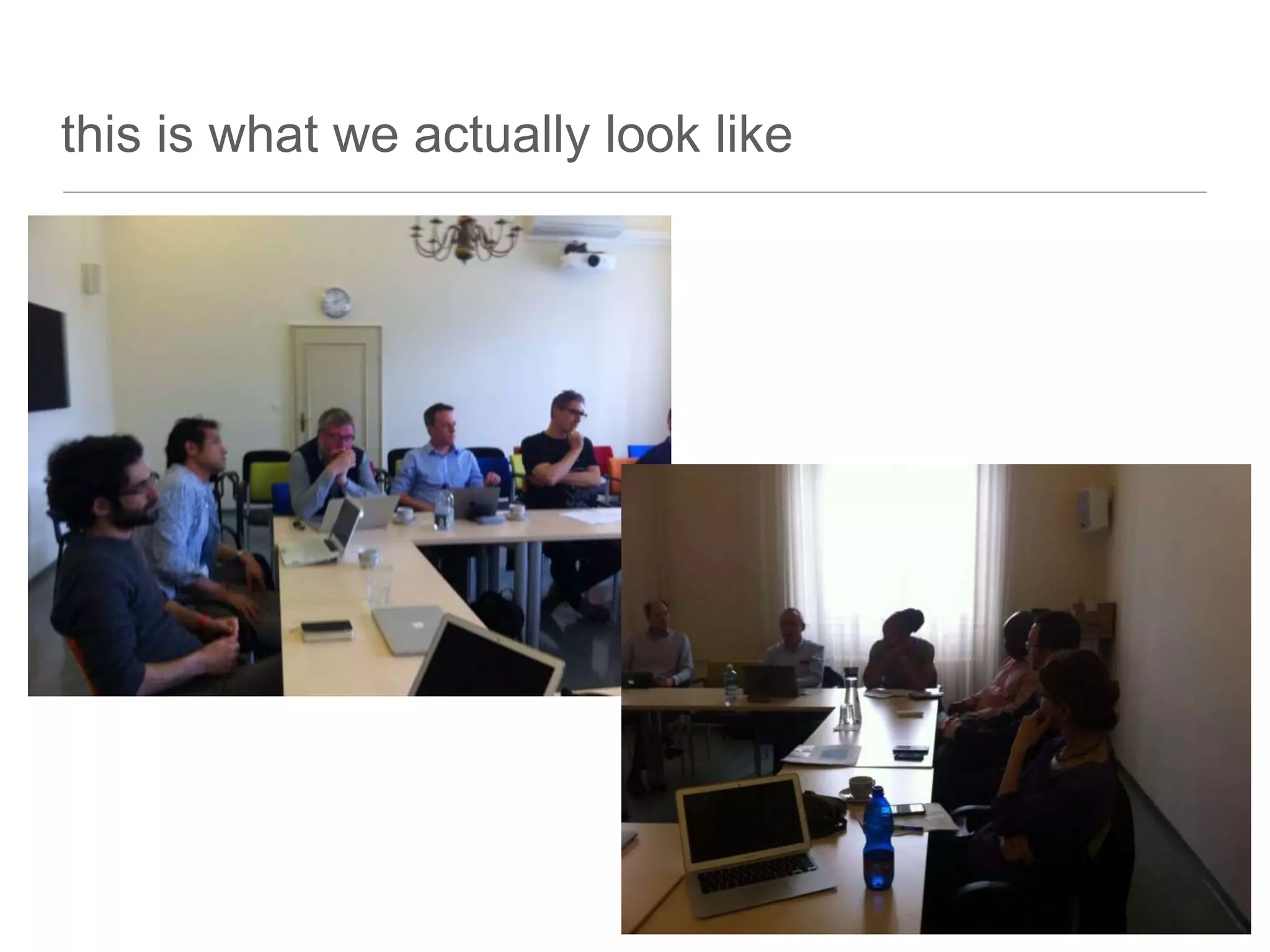
this is what we actually look like
To position repositories as the
foundation for a distributed, globally
networked infrastructure for scholarly
communication…
why focus on repositories?
3 cheers for repositories!
https://flic.kr/p/JqESVd
cheer #1:
proven technology,
ubiquitous in our
institutions
cheer #2:
strong community
support
cheer #3:
distributed policy
control
The working group asserts that:
“The nearly ubiquitous deployment of
repository systems in higher education
and research institutions provides the
foundation for a distributed, globally
networked infrastructure for scholarly
communication.”
However, the working group also
recognises that:
“…repository platforms are still using
technologies and protocols designed
almost twenty years ago, before the
boom of the Web and the dominance of
Google, social networking, semantic web
and ubiquitous mobile devices.”
two of the ideas being
discussed
1. Being of, not just on The Web
• obvious…but not really done yet
• the ‘splash page’ requiring human
mediation is a real problem
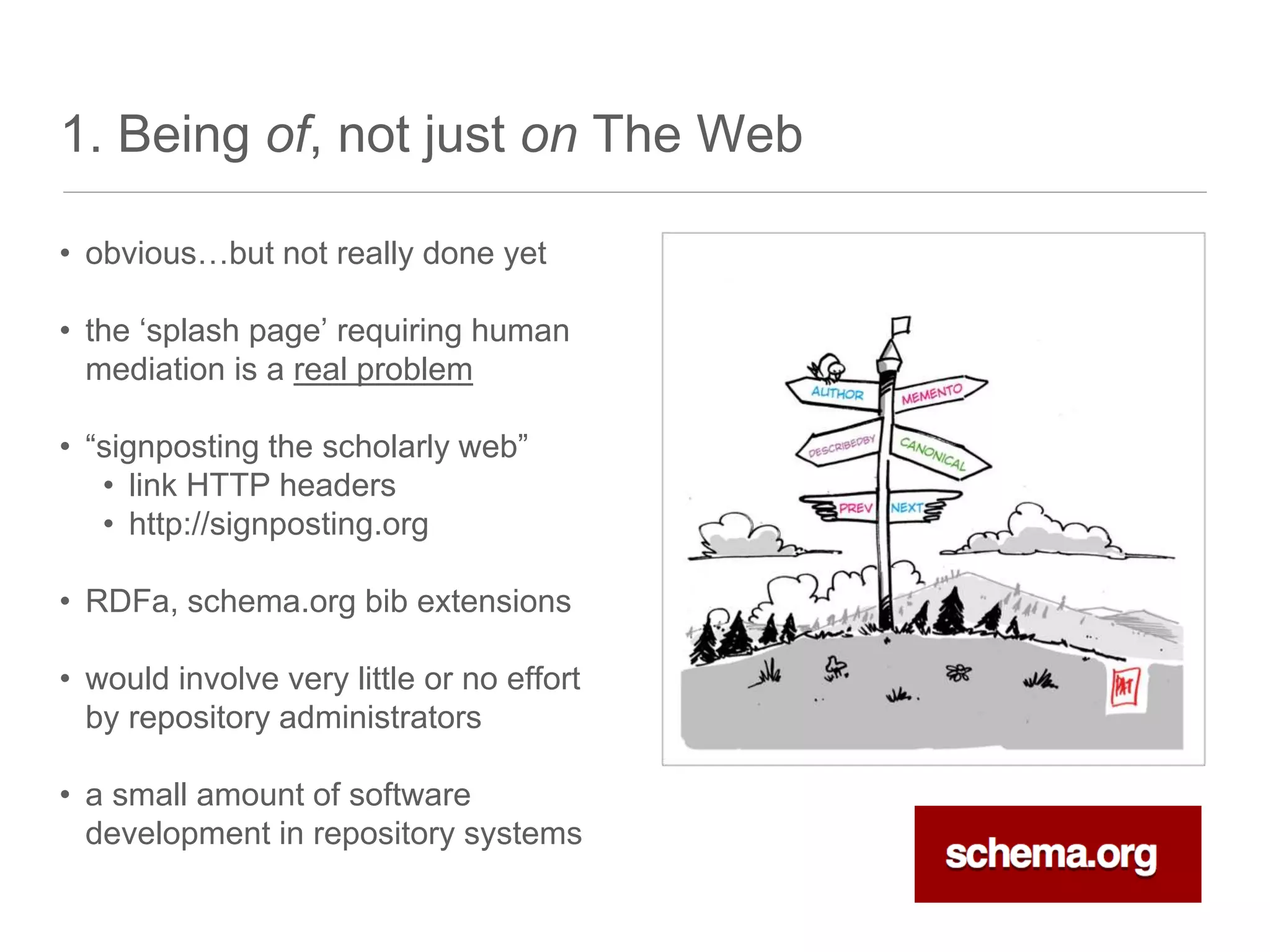
• “signposting the scholarly web”
• link HTTP headers
• http://signposting.org
• RDFa, schema.org bib extensions
• would involve very little or no effort
by repository administrators
• a small amount of software
development in repository systems
2. Pro-active repositories
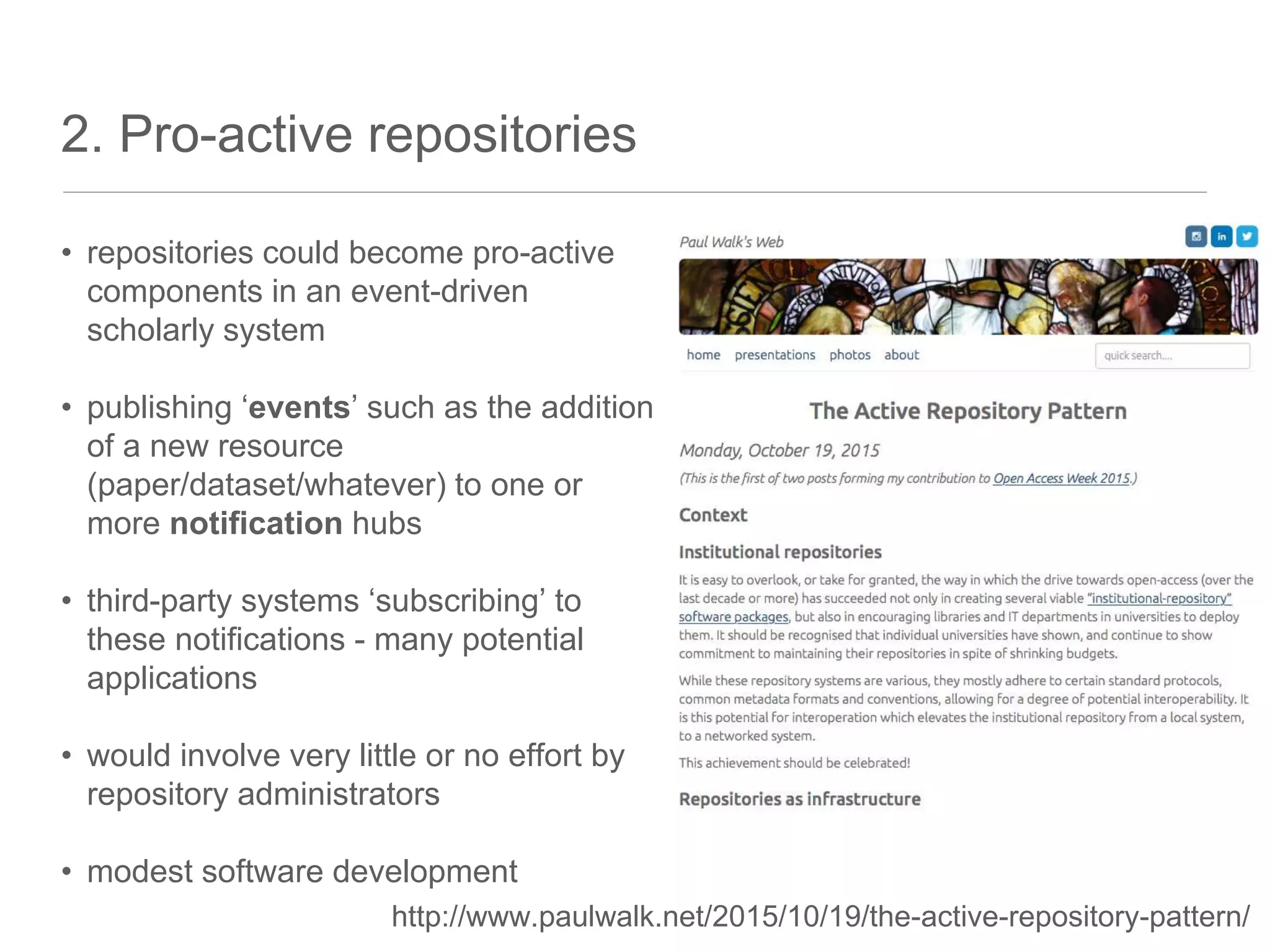
• repositories could become pro-active
components in an event-driven
scholarly system
• publishing ‘events’ such as the addition
of a new resource
(paper/dataset/whatever) to one or
more notification hubs
• third-party systems ‘subscribing’ to
these notifications - many potential
applications
• would involve very little or no effort by
repository administrators
• modest software development
http://www.paulwalk.net/2015/10/19/the-active-repository-pattern/
imagine if:
your repository could immediately notify a
funder that a compliant open-access
paper had been made available, and the
funder's system could then easily and
automatically retrieve a copy
depositing a dataset into an institutional
repository automatically notified a set of
data-processing & preservation services
many other ideas being discussed
• Discovery
• web-friendly repository technologies and architectures
• (quasi)peer-to-peer and/or notification pub-sub architectures
• Assessment
• overlay services on top of repositories using standardised registration,
open peer-review and quality assessment services
• Workflows
• support the full lifecycle of research
• cross-repository workflows
• automated and continuous publishing of research artefacts
• Impact
• reliable and interoperable impact metrics for repository content
thanks for listening!
more info:
http://bit.ly/coar-repo-ng
1. Preliminary findings for public review later this year
2. Final report in early 2017
I lied.

COAR Next Generation Repositories Working Group

  • 1.
    Paul Walk Head ofTechnology Strategy and Planning, EDINA p.walk@ed.ac.uk @paulwalk COAR Next Generation Repositories WG
  • 2.
  • 4.
    what is theRepositories Next Generation Working Group?
  • 5.
    ...resisting the obviousStar Trek: Next Generation joke here...
  • 6.
    Repositories Next GenerationWorking Group • Eloy Rodrigues, chair (COAR, Portugal) • Andrea Bollini (CINECA, Italy) • Alberto Cabezas (LA Referencia, Chile) • Donatella Castelli (OpenAIRE/CNR, Italy) • Les Carr (Southampton University, UK) • Leslie Chan (University of Toronto at Scarborough, Canada) • Rick Johnson (SHARE/University of Notre Dame, US) • Petr Knoth (Jisc and Open University, UK) • Paolo Manghi (CNR, Italy) • Lazarus Matizirofa (NRF, South Africa) • Pandelis Perakakis (Open Scholar, Spain) • Oya Rieger (Cornell University, US) • Jochen Schirrwagen (University of Bielefeld, Germany) • Daisy Selematsela (NRF, South Africa) • Kathleen Shearer (COAR, Canada) • Tim Smith (CERN, Switzerland) • Herbert Van de Sompel (Los Alamos National Laboratory, US) • Paul Walk (EDINA, UK) • David Wilcox (Duraspace/Fedora, Canada) • ▪ Kazu Yamaji (National Institute of Informatics, Japan)
  • 7.
    this is whatwe actually look like
  • 8.
    To position repositoriesas the foundation for a distributed, globally networked infrastructure for scholarly communication…
  • 9.
    why focus onrepositories?
  • 10.
    3 cheers forrepositories! https://flic.kr/p/JqESVd
  • 11.
  • 12.
  • 13.
  • 14.
    The working groupasserts that: “The nearly ubiquitous deployment of repository systems in higher education and research institutions provides the foundation for a distributed, globally networked infrastructure for scholarly communication.”
  • 15.
    However, the workinggroup also recognises that: “…repository platforms are still using technologies and protocols designed almost twenty years ago, before the boom of the Web and the dominance of Google, social networking, semantic web and ubiquitous mobile devices.”
  • 16.
    two of theideas being discussed
  • 17.
    1. Being of,not just on The Web • obvious…but not really done yet • the ‘splash page’ requiring human mediation is a real problem • “signposting the scholarly web” • link HTTP headers • http://signposting.org • RDFa, schema.org bib extensions • would involve very little or no effort by repository administrators • a small amount of software development in repository systems
  • 18.
    2. Pro-active repositories •repositories could become pro-active components in an event-driven scholarly system • publishing ‘events’ such as the addition of a new resource (paper/dataset/whatever) to one or more notification hubs • third-party systems ‘subscribing’ to these notifications - many potential applications • would involve very little or no effort by repository administrators • modest software development http://www.paulwalk.net/2015/10/19/the-active-repository-pattern/
  • 19.
    imagine if: your repositorycould immediately notify a funder that a compliant open-access paper had been made available, and the funder's system could then easily and automatically retrieve a copy depositing a dataset into an institutional repository automatically notified a set of data-processing & preservation services
  • 20.
    many other ideasbeing discussed • Discovery • web-friendly repository technologies and architectures • (quasi)peer-to-peer and/or notification pub-sub architectures • Assessment • overlay services on top of repositories using standardised registration, open peer-review and quality assessment services • Workflows • support the full lifecycle of research • cross-repository workflows • automated and continuous publishing of research artefacts • Impact • reliable and interoperable impact metrics for repository content
  • 21.
    thanks for listening! moreinfo: http://bit.ly/coar-repo-ng 1. Preliminary findings for public review later this year 2. Final report in early 2017
  • 22.

Editor's Notes

  • #4 Confederation of Open Access Repositories international association with >100 members from 35 countries - 5 continents represented libraries, universities, research institutions, government funding agencies etc. University of Edinburgh is a long-standing member
  • #6 quite proud of myself for resisting that :-)
  • #7 the WG includes some luminaries from the world of repositories. And I'm in there too.
  • #8 yes, earnest looking people with laptops, in a back-room
  • #9 The vision “…on top of which layers of value added services will be deployed, thereby transforming the system, making it more research-centric, open to and supportive of innovation, while also collectively managed by the scholarly community.”
  • #10 aren’t they old hat?
  • #11 I’d like to propose 3 cheers for repositories I think this is the Portugal fans celebrating Euro 2016. I wanted to use a picture of Portsmouth fans cheering, but nothing came up on Flickr for some reason....
  • #12 most of our repository systems are built from technology which has been in near-continuous development for more than a decade.
  • #13 the community support for repository systems is considerable - look around you for the evidence of that! :-)
  • #14 the resources within our repositories are under the control of our institutions, not under the control of a handful of publishers monopoly avoidance startegy the most important aspect from my point of view
  • #15 so that’s good a real opportunity!
  • #16 so, there’s some work to do…
  • #17 looking at functional requirements
  • #18 Herbert Van de Sompel & Michael Nelson make the webpage itself both human and machine readable
  • #19 This blog post is why I was invited to join the COAR working group some interesting musing about peer-to-peer distributed control! alternatives to high-latency aggregation
  • #20 some quick wins
  • #21 focus areas
  • #22 that was a very shallow overview - please talk to me afterwards if you want to know more. more information - follow that link!
  • #23 sorry…