Guiding users through
data deposit
ROBIN RICE, DATA LIBRARIAN, R.RICE@ED.AC.UK
RDMF, FRIENDS HOUSE, LONDON, 29 APRIL 2015
Context
 Data Library perspective: supporting data users
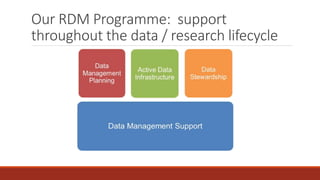
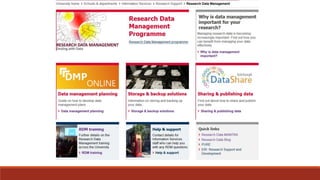
 Our RDM Programme: support throughout the data / research lifecycle
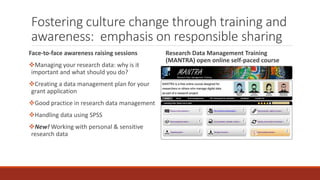
 Fostering culture change through training and awareness: emphasis on responsible sharing
 Incentivising open data sharing through our services (making it easy to ‘do the right thing’)
 Institutional multi-disciplinary data repository – getting the balance right
 Online demo of Edinburgh DataShare user documentation
Data Library perspective: supporting
data users
 Data Library established in 1983 to provide Population Census and other datasets for analysis
 Follows a North American model of institutional support
 We help users with queries like
 Does such data even exist?
 Where can I locate it?
 Who will pay for it?
 How can I access it?
 What does this documentation mean?
 How do I use it in X software?
 So our data repository aims to help users of data, not just depositors!
Our RDM Programme: support
throughout the data / research lifecycle
Fostering culture change through training and
awareness: emphasis on responsible sharing
Face-to-face awareness raising sessions
Managing your research data: why is it
important and what should you do?
Creating a data management plan for your
grant application
Good practice in research data management
Handling data using SPSS
New! Working with personal & sensitive
research data
Research Data Management Training
(MANTRA) open online self-paced course
Incentivising open data sharing through our
services (making it easy to ‘do the right thing’)
Provide separate data storage for active data or long-term safe-keeping, but only allow OPEN
data in DataShare
Embargo up to 5 years but not permanently
If registration or permission required, down to depositor to police/administer
 Open data licence by default (CC-BY 4.0 International)
Alternative rights field available, or upload own licence
 Suggested citation on landing page, DOI provided
 Only 5 required metadata fields
Guidance and repository administrators do encourage more
 Quick moderation, batch input, tar-balls and zips, large datasets (up to 10 GB per file)
Open download statistics for every data item, collection, community
Institutional multi-disciplinary data
repository – getting the balance right
 University RDM Policy:
 “Research data…will be offered and assessed for deposit and retention in an appropriate national or
international data service or domain repository, or a University repository.”
 CRIS as research data asset register
 We provide suggestions for data peer review, as well as other repositories
 We can’t be domain experts for everything – mutual trust with our depositors
 If it meets our definition of research data it can be approved; onus on users to vet
 Streamlined deposit workflow to lower ‘hassle’ barrier
Strive towards FAIRport initiative principles: Findable, Accessible, Interoperable, Re-usable
 Indexed in Data Citation Index; COUNTER-compliant via IRUS-UK; working with RDDS
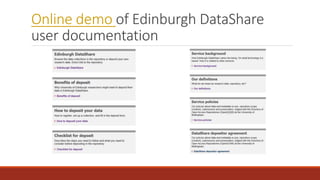
Online demo of Edinburgh DataShare
user documentation

Guiding users through data deposit

  • 1.
    Guiding users through datadeposit ROBIN RICE, DATA LIBRARIAN, R.RICE@ED.AC.UK RDMF, FRIENDS HOUSE, LONDON, 29 APRIL 2015
  • 2.
    Context  Data Libraryperspective: supporting data users  Our RDM Programme: support throughout the data / research lifecycle  Fostering culture change through training and awareness: emphasis on responsible sharing  Incentivising open data sharing through our services (making it easy to ‘do the right thing’)  Institutional multi-disciplinary data repository – getting the balance right  Online demo of Edinburgh DataShare user documentation
  • 3.
    Data Library perspective:supporting data users  Data Library established in 1983 to provide Population Census and other datasets for analysis  Follows a North American model of institutional support  We help users with queries like  Does such data even exist?  Where can I locate it?  Who will pay for it?  How can I access it?  What does this documentation mean?  How do I use it in X software?  So our data repository aims to help users of data, not just depositors!
  • 4.
    Our RDM Programme:support throughout the data / research lifecycle
  • 6.
    Fostering culture changethrough training and awareness: emphasis on responsible sharing Face-to-face awareness raising sessions Managing your research data: why is it important and what should you do? Creating a data management plan for your grant application Good practice in research data management Handling data using SPSS New! Working with personal & sensitive research data Research Data Management Training (MANTRA) open online self-paced course
  • 7.
    Incentivising open datasharing through our services (making it easy to ‘do the right thing’) Provide separate data storage for active data or long-term safe-keeping, but only allow OPEN data in DataShare Embargo up to 5 years but not permanently If registration or permission required, down to depositor to police/administer  Open data licence by default (CC-BY 4.0 International) Alternative rights field available, or upload own licence  Suggested citation on landing page, DOI provided  Only 5 required metadata fields Guidance and repository administrators do encourage more  Quick moderation, batch input, tar-balls and zips, large datasets (up to 10 GB per file) Open download statistics for every data item, collection, community
  • 8.
    Institutional multi-disciplinary data repository– getting the balance right  University RDM Policy:  “Research data…will be offered and assessed for deposit and retention in an appropriate national or international data service or domain repository, or a University repository.”  CRIS as research data asset register  We provide suggestions for data peer review, as well as other repositories  We can’t be domain experts for everything – mutual trust with our depositors  If it meets our definition of research data it can be approved; onus on users to vet  Streamlined deposit workflow to lower ‘hassle’ barrier Strive towards FAIRport initiative principles: Findable, Accessible, Interoperable, Re-usable  Indexed in Data Citation Index; COUNTER-compliant via IRUS-UK; working with RDDS
  • 9.
    Online demo ofEdinburgh DataShare user documentation