Paul Walk
Director & Founder, Antleaf
Email: paul@paulwalk.net www.antleaf.com
COAR Notify
COAR - Next Generation Repositories
To position repositories as the foundation
for a distributed, globally networked
infrastructure for scholarly communication
Principles
• distribution of control of scholarly resources
• inclusiveness: different institutions and regions have particular needs (e.g
diverse language, policies and priorities) and this must be supported
• for the public good
• useful openness - not just ticking the box of "openness"
Arcadia Funding
Specific objectives
1. Establish high-profile services in the domains of Humanities and Social Sciences, Life
Sciences, and in several national contexts that use the Notify protocol to support peer
review on repository resources
2. Develop, refine, and maintain the Notify protocol, including assessing and documenting further
valuable use cases
3. Significantly increase the opportunity for other players to use the Notify protocol by developing
the technical capability in a number of widely-used open source repository and peer review
software platforms
4. Support the development of a Notify-enabled open source platform for overlay journals, based
on an existing open source journal publishing platform
Arcadia, a charitable foundation that works to protect
nature, preserve cultural heritage and promote open
access to knowledge) has funded COAR Notify with
$4M for 4 years (project started in July 2024).
Context
• we have a globally-distributed network of repositories
• this is naturally resistant to monopolistic capture and control
• we have the Web and all the open standards we need
• all of which is mainstream technology
• avoiding creation of specialised "digital library" technologies
• Opportunity:
• the perceived importance of repository content is growing
• increased importance of pre-prints
• increasing number of data repositories
• "Repositories are having a moment!"
• there are services which can complement & exploit repository content
• peer-review
• endorsement
Strategy / Principles
• connect the resources in open-access repositories to related resources
in other repositories or services
• do this in a resource-oriented way
• pass by reference, not pass by copy
• use the Web - everything is accessible at a URL
• connect those URLs
• take advantage of the distributed network of repositories and services
• reduce our reliance on centralised services
• use a general solution
• don't create a new integration mechanism for each new service
• expensive - requires development effort and expertise
• increases "technological debt" over time - too much to maintain
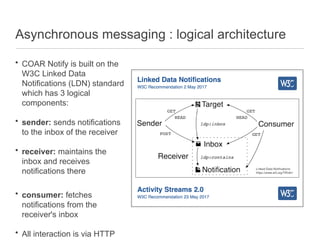
Asynchronous messaging : logical architecture
• COAR Notify is built on the
W3C Linked Data
Notifications (LDN) standard
which has 3 logical
components:
• sender: sends notifications
to the inbox of the receiver
• receiver: maintains the
inbox and receives
notifications there
• consumer: fetches
notifications from the
receiver's inbox
• All interaction is via HTTP
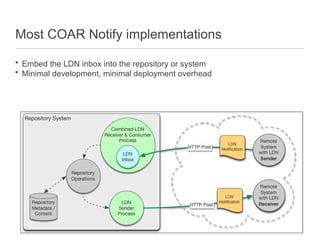
Most COAR Notify implementations
• Embed the LDN inbox into the repository or system
• Minimal development, minimal deployment overhead
Example use-case
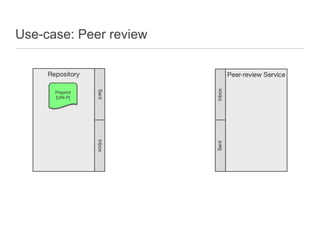
Use-case: Peer review
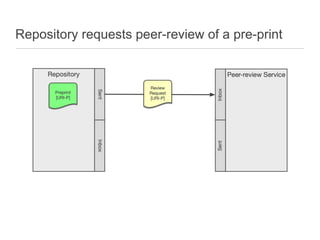
Repository requests peer-review of a pre-print
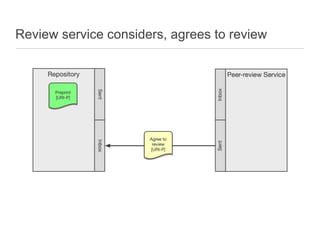
Review service considers, agrees to review
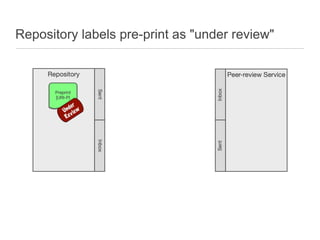
Repository labels pre-print as "under review"
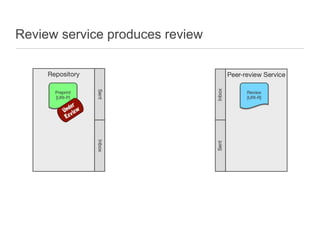
Review service produces review
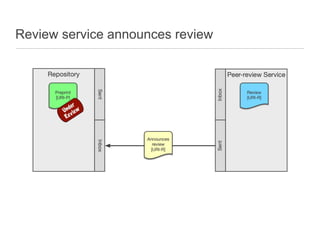
Review service announces review
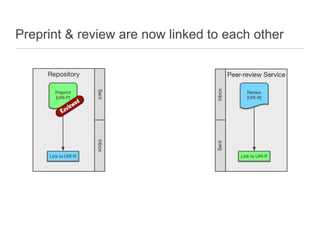
Preprint & review are now linked to each other
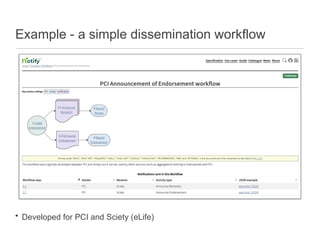
Example - a simple dissemination workflow
• Developed for PCI and Sciety (eLife)
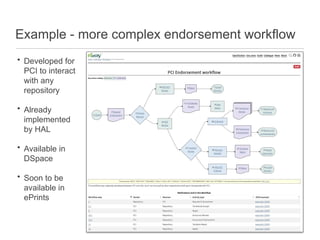
Example - more complex endorsement workflow
• Developed for
PCI to interact
with any
repository
• Already
implemented
by HAL
• Available in
DSpace
• Soon to be
available in
ePrints
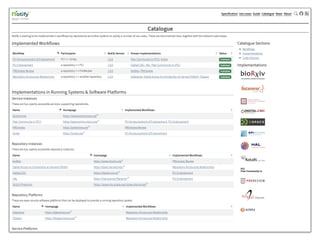
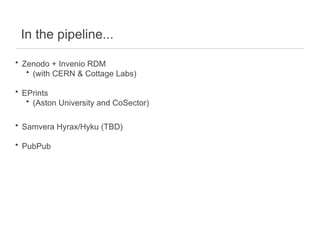
In the pipeline...
• Zenodo + Invenio RDM
• (with CERN & Cottage Labs)
• EPrints
• (Aston University and CoSector)
• Samvera Hyrax/Hyku (TBD)
• PubPub
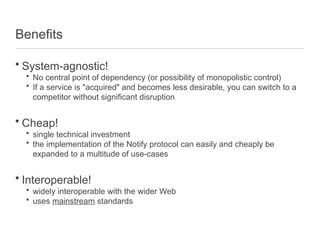
Benefits
• System-agnostic!
• No central point of dependency (or possibility of monopolistic control)
• If a service is "acquired" and becomes less desirable, you can switch to a
competitor without significant disruption
• Cheap!
• single technical investment
• the implementation of the Notify protocol can easily and cheaply be
expanded to a multitude of use-cases
• Interoperable!
• widely interoperable with the wider Web
• uses mainstream standards
Thank you!
Paul Walk
Director & Founder, Antleaf
Email: paul@paulwalk.net www.antleaf.com
https://coar-notify.net/

COAR Notify - presentation to PRC Meeting Lyon Notify

  • 1.
    Paul Walk Director &Founder, Antleaf Email: paul@paulwalk.net www.antleaf.com COAR Notify
  • 2.
    COAR - NextGeneration Repositories To position repositories as the foundation for a distributed, globally networked infrastructure for scholarly communication
  • 3.
    Principles • distribution ofcontrol of scholarly resources • inclusiveness: different institutions and regions have particular needs (e.g diverse language, policies and priorities) and this must be supported • for the public good • useful openness - not just ticking the box of "openness"
  • 5.
    Arcadia Funding Specific objectives 1.Establish high-profile services in the domains of Humanities and Social Sciences, Life Sciences, and in several national contexts that use the Notify protocol to support peer review on repository resources 2. Develop, refine, and maintain the Notify protocol, including assessing and documenting further valuable use cases 3. Significantly increase the opportunity for other players to use the Notify protocol by developing the technical capability in a number of widely-used open source repository and peer review software platforms 4. Support the development of a Notify-enabled open source platform for overlay journals, based on an existing open source journal publishing platform Arcadia, a charitable foundation that works to protect nature, preserve cultural heritage and promote open access to knowledge) has funded COAR Notify with $4M for 4 years (project started in July 2024).
  • 6.
    Context • we havea globally-distributed network of repositories • this is naturally resistant to monopolistic capture and control • we have the Web and all the open standards we need • all of which is mainstream technology • avoiding creation of specialised "digital library" technologies • Opportunity: • the perceived importance of repository content is growing • increased importance of pre-prints • increasing number of data repositories • "Repositories are having a moment!" • there are services which can complement & exploit repository content • peer-review • endorsement
  • 7.
    Strategy / Principles •connect the resources in open-access repositories to related resources in other repositories or services • do this in a resource-oriented way • pass by reference, not pass by copy • use the Web - everything is accessible at a URL • connect those URLs • take advantage of the distributed network of repositories and services • reduce our reliance on centralised services • use a general solution • don't create a new integration mechanism for each new service • expensive - requires development effort and expertise • increases "technological debt" over time - too much to maintain
  • 8.
    Asynchronous messaging :logical architecture • COAR Notify is built on the W3C Linked Data Notifications (LDN) standard which has 3 logical components: • sender: sends notifications to the inbox of the receiver • receiver: maintains the inbox and receives notifications there • consumer: fetches notifications from the receiver's inbox • All interaction is via HTTP
  • 9.
    Most COAR Notifyimplementations • Embed the LDN inbox into the repository or system • Minimal development, minimal deployment overhead
  • 10.
  • 11.
  • 12.
  • 13.
    Review service considers,agrees to review
  • 14.
    Repository labels pre-printas "under review"
  • 15.
  • 16.
  • 17.
    Preprint & revieware now linked to each other
  • 18.
    Example - asimple dissemination workflow • Developed for PCI and Sciety (eLife)
  • 19.
    Example - morecomplex endorsement workflow • Developed for PCI to interact with any repository • Already implemented by HAL • Available in DSpace • Soon to be available in ePrints
  • 22.
    In the pipeline... •Zenodo + Invenio RDM • (with CERN & Cottage Labs) • EPrints • (Aston University and CoSector) • Samvera Hyrax/Hyku (TBD) • PubPub
  • 23.
    Benefits • System-agnostic! • Nocentral point of dependency (or possibility of monopolistic control) • If a service is "acquired" and becomes less desirable, you can switch to a competitor without significant disruption • Cheap! • single technical investment • the implementation of the Notify protocol can easily and cheaply be expanded to a multitude of use-cases • Interoperable! • widely interoperable with the wider Web • uses mainstream standards
  • 24.
    Thank you! Paul Walk Director& Founder, Antleaf Email: paul@paulwalk.net www.antleaf.com https://coar-notify.net/

Editor's Notes

  • #3 by intelligent openness, I mean actually supporting re-use, not just making something ‘open’