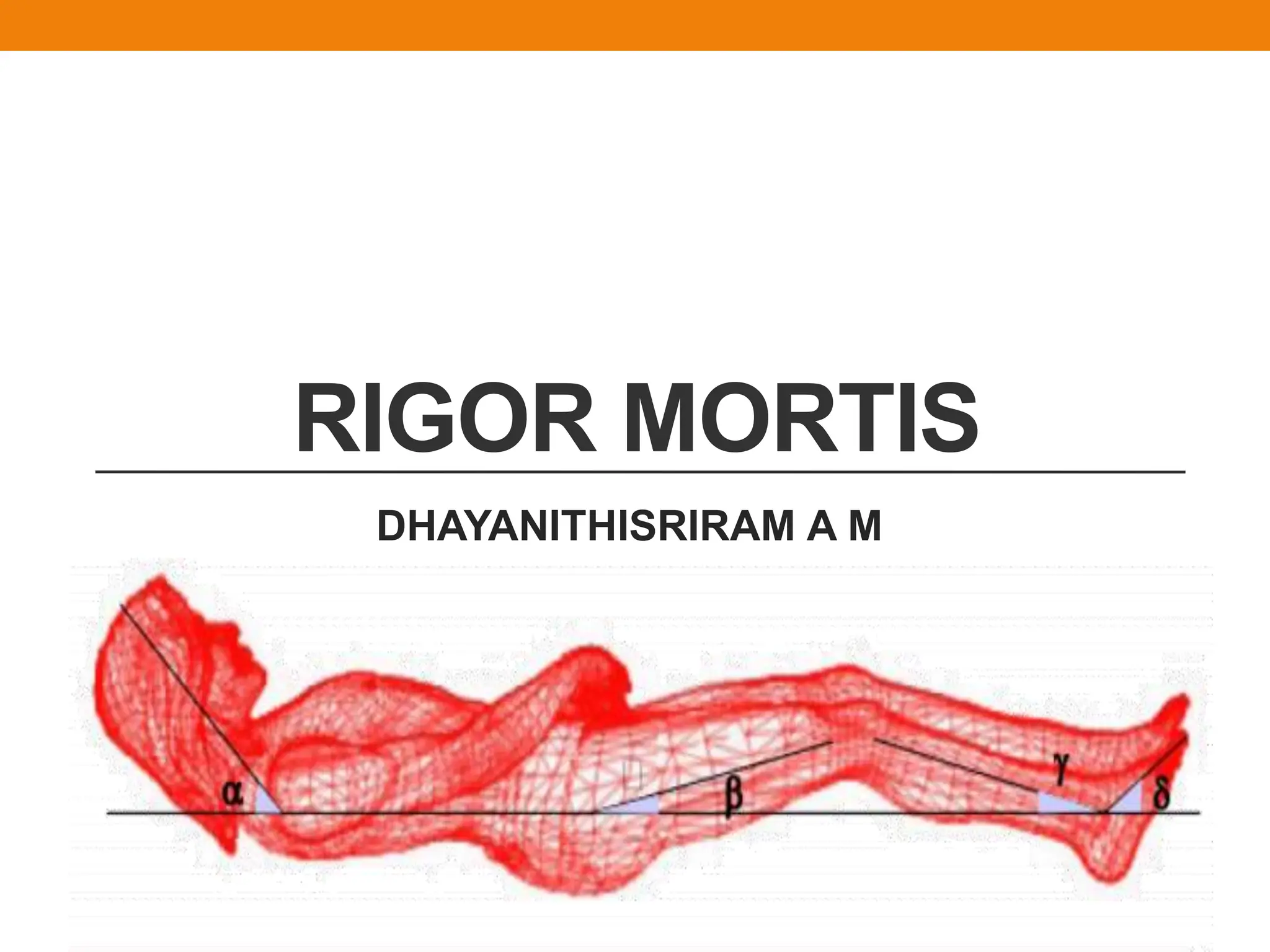
RIGOR MORTIS
DHAYANITHISRIRAM A M
DEATH
IMMEDIATE
CHANGE
EARLY CHANGE
RIGOR MORTIS
LATE CHANGE
CHANGES IN MUSCLE AFTER DEATH
PRIMARY RELAXATION
RIGOR MORTIS
SECONDARY RELAXATION
immediate relaxation of muscles after death
stiffening of muscles after death
rigor mortis disappear, muscles – soft &relaxed
PRIMARY RELAXATION
• During this stage, death is only somatic (no cellular death)
• All the muscles of the body begin to relax soon after death.
• Joints are flexible & muscle loose tension
• Contact flattening of body
• Muscle response to mechanical or electrical stimuli persist
• Peristalsis may occur in the bowel, with ciliary movements
• Pupils react to atropine or physostigmine. But not to light.
• Loss of tone of sphincters of bladder – cuz emptying of
Bladder
PRIMARY RELAXATION
• Muscles are relaxed as long as the ATP content
remains sufficiently high to permit the splitting of the
actin-myosin cross-bridges.
• Anaerobic chemical processes may continue in the
tissue cells to produce the ATP
• It lasts for 1- 2 hours.
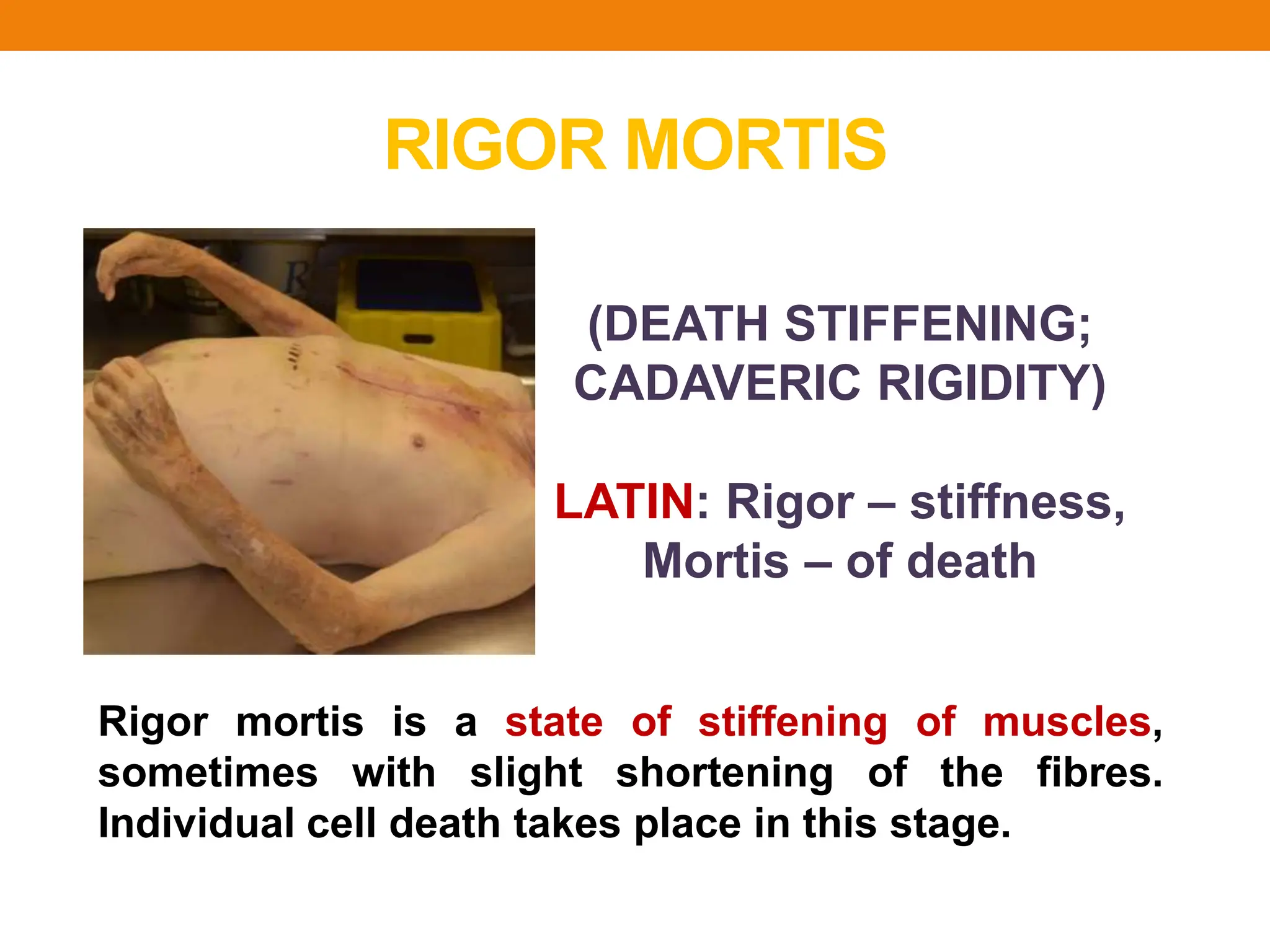
RIGOR MORTIS
(DEATH STIFFENING;
CADAVERIC RIGIDITY)
LATIN: Rigor – stiffness,
Mortis – of death
Rigor mortis is a state of stiffening of muscles,
sometimes with slight shortening of the fibres.
Individual cell death takes place in this stage.
MECHANISM
• Rigor mortis is a physico-chemical change that occurs within
muscles.
• During life, the separation of the actin and myosin filaments,
the energy needed for contraction are dependent on (ATP).
• 3 Metabolic systems - responsible for maintaining a continuous
supply of ATP in the muscle
(1) Phosphagen system.
(2) Glycogen-lactic acid system .
(3) Aerobic system.
• At the time of somatic death, enough ATP is present in the
muscle to maintain relaxation – PRIMARY RELAXATION
DEATH
CEASATION OF RESPIRATION
DEPLETION OF OXYGEN USED IN MAKING OF
ATP
lack of ATP – CUZ sarcoplasmic reticulum membrane disruption which PUMP calcium
IONS INTO TERMINAL CISTERNAE
CALCIUM IONS DIFFUSE FROM THE TERMINAL CISTERNAE AND
EXTRACELLULAR FLUID TO THE SACROMERE
CALCIUM BINDS WITH TROPONIN
CROSSBRIDGING BETWEEN MYOSIN & ACTIN FILAMENT
• After death the ATP is progressively and irreversibly
destroyed leading to increased accumulation of lactates and
phosphates in the muscles. There is no resynthesis of ATP.
• When the ATP is reduced to a critical level (85% of the normal),
the overlapping portions of myosin and actin filaments
combine as rigid link of actomyosin, which is viscous and
inextensible, and causes hardness and rigidity of muscle
rigor.
• Rigidity - is at maximum, when ATP is reduced to 15 %
• The actin-myosin complex is trapped in a state of contraction
until it is physically disrupted by the onset of putrefaction -
(proteolytic detachment) - loss of the structural integrity of the
contractile units – Cuz muscles soften and relax –
SECONDARY RELAXATION
ORDER OF APPEARANCE OF RIGOR
• All muscles of the body, both voluntary and involuntary
are affected.
• It does not start in all muscles simultaneously, It first
appears in involuntary muscles; then voluntary muscles
(Nysten's rule).
• rigor mortis is a physicochemical process, it is most likely
to develop simultaneously in all the muscles, although the
changes are more easily first detected in the smaller
masses than in the larger. (Shapiro (1950))
Proximo-distal Progression - sequence is determined
by the bulk and kind of muscle involved.
DEVELOPMENT
• The development of rigor is concerned with muscles only.
• Develop more slowly in paralysed limbs.
• When rigor is developing, the extremities can be moved and the
rigor, temporarily overcome, develops later and fixes the
extremities in their new position.
• If force is applied, when rigor is fully developed, stiffness is broken
up permanently and the rigid muscles may show postmortem
ruptures.
Skeletal muscle contains two types of fibres
(l)Type I (red)
(2)Type II (WHITE)
Rigor occurs at different times in the above types of muscles.
FEATURES
• When rigor is fully developed, the entire body is stiff, the
muscles shortened, hard and opaque;
• Knees, hips, shoulders and elbows - slightly flexed
• fingers and toes often - marked degree of flexion.
• Rigor of erector pilae muscles attached to the hair
follicles - cuz roughness, pimpling or goose-flesh
appearance of the skin with elevation of the cutaneous
hairs, known as cutis anserina or goose skin.
FEATURES
• Testes - drawn up into the groin; semen - forced
out of the seminal vesicles,
• Pupils - partially contracted.
• Rarely, if the uterus is in labour at the time of
death, the rigor mortis may cause the uterus to
contract and expel the foetus.
TESTING
Rigor is tested by
• Trying to lift the eyelids,
• Depressing the jaw,
• Gently bending the neck and various joints of the body,
The degree (absent, minimal, moderate, advanced or
complete) and distribution.
P.M. CHANGES CAUSED BY RIGOR MORTIS
• Heart - rigor causes ventricles to contract, which may
be mistaken for left ventricular hypertrophy - excluded by
measuring weight, estimating the relative size of left side
and measuring ventricular thickness.
• not possible to determine at autopsy whether a heart has
stopped in systole or diastole .
• Muscle relaxation immediately after death with opening of
the eyes and mouth and subsequent fixation - face the
appearance of grimacing.
TIME OF ONSET
In India
• begins one to two hours after death
• takes further one to two hours to develop.
In temperate countries
• begins in three to six hours
• takes further two to three hours to develop.
TIME OF ONSET & Duration
Begins 1
-2 hours after
death
well established
in 9 - 12 hours
usually it lasts
24 to 48 hours in
winter and, 18 to
36 hours in
summer.
disappear in
about 12hours.
When rigor sets in early , it passes off quickly and vice versa.
Times are variable, bez of many extrinsic and intrinsic factors.
RULE OF 12 !
CONDITIONS ALTERING THE ONSET AND
DURATION
• Rigor does not occur in foetus-less than seven months
• found in stillborn infants at full term.
• In healthy adults - develops slowly but well-marked & lasts longer
• children and old people - feeble and rapid.
AGE
• onset is slow and duration long - muscles are healthy and at rest before
death.
• onset is rapid, & duration short, if there is fatigue or exhaustion (violent
or heavy exercise, severe convulsions) before death.
MUSCUL
AR
STATE
• onset is slow & duration long - cold weather
• onset is rapid & duration is short - extremely hot environment
ATMOSP
HERIC
CONDITI
ONS
NATURE
OF
DEATH
CONDITIONS ALTERING THE ONSET AND
DURATION
NATURE OF DEATH
• Rigor mortis is frequently absent in persons dying from septicaemia.
EARLY ONSET
great exhaustion and wasting-cholera, typhoid,
TB, cancer
violent death as by cut-throat, firearms,
electrocution, lightning. organophosphate
poisoning, HCN and strychnine poisoning
DELAYED ONSET
asphyxia, severe haemorrhage,
pneumonia, and nervous disease
causing paralysis of muscle.
DELAYED DISAPPEARANCE
CO poisoning
RAPAIDLY DISAPPEARANCE
widespread bacterial infection, especially
in gas gangrene, where putrefaction
begins early.
DURATION PERSISTS LONGER.
HCN and strychnine poisoning
DURATION-SHORT IN DEATH
great exhaustion and wasting, e.g., cholera,
typhoid, tuberculosis, cancer, etc.
violent death as by cut-throat, firearms,
electrocution, lightning
MEDICOLEGAL IMPORTANCE
• (I) It is a sign of death.
• (2) Its extent helps in estimating the time of death,
which is not reliable.
• (3) It indicates the position of the body at the time of
death.
• If the body is lying on its back with its lower limbs raised in
the air, it indicates that the body reached full rigidity
elsewhere
CONDITIONS SIMULATING RIGORMORTIS
• Deaths from burning, high voltage electric shock and from falling
into hot liquid.
• temperatures above 65 °C - more marked rigor
• The degree and depth of the change depends on the intensity
of the heat and the time
• Heat causes stiffening of the muscles - Bez tissue proteins are
denatured and coagulated as in cooking.
• EARLY ONSET
• DURATION-SHORT IN DEATH
(1) Heat Stiffening:
CONDITIONS SIMULATING RIGORMORTIS
• When a body is exposed to freezing temperatures before
acid metabolites appear in the muscles, the tissues
become frozen and stiff, due to freezing of the body fluids
and solidification of subcutaneous fat simulating rigor.
• When the joints are forcibly flexed, ice breaks in the
synovial fluid with a sudden sharp sound
• If the body is placed in warm atmosphere, the stiffness
disappears and after a time, the normal rigor mortis
occurs rapidly and passes off quickly.
• Onset Is Slow & Duration Long - Cold Weather
(2) Cold Stiffening:
CONDITIONS SIMULATING RIGORMORTIS
Mechanism:
• Neurogenic and not chemical process like rigor.
• persistence of contraction after death - failure of the
active muscular relaxation to occur during molecular
death.
• Adrenocortical exhaustion which impairs resynthesis of
ATP may be a possible cause.
• It differs only in the speed of onset and the circumstances
in which it occurs.
(3) CADAVERIC SPASM OR INSTANTANEOUS RIGOR:
CONDITIONS SIMULATING RIGORMORTIS
Muscles involved:
• rare condition.
• Muscles that were contracted during life become stiff and rigid
immediately after death without passing into the stage of primary
relaxation.
• Change preserves the exact attitude of the person at the time of
death for several hours.
• The spasm is primarily vital phenomenon, it originates by normal
nervous stimulation of the muscles.
• Usually limited to a single group of voluntary muscles and
frequently involves the hands
• soldiers shot in battle - whole body affected when the body -may retain
the posture
(3) CADAVERIC SPASM OR INSTANTANEOUS RIGOR:
CONDITIONS SIMULATING RIGORMORTIS
Predisposing factors
• Especially in cases of intense physical and/or emotional
activity such as excitement, fear, severe pain, exhaustion,
• Cerebral haemorrhage, injury to the nervous system,
convulsant
• Firearm wound of the head, drowning,
• Poisons, such as strychnine, etc.
• Coagulation of protein is seen in burns on microscopic
examination but not in cadaveric spasm.
(3) CADAVERIC SPASM OR INSTANTANEOUS RIGOR:
CONDITIONS SIMULATING RIGORMORTIS
Medicolegal importance
(1) case of suicide, the weapon, e.g., pistol or knife - firmly
grasped in the victim's hand - strong presumptive evidence of
suicide.
But, rigor does not produce the same firm grip of a weapon
(2) If the deceased dies due to assault,
some part of clothing, e.g., button or some hair may be firmly
grasped in the hands.
(3) In case of drowning, material such as grass, weeds or
leaves may be found firmly grasped in the hands, which
indicates that the victim was alive on entering the water.
(3) CADAVERIC SPASM OR INSTANTANEOUS RIGOR:
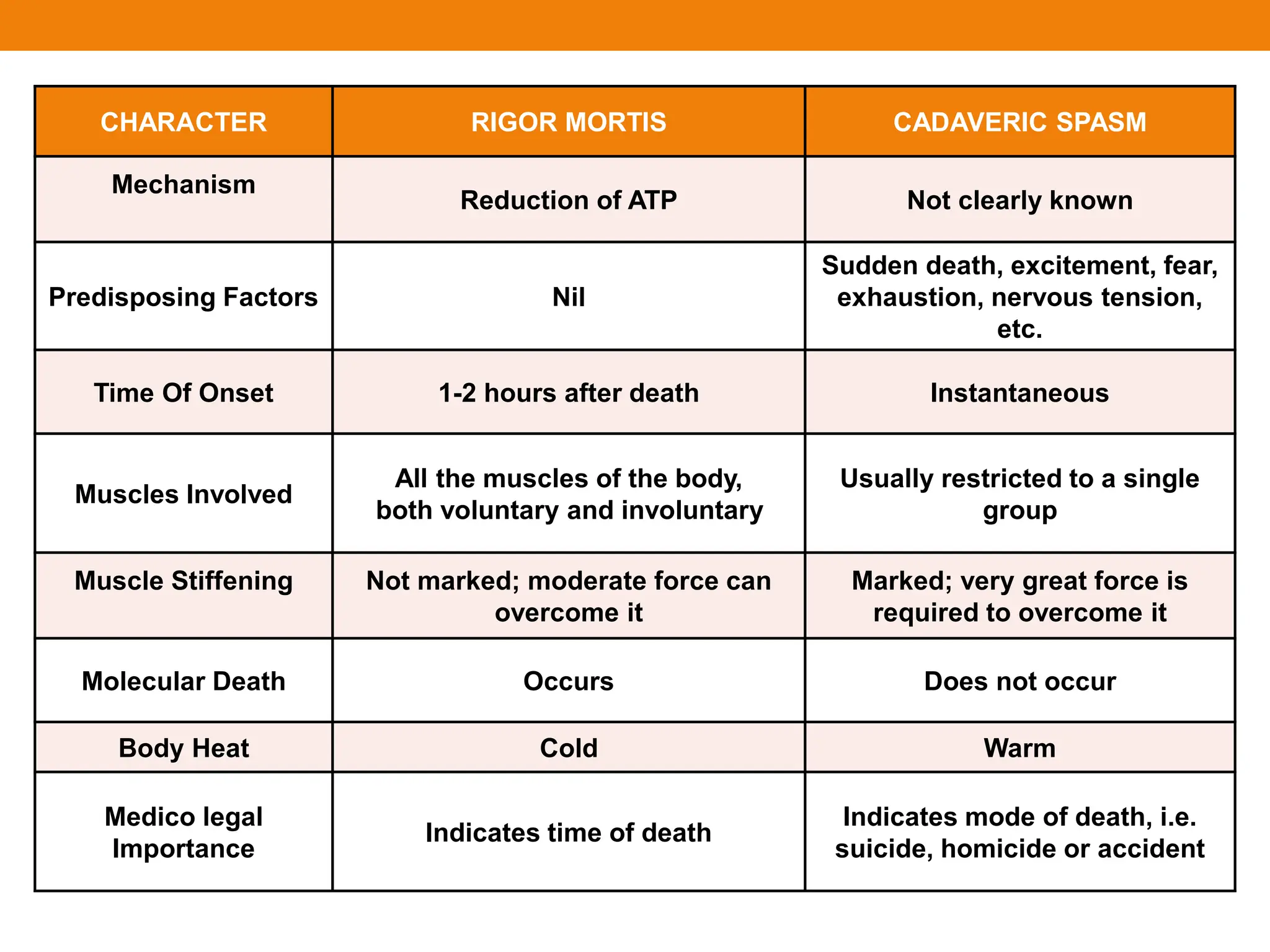
CHARACTER RIGOR MORTIS CADAVERIC SPASM
Mechanism
Reduction of ATP Not clearly known
Predisposing Factors Nil
Sudden death, excitement, fear,
exhaustion, nervous tension,
etc.
Time Of Onset 1-2 hours after death Instantaneous
Muscles Involved
All the muscles of the body,
both voluntary and involuntary
Usually restricted to a single
group
Muscle Stiffening Not marked; moderate force can
overcome it
Marked; very great force is
required to overcome it
Molecular Death Occurs Does not occur
Body Heat Cold Warm
Medico legal
Importance
Indicates time of death
Indicates mode of death, i.e.
suicide, homicide or accident
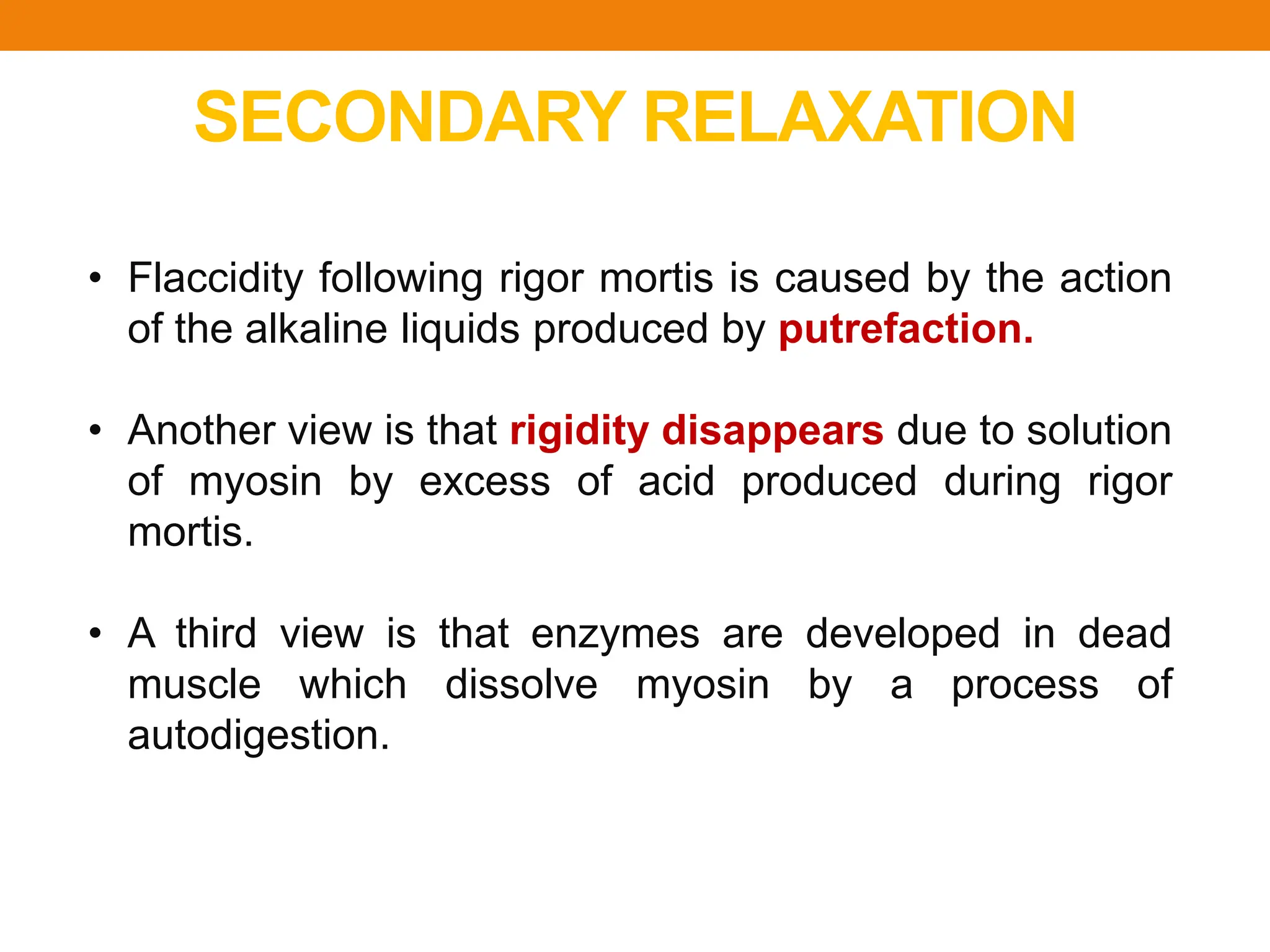
SECONDARY RELAXATION
• Flaccidity following rigor mortis is caused by the action
of the alkaline liquids produced by putrefaction.
• Another view is that rigidity disappears due to solution
of myosin by excess of acid produced during rigor
mortis.
• A third view is that enzymes are developed in dead
muscle which dissolve myosin by a process of
autodigestion.
THANKYOU

RIGOR MORTIS FORENSIC MEDICINE PRESENTATION

  • 1.
  • 2.
  • 3.
    CHANGES IN MUSCLEAFTER DEATH PRIMARY RELAXATION RIGOR MORTIS SECONDARY RELAXATION immediate relaxation of muscles after death stiffening of muscles after death rigor mortis disappear, muscles – soft &relaxed
  • 4.
    PRIMARY RELAXATION • Duringthis stage, death is only somatic (no cellular death) • All the muscles of the body begin to relax soon after death. • Joints are flexible & muscle loose tension • Contact flattening of body • Muscle response to mechanical or electrical stimuli persist • Peristalsis may occur in the bowel, with ciliary movements • Pupils react to atropine or physostigmine. But not to light. • Loss of tone of sphincters of bladder – cuz emptying of Bladder
  • 5.
    PRIMARY RELAXATION • Musclesare relaxed as long as the ATP content remains sufficiently high to permit the splitting of the actin-myosin cross-bridges. • Anaerobic chemical processes may continue in the tissue cells to produce the ATP • It lasts for 1- 2 hours.
  • 7.
    RIGOR MORTIS (DEATH STIFFENING; CADAVERICRIGIDITY) LATIN: Rigor – stiffness, Mortis – of death Rigor mortis is a state of stiffening of muscles, sometimes with slight shortening of the fibres. Individual cell death takes place in this stage.
  • 8.
    MECHANISM • Rigor mortisis a physico-chemical change that occurs within muscles. • During life, the separation of the actin and myosin filaments, the energy needed for contraction are dependent on (ATP). • 3 Metabolic systems - responsible for maintaining a continuous supply of ATP in the muscle (1) Phosphagen system. (2) Glycogen-lactic acid system . (3) Aerobic system. • At the time of somatic death, enough ATP is present in the muscle to maintain relaxation – PRIMARY RELAXATION
  • 9.
    DEATH CEASATION OF RESPIRATION DEPLETIONOF OXYGEN USED IN MAKING OF ATP lack of ATP – CUZ sarcoplasmic reticulum membrane disruption which PUMP calcium IONS INTO TERMINAL CISTERNAE CALCIUM IONS DIFFUSE FROM THE TERMINAL CISTERNAE AND EXTRACELLULAR FLUID TO THE SACROMERE CALCIUM BINDS WITH TROPONIN CROSSBRIDGING BETWEEN MYOSIN & ACTIN FILAMENT
  • 10.
    • After deaththe ATP is progressively and irreversibly destroyed leading to increased accumulation of lactates and phosphates in the muscles. There is no resynthesis of ATP. • When the ATP is reduced to a critical level (85% of the normal), the overlapping portions of myosin and actin filaments combine as rigid link of actomyosin, which is viscous and inextensible, and causes hardness and rigidity of muscle rigor. • Rigidity - is at maximum, when ATP is reduced to 15 % • The actin-myosin complex is trapped in a state of contraction until it is physically disrupted by the onset of putrefaction - (proteolytic detachment) - loss of the structural integrity of the contractile units – Cuz muscles soften and relax – SECONDARY RELAXATION
  • 11.
    ORDER OF APPEARANCEOF RIGOR • All muscles of the body, both voluntary and involuntary are affected. • It does not start in all muscles simultaneously, It first appears in involuntary muscles; then voluntary muscles (Nysten's rule). • rigor mortis is a physicochemical process, it is most likely to develop simultaneously in all the muscles, although the changes are more easily first detected in the smaller masses than in the larger. (Shapiro (1950))
  • 12.
    Proximo-distal Progression -sequence is determined by the bulk and kind of muscle involved.
  • 13.
    DEVELOPMENT • The developmentof rigor is concerned with muscles only. • Develop more slowly in paralysed limbs. • When rigor is developing, the extremities can be moved and the rigor, temporarily overcome, develops later and fixes the extremities in their new position. • If force is applied, when rigor is fully developed, stiffness is broken up permanently and the rigid muscles may show postmortem ruptures. Skeletal muscle contains two types of fibres (l)Type I (red) (2)Type II (WHITE) Rigor occurs at different times in the above types of muscles.
  • 14.
    FEATURES • When rigoris fully developed, the entire body is stiff, the muscles shortened, hard and opaque; • Knees, hips, shoulders and elbows - slightly flexed • fingers and toes often - marked degree of flexion. • Rigor of erector pilae muscles attached to the hair follicles - cuz roughness, pimpling or goose-flesh appearance of the skin with elevation of the cutaneous hairs, known as cutis anserina or goose skin.
  • 15.
    FEATURES • Testes -drawn up into the groin; semen - forced out of the seminal vesicles, • Pupils - partially contracted. • Rarely, if the uterus is in labour at the time of death, the rigor mortis may cause the uterus to contract and expel the foetus.
  • 16.
    TESTING Rigor is testedby • Trying to lift the eyelids, • Depressing the jaw, • Gently bending the neck and various joints of the body, The degree (absent, minimal, moderate, advanced or complete) and distribution.
  • 17.
    P.M. CHANGES CAUSEDBY RIGOR MORTIS • Heart - rigor causes ventricles to contract, which may be mistaken for left ventricular hypertrophy - excluded by measuring weight, estimating the relative size of left side and measuring ventricular thickness. • not possible to determine at autopsy whether a heart has stopped in systole or diastole . • Muscle relaxation immediately after death with opening of the eyes and mouth and subsequent fixation - face the appearance of grimacing.
  • 18.
    TIME OF ONSET InIndia • begins one to two hours after death • takes further one to two hours to develop. In temperate countries • begins in three to six hours • takes further two to three hours to develop.
  • 19.
    TIME OF ONSET& Duration Begins 1 -2 hours after death well established in 9 - 12 hours usually it lasts 24 to 48 hours in winter and, 18 to 36 hours in summer. disappear in about 12hours. When rigor sets in early , it passes off quickly and vice versa. Times are variable, bez of many extrinsic and intrinsic factors. RULE OF 12 !
  • 21.
    CONDITIONS ALTERING THEONSET AND DURATION • Rigor does not occur in foetus-less than seven months • found in stillborn infants at full term. • In healthy adults - develops slowly but well-marked & lasts longer • children and old people - feeble and rapid. AGE • onset is slow and duration long - muscles are healthy and at rest before death. • onset is rapid, & duration short, if there is fatigue or exhaustion (violent or heavy exercise, severe convulsions) before death. MUSCUL AR STATE • onset is slow & duration long - cold weather • onset is rapid & duration is short - extremely hot environment ATMOSP HERIC CONDITI ONS NATURE OF DEATH
  • 22.
    CONDITIONS ALTERING THEONSET AND DURATION NATURE OF DEATH • Rigor mortis is frequently absent in persons dying from septicaemia. EARLY ONSET great exhaustion and wasting-cholera, typhoid, TB, cancer violent death as by cut-throat, firearms, electrocution, lightning. organophosphate poisoning, HCN and strychnine poisoning DELAYED ONSET asphyxia, severe haemorrhage, pneumonia, and nervous disease causing paralysis of muscle. DELAYED DISAPPEARANCE CO poisoning RAPAIDLY DISAPPEARANCE widespread bacterial infection, especially in gas gangrene, where putrefaction begins early. DURATION PERSISTS LONGER. HCN and strychnine poisoning DURATION-SHORT IN DEATH great exhaustion and wasting, e.g., cholera, typhoid, tuberculosis, cancer, etc. violent death as by cut-throat, firearms, electrocution, lightning
  • 23.
    MEDICOLEGAL IMPORTANCE • (I)It is a sign of death. • (2) Its extent helps in estimating the time of death, which is not reliable. • (3) It indicates the position of the body at the time of death. • If the body is lying on its back with its lower limbs raised in the air, it indicates that the body reached full rigidity elsewhere
  • 24.
    CONDITIONS SIMULATING RIGORMORTIS •Deaths from burning, high voltage electric shock and from falling into hot liquid. • temperatures above 65 °C - more marked rigor • The degree and depth of the change depends on the intensity of the heat and the time • Heat causes stiffening of the muscles - Bez tissue proteins are denatured and coagulated as in cooking. • EARLY ONSET • DURATION-SHORT IN DEATH (1) Heat Stiffening:
  • 25.
    CONDITIONS SIMULATING RIGORMORTIS •When a body is exposed to freezing temperatures before acid metabolites appear in the muscles, the tissues become frozen and stiff, due to freezing of the body fluids and solidification of subcutaneous fat simulating rigor. • When the joints are forcibly flexed, ice breaks in the synovial fluid with a sudden sharp sound • If the body is placed in warm atmosphere, the stiffness disappears and after a time, the normal rigor mortis occurs rapidly and passes off quickly. • Onset Is Slow & Duration Long - Cold Weather (2) Cold Stiffening:
  • 26.
    CONDITIONS SIMULATING RIGORMORTIS Mechanism: •Neurogenic and not chemical process like rigor. • persistence of contraction after death - failure of the active muscular relaxation to occur during molecular death. • Adrenocortical exhaustion which impairs resynthesis of ATP may be a possible cause. • It differs only in the speed of onset and the circumstances in which it occurs. (3) CADAVERIC SPASM OR INSTANTANEOUS RIGOR:
  • 27.
    CONDITIONS SIMULATING RIGORMORTIS Musclesinvolved: • rare condition. • Muscles that were contracted during life become stiff and rigid immediately after death without passing into the stage of primary relaxation. • Change preserves the exact attitude of the person at the time of death for several hours. • The spasm is primarily vital phenomenon, it originates by normal nervous stimulation of the muscles. • Usually limited to a single group of voluntary muscles and frequently involves the hands • soldiers shot in battle - whole body affected when the body -may retain the posture (3) CADAVERIC SPASM OR INSTANTANEOUS RIGOR:
  • 28.
    CONDITIONS SIMULATING RIGORMORTIS Predisposingfactors • Especially in cases of intense physical and/or emotional activity such as excitement, fear, severe pain, exhaustion, • Cerebral haemorrhage, injury to the nervous system, convulsant • Firearm wound of the head, drowning, • Poisons, such as strychnine, etc. • Coagulation of protein is seen in burns on microscopic examination but not in cadaveric spasm. (3) CADAVERIC SPASM OR INSTANTANEOUS RIGOR:
  • 29.
    CONDITIONS SIMULATING RIGORMORTIS Medicolegalimportance (1) case of suicide, the weapon, e.g., pistol or knife - firmly grasped in the victim's hand - strong presumptive evidence of suicide. But, rigor does not produce the same firm grip of a weapon (2) If the deceased dies due to assault, some part of clothing, e.g., button or some hair may be firmly grasped in the hands. (3) In case of drowning, material such as grass, weeds or leaves may be found firmly grasped in the hands, which indicates that the victim was alive on entering the water. (3) CADAVERIC SPASM OR INSTANTANEOUS RIGOR:
  • 31.
    CHARACTER RIGOR MORTISCADAVERIC SPASM Mechanism Reduction of ATP Not clearly known Predisposing Factors Nil Sudden death, excitement, fear, exhaustion, nervous tension, etc. Time Of Onset 1-2 hours after death Instantaneous Muscles Involved All the muscles of the body, both voluntary and involuntary Usually restricted to a single group Muscle Stiffening Not marked; moderate force can overcome it Marked; very great force is required to overcome it Molecular Death Occurs Does not occur Body Heat Cold Warm Medico legal Importance Indicates time of death Indicates mode of death, i.e. suicide, homicide or accident
  • 32.
    SECONDARY RELAXATION • Flaccidityfollowing rigor mortis is caused by the action of the alkaline liquids produced by putrefaction. • Another view is that rigidity disappears due to solution of myosin by excess of acid produced during rigor mortis. • A third view is that enzymes are developed in dead muscle which dissolve myosin by a process of autodigestion.
  • 33.