RIGHT AND LEFT SIDE HEART
FAILURE
PRESENTED TO: Mr. QAMAR ZAMAN
PRESNENTED BY: RAHOUL GHOURI
INTRODUCTION
 Heart failure is a condition where the heart can’t
pump enough blood to meet the body’s demands.
The heart muscles are weakened, and they can’t
work as effectively as before. When this happens,
tissues throughout the body are deprived of oxygen
and other crucial nutrients.
 Heart failure is usually divided into two categories
based on which side of the heart it mainly affects.
The right side of the heart collects oxygen-depleted
blood from the body and brings it to the lungs to be
filled with fresh oxygen. The left side of the heart
receives oxygen-rich blood from the lungs and
sends it out to the rest of the body.
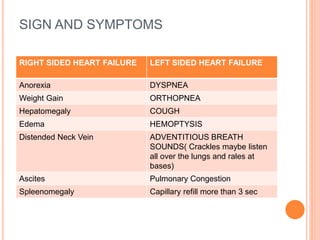
SIGN AND SYMPTOMS
RIGHT SIDED HEART FAILURE LEFT SIDED HEART FAILURE
Anorexia DYSPNEA
Weight Gain ORTHOPNEA
Hepatomegaly COUGH
Edema HEMOPTYSIS
Distended Neck Vein ADVENTITIOUS BREATH
SOUNDS( Crackles maybe listen
all over the lungs and rales at
bases)
Ascites Pulmonary Congestion
Spleenomegaly Capillary refill more than 3 sec
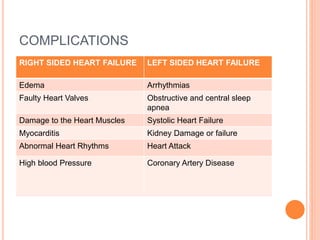
COMPLICATIONS
RIGHT SIDED HEART FAILURE LEFT SIDED HEART FAILURE
Edema Arrhythmias
Faulty Heart Valves Obstructive and central sleep
apnea
Damage to the Heart Muscles Systolic Heart Failure
Myocarditis Kidney Damage or failure
Abnormal Heart Rhythms Heart Attack
High blood Pressure Coronary Artery Disease
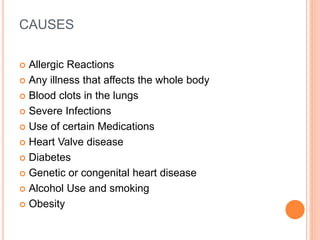
CAUSES
 Allergic Reactions
 Any illness that affects the whole body
 Blood clots in the lungs
 Severe Infections
 Use of certain Medications
 Heart Valve disease
 Diabetes
 Genetic or congenital heart disease
 Alcohol Use and smoking
 Obesity
NURSING MANAGEMENT
 Assess the general condition of the patient
 Monitor the vital signs and circulation
 Administer oxygen
 Closely monitor the ECG changes of the patient
 Gather information about patient symptoms and
activities in PQRST format
 Assess patient risk factors for CAD
 Assess patient’s family understanding about the
diagnosis
 Monitor patient’s pulse rate and Bp
NURSING MANAGEMENT
 Monitor the oxygen saturation level frequently
 Monitor the lab values
 Keep the defibrillator and emergency tray ready at
patient’s side
 Provide psychological support to the patient
 Teach the patient’s family about the compliance of
the medications.
 Modification of the diet according to the causing
factor of the disease
MEDICAL MANAGEMENT
 Beta blockers. These drugs slow your heart rate
and reduce blood pressure. Beta blockers may
reduce signs and symptoms of heart failure,
improve heart function, and help you live longer
 Diuretics. Often called water pills, diuretics make
you urinate more frequently and keep fluid from
collecting in your body. Diuretics, such as
furosemide (Lasix), also decrease fluid in your
lungs so you can breathe more easily
MEDICAL MANAGEMENT
 Digoxin . This drug, also called digitalis, increases
the strength of your heart muscle contractions. It
also tends to slow the heartbeat. Digoxin reduces
heart failure symptoms in systolic heart failure. It
may be more likely to be given to someone with a
heart rhythm problem, such as atrial fibrillation.
 Angiotensin-converting enzyme (ACE)
inhibitors. These drugs relax blood vessels to lower
blood pressure, improve blood flow and decrease
the strain on the heart. Examples include enalapril
(Vasotec, Epaned), lisinopril (Zestril, Qbrelis,
Prinivil) and captopril.
SURGICAL MANAGEMENT
 Angioplasty
 Stents
 Coronary artery bypass Grafting
(CABG
THANKYOU

RIGHT AND LEFT SIDED HEART FAILURE.pptx

  • 1.
    RIGHT AND LEFTSIDE HEART FAILURE PRESENTED TO: Mr. QAMAR ZAMAN PRESNENTED BY: RAHOUL GHOURI
  • 2.
    INTRODUCTION  Heart failureis a condition where the heart can’t pump enough blood to meet the body’s demands. The heart muscles are weakened, and they can’t work as effectively as before. When this happens, tissues throughout the body are deprived of oxygen and other crucial nutrients.  Heart failure is usually divided into two categories based on which side of the heart it mainly affects. The right side of the heart collects oxygen-depleted blood from the body and brings it to the lungs to be filled with fresh oxygen. The left side of the heart receives oxygen-rich blood from the lungs and sends it out to the rest of the body.
  • 3.
    SIGN AND SYMPTOMS RIGHTSIDED HEART FAILURE LEFT SIDED HEART FAILURE Anorexia DYSPNEA Weight Gain ORTHOPNEA Hepatomegaly COUGH Edema HEMOPTYSIS Distended Neck Vein ADVENTITIOUS BREATH SOUNDS( Crackles maybe listen all over the lungs and rales at bases) Ascites Pulmonary Congestion Spleenomegaly Capillary refill more than 3 sec
  • 4.
    COMPLICATIONS RIGHT SIDED HEARTFAILURE LEFT SIDED HEART FAILURE Edema Arrhythmias Faulty Heart Valves Obstructive and central sleep apnea Damage to the Heart Muscles Systolic Heart Failure Myocarditis Kidney Damage or failure Abnormal Heart Rhythms Heart Attack High blood Pressure Coronary Artery Disease
  • 5.
    CAUSES  Allergic Reactions Any illness that affects the whole body  Blood clots in the lungs  Severe Infections  Use of certain Medications  Heart Valve disease  Diabetes  Genetic or congenital heart disease  Alcohol Use and smoking  Obesity
  • 6.
    NURSING MANAGEMENT  Assessthe general condition of the patient  Monitor the vital signs and circulation  Administer oxygen  Closely monitor the ECG changes of the patient  Gather information about patient symptoms and activities in PQRST format  Assess patient risk factors for CAD  Assess patient’s family understanding about the diagnosis  Monitor patient’s pulse rate and Bp
  • 7.
    NURSING MANAGEMENT  Monitorthe oxygen saturation level frequently  Monitor the lab values  Keep the defibrillator and emergency tray ready at patient’s side  Provide psychological support to the patient  Teach the patient’s family about the compliance of the medications.  Modification of the diet according to the causing factor of the disease
  • 8.
    MEDICAL MANAGEMENT  Betablockers. These drugs slow your heart rate and reduce blood pressure. Beta blockers may reduce signs and symptoms of heart failure, improve heart function, and help you live longer  Diuretics. Often called water pills, diuretics make you urinate more frequently and keep fluid from collecting in your body. Diuretics, such as furosemide (Lasix), also decrease fluid in your lungs so you can breathe more easily
  • 9.
    MEDICAL MANAGEMENT  Digoxin. This drug, also called digitalis, increases the strength of your heart muscle contractions. It also tends to slow the heartbeat. Digoxin reduces heart failure symptoms in systolic heart failure. It may be more likely to be given to someone with a heart rhythm problem, such as atrial fibrillation.  Angiotensin-converting enzyme (ACE) inhibitors. These drugs relax blood vessels to lower blood pressure, improve blood flow and decrease the strain on the heart. Examples include enalapril (Vasotec, Epaned), lisinopril (Zestril, Qbrelis, Prinivil) and captopril.
  • 10.
    SURGICAL MANAGEMENT  Angioplasty Stents  Coronary artery bypass Grafting (CABG
  • 11.