OSTEOPOROSIS A Preventable Epidemic Dr Vispi Jokhi Orthopedic Surgeon
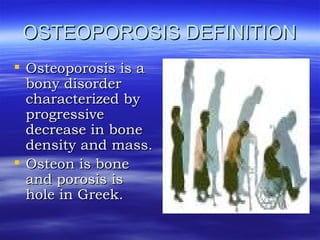
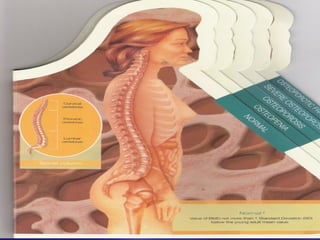
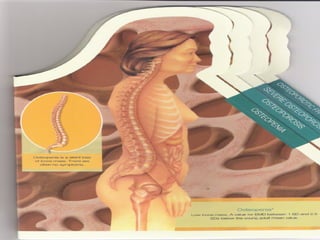
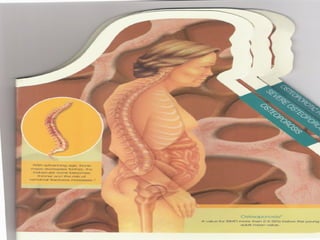
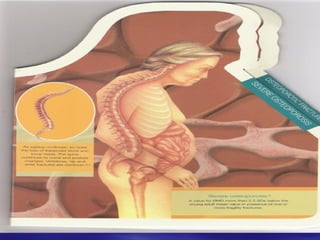
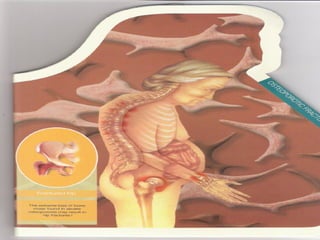
OSTEOPOROSIS DEFINITION Osteoporosis is a bony disorder characterized by progressive decrease in bone density and mass. Osteon is bone and porosis is hole in Greek.
EPIDEMIOLOGY Over 75 million osteoporotic patients in US, Europe and Japan. In India 26 million by 2003 expected to increase to 36 million by 2013.
EPIDEMIOLOGY Female male ratio 4:1 and higher incidence of male osteoporosis. 50% post-menopausal women affected. Normal Indian bones 15% less dense than Caucasians and fractures occur 10-20 years earlier in Indians.
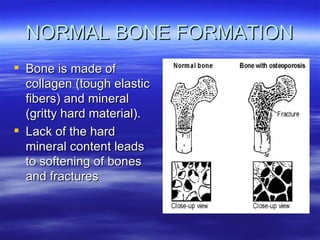
NORMAL BONE FORMATION Bone is made of collagen (tough elastic fibers) and mineral (gritty hard material). Lack of the hard mineral content leads to softening of bones and fractures
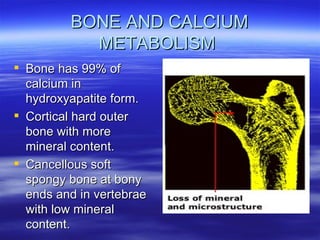
BONE AND CALCIUM METABOLISM  Bone has 99% of calcium in hydroxyapatite form. Cortical hard outer bone with more mineral content. Cancellous soft spongy bone at bony ends and in vertebrae with low mineral content.
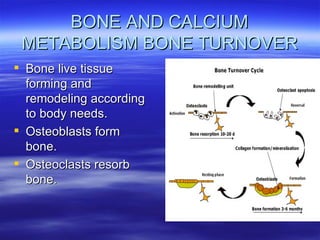
BONE AND CALCIUM METABOLISM BONE TURNOVER Bone live tissue forming and remodeling according to body needs. Osteoblasts form bone. Osteoclasts resorb bone.
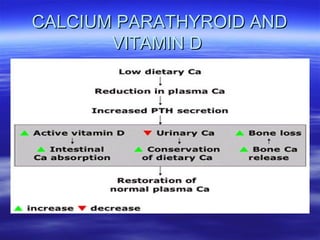
CALCIUM PARATHYROID AND VITAMIN D
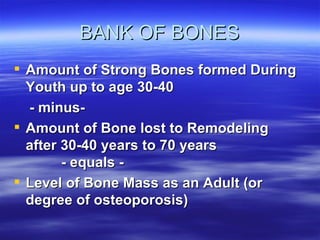
BANK OF BONES Amount of Strong Bones formed During Youth up to age 30-40  - minus- Amount of Bone lost to Remodeling after 30-40 years to 70 years  - equals - Level of Bone Mass as an Adult (or degree of osteoporosis)
OSTEOPOROSIS CAUSES Primary Osteoporosis due to nutritional causes. Couch Potato and sedentary life style. Age related or Senile Osteoporosis. Lack of sunshine leading to decreased active form of Vit D3
SECONDARY OSTEOPOROSIS Post Menopausal due to lack of estrogen which compensates for normal bone loss. Hyperthyroidism causes increased bone turnover. Hyperparathyroidism leads to increased bone resorption and hypercalcemia. Hypogonadism decreased testosterone leads to impotence and porosis. Liver disease leading to decreased bone formation
OSTEOPOROSIS DRUG RELATED Steroid intake over prolonged periods for arthritic, auto-immune, asthmatic and endocrinological disorders cause excessive bone resorption. Cyclosporine, heparin, vitamin A, certain synthetic retinoids and anti-epileptics affect the liver and cause decreased bone formation.
OSTEOPOROSIS RISK FACTORS History of fracture as an adult and in an immediate (first-degree) relative Low body weight (less than 127 lb [58 kg]) or weight loss Lifelong low calcium intake Current cigarette smoking Alcoholism Advanced age
OSTEOPOROSIS RISK FACTORS Estrogen deficiency menopause before age 45, surgical removal of both ovaries Inadequate physical activity Poor health Repeated falls Dementia (ie, progressive deterioration of intellectual abilities) Impaired vision despite adequate correction.
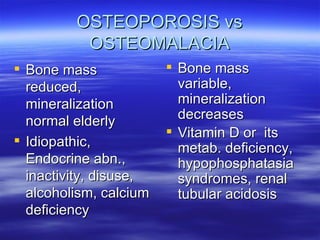
OSTEOPOROSIS vs OSTEOMALACIA Bone mass reduced, mineralization normal elderly  Idiopathic, Endocrine abn., inactivity, disuse, alcoholism, calcium deficiency  Bone mass variable, mineralization decreases  Vitamin D or  its metab. deficiency, hypophosphatasia syndromes, renal tubular acidosis
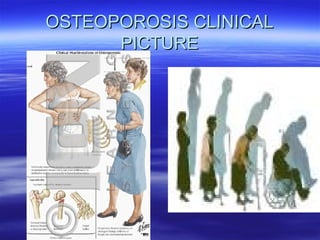
OSTEOPOROSIS CLINICAL PICTURE


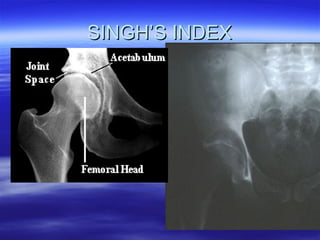
OSTEOPOROSIS DIAGNOSIS Clinical picture and risk factors most important. Radiological Hip Singh’s Index. Serological Se Calcium, Phosphorus and Alkaline Phosphatase. Other markers from blood and urine.
SINGH’S INDEX
BIOCHEMICAL MARKERS Vitamin K levels and undercarboxylated to carboxylated osteocalcin ratio. New Collagen type 1 measured by P1NP marker and mineralization by bone specific Alkaline Phosphatase. Bone resorption markers breakdown of collagen, include deoxypyridinoline and pyridinoline and their associated peptides (NTX and CTX).
BONE DENSITOMETRY Bone densitometry is a way of measuring your bone density, which is a method of estimating the strength of bones and the likelihood of bone fractures with minimal or no trauma.  On X-ray you will see changes only after 30-40% bone loss.
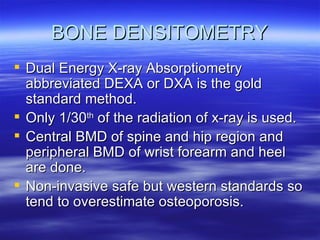
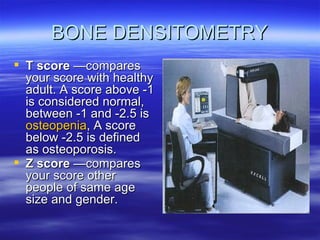
BONE DENSITOMETRY Dual Energy X-ray Absorptiometry abbreviated DEXA or DXA is the gold standard method. Only 1/30 th  of the radiation of x-ray is used. Central BMD of spine and hip region and peripheral BMD of wrist forearm and heel are done. Non-invasive safe but western standards so tend to overestimate osteoporosis.
BONE DENSITOMETRY T score  —compares your score with healthy adult. A score above -1 is considered normal, between -1 and -2.5 is  osteopenia , A score below -2.5 is defined as osteoporosis.  Z score  —compares your score other people of same age size and gender.
QUANTITATIVE  MRI To predict the mechanical properties of bone trabeculae To help quantify the element of osteoporosis as against osteomalacia Better follow-up investigation than BMD
OSTEOPOROSIS TREATMENT Diet calcium rich foods vs. calcium available foods. Milk cause of osteoporosis. Sugar a calcium stealer. Supplements of calcium along with active vitamin D only as a temporary measure. No smoking no alcohol no milk no sugar.
MILK Excessive Calcium is not digested as much as ingested as bound to complex protein. Excessive protein leads to acidity buffered by sodium and calcium  However prolonged excessive dairy product consumption leads to overuse and ageing of osteoblasts and depletion of bone matrix So bone cannot hold the calcium
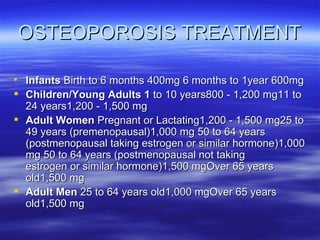
OSTEOPOROSIS TREATMENT Infants  Birth to 6 months 400mg 6 months to 1year 600mg  Children/Young Adults 1  to 10 years800 - 1,200 mg11 to 24 years1,200 - 1,500 mg Adult Women  Pregnant or Lactating1,200 - 1,500 mg25 to 49 years (premenopausal)1,000 mg 50 to 64 years (postmenopausal taking estrogen or similar hormone)1,000 mg 50 to 64 years (postmenopausal not taking estrogen or similar hormone)1,500 mgOver 65 years old1,500 mg Adult Men  25 to 64 years old1,000 mgOver 65 years old1,500 mg
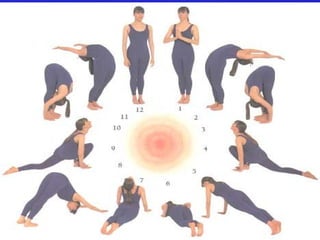
OSTEOPOROSIS TREATMENT Exercise in moderation at least 4-5 days a week for ½ to 1 hour. Stretches and weight lifting important. Yoga is holistic since the whole body is exercised.  Exposure to the early morning and late evening sunlight.
YOGA AND OSTEOPOROSIS Most complete holistic form of exercise. Most asanas can penetrate and make energy flow into all the cells of the body. Ability to involve the hip and pelvis region is much more than other forms of therapy.
 
OSTEOPOROSIS TREATMENT Hormone Replacement Therapy with estrogen and Selective estrogen receptor modulators (SERM’s).  Anti-resorptive therapies or biphosphonates also can be used in a crisis. Calcitonin injectable is used or in spray form. Active form of Vitamin D3 Alpha-calcidol and Calcitriol are also useful.
OSTEOPOROSIS TREATMENT Strontium Raleate acts by direct mineral deposition in bone Teriparatide injection a derived form of PTH is used in extremely severe forms of Osteoporosis
TAKE HOME MESSAGE Our health is in our hands and we must take responsibility for it. Life style modifications diet changes and exercise require efforts. The fruits are a healthy active fracture free life.
Osteoporosis is a preventable epidemic Thank you

Osteoporosis

  • 1.
    OSTEOPOROSIS A PreventableEpidemic Dr Vispi Jokhi Orthopedic Surgeon
  • 2.
    OSTEOPOROSIS DEFINITION Osteoporosisis a bony disorder characterized by progressive decrease in bone density and mass. Osteon is bone and porosis is hole in Greek.
  • 3.
    EPIDEMIOLOGY Over 75million osteoporotic patients in US, Europe and Japan. In India 26 million by 2003 expected to increase to 36 million by 2013.
  • 4.
    EPIDEMIOLOGY Female maleratio 4:1 and higher incidence of male osteoporosis. 50% post-menopausal women affected. Normal Indian bones 15% less dense than Caucasians and fractures occur 10-20 years earlier in Indians.
  • 5.
    NORMAL BONE FORMATIONBone is made of collagen (tough elastic fibers) and mineral (gritty hard material). Lack of the hard mineral content leads to softening of bones and fractures
  • 6.
    BONE AND CALCIUMMETABOLISM Bone has 99% of calcium in hydroxyapatite form. Cortical hard outer bone with more mineral content. Cancellous soft spongy bone at bony ends and in vertebrae with low mineral content.
  • 7.
    BONE AND CALCIUMMETABOLISM BONE TURNOVER Bone live tissue forming and remodeling according to body needs. Osteoblasts form bone. Osteoclasts resorb bone.
  • 8.
  • 9.
    BANK OF BONESAmount of Strong Bones formed During Youth up to age 30-40 - minus- Amount of Bone lost to Remodeling after 30-40 years to 70 years - equals - Level of Bone Mass as an Adult (or degree of osteoporosis)
  • 10.
    OSTEOPOROSIS CAUSES PrimaryOsteoporosis due to nutritional causes. Couch Potato and sedentary life style. Age related or Senile Osteoporosis. Lack of sunshine leading to decreased active form of Vit D3
  • 11.
    SECONDARY OSTEOPOROSIS PostMenopausal due to lack of estrogen which compensates for normal bone loss. Hyperthyroidism causes increased bone turnover. Hyperparathyroidism leads to increased bone resorption and hypercalcemia. Hypogonadism decreased testosterone leads to impotence and porosis. Liver disease leading to decreased bone formation
  • 12.
    OSTEOPOROSIS DRUG RELATEDSteroid intake over prolonged periods for arthritic, auto-immune, asthmatic and endocrinological disorders cause excessive bone resorption. Cyclosporine, heparin, vitamin A, certain synthetic retinoids and anti-epileptics affect the liver and cause decreased bone formation.
  • 13.
    OSTEOPOROSIS RISK FACTORSHistory of fracture as an adult and in an immediate (first-degree) relative Low body weight (less than 127 lb [58 kg]) or weight loss Lifelong low calcium intake Current cigarette smoking Alcoholism Advanced age
  • 14.
    OSTEOPOROSIS RISK FACTORSEstrogen deficiency menopause before age 45, surgical removal of both ovaries Inadequate physical activity Poor health Repeated falls Dementia (ie, progressive deterioration of intellectual abilities) Impaired vision despite adequate correction.
  • 15.
    OSTEOPOROSIS vs OSTEOMALACIABone mass reduced, mineralization normal elderly Idiopathic, Endocrine abn., inactivity, disuse, alcoholism, calcium deficiency Bone mass variable, mineralization decreases Vitamin D or its metab. deficiency, hypophosphatasia syndromes, renal tubular acidosis
  • 16.
  • 17.
  • 18.
  • 19.
  • 20.
  • 21.
  • 22.
    OSTEOPOROSIS DIAGNOSIS Clinicalpicture and risk factors most important. Radiological Hip Singh’s Index. Serological Se Calcium, Phosphorus and Alkaline Phosphatase. Other markers from blood and urine.
  • 23.
  • 24.
    BIOCHEMICAL MARKERS VitaminK levels and undercarboxylated to carboxylated osteocalcin ratio. New Collagen type 1 measured by P1NP marker and mineralization by bone specific Alkaline Phosphatase. Bone resorption markers breakdown of collagen, include deoxypyridinoline and pyridinoline and their associated peptides (NTX and CTX).
  • 25.
    BONE DENSITOMETRY Bonedensitometry is a way of measuring your bone density, which is a method of estimating the strength of bones and the likelihood of bone fractures with minimal or no trauma. On X-ray you will see changes only after 30-40% bone loss.
  • 26.
    BONE DENSITOMETRY DualEnergy X-ray Absorptiometry abbreviated DEXA or DXA is the gold standard method. Only 1/30 th of the radiation of x-ray is used. Central BMD of spine and hip region and peripheral BMD of wrist forearm and heel are done. Non-invasive safe but western standards so tend to overestimate osteoporosis.
  • 27.
    BONE DENSITOMETRY Tscore —compares your score with healthy adult. A score above -1 is considered normal, between -1 and -2.5 is osteopenia , A score below -2.5 is defined as osteoporosis. Z score —compares your score other people of same age size and gender.
  • 28.
    QUANTITATIVE MRITo predict the mechanical properties of bone trabeculae To help quantify the element of osteoporosis as against osteomalacia Better follow-up investigation than BMD
  • 29.
    OSTEOPOROSIS TREATMENT Dietcalcium rich foods vs. calcium available foods. Milk cause of osteoporosis. Sugar a calcium stealer. Supplements of calcium along with active vitamin D only as a temporary measure. No smoking no alcohol no milk no sugar.
  • 30.
    MILK Excessive Calciumis not digested as much as ingested as bound to complex protein. Excessive protein leads to acidity buffered by sodium and calcium However prolonged excessive dairy product consumption leads to overuse and ageing of osteoblasts and depletion of bone matrix So bone cannot hold the calcium
  • 31.
    OSTEOPOROSIS TREATMENT Infants Birth to 6 months 400mg 6 months to 1year 600mg Children/Young Adults 1 to 10 years800 - 1,200 mg11 to 24 years1,200 - 1,500 mg Adult Women Pregnant or Lactating1,200 - 1,500 mg25 to 49 years (premenopausal)1,000 mg 50 to 64 years (postmenopausal taking estrogen or similar hormone)1,000 mg 50 to 64 years (postmenopausal not taking estrogen or similar hormone)1,500 mgOver 65 years old1,500 mg Adult Men 25 to 64 years old1,000 mgOver 65 years old1,500 mg
  • 32.
    OSTEOPOROSIS TREATMENT Exercisein moderation at least 4-5 days a week for ½ to 1 hour. Stretches and weight lifting important. Yoga is holistic since the whole body is exercised. Exposure to the early morning and late evening sunlight.
  • 33.
    YOGA AND OSTEOPOROSISMost complete holistic form of exercise. Most asanas can penetrate and make energy flow into all the cells of the body. Ability to involve the hip and pelvis region is much more than other forms of therapy.
  • 34.
  • 35.
    OSTEOPOROSIS TREATMENT HormoneReplacement Therapy with estrogen and Selective estrogen receptor modulators (SERM’s). Anti-resorptive therapies or biphosphonates also can be used in a crisis. Calcitonin injectable is used or in spray form. Active form of Vitamin D3 Alpha-calcidol and Calcitriol are also useful.
  • 36.
    OSTEOPOROSIS TREATMENT StrontiumRaleate acts by direct mineral deposition in bone Teriparatide injection a derived form of PTH is used in extremely severe forms of Osteoporosis
  • 37.
    TAKE HOME MESSAGEOur health is in our hands and we must take responsibility for it. Life style modifications diet changes and exercise require efforts. The fruits are a healthy active fracture free life.
  • 38.
    Osteoporosis is apreventable epidemic Thank you