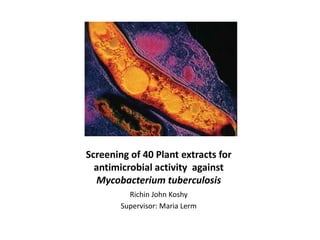
Screening of 40 Plant extracts for antimicrobial activity  against Mycobacterium tuberculosisRichin John KoshySupervisor: Maria Lerm
OverviewBackgroundHypothesis/AimMaterials and methods Results Conclusion
Epidemiology of MDR (TB)http://wwwnc.cdc.gov/travel/yellowbook/2010/http://wwwnc.cdc.gov/travel/yellowbook/2010/chapter-5/tuberculosis.htm
MorphologyMycobacteria are small rod shaped aerobic bacilliMycobacteria are present in the environment, soil and waterMycobacteria have high concentration of lipids and wax in the cell wall making them resistant to standard staining techniquesMtb grow quite slowly and colonies do not appear on solid media up to 2.5 -5 weekMedia which are used in growth of mycobacteria are selective media, semisynthetic media and broth mediawww.lookfordiagnosis.com
Pulmonary TB
commons.wikimedia.org
Treatment of  TBniaid.nih.gov
    Drug DevelopmentScreening of Chinese herbal medicine led to introduction of artemisinin from the leaves of Artemisia annua which is used worldwide for treatment against malaria At present, there are eight to ten drugs with therapies lasting to 18-24 months of which there are only four drugs which are actually developed to treat TBShifting the screening strategy from a single enzyme targets to a whole bacterial cell level have been showing successful results as it has a holistic approach and only gives hits that can enter the bacterium through the cell wall
Hypothesis Whole cell screening method is a more effective way than molecular/chemical approaches to identify new, anti-mycobacterial drug candidates/lead compoundsTraditionally used plants are a valuable source for the discovery of modern drugs
AimTo screen 40plant extracts prepared from plants used traditionally  to treat tuberculosis and other infections in Sudan for possible antimicrobial activity against Mtb
Materials and Methods
ResultsEffect of DMSO on plant extracts  DMSO at concentration of 10 %used along with plant extracts as treatments for reduction of antimycobacterial growth   showing higher pattern of inhibition and a reduction of inhibition seen with DMSO concentration of 1 % and 0.1 %
Anti-mycobacterial screening of plant extracts against avirulent strain of Mtb  H37Ra (1)
Anti-mycobacterial screening of plant extracts against avirulent strain of Mtb  H37Ra (2)Screening of 40 plant extracts by analysis of mycobacterial growth by luminometry and measuring cell viability showing a  pattern of inhibition in plant extracts A10, A12, A20, A22, A28, A29, A30, A34
Confirming screening of plant extracts showing inhibitionStudent paired t test was done assuming Gaussian distribution which show statistically insignificant hits
Detecting changes in mycobacterial growth by CFU plating
Determination of pH
ConclusionsHigh-throughput screening using luciferase determines mycobacterial growth giving conclusive results
40 extracts of selected medicinal plants were analysed for antimycobacterial activities which yielded 5 extracts to have distinct antimycobacterial properties
Further studies were carried out in order to measure colonies in the presence of selected medicinal extracts showing inhibition of bacterial growth, thereby ruling out inhibition due to luciferase

Richin final ppt 19

  • 1.
    Screening of 40Plant extracts for antimicrobial activity against Mycobacterium tuberculosisRichin John KoshySupervisor: Maria Lerm
  • 2.
  • 3.
    Epidemiology of MDR(TB)http://wwwnc.cdc.gov/travel/yellowbook/2010/http://wwwnc.cdc.gov/travel/yellowbook/2010/chapter-5/tuberculosis.htm
  • 4.
    MorphologyMycobacteria are smallrod shaped aerobic bacilliMycobacteria are present in the environment, soil and waterMycobacteria have high concentration of lipids and wax in the cell wall making them resistant to standard staining techniquesMtb grow quite slowly and colonies do not appear on solid media up to 2.5 -5 weekMedia which are used in growth of mycobacteria are selective media, semisynthetic media and broth mediawww.lookfordiagnosis.com
  • 5.
  • 6.
  • 7.
    Treatment of TBniaid.nih.gov
  • 8.
    Drug DevelopmentScreening of Chinese herbal medicine led to introduction of artemisinin from the leaves of Artemisia annua which is used worldwide for treatment against malaria At present, there are eight to ten drugs with therapies lasting to 18-24 months of which there are only four drugs which are actually developed to treat TBShifting the screening strategy from a single enzyme targets to a whole bacterial cell level have been showing successful results as it has a holistic approach and only gives hits that can enter the bacterium through the cell wall
  • 9.
    Hypothesis Whole cellscreening method is a more effective way than molecular/chemical approaches to identify new, anti-mycobacterial drug candidates/lead compoundsTraditionally used plants are a valuable source for the discovery of modern drugs
  • 10.
    AimTo screen 40plantextracts prepared from plants used traditionally to treat tuberculosis and other infections in Sudan for possible antimicrobial activity against Mtb
  • 11.
  • 12.
    ResultsEffect of DMSOon plant extracts  DMSO at concentration of 10 %used along with plant extracts as treatments for reduction of antimycobacterial growth showing higher pattern of inhibition and a reduction of inhibition seen with DMSO concentration of 1 % and 0.1 %
  • 13.
    Anti-mycobacterial screening ofplant extracts against avirulent strain of Mtb H37Ra (1)
  • 14.
    Anti-mycobacterial screening ofplant extracts against avirulent strain of Mtb H37Ra (2)Screening of 40 plant extracts by analysis of mycobacterial growth by luminometry and measuring cell viability showing a pattern of inhibition in plant extracts A10, A12, A20, A22, A28, A29, A30, A34
  • 15.
    Confirming screening ofplant extracts showing inhibitionStudent paired t test was done assuming Gaussian distribution which show statistically insignificant hits
  • 16.
    Detecting changes inmycobacterial growth by CFU plating
  • 17.
  • 18.
    ConclusionsHigh-throughput screening usingluciferase determines mycobacterial growth giving conclusive results
  • 19.
    40 extracts ofselected medicinal plants were analysed for antimycobacterial activities which yielded 5 extracts to have distinct antimycobacterial properties
  • 20.
    Further studies werecarried out in order to measure colonies in the presence of selected medicinal extracts showing inhibition of bacterial growth, thereby ruling out inhibition due to luciferase