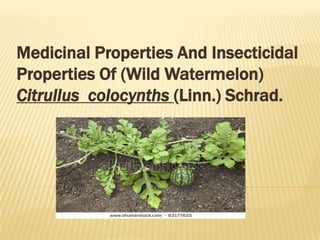
Medicinal Properties And Insecticidal
Properties Of (Wild Watermelon)
Citrullus colocynths (Linn.) Schrad.
IT is genarally found in farms as a weed
means there is no use of this climber.
Their different part perform different
medicinal properties as follow

1. Seed
2. Fruit and Fruit Pulp
3. Leaves
4. Root
SEED

   The Seeds are rich in fatty acids such as
    myristic, palmitic, stearic, oleic, linoleic and
    linolenic acids.

   Citrullus oil has a good potential use as cooking
    oil.

   The Investigation revealed that seed extract
    have an insulin tropic effect which show anti
    diabetic activities.
FRUIT AND FRUIT PULP
 The fruit is pungent, a cooling purgative,
  antihelmetic, antipyretic and carminative.
 The fruit pulp is purgative, diuretic and is
  used against gonorrhea.
 A fruit of Citrullus colocynthis is traditionally
  used for the treatment of diabetes, microbial
  diseases, ulcer, inflammation, jaundice and
  urinary diseases in Asian and African
  countries.
LEAVES
   The leaves exhibit anti-inflammatory activity
    and are diuretic.
ROOT
INSECTICIDAL PROPERTIES
 Cucurbitacin E Glycoside Isolated from Citrullus
  colocynthis show insecticidal effect against
  Aphis craccivora.
 Aphis craccivora can spread viruses.
 After NMR and IR spectrophotometer analysis
  we confirmed that the compound which isolated
  from Citrullus colocynthis and has insecticidal
  effect against Aphis craccivora was 2-O-β-D-
  glucopyranosylcucurbitacin E. (Torkey.H.M
  and Abou-Yousef,H.M.,2009)
ANTIMICROBIAL ACTIVITY

METHODS -
 In this procedure we can use either 1st or 2nd
  methods to examine antimicrobial activity

 AGAR- WELL DIFFUSION METHOD.
 DISC DIFFUSION METHOD.
AGAR- WELL DIFFUSION METHOD

 Petriplates -- 20ml medium -- 24hr culture of
  bacterial strains.
 Wells -- 20 µl of the plant extracts added.

 Incubated at 37°C for 24 hours.

 Measure diameter of obtained antimicrobial
  activity.
DIAGRAM - AGAR- WELL DIFFUSION METHOD


Plant
extract                        Bacteria
                               growing on
                               medium.
     Zone of
     inhibition
DISC DIFFUSION METHOD
 Prepare agar plates
 Inoculation of test microorganisms with spread
  plate method
 Filter paper discs -- 6mm in diameter -- soaked
  with 15µl of the plant extract
 Place (and press) in agar plate but no closer
  than 24 mm from each other, center to center
 Incubate -- 37ºC -- 16 to 18 hours.
 Measure diameter of obtained antimicrobial
  activity.
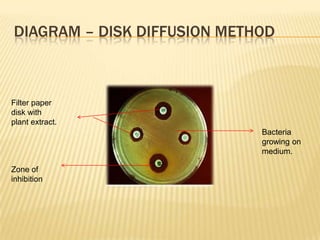
DIAGRAM – DISK DIFFUSION METHOD


Filter paper
disk with
plant extract.
                             Bacteria
                             growing on
                             medium.

Zone of
inhibition
PROCEDURE

 Collection and identification of plant
  material
 Collect fresh climbing plant.

 Confermed by botany teacher.

 Expose to air till it completely dried.

 Preparation of extract

 Leaf(Citrullus colocynthis) – Dried –
  Powdered – extract by soxhlate (aqueous) –
  concentrated by Rota evaporator – Extract
 Leaf(Citrullus colocynthis) – Dried –
  Powdered – extract by socslate (Ethanol) –
  concentrated by rota evaporator – Extract
  pripared.
 Seed = Dried–powdered- extract by socslate
  (aqueous) – concentrated by rota evaporator
  – Extract pripared.
 Root = Dried–powdered- extract by socslate
  (aqueous) – concentrated by rota evaporator
  – Extract pripared.
POWDERED STEM AND LEAF…
 Material -
 15 Petri plates – Conical flask containing
  nutrient agar – 15 suspension tubes containing
  saline were sterilized for further use.
 Bacterial Strains –
 E.coli
 Bacillus megaterium
 Bacillus cereus
 Pseudomonas aeruginosa
 Streptococcus mutans
 Actual Method –
 Pour agar (20ml) in each Petri plate

 Bacterial strains were poured and spread

 Make well (about 6mm) in Petri plate at
  center
 Fill the well with respective extract.

 Finally incubate the plates for 24 - 48 hrs
OBSERVATIONS
 After incubation we get a zone of inhibition
  around these well.
 The zone of inhibition is as follow

 Leaves -

    Bacterial Strains        Zone of inhibition
                             Aqueous
    E.coli                   Ethanol
    Bacillus megaterium
    Bacillus cereus
    Pseudomonas aeruginosa
    Streptococcus mutans
OBSERVATIONS
   Seed and Root –

Bacterial Strains        Zone of inhibition
                           Seed      Root
E.coli
Bacillus megaterium
Bacillus cereus
Pseudomonas aeruginosa
Streptococcus mutans
RESULT –
   The bitter water melon (Citrullus colocynthis)
    has antimicrobial (bacteria) activity.
CONCLUSION -
 There is a great promise for development of
  novel drugs from the plant Citrullus
  colocynthis for dreadful human diseases.
 They affects the growth of insect and
  degrade them so it can use in several
  insecticide, pesticide etc.
 They have some medicinal properties i.e
  antidiabetic activity,
 They shows the antibacterial activity which
  helps to inhibit the growth of bacteria which
  affects the plants.
REFERENCES
1st project

1st project

  • 1.
    Medicinal Properties AndInsecticidal Properties Of (Wild Watermelon) Citrullus colocynths (Linn.) Schrad.
  • 2.
    IT is genarallyfound in farms as a weed means there is no use of this climber.
  • 3.
    Their different partperform different medicinal properties as follow 1. Seed 2. Fruit and Fruit Pulp 3. Leaves 4. Root
  • 4.
    SEED  The Seeds are rich in fatty acids such as myristic, palmitic, stearic, oleic, linoleic and linolenic acids.  Citrullus oil has a good potential use as cooking oil.  The Investigation revealed that seed extract have an insulin tropic effect which show anti diabetic activities.
  • 5.
    FRUIT AND FRUITPULP  The fruit is pungent, a cooling purgative, antihelmetic, antipyretic and carminative.  The fruit pulp is purgative, diuretic and is used against gonorrhea.  A fruit of Citrullus colocynthis is traditionally used for the treatment of diabetes, microbial diseases, ulcer, inflammation, jaundice and urinary diseases in Asian and African countries.
  • 6.
    LEAVES  The leaves exhibit anti-inflammatory activity and are diuretic.
  • 7.
  • 8.
    INSECTICIDAL PROPERTIES  CucurbitacinE Glycoside Isolated from Citrullus colocynthis show insecticidal effect against Aphis craccivora.  Aphis craccivora can spread viruses.  After NMR and IR spectrophotometer analysis we confirmed that the compound which isolated from Citrullus colocynthis and has insecticidal effect against Aphis craccivora was 2-O-β-D- glucopyranosylcucurbitacin E. (Torkey.H.M and Abou-Yousef,H.M.,2009)
  • 9.
    ANTIMICROBIAL ACTIVITY METHODS - In this procedure we can use either 1st or 2nd methods to examine antimicrobial activity  AGAR- WELL DIFFUSION METHOD.  DISC DIFFUSION METHOD.
  • 10.
    AGAR- WELL DIFFUSIONMETHOD  Petriplates -- 20ml medium -- 24hr culture of bacterial strains.  Wells -- 20 µl of the plant extracts added.  Incubated at 37°C for 24 hours.  Measure diameter of obtained antimicrobial activity.
  • 11.
    DIAGRAM - AGAR-WELL DIFFUSION METHOD Plant extract Bacteria growing on medium. Zone of inhibition
  • 12.
    DISC DIFFUSION METHOD Prepare agar plates  Inoculation of test microorganisms with spread plate method  Filter paper discs -- 6mm in diameter -- soaked with 15µl of the plant extract  Place (and press) in agar plate but no closer than 24 mm from each other, center to center  Incubate -- 37ºC -- 16 to 18 hours.  Measure diameter of obtained antimicrobial activity.
  • 13.
    DIAGRAM – DISKDIFFUSION METHOD Filter paper disk with plant extract. Bacteria growing on medium. Zone of inhibition
  • 14.
    PROCEDURE  Collection andidentification of plant material  Collect fresh climbing plant.  Confermed by botany teacher.  Expose to air till it completely dried.  Preparation of extract  Leaf(Citrullus colocynthis) – Dried – Powdered – extract by soxhlate (aqueous) – concentrated by Rota evaporator – Extract
  • 15.
     Leaf(Citrullus colocynthis)– Dried – Powdered – extract by socslate (Ethanol) – concentrated by rota evaporator – Extract pripared.  Seed = Dried–powdered- extract by socslate (aqueous) – concentrated by rota evaporator – Extract pripared.  Root = Dried–powdered- extract by socslate (aqueous) – concentrated by rota evaporator – Extract pripared.
  • 16.
  • 17.
     Material - 15 Petri plates – Conical flask containing nutrient agar – 15 suspension tubes containing saline were sterilized for further use.  Bacterial Strains –  E.coli  Bacillus megaterium  Bacillus cereus  Pseudomonas aeruginosa  Streptococcus mutans
  • 18.
     Actual Method–  Pour agar (20ml) in each Petri plate  Bacterial strains were poured and spread  Make well (about 6mm) in Petri plate at center  Fill the well with respective extract.  Finally incubate the plates for 24 - 48 hrs
  • 19.
    OBSERVATIONS  After incubationwe get a zone of inhibition around these well.  The zone of inhibition is as follow  Leaves - Bacterial Strains Zone of inhibition Aqueous E.coli Ethanol Bacillus megaterium Bacillus cereus Pseudomonas aeruginosa Streptococcus mutans
  • 20.
    OBSERVATIONS  Seed and Root – Bacterial Strains Zone of inhibition Seed Root E.coli Bacillus megaterium Bacillus cereus Pseudomonas aeruginosa Streptococcus mutans
  • 21.
    RESULT –  The bitter water melon (Citrullus colocynthis) has antimicrobial (bacteria) activity. CONCLUSION -  There is a great promise for development of novel drugs from the plant Citrullus colocynthis for dreadful human diseases.  They affects the growth of insect and degrade them so it can use in several insecticide, pesticide etc.
  • 22.
     They havesome medicinal properties i.e antidiabetic activity,  They shows the antibacterial activity which helps to inhibit the growth of bacteria which affects the plants.
  • 23.