Benisuef University
Phaculty of pharmacy
Microbiology Department
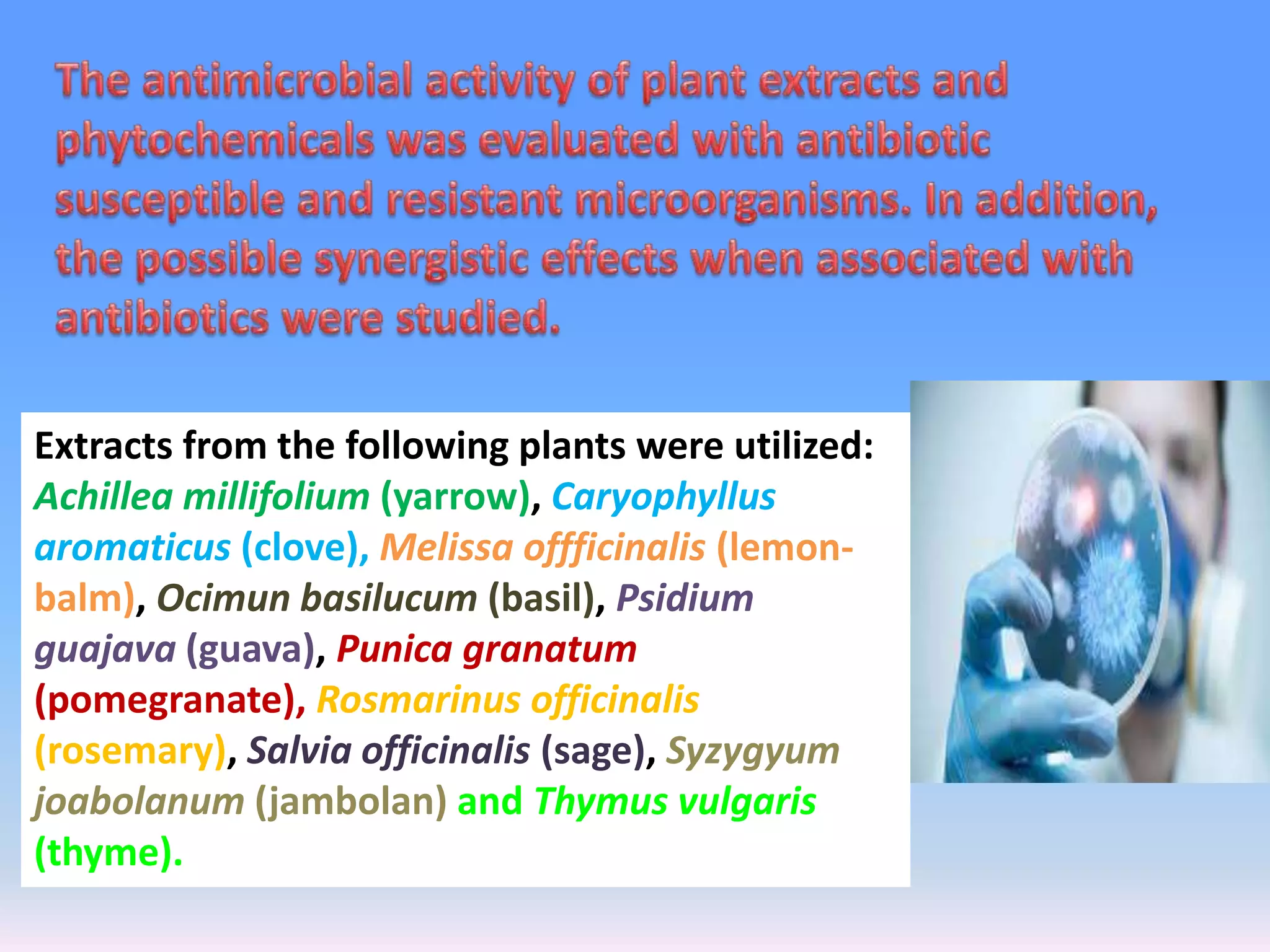
Extracts from the following plants were utilized:
Achillea millifolium (yarrow), Caryophyllus
aromaticus (clove), Melissa offficinalis (lemon-
balm), Ocimun basilucum (basil), Psidium
guajava (guava), Punica granatum
(pomegranate), Rosmarinus officinalis
(rosemary), Salvia officinalis (sage), Syzygyum
joabolanum (jambolan) and Thymus vulgaris
(thyme).
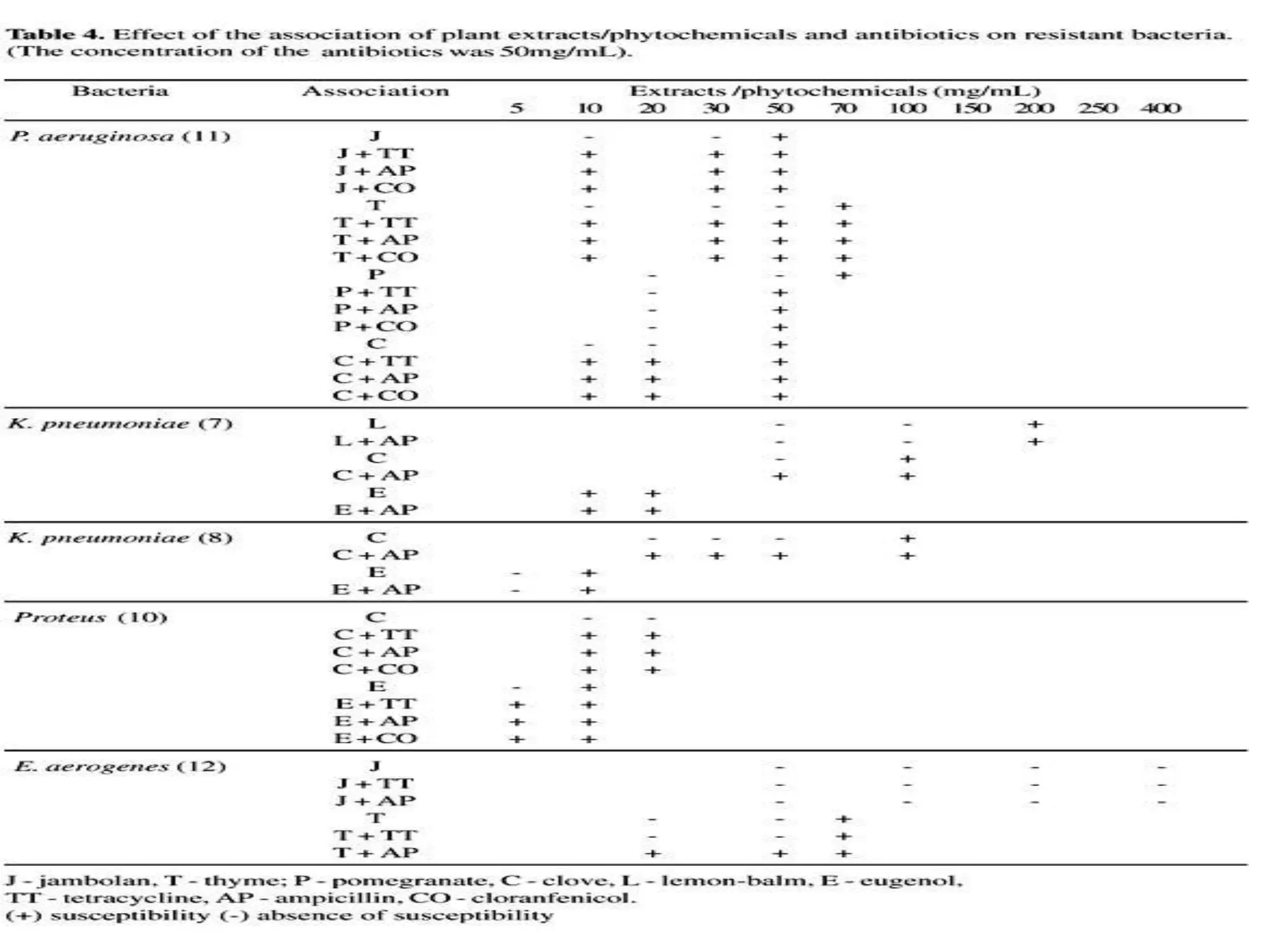
Association of antibiotics and plant extracts showed synergistic
antibacterial activity against antibiotic-resistant bacteria. The
results obtained with Pseudomonas aeruginosa was particularly
interesting, since it was inhibited by clove, jambolan,
pomegranate and thyme extracts. This inhibition was observed
with the individual extracts and when they were used in lower
concentrations with ineffective antibiotics.
Plant extracts
The methodologies of Harbone (17) and Wagner
et al. (37) were used to process the ethanolic
extracts (1:1) from the ten plants of interest.
Seven of them (basil, clove, lemon balm,
rosemary, sage, thyme and yarrow) had essential
oils as the main active ingredient while the other
three (guava, jambolan and pomegranate) had
high contents of tannin.
The following lists the plant of interest, plant
parts used for extractions, and compounds
obtained.
–Thyme (Thymus vulgaris L.,(eaecaimaL-deppirts[dnadeird
sevaeldna]srewolf.lacimehCstneutitsnoc:laitnesseslioylniam(
lomyhtdna,(lorcavrac,sdionovalfsninnatdnaenepretirt(.
–Rosemary (Rosmarinus officinalis L.,(eaecaimaL-]fael[.
lacimehCstneutitsnoc:,sdionovalfcilonehpsdica,cieffac(
cinegorohcdna(ciniramsordnalaicnessesliorohpmac(dna
(eloenic(
–Lemon balm (Melissa officinalis L.,(eaecaimaL-]fael[.lacimehC
stneutitsnoc:laicnessesliogniniatnoc(larticdnalallenortic
,(senepretonomsdionovalfdna,ciniramsorcieffacdna(.
–Sage (Salvia officinalis L.,(eaecaimaL-]fael[.lacimehC
stneutitsnoc:,ciniramsor,cieffaccinegorolhcsdica;,losonrac
,sdionovalflaitnesseslioylniam(enoyuhtdna(eloenic.– Basil
(Ocimum basilicum L.,(eaecaimaL-]fael[.lacimehCstneutitsnoc:
laitnesseslio,lolanil(logartsedna(lonegue;sninnatdnasdionovalf
– Yarrow (Achillea millefolium L.,Asteraceae) -
[flower-heads]. Chemical constituents: flavonoids,
tannins, comarins, proazulene. (8,11).
– Clove (Syzygium aromaticum (L.) Merr. et Perry =
Caryophyllus aromaticus L.) - [dried buds]. Chemical
constituents: essential oils (eugenol); taninns and
flavonoids (8,15).
– Pomegranate (Punica granatum L., Punicaceae) -
[pericarp]. Chemical constituents: ellagitannins and
alkaloids. (36).
– Jambolan (Syzygium cumini, Skeels, Myrtaceae) -
[leaf]. Chemical constituents: flavonoids and tannins
(7).
– Guava (Psidium guajava L., Myrtaceae) - [leaf].
Chemical constituents: comarins, essencial oils,
flavonoids, triterpenes and ellagitannins. (16).
The bacteria cultures were grown in Brain Heart Infusion liquid
medium at 37 °C. After 6 h of growth, each microorganism, at a
concentration of 106 cells/mL, was inoculated on the surface of
Mueller-Hinton agar plates. Subsequently, filter paper discs (6 mm
in diameter) saturated either with extract or phytochemicals (50
µL) were placed on surface of each inoculated plate.
To evaluate the efficiency of the methodology, each extract
was inserted simultaneously in a hole made (50 µL) in new
plates. The plates were incubated at 37 °C for 24 h. After
this period, it was possible to observe inhibition zone.
Overall, cultured bacteria with halos equal to or greater
than 7 mm were considered susceptible to either the
tested extract or phytochemical.
This evaluation was done according to Muroi and Kubo (28). Aliquots
of 100 µL of resistant bacterial cultures (106 cells/mL) grown in 10 mL
of nutrient broth for 6 h were inoculated in nutrient broth
supplemented with the respective antibiotics (50 µg/mL) with
different concentrations of plant extracts. The concentration for
plant extracts/phytochemicals ranged from 10 to 500 µg/mL, based
on MIC values, that had previously been evaluated. Only ampicillin
and/or chloramphenicol and/or tetracycline were used at the sub-
inhibitory concentration (50 µg/mL). The growth conditions were the
same as previously mentioned. After 48 h, the optical density of
each sample was documented and compared to those of MIC to
verify any synergistic effect among the tested compounds.
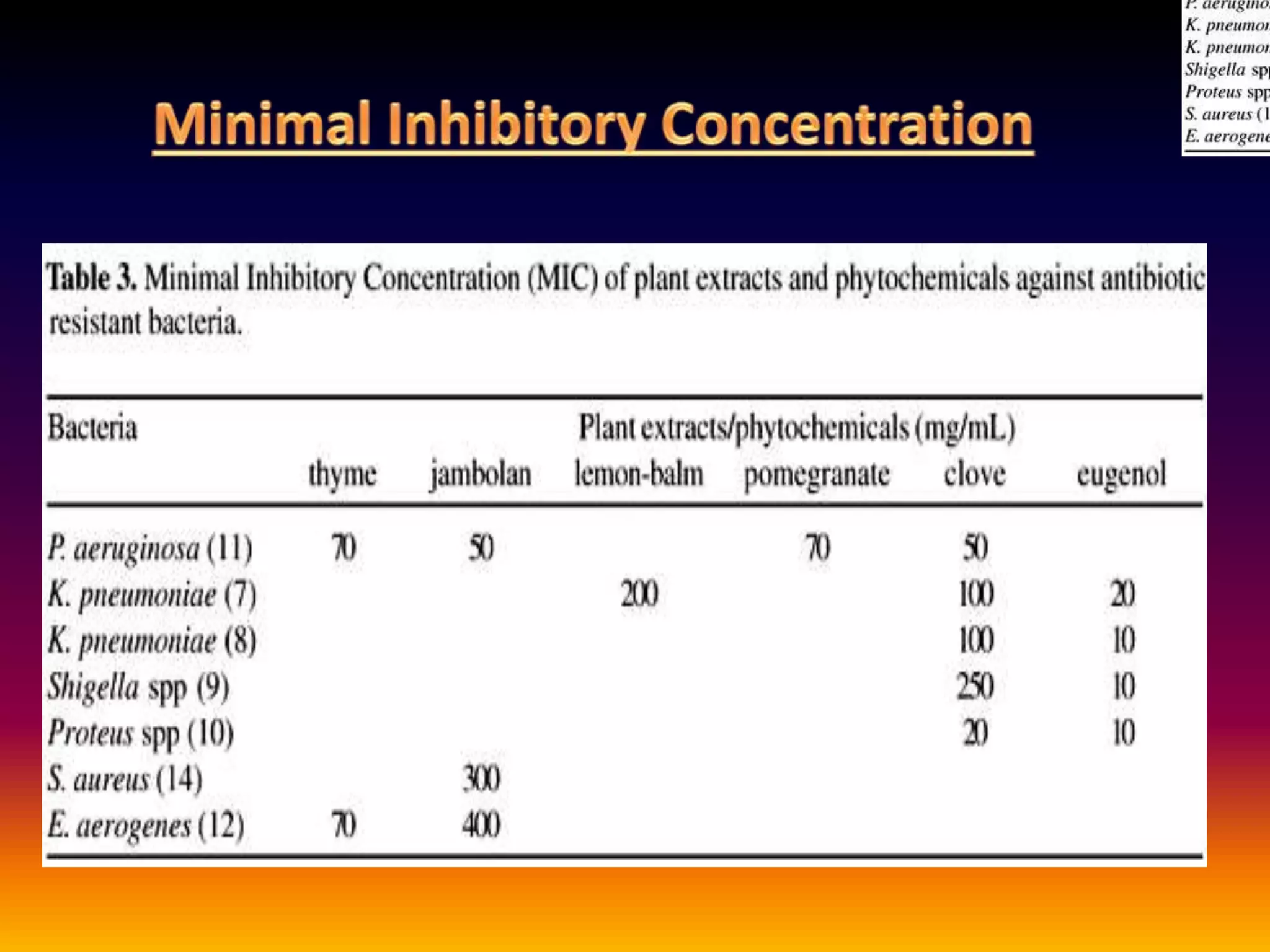
The data pertaining to the antimicrobial potential of the plant extracts and
phytochemicals are presented in Tables 1 and 2, and Figs. 1 and 2, respectively.
Among the phytochemicals, the eugenol, which
is extracted from cloves, showed the highest
antimicrobial activity. However, when it was
associated with cinnamic acid, no activity against
resistant bacteria was observed. On the other
hand, the benzoic acid, which presented low
activity against the investigated bacteria, was the
only one that inhibited the resistant ones, while
farnesol did not restrain the growth of any tested
bacteria.
Eugenol (clove)
Evaluation of the synergistic effect of antibiotics and
plant extracts or phytochemicals on the resistant
bacteria samples : in the following table ,
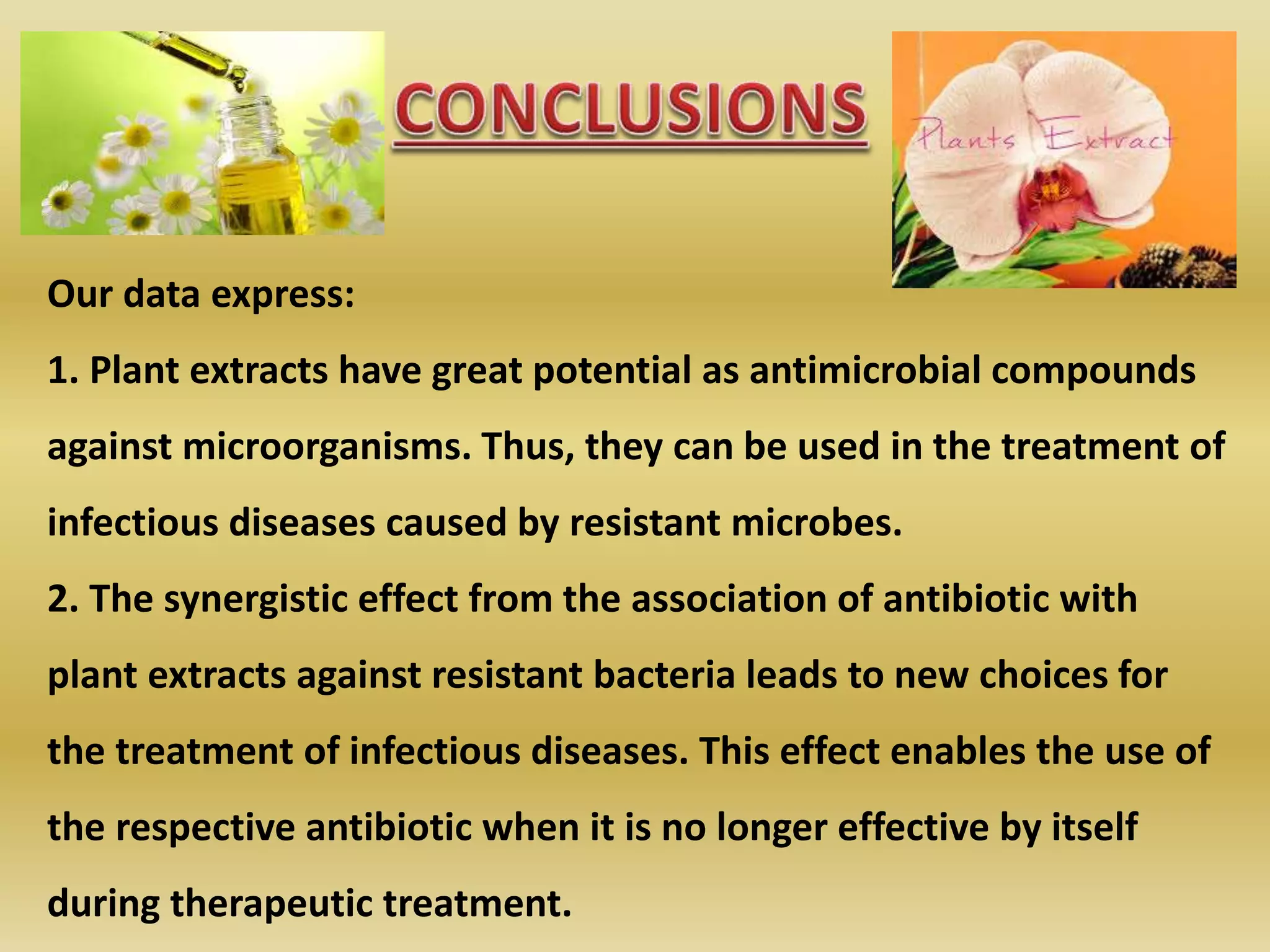
Our data express:
1. Plant extracts have great potential as antimicrobial compounds
against microorganisms. Thus, they can be used in the treatment of
infectious diseases caused by resistant microbes.
2. The synergistic effect from the association of antibiotic with
plant extracts against resistant bacteria leads to new choices for
the treatment of infectious diseases. This effect enables the use of
the respective antibiotic when it is no longer effective by itself
during therapeutic treatment.
1. Almagboul, A.Z.; Bashir, A.K.; Farouk, A.; Salih A.K.M. Antimicrobial activity of
certain Sudanese plants used in folkloric medicine. Screening for antibacterial activity.
Fitoterapia 56, 331-337,1985. [ Links ]
2. Almagboul, A.Z.; Bashir, A.K.; Farouk, A.; Salih, A.K.M. Antimicrobial activity of
certain Sudanese plants used in folkloric medicine. Screening for antifungal activity.
Fitoterapia 59, 393-396, 1988. [ Links ]
3. Alonso-Paz, E.; Cerdeiras, M.P.; Fernandez, J.; Ferreira, F.; Moyna, P.; Soubes, M.;
Vazquez, A.; Veros, S.; Zunno, L. Screening of Uruguayan medicinal plants for
antimicrobial activity. J. Ethnopharmacology 45, 67-70, 1995. [ Links ]
4. Anesini, E.; Perez, C. Screening of plants used in Argentine folk medicine for
antimicrobial activity. J. Ethnopharmacol. 39, 119-128, 1993. [ Links ]
5. Artizzu, N.; Bonsignore, L.; Cottiglia, F.; Loy, G. Studies of the diuretic and
antimicrobial activity of Cynodon dactylon essencial oil. Fitoterapia 66, 174-175,
1995. [ Links ]
6. Bauer, A.W.; Kirby, E.; Sherris, E.M.; Turk, M. Antibiotic by standarized single disk
method. Am. J. Clin. Path. 45, 493-496, 1966. [ Links ]
7. Bhatia, I.S.; Bajaj, K.L. Chemical constituents of the seeds and bark of Syzium
cumini. Planta Med. 28, 347-352, 1975. [ Links ]
8. Bisset, N.M. Herbal Drugs and Phytopharmaceuticals. CRC Press, London, 1994, 566
Prepared by :
Ahmed Gamal Abd El-mola
Ahmed Adel sayed
Ahmed Fadel Ewis
Ahmed Korany Abd El-hakim
Ahmed Mohamed Mahmoud
Ahmed Essam el-din Refaey
Ahmed Mostafa Sayed
Mahmoud Fateh El-bab Moawad

Antimicrobial activity of some phytochemicals

  • 1.
    Benisuef University Phaculty ofpharmacy Microbiology Department
  • 2.
    Extracts from thefollowing plants were utilized: Achillea millifolium (yarrow), Caryophyllus aromaticus (clove), Melissa offficinalis (lemon- balm), Ocimun basilucum (basil), Psidium guajava (guava), Punica granatum (pomegranate), Rosmarinus officinalis (rosemary), Salvia officinalis (sage), Syzygyum joabolanum (jambolan) and Thymus vulgaris (thyme).
  • 3.
    Association of antibioticsand plant extracts showed synergistic antibacterial activity against antibiotic-resistant bacteria. The results obtained with Pseudomonas aeruginosa was particularly interesting, since it was inhibited by clove, jambolan, pomegranate and thyme extracts. This inhibition was observed with the individual extracts and when they were used in lower concentrations with ineffective antibiotics. Plant extracts The methodologies of Harbone (17) and Wagner et al. (37) were used to process the ethanolic extracts (1:1) from the ten plants of interest. Seven of them (basil, clove, lemon balm, rosemary, sage, thyme and yarrow) had essential oils as the main active ingredient while the other three (guava, jambolan and pomegranate) had high contents of tannin.
  • 4.
    The following liststhe plant of interest, plant parts used for extractions, and compounds obtained. –Thyme (Thymus vulgaris L.,(eaecaimaL-deppirts[dnadeird sevaeldna]srewolf.lacimehCstneutitsnoc:laitnesseslioylniam( lomyhtdna,(lorcavrac,sdionovalfsninnatdnaenepretirt(. –Rosemary (Rosmarinus officinalis L.,(eaecaimaL-]fael[. lacimehCstneutitsnoc:,sdionovalfcilonehpsdica,cieffac( cinegorohcdna(ciniramsordnalaicnessesliorohpmac(dna (eloenic( –Lemon balm (Melissa officinalis L.,(eaecaimaL-]fael[.lacimehC stneutitsnoc:laicnessesliogniniatnoc(larticdnalallenortic ,(senepretonomsdionovalfdna,ciniramsorcieffacdna(. –Sage (Salvia officinalis L.,(eaecaimaL-]fael[.lacimehC stneutitsnoc:,ciniramsor,cieffaccinegorolhcsdica;,losonrac ,sdionovalflaitnesseslioylniam(enoyuhtdna(eloenic.– Basil (Ocimum basilicum L.,(eaecaimaL-]fael[.lacimehCstneutitsnoc: laitnesseslio,lolanil(logartsedna(lonegue;sninnatdnasdionovalf
  • 5.
    – Yarrow (Achilleamillefolium L.,Asteraceae) - [flower-heads]. Chemical constituents: flavonoids, tannins, comarins, proazulene. (8,11). – Clove (Syzygium aromaticum (L.) Merr. et Perry = Caryophyllus aromaticus L.) - [dried buds]. Chemical constituents: essential oils (eugenol); taninns and flavonoids (8,15). – Pomegranate (Punica granatum L., Punicaceae) - [pericarp]. Chemical constituents: ellagitannins and alkaloids. (36). – Jambolan (Syzygium cumini, Skeels, Myrtaceae) - [leaf]. Chemical constituents: flavonoids and tannins (7). – Guava (Psidium guajava L., Myrtaceae) - [leaf]. Chemical constituents: comarins, essencial oils, flavonoids, triterpenes and ellagitannins. (16).
  • 6.
    The bacteria cultureswere grown in Brain Heart Infusion liquid medium at 37 °C. After 6 h of growth, each microorganism, at a concentration of 106 cells/mL, was inoculated on the surface of Mueller-Hinton agar plates. Subsequently, filter paper discs (6 mm in diameter) saturated either with extract or phytochemicals (50 µL) were placed on surface of each inoculated plate. To evaluate the efficiency of the methodology, each extract was inserted simultaneously in a hole made (50 µL) in new plates. The plates were incubated at 37 °C for 24 h. After this period, it was possible to observe inhibition zone. Overall, cultured bacteria with halos equal to or greater than 7 mm were considered susceptible to either the tested extract or phytochemical.
  • 7.
    This evaluation wasdone according to Muroi and Kubo (28). Aliquots of 100 µL of resistant bacterial cultures (106 cells/mL) grown in 10 mL of nutrient broth for 6 h were inoculated in nutrient broth supplemented with the respective antibiotics (50 µg/mL) with different concentrations of plant extracts. The concentration for plant extracts/phytochemicals ranged from 10 to 500 µg/mL, based on MIC values, that had previously been evaluated. Only ampicillin and/or chloramphenicol and/or tetracycline were used at the sub- inhibitory concentration (50 µg/mL). The growth conditions were the same as previously mentioned. After 48 h, the optical density of each sample was documented and compared to those of MIC to verify any synergistic effect among the tested compounds.
  • 8.
    The data pertainingto the antimicrobial potential of the plant extracts and phytochemicals are presented in Tables 1 and 2, and Figs. 1 and 2, respectively.
  • 11.
    Among the phytochemicals,the eugenol, which is extracted from cloves, showed the highest antimicrobial activity. However, when it was associated with cinnamic acid, no activity against resistant bacteria was observed. On the other hand, the benzoic acid, which presented low activity against the investigated bacteria, was the only one that inhibited the resistant ones, while farnesol did not restrain the growth of any tested bacteria. Eugenol (clove)
  • 13.
    Evaluation of thesynergistic effect of antibiotics and plant extracts or phytochemicals on the resistant bacteria samples : in the following table ,
  • 15.
    Our data express: 1.Plant extracts have great potential as antimicrobial compounds against microorganisms. Thus, they can be used in the treatment of infectious diseases caused by resistant microbes. 2. The synergistic effect from the association of antibiotic with plant extracts against resistant bacteria leads to new choices for the treatment of infectious diseases. This effect enables the use of the respective antibiotic when it is no longer effective by itself during therapeutic treatment.
  • 16.
    1. Almagboul, A.Z.;Bashir, A.K.; Farouk, A.; Salih A.K.M. Antimicrobial activity of certain Sudanese plants used in folkloric medicine. Screening for antibacterial activity. Fitoterapia 56, 331-337,1985. [ Links ] 2. Almagboul, A.Z.; Bashir, A.K.; Farouk, A.; Salih, A.K.M. Antimicrobial activity of certain Sudanese plants used in folkloric medicine. Screening for antifungal activity. Fitoterapia 59, 393-396, 1988. [ Links ] 3. Alonso-Paz, E.; Cerdeiras, M.P.; Fernandez, J.; Ferreira, F.; Moyna, P.; Soubes, M.; Vazquez, A.; Veros, S.; Zunno, L. Screening of Uruguayan medicinal plants for antimicrobial activity. J. Ethnopharmacology 45, 67-70, 1995. [ Links ] 4. Anesini, E.; Perez, C. Screening of plants used in Argentine folk medicine for antimicrobial activity. J. Ethnopharmacol. 39, 119-128, 1993. [ Links ] 5. Artizzu, N.; Bonsignore, L.; Cottiglia, F.; Loy, G. Studies of the diuretic and antimicrobial activity of Cynodon dactylon essencial oil. Fitoterapia 66, 174-175, 1995. [ Links ] 6. Bauer, A.W.; Kirby, E.; Sherris, E.M.; Turk, M. Antibiotic by standarized single disk method. Am. J. Clin. Path. 45, 493-496, 1966. [ Links ] 7. Bhatia, I.S.; Bajaj, K.L. Chemical constituents of the seeds and bark of Syzium cumini. Planta Med. 28, 347-352, 1975. [ Links ] 8. Bisset, N.M. Herbal Drugs and Phytopharmaceuticals. CRC Press, London, 1994, 566
  • 18.
    Prepared by : AhmedGamal Abd El-mola Ahmed Adel sayed Ahmed Fadel Ewis Ahmed Korany Abd El-hakim Ahmed Mohamed Mahmoud Ahmed Essam el-din Refaey Ahmed Mostafa Sayed Mahmoud Fateh El-bab Moawad