Factors affecting grafting and budding success in
horticultural crops
Milan Regmi
Department of Horticulture
Institute of Agriculture and Animal Science
Tribhuvan University, Kirtipur
2022 March 22
Introduction
• Vegetative propagation such as grafting and budding are practiced in many horticultural crops and
is considered an effective method for maintaining true-to-type of a variety and transferring quality
characteristics from mother plant to progeny (Nakasone & Paull, 1998).
• These techniques are usually chosen over cuttings as some of the plant cuttings root poorly.
• In addition, these methods impart a rootstock characteristic to the plant such as hardiness, drought
tolerance, disease resistance and also practiced in changing cultivars of established plants,
repairing graftage for injuries and disease indexing (Hartmann et al., 2011).
• Grafting and budding are two processes that are normally conducted by highly experienced
operators since it need good craftmanship and deep knowledge of compatibility for higher success
rate.
• The most common symptom is the failure in the formation of successful graft or bud union
includes the tree's foliage turns yellow late in growing season, followed by early defoliation, a
reduction in vegetative development and appearance of shoot die-back.
• Premature death of plants in the nursery, great difference in growth rates of scion and rootstocks,
overgrowth above, below or at the graft union, breakdown of graft union are the other common
external symptoms of unsuccessful graft union.
• There are several factors that have greater influence in the callus formation and proliferation at the
graft union.
• The objective of the present study is to discuss the different factors affecting grafting and budding
success in horticultural crops in detail.
Factors affecting grafting and budding success
1. Plant
• Some plant species take graft easily than the others.
• Even when there is no incompatibility, some species such as hickories, oaks, and beeches are far
more difficult to graft than others (Hartmann et al., 2011).
• Even the most basic techniques for grafting of apples, grapes, and pears normally result in a high
percentage of successful unions, but grafting stone fruits like peaches and apricots requires more
care and attention.
• Surprisingly, grafting peaches to other compatible species like plums or almonds yields better
results than reworking back with the peaches (Hartmann et al., 2011).
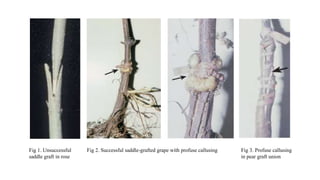
Fig 1. Unsuccessful
saddle graft in rose
Fig 3. Profuse callusing
in pear graft union
Fig 2. Successful saddle-grafted grape with profuse callusing
2. Seasonal considerations
• Temperature, moisture loss potential, and other environmental parameters affecting phenology and
physiological activity of the stock and scion determine the best time of year for grafting.
• The best time of year for grafting or budding is also determined by the species as well as the
grafting process.
• The temperature should be sufficiently high to support callus formation, other cambium activity
and cell differentiation necessary for xylem and phloem formation.
• Season can also have a significant impact on transpiration water loss. Also, sufficient level of
dormancy to avoid excessive transpiration also aids on the successful graft union formation
• Grafting/budding during the summer time may be detrimental to scions as they can affected by the
following cold winter temperatures (Yordanov and Tabakov, 2009).
• Outdoor grafting should therefore be done at a period of year when temperatures are likely to be
favorable (spring) and the vascular cambium is active (Hartmann et al., 2011).
• When cleft grafting was done in mango (Mangifera indica) during the March, minimum time for
bud breaking were observed. The treatment combination of June or March grafting period with
cleft technique yielded the highest (100%) grafting success rate (Beshir et al., 2019).
• Nguyen and Yen (2018) found that the best season for papaya ‘Red lady’ cleft grafting was summer
with the highest percentage of graft success (93.33%).
• Ozkan and Gumus (2001) compared two grafting techniques in walnut (Juglans regia L.)- cleft and
whip-tongue during the months of January, February and March. They revealed highest percentage
of successful grafting in the month of February for both grafting techniques.
• A Study by Ahmed et al. (2012) in different grafting dates in walnut (Juglans regia) revealed that
15th of March giving highest graft success (58.00%) and plant growth (163.78 cm).
3. Growth activity of rootstock
• Some propagation techniques such as T budding and bark grafting rely on the actively dividing
cambium cells and creating young thin-walled cells on the side of the cambium which facilitates
bark slipping.
• There is no requirement for an active cambium to raise the flap of rootstock bark in case of chip
budding.
• Similarly, while bench grafting, the rootstock is normally grafted just when new roots begin to
emerge later in the winter (Hartmann et al., 2011).
• When cuttings are made preliminary to budding and grafting, plants with strong root pressure (such
as the walnut, maple, and grape) exhibit excessive sap flow or "bleeding" during particular periods
of intense growth activity in the spring.
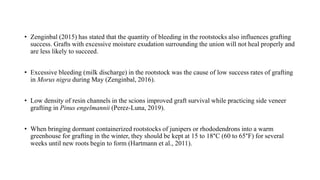
• Zenginbal (2015) has stated that the quantity of bleeding in the rootstocks also influences grafting
success. Grafts with excessive moisture exudation surrounding the union will not heal properly and
are less likely to succeed.
• Excessive bleeding (milk discharge) in the rootstock was the cause of low success rates of grafting
in Morus nigra during May (Zenginbal, 2016).
• Low density of resin channels in the scions improved graft survival while practicing side veneer
grafting in Pinus engelmannii (Perez-Luna, 2019).
• When bringing dormant containerized rootstocks of junipers or rhododendrons into a warm
greenhouse for grafting in the winter, they should be kept at 15 to 18°C (60 to 65°F) for several
weeks until new roots begin to form (Hartmann et al., 2011).
4. Polarity
• In grafting, polarity is crucial, and it must be maintained in both the scion and rootstock.
• In top-grafting, the proximal end of the scion should be put into the distal end of the rootstock as a
general rule. In normal root grafting, however, the scion's proximal end should be put into the
rootstock's proximal end.
• In case of bridge grafting, the reversed scion does not increase from its original size, whereas the
scion with correct polarity enlarges normally (Hartmann et al., 2011).
• The rule for maintaining correct polarity in T-budding or patch budding is less rigid. The buds
(scion) can be inserted with the polarity reversed and still form permanent unions. When budding,
however, it is still preferable to maintain polarity (Hartmann et al., 2011)
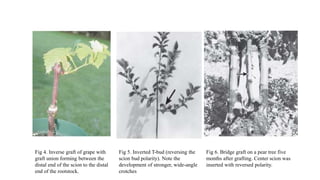
Fig 4. Inverse graft of grape with
graft union forming between the
distal end of the scion to the distal
end of the rootstock.
Fig 5. Inverted T-bud (reversing the
scion bud polarity). Note the
development of stronger, wide-angle
crotches
Fig 6. Bridge graft on a pear tree five
months after grafting. Center scion was
inserted with reversed polarity.
5. Craftsmanship
• Craftsmanship plays a role not only in initiation graft union healing but also in how well the plant
grows out after grafting
• The vascular cambium of the scion and that of the stock must be in relatively close contact for a
new vascular cambium to form across a graft union.
• This is especially crucial for difficult-to-graft species like conifers (e.g., Picea pungens), which
have a poor callus development.
• Grafting technique is less critical with grape or pear grafts, which callus profusely and have a high
grafting success rate (Hartmann et al., 2011).
• Other mistakes that cause graft failure include insufficient or delayed waxing, uneven cuts, use of
dehydrated scions, and girdling which occurs when polyethylene wrapping tape is not removed
after the graft (Hartmann et al., 2011).
6. Pests and diseases
• Graft union failures caused by pathogens resembles symptoms of incompatibility. Contamination
by viruses, insects, or disease organisms can put a stress on a grafted plant that is already stressed.
• Incompatibility was once reported for the failure of sweet orange (Citrus sinensis) budded onto
sour orange (Citrus aurantium) rootstock in South Africa and Java, but it was actually caused by
the Tristeza virus, which is tolerated by sweet orange but fatal to sour orange rootstock (Bitters and
Parker, 1953; Webber, 1943).
• Other examples include black line in English walnut (Juglans regia) rootstock caused by Cherry
leafroll virus, which infects sensitive walnut rootstocks and kills the scion in 2 to 6 years
(Mircetich and Rowhani, 1984).
• Apple union necrosis and decline (AUND) (Cummins and Gonsalves, 1982) and brown line of
prune (Mircetich and Hoy, 1981) is caused by tomato mosaic virus and is spread to the rootstocks
and then to the graft union by soil-borne nematodes.
7. Compatibility
• The ability of two different plants, grafted together, to produce a successful union and to develop
into one composite plant is termed graft compatibility (Santamour,1988).
• There is no definite rule that can exactly predict the ultimate outcome of a particular graft
combination except that the more closely the plants are related botanically, the better the chances
are for the graft union to be successful (Jayawickrama et al., 1991).
• Localized (non-translocated) incompatibility between stock and scion can be overcome by using
mutually compatible interstock. A good example is Bartlett pear on quince rootstock where Old
Home (Beurre Hardy) pear is used as inter-stock (Mosse, 1958; Proebsting, 1928; Roberts and
Blaney, 1967).
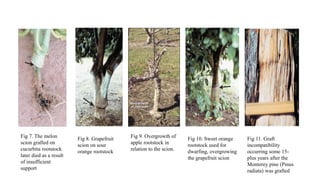
• Translocated incompatibility includes certain graft/rootstock combination in which the insertion of
a mutually compatible interstock does not overcome incompatibility. A brown line at the rootstock
contact can be identified as a sign of this.
• A translocated incompatibility example is Japanese plum cv. ‘Golden Japan’ budded on AP-45
rootstock (Reig et al., 2019).
• Some grafted apricot cultivars on Myrobalan plum rootstock will not break at the graft union until
the trees are fully established and start producing fruit in the case of delayed incompatibility
(Eames and Cox, 1945). It can take up to 20 years for graft incompatibility to develop.
• Some callus differentiation into cambium and vascular tissue occurs with incompatible
apricot/plum (Prunus) grafts, but a considerable percentage of the callus never develops. The union
that occurs is mechanically weak (Errea et al., 1994).
• Plant death was preceded by a reduction in SPAD index values five months after field planting
when rootstocks 'Mirabolano 29C' and 'Marianna 2624' demonstrated translocated graft
incompatibility with peach cultivars BRS-Kampai, Jade, and Maciel (Das Neves et al., 2017).
Fig 9. Overgrowth of
apple rootstock in
relation to the scion.
Fig 7. The melon
scion grafted on
cucurbita rootstock
later died as a result
of insufficient
support
Fig 10. Sweet orange
rootstock used for
dwarfing, overgrowing
the grapefruit scion
Fig 8. Grapefruit
scion on sour
orange rootstock
Fig 11. Graft
incompatibility
occurring some 15-
plus years after the
Monterey pine (Pinus
radiata) was grafted
8. Propagation techniques
• Sometimes the techniques used in grafting are so poor that only a small portion of the cambial
regions of the stock and scion come together.
• The scion can be much smaller in diameter than the stock in various grafting techniques, such as
cleft grafting. In such cases, it's critical to put the scion towards the stock's perimeter (outside edge)
so that the vascular cambia on one side are aligned.
• The interlocking "tongues" generated by the secondary cuts made in the stock and scion, on the
other hand, result in extra length of cambial contact in the whip & tongue graft.
• In non-rind grafting like cleft grafting, bark slipping is not mandatory and thus can be performed at
any time of the year considering the temperature to be high enough for callus formation.
• Ahmed et al. (2012) revealed that in walnut (Juglans regia), edge grafting was found superior than
tongue grafting in case of graft success (52.45 %) and sprouting percent (62.22 %).
• In Persian walnut, Patch budding (91.0 %) showed the highest success rate followed by shield
budding (31.1 %) and chip budding (19.1 %) under greenhouse s conditions (Ebrahimi et al.,
2007).
• The bark graft approach is more successful than the cleft graft method in topworking native black
walnut (Juglans regia) to Persian walnut (Juglans hindsii) in California (Hartmann et al., 2011).
• Chong et al. (2008) showed highest success (80%) using the cleft grafting approach in 'Eksotika'
papaya at the nursery stage.
10. Environmental factors during and following grafting
For callus tissues to grow and repair, certain environmental conditions must be fulfilled.
i) Temperature:
• The right temperature is crucial for callus formation. Callus growth does not occur below
0 Celsius. At 40°F (4°C) or lower, graft union formation is slow.
• Maintaining an excessively high temperature to produce rapid callus formation in bench-grafted
plants depletes required carbohydrate reserves, limiting field survival (Davies et al., 1980).
• Temperatures should not exceed 60°F (15°C) for 2–3 weeks following as carbohydrate reserve
deplete fast as the temperature increases (Hartmann et al., 2011).
• In most of the temperate fruit crops, callus production is retarded after 42.5º C and tissue death
occurs above 60 º C.
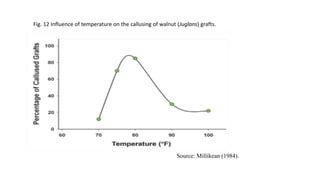
• Walnut does not produce callus below 20 °C (Erdogan, 2006) and the ideal temperature for graft
success is 26–27 °C (Millikean, 1984).
• Little callus forms on apple grafts when the temperature is below 0°C (32°F) or beyond 40°C
(104°F).
• When bench grafting, callusing can be slowed for several months by storing the grafts at low
temperatures, such as 7 to 10°C, or can be sped up by keeping at higher temperatures for a shorter
time (Hartmann et al., 2011).
• At 15 and 20 °C, the grafting success rate of tomato grafting was above 90%, but as the
temperature was raised, it decreased to 20% at 40 °C (Nordey et al., 2020).
Fig. 12 Influence of temperature on the callusing of walnut (Juglans) grafts.
Source: Millikean (1984).
ii) Relative humidity:
• The cambium and the parenchyma cells that make up the essential callus tissue have thin walls and
are vulnerable to desiccation. They will die if exposed to dry air (Hartmann et al., 2011).
• Tying or wrapping the graft union tightly, to eliminate gaps, retards moisture loss from cut surfaces
(grafting tape, parafilm, polythene, latex budding rubbers, grafting wax).
• Seasonal considerations, such as grafting at a time of year when transpiration is minimal should
also be considered.
• Generally, gunny sacks are used to store budsticks to avoid evaporation of moisture from the
breathable cloth bag which maintains high humidity around the scion wood stored in the bag, and
evaporative cooling prevents overheating.
• The graft-take ratios increased with increasing relative humidity in all temperature levels (17, 20,
23, 26 °C) in tomato (Vu et al., 2013).
11. Moisture management
• Ample supply of soil moisture is particularly important during and shortly after summer budding as
the bark must be in slipping stage (Kumar et al., 2005).
• Recovery of scion water potential occurs within the first 3 to 4 days of callus bridge formation
(Doley, 1970) and with maturation of the connecting tracheids, water potential and osmotic
potential continue to rise (Beeson and Proebsting, 1988).
• In vitro research of ash (Fraxinus excelsior) stem pieces revealed that when the water potential
declined, callus development on the cut surfaces decreased significantly (Doley, 1970).
• Bolat et al. (2014) revealed that with the use of Vista Bella/M9 (79.33 % and 46.67 %) and Santa
Maria/MA (70.33 % and 15.33 %) combination of apple and quince rootstocks, increased water
stress resulted in lower budding success.
• Sauve et al. (1991) reported Golden Delicious/M111 budding combination was badly affected
before and after chip budding in -5 to -25 kPa water stress conditions.
12. Age of scion, rootstock and donor tree
• Scions used in for the grafting purpose should generally be 1 years old (pencil size) and rootstocks
2 years or less (Kumar, 2005).
• Use of 1-month-old Papaya ‘Red lady’ rootstocks in the summer resulted in the shortest sprouting
time and the highest graft success rate (93.33 percent) and graft growth in the greenhouse (Nguyen
and Yen, 2018).
• Damtew and Assefa (2018) revealed grafting success was enhanced with older rootstocks (24 and
28 weeks), with 82.88 % and 75.07 % graft take respectively, whereas grafts made on 12 weeks old
rootstocks had the lowest success rate of 42.68 % in mango (Mangifera indica L.) using cleft
grafting.
• Cholid et al. (2014) stated that the best grafting method in physic nut (Jatropha curcas L.) was a
combination of 2 months old rootstock with top cleft or V-shaped grafting.
13. Plant growth regulators
• Plant growth regulators regulates the plant development and responses to different biotic and
abiotic stresses and also influence on the grafting and budding union formation.
• When applied to the base of side-grafted Picea scions, auxin (IBA, NAA) and cytokinin (BA)
enhanced graft success (Beeson and Proebsting, 1989).
• Shimomura and Fuzihara (1977) revealed how auxins improved vascular connections of
misaligned scions in cactus tip grafting.
• Kako et al. (2012) found highest budding success percentage (99.05%) attained from the
interaction between the different Peach (Prunus persica Batch) cultivars and 2,4,5-T (20 mg/l).
• The best results were obtained from treating the graft cut-surfaces of grape vines with
combinations of 250 and 500 mg/litre of Ki or BA which supported the higher callusing rate at
grafting point of all tested graft combinations (Kose and Guleryuz, 2006).
14. Presence of secondary metabolites
• Phenolic compounds are widespread in plants and present in the biochemical responses to stress
and wounding and also been implicated in graft incompatibility (Evans and Rasmussen, 1972).
• The incompatibility of certain pear cultivars on quince rootstock is caused by a cyanogenic
glucoside called prunasin, which is generally found in quince tissues (Gur et al., 1968).
• Assuncao et al. (2019a) found higher concentrations of catechin during the rooting phase (after 28
DAG), higher concentrations of sinapic acid and lower concentrations of caffeic acid were found in
the clone with lower grafting success 3 years after grafting.
• The suitable pear/pear grafts had a larger accumulation of procyanidin B2 at the graft interface as
compared to incompatible grafts (Musacchi et al., 2000).
Correcting incompatible combination
• There is not a practical or cost-effective method of correcting large-scale grafting partner
incompatibilities. Normally, plants would be rogued and discarded.
• If the incompatibility is detected before the tree dies or breaks off at the union, a bridge graft with a
mutually compatible rootstock could be done with some isolated specimen trees of importance.
• Another expensive option is to inarch with a compatible rootstock seedling. The rootstock
seedlings that were joined would eventually become the main root system.
Conclusion
• Grafting and budding technique integrates science and art of horticulture.
• Successful graft union between the rootstock and scion must be ensured to produce plant material
in such a high scale. But a number of factors are responsible for grafting and budding success.
• Type of plant materials may influence the success rate as some plant species may take graft easily
than others. Season of grafting and budding is another factor as it controls the environmental
temperature and relative humidity hence affecting the phenology and physiological activity of
callus cells.
• Also, proper polarity of rootstock and scion should be ensured with selection of rootstock with
higher growth activity as it controls the callus and cambium activity in the initial days of grafting.
• Identifying the graft transmissible virus, diseases and phytoplasma and avoiding such planting
materials for early graft failure problem.
• Choice of compatible plant material and propagation techniques for that specific season needs to be
ensured for higher success rate of graft union formation.
• Judicious selection of plant growth hormone to increase the callusing activity and choice of best
age of scion and rootstock also plays a prime role for maintaining successful growth union.
• Hence, all these factors should equally be considered for higher grafting and budding success.
References
• Nakasone, H. Y. and R. E. Paull. 1998. Tropical fruits. University of Hawaii, Honolulu, USA: CABI.
• Hartmann, H.T., D.E. Kester., F.T. Davies., Jr. R.L. Geneve. 2011. Hartmann and Kester´s Plant Propagation:
Principles and Practices (8th ed.) Pearson Education, Inc., Hoboken, NJ, USA.
• Iliev, N., & V. Tomov. 2017. Factors affecting the grafting/budding of Acer platanoides L. cultivars. Propagation of
Ornamental Plants. 17(1): 29-36.
• Yordanov A. I., Tabakov S. G. 2009. Comparison of different methods of propagation of persimmon trees. Acta
Horticulturae. 833: 187-192.
• Doley, D. and L. Leyton. 1970. Effects of growth regulating substances and water potential on the development of
wound callus in Fraxinus. New Phytol. 69:87–102.
• Beeson, R. C. and W. M. Proebsting. 1988. Relationship between transpiration and water potential in grafted scions
of Picea. Physiol. Plant. 74:481–86.
• Beeson, R. C., Jr. and W. M. Proebsting. 1989. Picea graft success: Effects of environment, rootstock disbudding,
growth regulators, and antitranspirants. HortScience. 24:253–54.
• Bolat, I., M. Dikilitas, S. Ercisli, A. Ikinci and T. Tonkaz. 2014. The effect of water stress on some morphological,
physiological, and biochemical characteristics and bud success on apple and quince rootstocks. The Scientific World
Journal. 1-8. doi:10.1155/2014/769732
• Sauve, R.J., D. Brown and R. L. Burrows. 1991. Effects of rootstock water stress on apple graft success.
HortScience. 26(6):728–732
• Kumar, G. N. M. 2011. Propagation of plants by grafting and budding. A Pacific Northwest Extension
Publication, Pullman, Washington, USA, 19p.
• Damtew, M. and W. Assefa. 2018. Influence of Grafting Season and Rootstock Age on the Success and
Growth of Mango (Mangifera indica L.) cv. Apple Using Cleft Grafting. Int. J. Novel Res. Life Sc. 5(3): 12-8.
• Cholid, M., S. Susanto and B.S. Purwoko. 2014. Effects of grafting time and grafting methods used on scion
and rootstock compatibility of physic nut (Jatropha curcas L.). Asian Journal of Agricultural Research. 8(3):
150-163.
• Beshir, W., M. Alemayehu and Y. Dessalegn. 2019. Effect of grafting time and technique on the success rate
of grafted Mango (Mangifera indica L.) in Kalu District of Amhara Region, North Eastern Ethiopia. Cogent
Food & Agriculture. 5(1): 1577023.
• Nguyen, V. H. and C. R. Yen. 2018. Rootstock age and grafting season affect graft success and plant growth
of papaya (Carica papaya L.) in greenhouse. Chilean journal of agricultural research. 78(1): 59-67. doi:
10.4067/S0718-58392018000100059
• Shimomura, T. and K. Fuzihara. 1977. Physiological study of graft union formation in cactus. II. Role of
auxin on vascular connection between stock and scion. J. Japan. Soc. Hort. Sci. 45: 397–406.
• Ozkan, Y. and A. Gumus, 2001. Effects of different applications on grafting under controlled conditions of
walnut (Juglans regia L.). Acta Hort., 544: 515-520.
• Kako, S. M., S. A. M, Karo. and S. I. Tawfik. 2012. Effect of Some Plant Growth Regulators on Different
Peach (Prunus persica Batsch) Cultivars Budding. International Journal of Pure & Applied Sciences &
Technology. 12(1).
• Kose, C. and M. Guleryuz. 2006. Effects of auxins and cytokinins on graft union of grapevine (Vitis vinifera). New
Zealand journal of crop and horticultural science. 34(2): 145-150.
• Ahmed, N., S. R. Singh, K. K. Srivastava, P. A. Shagoo and S. Hayat. 2012. Effect of different environments,
grafting methods and times on sprouting, graft success and plant growth of walnut (Juglans regia). Indian Journal of
Agricultural Sciences. 82(12): 14-18.
• Bidabadi, S. S., M. Afazel and P. Sabbatini. 2018. Iranian grapevine rootstocks and hormonal effects on graft union,
growth and antioxidant responses of Asgari seedless grape. Horticultural Plant Journal. 4(1): 16-23.
• Zenginbal, H. 2015. Effect of budding methods and grafting periods on propagation of persimmon sapling in nursery
conditions. Propagation of Ornamental Plants. 15: 3-9.
• Zenginbal, H. 2016. Effect of grafting techniques and periods on propagation of black mulberry (Morus nigra L.)
sapling. Propagation of Ornamental Plants, 16: 120-129.
• Evans, G. E. and H. P. Rasmussen. 1972. Anatomical changes in developing graft unions of Juniperus. J. Amer. Soc.
Hort. Sci. 97: 228–232.
• Perez-Luna, A., J. A. Prieto-Ruiz, J. Lopez-Upton, A. Carrillo-Parra, C. Wehenkel, J. A. Chavez-Simental and J. C.
Hernandez-Diaz. 2019. Some Factors Involved in the Success of Side Veneer Grafting of Pinus engelmannii
Carr. Forests. 10(2): 112.
• Bitters, W. P. and E. R. Parker. 1953. Quick decline of citrus as influenced by top-root relationships. Calif. Agr. Exp.
Sta. Bul. 733.
• Webber, H. J. 1943. The “tristeza” disease of sour orange rootstock. Proc. Amer. Soc. Hort. Sci. 43:160–68.
• Mircetich, S. M. and A. Rowhani. 1984. The relationship of cherry leafroll virus and blackline disease of English walnut
trees. Phytopathology. 74(4): 423-428.
• Mircetich, S. M. and J. W. Hoy. 1981. Brownline of prune trees, a disease associated with tomato ringspot virus infection of
myrobalan and peach rootstocks. Phytopathology. 71:31–35.
• Zhou, C. 2018. Graft-transmissible citrus diseases in PR China-research developments. Journal of Citrus Pathology. 5(1).
doi:10.5070/C451038786
• Gur, A., R.M. Samish and E. Lifshitz. 1968. The role of cyanogenic glycoside of the quince in the incompatibility between pear
cultivars and quince rootstock. Hortic. Res. 8: 113–134.
• Santamour, F. S., Jr. 1988. Graft compatibility in woody plants: An expanded perspective. J. Environ. Hort. 6:27–32.
• Santamour, F. S., Jr. 1989. Cambial peroxidase enzymes related to graft incompatibility in red maple. J. Environ. Hort. 7:8–14.
• Buchloh, G. 1960. The lignification in stock-scion junctions and its relation to compatibility. In J. B. Pridham (ed.), Phenolics in
plants in health and disease. Pergamon Press, Long Island City, NY.
• Assunçao, M., J. Pinheiro, S. Cruz, J. Brazao, J. Queiroz, J.E. Eiras Dias, et al. 2019a. Gallic acid, sinapic acid and catechin as
potential chemical markers of vitis graft success. Sci. Hortic. 246: 129–135. doi: 10.1016/j.scienta.2018.10.056
• Jayawickrama, K. J., J. B. Brett and S. E. McKeand. 1991. Rootstock effects in grafted conifers: A review. New Forests. 5: 157–173.
• Mosse, B. 1958. Further observations on growth and union structure of double-grafted pear on quince. J. Hort. Sci. 33:186–93.
• Musacchi, S., G. Pagliuca, K. Maddalena, M. V. Piretti and S. Sansavini. 2000. Flavonoids as markers for pear-quince graft
incompatibility. J. Appl. Bot. 74: 206–211.
• Proebsting, E. L. 1928. Further observations on structural defects of the graft union. Bot. Gaz. 86: 82–92.
• Roberts, A. N. and L. T. Blaney. 1967. Qualitative, quantitative, and positional aspects of interstock influence on growth
and flowering of the apple. Proc. Amer. Soc. Hort. Sci. 91:39–50.
• Reig, G., A. Salazar, O. Zarrouk, C. F. Forcada, J. Val and M. A. Mreno. 2019. Long-term graft compatibility study of
peach-almond hybrid and plum based rootstocks budded with European and Japanese plums. Scientia Horticulturae. 243:
392-400.
• Deloire, A. and C. Hebant. 1982. Peroxidase activity and lignification at the interface between stock and scion of
compatible and incompatible grafts of Capsicum on Lycopersicon. Ann. Bot. 49:887–91.
• Eames, A. J. and L.G. Cox. 1945. A remarkable tree-fall and an unusual type of graft-union failure. American Journal of
Botany. 331-335.
• Errea, P., A. Felipe and H. Herrero. 1994. Graft establishment between compatible and incompatible Prunus spp. J. Exp.
Bot. 45: 393–401.
• Das Neves, T. R., N.A. Mayer and B. Ueno. 2017. Graft incompatibility in Prunus spp. preceded by SPAD index
reduction. Embrapa Clima Temperado-Artigo em periodico indexado (ALICE).
• Chong, S.T., R. Prabhakaran and H.K. Lee. 2008. An improved technique of propagating ‘Eksotika’ papaya. Acta
Horticulturae. 787:273-276. doi:10.17660/ActaHortic.2008.787.30.
• Warmund, M. R., B. H. Barritt, J. M. Brown, K. L. Schaffer and B. R. Jeong. 1993. Detection of vascular discontinuity in
bud unions of Jonagold apple on Mark rootstock with magnetic resonance imaging. Journal of the American Society for
Horticultural Science. 118(1): 92-96.
• Ebrahimi, A., K. Vahdati and E. Fallahi. 2007. Improved success of Persian walnut grafting under environmentally
controlled conditions. International Journal of Fruit Science. 6(4): 3-12.
• Schmid H. 1989. Vereden der Obstgeholze. Eugen Ulmer Verlag, Stuttgart, 184 p.
• Davies, F. T., Jr., Y. Fann and J. E. Lazarte. 1980. Bench chip budding of field roses. HortScience. 15:817–18
• Millikean, D. F. 1984. Propagation of Juglans species by fall grafting. Annual Report Nut Grower Association. 61: 41–4.
• Nordey, T., E. Shem and J. Huat. 2020. Impacts of temperature and rootstocks on tomato grafting success
rates. HortScience. 55(2): 136-140. doi: 10.21273/HORTSCI14525-19
• Johnson, S. and C. A. Miles. 2011. Effect of healing chamber design on the survival of grafted eggplant, watermelon, and
tomato. HortTech. 21: 752-758.
• Yousef, A. F., M. M. Ali and H. M. Rizwan. 2021. Light quality and quantity affect graft union formation of tomato
plants. Sci Rep. 11: 9870. doi: 10.1038/s41598-021-88971-5
• Vu, N. T., C. H. Zhang, Z. H. Xu, Y. S. Kim, Kang, H. M. and I. S. Kim. 2013. Enhanced graft-take ratio and quality of
grafted tomato seedlings by controlling temperature and humidity conditions. Journal of Bio-Environment Control. 22(2):
146-153. doi:10.12791/KSBEC.2013.22.2.146
Factor affecting grafting and budding success.pptx

Factor affecting grafting and budding success.pptx

  • 1.
    Factors affecting graftingand budding success in horticultural crops Milan Regmi Department of Horticulture Institute of Agriculture and Animal Science Tribhuvan University, Kirtipur 2022 March 22
  • 2.
    Introduction • Vegetative propagationsuch as grafting and budding are practiced in many horticultural crops and is considered an effective method for maintaining true-to-type of a variety and transferring quality characteristics from mother plant to progeny (Nakasone & Paull, 1998). • These techniques are usually chosen over cuttings as some of the plant cuttings root poorly. • In addition, these methods impart a rootstock characteristic to the plant such as hardiness, drought tolerance, disease resistance and also practiced in changing cultivars of established plants, repairing graftage for injuries and disease indexing (Hartmann et al., 2011). • Grafting and budding are two processes that are normally conducted by highly experienced operators since it need good craftmanship and deep knowledge of compatibility for higher success rate.
  • 3.
    • The mostcommon symptom is the failure in the formation of successful graft or bud union includes the tree's foliage turns yellow late in growing season, followed by early defoliation, a reduction in vegetative development and appearance of shoot die-back. • Premature death of plants in the nursery, great difference in growth rates of scion and rootstocks, overgrowth above, below or at the graft union, breakdown of graft union are the other common external symptoms of unsuccessful graft union. • There are several factors that have greater influence in the callus formation and proliferation at the graft union. • The objective of the present study is to discuss the different factors affecting grafting and budding success in horticultural crops in detail.
  • 4.
    Factors affecting graftingand budding success 1. Plant • Some plant species take graft easily than the others. • Even when there is no incompatibility, some species such as hickories, oaks, and beeches are far more difficult to graft than others (Hartmann et al., 2011). • Even the most basic techniques for grafting of apples, grapes, and pears normally result in a high percentage of successful unions, but grafting stone fruits like peaches and apricots requires more care and attention. • Surprisingly, grafting peaches to other compatible species like plums or almonds yields better results than reworking back with the peaches (Hartmann et al., 2011).
  • 5.
    Fig 1. Unsuccessful saddlegraft in rose Fig 3. Profuse callusing in pear graft union Fig 2. Successful saddle-grafted grape with profuse callusing
  • 6.
    2. Seasonal considerations •Temperature, moisture loss potential, and other environmental parameters affecting phenology and physiological activity of the stock and scion determine the best time of year for grafting. • The best time of year for grafting or budding is also determined by the species as well as the grafting process. • The temperature should be sufficiently high to support callus formation, other cambium activity and cell differentiation necessary for xylem and phloem formation. • Season can also have a significant impact on transpiration water loss. Also, sufficient level of dormancy to avoid excessive transpiration also aids on the successful graft union formation • Grafting/budding during the summer time may be detrimental to scions as they can affected by the following cold winter temperatures (Yordanov and Tabakov, 2009).
  • 7.
    • Outdoor graftingshould therefore be done at a period of year when temperatures are likely to be favorable (spring) and the vascular cambium is active (Hartmann et al., 2011). • When cleft grafting was done in mango (Mangifera indica) during the March, minimum time for bud breaking were observed. The treatment combination of June or March grafting period with cleft technique yielded the highest (100%) grafting success rate (Beshir et al., 2019). • Nguyen and Yen (2018) found that the best season for papaya ‘Red lady’ cleft grafting was summer with the highest percentage of graft success (93.33%). • Ozkan and Gumus (2001) compared two grafting techniques in walnut (Juglans regia L.)- cleft and whip-tongue during the months of January, February and March. They revealed highest percentage of successful grafting in the month of February for both grafting techniques. • A Study by Ahmed et al. (2012) in different grafting dates in walnut (Juglans regia) revealed that 15th of March giving highest graft success (58.00%) and plant growth (163.78 cm).
  • 8.
    3. Growth activityof rootstock • Some propagation techniques such as T budding and bark grafting rely on the actively dividing cambium cells and creating young thin-walled cells on the side of the cambium which facilitates bark slipping. • There is no requirement for an active cambium to raise the flap of rootstock bark in case of chip budding. • Similarly, while bench grafting, the rootstock is normally grafted just when new roots begin to emerge later in the winter (Hartmann et al., 2011). • When cuttings are made preliminary to budding and grafting, plants with strong root pressure (such as the walnut, maple, and grape) exhibit excessive sap flow or "bleeding" during particular periods of intense growth activity in the spring.
  • 9.
    • Zenginbal (2015)has stated that the quantity of bleeding in the rootstocks also influences grafting success. Grafts with excessive moisture exudation surrounding the union will not heal properly and are less likely to succeed. • Excessive bleeding (milk discharge) in the rootstock was the cause of low success rates of grafting in Morus nigra during May (Zenginbal, 2016). • Low density of resin channels in the scions improved graft survival while practicing side veneer grafting in Pinus engelmannii (Perez-Luna, 2019). • When bringing dormant containerized rootstocks of junipers or rhododendrons into a warm greenhouse for grafting in the winter, they should be kept at 15 to 18°C (60 to 65°F) for several weeks until new roots begin to form (Hartmann et al., 2011).
  • 10.
    4. Polarity • Ingrafting, polarity is crucial, and it must be maintained in both the scion and rootstock. • In top-grafting, the proximal end of the scion should be put into the distal end of the rootstock as a general rule. In normal root grafting, however, the scion's proximal end should be put into the rootstock's proximal end. • In case of bridge grafting, the reversed scion does not increase from its original size, whereas the scion with correct polarity enlarges normally (Hartmann et al., 2011). • The rule for maintaining correct polarity in T-budding or patch budding is less rigid. The buds (scion) can be inserted with the polarity reversed and still form permanent unions. When budding, however, it is still preferable to maintain polarity (Hartmann et al., 2011)
  • 11.
    Fig 4. Inversegraft of grape with graft union forming between the distal end of the scion to the distal end of the rootstock. Fig 5. Inverted T-bud (reversing the scion bud polarity). Note the development of stronger, wide-angle crotches Fig 6. Bridge graft on a pear tree five months after grafting. Center scion was inserted with reversed polarity.
  • 12.
    5. Craftsmanship • Craftsmanshipplays a role not only in initiation graft union healing but also in how well the plant grows out after grafting • The vascular cambium of the scion and that of the stock must be in relatively close contact for a new vascular cambium to form across a graft union. • This is especially crucial for difficult-to-graft species like conifers (e.g., Picea pungens), which have a poor callus development. • Grafting technique is less critical with grape or pear grafts, which callus profusely and have a high grafting success rate (Hartmann et al., 2011). • Other mistakes that cause graft failure include insufficient or delayed waxing, uneven cuts, use of dehydrated scions, and girdling which occurs when polyethylene wrapping tape is not removed after the graft (Hartmann et al., 2011).
  • 13.
    6. Pests anddiseases • Graft union failures caused by pathogens resembles symptoms of incompatibility. Contamination by viruses, insects, or disease organisms can put a stress on a grafted plant that is already stressed. • Incompatibility was once reported for the failure of sweet orange (Citrus sinensis) budded onto sour orange (Citrus aurantium) rootstock in South Africa and Java, but it was actually caused by the Tristeza virus, which is tolerated by sweet orange but fatal to sour orange rootstock (Bitters and Parker, 1953; Webber, 1943). • Other examples include black line in English walnut (Juglans regia) rootstock caused by Cherry leafroll virus, which infects sensitive walnut rootstocks and kills the scion in 2 to 6 years (Mircetich and Rowhani, 1984). • Apple union necrosis and decline (AUND) (Cummins and Gonsalves, 1982) and brown line of prune (Mircetich and Hoy, 1981) is caused by tomato mosaic virus and is spread to the rootstocks and then to the graft union by soil-borne nematodes.
  • 14.
    7. Compatibility • Theability of two different plants, grafted together, to produce a successful union and to develop into one composite plant is termed graft compatibility (Santamour,1988). • There is no definite rule that can exactly predict the ultimate outcome of a particular graft combination except that the more closely the plants are related botanically, the better the chances are for the graft union to be successful (Jayawickrama et al., 1991). • Localized (non-translocated) incompatibility between stock and scion can be overcome by using mutually compatible interstock. A good example is Bartlett pear on quince rootstock where Old Home (Beurre Hardy) pear is used as inter-stock (Mosse, 1958; Proebsting, 1928; Roberts and Blaney, 1967). • Translocated incompatibility includes certain graft/rootstock combination in which the insertion of a mutually compatible interstock does not overcome incompatibility. A brown line at the rootstock contact can be identified as a sign of this.
  • 15.
    • A translocatedincompatibility example is Japanese plum cv. ‘Golden Japan’ budded on AP-45 rootstock (Reig et al., 2019). • Some grafted apricot cultivars on Myrobalan plum rootstock will not break at the graft union until the trees are fully established and start producing fruit in the case of delayed incompatibility (Eames and Cox, 1945). It can take up to 20 years for graft incompatibility to develop. • Some callus differentiation into cambium and vascular tissue occurs with incompatible apricot/plum (Prunus) grafts, but a considerable percentage of the callus never develops. The union that occurs is mechanically weak (Errea et al., 1994). • Plant death was preceded by a reduction in SPAD index values five months after field planting when rootstocks 'Mirabolano 29C' and 'Marianna 2624' demonstrated translocated graft incompatibility with peach cultivars BRS-Kampai, Jade, and Maciel (Das Neves et al., 2017).
  • 16.
    Fig 9. Overgrowthof apple rootstock in relation to the scion. Fig 7. The melon scion grafted on cucurbita rootstock later died as a result of insufficient support Fig 10. Sweet orange rootstock used for dwarfing, overgrowing the grapefruit scion Fig 8. Grapefruit scion on sour orange rootstock Fig 11. Graft incompatibility occurring some 15- plus years after the Monterey pine (Pinus radiata) was grafted
  • 17.
    8. Propagation techniques •Sometimes the techniques used in grafting are so poor that only a small portion of the cambial regions of the stock and scion come together. • The scion can be much smaller in diameter than the stock in various grafting techniques, such as cleft grafting. In such cases, it's critical to put the scion towards the stock's perimeter (outside edge) so that the vascular cambia on one side are aligned. • The interlocking "tongues" generated by the secondary cuts made in the stock and scion, on the other hand, result in extra length of cambial contact in the whip & tongue graft. • In non-rind grafting like cleft grafting, bark slipping is not mandatory and thus can be performed at any time of the year considering the temperature to be high enough for callus formation.
  • 18.
    • Ahmed etal. (2012) revealed that in walnut (Juglans regia), edge grafting was found superior than tongue grafting in case of graft success (52.45 %) and sprouting percent (62.22 %). • In Persian walnut, Patch budding (91.0 %) showed the highest success rate followed by shield budding (31.1 %) and chip budding (19.1 %) under greenhouse s conditions (Ebrahimi et al., 2007). • The bark graft approach is more successful than the cleft graft method in topworking native black walnut (Juglans regia) to Persian walnut (Juglans hindsii) in California (Hartmann et al., 2011). • Chong et al. (2008) showed highest success (80%) using the cleft grafting approach in 'Eksotika' papaya at the nursery stage.
  • 19.
    10. Environmental factorsduring and following grafting For callus tissues to grow and repair, certain environmental conditions must be fulfilled. i) Temperature: • The right temperature is crucial for callus formation. Callus growth does not occur below 0 Celsius. At 40°F (4°C) or lower, graft union formation is slow. • Maintaining an excessively high temperature to produce rapid callus formation in bench-grafted plants depletes required carbohydrate reserves, limiting field survival (Davies et al., 1980). • Temperatures should not exceed 60°F (15°C) for 2–3 weeks following as carbohydrate reserve deplete fast as the temperature increases (Hartmann et al., 2011).
  • 20.
    • In mostof the temperate fruit crops, callus production is retarded after 42.5º C and tissue death occurs above 60 º C. • Walnut does not produce callus below 20 °C (Erdogan, 2006) and the ideal temperature for graft success is 26–27 °C (Millikean, 1984). • Little callus forms on apple grafts when the temperature is below 0°C (32°F) or beyond 40°C (104°F). • When bench grafting, callusing can be slowed for several months by storing the grafts at low temperatures, such as 7 to 10°C, or can be sped up by keeping at higher temperatures for a shorter time (Hartmann et al., 2011). • At 15 and 20 °C, the grafting success rate of tomato grafting was above 90%, but as the temperature was raised, it decreased to 20% at 40 °C (Nordey et al., 2020).
  • 21.
    Fig. 12 Influenceof temperature on the callusing of walnut (Juglans) grafts. Source: Millikean (1984).
  • 22.
    ii) Relative humidity: •The cambium and the parenchyma cells that make up the essential callus tissue have thin walls and are vulnerable to desiccation. They will die if exposed to dry air (Hartmann et al., 2011). • Tying or wrapping the graft union tightly, to eliminate gaps, retards moisture loss from cut surfaces (grafting tape, parafilm, polythene, latex budding rubbers, grafting wax). • Seasonal considerations, such as grafting at a time of year when transpiration is minimal should also be considered. • Generally, gunny sacks are used to store budsticks to avoid evaporation of moisture from the breathable cloth bag which maintains high humidity around the scion wood stored in the bag, and evaporative cooling prevents overheating. • The graft-take ratios increased with increasing relative humidity in all temperature levels (17, 20, 23, 26 °C) in tomato (Vu et al., 2013).
  • 23.
    11. Moisture management •Ample supply of soil moisture is particularly important during and shortly after summer budding as the bark must be in slipping stage (Kumar et al., 2005). • Recovery of scion water potential occurs within the first 3 to 4 days of callus bridge formation (Doley, 1970) and with maturation of the connecting tracheids, water potential and osmotic potential continue to rise (Beeson and Proebsting, 1988). • In vitro research of ash (Fraxinus excelsior) stem pieces revealed that when the water potential declined, callus development on the cut surfaces decreased significantly (Doley, 1970). • Bolat et al. (2014) revealed that with the use of Vista Bella/M9 (79.33 % and 46.67 %) and Santa Maria/MA (70.33 % and 15.33 %) combination of apple and quince rootstocks, increased water stress resulted in lower budding success. • Sauve et al. (1991) reported Golden Delicious/M111 budding combination was badly affected before and after chip budding in -5 to -25 kPa water stress conditions.
  • 24.
    12. Age ofscion, rootstock and donor tree • Scions used in for the grafting purpose should generally be 1 years old (pencil size) and rootstocks 2 years or less (Kumar, 2005). • Use of 1-month-old Papaya ‘Red lady’ rootstocks in the summer resulted in the shortest sprouting time and the highest graft success rate (93.33 percent) and graft growth in the greenhouse (Nguyen and Yen, 2018). • Damtew and Assefa (2018) revealed grafting success was enhanced with older rootstocks (24 and 28 weeks), with 82.88 % and 75.07 % graft take respectively, whereas grafts made on 12 weeks old rootstocks had the lowest success rate of 42.68 % in mango (Mangifera indica L.) using cleft grafting. • Cholid et al. (2014) stated that the best grafting method in physic nut (Jatropha curcas L.) was a combination of 2 months old rootstock with top cleft or V-shaped grafting.
  • 25.
    13. Plant growthregulators • Plant growth regulators regulates the plant development and responses to different biotic and abiotic stresses and also influence on the grafting and budding union formation. • When applied to the base of side-grafted Picea scions, auxin (IBA, NAA) and cytokinin (BA) enhanced graft success (Beeson and Proebsting, 1989). • Shimomura and Fuzihara (1977) revealed how auxins improved vascular connections of misaligned scions in cactus tip grafting. • Kako et al. (2012) found highest budding success percentage (99.05%) attained from the interaction between the different Peach (Prunus persica Batch) cultivars and 2,4,5-T (20 mg/l). • The best results were obtained from treating the graft cut-surfaces of grape vines with combinations of 250 and 500 mg/litre of Ki or BA which supported the higher callusing rate at grafting point of all tested graft combinations (Kose and Guleryuz, 2006).
  • 26.
    14. Presence ofsecondary metabolites • Phenolic compounds are widespread in plants and present in the biochemical responses to stress and wounding and also been implicated in graft incompatibility (Evans and Rasmussen, 1972). • The incompatibility of certain pear cultivars on quince rootstock is caused by a cyanogenic glucoside called prunasin, which is generally found in quince tissues (Gur et al., 1968). • Assuncao et al. (2019a) found higher concentrations of catechin during the rooting phase (after 28 DAG), higher concentrations of sinapic acid and lower concentrations of caffeic acid were found in the clone with lower grafting success 3 years after grafting. • The suitable pear/pear grafts had a larger accumulation of procyanidin B2 at the graft interface as compared to incompatible grafts (Musacchi et al., 2000).
  • 27.
    Correcting incompatible combination •There is not a practical or cost-effective method of correcting large-scale grafting partner incompatibilities. Normally, plants would be rogued and discarded. • If the incompatibility is detected before the tree dies or breaks off at the union, a bridge graft with a mutually compatible rootstock could be done with some isolated specimen trees of importance. • Another expensive option is to inarch with a compatible rootstock seedling. The rootstock seedlings that were joined would eventually become the main root system.
  • 28.
    Conclusion • Grafting andbudding technique integrates science and art of horticulture. • Successful graft union between the rootstock and scion must be ensured to produce plant material in such a high scale. But a number of factors are responsible for grafting and budding success. • Type of plant materials may influence the success rate as some plant species may take graft easily than others. Season of grafting and budding is another factor as it controls the environmental temperature and relative humidity hence affecting the phenology and physiological activity of callus cells. • Also, proper polarity of rootstock and scion should be ensured with selection of rootstock with higher growth activity as it controls the callus and cambium activity in the initial days of grafting.
  • 29.
    • Identifying thegraft transmissible virus, diseases and phytoplasma and avoiding such planting materials for early graft failure problem. • Choice of compatible plant material and propagation techniques for that specific season needs to be ensured for higher success rate of graft union formation. • Judicious selection of plant growth hormone to increase the callusing activity and choice of best age of scion and rootstock also plays a prime role for maintaining successful growth union. • Hence, all these factors should equally be considered for higher grafting and budding success.
  • 30.
    References • Nakasone, H.Y. and R. E. Paull. 1998. Tropical fruits. University of Hawaii, Honolulu, USA: CABI. • Hartmann, H.T., D.E. Kester., F.T. Davies., Jr. R.L. Geneve. 2011. Hartmann and Kester´s Plant Propagation: Principles and Practices (8th ed.) Pearson Education, Inc., Hoboken, NJ, USA. • Iliev, N., & V. Tomov. 2017. Factors affecting the grafting/budding of Acer platanoides L. cultivars. Propagation of Ornamental Plants. 17(1): 29-36. • Yordanov A. I., Tabakov S. G. 2009. Comparison of different methods of propagation of persimmon trees. Acta Horticulturae. 833: 187-192. • Doley, D. and L. Leyton. 1970. Effects of growth regulating substances and water potential on the development of wound callus in Fraxinus. New Phytol. 69:87–102. • Beeson, R. C. and W. M. Proebsting. 1988. Relationship between transpiration and water potential in grafted scions of Picea. Physiol. Plant. 74:481–86. • Beeson, R. C., Jr. and W. M. Proebsting. 1989. Picea graft success: Effects of environment, rootstock disbudding, growth regulators, and antitranspirants. HortScience. 24:253–54. • Bolat, I., M. Dikilitas, S. Ercisli, A. Ikinci and T. Tonkaz. 2014. The effect of water stress on some morphological, physiological, and biochemical characteristics and bud success on apple and quince rootstocks. The Scientific World Journal. 1-8. doi:10.1155/2014/769732 • Sauve, R.J., D. Brown and R. L. Burrows. 1991. Effects of rootstock water stress on apple graft success. HortScience. 26(6):728–732
  • 31.
    • Kumar, G.N. M. 2011. Propagation of plants by grafting and budding. A Pacific Northwest Extension Publication, Pullman, Washington, USA, 19p. • Damtew, M. and W. Assefa. 2018. Influence of Grafting Season and Rootstock Age on the Success and Growth of Mango (Mangifera indica L.) cv. Apple Using Cleft Grafting. Int. J. Novel Res. Life Sc. 5(3): 12-8. • Cholid, M., S. Susanto and B.S. Purwoko. 2014. Effects of grafting time and grafting methods used on scion and rootstock compatibility of physic nut (Jatropha curcas L.). Asian Journal of Agricultural Research. 8(3): 150-163. • Beshir, W., M. Alemayehu and Y. Dessalegn. 2019. Effect of grafting time and technique on the success rate of grafted Mango (Mangifera indica L.) in Kalu District of Amhara Region, North Eastern Ethiopia. Cogent Food & Agriculture. 5(1): 1577023. • Nguyen, V. H. and C. R. Yen. 2018. Rootstock age and grafting season affect graft success and plant growth of papaya (Carica papaya L.) in greenhouse. Chilean journal of agricultural research. 78(1): 59-67. doi: 10.4067/S0718-58392018000100059 • Shimomura, T. and K. Fuzihara. 1977. Physiological study of graft union formation in cactus. II. Role of auxin on vascular connection between stock and scion. J. Japan. Soc. Hort. Sci. 45: 397–406. • Ozkan, Y. and A. Gumus, 2001. Effects of different applications on grafting under controlled conditions of walnut (Juglans regia L.). Acta Hort., 544: 515-520. • Kako, S. M., S. A. M, Karo. and S. I. Tawfik. 2012. Effect of Some Plant Growth Regulators on Different Peach (Prunus persica Batsch) Cultivars Budding. International Journal of Pure & Applied Sciences & Technology. 12(1).
  • 32.
    • Kose, C.and M. Guleryuz. 2006. Effects of auxins and cytokinins on graft union of grapevine (Vitis vinifera). New Zealand journal of crop and horticultural science. 34(2): 145-150. • Ahmed, N., S. R. Singh, K. K. Srivastava, P. A. Shagoo and S. Hayat. 2012. Effect of different environments, grafting methods and times on sprouting, graft success and plant growth of walnut (Juglans regia). Indian Journal of Agricultural Sciences. 82(12): 14-18. • Bidabadi, S. S., M. Afazel and P. Sabbatini. 2018. Iranian grapevine rootstocks and hormonal effects on graft union, growth and antioxidant responses of Asgari seedless grape. Horticultural Plant Journal. 4(1): 16-23. • Zenginbal, H. 2015. Effect of budding methods and grafting periods on propagation of persimmon sapling in nursery conditions. Propagation of Ornamental Plants. 15: 3-9. • Zenginbal, H. 2016. Effect of grafting techniques and periods on propagation of black mulberry (Morus nigra L.) sapling. Propagation of Ornamental Plants, 16: 120-129. • Evans, G. E. and H. P. Rasmussen. 1972. Anatomical changes in developing graft unions of Juniperus. J. Amer. Soc. Hort. Sci. 97: 228–232. • Perez-Luna, A., J. A. Prieto-Ruiz, J. Lopez-Upton, A. Carrillo-Parra, C. Wehenkel, J. A. Chavez-Simental and J. C. Hernandez-Diaz. 2019. Some Factors Involved in the Success of Side Veneer Grafting of Pinus engelmannii Carr. Forests. 10(2): 112. • Bitters, W. P. and E. R. Parker. 1953. Quick decline of citrus as influenced by top-root relationships. Calif. Agr. Exp. Sta. Bul. 733. • Webber, H. J. 1943. The “tristeza” disease of sour orange rootstock. Proc. Amer. Soc. Hort. Sci. 43:160–68.
  • 33.
    • Mircetich, S.M. and A. Rowhani. 1984. The relationship of cherry leafroll virus and blackline disease of English walnut trees. Phytopathology. 74(4): 423-428. • Mircetich, S. M. and J. W. Hoy. 1981. Brownline of prune trees, a disease associated with tomato ringspot virus infection of myrobalan and peach rootstocks. Phytopathology. 71:31–35. • Zhou, C. 2018. Graft-transmissible citrus diseases in PR China-research developments. Journal of Citrus Pathology. 5(1). doi:10.5070/C451038786 • Gur, A., R.M. Samish and E. Lifshitz. 1968. The role of cyanogenic glycoside of the quince in the incompatibility between pear cultivars and quince rootstock. Hortic. Res. 8: 113–134. • Santamour, F. S., Jr. 1988. Graft compatibility in woody plants: An expanded perspective. J. Environ. Hort. 6:27–32. • Santamour, F. S., Jr. 1989. Cambial peroxidase enzymes related to graft incompatibility in red maple. J. Environ. Hort. 7:8–14. • Buchloh, G. 1960. The lignification in stock-scion junctions and its relation to compatibility. In J. B. Pridham (ed.), Phenolics in plants in health and disease. Pergamon Press, Long Island City, NY. • Assunçao, M., J. Pinheiro, S. Cruz, J. Brazao, J. Queiroz, J.E. Eiras Dias, et al. 2019a. Gallic acid, sinapic acid and catechin as potential chemical markers of vitis graft success. Sci. Hortic. 246: 129–135. doi: 10.1016/j.scienta.2018.10.056 • Jayawickrama, K. J., J. B. Brett and S. E. McKeand. 1991. Rootstock effects in grafted conifers: A review. New Forests. 5: 157–173. • Mosse, B. 1958. Further observations on growth and union structure of double-grafted pear on quince. J. Hort. Sci. 33:186–93. • Musacchi, S., G. Pagliuca, K. Maddalena, M. V. Piretti and S. Sansavini. 2000. Flavonoids as markers for pear-quince graft incompatibility. J. Appl. Bot. 74: 206–211.
  • 34.
    • Proebsting, E.L. 1928. Further observations on structural defects of the graft union. Bot. Gaz. 86: 82–92. • Roberts, A. N. and L. T. Blaney. 1967. Qualitative, quantitative, and positional aspects of interstock influence on growth and flowering of the apple. Proc. Amer. Soc. Hort. Sci. 91:39–50. • Reig, G., A. Salazar, O. Zarrouk, C. F. Forcada, J. Val and M. A. Mreno. 2019. Long-term graft compatibility study of peach-almond hybrid and plum based rootstocks budded with European and Japanese plums. Scientia Horticulturae. 243: 392-400. • Deloire, A. and C. Hebant. 1982. Peroxidase activity and lignification at the interface between stock and scion of compatible and incompatible grafts of Capsicum on Lycopersicon. Ann. Bot. 49:887–91. • Eames, A. J. and L.G. Cox. 1945. A remarkable tree-fall and an unusual type of graft-union failure. American Journal of Botany. 331-335. • Errea, P., A. Felipe and H. Herrero. 1994. Graft establishment between compatible and incompatible Prunus spp. J. Exp. Bot. 45: 393–401. • Das Neves, T. R., N.A. Mayer and B. Ueno. 2017. Graft incompatibility in Prunus spp. preceded by SPAD index reduction. Embrapa Clima Temperado-Artigo em periodico indexado (ALICE). • Chong, S.T., R. Prabhakaran and H.K. Lee. 2008. An improved technique of propagating ‘Eksotika’ papaya. Acta Horticulturae. 787:273-276. doi:10.17660/ActaHortic.2008.787.30.
  • 35.
    • Warmund, M.R., B. H. Barritt, J. M. Brown, K. L. Schaffer and B. R. Jeong. 1993. Detection of vascular discontinuity in bud unions of Jonagold apple on Mark rootstock with magnetic resonance imaging. Journal of the American Society for Horticultural Science. 118(1): 92-96. • Ebrahimi, A., K. Vahdati and E. Fallahi. 2007. Improved success of Persian walnut grafting under environmentally controlled conditions. International Journal of Fruit Science. 6(4): 3-12. • Schmid H. 1989. Vereden der Obstgeholze. Eugen Ulmer Verlag, Stuttgart, 184 p. • Davies, F. T., Jr., Y. Fann and J. E. Lazarte. 1980. Bench chip budding of field roses. HortScience. 15:817–18 • Millikean, D. F. 1984. Propagation of Juglans species by fall grafting. Annual Report Nut Grower Association. 61: 41–4. • Nordey, T., E. Shem and J. Huat. 2020. Impacts of temperature and rootstocks on tomato grafting success rates. HortScience. 55(2): 136-140. doi: 10.21273/HORTSCI14525-19 • Johnson, S. and C. A. Miles. 2011. Effect of healing chamber design on the survival of grafted eggplant, watermelon, and tomato. HortTech. 21: 752-758. • Yousef, A. F., M. M. Ali and H. M. Rizwan. 2021. Light quality and quantity affect graft union formation of tomato plants. Sci Rep. 11: 9870. doi: 10.1038/s41598-021-88971-5 • Vu, N. T., C. H. Zhang, Z. H. Xu, Y. S. Kim, Kang, H. M. and I. S. Kim. 2013. Enhanced graft-take ratio and quality of grafted tomato seedlings by controlling temperature and humidity conditions. Journal of Bio-Environment Control. 22(2): 146-153. doi:10.12791/KSBEC.2013.22.2.146

Editor's Notes

  • #4 In most cases, graft failure can be linked to external symptoms. Some of the common symptoms are:
  • #9 If not enough water – active growth and cell division slows down- lifting of bark difficult
  • #18 The choice of grafting or budding method is a crucial part in the development of graft unions between scion and rootstock
  • #23 . Water quickly evaporates from freshly wounded surfaces at least until necrotic plate formation (a layer of dead cells that act as a moisture barrier).
  • #24 Drought stress on stock, scion and both have negative impact on graft union formation as it does on physiological processes in plant.
  • #26 2,4,5-Trichlorophenoxyacetic acid, Plant growth regulators are not commonly utilized in commercial grafting and budding systems, unlike auxin in cutting propagation
  • #27 Prunasin transported to pear phloem-broken down to hydrocyanic acid-morphological changes in p and x. p tissue above,at and above union degrades
  • #29 Science-nature of plant, grafting technique, mechanism of graft formation….art-craftmanship skills