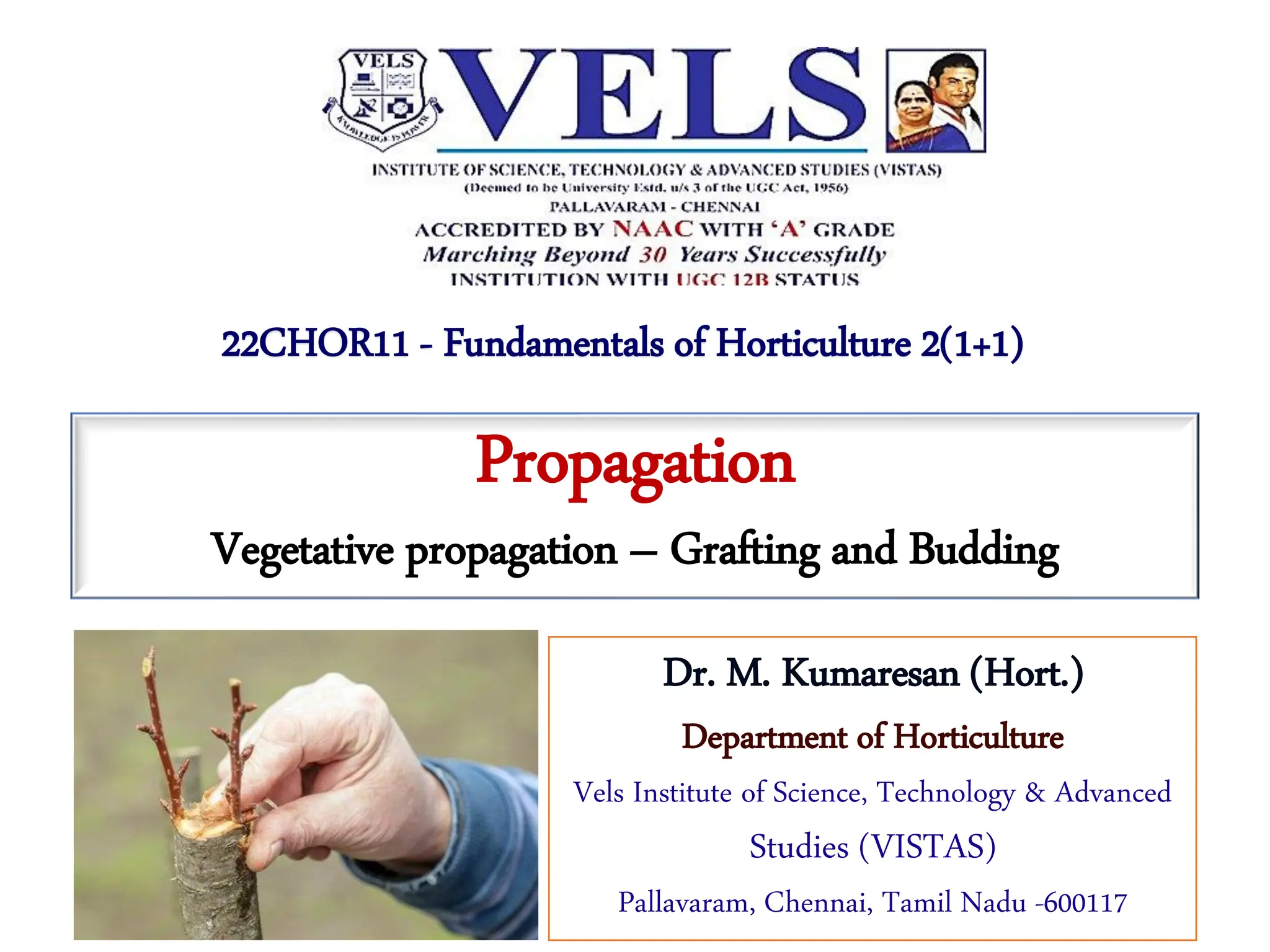
Propagation
Vegetative propagation – Grafting and Budding
22CHOR11 - Fundamentals of Horticulture 2(1+1)
Dr. M. Kumaresan (Hort.)
Department of Horticulture
Vels Institute of Science, Technology & Advanced
Studies (VISTAS)
Pallavaram, Chennai, Tamil Nadu -600117
Grafting
Grafting is the process of operation of inserting a part of one plant
into an or placing it upon, another in such a way that a union will
be formed and the combination will continue to grow as one plant.
The part of the graft combination which is to become the upper
portion is termed as the scion (cion) and the part which is to
become the lower portion or root is termed ‘rootstock’ or
‘understock’ or the ‘stock’. Root stocks are commonly grown from
seeds, cuttings or layers. All methods of joining plants are
popularly termed ‘grafting’ but when the scion part is only a small
piece of bark (and sometimes wood) containing a single bud, the
operation is termed ‘budding’.
Reasons for Grafting and Budding
Change varieties or cultivars: An older established orchard of
fruiting trees may become obsolete as newer varieties or cultivars
are developed. The newer varieties may offer improved insect or
disease resistance, better drought tolerance, or higher yields. As
long as the scion is compatible with the rootstock, the older
orchard may be top worked using the improved variety or cultivar
Reasons for Grafting and Budding
Optimize cross-pollination and pollination: Certain fruit trees are
not self-pollinating; they require pollination by a second fruit tree,
usually of another variety. This process is known as cross-
pollination. Portions of a tree or entire trees may be pollinated
with the second variety to ensure fruit set. For example, some
hollies are dioecious, meaning that a given plant has either male or
female flowers but not both. To ensure good fruit set on the female
(pistillate) plant, a male (staminate) plant must be growing nearby.
Where this is not possible, the chances that cross-pollination will
occur can be increased by grafting a scion from a male plant onto
the female plant
Reasons for Grafting and Budding
Take advantage of particular rootstocks: Compared to the
selected scion, certain rootstocks have superior growth habits,
disease and insect resistance, and drought tolerance. For example,
when used as rootstock for commercial apple varieties, the French
crabapple (Malus sylvestris, Mill.) can increase resistance to crown
gall and hairy root. Malling VIII and Malling IX are used as
dwarfing rootstocks for apple trees when full-sized trees are not
desired, such as in the home garden
Reasons for Grafting and Budding
Perpetuate clones: Clones of numerous species of conifers cannot
be economically reproduced from vegetative cuttings because the
percentage of cuttings that root successfully is low. Many can be
grafted, however, onto seedling rootstocks. Colorado blue spruce
(Picea pungens, Engelm), Koster blue spruce (Picea pungens var.
Kosteriana, Henry), and Moerheim spruce (Picea pungens var.
Moerheimii, Rujis) are commonly grafted onto Norway spruce
(Picea abies, Karst.) or Sitka spruce (Picea sitchensis, Carr.)
rootstock to perpetuate desirable clones. Numerous clones of
Japanese maple (Acer palmatum, Thunb.) that either root poorly
or lack an extensive root system are grafted onto seedling Acer
palmatum rootstock
Reasons for Grafting and Budding
Produce certain plant forms: Numerous horticultural plants owe their
beauty to the fact that they are grafted or budded onto a standard, especially
those that have a weeping or cascading form. Examples include weeping
hemlock (Tsuga canadensi, Carr. var. pendula, Beissn.), which is grafted onto
seedling hemlock rootstock (Tsuga canadensis, Carr.); weeping flowering
cherry (Prunus subhietella var. pendula, Tanaka), which is grafted onto
Mazzard cherry rootstock (Prunus avium, L.); and weeping dogwood (Cornus
florida, L. var. pendula, Dipp.), which is grafted onto flowering dogwood
rootstock (Cornus florida, L.). In most cases, multiple scions are grafted or
budded 3 feet or higher on the main stem of the rootstock. When used this
way, the rootstock is referred to as a standard. It may require staking for
several years until the standard is large enough to support the cascading or
weeping top
Reasons for Grafting and Budding
Repair damaged plants: Large trees or specimen plants can be
damaged easily at or slightly above the soil line. The damage may
be caused by maintenance equipment (such as lawn mowers,
trenchers, or construction equipment), or by disease, rodents, or
winter storms. The damage can often be repaired by planting
several seedlings of the same species around the injured tree and
grafting them above the injury. This procedure is referred to as
inarching, approach grafting, or bridge grafting
Reasons for Grafting and Budding
Increase the growth rate of seedlings: The seedling progeny
of many fruit and nut breeding programs, if left to develop
naturally, may require 8 to 12 years to become fruitful.
However, if these progeny are grafted onto established
plants, the time required for them to flower and fruit is
reduced dramatically. Another way to increase the growth
rate of seedlings is to graft more than one seedling onto a
mature plant. Using this procedure as a breeding tool saves
time, space, and money
Reasons for Grafting and Budding
Index viruses: Many plants carry viruses, although the symptoms
may not always be obvious or even visible. The presence or absence
of the virus in the suspect plant can be confirmed by grafting scions
from the plant onto another plant that is highly susceptible and will
display prominent symptoms.
Rootstocks
Rootstocks also influence the growth and productivity of scion.
Rootstocks can be divided into two groups as follows
Seedling rootstocks: Variation among seedlings can possibly
make them undesirable as rootstocks. Variation in rootstock
seedlings may cause variability in the growth and performance of
the grafted trees. Seedlings which are weak should be avoided.
Seedlings of 1 to 2 years old with pencil thickness are considered
optimum. Seedling rootstocks are employed for mango, plums and
peaches
Rootstocks
Clonal rootstock: To avoid variation in rootstocks, thus to impart
uniformity in the scion, often rootstocks are also propagated by
cuttings or Lavers. Such rootstocks which are perpetuated asexually
are termed as clonal rootstocks. Nucellar seedling (polyembryony)
in certain varieties of mango and all the species in citrus (Excepting
C. grandis) can be also considered as clonal rootstocks as they arise
from the tissues other than the true sexual embryo. Clonal
rootstocks are used in the propagation of apple and pear.
Factors for Successful Graft Union
Botanically the closer a rootstock and scion, the more will be the compatibility
between these two.
Proper season of grafting is essential. For deciduous plants, grafting is done at the
winter season or early spring season, and for evergreen trees it should be done
during its active growing season.
Any grafting or budding method should ensure intimate contact between the
cambium of scion and rootstock.
Immediately after the grafting operation is completed all the cut surfaces must be
carefully protected from desiccation.
Proper care should be given to the grafts for a period of time after grafting.
Formation of Graft Union
Production of callus tissues by the cambium regions.
Intermingling and interlocking of parenchyma cells of both grafts combinations
Differentiation of certain parenchyma cells of the callus into new cambium cells
connecting with the original cambium in the stock and scion
Production of new vascular tissues by the new cambium permitting passage of
nutrients and water between the stock and scion.
Method of Grafting
Grafting techniques may be employed for production of new plants, top
working or for renovation and rejuvenation of the existing trees.
Methods for Production of New Plants
1. Inarching or approach grafting
2. Tongue inarching
3. Side grafting
4. Saddle grafting
5. Cleft grafting
6. Whip grafting
7. Whip and tongue grafting
8. Veneer grafting
9. Epicotyl grafting
Inarching grafting (Scion attached method)
This method is extensively practiced in the propagation attached to
the mother plant while the rootstocks grown separately on pots are
brought closer to the mother trees for grafting. At the time of
inarching, the seedlings stock should have a thickness of a lead
pencil. From the stock, 22 cm above ground level, 5 to 8 cm long
slice of bark and wood is removed. This cut removes about one
third of the thickness of the stem and tapers gently towards the tip
and bottom
Inarching grafting (Scion attached method)
A corresponding cut is made on the scion shoot so that two cuts fit
in perfectly without leaving a chink. Two cuts are placed face to
face and tied firmly with jute threads and then with twine over it.
The union is covered with a mixture of cow dung and mud in
equal parts. After union (6 to 8 weeks after grafting) the top of the
rootstock is removed above the graft point and the base of the
scion shoot is removed below the graft point. Removal is done in
stages by giving a half cut first and an another half cut after an
interval of 10 days.
Inarching grafting (Scion attached method)
(a) Removal of slice of wood
(b) Positioning and tying
(c) Waxing the graft union
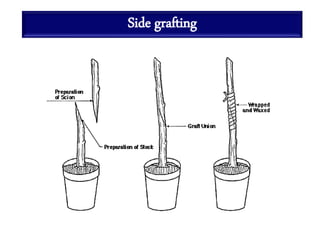
Side grafting
Scion is prepared from the terminal of the past season’s growth and
used when they are not in active growth. Pre-curing of scion has to
be done when it is still on the tree. Pre-curing of scion consists of
removal of all the leaves retaining their petiole intact excepting 10
cm at the top. Buds swell in axils subsequently and these pre-cured
scions will be cut and used as % scions after a week. Scion is
inserted into the side of the rootstock which is larger than the scion
and also the top of the rootstock is not removed. In the stock, a
slanting cut of 2.5cm is made at the base at an angle of 20° to 25°.
After insertion of the scion, it is tied well. After a month buds in
the scion begin to grow. When they grow to 7.5 to 9.0 cm long, the
rootstock stem above the joint is removed. Eg: Mango, Sapota, Fig
and Mangosteen.
Side grafting
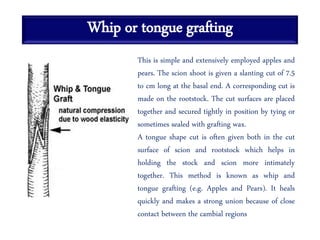
Whip or tongue grafting
This is simple and extensively employed apples and
pears. The scion shoot is given a slanting cut of 7.5
to cm long at the basal end. A corresponding cut is
made on the rootstock. The cut surfaces are placed
together and secured tightly in position by tying or
sometimes sealed with grafting wax.
A tongue shape cut is often given both in the cut
surface of scion and rootstock which helps in
holding the stock and scion more intimately
together. This method is known as whip and
tongue grafting (e.g. Apples and Pears). It heals
quickly and makes a strong union because of close
contact between the cambial regions
Cleft grafting
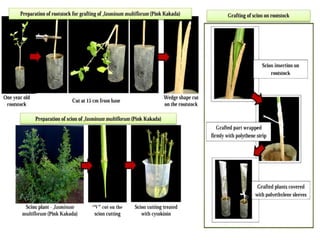
The base of the scion is prepared in the form of wedge. The
rootstock is split in which the scion is inserted. For this method,
the rootstock and scion shoots need not be of same thickness.
Usually this is done on thick stocks of 2 to 8 cm in diameter. The
stock is given a smooth cut and then it is split at the center and
two scions are inserted at the ends in such a way that the cambial
layers should be in contact. Hence, scions are not inserted in the
middle but done on either side. After the successful graft union,
only the better developed one of these two will be allowed
Cleft grafting
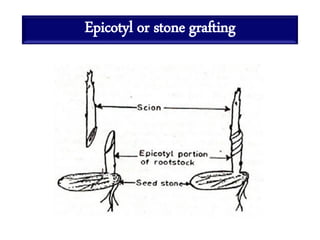
Epicotyl or stone grafting
This type of grafting has been recently standardized in fruit crops
like mango and cashew and this holds great promise for
multiplying plants in large number and in lesser time. The seeds
are placed on sand bed and covered with 5.0-7.5 cm thick layer of
leaf mould for germination. Germinated seedlings of 8 to 15 days
age are taken out and grafted indoor by beheading the seedlings
about 5.0 cm above the seed and inserting the wedge shaped
scion in the vertical split of the beheaded stock. Polythene tape of
200 gauge thickness is utilized for tying the graft. Immediately
thereafter, the grafts are planted in polythene bags filled with soil
and farm yard manure mixture (1:1).
Epicotyl or stone grafting
The grafts are watered and kept in semi-shade condition to avoid
damaging effects of sun and rain. If the age of the stock is beyond
15 days the percentage of success is greatly reduced in mango. To
overcome this problem, flush grafting and soft wood grafting have
been developed. In flush grafting, the fresh growth of the second
flush is used as rootstock while in softwood grafting; seedlings of
one year old are used as rootstocks. The technique of grafting is
same in all the three types of grafting.
Epicotyl or stone grafting
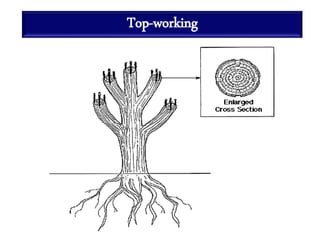
Top-working
This is also known as ‘top-grafting’ or ‘top-budding’ if we adopt
anyone of the grafting or budding techniques respectively.
Top-working is aimed at changing the established plant, tree,
shrub or vine with a desirable cultivar. For top-working, one has to
select three to five well-spaced scaffold branches which are not
larger than about 10 cm in diameter and are conveniently cut close
to ground. The selected branches are given smooth cut without
tearing the bark from the trunk. Thus, these branches may be
utilized as rootstocks and grafting is done.
Top-working
In bark grafting, the bark is split mid the scion is inserted as in
graft. The scion is inserted between the bark and the wood and
pushed carefully. The graft joint may be sealed with grafting wax.
In veneer grafting, which is a modified method of side grafting, 2.5
to 3.0 cm cut is made downward. A small notch is made by
removing a piece of wood by a diagonal cut at the base to
accommodate wedge shaped scion. Trees just grafted should be
amply supplied with water so that the tissues are in a high state of
turgidity. This is necessary to have adequate callus production
which is essential for the healing of the graft union
Top-working
For renovation and rejuvenation
Occasionally the roots, trunks or large limbs are damaged
by winter injury, cultivation implements, certain diseases
or rodents. Such damaged trees can be repaired and saved
by use of bridge and buttress grafting
Bridge grafting
This is used when the root system of the tree has not been
damaged but there is injury to the bark of the trunk. It is done
during the active growth of the tree so that the bark is slipping
easily. The scion is selected from one year old growth, 0.5 to 1.5
cm in diameter of the same or compatible species. The first step in
bridge grafting is to trim the wounded area back to healthy
undamaged tissue by removing dead or tom bark. Then every 8 to
10 cm around the injured section, a scion is inserted at both the
upper and lower ends into live bark. It is important that the scions
be inserted right side up. After all the scions have been inserted,
graft unions have to be thoroughly graft waxed.
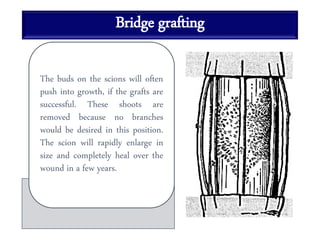
Bridge grafting
The buds on the scions will often
push into growth, if the grafts are
successful. These shoots are
removed because no branches
would be desired in this position.
The scion will rapidly enlarge in
size and completely heal over the
wound in a few years.
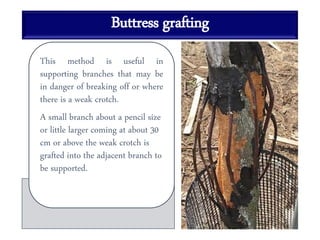
Buttress grafting
This method is useful in
supporting branches that may be
in danger of breaking off or where
there is a weak crotch.
A small branch about a pencil size
or little larger coming at about 30
cm or above the weak crotch is
grafted into the adjacent branch to
be supported.
Budding
Budding is the art of inserting a bud on the rootstock plant in such a manner
that both will unite and continue to grow as a single individual plant. The
special advantage of budding over grafting is the economy in the use of
scion materials. The shoots of mother tree from which buds are taken for
use as scion materials for budding are called ‘bud wood’.
Bud wood should be collected from a selected tree and it should be of a well
matured past season’s growth with plumpy and well developed buds which
should be dormant but ready to grow. Ten to fifteen days before the removal
of the bud3 the shoots should be defoliated so as to activate the buds. Buds
can be removed with or without wood from the scion shoot. Budding should
be done when the rootstock is still on active growing condition with a free
flow of sap which will help in easy lifting of bark in budding operation and
also for proper union.
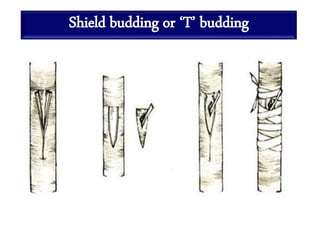
Shield budding or ‘T’ budding
In this method a T’ or inverted T’ shaped incision is made on
the, rootstock stem. A transverse cut of 1.0 to 1.5 cm length is
made-first and then either below or above to this a vertical cut of
2.5 cm to 3.0 cm lengths made and connected to the transverse
cut. Then the bark is lifted by using the ivory edge of the
budding knife. The scion bud is removed in the form of a shield
with or without a piece of wood. The bark is raised and then the
bud is inserted into the ‘T’ cut surface of the rootstocks. Then it
is secured in position by proper bandaging. This method of
budding is practiced extensively in the propagation of sweet
oranges, roses, plums and peaches.
Shield budding or ‘T’ budding
Patch budding
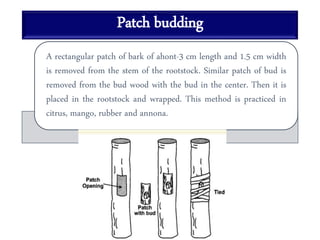
A rectangular patch of bark of ahont-3 cm length and 1.5 cm width
is removed from the stem of the rootstock. Similar patch of bud is
removed from the bud wood with the bud in the center. Then it is
placed in the rootstock and wrapped. This method is practiced in
citrus, mango, rubber and annona.
Ring budding
The bud is prepared by taking a ring of bark 3.0 cm in length
with the bud in the center. In the rootstock, two circular cuts 1.5
cm apart are made and these are connected with a vertical cut and
the ring of bark is removed. The prepared scion bud with the ring
of bark is fitted in the exposed portion of the rootstock and tied
as usual. This is commonly practiced in cinchona.
Flute budding: (Ring or Annular Budding)
This is exactly same as ring budding, the difference being that the
ringed bark can be removed easily in the form of a flute. Here the
stock plant is topped off at 25 cm height and at the top about 2.5
to 3.0 cm of bark is removed leaving the wood exposed. The bud
in the form of a flute is then fitted in the rootstock. It is essential
that the diameter of the rootstock and scion should exactly be
same, otherwise the contact between them will not be proper.
Flute budding: (Ring or Annular Budding)
Chip budding
In one-side of the rootstock, a slanting cut of 2.5 cm length going
to a depth of half of the thickness of the stock is made. A notch
is given at the bottom end of the cut. A similar cut is made in the
scion shoot and a bud with a large piece of wood is removed. The
scion bud is exactly fitted into the cut made in the rootstock and
tied (e.g. Grapes). If any of the above methods, the union will
take place in 3-5 weeks. After the union is complete, the top of
the rootstock is removed at gradual stages, 7 to 8 cm above the
bud union. This has to be provided above the bud union so that
drying of the tip of the rootstock may not extend up to bud joint
and injure the bud.
Chip budding
Propagation - Asexual - Grafting and budding.pdf

Propagation - Asexual - Grafting and budding.pdf

  • 1.
    Propagation Vegetative propagation –Grafting and Budding 22CHOR11 - Fundamentals of Horticulture 2(1+1) Dr. M. Kumaresan (Hort.) Department of Horticulture Vels Institute of Science, Technology & Advanced Studies (VISTAS) Pallavaram, Chennai, Tamil Nadu -600117
  • 2.
    Grafting Grafting is theprocess of operation of inserting a part of one plant into an or placing it upon, another in such a way that a union will be formed and the combination will continue to grow as one plant. The part of the graft combination which is to become the upper portion is termed as the scion (cion) and the part which is to become the lower portion or root is termed ‘rootstock’ or ‘understock’ or the ‘stock’. Root stocks are commonly grown from seeds, cuttings or layers. All methods of joining plants are popularly termed ‘grafting’ but when the scion part is only a small piece of bark (and sometimes wood) containing a single bud, the operation is termed ‘budding’.
  • 3.
    Reasons for Graftingand Budding Change varieties or cultivars: An older established orchard of fruiting trees may become obsolete as newer varieties or cultivars are developed. The newer varieties may offer improved insect or disease resistance, better drought tolerance, or higher yields. As long as the scion is compatible with the rootstock, the older orchard may be top worked using the improved variety or cultivar
  • 4.
    Reasons for Graftingand Budding Optimize cross-pollination and pollination: Certain fruit trees are not self-pollinating; they require pollination by a second fruit tree, usually of another variety. This process is known as cross- pollination. Portions of a tree or entire trees may be pollinated with the second variety to ensure fruit set. For example, some hollies are dioecious, meaning that a given plant has either male or female flowers but not both. To ensure good fruit set on the female (pistillate) plant, a male (staminate) plant must be growing nearby. Where this is not possible, the chances that cross-pollination will occur can be increased by grafting a scion from a male plant onto the female plant
  • 5.
    Reasons for Graftingand Budding Take advantage of particular rootstocks: Compared to the selected scion, certain rootstocks have superior growth habits, disease and insect resistance, and drought tolerance. For example, when used as rootstock for commercial apple varieties, the French crabapple (Malus sylvestris, Mill.) can increase resistance to crown gall and hairy root. Malling VIII and Malling IX are used as dwarfing rootstocks for apple trees when full-sized trees are not desired, such as in the home garden
  • 6.
    Reasons for Graftingand Budding Perpetuate clones: Clones of numerous species of conifers cannot be economically reproduced from vegetative cuttings because the percentage of cuttings that root successfully is low. Many can be grafted, however, onto seedling rootstocks. Colorado blue spruce (Picea pungens, Engelm), Koster blue spruce (Picea pungens var. Kosteriana, Henry), and Moerheim spruce (Picea pungens var. Moerheimii, Rujis) are commonly grafted onto Norway spruce (Picea abies, Karst.) or Sitka spruce (Picea sitchensis, Carr.) rootstock to perpetuate desirable clones. Numerous clones of Japanese maple (Acer palmatum, Thunb.) that either root poorly or lack an extensive root system are grafted onto seedling Acer palmatum rootstock
  • 7.
    Reasons for Graftingand Budding Produce certain plant forms: Numerous horticultural plants owe their beauty to the fact that they are grafted or budded onto a standard, especially those that have a weeping or cascading form. Examples include weeping hemlock (Tsuga canadensi, Carr. var. pendula, Beissn.), which is grafted onto seedling hemlock rootstock (Tsuga canadensis, Carr.); weeping flowering cherry (Prunus subhietella var. pendula, Tanaka), which is grafted onto Mazzard cherry rootstock (Prunus avium, L.); and weeping dogwood (Cornus florida, L. var. pendula, Dipp.), which is grafted onto flowering dogwood rootstock (Cornus florida, L.). In most cases, multiple scions are grafted or budded 3 feet or higher on the main stem of the rootstock. When used this way, the rootstock is referred to as a standard. It may require staking for several years until the standard is large enough to support the cascading or weeping top
  • 8.
    Reasons for Graftingand Budding Repair damaged plants: Large trees or specimen plants can be damaged easily at or slightly above the soil line. The damage may be caused by maintenance equipment (such as lawn mowers, trenchers, or construction equipment), or by disease, rodents, or winter storms. The damage can often be repaired by planting several seedlings of the same species around the injured tree and grafting them above the injury. This procedure is referred to as inarching, approach grafting, or bridge grafting
  • 9.
    Reasons for Graftingand Budding Increase the growth rate of seedlings: The seedling progeny of many fruit and nut breeding programs, if left to develop naturally, may require 8 to 12 years to become fruitful. However, if these progeny are grafted onto established plants, the time required for them to flower and fruit is reduced dramatically. Another way to increase the growth rate of seedlings is to graft more than one seedling onto a mature plant. Using this procedure as a breeding tool saves time, space, and money
  • 10.
    Reasons for Graftingand Budding Index viruses: Many plants carry viruses, although the symptoms may not always be obvious or even visible. The presence or absence of the virus in the suspect plant can be confirmed by grafting scions from the plant onto another plant that is highly susceptible and will display prominent symptoms.
  • 11.
    Rootstocks Rootstocks also influencethe growth and productivity of scion. Rootstocks can be divided into two groups as follows Seedling rootstocks: Variation among seedlings can possibly make them undesirable as rootstocks. Variation in rootstock seedlings may cause variability in the growth and performance of the grafted trees. Seedlings which are weak should be avoided. Seedlings of 1 to 2 years old with pencil thickness are considered optimum. Seedling rootstocks are employed for mango, plums and peaches
  • 12.
    Rootstocks Clonal rootstock: Toavoid variation in rootstocks, thus to impart uniformity in the scion, often rootstocks are also propagated by cuttings or Lavers. Such rootstocks which are perpetuated asexually are termed as clonal rootstocks. Nucellar seedling (polyembryony) in certain varieties of mango and all the species in citrus (Excepting C. grandis) can be also considered as clonal rootstocks as they arise from the tissues other than the true sexual embryo. Clonal rootstocks are used in the propagation of apple and pear.
  • 13.
    Factors for SuccessfulGraft Union Botanically the closer a rootstock and scion, the more will be the compatibility between these two. Proper season of grafting is essential. For deciduous plants, grafting is done at the winter season or early spring season, and for evergreen trees it should be done during its active growing season. Any grafting or budding method should ensure intimate contact between the cambium of scion and rootstock. Immediately after the grafting operation is completed all the cut surfaces must be carefully protected from desiccation. Proper care should be given to the grafts for a period of time after grafting.
  • 14.
    Formation of GraftUnion Production of callus tissues by the cambium regions. Intermingling and interlocking of parenchyma cells of both grafts combinations Differentiation of certain parenchyma cells of the callus into new cambium cells connecting with the original cambium in the stock and scion Production of new vascular tissues by the new cambium permitting passage of nutrients and water between the stock and scion.
  • 15.
    Method of Grafting Graftingtechniques may be employed for production of new plants, top working or for renovation and rejuvenation of the existing trees. Methods for Production of New Plants 1. Inarching or approach grafting 2. Tongue inarching 3. Side grafting 4. Saddle grafting 5. Cleft grafting 6. Whip grafting 7. Whip and tongue grafting 8. Veneer grafting 9. Epicotyl grafting
  • 16.
    Inarching grafting (Scionattached method) This method is extensively practiced in the propagation attached to the mother plant while the rootstocks grown separately on pots are brought closer to the mother trees for grafting. At the time of inarching, the seedlings stock should have a thickness of a lead pencil. From the stock, 22 cm above ground level, 5 to 8 cm long slice of bark and wood is removed. This cut removes about one third of the thickness of the stem and tapers gently towards the tip and bottom
  • 17.
    Inarching grafting (Scionattached method) A corresponding cut is made on the scion shoot so that two cuts fit in perfectly without leaving a chink. Two cuts are placed face to face and tied firmly with jute threads and then with twine over it. The union is covered with a mixture of cow dung and mud in equal parts. After union (6 to 8 weeks after grafting) the top of the rootstock is removed above the graft point and the base of the scion shoot is removed below the graft point. Removal is done in stages by giving a half cut first and an another half cut after an interval of 10 days.
  • 18.
    Inarching grafting (Scionattached method) (a) Removal of slice of wood (b) Positioning and tying (c) Waxing the graft union
  • 19.
    Side grafting Scion isprepared from the terminal of the past season’s growth and used when they are not in active growth. Pre-curing of scion has to be done when it is still on the tree. Pre-curing of scion consists of removal of all the leaves retaining their petiole intact excepting 10 cm at the top. Buds swell in axils subsequently and these pre-cured scions will be cut and used as % scions after a week. Scion is inserted into the side of the rootstock which is larger than the scion and also the top of the rootstock is not removed. In the stock, a slanting cut of 2.5cm is made at the base at an angle of 20° to 25°. After insertion of the scion, it is tied well. After a month buds in the scion begin to grow. When they grow to 7.5 to 9.0 cm long, the rootstock stem above the joint is removed. Eg: Mango, Sapota, Fig and Mangosteen.
  • 20.
  • 21.
    Whip or tonguegrafting This is simple and extensively employed apples and pears. The scion shoot is given a slanting cut of 7.5 to cm long at the basal end. A corresponding cut is made on the rootstock. The cut surfaces are placed together and secured tightly in position by tying or sometimes sealed with grafting wax. A tongue shape cut is often given both in the cut surface of scion and rootstock which helps in holding the stock and scion more intimately together. This method is known as whip and tongue grafting (e.g. Apples and Pears). It heals quickly and makes a strong union because of close contact between the cambial regions
  • 22.
    Cleft grafting The baseof the scion is prepared in the form of wedge. The rootstock is split in which the scion is inserted. For this method, the rootstock and scion shoots need not be of same thickness. Usually this is done on thick stocks of 2 to 8 cm in diameter. The stock is given a smooth cut and then it is split at the center and two scions are inserted at the ends in such a way that the cambial layers should be in contact. Hence, scions are not inserted in the middle but done on either side. After the successful graft union, only the better developed one of these two will be allowed
  • 23.
  • 24.
    Epicotyl or stonegrafting This type of grafting has been recently standardized in fruit crops like mango and cashew and this holds great promise for multiplying plants in large number and in lesser time. The seeds are placed on sand bed and covered with 5.0-7.5 cm thick layer of leaf mould for germination. Germinated seedlings of 8 to 15 days age are taken out and grafted indoor by beheading the seedlings about 5.0 cm above the seed and inserting the wedge shaped scion in the vertical split of the beheaded stock. Polythene tape of 200 gauge thickness is utilized for tying the graft. Immediately thereafter, the grafts are planted in polythene bags filled with soil and farm yard manure mixture (1:1).
  • 25.
    Epicotyl or stonegrafting The grafts are watered and kept in semi-shade condition to avoid damaging effects of sun and rain. If the age of the stock is beyond 15 days the percentage of success is greatly reduced in mango. To overcome this problem, flush grafting and soft wood grafting have been developed. In flush grafting, the fresh growth of the second flush is used as rootstock while in softwood grafting; seedlings of one year old are used as rootstocks. The technique of grafting is same in all the three types of grafting.
  • 26.
  • 27.
    Top-working This is alsoknown as ‘top-grafting’ or ‘top-budding’ if we adopt anyone of the grafting or budding techniques respectively. Top-working is aimed at changing the established plant, tree, shrub or vine with a desirable cultivar. For top-working, one has to select three to five well-spaced scaffold branches which are not larger than about 10 cm in diameter and are conveniently cut close to ground. The selected branches are given smooth cut without tearing the bark from the trunk. Thus, these branches may be utilized as rootstocks and grafting is done.
  • 28.
    Top-working In bark grafting,the bark is split mid the scion is inserted as in graft. The scion is inserted between the bark and the wood and pushed carefully. The graft joint may be sealed with grafting wax. In veneer grafting, which is a modified method of side grafting, 2.5 to 3.0 cm cut is made downward. A small notch is made by removing a piece of wood by a diagonal cut at the base to accommodate wedge shaped scion. Trees just grafted should be amply supplied with water so that the tissues are in a high state of turgidity. This is necessary to have adequate callus production which is essential for the healing of the graft union
  • 29.
  • 30.
    For renovation andrejuvenation Occasionally the roots, trunks or large limbs are damaged by winter injury, cultivation implements, certain diseases or rodents. Such damaged trees can be repaired and saved by use of bridge and buttress grafting
  • 31.
    Bridge grafting This isused when the root system of the tree has not been damaged but there is injury to the bark of the trunk. It is done during the active growth of the tree so that the bark is slipping easily. The scion is selected from one year old growth, 0.5 to 1.5 cm in diameter of the same or compatible species. The first step in bridge grafting is to trim the wounded area back to healthy undamaged tissue by removing dead or tom bark. Then every 8 to 10 cm around the injured section, a scion is inserted at both the upper and lower ends into live bark. It is important that the scions be inserted right side up. After all the scions have been inserted, graft unions have to be thoroughly graft waxed.
  • 32.
    Bridge grafting The budson the scions will often push into growth, if the grafts are successful. These shoots are removed because no branches would be desired in this position. The scion will rapidly enlarge in size and completely heal over the wound in a few years.
  • 33.
    Buttress grafting This methodis useful in supporting branches that may be in danger of breaking off or where there is a weak crotch. A small branch about a pencil size or little larger coming at about 30 cm or above the weak crotch is grafted into the adjacent branch to be supported.
  • 34.
    Budding Budding is theart of inserting a bud on the rootstock plant in such a manner that both will unite and continue to grow as a single individual plant. The special advantage of budding over grafting is the economy in the use of scion materials. The shoots of mother tree from which buds are taken for use as scion materials for budding are called ‘bud wood’. Bud wood should be collected from a selected tree and it should be of a well matured past season’s growth with plumpy and well developed buds which should be dormant but ready to grow. Ten to fifteen days before the removal of the bud3 the shoots should be defoliated so as to activate the buds. Buds can be removed with or without wood from the scion shoot. Budding should be done when the rootstock is still on active growing condition with a free flow of sap which will help in easy lifting of bark in budding operation and also for proper union.
  • 35.
    Shield budding or‘T’ budding In this method a T’ or inverted T’ shaped incision is made on the, rootstock stem. A transverse cut of 1.0 to 1.5 cm length is made-first and then either below or above to this a vertical cut of 2.5 cm to 3.0 cm lengths made and connected to the transverse cut. Then the bark is lifted by using the ivory edge of the budding knife. The scion bud is removed in the form of a shield with or without a piece of wood. The bark is raised and then the bud is inserted into the ‘T’ cut surface of the rootstocks. Then it is secured in position by proper bandaging. This method of budding is practiced extensively in the propagation of sweet oranges, roses, plums and peaches.
  • 36.
    Shield budding or‘T’ budding
  • 37.
    Patch budding A rectangularpatch of bark of ahont-3 cm length and 1.5 cm width is removed from the stem of the rootstock. Similar patch of bud is removed from the bud wood with the bud in the center. Then it is placed in the rootstock and wrapped. This method is practiced in citrus, mango, rubber and annona.
  • 38.
    Ring budding The budis prepared by taking a ring of bark 3.0 cm in length with the bud in the center. In the rootstock, two circular cuts 1.5 cm apart are made and these are connected with a vertical cut and the ring of bark is removed. The prepared scion bud with the ring of bark is fitted in the exposed portion of the rootstock and tied as usual. This is commonly practiced in cinchona.
  • 39.
    Flute budding: (Ringor Annular Budding) This is exactly same as ring budding, the difference being that the ringed bark can be removed easily in the form of a flute. Here the stock plant is topped off at 25 cm height and at the top about 2.5 to 3.0 cm of bark is removed leaving the wood exposed. The bud in the form of a flute is then fitted in the rootstock. It is essential that the diameter of the rootstock and scion should exactly be same, otherwise the contact between them will not be proper.
  • 40.
    Flute budding: (Ringor Annular Budding)
  • 41.
    Chip budding In one-sideof the rootstock, a slanting cut of 2.5 cm length going to a depth of half of the thickness of the stock is made. A notch is given at the bottom end of the cut. A similar cut is made in the scion shoot and a bud with a large piece of wood is removed. The scion bud is exactly fitted into the cut made in the rootstock and tied (e.g. Grapes). If any of the above methods, the union will take place in 3-5 weeks. After the union is complete, the top of the rootstock is removed at gradual stages, 7 to 8 cm above the bud union. This has to be provided above the bud union so that drying of the tip of the rootstock may not extend up to bud joint and injure the bud.
  • 42.