RHS Level 2 Certificate
Week 14- vegetative
reproduction by stem
cuttings, layering and
division.
Learning objectives









Review of leaf cuttings.
1.1 State the physiological factors to be fulfilled for successful
propagation by layering.
1.2 Describe how to propagate ONE NAMED plant for EACH of
the following types of layering: air; simple; and serpentine
1.3 Describe the aftercare required for plants raised by
layering.
1.4 State the conditions which have to be met to ensure
successful propagation by division.
1.5 Describe how to propagate by division ONE NAMED plant
of EACH of the following types: a suckering shrub; a fibrousrooted perennial; a perennial with distinct buds (eyes).
1.6 Describe the aftercare of plants propagated by division.
Christmas Prize Quiz
 Test

conditions
 30 minutes
 Ho! Ho! Ho!
Leaf cuttings








Leaf lamina – entire leaf; veins cut across (shallowly)
on the back of the leaf. Pinned down on compost.
Begonia rex
Midrib – Leaf detached and central vein removed;
cut edge inserted into shallow trench in compost and
firmed. Streptocarpus rexii
Petiole – entire leaf, petiole inserted into compost so
base touches. Saintpaulia ionantha
Leaf section – squares (planted to 1/3 of height in
tray) or chevrons (the pointy end is the ‘bottom’)
Plantlets form where the cut leaf veins touch the
compost.
Propagation by division






Used for perennials – clump forming, suckering and
rhizomes.
Use more juvenile offsets from the edge of the clump
or plant.
Divide summer flowering plants in the spring or
autumn e.g, Iris ensata
Divide spring flowering plants in the summer after
flowering e.g. Epimedium x rubrum
Aftercare – weed to reduce competition, do not allow
soil to dry out.
Plants that can be divided
Iris

ensata (or any rhizomatous iris)
Epimedium x rubrum
Bergenia purpurescens
Hosta sieboldiana
Phyllostachys nigra
Sarcoccoa hookeriana
Note: Three of these are monocots –
monocots cannot generally be propagated
by cuttings.
Propagation by layering




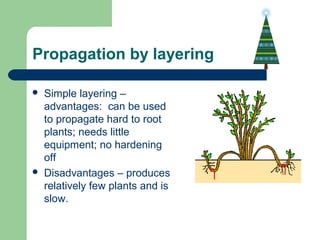
Simple layering –
advantages: can be used
to propagate hard to root
plants; needs little
equipment; no hardening
off
Disadvantages – produces
relatively few plants and is
slow.
Propagation by layering




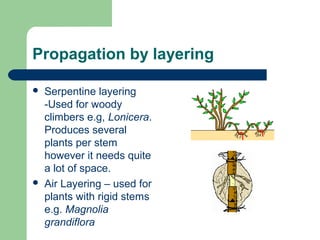
Serpentine layering
-Used for woody
climbers e.g, Lonicera.
Produces several
plants per stem
however it needs quite
a lot of space.
Air Layering – used for
plants with rigid stems
e.g. Magnolia
grandiflora
Aftercare for layered plants
 Keep

soil moist (sphagnum moss in air
layering) until rooting occurs.
 Once rooted (and shoots are produced in
serpentine layering) detach from the parent
plant and move to final position or into a pot
to grow on. Remove any residual stem from
the parent plant without leaving a snag.
Health and safety
 The

scalpels are very sharp. Take care
when cutting.
 Some people are allergic to the sap of some
plants – use the latex gloves if you are or
may be affected.
 Do not get the rooting powder on your skin.
Use the wet wipes if you do. Do not inhale
the rooting powder – put the lid on when not
in use.
Characteristics of plant material for
propagation
 True

to type – must show the characteristics
you want.
 Healthy – no signs of virus, no obvious or
severe infestation or infection.
 Turgid – must be well watered and protected
from dehydration after removal from parent.
 Juvenile – the more juvenile the material the
better it is likely to root.
Some hints
 Do

not touch the cut surfaces – the acids on
your skin will inhibit rooting.
 Use rooting powder sparingly.
 Remove unwanted leaves with the knife not by
tearing to avoid damage to the bark.
 Reduce any large leaves by half. Use the knife
or secateurs.
 Pinch out the tip of stem cuttings if soft or to
encourage branching growth.
Internodal cuttings
A

cut is made about 2cm below the leaf node
and another immediately above. The cutting is
a short piece of stem with a leaf and the axillary
bud. Several cuttings can be taken from a single
length of stem.
 No rooting powder is needed. The cuttings are
inserted into a pot of cutting compost so that the
axil is just visible above the compost.
 Suitable for Hedera sp. Camelia sp. Clematis
and other harder to root climbers.
Semi Ripe cuttings
 Take

above a node. 10cm long. Trim to below
a node and remove leaves from bottom so 2-3
sets of leaves remain.
 Wound the base by removing a sliver of bark.
 Dip into rooting powder – tap off excess
carefully
 Use dibber to make hole in prepared pot, insert
so the bottom leaves are just above the surface.
Firm in.
Learning outcomes









Review of leaf cuttings.
1.1 State the physiological factors to be fulfilled for successful
propagation by layering.
1.2 Describe how to propagate ONE NAMED plant for EACH of
the following types of layering: air; simple; and serpentine
1.3 Describe the aftercare required for plants raised by
layering.
1.4 State the conditions which have to be met to ensure
successful propagation by division.
1.5 Describe how to propagate by division ONE NAMED plant
of EACH of the following types: a suckering shrub; a fibrousrooted perennial; a perennial with distinct buds (eyes).
1.6 Describe the aftercare of plants propagated by division.
Term Dates
 Classes

start again on the
8th January
 Happy homework!
 HAPPY

CHRISTMAS!

Rhs year 1 week 15 2013

  • 1.
    RHS Level 2Certificate Week 14- vegetative reproduction by stem cuttings, layering and division.
  • 2.
    Learning objectives        Review ofleaf cuttings. 1.1 State the physiological factors to be fulfilled for successful propagation by layering. 1.2 Describe how to propagate ONE NAMED plant for EACH of the following types of layering: air; simple; and serpentine 1.3 Describe the aftercare required for plants raised by layering. 1.4 State the conditions which have to be met to ensure successful propagation by division. 1.5 Describe how to propagate by division ONE NAMED plant of EACH of the following types: a suckering shrub; a fibrousrooted perennial; a perennial with distinct buds (eyes). 1.6 Describe the aftercare of plants propagated by division.
  • 3.
    Christmas Prize Quiz Test conditions  30 minutes  Ho! Ho! Ho!
  • 4.
    Leaf cuttings      Leaf lamina– entire leaf; veins cut across (shallowly) on the back of the leaf. Pinned down on compost. Begonia rex Midrib – Leaf detached and central vein removed; cut edge inserted into shallow trench in compost and firmed. Streptocarpus rexii Petiole – entire leaf, petiole inserted into compost so base touches. Saintpaulia ionantha Leaf section – squares (planted to 1/3 of height in tray) or chevrons (the pointy end is the ‘bottom’) Plantlets form where the cut leaf veins touch the compost.
  • 5.
    Propagation by division      Usedfor perennials – clump forming, suckering and rhizomes. Use more juvenile offsets from the edge of the clump or plant. Divide summer flowering plants in the spring or autumn e.g, Iris ensata Divide spring flowering plants in the summer after flowering e.g. Epimedium x rubrum Aftercare – weed to reduce competition, do not allow soil to dry out.
  • 6.
    Plants that canbe divided Iris ensata (or any rhizomatous iris) Epimedium x rubrum Bergenia purpurescens Hosta sieboldiana Phyllostachys nigra Sarcoccoa hookeriana Note: Three of these are monocots – monocots cannot generally be propagated by cuttings.
  • 7.
    Propagation by layering   Simplelayering – advantages: can be used to propagate hard to root plants; needs little equipment; no hardening off Disadvantages – produces relatively few plants and is slow.
  • 8.
    Propagation by layering   Serpentinelayering -Used for woody climbers e.g, Lonicera. Produces several plants per stem however it needs quite a lot of space. Air Layering – used for plants with rigid stems e.g. Magnolia grandiflora
  • 9.
    Aftercare for layeredplants  Keep soil moist (sphagnum moss in air layering) until rooting occurs.  Once rooted (and shoots are produced in serpentine layering) detach from the parent plant and move to final position or into a pot to grow on. Remove any residual stem from the parent plant without leaving a snag.
  • 10.
    Health and safety The scalpels are very sharp. Take care when cutting.  Some people are allergic to the sap of some plants – use the latex gloves if you are or may be affected.  Do not get the rooting powder on your skin. Use the wet wipes if you do. Do not inhale the rooting powder – put the lid on when not in use.
  • 11.
    Characteristics of plantmaterial for propagation  True to type – must show the characteristics you want.  Healthy – no signs of virus, no obvious or severe infestation or infection.  Turgid – must be well watered and protected from dehydration after removal from parent.  Juvenile – the more juvenile the material the better it is likely to root.
  • 12.
    Some hints  Do nottouch the cut surfaces – the acids on your skin will inhibit rooting.  Use rooting powder sparingly.  Remove unwanted leaves with the knife not by tearing to avoid damage to the bark.  Reduce any large leaves by half. Use the knife or secateurs.  Pinch out the tip of stem cuttings if soft or to encourage branching growth.
  • 13.
    Internodal cuttings A cut ismade about 2cm below the leaf node and another immediately above. The cutting is a short piece of stem with a leaf and the axillary bud. Several cuttings can be taken from a single length of stem.  No rooting powder is needed. The cuttings are inserted into a pot of cutting compost so that the axil is just visible above the compost.  Suitable for Hedera sp. Camelia sp. Clematis and other harder to root climbers.
  • 14.
    Semi Ripe cuttings Take above a node. 10cm long. Trim to below a node and remove leaves from bottom so 2-3 sets of leaves remain.  Wound the base by removing a sliver of bark.  Dip into rooting powder – tap off excess carefully  Use dibber to make hole in prepared pot, insert so the bottom leaves are just above the surface. Firm in.
  • 15.
    Learning outcomes        Review ofleaf cuttings. 1.1 State the physiological factors to be fulfilled for successful propagation by layering. 1.2 Describe how to propagate ONE NAMED plant for EACH of the following types of layering: air; simple; and serpentine 1.3 Describe the aftercare required for plants raised by layering. 1.4 State the conditions which have to be met to ensure successful propagation by division. 1.5 Describe how to propagate by division ONE NAMED plant of EACH of the following types: a suckering shrub; a fibrousrooted perennial; a perennial with distinct buds (eyes). 1.6 Describe the aftercare of plants propagated by division.
  • 16.
    Term Dates  Classes startagain on the 8th January  Happy homework!  HAPPY CHRISTMAS!