Rasha Khamis Al-Dabbagh
5th year IUG medical student
• 3% of the population
•   : ,3:1
• 4th-5th decade
• Smoking
• Unknown
• Multifactorial:
  – HLA-DR4
  – Some antigen -possibly a virus- sets off
    a chain of events culminating in a chronic
    inflammatory disorder with abnormal
    immunological reactions.
  – Autoantibodies “Rheumatoid Factor”
• All tissues are affected.
• Stages:
 Stage 1 synovitis :
  – Synovial membrane inflammation &
    thickening, cell-rich effusion, intact
    joints & tendons, reversible.
  – S&S: swelling, hotness, tenderness (PIP
    & wrists >>> elbows, shoulders, knees,
    ankles & feet)
 Stage 2 destruction :
  – Articular cartilage erode & tendons may
    rupture.
  – S&S: stiffness & LOM esp. in the
    morning, tendon ruptures. Subcutaneous
    nodules in 25% (olecranon process).
 Stage 3 deformity :
  – Articular destruction, capsular stretching,
    tendon rupture. Progressive instability &
    deformity.
  – S&S: severe muscle wasting, painful callosities
    under metatarsal heads.
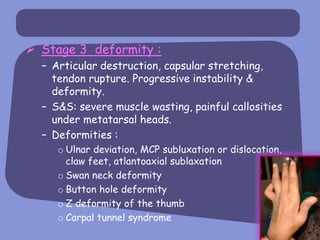
  – Deformities :
     o Ulnar deviation, MCP subluxation or dislocation,
       claw feet, atlantoaxial sublaxation
     o Swan neck deformity
     o Button hole deformity
     o Z deformity of the thumb
     o Carpal tunnel syndrome
• Rheumatoid nodules: in 25%, over
  bony prominences, tendons, sclera,
  viscera.
• Lymphadenopathy
• Vasculitis
• Muscle weakness
• Visceral disease (lungs, heart,
  kidneys, brain & GIT)
Stage 1:
 – Soft tissue swelling, periarticular
   osoteoporosis.
Stage 2:
 – Joint space narrowing, marginal bony
   erosions (esp. wrists & PIP).
Stage 3:
 – Articular destruction, joint deformity.
• ESR & CRP in active phase.
• RF in 80%, used in assessing
  prognosis.
• ANA in 30-40%.
• Minimal criteria:
  – Bilateral symmetrical polyarthritis.
  – Involving proximal joints of hands or
    feet.
  – At least 6 weeks.
• Subcutaneous nodules, periarticular
  erosins on x-ray confirm the
  diagnosis.
•   Seronegative polyarthritis
•   Ankylosing spondylitis
•   Reiter‟s disease
•   Polyarticular gout
•   Polyarticular osteoarthritis
•   Polymyalgia rheumatica
• 80 % Classical „periodic‟ course:
  relapsing & remitting.
• 5% Rapidly progressive: with visceral
  involvement.
• 10% -in men over 55yrs- explosive onset
  after which it tends to subside & follow
  a mild course.
• In few patients only 1-2 attacks then
  disappears.
•   Infection (septic arthritis)
•   Tendon rupture esp. wrist
•   Joint line rupture
•   Secondary osteoarthritis
•   Rest
•   Exercise
•   Splintage & orthotic devices
•   Rehabilitation
•   Physiotherapy
• NSAIDS
• Low-dose corticosteroids
• DMARD e.g gold & pencillinamine

• Surgical:
  – Operative Tx e.g. synovectomy, tendon
    repair or joint stabilization
  – Reconstructive surgery
  – Arthrodesis, osteotomy, arthroplasty
• Chronic inflammatory disease
• 0.2% in Western Europe
•   >
• 15-25 years
• Multifactorial:
  – HLA-B27
  – Trigger e.g. GU or GI infection
• Three characteristic lesions:
  1. Synovitis of synovial joints.
  2. Inflammation of fibro-osseous
     junctions of fibrous joints, tendons &
     ligaments (enthesopathy).
  3. Ossification across the peripheries of
     intervertebral discs.
• Fairly constant sequence:
  Inflammation > granulation tissue >
  cartilage or bone erosion >
  replacement by fibrous tissue >
  fibrous tissue ossification > ankylosis
• Mainly in spine & sacroiliac joints, sometimes
  hips & shoulders, rarely peripheral joints.
• Persistent backache & stiffness worse in
  morning or after inactivity.
• LOM of spine, extension being earliest &
  most severe.
• In > 10% onset in a peripheral joint.
• Atypical onset is more common in    .
Fingertips-to-floor Chest expansion
Wall test       distance
• 6 A‟s:
  –   Anterior uveitis
  –   Atlanto-axial sublaxation
  –   Apical lung fibrosis
  –   Aortitis, aortic regurge & AV block
  –   Amyloidosis
  –   Achilles tendonitis
• Fuzziness or frank erosion of
  sacroiliac joints, later sclerosis,
  eventually ankylosis.
• Intervertebral discs ossification
  causes bony bridges „syndesmophytes‟,
  if several levels are involved bamboo
  spine .
• ESR in active phase
• HLA-B27 in 90%
• Other sero-ve spondylarthropathies
• Ankylosing hyperostosis „Forestier‟s
  disease‟:
  – Mild or nonexistent S&S.
  – Incidental x-rays show widespread ossification
    of ligaments & tendon insertions.
• Mechanical back pain:
  – in young adults
  – Muscle strains, facet joint dysfunction,
    discogenic disorders.
• Medical:
  – Exercise
  – Postural training to prevent deformity
  – Analgesics & NSAIDs
• Surgical:
  – Joint replacement for hip stiffness
  – Vertebral osteotomy for severe flexion
    deformity
• Common features:
  1.    Characteristic spondylitis & sacroiliitis.
  2.    HLA-B27 association.
  3.    Familial aggregation.
  4.    Familial overlap with members having one
        disorder & relatives having another.
• Includes:
  –    Ankylosing spondylitis
  –    Psoriatic arthritis
  –    Reiter‟s disease
  –    IBD associated arthritis
• Psoriatic arthritis ≠ RA + Psoriasis
•   : equal
• HLA-B27 in 60%

• S&S:
  –   Mainly in IP joints of fingers & toes.
  –   Not as symmetrical as in RA.
  –   Arthritis mutilans in severe cases.
  –   ¼ develop AS-like sacroiliac & vertebral
      changes.
• Treatment:
  –   Judicious splintage to prevent deformity.
  –   Topical skin preparations.
  –   NSAIDs.
  –   Surgery for unstable joints.
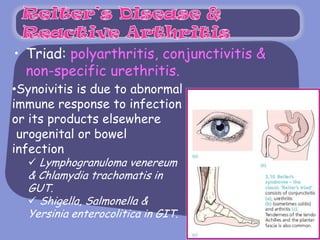
• Triad: polyarthritis, conjunctivitis &
  non-specific urethritis.
•Synoivitis is due to abnormal
immune response to infection
or its products elsewhere
 urogenital or bowel
infection
   Lymphogranuloma venereum
  & Chlamydia trachomatis in
  GUT.
   Shigella, Salmonella &
  Yersinia enterocolitica in GIT.
• Hx of GU infection or diarrhea.
• Mainly large joints, knee & ankle.
• Tenosynovitis & plantar fasciitis are common
• Sacroiliitis & spondylitis causing backache &
  stiffness occur at some stage.
• „Self-limiting‟ but 80% have symptoms for many
  years.
• Ocular lesions: conjunctivitis,
  episcleritis & uveitis.
• Normal at first
• Erosive arthritis after many months.
• AS-like sacroiliac & vertebral
  changes.
• HLA-B27 in 75% .
• ESR in active phase.
• Urethral fluids, faeces or Ab test
  may indicate the organism.
• Directed at the GU or GI infection
  “Antibiotics”.
• Chlamydia: daily tetracycline for 6
  months.

• Local:
  – Rest & splintage in severe arthritis.
  – Anti-inflammatory agents.
• Noninfective inflammatory joint
  disease > 3 months in children < 16
  years.
•    : equal.
• 1 per 1000 children.
• Multifactorial: Genetic
  predisposition + abnormal
  immune response to some antigen.
• RF is -ve
1. Systemic JCA:
  – Age < 3 years.
  – Onset: intermittent fever, rashes &
    malaise.
  – May be lymphadenopathy,
    hepatosplenomegaly.
  – Joint swelling after weeks-months.
2. Pauciarticular JCA:
  –   Commonest form.
  –   Age < 6 years, girls.
  –   Few joints, no systemic illness.
  –   Pain & swelling in medium-sized joints.
  –   Chronic iridocyclitis in 50%.
3. Polyarticular sero+ve JCA:
  – Older girls.
  – Resembles RA juvenile RA .
  – RF is +ve.

4. Sero-ve spondarthritis:
  –   Older boys.
  –   Sacroiliitis & spondyliitis.
  –   May be hips & knees.
  –   HLA-B27 often +ve juvenile AS .
•   Stiffness , sometimes permanent.
•   Growth defects & retardation.
•   Iridocyclitis , may lead to blindness.
•   Amyloidosis, can be fatal.
• General: similar to RA
• Local: prevent stiffness & deformity
  – Night splints.
  – Prone lying for some period daily to prevent
    flexion contracture of hips.
  – Active exercises.

• Surgical: for painful eroded joints
  – Custom-designed arthroplasty of hip & knee.
  – Arthrodesis of wrist & ankle.
• Most recover with moderate LOM.
• 5-10% severely crippled esp. JRA.
• 3% mortality :
  – Overwhelming infection,
  – Renal failure due to amyloidosis.
• Auto-immune disorders.
• Like RA triggered by viral infection in
  genetically predisposed individuals.
• SLE:
  – Progressive joint deformity is unusual.
  – A curious complication is avascular
    necrosis usually in femoral head.
• A descriptive term for a condition in
  which patients complain of pain &
  tenderness in muscles & other soft
  tissues around the back of the neck &
  shoulders, lower back & upper buttocks.
• No pathology in affected tissues.
• Depression & anxiety.
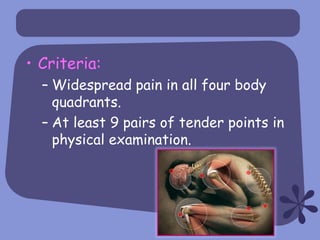
• Criteria:
  – Widespread pain in all four body
    quadrants.
  – At least 9 pairs of tender points in
    physical examination.
• Cause:
  – unknown
  – Suggested theories:
        • Abnormality of ”sensory processing” i.e. ”low pain
          threshold”.
        • Activation of stress responses by sudden
          accidents or traumatic life events.
• Tx:
  – Physiotherapy & daily exercise.
  – Injections into painful areas.
  – Psychotherapy.
Rheumatic disorders summary

Rheumatic disorders summary

  • 1.
    Rasha Khamis Al-Dabbagh 5thyear IUG medical student
  • 2.
    • 3% ofthe population • : ,3:1 • 4th-5th decade • Smoking
  • 3.
    • Unknown • Multifactorial: – HLA-DR4 – Some antigen -possibly a virus- sets off a chain of events culminating in a chronic inflammatory disorder with abnormal immunological reactions. – Autoantibodies “Rheumatoid Factor”
  • 4.
    • All tissuesare affected. • Stages:  Stage 1 synovitis : – Synovial membrane inflammation & thickening, cell-rich effusion, intact joints & tendons, reversible. – S&S: swelling, hotness, tenderness (PIP & wrists >>> elbows, shoulders, knees, ankles & feet)
  • 5.
     Stage 2destruction : – Articular cartilage erode & tendons may rupture. – S&S: stiffness & LOM esp. in the morning, tendon ruptures. Subcutaneous nodules in 25% (olecranon process).
  • 6.
     Stage 3deformity : – Articular destruction, capsular stretching, tendon rupture. Progressive instability & deformity. – S&S: severe muscle wasting, painful callosities under metatarsal heads. – Deformities : o Ulnar deviation, MCP subluxation or dislocation, claw feet, atlantoaxial sublaxation o Swan neck deformity o Button hole deformity o Z deformity of the thumb o Carpal tunnel syndrome
  • 8.
    • Rheumatoid nodules:in 25%, over bony prominences, tendons, sclera, viscera. • Lymphadenopathy • Vasculitis • Muscle weakness • Visceral disease (lungs, heart, kidneys, brain & GIT)
  • 10.
    Stage 1: –Soft tissue swelling, periarticular osoteoporosis. Stage 2: – Joint space narrowing, marginal bony erosions (esp. wrists & PIP). Stage 3: – Articular destruction, joint deformity.
  • 12.
    • ESR &CRP in active phase. • RF in 80%, used in assessing prognosis. • ANA in 30-40%.
  • 13.
    • Minimal criteria: – Bilateral symmetrical polyarthritis. – Involving proximal joints of hands or feet. – At least 6 weeks. • Subcutaneous nodules, periarticular erosins on x-ray confirm the diagnosis.
  • 14.
    Seronegative polyarthritis • Ankylosing spondylitis • Reiter‟s disease • Polyarticular gout • Polyarticular osteoarthritis • Polymyalgia rheumatica
  • 15.
    • 80 %Classical „periodic‟ course: relapsing & remitting. • 5% Rapidly progressive: with visceral involvement. • 10% -in men over 55yrs- explosive onset after which it tends to subside & follow a mild course. • In few patients only 1-2 attacks then disappears.
  • 16.
    Infection (septic arthritis) • Tendon rupture esp. wrist • Joint line rupture • Secondary osteoarthritis
  • 17.
    Rest • Exercise • Splintage & orthotic devices • Rehabilitation • Physiotherapy
  • 18.
    • NSAIDS • Low-dosecorticosteroids • DMARD e.g gold & pencillinamine • Surgical: – Operative Tx e.g. synovectomy, tendon repair or joint stabilization – Reconstructive surgery – Arthrodesis, osteotomy, arthroplasty
  • 20.
    • Chronic inflammatorydisease • 0.2% in Western Europe • > • 15-25 years
  • 21.
    • Multifactorial: – HLA-B27 – Trigger e.g. GU or GI infection
  • 22.
    • Three characteristiclesions: 1. Synovitis of synovial joints. 2. Inflammation of fibro-osseous junctions of fibrous joints, tendons & ligaments (enthesopathy). 3. Ossification across the peripheries of intervertebral discs.
  • 23.
    • Fairly constantsequence: Inflammation > granulation tissue > cartilage or bone erosion > replacement by fibrous tissue > fibrous tissue ossification > ankylosis
  • 24.
    • Mainly inspine & sacroiliac joints, sometimes hips & shoulders, rarely peripheral joints. • Persistent backache & stiffness worse in morning or after inactivity. • LOM of spine, extension being earliest & most severe. • In > 10% onset in a peripheral joint. • Atypical onset is more common in .
  • 25.
  • 26.
    • 6 A‟s: – Anterior uveitis – Atlanto-axial sublaxation – Apical lung fibrosis – Aortitis, aortic regurge & AV block – Amyloidosis – Achilles tendonitis
  • 27.
    • Fuzziness orfrank erosion of sacroiliac joints, later sclerosis, eventually ankylosis. • Intervertebral discs ossification causes bony bridges „syndesmophytes‟, if several levels are involved bamboo spine .
  • 29.
    • ESR inactive phase • HLA-B27 in 90%
  • 30.
    • Other sero-vespondylarthropathies • Ankylosing hyperostosis „Forestier‟s disease‟: – Mild or nonexistent S&S. – Incidental x-rays show widespread ossification of ligaments & tendon insertions. • Mechanical back pain: – in young adults – Muscle strains, facet joint dysfunction, discogenic disorders.
  • 31.
    • Medical: – Exercise – Postural training to prevent deformity – Analgesics & NSAIDs • Surgical: – Joint replacement for hip stiffness – Vertebral osteotomy for severe flexion deformity
  • 33.
    • Common features: 1. Characteristic spondylitis & sacroiliitis. 2. HLA-B27 association. 3. Familial aggregation. 4. Familial overlap with members having one disorder & relatives having another. • Includes: – Ankylosing spondylitis – Psoriatic arthritis – Reiter‟s disease – IBD associated arthritis
  • 34.
    • Psoriatic arthritis≠ RA + Psoriasis • : equal • HLA-B27 in 60% • S&S: – Mainly in IP joints of fingers & toes. – Not as symmetrical as in RA. – Arthritis mutilans in severe cases. – ¼ develop AS-like sacroiliac & vertebral changes.
  • 35.
    • Treatment: – Judicious splintage to prevent deformity. – Topical skin preparations. – NSAIDs. – Surgery for unstable joints.
  • 36.
    • Triad: polyarthritis,conjunctivitis & non-specific urethritis. •Synoivitis is due to abnormal immune response to infection or its products elsewhere urogenital or bowel infection  Lymphogranuloma venereum & Chlamydia trachomatis in GUT.  Shigella, Salmonella & Yersinia enterocolitica in GIT.
  • 37.
    • Hx ofGU infection or diarrhea. • Mainly large joints, knee & ankle. • Tenosynovitis & plantar fasciitis are common • Sacroiliitis & spondylitis causing backache & stiffness occur at some stage. • „Self-limiting‟ but 80% have symptoms for many years. • Ocular lesions: conjunctivitis, episcleritis & uveitis.
  • 38.
    • Normal atfirst • Erosive arthritis after many months. • AS-like sacroiliac & vertebral changes.
  • 39.
    • HLA-B27 in75% . • ESR in active phase. • Urethral fluids, faeces or Ab test may indicate the organism.
  • 40.
    • Directed atthe GU or GI infection “Antibiotics”. • Chlamydia: daily tetracycline for 6 months. • Local: – Rest & splintage in severe arthritis. – Anti-inflammatory agents.
  • 42.
    • Noninfective inflammatoryjoint disease > 3 months in children < 16 years. • : equal. • 1 per 1000 children. • Multifactorial: Genetic predisposition + abnormal immune response to some antigen. • RF is -ve
  • 43.
    1. Systemic JCA: – Age < 3 years. – Onset: intermittent fever, rashes & malaise. – May be lymphadenopathy, hepatosplenomegaly. – Joint swelling after weeks-months.
  • 44.
    2. Pauciarticular JCA: – Commonest form. – Age < 6 years, girls. – Few joints, no systemic illness. – Pain & swelling in medium-sized joints. – Chronic iridocyclitis in 50%.
  • 45.
    3. Polyarticular sero+veJCA: – Older girls. – Resembles RA juvenile RA . – RF is +ve. 4. Sero-ve spondarthritis: – Older boys. – Sacroiliitis & spondyliitis. – May be hips & knees. – HLA-B27 often +ve juvenile AS .
  • 47.
    Stiffness , sometimes permanent. • Growth defects & retardation. • Iridocyclitis , may lead to blindness. • Amyloidosis, can be fatal.
  • 48.
    • General: similarto RA • Local: prevent stiffness & deformity – Night splints. – Prone lying for some period daily to prevent flexion contracture of hips. – Active exercises. • Surgical: for painful eroded joints – Custom-designed arthroplasty of hip & knee. – Arthrodesis of wrist & ankle.
  • 49.
    • Most recoverwith moderate LOM. • 5-10% severely crippled esp. JRA. • 3% mortality : – Overwhelming infection, – Renal failure due to amyloidosis.
  • 51.
    • Auto-immune disorders. •Like RA triggered by viral infection in genetically predisposed individuals. • SLE: – Progressive joint deformity is unusual. – A curious complication is avascular necrosis usually in femoral head.
  • 52.
    • A descriptiveterm for a condition in which patients complain of pain & tenderness in muscles & other soft tissues around the back of the neck & shoulders, lower back & upper buttocks. • No pathology in affected tissues. • Depression & anxiety.
  • 53.
    • Criteria: – Widespread pain in all four body quadrants. – At least 9 pairs of tender points in physical examination.
  • 54.
    • Cause: – unknown – Suggested theories: • Abnormality of ”sensory processing” i.e. ”low pain threshold”. • Activation of stress responses by sudden accidents or traumatic life events. • Tx: – Physiotherapy & daily exercise. – Injections into painful areas. – Psychotherapy.

Editor's Notes

  • #6 LOM: limitation of motion
  • #26 Spine Mobility: Assessment Description:Occiput-to-wall distance (left): The patient places his or her heels and back against a wall and attempts to touch the wall with the occiput, keeping the chin horizontal. The distance in cm from the wall to the tragus is measured. Fingertips-to-floor distance (center): With straight knees, the patient bends forward to touch the floor. When in fullest flexion, the distance b/w fingertips &amp;floor is measured in cm. Chest expansion (right): Measurement is taken at max. expiration &amp; then at max. inspiration at the 4th ICS (nipple line); however, other areas may be used as long as the measurement is consistent over time. The patient should stand with hands on head. The best of three efforts should be recorded in cm. The difference b/w max. exhalation &amp; max. inhalation should be 7 - 12 cm. Less than 3 cm is abnormal.