RHEUMATOID ARTHRITIS
Dr. Gajanan Pandit
D. Ortho; DNB Ortho
DEEPAK HOSPITAL JALNA
Rheumatoid Arthritis:
Key Features
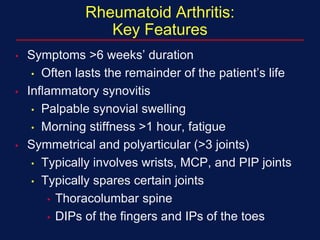
• Symptoms >6 weeks’ duration
• Often lasts the remainder of the patient’s life
• Inflammatory synovitis
• Palpable synovial swelling
• Morning stiffness >1 hour, fatigue
• Symmetrical and polyarticular (>3 joints)
• Typically involves wrists, MCP, and PIP joints
• Typically spares certain joints
• Thoracolumbar spine
• DIPs of the fingers and IPs of the toes
Rheumatoid Arthritis:
Key Features (cont’d)
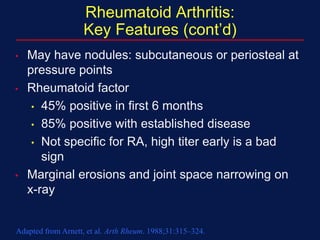
• May have nodules: subcutaneous or periosteal at
pressure points
• Rheumatoid factor
• 45% positive in first 6 months
• 85% positive with established disease
• Not specific for RA, high titer early is a bad
sign
• Marginal erosions and joint space narrowing on
x-ray
Adapted from Arnett, et al. Arth Rheum. 1988;31:315–324.
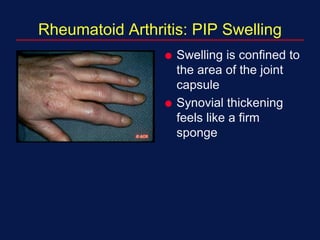
Rheumatoid Arthritis: PIP Swelling
 Swelling is confined to
the area of the joint
capsule
 Synovial thickening
feels like a firm
sponge
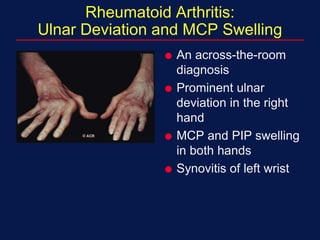
Rheumatoid Arthritis:
Ulnar Deviation and MCP Swelling
 An across-the-room
diagnosis
 Prominent ulnar
deviation in the right
hand
 MCP and PIP swelling
in both hands
 Synovitis of left wrist
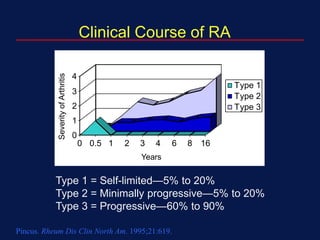
Clinical Course of RA
Type 1 = Self-limited—5% to 20%
Type 2 = Minimally progressive—5% to 20%
Type 3 = Progressive—60% to 90%
0
1
2
3
4
0 0.5 1 2 3 4 6 8 16
Type 1
Type 2
Type 3
Years
SeverityofArthritis
Pincus. Rheum Dis Clin North Am. 1995;21:619.
Pincus, et al. Rheum Dis Clin North Am. 1993;19:123–151.
Rheumatoid Arthritis: Typical Course
• Damage occurs early in most patients
• 50% show joint space narrowing or erosions in
the first 2 years
• By 10 years, 50% of young working patients
are disabled
• Death comes early
• Multiple causes
• Compared to general population
• Women lose 10 years, men lose 4 years
Rheumatoid Arthritis
• Key points:
• The sicker they are and the faster they get that
way, the worse the future will be
• Early intervention can make a difference
• Essential to establish a treatment plan early in
the disease
Rheumatoid Arthritis:
Treatment Principles
 Confirm the diagnosis
 Determine where the patient stands in the
spectrum of disease
 When damage begins early, start aggressive
treatment early
 Use the safest treatment plan that matches the
aggressiveness of the disease
 Monitor treatment for adverse effects
 Monitor disease activity, revise Rx as needed
Critical Elements of a Treatment Plan:
Assessment
• Assess current activity
• Morning stiffness, synovitis, fatigue, ESR
• Document the degree of damage
• ROM and deformities
• Joint space narrowing and erosions on x-ray
• Functional status
• Document extra-articular manifestations
• Nodules, pulmonary fibrosis, vasculitis
• Assess prior Rx responses and side effects
Critical Elements of a Treatment Plan:
Therapy
• Education
• Build a cooperative long-term relationship
• Assistive devices
• Exercise
• ROM, conditioning, and strengthening exercises
• Medications
• Analgesic and/or anti-inflammatory
• Immunosuppressive, cytotoxic, and biologic
• Balance efficacy and safety with activity
Rheumatoid Arthritis:
Drug Treatment Options
• NSAIDs
• Symptomatic relief, improved function
• No change in disease progression
• Low-dose prednisone (10 mg qd)
• May substitute for NSAID
• Used as bridge therapy
• If used long term, consider prophylactic
treatment for osteoporosis
• Intra-articular steroids
• Useful for flares
Paget. Primer on Rheum Dis. 11th edition. 1997:168.
Rheumatoid Arthritis:
Treatment Options
• Disease modifying drugs (DMARDs)
• Minocycline
• Modest effect, may work best early
• Sulfasalazine, hydroxychloroquine
• Moderate effect, low cost
• Intramuscular gold
• Slow onset, decreases progression, rare
remission
• Requires close monitoring
Alarcon. Rheum Dis Clin North Am. 1998;24:489–499.
Paget. Primer on Rheum Dis. 11th edition. 1997:168.
Rheumatoid Arthritis:
Treatment Options (cont’d)
• Immunosuppressive drugs
• Methotrexate
• Most effective single DMARD
• Good benefit-to-risk ratio
• Azathioprine
• Slow onset, reasonably effective
• Cyclophosphamide
• Effective for vasculitis, less so for arthritis
• Cyclosporine
• Superior to placebo, renal toxicity
Rheumatoid Arthritis: Treatment
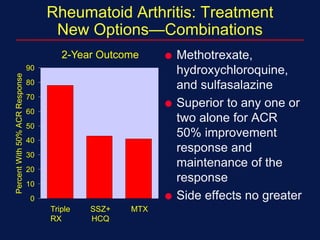
New Options—Combinations
 Methotrexate,
hydroxychloroquine,
and sulfasalazine
 Superior to any one or
two alone for ACR
50% improvement
response and
maintenance of the
response
 Side effects no greater0
10
20
30
40
50
60
70
80
90
2-Year Outcome
PercentWith50%ACRResponse
Triple
RX
SSZ+
HCQ
MTX
Rheumatoid Arthritis: Treatment
New Options—Combinations (cont’d)
• Step-down prednisone with sulfasalazine and
low-dose methotrexate*
• Superior to sulfasalazine in early disease*
• Methotrexate + hydroxychloroquine or
methotrexate + cyclosporine†
• May have additive beneficial effects†
*Boers, et al. Lancet. 1997;350:309–318.
†Stein, et al. Arth Rheum. 1997;40:1721–1723.
Rheumatoid Arthritis: Treatment
Options—New DMARDs
• Leflunomide
• Pyrimidine inhibitor
• Effect and side effects similar to those of MTX
• Etanercept
• Soluble TNF receptor, blocks TNF
• Rapid onset, quite effective in refractory
patients in short-term trials and in combination
with MTX
• Injection site reactions, long-term effects
unknown, expensive
Rozman. J Rheumatol. 1998;53:27–32.
Moreland. Rheum Dis Clin North Am. 1998;24:579–591.
Rheumatoid Arthritis: Monitoring
Treatment With DMARDs
• These drugs need frequent monitoring
• Blood, liver, lung, and kidney are frequent sites of
adverse effects
• Interval of laboratory testing varies with the drug
• 4- to 8-week intervals are commonly needed
• Most patients need to be seen 3 to 6 times a year
Rheumatoid Arthritis:
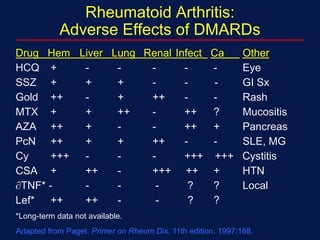
Adverse Effects of DMARDs
Drug Hem Liver Lung Renal Infect Ca Other
HCQ + - - - - - Eye
SSZ + + + - - - GI Sx
Gold ++ - + ++ - - Rash
MTX + + ++ - ++ ? Mucositis
AZA ++ + - - ++ + Pancreas
PcN ++ + + ++ - - SLE, MG
Cy +++ - - - +++ +++ Cystitis
CSA + ++ - +++ ++ + HTN
TNF* - - - - ? ? Local
Lef* ++ ++ - - ? ?
*Long-term data not available.
Adapted from Paget. Primer on Rheum Dis. 11th edition. 1997:168.
Rheumatoid Arthritis
Case Management
Rheumatoid Arthritis: Case 1
 34-year-old woman with 5-year history of RA
 Morning stiffness = 30 minutes
 Synovitis: 1+ swelling of MCP, PIP, wrist, and
MTP joints
 Normal joint alignment
 Rheumatoid factor positive
 No erosions seen on x-rays
Rheumatoid Arthritis: Case 1 (cont’d)
• Assessment
• Current activity—mild
• No sign of damage after 5 years
• Type 2 minimally progressive course
• Treatment
• NSAID + safer, less potent drugs, eg,
• Hydroxychloroquine, minocycline, or
sulfasalazine
• Education + ROM, conditioning, and
strengthening exercises
Rheumatoid Arthritis: Case 2
 34-year-old woman with 1-year history of RA
 Morning stiffness = 90 minutes
 Synovitis: 1+ to 2+ swelling of MCP, PIP, wrist,
knee, and MTP joints
 Normal joint alignment
 RF positive
 Small erosions of the right wrist and two MCP
joints seen on x-rays
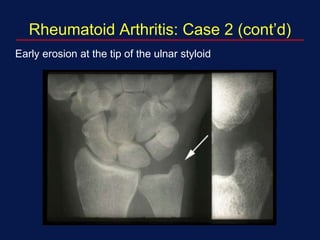
Rheumatoid Arthritis: Case 2 (cont’d)
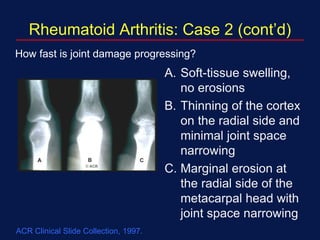
Early erosion at the tip of the ulnar styloid
A. Soft-tissue swelling,
no erosions
B. Thinning of the cortex
on the radial side and
minimal joint space
narrowing
C. Marginal erosion at
the radial side of the
metacarpal head with
joint space narrowing
How fast is joint damage progressing?
Rheumatoid Arthritis: Case 2 (cont’d)
ACR Clinical Slide Collection, 1997.
Rheumatoid Arthritis: Case 2 (cont’d)
• Assessment of case 2
• Moderate disease activity
• Many joints involved
• Clear radiologic signs of joint destruction early
in disease course
• Type 3 progressive course
• Treatment should be more aggressive
• NSAID, MTX, SSZ, and hydroxychloroquine
would be a good choice
Rheumatoid Arthritis: Case 3
• 34-year-old woman with 3-year history of RA
• Morning stiffness = 3 hours
• 2 to 3+ swelling of MCP, PIP, wrist, elbow,
knee, and MTP joints
• Ulnar deviation, swan neck deformities,
decreased ROM at wrists, nodules on elbows
• RF positive, x-rays show erosions of wrists and
MCP joints bilaterally
• Currently on low-dose prednisone + MTX, SSZ,
and hydroxychloroquine
Rheumatoid Arthritis: Case 3 (cont’d)
• Assessment
• Very active disease in spite of aggressive
combination therapy
• Evidence of extensive joint destruction
• Treatment options are many
• Step-down oral prednisone, 60 mg qd tapered
to 10 mg qd over 5 weeks, can be used for
immediate relief of symptoms
• Use other cytotoxics or cyclosporine
• Consider TNF inhibitor or leflunomide
Rheumatoid Arthritis:
Treatment Plan Summary
• A variety of treatment options are available
• Treatment plan should match
• The current disease activity
• The documented and anticipated pace of joint
destruction
• Consider a rheumatology consult to help design a
treatment plan
Rheumatoid Arthritis
Potential Complications
RA: Unknown Case 1
 68-year-old woman with 3-year history of RA is
squeezed into your schedule as a new patient
 She presents with 4 weeks of increasing fatigue,
dizziness, dyspnea, and anorexia
 Her joint pain and stiffness are mild and
unchanged
 Managed with ibuprofen and hydroxychloroquine
until 4 months ago, when a flare caused a switch
to piroxicam and prednisone
RA: Unknown Case 1 (cont’d)
 Past history: Peptic ulcer 10 years ago and mild
hypertension
 Exam shows a thin, pale apathetic woman with
Temp 98.4ºF, BP 110/65, pulse 110 bpm
 Symmetrical 1+ synovitis of the wrist, MCP, PIP,
and MTP joints
 Exam of the heart, lungs, and abdomen is
unremarkable
RA: Unknown Case 1 (cont’d)
 You are falling behind in your schedule
 What system must you inquire more
about today?
A. Cardiovascular
B. Neuropsychological
C. Endocrine
D. Gastrointestinal
RA: Unknown Case 1 (cont’d)
Don’t
Miss It
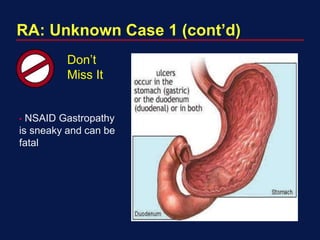
• NSAID Gastropathy
is sneaky and can be
fatal
RA: Unknown Case 1 (cont’d)
• Clues of impending disaster
• High risk for NSAID gastropathy
• Presentation suggestive of blood loss
• Pale, dizzy, weak
• Tachycardia, low blood pressure
• No evidence of flare in RA to explain recent
symptoms of increased fatigue
Singh. Am J Med. 1998;105(suppl B):31S–38S.
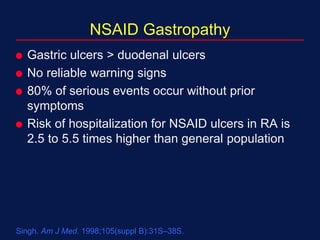
NSAID Gastropathy
 Gastric ulcers > duodenal ulcers
 No reliable warning signs
 80% of serious events occur without prior
symptoms
 Risk of hospitalization for NSAID ulcers in RA is
2.5 to 5.5 times higher than general population
Singh. Am J Med. 1998;105(suppl B):31S–38S.
Key Point: Know the Risk Factors
for NSAID Ulcers
 Older age
 Prior history of peptic ulcer or GI symptoms with
NSAIDs
 Concomitant use of prednisone
 NSAID dose: More prostaglandin suppression =
greater risk of serious events
 Disability level: The sicker the patient the higher
the risk
Hawkey. N Engl J Med. 1998;338:727–734.
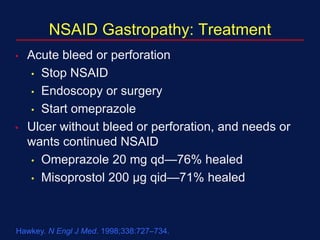
NSAID Gastropathy: Treatment
• Acute bleed or perforation
• Stop NSAID
• Endoscopy or surgery
• Start omeprazole
• Ulcer without bleed or perforation, and needs or
wants continued NSAID
• Omeprazole 20 mg qd—76% healed
• Misoprostol 200 µg qid—71% healed
NSAID Gastropathy: Prevention
• Avoid the problem
• Stop the NSAID and use alternative treatment
• Low-dose prednisone
• Acetaminophen
• Nonacetylated salicylates
• Use a selective cyclooxygenase-2 inhibitor
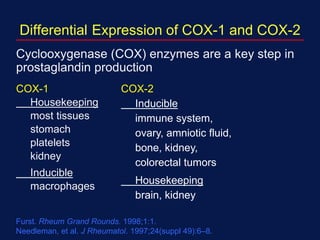
Differential Expression of COX-1 and COX-2
Cyclooxygenase (COX) enzymes are a key step in
prostaglandin production
COX-1
Housekeeping
most tissues
stomach
platelets
kidney
Inducible
macrophages
Furst. Rheum Grand Rounds. 1998;1:1.
Needleman, et al. J Rheumatol. 1997;24(suppl 49):6–8.
COX-2
Inducible
immune system,
ovary, amniotic fluid,
bone, kidney,
colorectal tumors
Housekeeping
brain, kidney
Selective COX-2 Suppression:
A Potentially Elegant Solution
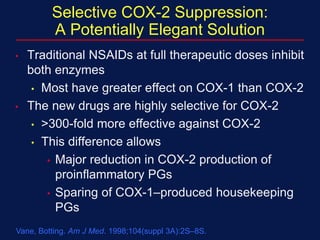
• Traditional NSAIDs at full therapeutic doses inhibit
both enzymes
• Most have greater effect on COX-1 than COX-2
• The new drugs are highly selective for COX-2
• >300-fold more effective against COX-2
• This difference allows
• Major reduction in COX-2 production of
proinflammatory PGs
• Sparing of COX-1–produced housekeeping
PGs
Vane, Botting. Am J Med. 1998;104(suppl 3A):2S–8S.
NSAID Gastropathy: Prevention
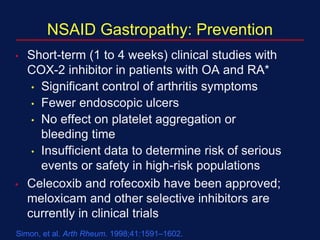
• Short-term (1 to 4 weeks) clinical studies with
COX-2 inhibitor in patients with OA and RA*
• Significant control of arthritis symptoms
• Fewer endoscopic ulcers
• No effect on platelet aggregation or
bleeding time
• Insufficient data to determine risk of serious
events or safety in high-risk populations
• Celecoxib and rofecoxib have been approved;
meloxicam and other selective inhibitors are
currently in clinical trials
*Celecoxib.
Simon, et al. Arth Rheum. 1998;41:1591–1602.
NSAID Gastropathy: Prevention (cont’d)
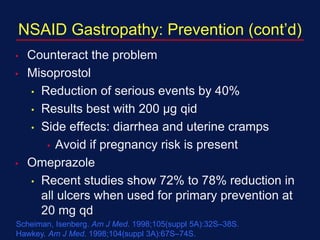
• Counteract the problem
• Misoprostol
• Reduction of serious events by 40%
• Results best with 200 µg qid
• Side effects: diarrhea and uterine cramps
• Avoid if pregnancy risk is present
• Omeprazole
• Recent studies show 72% to 78% reduction in
all ulcers when used for primary prevention at
20 mg qd
Scheiman, Isenberg. Am J Med. 1998;105(suppl 5A):32S–38S.
Hawkey. Am J Med. 1998;104(suppl 3A):67S–74S.
NSAID Gastropathy: Key Points
• Keep it in mind
• Know the risk factors
• The best way to treat it is to prevent it
• Avoid it: Use acetaminophen, salsalate, or a
selective COX-2 inhibitor
• Counteract it: Omeprazole or misoprostol
• Antacids and H2 blockers are not the answer
• May mask symptoms but do not prevent
serious events
Rheumatoid Arthritis: Unknown Case 2
 You are doing a preop physical for a routine
cholecystectomy on a 43-year-old woman with
RA since age 20. PH includes bilateral THAs and
left TKA. No other medical problems. Current
meds: NSAID, low-dose prednisone, MTX, and
HCQ
 General physical exam normal
 MS exam, extensive deformities, mild synovitis
 In addition to routine tests, what test should be
ordered before surgery?
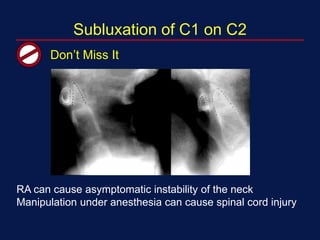
Don’t Miss It
Subluxation of C1 on C2
RA can cause asymptomatic instability of the neck
Manipulation under anesthesia can cause spinal cord injury
Clues for C1-C2 Subluxation
• Long-standing rheumatoid arthritis or JRA
• May have NO symptoms
• C2-C3 radicular pain in the neck and occiput
• Spinal cord compression
• Quadriparesis or paraparesis
• Sphincter dysfunction
• Sensory deficits
• TIAs secondary to compromise of the vertebral
arteries
Anderson. Primer on Rheum Dis. 11th edition. 1997:161.
Rheumatoid Arthritis:
Special Considerations on Preop Exam
• C1-C2 subluxation
• Cricoarytenoid arthritis with adductor spasm of
the vocal cords and a narrow airway
• Pulmonary fibrosis
• Risk for GI bleeding
• Need for stress steroid coverage
• Discontinue NSAIDs several days preop
• Discontinue methotrexate 1 to 2 weeks preop
• Cover with analgesic meds or if necessary
short-term, low-dose steroid if RA flares
Rheumatoid Arthritis: Unknown Case 3
 52-year-old man with destructive RA treated with
NSAID and low-dose prednisone. MTX started 4
months ago, now 15 mg/wk
 Presents with 3-week history of fever, dry cough,
and increasing shortness of breath
 Exam: Low-grade fever, fine rales in both lungs,
normal CBC and liver enzymes, low albumin,
diffuse interstitial infiltrates on chest x-ray
RA: Unknown Case 3 (cont’d)
 What would you do?
A. Culture, treat with antibiotic for bacterial
pneumonia
B. Culture, give cough suppressant for viral
pneumonia and watch
C. Give oral steroid for hypersensitivity
pneumonitis and stop methotrexate
D. Give a high-dose oral pulse of steroid
and increase methotrexate for
rheumatoid lung
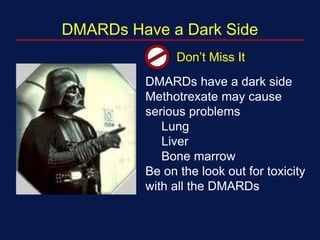
DMARDs Have a Dark Side
Don’t Miss It
DMARDs have a dark side
Methotrexate may cause
serious problems
Lung
Liver
Bone marrow
Be on the look out for toxicity
with all the DMARDs
Methotrexate Lung
• Dry cough, shortness of breath, fever
• Most often seen in the first 6 months of MTX
treatment
• Diffuse interstitial pattern on x-ray
• Bronchoalveolar lavage may be needed to rule
out infection
• Acute mortality = 17%; 50% to 60% recur with
retreatment, which carries the same mortality
• Risk factors: older age, RA lung, prior use of
DMARD, low albumin, diabetes
Kremer, et al. Arth Rheum. 1997;40:1829–1837.
Rheumatoid Arthritis: Summary
• Joint damage begins early
• Effective treatment should begin early in most
patients
• Aggressive treatment can make a difference
• Assess severity of patient’s disease
• Current activity
• Damage
• Pace
Rheumatoid Arthritis: Summary (cont’d)
• Choose a treatment plan with enough power to
match the disease
• If in doubt, get some help
• Rheumatologists can be a bargain
• New classes of drugs and biologics offer new
opportunities
• Do no harm
• Monitor for drug toxicity—high index of
suspicion and routine monitoring
• Alter the treatment based on changes in
disease activity
Thank You…

Rheumatoid Arthritis

  • 1.
    RHEUMATOID ARTHRITIS Dr. GajananPandit D. Ortho; DNB Ortho DEEPAK HOSPITAL JALNA
  • 2.
    Rheumatoid Arthritis: Key Features •Symptoms >6 weeks’ duration • Often lasts the remainder of the patient’s life • Inflammatory synovitis • Palpable synovial swelling • Morning stiffness >1 hour, fatigue • Symmetrical and polyarticular (>3 joints) • Typically involves wrists, MCP, and PIP joints • Typically spares certain joints • Thoracolumbar spine • DIPs of the fingers and IPs of the toes
  • 3.
    Rheumatoid Arthritis: Key Features(cont’d) • May have nodules: subcutaneous or periosteal at pressure points • Rheumatoid factor • 45% positive in first 6 months • 85% positive with established disease • Not specific for RA, high titer early is a bad sign • Marginal erosions and joint space narrowing on x-ray Adapted from Arnett, et al. Arth Rheum. 1988;31:315–324.
  • 4.
    Rheumatoid Arthritis: PIPSwelling  Swelling is confined to the area of the joint capsule  Synovial thickening feels like a firm sponge
  • 5.
    Rheumatoid Arthritis: Ulnar Deviationand MCP Swelling  An across-the-room diagnosis  Prominent ulnar deviation in the right hand  MCP and PIP swelling in both hands  Synovitis of left wrist
  • 6.
    Clinical Course ofRA Type 1 = Self-limited—5% to 20% Type 2 = Minimally progressive—5% to 20% Type 3 = Progressive—60% to 90% 0 1 2 3 4 0 0.5 1 2 3 4 6 8 16 Type 1 Type 2 Type 3 Years SeverityofArthritis Pincus. Rheum Dis Clin North Am. 1995;21:619.
  • 7.
    Pincus, et al.Rheum Dis Clin North Am. 1993;19:123–151. Rheumatoid Arthritis: Typical Course • Damage occurs early in most patients • 50% show joint space narrowing or erosions in the first 2 years • By 10 years, 50% of young working patients are disabled • Death comes early • Multiple causes • Compared to general population • Women lose 10 years, men lose 4 years
  • 8.
    Rheumatoid Arthritis • Keypoints: • The sicker they are and the faster they get that way, the worse the future will be • Early intervention can make a difference • Essential to establish a treatment plan early in the disease
  • 9.
    Rheumatoid Arthritis: Treatment Principles Confirm the diagnosis  Determine where the patient stands in the spectrum of disease  When damage begins early, start aggressive treatment early  Use the safest treatment plan that matches the aggressiveness of the disease  Monitor treatment for adverse effects  Monitor disease activity, revise Rx as needed
  • 10.
    Critical Elements ofa Treatment Plan: Assessment • Assess current activity • Morning stiffness, synovitis, fatigue, ESR • Document the degree of damage • ROM and deformities • Joint space narrowing and erosions on x-ray • Functional status • Document extra-articular manifestations • Nodules, pulmonary fibrosis, vasculitis • Assess prior Rx responses and side effects
  • 11.
    Critical Elements ofa Treatment Plan: Therapy • Education • Build a cooperative long-term relationship • Assistive devices • Exercise • ROM, conditioning, and strengthening exercises • Medications • Analgesic and/or anti-inflammatory • Immunosuppressive, cytotoxic, and biologic • Balance efficacy and safety with activity
  • 12.
    Rheumatoid Arthritis: Drug TreatmentOptions • NSAIDs • Symptomatic relief, improved function • No change in disease progression • Low-dose prednisone (10 mg qd) • May substitute for NSAID • Used as bridge therapy • If used long term, consider prophylactic treatment for osteoporosis • Intra-articular steroids • Useful for flares Paget. Primer on Rheum Dis. 11th edition. 1997:168.
  • 13.
    Rheumatoid Arthritis: Treatment Options •Disease modifying drugs (DMARDs) • Minocycline • Modest effect, may work best early • Sulfasalazine, hydroxychloroquine • Moderate effect, low cost • Intramuscular gold • Slow onset, decreases progression, rare remission • Requires close monitoring Alarcon. Rheum Dis Clin North Am. 1998;24:489–499. Paget. Primer on Rheum Dis. 11th edition. 1997:168.
  • 14.
    Paget. Primer onRheum Dis. 11th edition. 1997:168. Rheumatoid Arthritis: Treatment Options (cont’d) • Immunosuppressive drugs • Methotrexate • Most effective single DMARD • Good benefit-to-risk ratio • Azathioprine • Slow onset, reasonably effective • Cyclophosphamide • Effective for vasculitis, less so for arthritis • Cyclosporine • Superior to placebo, renal toxicity
  • 15.
    Rheumatoid Arthritis: Treatment NewOptions—Combinations  Methotrexate, hydroxychloroquine, and sulfasalazine  Superior to any one or two alone for ACR 50% improvement response and maintenance of the response  Side effects no greater0 10 20 30 40 50 60 70 80 90 2-Year Outcome PercentWith50%ACRResponse Triple RX SSZ+ HCQ MTX
  • 16.
    Rheumatoid Arthritis: Treatment NewOptions—Combinations (cont’d) • Step-down prednisone with sulfasalazine and low-dose methotrexate* • Superior to sulfasalazine in early disease* • Methotrexate + hydroxychloroquine or methotrexate + cyclosporine† • May have additive beneficial effects† *Boers, et al. Lancet. 1997;350:309–318. †Stein, et al. Arth Rheum. 1997;40:1721–1723.
  • 17.
    Rheumatoid Arthritis: Treatment Options—NewDMARDs • Leflunomide • Pyrimidine inhibitor • Effect and side effects similar to those of MTX • Etanercept • Soluble TNF receptor, blocks TNF • Rapid onset, quite effective in refractory patients in short-term trials and in combination with MTX • Injection site reactions, long-term effects unknown, expensive Rozman. J Rheumatol. 1998;53:27–32. Moreland. Rheum Dis Clin North Am. 1998;24:579–591.
  • 18.
    Rheumatoid Arthritis: Monitoring TreatmentWith DMARDs • These drugs need frequent monitoring • Blood, liver, lung, and kidney are frequent sites of adverse effects • Interval of laboratory testing varies with the drug • 4- to 8-week intervals are commonly needed • Most patients need to be seen 3 to 6 times a year
  • 19.
    Rheumatoid Arthritis: Adverse Effectsof DMARDs Drug Hem Liver Lung Renal Infect Ca Other HCQ + - - - - - Eye SSZ + + + - - - GI Sx Gold ++ - + ++ - - Rash MTX + + ++ - ++ ? Mucositis AZA ++ + - - ++ + Pancreas PcN ++ + + ++ - - SLE, MG Cy +++ - - - +++ +++ Cystitis CSA + ++ - +++ ++ + HTN TNF* - - - - ? ? Local Lef* ++ ++ - - ? ? *Long-term data not available. Adapted from Paget. Primer on Rheum Dis. 11th edition. 1997:168.
  • 20.
  • 21.
    Rheumatoid Arthritis: Case1  34-year-old woman with 5-year history of RA  Morning stiffness = 30 minutes  Synovitis: 1+ swelling of MCP, PIP, wrist, and MTP joints  Normal joint alignment  Rheumatoid factor positive  No erosions seen on x-rays
  • 22.
    Rheumatoid Arthritis: Case1 (cont’d) • Assessment • Current activity—mild • No sign of damage after 5 years • Type 2 minimally progressive course • Treatment • NSAID + safer, less potent drugs, eg, • Hydroxychloroquine, minocycline, or sulfasalazine • Education + ROM, conditioning, and strengthening exercises
  • 23.
    Rheumatoid Arthritis: Case2  34-year-old woman with 1-year history of RA  Morning stiffness = 90 minutes  Synovitis: 1+ to 2+ swelling of MCP, PIP, wrist, knee, and MTP joints  Normal joint alignment  RF positive  Small erosions of the right wrist and two MCP joints seen on x-rays
  • 24.
    Rheumatoid Arthritis: Case2 (cont’d) Early erosion at the tip of the ulnar styloid
  • 25.
    A. Soft-tissue swelling, noerosions B. Thinning of the cortex on the radial side and minimal joint space narrowing C. Marginal erosion at the radial side of the metacarpal head with joint space narrowing How fast is joint damage progressing? Rheumatoid Arthritis: Case 2 (cont’d) ACR Clinical Slide Collection, 1997.
  • 26.
    Rheumatoid Arthritis: Case2 (cont’d) • Assessment of case 2 • Moderate disease activity • Many joints involved • Clear radiologic signs of joint destruction early in disease course • Type 3 progressive course • Treatment should be more aggressive • NSAID, MTX, SSZ, and hydroxychloroquine would be a good choice
  • 27.
    Rheumatoid Arthritis: Case3 • 34-year-old woman with 3-year history of RA • Morning stiffness = 3 hours • 2 to 3+ swelling of MCP, PIP, wrist, elbow, knee, and MTP joints • Ulnar deviation, swan neck deformities, decreased ROM at wrists, nodules on elbows • RF positive, x-rays show erosions of wrists and MCP joints bilaterally • Currently on low-dose prednisone + MTX, SSZ, and hydroxychloroquine
  • 28.
    Rheumatoid Arthritis: Case3 (cont’d) • Assessment • Very active disease in spite of aggressive combination therapy • Evidence of extensive joint destruction • Treatment options are many • Step-down oral prednisone, 60 mg qd tapered to 10 mg qd over 5 weeks, can be used for immediate relief of symptoms • Use other cytotoxics or cyclosporine • Consider TNF inhibitor or leflunomide
  • 29.
    Rheumatoid Arthritis: Treatment PlanSummary • A variety of treatment options are available • Treatment plan should match • The current disease activity • The documented and anticipated pace of joint destruction • Consider a rheumatology consult to help design a treatment plan
  • 30.
  • 31.
    RA: Unknown Case1  68-year-old woman with 3-year history of RA is squeezed into your schedule as a new patient  She presents with 4 weeks of increasing fatigue, dizziness, dyspnea, and anorexia  Her joint pain and stiffness are mild and unchanged  Managed with ibuprofen and hydroxychloroquine until 4 months ago, when a flare caused a switch to piroxicam and prednisone
  • 32.
    RA: Unknown Case1 (cont’d)  Past history: Peptic ulcer 10 years ago and mild hypertension  Exam shows a thin, pale apathetic woman with Temp 98.4ºF, BP 110/65, pulse 110 bpm  Symmetrical 1+ synovitis of the wrist, MCP, PIP, and MTP joints  Exam of the heart, lungs, and abdomen is unremarkable
  • 33.
    RA: Unknown Case1 (cont’d)  You are falling behind in your schedule  What system must you inquire more about today? A. Cardiovascular B. Neuropsychological C. Endocrine D. Gastrointestinal
  • 34.
    RA: Unknown Case1 (cont’d) Don’t Miss It • NSAID Gastropathy is sneaky and can be fatal
  • 35.
    RA: Unknown Case1 (cont’d) • Clues of impending disaster • High risk for NSAID gastropathy • Presentation suggestive of blood loss • Pale, dizzy, weak • Tachycardia, low blood pressure • No evidence of flare in RA to explain recent symptoms of increased fatigue
  • 36.
    Singh. Am JMed. 1998;105(suppl B):31S–38S. NSAID Gastropathy  Gastric ulcers > duodenal ulcers  No reliable warning signs  80% of serious events occur without prior symptoms  Risk of hospitalization for NSAID ulcers in RA is 2.5 to 5.5 times higher than general population
  • 37.
    Singh. Am JMed. 1998;105(suppl B):31S–38S. Key Point: Know the Risk Factors for NSAID Ulcers  Older age  Prior history of peptic ulcer or GI symptoms with NSAIDs  Concomitant use of prednisone  NSAID dose: More prostaglandin suppression = greater risk of serious events  Disability level: The sicker the patient the higher the risk
  • 38.
    Hawkey. N EnglJ Med. 1998;338:727–734. NSAID Gastropathy: Treatment • Acute bleed or perforation • Stop NSAID • Endoscopy or surgery • Start omeprazole • Ulcer without bleed or perforation, and needs or wants continued NSAID • Omeprazole 20 mg qd—76% healed • Misoprostol 200 µg qid—71% healed
  • 39.
    NSAID Gastropathy: Prevention •Avoid the problem • Stop the NSAID and use alternative treatment • Low-dose prednisone • Acetaminophen • Nonacetylated salicylates • Use a selective cyclooxygenase-2 inhibitor
  • 40.
    Differential Expression ofCOX-1 and COX-2 Cyclooxygenase (COX) enzymes are a key step in prostaglandin production COX-1 Housekeeping most tissues stomach platelets kidney Inducible macrophages Furst. Rheum Grand Rounds. 1998;1:1. Needleman, et al. J Rheumatol. 1997;24(suppl 49):6–8. COX-2 Inducible immune system, ovary, amniotic fluid, bone, kidney, colorectal tumors Housekeeping brain, kidney
  • 41.
    Selective COX-2 Suppression: APotentially Elegant Solution • Traditional NSAIDs at full therapeutic doses inhibit both enzymes • Most have greater effect on COX-1 than COX-2 • The new drugs are highly selective for COX-2 • >300-fold more effective against COX-2 • This difference allows • Major reduction in COX-2 production of proinflammatory PGs • Sparing of COX-1–produced housekeeping PGs Vane, Botting. Am J Med. 1998;104(suppl 3A):2S–8S.
  • 42.
    NSAID Gastropathy: Prevention •Short-term (1 to 4 weeks) clinical studies with COX-2 inhibitor in patients with OA and RA* • Significant control of arthritis symptoms • Fewer endoscopic ulcers • No effect on platelet aggregation or bleeding time • Insufficient data to determine risk of serious events or safety in high-risk populations • Celecoxib and rofecoxib have been approved; meloxicam and other selective inhibitors are currently in clinical trials *Celecoxib. Simon, et al. Arth Rheum. 1998;41:1591–1602.
  • 43.
    NSAID Gastropathy: Prevention(cont’d) • Counteract the problem • Misoprostol • Reduction of serious events by 40% • Results best with 200 µg qid • Side effects: diarrhea and uterine cramps • Avoid if pregnancy risk is present • Omeprazole • Recent studies show 72% to 78% reduction in all ulcers when used for primary prevention at 20 mg qd Scheiman, Isenberg. Am J Med. 1998;105(suppl 5A):32S–38S. Hawkey. Am J Med. 1998;104(suppl 3A):67S–74S.
  • 44.
    NSAID Gastropathy: KeyPoints • Keep it in mind • Know the risk factors • The best way to treat it is to prevent it • Avoid it: Use acetaminophen, salsalate, or a selective COX-2 inhibitor • Counteract it: Omeprazole or misoprostol • Antacids and H2 blockers are not the answer • May mask symptoms but do not prevent serious events
  • 45.
    Rheumatoid Arthritis: UnknownCase 2  You are doing a preop physical for a routine cholecystectomy on a 43-year-old woman with RA since age 20. PH includes bilateral THAs and left TKA. No other medical problems. Current meds: NSAID, low-dose prednisone, MTX, and HCQ  General physical exam normal  MS exam, extensive deformities, mild synovitis  In addition to routine tests, what test should be ordered before surgery?
  • 46.
    Don’t Miss It Subluxationof C1 on C2 RA can cause asymptomatic instability of the neck Manipulation under anesthesia can cause spinal cord injury
  • 47.
    Clues for C1-C2Subluxation • Long-standing rheumatoid arthritis or JRA • May have NO symptoms • C2-C3 radicular pain in the neck and occiput • Spinal cord compression • Quadriparesis or paraparesis • Sphincter dysfunction • Sensory deficits • TIAs secondary to compromise of the vertebral arteries Anderson. Primer on Rheum Dis. 11th edition. 1997:161.
  • 48.
    Rheumatoid Arthritis: Special Considerationson Preop Exam • C1-C2 subluxation • Cricoarytenoid arthritis with adductor spasm of the vocal cords and a narrow airway • Pulmonary fibrosis • Risk for GI bleeding • Need for stress steroid coverage • Discontinue NSAIDs several days preop • Discontinue methotrexate 1 to 2 weeks preop • Cover with analgesic meds or if necessary short-term, low-dose steroid if RA flares
  • 49.
    Rheumatoid Arthritis: UnknownCase 3  52-year-old man with destructive RA treated with NSAID and low-dose prednisone. MTX started 4 months ago, now 15 mg/wk  Presents with 3-week history of fever, dry cough, and increasing shortness of breath  Exam: Low-grade fever, fine rales in both lungs, normal CBC and liver enzymes, low albumin, diffuse interstitial infiltrates on chest x-ray
  • 50.
    RA: Unknown Case3 (cont’d)  What would you do? A. Culture, treat with antibiotic for bacterial pneumonia B. Culture, give cough suppressant for viral pneumonia and watch C. Give oral steroid for hypersensitivity pneumonitis and stop methotrexate D. Give a high-dose oral pulse of steroid and increase methotrexate for rheumatoid lung
  • 51.
    DMARDs Have aDark Side Don’t Miss It DMARDs have a dark side Methotrexate may cause serious problems Lung Liver Bone marrow Be on the look out for toxicity with all the DMARDs
  • 52.
    Methotrexate Lung • Drycough, shortness of breath, fever • Most often seen in the first 6 months of MTX treatment • Diffuse interstitial pattern on x-ray • Bronchoalveolar lavage may be needed to rule out infection • Acute mortality = 17%; 50% to 60% recur with retreatment, which carries the same mortality • Risk factors: older age, RA lung, prior use of DMARD, low albumin, diabetes Kremer, et al. Arth Rheum. 1997;40:1829–1837.
  • 53.
    Rheumatoid Arthritis: Summary •Joint damage begins early • Effective treatment should begin early in most patients • Aggressive treatment can make a difference • Assess severity of patient’s disease • Current activity • Damage • Pace
  • 54.
    Rheumatoid Arthritis: Summary(cont’d) • Choose a treatment plan with enough power to match the disease • If in doubt, get some help • Rheumatologists can be a bargain • New classes of drugs and biologics offer new opportunities • Do no harm • Monitor for drug toxicity—high index of suspicion and routine monitoring • Alter the treatment based on changes in disease activity
  • 55.