RHEUMATOID ARTHRITIS
Dr.Pradeep pathak
PGIMS ROHTAK
dr.pathak09@gmail.com
• Rheumatoid arthritis (RA) is an autoimmune
disease that results in a chronic, systemic
inflammatory disorder that may affect many
tissues and organs, but principally attacks
synovial joints.
• Affects 1-3% of adult population
• F>M: 3 to 1
• Peak age of onset -25 and 45
CLINICAL MANIFESTATIONS
• Symmetrical polyarthralgia, morning stiffness, and fatigue are
common
• The initial pattern of joint involvement may be monoarticular,
oligoarticular (≤4 joints), or polyarticular (>5 joints), usually in
a symmetric distribution.
Involved joints are swollen, warm, painful, and particularly
stiff when rising in the morning or following inactivity.
The typical patient has progressive joint enlargement,
decreased range of motion evolving to complete ankylosis,
with the greatest damage occurring in the first 4 or 5 years
• Morning stiffness results from increases in extracellular
fluid in & around joint
• Later on, there may be limitation of motion due to pain or
joint destruction
• Predilection for wrists and hands; MP joints, PIP joints, and
wrists are first to become symptomatic
• Ulnar deviation, and swan-neck or boutonniere deformities
are common
EXTRA ARTICULAR MANIFESTATIONS:
Patients with extraarticular manifestations have –
• High-titer RF
• More severe disability
• Increased mortality rate
• Heart- The most common cause of death in patients with RA is
cardiovascular disease
– pericarditis, cardiomyopathy, and valvular incompetence,
interstitial fibrosis
• Lungs: pleuritic chest pain and dyspnea, as well as a pleural
friction rub and effusion.
– Rheumatoid lung (Honeycombed appearance on CXR due to multiple
nodules), Caplan syndrome (associated with pneumoconiosis),
Idiopathic pulmonary fibrosis
• Eyes- scleritis (most common ocular complication of RA),
scleromalacia perforans)
• Nervous system- mononeuritis multiplex, compression
syndromes such as median neuropathy
• Kidneys- amyloid deposition
• Hematopoietic system- Felty's syndrome (anemia,
splenomegaly, and leukopenia)
• Vasculitis: usually is a non necrotising arteritis of the
small terminal arterials, Skin lesions, leg ulcers,
necrotizing arteritis of the viscera, digital infarctions, and
fever
• Sjogren's syndrome: occurs in 15%; RA +
keratoconjunctivitis sicca, xerostomia
PRESENTATION
• 10% cases spontaneous remission within 6
months
• most of the cases : pattern of persistent and
progressive disease activity
• minority of patients : intermittent and
recurrent explosive attacks of inflammatory
arthritis interspersed with periods of disease
quiescence
2010 ACR-EULAR classification criteria
for rheumatoid arthritisTarget population Patients who have at least 1 joint with definite clinical synovitis (swelling) with the
synovitis not better explained by another disease
Classification criteria for RA (score-based algorithm: add score of categories A - D;
a score of ≥6/10 is needed for classification of a patient as having definite RA).
The metacarpophalangeal joints, proximal interphalangeal joints, the interphalangeal joint of the thumb,
second through fifth metatarsophalangeal joint and wrist as small joints, and shoulders, elbows, hip
joints, knees, and ankles as large joints
A. Joint involvement
1 large joint 0
2-10 large joints 1
1-3 small joints (with or without involvement of large joints) 2
4-10 small joints (with or without involvement of large joints) 3
>10 joints (at least 1 small joint) 5
B. Serology (at least 1 test result is needed for classification)
Negative RF and negative ACPA 0
Low-positive RF or low-positive ACPA 2
High-positive RF or high-positive ACPA 3
C. Acute-phase reactants (at least 1 test result is needed for classification)
Normal CRP and normal ESR 0
Abnormal CRP or abnormal ESR 1
D. Duration of symptoms
<6 weeks 0
≥6 weeks 1
Diagnostic criteria
• ACR criteria (1987); 4 of the following
– Morning stiffness > 1hr around joints > 6weeks
– Arthritis (pain + effusion) > 3 joints of the 7 joint groups
(PIP, MCP, wrist, elbow, knee, ankle, MTP) > 6weeks
– Arthritis of hand joints; PIP, MCP, wrist > 6 weeks
– Symmetric arthritis – at least 1 area > 6 weeks
– Rheumatoid nodule
– +ve Rheumatoid factor
– Positive radiological changes (symmetric joint destruction,
erosions, periarticular osteopenia)
pathogenesis
pathology
• synovial cell hyperplasia and
proliferation
• dense inflammatory infiltrates
• pannus: a mass of edematous
synovium, inflammatory cells,
granulation tissue that grows
over the articular cartilage and
causes its erosion.
• fibrous ankylosis,
• bony ankylosis
Cervical Spine in RA
• Cervical spine involvement is common in RA
(upto 90%), more common with long standing
disease and multiple joint involvement
Most common presentations:
• Atlantoaxial subluxation: most common and
may occur in upto 40%
• Atlantoaxial impaction / Basilar invagination
• Lower cervical spine: Joints of Lushka & facet
joints are affected, subluxation may occur at
multiple levels; more common in males, with
steroid use, sero-+ RA, with RA nodules, &
severe RA
• Presentation: neck pain, neurologic involvement,
myelopathy, radiculopathy
• Investigation: Cross table lateral X-ray, MRI
Treatment: Indications for Surgery
• 1. Space available for the cord: spinal cord
compression with < 14 mm of room either at upper
or lower cervical spine or with basilar invagination
• 2. Atlas Dens Interval (ADI): Instability is present
when 3.5 mm ADI difference on flex/ext views,
– 7 mm difference may imply disruption of the
alar ligaments;
– difference of > 9 mm is assoc with increase in
neurologic injury & will usually require
posterior fusion and wiring.
• 3. Myelopathy: neurologic impairment and/or
instability are indications for treatment;
• Surgical Options: posterior or anterior cervical
fusion.
• an extraarticular process found over IP joints, over olecranon, and over ulnar
border of the forearm
• most common extra-articular manifestation of RA
• seen in 25% of patients with RA and associated with aggressive disease
• erosion through skin may lead to formation of sinus tract
• patients complain of pain and cosmetic concerns
• treatment
– non operative :steroid injection
– operative : surgical excision (indications - cosmetic concerns, pain relief, diagnostic
biopsy)
Ulnar drift at MCP joint
• volar subluxation associated with ulnar
drifting of digits
• extensor lag at level of MCP joint
• treatment
– synovectomy, extensor tendon centralization,
and intrinsic release
– MCP arthroplasty
– MCP fusion
Boutonniere deformity
• synovitis of PIP leads to
central slip and dorsal
capsule attenuation
• increasing PIP flexion
• oblique retinacular
ligament contracture
causes extension
contracture of DIP
Boutonniere deformity :treatment
• splinting for flexible PIP
• extensor reconstruction (central slip imbrication or
Fowler distal tenotomy) for moderate deformity
• PIP arthrodesis or arthroplasty for rigid
contractures
Swan neck deformity
Hyperextension of PIP joints with flexion of DIP
joint
• terminal tendon rupture from DIP synovitis
leads to DIP flexion/PIP hyperextension
• FDS, volar plate and collateral ligament
attenuation from synovitis leads to
decreased volar support of PIP, and
hyperextension deformity
treatment
-splinting for flexible PIP (prevent
hyperextension)
-FDS tenodesis or proximal Fowler tenotomy
for flexible PIP and failed splinting
-dorsal capsule release, lateral band
mobilization, collateral ligament and intrinsic
release, extensor tenolysis for rigid deformities
Wrist Deformity
• Rheumatoid synovitis in wrist affects
– Ulnar styloid
– Ulnar head
– Mid portion of scaphoid
• Synovitis stretches ulnar carpal ligamentous
complex & causes ‘caput ulna syndrome’
– Dorsal prominence of distal ulna
– Supination of carpus
– Volar subluxation of ECU
– Radial deviation of wrist
• Synovitis begins in the region of deep volar
radiocarpal ligament & intercarpal ligament which
results in volar subluxation of scaphoid.
• combination of
– rotatory subluxation of the scaphoid
– volar subluxation of the ulnar carpus
– dorsal subluxation of the distal ulna
relative supination of
the wrist
• Wrist collapse leads to
– imbalance of the extensor
tendons
– radial shift of the metacarpals
– ulnar deviation of the fingers
• untreated, end-stage rheumatoid
wrist is
– Dislocated volarward
– Complete destruction of the
carpal bones
– Complete dissociation of the
radioulnar joint.
Tenosynovitis
• Rheumatoid arthritis is a disease of the synovium.
• Tendon sheath involvement is common and may occur
months before the symptoms of intra-articular disease
are noted.
• Common sites
– Dorsal aspect of wrist
– Volar aspect of wrist
– Volar aspect of digits
• Presentation :
– Pain
– Tendon dysfunction
– Tendon rupture
Extensor tenosynovitis
• Wrist & digital extensor
tenosynovitis causes painless
swelling.
• If painful look for involvement of
radioulnar & radiocarpal joint.
• May be the first sign of RA
• D/D : ganglion cyst, dorsal
capsular synovitis
• Extensor nodule may impinge
on distal extensor retinaculum
causing discomfort in wrist &
finger extension.
Extensor tendon rupture
• Eventually tenosynovitis leads to tendon rupture
• Major cause of deformity and disability.
• Causes
– Attrition rupture
– Infiltration of synovium
– Ischemic rupture
• Attrition rupture occurs at
– Distal end of the ulna
– Lister’s tubercle (pulley for EPL gliding)
Extensor tendon rupture
• The small finger extensors is
usually involved first and
subsequently the ring (Vaughn-
Jackson syndrome) and then
sequentially more radial digital
extensors.
• The EPL frequently ruptures at
the Lister tubercle
• EDQ rupture (with intact little
EDC) is diagnosed with the
Texas long horn sign, in which
the index and little finger are
extended while the ring and
Middle fingers are flexed; this
requires intact extensor indicis
and EDQ tendons.
Flexor tenosynovitis
• volar surface of the wrist and
fingers.
• Fusiform swelling of one or
more flexor tendon sheaths
extending from the middle of
the palm to the distal
interphalangeal joint.
• The swelling is typically painful
and causes a gradual decrease in
finger flexion.
• synovium is thickened and
nodules can be felt along the
tendon sheath with tendon
excursion; crepitus and grating
usually are present.
Flexor tenosynovitis
• Presentation
– interferes with finger motion
– Compresses the median nerve in the carpal tunnel
– Trigger finger
– Tendon rupture.
• Erosion of the volar capsule and ligaments
over radial osteophytes contribute to flexor
pollicis longus rupture in the carpal tunnel
(Mannerfelt lesion).
Flexor tendon rupture : FPL, FDP
• less commonly involved than extensors
• Sites:
– Digit (infiltrative tenosynovitis)
– Wrist (FPL tendon : Most common tendon to rupture)
– treatment options
• FDS4 to FPL tendon transfer + excision of scaphoid
spurs
• tendon graft + spur excision
• IPJ fusion (for advanced disease)
• Infiltration, weakening, and eventual rupture of the profundus
tendons
Elbow:
• Synovitis
• Posterior subluxation of elbow
• Compression neuropathy – ulnar & PIN
Hip:
• Protrusio acetabuli: often progressive Flexion deformity
Rheumatoid Foot
• Initially, RA involves the forefoot, then the midtarsal
joints, and finally the hindfoot; forefoot is involved
twice as often as the hindfoot
Rheumatoid forefoot
• - Hyperpronation of rheumatoid foot
• - Metatarsalgia
• - Claw toes
Midfoot:
• - Talonavicular arthritis
• - Midfoot hyperpronation
• Hind foot: calcaneovalgus
• raised ESR, CRP : active RA – elevated; good indicator of response
to medical therapy and the activity of the disease
• RA factor : IgM, IgG, and IgA isotypes of RF occur in sera from
patients with RA, although the IgM isotype is the one most
frequently measured by commercial laboratories
• also found in Sjögren’s syndrome, systemic lupus erythematosus,
and type II mixed essential cryoglobulinemia
• anti-CCP antibodies : more specific
• presence of RF or anti-CCP antibodies also has prognostic
significance, with anti-CCP antibodies showing the most value for
predicting worse outcomes.
X-ray
• Early changes are limited to
the soft tissues w/ fusiform
swelling and joint effusion
• Juxta-articular osteoporosis
• Cartilage destruction produces
narrowing of the joint
• Erosion of bone occurs
characteristically in the
metaphyseal region underlying
collateral ligament
attachments
• Mal-alignment, displacement,
and ankylosis of the joint mark
end-stage
X-ray demonstrating progression of erosions
the proximal interphalangeal joint.
MRI
• greatest sensitivity for detecting synovitis and
joint effusions, as well as early bone and bone
marrow changes
• Presence of bone marrow edema has been
recognized to be an early sign of inflammatory
joint disease and can predict the subsequent
development of erosions on plain radiographs
as well as MRI scans
Differential diagnoses
• Crystal induced arthritis (gout, and pseudogout)
• Osteoarthritis
• Systemic lupus erythematosus (SLE)
• One of the several types of psoriatic arthritis resembles RA
• Lyme disease
• Reactive arthritis (previously Reiter's disease)
• Ankylosing spondylitis
• Hepatitis C
• Sarcoidosis
• Amyloidosis,
• Whipple's disease
• Hemochromatosis
• Acute rheumatic fever
• Gonococcal arthritis
treatment
• methotrexate is the DMARD of first choice for
initial treatment of moderate to severe RA
• Failure to achieve adequate improvement with
methotrexate therapy in 3 months →combination
regimen.
1. methotrexate, sulfasalazine, and hydroxychloroquine
(oral triple therapy);
2. methotrexate and leflunomide;
3. and methotrexate plus a biological.
treatment...
A clinical state defined as low disease activity or remission is the optimal goal of
therapy
A CR/EULAR Provisional Definition of Remission in Rheumatoid Arthritis
At any time point, patient must satisfy all of the following:
Tender joint count ≤1
Swollen joint count ≤1
C-reactive protein ≤1 mg/dL
Patient global assessment ≤1 (on a 0–10 scale)
OR
At any time point, patient must have a Simplified Disease Activity Index score
of ≤3.3
Methotrexate 10–25 mg/week orally or SQ Folic acid 1
mg/d to reduce toxicities
• adv. effects :
• monitor :
• CBC, LFTs
• Viral hepatitis
• panela
• Chest x-ray
• CBC, creatinine,
• LFTs every
• 2–3 months
Hepatotoxicity
Myelosuppress
ion
Infection
Interstitial
pneumonitis
Pregnancy
category X
Nausea
Diarrhea
Stomatitis/
mouth ulcers
Alopecia
Physical Therapy : 30 min of moderate intensive
activity, foot orthotics for painful valgus deformity,
wrist splints
Surgical treatment
• Synovectomy
• Arthroplasty- hip, knee, shoulder, elbow, wrist,
MCP
• Arthrodesis- wrist, PIP, MCP
• Tendon transfer & reconstuctve surgery of hand
RA in pregnency
• Up to 75% of female RA patients will note overall
improvement in symptoms during pregnancy, but
often will flare after delivery.
• Flares during pregnancy are generally treated with
low doses of prednisone; hydroxychloroquine and
sulfasalazine are probably the safest DMARDs to
use during pregnancy.
• Methotrexate and leflunomide therapy are
contraindicated during pregnancy
TREATMENT
Medical Management:
1. NSAIDS
2. Oral Corticosteroids- used to alleviate intractable
joint inflammation or vasculitis
3. DMARDS
• Methotrexate: (10 - 25 mg/ wk oral )anti folate,
hepatic and pulmonary toxicity; first choice DMARD
• Antimalarials: stabilize lysosomal membranes and
inhibit IL1, hydroxychloroquine sulfate, major side
effect is macular degeneration
• Sulfasalazine (anti folate activity)
4. Anti-cytokine agents
• Etanercept - TNF type II receptor fused to IgG1
• Infliximab- chimeric mouse/human monoclonal
antibody to TNF
• Adalimumab- human antibody to TNF
• Leflunomide: inhibit dihydroorotate dehydrogenase, an
essential enzyme in the pyrimidine biosynthetic
pathway. Its predominant action is to inhibit the
proliferation of T lymphocytes.
JUVENILE RHEUMATOID ARTHRITIS
ACR dignostic criteria
• Age < 16
• Arthritis of 1 or more joints
• Symptoms of at least 6 weeks
• An onset type after 6 months of observation –
pauciarticular, polyarticular or sysytemic
• Exclusion of other forms of arthritis
Types:
• Pauciarticular – less than 5 joints involved;
with ANA + iridocyclitis or HLA B 27 +
spondylitis
• Polyarticular –5 or more joints affected; RA
factor + or -
• Systemic (Still’s disease)
• < 20% have progressive destructive disease;
mostly systemic
Pauciarticular:
A. With ANA + iridocyclitis
• F>M
• Onset age < 5yr
• Fewer joint involved
• 30-35% have chronic iridocyclitis; complications- posterior synechia,
band shaped keratopathy, cataract, glaucoma, blindness
B. With HLA B 27 + spondylitis
• M>F
• Onset age- >8 years
• Arthritis involve lower limbs
• Radiographic sacroiliitis
• Iridocyclitis, reiter’s seen
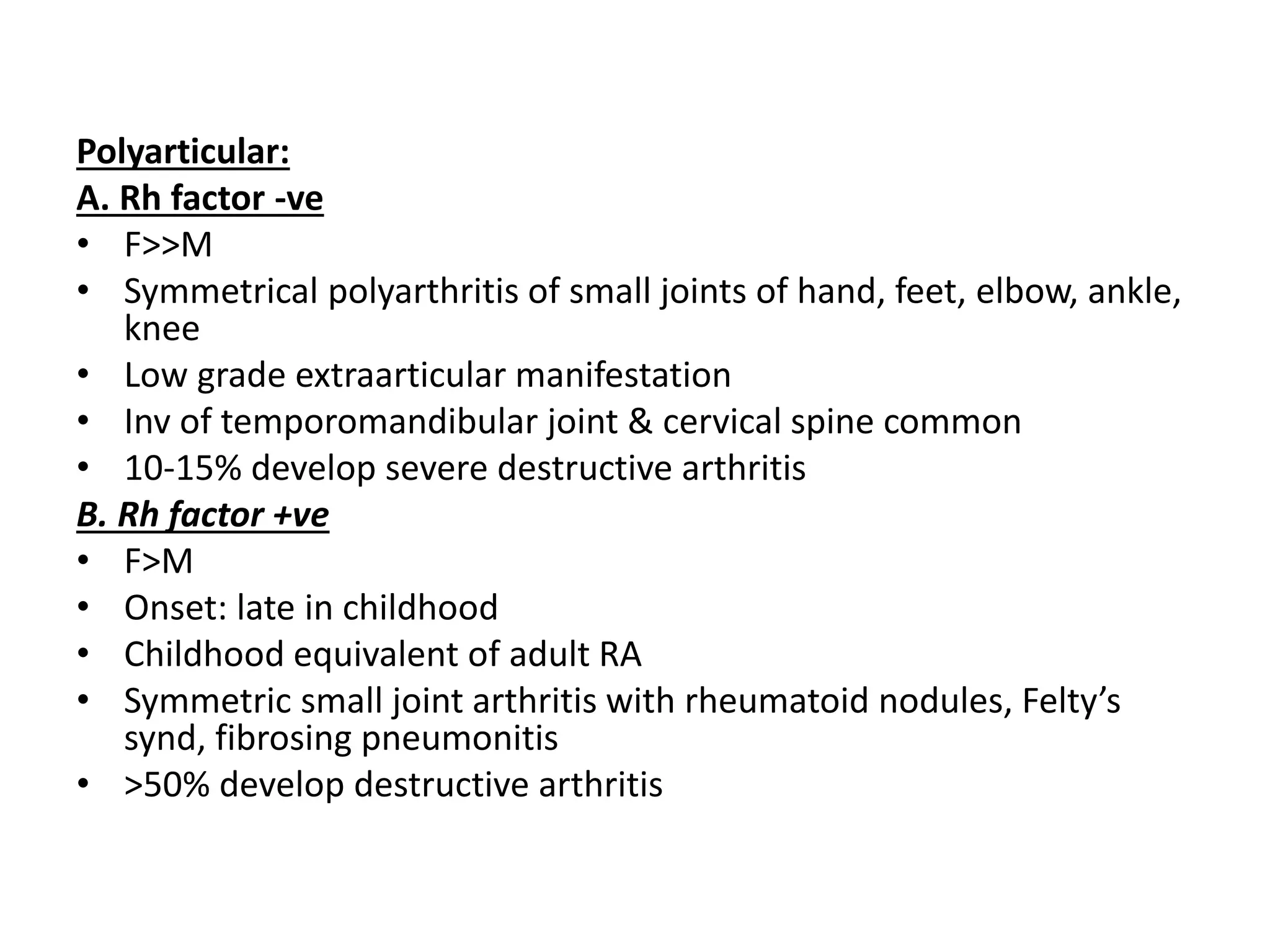
Polyarticular:
A. Rh factor -ve
• F>>M
• Symmetrical polyarthritis of small joints of hand, feet, elbow, ankle,
knee
• Low grade extraarticular manifestation
• Inv of temporomandibular joint & cervical spine common
• 10-15% develop severe destructive arthritis
B. Rh factor +ve
• F>M
• Onset: late in childhood
• Childhood equivalent of adult RA
• Symmetric small joint arthritis with rheumatoid nodules, Felty’s
synd, fibrosing pneumonitis
• >50% develop destructive arthritis
Systemic (Still’s disease)
• M>=F
• Intermittent quotidian fever (>1030 F) with chill &
evanescent rash
• During fever- myalgia, arthralgia, transient arthritis,
pleuritis, pericarditis, adenitis, abdominal pain
• Hepatosplenomegaly
• Multiple symmetric joint involvement
• Recur in > 50% cases
• No iridocyclitis
• Inv: leucocytosis, anaemia
Complications:
• Flexion deformity at hip, knee, elbow
• Triple deformity in knee (Flexion, external
rotation, posterior subluxation; also seen in
TB, Polio)
• Growth defects- short stature, tortional
deformity in limbs, leg length discripancy
TREATMENT
• Salicylates- promptly relieve symp. Aspirin 100
mg/kg in 5 devided doses
• Steroids in severe systemic disease &
iridocyclitis
• Deformity correction, physiotherapy
• Synovectomy

Rheumatoid arthritis

  • 1.
  • 2.
    • Rheumatoid arthritis(RA) is an autoimmune disease that results in a chronic, systemic inflammatory disorder that may affect many tissues and organs, but principally attacks synovial joints. • Affects 1-3% of adult population • F>M: 3 to 1 • Peak age of onset -25 and 45
  • 3.
    CLINICAL MANIFESTATIONS • Symmetricalpolyarthralgia, morning stiffness, and fatigue are common • The initial pattern of joint involvement may be monoarticular, oligoarticular (≤4 joints), or polyarticular (>5 joints), usually in a symmetric distribution. Involved joints are swollen, warm, painful, and particularly stiff when rising in the morning or following inactivity. The typical patient has progressive joint enlargement, decreased range of motion evolving to complete ankylosis, with the greatest damage occurring in the first 4 or 5 years
  • 4.
    • Morning stiffnessresults from increases in extracellular fluid in & around joint • Later on, there may be limitation of motion due to pain or joint destruction • Predilection for wrists and hands; MP joints, PIP joints, and wrists are first to become symptomatic • Ulnar deviation, and swan-neck or boutonniere deformities are common
  • 5.
    EXTRA ARTICULAR MANIFESTATIONS: Patientswith extraarticular manifestations have – • High-titer RF • More severe disability • Increased mortality rate • Heart- The most common cause of death in patients with RA is cardiovascular disease – pericarditis, cardiomyopathy, and valvular incompetence, interstitial fibrosis • Lungs: pleuritic chest pain and dyspnea, as well as a pleural friction rub and effusion. – Rheumatoid lung (Honeycombed appearance on CXR due to multiple nodules), Caplan syndrome (associated with pneumoconiosis), Idiopathic pulmonary fibrosis • Eyes- scleritis (most common ocular complication of RA), scleromalacia perforans)
  • 6.
    • Nervous system-mononeuritis multiplex, compression syndromes such as median neuropathy • Kidneys- amyloid deposition • Hematopoietic system- Felty's syndrome (anemia, splenomegaly, and leukopenia) • Vasculitis: usually is a non necrotising arteritis of the small terminal arterials, Skin lesions, leg ulcers, necrotizing arteritis of the viscera, digital infarctions, and fever • Sjogren's syndrome: occurs in 15%; RA + keratoconjunctivitis sicca, xerostomia
  • 7.
    PRESENTATION • 10% casesspontaneous remission within 6 months • most of the cases : pattern of persistent and progressive disease activity • minority of patients : intermittent and recurrent explosive attacks of inflammatory arthritis interspersed with periods of disease quiescence
  • 8.
    2010 ACR-EULAR classificationcriteria for rheumatoid arthritisTarget population Patients who have at least 1 joint with definite clinical synovitis (swelling) with the synovitis not better explained by another disease Classification criteria for RA (score-based algorithm: add score of categories A - D; a score of ≥6/10 is needed for classification of a patient as having definite RA). The metacarpophalangeal joints, proximal interphalangeal joints, the interphalangeal joint of the thumb, second through fifth metatarsophalangeal joint and wrist as small joints, and shoulders, elbows, hip joints, knees, and ankles as large joints A. Joint involvement 1 large joint 0 2-10 large joints 1 1-3 small joints (with or without involvement of large joints) 2 4-10 small joints (with or without involvement of large joints) 3 >10 joints (at least 1 small joint) 5 B. Serology (at least 1 test result is needed for classification) Negative RF and negative ACPA 0 Low-positive RF or low-positive ACPA 2 High-positive RF or high-positive ACPA 3 C. Acute-phase reactants (at least 1 test result is needed for classification) Normal CRP and normal ESR 0 Abnormal CRP or abnormal ESR 1 D. Duration of symptoms <6 weeks 0 ≥6 weeks 1
  • 9.
    Diagnostic criteria • ACRcriteria (1987); 4 of the following – Morning stiffness > 1hr around joints > 6weeks – Arthritis (pain + effusion) > 3 joints of the 7 joint groups (PIP, MCP, wrist, elbow, knee, ankle, MTP) > 6weeks – Arthritis of hand joints; PIP, MCP, wrist > 6 weeks – Symmetric arthritis – at least 1 area > 6 weeks – Rheumatoid nodule – +ve Rheumatoid factor – Positive radiological changes (symmetric joint destruction, erosions, periarticular osteopenia)
  • 10.
  • 11.
    pathology • synovial cellhyperplasia and proliferation • dense inflammatory infiltrates • pannus: a mass of edematous synovium, inflammatory cells, granulation tissue that grows over the articular cartilage and causes its erosion. • fibrous ankylosis, • bony ankylosis
  • 12.
    Cervical Spine inRA • Cervical spine involvement is common in RA (upto 90%), more common with long standing disease and multiple joint involvement Most common presentations: • Atlantoaxial subluxation: most common and may occur in upto 40% • Atlantoaxial impaction / Basilar invagination • Lower cervical spine: Joints of Lushka & facet joints are affected, subluxation may occur at multiple levels; more common in males, with steroid use, sero-+ RA, with RA nodules, & severe RA • Presentation: neck pain, neurologic involvement, myelopathy, radiculopathy • Investigation: Cross table lateral X-ray, MRI
  • 13.
    Treatment: Indications forSurgery • 1. Space available for the cord: spinal cord compression with < 14 mm of room either at upper or lower cervical spine or with basilar invagination • 2. Atlas Dens Interval (ADI): Instability is present when 3.5 mm ADI difference on flex/ext views, – 7 mm difference may imply disruption of the alar ligaments; – difference of > 9 mm is assoc with increase in neurologic injury & will usually require posterior fusion and wiring. • 3. Myelopathy: neurologic impairment and/or instability are indications for treatment; • Surgical Options: posterior or anterior cervical fusion.
  • 14.
    • an extraarticularprocess found over IP joints, over olecranon, and over ulnar border of the forearm • most common extra-articular manifestation of RA • seen in 25% of patients with RA and associated with aggressive disease • erosion through skin may lead to formation of sinus tract • patients complain of pain and cosmetic concerns • treatment – non operative :steroid injection – operative : surgical excision (indications - cosmetic concerns, pain relief, diagnostic biopsy)
  • 15.
    Ulnar drift atMCP joint • volar subluxation associated with ulnar drifting of digits • extensor lag at level of MCP joint • treatment – synovectomy, extensor tendon centralization, and intrinsic release – MCP arthroplasty – MCP fusion
  • 16.
    Boutonniere deformity • synovitisof PIP leads to central slip and dorsal capsule attenuation • increasing PIP flexion • oblique retinacular ligament contracture causes extension contracture of DIP
  • 17.
    Boutonniere deformity :treatment •splinting for flexible PIP • extensor reconstruction (central slip imbrication or Fowler distal tenotomy) for moderate deformity • PIP arthrodesis or arthroplasty for rigid contractures
  • 18.
    Swan neck deformity Hyperextensionof PIP joints with flexion of DIP joint • terminal tendon rupture from DIP synovitis leads to DIP flexion/PIP hyperextension • FDS, volar plate and collateral ligament attenuation from synovitis leads to decreased volar support of PIP, and hyperextension deformity treatment -splinting for flexible PIP (prevent hyperextension) -FDS tenodesis or proximal Fowler tenotomy for flexible PIP and failed splinting -dorsal capsule release, lateral band mobilization, collateral ligament and intrinsic release, extensor tenolysis for rigid deformities
  • 19.
    Wrist Deformity • Rheumatoidsynovitis in wrist affects – Ulnar styloid – Ulnar head – Mid portion of scaphoid • Synovitis stretches ulnar carpal ligamentous complex & causes ‘caput ulna syndrome’ – Dorsal prominence of distal ulna – Supination of carpus – Volar subluxation of ECU – Radial deviation of wrist
  • 20.
    • Synovitis beginsin the region of deep volar radiocarpal ligament & intercarpal ligament which results in volar subluxation of scaphoid. • combination of – rotatory subluxation of the scaphoid – volar subluxation of the ulnar carpus – dorsal subluxation of the distal ulna relative supination of the wrist
  • 21.
    • Wrist collapseleads to – imbalance of the extensor tendons – radial shift of the metacarpals – ulnar deviation of the fingers • untreated, end-stage rheumatoid wrist is – Dislocated volarward – Complete destruction of the carpal bones – Complete dissociation of the radioulnar joint.
  • 22.
    Tenosynovitis • Rheumatoid arthritisis a disease of the synovium. • Tendon sheath involvement is common and may occur months before the symptoms of intra-articular disease are noted. • Common sites – Dorsal aspect of wrist – Volar aspect of wrist – Volar aspect of digits • Presentation : – Pain – Tendon dysfunction – Tendon rupture
  • 23.
    Extensor tenosynovitis • Wrist& digital extensor tenosynovitis causes painless swelling. • If painful look for involvement of radioulnar & radiocarpal joint. • May be the first sign of RA • D/D : ganglion cyst, dorsal capsular synovitis • Extensor nodule may impinge on distal extensor retinaculum causing discomfort in wrist & finger extension.
  • 24.
    Extensor tendon rupture •Eventually tenosynovitis leads to tendon rupture • Major cause of deformity and disability. • Causes – Attrition rupture – Infiltration of synovium – Ischemic rupture • Attrition rupture occurs at – Distal end of the ulna – Lister’s tubercle (pulley for EPL gliding)
  • 25.
    Extensor tendon rupture •The small finger extensors is usually involved first and subsequently the ring (Vaughn- Jackson syndrome) and then sequentially more radial digital extensors. • The EPL frequently ruptures at the Lister tubercle
  • 26.
    • EDQ rupture(with intact little EDC) is diagnosed with the Texas long horn sign, in which the index and little finger are extended while the ring and Middle fingers are flexed; this requires intact extensor indicis and EDQ tendons.
  • 27.
    Flexor tenosynovitis • volarsurface of the wrist and fingers. • Fusiform swelling of one or more flexor tendon sheaths extending from the middle of the palm to the distal interphalangeal joint. • The swelling is typically painful and causes a gradual decrease in finger flexion. • synovium is thickened and nodules can be felt along the tendon sheath with tendon excursion; crepitus and grating usually are present.
  • 28.
    Flexor tenosynovitis • Presentation –interferes with finger motion – Compresses the median nerve in the carpal tunnel – Trigger finger – Tendon rupture. • Erosion of the volar capsule and ligaments over radial osteophytes contribute to flexor pollicis longus rupture in the carpal tunnel (Mannerfelt lesion).
  • 29.
    Flexor tendon rupture: FPL, FDP • less commonly involved than extensors • Sites: – Digit (infiltrative tenosynovitis) – Wrist (FPL tendon : Most common tendon to rupture) – treatment options • FDS4 to FPL tendon transfer + excision of scaphoid spurs • tendon graft + spur excision • IPJ fusion (for advanced disease) • Infiltration, weakening, and eventual rupture of the profundus tendons
  • 31.
    Elbow: • Synovitis • Posteriorsubluxation of elbow • Compression neuropathy – ulnar & PIN Hip: • Protrusio acetabuli: often progressive Flexion deformity
  • 32.
    Rheumatoid Foot • Initially,RA involves the forefoot, then the midtarsal joints, and finally the hindfoot; forefoot is involved twice as often as the hindfoot Rheumatoid forefoot • - Hyperpronation of rheumatoid foot • - Metatarsalgia • - Claw toes Midfoot: • - Talonavicular arthritis • - Midfoot hyperpronation • Hind foot: calcaneovalgus
  • 33.
    • raised ESR,CRP : active RA – elevated; good indicator of response to medical therapy and the activity of the disease • RA factor : IgM, IgG, and IgA isotypes of RF occur in sera from patients with RA, although the IgM isotype is the one most frequently measured by commercial laboratories • also found in Sjögren’s syndrome, systemic lupus erythematosus, and type II mixed essential cryoglobulinemia • anti-CCP antibodies : more specific • presence of RF or anti-CCP antibodies also has prognostic significance, with anti-CCP antibodies showing the most value for predicting worse outcomes.
  • 34.
    X-ray • Early changesare limited to the soft tissues w/ fusiform swelling and joint effusion • Juxta-articular osteoporosis • Cartilage destruction produces narrowing of the joint • Erosion of bone occurs characteristically in the metaphyseal region underlying collateral ligament attachments • Mal-alignment, displacement, and ankylosis of the joint mark end-stage X-ray demonstrating progression of erosions the proximal interphalangeal joint.
  • 35.
    MRI • greatest sensitivityfor detecting synovitis and joint effusions, as well as early bone and bone marrow changes • Presence of bone marrow edema has been recognized to be an early sign of inflammatory joint disease and can predict the subsequent development of erosions on plain radiographs as well as MRI scans
  • 36.
    Differential diagnoses • Crystalinduced arthritis (gout, and pseudogout) • Osteoarthritis • Systemic lupus erythematosus (SLE) • One of the several types of psoriatic arthritis resembles RA • Lyme disease • Reactive arthritis (previously Reiter's disease) • Ankylosing spondylitis • Hepatitis C • Sarcoidosis • Amyloidosis, • Whipple's disease • Hemochromatosis • Acute rheumatic fever • Gonococcal arthritis
  • 37.
    treatment • methotrexate isthe DMARD of first choice for initial treatment of moderate to severe RA • Failure to achieve adequate improvement with methotrexate therapy in 3 months →combination regimen. 1. methotrexate, sulfasalazine, and hydroxychloroquine (oral triple therapy); 2. methotrexate and leflunomide; 3. and methotrexate plus a biological.
  • 38.
    treatment... A clinical statedefined as low disease activity or remission is the optimal goal of therapy A CR/EULAR Provisional Definition of Remission in Rheumatoid Arthritis At any time point, patient must satisfy all of the following: Tender joint count ≤1 Swollen joint count ≤1 C-reactive protein ≤1 mg/dL Patient global assessment ≤1 (on a 0–10 scale) OR At any time point, patient must have a Simplified Disease Activity Index score of ≤3.3
  • 39.
    Methotrexate 10–25 mg/weekorally or SQ Folic acid 1 mg/d to reduce toxicities • adv. effects : • monitor : • CBC, LFTs • Viral hepatitis • panela • Chest x-ray • CBC, creatinine, • LFTs every • 2–3 months Hepatotoxicity Myelosuppress ion Infection Interstitial pneumonitis Pregnancy category X Nausea Diarrhea Stomatitis/ mouth ulcers Alopecia
  • 41.
    Physical Therapy :30 min of moderate intensive activity, foot orthotics for painful valgus deformity, wrist splints Surgical treatment • Synovectomy • Arthroplasty- hip, knee, shoulder, elbow, wrist, MCP • Arthrodesis- wrist, PIP, MCP • Tendon transfer & reconstuctve surgery of hand
  • 42.
    RA in pregnency •Up to 75% of female RA patients will note overall improvement in symptoms during pregnancy, but often will flare after delivery. • Flares during pregnancy are generally treated with low doses of prednisone; hydroxychloroquine and sulfasalazine are probably the safest DMARDs to use during pregnancy. • Methotrexate and leflunomide therapy are contraindicated during pregnancy
  • 43.
    TREATMENT Medical Management: 1. NSAIDS 2.Oral Corticosteroids- used to alleviate intractable joint inflammation or vasculitis 3. DMARDS • Methotrexate: (10 - 25 mg/ wk oral )anti folate, hepatic and pulmonary toxicity; first choice DMARD • Antimalarials: stabilize lysosomal membranes and inhibit IL1, hydroxychloroquine sulfate, major side effect is macular degeneration • Sulfasalazine (anti folate activity)
  • 44.
    4. Anti-cytokine agents •Etanercept - TNF type II receptor fused to IgG1 • Infliximab- chimeric mouse/human monoclonal antibody to TNF • Adalimumab- human antibody to TNF • Leflunomide: inhibit dihydroorotate dehydrogenase, an essential enzyme in the pyrimidine biosynthetic pathway. Its predominant action is to inhibit the proliferation of T lymphocytes.
  • 45.
    JUVENILE RHEUMATOID ARTHRITIS ACRdignostic criteria • Age < 16 • Arthritis of 1 or more joints • Symptoms of at least 6 weeks • An onset type after 6 months of observation – pauciarticular, polyarticular or sysytemic • Exclusion of other forms of arthritis
  • 46.
    Types: • Pauciarticular –less than 5 joints involved; with ANA + iridocyclitis or HLA B 27 + spondylitis • Polyarticular –5 or more joints affected; RA factor + or - • Systemic (Still’s disease) • < 20% have progressive destructive disease; mostly systemic
  • 47.
    Pauciarticular: A. With ANA+ iridocyclitis • F>M • Onset age < 5yr • Fewer joint involved • 30-35% have chronic iridocyclitis; complications- posterior synechia, band shaped keratopathy, cataract, glaucoma, blindness B. With HLA B 27 + spondylitis • M>F • Onset age- >8 years • Arthritis involve lower limbs • Radiographic sacroiliitis • Iridocyclitis, reiter’s seen
  • 48.
    Polyarticular: A. Rh factor-ve • F>>M • Symmetrical polyarthritis of small joints of hand, feet, elbow, ankle, knee • Low grade extraarticular manifestation • Inv of temporomandibular joint & cervical spine common • 10-15% develop severe destructive arthritis B. Rh factor +ve • F>M • Onset: late in childhood • Childhood equivalent of adult RA • Symmetric small joint arthritis with rheumatoid nodules, Felty’s synd, fibrosing pneumonitis • >50% develop destructive arthritis
  • 49.
    Systemic (Still’s disease) •M>=F • Intermittent quotidian fever (>1030 F) with chill & evanescent rash • During fever- myalgia, arthralgia, transient arthritis, pleuritis, pericarditis, adenitis, abdominal pain • Hepatosplenomegaly • Multiple symmetric joint involvement • Recur in > 50% cases • No iridocyclitis • Inv: leucocytosis, anaemia
  • 50.
    Complications: • Flexion deformityat hip, knee, elbow • Triple deformity in knee (Flexion, external rotation, posterior subluxation; also seen in TB, Polio) • Growth defects- short stature, tortional deformity in limbs, leg length discripancy
  • 51.
    TREATMENT • Salicylates- promptlyrelieve symp. Aspirin 100 mg/kg in 5 devided doses • Steroids in severe systemic disease & iridocyclitis • Deformity correction, physiotherapy • Synovectomy