Rheumatoid Arthritis
• Epidemiology
• Pathophysiology and clinical presentation
• Treatment
• Evaluation of treatment
• Clinical case
Epidemiology
 The prevalence estimated to be between 1% and 2% ,
with women affected 3 times more often than men
 Rheumatoid arthritis can occur at any age and often
occurs in younger people.
 Rheumatoid arthritis is an autoimmune disease with a
strong genetic predisposition.
Pathophysiology and clinical
presentation
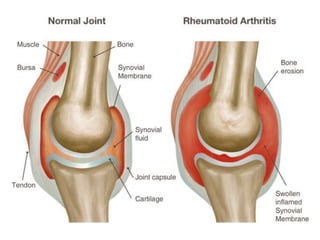
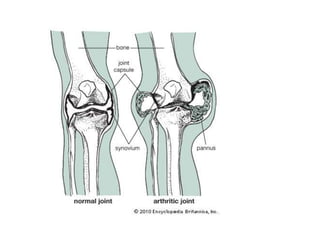
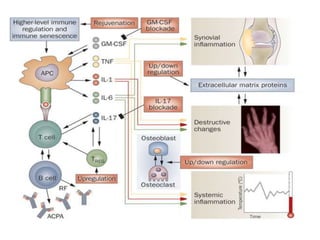
Chronic inflammation of the synovial tissue lining the
joint capsule results in the proliferation of this tissue.
The inflamed proliferating synovium characteristic of
rheumatoid arthritis Is called pannus.
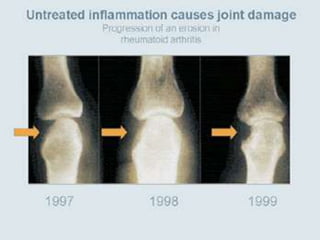
This panes invades the cartilage and eventually the
bone surface, producing erosions of bone and cartilage and
leading to destruction of the joint.
The factors that initiate the inflammatory process are unknown
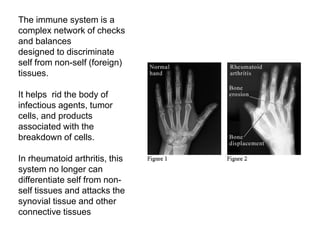
The immune system is a
complex network of checks
and balances
designed to discriminate
self from non-self (foreign)
tissues.
It helps rid the body of
infectious agents, tumor
cells, and products
associated with the
breakdown of cells.
In rheumatoid arthritis, this
system no longer can
differentiate self from non-
self tissues and attacks the
synovial tissue and other
connective tissues
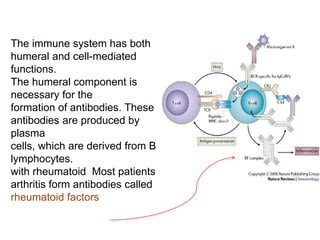
The immune system has both
humeral and cell-mediated
functions.
The humeral component is
necessary for the
formation of antibodies. These
antibodies are produced by
plasma
cells, which are derived from B
lymphocytes.
Most patientswith rheumatoid
arthritis form antibodies called
rheumatoid factors
Symptoms
■Joint pain and stiffness of more than 6 weeks’ duration
May also experience fatigue, weakness, low-grade fever,
Loss of appetite. Muscle pain and afternoon fatigue may also be
present.
Joint deformity is generally seen late in the disease.
Signs
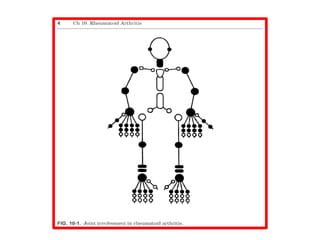
■Tenderness with warmth and swelling over affected joints
usually involving hands and feet. Distribution of joint involvement
is frequently symmetrical. Rheumatoid nodules may also be
present
Laboratory Tests
■Rheumatoid factor (RF) detectable in 60% to 70%.
■Ant cyclic citrullinated peptide (anti-CCP) antibodieshave
similar sensitivity to RF (50% to 85%) but are morespecific
(90% to 95%) and are present earlier in the disease.
■Elevated erythrocyte sedimentation rate and C-reactive
protein are markers for inflammation.
■Normocytic normochromic anemia is common as is
thrombocytosis.
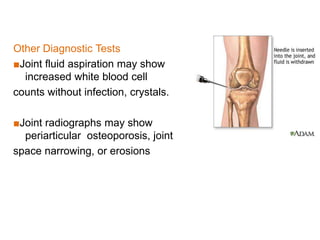
Other Diagnostic Tests
■Joint fluid aspiration may show
increased white blood cell
counts without infection, crystals.
■Joint radiographs may show
periarticular osteoporosis, joint
space narrowing, or erosions
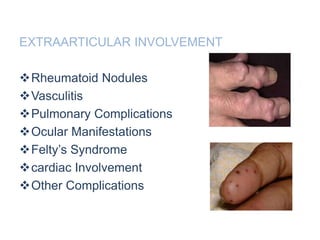
EXTRAARTICULAR INVOLVEMENT
Rheumatoid Nodules
Vasculitis
Pulmonary Complications
Ocular Manifestations
Felty’s Syndrome
cardiac Involvement
Other Complications
LABORATORY FINDINGS
Normocytic normochromic anemia
Thrombocytosis
Leucopenia
ESR is elevated
C-reactive protein elevated
RF present in 60-70 % of patient
Anti- CCP antibody in 50-85%
Antinuclear antibodies in 25%
Diseases Associated with a
Positive
Rheumatoid Factor
Rheumatic diseases
Rheumatoid arthritis
Sjögren’s syndrome (with or without
arthritis)
Systemic lupus erythematosus
Progressive systemic sclerosis
Polymyositis/dermatomyositis
Infectious diseases
Bacterial endocarditis
Tuberculosis
Syphilis
Infectious mononucleosis
Infectious hepatitis
Leprosy
Other causes
Aging
Interstitial pulmonary fibrosis
Cirrhosis of the liver
Chronic active hepatitis
Sarcoidosis
TREATMENT
DESIRED OUTCOME
Control of inflammation is the key to slowing
or preventing disease progression as well
as managing symptoms
a. Reduction in the number of affected joints
and in joint tenderness and swelling
b. Improvement in pain
c. Decreased amount of morning stiffness
d. reduction in serological markers such as RF
e. Improvement in quality-of-life scales
NONPHARMACOLOGIC THERAPY
a. Rest during periods of disease exacerbation
b. Occupational and physical therapy to support
mobility and maintain function
c. Maintenance of normal weight to reduce
biomechanical stress on joints
d. Surgery (Tenosynovectomy, tendon repair,
And joint replacements).
e. Smoking Cessation
PHARMACOLOGIC THERAPY
Drug therapy should be only part of a
comprehensive program for patient management
which would also Include physical therapy,
exercise, and rest.
surgery may beAssistive devices and orthopedic
necessary in some patients
There are four types of medications used to treat RA:
Non-steroidal anti-inflammatory drugs (NSAIDs)
Corticosteroids
Disease-modifying anti-rheumatic drugs(DMARDS).
Biologic Response Modifiers (“Bioligics”)
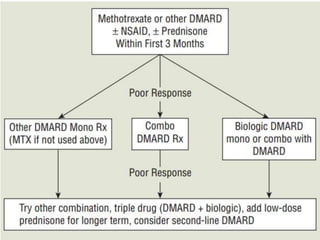
 Disease-modifying antirheumatic drugs (DMARDs) or
biologic agents should be started within 3 months of the
diagnosis of rheumatoid arthritis.
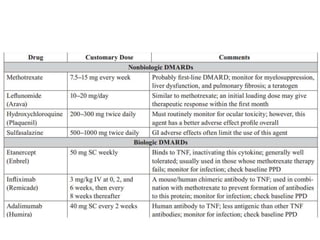
Methotrexate ,hydroxycloroquine ,leflunomide ,and
sulphasalsine are commonly used as first line gents
 Nonsteroidal antiinflammatory drugs and/or corticosteroids
should be considered adjunctive therapy early in the course
of treatment and as needed if symptoms are not adequately
controlled with DMARDs.
When DMARDs used singly are ineffective or not
adequately effective, combination therapy with
two or more DMARDs or a
DMARD plus biologic agents may be used to
induce a response.
Patients require careful monitoring for toxicity and
therapeutic benefit for the duration of treatment
NSAIDs and/or corticosteroids may be used for
symptomatic relief if needed.
They provide relatively rapid improvement in
symptoms compared with DMARDs, which
may take weeks to months before benefit is
seen; however, NSAIDs have no impact on
disease progression and the long-term
complication risk of corticosteroids make
them less desirable
Non-steroidal anti-inflammatory drugs
(NSAIDs)
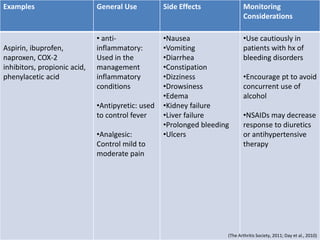
Examples General Use Side Effects Monitoring
Considerations
Aspirin, ibuprofen,
naproxen, COX-2
inhibitors, propionic acid,
phenylacetic acid
• anti-
inflammatory:
Used in the
management
inflammatory
conditions
•Antipyretic: used
to control fever
•Analgesic:
Control mild to
moderate pain
•Nausea
•Vomiting
•Diarrhea
•Constipation
•Dizziness
•Drowsiness
•Edema
•Kidney failure
•Liver failure
•Prolonged bleeding
•Ulcers
•Use cautiously in
patients with hx of
bleeding disorders
•Encourage pt to avoid
concurrent use of
alcohol
•NSAIDs may decrease
response to diuretics
or antihypertensive
therapy
(The Arthritis Society, 2011; Day et al., 2010)
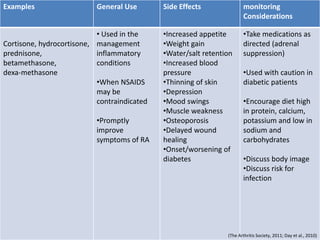
Corticosteroids
 Used in bridging therapy
 Corticosteroids also may be delivered by
injection
 Patients on long-term therapy should be given
calcium and vitamin D or Alendronate to minimize
bone loss.
Examples General Use Side Effects monitoring
Considerations
Cortisone, hydrocortisone,
prednisone,
betamethasone,
dexa-methasone
• Used in the
management
inflammatory
conditions
•When NSAIDS
may be
contraindicated
•Promptly
improve
symptoms of RA
•Increased appetite
•Weight gain
•Water/salt retention
•Increased blood
pressure
•Thinning of skin
•Depression
•Mood swings
•Muscle weakness
•Osteoporosis
•Delayed wound
healing
•Onset/worsening of
diabetes
•Take medications as
directed (adrenal
suppression)
•Used with caution in
diabetic patients
•Encourage diet high
in protein, calcium,
potassium and low in
sodium and
carbohydrates
•Discuss body image
•Discuss risk for
infection
(The Arthritis Society, 2011; Day et al., 2010)
Disease-modifying anti-rheumatic drugs(DMARDS)
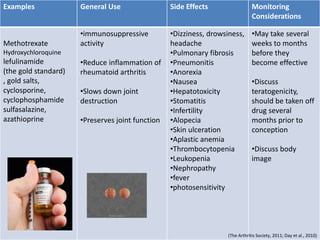
Examples General Use Side Effects Monitoring
Considerations
Methotrexate
Hydroxychloroquine
lefulinamide
(the gold standard)
, gold salts,
cyclosporine,
cyclophosphamide
sulfasalazine,
azathioprine
•immunosuppressive
activity
•Reduce inflammation of
rheumatoid arthritis
•Slows down joint
destruction
•Preserves joint function
•Dizziness, drowsiness,
headache
•Pulmonary fibrosis
•Pneumonitis
•Anorexia
•Nausea
•Hepatotoxicity
•Stomatitis
•Infertility
•Alopecia
•Skin ulceration
•Aplastic anemia
•Thrombocytopenia
•Leukopenia
•Nephropathy
•fever
•photosensitivity
•May take several
weeks to months
before they
become effective
•Discuss
teratogenicity,
should be taken off
drug several
months prior to
conception
•Discuss body
image
(The Arthritis Society, 2011; Day et al., 2010)
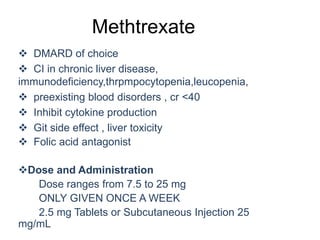
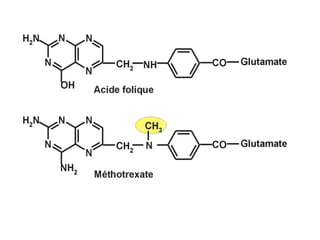
Methtrexate
 DMARD of choice
 CI in chronic liver disease,
immunodeficiency,thrpmpocytopenia,leucopenia,
 preexisting blood disorders , cr <40
 Inhibit cytokine production
 Git side effect , liver toxicity
 Folic acid antagonist
Dose and Administration
Dose ranges from 7.5 to 25 mg
ONLY GIVEN ONCE A WEEK
2.5 mg Tablets or Subcutaneous Injection 25
mg/mL
Tetrahydrofolate is an important cofactor in the production of purines
transferring a carbon atom
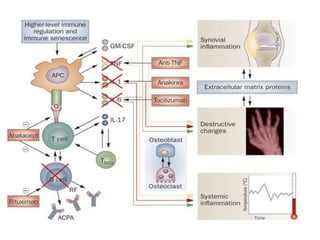
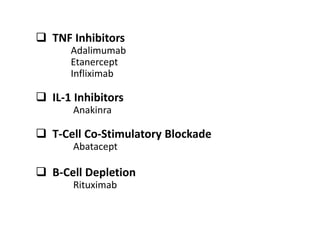
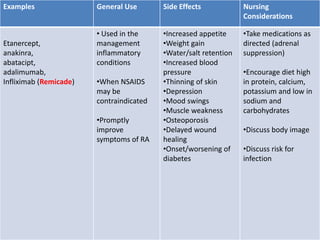
Biologic Response Modifiers (“Bioligics”)
 TNF Inhibitors
Adalimumab
Etanercept
Infliximab
 IL-1 Inhibitors
Anakinra
 T-Cell Co-Stimulatory Blockade
Abatacept
 B-Cell Depletion
Rituximab
Examples General Use Side Effects Nursing
Considerations
Etanercept,
anakinra,
abatacipt,
adalimumab,
Infliximab (Remicade)
• Used in the
management
inflammatory
conditions
•When NSAIDS
may be
contraindicated
•Promptly
improve
symptoms of RA
•Increased appetite
•Weight gain
•Water/salt retention
•Increased blood
pressure
•Thinning of skin
•Depression
•Mood swings
•Muscle weakness
•Osteoporosis
•Delayed wound
healing
•Onset/worsening of
diabetes
•Take medications as
directed (adrenal
suppression)
•Encourage diet high
in protein, calcium,
potassium and low in
sodium and
carbohydrates
•Discuss body image
•Discuss risk for
infection
Therapeutic guideline
Triple Therapy
Methotrexate, Sulfasalazine, Hydroxychloroquine
Double Therapy
Methotrexate & Leflunomide
Methotrexate & Sulfasalazine
Methotrexate & Hydroxychloroquine
Methotrexate & infliximab
Sulfasalazine & cyclosporin
Dosing
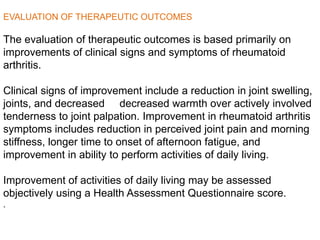
EVALUATION OF THERAPEUTIC OUTCOMES
The evaluation of therapeutic outcomes is based primarily on
improvements of clinical signs and symptoms of rheumatoid
arthritis.
Clinical signs of improvement include a reduction in joint swelling,
decreased warmth over actively involvedjoints, and decreased
tenderness to joint palpation. Improvement in rheumatoid arthritis
symptoms includes reduction in perceived joint pain and morning
stiffness, longer time to onset of afternoon fatigue, and
improvement in ability to perform activities of daily living.
Improvement of activities of daily living may be assessed
objectively using a Health Assessment Questionnaire score.
.
Joint radiographs may be of some benefit in assessing the
progression of the disease and should show little or no
evidence of disease progression if treatment is effective.
Laboratory monitoring is of little value in monitoring individual
patient response to therapy. Routine monitoring of patients is
essential to the safe use of these drugs.
In addition, patients should be questioned about
symptoms of the adverse effects outlined previously
Rheumatoid arthritis

Rheumatoid arthritis

  • 1.
  • 2.
    • Epidemiology • Pathophysiologyand clinical presentation • Treatment • Evaluation of treatment • Clinical case
  • 3.
  • 4.
     The prevalenceestimated to be between 1% and 2% , with women affected 3 times more often than men  Rheumatoid arthritis can occur at any age and often occurs in younger people.  Rheumatoid arthritis is an autoimmune disease with a strong genetic predisposition.
  • 5.
  • 6.
    Chronic inflammation ofthe synovial tissue lining the joint capsule results in the proliferation of this tissue. The inflamed proliferating synovium characteristic of rheumatoid arthritis Is called pannus. This panes invades the cartilage and eventually the bone surface, producing erosions of bone and cartilage and leading to destruction of the joint. The factors that initiate the inflammatory process are unknown
  • 10.
    The immune systemis a complex network of checks and balances designed to discriminate self from non-self (foreign) tissues. It helps rid the body of infectious agents, tumor cells, and products associated with the breakdown of cells. In rheumatoid arthritis, this system no longer can differentiate self from non- self tissues and attacks the synovial tissue and other connective tissues
  • 12.
    The immune systemhas both humeral and cell-mediated functions. The humeral component is necessary for the formation of antibodies. These antibodies are produced by plasma cells, which are derived from B lymphocytes. Most patientswith rheumatoid arthritis form antibodies called rheumatoid factors
  • 13.
    Symptoms ■Joint pain andstiffness of more than 6 weeks’ duration May also experience fatigue, weakness, low-grade fever, Loss of appetite. Muscle pain and afternoon fatigue may also be present. Joint deformity is generally seen late in the disease. Signs ■Tenderness with warmth and swelling over affected joints usually involving hands and feet. Distribution of joint involvement is frequently symmetrical. Rheumatoid nodules may also be present
  • 14.
    Laboratory Tests ■Rheumatoid factor(RF) detectable in 60% to 70%. ■Ant cyclic citrullinated peptide (anti-CCP) antibodieshave similar sensitivity to RF (50% to 85%) but are morespecific (90% to 95%) and are present earlier in the disease. ■Elevated erythrocyte sedimentation rate and C-reactive protein are markers for inflammation. ■Normocytic normochromic anemia is common as is thrombocytosis.
  • 15.
    Other Diagnostic Tests ■Jointfluid aspiration may show increased white blood cell counts without infection, crystals. ■Joint radiographs may show periarticular osteoporosis, joint space narrowing, or erosions
  • 16.
    EXTRAARTICULAR INVOLVEMENT Rheumatoid Nodules Vasculitis PulmonaryComplications Ocular Manifestations Felty’s Syndrome cardiac Involvement Other Complications
  • 17.
    LABORATORY FINDINGS Normocytic normochromicanemia Thrombocytosis Leucopenia ESR is elevated C-reactive protein elevated RF present in 60-70 % of patient Anti- CCP antibody in 50-85% Antinuclear antibodies in 25%
  • 18.
    Diseases Associated witha Positive Rheumatoid Factor Rheumatic diseases Rheumatoid arthritis Sjögren’s syndrome (with or without arthritis) Systemic lupus erythematosus Progressive systemic sclerosis Polymyositis/dermatomyositis Infectious diseases Bacterial endocarditis Tuberculosis Syphilis Infectious mononucleosis Infectious hepatitis Leprosy Other causes Aging Interstitial pulmonary fibrosis Cirrhosis of the liver Chronic active hepatitis Sarcoidosis
  • 19.
  • 20.
    DESIRED OUTCOME Control ofinflammation is the key to slowing or preventing disease progression as well as managing symptoms
  • 21.
    a. Reduction inthe number of affected joints and in joint tenderness and swelling b. Improvement in pain c. Decreased amount of morning stiffness d. reduction in serological markers such as RF e. Improvement in quality-of-life scales
  • 22.
    NONPHARMACOLOGIC THERAPY a. Restduring periods of disease exacerbation b. Occupational and physical therapy to support mobility and maintain function c. Maintenance of normal weight to reduce biomechanical stress on joints d. Surgery (Tenosynovectomy, tendon repair, And joint replacements). e. Smoking Cessation
  • 23.
    PHARMACOLOGIC THERAPY Drug therapyshould be only part of a comprehensive program for patient management which would also Include physical therapy, exercise, and rest. surgery may beAssistive devices and orthopedic necessary in some patients
  • 24.
    There are fourtypes of medications used to treat RA: Non-steroidal anti-inflammatory drugs (NSAIDs) Corticosteroids Disease-modifying anti-rheumatic drugs(DMARDS). Biologic Response Modifiers (“Bioligics”)
  • 25.
     Disease-modifying antirheumaticdrugs (DMARDs) or biologic agents should be started within 3 months of the diagnosis of rheumatoid arthritis. Methotrexate ,hydroxycloroquine ,leflunomide ,and sulphasalsine are commonly used as first line gents  Nonsteroidal antiinflammatory drugs and/or corticosteroids should be considered adjunctive therapy early in the course of treatment and as needed if symptoms are not adequately controlled with DMARDs.
  • 26.
    When DMARDs usedsingly are ineffective or not adequately effective, combination therapy with two or more DMARDs or a DMARD plus biologic agents may be used to induce a response. Patients require careful monitoring for toxicity and therapeutic benefit for the duration of treatment
  • 27.
    NSAIDs and/or corticosteroidsmay be used for symptomatic relief if needed. They provide relatively rapid improvement in symptoms compared with DMARDs, which may take weeks to months before benefit is seen; however, NSAIDs have no impact on disease progression and the long-term complication risk of corticosteroids make them less desirable
  • 28.
  • 29.
    Examples General UseSide Effects Monitoring Considerations Aspirin, ibuprofen, naproxen, COX-2 inhibitors, propionic acid, phenylacetic acid • anti- inflammatory: Used in the management inflammatory conditions •Antipyretic: used to control fever •Analgesic: Control mild to moderate pain •Nausea •Vomiting •Diarrhea •Constipation •Dizziness •Drowsiness •Edema •Kidney failure •Liver failure •Prolonged bleeding •Ulcers •Use cautiously in patients with hx of bleeding disorders •Encourage pt to avoid concurrent use of alcohol •NSAIDs may decrease response to diuretics or antihypertensive therapy (The Arthritis Society, 2011; Day et al., 2010)
  • 30.
  • 31.
     Used inbridging therapy  Corticosteroids also may be delivered by injection  Patients on long-term therapy should be given calcium and vitamin D or Alendronate to minimize bone loss.
  • 32.
    Examples General UseSide Effects monitoring Considerations Cortisone, hydrocortisone, prednisone, betamethasone, dexa-methasone • Used in the management inflammatory conditions •When NSAIDS may be contraindicated •Promptly improve symptoms of RA •Increased appetite •Weight gain •Water/salt retention •Increased blood pressure •Thinning of skin •Depression •Mood swings •Muscle weakness •Osteoporosis •Delayed wound healing •Onset/worsening of diabetes •Take medications as directed (adrenal suppression) •Used with caution in diabetic patients •Encourage diet high in protein, calcium, potassium and low in sodium and carbohydrates •Discuss body image •Discuss risk for infection (The Arthritis Society, 2011; Day et al., 2010)
  • 33.
  • 34.
    Examples General UseSide Effects Monitoring Considerations Methotrexate Hydroxychloroquine lefulinamide (the gold standard) , gold salts, cyclosporine, cyclophosphamide sulfasalazine, azathioprine •immunosuppressive activity •Reduce inflammation of rheumatoid arthritis •Slows down joint destruction •Preserves joint function •Dizziness, drowsiness, headache •Pulmonary fibrosis •Pneumonitis •Anorexia •Nausea •Hepatotoxicity •Stomatitis •Infertility •Alopecia •Skin ulceration •Aplastic anemia •Thrombocytopenia •Leukopenia •Nephropathy •fever •photosensitivity •May take several weeks to months before they become effective •Discuss teratogenicity, should be taken off drug several months prior to conception •Discuss body image (The Arthritis Society, 2011; Day et al., 2010)
  • 35.
    Methtrexate  DMARD ofchoice  CI in chronic liver disease, immunodeficiency,thrpmpocytopenia,leucopenia,  preexisting blood disorders , cr <40  Inhibit cytokine production  Git side effect , liver toxicity  Folic acid antagonist Dose and Administration Dose ranges from 7.5 to 25 mg ONLY GIVEN ONCE A WEEK 2.5 mg Tablets or Subcutaneous Injection 25 mg/mL
  • 37.
    Tetrahydrofolate is animportant cofactor in the production of purines transferring a carbon atom
  • 38.
    Biologic Response Modifiers(“Bioligics”)
  • 41.
     TNF Inhibitors Adalimumab Etanercept Infliximab IL-1 Inhibitors Anakinra  T-Cell Co-Stimulatory Blockade Abatacept  B-Cell Depletion Rituximab
  • 42.
    Examples General UseSide Effects Nursing Considerations Etanercept, anakinra, abatacipt, adalimumab, Infliximab (Remicade) • Used in the management inflammatory conditions •When NSAIDS may be contraindicated •Promptly improve symptoms of RA •Increased appetite •Weight gain •Water/salt retention •Increased blood pressure •Thinning of skin •Depression •Mood swings •Muscle weakness •Osteoporosis •Delayed wound healing •Onset/worsening of diabetes •Take medications as directed (adrenal suppression) •Encourage diet high in protein, calcium, potassium and low in sodium and carbohydrates •Discuss body image •Discuss risk for infection
  • 43.
  • 45.
    Triple Therapy Methotrexate, Sulfasalazine,Hydroxychloroquine Double Therapy Methotrexate & Leflunomide Methotrexate & Sulfasalazine Methotrexate & Hydroxychloroquine Methotrexate & infliximab Sulfasalazine & cyclosporin
  • 46.
  • 48.
    EVALUATION OF THERAPEUTICOUTCOMES The evaluation of therapeutic outcomes is based primarily on improvements of clinical signs and symptoms of rheumatoid arthritis. Clinical signs of improvement include a reduction in joint swelling, decreased warmth over actively involvedjoints, and decreased tenderness to joint palpation. Improvement in rheumatoid arthritis symptoms includes reduction in perceived joint pain and morning stiffness, longer time to onset of afternoon fatigue, and improvement in ability to perform activities of daily living. Improvement of activities of daily living may be assessed objectively using a Health Assessment Questionnaire score. .
  • 49.
    Joint radiographs maybe of some benefit in assessing the progression of the disease and should show little or no evidence of disease progression if treatment is effective. Laboratory monitoring is of little value in monitoring individual patient response to therapy. Routine monitoring of patients is essential to the safe use of these drugs. In addition, patients should be questioned about symptoms of the adverse effects outlined previously