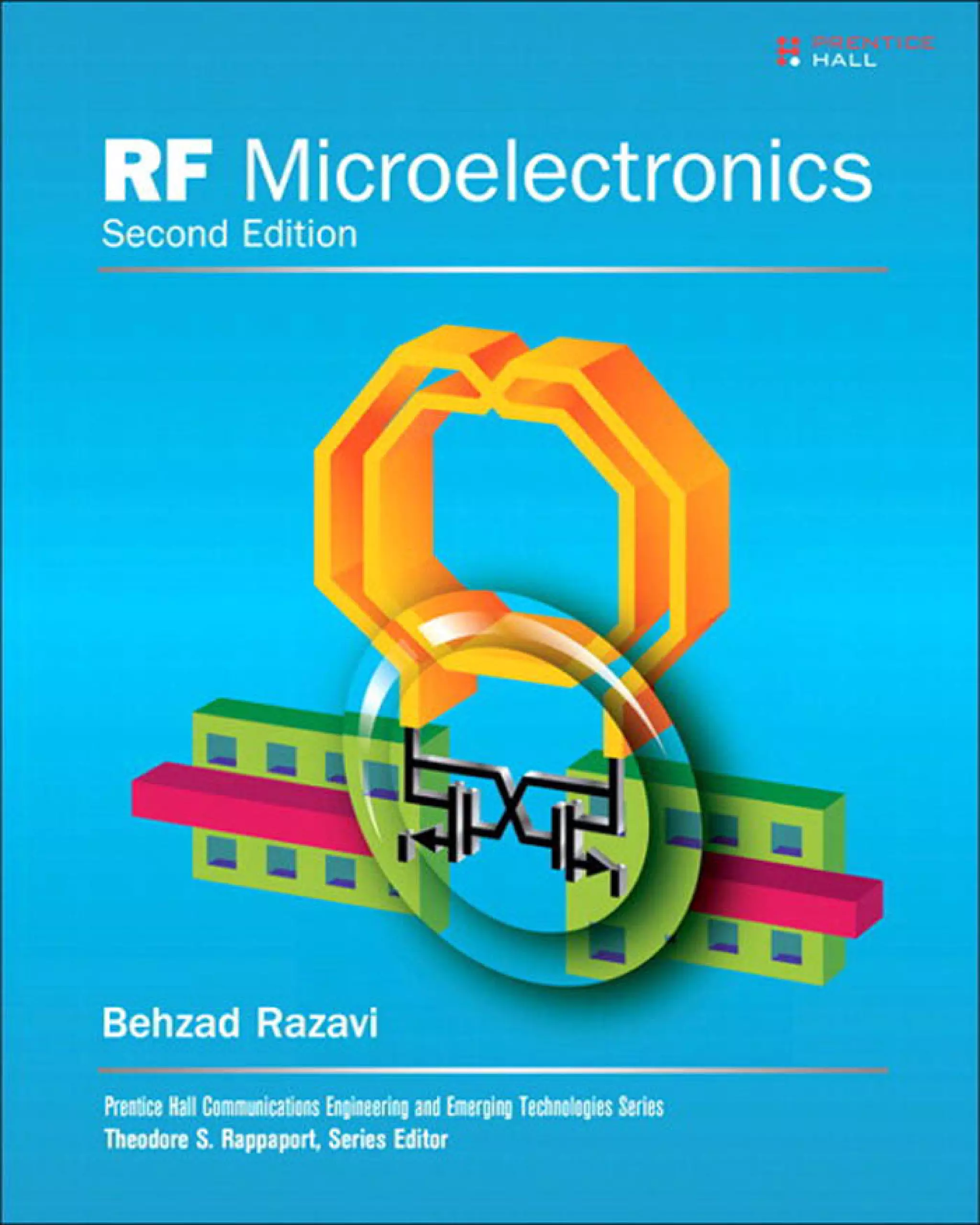
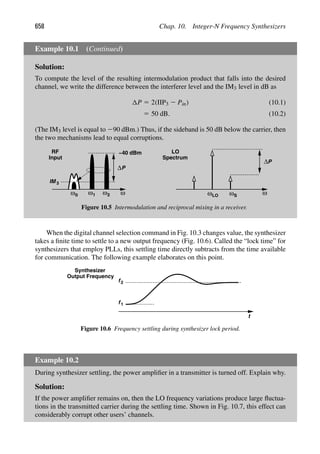
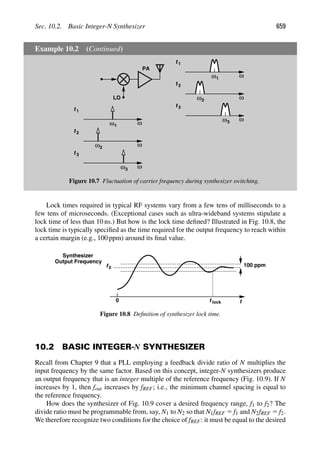
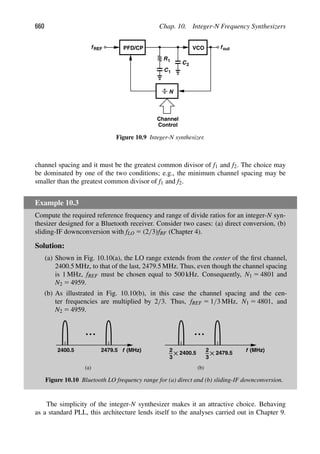
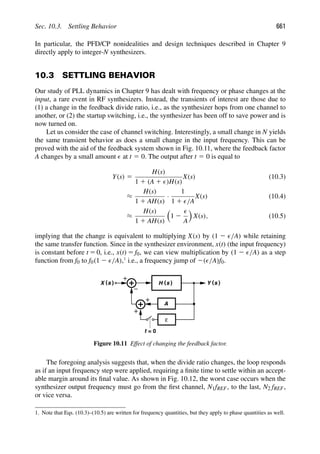
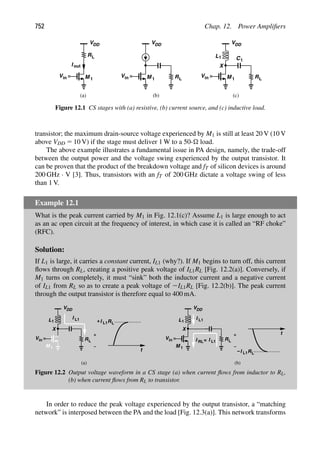
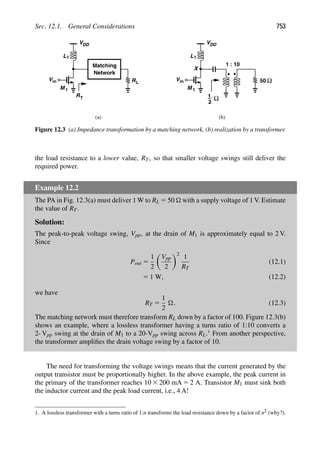
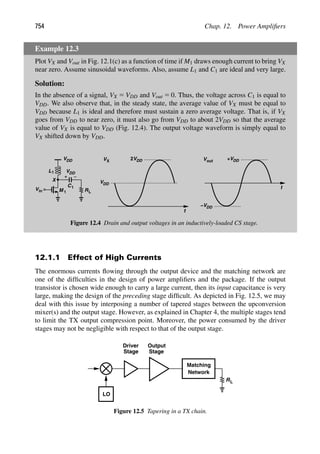
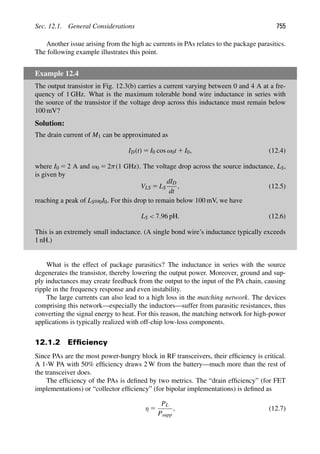
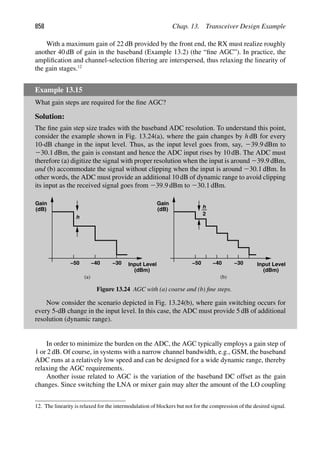
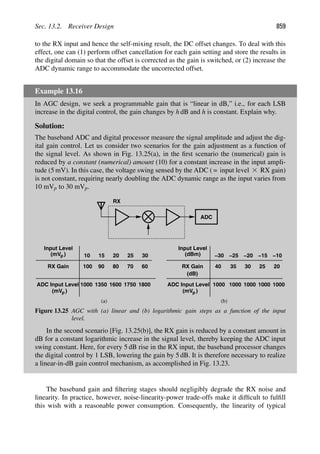
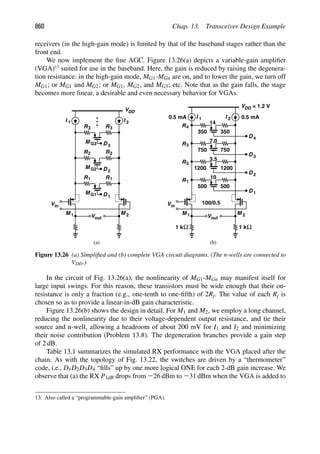
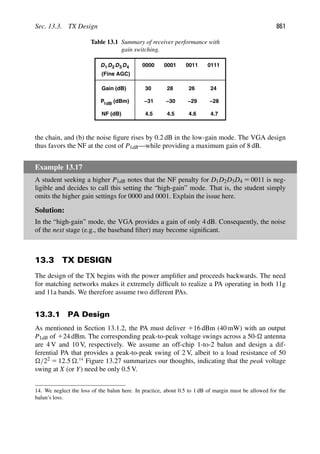
RF MICROELECTRONICS
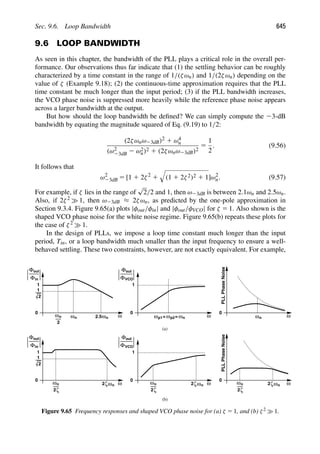
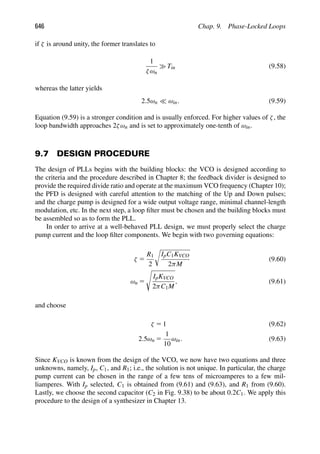
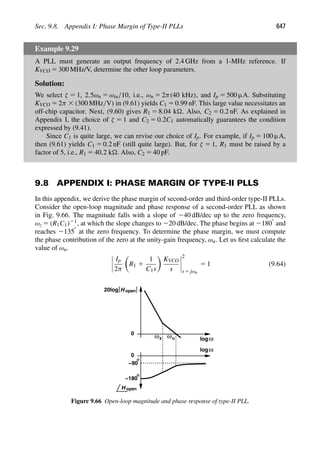
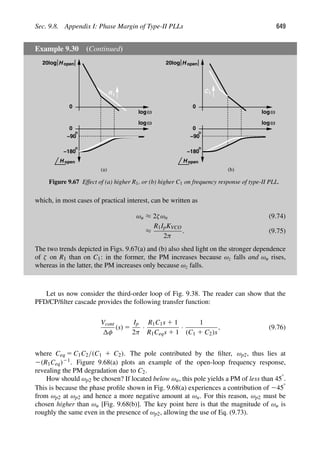
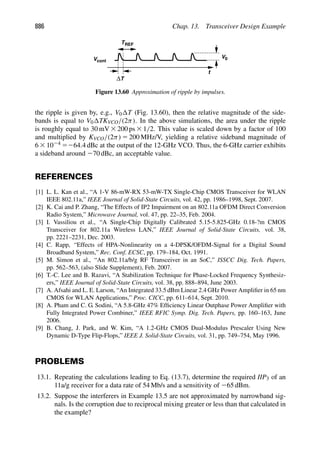
Second Edition
P
rentice Hall PTR’s Communications Engineering and Emerging
Technologies Series provides leading-edge learning and
information about wireless, digital, and other innovative technologies that
are revolutionizing communications around the world. This series reveals
to readers the minds of leading experts in these fields, often as the
technologies are being developed and implemented.
Visit informit.com/communicationengineering for a
complete list of available publications.
The Prentice Hall
Communications Engineering and
Emerging Technologies Series
RF MICROELECTRONICS
Second Edition
Behzad Razavi
Upper Saddle River, NJ • Boston • Indianapolis • San Francisco
New York • Toronto • Montreal • London • Munich • Paris • Madrid
Capetown • Sydney • Tokyo • Singapore • Mexico City
Many of the designations used by manufacturers and sellers to distinguish their products are
claimed as trademarks. Where those designations appear in this book, and the publisher was
aware of a trademark claim, the designations have been printed with initial capital letters or in
all capitals.
The author and publisher have taken care in the preparation of this book, but make no
expressed or implied warranty of any kind and assume no responsibility for errors or
omissions. No liability is assumed for incidental or consequential damages in connection with
or arising out of the use of the information or programs contained herein.
The publisher offers excellent discounts on this book when ordered in quantity for bulk
purchases or special sales, which may include electronic versions and/or custom covers and
content particular to your business, training goals, marketing focus, and branding interests.
For more information, please contact:
U.S. Corporate and Government Sales
(800) 382-3419
corpsales@pearsontechgroup.com
For sales outside the United States, please contact:
International Sales
international@pearson.com
Visit us on the Web: informit.com/ph
Library of Congress Cataloging-in-Publication Data
Razavi, Behzad.
RF microelectronics / Behzad Razavi.—2nd ed.
p. cm.
Includes bibliographical references and index.
ISBN 978-0-13-713473-1 (hardcover : alk. paper) 1. Radio frequency integrated
circuits—Design and construction. I. Title.
TK6560.R39 2011
621.384’12—dc23
2011026820
Copyright c
 2012 Pearson Education, Inc.
All rights reserved. Printed in the United States of America. This publication is protected by
copyright, and permission must be obtained from the publisher prior to any prohibited
reproduction, storage in a retrieval system, or transmission in any form or by any means,
electronic, mechanical, photocopying, recording, or likewise. To obtain permission to use
material from this work, please submit a written request to Pearson Education, Inc.,
Permissions Department, One Lake Street, Upper Saddle River, New Jersey 07458, or you
may fax your request to (201) 236-3290.
ISBN-13: 978-0-13-713473-1
ISBN-10: 0-13-713473-8
Text printed in the United States at Hamilton Printing Company in Castleton, New York.
First printing, September 2011
Publisher
Paul Boger
Acquisitions Editor
Bernard Goodwin
Managing Editor
John Fuller
Full-Service Production
Manager
Julie B. Nahil
Copy Editor
Geneil Breeze
Indexer
Ted Laux
Proofreader
Linda Seifert
Publishing Coordinator
Michelle Housley
Cover Designer
Gary Adair
Compositor
LaurelTech
To the memory of my parents
This page intentionally left blank
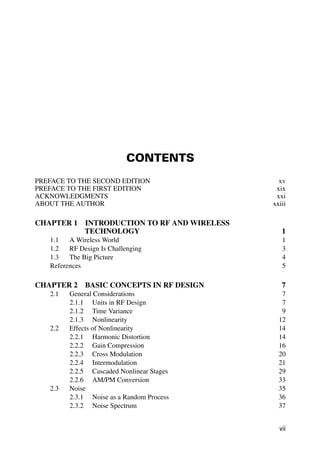
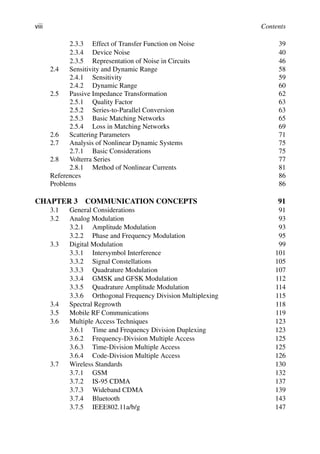
CONTENTS
PREFACE TO THE SECOND EDITION xv
PREFACE TO THE FIRST EDITION xix
ACKNOWLEDGMENTS xxi
ABOUT THE AUTHOR xxiii
CHAPTER 1 INTRODUCTION TO RF AND WIRELESS
TECHNOLOGY 1
1.1 A Wireless World 1
1.2 RF Design Is Challenging 3
1.3 The Big Picture 4
References 5
CHAPTER 2 BASIC CONCEPTS IN RF DESIGN 7
2.1 General Considerations 7
2.1.1 Units in RF Design 7
2.1.2 Time Variance 9
2.1.3 Nonlinearity 12
2.2 Effects of Nonlinearity 14
2.2.1 Harmonic Distortion 14
2.2.2 Gain Compression 16
2.2.3 Cross Modulation 20
2.2.4 Intermodulation 21
2.2.5 Cascaded Nonlinear Stages 29
2.2.6 AM/PM Conversion 33
2.3 Noise 35
2.3.1 Noise as a Random Process 36
2.3.2 Noise Spectrum 37
vii
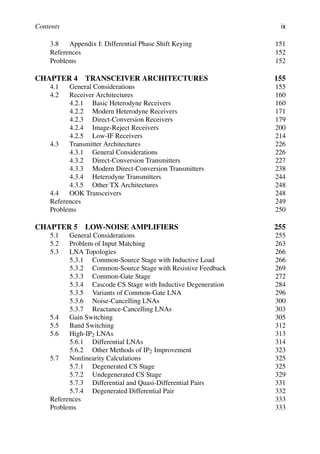
viii Contents
2.3.3 Effect of Transfer Function on Noise 39
2.3.4 Device Noise 40
2.3.5 Representation of Noise in Circuits 46
2.4 Sensitivity and Dynamic Range 58
2.4.1 Sensitivity 59
2.4.2 Dynamic Range 60
2.5 Passive Impedance Transformation 62
2.5.1 Quality Factor 63
2.5.2 Series-to-Parallel Conversion 63
2.5.3 Basic Matching Networks 65
2.5.4 Loss in Matching Networks 69
2.6 Scattering Parameters 71
2.7 Analysis of Nonlinear Dynamic Systems 75
2.7.1 Basic Considerations 75
2.8 Volterra Series 77
2.8.1 Method of Nonlinear Currents 81
References 86
Problems 86
CHAPTER 3 COMMUNICATION CONCEPTS 91
3.1 General Considerations 91
3.2 Analog Modulation 93
3.2.1 Amplitude Modulation 93
3.2.2 Phase and Frequency Modulation 95
3.3 Digital Modulation 99
3.3.1 Intersymbol Interference 101
3.3.2 Signal Constellations 105
3.3.3 Quadrature Modulation 107
3.3.4 GMSK and GFSK Modulation 112
3.3.5 Quadrature Amplitude Modulation 114
3.3.6 Orthogonal Frequency Division Multiplexing 115
3.4 Spectral Regrowth 118
3.5 Mobile RF Communications 119
3.6 Multiple Access Techniques 123
3.6.1 Time and Frequency Division Duplexing 123
3.6.2 Frequency-Division Multiple Access 125
3.6.3 Time-Division Multiple Access 125
3.6.4 Code-Division Multiple Access 126
3.7 Wireless Standards 130
3.7.1 GSM 132
3.7.2 IS-95 CDMA 137
3.7.3 Wideband CDMA 139
3.7.4 Bluetooth 143
3.7.5 IEEE802.11a/b/g 147
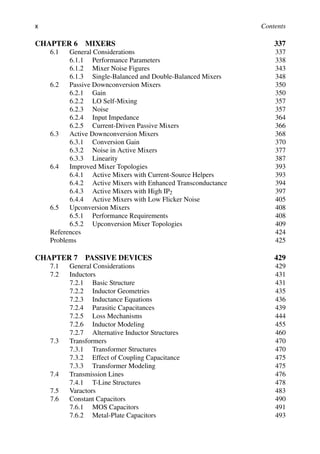
Contents ix
3.8 Appendix I: Differential Phase Shift Keying 151
References 152
Problems 152
CHAPTER 4 TRANSCEIVER ARCHITECTURES 155
4.1 General Considerations 155
4.2 Receiver Architectures 160
4.2.1 Basic Heterodyne Receivers 160
4.2.2 Modern Heterodyne Receivers 171
4.2.3 Direct-Conversion Receivers 179
4.2.4 Image-Reject Receivers 200
4.2.5 Low-IF Receivers 214
4.3 Transmitter Architectures 226
4.3.1 General Considerations 226
4.3.2 Direct-Conversion Transmitters 227
4.3.3 Modern Direct-Conversion Transmitters 238
4.3.4 Heterodyne Transmitters 244
4.3.5 Other TX Architectures 248
4.4 OOK Transceivers 248
References 249
Problems 250
CHAPTER 5 LOW-NOISE AMPLIFIERS 255
5.1 General Considerations 255
5.2 Problem of Input Matching 263
5.3 LNA Topologies 266
5.3.1 Common-Source Stage with Inductive Load 266
5.3.2 Common-Source Stage with Resistive Feedback 269
5.3.3 Common-Gate Stage 272
5.3.4 Cascode CS Stage with Inductive Degeneration 284
5.3.5 Variants of Common-Gate LNA 296
5.3.6 Noise-Cancelling LNAs 300
5.3.7 Reactance-Cancelling LNAs 303
5.4 Gain Switching 305
5.5 Band Switching 312
5.6 High-IP2 LNAs 313
5.6.1 Differential LNAs 314
5.6.2 Other Methods of IP2 Improvement 323
5.7 Nonlinearity Calculations 325
5.7.1 Degenerated CS Stage 325
5.7.2 Undegenerated CS Stage 329
5.7.3 Differential and Quasi-Differential Pairs 331
5.7.4 Degenerated Differential Pair 332
References 333
Problems 333
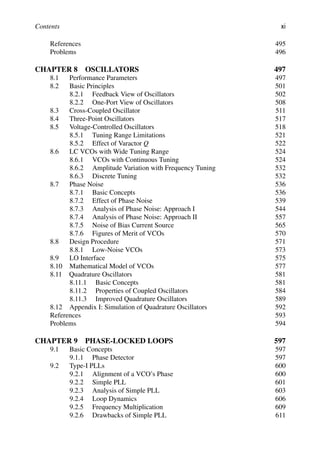
x Contents
CHAPTER 6 MIXERS 337
6.1 General Considerations 337
6.1.1 Performance Parameters 338
6.1.2 Mixer Noise Figures 343
6.1.3 Single-Balanced and Double-Balanced Mixers 348
6.2 Passive Downconversion Mixers 350
6.2.1 Gain 350
6.2.2 LO Self-Mixing 357
6.2.3 Noise 357
6.2.4 Input Impedance 364
6.2.5 Current-Driven Passive Mixers 366
6.3 Active Downconversion Mixers 368
6.3.1 Conversion Gain 370
6.3.2 Noise in Active Mixers 377
6.3.3 Linearity 387
6.4 Improved Mixer Topologies 393
6.4.1 Active Mixers with Current-Source Helpers 393
6.4.2 Active Mixers with Enhanced Transconductance 394
6.4.3 Active Mixers with High IP2 397
6.4.4 Active Mixers with Low Flicker Noise 405
6.5 Upconversion Mixers 408
6.5.1 Performance Requirements 408
6.5.2 Upconversion Mixer Topologies 409
References 424
Problems 425
CHAPTER 7 PASSIVE DEVICES 429
7.1 General Considerations 429
7.2 Inductors 431
7.2.1 Basic Structure 431
7.2.2 Inductor Geometries 435
7.2.3 Inductance Equations 436
7.2.4 Parasitic Capacitances 439
7.2.5 Loss Mechanisms 444
7.2.6 Inductor Modeling 455
7.2.7 Alternative Inductor Structures 460
7.3 Transformers 470
7.3.1 Transformer Structures 470
7.3.2 Effect of Coupling Capacitance 475
7.3.3 Transformer Modeling 475
7.4 Transmission Lines 476
7.4.1 T-Line Structures 478
7.5 Varactors 483
7.6 Constant Capacitors 490
7.6.1 MOS Capacitors 491
7.6.2 Metal-Plate Capacitors 493
Contents xi
References 495
Problems 496
CHAPTER 8 OSCILLATORS 497
8.1 Performance Parameters 497
8.2 Basic Principles 501
8.2.1 Feedback View of Oscillators 502
8.2.2 One-Port View of Oscillators 508
8.3 Cross-Coupled Oscillator 511
8.4 Three-Point Oscillators 517
8.5 Voltage-Controlled Oscillators 518
8.5.1 Tuning Range Limitations 521
8.5.2 Effect of Varactor Q 522
8.6 LC VCOs with Wide Tuning Range 524
8.6.1 VCOs with Continuous Tuning 524
8.6.2 Amplitude Variation with Frequency Tuning 532
8.6.3 Discrete Tuning 532
8.7 Phase Noise 536
8.7.1 Basic Concepts 536
8.7.2 Effect of Phase Noise 539
8.7.3 Analysis of Phase Noise: Approach I 544
8.7.4 Analysis of Phase Noise: Approach II 557
8.7.5 Noise of Bias Current Source 565
8.7.6 Figures of Merit of VCOs 570
8.8 Design Procedure 571
8.8.1 Low-Noise VCOs 573
8.9 LO Interface 575
8.10 Mathematical Model of VCOs 577
8.11 Quadrature Oscillators 581
8.11.1 Basic Concepts 581
8.11.2 Properties of Coupled Oscillators 584
8.11.3 Improved Quadrature Oscillators 589
8.12 Appendix I: Simulation of Quadrature Oscillators 592
References 593
Problems 594
CHAPTER 9 PHASE-LOCKED LOOPS 597
9.1 Basic Concepts 597
9.1.1 Phase Detector 597
9.2 Type-I PLLs 600
9.2.1 Alignment of a VCO’s Phase 600
9.2.2 Simple PLL 601
9.2.3 Analysis of Simple PLL 603
9.2.4 Loop Dynamics 606
9.2.5 Frequency Multiplication 609
9.2.6 Drawbacks of Simple PLL 611
xii Contents
9.3 Type-II PLLs 611
9.3.1 Phase/Frequency Detectors 612
9.3.2 Charge Pumps 614
9.3.3 Charge-Pump PLLs 615
9.3.4 Transient Response 620
9.3.5 Limitations of Continuous-Time Approximation 622
9.3.6 Frequency-Multiplying CPPLL 623
9.3.7 Higher-Order Loops 625
9.4 PFD/CP Nonidealities 627
9.4.1 Up and Down Skew and Width Mismatch 627
9.4.2 Voltage Compliance 630
9.4.3 Charge Injection and Clock Feedthrough 630
9.4.4 Random Mismatch between Up and Down Currents 632
9.4.5 Channel-Length Modulation 633
9.4.6 Circuit Techniques 634
9.5 Phase Noise in PLLs 638
9.5.1 VCO Phase Noise 638
9.5.2 Reference Phase Noise 643
9.6 Loop Bandwidth 645
9.7 Design Procedure 646
9.8 Appendix I: Phase Margin of Type-II PLLs 647
References 651
Problems 652
CHAPTER 10 INTEGER-N FREQUENCY SYNTHESIZERS 655
10.1 General Considerations 655
10.2 Basic Integer-N Synthesizer 659
10.3 Settling Behavior 661
10.4 Spur Reduction Techniques 664
10.5 PLL-Based Modulation 667
10.5.1 In-Loop Modulation 667
10.5.2 Modulation by Offset PLLs 670
10.6 Divider Design 673
10.6.1 Pulse Swallow Divider 674
10.6.2 Dual-Modulus Dividers 677
10.6.3 Choice of Prescaler Modulus 682
10.6.4 Divider Logic Styles 683
10.6.5 Miller Divider 699
10.6.6 Injection-Locked Dividers 707
10.6.7 Divider Delay and Phase Noise 709
References 712
Problems 713
Contents xiii
CHAPTER 11 FRACTIONAL-N SYNTHESIZERS 715
11.1 Basic Concepts 715
11.2 Randomization and Noise Shaping 718
11.2.1 Modulus Randomization 718
11.2.2 Basic Noise Shaping 722
11.2.3 Higher-Order Noise Shaping 728
11.2.4 Problem of Out-of-Band Noise 732
11.2.5 Effect of Charge Pump Mismatch 733
11.3 Quantization Noise Reduction Techniques 738
11.3.1 DAC Feedforward 738
11.3.2 Fractional Divider 742
11.3.3 Reference Doubling 743
11.3.4 Multiphase Frequency Division 745
11.4 Appendix I: Spectrum of Quantization Noise 748
References 749
Problems 749
CHAPTER 12 POWER AMPLIFIERS 751
12.1 General Considerations 751
12.1.1 Effect of High Currents 754
12.1.2 Efficiency 755
12.1.3 Linearity 756
12.1.4 Single-Ended and Differential PAs 758
12.2 Classification of Power Amplifiers 760
12.2.1 Class A Power Amplifiers 760
12.2.2 Class B Power Amplifiers 764
12.2.3 Class C Power Amplifiers 768
12.3 High-Efficiency Power Amplifiers 770
12.3.1 Class A Stage with Harmonic Enhancement 771
12.3.2 Class E Stage 772
12.3.3 Class F Power Amplifiers 775
12.4 Cascode Output Stages 776
12.5 Large-Signal Impedance Matching 780
12.6 Basic Linearization Techniques 782
12.6.1 Feedforward 783
12.6.2 Cartesian Feedback 786
12.6.3 Predistortion 787
12.6.4 Envelope Feedback 788
12.7 Polar Modulation 790
12.7.1 Basic Idea 790
12.7.2 Polar Modulation Issues 793
12.7.3 Improved Polar Modulation 796
xiv Contents
12.8 Outphasing 802
12.8.1 Basic Idea 802
12.8.2 Outphasing Issues 805
12.9 Doherty Power Amplifier 811
12.10 Design Examples 814
12.10.1 Cascode PA Examples 815
12.10.2 Positive-Feedback PAs 819
12.10.3 PAs with Power Combining 821
12.10.4 Polar Modulation PAs 824
12.10.5 Outphasing PA Example 826
References 830
Problems 831
CHAPTER 13 TRANSCEIVER DESIGN EXAMPLE 833
13.1 System-Level Considerations 833
13.1.1 Receiver 834
13.1.2 Transmitter 838
13.1.3 Frequency Synthesizer 840
13.1.4 Frequency Planning 844
13.2 Receiver Design 848
13.2.1 LNA Design 849
13.2.2 Mixer Design 851
13.2.3 AGC 856
13.3 TX Design 861
13.3.1 PA Design 861
13.3.2 Upconverter 867
13.4 Synthesizer Design 869
13.4.1 VCO Design 869
13.4.2 Divider Design 878
13.4.3 Loop Design 882
References 886
Problems 886
INDEX 889
PREFACE TO THE SECOND EDITION
In the 14 years since the first edition of this book, RF IC design has experienced a dramatic
metamorphosis. Innovations in transceiver architectures, circuit topologies, and device
structures have led to highly-integrated “radios” that span a broad spectrum of applica-
tions. Moreover, new analytical and modeling techniques have considerably improved
our understanding of RF circuits and their underlying principles. A new edition was
therefore due.
The second edition differs from the first in several respects:
1. I realized at the outset—three-and-a-half years ago—that simply adding “patches”
to the first edition would not reflect today’s RF microelectronics. I thus closed the
first edition and began with a clean slate. The two editions have about 10% overlap.
2. I wanted the second edition to contain greater pedagogy, helping the reader under-
stand both the fundamentals and the subtleties. I have thus incorporated hundreds
of examples and problems.
3. I also wanted to teach design in addition to analysis. I have thus included step-by-
step design procedures and examples. Furthermore, I have dedicated Chapter 13 to
the step-by-step transistor-level design of a dual-band WiFi transceiver.
4. With the tremendous advances in RF design, some of the chapters have inevitably
become longer and some have been split into two or more chapters. As a result, the
second edition is nearly three times as long as the first.
Suggestions for Instructors and Students
The material in this book is much more than can be covered in one quarter or semester.
The following is a possible sequence of the chapters that can be taught in one term with
reasonable depth. Depending on the students’ background and the instructor’s preference,
other combinations of topics can also be covered in one quarter or semester.
xv
xvi Preface to the Second Edition
Chapter 1: Introduction to RF and Wireless Technology
This chapter provides the big picture and should be covered in about half an hour.
Chapter 2: Basic Concepts in RF Design
The following sections should be covered: General Considerations, Effects of
Nonlinearity (the section on AM/PM Conversion can be skipped), Noise, and Sen-
sitivity and Dynamic Range. (The sections on Passive Impedance Transformation,
Scattering Parameters, and Analysis of Nonlinear Dynamic Systems can be skipped.)
This chapter takes about six hours of lecture.
Chapter 3: Communication Concepts
This chapter can be covered minimally in a quarter system—for example, Analog
Modulation, Quadrature Modulation, GMSK Modulation, Multiple Access Tech-
niques, and the IEEE802.11a/b/g Standard. In a semester system, the concept of signal
constellations can be introduced and a few more modulation schemes and wireless
standards can be taught. This chapter takes about two hours in a quarter system and
three hours in a semester system.
Chapter 4: Transceiver Architectures
This chapter is relatively long and should be taught selectively. The following
sections should be covered: General Considerations, Basic and Modern Hetero-
dyne Receivers, Direct-Conversion Receivers, Image-Reject Receivers, and Direct-
Conversion Transmitters. In a semester system, Low-IF Receivers and Heterodyne
Transmitters can be covered as well. This chapter takes about eight hours in a quarter
system and ten hours in a semester system.
Chapter 5: Low-Noise Amplifiers
The following sections should be covered: General Considerations, Problem of
Input Matching, and LNA Topologies. A semester system can also include Gain
Switching and Band Switching or High-IP2 LNAs. This chapter takes about six hours
in a quarter system and eight hours in a semester system.
Chapter 6: Mixers
The following sections should be covered: General Considerations, Passive
Downconversion Mixers (the computation of noise and input impedance of voltage-
driven sampling mixers can be skipped), Active Downconversion Mixers, and
Active Mixers with High IP2. In a semester system, Active Mixers with Enhanced
Transconductance, Active Mixers with Low Flicker Noise, and Upconversion
Mixers can also be covered. This chapter takes about eight hours in a quarter system
and ten hours in a semester system.
Chapter 7: Passive Devices
This chapter may not fit in a quarter system. In a semester system, about three
hours can be spent on basic inductor structures and loss mechanisms and MOS
varactors.
Chapter 8: Oscillators
This is a long chapter and should be taught selectively. The following sections
should be covered: Basic Principles, Cross-Coupled Oscillator, Voltage-Controlled
Preface to the Second Edition xvii
Oscillators, Low-Noise VCOs. In a quarter system, there is little time to cover phase
noise. In a semester system, both approaches to phase noise analysis can be taught.
This chapter takes about six hours in a quarter system and eight hours in a semester
system.
Chapter 9: Phase-Locked Loops
This chapter forms the foundation for synthesizers. In fact, if taught carefully, this
chapter naturally teaches integer-N synthesizers, allowing a quarter system to skip the
next chapter. The following sections should be covered: Basic Concepts, Type-I PLLs,
Type-II PLLs, and PFD/CP Nonidealities. A semester system can also include Phase
Noise in PLLs and Design Procedure. This chapter takes about four hours in a quarter
system and six hours in a semester system.
Chapter 10: Integer-N Synthesizers
This chapter is likely sacrificed in a quarter system. A semester system can spend
about four hours on Spur Reduction Techniques and Divider Design.
Chapter 11: Fractional-N Synthesizers
This chapter is likely sacrificed in a quarter system. A semester system can spend
about four hours on Randomization and Noise Shaping. The remaining sections may
be skipped.
Chapter 12: Power Amplifiers
This is a long chapter and, unfortunately, is often sacrificed for other chapters.
If coverage is desired, the following sections may be taught: General Considera-
tions, Classification of Power Amplifiers, High-Efficiency Power Amplifiers, Cascode
Output Stages, and Basic Linearization Techniques. These topics take about four
hours of lecture. Another four hours can be spent on Doherty Power Amplifier, Polar
Modulation, and Outphasing.
Chapter 13: Transceiver Design Example
This chapter provides a step-by-step design of a dual-band transceiver. It is possi-
ble to skip the state-of-the-art examples in Chapters 5, 6, and 8 to allow some time for
this chapter. The system-level derivations may still need to be skipped. The RX, TX,
and synthesizer transistor-level designs can be covered in about four hours.
A solutions manual is available for instructors via the Pearson Higher Education Instruc-
tor Resource Center web site: pearsonhighered.com/irc; and a set of Powerpoint slides is
available for instructors at informit.com/razavi. Additional problems will be posted on the
book’s website (informit.com/razavi).
—Behzad Razavi
July 2011
This page intentionally left blank
PREFACE TO THE FIRST EDITION
The annual worldwide sales of cellular phones has exceeded $2.5B. With 4.5 million cus-
tomers, home satellite networks comprise a $2.5B industry. The global positioning system
is expected to become a $5B market by the year 2000. In Europe, the sales of equip-
ment and services for mobile communications will reach $30B by 1998. The statistics are
overwhelming.
The radio frequency (RF) and wireless market has suddenly expanded to unimaginable
dimensions. Devices such as pagers, cellular and cordless phones, cable modems, and
RF identification tags are rapidly penetrating all aspects of our lives, evolving from luxury
items to indispensable tools. Semiconductor and system companies, small and large, analog
and digital, have seen the statistics and are striving to capture their own market share by
introducing various RF products.
RF design is unique in that it draws upon many disciplines unrelated to integrated
circuits (ICs). The RF knowledge base has grown for almost a century, creating a seemingly
endless body of literature for the novice.
This book deals with the analysis and design of RF integrated circuits and systems.
Providing a systematic treatment of RF electronics in a tutorial language, the book begins
with the necessary background knowledge from microwave and communication theory
and leads the reader to the design of RF transceivers and circuits. The text emphasizes both
architecture and circuit level issues with respect to monolithic implementation in VLSI
technologies. The primary focus is on bipolar and CMOS design, but most of the con-
cepts can be applied to other technologies as well. The reader is assumed to have a basic
understanding of analog IC design and the theory of signals and systems.
The book consists of nine chapters. Chapter 1 gives a general introduction, posing ques-
tions and providing motivation for subsequent chapters. Chapter 2 describes basic concepts
in RF and microwave design, emphasizing the effects of nonlinearity and noise.
Chapters 3 and 4 take the reader to the communication system level, giving an overview
of modulation, detection, multiple access techniques, and wireless standards. While ini-
tially appearing to be unnecessary, this material is in fact essential to the concurrent design
of RF circuits and systems.
xix
xx Preface to the First Edition
Chapter 5 deals with transceiver architectures, presenting various receiver and trans-
mitter topologies along with their merits and drawbacks. This chapter also includes a
number of case studies that exemplify the approaches taken in actual RF products.
Chapters 6 through 9 address the design of RF building blocks: low-noise amplifiers
and mixers, oscillators, frequency synthesizers, and power amplifiers, with particular atten-
tion to minimizing the number of off-chip components. An important goal of these chapters
is to demonstrate how the system requirements define the parameters of the circuits and how
the performance of each circuit impacts that of the overall transceiver.
I have taught approximately 80% of the material in this book in a 4-unit graduate course
at UCLA. Chapters 3, 4, 8, and 9 had to be shortened in a ten-week quarter, but in a semester
system they can be covered more thoroughly.
Much of my RF design knowledge comes from interactions with colleagues. Helen
Kim, Ting-Ping Liu, and Dan Avidor of Bell Laboratories, and David Su and Andrew
Gzegorek of Hewlett-Packard Laboratories have contributed to the material in this book in
many ways. The text was also reviewed by a number of experts: Stefan Heinen (Siemens),
Bart Jansen (Hewlett-Packard), Ting-Ping Liu (Bell Labs), John Long (University of
Toronto), Tadao Nakagawa (NTT), Gitty Nasserbakht (Texas Instruments), Ted Rappaport
(Virginia Tech), Tirdad Sowlati (Gennum), Trudy Stetzler (Bell Labs), David Su (Hewlett-
Packard), and Rick Wesel (UCLA). In addition, a number of UCLA students, including
Farbod Behbahani, Hooman Darabi, John Leete, and Jacob Rael, “test drove” various
chapters and provided useful feedback. I am indebted to all of the above for their kind
assistance.
I would also like to thank the staff at Prentice Hall, particularly Russ Hall, Maureen
Diana, and Kerry Riordan for their support.
—Behzad Razavi
July 1997
ACKNOWLEDGMENTS
I have been fortunate to benefit from the support of numerous people during the writing,
review, and production phases of this book. I would like to express my thanks here.
Even after several rounds of self-editing, it is possible that typos or subtle mistakes
have eluded the author. Sometimes, an explanation that is clear to the author may not be
so to the reader. And, occasionally, the author may have missed a point or a recent devel-
opment. A detailed review of the book by others thus becomes necessary. The following
individuals meticulously reviewed various chapters, discovered my mistakes, and made
valuable suggestions:
Ali Afsahi (Broadcom)
Pietro Andreani (Lund University)
Ashkan Borna (UC Berkeley)
Jonathan Borremans (IMEC)
Debopriyo Chowdhury (UC Berkeley)
Matteo Conta (Consultant)
Ali Homayoun (UCLA)
Velntina del Lattorre (Consultant)
Jane Gu (University of Florida)
Peng Han (Beken)
Pavan Hanumolu (Oregon State University)
Daquan Huang (Texas Instruments)
Sy-Chyuan Hwu (UCLA)
Amin Jahanian (UCI)
Jithin Janardhan (UCLA)
Shinwon Kang (UC Berkeley)
Iman Khajenasiri
(Sharif University of Technology)
Yanghyo Kim (UCLA)
Abbas Komijani (Atheros)
Tai-Cheng Lee (National Taiwan University)
Antonio Liscidini (University of Pavia)
Shen-Iuan Liu (National Taiwan University)
Xiaodong Liu (Lund University)
Jian Hua Lu (UCLA)
Howard Luong (Hong Kong University of
Science and Technology)
Elvis Mak (University of Macau)
Rabih Makarem (Atheros)
Rui Martins (University of Macau)
Andrea Mazzanti (University of Pavia)
Karthik Natarajan
(University of Washington)
Nitin Nidhi (UCLA)
Joung Park (UCLA)
Paul Park (Atheros)
Stefano Pellerano (Intel)
Jafar Savoj (Xilinx)
xxi
xxii Acknowledgments
Parmoon Seddighrad
(University of Washington)
Alireza Shirvani (Ralink)
Tirdad Sowlati (Qualcomm)
Francesco Svelto (University of Pavia)
Enrico Temporiti (ST Microelectronics)
Federico Vecchi (University of Pavia)
Vijay Viswam (Lund University)
Vidojkovic Vojkan (IMEC)
Ning Wang (UCLA)
Weifeng Wang (Beken)
Zhi Gong Wang (Southeast University)
Marco Zanuso (UCLA)
Yunfeng Zhao (Beken)
Alireza Zolfaghari (Broadcom)
I am thankful for their enthusiastic, organized, and to-the-point reviews.
The book’s production was proficiently managed by the staff at Prentice Hall, including
Bernard Goodwin and Julie Nahil. I would like to thank both.
As with my other books, my wife, Angelina, typed the entire second edition in Latex
and selflessly helped me in this three-and-a-half-year endeavor. I am grateful to her.
—Behzad Razavi
ABOUT THE AUTHOR
Behzad Razavi received the BSEE degree from Sharif University of Technology in 1985
and MSEE and PhDEE degrees from Stanford University in 1988 and 1992, respectively.
He was with ATT Bell Laboratories and Hewlett-Packard Laboratories until 1996. Since
1996, he has been associate professor and, subsequently, professor of electrical engi-
neering at University of California, Los Angeles. His current research includes wireless
transceivers, frequency synthesizers, phase-locking and clock recovery for high-speed data
communications, and data converters.
Professor Razavi was an adjunct professor at Princeton University from 1992 to 1994,
and at Stanford University in 1995. He served on the Technical Program Committees of the
International Solid-State Circuits Conference (ISSCC) from 1993 to 2002 and VLSI Cir-
cuits Symposium from 1998 to 2002. He has also served as guest editor and associate editor
of the IEEE Journal of Solid-State Circuits, IEEE Transactions on Circuits and Systems,
and International Journal of High Speed Electronics.
Professor Razavi received the Beatrice Winner Award for Editorial Excellence at the
1994 ISSCC; the best paper award at the 1994 European Solid-State Circuits Conference;
the best panel award at the 1995 and 1997 ISSCC; the TRW Innovative Teaching Award in
1997; the best paper award at the IEEE Custom Integrated Circuits Conference (CICC) in
1998; and McGraw-Hill First Edition of the Year Award in 2001. He was the co-recipient
of both the Jack Kilby Outstanding Student Paper Award and the Beatrice Winner Award
for Editorial Excellence at the 2001 ISSCC. He received the Lockheed Martin Excellence
in Teaching Award in 2006; the UCLA Faculty Senate Teaching Award in 2007; and the
CICC Best Invited Paper Award in 2009. He was also recognized as one of the top ten
authors in the fifty-year history of ISSCC. He received the IEEE Donald Pederson Award
in Solid-State Circuits in 2012.
Professor Razavi is an IEEE Distinguished Lecturer, a Fellow of IEEE, and the
author of Principles of Data Conversion System Design, RF Microelectronics, First Edi-
tion (translated to Chinese, Japanese, and Korean), Design of Analog CMOS Integrated
Circuits (translated to Chinese, Japanese, and Korean), Design of Integrated Circuits for
xxiii
xxiv About the Author
Optical Communications, and Fundamentals of Microelectronics (translated to Korean and
Portuguese), and the editor of Monolithic Phase-Locked Loops and Clock Recovery Circuits
and Phase-Locking in High-Performance Systems.
CHAPTER
1
INTRODUCTION TO RF AND
WIRELESS TECHNOLOGY
Compare two RF transceivers designed for cell phones:
“A 2.7-V GSM RF Transceiver IC” [1] (published in 1997)
“A Single-Chip 10-Band WCDMA/HSDPA 4-Band GSM/EDGE SAW-
Less CMOS Receiver with DigRF 3G Interface and 190-dBm IIP2” [2]
(published in 2009)
Why is the latter much more complex than the former? Does the latter have a higher perfor-
mance or only greater functionality? Which one costs more? Which one consumes a higher
power? What do all the acronyms GSM, WCDMA, HSDPA, EDGE, SAW, and IIP2 mean?
Why do we care?
The field of RF communication has grown rapidly over the past two decades, reaching
far into our lives and livelihood. Our cell phones serve as an encyclopedia, a shopping
terminus, a GPS guide, a weather monitor, and a telephone—all thanks to their wireless
communication devices. We can now measure a patient’s brain or heart activity and transmit
the results wirelessly, allowing the patient to move around untethered. We use RF devices
to track merchandise, pets, cattle, children, and convicts.
1.1 A WIRELESS WORLD
Wireless communication has become almost as ubiquitous as electricity; our refrigera-
tors and ovens may not have a wireless device at this time, but it is envisioned that our
homes will eventually incorporate a wireless network that controls every device and appli-
ance. High-speed wireless links will allow seamless connections among our laptops, digital
cameras, camcorders, cell phones, printers, TVs, microwave ovens, etc. Today’s WiFi and
Bluetooth connections are simple examples of such links.
How did wireless communication take over the world? A confluence of factors has
contributed to this explosive growth. The principal reason for the popularity of wireless
1
2 Chap. 1. Introduction to RF and Wireless Technology
communication is the ever-decreasing cost of electronics. Today’s cell phones cost about
the same as those a decade ago but they offer many more functions and features: many
frequency bands and communication modes, WiFi, Bluetooth, GPS, computing, storage,
a digital camera, and a user-friendly interface. This affordability finds its roots in inte-
gration, i.e., how much functionality can be placed on a single chip—or, rather, how few
components are left off-chip. The integration, in turn, owes its steady rise to (1) the scaling
of VLSI processes, particularly, CMOS technology, and (2) innovations in RF architectures,
circuits, and devices.
Along with higher integration levels, the performance of RF circuits has also improved.
For example, the power consumption necessary for a given function has decreased and the
speed of RF circuits has increased. Figure 1.1 illustrates some of the trends in RF integrated
circuits (ICs) and technology for the past two decades. The minimum feature size of CMOS
1000
100
10
1
88 90 92 94 96 98 00 02 04 06 08 10
Year
T
Oscillation
Frequency
and
f
(GHz)
0.5
um
0.35
um
0.25
um
0.18
um
0.13
um
90
nm
Osc. Freq.
f T
40
nm
65
nm
[3] [4]
[5]
[6]
[7]
[8] [9]
[10]
88 90 92 94 96 98 00 02 04 06 08 10
Year
10
20
30
40
50
60
70
Number
of
RF
and
Wireless
Papers
at
ISSCC
Figure 1.1 Trends in RF circuits and technology.
Sec. 1.2. RF Design Is Challenging 3
technology has fallen from 0.5 μm to 40 nm, the transit frequency,1
fT, of NMOS devices
has risen from about 12 GHz to several hundred gigahertz, and the speed of RF oscillators
has gone from 1.2 GHz to 300 GHz. Also shown is the number of RF and wireless design
papers presented at the International Solid-State Circuits Conference (ISSCC) each year,
revealing the fast-growing activity in this field.
1.2 RF DESIGN IS CHALLENGING
Despite many decades of work on RF and microwave theory and two decades of research
on RF ICs, the design and implementation of RF circuits and transceivers remain chal-
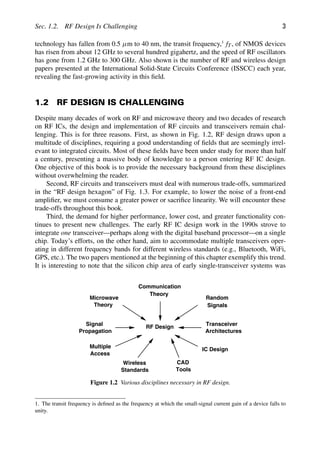
lenging. This is for three reasons. First, as shown in Fig. 1.2, RF design draws upon a
multitude of disciplines, requiring a good understanding of fields that are seemingly irrel-
evant to integrated circuits. Most of these fields have been under study for more than half
a century, presenting a massive body of knowledge to a person entering RF IC design.
One objective of this book is to provide the necessary background from these disciplines
without overwhelming the reader.
Second, RF circuits and transceivers must deal with numerous trade-offs, summarized
in the “RF design hexagon” of Fig. 1.3. For example, to lower the noise of a front-end
amplifier, we must consume a greater power or sacrifice linearity. We will encounter these
trade-offs throughout this book.
Third, the demand for higher performance, lower cost, and greater functionality con-
tinues to present new challenges. The early RF IC design work in the 1990s strove to
integrate one transceiver—perhaps along with the digital baseband processor—on a single
chip. Today’s efforts, on the other hand, aim to accommodate multiple transceivers oper-
ating in different frequency bands for different wireless standards (e.g., Bluetooth, WiFi,
GPS, etc.). The two papers mentioned at the beginning of this chapter exemplify this trend.
It is interesting to note that the silicon chip area of early single-transceiver systems was
RF Design
Communication
Theory
Random
Signals
Transceiver
Architectures
IC Design
Wireless
Standards
Multiple
Access
Microwave
Theory
Signal
Propagation
CAD
Tools
Figure 1.2 Various disciplines necessary in RF design.
1. The transit frequency is defined as the frequency at which the small-signal current gain of a device falls to
unity.
4 Chap. 1. Introduction to RF and Wireless Technology
Noise Power
Linearity
Gain
Supply
Voltage
Frequency
Figure 1.3 RF design hexagon.
dominated by the digital baseband processor, allowing RF and analog designers some lat-
itude in the choice of their circuit and device topologies. In today’s designs, however, the
multiple transceivers tend to occupy a larger area than the baseband processor, requiring
that RF and analog sections be designed with much care about their area consumption.
For example, while on-chip spiral inductors (which have a large footprint) were utilized in
abundance in older systems, they are now used only sparingly.
1.3 THE BIG PICTURE
The objective of an RF transceiver is to transmit and receive information. We envision
that the transmitter (TX) somehow processes the voice or data signal and applies the result
to the antenna [Fig. 1.4(a)]. Similarly, the receiver (RX) senses the signal picked up by
the antenna and processes it so as to reconstruct the original voice or data information.
Each black box in Fig. 1.4(a) contains a great many functions, but we can readily make
two observations: (1) the TX must drive the antenna with a high power level so that the
transmitted signal is strong enough to reach far distances, and (2) the RX may sense a
small signal (e.g., when a cell phone is used in the basement of a building) and must first
amplify the signal with low noise. We now architect our transceiver as shown in Fig. 1.4(b),
where the signal to be transmitted is first applied to a “modulator” or “upconverter” so that
its center frequency goes from zero to, say, fc 5 2.4 GHz. The result drives the antenna
through a “power amplifier” (PA). On the receiver side, the signal is sensed by a “low-
noise amplifier” (LNA) and subsequently by a “downconverter” or “demodulator” (also
known as a “detector”).
The upconversion and downconversion paths in Fig. 1.4(b) are driven by an oscillator,
which itself is controlled by a “frequency synthesizer.” Figure 1.4(c) shows the overall
transceiver.2
The system looks deceptively simple, but we will need the next 900 pages to
cover its RF sections. And perhaps another 900 pages to cover the analog-to-digital and
digital-to-analog converters.
2. In some cases, the modulator and the upconverter are one and the same. In some other cases, the modula-
tion is performed in the digital domain before upconversion. Most receivers demodulate and detect the signal
digitally, requiring only a downconverter in the analog domain.
References 5
?
Transmitter (TX) Receiver (RX)
?
Voice or
Data
Reconstructed
Voice or Data
Power
Amplifier
Upconverter or
Modulator
Voice or
Data
0 f
Amplifier
Low−Noise
f
fc
Downconverter or
Demodulator
Reconstructed
Voice or Data
f
fc 0 f
Downconverter or
Demodulator
LNA
PA
Upconverter or
Modulator
Frequency
Synthesizer
Oscillator
Converter
Analog−to−Digital
Converter
Digital−to−Analog
Digital
Baseband
Processor
(a)
(b)
(c)
Figure 1.4 (a) Simple view of RF communication, (b) more complete view, (c) generic RF
transceiver.
REFERENCES
[1] T. Yamawaki et al., “A 2.7-V GSM RF Transceiver IC,” IEEE J. Solid-State Circuits, vol. 32,
pp. 2089–2096, Dec. 1997.
[2] D. Kaczman et al., “A Single-Chip 10-Band WCDMA/HSDPA 4-Band GSM/EDGE SAW-
less CMOS Receiver with DigRF 3G Interface and 190-dBm IIP2,” IEEE J. Solid-State
Circuits, vol. 44, pp. 718–739, March 2009.
[3] M. Banu, “MOS Oscillators with Multi-Decade Tuning Range and Gigahertz Maximum
Speed,” IEEE J. Solid-State Circuits, vol. 23, pp. 474–479, April 1988.
[4] B. Razavi et al., “A 3-GHz 25-mW CMOS Phase-Locked Loop,” Dig. of Symposium on VLSI
Circuits, pp. 131–132, June 1994.
6 Chap. 1. Introduction to RF and Wireless Technology
[5] M. Soyuer et al., “A 3-V 4-GHz nMOS Voltage-Controlled Oscillator with Integrated
Resonator,” IEEE J. Solid-State Circuits, vol. 31, pp. 2042–2045, Dec. 1996.
[6] B. Kleveland et al., “Monolithic CMOS Distributed Amplifier and Oscillator,” ISSCC Dig.
Tech. Papers, pp. 70–71, Feb. 1999.
[7] H. Wang, “A 50-GHz VCO in 0.25-μm CMOS,” ISSCC Dig. Tech. Papers, pp. 372–373,
Feb. 2001.
[8] L. Franca-Neto, R. Bishop, and B. Bloechel, “64 GHz and 100 GHz VCOs in 90 nm CMOS
Using Optimum Pumping Method,” ISSCC Dig. Tech. Papers, pp. 444–445, Feb. 2004.
[9] E. Seok et al., “A 410GHz CMOS Push-Push Oscillator with an On-Chip Patch Antenna”
ISSCC Dig. Tech. Papers, pp. 472–473, Feb. 2008.
[10] B. Razavi, “A 300-GHz Fundamental Oscillator in 65-nm CMOS Technology,” Symposium
on VLSI Circuits Dig. Of Tech. Papers, pp. 113–114, June 2010.
CHAPTER
2
BASIC CONCEPTS IN
RF DESIGN
RF design draws upon many concepts from a variety of fields, including signals and
systems, electromagnetics and microwave theory, and communications. Nonetheless, RF
design has developed its own analytical methods and its own language. For example, while
the nonlinear behavior of analog circuits may be characterized by “harmonic distortion,”
that of RF circuits is quantified by very different measures.
This chapter deals with general concepts that prove essential to the analysis and
design of RF circuits, closing the gaps with respect to other fields such as analog design,
microwave theory, and communication systems. The outline is shown below.
Nonlinearity
Harmonic Distortion
Compression
Intermodulation
Noise
Noise Spectrum
Device Noise
Noise in Circuits
Dynamic Nonlinear Systems
Impedance Transformation
Series−Parallel Conversion
Matching Networks
S−Parameters
2.1 GENERAL CONSIDERATIONS
2.1.1 Units in RF Design
RF design has traditionally employed certain units to express gains and signal levels. It
is helpful to review these units at the outset so that we can comfortably use them in our
subsequent studies.
The voltage gain, Vout/Vin, and power gain, Pout/Pin, are expressed in decibels (dB):
AV|dB 5 20 log
Vout
Vin
(2.1)
AP|dB 5 10 log
Pout
Pin
. (2.2)
7
8 Chap. 2. Basic Concepts in RF Design
These two quantities are equal (in dB) only if the input and output voltages appear across
equal impedances. For example, an amplifier having an input resistance of R0 (e.g., 50 )
and driving a load resistance of R0 satisfies the following equation:
AP|dB 5 10 log
V2
out
R0
V2
in
R0
(2.3)
5 20 log
Vout
Vin
(2.4)
5 AV|dB, (2.5)
where Vout and Vin are rms values. In many RF systems, however, this relationship does
not hold because the input and output impedances are not equal.
The absolute signal levels are often expressed in dBm rather than in watts or volts.
Used for power quantities, the unit dBm refers to “dB’s above 1 mW.” To express the
signal power, Psig, in dBm, we write
Psig|dBm 5 10 log

Psig
1 mW

. (2.6)
Example 2.1
An amplifier senses a sinusoidal signal and delivers a power of 0 dBm to a load resistance
of 50 . Determine the peak-to-peak voltage swing across the load.
Solution:
Since 0 dBm is equivalent to 1 mW, for a sinusoidal having a peak-to-peak amplitude of
Vpp and hence an rms value of Vpp/(2
√
2), we write
V2
pp
8RL
5 1 mW, (2.7)
where RL 5 50 . Thus,
Vpp 5 632 mV. (2.8)
This is an extremely useful result, as demonstrated in the next example.
Example 2.2
A GSM receiver senses a narrowband (modulated) signal having a level of 2100 dBm. If
the front-end amplifier provides a voltage gain of 15 dB, calculate the peak-to-peak voltage
swing at the output of the amplifier.
Sec. 2.1. General Considerations 9
Example 2.2 (Continued)
Solution:
Since the amplifier output voltage swing is of interest, we first convert the received signal
level to voltage. From the previous example, we note that 2100 dBm is 100 dB below
632 mVpp. Also, 100 dB for voltage quantities is equivalent to 105. Thus, 2100 dBm is
equivalent to 6.32 μVpp. This input level is amplified by 15 dB (≈ 5.62), resulting in an
output swing of 35.5 μVpp.
The reader may wonder why the output voltage of the amplifier is of interest in the
above example. This may occur if the circuit following the amplifier does not present a
50- input impedance, and hence the power gain and voltage gain are not equal in dB. In
fact, the next stage may exhibit a purely capacitive input impedance, thereby requiring no
signal “power.” This situation is more familiar in analog circuits wherein one stage drives
the gate of the transistor in the next stage. As explained in Chapter 5, in most integrated
RF systems, we prefer voltage quantities to power quantities so as to avoid confusion if the
input and output impedances of cascade stages are unequal or contain negligible real parts.
The reader may also wonder why we were able to assume 0 dBm is equivalent to
632 mVpp in the above example even though the signal is not a pure sinusoid. After all, only
for a sinusoid can we assume that the rms value is equal to the peak-to-peak value divided
by 2
√
2. Fortunately, for a narrowband 0-dBm signal, it is still possible to approximate the
(average) peak-to-peak swing as 632 mV.
Although dBm is a unit of power, we sometimes use it at interfaces that do not neces-
sarily entail power transfer. For example, consider the case shown in Fig. 2.1(a), where the
LNA drives a purely-capacitive load with a 632-mVpp swing, delivering no average power.
We mentally attach an ideal voltage buffer to node X and drive a 50- load [Fig. 2.1(b)].
We then say that the signal at node X has a level of 0 dBm, tacitly meaning that if this
signal were applied to a 50- load, then it would deliver 1 mW.
M 1
LNA
in
C
M 1
LNA
X
X
50
Av =1
Ω
632 mV
632 mV
(a) (b)
632 mV
Figure 2.1 (a) LNA driving a capacitive impedance, (b) use of fictitious buffer to visualize the signal
level in dBm.
2.1.2 Time Variance
A system is linear if its output can be expressed as a linear combination (superposition) of
responses to individual inputs. More specifically, if the outputs in response to inputs x1(t)
10 Chap. 2. Basic Concepts in RF Design
in1
in2 R1
out
in1
in2 R1
out
in1
in2 R1
out
(a) (b) (c)
v
v
v
v
v
v
v
v
v
Figure 2.2 (a) Simple switching circuit, (b) system with Vin1 as the input, (c) system with Vin2 as the
input.
and x2(t) can be respectively expressed as
y1(t) 5 f[x1(t)] (2.9)
y2(t) 5 f[x2(t)], (2.10)
then,
ay1(t) 1 by2(t) 5 f[ax1(t) 1 bx2(t)], (2.11)
for arbitrary values of a and b. Any system that does not satisfy this condition is nonlinear.
Note that, according to this definition, nonzero initial conditions or dc offsets also make a
system nonlinear, but we often relax the rule to accommodate these two effects.
Another attribute of systems that may be confused with nonlinearity is time variance.
A system is time-invariant if a time shift in its input results in the same time shift in its
output. That is, if y(t) 5 f[x(t)], then y(t 2 τ) 5 f[x(t 2 τ)] for arbitrary τ.
As an example of an RF circuit in which time variance plays a critical role and must
not be confused with nonlinearity, let us consider the simple switching circuit shown in
Fig. 2.2(a). The control terminal of the switch is driven by vin1(t) 5 A1 cos ω1t and the input
terminal by vin2(t) 5 A2 cos ω2t. We assume the switch is on if vin1  0 and off otherwise.
Is this system nonlinear or time-variant? If, as depicted in Fig. 2.2(b), the input of interest
is vin1 (while vin2 is part of the system and still equal to A2 cos ω2t), then the system is
nonlinear because the control is only sensitive to the polarity of vin1 and independent of
its amplitude. This system is also time-variant because the output depends on vin2. For
example, if vin1 is constant and positive, then vout(t) 5 vin2(t), and if vin1 is constant and
negative, then vout(t) 5 0 (why?).
Now consider the case shown in Fig. 2.2(c), where the input of interest is vin2
(while vin1 remains part of the system and still equal to A1 cos ω1t). This system is lin-
ear with respect to vin2. For example, doubling the amplitude of vin2 directly doubles that
of vout. The system is also time-variant due to the effect of vin1.
Example 2.3
Plot the output waveform of the circuit in Fig. 2.2(a) if vin1 5 A1 cos ω1t and vin2 5
A2 cos(1.25ω1t).
Sec. 2.1. General Considerations 11
Example 2.3 (Continued)
Solution:
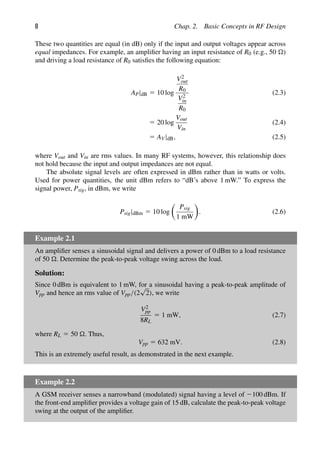
As shown in Fig. 2.3, vout tracks vin2 if vin1  0 and is pulled down to zero by R1 if vin1  0.
That is, vout is equal to the product of vin2 and a square wave toggling between 0 and 1.
t
t
t
v in1
v in2
v out
Figure 2.3 Input and output waveforms.
The circuit of Fig. 2.2(a) is an example of RF “mixers.” We will study such circuits in
Chapter 6 extensively, but it is important to draw several conclusions from the above study.
First, statements such as “switches are nonlinear” are ambiguous. Second, a linear system
can generate frequency components that do not exist in the input signal—the system only
need be time-variant. From Example 2.3,
vout(t) 5 vin2(t) · S(t), (2.12)
where S(t) denotes a square wave toggling between 0 and 1 with a frequency of
f1 5 ω1/(2π). The output spectrum is therefore given by the convolution of the spectra
of vin2(t) and S(t). Since the spectrum of a square wave is equal to a train of impulses
whose amplitudes follow a sinc envelope, we have
Vout( f) 5 Vin2( f) ∗
1∞

n52∞
sin(nπ/2)
nπ
δ

f 2
n
T1

(2.13)
5
1∞

n52∞
sin(nπ/2)
nπ
Vin2

f 2
n
T1

, (2.14)
where T1 5 2π/ω1. This operation is illustrated in Fig. 2.4 for a Vin2 spectrum located
around zero frequency.1
1. It is helpful to remember that, for n 5 1, each impulse in the above summation has an area of 1/π and the
corresponding sinusoid, a peak amplitude of 2/π.
12 Chap. 2. Basic Concepts in RF Design
t t
v in2
1
)
(t
f
0
in2 )
(
V f
f
0
f1
+
f1
+3
f1
f1
−
−3
f
0
f1
+
f1
+3
f1
f1
−
−3
Figure 2.4 Multiplication in the time domain and corresponding convolution in the frequency
domain.
2.1.3 Nonlinearity
A system is called “memoryless” or “static” if its output does not depend on the past values
of its input (or the past values of the output itself). For a memoryless linear system, the
input/output characteristic is given by
y(t) 5 αx(t), (2.15)
where α is a function of time if the system is time-variant [e.g., Fig. 2.2(c)]. For a
memoryless nonlinear system, the input/output characteristic can be approximated with
a polynomial,
y(t) 5 α0 1 α1x(t) 1 α2x2
(t) 1 α3x3
(t) 1 · · ·, (2.16)
where αj may be functions of time if the system is time-variant. Figure 2.5 shows a
common-source stage as an example of a memoryless nonlinear circuit (at low frequen-
cies). If M1 operates in the saturation region and can be approximated as a square-law
device, then
Vout 5 VDD 2 IDRD (2.17)
5 VDD 2
1
2
μnCox
W
L
(Vin 2 VTH)2
RD. (2.18)
In this idealized case, the circuit displays only second-order nonlinearity.
The system described by Eq. (2.16) has “odd symmetry” if y(t) is an odd function of
x(t), i.e., if the response to 2 x(t) is the negative of that to 1 x(t). This occurs if αj 5 0
for even j. Such a system is sometimes called “balanced,” as exemplified by the differential
M 1
RD
VDD
out
V
in
V
Figure 2.5 Common-source stage.
Sec. 2.1. General Considerations 13
RD
V
VDD
RD
M M
1 2
I SS
out
in
V
in
V
Vout
(a) (b)
Figure 2.6 (a) Differential pair and (b) its input/output characteristic.
pair shown in Fig. 2.6(a). Recall from basic analog design that by virtue of symmetry, the
circuit exhibits the characteristic depicted in Fig. 2.6(b) if the differential input varies from
very negative values to very positive values.
Example 2.4
For square-law MOS transistors operating in saturation, the characteristic of Fig. 2.6(b) can
be expressed as [1]
Vout 5 2
1
2
μnCox
W
L
Vin

4ISS
μnCox
W
L
2 V2
inRD. (2.19)
If the differential input is small, approximate the characteristic by a polynomial.
Solution:
Factoring 4ISS/(μnCoxW/L) out of the square root and assuming
V2
in 
4ISS
μnCox
W
L
, (2.20)
we use the approximation
√
1 2  ≈ 1 2 /2 to write
Vout ≈ 2

μnCox
W
L
ISSVin

1 2
μnCox
W
L
8ISS
V2
in

RD (2.21)
≈ 2

μnCox
W
L
ISSRDVin 1
μnCox
W
L
3/2
8
√
ISS
RDV3
in. (2.22)
The first term on the right-hand side represents linear operation, revealing the small-
signal voltage gain of the circuit (2gmRD). Due to symmetry, even-order nonlinear
terms are absent. Interestingly, square-law devices yield a third-order characteristic in this
case. We return to this point in Chapter 5.
14 Chap. 2. Basic Concepts in RF Design
A system is called “dynamic” if its output depends on the past values of its input(s) or
output(s). For a linear, time-invariant, dynamic system,
y(t) 5 h(t) ∗ x(t), (2.23)
where h(t) denotes the impulse response. If a dynamic system is linear but time-variant,
its impulse response depends on the time origin; if δ(t) yields h(t), then δ(t 2 τ) produces
h(t, τ). Thus,
y(t) 5 h(t, τ) ∗ x(t). (2.24)
Finally, if a system is both nonlinear and dynamic, then its impulse response can be
approximated by a Volterra series. This is described in Section 2.8.
2.2 EFFECTS OF NONLINEARITY
While analog and RF circuits can be approximated by a linear model for small-signal opera-
tion, nonlinearities often lead to interesting and important phenomena that are not predicted
by small-signal models. In this section, we study these phenomena for memoryless systems
whose input/output characteristic can be approximated by2
y(t) ≈ α1x(t) 1 α2x2
(t) 1 α3x3
(t). (2.25)
The reader is cautioned, however, that the effect of storage elements (dynamic nonlinearity)
and higher-order nonlinear terms must be carefully examined to ensure (2.25) is a plausible
representation. Section 2.7 deals with the case of dynamic nonlinearity. We may consider
α1 as the small-signal gain of the system because the other two terms are negligible for
small input swings. For example, α1 5 2
√
μnCox(W/L)ISSRD in Eq. (2.22).
The nonlinearity effects described in this section primarily arise from the third-order
term in Eq. (2.25). The second-order term too manifests itself in certain types of receivers
and is studied in Chapter 4.
2.2.1 Harmonic Distortion
If a sinusoid is applied to a nonlinear system, the output generally exhibits frequency com-
ponents that are integer multiples (“harmonics”) of the input frequency. In Eq. (2.25), if
x(t) 5 A cos ωt, then
y(t) 5 α1A cos ωt 1 α2A2
cos2
ωt 1 α3A3
cos3
ωt (2.26)
5 α1A cos ωt 1
α2A2
2
(1 1 cos 2ωt) 1
α3A3
4
(3 cos ωt 1 cos 3ωt) (2.27)
5
α2A2
2
1

α1A 1
3α3A3
4

cos ωt 1
α2A2
2
cos 2ωt 1
α3A3
4
cos 3ωt. (2.28)
2. Note that this expression should be considered as a fit across the signal swings of interest rather than as a
Taylor expansion in the vicinity of x 5 0. These two views may yield slightly different values for αj.
Sec. 2.2. Effects of Nonlinearity 15
In Eq. (2.28), the first term on the right-hand side is a dc quantity arising from second-order
nonlinearity, the second is called the “fundamental,” the third is the second harmonic, and
the fourth is the third harmonic. We sometimes say that even-order nonlinearity introduces
dc offsets.
From the above expansion, we make two observations. First, even-order harmonics
result from αj with even j, and vanish if the system has odd symmetry, i.e., if it is fully
differential. In reality, however, random mismatches corrupt the symmetry, yielding finite
even-order harmonics. Second, in (2.28) the amplitudes of the second and third harmon-
ics are proportional to A2 and A3, respectively, i.e., we say the nth harmonic grows in
proportion to An.
In many RF circuits, harmonic distortion is unimportant or an irrelevant indicator of the
effect of nonlinearity. For example, an amplifier operating at 2.4 GHz produces a second
harmonic at 4.8 GHz, which is greatly suppressed if the circuit has a narrow bandwidth.
Nonetheless, harmonics must always be considered carefully before they are dismissed.
The following examples illustrate this point.
Example 2.5
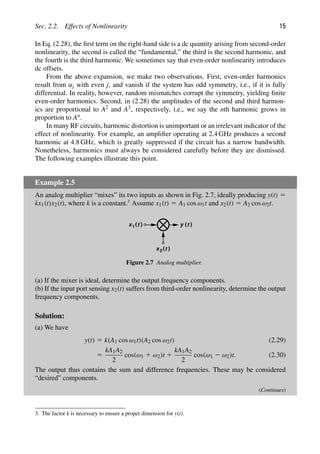
An analog multiplier “mixes” its two inputs as shown in Fig. 2.7, ideally producing y(t) 5
kx1(t)x2(t), where k is a constant.3
Assume x1(t) 5 A1 cos ω1t and x2(t) 5 A2 cos ω2t.
)
(t
x1
)
(t
x2
)
(t
y
Figure 2.7 Analog multiplier.
(a) If the mixer is ideal, determine the output frequency components.
(b) If the input port sensing x2(t) suffers from third-order nonlinearity, determine the output
frequency components.
Solution:
(a) We have
y(t) 5 k(A1 cos ω1t)(A2 cos ω2t) (2.29)
5
kA1A2
2
cos(ω1 1 ω2)t 1
kA1A2
2
cos(ω1 2 ω2)t. (2.30)
The output thus contains the sum and difference frequencies. These may be considered
“desired” components.
(Continues)
3. The factor k is necessary to ensure a proper dimension for y(t).
16 Chap. 2. Basic Concepts in RF Design
Example 2.5 (Continued)
(b) Representing the third harmonic of x2(t) by (α3A3
2/4) cos 3ω2t, we write
y(t) 5 k(A1 cos ω1t)

A2 cos ω2t 1
α3A3
2
4
cos 3ω2t

(2.31)
5
kA1A2
2
cos(ω1 1 ω2)t 1
kA1A2
2
cos(ω1 2 ω2)t
1
kα3A1A3
2
8
cos(ω1 1 3ω2)t 1
kα3A1A3
2
8
cos(ω1 2 3ω2)t. (2.32)
The mixer now produces two “spurious” components at ω1 1 3ω2 and ω1 2 3ω2, one
or both of which often prove problematic. For example, if ω1 5 2π 3 (850 MHz) and
ω2 5 2π 3 (900 MHz), then |ω1 2 3ω2| 5 2π 3 (1850 MHz), an “undesired” component
that is difficult to filter because it lies close to the desired component at ω1 1 ω2 5 2π 3
(1750 MHz).
Example 2.6
The transmitter in a 900-MHz GSM cellphone delivers 1 W of power to the antenna.
Explain the effect of the harmonics of this signal.
Solution:
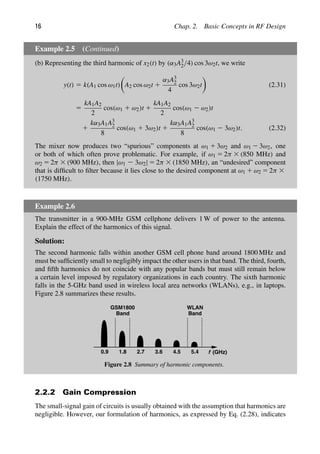
The second harmonic falls within another GSM cell phone band around 1800 MHz and
must be sufficiently small to negligibly impact the other users in that band. The third, fourth,
and fifth harmonics do not coincide with any popular bands but must still remain below
a certain level imposed by regulatory organizations in each country. The sixth harmonic
falls in the 5-GHz band used in wireless local area networks (WLANs), e.g., in laptops.
Figure 2.8 summarizes these results.
0.9 1.8 2.7 3.6 4.5 5.4
GSM1800
Band Band
WLAN
f (GHz)
Figure 2.8 Summary of harmonic components.
2.2.2 Gain Compression
The small-signal gain of circuits is usually obtained with the assumption that harmonics are
negligible. However, our formulation of harmonics, as expressed by Eq. (2.28), indicates
Sec. 2.2. Effects of Nonlinearity 17
that the gain experienced by A cos ωt is equal to α1 13α3A2/4 and hence varies appreciably
as A becomes larger.4
We must then ask, do α1 and α3 have the same sign or opposite
signs? Returning to the third-order polynomial in Eq. (2.25), we note that if α1α3  0,
then α1x 1 α3x3 overwhelms α2x2 for large x regardless of the sign of α2, yielding an
“expansive” characteristic [Fig. 2.9(a)]. For example, an ideal bipolar transistor operating
in the forward active region produces a collector current in proportion to exp(VBE/VT),
exhibiting expansive behavior. On the other hand, if α1α3  0, the term α3x3 “bends”
the characteristic for sufficiently large x [Fig. 2.9(b)], leading to “compressive” behavior,
i.e., a decreasing gain as the input amplitude increases. For example, the differential pair
of Fig. 2.6(a) suffers from compression as the second term in (2.22) becomes comparable
with the first. Since most RF circuits of interest are compressive, we hereafter focus on
this type.
x
y
x
1
α
dominant x
dominant
α3
3
x
y
x
1
α
dominant
x
dominant
α3
3
1
α α3  0
1
α α3  0
(a) (b)
Figure 2.9 (a) Expansive and (b) compressive characteristics.
With α1α3  0, the gain experienced by A cos ωt in Eq. (2.28) falls as A rises. We quan-
tify this effect by the “1-dB compression point,” defined as the input signal level that causes
the gain to drop by 1 dB. If plotted on a log-log scale as a function of the input level, the
output level, Aout, falls below its ideal value by 1 dB at the 1-dB compression point, Ain,1dB
(Fig. 2.10). Note that (a) Ain and Aout are voltage quantities here, but compression can also
be expressed in terms of power quantities; (b) 1-dB compression may also be specified in
terms of the output level at which it occurs, Aout,1dB. The input and output compression
points typically prove relevant in the receive path and the transmit path, respectively.
1 dB
20log in
out
A
A
20log
A in,1dB
Figure 2.10 Definition of 1-dB compression point.
4. This effect is akin to the fact that nonlinearity can also be viewed as variation of the slope of the input/output
characteristic with the input level.
18 Chap. 2. Basic Concepts in RF Design
To calculate the input 1-dB compression point, we equate the compressed gain, α1 1
(3α3/4)A2
in,1dB, to 1 dB less than the ideal gain, α1:
20 log α1 1
3
4
α3A2
in,1dB 5 20 log |α1| 2 1 dB. (2.33)
It follows that
Ain,1dB 5

0.145
α1
α3
. (2.34)
Note that Eq. (2.34) gives the peak value (rather than the peak-to-peak value) of the input.
Also denoted by P1dB, the 1-dB compression point is typically in the range of 220 to
225 dBm (63.2 to 35.6 mVpp in 50- system) at the input of RF receivers. We use the
notations A1dB and P1dB interchangeably in this book. Whether they refer to the input or
the output will be clear from the context or specified explicitly. While gain compression by
1 dB seems arbitrary, the 1-dB compression point represents a 10% reduction in the gain
and is widely used to characterize RF circuits and systems.
Why does compression matter? After all, it appears that if a signal is so large as to
reduce the gain of a receiver, then it must lie well above the receiver noise and be easily
detectable. In fact, for some modulation schemes, this statement holds and compression of
the receiver would seem benign. For example, as illustrated in Fig. 2.11(a), a frequency-
modulated signal carries no information in its amplitude and hence tolerates compression
(i.e., amplitude limiting). On the other hand, modulation schemes that contain information
in the amplitude are distorted by compression [Fig. 2.11(b)]. This issue manifests itself in
both receivers and transmitters.
Another adverse effect arising from compression occurs if a large interferer accom-
panies the received signal [Fig. 2.12(a)]. In the time domain, the small desired signal is
superimposed on the large interferer. Consequently, the receiver gain is reduced by the
large excursions produced by the interferer even though the desired signal itself is small
(a)
(b)
Frequency Modulation
Amplitude Modulation
Figure 2.11 Effect of compressive nonlinearity on (a) FM and (b) AM waveforms.
Sec. 2.2. Effects of Nonlinearity 19
f
Desired
Interferer
Signal
t
Desired Signal + Interferer
(a) (b)
Gain Reduction
Figure 2.12 (a) Interferer accompanying signal, (b) effect in time domain.
[Fig. 2.12(b)]. Called “desensitization,” this phenomenon lowers the signal-to-noise ratio
(SNR) at the receiver output and proves critical even if the signal contains no amplitude
information.
To quantify desensitization, let us assume x(t) 5 A1 cos ω1t 1 A2 cos ω2t, where the
first and second terms represent the desired component and the interferer, respectively. With
the third-order characteristic of Eq. (2.25), the output appears as
y(t) 5

α1 1
3
4
α3A2
1 1
3
2
α3A2
2

A1 cos ω1t 1 · · · . (2.35)
Note that α2 is absent in compression. For A1  A2, this reduces to
y(t) 5

α1 1
3
2
α3A2
2

A1 cos ω1t 1 · · · . (2.36)
Thus, the gain experienced by the desired signal is equal to α1 1 3α3A2
2/2, a decreasing
function of A2 if α1α3  0. In fact, for sufficiently large A2, the gain drops to zero, and we
say the signal is “blocked.” In RF design, the term “blocking signal” or “blocker” refers to
interferers that desensitize a circuit even if they do not reduce the gain to zero. Some RF
receivers must be able to withstand blockers that are 60 to 70 dB greater than the desired
signal.
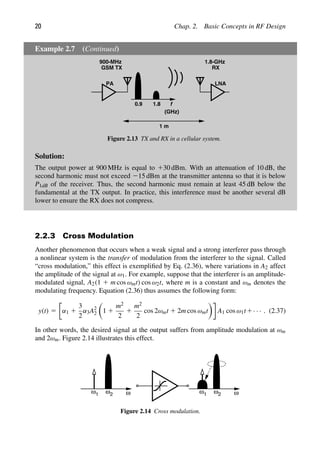
Example 2.7
A 900-MHz GSM transmitter delivers a power of 1 W to the antenna. By how much must
the second harmonic of the signal be suppressed (filtered) so that it does not desensitize a
1.8-GHz receiver having P1dB 5 225 dBm? Assume the receiver is 1 m away (Fig. 2.13)
and the 1.8-GHz signal is attenuated by 10 dB as it propagates across this distance.
(Continues)
20 Chap. 2. Basic Concepts in RF Design
Example 2.7 (Continued)
PA LNA
900-MHz
GSM TX RX
0.9 1.8 f
1 m
1.8-GHz
(GHz)
Figure 2.13 TX and RX in a cellular system.
Solution:
The output power at 900 MHz is equal to 130 dBm. With an attenuation of 10 dB, the
second harmonic must not exceed 215 dBm at the transmitter antenna so that it is below
P1dB of the receiver. Thus, the second harmonic must remain at least 45 dB below the
fundamental at the TX output. In practice, this interference must be another several dB
lower to ensure the RX does not compress.
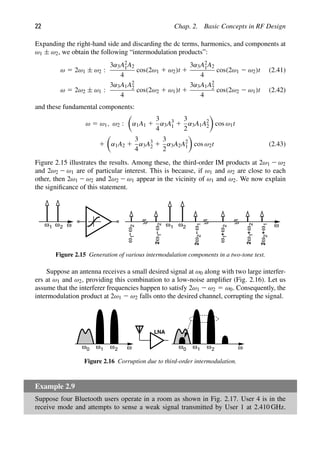
2.2.3 Cross Modulation
Another phenomenon that occurs when a weak signal and a strong interferer pass through
a nonlinear system is the transfer of modulation from the interferer to the signal. Called
“cross modulation,” this effect is exemplified by Eq. (2.36), where variations in A2 affect
the amplitude of the signal at ω1. For example, suppose that the interferer is an amplitude-
modulated signal, A2(1 1 m cos ωmt) cos ω2t, where m is a constant and ωm denotes the
modulating frequency. Equation (2.36) thus assumes the following form:
y(t) 5 α1 1
3
2
α3A2
2

1 1
m2
2
1
m2
2
cos 2ωmt 1 2m cos ωmt

A1 cos ω1t1· · · . (2.37)
In other words, the desired signal at the output suffers from amplitude modulation at ωm
and 2ωm. Figure 2.14 illustrates this effect.
ω
ω1 ω2 ω
ω1 ω2
Figure 2.14 Cross modulation.
Sec. 2.2. Effects of Nonlinearity 21
Example 2.8
Suppose an interferer contains phase modulation but not amplitude modulation. Does cross
modulation occur in this case?
Solution:
Expressing the input as x(t) 5 A1 cos ω1t 1 A2 cos(ω2t 1 φ), where the second term rep-
resents the interferer (A2 is constant but φ varies with time), we use the third-order
polynomial in Eq. (2.25) to write
y(t) 5 α1[A1 cos ω1t 1 A2 cos(ω2t 1 φ)] 1 α2[A1 cos ω1t 1 A2 cos(ω2t 1 φ)]2
1 α3[A1 cos ω1t 1 A2 cos(ω2t 1 φ)]3
. (2.38)
We now note that (1) the second-order term yields components at ω1 ± ω2 but not at ω1;
(2) the third-order term expansion gives 3α3A1 cos ω1tA2
2 cos2(ω2t 1 φ), which, according
to cos2 x 5 (1 1 cos 2x)/2, results in a component at ω1. Thus,
y(t) 5

α1 1
3
2
α3A2
2

A1 cos ω1t 1 · · · . (2.39)
Interestingly, the desired signal at ω1 does not experience cross modulation. That is,
phase-modulated interferers do not cause cross modulation in memoryless (static) nonlinear
systems. Dynamic nonlinear systems, on the other hand, may not follow this rule.
Cross modulation commonly arises in amplifiers that must simultaneously process
many independent signal channels. Examples include cable television transmitters and
systems employing “orthogonal frequency division multiplexing” (OFDM). We examine
OFDM in Chapter 3.
2.2.4 Intermodulation
Our study of nonlinearity has thus far considered the case of a single signal (for harmonic
distortion) or a signal accompanied by one large interferer (for desensitization). Another
scenario of interest in RF design occurs if two interferers accompany the desired signal.
Such a scenario represents realistic situations and reveals nonlinear effects that may not
manifest themselves in a harmonic distortion or desensitization test.
If two interferers at ω1 and ω2 are applied to a nonlinear system, the output generally
exhibits components that are not harmonics of these frequencies. Called “intermodulation”
(IM), this phenomenon arises from “mixing” (multiplication) of the two components as
their sum is raised to a power greater than unity. To understand how Eq. (2.25) leads to
intermodulation, assume x(t) 5 A1 cos ω1t 1 A2 cos ω2t. Thus,
y(t) 5 α1(A1 cos ω1t 1 A2 cos ω2t) 1 α2(A1 cos ω1t 1 A2 cos ω2t)2
1 α3(A1 cos ω1t 1 A2 cos ω2t)3
. (2.40)
22 Chap. 2. Basic Concepts in RF Design
Expanding the right-hand side and discarding the dc terms, harmonics, and components at
ω1 ± ω2, we obtain the following “intermodulation products”:
ω 5 2ω1 ± ω2 :
3α3A2
1A2
4
cos(2ω1 1 ω2)t 1
3α3A2
1A2
4
cos(2ω1 2 ω2)t (2.41)
ω 5 2ω2 ± ω1 :
3α3A1A2
2
4
cos(2ω2 1 ω1)t 1
3α3A1A2
2
4
cos(2ω2 2 ω1)t (2.42)
and these fundamental components:
ω 5 ω1, ω2 :

α1A1 1
3
4
α3A3
1 1
3
2
α3A1A2
2

cos ω1t
1

α1A2 1
3
4
α3A3
2 1
3
2
α3A2A2
1

cos ω2t (2.43)
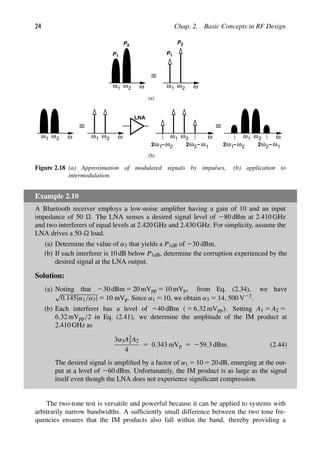
Figure 2.15 illustrates the results. Among these, the third-order IM products at 2ω1 2 ω2
and 2ω2 2 ω1 are of particular interest. This is because, if ω1 and ω2 are close to each
other, then 2ω1 2 ω2 and 2ω2 2 ω1 appear in the vicinity of ω1 and ω2. We now explain
the significance of this statement.
ω
2
1
ω ω
1
ω
−
ω
2
1
ω
−
ω
2
2
1
ω ω2
−
ω
2
ω
2
1
2
ω
ω
1
+
1
ω
ω
2
2
+
ω
ω
2
+
2
1
ω
Figure 2.15 Generation of various intermodulation components in a two-tone test.
Suppose an antenna receives a small desired signal at ω0 along with two large interfer-
ers at ω1 and ω2, providing this combination to a low-noise amplifier (Fig. 2.16). Let us
assume that the interferer frequencies happen to satisfy 2ω1 2 ω2 5 ω0. Consequently, the
intermodulation product at 2ω1 2 ω2 falls onto the desired channel, corrupting the signal.
1
ω ω2 ω
ω0
LNA
1
ω ω2 ω
ω0
Figure 2.16 Corruption due to third-order intermodulation.
Example 2.9
Suppose four Bluetooth users operate in a room as shown in Fig. 2.17. User 4 is in the
receive mode and attempts to sense a weak signal transmitted by User 1 at 2.410 GHz.
Sec. 2.2. Effects of Nonlinearity 23
Example 2.9 (Continued)
At the same time, Users 2 and 3 transmit at 2.420 GHz and 2.430 GHz, respectively. Explain
what happens.
TX1
TX
TX2
3
RX 4
f (GHz)
2.42
2.41 2.43
User 2
User 3
User 1
User 4
Figure 2.17 Bluetooth RX in the presence of several transmitters.
Solution:
Since the frequencies transmitted by Users 1, 2, and 3 happen to be equally spaced, the
intermodulation in the LNA of RX4 corrupts the desired signal at 2.410 GHz.
The reader may raise several questions at this point: (1) In our analysis of intermod-
ulation, we represented the interferers with pure (unmodulated) sinusoids (called “tones”)
whereas in Figs. 2.16 and 2.17, the interferers are modulated. Are these consistent? (2) Can
gain compression and desensitization (P1dB) also model intermodulation, or do we need
other measures of nonlinearity? (3) Why can we not simply remove the interferers by fil-
ters so that the receiver does not experience intermodulation? We answer the first two here
and address the third in Chapter 4.
For narrowband signals, it is sometimes helpful to “condense” their energy into an
impulse, i.e., represent them with a tone of equal power [Fig. 2.18(a)]. This approxima-
tion must be made judiciously: if applied to study gain compression, it yields reasonably
accurate results; on the other hand, if applied to the case of cross modulation, it fails. In
intermodulation analyses, we proceed as follows: (a) approximate the interferers with tones,
(b) calculate the level of intermodulation products at the output, and (c) mentally convert
the intermodulation tones back to modulated components so as to see the corruption.5
This
thought process is illustrated in Fig. 2.18(b).
We now deal with the second question: if the gain is not compressed, then can we say
that intermodulation is negligible? The answer is no; the following example illustrates this
point.
5. Since a tone contains no randomness, it generally does not corrupt a signal. But a tone appearing in the
spectrum of a signal may make the detection difficult.
24 Chap. 2. Basic Concepts in RF Design
1
ω ω2 ω
LNA
1
ω ω2 ω
1
P
P2
1
P
P2
1
ω ω2 ω 1
ω ω2 ω 1
ω ω2 ω
1
ω −ω2
2 −ω
2ω2 1
ω
1
ω ω2
1
ω −ω2
2 −ω
2ω2 1
(a)
(b)
Figure 2.18 (a) Approximation of modulated signals by impulses, (b) application to
intermodulation.
Example 2.10
A Bluetooth receiver employs a low-noise amplifier having a gain of 10 and an input
impedance of 50 . The LNA senses a desired signal level of 280 dBm at 2.410 GHz
and two interferers of equal levels at 2.420 GHz and 2.430 GHz. For simplicity, assume the
LNA drives a 50- load.
(a) Determine the value of α3 that yields a P1dB of 230 dBm.
(b) If each interferer is 10 dB below P1dB, determine the corruption experienced by the
desired signal at the LNA output.
Solution:
(a) Noting that 230 dBm 5 20 mVpp 5 10 mVp, from Eq. (2.34), we have
√
0.145|α1/α3| 5 10 mVp. Since α1 5 10, we obtain α3 5 14, 500 V22.
(b) Each interferer has a level of 240 dBm ( 5 6.32 mVpp). Setting A1 5 A2 5
6.32 mVpp/2 in Eq. (2.41), we determine the amplitude of the IM product at
2.410 GHz as
3α3A2
1A2
4
5 0.343 mVp 5 259.3 dBm. (2.44)
The desired signal is amplified by a factor of α1 5 10 5 20 dB, emerging at the out-
put at a level of 260 dBm. Unfortunately, the IM product is as large as the signal
itself even though the LNA does not experience significant compression.
The two-tone test is versatile and powerful because it can be applied to systems with
arbitrarily narrow bandwidths. A sufficiently small difference between the two tone fre-
quencies ensures that the IM products also fall within the band, thereby providing a
Sec. 2.2. Effects of Nonlinearity 25
1
ω ω2 ω
−ω
2ω2 1
−ω
2ω1 2
System
Frequency Response
(a)
1
ω ω
2 1
ω
(b)
Figure 2.19 (a) Two-tone and (b) harmonic tests in a narrowband system.
meaningful view of the nonlinear behavior of the system. Depicted in Fig. 2.19(a), this
attribute stands in contrast to harmonic distortion tests, where higher harmonics lie so far
away in frequency that they are heavily filtered, making the system appear quite linear
[Fig. 2.19(b)].
Third Intercept Point Our thoughts thus far indicate the need for a measure of inter-
modulation. A common method of IM characterization is the “two-tone” test, whereby two
pure sinusoids of equal amplitudes are applied to the input. The amplitude of the output IM
products is then normalized to that of the fundamentals at the output. Denoting the peak
amplitude of each tone by A, we can write the result as
Relative IM 5 20 log

3
4
α3
α1
A2

dBc, (2.45)
where the unit dBc denotes decibels with respect to the “carrier” to emphasize the normal-
ization. Note that, if the amplitude of each input tone increases by 6 dB (a factor of two), the
amplitude of the IM products (∝ A3) rises by 18 dB and hence the relative IM by 12 dB.6
The principal difficulty in specifying the relative IM for a circuit is that it is meaningful
only if the value of A is given. From a practical point of view, we prefer a single measure
that captures the intermodulation behavior of the circuit with no need to know the input
level at which the two-tone test is carried out. Fortunately, such a measure exists and is
called the “third intercept point” (IP3).
The concept of IP3 originates from our earlier observation that, if the amplitude of
each tone rises, that of the output IM products increases more sharply (∝ A3). Thus, if
we continue to raise A, the amplitude of the IM products eventually becomes equal to that
6. It is assumed that no compression occurs so that the output fundamental tones also rise by 6 dB.
26 Chap. 2. Basic Concepts in RF Design
A
A
α1
log( )
3
4
3
A
α3
log( )
20
20
AIIP3
AOIP3
in
(log scale)
Output
Amplitude
Figure 2.20 Definition of IP3 (for voltage quantities).
of the fundamental tones at the output. As illustrated in Fig. 2.20 on a log-log scale, the
input level at which this occurs is called the “input third intercept point” (IIP3). Similarly,
the corresponding output is represented by OIP3. In subsequent derivations, we denote the
input amplitude as AIIP3.
To determine the IIP3, we simply equate the fundamental and IM amplitudes:
|α1AIIP3| 5
3
4
α3A3
IIP3 , (2.46)
obtaining
AIIP3 5

4
3
α1
α3
. (2.47)
Interestingly,
AIIP3
A1dB
5

4
0.435
(2.48)
≈ 9.6 dB. (2.49)
This ratio proves helpful as a sanity check in simulations and measurements.7
We some-
times write IP3 rather than IIP3 if it is clear from the context that the input is of
interest.
Upon further consideration, the reader may question the consistency of the above
derivations. If the IP3 is 9.6 dB higher than P1dB, is the gain not heavily compressed at
Ain 5 AIIP3?! If the gain is compressed, why do we still express the amplitude of the fun-
damentals at the output as α1A? It appears that we must instead write this amplitude as
[α1 1 (9/4)α3A2]A to account for the compression.
In reality, the situation is even more complicated. The value of IP3 given by Eq. (2.47)
may exceed the supply voltage, indicating that higher-order nonlinearities manifest them-
selves as Ain approaches AIIP3 [Fig. 2.21(a)]. In other words, the IP3 is not a directly
measureable quantity.
In order to avoid these quandaries, we measure the IP3 as follows. We begin with a very
low input level so that α1 1 (9/4)α3A2
in ≈ α1 (and, of course, higher order nonlinearities
7. Note that this relationship holds for a third-order system and not necessarily if higher-order terms manifest
themselves.
Sec. 2.2. Effects of Nonlinearity 27
AIIP3
AOIP3
Fundamental
IM3
Fundamental
IM3
Ain
(log scale)
Ain
(log scale)
(a) (b)
Aout
Figure 2.21 (a) Actual behavior of nonlinear circuits, (b) definition of IP3 based on extrapolation.
are also negligible). We increase Ain, plot the amplitudes of the fundamentals and the IM
products on a log-log scale, and extrapolate these plots according to their slopes (one and
three, respectively) to obtain the IP3 [Fig. 2.21(b)]. To ensure that the signal levels remain
well below compression and higher-order terms are negligible, we must observe a 3-dB rise
in the IM products for every 1-dB increase in Ain. On the other hand, if Ain is excessively
small, then the output IM components become comparable with the noise floor of the circuit
(or the noise floor of the simulated spectrum), thus leading to inaccurate results.
Example 2.11
A low-noise amplifier senses a 280-dBm signal at 2.410 GHz and two 220-dBm inter-
ferers at 2.420 GHz and 2.430 GHz. What IIP3 is required if the IM products must remain
20 dB below the signal? For simplicity, assume 50- interfaces at the input and output.
Solution:
Denoting the peak amplitudes of the signal and the interferers by Asig and Aint, respectively,
we can write at the LNA output:
20 log |α1Asig| 2 20 dB 5 20 log
3
4
α3A3
int . (2.50)
It follows that
|α1Asig| 5
30
4
α3A3
int . (2.51)
In a 50- system, the 280-dBm and 220-dBm levels respectively yield Asig 5 31.6 μVp
and Aint 5 31.6 mVp. Thus,
IIP3 5

4
3
α1
α3
(2.52)
5 3.65 Vp (2.53)
5 115.2 dBm. (2.54)
Such an IP3 is extremely difficult to achieve, especially for a complete receiver chain.
28 Chap. 2. Basic Concepts in RF Design
ω
ΔP
IIP3
ΔP
in
dB
2
+ P
=
L
L
(a) (b)
dBm
dBm
ΔP
1
2 ΔP
2
ω1 2
ω
2 ω2 1
ω
2
2
ω
1
ω
A in
(log scale)
A IIP3
A f
A IM
A in1
IM3
A OIP3
A IIP3
log
20 − A
20 in1
( log )
3
Fundamental
Figure 2.22 (a) Relationships among various power levels in a two-tone test, (b) illustration of
shortcut technique.
Since extrapolation proves quite tedious in simulations or measurements, we often
employ a shortcut that provides a reasonable initial estimate. As illustrated in Fig. 2.22(a),
suppose hypothetically that the input is equal to AIIP3, and hence the (extrapolated) output
IM products are as large as the (extrapolated) fundamental tones. Now, the input is reduced
to a level Ain1. That is, the change in the input is equal to 20 log AIIP3 2 20 log Ain1. On a
log-log scale, the IM products fall with a slope of 3 and the fundamentals with a slope of
unity. Thus, the difference between the two plots increases with a slope of 2. We denote
20 log Af 2 20 log AIM by P and write
P 5 20 log Af 2 20 log AIM 5 2(20 log AIIP3 2 20 log Ain1), (2.55)
obtaining
20 log AIIP3 5
P
2
1 20 log Ain1. (2.56)
In other words, for a given input level (well below P1dB), the IIP3 can be calculated by
halving the difference between the output fundamental and IM levels and adding the result
to the input level, where all values are expressed as logarithmic quantities. Figure 2.22(b)
depicts an abbreviated notation for this rule. The key point here is that the IP3 is measured
without extrapolation.
Why do we consider the above result an estimate? After all, the derivation assumes
third-order nonlinearity. A difficulty arises if the circuit contains dynamic nonlinearities,
in which case this result may deviate from that obtained by extrapolation. The latter is the
standard and accepted method for measuring and reporting the IP3, but the shortcut method
proves useful in understanding the behavior of the device under test.
Sec. 2.2. Effects of Nonlinearity 29
We should remark that second-order nonlinearity also leads to a certain type of inter-
modulation and is characterized by a “second intercept point,” (IP2).8
We elaborate on this
effect in Chapter 4.
2.2.5 Cascaded Nonlinear Stages
Since in RF systems, signals are processed by cascaded stages, it is important to know how
the nonlinearity of each stage is referred to the input of the cascade. The calculation of P1dB
for a cascade is outlined in Problem 2.1. Here, we determine the IP3 of a cascade. For the
sake of brevity, we hereafter denote the input IP3 by AIP3 unless otherwise noted.
Consider two nonlinear stages in cascade (Fig. 2.23). If the input/output characteristics
of the two stages are expressed, respectively, as
y1(t) 5 α1x(t) 1 α2x2
(t) 1 α3x3
(t) (2.57)
y2(t) 5 β1y1(t) 1 β2y2
1(t) 1 β3y3
1(t), (2.58)
then
y2(t) 5 β1[α1x(t) 1 α2x2
(t) 1 α3x3
(t)] 1 β2[α1x(t) 1 α2x2
(t) 1 α3x3
(t)]2
1 β3[α1x(t) 1 α2x2
(t) 1 α3x3
(t)]3
. (2.59)
Considering only the first- and third-order terms, we have
y2(t) 5 α1β1x(t) 1 (α3β1 1 2α1α2β2 1 α3
1β3)x3
(t) 1 · · · . (2.60)
Thus, from Eq. (2.47),
AIP3 5


4
3
α1β1
α3β1 1 2α1α2β2 1 α3
1β3
. (2.61)
IIP IIP
3, 3
1 ,2
( )
t
x ( )
t
y
1
( )
t
y
2
Figure 2.23 Cascaded nonlinear stages.
Example 2.12
Two differential pairs are cascaded. Is it possible to select the denominator of Eq. (2.61)
such that IP3 goes to infinity?
(Continues)
8. As seen in the next section, second-order nonlinearity also affects the IP3 in cascaded systems.
30 Chap. 2. Basic Concepts in RF Design
Example 2.12 (Continued)
Solution:
With no asymmetries in the cascade, α2 5 β2 5 0. Thus, we seek the condition α3β1 1
α3
1β3 5 0, or equivalently,
α3
α1
5 2
β3
β1
· α2
1. (2.62)
Since both stages are compressive, α3/α1  0 and β3/β1  0. It is therefore impossible to
achieve an arbitrarily high IP3.
Equation (2.61) leads to more intuitive results if its two sides are squared and inverted:
1
A2
IP3
5
3
4
α3β1 1 2α1α2β2 1 α3
1β3
α1β1
(2.63)
5
3
4
α3
α1
1
2α2β2
β1
1
α2
1β3
β1
(2.64)
5
1
A2
IP3,1
1
3α2β2
2β1
1
α2
1
A2
IP3,2
, (2.65)
where AIP3,1 and AIP3,2 represent the input IP3’s of the first and second stages, respectively.
Note that AIP3, AIP3,1, and AIP3,2 are voltage quantities.
The key observation in Eq. (2.65) is that to “refer” the IP3 of the second stage to the
input of the cascade, we must divide it by α1. Thus, the higher the gain of the first stage,
the more nonlinearity is contributed by the second stage.
IM Spectra in a Cascade To gain more insight into the above results, let us assume
x(t) 5 A cos ω1t 1 A cos ω2t and identify the IM products in a cascade. With the aid of
Fig. 2.24, we make the following observations:9
1. The input tones are amplified by a factor of approximately α1 in the first stage and
β1 in the second. Thus, the output fundamentals are given by α1β1A(cos ω1t 1
cos ω2t).
2. The IM products generated by the first stage, namely, (3α3/4)A3[cos(2ω1 2 ω2)t 1
cos(2ω2 2 ω1)t], are amplified by a factor of β1 when they appear at the output of
the second stage.
3. Sensing α1A(cos ω1t 1 cos ω2t) at its input, the second stage produces its own IM
components: (3β3/4)(α1A)3 cos(2ω1 2 ω2)t 1 (3β3/4)(α1A)3 cos(2ω2 2 ω1)t.
9. The spectrum of A cos ωt consists of two impulses, each with a weight of A/2. We drop the factor of 1/2 in
the figures for simplicity.
Sec. 2.2. Effects of Nonlinearity 31
A
( )
ω
ω1 2
ω
2
ω
1
2 ω2 1
ω
2
IIP IIP
3, 3
1 ,2
ω ω
A
α1
2
1
ω ω
A
α1 1
β
ω
2
1
ω
3
4
3
A
α3
ω1 2
ω
ω
2 ω2 1
ω
2
3
4
3
A
α3 1
β
ω1 2
ω
ω
2 ω2 1
ω
2
3
4
3
A
α
β3 1
A
α1
2
1
ω ω ω
ω ω
A
α2
2
2 1 ω1 2
ω
ω
2 ω2 1
ω
2
3
A
α
α1 2 2
β
A
α1
2
1
ω ω ω
A
α2
2
1
2 2
2
ω ω
1
2
ω1 2
ω
ω
2 ω2 1
ω
2
3
A
α
α1 2 2
β
ω ω
1
2
( )
t
x ( )
t
y
1
( )
t
y
2
Figure 2.24 Spectra in a cascade of nonlinear stages.
4. The second-order nonlinearity in y1(t) generates components at ω1 2 ω2, 2ω1, and
2ω2. Upon experiencing a similar nonlinearity in the second stage, these compo-
nents are mixed with those at ω1 and ω2 and translated to 2ω1 2 ω2 and 2ω2 2 ω1.
Specifically, as shown in Fig. 2.24, y2(t) contains terms such as 2β2[α1A cos ω1t 3
α2A2 cos(ω1 2 ω2)t] and 2β2(α1A cos ω1t 3 0.5α2A2 cos 2ω2t). The resulting IM
products can be expressed as (3α1α2β2A3/2)[cos(2ω1 2 ω2)t 1 cos(2ω2 2 ω1)t].
Interestingly, the cascade of two second-order nonlinearities can produce third-
order IM products.
Adding the amplitudes of the IM products, we have
y2(t) 5 α1β1A(cos ω1t 1 cos ω2t)
1

3α3β1
4
1
3α3
1β3
4
1
3α1α2β2
2

A3
[cos(ω1 2 2ω2)t
1 cos(2ω2 2 ω1)t] 1 · · · , (2.66)
obtaining the same IP3 as above. This result assumes zero phase shift for all components.
Why did we add the amplitudes of the IM3 products in Eq. (2.66) without regard for
their phases? Is it possible that phase shifts in the first and second stages allow partial
32 Chap. 2. Basic Concepts in RF Design
cancellation of these terms and hence a higher IP3? Yes, it is possible but uncommon in
practice. Since the frequencies ω1, ω2, 2ω1 2 ω2, and 2ω2 2 ω1 are close to one another,
these components experience approximately equal phase shifts.
But how about the terms described in the fourth observation? Components such as
ω1 2 ω2 and 2ω1 may fall well out of the signal band and experience phase shifts different
from those in the first three observations. For this reason, we may consider Eqs. (2.65) and
(2.66) as the worst-case scenario. Since most RF systems incorporate narrowband circuits,
the terms at ω1 ± ω2, 2ω1, and 2ω2 are heavily attenuated at the output of the first stage.
Consequently, the second term on the right-hand side of (2.65) becomes negligible, and
1
A2
IP3
≈
1
A2
IP3,1
1
α2
1
A2
IP3,2
. (2.67)
Extending this result to three or more stages, we have
1
A2
IP3
≈
1
A2
IP3,1
1
α2
1
A2
IP3,2
1
α2
1β2
1
A2
IP3,3
1 · · · . (2.68)
Thus, if each stage in a cascade has a gain greater than unity, the nonlinearity of the latter
stages becomes increasingly more critical because the IP3 of each stage is equivalently
scaled down by the total gain preceding that stage.
Example 2.13
A low-noise amplifier having an input IP3 of 210 dBm and a gain of 20 dB is followed
by a mixer with an input IP3 of 14 dBm. Which stage limits the IP3 of the cascade more?
Assume the conceptual picture shown in Fig. 2.1(b) to go between volts and dBm’s.
Solution:
With α1 5 20 dB, we note that
AIP3,1 5 210 dBm (2.69)
AIP3,2
α1
5 216 dBm. (2.70)
Since the scaled IP3 of the second stage is lower than the IP3 of the first stage, we say the
second stage limits the overall IP3 more.
In the simulation of a cascade, it is possible to determine which stage limits the linearity
more. As depicted in Fig. 2.25, we examine the relative IM magnitudes at the output of each
stage ( 1 and 2, expressed in dB.) If 2 ≈ 1, the second stage contributes negligible
nonlinearity. On the other hand, if 2 is substantially less than 1, then the second stage
limits the IP3.
Sec. 2.2. Effects of Nonlinearity 33
IIP IIP
3,1 3,2
1
ω ω2 ω
−ω
2ω2 1
−ω
2ω1 2
1
ω ω2 ω
Δ1
1
ω ω2 ω
−ω
2ω2 1
−ω
2ω1 2
Δ2
Figure 2.25 Growth of IM components along the cascade.
2.2.6 AM/PM Conversion
In some RF circuits, e.g., power amplifiers, amplitude modulation (AM) may be converted
to phase modulation (PM), thus producing undesirable effects. In this section, we study this
phenomenon.
AM/PM conversion (APC) can be viewed as the dependence of the phase shift upon
the signal amplitude. That is, for an input Vin(t) 5 V1 cos ω1t, the fundamental output
component is given by
Vout(t) 5 V2 cos[ω1t 1 φ(V1)], (2.71)
where φ(V1) denotes the amplitude-dependent phase shift. This, of course, does not occur
in a linear time-invariant system. For example, the phase shift experienced by a sinusoid
of frequency ω1 through a first-order low-pass RC section is given by 2 tan21(RCω1)
regardless of the amplitude. Moreover, APC does not appear in a memoryless nonlinear
system because the phase shift is zero in this case.
We may therefore surmise that AM/PM conversion arises if a system is both dynamic
and nonlinear. For example, if the capacitor in a first-order low-pass RC section is nonlin-
ear, then its “average” value may depend on V1, resulting in a phase shift, 2 tan21(RCω1),
that itself varies with V1. To explore this point, let us consider the arrangement shown in
Fig. 2.26 and assume
C1 5 (1 1 αVout)C0. (2.72)
Vin C
R1
Vout
1
Figure 2.26 RC section with nonlinear capacitor.
This capacitor is considered nonlinear because its value depends on its voltage. An
exact calculation of the phase shift is difficult here as it requires that we write
Vin 5 R1C1dVout/dt 1 Vout and hence solve
V1 cos ω1t 5 R1(1 1 αVout)C0
dVout
dt
1 Vout. (2.73)
We therefore make an approximation. Since the value of C1 varies periodically with
time, we can express the output as that of a first-order network but with a time-varying
34 Chap. 2. Basic Concepts in RF Design
capacitance, C1(t):
Vout(t) ≈
V1

1 1 R2
1C2
1(t)ω2
1
cos{ω1t 2 tan21
[R1C1(t)ω1]}. (2.74)
If R1C1(t)ω1  1 rad,
Vout(t) ≈ V1 cos[ω1t 2 R1(1 1 αVout)C0ω1]. (2.75)
We also assume that (1 1 αVout)C0 ≈ (1 1 αV1 cos ω1t)C0, obtaining
Vout(t) ≈ V1 cos(ω1t 2 R1C0ω1 2 αR1C0ω1V1 cos ω1t). (2.76)
Does the output fundamental contain an input-dependent phase shift here? No, it does
not! The reader can show that the third term inside the parentheses produces only higher
harmonics. Thus, the phase shift of the fundamental is equal to 2R1C0ω1 and hence
constant.
The above example entails no AM/PM conversion because of the first-order depen-
dence of C1 upon Vout. As illustrated in Fig. 2.27, the average value of C1 is equal to
C0 regardless of the output amplitude. In general, since C1 varies periodically, it can be
expressed as a Fourier series with a “dc” term representing its average value:
C1(t) 5 Cavg 1
∞

n51
an cos(nω1t) 1
∞

n51
bn sin(nω1t). (2.77)
Thus, if Cavg is a function of the amplitude, then the phase shift of the fundamental com-
ponent in the output voltage becomes input-dependent. The following example illustrates
this point.
t
C1
C0
t
Vout
C1
Figure 2.27 Time variation of capacitor with first-order voltage dependence for small and large
swings.
Sec. 2.3. Noise 35
Example 2.14
Suppose C1 in Fig. 2.26 is expressed as C1 5 C0(1 1 α1Vout 1 α2V2
out). Study the AM/PM
conversion in this case if Vin(t) 5 V1 cos ω1t.
Solution:
Figure 2.28 plots C1(t) for small and large input swings, revealing that Cavg indeed depends
on the amplitude. We rewrite Eq. (2.75) as
t
C1
C0
t
Vout
C1
Cavg1
Cavg2
Figure 2.28 Time variation of capacitor with second-order voltage dependence for small and large
swings.
Vout(t) ≈ V1 cos[ω1t 2 R1C0ω1(1 1 α1V1 cos ω1t 1 α2V2
1 cos2
ω1t)] (2.78)
≈ V1 cos(ω1t 2 R1C0ω1 2
α2R1C0ω1V2
1
2
2 · · · ). (2.79)
The phase shift of the fundamental now contains an input-dependent term,
2(α2R1C0ω1V2
1 )/2. Figure 2.28 also suggests that AM/PM conversion does not occur if
the capacitor voltage dependence is odd-symmetric.
What is the effect of APC? In the presence of APC, amplitude modulation (or amplitude
noise) corrupts the phase of the signal. For example, if Vin(t) 5 V1(11m cos ωmt) cos ω1t,
then Eq. (2.79) yields a phase corruption equal to 2α2R1C0ω1(2mV1 cos ωmt 1
m2V2
1 cos2 ωmt)/2. We will encounter examples of APC in Chapters 8 and 12.
2.3 NOISE
The performance of RF systems is limited by noise. Without noise, an RF receiver would
be able to detect arbitrarily small inputs, allowing communication across arbitrarily long
36 Chap. 2. Basic Concepts in RF Design
distances. In this section, we review basic properties of noise and methods of calculat-
ing noise in circuits. For a more complete study of noise in analog circuits, the reader is
referred to [1].
2.3.1 Noise as a Random Process
The trouble with noise is that it is random. Engineers who are used to dealing with well-
defined, deterministic, “hard” facts often find the concept of randomness difficult to grasp,
especially if it must be incorporated mathematically. To overcome this fear of randomness,
we approach the problem from an intuitive angle.
By “noise is random,” we mean the instantaneous value of noise cannot be predicted.
For example, consider a resistor tied to a battery and carrying a current [Fig. 2.29(a)].
Due to the ambient temperature, each electron carrying the current experiences thermal
agitation, thus following a somewhat random path while, on the average, moving toward
the positive terminal of the battery. As a result, the average current remains equal to VB/R
but the instantaneous current displays random values.10
VB
t
VB
R
R
VB
t
VB
R
R
(a) (b)
Figure 2.29 (a) Noise generated in a resistor, (b) effect of higher temperature.
Since noise cannot be characterized in terms of instantaneous voltages or currents, we
seek other attributes of noise that are predictable. For example, we know that a higher ambi-
ent temperature leads to greater thermal agitation of electrons and hence larger fluctuations
in the current [Fig. 2.29(b)]. How do we express the concept of larger random swings for
a current or voltage quantity? This property is revealed by the average power of the noise,
defined, in analogy with periodic signals, as
Pn 5 lim
T→∞
1
T
T

0
n2
(t)dt, (2.80)
where n(t) represents the noise waveform. Illustrated in Fig. 2.30, this definition simply
means that we compute the area under n2(t) for a long time, T, and normalize the result
to T, thus obtaining the average power. For example, the two scenarios depicted in Fig. 2.29
yield different average powers.
10. As explained later, this is true even with a zero average current.
Sec. 2.3. Noise 37
t t
( )
2
)
(t
n )
(t
n
2
T
Figure 2.30 Computation of noise power.
If n(t) is random, how do we know that Pn is not?! We are fortunate that noise compo-
nents in circuits have a constant average power. For example, Pn is known and constant for
a resistor at a constant ambient temperature.
How long should T in Eq. (2.80) be? Due to its randomness, noise consists of different
frequencies. Thus, T must be long enough to accommodate several cycles of the lowest
frequency. For example, the noise in a crowded restaurant arises from human voice and
covers the range of 20 Hz to 20 kHz, requiring that T be on the order of 0.5 s to capture
about 10 cycles of the 20-Hz components.11
2.3.2 Noise Spectrum
Our foregoing study suggests that the time-domain view of noise provides limited informa-
tion, e.g., the average power. The frequency-domain view, on the other hand, yields much
greater insight and proves more useful in RF design.
The reader may already have some intuitive understanding of the concept of “spec-
trum.” We say the spectrum of human voice spans the range of 20 Hz to 20 kHz. This
means that if we somehow measure the frequency content of the voice, we observe all
components from 20 Hz to 20 kHz. How, then, do we measure a signal’s frequency content,
e.g., the strength of a component at 10 kHz? We would need to filter out the remainder
of the spectrum and measure the average power of the 10-kHz component. Figure 2.31(a)
conceptually illustrates such an experiment, where the microphone signal is applied to a
band-pass filter having a 1-Hz bandwidth centered around 10 kHz. If a person speaks into
the microphone at a steady volume, the power meter reads a constant value.
The scheme shown in Fig. 2.31(a) can be readily extended so as to measure the strength
of all frequency components. As depicted in Fig. 2.31(b), a bank of 1-Hz band-pass filters
centered at f1 · · · fn measures the average power at each frequency.12
Called the spectrum or
the “power spectral density” (PSD) of x(t) and denoted by Sx( f), the resulting plot displays
the average power that the voice (or the noise) carries in a 1-Hz bandwidth at different
frequencies.13
It is interesting to note that the total area under Sx( f) represents the average power
carried by x(t):
∞

0
Sx( f)df 5 lim
T→∞
1
T
T

0
x2
(t)dt. (2.81)
11. In practice, we make a guess for T, calculate Pn, increase T, recalculate Pn, and repeat until consecutive
values of Pn become nearly equal.
12. This is also the conceptual operation of spectrum analyzers.
13. In the theory of signals and systems, the PSD is defined as the Fourier transform of the autocorrelation of
a signal. These two views are equivalent.
38 Chap. 2. Basic Concepts in RF Design
f
1 Hz
Band−Pass
Power
Microphone
)
(t
x
Filter
10 kHz
Meter
P0
f
Average
Power
10 kHz
f
f1
1 Hz
f
f
1 Hz
2
f
f
1 Hz
f
f2
n
Band−Pass
Filters Power
Meters
f1 fn
)
(
S f
)
(t
x
x
(a)
(b)
Figure 2.31 Measurement of (a) power in 1 Hz, and (b) the spectrum.
The spectrum shown in Fig. 2.31(b) is called “one-sided” because it is constructed for
positive frequencies. In some cases, the analysis is simpler if a “two-sided” spectrum is
utilized. The latter is an even-symmetric of the former scaled down vertically by a factor
of two (Fig. 2.32), so that the two carry equal energies.
f
)
(
S f
f
0 0
f1 f 2
f f1
2 f1 f 2
X
)
(
S f
X
Figure 2.32 Two-sided and one-sided spectra.
Example 2.15
A resistor of value R1 generates a noise voltage whose one-sided PSD is given by
Sv( f) 5 4kTR1, (2.82)
Sec. 2.3. Noise 39
Example 2.15 (Continued)
where k 5 1.38 3 10223 J/K denotes the Boltzmann constant and T the absolute tempera-
ture. Such a flat PSD is called “white” because, like white light, it contains all frequencies
with equal power levels.
(a) What is the total average power carried by the noise voltage?
(b) What is the dimension of Sv( f)?
(c) Calculate the noise voltage for a 50- resistor in 1 Hz at room temperature.
Solution:
(a) The area under Sv( f) appears to be infinite, an implausible result because the resistor
noise arises from the finite ambient heat. In reality, Sv( f) begins to fall at f  1 THz,
exhibiting a finite total energy, i.e., thermal noise is not quite white.
(b) The dimension of Sv( f) is voltage squared per unit bandwidth (V2/Hz) rather than
power per unit bandwidth (W/Hz). In fact, we may write the PSD as
V2
n 5 4kTR, (2.83)
where V2
n denotes the average power of Vn in 1 Hz.14
While some texts express the
right-hand side as 4kTR f to indicate the total noise in a bandwidth of f, we omit
f with the understanding that our PSDs always represent power in 1 Hz. We shall
use Sv( f) and V2
n interchangeably.
(c) For a 50- resistor at T 5 300 K,
V2
n 5 8.28 3 10219
V2
/Hz. (2.84)
This means that if the noise voltage of the resistor is applied to a 1-Hz band-pass fil-
ter centered at any frequency ( 1 THz), then the average measured output is given
by the above value. To express the result as a root-mean-squared (rms) quantity and
in more familiar units, we may take the square root of both sides:

V2
n 5 0.91 nV/
√
Hz. (2.85)
The familiar unit is nV but the strange unit is
√
Hz. The latter bears no profound
meaning; it simply says that the average power in 1 Hz is (0.91 nV)2.
2.3.3 Effect of Transfer Function on Noise
The principal reason for defining the PSD is that it allows many of the frequency-domain
operations used with deterministic signals to be applied to random signals as well. For
14. Also called “spot noise.”
40 Chap. 2. Basic Concepts in RF Design
example, if white noise is applied to a low-pass filter, how do we determine the PSD at
the output? As shown in Fig. 2.33, we intuitively expect that the output PSD assumes the
shape of the filter’s frequency response. In fact, if x(t) is applied to a linear, time-invariant
system with a transfer function H(s), then the output spectrum is
Sy( f) 5 Sx( f)|H( f)|2
, (2.86)
where H( f) 5 H(s 5 j2πf) [2]. We note that |H( f)| is squared because Sx( f) is a (voltage
or current) squared quantity.
f
LPF
f
Figure 2.33 Effect of low-pass filter on white noise.
2.3.4 Device Noise
In order to analyze the noise performance of circuits, we wish to model the noise of their
constituent elements by familiar components such as voltage and current sources. Such a
representation allows the use of standard circuit analysis techniques.
Thermal Noise of Resistors As mentioned previously, the ambient thermal energy leads
to random agitation of charge carriers in resistors and hence noise. The noise can be
modeled by a series voltage source with a PSD of V2
n 5 4kTR1 [Thevenin equivalent,
Fig. 2.34(a)] or a parallel current source with a PSD of I2
n 5 V2
n /R1 5 4kT/R1 [Norton
equivalent, Fig. 2.34(b)]. The choice of the model sometimes simplifies the analysis.
The polarity of the sources is unimportant (but must be kept the same throughout the
calculations of a given circuit).
R1
4kTR1
R1
4kT
R1
(a) (b)
Figure 2.34 (a) Thevenin and (b) Norton models of resistor thermal noise.
Example 2.16
Sketch the PSD of the noise voltage measured across the parallel RLC tank depicted in
Fig. 2.35(a).
Sec. 2.3. Noise 41
Example 2.16 (Continued)
(a) (b)
L1 C1
R1 )
(t 4kT
R1
L1 C1
R1 )
(t
n
f
)
(
S f
V
4kTR1
f0
(c)
V
n
V
Figure 2.35 (a) RLC tank, (b) inclusion of resistor noise, (c) output noise spectrum due to R1.
Solution:
Modeling the noise of R1 by a current source, I2
n1 5 4kT/R1, [Fig. 2.35(b)] and noting that
the transfer function Vn/In1 is, in fact, equal to the impedance of the tank, ZT, we write
from Eq. (2.86)
V2
n 5 I2
n1|ZT|2
. (2.87)
At f0 5 (2π
√
L1C1)21, L1 and C1 resonate, reducing the circuit to only R1. Thus, the output
noise at f0 is simply equal to I2
n1R2
1 5 4kTR1. At lower or higher frequencies, the impedance
of the tank falls and so does the output noise [Fig. 2.35(c)].
If a resistor converts the ambient heat to a noise voltage or current, can we extract
energy from the resistor? In particular, does the arrangement shown in Fig. 2.36 deliver
energy to R2? Interestingly, if R1 and R2 reside at the same temperature, no net energy is
transferred between them because R2 also produces a noise PSD of 4kTR2 (Problem 2.8).
However, suppose R2 is held at T 5 0 K. Then, R1 continues to draw thermal energy from
its environment, converting it to noise and delivering the energy to R2. The average power
transferred to R2 is equal to
PR2 5
V2
out
R2
(2.88)
5 V2
n

R2
R1 1 R2
2
1
R2
(2.89)
5 4kT
R1R2
(R1 1 R2)2
. (2.90)
Vn
2
4kTR1
R
R
=
2
1
Vout
Figure 2.36 Transfer of noise from one resistor to another.
42 Chap. 2. Basic Concepts in RF Design
This quantity reaches a maximum if R2 5 R1:
PR2,max 5 kT. (2.91)
Called the “available noise power,” kT is independent of the resistor value and has the
dimension of power per unit bandwidth. The reader can prove that kT 5 2173.8 dBm/Hz
at T 5 300 K.
For a circuit to exhibit a thermal noise density of V2
n 5 4kTR1, it need not contain an
explicit resistor of value R1. After all, Eq. (2.86) suggests that the noise density of a resistor
may be transformed to a higher or lower value by the surrounding circuit. We also note that
if a passive circuit dissipates energy, then it must contain a physical resistance15
and must
therefore produce thermal noise. We loosely say “lossy circuits are noisy.”
A theorem that consolidates the above observations is as follows: If the real part of
the impedance seen between two terminals of a passive (reciprocal) network is equal to
Re{Zout}, then the PSD of the thermal noise seen between these terminals is given by V2
n 5
4kTRe{Zout} (Fig. 2.37) [8]. This general theorem is not limited to lumped circuits. For
example, consider a transmitting antenna that dissipates energy by radiation according to
the equation V2
TX,rms/Rrad, where Rrad is the “radiation resistance” [Fig. 2.38(a)]. As a
receiving element [Fig. 2.38(b)], the antenna generates a thermal noise PSD of16
V2
n,ant 5 4kTRrad. (2.92)
out
Z
4kT
Re{ out
Z
}
out
Z
Figure 2.37 Output noise of a passive (reciprocal) circuit.
VX
Rrad
R
4kTR
rad
rad
(a) (b)
Figure 2.38 (a) Transmitting antenna, (b) receiving antenna producing thermal noise.
15. Recall that ideal inductors and capacitors store energy but do not dissipate it.
16. Strictly speaking, this is not correct because the noise of a receiving antenna is in fact given by the “back-
ground” noise (e.g., cosmic radiation). However, in RF design, the antenna noise is commonly assumed to be
4kTRrad.
Sec. 2.3. Noise 43
M 1
4kT γ g m
M 1
4kT γ
g m
(a) (b)
Figure 2.39 Thermal channel noise of a MOSFET modeled as a (a) current source, (b) voltage
source.
Noise in MOSFETs The thermal noise of MOS transistors operating in the saturation
region is approximated by a current source tied between the source and drain terminals
[Fig. 2.39(a)]:
I2
n 5 4kTγ gm, (2.93)
where γ is the “excess noise coefficient” and gm the transconductance.17
The value of γ
is 2/3 for long-channel transistors and may rise to even 2 in short-channel devices [4].
The actual value of γ has other dependencies [5] and is usually obtained by measure-
ments for each generation of CMOS technology. In Problem 2.10, we prove that the noise
can alternatively be modeled by a voltage source V2
n 5 4kTγ/gm in series with the gate
[Fig. 2.39(b)].
Another component of thermal noise arises from the gate resistance of MOSFETs, an
effect that becomes increasingly more important as the gate length is scaled down. Illus-
trated in Fig. 2.40(a) for a device with a width of W and a length of L, this resistance
amounts to
RG 5
W
L
R, (2.94)
where R denotes the sheet resistance (resistance of one square) of the polysilicon gate.
For example, if W 5 1 μm, L 5 45 nm, and R 5 15 , then RG 5 333 . Since RG is dis-
tributed over the width of the transistor [Fig. 2.40(b)], its noise must be calculated carefully.
As proved in [6], the structure can be reduced to a lumped model having an equivalent gate
resistance of RG/3 with a thermal noise PSD of 4kTRG/3 [Fig. 2.40(c)]. In a good design,
this noise must be much less than that of the channel:
4kT
RG
3

4kTγ
gm
. (2.95)
The gate and drain terminals also exhibit physical resistances, which are minimized through
the use of multiple fingers.
At very high frequencies the thermal noise current flowing through the channel couples
to the gate capacitively, thus generating a “gate-induced noise current” [3] (Fig. 2.41). This
17. More accurately, I2
n 5 4kTγ gd0, where gd0 is the drain-source conductance in the triode region (even
though the noise is measured in saturation) [3].
44 Chap. 2. Basic Concepts in RF Design
RG1 RG2 RGn
S
D
G
RG1 RG2 RGn
+ + + = RG
R
3
4kTRG
3
G
(c)
(a)
(b)
W
L
W
L
Gate
Drain
Source
Figure 2.40 (a) Gate resistance of a MOSFET, (b) equivalent circuit for noise calculation,
(c) equivalent noise and resistance in lumped model.
I
2
G
I
2
n
Gate Channel
Figure 2.41 Gate-induced noise, I2
G.
effect is not modeled in typical circuit simulators, but its significance has remained unclear.
In this book, we neglect the gate-induced noise current.
MOS devices also suffer from “flicker” or “1/f” noise. Modeled by a voltage source in
series with the gate, this noise exhibits the following PSD:
V2
n 5
K
WLCox
1
f
, (2.96)
where K is a process-dependent constant. In most CMOS technologies, K is lower for
PMOS devices than for NMOS transistors because the former carry charge well below the
silicon-oxide interface and hence suffer less from “surface states” (dangling bonds) [1]. The
1/f dependence means that noise components that vary slowly assume a large amplitude.
The choice of the lowest frequency in the noise integration depends on the time scale of
interest and/or the spectrum of the desired signal [1].
Sec. 2.3. Noise 45
Example 2.17
Can the flicker noise be modeled by a current source?
Solution:
Yes, as shown in Fig. 2.42, a MOSFET having a small-signal voltage source of magnitude
V1 in series with its gate is equivalent to a device with a current source of value gmV1 tied
between drain and source. Thus,
I2
1 5 g2
m
K
WLCox
1
f
. (2.97)
V
2
1
I
2
1
Figure 2.42 Conversion of flicker noise voltage to current.
For a given device size and bias current, the 1/f noise PSD intercepts the thermal noise
PSD at some frequency, called the “1/f noise corner frequency,” fc. Illustrated in Fig. 2.43,
fc can be obtained by converting the flicker noise voltage to current (according to the above
example) and equating the result to the thermal noise current:
K
WLCox
1
fc
g2
m 5 4kTγ gm. (2.98)
It follows that
fc 5
K
WLCox
gm
4kTγ
. (2.99)
The corner frequency falls in the range of tens or even hundreds of megahertz in today’s
MOS technologies.
V 2
n
f
f
1
fC
Corner
(log scale)
Thermal Noise
Flicker Noise
Figure 2.43 Flicker noise corner frequency.
46 Chap. 2. Basic Concepts in RF Design
While the effect of flicker noise may seem negligible at high frequencies, we must
note that nonlinearity or time variance in circuits such as mixers and oscillators may trans-
late the 1/f-shaped spectrum to the RF range. We study these phenomena in Chapters 6
and 8.
Noise in Bipolar Transistors Bipolar transistors contain physical resistances in their
base, emitter, and collector regions, all of which generate thermal noise. Moreover, they
also suffer from “shot noise” associated with the transport of carriers across the base-emitter
junction. As shown in Fig. 2.44, this noise is modeled by two current sources having the
following PSDs:
I2
n,b 5 2qIB 5 2q
IC
β
(2.100)
I2
n,c 5 2qIC, (2.101)
where IB and IC are the base and collector bias currents, respectively. Since gm 5IC/(kT/q)
for bipolar transistors, the collector current shot noise is often expressed as
I2
n,c 5 4kT
gm
2
, (2.102)
in analogy with the thermal noise of MOSFETs or resistors.
In low-noise circuits, the base resistance thermal noise and the collector current shot
noise become dominant. For this reason, wide transistors biased at high current levels are
employed.
b
r
re
V 2
nb
V 2
ne
I
2
I
2
n,b
n,c
Figure 2.44 Noise sources in a bipolar transistor.
2.3.5 Representation of Noise in Circuits
With the noise of devices formulated above, we now wish to develop measures of the noise
performance of circuits, i.e., metrics that reveal how noisy a given circuit is.
Input-Referred Noise How can the noise of a circuit be observed in the laboratory? We
have access only to the output and hence can measure only the output noise. Unfortunately,
the output noise does not permit a fair comparison between circuits: a circuit may exhibit
high output noise because it has a high gain rather than high noise. For this reason, we
“refer” the noise to the input.
Sec. 2.3. Noise 47
Noisy
Circuit Circuit
V 2
I n
2
n
Noiseless
Model A Model B
Figure 2.45 Input-referred noise.
In analog design, the input-referred noise is modeled by a series voltage source and a
parallel current source (Fig. 2.45) [1]. The former is obtained by shorting the input port
of models A and B and equating their output noises (or, equivalently, dividing the output
noise by the voltage gain). Similarly, the latter is computed by leaving the input ports
open and equating the output noises (or, equivalently, dividing the output noise by the
transimpedance gain).
Example 2.18
Calculate the input-referred noise of the common-gate stage depicted in Fig. 2.46(a).
Assume I1 is ideal and neglect the noise of R1.
Vb
VDD
M 1
V
Vin
out
r O
I 1
R
Zin
M 1
r O
R
V
2
n1
I
2
M 1
r O
R
V
2
I
2
(c)
(a) (b)
n2
1
1
1
n
n
Figure 2.46 (a) CG stage, (b) computation of input-referred noise voltage, (c) computation of
input-referred noise current.
Solution:
Shorting the input to ground, we write from Fig. 2.46(b),
V2
n1 5 I2
n · r2
O. (2.103)
Since the voltage gain of the stage is given by 1 1 gmrO, the input-referred noise voltage is
equal to
V2
n,in 5
I2
nr2
O
(1 1 gmrO)2
(2.104)
≈
4kTγ
gm
, (2.105)
(Continues)
48 Chap. 2. Basic Concepts in RF Design
Example 2.18 (Continued)
where it is assumed gmrO 1. Leaving the input open as shown in Fig. 2.46(c), the reader
can show that (Problem 2.12)
V2
n2 5 I2
nr2
O. (2.106)
Defined as the output voltage divided by the input current, the transimpedance gain of the
stage is given by gmrOR1 (why?). It follows that
I2
n,in 5
I2
nr2
O
g2
mr2
OR2
1
(2.107)
5
4kTγ
gmR2
1
. (2.108)
From the above example, it may appear that the noise of M1 is “counted” twice. It
can be shown that [1] the two input-referred noise sources are necessary and sufficient, but
often correlated.
Example 2.19
Explain why the output noise of a circuit depends on the output impedance of the preceding
stage.
Solution:
Modeling the noise of the circuit by input-referred sources as shown in Fig. 2.47, we
observe that some of I2
n flows through Z1, generating a noise voltage at the input that
depends on |Z1|. Thus, the output noise, Vn,out, also depends on |Z1|.
Z 1
Z 1
V
2
n
I
2
n
Vn,out Vn,out
Figure 2.47 Noise in a cascade.
The computation and use of input-referred noise sources prove difficult at high fre-
quencies. For example, it is quite challenging to measure the transimpedance gain of an
RF stage. For this reason, RF designers employ the concept of “noise figure” as another
metric of noise performance that more easily lends itself to measurement.
Noise Figure In circuit and system design, we are interested in the signal-to-noise ratio
(SNR), defined as the signal power divided by the noise power. It is therefore helpful to
Sec. 2.3. Noise 49
ask, how does the SNR degrade as the signal travels through a given circuit? If the circuit
contains no noise, then the output SNR is equal to the input SNR even if the circuit acts as
an attenuator.18
To quantify how noisy the circuit is, we define its noise figure (NF) as
NF 5
SNRin
SNRout
(2.109)
such that it is equal to 1 for a noiseless stage. Since each quantity in this ratio has a
dimension of power (or voltage squared), we express NF in decibels as
NF|dB 5 10 log
SNRin
SNRout
. (2.110)
Note that most texts call (2.109) the “noise factor” and (2.110) the noise figure. We do not
make this distinction in this book.
Compared to input-referred noise, the definition of NF in (2.109) may appear rather
complicated: it depends on not only the noise of the circuit under consideration but the
SNR provided by the preceding stage. In fact, if the input signal contains no noise, then
SNRin 5 ∞ and NF 5 ∞, even though the circuit may have finite internal noise. For
such a case, NF is not a meaningful parameter and only the input-referred noise can be
specified.
Calculation of the noise figure is generally simpler than Eq. (2.109) may suggest.
For example, suppose a low-noise amplifier senses the signal received by an antenna
[Fig. 2.48(a)]. As predicted by Eq. (2.92), the antenna “radiation resistance,” RS, pro-
duces thermal noise, leading to the model shown in Fig. 2.48(b). Here, V2
n,RS represents the
thermal noise of the antenna, and V2
n the output noise of the LNA. We must compute SNRin
at the LNA input and SNRout at its output.
LNA
out
V
R
Vin
V
2
S
Circuit
Noiseless
Zin
Antenna SNRin
n,RS V
2
n
Vout
SNRout
LNA
A v
(a) (b)
Figure 2.48 (a) Antenna followed by LNA, (b) equivalent circuit.
18. Because the input signal and the input noise are attenuated by the same factor.
50 Chap. 2. Basic Concepts in RF Design
If the LNA exhibits an input impedance of Zin, then both Vin and VRS experience an
attenuation factor of α 5 Zin/(Zin 1 RS) as they appear at the input of the LNA. That is,
SNRin 5
|α|2V2
in
|α|2V2
RS
, (2.111)
where Vin denotes the rms value of the signal received by the antenna.
To determine SNRout, we assume a voltage gain of Av from the LNA input to the output
and recognize that the output signal power is equal to V2
in|α|2A2
v. The output noise consists
of two components: (a) the noise of the antenna amplified by the LNA, V2
RS|α|2A2
v, and
(b) the output noise of the LNA, V2
n . Since these two components are uncorrelated, we
simply add the PSDs and write
SNRout 5
V2
in|α|2A2
v
V2
RS|α|2A2
v 1 V2
n
. (2.112)
It follows that
NF 5
V2
in
4kTRS
·
V2
RS|α|2A2
v 1 V2
n
V2
in|α|2A2
v
(2.113)
5
1
V2
RS
·
V2
RS|α|2A2
v 1 V2
n
|α|2A2
v
(2.114)
5 1 1
V2
n
|α|2A2
v
·
1
V2
RS
. (2.115)
This result leads to another definition of the NF: the total noise at the output divided by
the noise at the output due to the source impedance. The NF is usually specified for a 1-Hz
bandwidth at a given frequency, and hence sometimes called the “spot noise figure” to
emphasize the small bandwidth.
Equation (2.115) suggests that the NF depends on the source impedance, not only
through V2
RS but also through V2
n (Example 2.19). In fact, if we model the noise by input-
referred sources, then the input noise current, I2
n,in, partially flows through RS, generating a
source-dependent noise voltage of I2
n,inR2
S at the input and hence a proportional noise at the
output. Thus, the NF must be specified with respect to a source impedance—typically 50 .
For hand analysis and simulations, it is possible to reduce the right-hand side of
Eq. (2.114) to a simpler form by noting that the numerator is the total noise measured
at the output:
NF 5
1
4kTRS
·
V2
n,out
A2
0
, (2.116)
where V2
n,out includes both the source impedance noise and the LNA noise, and A0 5 |α|Av
is the voltage gain from Vin to Vout (rather than the gain from the LNA input to its output).
We loosely say, “to calculate the NF, we simply divide the total output noise by the gain
Sec. 2.3. Noise 51
from Vin to Vout and normalize the result to the noise of RS.” Alternatively, we can say from
(2.115) that “we calculate the output noise due to the amplifier (V2
n ), divide it by the gain,
normalize it to 4kTRS, and add 1 to the result.”
It is important to note that the above derivations are valid even if no actual power is
transferred from the antenna to the LNA or from the LNA to a load. For example, if Zin
in Fig. 2.48(b) goes to infinity, no power is delivered to the LNA, but all of the deriva-
tions remain valid because they are based on voltage (squared) quantities rather than power
quantities. In other words, so long as the derivations incorporate noise and signal volt-
ages, no inconsistency arises in the presence of impedance mismatches or even infinite
input impedances. This is a critical difference in thinking between modern RF design and
traditional microwave design.
Example 2.20
Compute the noise figure of a shunt resistor RP with respect to a source impedance RS
[Fig. 2.49(a)].
Vin
RS
Vout
V 2
(a) (b)
RP RP
RS
n,out
Figure 2.49 (a) Circuit consisting of a single parallel resistor, (b) model for NF calculation.
Solution:
From Fig. 2.49(b), the total output noise voltage is obtained by setting Vin to zero:
V2
n,out 5 4kT(RS||RP). (2.117)
The gain is equal to
A0 5
RP
RP 1 RS
. (2.118)
Thus,
NF 5 4kT(RS||RP)
(RS 1 RP)2
R2
P
1
4kTRS
(2.119)
5 1 1
RS
RP
. (2.120)
The NF is therefore minimized by maximizing RP. Note that if RP 5 RS to provide
impedance matching, then the NF cannot be less than 3 dB. We will return to this critical
point in the context of LNA design in Chapter 5.
52 Chap. 2. Basic Concepts in RF Design
Example 2.21
Determine the noise figure of the common-source stage shown in Fig. 2.50(a) with respect
to a source impedance RS. Neglect the capacitances and flicker noise of M1 and assume I1
is ideal.
VDD
M
in
V
out
V
I 1
1
VDD
M
I 1
1
V
2
n,RS
RS
I
2
out
V
n,M1
(a (
) b)
Figure 2.50 (a) CS stage, (b) inclusion of noise.
Solution:
From Fig. 2.50(b), the output noise consists of two components: (a) that due to M1, I2
n,M1r2
O,
and (b) the amplified noise of RS, V2
RS(gmrO)2. It follows that
NF 5
4kTγ gmr2
O 1 4kTRS(gmrO)2
(gmrO)2
·
1
4kTRS
(2.121)
5
γ
gmRS
1 1. (2.122)
This result implies that the NF falls as RS rises. Does this mean that, even though the ampli-
fier remains unchanged, the overall system noise performance improves as RS increases?!
This interesting point is studied in Problems 2.18 and 2.19.
Noise Figure of Cascaded Stages Since many stages appear in a receiver chain, it is
desirable to determine the NF of the overall cascade in terms of that of each stage. Consider
the cascade depicted in Fig. 2.51(a), where Av1 and Av2 denote the unloaded voltage gain
of the two stages. The input and output impedances and the output noise voltages of the
two stages are also shown.19
We first obtain the NF of the cascade using a direct method; according to (2.115), we
simply calculate the total noise at the output due to the two stages, divide by (Vout/Vin)2,
normalize to 4kTRS, and add one to the result. Taking the loadings into account, we write
the overall voltage gain as
A0 5
Vout
Vin
5
Rin1
Rin1 1 RS
Av1
Rin2
Rin2 1 Rout1
Av2. (2.123)
19. We assume for simplicity that the reactive components of the input and output impedances are nulled but
the final result is valid even if they are not.
Sec. 2.3. Noise 53
(a)
R
Vin
S
A v1
Rin1 Rout1
V
2
n1
A
R R
V
Stage 1 Stage 2
Vout
in2 out2
v2
n2
2
(b)
A
R R
V
Stage 2
Vout
R
Vin
out1
v2
n2
in2 out2
Figure 2.51 (a) Noise in a cascade of stages, (b) simplified diagram.
The output noise due to the two stages, denoted by V2
n,out, consists of two components: (a)
V2
n2, and (b) V2
n1 amplified by the second stage. Since Vn1 sees an impedance of Rout1 to its
left and Rin2 to its right, it is scaled by a factor of Rin2/(Rin2 1 Rout1) as it appears at the
input of the second stage. Thus,
V2
n,out 5 V2
n2 1 V2
n1
R2
in2
(Rin2 1 Rout1)2
A2
v2. (2.124)
The overall NF is therefore expressed as
NFtot 5 1 1
V2
n,out
A2
0
·
1
4kTRS
(2.125)
5 1 1
V2
n1

Rin1
Rin1 1 RS

2
A2
v1
·
1
4kTRS
1
V2
n2

Rin1
Rin1 1 RS

2
A2
v1

Rin2
Rin2 1 Rout1

2
A2
v2
·
1
4kTRS
(2.126)
The first two terms constitute the NF of the first stage, NF1, with respect to a source
impedance of RS. The third term represents the noise of the second stage, but how can it be
expressed in terms of the noise figure of this stage?
54 Chap. 2. Basic Concepts in RF Design
Let us now consider the second stage by itself and determine its noise figure with
respect to a source impedance of Rout1 [Fig. 2.51(b)]. Using (2.115) again, we have
NF2 5 1 1
V2
n2
R2
in2
(Rin2 1 Rout1)2
A2
v2
1
4kTRout1
. (2.127)
It follows from (2.126) and (2.127) that
NFtot 5 NF1 1
NF2 2 1
R2
in1
(Rin1 1 RS)2
A2
v1
RS
Rout1
. (2.128)
What does the denominator represent? This quantity is in fact the “available power gain”
of the first stage, defined as the “available power” at its output, Pout,av (the power that it
would deliver to a matched load) divided by the available source power, PS,av (the power
that the source would deliver to a matched load). This can be readily verified by finding the
power that the first stage in Fig. 2.51(a) would deliver to a load equal to Rout1:
Pout,av 5 V2
in
R2
in1
(RS 1 Rin1)2
A2
v1 ·
1
4Rout1
. (2.129)
Similarly, the power that Vin would deliver to a load of RS is given by
PS,av 5
V2
in
4RS
. (2.130)
The ratio of (2.129) and (2.130) is indeed equal to the denominator in (2.128).
With these observations, we write
NFtot 5 NF1 1
NF2 2 1
AP1
, (2.131)
where AP1 denotes the “available power gain” of the first stage. It is important to bear in
mind that NF2 is computed with respect to the output impedance of the first stage. For m
stages,
NFtot 5 1 1 (NF1 2 1) 1
NF2 2 1
AP1
1 · · · 1
NFm 2 1
AP1 · · · AP(m21)
. (2.132)
Called “Friis’ equation” [7], this result suggests that the noise contributed by each stage
decreases as the total gain preceding that stage increases, implying that the first few stages
in a cascade are the most critical. Conversely, if a stage suffers from attenuation (loss),
then the NF of the following circuits is “amplified” when referred to the input of that
stage.
Sec. 2.3. Noise 55
Example 2.22
Determine the NF of the cascade of common-source stages shown in Fig. 2.52. Neglect the
transistor capacitances and flicker noise.
M
I 1
1
VDD
M
I
RS
Vin
2
out
V
2
Figure 2.52 Cascade of CS stages for noise figure calculation.
Solution:
Which approach is simpler to use here, the direct method or Friis’ equation? Since
Rin1 5 Rin2 5 ∞, Eq. (2.126) reduces to
NF 5 1 1
V2
n1
A2
v1
1
4kTRS
1
V2
n2
A2
v1A2
v2
1
4kTRS
, (2.133)
where V2
n1 5 4kTγ gm1r2
O1, V2
n2 5 4kTγ gm2r2
O2, Av1 5 gm1rO1, and Av2 5 gm2rO2. With all
of these quantities readily available, we simply substitute for their values in (2.133),
obtaining
NF 5 1 1
γ
gm1RS
1
γ
g2
m1r2
O1gm2RS
. (2.134)
On the other hand, Friis’ equation requires the calculation of the available power gain of
the first stage and the NF of the second stage with respect to a source impedance of rO1,
leading to lengthy algebra.
The foregoing example represents a typical situation in modern RF design: the interface
between the two stages does not have a 50- impedance and no attempt has been made
to provide impedance matching between the two stages. In such cases, Friis’ equation
becomes cumbersome, making direct calculation of the NF more attractive.
While the above example assumes an infinite input impedance for the second stage, the
direct method can be extended to more realistic cases with the aid of Eq. (2.126). Even in the
presence of complex input and output impedances, Eq. (2.126) indicates that (1) V2
n1 must
be divided by the unloaded gain from Vin to the output of the first stage; (2) the output noise
of the second stage, V2
n2, must be calculated with this stage driven by the output impedance
of the first stage;20
and (3) V2
n2 must be divided by the total voltage gain from Vin to Vout.
20. Recall from Example 2.19 that the output noise of a circuit may depend on the source impedance driving
it, but the source impedance noise is excluded from V2
n2.
56 Chap. 2. Basic Concepts in RF Design
Example 2.23
Determine the noise figure of the circuit shown in Fig. 2.53(a). Neglect transistor
capacitances, flicker noise, channel-length modulation, and body effect.
M 1
VDD
RS
Vin
R
Vb
M
R
R
Rout1
D2
D1
2
Vout
RD2
VDD
M 2
V
2
n2
RD1
4kT γ
gm2
(a) (b)
in2
Figure 2.53 (a) Cascade of CS and CG stages, (b) simplified diagram.
Solution:
For the first stage, Av1 5 2gm1RD1 and the unloaded output noise is equal to
V2
n1 5 4kTγ gm1R2
D1 1 4kTRD1. (2.135)
For the second stage, the reader can show from Fig. 2.53(b) that
V2
n2 5
4kTγ
gm2

RD2
1
gm2
1 RD1

2
1 4kTRD2. (2.136)
Note that the output impedance of the first stage is included in the calculation of V2
n2 but
the noise of RD1 is not.
We now substitute these values in Eq. (2.126), bearing in mind that Rin2 5 1/gm2 and
Av2 5 gm2RD2.
NFtot 5 1 1
4kTγ gm1R2
D 1 4kTRD1
g2
m1R2
D1
·
1
4kTRS
1
4kTγ
gm2

RD2
g21
m2 1 RD2

2
1 4kTRD2
g2
m1R2
D1

g21
m2
g21
m2 1 RD1

2
g2
m2R2
D2
·
1
4kTRS
. (2.137)
Noise Figure of Lossy Circuits Passive circuits such as filters appear at the front end of
RF transceivers and their loss proves critical (Chapter 4). The loss arises from unwanted
Sec. 2.3. Noise 57
resistive components within the circuit that convert the input power to heat, thereby pro-
ducing a smaller signal power at the output. Furthermore, recall from Fig. 2.37 that resistive
components also generate thermal noise. That is, passive lossy circuits both attenuate the
signal and introduce noise.
We wish to prove that the noise figure of a passive (reciprocal) circuit is equal to its
“power loss,” defined as L 5 Pin/Pout, where Pin is the available source power and Pout the
available power at the output. As mentioned in the derivation of Friis’ equation, the avail-
able power is the power that a given source or circuit would deliver to a conjugate-matched
load. The proof is straightforward if the input and output are matched (Problem 2.20). We
consider a more general case here.
Consider the arrangement shown in Fig. 2.54(a), where the lossy circuit is driven by
a source impedance of RS while driving a load impedance of RL.21
From Eq. (2.130), the
available source power is Pin 5 V2
in/(4RS). To determine the available output power, we
construct the Thevenin equivalent shown in Fig. 2.54(b), obtaining Pout 5 V2
Thev/(4Rout).
Thus, the loss is given by
L 5
V2
in
V2
Thev
Rout
RS
. (2.138)
To calculate the noise figure, we utilize the theorem illustrated in Fig. 2.37 and the
equivalent circuit shown in Fig. 2.54(c) to write
V2
n,out 5 4kTRout
R2
L
(RL 1 Rout)2
. (2.139)
4 RL
Rout
kTRout V
2
n,out
(c)
Vin
RS
R
Vout
R
R
L
in out
Lossy
Circuit
Vout
RL
Rout
V
(a) (b)
Thevenin
Equivalent
Thev
Figure 2.54 (a) Lossy passive network, (b) Thevenin equivalent, (c) simplified diagram.
21. For simplicity, we assume the reactive parts of the impedances are cancelled but the final result is valid
even if they are not.
58 Chap. 2. Basic Concepts in RF Design
Note that RL is assumed noiseless so that only the noise figure of the lossy circuit can be
determined. The voltage gain from Vin to Vout is found by noting that, in response to Vin, the
circuit produces an output voltage of Vout 5 VThevRL/(RL 1 Rout) [Fig. 2.54(b)]. That is,
A0 5
VThev
Vin
RL
RL 1 Rout
. (2.140)
The NF is equal to (2.139) divided by the square of (2.140) and normalized to 4kTRS:
NF 5 4kTRout
V2
in
V2
Thev
1
4kTRS
(2.141)
5 L. (2.142)
Example 2.24
The receiver shown in Fig. 2.55 incorporates a front-end band-pass filter (BPF) to suppress
some of the interferers that may desensitize the LNA. If the filter has a loss of L and the
LNA a noise figure of NFLNA, calculate the overall noise figure.
LNA
out
V
BPF
Figure 2.55 Cascade of BPF and LNA.
Solution:
Denoting the noise figure of the filter by NFfilt, we write Friis’ equation as
NFtot 5 NFfilt 1
NFLNA 2 1
L21
(2.143)
5 L 1 (NFLNA 2 1)L (2.144)
5 L · NFLNA, (2.145)
where NFLNA is calculated with respect to the output resistance of the filter. For example,
if L 5 1.5 dB and NFLNA 5 2 dB, then NFtot 5 3.5 dB.
2.4 SENSITIVITY AND DYNAMIC RANGE
The performance of RF receivers is characterized by many parameters. We study two,
namely, sensitivity and dynamic range, here and defer the others to Chapter 3.
Sec. 2.4. Sensitivity and Dynamic Range 59
2.4.1 Sensitivity
The sensitivity is defined as the minimum signal level that a receiver can detect with
“acceptable quality.” In the presence of excessive noise, the detected signal becomes
unintelligible and carries little information. We define acceptable quality as sufficient
signal-to-noise ratio, which itself depends on the type of modulation and the corruption
(e.g., bit error rate) that the system can tolerate. Typical required SNR levels are in the
range of 6 to 25 dB (Chapter 3).
In order to calculate the sensitivity, we write
NF 5
SNRin
SNRout
(2.146)
5
Psig/PRS
SNRout
, (2.147)
where Psig denotes the input signal power and PRS the source resistance noise power, both
per unit bandwidth. Do we express these quantities in V2/Hz or W/Hz? Since the input
impedance of the receiver is typically matched to that of the antenna (Chapter 4), the
antenna indeed delivers signal power and noise power to the receiver. For this reason, it
is common to express both quantities in W/Hz (or dBm/Hz). It follows that
Psig 5 PRS · NF · SNRout. (2.148)
Since the overall signal power is distributed across a certain bandwidth, B, the two sides
of (2.148) must be integrated over the bandwidth so as to obtain the total mean squared
power. Assuming a flat spectrum for the signal and the noise, we have
Psig,tot 5 PRS · NF · SNRout · B. (2.149)
Equation (2.149) expresses the sensitivity as the minimum input signal that yields a
given value for the output SNR. Changing the notation slightly and expressing the quantities
in dB or dBm, we have22
Psen|dBm 5 PRS|dBm/Hz 1 NF|dB 1 SNRmin|dB 1 10 log B, (2.150)
where Psen is the sensitivity and B is expressed in Hz. Note that (2.150) does not directly
depend on the gain of the system. If the receiver is matched to the antenna, then from
(2.91), PRS 5 kT 5 2174 dBm/Hz and
Psen 5 2174 dBm/Hz 1 NF 1 10 log B 1 SNRmin. (2.151)
Note that the sum of the first three terms is the total integrated noise of the system
(sometimes called the “noise floor”).
22. Note that in conversion to dB or dBm, we take 10 log because these are power quantities.
60 Chap. 2. Basic Concepts in RF Design
Example 2.25
A GSM receiver requires a minimum SNR of 12 dB and has a channel bandwidth of
200 kHz. A wireless LAN receiver, on the other hand, specifies a minimum SNR of 23 dB
and has a channel bandwidth of 20 MHz. Compare the sensitivities of these two systems if
both have an NF of 7 dB.
Solution:
For the GSM receiver, Psen 5 2 102 dBm, whereas for the wireless LAN system, Psen 5
271 dBm. Does this mean that the latter is inferior? No, the latter employs a much wider
bandwidth and a more efficient modulation to accommodate a data rate of 54 Mb/s. The
GSM system handles a data rate of only 270 kb/s. In other words, specifying the sensitivity
of a receiver without the data rate is not meaningful.
2.4.2 Dynamic Range
Dynamic range (DR) is loosely defined as the maximum input level that a receiver can
“tolerate” divided by the minimum input level that it can detect (the sensitivity). This defi-
nition is quantified differently in different applications. For example, in analog circuits such
as analog-to-digital converters, the DR is defined as the “full-scale” input level divided by
the input level at which SNR 5 1. The full scale is typically the input level beyond which a
hard saturation occurs and can be easily determined by examining the circuit.
In RF design, on the other hand, the situation is more complicated. Consider a sim-
ple common-source stage. How do we define the input “full scale” for such a circuit? Is
there a particular input level beyond which the circuit becomes excessively nonlinear? We
may view the 1-dB compression point as such a level. But, what if the circuit senses two
interferers and suffers from intermodulation?
In RF design, two definitions of DR have emerged. The first, simply called the dynamic
range, refers to the maximum tolerable desired signal power divided by the minimum tol-
erable desired signal power (the sensitivity). Illustrated in Fig. 2.56(a), this DR is limited
by compression at the upper end and noise at the lower end. For example, a cell phone
coming close to a base station may receive a very large signal and must process it with
f
scale
log
DR
Receiver
Integrated Noise
Performance
Limited by
Compression
Performance
Limited by
Noise
(a)
Sensitivity
f
scale
log
SFDR
(b)
Receiver
Integrated Noise
Sensitivity
Figure 2.56 Definitions of (a) DR and (b) SFDR.
Sec. 2.4. Sensitivity and Dynamic Range 61
acceptable distortion. In fact, the cell phone measures the signal strength and adjusts the
receiver gain so as to avoid compression. Excluding interferers, this “compression-based”
DR can exceed 100 dB because the upper end can be raised relatively easily.
The second type, called the “spurious-free dynamic range” (SFDR), represents limita-
tions arising from both noise and interference. The lower end is still equal to the sensitivity,
but the upper end is defined as the maximum input level in a two-tone test for which the
third-order IM products do not exceed the integrated noise of the receiver. As shown in
Fig. 2.56(b), two (modulated or unmodulated) tones having equal amplitudes are applied
and their level is raised until the IM products reach the integrated noise.23
The ratio of the
power of each tone to the sensitivity yields the SFDR. The SFDR represents the maximum
relative level of interferers that a receiver can tolerate while producing an acceptable signal
quality from a small input level.
Where should the various levels depicted in Fig. 2.56(b) be measured, at the input
of the circuit or at its output? Since the IM components appear only at the output, the
output port serves as a more natural candidate for such a measurement. In this case, the
sensitivity—usually an input-referred quantity—must be scaled by the gain of the circuit
so that it is referred to the output. Alternatively, the output IM magnitudes can be divided
by the gain so that they are referred to the input. We follow the latter approach in our SFDR
calculations.
To determine the upper end of the SFDR, we rewrite Eq. (2.56) as
PIIP3 5 Pin 1
Pout 2 PIM,out
2
, (2.152)
where, for the sake of brevity, we have denoted 20 log Ax as Px even though no actual
power may be transferred at the input or output ports. Also, PIM,out represents the level of
IM products at the output. If the circuit exhibits a gain of G (in dB), then we can refer the
IM level to the input by writing PIM,in 5 PIM,out 2G. Similarly, the input level of each tone
is given by Pin 5 Pout 2 G. Thus, (2.152) reduces to
PIIP3 5 Pin 1
Pin 2 PIM,in
2
(2.153)
5
3Pin 2 PIM,in
2
, (2.154)
and hence
Pin 5
2PIIP3 1 PIM,in
3
. (2.155)
The upper end of the SFDR is that value of Pin which makes PIM,in equal to the integrated
noise of the receiver:
Pin,max 5
2PIIP3 1 (2174 dBm 1 NF 1 10 log B)
3
. (2.156)
23. Note that the integrated noise is a single value (e.g., 100 μVrms), not a density.
62 Chap. 2. Basic Concepts in RF Design
The SFDR is the difference (in dB) between Pin,max and the sensitivity:
SFDR 5 Pin,max 2 (2174 dBm 1 NF 1 10 log B 1 SNRmin) (2.157)
5
2(PIIP3 1 174 dBm 2 NF 2 10 log B)
3
2 SNRmin. (2.158)
For example, a GSM receiver with NF 5 7 dB, PIIP3 5 2 15 dBm, and SNRmin 5 12 dB
achieves an SFDR of 54 dB, a substantially lower value than the dynamic range in the
absence of interferers.
Example 2.26
The upper end of the dynamic range is limited by intermodulation in the presence of two
interferers or desensitization in the presence of one interferer. Compare these two cases and
determine which one is more restrictive.
Solution:
We must compare the upper end expressed by Eq. (2.156) with the 1-dB compression point:
P12dB
?


Pin,max. (2.159)
Since P12dB 5 PIIP3 2 9.6 dB,
PIIP3 2 9.6 dB
?


2PIIP3 1 (2174 dBm 1 NF 1 10 log B)
3
(2.160)
and hence
PIIP3 2 28.8 dB
?


2174 dBm 1 NF 1 10 log B. (2.161)
Since the right-hand side represents the receiver noise floor, we expect it to be much lower
than the left-hand side. In fact, even for an extremely wideband channel of B 5 1 GHz and
NF 5 10 dB, the right-hand side is equal to 274 dBm, whereas, with a typical PIIP3 of 210
to 225 dBm, the left-hand side still remains higher. It is therefore plausible to conclude that
P12dB  Pin,max. (2.162)
It follows that the maximum tolerable level in a two-tone test is quite lower than that in
a compression test, i.e., corruption by intermodulation between two interferers is much
greater than compression due to one. The SFDR is therefore a more stringent characteristic
of the system than the compression-based dynamic range.
2.5 PASSIVE IMPEDANCE TRANSFORMATION
At radio frequencies, we often employ passive networks to transform impedances—from
high to low and vice versa, or from complex to real and vice versa. Called “matching
Sec. 2.5. Passive Impedance Transformation 63
networks,” such circuits do not easily lend themselves to integration because their con-
stituent devices, particularly inductors, suffer from loss if built on silicon chips. (We do
use on-chip inductors in many RF building blocks.) Nonetheless, a basic understanding of
impedance transformation is essential.
2.5.1 Quality Factor
In its simplest form, the quality factor, Q, indicates how close to ideal an energy-storing
device is. An ideal capacitor dissipates no energy, exhibiting an infinite Q, but a series
resistance, RS [Fig. 2.57(a)], reduces its Q to
QS 5
1
Cω
RS
, (2.163)
where the numerator denotes the “desired” component and the denominator, the “unde-
sired” component. If the resistive loss in the capacitor is modeled by a parallel resistance
[Fig. 2.57(b)], then we must define the Q as
QP 5
RP
1
Cω
, (2.164)
because an ideal (infinite Q) results only if RP 5 ∞. As depicted in Figs. 2.57(c) and (d),
similar concepts apply to inductors
QS 5
Lω
RS
(2.165)
QP 5
RP
Lω
. (2.166)
While a parallel resistance appears to have no physical meaning, modeling the loss by RP
proves useful in many circuits such as amplifiers and oscillators (Chapters 5 and 8). We
will also introduce other definitions of Q in Chapter 8.
2.5.2 Series-to-Parallel Conversion
Before studying transformation techniques, let us consider the series and parallel RC
sections shown in Fig. 2.58. What choice of values makes the two networks equivalent?
R C
S
RP
C
RS
L RP
L
(c)
(a) (b (
) d)
Figure 2.57 (a) Series RC circuit, (b) equivalent parallel circuit, (c) series RL circuit, (d) equivalent
parallel circuit.
64 Chap. 2. Basic Concepts in RF Design
RS
RP
(a) (b)
C
C
S
P
Figure 2.58 Series-to-parallel conversion.
Equating the impedances,
RSCSs 1 1
CSs
5
RP
RPCPs 1 1
, (2.167)
and substituting jω for s, we have
RPCSjω 5 1 2 RPCPRSCSω2
1 (RPCP 1 RSCS)jω, (2.168)
and hence
RPCPRSCSω2
5 1 (2.169)
RPCP 1 RSCS 2 RPCS 5 0. (2.170)
Equation (2.169) implies that QS 5 QP.
Of course, the two impedances cannot remain equal at all frequencies. For example, the
series section approaches an open circuit at low frequencies while the parallel section does
not. Nevertheless, an approximation allows equivalence for a narrow frequency range. We
first substitute for RPCP in (2.169) from (2.170), obtaining
RP 5
1
RSC2
Sω2
1 RS. (2.171)
Utilizing the definition of QS in (2.163), we have
RP 5 (Q2
S 1 1)RS. (2.172)
Substitution in (2.169) thus yields
CP 5
Q2
S
Q2
S 1 1
CS. (2.173)
So long as Q2
S 1 (which is true for a finite frequency range),
RP ≈ Q2
SRS (2.174)
CP ≈ CS. (2.175)
That is, the series-to-parallel conversion retains the value of the capacitor but raises the
resistance by a factor of Q2
S. These approximations for RP and CP are relatively accu-
rate because the quality factors encountered in practice typically exceed 4. Conversely,
Sec. 2.5. Passive Impedance Transformation 65
parallel-to-series conversion reduces the resistance by a factor of Q2
P. This statement applies
to RL sections as well.
2.5.3 Basic Matching Networks
A common situation in RF transmitter design is that a load resistance must be transformed
to a lower value. The circuit shown in Fig. 2.59(a) accomplishes this task. As mentioned
above, the capacitor in parallel with RL converts this resistance to a lower series component
[Fig. 2.59(b)]. The inductance is inserted to cancel the equivalent series capacitance.
L1
C1 R
Zin
L
L1
R
Zin
C1
S
(a) (b)
Figure 2.59 (a) Matching network, (b) equivalent circuit.
Writing Zin from Fig. 2.59(a) and replacing s with jω, we have
Zin( jω) 5
RL(1 2 L1C1ω2) 1 jL1ω
1 1 jRLC1ω
. (2.176)
Thus,
Re{Zin} 5
RL
1 1 R2
LC2
1ω2
(2.177)
5
RL
1 1 Q2
P
, (2.178)
indicating that RL is transformed down by a factor of 1 1 Q2
P. Also, setting the imaginary
part to zero gives
L1 5
R2
LC1
1 1 R2
LC2
1ω2
(2.179)
5
R2
LC1
1 1 Q2
P
. (2.180)
If Q2
P 1, then
Re{Zin} ≈
1
RLC2
1ω2
(2.181)
L1 5
1
C1ω2
. (2.182)
The following example illustrates how the component values are chosen.
66 Chap. 2. Basic Concepts in RF Design
Example 2.27
Design the matching network of Fig. 2.59(a) so as to transform RL 5 50  to 25  at a
center frequency of 5 GHz.
Solution:
Assuming Q2
P 1, we have from Eqs. (2.181) and (2.182), C1 5 0.90 pF and L1 5 1.13 nH,
respectively. Unfortunately, however, QP 5 1.41, indicating that Eqs. (2.178) and (2.180)
must be used instead. We thus obtain C1 5 0.637 pF and L1 5 0.796 nH.
In order to transform a resistance to a higher value, the capacitive network shown in
Fig. 2.60(a) can be used. The series-parallel conversion results derived previously pro-
vide insight here. If Q2 1, the parallel combination of C1 and RL can be converted to
a series network [Fig. 2.60(b)], where RS ≈ [RL(C1ω)2]21 and CS ≈ C1. Viewing C2 and
C1 as one capacitor, Ceq, and converting the resulting series section to a parallel circuit
[Fig. 2.60(c)], we have
Rtot 5
1
RS(Ceqω)2
(2.183)
5

1 1
C1
C2

2
RL. (2.184)
That is, the network “boosts” the value of RL by a factor of (1 1 C1/C2)2. Also,
Ceq 5
C1C2
C1 1 C2
. (2.185)
Note that the capacitive component must be cancelled by placing an inductor in parallel
with the input.
C1 R
in
L R
C1
S
(a) (b)
C2
Y
C2
in
Y
R
C
(c)
tot
eq
Figure 2.60 (a) Capacitive matching circuit, (b) simplified circuit with parallel-to-series conver-
sion, (c) simplified circuit with series-to-parallel conversion.
For low Q values, the above derivations incur significant error. We thus compute the
input admittance (1/Yin) and replace s with jω,
Yin 5
jωC2(1 1 jωRLC1)
1 1 RL(C1 1 C2)jω
. (2.186)
Sec. 2.5. Passive Impedance Transformation 67
The real part of Yin yields the equivalent resistance seen to ground if we write
Rtot 5
1
Re{Yin}
(2.187)
5
1
RLC2
2ω2
1 RL

1 1
C1
C2
2
. (2.188)
In comparison with Eq. (2.184), this result contains an additional component, (RLC2
2ω2)21.
Example 2.28
Determine how the circuit shown in Fig. 2.61(a) transforms RL.
L1
C1 R
Zin
L
(a) (b)
C1 R
Zin
L1 P
Figure 2.61 (a) Matching network, (b) simplified circuit.
Solution:
We postulate that conversion of the L1–RL branch to a parallel section produces a higher
resistance. If Q2
S 5 (L1ω/RL)2 1, then the equivalent parallel resistance is obtained from
Eq. (2.174) as
RP 5 Q2
SRL (2.189)
5
L2
1ω2
RL
. (2.190)
The parallel equivalent inductance is approximately equal to L1 and is cancelled by C1
[Fig. 2.61(b)].
The intuition gained from our analysis of matching networks leads to the four
“L-section” topologies24
shown in Fig. 2.62. In Fig. 2.62(a), C1 transforms RL to a smaller
series value and L1 cancels C1. Similarly, in Fig. 2.62(b), L1 transforms RL to a smaller
series value while C1 resonates with L1. In Fig. 2.62(c), L1 transforms RL to a larger paral-
lel value and C1 cancels the resulting parallel inductance. A similar observation applies to
Fig. 2.62(d).
How do these networks transform voltages and currents? As an example, consider the
circuit in Fig. 2.62(a). For a sinusoidal input voltage with an rms value of Vin, the power
24. The term “L” is used because the capacitor and the inductor form the letter L in the circuit diagram.
68 Chap. 2. Basic Concepts in RF Design
L1
C1 RL
Re{Z }
in RL
RL
Re{Z }
in RL
C1
L1
L1
C1 RL
Re{Z }
in RL
R
Re{Z }
in RL
C1
L1

L
(a) (b)
(c) (d)


Figure 2.62 Four L sections used for matching.
delivered to the input port is equal to V2
in/Re{Zin}, and that delivered to the load, V2
out/RL.
If L1 and C1 are ideal, these two powers must be equal, yielding
Vout
Vin
5

RL
Re{Zin}
. (2.191)
This result, of course, applies to any lossless matching network whose input impedance
contains a zero imaginary part. Since Pin 5 VinIin and Pout 5 VoutIout, we also have
Iout
Iin
5

Re{Zin}
RL
. (2.192)
For example, a network transforming RL to a lower value “amplifies” the voltage and
attenuates the current by the above factor.
Example 2.29
A closer look at the L-sections in Figs. 2.62(a) and (c) suggests that one can be obtained
from the other by swapping the input and output ports. Is it possible to generalize this
observation?
Solution:
Yes, it is. Consider the arrangement shown in Fig. 2.63(a), where the passive network
transforms RL by a factor of α. Assuming the input port exhibits no imaginary component,
we equate the power delivered to the network to the power delivered to the load:

Vin
αRL
αRL 1 RS
2
·
1
αRL
5
V2
out
RL
. (2.193)
Sec. 2.5. Passive Impedance Transformation 69
Example 2.29 (Continued)
Vin
RS
R
Vout
RL
Lossless
X
L
α
Network
Passive Vin
RS
Vout
RL
α
α
RS
α
(a) (b)
Figure 2.63 (a) Input and (b) output impedances of a lossless passive network.
It follows that
Vout 5
Vin
√
α
·
RL
RL 1
RS
α
, (2.194)
pointing to the Thevenin equivalent shown in Fig. 2.63(b). We observe that the network
transforms RS by a factor of 1/α and the input voltage by a factor of 1/
√
α, similar to that
in Eq. (2.191). In other words, if the input and output ports of such a network are swapped,
the resistance transformation ratio is simply inverted.
Transformers can also transform impedances. An ideal transformer having a turns ratio
of n “amplifies” the input voltage by a factor of n (Fig. 2.64). Since no power is lost,
V2
in/Rin 5 n2V2
in/RL and hence Rin 5 RL/n2. The behavior of actual transformers, especially
those fabricated monolithically, is studied in Chapter 7.
RS
Vin
1:n
Rin
R
out
V
L
Figure 2.64 Impedance transformation by a physical transformer.
The networks studied here operate across only a narrow bandwidth because the trans-
formation ratio, e.g., 1 1 Q2, varies with frequency, and the capacitance and inductance
approximately resonate over a narrow frequency range. Broadband matching networks can
be constructed, but they typically suffer from a high loss.
2.5.4 Loss in Matching Networks
Our study of matching networks has thus far neglected the loss of their constituent compo-
nents, particularly, that of inductors. We analyze the effect of loss in a few cases here,
but, in general, simulations are necessary to determine the behavior of complex lossy
networks.
70 Chap. 2. Basic Concepts in RF Design
L1
C1 RL
Vin
RS
P in P
Rin1
Lossy Matching Circuit L
out
V
Figure 2.65 Lossy matching network with series resistence.
Consider the matching network of Fig. 2.62(a), shown in Fig. 2.65 with the loss of L1
modeled by a series resistance, RS. We define the loss as the power provided by the input
divided by that delivered to RL. The former is equal to
Pin 5
V2
in
RS 1 Rin1
(2.195)
and the latter,
PL 5

Vin
Rin1
RS 1 Rin1
2
·
1
Rin1
, (2.196)
because the power delivered to Rin1 is entirely absorbed by RL. It follows that
Loss 5
Pin
PL
(2.197)
5 1 1
RS
Rin1
. (2.198)
For example, if RS 5 0.1Rin1, then the (power) loss reaches 0.41 dB. Note that this network
transforms RL to a lower value, Rin1 5 RL/(1 1 Q2
P), thereby suffering from loss even if RS
appears small.
As another example, consider the network of Fig. 2.62(b), depicted in Fig. 2.66 with
the loss of L1 modeled by a parallel resistance, RP. We note that the power delivered by Vin,
Pin, is entirely absorbed by RP||RL:
Pin 5
V2
out
RP||RL
(2.199)
5
V2
out
RL
RP 1 RL
RP
. (2.200)
R
C1
L1 P RL
P
Vin
P in
out
V
L
Figure 2.66 Lossy matching network with parallel resistence.
Sec. 2.6. Scattering Parameters 71
Recognizing V2
out/RL as the power delivered to the load, PL, we have
Loss 5 1 1
RL
RP
. (2.201)
For example, if RP 5 10RL, then the loss is equal to 0.41 dB.
2.6 SCATTERING PARAMETERS
Microwave theory deals mostly with power quantities rather than voltage or current quanti-
ties. Two reasons can explain this approach. First, traditional microwave design is based on
transfer of power from one stage to the next. Second, the measurement of high-frequency
voltages and currents in the laboratory proves very difficult, whereas that of average power
is more straightforward. Microwave theory therefore models devices, circuits, and systems
by parameters that can be obtained through the measurement of power quantities. They are
called “scattering parameters” (S-parameters).
Before studying S-parameters, we introduce an example that provides a useful view-
point. Consider the L1–C1 series combination depicted in Fig. 2.67. The circuit is driven by
a sinusoidal source, Vin, having an output impedance of RS. A load resistance of RL 5 RS
is tied to the output port. At an input frequency of ω 5 (
√
L1C1)21, L1 and C1 form a short
circuit, providing a conjugate match between the source and the load. In analogy with trans-
mission lines, we say the “incident wave” produced by the signal source is absorbed by RL.
At other frequencies, however, L1 and C1 attenuate the voltage delivered to RL. Equiva-
lently, we say the input port of the circuit generates a “reflected wave” that returns to the
source. In other words, the difference between the incident power (the power that would be
delivered to a matched load) and the reflected power represents the power delivered to the
circuit.
L1 C1
Vin
RS
R
out
V
L= RS
Incident
Wave
Figure 2.67 Incident wave in a network.
The above viewpoint can be generalized for any two-port network. As illustrated in
Fig. 2.68, we denote the incident and reflected waves at the input port by V1
1 and V2
1 ,
respectively. Similar waves are denoted by V1
2 and V2
2 , respectively, at the output. Note
Two−Port
Network
Vin
RS
V1
+
V1
− RL
V
V
+
2
2
−
Figure 2.68 Illustration of incident and reflected waves at the input and output.
72 Chap. 2. Basic Concepts in RF Design
that V1
1 denotes a wave generated by Vin as if the input impedance of the circuit were
equal to RS. Since that may not be the case, we include the reflected wave, V2
1 , so that the
actual voltage measured at the input is equal to V1
1 1 V2
1 . Also, V1
2 denotes the incident
wave traveling into the output port or, equivalently, the wave reflected from RL. These four
quantities are uniquely related to one another through the S-parameters of the network:
V2
1 5 S11V1
1 1 S12V1
2 (2.202)
V2
2 5 S21V1
1 1 S22V1
2 . (2.203)
With the aid of Fig. 2.69, we offer an intuitive interpretation for each parameter:
1. For S11, we have from Fig. 2.69(a)
S11 5
V2
1
V1
1
|V1
2 5 0. (2.204)
Thus, S11 is the ratio of the reflected and incident waves at the input port when the
reflection from RL (i.e., V1
2 ) is zero. This parameter represents the accuracy of the
input matching.
2. For S12, we have from Fig. 2.69(b)
S12 5
V2
1
V1
2
|V1
1 5 0. (2.205)
Thus, S12 is the ratio of the reflected wave at the input port to the incident wave
into the output port when the input port is matched. In this case, the output port is
driven by the signal source. This parameter characterizes the “reverse isolation” of
the circuit, i.e., how much of the output signal couples to the input network.
Two−Port
Network
RS
V
V
+
2
2
−
R
VX
L
V
+
= 0
1
V1
−
(b)
(d)
Two−Port
Network
Vin
RS
V1
+
V1
− RL
V
+
2 = 0
V2
−
Two−Port
Network
RS
V
V
+
2
2
−
R
VX
L
V
+
= 0
1
(a)
(c)
Two−Port
Network
Vin
RS
V1
+
V1
− RL
V
+
2 = 0
Figure 2.69 Illustration of four S-parameters.
Sec. 2.6. Scattering Parameters 73
3. For S22, we have from Fig. 2.69(c)
S22 5
V2
2
V1
2
|V1
1 5 0. (2.206)
Thus, S22 is the ratio of reflected and incident waves at the output when the reflec-
tion from RS (i.e., V1
1 ) is zero. This parameter represents the accuracy of the output
matching.
4. For S21, we have from Fig. 2.69(d)
S21 5
V2
2
V1
1
|V1
2 5 0. (2.207)
Thus, S21 is the ratio of the wave incident on the load to that going to the input when
the reflection from RL is zero. This parameter represents the gain of the circuit.
We should make a few remarks at this point. First, S-parameters generally have
frequency-dependent complex values. Second, we often express S-parameters in units of
dB as follows
Smn|dB 5 20 log |Smn|. (2.208)
Third, the condition V1
2 5 0 in Eqs. (2.204) and (2.207) requires that the reflection from RL
be zero, but it does not mean that the output port of the circuit must be conjugate-matched
to RL. This condition simply means that if, hypothetically, a transmission line having a char-
acteristic impedance equal to RS carries the output signal to RL, then no wave is reflected
from RL. A similar note applies to the requirement V1
1 5 0 in Eqs. (2.205) and (2.206).
The conditions V1
1 5 0 at the input or V1
2 5 0 at the output facilitate high-frequency mea-
surements while creating issues in modern RF design. As mentioned in Section 2.3.5 and
exemplified by the cascade of stages in Fig. 2.53, modern RF design typically does not
strive for matching between stages. Thus, if S11 of the first stage must be measured with
RL 5 RS at its output, then its value may not represent the S11 of the cascade.
In modern RF design, S11 is the most commonly-used S parameter as it quantifies the
accuracy of impedance matching at the input of receivers. Consider the arrangement shown
in Fig. 2.70, where the receiver exhibits an input impedance of Zin. The incident wave V1
1
is given by Vin/2 (as if Zin were equal to RS). Moreover, the total voltage at the receiver
Vin
RS
V1
+
V1
− Receiver
Zin
Figure 2.70 Receiver with incident and reflected waves.
74 Chap. 2. Basic Concepts in RF Design
input is equal to VinZin/(Zin 1 RS), which is also equal to V1
1 1 V2
1 . Thus,
V2
1 5 Vin
Zin
Zin 1 RS
2
Vin
2
(2.209)
5
Zin 2 RS
2(Zin 1 RS)
Vin. (2.210)
It follows that
V2
1
V1
1
5
Zin 2 RS
Zin 1 RS
. (2.211)
Called the “input reflection coefficient” and denoted by in, this quantity can also be
considered to be S11 if we remove the condition V1
2 5 0 in Eq. (2.204).
Example 2.30
Determine the S-parameters of the common-gate stage shown in Fig. 2.71(a). Neglect
channel-length modulation and body effect.
VDD
Vb
M
Vout
RD
Vin
RS
1
I 1
VDD
M
RD
Vin
RS
1
CX
X
CY
Y
Zin
Zout
(a) (b)
V2
−
VDD
M
RD
RS
1
CX
X
CY
Y
Vin
RL= RS
(c)
Figure 2.71 (a) CG stage for calculation of S-parameters, (b) inclusion of capacitors, (c) effect
of reflected wave at output.
Sec. 2.7. Analysis of Nonlinear Dynamic Systems 75
Example 2.30 (Continued)
Solution:
Drawing the circuit as shown in Fig. 2.71(b), where CX 5 CGS 1CSB and CY 5 CGD 1CDB,
we write Zin 5 (1/gm)||(CXs)21 and
S11 5
Zin 2 RS
Zin 1 RS
(2.212)
5
1 2 gmRS 2 CXs
1 1 gmRS 1 CXs
. (2.213)
For S12, we recognize that the arrangement of Fig. 2.71(b) yields no coupling from the
output to the input if channel-length modulation is neglected. Thus, S12 5 0. For S22, we
note that Zout 5 RD||(CYs)21 and hence
S22 5
Zout 2 RS
Zout 1 RS
(2.214)
5 2
RS 2 RD 1 RSRDCYs
RS 1 RD 1 RSRDCYs
. (2.215)
Lastly, S21 is obtained according to the configuration of Fig. 2.71(c). Since V2
2 /Vin 5
(V2
2 /VX)(VX/Vin), V2
2 /VX 5 gm[RD||RS||(CYs)21], and VX/Vin 5 Zin/(Zin 1 RS), we
obtain
V2
2
Vin
5 gm

RD||RS||
1
CYs

1
1 1 gmRS 1 RSCXs
. (2.216)
It follows that
S21 5 2gm

RD||RS||
1
CYs

1
1 1 gmRS 1 RSCXs
. (2.217)
2.7 ANALYSIS OF NONLINEAR DYNAMIC SYSTEMS25
In our treatment of systems in Section 2.2, we have assumed a static nonlinearity, e.g., in
the form of y(t) 5 α1x(t)1α2x2(t)1α3x3(t). In some cases, a circuit may exhibit dynamic
nonlinearity, requiring a more complex analysis. In this section, we address this task.
2.7.1 Basic Considerations
Let us first consider a general nonlinear system with an input given by x(t) 5 A1 cos ω1t 1
A2 cos ω2t. We expect the output, y(t), to contain harmonics at nω1, mω2, and IM products
25. This section can be skipped in a first reading.
76 Chap. 2. Basic Concepts in RF Design
at kω1 ± qω2, where, n, m, k, and q are integers. In other words,
y(t) 5
∞

n51
an cos(nω1t 1 θn) 1
∞

n51
bn cos(nω2t 1 φn)
1
∞

n52∞
∞

m52∞
cm,n cos(nω1t 1 mω2t 1 φn,m). (2.218)
In the above equation, an, bn, cm,n, and the phase shifts are frequency-dependent quantities.
If the differential equation governing the system is known, we can simply substitute for y(t)
from this expression, equate the like terms, and compute an, bn, cm,n, and the phase shifts.
For example, consider the simple RC section shown in Fig. 2.72, where the capacitor is
nonlinear and expressed as C1 5 C0(11αVout). Adding the voltages across R1 and C1 and
equating the result to Vin, we have
R1C0(1 1 αVout)
dVout
dt
1 Vout 5 Vin. (2.219)
Now suppose Vin(t) 5 V0 cos ω1t1V0 cos ω2t (as in a two-tone test) and assume the system
is only “weakly” nonlinear, i.e., only the output terms at ω1, ω2, ω1 ± ω2, 2ω1 ± ω2, and
2ω2 ± ω1 are significant. Thus, the output assumes the form
Vout(t) 5 a1 cos(ω1t 1 φ1) 1 b1 cos(ω2t 1 φ2) 1 c1 cos[(ω1 1 ω2)t 1 φ3]
1 c2 cos[(ω1 2 ω2)t 1 φ4] 1 c3 cos[(2ω1 1 ω2)t 1 φ5]
1 c4 cos[(ω1 1 2ω2)t 1 φ6] 1 c5 cos[(2ω1 2 ω2)t 1 φ7]
1 c6 cos[(ω1 2 2ω2)t 1 φ8], (2.220)
where, for simplicity, we have used cm and φm. We must now substitute for Vout(t) and
Vin(t) in (2.219), convert products of sinusoids to sums, bring all of the terms to one side of
the equation, group them according to their frequencies, and equate the coefficient of each
sinusoid to zero. We thus obtain a system of 16 nonlinear equations and 16 knowns (a1, b1,
c1, . . ., c6, φ1, . . ., φ8).
R1
C1
out
V
in
V
Figure 2.72 RC circuit with nonlinear capacitor.
This type of analysis is called “harmonic balance” because it predicts the output fre-
quencies and attempts to “balance” the two sides of the circuit’s differential equation by
including these components in Vout(t). The mathematical labor in harmonic balance makes
hand analysis difficult or impossible. The “Volterra series” approach, on the other hand,
prescribes a recursive method that computes the response more accurately in successive
Sec. 2.8. Volterra Series 77
steps without the need for solving nonlinear equations. A detailed treatment of the concepts
described below can be found in [10–14].
2.8 VOLTERRA SERIES
In order to understand how the Volterra series represents the time response of a system,
we begin with a simple input form, Vin(t) 5 V0 exp( jω1t). Of course, if we wish to obtain
the response to a sinusoid of the form V0 cos ω1t 5 Re{V0 exp( jω1t)}, we simply cal-
culate the real part of the output.26
(The use of the exponential form greatly simplifies
the manipulation of the product terms.) For a linear, time-invariant system, the output is
given by
Vout(t) 5 H(ω1)V0 exp( jω1t), (2.221)
where H(ω1) is the Fourier transform of the impulse response. For example, if the capacitor
in Fig. 2.72 is linear, i.e., C1 5 C0, then we can substitute for Vout and Vin in Eq. (2.219):
R1C0H(ω1)( jω1)V0 exp( jω1t) 1 H(ω1)V0 exp( jω1t) 5 V0 exp( jω1t). (2.222)
It follows that
H(ω1) 5
1
R1C0 jω1 1 1
. (2.223)
Note that the phase shift introduced by the circuit is included in H(ω1) here.
As our next step, let us ask, how should the output response of a dynamic nonlinear
system be expressed? To this end, we apply two tones to the input, Vin(t) 5 V0 exp( jω1t)1
V0 exp( jω2t), recognizing that the output consists of both linear and nonlinear responses.
The former are of the form
Vout1(t) 5 H(ω1)V0 exp( jω1t) 1 H(ω2)V0 exp( jω2t), (2.224)
and the latter include exponentials such as exp[ j(ω1 1ω2)t], etc. We expect that the coeffi-
cient of such an exponential is a function of both ω1 and ω2. We thus make a slight change
in our notation: we denote H(ωj) in Eq. (2.224) by H1(ωj) [to indicate first-order (linear)
terms] and the coefficient of exp[ j(ω1 1 ω2)t] by H2(ω1, ω2). In other words, the overall
output can be written as
Vout(t) 5 H1(ω1)V0 exp( jω1t) 1 H1(ω2)V0 exp( jω2t)
1 H2(ω1, ω2)V2
0 exp[ j(ω1 1 ω2)t] 1 · · · . (2.225)
How do we determine the terms at 2ω1, 2ω2, and ω1 2 ω2? If H2(ω1, ω2) exp[ j(ω1 1
ω2)t] represents the component at ω1 1 ω2, then H2(ω1, ω1) exp[ j(2ω1)t] must model
26. From another point of view, in V0 exp( jω1t) 5 V0 cos ω1t 1 jV0 sin ω1t, the first term generates its own
response, as does the second term; the two responses remain distinguishable by virtue of the factor j.
78 Chap. 2. Basic Concepts in RF Design
that at 2ω1. Similarly, H2(ω2, ω2) and H2(ω1, 2ω2) serve as coefficients for exp[ j(2ω2)t]
and exp[ j(ω1 2 ω2)t], respectively. In other words, a more complete form of Eq. (2.225)
reads
Vout(t) 5 H1(ω1)V0 exp( jω1t) 1 H1(ω2)V0 exp( jω2t) 1 H2(ω1, ω1)V2
0 exp(2jω1t)
1 H2(ω2, ω2)V2
0 exp(2jω2t) 1 H2(ω1, ω2)V2
0 exp[ j(ω1 1 ω2)t]
1 H2(ω1, 2ω2)V2
0 exp[ j(ω1 2 ω2)t] 1 · · · . (2.226)
Thus, our task is simply to compute H2(ω1, ω2).
Example 2.31
Determine H2(ω1, ω2) for the circuit of Fig. 2.72.
Solution:
We apply the input Vin(t) 5 V0 exp( jω1t) 1 V0 exp( jω2t) and assume the output is of the
form Vout(t) 5 H1(ω1)V0 exp( jω1t) 1 H1(ω2)V0 exp( jω2t) 1 H2(ω1, ω2)V2
0 exp[ j(ω1 1
ω2)t]. We substitute for Vout and Vin in Eq. (2.219):
R1C0[1 1 αH1(ω1)V0ejω1t
1 αH1(ω2)V0ejω2t
1 αH2(ω1, ω2)V2
0 ej(ω11ω2)t
]
3 [H1(ω1)jω1V0ejω1t
1 H1(ω2)jω2V0ejω2t
1 H2(ω1, ω2)j(ω1 1 ω2)
3 V2
0 ej(ω11ω2)t
] 1 H1(ω1)ejω1t
1 H1(ω2)ejω2t
1 H2(ω1, ω2)V2
0 ej(ω11ω2)t
5 V0ejω1t
1 V0ejω2t
. (2.227)
To obtain H2, we only consider the terms containing ω1 1 ω2:
R1C0[αH1(ω1)H1(ω2)jω1V2
0 ej(ω11ω2)t
1 αH1(ω2)H1(ω1)jω2V2
0 ej(ω11ω2)t
1 H2(ω1, ω2)j(ω1 1 ω2)V2
0 ej(ω11ω2)t
] 1 H2(ω1, ω2)
3 V2
0 ej(ω11ω2)t
5 0 (2.228)
That is,
H2(ω1, ω2) 5 2
αR1C0 j(ω1 1 ω2)H1(ω1)H1(ω2)
R1C0 j(ω1 1 ω2) 1 1
. (2.229)
Noting that the denominator resembles that of (2.223) but with ω1 replaced by ω1 1ω2,
we simplify H2(ω1, ω2) to
H2(ω1, ω2) 5 2αR1C0 j(ω1 1 ω2)H1(ω1)H1(ω2)H1(ω1 1 ω2). (2.230)
Why did we assume Vout(t) 5 H1(ω1)V0 exp( jω1t) 1 H1(ω2)V0 exp( jω2t) 1
H2V2
0 (ω1, ω2) exp[ j(ω1 1 ω2)t] while we know that Vout(t) also contains terms at
2ω1, 2ω2, and ω1 2 ω2? This is because these other exponentials do not yield terms of the
form exp[ j(ω1 1 ω2)t].
Sec. 2.8. Volterra Series 79
Example 2.32
If an input V0 exp( jω1t) is applied to the circuit of Fig. 2.72, determine the amplitude of
the second harmonic at the output.
Solution:
As mentioned earlier, the component at 2ω1 is obtained as H2(ω1, ω1)V2
0 exp[ j(ω1 1ω1)t].
Thus, the amplitude is equal to
|A2ω1| 5 |αR1C0(2ω1)H2
1(ω1)H1(2ω1)|V2
0 (2.231)
5
2|α|R1C0ω1V2
0
(R2
1C2
0ω2
1 1 1)

4R2
1C2
0ω2
1 1 1
. (2.232)
We observe that A2ω1 falls to zero as ω1 approaches zero because C1 draws little current,
and also as ω1 goes to infinity because the second harmonic is suppressed by the low-pass
nature of the circuit.
Example 2.33
If two tones of equal amplitude are applied to the circuit of Fig. 2.72, determine the
ratio of the amplitudes of the components at ω1 1 ω2 and ω1 2 ω2. Recall that H1(ω) 5
(R1C0 jω 1 1)21.
Solution:
From Eq. (2.230), the ratio is given by
Aω11ω2
Aω12ω2
5
H2(ω1, ω2)
H2(ω1, 2ω2)
(2.233)
5
(ω1 1 ω2)H1(ω2)H1(ω1 1 ω2)
(ω1 2 ω2)H1(2ω2)H1(ω1 2 ω2)
. (2.234)
Since |H1(ω2)| 5 |H1(2ω2)|, we have
Aω11ω2
Aω12ω2
5
(ω1 1 ω2)

R2
1C2
0(ω1 2 ω2)2 1 1
|ω1 2 ω2)|

R2
1C2
0(ω1 1 ω2)2 1 1
. (2.235)
The foregoing examples point to a methodical approach that allows us to compute
the second harmonic or second-order IM components with a moderate amount of algebra.
But how about higher-order harmonics or IM products? We surmise that for Nth-order
terms, we must apply the input Vin(t) 5 V0 exp( jω1t) 1 · · · 1 V0 exp( jωNt) and compute
Hn(ω1, . . . , ωn) as the coefficient of the exp[ j(ω1 1 · · · 1 ωn)t] terms in the output. The
80 Chap. 2. Basic Concepts in RF Design
output can therefore be expressed as
Vout(t) 5
N

k51
H1(ωk)V0 exp( jωkt) 1
N

m51
N

k51
H2(ωm, ±ωk)V2
0 exp[ j(ωm ± ωk)t]
1
N

n51
N

m51
N

k51
H3(ωn, ±ωm, ±ωk)V3
0 exp[ j(ωn ± ωm ± ωk)t] 1 · · · . (2.236)
The above representation of the output is called the Volterra series. As exemplified by
(2.230), Hm(ω1, . . . , ωm) can be computed in terms of H1, . . . , Hm21 with no need to solve
nonlinear equations. We call Hm the m-th “Volterra kernel.”
Example 2.34
Determine the third Volterra kernel for the circuit of Fig. 2.72.
Solution:
We assume Vin(t) 5 V0 exp( jω1t) 1 V0 exp( jω2t) 1 V0 exp( jω3t). Since the output con-
tains many components, we introduce the short hands H1(1) 5 H1(ω1)V0 exp( jω1t),
H1(2) 5 H1(ω2)V0 exp( jω2t), etc., H2(1,2) 5 H2(ω1, ω2)V2
0 exp[ j(ω1 1 ω2)t], etc., and
H3(1,2,3) 5 H3(ω1, ω2, ω3)V3
0 exp[ j(ω1 1 ω2 1 ω3)t]. We express the output as
Vout(t) 5 H1(1) 1 H1(2) 1 H1(3) 1 H2(1,2) 1 H2(1,3) 1 H2(2,3) 1 H2(1,1)
1 H2(2,2) 1 H2(3,3) 1 H3(1,2,3) 1 · · · . (2.237)
We must substitute for Vout and Vin in Eq. (2.219) and group all of the terms that con-
tain ω1 1 ω2 1 ω3. To obtain such terms in the product of αVout and dVout/dt, we
note that αH2(1,2)jω3H1(3) and αH1(3)j(ω1 1 ω2)H2(1,2) produce an exponential of the
form exp[ j(ω1 1 ω2)t] exp( jω3). Similarly, αH2(2,3)jω1H1(1), αH1(1)j(ω2 1 ω3)H2(2,3),
αH2(1,3)jω2H1(2), and αH1(2)j(ω1 1 ω3)H2(1,3) result in ω1 1 ω2 1 ω3. Finally, the product
of αVout and dVout/dt also contains 1 3 j(ω1 1 ω2 1 ω3)H3(1,2,3). Grouping all of the
terms, we have
H3(ω1, ω2, ω3)
5 2jαR1C0
H2(ω1, ω2)ω3H1(ω3) 1 H2(ω2, ω3)ω1H1(ω1) 1 H2(ω1, ω3)ω2H1(ω2)
R1C0 j(ω1 1 ω2 1 ω3) 1 1
2 jαR1C0
H1(ω1)(ω2 1 ω3)H2(ω2, ω3) 1 H1(ω2)(ω1 1 ω3)H2(ω1, ω3)
R1C0 j(ω1 1 ω2 1 ω3) 1 1
2 jαR1C0
H1(ω3)(ω1 1 ω2)H2(ω1, ω2)
R1C0 j(ω1 1 ω2 1 ω3) 1 1
. (2.238)
Note that H2(1,1), etc., do not appear here and could have been omitted from Eq. (2.237).
With the third Volterra kernel available, we can compute the amplitude of critical terms.
For example, the third-order IM components in a two-tone test are obtained by substituting
ω1 for ω3 and 2ω2 for ω2.
Sec. 2.8. Volterra Series 81
The reader may wonder if the Volterra series can be used with inputs other than
exponentials. This is indeed possible [14] but beyond the scope of this book.
The approach described in this section is called the “harmonic” method of kernel
calculation. In summary, this method proceeds as follows:
1. Assume Vin(t) 5 V0 exp( jω1t) and Vout(t) 5 H1(ω1)V0 exp( jω1t). Substitute for
Vout and Vin in the system’s differential equation, group the terms that contain
exp( jω1t), and compute the first (linear) kernel, H1(ω1).
2. Assume Vin(t) 5 V0 exp( jω1t)1V0 exp( jω2t) and Vout(t) 5 H1(ω1)V0 exp( jω1t)1
H1(ω2)V0 exp( jω2t) 1 H2(ω1, ω2)V2
0 exp[ j(ω1 1 ω2)t]. Make substitutions in the
differential equation, group the terms that contain exp[ j(ω1 1 ω2)t], and determine
the second kernel, H2(ω1, ω2).
3. Assume Vin(t) 5 V0 exp( jω1t) 1 V0 exp( jω2t) 1 V0 exp( jω3t) and Vout(t) is given
by Eq. (2.237). Make substitutions, group the terms that contain exp[ j(ω1 1 ω2 1
ω3)t], and calculate the third kernel, H3(ω1, ω2, ω3).
4. To compute the amplitude of harmonics and IM components, choose ω1, ω2, . . .
properly. For example, H2(ω1, ω1) yields the transfer function for 2ω1 and
H3(ω1, 2ω2, ω1) the transfer function for 2ω1 2 ω2.
2.8.1 Method of Nonlinear Currents
As seen in Example 2.34, the harmonic method becomes rapidly more complex as n
increases. An alternative approach called the method of “nonlinear currents” is sometimes
preferred as it reduces the algebra to some extent. We describe the method itself here and
refer the reader to [13] for a formal proof of its validity.
The method of nonlinear currents proceeds as follows for a circuit that contains a two-
terminal nonlinear device [13]:
1. Assume Vin(t) 5 V0 exp( jω1t) and determine the linear response of the circuit by
ignoring the nonlinearity. The “response” includes both the output of interest and
the voltage across the nonlinear device.
2. Assume Vin(t) 5 V0 exp( jω1t) 1 V0 exp( jω2t) and calculate the voltage across the
nonlinear device, assuming it is linear. Now, compute the nonlinear component of
the current flowing through the device, assuming the device is nonlinear.
3. Set the main input to zero and place a current source equal to the nonlinear
component found in Step 2 in parallel with the nonlinear device.
4. Ignoring the nonlinearity of the device again, determine the circuit’s response to the
current source applied in Step 3. Again, the response includes the output of interest
and the voltage across the nonlinear device.
5. Repeat Steps 2, 3, and 4 for higher-order responses. The overall response is equal
to the output components found in Steps 1, 4, etc.
The following example illustrates the procedure.
82 Chap. 2. Basic Concepts in RF Design
Example 2.35
Determine H3(ω1, ω2, ω3) for the circuit of Fig. 2.72.
Solution:
In this case, the output voltage also appears across the nonlinear device. We know that
H1(ω1) 5 (R1C0 jω1 1 1)21. Thus, with Vin(t) 5 V0 exp( jω1t), the voltage across the
capacitor is equal to
VC1(t) 5
V0
R1C0 jω1 1 1
ejω1t
. (2.239)
In the second step, we apply Vin(t) 5 V0 exp( jω1t) 1 V0 exp( jω2t), obtaining the linear
voltage across C1 as
VC1(t) 5
V0ejω1t
R1C0 jω1 1 1
1
V0ejω2t
R1C0 jω2 1 1
. (2.240)
With this voltage, we compute the nonlinear current flowing through C1:
IC1,non(t) 5 αC0VC1
dVC1
dt
(2.241)
5 αC0

V0ejω1t
R1C0jω1 1 1
1
V0ejω2t
R1C0 jω2 1 1

3

jω1V0ejω1t
R1C0 jω1 1 1
1
jω2V0ejω2t
R1C0 jω2 1 1

. (2.242)
Since only the component at ω1 1 ω2 is of interest at this point, we rewrite the above
expression as
IC1,non(t) 5 αC0

j(ω1 1 ω2)V2
0 ej(ω11ω2)t
(R1C0 jω1 1 1)(R1C0 jω2 1 1)
1 · · ·

(2.243)
5 αC0[ j(ω1 1 ω2)V2
0 ej(ω11ω2)t
H1(ω1)H1(ω2) 1 · · · ]. (2.244)
In the third step, we set the input to zero, assume a linear capacitor, and apply IC1,non(t) in
parallel with C1 (Fig. 2.73). The current component at ω1 1 ω2 flows through the parallel
combination of R1 and C0, producing VC1,non(t):
R1
C
out
V
0 I C1,non
Figure 2.73 Inclusion of nonlinear current in RC section.
Sec. 2.8. Volterra Series 83
Example 2.35 (Continued)
VC1,non(t) 5 2αC0 j(ω1 1 ω2)V2
0 ej(ω11ω2)t
H1(ω1)
3 H1(ω2)
R1
R1C0j(ω1 1 ω2) 1 1
(2.245)
5 2αR1C0 j(ω1 1 ω2)H1(ω1)H1(ω2)H1(ω1 1 ω2)V2
0 ej(ω11ω2)t
. (2.246)
We note that the coefficient of V2
0 exp[ j(ω1 1 ω2)t] in these two equations is the same as
H2(ω1, ω2) in (2.229).
To determine H3(ω1, ω2, ω3), we must assume an input of the form Vin(t) 5
V0 exp( jω1t) 1 V0 exp( jω2t) 1 V0 exp( jω3t) and write the voltage across C1 as
VC1(t) 5 H1(ω1)V0ejω1t
1 H1(ω2)V0ejω2t
1 H1(ω3)V0ejω3t
1 H2(ω1, ω2)V2
0 ej(ω11ω2)t
1 H2(ω1, ω3)V2
0 ej(ω11ω3)t
1 H2(ω2, ω3)V2
0 ej(ω21ω3)t
. (2.247)
Note that, in contrast to Eq. (2.240), we have included the second-order nonlinear terms in
the voltage so as to calculate the third-order terms.27
The nonlinear current through C1 is
thus equal to
IC1,non(t) 5 αC0VC1
dVC1
dt
. (2.248)
We substitute for VC1 and group the terms containing ω1 1 ω2 1 ω3:
IC1,non(t) 5 αC0[H1(ω1)H2(ω2, ω3)j(ω2 1 ω3) 1 H2(ω2, ω3)jω1H1(ω1)
1 H1(ω2)H2(ω1, ω3)j(ω1 1 ω3) 1 H2(ω1, ω3)jω2H1(ω2)
1 H1(ω3)H2(ω1, ω2)j(ω1 1 ω2) 1 H2(ω1, ω2)jω3H1(ω3)]V3
0 ej(ω11ω21ω3)t
1 · · · . (2.249)
This current flows through the parallel combination of R1 and C0, yielding VC1,non(t). The
reader can readily show that the coefficient of exp[ j(ω1 1 ω2 1 ω3)t] in VC1,non(t) is the
same as the third kernel expressed by Eq. (2.238).
The procedure described above applies to two-terminal nonlinear devices. For transis-
tors, a similar approach can be taken. We illustrate this point with the aid of an example.
Example 2.36
Figure 2.74(a) shows the input network of a commonly-used LNA (Chapter 5). Assuming
that gmL1/CGS 5 RS (Chapter 5) and ID 5 α(VGS 2 VTH)2, determine the nonlinear terms
in Iout. Neglect other capacitances, channel-length modulation, and body effect.
(Continues)
27. Other terms are excluded because they do not lead to a component at ω1 1 ω2 1 ω3.
84 Chap. 2. Basic Concepts in RF Design
Example 2.36 (Continued)
M 1
L1
CGS V1
LG
Vin
RS
I out
M 1
L1
CGS V1
LG
RS
I out
I D,non
L1
CGS
V1
LG
RS
I D,non
g
m
V1
I out
(a) (b)
(c)
Figure 2.74 (a) CS stage with inductors in series with source and gate, (b) inclusion of nonlinear
current, (c) computation of output current.
Solution:
In this circuit, two quantities are of interest, namely, the output current, Iout ( 5 ID), and
the gate-source voltage, V1; the latter must be computed each time as it determines the
nonlinear component in ID.
Let us begin with the linear response. Since the current flowing through L1 is equal to
V1CGSs 1 gmV1 and that flowing through RS and LG equal to V1CGSs, we can write a KVL
around the input loop as
Vin 5 (RS 1 LGs)V1CGSs 1 V1 1 (V1CGSs 1 gmV1)L1s. (2.250)
It follows that
V1
Vin
5
1
(L1 1 LG)CGSs2 1 (RSCGS 1 gmL1)s 1 1
. (2.251)
Since we have assumed gmL1/CGS 5 RS, for s 5 jω we obtain
V1
Vin
( jω) 5
1
2gmL1jω 1 1 2
ω2
ω2
0
5 H1(ω), (2.252)
where ω2
0 5 [(L1 1 LG)CGS]21. Note that Iout 5 gmV1 5 gmH1(ω)Vin.
Sec. 2.8. Volterra Series 85
Example 2.36 (Continued)
Now, we assume Vin(t) 5 V0 exp( jω1t) 1 V0 exp( jω2t) and write
V1(t) 5 H1(ω1)V0ejω1t
1 H1(ω2)V0ejω2t
. (2.253)
Upon experiencing the characteristic ID 5 αV2
1 , this voltage results in a nonlinear current
given by
ID,non 5 2αH1(ω1)H1(ω2)V2
0 ej(ω11ω2)t
. (2.254)
In the next step, we set Vin to zero and insert a current source having the above value in
parallel with the drain current source [Fig. 2.74(b)]. We must compute V1 in response to
ID,non, assuming the circuit is linear. From the equivalent circuit shown in Fig. 2.74(c), we
have the following KVL:
(RS 1 LGs)V1CGSs 1 V1 1 (gmV1 1 ID,non 1 V1CGSs)L1s 5 0. (2.255)
Thus, for s 5 jω
V1
ID,non
( jω) 5
2jL1ω
2gmL1jω 1 1 2
ω2
ω2
0
. (2.256)
Since ID,non contains a frequency component at ω1 1 ω2, the above transfer function must
be calculated at ω1 1 ω2 and multiplied by ID,non to yield V1. We therefore have
H2(ω1, ω2) 5
2jL1(ω1 1 ω2)
2gmL1j(ω1 1 ω2) 1 1 2
(ω1 1 ω2)2
ω2
0
2αH1(ω1)H1(ω2). (2.257)
In our last step, we assume Vin(t) 5 V0 exp( jω1t)1V0 exp( jω2t)1V0 exp( jω3t) and write
V1(t) 5 H1(ω1)V0ejω1t
1 H1(ω2)V0ejω2t
1 H1(ω3)V0ejω3t
1 H2(ω1, ω2)V2
0 ej(ω11ω2)t
1 H2(ω1, ω3)V2
0 ej(ω11ω3)t
1 H2(ω2, ω3)V2
0 ej(ω21ω3)t
. (2.258)
Since ID 5 αV2
1 , the nonlinear current at ω1 1 ω2 1 ω3 is expressed as
ID,non 5 2α[H1(ω1)H2(ω2, ω3) 1 H1(ω2)H2(ω1, ω3)
1 H1(ω3)H2(ω1, ω2)]V3
0 ej(ω11ω21ω3)t
. (2.259)
The third-order nonlinear component in the output of interest, Iout, is equal to the
above expression. We note that, even though the transistor exhibits only second-order
nonlinearity, the degeneration (feedback) caused by L1 results in higher-order terms.
The reader is encouraged to repeat this analysis using the harmonic method and see
that it is much more complex.
86 Chap. 2. Basic Concepts in RF Design
REFERENCES
[1] B. Razavi, Design of Analog CMOS Integrated Circuits, Boston: McGraw-Hill, 2001.
[2] L. W. Couch, Digital and Analog Communication Systems, Fourth Edition, New York:
Macmillan Co., 1993.
[3] A. van der Ziel, “Thermal Noise in Field Effect Transistors,” Proc. IRE, vol. 50, pp. 1808–1812,
Aug. 1962.
[4] A. A. Abidi, “High-Frequency Noise Measurements on FETs with Small Dimensions,” IEEE
Trans. Electron Devices, vol. 33, pp. 1801–1805, Nov. 1986.
[5] A. J. Sholten et al., “Accurate Thermal Noise Model of Deep-Submicron CMOS,” IEDM Dig.
Tech. Papers, pp. 155–158, Dec. 1999.
[6] B. Razavi, “Impact of Distributed Gate Resistance on the Performance of MOS Devices,”
IEEE Trans. Circuits and Systems- Part I, vol. 41, pp. 750–754, Nov. 1994.
[7] H. T. Friis, “Noise Figure of Radio Receivers,” Proc. IRE, vol. 32, pp. 419–422, July 1944.
[8] A. Papoulis, Probability, Random Variables, and Stochastic Processes, Third Edition, New
York: McGraw-Hill, 1991.
[9] R. W. Bennet, “Methods of Solving Noise Problems,” Proc. IRE, vol. 44, pp. 609–638, May
1956.
[10] S. Narayanan, “Application of Volterra Series to Intermodulation Distortion Analysis of
Transistor Feedback Amplifiers,” IEEE Tran. Circuit Theory, vol. 17, pp. 518–527, Nov. 1970.
[11] P. Wambacq et al., “High-Frequency Distortion Analysis of Analog Integrated Circuits,” IEEE
Tran. Circuits and Systems, II, vol. 46, pp. 335–334, March 1999.
[12] P. Wambaq and W. Sansen, Distortion Analysis of Analog Integrated Circuits, Norwell, MA:
Kluwer, 1998.
[13] J. Bussganag, L. Ehrman, and J. W. Graham, “Analysis of Nonlinear Systems with Multiple
Inputs,” Proc. IEEE, vol. 62, pp. 1088–1119, Aug. 1974.
[14] E. Bedrosian and S. O. Rice, “The Output Properties of Volterra Systems (Nonlinear Systems
with Memory) Driven by Harmonic and Gaussian Inputs,” Proc. IEEE, vol. 59, pp. 1688–
1707, Dec. 1971.
PROBLEMS
2.1. Two nonlinear stages are cascaded. If the input/output characteristic of each stage
is approximated by a third-order polynomial, determine the P1dB of the cascade in
terms of the P1dB of each stage.
2.2. Repeat Example 2.11 if one interferer has a level of 23 dBm and the other, 235 dBm.
2.3. If cascaded, stages having only second-order nonlinearity can yield a finite IP3. For
example, consider the cascade identical common-source stages shown in Fig. 2.75.
RD
VDD
M 1
RD
M 2
in
V
out
V
Figure 2.75 Cascade of CS stages.
Problems 87
If each transistor operates in saturation and follows the ideal square-law behavior,
determine the IP3 of the cascade.
2.4. Determine the IP3 and P1dB for a system whose characteristic is approximated by a
fifth-order polynomial.
2.5. Consider the scenario shown in Fig. 2.76, where ω3 2 ω2 5 ω2 2 ω3 and the band-
pass filter provides an attenuation of 17 dB at ω2 and 37 dB at ω3.
out
V
BPF
Amplifier
ω
1
ω ω2 ω3
ω
1
ω ω2 ω3
−2 dB
−17 dB
−37 dB
0.1 mV
10 mV 10 mV
Figure 2.76 Cascade of BPF and amplifier.
(a) Compute the IIP3 of the amplifier such that the intermodulation product falling
at ω1 is 20 dB below the desired signal.
(b) Suppose an amplifier with a voltage gain of 10 dB and IIP3 5 500 mVp precedes
the band-pass filter. Calculate the IIP3 of the overall chain. (Neglect second-
order nonlinearities.)
2.6. Prove that the Fourier transform of the autocorrelation of a random signal yields the
spectrum, i.e., the power measured in a 1-Hz bandwidth at each frequency.
2.7. A broadband circuit sensing an input V0 cos ω0t produces a third harmonic
V3 cos(3ω0t). Determine the 1-dB compression point in terms of V0 and V3.
2.8. Prove that in Fig. 2.36, the noise power delivered by R1 to R2 is equal to that deliv-
ered by R2 to R1 if the resistors reside at the same temperature. What happens if they
do not?
2.9. Explain why the channel thermal noise of a MOSFET is modeled by a current source
tied between the source and drain terminals (rather than, say, between the gate and
source terminals).
2.10. Prove that the channel thermal noise of a MOSFET can be referred to the gate as a
voltage given by 4kTγ/gm. As shown in Fig. 2.77, the two circuits must generate the
same current with the same terminal voltages.
2.11. Determine the NF of the circuit shown in Fig. 2.52 using Friis’ equation.
2.12. Prove that the output noise voltage of the circuit shown in Fig. 2.46(c) is given by
V2
n2 5 I2
n1r2
O.
88 Chap. 2. Basic Concepts in RF Design
I n
2
M 1
I D
V1
V2
V3
M 1
I D
V1
V2
V3
V 2
n
Figure 2.77 Equivalent circuits for noise of a MOSFET.
2.13. Repeat Example 2.23 if the CS and CG stages are swapped. Does the NF change?
Why?
2.14. Repeat Example 2.23 if RD1 and RD2 are replaced with ideal current sources and
channel-length modulation is not neglected.
2.15. The input/output characteristic of a bipolar differential pair is given by Vout 5
22RCIEE tanh[Vin/(2VT)], where RC denotes the load resistance, IEE is the tail
current, and VT 5 kT/q. Determine the IP3 of the circuit.
2.16. What happens to the noise figure of a circuit if the circuit is loaded by a noiseless
impedance ZL at its output?
2.17. The noise figure of a circuit is known for a source impedance of RS1. Is it possible to
compute the noise figure for another source impedance RS2? Explain in detail.
2.18. Equation (2.122) implies that the noise figure falls as RS rises. Assuming that the
antenna voltage swing remains constant, explain what happens to the output SNR as
RS increases.
2.19. Repeat Example 2.21 for the arrangement shown in Fig. 2.78, where the transformer
amplifies its primary voltage by a factor of n and transforms RS to a value of n2RS.
VDD
M
I 1
1
RS
Vin
1:n
out
V
Figure 2.78 CS stage driven by a transformer.
2.20. For matched inputs and outputs, prove that the NF of a passive (reciprocal) circuit is
equal to its power loss.
2.21. Determine the noise figure of each circuit in Fig. 2.79 with respect to a source
impedance RS. Neglect channel-length modulation and body effect.
Problems 89
VDD
M 1
M 2
out
V
in
V
VDD
M 1
M
out
V
in
V
M 2
Vb 3
VDD
M 1
M 2
out
V
in
V
Vb
M 3
VDD
M 1
M 2
out
V
in
V
Vb M 3
VDD
M 1
M 2
out
V
in
V
RD
(d)
(c)
(a) (b)
(e)
Figure 2.79 CS stages for NF calculation.
2.22. Determine the noise figure of each circuit in Fig. 2.80 with respect to a source
impedance RS. Neglect channel-length modulation and body effect.
VDD
out
V
M 1
Vb
in
V
M 2
VDD
out
V
M 1
Vb
in
V
M 2
RD
VDD
out
V
M 1
Vb
in
V
M 2
R1
VDD
out
V
M 1
Vb
in
V
M 2
M
Vb 3
RD out
V
M
M
in
V
Vb 1
RD
I 1
VDD
2
(d)
(c)
(a) (b)
(e)
Figure 2.80 CG stages for NF calculation.
90 Chap. 2. Basic Concepts in RF Design
2.23. Determine the noise figure of each circuit in Fig. 2.81 with respect to a source
impedance RS. Neglect channel-length modulation and body effect.
RD
M 1
Vb
in
V
out
V
VDD
M 2
RD
M 1
Vb
VDD
M 2
in
V
Ideal
out
V
(a) (b)
R
M 1
F
in
V out
V
VDD
M 2
(c)
Figure 2.81 Stages for NF calculation.
CHAPTER
3
COMMUNICATION CONCEPTS
The design of highly-integrated RF transceivers requires a solid understanding of commu-
nication theory. For example, as mentioned in Chapter 2, the receiver sensitivity depends
on the minimum acceptable signal-to-noise ratio, which itself depends on the type of mod-
ulation. In fact, today we rarely design a low-noise amplifier, an oscillator, etc., with no
attention to the type of transceiver in which they are used. Furthermore, modern RF design-
ers must regularly interact with digital signal processing engineers to trade functions and
specifications and must therefore speak the same language.
This chapter provides a basic, yet necessary, understanding of modulation theory and
wireless standards. Tailored to a reader who is ultimately interested in RF IC design rather
than communication theory, the concepts are described in an intuitive language so that they
can be incorporated in the reader’s daily work. The outline of the chapter is shown below.
Modulation
AM, PM, FM
Intersymbol Interference
Signal Constellations
ASK, PSK, FSK
QPSK, GMSK, QAM
OFDM
Spectral Regrowth
Mobile Systems
Cellular System
Hand-off
Multipath Fading
Diversity
Multiple Access Technqiues
Duplexing
FDMA
TDMA
CDMA
Wireless Standards
GSM
IS−95 CDMA
Wideband CDMA
Bluetooth
IEEE802.11a/b/g
3.1 GENERAL CONSIDERATIONS
How does your voice enter a cell phone here and come out of another cell phone miles
away? We wish to understand the incredible journey that your voice signal takes.
The transmitter in a cell phone must convert the voice, which is called a “baseband
signal” because its spectrum (20 Hz to 20 kHz) is centered around zero frequency, to a
“passband signal,” i.e., one residing around a nonzero center frequency, ωc [Fig. 3.1(b)].
We call ωc the “carrier frequency.”
91
92 Chap. 3. Communication Concepts
0
0 w wc wc w
(a) (b)
Figure 3.1 (a) Baseband and (b) passband signal spectra.
More generally, “modulation” converts a baseband signal to a passband signal. From
another point of view, modulation varies certain parameters of a sinusoidal carrier accord-
ing to the baseband signal. For example, if the carrier is expressed as A0 cos ωct, then the
modulated signal is given by
x(t) 5 a(t) cos[ωct 1 θ(t)], (3.1)
where the amplitude, a(t) and the phase, θ(t), are modulated.
The inverse of modulation is demodulation or detection, with the goal being to recon-
struct the original baseband signal with minimal noise, distortion, etc. Thus, as depicted
in Fig. 3.2, a simple communication system consists of a modulator/transmitter, a chan-
nel (e.g., air or a cable), and a receiver/demodulator. Note that the channel attenuates the
signal. A “transceiver” contains both a modulator and a demodulator; the two are called a
“modem.”
Baseband
Signal
Modulator Channel Demodulator
Detected
Signal
Transmitter Receiver
Figure 3.2 Generic communication system.
Important Aspects of Modulation Among various attributes of each modulation scheme,
three prove particularly critical in RF design.
1. Detectability, i.e., the quality of the demodulated signal for a given amount of
channel attenuation and receiver noise. As an example, consider the binary ampli-
tude modulation shown in Fig. 3.3(a), where logical ONEs are represented by full
amplitude and ZEROs by zero amplitude. The demodulation must simply distin-
guish between these two amplitude values. Now, suppose we wish to carry more
information and hence employ four different amplitudes as depicted in Fig. 3.3(b).
t t
(a) (b)
1 0 1 01 10 11 00
Figure 3.3 (a) Two-level and (b) four-level modulation schemes.
Sec. 3.2. Analog Modulation 93
In this case, the four amplitude values are closer to one another and can therefore be
misinterpreted in the presence of noise. We say the latter signal is less detectable.
2. Bandwidth efficiency, i.e., the bandwidth occupied by the modulated carrier for
a given information rate in the baseband signal. This aspect plays a critical role
in today’s systems because the available spectrum is limited. For example, the
GSM phone system provides a total bandwidth of 25 MHz for millions of users
in crowded cities. The sharing of this bandwidth among so many users is explained
in Section 3.6.
3. Power efficiency, i.e., the type of power amplifier (PA) that can be used in the
transmitter. As explained later in this chapter, some modulated waveforms can be
processed by means of nonlinear power amplifiers, whereas some others require
linear amplifiers. Since nonlinear PAs are generally more efficient (Chapter 12),
it is desirable to employ a modulation scheme that lends itself to nonlinear
amplification.
The above three attributes typically trade with one another. For example, we may suspect
that the modulation format in Fig. 3.3(b) is more bandwidth-efficient than that in Fig. 3.3(a)
because it carries twice as much information for the same bandwidth. This advantage comes
at the cost of detectability—because the amplitude values are more closely spaced—and
power efficiency—because PA nonlinearity compresses the larger amplitudes.
3.2 ANALOG MODULATION
If an analog signal, e.g., that produced by a microphone, is impressed on a carrier, then we
say we have performed analog modulation. While uncommon in today’s high-performance
communications, analog modulation provides fundamental concepts that prove essential in
studying digital modulation as well.
3.2.1 Amplitude Modulation
For a baseband signal xBB(t), an amplitude-modulated (AM) waveform can be construc-
ted as
xAM(t) 5 Ac[1 1 mxBB(t)] cos ωct, (3.2)
where m is called the “modulation index.”1
Illustrated in Fig. 3.4(a) is a multiplication
method for generating an AM signal. We say the baseband signal is “upconverted.” The
waveform Ac cos ωct is generated by a “local oscillator” (LO). Multiplication by cos ωct
in the time domain simply translates the spectrum of xBB(t) to a center frequency of ωc
[Fig. 3.4(b)]. Thus, the bandwidth of xAM(t) is twice that of xBB(t). Note that since xBB(t)
has a symmetric spectrum around zero (because it is a real signal), the spectrum of xAM(t)
is also symmetric around ωc. This symmetry does not hold for all modulation schemes and
plays a significant role in the design of transceiver architectures (Chapter 4).
1. Note that m has a dimension of 1/volt if xBB(t) is a voltage quantity.
94 Chap. 3. Communication Concepts
ω
0 ω
0 ω
ω
t
t
ω
0
t
ω
(a)
(b)
c
c
c
c
ω
cosω t
c
A
)
(t
xBB
1+m
)
(t
xAM
c
)
(
XBB f )
(
X f
AM
Figure 3.4 (a) Generation of AM signal, (b) resulting spectra.
Example 3.1
The modulated signal of Fig. 3.3(a) can be considered as the product of a random binary
sequence toggling between zero and 1 and a sinusoidal carrier. Determine the spectrum of
the signal.
Solution:
The spectrum of a random binary sequence with equal probabilities of ONEs and ZEROs
is given by (Section 3.3.1):
S( f) 5 Tb

sin πfTb
πfTb
2
1 0.5δ( f). (3.3)
Multiplication by a sinusoid in the time domain shifts this spectrum to a center frequency
of ± fc (Fig. 3.5).
f
( (
S f
10log
+
0 fc
fc
− f +
0
fc
fc
− f
Figure 3.5 Spectrum of random binary data and AM output.
Except for broadcast AM radios, amplitude modulation finds limited use in today’s
wireless systems. This is because carrying analog information in the amplitude requires
a highly-linear power amplifier in the transmitter. Amplitude modulation is also more
sensitive to additive noise than phase or frequency modulation is.
Sec. 3.2. Analog Modulation 95
3.2.2 Phase and Frequency Modulation
Phase modulation (PM) and frequency modulation (FM) are important concepts that are
encountered not only within the context of modems but also in the analysis of such circuits
as oscillators and frequency synthesizers.
Let us consider Eq. (3.1) again. We call the argument ωct 1 θ(t) the “total phase.”
We also define the “instantaneous frequency” as the time derivative of the phase; thus,
ωc 1 dθ/dt is the “total frequency” and dθ/dt is the “excess frequency” or the “frequency
deviation.” If the amplitude is constant and the excess phase is linearly proportional to the
baseband signal, we say the carrier is phase-modulated:
xPM(t) 5 Ac cos[ωct 1 mxBB(t)], (3.4)
where m denotes the phase modulation index. To understand PM intuitively, first note that,
if xBB(t) 5 0, then the zero-crossing points of the carrier waveform occur at uniformly-
spaced instants equal to integer multiples of the period, Tc 5 1/ωc. For a time-varying
xBB(t), on the other hand, the zero crossings are modulated (Fig. 3.6) while the amplitude
remains constant.
t
)
(t
xPM
Figure 3.6 Zero crossings in a phase-modulated signal.
Similarly, if the excess frequency, dθ/dt, is linearly proportional to the baseband signal,
we say the carrier is frequency-modulated:
xFM(t) 5 Ac cos[ωct 1 m
t

2∞
xBB(τ)dτ]. (3.5)
Note that the instantaneous frequency is equal to ωc 1 mxBB(t).2
Example 3.2
Determine the PM and FM signals in response to (a) xBB(t) 5 A0, (b) xBB(t) 5 αt.
Solution:
(a) For a constant baseband signal,
xPM(t) 5 Ac cos(ωct 1 mA0); (3.6)
(Continues)
2. In this case, m has a dimension of radian frequency/volt if xBB(t) is a voltage quantity.
96 Chap. 3. Communication Concepts
Example 3.2 (Continued)
i.e., the PM output simply contains a constant phase shift. The FM output, on the other
hand, is expressed as
xFM(t) 5 Ac cos(ωct 1 mA0t) (3.7)
5 Ac cos[(ωc 1 mA0)t]. (3.8)
Thus, the FM output exhibits a constant frequency shift equal to mA0.
(b) If xBB(t) 5 αt, then
xPM(t) 5 Ac cos(ωct 1 mαt) (3.9)
5 Ac cos[(ωc 1 mα)t], (3.10)
i.e., the PM output experiences a constant frequency shift. For the FM output, we have,
xFM(t) 5 Ac cos

ωct 1
mα
2
t2

. (3.11)
This signal can be viewed as a waveform whose phase grows quadratically with time.
The nonlinear dependence of xPM(t) and xFM(t) upon xBB(t) generally increases the
occupied bandwidth. For example, if xBB(t) 5 Am cos ωmt, then
xFM(t) 5 Ac cos

ωct 1
mAm
ωm
sin ωmt

, (3.12)
exhibiting spectral lines well beyond ωc ± ωm. Various approximations for the bandwidth
of PM and FM signals have been derived [1–3].
Narrowband FM Approximation A special case of FM that proves useful in the analysis
of RF circuits and systems arises if mAm/ωm  1 rad in Eq. (3.12). The signal can then be
approximated as
xFM(t) ≈ Ac cos ωct 2 AmAc
m
ωm
sin ωmt sin ωct (3.13)
≈ Ac cos ωct 2
mAmAc
2ωm
cos(ωc 2 ωm)t 1
mAmAc
2ωm
cos(ωc 1 ωm)t. (3.14)
Illustrated in Fig. 3.7, the spectrum consists of impulses at ±ωc (the carrier) and “side-
bands” at ωc ± ωm and 2ωc ± ωm. Note that, as the modulating frequency, ωm, increases,
the magnitude of the sidebands decreases.
Sec. 3.2. Analog Modulation 97
ω
0
ω
ω
ω
ω
m m
ωc
m
ωc
ωm
ωc
)
(
BB FM
X f X ( )
f
0
ω
ωc
m
ωc
ωm
ωc
Figure 3.7 Spectrum of a narrowband FM signal.
Example 3.3
It is sometimes said that the FM (or PM) sidebands have opposite signs, whereas AM
sidebands have identical signs. Is this generally true?
Solution:
Equation (3.14) indeed suggests that cos(ωc 2ωm)t and cos(ωc 1ωm)t have opposite signs.
Figure 3.8(a) illustrates this case by allowing signs in the magnitude plot. For a carrier
whose amplitude is modulated by a sinusoid, we have
xAM(t) 5 Ac(1 1 m cos ωmt) cos ωct (3.15)
5 Ac cos ωct 1
mAc
2
cos(ωc 1 ωm)t 1
mAc
2
cos(ωc 2 ωm)t. (3.16)
Thus, it appears that the sidebands have identical signs [Fig. 3.8(b)]. However, in general,
the polarity of the sidebands per se does not distinguish AM from FM. Writing the four
possible combinations of sine and cosine in Eqs. (3.2) and (3.5), the reader can arrive at
the spectra shown in Fig. 3.9. Given the exact waveforms for the carrier and the sidebands,
one can decide from these spectra whether the modulation is AM or narrowband FM.
ω
ω
ωc
m
ωc
ωm
ωc
ω
ω
ωc
m
ωc
ωm
ωc
(a) (b)
Figure 3.8 Spectra of (a) narrowband FM and (b) AM signals.
However, an important difference between the AM and FM sidebands relates to their
angular rotation with respect to the carrier. In an AM signal, the sidebands must modulate
only the amplitude at any time. Thus, as illustrated by phasors in Fig. 3.10(a), the two must
rotate in opposite directions such that their resultant remains aligned with the carrier. On
the other hand, the sidebands of an FM signal must create no component along the carrier
amplitude, and hence are positioned as shown in Fig. 3.10(b) so that their resultant remains
perpendicular to the carrier at all times.
(Continues)
98 Chap. 3. Communication Concepts
Example 3.3 (Continued)
ω0 ω ω0 ω
cosine
cosine
cosine
cosine
sine
sine
ω0 ω
sine
cosine
cosine
ω0 ω
sine sine
cosine
ω0 ω
cosine
sine sine
ω0 ω
cosine
cosine
cosine
ω0 ω
sine
sine
sine
ω0 ω
sine
cosine
cosine
AM
NBFM
Figure 3.9 Spectra of AM and narrowband FM signals.
ω
Carrier
c
AM Sideband
AM Sideband
Resultant
ω
Carrier
c
Resultant
FM Sideband
FM Sideband
(a) (b)
Figure 3.10 Rotation of (a) AM and (b) FM sidebands with respect to the carrier.
The insights afforded by the above example prove useful in many RF circuits. The
following example shows how an interesting effect in nonlinear circuits can be explained
with the aid of the foregoing observations.
Example 3.4
The sum of a large sinusoid at ωc and a small sinusoid at ωc 1ωm is applied to a differential
pair [Fig. 3.11(a)]. Explain why the output spectrum contains a component at ωc 2 ωm.
Assume that the differential pair experiences “hard limiting,” i.e., A is large enough to steer
ISS to each side.
Solution:
Let us decompose the input spectrum into two symmetric spectra as shown in Fig. 3.11(b).3
The one with sidebands of identical signs can be viewed as an AM waveform, which, due
to hard limiting, is suppressed at the output. The spectrum with sidebands of opposite
3. We call these symmetric because omission of sideband signs would make them symmetric.
Sec. 3.3. Digital Modulation 99
Example 3.4 (Continued)
signs can be considered an FM waveform, which emerges at the output intact because hard
limiting does not affect the zero crossings of the waveform.
ω ω ω
+ ω0 ω0 ω
+
ω0− ω0 ω0 ω
+
ω0−
ωm
c c
A
a
ωm
ωm
A
a
2
2
a
2
ωm
ωm
A
2 a
2
a
2
−
+
RD
M 1
I SS
RD
VDD
M 2
ω ω ω
+ ωm
c c
A
a
ω0 ω0 ω
+
ω0−
ωm
ωm
A
2 a
2
a
2
−
(a)
(b)
Figure 3.11 (a) Differential pair sensing a large and a small signal, (b) conversion of one sideband
to AM and FM components.
The reader may wonder how we decided that the two symmetric spectra in Fig. 3.11(b)
are AM and FM, respectively. We write the inputs in the time domain as
A cos ωct 1 a cos(ωc 1 ωm)t 5
A
2
cos ωct 1
a
2
cos(ωc 1 ωm)t 1
a
2
cos(ωc 2 ωm)t
1
A
2
cos ωct 1
a
2
cos(ωc 1 ωm)t
2
a
2
cos(ωc 2 ωm)t. (3.17)
Based on the observations in Example 3.3, we recognize the first three terms in Eq. (3.17)
as an AM signal and the last three terms as an FM signal.
3.3 DIGITAL MODULATION
In digital communication systems, the carrier is modulated by a digital baseband signal.
For example, the voice produced by the microphone in a cell phone is digitized and subse-
quently impressed on the carrier. As explained later in this chapter, carrying the information
in digital form offers many advantages over communication in the analog domain.
100 Chap. 3. Communication Concepts
ASK PSK FSK
(c)
(a) (b)
t t t
Figure 3.12 ASK, PSK, and FSK waveforms.
The digital counterparts of AM, PM, and FM are called “amplitude shift keying”
(ASK), “phase shift keying” (PSK), and “frequency shift keying” (FSK), respectively.
Figure 3.12 illustrates examples of these waveforms for a binary baseband signal. A binary
ASK signal toggling between full and zero amplitudes is also known as “on-off key-
ing” (OOK). Note that for the PSK waveform, the phase of the carrier toggles between
0 and 1808:
xPSK(t) 5 Ac cos ωct if data 5 ZERO (3.18)
5 Ac cos(ωct 1 1808
) if data 5 ONE. (3.19)
It is instructive to consider a method of generating ASK and PSK signals. As shown
in Fig. 3.13(a), if the baseband binary data toggles between 0 and 1, then the product
of this waveform and the carrier yields an ASK output. On the other hand, as depicted
in Fig. 3.13(b), if the baseband data toggles between 20.5 and 10.5 (i.e., it has a zero
average), then the product of this waveform and the carrier produces a PSK signal because
the sign of the carrier must change (and hence the phase jumps by 1808) every time the data
changes.
(a)
(b)
t t t
ONE ZERO
1
0
t t
ONE ZERO
+0.5
−0.5
t
Figure 3.13 Generation of (a) ASK and (b) PSK signals.
In addition to ASK, PSK, and FSK, numerous other digital modulation schemes have
been introduced. In this section, we study those that find wide application in RF systems.
But, we must first familiarize ourselves with two basic concepts in digital communications:
“intersymbol interference” (ISI) and “signal constellations.”
Sec. 3.3. Digital Modulation 101
3.3.1 Intersymbol Interference
Linear time-invariant systems can “distort” a signal if they do not provide sufficient
bandwidth. A familiar example of such a behavior is the attenuation of high-frequency
components of a periodic square wave in a low-pass filter [Fig. 3.14(a)]. However, lim-
ited bandwidth more detrimentally impacts random bit streams. To understand the issue,
first recall that if a single ideal rectangular pulse is applied to a low-pass filter, then the
output exhibits an exponential tail that becomes longer as the filter bandwidth decreases.
This occurs fundamentally because a signal cannot be both time-limited and bandwidth-
limited: when the time-limited pulse passes through the band-limited system, the output
must extend to infinity in the time domain.
C
R1
1
in
V
Vout
t
t
t
Vout
in
V out
V
(a)
(b)
Figure 3.14 Effect of low-pass filter on (a) periodic waveform and (b) random sequence.
Now suppose the output of a digital system consists of a random sequence of ONEs and
ZEROs. If this sequence is applied to a low-pass filter (LPF), the output can be obtained as
the superposition of the responses to each input bit [Fig. 3.14(b)]. We note that each bit level
is corrupted by decaying tails created by previous bits. Called “intersymbol interference”
(ISI), this phenomenon leads to a higher error rate because it brings the peak levels of ONEs
and ZEROs closer to the detection threshold. We also observe a trade-off between noise and
ISI: if the bandwidth is reduced so as to lessen the integrated noise, then ISI increases.
In general, any system that removes part of the spectrum of a signal introduces ISI.
This can be better seen by an example.
Example 3.5
Determine the spectrum of the random binary sequence, xBB(t), in Fig. 3.15(a) and explain,
in the frequency domain, the effect of low-pass filtering it.
(Continues)
102 Chap. 3. Communication Concepts
Example 3.5 (Continued)
t
+1
−1
)
(t
xBB
ONE
ZERO
f
( (
S X f
1
Tb Tb
2
Tb
3
0
Tb
Effect of
LPF
(a) (b)
Figure 3.15 (a) A random binary sequence toggling between 21 and 11, (b) its spectrum.
Solution:
Consider a general random binary sequence in which the basic pulse is denoted by p(t). We
can express the sequence as
xBB(t) 5
∞

n50
anp(t 2 nTb), (3.20)
where an assumes a random value of 11 or 21 with equal probabilities. In this example,
p(t) is simply a rectangular pulse. It can be proved [1] that the spectrum of xBB(t) is given
by the square of the magnitude of the Fourier transform of p(t):
Sx( f) 5
1
Tb
|P( f)|2
. (3.21)
For a rectangular pulse of width Tb (and unity height),
P( f) 5 Tb
sin πfTb
πfTb
, (3.22)
yielding
Sx( f) 5 Tb

sin πfTb
πfTb
2
. (3.23)
Figure 3.15(b) plots the sinc2
spectrum, revealing nulls at integer multiples of the bit rate,
1/Tb, and “side lobes” beyond f 5 ±1/Tb.
What happens if this signal is applied to a low-pass filter having a narrow bandwidth,
e.g., 1/(2Tb)? Since the frequency components above 1/(2Tb) are suppressed, the signal
experiences substantial ISI.
Sec. 3.3. Digital Modulation 103
Let us continue our thought process and determine the spectrum if the binary sequence
shown in Fig. 3.15(a) is impressed on the phase of a carrier. From the generation method
of Fig. 3.13(b), we write
xPSK(t) 5 xBB(t) cos ωct, (3.24)
concluding that the upconversion operation shifts the spectrum of xBB(t) to ±fc 5
±ωc/(2π) (Fig. 3.16). From Fig. 3.13(a) and Example 3.1, we also recognize that the
spectrum of an ASK waveform is similar but with impulses at ±fc.
( (
S f
10log
+
0 fc
fc
− f
RF
Figure 3.16 Spectrum of PSK signal.
Pulse Shaping The above analysis suggests that, to reduce the bandwidth of the mod-
ulated signal, the baseband pulse must be designed so as to occupy a small bandwidth
itself. In this regard, the rectangular pulse used in the binary sequence of Fig. 3.15(a) is a
poor choice: the sharp transitions between ZEROs and ONEs lead to an unnecessarily wide
bandwidth. For this reason, the baseband pulses in communication systems are usually
“shaped” to reduce their bandwidth. Shown in Fig. 3.17 is a conceptual example where the
basic pulse exhibits smooth transitions, thereby occupying less bandwidth than rectangular
pulses.
f
( (
S X f
1
Tb Tb
2
Tb
3
0
t
ONE
ZERO
)
(t
x
sinc
2
Figure 3.17 Effect of smooth data transitions on spectrum.
What pulse shape yields the tightest spectrum? Since the spectrum of an ideal rectan-
gular pulse is a sinc, we surmise that a sinc pulse in the time domain gives a rectangular
(“brickwall”) spectrum [Fig. 3.18(a)]. Note that the spectrum is confined to ±1/(2Tb).
Now, if a random binary sequence employs such a pulse every Tb seconds, from Eq. (3.21)
the spectrum still remains a rectangle [Fig. 3.18(b)] occupying substantially less bandwidth
than Sx( f) in Fig. 3.15(b). This bandwidth advantage persists after upconversion as well.
104 Chap. 3. Communication Concepts
0
t f
0
( (
S X f
Tb
)
(t
x
+
Tb
− Tb
+
1
2
Tb
1
2
−
t
ONE
ZERO
)
(t
x
f
0
( (
S X f
Tb
+
1
2
Tb
1
2
−
(a)
(b)
Tb
Tb
2
Figure 3.18 (a) Sinc pulse and its spectrum, (b) random sequence of sinc pulses and its spectrum.
Do we observe ISI in the random waveform of Fig. 3.18(b)? If the waveform is sampled
at exactly integer multiples of Tb, then ISI is zero because all other pulses go through zero
at these points. The use of such overlapping pulses that produce no ISI is called “Nyquist
signaling.” In practice, sinc pulses are difficult to generate and approximations are used
instead. A common pulse shape is shown in Fig. 3.19(a) and expressed as
p(t) 5
sin(πt/TS)
πt/TS
cos(παt/TS)
1 2 4α2t2/T2
S
. (3.25)
This pulse exhibits a “raised-cosine” spectrum [Fig. 3.19(b)]. Called the “roll-off factor,” α
determines how close p(t) is to a sinc and, hence, the spectrum to a rectangle. For α 5 0, the
pulse reduces to a sinc whereas for α 5 1, the spectrum becomes relatively wide. Typical
values of α are in the range of 0.3 to 0.5.
(a) (b)
t f
( )
α
1
2T
α
1
2T
α
1
2T
α
1
2T
P f
( )
t TS
Raised
Cosine
2T
T
0 b b b b b
b
p
Figure 3.19 Raised-cosine pulse shaping: (a) basic pulse and (b) corresponding spectrum.
Sec. 3.3. Digital Modulation 105
3.3.2 Signal Constellations
“Signal constellations” allow us to visualize modulation schemes and, more importantly,
the effect of nonidealities on them. Let us begin with the binary PSK signal expressed by
Eq. (3.24), which reduces to
xPSK(t) 5 an cos ωct an 5 ±1 (3.26)
for rectangular baseband pulses. We say this signal has one “basis function,” cos ωct, and
is simply defined by the possible values of the coefficient, an. Shown in Fig. 3.20(a), the
constellation represents the values of an. The receiver must distinguish between these two
values so as to decide whether the received bit is a ONE or a ZERO. In the presence
of amplitude noise, the two points on the constellation become “fuzzy” as depicted in
Fig. 3.20(b), sometimes coming closer to each other and making the detection more prone
to error.
(a) (b)
an
0 +1
−1 an
0 +1
−1
Figure 3.20 Signal constellation for (a) ideal and (b) noisy PSK signal.
Example 3.6
Plot the constellation of an ASK signal in the presence of amplitude noise.
Solution:
From the generation method of Fig. 3.13(a), we have
xASK(t) 5 an cos ωct an 5 0, 1. (3.27)
As shown in Fig. 3.21(a), noise corrupts the amplitude for both ZEROs and ONEs. Thus,
the constellation appears as in Fig. 3.21(b).
0
t
(a) (b)
an
+1
Figure 3.21 (a) Noisy ASK signal and (b) its constellation.
Next, we consider an FSK signal, which can be expressed as
xFSK(t) 5 a1 cos ω1t 1 a2 cos ω2t a1a2 5 10 or 01. (3.28)
106 Chap. 3. Communication Concepts
Decision
Boundary
a1
+1
+1
a2
a1
+1
+1
a2
ω2
( )
ω
( )
1
(a) (b)
Figure 3.22 Constellation of (a) ideal and (b) noisy FSK signal.
We say cos ω1t and cos ω2t are the basis functions4
and plot the possible values of a1 and
a2 as in Fig. 3.22(a). An FSK receiver must decide whether the received frequency is ω1
(i.e., a1 5 1, a2 5 0) or ω2 (i.e., a1 5 0, a2 5 1). In the presence of noise, a “cloud”
forms around each point in the constellation [Fig. 3.22(b)], causing an error if a particular
sample crosses the decision boundary.
A comparison of the constellations in Figs. 3.20(b) and 3.22(b) suggests that PSK sig-
nals are less susceptible to noise than are FSK signals because their constellation points are
farther from each other. This type of insight makes constellations a useful tool in analyzing
RF systems.
The constellation can also provide a quantitative measure of the impairments that cor-
rupt the signal. Representing the deviation of the constellation points from their ideal
positions, the “error vector magnitude” (EVM) is such a measure. To obtain the EVM,
a constellation based on a large number of detected samples is constructed and a vector is
drawn between each measured point and its ideal position (Fig. 3.23). The EVM is defined
as the rms magnitude of these error vectors normalized to the signal rms voltage:
EVM1 5
1
Vrms


 1
N
N

j51
e2
j , (3.29)
where ej denotes the magnitude of each error vector and Vrms the rms voltage of the signal.
Alternatively, we can write
EVM2 5
1
Pavg
·
1
N
N

j51
e2
j , (3.30)
a1
a2
e1
e2
e3
e4
Ideal
Measured
Figure 3.23 Illustration of EVM.
4. Basis functions must be orthogonal, i.e., have zero correlation.
Sec. 3.3. Digital Modulation 107
where Pavg is the average signal power. Note that to express EVM in decibels, we compute
20 log EVM1 or 10 log EVM2.
The signal constellation and the EVM form a powerful tool for analyzing the effect of
various nonidealities in the transceiver and the propagation channel. Effects such as noise,
nonlinearity, and ISI readily manifest themselves in both.
3.3.3 Quadrature Modulation
Recall from Fig. 3.16 that binary PSK signals with square baseband pulses of width Tb
seconds occupy a total bandwidth quite wider than 2/Tb hertz (after upconversion to RF).
Baseband pulse shaping can decrease this bandwidth to about 2/Tb.
In order to further reduce the bandwidth, “quadrature modulation,” more specifically,
“quadrature PSK” (QPSK) modulation can be performed. Illustrated in Fig. 3.24, the idea
is to subdivide a binary data stream into pairs of two consecutive bits and impress these
bits on the “quadrature phases” of the carrier, i.e., cos ωct and sin ωct:
x(t) 5 b2mAc cos ωct 2 b2m11Ac sin ωct. (3.31)
)
(
x t
t
cos
t
sin
Baseband
Data ω c
ωc
S/P
Converter
A
B
t
Binary
Baseband
Data
Binary
A
B
Tb
Tb
2
Figure 3.24 Generation of QPSK signal.
As shown in Fig. 3.24, a serial-to-parallel (S/P) converter (demultiplexer) separates the
even-numbered bits, b2m, and odd-numbered bits, b2m11, applying one group to the upper
arm and the other to the lower arm. The two groups are then multiplied by the quadra-
ture components of the carrier and subtracted at the output. Since cos ωct and sin ωct are
orthogonal, the signal can be detected uniquely and the bits b2m and b2m11 can be separated
without corrupting each other.
QPSK modulation halves the occupied bandwidth. This is simply because, as shown in
Fig. 3.24, the demultiplexer “stretches” each bit duration by a factor of two before giving
it to each arm. In other words, for a given pulse shape and bit rate, the spectra of PSK and
QPSK are identical except for a bandwidth scaling by a factor of two. This is the principal
reason for the widespread usage of QPSK. To avoid confusion, the pulses that appear at A
and B in Fig. 3.24 are called “symbols” rather than bits.5
Thus, the “symbol rate” of QPSK
is half of its bit rate.
To obtain the QPSK constellation, we assume bits b2m and b2m11 are pulses with a
height of ±1 and write the modulated signal as x(t) 5 α1Ac cos ωct 1 α2Ac sin ωct, where
5. More precisely, the two consecutive bits that are demultiplexed and appear at A and B together form a
symbol.
108 Chap. 3. Communication Concepts
AC
A C
A C
AC
α1
α2
+1
+1
−1
−1
Q
I
(a) (b)
Figure 3.25 QPSK signal constellation in terms of (a) α1 and α2, and (b) quadrature phases of
carrier.
α1 and α2 can each take on a value of 11 or 21. The constellation is shown in Fig. 3.25(a).
More generally, the pulses appearing at A and B in Fig. 3.24 are called “quadrature baseband
signals” and denoted by I (for “in-phase”) and Q (for quadrature). For QPSK, I 5 α1Ac
and Q 5 α2Ac, yielding the constellation in Fig. 3.25(b). In this representation, too, we
may simply plot the values of α1 and α2 in the constellation.
Example 3.7
Due to circuit nonidealities, one of the carrier phases in a QPSK modulator suffers from a
small phase error (“mismatch”) of θ:
x(t) 5 α1Ac cos(ωct 1 θ) 1 α2Ac sin ωct. (3.32)
Construct the signal constellation at the output of this modulator.
Solution:
We must reduce Eq. (3.32) to a form β1Ac cos ωct 1 β2Ac sin ωct:
x(t) 5 α1Ac cos θ cos ωct 1 (α2 2 α1 sin θ)Ac sin ωct. (3.33)
Noting that α1 and α2 assume ±1 values, we form four possible cases for the normalized
coefficients of cos ωct and sin ωct:
β1 5 1 cos θ, β2 5 1 2 sin θ (3.34)
β1 5 1 cos θ, β2 5 21 2 sin θ (3.35)
β1 5 2 cos θ, β2 5 1 1 sin θ (3.36)
β1 5 2 cos θ, β2 5 21 1 sin θ. (3.37)
Figure 3.26 superimposes the resulting constellation on the ideal one. As explained in
Chapter 4, this distortion of the constellation becomes critical in both transmitters and
receivers.
Sec. 3.3. Digital Modulation 109
Example 3.7 (Continued)
1
2
β
β
cosθ
+ θ
1− sin
,
( )
cosθ θ
sin
,
( )
− 1+
cosθ θ
sin
,
( )
− −1+
cosθ θ
sin
,
( )
+ −1−
Ideal Point
Actual Point
Figure 3.26 Effect of phase mismatch on QPSK constellation.
α1
α2
Baseband
Data
S/P
Converter
A
B t
Binary
A
B
Figure 3.27 Phase transitions in QPSK signal due to simultaneous transitions at A and B.
An important drawback of QPSK stems from the large phase changes at the end of
each symbol. As depicted in Fig. 3.27, when the waveforms at the output of the S/P con-
verter change simultaneously from, say, [21 2 1] to [11 1 1], the carrier experiences
a 1808 phase step, or equivalently, a transition between two diagonally opposite points in
the constellation. To understand why this is a serious issue, first recall from Section 3.3.1
that the baseband pulses are usually shaped so as to tighten the spectrum. What happens if
the symbol pulses at nodes A and B are shaped before multiplication by the carrier phases?
As illustrated in Fig. 3.28, with pulse shaping, the output signal amplitude (“envelope”)
experiences large changes each time the phase makes a 908 or 1808 transition. The resulting
110 Chap. 3. Communication Concepts
t
180 90 180
(a)
(b)
Figure 3.28 QPSK waveform with (a) square baseband pulses and (b) shaped baseband pulses.
waveform is called a “variable-envelope signal.” We also note the envelope variation is
proportional to the phase change. As explained in Section 3.4, a variable-envelope signal
requires a linear power amplifier, which is inevitably less efficient than a nonlinear PA.
A variant of QPSK that remedies the above drawback is “offset QPSK” (OQPSK). As
shown in Fig. 3.29, the data streams are offset in time by half the symbol period after S/P
conversion, thereby avoiding simultaneous transitions in waveforms at nodes A and B. The
phase step therefore does not exceed ±908. Figure 3.30 illustrates the phase transitions in
the time domain and in the constellation. This advantage is obtained while maintaining
the same spectrum. Unfortunately, however, OQPSK does not lend itself to “differential
encoding” (Section 3.8). This type of encoding finds widespread usage as it obviates the
need for “coherent detection,” a difficult task.
Tb
)
(
x t
t
cos
t
sin
Baseband
Data ω c
ωc
S/P
Converter
A
B
Binary
Figure 3.29 Offset QPSK modulator.
α1
α2
t
+90
−90
Figure 3.30 Phase transitions in OQPSK.
Sec. 3.3. Digital Modulation 111
A variant of QPSK that can be differentially encoded is “π/4-QPSK” [4, 5]. In this
case, the signal set consists of two QPSK schemes, one rotated 458 with respect to the
other:
x1(t) 5 Ac cos

ωct 1 k
π
4

k odd, (3.38)
x2(t) 5 Ac cos

ωct 1 k
π
4

k even. (3.39)
As shown in Fig. 3.31, the modulation is performed by alternately taking the output from
each QPSK generator.
)
(t
x
Tb
Baseband
Data
A t
cos
c ω
( π
k )
4
c k = 1, 3, 5, 7
A t
cos
c ω
( π
k )
4
c k
2
= 2, 4, 6, 8
Figure 3.31 Conceptual generation of π/4-QPSK signal.
To better understand the operation, let us study the simple π/4-QPSK generator shown
in Fig. 3.32. After S/P conversion, the digital signal levels are scaled and shifted so as
to present ±1 in the upper QPSK modulator and 0 and
√
2 in the lower. The outputs are
therefore equal to x1(t) 5 α1 cos ωct 1 α2 sin ωct, where [α1 α2] 5 [±Ac ± Ac], and
x2(t) 5 β1 cos ωct 1 β2 sin ωct, where [β1 β2] 5 [0 ±
√
2Ac] and [±
√
2Ac 0]. Thus, the
constellation alternates between the two depicted in Fig. 3.32. Now consider a baseband
sequence of [11, 01, 10, 11, 01]. As shown in Fig. 3.33, the first pair, [1 1], is converted to
[1Ac 1 Ac] in the upper arm, producing y(t) 5 Ac cos(ωct 1 π/4). The next pair, [0 1],
is converted to [0 2
√
2Ac] in the lower arm, yielding y(t) 5 2
√
2Ac cos ωct. Following
t
cos
t
sinω c
ωc
S/P
Converter
Baseband
Data
S/P
Converter
+1, −1
+1, −1
0, 2
)
(t
x
Tb
2
Ac
Ac
t
cos
t
sinω c
ωc
Ac
Ac
0, 2
Figure 3.32 Generation of π/4-QPSK signals.
112 Chap. 3. Communication Concepts
t
ONE
ZERO
ONE ONE
ZERO
ONE ONE
ONE
ZERO
ONE
(a) (b)
Figure 3.33 (a) Evolution of π/4-QPSK in time domain, (b) possible phase transitions in the
constellation.
the values of y(t) for the entire sequence, we note that the points chosen from the two
constellations appear as in Fig. 3.33(a) as a function of time. The key point here is that,
since no two consecutive points are from the same constellation, the maximum phase step
is 1358, 458 less than that in QPSK. This is illustrated in Fig. 3.33(b). Thus, in terms of the
maximum phase change, π/4-QPSK is an intermediate case between QPSK and OQPSK.
By virtue of baseband pulse shaping, QPSK and its variants provide high spectral effi-
ciency but lead to poor power efficiency because they dictate linear power amplifiers. These
modulation schemes are used in a number of applications (Section 3.7).
3.3.4 GMSK and GFSK Modulation
A class of modulation schemes that does not require linear power amplifiers, thus exhibiting
high power efficiency, is “constant-envelope modulation.” For example, an FSK waveform
expressed as xFSK(t) 5 Ac cos[ωct 1 m

xBB(t)dt] has a constant envelope. To arrive at
variants of FSK, let us first consider the implementation of a frequency modulator. As
illustrated in Fig. 3.34(a), an oscillator whose frequency can be tuned by a voltage [called
a “voltage-controlled oscillator” (VCO)] performs frequency modulation. In FSK, square
baseband pulses are applied to the VCO, producing a broad output spectrum due to the
abrupt changes in the VCO frequency. We therefore surmise that smoother transitions
between ONEs and ZEROs in the baseband signal can tighten the spectrum. A common
method of pulse shaping for frequency modulation employs a “Gaussian filter,” i.e., one
whose impulse response is a Gaussian pulse. Thus, as shown in Fig. 3.34(b), the pulses
applied to the VCO gradually change the output frequency, leading to a narrower spectrum.
Called “Gaussian minimum shift keying” (GMSK), the scheme of Fig. 3.34(b) is used
in GSM cell phones (Section 3.7). The GMSK waveform can be expressed as
xGMSK(t) 5 Ac cos[ωct 1 m

xBB(t) ∗ h(t)dt], (3.40)
where h(t) denotes the impulse response of the Gaussian filter. The modulation index, m,
is a dimensionless quantity and has a value of 0.5. Owing to its constant envelope, GMSK
allows optimization of PAs for high efficiency—with little attention to linearity.
Sec. 3.3. Digital Modulation 113
)
(t
xBB
t t
ONE ZERO
)
(t
xFSK
Filter
Gaussian
t
t
)
(t
xGMSK
(a)
(b)
VCO
VCO
)
(t
xBB
t
ONE ZERO
Figure 3.34 Generation of (a) FSK and (b) GMSK signals.
A slightly different version of GMSK, called Gaussian frequency shift keying (GFSK),
is employed in Bluetooth. The GFSK waveform is also given by Eq. (3.40) but with m 5 0.3.
Example 3.8
Construct a GMSK modulator using a quadrature upconverter.
Solution:
Let us rewrite Eq. (3.40) as
xGMSK(t) 5 Ac cos[m

xBB(t) ∗ h(t)dt] cos ωct 2 Ac sin[m

xBB(t) ∗ h(t)dt] sin ωct. (3.41)
We can therefore construct the modulator as shown in Fig. 3.35, where a Gaussian filter
is followed by an integrator and two arms that compute the sine and cosine of the signal
at node A. The complexity of these operations is much more easily afforded in the digital
domain than in the analog domain (Chapter 4).
)
(t
xBB
Filter
Gaussian
( )
( )
cos
( )
sin
t
cos
t
sinω c
ωc
)
(t
xGMSK
Digital Analog
A
Figure 3.35 Mixed-mode generation of GMSK signal.
114 Chap. 3. Communication Concepts
3.3.5 Quadrature Amplitude Modulation
Our study of PSK and QPSK has revealed a twofold reduction in the spectrum as a result
of impressing the information on the quadrature components of the carrier. Can we extend
this idea to further tighten the spectrum? A method that accomplishes this goal is called
“quadrature amplitude modulation” (QAM).
To arrive at QAM, let us first draw the four possible waveforms for QPSK corre-
sponding to the four points in the constellation. As predicted by Eq. (3.31) and shown
in Fig. 3.36(a), each quadrature component of the carrier is multipled by 11 or 21 accord-
ing to the values of b2m and b2m11. Now suppose we allow four possible amplitudes for the
sine and cosine waveforms, e.g., ±1 and ±2, thus obtaining 16 possible output waveforms.
Figure 3.36(b) depicts a few examples of such waveforms. In other words, we group four
consecutive bits of the binary baseband stream and select one of the 16 waveforms accord-
ingly. Called “16QAM,”6
the resulting output occupies one-fourth the bandwidth of PSK
and is expressed as
x16QAM(t) 5 α1Ac cos ωct 2 α2Ac sin ωct α1 5 ±1, ±2, α2 5 ±1, ±2. (3.42)
The constellation of 16QAM can be constructed using the 16 possible combinations of
[α1 α2] (Fig. 3.37). For a given transmitted power [e.g., the rms value of the waveforms
shown in Fig. 3.36(b)], the points in this constellation are closer to one another than those
in the QPSK constellation, making the detection more sensitive to noise. This is the price
paid for saving bandwidth.
In addition to a “dense” constellation, 16QAM also exhibits large envelope variations,
as exemplified by the waveforms in Fig. 3.36. Thus, this type of modulation requires a
t
cos
t
sinω c
ωc
+
−
t
cos
t
sinω c
ωc
+
+
t
cos
t
sinω c
ωc
−
t
cos
t
sinω c
ωc
+
− −
t
cos
t
sinω c
ωc
+
+2
t
cos
t
sinω c
ωc
+2
+2
t
cos
t
sinω c
ωc
+2
−
(a)
(b)
Figure 3.36 Amplitude combinations in (a) QPSK and (b) 16QAM.
6. Also known as QAM16.
Sec. 3.3. Digital Modulation 115
I
+1 +2
−1
−2
Q
+1
+2
−1
−2
Figure 3.37 Constellation of 16QAM signal.
highly-linear power amplifier. We again observe the trade-offs among bandwidth efficiency,
detectability, and power efficiency.
The concept of QAM can be extended to even denser constellations. For example, if
eight consecutive bits in the binary baseband stream are grouped and, accordingly, each
quadrature component of the carrier is allowed to have eight possible amplitudes, then
64QAM is obtained. The bandwidth is therefore reduced by a factor of eight with respect
to that of PSK, but the detection and power amplifier design become more difficult.
A number of applications employ QAM to save bandwidth. For example,
IEEE802.11g/a uses 64QAM for the highest data rate (54 Mb/s).
3.3.6 Orthogonal Frequency Division Multiplexing
Communication in a wireless environment entails a serious issue called “multipath prop-
agation.” Illustrated in Fig. 3.38(a), this effect arises from the propagation of the electro-
magnetic waves from the transmitter to the receiver through multiple paths. For example,
one wave directly propagates from the TX to the RX while another is reflected from a wall
before reaching the receiver. Since the phase shift associated with reflection(s) depends on
both the path length and the reflecting material, the waves arrive at the RX with vastly
different delays, or a large “delay spread.” Even if these delays do not result in destruc-
tive interference of the rays, they may lead to considerable intersymbol interference. To
understand this point, suppose, for example, two ASK waveforms containing the same
information reach the RX with different delays [Fig. 3.38(b)]. Since the antenna senses the
sum of these waveforms, the baseband data consists of two copies of the signal that are
shifted in time, thus experiencing ISI [Fig. 3.38(c)].
The ISI resulting from multipath effects worsens for larger delay spreads or higher bit
rates. For example, a data rate of 1 Mb/s becomes sensitive to multipath propagation if the
delay spread reaches a fraction of a microsecond. As a rule of thumb, we say communica-
tion inside office buildings and homes begins to suffer from multipath effects for data rates
greater than 10 Mb/s.
How does wireless communication handle higher data rates? An interesting method of
delay spread mitigation is called “orthogonal frequency division multiplexing” (OFDM).
Consider the “single-carrier” modulated spectrum shown in Fig. 3.39(a), which occupies
a relatively large bandwidth due to a high data rate of rb bits per second. In OFDM, the
baseband data is first demultiplexed by a factor of N, producing N streams each having
116 Chap. 3. Communication Concepts
TX RX
(c)
(a) (b)
RX
t
Path 1
Path 2
Path
1
Path
2
Path 1
Path 2
Figure 3.38 (a) Multipath propagation, (b) effect on received ASK waveforms, (c) baseband
components exhibiting ISI due to delay spread.
t
rb
Modulator
f
fc
t
rb
N
fc
Modulator
fc1
t
b
N
Modulator
f
r
cN
f
f f
c1 cN
Subcarrier
Subchannel
(a)
(b)
)
(t
xBB
)
(t
xBB
Figure 3.39 (a) Single-carrier modulator with high-rate input, (b) OFDM with multiple carriers.
Sec. 3.3. Digital Modulation 117
a (symbol) rate of rb/N [Fig. 3.39(b)]. The N streams are then impressed on N differ-
ent carrier frequencies, fc1-fcN, leading to a “multi-carrier” spectrum. Note that the total
bandwidth and data rate remain equal to those of the single-carrier spectrum, but the multi-
carrier signal is less sensitive to multipath effects because each carrier contains a low-rate
data stream and can therefore tolerate a larger delay spread.
Each of the N carriers in Fig. 3.39(b) is called a “subcarrier” and each resulting
modulated output a “subchannel.” In practice, all of the subchannels utilize the same mod-
ulation scheme. For example, IEEE802.11a/g employs 48 subchannels with 64QAM in
each for the highest data rate (54 Mb/s). Thus, each subchannel carries a symbol rate of
(54 Mb/s)/48/85141 ksymbol/s.
Example 3.9
It appears that an OFDM transmitter is very complex as it requires tens of carrier fre-
quencies and modulators (i.e., tens of oscillators and mixers). How is OFDM realized in
practice?
Solution:
In practice, the subchannel modulations are performed in the digital baseband and subse-
quently converted to analog form. In other words, rather than generate a1(t) cos[ωct 1
φ1(t)] 1 a2(t) cos[ωct 1 ωt 1 φ2(t)] 1 · · · , we first construct a1(t) cos φ1(t) 1
a2(t) cos[ ωt 1 φ2(t)] 1 · · · and a1(t) sin φ1(t) 1 a2(t) sin[ ωt 1 φ2(t)] 1 · · · . These
components are then applied to a quadrature modulator with an LO frequency of ωc.
While providing greater immunity to multipath propagation, OFDM imposes severe
linearity requirements on power amplifiers. This is because the N (orthogonal) subchannels
summed at the output of the system in Fig. 3.39(b) may add constructively at some point in
time, creating a large amplitude, and destructively at some other point in time, producing a
small amplitude. That is, OFDM exhibits large envelope variations even if the modulated
waveform in each subchannel does not.
In the design of power amplifiers, it is useful to have a quantitative measure of the
signal’s envelope variations. One such measure is the “peak-to-average ratio” (PAR). As
illustrated in Fig. 3.40, PAR is defined as the ratio of the largest value of the square of the
f
f f
c1 cN t
Peak
Amplitude
Amplitude
Average
Figure 3.40 Large amplitude variations due to OFDM.
118 Chap. 3. Communication Concepts
signal (voltage or current) divided by the average value of the square of the signal:
PAR 5
Max[x2(t)]
x2(t)
. (3.43)
We note that three effects lead to a large PAR: pulse shaping in the baseband, amplitude
modulation schemes such as QAM, and orthogonal frequency division multiplexing. For N
subcarriers, the PAR of an OFDM waveform is about 2 ln N if N is large [6].
3.4 SPECTRAL REGROWTH
In our study of modulation schemes, we have mentioned that variable-envelope signals
require linear PAs, whereas constant-envelope signals do not. Of course, modulation
schemes such as 16QAM that carry information in their amplitude levels experience corru-
ption if the PA compresses the larger levels, i.e., moves the outer points of the constellation
toward the origin. But even variable-envelope signals that carry no significant information
in their amplitude (e.g., QPSK with baseband pulse-shaping) create an undesirable effect
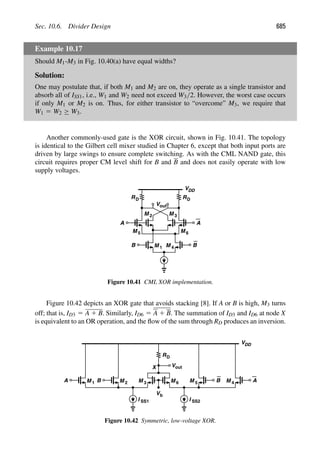
in nonlinear PAs. Called “spectral regrowth,” this effect corrupts the adjacent channels.
A modulated waveform x(t) 5 A(t) cos[ωct 1 φ(t)] is said to have a constant envelope
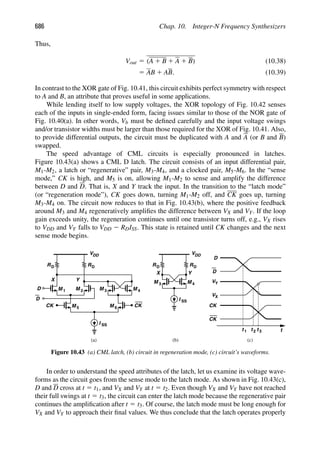
if A(t) does not vary with time. Otherwise, we say the signal has a variable envelope.
Constant- and variable-envelope signals behave differently in a nonlinear system. Suppose
A(t) 5 Ac and the system exhibits a third-order memoryless nonlinearity:
y(t) 5 α3x3
(t) 1 · · · (3.44)
5 α3A3
c cos3
[ωct 1 φ(t)] 1 · · · (3.45)
5
α3A3
c
4
cos[3ωct 1 3φ(t)] 1
3α3A3
c
4
cos[ωct 1 φ(t)] (3.46)
The first term in (3.46) represents a modulated signal around ω 5 3ωc. Since the bandwidth
of the original signal, Ac cos[ωct 1 φ(t)], is typically much less than ωc, the bandwidth
occupied by cos[3ωct 1 3φ(t)] is small enough that it does not reach the center frequency
of ωc. Thus, the shape of the spectrum in the vicinity of ωc remains unchanged.
Now consider a variable-envelope signal applied to the above nonlinear system.
Writing x(t) as
x(t) 5 xI(t) cos ωct 2 xQ(t) sin ωct, (3.47)
where xI and xQ(t) are the baseband I and Q components, we have
y(t) 5 α3[xI(t) cos ωct 2 xQ(t) sin ωct]3
1 · · · (3.48)
5 α3x3
I (t)
cos 3ωct 1 3 cos ωct
4
2 α3x3
Q(t)
2cos 3ωct 1 3 sin ωct
4
. (3.49)
Thus, the output contains the spectra of x3
I (t) and x3
Q(t) centered around ωc. Since these
components generally exhibit a broader spectrum than do xI(t) and xQ(t), we say the
spectrum “grows” when a variable-envelope signal passes through a nonlinear system.
Figure 3.41 summarizes our findings.
Sec. 3.5. Mobile RF Communications 119
ω
Nonlinear
PA
t
ω
t
ω
Nonlinear
PA
ω
t t
Figure 3.41 Amplification of constant- and variable-envelope signals and the effect on their spectra.
3.5 MOBILE RF COMMUNICATIONS
A mobile system is one in which users can physically move while communicating with one
another. Examples include pagers, cellular phones, and cordless phones. It is the mobility
that has made RF communications powerful and popular. The transceiver carried by the
user is called the “mobile unit” (or simply the “mobile”), the “terminal,” or the “hand-
held unit.” The complexity of the wireless infrastructure often demands that the mobiles
communicate only through a fixed, relatively expensive unit called the “base station.” Each
mobile receives and transmits information from and to the base station via two RF channels
called the “forward channel” or “downlink” and the “reverse channel” or “uplink,” respec-
tively. Most of our treatment in this book relates to the mobile unit because, compared to
the base station, hand-held units constitute a much larger portion of the market and their
design is much more similar to other types of RF systems.
Cellular System With the limited available spectrum (e.g., 25 MHz around
900 MHz), how do hundreds of thousands of people communicate in a crowded metropoli-
tan area? To answer this question, we first consider a simpler case: thousands of FM radio
broadcasting stations may operate in a country in the 88–108 MHz band. This is possible
because stations that are physically far enough from each other can use the same carrier
frequency (“frequency reuse”) with negligible mutual interference (except at some point in
the middle where the stations are received with comparable signal levels). The minimum
distance between two stations that can employ equal carrier frequencies depends on the
signal power produced by each.
In mobile communications, the concept of frequency reuse is implemented in a “cellu-
lar” structure, where each cell is configured as a hexagon and surrounded by 6 other cells
120 Chap. 3. Communication Concepts
f1
f1
f1
f1
f1 f1
f1
f1
f1
f2
f2
(a) (b)
Figure 3.42 (a) Simple cellular system, (b) 7-cell reuse pattern.
[Fig. 3.42(a)]. The idea is that if the center cell uses a frequency f1 for communication,
the 6 neighboring cells cannot utilize this frequency, but the cells beyond the immediate
neighbors may. In practice, more efficient frequency assignment leads to the “7-cell” reuse
pattern shown in Fig. 3.42(b). Note that in reality each cell utilizes a group of frequencies.
The mobile units in each cell of Fig. 3.42(b) are served by a base station, and all of the
base stations are controlled by a “mobile telephone switching office” (MTSO).
Co-Channel Interference An important issue in a cellular system is how much two
cells that use the same frequency interfere with each other (Fig. 3.43). Called “co-channel
interference” (CCI), this effect depends on the ratio of the distance between two co-channel
cells to the cell radius and is independent of the transmitted power. Given by the frequency
reuse plan, this ratio is approximately equal to 4.6 for the 7-cell pattern of Fig. 3.42(b) [7].
It can be shown that this value yields a signal-to-co-channel interference ratio of 18 dB [7].
f1
f1
f1 f1
f1
Figure 3.43 Co-channel interference.
Hand-off What happens when a mobile unit “roams” from cell A to cell B
(Fig. 3.44)? Since the power level received from the base station in cell A is insufficient
MTSO
Cell A
Cell B
Figure 3.44 Problem of hand-off.
Sec. 3.5. Mobile RF Communications 121
to maintain communication, the mobile must change its server to the base station in cell
B. Furthermore, since adjacent cells do not use the same group of frequencies, the channel
must also change. Called “hand-off,” this process is performed by the MTSO. Once the
level received by the base station in cell A drops below a threshold, the MTSO hands off
the mobile to the base station in cell B, hoping that the latter is close enough. This strategy
fails with relatively high probability, resulting in dropped calls.
To improve the hand-off process, second-generation cellular systems allow the mobile
unit to measure the received signal level from different base stations, thus performing hand-
off when the path to the second base station has sufficiently low loss [7].
Path Loss and Multipath Fading Propagation of signals in a mobile communication
environment is quite complex. We briefly describe some of the important concepts here.
Signals propagating through free space experience a power loss proportional to the square
of the distance, d, from the source. In reality, however, the signal travels through both a
direct path and an indirect, reflective path (Fig. 3.45). It can be shown that in this case, the
loss increases with the fourth power of the distance [7]. In crowded areas, the actual loss
profile may be proportional to d2 for some distance and d4 for another.
Direct Path
Reflective Path
4
1
d
Loss
(log scale)
Figure 3.45 Indirect signal propagation and resulting loss profile.
In addition to the overall loss profile depicted in Fig. 3.45, another mechanism gives
rise to fluctuations in the received signal level as a function of distance. Since the two
signals shown in Fig. 3.45 generally experience different phase shifts, possibly arriving at
the receiver with opposite phases and roughly equal amplitudes, the net received signal
may be very small. Called “multipath fading” and illustrated in Fig. 3.46, this phenomenon
introduces enormous variations in the signal level as the receiver moves by a fraction of
the wavelength. Note that multipath propagation creates fading and/or ISI.
d
Loss
(log scale)
Figure 3.46 Multipath loss profile.
122 Chap. 3. Communication Concepts
In reality, since the transmitted signal is reflected by many buildings and moving
cars, the fluctuations are quite irregular. Nonetheless, the overall received signal can be
expressed as
xR(t) 5 a1(t) cos(ωct 1 θ1) 1 a2(t) cos(ωct 1 θ2) 1 · · · 1 an cos(ωct 1 θn) (3.50)
5
⎡
⎣
n

j51
aj(t) cos θj
⎤
⎦ cos ωct 2
⎡
⎣
n

j51
aj(t) sin θj
⎤
⎦ sin ωct. (3.51)
For large n, each summation has a Gaussian distribution. Denoting the first summation by
A and the second by B, we have
xR(t) 5

A2 1 B2 cos(ωct 1 φ), (3.52)
where φ 5 tan21(B/A). It can be shown that the amplitude, Am 5
√
A2 1 B2, has a
Rayleigh distribution (Fig. 3.47) [1], exhibiting losses greater than 10 dB below the mean
for approximately 6% of the time.
x
)
(
Px x
Figure 3.47 Rayleigh distribution.
From the above discussion, we conclude that in an RF system the transmitter out-
put power and the receiver dynamic range must be chosen so as to accommodate signal
level variations due to both the overall path loss (roughly proportional to d4) and the deep
multipath fading effects. While it is theoretically possible that multipath fading yields a
zero amplitude (infinite loss) at a given distance, the probability of this event is negligible
because moving objects in a mobile environment tend to “soften” the fading.
Diversity The effect of fading can be lowered by adding redundancy to the transmis-
sion or reception of the signal. “Space diversity” or “antenna diversity” employs two or
more antennas spaced apart by a significant fraction of the wavelength so as to achieve a
higher probability of receiving a nonfaded signal.
“Frequency diversity” refers to the case where multiple carrier frequencies are used,
with the idea that fading is unlikely to occur simultaneously at two frequencies sufficiently
far from each other. “Time diversity” is another technique whereby the data is transmitted
or received more than once to overcome short-term fading.
Delay Spread Suppose two signals in a multipath environment experience roughly
equal attenuations but different delays. This is possible because the absorption coeffi-
cient and phase shift of reflective or refractive materials vary widely, making it likely for
two paths to exhibit equal loss and unequal delays. Addition of two such signals yields
x(t) 5 A cos ω(t2τ1)1A cos ω(t2τ2) 5 2A cos[(2ωt2ωτ1 2ωτ2)/2] cos[ω(τ1 2τ2)/2],
where the second cosine factor relates the fading to the “delay spread,” τ 5 τ1 2 τ2. An
Sec. 3.6. Multiple Access Techniques 123
ω
Channel
ω
Channel
Δτ
1
Δτ
1
cos
ω Δτ
2
cos
ω Δτ
2
(a) (b)
Figure 3.48 (a) Flat and (b) frequency-selective fading.
important issue here is the frequency dependence of the fade. As illustrated in Fig. 3.48,
small delay spreads yield a relatively flat fade, whereas large delay spreads introduce
considerable variation in the spectrum.
In a multipath environment, many signals arrive at the receiver with different delays,
yielding rms delay spreads as large as several microseconds and hence fading bandwidths
of several hundreds of kilohertz. Thus, an entire communication channel may be suppressed
during such a fade.
Interleaving The nature of multipath fading and the signal processing techniques
used to alleviate this issue is such that errors occur in clusters of bits. In order to lower the
effect of these errors, the baseband bit stream in the transmitter undergoes “interleaving”
before modulation. An interleaver in essence scrambles the time order of the bits according
to an algorithm known by the receiver [7].
3.6 MULTIPLE ACCESS TECHNIQUES
3.6.1 Time and Frequency Division Duplexing
The simplest case of multiple access is the problem of two-way communication by a
transceiver, a function called “duplexing.” In old walkie-talkies, for example, the user
would press the “talk” button to transmit while disabling the receive path and release the
button to listen while disabling the transmit path. This can be considered a simple form of
“time division duplexing,” (TDD), whereby the same frequency band is utilized for both
transmit (TX) and receive (RX) paths but the system transmits for half of the time and
receives for the other half. Illustrated in Fig. 3.49, TDD is usually performed fast enough
to be transparent to the user.
Another approach to duplexing is to employ two different frequency bands for the
transmit and receive paths. Called “frequency-division duplexing” (FDD) and shown in
Fig. 3.50, this technique incorporates band-pass filters to isolate the two paths, allowing
simultaneous transmission and reception. Since two such transceivers cannot communicate
directly, the TX band must be translated to the RX band at some point. In wireless networks,
this translation is performed in the base station.
It is instructive to contrast the two duplexing methods by considering their merits and
drawbacks. In TDD, an RF switch with a loss less than 1 dB follows the antenna to alter-
nately enable and disable the TX and RX paths. Even though the transmitter output power
124 Chap. 3. Communication Concepts
RX
TX
TDD Command
Figure 3.49 Time-division duplexing.
f T
TX
fR
RX
Base
Station
f T
TX
f R
RX
f T fR
fR f T
Band−Pass
Filters
Band−Pass
Filters
Figure 3.50 Frequency-division duplexing.
may be 100 dB above the receiver input signal, the two paths do not interfere because the
transmitter is turned off during reception. Furthermore, TDD allows direct (“peer-to-peer”)
communication between two transceivers, an especially useful feature in short-range, local
area network applications. The primary drawback of TDD is that the strong signals gener-
ated by all of the nearby mobile transmitters fall in the receive band, thus desensitizing the
receiver.
In FDD systems, the two front-end band-pass filters are combined to form a “duplexer
filter.” While making the receivers immune to the strong signals transmitted by other
mobile units, FDD suffers from a number of issues. First, components of the transmit-
ted signal that leak into the receive band are attenuated by typically only about 50 dB
(Chapter 4). Second, owing to the trade-off between the loss and the quality factor of
filters, the loss of the duplexer is typically quite higher than that of a TDD switch. Note
that a loss of, say, 3 dB in the RX path of the duplexer raises the overall noise figure by
3 dB (Chapter 2), and the same loss in the TX path of the filter means that only 50% of the
signal power reaches the antenna.
Another issue in FDD is the spectral leakage to adjacent channels in the transmitter
output. This occurs when the power amplifier is turned on and off to save energy or when
the local oscillator driving the modulator undergoes a transient. By contrast, in TDD such
transients can be timed to end before the antenna is switched to the power amplifier output.
Despite the above drawbacks, FDD is employed in many RF systems, particularly in
cellular communications, because it isolates the receivers from the signals produced by
mobile transmitters.
Sec. 3.6. Multiple Access Techniques 125
3.6.2 Frequency-Division Multiple Access
In order to allow simultaneous communication among multiple transceivers, the available
frequency band can be partitioned into many channels, each of which is assigned to one
user. Called “frequency-division multiple access,” (Fig. 3.51), this technique should be
familiar within the context of radio and television broadcasting, where the channel assign-
ment does not change with time. In multiple-user, two-way communications, on the other
hand, the channel assignment may remain fixed only until the end of the call; after the user
hangs up the phone, the channel becomes available to others. Note that in FDMA with
FDD, two channels are assigned to each user, one for transmit and another for receive.
ω
Channel
1
Channel
N
Figure 3.51 Frequency-division multiple access.
The relative simplicity of FDMA made it the principal access method in early cellu-
lar networks, called “analog FM” systems. However, in FDMA the minimum number of
simultaneous users is given by the ratio of the total available frequency band (e.g., 25 MHz
in GSM) and the width of each channel (e.g., 200 kHz in GSM), translating to insufficient
capacity in crowded areas.
3.6.3 Time-Division Multiple Access
In another implementation of multiple-access networks, the same band is available to each
user but at different times (“time-division multiple access”). Illustrated in Fig. 3.52, TDMA
periodically enables each of the transceivers for a “time slot” (Tsl). The overall period
consisting of all of the time slots is called a “frame” (TF). In other words, every TF seconds,
each user finds access to the channel for Tsl seconds.
What happens to the data (e.g., voice) produced by all other users while only one user
is allowed to transmit? To avoid loss of information, the data is stored (“buffered”) for
TF 2 Tsl seconds and transmitted as a burst during one time slot (hence the term “TDMA
burst”). Since buffering requires the data to be in digital form, TDMA transmitters perform
A/D conversion on the analog input signal. Digitization also allows speech compression
and coding.
TDMA systems have a number of advantages over their FDMA counterparts. First,
as each transmitter is enabled for only one time slot in every frame, the power amplifier
can be turned off during the rest of the frame, thus saving considerable power. In practice,
settling issues require that the PA be turned on slightly before the actual time slot begins.
Second, since digitized speech can be compressed in time by a large factor, the required
communication bandwidth can be smaller and hence the overall capacity larger. Equiva-
lently, as compressed speech can be transmitted over a shorter time slot, a higher number
126 Chap. 3. Communication Concepts
Transceiver 1
Enable
Transceiver
Enable
2
Transceiver
Enable
N
t
t
t
Tsl
TF
Figure 3.52 Time-division multiple access.
of users can be accommodated in each frame. Third, even with FDD, the TDMA bursts
can be timed such that the receive and transmit paths in each transceiver are never enabled
simultaneously.
The need for A/D conversion, digital modulation, time slot and frame synchronization,
etc., makes TDMA more complex than FDMA. With the advent of VLSI DSPs, however,
this drawback is no longer a determining factor. In most actual TDMA systems, a combi-
nation of TDMA and FDMA is utilized. In other words, each of the channels depicted in
Fig. 3.51 is time-shared among many users.
3.6.4 Code-Division Multiple Access
Our discussion of FDMA and TDMA implies that the transmitted signals in these systems
avoid interfering with each other in either the frequency domain or the time domain. In
essence, the signals are orthogonal in one of these domains. A third method of multiple
access allows complete overlap of signals in both frequency and time, but employs “ortho-
gonal messages” to avoid interference. This can be understood with the aid of an analogy [8].
Suppose many conversations are going on in a crowded party. To minimize crosstalk, dif-
ferent groups of people can be required to speak in different pitches(!) (FDMA), or only one
group can be allowed to converse at a time (TDMA). Alternatively, each group can be asked
to speak in a different language. If the languages are orthogonal (at least in nearby groups)
and the voice levels are roughly the same, then each listener can “tune in” to the proper
language and receive information while all groups talk simultaneously.
Direct-Sequence CDMA In “code-division multiple access,” different languages
are created by means of orthogonal digital codes. At the beginning of communication,
a certain code is assigned to each transmitter-receiver pair, and each bit of the baseband
data is “translated” to that code before modulation. Shown in Fig. 3.53(a) is an example
where each baseband pulse is replaced with an 8-bit code by multiplication. A method of
Sec. 3.6. Multiple Access Techniques 127
t
t
t
(a) (b)
t
Baseband
Pulse
Figure 3.53 (a) Encoding operation in DS-CDMA, (b) examples of Walsh code.
generating orthogonal codes is based on Walsh’s recursive equation:
W1 5 0 (3.53)
W2n 5

Wn Wn
Wn Wn

(3.54)
where Wn is derived from Wn by replacing all the entries with their complements. For
example,
W2 5

0 0
0 1

(3.55)
Fig. 3.53(b) shows examples of 8-bit Walsh codes (i.e., each row of W8).
In the receiver, the demodulated signal is decoded by multiplying it by the same
Walsh code. In other words, the receiver correlates the signal with the code to recover
the baseband data.
How is the received data affected when another CDMA signal is present? Suppose
two CDMA signals x1(t) and x2(t) are received in the same frequency band. Writing the
signals as xBB1(t) · W1(t) and xBB2(t) · W2(t), where W1(t) and W2(t) are Walsh functions,
we express the output of the demodulator as y(t) 5 [xBB1(t).W1(t) 1 xBB2(t).W2(t)].W1(t).
Thus, if W1(t) and W2(t) are exactly orthogonal, then y(t) 5 xBB1(t) · W1(t). In reality,
however, x1(t) and x2(t) may experience different delays, leading to corruption of y(t) by
xBB2(t). Nevertheless, for long codes the result appears as random noise.
The encoding operation of Fig. 3.53(a) increases the bandwidth of the data spectrum
by the number of pulses in the code. This may appear in contradiction to our emphasis thus
far on spectral efficiency. However, since CDMA allows the widened spectra of many users
to fall in the same frequency band (Fig. 3.54), this access technique has no less capacity
than do FDMA and TDMA. In fact, CDMA can potentially achieve a higher capacity than
the other two [9].
CDMA is a special case of “spread spectrum” (SS) communications, whereby the base-
band data of each user is spread over the entire available bandwidth. In this context, CDMA
is also called “direct sequence” SS (DS-SS) communication, and the code is called the
“spreading sequence” or “pseudo-random noise.” To avoid confusion with the baseband
data, each pulse in the spreading sequence is called a “chip” and the rate of the sequence
128 Chap. 3. Communication Concepts
t
ω
ω ωc
t
ω
ω ωc
User 1
User 2
Figure 3.54 Overlapping spectra in CDMA.
is called the “chip rate.” Thus, the spectrum is spread by the ratio of the chip rate to the
baseband bit rate.
It is instructive to reexamine the above RX decoding operation from a spread spectrum
point of view (Fig. 3.55). Upon multiplication by W1(t), the desired signal is “despread,”
with its bandwidth returning to the original value. The unwanted signal, on the other hand,
remains spread even after multiplication because of its low correlation with W1(t). For
a large number of users, the spread spectra of unwanted signals can be viewed as white
Gaussian noise.
ω
)
(t
W1
ω
ω
Signal 1
Signal 2
Signal 1
Signal 2
Figure 3.55 Despreading operation in a CDMA receiver.
An important feature of CDMA is its soft capacity limit [7]. While in FDMA and
TDMA the maximum number of users is fixed once the channel width or the time slots are
defined, in CDMA increasing the number of users only gradually (linearly) raises the noise
floor [7].
A critical issue in DS-CDMA is power control. Suppose, as illustrated in Fig. 3.56,
the desired signal power received at a point is much lower than that of an unwanted trans-
mitter,7
for example because the latter is at a shorter distance. Even after despreading,
the strong interferer greatly raises the noise floor, degrading the reception of the desired
signal. For multiple users, this means that one high-power transmitter can virtually halt
7. This situation arises in our party analogy if two people speak much more loudly than others. Even with
different languages, communication becomes difficult.
Sec. 3.6. Multiple Access Techniques 129
Despreader
Interferer
Desired
Signal
ω
Desired
Signal
Interferer
Figure 3.56 Near/far effect in CDMA.
communications among others, a problem much less serious in FDMA and TDMA. This is
called the “near/far effect.” For this reason, when many CDMA transmitters communicate
with a receiver, they must adjust their output power such that the receiver senses roughly
equal signal levels. To this end, the receiver monitors the signal strength corresponding
to each transmitter and periodically sends a power adjustment request to each one. Since
in a cellular system users communicate through the base station, rather than directly, the
latter must handle the task of power control. The received signal levels are controlled to be
typically within 1 dB of each other.
While adding complexity to the system, power control generally reduces the average
power dissipation of the mobile unit. To understand this, note that without such control,
the mobile must always transmit enough power to be able to communicate with the base
station, whether path loss and fading are significant or not. Thus, even when the channel has
minimum attenuation, the mobile unit produces the maximum output power. With power
control, on the other hand, the mobile can transmit at low levels whenever the channel
conditions improve. This also reduces the average interference seen by other users.
Unfortunately, power control also dictates that the receive and transmit paths of the
mobile phone operate concurrently.8
As a consequence, CDMA mobile phones must deal
with the leakage of the TX signal to the RX (Chapter 4).
Frequency-Hopping CDMA Another type of CDMA that has begun to appear in RF
communications is “frequency hopping” (FH). Illustrated in Fig. 3.57, this access technique
can be viewed as FDMA with pseudo-random channel allocation. The carrier frequency in
t
Oscillator
t
ωc1
ω
t
ω
ω
c2
c3
Baseband
Data
Figure 3.57 Frequency-hopping CDMA.
8. If a vehicle moves at a high speed or in an area with tall buildings, the power received by the base station
from it can vary rapidly, requiring continuous feedback.
130 Chap. 3. Communication Concepts
each transmitter is “hopped” according to a chosen code (similar to the spreading codes
in DS-CDMA). Thus, even though the short-term spectrum of a transmitter may overlap
with those of others, the overall trajectory of the spectrum, i.e., the PN code, distinguishes
each transmitter from others. Nevertheless, occasional overlap of the spectra raises the
probability of error.
Due to rare overlap of spectra, frequency hopping is somewhat similar to FDMA and
hence more tolerant of different received power levels than is direct-sequence CMDA.
However, FH may require relatively fast settling in the control loop of the oscillator shown
in Fig. 3.57, an important design issue studied in Chapter 10.
3.7 WIRELESS STANDARDS
Our study of wireless communication systems thus far indicates that making a phone call or
sending data entails a great many complex operations in both analog and digital domains.
Furthermore, nonidealities such as noise and interference require precise specification of
each system parameter, e.g., SNR, BER, occupied bandwidth, and tolerance of interferers.
A “wireless standard” defines the essential functions and specifications that govern the
design of the transceiver, including its baseband processing. Anticipating various operating
conditions, each standard fills a relatively large document while still leaving some of the
dependent specifications for the designer to choose. For example, a standard may specify
the sensitivity but not the noise figure.
Before studying various wireless standards, we briefly consider some of the common
specifications that standards quantify:
1. Frequency Bands and Channelization. Each standard performs communication
in an allocated frequency band. For example, Bluetooth uses the industrial-
scientific-medical (ISM) band from 2.400 GHz to 2.480 GHz. The band consists
of “channels,” each of which carries the information for one user. For example,
Bluetooth incorporates a channel of 1 MHz, allowing at most 80 users.
2. Data Rate(s). The standard specifies the data rate(s) that must be supported. Some
standards support a constant data rate, whereas others allow a variable data rate so
that, in the presence of high signal attenuation, the communication is sustained but
at a low speed. For example, Bluetooth specifies a data rate of 1 Mb/s.
3. Antenna Duplexing Method. Most cellular phone systems incorporate FDD, and
other standards employ TDD.
4. Type of Modulation. Each standard specifies the modulation scheme. In some
cases, different modulation schemes are used for different data rates. For exam-
ple, IEEE802.11a/g utilizes 64QAM for its highest rate (54 Mb/s) in the presence
of good signal conditions, but binary PSK for the lowest rate (6 Mb/s).
5. TX Output Power. The standard specifies the power level(s) that the TX must pro-
duce. For example, Bluetooth transmits 0 dBm. Some standards require a variable
output level to save battery power when the TX and RX are close to each other
and/or to avoid near/far effects.
6. TX EVM and Spectral Mask. The signal transmitted by the TX must satisfy sev-
eral requirements in addition to the power level. First, to ensure acceptable signal
Sec. 3.7. Wireless Standards 131
quality, the EVM is specified. Second, to guarantee that the TX out-of-channel
emissions remain sufficiently small, a TX “spectral mask” is defined. As explained
in Section 3.4, excessive PA nonlinearity may violate this mask. Also, the stan-
dard poses a limit on other unwanted transmitted components, e.g., spurs and
harmonics.
7. RX Sensitivity. The standard specifies the acceptable receiver sensitivity, usually
in terms of a maximum bit error rate, BERmax. In some cases, the sensitivity is
commensurate with the data rate, i.e., a higher sensitivity is stipulated for lower
data rates.
8. RX Input Level Range. The desired signal sensed by a receiver may range from
the sensitivity level to a much larger value if the RX is close to the TX. Thus,
the standard specifies the desired signal range that the receiver must handle with
acceptable noise or distortion.
9. RX Tolerance to Blockers. The standard specifies the largest interferer that the RX
must tolerate while receiving a small desired signal. This performance is typically
defined as illustrated in Fig. 3.58. In the first step, a modulated signal is applied at
the “reference” sensitivity level and the BER is measured to remain below BERmax
[Fig. 3.58(a)]. In the second step, the signal level is raised by 3 dB and a blocker
is added to the input and its level is gradually raised. When the blocker reaches the
specified level, the BER must not exceed BERmax [Fig. 3.58(b)]. This test reveals
the compression behavior and phase noise of the receiver. The latter is described in
Chapter 8.
Many standards also stipulate an intermodulation test. For example, as shown
in Fig. 3.59, two blockers (one modulated and another not) are applied along with
the desired signal at 3 dB above the sensitivity level. The receiver BER must not
exceed BERmax as the level of the two blockers reaches the specified level.
In this section, we study a number of wireless standards. In the case of cellular
standards, we focus on the “mobile station” (the handset).
f
Reference
Sensitivity
Receiver
t
BER max
f
Reference
Sensitivity
Receiver
t
BER max
3 dB
Blocker
(a)
(b)
Figure 3.58 Test of a receiver with (a) desired signal at reference sensitivity and (b) desired signal
3 dB above reference sensitivity along with a blocker.
132 Chap. 3. Communication Concepts
Reference
Sensitivity
3 dB
ω
ω1 ω2
−ω
2ω1 2
Figure 3.59 Intermodulation test.
3.7.1 GSM
The Global System for Mobile Communication (GSM) was originally developed as a uni-
fied wireless standard for Europe and became the most widely-used cellular standard in the
world. In addition to voice, GSM also supports the transmission of data.
The GSM standard is a TDMA/FDD system with GMSK modulation, operating in dif-
ferent bands and accordingly called GSM900, GSM1800 (also known as DCS1800), and
GSM1900 (also known as PCS1900). Figure 3.60 shows the TX and RX bands. Accom-
modating eight time-multiplexed users, each channel is 200 kHz wide, and the data rate
per user is 271 kb/s. The TX and RX time slots are offset (by about 1.73 ms) so that the
two paths do not operate simultaneously. The total capacity of the system is given by the
number of channels in the 25-MHz bandwidth and the number of users is per channel,
amounting to approximately 1,000.
Duplexer
FDD
f
Modulator
Digital
Baseband
Signal
200 kHz
890−915 MHz
935−960 MHz
GMSK
(271 kb/s)
Figure 3.60 GSM air interface.
Example 3.10
GSM specifies a receiver sensitivity of 2102 dBm.9
The detection of GMSK with accept-
able bit error rate (1023) requires an SNR of about 9 dB. What is the maximum allowable
RX noise figure?
Solution:
We have from Chapter 2
NF 5 174 dBm/Hz 2 102 dBm 2 10 log(200 kHz) 2 9 dB (3.56)
≈ 10 dB. (3.57)
9. The sensitivity in GSM1800 is 2101 dBm.
Sec. 3.7. Wireless Standards 133
f
600 1600 3000
0
−43 dBm
−33 dBm
−23 dBm
0 dBm
(kHz)
Edge of
Band
20 MHz
In−Band Blocker Levels Out−of−Band Blocker Levels
−99 dBm
Desired
Channel
Figure 3.61 GSM receiver blocking test. (The desired channel center frequency is denoted by 0 for
simplicity.)
Blocking Requirements GSM also specifies blocking requirements for the receiver.
Illustrated in Fig. 3.61, the blocking test applies the desired signal at 3 dB above the sensi-
tivity level along with a single (unmodulated) tone at discrete increments of 200 kHz from
the desired channel. (Only one blocker is applied at a time.)10
The tolerable in-band blocker
level jumps to 233 dBm at 1.6 MHz from the desired channel and to 223 dBm at 3 MHz.
The out-of-band blocker can reach 0 dBm beyond a 20-MHz guard band from the edge of
the RX band. With the blocker levels shown in Fig. 3.61, the receiver must still provide the
necessary BER.
Example 3.11
How must the receiver P1dB be chosen to satisfy the above blocking tests?
Solution:
Suppose the receiver incorporates a front-end filter and hence provides sufficient attenua-
tion if the blocker is applied outside the GSM band. Thus, the largest blocker level is equal
to 223 dBm (at or beyond 3-MHz offset), demanding a P1dB of roughly 215 dBm to avoid
compression. If the front-end filter does not attenuate the out-of-band blocker adequately,
then a higher P1dB is necessary.
If the receiver P1dB is determined by the blocker levels beyond 3-MHz offset, why
does GSM specify the levels at smaller offsets? Another receiver imperfection, namely, the
phase noise of the oscillator, manifests itself here and is discussed in Chapter 8.
Since the blocking requirements of Fig. 3.61 prove difficult to fulfill in practice, GSM
stipulates a set of “spurious response exceptions,” allowing the blocker level at six in-band
10. This mask and others described in this section symmetrically extend to the left.
134 Chap. 3. Communication Concepts
f
600 1600 3000
0
−23 dBm
(kHz)
Edge of
Band
−99 dBm
~22 MHz
Edge of
Band
Difficult
Blocking Requirement
Figure 3.62 Worst-case channel for GSM blocking test.
frequencies and 24 out-of-band frequencies to be relaxed to 243 dBm.11
Unfortunately,
these exceptions do not ease the compression and phase noise requirements. For example,
if the desired channel is near one edge of the band (Fig. 3.62), then about 100 chan-
nels reside above 3-MHz offset. Even if six of these channels are excepted, each of the
remaining can contain a 223 dBm blocker.
Intermodulation Requirements Figure 3.63 depicts the IM test specified by GSM. With
the desired channel 3 dB above the reference sensitivity level, a tone and a modulated
signal are applied at 800-kHz and 1.6-MHz offset, respectively. The receiver must satisfy
the required BER if the level of the two interferers is as high as 249 dBm.
f
−99 dBm
800 kHz 800 kHz
−49 dBm
Figure 3.63 GSM intermodulation test.
Example 3.12
Estimate the receiver IP3 necessary for the above test.
Solution:
For an acceptable BER, an SNR of 9 dB is required, i.e., the total noise in the desired
channel must remain below 2108 dBm. In this test, the signal is corrupted by both the
receiver noise and the intermodulation. If, from Example 3.10, we assume NF 5 10 dB,
then the total RX noise in 200 kHz amounts to 2111 dBm. Since the maximum tolerable
11. In GSM1800 and GSM1900, 12 in-band exceptions are allowed.
Sec. 3.7. Wireless Standards 135
Example 3.12 (Continued)
noise is 2108 dBm, the intermodulation can contribute at most 3 dB of corruption. In other
words, the IM product of the two interferers must have a level of 2111 dBm so that, along
with an RX noise of 2111 dBm, it yields a total corruption of 2108 dBm. It follows from
Chapter 2 that
IIP3 5
249 dBm 2 (2111 dBm)
2
1 (249 dBm) (3.58)
5 218 dBm. (3.59)
In Problem 3.2, we recompute the IIP3 if the noise figure is lower than 10 dB.
We observe from this example and Example 3.11 that the receiver linearity in
GSM is primarily determined by the single-tone blocking requirements rather than the
intermodulation specification.
Adjacent-Channel Interference A GSM receiver must withstand an adjacent-channel
interferer 9 dB above the desired signal or an alternate-adjacent channel interferer 41 dB
above the desired signal (Fig. 3.64). In this test, the desired signal is 20 dB higher than
the sensitivity level. As explained in Chapter 4, the relatively relaxed adjacent-channel
requirement facilitates the use of certain receiver architectures.
f
−82 dBm
9 dB
32 dB
f
Δ f
Δ
f
Δ =200 kHz
Figure 3.64 GSM adjacent-channel test.
TX Specifications A GSM (mobile) transmitter must deliver an output power of at least
2 W (133 dBm) in the 900-MHz band or 1 W in the 1.8-GHz band. Moreover, the output
power must be adjustable in steps of 2 dB from 15 dBm to the maximum level, allowing
adaptive power control as the mobile comes closer to or goes farther from the base station.
The output spectrum produced by a GSM transmitter must satisfy the “mask” shown in
Fig. 3.65, dictating that GMSK modulation be realized with an accurate modulation index
and well-controlled pulse shaping. Also, the rms phase error of the output signal must
remain below 58.
A stringent specification in GSM relates to the maximum noise that the TX can emit in
the receive band. As shown in Fig. 3.66, this noise level must be less than 2129 dBm/Hz
136 Chap. 3. Communication Concepts
f
0 200 400
Relative
Power
(dB)
+0.5
−30
−33
250
−60
1800
−63
−65
3000 6000
(kHz)
Measured in
30-kHz BW
Measured in
100-kHz BW
−71
Figure 3.65 GSM transmission mask for the 900-MHz band.
f
−129 dBm/Hz
RX Band
+33 dBm
Figure 3.66 GSM transmitter noise in receive band.
so that a transmitting mobile station negligibly interferes with a receiving mobile station in
its close proximity. The severity of this requirement becomes obvious if the noise bound
is normalized to the TX output power of 133 dBm, yielding a relative noise floor of
2162 dBc/Hz. As explained in Chapter 4, this specification makes the design of GSM
transmitters quite difficult.
EDGE To accommodate higher data rates in a 200-kHz channel, the GSM standard has
been extended to “Enhanced Data Rates for GSM Evolution” (EDGE). Achieving a rate
of 384 kb/s, EDGE employs “8-PSK” modulation, i.e., phase modulation with eight phase
values given by kπ/4, k 5 0-7. Figure 3.67 shows the signal constellation. EDGE is
considered a “2.5th-generation” (2.5G) cellular system.
The use of 8-PSK modulation entails two issues. First, to confine the spectrum to
200 kHz, a “linear” modulation with baseband pulse shaping is necessary. In fact, the con-
stellation of Fig. 3.67 can be viewed as that of two QPSK waveforms, one rotated by 458
with respect to the other. Thus, two QPSK signals with pulse shaping (Chapter 4) can be
generated and combined to yield the 8-PSK waveform. Pulse shaping, however, leads to
a variable envelope, necessitating a linear power amplifier. In other words, a GSM/EDGE
transmitter can operate with a nonlinear (and hence efficient) PA in the GSM mode but
must switch to a linear (and hence inefficient) PA in the EDGE mode.
The second issue concerns the detection of the 8-PSK signal in the receiver. The
closely-spaced points in the constellation require a higher SNR than, say, QPSK does.
For BER 5 1023, the former dictates an SNR of 14 dB and the latter, 7 dB.
Sec. 3.7. Wireless Standards 137
Q
I
Figure 3.67 Constellation of 8-PSK (used in EDGE).
3.7.2 IS-95 CDMA
A wireless standard based on direct-sequence CMDA has been proposed by Qualcomm,
Inc., and adopted for North America as IS-95. Using FDD, the air interface employs the
transmit and receive bands shown in Fig. 3.68. In the mobile unit, the 9.6 kb/s baseband data
is spread to 1.23 MHz and subsequently modulated using OQPSK. The link from the base
station to the mobile unit, on the other hand, incorporates QPSK modulation. The logic
is that the mobile must use a power-efficient modulation scheme (Chapter 3), whereas
the base station transmits many channels simultaneously and must therefore employ a
linear power amplifier regardless of the type of modulation. In both directions, IS-95
requires coherent detection, a task accomplished by transmitting a relatively strong “pilot
tone” (e.g., unmodulated carrier) at the beginning of communication to establish phase
synchronization.
In contrast to the other standards studied above, IS-95 is substantially more complex,
incorporating many techniques to increase the capacity while maintaining a reasonable
signal quality. We briefly describe some of the features here. For more details, the reader is
referred to [8, 10, 11].
Duplexer
FDD
f
Modulator
824−849 MHz
869−894 MHz
Digital
Baseband
Signal
1.23 MHz
OQPSK
PN Sequence
(9.6 kb/s)
1850−1910 MHz
1930−1980 MHz
Figure 3.68 IS-95 air interface.
138 Chap. 3. Communication Concepts
Power Control As mentioned in Section 3.6.4, in CDMA the power levels received
by the base station from various mobile units must differ by no more than approximately
1 dB. In IS-95, the output power of each mobile is controlled by an open-loop procedure
at the beginning of communication so as to perform a rough but fast adjustment. Subse-
quently, the power is set more accurately by a closed-loop method. For open-loop control,
the mobile measures the signal power it receives from the base station and adjusts its
transmitted power so that the sum of the two (in dB) is approximately 273 dBm. If the
receive and transmit paths entail roughly equal attenuation, k dB, and the power transmit-
ted by the base station is Pbs, then the mobile output power Pm satisfies the following:
Pbs 2k1Pm 5 273 dBm. Since the power received by the base station is Pm 2k, we have
Pm 2 k 5 273 dBm 2Pbs, a well-defined value because Pbs is usually fixed. The mobile
output power can be varied by approximately 85 dB in a few microseconds.
Closed-loop power control is also necessary because the above assumption of equal
loss in the transmit and receive paths is merely an approximation. In reality, the two paths
may experience different fading because they operate in different frequency bands. To this
end, the base station measures the power level received from the mobile unit and sends
a feedback signal requesting power adjustment. This command is transmitted once every
1.25 ms to ensure timely adjustment in the presence of rapid fading.
Frequency and Time Diversity Recall from Section 3.5 that multipath fading is
often frequency-selective, causing a notch in the channel transfer function that can be sev-
eral kilohertz wide. Since IS-95 spreads the spectrum to 1.23 MHz, it provides frequency
diversity, exhibiting only 25% loss of the band for typical delay spreads [8].
IS-95 also employs time diversity to use multipath signals to advantage. This is accom-
plished by performing correlation on delayed replicas of the received signal (Fig. 3.69).
Called a “rake receiver,” such a system combines the delayed replicas with proper weight-
ing factors, αj, to obtain the maximum signal-to-noise ratio at the output. That is, if the
output of one correlator is corrupted, then the corresponding weighting factor is reduced
and vice versa.
Rake receivers are a unique feature of CDMA. Since the chip rate is much higher than
the fading bandwidth, and since the spreading codes are designed to have negligible corre-
lation for delays greater than a chip period, multipath effects do not introduce intersymbol
interference. Thus, each correlator can be synchronized to one of the multipath signals.
Δ Δ Δ
α1 α α α
2 3 4
)
(t
x
)
(t
y
Figure 3.69 Rake receiver.
Sec. 3.7. Wireless Standards 139
Variable Coding Rate The variable rate of information in human speech can be
exploited to lower the average number of transmitted bits per second. In IS-95, the data rate
can vary in four discrete steps: 9600, 4800, 2400, and 1200 b/s. This arrangement allows
buffering slower data such that the transmission still occurs at 9600 b/s but for a propor-
tionally shorter duration. This approach further reduces the average power transmitted by
the mobile unit, both saving battery and lowering interference seen by other users.
Soft Hand-off Recall from Section 3.5 that when the mobile unit is assigned a dif-
ferent base station, the call may be dropped if the channel center frequency must change
(e.g., in IS-54 and GSM). In CDMA, on the other hand, all of the users in one cell commu-
nicate on the same channel. Thus, as the mobile unit moves farther from one base station
and closer to another, the signal strength corresponding to both stations can be monitored
by means of a rake receiver. When it is ascertained that the nearer base station has a suf-
ficiently strong signal, the hand-off is performed. Called “soft hand-off,” this method can
be viewed as a “make-before-break” operation. The result is lower probability of dropping
calls during hand-off.
3.7.3 Wideband CDMA
As a third-generation cellular system, wideband CDMA extends the concepts realized in
IS-95 to achieve a higher data rate. Using BPSK (for uplink) and QPSK (for downlink) in
a nominal channel bandwidth of 5 MHz, WCDMA achieves a rate of 384 kb/s.
Several variants of WCDMA have been deployed in different graphical regions. In
this section, we study “IMT-2000” as an example. Figure 3.70 shows the air interface of
IMT-2000, indicating a total bandwidth of 60 MHz. Each channel can accommodate a data
rate of 384 kb/s in a (spread) bandwidth of 3.84 MHz; but, with “guard bands” included,
the channel spacing is 5 MHz. The mobile station employs BPSK modulation for data and
QPSK modulation for spreading.
Transmitter Requirements The TX must deliver an output power ranging from
249 dBm to 124 dBm.12
The wide output dynamic range makes the design of WCDMA
transmitters and, specifically, power amplifiers, difficult. In addition, the TX incorpo-
rates baseband pulse shaping so as to tighten the output spectrum, calling for a linear PA.
Duplexer
FDD
2110−2170 MHz
1920−1980 MHz
Baseband
Signal
Processor
Baseband and Modulator
Figure 3.70 IMT-2000 air interface.
12. The PA may need to deliver about +27 dBm to account for the loss of the duplexer.
140 Chap. 3. Communication Concepts
f
f
Δ f
Δ
f
Δ
Transmitted
Channel
= 5 MHz
f
0
Relative
Power
(dB)
2.5 3.5 7.5 8.5 12.5
0
−33.5
−49
−53
−63
(MHz)
(a) (b)
33 dB
43 dB
Figure 3.71 Transmitter (a) adjacent-channel power test, and (b) emission mask in IMT-2000.
IMT-2000 stipulates two sets of specifications to quantify the limits on the out-of-channel
emissions: (1) the adjacent and alternate adjacent channel powers must be 33 dB and 43 dB
below the main channel, respectively [Fig. 3.71(a)]; (2) the emissions measured in a 30-kHz
bandwidth must satisfy the TX mask shown in Fig. 3.71(b).
The transmitter must also coexist harmoniously with the GSM and DCS1800 stan-
dards. That is, the TX power must remain below 279 dBm in a 100-kHz bandwidth in the
GSM RX band (935 MHz-960 MHz) and below 271 dBm in a 100-kHz bandwidth in the
DCS1800 RX band (1805 MHz-1880 MHz).
Receiver Requirements The receiver reference sensitivity is 2107 dBm. As with GSM,
IMT-2000 receivers must withstand a sinusoidal blocker whose amplitude becomes larger
at greater frequency offsets. Unlike GSM, however, IMT-2000 requires the sinusoidal test
for only out-of-band blocking [Fig. 3.72(a)]. The P1dB necessary here is more relaxed than
that in GSM; e.g., at 85 MHz outside the band, the RX must tolerate a tone of 215 dBm.13
For in-band blocking, IMT-2000 provides the two tests shown in Fig. 3.72(b). Here, the
blocker is modulated such that it behaves as another WCDMA channel, thus causing both
compression and cross modulation.
Example 3.13
Estimate the required P1dB of a WCDMA receiver satisfying the in-band test of Fig. 3.72(b).
Solution:
To avoid compression, P1dB must be 4 to 5 dB higher than the blocker level, i.e.,
P1dB ≈ 240 dBm. To quantify the corruption due to cross modulation, we return to our
derivation in Chapter 2. For a sinusoid A1 cos ω1t and an amplitude-modulated blocker
13. However, if the TX leakage is large, the RX linearity must be quite higher.
Sec. 3.7. Wireless Standards 141
Example 3.13 (Continued)
A2(1 1 m cos ωmt) cos ω2t, cross modulation appears as
y(t) 5 α1A1 1
3
2
α3A1A2
2

1 1
m2
2
1
m2
2
cos 2ωmt 1 2m cos ωmt

cos ω1t 1 · · · (3.60)
For the case at hand, both channels contain modulation and we make the following assump-
tions: (1) the desired channel and the blocker carry the same amplitude modulation and are
respectively expressed as A1(11m cos ωm1t) cos ω1t and A2(11m cos ωm2t) cos ω2t; (2) the
envelope varies by a moderate amount and hence m2/2  2m. The effect of third-order
nonlinearity can then be expressed as
y(t) 5 α1A1(11m cos ωm1t)1
3
2
α3A1(11m cos ωm1t)A2
2
3 (112m cos ωm2t) cos ω1t1 · · · (3.61)
5 α1A1(11m cos ωm1t)1
3
2
α3A1A2
2(11m cos ωm1t12m cos ωm2t
12m2
cos ωm1t cos ωm2t) cos ω1t1 · · · (3.62)
For the corruption to be negligible, the average power of the second term in the square
brackets must remain much less than that of the first:

3
2α3A1A2
2
2
1 1 m2 1 4m2 1 4m4
α1A1
2
1 1 m2
 1. (3.63)
Setting this ratio to 215 dB (5 0.0316) and neglecting the powers of m, we have
3
2
|α3|A2
2
|α1|
5 0.178. (3.64)
Since A1dB 5
√
0.145|α1/α3| and hence |α3/α1| 5 0.145/A2
1dB,
A1dB 5 1.1 A2. (3.65)
That is, the input compression point must exceed A2 (5 244 dBm) by about 1 dB. Thus,
compression is slightly more dominant than cross modulation in this test.
A sensitivity level of 2107 dBm with a signal bandwidth as wide as 3.84 MHz may
appear very impressive. In fact, since 10 log(3.84 MHz) ≈ 66 dB, it seems that the sum of
the receiver noise figure and the required SNR must not exceed 174 dBm/Hz 2 66 dB 2
107 dBm 5 1 dB! However, recall that CDMA spreads a lower bit rate (e.g., 384 kb/s)
142 Chap. 3. Communication Concepts
−104 dBm
f
RX Band
2110 2170
−44 dBm
−30 dBm
2185 2230 2255
−15 dBm
(MHz)
f
−104 dBm
−44 dBm
f
−104 dBm
−56 dBm
10 MHz
3.84 MHz
(a)
(b)
15 MHz
Figure 3.72 IMT-2000 receiver (a) blocking mask using a tone and (b) blocking test using a
modulated interferer.
by a factor, thus benefitting from the spreading gain after the despreading operation in the
receiver. That is, the NF is relaxed by a factor equal to the spreading gain.
IMT-2000 also specifies an intermodulation test. As depicted in Fig. 3.73, a tone and
a modulated signal, each at 246 dBm, are applied in the adjacent and alternate adjacent
channels, respectively, while the desired signal is at 2104 dBm. In Problem 3.3, we repeat
Example 3.12 for WCDMA to determine the required IP3 of the receiver.
f
10 MHz 10 MHz
−104 dBm
−46 dBm
Figure 3.73 IMT-2000 intermodulation test.
Figure 3.74 illustrates the adjacent-channel test stipulated by IMT-2000. With a level
of 293 dBm for the desired signal, the adjacent channel can be as high as 252 dBm. As
explained in Chapter 4, this specification requires a sharp roll-off in the frequency response
of the baseband filters.
Sec. 3.7. Wireless Standards 143
f
f
Δ
f
Δ
−93 dBm
−52 dBm
=5 MHz
Figure 3.74 IMT-2000 receiver adjacent-channel test.
3.7.4 Bluetooth
The Bluetooth standard was originally conceived as a low-cost solution for short-range,
moderate-rate data communication. In fact, it was envisioned that the transceiver would
perform modulation and demodulation in the analog domain, requiring little digital signal
processing. In practice, however, some attributes of the standard have made the analog
implementations difficult, calling for substantial processing in the digital domain. Despite
these challenges, Bluetooth has found its place in the consumer market, serving in such
short-reach applications as wireless headsets, wireless keyboards, etc.
Figure 3.75 shows the Bluetooth air interface, indicating operation in the 2.4-GHz ISM
band. Each channel carries 1 Mb/s, occupies 1 MHz, and has a carrier frequency equal to
(2402 1 k) MHz, for k 5 0, · · · , 78. To comply with out-of-band emission requirements
of various countries, the first 2 MHz and last 3.5 MHz of the ISM band are saved as “guard
bands” and not used.
f
Modulator
Digital
Baseband
Signal
1 MHz
(1 Mb/s)
GFSK
TDD
TDD
2.400−2.4835 GHz
2.400−2.4835 GHz
Figure 3.75 Bluetooth air interface.
Transmitter Characteristics The 1-Mb/s baseband data is applied to a Gaussian Fre-
quency Shift Keying (GFSK) modulator. GFSK can be viewed as GMSK with a modulation
index of 0.28 to 0.35. As explained in Section 3.3.4, GMSK modulation can be realized by
a Gaussian filter and a VCO (Fig. 3.76).
The output can be expressed as
xTX(t) 5 A cos[ωct 1 m

xBB(t) ∗ h(t)dt], (3.66)
144 Chap. 3. Communication Concepts
Filter
Gaussian
t
)
(t
x
VCO
)
(t
xBB
t
ONE ZERO
GFSK
Figure 3.76 GFSK modulation using a VCO.
t
)
(t
xGFSK
t
fc
f
Δ = 115 kHz
Frequency
Deviation
Figure 3.77 Frequency deviation in Bluetooth.
where h(t) denotes the impulse response of the Gaussian filter. As shown in Fig. 3.77,
Bluetooth specifies a minimum frequency deviation of 115 kHz in the carrier. The peak
frequency deviation, f, is obtained as the maximum difference between the instantaneous
frequency, finst, and the carrier frequency. Differentiating the argument of the cosine in
(3.66) yields finst as
finst 5
1
2π
[ωc 1 mxBB(t) ∗ h(t)], (3.67)
suggesting that
f 5
1
2π
m[xBB(t) ∗ h(t)]max. (3.68)
Since the peak voltage swing at the output of the Gaussian filter is approximately equal to
that of xBB(t),
m
2π
xBB,max 5 115 kHz. (3.69)
As explained in Chapter 8, m is a property of the voltage-controlled oscillator (called the
“gain” of the VCO) and must be chosen to satisfy (3.69).
Bluetooth specifies an output level of 0 dBm (1 mW).14
Along with the constant-
envelope modulation, this relaxed value greatly simplifies the design of the power amplifier,
allowing it to be a simple 50- buffer.
The Bluetooth transmit spectrum mask is shown in Fig. 3.78. At an offset of 550 kHz
from the center of the desired channel, the power measured in a 100-kHz bandwidth must
be at least 20 dB below the TX power measured in the same bandwidth but in the center
14. This corresponds to the most common case of “power class 3.” Other power classes with higher output
levels have also been specified.
Sec. 3.7. Wireless Standards 145
f
0
Relative
Power
(dB)
0
−20
550
−20 dBm in 1 MHz
2000 3000
(kHz)
Measured in
100-kHz BW
−40 dBm in 1 MHz
Figure 3.78 Bluetooth transmission mask.
of the channel. Moreover, the power measured in the entire 1-MHz alternate adjacent chan-
nel must remain below 220 dBm. Similarly, the power in the third and higher adjacent
channels must be less than 240 dBm.15
A Bluetooth TX must minimally interfere with cellular and WLAN systems. For exam-
ple, it must produce in a 100-kHz bandwidth less than 247 dBm in the range of 1.8 GHz to
1.9 GHz or 5.15 GHz to 5.3 GHz.
The carrier frequency of each Bluetooth carrier has a tolerance of ±75 kHz (≈ ±30
ppm). Since the carrier synthesis is based on a reference crystal frequency (Chapter 10),
the crystal must have an error of less than ±30 ppm.
Receiver Characteristics Bluetooth operates with a reference sensitivity of 270 dBm
(for BER51023), but most commercial products push this value to about 280 dBm,
affording longer range.
Example 3.14
Estimate the NF required of a Bluetooth receiver.
Solution:
Assuming an SNR of 17 dB and a channel bandwidth of 1 MHz, we obtain a noise figure
of 27 dB for a sensitivity of 270 dBm. It is this very relaxed NF that allows manufacturers
to push for higher sensitivities (lower noise figures).
Figure 3.79 illustrates the blocking tests specified by Bluetooth. In Fig. 3.79(a), the
desired signal is 10 dB higher than the reference sensitivity and another modulated Blue-
tooth signal is placed in the adjacent channel (with equal power) or in the alternate adjacent
channel (with a power of 230 dBm. These specifications in turn require a sharp roll-off in
the analog baseband filters (Chapter 4).
15. Up to three exceptions are allowed for the third and higher adjacent channel powers, with a relaxed
specification of 220 dBm.
146 Chap. 3. Communication Concepts
f
f
Δ f
Δ
f =1 MHz
Δ
−60 dBm
−30 dBm
f
−67 dBm
−27 dBm
 3 MHz
(a) (b)
Figure 3.79 Bluetooth receiver blocking test for (a) adjacent and alternate channels, and (b) chan-
nels at  3-MHz offset.
In Fig. 3.79(b), the desired signal is 3 dB above the sensitivity and a modulated blocker
is applied in the third or higher adjacent channel with a power of 227 dBm. Thus, the 1-dB
compression point of the receiver must exceed this value.
A Bluetooth receiver must also withstand out-of-band sinusoidal blockers. As shown
in Fig. 3.80, with the desired signal at 267 dBm, a tone level of 227 dBm or 210 dBm
must be tolerated according to the tone frequency range. We observe that if the receiver
achieves a P1dB of several dB above 227 dBm, then the filter following the antenna has a
relaxed out-of-band attenuation requirement.
f
3000
0
−67 dBm
2498
−27 dBm
−10 dBm
(MHz)
−27 dBm
−10 dBm
2399
2000
Figure 3.80 Bluetooth receiver out-of-band blocking test.
The intermodulation test in Bluetooth is depicted in Fig. 3.81. The desired signal level
is 6 dB higher than the reference sensitivity and the blockers are applied at 239 dBm with
f 5 3, 4, or 5 MHz. In Problem 3.6, we derive the required RX IP3 and note that it is
quite relaxed.
f
−39 dBm
−64 dBm
f
Δ f
Δ
Figure 3.81 Bluetooth receiver intermodulation test.
Sec. 3.7. Wireless Standards 147
Bluetooth also stipulates a maximum usable input level of 220 dBm. That is, a desired
channel at this level must be detected properly (with BER51023) by the receiver.
Example 3.15
Does the maximum usable input specification pose any design constraints?
Solution:
Yes, it does. Recall that the receiver must detect a signal as low as 260 dBm; i.e., the
receiver chain must provide enough gain before detection. Suppose this gain is about 60 dB,
yielding a signal level of around 0 dBm (632 mVpp) at the end of the chain. Now, if the
received signal rises to 220 dBm, the RX output must reach 140 dBm (63.2 Vpp), unless
the chain becomes heavily nonlinear. The nonlinearity may appear benign as the signal has
a constant envelope, but the heavy saturation of the stages may distort the baseband data.
For this reason, the receiver must incorporate “automatic gain control” (AGC), reducing
the gain of each stage as the input signal level increases (Chapter 13).
3.7.5 IEEE802.11a/b/g
The IEEE802.11a/b/g standard allows high-speed wireless connectivity, providing a maxi-
mum data rate of 54 Mb/s. The 11a and 11g versions are identical except for their frequency
bands (5 GHz and 2.4 GHz, respectively). The 11b version also operates in the 2.4-GHz
band but with different characteristics. The 11g and 11b standards are also known as
“WiFi.” We begin our study with 11a/g.
The 11a/g standard specifies a channel spacing of 20 MHz with different modulation
schemes for different data rates. Figure 3.82 shows the air interface and channelization
of 11a. We note that higher data rates use denser modulation schemes, posing tougher
demands on the TX and RX design. Also, as explained in Section 3.3.6, for rates higher
than a few megabits per second, wireless systems employ OFDM so as to minimize the
effect of delay spread. This standard incorporates a total of 52 subcarriers with a spacing
of 0.3125 MHz (Fig. 3.83). The middle subchannel and the first and last five subchannels
are unused. Moreover, four of the subcarriers are occupied by BPSK-modulated “pilots” to
simplify the detection in the receiver in the presence of frequency offsets and phase noise.
Each OFDM symbol is 4 μs long.
The TX must deliver a power of at least 40 mW (116 dBm) while complying with
the spectrum mask shown in Fig. 3.84. Here, each point represents the power measured
in a 100-kHz bandwidth normalized to the overall output power. The sharp drop between
9 MHz and 11 MHz calls for pulse shaping in the TX baseband (Section 3.3.1). In fact,
pulse shaping reduces the channel bandwidth to 16.6 MHz. The carrier frequency has a
tolerance of ±20 ppm. Also, the carrier leakage must remain 15 dB below the overall output
power.
The receiver sensitivity in 11a/g is specified in conjunction with the data rate. Table 3.1
summarizes the sensitivities along with adjacent channel and alternate adjacent channel
levels. The “packet error rate” must not exceed 10%, corresponding to a BER of less
than 1025.
148 Chap. 3. Communication Concepts
f Baseband
Signal
TDD
TDD
BPSK (6, 9 Mb/s)
QPSK (12, 18 Mb/s)
16QAM (24, 36 Mb/s)
64QAM (48, 54 Mb/s)
20 MHz
5.15−5.35 GHz
5.725−5.825 GHz
5.15−5.35 GHz
5.725−5.825 GHz
f
5.180 5.200 5.320 5.745 5.805
(MHz)
8 Channels 4 Channels
Figure 3.82 IEEE802.11a air interface.
f
(MHz)
26 Subchannels
0
26 Subchannels
20
5 Unused
Subchannels
5 Unused
Subchannels
Subchannel
1 Unused
Figure 3.83 OFDM channelization in 11a.
f
0
Relative
Power
(dB)
−20
9.0 11 20 30
−28
−40
(MHz)
0
Figure 3.84 IEEE802.11a transmission mask.
Sec. 3.7. Wireless Standards 149
Table 3.1 IEEE802.11a data rates, sensitivities, and
adjacent channel levels.
Data Rate
(Mb/s)
Reference
Sensitivity
(dBm)
Adj.
Channel
Level (dB)
Alt. Channel
Level (dB)
6.0 282 16 32
9.0 281 15 31
12 279 13 29
18 277 11 27
24 274 8.0 24
36 270 4.0 20
48 266 0 16
54 265 21 15
Example 3.16
Estimate the noise figure necessary for 6-Mb/s and 54-Mb/s reception in 11a/g.
Solution:
First, consider the rate of 6 Mb/s. Assuming a noise bandwidth of 20 MHz, we obtain 19 dB
for the sum of the NF and the required SNR. Similarly, for the rate of 54 Mb/s, this sum
reaches 36 dB. An NF of 10 dB leaves an SNR of 9 dB for BPSK and 26 dB for 64QAM,
both sufficient for the required error rate. In fact, most commercial products target an NF
of about 6 dB so as to achieve a sensitivity of about 270 dBm at the highest date rate.
The large difference between the sensitivities in Table 3.1 does make the receiver
design difficult: the gain of the chain must reach about 82 dB in the low-rate case and
be reduced to about 65 dB in the high-rate case.16
The adjacent channel tests shown in Table 3.1 are carried out with the desired channel
at 3 dB above the reference sensitivity and another modulated signal in the adjacent or
alternate channel.
An 11a/g receiver must operate properly with a maximum input level of 230 dBm. As
explained for Bluetooth in Section 3.7.4, such a high input amplitude saturates the receiver
chain, a very serious issue for the denser modulations used in 11a/g. Thus, the RX gain
must be programmable from about 82 dB to around 30 dB.
16. As a rule of thumb, a receiver analog baseband output should be around 0 dBm.
150 Chap. 3. Communication Concepts
Example 3.17
Estimate the 1-dB compression point necessary for 11a/g receivers.
Solution:
With an input of 230 dBm, the receiver must not compress. Furthermore, recall from
Section 3.3.6 that an OFDM signal having N subchannels exhibits a peak-to-average ratio
of about 2 ln N. For N 5 52, we have PAR 5 7.9. Thus, the receiver must not compress
even for an input level reaching 230 dBm17.9 dB 5 222.1 dBm. The envelope variation
due to baseband pulse shaping may require an even higher P1dB.
The IEEE802.11b supports a maximum data rate of 11Mb/s with “complementary code
keying” (CCK) modulation.17
But under high signal loss conditions, the data rate is scaled
down to 5.5 Mb/s, 2 Mb/s, or 1 Mb/s. The last two rates employ QPSK and BPSK modula-
tion, respectively. Each channel of 11b occupies 22 MHz in the 2.4-GHz ISM band. To offer
greater flexibility, 11b specifies overlapping channel frequencies (Fig. 3.85). Of course,
users operating in close proximity of one another avoid overlapping channels. The carrier
frequency tolerance is ±25 ppm.
f
(MHz)
2412
2417
2422
2427
2432
2437
2442
2447
2452
2457
2462
2467
2472
Figure 3.85 Overlapping channelization in 11a.
The 11b standard stipulates a TX output power of 100 mW (120 dBm) with the spec-
trum mask shown in Fig. 3.86, where each point denotes the power measured in a 100-kHz
bandwidth. The low emission in adjacent channels dictates the use of pulse shaping in the
TX baseband. The standard also requires that the carrier leakage be 15 dB below the peak
of the spectrum in Fig. 3.86.18
An 11b receiver must achieve a sensitivity of 276 dBm for a “frame error rate” of
8 3 1022 and operate with input levels as high as 210 dBm. The adjacent channel can be
35 dB above the desired signal, with the latter at 270 dBm.
17. CCK is a variant of QPSK.
18. Note that, unlike the 11a/g specification, this leakage is not with respect to the overall TX output power.
Sec. 3.8. Appendix I: Differential Phase Shift Keying 151
f
0
Relative
Power
(dB)
(MHz)
−30
0
−50
11 22
sinc
2
Figure 3.86 IEEE802.11b transmission mask.
3.8 APPENDIX I: DIFFERENTIAL PHASE SHIFT KEYING
A difficulty in the detection of PSK signals is that the phase relates to the time origin and
has no “absolute” meaning. For example, a 908 phase shift in a QPSK waveform converts
the constellation to a similar one, but with all the symbols interpreted incorrectly. Thus,
simple PSK waveforms cannot be detected noncoherently. However, if the information
lies in the phase change from one bit (or symbol) to the next, then a time origin is not
required and noncoherent detection is possible. This is accomplished through “differential”
encoding and decoding of the baseband signal before modulation and after demodulation,
respectively.
Let us consider binary differential PSK (DPSK). The rule for differential encoding
is that if the present input bit is a ONE, then the output state of the encoder does not
D Q
CK
Din
)
(mTb
D )
(mTb
out
(b)
D Q
CK
Din
)
(mTb
D )
(mTb
out
0 1 1 1 0 0 1 1 0 1
1 0 0 0 0 1 0 0 0 1 1
0 1 1 1 0 0 1 1 0 1
Input Data
Encoded Data
Decoded Data
(c)
(a)
Figure 3.87 (a) Differential encoding, (b) differential decoding, (c) example of encoded and
decoded sequence.
152 Chap. 3. Communication Concepts
change, and vice versa. This requires an extra starting bit (of arbitrary value). The con-
cept can be better understood by considering the implementation depicted in Fig. 3.87(a).
An exclusive-NOR (XNOR) gate compares the present output bit, Dout(mTb), with the
present input bit, Din(mTb), to determine the next output state:
Dout[(m 1 1)Tb] 5 Din(mTb) ⊕ Dout(mTb), (3.70)
implying that if Din(mTb) 5 1, then Dout[(m 1 1)Tb] 5 Dout(mTb), and if Din(mTb) 5 0
then Dout[(m 1 1)Tb] 5 Dout(mTb). The extra starting bit mentioned above corresponds to
the state of the flipflop before the data sequence begins.
REFERENCES
[1] L. W. Couch, Digital and Analog Communication Systems, Fourth Edition, New York:
Macmillan Co., 1993.
[2] H. E. Rowe, Signals and Noise in Communication Systems, New Jersey: Van Nostrand Co.,
1965.
[3] R. E. Ziemer and R. L. Peterson, Digital Communication and Spread Spectrum Systems, New
York: Macmillan, 1985.
[4] P. A. Baker, “Phase-Modulated Data Sets for Serial Transmission at 2000 and 2400 Bits per
Second,” Part I, AIEE Trans. Communication Electronics, pp. 166–171, July 1962.
[5] Y. Akaiwa and Y. Nagata, “Highly Efficient Digital Mobile Communication with a Linear
Modulation Method,” IEEE J. of Selected Areas in Commnunications, vol. 5, pp. 890–895,
June 1987.
[6] N. Dinur and D. Wulich, “Peak-to-average power ratio in high-order OFDM,” IEEE Tran.
Comm., vol. 49, pp. 1063–1072, June 2001.
[7] T. S. Rappaport, Wireless Communications, Principles and Practice, New Jersey: Prentice
Hall, 1996.
[8] D. P. Whipple, “North American Cellular CDMA,” Hewlett-Packard Journal, pp. 90–97, Dec.
1993.
[9] A. Salmasi and K. S. Gilhousen, “On the System Design Aspects of Code Division Multiple
Access (CDMA) Applied to Digital Cellular and Personal Communications Networks,” Proc.
IEEE Veh. Tech. Conf., pp. 57–62, May 1991.
[10] R. Kerr et al., “The CDMA Digitial Cellular System, An ASIC Overview,” Proceedings of
IEEE CICC, pp. 10.1.1–10.1.7, May 1992.
[11] J. Hinderling et al., “CDMA Mobile Station Modem ASIC,” Proceedings of IEEE CICC,
pp. 10.2.1–10.2.5, May 1992.
PROBLEMS
3.1. Due to imperfections, a 16QAM generator produces α1Ac cos(ωct1 θ)2α2Ac(11)
sin ωct, where α1 5 ±1, ±2 and α2 5 ±1, ±2.
(a) Construct the signal constellation for θ 5 0 but  5 0.
(b) Construct the signal constellation for θ 5 0 but  5 0.
3.2. Repeat Example 3.12 if the noise figure is less than 10 dB.
3.3. Repeat Example 3.12 for WCDMA.
Problems 153
3.4. Determine the maximum tolerable relative noise floor (in dBc/Hz) that an IMT-2000
TX can generate in the DCS1800 band.
3.5. Repeat Example 3.12 for the scenario shown in Fig. 3.73.
3.6. From Fig. 3.81, estimate the required IP3 of a Bluetooth receiver.
3.7. A “ternary” FSK signal can be defined as
xFSK(t) 5 a1 cos ω1t 1 a2 cos ω2t 1 a3 cos ω3t, (3.71)
where only one of the coefficients is equal to 1 at a time and the other two are equal
to zero. Plot the constellation of this signal.
3.8. In order to detect (demodulate) an AM signal, we can multiply it by the LO wave-
form and apply the result to a low-pass filter. Beginning with Eq. (3.2), explain the
operation of the detector.
3.9. Repeat the above problem for the BPSK signal expressed by Eq. (3.26).
3.10. The BPSK signal expressed by Eq. (3.26) is to be demodulated. As studied in the
previous problem, we must multiply an cos ωct by an LO waveform. Now suppose
the LO waveform generated in a receiver has a slight “frequency offset” with respect
to the incoming carrier. That is, we in fact multiply an cos ωct by cos(ωc 1 ω)t.
Prove that the signal constellation rotates with time at a rate of ω.
This page intentionally left blank
CHAPTER
4
TRANSCEIVER
ARCHITECTURES
With the understanding developed in previous chapters of RF design and communication
principles, we are now prepared to move down to the transceiver architecture level. The
choice of an architecture is determined by not only the RF performance that it can pro-
vide but other parameters such as complexity, cost, power dissipation, and the number of
external components. In the past ten years, it has become clear that high levels of integra-
tion improve the system performance along all of these axes. It has also become clear that
architecture design and circuit design are inextricably linked, requiring iterations between
the two. The outline of the chapter is shown below.
Heterodyne Receivers
Problem of Image
Mixing Spurs
Sliding−IF RX
Direct−Conversion
Receivers
LO Leakage and Offsets
Even−Order Nonlinearity
I/Q Mismatch
Image−Reject and
Low−IF Receivers
Hartley and Weaver Receivers
Low−IF Receivers
Polyphase Filters
Transmitter Architectures
TX Baseband Processing
Direct−Conversion TX
Heterodyne and Sliding−IF TX
4.1 GENERAL CONSIDERATIONS
The wireless communications environment is often called “hostile” to emphasize the severe
constraints that it imposes on transceiver design. Perhaps the most important constraint
originates from the limited channel bandwidth allocated to each user (e.g., 200 kHz in
GSM). From Shannon’s theorem,1
this translates to a limited rate of information, dictating
the use of sophisticated baseband processing techniques such as coding, compression, and
bandwidth-efficient modulation.
1. Shannon’s theorem states that the achievable data rate of a communication channel is equal to B log2(1 1
SNR), where B denotes the bandwidth and SNR the signal-to-noise ratio.
155
156 Chap. 4. Transceiver Architectures
f
Adjacent
Channel
Channel
Desired
f 1
Adjacent
Channel
Alternate
Band-Pass
Filter
Response
BPF
Power
Amplifier
BPF
Amplifier
Low Noise
ω
Transmitted
Adjacent
Channels
Channel
(a)
(b)
Figure 4.1 (a) Transmitter and (b) receiver front ends of a wireless system.
The narrow channel bandwidth also impacts the RF design of the transceiver. As
depicted in Fig. 4.1, the transmitter must employ narrowband modulation and amplification
to avoid leakage to adjacent channels, and the receiver must be able to process the desired
channel while sufficiently rejecting strong in-band and out-of-band interferers.
The reader may recall from Chapter 2 that both nonlinearity and noise increase as we
add more stages to a cascade. In particular, we recognized that the linearity of a receiver
must be high enough to accommodate interferers without experiencing compression or sig-
nificant intermodulation. The reader may then wonder if we can simply filter the interferers
so as to relax the receiver linearity requirements. Unfortunately, two issues arise here. First,
since an interferer may fall only one or two channels away from the desired signal (Fig. 4.2),
the filter must provide a very high selectivity (i.e., a high Q). If the interferer level is, say,
50–60 dB above the desired signal level, the required value of Q reaches prohibitively high
values, e.g., millions. Second, since a different carrier frequency may be allocated to the
f
Response
900 900.4
20 dB
BPF
(MHz)
35 dB
Figure 4.2 Hypothetical filter to suppress an interferer.
Sec. 4.1. General Considerations 157
user at different times, such a filter would need a variable, yet precise, center frequency—a
property very difficult to implement.
Example 4.1
A 900-MHz GSM receiver with 200-kHz channel spacing must tolerate an alternate adja-
cent channel blocker 20 dB higher than the desired signal. Calculate the Q of a second-order
LC filter required to suppress this interferer by 35 dB.
Solution:
As shown in Fig. 4.2, the filter frequency response must provide an attenuation of 35 dB at
400 kHz away from center frequency of 900 MHz. For a second-order RLC tank, we write
the impedance as
ZT(s) 5
RLs
RLCs2 1 Ls 1 R
, (4.1)
and assume a resonance frequency of ω0 5 1/
√
LC 5 2π(900 MHz). The magnitude
squared of the impedance is thus given by
|ZT( jω)|2
5
L2ω2
(1 2 LCω2)2 1 L2ω2/R2
. (4.2)
For an attenuation of 35 dB (556.2) at 900.4 MHz, this quantity must be equal to R2/56.22
(why?). Solving for L2ω2/R2, we obtain
L2ω2
R2
5 2.504 3 10210
. (4.3)
Recall from Chapter 2 that Q 5 R/(Lω) 5 63,200.
Channel Selection and Band Selection The type of filtering speculated above is called
“channel-selection filtering” to indicate that it “selects” the desired signal channel and
“rejects” the interferers in the other channels. We make two key observations here:
(1) all of the stages in the receiver chain that precede channel-selection filtering must
be sufficiently linear to avoid compression or excessive intermodulation, and (2) since
channel-selection filtering is extremely difficult at the input carrier frequency, it must be
deferred to some other point along the chain where the center frequency of the desired
channel is substantially lower and hence the required filter Q’s are more reasonable.2
Nonetheless, most receiver front ends do incorporate a “band-select” filter, which
selects the entire receive band and rejects “out-of-band” interferers (Fig. 4.3), thereby
suppressing components that may be generated by users that do not belong to the standard
2. The Q of a band-pass filter may be roughly defined as the center frequency divided by the 23-dB bandwidth.
158 Chap. 4. Transceiver Architectures
f
Receive
Band
BPF
f
LNA
Desired
Channel
Figure 4.3 Band-selection filtering.
of interest. We thus distinguish between out-of-band interferers and “in-band interferers,”
which are typically removed near the end of the receiver chain.
The front-end band-select (passive) filter suffers from a trade-off between its selectivity
and its in-band loss because the edges of the band-pass frequency response can be sharp-
ened only by increasing the order of the filter, i.e., the number of cascaded sections within
the filter. Now we note from Chapter 2 that the front-end loss directly raises the NF of the
entire receiver, proving very undesirable. The filter is therefore designed to exhibit a small
loss (0.5 to 1 dB) and some frequency selectivity.
Figure 4.4 plots the frequency response of a typical duplexer,3
exhibiting an in-band
loss of about 2 dB and an out-of-band rejection of 30 dB at 20-MHz “offset” with respect
to the receive band. That is, an interferer appearing at f1 (20 MHz away from the RX band)
is attenuated by only 30 dB, a critical issue in the design of both the receive path and the
frequency synthesizer (Chapter 10).
The in-band loss of the above duplexer in the transmit band also proves problematic as
it “wastes” some of the power amplifier output. For example, with 2-dB of loss and a 1-W
TX
Band Band
RX
10 dB/div.
20 MHz/div.
f 1
30 dB
f 2
50 dB
Figure 4.4 Duplexer characteristics.
3. As mentioned in Chapter 3, a duplexer consists of two band-pass filters, one for the TX band and another
for the RX band.
Sec. 4.1. General Considerations 159
PA, as much as 370 mW is dissipated within the duplexer—more than the typical power
consumed by the entire receive path!
Our observations also indicate the importance of controlled spectral regrowth through
proper choice of the modulation scheme and the power amplifier (Chapter 3). The out-of-
channel energy produced by the PA cannot be suppressed by the front-end BPF and must
be acceptably small by design.
TX-RX Feedthrough As mentioned in Chapter 3, TDD systems activate only the TX
or the RX at any point in time to avoid coupling between the two. Also, even though an
FDD system, GSM offsets the TX and RX time slots for the same reason. On the other
hand, in full-duplex standards, the TX and the RX operate concurrently. (As explained in
Chapter 3, CDMA systems require continual power control and hence concurrent TX and
RX operation.) We recognize from the typical duplexer characteristics shown in Fig. 4.4
that the transmitter output at frequencies near the upper end of the TX band, e.g., at f2, is
attenuated by only about 50 dB as it leaks to the receiver. Thus, with a 1-W TX power, the
leakage sensed by the LNA can reach 220 dBm (Fig. 4.5), dictating a substantially higher
RX compression point. For this reason, CDMA receivers must meet difficult linearity
requirements.
LNA
PA
Duplexer
1 W
(+30 dBm)
−50 dB
−20 dBm
Figure 4.5 TX leakage in a CDMA transceiver.
Example 4.2
Explain how a band-pass filter following the LNA can alleviate the TX-RX leakage in a
CDMA system.
Solution:
As depicted in Fig. 4.6, if the BPF provides additional rejection in the TX band, the linearity
required of the rest of the RX chain is proportionally relaxed. The LNA compression point,
however, must still be sufficiently high.
(Continues)
160 Chap. 4. Transceiver Architectures
Example 4.2 (Continued)
LNA
PA
Duplexer
f
f
BPF
f
TX Leakage
BPF
Frequency Response
Figure 4.6 Use of BPF after LNA to suppress TX leakage.
4.2 RECEIVER ARCHITECTURES
4.2.1 Basic Heterodyne Receivers
As mentioned above, channel-selection filtering proves very difficult at high carrier fre-
quencies. We must devise a method of “translating” the desired channel to a much lower
center frequency so as to permit channel-selection filtering with a reasonable Q. Illustrated
in Fig. 4.7(a), the translation is performed by means of a “mixer,” which in this chapter is
viewed as a simple analog multiplier. To lower the center frequency, the signal is multiplied
by a sinusoid A0 cos ωLOt, which is generated by a local oscillator (LO). Since multiplica-
tion in the time domain corresponds to convolution in the frequency domain, we observe
from Fig. 4.7(b) that the impulses at ±ωLO shift the desired channel to ±(ωin ± ωLO). The
components at ±(ωin 1 ωLO) are not of interest and are removed by the low-pass filter
(LPF) in Fig. 4.7(a), leaving the signal at a center frequency of ωin 2 ωLO. This operation
is called “downconversion mixing” or simply “downconversion.” Due to its high noise, the
downconversion mixer is preceded by a low-noise amplifier [Fig. 4.7(c)].
Called the intermediate frequency (IF), the center of the downconverted channel,
ωin 2 ωLO, plays a critical role in the performance. “Heterodyne” receivers employ an LO
frequency unequal to ωin and hence a nonzero IF.4
How does a heterodyne receiver cover a given frequency band? For an N-channel band,
we can envision two possibilities. (1) The LO frequency is constant and each RF channel
4. In this book, we do not distinguish between heterodyne and “super heterodyne” architectures. The term
heterodyne derives from hetero (different) and dyne (to mix).
Sec. 4.2. Receiver Architectures 161
Local
RF
Input
ω
ωin
A cos ωLOt
Oscillator
LPF
IF
Output
in
+
ωin
− ω ω
+
ω
− ω
LO ω
LO
0
0
in
ω ωLO ω
0 in
+ ω ω
− LO in
+ ω ωLO
+
in
ω ωLO
+
− − −
Local
RF
Input
Oscillator
LPF
IF
Output
LNA
(c)
(a)
(b)
Mixer
0
Figure 4.7 (a) Downconversion by mixing, (b) resulting spectra, (c) use of LNA to reduce noise.
is downconverted to a different IF channel [Fig. 4.8(a)], i.e., fIFj 5 fRFj 2 fLO. (2) The LO
frequency is variable so that all RF channels within the band of interest are translated to a
single value of IF [Fig. 4.8(b)], i.e., fLOj 5 fRFj 2 fIF. The latter case is more common as
it simplifies the design of the IF path; e.g., it does not require a filter with a variable center
frequency to select the IF channel of interest and reject the others. However, this approach
demands a feedback loop that precisely defines the LO frequency steps, i.e., a “frequency
synthesizer” (Chapters 9–11).
Problem of Image Heterodyne receivers suffer from an effect called the “image.”
To understand this phenomenon, let us assume a sinusoidal input and express the IF
component as
A cos ωIFt 5 A cos(ωin 2 ωLO)t (4.4)
5 A cos(ωLO 2 ωin)t. (4.5)
That is, whether ωin2ωLO is positive or negative, it yields the same intermediate frequency.
Thus, whether ωin lies above ωLO or below ωLO, it is translated to the same IF. Figure 4.9
162 Chap. 4. Transceiver Architectures
f
f LO
f
f RF1 f
f IF1
0
f
f LO
f
f f
f
0
RF2 IF2
(a)
(b)
f
f
f
f RF1 f
f
0
f
f
f
f RF2
IF
LO1 LO2
f
f
0 IF
Figure 4.8 (a) Constant-LO and (b) constant-IF downconversion mixing.
LPF
ω ω
ω
Image
Desired
ωim
ωIF ωIF
ωLO
ωIF
t
cosωLO
Signal
ωin
Figure 4.9 Problem of image in heterodyne downconversion.
depicts a more general case, revealing that two spectra located symmetrically around ωLO
are downconverted to the IF. Due to this symmetry, the component at ωim is called the
image of the desired signal. Note that ωim 5 ωin 1 2ωIF 5 2ωLO 2 ωin.
What creates the image? The numerous users in all standards (from police to WLAN
bands) that transmit signals produce many interferers. If one interferer happens to fall at
ωim 5 2ωLO 2 ωin, then it corrupts the desired signal after downconversion.
While each wireless standard imposes constraints upon the emissions by its own users,
it may have no control over the signals in other bands. The image power can therefore be
much higher than that of the desired signal, requiring proper “image rejection.”
Sec. 4.2. Receiver Architectures 163
Example 4.3
Suppose two channels at ω1 and ω2 have been received and ω1  ω2. Study the downcon-
verted spectrum as the LO frequency varies from below ω1 to above ω2.
Solution:
Shown in Fig. 4.10(a) is the case of ωLO  ω1. We note that the impulse at 2ωLO shifts
the components at 1ω1 and 1ω2 to the left. Similarly, the impulse at 1ωLO shifts
ω
0 ω1 ω2
+
+
ω ω
− 2 − 1
+
ω
− ω
LO LO
0 ω
ω
0
+
ω
LO
ω
1
−
ω
LO
ω
1
−
+
ω
LO
ω
2
ω
LO
ω
2
ω
0 ω1 ω2
+
+
ω ω
− 2 − 1
+
ω
− ω
LO LO
0 ω
ω
0
+
ω
LO
ω
1
−
ω
LO
ω
1
−
+
ω
LO
ω
2
ω
LO
ω
2
ω
0 ω1 ω2
+
+
ω ω
− 2 − 1
+
ω
− ω
LO LO
0 ω
ω
0
+ ωLO
ω1 − ωLO
ω1
− +
ω
0 ω1 ω2
+
+
ω ω
− 2 − 1
+
ω
− ω
LO LO
0 ω
ω
0
(c)
(a) (b)
(d)
+
−
−
+
+
−
−
+
Figure 4.10 Downconversion of two channels for (a) ωLO  ω1, (b) ωLO slightly above ω1,
(c) ωLO midway between ω1 and ω2, and (d) ωLO  ω2.
(Continues)
164 Chap. 4. Transceiver Architectures
Example 4.3 (Continued)
the components at 2ω1 and 2ω2 to the right. Since ωLO  ω1, the positive input fre-
quencies remain positive after downconversion, and the negative input frequencies remain
negative.
Now consider the case depicted in Fig. 4.10(b), where ωLO is slightly greater than
ω1. Here, after downconversion the channel at 1ω1 slides to negative frequencies while
that at 1ω2 remains positive. If ωLO reaches (ω1 1 ω2)/2, then the received channels are
translated such that they completely overlap each other at the IF output [Fig. 4.10(c)]. That
is, ω1 and ω2 are images of each other. Finally, if ωLO is greater than ω2, both positive input
frequencies are shifted to negative values, and both negative input frequencies are shifted
to positive values [Fig. 4.10(d)].
Example 4.4
Formulate the downconversion shown in Fig. 4.9 using expressions for the desired signal
and the image.
Solution:
The two components contain modulation, assuming the forms Ain(t) cos[ωint 1 φin(t)] and
Aim(t) cos[ωimt 1 φim(t)], where ωim 5 2ωLO 2 ωin. Upon multiplication by ALO cos ωLOt,
they yield
xIF(t) 5
1
2
Ain(t)ALO cos[(ωin 1 ωLO)t 1 φin(t)] 2
1
2
Ain(t)ALO[cos(ωin 2 ωLO)t 1 φint]
1
1
2
Aim(t)ALO cos[(ωim 1 ωLO)t 1 φim(t)]
2
1
2
Aim(t)ALO[cos(ωim 2 ωLO)t 1 φimt]. (4.6)
We observe that the components at ωin 1 ωLO and ωim 1 ωLO are removed by low-pass
filtering, and those at ωin 2 ωLO 5 2ωIF and ωim 2 ωLO 5 1ωIF coincide. The corruption
is given by the ratio of the rms values of Aim(t) and Ain(t).
High-Side and Low-Side Injection In the case illustrated in Fig. 4.9, the LO frequency
is above the desired channel. Alternatively, ωLO can be chosen below the desired channel
frequency. These two scenarios are called “high-side injection” and “low-side injection,”
respectively.5
The choice of one over the other is governed by issues such as high-frequency
design issues of the LO, the strength of the image-band interferers, and other system
requirements.
5. These have also been called “superdyne” and “infradyne,” respectively.
Sec. 4.2. Receiver Architectures 165
Example 4.5
The designer of an IEEE802.11g receiver attempts to place the image frequency in the GPS
band, which contains only low-level satellite transmissions and hence no strong interferers.
Is this possible?
Solution:
The two bands are shown in Fig. 4.11. The LO frequency must cover a range of 80 MHz but,
unfortunately, the GPS band spans only 20 MHz. For example, if the lowest LO frequency
is chosen so as to make 1.565 GHz the image of 2.4 GHz, then 802.11g channels above
2.42 GHz have images beyond the GPS band.
f
(GHz)
GPS Band
1.565 1.585
11g Band
2.400 2.480
Figure 4.11 Attempt to make the GPS band the image of an 11g receiver.
Example 4.6
A dual-mode receiver is designed for both 802.11g and 802.11a. Can this receiver operate
with a single LO?
Solution:
Figure 4.12(a) depicts the two bands. We choose the LO frequency halfway between the
two so that a single LO covers the 11g band by high-side injection and the 11a band by
low-side injection [Fig. 4.12(b)]. This greatly simplifies the design of the system but makes
f
(GHz)
11g Band
2.40 2.48
11a Band
5.15 5.35 5.725 5.825
f
f LO
(a)
(b)
Figure 4.12 (a) 11g and 11a bands, (b) choice of fLO.
(Continues)
166 Chap. 4. Transceiver Architectures
Example 4.6 (Continued)
each band the image of the other. For example, if the receiver is in the 11a mode while an
11g transmitter operates in close proximity, the reception may be heavily corrupted. Note
that also the IF in this case is quite high, an issue revisited later.
Image Rejection If the choice of the LO frequency leads to an image frequency in a high-
interference band, the receiver must incorporate a means of suppressing the image. The
most common approach is to precede the mixer with an “image-reject filter.” As shown in
Fig. 4.13, the filter exhibits a relatively small loss in the desired band and a large attenuation
in the image band, two requirements that can be simultaneously met if 2ωIF is sufficiently
large.
ω
LNA
Image
Reject
Filter
Filter
Image Reject
ω ωim
t
cosωLO 2ωIF
in
Figure 4.13 Image rejection by filtering.
Can the filter be placed before the LNA? More generally, can the front-end band-select
filter provide image rejection? Yes, but since this filter’s in-band loss proves critical, its
selectivity and hence out-of-band attenuation are inadequate.6
Thus, a filter with high image
rejection typically appears between the LNA and the mixer so that the gain of the LNA
lowers the filter’s contribution to the receiver noise figure.
The linearity and selectivity required of the image-reject filter have dictated passive,
off-chip implementations. Operating at high frequencies, the filters are designed to provide
50- input and output impedances. The LNA must therefore drive a load impedance of
50 , a difficult and power-hungry task.
Image Rejection versus Channel Selection As noted in Fig. 4.13, the desired channel
and the image have a frequency difference of 2ωIF. Thus, to maximize image rejection,
it is desirable to choose a large value for ωIF, i.e., a large difference between ωin and
ωLO. How large can 2ωIF be? Recall that the premise in a heterodyne architecture is to
translate the center frequency to a sufficiently low value so that channel selection by means
6. As mentioned earlier, passive filters suffer from a trade-off between the in-band loss and the out-of-band
attenuation.
Sec. 4.2. Receiver Architectures 167
of practical filters becomes feasible. However, as 2ωIF increases, so does the center of the
downconverted channel (ωIF), necessitating a higher Q in the IF filter.
Shown in Fig. 4.14 are two cases corresponding to high and low values of IF so as to
illustrate the trade-off. A high IF [Fig. 4.14(a)] allows substantial rejection of the image
whereas a low IF [Fig. 4.14(b)] helps with the suppression of in-band interferers. We
thus say heterodyne receivers suffer from a trade-off between image rejection and channel
selection.
ω
LNA
Image
Reject
Filter
Filter
Image Reject
Filter
Channel
Select
Desired
Channel
Interferer
Image
ω
Filter
Channel Select
ω ω
0
(a)
(b)
0
ωim
2ωIF
ωIF
ωIF
ω ωim
2ωIF
t
cosωLO
ω
in
in
Figure 4.14 Trade-off between image rejection and channel selection for (a) high IF and (b) low IF.
Example 4.7
An engineer is to design a receiver for space applications with no concern for interferers.
The engineer constructs the heterodyne front end shown in Fig. 4.15(a), avoiding band-
select and image-select filters. Explain why this design suffers from a relatively high noise
figure.
(Continues)
168 Chap. 4. Transceiver Architectures
Example 4.7 (Continued)
LNA
ωLO
ωin
ω
ωLO ωin
ωin
2 −ωLO
ω
ωIF
(a) (b)
Thermal
Noise
Figure 4.15 (a) Receiver for space applications, (b) effect of noise in image band.
Solution:
Even in the absence of interferers, the thermal noise produced by the antenna and the LNA
in the image band arrives at the input of the mixer. Thus, the desired signal, the thermal
noise in the desired channel, and the thermal noise in the image band are downconverted to
IF [Fig. 4.15(b)], leading to a higher noise figure for the receiver (unless the LNA has such
a limited bandwidth that it suppresses the noise in the image band). An image-reject filter
would remove the noise in the image band. We return to this effect in Chapter 6.
Dual Downconversion The trade-off between image rejection and channel selection in
the simple heterodyne architecture of Fig. 4.14 often proves quite severe: if the IF is high,
the image can be suppressed but complete channel selection is difficult, and vice versa. To
resolve this issue, the concept of heterodyning can be extended to multiple downconver-
sions, each followed by filtering and amplification. Illustrated in Fig. 4.16, this technique
performs partial channel selection at progressively lower center frequencies, thereby relax-
ing the Q required of each filter. Note that the second downconversion may also entail an
image called the “secondary image” here.
Figure 4.16 also shows the spectra at different points along the cascade. The front-end
filter selects the band while providing some image rejection as well. After amplification and
image-reject filtering, the spectrum at point C is obtained. A sufficiently linear mixer then
translates the desired channel and the adjacent interferers to the first IF (point D). Partial
channel selection in BPF3 permits the use of a second mixer with reasonable linearity.
Next, the spectrum is translated to the second IF, and BPF4 suppresses the interferers to
acceptably low levels (point G). We call MX1 and MX2 the “RF mixer” and the “IF mixer,”
respectively.
Sec. 4.2. Receiver Architectures 169
BPF
LNA
f
Desired
Channel Image
1
Band
Select
Filter
BPF
Filter
A B C
Image
Reject
D
2
Filter
Channel
Select
E
BPF 3 BPF
Filter
Channel
Select
4
F G
A
f
B
f
C
f
D
f
E
f
F
f
G
H
f
H
IF
Amplifier
ωLO1 ωLO2
RF Mixer
MX 1 MX 2
IF Mixer
Figure 4.16 Dual-IF receiver.
Recall from Chapter 2 that in a cascade of gain stages, the noise figure is most critical
in the front end and the linearity in the back end. Thus, an optimum design scales both
the noise figure and the IP3 of each stage according to the total gain preceding that stage.
Now suppose the receiver of Fig. 4.16 exhibits a total gain of, say, 40 dB from A to G.
If the two IF filters provided no channel selection, then the IP3 of the IF amplifier would
need to be about 40 dB higher than that of the LNA, e.g., in the vicinity of 130 dBm. It is
difficult to achieve such high linearity with reasonable noise, power dissipation, and gain,
especially if the circuit must operate from a low supply voltage. If each IF filter attenuates
the in-band interferers to some extent, then the linearity required of the subsequent stages
is relaxed proportionally. This is sometimes loosely stated as “every dB of gain requires
1 dB of prefiltering,” or “every dB of prefiltering relaxes the IP3 by 1 dB.”
Example 4.8
Assuming low-side injection for both downconversion mixers in Fig. 4.16, determine the
image frequencies.
(Continues)
170 Chap. 4. Transceiver Architectures
Example 4.8 (Continued)
Solution:
As shown in Fig. 4.17, the first image lies at 2ωLO1 2 ωin. The second image is located at
2ωLO2 2 (ωin 2 ωLO1).
ω
ω ω
ω
in
im1 ωLO1
ωin −ωLO1
ω ωLO2
im2
Figure 4.17 Secondary image in a heterodyne RX.
Mixing Spurs In the heterodyne receiver of Fig. 4.16, we have assumed ideal RF and
IF mixers. In practice, mixers depart from simple analog multipliers, introducing unde-
sirable effects in the receive path. Specifically, as exemplified by the switching mixer
studied in Chapter 2, mixers in fact multiply the RF input by a square-wave LO even if
the LO signal applied to the mixer is a sinusoid. As explained in Chapter 6, this inter-
nal sinusoid/square-wave conversion7
is inevitable in mixer design. We must therefore
view mixing as multiplication of the RF input by all harmonics of the LO.8
In other
words, the RF mixer in Fig. 4.16 produces components at ωin ± mωLO1 and the IF mixer,
ωin ± mωLO1 ± nωLO2, where m and n are integers. For the desired signal, of course, only
ωin 2 ωLO1 2 ωLO2 is of interest. But if an interferer, ωint, is downconverted to the same
IF, it corrupts the signal; this occurs if
ωint ± mωLO1 ± nωLO2 5 ωin 2 ωLO1 2 ωLO2. (4.7)
Called “mixing spurs,” such interferers require careful attention to the choice of the LO
frequencies.
Example 4.9
Figure 4.18(a) shows a 2.4-GHz dual downconversion receiver, where the first LO fre-
quency is chosen so as to place the (primary) image in the GPS band for some of the
channels. Determine a few mixing spurs.
7. Also called “limiting.”
8. Or only the odd harmonics of the LO if the LO and the mixer are perfectly symmetric (Chapter 6).
Sec. 4.2. Receiver Architectures 171
Example 4.9 (Continued)
LNA
ω
(a)
LO1
BPF
ωLO2
420 MHz
400 MHz
20 MHz
1.98 GHz
2.4 GHz
(b)
f
2.4 GHz
2.8
GHz
2.76
GHz
4.38 GHz
Spectrum
Received
Figure 4.18 (a) Heterodyne RX for 2.4-GHz band, (b) mixing spurs.
Solution:
Let us consider the second harmonic of LO2, 800 MHz. If an interferer appears at the
first IF at 820 MHz or 780 MHz, then it coincides with the desired signal at the second
IF. In the RF band, the former corresponds to 820 MHz 1 1980 MHz 5 2.8 GHz and the
latter arises from 780 MHz 1 1980 MHz 5 2.76 GHz. We can also identify the image cor-
responding to the second harmonic of LO1 by writing fin 2 2fLO1 2 fLO2 5 20 MHz and
hence fin 5 4.38 GHz. Figure 4.18(b) summarizes these results. We observe that numerous
spurs can be identified by considering other combinations of LO harmonics.
The architecture of Fig. 4.16 consists of two downconversion steps. Is it possible
to use more? Yes, but the additional IF filters and LO further complicate the design
and, more importantly, the mixing spurs arising from additional downconversion mixers
become difficult to manage. For these reasons, most heterodyne receivers employ only two
downconversion steps.
4.2.2 Modern Heterodyne Receivers
The receiver of Fig. 4.16 employs several bulky, passive (off-chip) filters and two local
oscillators; it has thus become obsolete. Today’s architecture and circuit design omits all of
the off-chip filters except for the front-end band-select device.
With the omission of a highly-selective filter at the first IF, no channel selection
occurs at this point, thereby dictating a high linearity for the second mixer. Fortunately,
CMOS mixers achieve high linearities. But the lack of a selective filter also means that the
secondary image—that associated with ωLO2—may become serious.
Zero Second IF To avoid the secondary image, most modern heterodyne receivers
employ a zero second IF. Illustrated in Fig. 4.19, the idea is to place ωLO2 at the center
of the first IF signal so that the output of the second mixer contains the desired channel
with a zero center frequency. In this case, the image is the signal itself, i.e., the left part of
the signal spectrum is the image of the right part and vice versa. As explained below, this
effect can be handled properly. The key point here is that no interferer at other frequencies
can be downconverted as an image to a zero center frequency if ωLO2 5 ωIF1.
172 Chap. 4. Transceiver Architectures
ωIF1 ω
ω ω
LO2
ω
0
Figure 4.19 Choice of second LO frequency to avoid secondary image.
Example 4.10
Suppose the desired signal in Fig. 4.19 is accompanied by an interferer in the adjacent
channel. Plot the spectrum at the second IF if ωLO2 5 ωIF1.
Solution:
Let us consider the spectra at the first IF carefully. As shown in Fig. 4.20, the desired
channel appears at ±ωIF1 and is accompanied by the interferer.9
Upon mixing in the time
domain, the spectrum at negative frequencies is convolved with the LO impulse at 1ωLO2,
sliding to a zero center frequency for the desired channel. Similarly, the spectrum at positive
frequencies is convolved with the impulse at 2ωLO2 and shifted down to zero. The output
thus consists of two copies of the desired channel surrounded by the interferer spectrum at
both positive and negative frequencies.
ω
0 ω
+
+
ω
− ω
0 ω
ω
IF1
Desired
Channel
Interferer
LO2
LO2
0
ω
0
ωIF1
−
Figure 4.20 Downconversion of a desired signal and an interferer in the adjacent channel.
What happens if the signal becomes its own image? To understand this effect, we must
distinguish between “symmetrically-modulated” and “asymmetrically-modulated” signals.
First, consider the generation of an AM signal, Fig. 4.21(a), where a real baseband signal
having a symmetric spectrum Sa( f) is mixed with a carrier, thereby producing an output
spectrum that remains symmetric with respect to fLO. We say AM signals are symmetric
because their modulated spectra carry exactly the same information on both sides of the
carrier.10
9. The spectrum of a real signal is symmetric with respect to the origin.
10. In fact, it is possible to remove one side without losing information.
Sec. 4.2. Receiver Architectures 173
ω
0 f
( (
S f
f LO f
( (
S f −f LO
f LO
VCO
f f
c
(a)
(b)
t
)
(t
xBB
Figure 4.21 (a) AM signal generation, (b) FM signal generation.
Now, consider an FM signal generated by a voltage-controlled oscillator [Fig. 4.21(b)]
(Chapter 8). We note that as the baseband voltage becomes more positive, the output fre-
quency, say, increases, and vice versa. That is, the information in the sideband below the
carrier is different from that in the sideband above the carrier. We say FM signals have an
asymmetric spectrum. Most of today’s modulation schemes, e.g., FSK, QPSK, GMSK, and
QAM, exhibit asymmetric spectra around their carrier frequencies. While the conceptual
diagram in Fig. 4.21(b) shows the asymmetry in the magnitude, some modulation schemes
may exhibit asymmetry in only their phase.
As exemplified by the spectra in Fig. 4.20, downconversion to a zero IF superimposes
two copies of the signal, thereby causing corruption if the signal spectrum is asymmetric.
Figure 4.22 depicts this effect more explicitly.
0 ω
ω
+ IF1
ωIF1
−
0 ω
Figure 4.22 Overlap of signal sidebands after second downconversion.
Example 4.11
Downconversion to what minimum intermediate frequency avoids self-corruption of asym-
metric signals?
Solution:
To avoid self-corruption, the downconverted spectra must not overlap each other. Thus, as
shown in Fig. 4.23, the signal can be downconverted to an IF equal to half of the signal
bandwidth. Of course, an interferer may now become the image.
(Continues)
174 Chap. 4. Transceiver Architectures
Example 4.11 (Continued)
0 ω
+ IF1
ωIF1
−
0 ω
ωBW
ωBW
2
ω
+
ωBW
2
−
Figure 4.23 Downconversion without overlap of signal sidebands.
How can downconversion to a zero IF avoid self-corruption? This is accomplished
by creating two versions of the downconverted signal that have a phase difference of 908.
Illustrated in Fig. 4.24, “quadrature downconversion” is performed by mixing xIF(t) with
the quadrature phases of the second LO (ωLO2 5 ωIF1). The resulting outputs, xBB,I(t) and
xBB,Q(t), are called the “quadrature baseband signals.” Though exhibiting identical spec-
tra, xBB,I(t) and xBB,Q(t) are separated in phase and together can reconstruct the original
information. In Problem 4.8, we show that even an AM signal of the form A(t) cos ωct may
require quadrature downconversion.
( (
t
xIF
cosω t
LO2
ω t
LO2
sin
( (
t
xBB,I
( (
t
xBB,Q
Figure 4.24 Quadrature downconversion.
Figure 4.25 shows a heterodyne receiver constructed after the above principles. In the
absence of an (external) image-reject filter, the LNA need not drive a 50- load, and the
LNA/mixer interface can be optimized for gain, noise, and linearity with little concern for
the interface impedance values. However, the lack of an image-reject filter requires careful
attention to the interferers in the image band, and dictates a narrow-band LNA design so
that the thermal noise of the antenna and the LNA in the image band is heavily suppressed
(Example 4.7). Moreover, no channel-select filter is shown at the first IF, but some “mild”
on-chip band-pass filtering is usually inserted here to suppress out-of-band interferers. For
example, the RF mixer may incorporate an LC load, providing some filtration.
Sliding-IF Receivers Modern heterodyne receivers entail another important departure
from their older counterparts: they employ only one oscillator. This is because the design
of oscillators and frequency synthesizers proves difficult and, more importantly, oscillators
Sec. 4.2. Receiver Architectures 175
cosω t
LO2
ω t
LO2
sin
( (
t
xBB,I
( (
t
xBB,Q
LNA
ωLO1
BPF
Figure 4.25 Heterodyne RX with quadrature downconversion.
( (
t
xBB,I
( (
t
xBB,Q
LNA
BPF
f
f f
RF
Input
LO1
(c)
LO 2
f
1
LO1
LO2,Q
LO2,I f LO1
2
t
LO1
LO2,Q
LO2,I
f in
f in
First LO
f
IF
f
Second
IF
f in f LO1
−
f in f LO1
− −
f LO1
2
First
(a)
(b)
90
Figure 4.26 (a) Sliding-IF heterodyne RX, (b) divide-by-2 circuit waveforms, (c) resulting spectra.
fabricated on the same chip suffer from unwanted coupling. The second LO frequency
is therefore derived from the first by “frequency division.”11
Shown in Fig. 4.26(a) is an
example, where the first LO is followed by a ÷2 circuit to generate the second LO wave-
forms at a frequency of fLO1/2. As depicted in Fig. 4.26(b) and explained in Chapter 10,
certain ÷2 topologies can produce quadrature outputs. Figure 4.26(c) shows the spectra at
different points in the receiver.
11. Frequency division can be performed by a counter: for M input cycles, the counter produces one output
cycle.
176 Chap. 4. Transceiver Architectures
The receiver architecture of Fig. 4.26(a) has a number of interesting properties. To
translate an input frequency of fin to a second IF of zero, we must have
fLO1 1
1
2
fLO1 5 fin (4.8)
and hence
fLO1 5
2
3
fin. (4.9)
That is, for an input band spanning the range [ f1 f2], the LO must cover a range of [(2/3)f1
(2/3)f2] (Fig. 4.27). Moreover, the first IF in this architecture is not constant because
fIF1 5 fin 2 fLO (4.10)
5
1
3
fin. (4.11)
Thus, as fin varies from f1 to f2, fIF1 goes from f1/3 to f2/3 (Fig. 4.27). For this reason,
this topology is called the “sliding-IF architecture.” Unlike the conventional heterodyne
receiver of Fig. 4.16, where the first IF filter must exhibit a narrow bandwidth to per-
form some channel selection, this sliding IF topology requires a fractional (or normalized)
IF bandwidth12
equal to the RF input fractional bandwidth. This is because the former is
given by
BWIF,frac 5
1
3
f2 2
1
3
f1

1
3
f2 1
1
3
f1

/2
, (4.12)
and the latter,
BWRF,frac 5
f2 2 f1
( f2 1 f1)/2
. (4.13)
f
f 1 f
RF Range
f
LO Range
f1
2
3
2
3
f
2
2
f
f1
3 3
f2
First IF
Range
Figure 4.27 LO and IF ranges in the sliding-IF RX.
12. Fractional bandwidth is defined as the bandwidth of interest divided by the center frequency of the band.
Sec. 4.2. Receiver Architectures 177
Example 4.12
Suppose the input band is partitioned into N channels, each having a bandwidth of ( f2 2
f1)/N 5 f. How does the LO frequency vary as the receiver translates each channel to a
zero second IF?
Solution:
The first channel is located between f1 and f1 1 f. Thus the first LO frequency is chosen
equal to two-thirds of the center of the channel: fLO 5 (2/3)( f1 1 f/2). Similarly, for the
second channel, located between f1 1 f and f1 1 2 f, the LO frequency must be equal to
(2/3)( f1 1 3 f/2). In other words, the LO increments in steps of (2/3) f.
Example 4.13
With the aid of the frequency bands shown in Fig. 4.27, determine the image band for the
architecture of Fig. 4.26(a).
Solution:
For an LO frequency of (2/3)f1, the image lies at 2fLO 2 fin 5 f1/3. Similarly, if fLO1 5
(2/3)f2, then the image is located at f2/3. Thus, the image band spans the range [ f1/3 f2/3]
(Fig. 4.28). Interestingly, the image band is narrower than the input band.
f
f
f
1
Image Band
3
LO Band
RF Band
f 1 f 2
1 f
1
3 2
f
3 1 f
3 2
2 2
Figure 4.28 Image band in the sliding-IF RX.
Does this mean that the image for each channel is also narrower? No, recall from the
above example that the LO increments by (2/3) f as we go from one channel to the next.
Thus, consecutive image channels have an overlap of f/3.
The sliding-IF architecture may incorporate greater divide ratios in the generation of
the second LO from the first. For example, a ÷4 circuit produces quadrature outputs at
fLO1/4, leading to the following relationship
fLO1 1
1
4
fLO1 5 fin (4.14)
178 Chap. 4. Transceiver Architectures
and hence
fLO1 5
4
5
fin. (4.15)
The detailed spectra of such an architecture are studied in Problem 4.1. But we must
make two observations here. (1) With a ÷4 circuit, the second LO frequency is equal to
fin/5, slightly lower than that of the first sliding-IF architecture. This is desirable because
generation of LO quadrature phases at lower frequencies incurs smaller mismatches. (2)
Unfortunately, the use of a ÷4 circuit reduces the frequency difference between the image
and the signal, making it more difficult to reject the image and even the thermal noise of
the antenna and the LNA in the image band. In other words, the choice of the divide ratio
is governed by the trade-off between quadrature accuracy and image rejection.
Example 4.14
We wish to select a sliding-IF architecture for an 802.11g receiver. Determine the pros and
cons of a ÷2 or a ÷4 circuit in the LO path.
Solution:
With a ÷2 circuit, the 11g band (2.40–2.48 GHz) requires an LO range of 1.600–1.653 GHz
and hence an image range of 800–827 MHz [Fig. 4.29(a)]. Unfortunately, since the CDMA
transmit band begins at 824 MHz, such a sliding-IF receiver may experience a large image
in the range of 824–827 MHz.
f
Image Band
3
80
MHz
0.800 0.827 2.400 2.480
RF Band
80 MHz
f
Image Band
2.400 2.480
RF Band
80 MHz
20 MHz
1.440 1.488
(GHz) (GHz)
(a) (b)
Figure 4.29 Image band in an 11g RX with a (a) divide-by-2 circuit, (b) divide-by-4 circuit.
With a ÷4 circuit, the LO range is 1.920–1.984 GHz and the image range, 1.440–
1.488 GHz [Fig. 4.29(b)]. This image band is relatively quiet. (Only Japan has allocated a
band around 1.4 GHz to WCDMA.) Thus, the choice of the ÷4 ratio proves advantageous
here if the LNA selectivity can suppress the thermal noise in the image band. The first IF
is lower in the second case and may be beneficial in some implementations.
The baseband signals produced by the heterodyne architecture of Fig. 4.26(a) suffer
from a number of critical imperfections, we study these effects in the context of direct-
conversion architectures.
Sec. 4.2. Receiver Architectures 179
4.2.3 Direct-Conversion Receivers
In our study of heterodyne receivers, the reader may have wondered why the RF spec-
trum is not simply translated to the baseband in the first downconversion. Called the
“direct-conversion,” “zero-IF,” or “homodyne” architecture,13
this type of receiver entails
its own issues but has become popular in the past decade. As explained in Section 4.2.2
and illustrated in Fig. 4.22, downconversion of an asymmetrically-modulated signal to a
zero IF leads to self-corruption unless the baseband signals are separated by their phases.
The direct-conversion receiver (DCR) therefore emerges as shown in Fig. 4.30, where
ωLO 5 ωin.
LPF
LPF
I
Q
t
cos
t
sinω
ω
LNA
BPF
ωin
LO
LO
Figure 4.30 Direct-conversion receiver.
Three aspects of direct conversion make it a superior choice with respect to heterodyn-
ing. First, the absence of an image greatly simplifies the design process. Second, channel
selection is performed by low-pass filters, which can be realized on-chip as active circuit
topologies with relatively sharp cut-off characteristics. Third, mixing spurs are consider-
ably reduced in number and hence simpler to handle.
The architecture of Fig. 4.30 appears to easily lend itself to integration. Except for the
front-end band-select filter, the cascade of stages need not connect to external components,
and the LNA/mixer interface can be optimized for gain, noise, and linearity without requir-
ing a 50- impedance. The simplicity of the architecture motivated many attempts in the
history of RF design, but it was only in the 1990s and 2000s that integration and sophisti-
cated signal processing made direct conversion a viable choice. We now describe the issues
that DCRs face and introduce methods of resolving them. Many of these issues also appear
in heterodyne receivers having a zero second IF.
LO Leakage A direct-conversion receiver emits a fraction of its LO power from its
antenna. To understand this effect, consider the simplified topology shown in Fig. 4.31,
where the LO couples to the antenna through two paths: (1) device capacitances between
the LO and RF ports of the mixer and device capacitances or resistances between the output
and input of the LNA; (2) the substrate to the input pad, especially because the LO employs
large on-chip spiral inductors. The LO emission is undesirable because it may desensitize
other receivers operating in the same band. Typical acceptable values range from 250 to
270 dBm (measured at the antenna).
13. The term homodyne originates from homo (same) and dyne (mixing) and has been historically used for only
“coherent” reception.
180 Chap. 4. Transceiver Architectures
LNA
Pad
LO
Substrate
Figure 4.31 LO leakage.
Example 4.15
Determine the LO leakage from the output to the input of a cascode LNA.
Solution:
As depicted in Fig. 4.32(a), we apply a test voltage to the output and measure the voltage
delivered to the antenna, Rant. Considering only rO2 and CGD1 as the leakage path, we
M 1
R
(a)
M
r
Vb
C
R
Vant
VX
O2
D
VDD
GD1
2
g
g r
m2 2 O2
V
V2
Vant
Vant
m1
CGD1
R
Vant
VX
(b)
ant
ant
X
Figure 4.32 LO leakage in a cascode LNA.
construct the equivalent circuit shown in Fig. 4.32(b), note that the current flowing through
Rant and CGD1 is given by Vant/Rant, and write V2 5 2[Vant 1 Vant/(RantCGD1s)]. Thus, a
KCL at node X yields

Vant 1
Vant
RantCGD1s

gm2 1
Vant
Rant
1 gm1Vant 5
1
rO2
VX 2

Vant 1
Vant
RantCGD1s

. (4.16)
If gm2 1/rO2,
Vant
VX
≈
CGD1s
(gm1Rant 1 gm2Rant 1 1)CGD1s 1 gm2
·
Rant
rO2
. (4.17)
Sec. 4.2. Receiver Architectures 181
Example 4.15 (Continued)
This quantity is called the “reverse isolation” of the LNA. In a typical design, the denomi-
nator is approximately equal to gm2, yielding a value of RantCGD1ω/(gm2rO2) for Vout/VX.
Does LO leakage occur in heterodyne receivers? Yes, but since the LO frequency falls
outside the band, it is suppressed by the front-end band-select filters in both the emitting
receiver and the victim receiver.
LO leakage can be minimized through symmetric layout of the oscillator and the RF
signal path. For example, as shown in Fig. 4.33, if the LO produces differential outputs and
the leakage paths from the LO to the input pad remain symmetric, then no LO is emitted
from the antenna. In other words, LO leakage arises primarily from random or deterministic
asymmetries in the circuits and the LO waveform.
LNA
LO
Figure 4.33 Cancellation of LO leakage by symmetry.
DC Offsets The LO leakage phenomenon studied above also gives rise to relatively large
dc offsets in the baseband, thus creating certain difficulties in the design. Let us first see
how the dc offset is generated. Consider the simplified receiver in Fig. 4.34, where a finite
amount of in-band LO leakage, kVLO, appears at the LNA input. Along with the desired
signal, VRF, this component is amplified and mixed with the LO. Called “LO self-mixing,”
this effect produces a dc component in the baseband because multiplying a sinusoid by
itself results in a dc term.
LNA
Pad
LO
VRF + k VLO
V + V
IF DC
Figure 4.34 DC offset in a direct-conversion RX.
Why is a dc component troublesome? It appears that, if constant, a dc term does not
corrupt the desired signal. However, such a component makes the processing of the base-
band signal difficult. To appreciate the issue, we make three observations: (1) the cascade
182 Chap. 4. Transceiver Architectures
of RF and baseband stages in a receiver must amplify the antenna signal by typically 70 to
100 dB; (as a rule of thumb, the signal at the end of the baseband chain should reach roughly
0 dBm.) (2) the received signal and the LO leakage are amplified and processed alongside
each other; (3) for an RF signal level of, say, 280 dBm at the antenna, the receiver must
provide a gain of about 80 dB, which, applied to an LO leakage of, say, 260 dBm, yields a
very large dc offset in the baseband stages. Such an offset saturates the baseband circuits,
simply prohibiting signal detection.
Example 4.16
A direct-conversion receiver incorporates a voltage gain of 30 dB from the LNA input to
each mixer output and another gain of 40 dB in the baseband stages following the mixer
(Fig. 4.35). If the LO leakage at the LNA input is equal to 260 dBm, determine the offset
voltage at the output of the mixer and at the output of the baseband chain.
LNA
LPF
t
cos
t
sinω
ω
A v1 = 30 dB A v2 = 40 dB
LO
LO
Figure 4.35 Effect of dc offset in baseband chain.
Solution:
What does AV1 5 30 dB mean? If a sinusoid V0 cos ωint is applied to the LNA input, then
the baseband signal at the mixer output, Vbb cos(ωin 2 ωLO)t, has an amplitude given by
Vbb 5 AV1 · V0. (4.18)
Thus, for an input Vleak cos ωLOt, the dc value at the mixer output is equal to
Vdc 5 AV1 · Vleak. (4.19)
Since AV1 5 31.6 and Vleak 5 (632/2) μV, we have Vdc 5 10 mV. Amplified by another
40 dB, this offset reaches 1 V at the baseband output!
Example 4.17
The dc offsets measured in the baseband I and Q outputs are often unequal. Explain
why.
Sec. 4.2. Receiver Architectures 183
Example 4.17 (Continued)
Solution:
Suppose, in the presence of the quadrature phases of the LO, the net LO leakage at the
input of the LNA is expressed as Vleak cos(ωLOt 1 φleak), where φleak arises from the phase
shift through the path(s) from each LO phase to the LNA input and also the summation of
the leakages VLO cos ωLOt and VLO sin ωLOt (Fig. 4.36). The LO leakage travels through
the LNA and each mixer, experiencing an additional phase shift, φckt, and is multiplied by
VLO cos ωLOt and VLO sin ωLOt. The dc components are therefore given by
Vdc,I 5 αVleakVLO cos(φleak 1 φckt) (4.20)
Vdc,Q 5 2αVleakVLO sin(φleak 1 φckt). (4.21)
Thus, the two dc offsets are generally unequal.
LNA
LO
Figure 4.36 Leakage of quadrature phases of LO.
Does the problem of dc offsets occur in heterodyne receivers having a zero second IF
[Fig. 4.26(a)]? Yes, the leakage of the second LO to the input of the IF mixers produces dc
offsets in the baseband. Since the second LO frequency is equal to fin/3 in Fig. 4.26(a), the
leakage is smaller than that in direct-conversion receivers,14
but the dc offset is still large
enough to saturate the baseband stages or at least create substantial nonlinearity.
The foregoing study implies that receivers having a final zero IF must incorporate some
means of offset cancellation in each of the baseband I and Q paths. A natural candidate is a
high-pass filter (ac coupling) as shown in Fig. 4.37(a), where C1 blocks the dc offset and R1
establishes proper bias, Vb, for the input of A1. However, as depicted in Fig. 4.37(b), such a
network also removes a fraction of the signal’s spectrum near zero frequency, thereby intro-
ducing intersymbol interference. As a rule of thumb, the corner frequency of the high-pass
filter, f1 5 (2πR1C1)21, must be less than one-thousandth of the symbol rate for negligi-
ble ISI. In practice, careful simulations are necessary to determine the maximum tolerable
value of f1 for a given modulation scheme.
The feasibility of on-chip ac coupling depends on both the symbol rate and the type
of modulation. For example, the bit rate of 271 kb/s in GSM necessitates a corner fre-
quency of roughly 20–30 Hz and hence extremely large capacitors and/or resistors. Note
14. Also because the LO in direct-conversion receivers employs inductors, which couple the LO waveform
into the substrate, whereas the second LO in heterodyne architectures is produced by an inductor-less divider.
184 Chap. 4. Transceiver Architectures
LPF
LNA
C1
t
cosω
R1
Vb
A1
f
0
Baseband
Signal
HPF
Frequency
Response
(a) (b)
f
+
f
− 1
1
LO
Figure 4.37 (a) Use of a high-pass filter to remove dc offset, (b) effect on signal spectrum.
that the quadrature mixers require four high-pass networks in their differential outputs. On
the other hand, 802.11b at a maximum bit rate of 20 Mb/s can operate with a high-pass
corner frequency of 20 kHz, a barely feasible value for on-chip integration.
Modulation schemes that contain little energy around the carrier better lend themselves
to ac coupling in the baseband. Figure 4.38 depicts two cases for FSK signals: for a small
modulation index, the spectrum still contains substantial energy around the carrier fre-
quency, fc, but for a large modulation index, the two frequencies generated by ONEs
and ZEROs become distinctly different, leaving a deep notch at fc. If downconverted to
baseband, the latter can be high-pass filtered more easily.
f
fc f
fc
(a) (b)
Figure 4.38 FSK spectrum with (a) small and (b) large frequency deviation.
A drawback of ac coupling stems from its slow response to transient inputs. With a very
low f1 5 (2πR1C1)21, the circuit inevitably suffers from a long time constant, failing to
block the offset if the offset suddenly changes. This change occurs if (a) the LO frequency
is switched to another channel, hence changing the LO leakage, or (b) the gain of the LNA
is switched to a different value, thus changing the reverse isolation of the LNA. (LNA gain
switching is necessary to accommodate varying levels of the received signal.) For these
reasons, and due to the relatively large size of the required capacitors, ac coupling is rarely
used in today’s direct-conversion receivers.
Example 4.18
Figure 4.39(a) shows another method of suppressing dc offsets in the baseband. Here, the
main signal path consists of Gm1 (a transconductance amplifier), RD, and A1, providing
a total voltage gain of Gm1RDA1. The negative feedback branch comprising R1, C1 and
2GmF returns a low-frequency current to node X so as to drive the dc content of Vout
toward zero. Note that this topology suppresses the dc offsets of all of the stages in the
baseband. Calculate the corner frequency of the circuit.
Sec. 4.2. Receiver Architectures 185
Example 4.18 (Continued)
A 1
RD
R1
C1
VDD
in
V
X
GmF
Gm1
ω
out
V
in
V
R C
1
1 R C
1 1
1 + GmF
1
RD
A 1
G RD
A 1 m1
1 + GmF RD
A 1
G RD
A 1 m1
(a) (b)
Vout
−
Figure 4.39 (a) Offset cancellation by feedback, (b) resulting frequency response.
Solution:
Recognizing that the current returned by 2GmF to node X is equal to 2GmFVout/
(R1C1s 1 1) and the current produced by Gm1 is given by Gm1Vin, we sum the two at
node X, multiply the sum by RD and A1, and equate the result to Vout

2GmFVout
R1C1s 1 1
1 Gm1Vin

RDA1 5 Vout. (4.22)
It follows that
Vout
Vin
5
Gm1RDA1(R1C1s 1 1)
R1C1s 1 GmFRDA1 1 1
. (4.23)
The circuit thus exhibits a pole at 2(1 1 GmFRDA1)/(R1C1) and a zero at 21/(R1C1)
[Fig. 4.39(b)]. The input offset is amplified by a factor of Gm1RDA1/(1 1 GmFRDA1) ≈
Gm1/GmF if GmFRDA1 1. This gain must remain below unity, i.e., GmF is typically
chosen larger than Gm1. Unfortunately, the high-pass corner frequency is given by
f1 ≈
GmFRDA1
2π(R1C1)
, (4.24)
a factor of GmFRDA1 higher than that of the passive circuit in Fig. 4.37(a). This “active
feedback” circuit therefore requires greater values for R1 and C1 to provide a low f1.
The advantage is that C1 can be realized by a MOSFET [while that in Fig. 4.37(a)
cannot].
The most common approach to offset cancellation employs digital-to-analog converters
(DACs) to draw a corrective current in the same manner as the GmF stage in Fig. 4.39(a).
Let us first consider the cascade shown in Fig. 4.40(a), where I1 is drawn from node X
186 Chap. 4. Transceiver Architectures
A 1
RD
VDD
X
out
V
I 1
RD
VDD
X
out
V
I 1
A 2
Y
I
I
2
I
4
1
D
D2
D3
Register ADC
(a) (b)
Figure 4.40 (a) Offset cancellation by means of a current source, (b) actual implementation.
and its value is adjusted so as to drive the dc content in Vout to zero.15
For example, if
the mixer produces an offset of V at X and the subsequent stages exhibit no offset, then
I1 5 V/RD with proper polarity. In Fig. 4.39(a), the corrective current provided by GmF
is continuously adjusted (even in the presence of signal), leading to the high-pass behavior;
we thus seek a method of “freezing” the value of I1 so that it does not affect the baseband
frequency response. This requires that I1 be controlled by a register and hence vary in
discrete steps. As illustrated in Fig. 4.40(b), I1 is decomposed into units that are turned on
or off according to the values stored in the register. For example, a binary word D3D2D1
controls “binary-weighted” current sources 4I, 2I, and I. These current sources form a
DAC.
How is the correct value of the register determined? When the receiver is turned on, an
analog-to-digital converter (ADC) digitizes the baseband output (in the absence of signals)
and drives the register. The entire negative-feedback loop thus converges such that Vout is
minimized. The resulting values are then stored in the register and remain frozen during
the actual operation of the receiver.
The arrangement of Fig. 4.40(b) appears rather complex, but, with the scaling of CMOS
technology, the area occupied by the DAC and the register is in fact considerably smaller
than that of the capacitors in Figs. 4.37(a) and 4.39(a). Moreover, the ADC is also used
during signal reception.
The digital storage of offset affords other capabilities as well. For example, since the
offset may vary with the LO frequency or gain settings before or after the mixer, at power-
up the receiver is cycled through all possible combinations of LO and gain settings, and the
required values of I1 are stored in a small memory. During reception, for the given LO and
gain settings, the value of I1 is recalled from the memory and loaded into the register.
The principal drawback of digital storage originates from the finite resolution with
which the offset is cancelled. For example, with the 3-bit DAC in Fig. 4.40(b), an offset of,
say, 10 mV at node X, can be reduced to about 1.2 mV after the overall loop settles. Thus,
for an A1A2 of, say, 40 dB, Vout still suffers from 120 mV of offset. To alleviate this issue,
15. We assume that the mixer generates an output current.
Sec. 4.2. Receiver Architectures 187
a higher resolution must be realized or multiple DACs must be tied to different nodes (e.g.,
Y and Vout) in the cascade to limit the maximum offset.
Example 4.19
In the arrangement of Fig. 4.40(b), another 3-bit DAC is tied to node Y. If the mixer
produces an offset of 10 mV and A1A2 5 40 dB, what is the minimum offset that can be
achieved in Vout? Assume A1 and A2 have no offset.
Solution:
The second DAC lowers the output offset by another factor of 8, yielding a minimum of
about 10 mV 3 100/64 ≈ 16 mV.
Even-Order Distortion Our study of nonlinearity in Chapter 2 indicates that third-
order distortion results in compression and intermodulation. Direct-conversion receivers
are additionally sensitive to even-order nonlinearity in the RF path, and so are heterodyne
architectures having a second zero IF.
Suppose, as shown in Fig. 4.41, two strong interferers at ω1 and ω2 experience a non-
linearity such as y(t) 5 α1x(t) 1 α2x2(t) in the LNA. The second-order term yields the
product of these two interferers and hence a low-frequency “beat” at ω2 2 ω1. What is
the effect of this component? Upon multiplication by cos ωLOt in an ideal mixer, such a
term is translated to high frequencies and hence becomes unimportant. In reality, however,
asymmetries in the mixer or in the LO waveform allow a fraction of the RF input of the
mixer to appear at the output without frequency translation. As a result, a fraction of the
low-frequency beat appears in the baseband, thereby corrupting the downconverted signal.
Of course, the beat generated by the LNA can be removed by ac coupling, making the input
transistor of the mixer the dominant source of even-order distortion.
ω
Interferers
Desired
Channel LNA
ω
0
ω
0
Feedthrough
t
cosωLO
ω −
ω1 ω2
1 ω2
Beat
Component
Figure 4.41 Effect of even-order distortion on direct conversion.
To understand how asymmetries give rise to direct “feedthrough” in a mixer, first con-
sider the circuit shown in Fig. 4.42(a). As explained in Chapter 2, the output can be written
as the product of Vin and an ideal LO, i.e., a square-wave toggling between 0 and 1 with
188 Chap. 4. Transceiver Architectures
R
Vout1
LO
1
R
V
LO
1
out2
in
V
R
Vout1
LO
1
in
V
(a) (b)
Figure 4.42 (a) Simple mixer, (b) mixer with differential output.
50% duty cycle, S(t):
Vout(t) 5 Vin(t) · S(t) (4.25)
5 Vin(t) S(t) 2
1
2
1 Vin(t) ·
1
2
. (4.26)
We recognize that S(t) 2 1/2 represents a “dc-free” square wave consisting of only odd
harmonics. Thus, Vin(t) · [S(t) 2 1/2] contains the product of Vin and the odd harmonics of
the LO. The second term in (4.26), Vin(t) 3 1/2, denotes the RF feedthrough to the output
(with no frequency translation).
Next, consider the topology depicted in Fig. 4.42(b), where a second branch driven by
LO (the complement of LO) produces a second output. Expressing LO as 12S(t), we have
Vout1(t) 5 Vin(t)S(t) (4.27)
Vout2(t) 5 Vin(t)[1 2 S(t)]. (4.28)
As with Vout1(t), the second output Vout2(t) contains an RF feedthrough equal to Vin(t) 3
1/2 because 1 2 S(t) exhibits a dc content of 1/2. If the output is sensed differentially, the
RF feedthroughs in Vout1(t) and Vout2(t) are cancelled while the signal components add. It
is this cancellation that is sensitive to asymmetries; for example, if the switches exhibit a
mismatch between their on-resistances, then a net RF feedthrough arises in the differential
output.
The problem of even-order distortion is critical enough to merit a quantitative measure.
Called the “second intercept point” (IP2), such a measure is defined according to a two-tone
test similar to that for IP3 except that the output of interest is the beat component rather
than the intermodulation product. If Vin(t) 5 A cos ω1t 1A cos ω2t, then the LNA output is
given by
Vout(t) 5 α1Vin(t) 1 α2V2
in(t) (4.29)
5 α1A(cos ω1t 1 cos ω2t) 1 α2A2
cos(ω1 1 ω2)t
1 α2A2
cos(ω1 2 ω2)t 1 · · · , (4.30)
Sec. 4.2. Receiver Architectures 189
A
A
α1
A
α
A
A
in
(log scale)
IIP2
2
2
(log scale)
IIP2
Figure 4.43 Plot illustrating IP2.
Revealing that the beat amplitude grows with the square of the amplitude of the input
tones. Thus, as shown in Fig. 4.43, the beat amplitude rises with a slope of 2 on a log scale.
Since the net feedthrough of the beat depends on the mixer and LO asymmetries, the beat
amplitude measured in the baseband depends on the device dimensions and the layout and
is therefore difficult to formulate.
Example 4.20
Suppose the attenuation factor experienced by the beat as it travels through the mixer is
equal to k, whereas the gain seen by each tone as it is downconverted to the baseband is
equal to unity. Calculate the IP2.
Solution:
From Eq. (4.30), the value of A that makes the output beat amplitude, kα2A2, equal to the
main tone amplitude, α1A, is given by
kα2A2
IIP2 5 α1AIIP2 (4.31)
and hence
AIIP2 5
1
k
·
α1
α2
. (4.32)
Even-order distortion may manifest itself even in the absence of interferers. Suppose
in addition to frequency and phase modulation, the received signal also exhibits amplitude
modulation. For example, as explained in Chapter 3, QAM, OFDM, or simple QPSK with
baseband pulse shaping produce variable-envelope waveforms. We express the signal as
xin(t) 5 [A0 1 a(t)] cos[ωct 1 φ(t)], where a(t) denotes the envelope and typically varies
slowly, i.e., it is a low-pass signal. Upon experiencing second-order distortion, the signal
appears as
α2x2
in(t) 5 α2

A2
0 1 2A0a(t) 1 a2
(t)
 1 1 cos[2ωct 1 2φ(t)]
2
. (4.33)
190 Chap. 4. Transceiver Architectures
Both of the terms α2A0a(t) and α2a2(t)/2 are low-pass signals and, like the beat component
shown in Fig. 4.41, pass through the mixer with finite attenuation, corrupting the down-
converted signal. We say even-order distortion demodulates AM because the amplitude
information appears as α2A0a(t). This effect may corrupt the signal by its own envelope or
by the envelope of a large interferer. We consider both cases below.
Example 4.21
Quantify the self-corruption expressed by Eq. (4.33) in terms of the IP2.
Solution:
Assume, as in Example 4.20, that the low-pass components, α2A0a(t) 1 α2a2(t)/2, expe-
rience an attenuation factor of k and the desired signal, α1A0, sees a gain of unity. Also,
typically a(t) is several times smaller than A0 and hence the baseband corruption can be
approximated as kα2A0a(t). Thus, the signal-to-noise ratio arising from self-corruption is
given by
SNR 5
α1A0/
√
2
kα2A0arms
(4.34)
5
AIIP2
√
2arms
, (4.35)
where A0/
√
2 denotes the rms signal amplitude and arms the rms value of a(t).
How serious is the above phenomenon? Equation (4.35) predicts that the SNR falls to
dangerously low levels as the envelope variation becomes comparable with the input IP2.
In reality, this is unlikely to occur. For example, if arms 5 220 dBm, then A0 is perhaps on
the order of 210 to 215 dBm, large enough to saturate the receiver chain. For such high
input levels, the gain of the LNA and perhaps the mixer is switched to much lower values
to avoid saturation, automatically minimizing the above self-corruption effect.
The foregoing study nonetheless points to another, much more difficult, situation. If the
desired channel is accompanied by a large amplitude-modulated interferer, then even-order
distortion demodulates the AM component of the interferer, and mixer feedthrough allows
it to appear in the baseband. In this case, Eq. (4.34) still applies but the numerator must
represent the desired signal, α1Asig/
√
2, and the denominator, the interferer kα2Aintarms:
SNR 5
α1Asig/
√
2
kα2Aintarms
(4.36)
5
AIIP2Asig/
√
2
Aintarms
. (4.37)
Sec. 4.2. Receiver Architectures 191
Example 4.22
A desired signal at 2100 dBm is received along with an interferer [Aint 1 a(t)] cos[ωct 1
φ(t)], where Aint 5 5 mV and arms 5 1 mV. What IP2 is required to ensure SNR ≥ 20 dB?
Solution:
Since 2100 dBm is equivalent to a peak amplitude of Asig 5 3.16 μV, we have
AIIP2 5 SNR
Aintarms
Asig/
√
2
(4.38)
5 22.4 V (4.39)
5 137 dBm. (4.40)
Note that the interferer level (Aint 5 236 dBm) falls well below the compression point of
typical receivers, but it can still corrupt the signal if the IIP2 is not as high as 137 dBm.
This study reveals the relatively high IP2 values required in direct-conversion receivers.
We deal with methods of achieving a high IP2 in Chapter 6.
Flicker Noise Since linearity requirements typically limit the gain of the LNA/mixer
cascade to about 30 dB, the downconverted signal in a direct-conversion receiver is still
relatively small and hence susceptible to noise in the baseband circuits. Furthermore, since
the signal is centered around zero frequency, it can be substantially corrupted by flicker
noise. As explained in Chapter 6, the mixers themselves may also generate flicker noise at
their output.
In order to quantify the effect of flicker noise, let us assume the downconverted spec-
trum shown in Fig. 4.44, where fBW is half of the RF channel bandwidth. The flicker noise
is denoted by S1/f and the thermal noise at the end of the baseband by Sth. The frequency
at which the two profiles meet is called fc. We wish to determine the penalty due to flicker
f
fC
(log scale)
)
(
S f
1/f
Sth
fBW
fBW
1000
Figure 4.44 Spectrum for calculation of flicker noise.
192 Chap. 4. Transceiver Architectures
noise, i.e., the additional noise power contributed by S1/f . To this end, we note that if
S1/f 5 α/f, then at fc,
α
fc
5 Sth. (4.41)
That is, α 5 fc ·Sth. Also, we assume noise components below roughly fBW/1000 are unim-
portant because they vary so slowly that they negligibly affect the baseband symbols.16
The
total noise power from fBW/1000 to fBW is equal to
Pn1 5
fc

fBW/1000
α
f
df 1 ( fBW 2 fc)Sth (4.42)
5 α ln
1000fc
fBW
1 ( fBW 2 fc)Sth (4.43)
5

6.9 1 ln
fc
fBW

fcSth 1 ( fBW 2 fc)Sth (4.44)
5

5.9 1 ln
fc
fBW

fcSth 1 fBWSth. (4.45)
In the absence of flicker noise, the total noise power from fBW/1000 to fBW is given by
Pn2 ≈ fBWSth. (4.46)
The ratio of Pn1 and Pn2 can serve as a measure of the flicker noise penalty:
Pn1
Pn2
5 1 1

5.9 1 ln
fc
fBW

fc
fBW
. (4.47)
Example 4.23
An 802.11g receiver exhibits a baseband flicker noise corner frequency of 200 kHz.
Determine the flicker noise penalty.
Solution:
We have fBW 5 10 MHz, fc 5 200 kHz, and hence
Pn1
Pn2
5 1.04. (4.48)
How do the above results depend on the gain of the LNA/mixer cascade? In a good
design, the thermal noise at the end of the baseband chain arises mostly from the noise of
16. As an extreme example, a noise component with a period of one day varies so slowly that it has negligible
effect on a 20-minute phone conversation.
Sec. 4.2. Receiver Architectures 193
the antenna, the LNA, and the mixer. Thus, a higher front-end gain directly raises Sth in
Fig. 4.44, thereby lowering the value of fc and hence the flicker noise penalty.
Example 4.24
A GSM receiver exhibits a baseband flicker noise corner frequency of 200 kHz. Determine
the flicker noise penalty.
Solution:
Figure 4.45 plots the baseband spectra, implying that the noise must be integrated up to
f
(log scale)
)
(
S f
1/f
Sth
fBW
Downconverted
GSM Channel
100 200
(kHz)
Figure 4.45 Effect of flicker noise on a GSM channel.
100 kHz. Assuming a lower end equal to about 1/1000 of the bit rate, we write the total
noise as
Pn1 5
100 kHz

27 Hz
α
f
df (4.49)
5 fc · Sth ln
100 kHz
27 Hz
(4.50)
5 8.2fcSth. (4.51)
Without flicker noise,
Pn2 ≈ (100 kHz)Sth. (4.52)
That is, the penalty reaches
Pn1
Pn2
5
8.2fc
100 kHz
(4.53)
5 16.4. (4.54)
As expected, the penalty is much more severe in this case than in the 802.11g receiver of
Example 4.23.
194 Chap. 4. Transceiver Architectures
LPF
LPF
I
Q
VRF VLO
90
LPF
LPF
I
Q
VRF VLO
90
(a)
(b)
Figure 4.46 Shift of (a) RF signal, or (b) LO waveform by 908.
As evident from the above example, the problem of flicker noise makes it difficult
to employ direct conversion for standards that have a narrow channel bandwidth. In such
cases, the “low-IF” architecture proves a more viable choice (Section 4.2.5).
I/Q Mismatch As explained in Section 4.2.2, downconversion of an asymmetrically-
modulated signal to a zero IF requires separation into quadrature phases. This can be
accomplished by shifting either the RF signal or the LO waveform by 908 (Fig. 4.46). Since
shifting the RF signal generally entails severe noise-power-gain trade-offs, the approach in
Fig. 4.46(b) is preferred. In either case, as illustrated in Fig. 4.47, errors in the 908 phase
shift circuit and mismatches between the quadrature mixers result in imbalances in the
amplitudes and phases of the baseband I and Q outputs. The baseband stages themselves
may also contribute significant gain and phase mismatches.17
I
Q
LPF
LPF
VRF VLO
90
Phase and Gain Error
Phase and
Gain Error
Phase and
Gain Error
Figure 4.47 Sources of I and Q mismatch.
17. We use the terms “amplitude mismatch” and “gain mismatch” interchangeably.
Sec. 4.2. Receiver Architectures 195
Quadrature mismatches tend to be larger in direct-conversion receivers than in hetero-
dyne topologies. This occurs because (1) the propagation of a higher frequency (fin) through
quadrature mixers experiences greater mismatches; for example, a delay mismatch of 10 ps
between the two mixers translates to a phase mismatch of 188 at 5 GHz [Fig. 4.48(a)] and
3.68 at 1 GHz [Fig. 4.48(b)]; or (2) the quadrature phases of the LO itself suffer from greater
mismatches at higher frequencies; for example, since device dimensions are reduced to
achieve higher speeds, the mismatches between transistors increase.
LNA
t
cos
t
sinω
ω
ΔT = 10 ps
5 GHz
( (
t
xBB,I
( (
t
xBB,Q
LNA
LO1
5 GHz
4
4 GHz
1 GHz
ΔT = 10 ps
(a) (b)
LO
LO
Figure 4.48 Effect of a 10-ps propagation mismatch on a (a) direct-conversion and (b) heterodyne
receiver.
To gain insight into the effect of I/Q imbalance, consider a QPSK signal, xin(t) 5
a cos ωct 1 b sin ωct, where a and b are either 21 or 11. Now let us lump all of the gain
and phase mismatches shown in Fig. 4.47 in the LO path (Fig. 4.49)
xLO,I(t) 5 2

1 1

2

cos

ωct 1
θ
2

(4.55)
xLO,Q(t) 5 2

1 2

2

sin

ωct 2
θ
2

, (4.56)
2
ε
LPF
LPF
θ
2
+
1+
2
ε
θ
2
1−
90
−
( (
t
xBB,I
( (
t
xBB,Q
( (
t
xin
( (
t
xLO
Figure 4.49 Mismatches lumped in LO path.
196 Chap. 4. Transceiver Architectures
where the factor of 2 is included to simplify the results and  and θ represent the amplitude
and phase mismatches, respectively. Multiplying xin(t) by the quadrature LO waveforms
and low-pass filtering the results, we obtain the following baseband signals:
xBB,I(t) 5 a

1 1

2

cos
θ
2
2 b

1 1

2

sin
θ
2
(4.57)
xBB,Q(t) 5 2a

1 2

2

sin
θ
2
1 b

1 2

2

cos
θ
2
. (4.58)
We now examine the results for two special cases:  5 0, θ 5 0 and  5 0, θ 5 0. In the
former case, xBB,I(t) 5 a(1 1 /2) and xBB,Q(t) 5 b(1 2 /2), implying that the quadrature
baseband symbols are scaled differently in amplitude [Fig. 4.50(a)]. More importantly, the
points in the constellation are displaced [Fig. 4.50(b)].
t
t
I
Q
Q
I
Ideal
(a) (b)
Figure 4.50 Effect of gain mismatch on (a) time-domain waveforms and (b) constellation of a QPSK
signal.
With  5 0 θ 5 0, we have xBB,I(t) 5 a cos(θ/2) 2 b sin(θ/2) and xBB,Q(t) 5
2a sin(θ/2) 1 b cos(θ/2). That is, each baseband output is corrupted by a fraction of the
data symbols in the other output [Fig. 4.51(a)]. Also, the constellation is compressed along
one diagonal and stretched along the other [Fig. 4.51(b)].
t
t
I
Q
Q
I
Ideal
(a) (b)
Figure 4.51 Effect of phase mismatch on (a) time-domain waveforms and (b) constellation of a
QPSK signal.
Sec. 4.2. Receiver Architectures 197
Example 4.25
An FSK signal is applied to a direct-conversion receiver. Plot the baseband waveforms and
determine the effect of I/Q mismatch.
Solution:
We express the FSK signal as xFSK(t) 5 A0 cos[(ωc 1 aω1)t], where a 5 ± 1 represents the
binary information; i.e., the frequency of the carrier swings by 1ω1 or 2ω1. Upon multi-
plication by the quadrature phases of the LO, the signal produces the following baseband
components:
xBB,I(t) 5 2A1 cos aω1t (4.59)
xBB,Q(t) 5 1A1 sin aω1t. (4.60)
Figure 4.52(a) illustrates the results: if the carrier frequency is equal to ωc 1 ω1 (i.e.,
a 5 11), then the rising edges of xBB,I(t) coincide with the positive peaks of xBB,Q(t).
t
)
(t
xFSK
)
(t
xBB,Q
)
(t
xBB,I
t
ωc+ ω1 ωc ω1
− ωc+ ω1 ωc ω1
−
LNA
LPF
LPF
t
cos
t
sinω
ω0
0
D
FF
)
(t
xBB,Q
)
(t
xBB,I
t
(c)
(a)
(b)
xBB,Q
xBB,I
Figure 4.52 (a) Baseband waveforms for an FSK signal, (b) FSK detection by a D flipflop,
(c) effect of phase and gain mismatches.
(Continues)
198 Chap. 4. Transceiver Architectures
Example 4.25 (Continued)
Conversely, if the carrier frequency is equal to ωc 2 ω1, then the rising edges of xBB,I(t)
coincide with the negative peaks of xBB,Q(t). Thus, the binary information is detected if
xBB,I(t) simply samples xBB,Q(t), e.g., by means of a D flipflop [Fig. 4.52(b)].
The waveforms of Fig. 4.52(a) and the detection method of Fig. 4.52(b) suggest that
FSK can tolerate large I/Q mismatches [Fig. 4.52(c)]: amplitude mismatch proves benign
so long as the smaller output does not suffer from degraded SNR, and phase mismatch is
tolerable so long as xBB,I(t) samples the correct polarity of xBB,Q(t). Of course, as the phase
mismatch approaches 908, the additive noise in the receive chain introduces errors.
In the design of an RF receiver, the maximum tolerable I/Q mismatch must be known
so that the architecture and the building blocks are chosen accordingly. For complex signal
waveforms such as OFDM with QAM, this maximum can be obtained by simulations: the
bit error rate is plotted for different combinations of gain and phase mismatches, providing
the maximum mismatch values that affect the performance negligibly. (The EVM can also
reflect the effect of these mismatches.) As an example, Fig. 4.53 plots the BER curves for a
system employing OFDM with 128 subchannels and QPSK modulation in each subchannel
[1]. We observe that gain/phase mismatches below 20.6 dB/68 have negligible effect.
In standards such as 802.11a/g, the required phase and gain mismatches are so small
that the “raw” matching of the devices and the layout may not suffice. Consequently, in
−2 0 4 6 8 10
10
0
10
−1
10
10
−2
−3
10
10
10
−4
−5
−6
BER
2
SNR (dB)
Figure 4.53 Effect of I/Q mismatch on an OFDM signal with QPSK modulation. (: no imbalance;
8: θ 5 68,  5 0.6 dB; : θ 5 108,  5 0.8 dB; : θ 5 168,  5 1.4 dB.)
Sec. 4.2. Receiver Architectures 199
LPF
LPF
I
Q
t
cos
t
sinω
ω
LNA
t
Amplitude
Mismatch
Mismatch
Phase
I
Q
LPF
LPF
t
cos
t
sinω
ω
LNA
ADC
ADC
Logic
(a)
(b)
LO
LO
LO
LO
φ
φ
Figure 4.54 (a) Computation and (b) correction of I/Q mismatch in a direct-conversion receiver.
many high-performance systems, the quadrature phase and gain must be calibrated—either
at power-up or continuously. As illustrated in Fig. 4.54(a), calibration at power-up can
be performed by applying an RF tone at the input of the quadrature mixers and observ-
ing the baseband sinusoids in the analog or digital domain [2]. Since these sinusoids can
be produced at arbitrarily low frequencies, their amplitude and phase mismatches can be
measured accurately. With the mismatches known, the received signal constellation is cor-
rected before detection. Alternatively, as depicted in Fig. 4.54(b), a variable-phase stage,
φ, and a variable-gain stage can be inserted in the LO and baseband paths, respectively,
and adjusted until the mismatches are sufficiently small. Note that the adjustment controls
must be stored digitally during the actual operation of the receiver.
Mixing Spurs Unlike heterodyne systems, direct-conversion receivers rarely encounter
corruption by mixing spurs. This is because, for an input frequency f1 to fall in the baseband
after experiencing mixing with nfLO, we must have f1 ≈ nfLO. Since fLO is equal to the
desired channel frequency, f1 lies far from the band of interest and is greatly suppressed by
the selectivity of the antenna, the band-select filter, and the LNA.
The issue of LO harmonics does manifest itself if the receiver is designed for a wide
frequency band (greater than two octaves). Examples include TV tuners, “software-defined
radios,” and “cognitive radios.”
200 Chap. 4. Transceiver Architectures
4.2.4 Image-Reject Receivers
Our study of heterodyne and direct-conversion receivers has revealed various pros and
cons. For example, heterodyning must deal with the image and mixing spurs and direct
conversion, with even-order distortion and flicker noise. “Image-reject” architectures are
another class of receivers that suppress the image without filtering, thereby avoiding the
trade-off between image rejection and channel selection.
908
Phase Shift Before studying these architectures, we must define a “shift-by-908”
operation. First, let us consider a tone, A cos ωct 5 (A/2)[exp(1jωct) 1 exp(2jωct)]. The
two exponentials respectively correspond to impulses at 1ωc and 2ωc in the frequency
domain. We now shift the waveform by 908:
A cos(ωct 2 908
) 5 A
e1j(ωct2908)
1 e2j(ωct2908)
2
(4.61)
5 2
A
2
je1jωct
1
A
2
je2jωct
(4.62)
5 A sin ωct. (4.63)
Equivalently, the impulse at 1ωc is multiplied by 2j and that at 2ωc, by 1j. We illustrate
this transformation in the three-dimensional diagram of Fig. 4.55(a), recognizing that the
impulse at 1ωc is rotated clockwise and that at 2ωc counterclockwise.
Similarly, for a narrowband modulated signal, x(t) 5 A(t) cos [ωct 1 φ(t)], we
perform a 908 phase shift as
A(t) cos[ωct 1 φ(t) 2 908
] 5 A(t)
e1j[ωct 1 φ(t)2908]
1 e2j[ωct 1 φ(t)2908]
2
(4.64)
5 A(t)
2je1j[ωct 1 φ(t)]
1 je2j[ωct 1 φ(t)]
2
(4.65)
5 A(t) sin[ωct 1 φ(t)]. (4.66)
ω
Re
Im
2
A
ωc
−
2
A
ωc
+
2
A
j
+
2
A
j
−
ω
Re
Im
ωc
−
ωc
+
( )
ω
X
( )
ω
X
j
( )
ω
X
( )
ω
X
j
−
(a) (b)
Figure 4.55 Illustration of 908 phase shift for (a) a cosine and (b) a modulated signal.
Sec. 4.2. Receiver Architectures 201
As depicted in Fig. 4.55(b), the positive-frequency contents are multiplied by 2j and
the negative-frequency contents by 1j (if ωc is positive). Alternatively, we write in the
frequency domain:
X908 (ω) 5 X(ω)[2jsgn(ω)], (4.67)
where sgn(ω) denotes the signum (sign) function. The shift-by-908 operation is also called
the “Hilbert transform.” The reader can prove that the Hilbert transform of the Hilbert
transform (i.e., the cascade of two 908 phase shifts) simply negates the original signal.
Example 4.26
In phasor diagrams, we simply multiply a phasor by 2j to rotate it by 908 clockwise. Is that
inconsistent with the Hilbert transform?
Solution:
No, it is not. A phasor is a representation of A exp( jωct), i.e., only the positive fre-
quency content. That is, we implicitly assume that if A exp( jωct) is multiplied by 2j, then
A exp(2jωct) is also multiplied by 1j.
The Hilbert transform, as expressed by Eq. (4.67), distinguishes between negative and
positive frequencies. This distinction is the key to image rejection.
Example 4.27
Plot the spectrum of A cos ωct 1 jA sin ωct.
Solution:
Multiplication of the spectrum of A sin ωct by j rotates both impulses by 908 coun-
terclockwise [Fig. 4.56(a)]. Upon adding this spectrum to that A cos ωct, we obtain the
ω
Re
Im
2
A ωc
−
2
A
ωc
+
2
A
j
+
2
A
j
−
(a)
(b)
−
+
ω
Re
Im
A
ωc
+
+
Figure 4.56 (a) A sine subjected to 908 phase shift, (b) spectrum of A cos ωct 1 j sin ωct.
(Continues)
202 Chap. 4. Transceiver Architectures
Example 4.27 (Continued)
one-sided spectrum shown in Fig. 4.56(b). This is, of course, to be expected because
A cos ωct1jA sin ωct 5 A exp(2jωct), whose Fourier transform is a single impulse located
at ω 5 1ωc.
Example 4.28
A narrowband signal I(t) with a real spectrum is shifted by 908 to produce Q(t). Plot the
spectrum of I(t) 1 jQ(t).18
Solution:
We first multiply I(ω) by 2jsgn(ω) [Fig. 4.57(a)] and then, in a manner similar to the pre-
vious example, multiply the result by j [Fig. 4.57(b)]. The spectrum of jQ(t) therefore
cancels that of I(t) at negative frequencies and enhances it at positive frequencies
[Fig. 4.57(c)]. The one-sided spectrum of I(t) 1 jQ(t) proves useful in the analysis of
transceivers.
ω
Re
Im
ωc
−
ωc
+
( )
ω
( )
ω
j
( )
ω
( )
ω
j
−
(a) (b)
I
I
I
I
ω
Re
Im
ωc
−
ωc
+
( )
ω
j
( )
ω
( )
ω
j
−
I
I
I
( )
ω
I
−
ω
Re
Im
ωc
+
( )
ω
I ( )
ω
j
+ Q
(c)
Figure 4.57 (a) 908 phase shift applied to I to produce Q, (b) multiplication of the result by j,
(c) analytic signal.
18. This sum is called the “analytic signal” of I(t).
Sec. 4.2. Receiver Architectures 203
V
V
out1
out2
Vin
C1
R1
R1
C1
ω
1
2
1
1
R1C1
HLPF
HHPF
ω
HHPF
2
π
+
2
π
−
HLPF
2
π
(a) (b)
0
Figure 4.58 (a) Use of an RC-CR network to perform a 908 phase shift, (b) frequency response of
the network.
How is the 908 phase shift implemented? Consider the RC-CR network shown in
Fig. 4.58(a), where the high-pass and low-pass transfer functions are respectively given
by
HHPF(s) 5
Vout1
Vin
5
R1C1s
R1C1s 1 1
(4.68)
HLPF(s) 5
Vout2
Vin
5
1
R1C1s 1 1
. (4.69)
The transfer functions exhibit a phase of ∠HHPF 5 π/2 2 tan21(R1C1ω) and ∠HLPF 5
2tan21(R1C1ω). Thus, ∠HHPF 2 ∠HLPF 5 π/2 at all frequencies and any choice of R1
and C1. Also, |Vout1/Vin| 5 |Vout2/Vin| 5 1/
√
2 at ω 5 (R1C1)21 [Fig. 4.58(b)]. We can
therefore consider Vout2 as the Hilbert transform of Vout1 at frequencies close to (R1C1)21.
Another approach to realizing the 908-phase-shift operation is illustrated in Fig. 4.59(a),
where the RF input is mixed with the quadrature phases of the LO so as to translate the
spectrum to a nonzero IF. As shown in Fig. 4.59(b), as a result of mixing with cos ωLOt,
the impulse at 2ωLO is convolved with the input spectrum around 1ωc, generating that at
2ωIF. Similarly, the impulse at 1ωLO produces the spectrum at 1ωIF from that at 2ωc.
Depicted in Fig. 4.59(c), mixing with sin ωLOt results in an IF spectrum at 2ωIF with a
coefficient 1j/2 and another at 1ωIF with a coefficient 2j/2. We observe that, indeed,
the IF spectrum emerging from the lower arm is the Hilbert transform of that from the
upper arm.
204 Chap. 4. Transceiver Architectures
I
Q
t
cos
t
sinω
ωLO
LO
VRF
0 ω
ω
+
ω
−
0
c
c
ω
ω
+ LO
−ωLO
0 ω
+
ω
− ωIF
IF
0 ω
ω
+
ω
−
0
c
c
ω
ω
+ LO
−ωLO
0 ω
+
ω
−
ωIF
IF
2
j
+
2
j
−
2
j
+
2
j
−
2
+
1
2
+
1
2
+
1
2
+
1
(c)
(a)
(b)
Figure 4.59 (a) Quadrature downconversion as a 908 phase shifter, (b) output spectrum resulting
from multiplication by cos ωLOt, (c) output spectrum resulting from multiplication by
sin ωLOt.
Example 4.29
The realization of Fig. 4.59(a) assumes high-side injection for the LO. Repeat the analysis
for low-side injection.
Solution:
Figures 4.60(a) and (b) show the spectra for mixing with cos ωLOt and sin ωLOt, respec-
tively. In this case, the IF component in the lower arm is the negative of the Hilbert
transform of that in the upper arm.
0 ω
ω
+
ω
−
0
c
c
ω
ω
+ LO
−ωLO
0 ω
+
ω
− ωIF
IF
0 ω
ω
+
ω
−
0
c
c
ω
ω
+ LO
−ωLO
0 ω
+
ω
−
ωIF
IF
2
j
+
2
j
−
2
j
+
2
j
−
2
+
1
2
+
1
2
+
1
2
+
1
(a (
) b)
Figure 4.60 Low-side-injection mixing of an RF signal with (a) cos ωLOt and (b) sin ωLOt.
Sec. 4.2. Receiver Architectures 205
Let us summarize our findings thus far. The quadrature converter19
of Fig. 4.59(a)
produces at its output a signal and its Hilbert transform if ωc  ωLO or a signal and the
negative of its Hilbert transform if ωc  ωLO. This arrangement therefore distinguishes
between the desired signal and its image. Figure 4.61 depicts the three-dimensional IF
spectra if a signal and its image are applied at the input and ωLO  ωc.
ω
Re
ω
+
ω
−
Im
IF
IF
Isig
Isig
sig
Q
sig
Q
ω
Re
ω
+
ω
−
Im
IF
IF
I
I
im
Qim
Qim
+
t
cosωLO
t
sinωLO
im
ω
Re
ωc
−
ωc
+
ω
− im
ω
+ im
Im
Isig + Iim
sig
Q + Qim
Image
Components
Components
Signal
Figure 4.61 Input and output spectra in a quadrature downconverter with low-side injection.
Hartley Architecture How can the image components in Fig. 4.61 cancel each other? For
example, is I(t) 1 Q(t) free from the image? Since the image components in Q(t) are 908
out of phase with respect to those in I(t), this summation still contains the image. However,
since the Hilbert transform of the Hilbert transform negates the signal, if we shift I(t) or
Q(t) by another 908 before adding them, the image may be removed. This hypothesis forms
the foundation for the Hartley architecture shown in Fig. 4.62. (The original idea proposed
LPF
90
LPF
IF
Output
t
cosωLO
t
ωLO
sin
A
B
0 ω
ω
+ c
ω
+ im
ωc ωim
−
−
C
Isig
Qsig,90
Qim,90
Iim
Q
Q
sig
im
Figure 4.62 Hartley image-reject receiver.
19. We can also consider this a quadrature downconverter if ωIF  ωc. In Problem 4.14, we study the case
ωIF  ωc.
206 Chap. 4. Transceiver Architectures
by Hartley relates to single-sideband transmitters [4].) The low-pass filters are inserted to
remove the unwanted high-frequency components generated by the mixers.
To understand the operation of Hartley’s architecture, we assume low-side injection
and apply a 908 phase shift to the Hilbert transforms of the signal and the image (the
Q arm) in Fig. 4.61, obtaining Qsig,908 and Qim,908 as shown in Fig. 4.63. Multiplication
of Qsig by 2jsgn(ω) rotates and superimposes the spectrum of Qsig on that of Isig (from
Fig. 4.61), doubling the signal amplitude. On the other hand, multiplication of Qim by
2jsgn(ω) creates the opposite of Iim, cancelling the image.
ω
Re
ω
+
ω
−
Im
IF
IF
sig
Q
Q
ω
Re
ω
+
ω
−
Im
IF
IF
Qim
sig,90
sig
Q
Qsig,90
Qim,90
Qim
Qim,90
(a) (b)
Figure 4.63 Spectra at points B and C in Hartley receiver.
In summary, the Hartley architecture first takes the negative Hilbert transform of the
signal and the Hilbert transform of the image (or vice versa) by means of quadrature mixing,
subsequently takes the Hilbert transform of one of the downconverted outputs, and sums the
results. That is, the signal spectrum is multiplied by [1jsgn(ω)][2jsgn(ω)] 5 11, whereas
the image spectrum is multiplied by [2jsgn(ω)][2jsgn(ω)] 5 21.
Example 4.30
An eager student constructs the Hartley architecture but with high-side injection. Explain
what happens.
Solution:
From Fig. 4.60, we note that the quadrature converter takes the Hilbert transform of the sig-
nal and the negative Hilbert transform of the image. Thus, with another 908 phase shift, the
outputs C and A in Fig. 4.62 contain the signal with opposite polarities and the image with
the same polarity. The circuit therefore operates as a “signal-reject” receiver! Of course,
the design is salvaged if the addition is replaced with subtraction.
The behavior of the Hartley architecture can also be expressed analytically. Let us rep-
resent the received signal and image as x(t) 5 Asig cos(ωct 1 φsig) 1 Aim cos(ωimt 1 φim),
where the amplitudes and phases are functions of time in the general case. Multiplying x(t)
by the LO phases and neglecting the high-frequency components, we obtain the signals at
Sec. 4.2. Receiver Architectures 207
points A and B in Fig. 4.62:
xA(t) 5
Asig
2
cos[(ωc 2 ωLO)t 1 φsig] 1
Aim
2
cos[(ωim 2 ωLO)t 1 φim] (4.70)
xB(t) 5 2
Asig
2
sin[(ωc 2 ωLO)t 1 φsig] 2
Aim
2
sin[(ωim 2 ωLO)t 1 φim], (4.71)
where a unity LO amplitude is assumed for simplicity. Now, xB(t) must be shifted by 908.
With low-side injection, the first sine has a positive frequency and becomes negative of
a cosine after the 908 shift (why?). The second sine, on the other hand, has a negative
frequency. We therefore write 2(Aim/2) sin[(ωim 2 ωLO)t 1 φim] 5 (Aim/2) sin[(ωLO 2
ωim)t 2 φim] so as to obtain a positive frequency and shift the result by 908, arriving at
2(Aim/2) cos[(ωLO 2 ωim)t 2 φim] 5 2(Aim/2) cos[(ωim 2 ωLO)t 1 φim]. It follows that
xC(t) 5
Asig
2
cos[(ωc 2 ωLO)t 1 φsig] 2
Aim
2
cos[(ωim 2 ωLO)t 1 φim]. (4.72)
Upon addition of xA(t) and xC(t), we retain the signal and reject the image.
The 908 phase shift depicted in Fig. 4.62 is typically realized as a 1458 shift in one path
and 2458 shift in the other (Fig. 4.64). This is because it is difficult to shift a single signal
by 908 while circuit components vary with process and temperature.
The principal drawback of the Hartley architecture stems from its sensitivity to mis-
matches: the perfect image cancellation described above occurs only if the amplitude and
phase of the negative of the image exactly match those of the image itself. If the LO
phases are not in exact quadrature or the gains and phase shifts of the upper and lower
arms in Fig. 4.64 are not identical, then a fraction of the image remains. To quantify
this effect, we lump the mismatches of the receiver as a single amplitude error, , and
phase error, θ, in the LO path, i.e., one LO waveform is expressed as sin ωLOt and
the other as (1 1 ) cos(ωLOt 1 θ). Expressing the received signal and image as x(t) 5
Asig cos(ωct 1 φsig) 1 Aim cos(ωimt 1 φim) and multiplying x(t) by the LO waveforms, we
write the downconverted signal at point A in Fig. 4.62 as
xA(t) 5
Asig
2
(1 1 ) cos[(ωc 2 ωLO)t 1 φsig 1 θ]
1
Aim
2
(1 1 ) cos[(ωim 2 ωLO)t 1 φim 1 θ]. (4.73)
RF
Input
IF
LPF
LPF
t
cosωLO
t
ωLO
sin
R1
R1
C1
C1
Output
Figure 4.64 Realization of 908 phase shift in Hartley receiver.
208 Chap. 4. Transceiver Architectures
The spectra at points B and C are still given by Eqs. (4.71) and (4.72), respectively. We
now add xA(t) and xC(t) and group the signal and image components at the output:
xsig(t) 5
Asig
2
(1 1 ) cos[(ωc 2 ωLO)t 1 φsig 1 θ]
1
Asig
2
cos[(ωc 2 ωLO)t 1 φsig] (4.74)
xim(t) 5
Aim
2
(1 1 ) cos[(ωim 2 ωLO)t 1 φim 1 θ]
2
Aim
2
cos[(ωim 2 ωLO)t 1 φim]. (4.75)
To arrive at a meaningful measure of the image rejection, we divide the image-to-signal
ratio at the input by the same ratio at the output.20
The result is called the “image rejection
ratio” (IRR). Noting that the average power of the vector sum a cos(ωt 1 α) 1 b cos ωt is
given by (a2 1 2ab cos α 1 b2)/2, we write the output image-to-signal ratio as
Pim
Psig
|out 5
A2
im
A2
sig
(1 1 )2 2 2(1 1 ) cos θ 1 1
(1 1 )2 1 2(1 1 ) cos θ 1 1
. (4.76)
Since the image-to-signal ratio at the input is given by A2
im/A2
sig, the IRR can be expressed
as
IRR 5
(1 1 )2 1 2(1 1 ) cos θ 1 1
(1 1 )2 2 2(1 1 ) cos θ 1 1
. (4.77)
Note that  denotes the relative gain error and θ is in radians. Also, to express IRR in dB,
we must compute 10 log IRR (rather than 20 log IRR).
Example 4.31
If   1 rad, simplify the expression for IRR.
Solution:
Since cos θ ≈ 1 2 θ2/2 for θ  1 rad, we can reduce (4.77) to
IRR ≈
4 1 4 1 2 2 (1 1 ) θ2
2 1 (1 1 ) θ2
. (4.78)
In the numerator, the first term dominates and in the denominator   1, yielding
IRR ≈
4
2 1 θ2
. (4.79)
20. Note that the ratio of the output image power and the input image power is not meaningful because it
depends on the gain.
Sec. 4.2. Receiver Architectures 209
Example 4.31 (Continued)
For example,  5 10% (≈ 0.83 dB)21
limits the IRR to 26 dB. Similarly, θ 5 108 yields an
IRR of 21 dB. While such mismatch values may be tolerable in direct-conversion receivers,
they prove inadequate here.
With various mismatches arising in the LO and signal paths, the IRR typically falls
below roughly 35 dB. This issue and a number of other drawbacks limit the utility of the
Hartley architecture.
Another critical drawback, especially in CMOS technology, originates from the varia-
tion of the absolute values of R1 and C1 in Fig. 4.64. Recall from Fig. 4.58 that the phase
shift produced by the RC-CR network remains equal to 908 even with such variations, but
the output amplitudes are equal at only ω 5 (R1C1)21. Specifically, if R1 and C1 are nomi-
nally chosen for a certain IF, (R1C1)21 5 ωIF, but respectively experience a small change
of R and C with process or temperature, then the ratio of the output amplitudes of the
high-pass and low-pass sections is given by
HHPF
HLPF
5 (R1 1 R)(C1 1 C)ωIF (4.80)
≈ 1 1
R
R1
1
C
C1
. (4.81)
Thus, the gain mismatch is equal to
 5
R
R1
1
C
C1
. (4.82)
For example, R/R1 5 20% limits the image rejection to only 20 dB. Note that these cal-
culations have assumed perfect matching between the high-pass and low-pass sections. If
the resistors or capacitors exhibit mismatches, the IRR degrades further.
Another drawback resulting from the RC-CR sections manifests itself if the signal
translated to the IF has a wide bandwidth. Since the gains of the high-pass and low-
pass sections depart from each other as the frequency departs from ωIF 5 (R1C1)21
[Fig. 4.58(b)], the image rejection may degrade substantially near the edges of the channel.
In Problem 4.17, the reader can prove that, at a frequency of ωIF 1 ω, the IRR is given by
IRR 5
ωIF
ω
2
. (4.83)
For example, a fractional bandwidth of 2 ω/ωIF 5 5% limits the IRR to 32 dB.
The limitation expressed by Eq. (4.83) implies that ωIF cannot be zero, dictating a het-
erodyne approach. Figure 4.65 shows an example where the first IF is followed by another
quadrature downconverter so as to produce the baseband signals. Unlike the sliding-IF
21. To calculate  in dB, we write 20 log(1 1 10%) 5 0.83 dB.
210 Chap. 4. Transceiver Architectures
LPF
90
LPF
C
t
cosω
t
ω
sin
I
Q
t
cos
t
sinω
ω
RF
Input
LO2
LO2
LO1
LO1
Figure 4.65 Downconversion of Hartley receiver output to baseband.
architecture of Fig. 4.26(a), this topology also requires the quadrature phases of the first
LO, a critical disadvantage. The mixing spurs studied in Section 4.2.1 persist here as well.
The RC-CR sections used in Fig. 4.64 also introduce attenuation and noise. The 3-dB
loss resulting from |HHPF| 5 |HLPF| 5 1/
√
2 at ω 5 (R1C1)21 directly amplifies the noise
of the following adder. Moreover, the input impedance of each section, |R1 1 (C1s)21|,
reaches
√
2R1 at ω 5 (R1C1)21, imposing a trade-off between the loading seen by the
mixers and the thermal noise of the 908 shift circuit.
The voltage adder at the output of the Hartley architecture also poses difficulties as its
noise and nonlinearity appear in the signal path. Illustrated in Fig. 4.66, the summation is
typically realized by differential pairs, which convert the signal voltages to currents, sum
the currents, and convert the result to a voltage.
M M
1 2
Vout
Vin1
M M
Vin2
3 4
RD
VDD
RD
Figure 4.66 Summation of two voltages.
Weaver Architecture Our analysis of the Hartley architecture has revealed several issues
that arise from the use of the RC-CR phase shift network. The Weaver receiver, derived
from its transmitter counterpart [5], avoids these issues.
As recognized in Fig. 4.59, mixing a signal with quadrature phases of an LO takes the
Hilbert transform. Depicted in Fig. 4.67, the Weaver architecture replaces the 908 phase
shift network with quadrature mixing. To formulate the circuit’s behavior, we begin with
xA(t) and xB(t) as given by Eqs. (4.70) and (4.71), respectively, and perform the second
Sec. 4.2. Receiver Architectures 211
LPF
LPF
A
B
RF
Input
IF
Output
C
D
t
cosω
t
ω
sin 1
1 t
cosω
t
ω
sin 2
2
LPF
LPF
E
F
Figure 4.67 Weaver architecture.
quadrature mixing operation, arriving at
xC(t) 5
Asig
4
cos[(ωc 2 ω1 2 ω2)t 1 φsig] 1
Aim
4
cos[(ωim 2 ω1 2 ω2)t 1 φim]
1
Asig
4
cos[(ωc 2 ω1 1 ω2)t 1 φsig] 1
Aim
4
cos[(ωim 2 ω1 1 ω2)t 1 φim]
(4.84)
xD(t) 5 2
Asig
4
cos[(ωc 2 ω1 2 ω2)t 1 φsig] 2
Aim
4
cos[(ωim 2 ω1 2 ω2)t 1 φim]
1
Asig
4
cos[(ωc 2 ω1 1 ω2)t 1 φsig] 1
Aim
4
cos[(ωim 2 ω1 1 ω2)t 1 φim].
(4.85)
Should these results be added or subtracted? Let us assume low-side injection for both
mixing stages. Thus, ωim  ω1 and ω1 2ωim  ω2 (Fig. 4.68). Also, ω1 2ωim 1ω2  ω1 2
ωim 2ω2. The low-pass filters following points C and D in Fig. 4.67 must therefore remove
the components at ω1 2 ωim 1 ω2 (5 ωc 2 ω1 1 ω2), leaving only those at ω1 2 ωim 2 ω2
(5 ωc 2 ω1 2 ω2). That is, the second and third terms in Eqs. (4.84) and (4.85) are filtered.
Upon subtracting xF(t) from xE(t), we obtain
xE(t) 2 xF(t) 5
Asig
2
cos[(ωc 2 ω1 2 ω2)t 1 φsig]. (4.86)
The image is therefore removed. In Problem 4.19, we consider the other three combinations
of low-side and high-side injection so as to determine whether the outputs must be added
or subtracted.
ω
ωc
ωim ω1 ω
ω
ω
0 2 ω
−
1 im
Figure 4.68 RF and IF spectra in Weaver architecture.
212 Chap. 4. Transceiver Architectures
Example 4.32
Perform the above analysis graphically. Assume low-side injection for both mixing stages.
Solution:
Recall from Fig. 4.60(b) that low-side injection mixing with a sine multiplies the spectrum
by 1( j/2)sgn(ω). Beginning with the spectra of Fig. 4.61 and mixing them with sin ω2t
and cos ω2t, we arrive at the spectra shown in Fig. 4.69. Subtraction of XF( f) from XE( f)
thus yields the signal and removes the image.
ω
Re
Im
ω
ω
+
c ω
−
1 ω
−
2
ωc ω1 ω2
−
+
+
Im
ω
+
c ω
−
1 ω
−
2
ωc ω1 ω2
−
+
+
+
( )
ω
XE
ω
Re
Im
ω
Re
ω
+
c ω
−
1 ω
−
2
ωc ω1 ω2
−
+
+
Im
ω
+
c ω
−
1 ω
−
2
ωc ω1 ω2
−
+
+
+
( )
ω
XF
Re
Figure 4.69 Signal and image spectra in Weaver architecture.
While employing two more mixers and one more LO than the Hartley architecture, the
Weaver topology avoids the issues related to RC-CR networks: resistance and capacitance
variations, degradation of IRR as the frequency departs from 1/(R1C1), attenuation, and
noise. Also, if the IF mixers are realized in active form (Chapter 6), their outputs are
available in the current domain and can be summed directly. Nonetheless, the IRR is still
limited by mismatches, typically falling below 40 dB.
The Weaver architecture must deal with a secondary image if the second IF is not zero.
Illustrated in Fig. 4.70, this effect arises if a component at 2ω2 2ωin 12ω1 accompanies the
RF signal. Downconversion to the first IF translates this component to 2ω2 2ωin 1ω1, i.e.,
image of the signal with respect to ω2, and mixing with ω2 brings it to ω2 2 ωin 1 ω1, the
same IF at which the signal appears. For this reason, the second downconversion preferably
Sec. 4.2. Receiver Architectures 213
ω
0
ω
0
ω
0
RF
Input
First
IF
IF
Second
Image
Desired
Channel
Secondary
1
ω
ω
2ω2 1
ωin
ωin
ω2
ω1
ωin
ω1
ωin ω2
ω
2ω2 1
ωin
2
Figure 4.70 Secondary image in Weaver architecture.
LPF
LPF
RF
Input t
cosω
t
ω
sin 1
1
2
)
(t
xBB,I
)
(t
xBB,Q
Figure 4.71 Double quadrature downconversion Weaver architecture to produce baseband outputs.
produces a zero IF, in which case it must perform quadrature separation as well. Figure 4.71
shows an example [6], where the second LO is derived from the first by frequency division.
The Weaver topology also suffers from mixing spurs in both downconversion steps. In
particular, the harmonics of the second LO frequency may downconvert interferers from
the first IF to baseband.
Calibration For image-rejection ratios well above 40 dB, the Hartley or Weaver archi-
tectures must incorporate calibration, i.e., a method of cancelling the gain and phase
mismatches. A number of calibration techniques have been reported [7, 9].
214 Chap. 4. Transceiver Architectures
4.2.5 Low-IF Receivers
In our study of heterodyne receivers, we noted that it is undesirable to place the image
within the signal band because the image thermal noise of the antenna, the LNA, and the
input stage of the RF mixer would raise the overall noise figure by approximately 3 dB.22
In
“low-IF receivers,” the image indeed falls in the band but is suppressed by image rejection
operations similar to those described in Section 4.2.4. To understand the motivation for the
use of low-IF architectures, let us consider a GSM receiver as an example. As explained in
Section 4.2.3, direct conversion of the 200-kHz desired channel to a zero IF may signifi-
cantly corrupt the signal by 1/f noise. Furthermore, the removal of the dc offset by means
of a high-pass filter proves difficult. Now suppose the LO frequency is placed at the edge
of the desired (200-kHz) channel [Fig. 4.72(a)], thereby translating the RF signal to an
IF of 100 kHz. With such an IF, and because the signal carries little information near the
edge, the 1/f noise penalty is much less severe. Also, on-chip high-pass filtering of the
signal becomes feasible. Called a “low-IF receiver,” this type of system is particularly
attractive for narrow-channel standards.
f
fc
f
fLO
f
0 100 kHz
200 kHz
f
fc
9 dB
Adjacent
Channel
(a (
) b)
Figure 4.72 (a) Spectra in a low-IF receiver, (b) adjacent-channel specification in GSM.
The heterodyne downconversion nonetheless raises the issue of the image, which in
this case falls in the adjacent channel. Fortunately, the GSM standard requires that receivers
tolerate an adjacent channel only 9 dB above the desired channel (Chapter 3) [Fig. 4.72(b)].
Thus, an image-reject receiver with a moderate IRR can lower the image to well below the
signal level. For example, if IRR 5 30 dB, the image remains 21 dB below the signal.
Example 4.33
Repeat Example 4.24 for a low-IF receiver.
Solution:
Assuming that high-pass filtering of dc offsets also removes the flicker noise up to roughly
20 kHz, we integrate the noise from 20 kHz to 200 kHz (Fig. 4.73):
22. This occurs because the entire signal band must see a flat frequency response in the antenna/LNA/mixer
chain.
Sec. 4.2. Receiver Architectures 215
Example 4.33 (Continued)
f
(log scale) )
(
S f
1/f
Sth
fBW
Downconverted
GSM Channel
100 200
(kHz)
Figure 4.73 Effect of flicker noise in low-IF GSM receiver.
Pn1 5
200 kHz

20 kHz
α
f
df (4.87)
5 fc · Sth ln 10 (4.88)
5 2.3fcSth. (4.89)
Without flicker noise,
Pn2 ≈ (200 kHz)Sth. (4.90)
It follows that
Pn1
Pn2
5 2.3(5 3.62 dB). (4.91)
The flicker noise penalty is therefore much lower in this case.
How is image rejection realized in a low-IF receiver? The Hartley architecture
employing the RC-CR network (Fig. 4.64) appears to be a candidate, but the IF spectrum
in a low-IF RX may extend to zero frequency, making it impossible to maintain a high IRR
across the signal bandwidth. (The high-pass Section exhibits zero gain near frequency!)
While avoiding this issue, the Weaver architecture must deal with the secondary image if
the second IF is not zero or with flicker noise if it is.
One possible remedy is to move the 908 phase shift in the Hartley architecture from
the IF path to the RF path. Illustrated in Fig. 4.74, the idea is to first create the quadrature
phases of the RF signal and the image and subsequently perform another Hilbert transform
by means of quadrature mixing. We also recognize some similarity between this topology
and the Weaver architecture: both multiply quadrature components of the signal and the
image by the quadrature phases of the LO and sum the results, possibly in the current
domain. Here, the RC-CR network is centered at a high frequency and can maintain a
reasonable IRR across the band. For example, for the 25-MHz receive band of 900-MHz
GSM, if (2πR1C1)21 is chosen equal to the center frequency, then Eq. (4.83) implies an
216 Chap. 4. Transceiver Architectures
IF
Output
t
cosω
t
ω
sin 2
2
LPF
LPF
RF
Input
R1
R1
C1
C1
Quadrature Phases of
Image and Signal
Figure 4.74 Quadrature phase separation in RF path of a Hartley receiver.
IRR of 20 log(900 MHz/12.5 MHz) 5 37 dB. However, the variation of R1 and C1 still
limits the IRR to about 20 dB [Eq. (4.82)].
Another variant of the low-IF architecture is shown in Fig. 4.75. Here, the downcon-
verted signals are applied to channel-select filters and amplifiers as in a direct-conversion
receiver.23
The results are then digitized and subjected to a Hilbert transform in the digital
domain before summation. Avoiding the issues related to the analog 908 phase shift opera-
tion, this approach proves a viable choice. Note that the ADCs must accommodate a signal
bandwidth twice that in a direct-conversion receiver, thus consuming higher power. This
issue is unimportant in narrow-channel standards such as GSM because the ADC power
dissipation is but a small fraction of that of the overall system.
LPF
90
LPF
t
cosωLO
t
ωLO
sin
ADC
ADC
)
(t
xRF
Figure 4.75 Low-IF receiver with 908 phase shift in digital domain.
Let us summarize our thoughts thus far. If a low-IF receiver places the image in the
adjacent channel, then it cannot employ an RC-CR 908 phase shift after downconversion.
Also, a 908 circuit in the RF path still suffers from RC variation. For these reasons, the
concept of “low IF” can be extended to any downconversion that places the image within
23. The channel-select filters must, however, provide a bandwidth equal to the RF signal bandwidth rather than
half of it [Fig. 4.72(a)].
Sec. 4.2. Receiver Architectures 217
the band so that the IF is significantly higher than the signal bandwidth, possibly allowing
the use of an RC-CR network—but not so high as to unduly burden the ADC. Of course,
since the image no longer lies in the adjacent channel, a substantially higher IRR may be
required. Some research has therefore been expended on low-IF receivers with high image
rejection. Such receivers often employ “polyphase filters” (PPFs) [10, 11].
Polyphase Filters Recall from Section 4.2.4 that heterodyne quadrature downconver-
sion subjects the signal to low-side injection and the image to high-side injection, or vice
versa, thus creating the Hilbert transform of one and the negative Hilbert transform of the
other. Now let us consider the circuit shown in Fig. 4.76(a), where Vout can be viewed as a
weighted sum of V1 and V2:
Vout 5
V1 1 R1C1sV2
R1C1s 1 1
. (4.92)
R1 C1
V V
out
V
R1 C1
out
V
V1 1
jV
V2 = −
V1
1
jV
V2 = −
out
V
R1 C1
out
V
V1 1
jV
V2
V1
1
jV
V2
out
V
= +
(c)
(a)
(b)
1 2
= +
= 0
Figure 4.76 (a) Simple RC circuit, (b) output in response to V1 and 2jV1, (c) output in response to
V1 and 1jV1.
We consider two special cases.
1. The voltage V2 is the Hilbert transform of V1; in phasor form, V2 5 2jV1 (Example
4.26). Consequently, for s 5 jω,
Vout 5 V1
R1C1ω 1 1
jR1C1ω 1 1
. (4.93)
If ω 5 (R1C1)21, then Vout 5 2V1/(1 1 j) 5 V1(1 2 j). That is, |Vout| 5
√
2V1
and ∠Vout 5 ∠Vin 2 458 [Fig. 4.76(b)]. In this case, the circuit simply computes
the vector summation of V1 and V2 5 2jV1. We say the circuit rotates by 2458 the
voltage sensed by the resistor.
2. The voltage V2 is the negative Hilbert transform of V1, i.e., V2 5 1jV1. For s 5 jω,
Vout 5 V1
2R1C1ω 1 1
jR1C1ω 1 1
. (4.94)
218 Chap. 4. Transceiver Architectures
Interestingly, if ω 5 (R1C1)21, then Vout 5 0 [Fig. 4.76(c)]. Intuitively, we can
say that C1 rotates V2 by another 908 so that the result cancels the effect of V1
at the output node. The reader is encouraged to arrive at these conclusions using
superposition.
In summary, the series branch of Fig. 4.76(a) rotates V1 by 2458 (to produce Vout) if
V2 5 2jV1 and rejects V1 if V2 5 1jV1. The circuit can therefore distinguish between the
signal and the image if it follows a quadrature downconverter.
Example 4.34
Extend the topology of Fig. 4.76(a) if V1 and 2jV1 are available in differential form and
construct an image-reject receiver.
Solution:
Figure 4.77(a) shows the arrangement and the resulting phasors if R1 5 R2 5 R and
C1 5 C2 5 C. The connections to quadrature downconversion mixers are depicted in
Fig. 4.77(b).
R1 C1
V
V1 1
jV
V2 = −
V1
1
jV
V
1
jV
V2
1
jV
(a)
+
out1
Vout2
R C
V1
− = +
+
out1
Vout2
−
t
cos
t
sinω
ωLO
LO
VRF
R1
C1
out
V
R
C2
2
Vsig
+ Vim
Vsig V
− im
−
+
sig
+ im
jV −jV
sig im
jV jV
− +
(b)
+
V1
−
2 2
Figure 4.77 (a) RC circuit sensing differential inputs, (b) quadrature downconverter driving
RC network of part (a).
Sec. 4.2. Receiver Architectures 219
In contrast to the Hartley architecture of Fig. 4.62, the circuit of Fig. 4.77(b) avoids
an explicit voltage adder at the output. Nonetheless, this arrangement still suffers from RC
variations and a narrow bandwidth. In fact, at an IF of ω 5 (R1C1)21 1 ω, Eq. (4.94)
yields the residual image as
|Vout| ≈ |V1|
RC ω
√
2 1 2RC ω
(4.95)
≈ |V1|
RC ω
√
2
, (4.96)
where it is assumed that ω  ω.
In the next step of our development of polyphase filters, let us now redraw the circuit
of Fig. 4.77(a) and add two branches to it as shown in Fig. 4.78(a). Here, the capacitors
are equal and so are the resistors. The top and bottom branches still produce differential
outputs, but how about the left and right branches? Since R3 and C3 compute the weighted
sum of 1jV1 and 1V1, we observe from Fig. 4.76(b) that Vout3 is 458 more negative than
1jV1. By the same token, Vout4 is 458 more negative than 2jV1. Figure 4.78(b) depicts the
resulting phasors at ω 5 (R1C1)21, suggesting that the circuit produces quadrature outputs
that are 458 out of phase with respect to the quadrature inputs.
R1 C1
V
V 1
jV
+
out1
Vout2
C
R
C
Vout4
Vout3
R
C3
3
2 R 2
4
4
1 −
1
jV
+ V1
−
1 2
3
4
1
jV
V
1
jV
+
out1
Vout2
−
V
+ 1
V1
−
Vout3
Vout4
(a) (b)
Figure 4.78 (a) RC network sensing differential quadrature phases, (b) resulting outputs.
Example 4.35
The outputs of a quadrature downconverter contain the signal, Vsig, and the image, Vim, and
drive the circuit of Fig. 4.78(a) as shown in Fig. 4.79(a). Determine the outputs, assuming
all capacitors are equal to C and all resistors equal to R.
(Continues)
220 Chap. 4. Transceiver Architectures
Example 4.35 (Continued)
1
jV
V
+
out1
Vout2
−
V
−
Vout3
Vout4
t
cos
t
sinω
ωLO
LO
VRF
R1
C1
V
R
C2
2
Vsig
+ Vim
Vsig V
− im
−
+
sig
+ im
jV −jV
sig im
jV jV
− +
3
4
2
out1 Vout2
R
C
Vout3
3
3
R
C
V
4
4
out4
sig
jVsig
sig
1
3
4
2
Vsig
+
jV
+
−
V
−
jV
1
3
V
+
2
4
Vout1 V
= = = 0
(c)
(a)
(b)
im
im
im
im
out4
Figure 4.79 (a) Quadrature downconverter driving RC sections, (b) resulting signal output, (c)
resulting image output.
Solution:
The quadrature downconverter produces 1Vsig 1 Vim, 2Vsig 2 Vim, 1jVsig 2 jVim, and
2jVsig 1 jVim. At ω 5 (RC)21, the branch R1C1 rotates 1Vsig by 2458 to generate Vout1.
Similarly, R2C2 rotates 2Vsig by 458 to generate Vout2, etc. [Fig. 4.79(b)]. The image
components, on the other hand, yield a zero output [Fig. 4.79(c)]. The key point here is that,
if we consider the sequence of nodes 1, 2, 3, and 4, we observe that Vsig rotates clockwise by
Sec. 4.2. Receiver Architectures 221
Example 4.35 (Continued)
908 from one node to the next, whereas Vim rotates counterclockwise by 908 from one node
to the next. The circuit therefore exhibits an asymmetry in its response to the “sequence”
of the four inputs.
The multiphase circuit of Fig. 4.78(a) is called a “sequence-asymmetric polyphase
filter” [8]. Since the signal and the image arrive at the inputs with different sequences, one
is passed to the outputs while the other is suppressed. But what happens if ω 5 (RC)21?
Substituting ω 5 (R1C1)21 1 ω in Eq. (4.93), we have
Vout1 5 Vsig
2 1 RC ω
1 1 j(1 1 RC ω)
, (4.97)
and hence,
|Vout1|2
5 |Vsig|2 4 1 4RC ω 1 R2C2 ω2
2 1 2RC ω 1 R2C2 ω2
(4.98)
≈ 2|Vsig|2

1 1 RC ω 1
R2C2 ω2
4
 
1 2 RC ω 2
R2C2 ω2
2

(4.99)
≈ 2|Vsig|2

1 2
5
4
R2
C2
ω2

. (4.100)
That is,
|Vout1| ≈
√
2|Vsig|

1 2
5
8
R2
C2
ω2

. (4.101)
The phase of Vout1 is obtained from (4.97) as
∠Vout1 5 ∠Vsig 2 tan21
(1 1 RC ω). (4.102)
Since tan21(1 1 RC ω) ≈ π/4 1 RC ω/2 for RC ω  1 rad,
∠Vout1 5 ∠Vsig 2

π
4
1
RC ω
2

. (4.103)
Figure 4.80(a) illustrates the effect on all four phases of the signal, implying that the outputs
retain their differential and quadrature relationship.
For the image, we return to Eq. (4.96) and note that the four outputs have a magnitude
equal to VimRC ω/
√
2 and phases similar to those of the signal components in Fig. 4.80(a).
The output image phasors thus appear as shown in Fig. 4.80(b). The reader is encouraged
to prove that Vout1 is at 2458 2 RC ω/2 and Vout3 at 21358 2 RC ω/2.
An interesting observation in Fig. 4.80 is that the output signal and image components
exhibit opposite sequences [10, 11]. We therefore expect that if this polyphase filter is
222 Chap. 4. Transceiver Architectures
Vout1
Vout2
Vout3
Vout4
RC Δω
2
Vout1
Vout2
V
V
(a) (b)
out4
out3
Figure 4.80 Effect of polyphase filter at a frequency offset of ω for (a) signal, and (b) image.
V
V 1
jV
+
out1
Vout2
C
Vout4
Vout3
2
1 −
1
jV
+ V1
−
1 2
3
4
(a)
VA
VB
(b)
VC
VD
Figure 4.81 (a) Cascaded polyphase sections, (b) alternative drawing.
followed by another, then the image can be further suppressed. Figure 4.81(a) depicts such
a cascade and Fig. 4.81(b) shows an alternative drawing that more easily lends itself to
cascading.
We must now answer two questions: (1) how should we account for the loading of the
second stage on the first? (2) how are the RC values chosen in the two stages? To answer
the first question, consider the equivalent circuit shown in Fig. 4.82, where Z1-Z4 represent
the RC branches in the second stage. Intuitively, we note that Z1 attempts to “pull” the
phasors Vout1 and Vout3 toward each other, Z2 attempts to pull Vout1 and Vout4 toward each
other, etc. Thus, if Z1 5 · · · 5 Z4 5 Z, then, Vout1–Vout4 experience no rotation, but the
loading may reduce their magnitudes. Since the angles of Vout1–Vout4 remain unchanged,
we can express them as ±α(1 ± j)V1, where α denotes the attenuation due to the loading
of the second stage. The currents drawn from node X by Z1 and Z2 are therefore equal to
[α(1 2 j)V1 2 α(1 1 j)V1]/Z1 and [α(1 2 j)V1 1 α(1 1 j)V1]/Z2, respectively. Summing
Sec. 4.2. Receiver Architectures 223
V
V 1
jV
+
out1
Vout2
Vout4
Vout3
1 −
1
jV
+ V1
−
Z1 Z2
Z Z
4 3
X
Figure 4.82 Effect of loading of second polyphase section.
all of the currents flowing out of node X and equating the result to zero, we have
α(1 2 j)V1 2 V1
R
1 [α(1 2 j)V1 1 jV1]Cjω 1
α(1 2 j)V1 2 α(1 1 j)V1
Z
1
α(1 2 j)V1 1 α(1 1 j)V1
Z
5 0. (4.104)
This equality must hold for any nonzero value of V1. If RCω 5 1, the expression reduces to
2α 2 2 1
2α(1 2 j)R
Z
5 0. (4.105)
That is,
α 5
Z
Z 1 (1 2 j)R
. (4.106)
For example, if Z 5 R 1 ( jCω)21, then α 5 1/2, revealing that loading by an identical
stage attenuates the outputs of the first stage by a factor of 2.
Example 4.36
If Z 5 R 1 ( jCω)21 and RCω 5 1, determine VA in Fig. 4.81(a).
Solution:
We have Vout1 5 (1/2)(1 2 jV1) and Vout4 5 (1/2)(21 2 j)V1, observing that Vout1 and
Vout2 have the same phase relationship as V1 and V2 in Fig. 4.76(b). Thus, VA is simply the
vector sum of Vout1 and Vout4:
VA 5 2jV1. (4.107)
In comparison with Fig. 4.76(b), we note that a two-section polyphase filter produces an
output whose magnitude is
√
2 times smaller than that of a single-section counterpart. We
say each section attenuates the signal by a factor of
√
2.
224 Chap. 4. Transceiver Architectures
The second question relates to the choice of RC values. Suppose both stages employ
RC 5 R0C0. Then, the cascade of two stages yields an image attenuation equal to the square
of Eq. (4.95) at a frequency of (R0C0)21 1 ω:
|
Vim,out
Vim,in
| ≈
(R0C0 ω)2
2 1 2R0C0 ω
, (4.108)
which reduces to (R0C0 ω)2/2 for ω  (R0C0)21. Figure 4.83 plots this behavior,
comparing it with that of a single section.
Δω
R0 C0
2
Vim,out
Vim,in Two−Stage
PPF
PPF
Single−Stage
Figure 4.83 Image rejection for single-stage and two-stage polyphase filters.
What happens if the two stages use different time constants? In particular, for a given
IF of ω0, let us assume that the time constants in the first and second stages are respectively
equal to R1C1 and R2C2 such that ω0 2 (R1C1)21 5 (R2C2)21 2 ω0, i.e., the center fre-
quencies are shifted up and down. From Eq. (4.96), we plot the image rejections of the two
stages as shown in Fig. 4.84(a).24
The product of these two functions is a parabola cross-
ing zero at ω1 5 (R1C1)21 and ω2 5 (R2C2)21 [Fig. 4.84(b)]. The reader can prove that
the attenuation at ω0 is equal to (ω1 2 ω2)2/(8ω1ω2), which must be chosen sufficiently
small. The reader can also show that for an attenuation of 60 dB, ω1 2 ω2 cannot exceed
approximately 18% of ω0.
The advantage of splitting the cut-off frequencies of the two stages is the wider
achievable bandwidth. Figure 4.85 plots the image rejection for ω1 5 ω2 5 ω0 and ω1 5 ω2.
The cascading of polyphase filter sections entails both attenuation and additional ther-
mal noise. To alleviate the former, the resistors in the latter stages can be chosen larger than
those in the former, but at the cost of higher noise. For this reason, polyphase filters are
only occasionally used in RF receivers. In low-IF architectures, the polyphase filters can
be realized as “complex filters” so as to perform channel-selection filtering [12].
Double-Quadrature Downconversion In our study of the Hartley architecture, we noted
that mismatches arise in both the RF signal path and the LO path. A method of reducing the
effect of mismatches incorporates “double-quadrature” downconversion [10]. Illustrated
in Fig. 4.86, the circuit decomposes the RF signal into quadrature components, performs
24. For clarity, the plots are allowed to be negative even though Eq. (4.96) contains absolute values.
Sec. 4.2. Receiver Architectures 225
ω
R C
1
2 2
Image Rejection
of Second Stage
R C
1
Image Rejection
of First Stage
1 1
ω
R C
1
2 2
R C
1
1 1
ω0
Casade
Image Rejection
ω
R C
1
2 2
R C
1
1 1
ω0
Image Rejection
Magnitude of Casade
(c)
(a)
(b)
Figure 4.84 (a) Image rejections of two unidentical polyphase stages, (b) cascade image rejection,
(c) magnitude of cascade image rejection.
ω
R C
1
2 2
R C
1
1 1
ω0
Image Rejection
ω =
1 ω =
2 ω0
ω =
1 ω2
BW1
BW2
Figure 4.85 Comparison of image rejections of two identical and unidentical polyphase stages.
quadrature downconversion on each of the RF components, and subtracts and adds the
results to produce net quadrature IF outputs. It can be shown [10] that the overall gain and
phase mismatches of this topology are given by
A
A
5
ARF
ARF
·
ALO
ALO
1
Gmix
Gmix
(4.109)
tan( φ) 5 tan( φRF) · tan( φLO) 1
tan( φmix)
2
, (4.110)
226 Chap. 4. Transceiver Architectures
t
ω
t
c
c
t
cosω
t
sin c
c
ω
90
RF
Input
I
Q
cos
sin
ω
Figure 4.86 Low-IF receiver with double quadrature downconverter.
where ARF/ARF and ALO/ALO denote amplitude mismatches in the RF and LO paths,
respectively, and φRF and φLO are the corresponding phase mismatches. The quantities
Gmix/Gmix and φmix denote the conversion gain mismatch and phase mismatch of the
mixers, respectively. Thus, the IRR is only limited by mixer mismatches because the first
terms on the right-hand sides of (4.109) and (4.110) are very small.
Equations (4.109) and (4.110) reveal that the IRR of the double-quadrature architec-
ture is likely to fall well below 60 dB. This is because, even with no phase mismatch,
Gmix/Gmix must remain less than 0.1% for IRR 5 60 dB, a very stringent requirement
even for matching of simple resistors. Calibration of the mismatches can therefore raise the
IRR more robustly [7, 9].
4.3 TRANSMITTER ARCHITECTURES
4.3.1 General Considerations
An RF transmitter performs modulation, upconversion, and power amplification. In most of
today’s systems, the data to be transmitted is provided in the form of quadrature baseband
signals. For example, from Chapter 3 the GMSK waveform in GSM can be expanded as
xGMSK(t) 5 A cos[ωct 1 m

xBB(t) ∗ h(t)dt] (4.111)
5 A cos ωct cos φ 2 A sin ωct sin φ, (4.112)
where
φ 5 m

xBB ∗ h(t)dt. (4.113)
Thus, cos φ and sin φ are produced from xBB(t) by the digital baseband processor, converted
to analog form by D/A converters, and applied to the transmitter.
We have seen the need for baseband pulse shaping in Chapter 3 and in the above equa-
tions for GMSK: each rectangular data pulse must be transformed to a smoother pulse.
Sec. 4.3. Transmitter Architectures 227
Since pulse shaping in the analog domain, especially at low frequencies, requires bulky
filters, each incoming pulse is mapped to the desired shape by a combination of digital and
analog techniques. Illustrated in Fig. 4.87 is an example [13, 14], where the input pulse
generates a sequence of addresses, e.g., it enables a counter, producing a set of levels from
two read-only memories (ROMs). (We say the pulse is “oversampled.”) These levels are
subsequently converted to analog form, yielding the desired pulse shape at points A and B.
Baseband
Data Signal
Modulated
LPF
LPF
DAC
I ROM
DAC
Q ROM
Address
Generator
t
t
t t
A
B
t
cosω
t
sinωc
c
Figure 4.87 Baseband pulse shaping.
4.3.2 Direct-Conversion Transmitters
Most transmitter architectures are similar to the receiver topologies described in
Section 4.2, but with the operations performed in “reverse” order. For example, an RX
cascade of an LNA and quadrature downconversion mixers suggests a TX cascade of
quadrature upconversion mixers and a PA.
The above expression of a GMSK waveform can be generalized to any narrowband
modulated signal:
x(t) 5 A(t) cos[ωct 1 φ(t)] (4.114)
5 A(t) cos ωct cos[φ(t)] 2 A(t) sin ωct sin[φ(t)]. (4.115)
We therefore define the quadrature baseband signals as
xBB,I(t) 5 A(t) cos[φ(t)] (4.116)
xBB,Q(t) 5 A(t) sin[φ(t)], (4.117)
and construct the transmitter as shown in Fig. 4.88. Called a “direct-conversion” transmit-
ter, this topology directly translates the baseband spectrum to the RF carrier by means of a
“quadrature upconverter.”25
The upconverter is followed by a PA and a matching network,
whose role is to provide maximum power delivery to the antenna and filter out-of-band
25. Also known as a “quadrature modulator” or a “vector modulator.”
228 Chap. 4. Transceiver Architectures
Matching
Network
PA
Duplexer
t
cos
t
sinω c
ωc
)
(t
xBB,I
)
(t
xBB,Q
Figure 4.88 Direct-conversion transmitter.
components that result from the PA nonlinearity (Chapter 12). Note that since the baseband
signal is produced in the transmitter and hence has a sufficiently large amplitude (several
hundred millivolts), the noise of the mixers is much less critical here than in receivers.
The design of the TX begins with the PA. This circuit is crafted so as to deliver
the required power to the antenna (and with adequate linearity if applicable). Employing
large transistors to carry high currents, the PA exhibits a large input capacitance. Thus, a
predriver is typically interposed between the upconverter and the PA to serve as a buffer.
Example 4.37
A student decides to omit the predriver and simply “scale up” the upconverter so that it can
drive the PA directly. Explain the drawback of this approach.
Solution:
In order to scale up the upconverter, the width and bias current of each transistor are
scaled up, and the resistor and inductor values are proportionally scaled down. For exam-
ple, if the upconverter is modeled as a transconductance Gm and an output resistance Rout
(Fig. 4.89),26
then Rout can be reduced to yield adequate bandwidth with the input capac-
itance of the PA, and Gm can be enlarged to maintain a constant GmRout (i.e., constant
voltage swings). In practice, the upconverter employs a resonant LC load, but the same
principles still apply.
PA
m
G Rout
Cin
Figure 4.89 Scaling of quadrature upconverter to drive the PA.
The scaling of the transistors raises the capacitances seen at the baseband and LO ports
of the mixers in Fig. 4.88. The principal issue here is that the LO now sees a large load
capacitance, requiring its own buffers. Also, the two mixers consume a higher power.
26. In this conceptual model, we omit the frequency translation inherent in the upconverter.
Sec. 4.3. Transmitter Architectures 229
Among various TX architectures studied in this chapter, the direct-conversion approach
provides the most compact solution and a relatively “clean” output. That is, the output
spectrum contains only the desired signal around the carrier frequency (and its harmonics)
but no spurious components—an attribute similar to that of direct-conversion receivers.
Nonetheless, direct upconversion entails other issues that demand attention.
I/Q Mismatch We noted in Section 4.2 that I/Q mismatch in direct-conversion receivers
results in “cross-talk” between the quadrature baseband outputs or, equivalently, distortion
in the constellation. We expect a similar effect in the TX counterpart. For example, as
derived in Chapter 3, a phase mismatch of θ in the upconverter shifts the constellation
points of a QPSK signal to I 5 ± cos θ and Q 5 ±1 ± sin θ, just as observed for a
direct-conversion receiver. The results obtained in Chapter 3 can be extended to include
amplitude mismatch by writing
x(t) 5 α1(Ac 1 Ac) cos(ωct 1 θ) 1 α2Ac sin ωct (4.118)
5 α1(Ac 1 Ac) cos θ cos ωct 1 [α2Ac 2 α1(Ac 1 Ac) sin θ] sin ωct. (4.119)
Since α1 and α2 assume ±1 values, the normalized coefficients of cos ωct and sin ωct appear
as follows for the four points in the constellation:
β1 5 1

1 1
Ac
Ac

cos θ, β2 5 1 2

1 1
Ac
Ac

sin θ (4.120)
β1 5 1

1 1
Ac
Ac

cos θ, β2 5 21 2

1 1
Ac
Ac

sin θ (4.121)
β1 5 2

1 1
Ac
Ac

cos θ, β2 5 1 1

1 1
Ac
Ac

sin θ (4.122)
β1 5 2

1 1
Ac
Ac

cos θ, β2 5 21 1

1 1
Ac
Ac

sin θ. (4.123)
The reader is encouraged to compute the error vector magnitude (Chapter 3) of this
constellation.
Another approach to quantifying the I/Q mismatch in a transmitter involves apply-
ing two tones V0 cos ωint and V0 sin ωint to the I and Q inputs in Fig. 4.88 and
examining the output spectrum. In the ideal case, the output is simply given by
Vout 5 V0 cos ωint cos ωc t2 V0 sin ωint sin ωct 5 V0 cos(ωc 1 ωin)t. On the other hand, in
the presence of a (relative) gain mismatch of ε and a phase imbalance of θ, we have
Vout(t) 5 V0(1 1 ε) cos ωint cos(ωct 1 θ) 2 V0 sin ωint sin ωct (4.124)
5
V0
2
[(1 1 ε) cos θ 1 1] cos(ωct 1 ωin)t
2
V0
2
(1 1 ε) sin θ sin(ωc 1 ωin)t
1
V0
2
[(1 1 ε) cos θ 2 1] cos(ωc 2 ωin)t
2
V0
2
(1 1 ε) sin θ sin(ωc 2 ωin)t. (4.125)
230 Chap. 4. Transceiver Architectures
It follows that the power of the unwanted sideband at ωc 2ωin divided by that of the wanted
sideband at ωc 1 ωin is given by
P2
P1
5
[(1 1 ε) cos θ 2 1]2 1 (1 1 ε)2 sin2
θ
[(1 1 ε) cos θ 1 1]2 1 (1 1 ε)2 sin2
θ
(4.126)
5
(1 1 ε)2 2 2(1 1 ε) cos θ 1 1
(1 1 ε)2 1 2(1 1 ε) cos θ 1 1
, (4.127)
which is similar to the image-rejection ratio expression [Eq. (4.77)]. We may even call
the unwanted sideband the “image” of the wanted sideband with respect to the carrier fre-
quency. In practice, a P2/P1 of roughly 230 dB is sufficient to ensure negligible distortion
of the cancellation, but the exact requirement depends on the type of modulation.
Example 4.38
Compute the average power of Vout(t) in Eq. (4.125).
Solution:
We add P2 and P1 and multiply the result by V2
0 /4. If ε  1, then
V2
out(t) 5
V2
0
2
(1 1 ε). (4.128)
Interestingly, the output power is independent of the phase mismatch.
If the raw I/Q matching of circuits in a transmitter is inadequate, some means of cali-
bration can be employed. To this end, the gain and phase mismatch must first be measured
and subsequently corrected. Can we use the power of the unwanted sideband as a symptom
of the I/Q mismatch? Yes, but it is difficult to measure this power in the presence of the
large wanted sideband: the two sidebands are too close to each other to allow suppressing
the larger one by tens of decibels by means of a filter.
Let us now apply a single sinusoid to both inputs of the upconverter (Fig. 4.90). The
output emerges as
Vout3(t) 5 V0(1 1 ε) cos ωint cos(ωct 1 θ) 2 V0 cos ωint sin ωct (4.129)
5 V0 cos ωint(1 1 ε) cos θ cos ωct
2 V0 cos ωint[(1 1 ε) sin θ 1 1] sin ωct. (4.130)
It can be shown that the output contains two sidebands of equal amplitudes and carries an
average power equal to
V2
out3(t) 5 V2
0 [1 1 (1 1 ε) sin θ]. (4.131)
Sec. 4.3. Transmitter Architectures 231
t
cos
t
sinω c
ωc
t
cosωin
V0 Vout3
Figure 4.90 Quadrature upconverter sensing a single sinusoid to reveal phase mismatch.
We observe that ε is forced to zero as described above, then
V2
out3 2 2V2
out1 5 sin θ. (4.132)
Thus, the calibration of phase mismatch proceeds to drive this quantity to zero.
For gain mismatch calibration, we perform two consecutive tests. Depicted in Fig. 4.91,
the tests entail applying a sinusoid to one baseband input while the other is set to zero. For
the case in Fig. 4.91(a),
Vout1(t) 5 V0(1 1 ε) cos ωint cos(ωct 1 θ), (4.133)
yielding an average power of
V2
out1(t) 5
V2
0
2
1 V2
0 ε. (4.134)
In Fig. 4.91(b), on the other hand,
Vout2(t) 5 V0 cos ωint sin ωct, (4.135)
producing
V2
out2(t) 5
V2
0
2
. (4.136)
t
cos
t
sinω c
ωc
t
cosωin
V0
t
cos
t
sinω c
ωc
t
cosωin
V0
(a) (b)
Vout1 Vout2
Figure 4.91 Quadrature upconverter sensing a cosine at (a) the I input, (b) at the Q input.
232 Chap. 4. Transceiver Architectures
That is,
V2
out1(t) 2 V2
out2(t) 5 V2
0 ε, (4.137)
suggesting that the gain mismatch can be adjusted so as to drive this difference to zero.
The measurement of V2
out3(t) and V2
out1(t) 2 V2
out2(t) in the above tests requires a rel-
atively high resolution. For example, a residual phase mismatch of θ 5 18 translates to
sin θ 5 1.75%, dictating a resolution of about 7–8 bits in the ADC that digitizes V2
out3(t)
in Eq. (4.131).
We should remark that dc offsets in the baseband may affect the accuracy of I/Q cali-
bration. As explained below, another effect, “carrier leakage,” may also require the removal
of dc offsets prior to I/Q calibration.
Carrier Leakage The analog baseband circuitry producing the quadrature signals in
the transmitter of Fig. 4.88 exhibits dc offsets, and so does the baseband port of each
upconversion mixer. Consequently, the output signal appears as
Vout(t) 5 [A(t) cos φ 1 VOS1] cos ωct 2 [A(t) sin φ 1 VOS2] sin ωct, (4.138)
where VOS1 and VOS2 denote the total dc offsets referred to the input port of the mixers.
The upconverter output therefore contains a fraction of the unmodulated carrier:
Vout(t) 5 A(t) cos(ωct 1 φ) 1 VOS1 cos ωct 2 VOS2 sin ωct. (4.139)
Called “carrier leakage,” and quantified as
Relative Carrier Leakage 5

V2
OS1 1 V2
OS2

A2(t)
, (4.140)
this phenomenon leads to two adverse effects. First, it distorts the signal constellation,
raising the error vector magnitude at the TX output. For example, if Vout(t) represents a
QPSK signal,
Vout(t) 5 α1(V0 1 VOS1) cos ωct 2 α2(V0 1 VOS2) sin ωct, (4.141)
and is applied to an ideal direct-conversion receiver, then the baseband quadrature outputs
suffer from dc offsets, i.e., horizontal and vertical shifts in the constellation (Fig. 4.92).
The second effect manifests itself if the output power of the transmitter must be varied
across a wide range by varying the amplitude of the baseband signals. For example, as
described in Chapter 3, CDMA mobiles must lower their transmitted power as they come
closer to the base station so as to avoid the near-far effect. Figure 4.93(a) conceptually
depicts the power control loop. The base station measures the power level received from the
mobile and, accordingly, requests the mobile to adjust its transmitted power. With a short
distance between the two, the mobile output power must be reduced to very low values,
yielding the spectrum shown in Fig. 4.93(b) in the presence of carrier leakage. In this case,
the carrier power dominates, making it difficult to measure the actual signal power. This
Sec. 4.3. Transmitter Architectures 233
Q
I
V0
+
V0
− V0
+ V
+ OS1
V0
+
V0
−
V0
+ V
+ OS2
Figure 4.92 Effect of carrier feedthrough on received signal spectrum.
PA
t
cos
t
sinω c
ωc
Receiver
Baseband
Processor
ω
ωc
(a) (b)
Carrier
Leakage
Base
Station
Figure 4.93 (a) Power control feedback loop in CDMA, (b) effect of carrier leakage.
issue arises if the mobile output power is adjusted by varying the baseband swings but not
if the PA itself is adjusted.
In order to reduce the carrier leakage, Eq. (4.140) suggests that the baseband signal
swing, A(t), must be chosen sufficiently large. However, as A(t) increases, the input port
of the upconversion mixers becomes more nonlinear. A compromise is therefore necessary.
In stringent applications, the offsets must be trimmed to minimize the carrier leakage. As
illustrated in Fig. 4.94, two DACs are tied to the baseband ports of the TX27
and a power
detector (e.g., a rectifier or an envelope detector) monitors the output level, and its output
is digitized. During carrier leakage cancellation, the baseband processor produces a zero
output so that the detector measures only the leakage. Thus, the loop consisting of the TX,
the detector, and the DACs drives the leakage toward zero, with the final settings of the
DACs stored in the register.
27. The DACs may be embedded within the mixers themselves (Chapter 6).
234 Chap. 4. Transceiver Architectures
t
cos
t
sinω c
ωc
Power
Detector
ADC
Register
DAC I
DAC Q
Baseband
Processor
Figure 4.94 Reduction of carrier leakage by baseband offset control.
Example 4.39
Is it possible to cancel the carrier leakage by means of a single DAC?
Solution:
No, it is not. Eq. (4.139) implies that no choice of VOS1 or VOS2 can force VOS1 cos ωct 2
VOS2 sin ωct to zero if the other remains finite.
How should the two DACs be adjusted so that the loop in Fig. 4.94 converges? An
adaptive loop such as the least mean square (LMS) algorithm can perform this task. Alter-
natively, an “exhaustive” search can arrive at the optimum settings; e.g., for 8-bit DACs,
only 256 3 256 possible combinations exist, and the system can try all to determine which
combination yields the lowest leakage at the output. In this procedure, the system begins
with, say, zero settings for both DACs, measures the carrier leakage, memorizes this value,
increments one DAC by 1 LSB, measures the leakage again, and compares the result with
the previous value. The new settings replace the previous ones if the new leakage is lower.
Mixer Linearity Unlike downconversion mixers in a receiver, upconversion mixers in
a transmitter sense no interferers. However, excessive nonlinearity in the baseband port
of upconversion mixers can corrupt the signal or raise the adjacent channel power (Chap-
ter 3). As an example, consider the GMSK signal expressed by Eq. (4.112) and suppose
the baseband I/Q inputs experience a nonlinearity given by α1x 1 α3x3. The upconverted
signal assumes the form [15]
Vout(t) 5 (α1A cos φ 1 α3A3
cos3
φ) cos ωct 2 (α1A sin φ 1 α3A3
sin3
φ) sin ωct (4.142)
5

α1A 1
3
4
α3A3

cos(ωct 1 φ) 1
α3A3
4
cos(ωct 2 3φ). (4.143)
Sec. 4.3. Transmitter Architectures 235
The second term also represents a GMSK signal but with a threefold modulation index,
thereby occupying a larger bandwidth. Simulations indicate that this effect becomes neg-
ligible if the baseband port of the mixers experiences a nonlinearity less than 1% for the
specified baseband swings [15].
For variable-envelope signals, A3(t) appears in both terms of Eq. (4.143), exacerbating
the effect. The required mixer linearity is typically determined by simulations. However, in
most cases (i.e., in a good design), as the baseband signal swings increase, the PA output
begins to compress before the mixer nonlinearity manifests itself. This is explained below.
TX Linearity The linearity of transmitters must be chosen according to the spectral
regrowth (adjacent channel power) requirements and/or the tolerable distortion of the sig-
nal to be transmitted. As mentioned in Chapter 3, both of these effects become critical for
variable-envelope modulation schemes. We defer the former to Chapter 12 and deal with
the latter here.
The distortion of a variable-envelope signal is typically characterized by the compres-
sion that it experiences. As shown in Fig. 4.95, the signal is subjected to a nonlinear
characteristic in simulations and it is determined how close its level can come to the
1-dB compression point while the degradation in the constellation or the bit error rate is
negligible. For example, the average power of the 64-QAM OFDM signal in 802.11a must
remain about 8 dB below P1dB of a given circuit. We say the circuit must operate at “8-dB
back-off.” In other words, if a peak swing of V0 places the circuit at the 1-dB compression
point, then the average signal swing must not exceed V0/2.51.
In a TX chain, the signal may experience compression in any of the stages. Consider
the example depicted in Fig. 4.96, where the signal levels (in dB) along the chain are also
shown. Since the largest voltage swing occurs at the output of the PA, this stage dominates
the compression of the TX; i.e., in a good design, the preceding stages must remain well
below compression as the PA output approaches P1dB. To so ensure, we must maximize the
gain of the PA and minimize the output swing of the predriver and the stages preceding it.
This requirement places additional burden on the PA design (Chapters 12 and 13).
V0
1−dB Compression
Point
t
out
V
in
V
Figure 4.95 Variable-envelope signal applied to a compressive system.
236 Chap. 4. Transceiver Architectures
PA
t
cos
t
sinω c
ωc
PA
Predriver
VBB,I
VBB,Q
VBB
VX Vdr Vout
VX
Vdr
Vout
Figure 4.96 Level chart for the signals along a TX chain.
Example 4.40
If the predriver and the PA exhibit third-order characteristics, compute the 1-dB compres-
sion point of the cascade of the two.
Solution:
Assuming a nonlinearity of α1x 1 α3x3 for the predriver and β1x 1 β3x3 for the PA, we
write the PA output as
y(t) 5 β1(α1x 1 α3x3
) 1 β3(α1x 1 α3x3
)3
(4.144)
5 β1α1x 1 (β1α3 1 β3α3
1)x3
1 · · · (4.145)
If the first two terms are dominant, then the input 1-dB compression point is given by the
coefficients of x and x3 as follows:
A1dB,in 5

0.145|
β1α1
β1α3 1 β3α3
1
|. (4.146)
The reader is encouraged to consider the special cases β3 5 0 or α3 5 0 and justify the
results intuitively. It is interesting to note that if β1α3 5 2β3α3
1, the coefficient of x3 falls
to zero and A1dB,in → ∞. This is because the compression in one stage is cancelled by the
expansion in the other.
In transmitters, the output power is of interest, suggesting that the compression behav-
ior must also be quantified at the output. Since at A1dB,in, the output level is 1 dB below its
ideal value, we simply multiply A1dB,in by the total gain and reduce the result by 1 dB so as
to determine the output compression point:
A1dB,out 5 A1dB,in 3 |α1β1| 3
1
1.12
, (4.147)
Sec. 4.3. Transmitter Architectures 237
Example 4.40 (Continued)
where the factor 1/1.12 accounts for the 1-dB gain reduction. It follows that
A1dB,out 5
0.34|α1β1|
√
|β1α1|

β1α3 1 β3α3
1
. (4.148)
Oscillator Pulling While the issues described above apply to most transmitter archi-
tectures, another one becomes particularly critical in direct-conversion topologies. As
illustrated in Fig. 4.97(a), the PA output exhibits very large swings (20 Vpp for 1 W
delivered to a 50- load), which couple to various parts of the system through the silicon
substrate, package parasitics, and traces on the printed-circuit board. Thus, it is likely that
an appreciable fraction of the PA output couples to the local oscillator. Even if the PA is off-
chip, the PA driver may still pull the LO. Note that the center frequency of the PA output
spectrum is equal to ωLO in direct-conversion transmitters.
Let us consider a “sliver” of the output spectrum centered at ωLO 1 ω and model it by
an impulse of equal energy [Fig. 4.97(b)]. We therefore inquire what happens if a sinusoid
at a frequency of ω1 5 ωLO 1 ω is “injected” into an oscillator operating at a frequency
of ωLO, where ω  ωLO. Called “injection pulling,” this phenomenon has been studied
extensively [16, 17] and is analyzed in Chapter 8. In such a condition, the output phase
of the oscillator, φout, is modulated periodically. In fact, as depicted in Fig. 4.98(a), φout
remains around 908 (with respect to the input phase) for part of the period, subsequently
experiencing a rapid 3608 rotation. The input and output waveforms therefore appear as in
Fig. 4.98(b). It can be proved that the output spectrum is heavily asymmetric [Fig. 4.98(c)],
with most of the impulses located away from the input frequency, ωinj (5ωLO 1 ω). Note
that the spacing between the impulses is equal to the frequency of the phase variation in
Fig. 4.98(a) and not equal to ω.28
PA
I
Q
ω
LO
LO
ωLO
Δω
ω
LO
ω
LO
Δω
ω
(a) (b)
φ out
Figure 4.97 (a) Injection pulling of LO by PA in a direct-conversion TX, (b) conceptual illustration
of injection into an oscillator.
28. Pulling can also occur if the injected signal frequency is close to a harmonic of the oscillator frequency,
e.g., in the vicinity of 2ωLO. We call this effect “superharmonic pulling.”
238 Chap. 4. Transceiver Architectures
ω
ωinj
ω
+
ωinj b
ω
ωinj b
+ 2
Output
Spectrum
(c)
ω
ωinj b
+ 3
t
2
π
+
π
+
π
−
out
V
in
V
t
φout
360
Rotation
(a)
(b)
Figure 4.98 (a) Behavior of LO output phase in the presence of injection pulling, (b) cycle slips in
time domain, (c) resulting spectrum.
At what output power level does injection pulling become significant? The answer
depends on several factors: (1) the internal voltage and current swings of the LO (the larger
they are, the less is the effect of pulling); (2) the Q of the tank used in the oscillator;
(3) whether the PA output is differential, in which case its coupling to the LO is 30–40 dB
lower than if it is single-ended;29
(4) how much the feedback loop controlling the LO (the
synthesizer) counteracts the pulling [17]; (5) the symmetry of the layout and the type of
packaging. Nonetheless, for typical designs, as the PA output exceeds 0 dBm, injection
pulling may prove serious.
In order to avoid injection pulling, the PA output frequency and the oscillator frequency
must be made sufficiently different (e.g., by more than 20%), an impossible task in the
architecture of Fig. 4.97. This principle has led to a number of transmitter architectures and
frequency plans that are described below.
Noise in RX Band As explained in Chapter 3, some standards (e.g., GSM) specify the
maximum noise that a TX can transmit in the RX band. In a direct-conversion transmitter,
the baseband circuits, the upconverter, and the PA may create significant noise in the RX
band. To resolve this issue, “offset-PLL” transmitters can be used (Chapter 9).
4.3.3 Modern Direct-Conversion Transmitters
Most of today’s direct-conversion transmitters avoid an oscillator frequency equal to the PA
output frequency. To avoid confusion, we call the former the LO frequency, ωLO, and the
29. This is true only if the differential PA incorporates “single-ended” inductors rather than one symmetric
inductor (Chapter 7).
Sec. 4.3. Transmitter Architectures 239
latter, the carrier frequency, ωc. The task is accomplished by choosing ωLO sufficiently far
from ωc and deriving ωc from ωLO by operations such as frequency division and mixing.
Figure 4.99 depicts a common example where ωLO 5 2ωc. A divide-by-2 circuit fol-
lows the LO, thereby generating ωLO/2 with quadrature phases. This architecture is popular
for two reasons: (1) injection pulling is greatly reduced, and (2) the divider readily provides
quadrature phases of the carrier, an otherwise difficult task (Chapter 8).
LO 2
PA
ωLO = 2ωc
ω
ωc ωc
2
I
Q
Figure 4.99 Use of an LO running at twice the carrier frequency to minimize LO pulling.
The architecture of Fig. 4.99 does not entirely eliminate injection pulling. Since the PA
nonlinearity produces a finite amount of power at the second harmonic of the carrier, the
LO may still be pulled. Nonetheless, proper layout and isolation techniques can suppress
this effect.
Example 4.41
Is it possible to choose ωLO 5 ωc/2 and use a frequency doubler to generate ωc?
Solution:
It is possible, but the doubler typically does not provide quadrature phases, necessitating
additional quadrature generation stages. Figure 4.100 shows an example where the doubler
output is applied to a polyphase filter (Section 4.2.5). The advantage of this architecture
is that no harmonic of the PA output can pull the LO. The serious disadvantage is that the
doubler and the polyphase filter suffer from a high loss, requiring the use of power-hungry
buffers.
LO
PA
ωLO
ωc
ω
ωc
I
Q
2X
2
=
Polyphase
Filter
Figure 4.100 Use of an LO running at half the carrier frequency to minimize LO pulling.
240 Chap. 4. Transceiver Architectures
The principal drawback of the architecture of Fig. 4.99 stems from the speed required
of the divider. Operating at twice the carrier frequency, the divider may become the speed
bottleneck of the entire transceiver. (We deal with divider design in Chapter 10.) Nev-
ertheless, as seen in the following discussion, other transmitter architectures suffer from
more serious drawbacks. Thus, even a substantial effort on divider design to enable this
architecture is well justified.
Another approach to deriving frequencies is through the use of mixing. For example,
mixing the outputs of two oscillators operating at ω1 and ω2 can yield ω1 1 ω2 or ω1 2 ω2.
Nonetheless, as with the receivers studied in Section 4.2, it is desirable to employ a sin-
gle oscillator and utilize division to obtain subharmonics. To this end, let us consider the
arrangement shown in Fig. 4.101(a), where the oscillator frequency is divided by 2 and the
two outputs are mixed. The result contains components at ω1±ω1/2 with equal magnitudes.
We may call one the “image” of the other with respect to ω1.
LO
ω
PA
ω
I Q
2
1
ω
2
1
ω
ω
2
1 ω
2
1
3
Quadrature
Upconverter
)
(t
xBB,I
(t
xBB,Q
ω
ω
2
1 ω
2
1
3
LO
ω
2
1 ω
2
3
(a) (b)
1
)
Figure 4.101 (a) Mixing of an LO output with half of its frequency, (b) effect of two sidebands on
transmitter output.
Can both components be retained? In a transmitter using such an LO waveform, the
upconverter output would contain, with equal power, the signal spectrum at both carrier
frequencies [Fig. 4.101(b)]. Thus, half of the power delivered to the antenna is wasted.
Furthermore, the power transmitted at the unwanted carrier frequency corrupts communi-
cation in other channels or bands. One component (e.g., that at ω1/2) must therefore be
suppressed.
It is difficult to remove the unwanted carrier by means of filtering because the two
frequencies differ by only a factor of 3. For example, in Problem 4.24 we show that a
second-order LC filter resonating at 3ω1/2 attenuates the component at ω1/2 by a factor of
8Q/3. For a Q in the range of 5 to 10, this attenuation amounts to 25 to 30 dB, sufficient for
minimizing the waste of power in the unwanted sideband but inadequate for avoiding cor-
ruption of other channels. The other issue is that the output in Fig. 4.101(a) is not available
in quadrature form.
An alternative method of suppressing the unwanted sideband incorporates “single-
sideband” (SSB) mixing. Based on the trigonometric identity cos ω1t cos ω2t 2 sin ω1t
sin ω2t 5 cos(ω1 1 ω2)t and illustrated in Fig. 4.102(a), SSB mixing involves multiply-
ing the quadrature phases of ω1 and ω2 and subtracting the results—just as realized by the
quadrature upconverter of Fig. 4.88. We denote an SSB mixer by the abbreviated symbol
Sec. 4.3. Transmitter Architectures 241
t
cos
t
sinω
ω1
1
t
cos
t
sinω
ω
A
A
out
V
I/Q
I/Q
2
2
ω1
ω2
out
V
(a) (b)
Figure 4.102 Single-sideband mixer (a) implementation, (b) simplified symbol.
shown in Fig. 4.102(b). Of course, gain and phase mismatches lead to an unwanted side-
band, as expressed by Eq. (4.127). With typical mismatches, P2/P1 falls in the vicinity of
30 to 40 dB, and filtering by a second-order LC stage attenuates the sideband by another 25
to 30 dB.
In addition to the image sideband, the harmonics of the input frequencies also corrupt
the output of an SSB mixer. For example, suppose each mixer in Fig. 4.102(a) exhibits
third-order nonlinearity in the port sensing A sin ω1t or A cos ω1t. If the nonlinearity is of
the form α1x 1 α3x3, the output can be expressed as
Vout(t) 5 (α1A cos ω1t 1 α3A3
cos3
ω1t) cos ω2t
2 (α1A sin ω1t 1 α3A3
sin3
ω1t) sin ω2t (4.149)
5

α1A 1
3α3A3
4

cos ω1t cos ω2t 2

α1A 1
3α3A3
4

sin ω1t sin ω2t
1
α3A3
4
cos 3ω1t cos ω2t 1
α3A3
4
sin 3ω1t sin ω2t (4.150)
5

α1A 1
3α3A3
4

cos(ω1 1 ω2)t 1
α3A3
4
cos(3ω1 2 ω2)t. (4.151)
The output spectrum contains a spur at 3ω1 2 ω2. Similarly, with third-order nonlinearity
in the mixer ports sensing sin ω2t and cos ω2t, a component at 3ω2 2 ω1 arises at the output.
The overall output spectrum (in the presence of mismatches) is depicted in Fig. 4.103.
ω
ω1
0 ω
ω1− 2 ω2 ω
ω −
3 2 1 ω
ω 2
1+ ω
ω −
3 1 2
Figure 4.103 Output spectrum of SSB mixer in the presence of nonlinearity and mismatches.
Figure 4.104 shows a mixer example where the port sensing Vin1 is linear while that
driven by Vin2 is nonlinear. As explained in Chapter 2, the circuit multiplies Vin1 by a
square wave toggling between 0 and 1. That is, the third harmonic of Vin2 is only one-third
of its fundamental, thus producing the strong spurs in Fig. 4.103.
242 Chap. 4. Transceiver Architectures
R1
out
V
Vin1
Vin2
Figure 4.104 Simple mixer.
How serious are the above spurs? In a typical mixer design (Chapter 6), it is possible
to linearize only one port, thus maintaining a small third harmonic in that port. The other
is highly nonlinear so as to retain a reasonable gain (or loss). We therefore conclude that,
between the two spurs at 3ω1 2 ω2 and 3ω2 2 ω1, only one can be reduced to acceptably
low levels while the other remains only 10 dB (a factor of one-third) below the desired
component. As an example, if ω2 5 ω1/2, then 3ω1 2ω2 5 5ω1/2 and 3ω2 2ω1 5 ω1/2;
we can linearize the port sensing ω2 to suppress the latter, but the former still requires
substantial filtering.
For use in a direct-conversion TX, the SSB mixer must provide the quadrature phases of
the carrier. This is accomplished by noting that sin ω1t cos ω2t1cos ω1t sin ω2t 5 sin(ω1 1
ω2)t and duplicating the SSB mixer as shown in Fig. 4.105.
t
cos
t
sinω
ω2
2
t
cos
t
sinω
ω2
2
t
cosω1
t
ω1
cos( 2
ω
+ )
t
ω1 2
ω
+ )
sin(
t
sinω1
Figure 4.105 SSB mixer providing quadrature outputs.
Figure 4.106 shows a direct-conversion TX with SSB mixing for carrier generation.
Since the carrier and LO frequencies are sufficiently different, this architecture remains free
from injection pulling.30
While suppressing the carrier sideband at ω1/2, this architecture
30. This is not strictly correct because the second harmonic of the PA output is also the third harmonic of the
LO, potentially causing “superharmonic” pulling.
Sec. 4.3. Transmitter Architectures 243
PA
I/Q
2
LO
I/Q
2
3
)
(t
xBB,I
)
(t
xBB,Q
ω1
3
ω1
1
ω1
Figure 4.106 Direct-conversion TX using SSB mixing in LO path.
presents two drawbacks: (1) the spurs at 5ω1/2 and other harmonic-related frequencies
prove troublesome, and (2) the LO must provide quadrature phases, a difficult issue
(Chapter 8).
Example 4.42
A student replaces the ÷2 circuit in Fig. 4.106 with a ÷4 topology. Analyze the unwanted
components in the carrier.
Solution:
Upon mixing ω1 and ω1/4, the SSB mixer generates 5ω1/4 and, due to mismatches, 3ω1/4.
In the previous case, these values were given by 3ω1/2 and ω1/2, respectively. Thus,
filtering the unwanted sideband is more difficult in this case because it is closer to the
wanted sideband.
As for the effect of harmonics, the output contains spurs at 3ω1 2 ω2 and 3ω2 2
ω1, which are respectively equal to 11ω1/4 and ω1/4 if ω2 5 ω1/4. The spur at 11ω1/4
remains slightly higher than its counterpart in the previous case (5ω1/2), while that at ω1/4
is substantially lower and can be filtered more easily. Figure 4.107 summarizes the output
components.
ω
0 ω1
5 ω1
11
4
4
ω1
4
3
1
4
ω
Figure 4.107 Output spurs with a divide-by-4 circuit used in LO mixing.
244 Chap. 4. Transceiver Architectures
4.3.4 Heterodyne Transmitters
Another approach to avoiding injection pulling involves performing the signal upconver-
sion in two steps so that the LO frequency remains far from the PA output spectrum. Shown
in Fig. 4.108, such a TX topology is the “dual” of the heterodyne receiver studied in
Section 4.2.1. Here, the baseband I and Q signals are upconverted to an IF of ω1, and
the result is mixed with ω2 and hence translated to a carrier frequency of ω1 1 ω2. Since
the second mixer also produces an output at ω1 2 ω2, a band-pass filter follows this stage.
As with the receiver counterpart, one advantage of this architecture is that the I/Q upcon-
version occurs at a significantly lower frequency than the carrier, exhibiting smaller gain
and phase mismatches. The equations quantifying the effect of mismatches are the same as
those derived in Section 4.3.2 for the direct-conversion TX.
BPF
PA
I
Q
ω ω
ω
t
cosω
t
ω
sin 1
1
t
cosω2
1
ω 1
ω ω2
1
ω ω2
ω2
1
ω ω2
Figure 4.108 Two-step TX.
In analogy with the sliding-IF receiver architecture of Fig. 4.26(a), we eliminate the
first oscillator in the above TX and derive the required phases from the second oscillator
(Fig. 4.109). The carrier frequency is thus equal to 3ω1/2. Let us study the effect of nonide-
alities in this architecture. We call the LO waveforms at ω1/2 and ω1 the first and second
LOs, respectively.
BPF
PA
I
Q LO
2 1
3
2
ω
1
ω
RF Mixer
2
1
ω
1
Figure 4.109 Sliding-IF TX.
Sec. 4.3. Transmitter Architectures 245
1
ω
2
ω
1
ω
2
ω
1
ω ω1
3
2
IF
Output
Output
RF
Figure 4.110 Carrier leakage in heterodyne TX.
Carrier Leakage The dc offsets in the baseband yield a component at ω1/2 at the output
of the quadrature upconverter, and the dc offset at the input of the RF mixer produces
another component at ω1 (Fig. 4.110). The former can be minimized as described in
Section 4.3.2. The latter, and the lower sideband at ω1/2, must be removed by filtering.
The leakage at ω1 is closer to the upper sideband than the lower sideband is, but it is also
much smaller than the lower sideband. Thus, the filter following the RF mixer must be
designed to attenuate both to acceptably low levels.
Mixing Spurs The heterodyne TX of Fig. 4.109 displays various mixing spurs that must
be managed properly. The spurs arise from two mechanisms: the harmonics of the first LO
and the harmonics of the second LO.
The quadrature upconverter mixes the baseband signals with the third and fifth har-
monics of the first LO,31
thus creating replicas of the signal spectrum at ω1/2, 3ω1/2, and
5ω1/2. The result is shown in Fig. 4.111(a) for an asymmetrically-modulated signal. Note
that the harmonic magnitudes follow a sinc envelope if the mixers operate as the switching
network depicted in Fig. 4.104. In other words, the magnitudes of the replicas at 3ω1/2 and
5ω1/2 are one-third and one-fifth of the desired signal magnitude, respectively. Upon mix-
ing with the second LO (ω1), the components in Fig. 4.111(a) are translated up and down by
an amount equal to ω1, yielding the spectrum illustrated in Fig. 4.111(b). Interestingly, the
desired sideband at 13ω1/2 is enhanced by a smaller replica that results from the mixing
of 5ω1/2 and ω1. The unwanted sidebands at ω1/2, 5ω1/2, and 7ω1/2 must be suppressed
by an RF band-pass filter.
The second mechanism relates to the harmonics of the second LO. That is, the spec-
trum shown in Fig. 4.111(a) is mixed with not only ω1 but 3ω1, 5ω1, etc. Illustrated in
Fig. 4.112 is the resulting output, revealing that, upon mixing with 13ω1, the IF sideband
at 23ω1/2 is translated to 13ω1/2, thereby corrupting the wanted sideband (if the modu-
lation is asymmetric). Similarly, the IF sideband at 25ω1/2 is mixed with 15ω1 and falls
atop the desired signal.
31. The higher harmonics are neglected here.
246 Chap. 4. Transceiver Architectures
1
ω
2
+
3 ω
0 1
ω
2
+
1
ω
2
+
5
1
ω
2
−
1
ω
2
3
1
ω
2
5
− −
ω
1
ω
2
+
7
ω
1
ω
2
7
−
1
ω
2
+
3
0 1
ω
2
+
1
ω
2
+
5
1
ω
2
−
1
ω
2
3
−
1
ω
2
+
3
0 1
ω
2
+
1
ω
2
−
1
ω
2
3
1
ω
2
5
− −
(a)
(b)
IF
Output
Output
RF
Figure 4.111 Spurs at (a) IF and (b) RF outputs of a heterodyne TX.
1
ω
2
+
3 ω
0
1
ω
2
3
1
ω
2
5
− −
1
ω
2
+
3 ω
0
Mixed with
1
ω
3
Mixed with
1
ω
5
Figure 4.112 Effect of harmonics of second LO on TX output.
How serious is this corruption? Since the IF sideband at 23ω1/2 is 10 dB below the
desired signal, and since mixing with 3ω1 entails another 10 dB attenuation (why?), the
level of corruption is at 220 dB. This value is acceptable only for modulation schemes that
require a moderate SNR (10–12 dB) (e.g., QPSK) or systems with a moderate bit error rate
(e.g., 1022). Even in these cases, some IF filtering is necessary to suppress the unwanted
sidebands before they are upconverted to RF and fall into other users’ channels.
Sec. 4.3. Transmitter Architectures 247
LO
PA
I
Q
cos
RF SSB Mixer
2
)
(t
xBB,I = )
(t
A θ
)
(t
x = )
(t
A θ
sin
BB,Q
ω1
3
2
ω1
Figure 4.113 Use of baseband quadrature SSB mixing and IF SSB mixing to reduce the unwanted
component.
Example 4.43
Compare the spurious behavior of the TX architectures shown in Figs. 4.106 and 4.109.
Solution:
In the direct-conversion TX of Fig. 4.106, the primary spur appears at 5ω1/2 , and no self-
corruption similar to that illustrated in Fig. 4.112 exists. The heterodyne topology, on the
other hand, suffers from more spurs.
The unwanted sideband at ω1 2 ω1/2 produced by the RF mixer in Fig. 4.109 can
be greatly suppressed through the use of SSB mixing. To this end, the IF signal must be
generated in quadrature form. Figure 4.113 shows such a topology [15, 18], where two
quadrature upconverters provide the quadrature components of the IF signal:
xIF,I(t) 5 A(t) cos θ cos
ω1t
2
2 A(t) sin θ sin
ω1t
2
(4.152)
5 A(t) cos

ω1t
2
1 θ

(4.153)
248 Chap. 4. Transceiver Architectures
xIF,Q(t) 5 A(t) cos θ sin
ω1t
2
1 A(t) sin θ cos
ω1t
2
(4.154)
5 A(t) sin

ω1t
2
1 θ

. (4.155)
The RF SSB mixer then translates the result to ω1 1 ω1/2. The reader is encouraged to
study the mixing spurs in this architecture.
While attenuating the sideband at ω1 2ω1/2, the architecture of Fig. 4.113 suffers from
three drawbacks: (1) the oscillator must provide quadrature outputs, a difficult issue (Chap-
ter 8), (2) the circuit employs twice as many mixers as those in the original architecture
(Fig. 4.109), and (3) the loading seen by the ÷2 circuit is doubled. The first issue can be
alleviated by operating the oscillator at 2ω1 and following it with a ÷2 stage, but such a
design is only slightly simpler than the direct-conversion architecture of Fig. 4.106.
Our study of the heterodyne sliding-IF TX has thus far assumed that the first LO fre-
quency is half of the second LO frequency. It is possible to replace the ÷2 circuit with a
÷4 stage so as to produce the IF signal at ω1/4 and the RF output at ω1 1 ω1/4 5 5ω1/4
[19]. We study the spurious effects in such an architecture in Problem 4.25.
4.3.5 Other TX Architectures
In addition to the TX architectures described above, several others find usage in some
applications. These include “offset PLL” topologies, “in-loop modulation” systems, and
“polar modulation” transmitters. We study the first two in Chapter 10 and the last in
Chapter 12.
4.4 OOK TRANSCEIVERS
“On-off keying” (OOK) modulation is a special case of ASK where the carrier amplitude
is switched between zero and maximum. Transceivers employing OOK lend themselves to
a compact, low-power implementation and merit some study here. Figure 4.114 illustrates
two TX topologies. In Fig. 4.114(a), the LO is directly turned on and off by the binary
baseband data. If the LO swings are large enough, the PA also experiences relatively com-
plete switching and delivers an OOK waveform to the antenna. In contrast to the transmitter
architectures studied in the previous sections, OOK does not require quadrature baseband
or LO waveforms or a quadrature upconverter. Of course, it is also less bandwidth-efficient
as unshaped binary pulses modulated on one phase of the carrier occupy a wide spectrum.
LO
PA
LO
PA
(a) (b)
Figure 4.114 OOK TX with (a) direct LO switching (b) PA switching.
References 249
LNA
Envelope
Detector
Figure 4.115 OOK receiver.
Nonetheless, the simplicity of the architecture makes it attractive for low-cost, low-power
applications.
The principal issue in the TX of Fig. 4.114(a) is that the LO cannot be easily controlled
by a phase-locked loop (Chapter 9). The TX of Fig. 4.114(b), on the other hand, keeps the
LO on and directly switches the PA. We study the injection-pulling properties of the two
architectures in Problem 4.29.
OOK receivers are also simple and compact. As shown in Fig. 4.115, an LNA followed
by an envelope detector can recover the binary data, with no need for an LO. Of course,
such a receiver has little tolerance of interferers.
REFERENCES
[1] B. Razavi et al., “Multiband UWB Transceivers,” Proc. CICC, pp. 141–148, Sept 2005.
[2] B. Razavi, “Design Considerations for Direct-Conversion Receivers,” IEEE Trans. Circuits
and Systems, vol. 44, pp. 428–435, June 1997.
[3] A. A. Abidi, “Direct-conversion Radio Transceivers for Digital Communications,” IEEE
Journal of Solid-State Circuits, vol. 30, pp. 1399–1410, Dec. 1995.
[4] R. Hartley, “Modulation System,” US Patent 1,666,206, April 1928.
[5] D. K. Weaver, “A Third Method of Generation and Detection of Single-Sideband Signals,”
Proc. IRE, vol. 44, pp. 1703–1705, Dec. 1956.
[6] J. Rudell et al., “A 1.9-GHz Wideband IF Double Conversion CMOS Receiver for Cordless
Telephone Applications,” IEEE Journal of Solid-State Circuits, vol. 32, pp. 2071–2088, Dec.
1997.
[7] L. Der and B. Razavi, “A 2-GHz CMOS Image-Reject Receiver with LMS Calibration,” IEEE
Journal of Solid-State Circuits, vol. 38, pp. 167–175, Feb. 2003.
[8] M. Gingell, “Single-Sideband Modulation Using Sequence Asymmetric Polyphase Net-
works,” Elec. Comm., vol. 48, pp. 21–25, 1973.
[9] S. Lerstaveesin and B. S. Song, “A Complex Image Rejection Circuit with Sign Detection
Only,” IEEE J. Solid-State Circuits, vol. 41, pp. 2693–2702, Dec. 2006.
[10] J. Crols and M. S. J. Steyaert, “A Single-Chip 900-MHz CMOS Receiver Front End with a
High-Perfromance Low-IF Topology,” IEEE J. Solid-State Circuits, vol. 30, pp. 1483–1492,
Dec. 1995.
[11] F. Behbahani et al., “CMOS Mixers and Polyphase Filters for Large Image Rejection,” IEEE
J. Solid-State Circuits, vol. 36, pp. 873–887, June 2001.
[12] J. Crols and M. S. J. Steyaert, “Low-IF Topologies for High-Performance Analog Front Ends
of Fully Integrated Receivers,” IEEE Tran. Circuits and Sys., II, vol. 45, pp. 269–282, March
1998.
[13] K. Feher, Wireless Digital Communications, New Jersey: Prentice-Hall, 1995.
[14] R. Steele, Ed., Mobile Radio Communications, New Jersey: IEEE Press, 1992.
[15] B. Razavi, “A 900-MHz/1.8-GHz CMOS Transmitter for Dual-Band Applications,” IEEE
Journal of Solid-State Circuits, vol. 34, pp. 573–579, May 1999.
250 Chap. 4. Transceiver Architectures
[16] R. Adler, “A Study of Locking Phenomena in Oscillators,” Proc. of the IEEE, vol. 61, No. 10,
pp. 1380–1385, Oct. 1973.
[17] B. Razavi, “A Study of Injection Locking and Pulling in Oscillators,” IEEE J. of Solid-State
Circuits, vol. 39, pp. 1415–1424, Sep. 2004.
[18] M. Zargari et al., “A 5-GHz CMOS Transceiver for IEEE 802.11a Wireless LAN Systems,”
IEEE J. of Solid-State Circuits, vol. 37, pp. 1688–1694, Dec. 2002.
[19] S. A. Sanielevici et al., “A 900-MHz Transceiver Chipset for Two-Way Paging Applications,”
IEEE J. of Solid-State Circuits, vol. 33, pp. 2160–2168, Dec. 1998.
[20] M. Conta, private communication, Feb. 2011.
[21] B. Razavi, “A 5.2-GHz CMOS Receiver with 62-dB Image Rejection,” IEEE Journal of Solid-
State Circuits, vol. 36, pp. 810–815, May 2001.
[22] A. Parsa and B. Razavi, “A New Transceiver Architecture for the 60-GHz Band,” IEEE
Journal of Solid-State Circuits, vol. 44, pp. 751–762, Mar. 2009.
PROBLEMS
4.1. For the sliding-IF architecture of Fig. 4.26(a), assume the ÷2 circuit is replaced with
a ÷4 circuit.
(a) Determine the required LO frequency range and steps.
(b) Determine the image frequency range.
4.2. Since the image band of the sliding-IF receiver of Fig. 4.26(a) is narrower than the
signal band, is it possible to design an 11g receiver whose image is confined to the
GPS band? Explain your reasoning.
4.3. A sliding-IF receiver with fLO 5 (2/3)fin is designed for the 11g band. Determine
some of the mixing spurs that result from the harmonics of the first LO and the
second LO. Assume the second IF is zero.
4.4. Consider the 11g sliding-IF receiver shown in Fig. 4.116.
(a) Determine the required LO frequency range.
(b) Determine the image frequency range.
(c) Is this architecture preferable to that in Fig. 4.26(a)? Why?
Qout
Iout
LNA
I Q
fin
LO
2
Figure 4.116 Sliding-IF RX for 11g.
Problems 251
4.5. Determine some of the mixing spurs in the architecture of Fig. 4.116.
4.6. The sliding-IF architecture shown in Fig. 4.117 is designed for the 11a band.
(a) Determine the image band.
(b) Determine the interferer frequencies that can appear in the output baseband as a
result of mixing with the third harmonic of the first LO or the third harmonic of
the second LO.
( (
t
xBB,I
( (
t
xBB,Q
LNA
BPF
LO
f
1
LO1
LO2,Q
LO2,I fLO1
fin
8 8
Figure 4.117 Sliding-IF RX for 11a.
4.7. Figure 4.118 shows a “half-RF” architecture, where fLO 5 f 2 in/2 [21, 22].
(a) Assume the RF input is an asymmetrically-modulated signal. Sketch the spectra
at the first and second IFs if the mixers are ideal multipliers.
(b) Repeat part (a) but assuming that the RF mixer also multiplies the RF signal by
the third harmonic of the LO.
(c) The flicker noise of the LNA may be critical here. Explain why.
Qout
Iout
LNA
I Q
fin
LO
Figure 4.118 Half-RF RX.
4.8. Suppose an AM signal, A(t) cos ωct, is applied to a single mixer driven by an LO.
(a) If the LO waveform is given by cos ωct, determine the baseband signal.
(b) If the LO waveform is given by sin ωct, what happens? Why does this indicate
the need for quadrature downconversion?
252 Chap. 4. Transceiver Architectures
4.9. In this problem we wish to study an interesting effect that arises from LO leakage
in direct-conversion receivers [20]. Consider the LO leakage in a direct-conversion
receiver, V0 cos ωLOt. Suppose this leakage is added to an amplitude-modulated
interferer, Vint(t) cos ωintt, and the result experiences third-order nonlinearity in the
LNA (or downconversion mixer).
(a) Determine the components near the carrier at the LNA output.
(b) Determine the resulting baseband components and whether they corrupt the
desired signal.
4.10. In Example 4.24, how much gain must precede the given noise spectrum so that the
penalty remains below 1 dB?
4.11. In Example 4.24, what flicker noise corner frequency is necessary if the penalty must
remain below 1 dB?
4.12. An ASK waveform is applied to a direct-conversion receiver. Plot the baseband I and
Q waveforms.
4.13. Does the quadrature mixing of Fig. 4.59(a) perform a Hilbert transform if the
upconverted outputs at ωc 1 ωLO are considered?
4.14. Repeat the analysis in Fig. 4.59 if ωIF  ωc.
4.15. Does the Hartley architecture cancel the image if the IF low-pass filters are replaced
with high-pass filters and the upconverted components are considered?
4.16. In the architecture of Fig. 4.64, assume the two resistors have a mismatch of R.
Compute the IRR.
4.17. Prove that the IRR of the Hartley architecture is given by (ωIF/ ω)2 at an
intermediate frequency of ωIF 1 ω if ωIF 5 (R1C1)21.
4.18. Considering only the thermal noise of the resistors in Fig. 4.64 and assuming a volt-
age gain of A1 for each mixer, determine the noise figure of the receiver with respect
to a source impedance of RD.
4.19. In the Weaver architecture of Fig. 4.67, both quadrature downconversions were per-
formed with low-side injection. Study the other three combinations of high-side and
low-side injection with the aid of signal spectra at nodes A-F.
4.20. Figure 4.119 shows three variants of the Hartley architecture. Explain which one(s)
can reject the image.
4.21. If sin ωLOt and cos ωLOt in the Hartley architecture are swapped, does the RX still
reject the image?
4.22. Repeat the above problem for the first or second LO in a Weaver architecture.
4.23. Using Eq. (4.96), compute the IRR of the receiver shown in Fig. 4.77(b) at an IF of
ω 1 ω.
4.24. Assume a second-order parallel RLC tank is excited by a current source containing
a component at ω0 and another at 3ω0. Prove that, if the tank resonates at 3ω0, then
the first harmonic is attenuated by approximately a factor of 8Q/3 with respect to the
third harmonic.
Problems 253
LPF
90
LPF
IF
Output
t
cosωLO
90
RF
Input
LPF
90
LPF
IF
Output
t
cosωLO
RF
Input
90
IF
Output
cosω
LPF
LPF
t
LO
90
(c)
(a) (b)
90
RF
Input
Figure 4.119 Possible variants of Hartley RX.
4.25. If the ÷2 circuit in Fig. 4.109 is replaced with a ÷4 circuit, study the spurious
components arising from the third and fifth harmonics of the first and second LO
frequencies.
4.26. The simplified Hartley architecture shown in Fig. 4.120 incorporates mixers having a
voltage conversion gain of Amix and an infinite input impedance. Taking into account
only the noise of the two resistors, compute the noise figure of the receiver with
respect to a source resistance of RS at an IF of 1/(R1C1).
IF
t
cosωLO
t
ωLO
sin
R1
R1
C1
C1
Vin
RS
Output
Figure 4.120 Simplified Hartley RX.
4.27. A dual-band receiver employing a Weaver architecture is shown in Fig. 4.121. The
first LO frequency is chosen so as to create high-side injection for the 2.4-GHz band
and low-side injection for the 5.2-GHz band. (The receiver operates only in one band
at a given time.) Neglect the noise and nonlinearity of the receiver itself and assume
254 Chap. 4. Transceiver Architectures
LNA
BPF
1
2.4 GHz
LNA
BPF
2
5.2 GHz
LO1
LO1
I
Q
I
Q
LO
I
Q
2
3.8 GHz 1.4 GHz
Figure 4.121 Dual-band RX.
an SNR of 20 dB is required for the signal to be detected properly. The Weaver
architecture provides an image rejection ratio of 45 dB.
(a) Suppose the receiver must detect a 285-dBm signal in the 2.4-GHz mode
while receiving at the same antenna a 210-dBm 5.2-GHz component as well.
Determine the amount of rejection required of BPF1 at 5.2 GHz.
(b) Suppose the receiver operates in the 5.2-GHz band but it also picks up a strong
component at 7.2 GHz. It is possible for this component to be mixed with the
third harmonics of LO1 and LO2 and appear in the baseband. Does the Weaver
architecture prohibit this phenomenon? Explain in detail.
4.28. Consider the single-sideband mixer shown in Fig. 4.122. In the ideal case, the output
has only one component at ω1 1 ω2. Now suppose the ports sensing ω2 suffer from
third- and fifth-order nonlinearity. Plot the output spectrum if (a) ω1  3ω2 or (b)
ω1  3ω2. Identify the frequency of each component.
t
cos
t
sinω
ω
t
cos
t
sinω
ω
out
V
2
2
1
1
Figure 4.122 SSB mixer.
4.29. Explain why injection pulling is more serious in Fig. 4.114(b) than in Fig. 4.114(a).
CHAPTER
5
LOW-NOISE AMPLIFIERS
Following our system- and architecture-level studies in previous chapters, we move farther
down to the circuit level in this and subsequent chapters. Beginning with the receive path,
we describe the design of low-noise amplifiers. While our focus is on CMOS implementa-
tions, most of the concepts can be applied to other technologies as well. The outline of the
chapter is shown below.
CS Stage with Inductive Load
CS Stage with Resistive Feedback
CG Stage
CS Stage with Inductive
Degeneration
Basic LNA Topologies
Alternative LNA
Topologies
Variants of CS LNA
Noise−Cancelling LNAs
Differential LNAs
Nonlinearity of LNAs
Nonlinearity Calculations
Differential and Quasi−Differential
LNAs
5.1 GENERAL CONSIDERATIONS
As the first active stage of receivers, LNAs play a critical role in the overall performance
and their design is governed by the following parameters.
Noise Figure The noise figure of the LNA directly adds to that of the receiver. For a
typical RX noise figure of 6 to 8 dB, it is expected that the antenna switch or duplexer
contributes about 0.5 to 1.5 dB, the LNA about 2 to 3 dB, and the remainder of the chain
about 2.5 to 3.5 dB. While these values provide a good starting point in the receiver design,
the exact partitioning of the noise is flexible and depends on the performance of each stage
in the chain. In modern RF electronics, we rarely design an LNA in isolation. Rather, we
view and design the RF chain as one entity, performing many iterations among the stages.
To gain a better feel for a noise figure of 2 dB, consider the simple example in
Fig. 5.1(a), where the noise of the LNA is represented by only a voltage source. Rearranging
255
256 Chap. 5. Low-Noise Amplifiers
LNA
out
V
RS
(a) (b)
Vin
V
2
n,in
Av
out
V
RS
V
2
n,in
LNA
RS
kT
4
RS
kT
4
Figure 5.1 (a) LNA with input-referred noise voltage, (b) simplified circuit.
the input network as shown in Fig. 5.1(b), we have from Chapter 2
NF 5
V2
n,out
A2
v
·
1
4kTRS
(5.1)
5 1 1
V2
n,in
4kTRS
. (5.2)
Thus, a noise figure of 2 dB with respect to a source impedance of 50  translates to

V2
n,in 5 0.696 nV/
√
Hz, an extremely low value. For the gate-referred thermal noise volt-
age of a MOSFET, 4kTγ/gm, to reach this value, the gm must be as high as (29 )21 (if
γ 5 1). In this chapter, we assume RS 5 50 .
Example 5.1
A student lays out an LNA and connects its input to a pad through a metal line 200 μm long.
In order to minimize the input capacitance, the student chooses a width of 0.5 μm for the
line. Assuming a noise figure of 2 dB for the LNA and a sheet resistance of 40 m/ for
the metal line, determine the overall noise figure. Neglect the input-referred noise current
of the LNA.
Solution:
We draw the equivalent circuit as shown in Fig. 5.2, pretending that the line resistance, RL,
is part of the LNA. The total input-referred noise voltage of the circuit inside the box is
LNA
out
V
RS
Vin
V
2
n,in
RS
kT
4
R
R
kT
4
L
L
Metal
Line
Figure 5.2 LNA with metal resistance in series with its input.
Sec. 5.1. General Considerations 257
Example 5.1 (Continued)
therefore equal to V2
n,in 1 4kTRL. We thus write
NFtot 5 1 1
V2
n,in 1 4kTRL
4kTRS
(5.3)
5 1 1
V2
n,in
4kTRS
1
RL
RS
(5.4)
5 NFLNA 1
RL
RS
, (5.5)
where NFLNA denotes the noise figure of the LNA without the line resistance. Since
NFLNA 5 2 dB ≡ 1.58 and RL 5 (200/0.5) 3 40 m/ 5 16 , we have
NFtot 5 2.79 dB. (5.6)
The point here is that even small amounts of line or gate resistance can raise the noise figure
of LNAs considerably.
The low noise required of LNAs limits the choice of the circuit topology. This often
means that only one transistor—usually the input device—can be the dominant contributor
to NF, thus ruling out configurations such as emitter or source followers.
Gain The gain of the LNA must be large enough to minimize the noise contribution of
subsequent stages, specifically, the downconversion mixer(s). As described in Chapter 2,
the choice of this gain leads to a compromise between the noise figure and the linear-
ity of the receiver as a higher gain makes the nonlinearity of the subsequent stages more
pronounced. In modern RF design, the LNA directly drives the downconversion mixer(s)
with no impedance matching between the two. Thus, it is more meaningful and simpler to
perform the chain calculations in terms of the voltage gain—rather than power gain—of
the LNA.
It is important to note that the noise and IP3 of the stage following the LNA are divided
by different LNA gains. Consider the LNA/mixer cascade shown in Fig. 5.3(a), where the
input-referred noise voltages are denoted by V2
n,LNA and V2
n,mixer and input noise currents
(a) (b)
RS
Vin
V
2
RS
kT
4 V
2
n,mix
n,LNA
LO
V
2
n,out
Av1
RS
Vin
LO
V
2
n,out
x
1
α + x
α2
2
+ x
α3
3
1
α
Rin
Figure 5.3 Appropriate choice of gain for referring (a) noise and (b) IP3 of a mixer to LNA input.
258 Chap. 5. Low-Noise Amplifiers
are neglected. Assuming a unity voltage gain for the mixer for simplicity, we write the total
output noise as A2
v1(V2
n,LNA 1 4kTRS) 1 V2
n,mix. The overall noise figure is thus equal to
NFtot 5
A2
v1(V2
n,LNA 1 4kTRS) 1 V2
n,mix
A2
v1
1
4kTRS
(5.7)
5 NFLNA 1
V2
n,mix
A2
v1
·
1
4kTRS
. (5.8)
In other words, for NF calculations, the noise of the second stage is divided by the gain
from the input voltage source to the LNA output.
Now consider the same cascade repeated in Fig. 5.3(b) with the nonlinearity of the
LNA expressed as a third-order polynomial. From Chapter 2, we have1
1
IP2
3,tot
5
1
IP2
3,LNA
1
α2
1
IP2
3,mixer
. (5.9)
In this case, α1 denotes the voltage gain from the input of the LNA to its output. With input
matching, we have Rin 5 RS and α1 5 2Av1. That is, the mixer noise is divided by the lower
gain and the mixer IP3 by the higher gain—both against the designer’s wish.
Input Return Loss The interface between the antenna and the LNA entails an interesting
issue that divides analog designers and microwave engineers. Considering the LNA as a
voltage amplifier, we may expect that its input impedance must ideally be infinite. From
the noise point of view, we may precede the LNA with a transformation network to obtain
minimum NF. From the signal power point of view, we may realize conjugate matching
between the antenna and the LNA. Which one of these choices is preferable?
We make the following observations. (1) the (off-chip) band-select filter interposed
between the antenna and the LNA is typically designed and characterized as a high-
frequency device and with a standard termination of 50 . If the load impedance seen by
the filter (i.e., the LNA input impedance) deviates from 50  significantly, then the pass-
band and stopband characteristics of the filter may exhibit loss and ripple. (2) Even in the
absence of such a filter, the antenna itself is designed for a certain real load impedance, suf-
fering from uncharacterized loss if its load deviates from the desired real value or contains
an imaginary component. Antenna/LNA co-design could improve the overall performance
by allowing even non-conjugate matching, but it must be borne in mind that, if the antenna
is shared with the transmitter, then its impedance must contain a negligible imaginary part
so that it radiates the PA signal. (3) In practice, the antenna signal must travel a consider-
able distance on a printed-circuit board before reaching the receiver. Thus, poor matching at
the RX input leads to significant reflections, an uncharacterized loss, and possibly voltage
attenuation. For these reasons, the LNA is designed for a 50- resistive input impedance.
Since none of the above concerns apply to the other interfaces within the RX (e.g., between
the LNA and the mixer or between the LO and the mixer), they are typically designed to
maximize voltage swings rather than power transfer.
1. The IM3 components arising from second-order terms are neglected.
Sec. 5.1. General Considerations 259
Zin
Re{ }
Zin}
Im{
1.02
−10 dB
50Ω
50Ω
1.065
1.22
−20 dB −15 dB
2.0
1.22 + j0.703
Figure 5.4 Constant- contours in the input impedance plane.
The quality of the input match is expressed by the input “return loss,” defined as the
reflected power divided by the incident power. For a source impedance of RS, the return
loss is given by2
5
Zin 2 RS
Zin 1 RS
2
, (5.10)
where Zin denotes the input impedance. An input return loss of 210 dB signifies that one-
tenth of the power is reflected—a typically acceptable value. Figure 5.4 plots contours of
constant in the Zin plane. Each contour is a circle with its center shown. For example,
Re{Zin} 5 1.22 3 50  5 61  and Im{Zin} 5 0.703 3 50  5 35.2  yield S11 5 210 dB.
In Problem 5.1, we derive the equations for these contours. We should remark that, in
practice, a of about 215 dB is targeted so as to allow margin for package parasitics, etc.
Stability Unlike the other circuits in a receiver, the LNA must interface with the “outside
world,” specifically, a poorly-controlled source impedance. For example, if the user of a
cell phone wraps his/her hand around the antenna, the antenna impedance changes.3
For
this reason, the LNA must remain stable for all source impedances at all frequencies. One
may think that the LNA must operate properly only in the frequency band of interest and
not necessarily at other frequencies, but if the LNA begins to oscillate at any frequency, it
becomes highly nonlinear and its gain is very heavily compressed.
A parameter often used to characterize the stability of circuits is the “Stern stability
factor,” defined as
K 5
1 1 | |2 2 |S11|2 2 |S22|2
2|S21||S12|
, (5.11)
2. Note that is sometimes defined as (Zin 2 RS)/(Zin 1 RS), in which case it is expressed in decibels by
computing 20 log (rather than 10 log ).
3. In the presence of a front-end band-select filter, the LNA sees smaller changes in the source impedance.
260 Chap. 5. Low-Noise Amplifiers
where 5 S11S22 2 S12S21. If K  1 and  1, then the circuit is unconditionally stable,
i.e., it does not oscillate with any combination of source and load impedances. In modern
RF design, on the other hand, the load impedance of the LNA (the input impedance of the
on-chip mixer) is relatively well-controlled, making K a pessimistic measure of stability.
Also, since the LNA output is typically not matched to the input of the mixer, S22 is not a
meaningful quantity in such an environment.
Example 5.2
A cascade stage exhibits a high reverse isolation, i.e., S12 ≈ 0. If the output impedance is
relatively high so that S22 ≈ 1, determine the stability conditions.
Solution:
With S12 ≈ 0 and S22 ≈ 1,
K ≈
1 2 |S22|2
2|S21||S12|
 1 (5.12)
and hence
|S21| 
1 2 |S22|2
2|S12|
. (5.13)
In other words, the forward gain must not exceed a certain value. For  1, we have
S11  1, (5.14)
concluding that the input resistance must remain positive.
The above example suggests that LNAs can be stabilized by maximizing their reverse
isolation. As explained in Section 5.3, this point leads to two robust LNA topologies that
are naturally stable and hence can be optimized for other aspects of their performance with
no stability concerns. A high reverse isolation is also necessary for suppressing the LO
leakage to the input of the LNA.
LNAs may become unstable due to ground and supply parasitic inductances resulting
from the packaging (and, at frequencies of tens of gigahertz, the on-chip line inductances).
For example, if the gate terminal of a common-gate transistor sees a large series inductance,
the circuit may suffer from substantial feedback from the output to the input and become
unstable at some frequency. For this reason, precautions in the design and layout as well as
accurate package modeling are essential.
Linearity In most applications, the LNA does not limit the linearity of the receiver.
Owing to the cumulative gain through the RX chain, the latter stages, e.g., the baseband
amplifiers or filters tend to limit the overall input IP3 or P1dB. We therefore design and
optimize LNAs with little concern for their linearity.
An exception to the above rule arises in “full-duplex” systems, i.e., applications that
transmit and receive simultaneously (and hence incorporate FDD). Exemplified by the
Sec. 5.1. General Considerations 261
Duplexer
LNA
PA
RX
TX
1
2
3
Leakage
ω
Transmitted
Signal
Transmit
Band Band
Receive
+30 dBm
ω
Signal
Transmit
Band Band
Receive
−20 dBm
Received
Figure 5.5 TX leakage to RX in a full-duplex system.
CDMA systems studied in Chapter 3, full-duplex operation must deal with the leakage
of the strong transmitted signal to the receiver. To understand this issue, let us consider the
front end shown in Fig. 5.5, where a duplexer separates the TX and RX bands. Modeling
the duplexer as a three-port network, we note that S31 and S21 represent the losses in the RX
and TX paths, respectively, and are about 1 to 2 dB. Unfortunately, leakages through the fil-
ter and the package yield a finite isolation between ports 2 and 3, as characterized by an S32
of about 250 dB. In other words, if the PA produces an average output power of 130 dBm
(1 W), then the LNA experiences a signal level of 220 dBm in the TX band while sensing
a much smaller received signal. Since the TX signal exhibits a variable envelope, its peak
level may be about 2 dB higher. Thus, the receiver must remain uncompressed for an input
level of 218 dBm. We must therefore choose a P1dB of about 215 dBm to allow some
margin.
Such a value for P1dB may prove difficult to realize in a receiver. With an LNA gain of
15 to 20 dB, an input of 215 dBm yields an output of 0 to 15 dBm (632 to 1124 mVpp),
possibly compressing the LNA at its output. The LNA linearity is therefore critical. Simi-
larly, the 1-dB compression point of the downconversion mixer(s) must reach 0 to 15 dBm.
(The corresponding mixer IP3 is roughly 110 to 115 dBm.) Thus, the mixer design also
becomes challenging. For this reason, some CDMA receivers interpose an off-chip filter
between the LNA and the mixer(s) so as to remove the TX leakage [1].
The linearity of the LNA also becomes critical in wideband receivers that may sense a
large number of strong interferers. Examples include “ultra-wideband” (UBW), “software-
defined,” and “cognitive” radios.
Bandwidth The LNA must provide a relatively flat response for the frequency range of
interest, preferably with less than 1 dB of gain variation. The LNA 23-dB bandwidth must
therefore be substantially larger than the actual band so that the roll-off at the edges remains
below 1 dB.
262 Chap. 5. Low-Noise Amplifiers
In order to quantify the difficulty in achieving the necessary bandwidth in a circuit,
we often refer to its “fractional bandwidth,” defined as the total 23-dB bandwidth divided
by the center frequency of the band. For example, an 802.11g LNA requires a fractional
bandwidth greater than 80 MHz/2.44 GHz 5 0.0328.
Example 5.3
An 802.11a LNA must achieve a 23-dB bandwidth from 5 GHz to 6 GHz. If the LNA
incorporates a second-order LC tank as its load, what is the maximum allowable tank Q?
Solution:
As illustrated in Fig. 5.6, the fractional bandwidth of an LC tank is equal to ω/ω0 5 1/Q.
Thus, the Q of the tank must remain less than 5.5 GHz/1 GHz 5 5.5.
ω
ω0
( )
ω
Z
3 dB
Δω
Figure 5.6 Relationship between bandwidth and Q of a tank.
LNA designs that must achieve a relatively large fractional bandwidth may employ
a mechanism to switch the center frequency of operation. Depicted in Fig. 5.7(a) is an
L1 C1 R1
VDD
1
S
C2
ω
ω
( )
ω
Z
ω
(a) (b)
2 1
Z
Figure 5.7 (a) Band switching, (b) resulting frequency response.
Sec. 5.2. Problem of Input Matching 263
example, where an additional capacitor, C2, can be switched into the tank, thereby chang-
ing the center frequency from ω1 5 1/
√
L1C1 to ω2 5 1/
√
L1(C1 1 C2) [Fig. 5.7(b)]. We
return to this concept in Section 5.5.
Power Dissipation The LNA typically exhibits a direct trade-off among noise, linearity,
and power dissipation. Nonetheless, in most receiver designs, the LNA consumes only
a small fraction of the overall power. In other words, the circuit’s noise figure generally
proves much more critical than its power dissipation.
5.2 PROBLEM OF INPUT MATCHING
As explained in Section 5.1, LNAs are typically designed to provide a 50- input resistance
and negligible input reactance. This requirement limits the choice of LNA topologies. In
other words, we cannot begin with an arbitrary configuration, design it for a certain noise
figure and gain, and then decide how to create input matching.
Let us first consider the simple common-source stage shown in Fig. 5.8, where CF
represents the gate-drain overlap capacitance. At very low frequencies, RD is much smaller
than the impedances of CF and CL and the input impedance is roughly equal to [(CGS 1
CF)s]21. At very high frequencies, CF shorts the gate and drain terminals of M1, yielding
an input resistance equal to RD||(1/gm). More generally, the reader can prove that the real
and imaginary parts of the input admittance are, respectively, equal to
Re{Yin} 5 RDCFω2 CF 1 gmRD(CL 1 CF)
R2
D(CL 1 CF)2ω2 1 1
(5.15)
Im{Yin} 5 CFω
R2
DCL(CL 1 CF)ω2 1 1 1 gmRD
R2
D(CL 1 CF)2ω2 1 1
. (5.16)
Is it possible to select the circuit parameters so as to obtain Re{Yin} 5 1/(50 )? For exam-
ple, if CF 5 10 fF, CL 5 30 fF, gmRD 5 4, and RD 5 100 , then Re{Yin} 5 (7.8 k)21 at
5 GHz, far from (50 )21. This is because CF introduces little feedback at this frequency.
M 1
RD
VDD
out
V
in
V
CF
CGS
CL
in
Y
Figure 5.8 Input admittance of a CS stage.
264 Chap. 5. Low-Noise Amplifiers
Example 5.4
Why did we compute the input admittance rather than the input impedance for the circuit
of Fig. 5.8.
Solution:
The choice of one over the other is somewhat arbitrary. In some circuits, it is simpler to
compute Yin. Also, if the input capacitance is cancelled by a parallel inductor, then Im{Yin}
is more relevant. Similarly, a series inductor would cancel Im{Zin}. We return to these
concepts later in this chapter.
Can we employ simple resistive termination at the input? Illustrated in Fig. 5.9(a),
such a topology is designed in three steps: (1) M1 and RD provide the required noise figure
and gain, (2) RP is placed in parallel with the input to provide Re{Zin} 5 50 , and (3)
an inductor is interposed between RS and the input to cancel Im{Zin}. Unfortunately, as
explained in Chapter 2, the termination resistor itself yields a noise figure of 11RS/RP. To
calculate the noise figure at low frequencies, we can utilize Friis’ equation4
or simply treat
the entire LNA as one circuit and, from Fig. 5.9(b), express the total output noise as
V2
n,out 5 4kT(RS||RP)(gmRD)2
1 4kTγ gmR2
D 1 4kTRD, (5.17)
where channel-length modulation is neglected. Since the voltage gain from Vin to Vout in
Fig. 5.9(a) is equal to 2[RP/(RP 1 RS)]gmRD, the noise figure is given by
NF 5 1 1
RS
RP
1
γ RS
gm(RS||RP)2
1
RS
g2
m(RS||RP)2RD
. (5.18)
For RP ≈ RS, the NF exceeds 3 dB—perhaps substantially.
The key point in the foregoing study is that the LNA must provide a 50- input resis-
tance without the thermal noise of a physical 50- resistor. This becomes possible with the
aid of active devices.
M 1
RD
VDD
out
V
RP
L1
Vin
RS
M 1
RD
VDD
RS RP
RS RP
V
2
n,out
kT
4 ( )
kT
4 γ gm
(a) (b)
Figure 5.9 (a) Use of resistive termination for matching, (b) simplified circuit.
4. That is, consider RP as one stage and the CS amplifier as another.
Sec. 5.2. Problem of Input Matching 265
Example 5.5
A student decides to defy the above observation by choosing a large RP and transforming
its value down to RS. The resulting circuit is shown in Fig. 5.10(a), where C1 represents
the input capacitance of M1. (The input resistance of M1 is neglected.) Can this topology
achieve a noise figure less than 3 dB?
M 1
RP
L1
Vin
RS
C1
in
RP
X
RP
Vin
RS X ( )
H s Vout
Av
(a) (b)
RS
( )
H s
RS
R
kT
4
kT
4
RP
RP
Rout
RS
kT
4 RS
RS
RS
( )
H s
RS
R
kT
4
RP
Passive
Reciprocal Network
(c) (d) (e)
V
2
n,out
R
in
R
S S
Figure 5.10 (a) Use of matching circuit to transform the value of RP, (b) general representation
of (a), (c) inclusion of noise of RP, (d) simplified circuit of (c), (e) simplified circuit
of (d).
Solution:
Consider the more general circuit in Fig. 5.10(b), where H(s) represents a lossless network
similar to L1 and C1 in Fig. 5.10(a). Since it is desired that Zin 5 RS, the power delivered by
Vin to the input port of H(s) is equal to (Vin,rms/2)2/RS. This power must also be delivered
to RP:
V2
in,rms
4RS
5
V2
out,rms
RP
. (5.19)
It follows that
|Av|2
5
RP
4RS
. (5.20)
Let us now compute the output noise with the aid of Fig. 5.10(c). The output noise due to
the noise of RS is readily obtained from Eq. (5.19) by the substitution V2
in,rms 5 4kTRS:
V2
n,out|RS 5 4kTRS ·
RP
4RS
(5.21)
5 kTRP. (5.22)
(Continues)
266 Chap. 5. Low-Noise Amplifiers
Example 5.5 (Continued)
But, how about the noise of RP? We must first determine the value of Rout. To this end, we
invoke the following thermodynamics principle: if RS and RP are in thermal equilibrium,
then the noise power delivered by RS to RP must remain equal to the noise power delivered
by RP to RS; otherwise, one heats up and the other cools down. How much is the noise
delivered to RS by RP? We draw the circuit as depicted in Fig. 5.10(d) and recall from
Chapter 2 that a passive reciprocal network exhibiting a real port impedance of RS also
produces a thermal noise of 4kTRS. From the equivalent circuit shown in Fig. 5.10(e), we
note that the noise power delivered to the RS on the left is equal to kT. Equating this value
to the noise delivered by RP to Rout in Fig. 5.10(c), we write
4kTRP

Rout
Rout 1 RP
2
·
1
Rout
5 kT (5.23)
and hence
Rout 5 RP. (5.24)
That is, if Rin 5 RS, then Rout 5 RP. The output noise due to RP is therefore given by
V2
n,out|RP 5 kTRP. (5.25)
Summing (5.22) and (5.25) and dividing the result by (5.20) and 4kTRS, we arrive at the
noise figure of the circuit (excluding M1):
NF 5 2. (5.26)
Unfortunately, the student has attempted to defy the laws of physics.
In summary, proper input (conjugate) matching of LNAs requires certain circuit tech-
niques that yield a real part of 50  in the input impedance without the noise of a 50-
resistor. We study such techniques in the next section.
5.3 LNA TOPOLOGIES
Our preliminary studies thus far suggest that the noise figure, input matching, and gain
constitute the principal targets in LNA design. In this section, we present a number of LNA
topologies and analyze their behavior with respect to these targets. Table 5.1 provides an
overview of these topologies.
5.3.1 Common-Source Stage with Inductive Load
As noted in Section 5.1, a CS stage with resistive load (Fig. 5.8) proves inadequate because
it does not provide proper matching. Furthermore, the output node time constant may pro-
hibit operation at high frequencies. In general, the trade-off between the voltage gain and
Sec. 5.3. LNA Topologies 267
Table 5.1 Overview of LNA topologies.
with
Common−Gate Stage
Inductive Load
Feedback
Feedforward
Cascode and
Inductive Load
with
Common−Source Stage
Inductive Load
Resistive Feedback
Cascode,
Inductive Load,
Inductive Degeneration
Broadband Topologies
Noise−Cancelling LNAs
Reactance−Cancelling LNAs
the supply voltage in this circuit makes it less attractive as the latter scales down with
technology. For example, at low frequencies,
|Av| 5 gmRD (5.27)
5
2ID
VGS 2 VTH
·
VRD
ID
(5.28)
5
2VRD
VGS 2 VTH
, (5.29)
where VRD denotes the dc voltage drop across RD and is limited by VDD. With channel-
length modulation, the gain is even lower.
In order to circumvent the trade-off expressed by Eq. (5.29) and also operate at higher
frequencies, the CS stage can incorporate an inductive load. Illustrated in Fig. 5.11(a),
such a topology operates with very low supply voltages because the inductor sustains a
smaller dc voltage drop than a resistor does. (For an ideal inductor, the dc drop is zero.)
Moreover, L1 resonates with the total capacitance at the output node, affording a much
higher operation frequency than does the resistively-loaded counterpart of Fig. 5.8.
VDD
C
L1
VDD
out
V
CF
C
L1
1
in
V
1
Zin
CF L1 C1
R
M 1
g m
V
VX
I X
ZT
(a) (b) (c)
I X
M 1
M 1
out
V
in
V
S
X
Figure 5.11 (a) Inductively-loaded CS stage, (b) input impedance in the presence of CF,
(c) equivalent circuit.
How about the input matching? We consider the more complete circuit shown in
Fig. 5.11(b), where CF denotes the gate-drain overlap capacitance. Ignoring the gate-source
capacitance of M1 for now, we wish to compute Zin. We redraw the circuit as depicted in
Fig. 5.11(c) and note that the current flowing through the output parallel tank is equal to
268 Chap. 5. Low-Noise Amplifiers
IX 2gmVX. In this case, the inductor loss is modeled by a series resistance, RS, because this
resistance varies much less with frequency than the equivalent parallel resistance does.5
The tank impedance is given by
ZT 5
L1s 1 RS
L1C1s2 1 RSC1s 1 1
, (5.30)
and the tank voltage by (IX 2 gmVX)ZT. Adding the voltage drop across CF to the tank
voltage, we have
VX 5
IX
CFs
1 (IX 2 gmVX)ZT. (5.31)
Substitution of ZT from (5.30) gives
Zin(s) 5
VX
IX
5
L1(C1 1 CF)s2 1 RS(C1 1 CF)s 1 1
[L1C1s2 1 (RSC1 1 gmL1)s 1 1 1 gmRS]CFs
. (5.32)
For s 5 jω,
Zin(jω) 5
1 2 L1(C1 1 CF)ω2 1 jRS(C1 1 CF)ω
[2(RSC1 1 gmL1)ω 1 j(gmRS 2 L1C1ω2 1 1)]CFω
. (5.33)
Since the real part of a complex fraction (a 1 jb)/(c 1 jd) is equal to (ac 1 bd)/(c2 1 d2),
we have
Re{Zin} 5
[1 2 L1(C1 1 CF)ω2][2(RSC1 1 gmL1)ω] 1 RS(C1 1 CF)(gmRS 2 L1C1ω2 1 1)ω2
D
,
(5.34)
where D is a positive quantity. It is thus possible to select the values so as to obtain
Re{Zin} 5 50 .
While providing the possibility of Re{Zin} 5 50  at the frequency of interest, the
feedback capacitance in Fig. 5.11(b) gives rise to a negative input resistance at other
frequencies, potentially causing instability. To investigate this point, let us rewrite
Eq. (5.34) as
Re{Zin} 5
gmL2
1(C1 1 CF)ω2 1 RS(1 1 gmRS)(C1 1 CF) 2 (RSC1 1 gmL1)
D
ω. (5.35)
We note that the numerator falls to zero at a frequency given by
ω2
1 5
RSC1 1 gmL1 2 (1 1 gmRS)RS(C1 1 CF)
gmL2
1(C1 1 CF)
. (5.36)
5. For example, if RS simply represents the low-frequency resistance of the wire, its value remains con-
stant and Q 5 Lω/RS rises linearly with frequency. For a parallel resistance, RP, to allow such a behavior
for Q 5 RP/(Lω), the resistance must rise in proprotion to ω2 rather than remain constant.
Sec. 5.3. LNA Topologies 269
Thus, at this frequency (if it exists), Re{Zin} changes sign. For example, if CF 5 10 fF,
C1 5 30 fF, gm 5 (20 )21, L1 5 5 nH, and RS 5 20 , then gmL1 dominates in the
numerator, yielding ω2
1 ≈ [L1(C1 1 CF)]21 and hence ω1 ≈ 2π 3 (11.3 GHz).
It is possible to “neutralize” the effect of CF in some frequency range through the use
of parallel resonance (Fig. 5.12), but, since CF is relatively small, LF must assume a large
value, thereby introducing significant parasitic capacitances at the input and output (and
even between the input and output) and degrading the performance. For these reasons, this
topology is rarely used in modern RF design.
M 1
VDD
out
V
in
V
CF
C1
L
L1
F
Figure 5.12 Neutralization of CF by LF.
5.3.2 Common-Source Stage with Resistive Feedback
If the frequency of operation remains an order of magnitude lower than the fT of the tran-
sistor, the feedback CS stage depicted in Fig. 5.13(a) may be considered as a possible
candidate. Here, M2 operates as a current source and RF senses the output voltage and
returns a current to the input. We wish to design this stage for an input resistance equal to
RS and a relatively low noise figure.
If channel-length modulation is neglected, we have from Fig. 5.13(b),
Rin 5
1
gm1
(5.37)
Vin
RS
M 1
RF
VDD
Vb M 2
Rin
out
V
V
M 1
RF
Rin
X
(a) (b)
out
V
Figure 5.13 (a) CS stage with resistive feedback, (b) simplified circuit.
270 Chap. 5. Low-Noise Amplifiers
because RF is simply in series with an ideal current source and M1 appears as a diode-
connected device. We must therefore choose
gm1 5
1
RS
. (5.38)
Figure 5.13(b) also implies that the small-signal drain current of M1, gm1VX, entirely flows
through RF, generating a voltage drop of gm1VXRF. It follows that
VX 2 gm1VXRF 5 Vout (5.39)
and hence
Vout
VX
5 1 2 gm1RF (5.40)
5 1 2
RF
RS
. (5.41)
In practice, RF RS, and the voltage gain from Vin to Vout in Fig. 5.13(a) is equal to
Av 5
1
2

1 2
RF
RS

(5.42)
≈ 2
RF
RS
. (5.43)
In contrast to the resistively-loaded CS stage of Fig. 5.8, this circuit does not suffer from a
direct trade-off between gain and supply voltage because RF carries no bias current.
Let us determine the noise figure of the circuit, assuming that gm1 5 1/RS. We first
compute the noise contributions of RF, M1, and M2 at the output. From Fig. 5.14(a), the
reader can show the noise of RF appears at the output in its entirety:
V2
n,out|RF 5 4kTRF. (5.44)
The noise currents of M1 and M2 flow through the output impedance of the circuit, Rout, as
shown in Fig. 5.14(b). The reader can prove that
Rout 5
1
gm1

1 1
RF
RS

||(RF 1 RS) (5.45)
5
1
2
(RF 1 RS). (5.46)
RS
M 1
RF
M 1
RF
(a) (b)
R
kT
4 F
V
2
n,out
RS
I
2
V
2
n,out
n
Rout
Figure 5.14 Effect of noise of (a) RF and (b) M1 in CS stage.
Sec. 5.3. LNA Topologies 271
It follows that
V2
n,out|M1,M2 5 4kTγ (gm1 1 gm2)
(RF 1 RS)2
4
. (5.47)
The noise of RS is multiplied by the gain when referred to the output, and the result is
divided by the gain when referred to the input. We thus have
NF 5 1 1
4RF
RS

1 2
RF
RS
2
1
γ (gm1 1 gm2)(RF 1 RS)2

1 2
RF
RS
2
RS
(5.48)
≈ 1 1
4RS
RF
1 γ (gm1 1 gm2)RS (5.49)
≈ 1 1
4RS
RF
1 γ 1 γ gm2RS. (5.50)
For γ ≈ 1, the NF exceeds 3 dB even if 4RS/RF 1 γ gm2RS  1.
Example 5.6
Express the fourth term on the right-hand side of Eq. (5.50) in terms of transistor overdrive
voltages.
Solution:
Since gm 5 2ID/(VGS 2 VTH), we write gm2RS 5 gm2/gm1 and
gm2
gm1
5
(VGS 2 VTH)1
|VGS 2 VTH|2
. (5.51)
That is, the fourth term becomes negligible only if the overdrive of the current source
remains much higher than that of M1—a difficult condition to meet at low supply volt-
ages because |VDS2| 5 VDD 2 VGS1. We should also remark that heavily velocity-saturated
MOSFETs have a transconductance given by gm 5 ID/(VGS 2 VTH) and still satisfy (5.51).
Example 5.7
In the circuit of Fig. 5.15, the PMOS current source is converted to an “active load,”
amplifying the input signal. The idea is that, if M2 amplifies the input in addition to inject-
ing noise to the output, then the noise figure may be lower. Neglecting channel-length
modulation, calculate the noise figure. (Current source I1 defines the bias current, and C1
establishes an ac ground at the source of M2.)
(Continues)
272 Chap. 5. Low-Noise Amplifiers
Example 5.7 (Continued)
M 1
RF
VDD
M 2
out
V
I 1
C1
Vin
RS
Figure 5.15 CS stage with active load.
Solution:
For small-signal operation, M1 and M2 appear in parallel, behaving as a single transistor
with a transconductance of gm1 1 gm2. Thus, for input matching, gm1 1 gm2 5 1/RS. The
noise figure is still given by Eq. (5.49), except that γ (gm1 1 gm2)RS 5 γ . That is,
NF ≈ 1 1
4RS
RF
1 γ. (5.52)
This circuit is therefore superior, but it requires a supply voltage equal to VGS1 1 |VGS2| 1
VI1, where VI1 denotes the voltage headroom necessary for I1.
5.3.3 Common-Gate Stage
The low input impedance of the common-gate (CG) stage makes it attractive for LNA
design. Since a resistively-loaded stage suffers from the same gain-headroom trade-off as
its CS counterpart, we consider only a CG circuit with inductive loading [Fig. 5.16(a)].
Here, L1 resonates with the total capacitance at the output node (including the input capaci-
tance of the following stage), and R1 represents the loss of L1. If channel-length modulation
and body effect are neglected, Rin 5 1/gm. Thus, the dimensions and bias current of M1 are
chosen so as to yield gm 5 1/RS 5 (50 )21. The voltage gain from X to the output node
at the output resonance frequency is then equal to
Vout
VX
5 gmR1 (5.53)
5
R1
RS
(5.54)
and hence Vout/Vin 5 R1/(2RS).
Let us now determine the noise figure of the circuit under the condition gm 5 1/RS and
at the resonance frequency. Modeling the thermal noise of M1 as a voltage source in series
Sec. 5.3. LNA Topologies 273
Vb
M
Vin
RS
1
VDD
R
RS
(a) (b)
VDD
out
V
C
L1 R1
1
X
Rin
1
kT
4
g m
γ
M 1
V
2
n,out
Figure 5.16 (a) CG stage, (b) effect of noise of M1.
with its gate, V2
n1 5 4kTγ/gm [Fig. 5.16(b)], and multiplying it by the gain from the gate
of M1 to the output, we have
V2
n,out|M1 5
4kTγ
gm
⎛
⎜
⎜
⎝
R1
RS 1
1
gm
⎞
⎟
⎟
⎠
2
(5.55)
5 kTγ
R2
1
RS
. (5.56)
The output noise due to R1 is simply equal to 4kTR1. To obtain the noise figure, we divide
the output noise due to M1 and R1 by the gain and 4kTRS and add unity to the result:
NF 5 1 1
γ
gmRS
1
RS
R1

1 1
1
gmRS
2
(5.57)
5 1 1 γ 1 4
RS
R1
. (5.58)
Even if 4RS/R1  1 1 γ , the NF still reaches 3 dB (with γ ≈ 1), a price paid for the con-
dition gm 5 1/RS. In other words, a higher gm yields a lower NF but also a lower input
resistance. In Problem 5.8, we show that the NF can be lower if some impedance mismatch
is permitted at the input.
Example 5.8
We wish to provide the bias current of the CG stage by a current source or a resistor
(Fig. 5.17). Compare the additional noise in these two cases.
(Continues)
274 Chap. 5. Low-Noise Amplifiers
Example 5.8 (Continued)
V
M
Vin
RS
1
(a) (b)
VDD
L1
V
M 2
b2
b1
out
V
C1
V
M
Vin
RS
1
VDD
L1
b1
out
V
C1
RB
Figure 5.17 CG stage biasing with (a) current source and (b) resistor.
Solution:
For a given Vb1 and VGS1, the source voltages of M1 in the two cases are equal and hence
VDS2 is equal to the voltage drop across RB ( = VRB). Operating in saturation, M2 requires
that VDS2 ≥ VGS2 2 VTH2. We express the noise current of M2 as
I2
n,M2 5 4kTγ gm2 (5.59)
5 4kTγ
2ID
VGS2 2 VTH2
, (5.60)
and that of RB as
I2
n,RB 5
4kT
RB
(5.61)
5 4kT
ID
VRB
. (5.62)
Since VGS2 2 VTH2 ≤ VRB, the noise contribution of M2 is about twice that of RB (for
γ ≈ 1). Additionally, M2 may introduce significant capacitance at the input node.
M
Vin
RS
1
VDD
L1
out
V
C1
RB
M
RB
I 1
3
CB
Figure 5.18 Proper biasing of CG stage.
Sec. 5.3. LNA Topologies 275
Example 5.8 (Continued)
The use of a resistor is therefore preferable, so long as RB is much greater than RS
so that it does not attenuate the input signal. Note that the input capacitance due to M1
may still be significant. We will return to this issue later. Figure 5.18 shows an example of
proper biasing in this case.
In deep-submicron CMOS technologies, channel-length modulation significantly
impacts the behavior of the CG stage. As shown in Fig. 5.19, the positive feedback through
rO raises the input impedance. Since the drain-source current of M1 (without rO) is equal to
2gmVX (if body effect is neglected), the current flowing through rO is given by IX 2gmVX,
yielding a voltage drop of rO(IX 2 gmVX) across it. Also, IX flows through the output tank,
producing a voltage of IXR1 at the resonance frequency. Adding this voltage to the drop
across rO and equating the result to VX, we obtain
VX 5 rO(IX 2 gmVX) 1 IXR1. (5.63)
That is,
VX
IX
5
R1 1 rO
1 1 gmrO
. (5.64)
If the intrinsic gain, gmrO, is much greater than unity, then VX/IX ≈ 1/gm 1 R1/(gmrO).
However, in today’s technology, gmrO hardly exceeds 10. Thus, the term R1/(gmrO)
may become comparable with or even exceed the term 1/gm, yielding an input resistance
substantially higher than 50 .
L1 C1 R1
VDD
Vb
M
V
1
X
r O
I X
I X
Zin
Figure 5.19 Input impedance of CG stage in the presence of rO.
Example 5.9
Neglecting the capacitances of M1 in Fig. 5.19, plot the input impedance as a function of
frequency.
(Continues)
276 Chap. 5. Low-Noise Amplifiers
Example 5.9 (Continued)
Solution:
At very low or very high frequencies, the tank assumes a low impedance, yielding
Rin 5 1/gm [or 1/(gm 1gmb) if body effect is considered]. Figure 5.20 depicts the behavior.
ω
ω0
( )
ω
Zin
1
g m
1
g m
+
R1
g m
rO
Figure 5.20 Input impedance of CG stage with a resonant load.
With the strong effect of R1 on Rin, we must equate the actual input resistance to RS to
guarantee input matching:
RS 5
R1 1 rO
1 1 gmrO
. (5.65)
The reader can prove that the voltage gain of the CG stage shown in Fig. 5.16(a) with a
finite rO is expressed as
Vout
Vin
5
gmrO 1 1
rO 1 gmrORS 1 RS 1 R1
R1, (5.66)
which, from Eq. (5.65), reduces to
Vout
Vin
5
gmrO 1 1
2

1 1
rO
R1
. (5.67)
This is a disturbing result! If rO and R1 are comparable, then the voltage gain is on the
order of gmrO/4, a very low value.
In summary, the input impedance of the CG stage is too low if channel-length mod-
ulation is neglected and too high if it is not! A number of circuit techniques have been
introduced to deal with the former case (Section 5.3.5), but in today’s technology, we face
the latter case.
In order to alleviate the above issue, the channel length of the transistor can be
increased, thus reducing channel-length modulation and raising the achievable gmrO. Since
the device width must also increase proportionally so as to retain the transconductance
value, the gate-source capacitance of the transistor rises considerably, degrading the input
return loss.
Sec. 5.3. LNA Topologies 277
L1 C1 R1
VDD
X
out
V
Vin
RS
Rin
V
M 1
V
M 2
RX
b2
b1
Figure 5.21 Cascode CG stage.
Cascode CG Stage An alternative approach to lowering the input impedance is to incor-
porate a cascode device as shown in Fig. 5.21. Here, the resistance seen looking into the
source of M2 is given by Eq. (5.64):
RX 5
R1 1 rO2
1 1 gm2rO2
. (5.68)
This load resistance is now transformed to a lower value by M1, again according to (5.64):
Rin 5

R1 1 rO1
1 1 gm2rO2
1 rO1

÷ (1 1 gm1rO1). (5.69)
If gmrO 1, then
Rin ≈
1
gm1
1
R1
gm1rO1gm2rO2
1
1
gm1rO1gm2
. (5.70)
Since R1 is divided by the product of two intrinsic gains, its effect remains negligible.
Similarly, the third term is much less than the first if gm1 and gm2 are roughly equal. Thus,
Rin ≈ 1/gm1.
The addition of the cascode device entails two issues: the noise contribution of M2 and
the voltage headroom limitation due to stacking two transistors. To quantify the former,
we consider the equivalent circuit shown in Fig. 5.22(a), where RS ( 5 1/gm1) and M1 are
replaced with an output resistance equal to 2rO1 (why?), and CX 5 CDB1 1 CGD1 1 CSB2.
For simplicity, we have also replaced the tank with a resistor R1, i.e., the output node has a
broad bandwidth. Neglecting the gate-source capacitance, channel-length modulation, and
body effect of M2, we express the transfer function from Vn2 to the output at the resonance
frequency as
Vn,out
Vn2
(s) 5
R1
1
gm2
1 (2rO1)||
1
CXs
(5.71)
5
2rO1CXs 1 1
2rO1CXs 1 2gm2rO1 1 1
gm2R1. (5.72)
278 Chap. 5. Low-Noise Amplifiers
R1
VDD
out
V
M 2
r CX
V
2
n2
2 O1
ω
r
2 O1 CX
1
r
2 O1 CX
g r
2 m2 O1 +1
g r
2 m2 O1 +1
(a) (b)
out
V
Vn2
g m2 R1
g m2 R1
Figure 5.22 (a) Cascode transistor noise, (b) output contribution as a function of frequency.
Figure 5.22(b) plots the frequency response, implying that the noise contribution of M2
is negligible for frequencies up to the zero frequency, (2rO1CX)21, but begins to mani-
fest itself thereafter. Since CX is comparable with CGS and 2rO1 1/gm, we note that
(2rO1CX)21  gm/CGS (≈ ωT). That is, the zero frequency is much lower than the fT of
the transistors, making this effect potentially significant.
Example 5.10
Assuming 2rO1 |CXs|21 at frequencies of interest so that the degeneration impedance in
the source of M2 reduces to CX, recompute the above transfer function while taking CGS2
into account. Neglect the effect of rO2.
Solution:
From the equivalent circuit shown in Fig. 5.23, we have gm2V1 5 2Vout/R1 and
hence V1 5 2Vout/(gm2R1). The current flowing through CGS2 is therefore equal to
2VoutCGS2s/(gm2R1). The sum of this current and 2Vout/R1 flows through CX, produc-
ing a voltage of [2VoutCGS2s/(gm2R1) 2 Vout/R1]/(CXs). Writing a KVL in the input loop
gives

2
VoutCGS2s
gm2R1
2
Vout
R1

1
CXs
2
Vout
gm2R1
5 Vin (5.73)
R1
VDD
out
V
M 2
Vin
C
CX
GS2
g
1 1
V V
CGS2
CX
Vin R1
out
V
m2
Figure 5.23 Computation of gain from the gate of cascode device to output.
Sec. 5.3. LNA Topologies 279
Example 5.10 (Continued)
and hence
Vout
Vin
5
2gm2R1CXs
(CGS2 1 CX)s 1 gm2
. (5.74)
At frequencies well below the fT of the transistor, |(CGS2 1 CX)s|  gm2 and
Vout
Vin
≈ 2R1CXs. (5.75)
That is, the noise of M2 reaches the output unattenuated if ω is much greater than
(2rO1CX)21 [but much less than gm2/(CGS2 1 CX)].
The second issue stemming from the cascode device relates to the limited voltage head-
room. To quantify this limitation, let us determine the required or allowable values of Vb1
and Vb2 in Fig. 5.21. Since the drain voltage of M2 begins at VDD and can swing below
its gate voltage by as much as VTH2 while keeping M2 in saturation, we can simply choose
Vb2 5 VDD. Now, VX 5 VDD 2 VGS2, allowing a maximum value of VDD 2 VGS2 1 VTH1
for Vb1 if M1 must remain saturated. Consequently, the source voltage of M1 cannot exceed
VDD 2 VGS2 2 (VGS1 2 VTH1). We say the two transistors consume a voltage headroom of
one VGS plus one overdrive (VGS1 2 VTH1).
It may appear that, so long as VDD  VGS2 1 (VGS1 2 VTH1), the circuit can be prop-
erly biased, but how about the path from the source of M1 to ground? In comparison with
the CG stages in Fig. 5.17, the cascode topology consumes an additional voltage head-
room of VGS1 2 VTH1, leaving less for the biasing transistor or resistor and hence raising
their noise contribution. For example, suppose ID1 5 ID2 5 2 mA. Since gm1 5 (50 )21 5
2ID/(VGS1 2 VTH1), we have VGS1 2 VTH1 5 200 mV. Also assume VGS2 ≈ 500 mV. Thus,
with VDD 5 1 V, the voltage available for a bias resistor, RB, tied between the source
of M1 and ground cannot exceed 300 mV/2 mA 5 150 . This value is comparable with
RS 5 50  and degrades the gain and noise behavior of the circuit considerably.
In order to avoid the noise-headroom trade-off imposed by RB, and also cancel the
input capacitance of the circuit, CG stages often employ an inductor for the bias path.
Illustrated in Fig. 5.24 with proper biasing for the input transistor, this technique minimizes
the additional noise due to the biasing element (LB) and significantly improves the input
matching. In modern RF design, both LB and L1 are integrated on the chip.
Design Procedure With so many devices present in the circuit of Fig. 5.24, how do we
begin the design? We describe a systematic procedure that provides a “first-order” design,
which can then be refined and optimized.
The design procedure begins with two knowns: the frequency of operation and the
supply voltage. In the first step, the dimensions and bias current of M1 must be chosen such
that a transconductance of (50 )21 is obtained. The length of the transistor is set to the
minimum allowable by the technology, but how should the width and the drain current be
determined?
Using circuit simulations, we plot the transconductance and fT of an NMOS transis-
tor with a given width, W0, as a function of the drain current. For long-channel devices,
280 Chap. 5. Low-Noise Amplifiers
L1 C1 R1
VDD
X
M 1
Vin
RS
L
M
I
CB
M 2
REF
B
B
W
B
Figure 5.24 Biasing of cascode CG stage.
f T
g m
g m,max
g m,max
0.8
I D
I D0
= W0
W
=
L L min
Figure 5.25 Behavior of gm and fT as a function of drain current.
gm ∝
√
ID, but submicron transistors suffer from degradation of the mobility with the ver-
tical field in the channel, exhibiting the saturation behavior shown in Fig. 5.25. To avoid
excessive power consumption, we select a bias current, ID0, that provides 80 to 90% of
the saturated gm. That is, the combination of W0 and ID0 (the “current density”) is nearly
optimum in terms of speed (transistor capacitances) and power consumption.
With W0 and ID0 known, any other value of transconductance can be obtained by sim-
ply scaling the two proportionally. The reader can prove that if W0 and ID0 scale by a factor
of α, then so does gm, regardless of the type and behavior of the transistor. We thus arrive
at the required dimensions and bias current of M1 (for 1/gm1 5 50 ), which in turn yield
its overdrive voltage.
In the second step, we compute the necessary value of LB in Fig. 5.24. As shown in
Fig. 5.26, the input of the circuit sees a pad capacitance to the substrate.6
Thus, LB must
resonate with Cpad 1 CSB1 1 CGS1 and its own capacitance at the frequency of interest.
(Here, Rp models the loss of LB.) Since the parasitic capacitance of LB is not known a priori,
some iteration is required. (The design and modeling of spiral inductors are described in
Chapter 7.)
6. The input may also see additional capacitance due to electrostatic discharge (ESD) protection devices that
are tied to VDD and ground.
Sec. 5.3. LNA Topologies 281
M 1
Vin
RS
LB R
Cpad p
Figure 5.26 Effect of pad capacitance on CG stage.
Does LB affect the performance of the circuit at resonance? Accompanying LB is the
parallel equivalent resistance Rp 5 QLBω, which contributes noise and possibly attenuates
the input signal. Thus, Rp must be at least ten times higher than RS 5 50 . In other words,
if the total capacitance at the input is so large as to dictate an excessively small inductor
and Rp, then the noise figure is quite high. This situation may arise only at frequencies
approaching the fT of the technology.
In the third step, the bias of M1 is defined by means of MB and IREF in Fig. 5.24. For
example, WB 5 0.2W1 and IREF 5 0.2ID1 so that the bias branch draws only one-fifth of
the current of the main branch.7
Capacitor CB provides a sufficiently low impedance (much
less than 50 ) from the gate of M1 to ground and also bypasses the noise of MB and IB
to ground. The choice of a solid, low-inductance ground is critical here because the high-
frequency performance of the CG stage degrades drastically if the impedance seen in series
with the gate becomes comparable with RS.
Next, the width of M2 in Fig. 5.24 must be chosen (the length is the minimum allowable
value). With the bias current known (ID2 5 ID1), if the width is excessively small, then VGS2
may be so large as to drive M1 into the triode region. On the other hand, as W2 increases,
M2 contributes an increasingly larger capacitance to node X while its gm reaches a nearly
constant value (why?). Thus, the optimum width of M2 is likely to be near that of M1, and
that is the initial choice. Simulations can be used to refine this choice, but in practice, even
a twofold change from this value negligibly affects the performance.
In order to minimize the capacitance at node X in Fig. 5.24, transistors M1 and M2
can be laid out such that the drain area of the former is shared with the source area of the
latter. Furthermore, since no other connection is made to this node, the shared area need not
accommodate contacts and can therefore be minimized. Depicted in Fig. 5.27 and feasible
only if W1 5 W2, such a structure can be expanded to one with multiple gate fingers.
M 1
M 2
Drain 2
Source 1
Figure 5.27 Layout of cascode devices.
7. For proper matching between the two transistors, M1 incorporates five unit transistors (e.g., gate fingers) and
MB one unit transistor.
282 Chap. 5. Low-Noise Amplifiers
In the last step, the value of the load inductor, L1, must be determined (Fig. 5.24). In a
manner similar to the choice of LB, we compute L1 such that it resonates with CGD2 1CDB2,
the input capacitance of the next stage, and its own capacitance. Since the voltage gain of
the LNA is proportional to R1 5 QL1ω, R1 must be sufficiently large, e.g., 500 to 1000 .
This condition is met in most designs without much difficulty.
The design procedure outlined above leads to a noise figure around 3 dB [Eq. (5.58)]
and a voltage gain, Vout/Vin 5 R1/(2RS), of typically 15 to 20 dB. If the gain is too high,
i.e., if it dictates an unreasonably high mixer IP3, then an explicit resistor can be placed in
parallel with R1 to obtain the required gain. As studied in Section 5.7, this LNA topology
displays a high IIP3, e.g., 15 to 110 dBm.
Example 5.11
Design the LNA of Fig. 5.24 for a center frequency of 5.5 GHz in 65-nm CMOS technology.
Assume the circuit is designed for an 11a receiver.
Solution:
Figure 5.28 plots the transconductance of an NMOS transistor with W 5 10 μm and L 5 60
nmasafunctionofthedraincurrent. Weselectabiascurrentof2 mAtoachieve a gm of about
10 mS 5 1/(100 ). Thus, to obtain an input resistance of 50 , we must double the width
and drain current.8 The capacitance introduced by a 20-μm transistor at the input is about
30 fF. To this we add a pad capacitance of 50 fF and choose LB 5 10 nH for resonance at
5.5 GHz. Such an inductor exhibits a parasitic capacitance of roughly 30 fF, requiring that
a smaller inductance be chosen, but we proceed without this refinement.
2.0
4.0
6.0
8.0
10.0
12.0
14.0
0.5 1.0 1.5 2.0 2.5 3.0
gm
(mS)
I D
(mA)
Figure 5.28 Transcoductance of a 10 μm/60 nm NMOS device as a function of drain current.
Next, we choose the width of the cascode device equal to 20 μm and assume a load
capacitance of 30 fF (e.g., the input capacitance of subsequent mixers). This allows the
use of a 10-nH inductor for the load, too, because the total capacitance at the output node
amounts to about 75 fF. However, with a Q of about 10 for such an inductor, the LNA
8. The body effect lowers the input resistance, but the feedback from the drain to the gate raises it. We therefore
neglect both.
Sec. 5.3. LNA Topologies 283
Example 5.11 (Continued)
gain is exessively high and its bandwidth excessively low (failing to cover the 11a band).
For this reason, we place a resistor of 1 k in parallel with the tank. Figure 5.29 shows
the design details and Fig. 5.30 the simulated characteristics. Note that the inductor loss
VDD
Vin
RS
10 nH 30 fF Ω
Ω
17
1 k
Ω
Inductor Model
6.9 k
= 1 V
20 μm
60 nm
20 μm
60 nm
10 nH 30 fF
Ω
17
Ω
6.9 k
1 pF
μm
60 nm
5
1 mA
Vout
30 fF
50 fF
M 2
M 1
L1
LB
Figure 5.29 CG LNA example.
5 5.2 5.4 5.6 5.8 6
2
2.2
2.4
2.6
2.8
3
NF
(dB)
5 5.2 5.4 5.6 5.8 6
−23
−22
−21
−20
−19
−18
S11
(dB)
5 5.2 5.4 5.6 5.8 6
21
21.5
22
22.5
23
Frequency (GHz)
Gain
(dB)
5 5.2 5.4 5.6 5.8 6
−20
0
20
40
60
80
Frequency (GHz)
Real
and
Imaginary
(Ω)
Re{Zin}
Im{Zin}
Figure 5.30 Simulated charactersitics of CG LNA example.
(Continues)
284 Chap. 5. Low-Noise Amplifiers
Example 5.11 (Continued)
is modeled by series and parallel resistances so as to obtain a broadband representation
(Chapter 7).
The simulation results reveal a relatively flat noise figure and gain from 5 to 6 GHz.
The input return loss remains below 218 dB for this range even though we did not refine
the choice of LB.
5.3.4 Cascode CS Stage with Inductive Degeneration
Our study of the CS stage of Fig. 5.11(a) indicates that the feedback through the gate-
drain capacitance many be exploited to produce the required real part, but it also leads to a
negative resistance at lower frequencies. We must therefore seek a topology in which the
input is “isolated” from the inductive load and the input resistance is established by means
other than CGD.
Let us first develop the latter concept. As mentioned in Section 5.2, we must employ
active devices to provide a 50- input resistance without the noise of a 50- resistor. One
such method employs a CS stage with inductive degeneration, as shown in Fig. 5.31(a). We
first compute the input impedance of the circuit while neglecting CGD and CSB.9
Flowing
entirely through CGS1, IX generates a gate-source voltage of IX/(CGS1s) and hence a drain
current of gmIX/(CGS1s). These two currents flow through L1, producing a voltage
VP 5

IX 1
gmIX
CGS1s

L1s. (5.76)
Since VX 5 VGS1 1 VP, we have
VX
IX
5
1
CGS1s
1 L1s 1
gmL1
CGS1
. (5.77)
Interestingly, the input impedance contains a frequency-independent real part given by
gmL1/CGS1. Thus, the third term can be chosen equal to 50 .
M
V C
L1
P
X
I X
Zin
Chip
Package Ground Plane
(a) (b)
1
GS1
Bond Wire
Figure 5.31 (a) Input impedance of inductively-degenerated CS stage, (b) use of bond wire for
degeneration.
9. We also neglect channel-length modulation and body effect.
Sec. 5.3. LNA Topologies 285
The third term in Eq. (5.77) carries a profound meaning: since gm/CGS1 ≈ ωT ( 5 2πfT),
the input resistance is approximately equal to L1ωT and directly related to the fT
of the transistor. For example, in 65-nm technology, ωT ≈ 2π 3 (160 GHz), dictating
L1 ≈ 50 pH (!) for a real part of 50 .
In practice, the degeneration inductor is often realized as a bond wire with the reason-
ing that the latter is inevitable in packaging and must be incorporated in the design. To
minimize the inductance, a “downbond” can directly connect the source pad to a ground
plane in the package [Fig. 5.31(b)], but even this geometry yields a value in the range of
0.5 to 1 nH—far from the 50-pH amount calculated above! That is, the input resistance
provided by modern MOSFETs tends to be substantially higher than 50  if a bond wire
inductance is used.10
How do we obtain a 50- resistance with L1 ≈ 0.5 nH? At operation frequencies far
below fT of the transistor, we can reduce the fT. This is accomplished by increasing the
channel length or simply placing an explicit capacitor in parallel with CGS. For example, if
L1 5 0.5 nH, then fT must be lowered to about 16 GHz.
Example 5.12
Determine the input impedance of the circuit shown in Fig. 5.32(a) if CGD is not neglected
and the drain is tied to a load resistance R1. Assume R1 ≈ 1/gm (as in a cascode).
M
V C
L1
P
X
I X
Zin
VDD
C
R1
1
GD
g
1 1
V V
C R1
L1
CGD
VX
I X
(a) (b)
GS m
GS
Figure 5.32 (a) Input impedance of CS stage in the presence of CGD, (b) equivalent circuit.
Solution:
From the equivalent circuit depicted in Fig. 5.32(b), we note the current flowing through
L1 is equal to V1CGSs 1 gmV1 and hence
VX 5 V1 1 (V1CGSs 1 gmV1)L1s. (5.78)
(Continues)
10. This is a rare case in which the transistor is too fast!
286 Chap. 5. Low-Noise Amplifiers
Example 5.12 (Continued)
Also, the current flowing through R1 is equal to IX 2 V1CGSs 2 gmV1, leading to
VX 5 (IX 2 V1CGSs 2 gmV1)R1 1 (IX 2 V1CGSs)
1
CGDs
. (5.79)
Substituting for V1 from (5.78), we have
VX
IX
5

R1 1
1
CGDs

(L1CGSs2
1 gmL1s 1 1)
L1CGSs2 1 (R1CGS 1 gmL1)s 1 gmR1 1 CGS/CGD 1 1
. (5.80)
If R1 ≈ 1/gm  |CGDs|21 and CGS/CGD dominates in the denominator, (5.80) reduces to
VX
IX
≈

1
CGSs
1 L1s 1
gmL1
CGS

1 2
2CGD
CGS
2 L1CGDs2
2

R1CGD 1 gmL1
CGD
CGS

s
(5.81)
Assuming that the first two terms in the square brackets are dominant, we conclude that the
input resistance falls by a factor of 1 2 2CGD/CGS.
Effect of Pad Capacitance In addition to CGD, the input pad capacitance of the circuit
also lowers the input resistance. To formulate this effect, we construct the equivalent cir-
cuit shown in Fig. 5.33(a), where CGS1, L1, and R1 represent the three terms in Eq. (5.77),
respectively. Denoting the series combination jL1ω 2 j/(CGS1ω) by jX1 and 2j/(Cpadω)
by jX2, we first transform jX1 1 R1 to a parallel combination [Fig. 5.33(b)]. From
Chapter 2,
RP 5
X2
1
R1
. (5.82)
R
Cpad 1
L1 CGS1
Zin
R
Zin
P
1
jX
jX2 R
Zin
eq
1
X X 2
+
1
X X2
j
(a) (b) (c)
Figure 5.33 (a) Equivalent circuit for inclusion of pad capacitance, (b) simplified circuit of (a), (c)
simplified circuit of (b).
Sec. 5.3. LNA Topologies 287
We now merge the two parallel reactances into jX1X2/(X1 1X2) and transform the resulting
circuit to a series combination [Fig. 5.33(c)], where
Req 5

X1X2
X1 1 X2
2
·
1
RP
(5.83)
5

X2
X1 1 X2
2
R1. (5.84)
In most cases, we can assume L1ω  1/(CGS1ω) 1 1/(Cpadω) at the frequency of interest,
obtaining
Req ≈

CGS1
CGS1 1 Cpad
2
R1. (5.85)
For example, if CGS1 ≈ Cpad, then the input resistance falls by a factor of four.
We can now make two observations. First, the effect of the gate-drain and pad capac-
itance suggests that the transistor fT need not be reduced so much as to create R1 5 50 .
Second, since the degeneration inductance necessary for Re{Zin} 5 50  is insufficient to
resonate with CGS1 1Cpad, another inductor must be placed in series with the gate as shown
in Fig. 5.34, where it is assumed LG is off-chip.
M
C
L1
P
1
Vin
RS
Cpad
LG
GS
Figure 5.34 Addition of LG for input matching.
Example 5.13
A 5-GHz LNA requires a value of 2 nH for LG. Discuss what happens if LG is integrated
on the chip and its Q does not exceed 5.
Solution:
With Q 5 5, LG suffers from a series resistance equal to LGω/Q 5 12.6 . This value
is not much less than 50 , degrading the noise figure considerably. For this reason, LG is
typically placed off-chip.
NF Calculation Let us now compute the noise figure of the CS circuit, excluding the
effect of channel-length modulation, body effect, CGD, and Cpad for simplicity (Fig. 5.35).
The noise of M1 is represented by In1. For now, we assume the output of interest is the
288 Chap. 5. Low-Noise Amplifiers
g
1 1
V V
C
L1
RS
Vin
LG I
I
out
GS m n1
Figure 5.35 Equivalent circuit for computation of NF.
current Iout. We have
Iout 5 gmV1 1 In1. (5.86)
Also, since L1 sustains a voltage of L1s(Iout 1 V1CGS1s), a KVL around the input loop
yields
Vin 5 (RS 1 LGs)V1CGS1s 1 V1 1 L1s(Iout 1 V1CGS1s). (5.87)
Substituting for V1 from (5.86) gives
Vin 5 IoutL1s 1
(L1 1 LG)CGS1s2 1 1 1 RSCGS1s
gm
(Iout 2 In1). (5.88)
The input network is designed to resonate at the frequency of interest, ω0. That is, (L1 1 LG)
CGS1 5 ω22
0 and hence, (L1 1 LG)CGS1s2 1 1 5 0 at s 5 jω0. We therefore obtain
Vin 5 Iout

jL1ω0 1
jRSCGS1ω0
gm

2 In1
jRSCGS1ω0
gm
. (5.89)
The coefficient of Iout represents the transconductance gain of the circuit (including RS):
|
Iout
Vin
| 5
1
ω0

L1 1
RSCGS1
gm
. (5.90)
Now, recall from Eq. (5.77) that, for input matching, gmL1/CGS1 5 RS. Since gm/CGS1 ≈
ωT,
|
Iout
Vin
| 5
ωT
2ω0
·
1
RS
. (5.91)
Interestingly, the transconductance of the circuit remains independent of L1, LG, and gm so
long as the input is matched.
Setting Vin to zero in Eq. (5.89), we compute the output noise due to M1:
|In,out|M1 5 |In1|
RSCGS1
gmL1 1 RSCGS1
, (5.92)
Sec. 5.3. LNA Topologies 289
which, for gmL1/CGS1 5 RS, reduces to
|In,out|M1 5
|In1|
2
, (5.93)
and hence
I2
n,out|M1 5 kTγ gm. (5.94)
Dividing the output noise current by the transconductance of the circuit and by 4kTRS and
adding unity to the result, we arrive at the noise figure of the circuit [2]:
NF 5 1 1 gmRSγ

ω0
ωT
2
. (5.95)
It is important to bear in mind that this result holds only at the input resonance frequency
and if the input is matched.
Example 5.14
A student notes from Eq. (5.95) above that, if the transistor width and bias current are scaled
down proportionally, then gm and CGS1 decrease while gm/CGS1 5 ωT remains constant.
That is, the noise figure decreases while the power dissipation of the circuit also decreases!
Does this mean we can obtain NF 5 1 with zero power dissipation?
Solution:
As CGS1 decreases, LG 1 L1 must increase proportionally to maintain a constant ω0. Sup-
pose L1 is fixed and we simply increase LG. As CGS1 approaches zero and LG infinity, the Q
of the input network (≈ LGω0/RS) also goes to infinity, providing an infinite voltage gain at
the input. Thus, the noise of RS overwhelms that of M1, leading to NF 5 1. This result is not
surprising; after all, in a circuit such as the network of Fig. 5.36, |Vout/Vin| 5 (RSCaω0)21
at resonance, implying that the voltage gain approaches infinity if Ca goes to zero (and La
goes to infinity so that ω0 is constant). In practice, of course, the inductor suffers from a
finite Q (and parasitic capacitances), limiting the performance.
RS
Vin
L
Ca
out
V
a
Figure 5.36 Equivalent circuit of CS input network.
What if we keep LG constant and increase the degeneration inductance, L1? The NF still
approaches 1 but the transconductance of the circuit, Eq. (5.90), falls to zero if CGS1/gm
remains fixed.11 That is, the circuit provides a zero-dB noise figure but with zero gain.
11. If CGS1/gm is constant and L1 increases, the input cannot remain matched and Eq. (5.95) is invalid.
290 Chap. 5. Low-Noise Amplifiers
The above example suggests that maximizing LG can minimize the noise figure by
providing voltage gain from Vin to the gate of M1. The reader can prove that this gain is
given by
VG
Vin
5
1
2

1 1
LGω0
RS

. (5.96)
Note that LGω0/RS represents the Q of the series combination of LG and RS. Indeed, as
explained below, the design procedure begins with the maximum available value of LG
(typically an off-chip inductor) whose parasitic capacitances are negligible. The voltage
gain in the input network (typically as high as 6 dB) does lower the IP3 and P1dB of the
LNA, but the resulting values still prove adequate in most applications.
We now turn our attention to the output node of the circuit. As explained in
Section 5.3.1, an inductive load attached to a common-source stage introduces a negative
resistance due to the feedback through CGD. We therefore add a cascode transistor in the
output branch to suppress this effect. Figure 5.37 shows the resulting circuit, where R1 mod-
els the loss of LD. The voltage gain is equal to the product of the circuit’s transconductance
[Eq. (5.91)] and the load resistance, R1:12
Vout
Vin
5
ωT
2ω0
R1
RS
(5.97)
5
R1
2L1ω0
. (5.98)
The effect of CGD1 on the input impedance may still require attention because the
impedance seen at the source of M2, RX, rises sharply at the output resonance frequency.
From Eq. (5.64),
RX 5
R1 1 rO2
1 1 gmrO2
. (5.99)
M
L1
1
Vin
RS
LG
M 2
L C1 R1
VDD
out
V
D
RX
X
G
Figure 5.37 Inductively-degenerated cascode CS LNA.
12. The output impedance of the cascode is assumed much higher than R1.
Sec. 5.3. LNA Topologies 291
Using the transconductance expression in (5.90) and VG/Vin in (5.96), we compute the
voltage gain from the gate to the drain of M1:
VX
VG
5
RS
L1ω0
·
R1 1 rO2
(1 1 gm2rO2)(RS 1 LGω0)
. (5.100)
Since RS L1ω0 (why?) and the second fraction is typically near or higher than unity,
CGD1 may suffer from substantial Miller multiplication at the output resonance frequency.
In the foregoing noise figure calculation, we have not included the noise contribution
of M2. As formulated for the cascode CG stage in Section 5.3.3, the noise of the cascode
device begins to manifest itself if the frequency of operation exceeds roughly (2rO1CX)21.
Example 5.15
Determine the noise figure of the cascode CS stage of Fig. 5.37, including the noise
contributed by R1 but neglecting the noise of M2.
Solution:
Dividing the noise of R1 by the gain given by (5.98) and the noise of RS and adding the
result to the noise figure in (5.95), we have
NF 5 1 1 gmRSγ

ω0
ωT
2
1
4RS
R1

ω0
ωT
2
. (5.101)
Design Procedure Having developed a good understanding of the cascode CS LNA of
Fig. 5.37, we now describe a procedure for designing the circuit. The reader is encouraged
to review the CG design procedure. The procedure begins with four knowns: the frequency
of operation, ω0, the value of the degeneration inductance, L1, the input pad capacitance,
Cpad, and the value of the input series inductance, LG. Each of the last three knowns is
somewhat flexible, but it is helpful to select some values, complete the design, and iterate
if necessary.
Governing the design are the following equations:
1
(LG 1 L1)(CGS1 1 Cpad)
5 ω2
0 (5.102)

CGS1
CGS1 1 Cpad
2
L1ωT 5 RS. (5.103)
With ω0 known, CGS1 is calculated from (5.102), and ωT and gm ( 5 ωTCGS1) from (5.103).
We then return to the plots of gm and fT in Fig. 5.25 and determine whether a transistor
width can yield the necessary gm and fT simultaneously. In deep-submicron technologies
and for operation frequencies up to a few tens of gigahertz, the fT is likely to be “too high,”
but the pad capacitance alleviates the issue by transforming the input resistance to a lower
value. If the requisite fT is quite low, a capacitance can be added to Cpad. On the other hand,
if the pad capacitance is so large as to demand a very high fT, the degeneration inductance
can be increased.
292 Chap. 5. Low-Noise Amplifiers
In the next step, the dimensions of the cascode device are chosen equal to those of the
input transistor. As mentioned in Section 5.3.3 for the cascode CG stage, the width of the
cascode device only weakly affects the performance. Also, the layout of M1 and M2 can
follow the structure shown in Fig. 5.27 to minimize the capacitance at node X.
The design procedure now continues with selecting a value for LD such that it resonates
at ω0 with the drain-bulk and drain-gate capacitances of M2, the input capacitance of the
next stage, and the inductors’s own parasitic capacitance. If the parallel equivalent resis-
tance of LD results in a gain, R1/(2L1ω0), greater than required, then an explicit resistor
can be placed in parallel with LD to lower the gain and widen the bandwidth.
In the last step of the design, we must examine the input match. Due to the Miller
multiplication of CGD1 (Example 5.12), it is possible that the real and imaginary parts
depart from their ideal values, necessitating some adjustment in LG.
The foregoing procedure typically leads to a design with a relatively low noise figure,
around 1.5 to 2 dB—depending on how large LG can be without displaying excessive para-
sitic capacitances. Alternatively, the design procedure can begin with known values for NF
and L1 and the following two equations:
NF 5 1 1 gm1RSγ

ω0
ωT
2
(5.104)
RS 5

CGS1
CGS1 1 Cpad
2
L1ωT, (5.105)
where the noise of the cascode transistor and the load is neglected. The necessary values of
ωT and gm1 can thus be computed (gm1/CGS1 ≈ ωT). If the plots in Fig. 5.25 indicate that
the device fT is too high, then additional capacitance can be placed in parallel with CGS1.
Finally, LG is obtained from Eq. (5.102). (If advanced packaging minimizes inductances,
then L1 can be integrated on the chip and assume a small value.)
The overall LNA appears as shown in Fig. 5.38, where the antenna is capacitively tied
to the receiver to isolate the LNA bias from external connections. The bias current of M1 is
M
L1
1
LG
M 2
L C1 R1
VDD
out
V
D
Cpad
VDD
RB
M B
I
CB
B
Figure 5.38 Inductively-degenerated CS stage with pads and bias network.
Sec. 5.3. LNA Topologies 293
established by MB and IB, and resistor RB and capacitor CB isolate the signal path from the
noise of IB and MB. The source-bulk capacitance of M1 and the capacitance of the pad at the
source of M1 may slightly alter the input impedance and must be included in simulations.
Example 5.16
How is the value of RB chosen in Fig. 5.38?
Solution:
Since RB appears in parallel with the signal path, its value must be maximized. Is
RB 5 10RS sufficiently high? As illustrated in Fig. 5.39, the series combination of RS and
LG can be transformed to a parallel combination with RP ≈ Q2RS ≈ (LGω0/RS)2RS. From
Eq. (5.96), we note that a voltage gain of, say, 2 at the input requires Q 5 3, yielding
RP ≈ 450 . Thus, RB 5 10RS becomes comparable with RP, raising the noise figure and
lowering the voltage gain. In other words, RB must remain much greater than RP.
C
M
C
L1
1
GS1
LG
CB
RS
RB
M
C
L1
1
GS1
LG
CB
R
RB
P
M 1
RB
ZB
(a) (b) (c)
P Q
1 Cn
ac GND? ac GND?
Figure 5.39 (a) Effect of bias resistor RB on CS LNA, (b) conversion of RS and LG to a parallel
network, (c) effect of distributed capacitance of RB.
Large resistors may suffer from significant parasitic capacitance. However, increasing
the length of a resistor does not load the signal path anymore even though it leads to a larger
overall parasitic capacitance. To understand this point, consider the arrangement shown in
Fig. 5.39(b), where the parasitic capacitance of RB is represented as distributed elements
C1-Cn. Which node should be bypassed to ground, P or Q? We recognize that ZB is higher
if Q is bypassed even though the longer resistor has a higher capacitance. Thus, longer bias
resistors are better. Alternatively, a small MOSFET acting as a resistor can be used here.
The choice between the CG and CS LNA topologies is determined by the trade-off
between the robustness of the input match and the lower bound on the noise figure. The
former provides an accurate input resistance that is relatively independent of package par-
asitics, whereas the latter exhibits a lower noise figure. We therefore select the CG stage if
the required LNA noise figure can be around 4 dB, and the CS stage for lower values.
An interesting point of contrast between the CG and CS LNAs relates to the contri-
bution of the load resistor, R1, to the noise figure. Equation (5.58) indicates that in a CG
stage, this contribution, 4RS/R1, is equal to 4 divided by the voltage gain from the input
294 Chap. 5. Low-Noise Amplifiers
source to the output. Thus, for a typical gain of 10, this contribution reaches 0.4, a sig-
nificant amount. For the inductively-degenerated CS stage, on the other hand, Eq. (5.101)
reveals that the contribution is equal to 4RS/R1 multiplied by (ω0/ωT)2. Thus, for opera-
tion frequencies well below the fT of the transistor, the noise contribution of R1 becomes
negligible.
Example 5.17
It is believed that input matching holds across a wider bandwidth for the CG stage than for
the inductively-degenerated CS stage. Is this statement correct?
Solution:
Consider the equivalent circuits shown in Fig. 5.40 for the two LNA configurations, where
R1 5 50 , C1 and C2 are roughly equal, and the inductors represent (inevitable) bond
L1
R1
C1
Zin1
L
R1
Z
g m
1
=
2
C2
CGS+ CSB
(a) (b)
in2
Figure 5.40 Input networks of (a) CS and (b) CG LNAs.
wires. For the CS stage [Fig. 5.40(a)], we have
Re{Zin1} 5 R1 (5.106)
Im{Zin1} 5
L1C1ω2 2 1
C1ω
. (5.107)
If the center frequency of interest is ω0 ( 5 1/
√
L1C1) and ω 5 ω0 1 ω, then
Im{Zin1} ≈ 2L1 ω
L1 ω
ω0
. (5.108)
That is, the imaginary part varies in proportion to deviation from the center frequency,
limiting the bandwidth across which |S11| remains acceptably low.
In the network of Fig. 5.40(b), on the other hand,
Re{Zin2} 5
R1
1 1 R2
1C2
2ω2
(5.109)
Im{Zin2} 5 L2ω 2
R2
1C2ω
1 1 R2
1C2
2ω2
. (5.110)
Sec. 5.3. LNA Topologies 295
Example 5.17 (Continued)
In practice, 1/(R1C2) is comparable with the ωT of the transistor [e.g., if R1 5 1/gm and
C2 5 CGS, then 1/(R1C2) ≈ ωT]. Thus, for ω  ωT,
Re{Zin2} ≈ R1 (5.111)
Im{Zin2} ≈ (L2 2 R2
1C2)ω. (5.112)
Interestingly, if L2 5 R2
1C2, then Im{Zin2} falls to zero and becomes independent of fre-
quency. Thus the CG stage indeed provides a much broader band at its input, another
advantage of this topology.
Example 5.18
Design a cascode CS LNA for a center frequency of 5.5 GHz in 65-nm CMOS technology.
Solution:
We begin with a degeneration inductance of 1 nH and the same input transistor as that in the
CG stage of Example 5.11. Interestingly, with a pad capacitance of 50 fF, the input resis-
tance happens to be around 60 . (Without the pad capacitance, Re{Zin} is in the vicinity
of 600 .) We thus simply add enough inductance in series with the gate (LG 5 12 nH) to
null the reactive component at 5.5 GHz. The design of the cascode device and the output
network is identical to that of the CG example.
Figure 5.41 shows the details of the design and Fig. 5.42 the simulated characteristics.
We observe that the CS stage has a higher gain, a lower noise figure, and a narrower
bandwidth than the CG stage in Example 5.11.
VDD
10 nH 30 fF Ω
Ω
17
1 k
Ω
Inductor Model
6.9 k
= 1 V
20 μm
60 nm
20 μm
60 nm
1 pF
μm
60 nm
5
1 mA
Vout
30 fF
1 nH
Vin
RS
50 fF
12 nH Ω
10 k
Off Chip
Figure 5.41 CS LNA example.
(Continues)
296 Chap. 5. Low-Noise Amplifiers
Example 5.18 (Continued)
5 5.2 5.4 5.6 5.8 6
1.3
1.4
1.5
1.6
1.7
1.8
NF
(dB)
5 5.2 5.4 5.6 5.8 6
−20
−15
−10
−5
0
S11
(dB)
5 5.2 5.4 5.6 5.8 6
31
32
33
34
35
36
Frequency (GHz)
Gain
(dB)
5 5.2 5.4 5.6 5.8 6
−100
−50
0
50
100
Frequency (GHz)
Real
and
Imaginary
(Ω)
Re{Zin}
Im{Zin}
Figure 5.42 Simulated characteristics of CS LNA example.
5.3.5 Variants of Common-Gate LNA
As revealed by Eq. (5.57), the noise figure and input matching of the CG stage are inex-
tricably related if channel-length modulation is negligible, a common situation in older
CMOS technologies. For this reason, a number of efforts have been made to add another
degree of freedom to the design so as to avoid this relationship. In this section, we describe
two such examples.
Figure 5.43 shows a topology incorporating voltage-voltage feedback [3].13
The block
having a gain (or attenuation factor) of α senses the output voltage and subtracts a fraction
thereof from the input. (Note that M1 operates as a subtractor because ID1 ∝ VF 2 Vin.)
The loop transmission can be obtained by breaking the loop at the gate of M1 and is equal
to gmZL · α.14
If channel-length modulation and body effect are neglected, the closed-loop
input impedance is equal to the open-loop input impedance, 1/gm, multiplied by 11gmZLα:
Zin 5
1
gm
1 αZL. (5.113)
At resonance,
Zin 5
1
gm
1 αR1. (5.114)
13. This technique was originally devised for bipolar stages.
14. The input impedance of the feedback circuit is absorbed in ZL.
Sec. 5.3. LNA Topologies 297
L1 C1 R1
VDD
V
Zin
M 1 α
VF
out
V
ZL
in
Figure 5.43 CG LNA with feedback.
VDD
V
Zin
M 1 α
VF
out
V
in
RS X
R1
VDD
M 1 α
VF
RS
R1
Vn1
Vn,out
(a) (b)
Figure 5.44 (a) Input impedance and (b) noise behavior of CG stage with feedback.
The input resistance can therefore be substantially higher than 1/gm, but how about the
noise figure? We first calculate the gain with the aid of the circuit depicted in Fig. 5.44(a).
The voltage gain from X to the output is equal to the open-loop gain, gmR1, divided by
1 1 αgmR1 (at the resonance frequency). Thus,
Vout
Vin
5
Zin
Zin 1 RS
·
gmR1
1 1 αgmR1
(5.115)
5
R1
1
gm
1 αR1 1 RS
, (5.116)
which reduces to R1/(2RS) if the input is matched.
For output noise calculation, we construct the circuit of Fig. 5.44(b), where Vn1 rep-
resents the noise voltage of M1 and noise of the feedback circuit is neglected. Since RS
carries a current equal to 2Vn,out/R1 (why?), we recognize that VGS1 5 αVn,out 1 Vn1 1
Vn,outRS/R1. Equating gmVGS1 to 2Vn,out/R1 yields
gm

αVn,out 1 Vn1 1
RS
R1
Vn,out

5 2
Vn,out
R1
, (5.117)
298 Chap. 5. Low-Noise Amplifiers
and hence
Vn,out|M1 5
2gmVn1
gm(α 1
RS
R1
) 1
1
R1
. (5.118)
The noise current of R1 is multiplied by the output impedance of the circuit, Rout. The
reader can show that Rout is equal to R1 in parallel with (1 1 gmRS)/(αgm). Summing this
noise and that of M1, dividing the result by the square of (5.116) and 4kTRS, and assuming
the input is matched, we have
NF 5 1 1
γ
gmRS
1
RS
R1

1 1
1
gmRS
2
. (5.119)
That is, the NF can be lowered by raising gm. Note that this result is identical to that
expressed by Eq. (5.57) for the simple CG stage, except that gmRS need not be equal to
unity here. For example, if gmRS 5 4 and γ 5 1, then the first two terms yield a noise figure
of 0.97 dB. In Problem 5.15 we reexamine these results if channel-length modulation is not
neglected.
Example 5.19
How is the feedback factor, α, chosen in the above circuit?
Solution:
The design begins with the choice of gmRS and R1/(2RS) to obtain the required noise figure
and voltage gain, Av. For input matching, gmRS 2 1 5 αgmR1 5 αgm(2AvRS). It follows
that
α 5
gmRS 2 1
2gmRSAv
. (5.120)
For example, if gmRS 5 4 and Av 5 6 ( 5 15.6 dB), then R1 5 600  and α 5 1/16.
Another variant of the CG LNA employs feedforward to avoid the tight relationship
between the input resistance and the noise figure [4]. Illustrated in Fig. 5.45(a), the idea is
to amplify the input by a factor of 2A and apply the result to the gate of M1. For an input
voltage change of V, the gate-source voltage changes by 2(1 1 A) V and the drain
current by 2(1 1 A)gm V. Thus, the gm is “boosted” by a factor of 1 1 A [4], lowering
the input impedance to Rin 5 [gm(1 1 A)]21 and raising the voltage gain from the source
to the drain to (1 1 A)gmR1 (at resonance).
We now compute the noise figure with the aid of the equivalent circuit shown in Fig.
5.45(b). Since the current flowing through RS is equal to 2Vn,out/R1, the source voltage is
given by 2Vn,outRS/R1 and the gate voltage by (2Vn,outRS/R1)(2A) 1 Vn1. Multiplying
Sec. 5.3. LNA Topologies 299
L1 C1 R1
VDD
V
M 1
out
V
in
A
−
Rin
ΔV
R1
VDD
M 1
A
−
RS
Vn1
Vn,out
(a) (b)
Figure 5.45 (a) CG stage with feedforward, (b) calculation of NF.
the gate-source voltage by gm and equating the result to 2Vn,out/R1, we have
gm

A
RS
R1
Vn,out 1 Vn1 1
RS
R1
Vn,out

5 2
Vn,out
R1
, (5.121)
and hence
Vn,out|M1 5
2gmR1Vn1
(1 1 A)gmRS 1 1
. (5.122)
This expression reduces to 2gmR1Vn1/2 if the input is matched, indicating that half of the
noise current of M1 flows through R1.15
With input matching, the voltage gain from the left
terminal of RS in Fig. 5.45(b) to the output is equal to (1 1 A)gmR1/2. We therefore sum
the output noise contribution of M1 and R1, divide the result by the square of this gain and
the noise of RS, and add unity:
NF 5 1 1
γ
1 1 A
1
4RS
R1
. (5.123)
This equation reveals that the NF can be lowered by raising A with the constraint gm(1 1
A) 5 R21
S (for input matching).
The above analysis has neglected the noise of the gain stage A in Fig. 5.45(a). We show
in Problem 5.17 that the input-referred noise of this stage, V2
nA, is multiplied by A and added
to Vn1 in Eq. (5.122), leading to an overall noise figure equal to
NF 5 1 1
γ
1 1 A
1
4RS
R1
1
A2
(1 1 A)2
V2
nA
4kTRS
. (5.124)
In other words, V2
nA is referred to the input by a factor of A2/(1 1 A)2, which is not much
less than unity. For this reason, it is difficult to realize A by an active circuit.
It is possible to obtain the voltage gain through the use of an on-chip transformer. As
shown in Fig. 5.46 [4], for a coupling factor of k between the primary and the secondary and
15. Where does the other half go?
300 Chap. 5. Low-Noise Amplifiers
Vin
RS
VDD
out
V
C1
M
I 1
CB
M 1
2
L1
VDD
L2
k
Figure 5.46 CG stage with transformer feedforward.
a turns ratio of n ( 5
√
L2/L1), the transformer provides a voltage gain of kn. The direction
of the currents is chosen so as to yield a negative sign. However, on-chip transformer
geometries make it difficult to achieve a voltage gain higher than roughly 3, even with
stacked spirals [5]. Also, the loss in the primary and secondary contributes noise.
5.3.6 Noise-Cancelling LNAs
In our previous derivations of the noise figure of LNAs, we have observed three terms: a
value of unity arising from the noise of RS itself, a term representing the contribution of
the input transistor, and another related to the noise of the load resistor. “Noise-cancelling
LNAs” aim to cancel the second term [6]. The underlying principle is to identify two nodes
in the circuit at which the signal appears with opposite polarities but the noise of the input
transistor appears with the same polarity. As shown in Fig. 5.47, if nodes X and Y satisfy
this condition, then their voltages can be properly scaled and summed such that the signal
components add and the noise components cancel.
RS
Vin
X out
V
Y
A 0
LNA
Auxiliary Amplifier
Figure 5.47 Conceptual illustration of noise-cancelling LNAs.
The CS stage with resistive feedback studied in Section 5.3.2 serves as a good candidate
for noise cancellation because, as shown in Fig. 5.48(a), the noise current of M1 flows
through RF and RS, producing voltages at the gate and drain of the transistor with the
same polarity. The signal, on the other hand, experiences inversion. Thus, as conceptually
shown in Fig. 5.48(b), if VX is amplified by 2A1 and added to VY, the noise of M1 can
be removed [6]. Since the noise voltages at nodes Y and X bear a ratio of 1 1 RF/RS
(why?), we choose A1 5 11RF/RS. The signal experiences two additive gains: the original
Sec. 5.3. LNA Topologies 301
Y
M 1
RF
RS
Vin
out
V
X
Y
M 1
RF
RS
Vin
I n1
X
A
−
in
C
(a) (b)
1
Figure 5.48 (a) Noise of input transistor in a feedback CS stage, (b) cancellation of noise of M1.
gain, VY/VX 5 1 2 gmRF 5 1 2 RF/RS (if the input is matched), and the additional gain,
2(1 1 RF/RS). It follows that
Vout
VX
5 1 2
RF
RS
2

1 1
RF
RS

(5.125)
5 2
2RF
RS
, (5.126)
if the input is matched. The gain Vout/Vin is half of this value.
Let us now compute the noise figure of the circuit, assuming that the auxiliary amplifier
exhibits an input-referred noise voltage VnA1 and a high input impedance. Recall from
Section 5.3.2 that the noise voltage of RF appears directly at the output as 4kTRF. Adding
this noise to A2
1V2
nA1, dividing the result by (RF/RS)2 and 4kTRS, and adding unity, we
obtain the noise figure as
NF 5 1 1
RS
RF
1 A2
1V2
nA1
RS
4kTR2
F
. (5.127)
Since A1 5 1 1 RF/RS,
NF 5 1 1
RS
RF
1
V2
nA1
4kTRS

1 1
RS
RF
2
. (5.128)
The NF can therefore be minimized by maximizing RF and minimizing V2
nA1. Note that
RS/RF is the inverse of the gain and hence substantially less than unity, making the third
term approximately equal to V2
nA1/(4kTRS). That is, the noise of the auxiliary amplifier is
directly referred to the input and must therefore be much less than that of RS.
The input capacitance, Cin, arising from M1 and the auxiliary amplifier degrades both
S11 and the noise cancellation, thereby requiring a series (or parallel) inductor at the input
for operation at very high frequencies. It can be proved [6] that the frequency-dependent
noise figure is expressed as
NF( f) 5 NF(0) 1 [NF(0) 2 1 1 γ ]

f
f0
2
, (5.129)
where NF(0) is given by (5.128) and f0 5 1/(πRSCin).
302 Chap. 5. Low-Noise Amplifiers
X
Y
M 1
RF
RS
Vin
VDD
M
M
M
out
V
2
3
A
−
4
C1
RB
1
Figure 5.49 Example of noise-cancelling LNA.
Figure 5.49 depicts an implementation of the circuit [6]. Here, M2 and M3 serve as a CS
amplifier, providing a voltage gain of gm2/(gm3 1 gmb3), and also as the summing circuit.
Transistor M3 operates as a source follower, sensing the signal and noise at the drain of M1.
The first stage is similar to that studied in Example 5.7.
Example 5.20
Figure 5.50 shows an alternative implementation of a noise-cancelling LNA that also
performs single-ended to differential conversion. Neglecting channel-length modulation,
determine the condition for noise cancellation and derive the noise figure.
M 1
M
Vin
Vb1
R S
VDD
Vout
Vn1
2
R
R1 2
X
Y N
Figure 5.50 CG/CS stage as a noise-cancelling LNA.
Solution:
The circuit follows the noise cancellation principle because (a) the noise of M1, Vn1, sees a
source follower path to node X and a common-source path to node Y, exhibiting opposite
polarities at these two nodes, and (b) the signal sees a common-gate path through X and Y,
exhibiting the same polarity. Transistor M1 produces half of its noise voltage at X if the
input is matched (why?). Transistor M2 senses this noise and amplifies it by a factor of
2gm2R2. The reader can prove that the output noise of the CG stage due to M1 (at Y) is
equal to (Vn1/2)gm1R1. For noise cancellation, we must have
gm1R1
Vn1
2
5 gm2R2
Vn1
2
, (5.130)
Sec. 5.3. LNA Topologies 303
Example 5.20 (Continued)
and, since gm1 5 1/RS,
R1 5 gm2R2RS. (5.131)
If the noise of M1 is cancelled, the noise figure arises from the contributions of M2, R1,
and R2. The noise at Y is equal to 4kTR1 and at N equal to 4kTγ gm2R2
2 1 4kTR2. Since the
total voltage gain, Vout/Vin, is given by (gm1R1 1 gm2R2)/2 5 gm1R1 5 R1/RS, we have
NF 5 1 1

RS
R1
2
(4kTR1 1 4kTγ gm2R2
2 1 4kTR2)
1
4kTRS
(5.132)
5 1 1
RS
R1
1 γ
R2
R1
1
RSR2
R2
1
. (5.133)
The principal advantage of the above noise cancellation technique is that it affords the
broadband characteristics of feedback or CG stages but with a lower noise figure. It is there-
fore suited to systems operating in different frequency bands or across a wide frequency
range, e.g., 900 MHz to 5 GHz.
5.3.7 Reactance-Cancelling LNAs
It is possible to devise an LNA topology that inherently cancels the effect of its own
input capacitance. Illustrated in Fig. 5.51(a) [7], the idea is to exploit the inductive input
impedance of a negative-feedback amplifier so as to cancel the input capacitance, Cin. If
the open-loop transfer function of the core amplifier is modeled by a one-pole response,
A0/(1 1 s/ω0), then the input admittance is given by
Y1(s) 5
s 1 (A0 1 1)ω0
RF(s 1 ω0)
. (5.134)
Vin
R
R
Cin
Y 1
out
V
S
LNA
ω
ω0
F
RF
A0
1 +
1
Y1
Y1
Core
Amplifier
Re{ }
−Im{ }
(a) (b)
Figure 5.51 (a) Reactance-cancelling LNA topology, (b) behavior of components of Y1 with
frequency.
304 Chap. 5. Low-Noise Amplifiers
It follows that
1
Re{Y1}
5
RF(ω2 1 ω2
0)
(1 1 A0)ω2
0
(5.135)
Im{Y1} 5
2A0ωω0
RF(ω2 1 ω2
0)
. (5.136)
At frequencies well below ω0, 1/Re{Y1} reduces to RF/(1 1 A0), which can be set
equal to RS, and Im{Y1} is roughly 2A0ω/(RFω0), which can be chosen to cancel Cinω.
Figure 5.51(b) illustrates the behavior of 1/Re{Y1} and 2Im{Y1}.
The input matching afforded by the above technique holds for frequencies up to about
ω0, dictating that the open-loop bandwidth of the core amplifier reach the maximum fre-
quency of interest. The intrinsic speed of deep-submicron devices provides the gain and
bandwidth required here.
The reader may wonder if our modeling of the core amplifier by a one-pole response
applies to multistage implementations as well. We return to this point below.
Figure 5.52 shows a circuit realization of the amplifier concept for the frequency range
of 50 MHz to 10 GHz [7]. Three common-source stages provide gain and allow negative
feedback. Cascodes and source followers are avoided to save voltage headroom. The input
transistor, M1, has a large width commensurate with flicker noise requirements at 50 MHz,
thus operating with a VGS of about 200 mV. If this voltage also appears at node Y, it leaves
no headroom for output swings, limiting the linearity of the circuit. To resolve this issue,
current I1 is drawn from RF so as to shift up the quiescent voltage at Y by approximately
250 mV. Since RF 5 1 k, I1 need be only 200 μA, contributing negligible noise at the
LNA input.16
With three gain stages, the LNA can potentially suffer from a small phase margin
and exhibit substantial peaking in its frequency response. In this design, the open-loop
poles at nodes A, B, X, and Y lie at 10 GHz, 24.5 GHz, 22 GHz, and 75 GHz, respec-
tively, creating a great deal of phase shift. Nonetheless, due to the small feedback factor,
Vin
RS
M 1 M 2
200 m
μ
60 nm
75 Ω Ω Ω
m
μ
60 nm
25
200 150
M
m
μ
60 nm
25
3
VDD
Ω
1000
A
B X
Y
RF
I 1
Figure 5.52 Implementation of reactance-cancelling LNA.
16. Alternatively, capacitive coupling can be used in the feedback path. But the large value necessary for the
capacitor would introduce additional parasitics.
Sec. 5.4. Gain Switching 305
RS/(RS 1 RF) 5 0.048, simulations indicate that the circuit provides a phase margin of
about 508 and a peaking of 1 dB in its closed-loop frequency response.
The multi-pole LNA of Fig. 5.52 contains an inductive component in its input
impedance but with a behavior more complex than the above analysis suggests. Fortu-
nately, behavioral simulations confirm that, if the poles at B, X, and Y are “lumped” (i.e.,
their time constants are added), then the one-pole approximation still predicts the input
admittance accurately. The pole frequencies mentioned above collapse to an equivalent
value of ω0 5 2π(9.9 GHz), suggesting that the real and imaginary parts of Y1 retain the
desired behavior up to the edge of the cognitive radio band.
The LNA output is sensed between nodes X and Y. Even though these nodes provide
somewhat unequal swings and a phase difference slightly greater than 1808, the pseudo-
differential sensing still raises both the gain and the IP2, the latter because second-order
distortion at X also appears at Y and is thus partially cancelled in VY 2 VX.17
5.4 GAIN SWITCHING
The dynamic range of the signal sensed by a receiver may approach 100 dB. For example,
a cell phone may receive a signal level as high as 210 dBm if it is close to a base station
or as low as 2110 dBm if it is in an underground garage. While designed for the highest
sensitivity, the receiver chain must still detect the signal correctly as the input level contin-
ues to increase. This requires that the gain of each stage be reduced so that the subsequent
stages remain sufficiently linear with the large input signal. Of course, as the gain of the
receiver is reduced, its noise figure rises. The gain must therefore be lowered such that
the degradation in the sensitivity is less than the increase in the received signal level, i.e.,
the SNR does not fall. Figure 5.53 shows a typical scenario.
Gain switching in an LNA must deal with several issues: (1) it must negligibly affect
the input matching; (2) it must provide sufficiently small “gain steps”; (3) the additional
devices performing the gain switching must not degrade the speed of the original LNA;
Gain
NF
P1dB
Log
Scale
Signal Strength
Figure 5.53 Effect of gain switching on NF and P1dB.
17. To ensure stability in the presence of package parasitics, a capacitor of 10-20 pF must be placed between
VDD and GND.
306 Chap. 5. Low-Noise Amplifiers
M
L1
in
V
M
M
VDD
M
I 1
1x
1y
GS
GS
L1
Vout
2
3
Figure 5.54 Example of gain switching in CG stage.
(4) for high input signal levels, gain switching must also make the LNA more linear so that
this stage does not limit the receiver linearity. As seen below, some LNA topologies lend
themselves more easily to gain switching than others do.
Let us first consider a common-gate stage. Can we reduce the transconductance of the
input transistor to reduce the gain? To switch the gain while maintaining input matching,
we can insert a physical resistance in parallel with the input as gm is lowered. Figure 5.54
shows an example [8], where the input transistor is decomposed into two, M1x and M1y,
and transistor M2 introduces a parallel resistance if it is on. In the “high-gain mode,” the
gain select line, GS, is high, placing M1x and M1y in parallel, and M2 is off. In the “low-
gain mode,” M1y turns off, reducing the gain, and M2 turns on, ensuring that Ron2||(gm1x 1
gmb1x)21 5 RS. For example, to reduce the gain by 6 dB, we choose equal dimensions for
M1x and M1y and Ron2 5 (gm1x 1 gmb1x)21 5 2RS (why?). Also, the gate of M1y is secured
to ground by a capacitor to avoid the on-resistance of the switch at high frequencies.
Example 5.21
Choose the devices in the above circuit for a gain step of 3 dB.
Solution:
To reduce the voltage gain by
√
2, we have
W1x
W1x 1 W1y
5
1
√
2
, (5.137)
and hence W1y/W1x 5
√
2 2 1. We also note that, with M1y off, the input resistance rises to
√
2RS. Thus, Ron2||(
√
2RS) 5 RS and hence
Ron2 5
√
2
√
2 2 1
RS. (5.138)
In Problem 5.21, we calculate the noise figure after the 3-dB gain reduction.
Sec. 5.4. Gain Switching 307
In the above calculation, we have neglected the effect of channel-length modulation. If
the upper bound expressed by Eq. (5.67) restricts the design, then the cascode CG stage of
Fig. 5.24 can be used.
Another approach to switching the gain of a CG stage is illustrated in Fig. 5.55, where
the on-resistance of M2 appears in parallel with R1. With input matching and in the absence
of channel-length modulation, the gain is given by
Vout
Vin
5
R1||Ron2
2RS
. (5.139)
For multiple gain steps, a number of PMOS switches can be placed in parallel with R1. The
following example elaborates on this point.
V
VDD
L1
b1
in
R
M 1
R1
Vout
GS
M 2
Figure 5.55 Effect of load switching on input impedance.
Example 5.22
Design the load switching network of Fig. 5.55 for two 3-dB gain steps.
Solution:
As shown in Fig. 5.56, M2a and M2b switch the gain. For the first 3-dB reduction in gain,
M2a is turned on and
R1||Ron,a 5
R1
√
2
, (5.140)
V
VDD
L1
b1
M 1
R1
Vout
GS
M
RS
Vin
M
2a
1 GS2
2b
Figure 5.56 Load switching for 3-dB gain steps.
(Continues)
308 Chap. 5. Low-Noise Amplifiers
Example 5.22 (Continued)
i.e., Ron,a 5 R1/(
√
2 2 1). For the second 3-dB reduction, both M2a and M2b are turned on
and
R1||Ron,a||Ron,b 5
R1
2
, (5.141)
i.e., Ron,b 5 R1/(2 2
√
2). Note that if only M2b were on in this case, then it would need to
be wider, thus contributing a greater capacitance to the output node.
The principal difficulty with switching the load resistance in a CG stage is that it alters
the input resistance, as expressed by Rin 5 (R1 1 rO)/(1 1 gmrO). This effect can be min-
imized by adding a cascode transistor as in Fig. 5.24. The use of a cascode transistor also
permits a third method of gain switching. Illustrated in Fig. 5.57, the idea is to route part of
the drain current of the input device to VDD—rather than to the load—by means of another
cascode transistor, M3. For example, if M2 and M3 are identical, then turning M3 on yields
α 5 0.5, dropping the voltage gain by 6 dB.
The advantage of the above technique over the previous two is that the gain step
depends only on W3/W2 (if M2 and M3 have equal lengths) and not the absolute value of the
on-resistance of a MOS switch. The bias and signal currents produced by M1 split between
M3 and M2 in proportion to W3/W2, yielding a gain change by a factor of 1 1 W3/W2. As
a result, gain steps in the circuit of Fig. 5.57 are more accurate than those in Figs. 5.54
and 5.55. However, the capacitance introduced by M3 at node Y degrades the performance
at high frequencies. For a single gain step of 6 dB, we have W3 5 W2, nearly doubling the
capacitance at this node. For a gain reduction by a factor of N, W3 5 (N 2 1)W2, possibly
degrading the performance considerably.
VDD
Vin
RS
V
M 1
M
b
M 3
GS
GS
RX
2
out
V
I
Rin2
RY
Y
α D1
I
α D1
(1− )
R1
Figure 5.57 Gain switching by cascode device.
Sec. 5.4. Gain Switching 309
Example 5.23
If W3 5 W2 in Fig. 5.57, how does the input impedance of the circuit change from the
high-gain mode to the low-gain mode? Neglect body effect.
Solution:
In the high-gain mode, the input impedance is given by Eq. (5.70). In the low-gain mode,
the impedance seen looking into the source of M2 changes because both gm2 and rO2
change. For a square-law device, a twofold reduction in the bias current (while the dimen-
sions remain unchanged) translates to a twofold increase in rO and a
√
2 reduction in gm.
Thus, in Fig. 5.57,
Rin2 5
R1 1 2rO2
1 1
√
2gm2rO2
, (5.142)
where gm2 and rO2 correspond to the values while M3 is off. Transistor M3 presents an
impedance of (1/gm3)||rO3 at Y, yielding
RY 5
1
gm3
||rO3||
R1 1 2rO2
1 1
√
2gm2rO2
. (5.143)
Transistor M1 transforms this impedance to
RX 5
RY 1 rO1
1 1 gm1rO1
. (5.144)
This impedance is relatively independent of the gain setting because RY is on the order of
1/gm.
In order to reduce the capacitance contributed by the gain switching transistor, we can
turn off part of the main cascode transistor so as to create a greater imbalance between the
two. Shown in Fig. 5.58 (on page 310) is an example where M2 is decomposed into two
devices so that, when M3 is turned on, M2a is turned off. Consequently, the gain drops by a
factor of 1 1 W3/W2b rather than 1 1 W3/(W2b 1 W2a).
Example 5.24
Design the gain switching network of Fig. 5.58 for two 3-dB steps. Assume equal lengths
for the cascode devices.
Solution:
To reduce the gain by 3 dB, we turn on M3 while M2a and M2b remain on. Thus,
1 1
W3
W2a 1 W2b
5
√
2. (5.145)
(Continues)
310 Chap. 5. Low-Noise Amplifiers
Example 5.24 (Continued)
For another 3-dB reduction, we turn off M2b:
1 1
W3
W2a
5 2. (5.146)
It follows from Eqs. (5.145) and (5.146) that
W3 5 W2a 5
W2b
√
2
. (5.147)
In a more aggressive design, M2 would be decomposed into three devices, such that
one is turned off for the first 3-dB step, allowing M3 to be narrower. The calculations are
left as an exercise for the reader.
VDD
Vin
RS
V
M 1
M
b
M 3
GS
GS
M
2a 2b
Figure 5.58 Gain switching by programmable cascode devices.
We now turn our attention to gain switching in an inductively-degenerated cascode
LNA. Can we switch part of the input transistor to switch the gain (Fig. 5.59)? Turning M1b
off does not alter ωT because the current density remains constant. Thus, Re{Zin} 5 L1ωT
is relatively constant, but Im{Zin} changes, degrading the input match. If the input match
is somehow restored, then the voltage gain, R1/(2L1ω), does not change! Furthermore, the
thermal noise of S1 degrades the noise figure in the high gain mode. For these reasons, gain
switching must be realized in other parts of the circuit.
As with the CG LNA of Fig. 5.55, the gain can be reduced by placing one or more
PMOS switches in parallel with the load [Fig. 5.60(a)]. Alternatively, the cascode switching
scheme of Fig. 5.57 can be applied here as well [Fig. 5.60(b)]. The latter follows the
calculations outlined in Example 5.24, providing well-defined gain steps with a moderate
Sec. 5.4. Gain Switching 311
M
L1
LG
M 2
L C1 R1
VDD
out
V
D
VDD
RB
M B
I REF
CB
1
S M 1b
1a
Z in
Figure 5.59 Gain switching in CS stage.
M
L1
1
LG
M 2
L
VDD
out
V
D
G
GS
Y
M
L1
1
LG
M 2
L
VDD
out
V
D
G
Y
M 3
GS
(a) (b)
Figure 5.60 Gain switching in cascode CS stage by (a) load switching, (b) additional cascode
device.
additional capacitance at node Y. It is important to bear in mind that cascode switching is
attractive because it reduces the current flowing through the load by a well-defined ratio
and it negligibly alters the input impedance of the LNA.
For the two variants of the CG stage studied in Section 5.3.3, gain switching can be
realized by cascode devices as illustrated in Fig. 5.57. The use of feedback or feedforward
in these topologies makes it difficult to change the gain through the input transistor without
affecting the input match.
Lastly, let us consider gain switching in the noise-cancelling LNA of Fig. 5.48(b).
Since VY/VX 5 1 2 RF/RS and Rin is approximately equal to 1/gm1 and independent of
RF, the gain can be reduced simply by lowering the value of RF. Though not essential in
the low-gain mode, noise cancellation can be preserved by adjusting A1 so that it remains
equal to 1 1 RF/RS.
312 Chap. 5. Low-Noise Amplifiers
Which one of the foregoing gain reduction techniques also makes the LNA more
linear? None, except for the last one! Since the CG and CS stages retain the gate-source
voltage swing (equal to half of the input voltage swing), their linearity improves negligibly.
In the feedback LNA of Fig. 5.48(b), on the other hand, a lower RF strengthens the negative
feedback, raising the linearity to some extent.
Receiver designs in which the LNA nonlinearity becomes problematic at high input
levels can “bypass” the LNA in very-low-gain modes. Illustrated conceptually in Fig. 5.61,
the idea is to omit the LNA from the signal path so that the mixer (presumably more lin-
ear) directly senses the received signal. The implementation is not straightforward if input
matching must be maintained. Figure 5.62 depicts a common-gate example, where M1 is
turned off, M2 is turned on to produce a 50- resistance, and M3 is turned on to route the
signal to the mixer.
RS
Vin LNA
Figure 5.61 LNA bypass.
L1 C1 R1
VDD
M 1
Vin
RS
LB
M 2
M 3
GS
GS
Figure 5.62 Realization of LNA bypass.
5.5 BAND SWITCHING
As mentioned in Section 5.1, LNAs that must operate across a wide bandwidth or in differ-
ent bands can incorporate band switching. Figure 5.63(a) repeats the structure of Fig. 5.7(a),
with the switch realized by a MOS transistor. Since the bias voltage at the output node is
near VDD, the switch must be a PMOS device, thus contributing a larger capacitance for a
given on-resistance than an NMOS transistor. This capacitance lowers the tank resonance
frequency when S1 is off, reducing the maximum tolerable value of C1 and hence limit-
ing the size of the input transistor of the following stage. (If L1 is reduced to compensate
for the higher capacitance, then so are R1 and the gain.) For this reason, we prefer the
implementation in Fig. 5.63(b), where S1 is formed as an NMOS device tied to ground.
Sec. 5.6. High-IP2 LNAs 313
(a)
L1 C1 R1
VDD
C2 M a
out
V
CGD1
CDB1
Band
Switch
1
S
L1 C1 R1
VDD
C2 M a
out
V
Band
Switch
1
S
(b)
Figure 5.63 (a) Band switching, (b) effect of switch parasitics.
The choice of the width of S1 in Fig. 5.63(b) proves critical. For a very narrow transis-
tor, the on-resistance, Ron1, remains so high that the tank does not “feel” the presence of
C2 when S1 is on. For a moderate device width, Ron1 limits the Q of C2, thereby lowering
the Q of the overall tank and hence the voltage gain of the LNA. This can be readily seen
by transforming the series combination of C2 and Ron1 to a parallel network consisting of
C2 and RP1 ≈ Q2Ron1, where Q 5 (C2ωRon1)21. That is, R1 is now shunted by a resistance
RP1 5 (C2
2ω2Ron1)21.
The foregoing observation implies that Ron1 must be minimized such that RP1 R1.
However, as the width of S1 in Fig. 5.63(b) increases, so does the capacitance that it intro-
duces in the off state. The equivalent capacitance seen by the tank when S1 is off is equal
to the series combination of C2 and CGD1 1 CDB1, which means C1 must be less than its
original value by this amount. We therefore conclude that the width of S1 poses a trade-off
between the tolerable value of C1 when S1 is off and the reduction of the gain when S1 is
on. (Recall that C1 arises from Ma, the input capacitance of the next stage, and the parasitic
capacitance of L1.)
An alternative method of band switching incorporates two or more tanks as shown in
Fig. 5.64 [8]. To select one band, the corresponding cascode transistor is turned on while
the other remains off. This scheme requires that each tank drive a copy of the following
stage, e.g., a mixer. Thus, when M1 and band 1 are activated, so is mixer MX1. The prin-
cipal drawback of this approach is the capacitance contributed by the additional cascode
device(s) to node Y. Also, the spiral inductors have large footprints, making the layout and
routing more difficult.
5.6 HIGH-IP2 LNAS
As explained in Chapter 4, even-order distortion can significantly degrade the performance
of direct-conversion receivers. Since the circuits following the downconversion mixers are
typically realized in differential form,18
they exhibit a high IP2, leaving the LNA and the
18. And since they employ large devices and hence have small mismatches.
314 Chap. 5. Low-Noise Amplifiers
Band 1
Stage
CS or CG
in
V
M
VDD
M
Y
VDD
VDD
Band 2
MX
MX2
1
Band
Select
Band
Select
1 2
Figure 5.64 Band switching by programmable cascode branches.
mixers as the IP2 bottleneck of the receivers. In this section, we study techniques of raising
the IP2 of LNAs, and in Chapter 6, we do the same for mixers.
5.6.1 Differential LNAs
Differential LNAs can achieve high IP2’s because, as explained in Chapter 2, symmetric
circuits produce no even-order distortion. Of course, some (random) asymmetry plagues
actual circuits, resulting in a finite, but still high, IP2.
In principle, any of the single-ended LNAs studied thus far can be converted to differ-
ential form. Figure 5.65 depicts two examples. Not shown here, the bias network for the
input transistors is similar to those described in Sections 5.3.3 and 5.3.4.
L1
VDD
LB
L1
LB
Vout
Vb
in
V
L1
VDD
L1
LB
Vout
LB
in
V
(a) (b)
Figure 5.65 Differential (a) CG and (b) CS stages.
Sec. 5.6. High-IP2 LNAs 315
But what happens to the noise figure of the circuit if it is converted to differential
form? Before answering this question, we must determine the source impedance driving
the LNA. Since the antenna and the preselect filter are typically single-ended, a transformer
must precede the LNA to perform single-ended to differential conversion. Illustrated in
Fig. 5.66(a), such a cascade processes the signal differentially from the input port of the
LNA to the end of the baseband section. The transformer is called a “balun,” an acronym
for “balanced-to-unbalanced” conversion because it can also perform differential to single-
ended conversion if its two ports are swapped.
BPF
1−to−1 Balun
in
R
RS1
RS2
in
R
LNA
in
R
LNA
RS1
(a) (b)
Vn,out
Figure 5.66 (a) Use of balun at RX input, (b) simplified circuit.
If the source impedance provided by the antenna and the band-pass filter in Fig. 5.66(a)
is RS1 (e.g., 50 ), what is the differential source impedance seen by the LNA, RS2? For
a lossless 1-to-1 balun, i.e., for a lossless transformer with an equal number of turns in
its primary and secondary, we have RS2 5 RS1. We must thus obtain the noise figure of
the differential LNA with respect to a differential source impedance of RS1. Figure 5.66(b)
shows the setup for output noise calculation.
Note that the differential input impedance of the LNA, Rin, must be equal to RS1 for
proper input matching. Thus, in the LNAs of Figs. 5.66(a) and (b), the single-ended input
impedance of each half circuit must be equal to RS1/2, e.g., 25 .
Differential CG LNA We now calculate the noise figure of the differential CG LNA
of Fig. 5.65(a), assuming it is designed such that the impedance seen between each input
node and ground is equal to RS1/2. In other words, each CG transistor must provide an
input resistance of 25 . Figure 5.67(a) shows the simplified environment, emphasizing
that the noise figure is calculated with respect to a source impedance of RS1. Redrawing
Fig. 5.67(a) as shown in Fig. 5.67(b), we recognize from the symmetry of the circuit that
R
LNA
LNA
(a) (b)
R
Vin
RS1
S1
1:1
S1
Vn,out
2
Vn,out
2
R
2
R
2
R
2
V
2
n,out1
X
Y
V
2
R
2
Z
W
n,out2
(c)
R1 R1
S1
S1
S1
S1
Figure 5.67 (a) Cascade of balun and LNA, (b) simplified circuit of (a), and (c) simplified circuit
of (b).
316 Chap. 5. Low-Noise Amplifiers
we can compute the output noise of each half circuit as in Fig. 5.67(c) and add the output
powers:
V2
n,out 5 V2
n,out1 1 V2
n,out2. (5.148)
Since each half circuit provides matching at the input, the CG results of Section 5.3.3
apply here as well with the substitution RS 5 RS1/2. Specifically, the voltage gain from
X to Y is equal to R1/(2RS1/2), where R1 denotes the load resistance of the CG half cir-
cuit. The output noise consists of (1) the input transistor contribution, given by Eq. (5.56),
(2) the load resistor contribution, 4kTR1, and (3) the source impedance contribution,
(4kTRS1/2)[R1/(2R1/2)]:
V2
n,out1 5 kTγ
R2
1
RS1/2
1 4kTR1 1 4kT
RS1
2
⎛
⎜
⎝
R1
2RS1
2
⎞
⎟
⎠
2
. (5.149)
From Eq. (5.148), the total output noise power is twice this amount. Noting that the total
voltage gain Av 5 (VY 2 VW)/(VX 2 VZ) is equal to that of half of the circuit, VY/VX
( 5 R1/RS1), we compute the noise figure with respect to a source impedance of RS1 as
NF 5
V2
n,out
A2
v
·
1
4kTRS1
(5.150)
5 1 1 γ 1
2RS1
R1
. (5.151)
Interestingly, this value is lower than that of the single-ended counterpart [Eq. (5.58)]. But
why? Since in Fig. 5.67(c), VY/VX 5 R1/(2RS1/2) 5 R1/RS1, we observe that the voltage
gain is twice that of the single-ended CG LNA. (After all, the transconductance of the
input transistor is doubled to lower the input impedance to RS1/2.) On the other hand, the
overall differential circuit contains two R1’s at its output, each contributing a noise power
of 4kTR1. The total, 8kTR1, divided by (R1/RS1)2 and 4kTRS1 yields 2RS1/R1. Of course,
the value stipulated by Eq. (5.151) can be readily obtained in a single-ended CG LNA
by simply doubling the load resistance. Figure 5.68 summarizes the behavior of the two
circuits, highlighting the greater voltage gain in the differential topology. If identical gains
are desired, the value of the load resistors in the differential circuit must be halved, thereby
yielding identical noise figures.
In summary, a single-ended CG LNA can be converted to differential form according
to one of three scenarios: (1) simply copy the circuit, in which case the differential input
resistance reaches 100 , failing to provide matching with a 1-to-1 balun; (2) copy the
circuit but double the transconductance of the input transistors, in which case the input is
matched but the overall voltage gain is doubled; (3) follow the second scenario but halve the
load resistance to retain the same voltage gain. The second choice is generally preferable.
Note that, for a given noise figure, a differential CG LNA consumes four times the power
of a single-ended stage.19
19. To halve the input resistance, the transistor width and bias current must be doubled.
Sec. 5.6. High-IP2 LNAs 317
R
Vin
R1
V
V R1
R
2
RS1
CG LNA
R
R
Vin
RS1
S1
1:1
S1 R1 R1
V
V R1
R
2
(a)
(b)
S1
S1
S1
p
p
V R1
R
2 S1
p
p
p
Figure 5.68 Comparison of (a) single-ended and (b) differential CG LNAs.
Our NF calculations have assumed an ideal balun. In reality, even external baluns have
a loss as high as 0.5 dB, raising the NF by the same amount.
Example 5.25
An amplifier having a high input impedance employs a parallel resistor at the input to
provide matching [Fig. 5.69(a)]. Determine the noise figure of the circuit and its differential
version, shown in Fig. 5.69(b), where two replicas of the amplifier are used.
R
Vin
S1
RS1
V
2
n
A
R
Vin
1:1
S1
RS1
2
V
2
n
A
RS1
2
A
V
2
n
A
RS1
2
RS1
2
V
2
n,out1
(a) (b) (c)
Figure 5.69 (a) NF of an LNA with resistive termination, (b) differential version of (a), (c) simplified
circuit of (b).
Solution:
In the circuit of Fig. 5.69(a), the amplifier input-referred noise current is negligible and
the total noise at the output is equal to (4kTRS1/2)A2 1 A2V2
n . The noise figure of the
(Continues)
318 Chap. 5. Low-Noise Amplifiers
Example 5.25 (Continued)
single-ended circuit is therefore given by
NFsing 5
4kT
RS1
2
A2
1 A2
V2
n
A2
4
·
1
4kTRS1
(5.152)
5 2 1
V2
n
kTRS1
. (5.153)
For the differential version, we write from the simplified half circuit shown in Fig. 5.69(c),
V2
n,out1 5 (4kTRS1/4)A2 1 A2V2
n . The total output noise power of the differential circuit is
twice this amount. The corresponding noise figure is then given by
NFdiff 5
2

4kT
RS1
4
A2
1 A2
V2
n

A2
4
·
1
4kTRS1
(5.154)
5 2 1
2V2
n
kTRS1
. (5.155)
In this case, the noise figure of the differential circuit is higher. We conclude that whether
the differential version of an LNA exhibits a higher or lower NF depends on the circuit
topology.
Differential CS LNA The differential CS LNA of Fig. 5.65(b) behaves differently from
its CG counterpart. From Section 5.3.4, we recall that the input resistance of each half
circuit is equal to L1ωT and must now be halved. This is accomplished by halving L1.
With input matching and a degeneration inductance of L1, the voltage gain was found in
Section 5.3.4 to be R1/(2L1ω0), which is now doubled. Figure 5.70(a) illustrates the overall
cascade of the balun and the differential LNA. We assume that the width and bias current
of each input transistor are the same as those of the single-ended LNA.
To compute the noise figure, let us first determine the output noise of the half circuit
depicted in Fig. 5.70(b). Neglecting the contribution of the cascode device, we note from
Section 5.3.4 that, if the input is matched, half of the noise current of the input transistor
flows from the output node. Thus,
V2
n,out1 5 kTγ gm1R2
1 1 4kTR1 1 4kT
RS1
2

R1
L1ω0
2
. (5.156)
Sec. 5.6. High-IP2 LNAs 319
R
Vin
1:1
S1
RS1
2
V
2
n,out1
(a)
VDD
L
Vout
L
(b)
in
R 1
2
L1
2
LG
LD D
RS1
R1
R1 LD
R1
VDD
RS1
2
L1
2
L
2
G
M 1
Figure 5.70 (a) Differential CS LNA and (b) its half circuit.
Multiplying this power by two, dividing it by A2
v 5 R2
1/(L1ω0)2 and 4kTRS1, and noting
that L1ωT/2 5 RS1/2, we have
NF 5
γ
2
gm1RS1

ω0
ωT

2
1
2RS1
R1

ω0
ωT

2
1 1. (5.157)
How does this compare with the noise figure of the original single-ended LNA
[Eq. (5.101)]? We observe that both the transistor contribution and the load contribution
are halved. The transistor contribution is halved because gm1 and hence the transistor noise
current remain unchanged while the overall transconductance of the circuit is doubled.
To understand this point, recall from Section 5.3.4 that Gm 5 ωT/(2ω0RS) for the original
single-ended circuit. Now consider the equivalent circuit shown in Fig. 5.71, where the dif-
ferential transconductance, (I1 2 I2)/Vin, is equal to ωT/(ω0RS1) (why?). The differential
output current contains the noise currents of both M1 and M2 and is equal to 2(kTγ gm1).
If this power is divided by the square of the transconductance and 4kTRS1, the first term in
Eq. (5.157) is obtained.
RS1
2
L1
2
L
2
G
I 1
RS1
2
L1
2
L
2
G
I 2
Vin
Figure 5.71 Differential CS stage viewed as a transconductor.
320 Chap. 5. Low-Noise Amplifiers
The reduction of the input transistor noise contribution in Eq. (5.157) is a remarkable
property of differential operation, reinforcing the NF advantage of the degenerated CS
stage over the CG LNA. However, this result holds only if the design can employ two
degeneration inductors, each having half the value of that in the single-ended counterpart.
This is difficult with bond wires as their physical length cannot be shortened arbitrarily.
Alternatively, the design can incorporate on-chip degeneration inductors while converting
the effect of the (inevitable) bond wire to a common-mode inductance. Figure 5.72 shows
such a topology. With perfect symmetry, the bond wire inductance has no effect on the
differential impedance seen between the gates. Nonetheless, as explained in Chapter 7,
on-chip inductors suffer from a low quality factor (e.g., a high series resistance), possibly
degrading the noise figure. We compare the power consumptions of the single-ended and
differential implementations in Problem 5.22.
R
Vin
1:1
S1
LG
L1 L1
Bond
Wire
On−Chip
Inductors
Figure 5.72 Differential CS stage with on-chip degeneration inductors.
The NF advantage implied by Eq. (5.157) may not materialize in reality because the
loss of the balun is not negligible.
Is it possible to use a differential pair to convert the single-ended antenna signal to
differential form? As shown in Fig. 5.73(a), the signal is applied to one input while the other
is tied to a bias voltage. At low to moderate frequencies, VX and VY are differential and the
voltage gain is equal to gm1,2RD. At high frequencies, however, two effects degrade the
balance of the phases: the parasitic capacitance at node P attenuates and delays the signal
propagating from M1 to M2, and the gate-drain capacitance of M1 provides a non-inverting
feedforward path around M1 (whereas M2 does not contain such a path).
RD
V
VDD
RD
M M
1 2
out
X Y
Vb
in
V
P
CP
RD
V
VDD
RD
M M
1 2
out
X Y
Vb
in
V
P
CP
LP
(a) (b)
Figure 5.73 Single-ended to differential conversion by (a) a simple differential pair, (b) a differen-
tial pair including tail resonance.
Sec. 5.6. High-IP2 LNAs 321
The capacitance at P can be nulled through the use of a parallel inductor [Fig. 5.73(b)]
[9], but the CGD1 feedforward persists. The tail inductor can be realized on-chip because
its parallel equivalent resistance at resonance (RP 5 QLPω0) is typically much greater than
1/gm1,2.
Example 5.26
A student computes CP in Fig. 5.73(b) as CSB1 1 CSB2 1 CGS2, and selects the value of LP
accordingly. Is this an appropriate choice?
Solution:
No, it is not. For LP to null the phase shift at P, it must resonate with only CSB1 1 CSB2.
This point can be seen by examining the voltage division at node P. As shown in Fig. 5.74,
in the absence of CSB1 1 CSB2,
VP 5 Vin
Z2
Z1 1 Z2
. (5.158)
M M
1 2
in
V
P
CGS1 CGS2
Z 2
Z 1
Figure 5.74 Impedances seen at the common source of differential pair.
For VP to be exactly equal to half of Vin (with zero phase difference), we must have Z1 5 Z2.
Since each impedance is equal to (gm 1 gmb)21||(CGSs)21, we conclude that CGS2 must
not be nulled.20
The topology of Fig. 5.73(b) still does not provide input matching. We must therefore
insert (on-chip) inductances in series with the sources of M1 and M2 (Fig. 5.75). Here, LP1
and LP2 resonate with CP1 and CP2, respectively, and LS1 1 LS2 provides the necessary
input resistance. Of course, LS1 1 LS2 is realized as one inductor. However, as explained in
Section 5.7, this topology exhibits a lower IP3 than that of Fig. 5.65(b).
Balun Issues The foregoing development of differential LNAs has assumed ideal 1-to-1
baluns. Indeed, external baluns with a low loss (e.g., 0.5 dB) in the gigahertz range are
available from manufacturers, but they consume board space and raise the cost. Inte-
grated baluns, on the other hand, suffer from a relatively high loss and large capacitances.
20. But the parasitic capacitance of ISS must be nulled.
322 Chap. 5. Low-Noise Amplifiers
M M 2
1
Vb
in
V
L
L
L S2
S1
LP1 P2 CP2
CP1
Figure 5.75 Use of on-chip inductors for resonance and degeneration.
C
A B
Figure 5.76 Simple planar 1-to-1 balun.
Shown in Fig. 5.76 is an example, where two spiral inductors LAC and LCB are intertwined
to create a high mutual coupling. As explained in Chapter 7, the resistance and capaci-
tance associated with the spirals and the sub-unity coupling factor make such baluns less
attractive.
Example 5.27
A student attempts to use a 1-to-N balun with a differential CS stage so as to amplify the
input voltage by a factor of N and potentially achieve a lower noise figure. Compute the
noise figure in this case.
Solution:
Illustrated in Fig. 5.77, such an arrangement transforms the source impedance to a value
of N2RS, requiring that each half circuit provide an input real part equal to N2RS/2. Thus,
L1ωT 5 N2RS/2, i.e., each degeneration inductance must be reduced by a factor of N2.
Since still half of the noise current of each input transistor flows to the output node, the
noise power measured at each output is given by
V2
n,out1 5 V2
n,out2 5 4kTγ gm1
R2
1
4
1 4kTR1. (5.159)
Sec. 5.6. High-IP2 LNAs 323
Example 5.27 (Continued)
R
Vin
VDD
L
L
R 1 L1
LG
LD D
RS
S
N
2
S
R
N
2
S
1:N
V
2
n,out1 V
2
n,out2
Vb
R
R 1
1
Figure 5.77 Use of 1-to-N balun in an LNA.
The gain from Vin to the differential output is now equal to NR1/(2L1ω0). Doubling the
above power, dividing by the square of the gain, and normalizing to 4kTRS, we have
NF 5 N2 γ
2
gm1RS

ω0
ωT
2
1 2N2 RS
R1

ω0
ωT
2
1 1. (5.160)
We note, with great distress, that the first two terms have risen by a factor of N2!21 This
is because the condition L1ωT 5 N2RS/2 inevitably leads to an N2-fold reduction in the
transconductance of the circuit. Thus, even with the N-fold amplification of Vin by the
balun, the overall voltage gain drops by a factor of N.
The reader may wonder if an N-to-1 (rather than 1-to-N) balun proves beneficial in
the above example as it would multiply the first two terms of Eq. (5.160) by 1/N2 rather
than N2. Indeed, off-chip baluns may provide a lower noise figure if L1 (a bond wire) can be
reduced by a factor of N2. On the other hand, on-chip baluns with a non-unity turns ratio are
difficult to design and suffer from a higher loss and a lower coupling factor. Figure 5.78(a)
shows an example [5], where one spiral forms the primary (secondary) of the balun and
the series combination of two spirals constitutes the secondary (primary). Alternatively, as
shown in Fig. 5.78(b), spirals having different numbers of turns can be embedded [10].
5.6.2 Other Methods of IP2 Improvement
The difficulty with the use of off-chip or on-chip baluns at the input of differential LNAs
makes single-ended topologies still an attractive choice. A possible approach to raising the
IP2 entails simply filtering the low-frequency second-order intermodulation product, called
the beat component in Chapter 4. Illustrated in Fig. 5.79, the idea is to remove the beat by
a simple high-pass filter (HPF) following the LNA. For example, suppose two interferers
21. Assuming that gm1 and ωT remain unchanged.
324 Chap. 5. Low-Noise Amplifiers
(a) (b)
Secondary
Primary
Figure 5.78 Realization of 1-to-2 balun as (a) stacked spirals, (b) embedded spirals.
M 1
M 2
L C1 R1
VDD
D
C
R2
2
LNA
Figure 5.79 Removal of low-frequency beat by first-order high-pass filter.
are located at the edges of the 2.4-GHz band, f1 5 2.4 GHz and f2 5 2.480 GHz. The beat
therefore lies at 80 MHz and is attenuated by approximately a factor of 2400/80 5 30 for
a first-order HPF. With this substantial suppression, the IP2 of the LNA is unlikely to limit
the RX performance, calling for techniques that improve the IP2 of mixers (Chapter 6).
Example 5.28
A student considers the above calculation pessimistic, reasoning that an 80-MHz beat leak-
ing to the baseband of an 11b/g or Bluetooth receiver does not fall within the desired
channel. Is the student correct?
Solution:
Yes, the student is correct. For a direct-conversion 11b/g receiver, the baseband signal
spans 210 MHz to 110 MHz. Thus, the worst-case beat occurs at 10 MHz, e.g., between
two interferers at 2.400 GHz and 2.410 GHz. Such a beat is attenuated by a factor of
2400/10 5 240 by the first-order HPF.
The filtration of the IM2 product becomes less effective for wider communication
bands. For example, if a receiver must accommodate frequencies from 1 GHz to 10 GHz,
then two interferers can produce a beat within the band, prohibiting the use of filters to
remove the beat. In this case, the LNA may become the receiver’s IP2 bottleneck.
Sec. 5.7. Nonlinearity Calculations 325
5.7 NONLINEARITY CALCULATIONS
The general behavior of nonlinear systems was formulated in Chapter 2. In this section, we
develop a methodology for computing the nonlinear characteristics of some circuits.
Recall from Chapter 2 that systems with weak static nonlinearity can be approximated
by a polynomial such as y 5 α1x 1 α2x2 1 α3x3. Let us devise a method for computing
α1-α3 for a given circuit. In many circuits, it is difficult to derive y as an explicit function
of x. However, we recognize that
α1 5
∂y
∂x
|x50 (5.161)
α2 5
1
2
∂2y
∂x2
|x50 (5.162)
α3 5
1
6
∂3y
∂x3
|x50. (5.163)
These expressions prove useful because we can obtain the derivatives by implicit differen-
tiation. It is important to note that in most cases, x 5 0 in fact corresponds to the bias point
of the circuit with no input perturbation. In other words, the total y may not be zero for
x 5 0. For example, in the common-source stage of Fig. 5.80, M1 is biased at a gate-source
voltage of VGS0 5 Vb and Vin is superimposed on this voltage.
M 1
RD
VDD
out
V
Vin
C1
R1
Vb
Figure 5.80 CS stage with gate bias.
5.7.1 Degenerated CS Stage
As an example, let us study the resistively-degenerated common-source stage shown in
Fig. 5.81,
M 1
Vin
C1
R1
Vb
RS
I
VGS
D
Figure 5.81 CS stage for nonlinearity calculations.
326 Chap. 5. Low-Noise Amplifiers
assuming the drain current is the output of interest. We wish to compute the IP3 of the
circuit. For a simple square-law device
ID 5 K(VGS 2 VTH)2
, (5.164)
where K 5 (1/2)μnCox(W/L) and channel-length modulation and body effect are
neglected. Since VGS 5 Vin 2 RSID,
ID 5 K(Vin 2 RSID 2 VTH)2
, (5.165)
and hence
∂ID
∂Vin
5 2K(Vin 2 RSID 2 VTH)

1 2 RS
∂ID
∂Vin

. (5.166)
We also note that
gm 5
∂ID
∂VGS
5 2K(VGS 2 VTH) (5.167)
5 2K(Vin0 2 RSID0 2 VTH), (5.168)
where Vin0 ( 5 Vb) and ID0 denote the bias values. Thus, in the absence of signals,
∂ID
∂Vin
|Vin0 5 α1 5
gm
1 1 gmRS
, (5.169)
an expected result.
We now compute the second derivative from Eq. (5.166):
∂2ID
∂V2
in
5 2K

1 2 RS
∂ID
∂Vin
2
1 2K(Vin 2 RSID 2 VTH)

2RS
∂2ID
∂V2
in

. (5.170)
With no signals, (5.168) and (5.169) can be substituted in (5.170) to produce
∂2ID
∂V2
in
|Vin0 5 2α2 5
2K
(1 1 gmRS)3
. (5.171)
Lastly, we determine the third derivative from (5.170):
∂3ID
∂V3
in
5 4K

1 2 RS
∂ID
∂Vin
 
2RS
∂2ID
∂V2
in

1 2K

1 2 RS
∂ID
∂Vin
 
2RS
∂2ID
∂V2
in

2 2K(Vin 2 RSID 2 VTH)RS
∂3ID
∂V3
in
, (5.172)
which, from (5.169) and (5.171) reduces to
∂3ID
∂V3
in
|Vin0 5 6α3 5
212K2RS
(1 1 gmRS)5
. (5.173)
Sec. 5.7. Nonlinearity Calculations 327
While lengthy, the foregoing calculations lead to interesting results. Equation (5.173)
reveals that α3 5 0 if RS 5 0, an expected outcome owing to the square-law behavior
assumed for the transistor. Additionally, α1 and α3 have opposite signs, implying a com-
pressive characteristic—whereas the undegenerated transistor would exhibit an expansive
behavior. In other words, resistive degeneration of a square-law device creates third-order
distortion.
To compute the IP3 of the stage, we write from Chapter 2,
AIIP3 5

4
3
|
α1
α3
| (5.174)
5

2gm
3RS
(1 1 gmRS)2
K
. (5.175)
The 1-dB compression point follows the same expression but lowered by a factor of 3.03
(9.6 dB).
The reader may wonder if the above analysis of nonlinearity confuses large-signal and
small-signal operations by expression α1-α3 in terms of the device transconductance. It is
helpful to bear in mind that gm in the above expressions is merely a short-hand notation for
a constant value, 2K(Vin0 2 RSID0 2 VTH), and independent of the input. It is, of course,
plausible that α1-α3 must be independent of the input; otherwise, the polynomial’s order
exceeds 3.
Example 5.29
A student measures the IP3 of the CS stage of Fig. 5.81 in the laboratory and obtains a
value equal to half of that predicted by Eq. (5.175). Explain why.
Solution:
The test setup is shown in Fig. 5.82, where the signal generator produces the required
input.22 The discrepancy arises because the generator contains an internal output resis-
tance RG 5 50 , and it assumes that the circuit under test provides input matching,
i.e., Zin 5 50 . The generator’s display therefore shows A0/2 for the peak amplitude.
M 1
RS
I
R
Z in
X
G
D
0
A
Signal Generator
Figure 5.82 CS stage driven by finite signal source impedance.
(Continues)
22. In reality, the outputs of two generators are summed for a two-tone test.
328 Chap. 5. Low-Noise Amplifiers
Example 5.29 (Continued)
The simple CS stage, on the other hand, exhibits a high input impedance, sensing a peak
amplitude of A0 rather than A0/2. Thus, the level that the student reads is half of that
applied to the circuit. This confusion arises in IP3 measurements because this quantity has
been traditionally defined in terms of the available input power.
Example 5.30
Compute the IP3 of a common-gate stage if the input is matched. Neglect channel-length
modulation and body effect.
Solution:
The circuit is shown in Fig. 5.83, where we have
ID 5 K(Vb 2 Vin 2 IDRS 2 VTH)2
, (5.176)
Vb
Vin
RS
I D
VGS
M 1
Figure 5.83 CG stage for nonlinearity calculations.
and K 5 (1/2)μnCox(W/L). Differentiating both sides with respect to Vin gives
∂ID
∂Vin
5 2K(Vb 2 Vin 2 IDRS 2 VTH)

21 2 RS
∂ID
∂Vin

. (5.177)
In the absence of signals, 2K(Vb 2 Vin0 2 ID0RS 2 VTH) is equal to the transconductance
of M1, and hence
∂ID
∂Vin
|Vin0 5
2gm
1 1 gmRS
. (5.178)
The second derivative is identical to that of the CS stage, Eq. (5.171):
∂2ID
∂V2
in
|Vin0 5
2K
(1 1 gmRS)3
, (5.179)
and the third derivative emerges as
∂3ID
∂V3
in
|Vin0 5
12K2RS
(1 1 gmRS)5
. (5.180)
Sec. 5.7. Nonlinearity Calculations 329
Example 5.30 (Continued)
Thus, the IP3 expression in Eq. (5.175) applies here as well. For input matching, RS 5 1/gm.
However, as explained in Example 5.29, the definition of IP3 is based on the available
signal power, i.e., that which is delivered to a matched load. Thus, the peak value predicted
by Eq. (5.175) must be divided by 2, yielding
AIIP3 5
2
K

2
3
gm (5.181)
5 4

2
3
(VGS0 2 VTH), (5.182)
where VGS0 denotes the bias value of the gate-source voltage.
5.7.2 Undegenerated CS Stage
Consider the CS stage shown in Fig. 5.80. Submicron transistors substantially depart from
square-law characteristics. The effect of mobility degradation due to both vertical and
lateral fields in the channel can be approximated as
ID 5
1
2
μ0Cox
W
L
(VGS 2 VTH)2
1 1 (
μ0
2vsatL
1 θ)(VGS 2 VTH)
, (5.183)
where μ0 denotes the zero-field mobility, vsat the saturation velocity of the carriers, and θ
the effect of the vertical field [11]. If the second term in the denominator remains much less
than unity, we can write (1 1 ε)21 ≈ 1 2 ε and hence
ID ≈
1
2
μ0Cox
W
L
(VGS 2 VTH)2
2

μ0
2vsatL
1 θ

(VGS 2 VTH)3
. (5.184)
The input signal, Vin, is superimposed on a bias voltage, VGS0 5 Vb. We therefore replace
VGS with Vin 1 VGS0, obtaining
ID ≈ K[2 2 3a(VGS0 2 VTH)](VGS0 2 VTH)Vin 1 K[1 2 3a(VGS0 2 VTH)]V2
in
2 KaV3
in 1 K(VGS0 2 VTH)2
2 aK(VGS0 2 VTH)3
, (5.185)
where K 5 (1/2)μ0Cox(W/L) and a 5 μ0/(2vsatL)1θ. We recognize the coefficient of Vin
as the transconductance (∂ID/∂Vin) and the last two terms as the bias current. It follows
that
α1 5 K[2 2 3a(VGS0 2 VTH)](VGS0 2 VTH) (5.186)
α3 5 2Ka. (5.187)
330 Chap. 5. Low-Noise Amplifiers
IIP3
V −VTH
GS0
v sat L
2
3 μ0
+ 3θ
v sat L
2
3 μ0
2
+ 3θ
1
Figure 5.84 Behavior of IP3 as a function of overdrive.
The IP3 is given by
AIIP3 5

4
3
3
2 2 3a(VGS0 2 VTH)
a
(VGS0 2 VTH) (5.188)
5


8
3
(VGS0 2 VTH)
μ0
2vsatL
1 θ
2 4(VGS0 2 VTH)2. (5.189)
We note that the IP3 rises with the bias overdrive voltage, reaching a maximum of
AIIP3,max 5
2
3a
5
2
3
1
μ0
2vsatL
1 θ
(5.190)
at VGS0 2 VTH 5 (3a)21 (Fig. 5.84).
Example 5.31
If the second term in the denominator of Eq. (5.183) is only somewhat less than unity, a
better approximation must be used, e.g., (1 1 ε)21 ≈ 1 2 ε 1 ε2. Compute α1 and α3 with
this approximation.
Solution:
The additional term a2(VGS 2 VTH)2 is multiplied by K(VGS 2 VTH)2, yielding two terms
of interest: 4Ka2Vin(VGS 2 VTH)3 and 4Ka2V3
in(VGS 2 VTH). The former contributes to α1
and the latter to α3. It follows that
α1 5 K[2 2 3a(VGS0 2 VTH) 1 4a2
(VGS0 2 VTH)2
](VGS0 2 VTH) (5.191)
α3 5 2Ka[1 2 4a(VGS0 2 VTH)]. (5.192)
Sec. 5.7. Nonlinearity Calculations 331
5.7.3 Differential and Quasi-Differential Pairs
In RF systems, differential signals can be processed using the differential pair shown in
Fig. 5.85(a) or the “quasi-differential” pair depicted in Fig. 5.85(b). The two topologies
exhibit distinctly different nonlinear characteristics. We know from our above analysis that
the dependence of the mobility upon vertical and lateral fields in the channel results in
third-order nonlinearity in the quasi-differential pair and an IP3 given by Eq. (5.189). To
study the nonlinearity of the standard differential pair, we recall from basic analog circuits
that
ID1 2 ID2 5
1
2
μnCox
W
L
Vin


4ISS
μnCox
W
L
2 V2
in, (5.193)
where Vin denotes the input differential voltage. If |Vin|  ISS/(μnCoxW/L), then
ID1 2 ID2 ≈
1
2
μnCox
W
L
Vin


4ISS
μnCox
W
L
⎛
⎜
⎜
⎝1 2
1
2
V2
in
4ISS
μnCoxW/L
⎞
⎟
⎟
⎠. (5.194)
That is,
α1 5

μnCox
W
L
ISS (5.195)
α3 5 2

μnCox
W
L
3/2
1
8
√
ISS
, (5.196)
and hence
AIIP3 5

6ISS
μnCoxW/L
(5.197)
5
√
6(VGS0 2 VTH), (5.198)
where (VGS0 2 VTH) is the overdrive voltage of each transistor in equilibrium (Vin 5 0).23
M M
1 2
I SS
I D2
I D1
in
V in
V
VDD
I D2
I D1
(a) (b)
Figure 5.85 (a) Differential and (b) quasi-differential pairs.
23. Note that one transistor turns off if the differential input reaches
√
2(VGS0 2 VTH).
332 Chap. 5. Low-Noise Amplifiers
Interestingly, the standard differential pair suffers from third-order nonlinearity even in
the absence of field-dependent mobility (i.e., with square-law devices). For this reason, the
quasi-differential pair of Fig. 5.85(b) is preferred in cases where linearity is important. In
fact, it is for this reason that the differential CS LNA of Fig. 5.65(b) does not employ a tail
current source. The quasi-differential pair also saves the voltage headroom associated with
the tail current source, proving more attractive as the supply voltage is scaled down.
5.7.4 Degenerated Differential Pair
Consider the degenerated pair shown in Fig. 5.86, where ID1 2 ID2 is the output of interest.
Since ID1 1 ID2 5 2I0, we have ∂(ID1 2 ID2)/∂Vin 5 2∂ID1/∂Vin. Also, Vin1 2 VGS1 2
ISRS 5 Vin2 2 VGS2 and IS 5 ID1 2 I0. It follows that
Vin 2 RSID1 1 RSI0 5
1
√
K
(

ID1 2

ID2), (5.199)
where Vin 5 Vin1 2Vin2 and K 5 (1/2)μnCox(W/L). Differentiating both sides with respect
to Vin yields
∂ID1
∂Vin
RS 1
1
2
√
K

1
√
ID1
1
1
√
ID2

5 1. (5.200)
At Vin 5 0, ID1 5 ID2 and
α1 5
1
RS 1
2
gm
, (5.201)
where gm 5 2I0/(VGS0 2 VTH). Differentiating both sides of (5.200) with respect to Vin
gives
∂2ID1
∂V2
in
RS 1
1
2
√
K

1
√
ID1
1
1
√
ID2

2
∂ID1
∂Vin

1
4
√
K

1
I
3/2
D1
∂ID1
∂Vin
1
1
I
3/2
D2
∂ID2
∂Vin

5 0.
(5.202)
Note that for Vin 5 0, we have ∂2ID1/∂V2
in 5 0 because ∂ID1/∂Vin 5 2 ∂ID2/∂Vin and the
term in the second set of square brackets vanishes. Differentiating once more and exploiting
M M
1 2
I
I D2
I D1
0
RS
I 0
I S
Vin1 Vin2
Figure 5.86 Degenerated differential pair.
Problems 333
this fact, we have
∂3ID1
∂V3
in
|Vin50 5
23
(RS 1
2
gm
)4
gmI2
0
5 6α3. (5.203)
It follows that 6α3 5 ∂3(ID1 2 ID2)/∂V3
in 5 2∂3ID1/∂V3
in. We now have that
AIIP3 5
2I0
3

gm

RS 1
2
gm
3
. (5.204)
REFERENCES
[1] J. Rogin et al., “A 1.5-V 45-mW Direct-Conversion WCDMA Receiver IC in 0.13-m CMOS,”
IEEE Journal of Solid-State Circuits, vol. 38, pp. 2239–2248, Dec. 2003.
[2] D. K. Shaeffer and T. H. Lee, “A 1.5-V, 1.5-GHz CMOS Low Noise Amplifier,” IEEE J.
Solid-State Circuits, vol. 32, pp. 745–759, May 1997.
[3] P. Rossi et al., “A Variable-Gain RF Front End Based on a Voltage-Voltage Feedback LNA for
Multistandard Applications,” IEEE J. Solid-State Circuits, vol. 40, pp. 690–697, March 2005.
[4] X. Li, S. Shekar, and D. J. Allstot, “Gm-Boosted Common-Gate LNA and Differential Col-
pitts VCO/QVCO in 0.18-um CMOS,” IEEE J. Solid-State Circuits, vol. 40, pp. 2609–2618,
Dec. 2005.
[5] A. Zolfaghari, A. Y. Chan, and B. Razavi, “Stacked Inductors and 1-to-2 Transformers in
CMOS Technology,” IEEE Journal of Solid-State Circuits, vol. 36, pp. 620–628, April 2001.
[6] F. Bruccoleri, E. A. M. Klumperink, and B. Nauta, “Wideband CMOS Low-Noise Amplifier
Exploiting Thermal Noise Canceling,” IEEE J. Solid-State Circuits, vol. 39, pp. 275–281,
Feb. 2004.
[7] B. Razavi, “Cognitive Radio Design Challenges and Techniques,” IEEE Journal of Solid-State
Circuits, vol. 45, pp. 1542–1553, Aug. 2010.
[8] B. Razavi et al., “A UWB CMOS Transceiver,” IEEE Journal of Solid-State Circuits, vol. 40,
pp. 2555–2562, Dec. 2005.
[9] M. Zargari et al., “A Single-Chip Dual-Band Tri-Mode CMOS Transceiver for IEEE
802.11a/b/g Wireless LAN,” IEEE Journal of Solid-State Circuits, vol. 39, pp. 2239–2249,
Dec. 2004.
[10] J. R. Long and M. A. Copeland, “The Modeling, Characterization, and Design of Monolithic
Inductors for Silicon RF ICs,” IEEE J. Solid-State Circuits, vol. 32, pp. 357–369, March 1997.
[11] B. Razavi, Design of Analog CMOS Integrated Circuits, Boston: McGraw-Hill, 2001.
PROBLEMS
5.1. Assuming Zin 5 x 1 jy, derive an equation for constant- contours in Fig. 5.4.
5.2. If Rp 5 RS and gmRS ≈ 1, determine the NF in Eq. (5.18) by considering the first
three terms. What value of gm is necessary to achieve a noise figure of 3.5 dB?
5.3. Repeat Example 5.5 by solving the specific network shown in Fig. 5.10(a).
5.4. Determine the noise figure of the stages shown in Fig. 5.87 with respect to a source
impedance of RS. Neglect channel-length modulation and body effect.
334 Chap. 5. Low-Noise Amplifiers
M 1
VDD
I 1
(c)
(a) (b)
M 2
in
V
Vb
out
V
M 1
VDD
I 1
M 2
in
V
out
V
M 1
VDD
I 1
M 2
in
V
out
V
M 1
VDD
I 1
Vb
M 2
in
V
out
V
(d)
Figure 5.87 Stages for NF calculation.
5.5. For the inductively-loaded CS stage of Fig. 5.11(b), determine Vout/Vin and find the
voltage gain at the resonance frequency, ω0 5 1/
√
L1(C1 1 CF), if | jC1ω0|  gm.
5.6. For the CS stage of Fig. 5.13(a), determine the closed-loop gain and noise figure if
channel-length modulation is not neglected. Assume matching at the input.
5.7. For the complementary stage shown in Fig. 5.15, determine the closed-loop gain and
noise figure if channel-length modulation is not neglected. Assume matching at the
input.
5.8. For the CG stage of Fig. 5.16(a), compute the noise figure at the output resonance
frequency if gm 5 1/RS. How can gm be chosen to yield a noise figure lower than
1 1 γ 1 4RS/Ra?
5.9. A circuit exhibits a noise figure of 3 dB. What percentage of the output noise power
is due to the source resistance, RS? Repeat the problem for NF 5 1 dB.
5.10. Determine the noise figure of the CG circuits shown in Fig. 5.17.
5.11. In Example, 5.10, we concluded that the noise of M2 reaches the output unatten-
uated if ω is greater than (R1CX)21 but much less than gm2/(CGS2 1 CX). Does
such a frequency range exist? In other words, under what conditions do we have
(R1CX)21  ω  gm2/(CGS2 1 CX) ? Assume gm2 ≈ gm1 and recall that gm1R1
is the gain of the LNA and CX is on the order of CSG2.
5.12. If LG in Fig. 5.34 suffers from a series resistance of Rt, determine the noise figure of
the circuit.
5.13. The LNA shown in Fig. 5.88 is designed to operate with low supply voltages. Each
inductor is chosen to resonate with the total capacitance at its corresponding node
at the frequency of interest. Neglect channel-length modulation and body effect and
the noise due to the loss in L2. Determine the noise figure of the LNA with respect
to a source resistance RS assuming that L1 can be viewed as a resistance equal to
Rp at the resonance frequency. Make sure the result reduces to a familiar form if
Rp → ∞. (Hint: the equivalent transconductance of a degenerated common-source
stage is given by gm/(1 1 gmR1), where R1 denotes the degeneration resistance.)
5.14. Determine S11 for both topologies in Fig. 5.40 and compute the maximum deviation
of the center frequency for which S11 remains lower than 210 dB.
Problems 335
M 1
RS
in
V
L
Vb
L1
VDD
2
out
V
M 2
Figure 5.88 Folded-cascode LNA.
5.15. Repeat the analysis of the CG stage in Fig. 5.43 while including channel-length
modulation.
5.16. Repeat the NF analysis of the CG stage in Fig. 5.43 while including the noise of the
feedback network as a voltage, V2
nF, in series with its input.
5.17. Prove that the input-referred noise of the feedforward amplifier in Fig. 5.45(a)
manifests itself as the fourth term in Eq. (5.124).
5.18. Repeat the analysis of the CG stage of Fig. 5.45(a) while including channel-length
modulation.
5.19. Is the noise of RF in Fig. 5.48(b) cancelled? Explain.
5.20. For the circuit shown in Fig. 5.89, we express the input-output characteristic as
Iout 2 I0 5 α1(Vin 2 V0) 1 α2(Vin 2 V0)2
1 · · · , (5.205)
where I0 and V0 denote the bias values, i.e., the values in the absence of signals. We
note that ∂Iout/∂Vin 5 α1 at Vin 5 V0 (or Iout 5 I0). Similarly, ∂I2
out/∂2Vin 5 2α2 at
Vin 5 V0 (or Iout 5 I0).
(a) Write a KVL around the input network in terms of Vin and Iout (with no VGS).
Differentiate both sides implicitly with respect to Vin. You will need this equation
in part (b). Noting that 2
√
KI0 5 gm, where K 5 μnCoxW/L, find ∂Iout/∂Vin and
hence α1.
(b) Differentiate the equation obtained in part (a) with respect to Vin once more and
compute α2 in terms of I0 and gm.
(c) Determine the IP2 of the circuit.
M 1
R1
I out
Vin
Figure 5.89 Stage for IP2 calculation.
336 Chap. 5. Low-Noise Amplifiers
5.21. Determine the noise figure in Example 5.21 if the gain is reduced by 3 dB.
5.22. Compare the power consumptions of the single-ended and differential CS stages
discussed in Section 5.6.1. Consider two cases: (a) the differential stage is derived
by only halving L1 (and hence has a lower noise figure), or (b) the differential stage
is designed for the same NF as the single-ended circuit.
5.23. Repeat the analysis of the differential CG stage NF if a 1-to-2 balun is used. Such a
balun provides a voltage gain of 2.
5.24. Consider a MOS transistor configured as a CS stage and operating in saturation.
Determine the IP3 and P1dB if the device (a) follows the square-law behavior, ID ∝
(VGS 2 VTH)2, or (b) exhibits field-dependent mobility [Eq. (5.183)]. (Hint: IP3 and
P1dB may not be related by a 9.6-dB difference in this case.)
CHAPTER
6
MIXERS
In this chapter, our study of building blocks focuses on downconversion and upconversion
mixers, which appear in the receive path and the transmit path, respectively. While a decade
ago, most mixers were realized as a Gilbert cell, many more variants have recently been
introduced to satisfy the specific demands of different RX or TX architectures. In other
words, a stand-alone mixer design is no longer meaningful because its ultimate perfor-
mance heavily depends on the circuits surrounding it. The outline of the chapter is shown
below.
Mixer Noise Figures
General
Considerations
Single−Balanced and
Double−Balanced Mixers
Port−to−Port Feedthrough
Passive and Active Mixers
Passive Mixers
Noise
Input Impedance
Conversion Gain
Noise
Conversion Gain
Active Mixers
Linearity
Improved Mixer Topologies
Active Mixers with Current
Source Helpers
Active Mixers with High IP2
Active Mixers with Low
Flicker Noise
Passive Mixers
Active Mixers
Upconversion
Mixers
Current−Driven
Mixers
6.1 GENERAL CONSIDERATIONS
Mixers perform frequency translation by multiplying two waveforms (and possibly their
harmonics). As such, mixers have three distinctly different ports. Figure 6.1 shows a
generic transceiver environment in which mixers are used. In the receive path, the down-
conversion mixer senses the RF signal at its “RF port” and the local oscillator waveform
at its “LO port.” The output is called the “IF port” in a heterodyne RX or the “baseband
port” in a direct-conversion RX. Similarly, in the transmit path, the upconversion mixer
input sensing the IF or the baseband signal is called the IF port or the baseband port, and
the output port is called the RF port. The input driven by the LO is called the LO port.
How linear should each input port of a mixer be? A mixer can simply be realized
as depicted in Fig. 6.2(a), where VLO turns the switch on and off, yielding VIF 5 VRF or
337
338 Chap. 6. Mixers
Duplexer
LNA
PA
LO
LO
Port
Port
RF
LO
Port
Port
IF/Baseband
Port
IF/Baseband
Downconversion
Port
RF
Mixer
Mixer
Upconversion
Figure 6.1 Role of mixers in a generic transceiver.
R
V
V
LO
RF
V
IF
L ω ω ω
LO ω
0 0 ωLO
ωLO
ωRF
ωLO
3
ωRF
ωRF 3
− −
(a) (b)
Figure 6.2 (a) Mixer using an ideal switch, (b) input and output spectra.
VIF 5 0. As explained in Chapter 2, with abrupt switching, the operation can be viewed
as multiplication of the RF input by a square wave toggling between 0 and 1, even if VLO
itself is a sinusoid. Thus, as illustrated in Fig. 6.2(b), the circuit mixes the RF input with
all of the LO harmonics, producing what we called “mixing spurs” in Chapter 4. In other
words, the LO port of this mixer is very nonlinear. The RF port, of course, must remain
sufficiently linear to satisfy the compression and/or intermodulation requirements.
The reader may wonder if the LO port of mixers can be linearized so as to avoid mixing
with the LO harmonics. As seen later in this chapter, mixers suffer from a lower gain and
higher noise as the switching in the LO port becomes less abrupt. We therefore design mix-
ers and LO swings to ensure abrupt switching and deal with mixing spurs at the architecture
level (Chapter 4).
6.1.1 Performance Parameters
Let us now consider mixer performance parameters and their role in a transceiver.
Noise and Linearity In a receive chain, the input noise of the mixer following the LNA
is divided by the LNA gain when referred to the RX input. Similarly, the IP3 of the mixer
is scaled down by the LNA gain. (Recall from Chapter 5 that the mixer noise and IP3
are divided by different gains.) The design of downconversion mixers therefore entails a
compromise between the noise figure and the IP3 (or P1dB). Also, the designs of the LNA
and the mixer are inextricably linked, requiring that the cascade be designed as one entity.
Where in the design space do we begin then? Since the noise figure of mixers is rarely
less than 8 dB, we typically allocate a gain of 10 to 15 dB to the LNA and proceed with
Sec. 6.1. General Considerations 339
the design of the mixer, seeking to maximize its linearity while not raising its NF. If the
resulting mixer design is not satisfactory, some iteration becomes necessary. For example,
we may decide to further linearize the mixer even if the NF increases and compensate for
the higher noise by raising the LNA gain. We elaborate on these points in various design
examples in this chapter.
In direct-conversion receivers, the IP2 of the LNA/mixer cascade must be maximized.
In Section 6.4, we introduce methods of raising the IP2 in mixers. Also, as mentioned
in Chapter 4, the mixing spurs due to the LO harmonics become important in broadband
receivers.
For upconversion mixers, the noise proves somewhat critical only if the TX output
noise in the RX band must be very small (Chapter 4), but even such cases demand more
relaxed mixer noise performance than receivers do. The linearity of upconversion mixers
is specified by the type of modulation and the baseband signal swings.
Gain Downconversion mixers must provide sufficient gain to adequately suppress the
noise contributed by subsequent stages. However, low supply voltages make it difficult to
achieve a gain of more than roughly 10 dB while retaining linearity. Thus, the noise of
stages following the mixer still proves critical.
In direct-conversion transmitters, it is desirable to maximize the gain and hence the
output swings of upconversion mixers, thereby relaxing the gain required of the power
amplifier. In two-step transmitters, on the other hand, the IF mixers must provide only a
moderate gain so as to avoid compressing the RF mixer.
The gain of mixers must be carefully defined to avoid confusion. The “voltage con-
version gain” of a downconversion mixer is given by the ratio of the rms voltage of the IF
signal to the rms voltage of the RF signal. Note that these two signals are centered around
two different frequencies. The voltage conversion gain can be measured by applying a
sinusoid at ωRF and finding the amplitude of the downconverted component at ωIF. For
upconversion mixers, the voltage conversion gain is defined in a similar fashion but from
the baseband or IF port to the RF port.
In traditional RF and microwave design, mixers are characterized by a “power conver-
sion gain,” defined as the output signal power divided by the input signal power. But in
modern RF design, we prefer to employ voltage quantities because the input impedances
are mostly imaginary, making the use of power quantities difficult and unnecessary.
Port-to-Port Feedthrough Owing to device capacitances, mixers suffer from unwanted
coupling (feedthrough) from one port to another [Fig. 6.3(a)]. For example, if the mixer
RF
LO
IF
R
V
VLO
RF VIF
L
(a) (b)
Figure 6.3 (a) Feedthrough mechanisms in a mixer, (b) feedthrough paths in a MOS mixer.
340 Chap. 6. Mixers
LPF
LPF
LNA
LO
Figure 6.4 Effect of LO-RF feedthrough.
is realized by a MOSFET [Fig. 6.3(b)], then the gate-source and gate-drain capacitances
create feedthrough from the LO port to the RF and IF ports.
The effect of mixer port-to-port feedthrough on the performance depends on the
architecture. Consider the direct-conversion receiver shown in Fig. 6.4. As explained in
Chapter 4, the LO-RF feedthrough proves undesirable as it produces both offsets in the
baseband and LO radiation from the antenna. Interestingly, this feedthrough is entirely
determined by the symmetry of the mixer circuit and LO waveforms (Section 6.2.2). The
LO-IF feedthrough is benign because it is heavily suppressed by the baseband low-pass
filter(s).
Example 6.1
Consider the mixer shown in Fig. 6.5, where VLO 5 V1 cos ωLOt 1 V0 and CGS denotes the
gate-source overlap capacitance of M1. Neglecting the on-resistance of M1 and assuming
abrupt switching, determine the dc offset at the output for RS 5 0 and RS  0. Assume
RL RS.
R
VLO
V
L
RS
VRF
X
CGS
out
M 1
Figure 6.5 LO-RF feedthrough in a MOS device operating as a mixer.
Solution:
The LO leakage to node X is expressed as
VX 5
RSCGSs
RSCGSs 1 1
VLO, (6.1)
Sec. 6.1. General Considerations 341
Example 6.1 (Continued)
because even when M1 is on, node X sees a resistance of approximately RS to ground. With
abrupt switching, this voltage is multiplied by a square wave toggling between 0 and 1.
The output dc offset results from the mixing of VX and the first harmonic of the square
wave. Exhibiting a magnitude of 2 sin(π/2)/π 5 2/π, this harmonic can be expressed as
(2/π) cos ωLOt, yielding
Vout(t) 5 VX(t) 3
2
π
cos ωLOt 1 · · · (6.2)
5
RSCGSωLO

R2
SC2
GSω2
LO 1 1
V1 cos(ωLOt 1 φ) 3
2
π
cos ωLOt 1 · · · , (6.3)
where φ 5 (π/2) 2 tan21(RSCGSωLO). The dc component is therefore equal to
Vdc 5
V1
π
RSCGSωLO cos φ

R2
SC2
GSω2
LO 1 1
. (6.4)
As expected, the output dc offset vanishes if RS 5 0.
The generation of dc offsets can also be seen intuitively. Suppose, as shown in Fig. 6.6,
the RF input is a sinusoid having the same frequency as the LO. Then, each time the switch
turns on, the same portion of the input waveform appears at the output, producing a certain
average.
The RF-LO and RF-IF feedthroughs also prove problematic in direct-conversion
receivers. As shown in Fig. 6.7, a large in-band interferer can couple to the LO and
injection-pull it (Chapter 8), thereby corrupting the LO spectrum. To avoid this effect,
R
V
VLO
RF
VIF
L
t
VLO
VRF
VIF
Figure 6.6 Offset generated by LO leakage.
342 Chap. 6. Mixers
LPF
LNA
LO
ω
ω
RF−IF Feedthrough
RF−LO
Feedthrough
Figure 6.7 Effect of RF-LO feedthrough in a direct-conversion receiver.
a buffer is typically interposed between the LO and the mixer. Also, as explained in
Chapter 4, the RF-IF feedthrough corrupts the baseband signal by the beat component
resulting from even-order distortion in the RF path. (This phenomenon is characterized by
the IP2.)
Now, consider the heterodyne RX depicted in Fig. 6.8. Here, the LO-RF feedthrough is
relatively unimportant because (1) the LO leakage falls outside the band and is attenuated
by the selectivity of the LNA, the front-end band-select filter, and the antenna; and (2) the
dc offset appearing at the output of the RF mixer can be removed by a high-pass filter. The
LO-IF feedthrough, on the other hand, becomes serious if ωIF and ωLO are too close to
allow filtering of the latter. The LO feedthrough may then desensitize the IF mixers if its
level is comparable with their 1-dB compression point.
LNA
LO
LO−RF
Feedthrough Feedthrough
RF
Mixer
ωIF
LO−IF
Figure 6.8 Effect of LO feedthrough in a heterodyne RX.
Example 6.2
Shown in Fig. 6.9 is a receiver architecture wherein ωLO 5 ωRF/2 so that the RF channel
is translated to an IF of ωRF 2 ωLO 5 ωLO and subsequently to zero. Study the effect of
port-to-port feedthroughs in this architecture.
Sec. 6.1. General Considerations 343
Example 6.2 (Continued)
LNA
I Q
LO
RF
Mixer
Figure 6.9 Half-RF RX architecture.
Solution:
For the RF mixer, the LO-RF feedthrough is unimportant as it lies at ωRF/2 and is sup-
pressed. Also, the RF-LO feedthrough is not critical because in-band interferers are far
from the LO frequency, creating little injection pulling. (Interferers near the LO frequency
are attenuated by the front end before reaching the mixer.) The RF-IF feedthrough proves
benign because low-frequency beat components appearing at the RF port can be removed
by high-pass filtering.
The most critical feedthrough in this architecture is that from the LO port to the IF
port of the RF mixer. Since ωIF 5 ωLO, this leakage lies in the center of the IF channel,
potentially desensitizing the IF mixers (and producing dc offsets in the baseband). Thus,
the RF mixer must be designed for minimal LO-IF feedthrough (Section 6.1.3).
The IF mixers also suffer from port-to-port feedthroughs. Resembling a direct-
conversion receiver, this section of the architecture follows the observations made for the
topologies in Figs. 6.4 and 6.7.
The port-to-port feedthroughs of upconversion mixers are less critical, except for the
LO-RF component. As explained in Chapter 4, the LO (or carrier) feedthrough corrupts the
transmitted signal constellation and must be minimized.
6.1.2 Mixer Noise Figures
The noise figure of downconversion mixers is often a source of great confusion. For
simplicity, let us consider a noiseless mixer with unity gain. As shown in Fig. 6.10, the
spectrum sensed by the RF port consists of a signal component and the thermal noise of RS
in both the signal band and the image band. Upon downconversion, the signal, the noise
in the signal band, and the noise in the image band are translated to ωIF. Thus, the out-
put SNR is half the input SNR if the two noise components have equal powers, i.e., the
mixer exhibits a flat frequency response at its input from the image band to the signal band.
344 Chap. 6. Mixers
Vin
RS
ω
ω
LO
ωLO
Signal
Band
Band
Image
Thermal
Noise
ω
ωIF
Spectrum at X
Spectrum at Y
X
Y
Figure 6.10 SSB noise figure.
We therefore say the noise figure of a noiseless mixer is 3 dB. This quantity is called the
“single-sideband” (SSB) noise figure to indicate that the desired signal resides on only one
side of the LO frequency, a common case in heterodyne receivers.
Now, consider the direct-conversion mixer shown in Fig. 6.11. In this case, only the
noise in the signal band is translated to the baseband, thereby yielding equal input and
output SNRs if the mixer is noiseless. The noise figure is thus equal to 0 dB. This quantity is
called the “double-sideband” (DSB) noise figure to emphasize that the input signal resides
on both sides of ωLO, a common situation in direct-conversion receivers.
Vin
RS
ω
ω
LO
ωLO
Signal
Band
Thermal
Noise
ω
Spectrum at X
Spectrum at Y
X
Y
0
Figure 6.11 DSB noise figure.
In summary, the SSB noise figure of a mixer is 3 dB higher than its DSB noise figure
if the signal and image bands experience equal gains at the RF port of the mixer. Typical
noise figure meters measure the DSB NF and predict the SSB value by simply adding 3 dB.
Example 6.3
A student designs the heterodyne receiver of Fig. 6.12(a) for two cases: (1) ωLO1 is far from
ωRF; (2) ωLO1 lies inside the band and so does the image. Study the noise behavior of the
receiver in the two cases.
Sec. 6.1. General Considerations 345
Example 6.3 (Continued)
LNA
LO
RF
Mixer
ω
BPF
ωRF
LO1
A
ω
SA
Smix
RF
LNA
Output Noise
ωim
RF
Channel
ωIF
ω ω
SA
Smix
RF
LNA
Output Noise
ω
ωIF
im
(a)
(b) (c)
ω
ω
ω
Figure 6.12 (a) Heterodyne RX, (b) downconversion of noise with image located out of band,
(c) downconversion of noise with image located in band.
Solution:
In the first case, the selectivity of the antenna, the BPF, and the LNA suppresses the thermal
noise in the image band. Of course, the RF mixer still folds its own noise. The overall
behavior is illustrated in Fig. 6.12(b), where SA denotes the noise spectrum at the output
of the LNA and Smix the noise in the input network of the mixer itself. Thus, the mixer
downconverts three significant noise components to IF: the amplified noise of the antenna
and the LNA around ωRF, its own noise around ωRF, and its image noise around ωim.
In the second case, the noise produced by the antenna, the BPF, and the LNA exhibits
a flat spectrum from the image frequency to the signal frequency. As shown in Fig. 6.12(c),
the RF mixer now downconverts four significant noise components to IF: the output noise
of the LNA around ωRF and ωim, and the input noise of the mixer around ωRF and ωim.
We therefore conclude that the noise figure of the second frequency plan is substantially
higher than that of the first. In fact, if the noise contributed by the mixer is much less
(Continues)
346 Chap. 6. Mixers
Example 6.3 (Continued)
than that contributed by the LNA, the noise figure penalty reaches 3 dB. The low-IF
receivers of Chapter 4, on the other hand, do not suffer from this drawback because they
employ image rejection.
NF of Direct-Conversion Receivers It is difficult to define a noise figure for receivers
that translate the signal to a zero IF (even in a heterodyne system). To understand the issue,
let us consider the direct-conversion topology shown in Fig. 6.13. We recognize that the
noise observed in the I output consists of the amplified noise of the LNA plus the noise of
the I mixer. (The mixer DSB NF is used here because the signal spectrum appears on both
sides of ωLO.) Similarly, the noise in the Q output consists of the amplified noise of the
LNA plus the noise of the Q mixer.
LPF
LPF
LNA
LO
I
Q
I Mixer
Q Mixer
ωLO
Figure 6.13 Direct-conversion RX for NF calculation.
But, how do we define the overall noise figure? Even though the system has two output
ports, one may opt to define the NF with respect to only one,
NF 5
SNRin
SNRI
5
SNRin
SNRQ
, (6.5)
where SNRI and SNRQ denote the SNRs measured at the I and Q outputs, respectively.
Indeed, this is the most common NF definition for direct-conversion receivers. However,
since the I and Q outputs are eventually combined (possibly in the digital domain), the
SNR in the final combined output would serve as a more accurate measure of the noise
performance. Unfortunately, the manner in which the outputs are combined depends on
the modulation scheme, thus making it difficult to obtain the output SNR. For example,
as described in Chapter 4, an FSK receiver may simply sample the binary levels in the I
output by the data edges in the Q output, leading to a nonlinear combining of the baseband
quadrature signals. For these reasons, the NF is usually obtained according to Eq. (6.5), a
somewhat pessimistic value because the signal component in the other output is ignored.
Ultimately, the sensitivity of the receiver is characterized by the bit error rate, thereby
avoiding the NF ambiguity.
Sec. 6.1. General Considerations 347
Example 6.4
Consider the simple mixer shown in Fig. 6.14(a). Assuming RL RS and the LO has a
50% duty cycle, determine the output noise spectrum due to RS, i.e., assume RL is noiseless.
R
t
(a)
R
S
V
2
n,RS
t
t
Vn,out
f
RS
kT
2
0 0
+3
+ f
fLO
fLO
−
fLO
fLO
−3
1
Vn,RS
(b)
f
RS
2kT
0
=
L
Figure 6.14 (a) Passive mixer, (b) input and output signals in time and frequency domains.
Solution:
Since Vout is equal to the noise of RS for half of the LO cycle and equal to zero for the
other half, we expect the output power density to be simply equal to half of that of the
input, i.e., V2
n,out 5 2kTRS. (This is the one-sided spectrum.) To prove this conjecture, we
view Vn,out(t) as the product of Vn,RS(t) and a square wave toggling between 0 and 1. The
output spectrum is thus obtained by convolving the spectra of the two [Fig. 6.14(b)]. It is
important to note that the power spectral density of the square wave has a sinc2
envelope,
exhibiting an impulse with an area of 0.52 at f 5 0, two with an area of (1/π)2 at f 5 ±fLO,
etc. The output spectrum consists of (a) 2kTRS 3 0.52, (b) 2kTRS shifted to the right and to
the left by ±fLO and multiplied by (1/π)2, (c) 2kTRS shifted to the right and to the left by
±3fLO and multiplied by [1/(3π)]2, etc. We therefore write
V2
n,out 5 2kTRS
1
22
1
2
π2
1
2
(3π)2
1
2
(5π)2
1 · · · (6.6)
5 2kTRS
1
22
1
2
π2

1 1
1
32
1
1
52
1 · · ·

. (6.7)
It can be proved that 122 1 322 1 522 1 · · · 5 π2/8. It follows that the two-sided output
spectrum is equal to kTRS and hence the one-sided spectrum is given by
V2
n,out 5 2kTRS. (6.8)
348 Chap. 6. Mixers
The above example leads to an important conclusion: if white noise is switched on
and off with 50% duty cycle, then the resulting spectrum is still white but carries half the
power. More generally, if white noise is turned on for T seconds and off for T 2 T
seconds, then the resulting spectrum is still white and its power is scaled by T/T. This
result proves useful in the study of mixers and oscillators.
6.1.3 Single-Balanced and Double-Balanced Mixers
The simple mixer of Fig. 6.2(a) and its realization in Fig. 6.3(b) operate with a single-
ended RF input and a single-ended LO. Discarding the RF signal for half of the LO period,
this topology is rarely used in modern RF design. Figure 6.15(a) depicts a more efficient
approach whereby two switches are driven by differential LO phases, thus “commutating”
the RF input to the two outputs. Called a “single-balanced” mixer because of the bal-
anced LO waveforms, this configuration provides twice the conversion gain of the mixer of
Fig. 6.2(a) (Section 6.2.1). Furthermore, the circuit naturally provides differential outputs
even with a single-ended RF input, easing the design of subsequent stages. Also, as seen in
Fig. 6.15(b), the LO-RF feedthrough at ωLO vanishes if the circuit is symmetric.1
The single-balanced mixer of Fig. 6.15(b) nonetheless suffers from significant LO-IF
feedthrough. In particular, denoting the coupling of VLO to Vout1 by 1 αVLO and that from
VLO to Vout2 by 2αVLO, we observe that Vout1 2 Vout2 contains an LO leakage equal to
2αVLO. To eliminate this effect, we connect two single-balanced mixers such that their
output LO feedthroughs cancel but their output signals do not. Shown in Fig. 6.16, such a
topology introduces two opposing feedthroughs at each output, one from VLO and another
from VLO. The output signals remain intact because, when VLO is high, Vout1 5 V1
RF and
Vout2 5 V2
RF, and when VLO is high, Vout1 5 V2
RF and Vout2 5 V1
RF. That is, Vout1 2 Vout2 is
equal to V1
RF 2 V2
RF for a high LO and V2
RF 2 V1
RF for a low LO.
Called a “double-balanced” mixer, the circuit of Fig. 6.16 operates with both balanced
LO waveforms and balanced RF inputs. It is possible to apply a single-ended RF input
R
VLO
V
L
out1
R
VLO
V
L
VRF
out2
VLO
(a) (b)
R
VLO
L
CGS1 CGD1
M 1
Vout1
M 2
RL
C C
GS2 GD2
VRF
Vout2
Figure 6.15 (a) Single-balanced passive mixer, (b) implementation of (a).
1. Due to nonlinearities, a component at 2ωLO still leaks to the input (Problem 6.3).
Sec. 6.1. General Considerations 349
VLO
R
VLO
L
M 1
Vout1
M 2
RL
VRF
Vout2
VLO
M
M
3
4
+
VRF
−
Figure 6.16 Double-balanced passive mixer.
(e.g., if the LNA is single-ended) while grounding the other, but at the cost of a higher
input-referred noise.
Ideal LO Waveform What is the “ideal” LO waveform, a sinusoid or a square wave?
Since each LO in an RF transceiver drives a mixer,2
we note from the above observations
that the LO waveform must ideally be a square wave to ensure abrupt switching and hence
maximum conversion gain. For example, in the circuit of Fig. 6.16(b), if VLO and VLO vary
gradually, then they remain approximately equal for a substantial fraction of the period
(Fig. 6.17). During this time, all four transistors are on, treating VRF as a common-mode
input. That is, the input signal is “wasted” because it produces no differential component
for roughly 2 T seconds each period. As explained later, the gradual edges may also raise
the noise figure.
At very high frequencies, the LO waveforms inevitably resemble sinusoids. We there-
fore choose a relatively large amplitude so as to obtain a high slew rate and ensure a
minimum overlap time, T.
t
VLO
VLO
ΔT ΔT
Figure 6.17 LO waveforms showing when the switches are on simultaneously.
2. One exception is when an LO drives only a frequency divider to avoid injection pulling (Chapter 4).
350 Chap. 6. Mixers
Since mixers equivalently multiply the RF input by a square wave, they can down-
convert interferers located at the LO harmonics, a serious issue in broadband receiver.
For example, an interferer at 3fLO is attenuated by about only 10 dB as it appears in the
baseband.
Passive and Active Mixers Mixers can be broadly categorized into “passive” and
“active” topologies; each can be realized as a single-balanced or a double-balanced circuit.
We study these types in the following sections.
6.2 PASSIVE DOWNCONVERSION MIXERS
The mixers illustrated in Figs. 6.15 and 6.16 exemplify passive topologies because their
transistors do not operate as amplifying devices. We wish to determine the conversion
gain, noise figure, and input impedance of a certain type of passive mixers. We first assume
that the LO has a duty cycle of 50% and the RF input is driven by a voltage source.
6.2.1 Gain
Let us begin with Fig. 6.18(a) and note that the input is multiplied by a square wave toggling
between 0 and 1. The first harmonic of this waveform has a peak amplitude of 2/π and
can be expressed as (2/π) cos ωLOt. In the frequency domain, this harmonic consists of
two impulses at ±ωLO, each having an area of 1/π. Thus, as shown in Fig. 6.18(b), the
convolution of an RF signal with these impulses creates the IF signal with a gain of 1/π
( ≈ 210 dB). The conversion gain is therefore equal to 1/π for abrupt LO switching. We
call this topology a “return-to-zero” (RZ) mixer because the output falls to zero when the
switch turns off.
R
V
VLO
RF
VIF
L
ω ω
ωRF
+
0
ωRF
− ω
+ LO
ωLO
− 0
1
π
1
π
ω
ω
+
0
ω
− IF IF
1
π
1
π
(a)
(b)
Figure 6.18 (a) Input and output waveforms of a return-to-zero mixer, (b) corresponding spectra.
Sec. 6.2. Passive Downconversion Mixers 351
Example 6.5
Explain why the mixer of Fig. 6.18 is ill-suited to direct-conversion receivers.
Solution:
Since the square wave toggling between 0 and 1 carries an average of 0.5, VRF itself also
appears at the output with a conversion gain of 0.5. Thus, low-frequency beat compo-
nents resulting from even-order distortion in the preceding stage directly go to the output,
yielding a low IP2.
Example 6.6
Determine the conversion gain if the circuit of Fig. 6.18(a) is converted to a single-balanced
topology.
Solution:
As illustrated in Fig. 6.19, the second output is similar to the first but shifted by 1808.
Thus, the differential output contains twice the amplitude of each single-ended output. The
conversion gain is therefore equal to 2/π ( ≈ 24 dB). Providing differential outputs and
twice the gain, this circuit is superior to the single-ended topology of Fig. 6.18(a).
R
VLO
V
L
out1
R
VLO
V
L
VRF
out2
t
Vout1 V
− out2
Figure 6.19 Waveforms for passive mixer gain computation.
Example 6.7
Determine the voltage conversion gain of a double-balanced version of the above topology
[Fig. 6.20(a)]. (Decompose the differential output to return-to-zero waveforms.)
(Continues)
352 Chap. 6. Mixers
Example 6.7 (Continued)
VLO
R
R
VRF
+
VRF
−
VLO
VLO
1
2
t
Vout1
Vout1 V
− out2
t
Vout2 t
(a) (b)
V0 Vout1
Vout2
Figure 6.20 (a) Double-balanced passive mixer, (b) output waveforms.
Solution:
In this case, Vout1 is equal to V1
RF for one half of the LO cycle and equal to V2
RF for the
other half, i.e., R1 and R2 can be omitted because the outputs do not “float.” From the
waveforms shown in Fig. 6.20(b), we observe that Vout1 2 Vout2 can be decomposed into
two return-to-zero waveforms, each having a peak amplitude of 2V0 (why?). Since each of
these waveforms generates an IF amplitude of (1/π)2V0 and since the outputs are 1808 out
of phase, we conclude that Vout1 2 Vout2 contains an IF amplitude of (1/π)(4V0). Noting
that the peak differential input is equal to 2V0, we conclude that the circuit provides a
voltage conversion gain of 2/π, equal to that of the single-balanced counterpart.
The reader may wonder why resistor RL is used in the circuit of Fig. 6.18(a). What hap-
pens if the resistor is replaced with a capacitor, e.g., the input capacitance of the next stage?
Depicted in Fig. 6.21(a) and called a “sampling” mixer or a “non-return-to-zero” (NRZ)
mixer, such an arrangement operates as a sample-and-hold circuit and exhibits a higher
gain because the output is held—rather than reset—when the switch turns off. In fact, the
output waveform of Fig. 6.21(a) can be decomposed into two as shown in Fig. 6.21(b),
where y1(t) is identical to the return-to-zero output in Fig. 6.18(a), and y2(t) denotes the
additional output stored on the capacitor when S1 is off. We wish to compute the voltage
conversion gain.
We first recall the following Fourier transform pairs:
1 ∞

k 5 2∞
δ(t 2 kT) ↔
1
T
1 ∞

k 5 2∞
δ

f 2
k
T

(6.9)
x(t 2 T) ↔ e2jωT
X( f) (6.10)
% 
t
T/2
2
1
2

↔
1
jω

1 2 e2jωT/2

, (6.11)
Sec. 6.2. Passive Downconversion Mixers 353
CL
)
(t
x )
(t
y
LO
t
)
(t
y
)
(t
x
t t
)
(t
y
1
)
(t
y
2
(a)
(b)
Figure 6.21 (a) Sampling mixer, (b) output waveform decomposition.
where

[t/(T/2) 2 1/2] represents a square pulse with an amplitude of 1 between t 5 0
and t 5 T/2 and zero elsewhere. The right-hand side of Eq. (6.11) can also be expressed as
a sinc. Since y1(t) is equal to x(t) multiplied by a square wave toggling between zero and 1,
and since such a square wave is equal to the convolution of a square pulse and a train of
impulses [Fig. 6.22(a)], we have
y1(t) 5 x(t)

% 
t
TLO/2
2
1
2

∗
1 ∞

k 5 2∞
δ (t 2 kTLO)

, (6.12)
0 0
(a)
(b)
t
1
T LO
t
1
0
=
t
0 TLO T LO
+ +2
TLO
T LO
−2 −
1
0
+3
+ f
f fLO
fLO
−
fLO
fLO
−3
f
IF Component
T LO
2
in )
(
Y1 f
Figure 6.22 (a) Decomposition of a square wave, (b) input and output spectra corresponding
to y1(t).
354 Chap. 6. Mixers
where TLO denotes the LO period. It follows from Eqs. (6.9) and (6.11) that
Y1( f) 5 X( f) ∗

1
jω

1 2 e2jωTLO/2
 1
TLO
1 ∞

k 5 2∞
δ

f 2
k
TLO

. (6.13)
Figure 6.22(b) shows the corresponding spectra. The component of interest in Y1( f) lies at
the IF and is obtained by setting k to ±1:
Y1( f)|IF 5 X( f) ∗
1
jω

1 2 e2jωTLO/2
 1
TLO
δ

f ±
1
TLO

. (6.14)
The impulse, in essence, computes [1/( jω)][1 2 exp(2jωTLO/2)] at ±1/TLO, which
amounts to ±TLO/( jπ). Multiplying this result by (1/TLO)δ( f ± 1/TLO) and convolving it
with X( f), we have
Y1( f)|IF 5
X( f 2 fLO)
jπ
2
X( f 1 fLO)
jπ
. (6.15)
As expected, the conversion gain from X( f) to Y1( f) is equal to 1/π, but with a phase shift
of 908.
The second output in Fig. 6.21(b), y2(t), can be viewed as a train of impulses that
sample the input and are subsequently convolved with a square pulse [Fig. 6.23(a)].
That is,
y2(t) 5

x(t)
1 ∞

k 5 2∞
δ

t 2 kTLO 2
TLO
2

∗
% 
t
TLO/2
2
1
2

, (6.16)
t
)
(t
y
2
TLO
2
t
0
TLO
TLO
2
3 TLO
2 TLO
2
5 t
TLO
2
TLO
2
3 TLO
2
5 TLO
2
0 f
(a)
(b)
IF Component
in )
(
Y f
2
Figure 6.23 (a) Decomposition of y2(t), (b) corresponding spectrum.
Sec. 6.2. Passive Downconversion Mixers 355
and hence
Y2( f) 5

X( f) ∗
1
TLO
1 ∞

k 5 2∞
e2jωTLO/2
δ

f 2
k
TLO

·
1
jω

1 2 e2jωTLO/2

. (6.17)
Figure 6.23(b) depicts the spectrum, revealing that shifted replicas of X( f) are multiplied
by a sinc envelope. Note the subtle difference between Y1( f) and Y2( f): in the former, each
replica of X( f) is simply scaled by a factor, whereas in the latter, each replica experiences a
“droop” due to the sinc envelope. The component of interest in Y2( f) is obtained by setting
k to ±1:
Y2( f)|IF 5
1
TLO
[2X( f 2 fLO) 2 X( f 1 fLO)]
1
jω

1 2 e2jωTLO/2

. (6.18)
The term in the second set of square brackets must be calculated at the IF. If the IF is much
lower than 2fLO, then exp(2jωIFTLO/2) ≈ 1 2 jωIFTLO/2. Thus,
Y2( f)|IF ≈
2X( f 2 fLO) 2 X( f 1 fLO)
2
. (6.19)
Note that Y2( f) in fact contains a larger IF component than does Y1( f). The total IF output
is therefore equal to
|Y1( f) 1 Y2( f)|IF 5

1
π2
1
1
4
[|X( f 2 fLO)| 1 |X( f 1 fLO)|] (6.20)
5 0.593[|X( f 2 fLO)| 1 |X( f 1 fLO)|]. (6.21)
If realized as a single-balanced topology (Fig. 6.24), the circuit provides a gain twice this
value, 1.186 ≈ 1.48 dB. That is, a single-balanced sampling mixer exhibits about 5.5 dB
higher gain than its return-to-zero counterpart. It is remarkable that, though a passive cir-
cuit, the single-ended sampling mixer actually has a voltage conversion gain greater than
unity, and hence is a more attractive choice. The return-to-zero mixer is rarely used in
modern RF design.
VLO
Vout1
VLO
Vout2
CL
CL
in
V
Figure 6.24 Single-balanced sampling mixer.
356 Chap. 6. Mixers
Example 6.8
Determine the voltage conversion gain of a double-balanced sampling mixer.
Solution:
Shown in Fig. 6.25, such a topology operates identically to the counterpart in Fig. 6.20(a).
In other words, the capacitors play no role here because each output is equal to one of the
inputs at any given point in time. The conversion gain is therefore equal to 2/π, about
5.5 dB lower than that of the single-balanced topology of Fig. 6.24.
VLO
Vout1
VRF
Vout2
+
VRF
−
VLO
VLO
CL
CL
Figure 6.25 Double-balanced sampling mixer.
The above example may rule out the use of double-balanced sampling mixers. Since
most receiver designs incorporate a single-ended LNA, this is not a serious limitation.
However, if necessary, double-balanced operation can be realized through the use of two
single-balanced mixers whose outputs are summed in the current domain. Illustrated con-
ceptually in Fig. 6.26 [1], the idea is to retain the samples on the capacitors, convert each
differential output voltage to a current by means of M1–M4, add their output currents, and
VLO
VLO
in
V
+
VLO
VLO in
V
−
M 1 M 2 M M
3 4
VDD
Figure 6.26 Output combining of two single-balanced mixers in the current domain.
Sec. 6.2. Passive Downconversion Mixers 357
apply the currents to load resistors, thus generating an output voltage. In this case, the
mixer conversion gain is still equal to 1.48 dB.
6.2.2 LO Self-Mixing
Recall from Chapter 4 that the leakage of the LO waveform to the input of a mixer is added
to the RF signal and mixed with the LO, generating a dc offset at the output. We now study
this mechanism in the single-balanced sampling mixer. Consider the arrangement shown
in Fig. 6.27(a), where RS denotes the output impedance of the previous stage (the LNA).
Suppose the LO waveforms and the transistors are perfectly symmetric. Then, due to the
nonlinearity of CGS1 and CGS2 arising from large LO amplitudes, VP does change with time
but only at twice the LO frequency [Fig. 6.27(b)] (Problem 6.3). Upon mixing with the LO
signal, this component is translated to fLO and 3fLO—but not to dc. In other words, with
perfectly-symmetric devices and LO waveforms, the mixer exhibits no LO self-mixing and
hence no output dc offsets.
In practice, however, mismatches between M1 and M2 and within the oscillator circuit
give rise to a finite LO leakage to node P. Accurate calculation of the resulting dc offset is
difficult owing to the lack of data on various transistor, capacitor, and inductor mismatches
that lead to asymmetries. A rough rule of thumb is 10–20 millivolts at the output of the
mixer.
6.2.3 Noise
In this section, we study the noise behavior of return-to-zero and sampling mixers. Our
approach is to determine the output noise spectrum, compute the output noise power in
1 Hz at the IF, and divide the result by the square of the conversion gain, thus obtaining the
input-referred noise.
Let us begin with the RZ mixer, shown in Fig. 6.28. Here, Ron denotes the on-resistance
of the switch. We assume a 50% duty cycle for the LO. The output noise is given by
4kT(Ron||RL) when S1 is on and by 4kTRL when it is off. As shown in Example 6.4, on the
(b)
VLO
VLO
CGS1
M 1
Vout1
M 2
CGS2
Vout2
RS
VRF
t
VLO
VLO
P
VP
(a)
Figure 6.27 (a) LO-RF leakage path in a sampling mixer, (b) LO and leakage waveforms.
358 Chap. 6. Mixers
R
R
V
2
n,RS
Vn,out
S 1
on
L
V
2
n,RL
Figure 6.28 RZ mixer for noise calculation.
average, the output contains half of 4kT(Ron||RL) and half of 4kTRL:
V2
n,out 5 2kT[(Ron||RL) 1 RL]. (6.22)
If we select Ron  RL so as to minimize the conversion loss, then
V2
n,out ≈ 2kTRL. (6.23)
Dividing this result by 1/π2, we have
V2
n,in ≈ 2π2
kTRL (6.24)
≈ 20kTRL. (6.25)
That is, the noise power of RL ( 5 4kTRL) is “amplified” by a factor of 5 when referred to
the input.
Example 6.9
If Ron 5 100  and RL 5 1 k, determine the input-referred noise of the above RZ mixer.
Solution:
We have 
V2
n,in 5 8.14 nV/
√
Hz. (6.26)
This noise would correspond to a noise figure of 10 log[1 1 (8.14/0.91)2] 5 19 dB in a
50- system.
The reader may wonder if our choice Ron  RL is optimum. If RL is very high, the
output noise decreases but so does the conversion gain. We now remove the assump-
tion Ron  RL and express the voltage conversion gain as (1/π)RL/(Ron 1 RL). Dividing
Eq. (6.22) by the square of this value gives
V2
n,in 5 2π2
kT
(Ron 1 RL)(2Ron 1 RL)
RL
. (6.27)
Sec. 6.2. Passive Downconversion Mixers 359
This function reaches a minimum of
V2
n,in,min 5 2π2
(2
√
2 1 3)kTRon (6.28)
≈ 117kTRon (6.29)
for RL 5
√
2Ron. For example, if Ron 5 100  and RL 5
√
2 3 100 , then the input-
referred noise voltage is equal to 6.96 nV/
√
Hz (equivalent to an NF of 17.7 dB in a 50-
system).
In reality, the output noise voltages calculated above are pessimistic because the input
capacitance of the following stage limits the noise bandwidth, i.e., the noise is no longer
white. This point becomes clearer in our study of the sampling mixer.
We now wish to compute the output noise spectrum of a sampling mixer. The output
noise at the IF can then be divided by the conversion gain to obtain the input-referred noise
voltage. We begin with three observations. First, in the simple circuit of Fig. 6.29(a) (where
R1 denotes the switch resistance), if Vin 5 0,
V2
n,LPF 5 V2
nR1
1
1 1 (R1C1ω)2
, (6.30)
where V2
nR1 5 2kTR1 (for 2∞  ω  1 ∞). We say the noise is “shaped” by the filter.3
Second, in the switching circuit of Fig. 6.29(b), the output is equal to the shaped noise of
R
Vin
V
2
C
n,R1
1
V
2
n,out
1
R
V
2
C
n,R1
1
1
t
T
2
T
2
3 T
2
T
0
Noise Noise
t
0
t
T
2
T
2
3 T
2
T
0
(a) (b)
(c)
Vn1
Vn2
Vn,out
LO LO LO LO
LO LO LO LO
Track−Mode Hold−Mode
Figure 6.29 (a) Equivalent circuit of sampling mixer for noise calculations, (b) noise in on and
off states, and (c) decomposition of output waveform.
3. Recall from basic analog circuits that the integral of this output noise from 0 to ∞ is equal to kT/C1.
360 Chap. 6. Mixers
R1 when S1 is on and a sampled, constant value when it is off. Third, in a manner similar
to the gain calculation in Fig. 6.21, we can decompose the output into two waveforms Vn1
and Vn2 as shown in Fig. 6.29(c).
It is tempting to consider the overall output spectrum as the sum of the spectra of Vn1
and Vn2. However, as explained below, the low-frequency noise components generated
by R1 create correlation between the track-mode and hold-mode noise waveforms. For
this reason, we proceed as follows: (1) compute the spectrum of Vn1 while excluding the
low-frequency components in the noise of R1, (2) do the same for Vn2, and (3) add the
contribution of the low-frequency components to the final result. In the derivations below,
we refer to the first two as simply the spectra of Vn1 and Vn2 even though Vn1(t) and
Vn2(t) in Fig. 6.29 are affected by the low-frequency noise of R1. Similarly, we use the
notation V2
n,LPF( f) even though its low-frequency components are removed and considered
separately.
Spectrum of Vn1 To calculate the spectrum of Vn1, we view this waveform as the product
of Vn,LPF(t) and a square wave toggling between 0 and 1. As shown in Fig. 6.30, the
spectrum of Vn1 is given by the convolution of V2
n,LPF( f) and the power spectral density of
the square wave (impulses with a sinc2 envelope). In practice, the sampling bandwidth of
the mixer, 1/(R1C1), rarely exceeds 3ωLO, and hence
V2
n1( f) 5 2 3

1
π2
1
1
9π2

2kTR1
1 1 (2πR1C1f)2
, (6.31)
where the factor of 2 on the right-hand side accounts for the aliasing of components at
negative and positive frequencies. At low output frequencies, this expression reduces to
V2
n1 5 0.226(2kTR1). (6.32)
Note that this is the two-sided spectrum of V2
n1.
0 f LO f LO
f
2kTR1
+
V
2
n,LPF
f
0
sinc
2
PSD of
Square Wave
Envelope
π2
1
1
9π2
f LO
−
f LO +3
−3
Figure 6.30 Aliasing in Vn1.
Spectrum of Vn2 The spectrum of Vn2 in Fig. 6.29(c) can be obtained using the approach
illustrated in Fig. 6.21 for the conversion gain. That is, Vn2 is equivalent to sampling Vn,LPF
by a train of impulses and convolving the result with a square pulse,

[t/(2TLO) 2 1/2].
We must therefore convolve the spectrum of Vn,LPF with a train of impulses (each having
an area of 1/T2
LO) and multiply the result by a sinc2 envelope. As shown in Fig. 6.31, the
Sec. 6.2. Passive Downconversion Mixers 361
0 f
f
0 LO fLO fLO
f
2kTR1
+ +2
fLO
fLO
fLO −2 −
V
2
n,LPF
Spectrum of
Impulse Train
+3
−3
Figure 6.31 Aliasing in Vn2.
convolution translates noise components around ±fLO, ±2fLO, etc., to the IF. The sum of
these aliased components is given by
V2
n,alias 5 2 3
2kTR1
T2
LO

1
1 1 4π2R2
1C2
1f2
LO
1
1
1 1 4π2R2
1C2
1 2f2
LO
1 · · ·

(6.33)
5 2 3
2kTR1
T2
LO
∞

n 5 1
1
1 1 a2n2
, (6.34)
where a 5 2πR1C1fLO. For the summation in Eq. (6.34), we have
∞

n 5 1
1
1 1 a2n2
5
1
2
π
a
coth
π
a
2 1

, (6.35)
Also, typically (2πR1C1)21
 fLO and hence coth(2R1C1fLO)21 ≈ 1. It follows that
V2
n,alias 5
kT
T2
LO

1
C1fLO
2 2R1

. (6.36)
This result must be multiplied by the sinc2 envelope, |( jω)21[1 2 exp(2jωTLO/2)]|2,
which has a magnitude of T2
LO/4 at low frequencies. Thus, the two-sided IF spectrum of
Vn2 is given by
V2
n2 5 kT

1
4C1fLO
2
R1
2

. (6.37)
Correlation Between Vn1 and Vn2 We must now consider the correlation between Vn1
and Vn2 in Fig. 6.29. The correlation arises from two mechanisms: (1) as the circuit enters
the track mode, the previous sampled value takes a finite time to vanish, and (2) when the
circuit enters the hold mode, the frozen noise value, Vn2, is partially correlated with Vn1.
The former mechanism is typically negligible because of the short track time constant. For
the latter, we recognize that the noise frequency components far below fLO remain relatively
constant during the track and hold modes (Fig. 6.32); it is as if they experienced a zero-
order hold operation and hence a conversion gain of unity. Thus, the R1 noise components
from 0 to roughly fLO/10 directly appear at the output, adding a noise PSD of 2kTR1.
Summing the one-sided spectra of Vn1 and Vn2 and the low-frequency contribution,
4kTR1, gives the total (one-sided) output noise at the IF:
V2
n,out,IF 5 kT

3.9R1 1
1
2C1fLO

. (6.38)
362 Chap. 6. Mixers
t
Low−Frequency
Noise Noise
Sampled
TLO
2
TLO
TLO
2
3 TLO
2 TLO
2
5
0
Figure 6.32 Correlation between noise components in acquisition and hold modes.
R1
R1
Vout
Vin
R1
R1
Vn,out
(a) (b)
Figure 6.33 (a) Equivalent circuit of double-balanced passive mixer, (b) simplified circuit.
The input-referred noise is obtained by dividing this result by 1/π2 1 1/4:
V2
n,in 5 2.85kT

3.9R1 1
1
2C1fLO

. (6.39)
Note that [2] and [3] do not predict the dependence on R1 or C1.
For a single-balanced topology, the differential output exhibits a noise power twice
that given by Eq. (6.38), but the voltage conversion gain is twice as high. Thus, the input-
referred noise of a single-balanced passive (sampling) mixer is equal to
V2
n,in,SB 5
kT
2

1
π2
1
1
4


3.9R1 1
1
2C1fLO

(6.40)
5 1.42kT

3.9R1 1
1
2C1fLO

. (6.41)
Let us now study the noise of a double-balanced passive mixer. As mentioned in Exam-
ple 6.8, the behavior of the circuit does not depend much on the absence or presence of load
capacitors. With abrupt LO edges, a resistance equal to R1 appears between one input and
one output at any point in time [Fig. 6.33(a)]. Thus, from Fig. 6.33(b), V2
n,out 5 8kTR1.
Since the voltage conversion is equal to 2/π,
V2
n,in 5 2π2
kTR1. (6.42)
Sec. 6.2. Passive Downconversion Mixers 363
VLO
VLO RD
V
VDD
RD
out
M M
1 2
VLO
VLO
M M
1 2
B
in
V
R
C1
M REF
REF
A
P
VDD
in
V
VLO
VLO
B
C1
A
V
M REF
P
VDD
I REF
in
I REF
(a) (b)
(c)
M 2
M 1
Figure 6.34 (a) Passive mixer followed by gain stage, (b) bias path at the RF input, (c) bias path at
the baseband output.
The low gain of passive mixers makes the noise of the subsequent stage critical.
Figure 6.34(a) shows a typical arrangement, where a quasi-differential pair (Chapter 5)
serves as an amplifier and its input capacitance holds the output of the mixer. Each
common-source stage exhibits an input-referred noise voltage of
V2
n,CS 5
4kTγ
gm
1
4kT
g2
mRD
. (6.43)
This power should be doubled to account for the two halves of the circuit and added to the
mixer output noise power.
How is the circuit of Fig. 6.34(a) biased? Depicted in Fig. 6.34(b) is an example. Here,
the bias of the preceding stage (the LNA) is blocked by C1, and the network consisting of
RREF, MREF, and IREF defines the bias current of M1 and M2. As explained in Chapter 5,
resistor RREF is chosen much greater than the output resistance of the preceding stage. We
typically select WREF ≈ 0.2W1,2 so that ID1,2 ≈ 5IREF.
In the circuit of Fig. 6.34(b), the dc voltages at nodes A and B are equal to VP unless
LO self-mixing produces a dc offset between these two nodes. The reader may wonder if
the circuit can be rearranged as shown in Fig. 6.34(c) so that the bias resistors provide a
path to remove the dc offset. The following example elaborates on this point.
Example 6.10
A student considers the arrangement shown in Fig. 6.35(a), where Vin models the LO leak-
age to the input. The student then decides that the arrangement in Fig. 6.35(b) is free from
dc offsets, reasoning that a positive dc voltage, Vdc, at the output would lead to a dc current,
Vdc/RL, through RL and hence an equal current through RS. This is impossible because it
gives rise to a negative voltage at node X. Does the student deserve an A?
(Continues)
364 Chap. 6. Mixers
Example 6.10 (Continued)
R
V
C
V
VLO
in
S
L
X
out
1
S
R
V
VLO
in
S
X 1
S
R
Vout
L
t
VLO
V
V
in
VX
out
(a) (b) (c)
Figure 6.35 (a) Sampling and (b) RZ mixer, (c) RZ mixer waveforms.
Solution:
The average voltage at node X can be negative. As shown in Fig. 6.35(c), VX is an attenu-
ated version of Vin when S1 is on and equal to Vin when S1 is off. Thus, the average value
of VX is negative while RL carries a finite average current as well. That is, the circuit of
Fig. 6.35(b) still suffers from a dc offset.
6.2.4 Input Impedance
Passive mixers tend to present an appreciable load to LNAs. We therefore wish to formulate
the input impedance of passive sampling mixers.
Consider the circuit depicted in Fig. 6.36, where S1 is assumed ideal for now. Recall
from Fig. 6.21 that the output voltage can be viewed as the sum of two waveforms y1(t) and
y2(t), given by Eqs. (6.12) and (6.16), respectively. The current drawn by C1 in Fig. 6.36 is
equal to
iout(t) 5 C1
dy
dt
. (6.44)
Moreover, iin(t) 5 iout(t). Taking the Fourier transform, we thus have
Iin( f) 5 C1jωY( f), (6.45)
where Y( f) is equal to the sum of Y1( f) and Y2( f).
As evident from Figs. 6.22 and 6.23, Y( f) contains many frequency components. We
must therefore reflect on the meaning of the “input impedance.” Since the input voltage
signal, x(t), is typically confined to a narrow bandwidth, we seek frequency components in
Iin( f) that lie within the bandwidth of x(t). To this end, we set k in Eqs. (6.13) and (6.17)
to zero so that X( f) is simply convolved with δ( f) [i.e., the center frequency of X( f) does
)
(t
x
1
S
in )
(t )
(t
out
Z in
)
(t
y
C1
i i
Figure 6.36 Input impedance of sampling mixer.
Sec. 6.2. Passive Downconversion Mixers 365
not change]. (This stands in contrast to gain and noise calculations, where k was chosen to
translate X( f) to the IF of interest.) It follows that
Iin( f)
C1jω
5 X( f) ∗
1
jω

1 2 e2jωTLO/2
 1
TLO
δ( f)
1
'
X( f) ∗
1
TLO
e2jωTLO/2
δ( f)
(
1
jω

1 2 e2jωTLO/2

. (6.46)
In the square brackets in the first term, ω must be set to zero to evaluate the impulse at
f 5 0. Thus, the first term reduces to (1/2)X( f). In the second term, the exponential in the
square brackets must also be calculated at ω 5 0. Consequently, the second term simplifies
to (1/TLO)X( f)[1/( jω)][12exp(2jωTLO/2)]. We then arrive at an expression for the input
admittance:
Iin( f)
X( f)
5 jC1ω
1
2
1
1
jωTLO

1 2 e2jωTLO/2

. (6.47)
Note that the on-resistance of the switch simply appears in series with the inverse of (6.47).
It is instructive to examine Eq. (6.47) for a few special cases. If ω (the input frequency)
is much less than ωLO, then the second term in the square brackets reduces to 1/2 and
Iin( f)
X( f)
5 jC1ω. (6.48)
In other words, the entire capacitance is seen at the input [Fig. 6.37(a)]. If ω ≈ 2πfLO (as in
direct-conversion receivers), then the second term is equal to 1/( jπ) and
Iin( f)
X( f)
5
jC1ω
2
1 2fC1. (6.49)
The input impedance thus contains a parallel resistive component equal to 1/(2fC1)
[Fig. 6.37(b)]. Finally, if ω 2πfLO, the second term is much less than the first, yielding
Iin( f)
X( f)
5
jC1ω
2
. (6.50)
For the input impedance of a single-balanced mixer, we must add the switch on-
resistance, R1, to the inverse of Eq. (6.47) and halve the result. If ω ≈ ωLO, then
Zin,SB 5
1
2
⎡
⎢
⎣R1 1
1
jC1ω
2
1 2fC1
⎤
⎥
⎦ . (6.51)
t
)
(t
y
C1
Z in
t
)
(t
y
C1
Z in
2 C1
2f
1
(a) (b)
Figure 6.37 Input impedance of passive mixer for (a) ω  ωLO and (b) ω ≈ ωLO.
366 Chap. 6. Mixers
VLO
Z mix
Baseband
Amplifier
LNA
CBB
Figure 6.38 Baseband input capacitance reflected at the input of passive mixer.
Flicker Noise An important advantage of passive mixers over their active counterparts
is their much lower output flicker noise. This property proves critical in narrowband appli-
cations, where 1/f noise in the baseband can substantially corrupt the downconverted
channel.
MOSFETs produce little flicker noise if they carry a small current [4], a condition
satisfied in a passive sampling mixer if the load capacitance is relatively small. However,
the low gain of passive mixers makes the 1/f noise contribution of the subsequent stage
critical. Thus, the baseband amplifier following the mixer must employ large transistors,
presenting a large load capacitance to the mixer (Fig. 6.38). As explained above, CBB
manifests itself in the input impedance of the mixer, Zmix, thereby loading the LNA.
LO Swing Passive MOS mixers require large (rail-to-rail) LO swings, a disadvantage
with respect to active mixers. Since LC oscillators typically generate large swings, this is
not a serious drawback, at least at moderate frequencies (up to 5 or 10 GHz).
In Chapter 13, we present the design of a passive mixer followed by a baseband
amplifier for 11a/g applications.
6.2.5 Current-Driven Passive Mixers
The gain, noise, and input impedance analyses carried out in the previous sections have
assumed that the RF input of passive mixers is driven by a voltage source. If driven by a
current source, such mixers exhibit different properties. Figure 6.39(a) shows a conceptual
arrangement where the LNA has a relatively high output impedance, approximating a cur-
rent source. The passive mixer still carries no bias current so as to achieve low flicker noise
and it drives a general impedance ZBB. Voltage-driven and current-driven passive mixers
entail a number of interesting differences.
First, the input impedance of the current-driven mixer in Fig. 6.39 is quite different
from that of the voltage-driven counterpart. The reader may find this strange. Indeed, famil-
iar circuits exhibit an input impedance that is independent of the source impedance: we can
calculate the input impedance of an LNA by applying a voltage or a current source to the
input port. A passive mixer, on the other hand, does not satisfy this intuition because it is a
time-variant circuit. To determine the input impedance of a current-driven single-balanced
mixer, we consider the simplified case depicted in Fig. 6.39(b), where the on-resistance of
the switches is neglected. We wish to calculate Zin( f) 5 VRF( f)/Iin( f) in the vicinity of
the carrier (LO) frequency, assuming a 50% duty cycle for the LO.
The input current is routed to the upper arm for 50% of the time and flows through ZBB.
In the time domain [5],
V1(t) 5 [iin(t) 3 S(t)] ∗ h(t), (6.52)
Sec. 6.2. Passive Downconversion Mixers 367
LNA
VLO
VLO
M 1
M 2
Z in
Z BB
Z BB
C1
Vout
VLO
V
VLO
1
Z BB
Z BB
V2
1
2
S
S
I in VRF Z in
A
0 f
f
)
(
Iin f
c
+
fc
0 f
f
+
f LO
LO
−
−
0 f
Spectrum of
Downconverted Current
0 f
)
(f
1
V
Shape of
Z BB
)
(f
0 f
fc
+
fc
−
)
(f
1
V
Upconverted to RF
(a) (b)
(c)
Figure 6.39 (a) Current-driven passive mixer, (b) simplified model for input impedance calculation,
(c) spectra at input and output.
where S(t) denotes a square wave toggling between 0 and 1, and h(t) is the impulse response
of ZBB. In the frequency domain,
V1( f) 5 [Iin( f) ∗ S( f)] · ZBB( f), (6.53)
where S( f) is the spectrum of a square wave. As expected, upon convolution with the first
harmonic of S( f), Iin( f) is translated to the baseband and is then subjected to the frequency
response of ZBB( f). A similar phenomenon occurs in the lower arm.
We now make a critical observation [5]: the switches in Fig. 6.39(b) also mix the base-
band waveforms with the LO, delivering the upconverted voltages to node A. Thus, V1(t)
is multiplied by S(t) as it returns to the input, and its spectrum is translated to RF. The
spectrum of V2(t) is also upconverted and added to this result.
Figure 6.39(c) summarizes our findings, revealing that the downconverted spectrum
of Iin( f) is shaped by the frequency response of ZBB, and the result “goes back” through
the mixer, landing around fc while retaining its spectral shape. In other words, in response
to the spectrum shown for Iin( f), an RF voltage spectrum has appeared at the input that
is shaped by the baseband impedance. This implies that the input impedance around fc
resembles a frequency-translated version of ZBB( f). For example, if ZBB( f) is a low-pass
impedance, then Zin( f) has a band-pass behavior [5].
The second property of current-driven passive mixers is that their noise and nonlinear-
ity contribution are reduced [6]. This is because, ideally, a device in series with a current
source does not alter the current passing through it.
368 Chap. 6. Mixers
t
VLO,0
VLO,90
VLO,180
VLO,270
Figure 6.40 Quadrature LO waveforms with 25% duty cycle.
Passive mixers need not employ a 50% LO duty cycle. In fact, both voltage-driven and
current-driven mixers utilizing a 25% duty cycle provide a higher gain. Figure 6.40 shows
the quadrature LO waveforms according to this scenario. Writing the Fourier series for LO
waveforms having a duty cycle of d, the reader can show that the RF current entering each
switch generates an IF current given by [6]:
IIF(t) 5
2
π
sin πd
2d
IRF0 cos ωIFt, (6.54)
where IRF0 denotes the peak amplitude of the RF current. As expected, d 5 0.5 yields a gain
of 2/π. More importantly, for d 5 0.25, the gain reaches 2
√
2/π, 3 dB higher. Of course,
the generation of these waveforms becomes difficult at very high frequencies. [Ideally, we
would choose d ≈ 0 (impulse sampling) to raise this gain to unity.]
Another useful attribute of the 25% duty cycle in Fig. 6.40 is that the mixer switches
driven by LO0 and LO180 (or by LO90 and LO270) are not on simultaneously. As a result,
the mixer contributes smaller noise and nonlinearity [6].
6.3 ACTIVE DOWNCONVERSION MIXERS
Mixers can be realized so as to achieve conversion gain in one stage. Called active mixers,
such topologies perform three functions: they convert the RF voltage to a current, “com-
mutate” (steer) the RF current by the LO, and convert the IF current to voltage. These
operations are illustrated in Fig. 6.41. While both passive and active mixers incorporate
switching for frequency translation, the latter precede and follow the switching by voltage-
to-current (V/I) and current-to-voltage (I/V) conversion, respectively, thereby achieving
gain. We can intuitively observe that the input transconductance, IRF/VRF, and the out-
put transresistance, VIF/IIF, can, in principle, assume arbitrarily large values, yielding an
arbitrarily high gain.
Figure 6.42 depicts a typical single-balanced realization. Here, M1 converts the input
RF voltage to a current (and is hence called a “transconductor”), the differential pair M2–M3
commutates (steers) this current to the left and to the right, and R1 and R2 convert the output
currents to voltage. We call M2 and M3 the “switching pair.” As with our passive mixer
study in Section 6.2, we wish to quantify the gain, noise, and nonlinearity of this circuit.
Sec. 6.3. Active Downconversion Mixers 369
V/I
Converter
VRF
I RF
V
Converter
I IF
I/V
Current
Switch
VIF
LO
Figure 6.41 Active mixer viewed as a V/I converter, a current switch, and an I/V converter.
R
V
VDD
R
M
M 1
2 M 3
IF
LO LO
VRF V/I
Converter
Current
Switch
Converter
I/V
Y
X
1 2
Figure 6.42 Single-balanced active mixer.
Note that the switching pair does not need rail-to-rail LO swings. In fact, as explained later,
such swings degrade the linearity.
Double-Balanced Topology If the RF input is available in differential form, e.g., if
the LNA provides differential outputs, then the active mixer of Fig. 6.42 must be mod-
ified accordingly. We begin by duplicating the circuit as shown in Fig. 6.43(a), where
V 1
RF and V2
RF denote the differential phases of the RF input. Each half circuit commu-
tates the RF current to its IF outputs. Since V 1
RF 5 2V2
RF, the small-signal IF components
at X1 and Y1 are equal to the negative of those at X2 and Y2, respectively. That is,
VX1 5 2VY1 5 2VX2 5 VY2, allowing us to short X1 to Y2 and X2 to Y1 and arrive at the
double-balanced mixer in Fig. 6.43(b), where the load resistors are equal to RD/2. We
often draw the circuit as shown in Fig. 6.43(c) for the sake of compactness. Transistors
M2, M3, M5, and M6 are called the “switching quad.” We will study the advantages and
disadvantages of this topology in subsequent sections.
One advantage of double-balanced mixers over their single-balanced counterparts
stems from their rejection of amplitude noise in the LO waveform. We return to this
property in Section 6.3.2.
370 Chap. 6. Mixers
VDD
RD
M
M 1
2 M 3
LO LO
VRF
Y
X
+
1 1
VDD
RD
M M
VRF
Y
X2 2
M
−
4
5 6
RD
VDD
M
M 1
2 M 3
VRF
+
M M
VRF
M
−
4
5 6
2
RD
2
VIF
LO LO
LO LO LO LO
M 1
VRF
+
VRF
M
−
4
LO LO
VDD
M M
2 3
VIF
R
R
(a)
(b) (c)
D
D
M M 5
6
RD
2
RD
2
Y
X
Figure 6.43 (a) Two single-balanced mixers sensing differential RF inputs, (b) summation of output
currents, (c) compact drawing of circuit.
Example 6.11
Can the load resistors in the circuit of Fig. 6.43(b) be equal to RD so as to double the gain?
Solution:
No, they cannot. Since the total bias current flowing through each resistor is doubled, RD
must be halved to comply with the voltage headroom.
6.3.1 Conversion Gain
In the circuit of Fig. 6.42, transistor M1 produces a small-signal drain current equal to
gm1VRF. With abrupt LO switching, the circuit reduces to that shown in Fig. 6.44(a), where
M2 multiplies IRF by a square wave toggling between 0 and 1, S(t), and M3 multiplies IRF
by S(t 2 TLO/2) because LO and LO are complementary. It follows that
I1 5 IRF · S(t) (6.55)
I2 5 IRF · S

t 2
TLO
2

. (6.56)
Sec. 6.3. Active Downconversion Mixers 371
M 2 M 3
R
V
DD
R
out
1 2
I I
1 2
LO
LO
I RF g
= m1
VRF
(a) (b)
t
1
)
(
S t
t
1
)
(
S t
T LO
2
−
t
+1
−1
)
(
S t )
(
S t
T LO
2
−
−
Figure 6.44 (a) Equivalent circuit of active mixer, (b) switching waveforms.
Since Vout 5 VDD 2 I1R1 2 (VDD 2 I2R2), we have for R1 5 R2 5 RD,
Vout(t) 5 IRFRD S

t 2
TLO
2

2 S(t) . (6.57)
From Fig. 6.44(b), we recognize that the switching operation in Eq. (6.57) is equivalent to
multiplying IRF by a square wave toggling between 21 and 1 1. Such a waveform exhibits
a fundamental amplitude equal to 4/π,4
yielding an output given by
Vout(t) 5 IRF(t)RD ·
4
π
cos ωLOt 1 · · · . (6.58)
If IRF(t) 5 gm1VRF cos ωRFt, then the IF component at ωRF 2 ωLO is equal to
VIF(t) 5
2
π
gm1RDVRF cos(ωRF 2 ωLO)t. (6.59)
The voltage conversion gain is therefore equal to
VIF,p
VRF,p
5
2
π
gm1RD. (6.60)
What limits the conversion gain? We assume a given power budget, i.e., a certain
bias current, ID1, and show that the gain trades with the linearity and voltage headroom.
The input transistor is sized according to the overdrive voltage, VGS1 2 VTH1, that yields
the required IP3 (Chapter 5). Thus, VDS1,min 5 VGS1 2 VTH1. The transconductance of M1
is limited by the current budget and IP3, as expressed by gm1 5 2ID1/(VGS1 2 VTH1) [or
ID1/(VGS1 2 VTH1) for velocity-saturated devices]. Also, the value of RD is limited by
the maximum allowable dc voltage across it. In other words, we must compute the mini-
mum allowable value of VX and VY in Fig. 6.42. As explained in Section 6.3.3, linearity
4. It is helpful to remember that the peak amplitude of the first harmonic of a square wave is greater than the
peak amplitude of the square wave.
372 Chap. 6. Mixers
requirements dictate that M2 and M3 not enter the triode region so long as both carry
current.
Suppose the gate voltages of M2 and M3 in Fig. 6.42 are held at the common-mode level
of the differential LO waveforms, VCM,LO [Fig. 6.45(a)]. If M1 is at the edge of saturation,
then VN ≥ VGS1 2 VTH1:
VCM,LO 2 VGS2,3 ≥ VGS1 2 VTH1. (6.61)
Now consider the time instant at which the gate voltages of M2 and M3 reach VCM,LO 1 V0
and VCM,LO 2 V0, respectively, where V0 5
√
2(VGS2,3 2 VTH2)/2, a value high enough to
turn off M3 [Fig. 6.45(b)]. For M2 to remain in saturation up to this point, its drain voltage
must not fall below VCM,LO 1
√
2(VGS2,3 2 VTH2)/2 2 VTH2:
VX,min 5 VCM,LO 1
√
2
2
(VGS2,3 2 VTH2) 2 VTH2, (6.62)
which, from Eq. (6.61), reduces to
VX,min 5 VGS1 2 VTH1 1

1 1
√
2
2

(VGS2,3 2 VTH2). (6.63)
Thus, VX,min must accommodate the overdrive of M1 and about 1.7 times the “equilib-
rium” overdrive of each of the switching transistors. The maximum allowable dc voltage
across each load resistor is equal to
VR,max 5 VDD 2

VGS1 2 VTH1 1

1 1
√
2
2

(VGS2,3 2 VTH2)

. (6.64)
Since each resistor carries half of ID1,
RD,max 5
2VR,max
ID1
. (6.65)
RD
V
VDD
RD
M
M 1
2 M 3
IF
VRF
Y
X
V V
N
CM,LO
RD
V
VDD
RD
M
M 1
2 M 3
IF
VRF
Y
X
V
N
V +V0
V
V V0
−
(a) (b)
CM,LO
CM,LO
CM,LO
CM,LO
CM,LO
Figure 6.45 (a) Active mixer with LO at CM level, (b) required swing to turn one device off.
Sec. 6.3. Active Downconversion Mixers 373
From (6.64) and (6.65), we obtain the maximum voltage conversion gain as
AV,max 5
2
π
gm1RD,max (6.66)
5
8
π
VR,max
VGS1 2 VTH1
. (6.67)
We therefore conclude that low supply voltages severely limit the gain of active mixers.
Example 6.12
A single-balanced active mixer requires an overdrive voltage of 300 mV for the input V/I
converter transistor. If each switching transistor has an equilibrium overdrive of 150 mV
and the peak LO swing is 300 mV, how much conversion gain can be obtained with a 1-V
supply?
Solution:
From Eq. (6.64), VR,max 5 444 mV and hence
AV,max 5 3.77 (6.68)
≈ 11.5 dB. (6.69)
Owing to the relatively low conversion gain, the noise contributed by the load resistors and
following stages may become significant.
How much room for improvement do we have? Given by IP3 requirements, the over-
drive of the input transistor has little flexibility unless the gain of the preceding LNA can be
reduced. This is possible if the mixer noise figure can also be lowered, which, as explained
in Section 6.3.2, trades with the power dissipation and input capacitance of the mixer.
The equilibrium overdrive of the switching transistors can be reduced by making the two
transistors wider (while raising the capacitance seen at the LO port).
The conversion gain may also fall if the LO swing is lowered. As illustrated in
Fig. 6.46, while M2 and M3 are near equilibrium, the RF current produced by M1 is
VLO
RD
VDD
RD
M
M 1
2 M 3
VRF
LO
V
I RF
I RF
2
I RF
2
Figure 6.46 RF current as a CM component near LO zero crossings.
374 Chap. 6. Mixers
split approximately equally between them, thus appearing as a common-mode current and
yielding little conversion gain for that period of time. Reduction of the LO swing tends to
increase this time and lower the gain (unless the LO is a square wave).
Example 6.13
Figure 6.47 shows a “dual-gate mixer,” where M1 and M2 can be viewed as one transistor
with two gates. Identify the drawbacks of this circuit.
VRF
RD
V
M
DD
M 1
V 2
LO
VIF
Figure 6.47 Dual-gate mixer.
Solution:
For M2 to operate as a switch, its gate voltage must fall to VTH2 above zero (why?) regard-
less of the overdrive voltages of the two transistors. For this reason, the dual-gate mixer
typically calls for larger LO swings than the single-balanced active topology does. Further-
more, since the RF current of M1 is now multiplied by a square wave toggling between 0
and 1, the conversion gain is half:
AV 5
1
π
gm1RD. (6.70)
Additionally, all of the frequency components produced by M1 appear at the output without
translation because they are multiplied by the average value of the square wave, 1/2. Thus,
half of the flicker noise of M1—a high-frequency device and hence small—emerges at IF.
Also, low-frequency beat components resulting from even-order distortion (Chapter 4) in
M1 directly corrupt the output, leading to a low IP2. The dual-gate mixer does not require
differential LO waveforms, a minor advantage. For these reasons, this topology is rarely
used in modern RF design.
With a sinusoidal LO, the drain currents of the switching devices depart from square
waves, remaining approximately equal for a fraction of each half cycle, T [Fig. 6.48(a)].
As mentioned previously, the circuit exhibits little conversion gain during these periods.
We now wish to estimate the reduction in the gain.
Sec. 6.3. Active Downconversion Mixers 375
t
VLO
VLO
RD
V
VDD
RD
M
M 1
2 M 3
IF
VRF
Y
X
VLO
N
VLO
t
ΔT ΔT
I D2
I D3
VLO
VLO
Vp,LO
VGS −VTH
( (eq
t
(a) (b)
5
ΔT /2
Figure 6.48 (a) Effect of gradual LO transitions, (b) magnified LO waveforms.
A differential pair having an equilibrium overdrive of (VGS 2 VTH)eq steers most of
its tail current for a differential input voltage, Vin, of
√
2(VGS 2 VTH)eq (for square-
law devices). We assume that the drain currents are roughly equal for Vin ≤ (VGS 2
VTH)eq/5 and calculate the corresponding value of T. We note from Fig. 6.48(b) that, if
each single-ended LO waveform has a peak amplitude of Vp,LO, then LO and LO reach a
difference of (VGS 2 VTH)eq/5 in approximately T/2 5 (VGS 2 VTH)eq/5/(2Vp,LOωLO)
seconds. Multiplying this result by a factor of 4 to account for the total time on both rising
and falling edges and normalizing to the LO period, we surmise that the overall gain of the
mixer is reduced to
AV 5
2
π
gm1RD

1 2
2 T
TLO

(6.71)
5
2
π
gm1RD 1 2
(VGS 2 VTH)eq
5πVp,LO
. (6.72)
Example 6.14
Repeat Example 6.12 but take the gradual LO edges into account.
Solution:
The gain expressed by Eq. (6.68) must be multiplied by 1 2 0.0318 ≈ 0.97:
AV,max ≈ 3.66 (6.73)
≈ 11.3 dB. (6.74)
Thus, the gradual LO transitions lower the gain by about 0.2 dB.
The second phenomenon that degrades the gain relates to the total capacitance seen
at the drain of the input transistor. Consider an active mixer in one-half of the LO cycle
(Fig. 6.49). With abrupt LO edges, M2 is on and M3 is off, yielding a total capacitance at
376 Chap. 6. Mixers
RD
V
VDD
RD
M
M 1
2 M 3
IF
VRF
Y
X
VLO
VLO
P
CP
Figure 6.49 Loss of RF current to ground through CP.
node P equal to
CP 5 CDB1 1 CGS2 1 CGS3 1 CSB2 1 CSB3. (6.75)
Note that CGS3 is substantially smaller than CGS2 in this phase (why?). The RF current
produced by M1 is split between CP and the resistance seen at the source of M2, 1/gm2
(if body effect is neglected). Thus, the voltage conversion gain is reduced by a factor of
gm2/(sCP 1 gm2); i.e., Eq. (6.72) must be modified as
AV,max 5
2
π
gm1RD 1 2
2(VGS 2 VTH)eq
5πVP,LO
gm2

C2
Pω2 1 g2
m2
. (6.76)
How significant is this current division? In other words, how does C2
Pω2 compare with g2
m2
in the above expression? Note that gm2/CP is well below the maximum fT of M2 because
(a) the sum of CDB1, CSB2, CSB3, and CGS3 is comparable with or larger than CGS2, and (b)
the low overdrive voltage of M2 (imposed by headroom and gain requirements) also leads
to a low fT. We therefore observe that the effect of CP may become critical for frequencies
higher than roughly one-tenth of the maximum fT of the transistors.
Example 6.15
If the output resistance of M2 in Fig. 6.49 is not neglected, how should it be included in the
calculations?
Solution:
Since the output frequency of the mixer is much lower than the input and LO frequencies, a
capacitor is usually tied from each output node to ground to filter the unwanted components
(Fig. 6.50). As a result, the resistance seen at the source of M2 in Fig. 6.50 is simply equal
to (1/gm2)||rO2 because the output capacitor establishes an ac ground at the drain of M2 at
the input frequency.
Sec. 6.3. Active Downconversion Mixers 377
Example 6.15 (Continued)
RD
V
VDD
RD
M
M 1
2 M 3
IF
VRF
Y
X
VLO
N
VLO
CY
CX
Figure 6.50 Capacitors tied to output nodes to limit the bandwidth.
Example 6.16
Compare the voltage conversion gains of single-balanced and double-balanced active
mixers.
Solution:
From Fig. 6.43(a), we recognize that (VX1 2 VY1)/V 1
RF is equal to the voltage conversion
gain of a single-balanced mixer. Also, VX1 5 VY2 and VY1 5 VX2 if V2
RF 5 2V 1
RF. Thus, if
Y2 is shorted to X1, and X2 to Y1, these node voltages remain unchanged. In other words,
VX 2 VY in Fig. 6.43(b) is equal to VX1 2 VY1 in Fig. 6.43(a). The differential voltage
conversion gain of the double-balanced topology is therefore given by
VX 2 VY
V 1
RF 2 V2
RF
5
VX1 2 VY1
2V 1
RF
, (6.77)
which is half of that of the single-balanced counterpart. This reduction arises because the
limited voltage headroom disallows a load resistance of RD in Fig. 6.43(b) (Example 6.11).
6.3.2 Noise in Active Mixers
The analysis of noise in active mixers is somewhat different from the study undertaken in
Section 6.2.3 for passive mixers. As illustrated conceptually in Fig. 6.51, the noise com-
ponents of interest lie in the RF range before downconversion and in the IF range after
downconversion. Note that the frequency translation of RF noise by the switching devices
prohibits the direct use of small-signal ac and noise analysis in circuit simulators (as is done
for LNAs), necessitating simulations in the time domain. Moreover, the noise contributed
by the switching devices exhibits time-varying statistics, complicating the analysis.
Qualitative Analysis To gain insight into the noise behavior of active mixers, we
begin with a qualitative study. Let us first assume abrupt LO transitions and consider the
378 Chap. 6. Mixers
RD
V
VDD
RD
M
M 1
2 M 3
IF
VRF
Y
X
VLO
VLO LO
RF
Noise
Noise
IF
P
Figure 6.51 Partitioning of active mixer for noise analysis.
RD
VDD
RD
M
M 1
2 M 3
VRF
VLO
VLO
P
CP
V
2
n,M2
M
M 1
2
CP
Vn,M2
CGS2
Vn,M2CPs
X
(a) (b)
P
I n=
Figure 6.52 (a) Effect of noise when one transistor is off, (b) equivalent circuit of (a).
representation in Fig. 6.52(a) for half of the LO cycle. Here,
CP 5 CGD1 1 CDB1 1 CSB2 1 CSB3 1 CGS3. (6.78)
In this phase, the circuit reduces to a cascode structure, with M2 contributing some noise
because of the capacitance at node P (Chapter 5). Recall from the analysis of cascode
LNAs in Chapter 5 that, at frequencies well below fT, the output noise current generated
by M2 is equal to Vn,M2CPs [Fig. 6.52(b)]. This noise and the noise current of M1 (which is
dominant) are multiplied by a square wave toggling between 0 and 1. Transistor M3 plays
an identical role in the next half cycle of the LO.
Now consider a more realistic case where the LO transitions are not abrupt, allowing
M2 and M3 to remain on simultaneously for part of the period. As depicted in Fig. 6.53, the
circuit now resembles a differential pair near equilibrium, amplifying the noise of M2 and
M3—while the noise of M1 has little effect on the output because it behaves as a common-
mode disturbance.
Sec. 6.3. Active Downconversion Mixers 379
RD
VDD
RD
M
M 1
2 M 3
VRF
V
V
V
2
n,M2 V
2
LO,CM LO,CM
n,M3
VIF
Figure 6.53 Effect of noise of M2 and M3 near equilibrium.
Example 6.17
Compare single-balanced and double-balanced active mixers in terms of their noise
behavior. Assume the latter’s total bias current is twice the former’s.
Solution:
Let us first study the output noise currents of the mixers [Fig. 6.54(a)]. If the total dif-
ferential output noise current of the single-balanced topology is I2
n,sing, then that of the
double-balanced circuit is equal to I2
n,doub 5 2I2
n,sing (why?). Next, we determine the output
noise voltages, bearing in mind that the load resistors differ by a factor of two [Fig. 6.54(b)].
We have
V2
n,out,sing 5 I2
n,sing(RD)2
(6.79)
V2
n,out,doub 5 I2
n,doub

RD
2

2
. (6.80)
But recall from Example 6.16 that the voltage conversion gain of the double-balanced mixer
is half of that of the single-balanced topology. Thus, the input-referred noise voltages of
the two circuits are related by
V2
n,in,sing 5
1
2
V2
n,in,doub. (6.81)
In this derivation, we have not included the noise of the load resistors. The reader can show
that Eq. (6.81) remains valid even with their noise taken into account. The single-balanced
mixer therefore exhibits less input noise and consumes less power.
(Continues)
380 Chap. 6. Mixers
Example 6.17 (Continued)
M
M 1
2 M 3
VRF
VLO
VLO
I
2
n,sing
M
M 1
2 M 3
VRF
+
M M
VRF
M
−
4
5 6
LO LO LO LO
I
2
n,doub
RD
VDD
RD
M
M 1
2 M 3
VRF
VLO
N
VLO
RD
VDD
M
M 1
2 M 3
VRF
+
M M
VRF
M
−
4
5 6
2
RD
2
LO LO LO LO
V
2
n,out,sing V
2
n,out,doub
(a)
(b)
Figure 6.54 (a) Output noise currents of single-balanced and double-balanced mixers, (b) corre-
sponding output noise voltages.
It is important to make an observation regarding the mixer of Fig. 6.53. The noise
generated by the local oscillator and its buffer becomes indistinguishable from the noise of
M2 and M3 when these two transistors are around equilibrium. As depicted in Fig. 6.55, a
differential pair serving as the LO buffer may produce an output noise much higher than
RD
V
RD
M
M 1
2 M 3
IF
VRF
Y
X
VDD
M
M 5 6
A B
VLO
LO Buffer
Figure 6.55 Effect of LO buffer noise on single-balanced mixer.
Sec. 6.3. Active Downconversion Mixers 381
that of M2 and M3. It is therefore necessary to simulate the noise behavior of mixers with
the LO circuitry present.
Example 6.18
Study the effect of LO noise on the performance of double-balanced active mixers.
Solution:
Drawing the circuit as shown in Fig. 6.56, we note that the LO noise voltage is con-
verted to current by each switching pair and summed with opposite polarities. Thus, the
double-balanced topology is much more immune to LO noise—a useful property obtained
at the cost of the 3-dB noise penalty expressed by Eq. (6.81) and the higher power dissi-
pation. Here, we have assumed that the noise components in LO and LO are differential.
We study this point in Problem 6.6, concluding that this assumption is reasonable for a true
differential buffer but not for a quasi-differential circuit.
M 2 M 3 M M
5 6
Vn,LO
−
Vn,LO
+
g m
+ Vn,LO
g m
Vn,LO
−
Figure 6.56 Effect of LO noise on double-balanced mixer.
Quantitative Analysis Consider the single-balanced mixer depicted in Fig. 6.51. From
our qualitative analysis, we identify three sections in the circuit: the RF section, the time-
varying (switching) section, and the IF section. To estimate the input-referred noise voltage,
we apply the following procedure: (1) for each source of noise, determine a “conversion
gain” to the IF output; (2) multiply the magnitude of each noise by the corresponding gain
and add up all of the resulting powers, thus obtaining the total noise at the IF output; (3)
divide the output noise by the overall conversion gain of the mixer to refer it to the input.
Let us begin the analysis by assuming abrupt LO transitions with a 50% duty cycle.
In each half cycle of the LO, the circuit resembles that in Fig. 6.57, i.e., the noise of
M1 (In1,M1) and each of the switching devices is multiplied by a square wave toggling
between 0 and 1. We have seen in Example 6.4 that, if white noise is switched on and off
with 50% duty cycle, the resulting spectrum is still white while carrying half of the power.
Thus, half of the noise powers (squared current quantities) of M1 and M2 is injected into
382 Chap. 6. Mixers
RD
VDD
RD
M 2 M 3
Y
X
CY
CX
P
CP
I
2
n,M1
V
V
2
n,M2
LO,CM
Figure 6.57 Noise of input device and one switching device in an active mixer.
node X, generating an output noise spectral density given by (1/2)(I2
n,M1 1 V2
n,M2C2
Pω2)R2
D,
where V2
n,M2C2
Pω2 denotes the noise current injected by M2 into node X. The total noise at
node X is therefore equal to
V2
n,X 5
1
2

I2
n,M1 1 V2
n,M2C2
Pω2

R2
D 1 4kTRD. (6.82)
The noise power must be doubled to account for that at node Y and then divided by the
square of the conversion gain. From Eq. (6.76), the conversion gain in the presence of
a capacitance at node P is equal to (2/π)gm1RDgm2/

C2
Pω2 1 g2
m2 for abrupt LO edges
(i.e., if Vp,LO → ∞). Note that the CP’s used for the noise contribution of M2 and gain
calculation are given by (6.75) and (6.78), respectively, and slightly different. Nonethe-
less, we assume they are approximately equal. The input-referred noise voltage is therefore
given by
V2
n,in 5

4kTγ gm1 1
4kTγ
gm2
C2
Pω2

R2
D 1 8kTRD
4
π2
g2
m1R2
D
g2
m2
C2
Pω2 1 g2
m2
(6.83)
5 π2

C2
Pω2
g2
m2
1 1

kT

γ
gm1
1
γ C2
Pω2
gm2g2
m1
1
2
g2
m1RD

. (6.84)
If the effect of CP is negligible, then
V2
n,in 5 π2
kT

γ
gm1
1
2
g2
m1RD

. (6.85)
Sec. 6.3. Active Downconversion Mixers 383
Example 6.19
Compare Eq. (6.85) with the input-referred noise voltage of a common-source stage having
the same transconductance and load resistance.
Solution:
For the CS stage, we have
V2
n,in,CS 5 4kT

γ
gm1
1
1
g2
m1RD

. (6.86)
Thus, even if the second term in the parentheses is negligible, the mixer exhibits 3.92 dB
higher noise power. With a finite CP and LO transition times, this difference becomes even
larger.
The term π2kTγ/gm1 in (6.85) represents the input-referred contribution of M1. This
appears puzzling: why is this contribution simply not equal to the gate-referred noise of
M1, 4kTγ/gm1? We investigate this point in Problem 6.7.
We now consider the effect of gradual LO transitions on the noise behavior. Simi-
lar to the gain calculations in Section 6.3.1, we employ a piecewise-linear approximation
(Fig. 6.58): the switching transistors are considered near equilibrium for 2 T 5 2(VGS 2
VTH)eq/(5VP,LOωLO) seconds per LO cycle, injecting noise to the output as a differential
pair. During this time period, M1 contributes mostly common-mode noise, and the output
noise is equal to
V2
n,diff 5 2(4kTγ gm2R2
D 1 4kTRD), (6.87)
where we assume gm2 ≈ gm3. Now, this noise power must be weighted by a factor of
2 T/TLO, and that in the numerator of Eq. (6.83) by a factor of 1 2 2 T/TLO. The sum of
t
ΔT
I D2
I D3
M 2
M operates as
a cascode
3
M 3 operate as
and
a differential pair
operates as
a cascode
M 2
Figure 6.58 Piecewise-linear waveforms for mixer noise calculation.
384 Chap. 6. Mixers
these weighted noise powers must then be divided by the square of (6.76) to refer it to the
input. The input-referred noise is thus given by
V2
n,in 5
8kT(γ gm2R2
D 1 RD)
2 T
TLO
1

4kTγ

gm1 1
C2
Pω2
gm2

R2
D 1 8kTRD
 
1 2
2 T
TLO

4
π2
g2
m1R2
D
g2
m2
C2
Pω2 1 g2
m2

1 2
2 T
TLO
2
.
(6.88)
Equation (6.88) reveals that the equilibrium overdrive voltage of the switching devices
plays a complex role here: (1) in the first term in the numerator, gm2 ∝ (VGS 2 VTH)21
eq
(for a given bias current), whereas T ∝ (VGS 2 VTH)eq; (2) the noise power expressed by
the second term in the numerator is proportional to 1 2 2 T/TLO while the squared gain
in the denominator varies in proportion to (1 2 2 T/TLO)2, suggesting that T must be
minimized.
Example 6.20
A single-balanced mixer is designed for a certain IP3, bias current, LO swing, and supply
voltage. Upon calculation of the noise, we find it unacceptably high. What can be done to
lower the noise?
Solution:
The overdrive voltages and the dc drop across the load resistors offer little flexibility. We
must therefore sacrifice power for noise by a direct scaling of the design. Illustrated in
Fig. 6.59, the idea is to scale the transistor widths and currents by a factor of α and the
load resistors by a factor of 1/α. All of the voltages thus remain unchanged, but the input-
referred noise voltage,

V2
n,in, falls by a factor of
√
α. Unfortunately, this scaling also
scales the capacitances seen at the RF and LO ports, making the design of the LNA and the
LO buffer more difficult and/or more power-hungry.
RD
V
VDD
RD
1
2 3
IF
VRF
VLO
VLO
W W
W
RD
V
VDD
1
2 3
IF
VRF
VLO
VLO
W W
W
α
RD
α
α α
α
I D I D
α
Figure 6.59 Effect of scaling on noise.
Sec. 6.3. Active Downconversion Mixers 385
Flicker Noise Unlike passive mixers, active topologies suffer from substantial flicker
noise at their output, a serious issue if the IF signal resides near zero frequency and has a
narrow bandwidth.
Consider the circuit shown in Fig. 6.60(a). With perfect symmetry, the 1/f noise of ISS
does not appear at the output because it is mixed with ωLO (and its harmonics). Thus, only
the flicker noise of M2 and M3 must be considered. The noise of M2, V2
n2, experiences the
gain of the differential pair as it propagates to the output. Fortunately, the large LO swing
heavily saturates (desensitizes) the differential pair most of the time, thereby lowering the
gain seen by V2
n2.
In order to compute the gain experienced by Vn2 in Fig. 6.60(a), we assume a sinu-
soidal LO but also a small switching time for M2 and M3 such that ISS is steered almost
instantaneously from one to the other at the zero crossings of LO and LO [Fig. 6.60(b)].
How does Vn2 alter this behavior? Upon addition to the LO waveform, the noise modulates
the zero crossings of the LO [7]. This can be seen by computing the time at which the gate
voltages of M1 and M2 are equal; i.e., by equating the instantaneous gate voltages of M2
and M3:
VCM 1 Vp,LO sin ωLOt 1 Vn2(t) 5 VCM 2 Vp,LO sin ωLOt, (6.89)
obtaining
2Vp,LO sin ωLOt 5 2 Vn2(t). (6.90)
M 2 M 3
P
V
V
2
n2
I SS
V
RD
V
VDD
RD
IF
t
VLO
VLO
t
I D2
I D3
VLO
VLO
Vp,LO
t
ΔT
(a) (b) (c)
t
I D2
I D3
t
t
I D2 I D3
−
(d)
CM CM
Vn2
I SS
2
Figure 6.60 (a) Flicker noise of switching device, (b) LO and drain current waveforms, (c) modu-
lation of zero crossing due to flicker noise, (d) equivalent pulsewidth modulation.
386 Chap. 6. Mixers
In the vicinity of t 5 0, we have
2Vp,LOωLOt ≈ 2 Vn2(t). (6.91)
The crossing of LO and LO is displaced from its ideal point by an amount of T
(ωLO T  1 rad) [Fig. 6.60(c)]:
2Vp,LOωLO T ≈ 2 Vn2(t). (6.92)
That is,
| T| 5
|Vn2(t)|
2Vp,LOωLO
. (6.93)
Note that 2Vp,LOωLO is the slope of the differential LO waveform,5
SLO, and hence
| T| 5 |Vn2(t)|/SLO.
We now assume nearly abrupt drain current switching for M2 and M3 and consider
the above zero-crossing deviation as pulsewidth modulation of the currents [Fig. 6.60(d)].
Drawing the differential output current as in Fig. 6.60(d), we note that the modulated output
is equal to the ideal output plus a noise waveform consisting of a series of narrow pulses
of height 2ISS and width T and occurring twice per period [7]. If each narrow pulse is
approximated by an impulse, the noise waveform in ID2 2 ID3 can be expressed as
In,out(t) 5
1 ∞

k 5 2∞
2ISSVn2(t)
SLO
δ

t 2 k
TLO
2

. (6.94)
In the frequency domain, from Eq. (6.9),
In,out( f) 5
4ISS
TLOSLO
1 ∞

k 5 2∞
Vn2( f)δ(t 2 2kfLO). (6.95)
The baseband component is obtained for k 5 0 because Vn2( f) has a low-pass spectrum. It
follows that
In,out( f)|k 5 0 5
ISS
πVp,LO
Vn2( f), (6.96)
and hence
Vn,out( f)|k 5 0 5
ISSRD
πVp,LO
Vn2( f). (6.97)
In other words, the flicker noise of each transistor is scaled by a factor of ISSRD/(πVp,LO) as
it appears at the output. It is therefore desirable to minimize the bias current of the switching
devices. Note that this quantity must be multiplied by
√
2 to account for the flicker noise
of M3 as well.
5. Because the difference between VLO and VLO must reach zero in T seconds.
Sec. 6.3. Active Downconversion Mixers 387
Example 6.21
Refer the noise found above to the input of the mixer.
Solution:
Multiplying the noise by
√
2 to account for the noise of M3 and dividing by the conversion
gain, (2/π)gm1RD, we have
Vn,in( f)|k 5 0 5
√
2ISS
2gm1Vp,LO
Vn2( f) (6.98)
5
√
2(VGS 2 VTH)1
4Vp,LO
Vn2( f). (6.99)
For example, if (VGS 2 VTH)1 5 250 mV and Vp,LO 5 300 mV, then Vn2( f) is reduced by
about a factor of 3.4 when referred to the input. Note, however, that (1) Vn2( f) is typically
very large because M2 and M3 are relatively small, and (2) the noise voltage found above
must be multiplied by
√
2 to account for the noise of M3.
The above study also explains the low 1/f noise of passive mixers. Since ISS 5 0 in
passive topologies, a noise voltage source in series with the gate experiences a high atten-
uation as it appears at the output. (Additionally, MOSFETs carrying negligible current
produce negligible flicker noise.)
The reader may wonder if the above results apply to the thermal noise of M2 and M3
as well. Indeed, the analysis is identical [7] and the same results are obtained, with Vn2( f)
replaced with 4kTγ/gm2. The reader can show that this method and our earlier method of
thermal noise analysis yield roughly equal results if πVp,LO ≈ 5(VGS 2 VTH)eq2,3.
Another flicker noise mechanism in active mixers arises from the finite capacitance at
node P in Fig. 6.60(a) [7]. It can be shown that the differential output current in this case
includes a flicker noise component given by [7]
In,out( f) 5 2fLOCPVn2( f). (6.100)
Thus, a higher tail capacitance or LO frequency intensifies this effect. Nonetheless, the first
mechanism tends to dominate at low and moderate frequencies.
6.3.3 Linearity
The linearity of active mixers is determined primarily by the input transistor’s overdrive
voltage. As explained in Chapter 5, the IP3 of a common-source transistor rises with the
overdrive, eventually reaching a relatively constant value.
The input transistor imposes a direct trade-off between nonlinearity and noise because
IP3 ∝ VGS 2 VTH (6.101)
V2
n,in 5
4kTγ
gm
5
4kTγ
2ID
(VGS 2 VTH). (6.102)
388 Chap. 6. Mixers
RD
VDD
RD
M 1
M 3
VRF
Y
X
VLO
CY
I RF
CX
Ron2
I D2
P
Figure 6.61 Effect of output waveform on current steering when one device enters the triode region.
We also noted in Section 6.3.1 that the headroom consumed by the input transistor,
VGS 2 VTH, lowers the conversion gain [Eq. (6.67)]. Along with the above example, these
observations point to trade-offs among noise, nonlinearity, gain, and power dissipation in
active mixers.
The linearity of active mixers degrades if the switching transistors enter the triode
region. To understand this phenomenon, consider the circuit shown in Fig. 6.61, where M2
is in the triode region while M3 is still on and in saturation. Note that (1) the load resistors
and capacitors establish an output bandwidth commensurate with the IF signal, and (2) the
IF signal is uncorrelated with the LO waveform. If both M2 and M3 operate in saturation,
then the division of IRF between the two transistors is given by their transconductances and
is independent of their drain voltages.6
On the other hand, if M2 is in the triode region, then
ID2 is a function of the IF voltage at node X, leading to signal-dependent current division
between M2 and M3. To avoid this nonlinearity, M2 must not enter the triode region so long
as M3 is on and vice versa. Thus, the LO swings cannot be arbitrarily large.
Compression Let us now study gain compression in active mixers. The above effect
may manifest itself as the circuit approaches compression. If the output swings become
excessively large, the circuit begins to compress at the output rather than at the input, by
which we mean the switching devices introduce nonlinearity and hence compression while
the input transistor has not reached compression. This phenomenon tends to occur if the
gain of the active mixer is relatively high.
Example 6.22
An active mixer exhibits a voltage conversion gain of 10 dB and an input 1-dB compres-
sion point of 355 mVpp ( 5 25 dBm). Is it possible that the switching devices contribute
compression?
6. We neglect channel-length modulation here.
Sec. 6.3. Active Downconversion Mixers 389
Example 6.22 (Continued)
Solution:
At an input level of 25 dBm, the mixer gain drops to 9 dB, leading to an output differential
swing of 355 mVpp 3 2.82 ≈ 1 Vpp. Thus, each output node experiences a peak swing of
250 mV; i.e., node X in Fig. 6.61 falls 250 mV below its bias point. If the LO drive is large
enough, the switching devices enter the triode region and compress the gain.
The input transistor may introduce compression even if it satisfies the quadratic char-
acteristics of long-channel MOSFETs. This is because, with a large input level, the gate
voltage of the device rises while the drain voltage falls, possibly driving it into the triode
region. From Fig. 6.51, we can write the RF voltage swing at node P as
VP ≈ 2 gm1RPVRF, (6.103)
where RP denotes the “average resistance” seen at the common source node of M2 and M3.7
We can approximate RP as (1/gm2)||(1/gm3), where gm2 and gm3 represent the equilibrium
transconductances of M2 and M3, respectively. In a typical design, gm1RP is on the order of
unity. Thus, in the above example, as the input rises by 355 mV/2 5 178 mV from its bias
value, the drain voltage of the input device falls by about 178 mV. If M1 must not enter the
triode region, then the drain-source headroom allocated to M1 must be 355 mV higher than
its quiescent overdrive voltage. Note that we did not account for this extra drain voltage
swing in Example 6.12. If we had, the conversion gain would have been even lower.
The IP2 of active mixers is also of great interest. We compute the IP2 in Section 6.4.3.
Example 6.23
Design a 6-GHz active mixer in 65-nm technology with a bias current of 2 mA from a 1.2-V
supply. Assume direct downconversion with a peak single-ended sinusoidal LO swing of
400 mV.
Solution:
The design of the mixer is constrained by the limited voltage headroom. We begin by
assigning an overdrive voltage of 300 mV to the input transistor, M1, and 150 mV to the
switching devices, M2 and M3 (in equilibrium) (Fig. 6.62). From Eq. (6.64), we obtain
a maximum allowable dc drop of about 600 mV for each load resistor, RD. With a total
bias current of 2 mA, we conservatively choose RD 5 500 . Note that the LO swing well
exceeds the voltage necessary to switch M2 and M3, forcing ID2 or ID3 to go from 2 mA to
zero in about 5 ps.
(Continues)
7. Since RP varies periodically, with a frequency equal to 2ωLO, we can express its value by a Fourier series
and consider the first term as the average resistance.
390 Chap. 6. Mixers
Example 6.23 (Continued)
VDD
RD
M
M 1
2 M 3
VRF
RD
VLO
VLO
Vout
C
C1 2
Figure 6.62 Active mixer design for the 6-GHz band.
The overdrives chosen above lead to W1 5 15 μm and W2,3 5 20 μm. According to
the gm-ID characteristic plotted in Chapter 5 for W 5 10 μm, gm reaches approximately
8.5 mS for ID 5 2 mA 3 (10/15) 5 1.33 mA. Thus, for W1 5 15 μm and ID1 5 2 mA, we
have gm1 5 8.5 mS 3 1.5 5 12.75 mS 5 (78.4 )21. Capacitors C1 and C2 have a value of
2 pF to suppress the LO component at the output (which would otherwise help compress
the mixer at the output).
We can now estimate the voltage conversion gain and the noise figure of the mixer.
We have
Av 5
2
π
gm1RD (6.104)
5 4.1 ( 5 12.3 dB). (6.105)
To compute the noise figure due to thermal noise, we first estimate the input-referred noise
voltage as
V2
n,in 5 π2
kT

γ
gm1
1
2
g2
m1RD

(6.106)
5 4.21 3 10218
V2
/Hz, (6.107)
where γ ≈ 1. Note that, at a given IF 5 0, this noise results from both the signal band and
the image band, ultimately yielding the single-sideband noise figure. We now write the NF
with respect to RS 5 50  as
NFSSB 5 1 1
V2
n,in
4kTRS
(6.108)
5 6.1(5 7.84 dB). (6.109)
The double-sideband NF is 3 dB less.
Sec. 6.3. Active Downconversion Mixers 391
Example 6.23 (Continued)
In the simulation of mixers, we consider nonzero baseband frequencies even for direct-
conversion receivers. After all, the RF signal has a finite bandwidth, producing nonzero
IF components upon downconversion. For example, a 20-MHz 11a channel occupies a
bandwidth of ±10 MHz in the baseband. Simulations therefore assume an LO frequency,
fLO, of, say, 6 GHz, and an input frequency, fRF, of, say, 6.01 GHz. The time-domain
simulation must then be long enough to capture a sufficient number of IF cycles for an
accurate Fast Fourier Transform (FFT). If the bandwidth at the mixer output nodes permits,
we may choose a higher IF to shorten the simulation time.
Figure 6.63 plots the simulated conversion gain of the mixer as a function of the peak
input voltage, Vin,p. Here, fLO 5 6 GHz, fin 5 5.95 GHz, and Vin,p is increased in each sim-
ulation. The uncompressed gain is 10.3 dB, about 2 dB less than our estimate, falling by
1 dB at Vin,p 5 170 mV ( 5 25.28 dBm). Note that LO feedthrough and signal distortion
make it difficult to measure the amplitude of the 50-MHz IF in the time domain. For this
reason, the FFTs of the input and the output are examined so as to measure the conversion
gain.
in
V
Conversion
Gain
(dB)
(mV )
A1dB
p
20 40 60 80 100 120 140 160 180
9.20
9.40
9.60
9.80
10.0
10.2
Figure 6.63 Compression characteristic of 6-GHz mixer.
Does this mixer design first compress at the input or at the output? As a test, we reduce
the load resistors by a factor of 5, scaling the output voltage swings proportionally, and
perform the above simulation again. We observe that the gain drops by only 0.5 dB at
Vin,p 5 170 mV. Thus, the output port, i.e., the switching transistors, reach compression
first.
In order to measure the input IP3 of the mixer, we apply to the input two sinusoidal
voltage sources in series with frequencies equal to 5.945 GHz and 5.967 GHz. The peak
amplitude of each tone is chosen after some iteration: if it is too small, the output IM3
components are corrupted by the FFT noise floor, and if it is too large, the circuit may
experience higher-order nonlinearity. We choose a peak amplitude of 40 mV. Figure 6.64
plots the downconverted spectrum, revealing a difference of P 5 50 dB between the
(Continues)
392 Chap. 6. Mixers
Example 6.23 (Continued)
fundamentals and the IM3 tones. We divide this value by 2 and by another factor of 20,
compute 10 P/40 5 17.8, and multiply the result by the input peak voltage, obtaining
IIP3 5 711 mVp ( 5 17 dBm in a 50- system). The IIP3 is 12.3 dB higher than the input
P1dB in this design—perhaps because when the mixer approaches P1dB, its nonlinearity has
higher-order terms.
0 20 40 60 80 100
−120
−110
−100
−90
−80
−70
−60
−50
−40
−30
Baseband Frequency (MHz)
Magnitude
(dB)
Figure 6.64 Two-tone test of 6-GHz mixer.
Figure 6.65 plots the simulated DSB noise figure of the mixer. The flicker noise heavily
corrupts the baseband up to several megahertz. The NF at 100 MHz is equal to 5.5 dB, about
0.7 dB higher than our prediction.
10
5
10
6
10
7
10
8
4
6
8
10
12
14
16
18
Baseband Frequency (Hz)
DSB
NF
(dB)
Figure 6.65 Noise figure of 6-GHz mixer.
Sec. 6.4. Improved Mixer Topologies 393
6.4 IMPROVED MIXER TOPOLOGIES
The mixer performance envelope defined by noise, nonlinearity, gain, power dissipation,
and voltage headroom must often be pushed beyond the typical scenarios studied thus far
in this chapter. For this reason, a multitude of circuit techniques have been introduced to
improve the performance of mixers, especially active topologies. In this section, we present
some of these techniques.
6.4.1 Active Mixers with Current-Source Helpers
The principal difficulty in the design of active mixers stems from the conflicting require-
ments between the input transistor current (which must be high enough to meet noise and
linearity specifications) and the load resistor current (which must be low enough to allow
large resistors and hence a high gain). We therefore surmise that adding current sources
(“helpers”) in parallel with the load resistors (Fig. 6.66) alleviates this conflict by affording
larger resistor values. If ID1 5 2I0 and each current source carries a fraction, αI0, then RD
can be as large as V0/[(1 2 α)I0], where V0 is the maximum allowable drop across RD [as
formulated by Eq. (6.64)]. Consequently, the voltage conversion gain rises as α increases.
For example, if α 5 0.5, then RD can be doubled and so can the gain. A higher RD also
reduces its input-referred noise contribution [Eq. (6.85)].
But how about the noise contributed by M4 and M5? Assuming that these devices are
biased at the edge of saturation, i.e., |VGS 2 VTH|4,5 5 V0, we write the noise current of
each as 4kTγ gm 5 4kTγ (2αI0)/V0, multiply it by R2
D to obtain the (squared) noise voltage
at each output node,8
and sum the result with the noise of RD itself:
V2
n,X 5 4kTγ
2αI0
V0
R2
D 1 4kTRD, (6.110)
where the noise due to other parts of the mixer is excluded. Since the voltage conversion
gain is proportional to RD, the above noise power must be normalized to R2
D [and eventually
V
M
M 1
2 M 3
IF
VRF
Y
VLO
VLO
Vb
Vb
VDD
I
2 0
I 0
α
X
RD R
I 0
α)
D
(1−
M M 5
4
Figure 6.66 Addition of load current sources to relax headroom constraints.
8. The output resistance of M4 and M5 can be absorbed in RD for this calculation.
394 Chap. 6. Mixers
the other factors in Eq. (6.85)]. We thus write
V2
n,X
R2
D
5 4kTγ
2αI0
V0
1
4kT
RD
(6.111)
5 4kT
I0
V0
(2αγ 1 1 2 α) (6.112)
5 4kT
I0
V0
[(2γ 2 1)α 1 1]. (6.113)
Interestingly, the total noise due to each current-source helper and its corresponding load
resistor rises with α, beginning from 4kTI0/V0 for α 5 0 and reaching (4kTI0/V0)(2γ ) for
α 5 1.
Example 6.24
Study the flicker noise contribution of M4 and M5 in Fig. 6.66.
Solution:
Modeled by a gate-referred voltage, V2
n,1/f , the flicker noise of each device is multiplied by
g2
m4,5R2
D as it appears at the output. As with the above derivation, we normalize this result
to R2
D:
V2
n,X
R2
D
5 V2
n,1/f

2αI0
V0
2
. (6.114)
Since the voltage headroom, V0, is typically limited to a few hundred millivolts, the helper
transistors tend to contribute substantial 1/f noise to the output, a serious issue in direct-
conversion receivers.
The addition of the helpers in Fig. 6.66 also degrades the linearity. In the calculations
leading to Eq. (6.113), we assumed that the helpers operate at the edge of saturation so as
to minimize their transconductance and hence their noise current, but this bias condition
readily drives them into the triode region in the presence of signals. The circuit is therefore
likely to compress at the output rather than at the input.
6.4.2 Active Mixers with Enhanced Transconductance
Following the foregoing thought process, we can insert the current-source helper in the RF
path rather than in the IF path. Depicted in Fig. 6.67 [8], the idea is to provide most of the
bias current of M1 by M4, thereby reducing the current flowing through the load resistors
(and the switching transistors). For example, if |ID4| 5 0.75ID1, then RD and hence the
gain can be quadrupled. Moreover, the reduction of the bias current switched by M2 and
M3 translates to a lower overdrive voltage and more abrupt switching, decreasing T in
Sec. 6.4. Improved Mixer Topologies 395
RD
V
VDD
RD
M
M 1
2 M 3
IF
VRF
Y
X
VLO
VLO
Vb
M
α)
(1− I D1
P
I
α D1
4
CP
Figure 6.67 Addition of current source to tail of switching pair.
Figs. 6.48(a) and 6.58 and lessening the gain and noise effects formulated by Eqs. (6.72)
and (6.88). Finally, the output flicker noise falls (Problem 6.10).
The above approach nonetheless faces two issues. First, transistor M4 contributes
additional capacitance to node P, exacerbating the difficulties mentioned earlier. As a
smaller bias current is allocated to M2 and M3, raising the impedance seen at their source
[ ≈ 1/(2gm)], CP “steals” a greater fraction of the RF current generated by M1, reducing
the gain. Second, the noise current of M4 directly adds to the RF signal. We can readily
express the noise currents of M1 and M4 as
I2
n,M1 1 I2
n,M4 5 4kTγ gm1 1 4kTγ gm4 (6.115)
5 4kTγ
2ID1
(VGS 2 VTH)1
1
2αID1
|VGS 2 VTH|2
. (6.116)
Example 6.25
A student eager to minimize the noise of M4 in the above equation selects |VGS 2 VTH|2 5
0.75 V with VDD 5 1 V. Explain the difficulty here.
Solution:
The bias current of M4 must be carefully defined so as to track that of M1. Poor match-
ing may “starve” M2 and M3, i.e., reduce their bias currents considerably, creating a high
impedance at node P and forcing the RF current to ground through CP. Now, consider the
simple current mirror shown in Fig. 6.68. If |VGS 2VTH|4 5 0.75 V, then |VGS4| may exceed
VDD, leaving no headroom for IREF. In other words, |VGS 2 VTH|4 must be chosen less than
VDD 2 |VGS4| 2 VIREF, where VIREF denotes the minimum acceptable voltage across IREF.
(Continues)
396 Chap. 6. Mixers
Example 6.25 (Continued)
VDD
M
M 1
2 M 3
VRF
P
I
M
M 4 REF
REF
Figure 6.68 Current mirror voltage limitations.
In order to suppress the capacitance and noise contribution of M4 in Fig. 6.68, an
inductor can be placed in series with its drain. Illustrated in Fig. 6.69(a) [9], such an
arrangement not only enhances the input transconductance but allows the inductor to res-
onate with CP. Additionally, capacitor C1 acts as a short at RF, shunting the noise current
of M4 to ground. As a result, most of the RF current produced by M1 is commutated by M2
and M3, and the noise injected by M2 and M3 is also reduced (because they switch more
abruptly).
In the circuit of Fig. 6.69(a), the inductor parasitics must be managed carefully. First,
L1 contributes some capacitance to node P, equivalently raising CP. Second, the loss of
L1 translates to a parallel resistance, “wasting” the RF current and adding noise. Depicted
in Fig. 6.69(b), this resistance, R1, must remain much greater than 1/(2gm2,3) so as to
RD
V
VDD
RD
M
M 1
2 M 3
IF
VRF
Y
X
VLO
VLO
Vb
M
P
4
L1
CP C1
N
M
M 1
2 M 3
VRF
VLO
VLO
P L1
R1
g
R
2 m2,3
1
1
(a) (b)
Figure 6.69 (a) Use of inductive resonance at tail with helper current source, (b) equivalent circuit
of inductor.
Sec. 6.4. Improved Mixer Topologies 397
negligibly shunt the RF current. Also, its noise current must be much less than that of M1.
Thus, the choice of the inductor is governed by the following conditions:
L1CP,tot 5
1
ω2
RF
(6.117)
R1 5 QL1ωRF
1
gm2,3
(6.118)
4kT
R1
5
4kT
QL1ωRF
 4kTγ gm1, (6.119)
where CP,tot includes the capacitance of L1.
The circuits of Figs. 6.67 and 6.69 suffer from a drawback in deep-submicron tech-
nologies: since M1 is typically a small transistor, it poorly matches the current mirror
arrangement that feeds M4. As a result, the exact current flowing through the switching
pair may vary considerably.
Figure 6.70 shows another topology wherein capacitive coupling permits independent
bias currents for the input transistor and the switching pair [10]. Here, C1 acts as a short
circuit at RF and L1 resonates with the parasitics at nodes P and N. Furthermore, the voltage
headroom available to M1 is no longer constrained by (VGS 2 VTH)2,3 and the drop across
the load resistors. In a typical design, ID1/I0 may fall in the range of 3 to 5 for optimum
performance. Note that if I0 is excessively low, the switching pair does not absorb all of
the RF current. Another important attribute is that, as formulated by Eq. (6.97), a smaller
I0 leads to lower flicker noise at the output.
RD
V
VDD
RD
M
M 1
2 M 3
IF
VRF
Y
X
VLO
VLO
P
CP
L1
C1
I
CN
N
0
Figure 6.70 Active mixer using capacitive coupling with resonance.
6.4.3 Active Mixers with High IP2
As explained in Chapter 4, the second intercept point becomes critical in direct-conversion
and low-IF receivers as it signifies the corruption introduced by the beating of two
interferers or envelope demodulation of one interferer. We also noted that capacitive
398 Chap. 6. Mixers
coupling between the LNA and the mixer removes the low-frequency beat, making
the mixer the bottleneck. Thus, a great deal of effort has been expended on high-IP2
mixers.
It is instructive to compute the IP2 of a single-balanced mixer in the presence of asym-
metries. (Recall from Chapter 4 that a symmetric mixer has an infinite IP2.) Let us begin
with the circuit of Fig. 6.71(a), where VOS denotes the offset voltage associated with M2
and M3. We wish to compute the fraction of ISS that flows to the output without frequency
translation. As with the flicker noise calculations in Section 6.3.2, we assume LO and LO
exhibit a finite slope but M2 and M3 switch instantaneously, i.e., they switch the tail current
according to the sign of VA 2 VB.
As shown in Fig. 6.71(b), the vertical shift of VLO displaces the consecutive crossings
of LO and LO by ± T, where T 5 VOS/SLO and SLO denotes the differential slope of
the LO ( 5 2Vp,LOωLO). This forces M2 to remain on for TLO/2 1 2 T seconds and M3
for TLO/2 2 2 T seconds. It follows from Fig. 6.71(c) that the differential output cur-
rent, ID2 2 ID3 contains a dc component equal to (4 T/TLO)ISS 5 VOSISS/(πVp,LO), and
the differential output voltage a dc component equal to VOSISSRD/(πVp,LO). As expected,
M 2 M 3
P
V
I SS
D
V
VDD
RD
IF
(a) (b)
(c)
OS
VLO VLO
R
A B
t
VLO
VLO
VLO
+ VOS
t
ΔT ΔT
ΔT
2
TLO
ΔT
2
TLO
ΔT
2
TLO
SS
I
+
SS
I
−
Differential
Output Current
M 2 M 3
P
V
D
V
VDD
RD
IF
OS
VLO VLO
R
A B
M 1
VRF
(d)
+ 2
+ 2
− 2
Figure 6.71 (a) Active mixer with offset voltage, (b) effect of offset on LO waveforms, (c) duty cycle
distortion of drain currents, (d) circuit for IP2 computation .
Sec. 6.4. Improved Mixer Topologies 399
this result agrees with Eq. (6.97) because the offset can be considered a very slow noise
component.
An interesting observation offered by the output 1/f noise and offset equations is as
follows. If the bias current of the switching pair is reduced but that of the input transcon-
ductor is not, then the performance improves because the gain does not change but the
output 1/f noise and offset fall. For example, the current helpers described in the previous
section prove useful here.
We now replace ISS with a transconductor device as depicted in Fig. 6.71(d) and assume
VRF 5 Vm cos ω1t 1 Vm cos ω2t 1 VGS0, (6.120)
where VGS0 is the bias gate-source voltage of M1. With a square-law device, the IM2
product emerges in the current of M1 as
IIM2 5
1
2
μnCox
W
L
V2
m cos(ω1 2 ω2)t. (6.121)
Multiplying this quantity by VOSRD/(πVp,LO) yields the direct feedthrough to the output:
VIM2,out 5
1
2
μnCox
W
L
V2
m cos(ω1 2 ω2)t
VOSRD
πVp,LO
. (6.122)
To calculate the IP2, the value of Vm must be raised until the amplitude of VIM2,out becomes
equal to the amplitude of the main downconverted components. This amplitude is simply
given by (2/π)gm1RDVm. Thus,
1
2
μnCox
W
L
V2
IIP2
VOSRD
πVp,LO
5
2
π
gm1RDVIIP2. (6.123)
Writing gm1 as μnCox(W/L)(VGS 2 VTH)1, we finally obtain
VIIP2 5 4(VGS 2 VTH)1
Vp,LO
VOS
. (6.124)
For example, if (VGS 2 VTH)1 5 250 mV, Vp,LO 5 300 mV, and VOS 5 10 mV, then
VIIP2 5 30 VP ( 5 39.5 dBm in a 50- system). Other IP2 mechanisms are described
in [12].
The foregoing analysis also applies to asymmetries in the LO waveforms that would
arise from mismatches within the LO circuitry and its buffer. If the duty cycle is denoted
by (TLO/2 2 T)/TLO (e.g., 48%), then the dc component in ID1 2 ID2 is equal to
(2 T/TLO)ISS, yielding an average of (2 T/TLO)ISSRD at the output. We therefore replace
ISS with the IM2 component given by Eq. (6.121), arriving at
VIM2,out 5
1
2
μnCox
W
L
V2
m cos(ω1 2 ω2)t
2 T
TLO
RD. (6.125)
400 Chap. 6. Mixers
M 1
VRF
M
−
LO LO
VDD
R
M
M 5 M 6
VIF
R
I SS
2
3 M 4
V
VRF
+
D D
OS1
Figure 6.72 Input offset in a double-balanced mixer.
Equating the amplitude of this component to (2/π)gm1RDVm and substituting
μnCox(W/L)(VGS 2 VTH)1 for gm1, we have
VIIP2 5
2TLO
π T
(VGS 2 VTH)1. (6.126)
For example, a duty cycle of 48% along with (VGS 2 VTH)1 5 250 mV gives rise to
VIIP2 5 7.96 VP ( 5 28 dBm in a 50- system).
In order to raise the IP2, the input transconductor of an active mixer can be realized
in differential form, leading to a double-balanced topology. Shown in Fig. 6.72, such a
circuit produces a finite IM2 product only as a result of mismatches between M1 and M2.
We quantify this effect in the following example. Note that, unlike the previous double-
balanced mixers, this circuit employs a tail current source.
Example 6.26
Assuming square-law devices, determine the IM2 product generated by M1 and M2 in
Fig. 6.72 if the two transistors suffer from an offset voltage of VOS1.
Solution:
For an RF differential voltage, Vin, the differential output current can be expressed as
ID1 2 ID2 5
1
2
μnCox
W
L
( Vin 2 VOS1)

4ISS
μnCox(W/L)
2 ( Vin 2 VOS1)2. (6.127)
Assuming that the second term under the square root is much less than the first, we write
√
1 2 ε ≈ 1 2 ε/2:
ID1 2 ID2 ≈

μnCox
W
L
ISS Vin 2 VOS1 2
μnCox(W/L)
8ISS
( Vin 2 VOS1)3
. (6.128)
Sec. 6.4. Improved Mixer Topologies 401
Example 6.26 (Continued)
The cubic term in the square brackets produces an IM2 component if Vin 5 Vm cos ω1t 1
Vm cos ω2t because the term 3 V2
inVOS1 leads to the cross product of the two sinusoids:
VIM2 5
3[μnCox(W/L)]3/2
8
√
ISS
V2
mVOS1 cos(ω1 2 ω2)t (6.129)
5
3ISS
8(VGS 2 VTH)3
eq
V2
mVOS1 cos(ω1 2 ω2)t, (6.130)
where (VGS 2 VTH)eq represents the equilibrium overdrive of each transistor. Of course,
only a small fraction of this component appears at the output of the mixer. For example, if
only the offset of the switching quad, VOS2, is considered,9
then the IM2 amplitude must be
multiplied by VOS2RD/(πVp,LO), yielding an IIP2 of
VIIP2 5
16(VGS 2 VTH)2
eqVp,LO
3VOS1VOS2
. (6.131)
For example, if (VGS2VTH)eq 5 250 mV, Vp,LO 5 300 mV, and VOS1 5 VOS2 5 10 mV, then
VIIP2 5 1000 Vp ( 5 1 70 dBm in a 50- system).
While improving the IP2 significantly, the use of a differential pair in Fig. 6.72 degrades
the IP3. As formulated in Chapter 5, a quasi-differential pair (with the sources held at
ac ground) exhibits a higher IP3. We now repeat the calculations leading to Eq. (6.131)
for such a mixer (Fig. 6.73), noting that the input pair now has poor common-mode
VDD
M
M 1
M
VRF
+
M M
VRF
M
−
5 6
V
LO LO LO LO
R
RD D
2
3 4
VOS1
VOS2 VOS3
out
I I D2
D1
Figure 6.73 Effect of offsets in a double-balanced mixer using a quasi-differential input pair.
9. In this case, VOS2 represents the difference between the offsets of M3–M4 and M5–M6.
402 Chap. 6. Mixers
rejection. Let us apply V 1
RF 5 Vm cos ω1t 1 Vm cos ω2t 1 VGS0 and V2
RF 5 2 Vm cos ω1t 2
Vm cos ω2t 1 VGS0, obtaining
ID1 5
1
2
μnCox

W
L

1
(Vm cos ω1t 1 Vm cos ω2t 1 VOS1 1 VGS0 2 VTH)2
(6.132)
ID2 5
1
2
μnCox

W
L

2
(Vm cos ω1t 1 Vm cos ω2t 1 VGS0 2 VTH)2
. (6.133)
While independent of VOS1, the low-frequency beat in ID1 is multiplied by a factor of
VOS2RD/(πVp,LO) and that in ID2 by VOS3RD/(πVp,LO). Here, VOS2 and VOS3 denote the
offsets of M3–M4 and M5–M6, respectively. The output thus exhibits an IM2 component
given by
VIM2,out 5
1
2
μnCox
W
L
V2
m cos(ω1 2 ω2)t
RD
πVp,LO
(VOS2 1 VOS3). (6.134)
Noting that the output amplitude of each fundamental is equal to (2/π)2Vmgm1RD and that
gm1 5 μnCox(W/L)1(VGS0 2 VTH), we have
VIIP2 5
8(VGS0 2 VTH)
VOS2 1 VOS3
Vp,LO. (6.135)
For example, if VGS 2VTH 5 250 mV, Vp,LO 5 300 mV, and VOS2 5 VOS3 5 1 10 mV, then
VIIP2 5 30 Vp ( 5 1 39.5 dBm in a 50- system). Comparison of the IIP2’s obtained for the
differential and quasi-differential mixers indicates that the latter is much inferior, revealing
a trade-off between IP2 and IP3.
We have thus far considered one mechanism leading to a finite IP2: the passage of the
low-frequency beat through the mixer’s switching devices. On the other hand, even with
no even-order distortion in the transconductor, it is still possible to observe a finite low-
frequency beat at the output if (a) the switching devices (or the LO waveforms) exhibit
asymmetry and (b) a finite capacitance appears at the common source node of the switch-
ing devices [11, 12]. In this case, two interferers, Vm cos ω1t 1 Vm cos ω2t, arriving at the
common source node experience nonlinearity and mixing with the LO harmonics, thereby
generating a component at ω1 2 ω2 after downconversion. The details of this mechanism
are described in [11, 12].
While conceived for noise and gain optimization reasons, the mixer topology in
Fig. 6.70 also exhibits a high IP2. The high-pass filter consisting of L1, C1, and the resis-
tance seen at node P suppresses low-frequency beats generated by the even-order distortion
in M1. From the equivalent circuit shown in Fig. 6.74, we have
Im
Ibeat
5
L1s
L1s 1
1
C1s
1
1
2gm
(6.136)
5
L1C1s2
L1C1s2
1
C1s
2gm
1 1
. (6.137)
Sec. 6.4. Improved Mixer Topologies 403
RD
V
VDD
RD
M 2 M 3
IF Y
X
VLO
VLO
P
L1
I
I beat
SS
g
2
1
m
C1 I m
Figure 6.74 Effect of low-frequency beat in a mixer using capacitive coupling and resonance.
At low frequencies, this result can be approximated as
Im
Ibeat
≈ L1C1s2
, (6.138)
revealing a high attenuation.
Another approach to raising the IP2 is to degenerate the transconductor capacitively.
As illustrated in Fig. 6.75 [10], the degeneration capacitor, Cd, acts as a short circuit
at RF but nearly an open circuit at the low-frequency beat components. Expressing the
transconductance of the input stage as
Gm 5
gm1
1 1
gm1
Cds
(6.139)
5
gm1Cds
Cds 1 gm1
, (6.140)
we recognize that the gain at low frequencies falls in proportion to Cds, making M1
incapable of generating second-order intermodulation components.
M
M 1
2 M 3
VRF
VLO
VLO
I Cd
1
Figure 6.75 Effect of capacitive degeneration on IP2.
404 Chap. 6. Mixers
Example 6.27
The mixer of Fig. 6.75 is designed for a 900-MHz GSM system. What is the worst-case
attenuation that capacitive degeneration provides for IM2 products that would otherwise be
generated by M1? Assume a low-IF receiver (Chapter 4).
Solution:
We must first determine the worst-case scenario. We may surmise that the highest beat
frequency experiences the least attenuation, thereby creating the largest IM2 product. As
depicted in Fig. 6.76(a), this situation arises if the two interferers remain within the GSM
band (so that they are not attenuated by the front-end filter) but as far from each other as
possible, i.e., at a frequency difference of 25 MHz. Let us assume that the pole frequency,
gm/Cd, is around 900 MHz. The IM2 product therefore falls at 25 MHz and, therefore,
experiences an attenuation of roughly 900 MHz/25 MHz 5 36 ( ≈ 31 dB) by capacitive
degeneration. However, in a low-IF receiver, the downconverted 200-kHz GSM channel is
located near zero frequency. Thus, this case proves irrelevant.
0
GSM RX band
25 MHz
25 MHz f 0
25 MHz
25 MHz f
200 kHz
Desired
Channel
(a) (b)
Figure 6.76 Beat generation from (a) two blockers near the edges of GSM band, (b) two closely-
spaced blockers in GSM band.
From the above study, we seek two interferers that bear a frequency difference of 200
kHz (i.e., adjacent channels). As shown in Fig. 6.76(b), we place the adjacent interferers
near the edge of the GSM band. Located at a center frequency of 200 kHz, the beat experi-
ences an attenuation of roughly 935 MHz/200 kHz 5 4, 675 ≈ 73 dB. It follows that very
high IP2’s can be obtained for low-IF 900-MHz GSM receivers.
As mentioned earlier, even with capacitive coupling between the transconductor stage
and the switching devices, the capacitance at the common source node of the switching
pair ultimately limits the IP2 (if the offset of the switching pair is considered). We therefore
expect a higher IP2 if an inductor resonates with this capacitance. Figure 6.77 shows a
double-balanced mixer employing both capacitive degeneration and resonance to achieve
an IP2 of 1 78 dBm [11].
Sec. 6.4. Improved Mixer Topologies 405
M
M 1
2 M 3
VRF
+
M M
VRF
M
−
4
5 6
LO LO LO LO
L1
C1 C2
Figure 6.77 Use of inductor at sources of switching quad to raise IP2.
6.4.4 Active Mixers with Low Flicker Noise
Our study of noise in Section 6.3.2 revealed that the downconverted flicker noise of the
switching devices is proportional to their bias current and the parasitic capacitance at their
common source node. Since these trends also hold for the IP2 of active mixers, we postulate
that the techniques described in Section 6.4.3 for raising the IP2 lower flicker noise as
well. In particular, the circuit topologies in Figs. 6.69 and 6.74 both allow a lower bias
current for the switching pair and cancel the tail capacitance by the inductor. This approach,
however, demands two inductors (one for each quadrature mixer), complicating the layout
and routing.
Let us return to the helper idea shown in Fig. 6.67 and ask, is it possible to turn on the
helper only at the time when it is needed? In other words, can we turn on the PMOS current
source only at the zero crossings of the LO so that it lowers the bias current of the switching
devices and hence the effect of their flicker noise [13]? In such a scheme, the helper itself
would inject only common-mode noise because it turns on only when the switching pair is
in equilibrium.
Figure 6.78 depicts our first attempt in realizing this concept. Since large LO swings
produce a reasonable voltage swing at node P at 2ωLO, the diode-connected transistor turns
on when LO and LO cross and VP falls. As LO or LO rises, so does VP, turning MH off.
Thus, MH can provide most of the bias current of M1 near the crossing points of LO and
LO while injecting minimal noise for the rest of the period.
M
M 1
2 M 3
VRF
P
VDD
M H
LO LO
Figure 6.78 Use of a diode-connected device to reduce switching pair current.
406 Chap. 6. Mixers
Unfortunately, the diode-connected transistor in Fig. 6.78 does not turn off abruptly as
LO and LO depart from their crossing point. Consequently, MH continues to present a low
impedance at node P, shunting the RF current to ac ground. This issue can be resolved in
a double-balanced mixer by reconfiguring the diode-connected devices as a cross-coupled
pair [13]. As illustrated in Fig. 6.79 [13], MH1 and MH2 turn on and off simultaneously
because VP and VQ vary identically—as if MH1 and MH2 were diode-connected devices.
Thus, these two transistors provide most of the bias currents of M1 and M4 at the crossing
points of LO and LO. On the other hand, as far as the differential RF current of M1 and
M4 is concerned, the cross-coupled pair acts as a negative resistance (Chapter 8), partially
cancelling the positive resistance presented by the switching pairs at P and Q. Thus, MH1
and MH2 do not shunt the RF current.
M
M 1
2 M 3
VRF
+
M M
VRF
M
−
4
5 6
LO LO LO LO
Q
P
VDD
M
M H1 H2
Figure 6.79 Use of cross-coupled pair to reduce current of switching quad.
The circuit of Fig. 6.79 nonetheless requires large LO swings to ensure that VP and
VQ rise rapidly and sufficiently so as to turn off MH1 and MH2.10
Otherwise, these two
devices continue to inject differential noise for part of the period. Another drawback of this
technique is that it does not lend itself to single-balanced mixers.
Example 6.28
The positive feedback around MH1 and MH2 in Fig. 6.79 may cause latchup, i.e., a slight
imbalance between the two sides may pull P (or Q) toward VDD, turning MH2 (or MH1) off.
Derive the condition necessary to avoid latchup.
Solution:
The impedance presented by the switching pairs at P and Q is at its highest value when
either transistor in each differential pair is off (why?). Shown in Fig. 6.80 is the resulting
worst case. For a symmetric circuit, the loop gain is equal to (gmH/gm2,5)2, where gmH
10. Note that MH1 and MH2 do not help the switching of the differential pairs because the 2ωLO waveforms at
P and Q are identical (rather than differential).
Sec. 6.4. Improved Mixer Topologies 407
Example 6.28 (Continued)
represents the transconductance of MH1 and MH2. To avoid latchup, we must ensure that

gmH
gm2
2
 1. (6.141)
VDD
M
M H1 H2
g
1
m2
g
1
P Q
m5
Figure 6.80 Equivalent circuit for latchup calculation.
The notion of reducing the current through the switching devices at the crossing points
of LO and LO can alternatively be realized by turning off the transconductor momentarily
[14]. Consider the circuit shown in Fig. 6.81(a), where switch S1 is driven by a waveform
having a frequency of 2fLO but a duty cycle of, say, 80%. As depicted in Fig. 6.81(b), S1
M
M 1
2 M 3
VRF
VLO
VLO
I D2 I D3
1
S
f
2 LO
I P
t
I D1
t
t
VLO
VLO
f
2 LO
t
I P
t
I D2
(a) (b)
Figure 6.81 (a) Use of a switch to turn off the switching pair near LO zero crossings, (b) circuit
waveforms.
408 Chap. 6. Mixers
briefly turns the transconductor off twice per LO period. Thus, if the crossing points of LO
and LO are chosen to fall at the times when IP is zero, then the flicker noise of M2 and
M3 is heavily attenuated. Moreover, M2 and M3 inject no thermal noise to the output near
the equilibrium. The concept can be extended to quadrature double-balanced mixers [14].
In Problem 6.12, we decide whether this circuit can also be viewed as a differential pair
whose current is modulated (chopped) at a rate of 2fLO.
The above approach entails a number of issues. First, the turn-off time of the transcon-
ductor must be sufficiently long and properly phased with respect to LO and LO so that
it encloses the LO transitions. Second, at high frequencies it becomes difficult to generate
2fLO with such narrow pulses; the conversion gain thus suffers because the transconductor
remains off for a greater portion of the period. Third, switch S1 in Fig. 6.81 does consume
some voltage headroom if its capacitances must be negligible.
6.5 UPCONVERSION MIXERS
The transmitter architectures studied in Chapter 4 employ upconversion mixers to translate
the baseband spectrum to the carrier frequency in one or two steps. In this section, we deal
with the design of such mixers.
6.5.1 Performance Requirements
Consider the generic transmitter shown in Fig. 6.82. The design of the TX circuitry
typically begins with the PA and moves backward; the PA is designed to deliver the spec-
ified power to the antenna while satisfying certain linearity requirements (in terms of the
adjacent-channel power or 1-dB compression point). The PA therefore presents a certain
input capacitance and, owing to its moderate gain, demands a certain input swing. Thus,
the upconversion mixers must (1) translate the baseband spectrum to a high output fre-
quency (unlike downconversion mixers) while providing sufficient gain, (2) drive the input
capacitance of the PA, (3) deliver the necessary swing to the PA input, and (4) not limit the
linearity of the TX. In addition, as studied in Chapter 4, dc offsets in upconversion mixers
translate to carrier feedthrough and must be minimized.
LO
PA
I
Q
LO
DAC
LO
DAC
LO
BPF
Figure 6.82 Generic transmitter.
Sec. 6.5. Upconversion Mixers 409
Example 6.29
Explain the pros and cons of placing a buffer before the PA in Fig. 6.82.
Solution:
The buffer relaxes the drive and perhaps output swing requirements of the upconverter.
However, it may contribute significant nonlinearity. For this reason, it is desirable to
minimize the number of stages between the mixers and the antenna.
The interface between the mixers and the PA entails another critical issue. Since the
baseband and mixer circuits are typically realized in differential form, and since the antenna
is typically single-ended, the designer must decide at what point and how the differential
output of the mixers must be converted to a single-ended signal. As explained in Chapter 5,
this operation presents many difficulties.
The noise requirement of upconversion mixers is generally much more relaxed than
that of downconversion mixers. As studied in Problem 6.13, this is true even in GSM,
wherein the amplified noise of the upconversion mixers in the receive band must meet
certain specifications (Chapter 4).
The interface between the baseband DACs and the upconversion mixers in Fig. 6.82
also imposes another constraint on the design. Recall from Chapter 4 that high-pass filter-
ing of the baseband signal introduces intersymbol interference. Thus, the DACs must be
directly coupled to the mixers to avoid a notch in the signal spectrum.11
As seen below, this
issue dictates that the bias conditions in the upconversion mixers be relatively independent
of the output common-mode level of the DACs.
6.5.2 Upconversion Mixer Topologies
Passive Mixers The superior linearity of passive mixers makes them attractive for
upconversion as well. We wish to construct a quadrature upconverter using passive mixers.
Our study of downconversion mixers has revealed that single-balanced sampling
topologies provide a conversion gain that is about 5.5 dB higher than their return-to-zero
counterparts. Is this true for upconversion, too? Consider a low-frequency baseband sinu-
soid applied to a sampling mixer (Fig. 6.83). The output appears to contain mostly the
input waveform and little high-frequency energy. To quantify our intuition, we return to the
constituent waveforms, y1(t) and y2(t), given by Eqs. (6.12) and (6.16), respectively, and
reexamine them for upconversion, assuming that x(t) is a baseband signal. The component
of interest in Y1( f) still occurs at k 5 ± 1 and is given by
Y1( f)|k 5 ±1 5
X( f 2 fLO)
jπ
2
X( f 1 fLO)
jπ
. (6.142)
11. In reality, each DAC is followed by a low-pass filter to suppress the DAC’s high-frequency output
components.
410 Chap. 6. Mixers
CL
)
(t
xBB
LO
t
)
(t
y
t
Figure 6.83 Sampling mixer for upconversion.
For Y2( f), we must also set k to ±1:
Y2( f)|k 5 ±1 5
1
TLO
[2X( f 2 fLO) 1 X( f 1 fLO)]
1
jω
(1 2 e2jωTLO/2
) . (6.143)
However, the term in the second set of brackets must be evaluated at the upcon-
verted frequency. If ω 5 ωLO 1 ωBB, where ωBB denotes the baseband frequency, then
exp(2jωTLO/2) 5 exp(2jπ) exp(2jωBBTLO/2), which, for ωBB  2fLO, reduces to 2(12
jωBBTLO/2). Similarly, if ω 5 2 ωLO 2 ωBB, then exp(2jωTLO/2) ≈ 2 (1 1 jωBBTLO/2).
Adding Y1( f) and Y2( f) gives
[Y1( f) 1 Y2( f)]k 5 ±1 ≈
ωBB
ωLO 1 ωBB

1
jπ
1
1
2

X( f 2 fLO) 1

2
1
jπ
1
1
2

X ( f 1 fLO) ,
(6.144)
indicating that the upconverted output amplitude is proportional to ωBB/(ωLO 1 ωBB) ≈
ωBB/ωLO. Thus, such a mixer is not suited to upconversion.
In Problem 6.14, we study a return-to-zero mixer for upconversion and show that
its conversion gain is still equal to 2/π (for a single-balanced topology). Similarly,
from Example 6.8, a double-balanced passive mixer exhibits a gain of 2/π. Depicted in
Fig. 6.84(a), such a topology is more relevant to TX design than single-balanced structures
because the baseband waveforms are typically available in differential form. We thus focus
on double-balanced mixers here.
While simple and quite linear, the circuit of Fig. 6.84(a) must deal with a number of
issues. First, the bandwidth at nodes X and Y must accommodate the upconverted signal
frequency so as to avoid additional loss. This bandwidth is determined by the on-resistance
of the switches (Ron), their capacitance contributions to the output nodes, and the input
capacitance of the next stage (Cin). Wider switches increase the bandwidth up to the point
where their capacitances overwhelm Cin, but they also present a greater capacitance at the
LO ports.
It is possible to null the capacitance at nodes X and Y by means of resonance. As
illustrated in Fig. 6.84(b) [15], inductor L1 resonates with the total capacitance at X and Y,
and its value is chosen to yield
ωIF 5
1

L1
2
(CX,Y 1 Cin)
, (6.145)
Sec. 6.5. Upconversion Mixers 411
LO
LO
VBB
in
C
in
C
Y
X
LO
LO
VBB
Y
X
L1 R1
(a) (b)
Figure 6.84 (a) Double-balanced upconversion passive mixer, (b) use of resonance to increase
bandwidth.
where CX,Y denotes the capacitances contributed by the switches at X or Y. At resonance,
the mixers are loaded by the parallel equivalent resistance of the inductor, R1 5 QL1ωIF.
Thus, we require that 2Ron  R1 to avoid additional loss. This technique becomes
necessary only at very high frequencies, e.g., at 50 GHz and above.
The second issue relates to the use of passive mixers in a quadrature upconverter, where
the outputs of two mixers must be summed. Unfortunately, passive mixers sense and pro-
duce voltages, making direct summation difficult. We therefore convert each output to
current, sum the currents, and convert the result to voltage. Figure 6.85(a) depicts such
an arrangement. Here, the quasi-differential pairs M1–M2 and M3–M4 perform V/I conver-
sion, and the load resistors, I/V conversion. This circuit can provide gain while lending
itself to low supply voltages. The grounded sources of M1–M4 also yield a relatively high
linearity.12
A drawback of the above topology is that its bias point is sensitive to the input common-
mode level, i.e., the output CM level of the preceding DAC. As shown in Fig. 6.85(b), ID1
depends on VBB and varies significantly with process and temperature. For this reason, we
VDD
M M M M
Vout
RD RD
Passive
Mixer
VBB,I
LOI
Passive
Mixer
VBB,Q
LOQ
1 2 3 4
M
Passive
Mixer
1
LO
DAC
VBB
VGS1
Summer
(a) (b)
M 5
I D1
Figure 6.85 (a) Summation of quadrature outputs, (b) bias definition issue.
12. The ac ground at the source nodes reduces third order nonlinearity (Chapter 5).
412 Chap. 6. Mixers
VDD
M M M M
Vout
RD RD
Passive
Mixer
VBB,I
LOI
Passive
Mixer
VBB,Q
LOQ
1 2 3 4
Figure 6.86 Addition of tail current to define bias of upconversion V/I converters.
employ ac coupling between the mixer and the V/I converter and define the latter’s bias by
a current mirror. Alternatively, we can resort to true differential pairs, with their common-
source nodes at ac ground (Fig. 6.86). Defined by the tail currents, the bias conditions now
remain relatively independent of the input CM level, but each tail current source consumes
voltage headroom.
Example 6.30
The trade-off between the voltage drop across RD in Fig. 6.85(a) and the voltage gain proves
undesirable, especially because M1–M4 must be biased with some margin with respect to
the triode region so as to preserve their linearity in the presence of large signals. Explain
how this trade-off can be avoided.
Solution:
Since the output center frequency of the upconverter is typically in the gigahertz range,
the resistors can be replaced with inductors. Illustrated in Fig. 6.87, such a technique con-
sumes little headroom (because the dc drop across the inductor is small) and nulls the total
capacitance at the output by means of resonance.
VDD
M M
1 2
Passive
Mixer
LO
DAC
VBB
M 5 in
C
in
C
Figure 6.87 Use of inductive loads to relax upconversion mixer headroom constraints.
Sec. 6.5. Upconversion Mixers 413
The third issue concerns the available overdrive voltage of the mixer switches, a par-
ticularly serious problem in Fig. 6.85(b). We note that M5 can be ac coupled to M1, but
still requiring a gate voltage of VTH5 1 VGS1 1 VBB to turn on. Thus, if the peak LO level
is equal to VDD, the switch experiences an overdrive of only VDD 2 (VTH5 1 VBB), thereby
suffering from a tight trade-off between its on-resistance and capacitance. A small over-
drive also degrades the linearity of the switch. For example, if VDD 5 1 V, VTH5 5 0.3 V,
and VBB 5 0.5 V, then the overdrive is equal to 0.2 V. It is important to recognize that
the use of inductors in Fig. 6.87 relaxes the headroom consumption from VDD through RD
and M1, but the headroom limitation in the path consisting of VDD, VGS5, and VBB still
persists.
The foregoing difficulty can be alleviated if the peak LO level can exceed VDD. This is
accomplished if the LO buffer contains a load inductor tied to VDD (Fig. 6.88).
Now, the dc level of the LO is approximately equal to VDD, with the peak reaching
VDD 1 V0. For example, if VDD 5 1 V, VTH5 5 0.3 V, VBB 5 0.5 V, and V0 5 0.5 V, then the
overdrive of M5 is raised to 0.7 V.
M M
1 2
Passive
Mixer
M 5
Summer
VDD
VDD
V0
V
Va
BB
LO Buffer
Figure 6.88 Mixer headroom considerations.
The above-VDD swings in Fig. 6.88 do raise concern with respect to device voltage
stress and reliability. In particular, if the baseband signal has a peak amplitude of Va and a
CM level of VBB, then the gate-source voltage of M5 reaches a maximum of VDD 1 V0 2
(VBB2Va), possibly exceeding the value allowed by the technology. In the above numerical
example, since the overdrive of M5 approaches 0.7 V, VGS5 5 0.7 V 1 VTH5 5 1 V in the
absence of the baseband signal. Thus, if the maximum allowable VGS is 1.2 V, the baseband
peak swing is limited to 0.2 V. As explained in Chapter 4, small baseband swings exacerbate
the problem of carrier feedthrough in transmitters.
It is important to note that, by now, we have added quite a few inductors to the circuit:
one in Fig. 6.84(b) to improve the bandwidth, one in Fig. 6.87 to save voltage headroom,
and another in Fig. 6.88 to raise the overdrive of the switches. A quadrature upconverter
therefore requires a large number of inductors. The LO buffer in Fig. 6.88 can be omitted
if the LO signal is capacitively coupled to the gate of M5 and biased at VDD.
Carrier Feedthrough It is instructive to study the sources of carrier feedthrough in
a transmitter using passive mixers. Consider the baseband interface shown in Fig. 6.89,
where the DAC output contains a peak signal swing of Va and an offset voltage of VOS,DAC.
414 Chap. 6. Mixers
LO
LO
DAC
Va
t
VOS,DAC
Figure 6.89 Effect of baseband offset in upconversion mixing.
An ideal double-balanced passive mixer upconverts both the signal and the offset, pro-
ducing at its output the RF (or IF) signal and a carrier (LO) component. If modeled as a
multiplier, the mixer generates an output given by
Vout(t) 5 α(Va cos ωBBt 1 VOS,DAC) cos ωLOt, (6.146)
where α is related to the conversion gain. Expanding the right-hand side yields
Vout(t) 5
αVa
2
cos(ωLO 1 ωBB)t 1
αVa
2
cos(ωLO 2 ωBB)t 1 αVOS,DAC cos ωLOt. (6.147)
Since α/2 5 2/π for a double-balanced mixer, we note that the carrier feedthrough has
a peak amplitude of αVOS,DAC 5 (4/π)VOS,DAC. Alternatively, we recognize that the
relative carrier feedthrough is equal to αVOS,DAC/(αVa/2) 5 2VOS,DAC/Va. For example,
if VOS,DAC 5 10 mV and Va 5 0.1 V, then the feedthrough is equal to 234 dB.
Let us now consider the effect of threshold mismatches within the switches themselves.
As illustrated in Fig. 6.90(a), the threshold mismatch in one pair shifts the LO waveform
vertically, distorting the duty cycle. That is, V 1
in is multiplied by the equivalent waveforms
shown in Fig. 6.90(b). Does this operation generate an output component at fLO? No, carrier
feedthrough can occur only if a dc component in the baseband is mixed with the fundamen-
tal LO frequency. We therefore conclude that threshold mismatches within passive mixers
introduce no carrier feedthrough.13
13. The threshold mismatch in fact leads to charge injection mismatch between the switches and a slight dis-
turbance at the output at the LO frequency. But this disturbance carries litter energy because it appears only
during LO transitions.
Sec. 6.5. Upconversion Mixers 415
VLO
VLO
M 1
Vout1
M 2
V
Vout2
VLO
M
M
3
4
+
V
−
in
in
VOS
t
VLO
VLO
VLO
+ VOS
(a) (b)
Figure 6.90 (a) Offset in a passive upconversion mixer, (b) effect on LO waveforms.
Example 6.31
If asymmetries in the LO circuitry distort the duty cycle, does the passive mixer display
carrier feedthrough?
Solution:
In this case, the two switching pairs in Fig. 6.90(a) experience the same duty cycle distor-
tion. The above analysis implies that each pair is free from feedthrough, and hence so does
the overall mixer.
The carrier feedthrough in passive upconversion mixers arises primarily from mis-
matches between the gate-drain capacitances of the switches. As shown in Fig. 6.91, the
LO feedthrough observed at X is equal to
VX 5 VLO
CGD1 2 CGD3
CGD1 1 CGD3 1 CX
, (6.148)
where CX denotes the total capacitance seen from X to ground (including the input
capacitance of the following stage).
416 Chap. 6. Mixers
VLO
CGD1
VLO
M 1
Vout1
M 2
V
Vout2
VLO
M
M
3
4
+
V
−
CGD3
CX
CY
BB
BB Y
X
Figure 6.91 LO feedthrough paths in a passive mixer.
Example 6.32
Calculate the relative carrier feedthrough for a CGD mismatch of 5%, CX ≈ 10CGD, peak
LO swing of 0.5 V, and peak baseband swing of 0.1 V.
Solution:
At the output, the LO feedthrough is given by Eq. (6.148) and approximately
equal to (5%/12)VLO 5 2.1 mV. The upconverted signal has a peak amplitude of
0.1 V 3 (2/π) 5 63.7 mV. Thus, the carrier feedthrough is equal to 229.6 dB.
Active Mixers Upconversion in a transmitter can be performed by means of active
mixers, facing issues different from those of passive mixers. We begin with a double-
balanced topology employing a quasi-differential pair (Fig. 6.92). The inductive loads
serve two purposes, namely, they relax voltage headroom issues and raise the conversion
gain (and hence the output swings) by nulling the capacitance at the output node. As with
active downconversion mixers studied in Section 6.3, the voltage conversion gain can be
expressed as
AV 5
2
π
gm1,2Rp, (6.149)
where Rp is the equivalent parallel resistance of each inductor at resonance.
With only low frequencies present at the gates and drains of M1 and M2 in Fig. 6.92, the
circuit is quite tolerant of capacitance at nodes P and Q, a point of contrast to downconver-
sion mixers. However, stacking of the transistors limits the voltage headroom. Recall from
downconversion mixer calculations in Section 6.3 that the minimum allowable voltage at
Sec. 6.5. Upconversion Mixers 417
M 1 M
LO LO
VDD
M M
M 6
R
DAC
P
Q
3
Y
X
Rp
p
VRF
2
4
M 5
Figure 6.92 Active upconversion mixer.
X (or Y) is given by
VX,min 5 VGS1 2 VTH1 1

1 1
√
2
2

(VGS3 2 VTH3), (6.150)
if the dc drop across the inductors is neglected. For example, if VGS1 2 VTH1 5 300 mV
and VGS3 2 VTH3 5 200 mV, then VX,min 5 640 mV, allowing a peak swing of VDD 2
VX,min 5 360 mV at X if VDD 5 1 V. This value is reasonable.
Example 6.33
Equation 6.150 allocates a drain-source voltage to the input transistors equal to their
overdrive voltage. Explain why this is inadequate.
Solution:
The voltage gain from each input to the drain of the corresponding transistor is about 21.
Thus, as depicted in Fig. 6.93, when one gate voltage rises by Va, the corresponding drain
falls by approximately Va, driving the transistor into the triode region by 2Va. In other
words, the VDS of the input devices in the absence of signals must be at least equal to their
overdrive voltage plus 2Va, further limiting Eq. (6.150) as
VX,min 5 VGS1 2 VTH1 1 2Va 1

1 1
√
2
2

(VGS3 2 VTH3). (6.151)
The output swing is therefore small. If Va 5 100 mV, then the above numerical example
yields a peak output swing of 160 mV.
(Continues)
418 Chap. 6. Mixers
Example 6.33 (Continued)
M 1
LO LO
M M
M M 6
P
3
4
5
Y
X
Va
Va
Figure 6.93 Voltage excursions in an active upconversion mixer.
Unfortunately, the bias conditions of the circuit of Fig. 6.92 heavily depend on the
DAC output common-mode level. Thus, we apply the modification shown in Fig. 6.86,
arriving at the topology in Fig. 6.94(a) (a Gilbert cell). This circuit faces two difficulties.
First, the current source consumes additional voltage headroom. Second, since node A
cannot be held at ac ground by a capacitor at low baseband frequencies, the nonlinearity is
more pronounced. We therefore fold the input path and degenerate the differential pair to
alleviate these issues [Fig. 6.94(b)].
M 1 M
LO LO
VDD
M M
M M 6
DAC
3
4
5
Y
X
VRF
2
LO LO
VDD
M M
M M 6
R
3
4
5
Y
X
Rp
p
VRF
P
Q
RS
I 1
I 3
I 2
I 4
M 1 M 2
Vin2
Vin1
(a) (b)
A
Figure 6.94 (a) Gilbert cell as upconversion mixer, (b) mixer with folded input stage.
Sec. 6.5. Upconversion Mixers 419
Example 6.34
Determine the maximum allowable input and output swings in the circuit of Fig. 6.94(b).
Solution:
Let us consider the simplified topology shown in Fig. 6.95. In the absence of signals, the
maximum gate voltage of M1 with respect to ground is equal to VDD 2|VGS1|2|VI1|, where
|VI1| denotes the minimum allowable voltage across I1. Also, VP 5 VI3. Note that, due to
source degeneration, the voltage gain from the baseband input to P is quite smaller than
unity. We therefore neglect the baseband swing at node P. For M1 to remain in saturation
as its gate falls by Va volts,
VDD 2 |VGS1| 2 |VI1| 2 Va 1 |VTH1| ≥ VP (6.152)
and hence
Va ≤ VDD 2 |VGS1 2 VTH1| 2 |VI1| 2 |VI3|. (6.153)
LO
VDD
P
I 1
I 3
M 1
Vin1 Y
Va
M 3
Figure 6.95 Simplified folded mixer diagram.
For the output swing, Eq. (6.150) is modified to
VX,min 5

1 1
√
2
2

(VGS3 2 VTH3) 1 VI3. (6.154)
The tolerable output swing is thus greater than that of the unfolded circuit.
Despite degeneration, the circuit of Fig. 6.94(b) may experience substantial nonlinear-
ity if the baseband voltage swing exceeds a certain value. We recognize that, if Vin1 2 Vin2
becomes sufficiently negative, |ID1| approaches I3, starving M3 and M5. Now, if the differ-
ential input becomes more negative, M1 and I1 must enter the triode region so as to satisfy
KCL at node P, introducing large nonlinearity. Since the random baseband signal occasion-
ally assumes large voltage excursions, it is difficult to avoid this effect unless the amount
420 Chap. 6. Mixers
of degeneration (e.g., RS) is chosen conservatively large, in which case the mixer gain and
hence the output swing suffer.
The above observation indicates that the current available to perform upconversion and
produce RF swings is approximately equal to the difference between I1 and I3 (or between
I2 and I4). The maximum baseband peak single-ended voltage swing is thus given by
Va,max 5
|I1 2 I3|
Gm
(6.155)
5 |I1 2 I3|

1
gm1,2
1
RS
2

. (6.156)
Mixer Carrier Feedthrough Transmitters using active upconversion mixers potentially
exhibit a higher carrier feedthrough than those incorporating passive topologies. This is
because, in addition to the baseband DAC offset, the mixers themselves introduce con-
siderable offset. In the circuits of Figs. 6.92 and 6.94(a), for example, the baseband input
transistors suffer from mismatches between their threshold voltages and other parameters.
Even more pronounced is the offset in the folded mixer of Fig. 6.94(b), as calculated in the
following example.
Example 6.35
Figure 6.96(a) shows a more detailed implementation of the folded mixer. Determine the
input-referred offset in terms of the threshold mismatches of the transistor pairs. Neglect
channel-length modulation and body effect.
VDD
RS
M 1 M 2
Vin2
Vin1
(a) (b)
M 9
M 10
M 3 M 4
V
V
b1
b2
I P I Q
VDD
RS
M 1 M 2
Vin2
M 9
M 10
M 3 M 4
V
V
b1
b2
I P I Q
Vin1
V OS10
VOS1
V OS4
E
Figure 6.96 (a) Role of bias current sources in folded mixer, (b) effect of offsets.
Solution:
As depicted in Fig. 6.96(b), we insert the threshold mismatches and seek the total mismatch
between IP and IQ. To obtain the effect of VOS10, we first recognize that it generates an
additional current of gm10VOS10 in M10. This current is split between M2 and M1 according
Sec. 6.5. Upconversion Mixers 421
Example 6.35 (Continued)
to the small-signal impedance seen at node E, namely,
|ID2|VOS10 5 gm10VOS10
RS 1
1
gm1
RS 1
1
gm1
1
1
gm2
(6.157)
|ID1|VOS10 5 gm10VOS10
1
gm2
RS 1
1
gm1
1
1
gm2
. (6.158)
The resulting mismatch between IP and IQ is given by the difference between these two:
|IP 2 IQ|VOS10 5 gm10VOS10
RS
RS 1
2
gm1,2
, (6.159)
where gm1,2 5 gm1 5 gm2. Note that this contribution becomes more significant as the
degeneration increases, approaching gm10VOS10 for RS 2/gm1,2.
The mismatch between M3 and M4 simply translates to a current mismatch of gm4VOS4.
Adding this component to Eq. (6.159), dividing the result by the transconductance of the
input pair, (RS/2 1 1/gm1,2)21, and adding VOS1, we arrive at the input-referred offset:
VOS,in 5 gm10RSVOS10 1 gm4VOS4

RS
2
1
1
gm1,2

1 VOS1. (6.160)
This expression imposes a trade-off between the input offset and the overdrive voltages
allocated to M9–M10 and M3–M4: for a given current, gm 5 2ID/(VGS 2 VTH) increases as
the overdrive decreases, raising VOS,in.
In addition to offset, the six transistors in Fig. 6.96(a) also contribute noise, potentially
a problem in GSM transmitters.14
It is interesting to note that LO duty cycle distortion
does not cause carrier feedthrough in double-balanced active mixers. This is studied in
Problem 6.15.
Active mixers readily lend themselves to quadrature upconversion because their out-
puts can be summed in the current domain. Figure 6.97 shows an example employing
folded mixers.
Design Procedure As mentioned in Section 6.1, the design of upconversion mixers typi-
cally follows that of the power amplifier. With the input capacitance of the PA (or PA driver)
known, the mixer output inductors, e.g., L1 and L2 in Fig. 6.97, are designed to resonate at
14. As explained in Chapter 4, the noise produced by a GSM transmitter in the receive band must be very
small.
422 Chap. 6. Mixers
LO LO
R Rp
p
VRF
RS
I 1
I 3
I 2
I 4
LO LO
I 3 I 4
VDD
RS
I 1 I 2
VBB,I VBB,Q
L
L 1
1
Figure 6.97 Summation of quadrature outputs.
the frequency of interest. At this point, the capacitance contributed by the switching quads,
Cq, is unknown and must be guessed. Thus,
L1 5 L2 5
1
ω2
0(Cq 1 CL)
, (6.161)
where CL includes the input capacitance of the next stage and the parasitic of L1 or L2.
Also, the finite Q of the inductors introduces a parallel equivalent resistance given by
Rp 5
Q
ω0(Cq 1 CL)
. (6.162)
If sensing quadrature baseband inputs with a peak single-ended swing of Va, the circuit of
Fig. 6.97 produces an output swing given by
Vp,out 5
√
2
2
π
Rp
RS
2
1
1
gmp
(2Va), (6.163)
where the factor of
√
2 results from summation of quadrature signals, 2Va denotes the
peak differential swing at each input, and gmp is the transconductance of the input PMOS
devices. Thus, RS, gmp, and Va must be chosen so as to yield both the required output swing
and proper linearity.
How do we choose the bias currents? We must first consider the following example.
Example 6.36
The tail current of Fig. 6.98 varies with time as ISS 5 I0 1 I0 cos ωBBt. Calculate the voltage
swing of the upconverted signal.
Sec. 6.5. Upconversion Mixers 423
Example 6.36 (Continued)
V
M 2 M 3
Y
X
VLO
VLO
I SS
out
R Rp
p
VDD
Figure 6.98 Simplified stage for swing calculation.
Solution:
We know that ISS is multiplied by (2/π)Rp as it is upconverted. Thus, the output voltage
swing at ωLO 2ωBB or ωLO 1 ωBB is equal to (2/π)I0Rp. We have assumed that ISS swings
between zero and 2I0, but an input transistor experiencing such a large current variation
may become quite nonlinear.
The above example suggests that I0 must be sufficiently large to yield the required
output swing. That is, with Rp known, I0 can be calculated. A double-balanced version of
the circuit generates twice the output swing, and a quadrature topology (Fig. 6.97) raises
the result by another factor of
√
2, delivering a peak output swing of (4
√
2/π)I0RP. With
I0 ( 5 I3/2 5 I4/2 in Fig. 6.97) known, we select I1 5 I2 5 I3/2 5 I4/2.
How do we select the transistor dimensions? Let us first consider the switching devices,
noting that each switching pair in Fig. 6.97 carries a current of nearly I3 ( 5 I4) at the
extremes of the baseband swings. These transistors must therefore be chosen wide enough
to (1) carry a current of I3 while leaving adequate voltage headroom for I3 and I4, and (2)
switch their tail currents nearly completely with a given LO swing.
Next, the transistors implementing I3 and I4 are sized according to their allowable
voltage headroom. Lastly, the dimensions of the input differential pair and the transistors
realizing I1 and I2 are chosen. With these choices, the input-referred offset [Eq. (6.160)]
must be checked.
Example 6.37
An engineer designs a quadrature upconversion mixer for a given output frequency, a given
output swing, and a given load capacitance, CL. Much to her dismay, the engineer’s man-
ager raises CL to 2CL because the following power amplifier must be redesigned for a
higher output power. If the upconverter output swing must remain the same, how can the
engineer modify her design to drive 2CL?
(Continues)
424 Chap. 6. Mixers
Example 6.37 (Continued)
Solution:
Following the calculations outlined previously, we observe that the load inductance and
hence Rp must be halved. Thus, all bias currents and transistor widths must be doubled so
as to maintain the output voltage swing. This in turn translates to a higher load capacitance
seen by the LO. In other words, the larger PA input capacitance “propagates” to the LO
port. Now, the engineer designing the LO is in trouble.
REFERENCES
[1] B. Razavi, “A Millimeter-Wave Circuit Technique,” IEEE J. of Solid-State Circuits, vol. 43,
pp. 2090–2098, Sept. 2008.
[2] P. Eriksson and H. Tenhunen, “The Noise Figure of A Sampling Mixer: Theory and
Measurement,” IEEE Int. Conf. Electronics, Circuits, and Systems, pp. 899–902, Sept. 1999.
[3] S. Zhou and M. C. F. Chang, “A CMOS Passive Mixer with Low Flicker Noise for Low-Power
Direct-Conversion Receivers,” IEEE J. of Solid-State Circuits, vol. 40, pp. 1084, 1093, May
2005.
[4] D. Leenaerts and W. Readman-White, “1/f Noise in Passive CMOS Mixers for Low and Zero
IF Integrated Receivers,” Proc. ESSCIRC, pp. 41–44, Sept. 2001.
[5] A. Mirzaei et al., “Analysis and Optimization of Current-Driven Passive Mixers in Narrow-
band Direct-Conversion Receivers,” IEEE J. of Solid-State Circuits, vol. 44, pp. 2678–2688,
Oct. 2009.
[6] D. Kaczman et al., “A Single-Chip 10-Band WCDMA/HSDPA 4-Band GSM/EDGE SAW-
less CMOS Receiver with DigRF 3G Interface and 190-dBm IIP2,” IEEE J. Solid-State
Circuits, vol. 44, pp. 718–739, March 2009.
[7] H. Darabi and A. A. Abidi, “Noise in RF-CMOS Mixers: A Simple Physical Model,” IEEE
J. of Solid-State Circuits, vol. 35, pp. 15–25, Jan. 2000.
[8] W. H. Sansen and R. G. Meyer, “Distortion in Bipolar Transistor Variable-Gain Amplifiers,”
IEEE Journal of Solid-State Circuits, vol. 8, pp. 275–282, Aug. 1973.
[9] B. Razavi, “A 60-GHz CMOS Receiver Front-End,” IEEE J. of Solid-State Circuits, vol. 41,
pp. 17–22, Jan. 2006.
[10] B. Razavi, “A 900-MHz CMOS Direct-Conversion Receiver,” Dig. of Symposium on VLSI
Circuits, pp. 113–114, June 1997.
[11] M. Brandolini et al., “A 178-dBm IIP2 CMOS Direct Downconversion Mixer for Fully-
Integrated UMTS Receivers,” IEEE J. Solid-State Circuits, vol. 41, pp. 552–559, March
2006.
[12] D. Manstretta, M. Brandolini, and F. Svelto, “Second-Order Intermodulation Mechanisms in
CMOS Downconverters,” IEEE J. Solid-State Circuits, vol. 38, pp. 394–406, March 2003.
[13] H. Darabi and J. Chiu, “A Noise Cancellation Technique in Active RF-CMOS Mixers,” IEEE
J. of Solid-State Circuits, vol. 40, pp. 2628–2632, Dec. 2005.
[14] R. S. Pullela, T. Sowlati, and D. Rozenblit, “Low Flicker Noise Quadrature Mixer Topology,”
ISSCC Dig. Tech. Papers, pp. 76–77, Feb. 2006.
[15] B. Razavi, “CMOS Transceivers for the 60-GHz Band,” IEEE Radio Frequency Integrated
Circuits Symposium, pp. 231–234, June 2006.
Problems 425
PROBLEMS
6.1. Suppose in Fig. 6.13, the LNA has a voltage gain of A0 and the mixers have a high
input impedance. If the I and Q outputs are simply added, determine the overall
noise figure in terms of the NF of the LNA and the input-referred noise voltage of
the mixers.
6.2. Making the same assumptions as in the above problem, determine the noise figure
of a Hartley receiver. Neglect the noise of the 908-phase-shift circuit and the output
adder.
6.3. Consider the circuit of Fig. 6.99, where C1 and C2 are identical and represent the
gate-source capacitances in Fig. 6.15(b). Assume V1 5 2V2 5 V0 cos ωLOt.
C C
1 2
V1 V2
out
V
Figure 6.99 Capacitors driven by differential waveforms.
(a) If C1 5 C2 5 C0(1 1 α1V), where V denotes the voltage across each capacitor,
determine the LO feedthrough component(s) in Vout. Assume α1V  1.
(b) Repeat part (a) if C1 5 C2 5 C0(1 1 α1V 1 α2V2).
6.4. We express Vn1 in Fig. 6.29(c) as the product of the shaped resistor noise voltage and
a square wave toggling between 0 and 1. Prove that the spectrum of Vn1 is given by
Eq. (6.31).
6.5. Prove that the voltage conversion gain of a sampling mixer approaches 6 dB as the
width of the LO pulses tends to zero (i.e., as the hold time approaches the LO period).
6.6. Consider the LO buffer shown in Fig. 6.55. Prove that the noise of M5 and M6
appears differentially at nodes A and B (but the noise due to the loss of the tanks
does not).
6.7. In the active mixer of Fig. 6.57, In,M1 contains all frequency components. Prove
that the convolution of these components with the harmonics of the LO in essence
multiplies 4kTγ/gm by a factor of π2/4.
6.8. If transistors M2 and M3 in Fig. 6.60(a) have a threshold mismatch of VOS, determine
the output flicker noise due to the flicker noise of ISS.
6.9. Shown in Fig. 6.100 is the front end of a 1.8-GHz receiver. The LO frequency is cho-
sen to be 900 MHz and the load inductors and capacitances resonate with a quality
426 Chap. 6. Mixers
factor of Q at the IF. Assume M1 is biased at a current of I1, and the mixer and the
LO are perfectly symmetric.
(a) Assuming M2 and M3 switch abruptly and completely, compute the LO-IF
feedthrough, i.e., the measured level of the 900-MHz output component in the
absence of an RF signal.
(b) Explain why the flicker noise of M1 is critical here.
VIF
V
M M
DD
M 1
VLO
2 3
LNA
1.8 GHz
(900 MHz)
L L
1 2
Figure 6.100 Front-end chain for a 1.8-GHz RX.
6.10. Suppose the helper in Fig. 6.67 reduces the bias current of the switching pair by a
factor of 2. By what factor does the input-referred contribution of the flicker noise
fall?
6.11. In the circuit of Fig. 6.67, we place a parallel RLC tank in series with the source
of M4 such that, at resonance, the noise contribution of M4 is reduced. Recalculate
Eq. (6.116) if the tank provides an equivalent parallel resistance of Rp. (Bear in mind
that Rp itself produces noise.)
6.12. Can the circuit of Fig. 6.81(a) be viewed as a differential pair whose tail current is
modulated at a rate of 2fLO? Carry out the analysis and explain your result.
6.13. Suppose the quadrature upconversion mixers in a GSM transmitter operate with a
peak baseband swing of 0.3 V. If the TX delivers an output power of 1 W, determine
the maximum tolerable input-referred noise of the mixers such that the transmitted
noise in the GSM RX band does not exceed 2155 dBm.
6.14. Prove that the voltage conversion gain of a single-balanced return-to-zero mixer is
equal to 2/π even for upconversion.
6.15. Prove that LO duty cycle distortion does not introduce carrier feedthrough in double-
balanced active mixers.
6.16. The circuit shown in Fig. 6.101 is a dual-gate mixer used in traditional microwave
design. Assume when M1 is on, it has an on-resistance of Ron1. Also, assume abrupt
edges and a 50% duty cycle for the LO and neglect channel-length modulation and
body effect.
Problems 427
RD
V
V
M
DD
M 1
V
2
IF
VRF
LO
Figure 6.101 Dual-gate mixer.
(a) Compute the voltage conversion gain of the circuit. Assume M2 does not enter
the triode region and denote its transconductance by gm2.
(b) If Ron1 is very small, determine the IP2 of the circuit. Assume M2 has an
overdrive of VGS0 2 VTH in the absence of signals (when it is on).
6.17. Consider the active mixer shown in Fig. 6.102, where the LO has abrupt edges and
a 50% duty cycle. Also, channel-length modulation and body effect are negligible.
The load resistors exhibit mismatch, but the circuit is otherwise symmetric. Assume
M1 carries a bias current of ISS.
(a) Determine the output offset voltage.
(b) Determine the IP2 of the circuit in terms of the overdrive and bias current of M1.
RD
V
V
M M
DD
RD
M 1
VLO
VRF
2 3
( )
α
1+
IF
Figure 6.102 Active mixer with load mismatch.
This page intentionally left blank
CHAPTER
7
PASSIVE DEVICES
An important factor in the success of today’s RF integrated circuits has been the ability
to incorporate numerous on-chip passive devices, thus reducing the number of off-chip
components. Of course, some integrated passive devices, especially in CMOS technology,
exhibit a lower quality than their external counterparts. But, as seen throughout this book,
we now routinely use hundreds of such devices in RF transceiver design—an impractical
paradigm if they were placed off-chip.
This chapter deals with the analysis and design of integrated inductors, transformers,
varactors, and constant capacitors. The outline of the chapter is shown below.
Inductors
Basic Structure
Inductance Equations
Parasitic Capacitances
Loss Mechanisms
Inductor Structures
Symmetric Inductors
Stacked Spirals
Effect of Ground Shield
Transformers
Structures
Transformer Modeling
Effect of Coupling
Capacitance
Varactors
PN Junctions
MOS Varactors
Varactor Modeling
Inductor Modeling
7.1 GENERAL CONSIDERATIONS
While analog integrated circuits commonly employ resistors and capacitors, RF design
demands additional passive devices, e.g., inductors, transformers, transmission lines,
and varactors. Why do we insist on integrating these devices on the chip? If the entire
transceiver requires only one or two inductors, why not utilize bond wires or external
components? Let us ponder these questions carefully.
Modern RF design needs many inductors. To understand this point, consider the sim-
ple common-source stage shown in Fig. 7.1(a). This topology suffers from two serious
drawbacks: (a) the bandwidth at node X is limited to 1/[(RD||rO1)CD], and (b) the voltage
headroom trades with the voltage gain, gm1(RD||rO1). CMOS technology scaling tends to
improve the former but at the cost of the latter. For example, in 65-nm technology with a
429
430 Chap. 7. Passive Devices
RD
VDD
in
V M 1
M 2
CD
X
VDD
in
V M 1
M 2
CD
X
LD
(a) (b)
Figure 7.1 CS stage with (a) resistive, and (b) inductive loads.
Chip
L1 L2
M
Figure 7.2 Coupling between bond wires.
1-V supply, the circuit provides a bandwidth of several gigahertz but a voltage gain in the
range of 3 to 4.
Now consider the inductively-loaded stage depicted in Fig. 7.1(b). Here, LD resonates
with CD, allowing operation at much higher frequencies (albeit in a narrow band). More-
over, since LD sustains little dc voltage drop, the circuit can comfortably operate with low
supply voltages while providing a reasonable voltage gain (e.g., 10). Owing to these two
key properties, inductors have become popular in RF transceivers. In fact, the ability to
integrate inductors has encouraged RF designers to utilize them almost as extensively as
other devices such as resistors and capacitors.
In addition to cost penalties, the use of off-chip devices entails other complications.
First, the bond wires and package pins connecting the chip to the outside world may
experience significant coupling (Fig. 7.2), creating crosstalk between different parts of the
transceiver.
Example 7.1
Identify two undesirable coupling mechanisms if the LO inductor is placed off-chip.
Solution:
As illustrated in Fig. 7.3, the bond wire leading to the inductor couples to the LNA input
bond wire, producing LO emission and large dc offsets in the baseband. Additionally, the
coupling from the PA output bond wire may result in severe LO pulling.
Sec. 7.2. Inductors 431
Example 7.1 (Continued)
LNA
LO
PA
Off−Chip
Inductor
Bond
Wire
Figure 7.3 Hypothetical transceiver using an off-chip inductor.
Second, external connections introduce parasitics that become significant at higher fre-
quencies. For example, a 1-nH bond wire inductance considerably alters the behavior of
gigahertz circuits. Third, it is difficult to realize differential operation with external loads
because of the poor control of the length of bond wires.
Despite the benefits of integrated components, a critical challenge in RF microelec-
tronics has been how to design high-performance circuits with relatively poor passive
devices. For example, on-chip inductors exhibit a lower quality factor than their off-chip
counterparts, leading to higher “phase noise” in oscillators (Chapter 8). The RF designer
must therefore seek new oscillator topologies that produce a low phase noise even with a
moderate inductor Q.
Modeling Issues Unlike integrated resistors and parallel-plate capacitors, which can be
characterized by a few simple parameters, inductors and some other structures are much
more difficult to model. In fact, the required modeling effort proves a high barrier to entry
into RF design: one cannot add an inductor to a circuit without an accurate model, and
the model heavily depends on the geometry, the layout, and the technology’s metal layers
(which is the thickest).
It is for these considerations that we devote this chapter to the analysis and design of
passive devices.
7.2 INDUCTORS
7.2.1 Basic Structure
Integrated inductors are typically realized as metal spirals (Fig. 7.4). Owing to the mutual
coupling between every two turns, spirals exhibit a higher inductance than a straight line
having the same length. To minimize the series resistance and the parasitic capacitance, the
spiral is implemented in the top metal layer (which is the thickest).
432 Chap. 7. Passive Devices
A D
L
L1 3
L2
B
C
Figure 7.4 Simple spiral inductor.
Example 7.2
For the three-turn spiral shown in Fig. 7.4, determine the overall inductance.
Solution:
We identify the three turns as AB, BC, and CD, denoting their individual inductances by
L1, L2, and L3, respectively. Also, we represent the mutual inductance between L1 and L2
by M12, etc. Thus, the total inductance is given by
Ltot 5 L1 1 L2 1 L3 1 M12 1 M13 1 M23. (7.1)
Equation (7.1) suggests that the total inductance rises in proportion to the square of
the number of turns. In fact, we prove in Problem 7.1 that the inductance expression for an
N-turn structure contains N(N11)/2 terms. However, two factors limit the growth rate as a
function of N: (a) due to the geometry’s planar nature, the inner turns are smaller and hence
exhibit lower inductances, and (b) the mutual coupling factor is only about 0.7 for adjacent
turns, falling further for non-adjacent turns. For example, in Eq. (7.1), L3 is quite smaller
than L1, and M13 quite smaller than M12. We elaborate on these points in Example 7.4.
A two-dimensional square spiral is fully specified by four quantities (Fig. 7.5): the
outer dimension, Dout, the line width, W, the line spacing, S, and the number of turns, N.1
W
S
in D
D out
Figure 7.5 Various dimensions of a spiral inductor.
1. One may use the inner opening dimension, Din, rather than Dout or N.
Sec. 7.2. Inductors 433
The inductance primarily depends on the number of turns and the diameter of each turn,
but the line width and spacing indirectly affect these two parameters.
Example 7.3
The line width of a spiral is doubled to reduce its resistance; Dout, S, and N remain constant.
How does the inductance change?
Solution:
As illustrated in Fig. 7.6, the doubling of the width inevitably decreases the diameter of the
inner turns, thus lowering their inductance, and the larger spacing between the legs reduces
their mutual coupling. We note that further increase in W may also lead to fewer turns,
reducing the inductance.
W
W 2
1
D D
out out
Figure 7.6 Effect of doubling line width of a spiral.
Compared with transistors and resistors, inductors typically have much greater dimen-
sions (“foot prints”), resulting in a large chip area and long interconnects traveling from
one block to another. It is therefore desirable to minimize the outer dimensions of induc-
tors. For a given inductance, this can be accomplished by (a) decreasing W [Fig. 7.7(a)],
or (b) increasing N [Fig. 7.7(b)]. In the former case, the line resistance rises, degrading the
inductor quality. In the latter case, the mutual coupling between the sides of the innermost
turns reduces the inductance because opposite sides carry currents in opposite directions.
As shown in Fig. 7.7(b), the two opposite legs of the innermost turn produce opposing
magnetic fields, partially cancelling each other’s inductance.
Example 7.4
Figure 7.8 plots the magnetic coupling factor between two straight metal lines as a function
of their normalized spacing, S/W. Obtained from electromagnetic field simulations, the
plots correspond to two cases: each line is 20 μm or 100 μm long. (The line width is 4 μm.)
What inner diameter do these plots prescribe for spiral inductors?
(Continues)
434 Chap. 7. Passive Devices
Dout1
W1
Dout2
W2
Dout1
Dout2
1
N
N2
(a) (b)
Figure 7.7 Effect of (a) reducing the outer dimension and the line width, or (b) reducing the outer
dimension and increasing the number of turns.
Example 7.4 (Continued)
S
W
1 2 3 4 5 6
0.1
0.2
0.3
0.4
0.5
0.6
k
Line Length = 100 μm
Line Length = 20μm
Figure 7.8 Coupling factor between two straight lines as a function of their normalized spacing.
Solution:
We wish to minimize the coupling between the opposite sides of the innermost turn. Rel-
evant to typical inductor designs is the plot for a line length of 20 μm, suggesting that a
diameter of 5 to 6 times W should be chosen for the inner opening to ensure negligible
coupling. It is helpful to remember this rule of thumb.
Even for the basic inductor structure of Fig. 7.5, we must answer a number of ques-
tions: (1) How are the inductance, the quality factor, and the parasitic capacitance of the
structure calculated? (2) What trade-offs do we face in the choice of these values? (3) What
technology and inductor parameters affect the quality factor? These questions are answered
in the context of inductor modeling in Section 7.2.6.
Sec. 7.2. Inductors 435
7.2.2 Inductor Geometries
Our qualitative study of the square spiral inductors reveals some degrees of freedom in the
design, particularly the number of turns and the outer dimension. But there are many other
inductor geometries that further add to the design space.
Figure 7.9 shows a collection of inductor structures encountered in RF IC design. We
investigate the properties of these topologies later in this chapter, but the reader can observe
at this point that: (1) the structures in Figs. 7.9(a) and (b) depart from the square shape,
(2) the spiral in Fig. 7.9(c) is symmetric, (3) the “stacked” geometry in Fig. 7.9(d) employs
two or more spirals in series, (4) the topology in Fig. 7.9(e) incorporates a grounded
“shield” under the inductor, and (5) the structure in Fig. 7.9(f) places two or more spi-
rals in parallel.2
Of course, many of these concepts can be combined, e.g., the parallel
topology of Fig. 7.9(f) can also utilize symmetric spirals and a grounded shield.
M9
M8
M7
(a) (b) (c)
(d) (f)
M9
M6 Broken
Shield
(e)
Figure 7.9 Various inductor structures: (a) circular, (b) octagonal, (c) symmetric, (d) stacked,
(e) with grounded shield, (f) parallel spirals.
Why are there so many different inductor structures? These topologies have resulted
from the vast effort expended on improving the trade-offs in inductor design, specifically
those between the quality factor and the capacitance or between the inductance and the
dimensions.
While providing additional degrees of freedom, the abundance of the inductor geome-
tries also complicates the modeling task, especially if laboratory measurements are
necessary to fine-tune the theoretical models. How many types of inductors and how many
different values must be studied? Which structures are more promising for a given circuit
application? Facing practical time limits, designers often select only a few geometries and
optimize them for their circuit and frequency of interest.
2. The spirals are shorted to one another by vias, although the vias are not necessary.
436 Chap. 7. Passive Devices
7.2.3 Inductance Equations
With numerous inductors used in a typical transceiver, it is desirable to have closed-form
equations that provide the inductance value in terms of the spiral’s geometric properties.
Indeed, various inductance expressions have been reported in the literature [1–3], some
based on curve fitting and some based on physical properties of inductors. For example,
an empirical formula that has less than 10% error for inductors in the range of 5 to 50 nH
is given in [1] and can be reduced to the following form for a square spiral:
L ≈ 1.3 3 1027 A
5/3
m
A
1/6
tot W1.75(W 1 S)0.25
, (7.2)
where Am is the metal area (the shaded area in Fig. 7.5) and Atot is the total inductor area
(≈ D2
out in Fig. 7.5). All units are metric.
Example 7.5
Calculate the inductor metal area in terms of the other geometric properties.
Solution:
Consider the structure shown in Fig. 7.10. We say this spiral has three turns because each
of the four sides contains three complete legs. To determine the metal area, we compute the
total length, ltot, of the wire and multiply it by W. The length from A to B is equal to Dout,
from B to C, equal to Dout 2 W, etc. That is,
lAB 5 Dout (7.3)
lBC 5 lCD 5 Dout 2 W (7.4)
lDE 5 lEF 5 Dout 2 (2W 1 S) (7.5)
lFG 5 lGH 5 Dout 2 (3W 1 2S) (7.6)
lHI 5 lIJ 5 Dout 2 (4W 1 3S) (7.7)
lJK 5 lKL 5 Dout 2 (5W 1 4S) (7.8)
lLM 5 Dout 2 (6W 1 5S). (7.9)
Adding these lengths and generalizing the result for N turns, we have
ltot 5 4NDout 2 2W[1 1 2 1 · · · 1 (2N 2 1)] 2 2NW
2 2S[1 1 2 1 · · · 1 (2N 2 2)] 2 (2N 2 1)S (7.10)
5 4NDout 2 4N2
W 2 (2N 2 1)2
S. (7.11)
Since ltot S, we can add one S to the right-hand side so as to simplify the expression:
ltot ≈ 4N[Dout 2 W 2 (N 2 1)(W 1 S)]. (7.12)
Sec. 7.2. Inductors 437
Example 7.5 (Continued)
The metal area is thus given by
Am 5 W[4NDout 2 4N2
W 2 (2N 2 1)2
S] (7.13)
≈ 4NW[Dout 2 W 2 (N 2 1)(W 1 S)]. (7.14)
This equation is also used for calculating the area capacitance of the spiral.
A
B
C D
E
F
G
H
I
J
K
L
M
Dout
W
Figure 7.10 Spiral inductor for calculation of line length.
An interesting property of inductors is that, for a given wire length, width, and spacing,
their inductance is a weak function of the number of turns. This can be seen by finding Dout
from (7.12), noting that Atot ≈ D2
out, and manipulating (7.2) as follows:
L ≈ 1.3 3 1027 l
5/3
tot
ltot
4N
1 W 1 (N 2 1)(W 1 S)
1/3
W0.083(W 1 S)0.25
. (7.15)
We observe that N appears only within the square brackets in the denominator, in two terms
varying in opposite directions, with the result raised to the power of 1/3. For example,
if ltot 5 2000 μm, W 5 4 μm, and S 5 0.5 μm, then as N varies from 2 to 3 to 4 to 5,
then inductance rises from 3.96 nH to 4.47 nH to 4.83 nH to 4.96 nH, respectively. In other
words, a given length of wire yields roughly a constant inductance regardless of how it is
“wound.”3
The key point here is that, since this length has a given series resistance (at low
frequencies), the choice of N only mildly affects the Q (but can save area).
Figure 7.11 plots the inductance predicted by the simulator ASITIC (described below)
as N varies from 2 to 6 and the total wire length remains at 2000 μm.4
We observe that L
becomes relatively constant for N  3. Also, the values produced by ASITIC are lower
than those given by Eq. (7.15).
3. But the number of turns must be at least 2 to create mutual coupling.
4. The outer dimension varies from 260 μm to 110 μm in this experiment.
438 Chap. 7. Passive Devices
2 3 4 5 6 N
Dout
260 180 142 120 110 (μm)
3.0
3.5
4.0
4.5
5.0
L
(nH)
Figure 7.11 Inductance as a function of the number of turns for a given line length.
A number of other expressions have been proposed for the inductance of spirals. For
example,
L 5
μ0N2Davgα1
2

ln
α2
ρ
1 α3ρ 1 α4ρ2

, (7.16)
where Davg 5 (Dout 1 Din)/2 in Fig. 7.5 and ρ is the “fill factor” and equal to (Dout 2
Din)/(Dout 1 Din) [3]. The α coefficients are chosen as follows [3]:
α1 5 1.27, α2 5 2.07, α3 5 0.18, α4 5 0.13 for square shape (7.17)
α1 5 1.07, α2 5 2.29, α3 5 0, α4 5 0.19 for octagonal shape. (7.18)
Another empirical expression is given by [3]
L 5 1.62 3 1023
D21.21
out W20.147
D2.4
avgN1.78
S20.03
for square shape (7.19)
L 5 1.33 3 1023
D21.21
out W20.163
D2.43
avg N1.75
S20.049
for octagonal shape. (7.20)
Accuracy Considerations The above inductance equations yield different levels of accu-
racy for different geometries. For example, the measurements on tens of inductors in [3]
reveal that Eqs. (7.19) and (7.20) incur an error of about 8% for 20% of the inductors
and an error of about 4% for 50% of the inductors. We must then ask: how much error
is tolerable in inductance calculations? As observed throughout this book and exempli-
fied by Fig. 7.1(b), inductors must typically resonate with their surrounding capacitances
at the desired frequency. Since a small error of L/L shifts the resonance frequency, ω0,
by approximately L/(2L) (why?), we must determine the tolerable error in ω0.
The resonance frequency error becomes critical in amplifiers and oscillators, but much
more so in the latter. This is because, as seen abundantly in Chapter 8, the design of LC
oscillators faces tight trade-offs between the “tuning range” and other parameters. Since
the tuning range must encompass the error in ω0, a large error dictates a wider tuning
range, thereby degrading other aspects of the oscillator’s performance. In practice, the tun-
ing range of high-performance LC oscillators rarely exceeds ±10%, requiring that both
capacitance and inductance errors be only a small fraction of this value, e.g., a few per-
cent. Thus, the foregoing inductance expressions may not provide sufficient accuracy for
oscillator design.
Sec. 7.2. Inductors 439
Another issue with respect to inductance equations stems from the geometry limitations
that they impose. Among the topologies shown in Fig. 7.9, only a few lend themselves
to the above formulations. For example, the subtle differences between the structures in
Figs. 7.9(b) and (c) or the parallel combination of the spirals in Fig. 7.9(f) may yield several
percent of error in inductance predictions.
Another difficulty is that the inductance value also depends on the frequency of
operation—albeit weakly—while most equations reported in the literature predict the
low-frequency value. We elaborate on this dependence in Section 7.2.6.
Field Simulations With the foregoing sources of error in mind, how do we compute
the inductance in practice? We may begin with the above approximate equations for stan-
dard structures, but must eventually resort to electromagnetic field simulations for standard
or nonstandard geometries. A field simulator employs finite-element analysis to solve the
steady-state field equations and compute the electrical properties of the structure at a given
frequency.
A public-domain field simulator developed for analysis of inductors and transformers
is called “Analysis and Simulation of Spiral Inductors and Transformers” (ASITIC) [4].
The tool can analyze a given structure and report its equivalent circuit components. While
simple and efficient, ASITIC also appears to exhibit inaccuracies similar to those of the
above equations [3, 5].5
Following rough estimates provided by formulas and/or ASITIC, we must analyze the
structure in a more versatile field simulator. Examples include Agilent’s “ADS,” Sonnet
Software’s “Sonnet,” and Ansoft’s “HFSS.” Interestingly, these tools yield slightly different
values, partly due to the types of approximations that they make. For example, some do
not accurately account for the thickness of the metal layers. Owing to these discrepancies,
RF circuits sometimes do not exactly hit the targeted frequencies after the first fabrication,
requiring slight adjustments and “silicon iterations.” As a remedy, we can limit our usage
to a library of inductors that have been measured and modeled carefully but at the cost of
flexibility in design and layout.
7.2.4 Parasitic Capacitances
As a planar structure built upon a substrate, spiral inductors suffer from parasitic capac-
itances. We identify two types. (1) The metal line forming the inductor exhibits parallel-
plate and fringe capacitances to the substrate [Fig. 7.12(a)]. If a wider line is chosen to
reduce its resistance, then the parallel-plate component increases. (2) The adjacent turns
also bear a fringe capacitance, which equivalently appears in parallel with each segment
[Fig. 7.12(b)].
Let us first examine the effect of the capacitance to the substrate. Since in most cir-
cuits, one terminal of the inductor is at ac ground, we construct the uniformly-distributed
equivalent circuit shown in Fig. 7.13, where each segment has an inductance of Lu. Our
objective is to obtain a lumped model for this network. To simplify the analysis, we make
two assumptions: (1) each two inductor segments have a mutual coupling of M, and (2)
5. In fact, Eqs. (7.19) and (7.20) have been developed based on ASITIC simulations.
440 Chap. 7. Passive Devices
(a) (b)
Fringe
Capacitance
Capacitance
Parallel−Plate
Figure 7.12 (a) Bottom-plate and (b) interwinding capacitances of an inductor and their models.
V1
1 2 3
L1 L2
Cu Cu
L
Cu Cu
n
n−1 Ln
I n
n +1
Vn
Ln+1 L
Cu
L
K−1 K
Figure 7.13 Model of an inductor’s distributed capacitance to ground.
the coupling is strong enough that M can be assumed approximately equal to Lu. While not
quite valid, these assumptions lead to a relatively accurate result.
The voltage across each inductor segment arises from the current flowing through that
segment and the currents flowing through the other segments. That is,
Vn 5 jωLnIn 1
n21

m51
jωImM 1
K

m5n11
jωImM. (7.21)
If M ≈ Lu, then
Vn 5 jω
K

m51
ImLm. (7.22)
Since this summation is independent of n, we note that all inductor segments sustain equal
voltages [6]. The voltage at node n is therefore given by (n/K)V1, yielding an electric
energy stored in the corresponding node capacitance equal to
Eu 5
1
2
Cu
 n
K
2
V2
1 . (7.23)
Summing the energies stored on all of the unit capacitances, we have
Etot 5
1
2
Cu
K

n51
 n
K
2
V2
1 (7.24)
5
1
2
Cu
(K 1 1)(2K 1 1)
6K
V2
1 . (7.25)
Sec. 7.2. Inductors 441
If K → ∞ and Cu → 0 such that KCu is equal to the total wire capacitance, Ctot, then [6]
Etot 5
1
2
Ctot
3
V2
1 , (7.26)
revealing that the equivalent lumped capacitance of the spiral is given by Ctot/3 (if one end
is grounded).
Let us now study the turn-to-turn (interwinding) capacitance. Using the model shown
in Fig. 7.14, where C1 5 C2 5 · · · 5 CK 5 CF, we recognize that Eq. (7.22) still applies
for it is independent of capacitances. Thus, each capacitor sustains a voltage equal to V1/K,
storing an electric energy of
Eu 5
1
2
CF

1
K
V1
2
. (7.27)
The total stored energy is given by
Etot 5 KEu (7.28)
5
1
2K
CFV2
1 . (7.29)
Interestingly, Etot falls to zero as K → ∞ and CF → 0. This is because, for a large number
of turns, the potential difference between adjacent turns becomes very small, yielding a
small electric energy stored on the CF’s.
V1
2 3
L1 L2 L n
n−1 Ln
I n
n +1
V
Ln+1 L L
K−1 K
n
C1 C2 Cn−1 C C
n n+1 C CK
K−1
1
Figure 7.14 Model of an inductor’s turn-to-turn capacitances.
In practice, we can utilize Eq. (7.29) to estimate the equivalent lumped capacitance for
a finite number of turns. The following example illustrates this point.
Example 7.6
Estimate the equivalent turn-to-turn capacitance of the three-turn spiral shown in
Fig. 7.15(a).
Solution:
An accurate calculation would “unwind” the structure, modeling each leg of each turn by
an inductance and placing the capacitances between adjacent legs [Fig. 7.15(b)]. Unfortu-
nately, owing to the unequal lengths of the legs, this model entails unequal inductances and
capacitances, making the analysis difficult. To arrive at a uniformly-distributed model, we
select the value of Cj equal to the average of C1, . . . , C8, and Lj equal to the total inductance
(Continues)
442 Chap. 7. Passive Devices
Example 7.6 (Continued)
divided by 12. Thus, Eq. (7.29) applies and
Ceq 5
1
K
CF (7.30)
5
1
8
C1 1 · · · 1 C8
8
(7.31)
5
C1 1 · · · 1 C8
64
. (7.32)
In general, for an N-turn spiral,
Ceq 5
C1 1 · · · 1 CN221
(N2 2 1)2
. (7.33)
13
12
11 10
9
8
7 6
5
4
3 2
1
2 4
3
Vin
1 5
C1
C2
C
6
7
8
9
10
11
12
13
C3
4
C
C5
C
C
6
7
8
(a)
(b)
Figure 7.15 (a) Spiral inductor for calculation of turn-to-turn capacitances, (b) circuit model.
The frequency at which an inductor resonates with its own capacitances is called the
“self-resonance frequency” (fSR). In essence, the inductor behaves as a capacitor at fre-
quencies above fSR. For this reason, fSR serves as a measure of the maximum frequency at
which a given inductor can be used.
Example 7.7
In analogy with Q 5 Lω/RS for an inductor L having a series resistance RS, the Q of an
impedance Z1 is sometimes defined as
Q 5
Im{Z1}
Re{Z1}
. (7.34)
Sec. 7.2. Inductors 443
Example 7.7 (Continued)
Compute this Q for the parallel inductor model shown in Fig. 7.16(a).
Rp
L1
C1
Z 1
f
fSR
Z
Re{ }
Z }
Im{
Q =
(a) (b)
in1
in1
Figure 7.16 (a) Simple tank and (b) behavior of one definition of Q.
Solution:
We have
Z1(s) 5
RpL1s
RpL1C1s2 1 L1s 1 Rp
. (7.35)
At s 5 jω,
Z1(jω) 5
[Rp(1 2 L1C1ω2) 2 jL1ω]jRpL1ω
R2
p(1 2 L1C1ω2)2 1 L2
1ω2
. (7.36)
It follows that
Q 5
Rp(1 2 L1C1ω2)
L1ω
(7.37)
5
Rp
L1ω

1 2
ω2
ω2
SR

, (7.38)
where ωSR 5 2πfSR 5 1/
√
L1C1. At frequencies well below ωSR, we have Q ≈ Rp/(L1ω),
which agrees with our definition in Chapter 2. On the other hand, as the frequency
approaches fSR, Q falls to zero [Fig. 7.16(b)]—as if the tank were useless! This defini-
tion implies that a general impedance (including additional capacitances due to transistors,
etc.) exhibits a Q of zero at resonance. Of course, the tank of Fig. 7.16(a) simply reduces to
resistor Rp at fSR, providing a Q of Rp/(L1ωSR) rather than zero. Owing to its meaningless
behavior around resonance, the Q definition given by Eq. (7.34) proves irrelevant to circuit
design. We return to this point in Section 7.2.6.
Example 7.8
In analogy with L1 5 impedance/ω 5 (L1ω)/ω, the equivalent inductance of a structure is
sometimes defined as Im{Z1(jω)}/ω. Study this inductance definition for the parallel tank
of Fig. 7.16(a) as a function of frequency.
(Continues)
444 Chap. 7. Passive Devices
Example 7.8 (Continued)
Solution:
From Eq. (7.36), we have
Im{Z1(jω)}
ω
5
R2
pL1(1 2 L1C1ω2)
R2
p(1 2 L1C1ω2)2 1 L2
1ω2
. (7.39)
This expression simplifies to L1 at frequencies well below fSR but falls to zero at reso-
nance! The actual inductance, however, varies only slightly with frequency. This definition
of inductance is therefore meaningless. Nonetheless, its value at low frequencies proves
helpful in estimating the inductance.
7.2.5 Loss Mechanisms
The quality factor, Q, of inductors plays a critical role in various RF circuits. For example,
the phase noise of oscillators is proportional to 1/Q2 (Chapter 8), and the voltage gain of
“tuned amplifiers” [e.g., the CS stage in Fig. 7.1(b)] is proportional to Q. In typical CMOS
technologies and for frequencies up to 5 GHz, a Q of 5 is considered moderate and a Q
of 10, relatively high.
We define the Q carefully in Section 7.2.6, but for now we consider Q as a measure
of how much energy is lost in an inductor when it carries a sinusoidal current. Since only
resistive components dissipate energy, the loss mechanisms of inductors relate to various
resistances within or around the structure that carry current when the inductor does.
In this section, we study these loss mechanisms. As we will see, it is difficult to
formulate the losses analytically; we must therefore resort to simulations and even mea-
surements to construct accurate inductor models. Nonetheless, our understanding of the
loss mechanisms helps us develop guidelines for inductor modeling and design.
Metal Resistance Suppose the metal line forming an inductor exhibits a series resistance,
RS (Fig. 7.17). The Q may be defined as the ratio of the desirable impedance, L1ω0, and the
undesirable impedance, RS:
Q 5
L1ω0
RS
. (7.40)
For example, a 5-nH inductor operating at 5 GHz with an RS of 15.7  has a Q of 10.
Figure 7.17 Metal resistance in a spiral inductor.
Sec. 7.2. Inductors 445
Example 7.9
Assuming a sheet resistance of 22 m/ for the metal, W 5 4 μm, and S 5 0.5 μm,
determine if the above set of values is feasible.
Solution:
Recall from our estimates in Section 7.2.3, a 2000-μm long, 4-μm wide wire that is wound
into N 5 5 turns with S 5 0.5 μm provides an inductance of about 4.96 nH. Such a wire
consists of 2000/4 5 500 squares and hence has a resistance of 500 3 22 m/ 5 11 .
It thus appears that a Q of 10 at 5 GHz is feasible.
Unfortunately, the above example portrays an optimistic picture: the Q is limited not
only by the (low-frequency) series resistance but also by several other mechanisms. That is,
the overall Q may fall quite short of 10. As a rule of thumb, we strive to design induc-
tors such that the low-frequency metal resistance yields a Q about twice the desired value,
anticipating that other mechanisms drop the Q by a factor of 2.
How do we reduce the metal dc resistance for a given inductance? As explained in
Section 7.2.3, the total length of the metal wire and the inductance are inextricably related,
i.e., for a given W, S, and wire length, the inductance is a weak function of N. Thus, with W
and S known, a desired inductance value translates to a certain length and hence a certain
dc resistance almost regardless of the choice of N. Figure 7.18 plots the wire resistance of
a 5-nH inductor with N 5 2 to 6, W 5 4 μm, and S 5 0.5 μm. In a manner similar to the
flattening effect in Fig. 7.11, RS falls to a relatively constant value for N  3.
2 3 4 5 6 N
12
13
14
15
16
R
S
(
)
Ω
Figure 7.18 Metal resistance of an inductor as a function of number of turns.
From the above discussions, we conclude that the only parameter among Dout, S, N, and
W that significantly affects the resistance is W. Of course, a wider metal line exhibits less
resistance but a larger capacitance to the substrate. Spiral inductors therefore suffer from
a trade-off between their Q and their parasitic capacitance. The circuit design limitations
imposed by this capacitance are examined in Chapters 5 and 8.
As explained in Example 7.3, a wider metal line yields a smaller inductance value
if S, Dout, and N remain constant. In other words, to retain the same inductance while
W increases, we must inevitably increase Dout (or N), thereby increasing the length and
counteracting the resistance reduction afforded by a wider line. To illustrate this effect,
we can design spirals having a given inductance but different line widths and examine the
446 Chap. 7. Passive Devices
W
(μm)
3 4 5 6 7
N = 5
N = 4
R
S
(
Ω
)
18
16
14
12
10
8
Figure 7.19 Metal resistance of an inductor as a function of line width for different number of turns.
resistance. Figure 7.19 plots RS as a function of W for an inductance of 2 nH and with four
or five turns. We observe that RS falls considerably as W goes from 3 μm to about 5 μm but
begins to flatten thereafter. In other words, choosing W  5 μm in this example negligibly
reduces the resistance but increases the parasitic capacitance proportionally.
In summary, for a given inductance value, the choice of N has little effect on RS, and a
larger W reduces RS to some extent but at the cost of higher capacitance. These limitations
manifest themselves particularly at lower frequencies, as shown by the following example.
Example 7.10
We wish to design a spiral inductor for a 900-MHz GSM system. Is the 5-nH structure
considered in Example 7.9 suited to this application? What other choices do we have?
Solution:
Since Q 5 L1ω0/RS, if the frequency falls from 5 GHz to 900 MHz, the Q declines from
10 to 1.8.6 Thus, a value of 5 nH is inadequate for usage at 900 MHz.
Let us attempt to raise the inductance, hoping that, in Q 5 L1ω0/RS, L1 can increase
at a higher rate than can RS. Indeed, we observe from Eq. (7.15) that L1 ∝ l
5/3
tot , whereas
RS ∝ ltot. For example, if ltot 5 8 mm, N 5 10, W 5 6 μm, and S 5 0.5 μm, then Eq. (7.15)
yields L ≈ 35 nH. For a sheet resistance of 22 m/, RS 5 (8000 μm/6 μm) 3
22 m/ 5 29.3 . Thus, the Q (due to the dc resistance) reaches 6.75 at 900 MHz.
Note, however, that this structure occupies a large area. The reader can readily show that
the outer dimension of this spiral is approximately equal to 265 μm.
Another approach to reducing the wire resistance is to place two or more metal layers
in parallel, as suggested by Fig. 7.9(f). For example, adding a metal-7 and a metal-8 spiral
to a metal-9 structure lowers the resistance by about a factor of 2 because metals 7 and 8 are
6. Note that the actual Q may be even lower due to other losses.
Sec. 7.2. Inductors 447
typically half as thick as metal 9. However, the closer proximity of metal 7 to the substrate
slightly raises the parasitic capacitance.
Example 7.11
A student reasons that placing m spiral inductors in parallel may in fact degrade the Q
because it leads to an m-fold decrease in the inductance but not an m-fold decrease in
resistance. Explain the flaw in the student’s argument.
Solution:
Since the vertical spacing between the spirals is much less than their lateral dimensions,
each two experience a strong mutual coupling (Fig. 7.20). If L1 5 L2 5 L3 5 L and M ≈ L,
then the overall inductance remains equal to L (why?).
L
L1
L
2
3
M
M
M
Figure 7.20 Effect of placing tightly-coupled inductors in parallel.
Which approach provides a more favorable resistance-capacitance trade-off: widening
the metal line of a single layer or placing multiple layers in parallel? We surmise the latter;
after all, if W is doubled, the capacitance of a single spiral increases by at least a factor
of 2, but if metal-7 and metal-8 structures are placed in parallel with a metal-9 spiral,
the capacitance may rise by only 50%. For example, the metal-9-substrate and metal-7-
substrate capacitances are around 4 af/μm2 and 6 af/μm2, respectively. The following
example demonstrates this point.
Example 7.12
Design the inductor of Example 7.10 with W 5 3 μm, S 5 0.5 μm, and N 5 10, using
metals 7, 8, and 9 in parallel.
Solution:
Since W is reduced from 6 μm to 3 μm, the term (W 1 S)0.25 in the denominator of
Eq. (7.15) falls by a factor of 1.17, requiring a similar drop in l
5/3
tot in the numerator so as to
obtain L ≈ 35 nH. Iteration yields ltot ≈ 6800 μm. The length and the outer dimension are
smaller because the narrower metal line allows a tighter compaction of the turns. With three
metal layers in parallel, we assume a sheet resistance of approximately 11 m/, obtain-
ing RS 5 25  and hence a Q of 7.9 (due to the dc resistance). The parallel combination
therefore yields a higher Q.
(Continues)
448 Chap. 7. Passive Devices
Example 7.12 (Continued)
It is instructive to compare the capacitances of the metal-9 spiral in Exam-
ple 7.10 and the above multi-layer structure. For the former, the total metal area is
ltot · W 5 48, 000 μm2, yielding a capacitance of (4 af/μm2) 3 48, 000 μm2 5 192 fF.7
For the latter, the area is equal to 20,400 μm2 and the capacitance is 122.4 fF.
Skin Effect At high frequencies, the current through a conductor prefers to flow at
the surface. If the overall current is viewed as many parallel current components, these
components tend to repel each other, migrating away so as to create maximum distance
between them. This trend is illustrated in Fig. 7.21. Flowing through a smaller cross section
area, the high-frequency current thus faces a greater resistance. The actual distribution
of the current follows an exponential decay from the surface of the conductor inward,
J(s) 5 J0 exp(2x/δ), where J0 denotes the current density (in A/m2
) at the surface, and
δ is the “skin depth.” The value of δ is given by
δ 5
1
√
πfμσ
, (7.41)
where f denotes the frequency, μ the permeability, and σ the conductivity. For example,
δ ≈ 1.4 μm at 10 GHz for aluminum. The extra resistance of a conductor due to the skin
effect is equal to
Rskin 5
1
σδ
. (7.42)
Parallel spirals can reduce this resistance if the skin depth exceeds the sum of the metal
wire thicknesses.
(a) (b)
Figure 7.21 Current distribution in a conductor at (a) low and (b) high frequencies.
In spiral inductors, the proximity of adjacent turns results in a complex current distri-
bution. As illustrated in Fig. 7.22(a), the current may concentrate near the edge of the wire.
To understand this “current crowding” effect, consider the more detailed diagram shown
in Fig. 7.22(b), where each turn carries a current of I(t) [7, 8]. The current in one turn
creates a time-varying magnetic field, B, that penetrates the other turns, generating loops of
current.8
Called “eddy currents,” these components add to I(t) at one edge of the wire and
7. The equivalent (lumped) capacitance of the inductor is less than this value (Section 7.2.4).
8. Faraday’s law states that the voltage induced in a conducting circuit is proportional to the time derivative of
the magnetic field.
Sec. 7.2. Inductors 449
B
I )
(t
Magnetic Field
Produced by I
Produced by
Eddy Current
B
I )
(t
(a) (b)
Figure 7.22 (a) Current distribution in adjacent turns, (b) detailed view of (a).
subtract from I(t) at the other edge. Since the induced voltage increases with frequency,
the eddy currents and hence the nonuniform distribution become more prominent at higher
frequencies.
Based on these observations, [7, 8] derive the following expression for the resistance
of a spiral inductor:
Reff ≈ R0

1 1
1
10

f
fcrit
2

, (7.43)
where R0 is the dc resistance and the frequency fcrit denotes the onset of current crowding
and is given by
fcrit ≈
3.1
2πμ
W 1 S
W2
R. (7.44)
In this equation, R represents the dc sheet resistance of the metal.
Example 7.13
Calculate the series resistance of the 30-nH inductors studied in Examples 7.9 and 7.12 at
900 MHz. Assume μ 5 4π 3 1027 H/m.
Solution:
For the single-layer spiral, R 5 22 m/, W 5 6 μm, S 5 0.5 μm, and hence fcrit 5
1.56 GHz. Thus, Reff 5 1.03R0 5 30.3 . For the multilayer spiral, R 5 11 m/,
W 5 3 μm, S 5 0.5 μm, and hence fcrit 5 1.68 GHz. We therefore have Reff 5
1.03R0 5 26 .
Current crowding also alters the inductance and capacitance of spiral geometries. Since
the current is pushed to the edge of the wire, the equivalent diameter of each turn changes
slightly, yielding an inductance different from the low-frequency value. Similarly, as illus-
trated in Fig. 7.23(a), if a conductor carries currents only near the edges, then its middle
section can be “carved out” without altering the currents and voltages, suggesting that the
capacitance of this section, Cm, is immaterial. From another perspective, Cm manifests
itself only if it carries displacement current, which is not possible if the middle section has
no current. Based on this observation, [7, 8] approximate the total capacitance, Ctot, to vary
450 Chap. 7. Passive Devices
Cm
No Current Flow
Figure 7.23 Reduction of capacitance to the substrate as a result of current crowding.
inversely proportional to the wire resistance:
Ctot ≈
R0
Reff
C0, (7.45)
where C0 denotes the low-frequency capacitance.
Capacitive Coupling to Substrate We have seen in our studies that spirals exhibit capac-
itance to the substrate. As the voltage at each point on the spiral rises and falls with
time, it creates a displacement current that flows through this capacitance and the substrate
(Fig. 7.24). Since the substrate resistivity is neither zero nor infinity, this flow of current
translates to loss in each cycle of the operation, lowering the Q.
Figure 7.24 Substrate loss due to capacitive coupling.
Example 7.14
Use a distributed model of a spiral inductor to estimate the power lost in the substrate.
Solution:
We model the structure by K sections as shown in Fig. 7.25(a). Here, each section consists
of an inductance equal to Ltot/K, a capacitance equal to Ctot/K, and a substrate resistance
equal to KRsub. (The other loss mechanisms are ignored here.) The factor of K in KRsub
is justified as follows: as we increase K for a given inductor geometry (i.e., as the dis-
tributed model approaches the actual structure), each section represents a smaller segment
of the spiral and hence a smaller cross section area looking into the substrate [Fig. 7.25(b)].
Consequently, the equivalent resistance increases proportionally.
Sec. 7.2. Inductors 451
Example 7.14 (Continued)
V1
1 2
C
n
I
Ltot
K
Ltot
K
tot
K
R
K sub
Ctot
K
R
K sub
u,n
Ctot
K
R
K sub
K
n
V1
Substrate
dx
(a) (b)
Figure 7.25 (a) Distributed model of capacitive coupling to the substrate, (b) diagram showing
an infinitesimal section.
If we assume perfect coupling between every two inductor segments, then the voltage
drop across each segment is given by Eq. (7.22):
Vu 5
K

m 5 1
jωImLm, (7.46)
where Im denotes the current flowing through segment Lm. Interestingly, due to the
uniformly-distributed approximation, all segments sustain equal voltages regardless of the
capacitance and resistance distribution. Thus, the voltage at node number n is given by
(n/K)V1 and the current flowing through the corresponding RC branch by
Iu,n 5
n
K
V1
KRsub 1

j
Ctot
K
ω
21
. (7.47)
Since the average power dissipated in the resistor KRsub is equal to |Iu,n|2Rsub, the total lost
power in the spiral is obtained as
Ptot 5
K

n 5 1
|Iu,n|2
KRsub (7.48)
5
K

n 5 1
V2
1 KRsub
K2R2
sub 1

Ctot
K
ω
22
n2
K2
(7.49)
5
V2
1 KRsub
K2R2
sub 1

Ctot
K
ω
22
K(K 1 1)(2K 1 1)
6K2
. (7.50)
Letting K go to infinity, we have
Ptot 5
V2
1
R2
sub 1 (C2
totω2)21
Rsub
3
. (7.51)
For example, if R2
sub  (C2
totω2)21, then Ptot ≈ V2
1 RsubC2
totω2/3. Conversely, if R2
sub
(C2
totω2)21, then Ptot ≈ V2
1 /(3Rsub).
452 Chap. 7. Passive Devices
The foregoing example provides insight into the power loss due to capacitive cou-
pling to the substrate. The distributed model of the substrate, however, is not accurate. As
depicted in Fig. 7.26(a), since the connection of the substrate to ground is physically far,
some of the displacement current flows laterally in the substrate. Lateral substrate currents
are more pronounced between adjacent turns [Fig. 7.26(b)] because their voltage differ-
ence, V1 2 V2, is larger than the incremental drops in Fig. 7.26(a), Vn11 2 Vn. The key
point here is that the inductor-substrate interaction can be quantified accurately only if a
three-dimensional model is used, but a rare case in practice.
Substrate
Vn Vn+1 Vn+2
(a) (b)
V1 V2
Figure 7.26 Lateral current flow in the substrate (a) under a branch, and (b) from one branch to
another.
Magnetic Coupling to the Substrate The magnetic coupling from an inductor to the
substrate can be understood with the aid of basic electromagnetic laws: (1) Ampere’s law
states that a current flowing through a conductor generates a magnetic field around the con-
ductor; (2) Faraday’s law states that a time-varying magnetic field induces a voltage, and
hence a current if the voltage appears across a conducting material; (3) Lenz’s law states
that the current induced by a magnetic field generates another magnetic field opposing the
first field.
Ampere’s and Faraday’s laws readily reveal that, as the current through an inductor
varies with time, it creates an eddy current in the substrate (Fig. 7.27). Lenz’s law implies
that the current flows in the opposite direction. Of course, if the substrate resistance were
infinity, no current would flow and no loss would occur.
The induction of eddy currents in the substrate can also be viewed as transformer cou-
pling. As illustrated in Fig. 7.28(a), the inductor and the substrate act as the primary and
Magnetic
Field
Eddy
Current
Figure 7.27 Magnetic coupling to the substrate.
Sec. 7.2. Inductors 453
M
Vin L1 L2 R
I in I 2
sub
(a) (b)
Figure 7.28 (a) Modeling of magnetic coupling by transformers, (b) lumped model of (a).
the secondary, respectively. Figure 7.28(b) depicts a lumped model of the overall system,
with L1 representing the spiral, M the magnetic coupling, and L2 and Rsub the substrate.
It follows that
Vin 5 L1sIin 1 MsI2 (7.52)
2RsubI2 5 I2L2s 1 MsIin. (7.53)
Thus,
Vin
Iin
5 L1s 2
M2s2
Rsub 1 L2s
. (7.54)
For s 5 jω,
Vin
Iin
5
M2ω2Rsub
R2
sub 1 L2
2ω2
1

L1 2
M2ω2L2
R2
sub 1 L2
2ω2

jω, (7.55)
implying that Rsub is transformed by a factor of M2ω2/(R2
sub 1 L2
2ω2) and the inductance is
reduced by an amount equal to M2ω2L2/(R2
sub 1 L2
2ω2).
Example 7.15
A student concludes that both the electric coupling and the magnetic coupling to the sub-
strate are eliminated if a grounded conductive plate is placed under the spiral (Fig. 7.29).
Explain the pros and cons of this approach.
Conductive
Shield
Eddy
Current
Displacement
Current
Figure 7.29 Inductor with a continuous shield.
(Continues)
454 Chap. 7. Passive Devices
Example 7.15 (Continued)
Solution:
This method indeed reduces the path resistance seen by both displacement and eddy cur-
rents. Unfortunately, however, Eq. (7.55) reveals that the equivalent inductance also falls
with Rsub. For Rsub 5 0,
Leq 5 L1 2
M2
L2
. (7.56)
Since the vertical spacing between the spiral and the conductive plate (≈ 5 μm) is much
smaller than their lateral dimensions, we have M ≈ L2 ≈ L1, obtaining a very small value
for Leq. In other words, even though the substrate losses are reduced, the drastic fall in the
equivalent inductance still yields a low Q because of the spiral’s resistance.
It is instructive to consider a few special cases of Eq. (7.54). If L1 5 L2 5 M, then
Vin
Iin
5 L1s||Rsub, (7.57)
indicating that Rsub simply appears in parallel with L1, lowering the Q.
Example 7.16
Sketch the Q of a given inductor as a function of frequency.
Solution:
At low frequencies, the Q is given by the dc resistance of the spiral, RS. As the frequency
increases, Q 5 L1ω/RS rises linearly up to a point where skin effect becomes significant
[Fig. 7.30(a)]. The Q then increases in proportion to
√
f. At higher frequencies, L1ω RS,
and Eq. (7.57) reveals that Rsub shunts the inductor, limiting the Q to
Q ≈
Rsub
L1ω
, (7.58)
which falls with frequency. Figure 7.30(b) sketches the behavior.
L1
RS
L1
RS
Rskin
L1
RS
Rskin
Rsub
Low
Frequencies Frequencies
High
Frequencies
Very High
ω
Q
L1ω
RS
L1ω
RS+Rskin
L1ω
Rsub
(a) (b)
Figure 7.30 (a) Inductor model reflecting loss at different frequencies, (b) corresponding Q
behavior.
Sec. 7.2. Inductors 455
As another special case, suppose Rsub  |L2s|. We can then factor L2s out in Eq. (7.54)
and approximate the result as
Vin
Iin
5

L1 2
M2
L2

s 1
M2
L2
2
Rsub. (7.59)
Thus, as predicted in Example 7.15, the inductance is reduced by an amount equal to
M2/L2. Moreover, the substrate resistance is transformed by a factor of M2/L2
2 and appears
in series with the net inductance.
7.2.6 Inductor Modeling
Our study of various effects in spiral inductors has prepared us for developing a circuit
model that can be used in simulations. Ideally, we wish to obtain a model that retains our
physical insights and is both simple and accurate. In practice, some compromise must be
made.
It is important to note that (1) both the spiral and the substrate act as three-dimensional
distributed structures and can only be approximated by a two-dimensional lumped model;
(2) due to skin effect, current-crowding effects, and eddy currents, some of the inductor
parameters vary with frequency, making it difficult to fit the model in a broad bandwidth.
Example 7.17
If RF design mostly deals with narrowband systems, why is a broadband model necessary?
Solution:
From a practical point of view, it is desirable to develop a broadband model for a given
inductor structure so that it can be used by multiple designers and at different frequencies
without repeating the modeling effort each time. Moreover, RF systems such as ultra-
wideband (UWB) and cognitive radios do operate across a wide bandwidth, requiring
broadband models.
Let us begin with a model representing metal losses. As shown in Fig. 7.31(a), a series
resistance can embody both low-frequency and skin resistance. With a constant RS, the
model is valid for a limited frequency range. As explained in Chapter 2, the loss can alter-
natively be modeled by a parallel resistance [Fig. 7.31(b)] but still for a narrow range if Rp
is constant.
L1
RS
L1 Rp
(a) (b)
Figure 7.31 Modeling loss by (a) series or (b) parallel resistors.
456 Chap. 7. Passive Devices
An interesting observation allows us to combine the models of Figs. 7.31(a) and (b),
thus broadening the valid bandwidth. The following example serves as the starting point.
Example 7.18
If the inductance and resistance values in Fig. 7.31 are independent of frequency, how do
the two models predict the behavior of the Q?
Solution:
In Fig. 7.31(a), Q 5 L1ω/RS, whereas in Fig. 7.31(b), Q 5 Rp/(L1ω); i.e., the two models
predict opposite trends with frequency. (We also encountered this effect in Example 7.16.)
The above observation suggests that we can tailor the frequency dependence of the
Q by merging the two models. Depicted in Fig. 7.32(a), such a model partitions the loss
between a series resistance and a parallel resistance. A simple approach assigns half of the
loss to each at the center frequency of the band:
R9
S 5
L1ω
2Q
(7.60)
R9
p 5 2QL1ω. (7.61)
In Problem 7.2, we prove that the overall Q of the circuit, defined as Im{Z1}/Re{Z1},
is equal to
Q 5
L1ωR9
p
L2
1ω2 1 R9
S(R9
S 1 R9
p)
. (7.62)
Note that this definition of Q is meaningful here because the circuit does not resonate at any
frequency. As shown in Fig. 7.32(b), the Q reaches a peak of 2

R9
p/R9
S at ω0 5

R9
SR9
p/L1.
The choice of R9
S and R9
p can therefore yield an accurate variation for a certain frequency
range.
L1
RS Rp
′
′
ω
Q
(b)
Rp
′
R′
S
2
L1
RpR′
S
′
(a)
Figure 7.32 (a) Modeling loss by both series and parallel resistors, (b) resulting Q behavior.
Sec. 7.2. Inductors 457
1 n
2
R
R L
1
2 2
R L
3 3
(a) (b)
R S1 L1
R S2
L2
(c)
Figure 7.33 (a) Broadband model of inductor, (b) view of a conductor as concentric cylinders,
(c) broadband skin effect model.
A more general model of skin effect has been proposed by [9] and is illustrated in
Fig. 7.33. Suppose a model must be valid only at dc and a high frequency. Then, as shown
in Fig. 7.33(a), we select a series resistance, RS1, equal to that due to skin effect and shunt
the combination of RS1 and L1 with a large inductor, L2. We then add RS2 in series to model
the low-frequency resistance of the wire. At high frequencies, L2 is open and RS1 1 RS2
embodies the overall loss; at low frequencies, the network reduces to RS2.
The above principle can be extended to broadband modeling of skin effect. Depicted in
Fig. 7.33(b) for a cylindrical wire, the approach in [9] views the line as a set of concentric
cylinders, each having some low-frequency resistance and inductance, arriving at the circuit
in Fig. 7.33(c) for one section of the distributed model. Here, the branch consisting of Rj
and Lj represents the impedance of cylinder number j. At low frequencies, the current is
uniformly distributed through the conductor and the model reduces to R1||R2|| · · · ||Rn [9].
As the frequency increases, the current moves away from the inner cylinders, as modeled
by the rising impedance of the inductors in each branch. In [9], a constant ratio Rj/Rj11 is
maintained to simplify the model. We return to the use of this model for inductors later in
this section.
We now add the effect of capacitive coupling to the substrate. Figure 7.34(a) shows
a one-dimensional uniformly-distributed model where the total inductance and series
resistance are decomposed into n equal segments, i.e., L1 1 L2 1 · · · 1 Ln 5 Ltot and
RS1 1 RS2 1 · · · 1 RSn 5 RS,tot.9
The nodes in the substrate are connected to one another
by Rsub1, . . . , Rsub,n21 and to ground by RG1, . . . , RGn. The total capacitance between the
spiral and the substrate is decomposed into Csub1, . . . , Csubn.
Continuing our model development, we include the magnetic coupling to the substrate.
As depicted in Fig. 7.34(b), each inductor segment is coupled to the substrate through a
transformer. Proper choice of the mutual coupling and Rsubm allows accurate representation
of this type of loss. In this model, the capacitance between the substrate nodes is also
included.
While capturing the physical properties of inductors, the model shown in Fig. 7.34(b)
proves too complex for practical use. The principal issue is that the numerous parameters
make it difficult to fit the model to measured data. We must therefore seek more compact
models that more easily lend themselves to parameter extraction and fitting. In the first
9. A more accurate model would include mutual coupling such that Ltot 5 L1 1 · · · 1 Ln 1 nM.
458 Chap. 7. Passive Devices
R
L1 R
L
Csub1
RG1
Rsub1
S1 2 S2
C
R
sub2
G2
R
L
C
R
n Sn
subn
Gn
Rsub,n−1
R
L1 R
L
Csub1
RG1
Rsub1
S1 2 S2
C
R
sub2
G2
R
L
C
R
n Sn
subn
Gn
Rsub,n−1
Rsubm Rsubm Rsubm
(a)
(b)
Figure 7.34 Distributed inductor model with (a) capacitive and (b) magnetic coupling to substrate.
R
C C
S
1 2
(a) (b)
′
L1
CF
R R
R′
p
RS
′
L1
CF
1 2
C1
C3
C2
C4
Figure 7.35 (a) Compact inductor model, (b) alternative topology.
step, we turn to lumped models. As a simple example, we return to the parallel-series
combination of Fig. 7.32(a) and add capacitances to the substrate [Fig. 7.35(a)]. We surmise
that R9
S and R9
p can represent all of the losses even though they do not physically reflect the
substrate loss. We also recall from Section 7.2.4 that an equivalent lumped capacitance, CF,
appears between the two terminals. With constant element values, this model is accurate
for a bandwidth of about ±20% around the center frequency.
An interesting dilemma arises in the above lumped model. We may choose C1 and C2
to be equal to half of the total capacitance to the substrate, but our analysis in Section 7.2.4
suggests that, if one terminal is grounded, the equivalent capacitance is one-third of the
total amount. This is a shortcoming of the lumped model.
Sec. 7.2. Inductors 459
Another model that has proved relatively accurate is shown in Fig. 7.35(b). Here,
R1 and R2 play a similar role to that of Rp in Fig. 7.35(a). Note that neither model explicitly
includes the magnetic coupling to the substrate. The assumption is that the three resistances
suffice to represent all of the losses across a reasonable bandwidth (e.g., ±20% around the
frequency at which the component values are calculated). A more broadband model is
described in [10].
Definitions of Q In this book, we have encountered several definitions of the Q of an
inductor:
Q1 5
Lω
RS
(7.63)
Q2 5
Rp
Lω
(7.64)
Q3 5
Im{Z}
Re{Z}
. (7.65)
In basic physics, the Q of a lossy oscillatory system is defined as
Q4 5 2π
Energy Stored
Energy Dissipated per Cycle
. (7.66)
Additionally, for a second-order tank, the Q can be defined in terms of the resonance
frequency, ω0, and the 23-dB bandwidth, ωBW, as
Q5 5
ω0
ωBW
. (7.67)
To make matters more complicated, we can also define the Q of an open-loop system at a
frequency ω0 as
Q6 5
ω0
2
dφ
dω
, (7.68)
where φ denotes the phase of the system’s transfer function (Chapter 8).
Which one of the above definitions is relevant to RF design? We recall from Chapter 2
that Q1 and Q2 model the loss by a single resistance and are equivalent for a narrow band-
width. Also, from Example 7.7, we discard Q3 because it fails where it matters most: in
most RF circuits, inductors operate in resonance (with their own and other circuit capac-
itances), exhibiting Q3 5 0. The remaining three, namely, Q4, Q5, and Q6, are equivalent
for a second-order tank in the vicinity of the resonance frequency.
Before narrowing down the definitions of Q further, we must recognize that, in general,
the analysis of a circuit does not require a knowledge of the Q’s of its constituent devices.
For example, the inductor model shown in Fig. 7.34(b) represents the properties of the
device completely. Thus, the concept of Q has been invented primarily to provide intuition,
allowing analysis by inspection as well as the use of certain rules of thumb.
In this book, we mostly deal with only one of the above definitions, Q2. We reduce
any resonant network to a parallel RLC tank, lumping all of the loss in a single parallel
resistor Rp, and define Q2 5 RP/(Lω0). This readily yields the voltage gain of the stage
460 Chap. 7. Passive Devices
shown in Fig. 7.1(b) as 2gm(rO||Rp) at resonance. Moreover, if we wish to compute the Q
of a given inductor design at different frequencies, then we add or subtract enough parallel
capacitance to create resonance at each frequency and determine Q2 accordingly.
It is interesting to note the following equivalencies for a second-order parallel tank: for
Q2 and Q3, we have
Q2 5 2π
Peak Magnetic Energy
Energy Lost per Cycle
(7.69)
Q3 5 2π
Peak Magnetic Energy 2 Peak Electric Energy
Energy Lost per Cycle
. (7.70)
7.2.7 Alternative Inductor Structures
As illustrated conceptually in Fig. 7.9, many variants of spiral inductors can be envisioned
that can potentially raise the Q, lower the parasitic capacitances, or reduce the lateral
dimensions. For example, the parallel combination of spirals proves beneficial in reducing
the metal resistance. In this section, we deal with several inductor geometries.
Symmetric Inductors Differential circuits can employ a single symmetric inductor rather
than two (asymmetric) spirals (Fig. 7.36). In addition to saving area, a differential geometry
(driven by differential signals) also exhibits a higher Q [11]. To understand this property,
let us use the model of Fig. 7.35(b) with single-ended and differential stimuli (Fig. 7.37).
If in Fig. 7.37(a), we neglect C3 and assume C1 has a low impedance, then the resistance
shunting the inductor at high frequencies is approximately equal to R1. That is, the circuit
is reduced to that in Fig. 7.37(b).
Now, consider the differential arrangement shown in Fig. 7.37(c). The circuit can be
decomposed into two symmetric half circuits, revealing that R1 (or R2) appears in parallel
with an inductance of L/2 [Fig. 7.37(d)] and hence affects the Q to a lesser extent [11].
In Problem 7.4, we use Eq. (7.62) to compare the Q’s in the two cases. For frequencies
above 5 GHz, differential spirals provide a Q of 8 or higher and single-ended structures a
Q of about 5 to 6.
VDD
VDD
Figure 7.36 Use of symmetric inductor in a differential circuit.
Sec. 7.2. Inductors 461
R
L
C
C
R
S
C3 C4
I in
R
L
R R
S
C3 C4
I in
2
+
I in
2
−
1 2
C
C1 2
R1 2
R
L S
I in
R1
1 2
R
L S
I in
2
+
I in
2
−
2 2
L
2
RS
2
R1 R2
(c)
(a) (b)
(d)
Figure 7.37 (a) Inductor driven by a single-ended input, (b) simplified model of (a), (c) symmetric
inductor driven by differential inputs, (d) simplified model of (c).
The principal drawback of symmetric inductors is their large interwinding capacitance,
a point of contrast to the trend predicted by Eq. (7.29). Consider the arrangement shown
in Fig. 7.38(a), where the inductor is driven by differential voltages and viewed as four
segments in series. Modeling each segment by an inductor and including the fringe capac-
itance between the segments, we obtain the network depicted in Fig. 7.38(b). Note that
symmetry creates a virtual ground at node 3. This model implies that C1 and C2 sustain
large voltages, e.g., as much as Vin/2 if we assume a linear voltage profile from node 1 to
node 5 [Fig. 7.38(c)].
Vin
1 5
2 4
3
2
+
Vin
2
−
2 4
3
Vin
2
+
Vin
2
−
5
1
C1 C2
C1
C2
1 2 3
4 5
Vin
2
+
Vin
2
−
(a)
(b)
(c)
Figure 7.38 (a) Symmetric inductor, (b) equivalent circuit, (c) voltage profile along the inductor.
462 Chap. 7. Passive Devices
Example 7.19
Estimate the equivalent lumped interwinding capacitance of the three-turn spiral shown in
Fig. 7.39(a).
1
2 6
3
5
4
7
Vin
2
+
Vin
2
−
1 2 3
4 5
Vin
2
+
Vin
2
−
(a)
(b)
(c)
2
3 5
1
C
C
C
6
7
C1
4
3
Vin
2
−
4
Vin
2
+
6 7
C
1
C
4
2
Figure 7.39 (a) Three-turn symmetric inductor, (b) equivalent circuit, (c) voltage profile along
the ladder.
Solution:
We unwind the structure as depicted in Fig. 7.39(b), assuming, as an approximation, that
all unit inductances are equal and so are all unit capacitances. We further assume a linear
voltage profile from one end to the other [Fig. 7.39(c)]. Thus, C1 sustains a voltage of
4Vin/6 and so does C3. Similarly, each of C2 and C4 has a voltage of 2Vin/6. The total
electric energy stored on the four capacitors is therefore equal to
Etot 5 2

1
2
C

2
3
Vin
2
1
1
2
C

1
3
Vin
2

, (7.71)
where C 5 C1 5 · · · 5 C4. Denoting C1 1 · · · 1 C4 by Ctot, we have
Etot 5
5
9
Ctot
4
V2
in, (7.72)
and hence an equivalent lumped capacitance of
Ceq 5
5
18
Ctot. (7.73)
Sec. 7.2. Inductors 463
Example 7.19 (Continued)
Compared with its counterpart in a single-ended inductor, Eq. (7.32), this value is higher
by a factor of 160/9 ≈ 18. In fact, the equivalent interwinding capacitance of a differential
inductor is typically quite larger than the capacitance to the substrate, dominating the self-
resonance frequency.
How do we reduce the interwinding capacitance? We can increase the line-to-line spac-
ing, S, but, for a given outer dimension, this results in smaller inner turns and hence a lower
inductance. In fact, Eq. (7.15) reveals that L falls as S increases and ltot remains constant,
yielding a lower Q. As a rule of thumb, we choose a spacing of approximately three times
the minimum allowable value.10
Further increase of S lowers the fringe capacitance only
slightly but degrades the Q.
Owing to their higher Q, differential inductors are common in oscillator design, where
the Q matters most. They are typically constructed as octagons (a symmetric version of
that in Fig. 7.9(b)] because, for a given inductance, an octagonal shape has a shorter length
and hence less series resistance than does a square geometry. (Perpendicular sides provide
little mutual coupling.) For other differential circuits, such structures can be used, but
at the cost of routing complexity. Figure 7.40 illustrates this point for a cascade of two
stages. With single-ended spirals on each side, the lines traveling to the next stage can
pass between the inductors [Fig. 7.40(a)]. Of course, some spacing is necessary between
the lines and the inductors so as to minimize unwanted coupling. On the other hand, with
the differential structure, the lines must travel either through the inductor or around it
[Fig. 7.40(b)], creating greater coupling than in the former case.
(a) (b)
Figure 7.40 Routing of signals to next stage in a circuit using (a) single-ended inductors, (b) a
symmetric inductor.
10. But, in some technologies long lines require a wider spacing than short lines, in which case the minimum
S may be 1 to 1.5 μm.
464 Chap. 7. Passive Devices
Example 7.20
If used as the load of differential circuits, single-ended inductors can be laid out with “mir-
ror symmetry” [Fig. 7.41(a)] or “step symmetry” [Fig. 7.41(b)]. Discuss the pros and cons
of each layout style.
VDD
M M
1 2
Y
X
VDD
M M
1 2
Y
X
(a) (b)
L1 L2 L1 L2
Figure 7.41 Load inductors in a differential pair with (a) mirror symmetry and (b) step symmetry.
Solution:
The circuit of Fig. 7.41(a) is relatively symmetric but suffers from undesirable mutual
coupling between L1 and L2. Since the differential currents produced by M1 and M2 flow
in opposite directions in the spirals, the equivalent inductance seen between X and Y is
equal to
Leq 5 L1 1 L2 2 2M, (7.74)
where M denotes the mutual coupling between L1 and L2. With a small spacing
between the spirals, the mutual coupling factor, k, may reach roughly 0.25, yielding
M 5 k
√
L1L2 5 0.25L if L1 5 L2 5 L. In other words, Leq is 25% less than L1 1L2, exhibit-
ing a lower Q. For k to fall to a few percent, the spacing between L1 and L2 must exceed
approximately one-half of the outer dimension of each.
In the topology of Fig. 7.41(b), the direction of currents results in
Leq 5 L1 1 L2 1 2M, (7.75)
increasing the Q. However, the circuit is less symmetric. Thus, if symmetry is critical [e.g.,
in the LO buffer of a direct-conversion receiver (Chapter 4)], then we choose the former
with some spacing between L1 and L2. Otherwise, we opt for the latter.
Another important difference between two single-ended inductors and one differential
inductor is the amount of signal coupling that they inflict or incur. Consider the topology
of Fig. 7.42(a) and a point P on its axis of symmetry. Using the right-hand rule, we observe
that the magnetic field due to L1 points into the page at P and that due to L2 out of the page.
Sec. 7.2. Inductors 465
P
Magnetic Field
(b)
P
Magnetic Field
(a)
L1 L2
Figure 7.42 Magnetic coupling along the axis of symmetry with (a) single-ended inductors and
(b) a symmetric inductor.
The two fields therefore cancel along the axis of symmetry. By contrast, the differential
spiral in Fig. 7.42(b) produces a single magnetic field at P and hence coupling to other
devices even on the line of symmetry.11
This issue is particularly problematic in oscillators:
to achieve a high Q, we wish to use symmetric inductors but at the cost of making the
circuit more sensitive to injection-pulling by the power amplifier.
Example 7.21
The topology of Fig. 7.43 may be considered a candidate for small coupling. Explain the
pros and cons of this structure.
P
N
Figure 7.43 Inductor with reduced magnetic coupling along axis of symmetry.
Solution:
This geometry in fact consists of two single-ended inductors because node N is a virtual
ground. The magnetic fields of the two halves indeed cancel on the axis of symmetry.
(Continues)
11. One can also view the single spiral as a loop antenna.
466 Chap. 7. Passive Devices
Example 7.21 (Continued)
The structure is more symmetric than the single-ended spirals with step symmetry in
Fig. 7.42(a). Unfortunately, the Q of this topology is lower than that of a differential induc-
tor because each half experiences its own substrate loss; i.e., the doubling of the substrate
shunt resistance observed in Fig. 7.37 does not occur here. A variant of this structure is
described in [12].
Inductors with Ground Shield In our early study of substrate loss in Section 7.2.5, we
contemplated the use of a grounded shield below the inductor. The goal was to allow the
displacement current to flow through a low resistance to ground, thus avoiding the loss due
to electric coupling to the substrate. But we observed that eddy currents in a continuous
shield drastically reduce the inductance and the Q.
We now observe that the shield can provide a low-resistance termination for electric
field lines even if it is not continuous. As illustrated in Fig. 7.44 [13], a “patterned” shield,
i.e., a plane broken periodically in the direction perpendicular to the flow of eddy currents,
receives most of the electric field lines without reducing the inductance. A small fraction
of the field lines sneak through the gaps in the shield and terminate on the lossy substrate.
Thus, the width of the gaps must be minimized.
Broken
Shield
Displacement
Current
Figure 7.44 Inductor with patterned ground shield.
It is important to note that the patterned ground shield only reduces the effect of capaci-
tive coupling to the substrate. The eddy currents resulting from magnetic coupling continue
to flow through the substrate as Faraday and Lenz have prescribed.
Example 7.22
A student designing a patterned ground shield decides that minimizing the gap width is not
a good idea because it increases the capacitance between each two sections of the shield,
potentially allowing large eddy currents to flow through the shield. Is the student correct?
Solution:
While it is true that the gap capacitance increases, we must note that all of the gap capac-
itances appear in series with the path of eddy currents. The overall equivalent capacitance
is therefore very small and the impedance presented to eddy currents quite high.
Sec. 7.2. Inductors 467
The use of a patterned shield may increase the Q by 10 to 15% [13], but this improve-
ment depends on many factors and has thus been inconsistent in different reports [14]. The
factors include single-ended versus differential operation, the thickness of the metal, and
the resistivity of the substrate. The improvement comes at the cost of higher capacitance.
For example, if the inductor is realized in metal 9 and the shield in metal 1, then the capaci-
tance rises by about 15%. One can utilize a patterned n1 region in the substrate as the shield
to avoid this capacitance increase, but the measurement results have not been consistent.
The other difficulty with patterned shields is the additional complexity that they intro-
duce in modeling and layout. The capacitance to the shield and the various losses now
require much lengthier electromagnetic simulations.
Stacked Inductors At frequencies up to about 5 GHz, inductor values encountered in
practice fall in the range of five to several tens of nanohenries. If realized as a single spiral,
such inductors occupy a large area and lead to long interconnects between the circuit blocks.
This issue can be resolved by exploiting the third dimension, i.e., by stacking spirals. Illus-
trated in Fig. 7.45, the idea is to place two or more spirals in series, obtaining a higher
inductance not only due to the series connection but also as a result of strong mutual
coupling. For example, the total inductance in Fig. 7.45 is given by
Ltot 5 L1 1 L2 1 2M. (7.76)
Since the lateral dimensions of L1 and L2 are much greater than their vertical separation,
L1 and L2 exhibit almost perfect coupling, i.e., M ≈ L1 5 L2 and Ltot ≈ 4L1. Similarly, n
stacked spirals operating in series raise the total inductance by approximately a factor of n2.
L1
L2
Metal 9
Metal 8
I
I
Figure 7.45 Stacked spirals.
Example 7.23
The five-turn 4.96-nH inductor obtained from Eq. (7.15) in Section 7.2.3 has an outer
dimension of
Dout 5
ltot
4N
1 W 1 (N 2 1)(W 1 S) (7.77)
5 122 μm. (7.78)
Using Eq. (7.15) for the inductance of one spiral, determine the required outer dimension
of a four-turn stacked structure having the same W and S. Assume two spirals are stacked.
(Continues)
468 Chap. 7. Passive Devices
Example 7.23 (Continued)
Solution:
Each spiral must provide an inductance of 4.96 nH/4 5 1.24 nH. Iteration with N 5 4,
W 5 4 μm, and S 5 0.5 μm in Eq. (7.15) yields ltot ≈ 780 μm and hence Dout 5 66.25 μm.
Stacking thus reduces the outer dimension by nearly a factor of 2 in this case.
(a) (b)
C1
C2
Substrate
L1
L2
C1
C2
Substrate
L1
L2
Metal 9
Metal 8
Metal 9
Metal 5
Figure 7.46 Equivalent capacitance for a stack of (a) metal-9 and metal-8, or (b) metal-9 and
metal-5 spirals.
In reality, the multiplication factor of stacked square inductors is less than n2 because
the legs of one inductor that are perpendicular to the legs of the other provide no mutual
coupling. For example, a stack of two raises the inductance by about a factor of 3.5 [6].
The factor is closer to n2 for octagonal spirals and almost equal to n2 for circular structures.
In addition to the capacitance to the substrate and the interwinding capacitance, stacked
inductors also contain one between the spirals [Fig. 7.46(a)].
Example 7.24
In most circuits, one terminal of the inductor(s) is at ac ground. Which terminal of the
structure in Fig. 7.46(a) should be grounded?
Solution:
Since L2 sees a much larger capacitance to the substrate than L1 does, the terminal of L2
should be grounded. This is a critical point in the use of stacked inductors.
Using an energy-based analysis similar to that in Section 7.2.4, [6] proves that the
equivalent lumped capacitance of the inductor shown in Fig. 7.46(a) is equal to
Ceq 5
4C1 1 C2
12
, (7.79)
Sec. 7.2. Inductors 469
if the free terminal of L2 is at ac ground.12
Interestingly, the inter-spiral capacitance has a
larger weighting factor than the capacitance to the substrate does. For this reason, if L2 is
moved to lower metal layers [Fig. 7.46(b)], Ceq falls even though C2 rises. Note that the
total inductance remains approximately constant so long as the lateral dimensions are much
greater than the vertical spacing between L1 and L2.
Example 7.25
Compare the equivalent lumped capacitance of single-layer and stacked 4.96-nH induc-
tors studied in Example 7.23. Assume the lower spiral is realized in metal 5 and use the
capacitance values shown in Table 7.1.
Table 7.1 Table of metal capacitances (aF/μm2).
Metal 8 Metal 7 Metal 6 Metal 5 Substrate
Metal 9 52 16 12 9.5 4.4
Metal 8 52 24 16 5.4
Metal 7 88 28 6.1
Metal 6 88 7.1
Metal 5 8.6
Solution:
For a single metal-9 layer, the total area is equal to 2000 μm 3 4 μm 5 8000 μm2, yielding
a total capacitance of 35.2 fF to the substrate. As suggested by Eq. (7.26), the equivalent
lumped capacitance is 1/3 of this value, 11.73 fF. For the stacked structure, each spiral has
an area of 780 μm 3 4 μm 5 3120 μm2. Thus, C1 5 29.64 fF and C2 5 26.83 fF, resulting
in
Ceq 5 12.1 fF. (7.80)
The choice of stacking therefore translates to comparable capacitances.13
If L2 is moved
down to metal 4 or 3, the capacitance of the stacked structure falls more.
For n stacked spirals, it can be proved that
Ceq 5
4
n21

m 5 1
Cm 1 Csub
3n2
, (7.81)
where Cm denotes each inter-spiral capacitance [6].
12. If the free terminal of L1 is grounded, the equivalent capacitance is quite larger.
13. We have neglected the fringe components for simplicity.
470 Chap. 7. Passive Devices
How does stacking affect the Q? We may surmise that the “resistance-free” coupling,
M, among the spirals raises the inductance without increasing the resistance. However,
M also exists among the turns of a single, large spiral. More fundamentally, for a given
inductance, the total wire’s length is relatively constant and independent of how the wire
is wound. For example, the single-spiral 4.96-nH inductor studied above has a total length
of 2000 μm and the double-spiral stacked structure in Example 7.23, 1560 μm. But, with
a more realistic multiplication factor of 3.5 for the inductance of two stacked spirals, the
total length grows to about 1800 μm. We now observe that since the top metal layer is
typically thicker than the lower layers, stacking tends to increase the series resistance and
hence decrease the Q. The issue can be remedied by placing two or more lower spirals in
parallel. Figure 7.47 shows an example where a metal-9 spiral is in series with the parallel
combination of metal-6 and metal-5 spirals. Of course, complex current crowding effects
at high frequencies require careful electromagnetic field simulations to determine the Q.
L1
L2
Metal 9
Metal 6
Metal 5
Figure 7.47 Stacked inductor using two parallel spirals in metal 6 and metal 5.
7.3 TRANSFORMERS
Integrated transformers can perform a number of useful functions in RF design:
(1) impedance matching, (2) feedback or feedforward with positive or negative polarity,
(3) single-ended to differential conversion or vice versa, and (4) ac coupling between
stages. They are, however, more difficult to model and design than are inductors.
A well-designed transformer must exhibit the following: (1) low series resistance in the
primary and secondary windings, (2) high magnetic coupling between the primary and the
secondary, (3) low capacitive coupling between the primary and the secondary, and (4) low
parasitic capacitances to the substrate. Some of the trade-offs are thus similar to those of
inductors.
7.3.1 Transformer Structures
An integrated transformer generally comprises two spiral inductors with strong magnetic
coupling. To arrive at “planar” structure, we begin with a symmetric inductor and break
it at its point of symmetry (Fig. 7.48). Segments AB and CD now act as mutually-coupled
inductors. We consider this structure a 1-to-1 transformer because the primary and the
secondary are identical.
Sec. 7.3. Transformers 471
A C A C
D B
Figure 7.48 Transformer derived from a symmetric inductor.
Example 7.26
What is the relationship between the inductance of the symmetric spiral of Fig. 7.48 and
the inductances of the resulting transformer?
Solution:
We have
LAC 5 LAB 1 LCD 1 2M, (7.82)
where each L refers to the inductance between its end points and M to the mutual coupling
between LAB and LDC. Since LAB 5 LCD,
LAC 5 2LAB 1 2M. (7.83)
If LAC and M are known, we can determine the inductance of the primary and the secondary.
The transformer structure of Fig. 7.48 suffers from low magnetic coupling, an asym-
metric primary, and an asymmetric secondary. To remedy the former, the number of turns
can be increased [Fig. 7.49(a)] but at the cost of higher capacitive coupling. To remedy the
latter, two symmetric spirals can be embedded as shown in Fig. 7.49(b) but with a slight
A C A
B D
B
C D
(a (
) b)
Figure 7.49 Transformers (a) derived from a three-turn symmetric inductor, (b) formed as two
embedded symmetric spirals.
472 Chap. 7. Passive Devices
difference between the primary and secondary inductances. The coupling factor in all of the
above structures is typically less than 0.8. We study the consequences of this imperfection
in the following example.
Example 7.27
Consider the circuit shown in Fig. 7.50, where CF models the equivalent lumped capaci-
tance between the primary and the secondary. Determine the transfer function Vout/Vin and
discuss the effect of the sub-unity magnetic coupling factor.
M
Vin L1 L2 R
I I 2
L
Z in
CF
out
V
1
Figure 7.50 Simple transformer model.
Solution:
The transformer action gives
Vin 5 L1sI1 1 MsI2 (7.84)
Vout 5 L2sI2 1 MsI1. (7.85)
Finding I1 from Eq. (7.84) and substituting the result in Eq. (7.85), we have
I2 5
Vout
L2s
2
M(Vin 2 MsI2)
L1L2s
. (7.86)
Also, a KCL at the output node yields
(Vin 2 Vout)CFs 2 I2 5
Vout
RL
. (7.87)
Replacing I2 from (7.86) and simplifying the result, we obtain
Vout
Vin
(s) 5
L1L2

1 2
M2
L1L2

CFs2
1 M
L1L2

1 2
M2
L1L2

CFs2
1
L1L2
RL

1 2
M2
L1L2

s 1 L1
. (7.88)
It is instructive to examine this transfer function in a few special cases. First, if CF 5 0,
Vout
Vin
5
M
L1L2
RL

1 2
M2
L1L2

s 1 L1
, (7.89)
Sec. 7.3. Transformers 473
Example 7.27 (Continued)
suggesting that, since k 5 M/
√
L1L2  1, the transformer exhibits a low-pass response
with a real pole located at
ωp 5
2RL
L2

1 2
M2
L1L2
. (7.90)
For example, if k 5 0.7, then ωp 5 21.96RL/L2. This pole must lie well above the
frequency of operation.
Second, if CF  0 but M 5 L1 5 L2, then Vout/Vin 5 M/L1 5 1 regardless of the val-
ues of CF and RL. Thus, CF manifests itself because of the sub-unity k. Since typically
L1 5 L2 5 L, we can express the poles of Eq. (7.88) as
ωp1,2 5
1
2RLCF
⎡
⎣21 ±

1 2
4R2
LCF
L(1 2 k2)
⎤
⎦ . (7.91)
Equation (7.88) implies that it is beneficial to reduce L1 and L2 while k remains
constant; as L1 and L2 (and M 5 k
√
L1L2) approach zero,
Vout
Vin
(s) ≈
M
L1
, (7.92)
a frequency-independent quantity equal to k if L1 5 L2. However, reduction of L1 and L2
also lowers the input impedance, Zin, in Fig. 7.50. For example, if CF 5 0, we have from
Eq. (7.54),
Zin 5 L1s 2
M2s2
RL 1 L2s
. (7.93)
Thus, the number of primary and secondary turns must be chosen so that Zin is adequately
high in the frequency range of interest.
Is it possible to construct planar transformers having a turns ratio greater than unity?
Figure 7.51(a) shows an example, where AB has approximately one turn and CD approx-
imately two. We note, however, that the mutual coupling between AB and the inner
turn of CD is relatively weak due to the smaller diameter of the latter. Figure 7.51(b)
depicts another 1-to-2 example with a stronger coupling factor. In practice, the primary
and secondary may require a larger number of turns so as to provide a reasonable input
impedance.
Figure 7.52 shows two other examples of planar transformers. Here, two asymmetric
spirals are interwound to achieve a high coupling factor. The geometry of Fig. 7.52(a) can
be viewed as two parallel conductors that are wound into turns. Owing to the difference
between their lengths, the primary and secondary exhibit unequal inductances and hence
a nonunity turns ratio [16]. The structure of Fig. 7.52(b), on the other hand, provides an
exact turns ratio of unity [16].
Transformers can also be implemented as three-dimensional structures. Similar to the
stacked inductors studied in Section 7.2.7, a transformer can employ stacked spirals for the
474 Chap. 7. Passive Devices
(a) (b)
A B
C D
A
C
D
B
Figure 7.51 One-to-two transformers (a) derived from a symmetric inductor, (b) formed as two
symmetric inductors.
A
B
C
D
A
B
C
D
(a) (b)
Figure 7.52 (a) Transformer formed as two wires wound together, (b) alternative version with equal
primary and secondary lengths.
Secondary
Primary
Metal 9
Metal 7
Metal 5
Secondary
Primary
Metal 9
Metal 7
Secondary
Primary
(a) (b) (c)
Figure 7.53 (a) One-to-one stacked transformer, (b) one-to-two transformer, (c) staggering of turns
to reduce coupling capacitance.
primary and the secondary [6]. Figure 7.53(a) shows a 1-to-1 example. It is important to
recognize the following attributes: (1) the alignment of the primary and secondary turns
results in a slightly higher magnetic coupling factor here than in the planar transformers of
Figs. 7.49 and 7.51; (2) unlike the planar structures, the primary and the secondary can be
Sec. 7.3. Transformers 475
symmetric and identical (except for differences in their capacitances); (3) the overall area
occupied by 3D transformers is less than that of their planar counterparts.
Another advantage of stacked transformers is that they can readily provide a turns
ratio higher than unity [6]. Illustrated in Fig. 7.53(b), the idea is to incorporate multiple
spirals in series to form the primary or the secondary. Thus, a technology having nine
metal layers can afford 1-to-8 transformers! As shown in [6], stacked transformers indeed
provide significant voltage or current gain at gigahertz frequencies. This “free” gain can be
utilized between stages in a chain.
Stacked transformers must, however, deal with two issues. First, the lower spirals suffer
from a higher resistance due to the thinner metal layers. Second, the capacitance between
the primary and secondary is larger here than in planar transformers (why?). To reduce this
capacitance, the primary and secondary turns can be “staggered,” thus minimizing their
overlap [Fig. 7.53(c)] [6]. But this requires a relatively large spacing between the adjacent
turns of each inductor, reducing the inductance.
7.3.2 Effect of Coupling Capacitance
The coupling capacitance between the primary and secondary yields different types of
behavior with negative and positive mutual (magnetic) coupling factors. To understand
this point, we return to the transfer function in Eq. (7.88) and note that, for s 5 jω, the
numerator reduces to
N(jω) 5 2 L1L2

1 2
M2
L1L2

CFω2
1 M. (7.94)
The first term is always negative, but the polarity of the second term depends on the
direction chosen for mutual coupling. Thus, if M  0, then N(jω) falls to zero at
ωz 5


M
L1L2

1 2
M2
L1L2

CF
, (7.95)
i.e., the frequency response exhibits a notch at ωz. On the other hand, if M  0, no
such notch exists and the transformer can operate at higher frequencies. We therefore
say “noninverting” transformers suffer from a lower speed than do “inverting” transfor-
mers [16].
The above phenomenon can also be explained intuitively: the feedforward signal
through CF can cancel the signal coupled from L1 to L2. Specifically, the voltage across
L2 in Fig. 7.50 contains two terms, namely, L2jωI2 and MjωI1. If, at some frequency, I2 is
entirely provided by CF, the former term can cancel the latter, yielding a zero output voltage.
7.3.3 Transformer Modeling
An integrated transformer can be viewed as two inductors having magnetic and capac-
itive coupling. The inductor models described in Section 7.2.6 therefore directly apply
here. Figure 7.54 shows an example, where the primary and secondary are represented
by the compact inductor model of Fig. 7.35(b), with the mutual coupling M and coupling
capacitor CF added. More details on transformer modeling can be found in [16] and [17].
476 Chap. 7. Passive Devices
L1 L2
M
C
C
F
F
Figure 7.54 Transformer model.
Due to the complexity of this model, it is difficult to find the value of each component from
measurements or field simulations that provide only S- or Y-parameters for the entire struc-
ture. In practice, some effort is expended on this type of modeling to develop insight into
the transformer’s limitations, but an accurate representation may require that the designer
directly use the S- or Y-parameters in circuit simulations. Unfortunately, circuit simulators
sometimes face convergence difficulties with these parameters.
7.4 TRANSMISSION LINES
Integrated transmission lines (T-lines) are occasionally used in RF design. It is instructive to
consider a few examples of T-line applications. Suppose a long wire carries a high-frequency
signal from one circuit block to another (Fig. 7.55). The wire suffers from inductance,
capacitance, and resistance. If the width of the wire is increased so as to reduce the induc-
tance and series resistance, then the capacitance to the substrate rises. These parasitics may
considerably degrade the signal as the frequency exceeds several gigahertz.
Block
A
Block
B
Y
X
Figure 7.55 Two circuit blocks connected by a long wire.
Example 7.28
For the wire shown in Fig. 7.55, we also say the current “return path” is poorly-defined.
Explain this attribute and its consequences.
Solution:
In the ideal situation, the signal current flowing through the wire from block A to block B
returns through a ground plane [Fig. 7.56(a)]. In reality, however, due to the wire parasitics
Sec. 7.4. Transmission Lines 477
Example 7.28 (Continued)
and the nonideal ground connection between the two blocks, some of the signal current
flows through the substrate [Fig. 7.56(b)]. The complexity of the return path makes it dif-
ficult to accurately predict the behavior of the wire at high frequencies. Also, the coupling
to the substrate creates leakage of the signal to other parts of the chip.
Block
A
Block
B
Y
X
I 1
I
GND
Block
A
Block
B
Y
X
I 1
Substrate
(a) (b)
1
Figure 7.56 (a) Current return path through a ground plane, (b) poor definition of current return
path.
If the long wire in Fig. 7.55 is replaced with a T-line and the input port of block B is
modified to match the T-line, then the above issues are alleviated. As illustrated in Fig. 7.57,
the line inductance and capacitance no longer degrade the signal, and the T-line ground
plane not only provides a low-impedance path for the returning current but minimizes the
interaction of the signal with the substrate. The line resistance can also be lowered but with
a trade-off (Section 7.4.1).
Block
A
Block
B
Z0
RT Z0
=
Z 0
Figure 7.57 Two circuit blocks connected by a T-line.
As another example of T-line applications, recall from Chapter 2 that a T-line having a
short-circuit termination acts as an inductor if it is much shorter than a wavelength. Thus,
T-lines can serve as inductive loads (Fig. 7.58).
VDD
out
V
in
V M 1
Z0
d
Figure 7.58 T-line serving as a load inductor.
478 Chap. 7. Passive Devices
Example 7.29
Identify the return path for the signal current that flows through the T-line in Fig. 7.58.
Solution:
Since the signal current reaches the VDD line, a bypass capacitor must be placed between
VDD and ground. Illustrated in Fig. 7.59, such an arrangement must minimize the parasitic
inductance and resistance in the return path. Note that low-impedance return paths and
hence bypass capacitors are necessary in any high-frequency single-ended stage.
VDD
in
V
Figure 7.59 Return path around a T-line in a CS stage.
How does the Q of T-line inductors compare with that of spiral structures? For frequen-
cies as high as several tens of gigahertz, the latter provide a higher Q because of the mutual
coupling among their turns. For higher frequencies, it is expected that the former become
superior, but actual measured data supporting this prediction are not available—at least in
CMOS technology.
T-lines can also transform impedances. As mentioned in Chapter 2, a line of length d
that is terminated with a load impedance of ZL exhibits an input impedance of
Zin(d) 5
ZL 1 jZ0 tan(βd)
Z0 1 jZL tan(βd)
, (7.96)
where β 5 2π/λ and Z0 is the characteristic impedance of the line. For example, if d 5 λ/4,
then Zin 5 Z2
0/ZL, i.e., a capacitive load can be transformed to an inductive component. Of
course, the required quarter-wave length becomes practical in integrated circuits only at
millimeter-wave frequencies.
7.4.1 T-Line Structures
Among various T-line structures developed in the field of microwaves, only a few lend
themselves to integration. When choosing a geometry, the RF IC designer is concerned
with the following parameters: loss, characteristic impedance, velocity, and size.
Before studying T-line structures, let us briefly look at the back end of CMOS pro-
cesses. As exemplified by Fig. 7.60, a typical process provides a silicided polysilicon layer
and about nine metal layers. The high sheet resistance, Rsh, of poly (10 to 20 /) makes
Sec. 7.4. Transmission Lines 479
ε r= 3.5
ε r= 7
0.7 μm
M9
M8
M1
Poly
Substrate
Figure 7.60 Typical back end of a CMOS process.
it a poor conductor. Each of the lower metal layers has a thickness of approximately 0.3 μm
and an Rsh of 60 to 70 m/. The top layer has a thickness of about 0.7 to 0.8 μm and
an Rsh of 25 to 30 m/. Between each two consecutive metal layers lie two dielectric
layers: a 0.7-μm layer with r ≈ 3.5 and a 0.1-μm layer with r ≈ 7.
Microstrip A natural candidate for integrated T-lines is the “microstrip” structure.
Depicted in Fig. 7.61, it consists of a signal line realized in the topmost metal layer and
a ground plane in a lower metal layer. An important attribute of this topology is that it can
have minimal interaction between the signal line and the substrate. This is accomplished
if the ground plane is wide enough to contain most of the electric field lines emanating
from the signal wire. As a compromise between field confinement and the dimensions of
the T-line, we choose WG ≈ 3WS.
Metal 1
Signal
GND
Metal 9
WS
WG
Figure 7.61 Microstrip structure.
Numerous equations have been developed in the field of microwaves to express the
characteristic impedance of microstrips. For example, if the signal line has a thickness of
t and a height of h with respect to the ground plane, then
Z0 5
377
√
r
h
WS
1
1 1 1.73520.0724
r (We/h)20.836
, (7.97)
480 Chap. 7. Passive Devices
where
We 5 WS 1
t
π

1 1 ln
2h
t

. (7.98)
For example, if h 5 7 μm, t 5 0.8 μm, r 5 4, and WS 5 4 μm, then Z0 ≈ 86 . Unfortu-
nately, these equations suffer from errors as large as 10%. In practice, electromagnetic field
simulations including the back end details are necessary to compute Z0.
Example 7.30
A short microstrip is used as an inductor resonating with the transistor capacitances in a
circuit. Determine the error in the resonance frequency, ωres, if the line’s characteristic
impedance has a 10% error.
Solution:
From Eq. (7.96), a T-line with ZL 5 0 and 2πd  λ provides an input impedance of
Zin 5 jZ0 tan(βd) (7.99)
≈ jZ0

2π
d
λ

(7.100)
≈ jω
Z0d
v
, (7.101)
i.e., an inductance of Leq 5 Z0d/v 5 Lud, where v denotes the wave velocity and Lu the
inductance per unit length. Since ωres is inversely proportional to

Leq, a 10% error in Leq
translates to about a 5% error in ωres.
The loss of microstrips arises from the resistance of both the signal line and the ground
plane. In modern CMOS technologies, metal 1 is in fact thinner than the higher layers,
introducing a ground plane loss comparable to the signal line loss.
The loss of a T-line manifests itself as signal attenuation (or bandwidth reduction) if the
line simply connects two blocks. With a typical loss of less than 0.5 dB/mm at frequencies
of several tens of gigahertz, a microstrip serves this purpose well. On the other hand, if a
T-line acts as an inductive load whose Q is critical, then a much lower loss is required.
We can readily relate the loss and the Q. Suppose a T-line of unit length exhibits a series
resistance of Ru. As shown in Fig. 7.62,
Vout
Vin
≈
RL
RS 1 Ru 1 RL
(7.102)
≈
Z0
2Z0 1 Ru
. (7.103)
Sec. 7.4. Transmission Lines 481
Z0 Ru
,
Vin
RS Z0
=
out
V
R Z0
=
L
Figure 7.62 Lossy transmission line.
We find the difference between this result and the ideal value and then normalize to 1/2:
Loss ≈
Ru
2Z0 1 Ru
(7.104)
≈
Ru
2Z0
, (7.105)
if Ru  2Z0. Note that this value is expressed in decibels as 20 log(12Loss) and the result
is negative. A T-line of unit length has a Q of
Q 5
Luω
Ru
(7.106)
5
Luω
2Z0 · Loss
. (7.107)
Example 7.31
Consider a microstrip line 1000 μm long with Z0 5 100  and L 5 1 nH. If the signal line is
4 μm wide and has a sheet resistance of 25 m/, determine the loss and the Q at 5 GHz.
Neglect skin effect and the loss of the ground plane.
Solution:
The low-frequency resistance of the signal line is equal to 6.25 , yielding from Eq. (7.104)
a loss of 0.031 ≡ 20.276 dB. The Q is obtained from (7.107) as
Q 5 5.03. (7.108)
In order to reduce the loss of a microstrip, the width of the signal line can be increased
(requiring a proportional increase in the width of the ground plane). But such an increase
(1) reduces the inductance per unit length (as if multiple signal lines were placed in
parallel), and (2) raises the capacitance to the ground plane. Both effects translate to a
lower characteristic impedance, Z0 5
√
Lu/Cu. For example, doubling the signal line width
roughly halves Z0.14
Equation (7.97) also reveals this rough dependence.
The reduction of the characteristic impedance as a result of widening the signal line
does make circuit design more difficult. As noted in Fig. 7.57, a properly-terminated T-line
14. Doubling the width does not reduce Lu by a factor of 2 because placing two coupled wires in parallel does
not halve the inductance.
482 Chap. 7. Passive Devices
loads the driving stage (block A) with a resistance of Z0. Thus, as Z0 decreases, so does the
gain of block A. In other words, it is the product of the gain of block A and the inverse loss
of the T-line that must be maximized, dictating that the circuit and the line be designed as
a single entity.
The resistance of microstrips can also be reduced by stacking metal layers. Illustrated
in Fig. 7.63, such a geometry alleviates the trade-off between the loss and the characteristic
impedance. Also, stacking allows a narrower footprint for the T-line, thus simplifying the
routing and the layout.
GND
Metal 9
Metal 2
Metal 1
Metal 8
Signal
Figure 7.63 Microstrip using parallel metal layers for lower loss.
Example 7.32
Transmission lines used to transform impedances are prohibitively long for frequencies up
to a few tens of gigahertz. However, the relationship v 5 1/
√
LuCu suggests that, if Cu is
raised, then the wave velocity can be reduced and so can λ 5 v/f. Explain the practicality
of this idea.
Solution:
The issue is that a higher Cu results in a lower Z0. Thus, the line can be shorter, but it
demands a greater drive capability. Moreover, impedance transformation becomes more
difficult. For example, suppose a λ/4 line is used to raise ZL to Z2
0/ZL. This is possible
only if Z0  ZL.
Coplanar Lines Another candidate for integrated T-lines is the “coplanar” structure.
Shown in Fig. 7.64, this geometry realizes both the signal and the ground lines in one
plane, e.g., in metal 9. The characteristic impedance of coplanar lines can be higher than
that of microstrips because (1) the thickness of the signal and ground lines in Fig. 7.64 is
quite small, leading to a small capacitance between them, and (2) the spacing between the
two lines can be large, further decreasing the capacitance. Of course, as S becomes compa-
rable with h, more of the electric field lines emanating from the signal wire terminate on the
substrate, producing a higher loss. Also, the signal line can be surrounded by ground lines
on both sides. The characteristics of coplanar lines are usually obtained by electromagnetic
field simulations.
Sec. 7.5. Varactors 483
Signal
Metal 9
G
ND
S
Substrate
h
Figure 7.64 Coplanar structure.
The loss reduction techniques described above for microstrips can also be applied to
coplanar lines, entailing similar trade-offs. However, coplanar lines have a larger footprint
because of their lateral spread, making layout more difficult.
Stripline The “stripline” consists of a signal line surrounded by ground planes, thus pro-
ducing little field leakage to the environment. As an example, a metal-5 signal line can be
surrounded by metal-1 and metal-9 planes and vias connecting the two planes (Fig. 7.65).
If the vias are spaced closely, the signal line remains shielded in all four directions.
The stripline exhibits a smaller characteristic impedance than microstrip and coplanar
structures do. It is therefore used only where field confinement is essential.
GND
Metal 9
Metal 1
Signal
Metal 5
GND
Figure 7.65 Stripline structure.
7.5 VARACTORS
As described in Chapter 8, “varactors” are an essential component of LC VCOs. Varactors
also occasionally serve to tune the resonance frequency of narrowband amplifiers.
A varactor is a voltage-dependent capacitor. Two attributes of varactors become critical
in oscillator design: (1) the capacitance range, i.e., the ratio of the maximum and minimum
capacitances that the varactor can provide, and (2) the quality factor of the varactor, which
is limited by the parasitic series resistances within the structure. Interestingly, these two
parameters trade with each other in some cases.
In older generations of RF ICs, varactors were realized as reverse-biased pn junc-
tions. Illustrated in Fig. 7.66(a) is one example where the p-substrate forms the anode
and the n1 contact, the cathode. (The p1 contact provides a low-resistance connection to
484 Chap. 7. Passive Devices
n−well
+
p
−substrate
p
+
n +
p
−substrate
p
+
n
(a (
) b)
+
p +
n
Side
View
View
Top
+
p +
n
Figure 7.66 PN junction varactor with (a) one terminal grounded, (b) both terminals floating.
the substrate.) In this case, the anode is “hard-wired” to ground, limiting the design flexi-
bility. A “floating” pn junction can be constructed as shown in Fig. 7.66(b), with an n-well
isolating the diode from the substrate and acting as the cathode.
Let us examine the capacitance range and Q of pn junctions. At a reverse bias of VD,
the junction capacitance, Cj, is given by
Cj 5
Cj0

1 1
VD
V0
m , (7.109)
where Cj0 is the capacitance at zero bias, V0 the built-in potential, and m an exponent
around 0.3 in integrated structures. We recognize the weak dependence of Cj upon VD.
Since V0 ≈ 0.7 to 0.8 V and since VD is constrained to less than 1 V by today’s supply
voltages, the term 1 1 VD/V0 varies between approximately 1 and 2. Furthermore, an m of
about 0.3 weakens this variation, resulting in a capacitance range, Cj,max/Cj,min, of roughly
1.23. In practice, we may allow the varactor to experience some forward bias (0.2 to 0.3 V),
thus obtaining a somewhat larger range.
The Q of a pn-junction varactor is given by the total series resistance of the structure.
In the floating diode of Fig. 7.66(b), this resistance is primarily due to the n-well and can be
minimized by selecting minimum spacing between the n1 and p1 contacts. Moreover, as
shown in Fig. 7.67, each p1 region can be surrounded by an n1 ring to lower the resistance
in two dimensions.
Unlike inductors, transformers, and T-lines, varactors are quite difficult to simulate and
model, especially for Q calculations. Consider the displacement current flow depicted in
Fig. 7.68(a). Due to the two-dimensional nature of the flow, it is difficult to determine or
compute the equivalent series resistance of the structure. This issue arises partly because
the sheet resistance of the n-well is typically measured by the foundry for contacts having a
spacing greater than the depth of the n-well [Fig. 7.68(b)]. Since the current path in this case
is different from that in Fig. 7.68(a), the n-well sheet resistance cannot be directly applied
Sec. 7.5. Varactors 485
+
p +
n
+
n
Figure 7.67 Use of an n1 ring to reduce varactor resistance.
n−well
+
p
−substrate
p
+
n
(a) (b)
Displacement
Current
n−well
+
−substrate
p
+
n
n
Figure 7.68 Current distribution in a (a) varactor, (b) typical test structure.
to the calculation of the varactor series resistance. For these reasons, the Q of varactors is
usually obtained by measurement on fabricated structures.15
In modern RF IC design, MOS varactors have supplanted their pn-junction counter-
parts. A regular MOSFET exhibits a voltage-dependent gate capacitance (Fig. 7.69), but
the nonmonotonic behavior limits the design flexibility. For example, a voltage-controlled
oscillator (VCO) employing such a varactor would generate an output frequency that rises
and falls as (the average) VGS goes from negative to positive values. This nonmonotonic
frequency tuning behavior becomes problematic in phase-locked loop design (Chapter 9).
V
CGS
0 GS
VTH
Accumulation Strong Inversion
G
S
Figure 7.69 Variation of gate capacitance with VGS.
15. Of course, semiconductor device simulators can be used here if the doping levels and the junction depths
are known.
486 Chap. 7. Passive Devices
n−well
−substrate
p
+
n
+
n
VG
VS
n−well
−substrate
p
VG
VS
+
n
+
n
n−well
−substrate
p
VG
VS
+
n
+
n
Depletion
Region
−−−−−−−−−
Accumulation
Layer
(c)
(a) b)
V
CGS
0 GS
(d)
Cmin
Cmax
(
Figure 7.70 (a) MOS varactor, (b) operation with negative gate-source voltage, (c) operation with
positive gate-source voltage, (d) resulting C/V characteristic.
A simple modification of the MOS device avoids the above issues. Called an
“accumulation-mode MOS varactor” and shown in Fig. 7.70(a), this structure is obtained
by placing an NMOS transistor inside an n-well. If VG  VS, then the electrons in the n-well
are repelled from the silicon/oxide interface and a depletion region is formed [Fig. 7.70(b)].
Under this condition, the equivalent capacitance is given by the series combination of the
oxide and depletion capacitances. As VG exceeds VS, the interface attracts electrons from
the n1 source/drain terminals, creating a channel [Fig. 7.70(c)]. The overall capacitance
therefore rises to that of the oxide, behaving as shown in Fig. 7.70(d). (Since the material
under the gate is n-type silicon, the concept of strong inversion does not apply here.)
The C/V characteristic of MOS varactors has scaled well with CMOS technology gen-
erations, approaching its saturated levels of Cmax and Cmin for VGS ≈ ±0.5 V in 65-nm
devices. These varactors therefore operate with low supply voltages better than their
pn-junction counterparts.
Another advantage of accumulation-mode MOS varactors is that, unlike pn junc-
tions, they can tolerate both positive and negative voltages. In fact, the characteristic of
Fig. 7.70(d) suggests that MOS varactors should operate with positive and negative biases
so as to provide maximum tuning range. We pursue this point in VCO design in Chapter 8.
Circuit simulations must somehow incorporate the varactor C/V characteristic of
Fig. 7.70(d). In practice, this characteristic is measured on fabricated devices and repre-
sented by a table of discrete values. Such a table, however, may introduce discontinuities in
the derivatives of the characteristic, creating undesirable artifacts (e.g., a high noise floor)
in simulations. It is therefore desirable to approximate the C/V plot by a well-behaved
Sec. 7.5. Varactors 487
function. The hyperbolic tangent proves useful here for both its saturating behavior and its
continuous derivatives. Noting that tanh(±∞) 5 ±1, we approximate the characteristic of
Fig. 7.70(d) by
Cvar(VGS) 5
Cmax 2 Cmin
2
tanh

a 1
VGS
V0

1
Cmax 1 Cmin
2
. (7.110)
Here, a and V0 allow fitting for the intercept and the slope, respectively, and Cmin and Cmax
include the gate-drain and gate-source overlap capacitance.
The above varactor model translates to different characteristics in different circuit sim-
ulators! For example, HSPICE predicts a narrower oscillator tuning range than Cadence
does. Simulation tools that analyze circuits in terms of voltages and currents (e.g., HSPICE)
interpret the nonlinear capacitance equation correctly. On the other hand, programs that rep-
resent the behavior of capacitors by charge equations (e.g., Cadence’s Spectre) require that
the model be transformed to a Q/V relationship. To this end, we recall the general definition
of capacitance from dQ 5 C(V)dV and write
Qvar 5

CvardVGS (7.111)
5
Cmax 2 Cmin
2
V0 ln cosh

a 1
VGS
V0

1
Cmax 1 Cmin
2
VGS. (7.112)
In other words, the varactor is represented as a two-terminal device whose charge and
voltage are related by Eq. (7.112). The simulation tool then computes the current flowing
through the varactor as
Ivar 5
dQvar
dt
. (7.113)
The Q of MOS varactors is determined by the resistance between the source and drain
terminals.16
As shown in Fig. 7.71(a), this resistance and the capacitance are distributed
from the source to the drain and can be approximated by the lumped model depicted in
Fig. 7.71(b).
n−well
−substrate
p
+
n
+
n
VG
VS
G
S
Rvar
Cvar
(a) (b)
Figure 7.71 (a) Effect of distributed resistance in a varactor, (b) lumped model.
16. We assume that the gate resistance is minimized by proper layout.
488 Chap. 7. Passive Devices
Example 7.33
Determine the equivalent resistance and capacitance values in the lumped model of
Fig. 7.71(b).
Cu Cu
Ru
Cu
Ru
Ru
V
Cu Cu
Ru
Cu
Ru
Ru Ru
Ctot
Rtot
X
I X
Ru Ru
Ru
VX
I X
Cu Cu Cu
Z in
Z 1
1
Y
Z 1
1
Y
Z 1
1
Y
Z in
(c)
(a)
(b)
Figure 7.72 (a) Distributed model of a varactor, (b) equivalent circuit for half of the structure,
(c) canonical T-line structure.
Solution:
Let us first consider only one-half of the structure as shown in Fig. 7.72(a). Here, the unit
capacitances add up to the total distributed capacitance, Ctot, and the unit resistances to
the total distributed resistance, Rtot. We turn the circuit upside down, arriving at the more
familiar topology illustrated in Fig. 7.72(b). The circuit now resembles a transmission line
consisting of series resistances and parallel capacitances. For the general T-line shown in
Fig. 7.72(c), it can be proved that the input impedance, Zin, is given by [18]
Zin 5

Z1
Y1
1
tanh(
√
Z1Y1d)
, (7.114)
where Z1 and Y1 are specified for unit length and d is the length of the line. From
Fig. 7.72(b), Z1d 5 Rtot and Y1d 5 Ctots; thus,
Zin 5

Rtot
Ctots
1
tanh(
√
RtotCtots/4)
. (7.115)
At frequencies well below 1/(RtotCtot/4), the argument of tanh is much less than unity,
allowing the approximation,
tanh  ≈  2
3
3
(7.116)
≈

1 1
2
3
. (7.117)
Sec. 7.5. Varactors 489
Example 7.33 (Continued)
It follows that
Zin ≈
1
Ctots/2
1
Rtot/2
3
. (7.118)
That is, the lumped model of half of the structure consists of its distributed capaci-
tance in series with one-third of its distributed resistance. Accounting for the gray half
in Fig. 7.72(b), we obtain
Zin,tot ≈
1
Ctots
1
Rtot
12
. (7.119)
The principal difficulty in computing the Q of MOS varactors (placed inside an n-well)
is that the resistance between the source and drain cannot be directly computed from the
MOS transistor characteristics. As with pn junctions, the Q of MOS varactors is usually
obtained from experimental measurements.
How does the Q of MOS varactors vary with the capacitance? In the characteristic of
Fig. 7.70(d), as we begin from Cmin, the capacitance is small and the resistance somewhat
large (that of n-well). On the other hand, as we approach Cmax, the capacitance rises and
the resistance falls. Consequently, equation Q 5 1/(RCω) suggests that the Q may remain
relatively constant. In practice, however, the Q drops as CGS goes from Cmin to Cmax
(Fig. 7.73), indicating that the relative rise in the capacitance is greater than the relative
fall in the resistance.
V
CGS
0 GS
Cmin
Cmax
V
0 GS
Q
Figure 7.73 Variation of varactor Q with capacitance.
As explained in Chapter 8, it is desirable to maximize the Q of varactors for oscillator
design. From our foregoing study of MOS varactors, we conclude that the device length
(the distance between the source and drain) must be minimized. Unfortunately, for a mini-
mum channel length, the overlap capacitance between the gate and source/drain terminals
becomes a substantial fraction of the overall capacitance, limiting the capacitance range. As
illustrated in Fig. 7.74, the overlap capacitance (which is relatively voltage-independent)
shifts the C/V characteristic up, yielding a ratio of (Cmax 1 2WCov)/(Cmin 1 2WCov),
where Cmax and Cmin denote the “intrinsic” values, i.e., those without the overlap effect.
For a minimum channel length, 2WCov may even be larger than Cmin, thus reducing the
capacitance ratio considerably.
490 Chap. 7. Passive Devices
V
CGS
0 GS
Cmin
Cmax
Cmin + 2WCov
C + 2WCov
max
With Overlap
Capacitance
Capacitance
Without Overlap
Figure 7.74 Effect of overlap capacitance on varactor capacitance range.
Example 7.34
A MOS varactor realized in 65-nm technology has an effective length of 50 nm and a Cov of
0.09 fF/μm. If Cox 5 17 fF/μm2, determine the largest capacitance range that the varactor
can provide.
Solution:
Assuming a width of 1 μm for the device, we have 2WCov 5 0.18 fF and a gate oxide
capacitance of 17 fF/μm2 3 1 μm 3 50 nm 5 0.85 fF. Thus, the minimum capacitance is
0.18 fF (if the series combination of the oxide and depletion capacitances is neglected),
and the maximum capacitance reaches 0.85 fF 1 0.18 fF 5 1.03 fF. The largest possible
capacitance ratio is therefore equal to 5.72. In practice, the series combination of the oxide
and depletion capacitances is comparable to 2WCov, reducing this ratio to about 2.5.
In order to achieve a larger capacitance range, the length of MOS varactors can be
increased. In the above example, if the effective channel length grows to 100 nm, then the
capacitance ratio reaches (1.7 fF 1 0.18 fF)/(0.18 fF) 5 10.4. However, the larger source-
drain resistance results in a lower Q. Since the maximum capacitance goes from 1.03 fF to
1.88 fF and since the channel resistance is doubled, the Q [ 5 1/(RCω)] falls by a factor
of 3.65. In other words, an m-fold increase in the channel length translates to roughly an
m2-fold drop in the Q.
The trade-off between the capacitance range and Q of varactors ultimately leads to
another between the tuning range and phase noise of LC VCOs. We study this issue in
Chapter 8. At frequencies up to about 10 GHz, a channel length of twice the minimum may
be chosen so as to widen the capacitance range while retaining a varactor Q much larger
than the inductor Q.
7.6 CONSTANT CAPACITORS
RF circuits employ constant capacitors for various purposes, e.g., (1) to adjust the reso-
nance frequency of LC tanks, (2) to provide ac coupling between stages, or (3) to bypass
the supply rail to ground. The critical parameters of capacitors used in RF ICs include the
Sec. 7.6. Constant Capacitors 491
capacitance density (the amount of capacitance per unit area on the chip), the parasitic
capacitances, and the Q.
7.6.1 MOS Capacitors
MOSFETs configured as capacitors offer the highest density in integrated circuits because
Cox is larger than other capacitances in CMOS processes. However, the use of MOS capac-
itors entails two issues. First, to provide the maximum capacitance, the device requires a
VGS higher than the threshold voltage (Fig. 7.69). A similar “bias” requirement applies to
MOS varactors if they are to provide maximum capacitance. Second, the channel resis-
tance limits the Q of MOS capacitors at high frequencies. From Eq. (7.119), we note that
the channel resistance is divided by 12 in the lumped model, yielding
Q 5
12
RtotCtotω
. (7.120)
Both of the above issues make MOS capacitors a poor choice for interstage coupling.
Depicted in Fig. 7.75(a) is an example, wherein M3 sustains a bias gate-source voltage
approximately equal to VDD 2 VGS2 (why?). With typical values of VDD 5 1 V and VGS2 5
0.5 V, M3 suffers from a small overdrive voltage and hence a high channel resistance.
Moreover, the nonlinearity of the capacitance of M3 may manifest itself if the circuit senses
large interferers. For these reasons, MOS capacitors rarely serve as coupling devices.
M 1
VDD
M
Vb
M 3
M 1
VDD
M
Vb
22
Ron3
M 3
Bond Wire
Feedback
(a) (b)
Figure 7.75 MOS capacitor used as (a) coupling device (b) bypass component.
One application of MOS capacitors is in supply bypass. As illustrated in Fig. 7.75(b),
the supply line may include significant bond wire inductance, allowing feedback from the
second stage to the first at high frequencies. The bypass capacitor, M3, creates a low
impedance between the supply and the ground, suppressing the feedback. In this case,
the Q of M3 is still important: if the equivalent series resistance of the device becomes
comparable with the reactance of its capacitance, then the bypass impedance may not be
low enough to suppress the feedback.
It is important to note that typical MOS models fail to include the channel resis-
tance, Ron, if the source and the drain are shorted. As illustrated in Fig. 7.75(b) for M3,
Ron3 is represented as a single lumped component between the two terminals and simply
“shorted out” by circuit simulators. For this reason, the designer must compute Ron from
I/V characteristics, divide it by 12, and insert the result in series with the MOS capacitor.
492 Chap. 7. Passive Devices
Example 7.35
A MOS capacitor can be constructed as a single transistor of length L [Fig. 7.76(a)]
or N transistors in parallel, each of length L/N. Compare the Q’s of the two struc-
tures. For simplicity, assume the effective channel lengths are equal to L and L/N,
respectively.
Solution:
The structure of Fig. 7.76(a) exhibits a channel resistance of
Ron,a 5
1
μnCox
W
L
(VGS 2 VTH)
, (7.121)
and each finger in Fig. 7.76(b) a channel resistance of
Ron,u 5
1
μnCox
W
L/N
(VGS 2 VTH)
, (7.122)
Since N fingers appear in parallel, Ron,b 5 Ron,u/N 5 Ron,a/N2. That is, the decomposition
of the device into N parallel fingers reduces the resistance by a factor of N2.
L
W
L
W
N
S
D
(a) (b)
Figure 7.76 MOS capacitor realized as (a) one long finger, (b) multiple short fingers.
For frequencies up to a few tens of gigahertz, the above decomposition can yield
reasonable Q’s (e.g., 5 to 10), allowing the use of MOS capacitors for supply bypass.
The reader is cautioned that very large MOS capacitors suffer from significant gate
leakage current, especially with a VGS as high as VDD. This current manifests itself if the
system must enter a low-power (standby) mode: the leakage persists as long as VDD is
applied, draining the battery.
Sec. 7.6. Constant Capacitors 493
C1
Substrate
Cp
C2
C3
C1
C = + C2+ C3
Metal 9
Metal 8
Metal 7
Metal 6
Figure 7.77 Parallel-plate capacitor.
7.6.2 Metal-Plate Capacitors
If the Q or linearity of MOS capacitors is inadequate, metal-plate capacitors can be used
instead. The “parallel-plate” structure employs planes in different metal layers as shown in
Fig. 7.77. For maximum capacitance density, all metal layers (and even the poly layer) can
be utilized.
Example 7.36
Show the actual connections necessary among the metal layers shown in Fig. 7.77.
Solution:
The even-numbered metal layers must be tied to one another and so must the odd-numbered
layers. As shown in Figure 7.78, these connections are made by vias. In practice, a row
of vias (into the page) is necessary to connect the layers so as to obtain a small series
resistance.
Substrate
Metal 9
Metal 8
Metal 7
Metal 6
Metal 5
Metal 4
Figure 7.78 Detailed realization of parallel-plate capacitor.
The Q and linearity of well-designed parallel-plate capacitors are typically so high
that they need not be taken into account. However, even with all metal layers and a poly
494 Chap. 7. Passive Devices
layer, parallel-plate structures achieve less capacitance density than MOSFETs do. For
example, with nine metal layers in 65-nm technology, the former provides a density of
about 1.4 fF/μm2 and the latter, 17 fF/μm2.
Parallel-plate geometries also suffer from a parasitic capacitance to the substrate. As
illustrated in Fig. 7.79, the capacitance between the lowest plate and the substrate, Cp,
divided by the desired capacitance, CAB 5 C1 1 · · · 1 C9, represents the severity of this
parasitic. In a typical process, this value reaches 10%, leading to serious difficulties in
circuit design.
C1
Substrate
Cp
Metal 1
C
Poly
Metal 9
Metal 8
9
CAB
Cp
B
A
B A
Figure 7.79 Bottom-plate parasitic capacitance.
Example 7.37
We wish to employ capacitive coupling at the input of a stage that has an input capacitance
of Cin (Fig. 7.80). Determine the additional input capacitance resulting from the coupling
capacitor. Assume Cp 5 0.1Cc.
C
Cp
C
in
C
in
C′
Figure 7.80 Choice of input coupling capacitance value.
Solution:
To minimize signal attenuation, Cc must be much greater than Cin, e.g., Cc ≈ 5Cin. Thus,
Cp 5 0.5Cin, yielding
C9
in 5
CcCin
Cc 1 Cin
1 0.5Cin (7.123)
5
4
3
Cin. (7.124)
That is, the input capacitance is raised by more than 30%.
References 495
C C C
f1 f2 fn
Figure 7.81 Fringe capacitor structure.
To alleviate the above issue, only a few top metal layers can be utilized. For example, a
structure consisting of metal 9 through metal 4 has a density of 660 aF/μm2 and a parasitic
of 18 aF/μm2, i.e., 2.7%. Of course, the lower density translates to a larger area and more
complex routing of signals.
An alternative geometry utilizes the lateral electric field between adjacent metal lines to
achieve a high capacitance density. Illustrated in Fig. 7.81, this “fringe” capacitor consists
of narrow metal lines with the minimum allowable spacing. This structure is described in
Chapter 8.
REFERENCES
[1] J. Craninckx and M. S. J. Steyaert, “A 1.8 GHz CMOS Low Phase Noise Voltage-Controlled
Oscillator with Prescaler,” IEEE Journal of Solid-State Circuits, vol. 30, pp. 1474–1482, Dec.
1995.
[2] S. Jenei, B. K. J. C. Nauwelaers, and S. Decoutere, “Physics-Based Closed-Form Inductance
Expressions for Compact Modeling of Integrated Spiral Inductors,” IEEE Journal of Solid-
State Circuits, vol. 37, pp. 77–80, Jan. 2002.
[3] S. S. Mohan et al., “Simple Accurate Expressions for Planar Spiral Inductances,” IEEE
J. Solid-State Circuits, vol. 34, pp. 1419–1424, Oct. 1999.
[4] A. Niknejad and R. G. Meyer, “Analysis, Design, and Optimization of Spiral Inductors and
Transformers for Si RF ICs,” IEEE J. Solid-State Circuits, vol. 33, pp. 1470–1481, Oct. 1998.
[5] M. Kraemer, D. Dragomirescu, and R. Plana, “Accurate Electromagnetic Simulation and Mea-
surement of Millimeter-Wave Inductors in Bulk CMOS Technology,” IEEE Topical Meeting
on Silison Monolithic Integrated Circuits in RF Systems, pp. 61–64, Jan. 2010.
[6] A. Zolfaghari, A. Y. Chan, and B. Razavi, “Stacked Inductors and 1-to-2 Transformers in
CMOS Technology,” IEEE Journal of Solid-State Circuits, vol. 36, pp. 620–628, April 2001.
[7] W. B. Kuhn, “Approximate Analytical Modeling of Current Crowding Effects in Multi-Turn
Spiral Inductors,” IEEE RFIC Symp. Dig. Tech. Papers, pp. 271–274, June 2000.
[8] W. B. Kuhn and N. M. Ibrahim, “Analysis of Current Crowding Effects in Multiturn Spiral
Inductors,” IEEE Tran. MTT, vol. 49, pp. 31–39, Jan. 2001.
[9] C. S. Yen, Z. Fazarinc, and R. Wheeler, “Time-Domain Skin-Effect Model for Transient
Analysis of Lossy Transmission Lines,” Proc. of IEEE, vol. 70, pp. 750–757, July 1982.
[10] Y. Cao et al., “Frequency-Independent Equivalent Circuit Model of On-Chip Spiral Inductors,”
Proc. CICC, pp. 217–220, May 2002.
[11] M. Danesh et al., “A Q-Factor Enhancement Technique for MMIC Inductors,” Proc. IEEE
Radio Frequency Integrated Circuits Symp., pp. 217–220, April 1998.
[12] N. M. Neihart et al., “Twisted Inductors for Low Coupling Mixed-signal and RF Applica-
tions,” Proc. CICC, pp. 575–578, Sept. 2008.
496 Chap. 7. Passive Devices
[13] C. P. Yue and S. S. Wong, “On-Chip Spiral Inductors with Patterned Ground Shields for
Si-Based RF ICs,” IEEE J. Solid-State Circuits, vol. 33, pp. 743–751, May 1998.
[14] S.-M. Yim, T. Chen, and K. K. O, “The Effects of a Ground Shield on the Characteristics and
Performance of Spiral Inductors,” IEEE J. Solid-State Circuits, vol. 37, pp. 237–245, Feb.
2002.
[15] Y. E. Chen et al., “Q-Enhancement of Spiral Inductor with N1-Diffusion Patterned Ground
Shields,” IEEE MTT Symp. Dig. Tech. Papers, pp. 1289–1292, 2001.
[16] J. R. Long, “Monolithic Transformers for Silicon RF IC Design,” IEEE J. Solid-State Circuits,
vol. 35, pp. 1368–1383, Sept. 2000.
[17] J. R. Long and M. A. Copeland, “The Modeling, Characterization, and Design of Monolithic
Inductors for Silicon RF ICs,” IEEE J. Solid-State Circuits, vol. 32, pp. 357–369, March 1997.
[18] S. Ramo, J. R. Whinnery, and T. Van Duzer, Fields and Waves in Communication Electronics,
Third Edition, New York: Wiley, 1994.
PROBLEMS
7.1. Extend Eq. (7.1) to an N-turn spiral and show that Ltot contains N(N 1 1)/2 terms.
7.2. Prove that the Q of the circuit shown in Fig. 7.32(a) is given by Eq. (7.62).
7.3. Prove that for an N-turn spiral inductor, the equivalent interwinding capacitance is
given by
Ceq 5
C1 1 · · · 1 CN221
(N2 2 1)2
. (7.125)
7.4. Using Eq. (7.62), compare the Q’s of the circuits shown in Figs. 7.37(b) and (d).
7.5. Consider the magnetic fields produced by the inductors in Fig. 7.41. Which topol-
ogy creates less net magnetic field at a point far from the circuit but on its line of
symmetry?
7.6. Repeat Example 7.13 for a 5-nH inductor using a linewidth of 5 μm, a line spacing
of 0.5 μm, and four turns. Do the results depend much on the outer diameter?
7.7. For the circuit of Fig. 7.28(a), compute Y11 and find the parallel equivalent resistance.
Is the result the same as that shown in Eq. (7.55)?
7.8. Repeat Example 7.19 for four turns. Is it possible to find an expression for N turns?
7.9. Find the input impedance, Zin, in Fig. 7.50.
7.10. Using the capacitance data in Table 7.1, repeat Example 7.25 for an inductor realized
as a stack of four metal layers. Assume the inductance is about 3.5 times that of one
spiral.
7.11. Suppose an LC VCO (Chapter 8) employs pn-junction varactors. Determine the
bounds on the control voltage and the output swings if the varactors must remain
reverse-biased.
CHAPTER
8
OSCILLATORS
In our study of RF transceivers in Chapter 4, we noted the extensive use of oscillators in
both the transmit and receive paths. Interestingly, in most systems, one input of every mixer
is driven by a periodic signal, hence the need for oscillators. This chapter deals with the
analysis and design of oscillators. The outline is shown below.
Feedback View
One−Port View
General Principles
Cross−Coupled
Oscillator
Three−Point
Oscillators
Voltage−Controlled
Oscillators
Tuning Limitations
Effect of Varactor Q
VCOs with Wide
Tuning Range
Phase Noise
Effect of Phase Noise
Analysis Approach I
Analysis Approach II
VCO Design Procedure
Noise of Bias Current
Low−Noise VCOs
Quadrature VCOs
Coupling into an Oscillator
Basic Topology
Properties of Quadrature
Oscillators
Improved Topologies
8.1 PERFORMANCE PARAMETERS
An oscillator used in an RF transceiver must satisfy two sets of requirements: (1) system
specifications, e.g., the frequency of operation and the “purity” of the output, and (2) “inter-
face” specifications, e.g., drive capability or output swing. In this section, we study the
oscillator performance parameters and their role in the overall system.
Frequency Range An RF oscillator must be designed such that its frequency can be var-
ied (tuned) across a certain range. This range includes two components: (1) the system
specification; for example, a 900-MHz GSM direct-conversion receiver may tune the LO
from 935 MHz to 960 MHz; (2) additional margin to cover process and temperature varia-
tions and errors due to modeling inaccuracies. The latter component typically amounts to
several percent.
497
498 Chap. 8. Oscillators
Example 8.1
A direct-conversion transceiver is designed for the 2.4-GHz and 5-GHz wireless bands. If
a single LO must cover both bands, what is the minimum acceptable tuning range?
Solution:
Figure 8.1 shows a possible arrangement for covering both bands. For the lower band,
4.8 GHz ≤ fLO ≤ 4.96 GHz. Thus, we require a total tuning range of 4.8 GHz to 5.8 GHz,
about 20%. Such a wide tuning range is relatively difficult to achieve in LC oscillators.
LO
f
11a TRX
LO
2
11b/g TRX
5.2−5.8 GHz
2.40−2.48 GHz
Figure 8.1 LO path of a dual-band transceiver.
The actual frequency range of an oscillator may also depend on whether quadrature
outputs are required and/or injection pulling is of concern (Chapter 4). A direct-conversion
transceiver employs quadrature phases of the carrier, necessitating that either the oscillator
directly generate quadrature outputs or it run at twice the required frequency so that a ÷2
stage can produce such outputs. For example, in the hybrid topology of Fig. 8.1, the LO
must still provide quadrature phases in the 5-GHz range—but it is prone to injection pulling
by the PA output. We address the problem of quadrature generation in Section 8.11.
How high a frequency can one expect of a CMOS oscillator? While oscillation fre-
quencies as high as 300 GHz have been demonstrated [1], in practice, a number of serious
trade-offs emerge that become much more pronounced at higher operation frequencies. We
analyze these trade-offs later in this chapter.
Output Voltage Swing As exemplified by the arrangement shown in Fig. 8.1, the oscil-
lators in an RF system drive mixers and frequency dividers. As such, they must produce
sufficiently large output swings to ensure nearly complete switching of the transistors in the
subsequent stages. Furthermore, as studied in Section 8.7, excessively low output swings
exacerbate the effect of the internal noise of the oscillator. With a 1-V supply, a typical
single-ended swing may be around 0.6 to 0.8 Vpp. A buffer may follow the oscillator to
amplify the swings and/or drive the subsequent stage.
Drive Capability Oscillators may need to drive a large load capacitance. Figure 8.2
depicts a typical arrangement for the receive path. In addition to the downconversion mix-
ers, the oscillator must also drive a frequency divider, denoted by a ÷N block. This is
because a loop called the “frequency synthesizer” must precisely control the frequency of
Sec. 8.1. Performance Parameters 499
Q
I
LNA
LO
Synthesizer
N
Figure 8.2 Circuits loading the LO.
the oscillator, requiring a divider (Chapter 10). In other words, the LO must drive the input
capacitance of at least one mixer and one divider.
Interestingly, typical mixers and dividers exhibit a trade-off between the minimum
LO swing with which they can operate properly and the capacitance that they present at
their LO port. This can be seen in the representative stage shown in Fig. 8.3(a), wherein
it is desirable to switch M1 and M2 as abruptly as possible (Chapter 6). To this end, we
can select large LO swings so that VGS1 2 VGS2 rapidly reaches a large value, turning off
one transistor [Fig. 8.3(b)]. Alternatively, we can employ smaller LO swings but wider
transistors so that they steer their current with a smaller differential input.
M M VLO
VLO 1 2
VRF
t
VLO
VLO
t
I
I
(b) (c)
D1
D2
t
VLO
VLO
t
I
I
D1
D2
(a)
Figure 8.3 (a) Representative LO path of mixers and dividers, (b) current-steering with large LO
swings, (c) current-steering with small LO swings but wide transistors.
The issue of capacitive loading becomes more serious in transmitters. As explained in
Example 6.37, the PA input capacitance “propagates” to the LO port of the upconversion
mixers.
To alleviate the loading presented by mixers and dividers and perhaps amplify the
swings, we can follow the LO with a buffer, e.g., a differential pair. Note that in Fig. 8.2,
two buffers are necessary for the quadrature phases. The buffers consume additional power
and may require inductive loads—owing to speed limitations or the need for swings above
the supply voltage (Chapter 6). The additional inductors complicate the layout and the
routing of the high-frequency signals.
500 Chap. 8. Oscillators
Example 8.2
Prove that the LO port of downconversion mixers presents a mostly capacitive impedance,
whereas that of upconversion mixers also contains a resistive component.
Solution:
Consider the simplified model shown in Fig. 8.4. Here, Rp represents a physical load resis-
tor in a downconversion mixer, forming a low-pass filter with CL. In an upconversion
mixer, on the other hand, Rp models the equivalent parallel resistance of a load inductor at
resonance. In Problem 8.1, we will compute the input admittance of the circuit and show
that the real part reduces to the following form:
Re{Yin} 5
[(1 1 gmRp)CGD 1 gmRpCL]RpCGDω2
1 1 R2
p(CGD 1 CL)2ω2
. (8.1)
M M
1 2
VRF
R
VDD
P
CGD
in
Y
LO
Port
CL
Figure 8.4 Input admittance of differential pair.
In a downconversion mixer, the 23-dB bandwidth at the output node is commensurate
with the channel bandwidth and hence very small. That is, we can assume RpCL is very
large, simplifying Eq. (8.1) to
Re{Yin} ≈
gmCGDCL
(CGD 1 CL)2
. (8.2)
It is also reasonable to assume that CL CGD in a downconversion mixer, arriving at the
following parallel resistive component seen at the input:
Rin ≈
1
gm
CL
CGD
. (8.3)
Note that this is the resistance seen in parallel with the input, but only for a fraction of
the period (when M1 and M2 are around equilibrium). For example, if 1/gm ≈ 100 ,
CL 5 1 pF, and CGD 5 5 fF, then Rin 5 20 k, a relatively large value.
In an upconversion mixer, Eq. (8.1) may yield a substantially lower input resistance.
For example, if gmRp 5 2, Rp 5 200 , CGD 5 5 fF, CL 5 20 fF, and ω 5 2π 3 (10 GHz),
then Rin 5 5.06 k. (In practice, CL is nulled by the load inductor.) This resistive
component loads the LO, degrading its performance.
Sec. 8.2. Basic Principles 501
Phase Noise The spectrum of an oscillator in practice deviates from an impulse and is
“broadened” by the noise of its constituent devices. Called “phase noise,” this phenomenon
has a profound effect on RF receivers and transmitters (Section 8.7). Unfortunately, phase
noise bears direct trade-offs with the tuning range and power dissipation of oscillators, mak-
ing the design more challenging. Since the phase noise of LC oscillators is inversely propor-
tional to the Q of their tank(s), we will pay particular attention to factors that degrade the Q.
Output Waveform What is the desired output waveform of an RF oscillator? Recall from
the analysis of mixers in Chapter 6 that abrupt LO transitions reduce the noise and increase
the conversion gain. Moreover, effects such as direct feedthrough are suppressed if the LO
signal has a 50% duty cycle. Sharp transitions also improve the performance of frequency
dividers (Chapter 10). Thus, the ideal LO waveform in most cases is a square wave.
In practice, it is difficult to generate square LO waveforms. This is primarily because
the LO circuitry itself and the buffer(s) following it typically incorporate (narrowband)
resonant loads, thereby attenuating the harmonics. For this reason, as illustrated in Fig. 8.3,
the LO amplitude is chosen large and/or the switching transistors wide so as to approximate
abrupt current switching.
A number of considerations call for differential LO waveforms. First, as observed in
Chapter 6, balanced mixers outperform unbalanced topologies in terms of gain, noise, and
dc offsets. Second, the leakage of the LO to the input is generally smaller with differential
waveforms.
Supply Sensitivity The frequency of an oscillator may vary with the supply voltage, an
undesirable effect because it translates supply noise to frequency (and phase) noise. For
example, external or internal voltage regulators may suffer from substantial flicker noise,
which cannot be easily removed by bypass capacitors due to its low-frequency contents.
This noise therefore modulates the oscillation frequency (Fig. 8.5).
Oscillator
Voltage
Regulator VDD
t
Flicker Noise
out
V
Figure 8.5 Effect of regulator noise on an oscillator.
Power Dissipation The power drained by the LO and its buffer(s) proves critical in some
applications as it trades with the phase noise and tuning range. Thus, many techniques have
been introduced that lower the phase noise for a given power dissipation.
8.2 BASIC PRINCIPLES
An oscillator generates a periodic output. As such, the circuit must involve a self-sustaining
mechanism that allows its own noise to grow and eventually become a periodic signal.
502 Chap. 8. Oscillators
8.2.1 Feedback View of Oscillators
An oscillator may be viewed as a “badly-designed” negative-feedback amplifier—so badly-
designed that it has a zero or negative phase margin. While the art of oscillator design
entails much more than an unstable amplifier, this view provides a good starting point for
our study. Consider the simple linear negative-feedback system depicted in Fig. 8.6, where
Y
X
(s) 5
H(s)
1 1 H(s)
. (8.4)
What happens if at a sinusoidal frequency, ω1, H(s 5 jω1) becomes equal to 21? The
gain from the input to the output goes to infinity, allowing the circuit to amplify a noise
component at ω1 indefinitely. That is, the circuit can sustain an output at ω1. From another
point of view, the closed-loop system exhibits two imaginary poles given by ±jω1.
H ( )
s Y
X
Figure 8.6 Negative feedback system.
Example 8.3
For the above system to oscillate, must the noise at ω1 appear at the input?
Solution:
No, the noise can be anywhere in the loop. For example, consider the system shown in
Fig. 8.7, where the noise N appears in the feedback path. Here,
Y(s) 5
H1(s)
1 1 H1(s)H2(s)H3(s)
X(s) 1
H1(s)H3(s)
1 1 H1(s)H2(s)H3(s)
N(s). (8.5)
Thus, if the loop transmission, H1H2H3, approaches 21 at ω1, N is also amplified
indefinitely.
H ( )
s Y
X 1
H ( )
s
N
2
H ( )
s
3
Figure 8.7 Negative feedback systems with two injection points.
Sec. 8.2. Basic Principles 503
The above example leads to a general and powerful analytical point: in the small-signal
model of an oscillator, the impedance seen between any two nodes (one of which is not
ground) in the signal path goes to infinity at the oscillation frequency, ω1, because a noise
current at ω1 injected between these two nodes produces an infinitely large swing. This
observation can be used to determine the oscillation condition and frequency.
Example 8.4
Derive an expression for Y/X in Fig. 8.6 in the vicinity of ω 5 ω1 if H( jω1) 5 21.
Solution:
If ω 5 ω1 1 ω, we can approximate H( jω) by the first two terms in its Taylor series:
H[j(ω1 1 ω)] ≈ H( jω1) 1 ω
dH( jω1)
dω
. (8.6)
Since H( jω1) 5 21, we have
Y
X
[j(ω1 1 ω)] 5
H( jω1) 1 ω
dH( jω1)
dω
ω
dH( jω1)
dω
(8.7)
≈
H( jω1)
ω
dH( jω1)
dω
(8.8)
≈
21
ω
dH( jω1)
dω
. (8.9)
As expected, Y/X → ∞ as ω → 0, with a “sharpness” proportional to dH/dω.
Since H(s) is a complex function, the condition H( jω1) 5 21 can equivalently be
expressed as
|H(s 5 jω1)| 5 1 (8.10)
∠H(s 5 jω1) 5 1808
, (8.11)
which are called “Barkhausen’s criteria” for oscillation. Let us examine these two condi-
tions to develop more insight. We recognize that a signal at ω1 experiences a gain of unity
and a phase shift of 1808 as it travels through H(s) [Fig. 8.8(a)]. Bearing in mind that the
system is originally designed to have negative feedback (as denoted by the input subtrac-
tor), we conclude that the signal at ω1 experiences a total phase shift of 3608 [Fig. 8.8(b)]
as it travels around the loop. This is, of course, to be expected: for the circuit to reach
steady state, the signal returning to A must exactly coincide with the signal that started at A.
504 Chap. 8. Oscillators
H ( )
s Y
X
180
H ( )
s Y
X
360
A
(a) (b)
Figure 8.8 Barkhausen’s phase shift criterion viewed as (a) 1808 frequency-dependent phase shift
due to H(s), (b) 3608 total phase shift.
We call ∠H( jω1) a “frequency-dependent” phase shift to distinguish it from the 1808 phase
due to negative feedback.
The above point can also be viewed as follows. Even though the system was originally
configured to have negative feedback, H(s) is so “sluggish” that it contributes an additional
phase shift of 1808 at ω1, thereby creating positive feedback at this frequency.
What is the significance of |H( jω1)| 5 1? For a noise component at ω1 to “build up”
as it circulates around the loop with positive feedback, the loop gain must be at least unity.
Figure 8.9 illustrates the “startup” of the oscillator if |H( jω1)| 5 1 and ∠H( jω1) 5 1808.
An input at ω1 propagates through H(s), emerging unattenuated but inverted. The result
is subtracted from the input, yielding a waveform with twice the amplitude. This growth
continues with time. We call |H( jω1)| 5 1 the “startup” condition.
H ( )
s Y
ω1
H ( )
s Y
ω1
H ( )
s Y
ω1
Figure 8.9 Successive snapshots of an oscillator during startup.
What happens if |H( jω1)|  1 and ∠H( jω1) 5 1808? The growth shown in Fig. 8.9 still
occurs but at a faster rate because the returning waveform is amplified by the loop. Note
that the closed-loop poles now lie in the right half plane. The amplitude growth eventually
ceases due to circuit nonlinearities. We elaborate on these points later in this chapter.
Example 8.5
Can a two-pole system oscillate?
Solution:
Suppose the system exhibits two coincident real poles at ωp. Figure 8.10(a) shows an
example, where two cascaded common-source stages constitute H(s) and ωp 5 (R1C1)21.
Sec. 8.2. Basic Principles 505
Example 8.5 (Continued)
This system cannot satisfy both of Barkhausen’s criteria because the phase shift associated
with each stage reaches 908 only at ω 5 ∞, but |H(∞)| 5 0. Figure 8.10(b) plots |H| and
∠H as a function of frequency, revealing no frequency at which both conditions are met.
Thus, the circuit cannot oscillate.
R
C1
R
VDD
C1
1 1
X
Y
ω
( )
ω
H
0
ω
0
( )
ω
H
−180
−90
(log scale)
(log scale)
(log scale)
C
1
R1 1
Z
X Y
ω
( )
ω
H
0
ω
0
( )
ω
H
−180
(log scale)
(log scale)
(log scale)
(a) (b)
(c (
) d)
ω1
Figure 8.10 (a) Two CS stages in feedback, (b) loop transmission response, (c) two integrators in
feedback, (d) loop transmission response.
But, what if both poles are located at the origin? Realized as two ideal integrators in a
loop [Fig. 8.10(c)], such a circuit does oscillate because each integrator contributes a phase
shift of 2908 at any nonzero frequency. Shown in Fig. 8.10(d) are |H| and ∠H for this
system.
Our study thus far allows us to predict the frequency of oscillation: we seek the
frequency at which the total phase shift around the loop is 3608 and determine whether
the loop gain reaches unity at this frequency. (An exception is described in the example
below.) This calculation, however, does not predict the oscillation amplitude. In a perfectly
506 Chap. 8. Oscillators
linear loop, the oscillation amplitude is simply given by the initial conditions residing on
the storage elements if the loop gain is equal to unity at the oscillation frequency. The
following example illustrates this point.
Example 8.6
The feedback loop of Fig. 8.10(c) is released at t 5 0 with initial conditions of z0 and y0 at
the outputs of the two integrators and x(t) 5 0. Determine the frequency and amplitude of
oscillation.
Solution:
Assuming each integrator transfer function is expressed as K/s, we have
Y
X
(s) 5
K2
s2 1 K2
. (8.12)
Thus, in the time domain,
d2y
dt2
1 K2
y 5 K2
x(t). (8.13)
With x(t) 5 0, y(t) assumes the form A cos(ω1t 1 φ1). Substitution in Eq. (8.13) gives
2 Aω2
1 cos(ω1t 1 φ1) 1 K2
A cos(ω1t 1 φ1) 5 0 (8.14)
and hence
ω1 5 K. (8.15)
Interestingly, the circuit automatically finds the frequency at which the loop gain K2/ω2
drops to unity.
To obtain the oscillation amplitude, we enforce the initial conditions at t 5 0:
y(0) 5 A cos φ1 5 y0, (8.16)
and
z(0) 5
1
K
dy
dt
|t 5 0 (8.17)
5 2A sin φ1 5 z0. (8.18)
It follows from Eqs. (8.16) and (8.18) that
tan φ0 5 2
z0
y0
(8.19)
A 5

z2
0 1 y2
0. (8.20)
Sec. 8.2. Basic Principles 507
Example 8.6 (Continued)
Why does the circuit not oscillate at frequencies below ω1 5 K? It appears that the
loop has enough gain and a phase shift of 1808 at these frequencies. As mentioned earlier,
oscillation build-up occurs with a loop gain of greater than unity only if the closed-loop
system contains poles in the right-half plane. This is not the case for the two-integrator
loop: Y/X can have only poles on the imaginary axis, failing to produce oscillation if
s 5 jω 5 jK.
Other oscillators behave differently from the two-integrator loop: they may begin to
oscillate at a frequency at which the loop gain is higher than unity, thereby experiencing
an exponential growth in their output amplitude. In an actual circuit, the growth even-
tually stops due to the saturating behavior of the amplifier(s) in the loop. For example,
consider the cascade of three CMOS inverters depicted in Fig. 8.11 (called a “ring oscilla-
tor”). If the circuit is released with X, Y, and Z at the trip point of the inverters, then each
stage operates as an amplifier, leading to an oscillation frequency at which each inverter
contributes a frequency-dependent phase shift of 608. (The three inversions make this a
negative-feedback loop at low frequencies.) With the high loop gain, the oscillation ampli-
tude grows exponentially until the transistors enter the triode region at the peaks, thus
lowering the gain. In the steady state, the output of each inverter swings from nearly zero
to nearly VDD.
Y
X Z
t
Trip
Point
VX
VZ VY
Figure 8.11 Ring oscillator and its waveforms.
In most oscillator topologies of interest to us, the voltage swings are defined by the
saturating behavior of differential pairs. The following example elaborates on this point.
Example 8.7
The inductively-loaded differential pair shown in Fig. 8.12(a) is driven by a large
input sinusoid at ω0 5 1/
√
L1C1. Plot the output waveforms and determine the output
swing.
(Continues)
508 Chap. 8. Oscillators
Example 8.7 (Continued)
V
M
I SS
out
R Rp
p
VDD
L1 L1 C1
C1
M 1 2
in
V
t
I
I
(b)
D1
D2
I SS
(a)
t
A
+
A
−
A
4
π
+
A
4
π
−
(c)
0 f
A
π
2
f0
+
A
π
2
f0
−
Figure 8.12 (a) Differential pair with tank loads, (b) drain currents, (c) first harmonic of a square
wave.
Solution:
With large input swings, M1 and M2 experience complete switching in a short transition
time, injecting nearly square current waveforms into the tanks [Fig. 8.12(b)]. Each drain
current waveform has an average of ISS/2 and a peak amplitude of ISS/2. The first har-
monic of the current is multiplied by Rp, whereas higher harmonics are attenuated by the
tank selectivity. Recall from the Fourier expansion of a square wave of peak amplitude A
(with 50% duty cycle) that the first harmonic exhibits a peak amplitude of (4/π)A (slightly
greater than A) [Fig. 8.12(c)]. The peak single-ended output swing is therefore equal to
(4/π)(ISS/2)Rp 5 2ISSRp/π, yielding a peak differential output swing of
Vout 5
4
π
ISSRp. (8.21)
If interested in carrying out this calculation in the frequency domain, the reader is cau-
tioned that the spectrum of the first harmonic contains two impulses, each having an area
of (2/π)A [not (4/π)A] [Fig. 8.12(c)].
8.2.2 One-Port View of Oscillators
In the previous section, we considered oscillators as negative-feedback systems that expe-
rience sufficient positive feedback at some frequency. An alternative perspective views
Sec. 8.2. Basic Principles 509
oscillators as two one-port components, namely, a lossy resonator and an active circuit
that cancels the loss. This perspective provides additional insight and is described in this
section.
Suppose, as shown in Fig. 8.13(a), a current impulse, I0δ(t), is applied to a lossless
tank. The impulse is entirely absorbed by C1 (why?), generating a voltage of I0/C1. The
charge on C1 then begins to flow through L1, and the output voltage falls. When Vout
reaches zero, C1 carries no energy but L1 has a current equal to L1dVout/dt, which charges
C1 in the opposite direction, driving Vout toward its negative peak. This periodic exchange
of energy between C1 and L1 continues indefinitely, with an amplitude given by the strength
of the initial impulse.
Now, let us assume a lossy tank. Depicted in Fig. 8.13(b), such a circuit behaves simi-
larly except that Rp drains and “burns” some of the capacitor energy in every cycle, causing
an exponential decay in the amplitude. We therefore surmise that, if an active circuit replen-
ishes the energy lost in each period, then the oscillation can be sustained. In fact, we predict
that an active circuit exhibiting an input resistance of 2Rp can be attached across the tank
to cancel the effect of Rp, thereby recreating the ideal scenario shown in Fig. 8.13(a).
Illustrated in Fig. 8.13(c), the resulting topology is called a “one-port oscillator.”
Rp
t
L1 C1
t
I 0
out
V
L1 C1
t
I 0
out
V
0
0
I 0
C1
I 0
C1
(a)
(b)
Rp
L1 C1
Active
Circuit
Rp
−
(c)
0
0
t
Figure 8.13 (a) Response of an ideal tank to an impulse, (b) response of a lossy tank to an impulse,
(c) cancellation of loss by negative resistance.
Example 8.8
A student who remembers that loss in a tank results in noise postulates that, if the circuit
of Fig. 8.13(c) resembles the ideal lossless topology, then it must also exhibit zero noise. Is
that true?
Solution:
No, it is not. Resistance Rp and the active circuit still generate their own (uncorrelated)
noise. We return to this point in Section 8.7.
How can a circuit present a negative (small-signal) input resistance? Figure 8.14(a)
shows an example, where two capacitors are tied from the gate and drain of a transistor to its
510 Chap. 8. Oscillators
V
X
I
X
Z
gm
−
C1C2ω2
C1C2
+
C1 2
C
(a) (b)
C
M 1
2
C1
Z
in
in
I X
−
Figure 8.14 (a) Circuit providing negative resistance, (b) equivalent circuit.
source. The impedance Zin can be obtained by noting that C1 carries a current equal to 2IX,
generating a gate-source voltage of 2IX/(C1s) and hence a drain current of 2IXgm/(C1s).
The difference between IX and the drain current flows through C2, producing a voltage
equal to [IX 1 IXgm/(C1s)]/(C2s). This voltage must be equal to VGS 1 VX:
2
IX
C1s
1 VX 5

IX 1 IX
gm
C1s

1
C2s
. (8.22)
It follows that
VX
IX
(s) 5
1
C1s
1
1
C2s
1
gm
C1C2s2
. (8.23)
For a sinusoidal input, s 5 jω,
VX
IX
( jω) 5
1
jC1ω
1
1
jC2ω
2
gm
C1C2ω2
. (8.24)
Thus, the input impedance can be viewed as a series combination of C1, C2, and a negative
resistance equal to 2gm/(C1C2ω2) [Fig. 8.14(b)]. Interestingly, the negative resistance
varies with frequency.
Having found a negative resistance, we can now attach it to a lossy tank so as to con-
struct an oscillator. Since the capacitive component in Eq. (8.24) can become part of the
tank, we simply connect an inductor to the negative-resistance port (Fig. 8.15), seeking the
condition for oscillation. In this case, it is simpler to model the loss of the inductor by a
series resistance, RS. The circuit oscillates if
RS 5
gm
C1C2ω2
. (8.25)
Under this condition, the circuit reduces to L1 and the series combination of C1 and C2,
exhibiting an oscillation frequency of
ωosc 5
1

L1
C1C2
C1 1 C2
. (8.26)
Sec. 8.3. Cross-Coupled Oscillator 511
gm
−
C1C2ω2
C1C2
+
C1 2
C
L1
R S
Figure 8.15 Connection of lossy inductor to negative-resistance circuit.
Example 8.9
Express the oscillation condition in terms of inductor’s parallel equivalent resistance, Rp,
rather than RS.
Solution:
Recall from Chapter 2 that, if Q  3, the series combination can be transformed to a parallel
combination and
L1ω
RS
≈
Rp
L1ω
. (8.27)
Thus,
L2
1ω2
Rp
5
gm
C1C2ω2
. (8.28)
Moreover, we can replace ω2 with the value given by Eq. (8.26), arriving at the startup
condition:
gmRp 5
(C1 1 C2)2
C1C2
(8.29)
5
C1
C2
1
C2
C1
1 2. (8.30)
As expected, for oscillation to occur, the transistor in Fig. 8.14(a) must provide suf-
ficient “strength” (transconductance). In fact, (8.30) implies that the minimum allowable
gm is obtained if C1 5 C2. That is, gmRp ≥ 4.
8.3 CROSS-COUPLED OSCILLATOR
In this section, we develop an LC oscillator topology that, owing to its robust operation, has
become the dominant choice in RF applications. We begin the development with a feedback
system, but will discover that the result also lends itself to the one-port view described in
Section 8.2.2.
512 Chap. 8. Oscillators
Vout
Rp
VDD
L1
C1
M 1
in
V
ω
0
ω
0
−180
−90
Vout
in
V
ω0
Vout
in
V
−270
(a) (b)
Figure 8.16 (a) Tuned amplifier, (b) frequency response.
We wish to build a negative-feedback oscillatory system using “LC-tuned” amplifier
stages. Figure 8.16(a) shows such a stage, where C1 denotes the total capacitance seen
at the output node and Rp the equivalent parallel resistance of the tank at the resonance
frequency. We neglect CGD here but will see that it can be readily included in the final
oscillator topology.
Let us examine the frequency response of the stage. At very low frequencies, L1
dominates the load and
Vout
Vin
≈ 2 gmL1s. (8.31)
That is, |Vout/Vin| is very small and ∠(Vout/Vin) remains around 2908 [Fig. 8.16(b)]. At
the resonance frequency, ω0, the tank reduces to Rp and
Vout
Vin
5 2 gmRp. (8.32)
The phase shift from the input to the output is thus equal to 21808. At very high
frequencies, C1 dominates, yielding
Vout
Vin
≈ 2 gm
1
C1s
. (8.33)
Thus, |Vout/Vin| diminishes and ∠(Vout/Vin) approaches 1 908 ( 5 22708).
Can the circuit of Fig. 8.16(a) oscillate if its input and output are shorted? As evidenced
by the open-loop magnitude and phase plots shown in Fig. 8.16(b), no frequency satisfies
Barkhausen’s criteria; the total phase shift fails to reach 3608 at any frequency.
Upon closer examination, we recognize that the circuit provides a phase shift of 1808
with possibly adequate gain (gmRp) at ω0. We simply need to increase the phase shift to
3608, perhaps by inserting another stage in the loop. Illustrated in Fig. 8.17(a), the idea is to
cascade two identical LC-tuned stages so that, at resonance, the total phase shift around the
Sec. 8.3. Cross-Coupled Oscillator 513
Rp
VDD
L1
C1
M
Rp
L1
C1
M 1 2
Y
X
t
VDD
VX
VY
(a) (b)
Figure 8.17 Cascade of two tuned amplifiers in feedback loop.
loop is equal to 3608. The circuit oscillates if the loop gain is equal to or greater than unity:
gmRp
2
≥ 1. (8.34)
Example 8.10
Assuming that the circuit of Fig. 8.17(a) oscillates, plot the voltage waveforms at X and Y.
Solution:
At t 5 0, VX 5 VY 5 VDD. As a noise component at ω0 is amplified and circulated around
the loop, VX and VY begin to grow while maintaining a 1808 phase difference [Fig. 8.17(b)].
A unique attribute of inductive loads is that they can provide peak voltages above the
supply.1
The growth of VX and VY ceases when M1 and M2 enter the triode region for part
of the period, reducing the loop gain.
The above circuit can be redrawn as shown in Fig. 8.18(a) and is called a “cross-
coupled” oscillator due to the connection of M1 and M2. Forming the core of most RF
L R C
M
VDD
RP
L
C
M 1 2
X Y
1
1 1 1
L R C
M
VDD
RP
L
C
M 1 2
X Y
1
1
1
1
I SS
(a) (b) (c)
p
p
Figure 8.18 (a) Simple cross-coupled oscillator, (b) addition of tail current, (c) equivalence to a
differential pair placed in feedback.
1. If L1 has no series resistance, then its average voltage drop must be zero; thus, VX and VY must go above
VDD and below VDD.
514 Chap. 8. Oscillators
oscillators used in practice, this topology entails many interesting properties and will be
studied from different perspectives in this chapter.
Let us compute the oscillation frequency of the circuit. The capacitance at X includes
CGS2, CDB1, and the effect of CGD1 and CGD2. We note that (a) CGD1 and CGD2 are in
parallel, and (b) the total voltage change across CGD1 1 CGD2 is equal to twice the voltage
change at X (or Y) because VX and VY vary differentially. Thus,
ωosc 5
1
√
L1(CGS2 1 CDB1 1 4CGD 1 C1)
. (8.35)
Here, C1 denotes the parasitic capacitance of L1 plus the input capacitance of the next stage.
The oscillator of Fig. 8.18(a) suffers from poorly-defined bias currents. Since the aver-
age VGS of each transistor is equal to VDD, the currents strongly depend on the mobility,
threshold voltage, and temperature. With differential VX and VY, we surmise that M1 and
M2 can operate as a differential pair if they are tied to a tail current source. Shown in
Fig. 8.18(b), the resulting circuit is more robust and can be viewed as an inductively-loaded
differential pair with positive feedback [Fig. 8.18(c)]. The oscillation amplitude grows
until the pair experiences saturation. We sometimes refer to this circuit as the “tail-biased
oscillator” to distinguish it from other cross-coupled topologies.
Example 8.11
Compute the voltage swings in the circuit of Fig. 8.18(b) if M1 and M2 experience complete
current switching with abrupt edges.
Solution:
From Example 8.7, the drain current of each transistor swings between zero and ISS,
yielding a peak differential output swing of
VXY ≈
4
π
ISSRp. (8.36)
The above-supply swings in the cross-coupled oscillator of Fig. 8.18(b) raise concern
with respect to transistor reliability. The instantaneous voltage difference between any two
terminals of M1 or M2 must remain below the maximum value allowed by the technology.
Figure 8.19 shows a “snapshot” of the circuit when M1 is off and M2 is on. Each transistor
may experience stress under the following conditions: (1) The drain reaches VDD 1 Va,
where Va is the peak single-ended swing, e.g., (2/π)ISSRp, while the gate drops to VDD 2
Va. The transistor remains off, but its drain-gate voltage is equal to 2Va and its drain-source
voltage is greater than 2Va (why?). (2) The drain falls to VDD 2 Va while the gate rises to
VDD 1 Va. Thus, the gate-drain voltage reaches 2Va and the gate-source voltage exceeds
2Va. We note that both VDS1 and VGS2 may assume excessively large values. Proper choice
of Va, ISS, and device dimensions avoids stressing the transistors.
The reader may wonder how the inductance value and the device dimensions are
selected in the cross-coupled oscillator. We defer the design procedure to after we have
studied voltage-controlled oscillators and phase noise (Section 8.8).
Sec. 8.3. Cross-Coupled Oscillator 515
t
VDD
VX
VY
M
M 1 2
X Y
I SS
VDD+Va
VDD+Va
VDD Va
−
VDD Va
−
P
VDD+Va
VDD Va
−
VP
Figure 8.19 Voltage swings in cross-coupled oscillator.2
Example 8.12
A student claims that the cross-coupled oscillator of Fig. 8.18(b) exhibits no supply
sensitivity if the tail current source is ideal. Is this true?
Solution:
No, it is not. The drain-substrate capacitance of each transistor sustains an average voltage
equal to VDD (Fig. 8.20). Thus, supply variations modulate this capacitance and hence the
oscillation frequency.
L R C
M
VDD
RP
L
C
M 2
1
1
1 1 1 1
I SS
CDB2
CDB1
Figure 8.20 Modulation of drain junction capacitances by VDD.
While conceived as a feedback system, the cross-coupled oscillator also lends itself
to the one-port view described in Section 8.2.2. Let us first redraw the circuit as shown
in Fig. 8.21(a) and note that, for small differential waveforms at X and Y, VN does not
change even if it is not connected to VDD. Disconnecting this node from VDD (only for
small-signal analysis) and recognizing that the series combination of two identical tanks
2. The voltage at node P falls at the crossings of VX and VY if M1 and M2 do not enter the triode region at any
point. On the other hand, if each transistor enters the deep triode region in a half cycle, then VP is low most of
the time and rises at the crossings at VX and VY.
516 Chap. 8. Oscillators
M
M 1 2
I SS
Y
X
C1
Rp
L1
C1
Rp
L1
VDD
N
M
M 1 2
I SS
Y
X
C1
Rp
L1
2
2
2
Z 1
g V
V m2
2 2
g V
m1 1 V1
VX I X
(a) (b) (c)
Figure 8.21 (a) Redrawing of cross-coupled oscillator, (b) load tanks merged, (c) equivalent circuit
of cross-coupled pair.
can be represented as a single tank, we arrive at the circuit depicted in Fig. 8.21(b). We
can now view the oscillator as a lossy resonator (2L1, C1/2, and 2Rp) tied to the port of an
active circuit (M1, M2, and ISS), expecting that the latter replenishes the energy lost in the
former. That is, Z1 must contain a negative resistance. This can be seen from the equivalent
circuit shown in Fig. 8.21(c), where V1 2 V2 5 VX and
IX 5 2 gm1V1 5 gm2V2. (8.37)
It follows that
VX
IX
5 2

1
gm1
1
1
gm2

, (8.38)
which, for gm1 5 gm2 5 gm, reduces to
VX
IX
5 2
2
gm
. (8.39)
For oscillation to occur, the negative resistance must cancel the loss of the tank:
2
gm
≤ 2Rp (8.40)
and hence
gmRp ≥ 1. (8.41)
As expected, this condition is identical to that expressed by Eq. (8.34).3
3. This topology is also called a “negative-Gm oscillator.” This is not quite correct because it does not contain
a negative transconductance but a negative conductance.
Sec. 8.4. Three-Point Oscillators 517
Choice of gm The foregoing studies may suggest that the gm of the cross-coupled
transistors in Fig. 8.18(b) can be chosen slightly greater than Rp of the tank to ensure oscil-
lation. However, this choice leads to small voltage swings; if the swings are large, e.g., if
M1 and M2 switch completely, then the gm falls below 1/Rp for part of the period, failing to
sustain oscillation. (That is, with gm ≈ 1/Rp, M1 and M2 must remain linear to avoid com-
pression.) In practice, therefore, we design the circuit for nearly complete current steering
between M1 and M2, inevitably choosing a gm quite higher than 1/Rp.
8.4 THREE-POINT OSCILLATORS
As observed in Section 8.2.2, the circuit of Fig. 8.14(a) can be attached to an inductor so
as to form an oscillator. Note that the derivation of the impedance Zin does not assume
any terminal is grounded. Thus, three different oscillator topologies can be obtained by
grounding each of the transistor terminals. Figures 8.22(a), (b), and (c) depict the resulting
circuits if the source, the gate, or the drain is (ac) grounded, respectively. In each case, a
current source defines the bias current of the transistor. [The gate of M1 in Fig. 8.22(b) and
the left terminal of L1 in Fig. 8.22(c) must be tied to a proper potential, e.g., Vb 2 VDD.]
M 1 C
C
L1
M 1
L1
2
1
C1 C2
M 1 C2
C1
L1
(c)
(a) (b)
VDD
Vb
Vb
Figure 8.22 Variants of three-point oscillator, (a) with source grounded, (b) with gate grounded
(Colpitts oscillator), (c) with drain grounded (Clapp oscillator).
It is important to bear in mind that the operation frequency and startup condition of all
three oscillators in Fig. 8.22 are given by Eqs. (8.26) and (8.30), respectively. Specifically,
the transistor must provide sufficient transconductance to satisfy
gmRp ≥ 4 (8.42)
if C1 5 C2. This condition is more stringent than Eq. (8.34) for the cross-coupled oscillator,
suggesting that the circuits of Fig. 8.22 may fail to oscillate if the inductor Q is not very
high. This is the principal disadvantage of these oscillators and the reason for their lack of
popularity.
Another drawback of the circuits shown in Fig. 8.22 is that they produce only single-
ended outputs. It is possible to couple two copies of one oscillator so that they operate
differentially. Shown in Fig. 8.23 is an example, where two instances of the oscillator
in Fig. 8.22(c) are coupled at node P. Resistor R1 establishes a dc level equal to VDD
at P and at the gates of M1 and M2. More importantly, if chosen properly, this resistor
518 Chap. 8. Oscillators
prohibits common-mode oscillation. To understand this point, suppose X and Y swing in
phase and so do A and B, creating in-phase currents through L1 and L2. The two half
circuits then collapse into one, and R1 appears in series with the parallel combination of L1
and L2, thereby lowering their Q. No CM oscillation can occur if R1 is sufficiently large.
For differential waveforms, on the other hand, L1 and L2 carry equal and opposite currents,
forcing P to ac ground.
M
L
1
L1
2
2
M
Y
X
I
I 1
B
A
R1
P
VDD
2
Figure 8.23 Differential version of a three-point oscillator.
Even with differential outputs, the circuit of Fig. 8.23 may be inferior to the cross-
coupled oscillator of Fig. 8.18(b)—not only for the more stringent startup condition but
also because the noise of I1 and I2 directly corrupts the oscillation. The circuit nonetheless
has been used in some designs.
8.5 VOLTAGE-CONTROLLED OSCILLATORS
Most oscillators must be tuned over a certain frequency range. We therefore wish to
construct oscillators whose frequency can be varied electronically. “Voltage-controlled
oscillators” (VCOs) are an example of such circuits.
Figure 8.24 conceptually shows the desired behavior of a VCO. The output frequency
varies from ω1 to ω2 (the required tuning range) as the control voltage, Vcont, goes from
V1 to V2. The slope of the characteristic, KVCO, is called the “gain” or “sensitivity” of the
VCO and expressed in rad/Hz/V. We formulate this characteristic as
ωout 5 KVCOVcont 1 ω0, (8.43)
where ω0 denotes the intercept point on the vertical axis. As explained in Chapter 9, it
is desirable that this characteristic be relatively linear, i.e., KVCO not change significantly
across the tuning range.
ωout
Voltage−Controlled
Oscillator
ωout
Vcont
Vcont
V2
V1
ω1
ω2
ω0
KVCO
Figure 8.24 VCO characteristic.
Sec. 8.5. Voltage-Controlled Oscillators 519
Example 8.13
As explained in Example 8.12, the cross-coupled oscillator exhibits sensitivity to VDD.
Considering VDD as the “control voltage,” determine the gain.
Solution:
We have
ωosc 5
1
√
L1(C1 1 CDB)
, (8.44)
where C1 includes all circuit capacitances except CDB. Thus,
KVCO 5
∂ωout
∂VDD
(8.45)
5
∂ωosc
∂CDB
·
∂CDB
∂VDD
. (8.46)
The junction capacitance, CDB, is approximated as
CDB 5
CDB0

1 1
VDD
φB
m , (8.47)
where φB denotes the junction’s built-in potential and m is around 0.3 to 0.4. It follows
from Eqs. (8.46) and (8.47) that
KVCO 5
21
2
√
L1
·
1
√
C1 1 CDB(C1 1 CDB)
·
2mCDB0
φB

1 1
VDD
φB
m 1 1
(8.48)
5
CDB
C1 1 CDB
·
m
2φB 1 2VDD
ωosc. (8.49)
In order to vary the frequency of an LC oscillator, the resonance frequency of its tank(s)
must be varied. Since it is difficult to vary the inductance electronically, we only vary the
capacitance by means of a varactor. As explained in Chapter 7, MOS varactors are more
commonly used than pn junctions, especially in low-voltage design. We thus construct
our first VCO as shown in Fig. 8.25(a), where varactors MV1 and MV2 appear in parallel
with the tanks (if Vcont is provided by an ideal voltage source). Note that the gates of the
varactors are tied to the oscillator nodes and the source/drain/n-well terminals to Vcont. This
avoids loading X and Y with the capacitance between the n-well and the substrate.
Since the gates of MV1 and MV2 reside at an average level equal to VDD, their gate-
source voltage remains positive and their capacitance decreases as Vcont goes from zero to
VDD [Fig. 8.25(b)]. This behavior persists even in the presence of large voltage swings at
X and Y and hence across MV1 and MV2. The key point here is that the average voltage
520 Chap. 8. Oscillators
L C
M
VDD
RP
L
C
M 1 2
1
1 1
I SS
Y
X
M v1 M v2
Vcont
Cvar
Cmax
Cmin
0
VDD Vcont
(a) (b)
Rp
2
Figure 8.25 (a) VCO using MOS varactors, (b) range of varactor capacitance used in (a).
across each varactor varies from VDD to zero as Vcont goes from zero to VDD, thus cre-
ating a monotonic decrease in their capacitance. The oscillation frequency can thus be
expressed as
ωosc 5
1
√
L1(C1 1 Cvar)
, (8.50)
where Cvar denotes the average value of each varactor’s capacitance.
The reader may wonder why capacitors C1 have been included in the oscillator of
Fig. 8.25(a). It appears that, without C1, the varactors can vary the frequency to a greater
extent, thereby providing a wider tuning range. This is indeed true, and we rarely need
to add a constant capacitance to the tank deliberately. In other words, C1 simply models
the inevitable capacitances appearing at X and Y: (1) CGS, CGD (with a Miller multiplica-
tion factor of two), and CDB of M1 and M2, (2) the parasitic capacitance of each inductor,
and (3) the input capacitance of the next stage (e.g., a buffer, divider, or mixer). As men-
tioned in Chapter 4, the last component becomes particularly significant on the transmit
side due to the “propagation” of the capacitance from the input of the PA to the input of the
upconversion mixers.
The above VCO topology merits two remarks. First, the varactors are stressed for part
of the period if Vcont is near ground and VX (or VY) rises significantly above VDD. Second,
as depicted in Fig. 8.25(b), only about half of Cmax 2 Cmin is utilized in the tuning. We
address these issues later in this chapter.
As explained in Chapter 7, symmetric spiral inductors excited by differential wave-
forms exhibit a higher Q than their single-ended counterparts. For this reason, L1 and L2 in
Fig. 8.25 are typically realized as a single symmetric structure. Figure 8.26 illustrates the
idea and its circuit representation. The point of symmetry of the inductor (its “center tap”)
is tied to VDD. In some of our analyses, we omit the center tap connection for the sake of
simplicity.
Sec. 8.5. Voltage-Controlled Oscillators 521
M
M 1 2
I SS
VDD
Symmetric Inductor
Y
X
M
M 1 2
I SS
Y
X
L1+L2
VDD
Figure 8.26 Oscillator using symmetric inductor.
Example 8.14
The symmetric inductor in Fig. 8.26 has a value of 2 nH and a Q of 10 at 10 GHz. What is
the minimum required transconductance of M1 and M2 to guarantee startup?
Solution:
The parallel equivalent resistance of L1 1 L2 5 2 nH is equal to Q(L1 1 L2)ω 5 1.26 k.
From Eq. (8.40), we have
gm1,2 ≥ (630 )21
. (8.51)
Alternatively, we can decompose the inductor into L1 and L2 and return to the cir-
cuit of Fig. 8.18(b). In this case, Rp 5 QL1ω 5 QL2ω 5 630 , and gm1,2Rp ≥ 1. Thus,
gm1,2 ≥ (630 )21. The point here is that, for frequency and startup calculations, we can
employ the one-port model with L1 1 L2 as one inductor or the feedback model with L1
and L2 belonging to two stages.
The VCO of Fig. 8.25(a) provides an output CM level near VDD, an advantage or
disadvantage depending on the next stage (Section 8.9).
8.5.1 Tuning Range Limitations
While a robust, versatile topology, the cross-coupled VCO of Fig. 8.25(a) suffers from a
narrow tuning range. As mentioned above, the three components comprising C1 tend to
limit the effect of the varactor capacitance variation. Since in (8.50), Cvar tends to be a
522 Chap. 8. Oscillators
small fraction of the total capacitance, we make a crude approximation, Cvar  C1, and
rewrite (8.50) as
ωosc ≈
1
√
L1C1

1 2
Cvar
2C1

. (8.52)
If the varactor capacitance varies from Cvar1 to Cvar2, then the tuning range is given by
ωosc ≈
1
√
L1C1
Cvar2 2 Cvar1
2C1
. (8.53)
For example, if Cvar2 2 Cvar1 5 20%C1, then the tuning range is about ±5% around the
center frequency.
What limits the capacitance range of the varactor, Cvar2 2 Cvar1? We note from Chap-
ter 7 that Cvar2 2 Cvar1 trades with the Q of the varactor: a longer channel reduces the
relative contribution of the gate-drain and gate-source overlap capacitances, widening the
range but lowering the Q. Thus, the tuning range trades with the overall tank Q (and hence
with the phase noise).
Another limitation on Cvar2 2 Cvar1 arises from the available range for the control volt-
age of the oscillator, Vcont in Fig. 8.25(a). This voltage is generated by a “charge pump”
(Chapter 9), which, as any other analog circuit, suffers from a limited output voltage range.
For example, a charge pump running from a 1-V supply may not be able to generate an
output below 0.1 V or above 0.9 V. The characteristic of Fig. 8.25(b) therefore reduces to
that depicted in Fig. 8.27.
Cvar
Cmax
Cmin
VDD Vcont
0
0.9 V
0.1 V
Figure 8.27 Varactor range used with input limited between 0.1 V and 0.9 V.
The foregoing tuning limitations prove serious in LC VCO design. We introduce in
Section 8.6 a number of oscillator topologies that provide a wider tuning range—but at the
cost of other aspects of the performance.
8.5.2 Effect of Varactor Q
As observed in the previous section, the varactor capacitance is but a small fraction of the
total tank capacitance. We therefore surmise that the resistive loss of the varactor lowers
the overall Q of the tank only to some extent. Let us begin with a fundamental observation.
Sec. 8.5. Voltage-Controlled Oscillators 523
Example 8.15
A lossy inductor and a lossy capacitor form a parallel tank. Determine the overall Q in
terms of the quality factor of each.
Solution:
The loss of an inductor or a capacitor can be modeled by a parallel resistance (for a
narrow frequency range). We therefore construct the tank as shown in Fig. 8.28, where the
L R C
1 1
p1 Rp2
Figure 8.28 Tank consisting of lossy inductor and lossy capacitor.
inductor and capacitor Q’s are respectively given by
QL 5
Rp1
L1ω
(8.54)
QC 5 Rp2C1ω. (8.55)
Note that, in the vicinity of resonance, L1ω 5 (C1ω)21. Merging Rp1 and Rp2 yields the
overall Q:
Qtot 5
Rp1Rp2
Rp1 1 Rp2
·
1
L1ω
(8.56)
5
1
L1ω
Rp1
1
L1ω
Rp2
(8.57)
5
1
L1ω
Rp1
1
1
Rp2C1ω
. (8.58)
It follows that
1
Qtot
5
1
QL
1
1
QC
. (8.59)
To quantify the effect of varactor loss, consider the tank shown in Fig. 8.29(a), where
Rp1 models the loss of the inductor and Rvar the equivalent series resistance of the varactor.
We wish to compute the Q of the tank. Transforming the series combination of Cvar and
524 Chap. 8. Oscillators
L R C
1 1
p1
Cvar
Rvar
L R C
1 1
p1 Rp2 Cvar
(a) (b)
Figure 8.29 (a) Tank using lossy varactor, (b) equivalent circuit.
Rvar to a parallel combination [Fig. 8.29(b)], we have from Chapter 2
Rp2 5
1
C2
varω2Rvar
. (8.60)
To utilize our previous results, we combine C1 and Cvar. The Q associated with C1 1 Cvar
is equal to
QC 5 RP2(C1 1 Cvar)ω (8.61)
5
C1 1 Cvar
C2
varωRvar
. (8.62)
Recognizing that Qvar 5 (CvarωRvar)21, we have
QC 5

1 1
C1
Cvar

Qvar. (8.63)
In other words, the Q of the varactor is “boosted” by a factor of 1 1 C1/Cvar. The overall
tank Q is therefore given by
1
Qtot
5
1
QL
1
1

1 1
C1
Cvar

Qvar
. (8.64)
For frequencies as high as several tens of gigahertz, the first term in Eq. (8.64) is dominant
(unless a long channel is chosen for the varactors).
Equation (8.64) can be generalized if the tank consists of an ideal capacitor, C1, and
lossy capacitors, C2-Cn, that exhibit a series resistance of R2-Rn, respectively. The reader
can prove that
1
Qtot
5
1
QL
1
C2
Ctot
1
Q2
1 · · · 1
Cn
Ctot
1
Qn
, (8.65)
where Ctot 5 C1 1 · · · 1 Cn and Qj 5 (RjCjω)21.
8.6 LC VCOs WITH WIDE TUNING RANGE
8.6.1 VCOs with Continuous Tuning
The tuning range obtained from the C–V characteristic depicted in Fig. 8.27 may prove
prohibitively narrow, particularly because the capacitance range corresponding to negative
Sec. 8.6. LC VCOs with Wide Tuning Range 525
VGS (for Vcont  VDD) remains unused. We must therefore seek oscillator topologies that
allow both positive and negative (average) voltages across the varactors, utilizing almost
the entire range from Cmin to Cmax.
Figure 8.30(a) shows one such topology. Unlike the tail-biased configuration studied in
Section 8.3, this circuit defines the bias currents of M1 and M2 by a top current source, IDD.
We analyze this circuit by first computing the output common-mode level. In the absence
of oscillation, the circuit reduces to that shown in Fig. 8.30(b), where M1 and M2 share IDD
equally and are configured as diode-connected devices. Thus, the CM level is simply given
by the gate-source voltage of a diode-connected transistor carrying a current of IDD/2.4
For
example, for square-law devices,
VGS1,2 5

IDD
μnCox(W/L)
1 VTH. (8.66)
L
M
L
M 1 2
1 1
I
Y
X
M v1 M v2
Vcont
Cvar
C
0 Vcont
(a) (b)
VDD
DD
P
M
M 1 2
I
VDD
DD
V
2
DD VDD
max
Cvar1
Cmin
V1 V
Cvar2
2
(c)
Figure 8.30 (a) Top-biased VCO, (b) equivalent circuit for CM calculation, (c) varactor range used.
We select the transistor dimensions such that the CM level is approximately equal
to VDD/2. Consequently, as Vcont varies from 0 to VDD, the gate-source voltage of the
varactors, VGS,var, goes from 1 VDD/2 to 2VDD/2, sweeping almost the entire capacitance
range from Cmin to Cmax [Fig. 8.30(c)]. In practice, the circuit producing Vcont (the charge
pump) can handle only the voltage range from V1 to V2, yielding a capacitance range from
Cvar1 to Cvar2.
The startup condition, oscillation frequency, and output swing of the oscillator shown
in Fig. 8.30(a) are similar to those derived for the tail-biased circuit of Fig. 8.18(b). Also,
L1 and L2 are realized as a single symmetric inductor so as to achieve a higher Q; the center
tap of the inductor is tied to IDD.
While providing a wider range than its tail-biased counterpart, the topology of
Fig. 8.30(a) suffers from a higher phase noise. As studied in Section 8.7, this penalty arises
primarily from the modulation of the output CM level (and hence the varactors) by the
noise current of IDD, as evidenced by Eq. (8.66). This effect does not occur in the tail-
biased oscillator because the output CM level is “pinned” at VDD by the low dc resistance
of the inductors. The following example illustrates this difference.
4. With large-signal oscillation, the nonlinearity of M1 and M2 shifts the output CM level slightly, but we
neglect this effect here.
526 Chap. 8. Oscillators
Example 8.16
The tail or top bias current in the above oscillators is changed by I. Determine the change
in the voltage across the varactors.
Solution:
As shown in the tail-biased topology of Fig. 8.31(a), each inductor contains a small low-
frequency resistance, rs (typically no more than 10 ). If ISS changes by I, the output
CM level changes by VCM 5 ( I/2)rs, and so does the voltage across each varactor. In
the top-biased circuit of Fig. 8.31(b), on the other hand, a change of I flows through two
diode-connected transistors, producing an output CM change of VCM 5 ( I/2)(1/gm).
Since 1/gm is typically in the range of a few hundred ohms, the top-biased topology suffers
from a much higher varactor voltage modulation.
M
M 1 2
Y
X
M v1 M v2
Vcont
VDD
M
M 1 2
I
VDD
DD
M v1 M v2
Vcont
I SS
rS
rS
(a) (b)
Figure 8.31 Output CM dependence on bias current in (a) tail-biased and (b) top-biased VCOs.
Example 8.17
What is the change in the oscillation frequency in the above example?
Solution:
Since a CM change at X and Y is indistinguishable from a change in Vcont, we have
ω 5 KVCO VCM (8.67)
5 KVCO
I
2
rs or KVCO
I
2
1
gm
. (8.68)
In order to avoid varactor modulation due to the noise of the bias current source, we
return to the tail-biased topology but employ ac coupling between the varactors and the core
so as to allow positive and negative voltages across the varactors. Illustrated in Fig. 8.32(a),
Sec. 8.6. LC VCOs with Wide Tuning Range 527
L
M
L
M 1 2
1 1
Y
X
M v1
(a) (b)
VDD
I SS
CS1
CS2
R
R1
Vcont
M v1
2
Vb
C
0 Vcont
VDD
max
Cmin
Cmax
11
10
Total
Variable
Capacitance
P
Q
Figure 8.32 (a) VCO using capacitor coupling to varactors, (b) reduction of tuning range as a
result of finite CS1 and CS2.
the idea is to define the dc voltage at the gate of the varactors by Vb ( ≈ VDD/2) rather than
VDD. Thus, in a manner similar to that shown in Fig. 8.30(c), the voltage across each
varactor goes from 2VDD/2 to 1 VDD/2 as Vcont varies from 0 to VDD, maximizing the
tuning range.
The principal drawback of the above circuit stems from the parasitics of the coupling
capacitors. In Fig. 8.32(a), CS1 and CS2 must be much greater than the maximum capaci-
tance of the varactors, Cmax, so that the capacitance range presented by the varactors to the
tanks does not shrink substantially. If CS1 5 CS2 5 CS, then in Eq. (8.53), Cvar2 and Cvar1
must be placed in series with CS, yielding
ωos ≈
1
√
L1C1
·
1
2C1
·
C2
S(Cvar2 2 Cvar1)
(CS 1 Cvar2)(CS 1 Cvar1)
. (8.69)
For example, if CS 5 10Cmax, then the series combination yields a maximum capac-
itance of (10Cmax · Cmax)/(11Cmax) 5 (10/11)Cmax, i.e., about 10% less than Cmax.
Thus, as shown in Fig. 8.32(b), the capacitance range decreases by about 10%.
Equivalently, the maximum-to-minimum capacitance ratio falls from Cmax/Cmin to
(10Cmax 1 Cmin)/(11Cmin) ≈ (10/11)(Cmax/Cmin).
The choice of CS 5 10Cmax reduces the capacitance range by 10% but introduces sub-
stantial parasitic capacitances at X and Y or at P and Q. This is because integrated capacitors
suffer from parasitic capacitances to the substrate. An example is depicted in Fig. 8.33(a),
where a sandwich of metal layers from metal 6 to metal 9 forms the wanted capacitance
between nodes A and B, and the capacitance between the bottom layer and the substrate,
Cb, appears from node A to ground. We must therefore choose the number of layers in the
sandwich so as to minimize Cb/CAB. Plotted in Fig. 8.33(b) is this ratio as a function of
the number of the layers, assuming that we begin with the top layers. For only metal 9 and
metal 8, Cb is small, but so is CAB. As more layers are stacked, Cb increases more slowly
than CAB does, yielding a declining ratio. As the bottom layer approaches the substrate, Cb
begins to increase more rapidly than CAB, producing the minimum shown in Fig. 8.33(b).
In other words, Cb/CAB typically exceeds 5%.
528 Chap. 8. Oscillators
C
Substrate
C
C
C
Metal 9
Metal 8
Metal 7
Metal 6
A B
b
Cb
CAB
2 3 4 5 6 7 8
Number of
Metal Layers
(a) (b)
98
87
76
9
Figure 8.33 (a) Capacitor realized as parallel metal plates, (b) relative parasitic capacitance as a
function of the number of metal layers.
Let us now study the effect of the parasitics of CS1 and CS2 in Fig. 8.32(a). From
Eq. (8.53), we note that a larger C1 further limits the tuning range. In other words, the
numerator of (8.53) decreases due to the series effect of CS, and the denominator of
(8.53) increases due to the parasitic capacitance of CS. To formulate these limitations, we
assume a typical case, Cmax ≈ 2Cmin, and also Cvar2 ≈ Cmax, Cvar1 ≈ Cmin, CS 5 10Cmax,
and Cb 5 0.05CS 5 0.5Cmax. Equation (8.69) thus reduces to
ωosc ≈
1
√
L1(C1 1 0.5Cmax)
3
1
2(C1 1 0.5Cmax)
3
3
C2
S(Cmax 2 0.5Cmax)
(10Cmax 1 Cmax)(10Cmax 1 0.5Cmax)
(8.70)
≈
1
√
L1(C1 1 0.5Cmax)
3
0.43Cmax
2(C1 1 0.5Cmax)
. (8.71)
Example 8.18
The VCO of Fig. 8.32(a) is designed for a tuning range of 10% without the series effect of
CS and parallel effect of Cb. If CS 5 10Cmax, Cmax 5 2Cmin, and Cb 5 0.05CS, determine
the actual tuning range.
Solution:
Without the effects of CS and Cb, Eq. (8.53) applies:
ωosc ≈
1
√
L1C1
0.5Cmax
2C1
. (8.72)
Sec. 8.6. LC VCOs with Wide Tuning Range 529
Example 8.18 (Continued)
For this range to reach 10% of the center frequency, we have
Cmax 5
2
5
C1. (8.73)
With the effects of CS and Cb, Eq. (8.71) yields
ωosc ≈
1
√
L1(1.2C1)
3
0.43
6
(8.74)
≈
7.2%
√
1.2L1C1
. (8.75)
The tuning range therefore falls to 7.2% (around
√
1.2L1C1
21
).
In the above study, we have assumed that Cb appears at nodes X and Y in Fig. 8.32(a).
Alternatively, Cb can be placed at nodes P and Q. We study this case in Problem 8.8,
arriving at similar limitations in the tuning range.
A capacitor structure that exhibits lower parasitics than the metal sandwich geometry
of Fig. 8.33(a) is shown in Fig. 8.34(a). Called a “fringe” or “lateral-field” capacitor, this
topology incorporates closely-spaced narrow metal lines to maximize the fringe capac-
itance between them. The capacitance per unit volume is larger than that of the metal
sandwich, leading to a smaller parasitic.
C C C
f1 f2 fn
h
h
Cp1 Cp2 Cp3 Cpn
(a)
(b)
Smin
Figure 8.34 (a) Fringe capacitor, (b) distributed view of parallel-plate capacitor.
530 Chap. 8. Oscillators
Example 8.19
Explain why the fringe structure provides a larger capacitance per unit volume.
Solution:
Suppose a two-layer metal sandwich capacitor is viewed as the sum of small units
[Fig. 8.34(b)]. Given by the vertical spacing, h, the capacitance between the two plates
is equal to Cp1 1 · · · 1 Cpn. Now, we decompose each plate into a number of narrow
lines, with a spacing equal to the minimum allowed by the technology, Smin [Fig. 8.34(a)].
For example, Smin 5 0.15 μm whereas h 5 0.5 μm. We now recognize that some of the
parallel-plate capacitances, Cpj, are omitted, but about twice as many fringe capacitors,
Cfj, have been added. Also, since Smin  h, Cfj  Cpj. Thus, the overall capacitance rises
substantially.
Three other issues in Fig. 8.32(a) merit consideration. First, since R1 and R2 appear
approximately in parallel with the tanks, their value must be chosen much greater than Rp.
(Even a tenfold ratio proves inadequate as it lowers the Q by about 10%.) Second, noise on
the mid-supply bias, Vb, directly modulates the varactors and must therefore be minimized.
Third, as studied in the transceiver design example of Chapter 13, the noise of R1 and R2
modulates the varactors, producing substantial phase noise.
Another VCO topology that naturally provides an output CM level approximately equal
to VDD/2 is shown in Fig. 8.35. The circuit can be viewed as two back-to-back CMOS
inverters, except that the sources of the NMOS devices are tied to a tail current, or as a
cross-coupled NMOS pair and a cross-coupled PMOS pair sharing the same bias current.
Proper choice of device dimensions and ISS can yield a CM level at X and Y around VDD/2,
thereby maximizing the tuning range.
M
M
Y
X
M v1 M v2
Vcont
VDD
I SS
M
M
1 2
3 4
LXY
Figure 8.35 VCO using NMOS and PMOS cross-coupled pairs.
In this circuit, the bias current is “reused” by the PMOS devices, providing a higher
transconductance. But a more important advantage of the above topology over those in
Figs. 8.25(a), 8.30(a), and 8.32(a) is that it produces twice the voltage swing for a given bias
current and inductor design. To understand this point, we assume LXY in the complementary
topology is equal to L1 1 L2 in the previous circuits. Thus, LXY presents an equivalent
parallel resistance of 2Rp. Drawing the circuit for each half cycle as shown in Fig. 8.36, we
Sec. 8.6. LC VCOs with Wide Tuning Range 531
M 1
I SS
Y
X
C
Rp
L
C
Rp
L
(a) (b)
X
X
Y
Y
VDD
M 4
I SS
I SS
I SS
Y
X
C
Rp
L
C
Rp
L
X
X
Y
Y
VDD
I SS
I
SS
M 3
M 2
Figure 8.36 Current flow through floating resonator when (a) M1 and M4 are on, and (b) M2 and
M3 are on.
recognize that the current in each tank swings between 1ISS and 2ISS, whereas in previous
topologies it swings between ISS and zero. The output voltage swing is therefore doubled.
The circuit of Fig. 8.35 nonetheless suffers from two drawbacks. First, for
|VGS3| 1 VGS1 1 VISS to be equal to VDD, the PMOS transistors must typically be quite
wide, contributing significant capacitance and limiting the tuning range. This is particu-
larly troublesome at very high frequencies, requiring a small inductor and diminishing the
above swing advantage. Second, as in the circuit of Fig. 8.30(a), the noise current of the
bias current source modulates the output CM level and hence the capacitance of the varac-
tors, producing frequency and phase noise. Following Example 8.17, the reader can show
that a change of I in ISS results in a change of ( I/2)/gm3,4 in the voltage across each var-
actor and hence a frequency change of KVCO( I/2)/gm3,4. Owing to the small headroom
available for ISS, the noise current of ISS, given by 4kTγ gm, tends to be large.
Example 8.20
A student attempts to remove the noise of the tail current source by simply eliminating it.
Explain the pros and cons of such a topology (Fig. 8.37).
M
M
Y
X
M v1 M v2
Vcont
VDD
M
M
1 2
3 4
LXY
Figure 8.37 VCO without bias current source.
(Continues)
532 Chap. 8. Oscillators
Example 8.20 (Continued)
Solution:
The circuit indeed avoids frequency modulation due to the tail current noise. Moreover, it
saves the voltage headroom associated with the tail current source. However, the circuit
is now very sensitive to the supply voltage. For example, a voltage regulator providing
VDD may exhibit significant flicker noise, thus modulating the frequency (by modulating
the CM level). Furthermore, the bias current of the circuit varies considerably with process
and temperature.
8.6.2 Amplitude Variation with Frequency Tuning
In addition to the narrow varactor capacitance range, another factor that limits the useful
tuning range is the variation of the oscillation amplitude. As the capacitance attached to
the tank increases, the amplitude tends to decrease. To formulate this effect, suppose the
tank inductor exhibits only a series resistance, RS, (due to metal resistance and skin effect).
Recall from Chapter 2 that, for a narrow frequency range and a Q greater than 3,
Q 5
L1ω
RS
5
Rp
L1ω
(8.76)
and hence
Rp 5
L2
1ω2
RS
. (8.77)
Thus, Rp falls in proportion to ω2 as more capacitance is presented to the tank.5
For
example, a 10% change in ω yields a 20% change in the amplitude.
8.6.3 Discrete Tuning
Our study of varactor tuning in Example 8.18 points to a relatively narrow range. The
use of large varactors leads to a high KVCO, making the circuit sensitive to noise on the
control voltage. In applications where a substantially wider tuning range is necessary, “dis-
crete tuning” may be added to the VCO so as to achieve a capacitance range well beyond
Cmax/Cmin of varactors. Illustrated in Fig. 8.38(a) and similar to the discrete tuning tech-
nique described in Chapter 5 for LNAs, the idea is to place a bank of small capacitors,
each having a value of Cu, in parallel with the tanks and switch them in or out to adjust the
resonance frequency. We can also view Vcont as a “fine control” and the digital input to the
capacitor bank as a “coarse control.” Figure 8.38(b) shows the tuning behavior of the VCO
as a function of both controls. The fine control provides a continuous but narrow range,
whereas the coarse control shifts the continuous characteristic up or down.
The overall tuning range can be calculated as follows. With ideal switches and unit
capacitors, the lowest frequency is obtained if all of the capacitors are switched in and the
5. The series resistance, RS, decreases only slightly with ω because it is equal to the sum of the low-frequency
component and the skin effect component, and because the latter varies with
√
ω.
Sec. 8.6. LC VCOs with Wide Tuning Range 533
L
M
L
M 1 2
1 1
(a) (b)
VDD
I SS
0 Vcont
M v1 M v2
Vcont
Y
X
Cu
ωout
ωmax
ωmin
Cu
n
Cu
n )
) −1
Cu
Cu
0 x
C C1
1
Figure 8.38 (a) Discrete tuning by means of switched capacitors, (b) resulting characteristics.
varactor is at its maximum value, Cmax:
ωmin 5
1
√
L1(C1 1 Cmax 1 nCu)
. (8.78)
The highest frequency occurs if the unit capacitors are switched out and the varactor is at
its minimum value, Cmin:
ωmax 5
1
√
L1(C1 1 Cmin)
. (8.79)
Of course, as expressed by Eq. (8.77), the oscillation amplitude may vary considerably
across this range, requiring “overdesign” at ωmax (or calibration) so as to obtain reasonable
swings at ωmin.
Example 8.21
Consider the characteristics of Fig. 8.38(b) more carefully (Fig. 8.39). Does the continu-
ous tuning range remain the same across the discrete tuning range? That is, can we say
ωosc1 ≈ ωosc2?
0 Vcont
ωout
Cu
n
Cu
0 x
Δωosc1
Δωosc2
Figure 8.39 Variation of fine tuning range.
(Continues)
534 Chap. 8. Oscillators
Example 8.21 (Continued)
Solution:
We expect ωosc1 to be greater than ωosc2 because, with nCu switched into the tanks, the
varactor sees a larger constant capacitance. In fact, from Eq. (8.53), we have
ωosc1 ≈
1
√
L1C1
Cmax 2 Cmin
2C1
, (8.80)
and
ωosc2 ≈
1
√
L1(C1 1 nCu)
Cmax 2 Cmin
2(C1 1 nCu)
. (8.81)
It follows that
ωosc1
ωosc2
5

1 1
nCu
C1
3/2
. (8.82)
This variation in KVCO proves undesirable in PLL design.
The discrete tuning technique shown in Fig. 8.38(a) entails several difficult issues.
First, the on-resistance, Ron, of the switches that control the unit capacitors degrades the
Q of the tank. Applying Eq. (8.65) to the parallel combination shown in Fig. 8.40 and
denoting [(Ron/n)(nCu)ω]21 by Qbank, we have
1
Qtot
5
1
QL
1
Cvar
C1 1 Cvar 1 nCu
1
Qvar
1
nCu
C1 1 Cvar 1 nCu
1
Qbank
(8.83)
5
RS
L1ω
1
Cvar
C1 1 Cvar 1 nCu
RvarCvarω 1
nCu
C1 1 Cvar 1 nCu
RonCuω. (8.84)
Cu
n
R
n
on
R
C1
C
Rvar
var
S
Capacitor
Bank
L1
Figure 8.40 Equivalent circuit for Q calculation.
Can we simply increase the width of the switch transistors in Fig. 8.38(a) so as to min-
imize the effect of Ron? Unfortunately, wider switches introduce a larger capacitance from
the bottom plate of the unit capacitors to ground, thereby presenting a substantial capaci-
tance to the tanks when the switches are off. As shown in Fig. 8.41, each branch in the bank
contributes a capacitance of CGD 1 CDB to the tank if Cu CGD 1 CDB. For n branches,
therefore, C1 incurs an additional constant component equal to n(CGD 1 CDB), further
Sec. 8.6. LC VCOs with Wide Tuning Range 535
VDD
L1
C1
CGD+ CDB
Cu
Discrete
Tuning Circuit
Figure 8.41 Effect of switch parasitic capacitances.
limiting the fine tuning range. For example, ωosc1 in Eq. (8.80) must be rewritten as
ωosc1 ≈
1
√
L1(C1 1 nCGD 1 nCDB)
Cmax 2 Cmin
2(C1 1 nCGD 1 nCDB)
. (8.85)
This trade-off between the Q and the tuning range limits the use of discrete tuning.
The problem of switch on-resistance can be alleviated by exploiting the differential
operation of the oscillator. Illustrated in Fig. 8.42(a), the idea is to place the main switch,
S1, between nodes A and B so that, with differential swings at these nodes, only half of Ron1
appears in series with each unit capacitor [Fig. 8.42(b)]. This allows a twofold reduction
in the switch width for a given resistance. Switches S2 and S3 are minimum-size devices,
merely defining the CM level of A and B.
L
M
L
M 1 2
1 1
VDD
I SS
Y
X
Cu
Cu
1
S
S2 S3
Band
Control
Y
X
Cu
Cu
Ron2 Ron3
R
2
on1
R
2
on1
(a) (b)
A B B
A
Figure 8.42 (a) Use of floating switch, (b) equivalent circuit.
The second issue in discrete tuning relates to potential “blind” zones. Suppose, as
shown in Fig. 8.43(a), unit capacitor number j is switched out, creating a frequency change
equal to ω4 2 ω2 ≈ ω3 2 ω1, but the fine tuning range provided by the varactor, ω4 2 ω3, is
less than ω4 2 ω2. Then, the oscillator fails to cover the range between ω2 and ω3 for any
combination of fine and coarse controls.
536 Chap. 8. Oscillators
(a) (b)
0 Vcont
ωout
ω
Cu
n
Cu
)
−1
) j
1
ω2
0 Vcont
ωout
ω
Cu
n
Cu
)
−1
) j
1
ω
ω3
3
ω2
ω4
Blind
Zone
ω4
Figure 8.43 (a) Blind zone in discrete tuning, (b) overlap between consecutive characteristics to
avoid blind zone.
To avoid blind zones, each two consecutive tuning characteristics must have some
overlap. Depicted in Fig. 8.43(b), this precaution translates to smaller unit capacitors but
a larger number of them and hence a complex layout. As explained in Chapter 13, the
unit capacitors can be chosen unequal to mitigate this issue. Note that the overlap is also
necessary to avoid excessive variation of KVCO near the ends of each tuning curve. For
example, around ω2 in Fig. 8.43(b), the lower tuning curve flattens out, requiring that the
upper one be used.
Some recent designs have employed oscillators with only discrete tuning. Called
“digitally-controlled oscillators” (DCOs), such circuits must employ very fine frequency
stops. Examples are described in [2].
In Chapter 13, we design and simulate a VCO with continuous and discrete tuning for
11a/g applications.
8.7 PHASE NOISE
The design of VCOs must deal with trade-offs among tuning range, phase noise, and power
dissipation. Our study has thus far focused on the task of tuning. We now turn our attention
to phase noise.
8.7.1 Basic Concepts
An ideal oscillator produces a perfectly-periodic output of the form x(t) 5 A cos ωct. The
zero crossings occur at exact integer multiples of Tc 5 2π/ωc. In reality, however, the
noise of the oscillator devices randomly perturbs the zero crossings. To model this pertur-
bation, we write x(t) 5 A cos[ωct 1 φn(t)], where φn(t) is a small random phase quantity
that deviates the zero crossings from integer multiples of Tc. Figure 8.44 illustrates the two
waveforms in the time domain. The term φn(t) is called the “phase noise.”
The waveforms in Fig. 8.44 can also be viewed from another, slightly different,
perspective. We can say that the period remains constant if x(t) 5 A cos ωct but varies
randomly if x(t) 5 A cos[ωct 1 φn(t)] (as indicated by T1, . . . , Tm in Fig. 8.44). In other
Sec. 8.7. Phase Noise 537
t
t
t
cosωc
A
t
ωc
A cos [ + φ (t
n )]
T1 T2 Tm
Figure 8.44 Output waveforms of an ideal and a noisy oscillator.
words, the frequency of the waveform is constant in the former case but varies ran-
domly in the latter. This observation leads to the spectrum of the oscillator output. For
x(t) 5 A cos ωct, the spectrum consists of a single impulse at ωc [Fig. 8.45(a)], whereas for
x(t) 5 A cos[ωct 1 φn(t)] the frequency experiences random variations, i.e., it departs from
ωc occasionally. As a consequence, the impulse is “broadened” to represent this random
departure [Fig. 8.45(b)].
ω
ωc ω
ωc
Sout Sout
(a) (b)
Figure 8.45 Output spectra of (a) an ideal, and (b) a noisy oscillator.
Example 8.22
Explain why the broadened impulse cannot assume the shape shown in Fig. 8.46.
ω
ωc
Sout
ωc+ Δω
ωc Δω
−
Figure 8.46 Flat spectrum around oscillation frequency.
(Continues)
538 Chap. 8. Oscillators
Example 8.22 (Continued)
Solution:
This spectrum occurs if the oscillator frequency has equal probability of appearing any-
where between ωc 2 ω and ωc 1 ω. However, we intuitively expect that the oscillator
prefers ωc to other frequencies, thus spending lesser time at frequencies that are farther
from ωc. This explains the declining phase noise “skirts” in Fig. 8.45(b).
Our focus on noise in the zero crossings rather than noise on the amplitude arises
from the assumption that the latter is removed by hard switching in stages following the
oscillator. For example, the switching transistors in an active mixer spend little time near
equilibrium, “masking” most of the LO amplitude noise for the rest of the time.
The spectrum of Fig. 8.45(b) can be related to the time-domain expression. Since
φn(t)  1 rad,
x(t) 5 A cos[ωct 1 φn(t)] (8.86)
≈ A cos ωct 2 A sin ωct sin[φn(t)] (8.87)
≈ A cos ωct 2 Aφn(t) sin ωct. (8.88)
That is, the spectrum of x(t) consists of an impulse at ωc and the spectrum of φn(t) trans-
lated to a center frequency of ωc. Thus, the declining skirts in Fig. 8.45(b) in fact represent
the behavior of φn(t) in the frequency domain.
In phase noise calculations, many factors of 2 or 4 appear at different stages and must
be carefully taken into account. For example, as illustrated in Fig. 8.47, (1) since φn(t)
in Eq. (8.88) is multiplied by sin ωct, its power spectral density, Sφn, is multiplied by 1/4
as it is translated to ±ωc; (2) A spectrum analyzer measuring the resulting spectrum folds
the negative-frequency spectrum atop the positive-frequency spectrum, raising the spectral
density by a factor of 2.
How is the phase noise quantified? Since the phase noise falls at frequencies farther
from ωc, it must be specified at a certain “frequency offset,” i.e., a certain difference with
ω
0
η
φ (t
n t
sinω
) c
ω
ω
0
+
ω
−
η
4
c
c
Spectrum of
RF Waveform
Spectrum
Analyzer
ω
Measured
Spectrum
ωc
η
2
S ( )
ω
φn
Figure 8.47 Various factors of 4 and 2 that arise in conversion of noise to phase noise.
Sec. 8.7. Phase Noise 539
Sout
1 Hz
f
fc
Carrier
Power
f
Δ
Figure 8.48 Specification of phase noise.
respect to ωc. As shown in Fig. 8.48, we consider a 1-Hz bandwidth of the spectrum at
an offset of f, measure the power in this bandwidth, and normalize the result to the
“carrier power.” The carrier power can be viewed as the peak of the spectrum or (more
rigorously) as the power given by Eq. (8.86), namely, A2/2. For example, the phase noise of
an oscillator in GSM applications must fall below 2115 dBc/Hz at 600-kHz offset. Called
“dB with respect to the carrier,” the unit dBc signifies normalization of the noise power to
the carrier power.
Example 8.23
At high carrier frequencies, it is difficult to measure the noise power in a 1-Hz bandwidth.
Suppose a spectrum analyzer measures a noise power of 270 dBm in a 1-kHz bandwidth
at 1-MHz offset. How much is the phase noise at this offset if the average oscillator output
power is 22 dBm?
Solution:
Since a 1-kHz bandwidth carries 10 log(1000 Hz) 5 30 dB higher noise than a 1-Hz band-
width, we conclude that the noise power in 1 Hz is equal to 2100 dBm. Normalized to the
carrier power, this value translates to a phase noise of 298 dBc/Hz.
In practice, the phase noise reaches a constant floor at large frequency offsets (beyond
a few megahertz) (Fig. 8.49). We call the regions near and far from the carrier the “close-
in” and the “far-out” phase noise, respectively, although the border between the two is
vague.
8.7.2 Effect of Phase Noise
To understand the effect of phase noise in RF systems, let us consider the receiver front
end shown in Fig. 8.50(a) and study the downconverted spectrum. Referring to the ideal
540 Chap. 8. Oscillators
Sout
f
fc
Close−In
Phase Noise
Phase Noise
Far−Out
Figure 8.49 Close-in and far-out phase noise.
ω
ω
LNA
LO
ωin
Desired
Channel
LO
ω
ωIF
0
ω
ω ωin
LO
ω
0
ωint
Interferer
LO
LO
ωIF
(a) (b) (c)
Figure 8.50 (a) Receive front end, (b) downconversion with an ideal LO, (c) downconversion with
a noisy LO (reciprocal mixing).
case depicted in Fig. 8.50(b), we observe that the desired channel is convolved with the
impulse at ωLO, yielding an IF signal at ωIF 5 ωin 2 ωLO. Now, suppose the LO suffers
from phase noise and the desired signal is accompanied by a large interferer. As illustrated
in Fig. 8.50(c), the convolution of the desired signal and the interferer with the noisy LO
spectrum results in a broadened downconverted interferer whose noise skirt corrupts the
desired IF signal. This phenomenon is called “reciprocal mixing.”
Reciprocal mixing becomes critical in receivers that may sense large interferers. The
LO phase noise must then be so small that, when integrated across the desired channel, it
produces negligible corruption.
Example 8.24
A GSM receiver must withstand an interferer located three channels away from the desired
channel and 45 dB higher. Estimate the maximum tolerable phase noise of the LO if the
corruption due to reciprocal mixing must remain 15 dB below the desired signal.
Sec. 8.7. Phase Noise 541
Example 8.24 (Continued)
Solution:
Figure 8.51 depicts the downconverted spectrum. The total noise power introduced by the
interferer in the desired channel is equal to
Pn,tot 5
fH

fL
Sn( f)df, (8.89)
f f f
S )
(f
n
L H
Pint
45 dB
f c
Psig
S0
600 kHz
Figure 8.51 Example of reciprocal mixing.
where Sn( f) denotes the broadened spectrum of the interferer and fL and fH are the
lower and upper ends of the desired channel, respectively. For simplicity, we assume
Sn( f) is relatively flat in this bandwidth and equal to S0, obtaining Pn,tot 5 S0( fH 2 fL).
Thus,
SNR 5
Psig
S0( fH 2 fL)
, (8.90)
which must be at least 15 dB. In other words,
10 log
S0
Psig
5 2 15 dB 2 10 log( fH 2 fL). (8.91)
Since the interferer is convolved with the LO phase noise (S0), it must be normalized to
Pint. Noting that 10 log(Pint/Psig) 5 45 dB, we rewrite Eq. (8.91) as
10 log
S0
Pint
5 2 15 dB 2 10 log( fH 2 fL) 2 45 dB. (8.92)
If fH 2 fL 5 200 kHz, then
10 log
S0
Pint
5 2 113 dBc/Hz at 6002kHz offset. (8.93)
(Continues)
542 Chap. 8. Oscillators
Example 8.24 (Continued)
In practice, the phase noise skirt is not constant from fL to fH, calling for a more accurate
calculation. We perform a more accurate analysis in Chapter 13.
Phase noise also manifests itself in transmitters. Shown in Fig. 8.52 is a scenario where
two users are located in close proximity, with user #1 transmitting a high-power signal at f1
and user #2 receiving this signal and a weak signal at f2. If f1 and f2 are only a few channels
apart, the phase noise skirt masking the signal received by user #2 greatly corrupts it even
before downconversion.
LNA
PA
User 1 User 2
f1
f1
f2
f1
f2 f
Figure 8.52 Received noise due to phase noise of an unwanted signal.
Example 8.25
A student reasons that, if the interferer at f1 in Fig. 8.52 is so large that its phase noise
corrupts the reception by user #2, then it also heavily compresses the receiver of user #2. Is
this true?
Solution:
Not necessarily. As evidenced by Example 8.24, an interferer, say, 50 dB above the desired
signal produces phase noise skirts that are not negligible. For example, the desired signal
may have a level of 290 dBm and the interferer, 240 dBm. Since most receivers’ 1-dB com-
pression point is well above 240 dBm, user #2’s receiver experiences no desensitization,
but the phenomenon in Fig. 8.52 is still critical.
The LO phase noise also corrupts phase-modulated signals in the process of upcon-
version or downconversion. Since the phase noise is indistinguishable from phase (or
frequency) modulation, the mixing of the signal with a noisy LO in the TX or RX path
corrupts the information carried by the signal. For example, a QPSK signal containing
phase noise can be expressed as
xQPSK(t) 5 A cos

ωct 1 (2k 1 1)
π
4
1 φn(t)

k 5 0, · · · , 3 (8.94)
Sec. 8.7. Phase Noise 543
I
Q
Figure 8.53 Corruption of a QPSK signal due to phase noise.
revealing that the amplitude is unaffected by phase noise. Thus, the constellation points
experience only random rotation around the origin (Fig. 8.53). If large enough, phase
noise and other nonidealities move a constellation point to another quadrant, creating an
error.
Example 8.26
Which points in a 16-QAM constellation are most sensitive to phase noise?
Solution:
Consider the four points in the top right quadrant (Fig. 8.54). Points B and C can tolerate a
rotation of 458 before they move to adjacent quadrants. Points A and D, on the other hand,
can rotate by only θ 5 tan21(1/3) 5 18.48. Thus, the eight outer points near the I and Q
axes are most sensitive to phase noise.
I
Q
A B
C D
θ
Figure 8.54 16-QAM constellation for study of effect of phase noise.
544 Chap. 8. Oscillators
8.7.3 Analysis of Phase Noise: Approach I
Oscillator phase noise has been under study for decades [3]–[17], leading to a multitude of
analysis techniques in the frequency and time domains. The calculation of phase noise by
hand still remains tedious, but simulation tools such as Cadence’s SpectreRF have greatly
simplified the task. Nonetheless, a solid understanding of the mechanisms that give rise to
phase noise proves essential to oscillator design. In this section, we analyze these mecha-
nisms. In particular, we must answer two important questions: (1) how much and at what
point in an oscillation cycle does each device “inject” noise? (2) how does the injected
noise produce phase noise in the output voltage waveform?
Q of an Oscillator In Chapters 2 and 7, we derived various expressions for the Q of an LC
tank. We know intuitively that a high Q signifies a sharper resonance, i.e., a higher selec-
tivity. Another definition of the Q that is especially well-suited to oscillators is illustrated in
Fig. 8.55. Here, the circuit is viewed as a feedback system and the phase of the open-loop
transfer function, φ(ω), is examined at the resonance frequency, ω0. The “open-loop” Q is
defined as
Q 5
ω0
2
|
dφ
dω
|. (8.95)
This definition offers an interesting insight if we recall that for steady oscillation, the total
phase shift around the loop must be 3608 (or zero). Suppose the noise injected by the devices
attempts to deviate the frequency from ω0. From Fig. 8.55, such a deviation translates to a
change in the total phase shift around the loop, violating Barkhausen’s criterion and forcing
the oscillator to return to ω0. The larger the slope of φ( jω), the greater is this “restoration”
force; i.e., oscillators with a high open-loop Q tend to spend less time at frequencies other
than ω0. In Problem 8.10, we prove that this definition of Q coincides with our original
definition, Q 5 Rp/(Lω), for a CS stage loaded by a second-order tank.
H ( )
s
Vin
Vout
φ ( )
ω ω
ω
ω0
( )
ω
H
( )
ω
H
ω0
φ ( )
ω =
Figure 8.55 Definition of open-loop Q.
Sec. 8.7. Phase Noise 545
Example 8.27
Compute the open-loop Q of a cross-coupled LC oscillator.
Solution:
We construct the open-loop circuit as shown in Fig. 8.56 and note that Vout/VX 5 VX/Vin
and hence H(s) 5 Vout/Vin 5 (VX/Vin)2. Thus, the phase of Vout/Vin is equal to twice the
phase of VX/Vin. Since at s 5 jω,
Rp
L1
C1
M 1
in
V
Vout
Rp
VDD
L1
C1
M 2
VX
Figure 8.56 Open-loop model of a cross-coupled oscillator.
VX
Vin
( jω) 5
2jgmRpL1ω
Rp(1 2 L1C1ω2) 1 jL1ω
, (8.96)
we have
∠H( jω) 5 2 2
π
2
2 tan21 L1ω
Rp(1 2 L1C1ω2)
. (8.97)
Differentiating both sides with respect to ω, calculating the result at ω0 5 (
√
L1C1)21, and
multiplying it by ω0/2, we obtain
ω0
2
d∠H( jω)
dω
|
ω0
5 2RpC1ω0 (8.98)
5 2Qtank, (8.99)
where Qtank denotes the Q of each tank. This result is to be expected: the cascade of
frequency-selective stages makes the phase transition sharper than that of one stage.
While the open-loop Q indicates how much an oscillator “rejects” the noise, the phase
noise depends on three other factors as well: (1) the amount of noise that different devices
inject, (2) the point in time during a cycle at which the devices inject noise (some parts
of the waveform are more sensitive than others), and (3) the output voltage swing (carrier
power). We elaborate on these as we analyze phase noise.
546 Chap. 8. Oscillators
H ( )
s Y
X
Noise SX
Δω Δω
0
(a) (b)
Figure 8.57 (a) Oscillator model, (b) noise shaping in oscillator.
Noise Shaping in Oscillators As our first step toward formulating the phase noise, we
wish to understand what happens if noise is injected into an oscillatory circuit. Employing
the feedback model, we represent the noise as an additive term [Fig. 8.57(a)] and write
Y(s)
X(s)
5
H(s)
1 1 H(s)
. (8.100)
In the vicinity of the oscillation frequency, i.e., at ω 5 ω0 1 ω, we can approximate
H( jω) with the first two terms in its Taylor series:
H( jω) ≈ H( jω0) 1 ω
dH
dω
. (8.101)
If H( jω0) 5 21 and ωdH/dω  1, then Eq. (8.100) reduces to
Y
X
( jω0 1 j ω) ≈
21
ω
dH
dω
. (8.102)
In other words, as shown in Fig. 8.57(b), the noise spectrum is “shaped” by
Y
X
( jω0 1 j ω)
2
5
1
ω2
|
dH
dω
|2
. (8.103)
To determine the shape of |dH/dω|2, we write H( jω) in polar form, H( jω) 5 |H| exp( jφ)
and differentiate with respect to ω,
dH
dω
5

d|H|
dω
1 j|H|
dφ
dω

exp( jφ). (8.104)
It follows that
dH
dω
2
5
d|H|
dω
2
1
dφ
dω
2
|H|2
. (8.105)
This equation leads to a general definition of Q [4], but we limit our study here to simple
LC oscillators. Note that (a) in an LC oscillator, the term |d|H|/dω|2 is much less than
Sec. 8.7. Phase Noise 547
|dφ/dω|2 in the vicinity of the resonance frequency, and (b) |H| is close to unity for steady
oscillations. The right-hand side of Eq. (8.105) therefore reduces to |dφ/dω|2, yielding
Y
X
( jω0 1 j ω)
2
5
1
ω2
0
4
dφ
dω
2
ω2
0
4 ω2
. (8.106)
From (8.95),
Y
X
( jω0 1 j ω)
2
5
1
4Q2
 ω0
ω
2
. (8.107)
Known as “Leeson’s Equation” [3], this result reaffirms our intuition that the open-loop Q
signifies how much the oscillator rejects the noise.
Example 8.28
A student designs the cross-coupled oscillator of Fig. 8.58 with 2/gm 5 2Rp, reasoning that
the tank now has infinite Q and hence the oscillator produces no phase noise!6
Explain
the flaw in this argument. (This circuit is similar to that in Fig. 8.21(b), but with the tank
components renamed.)
C1
M
M 2
1
I SS
Y
X
Rp
L1
Rp
−
Figure 8.58 Apparently infinite Q in an oscillator.
Solution:
The Q in Eq. (8.107) is the open-loop Q, i.e., ω0/2 times the slope of the phase of the
open-loop transfer function, which was calculated in Example 8.27. The “closed-loop” Q
does not carry much meaning.
6. The center tap of L1 is tied to VDD but not shown.
548 Chap. 8. Oscillators
H ( )
s Y
X
( )
s
G
Figure 8.59 Noise shaping in a general oscillator.
In Problem 8.11, we prove that, if the feedback path has a transfer function G(s)
(Fig. 8.59), then
Y
X
( jω0 1 j ω)
2
5
1
4Q2
 ω0
ω
2 1
G( jω0)
2
, (8.108)
where the open-loop Q is given by
Q 5
ω0
2
d(GH)
dω
. (8.109)
Linear Model The foregoing development suggests that the total noise at the output of an
oscillator can be obtained according to a number of transfer functions similar to Eq. (8.107)
from each noise source to the output. Such an approach begins with a small-signal (linear)
model and can account for some of the nonidealities [4]. However, the small-signal model
may ignore some important effects, e.g., the noise of the tail current source, or face other
difficulties. The following example illustrates this point.
Example 8.29
Compute the total noise injected to the differential output of the cross-coupled oscillator
when the transistors are in equilibrium. Note that the two-sided spectral density of the drain
current noise is equal to I2
n 5 2kTγ gm.
Solution:
Let us first determine the Norton equivalent of the cross-coupled pair. From Fig. 8.60(a),
the reader can show that the short-circuit output current, IX, is equal to half of the noise
current of each transistor: IX 5 (In2 2 In1)/2. Thus, as shown in Fig. 8.60(b), the output
noise is obtained as
V2
n,out 5

I2
X 1
2kT
Rp

R2L2
1ω2
R2(1 2 L1C1ω2)2 1 L2
1ω2
, (8.110)
Sec. 8.7. Phase Noise 549
Example 8.29 (Continued)
M
M 1 2
I SS
Y
X
I
2
n2
I
2
n1
I X
(a)
I X
2
g m
−
C1
Rp
L1
Vn,out
Norton
Equivalent
(b)
Figure 8.60 (a) Circuit for finding Norton noise equivalent of cross-coupled pair, (b) overall model
of oscillator.
where R 5 (22/gm)||Rp. Since In1 and In2 are uncorrelated, I2
X 5

I2
n1 1 I2
n2

/4 5 kTγ gm
and hence
V2
n,out 5

kTγ gm 1
2kT
Rp

R2L2
1ω2
R2(1 2 L1C1ω2)2 1 L2
1ω2
. (8.111)
Figure 8.61 plots the spectrum of V2
n,out. Unfortunately, this result contradicts Leeson’s
equation. As explained in Section 8.3, gm is typically quite higher than 2/Rp and hence
R 5 ∞. Thus, as ω → ω0, V2
n,out does not go to infinity. This is another difficulty arising
from the linear model.
ω
V
2
n,out
kT g m
γ
R
2
p
R
2
+
0
ω
+
ω
−
( )
0
0
Figure 8.61 Output spectrum due to transistor noise currents.
550 Chap. 8. Oscillators
Conversion of Additive Noise to Phase Noise The result expressed by (8.107) and exem-
plified by (8.111) yields the total noise that is added to the oscillation waveform at the
output. We must now determine how and to what extent additive noise corrupts the phase.
Let us begin with the simple case depicted in Fig. 8.62(a). The carrier appears at ω0 and
the additive noise in a 1-Hz bandwidth centered at ω0 1 ω is modeled by an impulse. In
the time domain, the overall waveform is x(t) 5 A cos ω0t 1 a cos(ω0 1 ω)t where a  A.
Intuitively, we expect the additive component to produce both amplitude and phase modu-
lation. To understand this point, we represent the carrier by a phasor of magnitude A that
rotates at a rate of ω0 [Fig. 8.62(b)]. The component at ω0 1 ω adds vectorially to the
carrier, i.e., it appears as a small phasor at the tip of the carrier phasor and rotates at a rate
of ω0 1 ω. At any point in time, the small phasor can be expressed as the sum of two
other phasors, one aligned with A and the other perpendicular to it. The former modulates
the amplitude and the latter, the phase. Figure 8.62(c) illustrates the behavior in the time
domain.
ω0 ω0 ω
+ Δω
A
a A
a
θ
Amplitude
Modulation
Modulation
Phase
t
)
(t
x
Amplitude
Modulation
Modulation
Phase
(a) (b) (c)
Figure 8.62 (a) Addition of a small sideband to a sinusoid, (b) phasor diagram showing both AM
and PM, (c) time-domain waveform.
In order to compute the phase modulation resulting from a small sinusoid at ω0 1 ω,
we make two important observations. First, as described in Chapter 3, the spectrum of
Fig. 8.62(a) can be written as the sum of an AM signal and an FM signal. Second, the
phase of the overall signal is obtained by applying the composite signal to a hard limiter,
i.e., a circuit that clips the amplitude and hence removes AM. From Chapter 3, the output
of the limiter can be written as
xlim(t) 5
A
2
cos ω0t 2
a
2
cos(ω0 1 ω)t 1
a
2
cos(ω0 2 ω)t (8.112)
≈
A
2
cos

ω0t 2
2a
A
sin ωt

. (8.113)
We recognize the phase component, (2a/A) sin ωt, as simply the original additive com-
ponent at ω0 1 ω, but translated down by ω0, shifted by 908, and normalized to A/2. We
therefore expect that narrowband random additive noise in the vicinity of ω0 results in a
phase whose spectrum has the same shape as that of the additive noise but translated by ω0
and normalized to A/2.
This conjecture can be proved analytically. We write x(t) 5 A cos ω0t 1 n(t), where
n(t) denotes the narrowband additive noise (voltage or current). It can be proved that
Sec. 8.7. Phase Noise 551
narrowband noise in the vicinity of ω0 can be expressed in terms of its quadrature
components [9]:
n(t) 5 nI(t) cos ω0t 2 nQ(t) sin ω0t, (8.114)
where nI(t) and nQ(t) have the same spectrum, which [for real n(t)] is equal to the spectrum
of n(t) but translated down by ω0 (Fig. 8.63) and doubled in spectral density. It follows that
x(t) 5 [A 1 nI(t)] cos ω0t 2 nQ(t) sin ω0t. (8.115)
ω
ω
S
0
n ( )
ω
0
+
ω0
−
η
ω
S ( )
ω
0
η
nI
S ( )
ω
nQ ,
2
Figure 8.63 Narrowband noise and spectrum of its quadrature components.
Expressing Eq. (8.115) in polar form, we have
x(t) 5

[A 1 nI(t)]2 1 n2
Q(t) cos ω0t 1 tan21 nQ(t)
A 1 nI(t)
. (8.116)
Since nI(t), nQ(t)  A, the phase component is equal to
φn(t) ≈
nQ(t)
A
, (8.117)
as postulated previously. It follows that
Sφn(ω) 5
SnQ(ω)
A2
. (8.118)
Note that A is the peak (not the rms) amplitude of the carrier. In Problem 8.12, we prove
that half of the noise power is carried by the AM sidebands and the other half by the PM
sidebands.
We are ultimately interested in the spectrum of the RF waveform, x(t), but excluding
its AM noise. We have
x(t) ≈ A cos ω0t 1
nQ(t)
A
(8.119)
≈ A cos ω0t 2 nQ(t) sin ω0t. (8.120)
Thus, the power spectral density of x(t) consists of two impulses at ±ω0, each with a power
of A2/4, and SnQ/4 centered around ±ω0. As shown in Fig. 8.64, a spectrum analyzer folds
552 Chap. 8. Oscillators
ω
0
η
ω
ω
0
+
ω
−
η
ω
Spectrum
ω
Additive
Noise
Measured
0 0
2
Quadrature
Noise Spectrum
ω
0
S ( )
ω
φn
ω
ω
0
+
ω
− 0 0
η
2
A
2
η
A
2
2
η
A
2
Spectrum of
)
(t
x
4
A
2
4
(Normalized to 2
0
Carrier Power)
Figure 8.64 Summary of conversion of additive noise to phase noise.
the negative- and positive-frequency contents. After the folding, we normalize the phase
noise to the total carrier power, A2/2.
The foregoing development can be summarized as follows (Fig. 8.64). Additive noise
around ±ω0 having a two-sided spectral density with a peak of η results in a phase noise
spectrum around ω0 having a normalized one-sided spectral density with a peak of 2η/A2,
where A is the peak amplitude of the carrier.
Cyclostationary Noise The derivations leading to Eq. (8.111) have assumed that the noise
of each transistor can be represented by a constant spectral density; however, as the tran-
sistors experience large-signal excursions, their transconductance and hence noise power
varies. Since oscillators perform this noise modulation periodically, we say such noise
sources are “cyclostationary,” i.e., their spectrum varies periodically. We begin our anal-
ysis with an observation made in Chapter 6 regarding cyclostationary white noise: white
noise multiplied by a periodic envelope in the time domain remains white. For example, if
white noise is switched on and off with 50% duty cycle, the result is still white but has half
the spectral density.
In order to study the effect of cyclostationary noise, we return to the original cross-
coupled oscillator and, from Fig. 8.65(a), recognize that (1) when VX reaches a maximum
and VY a minimum, M1 turns off, injecting no noise; (2) when M1 and M2 are near equilib-
rium, they inject maximum noise current, with a total two-sided spectral density of kTγ gm,
where gm is the equilibrium transconductance; (3) when VX reaches a minimum and VY
a maximum, M1 is on but degenerated by the tail current (while M2 is off), injecting
little noise to the output. We therefore conclude that the total noise current experiences
an envelope having twice the oscillation frequency and swinging between zero and unity
[Fig. 8.65(b)].
Sec. 8.7. Phase Noise 553
M
M 1
I SS
Y
X
(a)
C1
Rp
L1
2
t
t
V
of M 1
X
VY
Degenerated
M 1
by I SS
M 1 Off
(b)
Noise Envelope 1
Figure 8.65 (a) General cross-coupled oscillator, (b) envelope of transistor noise waveforms.
The noise envelope waveform can be determined by simulations, but let us approxi-
mate the envelope by a sinusoid, 0.5 cos 2ω0t 1 0.5. The reader can show that white noise
multiplied by such an envelope results in white noise with three-eighths the spectral density.
Thus, we simply multiply the noise contribution of M1 and M2, kTγ gm, by 3/8.
How about the noise of the tanks? We observe that the noise of Rp in Fig. 8.58 is
stationary. In other words, the two-sided tank noise contribution is equal to 2kT/Rp (but
only half of this value is converted to phase noise).
Time-Varying Resistance In addition to cyclostationary noise, the time variation of the
resistance presented by the cross-coupled pair also complicates the analysis. However,
since we have taken a “macroscopic” view of cyclostationary noise and modeled it by
an equivalent white noise, we may consider a time average of the resistance as well.
We have noted that the resistance seen between the drains of M1 and M2 in Fig. 8.65(a)
periodically varies from 22/gm to nearly infinity. The corresponding conductance, G, thus
swings between 2gm/2 and nearly zero (Fig. 8.66), exhibiting a certain average, 2Gavg.
The value of 2Gavg is readily obtained as the first term of the Fourier expansion of the
conductance waveform.
M
M 1
I SS
Y
X
2
t
G
G
g m
−
Average
Transconductance
0
2
Gavg
−
Figure 8.66 Time variation of conductance of cross-coupled pair.
554 Chap. 8. Oscillators
What can we say about 2Gavg? If 2Gavg is not sufficient to compensate for the loss
of the tank, Rp, then the oscillation decays. Conversely, if 2Gavg is more than enough,
then the oscillation amplitude grows. In the steady state, therefore, Gavg 5 1/Rp. This is
a powerful observation: regardless of the transistor dimensions and the value of the tail
current, Gavg must remain equal to Rp.
Example 8.30
What happens to the conductance waveform and Gavg if the tail current is increased?
Solution:
Since Gavg must remain equal to 1/Rp, the waveform changes shape such that it has greater
excursions but still the same average value. As shown in Fig. 8.67(a), a larger tail cur-
rent leads to a greater peak transconductance, 2gm2/2, while increasing the time that the
transconductance spends near zero so that the average is constant. That is, the transistors
are at equilibrium for a shorter amount of time [Fig. 8.67(b)].
t
t
Average
Transconductance
G
g
−
0
2
m1
g
−
2
m2
Gavg
−
I
I
D1
D2
Figure 8.67 Effect of increasing tail current on (a) transconductance, and (b) oscillation wave-
forms.
Phase Noise Computation We now consolidate our formulations of (a) conversion of
additive noise to phase noise, (b) cyclostationary noise, and (c) time-varying resistance.
Our analysis proceeds as follows:
1. We compute the average spectral density of the noise current injected by the cross-
coupled pair. If a sinusoidal envelope is assumed, the two-sided spectral density
amounts to kTγ gm 3 (3/8), where gm denotes the equilibrium transconductance of
each transistor.
2. To this we add the noise current of Rp, obtaining (3/8)kTγ gm 1 2kT/Rp.
Sec. 8.7. Phase Noise 555
3. We multiply the above spectral density by the squared magnitude of the net
impedance seen between the output nodes. Since Gavg 5 1/Rp, the average resis-
tance is infinite, leaving only L1 and C1 in Fig. 8.65(a). That is,
V2
n,out 5 kT

3
8
γ gm 1
2
Rp

L2
1ω2
(1 2 L1C1ω2)2
, (8.121)
which, for ω 5 ω0 1 ω and ω  ω0, reduces to
V2
n,out 5 kT

3
8
γ gm 1
2
Rp

1
4C2
1 ω2
. (8.122)
The factor of 3/8 depends on the noise envelope waveform and must be obtained by
careful simulations.
4. From Fig. 8.64, we divide this result by A2/2 to obtain the one-sided phase noise
spectrum around ω0. Note that in Fig. 8.65(a), A 5 (4/π)(ISSRp/2) 5 (2/π)ISS/Rp
and Rp 5 QL1ω0.7
It follows that
S( ω) 5
π2
2
kT
I2
SS

3
8
γ gm 1
2
Rp

ω2
0
4Q2 ω2
. (8.123)
As the tail current and hence the output swings increase, I2
SS rises much more sharply
than gm, thereby lowering the phase noise (so long as the transistors do not enter
the deep triode region).
A closer examination of the cross-coupled oscillator reveals that the phase noise is in
fact independent of the transconductance of the transistors [10, 11, 17]. This can be quali-
tatively justified as follows. Suppose the widths of the two transistors are increased while
the output voltage swing and frequency are kept constant. The transistors can now steer
their tail current with a smaller voltage swing, thus experiencing sharper current switching
(Fig. 8.68). That is, M1 and M2 spend less time injecting noise into the tank. However, the
higher transconductance translates to a higher amount of injected noise, as evident from
the noise envelope. It turns out that the decrease in the width and the increase in the height
of the noise envelope pulses cancel each other, and gm can be simply replaced with 2/Rp in
the above equation [10, 11, 17]:
S( ω) 5
π2
Rp
kT
I2
SS

3
8
γ 1 1

ω2
0
4Q2 ω2
. (8.124)
Problem of Tail Capacitance What happens if one of the transistors enters the deep
triode region? As depicted in Fig. 8.69(a), the corresponding tank is temporarily con-
nected to the tail capacitance through the on-resistance of the transistor, degrading the Q.
7. The differential resistance, Rp, can be viewed as two resistors of value Rp/2 tied to VDD. The peak single-
ended swing is therefore equal to (2/π)(Rp/2)ISS.
556 Chap. 8. Oscillators
t
M 1
I
I
D1
D2
Wider
Transistors
Noise Envelope
of
Wider
Transistors
Figure 8.68 Oscillator waveforms for different transistor widths.
L R C
M
VDD
R L
C
M 1 2
1
1 1 1
I SS CT
Ron
L R C
1 1 1 RT CT
(a) (b)
1 1
Figure 8.69 (a) Oscillator with one transistor in deep triode region, (b) equivalent circuit of the
tank.
Transforming the series combination of Ron and CT to a parallel circuit, we obtain the
equivalent network shown in Fig. 8.69(b), where RT 5 (RonC2
Tω2
0)21. If RT is comparable
to R1 and each transistor remains in the deep triode region for an appreciable fraction of
the period, then the Q degrades significantly. Equivalently, the noise injected by M2 rises
considerably [17].
The key result here is that, as the tail current is increased, the (relative) phase noise
continues to decline up to the point where the transistors enter the triode region. Beyond
this point, a higher tail current raises the output swing more gradually, but the overall tank Q
begins to fall, yielding no significant improvement in the phase noise. Of course, this trend
depends on the value of CT and may be pronounced only in some designs. This capacitance
may be large due to the parasitics of ISS or it may be added deliberately to shunt the noise
of ISS to ground (Section 8.7.5).
Sec. 8.7. Phase Noise 557
Example 8.31
How does the above phenomenon manifest itself in the top-biased topology of Fig. 8.30(a)?
Solution:
In this case, each transistor entering the deep triode region provides a direct resistive path
to ground. Since node P is also at (ac) ground, the tank Q heavily deteriorates. We thus
expect this topology to suffer more severely if M1 or M2 enters the deep triode region.
8.7.4 Analysis of Phase Noise: Approach II
The approach described in this section follows that in [6]. Consider an ideal LC tank that,
due to an initial condition, produces a sinusoidal output [Fig. 8.70(a)]. During the oscilla-
tion, L1 and C1 exchange the initial energy, with the former carrying the entire energy at
the zero crossings and the latter, at the peaks. Let us assume that the circuit begins with an
initial voltage of V0 across the capacitor. Now, suppose an impulse of current is injected
into the oscillating tank at the peak of the output voltage [Fig. 8.70(b)], producing a voltage
step across C1. If 8
Iin(t) 5 I1δ(t 2 t1), (8.125)
then the additional energy gives rise to a larger oscillation amplitude:
Vp 5 V0 1
I1
C1
. (8.126)
L C
1 1 out
V
I in
t
Vout
V0
Vp
I
C1
1
I 1 )
(t
δ
Vout
V0
t
t
t
I
C1
1
t 1 t 2
(a) (b) (c)
I in
t
− 1
I in I 1 )
(t
δ t
− 2
Figure 8.70 (a) Ideal tank with a current impulse, (b) effect of impulse injection at peak of
waveform, (c) effect of impulse injection at zero crossing of waveform.
8. Note that I1 in this equation is in fact a charge quantity because it denotes the area under the impulses.
558 Chap. 8. Oscillators
The key point here is that the injection at the peak does not disturb the phase of the
oscillation (as shown in the example below).
Next, let us assume the impulse of current is injected at a zero crossing point. A voltage
step is again created but leading to a phase jump [Fig. 8.70(c)]. Since the voltage jumps
from 0 to I1/C1, the phase is disturbed by an amount equal to sin21
[I1/(C1V0)]. We there-
fore conclude that noise creates only amplitude modulation if injected at the peaks and only
phase modulation if injected at the zero crossings.
Example 8.32
Explain how the effect of the current impulse can be determined analytically.
Solution:
The linearity of the tank allows the use of superposition for the injected currents (the inputs)
and the voltage waveforms (the outputs). The output waveform consists of two sinusoidal
components, one due to the initial condition9
(the oscillation waveform) and another due
to the impulse. Figure 8.71 illustrates these components for two cases: if injected at t1, the
impulse leads to a sinusoid exactly in phase with the original component, and if injected at
t2, the impulse produces a sinusoid 908 out of phase with respect to the original component.
In the former case, the peaks are unaffected, and in the latter, the zero crossings.
t
t
t
t 1
t 2
Oscillation
Waveform
Waveform
Impulse−Induced
Waveform
Impulse−Induced
Figure 8.71 Computation of impulse response using superposition.
The foregoing observations suggest the need for a method of quantifying how and when
each source of noise in an oscillator “hits” the output waveform. While the transistors turn
on and off, a noise source may only appear near the peaks of the output voltage, contributing
9. The initial condition in the tank can also be created by a current impulse and hence does not make the system
nonlinear.
Sec. 8.7. Phase Noise 559
negligible phase noise, whereas another may hit the zero crossings, producing substantial
phase noise. To this end, we define a linear, time-variant system from each noise source
to the output phase. The linearity property is justified because the noise levels are very
small, and the time variance is necessary to capture the effect of the time at which the noise
appears at the output.
For a linear, time-variant system, the convolution property holds, but the impulse
response varies with time. Thus, the output phase in response to a noise n(t) is given by
φ(t) 5 h(t, τ) ∗ n(t), (8.127)
where h(t, τ) is the time-variant impulse response from n(t) to φ(t). In an oscillator, h(t, τ)
varies periodically: as illustrated in Fig. 8.72, a noise impulse injected at t 5 t1 or integer
multiples of the period thereafter produces the same phase change. Now, the task of output
phase noise calculation consists of computing h(t, τ) for each noise source and convolving
it with the noise waveform. The impulse response, h(t, τ), is called the “impulse sensitivity
function” (ISF) in [6].
t
t
t1 t1+Tc
Vout Vout
Figure 8.72 Periodic impulse response in an oscillator.
Example 8.33
Explain how the LC tank of Fig. 8.70(a) has a time-variant behavior even though the
inductor and the capacitor values remain constant.
Solution:
The time variance arises from the finite initial condition (e.g., the initial voltage across
C1). With a zero initial condition, the circuit begins with a zero output, exhibiting a time-
invariant response to the input.
Example 8.34
Compute the phase impulse response for the lossless LC tank of Fig. 8.70(a).
Solution:
We invoke the superposition perspective of Example 8.32 and wish to calculate the phase
change resulting from a current impulse at an arbitrary time t1 (Fig. 8.73). The overall
output voltage can be expressed as
Vout(t) 5 V0 cos ω0t 1 V[cos ω0(t 2 t1)]u(t 2 t1), (8.128)
(Continues)
560 Chap. 8. Oscillators
Example 8.34 (Continued)
t
t
t1
V
Δ
t
cosω
t
ω
cos
V0 0
V 0 ( t1
− ) t
( t1
− )
u
t1
Δ
Figure 8.73 Waveforms for computation of phase impulse response of a tank.
where V is given by the area under the impulse (I1 in Fig. 8.70) divided by C1. For t ≥ t1,
Vout is equal to the sum of two sinusoids:
Vout(t) 5 V0 cos ω0t 1 V cos ω0(t 2 t1) t ≥ t1 (8.129)
which, upon expansion of the second term and regrouping, reduces to
Vout(t) 5 (V0 1 V cos ω0t1) cos ω0t 1 V sin ω0t1 sin ω0t t ≥ t1. (8.130)
The phase of the output is therefore equal to
φout 5 tan21 V sin ω0t1
V0 1 V cos ω0t1
t ≥ t1. (8.131)
Interestingly, φout is not a linear function of V in general. But, if V  V0, then
φout ≈
V
V0
sin ω0t1 t ≥ t1. (8.132)
If normalized to the area under the input impulse (I1), this result yields the impulse
response:
h(t, t1) 5
1
C1V0
sin ω0t1u(t 2 t1). (8.133)
As expected, h(t, t1) is zero at t1 5 0 (at the peak of V0 cos ω0t) and maximum at
t1 5 π/(2ω0) (at the zero crossing of V0 cos ω0t).
Let us now return to Eq. (8.127) and determine how the convolution is carried out.
It is instructive to begin with a linear, time-invariant system. A given input, x(t), can be
approximated by a series of time-domain impulses, each carrying the energy of x(t) in a
Sec. 8.7. Phase Noise 561
t
)
(t
x
t
t
( t
− )
h n
Σ
t
)
(t
y
t
)
(t
x
t
hn
Σ
t
)
(t
y
h1
h2
hn
(a) (b)
t1 t2 tn t1 t2 tn
Figure 8.74 Convolution in a (a) time-invariant, and (b) time-variant linear system.
short time span [Fig. 8.74(a)]:
x(t) ≈
1 ∞

n 5 2∞
x(tn)δ(t 2 tn). (8.134)
Each impulse produces the time-invariant impulse response of the system at tn. Thus,
y(t) consists of time-shifted replicas of h(t), each scaled in amplitude according to the
corresponding value of x(t):
y(t) ≈
1 ∞

n 5 2∞
x(tn)h(t 2 tn) (8.135)
5
1 ∞

2∞
x(τ)h(t 2 τ)dτ. (8.136)
Now, consider the time-variant system shown in Fig. 8.74(b). In this case, the time-shifted
versions of h(t) may be different, and we denote them by h1(t), h2(t), . . ., hn(t), with the
understanding that hj(t) is the impulse response in the vicinity of tj. It follows that
y(t) ≈
1 ∞

n 5 2∞
x(tn)hn(t). (8.137)
How do we express these impulse responses as a continuous-time function? We simply
write them as h(t, τ), where τ is the specific time shift. For example, h1(t) 5 h(t, 1 ns),
h2(t) 5 h(t, 2 ns), etc. Thus,
y(t) 5
1 ∞

2∞
x(τ)h(t, τ)dτ. (8.138)
562 Chap. 8. Oscillators
Example 8.35
Determine the phase noise resulting from a current, in(t), having a white spectrum, Si( f),
that is injected into the tank of Fig. 8.70(a).
Solution:
From Eqs. (8.133) and (8.138),
φn(t) 5
1 ∞

2∞
in(τ)
1
C1V0
sin ω0τu(t 2 τ)dτ (8.139)
5
1
C1V0
t

2∞
in(τ) sin ω0τdτ. (8.140)
If in(t) is white, so is g(t) 5 in(t) sin ω0t (why?), but with half the spectral density of in(t):
Sg( f) 5
1
2
Si( f). (8.141)
Our task therefore reduces to finding the transfer function of the system shown in
Fig. 8.75(a). To this end, we note that (1) the impulse response of this system is simply
equal to (C1V0)21u(t), and (2) the Fourier transform of u(t) is given by ( jω)21 1 πδ(ω).
We ignore πδ(ω) as it contains energy at only ω 5 0 and write
Sφn( f) 5 |H( jω)|2
Sg( f) (8.142)
5
1
C2
1V2
0
1
(2πf)2
Si( f)
2
. (8.143)
C1V0
1
( )
ω
H
)
(t
g φ (t
n )
f
0
(a) (b)
)
(
S f
φn
Figure 8.75 (a) Equivalent system for conversion of g(t) to φn(t), (b) resulting phase noise
spectrum.
As expected, the relative phase noise is inversely proportional to the oscillation peak ampli-
tude, V0. Depicted in Fig. 8.75(b), this equation agrees with the noise-shaping concept
described in Section 8.7.3: the spectrum of A cos[ω0t 1 φn(t)] contains Sφn( f) but shifted
to a center frequency of ±ω0. Figure 8.76 summarizes the mechanisms that convert the
Sec. 8.7. Phase Noise 563
Example 8.35 (Continued)
injected noise current to phase noise. For clarity, the white noise near ±ω0 is shown as
three narrowband segments.
S
+
ω
−
ω
ω
0
ω 0
0
( )
ω
i
ω
− 0
0 ω0
+
ω
( )
ω
0
Sg
ω
( )
ω
0
Sφn
ω
ω0
Spectrum of
t
ω
A cos [ + φ (t
n )]
0
Figure 8.76 Summary of conversion of injected noise to phase noise around the carrier.
The reader may find the foregoing example confusing: if the lossless tank with its
nonzero initial condition is viewed as an oscillator with infinite Q, why is the phase noise
not zero? This confusion is resolved if we recognize that, as Q → ∞, the width and bias
current of the transistor needed to sustain oscillation become infinitesimally small. The
transistor thus injects nearly zero noise; i.e., if in(t) represents transistor noise, Si( f)
approaches zero.
Example 8.36
Which frequency components in in(t) in the above example contribute significant phase
noise?
Solution:
Since in(t) is multiplied by sin ω0t, noise components around ω0 are translated to the
vicinity of zero frequency and subsequently appear in Eq. (8.143) (Fig. 8.76). Thus, for
a sinusoidal phase impulse response (ISF), only noise frequencies near ω0 contribute sig-
nificant phase noise. The reader is encouraged to repeat the translations in Fig. 8.76 for a
low-frequency component in Si(ω).
Effect of Flicker Noise Due to its periodic nature, the impulse response of oscillators can
be expressed as a Fourier series:
h(t, τ) 5 [a0 1 a1 cos(ω0t 1 φ1) 1 a2 cos(2ω0t 1 φ2) 1 · · · ]u(t 2 τ), (8.144)
564 Chap. 8. Oscillators
where a0 is the average (or “dc”) value of h(t, τ). In the LC tank studied above, aj 5 0
for all j 5 1, but in general this may not be true. In particular, suppose a0 5 0. Then, the
corresponding phase noise in response to an injected noise in(t) is equal to
φn,a0 5
t

2∞
a0in(τ)dτ. (8.145)
From Example 8.35, the integration is equivalent to a transfer function of ( jω)21 and hence
Sφn,a0( f) 5
a2
0
ω2
Si( f). (8.146)
That is, low-frequency components in in(t) contribute phase noise. (Recall that Sφn,a0 is
upconverted to a center frequency of ω0.) The key point here is that, if the “dc” value of
h(t, τ) is nonzero, then the flicker noise of the MOS transistors in the oscillator generates
phase noise. For flicker noise, we employ the gate-referred noise voltage expression given
by Sv( f) 5 [K/(WLCox)]/f and write
Sφn,a0( f) 5
a2
0
4π2
K
WLCox
1
f3
. (8.147)
Note that in this case, a0 represents the dc term of the impulse response from the gate
voltage of the transistors to the output phase. Since a0 relates to the symmetry of h(t, τ),
low upconversion of 1/f noise requires a circuit design that exhibits an odd-symmetric
h(t, τ) [6]. However, the 1/f noise of different transistors in the circuit may see different
impulse responses, and it may therefore be impossible to minimize the upconversion of all
1/f noise sources. For example, in the circuit of Fig. 8.35, it is possible to make h(t, τ)
from the gates of M1-M4 to the output symmetric, but not from the tail current source to
the output. As ISS slowly fluctuates, so does the output CM level and hence the oscillation
frequency. In general, the phase noise spectrum assumes the shape shown in Fig. 8.77.
Noise around Higher Harmonics Let us now turn our attention to the remaining
terms in Eq. (8.144). As mentioned in Example 8.35, a1 cos(ω0t 1 φ1) translates noise
frequencies around ω0 to the vicinity of zero and into phase noise. By the same
token, am cos(mω0t 1 φj) converts noise components around mω0 in in(t) to phase noise.
Figure 8.78 illustrates this behavior [6].
0
1
f 3
1
f 2
Δf
Figure 8.77 Phase noise profile showing regions arising from flicker and white noise.
Sec. 8.7. Phase Noise 565
0
Flicker
Noise
Noise
White
f
f0 f0
2
S ( )
i
f
0 f
Sφn( )
f
Figure 8.78 Conversion of various noise components to phase noise.
Cyclostationary Noise We must also incorporate the effect of cyclostationary noise. As
explained in Section 8.7.3, such noise can be viewed as stationary noise, n(t), multiplied
by a periodic envelope, e(t). Equation (8.138) can thus be written as
y(t) 5
1 ∞

2∞
n(τ)e(τ)h(t, τ)dτ, (8.148)
implying that e(t)h(t, τ) can be viewed as an “effective” impulse response [6]. In other
words, the effect of n(t) on phase noise ultimately depends on the product of the cyclo-
stationary noise envelope and h(t, τ).
This approach to phase noise analysis generally requires that both the noise envelope
and the impulse response be determined from multiple simulations for each device. Design
optimization may therefore prove a lengthy task.
Each of the two analysis approaches described thus far imparts its own insights and
finds its own utility in circuit design. However, there are other phase noise mechanisms
that can be better understood by other analysis techniques. The next section is an example.
8.7.5 Noise of Bias Current Source
Oscillators typically employ a bias current source so as to minimize sensitivity to the supply
voltage and noise therein. We wish to study the phase noise contributed by this current
source. Figure 8.79 summarizes the tail-related noise mechanisms studied here.
Consider the topology shown in Fig. 8.80(a), where In models the noise of ISS, includ-
ing flicker noise near zero frequency, thermal noise around the oscillation frequency, ω0,
566 Chap. 8. Oscillators
M
M 1 2
CT
M
M 1 2
I n
M
M 1 2
Vcont
VDD
I n
Tail has large capacitance.
enter triode region and
Cross−coupled transistors Tail current source has
ω0
noise at 2 .
Tail current source has
flicker noise and
Output CM level is modulated
by flicker noise or
Varactors have even−order
voltage dependence.
Figure 8.79 Tail noise mechanisms in cross-coupled oscillator.
Y
X
I n
L
M
L
M 1 2
1 1
VDD
I SS
M 2 M 3
VDD
I n
I SS
Y
X
I n
M
M
I SS
(a
1 2
(
) b)
Figure 8.80 (a) Oscillator with noisy tail current source, (b) circuit viewed as a mixer.
thermal noise around 2ω0, etc. We also recognize that M1 and M2 are periodically turned
on and off, thus steering (commutating) ISS 1 In and hence operating as a mixer. In other
words, the two circuits shown in Fig. 8.80(b) are similar, and the differential current
injected by M1 and M2 into the tanks can be viewed as the product of ISS 1 In and a square
wave toggling between 21 and 1 1 (for large swings).
We now examine the effect of different noise frequencies upon the performance of the
oscillator in Fig. 8.80(a). The flicker noise in In slowly varies the bias current and hence
the output voltage swing (4ISSRp/π), introducing amplitude modulation. We therefore pos-
tulate that the flicker noise produces negligible phase noise. As explained later, this is not
true in the presence of voltage-dependent capacitances at the output nodes (e.g., varactors),
but we neglect the effect of flicker noise for now.
How about the noise around ω0? This noise component is mixed with the harmonics
of the square wave, ω0, 3ω0, 5ω0, . . . , landing at 0, 2ω0, 4ω0, . . . . Thus, this component
is negligible.
Sec. 8.7. Phase Noise 567
ω0 ω
+2
0
−2ω
Δω
ω0
ω
ω0
+3
0
I n
ω0 ω
Δω
Δω
0
ω0 ω
I
2
0
+
I 0
−
6
ω0 ω
I 0
+
I 0
−
6
6
ω0 ω
I 0
+
3
+
ω0
I 0
+
I 0
−
6
6
PM
ω0
I 0
+
6
ω
ω
AM I 0
+
6
(a)
(b)
Figure 8.81 (a) Translation of tail noise around 2ω0 to sidebands around ω0, (b) separation of
PM and AM components.
The noise around 2ω0, on the other hand, markedly impacts the performance [12, 7].
As illustrated in Fig. 8.81(a), a noise component slightly below 2ω0 is mixed with the
first and third harmonics of the square wave, thereby falling at slightly below and above
ω0 but with different amplitudes and polarities. To determine whether these components
produce AM or FM, we express the oscillator output as cos ω0t and its third harmonic as
(21/3) cos(3ω0t). For a tail current noise component, I0 cos(2ω0 2 ω)t, the differential
output current of M1 and M2 emerges as
Iout ∝ cos ω0tI0 cos(2ω0 2 ω)t 1
21
3
cos(3ω0t)I0 cos(2ω0 2 ω)t (8.149)
∝
I0
2
cos(ω0 2 ω)t 2
I0
6
cos(ω0 1 ω)t 1 . . . . (8.150)
As explained in Chapter 3, two equal cosine sidebands having opposite signs sur-
rounding a cosine carrier represent FM. In the above equation, however, the two side-
bands have unequal magnitudes, creating some AM as well. Writing (I0/2) cos(ω0 2
ω)t 5 (I0/6) cos(ω0 2 ω)t 1 (I0/3) cos(ω0 2 ω)t and extracting from the second term
its PM components [Fig. 8.81(b)] as (I0/6) cos(ω0 2 ω)t 2 (I0/6) cos(ω0 1 ω)t, we
obtain the overall PM sidebands:
Iout ∝
I0
3
cos(ω0 1 ω)t 2
I0
3
cos(ω0 2 ω)t 1 . . . . (8.151)
The proportionality factor is related to the conversion gain of the mixing action, as
illustrated by the following example.
568 Chap. 8. Oscillators
Example 8.37
For a tail noise of In 5 I0 cos(2ω0 1 ω)t in Fig. 8.80(a), determine the magnitude of the
FM sidebands in the differential output current.
Solution:
In the frequency domain, each impulse near 2ω0 has a magnitude of I0/2. Upon mixing
with the first harmonic of the square wave, the impulse at 2ω0 1 ω appears at ω0 1 ω
with a height of (2/π)(I0/2). Similarly, mixing with the third harmonic yields an impulse at
ω0 2 ω with a height of 2(1/3)(2/π)(I0/2). Separating the AM component as explained
above, we have
Iout 5
1
3
4
π
I0 cos(ω0 1 ω)t 2
1
3
4
π
I0 cos(ω0 2 ω)t 1 . . . . (8.152)
To obtain the phase noise in the output voltage, (1) the current sidebands computed in
the above example must be multiplied by the impedance of the tank at a frequency offset
of ± ω, and (2) the result must be normalized to the oscillation amplitude. Note that the
current components see the lossless impedance of the tank once they are injected into the
output nodes because the average negative conductance presented by M1 and M2 cancels
the loss. This impedance is given by 2j/(2C1 ω) if ω  ω0. Thus, the relative phase
noise can be expressed as
S( ω) 5
16I2
n
9π2

1
2C ω
2
4
π2
I2
SSR2
p
5
4I2
n
9I2
SS

ω0
2Q ω
2
. (8.153)
The thermal noise near higher even harmonics of ω0 plays a similar role, producing
FM sidebands around ω0. It can be shown that the summation of all of the sideband powers
results in the following phase noise expression due to the tail current source [8, 10]:
S( ω) 5
π2I2
n
16I2
SS

ω0
2Q ω
2
. (8.154)
Let us now consider the noise of the top current source in Fig. 8.30(a). We wish to
formulate the frequency modulation resulting from this noise. Suppose IDD contains a
noise current in(t). As calculated in Example 8.16, in(t) produces a common-mode voltage
change of
V 5
1
gm
in(t)
2
. (8.155)
This change is indistinguishable from an equal but opposite change in the control voltage,
Vcont. As explained in Section 8.10, the output waveform can be expressed as
Vout(t) 5 V0 cos ω0t 1

KVCO
in(t)
2gm
dt , (8.156)
Sec. 8.7. Phase Noise 569
)
(
S f
φn
0 f
S ( )
f
1/f
α
f
KVCO
2 g m
0 f
f
3
( )
H
2
S ( )
f
1/f f
( )
H f
(
S f
φn ) =
1
Figure 8.82 Equivalent transfer function for conversion of top bias current to phase noise.
where the second term in the square brackets is the resulting phase noise, φn(t). If φn(t)  1
rad, then
Vout(t) ≈ V0 cos ω0t 2 V0
KVCO
2gm

in(t)dt sin ω0t. (8.157)
We recognize that low-frequency components in in(t) are upconverted to the vicinity of ω0.
In particular, as shown in Fig. 8.82, 1/f noise components in in(t) experience a transfer
function of [KVCO/(2gm)](1/s), producing
Sφn( f) 5

KVCO
2gm
1
2πf
2
α
f
. (8.158)
AM/PM Conversion Let us summarize our findings thus far. In the tail-biased oscillator
(and in the top-biased oscillator), the noise near zero frequency introduces amplitude mod-
ulation, whereas that near even harmonics of ω0 leads to phase noise. [In the top-biased
oscillator, low-frequency noise in the current source also modulates the output CM level,
producing phase noise (Example 8.16).]
The amplitude modulation resulting from the bias current noise does translate to phase
noise in the presence of nonlinear capacitances in the tanks [13, 14]. To understand this
point, we return to our AM/PM modulation study in Chapter 2 and make the follow-
ing observations. Since the varactor capacitance varies periodically with time, it can be
expressed as a Fourier series:
Cvar 5 Cavg 1
∞

n 5 1
an cos nω0t 1
∞

n 5 1
bn sin nω0t, (8.159)
where Cavg denotes the “dc” value. If noise in the circuit modulates Cavg, then the oscil-
lation frequency and phase are also modulated. We must therefore determine under what
conditions the tail noise, i.e., the output AM noise, modulates Cavg.
Consider the tank shown in Fig. 8.83(a), and first assume that the voltage dependence
of C1 is odd-symmetric around the vertial axis, e.g., C1 5 C0(1 1 αV). In this case, Cavg is
independent of the signal amplitude because the capacitance spends equal amounts of time
above and below C0 [Fig. 8.83(b)]. The average tank resonance frequency is thus constant
and no phase modulation occurs.
The above results change if C1 exhibits even-order voltage dependence, e.g.,
C1 5 C0(1 1 α1V 1 α2V2). Now, the capacitance changes more sharply for negative or
positive voltages, yielding an average that depends on the current amplitude [Fig. 8.83(c)].
570 Chap. 8. Oscillators
L C
1 1 out
V
I in Rp
(a)
t
C1
C0
Vout
t
C1
C0
t
Vout
C1
I in
Cavg
t
I in
C1
Cavg
(b) (c)
Figure 8.83 (a) Tank driven by an RF current course, (b) effect of AM on average capacitance for a
C/V characteristic that is symmetric around vertical axis, (c) effect of AM on average
capacitance for a C/V characteristic that is asymmetric around vertical axis.
We therefore observe that, in an oscillator employing such a tank, slow modulation of the
amplitude varies the average tank resonance frequency and hence the frequency of oscilla-
tion. The phase noise resulting from the low-frequency bias current noise is computed in
[13]. We study a simplified case in Problem 8.13.
It is important to note that the tail current in Fig. 8.35 introduces phase noise via three
distinct mechanisms: (1) its flicker noise modulates the output CM level and hence the
varactors; (2) its flicker noise produces AM at the output and hence phase noise through
AM/PM conversion; (3) its thermal noise at 2ω0 gives rise to phase noise.
8.7.6 Figures of Merit of VCOs
Our studies in this chapter point to direct trade-offs among the phase noise, power dis-
sipation, and tuning range of VCOs. For example, as explained in Chapter 7, varactors
themselves suffer from a trade-off between their capacitance range and their Q. We also
recall from Leeson’s equation, Eq. (8.107), that phase noise rises with the oscillation
frequency if the Q does not increase proportionally.
A figure of merit (FOM) that encapsulates some of these trade-offs is defined as
FOM1 5
(Oscillation Frequency)2
Power Dissipation 3 Phase Noise 3 (Offset Frequency)2
, (8.160)
Sec. 8.8. Design Procedure 571
where the phase noise is multiplied by the square of the offset frequency at which it is
measured so as to perform normalization. Attention must be paid to the unit of phase noise
(noise power normalized to carrier power) in this expression. Note that the product of power
dissipation and phase noise has a unit of W/Hz. Another FOM that additionally represents
the trade-offs with the tuning range is
FOM2 5
(Oscillation Frequency)2
Power Dissipation 3 Phase Noise 3 (Offset Frequency)2
3

Tuning Range
Oscillation Frequency
2
. (8.161)
State-of-the-art CMOS VCOs in the range of several gigahertz achieve an FOM2 around
190 dB. In general, the phase noise in the above expressions refers to the worst-case value,
typically at the the highest oscillation frequency. Also, note that these FOMs do not account
for the load driven by the VCO.
8.8 DESIGN PROCEDURE
Following our study of tuning techniques and phase noise issues, we now describe a pro-
cedure for the design of LC VCOs. We focus on the topology shown in Fig. 8.25(a) and
assume the following parameters are given: the center frequency, ω0, the output voltage
swing, the power dissipation, and the load capacitance, CL. Even though some of these
parameters may not be known at the outset, it is helpful to select some reasonable values
and iterate if necessary. Of course, the output swing must be chosen so as not to stress the
transistors.
The procedure consists of six steps:
1. Based on the power budget and hence the maximum allowable ISS, select the tank
parallel resistance, Rp, so as to obtain the required voltage swing, (4/π)ISSRp.
2. Select the smallest inductor value that yields a parallel resistance of Rp at ω0,
i.e., find the inductor with the maximum Q 5 Rp/(Lω0). This, of course, relies
on detailed modeling and characterization of inductors in the technology at hand
(Chapter 7). Denote the capacitance contributed by the inductors to each node
by Cp.
3. Determine the dimensions of M1 and M2 such that they experience nearly com-
plete switching with the given voltage swings. To minimize their capacitance
contributions, choose minimum channel length for the transistors.
4. Noting that the transistor, inductor, and load capacitances amount to a total of
CGS 1 4CGD 1 CDB 1 Cp 1 CL at each output node, calculate the maximum var-
actor capacitance, Cvar,max, that can be added to reach the lower end of the tuning
range, ωmin; e.g., ωmin 5 0.9ω0:
1

L0(CGS 1 4CGD 1 CDB 1 Cp 1 CL 1 Cvar,max)
≈ 0.9ω0. (8.162)
572 Chap. 8. Oscillators
5. Using proper varactor models, determine the minimum capacitance of such a
varactor, Cvar,min, and compute the upper end of the tuning range,
ωmax 5
1

L0(CGS 1 4CGD 1 CDB 1 Cp 1 CL 1 Cvar,min)
. (8.163)
6. If ωmax is quite higher than necessary, increase Cvar,max in Eq. (8.162) so as to center
the tuning range around ω0.
The above procedure yields a design that achieves the maximum tuning range subject
to known values of ω0, the output swing, the power dissipation, and CL. If the varactor
Q is high enough, such a design also has the highest tank Q. At this point, we calculate
or simulate the phase noise for different frequencies across the tuning range. If the phase
noise rises significantly at ωmin or ωmax, then the tuning range must be reduced, and if it is
still excessively high, the design procedure must be repeated with a higher power budget.
In applications requiring a low phase noise, a multitude of different VCO topologies must
be designed and simulated so as to obtain a solution with an acceptable performance.
We carry out the detailed design of a 12-GHz VCO for 11a/g applications in Chapter 13.
Example 8.38
If the power budget allocated to the VCO topology of Fig. 8.25(a) is doubled, by what
factor is the phase noise reduced?
Solution:
Doubling the power budget can be viewed as (a) placing two identical oscillators in par-
allel [Fig. 8.84(a)] or (b) scaling all of the components in an oscillator by a factor of 2
[Fig. 8.84(b)]. In this scenario, the output voltage swing and the tuning range remain
unchanged (why?), but the phase noise power falls by a factor of two (3 dB). This is because
in Eq. (8.124), Rp is doubled and I2
SS is quadrupled.
I SS
C1
Rp
L1
W
L
W
L
I SS
C1
Rp
L1
W
L
W
L
I SS
C1
Rp
L1
W
L
2
/2
2
2
2
W
L
2
(a) (b)
Figure 8.84 Scaling of oscillator by (a) placing two instances in parallel, (b) scaling each
component.
Sec. 8.8. Design Procedure 573
8.8.1 Low-Noise VCOs
A great deal of effort has been expended on relaxing the trade-offs among phase
noise, power dissipation, and tuning range of VCOs. In this section, we study several
examples.
In order to reduce the phase noise due to flicker noise, the generic cross-coupled oscil-
lator can incorporate PMOS transistors rather than NMOS devices. Figure 8.85 depicts
the PMOS counterparts of the circuits shown in Figs. 8.25(a) and 8.30(a). Since PMOS
devices exhibit substantially less flicker noise, the close-in phase noise of these oscilla-
tors is typically 5 to 10 dB lower. The principal drawback of these topologies is their
limited speed, an issue that arises only as frequencies exceeding tens of gigahertz are
sought.
M v1 M v2
Vcont
VDD
M
M 3 4
L2
L1 M v1 M v2
Vcont
VDD
M
M 3 4
L2
L1
(a) (b)
Figure 8.85 (a) Tail-biased and (b) bottom-biased PMOS oscillators.
As explained in Section 8.7.5, the noise current at 2ω0 in the tail current source trans-
lates to phase noise around ω0. This and higher noise harmonics can be removed by a
capacitor as shown in Fig. 8.86(a). However, if M1 and M2 enter the deep triode region
during oscillation, then two effects raise the phase noise: (1) the on-resistance of each tran-
sistor now degrades the Q of the tank [Fig. 8.69(a)] [16], and (2) the impulse response (ISF)
from the noise of each transistor to the output phase becomes substantially larger [17]. This
I n
L
M
L
M 1 2
1
VDD
I SS
(a) (b)
CT
I n
L
M
L
M
1
VDD
I SS
CT
C1 C2
2
1
2
2
Vb
Figure 8.86 (a) Use of capacitor to shunt tail noise, (b) use of ac coupling to avoid operation in
deep triode region.
574 Chap. 8. Oscillators
issue can be resolved by means of two techniques. If operation in the triode region must be
avoided but large output swings are desired, capacitive coupling can be inserted in the loop
[Fig. 8.86(b)]. Here, Vb is chosen so that the peak voltage at the gate of each transistor does
not exceed its minimum drain voltage by more than one threshold. A Class-C oscillator
similar to this topology is described in [17].
Example 8.39
If C1 and C2 along with transistor capacitances attenuate the swing by a factor of 2,
determine the requisite value of Vb so that the transistors are in saturation.
Solution:
Illustrated in Fig. 8.87 are the gate and drain waveforms. For the transistor to remain in
saturation,
Vp
2
1 Vb 2 (VDD 2 Vp) ≤ VTH (8.164)
and hence
Vb ≤ VDD 2
3Vp
2
1 VTH. (8.165)
L
M 2
VDD
C2
2
Vb
VDD
VDD Vp
−
V
V
Vp
b
b
2
+
Figure 8.87 Gate and drain swings with capacitive coupling.
The bias voltage, Vb, in Fig. 8.86(b) must remain high enough to provide sufficient
VGS for the cross-coupled transistors and headroom for the tail current source. Conse-
quently, the output swings may still be severely limited. In Problem 8.14, we show that
the peak swing does not exceed approximately VDD 2 2(VGS 2 VTH). This is obtained
only if the capacitive attenuation is so large as to yield a negligible gate swing, requiring a
high gm.
The second approach is to allow M1 and M2 in Fig. 8.86(a) to enter the triode region
but remove the effect of the tail capacitance at 2ω0. Illustrated in Fig. 8.88 [16], the idea is
to insert inductor LT in series with the tail node and choose its value such that it resonates
with the parasitic capacitance, CB, at 2ω0. The advantage of this topology over that in
Fig. 8.86(b) is that it affords larger swings. The disadvantage is that it employs an additional
inductor and requires tail tuning for broadband operation.
Sec. 8.9. LO Interface 575
I n
L
M
L
M 1 2
1
VDD
I SS
2
L
CT
CB T
Figure 8.88 Use of tail resonance to avoid tank Q degradation in deep triode region.
Example 8.40
Study the behavior of the circuit shown in Fig. 8.88 if the supply voltage contains high-
frequency noise.
Solution:
Capacitor CB degrades the high-frequency common-mode rejection of the circuit. This
issue can be partially resolved by tying CB to VDD (Fig. 8.89). Now, CB bootstraps node
P to VDD at high frequencies. Of course, this is not possible if CB arises from only the
parasitics at the tail node.
I n
L
M
L
M 1 2
1
VDD
2
L1
CT
CB
P
I SS
Figure 8.89 Connection of capacitor to VDD to improve supply rejection.
8.9 LO INTERFACE
Each oscillator in an RF system typically drives a mixer and a frequency divider, expe-
riencing their input capacitances. Moreover, the LO output common-mode level must be
compatible with the input CM level of these circuits. We study this compatibility issue here.
The output CM level of the oscillators studied in this chapter is around VDD, VDD/2,
or zero [for the PMOS implementation of Fig. 8.85(a)]. On the other hand, the required
576 Chap. 8. Oscillators
input CM level of the mixers studied in Chapter 6 is somewhat higher than VDD/2 for
active NMOS topologies or around VDD (zero) for passive NMOS (PMOS) realizations.
Figure 8.90 illustrates some of the LO/mixer combinations, suggesting that dc coupling is
possible in only some cases.
VDD VDD
VDD
VDD
VDD
Figure 8.90 LO/mixer interface examples.
We consider two approaches to providing CM compatibility. Shown in Fig. 8.91(a),
the first employs capacitive coupling and selects Vb such that M1 and M2 do not enter the
triode region at the peak of the LO swing. Resistor R1 must be large enough to negligibly
degrade the Q of the oscillator tanks. Capacitor C1 may be chosen 5 to 10 times Cin to avoid
significant LO attenuation. However, active mixers typically operate with only moderate
LO swings, whereas the oscillator output swing may be quite larger so as to reduce its
phase noise. Thus, C1 may be chosen to attenuate the LO amplitude. For example, if
VDD
C1
in
C
M 1 M 2
Vb
R1
VDD
M 1 M 2
VDD
R1
I 1
(a) (b)
Buffer
Figure 8.91 Use of (a) capacitive coupling, (b) a buffer between LO and mixer.
Sec. 8.10. Mathematical Model of VCOs 577
VDD
M 1 M 2
(a) (b)
VDD
VDD
0
VDD
VDD
VDD
0
VDD
Figure 8.92 LO/divider interface for (a) current-steering and (b) rail-to-rail operation.
C1 5 Cin, an attenuation factor of 2 results and the capacitance presented to the LO falls to
C1Cin/(C1 1 Cin) 5 Cin/2, a useful attribute afforded by active mixers.
The second approach to CM compatibility interposes a buffer between the LO and
the mixer. In fact, if the mixer input capacitance excessively loads the LO, or if long,
lossy interconnects appear in the layout between the LO and the mixer, then such a buffer
proves indispensable. Depicted in Fig. 8.91(b) is an example, where an inductively-loaded
differential pair serves as a buffer, providing an output CM level equal to VDD 2 I1R1. This
value can be chosen to suit the LO port of the mixer. The drawback of this approach stems
from the use of additional inductors and the resulting routing complexity.
Similar considerations apply to the interface between an oscillator and a frequency
divider. For example, in Fig. 8.92(a), the divider input CM level must be well below VDD
to ensure the current-steering transistors M1 and M2 do not enter the deep triode region
(Chapter 10). As another example, some dividers require a rail-to-rail input [Fig. 8.92(b)],
and possibly capacitive coupling.
8.10 MATHEMATICAL MODEL OF VCOs
Our definition of voltage-controlled oscillators in Section 8.5 relates the output frequency
to the control voltage by a linear, static equation, ωout 5 ω0 1 KVCOVcont. But, how do we
express the output in the time domain? To this end, we must reexamine our understanding
of frequency and phase.
Example 8.41
Plot the waveforms for V1(t) 5 V0 sin ω1t and V2(t) 5 V0 sin(at2).
Solution:
To plot these waveforms carefully, we must determine the time instants at which the argu-
ment of the sine reaches integer multiples of π. For V1(t), the argument, ω1t, rises linearly
(Continues)
578 Chap. 8. Oscillators
Example 8.41 (Continued)
with time, crossing kπ at t 5 πk/ω1 [Fig. 8.93(a)]. For V2(t), on the other hand, the argu-
ment rises increasingly faster with time, crossing kπ more frequently. Thus, V2(t) appears
as shown in Fig. 8.93(b).
π
2π
π
π
4
3
V (t (
t
t
1
ω1t
ω1
π
2π
π
π
4
3
V (t (
t
t
t
π
π
π
5
6
7
π
8
a
2
2
(a (
) b)
Figure 8.93 (a) Linear and (b) quadratic growth of phase with time.
Example 8.42
Since a sinusoid of constant frequency ω1 can be expressed as V0 cos ω1t, a student
surmises that the output waveform of a VCO can be written as
Vout(t) 5 V0 cos ωoutt (8.166)
5 V0 cos(ω0 1 KVCOVcont)t. (8.167)
Explain why this is incorrect.
Solution:
As an example, suppose Vcont 5 Vm sin ωmt, i.e., the frequency of the oscillator is modu-
lated periodically. Intuitively, we expect the output waveform shown in Fig. 8.94(a), where
the frequency periodically swings between ω0 1 KVCOVm and ω0 2 KVCOVm, i.e., has a
“peak deviation” of ±KVCOVm. However, the student’s expression yields
Vout(t) 5 V0 cos[ω0t 1 KVCOVm(sin ωmt)t]. (8.168)
Sec. 8.10. Mathematical Model of VCOs 579
Example 8.42 (Continued)
t
V (t (
out
ω0 KVCOVm
t
sinω
ω0 KVCOVm
+
−
π
2π
t
ω0t +KVCOVm m
t
V (t (
out
t
(a) (b)
(c)
π
3
π
4
Figure 8.94 (a) Frequency-modulated sinusoid, (b) incorrect definition of phase, (c) corresponding
output waveform.
Let us plot this waveform, noting from Example 8.41 that we must identify the time instants
at which the argument crosses integer multiples of π. Recognizing that the second term
of the argument displays a growing amplitude, we plot the overall argument as depicted
in Fig. 8.94(b) and draw horizontal lines corresponding to kπ. The intersection of each
horizontal line with the phase plot signifies the zero crossings of Vout(t). Thus, Vout(t)
appears as shown in Fig. 8.94(c). The key point here is that the VCO frequency is not
modulated periodically.
Let us now consider an unmodulated sinusoid, V1(t) 5 V0 sin ω1t. Called the “total
phase,” the argument of the sine, ω1t, varies linearly with time in this case, exhibiting a
slope of ω1 [Fig. 8.93(a)]. We say the phase “accumulates” at a rate of ω1. In other words, if
ω1 is increased to ω2, then the phase accumulates faster, crossing multiples of π at a higher
rate. It is therefore plausible to define the instantaneous frequency as the time derivative of
the phase:
ω 5
dφ
dt
. (8.169)
Conversely,
φ 5

ωdt 1 φ0. (8.170)
The initial phase, φ0, is usually unimportant and assumed zero hereafter. Since a
VCO exhibits an output frequency given by ω0 1 KVCOVcont, we can express its output
580 Chap. 8. Oscillators
waveform as
Vout(t) 5 V0 cos

ωoutdt

(8.171)
5 V0 cos

ω0t 1 KVCO

Vcontdt

. (8.172)
Comparing this result with that in Chapter 3, we recognize that a VCO is simply a frequency
modulator. For example, the narrowband FM approximation holds here as well. Note the
difference between Eqs. (8.167) and (8.172).
Example 8.43
A VCO experiences a small square-wave disturbance on its control voltage. Determine the
output spectrum.
Solution:
If the square wave toggles between 2a and 1 a, then the frequency toggles between ω0 2
KVCOa and ω0 1 KVCOa [Fig. 8.95(a)]. To compute the spectrum, we expand the square
wave in its Fourier series,
Vcont(t) 5 a

4
π
cos ωmt 2
1
3
4
π
cos 3ωmt 1 · · ·

, (8.173)
and hence
Vout(t) 5 V0 cos ω0t 2 KVCOa

1
ωm
4
π
sin ωmt 2
1
9ωm
4
π
sin 3ωmt 1 · · ·

. (8.174)
If 4KVCOa/(πωm)  1 rad, then the narrowband FM approximation applies:
Vout(t) ≈ V0 cos ω0t 1 KVCOa

1
ωm
4
π
sin ωmt 2
1
9ωm
4
π
sin 3ωmt 1 · · ·

V0 sin ω0t.
(8.175)
Depicted in Fig. 8.95(b), the spectrum consists of the carrier at ω0 and sidebands at
ω0 ± ωm, ω0 ± 3ωm, etc.
t
t
V (t (
0
V (t (
cont
+a
a
−
out ω0 ω
ωm
ωm
3
(a) (b)
Figure 8.95 (a) Frequency modulation by a square wave, (b) resulting spectrum.
Sec. 8.11. Quadrature Oscillators 581
In the analysis of phase-locked frequency synthesizers (Chapter 10), we are concerned
with only the second term in the argument of Eq. (8.172). Called the “excess phase,” this
term represents an integrator behavior for the VCO. In other words, if the quantity of
interest at the output of the VCO is the excess phase, φex, then
φex 5 KVCO

Vcontdt (8.176)
and hence
φex
Vcont
(s) 5
KVCO
s
. (8.177)
The important observation here is that the output frequency of a VCO (almost) instan-
taneously changes in response to a change in Vcont, whereas the output phase of a VCO
takes time to change and “remembers” the past.
8.11 QUADRATURE OSCILLATORS
In our study of transceiver architectures in Chapter 4, we observed the need for quadrature
LO phases in downconversion and upconversion operations. We also noted that flipflop-
based divide-by-two circuits generate quadrature phases, but they restrict the maximum
LO frequency. In applications where dividers do not offer sufficient speed, we may employ
polyphase filters or quadrature oscillators instead. In this section, we study the latter.
8.11.1 Basic Concepts
Two identical oscillators can be “coupled” such that they operate in-quadrature. We there-
fore begin our study with the concept of coupling (or injecting) a signal to an oscillator.
Figure 8.96 depicts an example, where the input voltage is converted to current and injected
into the oscillator. The differential pair is a natural means of coupling because the cross-
coupled pair can also be viewed as a circuit that steers and injects current into the tanks.
If the two pairs completely steer their respective tail currents, then the “coupling factor” is
equal to I1/ISS.10
This topology also exemplifies “unilateral” coupling because very little
VDD
in
V
M
M
I 1
I SS
1 2
M 4
M 3
Figure 8.96 Unilateral injection into an oscillator.
10. In this circuit, we typically scale the transistor widths in proportion to their bias currents; thus,
gm3,4/gm1,2 5 I1/ISS. For small-signal analysis, the coupling factor is equal to gm3,4/gm1,2.
582 Chap. 8. Oscillators
of the oscillator signal couples back to the input. By contrast, if implemented by, say, two
capacitors tied between Vin and the oscillator nodes, the coupling is bilateral.
Let us now consider two identical oscillators that are unilaterally coupled. Shown in
Fig. 8.97 are two possibilities, with “in-phase” and “anti-phase” coupling. The coupling
factors have the same sign in the former and opposite signs in the latter. We analyze these
topologies using both the feedback model and the one-port model of the oscillators. Note
that the tuning techniques described earlier in this chapter apply to these topologies as well.
(a) (b)
Figure 8.97 In-phase and anti-phase coupling of two oscillators.
Feedback Model The circuits of Fig. 8.97 can be mapped to two coupled feedback oscil-
lators as shown in Fig. 8.98, where |α1| 5 |α2| and the sign of α1α2 determines in-phase or
anti-phase coupling [18]. The output of the top adder is equal to α1Y 2 X, yielding
X 5 (α1Y 2 X)H(s). (8.178)
H ( )
s
H ( )
s Y
α2
α
X
1
Figure 8.98 Feedback model of quadrature oscillator.
Sec. 8.11. Quadrature Oscillators 583
Similarly, the bottom oscillator produces
Y 5 (α2X 2 Y)H(s). (8.179)
Multiplying both sides of (8.178) by α2X and both sides of (8.179) by α1Y and subtracting
the results, we have

α2X2
2 α1Y2

[1 1 H(s)] 5 0. (8.180)
As explained below, 1 1 H(s) 5 0 at the oscillation frequency, and hence
α2X2
5 α1Y2
. (8.181)
If α1 5 α2 (in-phase coupling), then X 5 ±Y, i.e., the two oscillators operate with a zero or
1808 phase difference.
Example 8.44
Applying Barkhausen’s criteria, explain why 1 1 H(s) 5 0 at the oscillation frequency if
α1 5 α2.
Solution:
Since each oscillator receives an additional input from the other, the oscillation startup
condition must be revisited. Drawing one half of the circuit as shown in Fig. 8.99(a), we
note that the input path can be merged with the feedback path as illustrated in Fig. 8.99(b).
The equivalent loop transmission is therefore equal to 2(1 ± α1)H(s), which, according to
Barkhausen, must be equal to unity:
2 (1 ± α1)H(s 5 jω0) 5 1. (8.182)
That is,
H( jω0) 5
21
1 ± α1
. (8.183)
This equation serves as the startup condition.
H ( )
s
Y
α
X
1 = X
+
−
X
+
−α1 H ( )
s X
+
−α1
1
(a) (b)
Figure 8.99 (a) Simplified model of coupled oscillators, (b) equivalent system.
584 Chap. 8. Oscillators
The in-phase operation is not particularly useful as the two oscillators can be simply
merged into one (as in Fig. 8.84). On the other hand, if α1 5 2 α2 (anti-phase coupling),
then Eq. (8.181) yields
X 5 ± jY; (8.184)
i.e., the outputs bear a phase difference of 1 908 or 2908. In this case, Eq. (8.182) is
revised to
2 (1 ± jα1)H(s 5 jω0) 5 1. (8.185)
One-Port Model It is possible to gain additional insight through the use of the one-port
model for each oscillator. A single oscillator experiencing unilateral coupling can be repre-
sented as shown in Fig. 8.100(a), where Gm denotes the transconductance of the coupling
differential pair (M3 and M4 in Fig. 8.96), ZT the tank impedance, and 2RC the negative
resistance provided by the cross-coupled pair. Two identical coupled oscillators are there-
fore modeled as depicted in Fig. 8.100(b), where the sign of Gm1Gm2 determines in-phase
or anti-phase coupling.
Z T −R
G V
m2 V
Z T G V
V m1
Z T
−R
V C
Oscillator
G Vin
m
in Y X
X Y
−R C
C
(a) (b)
Figure 8.100 (a) One-port oscillator model with injection, (b) model of coupled oscillators.
The parallel combination of ZT and 2RC is given by 2ZTRC/(ZT 2 RC), yielding
Gm2VX
ZTRC
ZT 2 RC
5 VY (8.186)
Gm1VY
ZTRC
ZT 2 RC
5 VX. (8.187)
Multiplying both sides of (8.186) by VX and both sides of (8.187) by VY and subtracting
the results, we have

Gm2V2
X 2 Gm1V2
Y
 ZTRC
ZT 2 RC
5 0. (8.188)
Since the parallel combination of ZT and 2RC cannot be zero,
Gm2V2
X 5 Gm1V2
Y, (8.189)
implying that, if Gm1 5 2 Gm2, then the two oscillators operate in quadrature. Since each
oscillator receives energy from the other, the startup condition need not be as stringent as
ZT(s 5 ω0) 5 RC (Problem 8.15).
8.11.2 Properties of Coupled Oscillators
Unilaterally-coupled oscillators exhibit interesting attributes. Let us consider the case of in-
phase coupling as a starting point. As shown in Fig. 8.101, we construct a phasor diagram
Sec. 8.11. Quadrature Oscillators 585
of the circuit’s voltages and currents. This is accomplished by noting that (1) VA and VB
are 1808 out of phase, and so are VC and VD, and (2) the drain current of each transistor is
aligned with its gate voltage phasor. Thus, the total current flowing through ZA is equal to
the sum of the ID1 and ID3 phasors, altering the startup condition according to Eq. (8.182).
Can the circuit operate with ID3 opposing ID1, i.e., with VC 5 2 VB and VD 5 2 VA?
In other words, which one of the solutions, X 5 1 Y or X 5 2 Y in Eq. (8.181), does the
circuit select? From Eq. (8.182), VC 5 2 VB is equivalent to a lower loop gain and hence
a more slowly growing amplitude. The circuit prefers to begin with the ID3 enhancing ID1
(Fig. 8.101), but this phase ambiguity may exist.
M
M
M 2
M
M 8
M
M
1
M 7
A B
C D
VA
VB
I D2
I D1
I D7
I D8
V
V
I
I
I
I
D
C
VA
VB
V
V
D
C
t
t
3 4
5 6
Z A Z B
Z Z
C D
D6 D5
D3 D4
Figure 8.101 Phasor diagrams for in-phase coupling.
We now repeat this study for anti-phase coupling. Since the two differential oscillators
operate in quadrature, the voltage and current phasors appear as in Fig. 8.102, with the
drain current phasor of each transistor still aligned with its gate voltage phasor. In this case,
the total current flowing through each tank consists of two orthogonal phasors; e.g., ZA
carries ID1 and ID3.
How can the vector sum ID1 1 ID3 yield VA? Depicted in Fig. 8.103(a), the resultant,
IZA, bears an angle of θ with respect to ID1. Thus, the tank must rotate IZA clockwise by an
amount equal to θ as it converts the current to voltage. In other words, the tank impedance
must provide a phase shift of θ. This is possible only if the oscillation frequency departs
from the resonance frequency of the tanks. As illustrated in Fig. 8.103(b), oscillation occurs
at a frequency, ωosc1, such that the tank phase shift reaches θ. From Fig. 8.103(a), the tank
must rotate IZA by an amount equal to
∠ZA 5 2 tan21 ID3
ID1
, (8.190)
586 Chap. 8. Oscillators
VA
VB
I D2
I D1
I D7
I D8
V
V
I
I
I
I
D
C
VA
VB
V
V
D
C
t
t
M
M
M 2
M
M 8
M
M
1
M 7
A B
C D
3 4
5 6
Z A Z B
Z Z
C D
D6
D5
D4
D3
Figure 8.102 Phasor diagrams for anti-phase coupling.
I D1
I
I
ω
Z
Z
ω
θ
ω
(a)
0
θ
D3
ZA
A
A
ωosc1
(b)
Figure 8.103 (a) Vector summation of core and coupling currents, (b) resulting departure from
resonance.
i.e., the necessary rotation is determined by the coupling factor. If ZA 5 (L1s)||(C1s)21||Rp,
then the phase shift of ZA can be set equal to 2 tan21(ID3/ID1) so as to obtain ωosc1:
π
2
2 tan21 L1ωosc1
Rp(1 2 L1C1ω2
osc1)
5 2 tan21 ID3
ID1
. (8.191)
Since ωosc12ω0 5 ω  ω0, the argument of tan21 on the left-hand side can be simplified
by writing ωosc1 ≈ ω0 in the numerator and ω2
osc1 ≈ ω2
0 1 2 ω · ω0 in the denominator:
π
2
2 tan21 1
22RpC1 ω
5 2 tan21 ID3
ID1
. (8.192)
We also recognize that tan21 a ≈ π/2 2 1/a if a 1 and apply this approximation to the
left-hand side:
2 2RpC1 ω 5 2 tan21 ID3
ID1
. (8.193)
Sec. 8.11. Quadrature Oscillators 587
Since 2RpC1ω0 5 2Qtank,
ω 5
ω0
2Qtank
tan21 ID3
ID1
. (8.194)
Equation (8.95) yields the same result.
Example 8.45
In the phasor diagram of Fig. 8.102, we have assumed that VC is 908 ahead of VA. Is it
possible for VC to remain 908 behind VA?
Solution:
Yes, it is. We construct the phasor diagram as shown in Fig. 8.104(a), noting that ID3
now points upward. Depicted in Fig. 8.104(b), the resultant of ID1 and ID3 must now be
rotated counterclockwise by the tank, requiring that the oscillation frequency fall below ω0
[Fig. 8.104(c)]. In this c
RF MICROELECTRONICS_Razavi.pdf

RF MICROELECTRONICS_Razavi.pdf

  • 2.
  • 3.
    P rentice Hall PTR’sCommunications Engineering and Emerging Technologies Series provides leading-edge learning and information about wireless, digital, and other innovative technologies that are revolutionizing communications around the world. This series reveals to readers the minds of leading experts in these fields, often as the technologies are being developed and implemented. Visit informit.com/communicationengineering for a complete list of available publications. The Prentice Hall Communications Engineering and Emerging Technologies Series
  • 4.
    RF MICROELECTRONICS Second Edition BehzadRazavi Upper Saddle River, NJ • Boston • Indianapolis • San Francisco New York • Toronto • Montreal • London • Munich • Paris • Madrid Capetown • Sydney • Tokyo • Singapore • Mexico City
  • 5.
    Many of thedesignations used by manufacturers and sellers to distinguish their products are claimed as trademarks. Where those designations appear in this book, and the publisher was aware of a trademark claim, the designations have been printed with initial capital letters or in all capitals. The author and publisher have taken care in the preparation of this book, but make no expressed or implied warranty of any kind and assume no responsibility for errors or omissions. No liability is assumed for incidental or consequential damages in connection with or arising out of the use of the information or programs contained herein. The publisher offers excellent discounts on this book when ordered in quantity for bulk purchases or special sales, which may include electronic versions and/or custom covers and content particular to your business, training goals, marketing focus, and branding interests. For more information, please contact: U.S. Corporate and Government Sales (800) 382-3419 corpsales@pearsontechgroup.com For sales outside the United States, please contact: International Sales international@pearson.com Visit us on the Web: informit.com/ph Library of Congress Cataloging-in-Publication Data Razavi, Behzad. RF microelectronics / Behzad Razavi.—2nd ed. p. cm. Includes bibliographical references and index. ISBN 978-0-13-713473-1 (hardcover : alk. paper) 1. Radio frequency integrated circuits—Design and construction. I. Title. TK6560.R39 2011 621.384’12—dc23 2011026820 Copyright c 2012 Pearson Education, Inc. All rights reserved. Printed in the United States of America. This publication is protected by copyright, and permission must be obtained from the publisher prior to any prohibited reproduction, storage in a retrieval system, or transmission in any form or by any means, electronic, mechanical, photocopying, recording, or likewise. To obtain permission to use material from this work, please submit a written request to Pearson Education, Inc., Permissions Department, One Lake Street, Upper Saddle River, New Jersey 07458, or you may fax your request to (201) 236-3290. ISBN-13: 978-0-13-713473-1 ISBN-10: 0-13-713473-8 Text printed in the United States at Hamilton Printing Company in Castleton, New York. First printing, September 2011 Publisher Paul Boger Acquisitions Editor Bernard Goodwin Managing Editor John Fuller Full-Service Production Manager Julie B. Nahil Copy Editor Geneil Breeze Indexer Ted Laux Proofreader Linda Seifert Publishing Coordinator Michelle Housley Cover Designer Gary Adair Compositor LaurelTech
  • 6.
    To the memoryof my parents
  • 7.
  • 8.
    CONTENTS PREFACE TO THESECOND EDITION xv PREFACE TO THE FIRST EDITION xix ACKNOWLEDGMENTS xxi ABOUT THE AUTHOR xxiii CHAPTER 1 INTRODUCTION TO RF AND WIRELESS TECHNOLOGY 1 1.1 A Wireless World 1 1.2 RF Design Is Challenging 3 1.3 The Big Picture 4 References 5 CHAPTER 2 BASIC CONCEPTS IN RF DESIGN 7 2.1 General Considerations 7 2.1.1 Units in RF Design 7 2.1.2 Time Variance 9 2.1.3 Nonlinearity 12 2.2 Effects of Nonlinearity 14 2.2.1 Harmonic Distortion 14 2.2.2 Gain Compression 16 2.2.3 Cross Modulation 20 2.2.4 Intermodulation 21 2.2.5 Cascaded Nonlinear Stages 29 2.2.6 AM/PM Conversion 33 2.3 Noise 35 2.3.1 Noise as a Random Process 36 2.3.2 Noise Spectrum 37 vii
  • 9.
    viii Contents 2.3.3 Effectof Transfer Function on Noise 39 2.3.4 Device Noise 40 2.3.5 Representation of Noise in Circuits 46 2.4 Sensitivity and Dynamic Range 58 2.4.1 Sensitivity 59 2.4.2 Dynamic Range 60 2.5 Passive Impedance Transformation 62 2.5.1 Quality Factor 63 2.5.2 Series-to-Parallel Conversion 63 2.5.3 Basic Matching Networks 65 2.5.4 Loss in Matching Networks 69 2.6 Scattering Parameters 71 2.7 Analysis of Nonlinear Dynamic Systems 75 2.7.1 Basic Considerations 75 2.8 Volterra Series 77 2.8.1 Method of Nonlinear Currents 81 References 86 Problems 86 CHAPTER 3 COMMUNICATION CONCEPTS 91 3.1 General Considerations 91 3.2 Analog Modulation 93 3.2.1 Amplitude Modulation 93 3.2.2 Phase and Frequency Modulation 95 3.3 Digital Modulation 99 3.3.1 Intersymbol Interference 101 3.3.2 Signal Constellations 105 3.3.3 Quadrature Modulation 107 3.3.4 GMSK and GFSK Modulation 112 3.3.5 Quadrature Amplitude Modulation 114 3.3.6 Orthogonal Frequency Division Multiplexing 115 3.4 Spectral Regrowth 118 3.5 Mobile RF Communications 119 3.6 Multiple Access Techniques 123 3.6.1 Time and Frequency Division Duplexing 123 3.6.2 Frequency-Division Multiple Access 125 3.6.3 Time-Division Multiple Access 125 3.6.4 Code-Division Multiple Access 126 3.7 Wireless Standards 130 3.7.1 GSM 132 3.7.2 IS-95 CDMA 137 3.7.3 Wideband CDMA 139 3.7.4 Bluetooth 143 3.7.5 IEEE802.11a/b/g 147
  • 10.
    Contents ix 3.8 AppendixI: Differential Phase Shift Keying 151 References 152 Problems 152 CHAPTER 4 TRANSCEIVER ARCHITECTURES 155 4.1 General Considerations 155 4.2 Receiver Architectures 160 4.2.1 Basic Heterodyne Receivers 160 4.2.2 Modern Heterodyne Receivers 171 4.2.3 Direct-Conversion Receivers 179 4.2.4 Image-Reject Receivers 200 4.2.5 Low-IF Receivers 214 4.3 Transmitter Architectures 226 4.3.1 General Considerations 226 4.3.2 Direct-Conversion Transmitters 227 4.3.3 Modern Direct-Conversion Transmitters 238 4.3.4 Heterodyne Transmitters 244 4.3.5 Other TX Architectures 248 4.4 OOK Transceivers 248 References 249 Problems 250 CHAPTER 5 LOW-NOISE AMPLIFIERS 255 5.1 General Considerations 255 5.2 Problem of Input Matching 263 5.3 LNA Topologies 266 5.3.1 Common-Source Stage with Inductive Load 266 5.3.2 Common-Source Stage with Resistive Feedback 269 5.3.3 Common-Gate Stage 272 5.3.4 Cascode CS Stage with Inductive Degeneration 284 5.3.5 Variants of Common-Gate LNA 296 5.3.6 Noise-Cancelling LNAs 300 5.3.7 Reactance-Cancelling LNAs 303 5.4 Gain Switching 305 5.5 Band Switching 312 5.6 High-IP2 LNAs 313 5.6.1 Differential LNAs 314 5.6.2 Other Methods of IP2 Improvement 323 5.7 Nonlinearity Calculations 325 5.7.1 Degenerated CS Stage 325 5.7.2 Undegenerated CS Stage 329 5.7.3 Differential and Quasi-Differential Pairs 331 5.7.4 Degenerated Differential Pair 332 References 333 Problems 333
  • 11.
    x Contents CHAPTER 6MIXERS 337 6.1 General Considerations 337 6.1.1 Performance Parameters 338 6.1.2 Mixer Noise Figures 343 6.1.3 Single-Balanced and Double-Balanced Mixers 348 6.2 Passive Downconversion Mixers 350 6.2.1 Gain 350 6.2.2 LO Self-Mixing 357 6.2.3 Noise 357 6.2.4 Input Impedance 364 6.2.5 Current-Driven Passive Mixers 366 6.3 Active Downconversion Mixers 368 6.3.1 Conversion Gain 370 6.3.2 Noise in Active Mixers 377 6.3.3 Linearity 387 6.4 Improved Mixer Topologies 393 6.4.1 Active Mixers with Current-Source Helpers 393 6.4.2 Active Mixers with Enhanced Transconductance 394 6.4.3 Active Mixers with High IP2 397 6.4.4 Active Mixers with Low Flicker Noise 405 6.5 Upconversion Mixers 408 6.5.1 Performance Requirements 408 6.5.2 Upconversion Mixer Topologies 409 References 424 Problems 425 CHAPTER 7 PASSIVE DEVICES 429 7.1 General Considerations 429 7.2 Inductors 431 7.2.1 Basic Structure 431 7.2.2 Inductor Geometries 435 7.2.3 Inductance Equations 436 7.2.4 Parasitic Capacitances 439 7.2.5 Loss Mechanisms 444 7.2.6 Inductor Modeling 455 7.2.7 Alternative Inductor Structures 460 7.3 Transformers 470 7.3.1 Transformer Structures 470 7.3.2 Effect of Coupling Capacitance 475 7.3.3 Transformer Modeling 475 7.4 Transmission Lines 476 7.4.1 T-Line Structures 478 7.5 Varactors 483 7.6 Constant Capacitors 490 7.6.1 MOS Capacitors 491 7.6.2 Metal-Plate Capacitors 493
  • 12.
    Contents xi References 495 Problems496 CHAPTER 8 OSCILLATORS 497 8.1 Performance Parameters 497 8.2 Basic Principles 501 8.2.1 Feedback View of Oscillators 502 8.2.2 One-Port View of Oscillators 508 8.3 Cross-Coupled Oscillator 511 8.4 Three-Point Oscillators 517 8.5 Voltage-Controlled Oscillators 518 8.5.1 Tuning Range Limitations 521 8.5.2 Effect of Varactor Q 522 8.6 LC VCOs with Wide Tuning Range 524 8.6.1 VCOs with Continuous Tuning 524 8.6.2 Amplitude Variation with Frequency Tuning 532 8.6.3 Discrete Tuning 532 8.7 Phase Noise 536 8.7.1 Basic Concepts 536 8.7.2 Effect of Phase Noise 539 8.7.3 Analysis of Phase Noise: Approach I 544 8.7.4 Analysis of Phase Noise: Approach II 557 8.7.5 Noise of Bias Current Source 565 8.7.6 Figures of Merit of VCOs 570 8.8 Design Procedure 571 8.8.1 Low-Noise VCOs 573 8.9 LO Interface 575 8.10 Mathematical Model of VCOs 577 8.11 Quadrature Oscillators 581 8.11.1 Basic Concepts 581 8.11.2 Properties of Coupled Oscillators 584 8.11.3 Improved Quadrature Oscillators 589 8.12 Appendix I: Simulation of Quadrature Oscillators 592 References 593 Problems 594 CHAPTER 9 PHASE-LOCKED LOOPS 597 9.1 Basic Concepts 597 9.1.1 Phase Detector 597 9.2 Type-I PLLs 600 9.2.1 Alignment of a VCO’s Phase 600 9.2.2 Simple PLL 601 9.2.3 Analysis of Simple PLL 603 9.2.4 Loop Dynamics 606 9.2.5 Frequency Multiplication 609 9.2.6 Drawbacks of Simple PLL 611
  • 13.
    xii Contents 9.3 Type-IIPLLs 611 9.3.1 Phase/Frequency Detectors 612 9.3.2 Charge Pumps 614 9.3.3 Charge-Pump PLLs 615 9.3.4 Transient Response 620 9.3.5 Limitations of Continuous-Time Approximation 622 9.3.6 Frequency-Multiplying CPPLL 623 9.3.7 Higher-Order Loops 625 9.4 PFD/CP Nonidealities 627 9.4.1 Up and Down Skew and Width Mismatch 627 9.4.2 Voltage Compliance 630 9.4.3 Charge Injection and Clock Feedthrough 630 9.4.4 Random Mismatch between Up and Down Currents 632 9.4.5 Channel-Length Modulation 633 9.4.6 Circuit Techniques 634 9.5 Phase Noise in PLLs 638 9.5.1 VCO Phase Noise 638 9.5.2 Reference Phase Noise 643 9.6 Loop Bandwidth 645 9.7 Design Procedure 646 9.8 Appendix I: Phase Margin of Type-II PLLs 647 References 651 Problems 652 CHAPTER 10 INTEGER-N FREQUENCY SYNTHESIZERS 655 10.1 General Considerations 655 10.2 Basic Integer-N Synthesizer 659 10.3 Settling Behavior 661 10.4 Spur Reduction Techniques 664 10.5 PLL-Based Modulation 667 10.5.1 In-Loop Modulation 667 10.5.2 Modulation by Offset PLLs 670 10.6 Divider Design 673 10.6.1 Pulse Swallow Divider 674 10.6.2 Dual-Modulus Dividers 677 10.6.3 Choice of Prescaler Modulus 682 10.6.4 Divider Logic Styles 683 10.6.5 Miller Divider 699 10.6.6 Injection-Locked Dividers 707 10.6.7 Divider Delay and Phase Noise 709 References 712 Problems 713
  • 14.
    Contents xiii CHAPTER 11FRACTIONAL-N SYNTHESIZERS 715 11.1 Basic Concepts 715 11.2 Randomization and Noise Shaping 718 11.2.1 Modulus Randomization 718 11.2.2 Basic Noise Shaping 722 11.2.3 Higher-Order Noise Shaping 728 11.2.4 Problem of Out-of-Band Noise 732 11.2.5 Effect of Charge Pump Mismatch 733 11.3 Quantization Noise Reduction Techniques 738 11.3.1 DAC Feedforward 738 11.3.2 Fractional Divider 742 11.3.3 Reference Doubling 743 11.3.4 Multiphase Frequency Division 745 11.4 Appendix I: Spectrum of Quantization Noise 748 References 749 Problems 749 CHAPTER 12 POWER AMPLIFIERS 751 12.1 General Considerations 751 12.1.1 Effect of High Currents 754 12.1.2 Efficiency 755 12.1.3 Linearity 756 12.1.4 Single-Ended and Differential PAs 758 12.2 Classification of Power Amplifiers 760 12.2.1 Class A Power Amplifiers 760 12.2.2 Class B Power Amplifiers 764 12.2.3 Class C Power Amplifiers 768 12.3 High-Efficiency Power Amplifiers 770 12.3.1 Class A Stage with Harmonic Enhancement 771 12.3.2 Class E Stage 772 12.3.3 Class F Power Amplifiers 775 12.4 Cascode Output Stages 776 12.5 Large-Signal Impedance Matching 780 12.6 Basic Linearization Techniques 782 12.6.1 Feedforward 783 12.6.2 Cartesian Feedback 786 12.6.3 Predistortion 787 12.6.4 Envelope Feedback 788 12.7 Polar Modulation 790 12.7.1 Basic Idea 790 12.7.2 Polar Modulation Issues 793 12.7.3 Improved Polar Modulation 796
  • 15.
    xiv Contents 12.8 Outphasing802 12.8.1 Basic Idea 802 12.8.2 Outphasing Issues 805 12.9 Doherty Power Amplifier 811 12.10 Design Examples 814 12.10.1 Cascode PA Examples 815 12.10.2 Positive-Feedback PAs 819 12.10.3 PAs with Power Combining 821 12.10.4 Polar Modulation PAs 824 12.10.5 Outphasing PA Example 826 References 830 Problems 831 CHAPTER 13 TRANSCEIVER DESIGN EXAMPLE 833 13.1 System-Level Considerations 833 13.1.1 Receiver 834 13.1.2 Transmitter 838 13.1.3 Frequency Synthesizer 840 13.1.4 Frequency Planning 844 13.2 Receiver Design 848 13.2.1 LNA Design 849 13.2.2 Mixer Design 851 13.2.3 AGC 856 13.3 TX Design 861 13.3.1 PA Design 861 13.3.2 Upconverter 867 13.4 Synthesizer Design 869 13.4.1 VCO Design 869 13.4.2 Divider Design 878 13.4.3 Loop Design 882 References 886 Problems 886 INDEX 889
  • 16.
    PREFACE TO THESECOND EDITION In the 14 years since the first edition of this book, RF IC design has experienced a dramatic metamorphosis. Innovations in transceiver architectures, circuit topologies, and device structures have led to highly-integrated “radios” that span a broad spectrum of applica- tions. Moreover, new analytical and modeling techniques have considerably improved our understanding of RF circuits and their underlying principles. A new edition was therefore due. The second edition differs from the first in several respects: 1. I realized at the outset—three-and-a-half years ago—that simply adding “patches” to the first edition would not reflect today’s RF microelectronics. I thus closed the first edition and began with a clean slate. The two editions have about 10% overlap. 2. I wanted the second edition to contain greater pedagogy, helping the reader under- stand both the fundamentals and the subtleties. I have thus incorporated hundreds of examples and problems. 3. I also wanted to teach design in addition to analysis. I have thus included step-by- step design procedures and examples. Furthermore, I have dedicated Chapter 13 to the step-by-step transistor-level design of a dual-band WiFi transceiver. 4. With the tremendous advances in RF design, some of the chapters have inevitably become longer and some have been split into two or more chapters. As a result, the second edition is nearly three times as long as the first. Suggestions for Instructors and Students The material in this book is much more than can be covered in one quarter or semester. The following is a possible sequence of the chapters that can be taught in one term with reasonable depth. Depending on the students’ background and the instructor’s preference, other combinations of topics can also be covered in one quarter or semester. xv
  • 17.
    xvi Preface tothe Second Edition Chapter 1: Introduction to RF and Wireless Technology This chapter provides the big picture and should be covered in about half an hour. Chapter 2: Basic Concepts in RF Design The following sections should be covered: General Considerations, Effects of Nonlinearity (the section on AM/PM Conversion can be skipped), Noise, and Sen- sitivity and Dynamic Range. (The sections on Passive Impedance Transformation, Scattering Parameters, and Analysis of Nonlinear Dynamic Systems can be skipped.) This chapter takes about six hours of lecture. Chapter 3: Communication Concepts This chapter can be covered minimally in a quarter system—for example, Analog Modulation, Quadrature Modulation, GMSK Modulation, Multiple Access Tech- niques, and the IEEE802.11a/b/g Standard. In a semester system, the concept of signal constellations can be introduced and a few more modulation schemes and wireless standards can be taught. This chapter takes about two hours in a quarter system and three hours in a semester system. Chapter 4: Transceiver Architectures This chapter is relatively long and should be taught selectively. The following sections should be covered: General Considerations, Basic and Modern Hetero- dyne Receivers, Direct-Conversion Receivers, Image-Reject Receivers, and Direct- Conversion Transmitters. In a semester system, Low-IF Receivers and Heterodyne Transmitters can be covered as well. This chapter takes about eight hours in a quarter system and ten hours in a semester system. Chapter 5: Low-Noise Amplifiers The following sections should be covered: General Considerations, Problem of Input Matching, and LNA Topologies. A semester system can also include Gain Switching and Band Switching or High-IP2 LNAs. This chapter takes about six hours in a quarter system and eight hours in a semester system. Chapter 6: Mixers The following sections should be covered: General Considerations, Passive Downconversion Mixers (the computation of noise and input impedance of voltage- driven sampling mixers can be skipped), Active Downconversion Mixers, and Active Mixers with High IP2. In a semester system, Active Mixers with Enhanced Transconductance, Active Mixers with Low Flicker Noise, and Upconversion Mixers can also be covered. This chapter takes about eight hours in a quarter system and ten hours in a semester system. Chapter 7: Passive Devices This chapter may not fit in a quarter system. In a semester system, about three hours can be spent on basic inductor structures and loss mechanisms and MOS varactors. Chapter 8: Oscillators This is a long chapter and should be taught selectively. The following sections should be covered: Basic Principles, Cross-Coupled Oscillator, Voltage-Controlled
  • 18.
    Preface to theSecond Edition xvii Oscillators, Low-Noise VCOs. In a quarter system, there is little time to cover phase noise. In a semester system, both approaches to phase noise analysis can be taught. This chapter takes about six hours in a quarter system and eight hours in a semester system. Chapter 9: Phase-Locked Loops This chapter forms the foundation for synthesizers. In fact, if taught carefully, this chapter naturally teaches integer-N synthesizers, allowing a quarter system to skip the next chapter. The following sections should be covered: Basic Concepts, Type-I PLLs, Type-II PLLs, and PFD/CP Nonidealities. A semester system can also include Phase Noise in PLLs and Design Procedure. This chapter takes about four hours in a quarter system and six hours in a semester system. Chapter 10: Integer-N Synthesizers This chapter is likely sacrificed in a quarter system. A semester system can spend about four hours on Spur Reduction Techniques and Divider Design. Chapter 11: Fractional-N Synthesizers This chapter is likely sacrificed in a quarter system. A semester system can spend about four hours on Randomization and Noise Shaping. The remaining sections may be skipped. Chapter 12: Power Amplifiers This is a long chapter and, unfortunately, is often sacrificed for other chapters. If coverage is desired, the following sections may be taught: General Considera- tions, Classification of Power Amplifiers, High-Efficiency Power Amplifiers, Cascode Output Stages, and Basic Linearization Techniques. These topics take about four hours of lecture. Another four hours can be spent on Doherty Power Amplifier, Polar Modulation, and Outphasing. Chapter 13: Transceiver Design Example This chapter provides a step-by-step design of a dual-band transceiver. It is possi- ble to skip the state-of-the-art examples in Chapters 5, 6, and 8 to allow some time for this chapter. The system-level derivations may still need to be skipped. The RX, TX, and synthesizer transistor-level designs can be covered in about four hours. A solutions manual is available for instructors via the Pearson Higher Education Instruc- tor Resource Center web site: pearsonhighered.com/irc; and a set of Powerpoint slides is available for instructors at informit.com/razavi. Additional problems will be posted on the book’s website (informit.com/razavi). —Behzad Razavi July 2011
  • 19.
  • 20.
    PREFACE TO THEFIRST EDITION The annual worldwide sales of cellular phones has exceeded $2.5B. With 4.5 million cus- tomers, home satellite networks comprise a $2.5B industry. The global positioning system is expected to become a $5B market by the year 2000. In Europe, the sales of equip- ment and services for mobile communications will reach $30B by 1998. The statistics are overwhelming. The radio frequency (RF) and wireless market has suddenly expanded to unimaginable dimensions. Devices such as pagers, cellular and cordless phones, cable modems, and RF identification tags are rapidly penetrating all aspects of our lives, evolving from luxury items to indispensable tools. Semiconductor and system companies, small and large, analog and digital, have seen the statistics and are striving to capture their own market share by introducing various RF products. RF design is unique in that it draws upon many disciplines unrelated to integrated circuits (ICs). The RF knowledge base has grown for almost a century, creating a seemingly endless body of literature for the novice. This book deals with the analysis and design of RF integrated circuits and systems. Providing a systematic treatment of RF electronics in a tutorial language, the book begins with the necessary background knowledge from microwave and communication theory and leads the reader to the design of RF transceivers and circuits. The text emphasizes both architecture and circuit level issues with respect to monolithic implementation in VLSI technologies. The primary focus is on bipolar and CMOS design, but most of the con- cepts can be applied to other technologies as well. The reader is assumed to have a basic understanding of analog IC design and the theory of signals and systems. The book consists of nine chapters. Chapter 1 gives a general introduction, posing ques- tions and providing motivation for subsequent chapters. Chapter 2 describes basic concepts in RF and microwave design, emphasizing the effects of nonlinearity and noise. Chapters 3 and 4 take the reader to the communication system level, giving an overview of modulation, detection, multiple access techniques, and wireless standards. While ini- tially appearing to be unnecessary, this material is in fact essential to the concurrent design of RF circuits and systems. xix
  • 21.
    xx Preface tothe First Edition Chapter 5 deals with transceiver architectures, presenting various receiver and trans- mitter topologies along with their merits and drawbacks. This chapter also includes a number of case studies that exemplify the approaches taken in actual RF products. Chapters 6 through 9 address the design of RF building blocks: low-noise amplifiers and mixers, oscillators, frequency synthesizers, and power amplifiers, with particular atten- tion to minimizing the number of off-chip components. An important goal of these chapters is to demonstrate how the system requirements define the parameters of the circuits and how the performance of each circuit impacts that of the overall transceiver. I have taught approximately 80% of the material in this book in a 4-unit graduate course at UCLA. Chapters 3, 4, 8, and 9 had to be shortened in a ten-week quarter, but in a semester system they can be covered more thoroughly. Much of my RF design knowledge comes from interactions with colleagues. Helen Kim, Ting-Ping Liu, and Dan Avidor of Bell Laboratories, and David Su and Andrew Gzegorek of Hewlett-Packard Laboratories have contributed to the material in this book in many ways. The text was also reviewed by a number of experts: Stefan Heinen (Siemens), Bart Jansen (Hewlett-Packard), Ting-Ping Liu (Bell Labs), John Long (University of Toronto), Tadao Nakagawa (NTT), Gitty Nasserbakht (Texas Instruments), Ted Rappaport (Virginia Tech), Tirdad Sowlati (Gennum), Trudy Stetzler (Bell Labs), David Su (Hewlett- Packard), and Rick Wesel (UCLA). In addition, a number of UCLA students, including Farbod Behbahani, Hooman Darabi, John Leete, and Jacob Rael, “test drove” various chapters and provided useful feedback. I am indebted to all of the above for their kind assistance. I would also like to thank the staff at Prentice Hall, particularly Russ Hall, Maureen Diana, and Kerry Riordan for their support. —Behzad Razavi July 1997
  • 22.
    ACKNOWLEDGMENTS I have beenfortunate to benefit from the support of numerous people during the writing, review, and production phases of this book. I would like to express my thanks here. Even after several rounds of self-editing, it is possible that typos or subtle mistakes have eluded the author. Sometimes, an explanation that is clear to the author may not be so to the reader. And, occasionally, the author may have missed a point or a recent devel- opment. A detailed review of the book by others thus becomes necessary. The following individuals meticulously reviewed various chapters, discovered my mistakes, and made valuable suggestions: Ali Afsahi (Broadcom) Pietro Andreani (Lund University) Ashkan Borna (UC Berkeley) Jonathan Borremans (IMEC) Debopriyo Chowdhury (UC Berkeley) Matteo Conta (Consultant) Ali Homayoun (UCLA) Velntina del Lattorre (Consultant) Jane Gu (University of Florida) Peng Han (Beken) Pavan Hanumolu (Oregon State University) Daquan Huang (Texas Instruments) Sy-Chyuan Hwu (UCLA) Amin Jahanian (UCI) Jithin Janardhan (UCLA) Shinwon Kang (UC Berkeley) Iman Khajenasiri (Sharif University of Technology) Yanghyo Kim (UCLA) Abbas Komijani (Atheros) Tai-Cheng Lee (National Taiwan University) Antonio Liscidini (University of Pavia) Shen-Iuan Liu (National Taiwan University) Xiaodong Liu (Lund University) Jian Hua Lu (UCLA) Howard Luong (Hong Kong University of Science and Technology) Elvis Mak (University of Macau) Rabih Makarem (Atheros) Rui Martins (University of Macau) Andrea Mazzanti (University of Pavia) Karthik Natarajan (University of Washington) Nitin Nidhi (UCLA) Joung Park (UCLA) Paul Park (Atheros) Stefano Pellerano (Intel) Jafar Savoj (Xilinx) xxi
  • 23.
    xxii Acknowledgments Parmoon Seddighrad (Universityof Washington) Alireza Shirvani (Ralink) Tirdad Sowlati (Qualcomm) Francesco Svelto (University of Pavia) Enrico Temporiti (ST Microelectronics) Federico Vecchi (University of Pavia) Vijay Viswam (Lund University) Vidojkovic Vojkan (IMEC) Ning Wang (UCLA) Weifeng Wang (Beken) Zhi Gong Wang (Southeast University) Marco Zanuso (UCLA) Yunfeng Zhao (Beken) Alireza Zolfaghari (Broadcom) I am thankful for their enthusiastic, organized, and to-the-point reviews. The book’s production was proficiently managed by the staff at Prentice Hall, including Bernard Goodwin and Julie Nahil. I would like to thank both. As with my other books, my wife, Angelina, typed the entire second edition in Latex and selflessly helped me in this three-and-a-half-year endeavor. I am grateful to her. —Behzad Razavi
  • 24.
    ABOUT THE AUTHOR BehzadRazavi received the BSEE degree from Sharif University of Technology in 1985 and MSEE and PhDEE degrees from Stanford University in 1988 and 1992, respectively. He was with ATT Bell Laboratories and Hewlett-Packard Laboratories until 1996. Since 1996, he has been associate professor and, subsequently, professor of electrical engi- neering at University of California, Los Angeles. His current research includes wireless transceivers, frequency synthesizers, phase-locking and clock recovery for high-speed data communications, and data converters. Professor Razavi was an adjunct professor at Princeton University from 1992 to 1994, and at Stanford University in 1995. He served on the Technical Program Committees of the International Solid-State Circuits Conference (ISSCC) from 1993 to 2002 and VLSI Cir- cuits Symposium from 1998 to 2002. He has also served as guest editor and associate editor of the IEEE Journal of Solid-State Circuits, IEEE Transactions on Circuits and Systems, and International Journal of High Speed Electronics. Professor Razavi received the Beatrice Winner Award for Editorial Excellence at the 1994 ISSCC; the best paper award at the 1994 European Solid-State Circuits Conference; the best panel award at the 1995 and 1997 ISSCC; the TRW Innovative Teaching Award in 1997; the best paper award at the IEEE Custom Integrated Circuits Conference (CICC) in 1998; and McGraw-Hill First Edition of the Year Award in 2001. He was the co-recipient of both the Jack Kilby Outstanding Student Paper Award and the Beatrice Winner Award for Editorial Excellence at the 2001 ISSCC. He received the Lockheed Martin Excellence in Teaching Award in 2006; the UCLA Faculty Senate Teaching Award in 2007; and the CICC Best Invited Paper Award in 2009. He was also recognized as one of the top ten authors in the fifty-year history of ISSCC. He received the IEEE Donald Pederson Award in Solid-State Circuits in 2012. Professor Razavi is an IEEE Distinguished Lecturer, a Fellow of IEEE, and the author of Principles of Data Conversion System Design, RF Microelectronics, First Edi- tion (translated to Chinese, Japanese, and Korean), Design of Analog CMOS Integrated Circuits (translated to Chinese, Japanese, and Korean), Design of Integrated Circuits for xxiii
  • 25.
    xxiv About theAuthor Optical Communications, and Fundamentals of Microelectronics (translated to Korean and Portuguese), and the editor of Monolithic Phase-Locked Loops and Clock Recovery Circuits and Phase-Locking in High-Performance Systems.
  • 26.
    CHAPTER 1 INTRODUCTION TO RFAND WIRELESS TECHNOLOGY Compare two RF transceivers designed for cell phones: “A 2.7-V GSM RF Transceiver IC” [1] (published in 1997) “A Single-Chip 10-Band WCDMA/HSDPA 4-Band GSM/EDGE SAW- Less CMOS Receiver with DigRF 3G Interface and 190-dBm IIP2” [2] (published in 2009) Why is the latter much more complex than the former? Does the latter have a higher perfor- mance or only greater functionality? Which one costs more? Which one consumes a higher power? What do all the acronyms GSM, WCDMA, HSDPA, EDGE, SAW, and IIP2 mean? Why do we care? The field of RF communication has grown rapidly over the past two decades, reaching far into our lives and livelihood. Our cell phones serve as an encyclopedia, a shopping terminus, a GPS guide, a weather monitor, and a telephone—all thanks to their wireless communication devices. We can now measure a patient’s brain or heart activity and transmit the results wirelessly, allowing the patient to move around untethered. We use RF devices to track merchandise, pets, cattle, children, and convicts. 1.1 A WIRELESS WORLD Wireless communication has become almost as ubiquitous as electricity; our refrigera- tors and ovens may not have a wireless device at this time, but it is envisioned that our homes will eventually incorporate a wireless network that controls every device and appli- ance. High-speed wireless links will allow seamless connections among our laptops, digital cameras, camcorders, cell phones, printers, TVs, microwave ovens, etc. Today’s WiFi and Bluetooth connections are simple examples of such links. How did wireless communication take over the world? A confluence of factors has contributed to this explosive growth. The principal reason for the popularity of wireless 1
  • 27.
    2 Chap. 1.Introduction to RF and Wireless Technology communication is the ever-decreasing cost of electronics. Today’s cell phones cost about the same as those a decade ago but they offer many more functions and features: many frequency bands and communication modes, WiFi, Bluetooth, GPS, computing, storage, a digital camera, and a user-friendly interface. This affordability finds its roots in inte- gration, i.e., how much functionality can be placed on a single chip—or, rather, how few components are left off-chip. The integration, in turn, owes its steady rise to (1) the scaling of VLSI processes, particularly, CMOS technology, and (2) innovations in RF architectures, circuits, and devices. Along with higher integration levels, the performance of RF circuits has also improved. For example, the power consumption necessary for a given function has decreased and the speed of RF circuits has increased. Figure 1.1 illustrates some of the trends in RF integrated circuits (ICs) and technology for the past two decades. The minimum feature size of CMOS 1000 100 10 1 88 90 92 94 96 98 00 02 04 06 08 10 Year T Oscillation Frequency and f (GHz) 0.5 um 0.35 um 0.25 um 0.18 um 0.13 um 90 nm Osc. Freq. f T 40 nm 65 nm [3] [4] [5] [6] [7] [8] [9] [10] 88 90 92 94 96 98 00 02 04 06 08 10 Year 10 20 30 40 50 60 70 Number of RF and Wireless Papers at ISSCC Figure 1.1 Trends in RF circuits and technology.
  • 28.
    Sec. 1.2. RFDesign Is Challenging 3 technology has fallen from 0.5 μm to 40 nm, the transit frequency,1 fT, of NMOS devices has risen from about 12 GHz to several hundred gigahertz, and the speed of RF oscillators has gone from 1.2 GHz to 300 GHz. Also shown is the number of RF and wireless design papers presented at the International Solid-State Circuits Conference (ISSCC) each year, revealing the fast-growing activity in this field. 1.2 RF DESIGN IS CHALLENGING Despite many decades of work on RF and microwave theory and two decades of research on RF ICs, the design and implementation of RF circuits and transceivers remain chal- lenging. This is for three reasons. First, as shown in Fig. 1.2, RF design draws upon a multitude of disciplines, requiring a good understanding of fields that are seemingly irrel- evant to integrated circuits. Most of these fields have been under study for more than half a century, presenting a massive body of knowledge to a person entering RF IC design. One objective of this book is to provide the necessary background from these disciplines without overwhelming the reader. Second, RF circuits and transceivers must deal with numerous trade-offs, summarized in the “RF design hexagon” of Fig. 1.3. For example, to lower the noise of a front-end amplifier, we must consume a greater power or sacrifice linearity. We will encounter these trade-offs throughout this book. Third, the demand for higher performance, lower cost, and greater functionality con- tinues to present new challenges. The early RF IC design work in the 1990s strove to integrate one transceiver—perhaps along with the digital baseband processor—on a single chip. Today’s efforts, on the other hand, aim to accommodate multiple transceivers oper- ating in different frequency bands for different wireless standards (e.g., Bluetooth, WiFi, GPS, etc.). The two papers mentioned at the beginning of this chapter exemplify this trend. It is interesting to note that the silicon chip area of early single-transceiver systems was RF Design Communication Theory Random Signals Transceiver Architectures IC Design Wireless Standards Multiple Access Microwave Theory Signal Propagation CAD Tools Figure 1.2 Various disciplines necessary in RF design. 1. The transit frequency is defined as the frequency at which the small-signal current gain of a device falls to unity.
  • 29.
    4 Chap. 1.Introduction to RF and Wireless Technology Noise Power Linearity Gain Supply Voltage Frequency Figure 1.3 RF design hexagon. dominated by the digital baseband processor, allowing RF and analog designers some lat- itude in the choice of their circuit and device topologies. In today’s designs, however, the multiple transceivers tend to occupy a larger area than the baseband processor, requiring that RF and analog sections be designed with much care about their area consumption. For example, while on-chip spiral inductors (which have a large footprint) were utilized in abundance in older systems, they are now used only sparingly. 1.3 THE BIG PICTURE The objective of an RF transceiver is to transmit and receive information. We envision that the transmitter (TX) somehow processes the voice or data signal and applies the result to the antenna [Fig. 1.4(a)]. Similarly, the receiver (RX) senses the signal picked up by the antenna and processes it so as to reconstruct the original voice or data information. Each black box in Fig. 1.4(a) contains a great many functions, but we can readily make two observations: (1) the TX must drive the antenna with a high power level so that the transmitted signal is strong enough to reach far distances, and (2) the RX may sense a small signal (e.g., when a cell phone is used in the basement of a building) and must first amplify the signal with low noise. We now architect our transceiver as shown in Fig. 1.4(b), where the signal to be transmitted is first applied to a “modulator” or “upconverter” so that its center frequency goes from zero to, say, fc 5 2.4 GHz. The result drives the antenna through a “power amplifier” (PA). On the receiver side, the signal is sensed by a “low- noise amplifier” (LNA) and subsequently by a “downconverter” or “demodulator” (also known as a “detector”). The upconversion and downconversion paths in Fig. 1.4(b) are driven by an oscillator, which itself is controlled by a “frequency synthesizer.” Figure 1.4(c) shows the overall transceiver.2 The system looks deceptively simple, but we will need the next 900 pages to cover its RF sections. And perhaps another 900 pages to cover the analog-to-digital and digital-to-analog converters. 2. In some cases, the modulator and the upconverter are one and the same. In some other cases, the modula- tion is performed in the digital domain before upconversion. Most receivers demodulate and detect the signal digitally, requiring only a downconverter in the analog domain.
  • 30.
    References 5 ? Transmitter (TX)Receiver (RX) ? Voice or Data Reconstructed Voice or Data Power Amplifier Upconverter or Modulator Voice or Data 0 f Amplifier Low−Noise f fc Downconverter or Demodulator Reconstructed Voice or Data f fc 0 f Downconverter or Demodulator LNA PA Upconverter or Modulator Frequency Synthesizer Oscillator Converter Analog−to−Digital Converter Digital−to−Analog Digital Baseband Processor (a) (b) (c) Figure 1.4 (a) Simple view of RF communication, (b) more complete view, (c) generic RF transceiver. REFERENCES [1] T. Yamawaki et al., “A 2.7-V GSM RF Transceiver IC,” IEEE J. Solid-State Circuits, vol. 32, pp. 2089–2096, Dec. 1997. [2] D. Kaczman et al., “A Single-Chip 10-Band WCDMA/HSDPA 4-Band GSM/EDGE SAW- less CMOS Receiver with DigRF 3G Interface and 190-dBm IIP2,” IEEE J. Solid-State Circuits, vol. 44, pp. 718–739, March 2009. [3] M. Banu, “MOS Oscillators with Multi-Decade Tuning Range and Gigahertz Maximum Speed,” IEEE J. Solid-State Circuits, vol. 23, pp. 474–479, April 1988. [4] B. Razavi et al., “A 3-GHz 25-mW CMOS Phase-Locked Loop,” Dig. of Symposium on VLSI Circuits, pp. 131–132, June 1994.
  • 31.
    6 Chap. 1.Introduction to RF and Wireless Technology [5] M. Soyuer et al., “A 3-V 4-GHz nMOS Voltage-Controlled Oscillator with Integrated Resonator,” IEEE J. Solid-State Circuits, vol. 31, pp. 2042–2045, Dec. 1996. [6] B. Kleveland et al., “Monolithic CMOS Distributed Amplifier and Oscillator,” ISSCC Dig. Tech. Papers, pp. 70–71, Feb. 1999. [7] H. Wang, “A 50-GHz VCO in 0.25-μm CMOS,” ISSCC Dig. Tech. Papers, pp. 372–373, Feb. 2001. [8] L. Franca-Neto, R. Bishop, and B. Bloechel, “64 GHz and 100 GHz VCOs in 90 nm CMOS Using Optimum Pumping Method,” ISSCC Dig. Tech. Papers, pp. 444–445, Feb. 2004. [9] E. Seok et al., “A 410GHz CMOS Push-Push Oscillator with an On-Chip Patch Antenna” ISSCC Dig. Tech. Papers, pp. 472–473, Feb. 2008. [10] B. Razavi, “A 300-GHz Fundamental Oscillator in 65-nm CMOS Technology,” Symposium on VLSI Circuits Dig. Of Tech. Papers, pp. 113–114, June 2010.
  • 32.
    CHAPTER 2 BASIC CONCEPTS IN RFDESIGN RF design draws upon many concepts from a variety of fields, including signals and systems, electromagnetics and microwave theory, and communications. Nonetheless, RF design has developed its own analytical methods and its own language. For example, while the nonlinear behavior of analog circuits may be characterized by “harmonic distortion,” that of RF circuits is quantified by very different measures. This chapter deals with general concepts that prove essential to the analysis and design of RF circuits, closing the gaps with respect to other fields such as analog design, microwave theory, and communication systems. The outline is shown below. Nonlinearity Harmonic Distortion Compression Intermodulation Noise Noise Spectrum Device Noise Noise in Circuits Dynamic Nonlinear Systems Impedance Transformation Series−Parallel Conversion Matching Networks S−Parameters 2.1 GENERAL CONSIDERATIONS 2.1.1 Units in RF Design RF design has traditionally employed certain units to express gains and signal levels. It is helpful to review these units at the outset so that we can comfortably use them in our subsequent studies. The voltage gain, Vout/Vin, and power gain, Pout/Pin, are expressed in decibels (dB): AV|dB 5 20 log Vout Vin (2.1) AP|dB 5 10 log Pout Pin . (2.2) 7
  • 33.
    8 Chap. 2.Basic Concepts in RF Design These two quantities are equal (in dB) only if the input and output voltages appear across equal impedances. For example, an amplifier having an input resistance of R0 (e.g., 50 ) and driving a load resistance of R0 satisfies the following equation: AP|dB 5 10 log V2 out R0 V2 in R0 (2.3) 5 20 log Vout Vin (2.4) 5 AV|dB, (2.5) where Vout and Vin are rms values. In many RF systems, however, this relationship does not hold because the input and output impedances are not equal. The absolute signal levels are often expressed in dBm rather than in watts or volts. Used for power quantities, the unit dBm refers to “dB’s above 1 mW.” To express the signal power, Psig, in dBm, we write Psig|dBm 5 10 log Psig 1 mW . (2.6) Example 2.1 An amplifier senses a sinusoidal signal and delivers a power of 0 dBm to a load resistance of 50 . Determine the peak-to-peak voltage swing across the load. Solution: Since 0 dBm is equivalent to 1 mW, for a sinusoidal having a peak-to-peak amplitude of Vpp and hence an rms value of Vpp/(2 √ 2), we write V2 pp 8RL 5 1 mW, (2.7) where RL 5 50 . Thus, Vpp 5 632 mV. (2.8) This is an extremely useful result, as demonstrated in the next example. Example 2.2 A GSM receiver senses a narrowband (modulated) signal having a level of 2100 dBm. If the front-end amplifier provides a voltage gain of 15 dB, calculate the peak-to-peak voltage swing at the output of the amplifier.
  • 34.
    Sec. 2.1. GeneralConsiderations 9 Example 2.2 (Continued) Solution: Since the amplifier output voltage swing is of interest, we first convert the received signal level to voltage. From the previous example, we note that 2100 dBm is 100 dB below 632 mVpp. Also, 100 dB for voltage quantities is equivalent to 105. Thus, 2100 dBm is equivalent to 6.32 μVpp. This input level is amplified by 15 dB (≈ 5.62), resulting in an output swing of 35.5 μVpp. The reader may wonder why the output voltage of the amplifier is of interest in the above example. This may occur if the circuit following the amplifier does not present a 50- input impedance, and hence the power gain and voltage gain are not equal in dB. In fact, the next stage may exhibit a purely capacitive input impedance, thereby requiring no signal “power.” This situation is more familiar in analog circuits wherein one stage drives the gate of the transistor in the next stage. As explained in Chapter 5, in most integrated RF systems, we prefer voltage quantities to power quantities so as to avoid confusion if the input and output impedances of cascade stages are unequal or contain negligible real parts. The reader may also wonder why we were able to assume 0 dBm is equivalent to 632 mVpp in the above example even though the signal is not a pure sinusoid. After all, only for a sinusoid can we assume that the rms value is equal to the peak-to-peak value divided by 2 √ 2. Fortunately, for a narrowband 0-dBm signal, it is still possible to approximate the (average) peak-to-peak swing as 632 mV. Although dBm is a unit of power, we sometimes use it at interfaces that do not neces- sarily entail power transfer. For example, consider the case shown in Fig. 2.1(a), where the LNA drives a purely-capacitive load with a 632-mVpp swing, delivering no average power. We mentally attach an ideal voltage buffer to node X and drive a 50- load [Fig. 2.1(b)]. We then say that the signal at node X has a level of 0 dBm, tacitly meaning that if this signal were applied to a 50- load, then it would deliver 1 mW. M 1 LNA in C M 1 LNA X X 50 Av =1 Ω 632 mV 632 mV (a) (b) 632 mV Figure 2.1 (a) LNA driving a capacitive impedance, (b) use of fictitious buffer to visualize the signal level in dBm. 2.1.2 Time Variance A system is linear if its output can be expressed as a linear combination (superposition) of responses to individual inputs. More specifically, if the outputs in response to inputs x1(t)
  • 35.
    10 Chap. 2.Basic Concepts in RF Design in1 in2 R1 out in1 in2 R1 out in1 in2 R1 out (a) (b) (c) v v v v v v v v v Figure 2.2 (a) Simple switching circuit, (b) system with Vin1 as the input, (c) system with Vin2 as the input. and x2(t) can be respectively expressed as y1(t) 5 f[x1(t)] (2.9) y2(t) 5 f[x2(t)], (2.10) then, ay1(t) 1 by2(t) 5 f[ax1(t) 1 bx2(t)], (2.11) for arbitrary values of a and b. Any system that does not satisfy this condition is nonlinear. Note that, according to this definition, nonzero initial conditions or dc offsets also make a system nonlinear, but we often relax the rule to accommodate these two effects. Another attribute of systems that may be confused with nonlinearity is time variance. A system is time-invariant if a time shift in its input results in the same time shift in its output. That is, if y(t) 5 f[x(t)], then y(t 2 τ) 5 f[x(t 2 τ)] for arbitrary τ. As an example of an RF circuit in which time variance plays a critical role and must not be confused with nonlinearity, let us consider the simple switching circuit shown in Fig. 2.2(a). The control terminal of the switch is driven by vin1(t) 5 A1 cos ω1t and the input terminal by vin2(t) 5 A2 cos ω2t. We assume the switch is on if vin1 0 and off otherwise. Is this system nonlinear or time-variant? If, as depicted in Fig. 2.2(b), the input of interest is vin1 (while vin2 is part of the system and still equal to A2 cos ω2t), then the system is nonlinear because the control is only sensitive to the polarity of vin1 and independent of its amplitude. This system is also time-variant because the output depends on vin2. For example, if vin1 is constant and positive, then vout(t) 5 vin2(t), and if vin1 is constant and negative, then vout(t) 5 0 (why?). Now consider the case shown in Fig. 2.2(c), where the input of interest is vin2 (while vin1 remains part of the system and still equal to A1 cos ω1t). This system is lin- ear with respect to vin2. For example, doubling the amplitude of vin2 directly doubles that of vout. The system is also time-variant due to the effect of vin1. Example 2.3 Plot the output waveform of the circuit in Fig. 2.2(a) if vin1 5 A1 cos ω1t and vin2 5 A2 cos(1.25ω1t).
  • 36.
    Sec. 2.1. GeneralConsiderations 11 Example 2.3 (Continued) Solution: As shown in Fig. 2.3, vout tracks vin2 if vin1 0 and is pulled down to zero by R1 if vin1 0. That is, vout is equal to the product of vin2 and a square wave toggling between 0 and 1. t t t v in1 v in2 v out Figure 2.3 Input and output waveforms. The circuit of Fig. 2.2(a) is an example of RF “mixers.” We will study such circuits in Chapter 6 extensively, but it is important to draw several conclusions from the above study. First, statements such as “switches are nonlinear” are ambiguous. Second, a linear system can generate frequency components that do not exist in the input signal—the system only need be time-variant. From Example 2.3, vout(t) 5 vin2(t) · S(t), (2.12) where S(t) denotes a square wave toggling between 0 and 1 with a frequency of f1 5 ω1/(2π). The output spectrum is therefore given by the convolution of the spectra of vin2(t) and S(t). Since the spectrum of a square wave is equal to a train of impulses whose amplitudes follow a sinc envelope, we have Vout( f) 5 Vin2( f) ∗ 1∞ n52∞ sin(nπ/2) nπ δ f 2 n T1 (2.13) 5 1∞ n52∞ sin(nπ/2) nπ Vin2 f 2 n T1 , (2.14) where T1 5 2π/ω1. This operation is illustrated in Fig. 2.4 for a Vin2 spectrum located around zero frequency.1 1. It is helpful to remember that, for n 5 1, each impulse in the above summation has an area of 1/π and the corresponding sinusoid, a peak amplitude of 2/π.
  • 37.
    12 Chap. 2.Basic Concepts in RF Design t t v in2 1 ) (t f 0 in2 ) ( V f f 0 f1 + f1 +3 f1 f1 − −3 f 0 f1 + f1 +3 f1 f1 − −3 Figure 2.4 Multiplication in the time domain and corresponding convolution in the frequency domain. 2.1.3 Nonlinearity A system is called “memoryless” or “static” if its output does not depend on the past values of its input (or the past values of the output itself). For a memoryless linear system, the input/output characteristic is given by y(t) 5 αx(t), (2.15) where α is a function of time if the system is time-variant [e.g., Fig. 2.2(c)]. For a memoryless nonlinear system, the input/output characteristic can be approximated with a polynomial, y(t) 5 α0 1 α1x(t) 1 α2x2 (t) 1 α3x3 (t) 1 · · ·, (2.16) where αj may be functions of time if the system is time-variant. Figure 2.5 shows a common-source stage as an example of a memoryless nonlinear circuit (at low frequen- cies). If M1 operates in the saturation region and can be approximated as a square-law device, then Vout 5 VDD 2 IDRD (2.17) 5 VDD 2 1 2 μnCox W L (Vin 2 VTH)2 RD. (2.18) In this idealized case, the circuit displays only second-order nonlinearity. The system described by Eq. (2.16) has “odd symmetry” if y(t) is an odd function of x(t), i.e., if the response to 2 x(t) is the negative of that to 1 x(t). This occurs if αj 5 0 for even j. Such a system is sometimes called “balanced,” as exemplified by the differential M 1 RD VDD out V in V Figure 2.5 Common-source stage.
  • 38.
    Sec. 2.1. GeneralConsiderations 13 RD V VDD RD M M 1 2 I SS out in V in V Vout (a) (b) Figure 2.6 (a) Differential pair and (b) its input/output characteristic. pair shown in Fig. 2.6(a). Recall from basic analog design that by virtue of symmetry, the circuit exhibits the characteristic depicted in Fig. 2.6(b) if the differential input varies from very negative values to very positive values. Example 2.4 For square-law MOS transistors operating in saturation, the characteristic of Fig. 2.6(b) can be expressed as [1] Vout 5 2 1 2 μnCox W L Vin 4ISS μnCox W L 2 V2 inRD. (2.19) If the differential input is small, approximate the characteristic by a polynomial. Solution: Factoring 4ISS/(μnCoxW/L) out of the square root and assuming V2 in 4ISS μnCox W L , (2.20) we use the approximation √ 1 2 ≈ 1 2 /2 to write Vout ≈ 2 μnCox W L ISSVin 1 2 μnCox W L 8ISS V2 in RD (2.21) ≈ 2 μnCox W L ISSRDVin 1 μnCox W L 3/2 8 √ ISS RDV3 in. (2.22) The first term on the right-hand side represents linear operation, revealing the small- signal voltage gain of the circuit (2gmRD). Due to symmetry, even-order nonlinear terms are absent. Interestingly, square-law devices yield a third-order characteristic in this case. We return to this point in Chapter 5.
  • 39.
    14 Chap. 2.Basic Concepts in RF Design A system is called “dynamic” if its output depends on the past values of its input(s) or output(s). For a linear, time-invariant, dynamic system, y(t) 5 h(t) ∗ x(t), (2.23) where h(t) denotes the impulse response. If a dynamic system is linear but time-variant, its impulse response depends on the time origin; if δ(t) yields h(t), then δ(t 2 τ) produces h(t, τ). Thus, y(t) 5 h(t, τ) ∗ x(t). (2.24) Finally, if a system is both nonlinear and dynamic, then its impulse response can be approximated by a Volterra series. This is described in Section 2.8. 2.2 EFFECTS OF NONLINEARITY While analog and RF circuits can be approximated by a linear model for small-signal opera- tion, nonlinearities often lead to interesting and important phenomena that are not predicted by small-signal models. In this section, we study these phenomena for memoryless systems whose input/output characteristic can be approximated by2 y(t) ≈ α1x(t) 1 α2x2 (t) 1 α3x3 (t). (2.25) The reader is cautioned, however, that the effect of storage elements (dynamic nonlinearity) and higher-order nonlinear terms must be carefully examined to ensure (2.25) is a plausible representation. Section 2.7 deals with the case of dynamic nonlinearity. We may consider α1 as the small-signal gain of the system because the other two terms are negligible for small input swings. For example, α1 5 2 √ μnCox(W/L)ISSRD in Eq. (2.22). The nonlinearity effects described in this section primarily arise from the third-order term in Eq. (2.25). The second-order term too manifests itself in certain types of receivers and is studied in Chapter 4. 2.2.1 Harmonic Distortion If a sinusoid is applied to a nonlinear system, the output generally exhibits frequency com- ponents that are integer multiples (“harmonics”) of the input frequency. In Eq. (2.25), if x(t) 5 A cos ωt, then y(t) 5 α1A cos ωt 1 α2A2 cos2 ωt 1 α3A3 cos3 ωt (2.26) 5 α1A cos ωt 1 α2A2 2 (1 1 cos 2ωt) 1 α3A3 4 (3 cos ωt 1 cos 3ωt) (2.27) 5 α2A2 2 1 α1A 1 3α3A3 4 cos ωt 1 α2A2 2 cos 2ωt 1 α3A3 4 cos 3ωt. (2.28) 2. Note that this expression should be considered as a fit across the signal swings of interest rather than as a Taylor expansion in the vicinity of x 5 0. These two views may yield slightly different values for αj.
  • 40.
    Sec. 2.2. Effectsof Nonlinearity 15 In Eq. (2.28), the first term on the right-hand side is a dc quantity arising from second-order nonlinearity, the second is called the “fundamental,” the third is the second harmonic, and the fourth is the third harmonic. We sometimes say that even-order nonlinearity introduces dc offsets. From the above expansion, we make two observations. First, even-order harmonics result from αj with even j, and vanish if the system has odd symmetry, i.e., if it is fully differential. In reality, however, random mismatches corrupt the symmetry, yielding finite even-order harmonics. Second, in (2.28) the amplitudes of the second and third harmon- ics are proportional to A2 and A3, respectively, i.e., we say the nth harmonic grows in proportion to An. In many RF circuits, harmonic distortion is unimportant or an irrelevant indicator of the effect of nonlinearity. For example, an amplifier operating at 2.4 GHz produces a second harmonic at 4.8 GHz, which is greatly suppressed if the circuit has a narrow bandwidth. Nonetheless, harmonics must always be considered carefully before they are dismissed. The following examples illustrate this point. Example 2.5 An analog multiplier “mixes” its two inputs as shown in Fig. 2.7, ideally producing y(t) 5 kx1(t)x2(t), where k is a constant.3 Assume x1(t) 5 A1 cos ω1t and x2(t) 5 A2 cos ω2t. ) (t x1 ) (t x2 ) (t y Figure 2.7 Analog multiplier. (a) If the mixer is ideal, determine the output frequency components. (b) If the input port sensing x2(t) suffers from third-order nonlinearity, determine the output frequency components. Solution: (a) We have y(t) 5 k(A1 cos ω1t)(A2 cos ω2t) (2.29) 5 kA1A2 2 cos(ω1 1 ω2)t 1 kA1A2 2 cos(ω1 2 ω2)t. (2.30) The output thus contains the sum and difference frequencies. These may be considered “desired” components. (Continues) 3. The factor k is necessary to ensure a proper dimension for y(t).
  • 41.
    16 Chap. 2.Basic Concepts in RF Design Example 2.5 (Continued) (b) Representing the third harmonic of x2(t) by (α3A3 2/4) cos 3ω2t, we write y(t) 5 k(A1 cos ω1t) A2 cos ω2t 1 α3A3 2 4 cos 3ω2t (2.31) 5 kA1A2 2 cos(ω1 1 ω2)t 1 kA1A2 2 cos(ω1 2 ω2)t 1 kα3A1A3 2 8 cos(ω1 1 3ω2)t 1 kα3A1A3 2 8 cos(ω1 2 3ω2)t. (2.32) The mixer now produces two “spurious” components at ω1 1 3ω2 and ω1 2 3ω2, one or both of which often prove problematic. For example, if ω1 5 2π 3 (850 MHz) and ω2 5 2π 3 (900 MHz), then |ω1 2 3ω2| 5 2π 3 (1850 MHz), an “undesired” component that is difficult to filter because it lies close to the desired component at ω1 1 ω2 5 2π 3 (1750 MHz). Example 2.6 The transmitter in a 900-MHz GSM cellphone delivers 1 W of power to the antenna. Explain the effect of the harmonics of this signal. Solution: The second harmonic falls within another GSM cell phone band around 1800 MHz and must be sufficiently small to negligibly impact the other users in that band. The third, fourth, and fifth harmonics do not coincide with any popular bands but must still remain below a certain level imposed by regulatory organizations in each country. The sixth harmonic falls in the 5-GHz band used in wireless local area networks (WLANs), e.g., in laptops. Figure 2.8 summarizes these results. 0.9 1.8 2.7 3.6 4.5 5.4 GSM1800 Band Band WLAN f (GHz) Figure 2.8 Summary of harmonic components. 2.2.2 Gain Compression The small-signal gain of circuits is usually obtained with the assumption that harmonics are negligible. However, our formulation of harmonics, as expressed by Eq. (2.28), indicates
  • 42.
    Sec. 2.2. Effectsof Nonlinearity 17 that the gain experienced by A cos ωt is equal to α1 13α3A2/4 and hence varies appreciably as A becomes larger.4 We must then ask, do α1 and α3 have the same sign or opposite signs? Returning to the third-order polynomial in Eq. (2.25), we note that if α1α3 0, then α1x 1 α3x3 overwhelms α2x2 for large x regardless of the sign of α2, yielding an “expansive” characteristic [Fig. 2.9(a)]. For example, an ideal bipolar transistor operating in the forward active region produces a collector current in proportion to exp(VBE/VT), exhibiting expansive behavior. On the other hand, if α1α3 0, the term α3x3 “bends” the characteristic for sufficiently large x [Fig. 2.9(b)], leading to “compressive” behavior, i.e., a decreasing gain as the input amplitude increases. For example, the differential pair of Fig. 2.6(a) suffers from compression as the second term in (2.22) becomes comparable with the first. Since most RF circuits of interest are compressive, we hereafter focus on this type. x y x 1 α dominant x dominant α3 3 x y x 1 α dominant x dominant α3 3 1 α α3 0 1 α α3 0 (a) (b) Figure 2.9 (a) Expansive and (b) compressive characteristics. With α1α3 0, the gain experienced by A cos ωt in Eq. (2.28) falls as A rises. We quan- tify this effect by the “1-dB compression point,” defined as the input signal level that causes the gain to drop by 1 dB. If plotted on a log-log scale as a function of the input level, the output level, Aout, falls below its ideal value by 1 dB at the 1-dB compression point, Ain,1dB (Fig. 2.10). Note that (a) Ain and Aout are voltage quantities here, but compression can also be expressed in terms of power quantities; (b) 1-dB compression may also be specified in terms of the output level at which it occurs, Aout,1dB. The input and output compression points typically prove relevant in the receive path and the transmit path, respectively. 1 dB 20log in out A A 20log A in,1dB Figure 2.10 Definition of 1-dB compression point. 4. This effect is akin to the fact that nonlinearity can also be viewed as variation of the slope of the input/output characteristic with the input level.
  • 43.
    18 Chap. 2.Basic Concepts in RF Design To calculate the input 1-dB compression point, we equate the compressed gain, α1 1 (3α3/4)A2 in,1dB, to 1 dB less than the ideal gain, α1: 20 log α1 1 3 4 α3A2 in,1dB 5 20 log |α1| 2 1 dB. (2.33) It follows that Ain,1dB 5 0.145 α1 α3 . (2.34) Note that Eq. (2.34) gives the peak value (rather than the peak-to-peak value) of the input. Also denoted by P1dB, the 1-dB compression point is typically in the range of 220 to 225 dBm (63.2 to 35.6 mVpp in 50- system) at the input of RF receivers. We use the notations A1dB and P1dB interchangeably in this book. Whether they refer to the input or the output will be clear from the context or specified explicitly. While gain compression by 1 dB seems arbitrary, the 1-dB compression point represents a 10% reduction in the gain and is widely used to characterize RF circuits and systems. Why does compression matter? After all, it appears that if a signal is so large as to reduce the gain of a receiver, then it must lie well above the receiver noise and be easily detectable. In fact, for some modulation schemes, this statement holds and compression of the receiver would seem benign. For example, as illustrated in Fig. 2.11(a), a frequency- modulated signal carries no information in its amplitude and hence tolerates compression (i.e., amplitude limiting). On the other hand, modulation schemes that contain information in the amplitude are distorted by compression [Fig. 2.11(b)]. This issue manifests itself in both receivers and transmitters. Another adverse effect arising from compression occurs if a large interferer accom- panies the received signal [Fig. 2.12(a)]. In the time domain, the small desired signal is superimposed on the large interferer. Consequently, the receiver gain is reduced by the large excursions produced by the interferer even though the desired signal itself is small (a) (b) Frequency Modulation Amplitude Modulation Figure 2.11 Effect of compressive nonlinearity on (a) FM and (b) AM waveforms.
  • 44.
    Sec. 2.2. Effectsof Nonlinearity 19 f Desired Interferer Signal t Desired Signal + Interferer (a) (b) Gain Reduction Figure 2.12 (a) Interferer accompanying signal, (b) effect in time domain. [Fig. 2.12(b)]. Called “desensitization,” this phenomenon lowers the signal-to-noise ratio (SNR) at the receiver output and proves critical even if the signal contains no amplitude information. To quantify desensitization, let us assume x(t) 5 A1 cos ω1t 1 A2 cos ω2t, where the first and second terms represent the desired component and the interferer, respectively. With the third-order characteristic of Eq. (2.25), the output appears as y(t) 5 α1 1 3 4 α3A2 1 1 3 2 α3A2 2 A1 cos ω1t 1 · · · . (2.35) Note that α2 is absent in compression. For A1 A2, this reduces to y(t) 5 α1 1 3 2 α3A2 2 A1 cos ω1t 1 · · · . (2.36) Thus, the gain experienced by the desired signal is equal to α1 1 3α3A2 2/2, a decreasing function of A2 if α1α3 0. In fact, for sufficiently large A2, the gain drops to zero, and we say the signal is “blocked.” In RF design, the term “blocking signal” or “blocker” refers to interferers that desensitize a circuit even if they do not reduce the gain to zero. Some RF receivers must be able to withstand blockers that are 60 to 70 dB greater than the desired signal. Example 2.7 A 900-MHz GSM transmitter delivers a power of 1 W to the antenna. By how much must the second harmonic of the signal be suppressed (filtered) so that it does not desensitize a 1.8-GHz receiver having P1dB 5 225 dBm? Assume the receiver is 1 m away (Fig. 2.13) and the 1.8-GHz signal is attenuated by 10 dB as it propagates across this distance. (Continues)
  • 45.
    20 Chap. 2.Basic Concepts in RF Design Example 2.7 (Continued) PA LNA 900-MHz GSM TX RX 0.9 1.8 f 1 m 1.8-GHz (GHz) Figure 2.13 TX and RX in a cellular system. Solution: The output power at 900 MHz is equal to 130 dBm. With an attenuation of 10 dB, the second harmonic must not exceed 215 dBm at the transmitter antenna so that it is below P1dB of the receiver. Thus, the second harmonic must remain at least 45 dB below the fundamental at the TX output. In practice, this interference must be another several dB lower to ensure the RX does not compress. 2.2.3 Cross Modulation Another phenomenon that occurs when a weak signal and a strong interferer pass through a nonlinear system is the transfer of modulation from the interferer to the signal. Called “cross modulation,” this effect is exemplified by Eq. (2.36), where variations in A2 affect the amplitude of the signal at ω1. For example, suppose that the interferer is an amplitude- modulated signal, A2(1 1 m cos ωmt) cos ω2t, where m is a constant and ωm denotes the modulating frequency. Equation (2.36) thus assumes the following form: y(t) 5 α1 1 3 2 α3A2 2 1 1 m2 2 1 m2 2 cos 2ωmt 1 2m cos ωmt A1 cos ω1t1· · · . (2.37) In other words, the desired signal at the output suffers from amplitude modulation at ωm and 2ωm. Figure 2.14 illustrates this effect. ω ω1 ω2 ω ω1 ω2 Figure 2.14 Cross modulation.
  • 46.
    Sec. 2.2. Effectsof Nonlinearity 21 Example 2.8 Suppose an interferer contains phase modulation but not amplitude modulation. Does cross modulation occur in this case? Solution: Expressing the input as x(t) 5 A1 cos ω1t 1 A2 cos(ω2t 1 φ), where the second term rep- resents the interferer (A2 is constant but φ varies with time), we use the third-order polynomial in Eq. (2.25) to write y(t) 5 α1[A1 cos ω1t 1 A2 cos(ω2t 1 φ)] 1 α2[A1 cos ω1t 1 A2 cos(ω2t 1 φ)]2 1 α3[A1 cos ω1t 1 A2 cos(ω2t 1 φ)]3 . (2.38) We now note that (1) the second-order term yields components at ω1 ± ω2 but not at ω1; (2) the third-order term expansion gives 3α3A1 cos ω1tA2 2 cos2(ω2t 1 φ), which, according to cos2 x 5 (1 1 cos 2x)/2, results in a component at ω1. Thus, y(t) 5 α1 1 3 2 α3A2 2 A1 cos ω1t 1 · · · . (2.39) Interestingly, the desired signal at ω1 does not experience cross modulation. That is, phase-modulated interferers do not cause cross modulation in memoryless (static) nonlinear systems. Dynamic nonlinear systems, on the other hand, may not follow this rule. Cross modulation commonly arises in amplifiers that must simultaneously process many independent signal channels. Examples include cable television transmitters and systems employing “orthogonal frequency division multiplexing” (OFDM). We examine OFDM in Chapter 3. 2.2.4 Intermodulation Our study of nonlinearity has thus far considered the case of a single signal (for harmonic distortion) or a signal accompanied by one large interferer (for desensitization). Another scenario of interest in RF design occurs if two interferers accompany the desired signal. Such a scenario represents realistic situations and reveals nonlinear effects that may not manifest themselves in a harmonic distortion or desensitization test. If two interferers at ω1 and ω2 are applied to a nonlinear system, the output generally exhibits components that are not harmonics of these frequencies. Called “intermodulation” (IM), this phenomenon arises from “mixing” (multiplication) of the two components as their sum is raised to a power greater than unity. To understand how Eq. (2.25) leads to intermodulation, assume x(t) 5 A1 cos ω1t 1 A2 cos ω2t. Thus, y(t) 5 α1(A1 cos ω1t 1 A2 cos ω2t) 1 α2(A1 cos ω1t 1 A2 cos ω2t)2 1 α3(A1 cos ω1t 1 A2 cos ω2t)3 . (2.40)
  • 47.
    22 Chap. 2.Basic Concepts in RF Design Expanding the right-hand side and discarding the dc terms, harmonics, and components at ω1 ± ω2, we obtain the following “intermodulation products”: ω 5 2ω1 ± ω2 : 3α3A2 1A2 4 cos(2ω1 1 ω2)t 1 3α3A2 1A2 4 cos(2ω1 2 ω2)t (2.41) ω 5 2ω2 ± ω1 : 3α3A1A2 2 4 cos(2ω2 1 ω1)t 1 3α3A1A2 2 4 cos(2ω2 2 ω1)t (2.42) and these fundamental components: ω 5 ω1, ω2 : α1A1 1 3 4 α3A3 1 1 3 2 α3A1A2 2 cos ω1t 1 α1A2 1 3 4 α3A3 2 1 3 2 α3A2A2 1 cos ω2t (2.43) Figure 2.15 illustrates the results. Among these, the third-order IM products at 2ω1 2 ω2 and 2ω2 2 ω1 are of particular interest. This is because, if ω1 and ω2 are close to each other, then 2ω1 2 ω2 and 2ω2 2 ω1 appear in the vicinity of ω1 and ω2. We now explain the significance of this statement. ω 2 1 ω ω 1 ω − ω 2 1 ω − ω 2 2 1 ω ω2 − ω 2 ω 2 1 2 ω ω 1 + 1 ω ω 2 2 + ω ω 2 + 2 1 ω Figure 2.15 Generation of various intermodulation components in a two-tone test. Suppose an antenna receives a small desired signal at ω0 along with two large interfer- ers at ω1 and ω2, providing this combination to a low-noise amplifier (Fig. 2.16). Let us assume that the interferer frequencies happen to satisfy 2ω1 2 ω2 5 ω0. Consequently, the intermodulation product at 2ω1 2 ω2 falls onto the desired channel, corrupting the signal. 1 ω ω2 ω ω0 LNA 1 ω ω2 ω ω0 Figure 2.16 Corruption due to third-order intermodulation. Example 2.9 Suppose four Bluetooth users operate in a room as shown in Fig. 2.17. User 4 is in the receive mode and attempts to sense a weak signal transmitted by User 1 at 2.410 GHz.
  • 48.
    Sec. 2.2. Effectsof Nonlinearity 23 Example 2.9 (Continued) At the same time, Users 2 and 3 transmit at 2.420 GHz and 2.430 GHz, respectively. Explain what happens. TX1 TX TX2 3 RX 4 f (GHz) 2.42 2.41 2.43 User 2 User 3 User 1 User 4 Figure 2.17 Bluetooth RX in the presence of several transmitters. Solution: Since the frequencies transmitted by Users 1, 2, and 3 happen to be equally spaced, the intermodulation in the LNA of RX4 corrupts the desired signal at 2.410 GHz. The reader may raise several questions at this point: (1) In our analysis of intermod- ulation, we represented the interferers with pure (unmodulated) sinusoids (called “tones”) whereas in Figs. 2.16 and 2.17, the interferers are modulated. Are these consistent? (2) Can gain compression and desensitization (P1dB) also model intermodulation, or do we need other measures of nonlinearity? (3) Why can we not simply remove the interferers by fil- ters so that the receiver does not experience intermodulation? We answer the first two here and address the third in Chapter 4. For narrowband signals, it is sometimes helpful to “condense” their energy into an impulse, i.e., represent them with a tone of equal power [Fig. 2.18(a)]. This approxima- tion must be made judiciously: if applied to study gain compression, it yields reasonably accurate results; on the other hand, if applied to the case of cross modulation, it fails. In intermodulation analyses, we proceed as follows: (a) approximate the interferers with tones, (b) calculate the level of intermodulation products at the output, and (c) mentally convert the intermodulation tones back to modulated components so as to see the corruption.5 This thought process is illustrated in Fig. 2.18(b). We now deal with the second question: if the gain is not compressed, then can we say that intermodulation is negligible? The answer is no; the following example illustrates this point. 5. Since a tone contains no randomness, it generally does not corrupt a signal. But a tone appearing in the spectrum of a signal may make the detection difficult.
  • 49.
    24 Chap. 2.Basic Concepts in RF Design 1 ω ω2 ω LNA 1 ω ω2 ω 1 P P2 1 P P2 1 ω ω2 ω 1 ω ω2 ω 1 ω ω2 ω 1 ω −ω2 2 −ω 2ω2 1 ω 1 ω ω2 1 ω −ω2 2 −ω 2ω2 1 (a) (b) Figure 2.18 (a) Approximation of modulated signals by impulses, (b) application to intermodulation. Example 2.10 A Bluetooth receiver employs a low-noise amplifier having a gain of 10 and an input impedance of 50 . The LNA senses a desired signal level of 280 dBm at 2.410 GHz and two interferers of equal levels at 2.420 GHz and 2.430 GHz. For simplicity, assume the LNA drives a 50- load. (a) Determine the value of α3 that yields a P1dB of 230 dBm. (b) If each interferer is 10 dB below P1dB, determine the corruption experienced by the desired signal at the LNA output. Solution: (a) Noting that 230 dBm 5 20 mVpp 5 10 mVp, from Eq. (2.34), we have √ 0.145|α1/α3| 5 10 mVp. Since α1 5 10, we obtain α3 5 14, 500 V22. (b) Each interferer has a level of 240 dBm ( 5 6.32 mVpp). Setting A1 5 A2 5 6.32 mVpp/2 in Eq. (2.41), we determine the amplitude of the IM product at 2.410 GHz as 3α3A2 1A2 4 5 0.343 mVp 5 259.3 dBm. (2.44) The desired signal is amplified by a factor of α1 5 10 5 20 dB, emerging at the out- put at a level of 260 dBm. Unfortunately, the IM product is as large as the signal itself even though the LNA does not experience significant compression. The two-tone test is versatile and powerful because it can be applied to systems with arbitrarily narrow bandwidths. A sufficiently small difference between the two tone fre- quencies ensures that the IM products also fall within the band, thereby providing a
  • 50.
    Sec. 2.2. Effectsof Nonlinearity 25 1 ω ω2 ω −ω 2ω2 1 −ω 2ω1 2 System Frequency Response (a) 1 ω ω 2 1 ω (b) Figure 2.19 (a) Two-tone and (b) harmonic tests in a narrowband system. meaningful view of the nonlinear behavior of the system. Depicted in Fig. 2.19(a), this attribute stands in contrast to harmonic distortion tests, where higher harmonics lie so far away in frequency that they are heavily filtered, making the system appear quite linear [Fig. 2.19(b)]. Third Intercept Point Our thoughts thus far indicate the need for a measure of inter- modulation. A common method of IM characterization is the “two-tone” test, whereby two pure sinusoids of equal amplitudes are applied to the input. The amplitude of the output IM products is then normalized to that of the fundamentals at the output. Denoting the peak amplitude of each tone by A, we can write the result as Relative IM 5 20 log 3 4 α3 α1 A2 dBc, (2.45) where the unit dBc denotes decibels with respect to the “carrier” to emphasize the normal- ization. Note that, if the amplitude of each input tone increases by 6 dB (a factor of two), the amplitude of the IM products (∝ A3) rises by 18 dB and hence the relative IM by 12 dB.6 The principal difficulty in specifying the relative IM for a circuit is that it is meaningful only if the value of A is given. From a practical point of view, we prefer a single measure that captures the intermodulation behavior of the circuit with no need to know the input level at which the two-tone test is carried out. Fortunately, such a measure exists and is called the “third intercept point” (IP3). The concept of IP3 originates from our earlier observation that, if the amplitude of each tone rises, that of the output IM products increases more sharply (∝ A3). Thus, if we continue to raise A, the amplitude of the IM products eventually becomes equal to that 6. It is assumed that no compression occurs so that the output fundamental tones also rise by 6 dB.
  • 51.
    26 Chap. 2.Basic Concepts in RF Design A A α1 log( ) 3 4 3 A α3 log( ) 20 20 AIIP3 AOIP3 in (log scale) Output Amplitude Figure 2.20 Definition of IP3 (for voltage quantities). of the fundamental tones at the output. As illustrated in Fig. 2.20 on a log-log scale, the input level at which this occurs is called the “input third intercept point” (IIP3). Similarly, the corresponding output is represented by OIP3. In subsequent derivations, we denote the input amplitude as AIIP3. To determine the IIP3, we simply equate the fundamental and IM amplitudes: |α1AIIP3| 5 3 4 α3A3 IIP3 , (2.46) obtaining AIIP3 5 4 3 α1 α3 . (2.47) Interestingly, AIIP3 A1dB 5 4 0.435 (2.48) ≈ 9.6 dB. (2.49) This ratio proves helpful as a sanity check in simulations and measurements.7 We some- times write IP3 rather than IIP3 if it is clear from the context that the input is of interest. Upon further consideration, the reader may question the consistency of the above derivations. If the IP3 is 9.6 dB higher than P1dB, is the gain not heavily compressed at Ain 5 AIIP3?! If the gain is compressed, why do we still express the amplitude of the fun- damentals at the output as α1A? It appears that we must instead write this amplitude as [α1 1 (9/4)α3A2]A to account for the compression. In reality, the situation is even more complicated. The value of IP3 given by Eq. (2.47) may exceed the supply voltage, indicating that higher-order nonlinearities manifest them- selves as Ain approaches AIIP3 [Fig. 2.21(a)]. In other words, the IP3 is not a directly measureable quantity. In order to avoid these quandaries, we measure the IP3 as follows. We begin with a very low input level so that α1 1 (9/4)α3A2 in ≈ α1 (and, of course, higher order nonlinearities 7. Note that this relationship holds for a third-order system and not necessarily if higher-order terms manifest themselves.
  • 52.
    Sec. 2.2. Effectsof Nonlinearity 27 AIIP3 AOIP3 Fundamental IM3 Fundamental IM3 Ain (log scale) Ain (log scale) (a) (b) Aout Figure 2.21 (a) Actual behavior of nonlinear circuits, (b) definition of IP3 based on extrapolation. are also negligible). We increase Ain, plot the amplitudes of the fundamentals and the IM products on a log-log scale, and extrapolate these plots according to their slopes (one and three, respectively) to obtain the IP3 [Fig. 2.21(b)]. To ensure that the signal levels remain well below compression and higher-order terms are negligible, we must observe a 3-dB rise in the IM products for every 1-dB increase in Ain. On the other hand, if Ain is excessively small, then the output IM components become comparable with the noise floor of the circuit (or the noise floor of the simulated spectrum), thus leading to inaccurate results. Example 2.11 A low-noise amplifier senses a 280-dBm signal at 2.410 GHz and two 220-dBm inter- ferers at 2.420 GHz and 2.430 GHz. What IIP3 is required if the IM products must remain 20 dB below the signal? For simplicity, assume 50- interfaces at the input and output. Solution: Denoting the peak amplitudes of the signal and the interferers by Asig and Aint, respectively, we can write at the LNA output: 20 log |α1Asig| 2 20 dB 5 20 log 3 4 α3A3 int . (2.50) It follows that |α1Asig| 5 30 4 α3A3 int . (2.51) In a 50- system, the 280-dBm and 220-dBm levels respectively yield Asig 5 31.6 μVp and Aint 5 31.6 mVp. Thus, IIP3 5 4 3 α1 α3 (2.52) 5 3.65 Vp (2.53) 5 115.2 dBm. (2.54) Such an IP3 is extremely difficult to achieve, especially for a complete receiver chain.
  • 53.
    28 Chap. 2.Basic Concepts in RF Design ω ΔP IIP3 ΔP in dB 2 + P = L L (a) (b) dBm dBm ΔP 1 2 ΔP 2 ω1 2 ω 2 ω2 1 ω 2 2 ω 1 ω A in (log scale) A IIP3 A f A IM A in1 IM3 A OIP3 A IIP3 log 20 − A 20 in1 ( log ) 3 Fundamental Figure 2.22 (a) Relationships among various power levels in a two-tone test, (b) illustration of shortcut technique. Since extrapolation proves quite tedious in simulations or measurements, we often employ a shortcut that provides a reasonable initial estimate. As illustrated in Fig. 2.22(a), suppose hypothetically that the input is equal to AIIP3, and hence the (extrapolated) output IM products are as large as the (extrapolated) fundamental tones. Now, the input is reduced to a level Ain1. That is, the change in the input is equal to 20 log AIIP3 2 20 log Ain1. On a log-log scale, the IM products fall with a slope of 3 and the fundamentals with a slope of unity. Thus, the difference between the two plots increases with a slope of 2. We denote 20 log Af 2 20 log AIM by P and write P 5 20 log Af 2 20 log AIM 5 2(20 log AIIP3 2 20 log Ain1), (2.55) obtaining 20 log AIIP3 5 P 2 1 20 log Ain1. (2.56) In other words, for a given input level (well below P1dB), the IIP3 can be calculated by halving the difference between the output fundamental and IM levels and adding the result to the input level, where all values are expressed as logarithmic quantities. Figure 2.22(b) depicts an abbreviated notation for this rule. The key point here is that the IP3 is measured without extrapolation. Why do we consider the above result an estimate? After all, the derivation assumes third-order nonlinearity. A difficulty arises if the circuit contains dynamic nonlinearities, in which case this result may deviate from that obtained by extrapolation. The latter is the standard and accepted method for measuring and reporting the IP3, but the shortcut method proves useful in understanding the behavior of the device under test.
  • 54.
    Sec. 2.2. Effectsof Nonlinearity 29 We should remark that second-order nonlinearity also leads to a certain type of inter- modulation and is characterized by a “second intercept point,” (IP2).8 We elaborate on this effect in Chapter 4. 2.2.5 Cascaded Nonlinear Stages Since in RF systems, signals are processed by cascaded stages, it is important to know how the nonlinearity of each stage is referred to the input of the cascade. The calculation of P1dB for a cascade is outlined in Problem 2.1. Here, we determine the IP3 of a cascade. For the sake of brevity, we hereafter denote the input IP3 by AIP3 unless otherwise noted. Consider two nonlinear stages in cascade (Fig. 2.23). If the input/output characteristics of the two stages are expressed, respectively, as y1(t) 5 α1x(t) 1 α2x2 (t) 1 α3x3 (t) (2.57) y2(t) 5 β1y1(t) 1 β2y2 1(t) 1 β3y3 1(t), (2.58) then y2(t) 5 β1[α1x(t) 1 α2x2 (t) 1 α3x3 (t)] 1 β2[α1x(t) 1 α2x2 (t) 1 α3x3 (t)]2 1 β3[α1x(t) 1 α2x2 (t) 1 α3x3 (t)]3 . (2.59) Considering only the first- and third-order terms, we have y2(t) 5 α1β1x(t) 1 (α3β1 1 2α1α2β2 1 α3 1β3)x3 (t) 1 · · · . (2.60) Thus, from Eq. (2.47), AIP3 5 4 3 α1β1 α3β1 1 2α1α2β2 1 α3 1β3 . (2.61) IIP IIP 3, 3 1 ,2 ( ) t x ( ) t y 1 ( ) t y 2 Figure 2.23 Cascaded nonlinear stages. Example 2.12 Two differential pairs are cascaded. Is it possible to select the denominator of Eq. (2.61) such that IP3 goes to infinity? (Continues) 8. As seen in the next section, second-order nonlinearity also affects the IP3 in cascaded systems.
  • 55.
    30 Chap. 2.Basic Concepts in RF Design Example 2.12 (Continued) Solution: With no asymmetries in the cascade, α2 5 β2 5 0. Thus, we seek the condition α3β1 1 α3 1β3 5 0, or equivalently, α3 α1 5 2 β3 β1 · α2 1. (2.62) Since both stages are compressive, α3/α1 0 and β3/β1 0. It is therefore impossible to achieve an arbitrarily high IP3. Equation (2.61) leads to more intuitive results if its two sides are squared and inverted: 1 A2 IP3 5 3 4 α3β1 1 2α1α2β2 1 α3 1β3 α1β1 (2.63) 5 3 4 α3 α1 1 2α2β2 β1 1 α2 1β3 β1 (2.64) 5 1 A2 IP3,1 1 3α2β2 2β1 1 α2 1 A2 IP3,2 , (2.65) where AIP3,1 and AIP3,2 represent the input IP3’s of the first and second stages, respectively. Note that AIP3, AIP3,1, and AIP3,2 are voltage quantities. The key observation in Eq. (2.65) is that to “refer” the IP3 of the second stage to the input of the cascade, we must divide it by α1. Thus, the higher the gain of the first stage, the more nonlinearity is contributed by the second stage. IM Spectra in a Cascade To gain more insight into the above results, let us assume x(t) 5 A cos ω1t 1 A cos ω2t and identify the IM products in a cascade. With the aid of Fig. 2.24, we make the following observations:9 1. The input tones are amplified by a factor of approximately α1 in the first stage and β1 in the second. Thus, the output fundamentals are given by α1β1A(cos ω1t 1 cos ω2t). 2. The IM products generated by the first stage, namely, (3α3/4)A3[cos(2ω1 2 ω2)t 1 cos(2ω2 2 ω1)t], are amplified by a factor of β1 when they appear at the output of the second stage. 3. Sensing α1A(cos ω1t 1 cos ω2t) at its input, the second stage produces its own IM components: (3β3/4)(α1A)3 cos(2ω1 2 ω2)t 1 (3β3/4)(α1A)3 cos(2ω2 2 ω1)t. 9. The spectrum of A cos ωt consists of two impulses, each with a weight of A/2. We drop the factor of 1/2 in the figures for simplicity.
  • 56.
    Sec. 2.2. Effectsof Nonlinearity 31 A ( ) ω ω1 2 ω 2 ω 1 2 ω2 1 ω 2 IIP IIP 3, 3 1 ,2 ω ω A α1 2 1 ω ω A α1 1 β ω 2 1 ω 3 4 3 A α3 ω1 2 ω ω 2 ω2 1 ω 2 3 4 3 A α3 1 β ω1 2 ω ω 2 ω2 1 ω 2 3 4 3 A α β3 1 A α1 2 1 ω ω ω ω ω A α2 2 2 1 ω1 2 ω ω 2 ω2 1 ω 2 3 A α α1 2 2 β A α1 2 1 ω ω ω A α2 2 1 2 2 2 ω ω 1 2 ω1 2 ω ω 2 ω2 1 ω 2 3 A α α1 2 2 β ω ω 1 2 ( ) t x ( ) t y 1 ( ) t y 2 Figure 2.24 Spectra in a cascade of nonlinear stages. 4. The second-order nonlinearity in y1(t) generates components at ω1 2 ω2, 2ω1, and 2ω2. Upon experiencing a similar nonlinearity in the second stage, these compo- nents are mixed with those at ω1 and ω2 and translated to 2ω1 2 ω2 and 2ω2 2 ω1. Specifically, as shown in Fig. 2.24, y2(t) contains terms such as 2β2[α1A cos ω1t 3 α2A2 cos(ω1 2 ω2)t] and 2β2(α1A cos ω1t 3 0.5α2A2 cos 2ω2t). The resulting IM products can be expressed as (3α1α2β2A3/2)[cos(2ω1 2 ω2)t 1 cos(2ω2 2 ω1)t]. Interestingly, the cascade of two second-order nonlinearities can produce third- order IM products. Adding the amplitudes of the IM products, we have y2(t) 5 α1β1A(cos ω1t 1 cos ω2t) 1 3α3β1 4 1 3α3 1β3 4 1 3α1α2β2 2 A3 [cos(ω1 2 2ω2)t 1 cos(2ω2 2 ω1)t] 1 · · · , (2.66) obtaining the same IP3 as above. This result assumes zero phase shift for all components. Why did we add the amplitudes of the IM3 products in Eq. (2.66) without regard for their phases? Is it possible that phase shifts in the first and second stages allow partial
  • 57.
    32 Chap. 2.Basic Concepts in RF Design cancellation of these terms and hence a higher IP3? Yes, it is possible but uncommon in practice. Since the frequencies ω1, ω2, 2ω1 2 ω2, and 2ω2 2 ω1 are close to one another, these components experience approximately equal phase shifts. But how about the terms described in the fourth observation? Components such as ω1 2 ω2 and 2ω1 may fall well out of the signal band and experience phase shifts different from those in the first three observations. For this reason, we may consider Eqs. (2.65) and (2.66) as the worst-case scenario. Since most RF systems incorporate narrowband circuits, the terms at ω1 ± ω2, 2ω1, and 2ω2 are heavily attenuated at the output of the first stage. Consequently, the second term on the right-hand side of (2.65) becomes negligible, and 1 A2 IP3 ≈ 1 A2 IP3,1 1 α2 1 A2 IP3,2 . (2.67) Extending this result to three or more stages, we have 1 A2 IP3 ≈ 1 A2 IP3,1 1 α2 1 A2 IP3,2 1 α2 1β2 1 A2 IP3,3 1 · · · . (2.68) Thus, if each stage in a cascade has a gain greater than unity, the nonlinearity of the latter stages becomes increasingly more critical because the IP3 of each stage is equivalently scaled down by the total gain preceding that stage. Example 2.13 A low-noise amplifier having an input IP3 of 210 dBm and a gain of 20 dB is followed by a mixer with an input IP3 of 14 dBm. Which stage limits the IP3 of the cascade more? Assume the conceptual picture shown in Fig. 2.1(b) to go between volts and dBm’s. Solution: With α1 5 20 dB, we note that AIP3,1 5 210 dBm (2.69) AIP3,2 α1 5 216 dBm. (2.70) Since the scaled IP3 of the second stage is lower than the IP3 of the first stage, we say the second stage limits the overall IP3 more. In the simulation of a cascade, it is possible to determine which stage limits the linearity more. As depicted in Fig. 2.25, we examine the relative IM magnitudes at the output of each stage ( 1 and 2, expressed in dB.) If 2 ≈ 1, the second stage contributes negligible nonlinearity. On the other hand, if 2 is substantially less than 1, then the second stage limits the IP3.
  • 58.
    Sec. 2.2. Effectsof Nonlinearity 33 IIP IIP 3,1 3,2 1 ω ω2 ω −ω 2ω2 1 −ω 2ω1 2 1 ω ω2 ω Δ1 1 ω ω2 ω −ω 2ω2 1 −ω 2ω1 2 Δ2 Figure 2.25 Growth of IM components along the cascade. 2.2.6 AM/PM Conversion In some RF circuits, e.g., power amplifiers, amplitude modulation (AM) may be converted to phase modulation (PM), thus producing undesirable effects. In this section, we study this phenomenon. AM/PM conversion (APC) can be viewed as the dependence of the phase shift upon the signal amplitude. That is, for an input Vin(t) 5 V1 cos ω1t, the fundamental output component is given by Vout(t) 5 V2 cos[ω1t 1 φ(V1)], (2.71) where φ(V1) denotes the amplitude-dependent phase shift. This, of course, does not occur in a linear time-invariant system. For example, the phase shift experienced by a sinusoid of frequency ω1 through a first-order low-pass RC section is given by 2 tan21(RCω1) regardless of the amplitude. Moreover, APC does not appear in a memoryless nonlinear system because the phase shift is zero in this case. We may therefore surmise that AM/PM conversion arises if a system is both dynamic and nonlinear. For example, if the capacitor in a first-order low-pass RC section is nonlin- ear, then its “average” value may depend on V1, resulting in a phase shift, 2 tan21(RCω1), that itself varies with V1. To explore this point, let us consider the arrangement shown in Fig. 2.26 and assume C1 5 (1 1 αVout)C0. (2.72) Vin C R1 Vout 1 Figure 2.26 RC section with nonlinear capacitor. This capacitor is considered nonlinear because its value depends on its voltage. An exact calculation of the phase shift is difficult here as it requires that we write Vin 5 R1C1dVout/dt 1 Vout and hence solve V1 cos ω1t 5 R1(1 1 αVout)C0 dVout dt 1 Vout. (2.73) We therefore make an approximation. Since the value of C1 varies periodically with time, we can express the output as that of a first-order network but with a time-varying
  • 59.
    34 Chap. 2.Basic Concepts in RF Design capacitance, C1(t): Vout(t) ≈ V1 1 1 R2 1C2 1(t)ω2 1 cos{ω1t 2 tan21 [R1C1(t)ω1]}. (2.74) If R1C1(t)ω1 1 rad, Vout(t) ≈ V1 cos[ω1t 2 R1(1 1 αVout)C0ω1]. (2.75) We also assume that (1 1 αVout)C0 ≈ (1 1 αV1 cos ω1t)C0, obtaining Vout(t) ≈ V1 cos(ω1t 2 R1C0ω1 2 αR1C0ω1V1 cos ω1t). (2.76) Does the output fundamental contain an input-dependent phase shift here? No, it does not! The reader can show that the third term inside the parentheses produces only higher harmonics. Thus, the phase shift of the fundamental is equal to 2R1C0ω1 and hence constant. The above example entails no AM/PM conversion because of the first-order depen- dence of C1 upon Vout. As illustrated in Fig. 2.27, the average value of C1 is equal to C0 regardless of the output amplitude. In general, since C1 varies periodically, it can be expressed as a Fourier series with a “dc” term representing its average value: C1(t) 5 Cavg 1 ∞ n51 an cos(nω1t) 1 ∞ n51 bn sin(nω1t). (2.77) Thus, if Cavg is a function of the amplitude, then the phase shift of the fundamental com- ponent in the output voltage becomes input-dependent. The following example illustrates this point. t C1 C0 t Vout C1 Figure 2.27 Time variation of capacitor with first-order voltage dependence for small and large swings.
  • 60.
    Sec. 2.3. Noise35 Example 2.14 Suppose C1 in Fig. 2.26 is expressed as C1 5 C0(1 1 α1Vout 1 α2V2 out). Study the AM/PM conversion in this case if Vin(t) 5 V1 cos ω1t. Solution: Figure 2.28 plots C1(t) for small and large input swings, revealing that Cavg indeed depends on the amplitude. We rewrite Eq. (2.75) as t C1 C0 t Vout C1 Cavg1 Cavg2 Figure 2.28 Time variation of capacitor with second-order voltage dependence for small and large swings. Vout(t) ≈ V1 cos[ω1t 2 R1C0ω1(1 1 α1V1 cos ω1t 1 α2V2 1 cos2 ω1t)] (2.78) ≈ V1 cos(ω1t 2 R1C0ω1 2 α2R1C0ω1V2 1 2 2 · · · ). (2.79) The phase shift of the fundamental now contains an input-dependent term, 2(α2R1C0ω1V2 1 )/2. Figure 2.28 also suggests that AM/PM conversion does not occur if the capacitor voltage dependence is odd-symmetric. What is the effect of APC? In the presence of APC, amplitude modulation (or amplitude noise) corrupts the phase of the signal. For example, if Vin(t) 5 V1(11m cos ωmt) cos ω1t, then Eq. (2.79) yields a phase corruption equal to 2α2R1C0ω1(2mV1 cos ωmt 1 m2V2 1 cos2 ωmt)/2. We will encounter examples of APC in Chapters 8 and 12. 2.3 NOISE The performance of RF systems is limited by noise. Without noise, an RF receiver would be able to detect arbitrarily small inputs, allowing communication across arbitrarily long
  • 61.
    36 Chap. 2.Basic Concepts in RF Design distances. In this section, we review basic properties of noise and methods of calculat- ing noise in circuits. For a more complete study of noise in analog circuits, the reader is referred to [1]. 2.3.1 Noise as a Random Process The trouble with noise is that it is random. Engineers who are used to dealing with well- defined, deterministic, “hard” facts often find the concept of randomness difficult to grasp, especially if it must be incorporated mathematically. To overcome this fear of randomness, we approach the problem from an intuitive angle. By “noise is random,” we mean the instantaneous value of noise cannot be predicted. For example, consider a resistor tied to a battery and carrying a current [Fig. 2.29(a)]. Due to the ambient temperature, each electron carrying the current experiences thermal agitation, thus following a somewhat random path while, on the average, moving toward the positive terminal of the battery. As a result, the average current remains equal to VB/R but the instantaneous current displays random values.10 VB t VB R R VB t VB R R (a) (b) Figure 2.29 (a) Noise generated in a resistor, (b) effect of higher temperature. Since noise cannot be characterized in terms of instantaneous voltages or currents, we seek other attributes of noise that are predictable. For example, we know that a higher ambi- ent temperature leads to greater thermal agitation of electrons and hence larger fluctuations in the current [Fig. 2.29(b)]. How do we express the concept of larger random swings for a current or voltage quantity? This property is revealed by the average power of the noise, defined, in analogy with periodic signals, as Pn 5 lim T→∞ 1 T T 0 n2 (t)dt, (2.80) where n(t) represents the noise waveform. Illustrated in Fig. 2.30, this definition simply means that we compute the area under n2(t) for a long time, T, and normalize the result to T, thus obtaining the average power. For example, the two scenarios depicted in Fig. 2.29 yield different average powers. 10. As explained later, this is true even with a zero average current.
  • 62.
    Sec. 2.3. Noise37 t t ( ) 2 ) (t n ) (t n 2 T Figure 2.30 Computation of noise power. If n(t) is random, how do we know that Pn is not?! We are fortunate that noise compo- nents in circuits have a constant average power. For example, Pn is known and constant for a resistor at a constant ambient temperature. How long should T in Eq. (2.80) be? Due to its randomness, noise consists of different frequencies. Thus, T must be long enough to accommodate several cycles of the lowest frequency. For example, the noise in a crowded restaurant arises from human voice and covers the range of 20 Hz to 20 kHz, requiring that T be on the order of 0.5 s to capture about 10 cycles of the 20-Hz components.11 2.3.2 Noise Spectrum Our foregoing study suggests that the time-domain view of noise provides limited informa- tion, e.g., the average power. The frequency-domain view, on the other hand, yields much greater insight and proves more useful in RF design. The reader may already have some intuitive understanding of the concept of “spec- trum.” We say the spectrum of human voice spans the range of 20 Hz to 20 kHz. This means that if we somehow measure the frequency content of the voice, we observe all components from 20 Hz to 20 kHz. How, then, do we measure a signal’s frequency content, e.g., the strength of a component at 10 kHz? We would need to filter out the remainder of the spectrum and measure the average power of the 10-kHz component. Figure 2.31(a) conceptually illustrates such an experiment, where the microphone signal is applied to a band-pass filter having a 1-Hz bandwidth centered around 10 kHz. If a person speaks into the microphone at a steady volume, the power meter reads a constant value. The scheme shown in Fig. 2.31(a) can be readily extended so as to measure the strength of all frequency components. As depicted in Fig. 2.31(b), a bank of 1-Hz band-pass filters centered at f1 · · · fn measures the average power at each frequency.12 Called the spectrum or the “power spectral density” (PSD) of x(t) and denoted by Sx( f), the resulting plot displays the average power that the voice (or the noise) carries in a 1-Hz bandwidth at different frequencies.13 It is interesting to note that the total area under Sx( f) represents the average power carried by x(t): ∞ 0 Sx( f)df 5 lim T→∞ 1 T T 0 x2 (t)dt. (2.81) 11. In practice, we make a guess for T, calculate Pn, increase T, recalculate Pn, and repeat until consecutive values of Pn become nearly equal. 12. This is also the conceptual operation of spectrum analyzers. 13. In the theory of signals and systems, the PSD is defined as the Fourier transform of the autocorrelation of a signal. These two views are equivalent.
  • 63.
    38 Chap. 2.Basic Concepts in RF Design f 1 Hz Band−Pass Power Microphone ) (t x Filter 10 kHz Meter P0 f Average Power 10 kHz f f1 1 Hz f f 1 Hz 2 f f 1 Hz f f2 n Band−Pass Filters Power Meters f1 fn ) ( S f ) (t x x (a) (b) Figure 2.31 Measurement of (a) power in 1 Hz, and (b) the spectrum. The spectrum shown in Fig. 2.31(b) is called “one-sided” because it is constructed for positive frequencies. In some cases, the analysis is simpler if a “two-sided” spectrum is utilized. The latter is an even-symmetric of the former scaled down vertically by a factor of two (Fig. 2.32), so that the two carry equal energies. f ) ( S f f 0 0 f1 f 2 f f1 2 f1 f 2 X ) ( S f X Figure 2.32 Two-sided and one-sided spectra. Example 2.15 A resistor of value R1 generates a noise voltage whose one-sided PSD is given by Sv( f) 5 4kTR1, (2.82)
  • 64.
    Sec. 2.3. Noise39 Example 2.15 (Continued) where k 5 1.38 3 10223 J/K denotes the Boltzmann constant and T the absolute tempera- ture. Such a flat PSD is called “white” because, like white light, it contains all frequencies with equal power levels. (a) What is the total average power carried by the noise voltage? (b) What is the dimension of Sv( f)? (c) Calculate the noise voltage for a 50- resistor in 1 Hz at room temperature. Solution: (a) The area under Sv( f) appears to be infinite, an implausible result because the resistor noise arises from the finite ambient heat. In reality, Sv( f) begins to fall at f 1 THz, exhibiting a finite total energy, i.e., thermal noise is not quite white. (b) The dimension of Sv( f) is voltage squared per unit bandwidth (V2/Hz) rather than power per unit bandwidth (W/Hz). In fact, we may write the PSD as V2 n 5 4kTR, (2.83) where V2 n denotes the average power of Vn in 1 Hz.14 While some texts express the right-hand side as 4kTR f to indicate the total noise in a bandwidth of f, we omit f with the understanding that our PSDs always represent power in 1 Hz. We shall use Sv( f) and V2 n interchangeably. (c) For a 50- resistor at T 5 300 K, V2 n 5 8.28 3 10219 V2 /Hz. (2.84) This means that if the noise voltage of the resistor is applied to a 1-Hz band-pass fil- ter centered at any frequency ( 1 THz), then the average measured output is given by the above value. To express the result as a root-mean-squared (rms) quantity and in more familiar units, we may take the square root of both sides: V2 n 5 0.91 nV/ √ Hz. (2.85) The familiar unit is nV but the strange unit is √ Hz. The latter bears no profound meaning; it simply says that the average power in 1 Hz is (0.91 nV)2. 2.3.3 Effect of Transfer Function on Noise The principal reason for defining the PSD is that it allows many of the frequency-domain operations used with deterministic signals to be applied to random signals as well. For 14. Also called “spot noise.”
  • 65.
    40 Chap. 2.Basic Concepts in RF Design example, if white noise is applied to a low-pass filter, how do we determine the PSD at the output? As shown in Fig. 2.33, we intuitively expect that the output PSD assumes the shape of the filter’s frequency response. In fact, if x(t) is applied to a linear, time-invariant system with a transfer function H(s), then the output spectrum is Sy( f) 5 Sx( f)|H( f)|2 , (2.86) where H( f) 5 H(s 5 j2πf) [2]. We note that |H( f)| is squared because Sx( f) is a (voltage or current) squared quantity. f LPF f Figure 2.33 Effect of low-pass filter on white noise. 2.3.4 Device Noise In order to analyze the noise performance of circuits, we wish to model the noise of their constituent elements by familiar components such as voltage and current sources. Such a representation allows the use of standard circuit analysis techniques. Thermal Noise of Resistors As mentioned previously, the ambient thermal energy leads to random agitation of charge carriers in resistors and hence noise. The noise can be modeled by a series voltage source with a PSD of V2 n 5 4kTR1 [Thevenin equivalent, Fig. 2.34(a)] or a parallel current source with a PSD of I2 n 5 V2 n /R1 5 4kT/R1 [Norton equivalent, Fig. 2.34(b)]. The choice of the model sometimes simplifies the analysis. The polarity of the sources is unimportant (but must be kept the same throughout the calculations of a given circuit). R1 4kTR1 R1 4kT R1 (a) (b) Figure 2.34 (a) Thevenin and (b) Norton models of resistor thermal noise. Example 2.16 Sketch the PSD of the noise voltage measured across the parallel RLC tank depicted in Fig. 2.35(a).
  • 66.
    Sec. 2.3. Noise41 Example 2.16 (Continued) (a) (b) L1 C1 R1 ) (t 4kT R1 L1 C1 R1 ) (t n f ) ( S f V 4kTR1 f0 (c) V n V Figure 2.35 (a) RLC tank, (b) inclusion of resistor noise, (c) output noise spectrum due to R1. Solution: Modeling the noise of R1 by a current source, I2 n1 5 4kT/R1, [Fig. 2.35(b)] and noting that the transfer function Vn/In1 is, in fact, equal to the impedance of the tank, ZT, we write from Eq. (2.86) V2 n 5 I2 n1|ZT|2 . (2.87) At f0 5 (2π √ L1C1)21, L1 and C1 resonate, reducing the circuit to only R1. Thus, the output noise at f0 is simply equal to I2 n1R2 1 5 4kTR1. At lower or higher frequencies, the impedance of the tank falls and so does the output noise [Fig. 2.35(c)]. If a resistor converts the ambient heat to a noise voltage or current, can we extract energy from the resistor? In particular, does the arrangement shown in Fig. 2.36 deliver energy to R2? Interestingly, if R1 and R2 reside at the same temperature, no net energy is transferred between them because R2 also produces a noise PSD of 4kTR2 (Problem 2.8). However, suppose R2 is held at T 5 0 K. Then, R1 continues to draw thermal energy from its environment, converting it to noise and delivering the energy to R2. The average power transferred to R2 is equal to PR2 5 V2 out R2 (2.88) 5 V2 n R2 R1 1 R2 2 1 R2 (2.89) 5 4kT R1R2 (R1 1 R2)2 . (2.90) Vn 2 4kTR1 R R = 2 1 Vout Figure 2.36 Transfer of noise from one resistor to another.
  • 67.
    42 Chap. 2.Basic Concepts in RF Design This quantity reaches a maximum if R2 5 R1: PR2,max 5 kT. (2.91) Called the “available noise power,” kT is independent of the resistor value and has the dimension of power per unit bandwidth. The reader can prove that kT 5 2173.8 dBm/Hz at T 5 300 K. For a circuit to exhibit a thermal noise density of V2 n 5 4kTR1, it need not contain an explicit resistor of value R1. After all, Eq. (2.86) suggests that the noise density of a resistor may be transformed to a higher or lower value by the surrounding circuit. We also note that if a passive circuit dissipates energy, then it must contain a physical resistance15 and must therefore produce thermal noise. We loosely say “lossy circuits are noisy.” A theorem that consolidates the above observations is as follows: If the real part of the impedance seen between two terminals of a passive (reciprocal) network is equal to Re{Zout}, then the PSD of the thermal noise seen between these terminals is given by V2 n 5 4kTRe{Zout} (Fig. 2.37) [8]. This general theorem is not limited to lumped circuits. For example, consider a transmitting antenna that dissipates energy by radiation according to the equation V2 TX,rms/Rrad, where Rrad is the “radiation resistance” [Fig. 2.38(a)]. As a receiving element [Fig. 2.38(b)], the antenna generates a thermal noise PSD of16 V2 n,ant 5 4kTRrad. (2.92) out Z 4kT Re{ out Z } out Z Figure 2.37 Output noise of a passive (reciprocal) circuit. VX Rrad R 4kTR rad rad (a) (b) Figure 2.38 (a) Transmitting antenna, (b) receiving antenna producing thermal noise. 15. Recall that ideal inductors and capacitors store energy but do not dissipate it. 16. Strictly speaking, this is not correct because the noise of a receiving antenna is in fact given by the “back- ground” noise (e.g., cosmic radiation). However, in RF design, the antenna noise is commonly assumed to be 4kTRrad.
  • 68.
    Sec. 2.3. Noise43 M 1 4kT γ g m M 1 4kT γ g m (a) (b) Figure 2.39 Thermal channel noise of a MOSFET modeled as a (a) current source, (b) voltage source. Noise in MOSFETs The thermal noise of MOS transistors operating in the saturation region is approximated by a current source tied between the source and drain terminals [Fig. 2.39(a)]: I2 n 5 4kTγ gm, (2.93) where γ is the “excess noise coefficient” and gm the transconductance.17 The value of γ is 2/3 for long-channel transistors and may rise to even 2 in short-channel devices [4]. The actual value of γ has other dependencies [5] and is usually obtained by measure- ments for each generation of CMOS technology. In Problem 2.10, we prove that the noise can alternatively be modeled by a voltage source V2 n 5 4kTγ/gm in series with the gate [Fig. 2.39(b)]. Another component of thermal noise arises from the gate resistance of MOSFETs, an effect that becomes increasingly more important as the gate length is scaled down. Illus- trated in Fig. 2.40(a) for a device with a width of W and a length of L, this resistance amounts to RG 5 W L R, (2.94) where R denotes the sheet resistance (resistance of one square) of the polysilicon gate. For example, if W 5 1 μm, L 5 45 nm, and R 5 15 , then RG 5 333 . Since RG is dis- tributed over the width of the transistor [Fig. 2.40(b)], its noise must be calculated carefully. As proved in [6], the structure can be reduced to a lumped model having an equivalent gate resistance of RG/3 with a thermal noise PSD of 4kTRG/3 [Fig. 2.40(c)]. In a good design, this noise must be much less than that of the channel: 4kT RG 3 4kTγ gm . (2.95) The gate and drain terminals also exhibit physical resistances, which are minimized through the use of multiple fingers. At very high frequencies the thermal noise current flowing through the channel couples to the gate capacitively, thus generating a “gate-induced noise current” [3] (Fig. 2.41). This 17. More accurately, I2 n 5 4kTγ gd0, where gd0 is the drain-source conductance in the triode region (even though the noise is measured in saturation) [3].
  • 69.
    44 Chap. 2.Basic Concepts in RF Design RG1 RG2 RGn S D G RG1 RG2 RGn + + + = RG R 3 4kTRG 3 G (c) (a) (b) W L W L Gate Drain Source Figure 2.40 (a) Gate resistance of a MOSFET, (b) equivalent circuit for noise calculation, (c) equivalent noise and resistance in lumped model. I 2 G I 2 n Gate Channel Figure 2.41 Gate-induced noise, I2 G. effect is not modeled in typical circuit simulators, but its significance has remained unclear. In this book, we neglect the gate-induced noise current. MOS devices also suffer from “flicker” or “1/f” noise. Modeled by a voltage source in series with the gate, this noise exhibits the following PSD: V2 n 5 K WLCox 1 f , (2.96) where K is a process-dependent constant. In most CMOS technologies, K is lower for PMOS devices than for NMOS transistors because the former carry charge well below the silicon-oxide interface and hence suffer less from “surface states” (dangling bonds) [1]. The 1/f dependence means that noise components that vary slowly assume a large amplitude. The choice of the lowest frequency in the noise integration depends on the time scale of interest and/or the spectrum of the desired signal [1].
  • 70.
    Sec. 2.3. Noise45 Example 2.17 Can the flicker noise be modeled by a current source? Solution: Yes, as shown in Fig. 2.42, a MOSFET having a small-signal voltage source of magnitude V1 in series with its gate is equivalent to a device with a current source of value gmV1 tied between drain and source. Thus, I2 1 5 g2 m K WLCox 1 f . (2.97) V 2 1 I 2 1 Figure 2.42 Conversion of flicker noise voltage to current. For a given device size and bias current, the 1/f noise PSD intercepts the thermal noise PSD at some frequency, called the “1/f noise corner frequency,” fc. Illustrated in Fig. 2.43, fc can be obtained by converting the flicker noise voltage to current (according to the above example) and equating the result to the thermal noise current: K WLCox 1 fc g2 m 5 4kTγ gm. (2.98) It follows that fc 5 K WLCox gm 4kTγ . (2.99) The corner frequency falls in the range of tens or even hundreds of megahertz in today’s MOS technologies. V 2 n f f 1 fC Corner (log scale) Thermal Noise Flicker Noise Figure 2.43 Flicker noise corner frequency.
  • 71.
    46 Chap. 2.Basic Concepts in RF Design While the effect of flicker noise may seem negligible at high frequencies, we must note that nonlinearity or time variance in circuits such as mixers and oscillators may trans- late the 1/f-shaped spectrum to the RF range. We study these phenomena in Chapters 6 and 8. Noise in Bipolar Transistors Bipolar transistors contain physical resistances in their base, emitter, and collector regions, all of which generate thermal noise. Moreover, they also suffer from “shot noise” associated with the transport of carriers across the base-emitter junction. As shown in Fig. 2.44, this noise is modeled by two current sources having the following PSDs: I2 n,b 5 2qIB 5 2q IC β (2.100) I2 n,c 5 2qIC, (2.101) where IB and IC are the base and collector bias currents, respectively. Since gm 5IC/(kT/q) for bipolar transistors, the collector current shot noise is often expressed as I2 n,c 5 4kT gm 2 , (2.102) in analogy with the thermal noise of MOSFETs or resistors. In low-noise circuits, the base resistance thermal noise and the collector current shot noise become dominant. For this reason, wide transistors biased at high current levels are employed. b r re V 2 nb V 2 ne I 2 I 2 n,b n,c Figure 2.44 Noise sources in a bipolar transistor. 2.3.5 Representation of Noise in Circuits With the noise of devices formulated above, we now wish to develop measures of the noise performance of circuits, i.e., metrics that reveal how noisy a given circuit is. Input-Referred Noise How can the noise of a circuit be observed in the laboratory? We have access only to the output and hence can measure only the output noise. Unfortunately, the output noise does not permit a fair comparison between circuits: a circuit may exhibit high output noise because it has a high gain rather than high noise. For this reason, we “refer” the noise to the input.
  • 72.
    Sec. 2.3. Noise47 Noisy Circuit Circuit V 2 I n 2 n Noiseless Model A Model B Figure 2.45 Input-referred noise. In analog design, the input-referred noise is modeled by a series voltage source and a parallel current source (Fig. 2.45) [1]. The former is obtained by shorting the input port of models A and B and equating their output noises (or, equivalently, dividing the output noise by the voltage gain). Similarly, the latter is computed by leaving the input ports open and equating the output noises (or, equivalently, dividing the output noise by the transimpedance gain). Example 2.18 Calculate the input-referred noise of the common-gate stage depicted in Fig. 2.46(a). Assume I1 is ideal and neglect the noise of R1. Vb VDD M 1 V Vin out r O I 1 R Zin M 1 r O R V 2 n1 I 2 M 1 r O R V 2 I 2 (c) (a) (b) n2 1 1 1 n n Figure 2.46 (a) CG stage, (b) computation of input-referred noise voltage, (c) computation of input-referred noise current. Solution: Shorting the input to ground, we write from Fig. 2.46(b), V2 n1 5 I2 n · r2 O. (2.103) Since the voltage gain of the stage is given by 1 1 gmrO, the input-referred noise voltage is equal to V2 n,in 5 I2 nr2 O (1 1 gmrO)2 (2.104) ≈ 4kTγ gm , (2.105) (Continues)
  • 73.
    48 Chap. 2.Basic Concepts in RF Design Example 2.18 (Continued) where it is assumed gmrO 1. Leaving the input open as shown in Fig. 2.46(c), the reader can show that (Problem 2.12) V2 n2 5 I2 nr2 O. (2.106) Defined as the output voltage divided by the input current, the transimpedance gain of the stage is given by gmrOR1 (why?). It follows that I2 n,in 5 I2 nr2 O g2 mr2 OR2 1 (2.107) 5 4kTγ gmR2 1 . (2.108) From the above example, it may appear that the noise of M1 is “counted” twice. It can be shown that [1] the two input-referred noise sources are necessary and sufficient, but often correlated. Example 2.19 Explain why the output noise of a circuit depends on the output impedance of the preceding stage. Solution: Modeling the noise of the circuit by input-referred sources as shown in Fig. 2.47, we observe that some of I2 n flows through Z1, generating a noise voltage at the input that depends on |Z1|. Thus, the output noise, Vn,out, also depends on |Z1|. Z 1 Z 1 V 2 n I 2 n Vn,out Vn,out Figure 2.47 Noise in a cascade. The computation and use of input-referred noise sources prove difficult at high fre- quencies. For example, it is quite challenging to measure the transimpedance gain of an RF stage. For this reason, RF designers employ the concept of “noise figure” as another metric of noise performance that more easily lends itself to measurement. Noise Figure In circuit and system design, we are interested in the signal-to-noise ratio (SNR), defined as the signal power divided by the noise power. It is therefore helpful to
  • 74.
    Sec. 2.3. Noise49 ask, how does the SNR degrade as the signal travels through a given circuit? If the circuit contains no noise, then the output SNR is equal to the input SNR even if the circuit acts as an attenuator.18 To quantify how noisy the circuit is, we define its noise figure (NF) as NF 5 SNRin SNRout (2.109) such that it is equal to 1 for a noiseless stage. Since each quantity in this ratio has a dimension of power (or voltage squared), we express NF in decibels as NF|dB 5 10 log SNRin SNRout . (2.110) Note that most texts call (2.109) the “noise factor” and (2.110) the noise figure. We do not make this distinction in this book. Compared to input-referred noise, the definition of NF in (2.109) may appear rather complicated: it depends on not only the noise of the circuit under consideration but the SNR provided by the preceding stage. In fact, if the input signal contains no noise, then SNRin 5 ∞ and NF 5 ∞, even though the circuit may have finite internal noise. For such a case, NF is not a meaningful parameter and only the input-referred noise can be specified. Calculation of the noise figure is generally simpler than Eq. (2.109) may suggest. For example, suppose a low-noise amplifier senses the signal received by an antenna [Fig. 2.48(a)]. As predicted by Eq. (2.92), the antenna “radiation resistance,” RS, pro- duces thermal noise, leading to the model shown in Fig. 2.48(b). Here, V2 n,RS represents the thermal noise of the antenna, and V2 n the output noise of the LNA. We must compute SNRin at the LNA input and SNRout at its output. LNA out V R Vin V 2 S Circuit Noiseless Zin Antenna SNRin n,RS V 2 n Vout SNRout LNA A v (a) (b) Figure 2.48 (a) Antenna followed by LNA, (b) equivalent circuit. 18. Because the input signal and the input noise are attenuated by the same factor.
  • 75.
    50 Chap. 2.Basic Concepts in RF Design If the LNA exhibits an input impedance of Zin, then both Vin and VRS experience an attenuation factor of α 5 Zin/(Zin 1 RS) as they appear at the input of the LNA. That is, SNRin 5 |α|2V2 in |α|2V2 RS , (2.111) where Vin denotes the rms value of the signal received by the antenna. To determine SNRout, we assume a voltage gain of Av from the LNA input to the output and recognize that the output signal power is equal to V2 in|α|2A2 v. The output noise consists of two components: (a) the noise of the antenna amplified by the LNA, V2 RS|α|2A2 v, and (b) the output noise of the LNA, V2 n . Since these two components are uncorrelated, we simply add the PSDs and write SNRout 5 V2 in|α|2A2 v V2 RS|α|2A2 v 1 V2 n . (2.112) It follows that NF 5 V2 in 4kTRS · V2 RS|α|2A2 v 1 V2 n V2 in|α|2A2 v (2.113) 5 1 V2 RS · V2 RS|α|2A2 v 1 V2 n |α|2A2 v (2.114) 5 1 1 V2 n |α|2A2 v · 1 V2 RS . (2.115) This result leads to another definition of the NF: the total noise at the output divided by the noise at the output due to the source impedance. The NF is usually specified for a 1-Hz bandwidth at a given frequency, and hence sometimes called the “spot noise figure” to emphasize the small bandwidth. Equation (2.115) suggests that the NF depends on the source impedance, not only through V2 RS but also through V2 n (Example 2.19). In fact, if we model the noise by input- referred sources, then the input noise current, I2 n,in, partially flows through RS, generating a source-dependent noise voltage of I2 n,inR2 S at the input and hence a proportional noise at the output. Thus, the NF must be specified with respect to a source impedance—typically 50 . For hand analysis and simulations, it is possible to reduce the right-hand side of Eq. (2.114) to a simpler form by noting that the numerator is the total noise measured at the output: NF 5 1 4kTRS · V2 n,out A2 0 , (2.116) where V2 n,out includes both the source impedance noise and the LNA noise, and A0 5 |α|Av is the voltage gain from Vin to Vout (rather than the gain from the LNA input to its output). We loosely say, “to calculate the NF, we simply divide the total output noise by the gain
  • 76.
    Sec. 2.3. Noise51 from Vin to Vout and normalize the result to the noise of RS.” Alternatively, we can say from (2.115) that “we calculate the output noise due to the amplifier (V2 n ), divide it by the gain, normalize it to 4kTRS, and add 1 to the result.” It is important to note that the above derivations are valid even if no actual power is transferred from the antenna to the LNA or from the LNA to a load. For example, if Zin in Fig. 2.48(b) goes to infinity, no power is delivered to the LNA, but all of the deriva- tions remain valid because they are based on voltage (squared) quantities rather than power quantities. In other words, so long as the derivations incorporate noise and signal volt- ages, no inconsistency arises in the presence of impedance mismatches or even infinite input impedances. This is a critical difference in thinking between modern RF design and traditional microwave design. Example 2.20 Compute the noise figure of a shunt resistor RP with respect to a source impedance RS [Fig. 2.49(a)]. Vin RS Vout V 2 (a) (b) RP RP RS n,out Figure 2.49 (a) Circuit consisting of a single parallel resistor, (b) model for NF calculation. Solution: From Fig. 2.49(b), the total output noise voltage is obtained by setting Vin to zero: V2 n,out 5 4kT(RS||RP). (2.117) The gain is equal to A0 5 RP RP 1 RS . (2.118) Thus, NF 5 4kT(RS||RP) (RS 1 RP)2 R2 P 1 4kTRS (2.119) 5 1 1 RS RP . (2.120) The NF is therefore minimized by maximizing RP. Note that if RP 5 RS to provide impedance matching, then the NF cannot be less than 3 dB. We will return to this critical point in the context of LNA design in Chapter 5.
  • 77.
    52 Chap. 2.Basic Concepts in RF Design Example 2.21 Determine the noise figure of the common-source stage shown in Fig. 2.50(a) with respect to a source impedance RS. Neglect the capacitances and flicker noise of M1 and assume I1 is ideal. VDD M in V out V I 1 1 VDD M I 1 1 V 2 n,RS RS I 2 out V n,M1 (a ( ) b) Figure 2.50 (a) CS stage, (b) inclusion of noise. Solution: From Fig. 2.50(b), the output noise consists of two components: (a) that due to M1, I2 n,M1r2 O, and (b) the amplified noise of RS, V2 RS(gmrO)2. It follows that NF 5 4kTγ gmr2 O 1 4kTRS(gmrO)2 (gmrO)2 · 1 4kTRS (2.121) 5 γ gmRS 1 1. (2.122) This result implies that the NF falls as RS rises. Does this mean that, even though the ampli- fier remains unchanged, the overall system noise performance improves as RS increases?! This interesting point is studied in Problems 2.18 and 2.19. Noise Figure of Cascaded Stages Since many stages appear in a receiver chain, it is desirable to determine the NF of the overall cascade in terms of that of each stage. Consider the cascade depicted in Fig. 2.51(a), where Av1 and Av2 denote the unloaded voltage gain of the two stages. The input and output impedances and the output noise voltages of the two stages are also shown.19 We first obtain the NF of the cascade using a direct method; according to (2.115), we simply calculate the total noise at the output due to the two stages, divide by (Vout/Vin)2, normalize to 4kTRS, and add one to the result. Taking the loadings into account, we write the overall voltage gain as A0 5 Vout Vin 5 Rin1 Rin1 1 RS Av1 Rin2 Rin2 1 Rout1 Av2. (2.123) 19. We assume for simplicity that the reactive components of the input and output impedances are nulled but the final result is valid even if they are not.
  • 78.
    Sec. 2.3. Noise53 (a) R Vin S A v1 Rin1 Rout1 V 2 n1 A R R V Stage 1 Stage 2 Vout in2 out2 v2 n2 2 (b) A R R V Stage 2 Vout R Vin out1 v2 n2 in2 out2 Figure 2.51 (a) Noise in a cascade of stages, (b) simplified diagram. The output noise due to the two stages, denoted by V2 n,out, consists of two components: (a) V2 n2, and (b) V2 n1 amplified by the second stage. Since Vn1 sees an impedance of Rout1 to its left and Rin2 to its right, it is scaled by a factor of Rin2/(Rin2 1 Rout1) as it appears at the input of the second stage. Thus, V2 n,out 5 V2 n2 1 V2 n1 R2 in2 (Rin2 1 Rout1)2 A2 v2. (2.124) The overall NF is therefore expressed as NFtot 5 1 1 V2 n,out A2 0 · 1 4kTRS (2.125) 5 1 1 V2 n1 Rin1 Rin1 1 RS 2 A2 v1 · 1 4kTRS 1 V2 n2 Rin1 Rin1 1 RS 2 A2 v1 Rin2 Rin2 1 Rout1 2 A2 v2 · 1 4kTRS (2.126) The first two terms constitute the NF of the first stage, NF1, with respect to a source impedance of RS. The third term represents the noise of the second stage, but how can it be expressed in terms of the noise figure of this stage?
  • 79.
    54 Chap. 2.Basic Concepts in RF Design Let us now consider the second stage by itself and determine its noise figure with respect to a source impedance of Rout1 [Fig. 2.51(b)]. Using (2.115) again, we have NF2 5 1 1 V2 n2 R2 in2 (Rin2 1 Rout1)2 A2 v2 1 4kTRout1 . (2.127) It follows from (2.126) and (2.127) that NFtot 5 NF1 1 NF2 2 1 R2 in1 (Rin1 1 RS)2 A2 v1 RS Rout1 . (2.128) What does the denominator represent? This quantity is in fact the “available power gain” of the first stage, defined as the “available power” at its output, Pout,av (the power that it would deliver to a matched load) divided by the available source power, PS,av (the power that the source would deliver to a matched load). This can be readily verified by finding the power that the first stage in Fig. 2.51(a) would deliver to a load equal to Rout1: Pout,av 5 V2 in R2 in1 (RS 1 Rin1)2 A2 v1 · 1 4Rout1 . (2.129) Similarly, the power that Vin would deliver to a load of RS is given by PS,av 5 V2 in 4RS . (2.130) The ratio of (2.129) and (2.130) is indeed equal to the denominator in (2.128). With these observations, we write NFtot 5 NF1 1 NF2 2 1 AP1 , (2.131) where AP1 denotes the “available power gain” of the first stage. It is important to bear in mind that NF2 is computed with respect to the output impedance of the first stage. For m stages, NFtot 5 1 1 (NF1 2 1) 1 NF2 2 1 AP1 1 · · · 1 NFm 2 1 AP1 · · · AP(m21) . (2.132) Called “Friis’ equation” [7], this result suggests that the noise contributed by each stage decreases as the total gain preceding that stage increases, implying that the first few stages in a cascade are the most critical. Conversely, if a stage suffers from attenuation (loss), then the NF of the following circuits is “amplified” when referred to the input of that stage.
  • 80.
    Sec. 2.3. Noise55 Example 2.22 Determine the NF of the cascade of common-source stages shown in Fig. 2.52. Neglect the transistor capacitances and flicker noise. M I 1 1 VDD M I RS Vin 2 out V 2 Figure 2.52 Cascade of CS stages for noise figure calculation. Solution: Which approach is simpler to use here, the direct method or Friis’ equation? Since Rin1 5 Rin2 5 ∞, Eq. (2.126) reduces to NF 5 1 1 V2 n1 A2 v1 1 4kTRS 1 V2 n2 A2 v1A2 v2 1 4kTRS , (2.133) where V2 n1 5 4kTγ gm1r2 O1, V2 n2 5 4kTγ gm2r2 O2, Av1 5 gm1rO1, and Av2 5 gm2rO2. With all of these quantities readily available, we simply substitute for their values in (2.133), obtaining NF 5 1 1 γ gm1RS 1 γ g2 m1r2 O1gm2RS . (2.134) On the other hand, Friis’ equation requires the calculation of the available power gain of the first stage and the NF of the second stage with respect to a source impedance of rO1, leading to lengthy algebra. The foregoing example represents a typical situation in modern RF design: the interface between the two stages does not have a 50- impedance and no attempt has been made to provide impedance matching between the two stages. In such cases, Friis’ equation becomes cumbersome, making direct calculation of the NF more attractive. While the above example assumes an infinite input impedance for the second stage, the direct method can be extended to more realistic cases with the aid of Eq. (2.126). Even in the presence of complex input and output impedances, Eq. (2.126) indicates that (1) V2 n1 must be divided by the unloaded gain from Vin to the output of the first stage; (2) the output noise of the second stage, V2 n2, must be calculated with this stage driven by the output impedance of the first stage;20 and (3) V2 n2 must be divided by the total voltage gain from Vin to Vout. 20. Recall from Example 2.19 that the output noise of a circuit may depend on the source impedance driving it, but the source impedance noise is excluded from V2 n2.
  • 81.
    56 Chap. 2.Basic Concepts in RF Design Example 2.23 Determine the noise figure of the circuit shown in Fig. 2.53(a). Neglect transistor capacitances, flicker noise, channel-length modulation, and body effect. M 1 VDD RS Vin R Vb M R R Rout1 D2 D1 2 Vout RD2 VDD M 2 V 2 n2 RD1 4kT γ gm2 (a) (b) in2 Figure 2.53 (a) Cascade of CS and CG stages, (b) simplified diagram. Solution: For the first stage, Av1 5 2gm1RD1 and the unloaded output noise is equal to V2 n1 5 4kTγ gm1R2 D1 1 4kTRD1. (2.135) For the second stage, the reader can show from Fig. 2.53(b) that V2 n2 5 4kTγ gm2 RD2 1 gm2 1 RD1 2 1 4kTRD2. (2.136) Note that the output impedance of the first stage is included in the calculation of V2 n2 but the noise of RD1 is not. We now substitute these values in Eq. (2.126), bearing in mind that Rin2 5 1/gm2 and Av2 5 gm2RD2. NFtot 5 1 1 4kTγ gm1R2 D 1 4kTRD1 g2 m1R2 D1 · 1 4kTRS 1 4kTγ gm2 RD2 g21 m2 1 RD2 2 1 4kTRD2 g2 m1R2 D1 g21 m2 g21 m2 1 RD1 2 g2 m2R2 D2 · 1 4kTRS . (2.137) Noise Figure of Lossy Circuits Passive circuits such as filters appear at the front end of RF transceivers and their loss proves critical (Chapter 4). The loss arises from unwanted
  • 82.
    Sec. 2.3. Noise57 resistive components within the circuit that convert the input power to heat, thereby pro- ducing a smaller signal power at the output. Furthermore, recall from Fig. 2.37 that resistive components also generate thermal noise. That is, passive lossy circuits both attenuate the signal and introduce noise. We wish to prove that the noise figure of a passive (reciprocal) circuit is equal to its “power loss,” defined as L 5 Pin/Pout, where Pin is the available source power and Pout the available power at the output. As mentioned in the derivation of Friis’ equation, the avail- able power is the power that a given source or circuit would deliver to a conjugate-matched load. The proof is straightforward if the input and output are matched (Problem 2.20). We consider a more general case here. Consider the arrangement shown in Fig. 2.54(a), where the lossy circuit is driven by a source impedance of RS while driving a load impedance of RL.21 From Eq. (2.130), the available source power is Pin 5 V2 in/(4RS). To determine the available output power, we construct the Thevenin equivalent shown in Fig. 2.54(b), obtaining Pout 5 V2 Thev/(4Rout). Thus, the loss is given by L 5 V2 in V2 Thev Rout RS . (2.138) To calculate the noise figure, we utilize the theorem illustrated in Fig. 2.37 and the equivalent circuit shown in Fig. 2.54(c) to write V2 n,out 5 4kTRout R2 L (RL 1 Rout)2 . (2.139) 4 RL Rout kTRout V 2 n,out (c) Vin RS R Vout R R L in out Lossy Circuit Vout RL Rout V (a) (b) Thevenin Equivalent Thev Figure 2.54 (a) Lossy passive network, (b) Thevenin equivalent, (c) simplified diagram. 21. For simplicity, we assume the reactive parts of the impedances are cancelled but the final result is valid even if they are not.
  • 83.
    58 Chap. 2.Basic Concepts in RF Design Note that RL is assumed noiseless so that only the noise figure of the lossy circuit can be determined. The voltage gain from Vin to Vout is found by noting that, in response to Vin, the circuit produces an output voltage of Vout 5 VThevRL/(RL 1 Rout) [Fig. 2.54(b)]. That is, A0 5 VThev Vin RL RL 1 Rout . (2.140) The NF is equal to (2.139) divided by the square of (2.140) and normalized to 4kTRS: NF 5 4kTRout V2 in V2 Thev 1 4kTRS (2.141) 5 L. (2.142) Example 2.24 The receiver shown in Fig. 2.55 incorporates a front-end band-pass filter (BPF) to suppress some of the interferers that may desensitize the LNA. If the filter has a loss of L and the LNA a noise figure of NFLNA, calculate the overall noise figure. LNA out V BPF Figure 2.55 Cascade of BPF and LNA. Solution: Denoting the noise figure of the filter by NFfilt, we write Friis’ equation as NFtot 5 NFfilt 1 NFLNA 2 1 L21 (2.143) 5 L 1 (NFLNA 2 1)L (2.144) 5 L · NFLNA, (2.145) where NFLNA is calculated with respect to the output resistance of the filter. For example, if L 5 1.5 dB and NFLNA 5 2 dB, then NFtot 5 3.5 dB. 2.4 SENSITIVITY AND DYNAMIC RANGE The performance of RF receivers is characterized by many parameters. We study two, namely, sensitivity and dynamic range, here and defer the others to Chapter 3.
  • 84.
    Sec. 2.4. Sensitivityand Dynamic Range 59 2.4.1 Sensitivity The sensitivity is defined as the minimum signal level that a receiver can detect with “acceptable quality.” In the presence of excessive noise, the detected signal becomes unintelligible and carries little information. We define acceptable quality as sufficient signal-to-noise ratio, which itself depends on the type of modulation and the corruption (e.g., bit error rate) that the system can tolerate. Typical required SNR levels are in the range of 6 to 25 dB (Chapter 3). In order to calculate the sensitivity, we write NF 5 SNRin SNRout (2.146) 5 Psig/PRS SNRout , (2.147) where Psig denotes the input signal power and PRS the source resistance noise power, both per unit bandwidth. Do we express these quantities in V2/Hz or W/Hz? Since the input impedance of the receiver is typically matched to that of the antenna (Chapter 4), the antenna indeed delivers signal power and noise power to the receiver. For this reason, it is common to express both quantities in W/Hz (or dBm/Hz). It follows that Psig 5 PRS · NF · SNRout. (2.148) Since the overall signal power is distributed across a certain bandwidth, B, the two sides of (2.148) must be integrated over the bandwidth so as to obtain the total mean squared power. Assuming a flat spectrum for the signal and the noise, we have Psig,tot 5 PRS · NF · SNRout · B. (2.149) Equation (2.149) expresses the sensitivity as the minimum input signal that yields a given value for the output SNR. Changing the notation slightly and expressing the quantities in dB or dBm, we have22 Psen|dBm 5 PRS|dBm/Hz 1 NF|dB 1 SNRmin|dB 1 10 log B, (2.150) where Psen is the sensitivity and B is expressed in Hz. Note that (2.150) does not directly depend on the gain of the system. If the receiver is matched to the antenna, then from (2.91), PRS 5 kT 5 2174 dBm/Hz and Psen 5 2174 dBm/Hz 1 NF 1 10 log B 1 SNRmin. (2.151) Note that the sum of the first three terms is the total integrated noise of the system (sometimes called the “noise floor”). 22. Note that in conversion to dB or dBm, we take 10 log because these are power quantities.
  • 85.
    60 Chap. 2.Basic Concepts in RF Design Example 2.25 A GSM receiver requires a minimum SNR of 12 dB and has a channel bandwidth of 200 kHz. A wireless LAN receiver, on the other hand, specifies a minimum SNR of 23 dB and has a channel bandwidth of 20 MHz. Compare the sensitivities of these two systems if both have an NF of 7 dB. Solution: For the GSM receiver, Psen 5 2 102 dBm, whereas for the wireless LAN system, Psen 5 271 dBm. Does this mean that the latter is inferior? No, the latter employs a much wider bandwidth and a more efficient modulation to accommodate a data rate of 54 Mb/s. The GSM system handles a data rate of only 270 kb/s. In other words, specifying the sensitivity of a receiver without the data rate is not meaningful. 2.4.2 Dynamic Range Dynamic range (DR) is loosely defined as the maximum input level that a receiver can “tolerate” divided by the minimum input level that it can detect (the sensitivity). This defi- nition is quantified differently in different applications. For example, in analog circuits such as analog-to-digital converters, the DR is defined as the “full-scale” input level divided by the input level at which SNR 5 1. The full scale is typically the input level beyond which a hard saturation occurs and can be easily determined by examining the circuit. In RF design, on the other hand, the situation is more complicated. Consider a sim- ple common-source stage. How do we define the input “full scale” for such a circuit? Is there a particular input level beyond which the circuit becomes excessively nonlinear? We may view the 1-dB compression point as such a level. But, what if the circuit senses two interferers and suffers from intermodulation? In RF design, two definitions of DR have emerged. The first, simply called the dynamic range, refers to the maximum tolerable desired signal power divided by the minimum tol- erable desired signal power (the sensitivity). Illustrated in Fig. 2.56(a), this DR is limited by compression at the upper end and noise at the lower end. For example, a cell phone coming close to a base station may receive a very large signal and must process it with f scale log DR Receiver Integrated Noise Performance Limited by Compression Performance Limited by Noise (a) Sensitivity f scale log SFDR (b) Receiver Integrated Noise Sensitivity Figure 2.56 Definitions of (a) DR and (b) SFDR.
  • 86.
    Sec. 2.4. Sensitivityand Dynamic Range 61 acceptable distortion. In fact, the cell phone measures the signal strength and adjusts the receiver gain so as to avoid compression. Excluding interferers, this “compression-based” DR can exceed 100 dB because the upper end can be raised relatively easily. The second type, called the “spurious-free dynamic range” (SFDR), represents limita- tions arising from both noise and interference. The lower end is still equal to the sensitivity, but the upper end is defined as the maximum input level in a two-tone test for which the third-order IM products do not exceed the integrated noise of the receiver. As shown in Fig. 2.56(b), two (modulated or unmodulated) tones having equal amplitudes are applied and their level is raised until the IM products reach the integrated noise.23 The ratio of the power of each tone to the sensitivity yields the SFDR. The SFDR represents the maximum relative level of interferers that a receiver can tolerate while producing an acceptable signal quality from a small input level. Where should the various levels depicted in Fig. 2.56(b) be measured, at the input of the circuit or at its output? Since the IM components appear only at the output, the output port serves as a more natural candidate for such a measurement. In this case, the sensitivity—usually an input-referred quantity—must be scaled by the gain of the circuit so that it is referred to the output. Alternatively, the output IM magnitudes can be divided by the gain so that they are referred to the input. We follow the latter approach in our SFDR calculations. To determine the upper end of the SFDR, we rewrite Eq. (2.56) as PIIP3 5 Pin 1 Pout 2 PIM,out 2 , (2.152) where, for the sake of brevity, we have denoted 20 log Ax as Px even though no actual power may be transferred at the input or output ports. Also, PIM,out represents the level of IM products at the output. If the circuit exhibits a gain of G (in dB), then we can refer the IM level to the input by writing PIM,in 5 PIM,out 2G. Similarly, the input level of each tone is given by Pin 5 Pout 2 G. Thus, (2.152) reduces to PIIP3 5 Pin 1 Pin 2 PIM,in 2 (2.153) 5 3Pin 2 PIM,in 2 , (2.154) and hence Pin 5 2PIIP3 1 PIM,in 3 . (2.155) The upper end of the SFDR is that value of Pin which makes PIM,in equal to the integrated noise of the receiver: Pin,max 5 2PIIP3 1 (2174 dBm 1 NF 1 10 log B) 3 . (2.156) 23. Note that the integrated noise is a single value (e.g., 100 μVrms), not a density.
  • 87.
    62 Chap. 2.Basic Concepts in RF Design The SFDR is the difference (in dB) between Pin,max and the sensitivity: SFDR 5 Pin,max 2 (2174 dBm 1 NF 1 10 log B 1 SNRmin) (2.157) 5 2(PIIP3 1 174 dBm 2 NF 2 10 log B) 3 2 SNRmin. (2.158) For example, a GSM receiver with NF 5 7 dB, PIIP3 5 2 15 dBm, and SNRmin 5 12 dB achieves an SFDR of 54 dB, a substantially lower value than the dynamic range in the absence of interferers. Example 2.26 The upper end of the dynamic range is limited by intermodulation in the presence of two interferers or desensitization in the presence of one interferer. Compare these two cases and determine which one is more restrictive. Solution: We must compare the upper end expressed by Eq. (2.156) with the 1-dB compression point: P12dB ? Pin,max. (2.159) Since P12dB 5 PIIP3 2 9.6 dB, PIIP3 2 9.6 dB ? 2PIIP3 1 (2174 dBm 1 NF 1 10 log B) 3 (2.160) and hence PIIP3 2 28.8 dB ? 2174 dBm 1 NF 1 10 log B. (2.161) Since the right-hand side represents the receiver noise floor, we expect it to be much lower than the left-hand side. In fact, even for an extremely wideband channel of B 5 1 GHz and NF 5 10 dB, the right-hand side is equal to 274 dBm, whereas, with a typical PIIP3 of 210 to 225 dBm, the left-hand side still remains higher. It is therefore plausible to conclude that P12dB Pin,max. (2.162) It follows that the maximum tolerable level in a two-tone test is quite lower than that in a compression test, i.e., corruption by intermodulation between two interferers is much greater than compression due to one. The SFDR is therefore a more stringent characteristic of the system than the compression-based dynamic range. 2.5 PASSIVE IMPEDANCE TRANSFORMATION At radio frequencies, we often employ passive networks to transform impedances—from high to low and vice versa, or from complex to real and vice versa. Called “matching
  • 88.
    Sec. 2.5. PassiveImpedance Transformation 63 networks,” such circuits do not easily lend themselves to integration because their con- stituent devices, particularly inductors, suffer from loss if built on silicon chips. (We do use on-chip inductors in many RF building blocks.) Nonetheless, a basic understanding of impedance transformation is essential. 2.5.1 Quality Factor In its simplest form, the quality factor, Q, indicates how close to ideal an energy-storing device is. An ideal capacitor dissipates no energy, exhibiting an infinite Q, but a series resistance, RS [Fig. 2.57(a)], reduces its Q to QS 5 1 Cω RS , (2.163) where the numerator denotes the “desired” component and the denominator, the “unde- sired” component. If the resistive loss in the capacitor is modeled by a parallel resistance [Fig. 2.57(b)], then we must define the Q as QP 5 RP 1 Cω , (2.164) because an ideal (infinite Q) results only if RP 5 ∞. As depicted in Figs. 2.57(c) and (d), similar concepts apply to inductors QS 5 Lω RS (2.165) QP 5 RP Lω . (2.166) While a parallel resistance appears to have no physical meaning, modeling the loss by RP proves useful in many circuits such as amplifiers and oscillators (Chapters 5 and 8). We will also introduce other definitions of Q in Chapter 8. 2.5.2 Series-to-Parallel Conversion Before studying transformation techniques, let us consider the series and parallel RC sections shown in Fig. 2.58. What choice of values makes the two networks equivalent? R C S RP C RS L RP L (c) (a) (b ( ) d) Figure 2.57 (a) Series RC circuit, (b) equivalent parallel circuit, (c) series RL circuit, (d) equivalent parallel circuit.
  • 89.
    64 Chap. 2.Basic Concepts in RF Design RS RP (a) (b) C C S P Figure 2.58 Series-to-parallel conversion. Equating the impedances, RSCSs 1 1 CSs 5 RP RPCPs 1 1 , (2.167) and substituting jω for s, we have RPCSjω 5 1 2 RPCPRSCSω2 1 (RPCP 1 RSCS)jω, (2.168) and hence RPCPRSCSω2 5 1 (2.169) RPCP 1 RSCS 2 RPCS 5 0. (2.170) Equation (2.169) implies that QS 5 QP. Of course, the two impedances cannot remain equal at all frequencies. For example, the series section approaches an open circuit at low frequencies while the parallel section does not. Nevertheless, an approximation allows equivalence for a narrow frequency range. We first substitute for RPCP in (2.169) from (2.170), obtaining RP 5 1 RSC2 Sω2 1 RS. (2.171) Utilizing the definition of QS in (2.163), we have RP 5 (Q2 S 1 1)RS. (2.172) Substitution in (2.169) thus yields CP 5 Q2 S Q2 S 1 1 CS. (2.173) So long as Q2 S 1 (which is true for a finite frequency range), RP ≈ Q2 SRS (2.174) CP ≈ CS. (2.175) That is, the series-to-parallel conversion retains the value of the capacitor but raises the resistance by a factor of Q2 S. These approximations for RP and CP are relatively accu- rate because the quality factors encountered in practice typically exceed 4. Conversely,
  • 90.
    Sec. 2.5. PassiveImpedance Transformation 65 parallel-to-series conversion reduces the resistance by a factor of Q2 P. This statement applies to RL sections as well. 2.5.3 Basic Matching Networks A common situation in RF transmitter design is that a load resistance must be transformed to a lower value. The circuit shown in Fig. 2.59(a) accomplishes this task. As mentioned above, the capacitor in parallel with RL converts this resistance to a lower series component [Fig. 2.59(b)]. The inductance is inserted to cancel the equivalent series capacitance. L1 C1 R Zin L L1 R Zin C1 S (a) (b) Figure 2.59 (a) Matching network, (b) equivalent circuit. Writing Zin from Fig. 2.59(a) and replacing s with jω, we have Zin( jω) 5 RL(1 2 L1C1ω2) 1 jL1ω 1 1 jRLC1ω . (2.176) Thus, Re{Zin} 5 RL 1 1 R2 LC2 1ω2 (2.177) 5 RL 1 1 Q2 P , (2.178) indicating that RL is transformed down by a factor of 1 1 Q2 P. Also, setting the imaginary part to zero gives L1 5 R2 LC1 1 1 R2 LC2 1ω2 (2.179) 5 R2 LC1 1 1 Q2 P . (2.180) If Q2 P 1, then Re{Zin} ≈ 1 RLC2 1ω2 (2.181) L1 5 1 C1ω2 . (2.182) The following example illustrates how the component values are chosen.
  • 91.
    66 Chap. 2.Basic Concepts in RF Design Example 2.27 Design the matching network of Fig. 2.59(a) so as to transform RL 5 50 to 25 at a center frequency of 5 GHz. Solution: Assuming Q2 P 1, we have from Eqs. (2.181) and (2.182), C1 5 0.90 pF and L1 5 1.13 nH, respectively. Unfortunately, however, QP 5 1.41, indicating that Eqs. (2.178) and (2.180) must be used instead. We thus obtain C1 5 0.637 pF and L1 5 0.796 nH. In order to transform a resistance to a higher value, the capacitive network shown in Fig. 2.60(a) can be used. The series-parallel conversion results derived previously pro- vide insight here. If Q2 1, the parallel combination of C1 and RL can be converted to a series network [Fig. 2.60(b)], where RS ≈ [RL(C1ω)2]21 and CS ≈ C1. Viewing C2 and C1 as one capacitor, Ceq, and converting the resulting series section to a parallel circuit [Fig. 2.60(c)], we have Rtot 5 1 RS(Ceqω)2 (2.183) 5 1 1 C1 C2 2 RL. (2.184) That is, the network “boosts” the value of RL by a factor of (1 1 C1/C2)2. Also, Ceq 5 C1C2 C1 1 C2 . (2.185) Note that the capacitive component must be cancelled by placing an inductor in parallel with the input. C1 R in L R C1 S (a) (b) C2 Y C2 in Y R C (c) tot eq Figure 2.60 (a) Capacitive matching circuit, (b) simplified circuit with parallel-to-series conver- sion, (c) simplified circuit with series-to-parallel conversion. For low Q values, the above derivations incur significant error. We thus compute the input admittance (1/Yin) and replace s with jω, Yin 5 jωC2(1 1 jωRLC1) 1 1 RL(C1 1 C2)jω . (2.186)
  • 92.
    Sec. 2.5. PassiveImpedance Transformation 67 The real part of Yin yields the equivalent resistance seen to ground if we write Rtot 5 1 Re{Yin} (2.187) 5 1 RLC2 2ω2 1 RL 1 1 C1 C2 2 . (2.188) In comparison with Eq. (2.184), this result contains an additional component, (RLC2 2ω2)21. Example 2.28 Determine how the circuit shown in Fig. 2.61(a) transforms RL. L1 C1 R Zin L (a) (b) C1 R Zin L1 P Figure 2.61 (a) Matching network, (b) simplified circuit. Solution: We postulate that conversion of the L1–RL branch to a parallel section produces a higher resistance. If Q2 S 5 (L1ω/RL)2 1, then the equivalent parallel resistance is obtained from Eq. (2.174) as RP 5 Q2 SRL (2.189) 5 L2 1ω2 RL . (2.190) The parallel equivalent inductance is approximately equal to L1 and is cancelled by C1 [Fig. 2.61(b)]. The intuition gained from our analysis of matching networks leads to the four “L-section” topologies24 shown in Fig. 2.62. In Fig. 2.62(a), C1 transforms RL to a smaller series value and L1 cancels C1. Similarly, in Fig. 2.62(b), L1 transforms RL to a smaller series value while C1 resonates with L1. In Fig. 2.62(c), L1 transforms RL to a larger paral- lel value and C1 cancels the resulting parallel inductance. A similar observation applies to Fig. 2.62(d). How do these networks transform voltages and currents? As an example, consider the circuit in Fig. 2.62(a). For a sinusoidal input voltage with an rms value of Vin, the power 24. The term “L” is used because the capacitor and the inductor form the letter L in the circuit diagram.
  • 93.
    68 Chap. 2.Basic Concepts in RF Design L1 C1 RL Re{Z } in RL RL Re{Z } in RL C1 L1 L1 C1 RL Re{Z } in RL R Re{Z } in RL C1 L1 L (a) (b) (c) (d) Figure 2.62 Four L sections used for matching. delivered to the input port is equal to V2 in/Re{Zin}, and that delivered to the load, V2 out/RL. If L1 and C1 are ideal, these two powers must be equal, yielding Vout Vin 5 RL Re{Zin} . (2.191) This result, of course, applies to any lossless matching network whose input impedance contains a zero imaginary part. Since Pin 5 VinIin and Pout 5 VoutIout, we also have Iout Iin 5 Re{Zin} RL . (2.192) For example, a network transforming RL to a lower value “amplifies” the voltage and attenuates the current by the above factor. Example 2.29 A closer look at the L-sections in Figs. 2.62(a) and (c) suggests that one can be obtained from the other by swapping the input and output ports. Is it possible to generalize this observation? Solution: Yes, it is. Consider the arrangement shown in Fig. 2.63(a), where the passive network transforms RL by a factor of α. Assuming the input port exhibits no imaginary component, we equate the power delivered to the network to the power delivered to the load: Vin αRL αRL 1 RS 2 · 1 αRL 5 V2 out RL . (2.193)
  • 94.
    Sec. 2.5. PassiveImpedance Transformation 69 Example 2.29 (Continued) Vin RS R Vout RL Lossless X L α Network Passive Vin RS Vout RL α α RS α (a) (b) Figure 2.63 (a) Input and (b) output impedances of a lossless passive network. It follows that Vout 5 Vin √ α · RL RL 1 RS α , (2.194) pointing to the Thevenin equivalent shown in Fig. 2.63(b). We observe that the network transforms RS by a factor of 1/α and the input voltage by a factor of 1/ √ α, similar to that in Eq. (2.191). In other words, if the input and output ports of such a network are swapped, the resistance transformation ratio is simply inverted. Transformers can also transform impedances. An ideal transformer having a turns ratio of n “amplifies” the input voltage by a factor of n (Fig. 2.64). Since no power is lost, V2 in/Rin 5 n2V2 in/RL and hence Rin 5 RL/n2. The behavior of actual transformers, especially those fabricated monolithically, is studied in Chapter 7. RS Vin 1:n Rin R out V L Figure 2.64 Impedance transformation by a physical transformer. The networks studied here operate across only a narrow bandwidth because the trans- formation ratio, e.g., 1 1 Q2, varies with frequency, and the capacitance and inductance approximately resonate over a narrow frequency range. Broadband matching networks can be constructed, but they typically suffer from a high loss. 2.5.4 Loss in Matching Networks Our study of matching networks has thus far neglected the loss of their constituent compo- nents, particularly, that of inductors. We analyze the effect of loss in a few cases here, but, in general, simulations are necessary to determine the behavior of complex lossy networks.
  • 95.
    70 Chap. 2.Basic Concepts in RF Design L1 C1 RL Vin RS P in P Rin1 Lossy Matching Circuit L out V Figure 2.65 Lossy matching network with series resistence. Consider the matching network of Fig. 2.62(a), shown in Fig. 2.65 with the loss of L1 modeled by a series resistance, RS. We define the loss as the power provided by the input divided by that delivered to RL. The former is equal to Pin 5 V2 in RS 1 Rin1 (2.195) and the latter, PL 5 Vin Rin1 RS 1 Rin1 2 · 1 Rin1 , (2.196) because the power delivered to Rin1 is entirely absorbed by RL. It follows that Loss 5 Pin PL (2.197) 5 1 1 RS Rin1 . (2.198) For example, if RS 5 0.1Rin1, then the (power) loss reaches 0.41 dB. Note that this network transforms RL to a lower value, Rin1 5 RL/(1 1 Q2 P), thereby suffering from loss even if RS appears small. As another example, consider the network of Fig. 2.62(b), depicted in Fig. 2.66 with the loss of L1 modeled by a parallel resistance, RP. We note that the power delivered by Vin, Pin, is entirely absorbed by RP||RL: Pin 5 V2 out RP||RL (2.199) 5 V2 out RL RP 1 RL RP . (2.200) R C1 L1 P RL P Vin P in out V L Figure 2.66 Lossy matching network with parallel resistence.
  • 96.
    Sec. 2.6. ScatteringParameters 71 Recognizing V2 out/RL as the power delivered to the load, PL, we have Loss 5 1 1 RL RP . (2.201) For example, if RP 5 10RL, then the loss is equal to 0.41 dB. 2.6 SCATTERING PARAMETERS Microwave theory deals mostly with power quantities rather than voltage or current quanti- ties. Two reasons can explain this approach. First, traditional microwave design is based on transfer of power from one stage to the next. Second, the measurement of high-frequency voltages and currents in the laboratory proves very difficult, whereas that of average power is more straightforward. Microwave theory therefore models devices, circuits, and systems by parameters that can be obtained through the measurement of power quantities. They are called “scattering parameters” (S-parameters). Before studying S-parameters, we introduce an example that provides a useful view- point. Consider the L1–C1 series combination depicted in Fig. 2.67. The circuit is driven by a sinusoidal source, Vin, having an output impedance of RS. A load resistance of RL 5 RS is tied to the output port. At an input frequency of ω 5 ( √ L1C1)21, L1 and C1 form a short circuit, providing a conjugate match between the source and the load. In analogy with trans- mission lines, we say the “incident wave” produced by the signal source is absorbed by RL. At other frequencies, however, L1 and C1 attenuate the voltage delivered to RL. Equiva- lently, we say the input port of the circuit generates a “reflected wave” that returns to the source. In other words, the difference between the incident power (the power that would be delivered to a matched load) and the reflected power represents the power delivered to the circuit. L1 C1 Vin RS R out V L= RS Incident Wave Figure 2.67 Incident wave in a network. The above viewpoint can be generalized for any two-port network. As illustrated in Fig. 2.68, we denote the incident and reflected waves at the input port by V1 1 and V2 1 , respectively. Similar waves are denoted by V1 2 and V2 2 , respectively, at the output. Note Two−Port Network Vin RS V1 + V1 − RL V V + 2 2 − Figure 2.68 Illustration of incident and reflected waves at the input and output.
  • 97.
    72 Chap. 2.Basic Concepts in RF Design that V1 1 denotes a wave generated by Vin as if the input impedance of the circuit were equal to RS. Since that may not be the case, we include the reflected wave, V2 1 , so that the actual voltage measured at the input is equal to V1 1 1 V2 1 . Also, V1 2 denotes the incident wave traveling into the output port or, equivalently, the wave reflected from RL. These four quantities are uniquely related to one another through the S-parameters of the network: V2 1 5 S11V1 1 1 S12V1 2 (2.202) V2 2 5 S21V1 1 1 S22V1 2 . (2.203) With the aid of Fig. 2.69, we offer an intuitive interpretation for each parameter: 1. For S11, we have from Fig. 2.69(a) S11 5 V2 1 V1 1 |V1 2 5 0. (2.204) Thus, S11 is the ratio of the reflected and incident waves at the input port when the reflection from RL (i.e., V1 2 ) is zero. This parameter represents the accuracy of the input matching. 2. For S12, we have from Fig. 2.69(b) S12 5 V2 1 V1 2 |V1 1 5 0. (2.205) Thus, S12 is the ratio of the reflected wave at the input port to the incident wave into the output port when the input port is matched. In this case, the output port is driven by the signal source. This parameter characterizes the “reverse isolation” of the circuit, i.e., how much of the output signal couples to the input network. Two−Port Network RS V V + 2 2 − R VX L V + = 0 1 V1 − (b) (d) Two−Port Network Vin RS V1 + V1 − RL V + 2 = 0 V2 − Two−Port Network RS V V + 2 2 − R VX L V + = 0 1 (a) (c) Two−Port Network Vin RS V1 + V1 − RL V + 2 = 0 Figure 2.69 Illustration of four S-parameters.
  • 98.
    Sec. 2.6. ScatteringParameters 73 3. For S22, we have from Fig. 2.69(c) S22 5 V2 2 V1 2 |V1 1 5 0. (2.206) Thus, S22 is the ratio of reflected and incident waves at the output when the reflec- tion from RS (i.e., V1 1 ) is zero. This parameter represents the accuracy of the output matching. 4. For S21, we have from Fig. 2.69(d) S21 5 V2 2 V1 1 |V1 2 5 0. (2.207) Thus, S21 is the ratio of the wave incident on the load to that going to the input when the reflection from RL is zero. This parameter represents the gain of the circuit. We should make a few remarks at this point. First, S-parameters generally have frequency-dependent complex values. Second, we often express S-parameters in units of dB as follows Smn|dB 5 20 log |Smn|. (2.208) Third, the condition V1 2 5 0 in Eqs. (2.204) and (2.207) requires that the reflection from RL be zero, but it does not mean that the output port of the circuit must be conjugate-matched to RL. This condition simply means that if, hypothetically, a transmission line having a char- acteristic impedance equal to RS carries the output signal to RL, then no wave is reflected from RL. A similar note applies to the requirement V1 1 5 0 in Eqs. (2.205) and (2.206). The conditions V1 1 5 0 at the input or V1 2 5 0 at the output facilitate high-frequency mea- surements while creating issues in modern RF design. As mentioned in Section 2.3.5 and exemplified by the cascade of stages in Fig. 2.53, modern RF design typically does not strive for matching between stages. Thus, if S11 of the first stage must be measured with RL 5 RS at its output, then its value may not represent the S11 of the cascade. In modern RF design, S11 is the most commonly-used S parameter as it quantifies the accuracy of impedance matching at the input of receivers. Consider the arrangement shown in Fig. 2.70, where the receiver exhibits an input impedance of Zin. The incident wave V1 1 is given by Vin/2 (as if Zin were equal to RS). Moreover, the total voltage at the receiver Vin RS V1 + V1 − Receiver Zin Figure 2.70 Receiver with incident and reflected waves.
  • 99.
    74 Chap. 2.Basic Concepts in RF Design input is equal to VinZin/(Zin 1 RS), which is also equal to V1 1 1 V2 1 . Thus, V2 1 5 Vin Zin Zin 1 RS 2 Vin 2 (2.209) 5 Zin 2 RS 2(Zin 1 RS) Vin. (2.210) It follows that V2 1 V1 1 5 Zin 2 RS Zin 1 RS . (2.211) Called the “input reflection coefficient” and denoted by in, this quantity can also be considered to be S11 if we remove the condition V1 2 5 0 in Eq. (2.204). Example 2.30 Determine the S-parameters of the common-gate stage shown in Fig. 2.71(a). Neglect channel-length modulation and body effect. VDD Vb M Vout RD Vin RS 1 I 1 VDD M RD Vin RS 1 CX X CY Y Zin Zout (a) (b) V2 − VDD M RD RS 1 CX X CY Y Vin RL= RS (c) Figure 2.71 (a) CG stage for calculation of S-parameters, (b) inclusion of capacitors, (c) effect of reflected wave at output.
  • 100.
    Sec. 2.7. Analysisof Nonlinear Dynamic Systems 75 Example 2.30 (Continued) Solution: Drawing the circuit as shown in Fig. 2.71(b), where CX 5 CGS 1CSB and CY 5 CGD 1CDB, we write Zin 5 (1/gm)||(CXs)21 and S11 5 Zin 2 RS Zin 1 RS (2.212) 5 1 2 gmRS 2 CXs 1 1 gmRS 1 CXs . (2.213) For S12, we recognize that the arrangement of Fig. 2.71(b) yields no coupling from the output to the input if channel-length modulation is neglected. Thus, S12 5 0. For S22, we note that Zout 5 RD||(CYs)21 and hence S22 5 Zout 2 RS Zout 1 RS (2.214) 5 2 RS 2 RD 1 RSRDCYs RS 1 RD 1 RSRDCYs . (2.215) Lastly, S21 is obtained according to the configuration of Fig. 2.71(c). Since V2 2 /Vin 5 (V2 2 /VX)(VX/Vin), V2 2 /VX 5 gm[RD||RS||(CYs)21], and VX/Vin 5 Zin/(Zin 1 RS), we obtain V2 2 Vin 5 gm RD||RS|| 1 CYs 1 1 1 gmRS 1 RSCXs . (2.216) It follows that S21 5 2gm RD||RS|| 1 CYs 1 1 1 gmRS 1 RSCXs . (2.217) 2.7 ANALYSIS OF NONLINEAR DYNAMIC SYSTEMS25 In our treatment of systems in Section 2.2, we have assumed a static nonlinearity, e.g., in the form of y(t) 5 α1x(t)1α2x2(t)1α3x3(t). In some cases, a circuit may exhibit dynamic nonlinearity, requiring a more complex analysis. In this section, we address this task. 2.7.1 Basic Considerations Let us first consider a general nonlinear system with an input given by x(t) 5 A1 cos ω1t 1 A2 cos ω2t. We expect the output, y(t), to contain harmonics at nω1, mω2, and IM products 25. This section can be skipped in a first reading.
  • 101.
    76 Chap. 2.Basic Concepts in RF Design at kω1 ± qω2, where, n, m, k, and q are integers. In other words, y(t) 5 ∞ n51 an cos(nω1t 1 θn) 1 ∞ n51 bn cos(nω2t 1 φn) 1 ∞ n52∞ ∞ m52∞ cm,n cos(nω1t 1 mω2t 1 φn,m). (2.218) In the above equation, an, bn, cm,n, and the phase shifts are frequency-dependent quantities. If the differential equation governing the system is known, we can simply substitute for y(t) from this expression, equate the like terms, and compute an, bn, cm,n, and the phase shifts. For example, consider the simple RC section shown in Fig. 2.72, where the capacitor is nonlinear and expressed as C1 5 C0(11αVout). Adding the voltages across R1 and C1 and equating the result to Vin, we have R1C0(1 1 αVout) dVout dt 1 Vout 5 Vin. (2.219) Now suppose Vin(t) 5 V0 cos ω1t1V0 cos ω2t (as in a two-tone test) and assume the system is only “weakly” nonlinear, i.e., only the output terms at ω1, ω2, ω1 ± ω2, 2ω1 ± ω2, and 2ω2 ± ω1 are significant. Thus, the output assumes the form Vout(t) 5 a1 cos(ω1t 1 φ1) 1 b1 cos(ω2t 1 φ2) 1 c1 cos[(ω1 1 ω2)t 1 φ3] 1 c2 cos[(ω1 2 ω2)t 1 φ4] 1 c3 cos[(2ω1 1 ω2)t 1 φ5] 1 c4 cos[(ω1 1 2ω2)t 1 φ6] 1 c5 cos[(2ω1 2 ω2)t 1 φ7] 1 c6 cos[(ω1 2 2ω2)t 1 φ8], (2.220) where, for simplicity, we have used cm and φm. We must now substitute for Vout(t) and Vin(t) in (2.219), convert products of sinusoids to sums, bring all of the terms to one side of the equation, group them according to their frequencies, and equate the coefficient of each sinusoid to zero. We thus obtain a system of 16 nonlinear equations and 16 knowns (a1, b1, c1, . . ., c6, φ1, . . ., φ8). R1 C1 out V in V Figure 2.72 RC circuit with nonlinear capacitor. This type of analysis is called “harmonic balance” because it predicts the output fre- quencies and attempts to “balance” the two sides of the circuit’s differential equation by including these components in Vout(t). The mathematical labor in harmonic balance makes hand analysis difficult or impossible. The “Volterra series” approach, on the other hand, prescribes a recursive method that computes the response more accurately in successive
  • 102.
    Sec. 2.8. VolterraSeries 77 steps without the need for solving nonlinear equations. A detailed treatment of the concepts described below can be found in [10–14]. 2.8 VOLTERRA SERIES In order to understand how the Volterra series represents the time response of a system, we begin with a simple input form, Vin(t) 5 V0 exp( jω1t). Of course, if we wish to obtain the response to a sinusoid of the form V0 cos ω1t 5 Re{V0 exp( jω1t)}, we simply cal- culate the real part of the output.26 (The use of the exponential form greatly simplifies the manipulation of the product terms.) For a linear, time-invariant system, the output is given by Vout(t) 5 H(ω1)V0 exp( jω1t), (2.221) where H(ω1) is the Fourier transform of the impulse response. For example, if the capacitor in Fig. 2.72 is linear, i.e., C1 5 C0, then we can substitute for Vout and Vin in Eq. (2.219): R1C0H(ω1)( jω1)V0 exp( jω1t) 1 H(ω1)V0 exp( jω1t) 5 V0 exp( jω1t). (2.222) It follows that H(ω1) 5 1 R1C0 jω1 1 1 . (2.223) Note that the phase shift introduced by the circuit is included in H(ω1) here. As our next step, let us ask, how should the output response of a dynamic nonlinear system be expressed? To this end, we apply two tones to the input, Vin(t) 5 V0 exp( jω1t)1 V0 exp( jω2t), recognizing that the output consists of both linear and nonlinear responses. The former are of the form Vout1(t) 5 H(ω1)V0 exp( jω1t) 1 H(ω2)V0 exp( jω2t), (2.224) and the latter include exponentials such as exp[ j(ω1 1ω2)t], etc. We expect that the coeffi- cient of such an exponential is a function of both ω1 and ω2. We thus make a slight change in our notation: we denote H(ωj) in Eq. (2.224) by H1(ωj) [to indicate first-order (linear) terms] and the coefficient of exp[ j(ω1 1 ω2)t] by H2(ω1, ω2). In other words, the overall output can be written as Vout(t) 5 H1(ω1)V0 exp( jω1t) 1 H1(ω2)V0 exp( jω2t) 1 H2(ω1, ω2)V2 0 exp[ j(ω1 1 ω2)t] 1 · · · . (2.225) How do we determine the terms at 2ω1, 2ω2, and ω1 2 ω2? If H2(ω1, ω2) exp[ j(ω1 1 ω2)t] represents the component at ω1 1 ω2, then H2(ω1, ω1) exp[ j(2ω1)t] must model 26. From another point of view, in V0 exp( jω1t) 5 V0 cos ω1t 1 jV0 sin ω1t, the first term generates its own response, as does the second term; the two responses remain distinguishable by virtue of the factor j.
  • 103.
    78 Chap. 2.Basic Concepts in RF Design that at 2ω1. Similarly, H2(ω2, ω2) and H2(ω1, 2ω2) serve as coefficients for exp[ j(2ω2)t] and exp[ j(ω1 2 ω2)t], respectively. In other words, a more complete form of Eq. (2.225) reads Vout(t) 5 H1(ω1)V0 exp( jω1t) 1 H1(ω2)V0 exp( jω2t) 1 H2(ω1, ω1)V2 0 exp(2jω1t) 1 H2(ω2, ω2)V2 0 exp(2jω2t) 1 H2(ω1, ω2)V2 0 exp[ j(ω1 1 ω2)t] 1 H2(ω1, 2ω2)V2 0 exp[ j(ω1 2 ω2)t] 1 · · · . (2.226) Thus, our task is simply to compute H2(ω1, ω2). Example 2.31 Determine H2(ω1, ω2) for the circuit of Fig. 2.72. Solution: We apply the input Vin(t) 5 V0 exp( jω1t) 1 V0 exp( jω2t) and assume the output is of the form Vout(t) 5 H1(ω1)V0 exp( jω1t) 1 H1(ω2)V0 exp( jω2t) 1 H2(ω1, ω2)V2 0 exp[ j(ω1 1 ω2)t]. We substitute for Vout and Vin in Eq. (2.219): R1C0[1 1 αH1(ω1)V0ejω1t 1 αH1(ω2)V0ejω2t 1 αH2(ω1, ω2)V2 0 ej(ω11ω2)t ] 3 [H1(ω1)jω1V0ejω1t 1 H1(ω2)jω2V0ejω2t 1 H2(ω1, ω2)j(ω1 1 ω2) 3 V2 0 ej(ω11ω2)t ] 1 H1(ω1)ejω1t 1 H1(ω2)ejω2t 1 H2(ω1, ω2)V2 0 ej(ω11ω2)t 5 V0ejω1t 1 V0ejω2t . (2.227) To obtain H2, we only consider the terms containing ω1 1 ω2: R1C0[αH1(ω1)H1(ω2)jω1V2 0 ej(ω11ω2)t 1 αH1(ω2)H1(ω1)jω2V2 0 ej(ω11ω2)t 1 H2(ω1, ω2)j(ω1 1 ω2)V2 0 ej(ω11ω2)t ] 1 H2(ω1, ω2) 3 V2 0 ej(ω11ω2)t 5 0 (2.228) That is, H2(ω1, ω2) 5 2 αR1C0 j(ω1 1 ω2)H1(ω1)H1(ω2) R1C0 j(ω1 1 ω2) 1 1 . (2.229) Noting that the denominator resembles that of (2.223) but with ω1 replaced by ω1 1ω2, we simplify H2(ω1, ω2) to H2(ω1, ω2) 5 2αR1C0 j(ω1 1 ω2)H1(ω1)H1(ω2)H1(ω1 1 ω2). (2.230) Why did we assume Vout(t) 5 H1(ω1)V0 exp( jω1t) 1 H1(ω2)V0 exp( jω2t) 1 H2V2 0 (ω1, ω2) exp[ j(ω1 1 ω2)t] while we know that Vout(t) also contains terms at 2ω1, 2ω2, and ω1 2 ω2? This is because these other exponentials do not yield terms of the form exp[ j(ω1 1 ω2)t].
  • 104.
    Sec. 2.8. VolterraSeries 79 Example 2.32 If an input V0 exp( jω1t) is applied to the circuit of Fig. 2.72, determine the amplitude of the second harmonic at the output. Solution: As mentioned earlier, the component at 2ω1 is obtained as H2(ω1, ω1)V2 0 exp[ j(ω1 1ω1)t]. Thus, the amplitude is equal to |A2ω1| 5 |αR1C0(2ω1)H2 1(ω1)H1(2ω1)|V2 0 (2.231) 5 2|α|R1C0ω1V2 0 (R2 1C2 0ω2 1 1 1) 4R2 1C2 0ω2 1 1 1 . (2.232) We observe that A2ω1 falls to zero as ω1 approaches zero because C1 draws little current, and also as ω1 goes to infinity because the second harmonic is suppressed by the low-pass nature of the circuit. Example 2.33 If two tones of equal amplitude are applied to the circuit of Fig. 2.72, determine the ratio of the amplitudes of the components at ω1 1 ω2 and ω1 2 ω2. Recall that H1(ω) 5 (R1C0 jω 1 1)21. Solution: From Eq. (2.230), the ratio is given by Aω11ω2 Aω12ω2 5 H2(ω1, ω2) H2(ω1, 2ω2) (2.233) 5 (ω1 1 ω2)H1(ω2)H1(ω1 1 ω2) (ω1 2 ω2)H1(2ω2)H1(ω1 2 ω2) . (2.234) Since |H1(ω2)| 5 |H1(2ω2)|, we have Aω11ω2 Aω12ω2 5 (ω1 1 ω2) R2 1C2 0(ω1 2 ω2)2 1 1 |ω1 2 ω2)| R2 1C2 0(ω1 1 ω2)2 1 1 . (2.235) The foregoing examples point to a methodical approach that allows us to compute the second harmonic or second-order IM components with a moderate amount of algebra. But how about higher-order harmonics or IM products? We surmise that for Nth-order terms, we must apply the input Vin(t) 5 V0 exp( jω1t) 1 · · · 1 V0 exp( jωNt) and compute Hn(ω1, . . . , ωn) as the coefficient of the exp[ j(ω1 1 · · · 1 ωn)t] terms in the output. The
  • 105.
    80 Chap. 2.Basic Concepts in RF Design output can therefore be expressed as Vout(t) 5 N k51 H1(ωk)V0 exp( jωkt) 1 N m51 N k51 H2(ωm, ±ωk)V2 0 exp[ j(ωm ± ωk)t] 1 N n51 N m51 N k51 H3(ωn, ±ωm, ±ωk)V3 0 exp[ j(ωn ± ωm ± ωk)t] 1 · · · . (2.236) The above representation of the output is called the Volterra series. As exemplified by (2.230), Hm(ω1, . . . , ωm) can be computed in terms of H1, . . . , Hm21 with no need to solve nonlinear equations. We call Hm the m-th “Volterra kernel.” Example 2.34 Determine the third Volterra kernel for the circuit of Fig. 2.72. Solution: We assume Vin(t) 5 V0 exp( jω1t) 1 V0 exp( jω2t) 1 V0 exp( jω3t). Since the output con- tains many components, we introduce the short hands H1(1) 5 H1(ω1)V0 exp( jω1t), H1(2) 5 H1(ω2)V0 exp( jω2t), etc., H2(1,2) 5 H2(ω1, ω2)V2 0 exp[ j(ω1 1 ω2)t], etc., and H3(1,2,3) 5 H3(ω1, ω2, ω3)V3 0 exp[ j(ω1 1 ω2 1 ω3)t]. We express the output as Vout(t) 5 H1(1) 1 H1(2) 1 H1(3) 1 H2(1,2) 1 H2(1,3) 1 H2(2,3) 1 H2(1,1) 1 H2(2,2) 1 H2(3,3) 1 H3(1,2,3) 1 · · · . (2.237) We must substitute for Vout and Vin in Eq. (2.219) and group all of the terms that con- tain ω1 1 ω2 1 ω3. To obtain such terms in the product of αVout and dVout/dt, we note that αH2(1,2)jω3H1(3) and αH1(3)j(ω1 1 ω2)H2(1,2) produce an exponential of the form exp[ j(ω1 1 ω2)t] exp( jω3). Similarly, αH2(2,3)jω1H1(1), αH1(1)j(ω2 1 ω3)H2(2,3), αH2(1,3)jω2H1(2), and αH1(2)j(ω1 1 ω3)H2(1,3) result in ω1 1 ω2 1 ω3. Finally, the product of αVout and dVout/dt also contains 1 3 j(ω1 1 ω2 1 ω3)H3(1,2,3). Grouping all of the terms, we have H3(ω1, ω2, ω3) 5 2jαR1C0 H2(ω1, ω2)ω3H1(ω3) 1 H2(ω2, ω3)ω1H1(ω1) 1 H2(ω1, ω3)ω2H1(ω2) R1C0 j(ω1 1 ω2 1 ω3) 1 1 2 jαR1C0 H1(ω1)(ω2 1 ω3)H2(ω2, ω3) 1 H1(ω2)(ω1 1 ω3)H2(ω1, ω3) R1C0 j(ω1 1 ω2 1 ω3) 1 1 2 jαR1C0 H1(ω3)(ω1 1 ω2)H2(ω1, ω2) R1C0 j(ω1 1 ω2 1 ω3) 1 1 . (2.238) Note that H2(1,1), etc., do not appear here and could have been omitted from Eq. (2.237). With the third Volterra kernel available, we can compute the amplitude of critical terms. For example, the third-order IM components in a two-tone test are obtained by substituting ω1 for ω3 and 2ω2 for ω2.
  • 106.
    Sec. 2.8. VolterraSeries 81 The reader may wonder if the Volterra series can be used with inputs other than exponentials. This is indeed possible [14] but beyond the scope of this book. The approach described in this section is called the “harmonic” method of kernel calculation. In summary, this method proceeds as follows: 1. Assume Vin(t) 5 V0 exp( jω1t) and Vout(t) 5 H1(ω1)V0 exp( jω1t). Substitute for Vout and Vin in the system’s differential equation, group the terms that contain exp( jω1t), and compute the first (linear) kernel, H1(ω1). 2. Assume Vin(t) 5 V0 exp( jω1t)1V0 exp( jω2t) and Vout(t) 5 H1(ω1)V0 exp( jω1t)1 H1(ω2)V0 exp( jω2t) 1 H2(ω1, ω2)V2 0 exp[ j(ω1 1 ω2)t]. Make substitutions in the differential equation, group the terms that contain exp[ j(ω1 1 ω2)t], and determine the second kernel, H2(ω1, ω2). 3. Assume Vin(t) 5 V0 exp( jω1t) 1 V0 exp( jω2t) 1 V0 exp( jω3t) and Vout(t) is given by Eq. (2.237). Make substitutions, group the terms that contain exp[ j(ω1 1 ω2 1 ω3)t], and calculate the third kernel, H3(ω1, ω2, ω3). 4. To compute the amplitude of harmonics and IM components, choose ω1, ω2, . . . properly. For example, H2(ω1, ω1) yields the transfer function for 2ω1 and H3(ω1, 2ω2, ω1) the transfer function for 2ω1 2 ω2. 2.8.1 Method of Nonlinear Currents As seen in Example 2.34, the harmonic method becomes rapidly more complex as n increases. An alternative approach called the method of “nonlinear currents” is sometimes preferred as it reduces the algebra to some extent. We describe the method itself here and refer the reader to [13] for a formal proof of its validity. The method of nonlinear currents proceeds as follows for a circuit that contains a two- terminal nonlinear device [13]: 1. Assume Vin(t) 5 V0 exp( jω1t) and determine the linear response of the circuit by ignoring the nonlinearity. The “response” includes both the output of interest and the voltage across the nonlinear device. 2. Assume Vin(t) 5 V0 exp( jω1t) 1 V0 exp( jω2t) and calculate the voltage across the nonlinear device, assuming it is linear. Now, compute the nonlinear component of the current flowing through the device, assuming the device is nonlinear. 3. Set the main input to zero and place a current source equal to the nonlinear component found in Step 2 in parallel with the nonlinear device. 4. Ignoring the nonlinearity of the device again, determine the circuit’s response to the current source applied in Step 3. Again, the response includes the output of interest and the voltage across the nonlinear device. 5. Repeat Steps 2, 3, and 4 for higher-order responses. The overall response is equal to the output components found in Steps 1, 4, etc. The following example illustrates the procedure.
  • 107.
    82 Chap. 2.Basic Concepts in RF Design Example 2.35 Determine H3(ω1, ω2, ω3) for the circuit of Fig. 2.72. Solution: In this case, the output voltage also appears across the nonlinear device. We know that H1(ω1) 5 (R1C0 jω1 1 1)21. Thus, with Vin(t) 5 V0 exp( jω1t), the voltage across the capacitor is equal to VC1(t) 5 V0 R1C0 jω1 1 1 ejω1t . (2.239) In the second step, we apply Vin(t) 5 V0 exp( jω1t) 1 V0 exp( jω2t), obtaining the linear voltage across C1 as VC1(t) 5 V0ejω1t R1C0 jω1 1 1 1 V0ejω2t R1C0 jω2 1 1 . (2.240) With this voltage, we compute the nonlinear current flowing through C1: IC1,non(t) 5 αC0VC1 dVC1 dt (2.241) 5 αC0 V0ejω1t R1C0jω1 1 1 1 V0ejω2t R1C0 jω2 1 1 3 jω1V0ejω1t R1C0 jω1 1 1 1 jω2V0ejω2t R1C0 jω2 1 1 . (2.242) Since only the component at ω1 1 ω2 is of interest at this point, we rewrite the above expression as IC1,non(t) 5 αC0 j(ω1 1 ω2)V2 0 ej(ω11ω2)t (R1C0 jω1 1 1)(R1C0 jω2 1 1) 1 · · · (2.243) 5 αC0[ j(ω1 1 ω2)V2 0 ej(ω11ω2)t H1(ω1)H1(ω2) 1 · · · ]. (2.244) In the third step, we set the input to zero, assume a linear capacitor, and apply IC1,non(t) in parallel with C1 (Fig. 2.73). The current component at ω1 1 ω2 flows through the parallel combination of R1 and C0, producing VC1,non(t): R1 C out V 0 I C1,non Figure 2.73 Inclusion of nonlinear current in RC section.
  • 108.
    Sec. 2.8. VolterraSeries 83 Example 2.35 (Continued) VC1,non(t) 5 2αC0 j(ω1 1 ω2)V2 0 ej(ω11ω2)t H1(ω1) 3 H1(ω2) R1 R1C0j(ω1 1 ω2) 1 1 (2.245) 5 2αR1C0 j(ω1 1 ω2)H1(ω1)H1(ω2)H1(ω1 1 ω2)V2 0 ej(ω11ω2)t . (2.246) We note that the coefficient of V2 0 exp[ j(ω1 1 ω2)t] in these two equations is the same as H2(ω1, ω2) in (2.229). To determine H3(ω1, ω2, ω3), we must assume an input of the form Vin(t) 5 V0 exp( jω1t) 1 V0 exp( jω2t) 1 V0 exp( jω3t) and write the voltage across C1 as VC1(t) 5 H1(ω1)V0ejω1t 1 H1(ω2)V0ejω2t 1 H1(ω3)V0ejω3t 1 H2(ω1, ω2)V2 0 ej(ω11ω2)t 1 H2(ω1, ω3)V2 0 ej(ω11ω3)t 1 H2(ω2, ω3)V2 0 ej(ω21ω3)t . (2.247) Note that, in contrast to Eq. (2.240), we have included the second-order nonlinear terms in the voltage so as to calculate the third-order terms.27 The nonlinear current through C1 is thus equal to IC1,non(t) 5 αC0VC1 dVC1 dt . (2.248) We substitute for VC1 and group the terms containing ω1 1 ω2 1 ω3: IC1,non(t) 5 αC0[H1(ω1)H2(ω2, ω3)j(ω2 1 ω3) 1 H2(ω2, ω3)jω1H1(ω1) 1 H1(ω2)H2(ω1, ω3)j(ω1 1 ω3) 1 H2(ω1, ω3)jω2H1(ω2) 1 H1(ω3)H2(ω1, ω2)j(ω1 1 ω2) 1 H2(ω1, ω2)jω3H1(ω3)]V3 0 ej(ω11ω21ω3)t 1 · · · . (2.249) This current flows through the parallel combination of R1 and C0, yielding VC1,non(t). The reader can readily show that the coefficient of exp[ j(ω1 1 ω2 1 ω3)t] in VC1,non(t) is the same as the third kernel expressed by Eq. (2.238). The procedure described above applies to two-terminal nonlinear devices. For transis- tors, a similar approach can be taken. We illustrate this point with the aid of an example. Example 2.36 Figure 2.74(a) shows the input network of a commonly-used LNA (Chapter 5). Assuming that gmL1/CGS 5 RS (Chapter 5) and ID 5 α(VGS 2 VTH)2, determine the nonlinear terms in Iout. Neglect other capacitances, channel-length modulation, and body effect. (Continues) 27. Other terms are excluded because they do not lead to a component at ω1 1 ω2 1 ω3.
  • 109.
    84 Chap. 2.Basic Concepts in RF Design Example 2.36 (Continued) M 1 L1 CGS V1 LG Vin RS I out M 1 L1 CGS V1 LG RS I out I D,non L1 CGS V1 LG RS I D,non g m V1 I out (a) (b) (c) Figure 2.74 (a) CS stage with inductors in series with source and gate, (b) inclusion of nonlinear current, (c) computation of output current. Solution: In this circuit, two quantities are of interest, namely, the output current, Iout ( 5 ID), and the gate-source voltage, V1; the latter must be computed each time as it determines the nonlinear component in ID. Let us begin with the linear response. Since the current flowing through L1 is equal to V1CGSs 1 gmV1 and that flowing through RS and LG equal to V1CGSs, we can write a KVL around the input loop as Vin 5 (RS 1 LGs)V1CGSs 1 V1 1 (V1CGSs 1 gmV1)L1s. (2.250) It follows that V1 Vin 5 1 (L1 1 LG)CGSs2 1 (RSCGS 1 gmL1)s 1 1 . (2.251) Since we have assumed gmL1/CGS 5 RS, for s 5 jω we obtain V1 Vin ( jω) 5 1 2gmL1jω 1 1 2 ω2 ω2 0 5 H1(ω), (2.252) where ω2 0 5 [(L1 1 LG)CGS]21. Note that Iout 5 gmV1 5 gmH1(ω)Vin.
  • 110.
    Sec. 2.8. VolterraSeries 85 Example 2.36 (Continued) Now, we assume Vin(t) 5 V0 exp( jω1t) 1 V0 exp( jω2t) and write V1(t) 5 H1(ω1)V0ejω1t 1 H1(ω2)V0ejω2t . (2.253) Upon experiencing the characteristic ID 5 αV2 1 , this voltage results in a nonlinear current given by ID,non 5 2αH1(ω1)H1(ω2)V2 0 ej(ω11ω2)t . (2.254) In the next step, we set Vin to zero and insert a current source having the above value in parallel with the drain current source [Fig. 2.74(b)]. We must compute V1 in response to ID,non, assuming the circuit is linear. From the equivalent circuit shown in Fig. 2.74(c), we have the following KVL: (RS 1 LGs)V1CGSs 1 V1 1 (gmV1 1 ID,non 1 V1CGSs)L1s 5 0. (2.255) Thus, for s 5 jω V1 ID,non ( jω) 5 2jL1ω 2gmL1jω 1 1 2 ω2 ω2 0 . (2.256) Since ID,non contains a frequency component at ω1 1 ω2, the above transfer function must be calculated at ω1 1 ω2 and multiplied by ID,non to yield V1. We therefore have H2(ω1, ω2) 5 2jL1(ω1 1 ω2) 2gmL1j(ω1 1 ω2) 1 1 2 (ω1 1 ω2)2 ω2 0 2αH1(ω1)H1(ω2). (2.257) In our last step, we assume Vin(t) 5 V0 exp( jω1t)1V0 exp( jω2t)1V0 exp( jω3t) and write V1(t) 5 H1(ω1)V0ejω1t 1 H1(ω2)V0ejω2t 1 H1(ω3)V0ejω3t 1 H2(ω1, ω2)V2 0 ej(ω11ω2)t 1 H2(ω1, ω3)V2 0 ej(ω11ω3)t 1 H2(ω2, ω3)V2 0 ej(ω21ω3)t . (2.258) Since ID 5 αV2 1 , the nonlinear current at ω1 1 ω2 1 ω3 is expressed as ID,non 5 2α[H1(ω1)H2(ω2, ω3) 1 H1(ω2)H2(ω1, ω3) 1 H1(ω3)H2(ω1, ω2)]V3 0 ej(ω11ω21ω3)t . (2.259) The third-order nonlinear component in the output of interest, Iout, is equal to the above expression. We note that, even though the transistor exhibits only second-order nonlinearity, the degeneration (feedback) caused by L1 results in higher-order terms. The reader is encouraged to repeat this analysis using the harmonic method and see that it is much more complex.
  • 111.
    86 Chap. 2.Basic Concepts in RF Design REFERENCES [1] B. Razavi, Design of Analog CMOS Integrated Circuits, Boston: McGraw-Hill, 2001. [2] L. W. Couch, Digital and Analog Communication Systems, Fourth Edition, New York: Macmillan Co., 1993. [3] A. van der Ziel, “Thermal Noise in Field Effect Transistors,” Proc. IRE, vol. 50, pp. 1808–1812, Aug. 1962. [4] A. A. Abidi, “High-Frequency Noise Measurements on FETs with Small Dimensions,” IEEE Trans. Electron Devices, vol. 33, pp. 1801–1805, Nov. 1986. [5] A. J. Sholten et al., “Accurate Thermal Noise Model of Deep-Submicron CMOS,” IEDM Dig. Tech. Papers, pp. 155–158, Dec. 1999. [6] B. Razavi, “Impact of Distributed Gate Resistance on the Performance of MOS Devices,” IEEE Trans. Circuits and Systems- Part I, vol. 41, pp. 750–754, Nov. 1994. [7] H. T. Friis, “Noise Figure of Radio Receivers,” Proc. IRE, vol. 32, pp. 419–422, July 1944. [8] A. Papoulis, Probability, Random Variables, and Stochastic Processes, Third Edition, New York: McGraw-Hill, 1991. [9] R. W. Bennet, “Methods of Solving Noise Problems,” Proc. IRE, vol. 44, pp. 609–638, May 1956. [10] S. Narayanan, “Application of Volterra Series to Intermodulation Distortion Analysis of Transistor Feedback Amplifiers,” IEEE Tran. Circuit Theory, vol. 17, pp. 518–527, Nov. 1970. [11] P. Wambacq et al., “High-Frequency Distortion Analysis of Analog Integrated Circuits,” IEEE Tran. Circuits and Systems, II, vol. 46, pp. 335–334, March 1999. [12] P. Wambaq and W. Sansen, Distortion Analysis of Analog Integrated Circuits, Norwell, MA: Kluwer, 1998. [13] J. Bussganag, L. Ehrman, and J. W. Graham, “Analysis of Nonlinear Systems with Multiple Inputs,” Proc. IEEE, vol. 62, pp. 1088–1119, Aug. 1974. [14] E. Bedrosian and S. O. Rice, “The Output Properties of Volterra Systems (Nonlinear Systems with Memory) Driven by Harmonic and Gaussian Inputs,” Proc. IEEE, vol. 59, pp. 1688– 1707, Dec. 1971. PROBLEMS 2.1. Two nonlinear stages are cascaded. If the input/output characteristic of each stage is approximated by a third-order polynomial, determine the P1dB of the cascade in terms of the P1dB of each stage. 2.2. Repeat Example 2.11 if one interferer has a level of 23 dBm and the other, 235 dBm. 2.3. If cascaded, stages having only second-order nonlinearity can yield a finite IP3. For example, consider the cascade identical common-source stages shown in Fig. 2.75. RD VDD M 1 RD M 2 in V out V Figure 2.75 Cascade of CS stages.
  • 112.
    Problems 87 If eachtransistor operates in saturation and follows the ideal square-law behavior, determine the IP3 of the cascade. 2.4. Determine the IP3 and P1dB for a system whose characteristic is approximated by a fifth-order polynomial. 2.5. Consider the scenario shown in Fig. 2.76, where ω3 2 ω2 5 ω2 2 ω3 and the band- pass filter provides an attenuation of 17 dB at ω2 and 37 dB at ω3. out V BPF Amplifier ω 1 ω ω2 ω3 ω 1 ω ω2 ω3 −2 dB −17 dB −37 dB 0.1 mV 10 mV 10 mV Figure 2.76 Cascade of BPF and amplifier. (a) Compute the IIP3 of the amplifier such that the intermodulation product falling at ω1 is 20 dB below the desired signal. (b) Suppose an amplifier with a voltage gain of 10 dB and IIP3 5 500 mVp precedes the band-pass filter. Calculate the IIP3 of the overall chain. (Neglect second- order nonlinearities.) 2.6. Prove that the Fourier transform of the autocorrelation of a random signal yields the spectrum, i.e., the power measured in a 1-Hz bandwidth at each frequency. 2.7. A broadband circuit sensing an input V0 cos ω0t produces a third harmonic V3 cos(3ω0t). Determine the 1-dB compression point in terms of V0 and V3. 2.8. Prove that in Fig. 2.36, the noise power delivered by R1 to R2 is equal to that deliv- ered by R2 to R1 if the resistors reside at the same temperature. What happens if they do not? 2.9. Explain why the channel thermal noise of a MOSFET is modeled by a current source tied between the source and drain terminals (rather than, say, between the gate and source terminals). 2.10. Prove that the channel thermal noise of a MOSFET can be referred to the gate as a voltage given by 4kTγ/gm. As shown in Fig. 2.77, the two circuits must generate the same current with the same terminal voltages. 2.11. Determine the NF of the circuit shown in Fig. 2.52 using Friis’ equation. 2.12. Prove that the output noise voltage of the circuit shown in Fig. 2.46(c) is given by V2 n2 5 I2 n1r2 O.
  • 113.
    88 Chap. 2.Basic Concepts in RF Design I n 2 M 1 I D V1 V2 V3 M 1 I D V1 V2 V3 V 2 n Figure 2.77 Equivalent circuits for noise of a MOSFET. 2.13. Repeat Example 2.23 if the CS and CG stages are swapped. Does the NF change? Why? 2.14. Repeat Example 2.23 if RD1 and RD2 are replaced with ideal current sources and channel-length modulation is not neglected. 2.15. The input/output characteristic of a bipolar differential pair is given by Vout 5 22RCIEE tanh[Vin/(2VT)], where RC denotes the load resistance, IEE is the tail current, and VT 5 kT/q. Determine the IP3 of the circuit. 2.16. What happens to the noise figure of a circuit if the circuit is loaded by a noiseless impedance ZL at its output? 2.17. The noise figure of a circuit is known for a source impedance of RS1. Is it possible to compute the noise figure for another source impedance RS2? Explain in detail. 2.18. Equation (2.122) implies that the noise figure falls as RS rises. Assuming that the antenna voltage swing remains constant, explain what happens to the output SNR as RS increases. 2.19. Repeat Example 2.21 for the arrangement shown in Fig. 2.78, where the transformer amplifies its primary voltage by a factor of n and transforms RS to a value of n2RS. VDD M I 1 1 RS Vin 1:n out V Figure 2.78 CS stage driven by a transformer. 2.20. For matched inputs and outputs, prove that the NF of a passive (reciprocal) circuit is equal to its power loss. 2.21. Determine the noise figure of each circuit in Fig. 2.79 with respect to a source impedance RS. Neglect channel-length modulation and body effect.
  • 114.
    Problems 89 VDD M 1 M2 out V in V VDD M 1 M out V in V M 2 Vb 3 VDD M 1 M 2 out V in V Vb M 3 VDD M 1 M 2 out V in V Vb M 3 VDD M 1 M 2 out V in V RD (d) (c) (a) (b) (e) Figure 2.79 CS stages for NF calculation. 2.22. Determine the noise figure of each circuit in Fig. 2.80 with respect to a source impedance RS. Neglect channel-length modulation and body effect. VDD out V M 1 Vb in V M 2 VDD out V M 1 Vb in V M 2 RD VDD out V M 1 Vb in V M 2 R1 VDD out V M 1 Vb in V M 2 M Vb 3 RD out V M M in V Vb 1 RD I 1 VDD 2 (d) (c) (a) (b) (e) Figure 2.80 CG stages for NF calculation.
  • 115.
    90 Chap. 2.Basic Concepts in RF Design 2.23. Determine the noise figure of each circuit in Fig. 2.81 with respect to a source impedance RS. Neglect channel-length modulation and body effect. RD M 1 Vb in V out V VDD M 2 RD M 1 Vb VDD M 2 in V Ideal out V (a) (b) R M 1 F in V out V VDD M 2 (c) Figure 2.81 Stages for NF calculation.
  • 116.
    CHAPTER 3 COMMUNICATION CONCEPTS The designof highly-integrated RF transceivers requires a solid understanding of commu- nication theory. For example, as mentioned in Chapter 2, the receiver sensitivity depends on the minimum acceptable signal-to-noise ratio, which itself depends on the type of mod- ulation. In fact, today we rarely design a low-noise amplifier, an oscillator, etc., with no attention to the type of transceiver in which they are used. Furthermore, modern RF design- ers must regularly interact with digital signal processing engineers to trade functions and specifications and must therefore speak the same language. This chapter provides a basic, yet necessary, understanding of modulation theory and wireless standards. Tailored to a reader who is ultimately interested in RF IC design rather than communication theory, the concepts are described in an intuitive language so that they can be incorporated in the reader’s daily work. The outline of the chapter is shown below. Modulation AM, PM, FM Intersymbol Interference Signal Constellations ASK, PSK, FSK QPSK, GMSK, QAM OFDM Spectral Regrowth Mobile Systems Cellular System Hand-off Multipath Fading Diversity Multiple Access Technqiues Duplexing FDMA TDMA CDMA Wireless Standards GSM IS−95 CDMA Wideband CDMA Bluetooth IEEE802.11a/b/g 3.1 GENERAL CONSIDERATIONS How does your voice enter a cell phone here and come out of another cell phone miles away? We wish to understand the incredible journey that your voice signal takes. The transmitter in a cell phone must convert the voice, which is called a “baseband signal” because its spectrum (20 Hz to 20 kHz) is centered around zero frequency, to a “passband signal,” i.e., one residing around a nonzero center frequency, ωc [Fig. 3.1(b)]. We call ωc the “carrier frequency.” 91
  • 117.
    92 Chap. 3.Communication Concepts 0 0 w wc wc w (a) (b) Figure 3.1 (a) Baseband and (b) passband signal spectra. More generally, “modulation” converts a baseband signal to a passband signal. From another point of view, modulation varies certain parameters of a sinusoidal carrier accord- ing to the baseband signal. For example, if the carrier is expressed as A0 cos ωct, then the modulated signal is given by x(t) 5 a(t) cos[ωct 1 θ(t)], (3.1) where the amplitude, a(t) and the phase, θ(t), are modulated. The inverse of modulation is demodulation or detection, with the goal being to recon- struct the original baseband signal with minimal noise, distortion, etc. Thus, as depicted in Fig. 3.2, a simple communication system consists of a modulator/transmitter, a chan- nel (e.g., air or a cable), and a receiver/demodulator. Note that the channel attenuates the signal. A “transceiver” contains both a modulator and a demodulator; the two are called a “modem.” Baseband Signal Modulator Channel Demodulator Detected Signal Transmitter Receiver Figure 3.2 Generic communication system. Important Aspects of Modulation Among various attributes of each modulation scheme, three prove particularly critical in RF design. 1. Detectability, i.e., the quality of the demodulated signal for a given amount of channel attenuation and receiver noise. As an example, consider the binary ampli- tude modulation shown in Fig. 3.3(a), where logical ONEs are represented by full amplitude and ZEROs by zero amplitude. The demodulation must simply distin- guish between these two amplitude values. Now, suppose we wish to carry more information and hence employ four different amplitudes as depicted in Fig. 3.3(b). t t (a) (b) 1 0 1 01 10 11 00 Figure 3.3 (a) Two-level and (b) four-level modulation schemes.
  • 118.
    Sec. 3.2. AnalogModulation 93 In this case, the four amplitude values are closer to one another and can therefore be misinterpreted in the presence of noise. We say the latter signal is less detectable. 2. Bandwidth efficiency, i.e., the bandwidth occupied by the modulated carrier for a given information rate in the baseband signal. This aspect plays a critical role in today’s systems because the available spectrum is limited. For example, the GSM phone system provides a total bandwidth of 25 MHz for millions of users in crowded cities. The sharing of this bandwidth among so many users is explained in Section 3.6. 3. Power efficiency, i.e., the type of power amplifier (PA) that can be used in the transmitter. As explained later in this chapter, some modulated waveforms can be processed by means of nonlinear power amplifiers, whereas some others require linear amplifiers. Since nonlinear PAs are generally more efficient (Chapter 12), it is desirable to employ a modulation scheme that lends itself to nonlinear amplification. The above three attributes typically trade with one another. For example, we may suspect that the modulation format in Fig. 3.3(b) is more bandwidth-efficient than that in Fig. 3.3(a) because it carries twice as much information for the same bandwidth. This advantage comes at the cost of detectability—because the amplitude values are more closely spaced—and power efficiency—because PA nonlinearity compresses the larger amplitudes. 3.2 ANALOG MODULATION If an analog signal, e.g., that produced by a microphone, is impressed on a carrier, then we say we have performed analog modulation. While uncommon in today’s high-performance communications, analog modulation provides fundamental concepts that prove essential in studying digital modulation as well. 3.2.1 Amplitude Modulation For a baseband signal xBB(t), an amplitude-modulated (AM) waveform can be construc- ted as xAM(t) 5 Ac[1 1 mxBB(t)] cos ωct, (3.2) where m is called the “modulation index.”1 Illustrated in Fig. 3.4(a) is a multiplication method for generating an AM signal. We say the baseband signal is “upconverted.” The waveform Ac cos ωct is generated by a “local oscillator” (LO). Multiplication by cos ωct in the time domain simply translates the spectrum of xBB(t) to a center frequency of ωc [Fig. 3.4(b)]. Thus, the bandwidth of xAM(t) is twice that of xBB(t). Note that since xBB(t) has a symmetric spectrum around zero (because it is a real signal), the spectrum of xAM(t) is also symmetric around ωc. This symmetry does not hold for all modulation schemes and plays a significant role in the design of transceiver architectures (Chapter 4). 1. Note that m has a dimension of 1/volt if xBB(t) is a voltage quantity.
  • 119.
    94 Chap. 3.Communication Concepts ω 0 ω 0 ω ω t t ω 0 t ω (a) (b) c c c c ω cosω t c A ) (t xBB 1+m ) (t xAM c ) ( XBB f ) ( X f AM Figure 3.4 (a) Generation of AM signal, (b) resulting spectra. Example 3.1 The modulated signal of Fig. 3.3(a) can be considered as the product of a random binary sequence toggling between zero and 1 and a sinusoidal carrier. Determine the spectrum of the signal. Solution: The spectrum of a random binary sequence with equal probabilities of ONEs and ZEROs is given by (Section 3.3.1): S( f) 5 Tb sin πfTb πfTb 2 1 0.5δ( f). (3.3) Multiplication by a sinusoid in the time domain shifts this spectrum to a center frequency of ± fc (Fig. 3.5). f ( ( S f 10log + 0 fc fc − f + 0 fc fc − f Figure 3.5 Spectrum of random binary data and AM output. Except for broadcast AM radios, amplitude modulation finds limited use in today’s wireless systems. This is because carrying analog information in the amplitude requires a highly-linear power amplifier in the transmitter. Amplitude modulation is also more sensitive to additive noise than phase or frequency modulation is.
  • 120.
    Sec. 3.2. AnalogModulation 95 3.2.2 Phase and Frequency Modulation Phase modulation (PM) and frequency modulation (FM) are important concepts that are encountered not only within the context of modems but also in the analysis of such circuits as oscillators and frequency synthesizers. Let us consider Eq. (3.1) again. We call the argument ωct 1 θ(t) the “total phase.” We also define the “instantaneous frequency” as the time derivative of the phase; thus, ωc 1 dθ/dt is the “total frequency” and dθ/dt is the “excess frequency” or the “frequency deviation.” If the amplitude is constant and the excess phase is linearly proportional to the baseband signal, we say the carrier is phase-modulated: xPM(t) 5 Ac cos[ωct 1 mxBB(t)], (3.4) where m denotes the phase modulation index. To understand PM intuitively, first note that, if xBB(t) 5 0, then the zero-crossing points of the carrier waveform occur at uniformly- spaced instants equal to integer multiples of the period, Tc 5 1/ωc. For a time-varying xBB(t), on the other hand, the zero crossings are modulated (Fig. 3.6) while the amplitude remains constant. t ) (t xPM Figure 3.6 Zero crossings in a phase-modulated signal. Similarly, if the excess frequency, dθ/dt, is linearly proportional to the baseband signal, we say the carrier is frequency-modulated: xFM(t) 5 Ac cos[ωct 1 m t 2∞ xBB(τ)dτ]. (3.5) Note that the instantaneous frequency is equal to ωc 1 mxBB(t).2 Example 3.2 Determine the PM and FM signals in response to (a) xBB(t) 5 A0, (b) xBB(t) 5 αt. Solution: (a) For a constant baseband signal, xPM(t) 5 Ac cos(ωct 1 mA0); (3.6) (Continues) 2. In this case, m has a dimension of radian frequency/volt if xBB(t) is a voltage quantity.
  • 121.
    96 Chap. 3.Communication Concepts Example 3.2 (Continued) i.e., the PM output simply contains a constant phase shift. The FM output, on the other hand, is expressed as xFM(t) 5 Ac cos(ωct 1 mA0t) (3.7) 5 Ac cos[(ωc 1 mA0)t]. (3.8) Thus, the FM output exhibits a constant frequency shift equal to mA0. (b) If xBB(t) 5 αt, then xPM(t) 5 Ac cos(ωct 1 mαt) (3.9) 5 Ac cos[(ωc 1 mα)t], (3.10) i.e., the PM output experiences a constant frequency shift. For the FM output, we have, xFM(t) 5 Ac cos ωct 1 mα 2 t2 . (3.11) This signal can be viewed as a waveform whose phase grows quadratically with time. The nonlinear dependence of xPM(t) and xFM(t) upon xBB(t) generally increases the occupied bandwidth. For example, if xBB(t) 5 Am cos ωmt, then xFM(t) 5 Ac cos ωct 1 mAm ωm sin ωmt , (3.12) exhibiting spectral lines well beyond ωc ± ωm. Various approximations for the bandwidth of PM and FM signals have been derived [1–3]. Narrowband FM Approximation A special case of FM that proves useful in the analysis of RF circuits and systems arises if mAm/ωm 1 rad in Eq. (3.12). The signal can then be approximated as xFM(t) ≈ Ac cos ωct 2 AmAc m ωm sin ωmt sin ωct (3.13) ≈ Ac cos ωct 2 mAmAc 2ωm cos(ωc 2 ωm)t 1 mAmAc 2ωm cos(ωc 1 ωm)t. (3.14) Illustrated in Fig. 3.7, the spectrum consists of impulses at ±ωc (the carrier) and “side- bands” at ωc ± ωm and 2ωc ± ωm. Note that, as the modulating frequency, ωm, increases, the magnitude of the sidebands decreases.
  • 122.
    Sec. 3.2. AnalogModulation 97 ω 0 ω ω ω ω m m ωc m ωc ωm ωc ) ( BB FM X f X ( ) f 0 ω ωc m ωc ωm ωc Figure 3.7 Spectrum of a narrowband FM signal. Example 3.3 It is sometimes said that the FM (or PM) sidebands have opposite signs, whereas AM sidebands have identical signs. Is this generally true? Solution: Equation (3.14) indeed suggests that cos(ωc 2ωm)t and cos(ωc 1ωm)t have opposite signs. Figure 3.8(a) illustrates this case by allowing signs in the magnitude plot. For a carrier whose amplitude is modulated by a sinusoid, we have xAM(t) 5 Ac(1 1 m cos ωmt) cos ωct (3.15) 5 Ac cos ωct 1 mAc 2 cos(ωc 1 ωm)t 1 mAc 2 cos(ωc 2 ωm)t. (3.16) Thus, it appears that the sidebands have identical signs [Fig. 3.8(b)]. However, in general, the polarity of the sidebands per se does not distinguish AM from FM. Writing the four possible combinations of sine and cosine in Eqs. (3.2) and (3.5), the reader can arrive at the spectra shown in Fig. 3.9. Given the exact waveforms for the carrier and the sidebands, one can decide from these spectra whether the modulation is AM or narrowband FM. ω ω ωc m ωc ωm ωc ω ω ωc m ωc ωm ωc (a) (b) Figure 3.8 Spectra of (a) narrowband FM and (b) AM signals. However, an important difference between the AM and FM sidebands relates to their angular rotation with respect to the carrier. In an AM signal, the sidebands must modulate only the amplitude at any time. Thus, as illustrated by phasors in Fig. 3.10(a), the two must rotate in opposite directions such that their resultant remains aligned with the carrier. On the other hand, the sidebands of an FM signal must create no component along the carrier amplitude, and hence are positioned as shown in Fig. 3.10(b) so that their resultant remains perpendicular to the carrier at all times. (Continues)
  • 123.
    98 Chap. 3.Communication Concepts Example 3.3 (Continued) ω0 ω ω0 ω cosine cosine cosine cosine sine sine ω0 ω sine cosine cosine ω0 ω sine sine cosine ω0 ω cosine sine sine ω0 ω cosine cosine cosine ω0 ω sine sine sine ω0 ω sine cosine cosine AM NBFM Figure 3.9 Spectra of AM and narrowband FM signals. ω Carrier c AM Sideband AM Sideband Resultant ω Carrier c Resultant FM Sideband FM Sideband (a) (b) Figure 3.10 Rotation of (a) AM and (b) FM sidebands with respect to the carrier. The insights afforded by the above example prove useful in many RF circuits. The following example shows how an interesting effect in nonlinear circuits can be explained with the aid of the foregoing observations. Example 3.4 The sum of a large sinusoid at ωc and a small sinusoid at ωc 1ωm is applied to a differential pair [Fig. 3.11(a)]. Explain why the output spectrum contains a component at ωc 2 ωm. Assume that the differential pair experiences “hard limiting,” i.e., A is large enough to steer ISS to each side. Solution: Let us decompose the input spectrum into two symmetric spectra as shown in Fig. 3.11(b).3 The one with sidebands of identical signs can be viewed as an AM waveform, which, due to hard limiting, is suppressed at the output. The spectrum with sidebands of opposite 3. We call these symmetric because omission of sideband signs would make them symmetric.
  • 124.
    Sec. 3.3. DigitalModulation 99 Example 3.4 (Continued) signs can be considered an FM waveform, which emerges at the output intact because hard limiting does not affect the zero crossings of the waveform. ω ω ω + ω0 ω0 ω + ω0− ω0 ω0 ω + ω0− ωm c c A a ωm ωm A a 2 2 a 2 ωm ωm A 2 a 2 a 2 − + RD M 1 I SS RD VDD M 2 ω ω ω + ωm c c A a ω0 ω0 ω + ω0− ωm ωm A 2 a 2 a 2 − (a) (b) Figure 3.11 (a) Differential pair sensing a large and a small signal, (b) conversion of one sideband to AM and FM components. The reader may wonder how we decided that the two symmetric spectra in Fig. 3.11(b) are AM and FM, respectively. We write the inputs in the time domain as A cos ωct 1 a cos(ωc 1 ωm)t 5 A 2 cos ωct 1 a 2 cos(ωc 1 ωm)t 1 a 2 cos(ωc 2 ωm)t 1 A 2 cos ωct 1 a 2 cos(ωc 1 ωm)t 2 a 2 cos(ωc 2 ωm)t. (3.17) Based on the observations in Example 3.3, we recognize the first three terms in Eq. (3.17) as an AM signal and the last three terms as an FM signal. 3.3 DIGITAL MODULATION In digital communication systems, the carrier is modulated by a digital baseband signal. For example, the voice produced by the microphone in a cell phone is digitized and subse- quently impressed on the carrier. As explained later in this chapter, carrying the information in digital form offers many advantages over communication in the analog domain.
  • 125.
    100 Chap. 3.Communication Concepts ASK PSK FSK (c) (a) (b) t t t Figure 3.12 ASK, PSK, and FSK waveforms. The digital counterparts of AM, PM, and FM are called “amplitude shift keying” (ASK), “phase shift keying” (PSK), and “frequency shift keying” (FSK), respectively. Figure 3.12 illustrates examples of these waveforms for a binary baseband signal. A binary ASK signal toggling between full and zero amplitudes is also known as “on-off key- ing” (OOK). Note that for the PSK waveform, the phase of the carrier toggles between 0 and 1808: xPSK(t) 5 Ac cos ωct if data 5 ZERO (3.18) 5 Ac cos(ωct 1 1808 ) if data 5 ONE. (3.19) It is instructive to consider a method of generating ASK and PSK signals. As shown in Fig. 3.13(a), if the baseband binary data toggles between 0 and 1, then the product of this waveform and the carrier yields an ASK output. On the other hand, as depicted in Fig. 3.13(b), if the baseband data toggles between 20.5 and 10.5 (i.e., it has a zero average), then the product of this waveform and the carrier produces a PSK signal because the sign of the carrier must change (and hence the phase jumps by 1808) every time the data changes. (a) (b) t t t ONE ZERO 1 0 t t ONE ZERO +0.5 −0.5 t Figure 3.13 Generation of (a) ASK and (b) PSK signals. In addition to ASK, PSK, and FSK, numerous other digital modulation schemes have been introduced. In this section, we study those that find wide application in RF systems. But, we must first familiarize ourselves with two basic concepts in digital communications: “intersymbol interference” (ISI) and “signal constellations.”
  • 126.
    Sec. 3.3. DigitalModulation 101 3.3.1 Intersymbol Interference Linear time-invariant systems can “distort” a signal if they do not provide sufficient bandwidth. A familiar example of such a behavior is the attenuation of high-frequency components of a periodic square wave in a low-pass filter [Fig. 3.14(a)]. However, lim- ited bandwidth more detrimentally impacts random bit streams. To understand the issue, first recall that if a single ideal rectangular pulse is applied to a low-pass filter, then the output exhibits an exponential tail that becomes longer as the filter bandwidth decreases. This occurs fundamentally because a signal cannot be both time-limited and bandwidth- limited: when the time-limited pulse passes through the band-limited system, the output must extend to infinity in the time domain. C R1 1 in V Vout t t t Vout in V out V (a) (b) Figure 3.14 Effect of low-pass filter on (a) periodic waveform and (b) random sequence. Now suppose the output of a digital system consists of a random sequence of ONEs and ZEROs. If this sequence is applied to a low-pass filter (LPF), the output can be obtained as the superposition of the responses to each input bit [Fig. 3.14(b)]. We note that each bit level is corrupted by decaying tails created by previous bits. Called “intersymbol interference” (ISI), this phenomenon leads to a higher error rate because it brings the peak levels of ONEs and ZEROs closer to the detection threshold. We also observe a trade-off between noise and ISI: if the bandwidth is reduced so as to lessen the integrated noise, then ISI increases. In general, any system that removes part of the spectrum of a signal introduces ISI. This can be better seen by an example. Example 3.5 Determine the spectrum of the random binary sequence, xBB(t), in Fig. 3.15(a) and explain, in the frequency domain, the effect of low-pass filtering it. (Continues)
  • 127.
    102 Chap. 3.Communication Concepts Example 3.5 (Continued) t +1 −1 ) (t xBB ONE ZERO f ( ( S X f 1 Tb Tb 2 Tb 3 0 Tb Effect of LPF (a) (b) Figure 3.15 (a) A random binary sequence toggling between 21 and 11, (b) its spectrum. Solution: Consider a general random binary sequence in which the basic pulse is denoted by p(t). We can express the sequence as xBB(t) 5 ∞ n50 anp(t 2 nTb), (3.20) where an assumes a random value of 11 or 21 with equal probabilities. In this example, p(t) is simply a rectangular pulse. It can be proved [1] that the spectrum of xBB(t) is given by the square of the magnitude of the Fourier transform of p(t): Sx( f) 5 1 Tb |P( f)|2 . (3.21) For a rectangular pulse of width Tb (and unity height), P( f) 5 Tb sin πfTb πfTb , (3.22) yielding Sx( f) 5 Tb sin πfTb πfTb 2 . (3.23) Figure 3.15(b) plots the sinc2 spectrum, revealing nulls at integer multiples of the bit rate, 1/Tb, and “side lobes” beyond f 5 ±1/Tb. What happens if this signal is applied to a low-pass filter having a narrow bandwidth, e.g., 1/(2Tb)? Since the frequency components above 1/(2Tb) are suppressed, the signal experiences substantial ISI.
  • 128.
    Sec. 3.3. DigitalModulation 103 Let us continue our thought process and determine the spectrum if the binary sequence shown in Fig. 3.15(a) is impressed on the phase of a carrier. From the generation method of Fig. 3.13(b), we write xPSK(t) 5 xBB(t) cos ωct, (3.24) concluding that the upconversion operation shifts the spectrum of xBB(t) to ±fc 5 ±ωc/(2π) (Fig. 3.16). From Fig. 3.13(a) and Example 3.1, we also recognize that the spectrum of an ASK waveform is similar but with impulses at ±fc. ( ( S f 10log + 0 fc fc − f RF Figure 3.16 Spectrum of PSK signal. Pulse Shaping The above analysis suggests that, to reduce the bandwidth of the mod- ulated signal, the baseband pulse must be designed so as to occupy a small bandwidth itself. In this regard, the rectangular pulse used in the binary sequence of Fig. 3.15(a) is a poor choice: the sharp transitions between ZEROs and ONEs lead to an unnecessarily wide bandwidth. For this reason, the baseband pulses in communication systems are usually “shaped” to reduce their bandwidth. Shown in Fig. 3.17 is a conceptual example where the basic pulse exhibits smooth transitions, thereby occupying less bandwidth than rectangular pulses. f ( ( S X f 1 Tb Tb 2 Tb 3 0 t ONE ZERO ) (t x sinc 2 Figure 3.17 Effect of smooth data transitions on spectrum. What pulse shape yields the tightest spectrum? Since the spectrum of an ideal rectan- gular pulse is a sinc, we surmise that a sinc pulse in the time domain gives a rectangular (“brickwall”) spectrum [Fig. 3.18(a)]. Note that the spectrum is confined to ±1/(2Tb). Now, if a random binary sequence employs such a pulse every Tb seconds, from Eq. (3.21) the spectrum still remains a rectangle [Fig. 3.18(b)] occupying substantially less bandwidth than Sx( f) in Fig. 3.15(b). This bandwidth advantage persists after upconversion as well.
  • 129.
    104 Chap. 3.Communication Concepts 0 t f 0 ( ( S X f Tb ) (t x + Tb − Tb + 1 2 Tb 1 2 − t ONE ZERO ) (t x f 0 ( ( S X f Tb + 1 2 Tb 1 2 − (a) (b) Tb Tb 2 Figure 3.18 (a) Sinc pulse and its spectrum, (b) random sequence of sinc pulses and its spectrum. Do we observe ISI in the random waveform of Fig. 3.18(b)? If the waveform is sampled at exactly integer multiples of Tb, then ISI is zero because all other pulses go through zero at these points. The use of such overlapping pulses that produce no ISI is called “Nyquist signaling.” In practice, sinc pulses are difficult to generate and approximations are used instead. A common pulse shape is shown in Fig. 3.19(a) and expressed as p(t) 5 sin(πt/TS) πt/TS cos(παt/TS) 1 2 4α2t2/T2 S . (3.25) This pulse exhibits a “raised-cosine” spectrum [Fig. 3.19(b)]. Called the “roll-off factor,” α determines how close p(t) is to a sinc and, hence, the spectrum to a rectangle. For α 5 0, the pulse reduces to a sinc whereas for α 5 1, the spectrum becomes relatively wide. Typical values of α are in the range of 0.3 to 0.5. (a) (b) t f ( ) α 1 2T α 1 2T α 1 2T α 1 2T P f ( ) t TS Raised Cosine 2T T 0 b b b b b b p Figure 3.19 Raised-cosine pulse shaping: (a) basic pulse and (b) corresponding spectrum.
  • 130.
    Sec. 3.3. DigitalModulation 105 3.3.2 Signal Constellations “Signal constellations” allow us to visualize modulation schemes and, more importantly, the effect of nonidealities on them. Let us begin with the binary PSK signal expressed by Eq. (3.24), which reduces to xPSK(t) 5 an cos ωct an 5 ±1 (3.26) for rectangular baseband pulses. We say this signal has one “basis function,” cos ωct, and is simply defined by the possible values of the coefficient, an. Shown in Fig. 3.20(a), the constellation represents the values of an. The receiver must distinguish between these two values so as to decide whether the received bit is a ONE or a ZERO. In the presence of amplitude noise, the two points on the constellation become “fuzzy” as depicted in Fig. 3.20(b), sometimes coming closer to each other and making the detection more prone to error. (a) (b) an 0 +1 −1 an 0 +1 −1 Figure 3.20 Signal constellation for (a) ideal and (b) noisy PSK signal. Example 3.6 Plot the constellation of an ASK signal in the presence of amplitude noise. Solution: From the generation method of Fig. 3.13(a), we have xASK(t) 5 an cos ωct an 5 0, 1. (3.27) As shown in Fig. 3.21(a), noise corrupts the amplitude for both ZEROs and ONEs. Thus, the constellation appears as in Fig. 3.21(b). 0 t (a) (b) an +1 Figure 3.21 (a) Noisy ASK signal and (b) its constellation. Next, we consider an FSK signal, which can be expressed as xFSK(t) 5 a1 cos ω1t 1 a2 cos ω2t a1a2 5 10 or 01. (3.28)
  • 131.
    106 Chap. 3.Communication Concepts Decision Boundary a1 +1 +1 a2 a1 +1 +1 a2 ω2 ( ) ω ( ) 1 (a) (b) Figure 3.22 Constellation of (a) ideal and (b) noisy FSK signal. We say cos ω1t and cos ω2t are the basis functions4 and plot the possible values of a1 and a2 as in Fig. 3.22(a). An FSK receiver must decide whether the received frequency is ω1 (i.e., a1 5 1, a2 5 0) or ω2 (i.e., a1 5 0, a2 5 1). In the presence of noise, a “cloud” forms around each point in the constellation [Fig. 3.22(b)], causing an error if a particular sample crosses the decision boundary. A comparison of the constellations in Figs. 3.20(b) and 3.22(b) suggests that PSK sig- nals are less susceptible to noise than are FSK signals because their constellation points are farther from each other. This type of insight makes constellations a useful tool in analyzing RF systems. The constellation can also provide a quantitative measure of the impairments that cor- rupt the signal. Representing the deviation of the constellation points from their ideal positions, the “error vector magnitude” (EVM) is such a measure. To obtain the EVM, a constellation based on a large number of detected samples is constructed and a vector is drawn between each measured point and its ideal position (Fig. 3.23). The EVM is defined as the rms magnitude of these error vectors normalized to the signal rms voltage: EVM1 5 1 Vrms 1 N N j51 e2 j , (3.29) where ej denotes the magnitude of each error vector and Vrms the rms voltage of the signal. Alternatively, we can write EVM2 5 1 Pavg · 1 N N j51 e2 j , (3.30) a1 a2 e1 e2 e3 e4 Ideal Measured Figure 3.23 Illustration of EVM. 4. Basis functions must be orthogonal, i.e., have zero correlation.
  • 132.
    Sec. 3.3. DigitalModulation 107 where Pavg is the average signal power. Note that to express EVM in decibels, we compute 20 log EVM1 or 10 log EVM2. The signal constellation and the EVM form a powerful tool for analyzing the effect of various nonidealities in the transceiver and the propagation channel. Effects such as noise, nonlinearity, and ISI readily manifest themselves in both. 3.3.3 Quadrature Modulation Recall from Fig. 3.16 that binary PSK signals with square baseband pulses of width Tb seconds occupy a total bandwidth quite wider than 2/Tb hertz (after upconversion to RF). Baseband pulse shaping can decrease this bandwidth to about 2/Tb. In order to further reduce the bandwidth, “quadrature modulation,” more specifically, “quadrature PSK” (QPSK) modulation can be performed. Illustrated in Fig. 3.24, the idea is to subdivide a binary data stream into pairs of two consecutive bits and impress these bits on the “quadrature phases” of the carrier, i.e., cos ωct and sin ωct: x(t) 5 b2mAc cos ωct 2 b2m11Ac sin ωct. (3.31) ) ( x t t cos t sin Baseband Data ω c ωc S/P Converter A B t Binary Baseband Data Binary A B Tb Tb 2 Figure 3.24 Generation of QPSK signal. As shown in Fig. 3.24, a serial-to-parallel (S/P) converter (demultiplexer) separates the even-numbered bits, b2m, and odd-numbered bits, b2m11, applying one group to the upper arm and the other to the lower arm. The two groups are then multiplied by the quadra- ture components of the carrier and subtracted at the output. Since cos ωct and sin ωct are orthogonal, the signal can be detected uniquely and the bits b2m and b2m11 can be separated without corrupting each other. QPSK modulation halves the occupied bandwidth. This is simply because, as shown in Fig. 3.24, the demultiplexer “stretches” each bit duration by a factor of two before giving it to each arm. In other words, for a given pulse shape and bit rate, the spectra of PSK and QPSK are identical except for a bandwidth scaling by a factor of two. This is the principal reason for the widespread usage of QPSK. To avoid confusion, the pulses that appear at A and B in Fig. 3.24 are called “symbols” rather than bits.5 Thus, the “symbol rate” of QPSK is half of its bit rate. To obtain the QPSK constellation, we assume bits b2m and b2m11 are pulses with a height of ±1 and write the modulated signal as x(t) 5 α1Ac cos ωct 1 α2Ac sin ωct, where 5. More precisely, the two consecutive bits that are demultiplexed and appear at A and B together form a symbol.
  • 133.
    108 Chap. 3.Communication Concepts AC A C A C AC α1 α2 +1 +1 −1 −1 Q I (a) (b) Figure 3.25 QPSK signal constellation in terms of (a) α1 and α2, and (b) quadrature phases of carrier. α1 and α2 can each take on a value of 11 or 21. The constellation is shown in Fig. 3.25(a). More generally, the pulses appearing at A and B in Fig. 3.24 are called “quadrature baseband signals” and denoted by I (for “in-phase”) and Q (for quadrature). For QPSK, I 5 α1Ac and Q 5 α2Ac, yielding the constellation in Fig. 3.25(b). In this representation, too, we may simply plot the values of α1 and α2 in the constellation. Example 3.7 Due to circuit nonidealities, one of the carrier phases in a QPSK modulator suffers from a small phase error (“mismatch”) of θ: x(t) 5 α1Ac cos(ωct 1 θ) 1 α2Ac sin ωct. (3.32) Construct the signal constellation at the output of this modulator. Solution: We must reduce Eq. (3.32) to a form β1Ac cos ωct 1 β2Ac sin ωct: x(t) 5 α1Ac cos θ cos ωct 1 (α2 2 α1 sin θ)Ac sin ωct. (3.33) Noting that α1 and α2 assume ±1 values, we form four possible cases for the normalized coefficients of cos ωct and sin ωct: β1 5 1 cos θ, β2 5 1 2 sin θ (3.34) β1 5 1 cos θ, β2 5 21 2 sin θ (3.35) β1 5 2 cos θ, β2 5 1 1 sin θ (3.36) β1 5 2 cos θ, β2 5 21 1 sin θ. (3.37) Figure 3.26 superimposes the resulting constellation on the ideal one. As explained in Chapter 4, this distortion of the constellation becomes critical in both transmitters and receivers.
  • 134.
    Sec. 3.3. DigitalModulation 109 Example 3.7 (Continued) 1 2 β β cosθ + θ 1− sin , ( ) cosθ θ sin , ( ) − 1+ cosθ θ sin , ( ) − −1+ cosθ θ sin , ( ) + −1− Ideal Point Actual Point Figure 3.26 Effect of phase mismatch on QPSK constellation. α1 α2 Baseband Data S/P Converter A B t Binary A B Figure 3.27 Phase transitions in QPSK signal due to simultaneous transitions at A and B. An important drawback of QPSK stems from the large phase changes at the end of each symbol. As depicted in Fig. 3.27, when the waveforms at the output of the S/P con- verter change simultaneously from, say, [21 2 1] to [11 1 1], the carrier experiences a 1808 phase step, or equivalently, a transition between two diagonally opposite points in the constellation. To understand why this is a serious issue, first recall from Section 3.3.1 that the baseband pulses are usually shaped so as to tighten the spectrum. What happens if the symbol pulses at nodes A and B are shaped before multiplication by the carrier phases? As illustrated in Fig. 3.28, with pulse shaping, the output signal amplitude (“envelope”) experiences large changes each time the phase makes a 908 or 1808 transition. The resulting
  • 135.
    110 Chap. 3.Communication Concepts t 180 90 180 (a) (b) Figure 3.28 QPSK waveform with (a) square baseband pulses and (b) shaped baseband pulses. waveform is called a “variable-envelope signal.” We also note the envelope variation is proportional to the phase change. As explained in Section 3.4, a variable-envelope signal requires a linear power amplifier, which is inevitably less efficient than a nonlinear PA. A variant of QPSK that remedies the above drawback is “offset QPSK” (OQPSK). As shown in Fig. 3.29, the data streams are offset in time by half the symbol period after S/P conversion, thereby avoiding simultaneous transitions in waveforms at nodes A and B. The phase step therefore does not exceed ±908. Figure 3.30 illustrates the phase transitions in the time domain and in the constellation. This advantage is obtained while maintaining the same spectrum. Unfortunately, however, OQPSK does not lend itself to “differential encoding” (Section 3.8). This type of encoding finds widespread usage as it obviates the need for “coherent detection,” a difficult task. Tb ) ( x t t cos t sin Baseband Data ω c ωc S/P Converter A B Binary Figure 3.29 Offset QPSK modulator. α1 α2 t +90 −90 Figure 3.30 Phase transitions in OQPSK.
  • 136.
    Sec. 3.3. DigitalModulation 111 A variant of QPSK that can be differentially encoded is “π/4-QPSK” [4, 5]. In this case, the signal set consists of two QPSK schemes, one rotated 458 with respect to the other: x1(t) 5 Ac cos ωct 1 k π 4 k odd, (3.38) x2(t) 5 Ac cos ωct 1 k π 4 k even. (3.39) As shown in Fig. 3.31, the modulation is performed by alternately taking the output from each QPSK generator. ) (t x Tb Baseband Data A t cos c ω ( π k ) 4 c k = 1, 3, 5, 7 A t cos c ω ( π k ) 4 c k 2 = 2, 4, 6, 8 Figure 3.31 Conceptual generation of π/4-QPSK signal. To better understand the operation, let us study the simple π/4-QPSK generator shown in Fig. 3.32. After S/P conversion, the digital signal levels are scaled and shifted so as to present ±1 in the upper QPSK modulator and 0 and √ 2 in the lower. The outputs are therefore equal to x1(t) 5 α1 cos ωct 1 α2 sin ωct, where [α1 α2] 5 [±Ac ± Ac], and x2(t) 5 β1 cos ωct 1 β2 sin ωct, where [β1 β2] 5 [0 ± √ 2Ac] and [± √ 2Ac 0]. Thus, the constellation alternates between the two depicted in Fig. 3.32. Now consider a baseband sequence of [11, 01, 10, 11, 01]. As shown in Fig. 3.33, the first pair, [1 1], is converted to [1Ac 1 Ac] in the upper arm, producing y(t) 5 Ac cos(ωct 1 π/4). The next pair, [0 1], is converted to [0 2 √ 2Ac] in the lower arm, yielding y(t) 5 2 √ 2Ac cos ωct. Following t cos t sinω c ωc S/P Converter Baseband Data S/P Converter +1, −1 +1, −1 0, 2 ) (t x Tb 2 Ac Ac t cos t sinω c ωc Ac Ac 0, 2 Figure 3.32 Generation of π/4-QPSK signals.
  • 137.
    112 Chap. 3.Communication Concepts t ONE ZERO ONE ONE ZERO ONE ONE ONE ZERO ONE (a) (b) Figure 3.33 (a) Evolution of π/4-QPSK in time domain, (b) possible phase transitions in the constellation. the values of y(t) for the entire sequence, we note that the points chosen from the two constellations appear as in Fig. 3.33(a) as a function of time. The key point here is that, since no two consecutive points are from the same constellation, the maximum phase step is 1358, 458 less than that in QPSK. This is illustrated in Fig. 3.33(b). Thus, in terms of the maximum phase change, π/4-QPSK is an intermediate case between QPSK and OQPSK. By virtue of baseband pulse shaping, QPSK and its variants provide high spectral effi- ciency but lead to poor power efficiency because they dictate linear power amplifiers. These modulation schemes are used in a number of applications (Section 3.7). 3.3.4 GMSK and GFSK Modulation A class of modulation schemes that does not require linear power amplifiers, thus exhibiting high power efficiency, is “constant-envelope modulation.” For example, an FSK waveform expressed as xFSK(t) 5 Ac cos[ωct 1 m xBB(t)dt] has a constant envelope. To arrive at variants of FSK, let us first consider the implementation of a frequency modulator. As illustrated in Fig. 3.34(a), an oscillator whose frequency can be tuned by a voltage [called a “voltage-controlled oscillator” (VCO)] performs frequency modulation. In FSK, square baseband pulses are applied to the VCO, producing a broad output spectrum due to the abrupt changes in the VCO frequency. We therefore surmise that smoother transitions between ONEs and ZEROs in the baseband signal can tighten the spectrum. A common method of pulse shaping for frequency modulation employs a “Gaussian filter,” i.e., one whose impulse response is a Gaussian pulse. Thus, as shown in Fig. 3.34(b), the pulses applied to the VCO gradually change the output frequency, leading to a narrower spectrum. Called “Gaussian minimum shift keying” (GMSK), the scheme of Fig. 3.34(b) is used in GSM cell phones (Section 3.7). The GMSK waveform can be expressed as xGMSK(t) 5 Ac cos[ωct 1 m xBB(t) ∗ h(t)dt], (3.40) where h(t) denotes the impulse response of the Gaussian filter. The modulation index, m, is a dimensionless quantity and has a value of 0.5. Owing to its constant envelope, GMSK allows optimization of PAs for high efficiency—with little attention to linearity.
  • 138.
    Sec. 3.3. DigitalModulation 113 ) (t xBB t t ONE ZERO ) (t xFSK Filter Gaussian t t ) (t xGMSK (a) (b) VCO VCO ) (t xBB t ONE ZERO Figure 3.34 Generation of (a) FSK and (b) GMSK signals. A slightly different version of GMSK, called Gaussian frequency shift keying (GFSK), is employed in Bluetooth. The GFSK waveform is also given by Eq. (3.40) but with m 5 0.3. Example 3.8 Construct a GMSK modulator using a quadrature upconverter. Solution: Let us rewrite Eq. (3.40) as xGMSK(t) 5 Ac cos[m xBB(t) ∗ h(t)dt] cos ωct 2 Ac sin[m xBB(t) ∗ h(t)dt] sin ωct. (3.41) We can therefore construct the modulator as shown in Fig. 3.35, where a Gaussian filter is followed by an integrator and two arms that compute the sine and cosine of the signal at node A. The complexity of these operations is much more easily afforded in the digital domain than in the analog domain (Chapter 4). ) (t xBB Filter Gaussian ( ) ( ) cos ( ) sin t cos t sinω c ωc ) (t xGMSK Digital Analog A Figure 3.35 Mixed-mode generation of GMSK signal.
  • 139.
    114 Chap. 3.Communication Concepts 3.3.5 Quadrature Amplitude Modulation Our study of PSK and QPSK has revealed a twofold reduction in the spectrum as a result of impressing the information on the quadrature components of the carrier. Can we extend this idea to further tighten the spectrum? A method that accomplishes this goal is called “quadrature amplitude modulation” (QAM). To arrive at QAM, let us first draw the four possible waveforms for QPSK corre- sponding to the four points in the constellation. As predicted by Eq. (3.31) and shown in Fig. 3.36(a), each quadrature component of the carrier is multipled by 11 or 21 accord- ing to the values of b2m and b2m11. Now suppose we allow four possible amplitudes for the sine and cosine waveforms, e.g., ±1 and ±2, thus obtaining 16 possible output waveforms. Figure 3.36(b) depicts a few examples of such waveforms. In other words, we group four consecutive bits of the binary baseband stream and select one of the 16 waveforms accord- ingly. Called “16QAM,”6 the resulting output occupies one-fourth the bandwidth of PSK and is expressed as x16QAM(t) 5 α1Ac cos ωct 2 α2Ac sin ωct α1 5 ±1, ±2, α2 5 ±1, ±2. (3.42) The constellation of 16QAM can be constructed using the 16 possible combinations of [α1 α2] (Fig. 3.37). For a given transmitted power [e.g., the rms value of the waveforms shown in Fig. 3.36(b)], the points in this constellation are closer to one another than those in the QPSK constellation, making the detection more sensitive to noise. This is the price paid for saving bandwidth. In addition to a “dense” constellation, 16QAM also exhibits large envelope variations, as exemplified by the waveforms in Fig. 3.36. Thus, this type of modulation requires a t cos t sinω c ωc + − t cos t sinω c ωc + + t cos t sinω c ωc − t cos t sinω c ωc + − − t cos t sinω c ωc + +2 t cos t sinω c ωc +2 +2 t cos t sinω c ωc +2 − (a) (b) Figure 3.36 Amplitude combinations in (a) QPSK and (b) 16QAM. 6. Also known as QAM16.
  • 140.
    Sec. 3.3. DigitalModulation 115 I +1 +2 −1 −2 Q +1 +2 −1 −2 Figure 3.37 Constellation of 16QAM signal. highly-linear power amplifier. We again observe the trade-offs among bandwidth efficiency, detectability, and power efficiency. The concept of QAM can be extended to even denser constellations. For example, if eight consecutive bits in the binary baseband stream are grouped and, accordingly, each quadrature component of the carrier is allowed to have eight possible amplitudes, then 64QAM is obtained. The bandwidth is therefore reduced by a factor of eight with respect to that of PSK, but the detection and power amplifier design become more difficult. A number of applications employ QAM to save bandwidth. For example, IEEE802.11g/a uses 64QAM for the highest data rate (54 Mb/s). 3.3.6 Orthogonal Frequency Division Multiplexing Communication in a wireless environment entails a serious issue called “multipath prop- agation.” Illustrated in Fig. 3.38(a), this effect arises from the propagation of the electro- magnetic waves from the transmitter to the receiver through multiple paths. For example, one wave directly propagates from the TX to the RX while another is reflected from a wall before reaching the receiver. Since the phase shift associated with reflection(s) depends on both the path length and the reflecting material, the waves arrive at the RX with vastly different delays, or a large “delay spread.” Even if these delays do not result in destruc- tive interference of the rays, they may lead to considerable intersymbol interference. To understand this point, suppose, for example, two ASK waveforms containing the same information reach the RX with different delays [Fig. 3.38(b)]. Since the antenna senses the sum of these waveforms, the baseband data consists of two copies of the signal that are shifted in time, thus experiencing ISI [Fig. 3.38(c)]. The ISI resulting from multipath effects worsens for larger delay spreads or higher bit rates. For example, a data rate of 1 Mb/s becomes sensitive to multipath propagation if the delay spread reaches a fraction of a microsecond. As a rule of thumb, we say communica- tion inside office buildings and homes begins to suffer from multipath effects for data rates greater than 10 Mb/s. How does wireless communication handle higher data rates? An interesting method of delay spread mitigation is called “orthogonal frequency division multiplexing” (OFDM). Consider the “single-carrier” modulated spectrum shown in Fig. 3.39(a), which occupies a relatively large bandwidth due to a high data rate of rb bits per second. In OFDM, the baseband data is first demultiplexed by a factor of N, producing N streams each having
  • 141.
    116 Chap. 3.Communication Concepts TX RX (c) (a) (b) RX t Path 1 Path 2 Path 1 Path 2 Path 1 Path 2 Figure 3.38 (a) Multipath propagation, (b) effect on received ASK waveforms, (c) baseband components exhibiting ISI due to delay spread. t rb Modulator f fc t rb N fc Modulator fc1 t b N Modulator f r cN f f f c1 cN Subcarrier Subchannel (a) (b) ) (t xBB ) (t xBB Figure 3.39 (a) Single-carrier modulator with high-rate input, (b) OFDM with multiple carriers.
  • 142.
    Sec. 3.3. DigitalModulation 117 a (symbol) rate of rb/N [Fig. 3.39(b)]. The N streams are then impressed on N differ- ent carrier frequencies, fc1-fcN, leading to a “multi-carrier” spectrum. Note that the total bandwidth and data rate remain equal to those of the single-carrier spectrum, but the multi- carrier signal is less sensitive to multipath effects because each carrier contains a low-rate data stream and can therefore tolerate a larger delay spread. Each of the N carriers in Fig. 3.39(b) is called a “subcarrier” and each resulting modulated output a “subchannel.” In practice, all of the subchannels utilize the same mod- ulation scheme. For example, IEEE802.11a/g employs 48 subchannels with 64QAM in each for the highest data rate (54 Mb/s). Thus, each subchannel carries a symbol rate of (54 Mb/s)/48/85141 ksymbol/s. Example 3.9 It appears that an OFDM transmitter is very complex as it requires tens of carrier fre- quencies and modulators (i.e., tens of oscillators and mixers). How is OFDM realized in practice? Solution: In practice, the subchannel modulations are performed in the digital baseband and subse- quently converted to analog form. In other words, rather than generate a1(t) cos[ωct 1 φ1(t)] 1 a2(t) cos[ωct 1 ωt 1 φ2(t)] 1 · · · , we first construct a1(t) cos φ1(t) 1 a2(t) cos[ ωt 1 φ2(t)] 1 · · · and a1(t) sin φ1(t) 1 a2(t) sin[ ωt 1 φ2(t)] 1 · · · . These components are then applied to a quadrature modulator with an LO frequency of ωc. While providing greater immunity to multipath propagation, OFDM imposes severe linearity requirements on power amplifiers. This is because the N (orthogonal) subchannels summed at the output of the system in Fig. 3.39(b) may add constructively at some point in time, creating a large amplitude, and destructively at some other point in time, producing a small amplitude. That is, OFDM exhibits large envelope variations even if the modulated waveform in each subchannel does not. In the design of power amplifiers, it is useful to have a quantitative measure of the signal’s envelope variations. One such measure is the “peak-to-average ratio” (PAR). As illustrated in Fig. 3.40, PAR is defined as the ratio of the largest value of the square of the f f f c1 cN t Peak Amplitude Amplitude Average Figure 3.40 Large amplitude variations due to OFDM.
  • 143.
    118 Chap. 3.Communication Concepts signal (voltage or current) divided by the average value of the square of the signal: PAR 5 Max[x2(t)] x2(t) . (3.43) We note that three effects lead to a large PAR: pulse shaping in the baseband, amplitude modulation schemes such as QAM, and orthogonal frequency division multiplexing. For N subcarriers, the PAR of an OFDM waveform is about 2 ln N if N is large [6]. 3.4 SPECTRAL REGROWTH In our study of modulation schemes, we have mentioned that variable-envelope signals require linear PAs, whereas constant-envelope signals do not. Of course, modulation schemes such as 16QAM that carry information in their amplitude levels experience corru- ption if the PA compresses the larger levels, i.e., moves the outer points of the constellation toward the origin. But even variable-envelope signals that carry no significant information in their amplitude (e.g., QPSK with baseband pulse-shaping) create an undesirable effect in nonlinear PAs. Called “spectral regrowth,” this effect corrupts the adjacent channels. A modulated waveform x(t) 5 A(t) cos[ωct 1 φ(t)] is said to have a constant envelope if A(t) does not vary with time. Otherwise, we say the signal has a variable envelope. Constant- and variable-envelope signals behave differently in a nonlinear system. Suppose A(t) 5 Ac and the system exhibits a third-order memoryless nonlinearity: y(t) 5 α3x3 (t) 1 · · · (3.44) 5 α3A3 c cos3 [ωct 1 φ(t)] 1 · · · (3.45) 5 α3A3 c 4 cos[3ωct 1 3φ(t)] 1 3α3A3 c 4 cos[ωct 1 φ(t)] (3.46) The first term in (3.46) represents a modulated signal around ω 5 3ωc. Since the bandwidth of the original signal, Ac cos[ωct 1 φ(t)], is typically much less than ωc, the bandwidth occupied by cos[3ωct 1 3φ(t)] is small enough that it does not reach the center frequency of ωc. Thus, the shape of the spectrum in the vicinity of ωc remains unchanged. Now consider a variable-envelope signal applied to the above nonlinear system. Writing x(t) as x(t) 5 xI(t) cos ωct 2 xQ(t) sin ωct, (3.47) where xI and xQ(t) are the baseband I and Q components, we have y(t) 5 α3[xI(t) cos ωct 2 xQ(t) sin ωct]3 1 · · · (3.48) 5 α3x3 I (t) cos 3ωct 1 3 cos ωct 4 2 α3x3 Q(t) 2cos 3ωct 1 3 sin ωct 4 . (3.49) Thus, the output contains the spectra of x3 I (t) and x3 Q(t) centered around ωc. Since these components generally exhibit a broader spectrum than do xI(t) and xQ(t), we say the spectrum “grows” when a variable-envelope signal passes through a nonlinear system. Figure 3.41 summarizes our findings.
  • 144.
    Sec. 3.5. MobileRF Communications 119 ω Nonlinear PA t ω t ω Nonlinear PA ω t t Figure 3.41 Amplification of constant- and variable-envelope signals and the effect on their spectra. 3.5 MOBILE RF COMMUNICATIONS A mobile system is one in which users can physically move while communicating with one another. Examples include pagers, cellular phones, and cordless phones. It is the mobility that has made RF communications powerful and popular. The transceiver carried by the user is called the “mobile unit” (or simply the “mobile”), the “terminal,” or the “hand- held unit.” The complexity of the wireless infrastructure often demands that the mobiles communicate only through a fixed, relatively expensive unit called the “base station.” Each mobile receives and transmits information from and to the base station via two RF channels called the “forward channel” or “downlink” and the “reverse channel” or “uplink,” respec- tively. Most of our treatment in this book relates to the mobile unit because, compared to the base station, hand-held units constitute a much larger portion of the market and their design is much more similar to other types of RF systems. Cellular System With the limited available spectrum (e.g., 25 MHz around 900 MHz), how do hundreds of thousands of people communicate in a crowded metropoli- tan area? To answer this question, we first consider a simpler case: thousands of FM radio broadcasting stations may operate in a country in the 88–108 MHz band. This is possible because stations that are physically far enough from each other can use the same carrier frequency (“frequency reuse”) with negligible mutual interference (except at some point in the middle where the stations are received with comparable signal levels). The minimum distance between two stations that can employ equal carrier frequencies depends on the signal power produced by each. In mobile communications, the concept of frequency reuse is implemented in a “cellu- lar” structure, where each cell is configured as a hexagon and surrounded by 6 other cells
  • 145.
    120 Chap. 3.Communication Concepts f1 f1 f1 f1 f1 f1 f1 f1 f1 f2 f2 (a) (b) Figure 3.42 (a) Simple cellular system, (b) 7-cell reuse pattern. [Fig. 3.42(a)]. The idea is that if the center cell uses a frequency f1 for communication, the 6 neighboring cells cannot utilize this frequency, but the cells beyond the immediate neighbors may. In practice, more efficient frequency assignment leads to the “7-cell” reuse pattern shown in Fig. 3.42(b). Note that in reality each cell utilizes a group of frequencies. The mobile units in each cell of Fig. 3.42(b) are served by a base station, and all of the base stations are controlled by a “mobile telephone switching office” (MTSO). Co-Channel Interference An important issue in a cellular system is how much two cells that use the same frequency interfere with each other (Fig. 3.43). Called “co-channel interference” (CCI), this effect depends on the ratio of the distance between two co-channel cells to the cell radius and is independent of the transmitted power. Given by the frequency reuse plan, this ratio is approximately equal to 4.6 for the 7-cell pattern of Fig. 3.42(b) [7]. It can be shown that this value yields a signal-to-co-channel interference ratio of 18 dB [7]. f1 f1 f1 f1 f1 Figure 3.43 Co-channel interference. Hand-off What happens when a mobile unit “roams” from cell A to cell B (Fig. 3.44)? Since the power level received from the base station in cell A is insufficient MTSO Cell A Cell B Figure 3.44 Problem of hand-off.
  • 146.
    Sec. 3.5. MobileRF Communications 121 to maintain communication, the mobile must change its server to the base station in cell B. Furthermore, since adjacent cells do not use the same group of frequencies, the channel must also change. Called “hand-off,” this process is performed by the MTSO. Once the level received by the base station in cell A drops below a threshold, the MTSO hands off the mobile to the base station in cell B, hoping that the latter is close enough. This strategy fails with relatively high probability, resulting in dropped calls. To improve the hand-off process, second-generation cellular systems allow the mobile unit to measure the received signal level from different base stations, thus performing hand- off when the path to the second base station has sufficiently low loss [7]. Path Loss and Multipath Fading Propagation of signals in a mobile communication environment is quite complex. We briefly describe some of the important concepts here. Signals propagating through free space experience a power loss proportional to the square of the distance, d, from the source. In reality, however, the signal travels through both a direct path and an indirect, reflective path (Fig. 3.45). It can be shown that in this case, the loss increases with the fourth power of the distance [7]. In crowded areas, the actual loss profile may be proportional to d2 for some distance and d4 for another. Direct Path Reflective Path 4 1 d Loss (log scale) Figure 3.45 Indirect signal propagation and resulting loss profile. In addition to the overall loss profile depicted in Fig. 3.45, another mechanism gives rise to fluctuations in the received signal level as a function of distance. Since the two signals shown in Fig. 3.45 generally experience different phase shifts, possibly arriving at the receiver with opposite phases and roughly equal amplitudes, the net received signal may be very small. Called “multipath fading” and illustrated in Fig. 3.46, this phenomenon introduces enormous variations in the signal level as the receiver moves by a fraction of the wavelength. Note that multipath propagation creates fading and/or ISI. d Loss (log scale) Figure 3.46 Multipath loss profile.
  • 147.
    122 Chap. 3.Communication Concepts In reality, since the transmitted signal is reflected by many buildings and moving cars, the fluctuations are quite irregular. Nonetheless, the overall received signal can be expressed as xR(t) 5 a1(t) cos(ωct 1 θ1) 1 a2(t) cos(ωct 1 θ2) 1 · · · 1 an cos(ωct 1 θn) (3.50) 5 ⎡ ⎣ n j51 aj(t) cos θj ⎤ ⎦ cos ωct 2 ⎡ ⎣ n j51 aj(t) sin θj ⎤ ⎦ sin ωct. (3.51) For large n, each summation has a Gaussian distribution. Denoting the first summation by A and the second by B, we have xR(t) 5 A2 1 B2 cos(ωct 1 φ), (3.52) where φ 5 tan21(B/A). It can be shown that the amplitude, Am 5 √ A2 1 B2, has a Rayleigh distribution (Fig. 3.47) [1], exhibiting losses greater than 10 dB below the mean for approximately 6% of the time. x ) ( Px x Figure 3.47 Rayleigh distribution. From the above discussion, we conclude that in an RF system the transmitter out- put power and the receiver dynamic range must be chosen so as to accommodate signal level variations due to both the overall path loss (roughly proportional to d4) and the deep multipath fading effects. While it is theoretically possible that multipath fading yields a zero amplitude (infinite loss) at a given distance, the probability of this event is negligible because moving objects in a mobile environment tend to “soften” the fading. Diversity The effect of fading can be lowered by adding redundancy to the transmis- sion or reception of the signal. “Space diversity” or “antenna diversity” employs two or more antennas spaced apart by a significant fraction of the wavelength so as to achieve a higher probability of receiving a nonfaded signal. “Frequency diversity” refers to the case where multiple carrier frequencies are used, with the idea that fading is unlikely to occur simultaneously at two frequencies sufficiently far from each other. “Time diversity” is another technique whereby the data is transmitted or received more than once to overcome short-term fading. Delay Spread Suppose two signals in a multipath environment experience roughly equal attenuations but different delays. This is possible because the absorption coeffi- cient and phase shift of reflective or refractive materials vary widely, making it likely for two paths to exhibit equal loss and unequal delays. Addition of two such signals yields x(t) 5 A cos ω(t2τ1)1A cos ω(t2τ2) 5 2A cos[(2ωt2ωτ1 2ωτ2)/2] cos[ω(τ1 2τ2)/2], where the second cosine factor relates the fading to the “delay spread,” τ 5 τ1 2 τ2. An
  • 148.
    Sec. 3.6. MultipleAccess Techniques 123 ω Channel ω Channel Δτ 1 Δτ 1 cos ω Δτ 2 cos ω Δτ 2 (a) (b) Figure 3.48 (a) Flat and (b) frequency-selective fading. important issue here is the frequency dependence of the fade. As illustrated in Fig. 3.48, small delay spreads yield a relatively flat fade, whereas large delay spreads introduce considerable variation in the spectrum. In a multipath environment, many signals arrive at the receiver with different delays, yielding rms delay spreads as large as several microseconds and hence fading bandwidths of several hundreds of kilohertz. Thus, an entire communication channel may be suppressed during such a fade. Interleaving The nature of multipath fading and the signal processing techniques used to alleviate this issue is such that errors occur in clusters of bits. In order to lower the effect of these errors, the baseband bit stream in the transmitter undergoes “interleaving” before modulation. An interleaver in essence scrambles the time order of the bits according to an algorithm known by the receiver [7]. 3.6 MULTIPLE ACCESS TECHNIQUES 3.6.1 Time and Frequency Division Duplexing The simplest case of multiple access is the problem of two-way communication by a transceiver, a function called “duplexing.” In old walkie-talkies, for example, the user would press the “talk” button to transmit while disabling the receive path and release the button to listen while disabling the transmit path. This can be considered a simple form of “time division duplexing,” (TDD), whereby the same frequency band is utilized for both transmit (TX) and receive (RX) paths but the system transmits for half of the time and receives for the other half. Illustrated in Fig. 3.49, TDD is usually performed fast enough to be transparent to the user. Another approach to duplexing is to employ two different frequency bands for the transmit and receive paths. Called “frequency-division duplexing” (FDD) and shown in Fig. 3.50, this technique incorporates band-pass filters to isolate the two paths, allowing simultaneous transmission and reception. Since two such transceivers cannot communicate directly, the TX band must be translated to the RX band at some point. In wireless networks, this translation is performed in the base station. It is instructive to contrast the two duplexing methods by considering their merits and drawbacks. In TDD, an RF switch with a loss less than 1 dB follows the antenna to alter- nately enable and disable the TX and RX paths. Even though the transmitter output power
  • 149.
    124 Chap. 3.Communication Concepts RX TX TDD Command Figure 3.49 Time-division duplexing. f T TX fR RX Base Station f T TX f R RX f T fR fR f T Band−Pass Filters Band−Pass Filters Figure 3.50 Frequency-division duplexing. may be 100 dB above the receiver input signal, the two paths do not interfere because the transmitter is turned off during reception. Furthermore, TDD allows direct (“peer-to-peer”) communication between two transceivers, an especially useful feature in short-range, local area network applications. The primary drawback of TDD is that the strong signals gener- ated by all of the nearby mobile transmitters fall in the receive band, thus desensitizing the receiver. In FDD systems, the two front-end band-pass filters are combined to form a “duplexer filter.” While making the receivers immune to the strong signals transmitted by other mobile units, FDD suffers from a number of issues. First, components of the transmit- ted signal that leak into the receive band are attenuated by typically only about 50 dB (Chapter 4). Second, owing to the trade-off between the loss and the quality factor of filters, the loss of the duplexer is typically quite higher than that of a TDD switch. Note that a loss of, say, 3 dB in the RX path of the duplexer raises the overall noise figure by 3 dB (Chapter 2), and the same loss in the TX path of the filter means that only 50% of the signal power reaches the antenna. Another issue in FDD is the spectral leakage to adjacent channels in the transmitter output. This occurs when the power amplifier is turned on and off to save energy or when the local oscillator driving the modulator undergoes a transient. By contrast, in TDD such transients can be timed to end before the antenna is switched to the power amplifier output. Despite the above drawbacks, FDD is employed in many RF systems, particularly in cellular communications, because it isolates the receivers from the signals produced by mobile transmitters.
  • 150.
    Sec. 3.6. MultipleAccess Techniques 125 3.6.2 Frequency-Division Multiple Access In order to allow simultaneous communication among multiple transceivers, the available frequency band can be partitioned into many channels, each of which is assigned to one user. Called “frequency-division multiple access,” (Fig. 3.51), this technique should be familiar within the context of radio and television broadcasting, where the channel assign- ment does not change with time. In multiple-user, two-way communications, on the other hand, the channel assignment may remain fixed only until the end of the call; after the user hangs up the phone, the channel becomes available to others. Note that in FDMA with FDD, two channels are assigned to each user, one for transmit and another for receive. ω Channel 1 Channel N Figure 3.51 Frequency-division multiple access. The relative simplicity of FDMA made it the principal access method in early cellu- lar networks, called “analog FM” systems. However, in FDMA the minimum number of simultaneous users is given by the ratio of the total available frequency band (e.g., 25 MHz in GSM) and the width of each channel (e.g., 200 kHz in GSM), translating to insufficient capacity in crowded areas. 3.6.3 Time-Division Multiple Access In another implementation of multiple-access networks, the same band is available to each user but at different times (“time-division multiple access”). Illustrated in Fig. 3.52, TDMA periodically enables each of the transceivers for a “time slot” (Tsl). The overall period consisting of all of the time slots is called a “frame” (TF). In other words, every TF seconds, each user finds access to the channel for Tsl seconds. What happens to the data (e.g., voice) produced by all other users while only one user is allowed to transmit? To avoid loss of information, the data is stored (“buffered”) for TF 2 Tsl seconds and transmitted as a burst during one time slot (hence the term “TDMA burst”). Since buffering requires the data to be in digital form, TDMA transmitters perform A/D conversion on the analog input signal. Digitization also allows speech compression and coding. TDMA systems have a number of advantages over their FDMA counterparts. First, as each transmitter is enabled for only one time slot in every frame, the power amplifier can be turned off during the rest of the frame, thus saving considerable power. In practice, settling issues require that the PA be turned on slightly before the actual time slot begins. Second, since digitized speech can be compressed in time by a large factor, the required communication bandwidth can be smaller and hence the overall capacity larger. Equiva- lently, as compressed speech can be transmitted over a shorter time slot, a higher number
  • 151.
    126 Chap. 3.Communication Concepts Transceiver 1 Enable Transceiver Enable 2 Transceiver Enable N t t t Tsl TF Figure 3.52 Time-division multiple access. of users can be accommodated in each frame. Third, even with FDD, the TDMA bursts can be timed such that the receive and transmit paths in each transceiver are never enabled simultaneously. The need for A/D conversion, digital modulation, time slot and frame synchronization, etc., makes TDMA more complex than FDMA. With the advent of VLSI DSPs, however, this drawback is no longer a determining factor. In most actual TDMA systems, a combi- nation of TDMA and FDMA is utilized. In other words, each of the channels depicted in Fig. 3.51 is time-shared among many users. 3.6.4 Code-Division Multiple Access Our discussion of FDMA and TDMA implies that the transmitted signals in these systems avoid interfering with each other in either the frequency domain or the time domain. In essence, the signals are orthogonal in one of these domains. A third method of multiple access allows complete overlap of signals in both frequency and time, but employs “ortho- gonal messages” to avoid interference. This can be understood with the aid of an analogy [8]. Suppose many conversations are going on in a crowded party. To minimize crosstalk, dif- ferent groups of people can be required to speak in different pitches(!) (FDMA), or only one group can be allowed to converse at a time (TDMA). Alternatively, each group can be asked to speak in a different language. If the languages are orthogonal (at least in nearby groups) and the voice levels are roughly the same, then each listener can “tune in” to the proper language and receive information while all groups talk simultaneously. Direct-Sequence CDMA In “code-division multiple access,” different languages are created by means of orthogonal digital codes. At the beginning of communication, a certain code is assigned to each transmitter-receiver pair, and each bit of the baseband data is “translated” to that code before modulation. Shown in Fig. 3.53(a) is an example where each baseband pulse is replaced with an 8-bit code by multiplication. A method of
  • 152.
    Sec. 3.6. MultipleAccess Techniques 127 t t t (a) (b) t Baseband Pulse Figure 3.53 (a) Encoding operation in DS-CDMA, (b) examples of Walsh code. generating orthogonal codes is based on Walsh’s recursive equation: W1 5 0 (3.53) W2n 5 Wn Wn Wn Wn (3.54) where Wn is derived from Wn by replacing all the entries with their complements. For example, W2 5 0 0 0 1 (3.55) Fig. 3.53(b) shows examples of 8-bit Walsh codes (i.e., each row of W8). In the receiver, the demodulated signal is decoded by multiplying it by the same Walsh code. In other words, the receiver correlates the signal with the code to recover the baseband data. How is the received data affected when another CDMA signal is present? Suppose two CDMA signals x1(t) and x2(t) are received in the same frequency band. Writing the signals as xBB1(t) · W1(t) and xBB2(t) · W2(t), where W1(t) and W2(t) are Walsh functions, we express the output of the demodulator as y(t) 5 [xBB1(t).W1(t) 1 xBB2(t).W2(t)].W1(t). Thus, if W1(t) and W2(t) are exactly orthogonal, then y(t) 5 xBB1(t) · W1(t). In reality, however, x1(t) and x2(t) may experience different delays, leading to corruption of y(t) by xBB2(t). Nevertheless, for long codes the result appears as random noise. The encoding operation of Fig. 3.53(a) increases the bandwidth of the data spectrum by the number of pulses in the code. This may appear in contradiction to our emphasis thus far on spectral efficiency. However, since CDMA allows the widened spectra of many users to fall in the same frequency band (Fig. 3.54), this access technique has no less capacity than do FDMA and TDMA. In fact, CDMA can potentially achieve a higher capacity than the other two [9]. CDMA is a special case of “spread spectrum” (SS) communications, whereby the base- band data of each user is spread over the entire available bandwidth. In this context, CDMA is also called “direct sequence” SS (DS-SS) communication, and the code is called the “spreading sequence” or “pseudo-random noise.” To avoid confusion with the baseband data, each pulse in the spreading sequence is called a “chip” and the rate of the sequence
  • 153.
    128 Chap. 3.Communication Concepts t ω ω ωc t ω ω ωc User 1 User 2 Figure 3.54 Overlapping spectra in CDMA. is called the “chip rate.” Thus, the spectrum is spread by the ratio of the chip rate to the baseband bit rate. It is instructive to reexamine the above RX decoding operation from a spread spectrum point of view (Fig. 3.55). Upon multiplication by W1(t), the desired signal is “despread,” with its bandwidth returning to the original value. The unwanted signal, on the other hand, remains spread even after multiplication because of its low correlation with W1(t). For a large number of users, the spread spectra of unwanted signals can be viewed as white Gaussian noise. ω ) (t W1 ω ω Signal 1 Signal 2 Signal 1 Signal 2 Figure 3.55 Despreading operation in a CDMA receiver. An important feature of CDMA is its soft capacity limit [7]. While in FDMA and TDMA the maximum number of users is fixed once the channel width or the time slots are defined, in CDMA increasing the number of users only gradually (linearly) raises the noise floor [7]. A critical issue in DS-CDMA is power control. Suppose, as illustrated in Fig. 3.56, the desired signal power received at a point is much lower than that of an unwanted trans- mitter,7 for example because the latter is at a shorter distance. Even after despreading, the strong interferer greatly raises the noise floor, degrading the reception of the desired signal. For multiple users, this means that one high-power transmitter can virtually halt 7. This situation arises in our party analogy if two people speak much more loudly than others. Even with different languages, communication becomes difficult.
  • 154.
    Sec. 3.6. MultipleAccess Techniques 129 Despreader Interferer Desired Signal ω Desired Signal Interferer Figure 3.56 Near/far effect in CDMA. communications among others, a problem much less serious in FDMA and TDMA. This is called the “near/far effect.” For this reason, when many CDMA transmitters communicate with a receiver, they must adjust their output power such that the receiver senses roughly equal signal levels. To this end, the receiver monitors the signal strength corresponding to each transmitter and periodically sends a power adjustment request to each one. Since in a cellular system users communicate through the base station, rather than directly, the latter must handle the task of power control. The received signal levels are controlled to be typically within 1 dB of each other. While adding complexity to the system, power control generally reduces the average power dissipation of the mobile unit. To understand this, note that without such control, the mobile must always transmit enough power to be able to communicate with the base station, whether path loss and fading are significant or not. Thus, even when the channel has minimum attenuation, the mobile unit produces the maximum output power. With power control, on the other hand, the mobile can transmit at low levels whenever the channel conditions improve. This also reduces the average interference seen by other users. Unfortunately, power control also dictates that the receive and transmit paths of the mobile phone operate concurrently.8 As a consequence, CDMA mobile phones must deal with the leakage of the TX signal to the RX (Chapter 4). Frequency-Hopping CDMA Another type of CDMA that has begun to appear in RF communications is “frequency hopping” (FH). Illustrated in Fig. 3.57, this access technique can be viewed as FDMA with pseudo-random channel allocation. The carrier frequency in t Oscillator t ωc1 ω t ω ω c2 c3 Baseband Data Figure 3.57 Frequency-hopping CDMA. 8. If a vehicle moves at a high speed or in an area with tall buildings, the power received by the base station from it can vary rapidly, requiring continuous feedback.
  • 155.
    130 Chap. 3.Communication Concepts each transmitter is “hopped” according to a chosen code (similar to the spreading codes in DS-CDMA). Thus, even though the short-term spectrum of a transmitter may overlap with those of others, the overall trajectory of the spectrum, i.e., the PN code, distinguishes each transmitter from others. Nevertheless, occasional overlap of the spectra raises the probability of error. Due to rare overlap of spectra, frequency hopping is somewhat similar to FDMA and hence more tolerant of different received power levels than is direct-sequence CMDA. However, FH may require relatively fast settling in the control loop of the oscillator shown in Fig. 3.57, an important design issue studied in Chapter 10. 3.7 WIRELESS STANDARDS Our study of wireless communication systems thus far indicates that making a phone call or sending data entails a great many complex operations in both analog and digital domains. Furthermore, nonidealities such as noise and interference require precise specification of each system parameter, e.g., SNR, BER, occupied bandwidth, and tolerance of interferers. A “wireless standard” defines the essential functions and specifications that govern the design of the transceiver, including its baseband processing. Anticipating various operating conditions, each standard fills a relatively large document while still leaving some of the dependent specifications for the designer to choose. For example, a standard may specify the sensitivity but not the noise figure. Before studying various wireless standards, we briefly consider some of the common specifications that standards quantify: 1. Frequency Bands and Channelization. Each standard performs communication in an allocated frequency band. For example, Bluetooth uses the industrial- scientific-medical (ISM) band from 2.400 GHz to 2.480 GHz. The band consists of “channels,” each of which carries the information for one user. For example, Bluetooth incorporates a channel of 1 MHz, allowing at most 80 users. 2. Data Rate(s). The standard specifies the data rate(s) that must be supported. Some standards support a constant data rate, whereas others allow a variable data rate so that, in the presence of high signal attenuation, the communication is sustained but at a low speed. For example, Bluetooth specifies a data rate of 1 Mb/s. 3. Antenna Duplexing Method. Most cellular phone systems incorporate FDD, and other standards employ TDD. 4. Type of Modulation. Each standard specifies the modulation scheme. In some cases, different modulation schemes are used for different data rates. For exam- ple, IEEE802.11a/g utilizes 64QAM for its highest rate (54 Mb/s) in the presence of good signal conditions, but binary PSK for the lowest rate (6 Mb/s). 5. TX Output Power. The standard specifies the power level(s) that the TX must pro- duce. For example, Bluetooth transmits 0 dBm. Some standards require a variable output level to save battery power when the TX and RX are close to each other and/or to avoid near/far effects. 6. TX EVM and Spectral Mask. The signal transmitted by the TX must satisfy sev- eral requirements in addition to the power level. First, to ensure acceptable signal
  • 156.
    Sec. 3.7. WirelessStandards 131 quality, the EVM is specified. Second, to guarantee that the TX out-of-channel emissions remain sufficiently small, a TX “spectral mask” is defined. As explained in Section 3.4, excessive PA nonlinearity may violate this mask. Also, the stan- dard poses a limit on other unwanted transmitted components, e.g., spurs and harmonics. 7. RX Sensitivity. The standard specifies the acceptable receiver sensitivity, usually in terms of a maximum bit error rate, BERmax. In some cases, the sensitivity is commensurate with the data rate, i.e., a higher sensitivity is stipulated for lower data rates. 8. RX Input Level Range. The desired signal sensed by a receiver may range from the sensitivity level to a much larger value if the RX is close to the TX. Thus, the standard specifies the desired signal range that the receiver must handle with acceptable noise or distortion. 9. RX Tolerance to Blockers. The standard specifies the largest interferer that the RX must tolerate while receiving a small desired signal. This performance is typically defined as illustrated in Fig. 3.58. In the first step, a modulated signal is applied at the “reference” sensitivity level and the BER is measured to remain below BERmax [Fig. 3.58(a)]. In the second step, the signal level is raised by 3 dB and a blocker is added to the input and its level is gradually raised. When the blocker reaches the specified level, the BER must not exceed BERmax [Fig. 3.58(b)]. This test reveals the compression behavior and phase noise of the receiver. The latter is described in Chapter 8. Many standards also stipulate an intermodulation test. For example, as shown in Fig. 3.59, two blockers (one modulated and another not) are applied along with the desired signal at 3 dB above the sensitivity level. The receiver BER must not exceed BERmax as the level of the two blockers reaches the specified level. In this section, we study a number of wireless standards. In the case of cellular standards, we focus on the “mobile station” (the handset). f Reference Sensitivity Receiver t BER max f Reference Sensitivity Receiver t BER max 3 dB Blocker (a) (b) Figure 3.58 Test of a receiver with (a) desired signal at reference sensitivity and (b) desired signal 3 dB above reference sensitivity along with a blocker.
  • 157.
    132 Chap. 3.Communication Concepts Reference Sensitivity 3 dB ω ω1 ω2 −ω 2ω1 2 Figure 3.59 Intermodulation test. 3.7.1 GSM The Global System for Mobile Communication (GSM) was originally developed as a uni- fied wireless standard for Europe and became the most widely-used cellular standard in the world. In addition to voice, GSM also supports the transmission of data. The GSM standard is a TDMA/FDD system with GMSK modulation, operating in dif- ferent bands and accordingly called GSM900, GSM1800 (also known as DCS1800), and GSM1900 (also known as PCS1900). Figure 3.60 shows the TX and RX bands. Accom- modating eight time-multiplexed users, each channel is 200 kHz wide, and the data rate per user is 271 kb/s. The TX and RX time slots are offset (by about 1.73 ms) so that the two paths do not operate simultaneously. The total capacity of the system is given by the number of channels in the 25-MHz bandwidth and the number of users is per channel, amounting to approximately 1,000. Duplexer FDD f Modulator Digital Baseband Signal 200 kHz 890−915 MHz 935−960 MHz GMSK (271 kb/s) Figure 3.60 GSM air interface. Example 3.10 GSM specifies a receiver sensitivity of 2102 dBm.9 The detection of GMSK with accept- able bit error rate (1023) requires an SNR of about 9 dB. What is the maximum allowable RX noise figure? Solution: We have from Chapter 2 NF 5 174 dBm/Hz 2 102 dBm 2 10 log(200 kHz) 2 9 dB (3.56) ≈ 10 dB. (3.57) 9. The sensitivity in GSM1800 is 2101 dBm.
  • 158.
    Sec. 3.7. WirelessStandards 133 f 600 1600 3000 0 −43 dBm −33 dBm −23 dBm 0 dBm (kHz) Edge of Band 20 MHz In−Band Blocker Levels Out−of−Band Blocker Levels −99 dBm Desired Channel Figure 3.61 GSM receiver blocking test. (The desired channel center frequency is denoted by 0 for simplicity.) Blocking Requirements GSM also specifies blocking requirements for the receiver. Illustrated in Fig. 3.61, the blocking test applies the desired signal at 3 dB above the sensi- tivity level along with a single (unmodulated) tone at discrete increments of 200 kHz from the desired channel. (Only one blocker is applied at a time.)10 The tolerable in-band blocker level jumps to 233 dBm at 1.6 MHz from the desired channel and to 223 dBm at 3 MHz. The out-of-band blocker can reach 0 dBm beyond a 20-MHz guard band from the edge of the RX band. With the blocker levels shown in Fig. 3.61, the receiver must still provide the necessary BER. Example 3.11 How must the receiver P1dB be chosen to satisfy the above blocking tests? Solution: Suppose the receiver incorporates a front-end filter and hence provides sufficient attenua- tion if the blocker is applied outside the GSM band. Thus, the largest blocker level is equal to 223 dBm (at or beyond 3-MHz offset), demanding a P1dB of roughly 215 dBm to avoid compression. If the front-end filter does not attenuate the out-of-band blocker adequately, then a higher P1dB is necessary. If the receiver P1dB is determined by the blocker levels beyond 3-MHz offset, why does GSM specify the levels at smaller offsets? Another receiver imperfection, namely, the phase noise of the oscillator, manifests itself here and is discussed in Chapter 8. Since the blocking requirements of Fig. 3.61 prove difficult to fulfill in practice, GSM stipulates a set of “spurious response exceptions,” allowing the blocker level at six in-band 10. This mask and others described in this section symmetrically extend to the left.
  • 159.
    134 Chap. 3.Communication Concepts f 600 1600 3000 0 −23 dBm (kHz) Edge of Band −99 dBm ~22 MHz Edge of Band Difficult Blocking Requirement Figure 3.62 Worst-case channel for GSM blocking test. frequencies and 24 out-of-band frequencies to be relaxed to 243 dBm.11 Unfortunately, these exceptions do not ease the compression and phase noise requirements. For example, if the desired channel is near one edge of the band (Fig. 3.62), then about 100 chan- nels reside above 3-MHz offset. Even if six of these channels are excepted, each of the remaining can contain a 223 dBm blocker. Intermodulation Requirements Figure 3.63 depicts the IM test specified by GSM. With the desired channel 3 dB above the reference sensitivity level, a tone and a modulated signal are applied at 800-kHz and 1.6-MHz offset, respectively. The receiver must satisfy the required BER if the level of the two interferers is as high as 249 dBm. f −99 dBm 800 kHz 800 kHz −49 dBm Figure 3.63 GSM intermodulation test. Example 3.12 Estimate the receiver IP3 necessary for the above test. Solution: For an acceptable BER, an SNR of 9 dB is required, i.e., the total noise in the desired channel must remain below 2108 dBm. In this test, the signal is corrupted by both the receiver noise and the intermodulation. If, from Example 3.10, we assume NF 5 10 dB, then the total RX noise in 200 kHz amounts to 2111 dBm. Since the maximum tolerable 11. In GSM1800 and GSM1900, 12 in-band exceptions are allowed.
  • 160.
    Sec. 3.7. WirelessStandards 135 Example 3.12 (Continued) noise is 2108 dBm, the intermodulation can contribute at most 3 dB of corruption. In other words, the IM product of the two interferers must have a level of 2111 dBm so that, along with an RX noise of 2111 dBm, it yields a total corruption of 2108 dBm. It follows from Chapter 2 that IIP3 5 249 dBm 2 (2111 dBm) 2 1 (249 dBm) (3.58) 5 218 dBm. (3.59) In Problem 3.2, we recompute the IIP3 if the noise figure is lower than 10 dB. We observe from this example and Example 3.11 that the receiver linearity in GSM is primarily determined by the single-tone blocking requirements rather than the intermodulation specification. Adjacent-Channel Interference A GSM receiver must withstand an adjacent-channel interferer 9 dB above the desired signal or an alternate-adjacent channel interferer 41 dB above the desired signal (Fig. 3.64). In this test, the desired signal is 20 dB higher than the sensitivity level. As explained in Chapter 4, the relatively relaxed adjacent-channel requirement facilitates the use of certain receiver architectures. f −82 dBm 9 dB 32 dB f Δ f Δ f Δ =200 kHz Figure 3.64 GSM adjacent-channel test. TX Specifications A GSM (mobile) transmitter must deliver an output power of at least 2 W (133 dBm) in the 900-MHz band or 1 W in the 1.8-GHz band. Moreover, the output power must be adjustable in steps of 2 dB from 15 dBm to the maximum level, allowing adaptive power control as the mobile comes closer to or goes farther from the base station. The output spectrum produced by a GSM transmitter must satisfy the “mask” shown in Fig. 3.65, dictating that GMSK modulation be realized with an accurate modulation index and well-controlled pulse shaping. Also, the rms phase error of the output signal must remain below 58. A stringent specification in GSM relates to the maximum noise that the TX can emit in the receive band. As shown in Fig. 3.66, this noise level must be less than 2129 dBm/Hz
  • 161.
    136 Chap. 3.Communication Concepts f 0 200 400 Relative Power (dB) +0.5 −30 −33 250 −60 1800 −63 −65 3000 6000 (kHz) Measured in 30-kHz BW Measured in 100-kHz BW −71 Figure 3.65 GSM transmission mask for the 900-MHz band. f −129 dBm/Hz RX Band +33 dBm Figure 3.66 GSM transmitter noise in receive band. so that a transmitting mobile station negligibly interferes with a receiving mobile station in its close proximity. The severity of this requirement becomes obvious if the noise bound is normalized to the TX output power of 133 dBm, yielding a relative noise floor of 2162 dBc/Hz. As explained in Chapter 4, this specification makes the design of GSM transmitters quite difficult. EDGE To accommodate higher data rates in a 200-kHz channel, the GSM standard has been extended to “Enhanced Data Rates for GSM Evolution” (EDGE). Achieving a rate of 384 kb/s, EDGE employs “8-PSK” modulation, i.e., phase modulation with eight phase values given by kπ/4, k 5 0-7. Figure 3.67 shows the signal constellation. EDGE is considered a “2.5th-generation” (2.5G) cellular system. The use of 8-PSK modulation entails two issues. First, to confine the spectrum to 200 kHz, a “linear” modulation with baseband pulse shaping is necessary. In fact, the con- stellation of Fig. 3.67 can be viewed as that of two QPSK waveforms, one rotated by 458 with respect to the other. Thus, two QPSK signals with pulse shaping (Chapter 4) can be generated and combined to yield the 8-PSK waveform. Pulse shaping, however, leads to a variable envelope, necessitating a linear power amplifier. In other words, a GSM/EDGE transmitter can operate with a nonlinear (and hence efficient) PA in the GSM mode but must switch to a linear (and hence inefficient) PA in the EDGE mode. The second issue concerns the detection of the 8-PSK signal in the receiver. The closely-spaced points in the constellation require a higher SNR than, say, QPSK does. For BER 5 1023, the former dictates an SNR of 14 dB and the latter, 7 dB.
  • 162.
    Sec. 3.7. WirelessStandards 137 Q I Figure 3.67 Constellation of 8-PSK (used in EDGE). 3.7.2 IS-95 CDMA A wireless standard based on direct-sequence CMDA has been proposed by Qualcomm, Inc., and adopted for North America as IS-95. Using FDD, the air interface employs the transmit and receive bands shown in Fig. 3.68. In the mobile unit, the 9.6 kb/s baseband data is spread to 1.23 MHz and subsequently modulated using OQPSK. The link from the base station to the mobile unit, on the other hand, incorporates QPSK modulation. The logic is that the mobile must use a power-efficient modulation scheme (Chapter 3), whereas the base station transmits many channels simultaneously and must therefore employ a linear power amplifier regardless of the type of modulation. In both directions, IS-95 requires coherent detection, a task accomplished by transmitting a relatively strong “pilot tone” (e.g., unmodulated carrier) at the beginning of communication to establish phase synchronization. In contrast to the other standards studied above, IS-95 is substantially more complex, incorporating many techniques to increase the capacity while maintaining a reasonable signal quality. We briefly describe some of the features here. For more details, the reader is referred to [8, 10, 11]. Duplexer FDD f Modulator 824−849 MHz 869−894 MHz Digital Baseband Signal 1.23 MHz OQPSK PN Sequence (9.6 kb/s) 1850−1910 MHz 1930−1980 MHz Figure 3.68 IS-95 air interface.
  • 163.
    138 Chap. 3.Communication Concepts Power Control As mentioned in Section 3.6.4, in CDMA the power levels received by the base station from various mobile units must differ by no more than approximately 1 dB. In IS-95, the output power of each mobile is controlled by an open-loop procedure at the beginning of communication so as to perform a rough but fast adjustment. Subse- quently, the power is set more accurately by a closed-loop method. For open-loop control, the mobile measures the signal power it receives from the base station and adjusts its transmitted power so that the sum of the two (in dB) is approximately 273 dBm. If the receive and transmit paths entail roughly equal attenuation, k dB, and the power transmit- ted by the base station is Pbs, then the mobile output power Pm satisfies the following: Pbs 2k1Pm 5 273 dBm. Since the power received by the base station is Pm 2k, we have Pm 2 k 5 273 dBm 2Pbs, a well-defined value because Pbs is usually fixed. The mobile output power can be varied by approximately 85 dB in a few microseconds. Closed-loop power control is also necessary because the above assumption of equal loss in the transmit and receive paths is merely an approximation. In reality, the two paths may experience different fading because they operate in different frequency bands. To this end, the base station measures the power level received from the mobile unit and sends a feedback signal requesting power adjustment. This command is transmitted once every 1.25 ms to ensure timely adjustment in the presence of rapid fading. Frequency and Time Diversity Recall from Section 3.5 that multipath fading is often frequency-selective, causing a notch in the channel transfer function that can be sev- eral kilohertz wide. Since IS-95 spreads the spectrum to 1.23 MHz, it provides frequency diversity, exhibiting only 25% loss of the band for typical delay spreads [8]. IS-95 also employs time diversity to use multipath signals to advantage. This is accom- plished by performing correlation on delayed replicas of the received signal (Fig. 3.69). Called a “rake receiver,” such a system combines the delayed replicas with proper weight- ing factors, αj, to obtain the maximum signal-to-noise ratio at the output. That is, if the output of one correlator is corrupted, then the corresponding weighting factor is reduced and vice versa. Rake receivers are a unique feature of CDMA. Since the chip rate is much higher than the fading bandwidth, and since the spreading codes are designed to have negligible corre- lation for delays greater than a chip period, multipath effects do not introduce intersymbol interference. Thus, each correlator can be synchronized to one of the multipath signals. Δ Δ Δ α1 α α α 2 3 4 ) (t x ) (t y Figure 3.69 Rake receiver.
  • 164.
    Sec. 3.7. WirelessStandards 139 Variable Coding Rate The variable rate of information in human speech can be exploited to lower the average number of transmitted bits per second. In IS-95, the data rate can vary in four discrete steps: 9600, 4800, 2400, and 1200 b/s. This arrangement allows buffering slower data such that the transmission still occurs at 9600 b/s but for a propor- tionally shorter duration. This approach further reduces the average power transmitted by the mobile unit, both saving battery and lowering interference seen by other users. Soft Hand-off Recall from Section 3.5 that when the mobile unit is assigned a dif- ferent base station, the call may be dropped if the channel center frequency must change (e.g., in IS-54 and GSM). In CDMA, on the other hand, all of the users in one cell commu- nicate on the same channel. Thus, as the mobile unit moves farther from one base station and closer to another, the signal strength corresponding to both stations can be monitored by means of a rake receiver. When it is ascertained that the nearer base station has a suf- ficiently strong signal, the hand-off is performed. Called “soft hand-off,” this method can be viewed as a “make-before-break” operation. The result is lower probability of dropping calls during hand-off. 3.7.3 Wideband CDMA As a third-generation cellular system, wideband CDMA extends the concepts realized in IS-95 to achieve a higher data rate. Using BPSK (for uplink) and QPSK (for downlink) in a nominal channel bandwidth of 5 MHz, WCDMA achieves a rate of 384 kb/s. Several variants of WCDMA have been deployed in different graphical regions. In this section, we study “IMT-2000” as an example. Figure 3.70 shows the air interface of IMT-2000, indicating a total bandwidth of 60 MHz. Each channel can accommodate a data rate of 384 kb/s in a (spread) bandwidth of 3.84 MHz; but, with “guard bands” included, the channel spacing is 5 MHz. The mobile station employs BPSK modulation for data and QPSK modulation for spreading. Transmitter Requirements The TX must deliver an output power ranging from 249 dBm to 124 dBm.12 The wide output dynamic range makes the design of WCDMA transmitters and, specifically, power amplifiers, difficult. In addition, the TX incorpo- rates baseband pulse shaping so as to tighten the output spectrum, calling for a linear PA. Duplexer FDD 2110−2170 MHz 1920−1980 MHz Baseband Signal Processor Baseband and Modulator Figure 3.70 IMT-2000 air interface. 12. The PA may need to deliver about +27 dBm to account for the loss of the duplexer.
  • 165.
    140 Chap. 3.Communication Concepts f f Δ f Δ f Δ Transmitted Channel = 5 MHz f 0 Relative Power (dB) 2.5 3.5 7.5 8.5 12.5 0 −33.5 −49 −53 −63 (MHz) (a) (b) 33 dB 43 dB Figure 3.71 Transmitter (a) adjacent-channel power test, and (b) emission mask in IMT-2000. IMT-2000 stipulates two sets of specifications to quantify the limits on the out-of-channel emissions: (1) the adjacent and alternate adjacent channel powers must be 33 dB and 43 dB below the main channel, respectively [Fig. 3.71(a)]; (2) the emissions measured in a 30-kHz bandwidth must satisfy the TX mask shown in Fig. 3.71(b). The transmitter must also coexist harmoniously with the GSM and DCS1800 stan- dards. That is, the TX power must remain below 279 dBm in a 100-kHz bandwidth in the GSM RX band (935 MHz-960 MHz) and below 271 dBm in a 100-kHz bandwidth in the DCS1800 RX band (1805 MHz-1880 MHz). Receiver Requirements The receiver reference sensitivity is 2107 dBm. As with GSM, IMT-2000 receivers must withstand a sinusoidal blocker whose amplitude becomes larger at greater frequency offsets. Unlike GSM, however, IMT-2000 requires the sinusoidal test for only out-of-band blocking [Fig. 3.72(a)]. The P1dB necessary here is more relaxed than that in GSM; e.g., at 85 MHz outside the band, the RX must tolerate a tone of 215 dBm.13 For in-band blocking, IMT-2000 provides the two tests shown in Fig. 3.72(b). Here, the blocker is modulated such that it behaves as another WCDMA channel, thus causing both compression and cross modulation. Example 3.13 Estimate the required P1dB of a WCDMA receiver satisfying the in-band test of Fig. 3.72(b). Solution: To avoid compression, P1dB must be 4 to 5 dB higher than the blocker level, i.e., P1dB ≈ 240 dBm. To quantify the corruption due to cross modulation, we return to our derivation in Chapter 2. For a sinusoid A1 cos ω1t and an amplitude-modulated blocker 13. However, if the TX leakage is large, the RX linearity must be quite higher.
  • 166.
    Sec. 3.7. WirelessStandards 141 Example 3.13 (Continued) A2(1 1 m cos ωmt) cos ω2t, cross modulation appears as y(t) 5 α1A1 1 3 2 α3A1A2 2 1 1 m2 2 1 m2 2 cos 2ωmt 1 2m cos ωmt cos ω1t 1 · · · (3.60) For the case at hand, both channels contain modulation and we make the following assump- tions: (1) the desired channel and the blocker carry the same amplitude modulation and are respectively expressed as A1(11m cos ωm1t) cos ω1t and A2(11m cos ωm2t) cos ω2t; (2) the envelope varies by a moderate amount and hence m2/2 2m. The effect of third-order nonlinearity can then be expressed as y(t) 5 α1A1(11m cos ωm1t)1 3 2 α3A1(11m cos ωm1t)A2 2 3 (112m cos ωm2t) cos ω1t1 · · · (3.61) 5 α1A1(11m cos ωm1t)1 3 2 α3A1A2 2(11m cos ωm1t12m cos ωm2t 12m2 cos ωm1t cos ωm2t) cos ω1t1 · · · (3.62) For the corruption to be negligible, the average power of the second term in the square brackets must remain much less than that of the first: 3 2α3A1A2 2 2 1 1 m2 1 4m2 1 4m4 α1A1 2 1 1 m2 1. (3.63) Setting this ratio to 215 dB (5 0.0316) and neglecting the powers of m, we have 3 2 |α3|A2 2 |α1| 5 0.178. (3.64) Since A1dB 5 √ 0.145|α1/α3| and hence |α3/α1| 5 0.145/A2 1dB, A1dB 5 1.1 A2. (3.65) That is, the input compression point must exceed A2 (5 244 dBm) by about 1 dB. Thus, compression is slightly more dominant than cross modulation in this test. A sensitivity level of 2107 dBm with a signal bandwidth as wide as 3.84 MHz may appear very impressive. In fact, since 10 log(3.84 MHz) ≈ 66 dB, it seems that the sum of the receiver noise figure and the required SNR must not exceed 174 dBm/Hz 2 66 dB 2 107 dBm 5 1 dB! However, recall that CDMA spreads a lower bit rate (e.g., 384 kb/s)
  • 167.
    142 Chap. 3.Communication Concepts −104 dBm f RX Band 2110 2170 −44 dBm −30 dBm 2185 2230 2255 −15 dBm (MHz) f −104 dBm −44 dBm f −104 dBm −56 dBm 10 MHz 3.84 MHz (a) (b) 15 MHz Figure 3.72 IMT-2000 receiver (a) blocking mask using a tone and (b) blocking test using a modulated interferer. by a factor, thus benefitting from the spreading gain after the despreading operation in the receiver. That is, the NF is relaxed by a factor equal to the spreading gain. IMT-2000 also specifies an intermodulation test. As depicted in Fig. 3.73, a tone and a modulated signal, each at 246 dBm, are applied in the adjacent and alternate adjacent channels, respectively, while the desired signal is at 2104 dBm. In Problem 3.3, we repeat Example 3.12 for WCDMA to determine the required IP3 of the receiver. f 10 MHz 10 MHz −104 dBm −46 dBm Figure 3.73 IMT-2000 intermodulation test. Figure 3.74 illustrates the adjacent-channel test stipulated by IMT-2000. With a level of 293 dBm for the desired signal, the adjacent channel can be as high as 252 dBm. As explained in Chapter 4, this specification requires a sharp roll-off in the frequency response of the baseband filters.
  • 168.
    Sec. 3.7. WirelessStandards 143 f f Δ f Δ −93 dBm −52 dBm =5 MHz Figure 3.74 IMT-2000 receiver adjacent-channel test. 3.7.4 Bluetooth The Bluetooth standard was originally conceived as a low-cost solution for short-range, moderate-rate data communication. In fact, it was envisioned that the transceiver would perform modulation and demodulation in the analog domain, requiring little digital signal processing. In practice, however, some attributes of the standard have made the analog implementations difficult, calling for substantial processing in the digital domain. Despite these challenges, Bluetooth has found its place in the consumer market, serving in such short-reach applications as wireless headsets, wireless keyboards, etc. Figure 3.75 shows the Bluetooth air interface, indicating operation in the 2.4-GHz ISM band. Each channel carries 1 Mb/s, occupies 1 MHz, and has a carrier frequency equal to (2402 1 k) MHz, for k 5 0, · · · , 78. To comply with out-of-band emission requirements of various countries, the first 2 MHz and last 3.5 MHz of the ISM band are saved as “guard bands” and not used. f Modulator Digital Baseband Signal 1 MHz (1 Mb/s) GFSK TDD TDD 2.400−2.4835 GHz 2.400−2.4835 GHz Figure 3.75 Bluetooth air interface. Transmitter Characteristics The 1-Mb/s baseband data is applied to a Gaussian Fre- quency Shift Keying (GFSK) modulator. GFSK can be viewed as GMSK with a modulation index of 0.28 to 0.35. As explained in Section 3.3.4, GMSK modulation can be realized by a Gaussian filter and a VCO (Fig. 3.76). The output can be expressed as xTX(t) 5 A cos[ωct 1 m xBB(t) ∗ h(t)dt], (3.66)
  • 169.
    144 Chap. 3.Communication Concepts Filter Gaussian t ) (t x VCO ) (t xBB t ONE ZERO GFSK Figure 3.76 GFSK modulation using a VCO. t ) (t xGFSK t fc f Δ = 115 kHz Frequency Deviation Figure 3.77 Frequency deviation in Bluetooth. where h(t) denotes the impulse response of the Gaussian filter. As shown in Fig. 3.77, Bluetooth specifies a minimum frequency deviation of 115 kHz in the carrier. The peak frequency deviation, f, is obtained as the maximum difference between the instantaneous frequency, finst, and the carrier frequency. Differentiating the argument of the cosine in (3.66) yields finst as finst 5 1 2π [ωc 1 mxBB(t) ∗ h(t)], (3.67) suggesting that f 5 1 2π m[xBB(t) ∗ h(t)]max. (3.68) Since the peak voltage swing at the output of the Gaussian filter is approximately equal to that of xBB(t), m 2π xBB,max 5 115 kHz. (3.69) As explained in Chapter 8, m is a property of the voltage-controlled oscillator (called the “gain” of the VCO) and must be chosen to satisfy (3.69). Bluetooth specifies an output level of 0 dBm (1 mW).14 Along with the constant- envelope modulation, this relaxed value greatly simplifies the design of the power amplifier, allowing it to be a simple 50- buffer. The Bluetooth transmit spectrum mask is shown in Fig. 3.78. At an offset of 550 kHz from the center of the desired channel, the power measured in a 100-kHz bandwidth must be at least 20 dB below the TX power measured in the same bandwidth but in the center 14. This corresponds to the most common case of “power class 3.” Other power classes with higher output levels have also been specified.
  • 170.
    Sec. 3.7. WirelessStandards 145 f 0 Relative Power (dB) 0 −20 550 −20 dBm in 1 MHz 2000 3000 (kHz) Measured in 100-kHz BW −40 dBm in 1 MHz Figure 3.78 Bluetooth transmission mask. of the channel. Moreover, the power measured in the entire 1-MHz alternate adjacent chan- nel must remain below 220 dBm. Similarly, the power in the third and higher adjacent channels must be less than 240 dBm.15 A Bluetooth TX must minimally interfere with cellular and WLAN systems. For exam- ple, it must produce in a 100-kHz bandwidth less than 247 dBm in the range of 1.8 GHz to 1.9 GHz or 5.15 GHz to 5.3 GHz. The carrier frequency of each Bluetooth carrier has a tolerance of ±75 kHz (≈ ±30 ppm). Since the carrier synthesis is based on a reference crystal frequency (Chapter 10), the crystal must have an error of less than ±30 ppm. Receiver Characteristics Bluetooth operates with a reference sensitivity of 270 dBm (for BER51023), but most commercial products push this value to about 280 dBm, affording longer range. Example 3.14 Estimate the NF required of a Bluetooth receiver. Solution: Assuming an SNR of 17 dB and a channel bandwidth of 1 MHz, we obtain a noise figure of 27 dB for a sensitivity of 270 dBm. It is this very relaxed NF that allows manufacturers to push for higher sensitivities (lower noise figures). Figure 3.79 illustrates the blocking tests specified by Bluetooth. In Fig. 3.79(a), the desired signal is 10 dB higher than the reference sensitivity and another modulated Blue- tooth signal is placed in the adjacent channel (with equal power) or in the alternate adjacent channel (with a power of 230 dBm. These specifications in turn require a sharp roll-off in the analog baseband filters (Chapter 4). 15. Up to three exceptions are allowed for the third and higher adjacent channel powers, with a relaxed specification of 220 dBm.
  • 171.
    146 Chap. 3.Communication Concepts f f Δ f Δ f =1 MHz Δ −60 dBm −30 dBm f −67 dBm −27 dBm 3 MHz (a) (b) Figure 3.79 Bluetooth receiver blocking test for (a) adjacent and alternate channels, and (b) chan- nels at 3-MHz offset. In Fig. 3.79(b), the desired signal is 3 dB above the sensitivity and a modulated blocker is applied in the third or higher adjacent channel with a power of 227 dBm. Thus, the 1-dB compression point of the receiver must exceed this value. A Bluetooth receiver must also withstand out-of-band sinusoidal blockers. As shown in Fig. 3.80, with the desired signal at 267 dBm, a tone level of 227 dBm or 210 dBm must be tolerated according to the tone frequency range. We observe that if the receiver achieves a P1dB of several dB above 227 dBm, then the filter following the antenna has a relaxed out-of-band attenuation requirement. f 3000 0 −67 dBm 2498 −27 dBm −10 dBm (MHz) −27 dBm −10 dBm 2399 2000 Figure 3.80 Bluetooth receiver out-of-band blocking test. The intermodulation test in Bluetooth is depicted in Fig. 3.81. The desired signal level is 6 dB higher than the reference sensitivity and the blockers are applied at 239 dBm with f 5 3, 4, or 5 MHz. In Problem 3.6, we derive the required RX IP3 and note that it is quite relaxed. f −39 dBm −64 dBm f Δ f Δ Figure 3.81 Bluetooth receiver intermodulation test.
  • 172.
    Sec. 3.7. WirelessStandards 147 Bluetooth also stipulates a maximum usable input level of 220 dBm. That is, a desired channel at this level must be detected properly (with BER51023) by the receiver. Example 3.15 Does the maximum usable input specification pose any design constraints? Solution: Yes, it does. Recall that the receiver must detect a signal as low as 260 dBm; i.e., the receiver chain must provide enough gain before detection. Suppose this gain is about 60 dB, yielding a signal level of around 0 dBm (632 mVpp) at the end of the chain. Now, if the received signal rises to 220 dBm, the RX output must reach 140 dBm (63.2 Vpp), unless the chain becomes heavily nonlinear. The nonlinearity may appear benign as the signal has a constant envelope, but the heavy saturation of the stages may distort the baseband data. For this reason, the receiver must incorporate “automatic gain control” (AGC), reducing the gain of each stage as the input signal level increases (Chapter 13). 3.7.5 IEEE802.11a/b/g The IEEE802.11a/b/g standard allows high-speed wireless connectivity, providing a maxi- mum data rate of 54 Mb/s. The 11a and 11g versions are identical except for their frequency bands (5 GHz and 2.4 GHz, respectively). The 11b version also operates in the 2.4-GHz band but with different characteristics. The 11g and 11b standards are also known as “WiFi.” We begin our study with 11a/g. The 11a/g standard specifies a channel spacing of 20 MHz with different modulation schemes for different data rates. Figure 3.82 shows the air interface and channelization of 11a. We note that higher data rates use denser modulation schemes, posing tougher demands on the TX and RX design. Also, as explained in Section 3.3.6, for rates higher than a few megabits per second, wireless systems employ OFDM so as to minimize the effect of delay spread. This standard incorporates a total of 52 subcarriers with a spacing of 0.3125 MHz (Fig. 3.83). The middle subchannel and the first and last five subchannels are unused. Moreover, four of the subcarriers are occupied by BPSK-modulated “pilots” to simplify the detection in the receiver in the presence of frequency offsets and phase noise. Each OFDM symbol is 4 μs long. The TX must deliver a power of at least 40 mW (116 dBm) while complying with the spectrum mask shown in Fig. 3.84. Here, each point represents the power measured in a 100-kHz bandwidth normalized to the overall output power. The sharp drop between 9 MHz and 11 MHz calls for pulse shaping in the TX baseband (Section 3.3.1). In fact, pulse shaping reduces the channel bandwidth to 16.6 MHz. The carrier frequency has a tolerance of ±20 ppm. Also, the carrier leakage must remain 15 dB below the overall output power. The receiver sensitivity in 11a/g is specified in conjunction with the data rate. Table 3.1 summarizes the sensitivities along with adjacent channel and alternate adjacent channel levels. The “packet error rate” must not exceed 10%, corresponding to a BER of less than 1025.
  • 173.
    148 Chap. 3.Communication Concepts f Baseband Signal TDD TDD BPSK (6, 9 Mb/s) QPSK (12, 18 Mb/s) 16QAM (24, 36 Mb/s) 64QAM (48, 54 Mb/s) 20 MHz 5.15−5.35 GHz 5.725−5.825 GHz 5.15−5.35 GHz 5.725−5.825 GHz f 5.180 5.200 5.320 5.745 5.805 (MHz) 8 Channels 4 Channels Figure 3.82 IEEE802.11a air interface. f (MHz) 26 Subchannels 0 26 Subchannels 20 5 Unused Subchannels 5 Unused Subchannels Subchannel 1 Unused Figure 3.83 OFDM channelization in 11a. f 0 Relative Power (dB) −20 9.0 11 20 30 −28 −40 (MHz) 0 Figure 3.84 IEEE802.11a transmission mask.
  • 174.
    Sec. 3.7. WirelessStandards 149 Table 3.1 IEEE802.11a data rates, sensitivities, and adjacent channel levels. Data Rate (Mb/s) Reference Sensitivity (dBm) Adj. Channel Level (dB) Alt. Channel Level (dB) 6.0 282 16 32 9.0 281 15 31 12 279 13 29 18 277 11 27 24 274 8.0 24 36 270 4.0 20 48 266 0 16 54 265 21 15 Example 3.16 Estimate the noise figure necessary for 6-Mb/s and 54-Mb/s reception in 11a/g. Solution: First, consider the rate of 6 Mb/s. Assuming a noise bandwidth of 20 MHz, we obtain 19 dB for the sum of the NF and the required SNR. Similarly, for the rate of 54 Mb/s, this sum reaches 36 dB. An NF of 10 dB leaves an SNR of 9 dB for BPSK and 26 dB for 64QAM, both sufficient for the required error rate. In fact, most commercial products target an NF of about 6 dB so as to achieve a sensitivity of about 270 dBm at the highest date rate. The large difference between the sensitivities in Table 3.1 does make the receiver design difficult: the gain of the chain must reach about 82 dB in the low-rate case and be reduced to about 65 dB in the high-rate case.16 The adjacent channel tests shown in Table 3.1 are carried out with the desired channel at 3 dB above the reference sensitivity and another modulated signal in the adjacent or alternate channel. An 11a/g receiver must operate properly with a maximum input level of 230 dBm. As explained for Bluetooth in Section 3.7.4, such a high input amplitude saturates the receiver chain, a very serious issue for the denser modulations used in 11a/g. Thus, the RX gain must be programmable from about 82 dB to around 30 dB. 16. As a rule of thumb, a receiver analog baseband output should be around 0 dBm.
  • 175.
    150 Chap. 3.Communication Concepts Example 3.17 Estimate the 1-dB compression point necessary for 11a/g receivers. Solution: With an input of 230 dBm, the receiver must not compress. Furthermore, recall from Section 3.3.6 that an OFDM signal having N subchannels exhibits a peak-to-average ratio of about 2 ln N. For N 5 52, we have PAR 5 7.9. Thus, the receiver must not compress even for an input level reaching 230 dBm17.9 dB 5 222.1 dBm. The envelope variation due to baseband pulse shaping may require an even higher P1dB. The IEEE802.11b supports a maximum data rate of 11Mb/s with “complementary code keying” (CCK) modulation.17 But under high signal loss conditions, the data rate is scaled down to 5.5 Mb/s, 2 Mb/s, or 1 Mb/s. The last two rates employ QPSK and BPSK modula- tion, respectively. Each channel of 11b occupies 22 MHz in the 2.4-GHz ISM band. To offer greater flexibility, 11b specifies overlapping channel frequencies (Fig. 3.85). Of course, users operating in close proximity of one another avoid overlapping channels. The carrier frequency tolerance is ±25 ppm. f (MHz) 2412 2417 2422 2427 2432 2437 2442 2447 2452 2457 2462 2467 2472 Figure 3.85 Overlapping channelization in 11a. The 11b standard stipulates a TX output power of 100 mW (120 dBm) with the spec- trum mask shown in Fig. 3.86, where each point denotes the power measured in a 100-kHz bandwidth. The low emission in adjacent channels dictates the use of pulse shaping in the TX baseband. The standard also requires that the carrier leakage be 15 dB below the peak of the spectrum in Fig. 3.86.18 An 11b receiver must achieve a sensitivity of 276 dBm for a “frame error rate” of 8 3 1022 and operate with input levels as high as 210 dBm. The adjacent channel can be 35 dB above the desired signal, with the latter at 270 dBm. 17. CCK is a variant of QPSK. 18. Note that, unlike the 11a/g specification, this leakage is not with respect to the overall TX output power.
  • 176.
    Sec. 3.8. AppendixI: Differential Phase Shift Keying 151 f 0 Relative Power (dB) (MHz) −30 0 −50 11 22 sinc 2 Figure 3.86 IEEE802.11b transmission mask. 3.8 APPENDIX I: DIFFERENTIAL PHASE SHIFT KEYING A difficulty in the detection of PSK signals is that the phase relates to the time origin and has no “absolute” meaning. For example, a 908 phase shift in a QPSK waveform converts the constellation to a similar one, but with all the symbols interpreted incorrectly. Thus, simple PSK waveforms cannot be detected noncoherently. However, if the information lies in the phase change from one bit (or symbol) to the next, then a time origin is not required and noncoherent detection is possible. This is accomplished through “differential” encoding and decoding of the baseband signal before modulation and after demodulation, respectively. Let us consider binary differential PSK (DPSK). The rule for differential encoding is that if the present input bit is a ONE, then the output state of the encoder does not D Q CK Din ) (mTb D ) (mTb out (b) D Q CK Din ) (mTb D ) (mTb out 0 1 1 1 0 0 1 1 0 1 1 0 0 0 0 1 0 0 0 1 1 0 1 1 1 0 0 1 1 0 1 Input Data Encoded Data Decoded Data (c) (a) Figure 3.87 (a) Differential encoding, (b) differential decoding, (c) example of encoded and decoded sequence.
  • 177.
    152 Chap. 3.Communication Concepts change, and vice versa. This requires an extra starting bit (of arbitrary value). The con- cept can be better understood by considering the implementation depicted in Fig. 3.87(a). An exclusive-NOR (XNOR) gate compares the present output bit, Dout(mTb), with the present input bit, Din(mTb), to determine the next output state: Dout[(m 1 1)Tb] 5 Din(mTb) ⊕ Dout(mTb), (3.70) implying that if Din(mTb) 5 1, then Dout[(m 1 1)Tb] 5 Dout(mTb), and if Din(mTb) 5 0 then Dout[(m 1 1)Tb] 5 Dout(mTb). The extra starting bit mentioned above corresponds to the state of the flipflop before the data sequence begins. REFERENCES [1] L. W. Couch, Digital and Analog Communication Systems, Fourth Edition, New York: Macmillan Co., 1993. [2] H. E. Rowe, Signals and Noise in Communication Systems, New Jersey: Van Nostrand Co., 1965. [3] R. E. Ziemer and R. L. Peterson, Digital Communication and Spread Spectrum Systems, New York: Macmillan, 1985. [4] P. A. Baker, “Phase-Modulated Data Sets for Serial Transmission at 2000 and 2400 Bits per Second,” Part I, AIEE Trans. Communication Electronics, pp. 166–171, July 1962. [5] Y. Akaiwa and Y. Nagata, “Highly Efficient Digital Mobile Communication with a Linear Modulation Method,” IEEE J. of Selected Areas in Commnunications, vol. 5, pp. 890–895, June 1987. [6] N. Dinur and D. Wulich, “Peak-to-average power ratio in high-order OFDM,” IEEE Tran. Comm., vol. 49, pp. 1063–1072, June 2001. [7] T. S. Rappaport, Wireless Communications, Principles and Practice, New Jersey: Prentice Hall, 1996. [8] D. P. Whipple, “North American Cellular CDMA,” Hewlett-Packard Journal, pp. 90–97, Dec. 1993. [9] A. Salmasi and K. S. Gilhousen, “On the System Design Aspects of Code Division Multiple Access (CDMA) Applied to Digital Cellular and Personal Communications Networks,” Proc. IEEE Veh. Tech. Conf., pp. 57–62, May 1991. [10] R. Kerr et al., “The CDMA Digitial Cellular System, An ASIC Overview,” Proceedings of IEEE CICC, pp. 10.1.1–10.1.7, May 1992. [11] J. Hinderling et al., “CDMA Mobile Station Modem ASIC,” Proceedings of IEEE CICC, pp. 10.2.1–10.2.5, May 1992. PROBLEMS 3.1. Due to imperfections, a 16QAM generator produces α1Ac cos(ωct1 θ)2α2Ac(11) sin ωct, where α1 5 ±1, ±2 and α2 5 ±1, ±2. (a) Construct the signal constellation for θ 5 0 but 5 0. (b) Construct the signal constellation for θ 5 0 but 5 0. 3.2. Repeat Example 3.12 if the noise figure is less than 10 dB. 3.3. Repeat Example 3.12 for WCDMA.
  • 178.
    Problems 153 3.4. Determinethe maximum tolerable relative noise floor (in dBc/Hz) that an IMT-2000 TX can generate in the DCS1800 band. 3.5. Repeat Example 3.12 for the scenario shown in Fig. 3.73. 3.6. From Fig. 3.81, estimate the required IP3 of a Bluetooth receiver. 3.7. A “ternary” FSK signal can be defined as xFSK(t) 5 a1 cos ω1t 1 a2 cos ω2t 1 a3 cos ω3t, (3.71) where only one of the coefficients is equal to 1 at a time and the other two are equal to zero. Plot the constellation of this signal. 3.8. In order to detect (demodulate) an AM signal, we can multiply it by the LO wave- form and apply the result to a low-pass filter. Beginning with Eq. (3.2), explain the operation of the detector. 3.9. Repeat the above problem for the BPSK signal expressed by Eq. (3.26). 3.10. The BPSK signal expressed by Eq. (3.26) is to be demodulated. As studied in the previous problem, we must multiply an cos ωct by an LO waveform. Now suppose the LO waveform generated in a receiver has a slight “frequency offset” with respect to the incoming carrier. That is, we in fact multiply an cos ωct by cos(ωc 1 ω)t. Prove that the signal constellation rotates with time at a rate of ω.
  • 179.
  • 180.
    CHAPTER 4 TRANSCEIVER ARCHITECTURES With the understandingdeveloped in previous chapters of RF design and communication principles, we are now prepared to move down to the transceiver architecture level. The choice of an architecture is determined by not only the RF performance that it can pro- vide but other parameters such as complexity, cost, power dissipation, and the number of external components. In the past ten years, it has become clear that high levels of integra- tion improve the system performance along all of these axes. It has also become clear that architecture design and circuit design are inextricably linked, requiring iterations between the two. The outline of the chapter is shown below. Heterodyne Receivers Problem of Image Mixing Spurs Sliding−IF RX Direct−Conversion Receivers LO Leakage and Offsets Even−Order Nonlinearity I/Q Mismatch Image−Reject and Low−IF Receivers Hartley and Weaver Receivers Low−IF Receivers Polyphase Filters Transmitter Architectures TX Baseband Processing Direct−Conversion TX Heterodyne and Sliding−IF TX 4.1 GENERAL CONSIDERATIONS The wireless communications environment is often called “hostile” to emphasize the severe constraints that it imposes on transceiver design. Perhaps the most important constraint originates from the limited channel bandwidth allocated to each user (e.g., 200 kHz in GSM). From Shannon’s theorem,1 this translates to a limited rate of information, dictating the use of sophisticated baseband processing techniques such as coding, compression, and bandwidth-efficient modulation. 1. Shannon’s theorem states that the achievable data rate of a communication channel is equal to B log2(1 1 SNR), where B denotes the bandwidth and SNR the signal-to-noise ratio. 155
  • 181.
    156 Chap. 4.Transceiver Architectures f Adjacent Channel Channel Desired f 1 Adjacent Channel Alternate Band-Pass Filter Response BPF Power Amplifier BPF Amplifier Low Noise ω Transmitted Adjacent Channels Channel (a) (b) Figure 4.1 (a) Transmitter and (b) receiver front ends of a wireless system. The narrow channel bandwidth also impacts the RF design of the transceiver. As depicted in Fig. 4.1, the transmitter must employ narrowband modulation and amplification to avoid leakage to adjacent channels, and the receiver must be able to process the desired channel while sufficiently rejecting strong in-band and out-of-band interferers. The reader may recall from Chapter 2 that both nonlinearity and noise increase as we add more stages to a cascade. In particular, we recognized that the linearity of a receiver must be high enough to accommodate interferers without experiencing compression or sig- nificant intermodulation. The reader may then wonder if we can simply filter the interferers so as to relax the receiver linearity requirements. Unfortunately, two issues arise here. First, since an interferer may fall only one or two channels away from the desired signal (Fig. 4.2), the filter must provide a very high selectivity (i.e., a high Q). If the interferer level is, say, 50–60 dB above the desired signal level, the required value of Q reaches prohibitively high values, e.g., millions. Second, since a different carrier frequency may be allocated to the f Response 900 900.4 20 dB BPF (MHz) 35 dB Figure 4.2 Hypothetical filter to suppress an interferer.
  • 182.
    Sec. 4.1. GeneralConsiderations 157 user at different times, such a filter would need a variable, yet precise, center frequency—a property very difficult to implement. Example 4.1 A 900-MHz GSM receiver with 200-kHz channel spacing must tolerate an alternate adja- cent channel blocker 20 dB higher than the desired signal. Calculate the Q of a second-order LC filter required to suppress this interferer by 35 dB. Solution: As shown in Fig. 4.2, the filter frequency response must provide an attenuation of 35 dB at 400 kHz away from center frequency of 900 MHz. For a second-order RLC tank, we write the impedance as ZT(s) 5 RLs RLCs2 1 Ls 1 R , (4.1) and assume a resonance frequency of ω0 5 1/ √ LC 5 2π(900 MHz). The magnitude squared of the impedance is thus given by |ZT( jω)|2 5 L2ω2 (1 2 LCω2)2 1 L2ω2/R2 . (4.2) For an attenuation of 35 dB (556.2) at 900.4 MHz, this quantity must be equal to R2/56.22 (why?). Solving for L2ω2/R2, we obtain L2ω2 R2 5 2.504 3 10210 . (4.3) Recall from Chapter 2 that Q 5 R/(Lω) 5 63,200. Channel Selection and Band Selection The type of filtering speculated above is called “channel-selection filtering” to indicate that it “selects” the desired signal channel and “rejects” the interferers in the other channels. We make two key observations here: (1) all of the stages in the receiver chain that precede channel-selection filtering must be sufficiently linear to avoid compression or excessive intermodulation, and (2) since channel-selection filtering is extremely difficult at the input carrier frequency, it must be deferred to some other point along the chain where the center frequency of the desired channel is substantially lower and hence the required filter Q’s are more reasonable.2 Nonetheless, most receiver front ends do incorporate a “band-select” filter, which selects the entire receive band and rejects “out-of-band” interferers (Fig. 4.3), thereby suppressing components that may be generated by users that do not belong to the standard 2. The Q of a band-pass filter may be roughly defined as the center frequency divided by the 23-dB bandwidth.
  • 183.
    158 Chap. 4.Transceiver Architectures f Receive Band BPF f LNA Desired Channel Figure 4.3 Band-selection filtering. of interest. We thus distinguish between out-of-band interferers and “in-band interferers,” which are typically removed near the end of the receiver chain. The front-end band-select (passive) filter suffers from a trade-off between its selectivity and its in-band loss because the edges of the band-pass frequency response can be sharp- ened only by increasing the order of the filter, i.e., the number of cascaded sections within the filter. Now we note from Chapter 2 that the front-end loss directly raises the NF of the entire receiver, proving very undesirable. The filter is therefore designed to exhibit a small loss (0.5 to 1 dB) and some frequency selectivity. Figure 4.4 plots the frequency response of a typical duplexer,3 exhibiting an in-band loss of about 2 dB and an out-of-band rejection of 30 dB at 20-MHz “offset” with respect to the receive band. That is, an interferer appearing at f1 (20 MHz away from the RX band) is attenuated by only 30 dB, a critical issue in the design of both the receive path and the frequency synthesizer (Chapter 10). The in-band loss of the above duplexer in the transmit band also proves problematic as it “wastes” some of the power amplifier output. For example, with 2-dB of loss and a 1-W TX Band Band RX 10 dB/div. 20 MHz/div. f 1 30 dB f 2 50 dB Figure 4.4 Duplexer characteristics. 3. As mentioned in Chapter 3, a duplexer consists of two band-pass filters, one for the TX band and another for the RX band.
  • 184.
    Sec. 4.1. GeneralConsiderations 159 PA, as much as 370 mW is dissipated within the duplexer—more than the typical power consumed by the entire receive path! Our observations also indicate the importance of controlled spectral regrowth through proper choice of the modulation scheme and the power amplifier (Chapter 3). The out-of- channel energy produced by the PA cannot be suppressed by the front-end BPF and must be acceptably small by design. TX-RX Feedthrough As mentioned in Chapter 3, TDD systems activate only the TX or the RX at any point in time to avoid coupling between the two. Also, even though an FDD system, GSM offsets the TX and RX time slots for the same reason. On the other hand, in full-duplex standards, the TX and the RX operate concurrently. (As explained in Chapter 3, CDMA systems require continual power control and hence concurrent TX and RX operation.) We recognize from the typical duplexer characteristics shown in Fig. 4.4 that the transmitter output at frequencies near the upper end of the TX band, e.g., at f2, is attenuated by only about 50 dB as it leaks to the receiver. Thus, with a 1-W TX power, the leakage sensed by the LNA can reach 220 dBm (Fig. 4.5), dictating a substantially higher RX compression point. For this reason, CDMA receivers must meet difficult linearity requirements. LNA PA Duplexer 1 W (+30 dBm) −50 dB −20 dBm Figure 4.5 TX leakage in a CDMA transceiver. Example 4.2 Explain how a band-pass filter following the LNA can alleviate the TX-RX leakage in a CDMA system. Solution: As depicted in Fig. 4.6, if the BPF provides additional rejection in the TX band, the linearity required of the rest of the RX chain is proportionally relaxed. The LNA compression point, however, must still be sufficiently high. (Continues)
  • 185.
    160 Chap. 4.Transceiver Architectures Example 4.2 (Continued) LNA PA Duplexer f f BPF f TX Leakage BPF Frequency Response Figure 4.6 Use of BPF after LNA to suppress TX leakage. 4.2 RECEIVER ARCHITECTURES 4.2.1 Basic Heterodyne Receivers As mentioned above, channel-selection filtering proves very difficult at high carrier fre- quencies. We must devise a method of “translating” the desired channel to a much lower center frequency so as to permit channel-selection filtering with a reasonable Q. Illustrated in Fig. 4.7(a), the translation is performed by means of a “mixer,” which in this chapter is viewed as a simple analog multiplier. To lower the center frequency, the signal is multiplied by a sinusoid A0 cos ωLOt, which is generated by a local oscillator (LO). Since multiplica- tion in the time domain corresponds to convolution in the frequency domain, we observe from Fig. 4.7(b) that the impulses at ±ωLO shift the desired channel to ±(ωin ± ωLO). The components at ±(ωin 1 ωLO) are not of interest and are removed by the low-pass filter (LPF) in Fig. 4.7(a), leaving the signal at a center frequency of ωin 2 ωLO. This operation is called “downconversion mixing” or simply “downconversion.” Due to its high noise, the downconversion mixer is preceded by a low-noise amplifier [Fig. 4.7(c)]. Called the intermediate frequency (IF), the center of the downconverted channel, ωin 2 ωLO, plays a critical role in the performance. “Heterodyne” receivers employ an LO frequency unequal to ωin and hence a nonzero IF.4 How does a heterodyne receiver cover a given frequency band? For an N-channel band, we can envision two possibilities. (1) The LO frequency is constant and each RF channel 4. In this book, we do not distinguish between heterodyne and “super heterodyne” architectures. The term heterodyne derives from hetero (different) and dyne (to mix).
  • 186.
    Sec. 4.2. ReceiverArchitectures 161 Local RF Input ω ωin A cos ωLOt Oscillator LPF IF Output in + ωin − ω ω + ω − ω LO ω LO 0 0 in ω ωLO ω 0 in + ω ω − LO in + ω ωLO + in ω ωLO + − − − Local RF Input Oscillator LPF IF Output LNA (c) (a) (b) Mixer 0 Figure 4.7 (a) Downconversion by mixing, (b) resulting spectra, (c) use of LNA to reduce noise. is downconverted to a different IF channel [Fig. 4.8(a)], i.e., fIFj 5 fRFj 2 fLO. (2) The LO frequency is variable so that all RF channels within the band of interest are translated to a single value of IF [Fig. 4.8(b)], i.e., fLOj 5 fRFj 2 fIF. The latter case is more common as it simplifies the design of the IF path; e.g., it does not require a filter with a variable center frequency to select the IF channel of interest and reject the others. However, this approach demands a feedback loop that precisely defines the LO frequency steps, i.e., a “frequency synthesizer” (Chapters 9–11). Problem of Image Heterodyne receivers suffer from an effect called the “image.” To understand this phenomenon, let us assume a sinusoidal input and express the IF component as A cos ωIFt 5 A cos(ωin 2 ωLO)t (4.4) 5 A cos(ωLO 2 ωin)t. (4.5) That is, whether ωin2ωLO is positive or negative, it yields the same intermediate frequency. Thus, whether ωin lies above ωLO or below ωLO, it is translated to the same IF. Figure 4.9
  • 187.
    162 Chap. 4.Transceiver Architectures f f LO f f RF1 f f IF1 0 f f LO f f f f 0 RF2 IF2 (a) (b) f f f f RF1 f f 0 f f f f RF2 IF LO1 LO2 f f 0 IF Figure 4.8 (a) Constant-LO and (b) constant-IF downconversion mixing. LPF ω ω ω Image Desired ωim ωIF ωIF ωLO ωIF t cosωLO Signal ωin Figure 4.9 Problem of image in heterodyne downconversion. depicts a more general case, revealing that two spectra located symmetrically around ωLO are downconverted to the IF. Due to this symmetry, the component at ωim is called the image of the desired signal. Note that ωim 5 ωin 1 2ωIF 5 2ωLO 2 ωin. What creates the image? The numerous users in all standards (from police to WLAN bands) that transmit signals produce many interferers. If one interferer happens to fall at ωim 5 2ωLO 2 ωin, then it corrupts the desired signal after downconversion. While each wireless standard imposes constraints upon the emissions by its own users, it may have no control over the signals in other bands. The image power can therefore be much higher than that of the desired signal, requiring proper “image rejection.”
  • 188.
    Sec. 4.2. ReceiverArchitectures 163 Example 4.3 Suppose two channels at ω1 and ω2 have been received and ω1 ω2. Study the downcon- verted spectrum as the LO frequency varies from below ω1 to above ω2. Solution: Shown in Fig. 4.10(a) is the case of ωLO ω1. We note that the impulse at 2ωLO shifts the components at 1ω1 and 1ω2 to the left. Similarly, the impulse at 1ωLO shifts ω 0 ω1 ω2 + + ω ω − 2 − 1 + ω − ω LO LO 0 ω ω 0 + ω LO ω 1 − ω LO ω 1 − + ω LO ω 2 ω LO ω 2 ω 0 ω1 ω2 + + ω ω − 2 − 1 + ω − ω LO LO 0 ω ω 0 + ω LO ω 1 − ω LO ω 1 − + ω LO ω 2 ω LO ω 2 ω 0 ω1 ω2 + + ω ω − 2 − 1 + ω − ω LO LO 0 ω ω 0 + ωLO ω1 − ωLO ω1 − + ω 0 ω1 ω2 + + ω ω − 2 − 1 + ω − ω LO LO 0 ω ω 0 (c) (a) (b) (d) + − − + + − − + Figure 4.10 Downconversion of two channels for (a) ωLO ω1, (b) ωLO slightly above ω1, (c) ωLO midway between ω1 and ω2, and (d) ωLO ω2. (Continues)
  • 189.
    164 Chap. 4.Transceiver Architectures Example 4.3 (Continued) the components at 2ω1 and 2ω2 to the right. Since ωLO ω1, the positive input fre- quencies remain positive after downconversion, and the negative input frequencies remain negative. Now consider the case depicted in Fig. 4.10(b), where ωLO is slightly greater than ω1. Here, after downconversion the channel at 1ω1 slides to negative frequencies while that at 1ω2 remains positive. If ωLO reaches (ω1 1 ω2)/2, then the received channels are translated such that they completely overlap each other at the IF output [Fig. 4.10(c)]. That is, ω1 and ω2 are images of each other. Finally, if ωLO is greater than ω2, both positive input frequencies are shifted to negative values, and both negative input frequencies are shifted to positive values [Fig. 4.10(d)]. Example 4.4 Formulate the downconversion shown in Fig. 4.9 using expressions for the desired signal and the image. Solution: The two components contain modulation, assuming the forms Ain(t) cos[ωint 1 φin(t)] and Aim(t) cos[ωimt 1 φim(t)], where ωim 5 2ωLO 2 ωin. Upon multiplication by ALO cos ωLOt, they yield xIF(t) 5 1 2 Ain(t)ALO cos[(ωin 1 ωLO)t 1 φin(t)] 2 1 2 Ain(t)ALO[cos(ωin 2 ωLO)t 1 φint] 1 1 2 Aim(t)ALO cos[(ωim 1 ωLO)t 1 φim(t)] 2 1 2 Aim(t)ALO[cos(ωim 2 ωLO)t 1 φimt]. (4.6) We observe that the components at ωin 1 ωLO and ωim 1 ωLO are removed by low-pass filtering, and those at ωin 2 ωLO 5 2ωIF and ωim 2 ωLO 5 1ωIF coincide. The corruption is given by the ratio of the rms values of Aim(t) and Ain(t). High-Side and Low-Side Injection In the case illustrated in Fig. 4.9, the LO frequency is above the desired channel. Alternatively, ωLO can be chosen below the desired channel frequency. These two scenarios are called “high-side injection” and “low-side injection,” respectively.5 The choice of one over the other is governed by issues such as high-frequency design issues of the LO, the strength of the image-band interferers, and other system requirements. 5. These have also been called “superdyne” and “infradyne,” respectively.
  • 190.
    Sec. 4.2. ReceiverArchitectures 165 Example 4.5 The designer of an IEEE802.11g receiver attempts to place the image frequency in the GPS band, which contains only low-level satellite transmissions and hence no strong interferers. Is this possible? Solution: The two bands are shown in Fig. 4.11. The LO frequency must cover a range of 80 MHz but, unfortunately, the GPS band spans only 20 MHz. For example, if the lowest LO frequency is chosen so as to make 1.565 GHz the image of 2.4 GHz, then 802.11g channels above 2.42 GHz have images beyond the GPS band. f (GHz) GPS Band 1.565 1.585 11g Band 2.400 2.480 Figure 4.11 Attempt to make the GPS band the image of an 11g receiver. Example 4.6 A dual-mode receiver is designed for both 802.11g and 802.11a. Can this receiver operate with a single LO? Solution: Figure 4.12(a) depicts the two bands. We choose the LO frequency halfway between the two so that a single LO covers the 11g band by high-side injection and the 11a band by low-side injection [Fig. 4.12(b)]. This greatly simplifies the design of the system but makes f (GHz) 11g Band 2.40 2.48 11a Band 5.15 5.35 5.725 5.825 f f LO (a) (b) Figure 4.12 (a) 11g and 11a bands, (b) choice of fLO. (Continues)
  • 191.
    166 Chap. 4.Transceiver Architectures Example 4.6 (Continued) each band the image of the other. For example, if the receiver is in the 11a mode while an 11g transmitter operates in close proximity, the reception may be heavily corrupted. Note that also the IF in this case is quite high, an issue revisited later. Image Rejection If the choice of the LO frequency leads to an image frequency in a high- interference band, the receiver must incorporate a means of suppressing the image. The most common approach is to precede the mixer with an “image-reject filter.” As shown in Fig. 4.13, the filter exhibits a relatively small loss in the desired band and a large attenuation in the image band, two requirements that can be simultaneously met if 2ωIF is sufficiently large. ω LNA Image Reject Filter Filter Image Reject ω ωim t cosωLO 2ωIF in Figure 4.13 Image rejection by filtering. Can the filter be placed before the LNA? More generally, can the front-end band-select filter provide image rejection? Yes, but since this filter’s in-band loss proves critical, its selectivity and hence out-of-band attenuation are inadequate.6 Thus, a filter with high image rejection typically appears between the LNA and the mixer so that the gain of the LNA lowers the filter’s contribution to the receiver noise figure. The linearity and selectivity required of the image-reject filter have dictated passive, off-chip implementations. Operating at high frequencies, the filters are designed to provide 50- input and output impedances. The LNA must therefore drive a load impedance of 50 , a difficult and power-hungry task. Image Rejection versus Channel Selection As noted in Fig. 4.13, the desired channel and the image have a frequency difference of 2ωIF. Thus, to maximize image rejection, it is desirable to choose a large value for ωIF, i.e., a large difference between ωin and ωLO. How large can 2ωIF be? Recall that the premise in a heterodyne architecture is to translate the center frequency to a sufficiently low value so that channel selection by means 6. As mentioned earlier, passive filters suffer from a trade-off between the in-band loss and the out-of-band attenuation.
  • 192.
    Sec. 4.2. ReceiverArchitectures 167 of practical filters becomes feasible. However, as 2ωIF increases, so does the center of the downconverted channel (ωIF), necessitating a higher Q in the IF filter. Shown in Fig. 4.14 are two cases corresponding to high and low values of IF so as to illustrate the trade-off. A high IF [Fig. 4.14(a)] allows substantial rejection of the image whereas a low IF [Fig. 4.14(b)] helps with the suppression of in-band interferers. We thus say heterodyne receivers suffer from a trade-off between image rejection and channel selection. ω LNA Image Reject Filter Filter Image Reject Filter Channel Select Desired Channel Interferer Image ω Filter Channel Select ω ω 0 (a) (b) 0 ωim 2ωIF ωIF ωIF ω ωim 2ωIF t cosωLO ω in in Figure 4.14 Trade-off between image rejection and channel selection for (a) high IF and (b) low IF. Example 4.7 An engineer is to design a receiver for space applications with no concern for interferers. The engineer constructs the heterodyne front end shown in Fig. 4.15(a), avoiding band- select and image-select filters. Explain why this design suffers from a relatively high noise figure. (Continues)
  • 193.
    168 Chap. 4.Transceiver Architectures Example 4.7 (Continued) LNA ωLO ωin ω ωLO ωin ωin 2 −ωLO ω ωIF (a) (b) Thermal Noise Figure 4.15 (a) Receiver for space applications, (b) effect of noise in image band. Solution: Even in the absence of interferers, the thermal noise produced by the antenna and the LNA in the image band arrives at the input of the mixer. Thus, the desired signal, the thermal noise in the desired channel, and the thermal noise in the image band are downconverted to IF [Fig. 4.15(b)], leading to a higher noise figure for the receiver (unless the LNA has such a limited bandwidth that it suppresses the noise in the image band). An image-reject filter would remove the noise in the image band. We return to this effect in Chapter 6. Dual Downconversion The trade-off between image rejection and channel selection in the simple heterodyne architecture of Fig. 4.14 often proves quite severe: if the IF is high, the image can be suppressed but complete channel selection is difficult, and vice versa. To resolve this issue, the concept of heterodyning can be extended to multiple downconver- sions, each followed by filtering and amplification. Illustrated in Fig. 4.16, this technique performs partial channel selection at progressively lower center frequencies, thereby relax- ing the Q required of each filter. Note that the second downconversion may also entail an image called the “secondary image” here. Figure 4.16 also shows the spectra at different points along the cascade. The front-end filter selects the band while providing some image rejection as well. After amplification and image-reject filtering, the spectrum at point C is obtained. A sufficiently linear mixer then translates the desired channel and the adjacent interferers to the first IF (point D). Partial channel selection in BPF3 permits the use of a second mixer with reasonable linearity. Next, the spectrum is translated to the second IF, and BPF4 suppresses the interferers to acceptably low levels (point G). We call MX1 and MX2 the “RF mixer” and the “IF mixer,” respectively.
  • 194.
    Sec. 4.2. ReceiverArchitectures 169 BPF LNA f Desired Channel Image 1 Band Select Filter BPF Filter A B C Image Reject D 2 Filter Channel Select E BPF 3 BPF Filter Channel Select 4 F G A f B f C f D f E f F f G H f H IF Amplifier ωLO1 ωLO2 RF Mixer MX 1 MX 2 IF Mixer Figure 4.16 Dual-IF receiver. Recall from Chapter 2 that in a cascade of gain stages, the noise figure is most critical in the front end and the linearity in the back end. Thus, an optimum design scales both the noise figure and the IP3 of each stage according to the total gain preceding that stage. Now suppose the receiver of Fig. 4.16 exhibits a total gain of, say, 40 dB from A to G. If the two IF filters provided no channel selection, then the IP3 of the IF amplifier would need to be about 40 dB higher than that of the LNA, e.g., in the vicinity of 130 dBm. It is difficult to achieve such high linearity with reasonable noise, power dissipation, and gain, especially if the circuit must operate from a low supply voltage. If each IF filter attenuates the in-band interferers to some extent, then the linearity required of the subsequent stages is relaxed proportionally. This is sometimes loosely stated as “every dB of gain requires 1 dB of prefiltering,” or “every dB of prefiltering relaxes the IP3 by 1 dB.” Example 4.8 Assuming low-side injection for both downconversion mixers in Fig. 4.16, determine the image frequencies. (Continues)
  • 195.
    170 Chap. 4.Transceiver Architectures Example 4.8 (Continued) Solution: As shown in Fig. 4.17, the first image lies at 2ωLO1 2 ωin. The second image is located at 2ωLO2 2 (ωin 2 ωLO1). ω ω ω ω in im1 ωLO1 ωin −ωLO1 ω ωLO2 im2 Figure 4.17 Secondary image in a heterodyne RX. Mixing Spurs In the heterodyne receiver of Fig. 4.16, we have assumed ideal RF and IF mixers. In practice, mixers depart from simple analog multipliers, introducing unde- sirable effects in the receive path. Specifically, as exemplified by the switching mixer studied in Chapter 2, mixers in fact multiply the RF input by a square-wave LO even if the LO signal applied to the mixer is a sinusoid. As explained in Chapter 6, this inter- nal sinusoid/square-wave conversion7 is inevitable in mixer design. We must therefore view mixing as multiplication of the RF input by all harmonics of the LO.8 In other words, the RF mixer in Fig. 4.16 produces components at ωin ± mωLO1 and the IF mixer, ωin ± mωLO1 ± nωLO2, where m and n are integers. For the desired signal, of course, only ωin 2 ωLO1 2 ωLO2 is of interest. But if an interferer, ωint, is downconverted to the same IF, it corrupts the signal; this occurs if ωint ± mωLO1 ± nωLO2 5 ωin 2 ωLO1 2 ωLO2. (4.7) Called “mixing spurs,” such interferers require careful attention to the choice of the LO frequencies. Example 4.9 Figure 4.18(a) shows a 2.4-GHz dual downconversion receiver, where the first LO fre- quency is chosen so as to place the (primary) image in the GPS band for some of the channels. Determine a few mixing spurs. 7. Also called “limiting.” 8. Or only the odd harmonics of the LO if the LO and the mixer are perfectly symmetric (Chapter 6).
  • 196.
    Sec. 4.2. ReceiverArchitectures 171 Example 4.9 (Continued) LNA ω (a) LO1 BPF ωLO2 420 MHz 400 MHz 20 MHz 1.98 GHz 2.4 GHz (b) f 2.4 GHz 2.8 GHz 2.76 GHz 4.38 GHz Spectrum Received Figure 4.18 (a) Heterodyne RX for 2.4-GHz band, (b) mixing spurs. Solution: Let us consider the second harmonic of LO2, 800 MHz. If an interferer appears at the first IF at 820 MHz or 780 MHz, then it coincides with the desired signal at the second IF. In the RF band, the former corresponds to 820 MHz 1 1980 MHz 5 2.8 GHz and the latter arises from 780 MHz 1 1980 MHz 5 2.76 GHz. We can also identify the image cor- responding to the second harmonic of LO1 by writing fin 2 2fLO1 2 fLO2 5 20 MHz and hence fin 5 4.38 GHz. Figure 4.18(b) summarizes these results. We observe that numerous spurs can be identified by considering other combinations of LO harmonics. The architecture of Fig. 4.16 consists of two downconversion steps. Is it possible to use more? Yes, but the additional IF filters and LO further complicate the design and, more importantly, the mixing spurs arising from additional downconversion mixers become difficult to manage. For these reasons, most heterodyne receivers employ only two downconversion steps. 4.2.2 Modern Heterodyne Receivers The receiver of Fig. 4.16 employs several bulky, passive (off-chip) filters and two local oscillators; it has thus become obsolete. Today’s architecture and circuit design omits all of the off-chip filters except for the front-end band-select device. With the omission of a highly-selective filter at the first IF, no channel selection occurs at this point, thereby dictating a high linearity for the second mixer. Fortunately, CMOS mixers achieve high linearities. But the lack of a selective filter also means that the secondary image—that associated with ωLO2—may become serious. Zero Second IF To avoid the secondary image, most modern heterodyne receivers employ a zero second IF. Illustrated in Fig. 4.19, the idea is to place ωLO2 at the center of the first IF signal so that the output of the second mixer contains the desired channel with a zero center frequency. In this case, the image is the signal itself, i.e., the left part of the signal spectrum is the image of the right part and vice versa. As explained below, this effect can be handled properly. The key point here is that no interferer at other frequencies can be downconverted as an image to a zero center frequency if ωLO2 5 ωIF1.
  • 197.
    172 Chap. 4.Transceiver Architectures ωIF1 ω ω ω LO2 ω 0 Figure 4.19 Choice of second LO frequency to avoid secondary image. Example 4.10 Suppose the desired signal in Fig. 4.19 is accompanied by an interferer in the adjacent channel. Plot the spectrum at the second IF if ωLO2 5 ωIF1. Solution: Let us consider the spectra at the first IF carefully. As shown in Fig. 4.20, the desired channel appears at ±ωIF1 and is accompanied by the interferer.9 Upon mixing in the time domain, the spectrum at negative frequencies is convolved with the LO impulse at 1ωLO2, sliding to a zero center frequency for the desired channel. Similarly, the spectrum at positive frequencies is convolved with the impulse at 2ωLO2 and shifted down to zero. The output thus consists of two copies of the desired channel surrounded by the interferer spectrum at both positive and negative frequencies. ω 0 ω + + ω − ω 0 ω ω IF1 Desired Channel Interferer LO2 LO2 0 ω 0 ωIF1 − Figure 4.20 Downconversion of a desired signal and an interferer in the adjacent channel. What happens if the signal becomes its own image? To understand this effect, we must distinguish between “symmetrically-modulated” and “asymmetrically-modulated” signals. First, consider the generation of an AM signal, Fig. 4.21(a), where a real baseband signal having a symmetric spectrum Sa( f) is mixed with a carrier, thereby producing an output spectrum that remains symmetric with respect to fLO. We say AM signals are symmetric because their modulated spectra carry exactly the same information on both sides of the carrier.10 9. The spectrum of a real signal is symmetric with respect to the origin. 10. In fact, it is possible to remove one side without losing information.
  • 198.
    Sec. 4.2. ReceiverArchitectures 173 ω 0 f ( ( S f f LO f ( ( S f −f LO f LO VCO f f c (a) (b) t ) (t xBB Figure 4.21 (a) AM signal generation, (b) FM signal generation. Now, consider an FM signal generated by a voltage-controlled oscillator [Fig. 4.21(b)] (Chapter 8). We note that as the baseband voltage becomes more positive, the output fre- quency, say, increases, and vice versa. That is, the information in the sideband below the carrier is different from that in the sideband above the carrier. We say FM signals have an asymmetric spectrum. Most of today’s modulation schemes, e.g., FSK, QPSK, GMSK, and QAM, exhibit asymmetric spectra around their carrier frequencies. While the conceptual diagram in Fig. 4.21(b) shows the asymmetry in the magnitude, some modulation schemes may exhibit asymmetry in only their phase. As exemplified by the spectra in Fig. 4.20, downconversion to a zero IF superimposes two copies of the signal, thereby causing corruption if the signal spectrum is asymmetric. Figure 4.22 depicts this effect more explicitly. 0 ω ω + IF1 ωIF1 − 0 ω Figure 4.22 Overlap of signal sidebands after second downconversion. Example 4.11 Downconversion to what minimum intermediate frequency avoids self-corruption of asym- metric signals? Solution: To avoid self-corruption, the downconverted spectra must not overlap each other. Thus, as shown in Fig. 4.23, the signal can be downconverted to an IF equal to half of the signal bandwidth. Of course, an interferer may now become the image. (Continues)
  • 199.
    174 Chap. 4.Transceiver Architectures Example 4.11 (Continued) 0 ω + IF1 ωIF1 − 0 ω ωBW ωBW 2 ω + ωBW 2 − Figure 4.23 Downconversion without overlap of signal sidebands. How can downconversion to a zero IF avoid self-corruption? This is accomplished by creating two versions of the downconverted signal that have a phase difference of 908. Illustrated in Fig. 4.24, “quadrature downconversion” is performed by mixing xIF(t) with the quadrature phases of the second LO (ωLO2 5 ωIF1). The resulting outputs, xBB,I(t) and xBB,Q(t), are called the “quadrature baseband signals.” Though exhibiting identical spec- tra, xBB,I(t) and xBB,Q(t) are separated in phase and together can reconstruct the original information. In Problem 4.8, we show that even an AM signal of the form A(t) cos ωct may require quadrature downconversion. ( ( t xIF cosω t LO2 ω t LO2 sin ( ( t xBB,I ( ( t xBB,Q Figure 4.24 Quadrature downconversion. Figure 4.25 shows a heterodyne receiver constructed after the above principles. In the absence of an (external) image-reject filter, the LNA need not drive a 50- load, and the LNA/mixer interface can be optimized for gain, noise, and linearity with little concern for the interface impedance values. However, the lack of an image-reject filter requires careful attention to the interferers in the image band, and dictates a narrow-band LNA design so that the thermal noise of the antenna and the LNA in the image band is heavily suppressed (Example 4.7). Moreover, no channel-select filter is shown at the first IF, but some “mild” on-chip band-pass filtering is usually inserted here to suppress out-of-band interferers. For example, the RF mixer may incorporate an LC load, providing some filtration. Sliding-IF Receivers Modern heterodyne receivers entail another important departure from their older counterparts: they employ only one oscillator. This is because the design of oscillators and frequency synthesizers proves difficult and, more importantly, oscillators
  • 200.
    Sec. 4.2. ReceiverArchitectures 175 cosω t LO2 ω t LO2 sin ( ( t xBB,I ( ( t xBB,Q LNA ωLO1 BPF Figure 4.25 Heterodyne RX with quadrature downconversion. ( ( t xBB,I ( ( t xBB,Q LNA BPF f f f RF Input LO1 (c) LO 2 f 1 LO1 LO2,Q LO2,I f LO1 2 t LO1 LO2,Q LO2,I f in f in First LO f IF f Second IF f in f LO1 − f in f LO1 − − f LO1 2 First (a) (b) 90 Figure 4.26 (a) Sliding-IF heterodyne RX, (b) divide-by-2 circuit waveforms, (c) resulting spectra. fabricated on the same chip suffer from unwanted coupling. The second LO frequency is therefore derived from the first by “frequency division.”11 Shown in Fig. 4.26(a) is an example, where the first LO is followed by a ÷2 circuit to generate the second LO wave- forms at a frequency of fLO1/2. As depicted in Fig. 4.26(b) and explained in Chapter 10, certain ÷2 topologies can produce quadrature outputs. Figure 4.26(c) shows the spectra at different points in the receiver. 11. Frequency division can be performed by a counter: for M input cycles, the counter produces one output cycle.
  • 201.
    176 Chap. 4.Transceiver Architectures The receiver architecture of Fig. 4.26(a) has a number of interesting properties. To translate an input frequency of fin to a second IF of zero, we must have fLO1 1 1 2 fLO1 5 fin (4.8) and hence fLO1 5 2 3 fin. (4.9) That is, for an input band spanning the range [ f1 f2], the LO must cover a range of [(2/3)f1 (2/3)f2] (Fig. 4.27). Moreover, the first IF in this architecture is not constant because fIF1 5 fin 2 fLO (4.10) 5 1 3 fin. (4.11) Thus, as fin varies from f1 to f2, fIF1 goes from f1/3 to f2/3 (Fig. 4.27). For this reason, this topology is called the “sliding-IF architecture.” Unlike the conventional heterodyne receiver of Fig. 4.16, where the first IF filter must exhibit a narrow bandwidth to per- form some channel selection, this sliding IF topology requires a fractional (or normalized) IF bandwidth12 equal to the RF input fractional bandwidth. This is because the former is given by BWIF,frac 5 1 3 f2 2 1 3 f1 1 3 f2 1 1 3 f1 /2 , (4.12) and the latter, BWRF,frac 5 f2 2 f1 ( f2 1 f1)/2 . (4.13) f f 1 f RF Range f LO Range f1 2 3 2 3 f 2 2 f f1 3 3 f2 First IF Range Figure 4.27 LO and IF ranges in the sliding-IF RX. 12. Fractional bandwidth is defined as the bandwidth of interest divided by the center frequency of the band.
  • 202.
    Sec. 4.2. ReceiverArchitectures 177 Example 4.12 Suppose the input band is partitioned into N channels, each having a bandwidth of ( f2 2 f1)/N 5 f. How does the LO frequency vary as the receiver translates each channel to a zero second IF? Solution: The first channel is located between f1 and f1 1 f. Thus the first LO frequency is chosen equal to two-thirds of the center of the channel: fLO 5 (2/3)( f1 1 f/2). Similarly, for the second channel, located between f1 1 f and f1 1 2 f, the LO frequency must be equal to (2/3)( f1 1 3 f/2). In other words, the LO increments in steps of (2/3) f. Example 4.13 With the aid of the frequency bands shown in Fig. 4.27, determine the image band for the architecture of Fig. 4.26(a). Solution: For an LO frequency of (2/3)f1, the image lies at 2fLO 2 fin 5 f1/3. Similarly, if fLO1 5 (2/3)f2, then the image is located at f2/3. Thus, the image band spans the range [ f1/3 f2/3] (Fig. 4.28). Interestingly, the image band is narrower than the input band. f f f 1 Image Band 3 LO Band RF Band f 1 f 2 1 f 1 3 2 f 3 1 f 3 2 2 2 Figure 4.28 Image band in the sliding-IF RX. Does this mean that the image for each channel is also narrower? No, recall from the above example that the LO increments by (2/3) f as we go from one channel to the next. Thus, consecutive image channels have an overlap of f/3. The sliding-IF architecture may incorporate greater divide ratios in the generation of the second LO from the first. For example, a ÷4 circuit produces quadrature outputs at fLO1/4, leading to the following relationship fLO1 1 1 4 fLO1 5 fin (4.14)
  • 203.
    178 Chap. 4.Transceiver Architectures and hence fLO1 5 4 5 fin. (4.15) The detailed spectra of such an architecture are studied in Problem 4.1. But we must make two observations here. (1) With a ÷4 circuit, the second LO frequency is equal to fin/5, slightly lower than that of the first sliding-IF architecture. This is desirable because generation of LO quadrature phases at lower frequencies incurs smaller mismatches. (2) Unfortunately, the use of a ÷4 circuit reduces the frequency difference between the image and the signal, making it more difficult to reject the image and even the thermal noise of the antenna and the LNA in the image band. In other words, the choice of the divide ratio is governed by the trade-off between quadrature accuracy and image rejection. Example 4.14 We wish to select a sliding-IF architecture for an 802.11g receiver. Determine the pros and cons of a ÷2 or a ÷4 circuit in the LO path. Solution: With a ÷2 circuit, the 11g band (2.40–2.48 GHz) requires an LO range of 1.600–1.653 GHz and hence an image range of 800–827 MHz [Fig. 4.29(a)]. Unfortunately, since the CDMA transmit band begins at 824 MHz, such a sliding-IF receiver may experience a large image in the range of 824–827 MHz. f Image Band 3 80 MHz 0.800 0.827 2.400 2.480 RF Band 80 MHz f Image Band 2.400 2.480 RF Band 80 MHz 20 MHz 1.440 1.488 (GHz) (GHz) (a) (b) Figure 4.29 Image band in an 11g RX with a (a) divide-by-2 circuit, (b) divide-by-4 circuit. With a ÷4 circuit, the LO range is 1.920–1.984 GHz and the image range, 1.440– 1.488 GHz [Fig. 4.29(b)]. This image band is relatively quiet. (Only Japan has allocated a band around 1.4 GHz to WCDMA.) Thus, the choice of the ÷4 ratio proves advantageous here if the LNA selectivity can suppress the thermal noise in the image band. The first IF is lower in the second case and may be beneficial in some implementations. The baseband signals produced by the heterodyne architecture of Fig. 4.26(a) suffer from a number of critical imperfections, we study these effects in the context of direct- conversion architectures.
  • 204.
    Sec. 4.2. ReceiverArchitectures 179 4.2.3 Direct-Conversion Receivers In our study of heterodyne receivers, the reader may have wondered why the RF spec- trum is not simply translated to the baseband in the first downconversion. Called the “direct-conversion,” “zero-IF,” or “homodyne” architecture,13 this type of receiver entails its own issues but has become popular in the past decade. As explained in Section 4.2.2 and illustrated in Fig. 4.22, downconversion of an asymmetrically-modulated signal to a zero IF leads to self-corruption unless the baseband signals are separated by their phases. The direct-conversion receiver (DCR) therefore emerges as shown in Fig. 4.30, where ωLO 5 ωin. LPF LPF I Q t cos t sinω ω LNA BPF ωin LO LO Figure 4.30 Direct-conversion receiver. Three aspects of direct conversion make it a superior choice with respect to heterodyn- ing. First, the absence of an image greatly simplifies the design process. Second, channel selection is performed by low-pass filters, which can be realized on-chip as active circuit topologies with relatively sharp cut-off characteristics. Third, mixing spurs are consider- ably reduced in number and hence simpler to handle. The architecture of Fig. 4.30 appears to easily lend itself to integration. Except for the front-end band-select filter, the cascade of stages need not connect to external components, and the LNA/mixer interface can be optimized for gain, noise, and linearity without requir- ing a 50- impedance. The simplicity of the architecture motivated many attempts in the history of RF design, but it was only in the 1990s and 2000s that integration and sophisti- cated signal processing made direct conversion a viable choice. We now describe the issues that DCRs face and introduce methods of resolving them. Many of these issues also appear in heterodyne receivers having a zero second IF. LO Leakage A direct-conversion receiver emits a fraction of its LO power from its antenna. To understand this effect, consider the simplified topology shown in Fig. 4.31, where the LO couples to the antenna through two paths: (1) device capacitances between the LO and RF ports of the mixer and device capacitances or resistances between the output and input of the LNA; (2) the substrate to the input pad, especially because the LO employs large on-chip spiral inductors. The LO emission is undesirable because it may desensitize other receivers operating in the same band. Typical acceptable values range from 250 to 270 dBm (measured at the antenna). 13. The term homodyne originates from homo (same) and dyne (mixing) and has been historically used for only “coherent” reception.
  • 205.
    180 Chap. 4.Transceiver Architectures LNA Pad LO Substrate Figure 4.31 LO leakage. Example 4.15 Determine the LO leakage from the output to the input of a cascode LNA. Solution: As depicted in Fig. 4.32(a), we apply a test voltage to the output and measure the voltage delivered to the antenna, Rant. Considering only rO2 and CGD1 as the leakage path, we M 1 R (a) M r Vb C R Vant VX O2 D VDD GD1 2 g g r m2 2 O2 V V2 Vant Vant m1 CGD1 R Vant VX (b) ant ant X Figure 4.32 LO leakage in a cascode LNA. construct the equivalent circuit shown in Fig. 4.32(b), note that the current flowing through Rant and CGD1 is given by Vant/Rant, and write V2 5 2[Vant 1 Vant/(RantCGD1s)]. Thus, a KCL at node X yields Vant 1 Vant RantCGD1s gm2 1 Vant Rant 1 gm1Vant 5 1 rO2 VX 2 Vant 1 Vant RantCGD1s . (4.16) If gm2 1/rO2, Vant VX ≈ CGD1s (gm1Rant 1 gm2Rant 1 1)CGD1s 1 gm2 · Rant rO2 . (4.17)
  • 206.
    Sec. 4.2. ReceiverArchitectures 181 Example 4.15 (Continued) This quantity is called the “reverse isolation” of the LNA. In a typical design, the denomi- nator is approximately equal to gm2, yielding a value of RantCGD1ω/(gm2rO2) for Vout/VX. Does LO leakage occur in heterodyne receivers? Yes, but since the LO frequency falls outside the band, it is suppressed by the front-end band-select filters in both the emitting receiver and the victim receiver. LO leakage can be minimized through symmetric layout of the oscillator and the RF signal path. For example, as shown in Fig. 4.33, if the LO produces differential outputs and the leakage paths from the LO to the input pad remain symmetric, then no LO is emitted from the antenna. In other words, LO leakage arises primarily from random or deterministic asymmetries in the circuits and the LO waveform. LNA LO Figure 4.33 Cancellation of LO leakage by symmetry. DC Offsets The LO leakage phenomenon studied above also gives rise to relatively large dc offsets in the baseband, thus creating certain difficulties in the design. Let us first see how the dc offset is generated. Consider the simplified receiver in Fig. 4.34, where a finite amount of in-band LO leakage, kVLO, appears at the LNA input. Along with the desired signal, VRF, this component is amplified and mixed with the LO. Called “LO self-mixing,” this effect produces a dc component in the baseband because multiplying a sinusoid by itself results in a dc term. LNA Pad LO VRF + k VLO V + V IF DC Figure 4.34 DC offset in a direct-conversion RX. Why is a dc component troublesome? It appears that, if constant, a dc term does not corrupt the desired signal. However, such a component makes the processing of the base- band signal difficult. To appreciate the issue, we make three observations: (1) the cascade
  • 207.
    182 Chap. 4.Transceiver Architectures of RF and baseband stages in a receiver must amplify the antenna signal by typically 70 to 100 dB; (as a rule of thumb, the signal at the end of the baseband chain should reach roughly 0 dBm.) (2) the received signal and the LO leakage are amplified and processed alongside each other; (3) for an RF signal level of, say, 280 dBm at the antenna, the receiver must provide a gain of about 80 dB, which, applied to an LO leakage of, say, 260 dBm, yields a very large dc offset in the baseband stages. Such an offset saturates the baseband circuits, simply prohibiting signal detection. Example 4.16 A direct-conversion receiver incorporates a voltage gain of 30 dB from the LNA input to each mixer output and another gain of 40 dB in the baseband stages following the mixer (Fig. 4.35). If the LO leakage at the LNA input is equal to 260 dBm, determine the offset voltage at the output of the mixer and at the output of the baseband chain. LNA LPF t cos t sinω ω A v1 = 30 dB A v2 = 40 dB LO LO Figure 4.35 Effect of dc offset in baseband chain. Solution: What does AV1 5 30 dB mean? If a sinusoid V0 cos ωint is applied to the LNA input, then the baseband signal at the mixer output, Vbb cos(ωin 2 ωLO)t, has an amplitude given by Vbb 5 AV1 · V0. (4.18) Thus, for an input Vleak cos ωLOt, the dc value at the mixer output is equal to Vdc 5 AV1 · Vleak. (4.19) Since AV1 5 31.6 and Vleak 5 (632/2) μV, we have Vdc 5 10 mV. Amplified by another 40 dB, this offset reaches 1 V at the baseband output! Example 4.17 The dc offsets measured in the baseband I and Q outputs are often unequal. Explain why.
  • 208.
    Sec. 4.2. ReceiverArchitectures 183 Example 4.17 (Continued) Solution: Suppose, in the presence of the quadrature phases of the LO, the net LO leakage at the input of the LNA is expressed as Vleak cos(ωLOt 1 φleak), where φleak arises from the phase shift through the path(s) from each LO phase to the LNA input and also the summation of the leakages VLO cos ωLOt and VLO sin ωLOt (Fig. 4.36). The LO leakage travels through the LNA and each mixer, experiencing an additional phase shift, φckt, and is multiplied by VLO cos ωLOt and VLO sin ωLOt. The dc components are therefore given by Vdc,I 5 αVleakVLO cos(φleak 1 φckt) (4.20) Vdc,Q 5 2αVleakVLO sin(φleak 1 φckt). (4.21) Thus, the two dc offsets are generally unequal. LNA LO Figure 4.36 Leakage of quadrature phases of LO. Does the problem of dc offsets occur in heterodyne receivers having a zero second IF [Fig. 4.26(a)]? Yes, the leakage of the second LO to the input of the IF mixers produces dc offsets in the baseband. Since the second LO frequency is equal to fin/3 in Fig. 4.26(a), the leakage is smaller than that in direct-conversion receivers,14 but the dc offset is still large enough to saturate the baseband stages or at least create substantial nonlinearity. The foregoing study implies that receivers having a final zero IF must incorporate some means of offset cancellation in each of the baseband I and Q paths. A natural candidate is a high-pass filter (ac coupling) as shown in Fig. 4.37(a), where C1 blocks the dc offset and R1 establishes proper bias, Vb, for the input of A1. However, as depicted in Fig. 4.37(b), such a network also removes a fraction of the signal’s spectrum near zero frequency, thereby intro- ducing intersymbol interference. As a rule of thumb, the corner frequency of the high-pass filter, f1 5 (2πR1C1)21, must be less than one-thousandth of the symbol rate for negligi- ble ISI. In practice, careful simulations are necessary to determine the maximum tolerable value of f1 for a given modulation scheme. The feasibility of on-chip ac coupling depends on both the symbol rate and the type of modulation. For example, the bit rate of 271 kb/s in GSM necessitates a corner fre- quency of roughly 20–30 Hz and hence extremely large capacitors and/or resistors. Note 14. Also because the LO in direct-conversion receivers employs inductors, which couple the LO waveform into the substrate, whereas the second LO in heterodyne architectures is produced by an inductor-less divider.
  • 209.
    184 Chap. 4.Transceiver Architectures LPF LNA C1 t cosω R1 Vb A1 f 0 Baseband Signal HPF Frequency Response (a) (b) f + f − 1 1 LO Figure 4.37 (a) Use of a high-pass filter to remove dc offset, (b) effect on signal spectrum. that the quadrature mixers require four high-pass networks in their differential outputs. On the other hand, 802.11b at a maximum bit rate of 20 Mb/s can operate with a high-pass corner frequency of 20 kHz, a barely feasible value for on-chip integration. Modulation schemes that contain little energy around the carrier better lend themselves to ac coupling in the baseband. Figure 4.38 depicts two cases for FSK signals: for a small modulation index, the spectrum still contains substantial energy around the carrier fre- quency, fc, but for a large modulation index, the two frequencies generated by ONEs and ZEROs become distinctly different, leaving a deep notch at fc. If downconverted to baseband, the latter can be high-pass filtered more easily. f fc f fc (a) (b) Figure 4.38 FSK spectrum with (a) small and (b) large frequency deviation. A drawback of ac coupling stems from its slow response to transient inputs. With a very low f1 5 (2πR1C1)21, the circuit inevitably suffers from a long time constant, failing to block the offset if the offset suddenly changes. This change occurs if (a) the LO frequency is switched to another channel, hence changing the LO leakage, or (b) the gain of the LNA is switched to a different value, thus changing the reverse isolation of the LNA. (LNA gain switching is necessary to accommodate varying levels of the received signal.) For these reasons, and due to the relatively large size of the required capacitors, ac coupling is rarely used in today’s direct-conversion receivers. Example 4.18 Figure 4.39(a) shows another method of suppressing dc offsets in the baseband. Here, the main signal path consists of Gm1 (a transconductance amplifier), RD, and A1, providing a total voltage gain of Gm1RDA1. The negative feedback branch comprising R1, C1 and 2GmF returns a low-frequency current to node X so as to drive the dc content of Vout toward zero. Note that this topology suppresses the dc offsets of all of the stages in the baseband. Calculate the corner frequency of the circuit.
  • 210.
    Sec. 4.2. ReceiverArchitectures 185 Example 4.18 (Continued) A 1 RD R1 C1 VDD in V X GmF Gm1 ω out V in V R C 1 1 R C 1 1 1 + GmF 1 RD A 1 G RD A 1 m1 1 + GmF RD A 1 G RD A 1 m1 (a) (b) Vout − Figure 4.39 (a) Offset cancellation by feedback, (b) resulting frequency response. Solution: Recognizing that the current returned by 2GmF to node X is equal to 2GmFVout/ (R1C1s 1 1) and the current produced by Gm1 is given by Gm1Vin, we sum the two at node X, multiply the sum by RD and A1, and equate the result to Vout 2GmFVout R1C1s 1 1 1 Gm1Vin RDA1 5 Vout. (4.22) It follows that Vout Vin 5 Gm1RDA1(R1C1s 1 1) R1C1s 1 GmFRDA1 1 1 . (4.23) The circuit thus exhibits a pole at 2(1 1 GmFRDA1)/(R1C1) and a zero at 21/(R1C1) [Fig. 4.39(b)]. The input offset is amplified by a factor of Gm1RDA1/(1 1 GmFRDA1) ≈ Gm1/GmF if GmFRDA1 1. This gain must remain below unity, i.e., GmF is typically chosen larger than Gm1. Unfortunately, the high-pass corner frequency is given by f1 ≈ GmFRDA1 2π(R1C1) , (4.24) a factor of GmFRDA1 higher than that of the passive circuit in Fig. 4.37(a). This “active feedback” circuit therefore requires greater values for R1 and C1 to provide a low f1. The advantage is that C1 can be realized by a MOSFET [while that in Fig. 4.37(a) cannot]. The most common approach to offset cancellation employs digital-to-analog converters (DACs) to draw a corrective current in the same manner as the GmF stage in Fig. 4.39(a). Let us first consider the cascade shown in Fig. 4.40(a), where I1 is drawn from node X
  • 211.
    186 Chap. 4.Transceiver Architectures A 1 RD VDD X out V I 1 RD VDD X out V I 1 A 2 Y I I 2 I 4 1 D D2 D3 Register ADC (a) (b) Figure 4.40 (a) Offset cancellation by means of a current source, (b) actual implementation. and its value is adjusted so as to drive the dc content in Vout to zero.15 For example, if the mixer produces an offset of V at X and the subsequent stages exhibit no offset, then I1 5 V/RD with proper polarity. In Fig. 4.39(a), the corrective current provided by GmF is continuously adjusted (even in the presence of signal), leading to the high-pass behavior; we thus seek a method of “freezing” the value of I1 so that it does not affect the baseband frequency response. This requires that I1 be controlled by a register and hence vary in discrete steps. As illustrated in Fig. 4.40(b), I1 is decomposed into units that are turned on or off according to the values stored in the register. For example, a binary word D3D2D1 controls “binary-weighted” current sources 4I, 2I, and I. These current sources form a DAC. How is the correct value of the register determined? When the receiver is turned on, an analog-to-digital converter (ADC) digitizes the baseband output (in the absence of signals) and drives the register. The entire negative-feedback loop thus converges such that Vout is minimized. The resulting values are then stored in the register and remain frozen during the actual operation of the receiver. The arrangement of Fig. 4.40(b) appears rather complex, but, with the scaling of CMOS technology, the area occupied by the DAC and the register is in fact considerably smaller than that of the capacitors in Figs. 4.37(a) and 4.39(a). Moreover, the ADC is also used during signal reception. The digital storage of offset affords other capabilities as well. For example, since the offset may vary with the LO frequency or gain settings before or after the mixer, at power- up the receiver is cycled through all possible combinations of LO and gain settings, and the required values of I1 are stored in a small memory. During reception, for the given LO and gain settings, the value of I1 is recalled from the memory and loaded into the register. The principal drawback of digital storage originates from the finite resolution with which the offset is cancelled. For example, with the 3-bit DAC in Fig. 4.40(b), an offset of, say, 10 mV at node X, can be reduced to about 1.2 mV after the overall loop settles. Thus, for an A1A2 of, say, 40 dB, Vout still suffers from 120 mV of offset. To alleviate this issue, 15. We assume that the mixer generates an output current.
  • 212.
    Sec. 4.2. ReceiverArchitectures 187 a higher resolution must be realized or multiple DACs must be tied to different nodes (e.g., Y and Vout) in the cascade to limit the maximum offset. Example 4.19 In the arrangement of Fig. 4.40(b), another 3-bit DAC is tied to node Y. If the mixer produces an offset of 10 mV and A1A2 5 40 dB, what is the minimum offset that can be achieved in Vout? Assume A1 and A2 have no offset. Solution: The second DAC lowers the output offset by another factor of 8, yielding a minimum of about 10 mV 3 100/64 ≈ 16 mV. Even-Order Distortion Our study of nonlinearity in Chapter 2 indicates that third- order distortion results in compression and intermodulation. Direct-conversion receivers are additionally sensitive to even-order nonlinearity in the RF path, and so are heterodyne architectures having a second zero IF. Suppose, as shown in Fig. 4.41, two strong interferers at ω1 and ω2 experience a non- linearity such as y(t) 5 α1x(t) 1 α2x2(t) in the LNA. The second-order term yields the product of these two interferers and hence a low-frequency “beat” at ω2 2 ω1. What is the effect of this component? Upon multiplication by cos ωLOt in an ideal mixer, such a term is translated to high frequencies and hence becomes unimportant. In reality, however, asymmetries in the mixer or in the LO waveform allow a fraction of the RF input of the mixer to appear at the output without frequency translation. As a result, a fraction of the low-frequency beat appears in the baseband, thereby corrupting the downconverted signal. Of course, the beat generated by the LNA can be removed by ac coupling, making the input transistor of the mixer the dominant source of even-order distortion. ω Interferers Desired Channel LNA ω 0 ω 0 Feedthrough t cosωLO ω − ω1 ω2 1 ω2 Beat Component Figure 4.41 Effect of even-order distortion on direct conversion. To understand how asymmetries give rise to direct “feedthrough” in a mixer, first con- sider the circuit shown in Fig. 4.42(a). As explained in Chapter 2, the output can be written as the product of Vin and an ideal LO, i.e., a square-wave toggling between 0 and 1 with
  • 213.
    188 Chap. 4.Transceiver Architectures R Vout1 LO 1 R V LO 1 out2 in V R Vout1 LO 1 in V (a) (b) Figure 4.42 (a) Simple mixer, (b) mixer with differential output. 50% duty cycle, S(t): Vout(t) 5 Vin(t) · S(t) (4.25) 5 Vin(t) S(t) 2 1 2 1 Vin(t) · 1 2 . (4.26) We recognize that S(t) 2 1/2 represents a “dc-free” square wave consisting of only odd harmonics. Thus, Vin(t) · [S(t) 2 1/2] contains the product of Vin and the odd harmonics of the LO. The second term in (4.26), Vin(t) 3 1/2, denotes the RF feedthrough to the output (with no frequency translation). Next, consider the topology depicted in Fig. 4.42(b), where a second branch driven by LO (the complement of LO) produces a second output. Expressing LO as 12S(t), we have Vout1(t) 5 Vin(t)S(t) (4.27) Vout2(t) 5 Vin(t)[1 2 S(t)]. (4.28) As with Vout1(t), the second output Vout2(t) contains an RF feedthrough equal to Vin(t) 3 1/2 because 1 2 S(t) exhibits a dc content of 1/2. If the output is sensed differentially, the RF feedthroughs in Vout1(t) and Vout2(t) are cancelled while the signal components add. It is this cancellation that is sensitive to asymmetries; for example, if the switches exhibit a mismatch between their on-resistances, then a net RF feedthrough arises in the differential output. The problem of even-order distortion is critical enough to merit a quantitative measure. Called the “second intercept point” (IP2), such a measure is defined according to a two-tone test similar to that for IP3 except that the output of interest is the beat component rather than the intermodulation product. If Vin(t) 5 A cos ω1t 1A cos ω2t, then the LNA output is given by Vout(t) 5 α1Vin(t) 1 α2V2 in(t) (4.29) 5 α1A(cos ω1t 1 cos ω2t) 1 α2A2 cos(ω1 1 ω2)t 1 α2A2 cos(ω1 2 ω2)t 1 · · · , (4.30)
  • 214.
    Sec. 4.2. ReceiverArchitectures 189 A A α1 A α A A in (log scale) IIP2 2 2 (log scale) IIP2 Figure 4.43 Plot illustrating IP2. Revealing that the beat amplitude grows with the square of the amplitude of the input tones. Thus, as shown in Fig. 4.43, the beat amplitude rises with a slope of 2 on a log scale. Since the net feedthrough of the beat depends on the mixer and LO asymmetries, the beat amplitude measured in the baseband depends on the device dimensions and the layout and is therefore difficult to formulate. Example 4.20 Suppose the attenuation factor experienced by the beat as it travels through the mixer is equal to k, whereas the gain seen by each tone as it is downconverted to the baseband is equal to unity. Calculate the IP2. Solution: From Eq. (4.30), the value of A that makes the output beat amplitude, kα2A2, equal to the main tone amplitude, α1A, is given by kα2A2 IIP2 5 α1AIIP2 (4.31) and hence AIIP2 5 1 k · α1 α2 . (4.32) Even-order distortion may manifest itself even in the absence of interferers. Suppose in addition to frequency and phase modulation, the received signal also exhibits amplitude modulation. For example, as explained in Chapter 3, QAM, OFDM, or simple QPSK with baseband pulse shaping produce variable-envelope waveforms. We express the signal as xin(t) 5 [A0 1 a(t)] cos[ωct 1 φ(t)], where a(t) denotes the envelope and typically varies slowly, i.e., it is a low-pass signal. Upon experiencing second-order distortion, the signal appears as α2x2 in(t) 5 α2 A2 0 1 2A0a(t) 1 a2 (t) 1 1 cos[2ωct 1 2φ(t)] 2 . (4.33)
  • 215.
    190 Chap. 4.Transceiver Architectures Both of the terms α2A0a(t) and α2a2(t)/2 are low-pass signals and, like the beat component shown in Fig. 4.41, pass through the mixer with finite attenuation, corrupting the down- converted signal. We say even-order distortion demodulates AM because the amplitude information appears as α2A0a(t). This effect may corrupt the signal by its own envelope or by the envelope of a large interferer. We consider both cases below. Example 4.21 Quantify the self-corruption expressed by Eq. (4.33) in terms of the IP2. Solution: Assume, as in Example 4.20, that the low-pass components, α2A0a(t) 1 α2a2(t)/2, expe- rience an attenuation factor of k and the desired signal, α1A0, sees a gain of unity. Also, typically a(t) is several times smaller than A0 and hence the baseband corruption can be approximated as kα2A0a(t). Thus, the signal-to-noise ratio arising from self-corruption is given by SNR 5 α1A0/ √ 2 kα2A0arms (4.34) 5 AIIP2 √ 2arms , (4.35) where A0/ √ 2 denotes the rms signal amplitude and arms the rms value of a(t). How serious is the above phenomenon? Equation (4.35) predicts that the SNR falls to dangerously low levels as the envelope variation becomes comparable with the input IP2. In reality, this is unlikely to occur. For example, if arms 5 220 dBm, then A0 is perhaps on the order of 210 to 215 dBm, large enough to saturate the receiver chain. For such high input levels, the gain of the LNA and perhaps the mixer is switched to much lower values to avoid saturation, automatically minimizing the above self-corruption effect. The foregoing study nonetheless points to another, much more difficult, situation. If the desired channel is accompanied by a large amplitude-modulated interferer, then even-order distortion demodulates the AM component of the interferer, and mixer feedthrough allows it to appear in the baseband. In this case, Eq. (4.34) still applies but the numerator must represent the desired signal, α1Asig/ √ 2, and the denominator, the interferer kα2Aintarms: SNR 5 α1Asig/ √ 2 kα2Aintarms (4.36) 5 AIIP2Asig/ √ 2 Aintarms . (4.37)
  • 216.
    Sec. 4.2. ReceiverArchitectures 191 Example 4.22 A desired signal at 2100 dBm is received along with an interferer [Aint 1 a(t)] cos[ωct 1 φ(t)], where Aint 5 5 mV and arms 5 1 mV. What IP2 is required to ensure SNR ≥ 20 dB? Solution: Since 2100 dBm is equivalent to a peak amplitude of Asig 5 3.16 μV, we have AIIP2 5 SNR Aintarms Asig/ √ 2 (4.38) 5 22.4 V (4.39) 5 137 dBm. (4.40) Note that the interferer level (Aint 5 236 dBm) falls well below the compression point of typical receivers, but it can still corrupt the signal if the IIP2 is not as high as 137 dBm. This study reveals the relatively high IP2 values required in direct-conversion receivers. We deal with methods of achieving a high IP2 in Chapter 6. Flicker Noise Since linearity requirements typically limit the gain of the LNA/mixer cascade to about 30 dB, the downconverted signal in a direct-conversion receiver is still relatively small and hence susceptible to noise in the baseband circuits. Furthermore, since the signal is centered around zero frequency, it can be substantially corrupted by flicker noise. As explained in Chapter 6, the mixers themselves may also generate flicker noise at their output. In order to quantify the effect of flicker noise, let us assume the downconverted spec- trum shown in Fig. 4.44, where fBW is half of the RF channel bandwidth. The flicker noise is denoted by S1/f and the thermal noise at the end of the baseband by Sth. The frequency at which the two profiles meet is called fc. We wish to determine the penalty due to flicker f fC (log scale) ) ( S f 1/f Sth fBW fBW 1000 Figure 4.44 Spectrum for calculation of flicker noise.
  • 217.
    192 Chap. 4.Transceiver Architectures noise, i.e., the additional noise power contributed by S1/f . To this end, we note that if S1/f 5 α/f, then at fc, α fc 5 Sth. (4.41) That is, α 5 fc ·Sth. Also, we assume noise components below roughly fBW/1000 are unim- portant because they vary so slowly that they negligibly affect the baseband symbols.16 The total noise power from fBW/1000 to fBW is equal to Pn1 5 fc fBW/1000 α f df 1 ( fBW 2 fc)Sth (4.42) 5 α ln 1000fc fBW 1 ( fBW 2 fc)Sth (4.43) 5 6.9 1 ln fc fBW fcSth 1 ( fBW 2 fc)Sth (4.44) 5 5.9 1 ln fc fBW fcSth 1 fBWSth. (4.45) In the absence of flicker noise, the total noise power from fBW/1000 to fBW is given by Pn2 ≈ fBWSth. (4.46) The ratio of Pn1 and Pn2 can serve as a measure of the flicker noise penalty: Pn1 Pn2 5 1 1 5.9 1 ln fc fBW fc fBW . (4.47) Example 4.23 An 802.11g receiver exhibits a baseband flicker noise corner frequency of 200 kHz. Determine the flicker noise penalty. Solution: We have fBW 5 10 MHz, fc 5 200 kHz, and hence Pn1 Pn2 5 1.04. (4.48) How do the above results depend on the gain of the LNA/mixer cascade? In a good design, the thermal noise at the end of the baseband chain arises mostly from the noise of 16. As an extreme example, a noise component with a period of one day varies so slowly that it has negligible effect on a 20-minute phone conversation.
  • 218.
    Sec. 4.2. ReceiverArchitectures 193 the antenna, the LNA, and the mixer. Thus, a higher front-end gain directly raises Sth in Fig. 4.44, thereby lowering the value of fc and hence the flicker noise penalty. Example 4.24 A GSM receiver exhibits a baseband flicker noise corner frequency of 200 kHz. Determine the flicker noise penalty. Solution: Figure 4.45 plots the baseband spectra, implying that the noise must be integrated up to f (log scale) ) ( S f 1/f Sth fBW Downconverted GSM Channel 100 200 (kHz) Figure 4.45 Effect of flicker noise on a GSM channel. 100 kHz. Assuming a lower end equal to about 1/1000 of the bit rate, we write the total noise as Pn1 5 100 kHz 27 Hz α f df (4.49) 5 fc · Sth ln 100 kHz 27 Hz (4.50) 5 8.2fcSth. (4.51) Without flicker noise, Pn2 ≈ (100 kHz)Sth. (4.52) That is, the penalty reaches Pn1 Pn2 5 8.2fc 100 kHz (4.53) 5 16.4. (4.54) As expected, the penalty is much more severe in this case than in the 802.11g receiver of Example 4.23.
  • 219.
    194 Chap. 4.Transceiver Architectures LPF LPF I Q VRF VLO 90 LPF LPF I Q VRF VLO 90 (a) (b) Figure 4.46 Shift of (a) RF signal, or (b) LO waveform by 908. As evident from the above example, the problem of flicker noise makes it difficult to employ direct conversion for standards that have a narrow channel bandwidth. In such cases, the “low-IF” architecture proves a more viable choice (Section 4.2.5). I/Q Mismatch As explained in Section 4.2.2, downconversion of an asymmetrically- modulated signal to a zero IF requires separation into quadrature phases. This can be accomplished by shifting either the RF signal or the LO waveform by 908 (Fig. 4.46). Since shifting the RF signal generally entails severe noise-power-gain trade-offs, the approach in Fig. 4.46(b) is preferred. In either case, as illustrated in Fig. 4.47, errors in the 908 phase shift circuit and mismatches between the quadrature mixers result in imbalances in the amplitudes and phases of the baseband I and Q outputs. The baseband stages themselves may also contribute significant gain and phase mismatches.17 I Q LPF LPF VRF VLO 90 Phase and Gain Error Phase and Gain Error Phase and Gain Error Phase and Gain Error Figure 4.47 Sources of I and Q mismatch. 17. We use the terms “amplitude mismatch” and “gain mismatch” interchangeably.
  • 220.
    Sec. 4.2. ReceiverArchitectures 195 Quadrature mismatches tend to be larger in direct-conversion receivers than in hetero- dyne topologies. This occurs because (1) the propagation of a higher frequency (fin) through quadrature mixers experiences greater mismatches; for example, a delay mismatch of 10 ps between the two mixers translates to a phase mismatch of 188 at 5 GHz [Fig. 4.48(a)] and 3.68 at 1 GHz [Fig. 4.48(b)]; or (2) the quadrature phases of the LO itself suffer from greater mismatches at higher frequencies; for example, since device dimensions are reduced to achieve higher speeds, the mismatches between transistors increase. LNA t cos t sinω ω ΔT = 10 ps 5 GHz ( ( t xBB,I ( ( t xBB,Q LNA LO1 5 GHz 4 4 GHz 1 GHz ΔT = 10 ps (a) (b) LO LO Figure 4.48 Effect of a 10-ps propagation mismatch on a (a) direct-conversion and (b) heterodyne receiver. To gain insight into the effect of I/Q imbalance, consider a QPSK signal, xin(t) 5 a cos ωct 1 b sin ωct, where a and b are either 21 or 11. Now let us lump all of the gain and phase mismatches shown in Fig. 4.47 in the LO path (Fig. 4.49) xLO,I(t) 5 2 1 1 2 cos ωct 1 θ 2 (4.55) xLO,Q(t) 5 2 1 2 2 sin ωct 2 θ 2 , (4.56) 2 ε LPF LPF θ 2 + 1+ 2 ε θ 2 1− 90 − ( ( t xBB,I ( ( t xBB,Q ( ( t xin ( ( t xLO Figure 4.49 Mismatches lumped in LO path.
  • 221.
    196 Chap. 4.Transceiver Architectures where the factor of 2 is included to simplify the results and and θ represent the amplitude and phase mismatches, respectively. Multiplying xin(t) by the quadrature LO waveforms and low-pass filtering the results, we obtain the following baseband signals: xBB,I(t) 5 a 1 1 2 cos θ 2 2 b 1 1 2 sin θ 2 (4.57) xBB,Q(t) 5 2a 1 2 2 sin θ 2 1 b 1 2 2 cos θ 2 . (4.58) We now examine the results for two special cases: 5 0, θ 5 0 and 5 0, θ 5 0. In the former case, xBB,I(t) 5 a(1 1 /2) and xBB,Q(t) 5 b(1 2 /2), implying that the quadrature baseband symbols are scaled differently in amplitude [Fig. 4.50(a)]. More importantly, the points in the constellation are displaced [Fig. 4.50(b)]. t t I Q Q I Ideal (a) (b) Figure 4.50 Effect of gain mismatch on (a) time-domain waveforms and (b) constellation of a QPSK signal. With 5 0 θ 5 0, we have xBB,I(t) 5 a cos(θ/2) 2 b sin(θ/2) and xBB,Q(t) 5 2a sin(θ/2) 1 b cos(θ/2). That is, each baseband output is corrupted by a fraction of the data symbols in the other output [Fig. 4.51(a)]. Also, the constellation is compressed along one diagonal and stretched along the other [Fig. 4.51(b)]. t t I Q Q I Ideal (a) (b) Figure 4.51 Effect of phase mismatch on (a) time-domain waveforms and (b) constellation of a QPSK signal.
  • 222.
    Sec. 4.2. ReceiverArchitectures 197 Example 4.25 An FSK signal is applied to a direct-conversion receiver. Plot the baseband waveforms and determine the effect of I/Q mismatch. Solution: We express the FSK signal as xFSK(t) 5 A0 cos[(ωc 1 aω1)t], where a 5 ± 1 represents the binary information; i.e., the frequency of the carrier swings by 1ω1 or 2ω1. Upon multi- plication by the quadrature phases of the LO, the signal produces the following baseband components: xBB,I(t) 5 2A1 cos aω1t (4.59) xBB,Q(t) 5 1A1 sin aω1t. (4.60) Figure 4.52(a) illustrates the results: if the carrier frequency is equal to ωc 1 ω1 (i.e., a 5 11), then the rising edges of xBB,I(t) coincide with the positive peaks of xBB,Q(t). t ) (t xFSK ) (t xBB,Q ) (t xBB,I t ωc+ ω1 ωc ω1 − ωc+ ω1 ωc ω1 − LNA LPF LPF t cos t sinω ω0 0 D FF ) (t xBB,Q ) (t xBB,I t (c) (a) (b) xBB,Q xBB,I Figure 4.52 (a) Baseband waveforms for an FSK signal, (b) FSK detection by a D flipflop, (c) effect of phase and gain mismatches. (Continues)
  • 223.
    198 Chap. 4.Transceiver Architectures Example 4.25 (Continued) Conversely, if the carrier frequency is equal to ωc 2 ω1, then the rising edges of xBB,I(t) coincide with the negative peaks of xBB,Q(t). Thus, the binary information is detected if xBB,I(t) simply samples xBB,Q(t), e.g., by means of a D flipflop [Fig. 4.52(b)]. The waveforms of Fig. 4.52(a) and the detection method of Fig. 4.52(b) suggest that FSK can tolerate large I/Q mismatches [Fig. 4.52(c)]: amplitude mismatch proves benign so long as the smaller output does not suffer from degraded SNR, and phase mismatch is tolerable so long as xBB,I(t) samples the correct polarity of xBB,Q(t). Of course, as the phase mismatch approaches 908, the additive noise in the receive chain introduces errors. In the design of an RF receiver, the maximum tolerable I/Q mismatch must be known so that the architecture and the building blocks are chosen accordingly. For complex signal waveforms such as OFDM with QAM, this maximum can be obtained by simulations: the bit error rate is plotted for different combinations of gain and phase mismatches, providing the maximum mismatch values that affect the performance negligibly. (The EVM can also reflect the effect of these mismatches.) As an example, Fig. 4.53 plots the BER curves for a system employing OFDM with 128 subchannels and QPSK modulation in each subchannel [1]. We observe that gain/phase mismatches below 20.6 dB/68 have negligible effect. In standards such as 802.11a/g, the required phase and gain mismatches are so small that the “raw” matching of the devices and the layout may not suffice. Consequently, in −2 0 4 6 8 10 10 0 10 −1 10 10 −2 −3 10 10 10 −4 −5 −6 BER 2 SNR (dB) Figure 4.53 Effect of I/Q mismatch on an OFDM signal with QPSK modulation. (: no imbalance; 8: θ 5 68, 5 0.6 dB; : θ 5 108, 5 0.8 dB; : θ 5 168, 5 1.4 dB.)
  • 224.
    Sec. 4.2. ReceiverArchitectures 199 LPF LPF I Q t cos t sinω ω LNA t Amplitude Mismatch Mismatch Phase I Q LPF LPF t cos t sinω ω LNA ADC ADC Logic (a) (b) LO LO LO LO φ φ Figure 4.54 (a) Computation and (b) correction of I/Q mismatch in a direct-conversion receiver. many high-performance systems, the quadrature phase and gain must be calibrated—either at power-up or continuously. As illustrated in Fig. 4.54(a), calibration at power-up can be performed by applying an RF tone at the input of the quadrature mixers and observ- ing the baseband sinusoids in the analog or digital domain [2]. Since these sinusoids can be produced at arbitrarily low frequencies, their amplitude and phase mismatches can be measured accurately. With the mismatches known, the received signal constellation is cor- rected before detection. Alternatively, as depicted in Fig. 4.54(b), a variable-phase stage, φ, and a variable-gain stage can be inserted in the LO and baseband paths, respectively, and adjusted until the mismatches are sufficiently small. Note that the adjustment controls must be stored digitally during the actual operation of the receiver. Mixing Spurs Unlike heterodyne systems, direct-conversion receivers rarely encounter corruption by mixing spurs. This is because, for an input frequency f1 to fall in the baseband after experiencing mixing with nfLO, we must have f1 ≈ nfLO. Since fLO is equal to the desired channel frequency, f1 lies far from the band of interest and is greatly suppressed by the selectivity of the antenna, the band-select filter, and the LNA. The issue of LO harmonics does manifest itself if the receiver is designed for a wide frequency band (greater than two octaves). Examples include TV tuners, “software-defined radios,” and “cognitive radios.”
  • 225.
    200 Chap. 4.Transceiver Architectures 4.2.4 Image-Reject Receivers Our study of heterodyne and direct-conversion receivers has revealed various pros and cons. For example, heterodyning must deal with the image and mixing spurs and direct conversion, with even-order distortion and flicker noise. “Image-reject” architectures are another class of receivers that suppress the image without filtering, thereby avoiding the trade-off between image rejection and channel selection. 908 Phase Shift Before studying these architectures, we must define a “shift-by-908” operation. First, let us consider a tone, A cos ωct 5 (A/2)[exp(1jωct) 1 exp(2jωct)]. The two exponentials respectively correspond to impulses at 1ωc and 2ωc in the frequency domain. We now shift the waveform by 908: A cos(ωct 2 908 ) 5 A e1j(ωct2908) 1 e2j(ωct2908) 2 (4.61) 5 2 A 2 je1jωct 1 A 2 je2jωct (4.62) 5 A sin ωct. (4.63) Equivalently, the impulse at 1ωc is multiplied by 2j and that at 2ωc, by 1j. We illustrate this transformation in the three-dimensional diagram of Fig. 4.55(a), recognizing that the impulse at 1ωc is rotated clockwise and that at 2ωc counterclockwise. Similarly, for a narrowband modulated signal, x(t) 5 A(t) cos [ωct 1 φ(t)], we perform a 908 phase shift as A(t) cos[ωct 1 φ(t) 2 908 ] 5 A(t) e1j[ωct 1 φ(t)2908] 1 e2j[ωct 1 φ(t)2908] 2 (4.64) 5 A(t) 2je1j[ωct 1 φ(t)] 1 je2j[ωct 1 φ(t)] 2 (4.65) 5 A(t) sin[ωct 1 φ(t)]. (4.66) ω Re Im 2 A ωc − 2 A ωc + 2 A j + 2 A j − ω Re Im ωc − ωc + ( ) ω X ( ) ω X j ( ) ω X ( ) ω X j − (a) (b) Figure 4.55 Illustration of 908 phase shift for (a) a cosine and (b) a modulated signal.
  • 226.
    Sec. 4.2. ReceiverArchitectures 201 As depicted in Fig. 4.55(b), the positive-frequency contents are multiplied by 2j and the negative-frequency contents by 1j (if ωc is positive). Alternatively, we write in the frequency domain: X908 (ω) 5 X(ω)[2jsgn(ω)], (4.67) where sgn(ω) denotes the signum (sign) function. The shift-by-908 operation is also called the “Hilbert transform.” The reader can prove that the Hilbert transform of the Hilbert transform (i.e., the cascade of two 908 phase shifts) simply negates the original signal. Example 4.26 In phasor diagrams, we simply multiply a phasor by 2j to rotate it by 908 clockwise. Is that inconsistent with the Hilbert transform? Solution: No, it is not. A phasor is a representation of A exp( jωct), i.e., only the positive fre- quency content. That is, we implicitly assume that if A exp( jωct) is multiplied by 2j, then A exp(2jωct) is also multiplied by 1j. The Hilbert transform, as expressed by Eq. (4.67), distinguishes between negative and positive frequencies. This distinction is the key to image rejection. Example 4.27 Plot the spectrum of A cos ωct 1 jA sin ωct. Solution: Multiplication of the spectrum of A sin ωct by j rotates both impulses by 908 coun- terclockwise [Fig. 4.56(a)]. Upon adding this spectrum to that A cos ωct, we obtain the ω Re Im 2 A ωc − 2 A ωc + 2 A j + 2 A j − (a) (b) − + ω Re Im A ωc + + Figure 4.56 (a) A sine subjected to 908 phase shift, (b) spectrum of A cos ωct 1 j sin ωct. (Continues)
  • 227.
    202 Chap. 4.Transceiver Architectures Example 4.27 (Continued) one-sided spectrum shown in Fig. 4.56(b). This is, of course, to be expected because A cos ωct1jA sin ωct 5 A exp(2jωct), whose Fourier transform is a single impulse located at ω 5 1ωc. Example 4.28 A narrowband signal I(t) with a real spectrum is shifted by 908 to produce Q(t). Plot the spectrum of I(t) 1 jQ(t).18 Solution: We first multiply I(ω) by 2jsgn(ω) [Fig. 4.57(a)] and then, in a manner similar to the pre- vious example, multiply the result by j [Fig. 4.57(b)]. The spectrum of jQ(t) therefore cancels that of I(t) at negative frequencies and enhances it at positive frequencies [Fig. 4.57(c)]. The one-sided spectrum of I(t) 1 jQ(t) proves useful in the analysis of transceivers. ω Re Im ωc − ωc + ( ) ω ( ) ω j ( ) ω ( ) ω j − (a) (b) I I I I ω Re Im ωc − ωc + ( ) ω j ( ) ω ( ) ω j − I I I ( ) ω I − ω Re Im ωc + ( ) ω I ( ) ω j + Q (c) Figure 4.57 (a) 908 phase shift applied to I to produce Q, (b) multiplication of the result by j, (c) analytic signal. 18. This sum is called the “analytic signal” of I(t).
  • 228.
    Sec. 4.2. ReceiverArchitectures 203 V V out1 out2 Vin C1 R1 R1 C1 ω 1 2 1 1 R1C1 HLPF HHPF ω HHPF 2 π + 2 π − HLPF 2 π (a) (b) 0 Figure 4.58 (a) Use of an RC-CR network to perform a 908 phase shift, (b) frequency response of the network. How is the 908 phase shift implemented? Consider the RC-CR network shown in Fig. 4.58(a), where the high-pass and low-pass transfer functions are respectively given by HHPF(s) 5 Vout1 Vin 5 R1C1s R1C1s 1 1 (4.68) HLPF(s) 5 Vout2 Vin 5 1 R1C1s 1 1 . (4.69) The transfer functions exhibit a phase of ∠HHPF 5 π/2 2 tan21(R1C1ω) and ∠HLPF 5 2tan21(R1C1ω). Thus, ∠HHPF 2 ∠HLPF 5 π/2 at all frequencies and any choice of R1 and C1. Also, |Vout1/Vin| 5 |Vout2/Vin| 5 1/ √ 2 at ω 5 (R1C1)21 [Fig. 4.58(b)]. We can therefore consider Vout2 as the Hilbert transform of Vout1 at frequencies close to (R1C1)21. Another approach to realizing the 908-phase-shift operation is illustrated in Fig. 4.59(a), where the RF input is mixed with the quadrature phases of the LO so as to translate the spectrum to a nonzero IF. As shown in Fig. 4.59(b), as a result of mixing with cos ωLOt, the impulse at 2ωLO is convolved with the input spectrum around 1ωc, generating that at 2ωIF. Similarly, the impulse at 1ωLO produces the spectrum at 1ωIF from that at 2ωc. Depicted in Fig. 4.59(c), mixing with sin ωLOt results in an IF spectrum at 2ωIF with a coefficient 1j/2 and another at 1ωIF with a coefficient 2j/2. We observe that, indeed, the IF spectrum emerging from the lower arm is the Hilbert transform of that from the upper arm.
  • 229.
    204 Chap. 4.Transceiver Architectures I Q t cos t sinω ωLO LO VRF 0 ω ω + ω − 0 c c ω ω + LO −ωLO 0 ω + ω − ωIF IF 0 ω ω + ω − 0 c c ω ω + LO −ωLO 0 ω + ω − ωIF IF 2 j + 2 j − 2 j + 2 j − 2 + 1 2 + 1 2 + 1 2 + 1 (c) (a) (b) Figure 4.59 (a) Quadrature downconversion as a 908 phase shifter, (b) output spectrum resulting from multiplication by cos ωLOt, (c) output spectrum resulting from multiplication by sin ωLOt. Example 4.29 The realization of Fig. 4.59(a) assumes high-side injection for the LO. Repeat the analysis for low-side injection. Solution: Figures 4.60(a) and (b) show the spectra for mixing with cos ωLOt and sin ωLOt, respec- tively. In this case, the IF component in the lower arm is the negative of the Hilbert transform of that in the upper arm. 0 ω ω + ω − 0 c c ω ω + LO −ωLO 0 ω + ω − ωIF IF 0 ω ω + ω − 0 c c ω ω + LO −ωLO 0 ω + ω − ωIF IF 2 j + 2 j − 2 j + 2 j − 2 + 1 2 + 1 2 + 1 2 + 1 (a ( ) b) Figure 4.60 Low-side-injection mixing of an RF signal with (a) cos ωLOt and (b) sin ωLOt.
  • 230.
    Sec. 4.2. ReceiverArchitectures 205 Let us summarize our findings thus far. The quadrature converter19 of Fig. 4.59(a) produces at its output a signal and its Hilbert transform if ωc ωLO or a signal and the negative of its Hilbert transform if ωc ωLO. This arrangement therefore distinguishes between the desired signal and its image. Figure 4.61 depicts the three-dimensional IF spectra if a signal and its image are applied at the input and ωLO ωc. ω Re ω + ω − Im IF IF Isig Isig sig Q sig Q ω Re ω + ω − Im IF IF I I im Qim Qim + t cosωLO t sinωLO im ω Re ωc − ωc + ω − im ω + im Im Isig + Iim sig Q + Qim Image Components Components Signal Figure 4.61 Input and output spectra in a quadrature downconverter with low-side injection. Hartley Architecture How can the image components in Fig. 4.61 cancel each other? For example, is I(t) 1 Q(t) free from the image? Since the image components in Q(t) are 908 out of phase with respect to those in I(t), this summation still contains the image. However, since the Hilbert transform of the Hilbert transform negates the signal, if we shift I(t) or Q(t) by another 908 before adding them, the image may be removed. This hypothesis forms the foundation for the Hartley architecture shown in Fig. 4.62. (The original idea proposed LPF 90 LPF IF Output t cosωLO t ωLO sin A B 0 ω ω + c ω + im ωc ωim − − C Isig Qsig,90 Qim,90 Iim Q Q sig im Figure 4.62 Hartley image-reject receiver. 19. We can also consider this a quadrature downconverter if ωIF ωc. In Problem 4.14, we study the case ωIF ωc.
  • 231.
    206 Chap. 4.Transceiver Architectures by Hartley relates to single-sideband transmitters [4].) The low-pass filters are inserted to remove the unwanted high-frequency components generated by the mixers. To understand the operation of Hartley’s architecture, we assume low-side injection and apply a 908 phase shift to the Hilbert transforms of the signal and the image (the Q arm) in Fig. 4.61, obtaining Qsig,908 and Qim,908 as shown in Fig. 4.63. Multiplication of Qsig by 2jsgn(ω) rotates and superimposes the spectrum of Qsig on that of Isig (from Fig. 4.61), doubling the signal amplitude. On the other hand, multiplication of Qim by 2jsgn(ω) creates the opposite of Iim, cancelling the image. ω Re ω + ω − Im IF IF sig Q Q ω Re ω + ω − Im IF IF Qim sig,90 sig Q Qsig,90 Qim,90 Qim Qim,90 (a) (b) Figure 4.63 Spectra at points B and C in Hartley receiver. In summary, the Hartley architecture first takes the negative Hilbert transform of the signal and the Hilbert transform of the image (or vice versa) by means of quadrature mixing, subsequently takes the Hilbert transform of one of the downconverted outputs, and sums the results. That is, the signal spectrum is multiplied by [1jsgn(ω)][2jsgn(ω)] 5 11, whereas the image spectrum is multiplied by [2jsgn(ω)][2jsgn(ω)] 5 21. Example 4.30 An eager student constructs the Hartley architecture but with high-side injection. Explain what happens. Solution: From Fig. 4.60, we note that the quadrature converter takes the Hilbert transform of the sig- nal and the negative Hilbert transform of the image. Thus, with another 908 phase shift, the outputs C and A in Fig. 4.62 contain the signal with opposite polarities and the image with the same polarity. The circuit therefore operates as a “signal-reject” receiver! Of course, the design is salvaged if the addition is replaced with subtraction. The behavior of the Hartley architecture can also be expressed analytically. Let us rep- resent the received signal and image as x(t) 5 Asig cos(ωct 1 φsig) 1 Aim cos(ωimt 1 φim), where the amplitudes and phases are functions of time in the general case. Multiplying x(t) by the LO phases and neglecting the high-frequency components, we obtain the signals at
  • 232.
    Sec. 4.2. ReceiverArchitectures 207 points A and B in Fig. 4.62: xA(t) 5 Asig 2 cos[(ωc 2 ωLO)t 1 φsig] 1 Aim 2 cos[(ωim 2 ωLO)t 1 φim] (4.70) xB(t) 5 2 Asig 2 sin[(ωc 2 ωLO)t 1 φsig] 2 Aim 2 sin[(ωim 2 ωLO)t 1 φim], (4.71) where a unity LO amplitude is assumed for simplicity. Now, xB(t) must be shifted by 908. With low-side injection, the first sine has a positive frequency and becomes negative of a cosine after the 908 shift (why?). The second sine, on the other hand, has a negative frequency. We therefore write 2(Aim/2) sin[(ωim 2 ωLO)t 1 φim] 5 (Aim/2) sin[(ωLO 2 ωim)t 2 φim] so as to obtain a positive frequency and shift the result by 908, arriving at 2(Aim/2) cos[(ωLO 2 ωim)t 2 φim] 5 2(Aim/2) cos[(ωim 2 ωLO)t 1 φim]. It follows that xC(t) 5 Asig 2 cos[(ωc 2 ωLO)t 1 φsig] 2 Aim 2 cos[(ωim 2 ωLO)t 1 φim]. (4.72) Upon addition of xA(t) and xC(t), we retain the signal and reject the image. The 908 phase shift depicted in Fig. 4.62 is typically realized as a 1458 shift in one path and 2458 shift in the other (Fig. 4.64). This is because it is difficult to shift a single signal by 908 while circuit components vary with process and temperature. The principal drawback of the Hartley architecture stems from its sensitivity to mis- matches: the perfect image cancellation described above occurs only if the amplitude and phase of the negative of the image exactly match those of the image itself. If the LO phases are not in exact quadrature or the gains and phase shifts of the upper and lower arms in Fig. 4.64 are not identical, then a fraction of the image remains. To quantify this effect, we lump the mismatches of the receiver as a single amplitude error, , and phase error, θ, in the LO path, i.e., one LO waveform is expressed as sin ωLOt and the other as (1 1 ) cos(ωLOt 1 θ). Expressing the received signal and image as x(t) 5 Asig cos(ωct 1 φsig) 1 Aim cos(ωimt 1 φim) and multiplying x(t) by the LO waveforms, we write the downconverted signal at point A in Fig. 4.62 as xA(t) 5 Asig 2 (1 1 ) cos[(ωc 2 ωLO)t 1 φsig 1 θ] 1 Aim 2 (1 1 ) cos[(ωim 2 ωLO)t 1 φim 1 θ]. (4.73) RF Input IF LPF LPF t cosωLO t ωLO sin R1 R1 C1 C1 Output Figure 4.64 Realization of 908 phase shift in Hartley receiver.
  • 233.
    208 Chap. 4.Transceiver Architectures The spectra at points B and C are still given by Eqs. (4.71) and (4.72), respectively. We now add xA(t) and xC(t) and group the signal and image components at the output: xsig(t) 5 Asig 2 (1 1 ) cos[(ωc 2 ωLO)t 1 φsig 1 θ] 1 Asig 2 cos[(ωc 2 ωLO)t 1 φsig] (4.74) xim(t) 5 Aim 2 (1 1 ) cos[(ωim 2 ωLO)t 1 φim 1 θ] 2 Aim 2 cos[(ωim 2 ωLO)t 1 φim]. (4.75) To arrive at a meaningful measure of the image rejection, we divide the image-to-signal ratio at the input by the same ratio at the output.20 The result is called the “image rejection ratio” (IRR). Noting that the average power of the vector sum a cos(ωt 1 α) 1 b cos ωt is given by (a2 1 2ab cos α 1 b2)/2, we write the output image-to-signal ratio as Pim Psig |out 5 A2 im A2 sig (1 1 )2 2 2(1 1 ) cos θ 1 1 (1 1 )2 1 2(1 1 ) cos θ 1 1 . (4.76) Since the image-to-signal ratio at the input is given by A2 im/A2 sig, the IRR can be expressed as IRR 5 (1 1 )2 1 2(1 1 ) cos θ 1 1 (1 1 )2 2 2(1 1 ) cos θ 1 1 . (4.77) Note that denotes the relative gain error and θ is in radians. Also, to express IRR in dB, we must compute 10 log IRR (rather than 20 log IRR). Example 4.31 If 1 rad, simplify the expression for IRR. Solution: Since cos θ ≈ 1 2 θ2/2 for θ 1 rad, we can reduce (4.77) to IRR ≈ 4 1 4 1 2 2 (1 1 ) θ2 2 1 (1 1 ) θ2 . (4.78) In the numerator, the first term dominates and in the denominator 1, yielding IRR ≈ 4 2 1 θ2 . (4.79) 20. Note that the ratio of the output image power and the input image power is not meaningful because it depends on the gain.
  • 234.
    Sec. 4.2. ReceiverArchitectures 209 Example 4.31 (Continued) For example, 5 10% (≈ 0.83 dB)21 limits the IRR to 26 dB. Similarly, θ 5 108 yields an IRR of 21 dB. While such mismatch values may be tolerable in direct-conversion receivers, they prove inadequate here. With various mismatches arising in the LO and signal paths, the IRR typically falls below roughly 35 dB. This issue and a number of other drawbacks limit the utility of the Hartley architecture. Another critical drawback, especially in CMOS technology, originates from the varia- tion of the absolute values of R1 and C1 in Fig. 4.64. Recall from Fig. 4.58 that the phase shift produced by the RC-CR network remains equal to 908 even with such variations, but the output amplitudes are equal at only ω 5 (R1C1)21. Specifically, if R1 and C1 are nomi- nally chosen for a certain IF, (R1C1)21 5 ωIF, but respectively experience a small change of R and C with process or temperature, then the ratio of the output amplitudes of the high-pass and low-pass sections is given by HHPF HLPF 5 (R1 1 R)(C1 1 C)ωIF (4.80) ≈ 1 1 R R1 1 C C1 . (4.81) Thus, the gain mismatch is equal to 5 R R1 1 C C1 . (4.82) For example, R/R1 5 20% limits the image rejection to only 20 dB. Note that these cal- culations have assumed perfect matching between the high-pass and low-pass sections. If the resistors or capacitors exhibit mismatches, the IRR degrades further. Another drawback resulting from the RC-CR sections manifests itself if the signal translated to the IF has a wide bandwidth. Since the gains of the high-pass and low- pass sections depart from each other as the frequency departs from ωIF 5 (R1C1)21 [Fig. 4.58(b)], the image rejection may degrade substantially near the edges of the channel. In Problem 4.17, the reader can prove that, at a frequency of ωIF 1 ω, the IRR is given by IRR 5 ωIF ω 2 . (4.83) For example, a fractional bandwidth of 2 ω/ωIF 5 5% limits the IRR to 32 dB. The limitation expressed by Eq. (4.83) implies that ωIF cannot be zero, dictating a het- erodyne approach. Figure 4.65 shows an example where the first IF is followed by another quadrature downconverter so as to produce the baseband signals. Unlike the sliding-IF 21. To calculate in dB, we write 20 log(1 1 10%) 5 0.83 dB.
  • 235.
    210 Chap. 4.Transceiver Architectures LPF 90 LPF C t cosω t ω sin I Q t cos t sinω ω RF Input LO2 LO2 LO1 LO1 Figure 4.65 Downconversion of Hartley receiver output to baseband. architecture of Fig. 4.26(a), this topology also requires the quadrature phases of the first LO, a critical disadvantage. The mixing spurs studied in Section 4.2.1 persist here as well. The RC-CR sections used in Fig. 4.64 also introduce attenuation and noise. The 3-dB loss resulting from |HHPF| 5 |HLPF| 5 1/ √ 2 at ω 5 (R1C1)21 directly amplifies the noise of the following adder. Moreover, the input impedance of each section, |R1 1 (C1s)21|, reaches √ 2R1 at ω 5 (R1C1)21, imposing a trade-off between the loading seen by the mixers and the thermal noise of the 908 shift circuit. The voltage adder at the output of the Hartley architecture also poses difficulties as its noise and nonlinearity appear in the signal path. Illustrated in Fig. 4.66, the summation is typically realized by differential pairs, which convert the signal voltages to currents, sum the currents, and convert the result to a voltage. M M 1 2 Vout Vin1 M M Vin2 3 4 RD VDD RD Figure 4.66 Summation of two voltages. Weaver Architecture Our analysis of the Hartley architecture has revealed several issues that arise from the use of the RC-CR phase shift network. The Weaver receiver, derived from its transmitter counterpart [5], avoids these issues. As recognized in Fig. 4.59, mixing a signal with quadrature phases of an LO takes the Hilbert transform. Depicted in Fig. 4.67, the Weaver architecture replaces the 908 phase shift network with quadrature mixing. To formulate the circuit’s behavior, we begin with xA(t) and xB(t) as given by Eqs. (4.70) and (4.71), respectively, and perform the second
  • 236.
    Sec. 4.2. ReceiverArchitectures 211 LPF LPF A B RF Input IF Output C D t cosω t ω sin 1 1 t cosω t ω sin 2 2 LPF LPF E F Figure 4.67 Weaver architecture. quadrature mixing operation, arriving at xC(t) 5 Asig 4 cos[(ωc 2 ω1 2 ω2)t 1 φsig] 1 Aim 4 cos[(ωim 2 ω1 2 ω2)t 1 φim] 1 Asig 4 cos[(ωc 2 ω1 1 ω2)t 1 φsig] 1 Aim 4 cos[(ωim 2 ω1 1 ω2)t 1 φim] (4.84) xD(t) 5 2 Asig 4 cos[(ωc 2 ω1 2 ω2)t 1 φsig] 2 Aim 4 cos[(ωim 2 ω1 2 ω2)t 1 φim] 1 Asig 4 cos[(ωc 2 ω1 1 ω2)t 1 φsig] 1 Aim 4 cos[(ωim 2 ω1 1 ω2)t 1 φim]. (4.85) Should these results be added or subtracted? Let us assume low-side injection for both mixing stages. Thus, ωim ω1 and ω1 2ωim ω2 (Fig. 4.68). Also, ω1 2ωim 1ω2 ω1 2 ωim 2ω2. The low-pass filters following points C and D in Fig. 4.67 must therefore remove the components at ω1 2 ωim 1 ω2 (5 ωc 2 ω1 1 ω2), leaving only those at ω1 2 ωim 2 ω2 (5 ωc 2 ω1 2 ω2). That is, the second and third terms in Eqs. (4.84) and (4.85) are filtered. Upon subtracting xF(t) from xE(t), we obtain xE(t) 2 xF(t) 5 Asig 2 cos[(ωc 2 ω1 2 ω2)t 1 φsig]. (4.86) The image is therefore removed. In Problem 4.19, we consider the other three combinations of low-side and high-side injection so as to determine whether the outputs must be added or subtracted. ω ωc ωim ω1 ω ω ω 0 2 ω − 1 im Figure 4.68 RF and IF spectra in Weaver architecture.
  • 237.
    212 Chap. 4.Transceiver Architectures Example 4.32 Perform the above analysis graphically. Assume low-side injection for both mixing stages. Solution: Recall from Fig. 4.60(b) that low-side injection mixing with a sine multiplies the spectrum by 1( j/2)sgn(ω). Beginning with the spectra of Fig. 4.61 and mixing them with sin ω2t and cos ω2t, we arrive at the spectra shown in Fig. 4.69. Subtraction of XF( f) from XE( f) thus yields the signal and removes the image. ω Re Im ω ω + c ω − 1 ω − 2 ωc ω1 ω2 − + + Im ω + c ω − 1 ω − 2 ωc ω1 ω2 − + + + ( ) ω XE ω Re Im ω Re ω + c ω − 1 ω − 2 ωc ω1 ω2 − + + Im ω + c ω − 1 ω − 2 ωc ω1 ω2 − + + + ( ) ω XF Re Figure 4.69 Signal and image spectra in Weaver architecture. While employing two more mixers and one more LO than the Hartley architecture, the Weaver topology avoids the issues related to RC-CR networks: resistance and capacitance variations, degradation of IRR as the frequency departs from 1/(R1C1), attenuation, and noise. Also, if the IF mixers are realized in active form (Chapter 6), their outputs are available in the current domain and can be summed directly. Nonetheless, the IRR is still limited by mismatches, typically falling below 40 dB. The Weaver architecture must deal with a secondary image if the second IF is not zero. Illustrated in Fig. 4.70, this effect arises if a component at 2ω2 2ωin 12ω1 accompanies the RF signal. Downconversion to the first IF translates this component to 2ω2 2ωin 1ω1, i.e., image of the signal with respect to ω2, and mixing with ω2 brings it to ω2 2 ωin 1 ω1, the same IF at which the signal appears. For this reason, the second downconversion preferably
  • 238.
    Sec. 4.2. ReceiverArchitectures 213 ω 0 ω 0 ω 0 RF Input First IF IF Second Image Desired Channel Secondary 1 ω ω 2ω2 1 ωin ωin ω2 ω1 ωin ω1 ωin ω2 ω 2ω2 1 ωin 2 Figure 4.70 Secondary image in Weaver architecture. LPF LPF RF Input t cosω t ω sin 1 1 2 ) (t xBB,I ) (t xBB,Q Figure 4.71 Double quadrature downconversion Weaver architecture to produce baseband outputs. produces a zero IF, in which case it must perform quadrature separation as well. Figure 4.71 shows an example [6], where the second LO is derived from the first by frequency division. The Weaver topology also suffers from mixing spurs in both downconversion steps. In particular, the harmonics of the second LO frequency may downconvert interferers from the first IF to baseband. Calibration For image-rejection ratios well above 40 dB, the Hartley or Weaver archi- tectures must incorporate calibration, i.e., a method of cancelling the gain and phase mismatches. A number of calibration techniques have been reported [7, 9].
  • 239.
    214 Chap. 4.Transceiver Architectures 4.2.5 Low-IF Receivers In our study of heterodyne receivers, we noted that it is undesirable to place the image within the signal band because the image thermal noise of the antenna, the LNA, and the input stage of the RF mixer would raise the overall noise figure by approximately 3 dB.22 In “low-IF receivers,” the image indeed falls in the band but is suppressed by image rejection operations similar to those described in Section 4.2.4. To understand the motivation for the use of low-IF architectures, let us consider a GSM receiver as an example. As explained in Section 4.2.3, direct conversion of the 200-kHz desired channel to a zero IF may signifi- cantly corrupt the signal by 1/f noise. Furthermore, the removal of the dc offset by means of a high-pass filter proves difficult. Now suppose the LO frequency is placed at the edge of the desired (200-kHz) channel [Fig. 4.72(a)], thereby translating the RF signal to an IF of 100 kHz. With such an IF, and because the signal carries little information near the edge, the 1/f noise penalty is much less severe. Also, on-chip high-pass filtering of the signal becomes feasible. Called a “low-IF receiver,” this type of system is particularly attractive for narrow-channel standards. f fc f fLO f 0 100 kHz 200 kHz f fc 9 dB Adjacent Channel (a ( ) b) Figure 4.72 (a) Spectra in a low-IF receiver, (b) adjacent-channel specification in GSM. The heterodyne downconversion nonetheless raises the issue of the image, which in this case falls in the adjacent channel. Fortunately, the GSM standard requires that receivers tolerate an adjacent channel only 9 dB above the desired channel (Chapter 3) [Fig. 4.72(b)]. Thus, an image-reject receiver with a moderate IRR can lower the image to well below the signal level. For example, if IRR 5 30 dB, the image remains 21 dB below the signal. Example 4.33 Repeat Example 4.24 for a low-IF receiver. Solution: Assuming that high-pass filtering of dc offsets also removes the flicker noise up to roughly 20 kHz, we integrate the noise from 20 kHz to 200 kHz (Fig. 4.73): 22. This occurs because the entire signal band must see a flat frequency response in the antenna/LNA/mixer chain.
  • 240.
    Sec. 4.2. ReceiverArchitectures 215 Example 4.33 (Continued) f (log scale) ) ( S f 1/f Sth fBW Downconverted GSM Channel 100 200 (kHz) Figure 4.73 Effect of flicker noise in low-IF GSM receiver. Pn1 5 200 kHz 20 kHz α f df (4.87) 5 fc · Sth ln 10 (4.88) 5 2.3fcSth. (4.89) Without flicker noise, Pn2 ≈ (200 kHz)Sth. (4.90) It follows that Pn1 Pn2 5 2.3(5 3.62 dB). (4.91) The flicker noise penalty is therefore much lower in this case. How is image rejection realized in a low-IF receiver? The Hartley architecture employing the RC-CR network (Fig. 4.64) appears to be a candidate, but the IF spectrum in a low-IF RX may extend to zero frequency, making it impossible to maintain a high IRR across the signal bandwidth. (The high-pass Section exhibits zero gain near frequency!) While avoiding this issue, the Weaver architecture must deal with the secondary image if the second IF is not zero or with flicker noise if it is. One possible remedy is to move the 908 phase shift in the Hartley architecture from the IF path to the RF path. Illustrated in Fig. 4.74, the idea is to first create the quadrature phases of the RF signal and the image and subsequently perform another Hilbert transform by means of quadrature mixing. We also recognize some similarity between this topology and the Weaver architecture: both multiply quadrature components of the signal and the image by the quadrature phases of the LO and sum the results, possibly in the current domain. Here, the RC-CR network is centered at a high frequency and can maintain a reasonable IRR across the band. For example, for the 25-MHz receive band of 900-MHz GSM, if (2πR1C1)21 is chosen equal to the center frequency, then Eq. (4.83) implies an
  • 241.
    216 Chap. 4.Transceiver Architectures IF Output t cosω t ω sin 2 2 LPF LPF RF Input R1 R1 C1 C1 Quadrature Phases of Image and Signal Figure 4.74 Quadrature phase separation in RF path of a Hartley receiver. IRR of 20 log(900 MHz/12.5 MHz) 5 37 dB. However, the variation of R1 and C1 still limits the IRR to about 20 dB [Eq. (4.82)]. Another variant of the low-IF architecture is shown in Fig. 4.75. Here, the downcon- verted signals are applied to channel-select filters and amplifiers as in a direct-conversion receiver.23 The results are then digitized and subjected to a Hilbert transform in the digital domain before summation. Avoiding the issues related to the analog 908 phase shift opera- tion, this approach proves a viable choice. Note that the ADCs must accommodate a signal bandwidth twice that in a direct-conversion receiver, thus consuming higher power. This issue is unimportant in narrow-channel standards such as GSM because the ADC power dissipation is but a small fraction of that of the overall system. LPF 90 LPF t cosωLO t ωLO sin ADC ADC ) (t xRF Figure 4.75 Low-IF receiver with 908 phase shift in digital domain. Let us summarize our thoughts thus far. If a low-IF receiver places the image in the adjacent channel, then it cannot employ an RC-CR 908 phase shift after downconversion. Also, a 908 circuit in the RF path still suffers from RC variation. For these reasons, the concept of “low IF” can be extended to any downconversion that places the image within 23. The channel-select filters must, however, provide a bandwidth equal to the RF signal bandwidth rather than half of it [Fig. 4.72(a)].
  • 242.
    Sec. 4.2. ReceiverArchitectures 217 the band so that the IF is significantly higher than the signal bandwidth, possibly allowing the use of an RC-CR network—but not so high as to unduly burden the ADC. Of course, since the image no longer lies in the adjacent channel, a substantially higher IRR may be required. Some research has therefore been expended on low-IF receivers with high image rejection. Such receivers often employ “polyphase filters” (PPFs) [10, 11]. Polyphase Filters Recall from Section 4.2.4 that heterodyne quadrature downconver- sion subjects the signal to low-side injection and the image to high-side injection, or vice versa, thus creating the Hilbert transform of one and the negative Hilbert transform of the other. Now let us consider the circuit shown in Fig. 4.76(a), where Vout can be viewed as a weighted sum of V1 and V2: Vout 5 V1 1 R1C1sV2 R1C1s 1 1 . (4.92) R1 C1 V V out V R1 C1 out V V1 1 jV V2 = − V1 1 jV V2 = − out V R1 C1 out V V1 1 jV V2 V1 1 jV V2 out V = + (c) (a) (b) 1 2 = + = 0 Figure 4.76 (a) Simple RC circuit, (b) output in response to V1 and 2jV1, (c) output in response to V1 and 1jV1. We consider two special cases. 1. The voltage V2 is the Hilbert transform of V1; in phasor form, V2 5 2jV1 (Example 4.26). Consequently, for s 5 jω, Vout 5 V1 R1C1ω 1 1 jR1C1ω 1 1 . (4.93) If ω 5 (R1C1)21, then Vout 5 2V1/(1 1 j) 5 V1(1 2 j). That is, |Vout| 5 √ 2V1 and ∠Vout 5 ∠Vin 2 458 [Fig. 4.76(b)]. In this case, the circuit simply computes the vector summation of V1 and V2 5 2jV1. We say the circuit rotates by 2458 the voltage sensed by the resistor. 2. The voltage V2 is the negative Hilbert transform of V1, i.e., V2 5 1jV1. For s 5 jω, Vout 5 V1 2R1C1ω 1 1 jR1C1ω 1 1 . (4.94)
  • 243.
    218 Chap. 4.Transceiver Architectures Interestingly, if ω 5 (R1C1)21, then Vout 5 0 [Fig. 4.76(c)]. Intuitively, we can say that C1 rotates V2 by another 908 so that the result cancels the effect of V1 at the output node. The reader is encouraged to arrive at these conclusions using superposition. In summary, the series branch of Fig. 4.76(a) rotates V1 by 2458 (to produce Vout) if V2 5 2jV1 and rejects V1 if V2 5 1jV1. The circuit can therefore distinguish between the signal and the image if it follows a quadrature downconverter. Example 4.34 Extend the topology of Fig. 4.76(a) if V1 and 2jV1 are available in differential form and construct an image-reject receiver. Solution: Figure 4.77(a) shows the arrangement and the resulting phasors if R1 5 R2 5 R and C1 5 C2 5 C. The connections to quadrature downconversion mixers are depicted in Fig. 4.77(b). R1 C1 V V1 1 jV V2 = − V1 1 jV V 1 jV V2 1 jV (a) + out1 Vout2 R C V1 − = + + out1 Vout2 − t cos t sinω ωLO LO VRF R1 C1 out V R C2 2 Vsig + Vim Vsig V − im − + sig + im jV −jV sig im jV jV − + (b) + V1 − 2 2 Figure 4.77 (a) RC circuit sensing differential inputs, (b) quadrature downconverter driving RC network of part (a).
  • 244.
    Sec. 4.2. ReceiverArchitectures 219 In contrast to the Hartley architecture of Fig. 4.62, the circuit of Fig. 4.77(b) avoids an explicit voltage adder at the output. Nonetheless, this arrangement still suffers from RC variations and a narrow bandwidth. In fact, at an IF of ω 5 (R1C1)21 1 ω, Eq. (4.94) yields the residual image as |Vout| ≈ |V1| RC ω √ 2 1 2RC ω (4.95) ≈ |V1| RC ω √ 2 , (4.96) where it is assumed that ω ω. In the next step of our development of polyphase filters, let us now redraw the circuit of Fig. 4.77(a) and add two branches to it as shown in Fig. 4.78(a). Here, the capacitors are equal and so are the resistors. The top and bottom branches still produce differential outputs, but how about the left and right branches? Since R3 and C3 compute the weighted sum of 1jV1 and 1V1, we observe from Fig. 4.76(b) that Vout3 is 458 more negative than 1jV1. By the same token, Vout4 is 458 more negative than 2jV1. Figure 4.78(b) depicts the resulting phasors at ω 5 (R1C1)21, suggesting that the circuit produces quadrature outputs that are 458 out of phase with respect to the quadrature inputs. R1 C1 V V 1 jV + out1 Vout2 C R C Vout4 Vout3 R C3 3 2 R 2 4 4 1 − 1 jV + V1 − 1 2 3 4 1 jV V 1 jV + out1 Vout2 − V + 1 V1 − Vout3 Vout4 (a) (b) Figure 4.78 (a) RC network sensing differential quadrature phases, (b) resulting outputs. Example 4.35 The outputs of a quadrature downconverter contain the signal, Vsig, and the image, Vim, and drive the circuit of Fig. 4.78(a) as shown in Fig. 4.79(a). Determine the outputs, assuming all capacitors are equal to C and all resistors equal to R. (Continues)
  • 245.
    220 Chap. 4.Transceiver Architectures Example 4.35 (Continued) 1 jV V + out1 Vout2 − V − Vout3 Vout4 t cos t sinω ωLO LO VRF R1 C1 V R C2 2 Vsig + Vim Vsig V − im − + sig + im jV −jV sig im jV jV − + 3 4 2 out1 Vout2 R C Vout3 3 3 R C V 4 4 out4 sig jVsig sig 1 3 4 2 Vsig + jV + − V − jV 1 3 V + 2 4 Vout1 V = = = 0 (c) (a) (b) im im im im out4 Figure 4.79 (a) Quadrature downconverter driving RC sections, (b) resulting signal output, (c) resulting image output. Solution: The quadrature downconverter produces 1Vsig 1 Vim, 2Vsig 2 Vim, 1jVsig 2 jVim, and 2jVsig 1 jVim. At ω 5 (RC)21, the branch R1C1 rotates 1Vsig by 2458 to generate Vout1. Similarly, R2C2 rotates 2Vsig by 458 to generate Vout2, etc. [Fig. 4.79(b)]. The image components, on the other hand, yield a zero output [Fig. 4.79(c)]. The key point here is that, if we consider the sequence of nodes 1, 2, 3, and 4, we observe that Vsig rotates clockwise by
  • 246.
    Sec. 4.2. ReceiverArchitectures 221 Example 4.35 (Continued) 908 from one node to the next, whereas Vim rotates counterclockwise by 908 from one node to the next. The circuit therefore exhibits an asymmetry in its response to the “sequence” of the four inputs. The multiphase circuit of Fig. 4.78(a) is called a “sequence-asymmetric polyphase filter” [8]. Since the signal and the image arrive at the inputs with different sequences, one is passed to the outputs while the other is suppressed. But what happens if ω 5 (RC)21? Substituting ω 5 (R1C1)21 1 ω in Eq. (4.93), we have Vout1 5 Vsig 2 1 RC ω 1 1 j(1 1 RC ω) , (4.97) and hence, |Vout1|2 5 |Vsig|2 4 1 4RC ω 1 R2C2 ω2 2 1 2RC ω 1 R2C2 ω2 (4.98) ≈ 2|Vsig|2 1 1 RC ω 1 R2C2 ω2 4 1 2 RC ω 2 R2C2 ω2 2 (4.99) ≈ 2|Vsig|2 1 2 5 4 R2 C2 ω2 . (4.100) That is, |Vout1| ≈ √ 2|Vsig| 1 2 5 8 R2 C2 ω2 . (4.101) The phase of Vout1 is obtained from (4.97) as ∠Vout1 5 ∠Vsig 2 tan21 (1 1 RC ω). (4.102) Since tan21(1 1 RC ω) ≈ π/4 1 RC ω/2 for RC ω 1 rad, ∠Vout1 5 ∠Vsig 2 π 4 1 RC ω 2 . (4.103) Figure 4.80(a) illustrates the effect on all four phases of the signal, implying that the outputs retain their differential and quadrature relationship. For the image, we return to Eq. (4.96) and note that the four outputs have a magnitude equal to VimRC ω/ √ 2 and phases similar to those of the signal components in Fig. 4.80(a). The output image phasors thus appear as shown in Fig. 4.80(b). The reader is encouraged to prove that Vout1 is at 2458 2 RC ω/2 and Vout3 at 21358 2 RC ω/2. An interesting observation in Fig. 4.80 is that the output signal and image components exhibit opposite sequences [10, 11]. We therefore expect that if this polyphase filter is
  • 247.
    222 Chap. 4.Transceiver Architectures Vout1 Vout2 Vout3 Vout4 RC Δω 2 Vout1 Vout2 V V (a) (b) out4 out3 Figure 4.80 Effect of polyphase filter at a frequency offset of ω for (a) signal, and (b) image. V V 1 jV + out1 Vout2 C Vout4 Vout3 2 1 − 1 jV + V1 − 1 2 3 4 (a) VA VB (b) VC VD Figure 4.81 (a) Cascaded polyphase sections, (b) alternative drawing. followed by another, then the image can be further suppressed. Figure 4.81(a) depicts such a cascade and Fig. 4.81(b) shows an alternative drawing that more easily lends itself to cascading. We must now answer two questions: (1) how should we account for the loading of the second stage on the first? (2) how are the RC values chosen in the two stages? To answer the first question, consider the equivalent circuit shown in Fig. 4.82, where Z1-Z4 represent the RC branches in the second stage. Intuitively, we note that Z1 attempts to “pull” the phasors Vout1 and Vout3 toward each other, Z2 attempts to pull Vout1 and Vout4 toward each other, etc. Thus, if Z1 5 · · · 5 Z4 5 Z, then, Vout1–Vout4 experience no rotation, but the loading may reduce their magnitudes. Since the angles of Vout1–Vout4 remain unchanged, we can express them as ±α(1 ± j)V1, where α denotes the attenuation due to the loading of the second stage. The currents drawn from node X by Z1 and Z2 are therefore equal to [α(1 2 j)V1 2 α(1 1 j)V1]/Z1 and [α(1 2 j)V1 1 α(1 1 j)V1]/Z2, respectively. Summing
  • 248.
    Sec. 4.2. ReceiverArchitectures 223 V V 1 jV + out1 Vout2 Vout4 Vout3 1 − 1 jV + V1 − Z1 Z2 Z Z 4 3 X Figure 4.82 Effect of loading of second polyphase section. all of the currents flowing out of node X and equating the result to zero, we have α(1 2 j)V1 2 V1 R 1 [α(1 2 j)V1 1 jV1]Cjω 1 α(1 2 j)V1 2 α(1 1 j)V1 Z 1 α(1 2 j)V1 1 α(1 1 j)V1 Z 5 0. (4.104) This equality must hold for any nonzero value of V1. If RCω 5 1, the expression reduces to 2α 2 2 1 2α(1 2 j)R Z 5 0. (4.105) That is, α 5 Z Z 1 (1 2 j)R . (4.106) For example, if Z 5 R 1 ( jCω)21, then α 5 1/2, revealing that loading by an identical stage attenuates the outputs of the first stage by a factor of 2. Example 4.36 If Z 5 R 1 ( jCω)21 and RCω 5 1, determine VA in Fig. 4.81(a). Solution: We have Vout1 5 (1/2)(1 2 jV1) and Vout4 5 (1/2)(21 2 j)V1, observing that Vout1 and Vout2 have the same phase relationship as V1 and V2 in Fig. 4.76(b). Thus, VA is simply the vector sum of Vout1 and Vout4: VA 5 2jV1. (4.107) In comparison with Fig. 4.76(b), we note that a two-section polyphase filter produces an output whose magnitude is √ 2 times smaller than that of a single-section counterpart. We say each section attenuates the signal by a factor of √ 2.
  • 249.
    224 Chap. 4.Transceiver Architectures The second question relates to the choice of RC values. Suppose both stages employ RC 5 R0C0. Then, the cascade of two stages yields an image attenuation equal to the square of Eq. (4.95) at a frequency of (R0C0)21 1 ω: | Vim,out Vim,in | ≈ (R0C0 ω)2 2 1 2R0C0 ω , (4.108) which reduces to (R0C0 ω)2/2 for ω (R0C0)21. Figure 4.83 plots this behavior, comparing it with that of a single section. Δω R0 C0 2 Vim,out Vim,in Two−Stage PPF PPF Single−Stage Figure 4.83 Image rejection for single-stage and two-stage polyphase filters. What happens if the two stages use different time constants? In particular, for a given IF of ω0, let us assume that the time constants in the first and second stages are respectively equal to R1C1 and R2C2 such that ω0 2 (R1C1)21 5 (R2C2)21 2 ω0, i.e., the center fre- quencies are shifted up and down. From Eq. (4.96), we plot the image rejections of the two stages as shown in Fig. 4.84(a).24 The product of these two functions is a parabola cross- ing zero at ω1 5 (R1C1)21 and ω2 5 (R2C2)21 [Fig. 4.84(b)]. The reader can prove that the attenuation at ω0 is equal to (ω1 2 ω2)2/(8ω1ω2), which must be chosen sufficiently small. The reader can also show that for an attenuation of 60 dB, ω1 2 ω2 cannot exceed approximately 18% of ω0. The advantage of splitting the cut-off frequencies of the two stages is the wider achievable bandwidth. Figure 4.85 plots the image rejection for ω1 5 ω2 5 ω0 and ω1 5 ω2. The cascading of polyphase filter sections entails both attenuation and additional ther- mal noise. To alleviate the former, the resistors in the latter stages can be chosen larger than those in the former, but at the cost of higher noise. For this reason, polyphase filters are only occasionally used in RF receivers. In low-IF architectures, the polyphase filters can be realized as “complex filters” so as to perform channel-selection filtering [12]. Double-Quadrature Downconversion In our study of the Hartley architecture, we noted that mismatches arise in both the RF signal path and the LO path. A method of reducing the effect of mismatches incorporates “double-quadrature” downconversion [10]. Illustrated in Fig. 4.86, the circuit decomposes the RF signal into quadrature components, performs 24. For clarity, the plots are allowed to be negative even though Eq. (4.96) contains absolute values.
  • 250.
    Sec. 4.2. ReceiverArchitectures 225 ω R C 1 2 2 Image Rejection of Second Stage R C 1 Image Rejection of First Stage 1 1 ω R C 1 2 2 R C 1 1 1 ω0 Casade Image Rejection ω R C 1 2 2 R C 1 1 1 ω0 Image Rejection Magnitude of Casade (c) (a) (b) Figure 4.84 (a) Image rejections of two unidentical polyphase stages, (b) cascade image rejection, (c) magnitude of cascade image rejection. ω R C 1 2 2 R C 1 1 1 ω0 Image Rejection ω = 1 ω = 2 ω0 ω = 1 ω2 BW1 BW2 Figure 4.85 Comparison of image rejections of two identical and unidentical polyphase stages. quadrature downconversion on each of the RF components, and subtracts and adds the results to produce net quadrature IF outputs. It can be shown [10] that the overall gain and phase mismatches of this topology are given by A A 5 ARF ARF · ALO ALO 1 Gmix Gmix (4.109) tan( φ) 5 tan( φRF) · tan( φLO) 1 tan( φmix) 2 , (4.110)
  • 251.
    226 Chap. 4.Transceiver Architectures t ω t c c t cosω t sin c c ω 90 RF Input I Q cos sin ω Figure 4.86 Low-IF receiver with double quadrature downconverter. where ARF/ARF and ALO/ALO denote amplitude mismatches in the RF and LO paths, respectively, and φRF and φLO are the corresponding phase mismatches. The quantities Gmix/Gmix and φmix denote the conversion gain mismatch and phase mismatch of the mixers, respectively. Thus, the IRR is only limited by mixer mismatches because the first terms on the right-hand sides of (4.109) and (4.110) are very small. Equations (4.109) and (4.110) reveal that the IRR of the double-quadrature architec- ture is likely to fall well below 60 dB. This is because, even with no phase mismatch, Gmix/Gmix must remain less than 0.1% for IRR 5 60 dB, a very stringent requirement even for matching of simple resistors. Calibration of the mismatches can therefore raise the IRR more robustly [7, 9]. 4.3 TRANSMITTER ARCHITECTURES 4.3.1 General Considerations An RF transmitter performs modulation, upconversion, and power amplification. In most of today’s systems, the data to be transmitted is provided in the form of quadrature baseband signals. For example, from Chapter 3 the GMSK waveform in GSM can be expanded as xGMSK(t) 5 A cos[ωct 1 m xBB(t) ∗ h(t)dt] (4.111) 5 A cos ωct cos φ 2 A sin ωct sin φ, (4.112) where φ 5 m xBB ∗ h(t)dt. (4.113) Thus, cos φ and sin φ are produced from xBB(t) by the digital baseband processor, converted to analog form by D/A converters, and applied to the transmitter. We have seen the need for baseband pulse shaping in Chapter 3 and in the above equa- tions for GMSK: each rectangular data pulse must be transformed to a smoother pulse.
  • 252.
    Sec. 4.3. TransmitterArchitectures 227 Since pulse shaping in the analog domain, especially at low frequencies, requires bulky filters, each incoming pulse is mapped to the desired shape by a combination of digital and analog techniques. Illustrated in Fig. 4.87 is an example [13, 14], where the input pulse generates a sequence of addresses, e.g., it enables a counter, producing a set of levels from two read-only memories (ROMs). (We say the pulse is “oversampled.”) These levels are subsequently converted to analog form, yielding the desired pulse shape at points A and B. Baseband Data Signal Modulated LPF LPF DAC I ROM DAC Q ROM Address Generator t t t t A B t cosω t sinωc c Figure 4.87 Baseband pulse shaping. 4.3.2 Direct-Conversion Transmitters Most transmitter architectures are similar to the receiver topologies described in Section 4.2, but with the operations performed in “reverse” order. For example, an RX cascade of an LNA and quadrature downconversion mixers suggests a TX cascade of quadrature upconversion mixers and a PA. The above expression of a GMSK waveform can be generalized to any narrowband modulated signal: x(t) 5 A(t) cos[ωct 1 φ(t)] (4.114) 5 A(t) cos ωct cos[φ(t)] 2 A(t) sin ωct sin[φ(t)]. (4.115) We therefore define the quadrature baseband signals as xBB,I(t) 5 A(t) cos[φ(t)] (4.116) xBB,Q(t) 5 A(t) sin[φ(t)], (4.117) and construct the transmitter as shown in Fig. 4.88. Called a “direct-conversion” transmit- ter, this topology directly translates the baseband spectrum to the RF carrier by means of a “quadrature upconverter.”25 The upconverter is followed by a PA and a matching network, whose role is to provide maximum power delivery to the antenna and filter out-of-band 25. Also known as a “quadrature modulator” or a “vector modulator.”
  • 253.
    228 Chap. 4.Transceiver Architectures Matching Network PA Duplexer t cos t sinω c ωc ) (t xBB,I ) (t xBB,Q Figure 4.88 Direct-conversion transmitter. components that result from the PA nonlinearity (Chapter 12). Note that since the baseband signal is produced in the transmitter and hence has a sufficiently large amplitude (several hundred millivolts), the noise of the mixers is much less critical here than in receivers. The design of the TX begins with the PA. This circuit is crafted so as to deliver the required power to the antenna (and with adequate linearity if applicable). Employing large transistors to carry high currents, the PA exhibits a large input capacitance. Thus, a predriver is typically interposed between the upconverter and the PA to serve as a buffer. Example 4.37 A student decides to omit the predriver and simply “scale up” the upconverter so that it can drive the PA directly. Explain the drawback of this approach. Solution: In order to scale up the upconverter, the width and bias current of each transistor are scaled up, and the resistor and inductor values are proportionally scaled down. For exam- ple, if the upconverter is modeled as a transconductance Gm and an output resistance Rout (Fig. 4.89),26 then Rout can be reduced to yield adequate bandwidth with the input capac- itance of the PA, and Gm can be enlarged to maintain a constant GmRout (i.e., constant voltage swings). In practice, the upconverter employs a resonant LC load, but the same principles still apply. PA m G Rout Cin Figure 4.89 Scaling of quadrature upconverter to drive the PA. The scaling of the transistors raises the capacitances seen at the baseband and LO ports of the mixers in Fig. 4.88. The principal issue here is that the LO now sees a large load capacitance, requiring its own buffers. Also, the two mixers consume a higher power. 26. In this conceptual model, we omit the frequency translation inherent in the upconverter.
  • 254.
    Sec. 4.3. TransmitterArchitectures 229 Among various TX architectures studied in this chapter, the direct-conversion approach provides the most compact solution and a relatively “clean” output. That is, the output spectrum contains only the desired signal around the carrier frequency (and its harmonics) but no spurious components—an attribute similar to that of direct-conversion receivers. Nonetheless, direct upconversion entails other issues that demand attention. I/Q Mismatch We noted in Section 4.2 that I/Q mismatch in direct-conversion receivers results in “cross-talk” between the quadrature baseband outputs or, equivalently, distortion in the constellation. We expect a similar effect in the TX counterpart. For example, as derived in Chapter 3, a phase mismatch of θ in the upconverter shifts the constellation points of a QPSK signal to I 5 ± cos θ and Q 5 ±1 ± sin θ, just as observed for a direct-conversion receiver. The results obtained in Chapter 3 can be extended to include amplitude mismatch by writing x(t) 5 α1(Ac 1 Ac) cos(ωct 1 θ) 1 α2Ac sin ωct (4.118) 5 α1(Ac 1 Ac) cos θ cos ωct 1 [α2Ac 2 α1(Ac 1 Ac) sin θ] sin ωct. (4.119) Since α1 and α2 assume ±1 values, the normalized coefficients of cos ωct and sin ωct appear as follows for the four points in the constellation: β1 5 1 1 1 Ac Ac cos θ, β2 5 1 2 1 1 Ac Ac sin θ (4.120) β1 5 1 1 1 Ac Ac cos θ, β2 5 21 2 1 1 Ac Ac sin θ (4.121) β1 5 2 1 1 Ac Ac cos θ, β2 5 1 1 1 1 Ac Ac sin θ (4.122) β1 5 2 1 1 Ac Ac cos θ, β2 5 21 1 1 1 Ac Ac sin θ. (4.123) The reader is encouraged to compute the error vector magnitude (Chapter 3) of this constellation. Another approach to quantifying the I/Q mismatch in a transmitter involves apply- ing two tones V0 cos ωint and V0 sin ωint to the I and Q inputs in Fig. 4.88 and examining the output spectrum. In the ideal case, the output is simply given by Vout 5 V0 cos ωint cos ωc t2 V0 sin ωint sin ωct 5 V0 cos(ωc 1 ωin)t. On the other hand, in the presence of a (relative) gain mismatch of ε and a phase imbalance of θ, we have Vout(t) 5 V0(1 1 ε) cos ωint cos(ωct 1 θ) 2 V0 sin ωint sin ωct (4.124) 5 V0 2 [(1 1 ε) cos θ 1 1] cos(ωct 1 ωin)t 2 V0 2 (1 1 ε) sin θ sin(ωc 1 ωin)t 1 V0 2 [(1 1 ε) cos θ 2 1] cos(ωc 2 ωin)t 2 V0 2 (1 1 ε) sin θ sin(ωc 2 ωin)t. (4.125)
  • 255.
    230 Chap. 4.Transceiver Architectures It follows that the power of the unwanted sideband at ωc 2ωin divided by that of the wanted sideband at ωc 1 ωin is given by P2 P1 5 [(1 1 ε) cos θ 2 1]2 1 (1 1 ε)2 sin2 θ [(1 1 ε) cos θ 1 1]2 1 (1 1 ε)2 sin2 θ (4.126) 5 (1 1 ε)2 2 2(1 1 ε) cos θ 1 1 (1 1 ε)2 1 2(1 1 ε) cos θ 1 1 , (4.127) which is similar to the image-rejection ratio expression [Eq. (4.77)]. We may even call the unwanted sideband the “image” of the wanted sideband with respect to the carrier fre- quency. In practice, a P2/P1 of roughly 230 dB is sufficient to ensure negligible distortion of the cancellation, but the exact requirement depends on the type of modulation. Example 4.38 Compute the average power of Vout(t) in Eq. (4.125). Solution: We add P2 and P1 and multiply the result by V2 0 /4. If ε 1, then V2 out(t) 5 V2 0 2 (1 1 ε). (4.128) Interestingly, the output power is independent of the phase mismatch. If the raw I/Q matching of circuits in a transmitter is inadequate, some means of cali- bration can be employed. To this end, the gain and phase mismatch must first be measured and subsequently corrected. Can we use the power of the unwanted sideband as a symptom of the I/Q mismatch? Yes, but it is difficult to measure this power in the presence of the large wanted sideband: the two sidebands are too close to each other to allow suppressing the larger one by tens of decibels by means of a filter. Let us now apply a single sinusoid to both inputs of the upconverter (Fig. 4.90). The output emerges as Vout3(t) 5 V0(1 1 ε) cos ωint cos(ωct 1 θ) 2 V0 cos ωint sin ωct (4.129) 5 V0 cos ωint(1 1 ε) cos θ cos ωct 2 V0 cos ωint[(1 1 ε) sin θ 1 1] sin ωct. (4.130) It can be shown that the output contains two sidebands of equal amplitudes and carries an average power equal to V2 out3(t) 5 V2 0 [1 1 (1 1 ε) sin θ]. (4.131)
  • 256.
    Sec. 4.3. TransmitterArchitectures 231 t cos t sinω c ωc t cosωin V0 Vout3 Figure 4.90 Quadrature upconverter sensing a single sinusoid to reveal phase mismatch. We observe that ε is forced to zero as described above, then V2 out3 2 2V2 out1 5 sin θ. (4.132) Thus, the calibration of phase mismatch proceeds to drive this quantity to zero. For gain mismatch calibration, we perform two consecutive tests. Depicted in Fig. 4.91, the tests entail applying a sinusoid to one baseband input while the other is set to zero. For the case in Fig. 4.91(a), Vout1(t) 5 V0(1 1 ε) cos ωint cos(ωct 1 θ), (4.133) yielding an average power of V2 out1(t) 5 V2 0 2 1 V2 0 ε. (4.134) In Fig. 4.91(b), on the other hand, Vout2(t) 5 V0 cos ωint sin ωct, (4.135) producing V2 out2(t) 5 V2 0 2 . (4.136) t cos t sinω c ωc t cosωin V0 t cos t sinω c ωc t cosωin V0 (a) (b) Vout1 Vout2 Figure 4.91 Quadrature upconverter sensing a cosine at (a) the I input, (b) at the Q input.
  • 257.
    232 Chap. 4.Transceiver Architectures That is, V2 out1(t) 2 V2 out2(t) 5 V2 0 ε, (4.137) suggesting that the gain mismatch can be adjusted so as to drive this difference to zero. The measurement of V2 out3(t) and V2 out1(t) 2 V2 out2(t) in the above tests requires a rel- atively high resolution. For example, a residual phase mismatch of θ 5 18 translates to sin θ 5 1.75%, dictating a resolution of about 7–8 bits in the ADC that digitizes V2 out3(t) in Eq. (4.131). We should remark that dc offsets in the baseband may affect the accuracy of I/Q cali- bration. As explained below, another effect, “carrier leakage,” may also require the removal of dc offsets prior to I/Q calibration. Carrier Leakage The analog baseband circuitry producing the quadrature signals in the transmitter of Fig. 4.88 exhibits dc offsets, and so does the baseband port of each upconversion mixer. Consequently, the output signal appears as Vout(t) 5 [A(t) cos φ 1 VOS1] cos ωct 2 [A(t) sin φ 1 VOS2] sin ωct, (4.138) where VOS1 and VOS2 denote the total dc offsets referred to the input port of the mixers. The upconverter output therefore contains a fraction of the unmodulated carrier: Vout(t) 5 A(t) cos(ωct 1 φ) 1 VOS1 cos ωct 2 VOS2 sin ωct. (4.139) Called “carrier leakage,” and quantified as Relative Carrier Leakage 5 V2 OS1 1 V2 OS2 A2(t) , (4.140) this phenomenon leads to two adverse effects. First, it distorts the signal constellation, raising the error vector magnitude at the TX output. For example, if Vout(t) represents a QPSK signal, Vout(t) 5 α1(V0 1 VOS1) cos ωct 2 α2(V0 1 VOS2) sin ωct, (4.141) and is applied to an ideal direct-conversion receiver, then the baseband quadrature outputs suffer from dc offsets, i.e., horizontal and vertical shifts in the constellation (Fig. 4.92). The second effect manifests itself if the output power of the transmitter must be varied across a wide range by varying the amplitude of the baseband signals. For example, as described in Chapter 3, CDMA mobiles must lower their transmitted power as they come closer to the base station so as to avoid the near-far effect. Figure 4.93(a) conceptually depicts the power control loop. The base station measures the power level received from the mobile and, accordingly, requests the mobile to adjust its transmitted power. With a short distance between the two, the mobile output power must be reduced to very low values, yielding the spectrum shown in Fig. 4.93(b) in the presence of carrier leakage. In this case, the carrier power dominates, making it difficult to measure the actual signal power. This
  • 258.
    Sec. 4.3. TransmitterArchitectures 233 Q I V0 + V0 − V0 + V + OS1 V0 + V0 − V0 + V + OS2 Figure 4.92 Effect of carrier feedthrough on received signal spectrum. PA t cos t sinω c ωc Receiver Baseband Processor ω ωc (a) (b) Carrier Leakage Base Station Figure 4.93 (a) Power control feedback loop in CDMA, (b) effect of carrier leakage. issue arises if the mobile output power is adjusted by varying the baseband swings but not if the PA itself is adjusted. In order to reduce the carrier leakage, Eq. (4.140) suggests that the baseband signal swing, A(t), must be chosen sufficiently large. However, as A(t) increases, the input port of the upconversion mixers becomes more nonlinear. A compromise is therefore necessary. In stringent applications, the offsets must be trimmed to minimize the carrier leakage. As illustrated in Fig. 4.94, two DACs are tied to the baseband ports of the TX27 and a power detector (e.g., a rectifier or an envelope detector) monitors the output level, and its output is digitized. During carrier leakage cancellation, the baseband processor produces a zero output so that the detector measures only the leakage. Thus, the loop consisting of the TX, the detector, and the DACs drives the leakage toward zero, with the final settings of the DACs stored in the register. 27. The DACs may be embedded within the mixers themselves (Chapter 6).
  • 259.
    234 Chap. 4.Transceiver Architectures t cos t sinω c ωc Power Detector ADC Register DAC I DAC Q Baseband Processor Figure 4.94 Reduction of carrier leakage by baseband offset control. Example 4.39 Is it possible to cancel the carrier leakage by means of a single DAC? Solution: No, it is not. Eq. (4.139) implies that no choice of VOS1 or VOS2 can force VOS1 cos ωct 2 VOS2 sin ωct to zero if the other remains finite. How should the two DACs be adjusted so that the loop in Fig. 4.94 converges? An adaptive loop such as the least mean square (LMS) algorithm can perform this task. Alter- natively, an “exhaustive” search can arrive at the optimum settings; e.g., for 8-bit DACs, only 256 3 256 possible combinations exist, and the system can try all to determine which combination yields the lowest leakage at the output. In this procedure, the system begins with, say, zero settings for both DACs, measures the carrier leakage, memorizes this value, increments one DAC by 1 LSB, measures the leakage again, and compares the result with the previous value. The new settings replace the previous ones if the new leakage is lower. Mixer Linearity Unlike downconversion mixers in a receiver, upconversion mixers in a transmitter sense no interferers. However, excessive nonlinearity in the baseband port of upconversion mixers can corrupt the signal or raise the adjacent channel power (Chap- ter 3). As an example, consider the GMSK signal expressed by Eq. (4.112) and suppose the baseband I/Q inputs experience a nonlinearity given by α1x 1 α3x3. The upconverted signal assumes the form [15] Vout(t) 5 (α1A cos φ 1 α3A3 cos3 φ) cos ωct 2 (α1A sin φ 1 α3A3 sin3 φ) sin ωct (4.142) 5 α1A 1 3 4 α3A3 cos(ωct 1 φ) 1 α3A3 4 cos(ωct 2 3φ). (4.143)
  • 260.
    Sec. 4.3. TransmitterArchitectures 235 The second term also represents a GMSK signal but with a threefold modulation index, thereby occupying a larger bandwidth. Simulations indicate that this effect becomes neg- ligible if the baseband port of the mixers experiences a nonlinearity less than 1% for the specified baseband swings [15]. For variable-envelope signals, A3(t) appears in both terms of Eq. (4.143), exacerbating the effect. The required mixer linearity is typically determined by simulations. However, in most cases (i.e., in a good design), as the baseband signal swings increase, the PA output begins to compress before the mixer nonlinearity manifests itself. This is explained below. TX Linearity The linearity of transmitters must be chosen according to the spectral regrowth (adjacent channel power) requirements and/or the tolerable distortion of the sig- nal to be transmitted. As mentioned in Chapter 3, both of these effects become critical for variable-envelope modulation schemes. We defer the former to Chapter 12 and deal with the latter here. The distortion of a variable-envelope signal is typically characterized by the compres- sion that it experiences. As shown in Fig. 4.95, the signal is subjected to a nonlinear characteristic in simulations and it is determined how close its level can come to the 1-dB compression point while the degradation in the constellation or the bit error rate is negligible. For example, the average power of the 64-QAM OFDM signal in 802.11a must remain about 8 dB below P1dB of a given circuit. We say the circuit must operate at “8-dB back-off.” In other words, if a peak swing of V0 places the circuit at the 1-dB compression point, then the average signal swing must not exceed V0/2.51. In a TX chain, the signal may experience compression in any of the stages. Consider the example depicted in Fig. 4.96, where the signal levels (in dB) along the chain are also shown. Since the largest voltage swing occurs at the output of the PA, this stage dominates the compression of the TX; i.e., in a good design, the preceding stages must remain well below compression as the PA output approaches P1dB. To so ensure, we must maximize the gain of the PA and minimize the output swing of the predriver and the stages preceding it. This requirement places additional burden on the PA design (Chapters 12 and 13). V0 1−dB Compression Point t out V in V Figure 4.95 Variable-envelope signal applied to a compressive system.
  • 261.
    236 Chap. 4.Transceiver Architectures PA t cos t sinω c ωc PA Predriver VBB,I VBB,Q VBB VX Vdr Vout VX Vdr Vout Figure 4.96 Level chart for the signals along a TX chain. Example 4.40 If the predriver and the PA exhibit third-order characteristics, compute the 1-dB compres- sion point of the cascade of the two. Solution: Assuming a nonlinearity of α1x 1 α3x3 for the predriver and β1x 1 β3x3 for the PA, we write the PA output as y(t) 5 β1(α1x 1 α3x3 ) 1 β3(α1x 1 α3x3 )3 (4.144) 5 β1α1x 1 (β1α3 1 β3α3 1)x3 1 · · · (4.145) If the first two terms are dominant, then the input 1-dB compression point is given by the coefficients of x and x3 as follows: A1dB,in 5 0.145| β1α1 β1α3 1 β3α3 1 |. (4.146) The reader is encouraged to consider the special cases β3 5 0 or α3 5 0 and justify the results intuitively. It is interesting to note that if β1α3 5 2β3α3 1, the coefficient of x3 falls to zero and A1dB,in → ∞. This is because the compression in one stage is cancelled by the expansion in the other. In transmitters, the output power is of interest, suggesting that the compression behav- ior must also be quantified at the output. Since at A1dB,in, the output level is 1 dB below its ideal value, we simply multiply A1dB,in by the total gain and reduce the result by 1 dB so as to determine the output compression point: A1dB,out 5 A1dB,in 3 |α1β1| 3 1 1.12 , (4.147)
  • 262.
    Sec. 4.3. TransmitterArchitectures 237 Example 4.40 (Continued) where the factor 1/1.12 accounts for the 1-dB gain reduction. It follows that A1dB,out 5 0.34|α1β1| √ |β1α1| β1α3 1 β3α3 1 . (4.148) Oscillator Pulling While the issues described above apply to most transmitter archi- tectures, another one becomes particularly critical in direct-conversion topologies. As illustrated in Fig. 4.97(a), the PA output exhibits very large swings (20 Vpp for 1 W delivered to a 50- load), which couple to various parts of the system through the silicon substrate, package parasitics, and traces on the printed-circuit board. Thus, it is likely that an appreciable fraction of the PA output couples to the local oscillator. Even if the PA is off- chip, the PA driver may still pull the LO. Note that the center frequency of the PA output spectrum is equal to ωLO in direct-conversion transmitters. Let us consider a “sliver” of the output spectrum centered at ωLO 1 ω and model it by an impulse of equal energy [Fig. 4.97(b)]. We therefore inquire what happens if a sinusoid at a frequency of ω1 5 ωLO 1 ω is “injected” into an oscillator operating at a frequency of ωLO, where ω ωLO. Called “injection pulling,” this phenomenon has been studied extensively [16, 17] and is analyzed in Chapter 8. In such a condition, the output phase of the oscillator, φout, is modulated periodically. In fact, as depicted in Fig. 4.98(a), φout remains around 908 (with respect to the input phase) for part of the period, subsequently experiencing a rapid 3608 rotation. The input and output waveforms therefore appear as in Fig. 4.98(b). It can be proved that the output spectrum is heavily asymmetric [Fig. 4.98(c)], with most of the impulses located away from the input frequency, ωinj (5ωLO 1 ω). Note that the spacing between the impulses is equal to the frequency of the phase variation in Fig. 4.98(a) and not equal to ω.28 PA I Q ω LO LO ωLO Δω ω LO ω LO Δω ω (a) (b) φ out Figure 4.97 (a) Injection pulling of LO by PA in a direct-conversion TX, (b) conceptual illustration of injection into an oscillator. 28. Pulling can also occur if the injected signal frequency is close to a harmonic of the oscillator frequency, e.g., in the vicinity of 2ωLO. We call this effect “superharmonic pulling.”
  • 263.
    238 Chap. 4.Transceiver Architectures ω ωinj ω + ωinj b ω ωinj b + 2 Output Spectrum (c) ω ωinj b + 3 t 2 π + π + π − out V in V t φout 360 Rotation (a) (b) Figure 4.98 (a) Behavior of LO output phase in the presence of injection pulling, (b) cycle slips in time domain, (c) resulting spectrum. At what output power level does injection pulling become significant? The answer depends on several factors: (1) the internal voltage and current swings of the LO (the larger they are, the less is the effect of pulling); (2) the Q of the tank used in the oscillator; (3) whether the PA output is differential, in which case its coupling to the LO is 30–40 dB lower than if it is single-ended;29 (4) how much the feedback loop controlling the LO (the synthesizer) counteracts the pulling [17]; (5) the symmetry of the layout and the type of packaging. Nonetheless, for typical designs, as the PA output exceeds 0 dBm, injection pulling may prove serious. In order to avoid injection pulling, the PA output frequency and the oscillator frequency must be made sufficiently different (e.g., by more than 20%), an impossible task in the architecture of Fig. 4.97. This principle has led to a number of transmitter architectures and frequency plans that are described below. Noise in RX Band As explained in Chapter 3, some standards (e.g., GSM) specify the maximum noise that a TX can transmit in the RX band. In a direct-conversion transmitter, the baseband circuits, the upconverter, and the PA may create significant noise in the RX band. To resolve this issue, “offset-PLL” transmitters can be used (Chapter 9). 4.3.3 Modern Direct-Conversion Transmitters Most of today’s direct-conversion transmitters avoid an oscillator frequency equal to the PA output frequency. To avoid confusion, we call the former the LO frequency, ωLO, and the 29. This is true only if the differential PA incorporates “single-ended” inductors rather than one symmetric inductor (Chapter 7).
  • 264.
    Sec. 4.3. TransmitterArchitectures 239 latter, the carrier frequency, ωc. The task is accomplished by choosing ωLO sufficiently far from ωc and deriving ωc from ωLO by operations such as frequency division and mixing. Figure 4.99 depicts a common example where ωLO 5 2ωc. A divide-by-2 circuit fol- lows the LO, thereby generating ωLO/2 with quadrature phases. This architecture is popular for two reasons: (1) injection pulling is greatly reduced, and (2) the divider readily provides quadrature phases of the carrier, an otherwise difficult task (Chapter 8). LO 2 PA ωLO = 2ωc ω ωc ωc 2 I Q Figure 4.99 Use of an LO running at twice the carrier frequency to minimize LO pulling. The architecture of Fig. 4.99 does not entirely eliminate injection pulling. Since the PA nonlinearity produces a finite amount of power at the second harmonic of the carrier, the LO may still be pulled. Nonetheless, proper layout and isolation techniques can suppress this effect. Example 4.41 Is it possible to choose ωLO 5 ωc/2 and use a frequency doubler to generate ωc? Solution: It is possible, but the doubler typically does not provide quadrature phases, necessitating additional quadrature generation stages. Figure 4.100 shows an example where the doubler output is applied to a polyphase filter (Section 4.2.5). The advantage of this architecture is that no harmonic of the PA output can pull the LO. The serious disadvantage is that the doubler and the polyphase filter suffer from a high loss, requiring the use of power-hungry buffers. LO PA ωLO ωc ω ωc I Q 2X 2 = Polyphase Filter Figure 4.100 Use of an LO running at half the carrier frequency to minimize LO pulling.
  • 265.
    240 Chap. 4.Transceiver Architectures The principal drawback of the architecture of Fig. 4.99 stems from the speed required of the divider. Operating at twice the carrier frequency, the divider may become the speed bottleneck of the entire transceiver. (We deal with divider design in Chapter 10.) Nev- ertheless, as seen in the following discussion, other transmitter architectures suffer from more serious drawbacks. Thus, even a substantial effort on divider design to enable this architecture is well justified. Another approach to deriving frequencies is through the use of mixing. For example, mixing the outputs of two oscillators operating at ω1 and ω2 can yield ω1 1 ω2 or ω1 2 ω2. Nonetheless, as with the receivers studied in Section 4.2, it is desirable to employ a sin- gle oscillator and utilize division to obtain subharmonics. To this end, let us consider the arrangement shown in Fig. 4.101(a), where the oscillator frequency is divided by 2 and the two outputs are mixed. The result contains components at ω1±ω1/2 with equal magnitudes. We may call one the “image” of the other with respect to ω1. LO ω PA ω I Q 2 1 ω 2 1 ω ω 2 1 ω 2 1 3 Quadrature Upconverter ) (t xBB,I (t xBB,Q ω ω 2 1 ω 2 1 3 LO ω 2 1 ω 2 3 (a) (b) 1 ) Figure 4.101 (a) Mixing of an LO output with half of its frequency, (b) effect of two sidebands on transmitter output. Can both components be retained? In a transmitter using such an LO waveform, the upconverter output would contain, with equal power, the signal spectrum at both carrier frequencies [Fig. 4.101(b)]. Thus, half of the power delivered to the antenna is wasted. Furthermore, the power transmitted at the unwanted carrier frequency corrupts communi- cation in other channels or bands. One component (e.g., that at ω1/2) must therefore be suppressed. It is difficult to remove the unwanted carrier by means of filtering because the two frequencies differ by only a factor of 3. For example, in Problem 4.24 we show that a second-order LC filter resonating at 3ω1/2 attenuates the component at ω1/2 by a factor of 8Q/3. For a Q in the range of 5 to 10, this attenuation amounts to 25 to 30 dB, sufficient for minimizing the waste of power in the unwanted sideband but inadequate for avoiding cor- ruption of other channels. The other issue is that the output in Fig. 4.101(a) is not available in quadrature form. An alternative method of suppressing the unwanted sideband incorporates “single- sideband” (SSB) mixing. Based on the trigonometric identity cos ω1t cos ω2t 2 sin ω1t sin ω2t 5 cos(ω1 1 ω2)t and illustrated in Fig. 4.102(a), SSB mixing involves multiply- ing the quadrature phases of ω1 and ω2 and subtracting the results—just as realized by the quadrature upconverter of Fig. 4.88. We denote an SSB mixer by the abbreviated symbol
  • 266.
    Sec. 4.3. TransmitterArchitectures 241 t cos t sinω ω1 1 t cos t sinω ω A A out V I/Q I/Q 2 2 ω1 ω2 out V (a) (b) Figure 4.102 Single-sideband mixer (a) implementation, (b) simplified symbol. shown in Fig. 4.102(b). Of course, gain and phase mismatches lead to an unwanted side- band, as expressed by Eq. (4.127). With typical mismatches, P2/P1 falls in the vicinity of 30 to 40 dB, and filtering by a second-order LC stage attenuates the sideband by another 25 to 30 dB. In addition to the image sideband, the harmonics of the input frequencies also corrupt the output of an SSB mixer. For example, suppose each mixer in Fig. 4.102(a) exhibits third-order nonlinearity in the port sensing A sin ω1t or A cos ω1t. If the nonlinearity is of the form α1x 1 α3x3, the output can be expressed as Vout(t) 5 (α1A cos ω1t 1 α3A3 cos3 ω1t) cos ω2t 2 (α1A sin ω1t 1 α3A3 sin3 ω1t) sin ω2t (4.149) 5 α1A 1 3α3A3 4 cos ω1t cos ω2t 2 α1A 1 3α3A3 4 sin ω1t sin ω2t 1 α3A3 4 cos 3ω1t cos ω2t 1 α3A3 4 sin 3ω1t sin ω2t (4.150) 5 α1A 1 3α3A3 4 cos(ω1 1 ω2)t 1 α3A3 4 cos(3ω1 2 ω2)t. (4.151) The output spectrum contains a spur at 3ω1 2 ω2. Similarly, with third-order nonlinearity in the mixer ports sensing sin ω2t and cos ω2t, a component at 3ω2 2 ω1 arises at the output. The overall output spectrum (in the presence of mismatches) is depicted in Fig. 4.103. ω ω1 0 ω ω1− 2 ω2 ω ω − 3 2 1 ω ω 2 1+ ω ω − 3 1 2 Figure 4.103 Output spectrum of SSB mixer in the presence of nonlinearity and mismatches. Figure 4.104 shows a mixer example where the port sensing Vin1 is linear while that driven by Vin2 is nonlinear. As explained in Chapter 2, the circuit multiplies Vin1 by a square wave toggling between 0 and 1. That is, the third harmonic of Vin2 is only one-third of its fundamental, thus producing the strong spurs in Fig. 4.103.
  • 267.
    242 Chap. 4.Transceiver Architectures R1 out V Vin1 Vin2 Figure 4.104 Simple mixer. How serious are the above spurs? In a typical mixer design (Chapter 6), it is possible to linearize only one port, thus maintaining a small third harmonic in that port. The other is highly nonlinear so as to retain a reasonable gain (or loss). We therefore conclude that, between the two spurs at 3ω1 2 ω2 and 3ω2 2 ω1, only one can be reduced to acceptably low levels while the other remains only 10 dB (a factor of one-third) below the desired component. As an example, if ω2 5 ω1/2, then 3ω1 2ω2 5 5ω1/2 and 3ω2 2ω1 5 ω1/2; we can linearize the port sensing ω2 to suppress the latter, but the former still requires substantial filtering. For use in a direct-conversion TX, the SSB mixer must provide the quadrature phases of the carrier. This is accomplished by noting that sin ω1t cos ω2t1cos ω1t sin ω2t 5 sin(ω1 1 ω2)t and duplicating the SSB mixer as shown in Fig. 4.105. t cos t sinω ω2 2 t cos t sinω ω2 2 t cosω1 t ω1 cos( 2 ω + ) t ω1 2 ω + ) sin( t sinω1 Figure 4.105 SSB mixer providing quadrature outputs. Figure 4.106 shows a direct-conversion TX with SSB mixing for carrier generation. Since the carrier and LO frequencies are sufficiently different, this architecture remains free from injection pulling.30 While suppressing the carrier sideband at ω1/2, this architecture 30. This is not strictly correct because the second harmonic of the PA output is also the third harmonic of the LO, potentially causing “superharmonic” pulling.
  • 268.
    Sec. 4.3. TransmitterArchitectures 243 PA I/Q 2 LO I/Q 2 3 ) (t xBB,I ) (t xBB,Q ω1 3 ω1 1 ω1 Figure 4.106 Direct-conversion TX using SSB mixing in LO path. presents two drawbacks: (1) the spurs at 5ω1/2 and other harmonic-related frequencies prove troublesome, and (2) the LO must provide quadrature phases, a difficult issue (Chapter 8). Example 4.42 A student replaces the ÷2 circuit in Fig. 4.106 with a ÷4 topology. Analyze the unwanted components in the carrier. Solution: Upon mixing ω1 and ω1/4, the SSB mixer generates 5ω1/4 and, due to mismatches, 3ω1/4. In the previous case, these values were given by 3ω1/2 and ω1/2, respectively. Thus, filtering the unwanted sideband is more difficult in this case because it is closer to the wanted sideband. As for the effect of harmonics, the output contains spurs at 3ω1 2 ω2 and 3ω2 2 ω1, which are respectively equal to 11ω1/4 and ω1/4 if ω2 5 ω1/4. The spur at 11ω1/4 remains slightly higher than its counterpart in the previous case (5ω1/2), while that at ω1/4 is substantially lower and can be filtered more easily. Figure 4.107 summarizes the output components. ω 0 ω1 5 ω1 11 4 4 ω1 4 3 1 4 ω Figure 4.107 Output spurs with a divide-by-4 circuit used in LO mixing.
  • 269.
    244 Chap. 4.Transceiver Architectures 4.3.4 Heterodyne Transmitters Another approach to avoiding injection pulling involves performing the signal upconver- sion in two steps so that the LO frequency remains far from the PA output spectrum. Shown in Fig. 4.108, such a TX topology is the “dual” of the heterodyne receiver studied in Section 4.2.1. Here, the baseband I and Q signals are upconverted to an IF of ω1, and the result is mixed with ω2 and hence translated to a carrier frequency of ω1 1 ω2. Since the second mixer also produces an output at ω1 2 ω2, a band-pass filter follows this stage. As with the receiver counterpart, one advantage of this architecture is that the I/Q upcon- version occurs at a significantly lower frequency than the carrier, exhibiting smaller gain and phase mismatches. The equations quantifying the effect of mismatches are the same as those derived in Section 4.3.2 for the direct-conversion TX. BPF PA I Q ω ω ω t cosω t ω sin 1 1 t cosω2 1 ω 1 ω ω2 1 ω ω2 ω2 1 ω ω2 Figure 4.108 Two-step TX. In analogy with the sliding-IF receiver architecture of Fig. 4.26(a), we eliminate the first oscillator in the above TX and derive the required phases from the second oscillator (Fig. 4.109). The carrier frequency is thus equal to 3ω1/2. Let us study the effect of nonide- alities in this architecture. We call the LO waveforms at ω1/2 and ω1 the first and second LOs, respectively. BPF PA I Q LO 2 1 3 2 ω 1 ω RF Mixer 2 1 ω 1 Figure 4.109 Sliding-IF TX.
  • 270.
    Sec. 4.3. TransmitterArchitectures 245 1 ω 2 ω 1 ω 2 ω 1 ω ω1 3 2 IF Output Output RF Figure 4.110 Carrier leakage in heterodyne TX. Carrier Leakage The dc offsets in the baseband yield a component at ω1/2 at the output of the quadrature upconverter, and the dc offset at the input of the RF mixer produces another component at ω1 (Fig. 4.110). The former can be minimized as described in Section 4.3.2. The latter, and the lower sideband at ω1/2, must be removed by filtering. The leakage at ω1 is closer to the upper sideband than the lower sideband is, but it is also much smaller than the lower sideband. Thus, the filter following the RF mixer must be designed to attenuate both to acceptably low levels. Mixing Spurs The heterodyne TX of Fig. 4.109 displays various mixing spurs that must be managed properly. The spurs arise from two mechanisms: the harmonics of the first LO and the harmonics of the second LO. The quadrature upconverter mixes the baseband signals with the third and fifth har- monics of the first LO,31 thus creating replicas of the signal spectrum at ω1/2, 3ω1/2, and 5ω1/2. The result is shown in Fig. 4.111(a) for an asymmetrically-modulated signal. Note that the harmonic magnitudes follow a sinc envelope if the mixers operate as the switching network depicted in Fig. 4.104. In other words, the magnitudes of the replicas at 3ω1/2 and 5ω1/2 are one-third and one-fifth of the desired signal magnitude, respectively. Upon mix- ing with the second LO (ω1), the components in Fig. 4.111(a) are translated up and down by an amount equal to ω1, yielding the spectrum illustrated in Fig. 4.111(b). Interestingly, the desired sideband at 13ω1/2 is enhanced by a smaller replica that results from the mixing of 5ω1/2 and ω1. The unwanted sidebands at ω1/2, 5ω1/2, and 7ω1/2 must be suppressed by an RF band-pass filter. The second mechanism relates to the harmonics of the second LO. That is, the spec- trum shown in Fig. 4.111(a) is mixed with not only ω1 but 3ω1, 5ω1, etc. Illustrated in Fig. 4.112 is the resulting output, revealing that, upon mixing with 13ω1, the IF sideband at 23ω1/2 is translated to 13ω1/2, thereby corrupting the wanted sideband (if the modu- lation is asymmetric). Similarly, the IF sideband at 25ω1/2 is mixed with 15ω1 and falls atop the desired signal. 31. The higher harmonics are neglected here.
  • 271.
    246 Chap. 4.Transceiver Architectures 1 ω 2 + 3 ω 0 1 ω 2 + 1 ω 2 + 5 1 ω 2 − 1 ω 2 3 1 ω 2 5 − − ω 1 ω 2 + 7 ω 1 ω 2 7 − 1 ω 2 + 3 0 1 ω 2 + 1 ω 2 + 5 1 ω 2 − 1 ω 2 3 − 1 ω 2 + 3 0 1 ω 2 + 1 ω 2 − 1 ω 2 3 1 ω 2 5 − − (a) (b) IF Output Output RF Figure 4.111 Spurs at (a) IF and (b) RF outputs of a heterodyne TX. 1 ω 2 + 3 ω 0 1 ω 2 3 1 ω 2 5 − − 1 ω 2 + 3 ω 0 Mixed with 1 ω 3 Mixed with 1 ω 5 Figure 4.112 Effect of harmonics of second LO on TX output. How serious is this corruption? Since the IF sideband at 23ω1/2 is 10 dB below the desired signal, and since mixing with 3ω1 entails another 10 dB attenuation (why?), the level of corruption is at 220 dB. This value is acceptable only for modulation schemes that require a moderate SNR (10–12 dB) (e.g., QPSK) or systems with a moderate bit error rate (e.g., 1022). Even in these cases, some IF filtering is necessary to suppress the unwanted sidebands before they are upconverted to RF and fall into other users’ channels.
  • 272.
    Sec. 4.3. TransmitterArchitectures 247 LO PA I Q cos RF SSB Mixer 2 ) (t xBB,I = ) (t A θ ) (t x = ) (t A θ sin BB,Q ω1 3 2 ω1 Figure 4.113 Use of baseband quadrature SSB mixing and IF SSB mixing to reduce the unwanted component. Example 4.43 Compare the spurious behavior of the TX architectures shown in Figs. 4.106 and 4.109. Solution: In the direct-conversion TX of Fig. 4.106, the primary spur appears at 5ω1/2 , and no self- corruption similar to that illustrated in Fig. 4.112 exists. The heterodyne topology, on the other hand, suffers from more spurs. The unwanted sideband at ω1 2 ω1/2 produced by the RF mixer in Fig. 4.109 can be greatly suppressed through the use of SSB mixing. To this end, the IF signal must be generated in quadrature form. Figure 4.113 shows such a topology [15, 18], where two quadrature upconverters provide the quadrature components of the IF signal: xIF,I(t) 5 A(t) cos θ cos ω1t 2 2 A(t) sin θ sin ω1t 2 (4.152) 5 A(t) cos ω1t 2 1 θ (4.153)
  • 273.
    248 Chap. 4.Transceiver Architectures xIF,Q(t) 5 A(t) cos θ sin ω1t 2 1 A(t) sin θ cos ω1t 2 (4.154) 5 A(t) sin ω1t 2 1 θ . (4.155) The RF SSB mixer then translates the result to ω1 1 ω1/2. The reader is encouraged to study the mixing spurs in this architecture. While attenuating the sideband at ω1 2ω1/2, the architecture of Fig. 4.113 suffers from three drawbacks: (1) the oscillator must provide quadrature outputs, a difficult issue (Chap- ter 8), (2) the circuit employs twice as many mixers as those in the original architecture (Fig. 4.109), and (3) the loading seen by the ÷2 circuit is doubled. The first issue can be alleviated by operating the oscillator at 2ω1 and following it with a ÷2 stage, but such a design is only slightly simpler than the direct-conversion architecture of Fig. 4.106. Our study of the heterodyne sliding-IF TX has thus far assumed that the first LO fre- quency is half of the second LO frequency. It is possible to replace the ÷2 circuit with a ÷4 stage so as to produce the IF signal at ω1/4 and the RF output at ω1 1 ω1/4 5 5ω1/4 [19]. We study the spurious effects in such an architecture in Problem 4.25. 4.3.5 Other TX Architectures In addition to the TX architectures described above, several others find usage in some applications. These include “offset PLL” topologies, “in-loop modulation” systems, and “polar modulation” transmitters. We study the first two in Chapter 10 and the last in Chapter 12. 4.4 OOK TRANSCEIVERS “On-off keying” (OOK) modulation is a special case of ASK where the carrier amplitude is switched between zero and maximum. Transceivers employing OOK lend themselves to a compact, low-power implementation and merit some study here. Figure 4.114 illustrates two TX topologies. In Fig. 4.114(a), the LO is directly turned on and off by the binary baseband data. If the LO swings are large enough, the PA also experiences relatively com- plete switching and delivers an OOK waveform to the antenna. In contrast to the transmitter architectures studied in the previous sections, OOK does not require quadrature baseband or LO waveforms or a quadrature upconverter. Of course, it is also less bandwidth-efficient as unshaped binary pulses modulated on one phase of the carrier occupy a wide spectrum. LO PA LO PA (a) (b) Figure 4.114 OOK TX with (a) direct LO switching (b) PA switching.
  • 274.
    References 249 LNA Envelope Detector Figure 4.115OOK receiver. Nonetheless, the simplicity of the architecture makes it attractive for low-cost, low-power applications. The principal issue in the TX of Fig. 4.114(a) is that the LO cannot be easily controlled by a phase-locked loop (Chapter 9). The TX of Fig. 4.114(b), on the other hand, keeps the LO on and directly switches the PA. We study the injection-pulling properties of the two architectures in Problem 4.29. OOK receivers are also simple and compact. As shown in Fig. 4.115, an LNA followed by an envelope detector can recover the binary data, with no need for an LO. Of course, such a receiver has little tolerance of interferers. REFERENCES [1] B. Razavi et al., “Multiband UWB Transceivers,” Proc. CICC, pp. 141–148, Sept 2005. [2] B. Razavi, “Design Considerations for Direct-Conversion Receivers,” IEEE Trans. Circuits and Systems, vol. 44, pp. 428–435, June 1997. [3] A. A. Abidi, “Direct-conversion Radio Transceivers for Digital Communications,” IEEE Journal of Solid-State Circuits, vol. 30, pp. 1399–1410, Dec. 1995. [4] R. Hartley, “Modulation System,” US Patent 1,666,206, April 1928. [5] D. K. Weaver, “A Third Method of Generation and Detection of Single-Sideband Signals,” Proc. IRE, vol. 44, pp. 1703–1705, Dec. 1956. [6] J. Rudell et al., “A 1.9-GHz Wideband IF Double Conversion CMOS Receiver for Cordless Telephone Applications,” IEEE Journal of Solid-State Circuits, vol. 32, pp. 2071–2088, Dec. 1997. [7] L. Der and B. Razavi, “A 2-GHz CMOS Image-Reject Receiver with LMS Calibration,” IEEE Journal of Solid-State Circuits, vol. 38, pp. 167–175, Feb. 2003. [8] M. Gingell, “Single-Sideband Modulation Using Sequence Asymmetric Polyphase Net- works,” Elec. Comm., vol. 48, pp. 21–25, 1973. [9] S. Lerstaveesin and B. S. Song, “A Complex Image Rejection Circuit with Sign Detection Only,” IEEE J. Solid-State Circuits, vol. 41, pp. 2693–2702, Dec. 2006. [10] J. Crols and M. S. J. Steyaert, “A Single-Chip 900-MHz CMOS Receiver Front End with a High-Perfromance Low-IF Topology,” IEEE J. Solid-State Circuits, vol. 30, pp. 1483–1492, Dec. 1995. [11] F. Behbahani et al., “CMOS Mixers and Polyphase Filters for Large Image Rejection,” IEEE J. Solid-State Circuits, vol. 36, pp. 873–887, June 2001. [12] J. Crols and M. S. J. Steyaert, “Low-IF Topologies for High-Performance Analog Front Ends of Fully Integrated Receivers,” IEEE Tran. Circuits and Sys., II, vol. 45, pp. 269–282, March 1998. [13] K. Feher, Wireless Digital Communications, New Jersey: Prentice-Hall, 1995. [14] R. Steele, Ed., Mobile Radio Communications, New Jersey: IEEE Press, 1992. [15] B. Razavi, “A 900-MHz/1.8-GHz CMOS Transmitter for Dual-Band Applications,” IEEE Journal of Solid-State Circuits, vol. 34, pp. 573–579, May 1999.
  • 275.
    250 Chap. 4.Transceiver Architectures [16] R. Adler, “A Study of Locking Phenomena in Oscillators,” Proc. of the IEEE, vol. 61, No. 10, pp. 1380–1385, Oct. 1973. [17] B. Razavi, “A Study of Injection Locking and Pulling in Oscillators,” IEEE J. of Solid-State Circuits, vol. 39, pp. 1415–1424, Sep. 2004. [18] M. Zargari et al., “A 5-GHz CMOS Transceiver for IEEE 802.11a Wireless LAN Systems,” IEEE J. of Solid-State Circuits, vol. 37, pp. 1688–1694, Dec. 2002. [19] S. A. Sanielevici et al., “A 900-MHz Transceiver Chipset for Two-Way Paging Applications,” IEEE J. of Solid-State Circuits, vol. 33, pp. 2160–2168, Dec. 1998. [20] M. Conta, private communication, Feb. 2011. [21] B. Razavi, “A 5.2-GHz CMOS Receiver with 62-dB Image Rejection,” IEEE Journal of Solid- State Circuits, vol. 36, pp. 810–815, May 2001. [22] A. Parsa and B. Razavi, “A New Transceiver Architecture for the 60-GHz Band,” IEEE Journal of Solid-State Circuits, vol. 44, pp. 751–762, Mar. 2009. PROBLEMS 4.1. For the sliding-IF architecture of Fig. 4.26(a), assume the ÷2 circuit is replaced with a ÷4 circuit. (a) Determine the required LO frequency range and steps. (b) Determine the image frequency range. 4.2. Since the image band of the sliding-IF receiver of Fig. 4.26(a) is narrower than the signal band, is it possible to design an 11g receiver whose image is confined to the GPS band? Explain your reasoning. 4.3. A sliding-IF receiver with fLO 5 (2/3)fin is designed for the 11g band. Determine some of the mixing spurs that result from the harmonics of the first LO and the second LO. Assume the second IF is zero. 4.4. Consider the 11g sliding-IF receiver shown in Fig. 4.116. (a) Determine the required LO frequency range. (b) Determine the image frequency range. (c) Is this architecture preferable to that in Fig. 4.26(a)? Why? Qout Iout LNA I Q fin LO 2 Figure 4.116 Sliding-IF RX for 11g.
  • 276.
    Problems 251 4.5. Determinesome of the mixing spurs in the architecture of Fig. 4.116. 4.6. The sliding-IF architecture shown in Fig. 4.117 is designed for the 11a band. (a) Determine the image band. (b) Determine the interferer frequencies that can appear in the output baseband as a result of mixing with the third harmonic of the first LO or the third harmonic of the second LO. ( ( t xBB,I ( ( t xBB,Q LNA BPF LO f 1 LO1 LO2,Q LO2,I fLO1 fin 8 8 Figure 4.117 Sliding-IF RX for 11a. 4.7. Figure 4.118 shows a “half-RF” architecture, where fLO 5 f 2 in/2 [21, 22]. (a) Assume the RF input is an asymmetrically-modulated signal. Sketch the spectra at the first and second IFs if the mixers are ideal multipliers. (b) Repeat part (a) but assuming that the RF mixer also multiplies the RF signal by the third harmonic of the LO. (c) The flicker noise of the LNA may be critical here. Explain why. Qout Iout LNA I Q fin LO Figure 4.118 Half-RF RX. 4.8. Suppose an AM signal, A(t) cos ωct, is applied to a single mixer driven by an LO. (a) If the LO waveform is given by cos ωct, determine the baseband signal. (b) If the LO waveform is given by sin ωct, what happens? Why does this indicate the need for quadrature downconversion?
  • 277.
    252 Chap. 4.Transceiver Architectures 4.9. In this problem we wish to study an interesting effect that arises from LO leakage in direct-conversion receivers [20]. Consider the LO leakage in a direct-conversion receiver, V0 cos ωLOt. Suppose this leakage is added to an amplitude-modulated interferer, Vint(t) cos ωintt, and the result experiences third-order nonlinearity in the LNA (or downconversion mixer). (a) Determine the components near the carrier at the LNA output. (b) Determine the resulting baseband components and whether they corrupt the desired signal. 4.10. In Example 4.24, how much gain must precede the given noise spectrum so that the penalty remains below 1 dB? 4.11. In Example 4.24, what flicker noise corner frequency is necessary if the penalty must remain below 1 dB? 4.12. An ASK waveform is applied to a direct-conversion receiver. Plot the baseband I and Q waveforms. 4.13. Does the quadrature mixing of Fig. 4.59(a) perform a Hilbert transform if the upconverted outputs at ωc 1 ωLO are considered? 4.14. Repeat the analysis in Fig. 4.59 if ωIF ωc. 4.15. Does the Hartley architecture cancel the image if the IF low-pass filters are replaced with high-pass filters and the upconverted components are considered? 4.16. In the architecture of Fig. 4.64, assume the two resistors have a mismatch of R. Compute the IRR. 4.17. Prove that the IRR of the Hartley architecture is given by (ωIF/ ω)2 at an intermediate frequency of ωIF 1 ω if ωIF 5 (R1C1)21. 4.18. Considering only the thermal noise of the resistors in Fig. 4.64 and assuming a volt- age gain of A1 for each mixer, determine the noise figure of the receiver with respect to a source impedance of RD. 4.19. In the Weaver architecture of Fig. 4.67, both quadrature downconversions were per- formed with low-side injection. Study the other three combinations of high-side and low-side injection with the aid of signal spectra at nodes A-F. 4.20. Figure 4.119 shows three variants of the Hartley architecture. Explain which one(s) can reject the image. 4.21. If sin ωLOt and cos ωLOt in the Hartley architecture are swapped, does the RX still reject the image? 4.22. Repeat the above problem for the first or second LO in a Weaver architecture. 4.23. Using Eq. (4.96), compute the IRR of the receiver shown in Fig. 4.77(b) at an IF of ω 1 ω. 4.24. Assume a second-order parallel RLC tank is excited by a current source containing a component at ω0 and another at 3ω0. Prove that, if the tank resonates at 3ω0, then the first harmonic is attenuated by approximately a factor of 8Q/3 with respect to the third harmonic.
  • 278.
    Problems 253 LPF 90 LPF IF Output t cosωLO 90 RF Input LPF 90 LPF IF Output t cosωLO RF Input 90 IF Output cosω LPF LPF t LO 90 (c) (a) (b) 90 RF Input Figure4.119 Possible variants of Hartley RX. 4.25. If the ÷2 circuit in Fig. 4.109 is replaced with a ÷4 circuit, study the spurious components arising from the third and fifth harmonics of the first and second LO frequencies. 4.26. The simplified Hartley architecture shown in Fig. 4.120 incorporates mixers having a voltage conversion gain of Amix and an infinite input impedance. Taking into account only the noise of the two resistors, compute the noise figure of the receiver with respect to a source resistance of RS at an IF of 1/(R1C1). IF t cosωLO t ωLO sin R1 R1 C1 C1 Vin RS Output Figure 4.120 Simplified Hartley RX. 4.27. A dual-band receiver employing a Weaver architecture is shown in Fig. 4.121. The first LO frequency is chosen so as to create high-side injection for the 2.4-GHz band and low-side injection for the 5.2-GHz band. (The receiver operates only in one band at a given time.) Neglect the noise and nonlinearity of the receiver itself and assume
  • 279.
    254 Chap. 4.Transceiver Architectures LNA BPF 1 2.4 GHz LNA BPF 2 5.2 GHz LO1 LO1 I Q I Q LO I Q 2 3.8 GHz 1.4 GHz Figure 4.121 Dual-band RX. an SNR of 20 dB is required for the signal to be detected properly. The Weaver architecture provides an image rejection ratio of 45 dB. (a) Suppose the receiver must detect a 285-dBm signal in the 2.4-GHz mode while receiving at the same antenna a 210-dBm 5.2-GHz component as well. Determine the amount of rejection required of BPF1 at 5.2 GHz. (b) Suppose the receiver operates in the 5.2-GHz band but it also picks up a strong component at 7.2 GHz. It is possible for this component to be mixed with the third harmonics of LO1 and LO2 and appear in the baseband. Does the Weaver architecture prohibit this phenomenon? Explain in detail. 4.28. Consider the single-sideband mixer shown in Fig. 4.122. In the ideal case, the output has only one component at ω1 1 ω2. Now suppose the ports sensing ω2 suffer from third- and fifth-order nonlinearity. Plot the output spectrum if (a) ω1 3ω2 or (b) ω1 3ω2. Identify the frequency of each component. t cos t sinω ω t cos t sinω ω out V 2 2 1 1 Figure 4.122 SSB mixer. 4.29. Explain why injection pulling is more serious in Fig. 4.114(b) than in Fig. 4.114(a).
  • 280.
    CHAPTER 5 LOW-NOISE AMPLIFIERS Following oursystem- and architecture-level studies in previous chapters, we move farther down to the circuit level in this and subsequent chapters. Beginning with the receive path, we describe the design of low-noise amplifiers. While our focus is on CMOS implementa- tions, most of the concepts can be applied to other technologies as well. The outline of the chapter is shown below. CS Stage with Inductive Load CS Stage with Resistive Feedback CG Stage CS Stage with Inductive Degeneration Basic LNA Topologies Alternative LNA Topologies Variants of CS LNA Noise−Cancelling LNAs Differential LNAs Nonlinearity of LNAs Nonlinearity Calculations Differential and Quasi−Differential LNAs 5.1 GENERAL CONSIDERATIONS As the first active stage of receivers, LNAs play a critical role in the overall performance and their design is governed by the following parameters. Noise Figure The noise figure of the LNA directly adds to that of the receiver. For a typical RX noise figure of 6 to 8 dB, it is expected that the antenna switch or duplexer contributes about 0.5 to 1.5 dB, the LNA about 2 to 3 dB, and the remainder of the chain about 2.5 to 3.5 dB. While these values provide a good starting point in the receiver design, the exact partitioning of the noise is flexible and depends on the performance of each stage in the chain. In modern RF electronics, we rarely design an LNA in isolation. Rather, we view and design the RF chain as one entity, performing many iterations among the stages. To gain a better feel for a noise figure of 2 dB, consider the simple example in Fig. 5.1(a), where the noise of the LNA is represented by only a voltage source. Rearranging 255
  • 281.
    256 Chap. 5.Low-Noise Amplifiers LNA out V RS (a) (b) Vin V 2 n,in Av out V RS V 2 n,in LNA RS kT 4 RS kT 4 Figure 5.1 (a) LNA with input-referred noise voltage, (b) simplified circuit. the input network as shown in Fig. 5.1(b), we have from Chapter 2 NF 5 V2 n,out A2 v · 1 4kTRS (5.1) 5 1 1 V2 n,in 4kTRS . (5.2) Thus, a noise figure of 2 dB with respect to a source impedance of 50 translates to V2 n,in 5 0.696 nV/ √ Hz, an extremely low value. For the gate-referred thermal noise volt- age of a MOSFET, 4kTγ/gm, to reach this value, the gm must be as high as (29 )21 (if γ 5 1). In this chapter, we assume RS 5 50 . Example 5.1 A student lays out an LNA and connects its input to a pad through a metal line 200 μm long. In order to minimize the input capacitance, the student chooses a width of 0.5 μm for the line. Assuming a noise figure of 2 dB for the LNA and a sheet resistance of 40 m/ for the metal line, determine the overall noise figure. Neglect the input-referred noise current of the LNA. Solution: We draw the equivalent circuit as shown in Fig. 5.2, pretending that the line resistance, RL, is part of the LNA. The total input-referred noise voltage of the circuit inside the box is LNA out V RS Vin V 2 n,in RS kT 4 R R kT 4 L L Metal Line Figure 5.2 LNA with metal resistance in series with its input.
  • 282.
    Sec. 5.1. GeneralConsiderations 257 Example 5.1 (Continued) therefore equal to V2 n,in 1 4kTRL. We thus write NFtot 5 1 1 V2 n,in 1 4kTRL 4kTRS (5.3) 5 1 1 V2 n,in 4kTRS 1 RL RS (5.4) 5 NFLNA 1 RL RS , (5.5) where NFLNA denotes the noise figure of the LNA without the line resistance. Since NFLNA 5 2 dB ≡ 1.58 and RL 5 (200/0.5) 3 40 m/ 5 16 , we have NFtot 5 2.79 dB. (5.6) The point here is that even small amounts of line or gate resistance can raise the noise figure of LNAs considerably. The low noise required of LNAs limits the choice of the circuit topology. This often means that only one transistor—usually the input device—can be the dominant contributor to NF, thus ruling out configurations such as emitter or source followers. Gain The gain of the LNA must be large enough to minimize the noise contribution of subsequent stages, specifically, the downconversion mixer(s). As described in Chapter 2, the choice of this gain leads to a compromise between the noise figure and the linear- ity of the receiver as a higher gain makes the nonlinearity of the subsequent stages more pronounced. In modern RF design, the LNA directly drives the downconversion mixer(s) with no impedance matching between the two. Thus, it is more meaningful and simpler to perform the chain calculations in terms of the voltage gain—rather than power gain—of the LNA. It is important to note that the noise and IP3 of the stage following the LNA are divided by different LNA gains. Consider the LNA/mixer cascade shown in Fig. 5.3(a), where the input-referred noise voltages are denoted by V2 n,LNA and V2 n,mixer and input noise currents (a) (b) RS Vin V 2 RS kT 4 V 2 n,mix n,LNA LO V 2 n,out Av1 RS Vin LO V 2 n,out x 1 α + x α2 2 + x α3 3 1 α Rin Figure 5.3 Appropriate choice of gain for referring (a) noise and (b) IP3 of a mixer to LNA input.
  • 283.
    258 Chap. 5.Low-Noise Amplifiers are neglected. Assuming a unity voltage gain for the mixer for simplicity, we write the total output noise as A2 v1(V2 n,LNA 1 4kTRS) 1 V2 n,mix. The overall noise figure is thus equal to NFtot 5 A2 v1(V2 n,LNA 1 4kTRS) 1 V2 n,mix A2 v1 1 4kTRS (5.7) 5 NFLNA 1 V2 n,mix A2 v1 · 1 4kTRS . (5.8) In other words, for NF calculations, the noise of the second stage is divided by the gain from the input voltage source to the LNA output. Now consider the same cascade repeated in Fig. 5.3(b) with the nonlinearity of the LNA expressed as a third-order polynomial. From Chapter 2, we have1 1 IP2 3,tot 5 1 IP2 3,LNA 1 α2 1 IP2 3,mixer . (5.9) In this case, α1 denotes the voltage gain from the input of the LNA to its output. With input matching, we have Rin 5 RS and α1 5 2Av1. That is, the mixer noise is divided by the lower gain and the mixer IP3 by the higher gain—both against the designer’s wish. Input Return Loss The interface between the antenna and the LNA entails an interesting issue that divides analog designers and microwave engineers. Considering the LNA as a voltage amplifier, we may expect that its input impedance must ideally be infinite. From the noise point of view, we may precede the LNA with a transformation network to obtain minimum NF. From the signal power point of view, we may realize conjugate matching between the antenna and the LNA. Which one of these choices is preferable? We make the following observations. (1) the (off-chip) band-select filter interposed between the antenna and the LNA is typically designed and characterized as a high- frequency device and with a standard termination of 50 . If the load impedance seen by the filter (i.e., the LNA input impedance) deviates from 50 significantly, then the pass- band and stopband characteristics of the filter may exhibit loss and ripple. (2) Even in the absence of such a filter, the antenna itself is designed for a certain real load impedance, suf- fering from uncharacterized loss if its load deviates from the desired real value or contains an imaginary component. Antenna/LNA co-design could improve the overall performance by allowing even non-conjugate matching, but it must be borne in mind that, if the antenna is shared with the transmitter, then its impedance must contain a negligible imaginary part so that it radiates the PA signal. (3) In practice, the antenna signal must travel a consider- able distance on a printed-circuit board before reaching the receiver. Thus, poor matching at the RX input leads to significant reflections, an uncharacterized loss, and possibly voltage attenuation. For these reasons, the LNA is designed for a 50- resistive input impedance. Since none of the above concerns apply to the other interfaces within the RX (e.g., between the LNA and the mixer or between the LO and the mixer), they are typically designed to maximize voltage swings rather than power transfer. 1. The IM3 components arising from second-order terms are neglected.
  • 284.
    Sec. 5.1. GeneralConsiderations 259 Zin Re{ } Zin} Im{ 1.02 −10 dB 50Ω 50Ω 1.065 1.22 −20 dB −15 dB 2.0 1.22 + j0.703 Figure 5.4 Constant- contours in the input impedance plane. The quality of the input match is expressed by the input “return loss,” defined as the reflected power divided by the incident power. For a source impedance of RS, the return loss is given by2 5 Zin 2 RS Zin 1 RS 2 , (5.10) where Zin denotes the input impedance. An input return loss of 210 dB signifies that one- tenth of the power is reflected—a typically acceptable value. Figure 5.4 plots contours of constant in the Zin plane. Each contour is a circle with its center shown. For example, Re{Zin} 5 1.22 3 50 5 61 and Im{Zin} 5 0.703 3 50 5 35.2 yield S11 5 210 dB. In Problem 5.1, we derive the equations for these contours. We should remark that, in practice, a of about 215 dB is targeted so as to allow margin for package parasitics, etc. Stability Unlike the other circuits in a receiver, the LNA must interface with the “outside world,” specifically, a poorly-controlled source impedance. For example, if the user of a cell phone wraps his/her hand around the antenna, the antenna impedance changes.3 For this reason, the LNA must remain stable for all source impedances at all frequencies. One may think that the LNA must operate properly only in the frequency band of interest and not necessarily at other frequencies, but if the LNA begins to oscillate at any frequency, it becomes highly nonlinear and its gain is very heavily compressed. A parameter often used to characterize the stability of circuits is the “Stern stability factor,” defined as K 5 1 1 | |2 2 |S11|2 2 |S22|2 2|S21||S12| , (5.11) 2. Note that is sometimes defined as (Zin 2 RS)/(Zin 1 RS), in which case it is expressed in decibels by computing 20 log (rather than 10 log ). 3. In the presence of a front-end band-select filter, the LNA sees smaller changes in the source impedance.
  • 285.
    260 Chap. 5.Low-Noise Amplifiers where 5 S11S22 2 S12S21. If K 1 and 1, then the circuit is unconditionally stable, i.e., it does not oscillate with any combination of source and load impedances. In modern RF design, on the other hand, the load impedance of the LNA (the input impedance of the on-chip mixer) is relatively well-controlled, making K a pessimistic measure of stability. Also, since the LNA output is typically not matched to the input of the mixer, S22 is not a meaningful quantity in such an environment. Example 5.2 A cascade stage exhibits a high reverse isolation, i.e., S12 ≈ 0. If the output impedance is relatively high so that S22 ≈ 1, determine the stability conditions. Solution: With S12 ≈ 0 and S22 ≈ 1, K ≈ 1 2 |S22|2 2|S21||S12| 1 (5.12) and hence |S21| 1 2 |S22|2 2|S12| . (5.13) In other words, the forward gain must not exceed a certain value. For 1, we have S11 1, (5.14) concluding that the input resistance must remain positive. The above example suggests that LNAs can be stabilized by maximizing their reverse isolation. As explained in Section 5.3, this point leads to two robust LNA topologies that are naturally stable and hence can be optimized for other aspects of their performance with no stability concerns. A high reverse isolation is also necessary for suppressing the LO leakage to the input of the LNA. LNAs may become unstable due to ground and supply parasitic inductances resulting from the packaging (and, at frequencies of tens of gigahertz, the on-chip line inductances). For example, if the gate terminal of a common-gate transistor sees a large series inductance, the circuit may suffer from substantial feedback from the output to the input and become unstable at some frequency. For this reason, precautions in the design and layout as well as accurate package modeling are essential. Linearity In most applications, the LNA does not limit the linearity of the receiver. Owing to the cumulative gain through the RX chain, the latter stages, e.g., the baseband amplifiers or filters tend to limit the overall input IP3 or P1dB. We therefore design and optimize LNAs with little concern for their linearity. An exception to the above rule arises in “full-duplex” systems, i.e., applications that transmit and receive simultaneously (and hence incorporate FDD). Exemplified by the
  • 286.
    Sec. 5.1. GeneralConsiderations 261 Duplexer LNA PA RX TX 1 2 3 Leakage ω Transmitted Signal Transmit Band Band Receive +30 dBm ω Signal Transmit Band Band Receive −20 dBm Received Figure 5.5 TX leakage to RX in a full-duplex system. CDMA systems studied in Chapter 3, full-duplex operation must deal with the leakage of the strong transmitted signal to the receiver. To understand this issue, let us consider the front end shown in Fig. 5.5, where a duplexer separates the TX and RX bands. Modeling the duplexer as a three-port network, we note that S31 and S21 represent the losses in the RX and TX paths, respectively, and are about 1 to 2 dB. Unfortunately, leakages through the fil- ter and the package yield a finite isolation between ports 2 and 3, as characterized by an S32 of about 250 dB. In other words, if the PA produces an average output power of 130 dBm (1 W), then the LNA experiences a signal level of 220 dBm in the TX band while sensing a much smaller received signal. Since the TX signal exhibits a variable envelope, its peak level may be about 2 dB higher. Thus, the receiver must remain uncompressed for an input level of 218 dBm. We must therefore choose a P1dB of about 215 dBm to allow some margin. Such a value for P1dB may prove difficult to realize in a receiver. With an LNA gain of 15 to 20 dB, an input of 215 dBm yields an output of 0 to 15 dBm (632 to 1124 mVpp), possibly compressing the LNA at its output. The LNA linearity is therefore critical. Simi- larly, the 1-dB compression point of the downconversion mixer(s) must reach 0 to 15 dBm. (The corresponding mixer IP3 is roughly 110 to 115 dBm.) Thus, the mixer design also becomes challenging. For this reason, some CDMA receivers interpose an off-chip filter between the LNA and the mixer(s) so as to remove the TX leakage [1]. The linearity of the LNA also becomes critical in wideband receivers that may sense a large number of strong interferers. Examples include “ultra-wideband” (UBW), “software- defined,” and “cognitive” radios. Bandwidth The LNA must provide a relatively flat response for the frequency range of interest, preferably with less than 1 dB of gain variation. The LNA 23-dB bandwidth must therefore be substantially larger than the actual band so that the roll-off at the edges remains below 1 dB.
  • 287.
    262 Chap. 5.Low-Noise Amplifiers In order to quantify the difficulty in achieving the necessary bandwidth in a circuit, we often refer to its “fractional bandwidth,” defined as the total 23-dB bandwidth divided by the center frequency of the band. For example, an 802.11g LNA requires a fractional bandwidth greater than 80 MHz/2.44 GHz 5 0.0328. Example 5.3 An 802.11a LNA must achieve a 23-dB bandwidth from 5 GHz to 6 GHz. If the LNA incorporates a second-order LC tank as its load, what is the maximum allowable tank Q? Solution: As illustrated in Fig. 5.6, the fractional bandwidth of an LC tank is equal to ω/ω0 5 1/Q. Thus, the Q of the tank must remain less than 5.5 GHz/1 GHz 5 5.5. ω ω0 ( ) ω Z 3 dB Δω Figure 5.6 Relationship between bandwidth and Q of a tank. LNA designs that must achieve a relatively large fractional bandwidth may employ a mechanism to switch the center frequency of operation. Depicted in Fig. 5.7(a) is an L1 C1 R1 VDD 1 S C2 ω ω ( ) ω Z ω (a) (b) 2 1 Z Figure 5.7 (a) Band switching, (b) resulting frequency response.
  • 288.
    Sec. 5.2. Problemof Input Matching 263 example, where an additional capacitor, C2, can be switched into the tank, thereby chang- ing the center frequency from ω1 5 1/ √ L1C1 to ω2 5 1/ √ L1(C1 1 C2) [Fig. 5.7(b)]. We return to this concept in Section 5.5. Power Dissipation The LNA typically exhibits a direct trade-off among noise, linearity, and power dissipation. Nonetheless, in most receiver designs, the LNA consumes only a small fraction of the overall power. In other words, the circuit’s noise figure generally proves much more critical than its power dissipation. 5.2 PROBLEM OF INPUT MATCHING As explained in Section 5.1, LNAs are typically designed to provide a 50- input resistance and negligible input reactance. This requirement limits the choice of LNA topologies. In other words, we cannot begin with an arbitrary configuration, design it for a certain noise figure and gain, and then decide how to create input matching. Let us first consider the simple common-source stage shown in Fig. 5.8, where CF represents the gate-drain overlap capacitance. At very low frequencies, RD is much smaller than the impedances of CF and CL and the input impedance is roughly equal to [(CGS 1 CF)s]21. At very high frequencies, CF shorts the gate and drain terminals of M1, yielding an input resistance equal to RD||(1/gm). More generally, the reader can prove that the real and imaginary parts of the input admittance are, respectively, equal to Re{Yin} 5 RDCFω2 CF 1 gmRD(CL 1 CF) R2 D(CL 1 CF)2ω2 1 1 (5.15) Im{Yin} 5 CFω R2 DCL(CL 1 CF)ω2 1 1 1 gmRD R2 D(CL 1 CF)2ω2 1 1 . (5.16) Is it possible to select the circuit parameters so as to obtain Re{Yin} 5 1/(50 )? For exam- ple, if CF 5 10 fF, CL 5 30 fF, gmRD 5 4, and RD 5 100 , then Re{Yin} 5 (7.8 k)21 at 5 GHz, far from (50 )21. This is because CF introduces little feedback at this frequency. M 1 RD VDD out V in V CF CGS CL in Y Figure 5.8 Input admittance of a CS stage.
  • 289.
    264 Chap. 5.Low-Noise Amplifiers Example 5.4 Why did we compute the input admittance rather than the input impedance for the circuit of Fig. 5.8. Solution: The choice of one over the other is somewhat arbitrary. In some circuits, it is simpler to compute Yin. Also, if the input capacitance is cancelled by a parallel inductor, then Im{Yin} is more relevant. Similarly, a series inductor would cancel Im{Zin}. We return to these concepts later in this chapter. Can we employ simple resistive termination at the input? Illustrated in Fig. 5.9(a), such a topology is designed in three steps: (1) M1 and RD provide the required noise figure and gain, (2) RP is placed in parallel with the input to provide Re{Zin} 5 50 , and (3) an inductor is interposed between RS and the input to cancel Im{Zin}. Unfortunately, as explained in Chapter 2, the termination resistor itself yields a noise figure of 11RS/RP. To calculate the noise figure at low frequencies, we can utilize Friis’ equation4 or simply treat the entire LNA as one circuit and, from Fig. 5.9(b), express the total output noise as V2 n,out 5 4kT(RS||RP)(gmRD)2 1 4kTγ gmR2 D 1 4kTRD, (5.17) where channel-length modulation is neglected. Since the voltage gain from Vin to Vout in Fig. 5.9(a) is equal to 2[RP/(RP 1 RS)]gmRD, the noise figure is given by NF 5 1 1 RS RP 1 γ RS gm(RS||RP)2 1 RS g2 m(RS||RP)2RD . (5.18) For RP ≈ RS, the NF exceeds 3 dB—perhaps substantially. The key point in the foregoing study is that the LNA must provide a 50- input resis- tance without the thermal noise of a physical 50- resistor. This becomes possible with the aid of active devices. M 1 RD VDD out V RP L1 Vin RS M 1 RD VDD RS RP RS RP V 2 n,out kT 4 ( ) kT 4 γ gm (a) (b) Figure 5.9 (a) Use of resistive termination for matching, (b) simplified circuit. 4. That is, consider RP as one stage and the CS amplifier as another.
  • 290.
    Sec. 5.2. Problemof Input Matching 265 Example 5.5 A student decides to defy the above observation by choosing a large RP and transforming its value down to RS. The resulting circuit is shown in Fig. 5.10(a), where C1 represents the input capacitance of M1. (The input resistance of M1 is neglected.) Can this topology achieve a noise figure less than 3 dB? M 1 RP L1 Vin RS C1 in RP X RP Vin RS X ( ) H s Vout Av (a) (b) RS ( ) H s RS R kT 4 kT 4 RP RP Rout RS kT 4 RS RS RS ( ) H s RS R kT 4 RP Passive Reciprocal Network (c) (d) (e) V 2 n,out R in R S S Figure 5.10 (a) Use of matching circuit to transform the value of RP, (b) general representation of (a), (c) inclusion of noise of RP, (d) simplified circuit of (c), (e) simplified circuit of (d). Solution: Consider the more general circuit in Fig. 5.10(b), where H(s) represents a lossless network similar to L1 and C1 in Fig. 5.10(a). Since it is desired that Zin 5 RS, the power delivered by Vin to the input port of H(s) is equal to (Vin,rms/2)2/RS. This power must also be delivered to RP: V2 in,rms 4RS 5 V2 out,rms RP . (5.19) It follows that |Av|2 5 RP 4RS . (5.20) Let us now compute the output noise with the aid of Fig. 5.10(c). The output noise due to the noise of RS is readily obtained from Eq. (5.19) by the substitution V2 in,rms 5 4kTRS: V2 n,out|RS 5 4kTRS · RP 4RS (5.21) 5 kTRP. (5.22) (Continues)
  • 291.
    266 Chap. 5.Low-Noise Amplifiers Example 5.5 (Continued) But, how about the noise of RP? We must first determine the value of Rout. To this end, we invoke the following thermodynamics principle: if RS and RP are in thermal equilibrium, then the noise power delivered by RS to RP must remain equal to the noise power delivered by RP to RS; otherwise, one heats up and the other cools down. How much is the noise delivered to RS by RP? We draw the circuit as depicted in Fig. 5.10(d) and recall from Chapter 2 that a passive reciprocal network exhibiting a real port impedance of RS also produces a thermal noise of 4kTRS. From the equivalent circuit shown in Fig. 5.10(e), we note that the noise power delivered to the RS on the left is equal to kT. Equating this value to the noise delivered by RP to Rout in Fig. 5.10(c), we write 4kTRP Rout Rout 1 RP 2 · 1 Rout 5 kT (5.23) and hence Rout 5 RP. (5.24) That is, if Rin 5 RS, then Rout 5 RP. The output noise due to RP is therefore given by V2 n,out|RP 5 kTRP. (5.25) Summing (5.22) and (5.25) and dividing the result by (5.20) and 4kTRS, we arrive at the noise figure of the circuit (excluding M1): NF 5 2. (5.26) Unfortunately, the student has attempted to defy the laws of physics. In summary, proper input (conjugate) matching of LNAs requires certain circuit tech- niques that yield a real part of 50 in the input impedance without the noise of a 50- resistor. We study such techniques in the next section. 5.3 LNA TOPOLOGIES Our preliminary studies thus far suggest that the noise figure, input matching, and gain constitute the principal targets in LNA design. In this section, we present a number of LNA topologies and analyze their behavior with respect to these targets. Table 5.1 provides an overview of these topologies. 5.3.1 Common-Source Stage with Inductive Load As noted in Section 5.1, a CS stage with resistive load (Fig. 5.8) proves inadequate because it does not provide proper matching. Furthermore, the output node time constant may pro- hibit operation at high frequencies. In general, the trade-off between the voltage gain and
  • 292.
    Sec. 5.3. LNATopologies 267 Table 5.1 Overview of LNA topologies. with Common−Gate Stage Inductive Load Feedback Feedforward Cascode and Inductive Load with Common−Source Stage Inductive Load Resistive Feedback Cascode, Inductive Load, Inductive Degeneration Broadband Topologies Noise−Cancelling LNAs Reactance−Cancelling LNAs the supply voltage in this circuit makes it less attractive as the latter scales down with technology. For example, at low frequencies, |Av| 5 gmRD (5.27) 5 2ID VGS 2 VTH · VRD ID (5.28) 5 2VRD VGS 2 VTH , (5.29) where VRD denotes the dc voltage drop across RD and is limited by VDD. With channel- length modulation, the gain is even lower. In order to circumvent the trade-off expressed by Eq. (5.29) and also operate at higher frequencies, the CS stage can incorporate an inductive load. Illustrated in Fig. 5.11(a), such a topology operates with very low supply voltages because the inductor sustains a smaller dc voltage drop than a resistor does. (For an ideal inductor, the dc drop is zero.) Moreover, L1 resonates with the total capacitance at the output node, affording a much higher operation frequency than does the resistively-loaded counterpart of Fig. 5.8. VDD C L1 VDD out V CF C L1 1 in V 1 Zin CF L1 C1 R M 1 g m V VX I X ZT (a) (b) (c) I X M 1 M 1 out V in V S X Figure 5.11 (a) Inductively-loaded CS stage, (b) input impedance in the presence of CF, (c) equivalent circuit. How about the input matching? We consider the more complete circuit shown in Fig. 5.11(b), where CF denotes the gate-drain overlap capacitance. Ignoring the gate-source capacitance of M1 for now, we wish to compute Zin. We redraw the circuit as depicted in Fig. 5.11(c) and note that the current flowing through the output parallel tank is equal to
  • 293.
    268 Chap. 5.Low-Noise Amplifiers IX 2gmVX. In this case, the inductor loss is modeled by a series resistance, RS, because this resistance varies much less with frequency than the equivalent parallel resistance does.5 The tank impedance is given by ZT 5 L1s 1 RS L1C1s2 1 RSC1s 1 1 , (5.30) and the tank voltage by (IX 2 gmVX)ZT. Adding the voltage drop across CF to the tank voltage, we have VX 5 IX CFs 1 (IX 2 gmVX)ZT. (5.31) Substitution of ZT from (5.30) gives Zin(s) 5 VX IX 5 L1(C1 1 CF)s2 1 RS(C1 1 CF)s 1 1 [L1C1s2 1 (RSC1 1 gmL1)s 1 1 1 gmRS]CFs . (5.32) For s 5 jω, Zin(jω) 5 1 2 L1(C1 1 CF)ω2 1 jRS(C1 1 CF)ω [2(RSC1 1 gmL1)ω 1 j(gmRS 2 L1C1ω2 1 1)]CFω . (5.33) Since the real part of a complex fraction (a 1 jb)/(c 1 jd) is equal to (ac 1 bd)/(c2 1 d2), we have Re{Zin} 5 [1 2 L1(C1 1 CF)ω2][2(RSC1 1 gmL1)ω] 1 RS(C1 1 CF)(gmRS 2 L1C1ω2 1 1)ω2 D , (5.34) where D is a positive quantity. It is thus possible to select the values so as to obtain Re{Zin} 5 50 . While providing the possibility of Re{Zin} 5 50 at the frequency of interest, the feedback capacitance in Fig. 5.11(b) gives rise to a negative input resistance at other frequencies, potentially causing instability. To investigate this point, let us rewrite Eq. (5.34) as Re{Zin} 5 gmL2 1(C1 1 CF)ω2 1 RS(1 1 gmRS)(C1 1 CF) 2 (RSC1 1 gmL1) D ω. (5.35) We note that the numerator falls to zero at a frequency given by ω2 1 5 RSC1 1 gmL1 2 (1 1 gmRS)RS(C1 1 CF) gmL2 1(C1 1 CF) . (5.36) 5. For example, if RS simply represents the low-frequency resistance of the wire, its value remains con- stant and Q 5 Lω/RS rises linearly with frequency. For a parallel resistance, RP, to allow such a behavior for Q 5 RP/(Lω), the resistance must rise in proprotion to ω2 rather than remain constant.
  • 294.
    Sec. 5.3. LNATopologies 269 Thus, at this frequency (if it exists), Re{Zin} changes sign. For example, if CF 5 10 fF, C1 5 30 fF, gm 5 (20 )21, L1 5 5 nH, and RS 5 20 , then gmL1 dominates in the numerator, yielding ω2 1 ≈ [L1(C1 1 CF)]21 and hence ω1 ≈ 2π 3 (11.3 GHz). It is possible to “neutralize” the effect of CF in some frequency range through the use of parallel resonance (Fig. 5.12), but, since CF is relatively small, LF must assume a large value, thereby introducing significant parasitic capacitances at the input and output (and even between the input and output) and degrading the performance. For these reasons, this topology is rarely used in modern RF design. M 1 VDD out V in V CF C1 L L1 F Figure 5.12 Neutralization of CF by LF. 5.3.2 Common-Source Stage with Resistive Feedback If the frequency of operation remains an order of magnitude lower than the fT of the tran- sistor, the feedback CS stage depicted in Fig. 5.13(a) may be considered as a possible candidate. Here, M2 operates as a current source and RF senses the output voltage and returns a current to the input. We wish to design this stage for an input resistance equal to RS and a relatively low noise figure. If channel-length modulation is neglected, we have from Fig. 5.13(b), Rin 5 1 gm1 (5.37) Vin RS M 1 RF VDD Vb M 2 Rin out V V M 1 RF Rin X (a) (b) out V Figure 5.13 (a) CS stage with resistive feedback, (b) simplified circuit.
  • 295.
    270 Chap. 5.Low-Noise Amplifiers because RF is simply in series with an ideal current source and M1 appears as a diode- connected device. We must therefore choose gm1 5 1 RS . (5.38) Figure 5.13(b) also implies that the small-signal drain current of M1, gm1VX, entirely flows through RF, generating a voltage drop of gm1VXRF. It follows that VX 2 gm1VXRF 5 Vout (5.39) and hence Vout VX 5 1 2 gm1RF (5.40) 5 1 2 RF RS . (5.41) In practice, RF RS, and the voltage gain from Vin to Vout in Fig. 5.13(a) is equal to Av 5 1 2 1 2 RF RS (5.42) ≈ 2 RF RS . (5.43) In contrast to the resistively-loaded CS stage of Fig. 5.8, this circuit does not suffer from a direct trade-off between gain and supply voltage because RF carries no bias current. Let us determine the noise figure of the circuit, assuming that gm1 5 1/RS. We first compute the noise contributions of RF, M1, and M2 at the output. From Fig. 5.14(a), the reader can show the noise of RF appears at the output in its entirety: V2 n,out|RF 5 4kTRF. (5.44) The noise currents of M1 and M2 flow through the output impedance of the circuit, Rout, as shown in Fig. 5.14(b). The reader can prove that Rout 5 1 gm1 1 1 RF RS ||(RF 1 RS) (5.45) 5 1 2 (RF 1 RS). (5.46) RS M 1 RF M 1 RF (a) (b) R kT 4 F V 2 n,out RS I 2 V 2 n,out n Rout Figure 5.14 Effect of noise of (a) RF and (b) M1 in CS stage.
  • 296.
    Sec. 5.3. LNATopologies 271 It follows that V2 n,out|M1,M2 5 4kTγ (gm1 1 gm2) (RF 1 RS)2 4 . (5.47) The noise of RS is multiplied by the gain when referred to the output, and the result is divided by the gain when referred to the input. We thus have NF 5 1 1 4RF RS 1 2 RF RS 2 1 γ (gm1 1 gm2)(RF 1 RS)2 1 2 RF RS 2 RS (5.48) ≈ 1 1 4RS RF 1 γ (gm1 1 gm2)RS (5.49) ≈ 1 1 4RS RF 1 γ 1 γ gm2RS. (5.50) For γ ≈ 1, the NF exceeds 3 dB even if 4RS/RF 1 γ gm2RS 1. Example 5.6 Express the fourth term on the right-hand side of Eq. (5.50) in terms of transistor overdrive voltages. Solution: Since gm 5 2ID/(VGS 2 VTH), we write gm2RS 5 gm2/gm1 and gm2 gm1 5 (VGS 2 VTH)1 |VGS 2 VTH|2 . (5.51) That is, the fourth term becomes negligible only if the overdrive of the current source remains much higher than that of M1—a difficult condition to meet at low supply volt- ages because |VDS2| 5 VDD 2 VGS1. We should also remark that heavily velocity-saturated MOSFETs have a transconductance given by gm 5 ID/(VGS 2 VTH) and still satisfy (5.51). Example 5.7 In the circuit of Fig. 5.15, the PMOS current source is converted to an “active load,” amplifying the input signal. The idea is that, if M2 amplifies the input in addition to inject- ing noise to the output, then the noise figure may be lower. Neglecting channel-length modulation, calculate the noise figure. (Current source I1 defines the bias current, and C1 establishes an ac ground at the source of M2.) (Continues)
  • 297.
    272 Chap. 5.Low-Noise Amplifiers Example 5.7 (Continued) M 1 RF VDD M 2 out V I 1 C1 Vin RS Figure 5.15 CS stage with active load. Solution: For small-signal operation, M1 and M2 appear in parallel, behaving as a single transistor with a transconductance of gm1 1 gm2. Thus, for input matching, gm1 1 gm2 5 1/RS. The noise figure is still given by Eq. (5.49), except that γ (gm1 1 gm2)RS 5 γ . That is, NF ≈ 1 1 4RS RF 1 γ. (5.52) This circuit is therefore superior, but it requires a supply voltage equal to VGS1 1 |VGS2| 1 VI1, where VI1 denotes the voltage headroom necessary for I1. 5.3.3 Common-Gate Stage The low input impedance of the common-gate (CG) stage makes it attractive for LNA design. Since a resistively-loaded stage suffers from the same gain-headroom trade-off as its CS counterpart, we consider only a CG circuit with inductive loading [Fig. 5.16(a)]. Here, L1 resonates with the total capacitance at the output node (including the input capaci- tance of the following stage), and R1 represents the loss of L1. If channel-length modulation and body effect are neglected, Rin 5 1/gm. Thus, the dimensions and bias current of M1 are chosen so as to yield gm 5 1/RS 5 (50 )21. The voltage gain from X to the output node at the output resonance frequency is then equal to Vout VX 5 gmR1 (5.53) 5 R1 RS (5.54) and hence Vout/Vin 5 R1/(2RS). Let us now determine the noise figure of the circuit under the condition gm 5 1/RS and at the resonance frequency. Modeling the thermal noise of M1 as a voltage source in series
  • 298.
    Sec. 5.3. LNATopologies 273 Vb M Vin RS 1 VDD R RS (a) (b) VDD out V C L1 R1 1 X Rin 1 kT 4 g m γ M 1 V 2 n,out Figure 5.16 (a) CG stage, (b) effect of noise of M1. with its gate, V2 n1 5 4kTγ/gm [Fig. 5.16(b)], and multiplying it by the gain from the gate of M1 to the output, we have V2 n,out|M1 5 4kTγ gm ⎛ ⎜ ⎜ ⎝ R1 RS 1 1 gm ⎞ ⎟ ⎟ ⎠ 2 (5.55) 5 kTγ R2 1 RS . (5.56) The output noise due to R1 is simply equal to 4kTR1. To obtain the noise figure, we divide the output noise due to M1 and R1 by the gain and 4kTRS and add unity to the result: NF 5 1 1 γ gmRS 1 RS R1 1 1 1 gmRS 2 (5.57) 5 1 1 γ 1 4 RS R1 . (5.58) Even if 4RS/R1 1 1 γ , the NF still reaches 3 dB (with γ ≈ 1), a price paid for the con- dition gm 5 1/RS. In other words, a higher gm yields a lower NF but also a lower input resistance. In Problem 5.8, we show that the NF can be lower if some impedance mismatch is permitted at the input. Example 5.8 We wish to provide the bias current of the CG stage by a current source or a resistor (Fig. 5.17). Compare the additional noise in these two cases. (Continues)
  • 299.
    274 Chap. 5.Low-Noise Amplifiers Example 5.8 (Continued) V M Vin RS 1 (a) (b) VDD L1 V M 2 b2 b1 out V C1 V M Vin RS 1 VDD L1 b1 out V C1 RB Figure 5.17 CG stage biasing with (a) current source and (b) resistor. Solution: For a given Vb1 and VGS1, the source voltages of M1 in the two cases are equal and hence VDS2 is equal to the voltage drop across RB ( = VRB). Operating in saturation, M2 requires that VDS2 ≥ VGS2 2 VTH2. We express the noise current of M2 as I2 n,M2 5 4kTγ gm2 (5.59) 5 4kTγ 2ID VGS2 2 VTH2 , (5.60) and that of RB as I2 n,RB 5 4kT RB (5.61) 5 4kT ID VRB . (5.62) Since VGS2 2 VTH2 ≤ VRB, the noise contribution of M2 is about twice that of RB (for γ ≈ 1). Additionally, M2 may introduce significant capacitance at the input node. M Vin RS 1 VDD L1 out V C1 RB M RB I 1 3 CB Figure 5.18 Proper biasing of CG stage.
  • 300.
    Sec. 5.3. LNATopologies 275 Example 5.8 (Continued) The use of a resistor is therefore preferable, so long as RB is much greater than RS so that it does not attenuate the input signal. Note that the input capacitance due to M1 may still be significant. We will return to this issue later. Figure 5.18 shows an example of proper biasing in this case. In deep-submicron CMOS technologies, channel-length modulation significantly impacts the behavior of the CG stage. As shown in Fig. 5.19, the positive feedback through rO raises the input impedance. Since the drain-source current of M1 (without rO) is equal to 2gmVX (if body effect is neglected), the current flowing through rO is given by IX 2gmVX, yielding a voltage drop of rO(IX 2 gmVX) across it. Also, IX flows through the output tank, producing a voltage of IXR1 at the resonance frequency. Adding this voltage to the drop across rO and equating the result to VX, we obtain VX 5 rO(IX 2 gmVX) 1 IXR1. (5.63) That is, VX IX 5 R1 1 rO 1 1 gmrO . (5.64) If the intrinsic gain, gmrO, is much greater than unity, then VX/IX ≈ 1/gm 1 R1/(gmrO). However, in today’s technology, gmrO hardly exceeds 10. Thus, the term R1/(gmrO) may become comparable with or even exceed the term 1/gm, yielding an input resistance substantially higher than 50 . L1 C1 R1 VDD Vb M V 1 X r O I X I X Zin Figure 5.19 Input impedance of CG stage in the presence of rO. Example 5.9 Neglecting the capacitances of M1 in Fig. 5.19, plot the input impedance as a function of frequency. (Continues)
  • 301.
    276 Chap. 5.Low-Noise Amplifiers Example 5.9 (Continued) Solution: At very low or very high frequencies, the tank assumes a low impedance, yielding Rin 5 1/gm [or 1/(gm 1gmb) if body effect is considered]. Figure 5.20 depicts the behavior. ω ω0 ( ) ω Zin 1 g m 1 g m + R1 g m rO Figure 5.20 Input impedance of CG stage with a resonant load. With the strong effect of R1 on Rin, we must equate the actual input resistance to RS to guarantee input matching: RS 5 R1 1 rO 1 1 gmrO . (5.65) The reader can prove that the voltage gain of the CG stage shown in Fig. 5.16(a) with a finite rO is expressed as Vout Vin 5 gmrO 1 1 rO 1 gmrORS 1 RS 1 R1 R1, (5.66) which, from Eq. (5.65), reduces to Vout Vin 5 gmrO 1 1 2 1 1 rO R1 . (5.67) This is a disturbing result! If rO and R1 are comparable, then the voltage gain is on the order of gmrO/4, a very low value. In summary, the input impedance of the CG stage is too low if channel-length mod- ulation is neglected and too high if it is not! A number of circuit techniques have been introduced to deal with the former case (Section 5.3.5), but in today’s technology, we face the latter case. In order to alleviate the above issue, the channel length of the transistor can be increased, thus reducing channel-length modulation and raising the achievable gmrO. Since the device width must also increase proportionally so as to retain the transconductance value, the gate-source capacitance of the transistor rises considerably, degrading the input return loss.
  • 302.
    Sec. 5.3. LNATopologies 277 L1 C1 R1 VDD X out V Vin RS Rin V M 1 V M 2 RX b2 b1 Figure 5.21 Cascode CG stage. Cascode CG Stage An alternative approach to lowering the input impedance is to incor- porate a cascode device as shown in Fig. 5.21. Here, the resistance seen looking into the source of M2 is given by Eq. (5.64): RX 5 R1 1 rO2 1 1 gm2rO2 . (5.68) This load resistance is now transformed to a lower value by M1, again according to (5.64): Rin 5 R1 1 rO1 1 1 gm2rO2 1 rO1 ÷ (1 1 gm1rO1). (5.69) If gmrO 1, then Rin ≈ 1 gm1 1 R1 gm1rO1gm2rO2 1 1 gm1rO1gm2 . (5.70) Since R1 is divided by the product of two intrinsic gains, its effect remains negligible. Similarly, the third term is much less than the first if gm1 and gm2 are roughly equal. Thus, Rin ≈ 1/gm1. The addition of the cascode device entails two issues: the noise contribution of M2 and the voltage headroom limitation due to stacking two transistors. To quantify the former, we consider the equivalent circuit shown in Fig. 5.22(a), where RS ( 5 1/gm1) and M1 are replaced with an output resistance equal to 2rO1 (why?), and CX 5 CDB1 1 CGD1 1 CSB2. For simplicity, we have also replaced the tank with a resistor R1, i.e., the output node has a broad bandwidth. Neglecting the gate-source capacitance, channel-length modulation, and body effect of M2, we express the transfer function from Vn2 to the output at the resonance frequency as Vn,out Vn2 (s) 5 R1 1 gm2 1 (2rO1)|| 1 CXs (5.71) 5 2rO1CXs 1 1 2rO1CXs 1 2gm2rO1 1 1 gm2R1. (5.72)
  • 303.
    278 Chap. 5.Low-Noise Amplifiers R1 VDD out V M 2 r CX V 2 n2 2 O1 ω r 2 O1 CX 1 r 2 O1 CX g r 2 m2 O1 +1 g r 2 m2 O1 +1 (a) (b) out V Vn2 g m2 R1 g m2 R1 Figure 5.22 (a) Cascode transistor noise, (b) output contribution as a function of frequency. Figure 5.22(b) plots the frequency response, implying that the noise contribution of M2 is negligible for frequencies up to the zero frequency, (2rO1CX)21, but begins to mani- fest itself thereafter. Since CX is comparable with CGS and 2rO1 1/gm, we note that (2rO1CX)21 gm/CGS (≈ ωT). That is, the zero frequency is much lower than the fT of the transistors, making this effect potentially significant. Example 5.10 Assuming 2rO1 |CXs|21 at frequencies of interest so that the degeneration impedance in the source of M2 reduces to CX, recompute the above transfer function while taking CGS2 into account. Neglect the effect of rO2. Solution: From the equivalent circuit shown in Fig. 5.23, we have gm2V1 5 2Vout/R1 and hence V1 5 2Vout/(gm2R1). The current flowing through CGS2 is therefore equal to 2VoutCGS2s/(gm2R1). The sum of this current and 2Vout/R1 flows through CX, produc- ing a voltage of [2VoutCGS2s/(gm2R1) 2 Vout/R1]/(CXs). Writing a KVL in the input loop gives 2 VoutCGS2s gm2R1 2 Vout R1 1 CXs 2 Vout gm2R1 5 Vin (5.73) R1 VDD out V M 2 Vin C CX GS2 g 1 1 V V CGS2 CX Vin R1 out V m2 Figure 5.23 Computation of gain from the gate of cascode device to output.
  • 304.
    Sec. 5.3. LNATopologies 279 Example 5.10 (Continued) and hence Vout Vin 5 2gm2R1CXs (CGS2 1 CX)s 1 gm2 . (5.74) At frequencies well below the fT of the transistor, |(CGS2 1 CX)s| gm2 and Vout Vin ≈ 2R1CXs. (5.75) That is, the noise of M2 reaches the output unattenuated if ω is much greater than (2rO1CX)21 [but much less than gm2/(CGS2 1 CX)]. The second issue stemming from the cascode device relates to the limited voltage head- room. To quantify this limitation, let us determine the required or allowable values of Vb1 and Vb2 in Fig. 5.21. Since the drain voltage of M2 begins at VDD and can swing below its gate voltage by as much as VTH2 while keeping M2 in saturation, we can simply choose Vb2 5 VDD. Now, VX 5 VDD 2 VGS2, allowing a maximum value of VDD 2 VGS2 1 VTH1 for Vb1 if M1 must remain saturated. Consequently, the source voltage of M1 cannot exceed VDD 2 VGS2 2 (VGS1 2 VTH1). We say the two transistors consume a voltage headroom of one VGS plus one overdrive (VGS1 2 VTH1). It may appear that, so long as VDD VGS2 1 (VGS1 2 VTH1), the circuit can be prop- erly biased, but how about the path from the source of M1 to ground? In comparison with the CG stages in Fig. 5.17, the cascode topology consumes an additional voltage head- room of VGS1 2 VTH1, leaving less for the biasing transistor or resistor and hence raising their noise contribution. For example, suppose ID1 5 ID2 5 2 mA. Since gm1 5 (50 )21 5 2ID/(VGS1 2 VTH1), we have VGS1 2 VTH1 5 200 mV. Also assume VGS2 ≈ 500 mV. Thus, with VDD 5 1 V, the voltage available for a bias resistor, RB, tied between the source of M1 and ground cannot exceed 300 mV/2 mA 5 150 . This value is comparable with RS 5 50 and degrades the gain and noise behavior of the circuit considerably. In order to avoid the noise-headroom trade-off imposed by RB, and also cancel the input capacitance of the circuit, CG stages often employ an inductor for the bias path. Illustrated in Fig. 5.24 with proper biasing for the input transistor, this technique minimizes the additional noise due to the biasing element (LB) and significantly improves the input matching. In modern RF design, both LB and L1 are integrated on the chip. Design Procedure With so many devices present in the circuit of Fig. 5.24, how do we begin the design? We describe a systematic procedure that provides a “first-order” design, which can then be refined and optimized. The design procedure begins with two knowns: the frequency of operation and the supply voltage. In the first step, the dimensions and bias current of M1 must be chosen such that a transconductance of (50 )21 is obtained. The length of the transistor is set to the minimum allowable by the technology, but how should the width and the drain current be determined? Using circuit simulations, we plot the transconductance and fT of an NMOS transis- tor with a given width, W0, as a function of the drain current. For long-channel devices,
  • 305.
    280 Chap. 5.Low-Noise Amplifiers L1 C1 R1 VDD X M 1 Vin RS L M I CB M 2 REF B B W B Figure 5.24 Biasing of cascode CG stage. f T g m g m,max g m,max 0.8 I D I D0 = W0 W = L L min Figure 5.25 Behavior of gm and fT as a function of drain current. gm ∝ √ ID, but submicron transistors suffer from degradation of the mobility with the ver- tical field in the channel, exhibiting the saturation behavior shown in Fig. 5.25. To avoid excessive power consumption, we select a bias current, ID0, that provides 80 to 90% of the saturated gm. That is, the combination of W0 and ID0 (the “current density”) is nearly optimum in terms of speed (transistor capacitances) and power consumption. With W0 and ID0 known, any other value of transconductance can be obtained by sim- ply scaling the two proportionally. The reader can prove that if W0 and ID0 scale by a factor of α, then so does gm, regardless of the type and behavior of the transistor. We thus arrive at the required dimensions and bias current of M1 (for 1/gm1 5 50 ), which in turn yield its overdrive voltage. In the second step, we compute the necessary value of LB in Fig. 5.24. As shown in Fig. 5.26, the input of the circuit sees a pad capacitance to the substrate.6 Thus, LB must resonate with Cpad 1 CSB1 1 CGS1 and its own capacitance at the frequency of interest. (Here, Rp models the loss of LB.) Since the parasitic capacitance of LB is not known a priori, some iteration is required. (The design and modeling of spiral inductors are described in Chapter 7.) 6. The input may also see additional capacitance due to electrostatic discharge (ESD) protection devices that are tied to VDD and ground.
  • 306.
    Sec. 5.3. LNATopologies 281 M 1 Vin RS LB R Cpad p Figure 5.26 Effect of pad capacitance on CG stage. Does LB affect the performance of the circuit at resonance? Accompanying LB is the parallel equivalent resistance Rp 5 QLBω, which contributes noise and possibly attenuates the input signal. Thus, Rp must be at least ten times higher than RS 5 50 . In other words, if the total capacitance at the input is so large as to dictate an excessively small inductor and Rp, then the noise figure is quite high. This situation may arise only at frequencies approaching the fT of the technology. In the third step, the bias of M1 is defined by means of MB and IREF in Fig. 5.24. For example, WB 5 0.2W1 and IREF 5 0.2ID1 so that the bias branch draws only one-fifth of the current of the main branch.7 Capacitor CB provides a sufficiently low impedance (much less than 50 ) from the gate of M1 to ground and also bypasses the noise of MB and IB to ground. The choice of a solid, low-inductance ground is critical here because the high- frequency performance of the CG stage degrades drastically if the impedance seen in series with the gate becomes comparable with RS. Next, the width of M2 in Fig. 5.24 must be chosen (the length is the minimum allowable value). With the bias current known (ID2 5 ID1), if the width is excessively small, then VGS2 may be so large as to drive M1 into the triode region. On the other hand, as W2 increases, M2 contributes an increasingly larger capacitance to node X while its gm reaches a nearly constant value (why?). Thus, the optimum width of M2 is likely to be near that of M1, and that is the initial choice. Simulations can be used to refine this choice, but in practice, even a twofold change from this value negligibly affects the performance. In order to minimize the capacitance at node X in Fig. 5.24, transistors M1 and M2 can be laid out such that the drain area of the former is shared with the source area of the latter. Furthermore, since no other connection is made to this node, the shared area need not accommodate contacts and can therefore be minimized. Depicted in Fig. 5.27 and feasible only if W1 5 W2, such a structure can be expanded to one with multiple gate fingers. M 1 M 2 Drain 2 Source 1 Figure 5.27 Layout of cascode devices. 7. For proper matching between the two transistors, M1 incorporates five unit transistors (e.g., gate fingers) and MB one unit transistor.
  • 307.
    282 Chap. 5.Low-Noise Amplifiers In the last step, the value of the load inductor, L1, must be determined (Fig. 5.24). In a manner similar to the choice of LB, we compute L1 such that it resonates with CGD2 1CDB2, the input capacitance of the next stage, and its own capacitance. Since the voltage gain of the LNA is proportional to R1 5 QL1ω, R1 must be sufficiently large, e.g., 500 to 1000 . This condition is met in most designs without much difficulty. The design procedure outlined above leads to a noise figure around 3 dB [Eq. (5.58)] and a voltage gain, Vout/Vin 5 R1/(2RS), of typically 15 to 20 dB. If the gain is too high, i.e., if it dictates an unreasonably high mixer IP3, then an explicit resistor can be placed in parallel with R1 to obtain the required gain. As studied in Section 5.7, this LNA topology displays a high IIP3, e.g., 15 to 110 dBm. Example 5.11 Design the LNA of Fig. 5.24 for a center frequency of 5.5 GHz in 65-nm CMOS technology. Assume the circuit is designed for an 11a receiver. Solution: Figure 5.28 plots the transconductance of an NMOS transistor with W 5 10 μm and L 5 60 nmasafunctionofthedraincurrent. Weselectabiascurrentof2 mAtoachieve a gm of about 10 mS 5 1/(100 ). Thus, to obtain an input resistance of 50 , we must double the width and drain current.8 The capacitance introduced by a 20-μm transistor at the input is about 30 fF. To this we add a pad capacitance of 50 fF and choose LB 5 10 nH for resonance at 5.5 GHz. Such an inductor exhibits a parasitic capacitance of roughly 30 fF, requiring that a smaller inductance be chosen, but we proceed without this refinement. 2.0 4.0 6.0 8.0 10.0 12.0 14.0 0.5 1.0 1.5 2.0 2.5 3.0 gm (mS) I D (mA) Figure 5.28 Transcoductance of a 10 μm/60 nm NMOS device as a function of drain current. Next, we choose the width of the cascode device equal to 20 μm and assume a load capacitance of 30 fF (e.g., the input capacitance of subsequent mixers). This allows the use of a 10-nH inductor for the load, too, because the total capacitance at the output node amounts to about 75 fF. However, with a Q of about 10 for such an inductor, the LNA 8. The body effect lowers the input resistance, but the feedback from the drain to the gate raises it. We therefore neglect both.
  • 308.
    Sec. 5.3. LNATopologies 283 Example 5.11 (Continued) gain is exessively high and its bandwidth excessively low (failing to cover the 11a band). For this reason, we place a resistor of 1 k in parallel with the tank. Figure 5.29 shows the design details and Fig. 5.30 the simulated characteristics. Note that the inductor loss VDD Vin RS 10 nH 30 fF Ω Ω 17 1 k Ω Inductor Model 6.9 k = 1 V 20 μm 60 nm 20 μm 60 nm 10 nH 30 fF Ω 17 Ω 6.9 k 1 pF μm 60 nm 5 1 mA Vout 30 fF 50 fF M 2 M 1 L1 LB Figure 5.29 CG LNA example. 5 5.2 5.4 5.6 5.8 6 2 2.2 2.4 2.6 2.8 3 NF (dB) 5 5.2 5.4 5.6 5.8 6 −23 −22 −21 −20 −19 −18 S11 (dB) 5 5.2 5.4 5.6 5.8 6 21 21.5 22 22.5 23 Frequency (GHz) Gain (dB) 5 5.2 5.4 5.6 5.8 6 −20 0 20 40 60 80 Frequency (GHz) Real and Imaginary (Ω) Re{Zin} Im{Zin} Figure 5.30 Simulated charactersitics of CG LNA example. (Continues)
  • 309.
    284 Chap. 5.Low-Noise Amplifiers Example 5.11 (Continued) is modeled by series and parallel resistances so as to obtain a broadband representation (Chapter 7). The simulation results reveal a relatively flat noise figure and gain from 5 to 6 GHz. The input return loss remains below 218 dB for this range even though we did not refine the choice of LB. 5.3.4 Cascode CS Stage with Inductive Degeneration Our study of the CS stage of Fig. 5.11(a) indicates that the feedback through the gate- drain capacitance many be exploited to produce the required real part, but it also leads to a negative resistance at lower frequencies. We must therefore seek a topology in which the input is “isolated” from the inductive load and the input resistance is established by means other than CGD. Let us first develop the latter concept. As mentioned in Section 5.2, we must employ active devices to provide a 50- input resistance without the noise of a 50- resistor. One such method employs a CS stage with inductive degeneration, as shown in Fig. 5.31(a). We first compute the input impedance of the circuit while neglecting CGD and CSB.9 Flowing entirely through CGS1, IX generates a gate-source voltage of IX/(CGS1s) and hence a drain current of gmIX/(CGS1s). These two currents flow through L1, producing a voltage VP 5 IX 1 gmIX CGS1s L1s. (5.76) Since VX 5 VGS1 1 VP, we have VX IX 5 1 CGS1s 1 L1s 1 gmL1 CGS1 . (5.77) Interestingly, the input impedance contains a frequency-independent real part given by gmL1/CGS1. Thus, the third term can be chosen equal to 50 . M V C L1 P X I X Zin Chip Package Ground Plane (a) (b) 1 GS1 Bond Wire Figure 5.31 (a) Input impedance of inductively-degenerated CS stage, (b) use of bond wire for degeneration. 9. We also neglect channel-length modulation and body effect.
  • 310.
    Sec. 5.3. LNATopologies 285 The third term in Eq. (5.77) carries a profound meaning: since gm/CGS1 ≈ ωT ( 5 2πfT), the input resistance is approximately equal to L1ωT and directly related to the fT of the transistor. For example, in 65-nm technology, ωT ≈ 2π 3 (160 GHz), dictating L1 ≈ 50 pH (!) for a real part of 50 . In practice, the degeneration inductor is often realized as a bond wire with the reason- ing that the latter is inevitable in packaging and must be incorporated in the design. To minimize the inductance, a “downbond” can directly connect the source pad to a ground plane in the package [Fig. 5.31(b)], but even this geometry yields a value in the range of 0.5 to 1 nH—far from the 50-pH amount calculated above! That is, the input resistance provided by modern MOSFETs tends to be substantially higher than 50 if a bond wire inductance is used.10 How do we obtain a 50- resistance with L1 ≈ 0.5 nH? At operation frequencies far below fT of the transistor, we can reduce the fT. This is accomplished by increasing the channel length or simply placing an explicit capacitor in parallel with CGS. For example, if L1 5 0.5 nH, then fT must be lowered to about 16 GHz. Example 5.12 Determine the input impedance of the circuit shown in Fig. 5.32(a) if CGD is not neglected and the drain is tied to a load resistance R1. Assume R1 ≈ 1/gm (as in a cascode). M V C L1 P X I X Zin VDD C R1 1 GD g 1 1 V V C R1 L1 CGD VX I X (a) (b) GS m GS Figure 5.32 (a) Input impedance of CS stage in the presence of CGD, (b) equivalent circuit. Solution: From the equivalent circuit depicted in Fig. 5.32(b), we note the current flowing through L1 is equal to V1CGSs 1 gmV1 and hence VX 5 V1 1 (V1CGSs 1 gmV1)L1s. (5.78) (Continues) 10. This is a rare case in which the transistor is too fast!
  • 311.
    286 Chap. 5.Low-Noise Amplifiers Example 5.12 (Continued) Also, the current flowing through R1 is equal to IX 2 V1CGSs 2 gmV1, leading to VX 5 (IX 2 V1CGSs 2 gmV1)R1 1 (IX 2 V1CGSs) 1 CGDs . (5.79) Substituting for V1 from (5.78), we have VX IX 5 R1 1 1 CGDs (L1CGSs2 1 gmL1s 1 1) L1CGSs2 1 (R1CGS 1 gmL1)s 1 gmR1 1 CGS/CGD 1 1 . (5.80) If R1 ≈ 1/gm |CGDs|21 and CGS/CGD dominates in the denominator, (5.80) reduces to VX IX ≈ 1 CGSs 1 L1s 1 gmL1 CGS 1 2 2CGD CGS 2 L1CGDs2 2 R1CGD 1 gmL1 CGD CGS s (5.81) Assuming that the first two terms in the square brackets are dominant, we conclude that the input resistance falls by a factor of 1 2 2CGD/CGS. Effect of Pad Capacitance In addition to CGD, the input pad capacitance of the circuit also lowers the input resistance. To formulate this effect, we construct the equivalent cir- cuit shown in Fig. 5.33(a), where CGS1, L1, and R1 represent the three terms in Eq. (5.77), respectively. Denoting the series combination jL1ω 2 j/(CGS1ω) by jX1 and 2j/(Cpadω) by jX2, we first transform jX1 1 R1 to a parallel combination [Fig. 5.33(b)]. From Chapter 2, RP 5 X2 1 R1 . (5.82) R Cpad 1 L1 CGS1 Zin R Zin P 1 jX jX2 R Zin eq 1 X X 2 + 1 X X2 j (a) (b) (c) Figure 5.33 (a) Equivalent circuit for inclusion of pad capacitance, (b) simplified circuit of (a), (c) simplified circuit of (b).
  • 312.
    Sec. 5.3. LNATopologies 287 We now merge the two parallel reactances into jX1X2/(X1 1X2) and transform the resulting circuit to a series combination [Fig. 5.33(c)], where Req 5 X1X2 X1 1 X2 2 · 1 RP (5.83) 5 X2 X1 1 X2 2 R1. (5.84) In most cases, we can assume L1ω 1/(CGS1ω) 1 1/(Cpadω) at the frequency of interest, obtaining Req ≈ CGS1 CGS1 1 Cpad 2 R1. (5.85) For example, if CGS1 ≈ Cpad, then the input resistance falls by a factor of four. We can now make two observations. First, the effect of the gate-drain and pad capac- itance suggests that the transistor fT need not be reduced so much as to create R1 5 50 . Second, since the degeneration inductance necessary for Re{Zin} 5 50 is insufficient to resonate with CGS1 1Cpad, another inductor must be placed in series with the gate as shown in Fig. 5.34, where it is assumed LG is off-chip. M C L1 P 1 Vin RS Cpad LG GS Figure 5.34 Addition of LG for input matching. Example 5.13 A 5-GHz LNA requires a value of 2 nH for LG. Discuss what happens if LG is integrated on the chip and its Q does not exceed 5. Solution: With Q 5 5, LG suffers from a series resistance equal to LGω/Q 5 12.6 . This value is not much less than 50 , degrading the noise figure considerably. For this reason, LG is typically placed off-chip. NF Calculation Let us now compute the noise figure of the CS circuit, excluding the effect of channel-length modulation, body effect, CGD, and Cpad for simplicity (Fig. 5.35). The noise of M1 is represented by In1. For now, we assume the output of interest is the
  • 313.
    288 Chap. 5.Low-Noise Amplifiers g 1 1 V V C L1 RS Vin LG I I out GS m n1 Figure 5.35 Equivalent circuit for computation of NF. current Iout. We have Iout 5 gmV1 1 In1. (5.86) Also, since L1 sustains a voltage of L1s(Iout 1 V1CGS1s), a KVL around the input loop yields Vin 5 (RS 1 LGs)V1CGS1s 1 V1 1 L1s(Iout 1 V1CGS1s). (5.87) Substituting for V1 from (5.86) gives Vin 5 IoutL1s 1 (L1 1 LG)CGS1s2 1 1 1 RSCGS1s gm (Iout 2 In1). (5.88) The input network is designed to resonate at the frequency of interest, ω0. That is, (L1 1 LG) CGS1 5 ω22 0 and hence, (L1 1 LG)CGS1s2 1 1 5 0 at s 5 jω0. We therefore obtain Vin 5 Iout jL1ω0 1 jRSCGS1ω0 gm 2 In1 jRSCGS1ω0 gm . (5.89) The coefficient of Iout represents the transconductance gain of the circuit (including RS): | Iout Vin | 5 1 ω0 L1 1 RSCGS1 gm . (5.90) Now, recall from Eq. (5.77) that, for input matching, gmL1/CGS1 5 RS. Since gm/CGS1 ≈ ωT, | Iout Vin | 5 ωT 2ω0 · 1 RS . (5.91) Interestingly, the transconductance of the circuit remains independent of L1, LG, and gm so long as the input is matched. Setting Vin to zero in Eq. (5.89), we compute the output noise due to M1: |In,out|M1 5 |In1| RSCGS1 gmL1 1 RSCGS1 , (5.92)
  • 314.
    Sec. 5.3. LNATopologies 289 which, for gmL1/CGS1 5 RS, reduces to |In,out|M1 5 |In1| 2 , (5.93) and hence I2 n,out|M1 5 kTγ gm. (5.94) Dividing the output noise current by the transconductance of the circuit and by 4kTRS and adding unity to the result, we arrive at the noise figure of the circuit [2]: NF 5 1 1 gmRSγ ω0 ωT 2 . (5.95) It is important to bear in mind that this result holds only at the input resonance frequency and if the input is matched. Example 5.14 A student notes from Eq. (5.95) above that, if the transistor width and bias current are scaled down proportionally, then gm and CGS1 decrease while gm/CGS1 5 ωT remains constant. That is, the noise figure decreases while the power dissipation of the circuit also decreases! Does this mean we can obtain NF 5 1 with zero power dissipation? Solution: As CGS1 decreases, LG 1 L1 must increase proportionally to maintain a constant ω0. Sup- pose L1 is fixed and we simply increase LG. As CGS1 approaches zero and LG infinity, the Q of the input network (≈ LGω0/RS) also goes to infinity, providing an infinite voltage gain at the input. Thus, the noise of RS overwhelms that of M1, leading to NF 5 1. This result is not surprising; after all, in a circuit such as the network of Fig. 5.36, |Vout/Vin| 5 (RSCaω0)21 at resonance, implying that the voltage gain approaches infinity if Ca goes to zero (and La goes to infinity so that ω0 is constant). In practice, of course, the inductor suffers from a finite Q (and parasitic capacitances), limiting the performance. RS Vin L Ca out V a Figure 5.36 Equivalent circuit of CS input network. What if we keep LG constant and increase the degeneration inductance, L1? The NF still approaches 1 but the transconductance of the circuit, Eq. (5.90), falls to zero if CGS1/gm remains fixed.11 That is, the circuit provides a zero-dB noise figure but with zero gain. 11. If CGS1/gm is constant and L1 increases, the input cannot remain matched and Eq. (5.95) is invalid.
  • 315.
    290 Chap. 5.Low-Noise Amplifiers The above example suggests that maximizing LG can minimize the noise figure by providing voltage gain from Vin to the gate of M1. The reader can prove that this gain is given by VG Vin 5 1 2 1 1 LGω0 RS . (5.96) Note that LGω0/RS represents the Q of the series combination of LG and RS. Indeed, as explained below, the design procedure begins with the maximum available value of LG (typically an off-chip inductor) whose parasitic capacitances are negligible. The voltage gain in the input network (typically as high as 6 dB) does lower the IP3 and P1dB of the LNA, but the resulting values still prove adequate in most applications. We now turn our attention to the output node of the circuit. As explained in Section 5.3.1, an inductive load attached to a common-source stage introduces a negative resistance due to the feedback through CGD. We therefore add a cascode transistor in the output branch to suppress this effect. Figure 5.37 shows the resulting circuit, where R1 mod- els the loss of LD. The voltage gain is equal to the product of the circuit’s transconductance [Eq. (5.91)] and the load resistance, R1:12 Vout Vin 5 ωT 2ω0 R1 RS (5.97) 5 R1 2L1ω0 . (5.98) The effect of CGD1 on the input impedance may still require attention because the impedance seen at the source of M2, RX, rises sharply at the output resonance frequency. From Eq. (5.64), RX 5 R1 1 rO2 1 1 gmrO2 . (5.99) M L1 1 Vin RS LG M 2 L C1 R1 VDD out V D RX X G Figure 5.37 Inductively-degenerated cascode CS LNA. 12. The output impedance of the cascode is assumed much higher than R1.
  • 316.
    Sec. 5.3. LNATopologies 291 Using the transconductance expression in (5.90) and VG/Vin in (5.96), we compute the voltage gain from the gate to the drain of M1: VX VG 5 RS L1ω0 · R1 1 rO2 (1 1 gm2rO2)(RS 1 LGω0) . (5.100) Since RS L1ω0 (why?) and the second fraction is typically near or higher than unity, CGD1 may suffer from substantial Miller multiplication at the output resonance frequency. In the foregoing noise figure calculation, we have not included the noise contribution of M2. As formulated for the cascode CG stage in Section 5.3.3, the noise of the cascode device begins to manifest itself if the frequency of operation exceeds roughly (2rO1CX)21. Example 5.15 Determine the noise figure of the cascode CS stage of Fig. 5.37, including the noise contributed by R1 but neglecting the noise of M2. Solution: Dividing the noise of R1 by the gain given by (5.98) and the noise of RS and adding the result to the noise figure in (5.95), we have NF 5 1 1 gmRSγ ω0 ωT 2 1 4RS R1 ω0 ωT 2 . (5.101) Design Procedure Having developed a good understanding of the cascode CS LNA of Fig. 5.37, we now describe a procedure for designing the circuit. The reader is encouraged to review the CG design procedure. The procedure begins with four knowns: the frequency of operation, ω0, the value of the degeneration inductance, L1, the input pad capacitance, Cpad, and the value of the input series inductance, LG. Each of the last three knowns is somewhat flexible, but it is helpful to select some values, complete the design, and iterate if necessary. Governing the design are the following equations: 1 (LG 1 L1)(CGS1 1 Cpad) 5 ω2 0 (5.102) CGS1 CGS1 1 Cpad 2 L1ωT 5 RS. (5.103) With ω0 known, CGS1 is calculated from (5.102), and ωT and gm ( 5 ωTCGS1) from (5.103). We then return to the plots of gm and fT in Fig. 5.25 and determine whether a transistor width can yield the necessary gm and fT simultaneously. In deep-submicron technologies and for operation frequencies up to a few tens of gigahertz, the fT is likely to be “too high,” but the pad capacitance alleviates the issue by transforming the input resistance to a lower value. If the requisite fT is quite low, a capacitance can be added to Cpad. On the other hand, if the pad capacitance is so large as to demand a very high fT, the degeneration inductance can be increased.
  • 317.
    292 Chap. 5.Low-Noise Amplifiers In the next step, the dimensions of the cascode device are chosen equal to those of the input transistor. As mentioned in Section 5.3.3 for the cascode CG stage, the width of the cascode device only weakly affects the performance. Also, the layout of M1 and M2 can follow the structure shown in Fig. 5.27 to minimize the capacitance at node X. The design procedure now continues with selecting a value for LD such that it resonates at ω0 with the drain-bulk and drain-gate capacitances of M2, the input capacitance of the next stage, and the inductors’s own parasitic capacitance. If the parallel equivalent resis- tance of LD results in a gain, R1/(2L1ω0), greater than required, then an explicit resistor can be placed in parallel with LD to lower the gain and widen the bandwidth. In the last step of the design, we must examine the input match. Due to the Miller multiplication of CGD1 (Example 5.12), it is possible that the real and imaginary parts depart from their ideal values, necessitating some adjustment in LG. The foregoing procedure typically leads to a design with a relatively low noise figure, around 1.5 to 2 dB—depending on how large LG can be without displaying excessive para- sitic capacitances. Alternatively, the design procedure can begin with known values for NF and L1 and the following two equations: NF 5 1 1 gm1RSγ ω0 ωT 2 (5.104) RS 5 CGS1 CGS1 1 Cpad 2 L1ωT, (5.105) where the noise of the cascode transistor and the load is neglected. The necessary values of ωT and gm1 can thus be computed (gm1/CGS1 ≈ ωT). If the plots in Fig. 5.25 indicate that the device fT is too high, then additional capacitance can be placed in parallel with CGS1. Finally, LG is obtained from Eq. (5.102). (If advanced packaging minimizes inductances, then L1 can be integrated on the chip and assume a small value.) The overall LNA appears as shown in Fig. 5.38, where the antenna is capacitively tied to the receiver to isolate the LNA bias from external connections. The bias current of M1 is M L1 1 LG M 2 L C1 R1 VDD out V D Cpad VDD RB M B I CB B Figure 5.38 Inductively-degenerated CS stage with pads and bias network.
  • 318.
    Sec. 5.3. LNATopologies 293 established by MB and IB, and resistor RB and capacitor CB isolate the signal path from the noise of IB and MB. The source-bulk capacitance of M1 and the capacitance of the pad at the source of M1 may slightly alter the input impedance and must be included in simulations. Example 5.16 How is the value of RB chosen in Fig. 5.38? Solution: Since RB appears in parallel with the signal path, its value must be maximized. Is RB 5 10RS sufficiently high? As illustrated in Fig. 5.39, the series combination of RS and LG can be transformed to a parallel combination with RP ≈ Q2RS ≈ (LGω0/RS)2RS. From Eq. (5.96), we note that a voltage gain of, say, 2 at the input requires Q 5 3, yielding RP ≈ 450 . Thus, RB 5 10RS becomes comparable with RP, raising the noise figure and lowering the voltage gain. In other words, RB must remain much greater than RP. C M C L1 1 GS1 LG CB RS RB M C L1 1 GS1 LG CB R RB P M 1 RB ZB (a) (b) (c) P Q 1 Cn ac GND? ac GND? Figure 5.39 (a) Effect of bias resistor RB on CS LNA, (b) conversion of RS and LG to a parallel network, (c) effect of distributed capacitance of RB. Large resistors may suffer from significant parasitic capacitance. However, increasing the length of a resistor does not load the signal path anymore even though it leads to a larger overall parasitic capacitance. To understand this point, consider the arrangement shown in Fig. 5.39(b), where the parasitic capacitance of RB is represented as distributed elements C1-Cn. Which node should be bypassed to ground, P or Q? We recognize that ZB is higher if Q is bypassed even though the longer resistor has a higher capacitance. Thus, longer bias resistors are better. Alternatively, a small MOSFET acting as a resistor can be used here. The choice between the CG and CS LNA topologies is determined by the trade-off between the robustness of the input match and the lower bound on the noise figure. The former provides an accurate input resistance that is relatively independent of package par- asitics, whereas the latter exhibits a lower noise figure. We therefore select the CG stage if the required LNA noise figure can be around 4 dB, and the CS stage for lower values. An interesting point of contrast between the CG and CS LNAs relates to the contri- bution of the load resistor, R1, to the noise figure. Equation (5.58) indicates that in a CG stage, this contribution, 4RS/R1, is equal to 4 divided by the voltage gain from the input
  • 319.
    294 Chap. 5.Low-Noise Amplifiers source to the output. Thus, for a typical gain of 10, this contribution reaches 0.4, a sig- nificant amount. For the inductively-degenerated CS stage, on the other hand, Eq. (5.101) reveals that the contribution is equal to 4RS/R1 multiplied by (ω0/ωT)2. Thus, for opera- tion frequencies well below the fT of the transistor, the noise contribution of R1 becomes negligible. Example 5.17 It is believed that input matching holds across a wider bandwidth for the CG stage than for the inductively-degenerated CS stage. Is this statement correct? Solution: Consider the equivalent circuits shown in Fig. 5.40 for the two LNA configurations, where R1 5 50 , C1 and C2 are roughly equal, and the inductors represent (inevitable) bond L1 R1 C1 Zin1 L R1 Z g m 1 = 2 C2 CGS+ CSB (a) (b) in2 Figure 5.40 Input networks of (a) CS and (b) CG LNAs. wires. For the CS stage [Fig. 5.40(a)], we have Re{Zin1} 5 R1 (5.106) Im{Zin1} 5 L1C1ω2 2 1 C1ω . (5.107) If the center frequency of interest is ω0 ( 5 1/ √ L1C1) and ω 5 ω0 1 ω, then Im{Zin1} ≈ 2L1 ω L1 ω ω0 . (5.108) That is, the imaginary part varies in proportion to deviation from the center frequency, limiting the bandwidth across which |S11| remains acceptably low. In the network of Fig. 5.40(b), on the other hand, Re{Zin2} 5 R1 1 1 R2 1C2 2ω2 (5.109) Im{Zin2} 5 L2ω 2 R2 1C2ω 1 1 R2 1C2 2ω2 . (5.110)
  • 320.
    Sec. 5.3. LNATopologies 295 Example 5.17 (Continued) In practice, 1/(R1C2) is comparable with the ωT of the transistor [e.g., if R1 5 1/gm and C2 5 CGS, then 1/(R1C2) ≈ ωT]. Thus, for ω ωT, Re{Zin2} ≈ R1 (5.111) Im{Zin2} ≈ (L2 2 R2 1C2)ω. (5.112) Interestingly, if L2 5 R2 1C2, then Im{Zin2} falls to zero and becomes independent of fre- quency. Thus the CG stage indeed provides a much broader band at its input, another advantage of this topology. Example 5.18 Design a cascode CS LNA for a center frequency of 5.5 GHz in 65-nm CMOS technology. Solution: We begin with a degeneration inductance of 1 nH and the same input transistor as that in the CG stage of Example 5.11. Interestingly, with a pad capacitance of 50 fF, the input resis- tance happens to be around 60 . (Without the pad capacitance, Re{Zin} is in the vicinity of 600 .) We thus simply add enough inductance in series with the gate (LG 5 12 nH) to null the reactive component at 5.5 GHz. The design of the cascode device and the output network is identical to that of the CG example. Figure 5.41 shows the details of the design and Fig. 5.42 the simulated characteristics. We observe that the CS stage has a higher gain, a lower noise figure, and a narrower bandwidth than the CG stage in Example 5.11. VDD 10 nH 30 fF Ω Ω 17 1 k Ω Inductor Model 6.9 k = 1 V 20 μm 60 nm 20 μm 60 nm 1 pF μm 60 nm 5 1 mA Vout 30 fF 1 nH Vin RS 50 fF 12 nH Ω 10 k Off Chip Figure 5.41 CS LNA example. (Continues)
  • 321.
    296 Chap. 5.Low-Noise Amplifiers Example 5.18 (Continued) 5 5.2 5.4 5.6 5.8 6 1.3 1.4 1.5 1.6 1.7 1.8 NF (dB) 5 5.2 5.4 5.6 5.8 6 −20 −15 −10 −5 0 S11 (dB) 5 5.2 5.4 5.6 5.8 6 31 32 33 34 35 36 Frequency (GHz) Gain (dB) 5 5.2 5.4 5.6 5.8 6 −100 −50 0 50 100 Frequency (GHz) Real and Imaginary (Ω) Re{Zin} Im{Zin} Figure 5.42 Simulated characteristics of CS LNA example. 5.3.5 Variants of Common-Gate LNA As revealed by Eq. (5.57), the noise figure and input matching of the CG stage are inex- tricably related if channel-length modulation is negligible, a common situation in older CMOS technologies. For this reason, a number of efforts have been made to add another degree of freedom to the design so as to avoid this relationship. In this section, we describe two such examples. Figure 5.43 shows a topology incorporating voltage-voltage feedback [3].13 The block having a gain (or attenuation factor) of α senses the output voltage and subtracts a fraction thereof from the input. (Note that M1 operates as a subtractor because ID1 ∝ VF 2 Vin.) The loop transmission can be obtained by breaking the loop at the gate of M1 and is equal to gmZL · α.14 If channel-length modulation and body effect are neglected, the closed-loop input impedance is equal to the open-loop input impedance, 1/gm, multiplied by 11gmZLα: Zin 5 1 gm 1 αZL. (5.113) At resonance, Zin 5 1 gm 1 αR1. (5.114) 13. This technique was originally devised for bipolar stages. 14. The input impedance of the feedback circuit is absorbed in ZL.
  • 322.
    Sec. 5.3. LNATopologies 297 L1 C1 R1 VDD V Zin M 1 α VF out V ZL in Figure 5.43 CG LNA with feedback. VDD V Zin M 1 α VF out V in RS X R1 VDD M 1 α VF RS R1 Vn1 Vn,out (a) (b) Figure 5.44 (a) Input impedance and (b) noise behavior of CG stage with feedback. The input resistance can therefore be substantially higher than 1/gm, but how about the noise figure? We first calculate the gain with the aid of the circuit depicted in Fig. 5.44(a). The voltage gain from X to the output is equal to the open-loop gain, gmR1, divided by 1 1 αgmR1 (at the resonance frequency). Thus, Vout Vin 5 Zin Zin 1 RS · gmR1 1 1 αgmR1 (5.115) 5 R1 1 gm 1 αR1 1 RS , (5.116) which reduces to R1/(2RS) if the input is matched. For output noise calculation, we construct the circuit of Fig. 5.44(b), where Vn1 rep- resents the noise voltage of M1 and noise of the feedback circuit is neglected. Since RS carries a current equal to 2Vn,out/R1 (why?), we recognize that VGS1 5 αVn,out 1 Vn1 1 Vn,outRS/R1. Equating gmVGS1 to 2Vn,out/R1 yields gm αVn,out 1 Vn1 1 RS R1 Vn,out 5 2 Vn,out R1 , (5.117)
  • 323.
    298 Chap. 5.Low-Noise Amplifiers and hence Vn,out|M1 5 2gmVn1 gm(α 1 RS R1 ) 1 1 R1 . (5.118) The noise current of R1 is multiplied by the output impedance of the circuit, Rout. The reader can show that Rout is equal to R1 in parallel with (1 1 gmRS)/(αgm). Summing this noise and that of M1, dividing the result by the square of (5.116) and 4kTRS, and assuming the input is matched, we have NF 5 1 1 γ gmRS 1 RS R1 1 1 1 gmRS 2 . (5.119) That is, the NF can be lowered by raising gm. Note that this result is identical to that expressed by Eq. (5.57) for the simple CG stage, except that gmRS need not be equal to unity here. For example, if gmRS 5 4 and γ 5 1, then the first two terms yield a noise figure of 0.97 dB. In Problem 5.15 we reexamine these results if channel-length modulation is not neglected. Example 5.19 How is the feedback factor, α, chosen in the above circuit? Solution: The design begins with the choice of gmRS and R1/(2RS) to obtain the required noise figure and voltage gain, Av. For input matching, gmRS 2 1 5 αgmR1 5 αgm(2AvRS). It follows that α 5 gmRS 2 1 2gmRSAv . (5.120) For example, if gmRS 5 4 and Av 5 6 ( 5 15.6 dB), then R1 5 600 and α 5 1/16. Another variant of the CG LNA employs feedforward to avoid the tight relationship between the input resistance and the noise figure [4]. Illustrated in Fig. 5.45(a), the idea is to amplify the input by a factor of 2A and apply the result to the gate of M1. For an input voltage change of V, the gate-source voltage changes by 2(1 1 A) V and the drain current by 2(1 1 A)gm V. Thus, the gm is “boosted” by a factor of 1 1 A [4], lowering the input impedance to Rin 5 [gm(1 1 A)]21 and raising the voltage gain from the source to the drain to (1 1 A)gmR1 (at resonance). We now compute the noise figure with the aid of the equivalent circuit shown in Fig. 5.45(b). Since the current flowing through RS is equal to 2Vn,out/R1, the source voltage is given by 2Vn,outRS/R1 and the gate voltage by (2Vn,outRS/R1)(2A) 1 Vn1. Multiplying
  • 324.
    Sec. 5.3. LNATopologies 299 L1 C1 R1 VDD V M 1 out V in A − Rin ΔV R1 VDD M 1 A − RS Vn1 Vn,out (a) (b) Figure 5.45 (a) CG stage with feedforward, (b) calculation of NF. the gate-source voltage by gm and equating the result to 2Vn,out/R1, we have gm A RS R1 Vn,out 1 Vn1 1 RS R1 Vn,out 5 2 Vn,out R1 , (5.121) and hence Vn,out|M1 5 2gmR1Vn1 (1 1 A)gmRS 1 1 . (5.122) This expression reduces to 2gmR1Vn1/2 if the input is matched, indicating that half of the noise current of M1 flows through R1.15 With input matching, the voltage gain from the left terminal of RS in Fig. 5.45(b) to the output is equal to (1 1 A)gmR1/2. We therefore sum the output noise contribution of M1 and R1, divide the result by the square of this gain and the noise of RS, and add unity: NF 5 1 1 γ 1 1 A 1 4RS R1 . (5.123) This equation reveals that the NF can be lowered by raising A with the constraint gm(1 1 A) 5 R21 S (for input matching). The above analysis has neglected the noise of the gain stage A in Fig. 5.45(a). We show in Problem 5.17 that the input-referred noise of this stage, V2 nA, is multiplied by A and added to Vn1 in Eq. (5.122), leading to an overall noise figure equal to NF 5 1 1 γ 1 1 A 1 4RS R1 1 A2 (1 1 A)2 V2 nA 4kTRS . (5.124) In other words, V2 nA is referred to the input by a factor of A2/(1 1 A)2, which is not much less than unity. For this reason, it is difficult to realize A by an active circuit. It is possible to obtain the voltage gain through the use of an on-chip transformer. As shown in Fig. 5.46 [4], for a coupling factor of k between the primary and the secondary and 15. Where does the other half go?
  • 325.
    300 Chap. 5.Low-Noise Amplifiers Vin RS VDD out V C1 M I 1 CB M 1 2 L1 VDD L2 k Figure 5.46 CG stage with transformer feedforward. a turns ratio of n ( 5 √ L2/L1), the transformer provides a voltage gain of kn. The direction of the currents is chosen so as to yield a negative sign. However, on-chip transformer geometries make it difficult to achieve a voltage gain higher than roughly 3, even with stacked spirals [5]. Also, the loss in the primary and secondary contributes noise. 5.3.6 Noise-Cancelling LNAs In our previous derivations of the noise figure of LNAs, we have observed three terms: a value of unity arising from the noise of RS itself, a term representing the contribution of the input transistor, and another related to the noise of the load resistor. “Noise-cancelling LNAs” aim to cancel the second term [6]. The underlying principle is to identify two nodes in the circuit at which the signal appears with opposite polarities but the noise of the input transistor appears with the same polarity. As shown in Fig. 5.47, if nodes X and Y satisfy this condition, then their voltages can be properly scaled and summed such that the signal components add and the noise components cancel. RS Vin X out V Y A 0 LNA Auxiliary Amplifier Figure 5.47 Conceptual illustration of noise-cancelling LNAs. The CS stage with resistive feedback studied in Section 5.3.2 serves as a good candidate for noise cancellation because, as shown in Fig. 5.48(a), the noise current of M1 flows through RF and RS, producing voltages at the gate and drain of the transistor with the same polarity. The signal, on the other hand, experiences inversion. Thus, as conceptually shown in Fig. 5.48(b), if VX is amplified by 2A1 and added to VY, the noise of M1 can be removed [6]. Since the noise voltages at nodes Y and X bear a ratio of 1 1 RF/RS (why?), we choose A1 5 11RF/RS. The signal experiences two additive gains: the original
  • 326.
    Sec. 5.3. LNATopologies 301 Y M 1 RF RS Vin out V X Y M 1 RF RS Vin I n1 X A − in C (a) (b) 1 Figure 5.48 (a) Noise of input transistor in a feedback CS stage, (b) cancellation of noise of M1. gain, VY/VX 5 1 2 gmRF 5 1 2 RF/RS (if the input is matched), and the additional gain, 2(1 1 RF/RS). It follows that Vout VX 5 1 2 RF RS 2 1 1 RF RS (5.125) 5 2 2RF RS , (5.126) if the input is matched. The gain Vout/Vin is half of this value. Let us now compute the noise figure of the circuit, assuming that the auxiliary amplifier exhibits an input-referred noise voltage VnA1 and a high input impedance. Recall from Section 5.3.2 that the noise voltage of RF appears directly at the output as 4kTRF. Adding this noise to A2 1V2 nA1, dividing the result by (RF/RS)2 and 4kTRS, and adding unity, we obtain the noise figure as NF 5 1 1 RS RF 1 A2 1V2 nA1 RS 4kTR2 F . (5.127) Since A1 5 1 1 RF/RS, NF 5 1 1 RS RF 1 V2 nA1 4kTRS 1 1 RS RF 2 . (5.128) The NF can therefore be minimized by maximizing RF and minimizing V2 nA1. Note that RS/RF is the inverse of the gain and hence substantially less than unity, making the third term approximately equal to V2 nA1/(4kTRS). That is, the noise of the auxiliary amplifier is directly referred to the input and must therefore be much less than that of RS. The input capacitance, Cin, arising from M1 and the auxiliary amplifier degrades both S11 and the noise cancellation, thereby requiring a series (or parallel) inductor at the input for operation at very high frequencies. It can be proved [6] that the frequency-dependent noise figure is expressed as NF( f) 5 NF(0) 1 [NF(0) 2 1 1 γ ] f f0 2 , (5.129) where NF(0) is given by (5.128) and f0 5 1/(πRSCin).
  • 327.
    302 Chap. 5.Low-Noise Amplifiers X Y M 1 RF RS Vin VDD M M M out V 2 3 A − 4 C1 RB 1 Figure 5.49 Example of noise-cancelling LNA. Figure 5.49 depicts an implementation of the circuit [6]. Here, M2 and M3 serve as a CS amplifier, providing a voltage gain of gm2/(gm3 1 gmb3), and also as the summing circuit. Transistor M3 operates as a source follower, sensing the signal and noise at the drain of M1. The first stage is similar to that studied in Example 5.7. Example 5.20 Figure 5.50 shows an alternative implementation of a noise-cancelling LNA that also performs single-ended to differential conversion. Neglecting channel-length modulation, determine the condition for noise cancellation and derive the noise figure. M 1 M Vin Vb1 R S VDD Vout Vn1 2 R R1 2 X Y N Figure 5.50 CG/CS stage as a noise-cancelling LNA. Solution: The circuit follows the noise cancellation principle because (a) the noise of M1, Vn1, sees a source follower path to node X and a common-source path to node Y, exhibiting opposite polarities at these two nodes, and (b) the signal sees a common-gate path through X and Y, exhibiting the same polarity. Transistor M1 produces half of its noise voltage at X if the input is matched (why?). Transistor M2 senses this noise and amplifies it by a factor of 2gm2R2. The reader can prove that the output noise of the CG stage due to M1 (at Y) is equal to (Vn1/2)gm1R1. For noise cancellation, we must have gm1R1 Vn1 2 5 gm2R2 Vn1 2 , (5.130)
  • 328.
    Sec. 5.3. LNATopologies 303 Example 5.20 (Continued) and, since gm1 5 1/RS, R1 5 gm2R2RS. (5.131) If the noise of M1 is cancelled, the noise figure arises from the contributions of M2, R1, and R2. The noise at Y is equal to 4kTR1 and at N equal to 4kTγ gm2R2 2 1 4kTR2. Since the total voltage gain, Vout/Vin, is given by (gm1R1 1 gm2R2)/2 5 gm1R1 5 R1/RS, we have NF 5 1 1 RS R1 2 (4kTR1 1 4kTγ gm2R2 2 1 4kTR2) 1 4kTRS (5.132) 5 1 1 RS R1 1 γ R2 R1 1 RSR2 R2 1 . (5.133) The principal advantage of the above noise cancellation technique is that it affords the broadband characteristics of feedback or CG stages but with a lower noise figure. It is there- fore suited to systems operating in different frequency bands or across a wide frequency range, e.g., 900 MHz to 5 GHz. 5.3.7 Reactance-Cancelling LNAs It is possible to devise an LNA topology that inherently cancels the effect of its own input capacitance. Illustrated in Fig. 5.51(a) [7], the idea is to exploit the inductive input impedance of a negative-feedback amplifier so as to cancel the input capacitance, Cin. If the open-loop transfer function of the core amplifier is modeled by a one-pole response, A0/(1 1 s/ω0), then the input admittance is given by Y1(s) 5 s 1 (A0 1 1)ω0 RF(s 1 ω0) . (5.134) Vin R R Cin Y 1 out V S LNA ω ω0 F RF A0 1 + 1 Y1 Y1 Core Amplifier Re{ } −Im{ } (a) (b) Figure 5.51 (a) Reactance-cancelling LNA topology, (b) behavior of components of Y1 with frequency.
  • 329.
    304 Chap. 5.Low-Noise Amplifiers It follows that 1 Re{Y1} 5 RF(ω2 1 ω2 0) (1 1 A0)ω2 0 (5.135) Im{Y1} 5 2A0ωω0 RF(ω2 1 ω2 0) . (5.136) At frequencies well below ω0, 1/Re{Y1} reduces to RF/(1 1 A0), which can be set equal to RS, and Im{Y1} is roughly 2A0ω/(RFω0), which can be chosen to cancel Cinω. Figure 5.51(b) illustrates the behavior of 1/Re{Y1} and 2Im{Y1}. The input matching afforded by the above technique holds for frequencies up to about ω0, dictating that the open-loop bandwidth of the core amplifier reach the maximum fre- quency of interest. The intrinsic speed of deep-submicron devices provides the gain and bandwidth required here. The reader may wonder if our modeling of the core amplifier by a one-pole response applies to multistage implementations as well. We return to this point below. Figure 5.52 shows a circuit realization of the amplifier concept for the frequency range of 50 MHz to 10 GHz [7]. Three common-source stages provide gain and allow negative feedback. Cascodes and source followers are avoided to save voltage headroom. The input transistor, M1, has a large width commensurate with flicker noise requirements at 50 MHz, thus operating with a VGS of about 200 mV. If this voltage also appears at node Y, it leaves no headroom for output swings, limiting the linearity of the circuit. To resolve this issue, current I1 is drawn from RF so as to shift up the quiescent voltage at Y by approximately 250 mV. Since RF 5 1 k, I1 need be only 200 μA, contributing negligible noise at the LNA input.16 With three gain stages, the LNA can potentially suffer from a small phase margin and exhibit substantial peaking in its frequency response. In this design, the open-loop poles at nodes A, B, X, and Y lie at 10 GHz, 24.5 GHz, 22 GHz, and 75 GHz, respec- tively, creating a great deal of phase shift. Nonetheless, due to the small feedback factor, Vin RS M 1 M 2 200 m μ 60 nm 75 Ω Ω Ω m μ 60 nm 25 200 150 M m μ 60 nm 25 3 VDD Ω 1000 A B X Y RF I 1 Figure 5.52 Implementation of reactance-cancelling LNA. 16. Alternatively, capacitive coupling can be used in the feedback path. But the large value necessary for the capacitor would introduce additional parasitics.
  • 330.
    Sec. 5.4. GainSwitching 305 RS/(RS 1 RF) 5 0.048, simulations indicate that the circuit provides a phase margin of about 508 and a peaking of 1 dB in its closed-loop frequency response. The multi-pole LNA of Fig. 5.52 contains an inductive component in its input impedance but with a behavior more complex than the above analysis suggests. Fortu- nately, behavioral simulations confirm that, if the poles at B, X, and Y are “lumped” (i.e., their time constants are added), then the one-pole approximation still predicts the input admittance accurately. The pole frequencies mentioned above collapse to an equivalent value of ω0 5 2π(9.9 GHz), suggesting that the real and imaginary parts of Y1 retain the desired behavior up to the edge of the cognitive radio band. The LNA output is sensed between nodes X and Y. Even though these nodes provide somewhat unequal swings and a phase difference slightly greater than 1808, the pseudo- differential sensing still raises both the gain and the IP2, the latter because second-order distortion at X also appears at Y and is thus partially cancelled in VY 2 VX.17 5.4 GAIN SWITCHING The dynamic range of the signal sensed by a receiver may approach 100 dB. For example, a cell phone may receive a signal level as high as 210 dBm if it is close to a base station or as low as 2110 dBm if it is in an underground garage. While designed for the highest sensitivity, the receiver chain must still detect the signal correctly as the input level contin- ues to increase. This requires that the gain of each stage be reduced so that the subsequent stages remain sufficiently linear with the large input signal. Of course, as the gain of the receiver is reduced, its noise figure rises. The gain must therefore be lowered such that the degradation in the sensitivity is less than the increase in the received signal level, i.e., the SNR does not fall. Figure 5.53 shows a typical scenario. Gain switching in an LNA must deal with several issues: (1) it must negligibly affect the input matching; (2) it must provide sufficiently small “gain steps”; (3) the additional devices performing the gain switching must not degrade the speed of the original LNA; Gain NF P1dB Log Scale Signal Strength Figure 5.53 Effect of gain switching on NF and P1dB. 17. To ensure stability in the presence of package parasitics, a capacitor of 10-20 pF must be placed between VDD and GND.
  • 331.
    306 Chap. 5.Low-Noise Amplifiers M L1 in V M M VDD M I 1 1x 1y GS GS L1 Vout 2 3 Figure 5.54 Example of gain switching in CG stage. (4) for high input signal levels, gain switching must also make the LNA more linear so that this stage does not limit the receiver linearity. As seen below, some LNA topologies lend themselves more easily to gain switching than others do. Let us first consider a common-gate stage. Can we reduce the transconductance of the input transistor to reduce the gain? To switch the gain while maintaining input matching, we can insert a physical resistance in parallel with the input as gm is lowered. Figure 5.54 shows an example [8], where the input transistor is decomposed into two, M1x and M1y, and transistor M2 introduces a parallel resistance if it is on. In the “high-gain mode,” the gain select line, GS, is high, placing M1x and M1y in parallel, and M2 is off. In the “low- gain mode,” M1y turns off, reducing the gain, and M2 turns on, ensuring that Ron2||(gm1x 1 gmb1x)21 5 RS. For example, to reduce the gain by 6 dB, we choose equal dimensions for M1x and M1y and Ron2 5 (gm1x 1 gmb1x)21 5 2RS (why?). Also, the gate of M1y is secured to ground by a capacitor to avoid the on-resistance of the switch at high frequencies. Example 5.21 Choose the devices in the above circuit for a gain step of 3 dB. Solution: To reduce the voltage gain by √ 2, we have W1x W1x 1 W1y 5 1 √ 2 , (5.137) and hence W1y/W1x 5 √ 2 2 1. We also note that, with M1y off, the input resistance rises to √ 2RS. Thus, Ron2||( √ 2RS) 5 RS and hence Ron2 5 √ 2 √ 2 2 1 RS. (5.138) In Problem 5.21, we calculate the noise figure after the 3-dB gain reduction.
  • 332.
    Sec. 5.4. GainSwitching 307 In the above calculation, we have neglected the effect of channel-length modulation. If the upper bound expressed by Eq. (5.67) restricts the design, then the cascode CG stage of Fig. 5.24 can be used. Another approach to switching the gain of a CG stage is illustrated in Fig. 5.55, where the on-resistance of M2 appears in parallel with R1. With input matching and in the absence of channel-length modulation, the gain is given by Vout Vin 5 R1||Ron2 2RS . (5.139) For multiple gain steps, a number of PMOS switches can be placed in parallel with R1. The following example elaborates on this point. V VDD L1 b1 in R M 1 R1 Vout GS M 2 Figure 5.55 Effect of load switching on input impedance. Example 5.22 Design the load switching network of Fig. 5.55 for two 3-dB gain steps. Solution: As shown in Fig. 5.56, M2a and M2b switch the gain. For the first 3-dB reduction in gain, M2a is turned on and R1||Ron,a 5 R1 √ 2 , (5.140) V VDD L1 b1 M 1 R1 Vout GS M RS Vin M 2a 1 GS2 2b Figure 5.56 Load switching for 3-dB gain steps. (Continues)
  • 333.
    308 Chap. 5.Low-Noise Amplifiers Example 5.22 (Continued) i.e., Ron,a 5 R1/( √ 2 2 1). For the second 3-dB reduction, both M2a and M2b are turned on and R1||Ron,a||Ron,b 5 R1 2 , (5.141) i.e., Ron,b 5 R1/(2 2 √ 2). Note that if only M2b were on in this case, then it would need to be wider, thus contributing a greater capacitance to the output node. The principal difficulty with switching the load resistance in a CG stage is that it alters the input resistance, as expressed by Rin 5 (R1 1 rO)/(1 1 gmrO). This effect can be min- imized by adding a cascode transistor as in Fig. 5.24. The use of a cascode transistor also permits a third method of gain switching. Illustrated in Fig. 5.57, the idea is to route part of the drain current of the input device to VDD—rather than to the load—by means of another cascode transistor, M3. For example, if M2 and M3 are identical, then turning M3 on yields α 5 0.5, dropping the voltage gain by 6 dB. The advantage of the above technique over the previous two is that the gain step depends only on W3/W2 (if M2 and M3 have equal lengths) and not the absolute value of the on-resistance of a MOS switch. The bias and signal currents produced by M1 split between M3 and M2 in proportion to W3/W2, yielding a gain change by a factor of 1 1 W3/W2. As a result, gain steps in the circuit of Fig. 5.57 are more accurate than those in Figs. 5.54 and 5.55. However, the capacitance introduced by M3 at node Y degrades the performance at high frequencies. For a single gain step of 6 dB, we have W3 5 W2, nearly doubling the capacitance at this node. For a gain reduction by a factor of N, W3 5 (N 2 1)W2, possibly degrading the performance considerably. VDD Vin RS V M 1 M b M 3 GS GS RX 2 out V I Rin2 RY Y α D1 I α D1 (1− ) R1 Figure 5.57 Gain switching by cascode device.
  • 334.
    Sec. 5.4. GainSwitching 309 Example 5.23 If W3 5 W2 in Fig. 5.57, how does the input impedance of the circuit change from the high-gain mode to the low-gain mode? Neglect body effect. Solution: In the high-gain mode, the input impedance is given by Eq. (5.70). In the low-gain mode, the impedance seen looking into the source of M2 changes because both gm2 and rO2 change. For a square-law device, a twofold reduction in the bias current (while the dimen- sions remain unchanged) translates to a twofold increase in rO and a √ 2 reduction in gm. Thus, in Fig. 5.57, Rin2 5 R1 1 2rO2 1 1 √ 2gm2rO2 , (5.142) where gm2 and rO2 correspond to the values while M3 is off. Transistor M3 presents an impedance of (1/gm3)||rO3 at Y, yielding RY 5 1 gm3 ||rO3|| R1 1 2rO2 1 1 √ 2gm2rO2 . (5.143) Transistor M1 transforms this impedance to RX 5 RY 1 rO1 1 1 gm1rO1 . (5.144) This impedance is relatively independent of the gain setting because RY is on the order of 1/gm. In order to reduce the capacitance contributed by the gain switching transistor, we can turn off part of the main cascode transistor so as to create a greater imbalance between the two. Shown in Fig. 5.58 (on page 310) is an example where M2 is decomposed into two devices so that, when M3 is turned on, M2a is turned off. Consequently, the gain drops by a factor of 1 1 W3/W2b rather than 1 1 W3/(W2b 1 W2a). Example 5.24 Design the gain switching network of Fig. 5.58 for two 3-dB steps. Assume equal lengths for the cascode devices. Solution: To reduce the gain by 3 dB, we turn on M3 while M2a and M2b remain on. Thus, 1 1 W3 W2a 1 W2b 5 √ 2. (5.145) (Continues)
  • 335.
    310 Chap. 5.Low-Noise Amplifiers Example 5.24 (Continued) For another 3-dB reduction, we turn off M2b: 1 1 W3 W2a 5 2. (5.146) It follows from Eqs. (5.145) and (5.146) that W3 5 W2a 5 W2b √ 2 . (5.147) In a more aggressive design, M2 would be decomposed into three devices, such that one is turned off for the first 3-dB step, allowing M3 to be narrower. The calculations are left as an exercise for the reader. VDD Vin RS V M 1 M b M 3 GS GS M 2a 2b Figure 5.58 Gain switching by programmable cascode devices. We now turn our attention to gain switching in an inductively-degenerated cascode LNA. Can we switch part of the input transistor to switch the gain (Fig. 5.59)? Turning M1b off does not alter ωT because the current density remains constant. Thus, Re{Zin} 5 L1ωT is relatively constant, but Im{Zin} changes, degrading the input match. If the input match is somehow restored, then the voltage gain, R1/(2L1ω), does not change! Furthermore, the thermal noise of S1 degrades the noise figure in the high gain mode. For these reasons, gain switching must be realized in other parts of the circuit. As with the CG LNA of Fig. 5.55, the gain can be reduced by placing one or more PMOS switches in parallel with the load [Fig. 5.60(a)]. Alternatively, the cascode switching scheme of Fig. 5.57 can be applied here as well [Fig. 5.60(b)]. The latter follows the calculations outlined in Example 5.24, providing well-defined gain steps with a moderate
  • 336.
    Sec. 5.4. GainSwitching 311 M L1 LG M 2 L C1 R1 VDD out V D VDD RB M B I REF CB 1 S M 1b 1a Z in Figure 5.59 Gain switching in CS stage. M L1 1 LG M 2 L VDD out V D G GS Y M L1 1 LG M 2 L VDD out V D G Y M 3 GS (a) (b) Figure 5.60 Gain switching in cascode CS stage by (a) load switching, (b) additional cascode device. additional capacitance at node Y. It is important to bear in mind that cascode switching is attractive because it reduces the current flowing through the load by a well-defined ratio and it negligibly alters the input impedance of the LNA. For the two variants of the CG stage studied in Section 5.3.3, gain switching can be realized by cascode devices as illustrated in Fig. 5.57. The use of feedback or feedforward in these topologies makes it difficult to change the gain through the input transistor without affecting the input match. Lastly, let us consider gain switching in the noise-cancelling LNA of Fig. 5.48(b). Since VY/VX 5 1 2 RF/RS and Rin is approximately equal to 1/gm1 and independent of RF, the gain can be reduced simply by lowering the value of RF. Though not essential in the low-gain mode, noise cancellation can be preserved by adjusting A1 so that it remains equal to 1 1 RF/RS.
  • 337.
    312 Chap. 5.Low-Noise Amplifiers Which one of the foregoing gain reduction techniques also makes the LNA more linear? None, except for the last one! Since the CG and CS stages retain the gate-source voltage swing (equal to half of the input voltage swing), their linearity improves negligibly. In the feedback LNA of Fig. 5.48(b), on the other hand, a lower RF strengthens the negative feedback, raising the linearity to some extent. Receiver designs in which the LNA nonlinearity becomes problematic at high input levels can “bypass” the LNA in very-low-gain modes. Illustrated conceptually in Fig. 5.61, the idea is to omit the LNA from the signal path so that the mixer (presumably more lin- ear) directly senses the received signal. The implementation is not straightforward if input matching must be maintained. Figure 5.62 depicts a common-gate example, where M1 is turned off, M2 is turned on to produce a 50- resistance, and M3 is turned on to route the signal to the mixer. RS Vin LNA Figure 5.61 LNA bypass. L1 C1 R1 VDD M 1 Vin RS LB M 2 M 3 GS GS Figure 5.62 Realization of LNA bypass. 5.5 BAND SWITCHING As mentioned in Section 5.1, LNAs that must operate across a wide bandwidth or in differ- ent bands can incorporate band switching. Figure 5.63(a) repeats the structure of Fig. 5.7(a), with the switch realized by a MOS transistor. Since the bias voltage at the output node is near VDD, the switch must be a PMOS device, thus contributing a larger capacitance for a given on-resistance than an NMOS transistor. This capacitance lowers the tank resonance frequency when S1 is off, reducing the maximum tolerable value of C1 and hence limit- ing the size of the input transistor of the following stage. (If L1 is reduced to compensate for the higher capacitance, then so are R1 and the gain.) For this reason, we prefer the implementation in Fig. 5.63(b), where S1 is formed as an NMOS device tied to ground.
  • 338.
    Sec. 5.6. High-IP2LNAs 313 (a) L1 C1 R1 VDD C2 M a out V CGD1 CDB1 Band Switch 1 S L1 C1 R1 VDD C2 M a out V Band Switch 1 S (b) Figure 5.63 (a) Band switching, (b) effect of switch parasitics. The choice of the width of S1 in Fig. 5.63(b) proves critical. For a very narrow transis- tor, the on-resistance, Ron1, remains so high that the tank does not “feel” the presence of C2 when S1 is on. For a moderate device width, Ron1 limits the Q of C2, thereby lowering the Q of the overall tank and hence the voltage gain of the LNA. This can be readily seen by transforming the series combination of C2 and Ron1 to a parallel network consisting of C2 and RP1 ≈ Q2Ron1, where Q 5 (C2ωRon1)21. That is, R1 is now shunted by a resistance RP1 5 (C2 2ω2Ron1)21. The foregoing observation implies that Ron1 must be minimized such that RP1 R1. However, as the width of S1 in Fig. 5.63(b) increases, so does the capacitance that it intro- duces in the off state. The equivalent capacitance seen by the tank when S1 is off is equal to the series combination of C2 and CGD1 1 CDB1, which means C1 must be less than its original value by this amount. We therefore conclude that the width of S1 poses a trade-off between the tolerable value of C1 when S1 is off and the reduction of the gain when S1 is on. (Recall that C1 arises from Ma, the input capacitance of the next stage, and the parasitic capacitance of L1.) An alternative method of band switching incorporates two or more tanks as shown in Fig. 5.64 [8]. To select one band, the corresponding cascode transistor is turned on while the other remains off. This scheme requires that each tank drive a copy of the following stage, e.g., a mixer. Thus, when M1 and band 1 are activated, so is mixer MX1. The prin- cipal drawback of this approach is the capacitance contributed by the additional cascode device(s) to node Y. Also, the spiral inductors have large footprints, making the layout and routing more difficult. 5.6 HIGH-IP2 LNAS As explained in Chapter 4, even-order distortion can significantly degrade the performance of direct-conversion receivers. Since the circuits following the downconversion mixers are typically realized in differential form,18 they exhibit a high IP2, leaving the LNA and the 18. And since they employ large devices and hence have small mismatches.
  • 339.
    314 Chap. 5.Low-Noise Amplifiers Band 1 Stage CS or CG in V M VDD M Y VDD VDD Band 2 MX MX2 1 Band Select Band Select 1 2 Figure 5.64 Band switching by programmable cascode branches. mixers as the IP2 bottleneck of the receivers. In this section, we study techniques of raising the IP2 of LNAs, and in Chapter 6, we do the same for mixers. 5.6.1 Differential LNAs Differential LNAs can achieve high IP2’s because, as explained in Chapter 2, symmetric circuits produce no even-order distortion. Of course, some (random) asymmetry plagues actual circuits, resulting in a finite, but still high, IP2. In principle, any of the single-ended LNAs studied thus far can be converted to differ- ential form. Figure 5.65 depicts two examples. Not shown here, the bias network for the input transistors is similar to those described in Sections 5.3.3 and 5.3.4. L1 VDD LB L1 LB Vout Vb in V L1 VDD L1 LB Vout LB in V (a) (b) Figure 5.65 Differential (a) CG and (b) CS stages.
  • 340.
    Sec. 5.6. High-IP2LNAs 315 But what happens to the noise figure of the circuit if it is converted to differential form? Before answering this question, we must determine the source impedance driving the LNA. Since the antenna and the preselect filter are typically single-ended, a transformer must precede the LNA to perform single-ended to differential conversion. Illustrated in Fig. 5.66(a), such a cascade processes the signal differentially from the input port of the LNA to the end of the baseband section. The transformer is called a “balun,” an acronym for “balanced-to-unbalanced” conversion because it can also perform differential to single- ended conversion if its two ports are swapped. BPF 1−to−1 Balun in R RS1 RS2 in R LNA in R LNA RS1 (a) (b) Vn,out Figure 5.66 (a) Use of balun at RX input, (b) simplified circuit. If the source impedance provided by the antenna and the band-pass filter in Fig. 5.66(a) is RS1 (e.g., 50 ), what is the differential source impedance seen by the LNA, RS2? For a lossless 1-to-1 balun, i.e., for a lossless transformer with an equal number of turns in its primary and secondary, we have RS2 5 RS1. We must thus obtain the noise figure of the differential LNA with respect to a differential source impedance of RS1. Figure 5.66(b) shows the setup for output noise calculation. Note that the differential input impedance of the LNA, Rin, must be equal to RS1 for proper input matching. Thus, in the LNAs of Figs. 5.66(a) and (b), the single-ended input impedance of each half circuit must be equal to RS1/2, e.g., 25 . Differential CG LNA We now calculate the noise figure of the differential CG LNA of Fig. 5.65(a), assuming it is designed such that the impedance seen between each input node and ground is equal to RS1/2. In other words, each CG transistor must provide an input resistance of 25 . Figure 5.67(a) shows the simplified environment, emphasizing that the noise figure is calculated with respect to a source impedance of RS1. Redrawing Fig. 5.67(a) as shown in Fig. 5.67(b), we recognize from the symmetry of the circuit that R LNA LNA (a) (b) R Vin RS1 S1 1:1 S1 Vn,out 2 Vn,out 2 R 2 R 2 R 2 V 2 n,out1 X Y V 2 R 2 Z W n,out2 (c) R1 R1 S1 S1 S1 S1 Figure 5.67 (a) Cascade of balun and LNA, (b) simplified circuit of (a), and (c) simplified circuit of (b).
  • 341.
    316 Chap. 5.Low-Noise Amplifiers we can compute the output noise of each half circuit as in Fig. 5.67(c) and add the output powers: V2 n,out 5 V2 n,out1 1 V2 n,out2. (5.148) Since each half circuit provides matching at the input, the CG results of Section 5.3.3 apply here as well with the substitution RS 5 RS1/2. Specifically, the voltage gain from X to Y is equal to R1/(2RS1/2), where R1 denotes the load resistance of the CG half cir- cuit. The output noise consists of (1) the input transistor contribution, given by Eq. (5.56), (2) the load resistor contribution, 4kTR1, and (3) the source impedance contribution, (4kTRS1/2)[R1/(2R1/2)]: V2 n,out1 5 kTγ R2 1 RS1/2 1 4kTR1 1 4kT RS1 2 ⎛ ⎜ ⎝ R1 2RS1 2 ⎞ ⎟ ⎠ 2 . (5.149) From Eq. (5.148), the total output noise power is twice this amount. Noting that the total voltage gain Av 5 (VY 2 VW)/(VX 2 VZ) is equal to that of half of the circuit, VY/VX ( 5 R1/RS1), we compute the noise figure with respect to a source impedance of RS1 as NF 5 V2 n,out A2 v · 1 4kTRS1 (5.150) 5 1 1 γ 1 2RS1 R1 . (5.151) Interestingly, this value is lower than that of the single-ended counterpart [Eq. (5.58)]. But why? Since in Fig. 5.67(c), VY/VX 5 R1/(2RS1/2) 5 R1/RS1, we observe that the voltage gain is twice that of the single-ended CG LNA. (After all, the transconductance of the input transistor is doubled to lower the input impedance to RS1/2.) On the other hand, the overall differential circuit contains two R1’s at its output, each contributing a noise power of 4kTR1. The total, 8kTR1, divided by (R1/RS1)2 and 4kTRS1 yields 2RS1/R1. Of course, the value stipulated by Eq. (5.151) can be readily obtained in a single-ended CG LNA by simply doubling the load resistance. Figure 5.68 summarizes the behavior of the two circuits, highlighting the greater voltage gain in the differential topology. If identical gains are desired, the value of the load resistors in the differential circuit must be halved, thereby yielding identical noise figures. In summary, a single-ended CG LNA can be converted to differential form according to one of three scenarios: (1) simply copy the circuit, in which case the differential input resistance reaches 100 , failing to provide matching with a 1-to-1 balun; (2) copy the circuit but double the transconductance of the input transistors, in which case the input is matched but the overall voltage gain is doubled; (3) follow the second scenario but halve the load resistance to retain the same voltage gain. The second choice is generally preferable. Note that, for a given noise figure, a differential CG LNA consumes four times the power of a single-ended stage.19 19. To halve the input resistance, the transistor width and bias current must be doubled.
  • 342.
    Sec. 5.6. High-IP2LNAs 317 R Vin R1 V V R1 R 2 RS1 CG LNA R R Vin RS1 S1 1:1 S1 R1 R1 V V R1 R 2 (a) (b) S1 S1 S1 p p V R1 R 2 S1 p p p Figure 5.68 Comparison of (a) single-ended and (b) differential CG LNAs. Our NF calculations have assumed an ideal balun. In reality, even external baluns have a loss as high as 0.5 dB, raising the NF by the same amount. Example 5.25 An amplifier having a high input impedance employs a parallel resistor at the input to provide matching [Fig. 5.69(a)]. Determine the noise figure of the circuit and its differential version, shown in Fig. 5.69(b), where two replicas of the amplifier are used. R Vin S1 RS1 V 2 n A R Vin 1:1 S1 RS1 2 V 2 n A RS1 2 A V 2 n A RS1 2 RS1 2 V 2 n,out1 (a) (b) (c) Figure 5.69 (a) NF of an LNA with resistive termination, (b) differential version of (a), (c) simplified circuit of (b). Solution: In the circuit of Fig. 5.69(a), the amplifier input-referred noise current is negligible and the total noise at the output is equal to (4kTRS1/2)A2 1 A2V2 n . The noise figure of the (Continues)
  • 343.
    318 Chap. 5.Low-Noise Amplifiers Example 5.25 (Continued) single-ended circuit is therefore given by NFsing 5 4kT RS1 2 A2 1 A2 V2 n A2 4 · 1 4kTRS1 (5.152) 5 2 1 V2 n kTRS1 . (5.153) For the differential version, we write from the simplified half circuit shown in Fig. 5.69(c), V2 n,out1 5 (4kTRS1/4)A2 1 A2V2 n . The total output noise power of the differential circuit is twice this amount. The corresponding noise figure is then given by NFdiff 5 2 4kT RS1 4 A2 1 A2 V2 n A2 4 · 1 4kTRS1 (5.154) 5 2 1 2V2 n kTRS1 . (5.155) In this case, the noise figure of the differential circuit is higher. We conclude that whether the differential version of an LNA exhibits a higher or lower NF depends on the circuit topology. Differential CS LNA The differential CS LNA of Fig. 5.65(b) behaves differently from its CG counterpart. From Section 5.3.4, we recall that the input resistance of each half circuit is equal to L1ωT and must now be halved. This is accomplished by halving L1. With input matching and a degeneration inductance of L1, the voltage gain was found in Section 5.3.4 to be R1/(2L1ω0), which is now doubled. Figure 5.70(a) illustrates the overall cascade of the balun and the differential LNA. We assume that the width and bias current of each input transistor are the same as those of the single-ended LNA. To compute the noise figure, let us first determine the output noise of the half circuit depicted in Fig. 5.70(b). Neglecting the contribution of the cascode device, we note from Section 5.3.4 that, if the input is matched, half of the noise current of the input transistor flows from the output node. Thus, V2 n,out1 5 kTγ gm1R2 1 1 4kTR1 1 4kT RS1 2 R1 L1ω0 2 . (5.156)
  • 344.
    Sec. 5.6. High-IP2LNAs 319 R Vin 1:1 S1 RS1 2 V 2 n,out1 (a) VDD L Vout L (b) in R 1 2 L1 2 LG LD D RS1 R1 R1 LD R1 VDD RS1 2 L1 2 L 2 G M 1 Figure 5.70 (a) Differential CS LNA and (b) its half circuit. Multiplying this power by two, dividing it by A2 v 5 R2 1/(L1ω0)2 and 4kTRS1, and noting that L1ωT/2 5 RS1/2, we have NF 5 γ 2 gm1RS1 ω0 ωT 2 1 2RS1 R1 ω0 ωT 2 1 1. (5.157) How does this compare with the noise figure of the original single-ended LNA [Eq. (5.101)]? We observe that both the transistor contribution and the load contribution are halved. The transistor contribution is halved because gm1 and hence the transistor noise current remain unchanged while the overall transconductance of the circuit is doubled. To understand this point, recall from Section 5.3.4 that Gm 5 ωT/(2ω0RS) for the original single-ended circuit. Now consider the equivalent circuit shown in Fig. 5.71, where the dif- ferential transconductance, (I1 2 I2)/Vin, is equal to ωT/(ω0RS1) (why?). The differential output current contains the noise currents of both M1 and M2 and is equal to 2(kTγ gm1). If this power is divided by the square of the transconductance and 4kTRS1, the first term in Eq. (5.157) is obtained. RS1 2 L1 2 L 2 G I 1 RS1 2 L1 2 L 2 G I 2 Vin Figure 5.71 Differential CS stage viewed as a transconductor.
  • 345.
    320 Chap. 5.Low-Noise Amplifiers The reduction of the input transistor noise contribution in Eq. (5.157) is a remarkable property of differential operation, reinforcing the NF advantage of the degenerated CS stage over the CG LNA. However, this result holds only if the design can employ two degeneration inductors, each having half the value of that in the single-ended counterpart. This is difficult with bond wires as their physical length cannot be shortened arbitrarily. Alternatively, the design can incorporate on-chip degeneration inductors while converting the effect of the (inevitable) bond wire to a common-mode inductance. Figure 5.72 shows such a topology. With perfect symmetry, the bond wire inductance has no effect on the differential impedance seen between the gates. Nonetheless, as explained in Chapter 7, on-chip inductors suffer from a low quality factor (e.g., a high series resistance), possibly degrading the noise figure. We compare the power consumptions of the single-ended and differential implementations in Problem 5.22. R Vin 1:1 S1 LG L1 L1 Bond Wire On−Chip Inductors Figure 5.72 Differential CS stage with on-chip degeneration inductors. The NF advantage implied by Eq. (5.157) may not materialize in reality because the loss of the balun is not negligible. Is it possible to use a differential pair to convert the single-ended antenna signal to differential form? As shown in Fig. 5.73(a), the signal is applied to one input while the other is tied to a bias voltage. At low to moderate frequencies, VX and VY are differential and the voltage gain is equal to gm1,2RD. At high frequencies, however, two effects degrade the balance of the phases: the parasitic capacitance at node P attenuates and delays the signal propagating from M1 to M2, and the gate-drain capacitance of M1 provides a non-inverting feedforward path around M1 (whereas M2 does not contain such a path). RD V VDD RD M M 1 2 out X Y Vb in V P CP RD V VDD RD M M 1 2 out X Y Vb in V P CP LP (a) (b) Figure 5.73 Single-ended to differential conversion by (a) a simple differential pair, (b) a differen- tial pair including tail resonance.
  • 346.
    Sec. 5.6. High-IP2LNAs 321 The capacitance at P can be nulled through the use of a parallel inductor [Fig. 5.73(b)] [9], but the CGD1 feedforward persists. The tail inductor can be realized on-chip because its parallel equivalent resistance at resonance (RP 5 QLPω0) is typically much greater than 1/gm1,2. Example 5.26 A student computes CP in Fig. 5.73(b) as CSB1 1 CSB2 1 CGS2, and selects the value of LP accordingly. Is this an appropriate choice? Solution: No, it is not. For LP to null the phase shift at P, it must resonate with only CSB1 1 CSB2. This point can be seen by examining the voltage division at node P. As shown in Fig. 5.74, in the absence of CSB1 1 CSB2, VP 5 Vin Z2 Z1 1 Z2 . (5.158) M M 1 2 in V P CGS1 CGS2 Z 2 Z 1 Figure 5.74 Impedances seen at the common source of differential pair. For VP to be exactly equal to half of Vin (with zero phase difference), we must have Z1 5 Z2. Since each impedance is equal to (gm 1 gmb)21||(CGSs)21, we conclude that CGS2 must not be nulled.20 The topology of Fig. 5.73(b) still does not provide input matching. We must therefore insert (on-chip) inductances in series with the sources of M1 and M2 (Fig. 5.75). Here, LP1 and LP2 resonate with CP1 and CP2, respectively, and LS1 1 LS2 provides the necessary input resistance. Of course, LS1 1 LS2 is realized as one inductor. However, as explained in Section 5.7, this topology exhibits a lower IP3 than that of Fig. 5.65(b). Balun Issues The foregoing development of differential LNAs has assumed ideal 1-to-1 baluns. Indeed, external baluns with a low loss (e.g., 0.5 dB) in the gigahertz range are available from manufacturers, but they consume board space and raise the cost. Inte- grated baluns, on the other hand, suffer from a relatively high loss and large capacitances. 20. But the parasitic capacitance of ISS must be nulled.
  • 347.
    322 Chap. 5.Low-Noise Amplifiers M M 2 1 Vb in V L L L S2 S1 LP1 P2 CP2 CP1 Figure 5.75 Use of on-chip inductors for resonance and degeneration. C A B Figure 5.76 Simple planar 1-to-1 balun. Shown in Fig. 5.76 is an example, where two spiral inductors LAC and LCB are intertwined to create a high mutual coupling. As explained in Chapter 7, the resistance and capaci- tance associated with the spirals and the sub-unity coupling factor make such baluns less attractive. Example 5.27 A student attempts to use a 1-to-N balun with a differential CS stage so as to amplify the input voltage by a factor of N and potentially achieve a lower noise figure. Compute the noise figure in this case. Solution: Illustrated in Fig. 5.77, such an arrangement transforms the source impedance to a value of N2RS, requiring that each half circuit provide an input real part equal to N2RS/2. Thus, L1ωT 5 N2RS/2, i.e., each degeneration inductance must be reduced by a factor of N2. Since still half of the noise current of each input transistor flows to the output node, the noise power measured at each output is given by V2 n,out1 5 V2 n,out2 5 4kTγ gm1 R2 1 4 1 4kTR1. (5.159)
  • 348.
    Sec. 5.6. High-IP2LNAs 323 Example 5.27 (Continued) R Vin VDD L L R 1 L1 LG LD D RS S N 2 S R N 2 S 1:N V 2 n,out1 V 2 n,out2 Vb R R 1 1 Figure 5.77 Use of 1-to-N balun in an LNA. The gain from Vin to the differential output is now equal to NR1/(2L1ω0). Doubling the above power, dividing by the square of the gain, and normalizing to 4kTRS, we have NF 5 N2 γ 2 gm1RS ω0 ωT 2 1 2N2 RS R1 ω0 ωT 2 1 1. (5.160) We note, with great distress, that the first two terms have risen by a factor of N2!21 This is because the condition L1ωT 5 N2RS/2 inevitably leads to an N2-fold reduction in the transconductance of the circuit. Thus, even with the N-fold amplification of Vin by the balun, the overall voltage gain drops by a factor of N. The reader may wonder if an N-to-1 (rather than 1-to-N) balun proves beneficial in the above example as it would multiply the first two terms of Eq. (5.160) by 1/N2 rather than N2. Indeed, off-chip baluns may provide a lower noise figure if L1 (a bond wire) can be reduced by a factor of N2. On the other hand, on-chip baluns with a non-unity turns ratio are difficult to design and suffer from a higher loss and a lower coupling factor. Figure 5.78(a) shows an example [5], where one spiral forms the primary (secondary) of the balun and the series combination of two spirals constitutes the secondary (primary). Alternatively, as shown in Fig. 5.78(b), spirals having different numbers of turns can be embedded [10]. 5.6.2 Other Methods of IP2 Improvement The difficulty with the use of off-chip or on-chip baluns at the input of differential LNAs makes single-ended topologies still an attractive choice. A possible approach to raising the IP2 entails simply filtering the low-frequency second-order intermodulation product, called the beat component in Chapter 4. Illustrated in Fig. 5.79, the idea is to remove the beat by a simple high-pass filter (HPF) following the LNA. For example, suppose two interferers 21. Assuming that gm1 and ωT remain unchanged.
  • 349.
    324 Chap. 5.Low-Noise Amplifiers (a) (b) Secondary Primary Figure 5.78 Realization of 1-to-2 balun as (a) stacked spirals, (b) embedded spirals. M 1 M 2 L C1 R1 VDD D C R2 2 LNA Figure 5.79 Removal of low-frequency beat by first-order high-pass filter. are located at the edges of the 2.4-GHz band, f1 5 2.4 GHz and f2 5 2.480 GHz. The beat therefore lies at 80 MHz and is attenuated by approximately a factor of 2400/80 5 30 for a first-order HPF. With this substantial suppression, the IP2 of the LNA is unlikely to limit the RX performance, calling for techniques that improve the IP2 of mixers (Chapter 6). Example 5.28 A student considers the above calculation pessimistic, reasoning that an 80-MHz beat leak- ing to the baseband of an 11b/g or Bluetooth receiver does not fall within the desired channel. Is the student correct? Solution: Yes, the student is correct. For a direct-conversion 11b/g receiver, the baseband signal spans 210 MHz to 110 MHz. Thus, the worst-case beat occurs at 10 MHz, e.g., between two interferers at 2.400 GHz and 2.410 GHz. Such a beat is attenuated by a factor of 2400/10 5 240 by the first-order HPF. The filtration of the IM2 product becomes less effective for wider communication bands. For example, if a receiver must accommodate frequencies from 1 GHz to 10 GHz, then two interferers can produce a beat within the band, prohibiting the use of filters to remove the beat. In this case, the LNA may become the receiver’s IP2 bottleneck.
  • 350.
    Sec. 5.7. NonlinearityCalculations 325 5.7 NONLINEARITY CALCULATIONS The general behavior of nonlinear systems was formulated in Chapter 2. In this section, we develop a methodology for computing the nonlinear characteristics of some circuits. Recall from Chapter 2 that systems with weak static nonlinearity can be approximated by a polynomial such as y 5 α1x 1 α2x2 1 α3x3. Let us devise a method for computing α1-α3 for a given circuit. In many circuits, it is difficult to derive y as an explicit function of x. However, we recognize that α1 5 ∂y ∂x |x50 (5.161) α2 5 1 2 ∂2y ∂x2 |x50 (5.162) α3 5 1 6 ∂3y ∂x3 |x50. (5.163) These expressions prove useful because we can obtain the derivatives by implicit differen- tiation. It is important to note that in most cases, x 5 0 in fact corresponds to the bias point of the circuit with no input perturbation. In other words, the total y may not be zero for x 5 0. For example, in the common-source stage of Fig. 5.80, M1 is biased at a gate-source voltage of VGS0 5 Vb and Vin is superimposed on this voltage. M 1 RD VDD out V Vin C1 R1 Vb Figure 5.80 CS stage with gate bias. 5.7.1 Degenerated CS Stage As an example, let us study the resistively-degenerated common-source stage shown in Fig. 5.81, M 1 Vin C1 R1 Vb RS I VGS D Figure 5.81 CS stage for nonlinearity calculations.
  • 351.
    326 Chap. 5.Low-Noise Amplifiers assuming the drain current is the output of interest. We wish to compute the IP3 of the circuit. For a simple square-law device ID 5 K(VGS 2 VTH)2 , (5.164) where K 5 (1/2)μnCox(W/L) and channel-length modulation and body effect are neglected. Since VGS 5 Vin 2 RSID, ID 5 K(Vin 2 RSID 2 VTH)2 , (5.165) and hence ∂ID ∂Vin 5 2K(Vin 2 RSID 2 VTH) 1 2 RS ∂ID ∂Vin . (5.166) We also note that gm 5 ∂ID ∂VGS 5 2K(VGS 2 VTH) (5.167) 5 2K(Vin0 2 RSID0 2 VTH), (5.168) where Vin0 ( 5 Vb) and ID0 denote the bias values. Thus, in the absence of signals, ∂ID ∂Vin |Vin0 5 α1 5 gm 1 1 gmRS , (5.169) an expected result. We now compute the second derivative from Eq. (5.166): ∂2ID ∂V2 in 5 2K 1 2 RS ∂ID ∂Vin 2 1 2K(Vin 2 RSID 2 VTH) 2RS ∂2ID ∂V2 in . (5.170) With no signals, (5.168) and (5.169) can be substituted in (5.170) to produce ∂2ID ∂V2 in |Vin0 5 2α2 5 2K (1 1 gmRS)3 . (5.171) Lastly, we determine the third derivative from (5.170): ∂3ID ∂V3 in 5 4K 1 2 RS ∂ID ∂Vin 2RS ∂2ID ∂V2 in 1 2K 1 2 RS ∂ID ∂Vin 2RS ∂2ID ∂V2 in 2 2K(Vin 2 RSID 2 VTH)RS ∂3ID ∂V3 in , (5.172) which, from (5.169) and (5.171) reduces to ∂3ID ∂V3 in |Vin0 5 6α3 5 212K2RS (1 1 gmRS)5 . (5.173)
  • 352.
    Sec. 5.7. NonlinearityCalculations 327 While lengthy, the foregoing calculations lead to interesting results. Equation (5.173) reveals that α3 5 0 if RS 5 0, an expected outcome owing to the square-law behavior assumed for the transistor. Additionally, α1 and α3 have opposite signs, implying a com- pressive characteristic—whereas the undegenerated transistor would exhibit an expansive behavior. In other words, resistive degeneration of a square-law device creates third-order distortion. To compute the IP3 of the stage, we write from Chapter 2, AIIP3 5 4 3 | α1 α3 | (5.174) 5 2gm 3RS (1 1 gmRS)2 K . (5.175) The 1-dB compression point follows the same expression but lowered by a factor of 3.03 (9.6 dB). The reader may wonder if the above analysis of nonlinearity confuses large-signal and small-signal operations by expression α1-α3 in terms of the device transconductance. It is helpful to bear in mind that gm in the above expressions is merely a short-hand notation for a constant value, 2K(Vin0 2 RSID0 2 VTH), and independent of the input. It is, of course, plausible that α1-α3 must be independent of the input; otherwise, the polynomial’s order exceeds 3. Example 5.29 A student measures the IP3 of the CS stage of Fig. 5.81 in the laboratory and obtains a value equal to half of that predicted by Eq. (5.175). Explain why. Solution: The test setup is shown in Fig. 5.82, where the signal generator produces the required input.22 The discrepancy arises because the generator contains an internal output resis- tance RG 5 50 , and it assumes that the circuit under test provides input matching, i.e., Zin 5 50 . The generator’s display therefore shows A0/2 for the peak amplitude. M 1 RS I R Z in X G D 0 A Signal Generator Figure 5.82 CS stage driven by finite signal source impedance. (Continues) 22. In reality, the outputs of two generators are summed for a two-tone test.
  • 353.
    328 Chap. 5.Low-Noise Amplifiers Example 5.29 (Continued) The simple CS stage, on the other hand, exhibits a high input impedance, sensing a peak amplitude of A0 rather than A0/2. Thus, the level that the student reads is half of that applied to the circuit. This confusion arises in IP3 measurements because this quantity has been traditionally defined in terms of the available input power. Example 5.30 Compute the IP3 of a common-gate stage if the input is matched. Neglect channel-length modulation and body effect. Solution: The circuit is shown in Fig. 5.83, where we have ID 5 K(Vb 2 Vin 2 IDRS 2 VTH)2 , (5.176) Vb Vin RS I D VGS M 1 Figure 5.83 CG stage for nonlinearity calculations. and K 5 (1/2)μnCox(W/L). Differentiating both sides with respect to Vin gives ∂ID ∂Vin 5 2K(Vb 2 Vin 2 IDRS 2 VTH) 21 2 RS ∂ID ∂Vin . (5.177) In the absence of signals, 2K(Vb 2 Vin0 2 ID0RS 2 VTH) is equal to the transconductance of M1, and hence ∂ID ∂Vin |Vin0 5 2gm 1 1 gmRS . (5.178) The second derivative is identical to that of the CS stage, Eq. (5.171): ∂2ID ∂V2 in |Vin0 5 2K (1 1 gmRS)3 , (5.179) and the third derivative emerges as ∂3ID ∂V3 in |Vin0 5 12K2RS (1 1 gmRS)5 . (5.180)
  • 354.
    Sec. 5.7. NonlinearityCalculations 329 Example 5.30 (Continued) Thus, the IP3 expression in Eq. (5.175) applies here as well. For input matching, RS 5 1/gm. However, as explained in Example 5.29, the definition of IP3 is based on the available signal power, i.e., that which is delivered to a matched load. Thus, the peak value predicted by Eq. (5.175) must be divided by 2, yielding AIIP3 5 2 K 2 3 gm (5.181) 5 4 2 3 (VGS0 2 VTH), (5.182) where VGS0 denotes the bias value of the gate-source voltage. 5.7.2 Undegenerated CS Stage Consider the CS stage shown in Fig. 5.80. Submicron transistors substantially depart from square-law characteristics. The effect of mobility degradation due to both vertical and lateral fields in the channel can be approximated as ID 5 1 2 μ0Cox W L (VGS 2 VTH)2 1 1 ( μ0 2vsatL 1 θ)(VGS 2 VTH) , (5.183) where μ0 denotes the zero-field mobility, vsat the saturation velocity of the carriers, and θ the effect of the vertical field [11]. If the second term in the denominator remains much less than unity, we can write (1 1 ε)21 ≈ 1 2 ε and hence ID ≈ 1 2 μ0Cox W L (VGS 2 VTH)2 2 μ0 2vsatL 1 θ (VGS 2 VTH)3 . (5.184) The input signal, Vin, is superimposed on a bias voltage, VGS0 5 Vb. We therefore replace VGS with Vin 1 VGS0, obtaining ID ≈ K[2 2 3a(VGS0 2 VTH)](VGS0 2 VTH)Vin 1 K[1 2 3a(VGS0 2 VTH)]V2 in 2 KaV3 in 1 K(VGS0 2 VTH)2 2 aK(VGS0 2 VTH)3 , (5.185) where K 5 (1/2)μ0Cox(W/L) and a 5 μ0/(2vsatL)1θ. We recognize the coefficient of Vin as the transconductance (∂ID/∂Vin) and the last two terms as the bias current. It follows that α1 5 K[2 2 3a(VGS0 2 VTH)](VGS0 2 VTH) (5.186) α3 5 2Ka. (5.187)
  • 355.
    330 Chap. 5.Low-Noise Amplifiers IIP3 V −VTH GS0 v sat L 2 3 μ0 + 3θ v sat L 2 3 μ0 2 + 3θ 1 Figure 5.84 Behavior of IP3 as a function of overdrive. The IP3 is given by AIIP3 5 4 3 3 2 2 3a(VGS0 2 VTH) a (VGS0 2 VTH) (5.188) 5 8 3 (VGS0 2 VTH) μ0 2vsatL 1 θ 2 4(VGS0 2 VTH)2. (5.189) We note that the IP3 rises with the bias overdrive voltage, reaching a maximum of AIIP3,max 5 2 3a 5 2 3 1 μ0 2vsatL 1 θ (5.190) at VGS0 2 VTH 5 (3a)21 (Fig. 5.84). Example 5.31 If the second term in the denominator of Eq. (5.183) is only somewhat less than unity, a better approximation must be used, e.g., (1 1 ε)21 ≈ 1 2 ε 1 ε2. Compute α1 and α3 with this approximation. Solution: The additional term a2(VGS 2 VTH)2 is multiplied by K(VGS 2 VTH)2, yielding two terms of interest: 4Ka2Vin(VGS 2 VTH)3 and 4Ka2V3 in(VGS 2 VTH). The former contributes to α1 and the latter to α3. It follows that α1 5 K[2 2 3a(VGS0 2 VTH) 1 4a2 (VGS0 2 VTH)2 ](VGS0 2 VTH) (5.191) α3 5 2Ka[1 2 4a(VGS0 2 VTH)]. (5.192)
  • 356.
    Sec. 5.7. NonlinearityCalculations 331 5.7.3 Differential and Quasi-Differential Pairs In RF systems, differential signals can be processed using the differential pair shown in Fig. 5.85(a) or the “quasi-differential” pair depicted in Fig. 5.85(b). The two topologies exhibit distinctly different nonlinear characteristics. We know from our above analysis that the dependence of the mobility upon vertical and lateral fields in the channel results in third-order nonlinearity in the quasi-differential pair and an IP3 given by Eq. (5.189). To study the nonlinearity of the standard differential pair, we recall from basic analog circuits that ID1 2 ID2 5 1 2 μnCox W L Vin 4ISS μnCox W L 2 V2 in, (5.193) where Vin denotes the input differential voltage. If |Vin| ISS/(μnCoxW/L), then ID1 2 ID2 ≈ 1 2 μnCox W L Vin 4ISS μnCox W L ⎛ ⎜ ⎜ ⎝1 2 1 2 V2 in 4ISS μnCoxW/L ⎞ ⎟ ⎟ ⎠. (5.194) That is, α1 5 μnCox W L ISS (5.195) α3 5 2 μnCox W L 3/2 1 8 √ ISS , (5.196) and hence AIIP3 5 6ISS μnCoxW/L (5.197) 5 √ 6(VGS0 2 VTH), (5.198) where (VGS0 2 VTH) is the overdrive voltage of each transistor in equilibrium (Vin 5 0).23 M M 1 2 I SS I D2 I D1 in V in V VDD I D2 I D1 (a) (b) Figure 5.85 (a) Differential and (b) quasi-differential pairs. 23. Note that one transistor turns off if the differential input reaches √ 2(VGS0 2 VTH).
  • 357.
    332 Chap. 5.Low-Noise Amplifiers Interestingly, the standard differential pair suffers from third-order nonlinearity even in the absence of field-dependent mobility (i.e., with square-law devices). For this reason, the quasi-differential pair of Fig. 5.85(b) is preferred in cases where linearity is important. In fact, it is for this reason that the differential CS LNA of Fig. 5.65(b) does not employ a tail current source. The quasi-differential pair also saves the voltage headroom associated with the tail current source, proving more attractive as the supply voltage is scaled down. 5.7.4 Degenerated Differential Pair Consider the degenerated pair shown in Fig. 5.86, where ID1 2 ID2 is the output of interest. Since ID1 1 ID2 5 2I0, we have ∂(ID1 2 ID2)/∂Vin 5 2∂ID1/∂Vin. Also, Vin1 2 VGS1 2 ISRS 5 Vin2 2 VGS2 and IS 5 ID1 2 I0. It follows that Vin 2 RSID1 1 RSI0 5 1 √ K ( ID1 2 ID2), (5.199) where Vin 5 Vin1 2Vin2 and K 5 (1/2)μnCox(W/L). Differentiating both sides with respect to Vin yields ∂ID1 ∂Vin RS 1 1 2 √ K 1 √ ID1 1 1 √ ID2 5 1. (5.200) At Vin 5 0, ID1 5 ID2 and α1 5 1 RS 1 2 gm , (5.201) where gm 5 2I0/(VGS0 2 VTH). Differentiating both sides of (5.200) with respect to Vin gives ∂2ID1 ∂V2 in RS 1 1 2 √ K 1 √ ID1 1 1 √ ID2 2 ∂ID1 ∂Vin 1 4 √ K 1 I 3/2 D1 ∂ID1 ∂Vin 1 1 I 3/2 D2 ∂ID2 ∂Vin 5 0. (5.202) Note that for Vin 5 0, we have ∂2ID1/∂V2 in 5 0 because ∂ID1/∂Vin 5 2 ∂ID2/∂Vin and the term in the second set of square brackets vanishes. Differentiating once more and exploiting M M 1 2 I I D2 I D1 0 RS I 0 I S Vin1 Vin2 Figure 5.86 Degenerated differential pair.
  • 358.
    Problems 333 this fact,we have ∂3ID1 ∂V3 in |Vin50 5 23 (RS 1 2 gm )4 gmI2 0 5 6α3. (5.203) It follows that 6α3 5 ∂3(ID1 2 ID2)/∂V3 in 5 2∂3ID1/∂V3 in. We now have that AIIP3 5 2I0 3 gm RS 1 2 gm 3 . (5.204) REFERENCES [1] J. Rogin et al., “A 1.5-V 45-mW Direct-Conversion WCDMA Receiver IC in 0.13-m CMOS,” IEEE Journal of Solid-State Circuits, vol. 38, pp. 2239–2248, Dec. 2003. [2] D. K. Shaeffer and T. H. Lee, “A 1.5-V, 1.5-GHz CMOS Low Noise Amplifier,” IEEE J. Solid-State Circuits, vol. 32, pp. 745–759, May 1997. [3] P. Rossi et al., “A Variable-Gain RF Front End Based on a Voltage-Voltage Feedback LNA for Multistandard Applications,” IEEE J. Solid-State Circuits, vol. 40, pp. 690–697, March 2005. [4] X. Li, S. Shekar, and D. J. Allstot, “Gm-Boosted Common-Gate LNA and Differential Col- pitts VCO/QVCO in 0.18-um CMOS,” IEEE J. Solid-State Circuits, vol. 40, pp. 2609–2618, Dec. 2005. [5] A. Zolfaghari, A. Y. Chan, and B. Razavi, “Stacked Inductors and 1-to-2 Transformers in CMOS Technology,” IEEE Journal of Solid-State Circuits, vol. 36, pp. 620–628, April 2001. [6] F. Bruccoleri, E. A. M. Klumperink, and B. Nauta, “Wideband CMOS Low-Noise Amplifier Exploiting Thermal Noise Canceling,” IEEE J. Solid-State Circuits, vol. 39, pp. 275–281, Feb. 2004. [7] B. Razavi, “Cognitive Radio Design Challenges and Techniques,” IEEE Journal of Solid-State Circuits, vol. 45, pp. 1542–1553, Aug. 2010. [8] B. Razavi et al., “A UWB CMOS Transceiver,” IEEE Journal of Solid-State Circuits, vol. 40, pp. 2555–2562, Dec. 2005. [9] M. Zargari et al., “A Single-Chip Dual-Band Tri-Mode CMOS Transceiver for IEEE 802.11a/b/g Wireless LAN,” IEEE Journal of Solid-State Circuits, vol. 39, pp. 2239–2249, Dec. 2004. [10] J. R. Long and M. A. Copeland, “The Modeling, Characterization, and Design of Monolithic Inductors for Silicon RF ICs,” IEEE J. Solid-State Circuits, vol. 32, pp. 357–369, March 1997. [11] B. Razavi, Design of Analog CMOS Integrated Circuits, Boston: McGraw-Hill, 2001. PROBLEMS 5.1. Assuming Zin 5 x 1 jy, derive an equation for constant- contours in Fig. 5.4. 5.2. If Rp 5 RS and gmRS ≈ 1, determine the NF in Eq. (5.18) by considering the first three terms. What value of gm is necessary to achieve a noise figure of 3.5 dB? 5.3. Repeat Example 5.5 by solving the specific network shown in Fig. 5.10(a). 5.4. Determine the noise figure of the stages shown in Fig. 5.87 with respect to a source impedance of RS. Neglect channel-length modulation and body effect.
  • 359.
    334 Chap. 5.Low-Noise Amplifiers M 1 VDD I 1 (c) (a) (b) M 2 in V Vb out V M 1 VDD I 1 M 2 in V out V M 1 VDD I 1 M 2 in V out V M 1 VDD I 1 Vb M 2 in V out V (d) Figure 5.87 Stages for NF calculation. 5.5. For the inductively-loaded CS stage of Fig. 5.11(b), determine Vout/Vin and find the voltage gain at the resonance frequency, ω0 5 1/ √ L1(C1 1 CF), if | jC1ω0| gm. 5.6. For the CS stage of Fig. 5.13(a), determine the closed-loop gain and noise figure if channel-length modulation is not neglected. Assume matching at the input. 5.7. For the complementary stage shown in Fig. 5.15, determine the closed-loop gain and noise figure if channel-length modulation is not neglected. Assume matching at the input. 5.8. For the CG stage of Fig. 5.16(a), compute the noise figure at the output resonance frequency if gm 5 1/RS. How can gm be chosen to yield a noise figure lower than 1 1 γ 1 4RS/Ra? 5.9. A circuit exhibits a noise figure of 3 dB. What percentage of the output noise power is due to the source resistance, RS? Repeat the problem for NF 5 1 dB. 5.10. Determine the noise figure of the CG circuits shown in Fig. 5.17. 5.11. In Example, 5.10, we concluded that the noise of M2 reaches the output unatten- uated if ω is greater than (R1CX)21 but much less than gm2/(CGS2 1 CX). Does such a frequency range exist? In other words, under what conditions do we have (R1CX)21 ω gm2/(CGS2 1 CX) ? Assume gm2 ≈ gm1 and recall that gm1R1 is the gain of the LNA and CX is on the order of CSG2. 5.12. If LG in Fig. 5.34 suffers from a series resistance of Rt, determine the noise figure of the circuit. 5.13. The LNA shown in Fig. 5.88 is designed to operate with low supply voltages. Each inductor is chosen to resonate with the total capacitance at its corresponding node at the frequency of interest. Neglect channel-length modulation and body effect and the noise due to the loss in L2. Determine the noise figure of the LNA with respect to a source resistance RS assuming that L1 can be viewed as a resistance equal to Rp at the resonance frequency. Make sure the result reduces to a familiar form if Rp → ∞. (Hint: the equivalent transconductance of a degenerated common-source stage is given by gm/(1 1 gmR1), where R1 denotes the degeneration resistance.) 5.14. Determine S11 for both topologies in Fig. 5.40 and compute the maximum deviation of the center frequency for which S11 remains lower than 210 dB.
  • 360.
    Problems 335 M 1 RS in V L Vb L1 VDD 2 out V M2 Figure 5.88 Folded-cascode LNA. 5.15. Repeat the analysis of the CG stage in Fig. 5.43 while including channel-length modulation. 5.16. Repeat the NF analysis of the CG stage in Fig. 5.43 while including the noise of the feedback network as a voltage, V2 nF, in series with its input. 5.17. Prove that the input-referred noise of the feedforward amplifier in Fig. 5.45(a) manifests itself as the fourth term in Eq. (5.124). 5.18. Repeat the analysis of the CG stage of Fig. 5.45(a) while including channel-length modulation. 5.19. Is the noise of RF in Fig. 5.48(b) cancelled? Explain. 5.20. For the circuit shown in Fig. 5.89, we express the input-output characteristic as Iout 2 I0 5 α1(Vin 2 V0) 1 α2(Vin 2 V0)2 1 · · · , (5.205) where I0 and V0 denote the bias values, i.e., the values in the absence of signals. We note that ∂Iout/∂Vin 5 α1 at Vin 5 V0 (or Iout 5 I0). Similarly, ∂I2 out/∂2Vin 5 2α2 at Vin 5 V0 (or Iout 5 I0). (a) Write a KVL around the input network in terms of Vin and Iout (with no VGS). Differentiate both sides implicitly with respect to Vin. You will need this equation in part (b). Noting that 2 √ KI0 5 gm, where K 5 μnCoxW/L, find ∂Iout/∂Vin and hence α1. (b) Differentiate the equation obtained in part (a) with respect to Vin once more and compute α2 in terms of I0 and gm. (c) Determine the IP2 of the circuit. M 1 R1 I out Vin Figure 5.89 Stage for IP2 calculation.
  • 361.
    336 Chap. 5.Low-Noise Amplifiers 5.21. Determine the noise figure in Example 5.21 if the gain is reduced by 3 dB. 5.22. Compare the power consumptions of the single-ended and differential CS stages discussed in Section 5.6.1. Consider two cases: (a) the differential stage is derived by only halving L1 (and hence has a lower noise figure), or (b) the differential stage is designed for the same NF as the single-ended circuit. 5.23. Repeat the analysis of the differential CG stage NF if a 1-to-2 balun is used. Such a balun provides a voltage gain of 2. 5.24. Consider a MOS transistor configured as a CS stage and operating in saturation. Determine the IP3 and P1dB if the device (a) follows the square-law behavior, ID ∝ (VGS 2 VTH)2, or (b) exhibits field-dependent mobility [Eq. (5.183)]. (Hint: IP3 and P1dB may not be related by a 9.6-dB difference in this case.)
  • 362.
    CHAPTER 6 MIXERS In this chapter,our study of building blocks focuses on downconversion and upconversion mixers, which appear in the receive path and the transmit path, respectively. While a decade ago, most mixers were realized as a Gilbert cell, many more variants have recently been introduced to satisfy the specific demands of different RX or TX architectures. In other words, a stand-alone mixer design is no longer meaningful because its ultimate perfor- mance heavily depends on the circuits surrounding it. The outline of the chapter is shown below. Mixer Noise Figures General Considerations Single−Balanced and Double−Balanced Mixers Port−to−Port Feedthrough Passive and Active Mixers Passive Mixers Noise Input Impedance Conversion Gain Noise Conversion Gain Active Mixers Linearity Improved Mixer Topologies Active Mixers with Current Source Helpers Active Mixers with High IP2 Active Mixers with Low Flicker Noise Passive Mixers Active Mixers Upconversion Mixers Current−Driven Mixers 6.1 GENERAL CONSIDERATIONS Mixers perform frequency translation by multiplying two waveforms (and possibly their harmonics). As such, mixers have three distinctly different ports. Figure 6.1 shows a generic transceiver environment in which mixers are used. In the receive path, the down- conversion mixer senses the RF signal at its “RF port” and the local oscillator waveform at its “LO port.” The output is called the “IF port” in a heterodyne RX or the “baseband port” in a direct-conversion RX. Similarly, in the transmit path, the upconversion mixer input sensing the IF or the baseband signal is called the IF port or the baseband port, and the output port is called the RF port. The input driven by the LO is called the LO port. How linear should each input port of a mixer be? A mixer can simply be realized as depicted in Fig. 6.2(a), where VLO turns the switch on and off, yielding VIF 5 VRF or 337
  • 363.
    338 Chap. 6.Mixers Duplexer LNA PA LO LO Port Port RF LO Port Port IF/Baseband Port IF/Baseband Downconversion Port RF Mixer Mixer Upconversion Figure 6.1 Role of mixers in a generic transceiver. R V V LO RF V IF L ω ω ω LO ω 0 0 ωLO ωLO ωRF ωLO 3 ωRF ωRF 3 − − (a) (b) Figure 6.2 (a) Mixer using an ideal switch, (b) input and output spectra. VIF 5 0. As explained in Chapter 2, with abrupt switching, the operation can be viewed as multiplication of the RF input by a square wave toggling between 0 and 1, even if VLO itself is a sinusoid. Thus, as illustrated in Fig. 6.2(b), the circuit mixes the RF input with all of the LO harmonics, producing what we called “mixing spurs” in Chapter 4. In other words, the LO port of this mixer is very nonlinear. The RF port, of course, must remain sufficiently linear to satisfy the compression and/or intermodulation requirements. The reader may wonder if the LO port of mixers can be linearized so as to avoid mixing with the LO harmonics. As seen later in this chapter, mixers suffer from a lower gain and higher noise as the switching in the LO port becomes less abrupt. We therefore design mix- ers and LO swings to ensure abrupt switching and deal with mixing spurs at the architecture level (Chapter 4). 6.1.1 Performance Parameters Let us now consider mixer performance parameters and their role in a transceiver. Noise and Linearity In a receive chain, the input noise of the mixer following the LNA is divided by the LNA gain when referred to the RX input. Similarly, the IP3 of the mixer is scaled down by the LNA gain. (Recall from Chapter 5 that the mixer noise and IP3 are divided by different gains.) The design of downconversion mixers therefore entails a compromise between the noise figure and the IP3 (or P1dB). Also, the designs of the LNA and the mixer are inextricably linked, requiring that the cascade be designed as one entity. Where in the design space do we begin then? Since the noise figure of mixers is rarely less than 8 dB, we typically allocate a gain of 10 to 15 dB to the LNA and proceed with
  • 364.
    Sec. 6.1. GeneralConsiderations 339 the design of the mixer, seeking to maximize its linearity while not raising its NF. If the resulting mixer design is not satisfactory, some iteration becomes necessary. For example, we may decide to further linearize the mixer even if the NF increases and compensate for the higher noise by raising the LNA gain. We elaborate on these points in various design examples in this chapter. In direct-conversion receivers, the IP2 of the LNA/mixer cascade must be maximized. In Section 6.4, we introduce methods of raising the IP2 in mixers. Also, as mentioned in Chapter 4, the mixing spurs due to the LO harmonics become important in broadband receivers. For upconversion mixers, the noise proves somewhat critical only if the TX output noise in the RX band must be very small (Chapter 4), but even such cases demand more relaxed mixer noise performance than receivers do. The linearity of upconversion mixers is specified by the type of modulation and the baseband signal swings. Gain Downconversion mixers must provide sufficient gain to adequately suppress the noise contributed by subsequent stages. However, low supply voltages make it difficult to achieve a gain of more than roughly 10 dB while retaining linearity. Thus, the noise of stages following the mixer still proves critical. In direct-conversion transmitters, it is desirable to maximize the gain and hence the output swings of upconversion mixers, thereby relaxing the gain required of the power amplifier. In two-step transmitters, on the other hand, the IF mixers must provide only a moderate gain so as to avoid compressing the RF mixer. The gain of mixers must be carefully defined to avoid confusion. The “voltage con- version gain” of a downconversion mixer is given by the ratio of the rms voltage of the IF signal to the rms voltage of the RF signal. Note that these two signals are centered around two different frequencies. The voltage conversion gain can be measured by applying a sinusoid at ωRF and finding the amplitude of the downconverted component at ωIF. For upconversion mixers, the voltage conversion gain is defined in a similar fashion but from the baseband or IF port to the RF port. In traditional RF and microwave design, mixers are characterized by a “power conver- sion gain,” defined as the output signal power divided by the input signal power. But in modern RF design, we prefer to employ voltage quantities because the input impedances are mostly imaginary, making the use of power quantities difficult and unnecessary. Port-to-Port Feedthrough Owing to device capacitances, mixers suffer from unwanted coupling (feedthrough) from one port to another [Fig. 6.3(a)]. For example, if the mixer RF LO IF R V VLO RF VIF L (a) (b) Figure 6.3 (a) Feedthrough mechanisms in a mixer, (b) feedthrough paths in a MOS mixer.
  • 365.
    340 Chap. 6.Mixers LPF LPF LNA LO Figure 6.4 Effect of LO-RF feedthrough. is realized by a MOSFET [Fig. 6.3(b)], then the gate-source and gate-drain capacitances create feedthrough from the LO port to the RF and IF ports. The effect of mixer port-to-port feedthrough on the performance depends on the architecture. Consider the direct-conversion receiver shown in Fig. 6.4. As explained in Chapter 4, the LO-RF feedthrough proves undesirable as it produces both offsets in the baseband and LO radiation from the antenna. Interestingly, this feedthrough is entirely determined by the symmetry of the mixer circuit and LO waveforms (Section 6.2.2). The LO-IF feedthrough is benign because it is heavily suppressed by the baseband low-pass filter(s). Example 6.1 Consider the mixer shown in Fig. 6.5, where VLO 5 V1 cos ωLOt 1 V0 and CGS denotes the gate-source overlap capacitance of M1. Neglecting the on-resistance of M1 and assuming abrupt switching, determine the dc offset at the output for RS 5 0 and RS 0. Assume RL RS. R VLO V L RS VRF X CGS out M 1 Figure 6.5 LO-RF feedthrough in a MOS device operating as a mixer. Solution: The LO leakage to node X is expressed as VX 5 RSCGSs RSCGSs 1 1 VLO, (6.1)
  • 366.
    Sec. 6.1. GeneralConsiderations 341 Example 6.1 (Continued) because even when M1 is on, node X sees a resistance of approximately RS to ground. With abrupt switching, this voltage is multiplied by a square wave toggling between 0 and 1. The output dc offset results from the mixing of VX and the first harmonic of the square wave. Exhibiting a magnitude of 2 sin(π/2)/π 5 2/π, this harmonic can be expressed as (2/π) cos ωLOt, yielding Vout(t) 5 VX(t) 3 2 π cos ωLOt 1 · · · (6.2) 5 RSCGSωLO R2 SC2 GSω2 LO 1 1 V1 cos(ωLOt 1 φ) 3 2 π cos ωLOt 1 · · · , (6.3) where φ 5 (π/2) 2 tan21(RSCGSωLO). The dc component is therefore equal to Vdc 5 V1 π RSCGSωLO cos φ R2 SC2 GSω2 LO 1 1 . (6.4) As expected, the output dc offset vanishes if RS 5 0. The generation of dc offsets can also be seen intuitively. Suppose, as shown in Fig. 6.6, the RF input is a sinusoid having the same frequency as the LO. Then, each time the switch turns on, the same portion of the input waveform appears at the output, producing a certain average. The RF-LO and RF-IF feedthroughs also prove problematic in direct-conversion receivers. As shown in Fig. 6.7, a large in-band interferer can couple to the LO and injection-pull it (Chapter 8), thereby corrupting the LO spectrum. To avoid this effect, R V VLO RF VIF L t VLO VRF VIF Figure 6.6 Offset generated by LO leakage.
  • 367.
    342 Chap. 6.Mixers LPF LNA LO ω ω RF−IF Feedthrough RF−LO Feedthrough Figure 6.7 Effect of RF-LO feedthrough in a direct-conversion receiver. a buffer is typically interposed between the LO and the mixer. Also, as explained in Chapter 4, the RF-IF feedthrough corrupts the baseband signal by the beat component resulting from even-order distortion in the RF path. (This phenomenon is characterized by the IP2.) Now, consider the heterodyne RX depicted in Fig. 6.8. Here, the LO-RF feedthrough is relatively unimportant because (1) the LO leakage falls outside the band and is attenuated by the selectivity of the LNA, the front-end band-select filter, and the antenna; and (2) the dc offset appearing at the output of the RF mixer can be removed by a high-pass filter. The LO-IF feedthrough, on the other hand, becomes serious if ωIF and ωLO are too close to allow filtering of the latter. The LO feedthrough may then desensitize the IF mixers if its level is comparable with their 1-dB compression point. LNA LO LO−RF Feedthrough Feedthrough RF Mixer ωIF LO−IF Figure 6.8 Effect of LO feedthrough in a heterodyne RX. Example 6.2 Shown in Fig. 6.9 is a receiver architecture wherein ωLO 5 ωRF/2 so that the RF channel is translated to an IF of ωRF 2 ωLO 5 ωLO and subsequently to zero. Study the effect of port-to-port feedthroughs in this architecture.
  • 368.
    Sec. 6.1. GeneralConsiderations 343 Example 6.2 (Continued) LNA I Q LO RF Mixer Figure 6.9 Half-RF RX architecture. Solution: For the RF mixer, the LO-RF feedthrough is unimportant as it lies at ωRF/2 and is sup- pressed. Also, the RF-LO feedthrough is not critical because in-band interferers are far from the LO frequency, creating little injection pulling. (Interferers near the LO frequency are attenuated by the front end before reaching the mixer.) The RF-IF feedthrough proves benign because low-frequency beat components appearing at the RF port can be removed by high-pass filtering. The most critical feedthrough in this architecture is that from the LO port to the IF port of the RF mixer. Since ωIF 5 ωLO, this leakage lies in the center of the IF channel, potentially desensitizing the IF mixers (and producing dc offsets in the baseband). Thus, the RF mixer must be designed for minimal LO-IF feedthrough (Section 6.1.3). The IF mixers also suffer from port-to-port feedthroughs. Resembling a direct- conversion receiver, this section of the architecture follows the observations made for the topologies in Figs. 6.4 and 6.7. The port-to-port feedthroughs of upconversion mixers are less critical, except for the LO-RF component. As explained in Chapter 4, the LO (or carrier) feedthrough corrupts the transmitted signal constellation and must be minimized. 6.1.2 Mixer Noise Figures The noise figure of downconversion mixers is often a source of great confusion. For simplicity, let us consider a noiseless mixer with unity gain. As shown in Fig. 6.10, the spectrum sensed by the RF port consists of a signal component and the thermal noise of RS in both the signal band and the image band. Upon downconversion, the signal, the noise in the signal band, and the noise in the image band are translated to ωIF. Thus, the out- put SNR is half the input SNR if the two noise components have equal powers, i.e., the mixer exhibits a flat frequency response at its input from the image band to the signal band.
  • 369.
    344 Chap. 6.Mixers Vin RS ω ω LO ωLO Signal Band Band Image Thermal Noise ω ωIF Spectrum at X Spectrum at Y X Y Figure 6.10 SSB noise figure. We therefore say the noise figure of a noiseless mixer is 3 dB. This quantity is called the “single-sideband” (SSB) noise figure to indicate that the desired signal resides on only one side of the LO frequency, a common case in heterodyne receivers. Now, consider the direct-conversion mixer shown in Fig. 6.11. In this case, only the noise in the signal band is translated to the baseband, thereby yielding equal input and output SNRs if the mixer is noiseless. The noise figure is thus equal to 0 dB. This quantity is called the “double-sideband” (DSB) noise figure to emphasize that the input signal resides on both sides of ωLO, a common situation in direct-conversion receivers. Vin RS ω ω LO ωLO Signal Band Thermal Noise ω Spectrum at X Spectrum at Y X Y 0 Figure 6.11 DSB noise figure. In summary, the SSB noise figure of a mixer is 3 dB higher than its DSB noise figure if the signal and image bands experience equal gains at the RF port of the mixer. Typical noise figure meters measure the DSB NF and predict the SSB value by simply adding 3 dB. Example 6.3 A student designs the heterodyne receiver of Fig. 6.12(a) for two cases: (1) ωLO1 is far from ωRF; (2) ωLO1 lies inside the band and so does the image. Study the noise behavior of the receiver in the two cases.
  • 370.
    Sec. 6.1. GeneralConsiderations 345 Example 6.3 (Continued) LNA LO RF Mixer ω BPF ωRF LO1 A ω SA Smix RF LNA Output Noise ωim RF Channel ωIF ω ω SA Smix RF LNA Output Noise ω ωIF im (a) (b) (c) ω ω ω Figure 6.12 (a) Heterodyne RX, (b) downconversion of noise with image located out of band, (c) downconversion of noise with image located in band. Solution: In the first case, the selectivity of the antenna, the BPF, and the LNA suppresses the thermal noise in the image band. Of course, the RF mixer still folds its own noise. The overall behavior is illustrated in Fig. 6.12(b), where SA denotes the noise spectrum at the output of the LNA and Smix the noise in the input network of the mixer itself. Thus, the mixer downconverts three significant noise components to IF: the amplified noise of the antenna and the LNA around ωRF, its own noise around ωRF, and its image noise around ωim. In the second case, the noise produced by the antenna, the BPF, and the LNA exhibits a flat spectrum from the image frequency to the signal frequency. As shown in Fig. 6.12(c), the RF mixer now downconverts four significant noise components to IF: the output noise of the LNA around ωRF and ωim, and the input noise of the mixer around ωRF and ωim. We therefore conclude that the noise figure of the second frequency plan is substantially higher than that of the first. In fact, if the noise contributed by the mixer is much less (Continues)
  • 371.
    346 Chap. 6.Mixers Example 6.3 (Continued) than that contributed by the LNA, the noise figure penalty reaches 3 dB. The low-IF receivers of Chapter 4, on the other hand, do not suffer from this drawback because they employ image rejection. NF of Direct-Conversion Receivers It is difficult to define a noise figure for receivers that translate the signal to a zero IF (even in a heterodyne system). To understand the issue, let us consider the direct-conversion topology shown in Fig. 6.13. We recognize that the noise observed in the I output consists of the amplified noise of the LNA plus the noise of the I mixer. (The mixer DSB NF is used here because the signal spectrum appears on both sides of ωLO.) Similarly, the noise in the Q output consists of the amplified noise of the LNA plus the noise of the Q mixer. LPF LPF LNA LO I Q I Mixer Q Mixer ωLO Figure 6.13 Direct-conversion RX for NF calculation. But, how do we define the overall noise figure? Even though the system has two output ports, one may opt to define the NF with respect to only one, NF 5 SNRin SNRI 5 SNRin SNRQ , (6.5) where SNRI and SNRQ denote the SNRs measured at the I and Q outputs, respectively. Indeed, this is the most common NF definition for direct-conversion receivers. However, since the I and Q outputs are eventually combined (possibly in the digital domain), the SNR in the final combined output would serve as a more accurate measure of the noise performance. Unfortunately, the manner in which the outputs are combined depends on the modulation scheme, thus making it difficult to obtain the output SNR. For example, as described in Chapter 4, an FSK receiver may simply sample the binary levels in the I output by the data edges in the Q output, leading to a nonlinear combining of the baseband quadrature signals. For these reasons, the NF is usually obtained according to Eq. (6.5), a somewhat pessimistic value because the signal component in the other output is ignored. Ultimately, the sensitivity of the receiver is characterized by the bit error rate, thereby avoiding the NF ambiguity.
  • 372.
    Sec. 6.1. GeneralConsiderations 347 Example 6.4 Consider the simple mixer shown in Fig. 6.14(a). Assuming RL RS and the LO has a 50% duty cycle, determine the output noise spectrum due to RS, i.e., assume RL is noiseless. R t (a) R S V 2 n,RS t t Vn,out f RS kT 2 0 0 +3 + f fLO fLO − fLO fLO −3 1 Vn,RS (b) f RS 2kT 0 = L Figure 6.14 (a) Passive mixer, (b) input and output signals in time and frequency domains. Solution: Since Vout is equal to the noise of RS for half of the LO cycle and equal to zero for the other half, we expect the output power density to be simply equal to half of that of the input, i.e., V2 n,out 5 2kTRS. (This is the one-sided spectrum.) To prove this conjecture, we view Vn,out(t) as the product of Vn,RS(t) and a square wave toggling between 0 and 1. The output spectrum is thus obtained by convolving the spectra of the two [Fig. 6.14(b)]. It is important to note that the power spectral density of the square wave has a sinc2 envelope, exhibiting an impulse with an area of 0.52 at f 5 0, two with an area of (1/π)2 at f 5 ±fLO, etc. The output spectrum consists of (a) 2kTRS 3 0.52, (b) 2kTRS shifted to the right and to the left by ±fLO and multiplied by (1/π)2, (c) 2kTRS shifted to the right and to the left by ±3fLO and multiplied by [1/(3π)]2, etc. We therefore write V2 n,out 5 2kTRS 1 22 1 2 π2 1 2 (3π)2 1 2 (5π)2 1 · · · (6.6) 5 2kTRS 1 22 1 2 π2 1 1 1 32 1 1 52 1 · · · . (6.7) It can be proved that 122 1 322 1 522 1 · · · 5 π2/8. It follows that the two-sided output spectrum is equal to kTRS and hence the one-sided spectrum is given by V2 n,out 5 2kTRS. (6.8)
  • 373.
    348 Chap. 6.Mixers The above example leads to an important conclusion: if white noise is switched on and off with 50% duty cycle, then the resulting spectrum is still white but carries half the power. More generally, if white noise is turned on for T seconds and off for T 2 T seconds, then the resulting spectrum is still white and its power is scaled by T/T. This result proves useful in the study of mixers and oscillators. 6.1.3 Single-Balanced and Double-Balanced Mixers The simple mixer of Fig. 6.2(a) and its realization in Fig. 6.3(b) operate with a single- ended RF input and a single-ended LO. Discarding the RF signal for half of the LO period, this topology is rarely used in modern RF design. Figure 6.15(a) depicts a more efficient approach whereby two switches are driven by differential LO phases, thus “commutating” the RF input to the two outputs. Called a “single-balanced” mixer because of the bal- anced LO waveforms, this configuration provides twice the conversion gain of the mixer of Fig. 6.2(a) (Section 6.2.1). Furthermore, the circuit naturally provides differential outputs even with a single-ended RF input, easing the design of subsequent stages. Also, as seen in Fig. 6.15(b), the LO-RF feedthrough at ωLO vanishes if the circuit is symmetric.1 The single-balanced mixer of Fig. 6.15(b) nonetheless suffers from significant LO-IF feedthrough. In particular, denoting the coupling of VLO to Vout1 by 1 αVLO and that from VLO to Vout2 by 2αVLO, we observe that Vout1 2 Vout2 contains an LO leakage equal to 2αVLO. To eliminate this effect, we connect two single-balanced mixers such that their output LO feedthroughs cancel but their output signals do not. Shown in Fig. 6.16, such a topology introduces two opposing feedthroughs at each output, one from VLO and another from VLO. The output signals remain intact because, when VLO is high, Vout1 5 V1 RF and Vout2 5 V2 RF, and when VLO is high, Vout1 5 V2 RF and Vout2 5 V1 RF. That is, Vout1 2 Vout2 is equal to V1 RF 2 V2 RF for a high LO and V2 RF 2 V1 RF for a low LO. Called a “double-balanced” mixer, the circuit of Fig. 6.16 operates with both balanced LO waveforms and balanced RF inputs. It is possible to apply a single-ended RF input R VLO V L out1 R VLO V L VRF out2 VLO (a) (b) R VLO L CGS1 CGD1 M 1 Vout1 M 2 RL C C GS2 GD2 VRF Vout2 Figure 6.15 (a) Single-balanced passive mixer, (b) implementation of (a). 1. Due to nonlinearities, a component at 2ωLO still leaks to the input (Problem 6.3).
  • 374.
    Sec. 6.1. GeneralConsiderations 349 VLO R VLO L M 1 Vout1 M 2 RL VRF Vout2 VLO M M 3 4 + VRF − Figure 6.16 Double-balanced passive mixer. (e.g., if the LNA is single-ended) while grounding the other, but at the cost of a higher input-referred noise. Ideal LO Waveform What is the “ideal” LO waveform, a sinusoid or a square wave? Since each LO in an RF transceiver drives a mixer,2 we note from the above observations that the LO waveform must ideally be a square wave to ensure abrupt switching and hence maximum conversion gain. For example, in the circuit of Fig. 6.16(b), if VLO and VLO vary gradually, then they remain approximately equal for a substantial fraction of the period (Fig. 6.17). During this time, all four transistors are on, treating VRF as a common-mode input. That is, the input signal is “wasted” because it produces no differential component for roughly 2 T seconds each period. As explained later, the gradual edges may also raise the noise figure. At very high frequencies, the LO waveforms inevitably resemble sinusoids. We there- fore choose a relatively large amplitude so as to obtain a high slew rate and ensure a minimum overlap time, T. t VLO VLO ΔT ΔT Figure 6.17 LO waveforms showing when the switches are on simultaneously. 2. One exception is when an LO drives only a frequency divider to avoid injection pulling (Chapter 4).
  • 375.
    350 Chap. 6.Mixers Since mixers equivalently multiply the RF input by a square wave, they can down- convert interferers located at the LO harmonics, a serious issue in broadband receiver. For example, an interferer at 3fLO is attenuated by about only 10 dB as it appears in the baseband. Passive and Active Mixers Mixers can be broadly categorized into “passive” and “active” topologies; each can be realized as a single-balanced or a double-balanced circuit. We study these types in the following sections. 6.2 PASSIVE DOWNCONVERSION MIXERS The mixers illustrated in Figs. 6.15 and 6.16 exemplify passive topologies because their transistors do not operate as amplifying devices. We wish to determine the conversion gain, noise figure, and input impedance of a certain type of passive mixers. We first assume that the LO has a duty cycle of 50% and the RF input is driven by a voltage source. 6.2.1 Gain Let us begin with Fig. 6.18(a) and note that the input is multiplied by a square wave toggling between 0 and 1. The first harmonic of this waveform has a peak amplitude of 2/π and can be expressed as (2/π) cos ωLOt. In the frequency domain, this harmonic consists of two impulses at ±ωLO, each having an area of 1/π. Thus, as shown in Fig. 6.18(b), the convolution of an RF signal with these impulses creates the IF signal with a gain of 1/π ( ≈ 210 dB). The conversion gain is therefore equal to 1/π for abrupt LO switching. We call this topology a “return-to-zero” (RZ) mixer because the output falls to zero when the switch turns off. R V VLO RF VIF L ω ω ωRF + 0 ωRF − ω + LO ωLO − 0 1 π 1 π ω ω + 0 ω − IF IF 1 π 1 π (a) (b) Figure 6.18 (a) Input and output waveforms of a return-to-zero mixer, (b) corresponding spectra.
  • 376.
    Sec. 6.2. PassiveDownconversion Mixers 351 Example 6.5 Explain why the mixer of Fig. 6.18 is ill-suited to direct-conversion receivers. Solution: Since the square wave toggling between 0 and 1 carries an average of 0.5, VRF itself also appears at the output with a conversion gain of 0.5. Thus, low-frequency beat compo- nents resulting from even-order distortion in the preceding stage directly go to the output, yielding a low IP2. Example 6.6 Determine the conversion gain if the circuit of Fig. 6.18(a) is converted to a single-balanced topology. Solution: As illustrated in Fig. 6.19, the second output is similar to the first but shifted by 1808. Thus, the differential output contains twice the amplitude of each single-ended output. The conversion gain is therefore equal to 2/π ( ≈ 24 dB). Providing differential outputs and twice the gain, this circuit is superior to the single-ended topology of Fig. 6.18(a). R VLO V L out1 R VLO V L VRF out2 t Vout1 V − out2 Figure 6.19 Waveforms for passive mixer gain computation. Example 6.7 Determine the voltage conversion gain of a double-balanced version of the above topology [Fig. 6.20(a)]. (Decompose the differential output to return-to-zero waveforms.) (Continues)
  • 377.
    352 Chap. 6.Mixers Example 6.7 (Continued) VLO R R VRF + VRF − VLO VLO 1 2 t Vout1 Vout1 V − out2 t Vout2 t (a) (b) V0 Vout1 Vout2 Figure 6.20 (a) Double-balanced passive mixer, (b) output waveforms. Solution: In this case, Vout1 is equal to V1 RF for one half of the LO cycle and equal to V2 RF for the other half, i.e., R1 and R2 can be omitted because the outputs do not “float.” From the waveforms shown in Fig. 6.20(b), we observe that Vout1 2 Vout2 can be decomposed into two return-to-zero waveforms, each having a peak amplitude of 2V0 (why?). Since each of these waveforms generates an IF amplitude of (1/π)2V0 and since the outputs are 1808 out of phase, we conclude that Vout1 2 Vout2 contains an IF amplitude of (1/π)(4V0). Noting that the peak differential input is equal to 2V0, we conclude that the circuit provides a voltage conversion gain of 2/π, equal to that of the single-balanced counterpart. The reader may wonder why resistor RL is used in the circuit of Fig. 6.18(a). What hap- pens if the resistor is replaced with a capacitor, e.g., the input capacitance of the next stage? Depicted in Fig. 6.21(a) and called a “sampling” mixer or a “non-return-to-zero” (NRZ) mixer, such an arrangement operates as a sample-and-hold circuit and exhibits a higher gain because the output is held—rather than reset—when the switch turns off. In fact, the output waveform of Fig. 6.21(a) can be decomposed into two as shown in Fig. 6.21(b), where y1(t) is identical to the return-to-zero output in Fig. 6.18(a), and y2(t) denotes the additional output stored on the capacitor when S1 is off. We wish to compute the voltage conversion gain. We first recall the following Fourier transform pairs: 1 ∞ k 5 2∞ δ(t 2 kT) ↔ 1 T 1 ∞ k 5 2∞ δ f 2 k T (6.9) x(t 2 T) ↔ e2jωT X( f) (6.10) % t T/2 2 1 2 ↔ 1 jω 1 2 e2jωT/2 , (6.11)
  • 378.
    Sec. 6.2. PassiveDownconversion Mixers 353 CL ) (t x ) (t y LO t ) (t y ) (t x t t ) (t y 1 ) (t y 2 (a) (b) Figure 6.21 (a) Sampling mixer, (b) output waveform decomposition. where [t/(T/2) 2 1/2] represents a square pulse with an amplitude of 1 between t 5 0 and t 5 T/2 and zero elsewhere. The right-hand side of Eq. (6.11) can also be expressed as a sinc. Since y1(t) is equal to x(t) multiplied by a square wave toggling between zero and 1, and since such a square wave is equal to the convolution of a square pulse and a train of impulses [Fig. 6.22(a)], we have y1(t) 5 x(t) % t TLO/2 2 1 2 ∗ 1 ∞ k 5 2∞ δ (t 2 kTLO) , (6.12) 0 0 (a) (b) t 1 T LO t 1 0 = t 0 TLO T LO + +2 TLO T LO −2 − 1 0 +3 + f f fLO fLO − fLO fLO −3 f IF Component T LO 2 in ) ( Y1 f Figure 6.22 (a) Decomposition of a square wave, (b) input and output spectra corresponding to y1(t).
  • 379.
    354 Chap. 6.Mixers where TLO denotes the LO period. It follows from Eqs. (6.9) and (6.11) that Y1( f) 5 X( f) ∗ 1 jω 1 2 e2jωTLO/2 1 TLO 1 ∞ k 5 2∞ δ f 2 k TLO . (6.13) Figure 6.22(b) shows the corresponding spectra. The component of interest in Y1( f) lies at the IF and is obtained by setting k to ±1: Y1( f)|IF 5 X( f) ∗ 1 jω 1 2 e2jωTLO/2 1 TLO δ f ± 1 TLO . (6.14) The impulse, in essence, computes [1/( jω)][1 2 exp(2jωTLO/2)] at ±1/TLO, which amounts to ±TLO/( jπ). Multiplying this result by (1/TLO)δ( f ± 1/TLO) and convolving it with X( f), we have Y1( f)|IF 5 X( f 2 fLO) jπ 2 X( f 1 fLO) jπ . (6.15) As expected, the conversion gain from X( f) to Y1( f) is equal to 1/π, but with a phase shift of 908. The second output in Fig. 6.21(b), y2(t), can be viewed as a train of impulses that sample the input and are subsequently convolved with a square pulse [Fig. 6.23(a)]. That is, y2(t) 5 x(t) 1 ∞ k 5 2∞ δ t 2 kTLO 2 TLO 2 ∗ % t TLO/2 2 1 2 , (6.16) t ) (t y 2 TLO 2 t 0 TLO TLO 2 3 TLO 2 TLO 2 5 t TLO 2 TLO 2 3 TLO 2 5 TLO 2 0 f (a) (b) IF Component in ) ( Y f 2 Figure 6.23 (a) Decomposition of y2(t), (b) corresponding spectrum.
  • 380.
    Sec. 6.2. PassiveDownconversion Mixers 355 and hence Y2( f) 5 X( f) ∗ 1 TLO 1 ∞ k 5 2∞ e2jωTLO/2 δ f 2 k TLO · 1 jω 1 2 e2jωTLO/2 . (6.17) Figure 6.23(b) depicts the spectrum, revealing that shifted replicas of X( f) are multiplied by a sinc envelope. Note the subtle difference between Y1( f) and Y2( f): in the former, each replica of X( f) is simply scaled by a factor, whereas in the latter, each replica experiences a “droop” due to the sinc envelope. The component of interest in Y2( f) is obtained by setting k to ±1: Y2( f)|IF 5 1 TLO [2X( f 2 fLO) 2 X( f 1 fLO)] 1 jω 1 2 e2jωTLO/2 . (6.18) The term in the second set of square brackets must be calculated at the IF. If the IF is much lower than 2fLO, then exp(2jωIFTLO/2) ≈ 1 2 jωIFTLO/2. Thus, Y2( f)|IF ≈ 2X( f 2 fLO) 2 X( f 1 fLO) 2 . (6.19) Note that Y2( f) in fact contains a larger IF component than does Y1( f). The total IF output is therefore equal to |Y1( f) 1 Y2( f)|IF 5 1 π2 1 1 4 [|X( f 2 fLO)| 1 |X( f 1 fLO)|] (6.20) 5 0.593[|X( f 2 fLO)| 1 |X( f 1 fLO)|]. (6.21) If realized as a single-balanced topology (Fig. 6.24), the circuit provides a gain twice this value, 1.186 ≈ 1.48 dB. That is, a single-balanced sampling mixer exhibits about 5.5 dB higher gain than its return-to-zero counterpart. It is remarkable that, though a passive cir- cuit, the single-ended sampling mixer actually has a voltage conversion gain greater than unity, and hence is a more attractive choice. The return-to-zero mixer is rarely used in modern RF design. VLO Vout1 VLO Vout2 CL CL in V Figure 6.24 Single-balanced sampling mixer.
  • 381.
    356 Chap. 6.Mixers Example 6.8 Determine the voltage conversion gain of a double-balanced sampling mixer. Solution: Shown in Fig. 6.25, such a topology operates identically to the counterpart in Fig. 6.20(a). In other words, the capacitors play no role here because each output is equal to one of the inputs at any given point in time. The conversion gain is therefore equal to 2/π, about 5.5 dB lower than that of the single-balanced topology of Fig. 6.24. VLO Vout1 VRF Vout2 + VRF − VLO VLO CL CL Figure 6.25 Double-balanced sampling mixer. The above example may rule out the use of double-balanced sampling mixers. Since most receiver designs incorporate a single-ended LNA, this is not a serious limitation. However, if necessary, double-balanced operation can be realized through the use of two single-balanced mixers whose outputs are summed in the current domain. Illustrated con- ceptually in Fig. 6.26 [1], the idea is to retain the samples on the capacitors, convert each differential output voltage to a current by means of M1–M4, add their output currents, and VLO VLO in V + VLO VLO in V − M 1 M 2 M M 3 4 VDD Figure 6.26 Output combining of two single-balanced mixers in the current domain.
  • 382.
    Sec. 6.2. PassiveDownconversion Mixers 357 apply the currents to load resistors, thus generating an output voltage. In this case, the mixer conversion gain is still equal to 1.48 dB. 6.2.2 LO Self-Mixing Recall from Chapter 4 that the leakage of the LO waveform to the input of a mixer is added to the RF signal and mixed with the LO, generating a dc offset at the output. We now study this mechanism in the single-balanced sampling mixer. Consider the arrangement shown in Fig. 6.27(a), where RS denotes the output impedance of the previous stage (the LNA). Suppose the LO waveforms and the transistors are perfectly symmetric. Then, due to the nonlinearity of CGS1 and CGS2 arising from large LO amplitudes, VP does change with time but only at twice the LO frequency [Fig. 6.27(b)] (Problem 6.3). Upon mixing with the LO signal, this component is translated to fLO and 3fLO—but not to dc. In other words, with perfectly-symmetric devices and LO waveforms, the mixer exhibits no LO self-mixing and hence no output dc offsets. In practice, however, mismatches between M1 and M2 and within the oscillator circuit give rise to a finite LO leakage to node P. Accurate calculation of the resulting dc offset is difficult owing to the lack of data on various transistor, capacitor, and inductor mismatches that lead to asymmetries. A rough rule of thumb is 10–20 millivolts at the output of the mixer. 6.2.3 Noise In this section, we study the noise behavior of return-to-zero and sampling mixers. Our approach is to determine the output noise spectrum, compute the output noise power in 1 Hz at the IF, and divide the result by the square of the conversion gain, thus obtaining the input-referred noise. Let us begin with the RZ mixer, shown in Fig. 6.28. Here, Ron denotes the on-resistance of the switch. We assume a 50% duty cycle for the LO. The output noise is given by 4kT(Ron||RL) when S1 is on and by 4kTRL when it is off. As shown in Example 6.4, on the (b) VLO VLO CGS1 M 1 Vout1 M 2 CGS2 Vout2 RS VRF t VLO VLO P VP (a) Figure 6.27 (a) LO-RF leakage path in a sampling mixer, (b) LO and leakage waveforms.
  • 383.
    358 Chap. 6.Mixers R R V 2 n,RS Vn,out S 1 on L V 2 n,RL Figure 6.28 RZ mixer for noise calculation. average, the output contains half of 4kT(Ron||RL) and half of 4kTRL: V2 n,out 5 2kT[(Ron||RL) 1 RL]. (6.22) If we select Ron RL so as to minimize the conversion loss, then V2 n,out ≈ 2kTRL. (6.23) Dividing this result by 1/π2, we have V2 n,in ≈ 2π2 kTRL (6.24) ≈ 20kTRL. (6.25) That is, the noise power of RL ( 5 4kTRL) is “amplified” by a factor of 5 when referred to the input. Example 6.9 If Ron 5 100 and RL 5 1 k, determine the input-referred noise of the above RZ mixer. Solution: We have V2 n,in 5 8.14 nV/ √ Hz. (6.26) This noise would correspond to a noise figure of 10 log[1 1 (8.14/0.91)2] 5 19 dB in a 50- system. The reader may wonder if our choice Ron RL is optimum. If RL is very high, the output noise decreases but so does the conversion gain. We now remove the assump- tion Ron RL and express the voltage conversion gain as (1/π)RL/(Ron 1 RL). Dividing Eq. (6.22) by the square of this value gives V2 n,in 5 2π2 kT (Ron 1 RL)(2Ron 1 RL) RL . (6.27)
  • 384.
    Sec. 6.2. PassiveDownconversion Mixers 359 This function reaches a minimum of V2 n,in,min 5 2π2 (2 √ 2 1 3)kTRon (6.28) ≈ 117kTRon (6.29) for RL 5 √ 2Ron. For example, if Ron 5 100 and RL 5 √ 2 3 100 , then the input- referred noise voltage is equal to 6.96 nV/ √ Hz (equivalent to an NF of 17.7 dB in a 50- system). In reality, the output noise voltages calculated above are pessimistic because the input capacitance of the following stage limits the noise bandwidth, i.e., the noise is no longer white. This point becomes clearer in our study of the sampling mixer. We now wish to compute the output noise spectrum of a sampling mixer. The output noise at the IF can then be divided by the conversion gain to obtain the input-referred noise voltage. We begin with three observations. First, in the simple circuit of Fig. 6.29(a) (where R1 denotes the switch resistance), if Vin 5 0, V2 n,LPF 5 V2 nR1 1 1 1 (R1C1ω)2 , (6.30) where V2 nR1 5 2kTR1 (for 2∞ ω 1 ∞). We say the noise is “shaped” by the filter.3 Second, in the switching circuit of Fig. 6.29(b), the output is equal to the shaped noise of R Vin V 2 C n,R1 1 V 2 n,out 1 R V 2 C n,R1 1 1 t T 2 T 2 3 T 2 T 0 Noise Noise t 0 t T 2 T 2 3 T 2 T 0 (a) (b) (c) Vn1 Vn2 Vn,out LO LO LO LO LO LO LO LO Track−Mode Hold−Mode Figure 6.29 (a) Equivalent circuit of sampling mixer for noise calculations, (b) noise in on and off states, and (c) decomposition of output waveform. 3. Recall from basic analog circuits that the integral of this output noise from 0 to ∞ is equal to kT/C1.
  • 385.
    360 Chap. 6.Mixers R1 when S1 is on and a sampled, constant value when it is off. Third, in a manner similar to the gain calculation in Fig. 6.21, we can decompose the output into two waveforms Vn1 and Vn2 as shown in Fig. 6.29(c). It is tempting to consider the overall output spectrum as the sum of the spectra of Vn1 and Vn2. However, as explained below, the low-frequency noise components generated by R1 create correlation between the track-mode and hold-mode noise waveforms. For this reason, we proceed as follows: (1) compute the spectrum of Vn1 while excluding the low-frequency components in the noise of R1, (2) do the same for Vn2, and (3) add the contribution of the low-frequency components to the final result. In the derivations below, we refer to the first two as simply the spectra of Vn1 and Vn2 even though Vn1(t) and Vn2(t) in Fig. 6.29 are affected by the low-frequency noise of R1. Similarly, we use the notation V2 n,LPF( f) even though its low-frequency components are removed and considered separately. Spectrum of Vn1 To calculate the spectrum of Vn1, we view this waveform as the product of Vn,LPF(t) and a square wave toggling between 0 and 1. As shown in Fig. 6.30, the spectrum of Vn1 is given by the convolution of V2 n,LPF( f) and the power spectral density of the square wave (impulses with a sinc2 envelope). In practice, the sampling bandwidth of the mixer, 1/(R1C1), rarely exceeds 3ωLO, and hence V2 n1( f) 5 2 3 1 π2 1 1 9π2 2kTR1 1 1 (2πR1C1f)2 , (6.31) where the factor of 2 on the right-hand side accounts for the aliasing of components at negative and positive frequencies. At low output frequencies, this expression reduces to V2 n1 5 0.226(2kTR1). (6.32) Note that this is the two-sided spectrum of V2 n1. 0 f LO f LO f 2kTR1 + V 2 n,LPF f 0 sinc 2 PSD of Square Wave Envelope π2 1 1 9π2 f LO − f LO +3 −3 Figure 6.30 Aliasing in Vn1. Spectrum of Vn2 The spectrum of Vn2 in Fig. 6.29(c) can be obtained using the approach illustrated in Fig. 6.21 for the conversion gain. That is, Vn2 is equivalent to sampling Vn,LPF by a train of impulses and convolving the result with a square pulse, [t/(2TLO) 2 1/2]. We must therefore convolve the spectrum of Vn,LPF with a train of impulses (each having an area of 1/T2 LO) and multiply the result by a sinc2 envelope. As shown in Fig. 6.31, the
  • 386.
    Sec. 6.2. PassiveDownconversion Mixers 361 0 f f 0 LO fLO fLO f 2kTR1 + +2 fLO fLO fLO −2 − V 2 n,LPF Spectrum of Impulse Train +3 −3 Figure 6.31 Aliasing in Vn2. convolution translates noise components around ±fLO, ±2fLO, etc., to the IF. The sum of these aliased components is given by V2 n,alias 5 2 3 2kTR1 T2 LO 1 1 1 4π2R2 1C2 1f2 LO 1 1 1 1 4π2R2 1C2 1 2f2 LO 1 · · · (6.33) 5 2 3 2kTR1 T2 LO ∞ n 5 1 1 1 1 a2n2 , (6.34) where a 5 2πR1C1fLO. For the summation in Eq. (6.34), we have ∞ n 5 1 1 1 1 a2n2 5 1 2 π a coth π a 2 1 , (6.35) Also, typically (2πR1C1)21 fLO and hence coth(2R1C1fLO)21 ≈ 1. It follows that V2 n,alias 5 kT T2 LO 1 C1fLO 2 2R1 . (6.36) This result must be multiplied by the sinc2 envelope, |( jω)21[1 2 exp(2jωTLO/2)]|2, which has a magnitude of T2 LO/4 at low frequencies. Thus, the two-sided IF spectrum of Vn2 is given by V2 n2 5 kT 1 4C1fLO 2 R1 2 . (6.37) Correlation Between Vn1 and Vn2 We must now consider the correlation between Vn1 and Vn2 in Fig. 6.29. The correlation arises from two mechanisms: (1) as the circuit enters the track mode, the previous sampled value takes a finite time to vanish, and (2) when the circuit enters the hold mode, the frozen noise value, Vn2, is partially correlated with Vn1. The former mechanism is typically negligible because of the short track time constant. For the latter, we recognize that the noise frequency components far below fLO remain relatively constant during the track and hold modes (Fig. 6.32); it is as if they experienced a zero- order hold operation and hence a conversion gain of unity. Thus, the R1 noise components from 0 to roughly fLO/10 directly appear at the output, adding a noise PSD of 2kTR1. Summing the one-sided spectra of Vn1 and Vn2 and the low-frequency contribution, 4kTR1, gives the total (one-sided) output noise at the IF: V2 n,out,IF 5 kT 3.9R1 1 1 2C1fLO . (6.38)
  • 387.
    362 Chap. 6.Mixers t Low−Frequency Noise Noise Sampled TLO 2 TLO TLO 2 3 TLO 2 TLO 2 5 0 Figure 6.32 Correlation between noise components in acquisition and hold modes. R1 R1 Vout Vin R1 R1 Vn,out (a) (b) Figure 6.33 (a) Equivalent circuit of double-balanced passive mixer, (b) simplified circuit. The input-referred noise is obtained by dividing this result by 1/π2 1 1/4: V2 n,in 5 2.85kT 3.9R1 1 1 2C1fLO . (6.39) Note that [2] and [3] do not predict the dependence on R1 or C1. For a single-balanced topology, the differential output exhibits a noise power twice that given by Eq. (6.38), but the voltage conversion gain is twice as high. Thus, the input- referred noise of a single-balanced passive (sampling) mixer is equal to V2 n,in,SB 5 kT 2 1 π2 1 1 4 3.9R1 1 1 2C1fLO (6.40) 5 1.42kT 3.9R1 1 1 2C1fLO . (6.41) Let us now study the noise of a double-balanced passive mixer. As mentioned in Exam- ple 6.8, the behavior of the circuit does not depend much on the absence or presence of load capacitors. With abrupt LO edges, a resistance equal to R1 appears between one input and one output at any point in time [Fig. 6.33(a)]. Thus, from Fig. 6.33(b), V2 n,out 5 8kTR1. Since the voltage conversion is equal to 2/π, V2 n,in 5 2π2 kTR1. (6.42)
  • 388.
    Sec. 6.2. PassiveDownconversion Mixers 363 VLO VLO RD V VDD RD out M M 1 2 VLO VLO M M 1 2 B in V R C1 M REF REF A P VDD in V VLO VLO B C1 A V M REF P VDD I REF in I REF (a) (b) (c) M 2 M 1 Figure 6.34 (a) Passive mixer followed by gain stage, (b) bias path at the RF input, (c) bias path at the baseband output. The low gain of passive mixers makes the noise of the subsequent stage critical. Figure 6.34(a) shows a typical arrangement, where a quasi-differential pair (Chapter 5) serves as an amplifier and its input capacitance holds the output of the mixer. Each common-source stage exhibits an input-referred noise voltage of V2 n,CS 5 4kTγ gm 1 4kT g2 mRD . (6.43) This power should be doubled to account for the two halves of the circuit and added to the mixer output noise power. How is the circuit of Fig. 6.34(a) biased? Depicted in Fig. 6.34(b) is an example. Here, the bias of the preceding stage (the LNA) is blocked by C1, and the network consisting of RREF, MREF, and IREF defines the bias current of M1 and M2. As explained in Chapter 5, resistor RREF is chosen much greater than the output resistance of the preceding stage. We typically select WREF ≈ 0.2W1,2 so that ID1,2 ≈ 5IREF. In the circuit of Fig. 6.34(b), the dc voltages at nodes A and B are equal to VP unless LO self-mixing produces a dc offset between these two nodes. The reader may wonder if the circuit can be rearranged as shown in Fig. 6.34(c) so that the bias resistors provide a path to remove the dc offset. The following example elaborates on this point. Example 6.10 A student considers the arrangement shown in Fig. 6.35(a), where Vin models the LO leak- age to the input. The student then decides that the arrangement in Fig. 6.35(b) is free from dc offsets, reasoning that a positive dc voltage, Vdc, at the output would lead to a dc current, Vdc/RL, through RL and hence an equal current through RS. This is impossible because it gives rise to a negative voltage at node X. Does the student deserve an A? (Continues)
  • 389.
    364 Chap. 6.Mixers Example 6.10 (Continued) R V C V VLO in S L X out 1 S R V VLO in S X 1 S R Vout L t VLO V V in VX out (a) (b) (c) Figure 6.35 (a) Sampling and (b) RZ mixer, (c) RZ mixer waveforms. Solution: The average voltage at node X can be negative. As shown in Fig. 6.35(c), VX is an attenu- ated version of Vin when S1 is on and equal to Vin when S1 is off. Thus, the average value of VX is negative while RL carries a finite average current as well. That is, the circuit of Fig. 6.35(b) still suffers from a dc offset. 6.2.4 Input Impedance Passive mixers tend to present an appreciable load to LNAs. We therefore wish to formulate the input impedance of passive sampling mixers. Consider the circuit depicted in Fig. 6.36, where S1 is assumed ideal for now. Recall from Fig. 6.21 that the output voltage can be viewed as the sum of two waveforms y1(t) and y2(t), given by Eqs. (6.12) and (6.16), respectively. The current drawn by C1 in Fig. 6.36 is equal to iout(t) 5 C1 dy dt . (6.44) Moreover, iin(t) 5 iout(t). Taking the Fourier transform, we thus have Iin( f) 5 C1jωY( f), (6.45) where Y( f) is equal to the sum of Y1( f) and Y2( f). As evident from Figs. 6.22 and 6.23, Y( f) contains many frequency components. We must therefore reflect on the meaning of the “input impedance.” Since the input voltage signal, x(t), is typically confined to a narrow bandwidth, we seek frequency components in Iin( f) that lie within the bandwidth of x(t). To this end, we set k in Eqs. (6.13) and (6.17) to zero so that X( f) is simply convolved with δ( f) [i.e., the center frequency of X( f) does ) (t x 1 S in ) (t ) (t out Z in ) (t y C1 i i Figure 6.36 Input impedance of sampling mixer.
  • 390.
    Sec. 6.2. PassiveDownconversion Mixers 365 not change]. (This stands in contrast to gain and noise calculations, where k was chosen to translate X( f) to the IF of interest.) It follows that Iin( f) C1jω 5 X( f) ∗ 1 jω 1 2 e2jωTLO/2 1 TLO δ( f) 1 ' X( f) ∗ 1 TLO e2jωTLO/2 δ( f) ( 1 jω 1 2 e2jωTLO/2 . (6.46) In the square brackets in the first term, ω must be set to zero to evaluate the impulse at f 5 0. Thus, the first term reduces to (1/2)X( f). In the second term, the exponential in the square brackets must also be calculated at ω 5 0. Consequently, the second term simplifies to (1/TLO)X( f)[1/( jω)][12exp(2jωTLO/2)]. We then arrive at an expression for the input admittance: Iin( f) X( f) 5 jC1ω 1 2 1 1 jωTLO 1 2 e2jωTLO/2 . (6.47) Note that the on-resistance of the switch simply appears in series with the inverse of (6.47). It is instructive to examine Eq. (6.47) for a few special cases. If ω (the input frequency) is much less than ωLO, then the second term in the square brackets reduces to 1/2 and Iin( f) X( f) 5 jC1ω. (6.48) In other words, the entire capacitance is seen at the input [Fig. 6.37(a)]. If ω ≈ 2πfLO (as in direct-conversion receivers), then the second term is equal to 1/( jπ) and Iin( f) X( f) 5 jC1ω 2 1 2fC1. (6.49) The input impedance thus contains a parallel resistive component equal to 1/(2fC1) [Fig. 6.37(b)]. Finally, if ω 2πfLO, the second term is much less than the first, yielding Iin( f) X( f) 5 jC1ω 2 . (6.50) For the input impedance of a single-balanced mixer, we must add the switch on- resistance, R1, to the inverse of Eq. (6.47) and halve the result. If ω ≈ ωLO, then Zin,SB 5 1 2 ⎡ ⎢ ⎣R1 1 1 jC1ω 2 1 2fC1 ⎤ ⎥ ⎦ . (6.51) t ) (t y C1 Z in t ) (t y C1 Z in 2 C1 2f 1 (a) (b) Figure 6.37 Input impedance of passive mixer for (a) ω ωLO and (b) ω ≈ ωLO.
  • 391.
    366 Chap. 6.Mixers VLO Z mix Baseband Amplifier LNA CBB Figure 6.38 Baseband input capacitance reflected at the input of passive mixer. Flicker Noise An important advantage of passive mixers over their active counterparts is their much lower output flicker noise. This property proves critical in narrowband appli- cations, where 1/f noise in the baseband can substantially corrupt the downconverted channel. MOSFETs produce little flicker noise if they carry a small current [4], a condition satisfied in a passive sampling mixer if the load capacitance is relatively small. However, the low gain of passive mixers makes the 1/f noise contribution of the subsequent stage critical. Thus, the baseband amplifier following the mixer must employ large transistors, presenting a large load capacitance to the mixer (Fig. 6.38). As explained above, CBB manifests itself in the input impedance of the mixer, Zmix, thereby loading the LNA. LO Swing Passive MOS mixers require large (rail-to-rail) LO swings, a disadvantage with respect to active mixers. Since LC oscillators typically generate large swings, this is not a serious drawback, at least at moderate frequencies (up to 5 or 10 GHz). In Chapter 13, we present the design of a passive mixer followed by a baseband amplifier for 11a/g applications. 6.2.5 Current-Driven Passive Mixers The gain, noise, and input impedance analyses carried out in the previous sections have assumed that the RF input of passive mixers is driven by a voltage source. If driven by a current source, such mixers exhibit different properties. Figure 6.39(a) shows a conceptual arrangement where the LNA has a relatively high output impedance, approximating a cur- rent source. The passive mixer still carries no bias current so as to achieve low flicker noise and it drives a general impedance ZBB. Voltage-driven and current-driven passive mixers entail a number of interesting differences. First, the input impedance of the current-driven mixer in Fig. 6.39 is quite different from that of the voltage-driven counterpart. The reader may find this strange. Indeed, famil- iar circuits exhibit an input impedance that is independent of the source impedance: we can calculate the input impedance of an LNA by applying a voltage or a current source to the input port. A passive mixer, on the other hand, does not satisfy this intuition because it is a time-variant circuit. To determine the input impedance of a current-driven single-balanced mixer, we consider the simplified case depicted in Fig. 6.39(b), where the on-resistance of the switches is neglected. We wish to calculate Zin( f) 5 VRF( f)/Iin( f) in the vicinity of the carrier (LO) frequency, assuming a 50% duty cycle for the LO. The input current is routed to the upper arm for 50% of the time and flows through ZBB. In the time domain [5], V1(t) 5 [iin(t) 3 S(t)] ∗ h(t), (6.52)
  • 392.
    Sec. 6.2. PassiveDownconversion Mixers 367 LNA VLO VLO M 1 M 2 Z in Z BB Z BB C1 Vout VLO V VLO 1 Z BB Z BB V2 1 2 S S I in VRF Z in A 0 f f ) ( Iin f c + fc 0 f f + f LO LO − − 0 f Spectrum of Downconverted Current 0 f ) (f 1 V Shape of Z BB ) (f 0 f fc + fc − ) (f 1 V Upconverted to RF (a) (b) (c) Figure 6.39 (a) Current-driven passive mixer, (b) simplified model for input impedance calculation, (c) spectra at input and output. where S(t) denotes a square wave toggling between 0 and 1, and h(t) is the impulse response of ZBB. In the frequency domain, V1( f) 5 [Iin( f) ∗ S( f)] · ZBB( f), (6.53) where S( f) is the spectrum of a square wave. As expected, upon convolution with the first harmonic of S( f), Iin( f) is translated to the baseband and is then subjected to the frequency response of ZBB( f). A similar phenomenon occurs in the lower arm. We now make a critical observation [5]: the switches in Fig. 6.39(b) also mix the base- band waveforms with the LO, delivering the upconverted voltages to node A. Thus, V1(t) is multiplied by S(t) as it returns to the input, and its spectrum is translated to RF. The spectrum of V2(t) is also upconverted and added to this result. Figure 6.39(c) summarizes our findings, revealing that the downconverted spectrum of Iin( f) is shaped by the frequency response of ZBB, and the result “goes back” through the mixer, landing around fc while retaining its spectral shape. In other words, in response to the spectrum shown for Iin( f), an RF voltage spectrum has appeared at the input that is shaped by the baseband impedance. This implies that the input impedance around fc resembles a frequency-translated version of ZBB( f). For example, if ZBB( f) is a low-pass impedance, then Zin( f) has a band-pass behavior [5]. The second property of current-driven passive mixers is that their noise and nonlinear- ity contribution are reduced [6]. This is because, ideally, a device in series with a current source does not alter the current passing through it.
  • 393.
    368 Chap. 6.Mixers t VLO,0 VLO,90 VLO,180 VLO,270 Figure 6.40 Quadrature LO waveforms with 25% duty cycle. Passive mixers need not employ a 50% LO duty cycle. In fact, both voltage-driven and current-driven mixers utilizing a 25% duty cycle provide a higher gain. Figure 6.40 shows the quadrature LO waveforms according to this scenario. Writing the Fourier series for LO waveforms having a duty cycle of d, the reader can show that the RF current entering each switch generates an IF current given by [6]: IIF(t) 5 2 π sin πd 2d IRF0 cos ωIFt, (6.54) where IRF0 denotes the peak amplitude of the RF current. As expected, d 5 0.5 yields a gain of 2/π. More importantly, for d 5 0.25, the gain reaches 2 √ 2/π, 3 dB higher. Of course, the generation of these waveforms becomes difficult at very high frequencies. [Ideally, we would choose d ≈ 0 (impulse sampling) to raise this gain to unity.] Another useful attribute of the 25% duty cycle in Fig. 6.40 is that the mixer switches driven by LO0 and LO180 (or by LO90 and LO270) are not on simultaneously. As a result, the mixer contributes smaller noise and nonlinearity [6]. 6.3 ACTIVE DOWNCONVERSION MIXERS Mixers can be realized so as to achieve conversion gain in one stage. Called active mixers, such topologies perform three functions: they convert the RF voltage to a current, “com- mutate” (steer) the RF current by the LO, and convert the IF current to voltage. These operations are illustrated in Fig. 6.41. While both passive and active mixers incorporate switching for frequency translation, the latter precede and follow the switching by voltage- to-current (V/I) and current-to-voltage (I/V) conversion, respectively, thereby achieving gain. We can intuitively observe that the input transconductance, IRF/VRF, and the out- put transresistance, VIF/IIF, can, in principle, assume arbitrarily large values, yielding an arbitrarily high gain. Figure 6.42 depicts a typical single-balanced realization. Here, M1 converts the input RF voltage to a current (and is hence called a “transconductor”), the differential pair M2–M3 commutates (steers) this current to the left and to the right, and R1 and R2 convert the output currents to voltage. We call M2 and M3 the “switching pair.” As with our passive mixer study in Section 6.2, we wish to quantify the gain, noise, and nonlinearity of this circuit.
  • 394.
    Sec. 6.3. ActiveDownconversion Mixers 369 V/I Converter VRF I RF V Converter I IF I/V Current Switch VIF LO Figure 6.41 Active mixer viewed as a V/I converter, a current switch, and an I/V converter. R V VDD R M M 1 2 M 3 IF LO LO VRF V/I Converter Current Switch Converter I/V Y X 1 2 Figure 6.42 Single-balanced active mixer. Note that the switching pair does not need rail-to-rail LO swings. In fact, as explained later, such swings degrade the linearity. Double-Balanced Topology If the RF input is available in differential form, e.g., if the LNA provides differential outputs, then the active mixer of Fig. 6.42 must be mod- ified accordingly. We begin by duplicating the circuit as shown in Fig. 6.43(a), where V 1 RF and V2 RF denote the differential phases of the RF input. Each half circuit commu- tates the RF current to its IF outputs. Since V 1 RF 5 2V2 RF, the small-signal IF components at X1 and Y1 are equal to the negative of those at X2 and Y2, respectively. That is, VX1 5 2VY1 5 2VX2 5 VY2, allowing us to short X1 to Y2 and X2 to Y1 and arrive at the double-balanced mixer in Fig. 6.43(b), where the load resistors are equal to RD/2. We often draw the circuit as shown in Fig. 6.43(c) for the sake of compactness. Transistors M2, M3, M5, and M6 are called the “switching quad.” We will study the advantages and disadvantages of this topology in subsequent sections. One advantage of double-balanced mixers over their single-balanced counterparts stems from their rejection of amplitude noise in the LO waveform. We return to this property in Section 6.3.2.
  • 395.
    370 Chap. 6.Mixers VDD RD M M 1 2 M 3 LO LO VRF Y X + 1 1 VDD RD M M VRF Y X2 2 M − 4 5 6 RD VDD M M 1 2 M 3 VRF + M M VRF M − 4 5 6 2 RD 2 VIF LO LO LO LO LO LO M 1 VRF + VRF M − 4 LO LO VDD M M 2 3 VIF R R (a) (b) (c) D D M M 5 6 RD 2 RD 2 Y X Figure 6.43 (a) Two single-balanced mixers sensing differential RF inputs, (b) summation of output currents, (c) compact drawing of circuit. Example 6.11 Can the load resistors in the circuit of Fig. 6.43(b) be equal to RD so as to double the gain? Solution: No, they cannot. Since the total bias current flowing through each resistor is doubled, RD must be halved to comply with the voltage headroom. 6.3.1 Conversion Gain In the circuit of Fig. 6.42, transistor M1 produces a small-signal drain current equal to gm1VRF. With abrupt LO switching, the circuit reduces to that shown in Fig. 6.44(a), where M2 multiplies IRF by a square wave toggling between 0 and 1, S(t), and M3 multiplies IRF by S(t 2 TLO/2) because LO and LO are complementary. It follows that I1 5 IRF · S(t) (6.55) I2 5 IRF · S t 2 TLO 2 . (6.56)
  • 396.
    Sec. 6.3. ActiveDownconversion Mixers 371 M 2 M 3 R V DD R out 1 2 I I 1 2 LO LO I RF g = m1 VRF (a) (b) t 1 ) ( S t t 1 ) ( S t T LO 2 − t +1 −1 ) ( S t ) ( S t T LO 2 − − Figure 6.44 (a) Equivalent circuit of active mixer, (b) switching waveforms. Since Vout 5 VDD 2 I1R1 2 (VDD 2 I2R2), we have for R1 5 R2 5 RD, Vout(t) 5 IRFRD S t 2 TLO 2 2 S(t) . (6.57) From Fig. 6.44(b), we recognize that the switching operation in Eq. (6.57) is equivalent to multiplying IRF by a square wave toggling between 21 and 1 1. Such a waveform exhibits a fundamental amplitude equal to 4/π,4 yielding an output given by Vout(t) 5 IRF(t)RD · 4 π cos ωLOt 1 · · · . (6.58) If IRF(t) 5 gm1VRF cos ωRFt, then the IF component at ωRF 2 ωLO is equal to VIF(t) 5 2 π gm1RDVRF cos(ωRF 2 ωLO)t. (6.59) The voltage conversion gain is therefore equal to VIF,p VRF,p 5 2 π gm1RD. (6.60) What limits the conversion gain? We assume a given power budget, i.e., a certain bias current, ID1, and show that the gain trades with the linearity and voltage headroom. The input transistor is sized according to the overdrive voltage, VGS1 2 VTH1, that yields the required IP3 (Chapter 5). Thus, VDS1,min 5 VGS1 2 VTH1. The transconductance of M1 is limited by the current budget and IP3, as expressed by gm1 5 2ID1/(VGS1 2 VTH1) [or ID1/(VGS1 2 VTH1) for velocity-saturated devices]. Also, the value of RD is limited by the maximum allowable dc voltage across it. In other words, we must compute the mini- mum allowable value of VX and VY in Fig. 6.42. As explained in Section 6.3.3, linearity 4. It is helpful to remember that the peak amplitude of the first harmonic of a square wave is greater than the peak amplitude of the square wave.
  • 397.
    372 Chap. 6.Mixers requirements dictate that M2 and M3 not enter the triode region so long as both carry current. Suppose the gate voltages of M2 and M3 in Fig. 6.42 are held at the common-mode level of the differential LO waveforms, VCM,LO [Fig. 6.45(a)]. If M1 is at the edge of saturation, then VN ≥ VGS1 2 VTH1: VCM,LO 2 VGS2,3 ≥ VGS1 2 VTH1. (6.61) Now consider the time instant at which the gate voltages of M2 and M3 reach VCM,LO 1 V0 and VCM,LO 2 V0, respectively, where V0 5 √ 2(VGS2,3 2 VTH2)/2, a value high enough to turn off M3 [Fig. 6.45(b)]. For M2 to remain in saturation up to this point, its drain voltage must not fall below VCM,LO 1 √ 2(VGS2,3 2 VTH2)/2 2 VTH2: VX,min 5 VCM,LO 1 √ 2 2 (VGS2,3 2 VTH2) 2 VTH2, (6.62) which, from Eq. (6.61), reduces to VX,min 5 VGS1 2 VTH1 1 1 1 √ 2 2 (VGS2,3 2 VTH2). (6.63) Thus, VX,min must accommodate the overdrive of M1 and about 1.7 times the “equilib- rium” overdrive of each of the switching transistors. The maximum allowable dc voltage across each load resistor is equal to VR,max 5 VDD 2 VGS1 2 VTH1 1 1 1 √ 2 2 (VGS2,3 2 VTH2) . (6.64) Since each resistor carries half of ID1, RD,max 5 2VR,max ID1 . (6.65) RD V VDD RD M M 1 2 M 3 IF VRF Y X V V N CM,LO RD V VDD RD M M 1 2 M 3 IF VRF Y X V N V +V0 V V V0 − (a) (b) CM,LO CM,LO CM,LO CM,LO CM,LO Figure 6.45 (a) Active mixer with LO at CM level, (b) required swing to turn one device off.
  • 398.
    Sec. 6.3. ActiveDownconversion Mixers 373 From (6.64) and (6.65), we obtain the maximum voltage conversion gain as AV,max 5 2 π gm1RD,max (6.66) 5 8 π VR,max VGS1 2 VTH1 . (6.67) We therefore conclude that low supply voltages severely limit the gain of active mixers. Example 6.12 A single-balanced active mixer requires an overdrive voltage of 300 mV for the input V/I converter transistor. If each switching transistor has an equilibrium overdrive of 150 mV and the peak LO swing is 300 mV, how much conversion gain can be obtained with a 1-V supply? Solution: From Eq. (6.64), VR,max 5 444 mV and hence AV,max 5 3.77 (6.68) ≈ 11.5 dB. (6.69) Owing to the relatively low conversion gain, the noise contributed by the load resistors and following stages may become significant. How much room for improvement do we have? Given by IP3 requirements, the over- drive of the input transistor has little flexibility unless the gain of the preceding LNA can be reduced. This is possible if the mixer noise figure can also be lowered, which, as explained in Section 6.3.2, trades with the power dissipation and input capacitance of the mixer. The equilibrium overdrive of the switching transistors can be reduced by making the two transistors wider (while raising the capacitance seen at the LO port). The conversion gain may also fall if the LO swing is lowered. As illustrated in Fig. 6.46, while M2 and M3 are near equilibrium, the RF current produced by M1 is VLO RD VDD RD M M 1 2 M 3 VRF LO V I RF I RF 2 I RF 2 Figure 6.46 RF current as a CM component near LO zero crossings.
  • 399.
    374 Chap. 6.Mixers split approximately equally between them, thus appearing as a common-mode current and yielding little conversion gain for that period of time. Reduction of the LO swing tends to increase this time and lower the gain (unless the LO is a square wave). Example 6.13 Figure 6.47 shows a “dual-gate mixer,” where M1 and M2 can be viewed as one transistor with two gates. Identify the drawbacks of this circuit. VRF RD V M DD M 1 V 2 LO VIF Figure 6.47 Dual-gate mixer. Solution: For M2 to operate as a switch, its gate voltage must fall to VTH2 above zero (why?) regard- less of the overdrive voltages of the two transistors. For this reason, the dual-gate mixer typically calls for larger LO swings than the single-balanced active topology does. Further- more, since the RF current of M1 is now multiplied by a square wave toggling between 0 and 1, the conversion gain is half: AV 5 1 π gm1RD. (6.70) Additionally, all of the frequency components produced by M1 appear at the output without translation because they are multiplied by the average value of the square wave, 1/2. Thus, half of the flicker noise of M1—a high-frequency device and hence small—emerges at IF. Also, low-frequency beat components resulting from even-order distortion (Chapter 4) in M1 directly corrupt the output, leading to a low IP2. The dual-gate mixer does not require differential LO waveforms, a minor advantage. For these reasons, this topology is rarely used in modern RF design. With a sinusoidal LO, the drain currents of the switching devices depart from square waves, remaining approximately equal for a fraction of each half cycle, T [Fig. 6.48(a)]. As mentioned previously, the circuit exhibits little conversion gain during these periods. We now wish to estimate the reduction in the gain.
  • 400.
    Sec. 6.3. ActiveDownconversion Mixers 375 t VLO VLO RD V VDD RD M M 1 2 M 3 IF VRF Y X VLO N VLO t ΔT ΔT I D2 I D3 VLO VLO Vp,LO VGS −VTH ( (eq t (a) (b) 5 ΔT /2 Figure 6.48 (a) Effect of gradual LO transitions, (b) magnified LO waveforms. A differential pair having an equilibrium overdrive of (VGS 2 VTH)eq steers most of its tail current for a differential input voltage, Vin, of √ 2(VGS 2 VTH)eq (for square- law devices). We assume that the drain currents are roughly equal for Vin ≤ (VGS 2 VTH)eq/5 and calculate the corresponding value of T. We note from Fig. 6.48(b) that, if each single-ended LO waveform has a peak amplitude of Vp,LO, then LO and LO reach a difference of (VGS 2 VTH)eq/5 in approximately T/2 5 (VGS 2 VTH)eq/5/(2Vp,LOωLO) seconds. Multiplying this result by a factor of 4 to account for the total time on both rising and falling edges and normalizing to the LO period, we surmise that the overall gain of the mixer is reduced to AV 5 2 π gm1RD 1 2 2 T TLO (6.71) 5 2 π gm1RD 1 2 (VGS 2 VTH)eq 5πVp,LO . (6.72) Example 6.14 Repeat Example 6.12 but take the gradual LO edges into account. Solution: The gain expressed by Eq. (6.68) must be multiplied by 1 2 0.0318 ≈ 0.97: AV,max ≈ 3.66 (6.73) ≈ 11.3 dB. (6.74) Thus, the gradual LO transitions lower the gain by about 0.2 dB. The second phenomenon that degrades the gain relates to the total capacitance seen at the drain of the input transistor. Consider an active mixer in one-half of the LO cycle (Fig. 6.49). With abrupt LO edges, M2 is on and M3 is off, yielding a total capacitance at
  • 401.
    376 Chap. 6.Mixers RD V VDD RD M M 1 2 M 3 IF VRF Y X VLO VLO P CP Figure 6.49 Loss of RF current to ground through CP. node P equal to CP 5 CDB1 1 CGS2 1 CGS3 1 CSB2 1 CSB3. (6.75) Note that CGS3 is substantially smaller than CGS2 in this phase (why?). The RF current produced by M1 is split between CP and the resistance seen at the source of M2, 1/gm2 (if body effect is neglected). Thus, the voltage conversion gain is reduced by a factor of gm2/(sCP 1 gm2); i.e., Eq. (6.72) must be modified as AV,max 5 2 π gm1RD 1 2 2(VGS 2 VTH)eq 5πVP,LO gm2 C2 Pω2 1 g2 m2 . (6.76) How significant is this current division? In other words, how does C2 Pω2 compare with g2 m2 in the above expression? Note that gm2/CP is well below the maximum fT of M2 because (a) the sum of CDB1, CSB2, CSB3, and CGS3 is comparable with or larger than CGS2, and (b) the low overdrive voltage of M2 (imposed by headroom and gain requirements) also leads to a low fT. We therefore observe that the effect of CP may become critical for frequencies higher than roughly one-tenth of the maximum fT of the transistors. Example 6.15 If the output resistance of M2 in Fig. 6.49 is not neglected, how should it be included in the calculations? Solution: Since the output frequency of the mixer is much lower than the input and LO frequencies, a capacitor is usually tied from each output node to ground to filter the unwanted components (Fig. 6.50). As a result, the resistance seen at the source of M2 in Fig. 6.50 is simply equal to (1/gm2)||rO2 because the output capacitor establishes an ac ground at the drain of M2 at the input frequency.
  • 402.
    Sec. 6.3. ActiveDownconversion Mixers 377 Example 6.15 (Continued) RD V VDD RD M M 1 2 M 3 IF VRF Y X VLO N VLO CY CX Figure 6.50 Capacitors tied to output nodes to limit the bandwidth. Example 6.16 Compare the voltage conversion gains of single-balanced and double-balanced active mixers. Solution: From Fig. 6.43(a), we recognize that (VX1 2 VY1)/V 1 RF is equal to the voltage conversion gain of a single-balanced mixer. Also, VX1 5 VY2 and VY1 5 VX2 if V2 RF 5 2V 1 RF. Thus, if Y2 is shorted to X1, and X2 to Y1, these node voltages remain unchanged. In other words, VX 2 VY in Fig. 6.43(b) is equal to VX1 2 VY1 in Fig. 6.43(a). The differential voltage conversion gain of the double-balanced topology is therefore given by VX 2 VY V 1 RF 2 V2 RF 5 VX1 2 VY1 2V 1 RF , (6.77) which is half of that of the single-balanced counterpart. This reduction arises because the limited voltage headroom disallows a load resistance of RD in Fig. 6.43(b) (Example 6.11). 6.3.2 Noise in Active Mixers The analysis of noise in active mixers is somewhat different from the study undertaken in Section 6.2.3 for passive mixers. As illustrated conceptually in Fig. 6.51, the noise com- ponents of interest lie in the RF range before downconversion and in the IF range after downconversion. Note that the frequency translation of RF noise by the switching devices prohibits the direct use of small-signal ac and noise analysis in circuit simulators (as is done for LNAs), necessitating simulations in the time domain. Moreover, the noise contributed by the switching devices exhibits time-varying statistics, complicating the analysis. Qualitative Analysis To gain insight into the noise behavior of active mixers, we begin with a qualitative study. Let us first assume abrupt LO transitions and consider the
  • 403.
    378 Chap. 6.Mixers RD V VDD RD M M 1 2 M 3 IF VRF Y X VLO VLO LO RF Noise Noise IF P Figure 6.51 Partitioning of active mixer for noise analysis. RD VDD RD M M 1 2 M 3 VRF VLO VLO P CP V 2 n,M2 M M 1 2 CP Vn,M2 CGS2 Vn,M2CPs X (a) (b) P I n= Figure 6.52 (a) Effect of noise when one transistor is off, (b) equivalent circuit of (a). representation in Fig. 6.52(a) for half of the LO cycle. Here, CP 5 CGD1 1 CDB1 1 CSB2 1 CSB3 1 CGS3. (6.78) In this phase, the circuit reduces to a cascode structure, with M2 contributing some noise because of the capacitance at node P (Chapter 5). Recall from the analysis of cascode LNAs in Chapter 5 that, at frequencies well below fT, the output noise current generated by M2 is equal to Vn,M2CPs [Fig. 6.52(b)]. This noise and the noise current of M1 (which is dominant) are multiplied by a square wave toggling between 0 and 1. Transistor M3 plays an identical role in the next half cycle of the LO. Now consider a more realistic case where the LO transitions are not abrupt, allowing M2 and M3 to remain on simultaneously for part of the period. As depicted in Fig. 6.53, the circuit now resembles a differential pair near equilibrium, amplifying the noise of M2 and M3—while the noise of M1 has little effect on the output because it behaves as a common- mode disturbance.
  • 404.
    Sec. 6.3. ActiveDownconversion Mixers 379 RD VDD RD M M 1 2 M 3 VRF V V V 2 n,M2 V 2 LO,CM LO,CM n,M3 VIF Figure 6.53 Effect of noise of M2 and M3 near equilibrium. Example 6.17 Compare single-balanced and double-balanced active mixers in terms of their noise behavior. Assume the latter’s total bias current is twice the former’s. Solution: Let us first study the output noise currents of the mixers [Fig. 6.54(a)]. If the total dif- ferential output noise current of the single-balanced topology is I2 n,sing, then that of the double-balanced circuit is equal to I2 n,doub 5 2I2 n,sing (why?). Next, we determine the output noise voltages, bearing in mind that the load resistors differ by a factor of two [Fig. 6.54(b)]. We have V2 n,out,sing 5 I2 n,sing(RD)2 (6.79) V2 n,out,doub 5 I2 n,doub RD 2 2 . (6.80) But recall from Example 6.16 that the voltage conversion gain of the double-balanced mixer is half of that of the single-balanced topology. Thus, the input-referred noise voltages of the two circuits are related by V2 n,in,sing 5 1 2 V2 n,in,doub. (6.81) In this derivation, we have not included the noise of the load resistors. The reader can show that Eq. (6.81) remains valid even with their noise taken into account. The single-balanced mixer therefore exhibits less input noise and consumes less power. (Continues)
  • 405.
    380 Chap. 6.Mixers Example 6.17 (Continued) M M 1 2 M 3 VRF VLO VLO I 2 n,sing M M 1 2 M 3 VRF + M M VRF M − 4 5 6 LO LO LO LO I 2 n,doub RD VDD RD M M 1 2 M 3 VRF VLO N VLO RD VDD M M 1 2 M 3 VRF + M M VRF M − 4 5 6 2 RD 2 LO LO LO LO V 2 n,out,sing V 2 n,out,doub (a) (b) Figure 6.54 (a) Output noise currents of single-balanced and double-balanced mixers, (b) corre- sponding output noise voltages. It is important to make an observation regarding the mixer of Fig. 6.53. The noise generated by the local oscillator and its buffer becomes indistinguishable from the noise of M2 and M3 when these two transistors are around equilibrium. As depicted in Fig. 6.55, a differential pair serving as the LO buffer may produce an output noise much higher than RD V RD M M 1 2 M 3 IF VRF Y X VDD M M 5 6 A B VLO LO Buffer Figure 6.55 Effect of LO buffer noise on single-balanced mixer.
  • 406.
    Sec. 6.3. ActiveDownconversion Mixers 381 that of M2 and M3. It is therefore necessary to simulate the noise behavior of mixers with the LO circuitry present. Example 6.18 Study the effect of LO noise on the performance of double-balanced active mixers. Solution: Drawing the circuit as shown in Fig. 6.56, we note that the LO noise voltage is con- verted to current by each switching pair and summed with opposite polarities. Thus, the double-balanced topology is much more immune to LO noise—a useful property obtained at the cost of the 3-dB noise penalty expressed by Eq. (6.81) and the higher power dissi- pation. Here, we have assumed that the noise components in LO and LO are differential. We study this point in Problem 6.6, concluding that this assumption is reasonable for a true differential buffer but not for a quasi-differential circuit. M 2 M 3 M M 5 6 Vn,LO − Vn,LO + g m + Vn,LO g m Vn,LO − Figure 6.56 Effect of LO noise on double-balanced mixer. Quantitative Analysis Consider the single-balanced mixer depicted in Fig. 6.51. From our qualitative analysis, we identify three sections in the circuit: the RF section, the time- varying (switching) section, and the IF section. To estimate the input-referred noise voltage, we apply the following procedure: (1) for each source of noise, determine a “conversion gain” to the IF output; (2) multiply the magnitude of each noise by the corresponding gain and add up all of the resulting powers, thus obtaining the total noise at the IF output; (3) divide the output noise by the overall conversion gain of the mixer to refer it to the input. Let us begin the analysis by assuming abrupt LO transitions with a 50% duty cycle. In each half cycle of the LO, the circuit resembles that in Fig. 6.57, i.e., the noise of M1 (In1,M1) and each of the switching devices is multiplied by a square wave toggling between 0 and 1. We have seen in Example 6.4 that, if white noise is switched on and off with 50% duty cycle, the resulting spectrum is still white while carrying half of the power. Thus, half of the noise powers (squared current quantities) of M1 and M2 is injected into
  • 407.
    382 Chap. 6.Mixers RD VDD RD M 2 M 3 Y X CY CX P CP I 2 n,M1 V V 2 n,M2 LO,CM Figure 6.57 Noise of input device and one switching device in an active mixer. node X, generating an output noise spectral density given by (1/2)(I2 n,M1 1 V2 n,M2C2 Pω2)R2 D, where V2 n,M2C2 Pω2 denotes the noise current injected by M2 into node X. The total noise at node X is therefore equal to V2 n,X 5 1 2 I2 n,M1 1 V2 n,M2C2 Pω2 R2 D 1 4kTRD. (6.82) The noise power must be doubled to account for that at node Y and then divided by the square of the conversion gain. From Eq. (6.76), the conversion gain in the presence of a capacitance at node P is equal to (2/π)gm1RDgm2/ C2 Pω2 1 g2 m2 for abrupt LO edges (i.e., if Vp,LO → ∞). Note that the CP’s used for the noise contribution of M2 and gain calculation are given by (6.75) and (6.78), respectively, and slightly different. Nonethe- less, we assume they are approximately equal. The input-referred noise voltage is therefore given by V2 n,in 5 4kTγ gm1 1 4kTγ gm2 C2 Pω2 R2 D 1 8kTRD 4 π2 g2 m1R2 D g2 m2 C2 Pω2 1 g2 m2 (6.83) 5 π2 C2 Pω2 g2 m2 1 1 kT γ gm1 1 γ C2 Pω2 gm2g2 m1 1 2 g2 m1RD . (6.84) If the effect of CP is negligible, then V2 n,in 5 π2 kT γ gm1 1 2 g2 m1RD . (6.85)
  • 408.
    Sec. 6.3. ActiveDownconversion Mixers 383 Example 6.19 Compare Eq. (6.85) with the input-referred noise voltage of a common-source stage having the same transconductance and load resistance. Solution: For the CS stage, we have V2 n,in,CS 5 4kT γ gm1 1 1 g2 m1RD . (6.86) Thus, even if the second term in the parentheses is negligible, the mixer exhibits 3.92 dB higher noise power. With a finite CP and LO transition times, this difference becomes even larger. The term π2kTγ/gm1 in (6.85) represents the input-referred contribution of M1. This appears puzzling: why is this contribution simply not equal to the gate-referred noise of M1, 4kTγ/gm1? We investigate this point in Problem 6.7. We now consider the effect of gradual LO transitions on the noise behavior. Simi- lar to the gain calculations in Section 6.3.1, we employ a piecewise-linear approximation (Fig. 6.58): the switching transistors are considered near equilibrium for 2 T 5 2(VGS 2 VTH)eq/(5VP,LOωLO) seconds per LO cycle, injecting noise to the output as a differential pair. During this time period, M1 contributes mostly common-mode noise, and the output noise is equal to V2 n,diff 5 2(4kTγ gm2R2 D 1 4kTRD), (6.87) where we assume gm2 ≈ gm3. Now, this noise power must be weighted by a factor of 2 T/TLO, and that in the numerator of Eq. (6.83) by a factor of 1 2 2 T/TLO. The sum of t ΔT I D2 I D3 M 2 M operates as a cascode 3 M 3 operate as and a differential pair operates as a cascode M 2 Figure 6.58 Piecewise-linear waveforms for mixer noise calculation.
  • 409.
    384 Chap. 6.Mixers these weighted noise powers must then be divided by the square of (6.76) to refer it to the input. The input-referred noise is thus given by V2 n,in 5 8kT(γ gm2R2 D 1 RD) 2 T TLO 1 4kTγ gm1 1 C2 Pω2 gm2 R2 D 1 8kTRD 1 2 2 T TLO 4 π2 g2 m1R2 D g2 m2 C2 Pω2 1 g2 m2 1 2 2 T TLO 2 . (6.88) Equation (6.88) reveals that the equilibrium overdrive voltage of the switching devices plays a complex role here: (1) in the first term in the numerator, gm2 ∝ (VGS 2 VTH)21 eq (for a given bias current), whereas T ∝ (VGS 2 VTH)eq; (2) the noise power expressed by the second term in the numerator is proportional to 1 2 2 T/TLO while the squared gain in the denominator varies in proportion to (1 2 2 T/TLO)2, suggesting that T must be minimized. Example 6.20 A single-balanced mixer is designed for a certain IP3, bias current, LO swing, and supply voltage. Upon calculation of the noise, we find it unacceptably high. What can be done to lower the noise? Solution: The overdrive voltages and the dc drop across the load resistors offer little flexibility. We must therefore sacrifice power for noise by a direct scaling of the design. Illustrated in Fig. 6.59, the idea is to scale the transistor widths and currents by a factor of α and the load resistors by a factor of 1/α. All of the voltages thus remain unchanged, but the input- referred noise voltage, V2 n,in, falls by a factor of √ α. Unfortunately, this scaling also scales the capacitances seen at the RF and LO ports, making the design of the LNA and the LO buffer more difficult and/or more power-hungry. RD V VDD RD 1 2 3 IF VRF VLO VLO W W W RD V VDD 1 2 3 IF VRF VLO VLO W W W α RD α α α α I D I D α Figure 6.59 Effect of scaling on noise.
  • 410.
    Sec. 6.3. ActiveDownconversion Mixers 385 Flicker Noise Unlike passive mixers, active topologies suffer from substantial flicker noise at their output, a serious issue if the IF signal resides near zero frequency and has a narrow bandwidth. Consider the circuit shown in Fig. 6.60(a). With perfect symmetry, the 1/f noise of ISS does not appear at the output because it is mixed with ωLO (and its harmonics). Thus, only the flicker noise of M2 and M3 must be considered. The noise of M2, V2 n2, experiences the gain of the differential pair as it propagates to the output. Fortunately, the large LO swing heavily saturates (desensitizes) the differential pair most of the time, thereby lowering the gain seen by V2 n2. In order to compute the gain experienced by Vn2 in Fig. 6.60(a), we assume a sinu- soidal LO but also a small switching time for M2 and M3 such that ISS is steered almost instantaneously from one to the other at the zero crossings of LO and LO [Fig. 6.60(b)]. How does Vn2 alter this behavior? Upon addition to the LO waveform, the noise modulates the zero crossings of the LO [7]. This can be seen by computing the time at which the gate voltages of M1 and M2 are equal; i.e., by equating the instantaneous gate voltages of M2 and M3: VCM 1 Vp,LO sin ωLOt 1 Vn2(t) 5 VCM 2 Vp,LO sin ωLOt, (6.89) obtaining 2Vp,LO sin ωLOt 5 2 Vn2(t). (6.90) M 2 M 3 P V V 2 n2 I SS V RD V VDD RD IF t VLO VLO t I D2 I D3 VLO VLO Vp,LO t ΔT (a) (b) (c) t I D2 I D3 t t I D2 I D3 − (d) CM CM Vn2 I SS 2 Figure 6.60 (a) Flicker noise of switching device, (b) LO and drain current waveforms, (c) modu- lation of zero crossing due to flicker noise, (d) equivalent pulsewidth modulation.
  • 411.
    386 Chap. 6.Mixers In the vicinity of t 5 0, we have 2Vp,LOωLOt ≈ 2 Vn2(t). (6.91) The crossing of LO and LO is displaced from its ideal point by an amount of T (ωLO T 1 rad) [Fig. 6.60(c)]: 2Vp,LOωLO T ≈ 2 Vn2(t). (6.92) That is, | T| 5 |Vn2(t)| 2Vp,LOωLO . (6.93) Note that 2Vp,LOωLO is the slope of the differential LO waveform,5 SLO, and hence | T| 5 |Vn2(t)|/SLO. We now assume nearly abrupt drain current switching for M2 and M3 and consider the above zero-crossing deviation as pulsewidth modulation of the currents [Fig. 6.60(d)]. Drawing the differential output current as in Fig. 6.60(d), we note that the modulated output is equal to the ideal output plus a noise waveform consisting of a series of narrow pulses of height 2ISS and width T and occurring twice per period [7]. If each narrow pulse is approximated by an impulse, the noise waveform in ID2 2 ID3 can be expressed as In,out(t) 5 1 ∞ k 5 2∞ 2ISSVn2(t) SLO δ t 2 k TLO 2 . (6.94) In the frequency domain, from Eq. (6.9), In,out( f) 5 4ISS TLOSLO 1 ∞ k 5 2∞ Vn2( f)δ(t 2 2kfLO). (6.95) The baseband component is obtained for k 5 0 because Vn2( f) has a low-pass spectrum. It follows that In,out( f)|k 5 0 5 ISS πVp,LO Vn2( f), (6.96) and hence Vn,out( f)|k 5 0 5 ISSRD πVp,LO Vn2( f). (6.97) In other words, the flicker noise of each transistor is scaled by a factor of ISSRD/(πVp,LO) as it appears at the output. It is therefore desirable to minimize the bias current of the switching devices. Note that this quantity must be multiplied by √ 2 to account for the flicker noise of M3 as well. 5. Because the difference between VLO and VLO must reach zero in T seconds.
  • 412.
    Sec. 6.3. ActiveDownconversion Mixers 387 Example 6.21 Refer the noise found above to the input of the mixer. Solution: Multiplying the noise by √ 2 to account for the noise of M3 and dividing by the conversion gain, (2/π)gm1RD, we have Vn,in( f)|k 5 0 5 √ 2ISS 2gm1Vp,LO Vn2( f) (6.98) 5 √ 2(VGS 2 VTH)1 4Vp,LO Vn2( f). (6.99) For example, if (VGS 2 VTH)1 5 250 mV and Vp,LO 5 300 mV, then Vn2( f) is reduced by about a factor of 3.4 when referred to the input. Note, however, that (1) Vn2( f) is typically very large because M2 and M3 are relatively small, and (2) the noise voltage found above must be multiplied by √ 2 to account for the noise of M3. The above study also explains the low 1/f noise of passive mixers. Since ISS 5 0 in passive topologies, a noise voltage source in series with the gate experiences a high atten- uation as it appears at the output. (Additionally, MOSFETs carrying negligible current produce negligible flicker noise.) The reader may wonder if the above results apply to the thermal noise of M2 and M3 as well. Indeed, the analysis is identical [7] and the same results are obtained, with Vn2( f) replaced with 4kTγ/gm2. The reader can show that this method and our earlier method of thermal noise analysis yield roughly equal results if πVp,LO ≈ 5(VGS 2 VTH)eq2,3. Another flicker noise mechanism in active mixers arises from the finite capacitance at node P in Fig. 6.60(a) [7]. It can be shown that the differential output current in this case includes a flicker noise component given by [7] In,out( f) 5 2fLOCPVn2( f). (6.100) Thus, a higher tail capacitance or LO frequency intensifies this effect. Nonetheless, the first mechanism tends to dominate at low and moderate frequencies. 6.3.3 Linearity The linearity of active mixers is determined primarily by the input transistor’s overdrive voltage. As explained in Chapter 5, the IP3 of a common-source transistor rises with the overdrive, eventually reaching a relatively constant value. The input transistor imposes a direct trade-off between nonlinearity and noise because IP3 ∝ VGS 2 VTH (6.101) V2 n,in 5 4kTγ gm 5 4kTγ 2ID (VGS 2 VTH). (6.102)
  • 413.
    388 Chap. 6.Mixers RD VDD RD M 1 M 3 VRF Y X VLO CY I RF CX Ron2 I D2 P Figure 6.61 Effect of output waveform on current steering when one device enters the triode region. We also noted in Section 6.3.1 that the headroom consumed by the input transistor, VGS 2 VTH, lowers the conversion gain [Eq. (6.67)]. Along with the above example, these observations point to trade-offs among noise, nonlinearity, gain, and power dissipation in active mixers. The linearity of active mixers degrades if the switching transistors enter the triode region. To understand this phenomenon, consider the circuit shown in Fig. 6.61, where M2 is in the triode region while M3 is still on and in saturation. Note that (1) the load resistors and capacitors establish an output bandwidth commensurate with the IF signal, and (2) the IF signal is uncorrelated with the LO waveform. If both M2 and M3 operate in saturation, then the division of IRF between the two transistors is given by their transconductances and is independent of their drain voltages.6 On the other hand, if M2 is in the triode region, then ID2 is a function of the IF voltage at node X, leading to signal-dependent current division between M2 and M3. To avoid this nonlinearity, M2 must not enter the triode region so long as M3 is on and vice versa. Thus, the LO swings cannot be arbitrarily large. Compression Let us now study gain compression in active mixers. The above effect may manifest itself as the circuit approaches compression. If the output swings become excessively large, the circuit begins to compress at the output rather than at the input, by which we mean the switching devices introduce nonlinearity and hence compression while the input transistor has not reached compression. This phenomenon tends to occur if the gain of the active mixer is relatively high. Example 6.22 An active mixer exhibits a voltage conversion gain of 10 dB and an input 1-dB compres- sion point of 355 mVpp ( 5 25 dBm). Is it possible that the switching devices contribute compression? 6. We neglect channel-length modulation here.
  • 414.
    Sec. 6.3. ActiveDownconversion Mixers 389 Example 6.22 (Continued) Solution: At an input level of 25 dBm, the mixer gain drops to 9 dB, leading to an output differential swing of 355 mVpp 3 2.82 ≈ 1 Vpp. Thus, each output node experiences a peak swing of 250 mV; i.e., node X in Fig. 6.61 falls 250 mV below its bias point. If the LO drive is large enough, the switching devices enter the triode region and compress the gain. The input transistor may introduce compression even if it satisfies the quadratic char- acteristics of long-channel MOSFETs. This is because, with a large input level, the gate voltage of the device rises while the drain voltage falls, possibly driving it into the triode region. From Fig. 6.51, we can write the RF voltage swing at node P as VP ≈ 2 gm1RPVRF, (6.103) where RP denotes the “average resistance” seen at the common source node of M2 and M3.7 We can approximate RP as (1/gm2)||(1/gm3), where gm2 and gm3 represent the equilibrium transconductances of M2 and M3, respectively. In a typical design, gm1RP is on the order of unity. Thus, in the above example, as the input rises by 355 mV/2 5 178 mV from its bias value, the drain voltage of the input device falls by about 178 mV. If M1 must not enter the triode region, then the drain-source headroom allocated to M1 must be 355 mV higher than its quiescent overdrive voltage. Note that we did not account for this extra drain voltage swing in Example 6.12. If we had, the conversion gain would have been even lower. The IP2 of active mixers is also of great interest. We compute the IP2 in Section 6.4.3. Example 6.23 Design a 6-GHz active mixer in 65-nm technology with a bias current of 2 mA from a 1.2-V supply. Assume direct downconversion with a peak single-ended sinusoidal LO swing of 400 mV. Solution: The design of the mixer is constrained by the limited voltage headroom. We begin by assigning an overdrive voltage of 300 mV to the input transistor, M1, and 150 mV to the switching devices, M2 and M3 (in equilibrium) (Fig. 6.62). From Eq. (6.64), we obtain a maximum allowable dc drop of about 600 mV for each load resistor, RD. With a total bias current of 2 mA, we conservatively choose RD 5 500 . Note that the LO swing well exceeds the voltage necessary to switch M2 and M3, forcing ID2 or ID3 to go from 2 mA to zero in about 5 ps. (Continues) 7. Since RP varies periodically, with a frequency equal to 2ωLO, we can express its value by a Fourier series and consider the first term as the average resistance.
  • 415.
    390 Chap. 6.Mixers Example 6.23 (Continued) VDD RD M M 1 2 M 3 VRF RD VLO VLO Vout C C1 2 Figure 6.62 Active mixer design for the 6-GHz band. The overdrives chosen above lead to W1 5 15 μm and W2,3 5 20 μm. According to the gm-ID characteristic plotted in Chapter 5 for W 5 10 μm, gm reaches approximately 8.5 mS for ID 5 2 mA 3 (10/15) 5 1.33 mA. Thus, for W1 5 15 μm and ID1 5 2 mA, we have gm1 5 8.5 mS 3 1.5 5 12.75 mS 5 (78.4 )21. Capacitors C1 and C2 have a value of 2 pF to suppress the LO component at the output (which would otherwise help compress the mixer at the output). We can now estimate the voltage conversion gain and the noise figure of the mixer. We have Av 5 2 π gm1RD (6.104) 5 4.1 ( 5 12.3 dB). (6.105) To compute the noise figure due to thermal noise, we first estimate the input-referred noise voltage as V2 n,in 5 π2 kT γ gm1 1 2 g2 m1RD (6.106) 5 4.21 3 10218 V2 /Hz, (6.107) where γ ≈ 1. Note that, at a given IF 5 0, this noise results from both the signal band and the image band, ultimately yielding the single-sideband noise figure. We now write the NF with respect to RS 5 50 as NFSSB 5 1 1 V2 n,in 4kTRS (6.108) 5 6.1(5 7.84 dB). (6.109) The double-sideband NF is 3 dB less.
  • 416.
    Sec. 6.3. ActiveDownconversion Mixers 391 Example 6.23 (Continued) In the simulation of mixers, we consider nonzero baseband frequencies even for direct- conversion receivers. After all, the RF signal has a finite bandwidth, producing nonzero IF components upon downconversion. For example, a 20-MHz 11a channel occupies a bandwidth of ±10 MHz in the baseband. Simulations therefore assume an LO frequency, fLO, of, say, 6 GHz, and an input frequency, fRF, of, say, 6.01 GHz. The time-domain simulation must then be long enough to capture a sufficient number of IF cycles for an accurate Fast Fourier Transform (FFT). If the bandwidth at the mixer output nodes permits, we may choose a higher IF to shorten the simulation time. Figure 6.63 plots the simulated conversion gain of the mixer as a function of the peak input voltage, Vin,p. Here, fLO 5 6 GHz, fin 5 5.95 GHz, and Vin,p is increased in each sim- ulation. The uncompressed gain is 10.3 dB, about 2 dB less than our estimate, falling by 1 dB at Vin,p 5 170 mV ( 5 25.28 dBm). Note that LO feedthrough and signal distortion make it difficult to measure the amplitude of the 50-MHz IF in the time domain. For this reason, the FFTs of the input and the output are examined so as to measure the conversion gain. in V Conversion Gain (dB) (mV ) A1dB p 20 40 60 80 100 120 140 160 180 9.20 9.40 9.60 9.80 10.0 10.2 Figure 6.63 Compression characteristic of 6-GHz mixer. Does this mixer design first compress at the input or at the output? As a test, we reduce the load resistors by a factor of 5, scaling the output voltage swings proportionally, and perform the above simulation again. We observe that the gain drops by only 0.5 dB at Vin,p 5 170 mV. Thus, the output port, i.e., the switching transistors, reach compression first. In order to measure the input IP3 of the mixer, we apply to the input two sinusoidal voltage sources in series with frequencies equal to 5.945 GHz and 5.967 GHz. The peak amplitude of each tone is chosen after some iteration: if it is too small, the output IM3 components are corrupted by the FFT noise floor, and if it is too large, the circuit may experience higher-order nonlinearity. We choose a peak amplitude of 40 mV. Figure 6.64 plots the downconverted spectrum, revealing a difference of P 5 50 dB between the (Continues)
  • 417.
    392 Chap. 6.Mixers Example 6.23 (Continued) fundamentals and the IM3 tones. We divide this value by 2 and by another factor of 20, compute 10 P/40 5 17.8, and multiply the result by the input peak voltage, obtaining IIP3 5 711 mVp ( 5 17 dBm in a 50- system). The IIP3 is 12.3 dB higher than the input P1dB in this design—perhaps because when the mixer approaches P1dB, its nonlinearity has higher-order terms. 0 20 40 60 80 100 −120 −110 −100 −90 −80 −70 −60 −50 −40 −30 Baseband Frequency (MHz) Magnitude (dB) Figure 6.64 Two-tone test of 6-GHz mixer. Figure 6.65 plots the simulated DSB noise figure of the mixer. The flicker noise heavily corrupts the baseband up to several megahertz. The NF at 100 MHz is equal to 5.5 dB, about 0.7 dB higher than our prediction. 10 5 10 6 10 7 10 8 4 6 8 10 12 14 16 18 Baseband Frequency (Hz) DSB NF (dB) Figure 6.65 Noise figure of 6-GHz mixer.
  • 418.
    Sec. 6.4. ImprovedMixer Topologies 393 6.4 IMPROVED MIXER TOPOLOGIES The mixer performance envelope defined by noise, nonlinearity, gain, power dissipation, and voltage headroom must often be pushed beyond the typical scenarios studied thus far in this chapter. For this reason, a multitude of circuit techniques have been introduced to improve the performance of mixers, especially active topologies. In this section, we present some of these techniques. 6.4.1 Active Mixers with Current-Source Helpers The principal difficulty in the design of active mixers stems from the conflicting require- ments between the input transistor current (which must be high enough to meet noise and linearity specifications) and the load resistor current (which must be low enough to allow large resistors and hence a high gain). We therefore surmise that adding current sources (“helpers”) in parallel with the load resistors (Fig. 6.66) alleviates this conflict by affording larger resistor values. If ID1 5 2I0 and each current source carries a fraction, αI0, then RD can be as large as V0/[(1 2 α)I0], where V0 is the maximum allowable drop across RD [as formulated by Eq. (6.64)]. Consequently, the voltage conversion gain rises as α increases. For example, if α 5 0.5, then RD can be doubled and so can the gain. A higher RD also reduces its input-referred noise contribution [Eq. (6.85)]. But how about the noise contributed by M4 and M5? Assuming that these devices are biased at the edge of saturation, i.e., |VGS 2 VTH|4,5 5 V0, we write the noise current of each as 4kTγ gm 5 4kTγ (2αI0)/V0, multiply it by R2 D to obtain the (squared) noise voltage at each output node,8 and sum the result with the noise of RD itself: V2 n,X 5 4kTγ 2αI0 V0 R2 D 1 4kTRD, (6.110) where the noise due to other parts of the mixer is excluded. Since the voltage conversion gain is proportional to RD, the above noise power must be normalized to R2 D [and eventually V M M 1 2 M 3 IF VRF Y VLO VLO Vb Vb VDD I 2 0 I 0 α X RD R I 0 α) D (1− M M 5 4 Figure 6.66 Addition of load current sources to relax headroom constraints. 8. The output resistance of M4 and M5 can be absorbed in RD for this calculation.
  • 419.
    394 Chap. 6.Mixers the other factors in Eq. (6.85)]. We thus write V2 n,X R2 D 5 4kTγ 2αI0 V0 1 4kT RD (6.111) 5 4kT I0 V0 (2αγ 1 1 2 α) (6.112) 5 4kT I0 V0 [(2γ 2 1)α 1 1]. (6.113) Interestingly, the total noise due to each current-source helper and its corresponding load resistor rises with α, beginning from 4kTI0/V0 for α 5 0 and reaching (4kTI0/V0)(2γ ) for α 5 1. Example 6.24 Study the flicker noise contribution of M4 and M5 in Fig. 6.66. Solution: Modeled by a gate-referred voltage, V2 n,1/f , the flicker noise of each device is multiplied by g2 m4,5R2 D as it appears at the output. As with the above derivation, we normalize this result to R2 D: V2 n,X R2 D 5 V2 n,1/f 2αI0 V0 2 . (6.114) Since the voltage headroom, V0, is typically limited to a few hundred millivolts, the helper transistors tend to contribute substantial 1/f noise to the output, a serious issue in direct- conversion receivers. The addition of the helpers in Fig. 6.66 also degrades the linearity. In the calculations leading to Eq. (6.113), we assumed that the helpers operate at the edge of saturation so as to minimize their transconductance and hence their noise current, but this bias condition readily drives them into the triode region in the presence of signals. The circuit is therefore likely to compress at the output rather than at the input. 6.4.2 Active Mixers with Enhanced Transconductance Following the foregoing thought process, we can insert the current-source helper in the RF path rather than in the IF path. Depicted in Fig. 6.67 [8], the idea is to provide most of the bias current of M1 by M4, thereby reducing the current flowing through the load resistors (and the switching transistors). For example, if |ID4| 5 0.75ID1, then RD and hence the gain can be quadrupled. Moreover, the reduction of the bias current switched by M2 and M3 translates to a lower overdrive voltage and more abrupt switching, decreasing T in
  • 420.
    Sec. 6.4. ImprovedMixer Topologies 395 RD V VDD RD M M 1 2 M 3 IF VRF Y X VLO VLO Vb M α) (1− I D1 P I α D1 4 CP Figure 6.67 Addition of current source to tail of switching pair. Figs. 6.48(a) and 6.58 and lessening the gain and noise effects formulated by Eqs. (6.72) and (6.88). Finally, the output flicker noise falls (Problem 6.10). The above approach nonetheless faces two issues. First, transistor M4 contributes additional capacitance to node P, exacerbating the difficulties mentioned earlier. As a smaller bias current is allocated to M2 and M3, raising the impedance seen at their source [ ≈ 1/(2gm)], CP “steals” a greater fraction of the RF current generated by M1, reducing the gain. Second, the noise current of M4 directly adds to the RF signal. We can readily express the noise currents of M1 and M4 as I2 n,M1 1 I2 n,M4 5 4kTγ gm1 1 4kTγ gm4 (6.115) 5 4kTγ 2ID1 (VGS 2 VTH)1 1 2αID1 |VGS 2 VTH|2 . (6.116) Example 6.25 A student eager to minimize the noise of M4 in the above equation selects |VGS 2 VTH|2 5 0.75 V with VDD 5 1 V. Explain the difficulty here. Solution: The bias current of M4 must be carefully defined so as to track that of M1. Poor match- ing may “starve” M2 and M3, i.e., reduce their bias currents considerably, creating a high impedance at node P and forcing the RF current to ground through CP. Now, consider the simple current mirror shown in Fig. 6.68. If |VGS 2VTH|4 5 0.75 V, then |VGS4| may exceed VDD, leaving no headroom for IREF. In other words, |VGS 2 VTH|4 must be chosen less than VDD 2 |VGS4| 2 VIREF, where VIREF denotes the minimum acceptable voltage across IREF. (Continues)
  • 421.
    396 Chap. 6.Mixers Example 6.25 (Continued) VDD M M 1 2 M 3 VRF P I M M 4 REF REF Figure 6.68 Current mirror voltage limitations. In order to suppress the capacitance and noise contribution of M4 in Fig. 6.68, an inductor can be placed in series with its drain. Illustrated in Fig. 6.69(a) [9], such an arrangement not only enhances the input transconductance but allows the inductor to res- onate with CP. Additionally, capacitor C1 acts as a short at RF, shunting the noise current of M4 to ground. As a result, most of the RF current produced by M1 is commutated by M2 and M3, and the noise injected by M2 and M3 is also reduced (because they switch more abruptly). In the circuit of Fig. 6.69(a), the inductor parasitics must be managed carefully. First, L1 contributes some capacitance to node P, equivalently raising CP. Second, the loss of L1 translates to a parallel resistance, “wasting” the RF current and adding noise. Depicted in Fig. 6.69(b), this resistance, R1, must remain much greater than 1/(2gm2,3) so as to RD V VDD RD M M 1 2 M 3 IF VRF Y X VLO VLO Vb M P 4 L1 CP C1 N M M 1 2 M 3 VRF VLO VLO P L1 R1 g R 2 m2,3 1 1 (a) (b) Figure 6.69 (a) Use of inductive resonance at tail with helper current source, (b) equivalent circuit of inductor.
  • 422.
    Sec. 6.4. ImprovedMixer Topologies 397 negligibly shunt the RF current. Also, its noise current must be much less than that of M1. Thus, the choice of the inductor is governed by the following conditions: L1CP,tot 5 1 ω2 RF (6.117) R1 5 QL1ωRF 1 gm2,3 (6.118) 4kT R1 5 4kT QL1ωRF 4kTγ gm1, (6.119) where CP,tot includes the capacitance of L1. The circuits of Figs. 6.67 and 6.69 suffer from a drawback in deep-submicron tech- nologies: since M1 is typically a small transistor, it poorly matches the current mirror arrangement that feeds M4. As a result, the exact current flowing through the switching pair may vary considerably. Figure 6.70 shows another topology wherein capacitive coupling permits independent bias currents for the input transistor and the switching pair [10]. Here, C1 acts as a short circuit at RF and L1 resonates with the parasitics at nodes P and N. Furthermore, the voltage headroom available to M1 is no longer constrained by (VGS 2 VTH)2,3 and the drop across the load resistors. In a typical design, ID1/I0 may fall in the range of 3 to 5 for optimum performance. Note that if I0 is excessively low, the switching pair does not absorb all of the RF current. Another important attribute is that, as formulated by Eq. (6.97), a smaller I0 leads to lower flicker noise at the output. RD V VDD RD M M 1 2 M 3 IF VRF Y X VLO VLO P CP L1 C1 I CN N 0 Figure 6.70 Active mixer using capacitive coupling with resonance. 6.4.3 Active Mixers with High IP2 As explained in Chapter 4, the second intercept point becomes critical in direct-conversion and low-IF receivers as it signifies the corruption introduced by the beating of two interferers or envelope demodulation of one interferer. We also noted that capacitive
  • 423.
    398 Chap. 6.Mixers coupling between the LNA and the mixer removes the low-frequency beat, making the mixer the bottleneck. Thus, a great deal of effort has been expended on high-IP2 mixers. It is instructive to compute the IP2 of a single-balanced mixer in the presence of asym- metries. (Recall from Chapter 4 that a symmetric mixer has an infinite IP2.) Let us begin with the circuit of Fig. 6.71(a), where VOS denotes the offset voltage associated with M2 and M3. We wish to compute the fraction of ISS that flows to the output without frequency translation. As with the flicker noise calculations in Section 6.3.2, we assume LO and LO exhibit a finite slope but M2 and M3 switch instantaneously, i.e., they switch the tail current according to the sign of VA 2 VB. As shown in Fig. 6.71(b), the vertical shift of VLO displaces the consecutive crossings of LO and LO by ± T, where T 5 VOS/SLO and SLO denotes the differential slope of the LO ( 5 2Vp,LOωLO). This forces M2 to remain on for TLO/2 1 2 T seconds and M3 for TLO/2 2 2 T seconds. It follows from Fig. 6.71(c) that the differential output cur- rent, ID2 2 ID3 contains a dc component equal to (4 T/TLO)ISS 5 VOSISS/(πVp,LO), and the differential output voltage a dc component equal to VOSISSRD/(πVp,LO). As expected, M 2 M 3 P V I SS D V VDD RD IF (a) (b) (c) OS VLO VLO R A B t VLO VLO VLO + VOS t ΔT ΔT ΔT 2 TLO ΔT 2 TLO ΔT 2 TLO SS I + SS I − Differential Output Current M 2 M 3 P V D V VDD RD IF OS VLO VLO R A B M 1 VRF (d) + 2 + 2 − 2 Figure 6.71 (a) Active mixer with offset voltage, (b) effect of offset on LO waveforms, (c) duty cycle distortion of drain currents, (d) circuit for IP2 computation .
  • 424.
    Sec. 6.4. ImprovedMixer Topologies 399 this result agrees with Eq. (6.97) because the offset can be considered a very slow noise component. An interesting observation offered by the output 1/f noise and offset equations is as follows. If the bias current of the switching pair is reduced but that of the input transcon- ductor is not, then the performance improves because the gain does not change but the output 1/f noise and offset fall. For example, the current helpers described in the previous section prove useful here. We now replace ISS with a transconductor device as depicted in Fig. 6.71(d) and assume VRF 5 Vm cos ω1t 1 Vm cos ω2t 1 VGS0, (6.120) where VGS0 is the bias gate-source voltage of M1. With a square-law device, the IM2 product emerges in the current of M1 as IIM2 5 1 2 μnCox W L V2 m cos(ω1 2 ω2)t. (6.121) Multiplying this quantity by VOSRD/(πVp,LO) yields the direct feedthrough to the output: VIM2,out 5 1 2 μnCox W L V2 m cos(ω1 2 ω2)t VOSRD πVp,LO . (6.122) To calculate the IP2, the value of Vm must be raised until the amplitude of VIM2,out becomes equal to the amplitude of the main downconverted components. This amplitude is simply given by (2/π)gm1RDVm. Thus, 1 2 μnCox W L V2 IIP2 VOSRD πVp,LO 5 2 π gm1RDVIIP2. (6.123) Writing gm1 as μnCox(W/L)(VGS 2 VTH)1, we finally obtain VIIP2 5 4(VGS 2 VTH)1 Vp,LO VOS . (6.124) For example, if (VGS 2 VTH)1 5 250 mV, Vp,LO 5 300 mV, and VOS 5 10 mV, then VIIP2 5 30 VP ( 5 39.5 dBm in a 50- system). Other IP2 mechanisms are described in [12]. The foregoing analysis also applies to asymmetries in the LO waveforms that would arise from mismatches within the LO circuitry and its buffer. If the duty cycle is denoted by (TLO/2 2 T)/TLO (e.g., 48%), then the dc component in ID1 2 ID2 is equal to (2 T/TLO)ISS, yielding an average of (2 T/TLO)ISSRD at the output. We therefore replace ISS with the IM2 component given by Eq. (6.121), arriving at VIM2,out 5 1 2 μnCox W L V2 m cos(ω1 2 ω2)t 2 T TLO RD. (6.125)
  • 425.
    400 Chap. 6.Mixers M 1 VRF M − LO LO VDD R M M 5 M 6 VIF R I SS 2 3 M 4 V VRF + D D OS1 Figure 6.72 Input offset in a double-balanced mixer. Equating the amplitude of this component to (2/π)gm1RDVm and substituting μnCox(W/L)(VGS 2 VTH)1 for gm1, we have VIIP2 5 2TLO π T (VGS 2 VTH)1. (6.126) For example, a duty cycle of 48% along with (VGS 2 VTH)1 5 250 mV gives rise to VIIP2 5 7.96 VP ( 5 28 dBm in a 50- system). In order to raise the IP2, the input transconductor of an active mixer can be realized in differential form, leading to a double-balanced topology. Shown in Fig. 6.72, such a circuit produces a finite IM2 product only as a result of mismatches between M1 and M2. We quantify this effect in the following example. Note that, unlike the previous double- balanced mixers, this circuit employs a tail current source. Example 6.26 Assuming square-law devices, determine the IM2 product generated by M1 and M2 in Fig. 6.72 if the two transistors suffer from an offset voltage of VOS1. Solution: For an RF differential voltage, Vin, the differential output current can be expressed as ID1 2 ID2 5 1 2 μnCox W L ( Vin 2 VOS1) 4ISS μnCox(W/L) 2 ( Vin 2 VOS1)2. (6.127) Assuming that the second term under the square root is much less than the first, we write √ 1 2 ε ≈ 1 2 ε/2: ID1 2 ID2 ≈ μnCox W L ISS Vin 2 VOS1 2 μnCox(W/L) 8ISS ( Vin 2 VOS1)3 . (6.128)
  • 426.
    Sec. 6.4. ImprovedMixer Topologies 401 Example 6.26 (Continued) The cubic term in the square brackets produces an IM2 component if Vin 5 Vm cos ω1t 1 Vm cos ω2t because the term 3 V2 inVOS1 leads to the cross product of the two sinusoids: VIM2 5 3[μnCox(W/L)]3/2 8 √ ISS V2 mVOS1 cos(ω1 2 ω2)t (6.129) 5 3ISS 8(VGS 2 VTH)3 eq V2 mVOS1 cos(ω1 2 ω2)t, (6.130) where (VGS 2 VTH)eq represents the equilibrium overdrive of each transistor. Of course, only a small fraction of this component appears at the output of the mixer. For example, if only the offset of the switching quad, VOS2, is considered,9 then the IM2 amplitude must be multiplied by VOS2RD/(πVp,LO), yielding an IIP2 of VIIP2 5 16(VGS 2 VTH)2 eqVp,LO 3VOS1VOS2 . (6.131) For example, if (VGS2VTH)eq 5 250 mV, Vp,LO 5 300 mV, and VOS1 5 VOS2 5 10 mV, then VIIP2 5 1000 Vp ( 5 1 70 dBm in a 50- system). While improving the IP2 significantly, the use of a differential pair in Fig. 6.72 degrades the IP3. As formulated in Chapter 5, a quasi-differential pair (with the sources held at ac ground) exhibits a higher IP3. We now repeat the calculations leading to Eq. (6.131) for such a mixer (Fig. 6.73), noting that the input pair now has poor common-mode VDD M M 1 M VRF + M M VRF M − 5 6 V LO LO LO LO R RD D 2 3 4 VOS1 VOS2 VOS3 out I I D2 D1 Figure 6.73 Effect of offsets in a double-balanced mixer using a quasi-differential input pair. 9. In this case, VOS2 represents the difference between the offsets of M3–M4 and M5–M6.
  • 427.
    402 Chap. 6.Mixers rejection. Let us apply V 1 RF 5 Vm cos ω1t 1 Vm cos ω2t 1 VGS0 and V2 RF 5 2 Vm cos ω1t 2 Vm cos ω2t 1 VGS0, obtaining ID1 5 1 2 μnCox W L 1 (Vm cos ω1t 1 Vm cos ω2t 1 VOS1 1 VGS0 2 VTH)2 (6.132) ID2 5 1 2 μnCox W L 2 (Vm cos ω1t 1 Vm cos ω2t 1 VGS0 2 VTH)2 . (6.133) While independent of VOS1, the low-frequency beat in ID1 is multiplied by a factor of VOS2RD/(πVp,LO) and that in ID2 by VOS3RD/(πVp,LO). Here, VOS2 and VOS3 denote the offsets of M3–M4 and M5–M6, respectively. The output thus exhibits an IM2 component given by VIM2,out 5 1 2 μnCox W L V2 m cos(ω1 2 ω2)t RD πVp,LO (VOS2 1 VOS3). (6.134) Noting that the output amplitude of each fundamental is equal to (2/π)2Vmgm1RD and that gm1 5 μnCox(W/L)1(VGS0 2 VTH), we have VIIP2 5 8(VGS0 2 VTH) VOS2 1 VOS3 Vp,LO. (6.135) For example, if VGS 2VTH 5 250 mV, Vp,LO 5 300 mV, and VOS2 5 VOS3 5 1 10 mV, then VIIP2 5 30 Vp ( 5 1 39.5 dBm in a 50- system). Comparison of the IIP2’s obtained for the differential and quasi-differential mixers indicates that the latter is much inferior, revealing a trade-off between IP2 and IP3. We have thus far considered one mechanism leading to a finite IP2: the passage of the low-frequency beat through the mixer’s switching devices. On the other hand, even with no even-order distortion in the transconductor, it is still possible to observe a finite low- frequency beat at the output if (a) the switching devices (or the LO waveforms) exhibit asymmetry and (b) a finite capacitance appears at the common source node of the switch- ing devices [11, 12]. In this case, two interferers, Vm cos ω1t 1 Vm cos ω2t, arriving at the common source node experience nonlinearity and mixing with the LO harmonics, thereby generating a component at ω1 2 ω2 after downconversion. The details of this mechanism are described in [11, 12]. While conceived for noise and gain optimization reasons, the mixer topology in Fig. 6.70 also exhibits a high IP2. The high-pass filter consisting of L1, C1, and the resis- tance seen at node P suppresses low-frequency beats generated by the even-order distortion in M1. From the equivalent circuit shown in Fig. 6.74, we have Im Ibeat 5 L1s L1s 1 1 C1s 1 1 2gm (6.136) 5 L1C1s2 L1C1s2 1 C1s 2gm 1 1 . (6.137)
  • 428.
    Sec. 6.4. ImprovedMixer Topologies 403 RD V VDD RD M 2 M 3 IF Y X VLO VLO P L1 I I beat SS g 2 1 m C1 I m Figure 6.74 Effect of low-frequency beat in a mixer using capacitive coupling and resonance. At low frequencies, this result can be approximated as Im Ibeat ≈ L1C1s2 , (6.138) revealing a high attenuation. Another approach to raising the IP2 is to degenerate the transconductor capacitively. As illustrated in Fig. 6.75 [10], the degeneration capacitor, Cd, acts as a short circuit at RF but nearly an open circuit at the low-frequency beat components. Expressing the transconductance of the input stage as Gm 5 gm1 1 1 gm1 Cds (6.139) 5 gm1Cds Cds 1 gm1 , (6.140) we recognize that the gain at low frequencies falls in proportion to Cds, making M1 incapable of generating second-order intermodulation components. M M 1 2 M 3 VRF VLO VLO I Cd 1 Figure 6.75 Effect of capacitive degeneration on IP2.
  • 429.
    404 Chap. 6.Mixers Example 6.27 The mixer of Fig. 6.75 is designed for a 900-MHz GSM system. What is the worst-case attenuation that capacitive degeneration provides for IM2 products that would otherwise be generated by M1? Assume a low-IF receiver (Chapter 4). Solution: We must first determine the worst-case scenario. We may surmise that the highest beat frequency experiences the least attenuation, thereby creating the largest IM2 product. As depicted in Fig. 6.76(a), this situation arises if the two interferers remain within the GSM band (so that they are not attenuated by the front-end filter) but as far from each other as possible, i.e., at a frequency difference of 25 MHz. Let us assume that the pole frequency, gm/Cd, is around 900 MHz. The IM2 product therefore falls at 25 MHz and, therefore, experiences an attenuation of roughly 900 MHz/25 MHz 5 36 ( ≈ 31 dB) by capacitive degeneration. However, in a low-IF receiver, the downconverted 200-kHz GSM channel is located near zero frequency. Thus, this case proves irrelevant. 0 GSM RX band 25 MHz 25 MHz f 0 25 MHz 25 MHz f 200 kHz Desired Channel (a) (b) Figure 6.76 Beat generation from (a) two blockers near the edges of GSM band, (b) two closely- spaced blockers in GSM band. From the above study, we seek two interferers that bear a frequency difference of 200 kHz (i.e., adjacent channels). As shown in Fig. 6.76(b), we place the adjacent interferers near the edge of the GSM band. Located at a center frequency of 200 kHz, the beat experi- ences an attenuation of roughly 935 MHz/200 kHz 5 4, 675 ≈ 73 dB. It follows that very high IP2’s can be obtained for low-IF 900-MHz GSM receivers. As mentioned earlier, even with capacitive coupling between the transconductor stage and the switching devices, the capacitance at the common source node of the switching pair ultimately limits the IP2 (if the offset of the switching pair is considered). We therefore expect a higher IP2 if an inductor resonates with this capacitance. Figure 6.77 shows a double-balanced mixer employing both capacitive degeneration and resonance to achieve an IP2 of 1 78 dBm [11].
  • 430.
    Sec. 6.4. ImprovedMixer Topologies 405 M M 1 2 M 3 VRF + M M VRF M − 4 5 6 LO LO LO LO L1 C1 C2 Figure 6.77 Use of inductor at sources of switching quad to raise IP2. 6.4.4 Active Mixers with Low Flicker Noise Our study of noise in Section 6.3.2 revealed that the downconverted flicker noise of the switching devices is proportional to their bias current and the parasitic capacitance at their common source node. Since these trends also hold for the IP2 of active mixers, we postulate that the techniques described in Section 6.4.3 for raising the IP2 lower flicker noise as well. In particular, the circuit topologies in Figs. 6.69 and 6.74 both allow a lower bias current for the switching pair and cancel the tail capacitance by the inductor. This approach, however, demands two inductors (one for each quadrature mixer), complicating the layout and routing. Let us return to the helper idea shown in Fig. 6.67 and ask, is it possible to turn on the helper only at the time when it is needed? In other words, can we turn on the PMOS current source only at the zero crossings of the LO so that it lowers the bias current of the switching devices and hence the effect of their flicker noise [13]? In such a scheme, the helper itself would inject only common-mode noise because it turns on only when the switching pair is in equilibrium. Figure 6.78 depicts our first attempt in realizing this concept. Since large LO swings produce a reasonable voltage swing at node P at 2ωLO, the diode-connected transistor turns on when LO and LO cross and VP falls. As LO or LO rises, so does VP, turning MH off. Thus, MH can provide most of the bias current of M1 near the crossing points of LO and LO while injecting minimal noise for the rest of the period. M M 1 2 M 3 VRF P VDD M H LO LO Figure 6.78 Use of a diode-connected device to reduce switching pair current.
  • 431.
    406 Chap. 6.Mixers Unfortunately, the diode-connected transistor in Fig. 6.78 does not turn off abruptly as LO and LO depart from their crossing point. Consequently, MH continues to present a low impedance at node P, shunting the RF current to ac ground. This issue can be resolved in a double-balanced mixer by reconfiguring the diode-connected devices as a cross-coupled pair [13]. As illustrated in Fig. 6.79 [13], MH1 and MH2 turn on and off simultaneously because VP and VQ vary identically—as if MH1 and MH2 were diode-connected devices. Thus, these two transistors provide most of the bias currents of M1 and M4 at the crossing points of LO and LO. On the other hand, as far as the differential RF current of M1 and M4 is concerned, the cross-coupled pair acts as a negative resistance (Chapter 8), partially cancelling the positive resistance presented by the switching pairs at P and Q. Thus, MH1 and MH2 do not shunt the RF current. M M 1 2 M 3 VRF + M M VRF M − 4 5 6 LO LO LO LO Q P VDD M M H1 H2 Figure 6.79 Use of cross-coupled pair to reduce current of switching quad. The circuit of Fig. 6.79 nonetheless requires large LO swings to ensure that VP and VQ rise rapidly and sufficiently so as to turn off MH1 and MH2.10 Otherwise, these two devices continue to inject differential noise for part of the period. Another drawback of this technique is that it does not lend itself to single-balanced mixers. Example 6.28 The positive feedback around MH1 and MH2 in Fig. 6.79 may cause latchup, i.e., a slight imbalance between the two sides may pull P (or Q) toward VDD, turning MH2 (or MH1) off. Derive the condition necessary to avoid latchup. Solution: The impedance presented by the switching pairs at P and Q is at its highest value when either transistor in each differential pair is off (why?). Shown in Fig. 6.80 is the resulting worst case. For a symmetric circuit, the loop gain is equal to (gmH/gm2,5)2, where gmH 10. Note that MH1 and MH2 do not help the switching of the differential pairs because the 2ωLO waveforms at P and Q are identical (rather than differential).
  • 432.
    Sec. 6.4. ImprovedMixer Topologies 407 Example 6.28 (Continued) represents the transconductance of MH1 and MH2. To avoid latchup, we must ensure that gmH gm2 2 1. (6.141) VDD M M H1 H2 g 1 m2 g 1 P Q m5 Figure 6.80 Equivalent circuit for latchup calculation. The notion of reducing the current through the switching devices at the crossing points of LO and LO can alternatively be realized by turning off the transconductor momentarily [14]. Consider the circuit shown in Fig. 6.81(a), where switch S1 is driven by a waveform having a frequency of 2fLO but a duty cycle of, say, 80%. As depicted in Fig. 6.81(b), S1 M M 1 2 M 3 VRF VLO VLO I D2 I D3 1 S f 2 LO I P t I D1 t t VLO VLO f 2 LO t I P t I D2 (a) (b) Figure 6.81 (a) Use of a switch to turn off the switching pair near LO zero crossings, (b) circuit waveforms.
  • 433.
    408 Chap. 6.Mixers briefly turns the transconductor off twice per LO period. Thus, if the crossing points of LO and LO are chosen to fall at the times when IP is zero, then the flicker noise of M2 and M3 is heavily attenuated. Moreover, M2 and M3 inject no thermal noise to the output near the equilibrium. The concept can be extended to quadrature double-balanced mixers [14]. In Problem 6.12, we decide whether this circuit can also be viewed as a differential pair whose current is modulated (chopped) at a rate of 2fLO. The above approach entails a number of issues. First, the turn-off time of the transcon- ductor must be sufficiently long and properly phased with respect to LO and LO so that it encloses the LO transitions. Second, at high frequencies it becomes difficult to generate 2fLO with such narrow pulses; the conversion gain thus suffers because the transconductor remains off for a greater portion of the period. Third, switch S1 in Fig. 6.81 does consume some voltage headroom if its capacitances must be negligible. 6.5 UPCONVERSION MIXERS The transmitter architectures studied in Chapter 4 employ upconversion mixers to translate the baseband spectrum to the carrier frequency in one or two steps. In this section, we deal with the design of such mixers. 6.5.1 Performance Requirements Consider the generic transmitter shown in Fig. 6.82. The design of the TX circuitry typically begins with the PA and moves backward; the PA is designed to deliver the spec- ified power to the antenna while satisfying certain linearity requirements (in terms of the adjacent-channel power or 1-dB compression point). The PA therefore presents a certain input capacitance and, owing to its moderate gain, demands a certain input swing. Thus, the upconversion mixers must (1) translate the baseband spectrum to a high output fre- quency (unlike downconversion mixers) while providing sufficient gain, (2) drive the input capacitance of the PA, (3) deliver the necessary swing to the PA input, and (4) not limit the linearity of the TX. In addition, as studied in Chapter 4, dc offsets in upconversion mixers translate to carrier feedthrough and must be minimized. LO PA I Q LO DAC LO DAC LO BPF Figure 6.82 Generic transmitter.
  • 434.
    Sec. 6.5. UpconversionMixers 409 Example 6.29 Explain the pros and cons of placing a buffer before the PA in Fig. 6.82. Solution: The buffer relaxes the drive and perhaps output swing requirements of the upconverter. However, it may contribute significant nonlinearity. For this reason, it is desirable to minimize the number of stages between the mixers and the antenna. The interface between the mixers and the PA entails another critical issue. Since the baseband and mixer circuits are typically realized in differential form, and since the antenna is typically single-ended, the designer must decide at what point and how the differential output of the mixers must be converted to a single-ended signal. As explained in Chapter 5, this operation presents many difficulties. The noise requirement of upconversion mixers is generally much more relaxed than that of downconversion mixers. As studied in Problem 6.13, this is true even in GSM, wherein the amplified noise of the upconversion mixers in the receive band must meet certain specifications (Chapter 4). The interface between the baseband DACs and the upconversion mixers in Fig. 6.82 also imposes another constraint on the design. Recall from Chapter 4 that high-pass filter- ing of the baseband signal introduces intersymbol interference. Thus, the DACs must be directly coupled to the mixers to avoid a notch in the signal spectrum.11 As seen below, this issue dictates that the bias conditions in the upconversion mixers be relatively independent of the output common-mode level of the DACs. 6.5.2 Upconversion Mixer Topologies Passive Mixers The superior linearity of passive mixers makes them attractive for upconversion as well. We wish to construct a quadrature upconverter using passive mixers. Our study of downconversion mixers has revealed that single-balanced sampling topologies provide a conversion gain that is about 5.5 dB higher than their return-to-zero counterparts. Is this true for upconversion, too? Consider a low-frequency baseband sinu- soid applied to a sampling mixer (Fig. 6.83). The output appears to contain mostly the input waveform and little high-frequency energy. To quantify our intuition, we return to the constituent waveforms, y1(t) and y2(t), given by Eqs. (6.12) and (6.16), respectively, and reexamine them for upconversion, assuming that x(t) is a baseband signal. The component of interest in Y1( f) still occurs at k 5 ± 1 and is given by Y1( f)|k 5 ±1 5 X( f 2 fLO) jπ 2 X( f 1 fLO) jπ . (6.142) 11. In reality, each DAC is followed by a low-pass filter to suppress the DAC’s high-frequency output components.
  • 435.
    410 Chap. 6.Mixers CL ) (t xBB LO t ) (t y t Figure 6.83 Sampling mixer for upconversion. For Y2( f), we must also set k to ±1: Y2( f)|k 5 ±1 5 1 TLO [2X( f 2 fLO) 1 X( f 1 fLO)] 1 jω (1 2 e2jωTLO/2 ) . (6.143) However, the term in the second set of brackets must be evaluated at the upcon- verted frequency. If ω 5 ωLO 1 ωBB, where ωBB denotes the baseband frequency, then exp(2jωTLO/2) 5 exp(2jπ) exp(2jωBBTLO/2), which, for ωBB 2fLO, reduces to 2(12 jωBBTLO/2). Similarly, if ω 5 2 ωLO 2 ωBB, then exp(2jωTLO/2) ≈ 2 (1 1 jωBBTLO/2). Adding Y1( f) and Y2( f) gives [Y1( f) 1 Y2( f)]k 5 ±1 ≈ ωBB ωLO 1 ωBB 1 jπ 1 1 2 X( f 2 fLO) 1 2 1 jπ 1 1 2 X ( f 1 fLO) , (6.144) indicating that the upconverted output amplitude is proportional to ωBB/(ωLO 1 ωBB) ≈ ωBB/ωLO. Thus, such a mixer is not suited to upconversion. In Problem 6.14, we study a return-to-zero mixer for upconversion and show that its conversion gain is still equal to 2/π (for a single-balanced topology). Similarly, from Example 6.8, a double-balanced passive mixer exhibits a gain of 2/π. Depicted in Fig. 6.84(a), such a topology is more relevant to TX design than single-balanced structures because the baseband waveforms are typically available in differential form. We thus focus on double-balanced mixers here. While simple and quite linear, the circuit of Fig. 6.84(a) must deal with a number of issues. First, the bandwidth at nodes X and Y must accommodate the upconverted signal frequency so as to avoid additional loss. This bandwidth is determined by the on-resistance of the switches (Ron), their capacitance contributions to the output nodes, and the input capacitance of the next stage (Cin). Wider switches increase the bandwidth up to the point where their capacitances overwhelm Cin, but they also present a greater capacitance at the LO ports. It is possible to null the capacitance at nodes X and Y by means of resonance. As illustrated in Fig. 6.84(b) [15], inductor L1 resonates with the total capacitance at X and Y, and its value is chosen to yield ωIF 5 1 L1 2 (CX,Y 1 Cin) , (6.145)
  • 436.
    Sec. 6.5. UpconversionMixers 411 LO LO VBB in C in C Y X LO LO VBB Y X L1 R1 (a) (b) Figure 6.84 (a) Double-balanced upconversion passive mixer, (b) use of resonance to increase bandwidth. where CX,Y denotes the capacitances contributed by the switches at X or Y. At resonance, the mixers are loaded by the parallel equivalent resistance of the inductor, R1 5 QL1ωIF. Thus, we require that 2Ron R1 to avoid additional loss. This technique becomes necessary only at very high frequencies, e.g., at 50 GHz and above. The second issue relates to the use of passive mixers in a quadrature upconverter, where the outputs of two mixers must be summed. Unfortunately, passive mixers sense and pro- duce voltages, making direct summation difficult. We therefore convert each output to current, sum the currents, and convert the result to voltage. Figure 6.85(a) depicts such an arrangement. Here, the quasi-differential pairs M1–M2 and M3–M4 perform V/I conver- sion, and the load resistors, I/V conversion. This circuit can provide gain while lending itself to low supply voltages. The grounded sources of M1–M4 also yield a relatively high linearity.12 A drawback of the above topology is that its bias point is sensitive to the input common- mode level, i.e., the output CM level of the preceding DAC. As shown in Fig. 6.85(b), ID1 depends on VBB and varies significantly with process and temperature. For this reason, we VDD M M M M Vout RD RD Passive Mixer VBB,I LOI Passive Mixer VBB,Q LOQ 1 2 3 4 M Passive Mixer 1 LO DAC VBB VGS1 Summer (a) (b) M 5 I D1 Figure 6.85 (a) Summation of quadrature outputs, (b) bias definition issue. 12. The ac ground at the source nodes reduces third order nonlinearity (Chapter 5).
  • 437.
    412 Chap. 6.Mixers VDD M M M M Vout RD RD Passive Mixer VBB,I LOI Passive Mixer VBB,Q LOQ 1 2 3 4 Figure 6.86 Addition of tail current to define bias of upconversion V/I converters. employ ac coupling between the mixer and the V/I converter and define the latter’s bias by a current mirror. Alternatively, we can resort to true differential pairs, with their common- source nodes at ac ground (Fig. 6.86). Defined by the tail currents, the bias conditions now remain relatively independent of the input CM level, but each tail current source consumes voltage headroom. Example 6.30 The trade-off between the voltage drop across RD in Fig. 6.85(a) and the voltage gain proves undesirable, especially because M1–M4 must be biased with some margin with respect to the triode region so as to preserve their linearity in the presence of large signals. Explain how this trade-off can be avoided. Solution: Since the output center frequency of the upconverter is typically in the gigahertz range, the resistors can be replaced with inductors. Illustrated in Fig. 6.87, such a technique con- sumes little headroom (because the dc drop across the inductor is small) and nulls the total capacitance at the output by means of resonance. VDD M M 1 2 Passive Mixer LO DAC VBB M 5 in C in C Figure 6.87 Use of inductive loads to relax upconversion mixer headroom constraints.
  • 438.
    Sec. 6.5. UpconversionMixers 413 The third issue concerns the available overdrive voltage of the mixer switches, a par- ticularly serious problem in Fig. 6.85(b). We note that M5 can be ac coupled to M1, but still requiring a gate voltage of VTH5 1 VGS1 1 VBB to turn on. Thus, if the peak LO level is equal to VDD, the switch experiences an overdrive of only VDD 2 (VTH5 1 VBB), thereby suffering from a tight trade-off between its on-resistance and capacitance. A small over- drive also degrades the linearity of the switch. For example, if VDD 5 1 V, VTH5 5 0.3 V, and VBB 5 0.5 V, then the overdrive is equal to 0.2 V. It is important to recognize that the use of inductors in Fig. 6.87 relaxes the headroom consumption from VDD through RD and M1, but the headroom limitation in the path consisting of VDD, VGS5, and VBB still persists. The foregoing difficulty can be alleviated if the peak LO level can exceed VDD. This is accomplished if the LO buffer contains a load inductor tied to VDD (Fig. 6.88). Now, the dc level of the LO is approximately equal to VDD, with the peak reaching VDD 1 V0. For example, if VDD 5 1 V, VTH5 5 0.3 V, VBB 5 0.5 V, and V0 5 0.5 V, then the overdrive of M5 is raised to 0.7 V. M M 1 2 Passive Mixer M 5 Summer VDD VDD V0 V Va BB LO Buffer Figure 6.88 Mixer headroom considerations. The above-VDD swings in Fig. 6.88 do raise concern with respect to device voltage stress and reliability. In particular, if the baseband signal has a peak amplitude of Va and a CM level of VBB, then the gate-source voltage of M5 reaches a maximum of VDD 1 V0 2 (VBB2Va), possibly exceeding the value allowed by the technology. In the above numerical example, since the overdrive of M5 approaches 0.7 V, VGS5 5 0.7 V 1 VTH5 5 1 V in the absence of the baseband signal. Thus, if the maximum allowable VGS is 1.2 V, the baseband peak swing is limited to 0.2 V. As explained in Chapter 4, small baseband swings exacerbate the problem of carrier feedthrough in transmitters. It is important to note that, by now, we have added quite a few inductors to the circuit: one in Fig. 6.84(b) to improve the bandwidth, one in Fig. 6.87 to save voltage headroom, and another in Fig. 6.88 to raise the overdrive of the switches. A quadrature upconverter therefore requires a large number of inductors. The LO buffer in Fig. 6.88 can be omitted if the LO signal is capacitively coupled to the gate of M5 and biased at VDD. Carrier Feedthrough It is instructive to study the sources of carrier feedthrough in a transmitter using passive mixers. Consider the baseband interface shown in Fig. 6.89, where the DAC output contains a peak signal swing of Va and an offset voltage of VOS,DAC.
  • 439.
    414 Chap. 6.Mixers LO LO DAC Va t VOS,DAC Figure 6.89 Effect of baseband offset in upconversion mixing. An ideal double-balanced passive mixer upconverts both the signal and the offset, pro- ducing at its output the RF (or IF) signal and a carrier (LO) component. If modeled as a multiplier, the mixer generates an output given by Vout(t) 5 α(Va cos ωBBt 1 VOS,DAC) cos ωLOt, (6.146) where α is related to the conversion gain. Expanding the right-hand side yields Vout(t) 5 αVa 2 cos(ωLO 1 ωBB)t 1 αVa 2 cos(ωLO 2 ωBB)t 1 αVOS,DAC cos ωLOt. (6.147) Since α/2 5 2/π for a double-balanced mixer, we note that the carrier feedthrough has a peak amplitude of αVOS,DAC 5 (4/π)VOS,DAC. Alternatively, we recognize that the relative carrier feedthrough is equal to αVOS,DAC/(αVa/2) 5 2VOS,DAC/Va. For example, if VOS,DAC 5 10 mV and Va 5 0.1 V, then the feedthrough is equal to 234 dB. Let us now consider the effect of threshold mismatches within the switches themselves. As illustrated in Fig. 6.90(a), the threshold mismatch in one pair shifts the LO waveform vertically, distorting the duty cycle. That is, V 1 in is multiplied by the equivalent waveforms shown in Fig. 6.90(b). Does this operation generate an output component at fLO? No, carrier feedthrough can occur only if a dc component in the baseband is mixed with the fundamen- tal LO frequency. We therefore conclude that threshold mismatches within passive mixers introduce no carrier feedthrough.13 13. The threshold mismatch in fact leads to charge injection mismatch between the switches and a slight dis- turbance at the output at the LO frequency. But this disturbance carries litter energy because it appears only during LO transitions.
  • 440.
    Sec. 6.5. UpconversionMixers 415 VLO VLO M 1 Vout1 M 2 V Vout2 VLO M M 3 4 + V − in in VOS t VLO VLO VLO + VOS (a) (b) Figure 6.90 (a) Offset in a passive upconversion mixer, (b) effect on LO waveforms. Example 6.31 If asymmetries in the LO circuitry distort the duty cycle, does the passive mixer display carrier feedthrough? Solution: In this case, the two switching pairs in Fig. 6.90(a) experience the same duty cycle distor- tion. The above analysis implies that each pair is free from feedthrough, and hence so does the overall mixer. The carrier feedthrough in passive upconversion mixers arises primarily from mis- matches between the gate-drain capacitances of the switches. As shown in Fig. 6.91, the LO feedthrough observed at X is equal to VX 5 VLO CGD1 2 CGD3 CGD1 1 CGD3 1 CX , (6.148) where CX denotes the total capacitance seen from X to ground (including the input capacitance of the following stage).
  • 441.
    416 Chap. 6.Mixers VLO CGD1 VLO M 1 Vout1 M 2 V Vout2 VLO M M 3 4 + V − CGD3 CX CY BB BB Y X Figure 6.91 LO feedthrough paths in a passive mixer. Example 6.32 Calculate the relative carrier feedthrough for a CGD mismatch of 5%, CX ≈ 10CGD, peak LO swing of 0.5 V, and peak baseband swing of 0.1 V. Solution: At the output, the LO feedthrough is given by Eq. (6.148) and approximately equal to (5%/12)VLO 5 2.1 mV. The upconverted signal has a peak amplitude of 0.1 V 3 (2/π) 5 63.7 mV. Thus, the carrier feedthrough is equal to 229.6 dB. Active Mixers Upconversion in a transmitter can be performed by means of active mixers, facing issues different from those of passive mixers. We begin with a double- balanced topology employing a quasi-differential pair (Fig. 6.92). The inductive loads serve two purposes, namely, they relax voltage headroom issues and raise the conversion gain (and hence the output swings) by nulling the capacitance at the output node. As with active downconversion mixers studied in Section 6.3, the voltage conversion gain can be expressed as AV 5 2 π gm1,2Rp, (6.149) where Rp is the equivalent parallel resistance of each inductor at resonance. With only low frequencies present at the gates and drains of M1 and M2 in Fig. 6.92, the circuit is quite tolerant of capacitance at nodes P and Q, a point of contrast to downconver- sion mixers. However, stacking of the transistors limits the voltage headroom. Recall from downconversion mixer calculations in Section 6.3 that the minimum allowable voltage at
  • 442.
    Sec. 6.5. UpconversionMixers 417 M 1 M LO LO VDD M M M 6 R DAC P Q 3 Y X Rp p VRF 2 4 M 5 Figure 6.92 Active upconversion mixer. X (or Y) is given by VX,min 5 VGS1 2 VTH1 1 1 1 √ 2 2 (VGS3 2 VTH3), (6.150) if the dc drop across the inductors is neglected. For example, if VGS1 2 VTH1 5 300 mV and VGS3 2 VTH3 5 200 mV, then VX,min 5 640 mV, allowing a peak swing of VDD 2 VX,min 5 360 mV at X if VDD 5 1 V. This value is reasonable. Example 6.33 Equation 6.150 allocates a drain-source voltage to the input transistors equal to their overdrive voltage. Explain why this is inadequate. Solution: The voltage gain from each input to the drain of the corresponding transistor is about 21. Thus, as depicted in Fig. 6.93, when one gate voltage rises by Va, the corresponding drain falls by approximately Va, driving the transistor into the triode region by 2Va. In other words, the VDS of the input devices in the absence of signals must be at least equal to their overdrive voltage plus 2Va, further limiting Eq. (6.150) as VX,min 5 VGS1 2 VTH1 1 2Va 1 1 1 √ 2 2 (VGS3 2 VTH3). (6.151) The output swing is therefore small. If Va 5 100 mV, then the above numerical example yields a peak output swing of 160 mV. (Continues)
  • 443.
    418 Chap. 6.Mixers Example 6.33 (Continued) M 1 LO LO M M M M 6 P 3 4 5 Y X Va Va Figure 6.93 Voltage excursions in an active upconversion mixer. Unfortunately, the bias conditions of the circuit of Fig. 6.92 heavily depend on the DAC output common-mode level. Thus, we apply the modification shown in Fig. 6.86, arriving at the topology in Fig. 6.94(a) (a Gilbert cell). This circuit faces two difficulties. First, the current source consumes additional voltage headroom. Second, since node A cannot be held at ac ground by a capacitor at low baseband frequencies, the nonlinearity is more pronounced. We therefore fold the input path and degenerate the differential pair to alleviate these issues [Fig. 6.94(b)]. M 1 M LO LO VDD M M M M 6 DAC 3 4 5 Y X VRF 2 LO LO VDD M M M M 6 R 3 4 5 Y X Rp p VRF P Q RS I 1 I 3 I 2 I 4 M 1 M 2 Vin2 Vin1 (a) (b) A Figure 6.94 (a) Gilbert cell as upconversion mixer, (b) mixer with folded input stage.
  • 444.
    Sec. 6.5. UpconversionMixers 419 Example 6.34 Determine the maximum allowable input and output swings in the circuit of Fig. 6.94(b). Solution: Let us consider the simplified topology shown in Fig. 6.95. In the absence of signals, the maximum gate voltage of M1 with respect to ground is equal to VDD 2|VGS1|2|VI1|, where |VI1| denotes the minimum allowable voltage across I1. Also, VP 5 VI3. Note that, due to source degeneration, the voltage gain from the baseband input to P is quite smaller than unity. We therefore neglect the baseband swing at node P. For M1 to remain in saturation as its gate falls by Va volts, VDD 2 |VGS1| 2 |VI1| 2 Va 1 |VTH1| ≥ VP (6.152) and hence Va ≤ VDD 2 |VGS1 2 VTH1| 2 |VI1| 2 |VI3|. (6.153) LO VDD P I 1 I 3 M 1 Vin1 Y Va M 3 Figure 6.95 Simplified folded mixer diagram. For the output swing, Eq. (6.150) is modified to VX,min 5 1 1 √ 2 2 (VGS3 2 VTH3) 1 VI3. (6.154) The tolerable output swing is thus greater than that of the unfolded circuit. Despite degeneration, the circuit of Fig. 6.94(b) may experience substantial nonlinear- ity if the baseband voltage swing exceeds a certain value. We recognize that, if Vin1 2 Vin2 becomes sufficiently negative, |ID1| approaches I3, starving M3 and M5. Now, if the differ- ential input becomes more negative, M1 and I1 must enter the triode region so as to satisfy KCL at node P, introducing large nonlinearity. Since the random baseband signal occasion- ally assumes large voltage excursions, it is difficult to avoid this effect unless the amount
  • 445.
    420 Chap. 6.Mixers of degeneration (e.g., RS) is chosen conservatively large, in which case the mixer gain and hence the output swing suffer. The above observation indicates that the current available to perform upconversion and produce RF swings is approximately equal to the difference between I1 and I3 (or between I2 and I4). The maximum baseband peak single-ended voltage swing is thus given by Va,max 5 |I1 2 I3| Gm (6.155) 5 |I1 2 I3| 1 gm1,2 1 RS 2 . (6.156) Mixer Carrier Feedthrough Transmitters using active upconversion mixers potentially exhibit a higher carrier feedthrough than those incorporating passive topologies. This is because, in addition to the baseband DAC offset, the mixers themselves introduce con- siderable offset. In the circuits of Figs. 6.92 and 6.94(a), for example, the baseband input transistors suffer from mismatches between their threshold voltages and other parameters. Even more pronounced is the offset in the folded mixer of Fig. 6.94(b), as calculated in the following example. Example 6.35 Figure 6.96(a) shows a more detailed implementation of the folded mixer. Determine the input-referred offset in terms of the threshold mismatches of the transistor pairs. Neglect channel-length modulation and body effect. VDD RS M 1 M 2 Vin2 Vin1 (a) (b) M 9 M 10 M 3 M 4 V V b1 b2 I P I Q VDD RS M 1 M 2 Vin2 M 9 M 10 M 3 M 4 V V b1 b2 I P I Q Vin1 V OS10 VOS1 V OS4 E Figure 6.96 (a) Role of bias current sources in folded mixer, (b) effect of offsets. Solution: As depicted in Fig. 6.96(b), we insert the threshold mismatches and seek the total mismatch between IP and IQ. To obtain the effect of VOS10, we first recognize that it generates an additional current of gm10VOS10 in M10. This current is split between M2 and M1 according
  • 446.
    Sec. 6.5. UpconversionMixers 421 Example 6.35 (Continued) to the small-signal impedance seen at node E, namely, |ID2|VOS10 5 gm10VOS10 RS 1 1 gm1 RS 1 1 gm1 1 1 gm2 (6.157) |ID1|VOS10 5 gm10VOS10 1 gm2 RS 1 1 gm1 1 1 gm2 . (6.158) The resulting mismatch between IP and IQ is given by the difference between these two: |IP 2 IQ|VOS10 5 gm10VOS10 RS RS 1 2 gm1,2 , (6.159) where gm1,2 5 gm1 5 gm2. Note that this contribution becomes more significant as the degeneration increases, approaching gm10VOS10 for RS 2/gm1,2. The mismatch between M3 and M4 simply translates to a current mismatch of gm4VOS4. Adding this component to Eq. (6.159), dividing the result by the transconductance of the input pair, (RS/2 1 1/gm1,2)21, and adding VOS1, we arrive at the input-referred offset: VOS,in 5 gm10RSVOS10 1 gm4VOS4 RS 2 1 1 gm1,2 1 VOS1. (6.160) This expression imposes a trade-off between the input offset and the overdrive voltages allocated to M9–M10 and M3–M4: for a given current, gm 5 2ID/(VGS 2 VTH) increases as the overdrive decreases, raising VOS,in. In addition to offset, the six transistors in Fig. 6.96(a) also contribute noise, potentially a problem in GSM transmitters.14 It is interesting to note that LO duty cycle distortion does not cause carrier feedthrough in double-balanced active mixers. This is studied in Problem 6.15. Active mixers readily lend themselves to quadrature upconversion because their out- puts can be summed in the current domain. Figure 6.97 shows an example employing folded mixers. Design Procedure As mentioned in Section 6.1, the design of upconversion mixers typi- cally follows that of the power amplifier. With the input capacitance of the PA (or PA driver) known, the mixer output inductors, e.g., L1 and L2 in Fig. 6.97, are designed to resonate at 14. As explained in Chapter 4, the noise produced by a GSM transmitter in the receive band must be very small.
  • 447.
    422 Chap. 6.Mixers LO LO R Rp p VRF RS I 1 I 3 I 2 I 4 LO LO I 3 I 4 VDD RS I 1 I 2 VBB,I VBB,Q L L 1 1 Figure 6.97 Summation of quadrature outputs. the frequency of interest. At this point, the capacitance contributed by the switching quads, Cq, is unknown and must be guessed. Thus, L1 5 L2 5 1 ω2 0(Cq 1 CL) , (6.161) where CL includes the input capacitance of the next stage and the parasitic of L1 or L2. Also, the finite Q of the inductors introduces a parallel equivalent resistance given by Rp 5 Q ω0(Cq 1 CL) . (6.162) If sensing quadrature baseband inputs with a peak single-ended swing of Va, the circuit of Fig. 6.97 produces an output swing given by Vp,out 5 √ 2 2 π Rp RS 2 1 1 gmp (2Va), (6.163) where the factor of √ 2 results from summation of quadrature signals, 2Va denotes the peak differential swing at each input, and gmp is the transconductance of the input PMOS devices. Thus, RS, gmp, and Va must be chosen so as to yield both the required output swing and proper linearity. How do we choose the bias currents? We must first consider the following example. Example 6.36 The tail current of Fig. 6.98 varies with time as ISS 5 I0 1 I0 cos ωBBt. Calculate the voltage swing of the upconverted signal.
  • 448.
    Sec. 6.5. UpconversionMixers 423 Example 6.36 (Continued) V M 2 M 3 Y X VLO VLO I SS out R Rp p VDD Figure 6.98 Simplified stage for swing calculation. Solution: We know that ISS is multiplied by (2/π)Rp as it is upconverted. Thus, the output voltage swing at ωLO 2ωBB or ωLO 1 ωBB is equal to (2/π)I0Rp. We have assumed that ISS swings between zero and 2I0, but an input transistor experiencing such a large current variation may become quite nonlinear. The above example suggests that I0 must be sufficiently large to yield the required output swing. That is, with Rp known, I0 can be calculated. A double-balanced version of the circuit generates twice the output swing, and a quadrature topology (Fig. 6.97) raises the result by another factor of √ 2, delivering a peak output swing of (4 √ 2/π)I0RP. With I0 ( 5 I3/2 5 I4/2 in Fig. 6.97) known, we select I1 5 I2 5 I3/2 5 I4/2. How do we select the transistor dimensions? Let us first consider the switching devices, noting that each switching pair in Fig. 6.97 carries a current of nearly I3 ( 5 I4) at the extremes of the baseband swings. These transistors must therefore be chosen wide enough to (1) carry a current of I3 while leaving adequate voltage headroom for I3 and I4, and (2) switch their tail currents nearly completely with a given LO swing. Next, the transistors implementing I3 and I4 are sized according to their allowable voltage headroom. Lastly, the dimensions of the input differential pair and the transistors realizing I1 and I2 are chosen. With these choices, the input-referred offset [Eq. (6.160)] must be checked. Example 6.37 An engineer designs a quadrature upconversion mixer for a given output frequency, a given output swing, and a given load capacitance, CL. Much to her dismay, the engineer’s man- ager raises CL to 2CL because the following power amplifier must be redesigned for a higher output power. If the upconverter output swing must remain the same, how can the engineer modify her design to drive 2CL? (Continues)
  • 449.
    424 Chap. 6.Mixers Example 6.37 (Continued) Solution: Following the calculations outlined previously, we observe that the load inductance and hence Rp must be halved. Thus, all bias currents and transistor widths must be doubled so as to maintain the output voltage swing. This in turn translates to a higher load capacitance seen by the LO. In other words, the larger PA input capacitance “propagates” to the LO port. Now, the engineer designing the LO is in trouble. REFERENCES [1] B. Razavi, “A Millimeter-Wave Circuit Technique,” IEEE J. of Solid-State Circuits, vol. 43, pp. 2090–2098, Sept. 2008. [2] P. Eriksson and H. Tenhunen, “The Noise Figure of A Sampling Mixer: Theory and Measurement,” IEEE Int. Conf. Electronics, Circuits, and Systems, pp. 899–902, Sept. 1999. [3] S. Zhou and M. C. F. Chang, “A CMOS Passive Mixer with Low Flicker Noise for Low-Power Direct-Conversion Receivers,” IEEE J. of Solid-State Circuits, vol. 40, pp. 1084, 1093, May 2005. [4] D. Leenaerts and W. Readman-White, “1/f Noise in Passive CMOS Mixers for Low and Zero IF Integrated Receivers,” Proc. ESSCIRC, pp. 41–44, Sept. 2001. [5] A. Mirzaei et al., “Analysis and Optimization of Current-Driven Passive Mixers in Narrow- band Direct-Conversion Receivers,” IEEE J. of Solid-State Circuits, vol. 44, pp. 2678–2688, Oct. 2009. [6] D. Kaczman et al., “A Single-Chip 10-Band WCDMA/HSDPA 4-Band GSM/EDGE SAW- less CMOS Receiver with DigRF 3G Interface and 190-dBm IIP2,” IEEE J. Solid-State Circuits, vol. 44, pp. 718–739, March 2009. [7] H. Darabi and A. A. Abidi, “Noise in RF-CMOS Mixers: A Simple Physical Model,” IEEE J. of Solid-State Circuits, vol. 35, pp. 15–25, Jan. 2000. [8] W. H. Sansen and R. G. Meyer, “Distortion in Bipolar Transistor Variable-Gain Amplifiers,” IEEE Journal of Solid-State Circuits, vol. 8, pp. 275–282, Aug. 1973. [9] B. Razavi, “A 60-GHz CMOS Receiver Front-End,” IEEE J. of Solid-State Circuits, vol. 41, pp. 17–22, Jan. 2006. [10] B. Razavi, “A 900-MHz CMOS Direct-Conversion Receiver,” Dig. of Symposium on VLSI Circuits, pp. 113–114, June 1997. [11] M. Brandolini et al., “A 178-dBm IIP2 CMOS Direct Downconversion Mixer for Fully- Integrated UMTS Receivers,” IEEE J. Solid-State Circuits, vol. 41, pp. 552–559, March 2006. [12] D. Manstretta, M. Brandolini, and F. Svelto, “Second-Order Intermodulation Mechanisms in CMOS Downconverters,” IEEE J. Solid-State Circuits, vol. 38, pp. 394–406, March 2003. [13] H. Darabi and J. Chiu, “A Noise Cancellation Technique in Active RF-CMOS Mixers,” IEEE J. of Solid-State Circuits, vol. 40, pp. 2628–2632, Dec. 2005. [14] R. S. Pullela, T. Sowlati, and D. Rozenblit, “Low Flicker Noise Quadrature Mixer Topology,” ISSCC Dig. Tech. Papers, pp. 76–77, Feb. 2006. [15] B. Razavi, “CMOS Transceivers for the 60-GHz Band,” IEEE Radio Frequency Integrated Circuits Symposium, pp. 231–234, June 2006.
  • 450.
    Problems 425 PROBLEMS 6.1. Supposein Fig. 6.13, the LNA has a voltage gain of A0 and the mixers have a high input impedance. If the I and Q outputs are simply added, determine the overall noise figure in terms of the NF of the LNA and the input-referred noise voltage of the mixers. 6.2. Making the same assumptions as in the above problem, determine the noise figure of a Hartley receiver. Neglect the noise of the 908-phase-shift circuit and the output adder. 6.3. Consider the circuit of Fig. 6.99, where C1 and C2 are identical and represent the gate-source capacitances in Fig. 6.15(b). Assume V1 5 2V2 5 V0 cos ωLOt. C C 1 2 V1 V2 out V Figure 6.99 Capacitors driven by differential waveforms. (a) If C1 5 C2 5 C0(1 1 α1V), where V denotes the voltage across each capacitor, determine the LO feedthrough component(s) in Vout. Assume α1V 1. (b) Repeat part (a) if C1 5 C2 5 C0(1 1 α1V 1 α2V2). 6.4. We express Vn1 in Fig. 6.29(c) as the product of the shaped resistor noise voltage and a square wave toggling between 0 and 1. Prove that the spectrum of Vn1 is given by Eq. (6.31). 6.5. Prove that the voltage conversion gain of a sampling mixer approaches 6 dB as the width of the LO pulses tends to zero (i.e., as the hold time approaches the LO period). 6.6. Consider the LO buffer shown in Fig. 6.55. Prove that the noise of M5 and M6 appears differentially at nodes A and B (but the noise due to the loss of the tanks does not). 6.7. In the active mixer of Fig. 6.57, In,M1 contains all frequency components. Prove that the convolution of these components with the harmonics of the LO in essence multiplies 4kTγ/gm by a factor of π2/4. 6.8. If transistors M2 and M3 in Fig. 6.60(a) have a threshold mismatch of VOS, determine the output flicker noise due to the flicker noise of ISS. 6.9. Shown in Fig. 6.100 is the front end of a 1.8-GHz receiver. The LO frequency is cho- sen to be 900 MHz and the load inductors and capacitances resonate with a quality
  • 451.
    426 Chap. 6.Mixers factor of Q at the IF. Assume M1 is biased at a current of I1, and the mixer and the LO are perfectly symmetric. (a) Assuming M2 and M3 switch abruptly and completely, compute the LO-IF feedthrough, i.e., the measured level of the 900-MHz output component in the absence of an RF signal. (b) Explain why the flicker noise of M1 is critical here. VIF V M M DD M 1 VLO 2 3 LNA 1.8 GHz (900 MHz) L L 1 2 Figure 6.100 Front-end chain for a 1.8-GHz RX. 6.10. Suppose the helper in Fig. 6.67 reduces the bias current of the switching pair by a factor of 2. By what factor does the input-referred contribution of the flicker noise fall? 6.11. In the circuit of Fig. 6.67, we place a parallel RLC tank in series with the source of M4 such that, at resonance, the noise contribution of M4 is reduced. Recalculate Eq. (6.116) if the tank provides an equivalent parallel resistance of Rp. (Bear in mind that Rp itself produces noise.) 6.12. Can the circuit of Fig. 6.81(a) be viewed as a differential pair whose tail current is modulated at a rate of 2fLO? Carry out the analysis and explain your result. 6.13. Suppose the quadrature upconversion mixers in a GSM transmitter operate with a peak baseband swing of 0.3 V. If the TX delivers an output power of 1 W, determine the maximum tolerable input-referred noise of the mixers such that the transmitted noise in the GSM RX band does not exceed 2155 dBm. 6.14. Prove that the voltage conversion gain of a single-balanced return-to-zero mixer is equal to 2/π even for upconversion. 6.15. Prove that LO duty cycle distortion does not introduce carrier feedthrough in double- balanced active mixers. 6.16. The circuit shown in Fig. 6.101 is a dual-gate mixer used in traditional microwave design. Assume when M1 is on, it has an on-resistance of Ron1. Also, assume abrupt edges and a 50% duty cycle for the LO and neglect channel-length modulation and body effect.
  • 452.
    Problems 427 RD V V M DD M 1 V 2 IF VRF LO Figure6.101 Dual-gate mixer. (a) Compute the voltage conversion gain of the circuit. Assume M2 does not enter the triode region and denote its transconductance by gm2. (b) If Ron1 is very small, determine the IP2 of the circuit. Assume M2 has an overdrive of VGS0 2 VTH in the absence of signals (when it is on). 6.17. Consider the active mixer shown in Fig. 6.102, where the LO has abrupt edges and a 50% duty cycle. Also, channel-length modulation and body effect are negligible. The load resistors exhibit mismatch, but the circuit is otherwise symmetric. Assume M1 carries a bias current of ISS. (a) Determine the output offset voltage. (b) Determine the IP2 of the circuit in terms of the overdrive and bias current of M1. RD V V M M DD RD M 1 VLO VRF 2 3 ( ) α 1+ IF Figure 6.102 Active mixer with load mismatch.
  • 453.
  • 454.
    CHAPTER 7 PASSIVE DEVICES An importantfactor in the success of today’s RF integrated circuits has been the ability to incorporate numerous on-chip passive devices, thus reducing the number of off-chip components. Of course, some integrated passive devices, especially in CMOS technology, exhibit a lower quality than their external counterparts. But, as seen throughout this book, we now routinely use hundreds of such devices in RF transceiver design—an impractical paradigm if they were placed off-chip. This chapter deals with the analysis and design of integrated inductors, transformers, varactors, and constant capacitors. The outline of the chapter is shown below. Inductors Basic Structure Inductance Equations Parasitic Capacitances Loss Mechanisms Inductor Structures Symmetric Inductors Stacked Spirals Effect of Ground Shield Transformers Structures Transformer Modeling Effect of Coupling Capacitance Varactors PN Junctions MOS Varactors Varactor Modeling Inductor Modeling 7.1 GENERAL CONSIDERATIONS While analog integrated circuits commonly employ resistors and capacitors, RF design demands additional passive devices, e.g., inductors, transformers, transmission lines, and varactors. Why do we insist on integrating these devices on the chip? If the entire transceiver requires only one or two inductors, why not utilize bond wires or external components? Let us ponder these questions carefully. Modern RF design needs many inductors. To understand this point, consider the sim- ple common-source stage shown in Fig. 7.1(a). This topology suffers from two serious drawbacks: (a) the bandwidth at node X is limited to 1/[(RD||rO1)CD], and (b) the voltage headroom trades with the voltage gain, gm1(RD||rO1). CMOS technology scaling tends to improve the former but at the cost of the latter. For example, in 65-nm technology with a 429
  • 455.
    430 Chap. 7.Passive Devices RD VDD in V M 1 M 2 CD X VDD in V M 1 M 2 CD X LD (a) (b) Figure 7.1 CS stage with (a) resistive, and (b) inductive loads. Chip L1 L2 M Figure 7.2 Coupling between bond wires. 1-V supply, the circuit provides a bandwidth of several gigahertz but a voltage gain in the range of 3 to 4. Now consider the inductively-loaded stage depicted in Fig. 7.1(b). Here, LD resonates with CD, allowing operation at much higher frequencies (albeit in a narrow band). More- over, since LD sustains little dc voltage drop, the circuit can comfortably operate with low supply voltages while providing a reasonable voltage gain (e.g., 10). Owing to these two key properties, inductors have become popular in RF transceivers. In fact, the ability to integrate inductors has encouraged RF designers to utilize them almost as extensively as other devices such as resistors and capacitors. In addition to cost penalties, the use of off-chip devices entails other complications. First, the bond wires and package pins connecting the chip to the outside world may experience significant coupling (Fig. 7.2), creating crosstalk between different parts of the transceiver. Example 7.1 Identify two undesirable coupling mechanisms if the LO inductor is placed off-chip. Solution: As illustrated in Fig. 7.3, the bond wire leading to the inductor couples to the LNA input bond wire, producing LO emission and large dc offsets in the baseband. Additionally, the coupling from the PA output bond wire may result in severe LO pulling.
  • 456.
    Sec. 7.2. Inductors431 Example 7.1 (Continued) LNA LO PA Off−Chip Inductor Bond Wire Figure 7.3 Hypothetical transceiver using an off-chip inductor. Second, external connections introduce parasitics that become significant at higher fre- quencies. For example, a 1-nH bond wire inductance considerably alters the behavior of gigahertz circuits. Third, it is difficult to realize differential operation with external loads because of the poor control of the length of bond wires. Despite the benefits of integrated components, a critical challenge in RF microelec- tronics has been how to design high-performance circuits with relatively poor passive devices. For example, on-chip inductors exhibit a lower quality factor than their off-chip counterparts, leading to higher “phase noise” in oscillators (Chapter 8). The RF designer must therefore seek new oscillator topologies that produce a low phase noise even with a moderate inductor Q. Modeling Issues Unlike integrated resistors and parallel-plate capacitors, which can be characterized by a few simple parameters, inductors and some other structures are much more difficult to model. In fact, the required modeling effort proves a high barrier to entry into RF design: one cannot add an inductor to a circuit without an accurate model, and the model heavily depends on the geometry, the layout, and the technology’s metal layers (which is the thickest). It is for these considerations that we devote this chapter to the analysis and design of passive devices. 7.2 INDUCTORS 7.2.1 Basic Structure Integrated inductors are typically realized as metal spirals (Fig. 7.4). Owing to the mutual coupling between every two turns, spirals exhibit a higher inductance than a straight line having the same length. To minimize the series resistance and the parasitic capacitance, the spiral is implemented in the top metal layer (which is the thickest).
  • 457.
    432 Chap. 7.Passive Devices A D L L1 3 L2 B C Figure 7.4 Simple spiral inductor. Example 7.2 For the three-turn spiral shown in Fig. 7.4, determine the overall inductance. Solution: We identify the three turns as AB, BC, and CD, denoting their individual inductances by L1, L2, and L3, respectively. Also, we represent the mutual inductance between L1 and L2 by M12, etc. Thus, the total inductance is given by Ltot 5 L1 1 L2 1 L3 1 M12 1 M13 1 M23. (7.1) Equation (7.1) suggests that the total inductance rises in proportion to the square of the number of turns. In fact, we prove in Problem 7.1 that the inductance expression for an N-turn structure contains N(N11)/2 terms. However, two factors limit the growth rate as a function of N: (a) due to the geometry’s planar nature, the inner turns are smaller and hence exhibit lower inductances, and (b) the mutual coupling factor is only about 0.7 for adjacent turns, falling further for non-adjacent turns. For example, in Eq. (7.1), L3 is quite smaller than L1, and M13 quite smaller than M12. We elaborate on these points in Example 7.4. A two-dimensional square spiral is fully specified by four quantities (Fig. 7.5): the outer dimension, Dout, the line width, W, the line spacing, S, and the number of turns, N.1 W S in D D out Figure 7.5 Various dimensions of a spiral inductor. 1. One may use the inner opening dimension, Din, rather than Dout or N.
  • 458.
    Sec. 7.2. Inductors433 The inductance primarily depends on the number of turns and the diameter of each turn, but the line width and spacing indirectly affect these two parameters. Example 7.3 The line width of a spiral is doubled to reduce its resistance; Dout, S, and N remain constant. How does the inductance change? Solution: As illustrated in Fig. 7.6, the doubling of the width inevitably decreases the diameter of the inner turns, thus lowering their inductance, and the larger spacing between the legs reduces their mutual coupling. We note that further increase in W may also lead to fewer turns, reducing the inductance. W W 2 1 D D out out Figure 7.6 Effect of doubling line width of a spiral. Compared with transistors and resistors, inductors typically have much greater dimen- sions (“foot prints”), resulting in a large chip area and long interconnects traveling from one block to another. It is therefore desirable to minimize the outer dimensions of induc- tors. For a given inductance, this can be accomplished by (a) decreasing W [Fig. 7.7(a)], or (b) increasing N [Fig. 7.7(b)]. In the former case, the line resistance rises, degrading the inductor quality. In the latter case, the mutual coupling between the sides of the innermost turns reduces the inductance because opposite sides carry currents in opposite directions. As shown in Fig. 7.7(b), the two opposite legs of the innermost turn produce opposing magnetic fields, partially cancelling each other’s inductance. Example 7.4 Figure 7.8 plots the magnetic coupling factor between two straight metal lines as a function of their normalized spacing, S/W. Obtained from electromagnetic field simulations, the plots correspond to two cases: each line is 20 μm or 100 μm long. (The line width is 4 μm.) What inner diameter do these plots prescribe for spiral inductors? (Continues)
  • 459.
    434 Chap. 7.Passive Devices Dout1 W1 Dout2 W2 Dout1 Dout2 1 N N2 (a) (b) Figure 7.7 Effect of (a) reducing the outer dimension and the line width, or (b) reducing the outer dimension and increasing the number of turns. Example 7.4 (Continued) S W 1 2 3 4 5 6 0.1 0.2 0.3 0.4 0.5 0.6 k Line Length = 100 μm Line Length = 20μm Figure 7.8 Coupling factor between two straight lines as a function of their normalized spacing. Solution: We wish to minimize the coupling between the opposite sides of the innermost turn. Rel- evant to typical inductor designs is the plot for a line length of 20 μm, suggesting that a diameter of 5 to 6 times W should be chosen for the inner opening to ensure negligible coupling. It is helpful to remember this rule of thumb. Even for the basic inductor structure of Fig. 7.5, we must answer a number of ques- tions: (1) How are the inductance, the quality factor, and the parasitic capacitance of the structure calculated? (2) What trade-offs do we face in the choice of these values? (3) What technology and inductor parameters affect the quality factor? These questions are answered in the context of inductor modeling in Section 7.2.6.
  • 460.
    Sec. 7.2. Inductors435 7.2.2 Inductor Geometries Our qualitative study of the square spiral inductors reveals some degrees of freedom in the design, particularly the number of turns and the outer dimension. But there are many other inductor geometries that further add to the design space. Figure 7.9 shows a collection of inductor structures encountered in RF IC design. We investigate the properties of these topologies later in this chapter, but the reader can observe at this point that: (1) the structures in Figs. 7.9(a) and (b) depart from the square shape, (2) the spiral in Fig. 7.9(c) is symmetric, (3) the “stacked” geometry in Fig. 7.9(d) employs two or more spirals in series, (4) the topology in Fig. 7.9(e) incorporates a grounded “shield” under the inductor, and (5) the structure in Fig. 7.9(f) places two or more spi- rals in parallel.2 Of course, many of these concepts can be combined, e.g., the parallel topology of Fig. 7.9(f) can also utilize symmetric spirals and a grounded shield. M9 M8 M7 (a) (b) (c) (d) (f) M9 M6 Broken Shield (e) Figure 7.9 Various inductor structures: (a) circular, (b) octagonal, (c) symmetric, (d) stacked, (e) with grounded shield, (f) parallel spirals. Why are there so many different inductor structures? These topologies have resulted from the vast effort expended on improving the trade-offs in inductor design, specifically those between the quality factor and the capacitance or between the inductance and the dimensions. While providing additional degrees of freedom, the abundance of the inductor geome- tries also complicates the modeling task, especially if laboratory measurements are necessary to fine-tune the theoretical models. How many types of inductors and how many different values must be studied? Which structures are more promising for a given circuit application? Facing practical time limits, designers often select only a few geometries and optimize them for their circuit and frequency of interest. 2. The spirals are shorted to one another by vias, although the vias are not necessary.
  • 461.
    436 Chap. 7.Passive Devices 7.2.3 Inductance Equations With numerous inductors used in a typical transceiver, it is desirable to have closed-form equations that provide the inductance value in terms of the spiral’s geometric properties. Indeed, various inductance expressions have been reported in the literature [1–3], some based on curve fitting and some based on physical properties of inductors. For example, an empirical formula that has less than 10% error for inductors in the range of 5 to 50 nH is given in [1] and can be reduced to the following form for a square spiral: L ≈ 1.3 3 1027 A 5/3 m A 1/6 tot W1.75(W 1 S)0.25 , (7.2) where Am is the metal area (the shaded area in Fig. 7.5) and Atot is the total inductor area (≈ D2 out in Fig. 7.5). All units are metric. Example 7.5 Calculate the inductor metal area in terms of the other geometric properties. Solution: Consider the structure shown in Fig. 7.10. We say this spiral has three turns because each of the four sides contains three complete legs. To determine the metal area, we compute the total length, ltot, of the wire and multiply it by W. The length from A to B is equal to Dout, from B to C, equal to Dout 2 W, etc. That is, lAB 5 Dout (7.3) lBC 5 lCD 5 Dout 2 W (7.4) lDE 5 lEF 5 Dout 2 (2W 1 S) (7.5) lFG 5 lGH 5 Dout 2 (3W 1 2S) (7.6) lHI 5 lIJ 5 Dout 2 (4W 1 3S) (7.7) lJK 5 lKL 5 Dout 2 (5W 1 4S) (7.8) lLM 5 Dout 2 (6W 1 5S). (7.9) Adding these lengths and generalizing the result for N turns, we have ltot 5 4NDout 2 2W[1 1 2 1 · · · 1 (2N 2 1)] 2 2NW 2 2S[1 1 2 1 · · · 1 (2N 2 2)] 2 (2N 2 1)S (7.10) 5 4NDout 2 4N2 W 2 (2N 2 1)2 S. (7.11) Since ltot S, we can add one S to the right-hand side so as to simplify the expression: ltot ≈ 4N[Dout 2 W 2 (N 2 1)(W 1 S)]. (7.12)
  • 462.
    Sec. 7.2. Inductors437 Example 7.5 (Continued) The metal area is thus given by Am 5 W[4NDout 2 4N2 W 2 (2N 2 1)2 S] (7.13) ≈ 4NW[Dout 2 W 2 (N 2 1)(W 1 S)]. (7.14) This equation is also used for calculating the area capacitance of the spiral. A B C D E F G H I J K L M Dout W Figure 7.10 Spiral inductor for calculation of line length. An interesting property of inductors is that, for a given wire length, width, and spacing, their inductance is a weak function of the number of turns. This can be seen by finding Dout from (7.12), noting that Atot ≈ D2 out, and manipulating (7.2) as follows: L ≈ 1.3 3 1027 l 5/3 tot ltot 4N 1 W 1 (N 2 1)(W 1 S) 1/3 W0.083(W 1 S)0.25 . (7.15) We observe that N appears only within the square brackets in the denominator, in two terms varying in opposite directions, with the result raised to the power of 1/3. For example, if ltot 5 2000 μm, W 5 4 μm, and S 5 0.5 μm, then as N varies from 2 to 3 to 4 to 5, then inductance rises from 3.96 nH to 4.47 nH to 4.83 nH to 4.96 nH, respectively. In other words, a given length of wire yields roughly a constant inductance regardless of how it is “wound.”3 The key point here is that, since this length has a given series resistance (at low frequencies), the choice of N only mildly affects the Q (but can save area). Figure 7.11 plots the inductance predicted by the simulator ASITIC (described below) as N varies from 2 to 6 and the total wire length remains at 2000 μm.4 We observe that L becomes relatively constant for N 3. Also, the values produced by ASITIC are lower than those given by Eq. (7.15). 3. But the number of turns must be at least 2 to create mutual coupling. 4. The outer dimension varies from 260 μm to 110 μm in this experiment.
  • 463.
    438 Chap. 7.Passive Devices 2 3 4 5 6 N Dout 260 180 142 120 110 (μm) 3.0 3.5 4.0 4.5 5.0 L (nH) Figure 7.11 Inductance as a function of the number of turns for a given line length. A number of other expressions have been proposed for the inductance of spirals. For example, L 5 μ0N2Davgα1 2 ln α2 ρ 1 α3ρ 1 α4ρ2 , (7.16) where Davg 5 (Dout 1 Din)/2 in Fig. 7.5 and ρ is the “fill factor” and equal to (Dout 2 Din)/(Dout 1 Din) [3]. The α coefficients are chosen as follows [3]: α1 5 1.27, α2 5 2.07, α3 5 0.18, α4 5 0.13 for square shape (7.17) α1 5 1.07, α2 5 2.29, α3 5 0, α4 5 0.19 for octagonal shape. (7.18) Another empirical expression is given by [3] L 5 1.62 3 1023 D21.21 out W20.147 D2.4 avgN1.78 S20.03 for square shape (7.19) L 5 1.33 3 1023 D21.21 out W20.163 D2.43 avg N1.75 S20.049 for octagonal shape. (7.20) Accuracy Considerations The above inductance equations yield different levels of accu- racy for different geometries. For example, the measurements on tens of inductors in [3] reveal that Eqs. (7.19) and (7.20) incur an error of about 8% for 20% of the inductors and an error of about 4% for 50% of the inductors. We must then ask: how much error is tolerable in inductance calculations? As observed throughout this book and exempli- fied by Fig. 7.1(b), inductors must typically resonate with their surrounding capacitances at the desired frequency. Since a small error of L/L shifts the resonance frequency, ω0, by approximately L/(2L) (why?), we must determine the tolerable error in ω0. The resonance frequency error becomes critical in amplifiers and oscillators, but much more so in the latter. This is because, as seen abundantly in Chapter 8, the design of LC oscillators faces tight trade-offs between the “tuning range” and other parameters. Since the tuning range must encompass the error in ω0, a large error dictates a wider tuning range, thereby degrading other aspects of the oscillator’s performance. In practice, the tun- ing range of high-performance LC oscillators rarely exceeds ±10%, requiring that both capacitance and inductance errors be only a small fraction of this value, e.g., a few per- cent. Thus, the foregoing inductance expressions may not provide sufficient accuracy for oscillator design.
  • 464.
    Sec. 7.2. Inductors439 Another issue with respect to inductance equations stems from the geometry limitations that they impose. Among the topologies shown in Fig. 7.9, only a few lend themselves to the above formulations. For example, the subtle differences between the structures in Figs. 7.9(b) and (c) or the parallel combination of the spirals in Fig. 7.9(f) may yield several percent of error in inductance predictions. Another difficulty is that the inductance value also depends on the frequency of operation—albeit weakly—while most equations reported in the literature predict the low-frequency value. We elaborate on this dependence in Section 7.2.6. Field Simulations With the foregoing sources of error in mind, how do we compute the inductance in practice? We may begin with the above approximate equations for stan- dard structures, but must eventually resort to electromagnetic field simulations for standard or nonstandard geometries. A field simulator employs finite-element analysis to solve the steady-state field equations and compute the electrical properties of the structure at a given frequency. A public-domain field simulator developed for analysis of inductors and transformers is called “Analysis and Simulation of Spiral Inductors and Transformers” (ASITIC) [4]. The tool can analyze a given structure and report its equivalent circuit components. While simple and efficient, ASITIC also appears to exhibit inaccuracies similar to those of the above equations [3, 5].5 Following rough estimates provided by formulas and/or ASITIC, we must analyze the structure in a more versatile field simulator. Examples include Agilent’s “ADS,” Sonnet Software’s “Sonnet,” and Ansoft’s “HFSS.” Interestingly, these tools yield slightly different values, partly due to the types of approximations that they make. For example, some do not accurately account for the thickness of the metal layers. Owing to these discrepancies, RF circuits sometimes do not exactly hit the targeted frequencies after the first fabrication, requiring slight adjustments and “silicon iterations.” As a remedy, we can limit our usage to a library of inductors that have been measured and modeled carefully but at the cost of flexibility in design and layout. 7.2.4 Parasitic Capacitances As a planar structure built upon a substrate, spiral inductors suffer from parasitic capac- itances. We identify two types. (1) The metal line forming the inductor exhibits parallel- plate and fringe capacitances to the substrate [Fig. 7.12(a)]. If a wider line is chosen to reduce its resistance, then the parallel-plate component increases. (2) The adjacent turns also bear a fringe capacitance, which equivalently appears in parallel with each segment [Fig. 7.12(b)]. Let us first examine the effect of the capacitance to the substrate. Since in most cir- cuits, one terminal of the inductor is at ac ground, we construct the uniformly-distributed equivalent circuit shown in Fig. 7.13, where each segment has an inductance of Lu. Our objective is to obtain a lumped model for this network. To simplify the analysis, we make two assumptions: (1) each two inductor segments have a mutual coupling of M, and (2) 5. In fact, Eqs. (7.19) and (7.20) have been developed based on ASITIC simulations.
  • 465.
    440 Chap. 7.Passive Devices (a) (b) Fringe Capacitance Capacitance Parallel−Plate Figure 7.12 (a) Bottom-plate and (b) interwinding capacitances of an inductor and their models. V1 1 2 3 L1 L2 Cu Cu L Cu Cu n n−1 Ln I n n +1 Vn Ln+1 L Cu L K−1 K Figure 7.13 Model of an inductor’s distributed capacitance to ground. the coupling is strong enough that M can be assumed approximately equal to Lu. While not quite valid, these assumptions lead to a relatively accurate result. The voltage across each inductor segment arises from the current flowing through that segment and the currents flowing through the other segments. That is, Vn 5 jωLnIn 1 n21 m51 jωImM 1 K m5n11 jωImM. (7.21) If M ≈ Lu, then Vn 5 jω K m51 ImLm. (7.22) Since this summation is independent of n, we note that all inductor segments sustain equal voltages [6]. The voltage at node n is therefore given by (n/K)V1, yielding an electric energy stored in the corresponding node capacitance equal to Eu 5 1 2 Cu n K 2 V2 1 . (7.23) Summing the energies stored on all of the unit capacitances, we have Etot 5 1 2 Cu K n51 n K 2 V2 1 (7.24) 5 1 2 Cu (K 1 1)(2K 1 1) 6K V2 1 . (7.25)
  • 466.
    Sec. 7.2. Inductors441 If K → ∞ and Cu → 0 such that KCu is equal to the total wire capacitance, Ctot, then [6] Etot 5 1 2 Ctot 3 V2 1 , (7.26) revealing that the equivalent lumped capacitance of the spiral is given by Ctot/3 (if one end is grounded). Let us now study the turn-to-turn (interwinding) capacitance. Using the model shown in Fig. 7.14, where C1 5 C2 5 · · · 5 CK 5 CF, we recognize that Eq. (7.22) still applies for it is independent of capacitances. Thus, each capacitor sustains a voltage equal to V1/K, storing an electric energy of Eu 5 1 2 CF 1 K V1 2 . (7.27) The total stored energy is given by Etot 5 KEu (7.28) 5 1 2K CFV2 1 . (7.29) Interestingly, Etot falls to zero as K → ∞ and CF → 0. This is because, for a large number of turns, the potential difference between adjacent turns becomes very small, yielding a small electric energy stored on the CF’s. V1 2 3 L1 L2 L n n−1 Ln I n n +1 V Ln+1 L L K−1 K n C1 C2 Cn−1 C C n n+1 C CK K−1 1 Figure 7.14 Model of an inductor’s turn-to-turn capacitances. In practice, we can utilize Eq. (7.29) to estimate the equivalent lumped capacitance for a finite number of turns. The following example illustrates this point. Example 7.6 Estimate the equivalent turn-to-turn capacitance of the three-turn spiral shown in Fig. 7.15(a). Solution: An accurate calculation would “unwind” the structure, modeling each leg of each turn by an inductance and placing the capacitances between adjacent legs [Fig. 7.15(b)]. Unfortu- nately, owing to the unequal lengths of the legs, this model entails unequal inductances and capacitances, making the analysis difficult. To arrive at a uniformly-distributed model, we select the value of Cj equal to the average of C1, . . . , C8, and Lj equal to the total inductance (Continues)
  • 467.
    442 Chap. 7.Passive Devices Example 7.6 (Continued) divided by 12. Thus, Eq. (7.29) applies and Ceq 5 1 K CF (7.30) 5 1 8 C1 1 · · · 1 C8 8 (7.31) 5 C1 1 · · · 1 C8 64 . (7.32) In general, for an N-turn spiral, Ceq 5 C1 1 · · · 1 CN221 (N2 2 1)2 . (7.33) 13 12 11 10 9 8 7 6 5 4 3 2 1 2 4 3 Vin 1 5 C1 C2 C 6 7 8 9 10 11 12 13 C3 4 C C5 C C 6 7 8 (a) (b) Figure 7.15 (a) Spiral inductor for calculation of turn-to-turn capacitances, (b) circuit model. The frequency at which an inductor resonates with its own capacitances is called the “self-resonance frequency” (fSR). In essence, the inductor behaves as a capacitor at fre- quencies above fSR. For this reason, fSR serves as a measure of the maximum frequency at which a given inductor can be used. Example 7.7 In analogy with Q 5 Lω/RS for an inductor L having a series resistance RS, the Q of an impedance Z1 is sometimes defined as Q 5 Im{Z1} Re{Z1} . (7.34)
  • 468.
    Sec. 7.2. Inductors443 Example 7.7 (Continued) Compute this Q for the parallel inductor model shown in Fig. 7.16(a). Rp L1 C1 Z 1 f fSR Z Re{ } Z } Im{ Q = (a) (b) in1 in1 Figure 7.16 (a) Simple tank and (b) behavior of one definition of Q. Solution: We have Z1(s) 5 RpL1s RpL1C1s2 1 L1s 1 Rp . (7.35) At s 5 jω, Z1(jω) 5 [Rp(1 2 L1C1ω2) 2 jL1ω]jRpL1ω R2 p(1 2 L1C1ω2)2 1 L2 1ω2 . (7.36) It follows that Q 5 Rp(1 2 L1C1ω2) L1ω (7.37) 5 Rp L1ω 1 2 ω2 ω2 SR , (7.38) where ωSR 5 2πfSR 5 1/ √ L1C1. At frequencies well below ωSR, we have Q ≈ Rp/(L1ω), which agrees with our definition in Chapter 2. On the other hand, as the frequency approaches fSR, Q falls to zero [Fig. 7.16(b)]—as if the tank were useless! This defini- tion implies that a general impedance (including additional capacitances due to transistors, etc.) exhibits a Q of zero at resonance. Of course, the tank of Fig. 7.16(a) simply reduces to resistor Rp at fSR, providing a Q of Rp/(L1ωSR) rather than zero. Owing to its meaningless behavior around resonance, the Q definition given by Eq. (7.34) proves irrelevant to circuit design. We return to this point in Section 7.2.6. Example 7.8 In analogy with L1 5 impedance/ω 5 (L1ω)/ω, the equivalent inductance of a structure is sometimes defined as Im{Z1(jω)}/ω. Study this inductance definition for the parallel tank of Fig. 7.16(a) as a function of frequency. (Continues)
  • 469.
    444 Chap. 7.Passive Devices Example 7.8 (Continued) Solution: From Eq. (7.36), we have Im{Z1(jω)} ω 5 R2 pL1(1 2 L1C1ω2) R2 p(1 2 L1C1ω2)2 1 L2 1ω2 . (7.39) This expression simplifies to L1 at frequencies well below fSR but falls to zero at reso- nance! The actual inductance, however, varies only slightly with frequency. This definition of inductance is therefore meaningless. Nonetheless, its value at low frequencies proves helpful in estimating the inductance. 7.2.5 Loss Mechanisms The quality factor, Q, of inductors plays a critical role in various RF circuits. For example, the phase noise of oscillators is proportional to 1/Q2 (Chapter 8), and the voltage gain of “tuned amplifiers” [e.g., the CS stage in Fig. 7.1(b)] is proportional to Q. In typical CMOS technologies and for frequencies up to 5 GHz, a Q of 5 is considered moderate and a Q of 10, relatively high. We define the Q carefully in Section 7.2.6, but for now we consider Q as a measure of how much energy is lost in an inductor when it carries a sinusoidal current. Since only resistive components dissipate energy, the loss mechanisms of inductors relate to various resistances within or around the structure that carry current when the inductor does. In this section, we study these loss mechanisms. As we will see, it is difficult to formulate the losses analytically; we must therefore resort to simulations and even mea- surements to construct accurate inductor models. Nonetheless, our understanding of the loss mechanisms helps us develop guidelines for inductor modeling and design. Metal Resistance Suppose the metal line forming an inductor exhibits a series resistance, RS (Fig. 7.17). The Q may be defined as the ratio of the desirable impedance, L1ω0, and the undesirable impedance, RS: Q 5 L1ω0 RS . (7.40) For example, a 5-nH inductor operating at 5 GHz with an RS of 15.7 has a Q of 10. Figure 7.17 Metal resistance in a spiral inductor.
  • 470.
    Sec. 7.2. Inductors445 Example 7.9 Assuming a sheet resistance of 22 m/ for the metal, W 5 4 μm, and S 5 0.5 μm, determine if the above set of values is feasible. Solution: Recall from our estimates in Section 7.2.3, a 2000-μm long, 4-μm wide wire that is wound into N 5 5 turns with S 5 0.5 μm provides an inductance of about 4.96 nH. Such a wire consists of 2000/4 5 500 squares and hence has a resistance of 500 3 22 m/ 5 11 . It thus appears that a Q of 10 at 5 GHz is feasible. Unfortunately, the above example portrays an optimistic picture: the Q is limited not only by the (low-frequency) series resistance but also by several other mechanisms. That is, the overall Q may fall quite short of 10. As a rule of thumb, we strive to design induc- tors such that the low-frequency metal resistance yields a Q about twice the desired value, anticipating that other mechanisms drop the Q by a factor of 2. How do we reduce the metal dc resistance for a given inductance? As explained in Section 7.2.3, the total length of the metal wire and the inductance are inextricably related, i.e., for a given W, S, and wire length, the inductance is a weak function of N. Thus, with W and S known, a desired inductance value translates to a certain length and hence a certain dc resistance almost regardless of the choice of N. Figure 7.18 plots the wire resistance of a 5-nH inductor with N 5 2 to 6, W 5 4 μm, and S 5 0.5 μm. In a manner similar to the flattening effect in Fig. 7.11, RS falls to a relatively constant value for N 3. 2 3 4 5 6 N 12 13 14 15 16 R S ( ) Ω Figure 7.18 Metal resistance of an inductor as a function of number of turns. From the above discussions, we conclude that the only parameter among Dout, S, N, and W that significantly affects the resistance is W. Of course, a wider metal line exhibits less resistance but a larger capacitance to the substrate. Spiral inductors therefore suffer from a trade-off between their Q and their parasitic capacitance. The circuit design limitations imposed by this capacitance are examined in Chapters 5 and 8. As explained in Example 7.3, a wider metal line yields a smaller inductance value if S, Dout, and N remain constant. In other words, to retain the same inductance while W increases, we must inevitably increase Dout (or N), thereby increasing the length and counteracting the resistance reduction afforded by a wider line. To illustrate this effect, we can design spirals having a given inductance but different line widths and examine the
  • 471.
    446 Chap. 7.Passive Devices W (μm) 3 4 5 6 7 N = 5 N = 4 R S ( Ω ) 18 16 14 12 10 8 Figure 7.19 Metal resistance of an inductor as a function of line width for different number of turns. resistance. Figure 7.19 plots RS as a function of W for an inductance of 2 nH and with four or five turns. We observe that RS falls considerably as W goes from 3 μm to about 5 μm but begins to flatten thereafter. In other words, choosing W 5 μm in this example negligibly reduces the resistance but increases the parasitic capacitance proportionally. In summary, for a given inductance value, the choice of N has little effect on RS, and a larger W reduces RS to some extent but at the cost of higher capacitance. These limitations manifest themselves particularly at lower frequencies, as shown by the following example. Example 7.10 We wish to design a spiral inductor for a 900-MHz GSM system. Is the 5-nH structure considered in Example 7.9 suited to this application? What other choices do we have? Solution: Since Q 5 L1ω0/RS, if the frequency falls from 5 GHz to 900 MHz, the Q declines from 10 to 1.8.6 Thus, a value of 5 nH is inadequate for usage at 900 MHz. Let us attempt to raise the inductance, hoping that, in Q 5 L1ω0/RS, L1 can increase at a higher rate than can RS. Indeed, we observe from Eq. (7.15) that L1 ∝ l 5/3 tot , whereas RS ∝ ltot. For example, if ltot 5 8 mm, N 5 10, W 5 6 μm, and S 5 0.5 μm, then Eq. (7.15) yields L ≈ 35 nH. For a sheet resistance of 22 m/, RS 5 (8000 μm/6 μm) 3 22 m/ 5 29.3 . Thus, the Q (due to the dc resistance) reaches 6.75 at 900 MHz. Note, however, that this structure occupies a large area. The reader can readily show that the outer dimension of this spiral is approximately equal to 265 μm. Another approach to reducing the wire resistance is to place two or more metal layers in parallel, as suggested by Fig. 7.9(f). For example, adding a metal-7 and a metal-8 spiral to a metal-9 structure lowers the resistance by about a factor of 2 because metals 7 and 8 are 6. Note that the actual Q may be even lower due to other losses.
  • 472.
    Sec. 7.2. Inductors447 typically half as thick as metal 9. However, the closer proximity of metal 7 to the substrate slightly raises the parasitic capacitance. Example 7.11 A student reasons that placing m spiral inductors in parallel may in fact degrade the Q because it leads to an m-fold decrease in the inductance but not an m-fold decrease in resistance. Explain the flaw in the student’s argument. Solution: Since the vertical spacing between the spirals is much less than their lateral dimensions, each two experience a strong mutual coupling (Fig. 7.20). If L1 5 L2 5 L3 5 L and M ≈ L, then the overall inductance remains equal to L (why?). L L1 L 2 3 M M M Figure 7.20 Effect of placing tightly-coupled inductors in parallel. Which approach provides a more favorable resistance-capacitance trade-off: widening the metal line of a single layer or placing multiple layers in parallel? We surmise the latter; after all, if W is doubled, the capacitance of a single spiral increases by at least a factor of 2, but if metal-7 and metal-8 structures are placed in parallel with a metal-9 spiral, the capacitance may rise by only 50%. For example, the metal-9-substrate and metal-7- substrate capacitances are around 4 af/μm2 and 6 af/μm2, respectively. The following example demonstrates this point. Example 7.12 Design the inductor of Example 7.10 with W 5 3 μm, S 5 0.5 μm, and N 5 10, using metals 7, 8, and 9 in parallel. Solution: Since W is reduced from 6 μm to 3 μm, the term (W 1 S)0.25 in the denominator of Eq. (7.15) falls by a factor of 1.17, requiring a similar drop in l 5/3 tot in the numerator so as to obtain L ≈ 35 nH. Iteration yields ltot ≈ 6800 μm. The length and the outer dimension are smaller because the narrower metal line allows a tighter compaction of the turns. With three metal layers in parallel, we assume a sheet resistance of approximately 11 m/, obtain- ing RS 5 25 and hence a Q of 7.9 (due to the dc resistance). The parallel combination therefore yields a higher Q. (Continues)
  • 473.
    448 Chap. 7.Passive Devices Example 7.12 (Continued) It is instructive to compare the capacitances of the metal-9 spiral in Exam- ple 7.10 and the above multi-layer structure. For the former, the total metal area is ltot · W 5 48, 000 μm2, yielding a capacitance of (4 af/μm2) 3 48, 000 μm2 5 192 fF.7 For the latter, the area is equal to 20,400 μm2 and the capacitance is 122.4 fF. Skin Effect At high frequencies, the current through a conductor prefers to flow at the surface. If the overall current is viewed as many parallel current components, these components tend to repel each other, migrating away so as to create maximum distance between them. This trend is illustrated in Fig. 7.21. Flowing through a smaller cross section area, the high-frequency current thus faces a greater resistance. The actual distribution of the current follows an exponential decay from the surface of the conductor inward, J(s) 5 J0 exp(2x/δ), where J0 denotes the current density (in A/m2 ) at the surface, and δ is the “skin depth.” The value of δ is given by δ 5 1 √ πfμσ , (7.41) where f denotes the frequency, μ the permeability, and σ the conductivity. For example, δ ≈ 1.4 μm at 10 GHz for aluminum. The extra resistance of a conductor due to the skin effect is equal to Rskin 5 1 σδ . (7.42) Parallel spirals can reduce this resistance if the skin depth exceeds the sum of the metal wire thicknesses. (a) (b) Figure 7.21 Current distribution in a conductor at (a) low and (b) high frequencies. In spiral inductors, the proximity of adjacent turns results in a complex current distri- bution. As illustrated in Fig. 7.22(a), the current may concentrate near the edge of the wire. To understand this “current crowding” effect, consider the more detailed diagram shown in Fig. 7.22(b), where each turn carries a current of I(t) [7, 8]. The current in one turn creates a time-varying magnetic field, B, that penetrates the other turns, generating loops of current.8 Called “eddy currents,” these components add to I(t) at one edge of the wire and 7. The equivalent (lumped) capacitance of the inductor is less than this value (Section 7.2.4). 8. Faraday’s law states that the voltage induced in a conducting circuit is proportional to the time derivative of the magnetic field.
  • 474.
    Sec. 7.2. Inductors449 B I ) (t Magnetic Field Produced by I Produced by Eddy Current B I ) (t (a) (b) Figure 7.22 (a) Current distribution in adjacent turns, (b) detailed view of (a). subtract from I(t) at the other edge. Since the induced voltage increases with frequency, the eddy currents and hence the nonuniform distribution become more prominent at higher frequencies. Based on these observations, [7, 8] derive the following expression for the resistance of a spiral inductor: Reff ≈ R0 1 1 1 10 f fcrit 2 , (7.43) where R0 is the dc resistance and the frequency fcrit denotes the onset of current crowding and is given by fcrit ≈ 3.1 2πμ W 1 S W2 R. (7.44) In this equation, R represents the dc sheet resistance of the metal. Example 7.13 Calculate the series resistance of the 30-nH inductors studied in Examples 7.9 and 7.12 at 900 MHz. Assume μ 5 4π 3 1027 H/m. Solution: For the single-layer spiral, R 5 22 m/, W 5 6 μm, S 5 0.5 μm, and hence fcrit 5 1.56 GHz. Thus, Reff 5 1.03R0 5 30.3 . For the multilayer spiral, R 5 11 m/, W 5 3 μm, S 5 0.5 μm, and hence fcrit 5 1.68 GHz. We therefore have Reff 5 1.03R0 5 26 . Current crowding also alters the inductance and capacitance of spiral geometries. Since the current is pushed to the edge of the wire, the equivalent diameter of each turn changes slightly, yielding an inductance different from the low-frequency value. Similarly, as illus- trated in Fig. 7.23(a), if a conductor carries currents only near the edges, then its middle section can be “carved out” without altering the currents and voltages, suggesting that the capacitance of this section, Cm, is immaterial. From another perspective, Cm manifests itself only if it carries displacement current, which is not possible if the middle section has no current. Based on this observation, [7, 8] approximate the total capacitance, Ctot, to vary
  • 475.
    450 Chap. 7.Passive Devices Cm No Current Flow Figure 7.23 Reduction of capacitance to the substrate as a result of current crowding. inversely proportional to the wire resistance: Ctot ≈ R0 Reff C0, (7.45) where C0 denotes the low-frequency capacitance. Capacitive Coupling to Substrate We have seen in our studies that spirals exhibit capac- itance to the substrate. As the voltage at each point on the spiral rises and falls with time, it creates a displacement current that flows through this capacitance and the substrate (Fig. 7.24). Since the substrate resistivity is neither zero nor infinity, this flow of current translates to loss in each cycle of the operation, lowering the Q. Figure 7.24 Substrate loss due to capacitive coupling. Example 7.14 Use a distributed model of a spiral inductor to estimate the power lost in the substrate. Solution: We model the structure by K sections as shown in Fig. 7.25(a). Here, each section consists of an inductance equal to Ltot/K, a capacitance equal to Ctot/K, and a substrate resistance equal to KRsub. (The other loss mechanisms are ignored here.) The factor of K in KRsub is justified as follows: as we increase K for a given inductor geometry (i.e., as the dis- tributed model approaches the actual structure), each section represents a smaller segment of the spiral and hence a smaller cross section area looking into the substrate [Fig. 7.25(b)]. Consequently, the equivalent resistance increases proportionally.
  • 476.
    Sec. 7.2. Inductors451 Example 7.14 (Continued) V1 1 2 C n I Ltot K Ltot K tot K R K sub Ctot K R K sub u,n Ctot K R K sub K n V1 Substrate dx (a) (b) Figure 7.25 (a) Distributed model of capacitive coupling to the substrate, (b) diagram showing an infinitesimal section. If we assume perfect coupling between every two inductor segments, then the voltage drop across each segment is given by Eq. (7.22): Vu 5 K m 5 1 jωImLm, (7.46) where Im denotes the current flowing through segment Lm. Interestingly, due to the uniformly-distributed approximation, all segments sustain equal voltages regardless of the capacitance and resistance distribution. Thus, the voltage at node number n is given by (n/K)V1 and the current flowing through the corresponding RC branch by Iu,n 5 n K V1 KRsub 1 j Ctot K ω 21 . (7.47) Since the average power dissipated in the resistor KRsub is equal to |Iu,n|2Rsub, the total lost power in the spiral is obtained as Ptot 5 K n 5 1 |Iu,n|2 KRsub (7.48) 5 K n 5 1 V2 1 KRsub K2R2 sub 1 Ctot K ω 22 n2 K2 (7.49) 5 V2 1 KRsub K2R2 sub 1 Ctot K ω 22 K(K 1 1)(2K 1 1) 6K2 . (7.50) Letting K go to infinity, we have Ptot 5 V2 1 R2 sub 1 (C2 totω2)21 Rsub 3 . (7.51) For example, if R2 sub (C2 totω2)21, then Ptot ≈ V2 1 RsubC2 totω2/3. Conversely, if R2 sub (C2 totω2)21, then Ptot ≈ V2 1 /(3Rsub).
  • 477.
    452 Chap. 7.Passive Devices The foregoing example provides insight into the power loss due to capacitive cou- pling to the substrate. The distributed model of the substrate, however, is not accurate. As depicted in Fig. 7.26(a), since the connection of the substrate to ground is physically far, some of the displacement current flows laterally in the substrate. Lateral substrate currents are more pronounced between adjacent turns [Fig. 7.26(b)] because their voltage differ- ence, V1 2 V2, is larger than the incremental drops in Fig. 7.26(a), Vn11 2 Vn. The key point here is that the inductor-substrate interaction can be quantified accurately only if a three-dimensional model is used, but a rare case in practice. Substrate Vn Vn+1 Vn+2 (a) (b) V1 V2 Figure 7.26 Lateral current flow in the substrate (a) under a branch, and (b) from one branch to another. Magnetic Coupling to the Substrate The magnetic coupling from an inductor to the substrate can be understood with the aid of basic electromagnetic laws: (1) Ampere’s law states that a current flowing through a conductor generates a magnetic field around the con- ductor; (2) Faraday’s law states that a time-varying magnetic field induces a voltage, and hence a current if the voltage appears across a conducting material; (3) Lenz’s law states that the current induced by a magnetic field generates another magnetic field opposing the first field. Ampere’s and Faraday’s laws readily reveal that, as the current through an inductor varies with time, it creates an eddy current in the substrate (Fig. 7.27). Lenz’s law implies that the current flows in the opposite direction. Of course, if the substrate resistance were infinity, no current would flow and no loss would occur. The induction of eddy currents in the substrate can also be viewed as transformer cou- pling. As illustrated in Fig. 7.28(a), the inductor and the substrate act as the primary and Magnetic Field Eddy Current Figure 7.27 Magnetic coupling to the substrate.
  • 478.
    Sec. 7.2. Inductors453 M Vin L1 L2 R I in I 2 sub (a) (b) Figure 7.28 (a) Modeling of magnetic coupling by transformers, (b) lumped model of (a). the secondary, respectively. Figure 7.28(b) depicts a lumped model of the overall system, with L1 representing the spiral, M the magnetic coupling, and L2 and Rsub the substrate. It follows that Vin 5 L1sIin 1 MsI2 (7.52) 2RsubI2 5 I2L2s 1 MsIin. (7.53) Thus, Vin Iin 5 L1s 2 M2s2 Rsub 1 L2s . (7.54) For s 5 jω, Vin Iin 5 M2ω2Rsub R2 sub 1 L2 2ω2 1 L1 2 M2ω2L2 R2 sub 1 L2 2ω2 jω, (7.55) implying that Rsub is transformed by a factor of M2ω2/(R2 sub 1 L2 2ω2) and the inductance is reduced by an amount equal to M2ω2L2/(R2 sub 1 L2 2ω2). Example 7.15 A student concludes that both the electric coupling and the magnetic coupling to the sub- strate are eliminated if a grounded conductive plate is placed under the spiral (Fig. 7.29). Explain the pros and cons of this approach. Conductive Shield Eddy Current Displacement Current Figure 7.29 Inductor with a continuous shield. (Continues)
  • 479.
    454 Chap. 7.Passive Devices Example 7.15 (Continued) Solution: This method indeed reduces the path resistance seen by both displacement and eddy cur- rents. Unfortunately, however, Eq. (7.55) reveals that the equivalent inductance also falls with Rsub. For Rsub 5 0, Leq 5 L1 2 M2 L2 . (7.56) Since the vertical spacing between the spiral and the conductive plate (≈ 5 μm) is much smaller than their lateral dimensions, we have M ≈ L2 ≈ L1, obtaining a very small value for Leq. In other words, even though the substrate losses are reduced, the drastic fall in the equivalent inductance still yields a low Q because of the spiral’s resistance. It is instructive to consider a few special cases of Eq. (7.54). If L1 5 L2 5 M, then Vin Iin 5 L1s||Rsub, (7.57) indicating that Rsub simply appears in parallel with L1, lowering the Q. Example 7.16 Sketch the Q of a given inductor as a function of frequency. Solution: At low frequencies, the Q is given by the dc resistance of the spiral, RS. As the frequency increases, Q 5 L1ω/RS rises linearly up to a point where skin effect becomes significant [Fig. 7.30(a)]. The Q then increases in proportion to √ f. At higher frequencies, L1ω RS, and Eq. (7.57) reveals that Rsub shunts the inductor, limiting the Q to Q ≈ Rsub L1ω , (7.58) which falls with frequency. Figure 7.30(b) sketches the behavior. L1 RS L1 RS Rskin L1 RS Rskin Rsub Low Frequencies Frequencies High Frequencies Very High ω Q L1ω RS L1ω RS+Rskin L1ω Rsub (a) (b) Figure 7.30 (a) Inductor model reflecting loss at different frequencies, (b) corresponding Q behavior.
  • 480.
    Sec. 7.2. Inductors455 As another special case, suppose Rsub |L2s|. We can then factor L2s out in Eq. (7.54) and approximate the result as Vin Iin 5 L1 2 M2 L2 s 1 M2 L2 2 Rsub. (7.59) Thus, as predicted in Example 7.15, the inductance is reduced by an amount equal to M2/L2. Moreover, the substrate resistance is transformed by a factor of M2/L2 2 and appears in series with the net inductance. 7.2.6 Inductor Modeling Our study of various effects in spiral inductors has prepared us for developing a circuit model that can be used in simulations. Ideally, we wish to obtain a model that retains our physical insights and is both simple and accurate. In practice, some compromise must be made. It is important to note that (1) both the spiral and the substrate act as three-dimensional distributed structures and can only be approximated by a two-dimensional lumped model; (2) due to skin effect, current-crowding effects, and eddy currents, some of the inductor parameters vary with frequency, making it difficult to fit the model in a broad bandwidth. Example 7.17 If RF design mostly deals with narrowband systems, why is a broadband model necessary? Solution: From a practical point of view, it is desirable to develop a broadband model for a given inductor structure so that it can be used by multiple designers and at different frequencies without repeating the modeling effort each time. Moreover, RF systems such as ultra- wideband (UWB) and cognitive radios do operate across a wide bandwidth, requiring broadband models. Let us begin with a model representing metal losses. As shown in Fig. 7.31(a), a series resistance can embody both low-frequency and skin resistance. With a constant RS, the model is valid for a limited frequency range. As explained in Chapter 2, the loss can alter- natively be modeled by a parallel resistance [Fig. 7.31(b)] but still for a narrow range if Rp is constant. L1 RS L1 Rp (a) (b) Figure 7.31 Modeling loss by (a) series or (b) parallel resistors.
  • 481.
    456 Chap. 7.Passive Devices An interesting observation allows us to combine the models of Figs. 7.31(a) and (b), thus broadening the valid bandwidth. The following example serves as the starting point. Example 7.18 If the inductance and resistance values in Fig. 7.31 are independent of frequency, how do the two models predict the behavior of the Q? Solution: In Fig. 7.31(a), Q 5 L1ω/RS, whereas in Fig. 7.31(b), Q 5 Rp/(L1ω); i.e., the two models predict opposite trends with frequency. (We also encountered this effect in Example 7.16.) The above observation suggests that we can tailor the frequency dependence of the Q by merging the two models. Depicted in Fig. 7.32(a), such a model partitions the loss between a series resistance and a parallel resistance. A simple approach assigns half of the loss to each at the center frequency of the band: R9 S 5 L1ω 2Q (7.60) R9 p 5 2QL1ω. (7.61) In Problem 7.2, we prove that the overall Q of the circuit, defined as Im{Z1}/Re{Z1}, is equal to Q 5 L1ωR9 p L2 1ω2 1 R9 S(R9 S 1 R9 p) . (7.62) Note that this definition of Q is meaningful here because the circuit does not resonate at any frequency. As shown in Fig. 7.32(b), the Q reaches a peak of 2 R9 p/R9 S at ω0 5 R9 SR9 p/L1. The choice of R9 S and R9 p can therefore yield an accurate variation for a certain frequency range. L1 RS Rp ′ ′ ω Q (b) Rp ′ R′ S 2 L1 RpR′ S ′ (a) Figure 7.32 (a) Modeling loss by both series and parallel resistors, (b) resulting Q behavior.
  • 482.
    Sec. 7.2. Inductors457 1 n 2 R R L 1 2 2 R L 3 3 (a) (b) R S1 L1 R S2 L2 (c) Figure 7.33 (a) Broadband model of inductor, (b) view of a conductor as concentric cylinders, (c) broadband skin effect model. A more general model of skin effect has been proposed by [9] and is illustrated in Fig. 7.33. Suppose a model must be valid only at dc and a high frequency. Then, as shown in Fig. 7.33(a), we select a series resistance, RS1, equal to that due to skin effect and shunt the combination of RS1 and L1 with a large inductor, L2. We then add RS2 in series to model the low-frequency resistance of the wire. At high frequencies, L2 is open and RS1 1 RS2 embodies the overall loss; at low frequencies, the network reduces to RS2. The above principle can be extended to broadband modeling of skin effect. Depicted in Fig. 7.33(b) for a cylindrical wire, the approach in [9] views the line as a set of concentric cylinders, each having some low-frequency resistance and inductance, arriving at the circuit in Fig. 7.33(c) for one section of the distributed model. Here, the branch consisting of Rj and Lj represents the impedance of cylinder number j. At low frequencies, the current is uniformly distributed through the conductor and the model reduces to R1||R2|| · · · ||Rn [9]. As the frequency increases, the current moves away from the inner cylinders, as modeled by the rising impedance of the inductors in each branch. In [9], a constant ratio Rj/Rj11 is maintained to simplify the model. We return to the use of this model for inductors later in this section. We now add the effect of capacitive coupling to the substrate. Figure 7.34(a) shows a one-dimensional uniformly-distributed model where the total inductance and series resistance are decomposed into n equal segments, i.e., L1 1 L2 1 · · · 1 Ln 5 Ltot and RS1 1 RS2 1 · · · 1 RSn 5 RS,tot.9 The nodes in the substrate are connected to one another by Rsub1, . . . , Rsub,n21 and to ground by RG1, . . . , RGn. The total capacitance between the spiral and the substrate is decomposed into Csub1, . . . , Csubn. Continuing our model development, we include the magnetic coupling to the substrate. As depicted in Fig. 7.34(b), each inductor segment is coupled to the substrate through a transformer. Proper choice of the mutual coupling and Rsubm allows accurate representation of this type of loss. In this model, the capacitance between the substrate nodes is also included. While capturing the physical properties of inductors, the model shown in Fig. 7.34(b) proves too complex for practical use. The principal issue is that the numerous parameters make it difficult to fit the model to measured data. We must therefore seek more compact models that more easily lend themselves to parameter extraction and fitting. In the first 9. A more accurate model would include mutual coupling such that Ltot 5 L1 1 · · · 1 Ln 1 nM.
  • 483.
    458 Chap. 7.Passive Devices R L1 R L Csub1 RG1 Rsub1 S1 2 S2 C R sub2 G2 R L C R n Sn subn Gn Rsub,n−1 R L1 R L Csub1 RG1 Rsub1 S1 2 S2 C R sub2 G2 R L C R n Sn subn Gn Rsub,n−1 Rsubm Rsubm Rsubm (a) (b) Figure 7.34 Distributed inductor model with (a) capacitive and (b) magnetic coupling to substrate. R C C S 1 2 (a) (b) ′ L1 CF R R R′ p RS ′ L1 CF 1 2 C1 C3 C2 C4 Figure 7.35 (a) Compact inductor model, (b) alternative topology. step, we turn to lumped models. As a simple example, we return to the parallel-series combination of Fig. 7.32(a) and add capacitances to the substrate [Fig. 7.35(a)]. We surmise that R9 S and R9 p can represent all of the losses even though they do not physically reflect the substrate loss. We also recall from Section 7.2.4 that an equivalent lumped capacitance, CF, appears between the two terminals. With constant element values, this model is accurate for a bandwidth of about ±20% around the center frequency. An interesting dilemma arises in the above lumped model. We may choose C1 and C2 to be equal to half of the total capacitance to the substrate, but our analysis in Section 7.2.4 suggests that, if one terminal is grounded, the equivalent capacitance is one-third of the total amount. This is a shortcoming of the lumped model.
  • 484.
    Sec. 7.2. Inductors459 Another model that has proved relatively accurate is shown in Fig. 7.35(b). Here, R1 and R2 play a similar role to that of Rp in Fig. 7.35(a). Note that neither model explicitly includes the magnetic coupling to the substrate. The assumption is that the three resistances suffice to represent all of the losses across a reasonable bandwidth (e.g., ±20% around the frequency at which the component values are calculated). A more broadband model is described in [10]. Definitions of Q In this book, we have encountered several definitions of the Q of an inductor: Q1 5 Lω RS (7.63) Q2 5 Rp Lω (7.64) Q3 5 Im{Z} Re{Z} . (7.65) In basic physics, the Q of a lossy oscillatory system is defined as Q4 5 2π Energy Stored Energy Dissipated per Cycle . (7.66) Additionally, for a second-order tank, the Q can be defined in terms of the resonance frequency, ω0, and the 23-dB bandwidth, ωBW, as Q5 5 ω0 ωBW . (7.67) To make matters more complicated, we can also define the Q of an open-loop system at a frequency ω0 as Q6 5 ω0 2 dφ dω , (7.68) where φ denotes the phase of the system’s transfer function (Chapter 8). Which one of the above definitions is relevant to RF design? We recall from Chapter 2 that Q1 and Q2 model the loss by a single resistance and are equivalent for a narrow band- width. Also, from Example 7.7, we discard Q3 because it fails where it matters most: in most RF circuits, inductors operate in resonance (with their own and other circuit capac- itances), exhibiting Q3 5 0. The remaining three, namely, Q4, Q5, and Q6, are equivalent for a second-order tank in the vicinity of the resonance frequency. Before narrowing down the definitions of Q further, we must recognize that, in general, the analysis of a circuit does not require a knowledge of the Q’s of its constituent devices. For example, the inductor model shown in Fig. 7.34(b) represents the properties of the device completely. Thus, the concept of Q has been invented primarily to provide intuition, allowing analysis by inspection as well as the use of certain rules of thumb. In this book, we mostly deal with only one of the above definitions, Q2. We reduce any resonant network to a parallel RLC tank, lumping all of the loss in a single parallel resistor Rp, and define Q2 5 RP/(Lω0). This readily yields the voltage gain of the stage
  • 485.
    460 Chap. 7.Passive Devices shown in Fig. 7.1(b) as 2gm(rO||Rp) at resonance. Moreover, if we wish to compute the Q of a given inductor design at different frequencies, then we add or subtract enough parallel capacitance to create resonance at each frequency and determine Q2 accordingly. It is interesting to note the following equivalencies for a second-order parallel tank: for Q2 and Q3, we have Q2 5 2π Peak Magnetic Energy Energy Lost per Cycle (7.69) Q3 5 2π Peak Magnetic Energy 2 Peak Electric Energy Energy Lost per Cycle . (7.70) 7.2.7 Alternative Inductor Structures As illustrated conceptually in Fig. 7.9, many variants of spiral inductors can be envisioned that can potentially raise the Q, lower the parasitic capacitances, or reduce the lateral dimensions. For example, the parallel combination of spirals proves beneficial in reducing the metal resistance. In this section, we deal with several inductor geometries. Symmetric Inductors Differential circuits can employ a single symmetric inductor rather than two (asymmetric) spirals (Fig. 7.36). In addition to saving area, a differential geometry (driven by differential signals) also exhibits a higher Q [11]. To understand this property, let us use the model of Fig. 7.35(b) with single-ended and differential stimuli (Fig. 7.37). If in Fig. 7.37(a), we neglect C3 and assume C1 has a low impedance, then the resistance shunting the inductor at high frequencies is approximately equal to R1. That is, the circuit is reduced to that in Fig. 7.37(b). Now, consider the differential arrangement shown in Fig. 7.37(c). The circuit can be decomposed into two symmetric half circuits, revealing that R1 (or R2) appears in parallel with an inductance of L/2 [Fig. 7.37(d)] and hence affects the Q to a lesser extent [11]. In Problem 7.4, we use Eq. (7.62) to compare the Q’s in the two cases. For frequencies above 5 GHz, differential spirals provide a Q of 8 or higher and single-ended structures a Q of about 5 to 6. VDD VDD Figure 7.36 Use of symmetric inductor in a differential circuit.
  • 486.
    Sec. 7.2. Inductors461 R L C C R S C3 C4 I in R L R R S C3 C4 I in 2 + I in 2 − 1 2 C C1 2 R1 2 R L S I in R1 1 2 R L S I in 2 + I in 2 − 2 2 L 2 RS 2 R1 R2 (c) (a) (b) (d) Figure 7.37 (a) Inductor driven by a single-ended input, (b) simplified model of (a), (c) symmetric inductor driven by differential inputs, (d) simplified model of (c). The principal drawback of symmetric inductors is their large interwinding capacitance, a point of contrast to the trend predicted by Eq. (7.29). Consider the arrangement shown in Fig. 7.38(a), where the inductor is driven by differential voltages and viewed as four segments in series. Modeling each segment by an inductor and including the fringe capac- itance between the segments, we obtain the network depicted in Fig. 7.38(b). Note that symmetry creates a virtual ground at node 3. This model implies that C1 and C2 sustain large voltages, e.g., as much as Vin/2 if we assume a linear voltage profile from node 1 to node 5 [Fig. 7.38(c)]. Vin 1 5 2 4 3 2 + Vin 2 − 2 4 3 Vin 2 + Vin 2 − 5 1 C1 C2 C1 C2 1 2 3 4 5 Vin 2 + Vin 2 − (a) (b) (c) Figure 7.38 (a) Symmetric inductor, (b) equivalent circuit, (c) voltage profile along the inductor.
  • 487.
    462 Chap. 7.Passive Devices Example 7.19 Estimate the equivalent lumped interwinding capacitance of the three-turn spiral shown in Fig. 7.39(a). 1 2 6 3 5 4 7 Vin 2 + Vin 2 − 1 2 3 4 5 Vin 2 + Vin 2 − (a) (b) (c) 2 3 5 1 C C C 6 7 C1 4 3 Vin 2 − 4 Vin 2 + 6 7 C 1 C 4 2 Figure 7.39 (a) Three-turn symmetric inductor, (b) equivalent circuit, (c) voltage profile along the ladder. Solution: We unwind the structure as depicted in Fig. 7.39(b), assuming, as an approximation, that all unit inductances are equal and so are all unit capacitances. We further assume a linear voltage profile from one end to the other [Fig. 7.39(c)]. Thus, C1 sustains a voltage of 4Vin/6 and so does C3. Similarly, each of C2 and C4 has a voltage of 2Vin/6. The total electric energy stored on the four capacitors is therefore equal to Etot 5 2 1 2 C 2 3 Vin 2 1 1 2 C 1 3 Vin 2 , (7.71) where C 5 C1 5 · · · 5 C4. Denoting C1 1 · · · 1 C4 by Ctot, we have Etot 5 5 9 Ctot 4 V2 in, (7.72) and hence an equivalent lumped capacitance of Ceq 5 5 18 Ctot. (7.73)
  • 488.
    Sec. 7.2. Inductors463 Example 7.19 (Continued) Compared with its counterpart in a single-ended inductor, Eq. (7.32), this value is higher by a factor of 160/9 ≈ 18. In fact, the equivalent interwinding capacitance of a differential inductor is typically quite larger than the capacitance to the substrate, dominating the self- resonance frequency. How do we reduce the interwinding capacitance? We can increase the line-to-line spac- ing, S, but, for a given outer dimension, this results in smaller inner turns and hence a lower inductance. In fact, Eq. (7.15) reveals that L falls as S increases and ltot remains constant, yielding a lower Q. As a rule of thumb, we choose a spacing of approximately three times the minimum allowable value.10 Further increase of S lowers the fringe capacitance only slightly but degrades the Q. Owing to their higher Q, differential inductors are common in oscillator design, where the Q matters most. They are typically constructed as octagons (a symmetric version of that in Fig. 7.9(b)] because, for a given inductance, an octagonal shape has a shorter length and hence less series resistance than does a square geometry. (Perpendicular sides provide little mutual coupling.) For other differential circuits, such structures can be used, but at the cost of routing complexity. Figure 7.40 illustrates this point for a cascade of two stages. With single-ended spirals on each side, the lines traveling to the next stage can pass between the inductors [Fig. 7.40(a)]. Of course, some spacing is necessary between the lines and the inductors so as to minimize unwanted coupling. On the other hand, with the differential structure, the lines must travel either through the inductor or around it [Fig. 7.40(b)], creating greater coupling than in the former case. (a) (b) Figure 7.40 Routing of signals to next stage in a circuit using (a) single-ended inductors, (b) a symmetric inductor. 10. But, in some technologies long lines require a wider spacing than short lines, in which case the minimum S may be 1 to 1.5 μm.
  • 489.
    464 Chap. 7.Passive Devices Example 7.20 If used as the load of differential circuits, single-ended inductors can be laid out with “mir- ror symmetry” [Fig. 7.41(a)] or “step symmetry” [Fig. 7.41(b)]. Discuss the pros and cons of each layout style. VDD M M 1 2 Y X VDD M M 1 2 Y X (a) (b) L1 L2 L1 L2 Figure 7.41 Load inductors in a differential pair with (a) mirror symmetry and (b) step symmetry. Solution: The circuit of Fig. 7.41(a) is relatively symmetric but suffers from undesirable mutual coupling between L1 and L2. Since the differential currents produced by M1 and M2 flow in opposite directions in the spirals, the equivalent inductance seen between X and Y is equal to Leq 5 L1 1 L2 2 2M, (7.74) where M denotes the mutual coupling between L1 and L2. With a small spacing between the spirals, the mutual coupling factor, k, may reach roughly 0.25, yielding M 5 k √ L1L2 5 0.25L if L1 5 L2 5 L. In other words, Leq is 25% less than L1 1L2, exhibit- ing a lower Q. For k to fall to a few percent, the spacing between L1 and L2 must exceed approximately one-half of the outer dimension of each. In the topology of Fig. 7.41(b), the direction of currents results in Leq 5 L1 1 L2 1 2M, (7.75) increasing the Q. However, the circuit is less symmetric. Thus, if symmetry is critical [e.g., in the LO buffer of a direct-conversion receiver (Chapter 4)], then we choose the former with some spacing between L1 and L2. Otherwise, we opt for the latter. Another important difference between two single-ended inductors and one differential inductor is the amount of signal coupling that they inflict or incur. Consider the topology of Fig. 7.42(a) and a point P on its axis of symmetry. Using the right-hand rule, we observe that the magnetic field due to L1 points into the page at P and that due to L2 out of the page.
  • 490.
    Sec. 7.2. Inductors465 P Magnetic Field (b) P Magnetic Field (a) L1 L2 Figure 7.42 Magnetic coupling along the axis of symmetry with (a) single-ended inductors and (b) a symmetric inductor. The two fields therefore cancel along the axis of symmetry. By contrast, the differential spiral in Fig. 7.42(b) produces a single magnetic field at P and hence coupling to other devices even on the line of symmetry.11 This issue is particularly problematic in oscillators: to achieve a high Q, we wish to use symmetric inductors but at the cost of making the circuit more sensitive to injection-pulling by the power amplifier. Example 7.21 The topology of Fig. 7.43 may be considered a candidate for small coupling. Explain the pros and cons of this structure. P N Figure 7.43 Inductor with reduced magnetic coupling along axis of symmetry. Solution: This geometry in fact consists of two single-ended inductors because node N is a virtual ground. The magnetic fields of the two halves indeed cancel on the axis of symmetry. (Continues) 11. One can also view the single spiral as a loop antenna.
  • 491.
    466 Chap. 7.Passive Devices Example 7.21 (Continued) The structure is more symmetric than the single-ended spirals with step symmetry in Fig. 7.42(a). Unfortunately, the Q of this topology is lower than that of a differential induc- tor because each half experiences its own substrate loss; i.e., the doubling of the substrate shunt resistance observed in Fig. 7.37 does not occur here. A variant of this structure is described in [12]. Inductors with Ground Shield In our early study of substrate loss in Section 7.2.5, we contemplated the use of a grounded shield below the inductor. The goal was to allow the displacement current to flow through a low resistance to ground, thus avoiding the loss due to electric coupling to the substrate. But we observed that eddy currents in a continuous shield drastically reduce the inductance and the Q. We now observe that the shield can provide a low-resistance termination for electric field lines even if it is not continuous. As illustrated in Fig. 7.44 [13], a “patterned” shield, i.e., a plane broken periodically in the direction perpendicular to the flow of eddy currents, receives most of the electric field lines without reducing the inductance. A small fraction of the field lines sneak through the gaps in the shield and terminate on the lossy substrate. Thus, the width of the gaps must be minimized. Broken Shield Displacement Current Figure 7.44 Inductor with patterned ground shield. It is important to note that the patterned ground shield only reduces the effect of capaci- tive coupling to the substrate. The eddy currents resulting from magnetic coupling continue to flow through the substrate as Faraday and Lenz have prescribed. Example 7.22 A student designing a patterned ground shield decides that minimizing the gap width is not a good idea because it increases the capacitance between each two sections of the shield, potentially allowing large eddy currents to flow through the shield. Is the student correct? Solution: While it is true that the gap capacitance increases, we must note that all of the gap capac- itances appear in series with the path of eddy currents. The overall equivalent capacitance is therefore very small and the impedance presented to eddy currents quite high.
  • 492.
    Sec. 7.2. Inductors467 The use of a patterned shield may increase the Q by 10 to 15% [13], but this improve- ment depends on many factors and has thus been inconsistent in different reports [14]. The factors include single-ended versus differential operation, the thickness of the metal, and the resistivity of the substrate. The improvement comes at the cost of higher capacitance. For example, if the inductor is realized in metal 9 and the shield in metal 1, then the capaci- tance rises by about 15%. One can utilize a patterned n1 region in the substrate as the shield to avoid this capacitance increase, but the measurement results have not been consistent. The other difficulty with patterned shields is the additional complexity that they intro- duce in modeling and layout. The capacitance to the shield and the various losses now require much lengthier electromagnetic simulations. Stacked Inductors At frequencies up to about 5 GHz, inductor values encountered in practice fall in the range of five to several tens of nanohenries. If realized as a single spiral, such inductors occupy a large area and lead to long interconnects between the circuit blocks. This issue can be resolved by exploiting the third dimension, i.e., by stacking spirals. Illus- trated in Fig. 7.45, the idea is to place two or more spirals in series, obtaining a higher inductance not only due to the series connection but also as a result of strong mutual coupling. For example, the total inductance in Fig. 7.45 is given by Ltot 5 L1 1 L2 1 2M. (7.76) Since the lateral dimensions of L1 and L2 are much greater than their vertical separation, L1 and L2 exhibit almost perfect coupling, i.e., M ≈ L1 5 L2 and Ltot ≈ 4L1. Similarly, n stacked spirals operating in series raise the total inductance by approximately a factor of n2. L1 L2 Metal 9 Metal 8 I I Figure 7.45 Stacked spirals. Example 7.23 The five-turn 4.96-nH inductor obtained from Eq. (7.15) in Section 7.2.3 has an outer dimension of Dout 5 ltot 4N 1 W 1 (N 2 1)(W 1 S) (7.77) 5 122 μm. (7.78) Using Eq. (7.15) for the inductance of one spiral, determine the required outer dimension of a four-turn stacked structure having the same W and S. Assume two spirals are stacked. (Continues)
  • 493.
    468 Chap. 7.Passive Devices Example 7.23 (Continued) Solution: Each spiral must provide an inductance of 4.96 nH/4 5 1.24 nH. Iteration with N 5 4, W 5 4 μm, and S 5 0.5 μm in Eq. (7.15) yields ltot ≈ 780 μm and hence Dout 5 66.25 μm. Stacking thus reduces the outer dimension by nearly a factor of 2 in this case. (a) (b) C1 C2 Substrate L1 L2 C1 C2 Substrate L1 L2 Metal 9 Metal 8 Metal 9 Metal 5 Figure 7.46 Equivalent capacitance for a stack of (a) metal-9 and metal-8, or (b) metal-9 and metal-5 spirals. In reality, the multiplication factor of stacked square inductors is less than n2 because the legs of one inductor that are perpendicular to the legs of the other provide no mutual coupling. For example, a stack of two raises the inductance by about a factor of 3.5 [6]. The factor is closer to n2 for octagonal spirals and almost equal to n2 for circular structures. In addition to the capacitance to the substrate and the interwinding capacitance, stacked inductors also contain one between the spirals [Fig. 7.46(a)]. Example 7.24 In most circuits, one terminal of the inductor(s) is at ac ground. Which terminal of the structure in Fig. 7.46(a) should be grounded? Solution: Since L2 sees a much larger capacitance to the substrate than L1 does, the terminal of L2 should be grounded. This is a critical point in the use of stacked inductors. Using an energy-based analysis similar to that in Section 7.2.4, [6] proves that the equivalent lumped capacitance of the inductor shown in Fig. 7.46(a) is equal to Ceq 5 4C1 1 C2 12 , (7.79)
  • 494.
    Sec. 7.2. Inductors469 if the free terminal of L2 is at ac ground.12 Interestingly, the inter-spiral capacitance has a larger weighting factor than the capacitance to the substrate does. For this reason, if L2 is moved to lower metal layers [Fig. 7.46(b)], Ceq falls even though C2 rises. Note that the total inductance remains approximately constant so long as the lateral dimensions are much greater than the vertical spacing between L1 and L2. Example 7.25 Compare the equivalent lumped capacitance of single-layer and stacked 4.96-nH induc- tors studied in Example 7.23. Assume the lower spiral is realized in metal 5 and use the capacitance values shown in Table 7.1. Table 7.1 Table of metal capacitances (aF/μm2). Metal 8 Metal 7 Metal 6 Metal 5 Substrate Metal 9 52 16 12 9.5 4.4 Metal 8 52 24 16 5.4 Metal 7 88 28 6.1 Metal 6 88 7.1 Metal 5 8.6 Solution: For a single metal-9 layer, the total area is equal to 2000 μm 3 4 μm 5 8000 μm2, yielding a total capacitance of 35.2 fF to the substrate. As suggested by Eq. (7.26), the equivalent lumped capacitance is 1/3 of this value, 11.73 fF. For the stacked structure, each spiral has an area of 780 μm 3 4 μm 5 3120 μm2. Thus, C1 5 29.64 fF and C2 5 26.83 fF, resulting in Ceq 5 12.1 fF. (7.80) The choice of stacking therefore translates to comparable capacitances.13 If L2 is moved down to metal 4 or 3, the capacitance of the stacked structure falls more. For n stacked spirals, it can be proved that Ceq 5 4 n21 m 5 1 Cm 1 Csub 3n2 , (7.81) where Cm denotes each inter-spiral capacitance [6]. 12. If the free terminal of L1 is grounded, the equivalent capacitance is quite larger. 13. We have neglected the fringe components for simplicity.
  • 495.
    470 Chap. 7.Passive Devices How does stacking affect the Q? We may surmise that the “resistance-free” coupling, M, among the spirals raises the inductance without increasing the resistance. However, M also exists among the turns of a single, large spiral. More fundamentally, for a given inductance, the total wire’s length is relatively constant and independent of how the wire is wound. For example, the single-spiral 4.96-nH inductor studied above has a total length of 2000 μm and the double-spiral stacked structure in Example 7.23, 1560 μm. But, with a more realistic multiplication factor of 3.5 for the inductance of two stacked spirals, the total length grows to about 1800 μm. We now observe that since the top metal layer is typically thicker than the lower layers, stacking tends to increase the series resistance and hence decrease the Q. The issue can be remedied by placing two or more lower spirals in parallel. Figure 7.47 shows an example where a metal-9 spiral is in series with the parallel combination of metal-6 and metal-5 spirals. Of course, complex current crowding effects at high frequencies require careful electromagnetic field simulations to determine the Q. L1 L2 Metal 9 Metal 6 Metal 5 Figure 7.47 Stacked inductor using two parallel spirals in metal 6 and metal 5. 7.3 TRANSFORMERS Integrated transformers can perform a number of useful functions in RF design: (1) impedance matching, (2) feedback or feedforward with positive or negative polarity, (3) single-ended to differential conversion or vice versa, and (4) ac coupling between stages. They are, however, more difficult to model and design than are inductors. A well-designed transformer must exhibit the following: (1) low series resistance in the primary and secondary windings, (2) high magnetic coupling between the primary and the secondary, (3) low capacitive coupling between the primary and the secondary, and (4) low parasitic capacitances to the substrate. Some of the trade-offs are thus similar to those of inductors. 7.3.1 Transformer Structures An integrated transformer generally comprises two spiral inductors with strong magnetic coupling. To arrive at “planar” structure, we begin with a symmetric inductor and break it at its point of symmetry (Fig. 7.48). Segments AB and CD now act as mutually-coupled inductors. We consider this structure a 1-to-1 transformer because the primary and the secondary are identical.
  • 496.
    Sec. 7.3. Transformers471 A C A C D B Figure 7.48 Transformer derived from a symmetric inductor. Example 7.26 What is the relationship between the inductance of the symmetric spiral of Fig. 7.48 and the inductances of the resulting transformer? Solution: We have LAC 5 LAB 1 LCD 1 2M, (7.82) where each L refers to the inductance between its end points and M to the mutual coupling between LAB and LDC. Since LAB 5 LCD, LAC 5 2LAB 1 2M. (7.83) If LAC and M are known, we can determine the inductance of the primary and the secondary. The transformer structure of Fig. 7.48 suffers from low magnetic coupling, an asym- metric primary, and an asymmetric secondary. To remedy the former, the number of turns can be increased [Fig. 7.49(a)] but at the cost of higher capacitive coupling. To remedy the latter, two symmetric spirals can be embedded as shown in Fig. 7.49(b) but with a slight A C A B D B C D (a ( ) b) Figure 7.49 Transformers (a) derived from a three-turn symmetric inductor, (b) formed as two embedded symmetric spirals.
  • 497.
    472 Chap. 7.Passive Devices difference between the primary and secondary inductances. The coupling factor in all of the above structures is typically less than 0.8. We study the consequences of this imperfection in the following example. Example 7.27 Consider the circuit shown in Fig. 7.50, where CF models the equivalent lumped capaci- tance between the primary and the secondary. Determine the transfer function Vout/Vin and discuss the effect of the sub-unity magnetic coupling factor. M Vin L1 L2 R I I 2 L Z in CF out V 1 Figure 7.50 Simple transformer model. Solution: The transformer action gives Vin 5 L1sI1 1 MsI2 (7.84) Vout 5 L2sI2 1 MsI1. (7.85) Finding I1 from Eq. (7.84) and substituting the result in Eq. (7.85), we have I2 5 Vout L2s 2 M(Vin 2 MsI2) L1L2s . (7.86) Also, a KCL at the output node yields (Vin 2 Vout)CFs 2 I2 5 Vout RL . (7.87) Replacing I2 from (7.86) and simplifying the result, we obtain Vout Vin (s) 5 L1L2 1 2 M2 L1L2 CFs2 1 M L1L2 1 2 M2 L1L2 CFs2 1 L1L2 RL 1 2 M2 L1L2 s 1 L1 . (7.88) It is instructive to examine this transfer function in a few special cases. First, if CF 5 0, Vout Vin 5 M L1L2 RL 1 2 M2 L1L2 s 1 L1 , (7.89)
  • 498.
    Sec. 7.3. Transformers473 Example 7.27 (Continued) suggesting that, since k 5 M/ √ L1L2 1, the transformer exhibits a low-pass response with a real pole located at ωp 5 2RL L2 1 2 M2 L1L2 . (7.90) For example, if k 5 0.7, then ωp 5 21.96RL/L2. This pole must lie well above the frequency of operation. Second, if CF 0 but M 5 L1 5 L2, then Vout/Vin 5 M/L1 5 1 regardless of the val- ues of CF and RL. Thus, CF manifests itself because of the sub-unity k. Since typically L1 5 L2 5 L, we can express the poles of Eq. (7.88) as ωp1,2 5 1 2RLCF ⎡ ⎣21 ± 1 2 4R2 LCF L(1 2 k2) ⎤ ⎦ . (7.91) Equation (7.88) implies that it is beneficial to reduce L1 and L2 while k remains constant; as L1 and L2 (and M 5 k √ L1L2) approach zero, Vout Vin (s) ≈ M L1 , (7.92) a frequency-independent quantity equal to k if L1 5 L2. However, reduction of L1 and L2 also lowers the input impedance, Zin, in Fig. 7.50. For example, if CF 5 0, we have from Eq. (7.54), Zin 5 L1s 2 M2s2 RL 1 L2s . (7.93) Thus, the number of primary and secondary turns must be chosen so that Zin is adequately high in the frequency range of interest. Is it possible to construct planar transformers having a turns ratio greater than unity? Figure 7.51(a) shows an example, where AB has approximately one turn and CD approx- imately two. We note, however, that the mutual coupling between AB and the inner turn of CD is relatively weak due to the smaller diameter of the latter. Figure 7.51(b) depicts another 1-to-2 example with a stronger coupling factor. In practice, the primary and secondary may require a larger number of turns so as to provide a reasonable input impedance. Figure 7.52 shows two other examples of planar transformers. Here, two asymmetric spirals are interwound to achieve a high coupling factor. The geometry of Fig. 7.52(a) can be viewed as two parallel conductors that are wound into turns. Owing to the difference between their lengths, the primary and secondary exhibit unequal inductances and hence a nonunity turns ratio [16]. The structure of Fig. 7.52(b), on the other hand, provides an exact turns ratio of unity [16]. Transformers can also be implemented as three-dimensional structures. Similar to the stacked inductors studied in Section 7.2.7, a transformer can employ stacked spirals for the
  • 499.
    474 Chap. 7.Passive Devices (a) (b) A B C D A C D B Figure 7.51 One-to-two transformers (a) derived from a symmetric inductor, (b) formed as two symmetric inductors. A B C D A B C D (a) (b) Figure 7.52 (a) Transformer formed as two wires wound together, (b) alternative version with equal primary and secondary lengths. Secondary Primary Metal 9 Metal 7 Metal 5 Secondary Primary Metal 9 Metal 7 Secondary Primary (a) (b) (c) Figure 7.53 (a) One-to-one stacked transformer, (b) one-to-two transformer, (c) staggering of turns to reduce coupling capacitance. primary and the secondary [6]. Figure 7.53(a) shows a 1-to-1 example. It is important to recognize the following attributes: (1) the alignment of the primary and secondary turns results in a slightly higher magnetic coupling factor here than in the planar transformers of Figs. 7.49 and 7.51; (2) unlike the planar structures, the primary and the secondary can be
  • 500.
    Sec. 7.3. Transformers475 symmetric and identical (except for differences in their capacitances); (3) the overall area occupied by 3D transformers is less than that of their planar counterparts. Another advantage of stacked transformers is that they can readily provide a turns ratio higher than unity [6]. Illustrated in Fig. 7.53(b), the idea is to incorporate multiple spirals in series to form the primary or the secondary. Thus, a technology having nine metal layers can afford 1-to-8 transformers! As shown in [6], stacked transformers indeed provide significant voltage or current gain at gigahertz frequencies. This “free” gain can be utilized between stages in a chain. Stacked transformers must, however, deal with two issues. First, the lower spirals suffer from a higher resistance due to the thinner metal layers. Second, the capacitance between the primary and secondary is larger here than in planar transformers (why?). To reduce this capacitance, the primary and secondary turns can be “staggered,” thus minimizing their overlap [Fig. 7.53(c)] [6]. But this requires a relatively large spacing between the adjacent turns of each inductor, reducing the inductance. 7.3.2 Effect of Coupling Capacitance The coupling capacitance between the primary and secondary yields different types of behavior with negative and positive mutual (magnetic) coupling factors. To understand this point, we return to the transfer function in Eq. (7.88) and note that, for s 5 jω, the numerator reduces to N(jω) 5 2 L1L2 1 2 M2 L1L2 CFω2 1 M. (7.94) The first term is always negative, but the polarity of the second term depends on the direction chosen for mutual coupling. Thus, if M 0, then N(jω) falls to zero at ωz 5 M L1L2 1 2 M2 L1L2 CF , (7.95) i.e., the frequency response exhibits a notch at ωz. On the other hand, if M 0, no such notch exists and the transformer can operate at higher frequencies. We therefore say “noninverting” transformers suffer from a lower speed than do “inverting” transfor- mers [16]. The above phenomenon can also be explained intuitively: the feedforward signal through CF can cancel the signal coupled from L1 to L2. Specifically, the voltage across L2 in Fig. 7.50 contains two terms, namely, L2jωI2 and MjωI1. If, at some frequency, I2 is entirely provided by CF, the former term can cancel the latter, yielding a zero output voltage. 7.3.3 Transformer Modeling An integrated transformer can be viewed as two inductors having magnetic and capac- itive coupling. The inductor models described in Section 7.2.6 therefore directly apply here. Figure 7.54 shows an example, where the primary and secondary are represented by the compact inductor model of Fig. 7.35(b), with the mutual coupling M and coupling capacitor CF added. More details on transformer modeling can be found in [16] and [17].
  • 501.
    476 Chap. 7.Passive Devices L1 L2 M C C F F Figure 7.54 Transformer model. Due to the complexity of this model, it is difficult to find the value of each component from measurements or field simulations that provide only S- or Y-parameters for the entire struc- ture. In practice, some effort is expended on this type of modeling to develop insight into the transformer’s limitations, but an accurate representation may require that the designer directly use the S- or Y-parameters in circuit simulations. Unfortunately, circuit simulators sometimes face convergence difficulties with these parameters. 7.4 TRANSMISSION LINES Integrated transmission lines (T-lines) are occasionally used in RF design. It is instructive to consider a few examples of T-line applications. Suppose a long wire carries a high-frequency signal from one circuit block to another (Fig. 7.55). The wire suffers from inductance, capacitance, and resistance. If the width of the wire is increased so as to reduce the induc- tance and series resistance, then the capacitance to the substrate rises. These parasitics may considerably degrade the signal as the frequency exceeds several gigahertz. Block A Block B Y X Figure 7.55 Two circuit blocks connected by a long wire. Example 7.28 For the wire shown in Fig. 7.55, we also say the current “return path” is poorly-defined. Explain this attribute and its consequences. Solution: In the ideal situation, the signal current flowing through the wire from block A to block B returns through a ground plane [Fig. 7.56(a)]. In reality, however, due to the wire parasitics
  • 502.
    Sec. 7.4. TransmissionLines 477 Example 7.28 (Continued) and the nonideal ground connection between the two blocks, some of the signal current flows through the substrate [Fig. 7.56(b)]. The complexity of the return path makes it dif- ficult to accurately predict the behavior of the wire at high frequencies. Also, the coupling to the substrate creates leakage of the signal to other parts of the chip. Block A Block B Y X I 1 I GND Block A Block B Y X I 1 Substrate (a) (b) 1 Figure 7.56 (a) Current return path through a ground plane, (b) poor definition of current return path. If the long wire in Fig. 7.55 is replaced with a T-line and the input port of block B is modified to match the T-line, then the above issues are alleviated. As illustrated in Fig. 7.57, the line inductance and capacitance no longer degrade the signal, and the T-line ground plane not only provides a low-impedance path for the returning current but minimizes the interaction of the signal with the substrate. The line resistance can also be lowered but with a trade-off (Section 7.4.1). Block A Block B Z0 RT Z0 = Z 0 Figure 7.57 Two circuit blocks connected by a T-line. As another example of T-line applications, recall from Chapter 2 that a T-line having a short-circuit termination acts as an inductor if it is much shorter than a wavelength. Thus, T-lines can serve as inductive loads (Fig. 7.58). VDD out V in V M 1 Z0 d Figure 7.58 T-line serving as a load inductor.
  • 503.
    478 Chap. 7.Passive Devices Example 7.29 Identify the return path for the signal current that flows through the T-line in Fig. 7.58. Solution: Since the signal current reaches the VDD line, a bypass capacitor must be placed between VDD and ground. Illustrated in Fig. 7.59, such an arrangement must minimize the parasitic inductance and resistance in the return path. Note that low-impedance return paths and hence bypass capacitors are necessary in any high-frequency single-ended stage. VDD in V Figure 7.59 Return path around a T-line in a CS stage. How does the Q of T-line inductors compare with that of spiral structures? For frequen- cies as high as several tens of gigahertz, the latter provide a higher Q because of the mutual coupling among their turns. For higher frequencies, it is expected that the former become superior, but actual measured data supporting this prediction are not available—at least in CMOS technology. T-lines can also transform impedances. As mentioned in Chapter 2, a line of length d that is terminated with a load impedance of ZL exhibits an input impedance of Zin(d) 5 ZL 1 jZ0 tan(βd) Z0 1 jZL tan(βd) , (7.96) where β 5 2π/λ and Z0 is the characteristic impedance of the line. For example, if d 5 λ/4, then Zin 5 Z2 0/ZL, i.e., a capacitive load can be transformed to an inductive component. Of course, the required quarter-wave length becomes practical in integrated circuits only at millimeter-wave frequencies. 7.4.1 T-Line Structures Among various T-line structures developed in the field of microwaves, only a few lend themselves to integration. When choosing a geometry, the RF IC designer is concerned with the following parameters: loss, characteristic impedance, velocity, and size. Before studying T-line structures, let us briefly look at the back end of CMOS pro- cesses. As exemplified by Fig. 7.60, a typical process provides a silicided polysilicon layer and about nine metal layers. The high sheet resistance, Rsh, of poly (10 to 20 /) makes
  • 504.
    Sec. 7.4. TransmissionLines 479 ε r= 3.5 ε r= 7 0.7 μm M9 M8 M1 Poly Substrate Figure 7.60 Typical back end of a CMOS process. it a poor conductor. Each of the lower metal layers has a thickness of approximately 0.3 μm and an Rsh of 60 to 70 m/. The top layer has a thickness of about 0.7 to 0.8 μm and an Rsh of 25 to 30 m/. Between each two consecutive metal layers lie two dielectric layers: a 0.7-μm layer with r ≈ 3.5 and a 0.1-μm layer with r ≈ 7. Microstrip A natural candidate for integrated T-lines is the “microstrip” structure. Depicted in Fig. 7.61, it consists of a signal line realized in the topmost metal layer and a ground plane in a lower metal layer. An important attribute of this topology is that it can have minimal interaction between the signal line and the substrate. This is accomplished if the ground plane is wide enough to contain most of the electric field lines emanating from the signal wire. As a compromise between field confinement and the dimensions of the T-line, we choose WG ≈ 3WS. Metal 1 Signal GND Metal 9 WS WG Figure 7.61 Microstrip structure. Numerous equations have been developed in the field of microwaves to express the characteristic impedance of microstrips. For example, if the signal line has a thickness of t and a height of h with respect to the ground plane, then Z0 5 377 √ r h WS 1 1 1 1.73520.0724 r (We/h)20.836 , (7.97)
  • 505.
    480 Chap. 7.Passive Devices where We 5 WS 1 t π 1 1 ln 2h t . (7.98) For example, if h 5 7 μm, t 5 0.8 μm, r 5 4, and WS 5 4 μm, then Z0 ≈ 86 . Unfortu- nately, these equations suffer from errors as large as 10%. In practice, electromagnetic field simulations including the back end details are necessary to compute Z0. Example 7.30 A short microstrip is used as an inductor resonating with the transistor capacitances in a circuit. Determine the error in the resonance frequency, ωres, if the line’s characteristic impedance has a 10% error. Solution: From Eq. (7.96), a T-line with ZL 5 0 and 2πd λ provides an input impedance of Zin 5 jZ0 tan(βd) (7.99) ≈ jZ0 2π d λ (7.100) ≈ jω Z0d v , (7.101) i.e., an inductance of Leq 5 Z0d/v 5 Lud, where v denotes the wave velocity and Lu the inductance per unit length. Since ωres is inversely proportional to Leq, a 10% error in Leq translates to about a 5% error in ωres. The loss of microstrips arises from the resistance of both the signal line and the ground plane. In modern CMOS technologies, metal 1 is in fact thinner than the higher layers, introducing a ground plane loss comparable to the signal line loss. The loss of a T-line manifests itself as signal attenuation (or bandwidth reduction) if the line simply connects two blocks. With a typical loss of less than 0.5 dB/mm at frequencies of several tens of gigahertz, a microstrip serves this purpose well. On the other hand, if a T-line acts as an inductive load whose Q is critical, then a much lower loss is required. We can readily relate the loss and the Q. Suppose a T-line of unit length exhibits a series resistance of Ru. As shown in Fig. 7.62, Vout Vin ≈ RL RS 1 Ru 1 RL (7.102) ≈ Z0 2Z0 1 Ru . (7.103)
  • 506.
    Sec. 7.4. TransmissionLines 481 Z0 Ru , Vin RS Z0 = out V R Z0 = L Figure 7.62 Lossy transmission line. We find the difference between this result and the ideal value and then normalize to 1/2: Loss ≈ Ru 2Z0 1 Ru (7.104) ≈ Ru 2Z0 , (7.105) if Ru 2Z0. Note that this value is expressed in decibels as 20 log(12Loss) and the result is negative. A T-line of unit length has a Q of Q 5 Luω Ru (7.106) 5 Luω 2Z0 · Loss . (7.107) Example 7.31 Consider a microstrip line 1000 μm long with Z0 5 100 and L 5 1 nH. If the signal line is 4 μm wide and has a sheet resistance of 25 m/, determine the loss and the Q at 5 GHz. Neglect skin effect and the loss of the ground plane. Solution: The low-frequency resistance of the signal line is equal to 6.25 , yielding from Eq. (7.104) a loss of 0.031 ≡ 20.276 dB. The Q is obtained from (7.107) as Q 5 5.03. (7.108) In order to reduce the loss of a microstrip, the width of the signal line can be increased (requiring a proportional increase in the width of the ground plane). But such an increase (1) reduces the inductance per unit length (as if multiple signal lines were placed in parallel), and (2) raises the capacitance to the ground plane. Both effects translate to a lower characteristic impedance, Z0 5 √ Lu/Cu. For example, doubling the signal line width roughly halves Z0.14 Equation (7.97) also reveals this rough dependence. The reduction of the characteristic impedance as a result of widening the signal line does make circuit design more difficult. As noted in Fig. 7.57, a properly-terminated T-line 14. Doubling the width does not reduce Lu by a factor of 2 because placing two coupled wires in parallel does not halve the inductance.
  • 507.
    482 Chap. 7.Passive Devices loads the driving stage (block A) with a resistance of Z0. Thus, as Z0 decreases, so does the gain of block A. In other words, it is the product of the gain of block A and the inverse loss of the T-line that must be maximized, dictating that the circuit and the line be designed as a single entity. The resistance of microstrips can also be reduced by stacking metal layers. Illustrated in Fig. 7.63, such a geometry alleviates the trade-off between the loss and the characteristic impedance. Also, stacking allows a narrower footprint for the T-line, thus simplifying the routing and the layout. GND Metal 9 Metal 2 Metal 1 Metal 8 Signal Figure 7.63 Microstrip using parallel metal layers for lower loss. Example 7.32 Transmission lines used to transform impedances are prohibitively long for frequencies up to a few tens of gigahertz. However, the relationship v 5 1/ √ LuCu suggests that, if Cu is raised, then the wave velocity can be reduced and so can λ 5 v/f. Explain the practicality of this idea. Solution: The issue is that a higher Cu results in a lower Z0. Thus, the line can be shorter, but it demands a greater drive capability. Moreover, impedance transformation becomes more difficult. For example, suppose a λ/4 line is used to raise ZL to Z2 0/ZL. This is possible only if Z0 ZL. Coplanar Lines Another candidate for integrated T-lines is the “coplanar” structure. Shown in Fig. 7.64, this geometry realizes both the signal and the ground lines in one plane, e.g., in metal 9. The characteristic impedance of coplanar lines can be higher than that of microstrips because (1) the thickness of the signal and ground lines in Fig. 7.64 is quite small, leading to a small capacitance between them, and (2) the spacing between the two lines can be large, further decreasing the capacitance. Of course, as S becomes compa- rable with h, more of the electric field lines emanating from the signal wire terminate on the substrate, producing a higher loss. Also, the signal line can be surrounded by ground lines on both sides. The characteristics of coplanar lines are usually obtained by electromagnetic field simulations.
  • 508.
    Sec. 7.5. Varactors483 Signal Metal 9 G ND S Substrate h Figure 7.64 Coplanar structure. The loss reduction techniques described above for microstrips can also be applied to coplanar lines, entailing similar trade-offs. However, coplanar lines have a larger footprint because of their lateral spread, making layout more difficult. Stripline The “stripline” consists of a signal line surrounded by ground planes, thus pro- ducing little field leakage to the environment. As an example, a metal-5 signal line can be surrounded by metal-1 and metal-9 planes and vias connecting the two planes (Fig. 7.65). If the vias are spaced closely, the signal line remains shielded in all four directions. The stripline exhibits a smaller characteristic impedance than microstrip and coplanar structures do. It is therefore used only where field confinement is essential. GND Metal 9 Metal 1 Signal Metal 5 GND Figure 7.65 Stripline structure. 7.5 VARACTORS As described in Chapter 8, “varactors” are an essential component of LC VCOs. Varactors also occasionally serve to tune the resonance frequency of narrowband amplifiers. A varactor is a voltage-dependent capacitor. Two attributes of varactors become critical in oscillator design: (1) the capacitance range, i.e., the ratio of the maximum and minimum capacitances that the varactor can provide, and (2) the quality factor of the varactor, which is limited by the parasitic series resistances within the structure. Interestingly, these two parameters trade with each other in some cases. In older generations of RF ICs, varactors were realized as reverse-biased pn junc- tions. Illustrated in Fig. 7.66(a) is one example where the p-substrate forms the anode and the n1 contact, the cathode. (The p1 contact provides a low-resistance connection to
  • 509.
    484 Chap. 7.Passive Devices n−well + p −substrate p + n + p −substrate p + n (a ( ) b) + p + n Side View View Top + p + n Figure 7.66 PN junction varactor with (a) one terminal grounded, (b) both terminals floating. the substrate.) In this case, the anode is “hard-wired” to ground, limiting the design flexi- bility. A “floating” pn junction can be constructed as shown in Fig. 7.66(b), with an n-well isolating the diode from the substrate and acting as the cathode. Let us examine the capacitance range and Q of pn junctions. At a reverse bias of VD, the junction capacitance, Cj, is given by Cj 5 Cj0 1 1 VD V0 m , (7.109) where Cj0 is the capacitance at zero bias, V0 the built-in potential, and m an exponent around 0.3 in integrated structures. We recognize the weak dependence of Cj upon VD. Since V0 ≈ 0.7 to 0.8 V and since VD is constrained to less than 1 V by today’s supply voltages, the term 1 1 VD/V0 varies between approximately 1 and 2. Furthermore, an m of about 0.3 weakens this variation, resulting in a capacitance range, Cj,max/Cj,min, of roughly 1.23. In practice, we may allow the varactor to experience some forward bias (0.2 to 0.3 V), thus obtaining a somewhat larger range. The Q of a pn-junction varactor is given by the total series resistance of the structure. In the floating diode of Fig. 7.66(b), this resistance is primarily due to the n-well and can be minimized by selecting minimum spacing between the n1 and p1 contacts. Moreover, as shown in Fig. 7.67, each p1 region can be surrounded by an n1 ring to lower the resistance in two dimensions. Unlike inductors, transformers, and T-lines, varactors are quite difficult to simulate and model, especially for Q calculations. Consider the displacement current flow depicted in Fig. 7.68(a). Due to the two-dimensional nature of the flow, it is difficult to determine or compute the equivalent series resistance of the structure. This issue arises partly because the sheet resistance of the n-well is typically measured by the foundry for contacts having a spacing greater than the depth of the n-well [Fig. 7.68(b)]. Since the current path in this case is different from that in Fig. 7.68(a), the n-well sheet resistance cannot be directly applied
  • 510.
    Sec. 7.5. Varactors485 + p + n + n Figure 7.67 Use of an n1 ring to reduce varactor resistance. n−well + p −substrate p + n (a) (b) Displacement Current n−well + −substrate p + n n Figure 7.68 Current distribution in a (a) varactor, (b) typical test structure. to the calculation of the varactor series resistance. For these reasons, the Q of varactors is usually obtained by measurement on fabricated structures.15 In modern RF IC design, MOS varactors have supplanted their pn-junction counter- parts. A regular MOSFET exhibits a voltage-dependent gate capacitance (Fig. 7.69), but the nonmonotonic behavior limits the design flexibility. For example, a voltage-controlled oscillator (VCO) employing such a varactor would generate an output frequency that rises and falls as (the average) VGS goes from negative to positive values. This nonmonotonic frequency tuning behavior becomes problematic in phase-locked loop design (Chapter 9). V CGS 0 GS VTH Accumulation Strong Inversion G S Figure 7.69 Variation of gate capacitance with VGS. 15. Of course, semiconductor device simulators can be used here if the doping levels and the junction depths are known.
  • 511.
    486 Chap. 7.Passive Devices n−well −substrate p + n + n VG VS n−well −substrate p VG VS + n + n n−well −substrate p VG VS + n + n Depletion Region −−−−−−−−− Accumulation Layer (c) (a) b) V CGS 0 GS (d) Cmin Cmax ( Figure 7.70 (a) MOS varactor, (b) operation with negative gate-source voltage, (c) operation with positive gate-source voltage, (d) resulting C/V characteristic. A simple modification of the MOS device avoids the above issues. Called an “accumulation-mode MOS varactor” and shown in Fig. 7.70(a), this structure is obtained by placing an NMOS transistor inside an n-well. If VG VS, then the electrons in the n-well are repelled from the silicon/oxide interface and a depletion region is formed [Fig. 7.70(b)]. Under this condition, the equivalent capacitance is given by the series combination of the oxide and depletion capacitances. As VG exceeds VS, the interface attracts electrons from the n1 source/drain terminals, creating a channel [Fig. 7.70(c)]. The overall capacitance therefore rises to that of the oxide, behaving as shown in Fig. 7.70(d). (Since the material under the gate is n-type silicon, the concept of strong inversion does not apply here.) The C/V characteristic of MOS varactors has scaled well with CMOS technology gen- erations, approaching its saturated levels of Cmax and Cmin for VGS ≈ ±0.5 V in 65-nm devices. These varactors therefore operate with low supply voltages better than their pn-junction counterparts. Another advantage of accumulation-mode MOS varactors is that, unlike pn junc- tions, they can tolerate both positive and negative voltages. In fact, the characteristic of Fig. 7.70(d) suggests that MOS varactors should operate with positive and negative biases so as to provide maximum tuning range. We pursue this point in VCO design in Chapter 8. Circuit simulations must somehow incorporate the varactor C/V characteristic of Fig. 7.70(d). In practice, this characteristic is measured on fabricated devices and repre- sented by a table of discrete values. Such a table, however, may introduce discontinuities in the derivatives of the characteristic, creating undesirable artifacts (e.g., a high noise floor) in simulations. It is therefore desirable to approximate the C/V plot by a well-behaved
  • 512.
    Sec. 7.5. Varactors487 function. The hyperbolic tangent proves useful here for both its saturating behavior and its continuous derivatives. Noting that tanh(±∞) 5 ±1, we approximate the characteristic of Fig. 7.70(d) by Cvar(VGS) 5 Cmax 2 Cmin 2 tanh a 1 VGS V0 1 Cmax 1 Cmin 2 . (7.110) Here, a and V0 allow fitting for the intercept and the slope, respectively, and Cmin and Cmax include the gate-drain and gate-source overlap capacitance. The above varactor model translates to different characteristics in different circuit sim- ulators! For example, HSPICE predicts a narrower oscillator tuning range than Cadence does. Simulation tools that analyze circuits in terms of voltages and currents (e.g., HSPICE) interpret the nonlinear capacitance equation correctly. On the other hand, programs that rep- resent the behavior of capacitors by charge equations (e.g., Cadence’s Spectre) require that the model be transformed to a Q/V relationship. To this end, we recall the general definition of capacitance from dQ 5 C(V)dV and write Qvar 5 CvardVGS (7.111) 5 Cmax 2 Cmin 2 V0 ln cosh a 1 VGS V0 1 Cmax 1 Cmin 2 VGS. (7.112) In other words, the varactor is represented as a two-terminal device whose charge and voltage are related by Eq. (7.112). The simulation tool then computes the current flowing through the varactor as Ivar 5 dQvar dt . (7.113) The Q of MOS varactors is determined by the resistance between the source and drain terminals.16 As shown in Fig. 7.71(a), this resistance and the capacitance are distributed from the source to the drain and can be approximated by the lumped model depicted in Fig. 7.71(b). n−well −substrate p + n + n VG VS G S Rvar Cvar (a) (b) Figure 7.71 (a) Effect of distributed resistance in a varactor, (b) lumped model. 16. We assume that the gate resistance is minimized by proper layout.
  • 513.
    488 Chap. 7.Passive Devices Example 7.33 Determine the equivalent resistance and capacitance values in the lumped model of Fig. 7.71(b). Cu Cu Ru Cu Ru Ru V Cu Cu Ru Cu Ru Ru Ru Ctot Rtot X I X Ru Ru Ru VX I X Cu Cu Cu Z in Z 1 1 Y Z 1 1 Y Z 1 1 Y Z in (c) (a) (b) Figure 7.72 (a) Distributed model of a varactor, (b) equivalent circuit for half of the structure, (c) canonical T-line structure. Solution: Let us first consider only one-half of the structure as shown in Fig. 7.72(a). Here, the unit capacitances add up to the total distributed capacitance, Ctot, and the unit resistances to the total distributed resistance, Rtot. We turn the circuit upside down, arriving at the more familiar topology illustrated in Fig. 7.72(b). The circuit now resembles a transmission line consisting of series resistances and parallel capacitances. For the general T-line shown in Fig. 7.72(c), it can be proved that the input impedance, Zin, is given by [18] Zin 5 Z1 Y1 1 tanh( √ Z1Y1d) , (7.114) where Z1 and Y1 are specified for unit length and d is the length of the line. From Fig. 7.72(b), Z1d 5 Rtot and Y1d 5 Ctots; thus, Zin 5 Rtot Ctots 1 tanh( √ RtotCtots/4) . (7.115) At frequencies well below 1/(RtotCtot/4), the argument of tanh is much less than unity, allowing the approximation, tanh ≈ 2 3 3 (7.116) ≈ 1 1 2 3 . (7.117)
  • 514.
    Sec. 7.5. Varactors489 Example 7.33 (Continued) It follows that Zin ≈ 1 Ctots/2 1 Rtot/2 3 . (7.118) That is, the lumped model of half of the structure consists of its distributed capaci- tance in series with one-third of its distributed resistance. Accounting for the gray half in Fig. 7.72(b), we obtain Zin,tot ≈ 1 Ctots 1 Rtot 12 . (7.119) The principal difficulty in computing the Q of MOS varactors (placed inside an n-well) is that the resistance between the source and drain cannot be directly computed from the MOS transistor characteristics. As with pn junctions, the Q of MOS varactors is usually obtained from experimental measurements. How does the Q of MOS varactors vary with the capacitance? In the characteristic of Fig. 7.70(d), as we begin from Cmin, the capacitance is small and the resistance somewhat large (that of n-well). On the other hand, as we approach Cmax, the capacitance rises and the resistance falls. Consequently, equation Q 5 1/(RCω) suggests that the Q may remain relatively constant. In practice, however, the Q drops as CGS goes from Cmin to Cmax (Fig. 7.73), indicating that the relative rise in the capacitance is greater than the relative fall in the resistance. V CGS 0 GS Cmin Cmax V 0 GS Q Figure 7.73 Variation of varactor Q with capacitance. As explained in Chapter 8, it is desirable to maximize the Q of varactors for oscillator design. From our foregoing study of MOS varactors, we conclude that the device length (the distance between the source and drain) must be minimized. Unfortunately, for a mini- mum channel length, the overlap capacitance between the gate and source/drain terminals becomes a substantial fraction of the overall capacitance, limiting the capacitance range. As illustrated in Fig. 7.74, the overlap capacitance (which is relatively voltage-independent) shifts the C/V characteristic up, yielding a ratio of (Cmax 1 2WCov)/(Cmin 1 2WCov), where Cmax and Cmin denote the “intrinsic” values, i.e., those without the overlap effect. For a minimum channel length, 2WCov may even be larger than Cmin, thus reducing the capacitance ratio considerably.
  • 515.
    490 Chap. 7.Passive Devices V CGS 0 GS Cmin Cmax Cmin + 2WCov C + 2WCov max With Overlap Capacitance Capacitance Without Overlap Figure 7.74 Effect of overlap capacitance on varactor capacitance range. Example 7.34 A MOS varactor realized in 65-nm technology has an effective length of 50 nm and a Cov of 0.09 fF/μm. If Cox 5 17 fF/μm2, determine the largest capacitance range that the varactor can provide. Solution: Assuming a width of 1 μm for the device, we have 2WCov 5 0.18 fF and a gate oxide capacitance of 17 fF/μm2 3 1 μm 3 50 nm 5 0.85 fF. Thus, the minimum capacitance is 0.18 fF (if the series combination of the oxide and depletion capacitances is neglected), and the maximum capacitance reaches 0.85 fF 1 0.18 fF 5 1.03 fF. The largest possible capacitance ratio is therefore equal to 5.72. In practice, the series combination of the oxide and depletion capacitances is comparable to 2WCov, reducing this ratio to about 2.5. In order to achieve a larger capacitance range, the length of MOS varactors can be increased. In the above example, if the effective channel length grows to 100 nm, then the capacitance ratio reaches (1.7 fF 1 0.18 fF)/(0.18 fF) 5 10.4. However, the larger source- drain resistance results in a lower Q. Since the maximum capacitance goes from 1.03 fF to 1.88 fF and since the channel resistance is doubled, the Q [ 5 1/(RCω)] falls by a factor of 3.65. In other words, an m-fold increase in the channel length translates to roughly an m2-fold drop in the Q. The trade-off between the capacitance range and Q of varactors ultimately leads to another between the tuning range and phase noise of LC VCOs. We study this issue in Chapter 8. At frequencies up to about 10 GHz, a channel length of twice the minimum may be chosen so as to widen the capacitance range while retaining a varactor Q much larger than the inductor Q. 7.6 CONSTANT CAPACITORS RF circuits employ constant capacitors for various purposes, e.g., (1) to adjust the reso- nance frequency of LC tanks, (2) to provide ac coupling between stages, or (3) to bypass the supply rail to ground. The critical parameters of capacitors used in RF ICs include the
  • 516.
    Sec. 7.6. ConstantCapacitors 491 capacitance density (the amount of capacitance per unit area on the chip), the parasitic capacitances, and the Q. 7.6.1 MOS Capacitors MOSFETs configured as capacitors offer the highest density in integrated circuits because Cox is larger than other capacitances in CMOS processes. However, the use of MOS capac- itors entails two issues. First, to provide the maximum capacitance, the device requires a VGS higher than the threshold voltage (Fig. 7.69). A similar “bias” requirement applies to MOS varactors if they are to provide maximum capacitance. Second, the channel resis- tance limits the Q of MOS capacitors at high frequencies. From Eq. (7.119), we note that the channel resistance is divided by 12 in the lumped model, yielding Q 5 12 RtotCtotω . (7.120) Both of the above issues make MOS capacitors a poor choice for interstage coupling. Depicted in Fig. 7.75(a) is an example, wherein M3 sustains a bias gate-source voltage approximately equal to VDD 2 VGS2 (why?). With typical values of VDD 5 1 V and VGS2 5 0.5 V, M3 suffers from a small overdrive voltage and hence a high channel resistance. Moreover, the nonlinearity of the capacitance of M3 may manifest itself if the circuit senses large interferers. For these reasons, MOS capacitors rarely serve as coupling devices. M 1 VDD M Vb M 3 M 1 VDD M Vb 22 Ron3 M 3 Bond Wire Feedback (a) (b) Figure 7.75 MOS capacitor used as (a) coupling device (b) bypass component. One application of MOS capacitors is in supply bypass. As illustrated in Fig. 7.75(b), the supply line may include significant bond wire inductance, allowing feedback from the second stage to the first at high frequencies. The bypass capacitor, M3, creates a low impedance between the supply and the ground, suppressing the feedback. In this case, the Q of M3 is still important: if the equivalent series resistance of the device becomes comparable with the reactance of its capacitance, then the bypass impedance may not be low enough to suppress the feedback. It is important to note that typical MOS models fail to include the channel resis- tance, Ron, if the source and the drain are shorted. As illustrated in Fig. 7.75(b) for M3, Ron3 is represented as a single lumped component between the two terminals and simply “shorted out” by circuit simulators. For this reason, the designer must compute Ron from I/V characteristics, divide it by 12, and insert the result in series with the MOS capacitor.
  • 517.
    492 Chap. 7.Passive Devices Example 7.35 A MOS capacitor can be constructed as a single transistor of length L [Fig. 7.76(a)] or N transistors in parallel, each of length L/N. Compare the Q’s of the two struc- tures. For simplicity, assume the effective channel lengths are equal to L and L/N, respectively. Solution: The structure of Fig. 7.76(a) exhibits a channel resistance of Ron,a 5 1 μnCox W L (VGS 2 VTH) , (7.121) and each finger in Fig. 7.76(b) a channel resistance of Ron,u 5 1 μnCox W L/N (VGS 2 VTH) , (7.122) Since N fingers appear in parallel, Ron,b 5 Ron,u/N 5 Ron,a/N2. That is, the decomposition of the device into N parallel fingers reduces the resistance by a factor of N2. L W L W N S D (a) (b) Figure 7.76 MOS capacitor realized as (a) one long finger, (b) multiple short fingers. For frequencies up to a few tens of gigahertz, the above decomposition can yield reasonable Q’s (e.g., 5 to 10), allowing the use of MOS capacitors for supply bypass. The reader is cautioned that very large MOS capacitors suffer from significant gate leakage current, especially with a VGS as high as VDD. This current manifests itself if the system must enter a low-power (standby) mode: the leakage persists as long as VDD is applied, draining the battery.
  • 518.
    Sec. 7.6. ConstantCapacitors 493 C1 Substrate Cp C2 C3 C1 C = + C2+ C3 Metal 9 Metal 8 Metal 7 Metal 6 Figure 7.77 Parallel-plate capacitor. 7.6.2 Metal-Plate Capacitors If the Q or linearity of MOS capacitors is inadequate, metal-plate capacitors can be used instead. The “parallel-plate” structure employs planes in different metal layers as shown in Fig. 7.77. For maximum capacitance density, all metal layers (and even the poly layer) can be utilized. Example 7.36 Show the actual connections necessary among the metal layers shown in Fig. 7.77. Solution: The even-numbered metal layers must be tied to one another and so must the odd-numbered layers. As shown in Figure 7.78, these connections are made by vias. In practice, a row of vias (into the page) is necessary to connect the layers so as to obtain a small series resistance. Substrate Metal 9 Metal 8 Metal 7 Metal 6 Metal 5 Metal 4 Figure 7.78 Detailed realization of parallel-plate capacitor. The Q and linearity of well-designed parallel-plate capacitors are typically so high that they need not be taken into account. However, even with all metal layers and a poly
  • 519.
    494 Chap. 7.Passive Devices layer, parallel-plate structures achieve less capacitance density than MOSFETs do. For example, with nine metal layers in 65-nm technology, the former provides a density of about 1.4 fF/μm2 and the latter, 17 fF/μm2. Parallel-plate geometries also suffer from a parasitic capacitance to the substrate. As illustrated in Fig. 7.79, the capacitance between the lowest plate and the substrate, Cp, divided by the desired capacitance, CAB 5 C1 1 · · · 1 C9, represents the severity of this parasitic. In a typical process, this value reaches 10%, leading to serious difficulties in circuit design. C1 Substrate Cp Metal 1 C Poly Metal 9 Metal 8 9 CAB Cp B A B A Figure 7.79 Bottom-plate parasitic capacitance. Example 7.37 We wish to employ capacitive coupling at the input of a stage that has an input capacitance of Cin (Fig. 7.80). Determine the additional input capacitance resulting from the coupling capacitor. Assume Cp 5 0.1Cc. C Cp C in C in C′ Figure 7.80 Choice of input coupling capacitance value. Solution: To minimize signal attenuation, Cc must be much greater than Cin, e.g., Cc ≈ 5Cin. Thus, Cp 5 0.5Cin, yielding C9 in 5 CcCin Cc 1 Cin 1 0.5Cin (7.123) 5 4 3 Cin. (7.124) That is, the input capacitance is raised by more than 30%.
  • 520.
    References 495 C CC f1 f2 fn Figure 7.81 Fringe capacitor structure. To alleviate the above issue, only a few top metal layers can be utilized. For example, a structure consisting of metal 9 through metal 4 has a density of 660 aF/μm2 and a parasitic of 18 aF/μm2, i.e., 2.7%. Of course, the lower density translates to a larger area and more complex routing of signals. An alternative geometry utilizes the lateral electric field between adjacent metal lines to achieve a high capacitance density. Illustrated in Fig. 7.81, this “fringe” capacitor consists of narrow metal lines with the minimum allowable spacing. This structure is described in Chapter 8. REFERENCES [1] J. Craninckx and M. S. J. Steyaert, “A 1.8 GHz CMOS Low Phase Noise Voltage-Controlled Oscillator with Prescaler,” IEEE Journal of Solid-State Circuits, vol. 30, pp. 1474–1482, Dec. 1995. [2] S. Jenei, B. K. J. C. Nauwelaers, and S. Decoutere, “Physics-Based Closed-Form Inductance Expressions for Compact Modeling of Integrated Spiral Inductors,” IEEE Journal of Solid- State Circuits, vol. 37, pp. 77–80, Jan. 2002. [3] S. S. Mohan et al., “Simple Accurate Expressions for Planar Spiral Inductances,” IEEE J. Solid-State Circuits, vol. 34, pp. 1419–1424, Oct. 1999. [4] A. Niknejad and R. G. Meyer, “Analysis, Design, and Optimization of Spiral Inductors and Transformers for Si RF ICs,” IEEE J. Solid-State Circuits, vol. 33, pp. 1470–1481, Oct. 1998. [5] M. Kraemer, D. Dragomirescu, and R. Plana, “Accurate Electromagnetic Simulation and Mea- surement of Millimeter-Wave Inductors in Bulk CMOS Technology,” IEEE Topical Meeting on Silison Monolithic Integrated Circuits in RF Systems, pp. 61–64, Jan. 2010. [6] A. Zolfaghari, A. Y. Chan, and B. Razavi, “Stacked Inductors and 1-to-2 Transformers in CMOS Technology,” IEEE Journal of Solid-State Circuits, vol. 36, pp. 620–628, April 2001. [7] W. B. Kuhn, “Approximate Analytical Modeling of Current Crowding Effects in Multi-Turn Spiral Inductors,” IEEE RFIC Symp. Dig. Tech. Papers, pp. 271–274, June 2000. [8] W. B. Kuhn and N. M. Ibrahim, “Analysis of Current Crowding Effects in Multiturn Spiral Inductors,” IEEE Tran. MTT, vol. 49, pp. 31–39, Jan. 2001. [9] C. S. Yen, Z. Fazarinc, and R. Wheeler, “Time-Domain Skin-Effect Model for Transient Analysis of Lossy Transmission Lines,” Proc. of IEEE, vol. 70, pp. 750–757, July 1982. [10] Y. Cao et al., “Frequency-Independent Equivalent Circuit Model of On-Chip Spiral Inductors,” Proc. CICC, pp. 217–220, May 2002. [11] M. Danesh et al., “A Q-Factor Enhancement Technique for MMIC Inductors,” Proc. IEEE Radio Frequency Integrated Circuits Symp., pp. 217–220, April 1998. [12] N. M. Neihart et al., “Twisted Inductors for Low Coupling Mixed-signal and RF Applica- tions,” Proc. CICC, pp. 575–578, Sept. 2008.
  • 521.
    496 Chap. 7.Passive Devices [13] C. P. Yue and S. S. Wong, “On-Chip Spiral Inductors with Patterned Ground Shields for Si-Based RF ICs,” IEEE J. Solid-State Circuits, vol. 33, pp. 743–751, May 1998. [14] S.-M. Yim, T. Chen, and K. K. O, “The Effects of a Ground Shield on the Characteristics and Performance of Spiral Inductors,” IEEE J. Solid-State Circuits, vol. 37, pp. 237–245, Feb. 2002. [15] Y. E. Chen et al., “Q-Enhancement of Spiral Inductor with N1-Diffusion Patterned Ground Shields,” IEEE MTT Symp. Dig. Tech. Papers, pp. 1289–1292, 2001. [16] J. R. Long, “Monolithic Transformers for Silicon RF IC Design,” IEEE J. Solid-State Circuits, vol. 35, pp. 1368–1383, Sept. 2000. [17] J. R. Long and M. A. Copeland, “The Modeling, Characterization, and Design of Monolithic Inductors for Silicon RF ICs,” IEEE J. Solid-State Circuits, vol. 32, pp. 357–369, March 1997. [18] S. Ramo, J. R. Whinnery, and T. Van Duzer, Fields and Waves in Communication Electronics, Third Edition, New York: Wiley, 1994. PROBLEMS 7.1. Extend Eq. (7.1) to an N-turn spiral and show that Ltot contains N(N 1 1)/2 terms. 7.2. Prove that the Q of the circuit shown in Fig. 7.32(a) is given by Eq. (7.62). 7.3. Prove that for an N-turn spiral inductor, the equivalent interwinding capacitance is given by Ceq 5 C1 1 · · · 1 CN221 (N2 2 1)2 . (7.125) 7.4. Using Eq. (7.62), compare the Q’s of the circuits shown in Figs. 7.37(b) and (d). 7.5. Consider the magnetic fields produced by the inductors in Fig. 7.41. Which topol- ogy creates less net magnetic field at a point far from the circuit but on its line of symmetry? 7.6. Repeat Example 7.13 for a 5-nH inductor using a linewidth of 5 μm, a line spacing of 0.5 μm, and four turns. Do the results depend much on the outer diameter? 7.7. For the circuit of Fig. 7.28(a), compute Y11 and find the parallel equivalent resistance. Is the result the same as that shown in Eq. (7.55)? 7.8. Repeat Example 7.19 for four turns. Is it possible to find an expression for N turns? 7.9. Find the input impedance, Zin, in Fig. 7.50. 7.10. Using the capacitance data in Table 7.1, repeat Example 7.25 for an inductor realized as a stack of four metal layers. Assume the inductance is about 3.5 times that of one spiral. 7.11. Suppose an LC VCO (Chapter 8) employs pn-junction varactors. Determine the bounds on the control voltage and the output swings if the varactors must remain reverse-biased.
  • 522.
    CHAPTER 8 OSCILLATORS In our studyof RF transceivers in Chapter 4, we noted the extensive use of oscillators in both the transmit and receive paths. Interestingly, in most systems, one input of every mixer is driven by a periodic signal, hence the need for oscillators. This chapter deals with the analysis and design of oscillators. The outline is shown below. Feedback View One−Port View General Principles Cross−Coupled Oscillator Three−Point Oscillators Voltage−Controlled Oscillators Tuning Limitations Effect of Varactor Q VCOs with Wide Tuning Range Phase Noise Effect of Phase Noise Analysis Approach I Analysis Approach II VCO Design Procedure Noise of Bias Current Low−Noise VCOs Quadrature VCOs Coupling into an Oscillator Basic Topology Properties of Quadrature Oscillators Improved Topologies 8.1 PERFORMANCE PARAMETERS An oscillator used in an RF transceiver must satisfy two sets of requirements: (1) system specifications, e.g., the frequency of operation and the “purity” of the output, and (2) “inter- face” specifications, e.g., drive capability or output swing. In this section, we study the oscillator performance parameters and their role in the overall system. Frequency Range An RF oscillator must be designed such that its frequency can be var- ied (tuned) across a certain range. This range includes two components: (1) the system specification; for example, a 900-MHz GSM direct-conversion receiver may tune the LO from 935 MHz to 960 MHz; (2) additional margin to cover process and temperature varia- tions and errors due to modeling inaccuracies. The latter component typically amounts to several percent. 497
  • 523.
    498 Chap. 8.Oscillators Example 8.1 A direct-conversion transceiver is designed for the 2.4-GHz and 5-GHz wireless bands. If a single LO must cover both bands, what is the minimum acceptable tuning range? Solution: Figure 8.1 shows a possible arrangement for covering both bands. For the lower band, 4.8 GHz ≤ fLO ≤ 4.96 GHz. Thus, we require a total tuning range of 4.8 GHz to 5.8 GHz, about 20%. Such a wide tuning range is relatively difficult to achieve in LC oscillators. LO f 11a TRX LO 2 11b/g TRX 5.2−5.8 GHz 2.40−2.48 GHz Figure 8.1 LO path of a dual-band transceiver. The actual frequency range of an oscillator may also depend on whether quadrature outputs are required and/or injection pulling is of concern (Chapter 4). A direct-conversion transceiver employs quadrature phases of the carrier, necessitating that either the oscillator directly generate quadrature outputs or it run at twice the required frequency so that a ÷2 stage can produce such outputs. For example, in the hybrid topology of Fig. 8.1, the LO must still provide quadrature phases in the 5-GHz range—but it is prone to injection pulling by the PA output. We address the problem of quadrature generation in Section 8.11. How high a frequency can one expect of a CMOS oscillator? While oscillation fre- quencies as high as 300 GHz have been demonstrated [1], in practice, a number of serious trade-offs emerge that become much more pronounced at higher operation frequencies. We analyze these trade-offs later in this chapter. Output Voltage Swing As exemplified by the arrangement shown in Fig. 8.1, the oscil- lators in an RF system drive mixers and frequency dividers. As such, they must produce sufficiently large output swings to ensure nearly complete switching of the transistors in the subsequent stages. Furthermore, as studied in Section 8.7, excessively low output swings exacerbate the effect of the internal noise of the oscillator. With a 1-V supply, a typical single-ended swing may be around 0.6 to 0.8 Vpp. A buffer may follow the oscillator to amplify the swings and/or drive the subsequent stage. Drive Capability Oscillators may need to drive a large load capacitance. Figure 8.2 depicts a typical arrangement for the receive path. In addition to the downconversion mix- ers, the oscillator must also drive a frequency divider, denoted by a ÷N block. This is because a loop called the “frequency synthesizer” must precisely control the frequency of
  • 524.
    Sec. 8.1. PerformanceParameters 499 Q I LNA LO Synthesizer N Figure 8.2 Circuits loading the LO. the oscillator, requiring a divider (Chapter 10). In other words, the LO must drive the input capacitance of at least one mixer and one divider. Interestingly, typical mixers and dividers exhibit a trade-off between the minimum LO swing with which they can operate properly and the capacitance that they present at their LO port. This can be seen in the representative stage shown in Fig. 8.3(a), wherein it is desirable to switch M1 and M2 as abruptly as possible (Chapter 6). To this end, we can select large LO swings so that VGS1 2 VGS2 rapidly reaches a large value, turning off one transistor [Fig. 8.3(b)]. Alternatively, we can employ smaller LO swings but wider transistors so that they steer their current with a smaller differential input. M M VLO VLO 1 2 VRF t VLO VLO t I I (b) (c) D1 D2 t VLO VLO t I I D1 D2 (a) Figure 8.3 (a) Representative LO path of mixers and dividers, (b) current-steering with large LO swings, (c) current-steering with small LO swings but wide transistors. The issue of capacitive loading becomes more serious in transmitters. As explained in Example 6.37, the PA input capacitance “propagates” to the LO port of the upconversion mixers. To alleviate the loading presented by mixers and dividers and perhaps amplify the swings, we can follow the LO with a buffer, e.g., a differential pair. Note that in Fig. 8.2, two buffers are necessary for the quadrature phases. The buffers consume additional power and may require inductive loads—owing to speed limitations or the need for swings above the supply voltage (Chapter 6). The additional inductors complicate the layout and the routing of the high-frequency signals.
  • 525.
    500 Chap. 8.Oscillators Example 8.2 Prove that the LO port of downconversion mixers presents a mostly capacitive impedance, whereas that of upconversion mixers also contains a resistive component. Solution: Consider the simplified model shown in Fig. 8.4. Here, Rp represents a physical load resis- tor in a downconversion mixer, forming a low-pass filter with CL. In an upconversion mixer, on the other hand, Rp models the equivalent parallel resistance of a load inductor at resonance. In Problem 8.1, we will compute the input admittance of the circuit and show that the real part reduces to the following form: Re{Yin} 5 [(1 1 gmRp)CGD 1 gmRpCL]RpCGDω2 1 1 R2 p(CGD 1 CL)2ω2 . (8.1) M M 1 2 VRF R VDD P CGD in Y LO Port CL Figure 8.4 Input admittance of differential pair. In a downconversion mixer, the 23-dB bandwidth at the output node is commensurate with the channel bandwidth and hence very small. That is, we can assume RpCL is very large, simplifying Eq. (8.1) to Re{Yin} ≈ gmCGDCL (CGD 1 CL)2 . (8.2) It is also reasonable to assume that CL CGD in a downconversion mixer, arriving at the following parallel resistive component seen at the input: Rin ≈ 1 gm CL CGD . (8.3) Note that this is the resistance seen in parallel with the input, but only for a fraction of the period (when M1 and M2 are around equilibrium). For example, if 1/gm ≈ 100 , CL 5 1 pF, and CGD 5 5 fF, then Rin 5 20 k, a relatively large value. In an upconversion mixer, Eq. (8.1) may yield a substantially lower input resistance. For example, if gmRp 5 2, Rp 5 200 , CGD 5 5 fF, CL 5 20 fF, and ω 5 2π 3 (10 GHz), then Rin 5 5.06 k. (In practice, CL is nulled by the load inductor.) This resistive component loads the LO, degrading its performance.
  • 526.
    Sec. 8.2. BasicPrinciples 501 Phase Noise The spectrum of an oscillator in practice deviates from an impulse and is “broadened” by the noise of its constituent devices. Called “phase noise,” this phenomenon has a profound effect on RF receivers and transmitters (Section 8.7). Unfortunately, phase noise bears direct trade-offs with the tuning range and power dissipation of oscillators, mak- ing the design more challenging. Since the phase noise of LC oscillators is inversely propor- tional to the Q of their tank(s), we will pay particular attention to factors that degrade the Q. Output Waveform What is the desired output waveform of an RF oscillator? Recall from the analysis of mixers in Chapter 6 that abrupt LO transitions reduce the noise and increase the conversion gain. Moreover, effects such as direct feedthrough are suppressed if the LO signal has a 50% duty cycle. Sharp transitions also improve the performance of frequency dividers (Chapter 10). Thus, the ideal LO waveform in most cases is a square wave. In practice, it is difficult to generate square LO waveforms. This is primarily because the LO circuitry itself and the buffer(s) following it typically incorporate (narrowband) resonant loads, thereby attenuating the harmonics. For this reason, as illustrated in Fig. 8.3, the LO amplitude is chosen large and/or the switching transistors wide so as to approximate abrupt current switching. A number of considerations call for differential LO waveforms. First, as observed in Chapter 6, balanced mixers outperform unbalanced topologies in terms of gain, noise, and dc offsets. Second, the leakage of the LO to the input is generally smaller with differential waveforms. Supply Sensitivity The frequency of an oscillator may vary with the supply voltage, an undesirable effect because it translates supply noise to frequency (and phase) noise. For example, external or internal voltage regulators may suffer from substantial flicker noise, which cannot be easily removed by bypass capacitors due to its low-frequency contents. This noise therefore modulates the oscillation frequency (Fig. 8.5). Oscillator Voltage Regulator VDD t Flicker Noise out V Figure 8.5 Effect of regulator noise on an oscillator. Power Dissipation The power drained by the LO and its buffer(s) proves critical in some applications as it trades with the phase noise and tuning range. Thus, many techniques have been introduced that lower the phase noise for a given power dissipation. 8.2 BASIC PRINCIPLES An oscillator generates a periodic output. As such, the circuit must involve a self-sustaining mechanism that allows its own noise to grow and eventually become a periodic signal.
  • 527.
    502 Chap. 8.Oscillators 8.2.1 Feedback View of Oscillators An oscillator may be viewed as a “badly-designed” negative-feedback amplifier—so badly- designed that it has a zero or negative phase margin. While the art of oscillator design entails much more than an unstable amplifier, this view provides a good starting point for our study. Consider the simple linear negative-feedback system depicted in Fig. 8.6, where Y X (s) 5 H(s) 1 1 H(s) . (8.4) What happens if at a sinusoidal frequency, ω1, H(s 5 jω1) becomes equal to 21? The gain from the input to the output goes to infinity, allowing the circuit to amplify a noise component at ω1 indefinitely. That is, the circuit can sustain an output at ω1. From another point of view, the closed-loop system exhibits two imaginary poles given by ±jω1. H ( ) s Y X Figure 8.6 Negative feedback system. Example 8.3 For the above system to oscillate, must the noise at ω1 appear at the input? Solution: No, the noise can be anywhere in the loop. For example, consider the system shown in Fig. 8.7, where the noise N appears in the feedback path. Here, Y(s) 5 H1(s) 1 1 H1(s)H2(s)H3(s) X(s) 1 H1(s)H3(s) 1 1 H1(s)H2(s)H3(s) N(s). (8.5) Thus, if the loop transmission, H1H2H3, approaches 21 at ω1, N is also amplified indefinitely. H ( ) s Y X 1 H ( ) s N 2 H ( ) s 3 Figure 8.7 Negative feedback systems with two injection points.
  • 528.
    Sec. 8.2. BasicPrinciples 503 The above example leads to a general and powerful analytical point: in the small-signal model of an oscillator, the impedance seen between any two nodes (one of which is not ground) in the signal path goes to infinity at the oscillation frequency, ω1, because a noise current at ω1 injected between these two nodes produces an infinitely large swing. This observation can be used to determine the oscillation condition and frequency. Example 8.4 Derive an expression for Y/X in Fig. 8.6 in the vicinity of ω 5 ω1 if H( jω1) 5 21. Solution: If ω 5 ω1 1 ω, we can approximate H( jω) by the first two terms in its Taylor series: H[j(ω1 1 ω)] ≈ H( jω1) 1 ω dH( jω1) dω . (8.6) Since H( jω1) 5 21, we have Y X [j(ω1 1 ω)] 5 H( jω1) 1 ω dH( jω1) dω ω dH( jω1) dω (8.7) ≈ H( jω1) ω dH( jω1) dω (8.8) ≈ 21 ω dH( jω1) dω . (8.9) As expected, Y/X → ∞ as ω → 0, with a “sharpness” proportional to dH/dω. Since H(s) is a complex function, the condition H( jω1) 5 21 can equivalently be expressed as |H(s 5 jω1)| 5 1 (8.10) ∠H(s 5 jω1) 5 1808 , (8.11) which are called “Barkhausen’s criteria” for oscillation. Let us examine these two condi- tions to develop more insight. We recognize that a signal at ω1 experiences a gain of unity and a phase shift of 1808 as it travels through H(s) [Fig. 8.8(a)]. Bearing in mind that the system is originally designed to have negative feedback (as denoted by the input subtrac- tor), we conclude that the signal at ω1 experiences a total phase shift of 3608 [Fig. 8.8(b)] as it travels around the loop. This is, of course, to be expected: for the circuit to reach steady state, the signal returning to A must exactly coincide with the signal that started at A.
  • 529.
    504 Chap. 8.Oscillators H ( ) s Y X 180 H ( ) s Y X 360 A (a) (b) Figure 8.8 Barkhausen’s phase shift criterion viewed as (a) 1808 frequency-dependent phase shift due to H(s), (b) 3608 total phase shift. We call ∠H( jω1) a “frequency-dependent” phase shift to distinguish it from the 1808 phase due to negative feedback. The above point can also be viewed as follows. Even though the system was originally configured to have negative feedback, H(s) is so “sluggish” that it contributes an additional phase shift of 1808 at ω1, thereby creating positive feedback at this frequency. What is the significance of |H( jω1)| 5 1? For a noise component at ω1 to “build up” as it circulates around the loop with positive feedback, the loop gain must be at least unity. Figure 8.9 illustrates the “startup” of the oscillator if |H( jω1)| 5 1 and ∠H( jω1) 5 1808. An input at ω1 propagates through H(s), emerging unattenuated but inverted. The result is subtracted from the input, yielding a waveform with twice the amplitude. This growth continues with time. We call |H( jω1)| 5 1 the “startup” condition. H ( ) s Y ω1 H ( ) s Y ω1 H ( ) s Y ω1 Figure 8.9 Successive snapshots of an oscillator during startup. What happens if |H( jω1)| 1 and ∠H( jω1) 5 1808? The growth shown in Fig. 8.9 still occurs but at a faster rate because the returning waveform is amplified by the loop. Note that the closed-loop poles now lie in the right half plane. The amplitude growth eventually ceases due to circuit nonlinearities. We elaborate on these points later in this chapter. Example 8.5 Can a two-pole system oscillate? Solution: Suppose the system exhibits two coincident real poles at ωp. Figure 8.10(a) shows an example, where two cascaded common-source stages constitute H(s) and ωp 5 (R1C1)21.
  • 530.
    Sec. 8.2. BasicPrinciples 505 Example 8.5 (Continued) This system cannot satisfy both of Barkhausen’s criteria because the phase shift associated with each stage reaches 908 only at ω 5 ∞, but |H(∞)| 5 0. Figure 8.10(b) plots |H| and ∠H as a function of frequency, revealing no frequency at which both conditions are met. Thus, the circuit cannot oscillate. R C1 R VDD C1 1 1 X Y ω ( ) ω H 0 ω 0 ( ) ω H −180 −90 (log scale) (log scale) (log scale) C 1 R1 1 Z X Y ω ( ) ω H 0 ω 0 ( ) ω H −180 (log scale) (log scale) (log scale) (a) (b) (c ( ) d) ω1 Figure 8.10 (a) Two CS stages in feedback, (b) loop transmission response, (c) two integrators in feedback, (d) loop transmission response. But, what if both poles are located at the origin? Realized as two ideal integrators in a loop [Fig. 8.10(c)], such a circuit does oscillate because each integrator contributes a phase shift of 2908 at any nonzero frequency. Shown in Fig. 8.10(d) are |H| and ∠H for this system. Our study thus far allows us to predict the frequency of oscillation: we seek the frequency at which the total phase shift around the loop is 3608 and determine whether the loop gain reaches unity at this frequency. (An exception is described in the example below.) This calculation, however, does not predict the oscillation amplitude. In a perfectly
  • 531.
    506 Chap. 8.Oscillators linear loop, the oscillation amplitude is simply given by the initial conditions residing on the storage elements if the loop gain is equal to unity at the oscillation frequency. The following example illustrates this point. Example 8.6 The feedback loop of Fig. 8.10(c) is released at t 5 0 with initial conditions of z0 and y0 at the outputs of the two integrators and x(t) 5 0. Determine the frequency and amplitude of oscillation. Solution: Assuming each integrator transfer function is expressed as K/s, we have Y X (s) 5 K2 s2 1 K2 . (8.12) Thus, in the time domain, d2y dt2 1 K2 y 5 K2 x(t). (8.13) With x(t) 5 0, y(t) assumes the form A cos(ω1t 1 φ1). Substitution in Eq. (8.13) gives 2 Aω2 1 cos(ω1t 1 φ1) 1 K2 A cos(ω1t 1 φ1) 5 0 (8.14) and hence ω1 5 K. (8.15) Interestingly, the circuit automatically finds the frequency at which the loop gain K2/ω2 drops to unity. To obtain the oscillation amplitude, we enforce the initial conditions at t 5 0: y(0) 5 A cos φ1 5 y0, (8.16) and z(0) 5 1 K dy dt |t 5 0 (8.17) 5 2A sin φ1 5 z0. (8.18) It follows from Eqs. (8.16) and (8.18) that tan φ0 5 2 z0 y0 (8.19) A 5 z2 0 1 y2 0. (8.20)
  • 532.
    Sec. 8.2. BasicPrinciples 507 Example 8.6 (Continued) Why does the circuit not oscillate at frequencies below ω1 5 K? It appears that the loop has enough gain and a phase shift of 1808 at these frequencies. As mentioned earlier, oscillation build-up occurs with a loop gain of greater than unity only if the closed-loop system contains poles in the right-half plane. This is not the case for the two-integrator loop: Y/X can have only poles on the imaginary axis, failing to produce oscillation if s 5 jω 5 jK. Other oscillators behave differently from the two-integrator loop: they may begin to oscillate at a frequency at which the loop gain is higher than unity, thereby experiencing an exponential growth in their output amplitude. In an actual circuit, the growth even- tually stops due to the saturating behavior of the amplifier(s) in the loop. For example, consider the cascade of three CMOS inverters depicted in Fig. 8.11 (called a “ring oscilla- tor”). If the circuit is released with X, Y, and Z at the trip point of the inverters, then each stage operates as an amplifier, leading to an oscillation frequency at which each inverter contributes a frequency-dependent phase shift of 608. (The three inversions make this a negative-feedback loop at low frequencies.) With the high loop gain, the oscillation ampli- tude grows exponentially until the transistors enter the triode region at the peaks, thus lowering the gain. In the steady state, the output of each inverter swings from nearly zero to nearly VDD. Y X Z t Trip Point VX VZ VY Figure 8.11 Ring oscillator and its waveforms. In most oscillator topologies of interest to us, the voltage swings are defined by the saturating behavior of differential pairs. The following example elaborates on this point. Example 8.7 The inductively-loaded differential pair shown in Fig. 8.12(a) is driven by a large input sinusoid at ω0 5 1/ √ L1C1. Plot the output waveforms and determine the output swing. (Continues)
  • 533.
    508 Chap. 8.Oscillators Example 8.7 (Continued) V M I SS out R Rp p VDD L1 L1 C1 C1 M 1 2 in V t I I (b) D1 D2 I SS (a) t A + A − A 4 π + A 4 π − (c) 0 f A π 2 f0 + A π 2 f0 − Figure 8.12 (a) Differential pair with tank loads, (b) drain currents, (c) first harmonic of a square wave. Solution: With large input swings, M1 and M2 experience complete switching in a short transition time, injecting nearly square current waveforms into the tanks [Fig. 8.12(b)]. Each drain current waveform has an average of ISS/2 and a peak amplitude of ISS/2. The first har- monic of the current is multiplied by Rp, whereas higher harmonics are attenuated by the tank selectivity. Recall from the Fourier expansion of a square wave of peak amplitude A (with 50% duty cycle) that the first harmonic exhibits a peak amplitude of (4/π)A (slightly greater than A) [Fig. 8.12(c)]. The peak single-ended output swing is therefore equal to (4/π)(ISS/2)Rp 5 2ISSRp/π, yielding a peak differential output swing of Vout 5 4 π ISSRp. (8.21) If interested in carrying out this calculation in the frequency domain, the reader is cau- tioned that the spectrum of the first harmonic contains two impulses, each having an area of (2/π)A [not (4/π)A] [Fig. 8.12(c)]. 8.2.2 One-Port View of Oscillators In the previous section, we considered oscillators as negative-feedback systems that expe- rience sufficient positive feedback at some frequency. An alternative perspective views
  • 534.
    Sec. 8.2. BasicPrinciples 509 oscillators as two one-port components, namely, a lossy resonator and an active circuit that cancels the loss. This perspective provides additional insight and is described in this section. Suppose, as shown in Fig. 8.13(a), a current impulse, I0δ(t), is applied to a lossless tank. The impulse is entirely absorbed by C1 (why?), generating a voltage of I0/C1. The charge on C1 then begins to flow through L1, and the output voltage falls. When Vout reaches zero, C1 carries no energy but L1 has a current equal to L1dVout/dt, which charges C1 in the opposite direction, driving Vout toward its negative peak. This periodic exchange of energy between C1 and L1 continues indefinitely, with an amplitude given by the strength of the initial impulse. Now, let us assume a lossy tank. Depicted in Fig. 8.13(b), such a circuit behaves simi- larly except that Rp drains and “burns” some of the capacitor energy in every cycle, causing an exponential decay in the amplitude. We therefore surmise that, if an active circuit replen- ishes the energy lost in each period, then the oscillation can be sustained. In fact, we predict that an active circuit exhibiting an input resistance of 2Rp can be attached across the tank to cancel the effect of Rp, thereby recreating the ideal scenario shown in Fig. 8.13(a). Illustrated in Fig. 8.13(c), the resulting topology is called a “one-port oscillator.” Rp t L1 C1 t I 0 out V L1 C1 t I 0 out V 0 0 I 0 C1 I 0 C1 (a) (b) Rp L1 C1 Active Circuit Rp − (c) 0 0 t Figure 8.13 (a) Response of an ideal tank to an impulse, (b) response of a lossy tank to an impulse, (c) cancellation of loss by negative resistance. Example 8.8 A student who remembers that loss in a tank results in noise postulates that, if the circuit of Fig. 8.13(c) resembles the ideal lossless topology, then it must also exhibit zero noise. Is that true? Solution: No, it is not. Resistance Rp and the active circuit still generate their own (uncorrelated) noise. We return to this point in Section 8.7. How can a circuit present a negative (small-signal) input resistance? Figure 8.14(a) shows an example, where two capacitors are tied from the gate and drain of a transistor to its
  • 535.
    510 Chap. 8.Oscillators V X I X Z gm − C1C2ω2 C1C2 + C1 2 C (a) (b) C M 1 2 C1 Z in in I X − Figure 8.14 (a) Circuit providing negative resistance, (b) equivalent circuit. source. The impedance Zin can be obtained by noting that C1 carries a current equal to 2IX, generating a gate-source voltage of 2IX/(C1s) and hence a drain current of 2IXgm/(C1s). The difference between IX and the drain current flows through C2, producing a voltage equal to [IX 1 IXgm/(C1s)]/(C2s). This voltage must be equal to VGS 1 VX: 2 IX C1s 1 VX 5 IX 1 IX gm C1s 1 C2s . (8.22) It follows that VX IX (s) 5 1 C1s 1 1 C2s 1 gm C1C2s2 . (8.23) For a sinusoidal input, s 5 jω, VX IX ( jω) 5 1 jC1ω 1 1 jC2ω 2 gm C1C2ω2 . (8.24) Thus, the input impedance can be viewed as a series combination of C1, C2, and a negative resistance equal to 2gm/(C1C2ω2) [Fig. 8.14(b)]. Interestingly, the negative resistance varies with frequency. Having found a negative resistance, we can now attach it to a lossy tank so as to con- struct an oscillator. Since the capacitive component in Eq. (8.24) can become part of the tank, we simply connect an inductor to the negative-resistance port (Fig. 8.15), seeking the condition for oscillation. In this case, it is simpler to model the loss of the inductor by a series resistance, RS. The circuit oscillates if RS 5 gm C1C2ω2 . (8.25) Under this condition, the circuit reduces to L1 and the series combination of C1 and C2, exhibiting an oscillation frequency of ωosc 5 1 L1 C1C2 C1 1 C2 . (8.26)
  • 536.
    Sec. 8.3. Cross-CoupledOscillator 511 gm − C1C2ω2 C1C2 + C1 2 C L1 R S Figure 8.15 Connection of lossy inductor to negative-resistance circuit. Example 8.9 Express the oscillation condition in terms of inductor’s parallel equivalent resistance, Rp, rather than RS. Solution: Recall from Chapter 2 that, if Q 3, the series combination can be transformed to a parallel combination and L1ω RS ≈ Rp L1ω . (8.27) Thus, L2 1ω2 Rp 5 gm C1C2ω2 . (8.28) Moreover, we can replace ω2 with the value given by Eq. (8.26), arriving at the startup condition: gmRp 5 (C1 1 C2)2 C1C2 (8.29) 5 C1 C2 1 C2 C1 1 2. (8.30) As expected, for oscillation to occur, the transistor in Fig. 8.14(a) must provide suf- ficient “strength” (transconductance). In fact, (8.30) implies that the minimum allowable gm is obtained if C1 5 C2. That is, gmRp ≥ 4. 8.3 CROSS-COUPLED OSCILLATOR In this section, we develop an LC oscillator topology that, owing to its robust operation, has become the dominant choice in RF applications. We begin the development with a feedback system, but will discover that the result also lends itself to the one-port view described in Section 8.2.2.
  • 537.
    512 Chap. 8.Oscillators Vout Rp VDD L1 C1 M 1 in V ω 0 ω 0 −180 −90 Vout in V ω0 Vout in V −270 (a) (b) Figure 8.16 (a) Tuned amplifier, (b) frequency response. We wish to build a negative-feedback oscillatory system using “LC-tuned” amplifier stages. Figure 8.16(a) shows such a stage, where C1 denotes the total capacitance seen at the output node and Rp the equivalent parallel resistance of the tank at the resonance frequency. We neglect CGD here but will see that it can be readily included in the final oscillator topology. Let us examine the frequency response of the stage. At very low frequencies, L1 dominates the load and Vout Vin ≈ 2 gmL1s. (8.31) That is, |Vout/Vin| is very small and ∠(Vout/Vin) remains around 2908 [Fig. 8.16(b)]. At the resonance frequency, ω0, the tank reduces to Rp and Vout Vin 5 2 gmRp. (8.32) The phase shift from the input to the output is thus equal to 21808. At very high frequencies, C1 dominates, yielding Vout Vin ≈ 2 gm 1 C1s . (8.33) Thus, |Vout/Vin| diminishes and ∠(Vout/Vin) approaches 1 908 ( 5 22708). Can the circuit of Fig. 8.16(a) oscillate if its input and output are shorted? As evidenced by the open-loop magnitude and phase plots shown in Fig. 8.16(b), no frequency satisfies Barkhausen’s criteria; the total phase shift fails to reach 3608 at any frequency. Upon closer examination, we recognize that the circuit provides a phase shift of 1808 with possibly adequate gain (gmRp) at ω0. We simply need to increase the phase shift to 3608, perhaps by inserting another stage in the loop. Illustrated in Fig. 8.17(a), the idea is to cascade two identical LC-tuned stages so that, at resonance, the total phase shift around the
  • 538.
    Sec. 8.3. Cross-CoupledOscillator 513 Rp VDD L1 C1 M Rp L1 C1 M 1 2 Y X t VDD VX VY (a) (b) Figure 8.17 Cascade of two tuned amplifiers in feedback loop. loop is equal to 3608. The circuit oscillates if the loop gain is equal to or greater than unity: gmRp 2 ≥ 1. (8.34) Example 8.10 Assuming that the circuit of Fig. 8.17(a) oscillates, plot the voltage waveforms at X and Y. Solution: At t 5 0, VX 5 VY 5 VDD. As a noise component at ω0 is amplified and circulated around the loop, VX and VY begin to grow while maintaining a 1808 phase difference [Fig. 8.17(b)]. A unique attribute of inductive loads is that they can provide peak voltages above the supply.1 The growth of VX and VY ceases when M1 and M2 enter the triode region for part of the period, reducing the loop gain. The above circuit can be redrawn as shown in Fig. 8.18(a) and is called a “cross- coupled” oscillator due to the connection of M1 and M2. Forming the core of most RF L R C M VDD RP L C M 1 2 X Y 1 1 1 1 L R C M VDD RP L C M 1 2 X Y 1 1 1 1 I SS (a) (b) (c) p p Figure 8.18 (a) Simple cross-coupled oscillator, (b) addition of tail current, (c) equivalence to a differential pair placed in feedback. 1. If L1 has no series resistance, then its average voltage drop must be zero; thus, VX and VY must go above VDD and below VDD.
  • 539.
    514 Chap. 8.Oscillators oscillators used in practice, this topology entails many interesting properties and will be studied from different perspectives in this chapter. Let us compute the oscillation frequency of the circuit. The capacitance at X includes CGS2, CDB1, and the effect of CGD1 and CGD2. We note that (a) CGD1 and CGD2 are in parallel, and (b) the total voltage change across CGD1 1 CGD2 is equal to twice the voltage change at X (or Y) because VX and VY vary differentially. Thus, ωosc 5 1 √ L1(CGS2 1 CDB1 1 4CGD 1 C1) . (8.35) Here, C1 denotes the parasitic capacitance of L1 plus the input capacitance of the next stage. The oscillator of Fig. 8.18(a) suffers from poorly-defined bias currents. Since the aver- age VGS of each transistor is equal to VDD, the currents strongly depend on the mobility, threshold voltage, and temperature. With differential VX and VY, we surmise that M1 and M2 can operate as a differential pair if they are tied to a tail current source. Shown in Fig. 8.18(b), the resulting circuit is more robust and can be viewed as an inductively-loaded differential pair with positive feedback [Fig. 8.18(c)]. The oscillation amplitude grows until the pair experiences saturation. We sometimes refer to this circuit as the “tail-biased oscillator” to distinguish it from other cross-coupled topologies. Example 8.11 Compute the voltage swings in the circuit of Fig. 8.18(b) if M1 and M2 experience complete current switching with abrupt edges. Solution: From Example 8.7, the drain current of each transistor swings between zero and ISS, yielding a peak differential output swing of VXY ≈ 4 π ISSRp. (8.36) The above-supply swings in the cross-coupled oscillator of Fig. 8.18(b) raise concern with respect to transistor reliability. The instantaneous voltage difference between any two terminals of M1 or M2 must remain below the maximum value allowed by the technology. Figure 8.19 shows a “snapshot” of the circuit when M1 is off and M2 is on. Each transistor may experience stress under the following conditions: (1) The drain reaches VDD 1 Va, where Va is the peak single-ended swing, e.g., (2/π)ISSRp, while the gate drops to VDD 2 Va. The transistor remains off, but its drain-gate voltage is equal to 2Va and its drain-source voltage is greater than 2Va (why?). (2) The drain falls to VDD 2 Va while the gate rises to VDD 1 Va. Thus, the gate-drain voltage reaches 2Va and the gate-source voltage exceeds 2Va. We note that both VDS1 and VGS2 may assume excessively large values. Proper choice of Va, ISS, and device dimensions avoids stressing the transistors. The reader may wonder how the inductance value and the device dimensions are selected in the cross-coupled oscillator. We defer the design procedure to after we have studied voltage-controlled oscillators and phase noise (Section 8.8).
  • 540.
    Sec. 8.3. Cross-CoupledOscillator 515 t VDD VX VY M M 1 2 X Y I SS VDD+Va VDD+Va VDD Va − VDD Va − P VDD+Va VDD Va − VP Figure 8.19 Voltage swings in cross-coupled oscillator.2 Example 8.12 A student claims that the cross-coupled oscillator of Fig. 8.18(b) exhibits no supply sensitivity if the tail current source is ideal. Is this true? Solution: No, it is not. The drain-substrate capacitance of each transistor sustains an average voltage equal to VDD (Fig. 8.20). Thus, supply variations modulate this capacitance and hence the oscillation frequency. L R C M VDD RP L C M 2 1 1 1 1 1 1 I SS CDB2 CDB1 Figure 8.20 Modulation of drain junction capacitances by VDD. While conceived as a feedback system, the cross-coupled oscillator also lends itself to the one-port view described in Section 8.2.2. Let us first redraw the circuit as shown in Fig. 8.21(a) and note that, for small differential waveforms at X and Y, VN does not change even if it is not connected to VDD. Disconnecting this node from VDD (only for small-signal analysis) and recognizing that the series combination of two identical tanks 2. The voltage at node P falls at the crossings of VX and VY if M1 and M2 do not enter the triode region at any point. On the other hand, if each transistor enters the deep triode region in a half cycle, then VP is low most of the time and rises at the crossings at VX and VY.
  • 541.
    516 Chap. 8.Oscillators M M 1 2 I SS Y X C1 Rp L1 C1 Rp L1 VDD N M M 1 2 I SS Y X C1 Rp L1 2 2 2 Z 1 g V V m2 2 2 g V m1 1 V1 VX I X (a) (b) (c) Figure 8.21 (a) Redrawing of cross-coupled oscillator, (b) load tanks merged, (c) equivalent circuit of cross-coupled pair. can be represented as a single tank, we arrive at the circuit depicted in Fig. 8.21(b). We can now view the oscillator as a lossy resonator (2L1, C1/2, and 2Rp) tied to the port of an active circuit (M1, M2, and ISS), expecting that the latter replenishes the energy lost in the former. That is, Z1 must contain a negative resistance. This can be seen from the equivalent circuit shown in Fig. 8.21(c), where V1 2 V2 5 VX and IX 5 2 gm1V1 5 gm2V2. (8.37) It follows that VX IX 5 2 1 gm1 1 1 gm2 , (8.38) which, for gm1 5 gm2 5 gm, reduces to VX IX 5 2 2 gm . (8.39) For oscillation to occur, the negative resistance must cancel the loss of the tank: 2 gm ≤ 2Rp (8.40) and hence gmRp ≥ 1. (8.41) As expected, this condition is identical to that expressed by Eq. (8.34).3 3. This topology is also called a “negative-Gm oscillator.” This is not quite correct because it does not contain a negative transconductance but a negative conductance.
  • 542.
    Sec. 8.4. Three-PointOscillators 517 Choice of gm The foregoing studies may suggest that the gm of the cross-coupled transistors in Fig. 8.18(b) can be chosen slightly greater than Rp of the tank to ensure oscil- lation. However, this choice leads to small voltage swings; if the swings are large, e.g., if M1 and M2 switch completely, then the gm falls below 1/Rp for part of the period, failing to sustain oscillation. (That is, with gm ≈ 1/Rp, M1 and M2 must remain linear to avoid com- pression.) In practice, therefore, we design the circuit for nearly complete current steering between M1 and M2, inevitably choosing a gm quite higher than 1/Rp. 8.4 THREE-POINT OSCILLATORS As observed in Section 8.2.2, the circuit of Fig. 8.14(a) can be attached to an inductor so as to form an oscillator. Note that the derivation of the impedance Zin does not assume any terminal is grounded. Thus, three different oscillator topologies can be obtained by grounding each of the transistor terminals. Figures 8.22(a), (b), and (c) depict the resulting circuits if the source, the gate, or the drain is (ac) grounded, respectively. In each case, a current source defines the bias current of the transistor. [The gate of M1 in Fig. 8.22(b) and the left terminal of L1 in Fig. 8.22(c) must be tied to a proper potential, e.g., Vb 2 VDD.] M 1 C C L1 M 1 L1 2 1 C1 C2 M 1 C2 C1 L1 (c) (a) (b) VDD Vb Vb Figure 8.22 Variants of three-point oscillator, (a) with source grounded, (b) with gate grounded (Colpitts oscillator), (c) with drain grounded (Clapp oscillator). It is important to bear in mind that the operation frequency and startup condition of all three oscillators in Fig. 8.22 are given by Eqs. (8.26) and (8.30), respectively. Specifically, the transistor must provide sufficient transconductance to satisfy gmRp ≥ 4 (8.42) if C1 5 C2. This condition is more stringent than Eq. (8.34) for the cross-coupled oscillator, suggesting that the circuits of Fig. 8.22 may fail to oscillate if the inductor Q is not very high. This is the principal disadvantage of these oscillators and the reason for their lack of popularity. Another drawback of the circuits shown in Fig. 8.22 is that they produce only single- ended outputs. It is possible to couple two copies of one oscillator so that they operate differentially. Shown in Fig. 8.23 is an example, where two instances of the oscillator in Fig. 8.22(c) are coupled at node P. Resistor R1 establishes a dc level equal to VDD at P and at the gates of M1 and M2. More importantly, if chosen properly, this resistor
  • 543.
    518 Chap. 8.Oscillators prohibits common-mode oscillation. To understand this point, suppose X and Y swing in phase and so do A and B, creating in-phase currents through L1 and L2. The two half circuits then collapse into one, and R1 appears in series with the parallel combination of L1 and L2, thereby lowering their Q. No CM oscillation can occur if R1 is sufficiently large. For differential waveforms, on the other hand, L1 and L2 carry equal and opposite currents, forcing P to ac ground. M L 1 L1 2 2 M Y X I I 1 B A R1 P VDD 2 Figure 8.23 Differential version of a three-point oscillator. Even with differential outputs, the circuit of Fig. 8.23 may be inferior to the cross- coupled oscillator of Fig. 8.18(b)—not only for the more stringent startup condition but also because the noise of I1 and I2 directly corrupts the oscillation. The circuit nonetheless has been used in some designs. 8.5 VOLTAGE-CONTROLLED OSCILLATORS Most oscillators must be tuned over a certain frequency range. We therefore wish to construct oscillators whose frequency can be varied electronically. “Voltage-controlled oscillators” (VCOs) are an example of such circuits. Figure 8.24 conceptually shows the desired behavior of a VCO. The output frequency varies from ω1 to ω2 (the required tuning range) as the control voltage, Vcont, goes from V1 to V2. The slope of the characteristic, KVCO, is called the “gain” or “sensitivity” of the VCO and expressed in rad/Hz/V. We formulate this characteristic as ωout 5 KVCOVcont 1 ω0, (8.43) where ω0 denotes the intercept point on the vertical axis. As explained in Chapter 9, it is desirable that this characteristic be relatively linear, i.e., KVCO not change significantly across the tuning range. ωout Voltage−Controlled Oscillator ωout Vcont Vcont V2 V1 ω1 ω2 ω0 KVCO Figure 8.24 VCO characteristic.
  • 544.
    Sec. 8.5. Voltage-ControlledOscillators 519 Example 8.13 As explained in Example 8.12, the cross-coupled oscillator exhibits sensitivity to VDD. Considering VDD as the “control voltage,” determine the gain. Solution: We have ωosc 5 1 √ L1(C1 1 CDB) , (8.44) where C1 includes all circuit capacitances except CDB. Thus, KVCO 5 ∂ωout ∂VDD (8.45) 5 ∂ωosc ∂CDB · ∂CDB ∂VDD . (8.46) The junction capacitance, CDB, is approximated as CDB 5 CDB0 1 1 VDD φB m , (8.47) where φB denotes the junction’s built-in potential and m is around 0.3 to 0.4. It follows from Eqs. (8.46) and (8.47) that KVCO 5 21 2 √ L1 · 1 √ C1 1 CDB(C1 1 CDB) · 2mCDB0 φB 1 1 VDD φB m 1 1 (8.48) 5 CDB C1 1 CDB · m 2φB 1 2VDD ωosc. (8.49) In order to vary the frequency of an LC oscillator, the resonance frequency of its tank(s) must be varied. Since it is difficult to vary the inductance electronically, we only vary the capacitance by means of a varactor. As explained in Chapter 7, MOS varactors are more commonly used than pn junctions, especially in low-voltage design. We thus construct our first VCO as shown in Fig. 8.25(a), where varactors MV1 and MV2 appear in parallel with the tanks (if Vcont is provided by an ideal voltage source). Note that the gates of the varactors are tied to the oscillator nodes and the source/drain/n-well terminals to Vcont. This avoids loading X and Y with the capacitance between the n-well and the substrate. Since the gates of MV1 and MV2 reside at an average level equal to VDD, their gate- source voltage remains positive and their capacitance decreases as Vcont goes from zero to VDD [Fig. 8.25(b)]. This behavior persists even in the presence of large voltage swings at X and Y and hence across MV1 and MV2. The key point here is that the average voltage
  • 545.
    520 Chap. 8.Oscillators L C M VDD RP L C M 1 2 1 1 1 I SS Y X M v1 M v2 Vcont Cvar Cmax Cmin 0 VDD Vcont (a) (b) Rp 2 Figure 8.25 (a) VCO using MOS varactors, (b) range of varactor capacitance used in (a). across each varactor varies from VDD to zero as Vcont goes from zero to VDD, thus cre- ating a monotonic decrease in their capacitance. The oscillation frequency can thus be expressed as ωosc 5 1 √ L1(C1 1 Cvar) , (8.50) where Cvar denotes the average value of each varactor’s capacitance. The reader may wonder why capacitors C1 have been included in the oscillator of Fig. 8.25(a). It appears that, without C1, the varactors can vary the frequency to a greater extent, thereby providing a wider tuning range. This is indeed true, and we rarely need to add a constant capacitance to the tank deliberately. In other words, C1 simply models the inevitable capacitances appearing at X and Y: (1) CGS, CGD (with a Miller multiplica- tion factor of two), and CDB of M1 and M2, (2) the parasitic capacitance of each inductor, and (3) the input capacitance of the next stage (e.g., a buffer, divider, or mixer). As men- tioned in Chapter 4, the last component becomes particularly significant on the transmit side due to the “propagation” of the capacitance from the input of the PA to the input of the upconversion mixers. The above VCO topology merits two remarks. First, the varactors are stressed for part of the period if Vcont is near ground and VX (or VY) rises significantly above VDD. Second, as depicted in Fig. 8.25(b), only about half of Cmax 2 Cmin is utilized in the tuning. We address these issues later in this chapter. As explained in Chapter 7, symmetric spiral inductors excited by differential wave- forms exhibit a higher Q than their single-ended counterparts. For this reason, L1 and L2 in Fig. 8.25 are typically realized as a single symmetric structure. Figure 8.26 illustrates the idea and its circuit representation. The point of symmetry of the inductor (its “center tap”) is tied to VDD. In some of our analyses, we omit the center tap connection for the sake of simplicity.
  • 546.
    Sec. 8.5. Voltage-ControlledOscillators 521 M M 1 2 I SS VDD Symmetric Inductor Y X M M 1 2 I SS Y X L1+L2 VDD Figure 8.26 Oscillator using symmetric inductor. Example 8.14 The symmetric inductor in Fig. 8.26 has a value of 2 nH and a Q of 10 at 10 GHz. What is the minimum required transconductance of M1 and M2 to guarantee startup? Solution: The parallel equivalent resistance of L1 1 L2 5 2 nH is equal to Q(L1 1 L2)ω 5 1.26 k. From Eq. (8.40), we have gm1,2 ≥ (630 )21 . (8.51) Alternatively, we can decompose the inductor into L1 and L2 and return to the cir- cuit of Fig. 8.18(b). In this case, Rp 5 QL1ω 5 QL2ω 5 630 , and gm1,2Rp ≥ 1. Thus, gm1,2 ≥ (630 )21. The point here is that, for frequency and startup calculations, we can employ the one-port model with L1 1 L2 as one inductor or the feedback model with L1 and L2 belonging to two stages. The VCO of Fig. 8.25(a) provides an output CM level near VDD, an advantage or disadvantage depending on the next stage (Section 8.9). 8.5.1 Tuning Range Limitations While a robust, versatile topology, the cross-coupled VCO of Fig. 8.25(a) suffers from a narrow tuning range. As mentioned above, the three components comprising C1 tend to limit the effect of the varactor capacitance variation. Since in (8.50), Cvar tends to be a
  • 547.
    522 Chap. 8.Oscillators small fraction of the total capacitance, we make a crude approximation, Cvar C1, and rewrite (8.50) as ωosc ≈ 1 √ L1C1 1 2 Cvar 2C1 . (8.52) If the varactor capacitance varies from Cvar1 to Cvar2, then the tuning range is given by ωosc ≈ 1 √ L1C1 Cvar2 2 Cvar1 2C1 . (8.53) For example, if Cvar2 2 Cvar1 5 20%C1, then the tuning range is about ±5% around the center frequency. What limits the capacitance range of the varactor, Cvar2 2 Cvar1? We note from Chap- ter 7 that Cvar2 2 Cvar1 trades with the Q of the varactor: a longer channel reduces the relative contribution of the gate-drain and gate-source overlap capacitances, widening the range but lowering the Q. Thus, the tuning range trades with the overall tank Q (and hence with the phase noise). Another limitation on Cvar2 2 Cvar1 arises from the available range for the control volt- age of the oscillator, Vcont in Fig. 8.25(a). This voltage is generated by a “charge pump” (Chapter 9), which, as any other analog circuit, suffers from a limited output voltage range. For example, a charge pump running from a 1-V supply may not be able to generate an output below 0.1 V or above 0.9 V. The characteristic of Fig. 8.25(b) therefore reduces to that depicted in Fig. 8.27. Cvar Cmax Cmin VDD Vcont 0 0.9 V 0.1 V Figure 8.27 Varactor range used with input limited between 0.1 V and 0.9 V. The foregoing tuning limitations prove serious in LC VCO design. We introduce in Section 8.6 a number of oscillator topologies that provide a wider tuning range—but at the cost of other aspects of the performance. 8.5.2 Effect of Varactor Q As observed in the previous section, the varactor capacitance is but a small fraction of the total tank capacitance. We therefore surmise that the resistive loss of the varactor lowers the overall Q of the tank only to some extent. Let us begin with a fundamental observation.
  • 548.
    Sec. 8.5. Voltage-ControlledOscillators 523 Example 8.15 A lossy inductor and a lossy capacitor form a parallel tank. Determine the overall Q in terms of the quality factor of each. Solution: The loss of an inductor or a capacitor can be modeled by a parallel resistance (for a narrow frequency range). We therefore construct the tank as shown in Fig. 8.28, where the L R C 1 1 p1 Rp2 Figure 8.28 Tank consisting of lossy inductor and lossy capacitor. inductor and capacitor Q’s are respectively given by QL 5 Rp1 L1ω (8.54) QC 5 Rp2C1ω. (8.55) Note that, in the vicinity of resonance, L1ω 5 (C1ω)21. Merging Rp1 and Rp2 yields the overall Q: Qtot 5 Rp1Rp2 Rp1 1 Rp2 · 1 L1ω (8.56) 5 1 L1ω Rp1 1 L1ω Rp2 (8.57) 5 1 L1ω Rp1 1 1 Rp2C1ω . (8.58) It follows that 1 Qtot 5 1 QL 1 1 QC . (8.59) To quantify the effect of varactor loss, consider the tank shown in Fig. 8.29(a), where Rp1 models the loss of the inductor and Rvar the equivalent series resistance of the varactor. We wish to compute the Q of the tank. Transforming the series combination of Cvar and
  • 549.
    524 Chap. 8.Oscillators L R C 1 1 p1 Cvar Rvar L R C 1 1 p1 Rp2 Cvar (a) (b) Figure 8.29 (a) Tank using lossy varactor, (b) equivalent circuit. Rvar to a parallel combination [Fig. 8.29(b)], we have from Chapter 2 Rp2 5 1 C2 varω2Rvar . (8.60) To utilize our previous results, we combine C1 and Cvar. The Q associated with C1 1 Cvar is equal to QC 5 RP2(C1 1 Cvar)ω (8.61) 5 C1 1 Cvar C2 varωRvar . (8.62) Recognizing that Qvar 5 (CvarωRvar)21, we have QC 5 1 1 C1 Cvar Qvar. (8.63) In other words, the Q of the varactor is “boosted” by a factor of 1 1 C1/Cvar. The overall tank Q is therefore given by 1 Qtot 5 1 QL 1 1 1 1 C1 Cvar Qvar . (8.64) For frequencies as high as several tens of gigahertz, the first term in Eq. (8.64) is dominant (unless a long channel is chosen for the varactors). Equation (8.64) can be generalized if the tank consists of an ideal capacitor, C1, and lossy capacitors, C2-Cn, that exhibit a series resistance of R2-Rn, respectively. The reader can prove that 1 Qtot 5 1 QL 1 C2 Ctot 1 Q2 1 · · · 1 Cn Ctot 1 Qn , (8.65) where Ctot 5 C1 1 · · · 1 Cn and Qj 5 (RjCjω)21. 8.6 LC VCOs WITH WIDE TUNING RANGE 8.6.1 VCOs with Continuous Tuning The tuning range obtained from the C–V characteristic depicted in Fig. 8.27 may prove prohibitively narrow, particularly because the capacitance range corresponding to negative
  • 550.
    Sec. 8.6. LCVCOs with Wide Tuning Range 525 VGS (for Vcont VDD) remains unused. We must therefore seek oscillator topologies that allow both positive and negative (average) voltages across the varactors, utilizing almost the entire range from Cmin to Cmax. Figure 8.30(a) shows one such topology. Unlike the tail-biased configuration studied in Section 8.3, this circuit defines the bias currents of M1 and M2 by a top current source, IDD. We analyze this circuit by first computing the output common-mode level. In the absence of oscillation, the circuit reduces to that shown in Fig. 8.30(b), where M1 and M2 share IDD equally and are configured as diode-connected devices. Thus, the CM level is simply given by the gate-source voltage of a diode-connected transistor carrying a current of IDD/2.4 For example, for square-law devices, VGS1,2 5 IDD μnCox(W/L) 1 VTH. (8.66) L M L M 1 2 1 1 I Y X M v1 M v2 Vcont Cvar C 0 Vcont (a) (b) VDD DD P M M 1 2 I VDD DD V 2 DD VDD max Cvar1 Cmin V1 V Cvar2 2 (c) Figure 8.30 (a) Top-biased VCO, (b) equivalent circuit for CM calculation, (c) varactor range used. We select the transistor dimensions such that the CM level is approximately equal to VDD/2. Consequently, as Vcont varies from 0 to VDD, the gate-source voltage of the varactors, VGS,var, goes from 1 VDD/2 to 2VDD/2, sweeping almost the entire capacitance range from Cmin to Cmax [Fig. 8.30(c)]. In practice, the circuit producing Vcont (the charge pump) can handle only the voltage range from V1 to V2, yielding a capacitance range from Cvar1 to Cvar2. The startup condition, oscillation frequency, and output swing of the oscillator shown in Fig. 8.30(a) are similar to those derived for the tail-biased circuit of Fig. 8.18(b). Also, L1 and L2 are realized as a single symmetric inductor so as to achieve a higher Q; the center tap of the inductor is tied to IDD. While providing a wider range than its tail-biased counterpart, the topology of Fig. 8.30(a) suffers from a higher phase noise. As studied in Section 8.7, this penalty arises primarily from the modulation of the output CM level (and hence the varactors) by the noise current of IDD, as evidenced by Eq. (8.66). This effect does not occur in the tail- biased oscillator because the output CM level is “pinned” at VDD by the low dc resistance of the inductors. The following example illustrates this difference. 4. With large-signal oscillation, the nonlinearity of M1 and M2 shifts the output CM level slightly, but we neglect this effect here.
  • 551.
    526 Chap. 8.Oscillators Example 8.16 The tail or top bias current in the above oscillators is changed by I. Determine the change in the voltage across the varactors. Solution: As shown in the tail-biased topology of Fig. 8.31(a), each inductor contains a small low- frequency resistance, rs (typically no more than 10 ). If ISS changes by I, the output CM level changes by VCM 5 ( I/2)rs, and so does the voltage across each varactor. In the top-biased circuit of Fig. 8.31(b), on the other hand, a change of I flows through two diode-connected transistors, producing an output CM change of VCM 5 ( I/2)(1/gm). Since 1/gm is typically in the range of a few hundred ohms, the top-biased topology suffers from a much higher varactor voltage modulation. M M 1 2 Y X M v1 M v2 Vcont VDD M M 1 2 I VDD DD M v1 M v2 Vcont I SS rS rS (a) (b) Figure 8.31 Output CM dependence on bias current in (a) tail-biased and (b) top-biased VCOs. Example 8.17 What is the change in the oscillation frequency in the above example? Solution: Since a CM change at X and Y is indistinguishable from a change in Vcont, we have ω 5 KVCO VCM (8.67) 5 KVCO I 2 rs or KVCO I 2 1 gm . (8.68) In order to avoid varactor modulation due to the noise of the bias current source, we return to the tail-biased topology but employ ac coupling between the varactors and the core so as to allow positive and negative voltages across the varactors. Illustrated in Fig. 8.32(a),
  • 552.
    Sec. 8.6. LCVCOs with Wide Tuning Range 527 L M L M 1 2 1 1 Y X M v1 (a) (b) VDD I SS CS1 CS2 R R1 Vcont M v1 2 Vb C 0 Vcont VDD max Cmin Cmax 11 10 Total Variable Capacitance P Q Figure 8.32 (a) VCO using capacitor coupling to varactors, (b) reduction of tuning range as a result of finite CS1 and CS2. the idea is to define the dc voltage at the gate of the varactors by Vb ( ≈ VDD/2) rather than VDD. Thus, in a manner similar to that shown in Fig. 8.30(c), the voltage across each varactor goes from 2VDD/2 to 1 VDD/2 as Vcont varies from 0 to VDD, maximizing the tuning range. The principal drawback of the above circuit stems from the parasitics of the coupling capacitors. In Fig. 8.32(a), CS1 and CS2 must be much greater than the maximum capaci- tance of the varactors, Cmax, so that the capacitance range presented by the varactors to the tanks does not shrink substantially. If CS1 5 CS2 5 CS, then in Eq. (8.53), Cvar2 and Cvar1 must be placed in series with CS, yielding ωos ≈ 1 √ L1C1 · 1 2C1 · C2 S(Cvar2 2 Cvar1) (CS 1 Cvar2)(CS 1 Cvar1) . (8.69) For example, if CS 5 10Cmax, then the series combination yields a maximum capac- itance of (10Cmax · Cmax)/(11Cmax) 5 (10/11)Cmax, i.e., about 10% less than Cmax. Thus, as shown in Fig. 8.32(b), the capacitance range decreases by about 10%. Equivalently, the maximum-to-minimum capacitance ratio falls from Cmax/Cmin to (10Cmax 1 Cmin)/(11Cmin) ≈ (10/11)(Cmax/Cmin). The choice of CS 5 10Cmax reduces the capacitance range by 10% but introduces sub- stantial parasitic capacitances at X and Y or at P and Q. This is because integrated capacitors suffer from parasitic capacitances to the substrate. An example is depicted in Fig. 8.33(a), where a sandwich of metal layers from metal 6 to metal 9 forms the wanted capacitance between nodes A and B, and the capacitance between the bottom layer and the substrate, Cb, appears from node A to ground. We must therefore choose the number of layers in the sandwich so as to minimize Cb/CAB. Plotted in Fig. 8.33(b) is this ratio as a function of the number of the layers, assuming that we begin with the top layers. For only metal 9 and metal 8, Cb is small, but so is CAB. As more layers are stacked, Cb increases more slowly than CAB does, yielding a declining ratio. As the bottom layer approaches the substrate, Cb begins to increase more rapidly than CAB, producing the minimum shown in Fig. 8.33(b). In other words, Cb/CAB typically exceeds 5%.
  • 553.
    528 Chap. 8.Oscillators C Substrate C C C Metal 9 Metal 8 Metal 7 Metal 6 A B b Cb CAB 2 3 4 5 6 7 8 Number of Metal Layers (a) (b) 98 87 76 9 Figure 8.33 (a) Capacitor realized as parallel metal plates, (b) relative parasitic capacitance as a function of the number of metal layers. Let us now study the effect of the parasitics of CS1 and CS2 in Fig. 8.32(a). From Eq. (8.53), we note that a larger C1 further limits the tuning range. In other words, the numerator of (8.53) decreases due to the series effect of CS, and the denominator of (8.53) increases due to the parasitic capacitance of CS. To formulate these limitations, we assume a typical case, Cmax ≈ 2Cmin, and also Cvar2 ≈ Cmax, Cvar1 ≈ Cmin, CS 5 10Cmax, and Cb 5 0.05CS 5 0.5Cmax. Equation (8.69) thus reduces to ωosc ≈ 1 √ L1(C1 1 0.5Cmax) 3 1 2(C1 1 0.5Cmax) 3 3 C2 S(Cmax 2 0.5Cmax) (10Cmax 1 Cmax)(10Cmax 1 0.5Cmax) (8.70) ≈ 1 √ L1(C1 1 0.5Cmax) 3 0.43Cmax 2(C1 1 0.5Cmax) . (8.71) Example 8.18 The VCO of Fig. 8.32(a) is designed for a tuning range of 10% without the series effect of CS and parallel effect of Cb. If CS 5 10Cmax, Cmax 5 2Cmin, and Cb 5 0.05CS, determine the actual tuning range. Solution: Without the effects of CS and Cb, Eq. (8.53) applies: ωosc ≈ 1 √ L1C1 0.5Cmax 2C1 . (8.72)
  • 554.
    Sec. 8.6. LCVCOs with Wide Tuning Range 529 Example 8.18 (Continued) For this range to reach 10% of the center frequency, we have Cmax 5 2 5 C1. (8.73) With the effects of CS and Cb, Eq. (8.71) yields ωosc ≈ 1 √ L1(1.2C1) 3 0.43 6 (8.74) ≈ 7.2% √ 1.2L1C1 . (8.75) The tuning range therefore falls to 7.2% (around √ 1.2L1C1 21 ). In the above study, we have assumed that Cb appears at nodes X and Y in Fig. 8.32(a). Alternatively, Cb can be placed at nodes P and Q. We study this case in Problem 8.8, arriving at similar limitations in the tuning range. A capacitor structure that exhibits lower parasitics than the metal sandwich geometry of Fig. 8.33(a) is shown in Fig. 8.34(a). Called a “fringe” or “lateral-field” capacitor, this topology incorporates closely-spaced narrow metal lines to maximize the fringe capac- itance between them. The capacitance per unit volume is larger than that of the metal sandwich, leading to a smaller parasitic. C C C f1 f2 fn h h Cp1 Cp2 Cp3 Cpn (a) (b) Smin Figure 8.34 (a) Fringe capacitor, (b) distributed view of parallel-plate capacitor.
  • 555.
    530 Chap. 8.Oscillators Example 8.19 Explain why the fringe structure provides a larger capacitance per unit volume. Solution: Suppose a two-layer metal sandwich capacitor is viewed as the sum of small units [Fig. 8.34(b)]. Given by the vertical spacing, h, the capacitance between the two plates is equal to Cp1 1 · · · 1 Cpn. Now, we decompose each plate into a number of narrow lines, with a spacing equal to the minimum allowed by the technology, Smin [Fig. 8.34(a)]. For example, Smin 5 0.15 μm whereas h 5 0.5 μm. We now recognize that some of the parallel-plate capacitances, Cpj, are omitted, but about twice as many fringe capacitors, Cfj, have been added. Also, since Smin h, Cfj Cpj. Thus, the overall capacitance rises substantially. Three other issues in Fig. 8.32(a) merit consideration. First, since R1 and R2 appear approximately in parallel with the tanks, their value must be chosen much greater than Rp. (Even a tenfold ratio proves inadequate as it lowers the Q by about 10%.) Second, noise on the mid-supply bias, Vb, directly modulates the varactors and must therefore be minimized. Third, as studied in the transceiver design example of Chapter 13, the noise of R1 and R2 modulates the varactors, producing substantial phase noise. Another VCO topology that naturally provides an output CM level approximately equal to VDD/2 is shown in Fig. 8.35. The circuit can be viewed as two back-to-back CMOS inverters, except that the sources of the NMOS devices are tied to a tail current, or as a cross-coupled NMOS pair and a cross-coupled PMOS pair sharing the same bias current. Proper choice of device dimensions and ISS can yield a CM level at X and Y around VDD/2, thereby maximizing the tuning range. M M Y X M v1 M v2 Vcont VDD I SS M M 1 2 3 4 LXY Figure 8.35 VCO using NMOS and PMOS cross-coupled pairs. In this circuit, the bias current is “reused” by the PMOS devices, providing a higher transconductance. But a more important advantage of the above topology over those in Figs. 8.25(a), 8.30(a), and 8.32(a) is that it produces twice the voltage swing for a given bias current and inductor design. To understand this point, we assume LXY in the complementary topology is equal to L1 1 L2 in the previous circuits. Thus, LXY presents an equivalent parallel resistance of 2Rp. Drawing the circuit for each half cycle as shown in Fig. 8.36, we
  • 556.
    Sec. 8.6. LCVCOs with Wide Tuning Range 531 M 1 I SS Y X C Rp L C Rp L (a) (b) X X Y Y VDD M 4 I SS I SS I SS Y X C Rp L C Rp L X X Y Y VDD I SS I SS M 3 M 2 Figure 8.36 Current flow through floating resonator when (a) M1 and M4 are on, and (b) M2 and M3 are on. recognize that the current in each tank swings between 1ISS and 2ISS, whereas in previous topologies it swings between ISS and zero. The output voltage swing is therefore doubled. The circuit of Fig. 8.35 nonetheless suffers from two drawbacks. First, for |VGS3| 1 VGS1 1 VISS to be equal to VDD, the PMOS transistors must typically be quite wide, contributing significant capacitance and limiting the tuning range. This is particu- larly troublesome at very high frequencies, requiring a small inductor and diminishing the above swing advantage. Second, as in the circuit of Fig. 8.30(a), the noise current of the bias current source modulates the output CM level and hence the capacitance of the varac- tors, producing frequency and phase noise. Following Example 8.17, the reader can show that a change of I in ISS results in a change of ( I/2)/gm3,4 in the voltage across each var- actor and hence a frequency change of KVCO( I/2)/gm3,4. Owing to the small headroom available for ISS, the noise current of ISS, given by 4kTγ gm, tends to be large. Example 8.20 A student attempts to remove the noise of the tail current source by simply eliminating it. Explain the pros and cons of such a topology (Fig. 8.37). M M Y X M v1 M v2 Vcont VDD M M 1 2 3 4 LXY Figure 8.37 VCO without bias current source. (Continues)
  • 557.
    532 Chap. 8.Oscillators Example 8.20 (Continued) Solution: The circuit indeed avoids frequency modulation due to the tail current noise. Moreover, it saves the voltage headroom associated with the tail current source. However, the circuit is now very sensitive to the supply voltage. For example, a voltage regulator providing VDD may exhibit significant flicker noise, thus modulating the frequency (by modulating the CM level). Furthermore, the bias current of the circuit varies considerably with process and temperature. 8.6.2 Amplitude Variation with Frequency Tuning In addition to the narrow varactor capacitance range, another factor that limits the useful tuning range is the variation of the oscillation amplitude. As the capacitance attached to the tank increases, the amplitude tends to decrease. To formulate this effect, suppose the tank inductor exhibits only a series resistance, RS, (due to metal resistance and skin effect). Recall from Chapter 2 that, for a narrow frequency range and a Q greater than 3, Q 5 L1ω RS 5 Rp L1ω (8.76) and hence Rp 5 L2 1ω2 RS . (8.77) Thus, Rp falls in proportion to ω2 as more capacitance is presented to the tank.5 For example, a 10% change in ω yields a 20% change in the amplitude. 8.6.3 Discrete Tuning Our study of varactor tuning in Example 8.18 points to a relatively narrow range. The use of large varactors leads to a high KVCO, making the circuit sensitive to noise on the control voltage. In applications where a substantially wider tuning range is necessary, “dis- crete tuning” may be added to the VCO so as to achieve a capacitance range well beyond Cmax/Cmin of varactors. Illustrated in Fig. 8.38(a) and similar to the discrete tuning tech- nique described in Chapter 5 for LNAs, the idea is to place a bank of small capacitors, each having a value of Cu, in parallel with the tanks and switch them in or out to adjust the resonance frequency. We can also view Vcont as a “fine control” and the digital input to the capacitor bank as a “coarse control.” Figure 8.38(b) shows the tuning behavior of the VCO as a function of both controls. The fine control provides a continuous but narrow range, whereas the coarse control shifts the continuous characteristic up or down. The overall tuning range can be calculated as follows. With ideal switches and unit capacitors, the lowest frequency is obtained if all of the capacitors are switched in and the 5. The series resistance, RS, decreases only slightly with ω because it is equal to the sum of the low-frequency component and the skin effect component, and because the latter varies with √ ω.
  • 558.
    Sec. 8.6. LCVCOs with Wide Tuning Range 533 L M L M 1 2 1 1 (a) (b) VDD I SS 0 Vcont M v1 M v2 Vcont Y X Cu ωout ωmax ωmin Cu n Cu n ) ) −1 Cu Cu 0 x C C1 1 Figure 8.38 (a) Discrete tuning by means of switched capacitors, (b) resulting characteristics. varactor is at its maximum value, Cmax: ωmin 5 1 √ L1(C1 1 Cmax 1 nCu) . (8.78) The highest frequency occurs if the unit capacitors are switched out and the varactor is at its minimum value, Cmin: ωmax 5 1 √ L1(C1 1 Cmin) . (8.79) Of course, as expressed by Eq. (8.77), the oscillation amplitude may vary considerably across this range, requiring “overdesign” at ωmax (or calibration) so as to obtain reasonable swings at ωmin. Example 8.21 Consider the characteristics of Fig. 8.38(b) more carefully (Fig. 8.39). Does the continu- ous tuning range remain the same across the discrete tuning range? That is, can we say ωosc1 ≈ ωosc2? 0 Vcont ωout Cu n Cu 0 x Δωosc1 Δωosc2 Figure 8.39 Variation of fine tuning range. (Continues)
  • 559.
    534 Chap. 8.Oscillators Example 8.21 (Continued) Solution: We expect ωosc1 to be greater than ωosc2 because, with nCu switched into the tanks, the varactor sees a larger constant capacitance. In fact, from Eq. (8.53), we have ωosc1 ≈ 1 √ L1C1 Cmax 2 Cmin 2C1 , (8.80) and ωosc2 ≈ 1 √ L1(C1 1 nCu) Cmax 2 Cmin 2(C1 1 nCu) . (8.81) It follows that ωosc1 ωosc2 5 1 1 nCu C1 3/2 . (8.82) This variation in KVCO proves undesirable in PLL design. The discrete tuning technique shown in Fig. 8.38(a) entails several difficult issues. First, the on-resistance, Ron, of the switches that control the unit capacitors degrades the Q of the tank. Applying Eq. (8.65) to the parallel combination shown in Fig. 8.40 and denoting [(Ron/n)(nCu)ω]21 by Qbank, we have 1 Qtot 5 1 QL 1 Cvar C1 1 Cvar 1 nCu 1 Qvar 1 nCu C1 1 Cvar 1 nCu 1 Qbank (8.83) 5 RS L1ω 1 Cvar C1 1 Cvar 1 nCu RvarCvarω 1 nCu C1 1 Cvar 1 nCu RonCuω. (8.84) Cu n R n on R C1 C Rvar var S Capacitor Bank L1 Figure 8.40 Equivalent circuit for Q calculation. Can we simply increase the width of the switch transistors in Fig. 8.38(a) so as to min- imize the effect of Ron? Unfortunately, wider switches introduce a larger capacitance from the bottom plate of the unit capacitors to ground, thereby presenting a substantial capaci- tance to the tanks when the switches are off. As shown in Fig. 8.41, each branch in the bank contributes a capacitance of CGD 1 CDB to the tank if Cu CGD 1 CDB. For n branches, therefore, C1 incurs an additional constant component equal to n(CGD 1 CDB), further
  • 560.
    Sec. 8.6. LCVCOs with Wide Tuning Range 535 VDD L1 C1 CGD+ CDB Cu Discrete Tuning Circuit Figure 8.41 Effect of switch parasitic capacitances. limiting the fine tuning range. For example, ωosc1 in Eq. (8.80) must be rewritten as ωosc1 ≈ 1 √ L1(C1 1 nCGD 1 nCDB) Cmax 2 Cmin 2(C1 1 nCGD 1 nCDB) . (8.85) This trade-off between the Q and the tuning range limits the use of discrete tuning. The problem of switch on-resistance can be alleviated by exploiting the differential operation of the oscillator. Illustrated in Fig. 8.42(a), the idea is to place the main switch, S1, between nodes A and B so that, with differential swings at these nodes, only half of Ron1 appears in series with each unit capacitor [Fig. 8.42(b)]. This allows a twofold reduction in the switch width for a given resistance. Switches S2 and S3 are minimum-size devices, merely defining the CM level of A and B. L M L M 1 2 1 1 VDD I SS Y X Cu Cu 1 S S2 S3 Band Control Y X Cu Cu Ron2 Ron3 R 2 on1 R 2 on1 (a) (b) A B B A Figure 8.42 (a) Use of floating switch, (b) equivalent circuit. The second issue in discrete tuning relates to potential “blind” zones. Suppose, as shown in Fig. 8.43(a), unit capacitor number j is switched out, creating a frequency change equal to ω4 2 ω2 ≈ ω3 2 ω1, but the fine tuning range provided by the varactor, ω4 2 ω3, is less than ω4 2 ω2. Then, the oscillator fails to cover the range between ω2 and ω3 for any combination of fine and coarse controls.
  • 561.
    536 Chap. 8.Oscillators (a) (b) 0 Vcont ωout ω Cu n Cu ) −1 ) j 1 ω2 0 Vcont ωout ω Cu n Cu ) −1 ) j 1 ω ω3 3 ω2 ω4 Blind Zone ω4 Figure 8.43 (a) Blind zone in discrete tuning, (b) overlap between consecutive characteristics to avoid blind zone. To avoid blind zones, each two consecutive tuning characteristics must have some overlap. Depicted in Fig. 8.43(b), this precaution translates to smaller unit capacitors but a larger number of them and hence a complex layout. As explained in Chapter 13, the unit capacitors can be chosen unequal to mitigate this issue. Note that the overlap is also necessary to avoid excessive variation of KVCO near the ends of each tuning curve. For example, around ω2 in Fig. 8.43(b), the lower tuning curve flattens out, requiring that the upper one be used. Some recent designs have employed oscillators with only discrete tuning. Called “digitally-controlled oscillators” (DCOs), such circuits must employ very fine frequency stops. Examples are described in [2]. In Chapter 13, we design and simulate a VCO with continuous and discrete tuning for 11a/g applications. 8.7 PHASE NOISE The design of VCOs must deal with trade-offs among tuning range, phase noise, and power dissipation. Our study has thus far focused on the task of tuning. We now turn our attention to phase noise. 8.7.1 Basic Concepts An ideal oscillator produces a perfectly-periodic output of the form x(t) 5 A cos ωct. The zero crossings occur at exact integer multiples of Tc 5 2π/ωc. In reality, however, the noise of the oscillator devices randomly perturbs the zero crossings. To model this pertur- bation, we write x(t) 5 A cos[ωct 1 φn(t)], where φn(t) is a small random phase quantity that deviates the zero crossings from integer multiples of Tc. Figure 8.44 illustrates the two waveforms in the time domain. The term φn(t) is called the “phase noise.” The waveforms in Fig. 8.44 can also be viewed from another, slightly different, perspective. We can say that the period remains constant if x(t) 5 A cos ωct but varies randomly if x(t) 5 A cos[ωct 1 φn(t)] (as indicated by T1, . . . , Tm in Fig. 8.44). In other
  • 562.
    Sec. 8.7. PhaseNoise 537 t t t cosωc A t ωc A cos [ + φ (t n )] T1 T2 Tm Figure 8.44 Output waveforms of an ideal and a noisy oscillator. words, the frequency of the waveform is constant in the former case but varies ran- domly in the latter. This observation leads to the spectrum of the oscillator output. For x(t) 5 A cos ωct, the spectrum consists of a single impulse at ωc [Fig. 8.45(a)], whereas for x(t) 5 A cos[ωct 1 φn(t)] the frequency experiences random variations, i.e., it departs from ωc occasionally. As a consequence, the impulse is “broadened” to represent this random departure [Fig. 8.45(b)]. ω ωc ω ωc Sout Sout (a) (b) Figure 8.45 Output spectra of (a) an ideal, and (b) a noisy oscillator. Example 8.22 Explain why the broadened impulse cannot assume the shape shown in Fig. 8.46. ω ωc Sout ωc+ Δω ωc Δω − Figure 8.46 Flat spectrum around oscillation frequency. (Continues)
  • 563.
    538 Chap. 8.Oscillators Example 8.22 (Continued) Solution: This spectrum occurs if the oscillator frequency has equal probability of appearing any- where between ωc 2 ω and ωc 1 ω. However, we intuitively expect that the oscillator prefers ωc to other frequencies, thus spending lesser time at frequencies that are farther from ωc. This explains the declining phase noise “skirts” in Fig. 8.45(b). Our focus on noise in the zero crossings rather than noise on the amplitude arises from the assumption that the latter is removed by hard switching in stages following the oscillator. For example, the switching transistors in an active mixer spend little time near equilibrium, “masking” most of the LO amplitude noise for the rest of the time. The spectrum of Fig. 8.45(b) can be related to the time-domain expression. Since φn(t) 1 rad, x(t) 5 A cos[ωct 1 φn(t)] (8.86) ≈ A cos ωct 2 A sin ωct sin[φn(t)] (8.87) ≈ A cos ωct 2 Aφn(t) sin ωct. (8.88) That is, the spectrum of x(t) consists of an impulse at ωc and the spectrum of φn(t) trans- lated to a center frequency of ωc. Thus, the declining skirts in Fig. 8.45(b) in fact represent the behavior of φn(t) in the frequency domain. In phase noise calculations, many factors of 2 or 4 appear at different stages and must be carefully taken into account. For example, as illustrated in Fig. 8.47, (1) since φn(t) in Eq. (8.88) is multiplied by sin ωct, its power spectral density, Sφn, is multiplied by 1/4 as it is translated to ±ωc; (2) A spectrum analyzer measuring the resulting spectrum folds the negative-frequency spectrum atop the positive-frequency spectrum, raising the spectral density by a factor of 2. How is the phase noise quantified? Since the phase noise falls at frequencies farther from ωc, it must be specified at a certain “frequency offset,” i.e., a certain difference with ω 0 η φ (t n t sinω ) c ω ω 0 + ω − η 4 c c Spectrum of RF Waveform Spectrum Analyzer ω Measured Spectrum ωc η 2 S ( ) ω φn Figure 8.47 Various factors of 4 and 2 that arise in conversion of noise to phase noise.
  • 564.
    Sec. 8.7. PhaseNoise 539 Sout 1 Hz f fc Carrier Power f Δ Figure 8.48 Specification of phase noise. respect to ωc. As shown in Fig. 8.48, we consider a 1-Hz bandwidth of the spectrum at an offset of f, measure the power in this bandwidth, and normalize the result to the “carrier power.” The carrier power can be viewed as the peak of the spectrum or (more rigorously) as the power given by Eq. (8.86), namely, A2/2. For example, the phase noise of an oscillator in GSM applications must fall below 2115 dBc/Hz at 600-kHz offset. Called “dB with respect to the carrier,” the unit dBc signifies normalization of the noise power to the carrier power. Example 8.23 At high carrier frequencies, it is difficult to measure the noise power in a 1-Hz bandwidth. Suppose a spectrum analyzer measures a noise power of 270 dBm in a 1-kHz bandwidth at 1-MHz offset. How much is the phase noise at this offset if the average oscillator output power is 22 dBm? Solution: Since a 1-kHz bandwidth carries 10 log(1000 Hz) 5 30 dB higher noise than a 1-Hz band- width, we conclude that the noise power in 1 Hz is equal to 2100 dBm. Normalized to the carrier power, this value translates to a phase noise of 298 dBc/Hz. In practice, the phase noise reaches a constant floor at large frequency offsets (beyond a few megahertz) (Fig. 8.49). We call the regions near and far from the carrier the “close- in” and the “far-out” phase noise, respectively, although the border between the two is vague. 8.7.2 Effect of Phase Noise To understand the effect of phase noise in RF systems, let us consider the receiver front end shown in Fig. 8.50(a) and study the downconverted spectrum. Referring to the ideal
  • 565.
    540 Chap. 8.Oscillators Sout f fc Close−In Phase Noise Phase Noise Far−Out Figure 8.49 Close-in and far-out phase noise. ω ω LNA LO ωin Desired Channel LO ω ωIF 0 ω ω ωin LO ω 0 ωint Interferer LO LO ωIF (a) (b) (c) Figure 8.50 (a) Receive front end, (b) downconversion with an ideal LO, (c) downconversion with a noisy LO (reciprocal mixing). case depicted in Fig. 8.50(b), we observe that the desired channel is convolved with the impulse at ωLO, yielding an IF signal at ωIF 5 ωin 2 ωLO. Now, suppose the LO suffers from phase noise and the desired signal is accompanied by a large interferer. As illustrated in Fig. 8.50(c), the convolution of the desired signal and the interferer with the noisy LO spectrum results in a broadened downconverted interferer whose noise skirt corrupts the desired IF signal. This phenomenon is called “reciprocal mixing.” Reciprocal mixing becomes critical in receivers that may sense large interferers. The LO phase noise must then be so small that, when integrated across the desired channel, it produces negligible corruption. Example 8.24 A GSM receiver must withstand an interferer located three channels away from the desired channel and 45 dB higher. Estimate the maximum tolerable phase noise of the LO if the corruption due to reciprocal mixing must remain 15 dB below the desired signal.
  • 566.
    Sec. 8.7. PhaseNoise 541 Example 8.24 (Continued) Solution: Figure 8.51 depicts the downconverted spectrum. The total noise power introduced by the interferer in the desired channel is equal to Pn,tot 5 fH fL Sn( f)df, (8.89) f f f S ) (f n L H Pint 45 dB f c Psig S0 600 kHz Figure 8.51 Example of reciprocal mixing. where Sn( f) denotes the broadened spectrum of the interferer and fL and fH are the lower and upper ends of the desired channel, respectively. For simplicity, we assume Sn( f) is relatively flat in this bandwidth and equal to S0, obtaining Pn,tot 5 S0( fH 2 fL). Thus, SNR 5 Psig S0( fH 2 fL) , (8.90) which must be at least 15 dB. In other words, 10 log S0 Psig 5 2 15 dB 2 10 log( fH 2 fL). (8.91) Since the interferer is convolved with the LO phase noise (S0), it must be normalized to Pint. Noting that 10 log(Pint/Psig) 5 45 dB, we rewrite Eq. (8.91) as 10 log S0 Pint 5 2 15 dB 2 10 log( fH 2 fL) 2 45 dB. (8.92) If fH 2 fL 5 200 kHz, then 10 log S0 Pint 5 2 113 dBc/Hz at 6002kHz offset. (8.93) (Continues)
  • 567.
    542 Chap. 8.Oscillators Example 8.24 (Continued) In practice, the phase noise skirt is not constant from fL to fH, calling for a more accurate calculation. We perform a more accurate analysis in Chapter 13. Phase noise also manifests itself in transmitters. Shown in Fig. 8.52 is a scenario where two users are located in close proximity, with user #1 transmitting a high-power signal at f1 and user #2 receiving this signal and a weak signal at f2. If f1 and f2 are only a few channels apart, the phase noise skirt masking the signal received by user #2 greatly corrupts it even before downconversion. LNA PA User 1 User 2 f1 f1 f2 f1 f2 f Figure 8.52 Received noise due to phase noise of an unwanted signal. Example 8.25 A student reasons that, if the interferer at f1 in Fig. 8.52 is so large that its phase noise corrupts the reception by user #2, then it also heavily compresses the receiver of user #2. Is this true? Solution: Not necessarily. As evidenced by Example 8.24, an interferer, say, 50 dB above the desired signal produces phase noise skirts that are not negligible. For example, the desired signal may have a level of 290 dBm and the interferer, 240 dBm. Since most receivers’ 1-dB com- pression point is well above 240 dBm, user #2’s receiver experiences no desensitization, but the phenomenon in Fig. 8.52 is still critical. The LO phase noise also corrupts phase-modulated signals in the process of upcon- version or downconversion. Since the phase noise is indistinguishable from phase (or frequency) modulation, the mixing of the signal with a noisy LO in the TX or RX path corrupts the information carried by the signal. For example, a QPSK signal containing phase noise can be expressed as xQPSK(t) 5 A cos ωct 1 (2k 1 1) π 4 1 φn(t) k 5 0, · · · , 3 (8.94)
  • 568.
    Sec. 8.7. PhaseNoise 543 I Q Figure 8.53 Corruption of a QPSK signal due to phase noise. revealing that the amplitude is unaffected by phase noise. Thus, the constellation points experience only random rotation around the origin (Fig. 8.53). If large enough, phase noise and other nonidealities move a constellation point to another quadrant, creating an error. Example 8.26 Which points in a 16-QAM constellation are most sensitive to phase noise? Solution: Consider the four points in the top right quadrant (Fig. 8.54). Points B and C can tolerate a rotation of 458 before they move to adjacent quadrants. Points A and D, on the other hand, can rotate by only θ 5 tan21(1/3) 5 18.48. Thus, the eight outer points near the I and Q axes are most sensitive to phase noise. I Q A B C D θ Figure 8.54 16-QAM constellation for study of effect of phase noise.
  • 569.
    544 Chap. 8.Oscillators 8.7.3 Analysis of Phase Noise: Approach I Oscillator phase noise has been under study for decades [3]–[17], leading to a multitude of analysis techniques in the frequency and time domains. The calculation of phase noise by hand still remains tedious, but simulation tools such as Cadence’s SpectreRF have greatly simplified the task. Nonetheless, a solid understanding of the mechanisms that give rise to phase noise proves essential to oscillator design. In this section, we analyze these mecha- nisms. In particular, we must answer two important questions: (1) how much and at what point in an oscillation cycle does each device “inject” noise? (2) how does the injected noise produce phase noise in the output voltage waveform? Q of an Oscillator In Chapters 2 and 7, we derived various expressions for the Q of an LC tank. We know intuitively that a high Q signifies a sharper resonance, i.e., a higher selec- tivity. Another definition of the Q that is especially well-suited to oscillators is illustrated in Fig. 8.55. Here, the circuit is viewed as a feedback system and the phase of the open-loop transfer function, φ(ω), is examined at the resonance frequency, ω0. The “open-loop” Q is defined as Q 5 ω0 2 | dφ dω |. (8.95) This definition offers an interesting insight if we recall that for steady oscillation, the total phase shift around the loop must be 3608 (or zero). Suppose the noise injected by the devices attempts to deviate the frequency from ω0. From Fig. 8.55, such a deviation translates to a change in the total phase shift around the loop, violating Barkhausen’s criterion and forcing the oscillator to return to ω0. The larger the slope of φ( jω), the greater is this “restoration” force; i.e., oscillators with a high open-loop Q tend to spend less time at frequencies other than ω0. In Problem 8.10, we prove that this definition of Q coincides with our original definition, Q 5 Rp/(Lω), for a CS stage loaded by a second-order tank. H ( ) s Vin Vout φ ( ) ω ω ω ω0 ( ) ω H ( ) ω H ω0 φ ( ) ω = Figure 8.55 Definition of open-loop Q.
  • 570.
    Sec. 8.7. PhaseNoise 545 Example 8.27 Compute the open-loop Q of a cross-coupled LC oscillator. Solution: We construct the open-loop circuit as shown in Fig. 8.56 and note that Vout/VX 5 VX/Vin and hence H(s) 5 Vout/Vin 5 (VX/Vin)2. Thus, the phase of Vout/Vin is equal to twice the phase of VX/Vin. Since at s 5 jω, Rp L1 C1 M 1 in V Vout Rp VDD L1 C1 M 2 VX Figure 8.56 Open-loop model of a cross-coupled oscillator. VX Vin ( jω) 5 2jgmRpL1ω Rp(1 2 L1C1ω2) 1 jL1ω , (8.96) we have ∠H( jω) 5 2 2 π 2 2 tan21 L1ω Rp(1 2 L1C1ω2) . (8.97) Differentiating both sides with respect to ω, calculating the result at ω0 5 ( √ L1C1)21, and multiplying it by ω0/2, we obtain ω0 2 d∠H( jω) dω | ω0 5 2RpC1ω0 (8.98) 5 2Qtank, (8.99) where Qtank denotes the Q of each tank. This result is to be expected: the cascade of frequency-selective stages makes the phase transition sharper than that of one stage. While the open-loop Q indicates how much an oscillator “rejects” the noise, the phase noise depends on three other factors as well: (1) the amount of noise that different devices inject, (2) the point in time during a cycle at which the devices inject noise (some parts of the waveform are more sensitive than others), and (3) the output voltage swing (carrier power). We elaborate on these as we analyze phase noise.
  • 571.
    546 Chap. 8.Oscillators H ( ) s Y X Noise SX Δω Δω 0 (a) (b) Figure 8.57 (a) Oscillator model, (b) noise shaping in oscillator. Noise Shaping in Oscillators As our first step toward formulating the phase noise, we wish to understand what happens if noise is injected into an oscillatory circuit. Employing the feedback model, we represent the noise as an additive term [Fig. 8.57(a)] and write Y(s) X(s) 5 H(s) 1 1 H(s) . (8.100) In the vicinity of the oscillation frequency, i.e., at ω 5 ω0 1 ω, we can approximate H( jω) with the first two terms in its Taylor series: H( jω) ≈ H( jω0) 1 ω dH dω . (8.101) If H( jω0) 5 21 and ωdH/dω 1, then Eq. (8.100) reduces to Y X ( jω0 1 j ω) ≈ 21 ω dH dω . (8.102) In other words, as shown in Fig. 8.57(b), the noise spectrum is “shaped” by Y X ( jω0 1 j ω) 2 5 1 ω2 | dH dω |2 . (8.103) To determine the shape of |dH/dω|2, we write H( jω) in polar form, H( jω) 5 |H| exp( jφ) and differentiate with respect to ω, dH dω 5 d|H| dω 1 j|H| dφ dω exp( jφ). (8.104) It follows that dH dω 2 5 d|H| dω 2 1 dφ dω 2 |H|2 . (8.105) This equation leads to a general definition of Q [4], but we limit our study here to simple LC oscillators. Note that (a) in an LC oscillator, the term |d|H|/dω|2 is much less than
  • 572.
    Sec. 8.7. PhaseNoise 547 |dφ/dω|2 in the vicinity of the resonance frequency, and (b) |H| is close to unity for steady oscillations. The right-hand side of Eq. (8.105) therefore reduces to |dφ/dω|2, yielding Y X ( jω0 1 j ω) 2 5 1 ω2 0 4 dφ dω 2 ω2 0 4 ω2 . (8.106) From (8.95), Y X ( jω0 1 j ω) 2 5 1 4Q2 ω0 ω 2 . (8.107) Known as “Leeson’s Equation” [3], this result reaffirms our intuition that the open-loop Q signifies how much the oscillator rejects the noise. Example 8.28 A student designs the cross-coupled oscillator of Fig. 8.58 with 2/gm 5 2Rp, reasoning that the tank now has infinite Q and hence the oscillator produces no phase noise!6 Explain the flaw in this argument. (This circuit is similar to that in Fig. 8.21(b), but with the tank components renamed.) C1 M M 2 1 I SS Y X Rp L1 Rp − Figure 8.58 Apparently infinite Q in an oscillator. Solution: The Q in Eq. (8.107) is the open-loop Q, i.e., ω0/2 times the slope of the phase of the open-loop transfer function, which was calculated in Example 8.27. The “closed-loop” Q does not carry much meaning. 6. The center tap of L1 is tied to VDD but not shown.
  • 573.
    548 Chap. 8.Oscillators H ( ) s Y X ( ) s G Figure 8.59 Noise shaping in a general oscillator. In Problem 8.11, we prove that, if the feedback path has a transfer function G(s) (Fig. 8.59), then Y X ( jω0 1 j ω) 2 5 1 4Q2 ω0 ω 2 1 G( jω0) 2 , (8.108) where the open-loop Q is given by Q 5 ω0 2 d(GH) dω . (8.109) Linear Model The foregoing development suggests that the total noise at the output of an oscillator can be obtained according to a number of transfer functions similar to Eq. (8.107) from each noise source to the output. Such an approach begins with a small-signal (linear) model and can account for some of the nonidealities [4]. However, the small-signal model may ignore some important effects, e.g., the noise of the tail current source, or face other difficulties. The following example illustrates this point. Example 8.29 Compute the total noise injected to the differential output of the cross-coupled oscillator when the transistors are in equilibrium. Note that the two-sided spectral density of the drain current noise is equal to I2 n 5 2kTγ gm. Solution: Let us first determine the Norton equivalent of the cross-coupled pair. From Fig. 8.60(a), the reader can show that the short-circuit output current, IX, is equal to half of the noise current of each transistor: IX 5 (In2 2 In1)/2. Thus, as shown in Fig. 8.60(b), the output noise is obtained as V2 n,out 5 I2 X 1 2kT Rp R2L2 1ω2 R2(1 2 L1C1ω2)2 1 L2 1ω2 , (8.110)
  • 574.
    Sec. 8.7. PhaseNoise 549 Example 8.29 (Continued) M M 1 2 I SS Y X I 2 n2 I 2 n1 I X (a) I X 2 g m − C1 Rp L1 Vn,out Norton Equivalent (b) Figure 8.60 (a) Circuit for finding Norton noise equivalent of cross-coupled pair, (b) overall model of oscillator. where R 5 (22/gm)||Rp. Since In1 and In2 are uncorrelated, I2 X 5 I2 n1 1 I2 n2 /4 5 kTγ gm and hence V2 n,out 5 kTγ gm 1 2kT Rp R2L2 1ω2 R2(1 2 L1C1ω2)2 1 L2 1ω2 . (8.111) Figure 8.61 plots the spectrum of V2 n,out. Unfortunately, this result contradicts Leeson’s equation. As explained in Section 8.3, gm is typically quite higher than 2/Rp and hence R 5 ∞. Thus, as ω → ω0, V2 n,out does not go to infinity. This is another difficulty arising from the linear model. ω V 2 n,out kT g m γ R 2 p R 2 + 0 ω + ω − ( ) 0 0 Figure 8.61 Output spectrum due to transistor noise currents.
  • 575.
    550 Chap. 8.Oscillators Conversion of Additive Noise to Phase Noise The result expressed by (8.107) and exem- plified by (8.111) yields the total noise that is added to the oscillation waveform at the output. We must now determine how and to what extent additive noise corrupts the phase. Let us begin with the simple case depicted in Fig. 8.62(a). The carrier appears at ω0 and the additive noise in a 1-Hz bandwidth centered at ω0 1 ω is modeled by an impulse. In the time domain, the overall waveform is x(t) 5 A cos ω0t 1 a cos(ω0 1 ω)t where a A. Intuitively, we expect the additive component to produce both amplitude and phase modu- lation. To understand this point, we represent the carrier by a phasor of magnitude A that rotates at a rate of ω0 [Fig. 8.62(b)]. The component at ω0 1 ω adds vectorially to the carrier, i.e., it appears as a small phasor at the tip of the carrier phasor and rotates at a rate of ω0 1 ω. At any point in time, the small phasor can be expressed as the sum of two other phasors, one aligned with A and the other perpendicular to it. The former modulates the amplitude and the latter, the phase. Figure 8.62(c) illustrates the behavior in the time domain. ω0 ω0 ω + Δω A a A a θ Amplitude Modulation Modulation Phase t ) (t x Amplitude Modulation Modulation Phase (a) (b) (c) Figure 8.62 (a) Addition of a small sideband to a sinusoid, (b) phasor diagram showing both AM and PM, (c) time-domain waveform. In order to compute the phase modulation resulting from a small sinusoid at ω0 1 ω, we make two important observations. First, as described in Chapter 3, the spectrum of Fig. 8.62(a) can be written as the sum of an AM signal and an FM signal. Second, the phase of the overall signal is obtained by applying the composite signal to a hard limiter, i.e., a circuit that clips the amplitude and hence removes AM. From Chapter 3, the output of the limiter can be written as xlim(t) 5 A 2 cos ω0t 2 a 2 cos(ω0 1 ω)t 1 a 2 cos(ω0 2 ω)t (8.112) ≈ A 2 cos ω0t 2 2a A sin ωt . (8.113) We recognize the phase component, (2a/A) sin ωt, as simply the original additive com- ponent at ω0 1 ω, but translated down by ω0, shifted by 908, and normalized to A/2. We therefore expect that narrowband random additive noise in the vicinity of ω0 results in a phase whose spectrum has the same shape as that of the additive noise but translated by ω0 and normalized to A/2. This conjecture can be proved analytically. We write x(t) 5 A cos ω0t 1 n(t), where n(t) denotes the narrowband additive noise (voltage or current). It can be proved that
  • 576.
    Sec. 8.7. PhaseNoise 551 narrowband noise in the vicinity of ω0 can be expressed in terms of its quadrature components [9]: n(t) 5 nI(t) cos ω0t 2 nQ(t) sin ω0t, (8.114) where nI(t) and nQ(t) have the same spectrum, which [for real n(t)] is equal to the spectrum of n(t) but translated down by ω0 (Fig. 8.63) and doubled in spectral density. It follows that x(t) 5 [A 1 nI(t)] cos ω0t 2 nQ(t) sin ω0t. (8.115) ω ω S 0 n ( ) ω 0 + ω0 − η ω S ( ) ω 0 η nI S ( ) ω nQ , 2 Figure 8.63 Narrowband noise and spectrum of its quadrature components. Expressing Eq. (8.115) in polar form, we have x(t) 5 [A 1 nI(t)]2 1 n2 Q(t) cos ω0t 1 tan21 nQ(t) A 1 nI(t) . (8.116) Since nI(t), nQ(t) A, the phase component is equal to φn(t) ≈ nQ(t) A , (8.117) as postulated previously. It follows that Sφn(ω) 5 SnQ(ω) A2 . (8.118) Note that A is the peak (not the rms) amplitude of the carrier. In Problem 8.12, we prove that half of the noise power is carried by the AM sidebands and the other half by the PM sidebands. We are ultimately interested in the spectrum of the RF waveform, x(t), but excluding its AM noise. We have x(t) ≈ A cos ω0t 1 nQ(t) A (8.119) ≈ A cos ω0t 2 nQ(t) sin ω0t. (8.120) Thus, the power spectral density of x(t) consists of two impulses at ±ω0, each with a power of A2/4, and SnQ/4 centered around ±ω0. As shown in Fig. 8.64, a spectrum analyzer folds
  • 577.
    552 Chap. 8.Oscillators ω 0 η ω ω 0 + ω − η ω Spectrum ω Additive Noise Measured 0 0 2 Quadrature Noise Spectrum ω 0 S ( ) ω φn ω ω 0 + ω − 0 0 η 2 A 2 η A 2 2 η A 2 Spectrum of ) (t x 4 A 2 4 (Normalized to 2 0 Carrier Power) Figure 8.64 Summary of conversion of additive noise to phase noise. the negative- and positive-frequency contents. After the folding, we normalize the phase noise to the total carrier power, A2/2. The foregoing development can be summarized as follows (Fig. 8.64). Additive noise around ±ω0 having a two-sided spectral density with a peak of η results in a phase noise spectrum around ω0 having a normalized one-sided spectral density with a peak of 2η/A2, where A is the peak amplitude of the carrier. Cyclostationary Noise The derivations leading to Eq. (8.111) have assumed that the noise of each transistor can be represented by a constant spectral density; however, as the tran- sistors experience large-signal excursions, their transconductance and hence noise power varies. Since oscillators perform this noise modulation periodically, we say such noise sources are “cyclostationary,” i.e., their spectrum varies periodically. We begin our anal- ysis with an observation made in Chapter 6 regarding cyclostationary white noise: white noise multiplied by a periodic envelope in the time domain remains white. For example, if white noise is switched on and off with 50% duty cycle, the result is still white but has half the spectral density. In order to study the effect of cyclostationary noise, we return to the original cross- coupled oscillator and, from Fig. 8.65(a), recognize that (1) when VX reaches a maximum and VY a minimum, M1 turns off, injecting no noise; (2) when M1 and M2 are near equilib- rium, they inject maximum noise current, with a total two-sided spectral density of kTγ gm, where gm is the equilibrium transconductance; (3) when VX reaches a minimum and VY a maximum, M1 is on but degenerated by the tail current (while M2 is off), injecting little noise to the output. We therefore conclude that the total noise current experiences an envelope having twice the oscillation frequency and swinging between zero and unity [Fig. 8.65(b)].
  • 578.
    Sec. 8.7. PhaseNoise 553 M M 1 I SS Y X (a) C1 Rp L1 2 t t V of M 1 X VY Degenerated M 1 by I SS M 1 Off (b) Noise Envelope 1 Figure 8.65 (a) General cross-coupled oscillator, (b) envelope of transistor noise waveforms. The noise envelope waveform can be determined by simulations, but let us approxi- mate the envelope by a sinusoid, 0.5 cos 2ω0t 1 0.5. The reader can show that white noise multiplied by such an envelope results in white noise with three-eighths the spectral density. Thus, we simply multiply the noise contribution of M1 and M2, kTγ gm, by 3/8. How about the noise of the tanks? We observe that the noise of Rp in Fig. 8.58 is stationary. In other words, the two-sided tank noise contribution is equal to 2kT/Rp (but only half of this value is converted to phase noise). Time-Varying Resistance In addition to cyclostationary noise, the time variation of the resistance presented by the cross-coupled pair also complicates the analysis. However, since we have taken a “macroscopic” view of cyclostationary noise and modeled it by an equivalent white noise, we may consider a time average of the resistance as well. We have noted that the resistance seen between the drains of M1 and M2 in Fig. 8.65(a) periodically varies from 22/gm to nearly infinity. The corresponding conductance, G, thus swings between 2gm/2 and nearly zero (Fig. 8.66), exhibiting a certain average, 2Gavg. The value of 2Gavg is readily obtained as the first term of the Fourier expansion of the conductance waveform. M M 1 I SS Y X 2 t G G g m − Average Transconductance 0 2 Gavg − Figure 8.66 Time variation of conductance of cross-coupled pair.
  • 579.
    554 Chap. 8.Oscillators What can we say about 2Gavg? If 2Gavg is not sufficient to compensate for the loss of the tank, Rp, then the oscillation decays. Conversely, if 2Gavg is more than enough, then the oscillation amplitude grows. In the steady state, therefore, Gavg 5 1/Rp. This is a powerful observation: regardless of the transistor dimensions and the value of the tail current, Gavg must remain equal to Rp. Example 8.30 What happens to the conductance waveform and Gavg if the tail current is increased? Solution: Since Gavg must remain equal to 1/Rp, the waveform changes shape such that it has greater excursions but still the same average value. As shown in Fig. 8.67(a), a larger tail cur- rent leads to a greater peak transconductance, 2gm2/2, while increasing the time that the transconductance spends near zero so that the average is constant. That is, the transistors are at equilibrium for a shorter amount of time [Fig. 8.67(b)]. t t Average Transconductance G g − 0 2 m1 g − 2 m2 Gavg − I I D1 D2 Figure 8.67 Effect of increasing tail current on (a) transconductance, and (b) oscillation wave- forms. Phase Noise Computation We now consolidate our formulations of (a) conversion of additive noise to phase noise, (b) cyclostationary noise, and (c) time-varying resistance. Our analysis proceeds as follows: 1. We compute the average spectral density of the noise current injected by the cross- coupled pair. If a sinusoidal envelope is assumed, the two-sided spectral density amounts to kTγ gm 3 (3/8), where gm denotes the equilibrium transconductance of each transistor. 2. To this we add the noise current of Rp, obtaining (3/8)kTγ gm 1 2kT/Rp.
  • 580.
    Sec. 8.7. PhaseNoise 555 3. We multiply the above spectral density by the squared magnitude of the net impedance seen between the output nodes. Since Gavg 5 1/Rp, the average resis- tance is infinite, leaving only L1 and C1 in Fig. 8.65(a). That is, V2 n,out 5 kT 3 8 γ gm 1 2 Rp L2 1ω2 (1 2 L1C1ω2)2 , (8.121) which, for ω 5 ω0 1 ω and ω ω0, reduces to V2 n,out 5 kT 3 8 γ gm 1 2 Rp 1 4C2 1 ω2 . (8.122) The factor of 3/8 depends on the noise envelope waveform and must be obtained by careful simulations. 4. From Fig. 8.64, we divide this result by A2/2 to obtain the one-sided phase noise spectrum around ω0. Note that in Fig. 8.65(a), A 5 (4/π)(ISSRp/2) 5 (2/π)ISS/Rp and Rp 5 QL1ω0.7 It follows that S( ω) 5 π2 2 kT I2 SS 3 8 γ gm 1 2 Rp ω2 0 4Q2 ω2 . (8.123) As the tail current and hence the output swings increase, I2 SS rises much more sharply than gm, thereby lowering the phase noise (so long as the transistors do not enter the deep triode region). A closer examination of the cross-coupled oscillator reveals that the phase noise is in fact independent of the transconductance of the transistors [10, 11, 17]. This can be quali- tatively justified as follows. Suppose the widths of the two transistors are increased while the output voltage swing and frequency are kept constant. The transistors can now steer their tail current with a smaller voltage swing, thus experiencing sharper current switching (Fig. 8.68). That is, M1 and M2 spend less time injecting noise into the tank. However, the higher transconductance translates to a higher amount of injected noise, as evident from the noise envelope. It turns out that the decrease in the width and the increase in the height of the noise envelope pulses cancel each other, and gm can be simply replaced with 2/Rp in the above equation [10, 11, 17]: S( ω) 5 π2 Rp kT I2 SS 3 8 γ 1 1 ω2 0 4Q2 ω2 . (8.124) Problem of Tail Capacitance What happens if one of the transistors enters the deep triode region? As depicted in Fig. 8.69(a), the corresponding tank is temporarily con- nected to the tail capacitance through the on-resistance of the transistor, degrading the Q. 7. The differential resistance, Rp, can be viewed as two resistors of value Rp/2 tied to VDD. The peak single- ended swing is therefore equal to (2/π)(Rp/2)ISS.
  • 581.
    556 Chap. 8.Oscillators t M 1 I I D1 D2 Wider Transistors Noise Envelope of Wider Transistors Figure 8.68 Oscillator waveforms for different transistor widths. L R C M VDD R L C M 1 2 1 1 1 1 I SS CT Ron L R C 1 1 1 RT CT (a) (b) 1 1 Figure 8.69 (a) Oscillator with one transistor in deep triode region, (b) equivalent circuit of the tank. Transforming the series combination of Ron and CT to a parallel circuit, we obtain the equivalent network shown in Fig. 8.69(b), where RT 5 (RonC2 Tω2 0)21. If RT is comparable to R1 and each transistor remains in the deep triode region for an appreciable fraction of the period, then the Q degrades significantly. Equivalently, the noise injected by M2 rises considerably [17]. The key result here is that, as the tail current is increased, the (relative) phase noise continues to decline up to the point where the transistors enter the triode region. Beyond this point, a higher tail current raises the output swing more gradually, but the overall tank Q begins to fall, yielding no significant improvement in the phase noise. Of course, this trend depends on the value of CT and may be pronounced only in some designs. This capacitance may be large due to the parasitics of ISS or it may be added deliberately to shunt the noise of ISS to ground (Section 8.7.5).
  • 582.
    Sec. 8.7. PhaseNoise 557 Example 8.31 How does the above phenomenon manifest itself in the top-biased topology of Fig. 8.30(a)? Solution: In this case, each transistor entering the deep triode region provides a direct resistive path to ground. Since node P is also at (ac) ground, the tank Q heavily deteriorates. We thus expect this topology to suffer more severely if M1 or M2 enters the deep triode region. 8.7.4 Analysis of Phase Noise: Approach II The approach described in this section follows that in [6]. Consider an ideal LC tank that, due to an initial condition, produces a sinusoidal output [Fig. 8.70(a)]. During the oscilla- tion, L1 and C1 exchange the initial energy, with the former carrying the entire energy at the zero crossings and the latter, at the peaks. Let us assume that the circuit begins with an initial voltage of V0 across the capacitor. Now, suppose an impulse of current is injected into the oscillating tank at the peak of the output voltage [Fig. 8.70(b)], producing a voltage step across C1. If 8 Iin(t) 5 I1δ(t 2 t1), (8.125) then the additional energy gives rise to a larger oscillation amplitude: Vp 5 V0 1 I1 C1 . (8.126) L C 1 1 out V I in t Vout V0 Vp I C1 1 I 1 ) (t δ Vout V0 t t t I C1 1 t 1 t 2 (a) (b) (c) I in t − 1 I in I 1 ) (t δ t − 2 Figure 8.70 (a) Ideal tank with a current impulse, (b) effect of impulse injection at peak of waveform, (c) effect of impulse injection at zero crossing of waveform. 8. Note that I1 in this equation is in fact a charge quantity because it denotes the area under the impulses.
  • 583.
    558 Chap. 8.Oscillators The key point here is that the injection at the peak does not disturb the phase of the oscillation (as shown in the example below). Next, let us assume the impulse of current is injected at a zero crossing point. A voltage step is again created but leading to a phase jump [Fig. 8.70(c)]. Since the voltage jumps from 0 to I1/C1, the phase is disturbed by an amount equal to sin21 [I1/(C1V0)]. We there- fore conclude that noise creates only amplitude modulation if injected at the peaks and only phase modulation if injected at the zero crossings. Example 8.32 Explain how the effect of the current impulse can be determined analytically. Solution: The linearity of the tank allows the use of superposition for the injected currents (the inputs) and the voltage waveforms (the outputs). The output waveform consists of two sinusoidal components, one due to the initial condition9 (the oscillation waveform) and another due to the impulse. Figure 8.71 illustrates these components for two cases: if injected at t1, the impulse leads to a sinusoid exactly in phase with the original component, and if injected at t2, the impulse produces a sinusoid 908 out of phase with respect to the original component. In the former case, the peaks are unaffected, and in the latter, the zero crossings. t t t t 1 t 2 Oscillation Waveform Waveform Impulse−Induced Waveform Impulse−Induced Figure 8.71 Computation of impulse response using superposition. The foregoing observations suggest the need for a method of quantifying how and when each source of noise in an oscillator “hits” the output waveform. While the transistors turn on and off, a noise source may only appear near the peaks of the output voltage, contributing 9. The initial condition in the tank can also be created by a current impulse and hence does not make the system nonlinear.
  • 584.
    Sec. 8.7. PhaseNoise 559 negligible phase noise, whereas another may hit the zero crossings, producing substantial phase noise. To this end, we define a linear, time-variant system from each noise source to the output phase. The linearity property is justified because the noise levels are very small, and the time variance is necessary to capture the effect of the time at which the noise appears at the output. For a linear, time-variant system, the convolution property holds, but the impulse response varies with time. Thus, the output phase in response to a noise n(t) is given by φ(t) 5 h(t, τ) ∗ n(t), (8.127) where h(t, τ) is the time-variant impulse response from n(t) to φ(t). In an oscillator, h(t, τ) varies periodically: as illustrated in Fig. 8.72, a noise impulse injected at t 5 t1 or integer multiples of the period thereafter produces the same phase change. Now, the task of output phase noise calculation consists of computing h(t, τ) for each noise source and convolving it with the noise waveform. The impulse response, h(t, τ), is called the “impulse sensitivity function” (ISF) in [6]. t t t1 t1+Tc Vout Vout Figure 8.72 Periodic impulse response in an oscillator. Example 8.33 Explain how the LC tank of Fig. 8.70(a) has a time-variant behavior even though the inductor and the capacitor values remain constant. Solution: The time variance arises from the finite initial condition (e.g., the initial voltage across C1). With a zero initial condition, the circuit begins with a zero output, exhibiting a time- invariant response to the input. Example 8.34 Compute the phase impulse response for the lossless LC tank of Fig. 8.70(a). Solution: We invoke the superposition perspective of Example 8.32 and wish to calculate the phase change resulting from a current impulse at an arbitrary time t1 (Fig. 8.73). The overall output voltage can be expressed as Vout(t) 5 V0 cos ω0t 1 V[cos ω0(t 2 t1)]u(t 2 t1), (8.128) (Continues)
  • 585.
    560 Chap. 8.Oscillators Example 8.34 (Continued) t t t1 V Δ t cosω t ω cos V0 0 V 0 ( t1 − ) t ( t1 − ) u t1 Δ Figure 8.73 Waveforms for computation of phase impulse response of a tank. where V is given by the area under the impulse (I1 in Fig. 8.70) divided by C1. For t ≥ t1, Vout is equal to the sum of two sinusoids: Vout(t) 5 V0 cos ω0t 1 V cos ω0(t 2 t1) t ≥ t1 (8.129) which, upon expansion of the second term and regrouping, reduces to Vout(t) 5 (V0 1 V cos ω0t1) cos ω0t 1 V sin ω0t1 sin ω0t t ≥ t1. (8.130) The phase of the output is therefore equal to φout 5 tan21 V sin ω0t1 V0 1 V cos ω0t1 t ≥ t1. (8.131) Interestingly, φout is not a linear function of V in general. But, if V V0, then φout ≈ V V0 sin ω0t1 t ≥ t1. (8.132) If normalized to the area under the input impulse (I1), this result yields the impulse response: h(t, t1) 5 1 C1V0 sin ω0t1u(t 2 t1). (8.133) As expected, h(t, t1) is zero at t1 5 0 (at the peak of V0 cos ω0t) and maximum at t1 5 π/(2ω0) (at the zero crossing of V0 cos ω0t). Let us now return to Eq. (8.127) and determine how the convolution is carried out. It is instructive to begin with a linear, time-invariant system. A given input, x(t), can be approximated by a series of time-domain impulses, each carrying the energy of x(t) in a
  • 586.
    Sec. 8.7. PhaseNoise 561 t ) (t x t t ( t − ) h n Σ t ) (t y t ) (t x t hn Σ t ) (t y h1 h2 hn (a) (b) t1 t2 tn t1 t2 tn Figure 8.74 Convolution in a (a) time-invariant, and (b) time-variant linear system. short time span [Fig. 8.74(a)]: x(t) ≈ 1 ∞ n 5 2∞ x(tn)δ(t 2 tn). (8.134) Each impulse produces the time-invariant impulse response of the system at tn. Thus, y(t) consists of time-shifted replicas of h(t), each scaled in amplitude according to the corresponding value of x(t): y(t) ≈ 1 ∞ n 5 2∞ x(tn)h(t 2 tn) (8.135) 5 1 ∞ 2∞ x(τ)h(t 2 τ)dτ. (8.136) Now, consider the time-variant system shown in Fig. 8.74(b). In this case, the time-shifted versions of h(t) may be different, and we denote them by h1(t), h2(t), . . ., hn(t), with the understanding that hj(t) is the impulse response in the vicinity of tj. It follows that y(t) ≈ 1 ∞ n 5 2∞ x(tn)hn(t). (8.137) How do we express these impulse responses as a continuous-time function? We simply write them as h(t, τ), where τ is the specific time shift. For example, h1(t) 5 h(t, 1 ns), h2(t) 5 h(t, 2 ns), etc. Thus, y(t) 5 1 ∞ 2∞ x(τ)h(t, τ)dτ. (8.138)
  • 587.
    562 Chap. 8.Oscillators Example 8.35 Determine the phase noise resulting from a current, in(t), having a white spectrum, Si( f), that is injected into the tank of Fig. 8.70(a). Solution: From Eqs. (8.133) and (8.138), φn(t) 5 1 ∞ 2∞ in(τ) 1 C1V0 sin ω0τu(t 2 τ)dτ (8.139) 5 1 C1V0 t 2∞ in(τ) sin ω0τdτ. (8.140) If in(t) is white, so is g(t) 5 in(t) sin ω0t (why?), but with half the spectral density of in(t): Sg( f) 5 1 2 Si( f). (8.141) Our task therefore reduces to finding the transfer function of the system shown in Fig. 8.75(a). To this end, we note that (1) the impulse response of this system is simply equal to (C1V0)21u(t), and (2) the Fourier transform of u(t) is given by ( jω)21 1 πδ(ω). We ignore πδ(ω) as it contains energy at only ω 5 0 and write Sφn( f) 5 |H( jω)|2 Sg( f) (8.142) 5 1 C2 1V2 0 1 (2πf)2 Si( f) 2 . (8.143) C1V0 1 ( ) ω H ) (t g φ (t n ) f 0 (a) (b) ) ( S f φn Figure 8.75 (a) Equivalent system for conversion of g(t) to φn(t), (b) resulting phase noise spectrum. As expected, the relative phase noise is inversely proportional to the oscillation peak ampli- tude, V0. Depicted in Fig. 8.75(b), this equation agrees with the noise-shaping concept described in Section 8.7.3: the spectrum of A cos[ω0t 1 φn(t)] contains Sφn( f) but shifted to a center frequency of ±ω0. Figure 8.76 summarizes the mechanisms that convert the
  • 588.
    Sec. 8.7. PhaseNoise 563 Example 8.35 (Continued) injected noise current to phase noise. For clarity, the white noise near ±ω0 is shown as three narrowband segments. S + ω − ω ω 0 ω 0 0 ( ) ω i ω − 0 0 ω0 + ω ( ) ω 0 Sg ω ( ) ω 0 Sφn ω ω0 Spectrum of t ω A cos [ + φ (t n )] 0 Figure 8.76 Summary of conversion of injected noise to phase noise around the carrier. The reader may find the foregoing example confusing: if the lossless tank with its nonzero initial condition is viewed as an oscillator with infinite Q, why is the phase noise not zero? This confusion is resolved if we recognize that, as Q → ∞, the width and bias current of the transistor needed to sustain oscillation become infinitesimally small. The transistor thus injects nearly zero noise; i.e., if in(t) represents transistor noise, Si( f) approaches zero. Example 8.36 Which frequency components in in(t) in the above example contribute significant phase noise? Solution: Since in(t) is multiplied by sin ω0t, noise components around ω0 are translated to the vicinity of zero frequency and subsequently appear in Eq. (8.143) (Fig. 8.76). Thus, for a sinusoidal phase impulse response (ISF), only noise frequencies near ω0 contribute sig- nificant phase noise. The reader is encouraged to repeat the translations in Fig. 8.76 for a low-frequency component in Si(ω). Effect of Flicker Noise Due to its periodic nature, the impulse response of oscillators can be expressed as a Fourier series: h(t, τ) 5 [a0 1 a1 cos(ω0t 1 φ1) 1 a2 cos(2ω0t 1 φ2) 1 · · · ]u(t 2 τ), (8.144)
  • 589.
    564 Chap. 8.Oscillators where a0 is the average (or “dc”) value of h(t, τ). In the LC tank studied above, aj 5 0 for all j 5 1, but in general this may not be true. In particular, suppose a0 5 0. Then, the corresponding phase noise in response to an injected noise in(t) is equal to φn,a0 5 t 2∞ a0in(τ)dτ. (8.145) From Example 8.35, the integration is equivalent to a transfer function of ( jω)21 and hence Sφn,a0( f) 5 a2 0 ω2 Si( f). (8.146) That is, low-frequency components in in(t) contribute phase noise. (Recall that Sφn,a0 is upconverted to a center frequency of ω0.) The key point here is that, if the “dc” value of h(t, τ) is nonzero, then the flicker noise of the MOS transistors in the oscillator generates phase noise. For flicker noise, we employ the gate-referred noise voltage expression given by Sv( f) 5 [K/(WLCox)]/f and write Sφn,a0( f) 5 a2 0 4π2 K WLCox 1 f3 . (8.147) Note that in this case, a0 represents the dc term of the impulse response from the gate voltage of the transistors to the output phase. Since a0 relates to the symmetry of h(t, τ), low upconversion of 1/f noise requires a circuit design that exhibits an odd-symmetric h(t, τ) [6]. However, the 1/f noise of different transistors in the circuit may see different impulse responses, and it may therefore be impossible to minimize the upconversion of all 1/f noise sources. For example, in the circuit of Fig. 8.35, it is possible to make h(t, τ) from the gates of M1-M4 to the output symmetric, but not from the tail current source to the output. As ISS slowly fluctuates, so does the output CM level and hence the oscillation frequency. In general, the phase noise spectrum assumes the shape shown in Fig. 8.77. Noise around Higher Harmonics Let us now turn our attention to the remaining terms in Eq. (8.144). As mentioned in Example 8.35, a1 cos(ω0t 1 φ1) translates noise frequencies around ω0 to the vicinity of zero and into phase noise. By the same token, am cos(mω0t 1 φj) converts noise components around mω0 in in(t) to phase noise. Figure 8.78 illustrates this behavior [6]. 0 1 f 3 1 f 2 Δf Figure 8.77 Phase noise profile showing regions arising from flicker and white noise.
  • 590.
    Sec. 8.7. PhaseNoise 565 0 Flicker Noise Noise White f f0 f0 2 S ( ) i f 0 f Sφn( ) f Figure 8.78 Conversion of various noise components to phase noise. Cyclostationary Noise We must also incorporate the effect of cyclostationary noise. As explained in Section 8.7.3, such noise can be viewed as stationary noise, n(t), multiplied by a periodic envelope, e(t). Equation (8.138) can thus be written as y(t) 5 1 ∞ 2∞ n(τ)e(τ)h(t, τ)dτ, (8.148) implying that e(t)h(t, τ) can be viewed as an “effective” impulse response [6]. In other words, the effect of n(t) on phase noise ultimately depends on the product of the cyclo- stationary noise envelope and h(t, τ). This approach to phase noise analysis generally requires that both the noise envelope and the impulse response be determined from multiple simulations for each device. Design optimization may therefore prove a lengthy task. Each of the two analysis approaches described thus far imparts its own insights and finds its own utility in circuit design. However, there are other phase noise mechanisms that can be better understood by other analysis techniques. The next section is an example. 8.7.5 Noise of Bias Current Source Oscillators typically employ a bias current source so as to minimize sensitivity to the supply voltage and noise therein. We wish to study the phase noise contributed by this current source. Figure 8.79 summarizes the tail-related noise mechanisms studied here. Consider the topology shown in Fig. 8.80(a), where In models the noise of ISS, includ- ing flicker noise near zero frequency, thermal noise around the oscillation frequency, ω0,
  • 591.
    566 Chap. 8.Oscillators M M 1 2 CT M M 1 2 I n M M 1 2 Vcont VDD I n Tail has large capacitance. enter triode region and Cross−coupled transistors Tail current source has ω0 noise at 2 . Tail current source has flicker noise and Output CM level is modulated by flicker noise or Varactors have even−order voltage dependence. Figure 8.79 Tail noise mechanisms in cross-coupled oscillator. Y X I n L M L M 1 2 1 1 VDD I SS M 2 M 3 VDD I n I SS Y X I n M M I SS (a 1 2 ( ) b) Figure 8.80 (a) Oscillator with noisy tail current source, (b) circuit viewed as a mixer. thermal noise around 2ω0, etc. We also recognize that M1 and M2 are periodically turned on and off, thus steering (commutating) ISS 1 In and hence operating as a mixer. In other words, the two circuits shown in Fig. 8.80(b) are similar, and the differential current injected by M1 and M2 into the tanks can be viewed as the product of ISS 1 In and a square wave toggling between 21 and 1 1 (for large swings). We now examine the effect of different noise frequencies upon the performance of the oscillator in Fig. 8.80(a). The flicker noise in In slowly varies the bias current and hence the output voltage swing (4ISSRp/π), introducing amplitude modulation. We therefore pos- tulate that the flicker noise produces negligible phase noise. As explained later, this is not true in the presence of voltage-dependent capacitances at the output nodes (e.g., varactors), but we neglect the effect of flicker noise for now. How about the noise around ω0? This noise component is mixed with the harmonics of the square wave, ω0, 3ω0, 5ω0, . . . , landing at 0, 2ω0, 4ω0, . . . . Thus, this component is negligible.
  • 592.
    Sec. 8.7. PhaseNoise 567 ω0 ω +2 0 −2ω Δω ω0 ω ω0 +3 0 I n ω0 ω Δω Δω 0 ω0 ω I 2 0 + I 0 − 6 ω0 ω I 0 + I 0 − 6 6 ω0 ω I 0 + 3 + ω0 I 0 + I 0 − 6 6 PM ω0 I 0 + 6 ω ω AM I 0 + 6 (a) (b) Figure 8.81 (a) Translation of tail noise around 2ω0 to sidebands around ω0, (b) separation of PM and AM components. The noise around 2ω0, on the other hand, markedly impacts the performance [12, 7]. As illustrated in Fig. 8.81(a), a noise component slightly below 2ω0 is mixed with the first and third harmonics of the square wave, thereby falling at slightly below and above ω0 but with different amplitudes and polarities. To determine whether these components produce AM or FM, we express the oscillator output as cos ω0t and its third harmonic as (21/3) cos(3ω0t). For a tail current noise component, I0 cos(2ω0 2 ω)t, the differential output current of M1 and M2 emerges as Iout ∝ cos ω0tI0 cos(2ω0 2 ω)t 1 21 3 cos(3ω0t)I0 cos(2ω0 2 ω)t (8.149) ∝ I0 2 cos(ω0 2 ω)t 2 I0 6 cos(ω0 1 ω)t 1 . . . . (8.150) As explained in Chapter 3, two equal cosine sidebands having opposite signs sur- rounding a cosine carrier represent FM. In the above equation, however, the two side- bands have unequal magnitudes, creating some AM as well. Writing (I0/2) cos(ω0 2 ω)t 5 (I0/6) cos(ω0 2 ω)t 1 (I0/3) cos(ω0 2 ω)t and extracting from the second term its PM components [Fig. 8.81(b)] as (I0/6) cos(ω0 2 ω)t 2 (I0/6) cos(ω0 1 ω)t, we obtain the overall PM sidebands: Iout ∝ I0 3 cos(ω0 1 ω)t 2 I0 3 cos(ω0 2 ω)t 1 . . . . (8.151) The proportionality factor is related to the conversion gain of the mixing action, as illustrated by the following example.
  • 593.
    568 Chap. 8.Oscillators Example 8.37 For a tail noise of In 5 I0 cos(2ω0 1 ω)t in Fig. 8.80(a), determine the magnitude of the FM sidebands in the differential output current. Solution: In the frequency domain, each impulse near 2ω0 has a magnitude of I0/2. Upon mixing with the first harmonic of the square wave, the impulse at 2ω0 1 ω appears at ω0 1 ω with a height of (2/π)(I0/2). Similarly, mixing with the third harmonic yields an impulse at ω0 2 ω with a height of 2(1/3)(2/π)(I0/2). Separating the AM component as explained above, we have Iout 5 1 3 4 π I0 cos(ω0 1 ω)t 2 1 3 4 π I0 cos(ω0 2 ω)t 1 . . . . (8.152) To obtain the phase noise in the output voltage, (1) the current sidebands computed in the above example must be multiplied by the impedance of the tank at a frequency offset of ± ω, and (2) the result must be normalized to the oscillation amplitude. Note that the current components see the lossless impedance of the tank once they are injected into the output nodes because the average negative conductance presented by M1 and M2 cancels the loss. This impedance is given by 2j/(2C1 ω) if ω ω0. Thus, the relative phase noise can be expressed as S( ω) 5 16I2 n 9π2 1 2C ω 2 4 π2 I2 SSR2 p 5 4I2 n 9I2 SS ω0 2Q ω 2 . (8.153) The thermal noise near higher even harmonics of ω0 plays a similar role, producing FM sidebands around ω0. It can be shown that the summation of all of the sideband powers results in the following phase noise expression due to the tail current source [8, 10]: S( ω) 5 π2I2 n 16I2 SS ω0 2Q ω 2 . (8.154) Let us now consider the noise of the top current source in Fig. 8.30(a). We wish to formulate the frequency modulation resulting from this noise. Suppose IDD contains a noise current in(t). As calculated in Example 8.16, in(t) produces a common-mode voltage change of V 5 1 gm in(t) 2 . (8.155) This change is indistinguishable from an equal but opposite change in the control voltage, Vcont. As explained in Section 8.10, the output waveform can be expressed as Vout(t) 5 V0 cos ω0t 1 KVCO in(t) 2gm dt , (8.156)
  • 594.
    Sec. 8.7. PhaseNoise 569 ) ( S f φn 0 f S ( ) f 1/f α f KVCO 2 g m 0 f f 3 ( ) H 2 S ( ) f 1/f f ( ) H f ( S f φn ) = 1 Figure 8.82 Equivalent transfer function for conversion of top bias current to phase noise. where the second term in the square brackets is the resulting phase noise, φn(t). If φn(t) 1 rad, then Vout(t) ≈ V0 cos ω0t 2 V0 KVCO 2gm in(t)dt sin ω0t. (8.157) We recognize that low-frequency components in in(t) are upconverted to the vicinity of ω0. In particular, as shown in Fig. 8.82, 1/f noise components in in(t) experience a transfer function of [KVCO/(2gm)](1/s), producing Sφn( f) 5 KVCO 2gm 1 2πf 2 α f . (8.158) AM/PM Conversion Let us summarize our findings thus far. In the tail-biased oscillator (and in the top-biased oscillator), the noise near zero frequency introduces amplitude mod- ulation, whereas that near even harmonics of ω0 leads to phase noise. [In the top-biased oscillator, low-frequency noise in the current source also modulates the output CM level, producing phase noise (Example 8.16).] The amplitude modulation resulting from the bias current noise does translate to phase noise in the presence of nonlinear capacitances in the tanks [13, 14]. To understand this point, we return to our AM/PM modulation study in Chapter 2 and make the follow- ing observations. Since the varactor capacitance varies periodically with time, it can be expressed as a Fourier series: Cvar 5 Cavg 1 ∞ n 5 1 an cos nω0t 1 ∞ n 5 1 bn sin nω0t, (8.159) where Cavg denotes the “dc” value. If noise in the circuit modulates Cavg, then the oscil- lation frequency and phase are also modulated. We must therefore determine under what conditions the tail noise, i.e., the output AM noise, modulates Cavg. Consider the tank shown in Fig. 8.83(a), and first assume that the voltage dependence of C1 is odd-symmetric around the vertial axis, e.g., C1 5 C0(1 1 αV). In this case, Cavg is independent of the signal amplitude because the capacitance spends equal amounts of time above and below C0 [Fig. 8.83(b)]. The average tank resonance frequency is thus constant and no phase modulation occurs. The above results change if C1 exhibits even-order voltage dependence, e.g., C1 5 C0(1 1 α1V 1 α2V2). Now, the capacitance changes more sharply for negative or positive voltages, yielding an average that depends on the current amplitude [Fig. 8.83(c)].
  • 595.
    570 Chap. 8.Oscillators L C 1 1 out V I in Rp (a) t C1 C0 Vout t C1 C0 t Vout C1 I in Cavg t I in C1 Cavg (b) (c) Figure 8.83 (a) Tank driven by an RF current course, (b) effect of AM on average capacitance for a C/V characteristic that is symmetric around vertical axis, (c) effect of AM on average capacitance for a C/V characteristic that is asymmetric around vertical axis. We therefore observe that, in an oscillator employing such a tank, slow modulation of the amplitude varies the average tank resonance frequency and hence the frequency of oscilla- tion. The phase noise resulting from the low-frequency bias current noise is computed in [13]. We study a simplified case in Problem 8.13. It is important to note that the tail current in Fig. 8.35 introduces phase noise via three distinct mechanisms: (1) its flicker noise modulates the output CM level and hence the varactors; (2) its flicker noise produces AM at the output and hence phase noise through AM/PM conversion; (3) its thermal noise at 2ω0 gives rise to phase noise. 8.7.6 Figures of Merit of VCOs Our studies in this chapter point to direct trade-offs among the phase noise, power dis- sipation, and tuning range of VCOs. For example, as explained in Chapter 7, varactors themselves suffer from a trade-off between their capacitance range and their Q. We also recall from Leeson’s equation, Eq. (8.107), that phase noise rises with the oscillation frequency if the Q does not increase proportionally. A figure of merit (FOM) that encapsulates some of these trade-offs is defined as FOM1 5 (Oscillation Frequency)2 Power Dissipation 3 Phase Noise 3 (Offset Frequency)2 , (8.160)
  • 596.
    Sec. 8.8. DesignProcedure 571 where the phase noise is multiplied by the square of the offset frequency at which it is measured so as to perform normalization. Attention must be paid to the unit of phase noise (noise power normalized to carrier power) in this expression. Note that the product of power dissipation and phase noise has a unit of W/Hz. Another FOM that additionally represents the trade-offs with the tuning range is FOM2 5 (Oscillation Frequency)2 Power Dissipation 3 Phase Noise 3 (Offset Frequency)2 3 Tuning Range Oscillation Frequency 2 . (8.161) State-of-the-art CMOS VCOs in the range of several gigahertz achieve an FOM2 around 190 dB. In general, the phase noise in the above expressions refers to the worst-case value, typically at the the highest oscillation frequency. Also, note that these FOMs do not account for the load driven by the VCO. 8.8 DESIGN PROCEDURE Following our study of tuning techniques and phase noise issues, we now describe a pro- cedure for the design of LC VCOs. We focus on the topology shown in Fig. 8.25(a) and assume the following parameters are given: the center frequency, ω0, the output voltage swing, the power dissipation, and the load capacitance, CL. Even though some of these parameters may not be known at the outset, it is helpful to select some reasonable values and iterate if necessary. Of course, the output swing must be chosen so as not to stress the transistors. The procedure consists of six steps: 1. Based on the power budget and hence the maximum allowable ISS, select the tank parallel resistance, Rp, so as to obtain the required voltage swing, (4/π)ISSRp. 2. Select the smallest inductor value that yields a parallel resistance of Rp at ω0, i.e., find the inductor with the maximum Q 5 Rp/(Lω0). This, of course, relies on detailed modeling and characterization of inductors in the technology at hand (Chapter 7). Denote the capacitance contributed by the inductors to each node by Cp. 3. Determine the dimensions of M1 and M2 such that they experience nearly com- plete switching with the given voltage swings. To minimize their capacitance contributions, choose minimum channel length for the transistors. 4. Noting that the transistor, inductor, and load capacitances amount to a total of CGS 1 4CGD 1 CDB 1 Cp 1 CL at each output node, calculate the maximum var- actor capacitance, Cvar,max, that can be added to reach the lower end of the tuning range, ωmin; e.g., ωmin 5 0.9ω0: 1 L0(CGS 1 4CGD 1 CDB 1 Cp 1 CL 1 Cvar,max) ≈ 0.9ω0. (8.162)
  • 597.
    572 Chap. 8.Oscillators 5. Using proper varactor models, determine the minimum capacitance of such a varactor, Cvar,min, and compute the upper end of the tuning range, ωmax 5 1 L0(CGS 1 4CGD 1 CDB 1 Cp 1 CL 1 Cvar,min) . (8.163) 6. If ωmax is quite higher than necessary, increase Cvar,max in Eq. (8.162) so as to center the tuning range around ω0. The above procedure yields a design that achieves the maximum tuning range subject to known values of ω0, the output swing, the power dissipation, and CL. If the varactor Q is high enough, such a design also has the highest tank Q. At this point, we calculate or simulate the phase noise for different frequencies across the tuning range. If the phase noise rises significantly at ωmin or ωmax, then the tuning range must be reduced, and if it is still excessively high, the design procedure must be repeated with a higher power budget. In applications requiring a low phase noise, a multitude of different VCO topologies must be designed and simulated so as to obtain a solution with an acceptable performance. We carry out the detailed design of a 12-GHz VCO for 11a/g applications in Chapter 13. Example 8.38 If the power budget allocated to the VCO topology of Fig. 8.25(a) is doubled, by what factor is the phase noise reduced? Solution: Doubling the power budget can be viewed as (a) placing two identical oscillators in par- allel [Fig. 8.84(a)] or (b) scaling all of the components in an oscillator by a factor of 2 [Fig. 8.84(b)]. In this scenario, the output voltage swing and the tuning range remain unchanged (why?), but the phase noise power falls by a factor of two (3 dB). This is because in Eq. (8.124), Rp is doubled and I2 SS is quadrupled. I SS C1 Rp L1 W L W L I SS C1 Rp L1 W L W L I SS C1 Rp L1 W L 2 /2 2 2 2 W L 2 (a) (b) Figure 8.84 Scaling of oscillator by (a) placing two instances in parallel, (b) scaling each component.
  • 598.
    Sec. 8.8. DesignProcedure 573 8.8.1 Low-Noise VCOs A great deal of effort has been expended on relaxing the trade-offs among phase noise, power dissipation, and tuning range of VCOs. In this section, we study several examples. In order to reduce the phase noise due to flicker noise, the generic cross-coupled oscil- lator can incorporate PMOS transistors rather than NMOS devices. Figure 8.85 depicts the PMOS counterparts of the circuits shown in Figs. 8.25(a) and 8.30(a). Since PMOS devices exhibit substantially less flicker noise, the close-in phase noise of these oscilla- tors is typically 5 to 10 dB lower. The principal drawback of these topologies is their limited speed, an issue that arises only as frequencies exceeding tens of gigahertz are sought. M v1 M v2 Vcont VDD M M 3 4 L2 L1 M v1 M v2 Vcont VDD M M 3 4 L2 L1 (a) (b) Figure 8.85 (a) Tail-biased and (b) bottom-biased PMOS oscillators. As explained in Section 8.7.5, the noise current at 2ω0 in the tail current source trans- lates to phase noise around ω0. This and higher noise harmonics can be removed by a capacitor as shown in Fig. 8.86(a). However, if M1 and M2 enter the deep triode region during oscillation, then two effects raise the phase noise: (1) the on-resistance of each tran- sistor now degrades the Q of the tank [Fig. 8.69(a)] [16], and (2) the impulse response (ISF) from the noise of each transistor to the output phase becomes substantially larger [17]. This I n L M L M 1 2 1 VDD I SS (a) (b) CT I n L M L M 1 VDD I SS CT C1 C2 2 1 2 2 Vb Figure 8.86 (a) Use of capacitor to shunt tail noise, (b) use of ac coupling to avoid operation in deep triode region.
  • 599.
    574 Chap. 8.Oscillators issue can be resolved by means of two techniques. If operation in the triode region must be avoided but large output swings are desired, capacitive coupling can be inserted in the loop [Fig. 8.86(b)]. Here, Vb is chosen so that the peak voltage at the gate of each transistor does not exceed its minimum drain voltage by more than one threshold. A Class-C oscillator similar to this topology is described in [17]. Example 8.39 If C1 and C2 along with transistor capacitances attenuate the swing by a factor of 2, determine the requisite value of Vb so that the transistors are in saturation. Solution: Illustrated in Fig. 8.87 are the gate and drain waveforms. For the transistor to remain in saturation, Vp 2 1 Vb 2 (VDD 2 Vp) ≤ VTH (8.164) and hence Vb ≤ VDD 2 3Vp 2 1 VTH. (8.165) L M 2 VDD C2 2 Vb VDD VDD Vp − V V Vp b b 2 + Figure 8.87 Gate and drain swings with capacitive coupling. The bias voltage, Vb, in Fig. 8.86(b) must remain high enough to provide sufficient VGS for the cross-coupled transistors and headroom for the tail current source. Conse- quently, the output swings may still be severely limited. In Problem 8.14, we show that the peak swing does not exceed approximately VDD 2 2(VGS 2 VTH). This is obtained only if the capacitive attenuation is so large as to yield a negligible gate swing, requiring a high gm. The second approach is to allow M1 and M2 in Fig. 8.86(a) to enter the triode region but remove the effect of the tail capacitance at 2ω0. Illustrated in Fig. 8.88 [16], the idea is to insert inductor LT in series with the tail node and choose its value such that it resonates with the parasitic capacitance, CB, at 2ω0. The advantage of this topology over that in Fig. 8.86(b) is that it affords larger swings. The disadvantage is that it employs an additional inductor and requires tail tuning for broadband operation.
  • 600.
    Sec. 8.9. LOInterface 575 I n L M L M 1 2 1 VDD I SS 2 L CT CB T Figure 8.88 Use of tail resonance to avoid tank Q degradation in deep triode region. Example 8.40 Study the behavior of the circuit shown in Fig. 8.88 if the supply voltage contains high- frequency noise. Solution: Capacitor CB degrades the high-frequency common-mode rejection of the circuit. This issue can be partially resolved by tying CB to VDD (Fig. 8.89). Now, CB bootstraps node P to VDD at high frequencies. Of course, this is not possible if CB arises from only the parasitics at the tail node. I n L M L M 1 2 1 VDD 2 L1 CT CB P I SS Figure 8.89 Connection of capacitor to VDD to improve supply rejection. 8.9 LO INTERFACE Each oscillator in an RF system typically drives a mixer and a frequency divider, expe- riencing their input capacitances. Moreover, the LO output common-mode level must be compatible with the input CM level of these circuits. We study this compatibility issue here. The output CM level of the oscillators studied in this chapter is around VDD, VDD/2, or zero [for the PMOS implementation of Fig. 8.85(a)]. On the other hand, the required
  • 601.
    576 Chap. 8.Oscillators input CM level of the mixers studied in Chapter 6 is somewhat higher than VDD/2 for active NMOS topologies or around VDD (zero) for passive NMOS (PMOS) realizations. Figure 8.90 illustrates some of the LO/mixer combinations, suggesting that dc coupling is possible in only some cases. VDD VDD VDD VDD VDD Figure 8.90 LO/mixer interface examples. We consider two approaches to providing CM compatibility. Shown in Fig. 8.91(a), the first employs capacitive coupling and selects Vb such that M1 and M2 do not enter the triode region at the peak of the LO swing. Resistor R1 must be large enough to negligibly degrade the Q of the oscillator tanks. Capacitor C1 may be chosen 5 to 10 times Cin to avoid significant LO attenuation. However, active mixers typically operate with only moderate LO swings, whereas the oscillator output swing may be quite larger so as to reduce its phase noise. Thus, C1 may be chosen to attenuate the LO amplitude. For example, if VDD C1 in C M 1 M 2 Vb R1 VDD M 1 M 2 VDD R1 I 1 (a) (b) Buffer Figure 8.91 Use of (a) capacitive coupling, (b) a buffer between LO and mixer.
  • 602.
    Sec. 8.10. MathematicalModel of VCOs 577 VDD M 1 M 2 (a) (b) VDD VDD 0 VDD VDD VDD 0 VDD Figure 8.92 LO/divider interface for (a) current-steering and (b) rail-to-rail operation. C1 5 Cin, an attenuation factor of 2 results and the capacitance presented to the LO falls to C1Cin/(C1 1 Cin) 5 Cin/2, a useful attribute afforded by active mixers. The second approach to CM compatibility interposes a buffer between the LO and the mixer. In fact, if the mixer input capacitance excessively loads the LO, or if long, lossy interconnects appear in the layout between the LO and the mixer, then such a buffer proves indispensable. Depicted in Fig. 8.91(b) is an example, where an inductively-loaded differential pair serves as a buffer, providing an output CM level equal to VDD 2 I1R1. This value can be chosen to suit the LO port of the mixer. The drawback of this approach stems from the use of additional inductors and the resulting routing complexity. Similar considerations apply to the interface between an oscillator and a frequency divider. For example, in Fig. 8.92(a), the divider input CM level must be well below VDD to ensure the current-steering transistors M1 and M2 do not enter the deep triode region (Chapter 10). As another example, some dividers require a rail-to-rail input [Fig. 8.92(b)], and possibly capacitive coupling. 8.10 MATHEMATICAL MODEL OF VCOs Our definition of voltage-controlled oscillators in Section 8.5 relates the output frequency to the control voltage by a linear, static equation, ωout 5 ω0 1 KVCOVcont. But, how do we express the output in the time domain? To this end, we must reexamine our understanding of frequency and phase. Example 8.41 Plot the waveforms for V1(t) 5 V0 sin ω1t and V2(t) 5 V0 sin(at2). Solution: To plot these waveforms carefully, we must determine the time instants at which the argu- ment of the sine reaches integer multiples of π. For V1(t), the argument, ω1t, rises linearly (Continues)
  • 603.
    578 Chap. 8.Oscillators Example 8.41 (Continued) with time, crossing kπ at t 5 πk/ω1 [Fig. 8.93(a)]. For V2(t), on the other hand, the argu- ment rises increasingly faster with time, crossing kπ more frequently. Thus, V2(t) appears as shown in Fig. 8.93(b). π 2π π π 4 3 V (t ( t t 1 ω1t ω1 π 2π π π 4 3 V (t ( t t t π π π 5 6 7 π 8 a 2 2 (a ( ) b) Figure 8.93 (a) Linear and (b) quadratic growth of phase with time. Example 8.42 Since a sinusoid of constant frequency ω1 can be expressed as V0 cos ω1t, a student surmises that the output waveform of a VCO can be written as Vout(t) 5 V0 cos ωoutt (8.166) 5 V0 cos(ω0 1 KVCOVcont)t. (8.167) Explain why this is incorrect. Solution: As an example, suppose Vcont 5 Vm sin ωmt, i.e., the frequency of the oscillator is modu- lated periodically. Intuitively, we expect the output waveform shown in Fig. 8.94(a), where the frequency periodically swings between ω0 1 KVCOVm and ω0 2 KVCOVm, i.e., has a “peak deviation” of ±KVCOVm. However, the student’s expression yields Vout(t) 5 V0 cos[ω0t 1 KVCOVm(sin ωmt)t]. (8.168)
  • 604.
    Sec. 8.10. MathematicalModel of VCOs 579 Example 8.42 (Continued) t V (t ( out ω0 KVCOVm t sinω ω0 KVCOVm + − π 2π t ω0t +KVCOVm m t V (t ( out t (a) (b) (c) π 3 π 4 Figure 8.94 (a) Frequency-modulated sinusoid, (b) incorrect definition of phase, (c) corresponding output waveform. Let us plot this waveform, noting from Example 8.41 that we must identify the time instants at which the argument crosses integer multiples of π. Recognizing that the second term of the argument displays a growing amplitude, we plot the overall argument as depicted in Fig. 8.94(b) and draw horizontal lines corresponding to kπ. The intersection of each horizontal line with the phase plot signifies the zero crossings of Vout(t). Thus, Vout(t) appears as shown in Fig. 8.94(c). The key point here is that the VCO frequency is not modulated periodically. Let us now consider an unmodulated sinusoid, V1(t) 5 V0 sin ω1t. Called the “total phase,” the argument of the sine, ω1t, varies linearly with time in this case, exhibiting a slope of ω1 [Fig. 8.93(a)]. We say the phase “accumulates” at a rate of ω1. In other words, if ω1 is increased to ω2, then the phase accumulates faster, crossing multiples of π at a higher rate. It is therefore plausible to define the instantaneous frequency as the time derivative of the phase: ω 5 dφ dt . (8.169) Conversely, φ 5 ωdt 1 φ0. (8.170) The initial phase, φ0, is usually unimportant and assumed zero hereafter. Since a VCO exhibits an output frequency given by ω0 1 KVCOVcont, we can express its output
  • 605.
    580 Chap. 8.Oscillators waveform as Vout(t) 5 V0 cos ωoutdt (8.171) 5 V0 cos ω0t 1 KVCO Vcontdt . (8.172) Comparing this result with that in Chapter 3, we recognize that a VCO is simply a frequency modulator. For example, the narrowband FM approximation holds here as well. Note the difference between Eqs. (8.167) and (8.172). Example 8.43 A VCO experiences a small square-wave disturbance on its control voltage. Determine the output spectrum. Solution: If the square wave toggles between 2a and 1 a, then the frequency toggles between ω0 2 KVCOa and ω0 1 KVCOa [Fig. 8.95(a)]. To compute the spectrum, we expand the square wave in its Fourier series, Vcont(t) 5 a 4 π cos ωmt 2 1 3 4 π cos 3ωmt 1 · · · , (8.173) and hence Vout(t) 5 V0 cos ω0t 2 KVCOa 1 ωm 4 π sin ωmt 2 1 9ωm 4 π sin 3ωmt 1 · · · . (8.174) If 4KVCOa/(πωm) 1 rad, then the narrowband FM approximation applies: Vout(t) ≈ V0 cos ω0t 1 KVCOa 1 ωm 4 π sin ωmt 2 1 9ωm 4 π sin 3ωmt 1 · · · V0 sin ω0t. (8.175) Depicted in Fig. 8.95(b), the spectrum consists of the carrier at ω0 and sidebands at ω0 ± ωm, ω0 ± 3ωm, etc. t t V (t ( 0 V (t ( cont +a a − out ω0 ω ωm ωm 3 (a) (b) Figure 8.95 (a) Frequency modulation by a square wave, (b) resulting spectrum.
  • 606.
    Sec. 8.11. QuadratureOscillators 581 In the analysis of phase-locked frequency synthesizers (Chapter 10), we are concerned with only the second term in the argument of Eq. (8.172). Called the “excess phase,” this term represents an integrator behavior for the VCO. In other words, if the quantity of interest at the output of the VCO is the excess phase, φex, then φex 5 KVCO Vcontdt (8.176) and hence φex Vcont (s) 5 KVCO s . (8.177) The important observation here is that the output frequency of a VCO (almost) instan- taneously changes in response to a change in Vcont, whereas the output phase of a VCO takes time to change and “remembers” the past. 8.11 QUADRATURE OSCILLATORS In our study of transceiver architectures in Chapter 4, we observed the need for quadrature LO phases in downconversion and upconversion operations. We also noted that flipflop- based divide-by-two circuits generate quadrature phases, but they restrict the maximum LO frequency. In applications where dividers do not offer sufficient speed, we may employ polyphase filters or quadrature oscillators instead. In this section, we study the latter. 8.11.1 Basic Concepts Two identical oscillators can be “coupled” such that they operate in-quadrature. We there- fore begin our study with the concept of coupling (or injecting) a signal to an oscillator. Figure 8.96 depicts an example, where the input voltage is converted to current and injected into the oscillator. The differential pair is a natural means of coupling because the cross- coupled pair can also be viewed as a circuit that steers and injects current into the tanks. If the two pairs completely steer their respective tail currents, then the “coupling factor” is equal to I1/ISS.10 This topology also exemplifies “unilateral” coupling because very little VDD in V M M I 1 I SS 1 2 M 4 M 3 Figure 8.96 Unilateral injection into an oscillator. 10. In this circuit, we typically scale the transistor widths in proportion to their bias currents; thus, gm3,4/gm1,2 5 I1/ISS. For small-signal analysis, the coupling factor is equal to gm3,4/gm1,2.
  • 607.
    582 Chap. 8.Oscillators of the oscillator signal couples back to the input. By contrast, if implemented by, say, two capacitors tied between Vin and the oscillator nodes, the coupling is bilateral. Let us now consider two identical oscillators that are unilaterally coupled. Shown in Fig. 8.97 are two possibilities, with “in-phase” and “anti-phase” coupling. The coupling factors have the same sign in the former and opposite signs in the latter. We analyze these topologies using both the feedback model and the one-port model of the oscillators. Note that the tuning techniques described earlier in this chapter apply to these topologies as well. (a) (b) Figure 8.97 In-phase and anti-phase coupling of two oscillators. Feedback Model The circuits of Fig. 8.97 can be mapped to two coupled feedback oscil- lators as shown in Fig. 8.98, where |α1| 5 |α2| and the sign of α1α2 determines in-phase or anti-phase coupling [18]. The output of the top adder is equal to α1Y 2 X, yielding X 5 (α1Y 2 X)H(s). (8.178) H ( ) s H ( ) s Y α2 α X 1 Figure 8.98 Feedback model of quadrature oscillator.
  • 608.
    Sec. 8.11. QuadratureOscillators 583 Similarly, the bottom oscillator produces Y 5 (α2X 2 Y)H(s). (8.179) Multiplying both sides of (8.178) by α2X and both sides of (8.179) by α1Y and subtracting the results, we have α2X2 2 α1Y2 [1 1 H(s)] 5 0. (8.180) As explained below, 1 1 H(s) 5 0 at the oscillation frequency, and hence α2X2 5 α1Y2 . (8.181) If α1 5 α2 (in-phase coupling), then X 5 ±Y, i.e., the two oscillators operate with a zero or 1808 phase difference. Example 8.44 Applying Barkhausen’s criteria, explain why 1 1 H(s) 5 0 at the oscillation frequency if α1 5 α2. Solution: Since each oscillator receives an additional input from the other, the oscillation startup condition must be revisited. Drawing one half of the circuit as shown in Fig. 8.99(a), we note that the input path can be merged with the feedback path as illustrated in Fig. 8.99(b). The equivalent loop transmission is therefore equal to 2(1 ± α1)H(s), which, according to Barkhausen, must be equal to unity: 2 (1 ± α1)H(s 5 jω0) 5 1. (8.182) That is, H( jω0) 5 21 1 ± α1 . (8.183) This equation serves as the startup condition. H ( ) s Y α X 1 = X + − X + −α1 H ( ) s X + −α1 1 (a) (b) Figure 8.99 (a) Simplified model of coupled oscillators, (b) equivalent system.
  • 609.
    584 Chap. 8.Oscillators The in-phase operation is not particularly useful as the two oscillators can be simply merged into one (as in Fig. 8.84). On the other hand, if α1 5 2 α2 (anti-phase coupling), then Eq. (8.181) yields X 5 ± jY; (8.184) i.e., the outputs bear a phase difference of 1 908 or 2908. In this case, Eq. (8.182) is revised to 2 (1 ± jα1)H(s 5 jω0) 5 1. (8.185) One-Port Model It is possible to gain additional insight through the use of the one-port model for each oscillator. A single oscillator experiencing unilateral coupling can be repre- sented as shown in Fig. 8.100(a), where Gm denotes the transconductance of the coupling differential pair (M3 and M4 in Fig. 8.96), ZT the tank impedance, and 2RC the negative resistance provided by the cross-coupled pair. Two identical coupled oscillators are there- fore modeled as depicted in Fig. 8.100(b), where the sign of Gm1Gm2 determines in-phase or anti-phase coupling. Z T −R G V m2 V Z T G V V m1 Z T −R V C Oscillator G Vin m in Y X X Y −R C C (a) (b) Figure 8.100 (a) One-port oscillator model with injection, (b) model of coupled oscillators. The parallel combination of ZT and 2RC is given by 2ZTRC/(ZT 2 RC), yielding Gm2VX ZTRC ZT 2 RC 5 VY (8.186) Gm1VY ZTRC ZT 2 RC 5 VX. (8.187) Multiplying both sides of (8.186) by VX and both sides of (8.187) by VY and subtracting the results, we have Gm2V2 X 2 Gm1V2 Y ZTRC ZT 2 RC 5 0. (8.188) Since the parallel combination of ZT and 2RC cannot be zero, Gm2V2 X 5 Gm1V2 Y, (8.189) implying that, if Gm1 5 2 Gm2, then the two oscillators operate in quadrature. Since each oscillator receives energy from the other, the startup condition need not be as stringent as ZT(s 5 ω0) 5 RC (Problem 8.15). 8.11.2 Properties of Coupled Oscillators Unilaterally-coupled oscillators exhibit interesting attributes. Let us consider the case of in- phase coupling as a starting point. As shown in Fig. 8.101, we construct a phasor diagram
  • 610.
    Sec. 8.11. QuadratureOscillators 585 of the circuit’s voltages and currents. This is accomplished by noting that (1) VA and VB are 1808 out of phase, and so are VC and VD, and (2) the drain current of each transistor is aligned with its gate voltage phasor. Thus, the total current flowing through ZA is equal to the sum of the ID1 and ID3 phasors, altering the startup condition according to Eq. (8.182). Can the circuit operate with ID3 opposing ID1, i.e., with VC 5 2 VB and VD 5 2 VA? In other words, which one of the solutions, X 5 1 Y or X 5 2 Y in Eq. (8.181), does the circuit select? From Eq. (8.182), VC 5 2 VB is equivalent to a lower loop gain and hence a more slowly growing amplitude. The circuit prefers to begin with the ID3 enhancing ID1 (Fig. 8.101), but this phase ambiguity may exist. M M M 2 M M 8 M M 1 M 7 A B C D VA VB I D2 I D1 I D7 I D8 V V I I I I D C VA VB V V D C t t 3 4 5 6 Z A Z B Z Z C D D6 D5 D3 D4 Figure 8.101 Phasor diagrams for in-phase coupling. We now repeat this study for anti-phase coupling. Since the two differential oscillators operate in quadrature, the voltage and current phasors appear as in Fig. 8.102, with the drain current phasor of each transistor still aligned with its gate voltage phasor. In this case, the total current flowing through each tank consists of two orthogonal phasors; e.g., ZA carries ID1 and ID3. How can the vector sum ID1 1 ID3 yield VA? Depicted in Fig. 8.103(a), the resultant, IZA, bears an angle of θ with respect to ID1. Thus, the tank must rotate IZA clockwise by an amount equal to θ as it converts the current to voltage. In other words, the tank impedance must provide a phase shift of θ. This is possible only if the oscillation frequency departs from the resonance frequency of the tanks. As illustrated in Fig. 8.103(b), oscillation occurs at a frequency, ωosc1, such that the tank phase shift reaches θ. From Fig. 8.103(a), the tank must rotate IZA by an amount equal to ∠ZA 5 2 tan21 ID3 ID1 , (8.190)
  • 611.
    586 Chap. 8.Oscillators VA VB I D2 I D1 I D7 I D8 V V I I I I D C VA VB V V D C t t M M M 2 M M 8 M M 1 M 7 A B C D 3 4 5 6 Z A Z B Z Z C D D6 D5 D4 D3 Figure 8.102 Phasor diagrams for anti-phase coupling. I D1 I I ω Z Z ω θ ω (a) 0 θ D3 ZA A A ωosc1 (b) Figure 8.103 (a) Vector summation of core and coupling currents, (b) resulting departure from resonance. i.e., the necessary rotation is determined by the coupling factor. If ZA 5 (L1s)||(C1s)21||Rp, then the phase shift of ZA can be set equal to 2 tan21(ID3/ID1) so as to obtain ωosc1: π 2 2 tan21 L1ωosc1 Rp(1 2 L1C1ω2 osc1) 5 2 tan21 ID3 ID1 . (8.191) Since ωosc12ω0 5 ω ω0, the argument of tan21 on the left-hand side can be simplified by writing ωosc1 ≈ ω0 in the numerator and ω2 osc1 ≈ ω2 0 1 2 ω · ω0 in the denominator: π 2 2 tan21 1 22RpC1 ω 5 2 tan21 ID3 ID1 . (8.192) We also recognize that tan21 a ≈ π/2 2 1/a if a 1 and apply this approximation to the left-hand side: 2 2RpC1 ω 5 2 tan21 ID3 ID1 . (8.193)
  • 612.
    Sec. 8.11. QuadratureOscillators 587 Since 2RpC1ω0 5 2Qtank, ω 5 ω0 2Qtank tan21 ID3 ID1 . (8.194) Equation (8.95) yields the same result. Example 8.45 In the phasor diagram of Fig. 8.102, we have assumed that VC is 908 ahead of VA. Is it possible for VC to remain 908 behind VA? Solution: Yes, it is. We construct the phasor diagram as shown in Fig. 8.104(a), noting that ID3 now points upward. Depicted in Fig. 8.104(b), the resultant of ID1 and ID3 must now be rotated counterclockwise by the tank, requiring that the oscillation frequency fall below ω0 [Fig. 8.104(c)]. In this c