Project Guides:- Project Assosiate:-
Mr. Anil Kumar Chaudhari Sir Abhijeet Patel
&
Mr. Manish Nigam Sir
(Department Of Civil Engineering)
A PRESENTATION ON
ANALYSIS AND DESIGN OF MULTISTORY BUILDING (G+6)
HOSTEL BUILDING WITH SEISMIC LOAD AND WIND LOAD
OBJECTIVES
The Objective of the Project are:-
๏ฑ Carrying out a complete analysis and design of the main structural elements of a
multi-storey building including slabs, columns, shear walls.
๏ฑ Getting familiar with structural soft wares ( Staad Pro ,AutoCAD).
๏ฑ Getting real life experience with engineering practices.
๏ฑ To study about the seismic load and wind load on the building.
SUMMARY
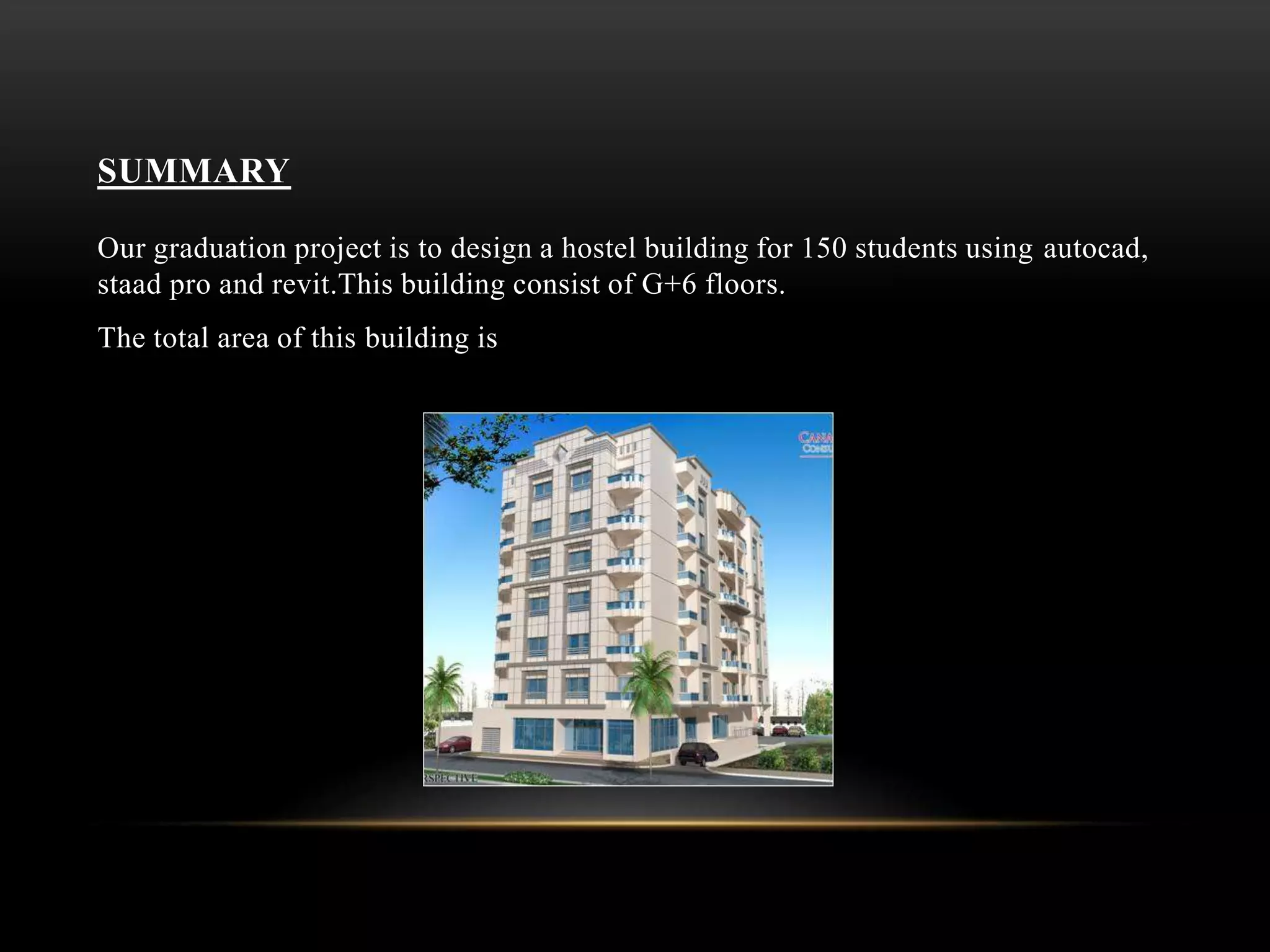
Our graduation project is to design a hostel building for 150 students using autocad,
staad pro and revit.This building consist of G+6 floors.
The total area of this building is
SOFTWARES
WHAT IS AUTO CAD
๏ฑ AutoCAD is a commercial computer-aided design (CAD) and drafting software
application. Developed and marketed by Autodesk, AutoCAD was first released
in December 1982 as a desktop app running on microcomputers with internal
graphics controllers ,AutoCAD was released as a mobile- and web app as well,
marketed as AutoCAD 360.
๏ฑ AutoCAD is used across a wide range of industries, by architects, project
managers, engineers, graphic designers, and many other professionals
WHAT THE STAAD PRO
๏ฑ STAAD or (STAAD.Pro) is a structural analysis and design computer program
originally developed by Research Engineers International at Yorba Linda, CA in
1997. In late 2005, Research Engineers International was bought by Bentley
Systems.
๏ฑ The commercial version, STAAD.Pro, is one of the most widely used structural
analysis and design software products worldwide.It supports several steel,
concrete and timber design codes.
WHAT IS REVIT
๏ฑ Autodesk Revit is building information modeling software for architects,
structural engineers, MEP engineers, designers and contractors developed by
Autodesk. It allows users to design a building and structure and its components in
3D, annotate the model with 2D drafting elements, and access building
information from the building model's database
TYPES OF BUILDINGS
Buildings are divided into:-
๏ฑ 1. Assembly Buildings
๏ฑ 2. Business Buildings
๏ฑ 3. Educational Buildings
๏ฑ 4. Factory Buildings
๏ฑ 5. Hazardous Building
๏ฑ 6. Institutional Buildings
๏ฑ 7. Mercantile Buildings
๏ฑ 8. Residential Buildings
๏ฑ 9. Storage Buildings
๏ฑ 10. Utility & Miscellaneous
GEOMETRIC DETAILS:-
๏ฑ Total area of the building:-
๏ฑ Floor height:-
๏ฑ Height of plinth:-
๏ฑ Depth of foundation:-
MATERIAL DETAILS
๏ฑ Concrete grade:- M25
๏ฑ All steel grade:- Fe500 grade
๏ฑ Types of steel:-HYSD
๏ฑ Bearing capacity of soil:- >180KN/M2
DIFFERENT TYPES OF LOADS ON THE STRUCTURE
๏ฑ Vertical loads on the structure:-
โ€ข Dead load
โ€ข Live load
โ€ข Wind load
โ€ข Snow load
โ€ข Seismic load
๏ฑ Horizontal loads on the structure:-
โ€ข Wind load
โ€ข Seismic load
โ€ข Floor load
DEAD LOADS
Involves self weight of :-
๏ฑ RCC Slabs
๏ฑ Beams and Colums
๏ฑ Plinth
๏ฑ Walls
IMPOSED LOADS
๏ฑ Imposed loads are also known as live loads.
๏ฑ Loads over the floor i.e. Load of persons it is calculated as 1 KN/m2
๏ฑ This load is applied over the length of structure.
WIND LOADS
๏ฑ Wind is air in motion.
๏ฑ Wind loads are calculated according to IS:875(part 3).
๏ฑ Intensity of wind and exposure are applied in the direction as required.
SEISMIC LOADS
The seismic loads on the structure during an earth quake results from inertia forces
which were created by ground acceleration.
The magnitude of these loads is a function of the following factors:-
๏ฑ Mass of the building
๏ฑ The dynamic properties of the building
๏ฑ The intensity
๏ฑ The frequency content of the ground motion
LOAD COMBINATION
๏ฑ The structures should be analysed for combination of loads as in practice we have
numbers of loads in various directions act
๏ฑ Some of the combinations to be checked are:-
๏ฑ 1.5(DL+LL)
๏ฑ 1.5(DL+WL)
๏ฑ 1.5(DL+LL+WL)
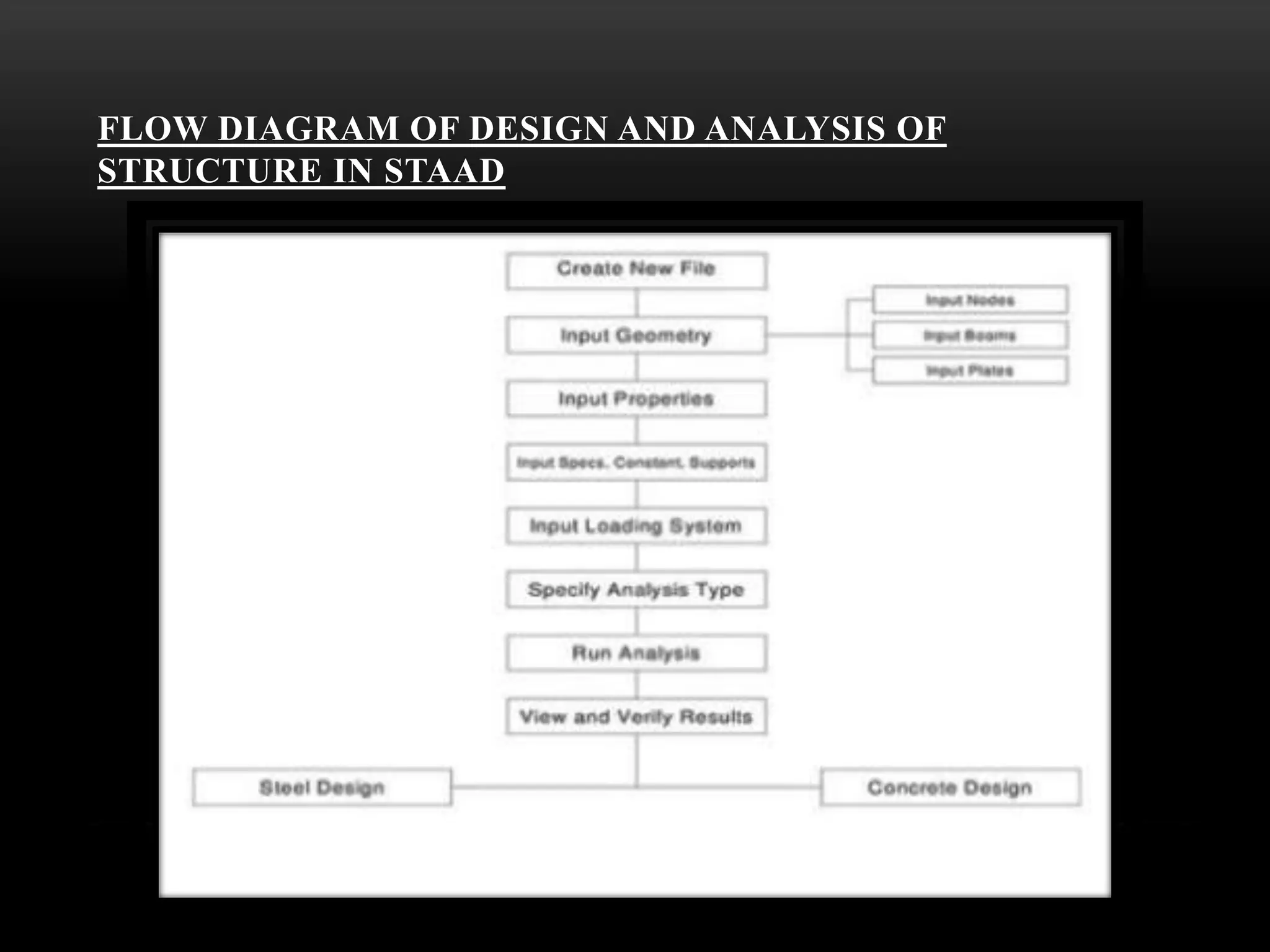
FLOW DIAGRAM OF DESIGN AND ANALYSIS OF
STRUCTURE IN STAAD
CONCLUSION
๏ฑ The design of slab, beam, column, rectangular footing and staircase are done in
limit state method which is safe at control of deflection and in all aspects.
๏ฑ Using staad.pro software, the design consideration has been taken as per the is
codes. The design is safe in all conditions.
๏ฑ On comparison with drawing, manual design and the geometrical model using
staad.pro the area of AST required for the beam, column, footing and slab are
comparatively similar to that of the requirment.
REFRENCES
๏ฑ Structural analysis by S.RAMAMRUTHAM
๏ฑ IS456-2000 CODE used
๏ฑ AUTO CAD & STAAD PRO packages
๏ฑ Design of RCC structures by B.C PUNMIA
A presentation on g+6 building by Staad pro and Autocad

A presentation on g+6 building by Staad pro and Autocad

  • 1.
    Project Guides:- ProjectAssosiate:- Mr. Anil Kumar Chaudhari Sir Abhijeet Patel & Mr. Manish Nigam Sir (Department Of Civil Engineering) A PRESENTATION ON ANALYSIS AND DESIGN OF MULTISTORY BUILDING (G+6) HOSTEL BUILDING WITH SEISMIC LOAD AND WIND LOAD
  • 2.
    OBJECTIVES The Objective ofthe Project are:- ๏ฑ Carrying out a complete analysis and design of the main structural elements of a multi-storey building including slabs, columns, shear walls. ๏ฑ Getting familiar with structural soft wares ( Staad Pro ,AutoCAD). ๏ฑ Getting real life experience with engineering practices. ๏ฑ To study about the seismic load and wind load on the building.
  • 3.
    SUMMARY Our graduation projectis to design a hostel building for 150 students using autocad, staad pro and revit.This building consist of G+6 floors. The total area of this building is
  • 4.
  • 5.
    WHAT IS AUTOCAD ๏ฑ AutoCAD is a commercial computer-aided design (CAD) and drafting software application. Developed and marketed by Autodesk, AutoCAD was first released in December 1982 as a desktop app running on microcomputers with internal graphics controllers ,AutoCAD was released as a mobile- and web app as well, marketed as AutoCAD 360. ๏ฑ AutoCAD is used across a wide range of industries, by architects, project managers, engineers, graphic designers, and many other professionals
  • 6.
    WHAT THE STAADPRO ๏ฑ STAAD or (STAAD.Pro) is a structural analysis and design computer program originally developed by Research Engineers International at Yorba Linda, CA in 1997. In late 2005, Research Engineers International was bought by Bentley Systems. ๏ฑ The commercial version, STAAD.Pro, is one of the most widely used structural analysis and design software products worldwide.It supports several steel, concrete and timber design codes.
  • 7.
    WHAT IS REVIT ๏ฑAutodesk Revit is building information modeling software for architects, structural engineers, MEP engineers, designers and contractors developed by Autodesk. It allows users to design a building and structure and its components in 3D, annotate the model with 2D drafting elements, and access building information from the building model's database
  • 8.
    TYPES OF BUILDINGS Buildingsare divided into:- ๏ฑ 1. Assembly Buildings ๏ฑ 2. Business Buildings ๏ฑ 3. Educational Buildings ๏ฑ 4. Factory Buildings ๏ฑ 5. Hazardous Building ๏ฑ 6. Institutional Buildings ๏ฑ 7. Mercantile Buildings ๏ฑ 8. Residential Buildings ๏ฑ 9. Storage Buildings ๏ฑ 10. Utility & Miscellaneous
  • 9.
    GEOMETRIC DETAILS:- ๏ฑ Totalarea of the building:- ๏ฑ Floor height:- ๏ฑ Height of plinth:- ๏ฑ Depth of foundation:-
  • 10.
    MATERIAL DETAILS ๏ฑ Concretegrade:- M25 ๏ฑ All steel grade:- Fe500 grade ๏ฑ Types of steel:-HYSD ๏ฑ Bearing capacity of soil:- >180KN/M2
  • 11.
    DIFFERENT TYPES OFLOADS ON THE STRUCTURE ๏ฑ Vertical loads on the structure:- โ€ข Dead load โ€ข Live load โ€ข Wind load โ€ข Snow load โ€ข Seismic load ๏ฑ Horizontal loads on the structure:- โ€ข Wind load โ€ข Seismic load โ€ข Floor load
  • 12.
    DEAD LOADS Involves selfweight of :- ๏ฑ RCC Slabs ๏ฑ Beams and Colums ๏ฑ Plinth ๏ฑ Walls
  • 13.
    IMPOSED LOADS ๏ฑ Imposedloads are also known as live loads. ๏ฑ Loads over the floor i.e. Load of persons it is calculated as 1 KN/m2 ๏ฑ This load is applied over the length of structure.
  • 14.
    WIND LOADS ๏ฑ Windis air in motion. ๏ฑ Wind loads are calculated according to IS:875(part 3). ๏ฑ Intensity of wind and exposure are applied in the direction as required.
  • 15.
    SEISMIC LOADS The seismicloads on the structure during an earth quake results from inertia forces which were created by ground acceleration. The magnitude of these loads is a function of the following factors:- ๏ฑ Mass of the building ๏ฑ The dynamic properties of the building ๏ฑ The intensity ๏ฑ The frequency content of the ground motion
  • 16.
    LOAD COMBINATION ๏ฑ Thestructures should be analysed for combination of loads as in practice we have numbers of loads in various directions act ๏ฑ Some of the combinations to be checked are:- ๏ฑ 1.5(DL+LL) ๏ฑ 1.5(DL+WL) ๏ฑ 1.5(DL+LL+WL)
  • 17.
    FLOW DIAGRAM OFDESIGN AND ANALYSIS OF STRUCTURE IN STAAD
  • 18.
    CONCLUSION ๏ฑ The designof slab, beam, column, rectangular footing and staircase are done in limit state method which is safe at control of deflection and in all aspects. ๏ฑ Using staad.pro software, the design consideration has been taken as per the is codes. The design is safe in all conditions. ๏ฑ On comparison with drawing, manual design and the geometrical model using staad.pro the area of AST required for the beam, column, footing and slab are comparatively similar to that of the requirment.
  • 19.
    REFRENCES ๏ฑ Structural analysisby S.RAMAMRUTHAM ๏ฑ IS456-2000 CODE used ๏ฑ AUTO CAD & STAAD PRO packages ๏ฑ Design of RCC structures by B.C PUNMIA