International Research Journal of Engineering and Technology (IRJET) e-ISSN: 2395-0056
Volume: 09 Issue: 10 | Oct 2022 www.irjet.net p-ISSN: 2395-0072
© 2022, IRJET | Impact Factor value: 7.529 | ISO 9001:2008 Certified Journal | Page 819
Response Spectrum and Time History Analysis of a Multistorey
Building
Sk. Hashmath Ali, B. Kesava Rao2
1.M.Tech., Student, Department of Civil Engineering, RVR&JC College of Engineering, Guntur, INDIA
2Assistant Professor, Department of Civil Engineering, RVR&JC College of Engineering, Guntur, INDIA
---------------------------------------------------------------------***---------------------------------------------------------------------
Abstract – The current analysis and design of a building
are weak under adjacent forces due to earthquakes. In
previous studies it has been analyzed that the buildings
under lateral earthquake forces have been failed and some
structures have been collapsed. A G+15 building model is
generated and the design and analysis is done with the
ETABS software as per Indian Standard codes. The response
spectrum and time history analysis has been analyzed and
its structure is designed with ETABS software. The response
spectrum, analysis of time history results and also the
displacements, storey shears and storey stiffness of a
building is generated by using the ETABS software. The
structural elements like columns, beams, shear and slabs
wall have been designed as per the Indian Standard codes.
Key Words: Building Frame, Response Spectrum and
Time History Analysis
1. INTRODUCTION
High-rise structures are chosen as a solution to the land
scarcity caused by the growing population. These kinds of
high-rise structures are vulnerable to natural disasters.
Because they can't be controlled and inflict damage and
mayhem to the structural components, natural disasters
like earthquakes are the most harmful. These natural
disasters disrupted the course of regular lifecycle
development and caused property destruction. Given that
it is a worldwide issue, extensive research must be done,
and the findings must be presented in order to prepare the
framework and meet the deadline. With the development
of technology, man has attempted to resist these natural
disasters in numerous ways, including by creating early
warning systems for disasters, implementing fresh
preventative strategies, and putting in place effective relief
and rescue efforts. But regrettably, not all natural
calamities fall within this category. There are periodic
revisions to the risk maps that identify seismic zones in
seismic codes (IS 1893:2002), which increases the base
shear requirement on existing structures. If the following
factors are taken into account, the risk of a building
collapsing is reduced.
2. METHODOLOGY
The structural analysis modes are categorized into five
classifications they are –
i. Response Spectrum Analysis
ii. Equivalent Static Analysis
iii. Linear Dynamic Analysis
iv. Non-Linear Static Analysis
v. Non-Linear Dynamic Analysis
2.1 EQUIVALENT STATIC ANALYSIS
The analysis performing upon the structure resembling
the impact of seismic activity motions usually defined with
a response spectrum. This one assumes that the structure
reacts around its primary modes and its true that the
construction have to be low-rise in addition to it should
not twist ominously with movements if the ground.
2.2 RESPONSE SPECTRUM ANALYSIS
The method approves the various methods of response
of structure to be procured into analysis and these modes
can also be combination of some special modes. These
techniques for the structure of each mode for which a
response is to be supplied from the design spectrum may
be resolved using computer analysis. Based on modal
mass and modal frequencies, the overall response of the
structure is given and calculated. This allows us to
calculate the forces' magnitudes in all X, Y, Z directions. As
a consequence, Research into the response spectrum that
makes use of ground-motion response spectra will provide
results that vary from those obtained from a
straightforward linear dynamic analysis of ground-motion
data. In cases where the structure is irregular (or) too tall
the response spectrum is approached no longer
appropriate to the complex study.
International Research Journal of Engineering and Technology (IRJET) e-ISSN: 2395-0056
Volume: 09 Issue: 10 | Oct 2022 www.irjet.net p-ISSN: 2395-0072
© 2022, IRJET | Impact Factor value: 7.529 | ISO 9001:2008 Certified Journal | Page 820
2.3 LINEAR DYNAMIC ANALYSIS
The structure is modelled in this study as having many
degrees of freedom, an equal viscous damping ratio and a
linear elastic stiffness matrix. In linear dynamic analysis, a
structure's reaction to earth movement is estimated using
time domain data from the past.
2.4 NON-LINEAR DYNAMIC ANALYSIS
The analysis makes use of the sequences of ground
movement data by a detailed pattern of the structure
hence, it is efficient to generate solutions by comparatively
low uncertainty and in this the non-linear dynamic
analysis the detailed structural representation subjected
to the recorded estimate of ground motion which that each
component deformation to every degree of freedom
within modal. But the analyzed response can remain
extremely subtle to the features of the specific earth
movement used as per seismic input.
2.5 NON-LINEAR STATIC ANALYSIS
In overall, the linear procedure remains appropriate
after the structure is predictable to persist approximately
in elastic form used for the parallel to ground movement
(or) while the design outcomes stay approximately for
equal distribution of non-linear response all over the
structure. This is similarly called as “Pushover Analysis”
where arrangement of forces is useful to the structural
pattern containing non-linear properties. These can be
combined with acceleration-displacement response
spectrum (ADRS) and also it moderates the
problematically to single degree of freedom (SDOF).
Table -1: Structural Data of Reinforced concrete elevated
over head water tank
Height of Building
Height of storey
45m
3m
Beam Size 450mm X 300mm
Column Size 450mm X 300mm
Characteristic
Strength of Concrete
(fck)
35MPa
Thickness of Slab 230mm
3. STRUCTURAL DATA OF REINFORCED
CONCRETE & STEEL ELEVATED OVER HEAD
WATER TANKS
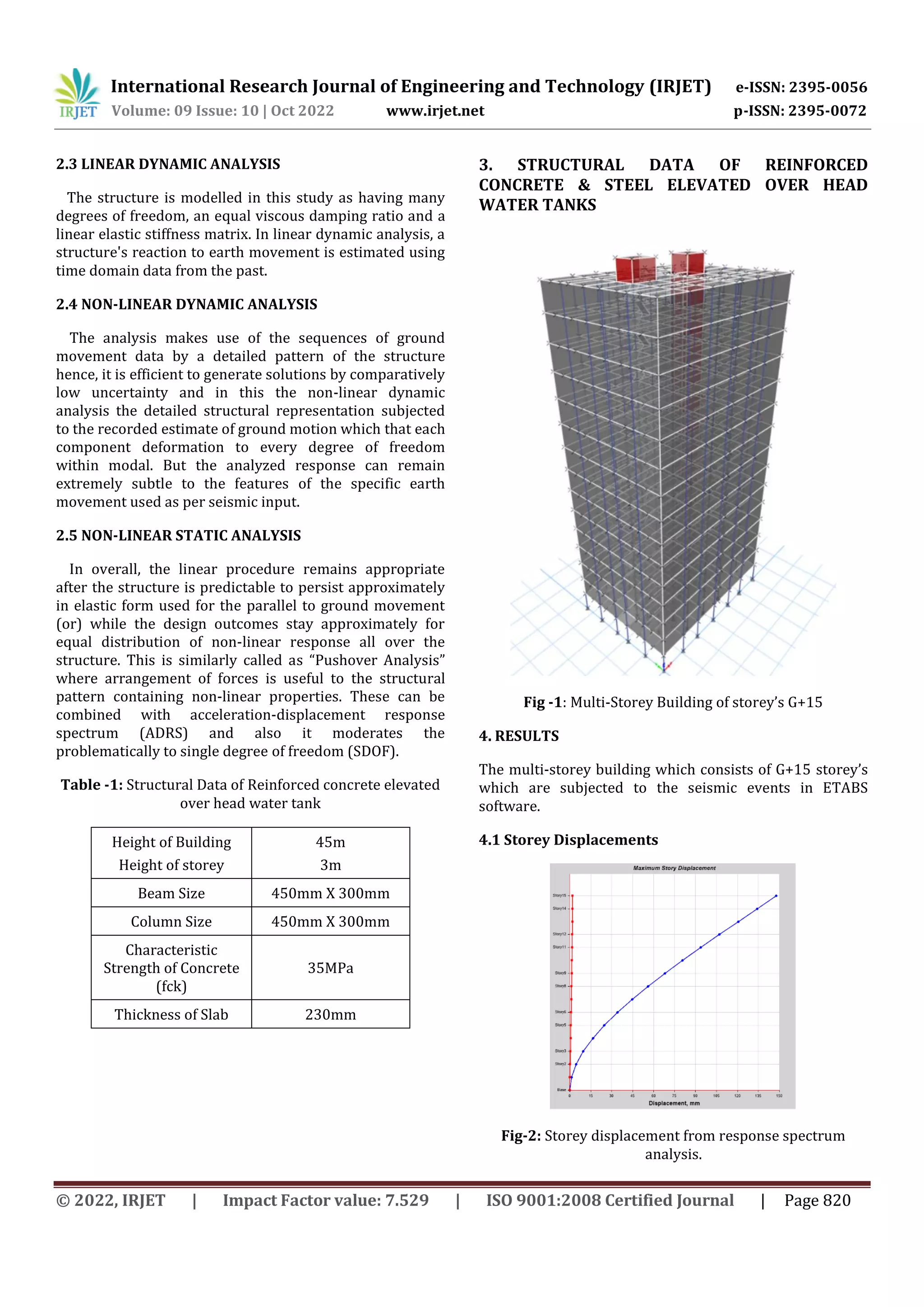
Fig -1: Multi-Storey Building of storey’s G+15
4. RESULTS
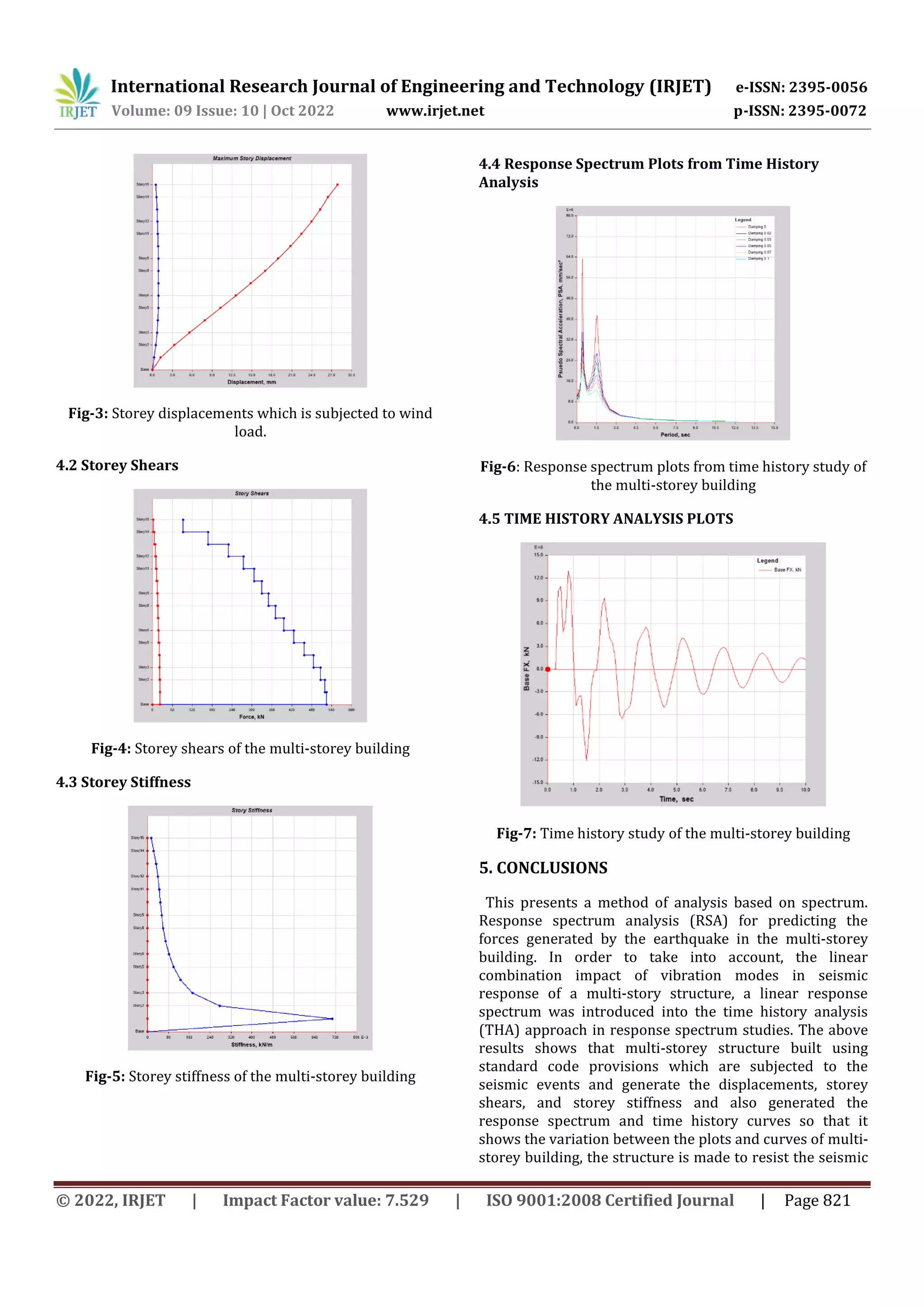
The multi-storey building which consists of G+15 storey’s
which are subjected to the seismic events in ETABS
software.
4.1 Storey Displacements
Fig-2: Storey displacement from response spectrum
analysis.
International Research Journal of Engineering and Technology (IRJET) e-ISSN: 2395-0056
Volume: 09 Issue: 10 | Oct 2022 www.irjet.net p-ISSN: 2395-0072
© 2022, IRJET | Impact Factor value: 7.529 | ISO 9001:2008 Certified Journal | Page 821
Fig-3: Storey displacements which is subjected to wind
load.
4.2 Storey Shears
Fig-4: Storey shears of the multi-storey building
4.3 Storey Stiffness
Fig-5: Storey stiffness of the multi-storey building
4.4 Response Spectrum Plots from Time History
Analysis
Fig-6: Response spectrum plots from time history study of
the multi-storey building
4.5 TIME HISTORY ANALYSIS PLOTS
Fig-7: Time history study of the multi-storey building
5. CONCLUSIONS
This presents a method of analysis based on spectrum.
Response spectrum analysis (RSA) for predicting the
forces generated by the earthquake in the multi-storey
building. In order to take into account, the linear
combination impact of vibration modes in seismic
response of a multi-story structure, a linear response
spectrum was introduced into the time history analysis
(THA) approach in response spectrum studies. The above
results shows that multi-storey structure built using
standard code provisions which are subjected to the
seismic events and generate the displacements, storey
shears, and storey stiffness and also generated the
response spectrum and time history curves so that it
shows the variation between the plots and curves of multi-
storey building, the structure is made to resist the seismic
International Research Journal of Engineering and Technology (IRJET) e-ISSN: 2395-0056
Volume: 09 Issue: 10 | Oct 2022 www.irjet.net p-ISSN: 2395-0072
© 2022, IRJET | Impact Factor value: 7.529 | ISO 9001:2008 Certified Journal | Page 822
induced forces from previous records and also resist the
lateral loads which are done using the ETABS software.
REFERENCES
[1] IS 1893 (part 1): (2002), “Criteria for Earthquake
Resistant Design of Structures Part General Provisions and
Buildings”, Bureau of Indian Standards.
[2] CSI Computers and Structures INC. “Introductory
Tutorial for ETABS: Linear and Nonlinear Static and
Dynamic Analysis and Design of Three-Dimensional
Structures” 2011.
[3] B.C. Punmia, A.K. Jain, 2006, R.C.C Designs”, Laxmi
Publications New Delhi.
[4] IS-456 2000 plain and reinforced concrete code of
practice.
[5] P.Agarwal, M.Shrinkhande, earthquake resistance
design of structures, PHI learning Pvt. 2012.
[6] Pardeshi Sameer, Prof. N. G. Gore (2016), “Study of
seismic analysis and design of multi storey symmetrical
and asymmetrical building “Volume: 03 Issue: 01.
[7] Ali Kadhim Sallal (2018) “Design and analysis ten
storied building using ETABS software-2016” Volume 4;
Issue 2; May 2018; Page No. 21-27
[8] Pushkar Rathod, Rahul Chandrashekar “seismic
analysis of multistoried building for different plans using
ETABS 2015” Volume: 04 Issue: 10 | Oct -2017
[9] S. Vijaya Bhaskar Reddy, Jagath Chandra. P, Srinivas
Vasam, P Srinivasa Rao “Analysis Of Multistoried
Structures Using ETABS” Vol. 3, Issue 1, pp: (151-158),
Month: April 2015 - September 2015,

Response Spectrum and Time History Analysis of a Multistorey Building

  • 1.
    International Research Journalof Engineering and Technology (IRJET) e-ISSN: 2395-0056 Volume: 09 Issue: 10 | Oct 2022 www.irjet.net p-ISSN: 2395-0072 © 2022, IRJET | Impact Factor value: 7.529 | ISO 9001:2008 Certified Journal | Page 819 Response Spectrum and Time History Analysis of a Multistorey Building Sk. Hashmath Ali, B. Kesava Rao2 1.M.Tech., Student, Department of Civil Engineering, RVR&JC College of Engineering, Guntur, INDIA 2Assistant Professor, Department of Civil Engineering, RVR&JC College of Engineering, Guntur, INDIA ---------------------------------------------------------------------***--------------------------------------------------------------------- Abstract – The current analysis and design of a building are weak under adjacent forces due to earthquakes. In previous studies it has been analyzed that the buildings under lateral earthquake forces have been failed and some structures have been collapsed. A G+15 building model is generated and the design and analysis is done with the ETABS software as per Indian Standard codes. The response spectrum and time history analysis has been analyzed and its structure is designed with ETABS software. The response spectrum, analysis of time history results and also the displacements, storey shears and storey stiffness of a building is generated by using the ETABS software. The structural elements like columns, beams, shear and slabs wall have been designed as per the Indian Standard codes. Key Words: Building Frame, Response Spectrum and Time History Analysis 1. INTRODUCTION High-rise structures are chosen as a solution to the land scarcity caused by the growing population. These kinds of high-rise structures are vulnerable to natural disasters. Because they can't be controlled and inflict damage and mayhem to the structural components, natural disasters like earthquakes are the most harmful. These natural disasters disrupted the course of regular lifecycle development and caused property destruction. Given that it is a worldwide issue, extensive research must be done, and the findings must be presented in order to prepare the framework and meet the deadline. With the development of technology, man has attempted to resist these natural disasters in numerous ways, including by creating early warning systems for disasters, implementing fresh preventative strategies, and putting in place effective relief and rescue efforts. But regrettably, not all natural calamities fall within this category. There are periodic revisions to the risk maps that identify seismic zones in seismic codes (IS 1893:2002), which increases the base shear requirement on existing structures. If the following factors are taken into account, the risk of a building collapsing is reduced. 2. METHODOLOGY The structural analysis modes are categorized into five classifications they are – i. Response Spectrum Analysis ii. Equivalent Static Analysis iii. Linear Dynamic Analysis iv. Non-Linear Static Analysis v. Non-Linear Dynamic Analysis 2.1 EQUIVALENT STATIC ANALYSIS The analysis performing upon the structure resembling the impact of seismic activity motions usually defined with a response spectrum. This one assumes that the structure reacts around its primary modes and its true that the construction have to be low-rise in addition to it should not twist ominously with movements if the ground. 2.2 RESPONSE SPECTRUM ANALYSIS The method approves the various methods of response of structure to be procured into analysis and these modes can also be combination of some special modes. These techniques for the structure of each mode for which a response is to be supplied from the design spectrum may be resolved using computer analysis. Based on modal mass and modal frequencies, the overall response of the structure is given and calculated. This allows us to calculate the forces' magnitudes in all X, Y, Z directions. As a consequence, Research into the response spectrum that makes use of ground-motion response spectra will provide results that vary from those obtained from a straightforward linear dynamic analysis of ground-motion data. In cases where the structure is irregular (or) too tall the response spectrum is approached no longer appropriate to the complex study.
  • 2.
    International Research Journalof Engineering and Technology (IRJET) e-ISSN: 2395-0056 Volume: 09 Issue: 10 | Oct 2022 www.irjet.net p-ISSN: 2395-0072 © 2022, IRJET | Impact Factor value: 7.529 | ISO 9001:2008 Certified Journal | Page 820 2.3 LINEAR DYNAMIC ANALYSIS The structure is modelled in this study as having many degrees of freedom, an equal viscous damping ratio and a linear elastic stiffness matrix. In linear dynamic analysis, a structure's reaction to earth movement is estimated using time domain data from the past. 2.4 NON-LINEAR DYNAMIC ANALYSIS The analysis makes use of the sequences of ground movement data by a detailed pattern of the structure hence, it is efficient to generate solutions by comparatively low uncertainty and in this the non-linear dynamic analysis the detailed structural representation subjected to the recorded estimate of ground motion which that each component deformation to every degree of freedom within modal. But the analyzed response can remain extremely subtle to the features of the specific earth movement used as per seismic input. 2.5 NON-LINEAR STATIC ANALYSIS In overall, the linear procedure remains appropriate after the structure is predictable to persist approximately in elastic form used for the parallel to ground movement (or) while the design outcomes stay approximately for equal distribution of non-linear response all over the structure. This is similarly called as “Pushover Analysis” where arrangement of forces is useful to the structural pattern containing non-linear properties. These can be combined with acceleration-displacement response spectrum (ADRS) and also it moderates the problematically to single degree of freedom (SDOF). Table -1: Structural Data of Reinforced concrete elevated over head water tank Height of Building Height of storey 45m 3m Beam Size 450mm X 300mm Column Size 450mm X 300mm Characteristic Strength of Concrete (fck) 35MPa Thickness of Slab 230mm 3. STRUCTURAL DATA OF REINFORCED CONCRETE & STEEL ELEVATED OVER HEAD WATER TANKS Fig -1: Multi-Storey Building of storey’s G+15 4. RESULTS The multi-storey building which consists of G+15 storey’s which are subjected to the seismic events in ETABS software. 4.1 Storey Displacements Fig-2: Storey displacement from response spectrum analysis.
  • 3.
    International Research Journalof Engineering and Technology (IRJET) e-ISSN: 2395-0056 Volume: 09 Issue: 10 | Oct 2022 www.irjet.net p-ISSN: 2395-0072 © 2022, IRJET | Impact Factor value: 7.529 | ISO 9001:2008 Certified Journal | Page 821 Fig-3: Storey displacements which is subjected to wind load. 4.2 Storey Shears Fig-4: Storey shears of the multi-storey building 4.3 Storey Stiffness Fig-5: Storey stiffness of the multi-storey building 4.4 Response Spectrum Plots from Time History Analysis Fig-6: Response spectrum plots from time history study of the multi-storey building 4.5 TIME HISTORY ANALYSIS PLOTS Fig-7: Time history study of the multi-storey building 5. CONCLUSIONS This presents a method of analysis based on spectrum. Response spectrum analysis (RSA) for predicting the forces generated by the earthquake in the multi-storey building. In order to take into account, the linear combination impact of vibration modes in seismic response of a multi-story structure, a linear response spectrum was introduced into the time history analysis (THA) approach in response spectrum studies. The above results shows that multi-storey structure built using standard code provisions which are subjected to the seismic events and generate the displacements, storey shears, and storey stiffness and also generated the response spectrum and time history curves so that it shows the variation between the plots and curves of multi- storey building, the structure is made to resist the seismic
  • 4.
    International Research Journalof Engineering and Technology (IRJET) e-ISSN: 2395-0056 Volume: 09 Issue: 10 | Oct 2022 www.irjet.net p-ISSN: 2395-0072 © 2022, IRJET | Impact Factor value: 7.529 | ISO 9001:2008 Certified Journal | Page 822 induced forces from previous records and also resist the lateral loads which are done using the ETABS software. REFERENCES [1] IS 1893 (part 1): (2002), “Criteria for Earthquake Resistant Design of Structures Part General Provisions and Buildings”, Bureau of Indian Standards. [2] CSI Computers and Structures INC. “Introductory Tutorial for ETABS: Linear and Nonlinear Static and Dynamic Analysis and Design of Three-Dimensional Structures” 2011. [3] B.C. Punmia, A.K. Jain, 2006, R.C.C Designs”, Laxmi Publications New Delhi. [4] IS-456 2000 plain and reinforced concrete code of practice. [5] P.Agarwal, M.Shrinkhande, earthquake resistance design of structures, PHI learning Pvt. 2012. [6] Pardeshi Sameer, Prof. N. G. Gore (2016), “Study of seismic analysis and design of multi storey symmetrical and asymmetrical building “Volume: 03 Issue: 01. [7] Ali Kadhim Sallal (2018) “Design and analysis ten storied building using ETABS software-2016” Volume 4; Issue 2; May 2018; Page No. 21-27 [8] Pushkar Rathod, Rahul Chandrashekar “seismic analysis of multistoried building for different plans using ETABS 2015” Volume: 04 Issue: 10 | Oct -2017 [9] S. Vijaya Bhaskar Reddy, Jagath Chandra. P, Srinivas Vasam, P Srinivasa Rao “Analysis Of Multistoried Structures Using ETABS” Vol. 3, Issue 1, pp: (151-158), Month: April 2015 - September 2015,