International Research Journal of Engineering and Technology (IRJET) e-ISSN: 2395-0056
Volume: 06 Issue: 11 | Nov 2019 www.irjet.net p-ISSN: 2395-0072
© 2019, IRJET | Impact Factor value: 7.34 | ISO 9001:2008 Certified Journal | Page 2315
SeismicAnalysisandComparativeStudyofRegularandIrregular Building
usingETABS
Himanshu Rajput
1
, Dr. Rakesh Patel
2
, Prof. Gaurav Tiwari I
3
1
Himanshu Rajput, M.Tech. Scholar Civil Engg. Dept. SIRTS, RGPV UNIVERSITY, BHOPAL,
2
Dr. Rakesh Patel, Professor Civil Engg. Dept. SIRTS, RGPV UNIVERSITY, BHOPAL,
3
Prof.Gaurav Tiwari, Assistant Professor Civil Engg. Dept. SIRTS, RGPV UNIVERSITY, BHOPAL
----------------------------------------------------------------------------------***----------------------------------------------------------------------------------
Abstract - The current version of the IS: 1893-2016 requires that practically all multi storied buildings be analyzed as three
dimensional systems. Buildings may be considered as Regular and Irregular on plain suraface, in mass and stiffness along storey of the
buildings. Most of the hilly regions of India are highly seismic. Inthis study, 3D analytical model of G+15storied buildings have been
generated for Regular and Irregular building models and analyzed using structural analysis tool ETABS software . Mass and stiffness aretwo
basic parameters toevaluate the Static analysis of a structural system. Multi storied buildings are behaved differently depending upon
the various parameters like mass stiffness distribution, foundation types and soil conditions. In 2001 Bhuj earthquake in Gujrat,
India demonstrated the damage and collapse of the buildings due to the irregularities in structural stiffness and floor mass. This
Project is concerned with the effects of various vertical irregularities on the seismic response of a structure. The objective of the
project is to carry out Regular and Irregular RC building frames by Dynamic Analysis Method.
Comparison of the results of analysis of irregular structures with regular structure is done.
Key Words: Irregular and Asymmetric structures; Dynamic analysis, Storey Deflection, StoreyShear, Stiffness
1.INTRODUCTION
A Regular Building is structure which performs against the earthquake. This structure must possess the simple, regular
configuration, minimum lateral strength and also stiffness of the structure. Setback buildings are a subset of vertically
irregular buildings where there are discontinuities with respect to geometry. The process to determine the response or
behaviorofastructure undersome specifiedloadsorcombinationsofloadsisknownas structural analysis
Irregularities are not avoidable in construction of Buildings. However, the behavior of structures with these irregularities
during earthquake needs to be studied. By taking adequate precautions, the main objective of Earthquake Engineering is to
design and build a structure in such a way that the damage to the structure and its structural components during an
earthquake is minimized. Constructions can suffer diverse damages when they are put under seismic excitations. Although
for a same structural configuration, region & earthquake,damages in the system are neither equal nor homogenous. So, there
areseveral factorsfortheselike–Structuralsystem, Earthquake characteristics, the quality of construction, soil of location and
its maintenance that define the seismic behavior of the structure. However, with the experiences in past and recent
earthquakes, most of the damages are related to architectural and structural configuration in plan and elevation and site ground
effects. Irregular buildings constitute a large portion of the modern urban infrastructure. Adequate precautions need to be
taken. A detailed study of structural behavior of the buildings with irregularities is essential for design and behavior in
earthquake. Therefore, the structural engineer needs to have a thorough understanding of the seismic response of irregular
structures.Several related studies have focused on evaluating the response of ‘RegularStructures”.
A Irregular structure that has difference between center of mass and center of resistance. Technically all the structures are
irregular. There are various types of irregularities in the buildings depending upon their location and scope, but mainly:
They are divided into two groups:
A) Planirregularities
B) Verticalirregularities
Elements,loads,material properties, and support Analysis of a structure involves its study from the viewpoint of its strength
stiffness, stability, and vibration and response of all elements.
International Research Journal of Engineering and Technology (IRJET) e-ISSN: 2395-0056
Volume: 06 Issue: 11 | Nov 2019 www.irjet.net p-ISSN: 2395-0072
© 2019, IRJET | Impact Factor value: 7.34 | ISO 9001:2008 Certified Journal | Page 2316
Objectives
The Main objective is Elements are designed by using software ETABS. And consider seismic load. For load combination
use code IS 1893:2016. Regular and Irregular building is compared. The designing has been carried out in ETABS software
1. To perform a comparative study of the various seismic parameters of different types of reinforced concrete
moment resisting frames (MRF), configuration, and types of irregularity.
2. To analyse the implementation of SRSS Method intall structure usingETABS.
3. Comparison between regular and irregular frameonthebasis of shear force, storey drift & node displacementetc.
4. To study the change in different seismic response parameters along the increasing height and increasing bays.
5. To proposethe best suitable building configuration on the existing condition.
6. ToachievebetterstrengthinResponseSpectrum method.
LITRATURE REVIEW:
Pardeshi Sameer et.al (2016) : Basically They adopted 4 types of models Regular, L-Shape, T shape, Plus Shape and they
analyse the Structure on the Method of Time History Analysis They found results that Plan configuration has Good
Response in Seismic Analysis, Shear force was found to be max.at first Storey. Where as the Displacement will be observed
largeinTShape.
Tushar Saxena et.al(2018): The foremost objective of the present work is to analyze the behavior of the structures and to
adopt the methodology to minimize the damages caused by while is result is in form of comparison and the base shear
value is more in the regular configuration. Because of the structure have more symmetrical dimensions. Story drift value is
more in the story 13 in the regular configuration
Prof. VedanteePrasadShuklaet.al(2018) This Topic Based on Design of Irregular Building &Regular building at Different
Earthquake Zone where as Slope is Greater than 3 Degree in the Which Regular and Irregular Building are Being Provided
with Or without Shear wall, the Analysis is Performed By the Response Spectrum Method, Results in the form of storey
displacement, storey drift, base shear and time period. Time period of the regular building is more than irregular. Seismic
activities. They adopted Push over analysis method. While in the Results Comparison of base shear & Roof displacement can
be seen, Base Shear for RegularStructureismorethanthatofIrregular Structure
Mr. S.Mahesh et.al (2014) : Comparison of analysis and design of regular and irregular configuration of multi-Story
building in various seismic zones using STADD PRO, They were followed by Time History Analysis Method, They adopted
seismic Zone 4found Drift is weak in Regular building.
Dr.S.K.Dubey&P.D.Sangamnerkar(2015)
[1] “Seismic behavior of Asymmetric R.C. buildings”, they had modeled & analyzed a five storeyframed structure using
STAADPRO. The building is assumed as commercial complex. Geometry of building is ‘T’ in shape consisting of open ground
storey parking. They analyzed for ZoneIV
Abhay Guleria (2016) [4]: Presented the analysisofmultistoryRCCbuildingfordifferent planconfiguration.Theanalysishas
performed for the earthquake loads. The specification of lateral loads has been taken from IS 1893 (Part 1)2002. The
modelingandanalysishasdoneby usingfiniteelementbasedsoftwareETABSIn addition, this study suggests that Lshape and
Ishapestructuregivesalmostsimilarresponse against overturning moment, story drift, and Story displacement.
Sanhik Kar Majumder and Priyabrata Guha(2015) [3]: Presented the comparison between wind and seismic load on
different types of structures. In this study, the effect of wind and seismic both will be considered and compared them
according to IS 875(Part 3)1987 and IS 1893(Part 1)2002 considering site with medium soil. They concluded that the
proposed buildings with irregularities are more prone to earthquake damage & torsion is the most critical factor leading to
major damage or complete collapse of building.
MagliuloG.,MaddaloniG.&PetroneC[5] (2017):“InfluenceofEarthquakedirectionon the Seismic Response of Irregular Plan
R.C. Framebuildings”,theyused threemulti storey R.C.building,representing a very common structural topology
in Italy for the evaluation. They are respectively a Rectangular Plan Shape, L-Plan Shape & a Rectangular Plan Shape with
Courtyardbuilding.Theresultthemodelingand analysis of (G+5) structures are done by using STAAD Pro.
International Research Journal of Engineering and Technology (IRJET) e-ISSN: 2395-0056
Volume: 06 Issue: 11 | Nov 2019 www.irjet.net p-ISSN: 2395-0072
© 2019, IRJET | Impact Factor value: 7.34 | ISO 9001:2008 Certified Journal | Page 2317
Dr.B.G.NareshKumar1,AvinashGornale2 and Abdullah Mubashir3 Presented (2018): “Seismic PerformanceEvaluationofRC
Framed Buildings an Approach to Torsionally Asymmetric Buildings”. In in this paper the effort is made to study the effect
eccentricity between centre of mass (CM) and centre of stiffness (CR) and the effect of stiffness of infill walls on the
performance o f the buildings. The performance of the buildings isassessed.
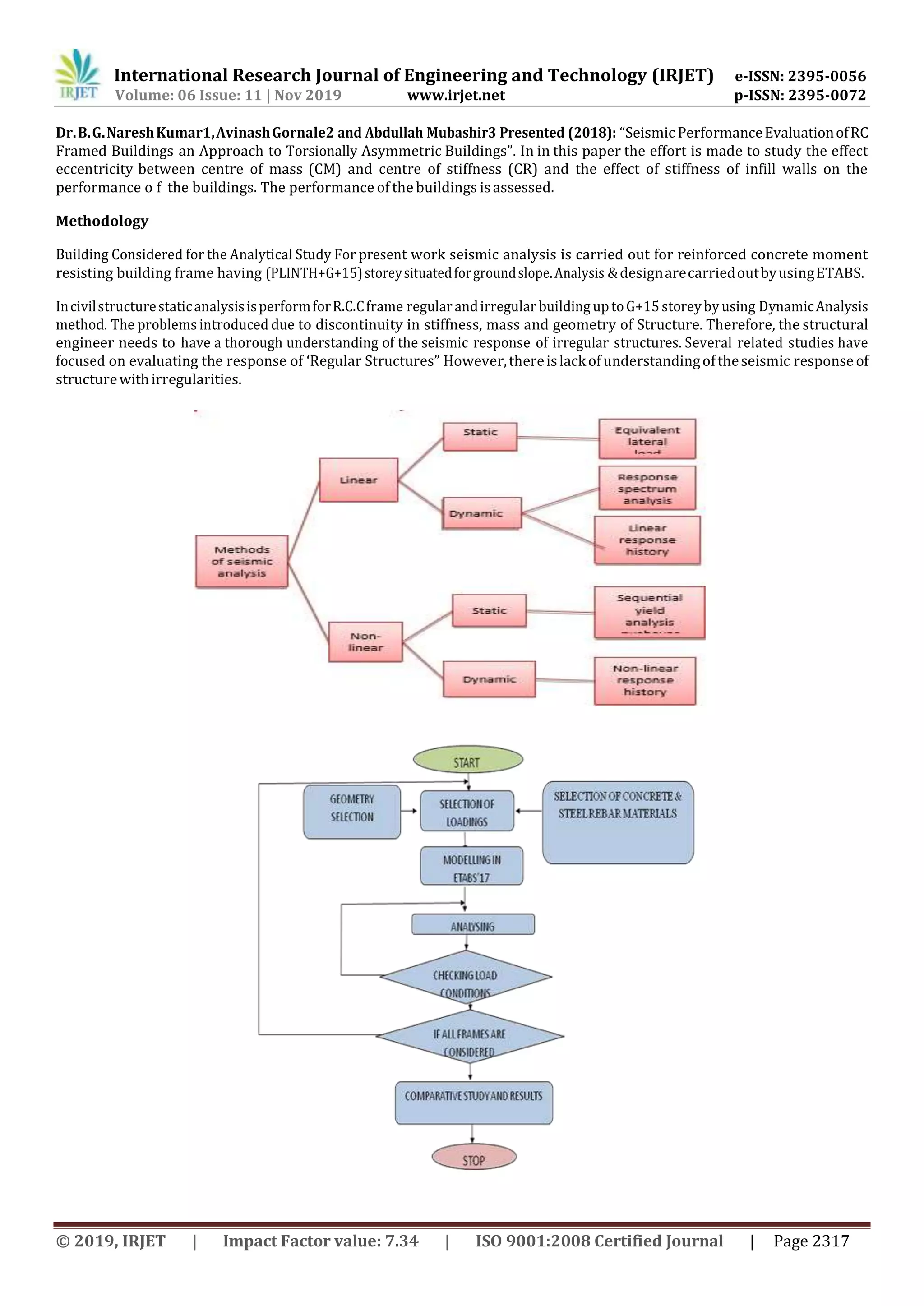
Methodology
Building Considered for the Analytical Study For present work seismic analysis is carried out for reinforced concrete moment
resisting building frame having (PLINTH+G+15)storeysituatedforgroundslope.Analysis &designarecarriedoutbyusingETABS.
IncivilstructurestaticanalysisisperformforR.C.Cframe regularandirregular building uptoG+15storeyby using DynamicAnalysis
method. The problems introduced due to discontinuity in stiffness, mass and geometry of Structure. Therefore, the structural
engineer needs to have a thorough understanding of the seismic response of irregular structures. Several related studies have
focused on evaluating the response of ‘Regular Structures” However,thereislackofunderstandingoftheseismic responseof
structurewithirregularities.
International Research Journal of Engineering and Technology (IRJET) e-ISSN: 2395-0056
Volume: 06 Issue: 11 | Nov 2019 www.irjet.net p-ISSN: 2395-0072
© 2019, IRJET | Impact Factor value: 7.34 | ISO 9001:2008 Certified Journal | Page 2318
Table No.05: MODELLING & PROBLEM FORMULATION
S.NO Description Value
1. Area 16 X 20 m
2. Number of bays in X-
direction
4
3. Number of bays in Y
direction
5
4. Overall height 45m
5. Seismic zone V
6. WALLS RED BRICK
7. SUPPORT TYPE FIXED SUPPORT
PARAMETERS FOR REGULAR AND IRREGULAR STRUCTURE:
S.NO DESCRIPTION SIZES
1. Type of Structure Framed
2. Type of Building Residential
3. Number of storey 16(G + 15)
4. Height of storey 3 m
5. Cross section of beams 300x500mm
6. Cross section of columns 500x500mm
7. Slab Thickness 150mm
8. Grade of concrete M25
9. Grade of steel Fe 500
10. Dead Load 1 factor
Table no.3 Loadings….
S.NO LOAD PARAMETERS DESCRIPTION
1. DEAD LOAD 1). WALLLOAD-
5KN/M2
2). SLABLOAD
4.8KN/M2
2. LIVE LOAD 2 KN/M2
3. SEISMIC LOAD AS PER IS 1893-
2012
4. SEISMIC ZONE V
5. SITE LOCATION VERY SEVERE
6. IMPORTANCE FACTOR 1.2
7. SOIL PROPERTY HARD SOIL
International Research Journal of Engineering and Technology (IRJET) e-ISSN: 2395-0056
Volume: 06 Issue: 11 | Nov 2019 www.irjet.net p-ISSN: 2395-0072
© 2019, IRJET | Impact Factor value: 7.34 | ISO 9001:2008 Certified Journal | Page 2319
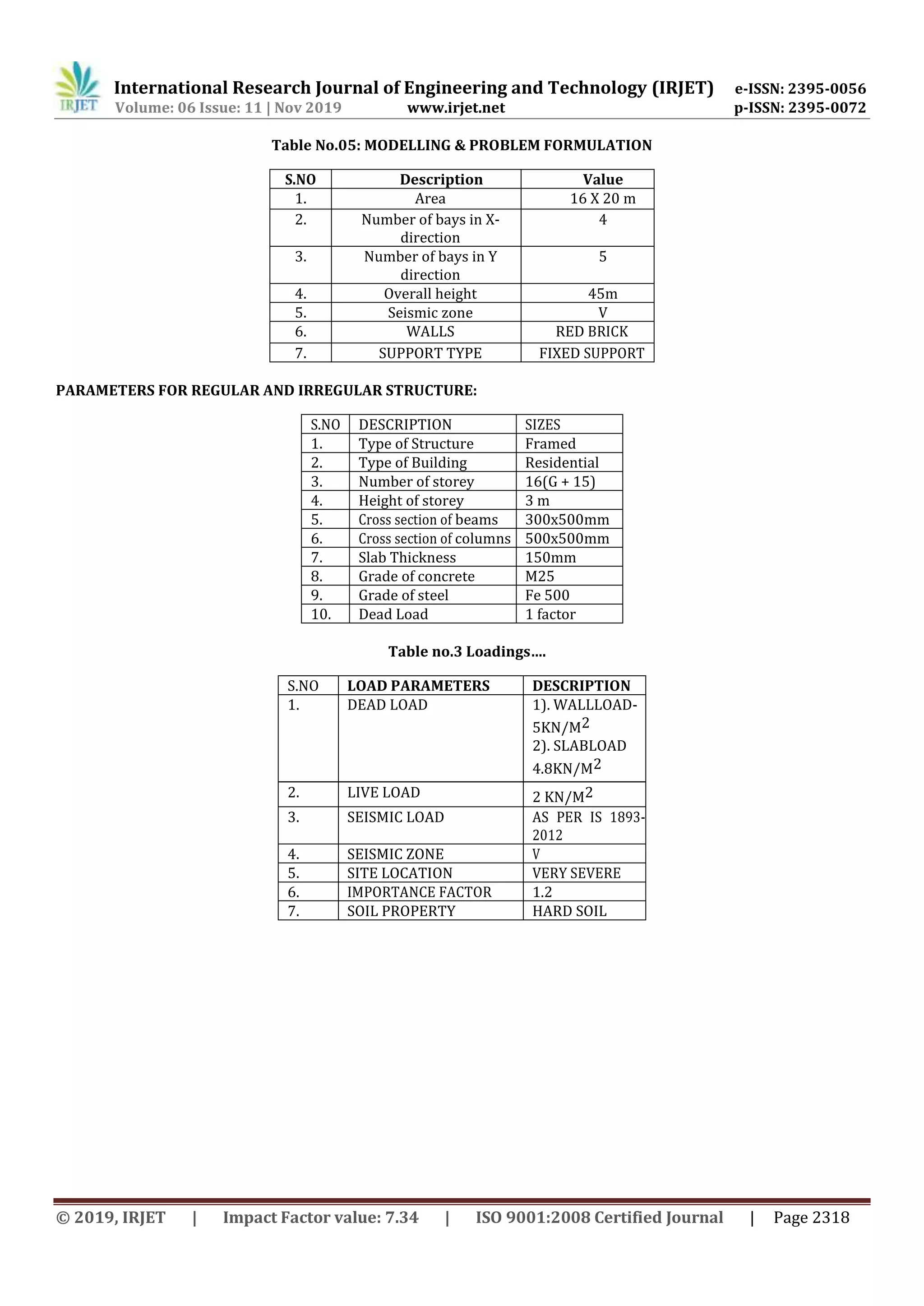
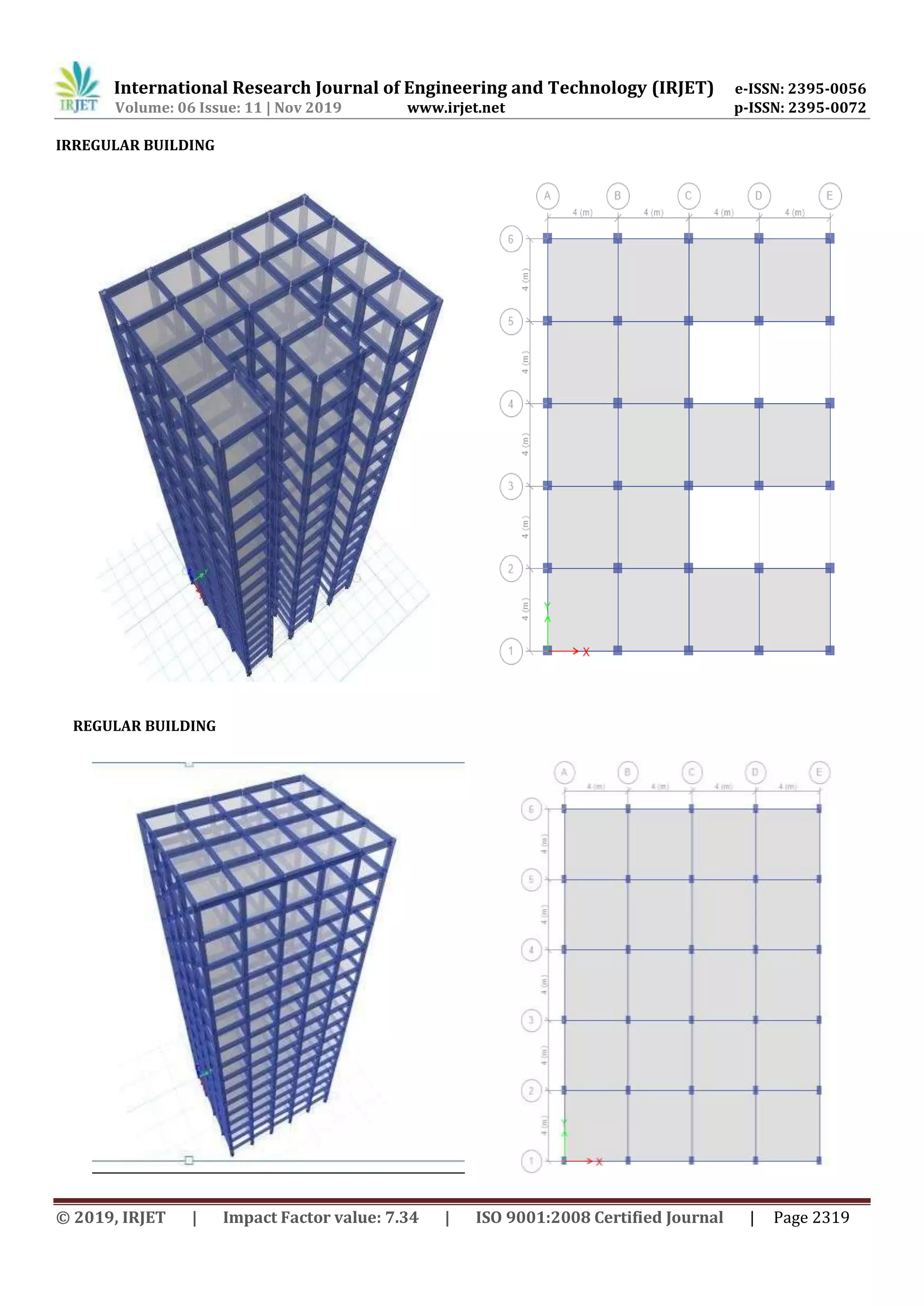
IRREGULAR BUILDING
REGULAR BUILDING
International Research Journal of Engineering and Technology (IRJET) e-ISSN: 2395-0056
Volume: 06 Issue: 11 | Nov 2019 www.irjet.net p-ISSN: 2395-0072
© 2019, IRJET | Impact Factor value: 7.34 | ISO 9001:2008 Certified Journal | Page 2320
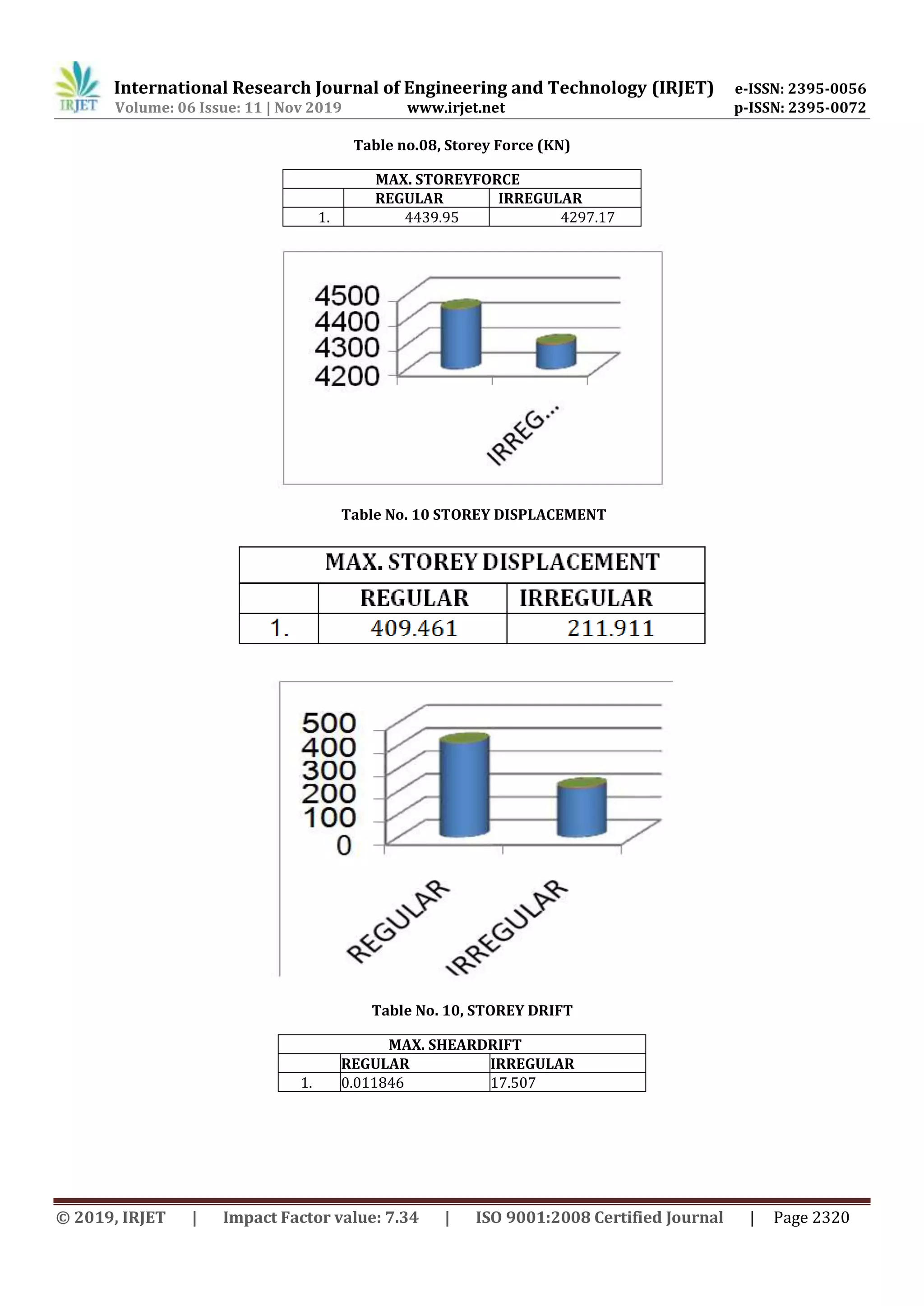
Table no.08, Storey Force (KN)
MAX. STOREYFORCE
REGULAR IRREGULAR
1. 4439.95 4297.17
Table No. 10 STOREY DISPLACEMENT
Table No. 10, STOREY DRIFT
MAX. SHEARDRIFT
REGULAR IRREGULAR
1. 0.011846 17.507
International Research Journal of Engineering and Technology (IRJET) e-ISSN: 2395-0056
Volume: 06 Issue: 11 | Nov 2019 www.irjet.net p-ISSN: 2395-0072
© 2019, IRJET | Impact Factor value: 7.34 | ISO 9001:2008 Certified Journal | Page 2321
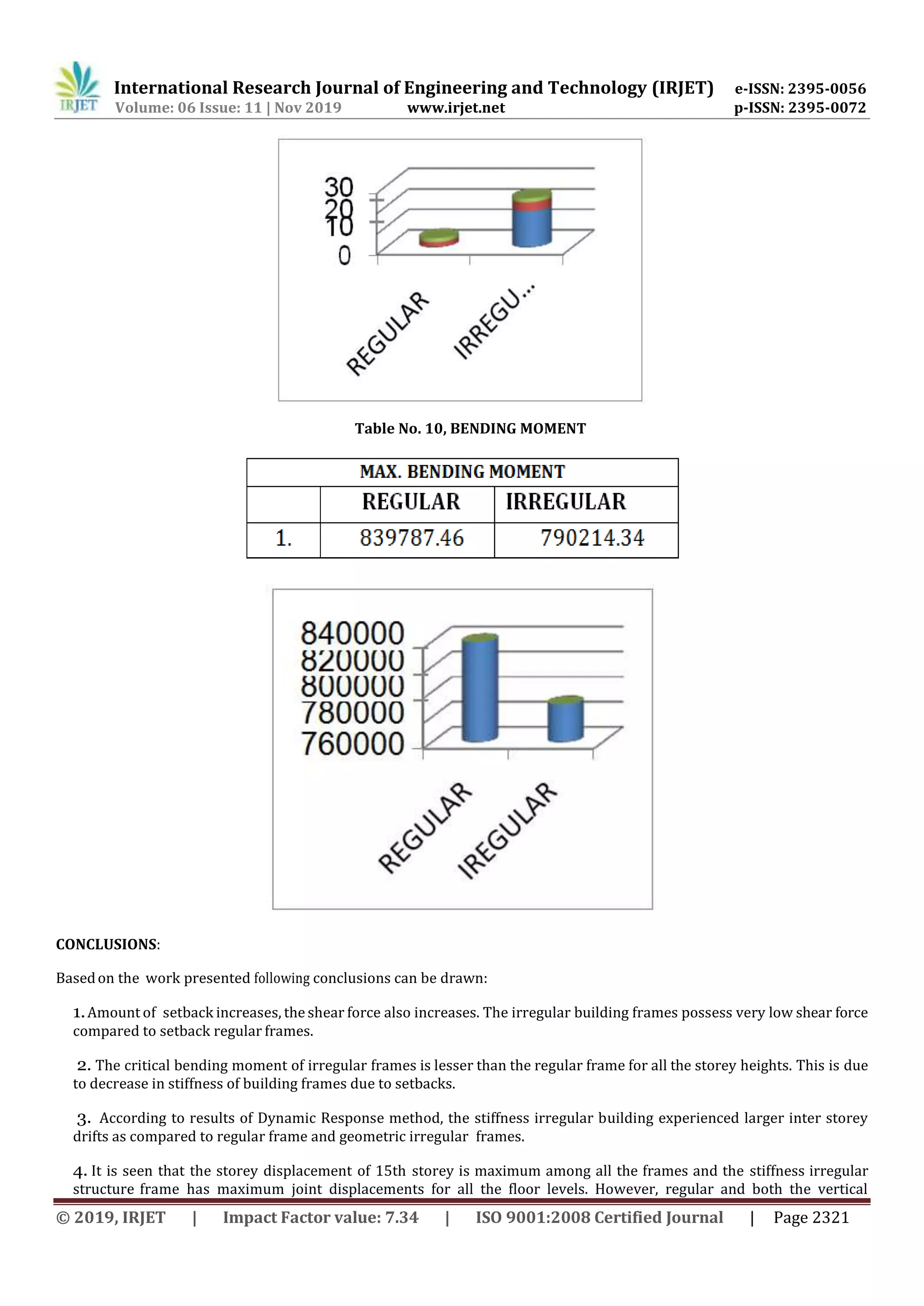
Table No. 10, BENDING MOMENT
CONCLUSIONS:
Basedon the work presented following conclusions can be drawn:
1.Amount of setback increases, the shear force also increases. The irregular building frames possess very low shear force
compared to setback regular frames.
2. The critical bending moment of irregular frames is lesser than the regular frame for all the storey heights. This is due
to decrease in stiffness of building frames due to setbacks.
3. According to results of Dynamic Response method, the stiffness irregular building experienced larger inter storey
drifts as compared to regular frame and geometric irregular frames.
4. It is seen that the storey displacement of 15th storey is maximum among all the frames and the stiffness irregular
structure frame has maximum joint displacements for all the floor levels. However, regular and both the vertical
International Research Journal of Engineering and Technology (IRJET) e-ISSN: 2395-0056
Volume: 06 Issue: 11 | Nov 2019 www.irjet.net p-ISSN: 2395-0072
© 2019, IRJET | Impact Factor value: 7.34 | ISO 9001:2008 Certified Journal | Page 2322
geometric frames have almost variant joint displacement
5. The seismic performance of regular frame is found to be better than corresponding irregular frames in nearly all the
cases.
Thereforeit should beconstructed tominimize theseismic effects. Among setback frames,the geometric irregular frame 1
building having setback at 3rd floor configuration is found superior than others.
REFERENCES:
[1].“Comparative Study of the Static and Dynamic Analysis of MultiStorey Irregular Building” Bahador Bagheri, Ehsan
Salimi Firoozabad, and Mohammadreza Yahyaei [2]. Static and Dynamic Behaviour of Reinforced Concrete Framed
Building: A Comparative Study [3]. Prakash Sangamnerkar*, Dr. S. K. Dubey
[2]. Professor, Deptt. Of Civil Engineering, Maulana Azad National Institute of Technology, Bhopal (M.P.) 462051 [6].
Response Analysis of Multistory RC Buildings under Equivalent StaticandDynamicLoadsAccording to Egyptian Code
Sayed Mahmoud1, Waleed Abdallah2
[3]. N. Lakshmanan, K. Muthumani, G. V. RamaRao,N.Gopal krishnan and G. R. Reddy (2007), "Verification of Pushover
Analysis Method With Static Load Testing", International Workshop on Earthquake Hazards and Mitigation, Guwahati,
India, 78 December2007.
[4] . Pardeshi S, N. G. Gore, “Study of seismic analysis and design of multi storey symmetricaland asymmetrical
building”, International Research Journal of Engineering and Technology, Volume03, Issue01, pp.732737, January 2016.
[5].Kumar P, A. Naresh, M. Nagajyothi, M. Rajasekhar, “Earthquake Analysis of Multi Storied Residential Building”,
International Journal of EngineeringResearch and Applications, Volume4,Issue11, pp.5964, November2014.
[6]. Neha P. Modakwar, Sangita S. Meshram, DineshW.Gawatre(2014),“SeismicAnalysisof StructureswithIrregularities"
IOSRJournalof Mechanical and Civil Engineering (IOSRJMCE) eISSN:22781684,pISSN:2320334XPP6366
[7]. Dr.S.K.Dubey&P.D.Sangamnerkar (2011), "Seismic Behaviour of Asymmetric RC Buildings", International
[8]. Journal of Advanced Engineering Technology EISSN09763945,IJAET/Vol.II/IssueIV/October December, 2011/296301
[9].Chourasiya Rahul,Rashmi Akalle,“Seismic Evaluation Of MultiStoried R.C. Structure Using Different Floor Diaphragms”,
International Journal Of Research In Engineering, And Technologies,Volume02, Issue, 09, pp. 641648 December 2015.M.
Young, The Technical Writer’sHandbook.MillValley,CA:University Science, 1989.
[10].Dubey S. K, Sangamnerkar P. D, “Seismic Behaviour Of Asymmetric RC Buildings”, International Journal Of Advanced
Engineering, Volume02,SpecialIssue04,pp.641648,(2011).

IRJET- Seismic Analysis and Comparative Study of Regular and Irregular Building using ETABS

  • 1.
    International Research Journalof Engineering and Technology (IRJET) e-ISSN: 2395-0056 Volume: 06 Issue: 11 | Nov 2019 www.irjet.net p-ISSN: 2395-0072 © 2019, IRJET | Impact Factor value: 7.34 | ISO 9001:2008 Certified Journal | Page 2315 SeismicAnalysisandComparativeStudyofRegularandIrregular Building usingETABS Himanshu Rajput 1 , Dr. Rakesh Patel 2 , Prof. Gaurav Tiwari I 3 1 Himanshu Rajput, M.Tech. Scholar Civil Engg. Dept. SIRTS, RGPV UNIVERSITY, BHOPAL, 2 Dr. Rakesh Patel, Professor Civil Engg. Dept. SIRTS, RGPV UNIVERSITY, BHOPAL, 3 Prof.Gaurav Tiwari, Assistant Professor Civil Engg. Dept. SIRTS, RGPV UNIVERSITY, BHOPAL ----------------------------------------------------------------------------------***---------------------------------------------------------------------------------- Abstract - The current version of the IS: 1893-2016 requires that practically all multi storied buildings be analyzed as three dimensional systems. Buildings may be considered as Regular and Irregular on plain suraface, in mass and stiffness along storey of the buildings. Most of the hilly regions of India are highly seismic. Inthis study, 3D analytical model of G+15storied buildings have been generated for Regular and Irregular building models and analyzed using structural analysis tool ETABS software . Mass and stiffness aretwo basic parameters toevaluate the Static analysis of a structural system. Multi storied buildings are behaved differently depending upon the various parameters like mass stiffness distribution, foundation types and soil conditions. In 2001 Bhuj earthquake in Gujrat, India demonstrated the damage and collapse of the buildings due to the irregularities in structural stiffness and floor mass. This Project is concerned with the effects of various vertical irregularities on the seismic response of a structure. The objective of the project is to carry out Regular and Irregular RC building frames by Dynamic Analysis Method. Comparison of the results of analysis of irregular structures with regular structure is done. Key Words: Irregular and Asymmetric structures; Dynamic analysis, Storey Deflection, StoreyShear, Stiffness 1.INTRODUCTION A Regular Building is structure which performs against the earthquake. This structure must possess the simple, regular configuration, minimum lateral strength and also stiffness of the structure. Setback buildings are a subset of vertically irregular buildings where there are discontinuities with respect to geometry. The process to determine the response or behaviorofastructure undersome specifiedloadsorcombinationsofloadsisknownas structural analysis Irregularities are not avoidable in construction of Buildings. However, the behavior of structures with these irregularities during earthquake needs to be studied. By taking adequate precautions, the main objective of Earthquake Engineering is to design and build a structure in such a way that the damage to the structure and its structural components during an earthquake is minimized. Constructions can suffer diverse damages when they are put under seismic excitations. Although for a same structural configuration, region & earthquake,damages in the system are neither equal nor homogenous. So, there areseveral factorsfortheselike–Structuralsystem, Earthquake characteristics, the quality of construction, soil of location and its maintenance that define the seismic behavior of the structure. However, with the experiences in past and recent earthquakes, most of the damages are related to architectural and structural configuration in plan and elevation and site ground effects. Irregular buildings constitute a large portion of the modern urban infrastructure. Adequate precautions need to be taken. A detailed study of structural behavior of the buildings with irregularities is essential for design and behavior in earthquake. Therefore, the structural engineer needs to have a thorough understanding of the seismic response of irregular structures.Several related studies have focused on evaluating the response of ‘RegularStructures”. A Irregular structure that has difference between center of mass and center of resistance. Technically all the structures are irregular. There are various types of irregularities in the buildings depending upon their location and scope, but mainly: They are divided into two groups: A) Planirregularities B) Verticalirregularities Elements,loads,material properties, and support Analysis of a structure involves its study from the viewpoint of its strength stiffness, stability, and vibration and response of all elements.
  • 2.
    International Research Journalof Engineering and Technology (IRJET) e-ISSN: 2395-0056 Volume: 06 Issue: 11 | Nov 2019 www.irjet.net p-ISSN: 2395-0072 © 2019, IRJET | Impact Factor value: 7.34 | ISO 9001:2008 Certified Journal | Page 2316 Objectives The Main objective is Elements are designed by using software ETABS. And consider seismic load. For load combination use code IS 1893:2016. Regular and Irregular building is compared. The designing has been carried out in ETABS software 1. To perform a comparative study of the various seismic parameters of different types of reinforced concrete moment resisting frames (MRF), configuration, and types of irregularity. 2. To analyse the implementation of SRSS Method intall structure usingETABS. 3. Comparison between regular and irregular frameonthebasis of shear force, storey drift & node displacementetc. 4. To study the change in different seismic response parameters along the increasing height and increasing bays. 5. To proposethe best suitable building configuration on the existing condition. 6. ToachievebetterstrengthinResponseSpectrum method. LITRATURE REVIEW: Pardeshi Sameer et.al (2016) : Basically They adopted 4 types of models Regular, L-Shape, T shape, Plus Shape and they analyse the Structure on the Method of Time History Analysis They found results that Plan configuration has Good Response in Seismic Analysis, Shear force was found to be max.at first Storey. Where as the Displacement will be observed largeinTShape. Tushar Saxena et.al(2018): The foremost objective of the present work is to analyze the behavior of the structures and to adopt the methodology to minimize the damages caused by while is result is in form of comparison and the base shear value is more in the regular configuration. Because of the structure have more symmetrical dimensions. Story drift value is more in the story 13 in the regular configuration Prof. VedanteePrasadShuklaet.al(2018) This Topic Based on Design of Irregular Building &Regular building at Different Earthquake Zone where as Slope is Greater than 3 Degree in the Which Regular and Irregular Building are Being Provided with Or without Shear wall, the Analysis is Performed By the Response Spectrum Method, Results in the form of storey displacement, storey drift, base shear and time period. Time period of the regular building is more than irregular. Seismic activities. They adopted Push over analysis method. While in the Results Comparison of base shear & Roof displacement can be seen, Base Shear for RegularStructureismorethanthatofIrregular Structure Mr. S.Mahesh et.al (2014) : Comparison of analysis and design of regular and irregular configuration of multi-Story building in various seismic zones using STADD PRO, They were followed by Time History Analysis Method, They adopted seismic Zone 4found Drift is weak in Regular building. Dr.S.K.Dubey&P.D.Sangamnerkar(2015) [1] “Seismic behavior of Asymmetric R.C. buildings”, they had modeled & analyzed a five storeyframed structure using STAADPRO. The building is assumed as commercial complex. Geometry of building is ‘T’ in shape consisting of open ground storey parking. They analyzed for ZoneIV Abhay Guleria (2016) [4]: Presented the analysisofmultistoryRCCbuildingfordifferent planconfiguration.Theanalysishas performed for the earthquake loads. The specification of lateral loads has been taken from IS 1893 (Part 1)2002. The modelingandanalysishasdoneby usingfiniteelementbasedsoftwareETABSIn addition, this study suggests that Lshape and Ishapestructuregivesalmostsimilarresponse against overturning moment, story drift, and Story displacement. Sanhik Kar Majumder and Priyabrata Guha(2015) [3]: Presented the comparison between wind and seismic load on different types of structures. In this study, the effect of wind and seismic both will be considered and compared them according to IS 875(Part 3)1987 and IS 1893(Part 1)2002 considering site with medium soil. They concluded that the proposed buildings with irregularities are more prone to earthquake damage & torsion is the most critical factor leading to major damage or complete collapse of building. MagliuloG.,MaddaloniG.&PetroneC[5] (2017):“InfluenceofEarthquakedirectionon the Seismic Response of Irregular Plan R.C. Framebuildings”,theyused threemulti storey R.C.building,representing a very common structural topology in Italy for the evaluation. They are respectively a Rectangular Plan Shape, L-Plan Shape & a Rectangular Plan Shape with Courtyardbuilding.Theresultthemodelingand analysis of (G+5) structures are done by using STAAD Pro.
  • 3.
    International Research Journalof Engineering and Technology (IRJET) e-ISSN: 2395-0056 Volume: 06 Issue: 11 | Nov 2019 www.irjet.net p-ISSN: 2395-0072 © 2019, IRJET | Impact Factor value: 7.34 | ISO 9001:2008 Certified Journal | Page 2317 Dr.B.G.NareshKumar1,AvinashGornale2 and Abdullah Mubashir3 Presented (2018): “Seismic PerformanceEvaluationofRC Framed Buildings an Approach to Torsionally Asymmetric Buildings”. In in this paper the effort is made to study the effect eccentricity between centre of mass (CM) and centre of stiffness (CR) and the effect of stiffness of infill walls on the performance o f the buildings. The performance of the buildings isassessed. Methodology Building Considered for the Analytical Study For present work seismic analysis is carried out for reinforced concrete moment resisting building frame having (PLINTH+G+15)storeysituatedforgroundslope.Analysis &designarecarriedoutbyusingETABS. IncivilstructurestaticanalysisisperformforR.C.Cframe regularandirregular building uptoG+15storeyby using DynamicAnalysis method. The problems introduced due to discontinuity in stiffness, mass and geometry of Structure. Therefore, the structural engineer needs to have a thorough understanding of the seismic response of irregular structures. Several related studies have focused on evaluating the response of ‘Regular Structures” However,thereislackofunderstandingoftheseismic responseof structurewithirregularities.
  • 4.
    International Research Journalof Engineering and Technology (IRJET) e-ISSN: 2395-0056 Volume: 06 Issue: 11 | Nov 2019 www.irjet.net p-ISSN: 2395-0072 © 2019, IRJET | Impact Factor value: 7.34 | ISO 9001:2008 Certified Journal | Page 2318 Table No.05: MODELLING & PROBLEM FORMULATION S.NO Description Value 1. Area 16 X 20 m 2. Number of bays in X- direction 4 3. Number of bays in Y direction 5 4. Overall height 45m 5. Seismic zone V 6. WALLS RED BRICK 7. SUPPORT TYPE FIXED SUPPORT PARAMETERS FOR REGULAR AND IRREGULAR STRUCTURE: S.NO DESCRIPTION SIZES 1. Type of Structure Framed 2. Type of Building Residential 3. Number of storey 16(G + 15) 4. Height of storey 3 m 5. Cross section of beams 300x500mm 6. Cross section of columns 500x500mm 7. Slab Thickness 150mm 8. Grade of concrete M25 9. Grade of steel Fe 500 10. Dead Load 1 factor Table no.3 Loadings…. S.NO LOAD PARAMETERS DESCRIPTION 1. DEAD LOAD 1). WALLLOAD- 5KN/M2 2). SLABLOAD 4.8KN/M2 2. LIVE LOAD 2 KN/M2 3. SEISMIC LOAD AS PER IS 1893- 2012 4. SEISMIC ZONE V 5. SITE LOCATION VERY SEVERE 6. IMPORTANCE FACTOR 1.2 7. SOIL PROPERTY HARD SOIL
  • 5.
    International Research Journalof Engineering and Technology (IRJET) e-ISSN: 2395-0056 Volume: 06 Issue: 11 | Nov 2019 www.irjet.net p-ISSN: 2395-0072 © 2019, IRJET | Impact Factor value: 7.34 | ISO 9001:2008 Certified Journal | Page 2319 IRREGULAR BUILDING REGULAR BUILDING
  • 6.
    International Research Journalof Engineering and Technology (IRJET) e-ISSN: 2395-0056 Volume: 06 Issue: 11 | Nov 2019 www.irjet.net p-ISSN: 2395-0072 © 2019, IRJET | Impact Factor value: 7.34 | ISO 9001:2008 Certified Journal | Page 2320 Table no.08, Storey Force (KN) MAX. STOREYFORCE REGULAR IRREGULAR 1. 4439.95 4297.17 Table No. 10 STOREY DISPLACEMENT Table No. 10, STOREY DRIFT MAX. SHEARDRIFT REGULAR IRREGULAR 1. 0.011846 17.507
  • 7.
    International Research Journalof Engineering and Technology (IRJET) e-ISSN: 2395-0056 Volume: 06 Issue: 11 | Nov 2019 www.irjet.net p-ISSN: 2395-0072 © 2019, IRJET | Impact Factor value: 7.34 | ISO 9001:2008 Certified Journal | Page 2321 Table No. 10, BENDING MOMENT CONCLUSIONS: Basedon the work presented following conclusions can be drawn: 1.Amount of setback increases, the shear force also increases. The irregular building frames possess very low shear force compared to setback regular frames. 2. The critical bending moment of irregular frames is lesser than the regular frame for all the storey heights. This is due to decrease in stiffness of building frames due to setbacks. 3. According to results of Dynamic Response method, the stiffness irregular building experienced larger inter storey drifts as compared to regular frame and geometric irregular frames. 4. It is seen that the storey displacement of 15th storey is maximum among all the frames and the stiffness irregular structure frame has maximum joint displacements for all the floor levels. However, regular and both the vertical
  • 8.
    International Research Journalof Engineering and Technology (IRJET) e-ISSN: 2395-0056 Volume: 06 Issue: 11 | Nov 2019 www.irjet.net p-ISSN: 2395-0072 © 2019, IRJET | Impact Factor value: 7.34 | ISO 9001:2008 Certified Journal | Page 2322 geometric frames have almost variant joint displacement 5. The seismic performance of regular frame is found to be better than corresponding irregular frames in nearly all the cases. Thereforeit should beconstructed tominimize theseismic effects. Among setback frames,the geometric irregular frame 1 building having setback at 3rd floor configuration is found superior than others. REFERENCES: [1].“Comparative Study of the Static and Dynamic Analysis of MultiStorey Irregular Building” Bahador Bagheri, Ehsan Salimi Firoozabad, and Mohammadreza Yahyaei [2]. Static and Dynamic Behaviour of Reinforced Concrete Framed Building: A Comparative Study [3]. Prakash Sangamnerkar*, Dr. S. K. Dubey [2]. Professor, Deptt. Of Civil Engineering, Maulana Azad National Institute of Technology, Bhopal (M.P.) 462051 [6]. Response Analysis of Multistory RC Buildings under Equivalent StaticandDynamicLoadsAccording to Egyptian Code Sayed Mahmoud1, Waleed Abdallah2 [3]. N. Lakshmanan, K. Muthumani, G. V. RamaRao,N.Gopal krishnan and G. R. Reddy (2007), "Verification of Pushover Analysis Method With Static Load Testing", International Workshop on Earthquake Hazards and Mitigation, Guwahati, India, 78 December2007. [4] . Pardeshi S, N. G. Gore, “Study of seismic analysis and design of multi storey symmetricaland asymmetrical building”, International Research Journal of Engineering and Technology, Volume03, Issue01, pp.732737, January 2016. [5].Kumar P, A. Naresh, M. Nagajyothi, M. Rajasekhar, “Earthquake Analysis of Multi Storied Residential Building”, International Journal of EngineeringResearch and Applications, Volume4,Issue11, pp.5964, November2014. [6]. Neha P. Modakwar, Sangita S. Meshram, DineshW.Gawatre(2014),“SeismicAnalysisof StructureswithIrregularities" IOSRJournalof Mechanical and Civil Engineering (IOSRJMCE) eISSN:22781684,pISSN:2320334XPP6366 [7]. Dr.S.K.Dubey&P.D.Sangamnerkar (2011), "Seismic Behaviour of Asymmetric RC Buildings", International [8]. Journal of Advanced Engineering Technology EISSN09763945,IJAET/Vol.II/IssueIV/October December, 2011/296301 [9].Chourasiya Rahul,Rashmi Akalle,“Seismic Evaluation Of MultiStoried R.C. Structure Using Different Floor Diaphragms”, International Journal Of Research In Engineering, And Technologies,Volume02, Issue, 09, pp. 641648 December 2015.M. Young, The Technical Writer’sHandbook.MillValley,CA:University Science, 1989. [10].Dubey S. K, Sangamnerkar P. D, “Seismic Behaviour Of Asymmetric RC Buildings”, International Journal Of Advanced Engineering, Volume02,SpecialIssue04,pp.641648,(2011).