Cell theory
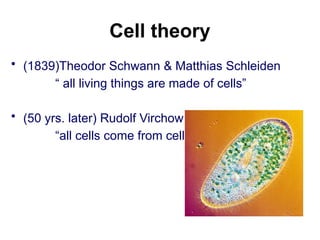
• (1839)TheodorSchwann & Matthias Schleiden
“ all living things are made of cells”
• (50 yrs. later) Rudolf Virchow
“all cells come from cells”
4.
Principles of CellTheory
• All living things are made of cells
• Smallest living unit of structure and
function of all organisms is the cell
• All cells arise from preexisting cells
(this principle discarded the idea of
spontaneous generation)
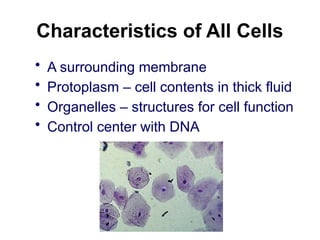
Characteristics of AllCells
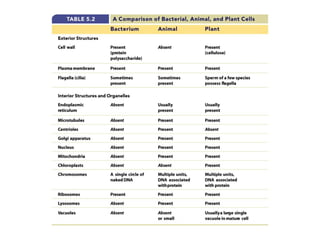
• A surrounding membrane
• Protoplasm – cell contents in thick fluid
• Organelles – structures for cell function
• Control center with DNA
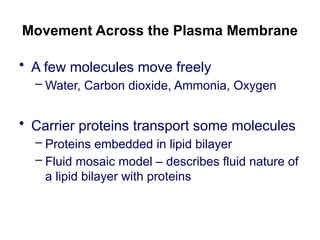
Movement Across thePlasma Membrane
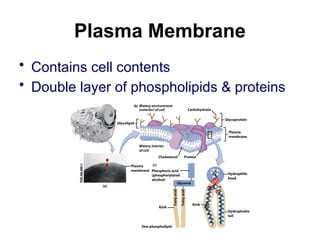
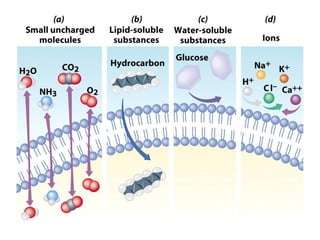
• A few molecules move freely
– Water, Carbon dioxide, Ammonia, Oxygen
• Carrier proteins transport some molecules
– Proteins embedded in lipid bilayer
– Fluid mosaic model – describes fluid nature of
a lipid bilayer with proteins
12.
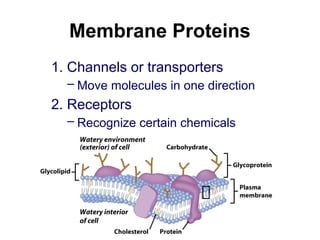
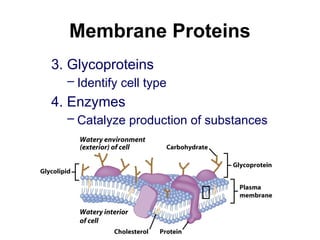
Membrane Proteins
1. Channelsor transporters
– Move molecules in one direction
2. Receptors
– Recognize certain chemicals
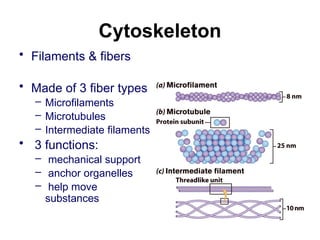
Cytoskeleton
• Filaments &fibers
• Made of 3 fiber types
– Microfilaments
– Microtubules
– Intermediate filaments
• 3 functions:
– mechanical support
– anchor organelles
– help move
substances
16.
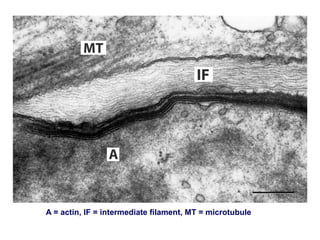
A = actin,IF = intermediate filament, MT = microtubule
17.
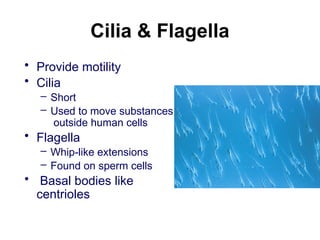
Cilia & Flagella
•Provide motility
• Cilia
– Short
– Used to move substances
outside human cells
• Flagella
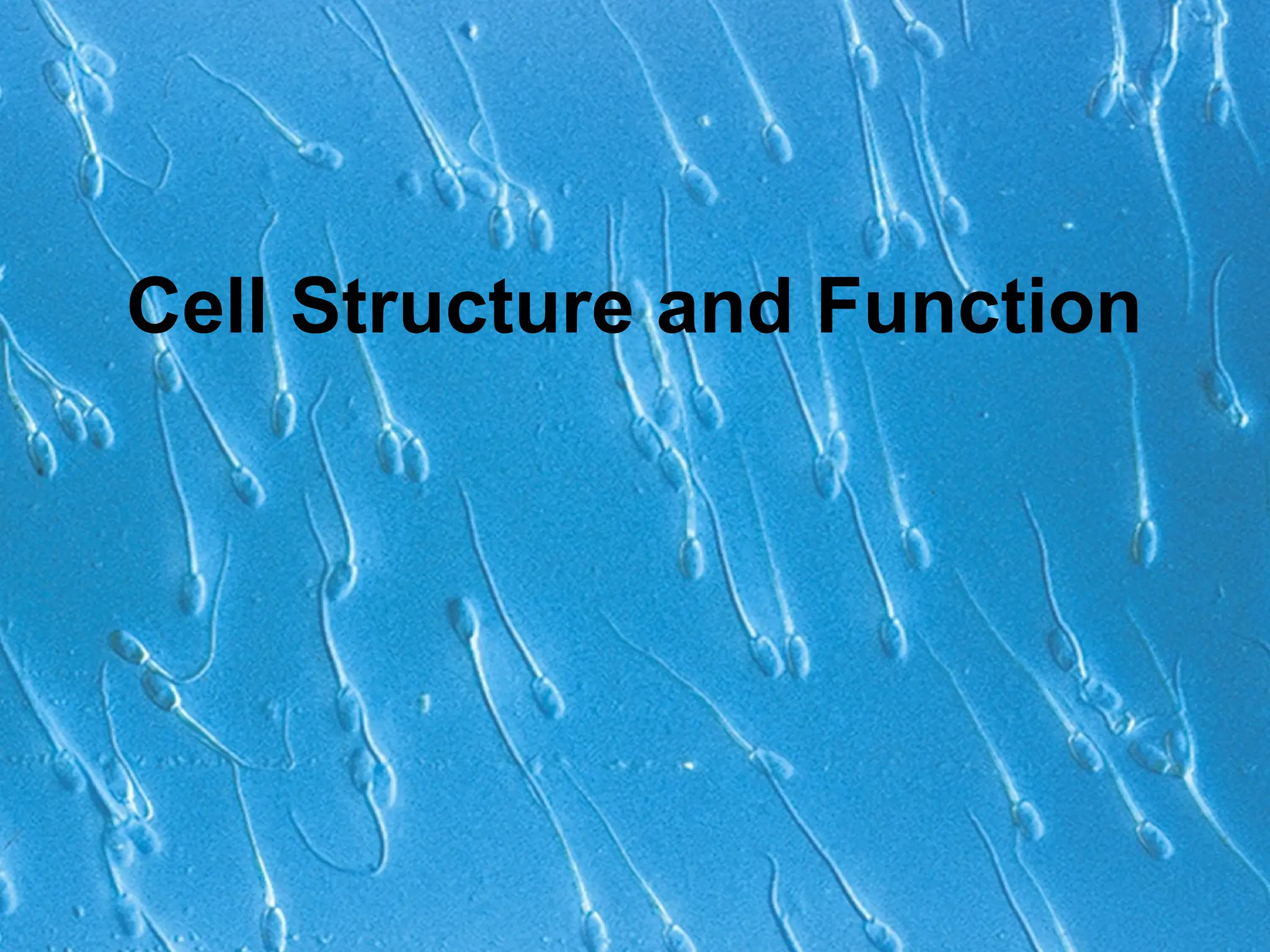
– Whip-like extensions
– Found on sperm cells
• Basal bodies like
centrioles
18.
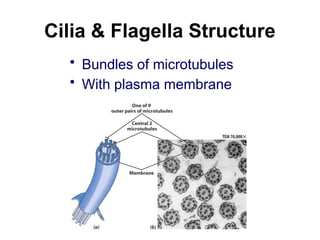
Cilia & FlagellaStructure
• Bundles of microtubules
• With plasma membrane
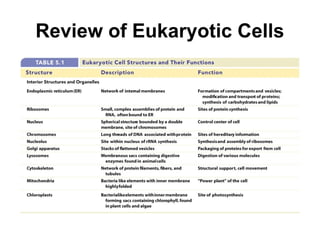
Endoplasmic Reticulum
• Helpsmove substances within cells
• Network of interconnected membranes
• Two types
– Rough endoplasmic reticulum
– Smooth endoplasmic reticulum
26.
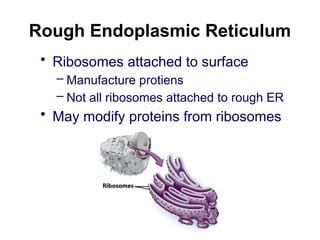
Rough Endoplasmic Reticulum
•Ribosomes attached to surface
– Manufacture protiens
– Not all ribosomes attached to rough ER
• May modify proteins from ribosomes
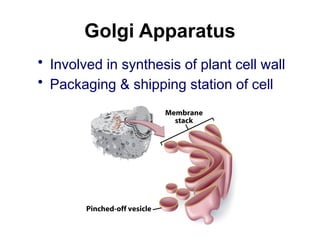
Golgi Apparatus Function
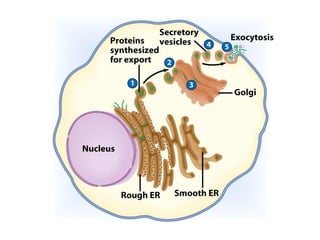
1.Molecules come in vesicles
2. Vesicles fuse with Golgi membrane
3. Molecules may be modified by Golgi
30.
Golgi Apparatus Function
(Continued)
4.Molecules pinched-off in separate vesicle
5. Vesicle leaves Golgi apparatus
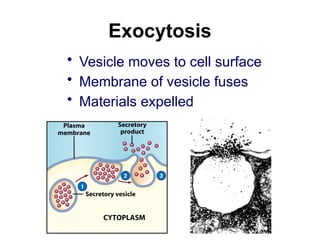
6. Vesicles may combine with plasma
membrane to secrete contents
32.
Lysosomes
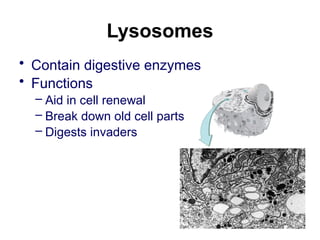
• Contain digestiveenzymes
• Functions
– Aid in cell renewal
– Break down old cell parts
– Digests invaders
33.
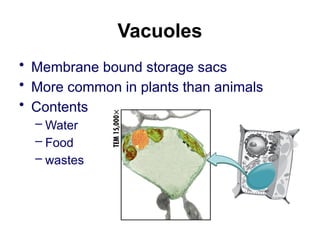
Vacuoles
• Membrane boundstorage sacs
• More common in plants than animals
• Contents
– Water
– Food
– wastes
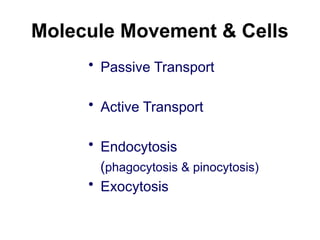
Molecule Movement &Cells
• Passive Transport
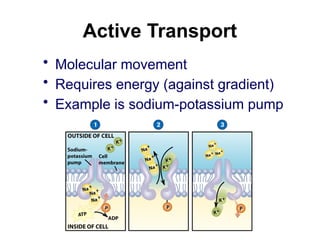
• Active Transport
• Endocytosis
(phagocytosis & pinocytosis)
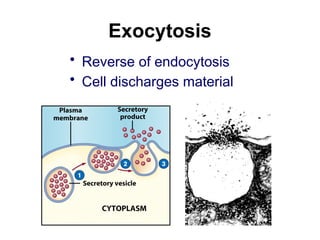
• Exocytosis
40.
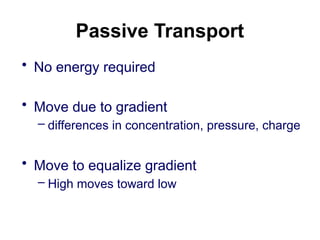
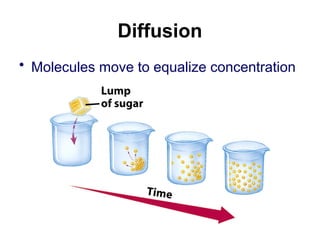
Passive Transport
• Noenergy required
• Move due to gradient
– differences in concentration, pressure, charge
• Move to equalize gradient
– High moves toward low
41.
Types of PassiveTransport
1. Diffusion
2. Osmosis
3. Facilitated diffusion
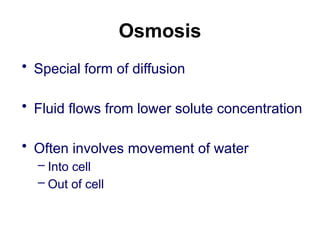
Osmosis
• Special formof diffusion
• Fluid flows from lower solute concentration
• Often involves movement of water
– Into cell
– Out of cell
44.
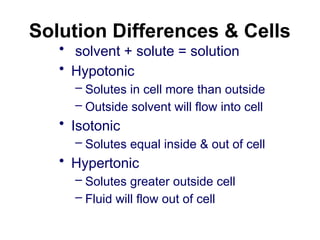
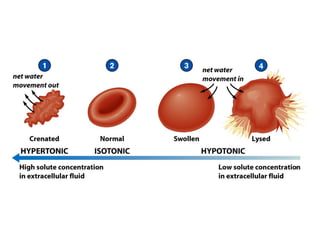
Solution Differences &Cells
• solvent + solute = solution
• Hypotonic
– Solutes in cell more than outside
– Outside solvent will flow into cell
• Isotonic
– Solutes equal inside & out of cell
• Hypertonic
– Solutes greater outside cell
– Fluid will flow out of cell
46.
Facilitated Diffusion
• Differentiallypermeable membrane
• Channels (are specific) help molecule
or ions enter or leave the cell
• Channels usually are transport proteins
(aquaporins facilitate the movement of
water)
• No energy is used
47.
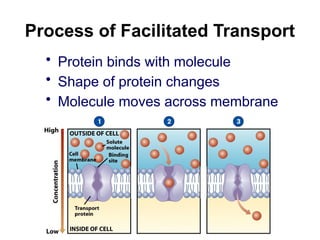
Process of FacilitatedTransport
• Protein binds with molecule
• Shape of protein changes
• Molecule moves across membrane
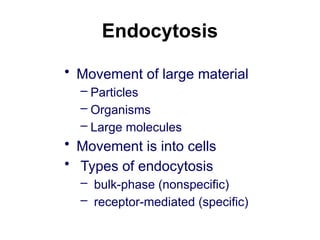
Endocytosis
• Movement oflarge material
– Particles
– Organisms
– Large molecules
• Movement is into cells
• Types of endocytosis
– bulk-phase (nonspecific)
– receptor-mediated (specific)
50.
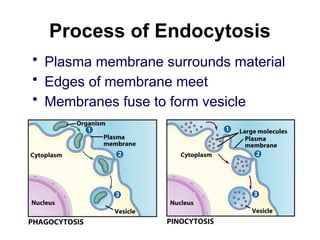
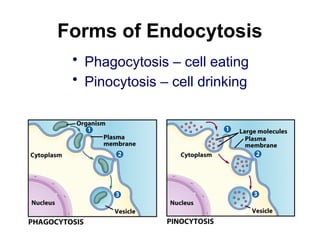
Process of Endocytosis
•Plasma membrane surrounds material
• Edges of membrane meet
• Membranes fuse to form vesicle