
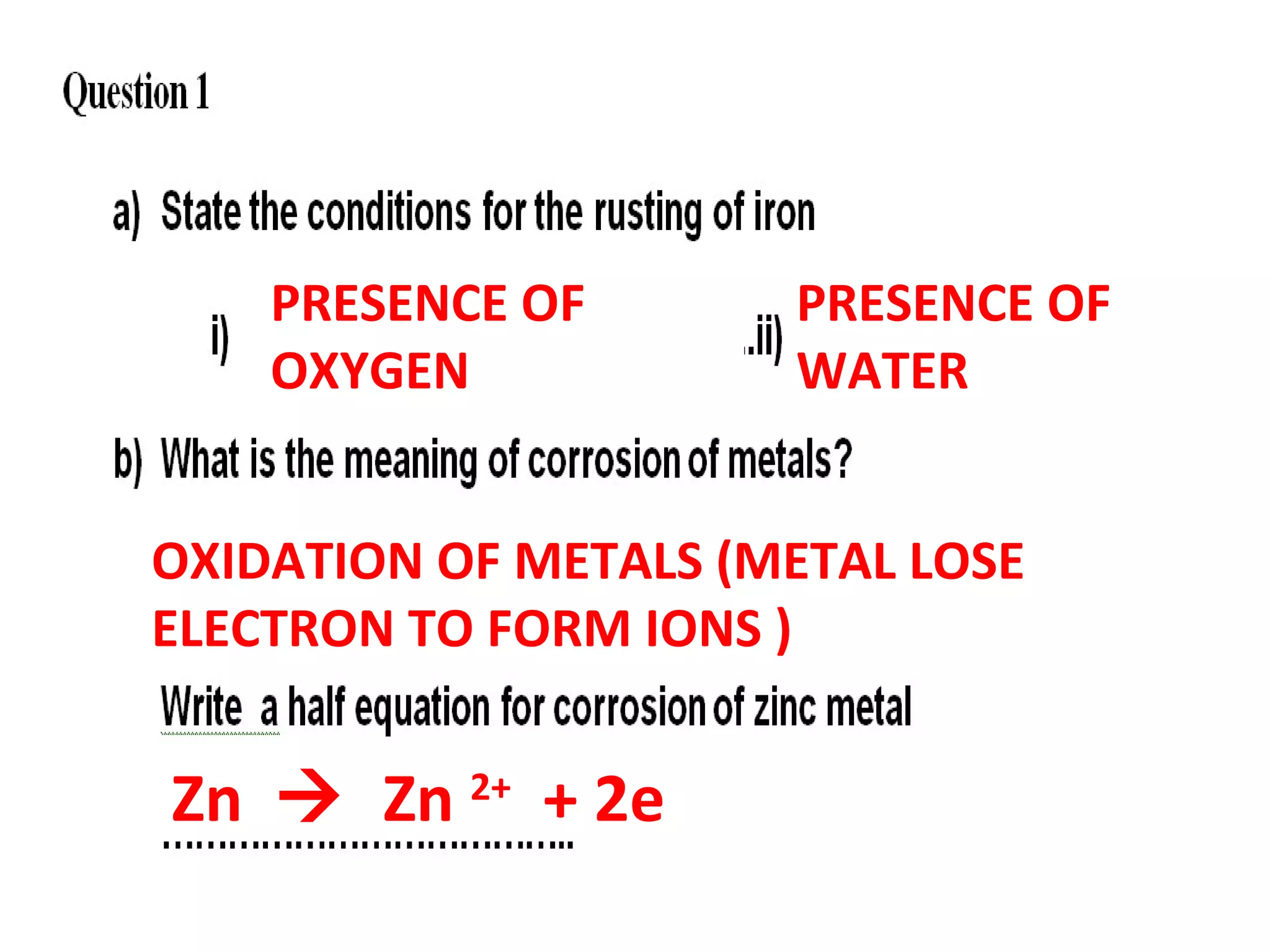
PRESENCE OF
OXYGEN
PRESENCE OF
WATER
OXIDATION OF METALS (METAL LOSE
ELECTRON TO FORM IONS )
Zn  Zn 2+
+ 2e
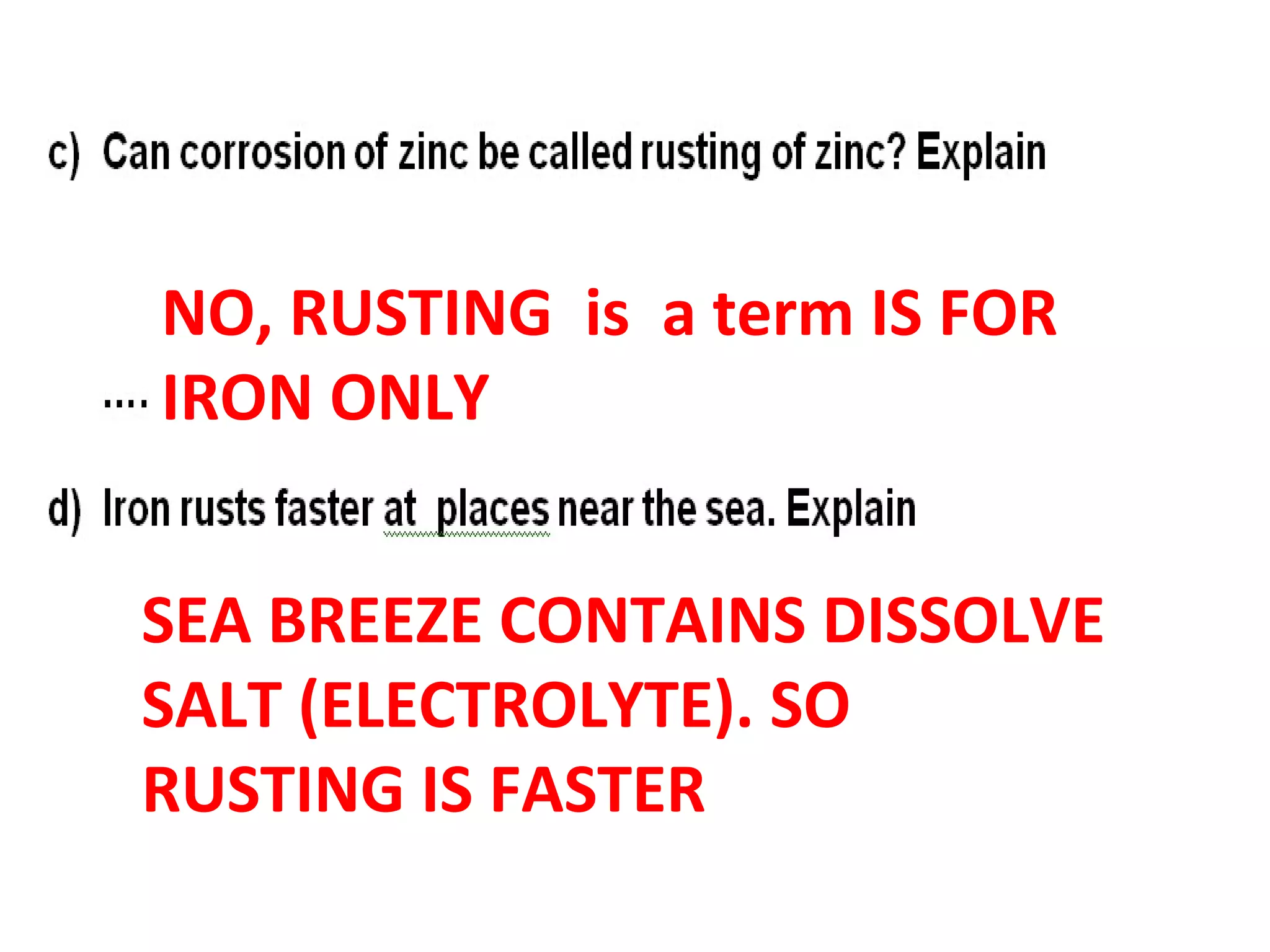
NO, RUSTING is a term IS FOR
IRON ONLY
SEA BREEZE CONTAINS DISSOLVE
SALT (ELECTROLYTE). SO
RUSTING IS FASTER
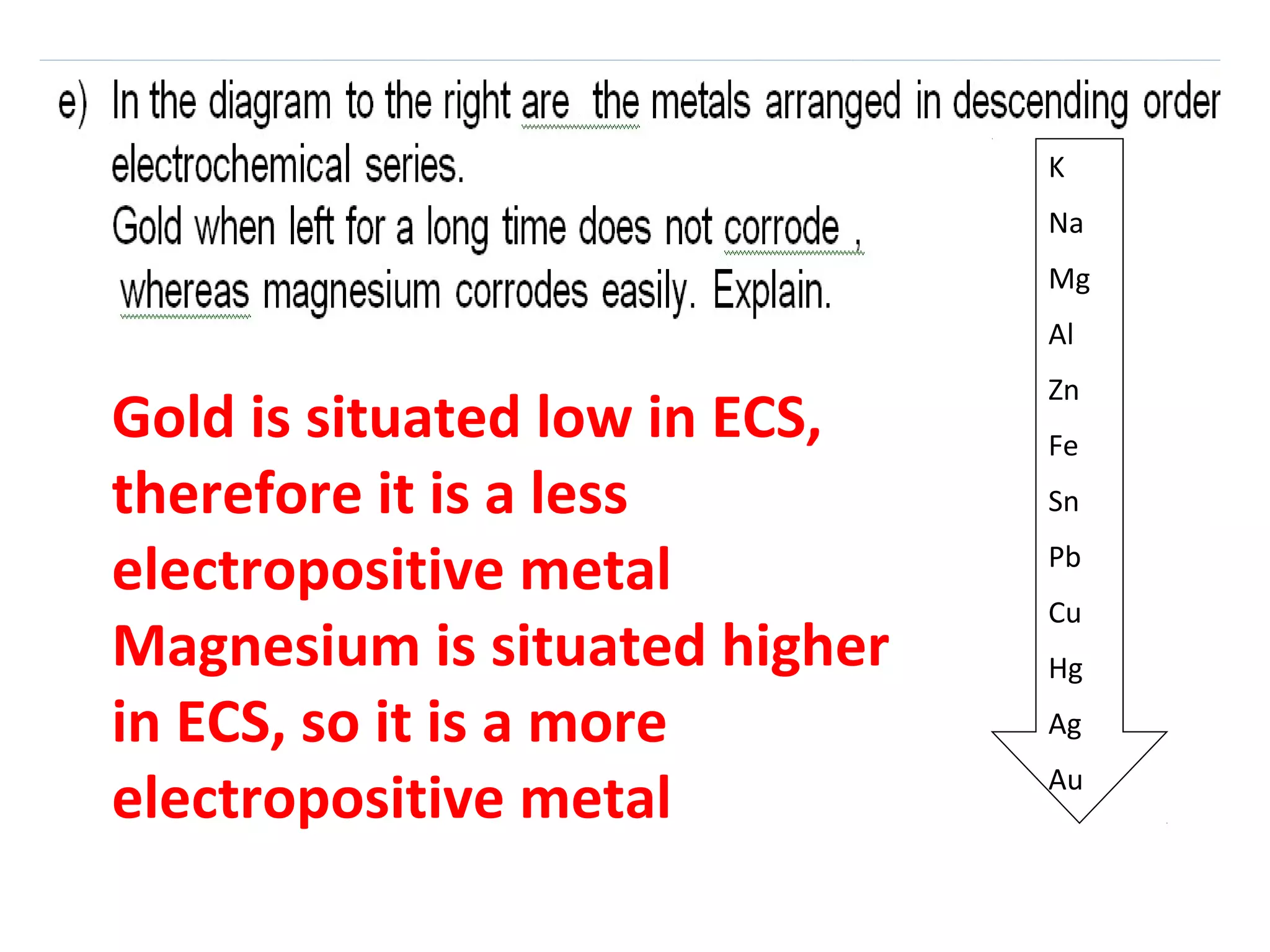
K
Na
Mg
Al
Zn
Fe
Sn
Pb
Cu
Hg
Ag
Au
Gold is situated low in ECS,
therefore it is a less
electropositive metal
Magnesium is situated higher
in ECS, so it is a more
electropositive metal
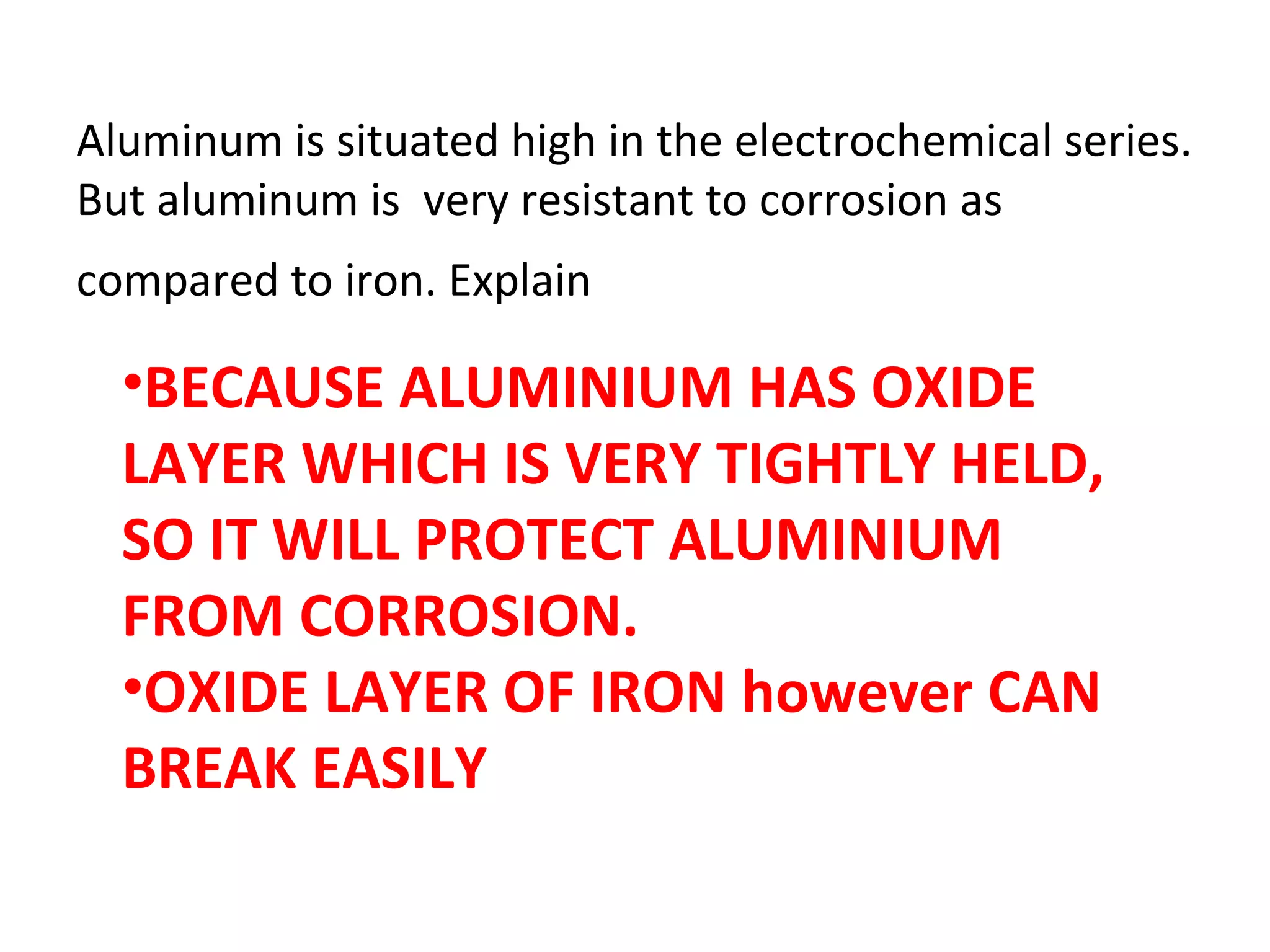
Aluminum is situated high in the electrochemical series.
But aluminum is very resistant to corrosion as
compared to iron. Explain
•BECAUSE ALUMINIUM HAS OXIDE
LAYER WHICH IS VERY TIGHTLY HELD,
SO IT WILL PROTECT ALUMINIUM
FROM CORROSION.
•OXIDE LAYER OF IRON however CAN
BREAK EASILY
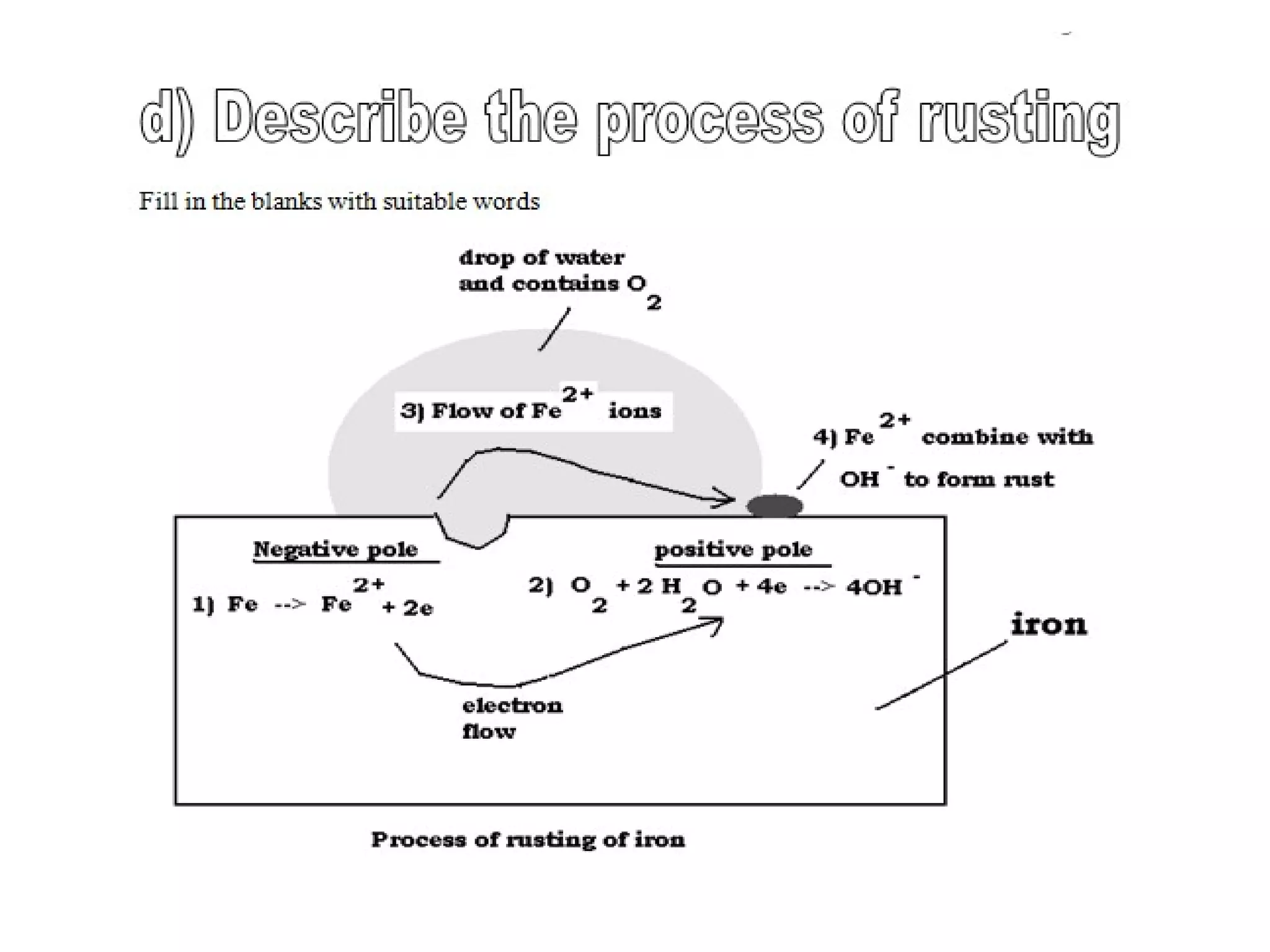
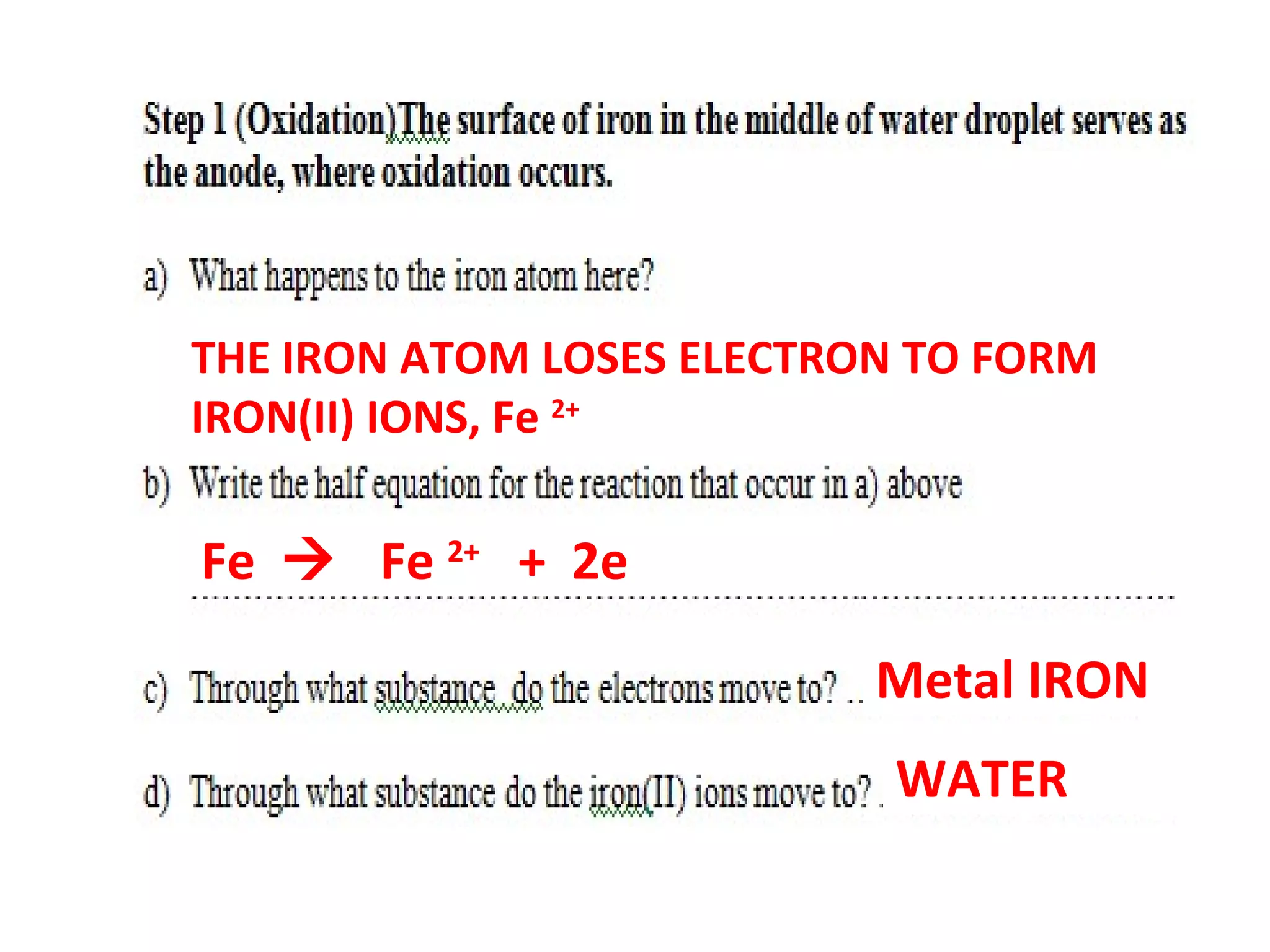
THE IRON ATOM LOSES ELECTRON TO FORM
IRON(II) IONS, Fe 2+
Fe  Fe 2+
+ 2e
Metal IRON
WATER
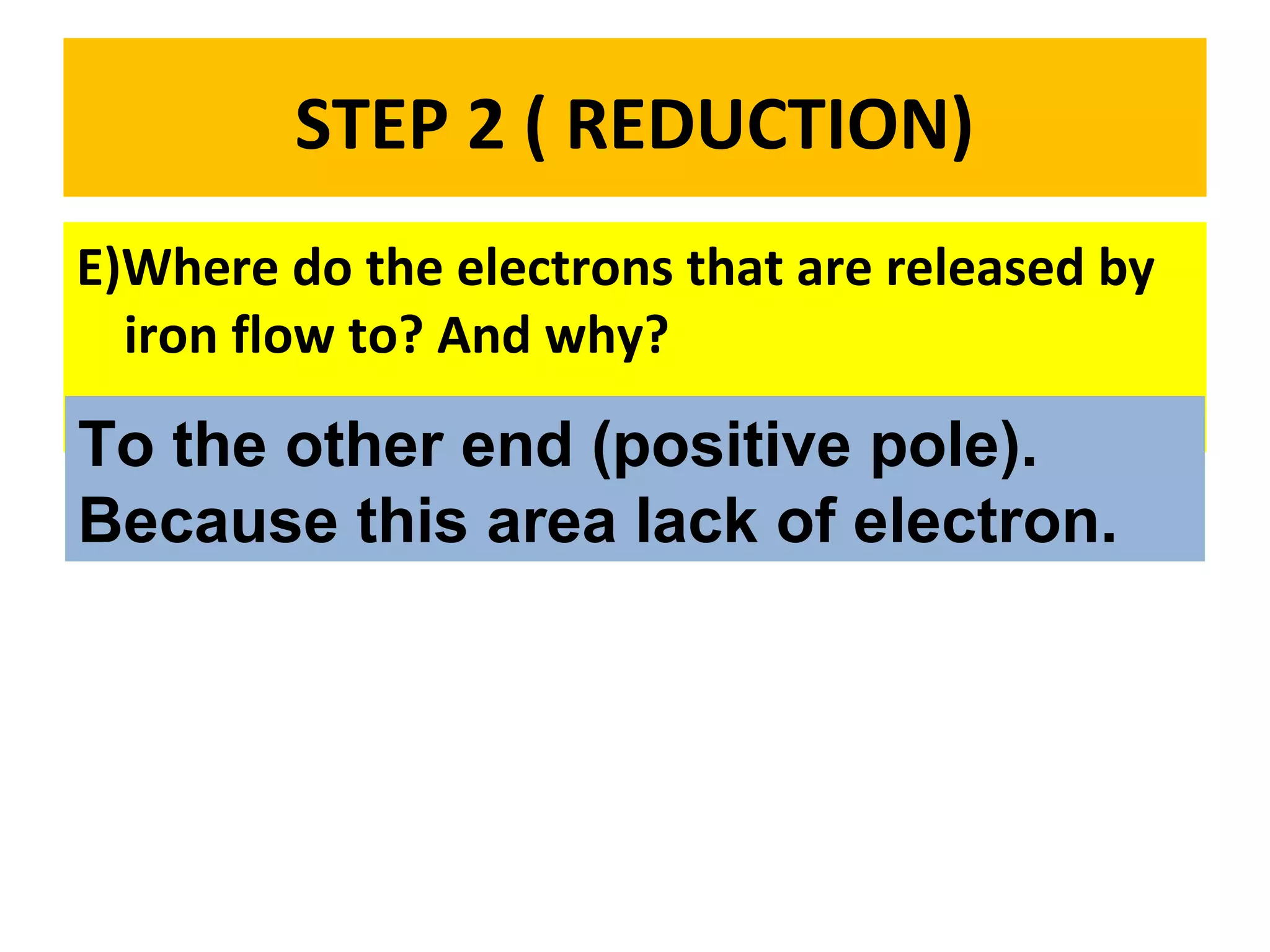
STEP 2 ( REDUCTION)
E)Where do the electrons that are released by
iron flow to? And why?
To the other end (positive pole).
Because this area lack of electron.
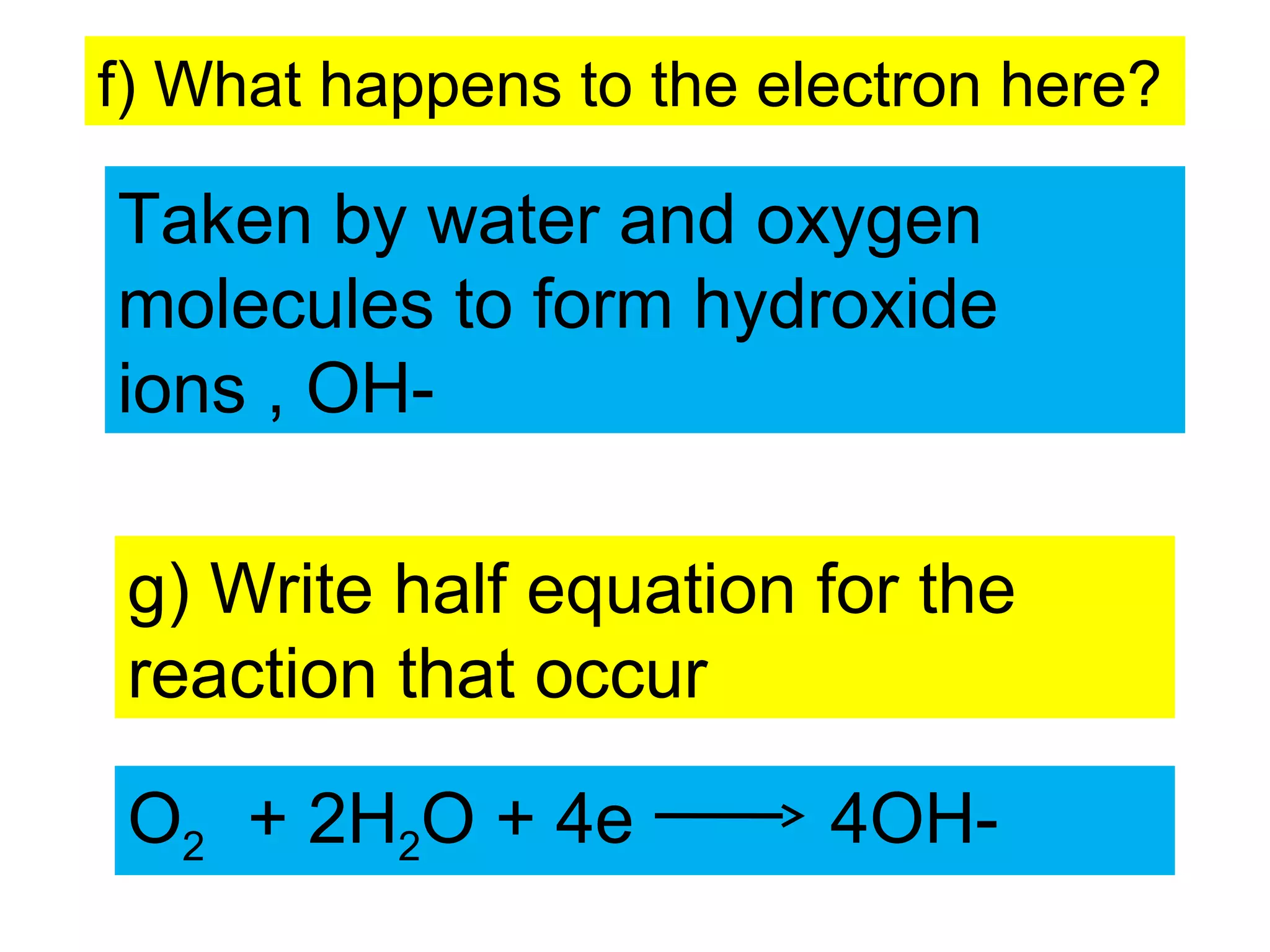
f) What happens to the electron here?
Taken by water and oxygen
molecules to form hydroxide
ions , OH-
g) Write half equation for the
reaction that occur
O2 + 2H2O + 4e 4OH-
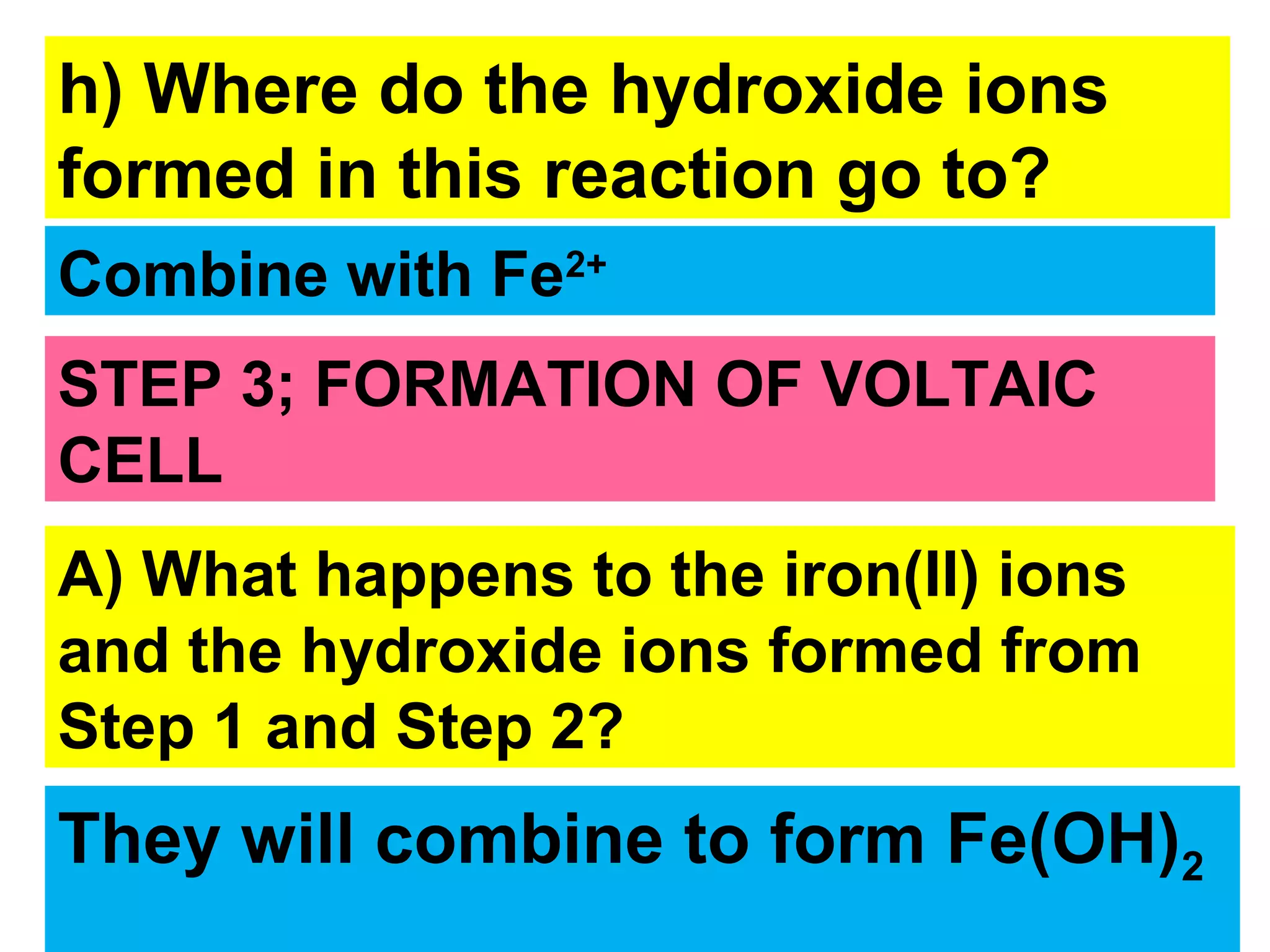
h) Where do the hydroxide ions
formed in this reaction go to?
Combine with Fe2+
STEP 3; FORMATION OF VOLTAIC
CELL
A) What happens to the iron(II) ions
and the hydroxide ions formed from
Step 1 and Step 2?
They will combine to form Fe(OH)2
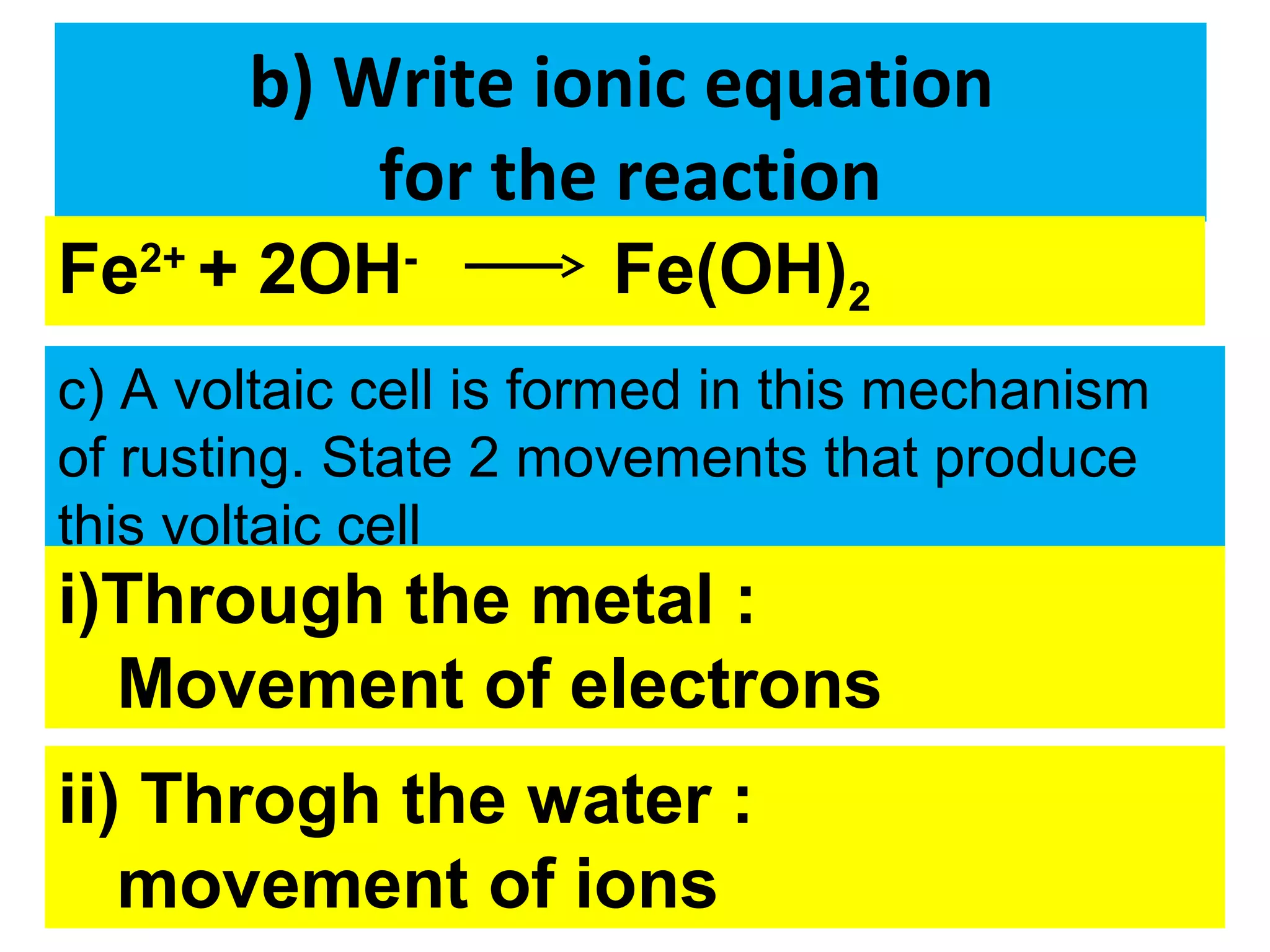
b) Write ionic equation
for the reaction
Fe2+
+ 2OH-
Fe(OH)2
c) A voltaic cell is formed in this mechanism
of rusting. State 2 movements that produce
this voltaic cell
i)Through the metal :
Movement of electrons
ii) Throgh the water :
movement of ions
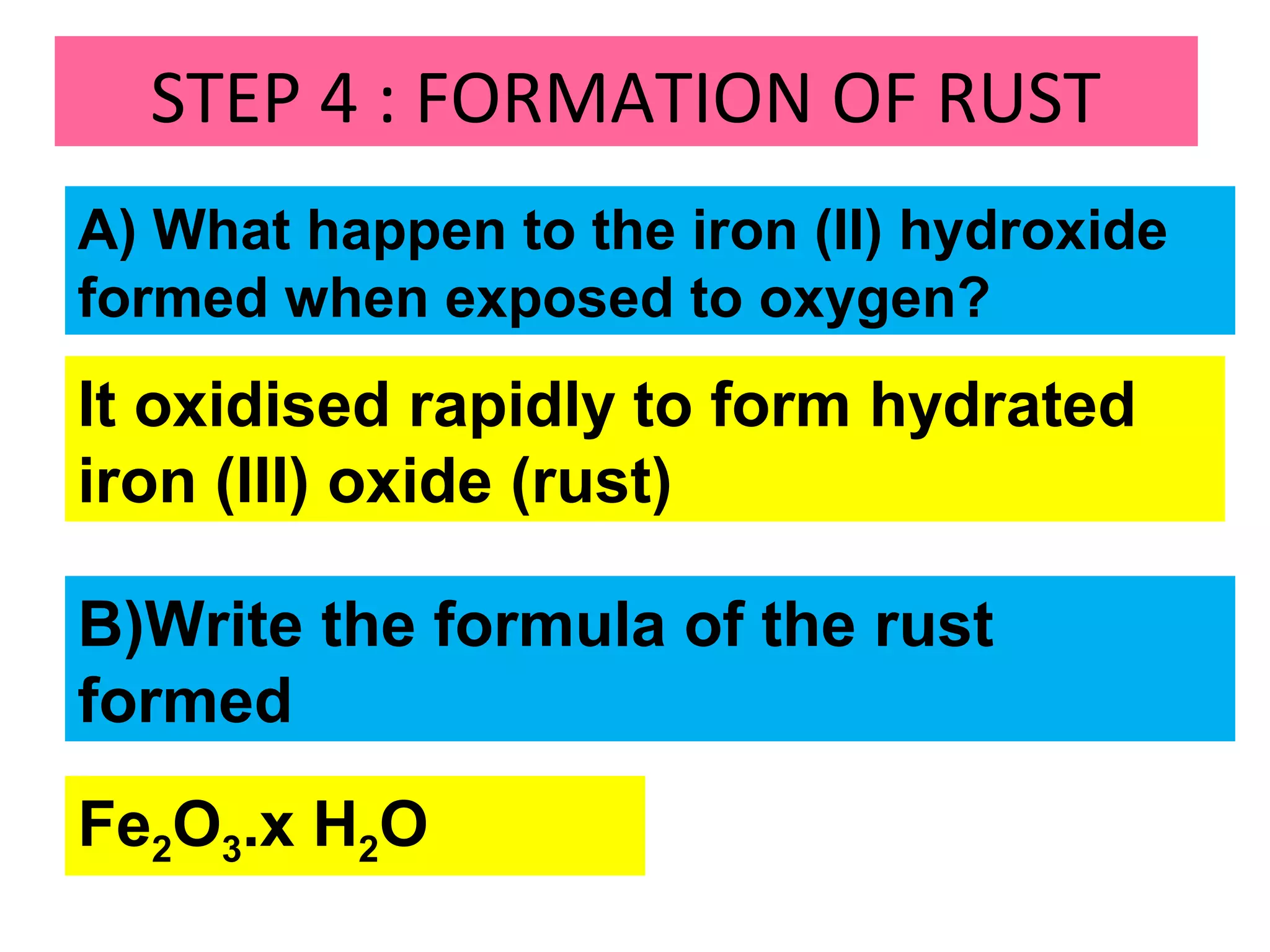
STEP 4 : FORMATION OF RUST
A) What happen to the iron (II) hydroxide
formed when exposed to oxygen?
It oxidised rapidly to form hydrated
iron (III) oxide (rust)
B)Write the formula of the rust
formed
Fe2O3.x H2O
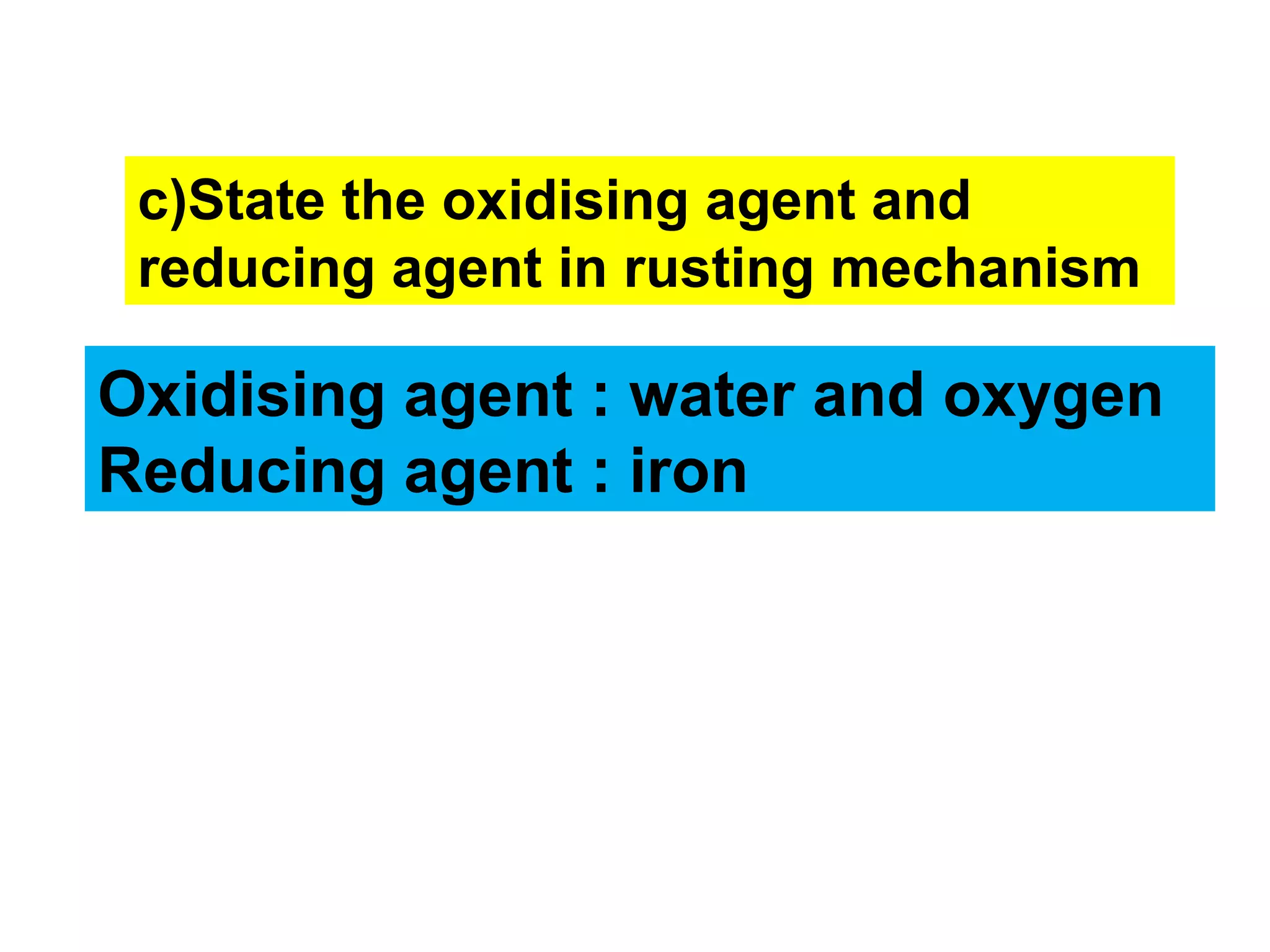
Oxidising agent : water and oxygen
Reducing agent : iron
c)State the oxidising agent and
reducing agent in rusting mechanism
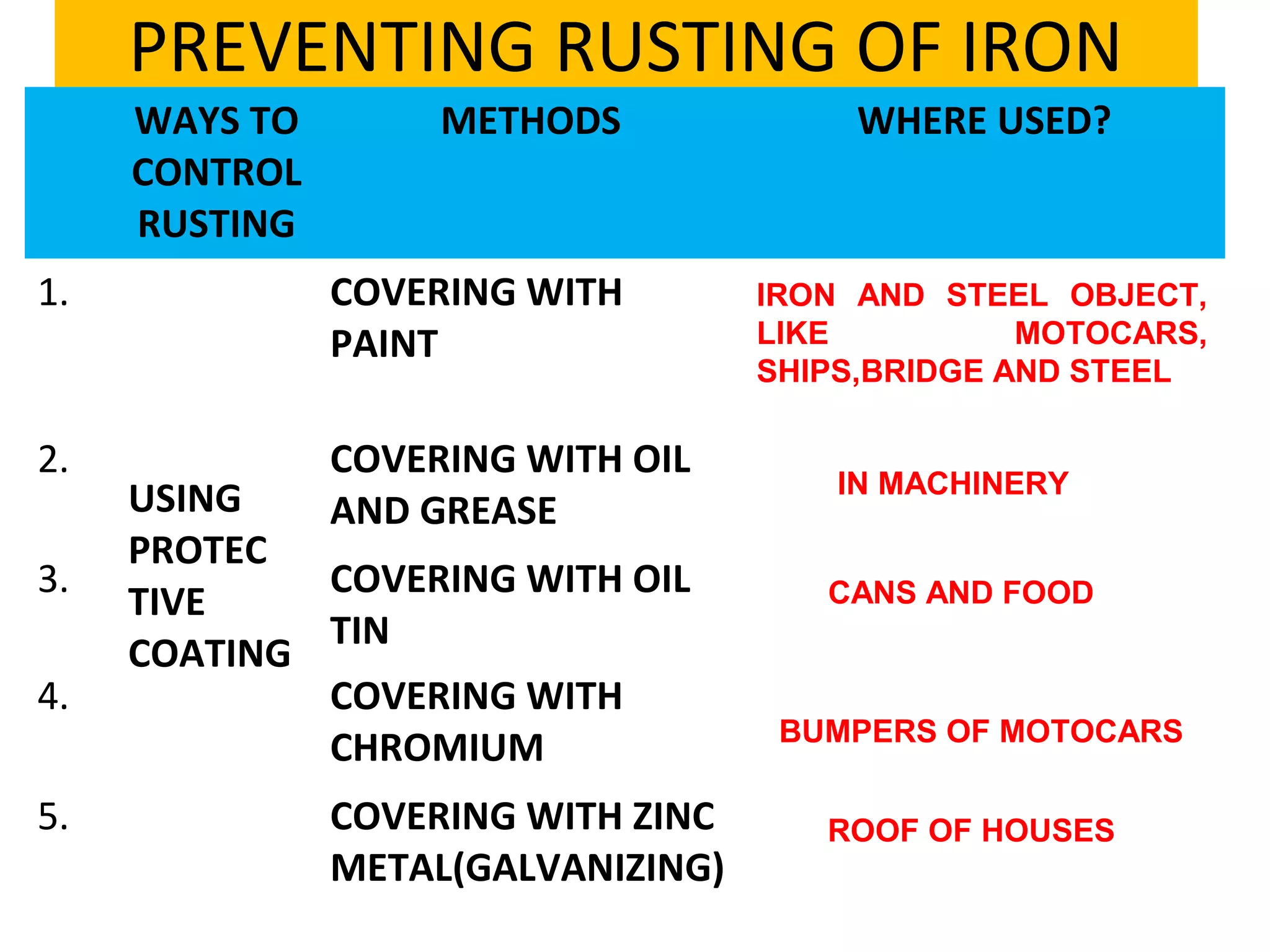
PREVENTING RUSTING OF IRON
WAYS TO
CONTROL
RUSTING
METHODS WHERE USED?
1.
USING
PROTEC
TIVE
COATING
COVERING WITH
PAINT
2. COVERING WITH OIL
AND GREASE
3. COVERING WITH OIL
TIN
4. COVERING WITH
CHROMIUM
5. COVERING WITH ZINC
METAL(GALVANIZING)
IRON AND STEEL OBJECT,
LIKE MOTOCARS,
SHIPS,BRIDGE AND STEEL
IN MACHINERY
CANS AND FOOD
BUMPERS OF MOTOCARS
ROOF OF HOUSES
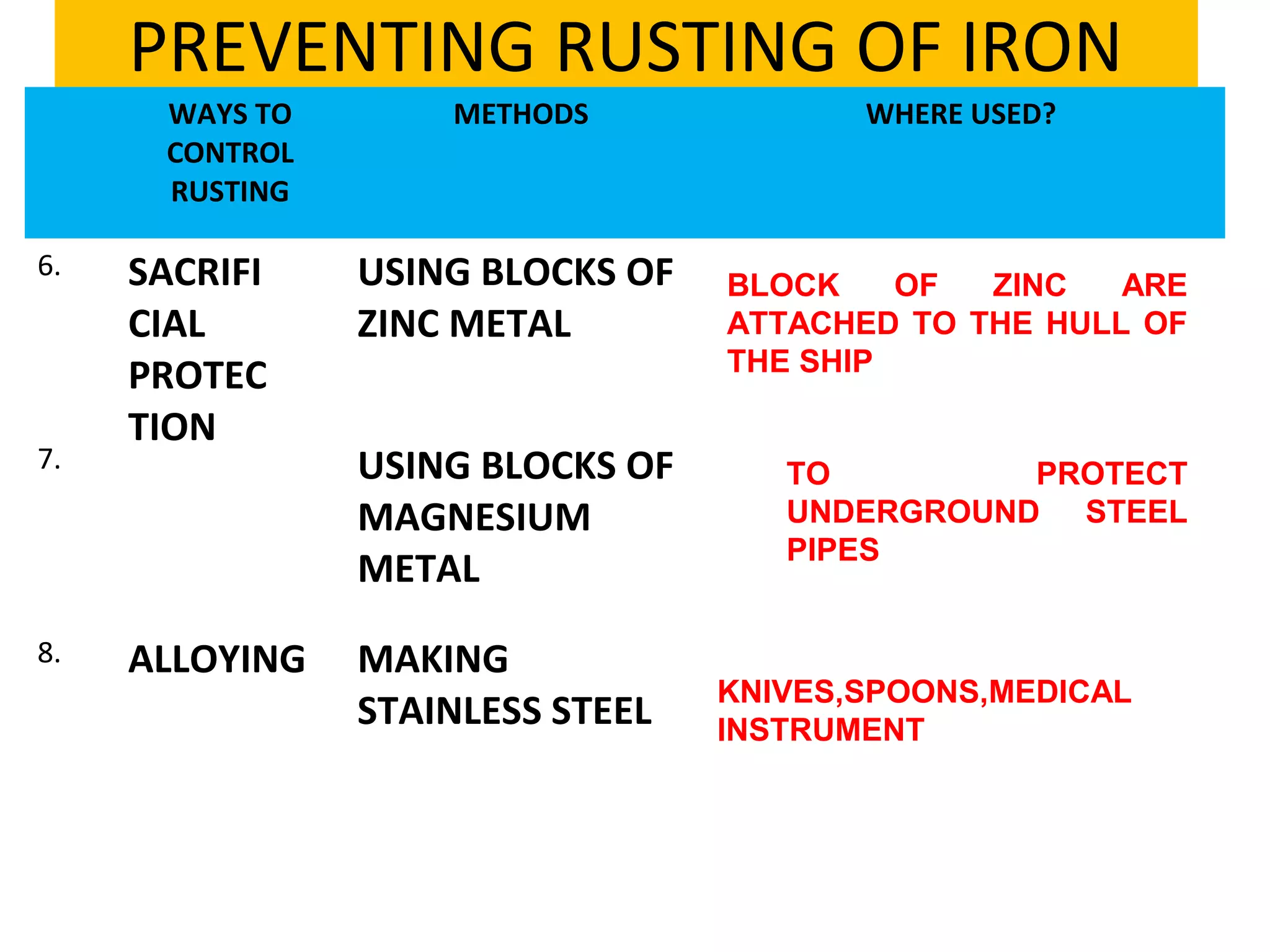
PREVENTING RUSTING OF IRON
WAYS TO
CONTROL
RUSTING
METHODS WHERE USED?
6. SACRIFI
CIAL
PROTEC
TION
USING BLOCKS OF
ZINC METAL
7. USING BLOCKS OF
MAGNESIUM
METAL
8. ALLOYING MAKING
STAINLESS STEEL
BLOCK OF ZINC ARE
ATTACHED TO THE HULL OF
THE SHIP
TO PROTECT
UNDERGROUND STEEL
PIPES
KNIVES,SPOONS,MEDICAL
INSTRUMENT
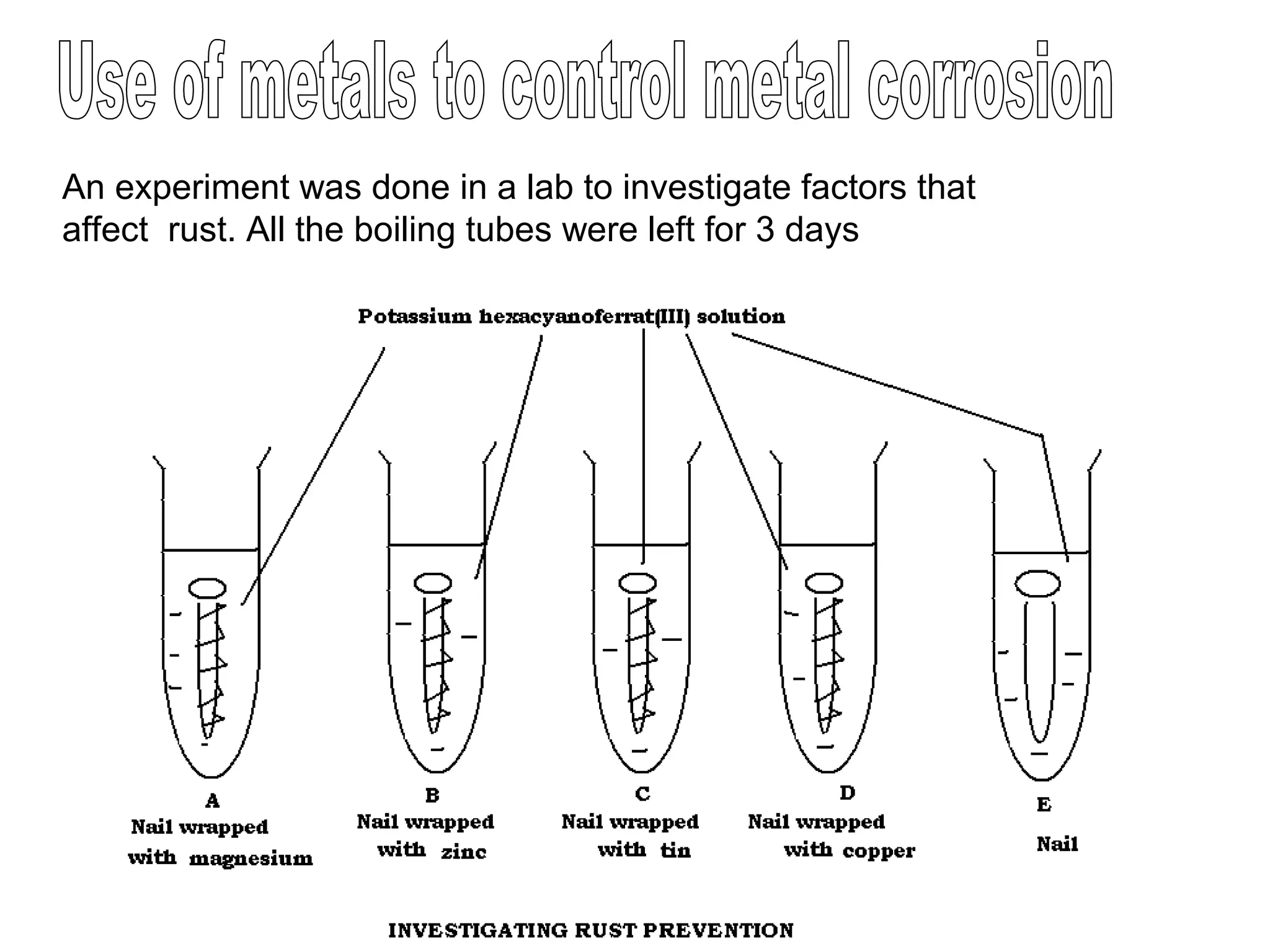
An experiment was done in a lab to investigate factors that
affect rust. All the boiling tubes were left for 3 days
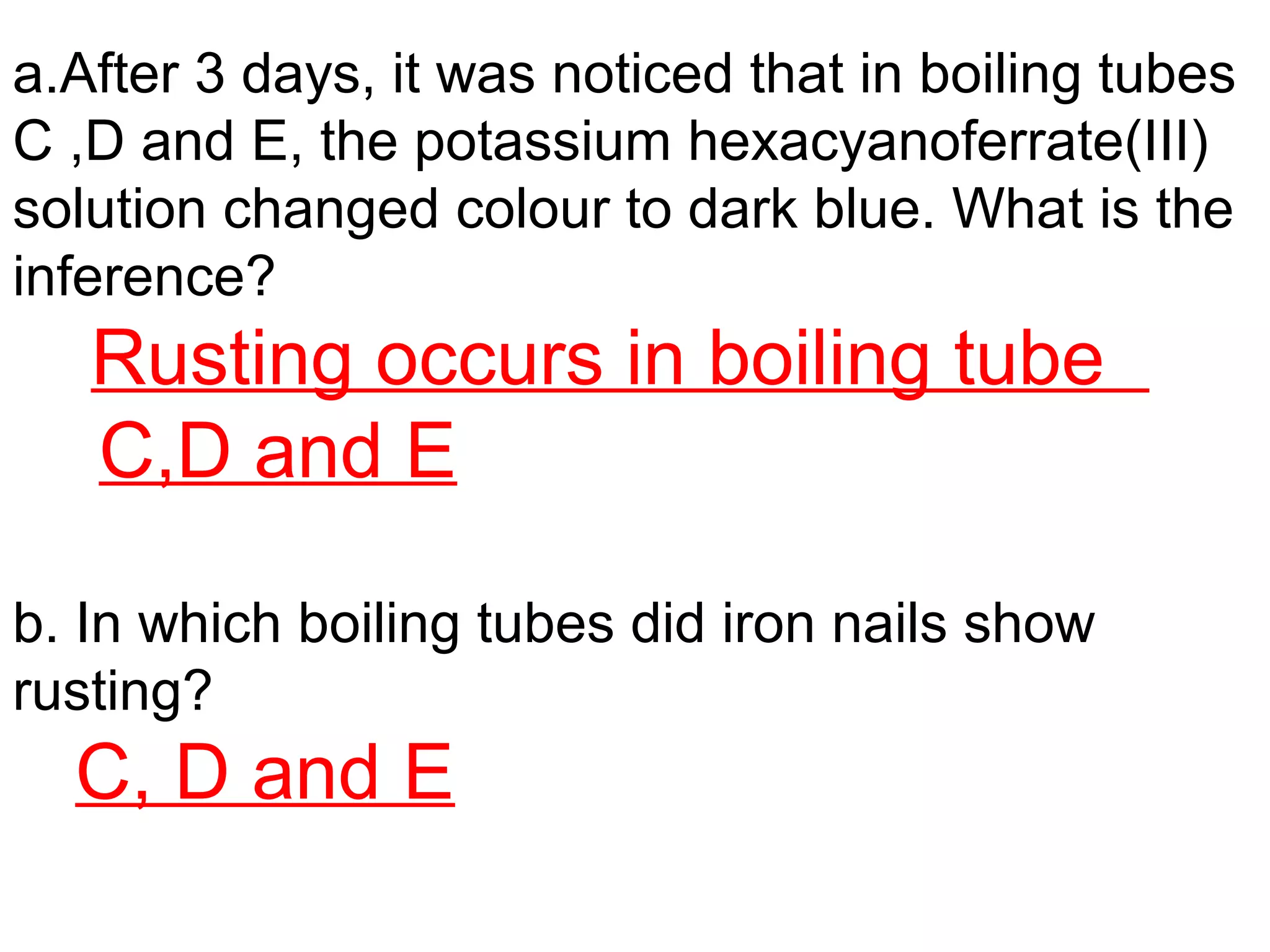
a.After 3 days, it was noticed that in boiling tubes
C ,D and E, the potassium hexacyanoferrate(III)
solution changed colour to dark blue. What is the
inference?
Rusting occurs in boiling tube
C,D and E
b. In which boiling tubes did iron nails show
rusting?
C, D and E
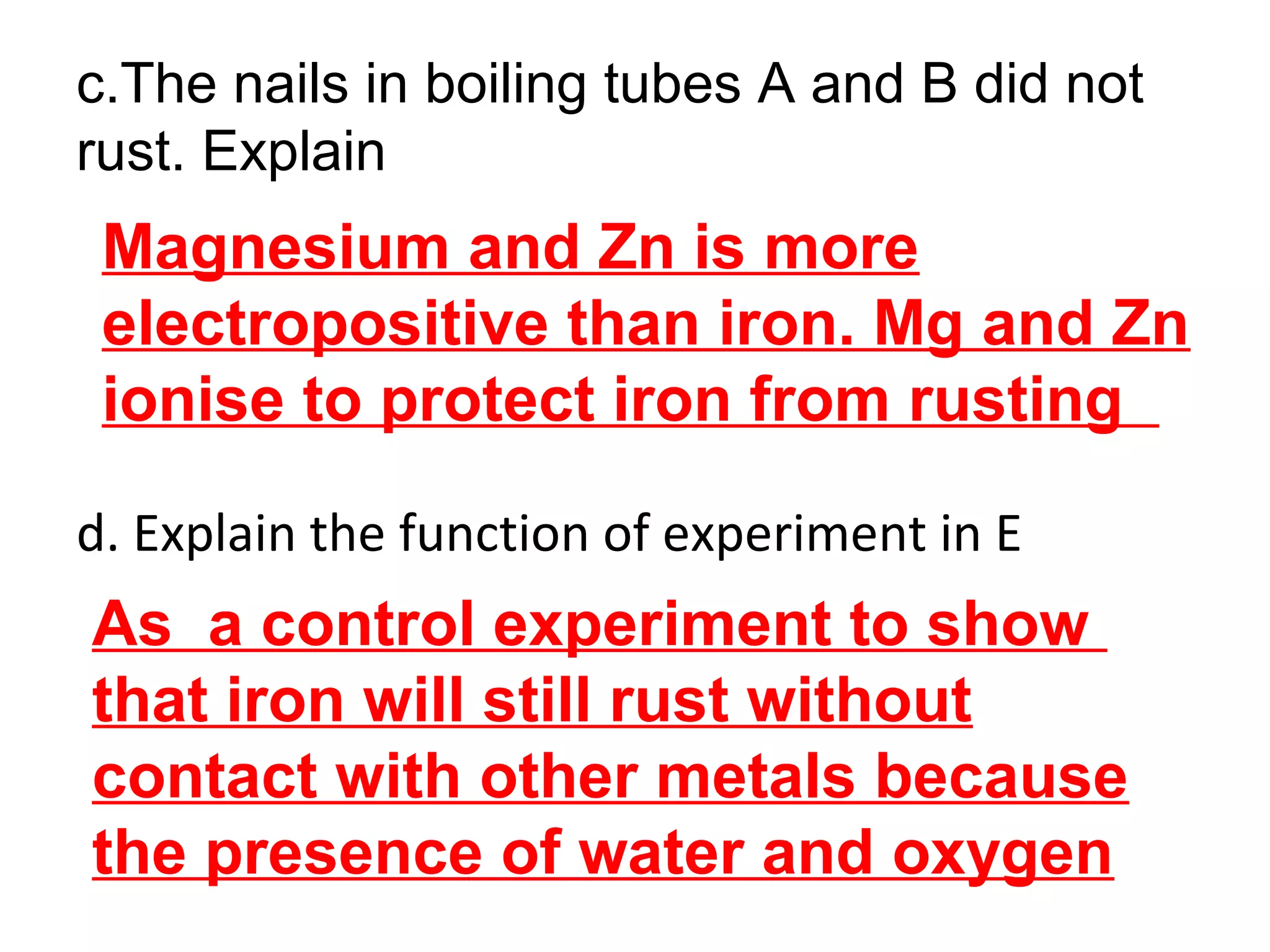
c.The nails in boiling tubes A and B did not
rust. Explain
d. Explain the function of experiment in E
Magnesium and Zn is more
electropositive than iron. Mg and Zn
ionise to protect iron from rusting
As a control experiment to show
that iron will still rust without
contact with other metals because
the presence of water and oxygen
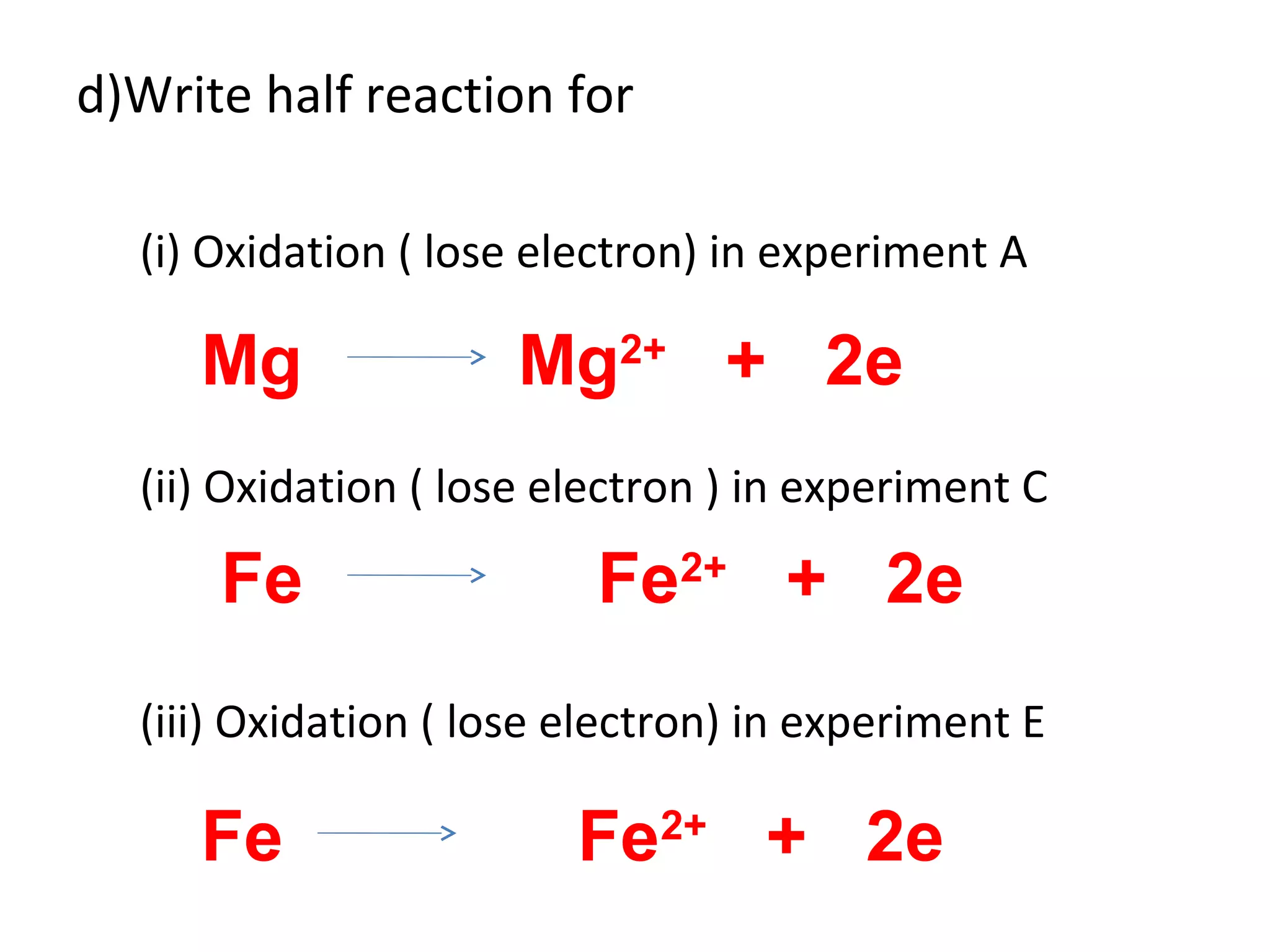
d)Write half reaction for
(i) Oxidation ( lose electron) in experiment A
(ii) Oxidation ( lose electron ) in experiment C
(iii) Oxidation ( lose electron) in experiment E
Mg Mg2+
+ 2e
Fe Fe2+
+ 2e
Fe Fe2+
+ 2e
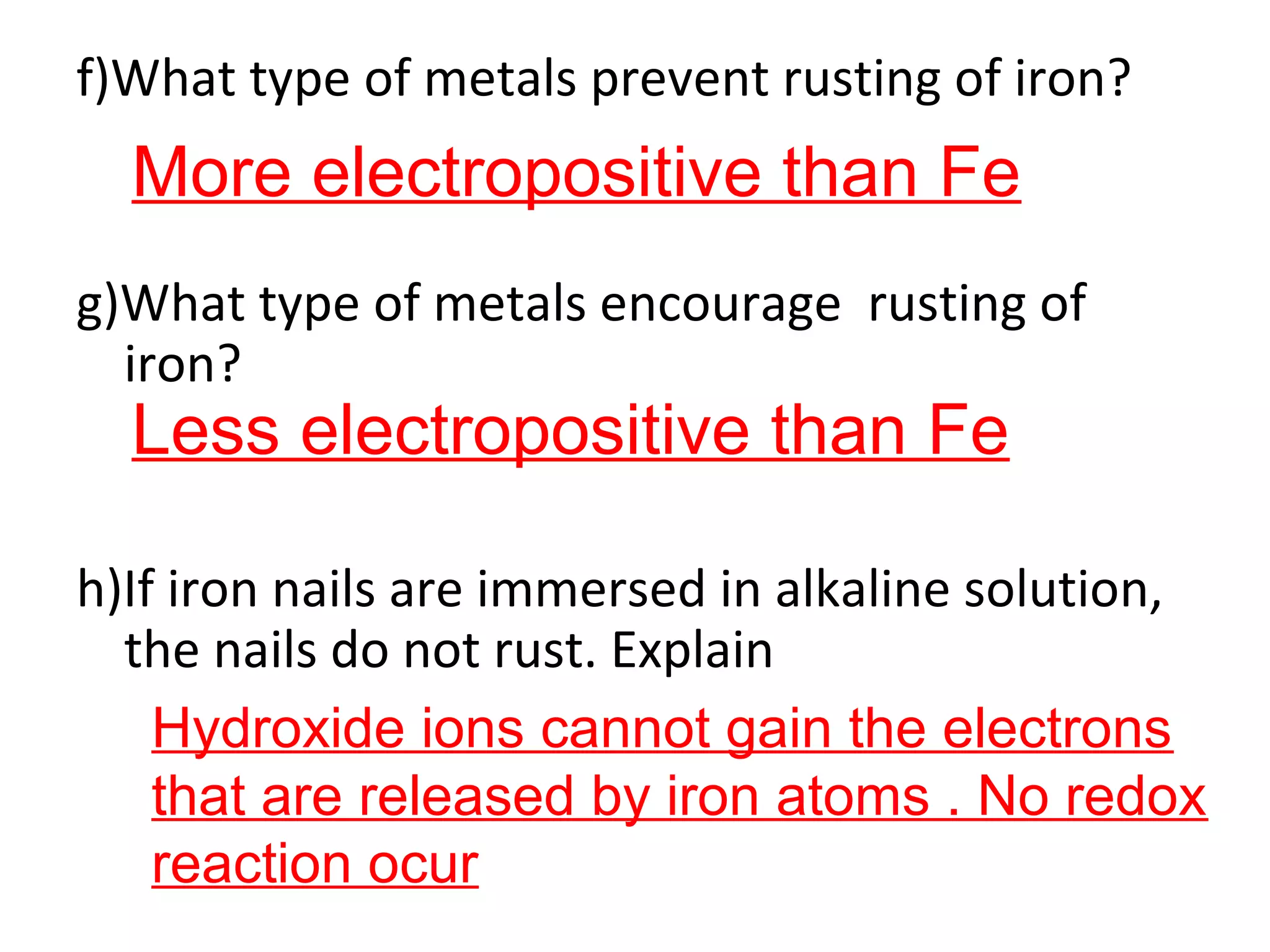
f)What type of metals prevent rusting of iron?
g)What type of metals encourage rusting of
iron?
h)If iron nails are immersed in alkaline solution,
the nails do not rust. Explain
More electropositive than Fe
Less electropositive than Fe
Hydroxide ions cannot gain the electrons
that are released by iron atoms . No redox
reaction ocur
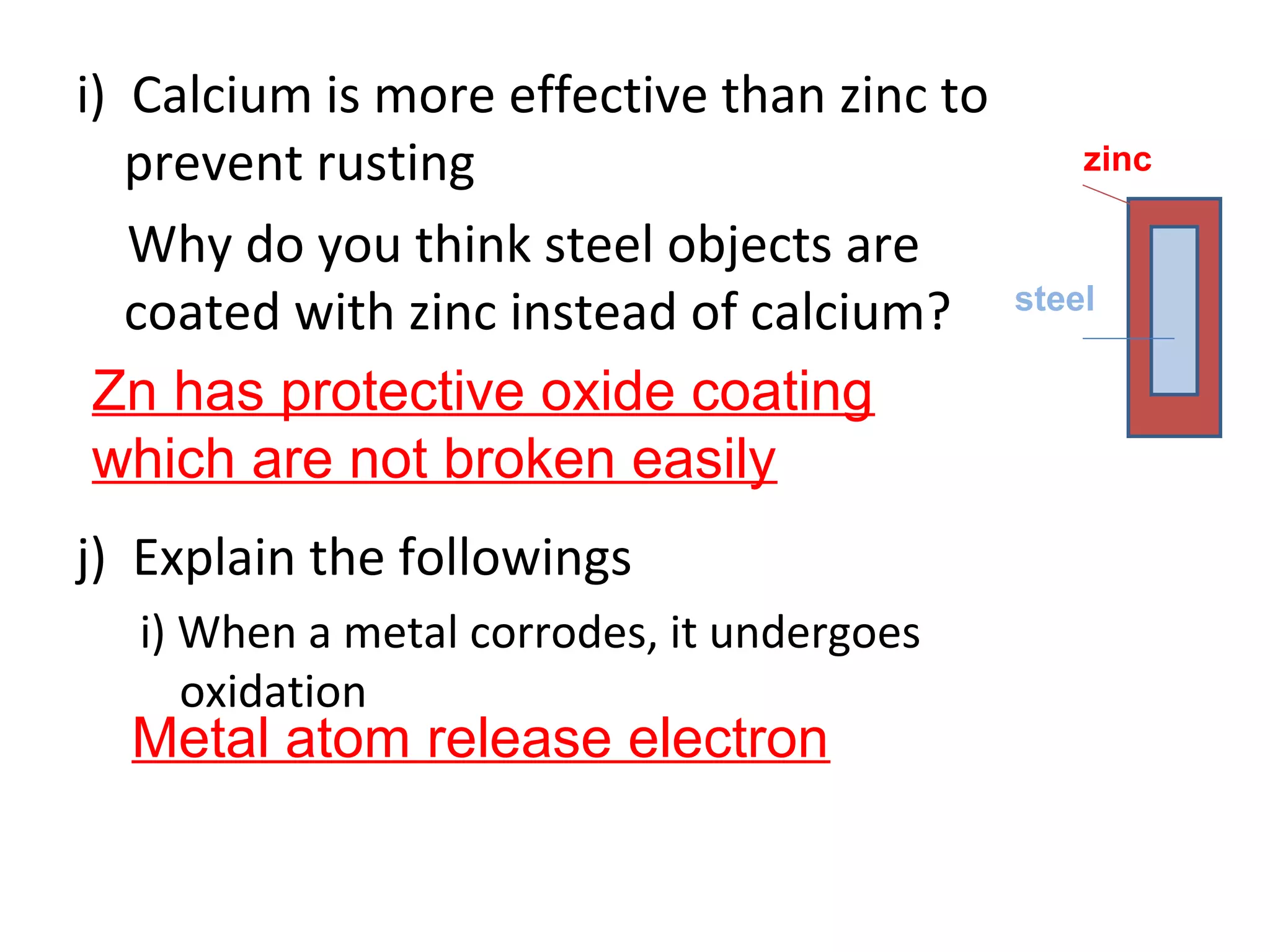
i) Calcium is more effective than zinc to
prevent rusting
Why do you think steel objects are
coated with zinc instead of calcium?
j) Explain the followings
i) When a metal corrodes, it undergoes
oxidation
Zn has protective oxide coating
which are not broken easily
Metal atom release electron
zinc
steel
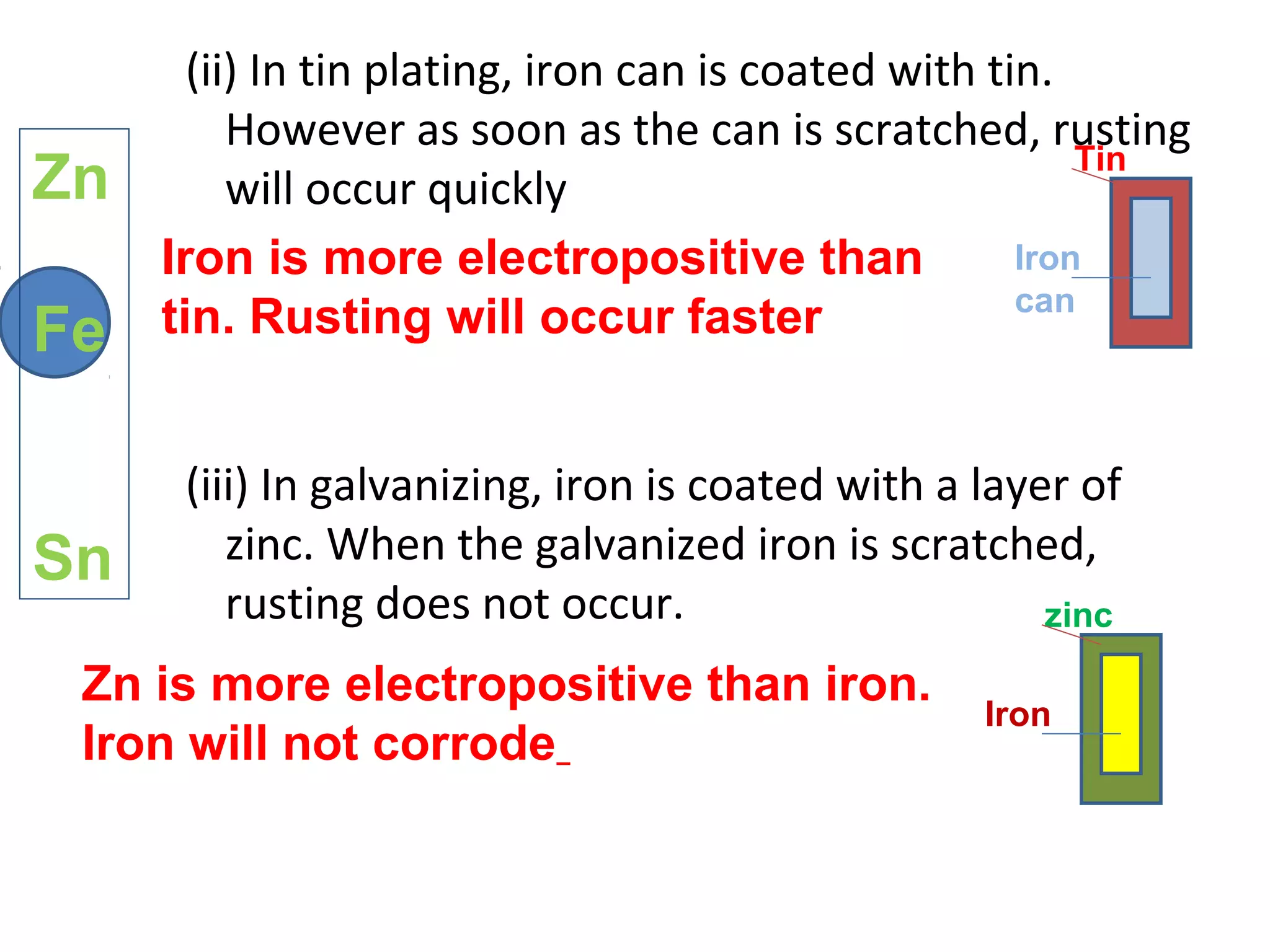
(ii) In tin plating, iron can is coated with tin.
However as soon as the can is scratched, rusting
will occur quickly
(iii) In galvanizing, iron is coated with a layer of
zinc. When the galvanized iron is scratched,
rusting does not occur.
 
Iron is more electropositive than
tin. Rusting will occur faster
Zn is more electropositive than iron.
Iron will not corrode
Tin
Iron
can
zinc
Iron
Zn
Fe
Sn
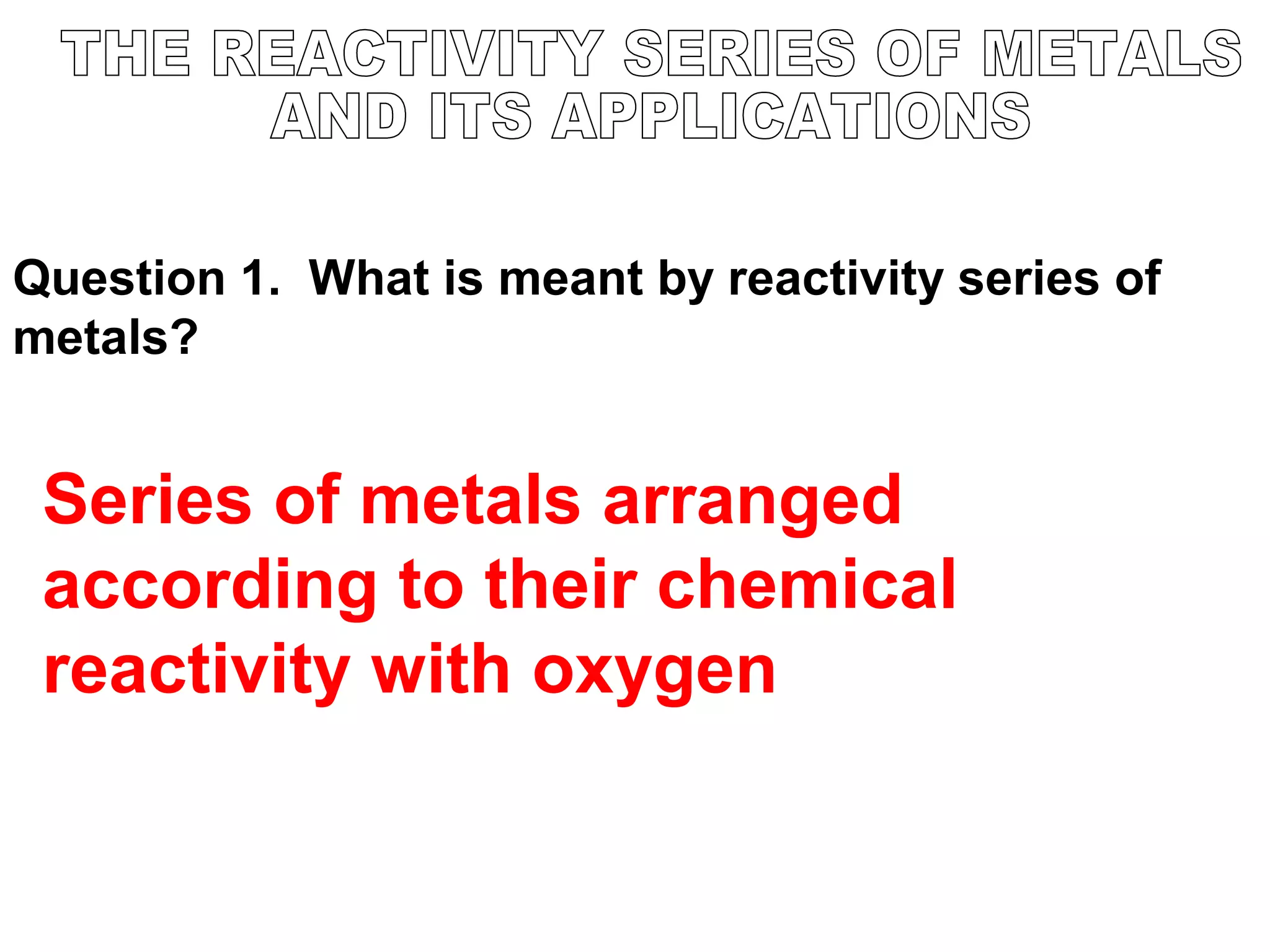
Question 1. What is meant by reactivity series of
metals?
Series of metals arranged
according to their chemical
reactivity with oxygen
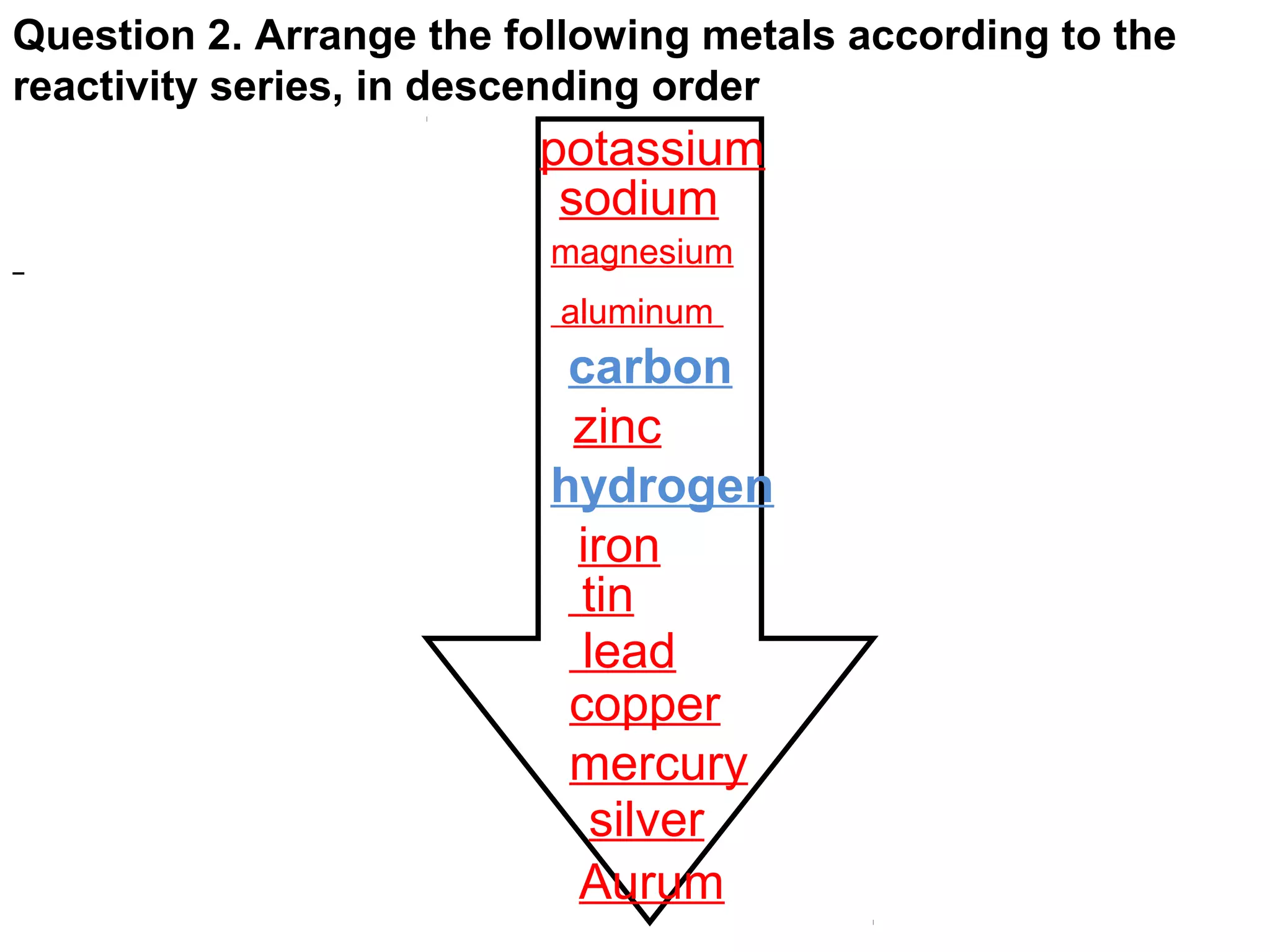
Question 2. Arrange the following metals according to the
reactivity series, in descending order
magnesium
aluminum
potassium
sodium
carbon
zinc
hydrogen
iron
tin
lead
copper
mercury
silver
Aurum
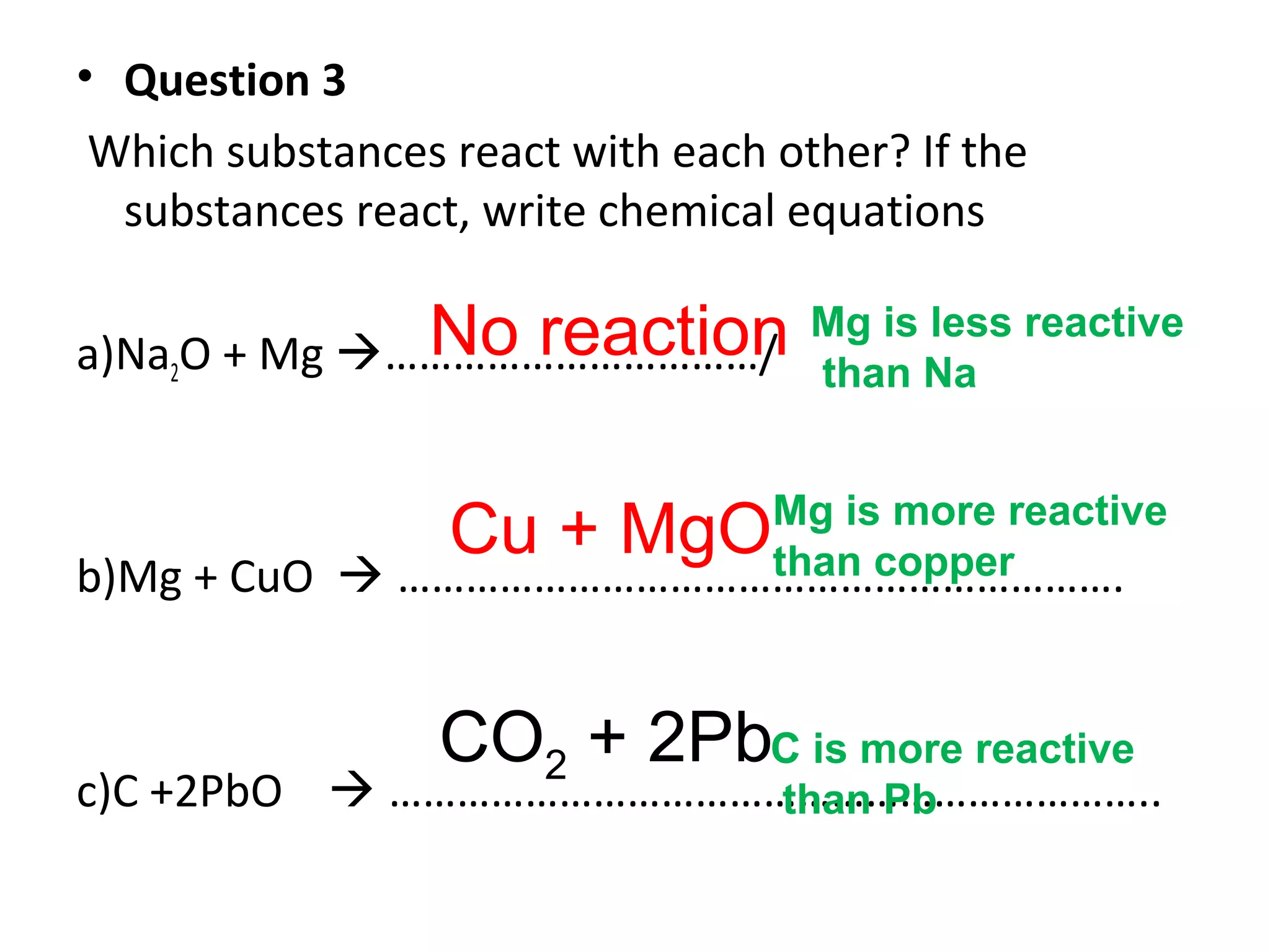
• Question 3
 Which substances react with each other? If the
substances react, write chemical equations
a)Na2O + Mg ……………………………/
b)Mg + CuO  ……………………………………………………….
c)C +2PbO  …………………………………………………………..
No reaction
Cu + MgO
CO2 + 2Pb
Mg is less reactive
than Na
Mg is more reactive
than copper
C is more reactive
than Pb
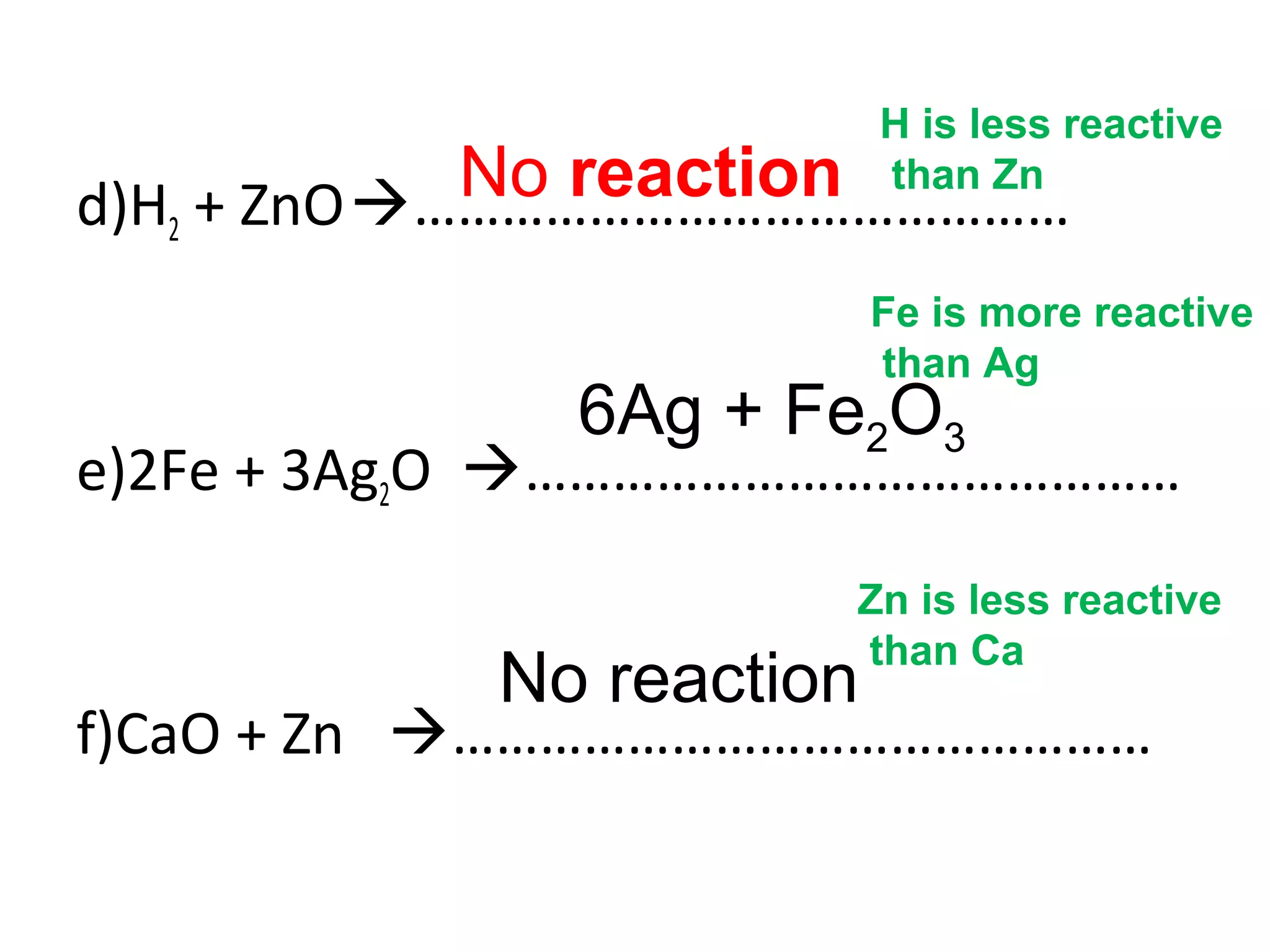
d)H2 + ZnO………………………………………
e)2Fe + 3Ag2O ………………………………………
f)CaO + Zn …………………………………………
 
No reaction
6Ag + Fe2O3
No reaction
H is less reactive
than Zn
Fe is more reactive
than Ag
Zn is less reactive
than Ca


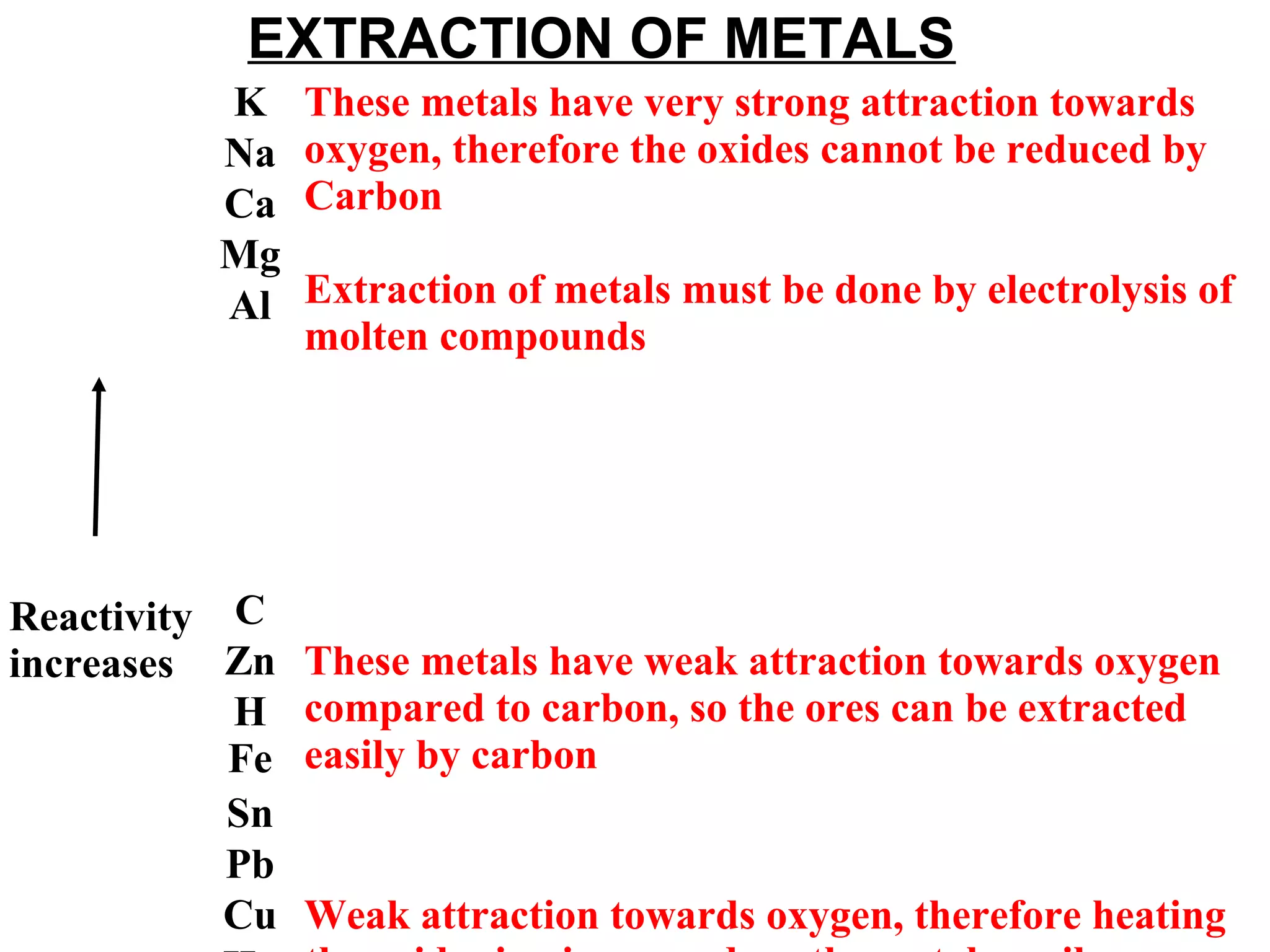
Reactivity 
increases
K These metals have very strong attraction towards 
oxygen, therefore the oxides cannot be reduced by 
Carbon
 
Extraction of metals must be done by electrolysis of 
molten compounds
Na
Ca
Mg
Al
C  
Zn These metals have weak attraction towards oxygen 
compared to carbon, so the ores can be extracted 
easily by carbon
 
H
Fe
Sn
Pb
Cu Weak attraction towards oxygen, therefore heating 
EXTRACTION OF METALS
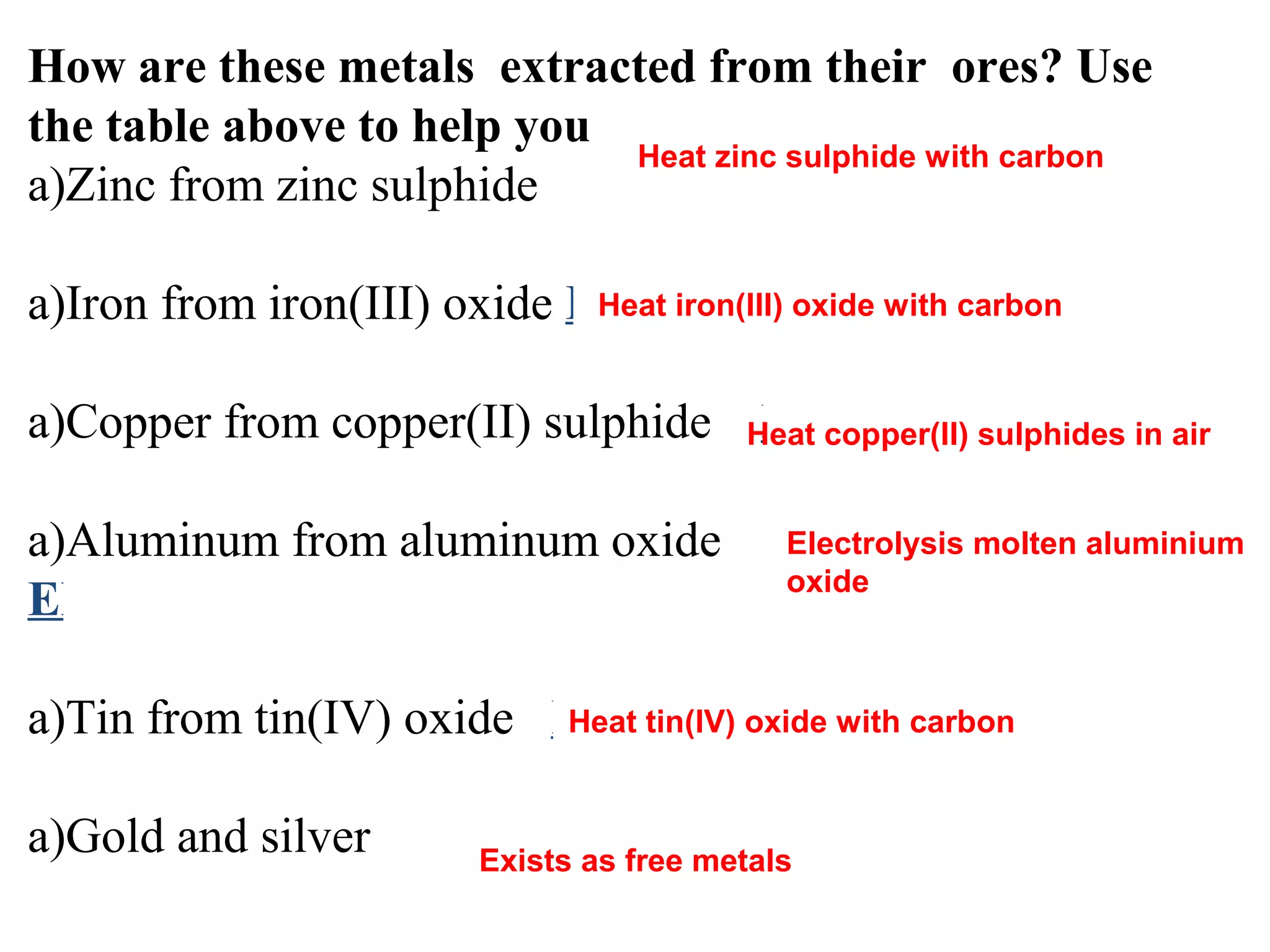
How are these metals extracted from their ores? Use
the table above to help you
a)Zinc from zinc sulphide Extracted by carbon
a)Iron from iron(III) oxide Extracted by carbon
a)Copper from copper(II) sulphide Heating oxides in air
a)Aluminum from aluminum oxide
Electrolysis of molten compounds
a)Tin from tin(IV) oxide Extracted by carbon
a)Gold and silver Exist as free metals
Heat zinc sulphide with carbon
Heat iron(III) oxide with carbon
Heat copper(II) sulphides in air
Electrolysis molten aluminium
oxide
Heat tin(IV) oxide with carbon
Exists as free metals
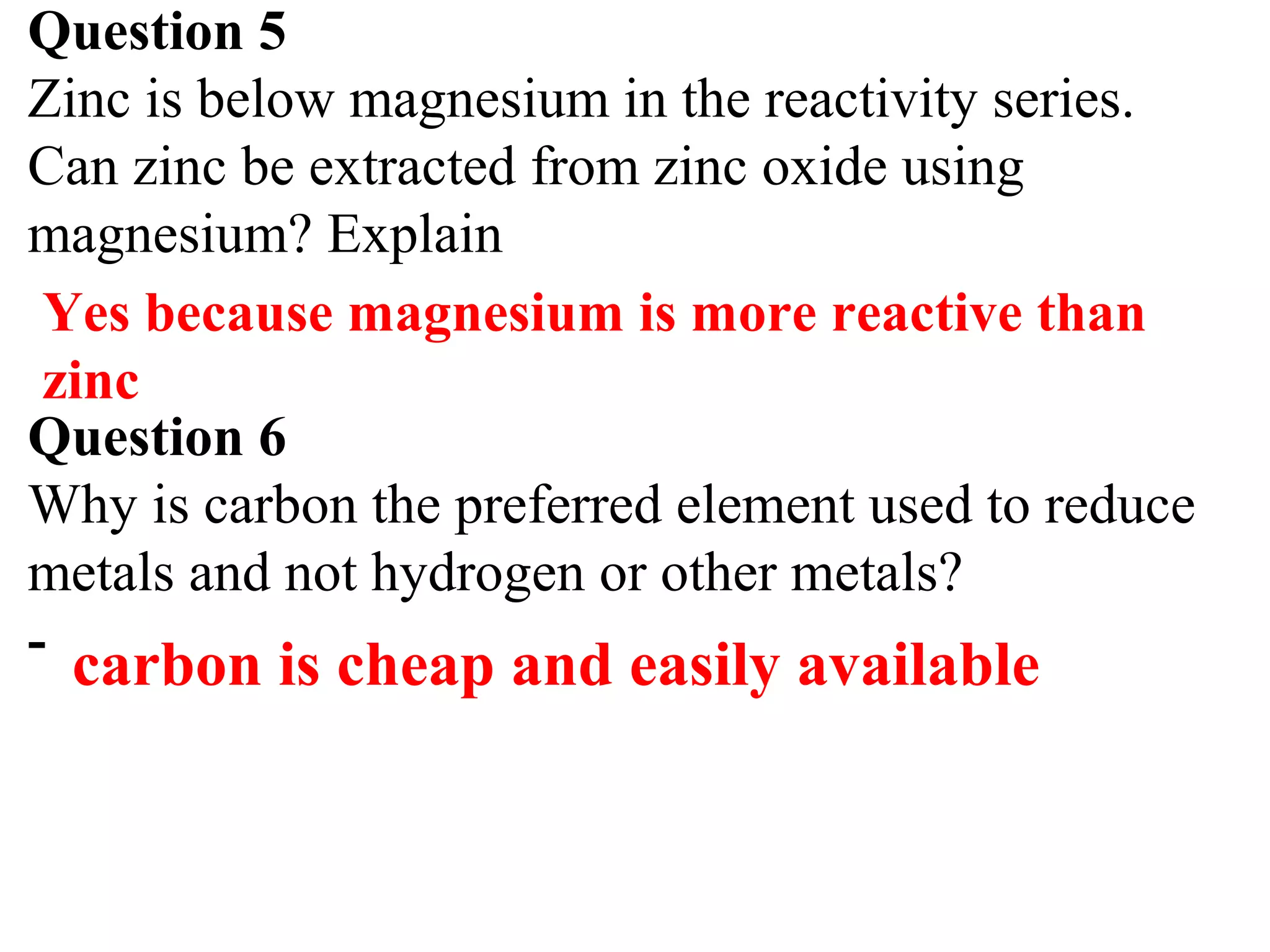
Question 5
Zinc is below magnesium in the reactivity series.
Can zinc be extracted from zinc oxide using
magnesium? Explain
Question 6
Why is carbon the preferred element used to reduce
metals and not hydrogen or other metals?
-
Yes because magnesium is more reactive than
zinc
carbon is cheap and easily available
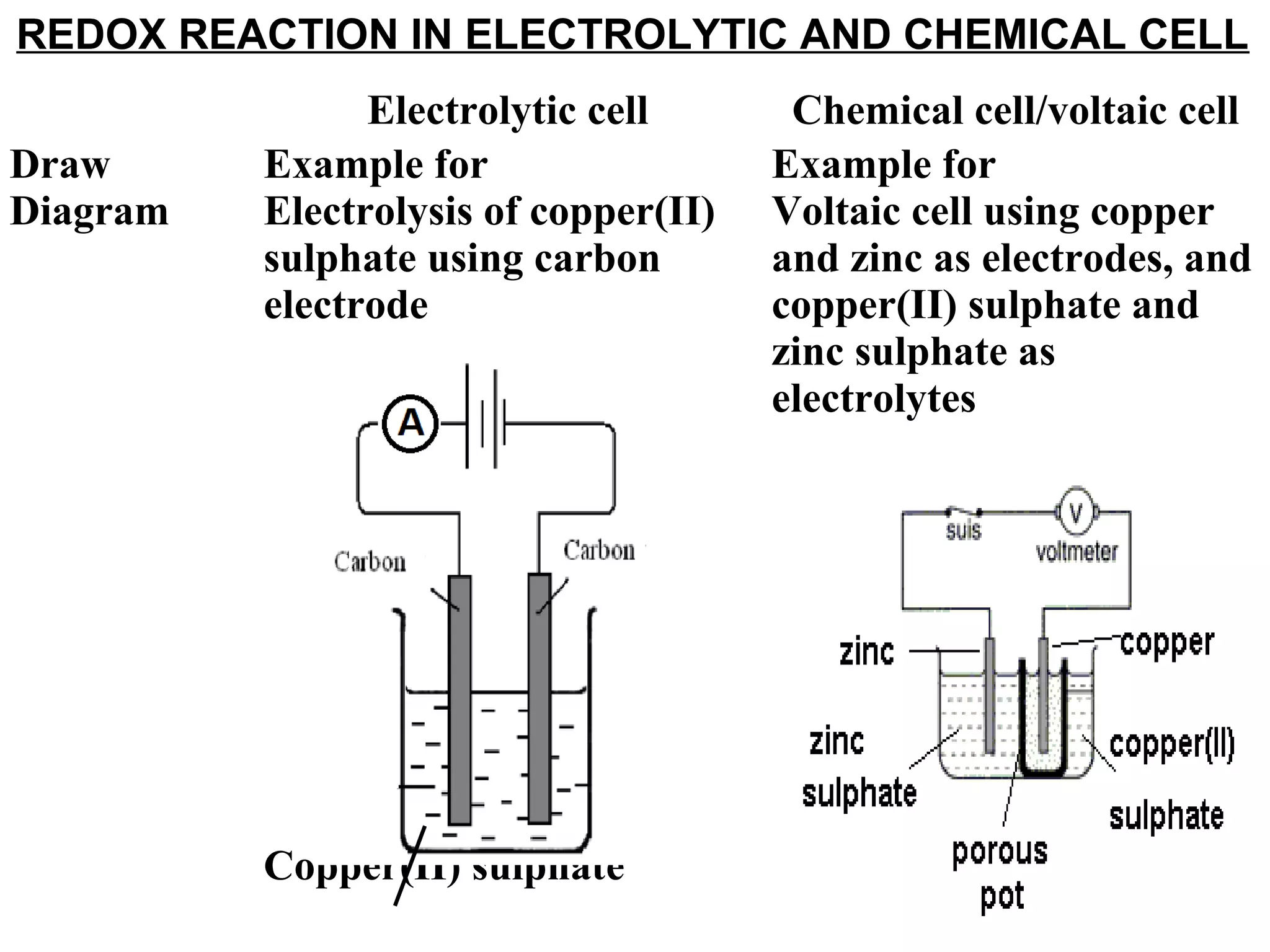
Electrolytic cell Chemical cell/voltaic cell
Draw
Diagram
Example for
Electrolysis of copper(II)
sulphate using carbon
electrode
Copper(II) sulphate
Example for
Voltaic cell using copper
and zinc as electrodes, and
copper(II) sulphate and
zinc sulphate as
electrolytes
REDOX REACTION IN ELECTROLYTIC AND CHEMICAL CELL
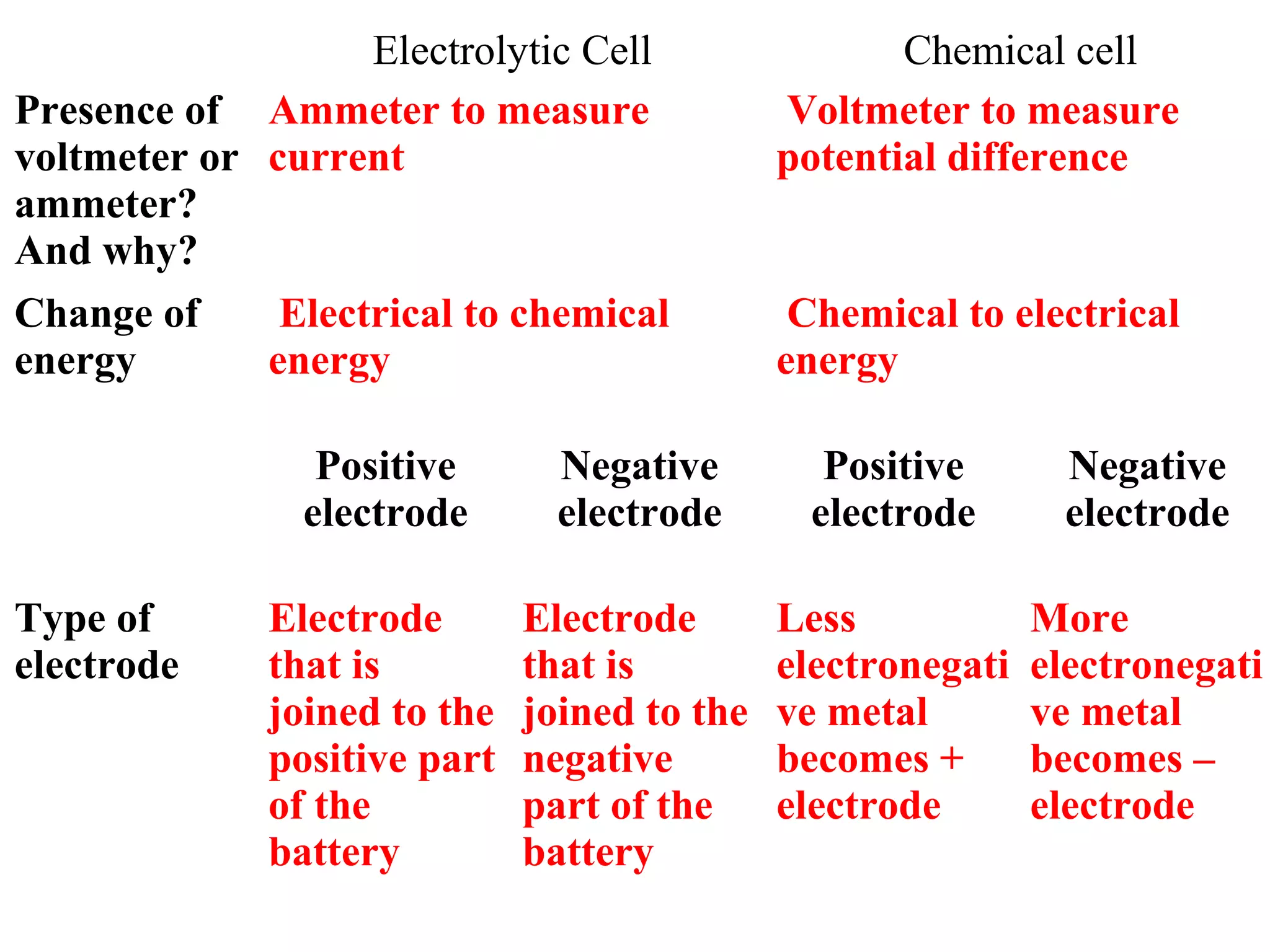
Electrolytic Cell Chemical cell
Presence of
voltmeter or
ammeter?
And why?
Ammeter to measure
current
Voltmeter to measure
potential difference
Change of
energy
Electrical to chemical
energy
Chemical to electrical
energy
Positive
electrode
Negative
electrode
Positive
electrode
Negative
electrode
Type of
electrode
Electrode
that is
joined to the
positive part
of the
battery
Electrode
that is
joined to the
negative
part of the
battery
Less
electronegati
ve metal
becomes +
electrode
More
electronegati
ve metal
becomes –
electrode
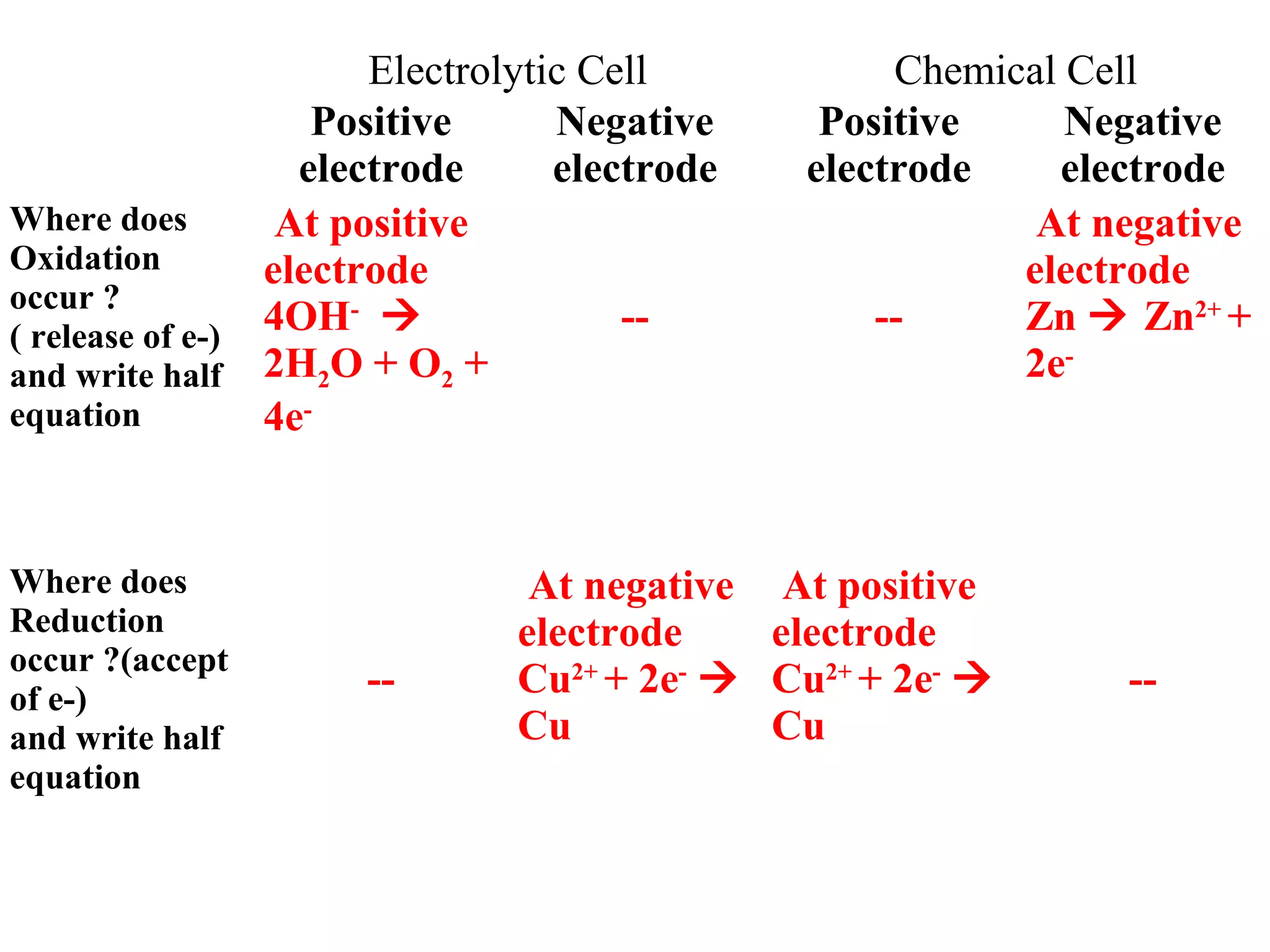
Electrolytic Cell Chemical Cell
Positive
electrode
Negative
electrode
Positive
electrode
Negative
electrode
Where does
Oxidation
occur ?
( release of e-)
and write half
equation
At positive
electrode
4OH-

2H2O + O2 +
4e-
-- --
At negative
electrode
Zn  Zn2+
+
2e-
Where does
Reduction
occur ?(accept
of e-)
and write half
equation
--
At negative
electrode
Cu2+
+ 2e-

Cu
At positive
electrode
Cu2+
+ 2e-

Cu
--
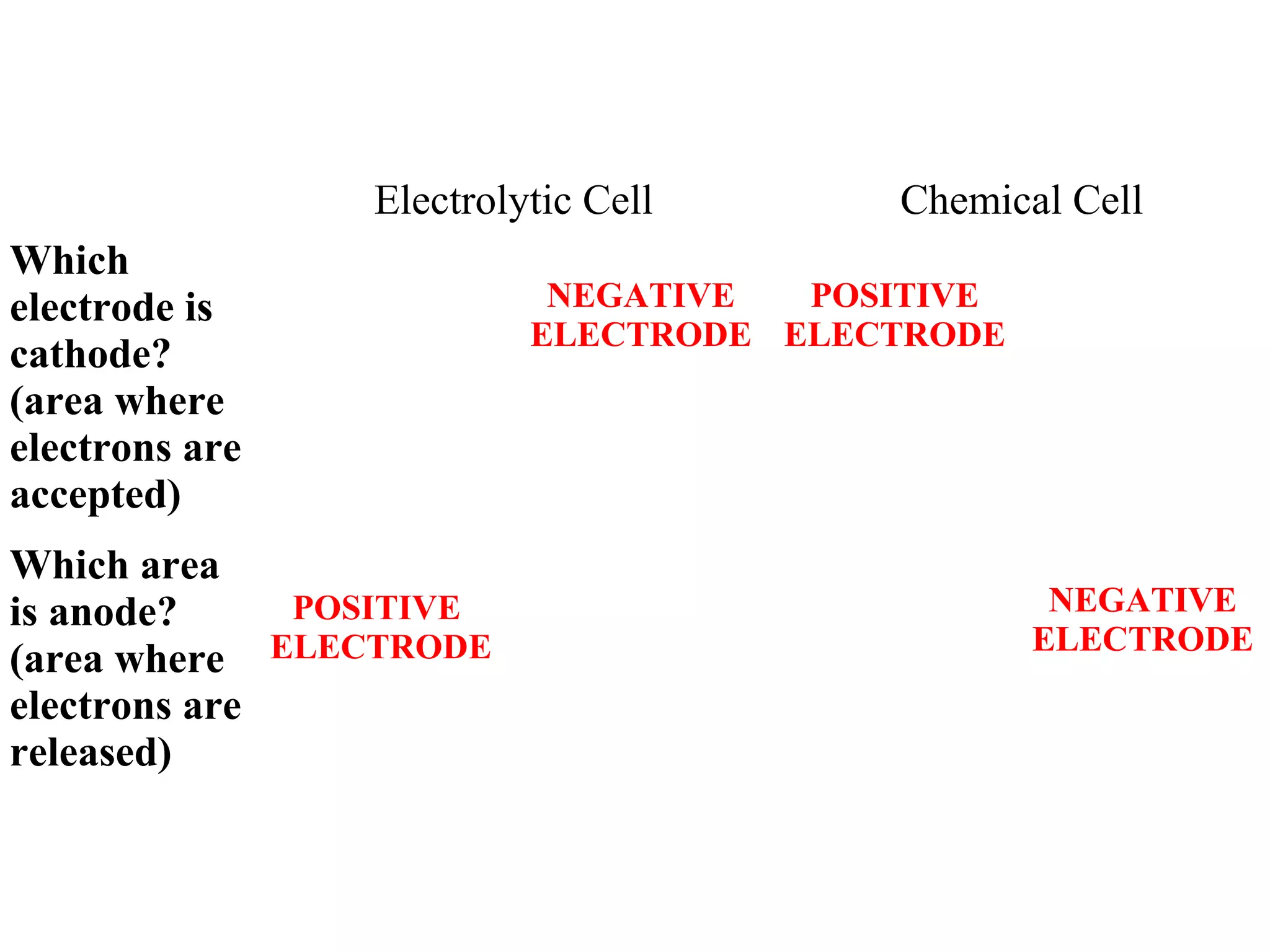
Electrolytic Cell Chemical Cell
Which
electrode is
cathode?
(area where
electrons are
accepted)
NEGATIVE
ELECTRODE
POSITIVE
ELECTRODE
Which area
is anode?
(area where
electrons are
released)
POSITIVE
ELECTRODE
NEGATIVE
ELECTRODE

Redox part 3= rusting - reactivity series and diff between electrolytic cell and electrolysis - edited with answers

  • 2.
    PRESENCE OF OXYGEN PRESENCE OF WATER OXIDATIONOF METALS (METAL LOSE ELECTRON TO FORM IONS ) Zn  Zn 2+ + 2e
  • 3.
    NO, RUSTING isa term IS FOR IRON ONLY SEA BREEZE CONTAINS DISSOLVE SALT (ELECTROLYTE). SO RUSTING IS FASTER
  • 4.
    K Na Mg Al Zn Fe Sn Pb Cu Hg Ag Au Gold is situatedlow in ECS, therefore it is a less electropositive metal Magnesium is situated higher in ECS, so it is a more electropositive metal
  • 5.
    Aluminum is situatedhigh in the electrochemical series. But aluminum is very resistant to corrosion as compared to iron. Explain •BECAUSE ALUMINIUM HAS OXIDE LAYER WHICH IS VERY TIGHTLY HELD, SO IT WILL PROTECT ALUMINIUM FROM CORROSION. •OXIDE LAYER OF IRON however CAN BREAK EASILY
  • 7.
    THE IRON ATOMLOSES ELECTRON TO FORM IRON(II) IONS, Fe 2+ Fe  Fe 2+ + 2e Metal IRON WATER
  • 8.
    STEP 2 (REDUCTION) E)Where do the electrons that are released by iron flow to? And why? To the other end (positive pole). Because this area lack of electron.
  • 9.
    f) What happensto the electron here? Taken by water and oxygen molecules to form hydroxide ions , OH- g) Write half equation for the reaction that occur O2 + 2H2O + 4e 4OH-
  • 10.
    h) Where dothe hydroxide ions formed in this reaction go to? Combine with Fe2+ STEP 3; FORMATION OF VOLTAIC CELL A) What happens to the iron(II) ions and the hydroxide ions formed from Step 1 and Step 2? They will combine to form Fe(OH)2
  • 11.
    b) Write ionicequation for the reaction Fe2+ + 2OH- Fe(OH)2 c) A voltaic cell is formed in this mechanism of rusting. State 2 movements that produce this voltaic cell i)Through the metal : Movement of electrons ii) Throgh the water : movement of ions
  • 12.
    STEP 4 :FORMATION OF RUST A) What happen to the iron (II) hydroxide formed when exposed to oxygen? It oxidised rapidly to form hydrated iron (III) oxide (rust) B)Write the formula of the rust formed Fe2O3.x H2O
  • 13.
    Oxidising agent :water and oxygen Reducing agent : iron c)State the oxidising agent and reducing agent in rusting mechanism
  • 14.
    PREVENTING RUSTING OFIRON WAYS TO CONTROL RUSTING METHODS WHERE USED? 1. USING PROTEC TIVE COATING COVERING WITH PAINT 2. COVERING WITH OIL AND GREASE 3. COVERING WITH OIL TIN 4. COVERING WITH CHROMIUM 5. COVERING WITH ZINC METAL(GALVANIZING) IRON AND STEEL OBJECT, LIKE MOTOCARS, SHIPS,BRIDGE AND STEEL IN MACHINERY CANS AND FOOD BUMPERS OF MOTOCARS ROOF OF HOUSES
  • 15.
    PREVENTING RUSTING OFIRON WAYS TO CONTROL RUSTING METHODS WHERE USED? 6. SACRIFI CIAL PROTEC TION USING BLOCKS OF ZINC METAL 7. USING BLOCKS OF MAGNESIUM METAL 8. ALLOYING MAKING STAINLESS STEEL BLOCK OF ZINC ARE ATTACHED TO THE HULL OF THE SHIP TO PROTECT UNDERGROUND STEEL PIPES KNIVES,SPOONS,MEDICAL INSTRUMENT
  • 16.
    An experiment wasdone in a lab to investigate factors that affect rust. All the boiling tubes were left for 3 days
  • 17.
    a.After 3 days,it was noticed that in boiling tubes C ,D and E, the potassium hexacyanoferrate(III) solution changed colour to dark blue. What is the inference? Rusting occurs in boiling tube C,D and E b. In which boiling tubes did iron nails show rusting? C, D and E
  • 18.
    c.The nails inboiling tubes A and B did not rust. Explain d. Explain the function of experiment in E Magnesium and Zn is more electropositive than iron. Mg and Zn ionise to protect iron from rusting As a control experiment to show that iron will still rust without contact with other metals because the presence of water and oxygen
  • 19.
    d)Write half reactionfor (i) Oxidation ( lose electron) in experiment A (ii) Oxidation ( lose electron ) in experiment C (iii) Oxidation ( lose electron) in experiment E Mg Mg2+ + 2e Fe Fe2+ + 2e Fe Fe2+ + 2e
  • 20.
    f)What type ofmetals prevent rusting of iron? g)What type of metals encourage rusting of iron? h)If iron nails are immersed in alkaline solution, the nails do not rust. Explain More electropositive than Fe Less electropositive than Fe Hydroxide ions cannot gain the electrons that are released by iron atoms . No redox reaction ocur
  • 21.
    i) Calcium ismore effective than zinc to prevent rusting Why do you think steel objects are coated with zinc instead of calcium? j) Explain the followings i) When a metal corrodes, it undergoes oxidation Zn has protective oxide coating which are not broken easily Metal atom release electron zinc steel
  • 22.
    (ii) In tinplating, iron can is coated with tin. However as soon as the can is scratched, rusting will occur quickly (iii) In galvanizing, iron is coated with a layer of zinc. When the galvanized iron is scratched, rusting does not occur.   Iron is more electropositive than tin. Rusting will occur faster Zn is more electropositive than iron. Iron will not corrode Tin Iron can zinc Iron Zn Fe Sn
  • 23.
    Question 1. Whatis meant by reactivity series of metals? Series of metals arranged according to their chemical reactivity with oxygen
  • 24.
    Question 2. Arrangethe following metals according to the reactivity series, in descending order magnesium aluminum potassium sodium carbon zinc hydrogen iron tin lead copper mercury silver Aurum
  • 25.
    • Question 3  Which substancesreact with each other? If the substances react, write chemical equations a)Na2O + Mg ……………………………/ b)Mg + CuO  ………………………………………………………. c)C +2PbO  ………………………………………………………….. No reaction Cu + MgO CO2 + 2Pb Mg is less reactive than Na Mg is more reactive than copper C is more reactive than Pb
  • 26.
    d)H2 + ZnO……………………………………… e)2Fe+ 3Ag2O ……………………………………… f)CaO + Zn …………………………………………   No reaction 6Ag + Fe2O3 No reaction H is less reactive than Zn Fe is more reactive than Ag Zn is less reactive than Ca
  • 27.
                        Reactivity  increases K These metals have very strong attraction towards  oxygen, therefore the oxides cannot be reduced by  Carbon   Extraction of metals must be done by electrolysis of  molten compounds Na Ca Mg Al C   ZnThese metals have weak attraction towards oxygen  compared to carbon, so the ores can be extracted  easily by carbon   H Fe Sn Pb Cu Weak attraction towards oxygen, therefore heating  EXTRACTION OF METALS
  • 28.
    How are thesemetals extracted from their ores? Use the table above to help you a)Zinc from zinc sulphide Extracted by carbon a)Iron from iron(III) oxide Extracted by carbon a)Copper from copper(II) sulphide Heating oxides in air a)Aluminum from aluminum oxide Electrolysis of molten compounds a)Tin from tin(IV) oxide Extracted by carbon a)Gold and silver Exist as free metals Heat zinc sulphide with carbon Heat iron(III) oxide with carbon Heat copper(II) sulphides in air Electrolysis molten aluminium oxide Heat tin(IV) oxide with carbon Exists as free metals
  • 29.
    Question 5 Zinc isbelow magnesium in the reactivity series. Can zinc be extracted from zinc oxide using magnesium? Explain Question 6 Why is carbon the preferred element used to reduce metals and not hydrogen or other metals? - Yes because magnesium is more reactive than zinc carbon is cheap and easily available
  • 30.
    Electrolytic cell Chemicalcell/voltaic cell Draw Diagram Example for Electrolysis of copper(II) sulphate using carbon electrode Copper(II) sulphate Example for Voltaic cell using copper and zinc as electrodes, and copper(II) sulphate and zinc sulphate as electrolytes REDOX REACTION IN ELECTROLYTIC AND CHEMICAL CELL
  • 31.
    Electrolytic Cell Chemicalcell Presence of voltmeter or ammeter? And why? Ammeter to measure current Voltmeter to measure potential difference Change of energy Electrical to chemical energy Chemical to electrical energy Positive electrode Negative electrode Positive electrode Negative electrode Type of electrode Electrode that is joined to the positive part of the battery Electrode that is joined to the negative part of the battery Less electronegati ve metal becomes + electrode More electronegati ve metal becomes – electrode
  • 32.
    Electrolytic Cell ChemicalCell Positive electrode Negative electrode Positive electrode Negative electrode Where does Oxidation occur ? ( release of e-) and write half equation At positive electrode 4OH-  2H2O + O2 + 4e- -- -- At negative electrode Zn  Zn2+ + 2e- Where does Reduction occur ?(accept of e-) and write half equation -- At negative electrode Cu2+ + 2e-  Cu At positive electrode Cu2+ + 2e-  Cu --
  • 33.
    Electrolytic Cell ChemicalCell Which electrode is cathode? (area where electrons are accepted) NEGATIVE ELECTRODE POSITIVE ELECTRODE Which area is anode? (area where electrons are released) POSITIVE ELECTRODE NEGATIVE ELECTRODE