#TargetXSummit
Retention -
War Stories & Best Practices
Meagan Wood, TargetX
Meagan Wood
Business Analyst, Product Team
Joined TargetX in August 2018
Nine years of higher education experience in
enrollment management & student services
meagan.wood@targetx.com
Make every student a graduate,
and every graduate a success.
TargetX Vision
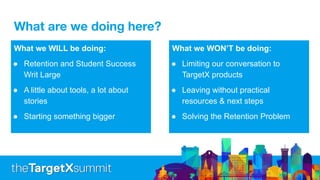
What are we doing here?
What we WILL be doing:
● Retention and Student Success
Writ Large
● A little about tools, a lot about
stories
● Starting something bigger
What we WON’T be doing:
● Limiting our conversation to
TargetX products
● Leaving without practical
resources & next steps
● Solving the Retention Problem
#TargetXSummit
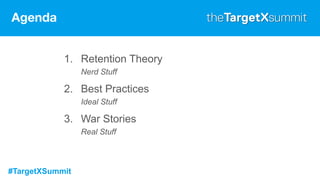
Agenda
1. Retention Theory
Nerd Stuff
2. Best Practices
Ideal Stuff
3. War Stories
Real Stuff
#TargetXSummit
Retention Theory
Nerd Stuff
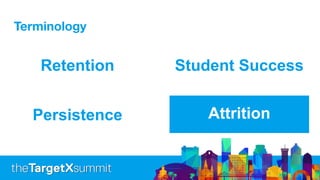
Terminology
Retention
Terminology
Retention Student Success
Terminology
Retention Student Success
Persistence
Terminology
Retention Student Success
Persistence Attrition
Terminology
Retention
An educational institution’s
rate of keeping students
enrolled for the duration of
their originally intended
degree program, and their
efforts deployed to this end
Terminology
Student Success
An educational institution’s
efforts to keep students on
target toward completion of
their educational goal More than just degree completion
More common at community colleges
Terminology
Persistence
The factors influencing a
student’s continued
progress toward their
educational goal
Emphasis is on the student instead
of the institution
Positively framed
Terminology
Attrition
The rate of departure of
students from an educational
institution
Emphasis is on the student instead
of the institution
Negatively framed
Terminology
Retention Student Success
Persistence Attrition
History of Retention Theory
● Through mid-20th century:
○ Student attrition was explained based on individual student
characteristics.
● Starting in the 1970s:
○ Theoretical models began to be used to understand and explain retention
systemically.
Three Theoretical Models of Retention
Attrition as voluntary withdrawal
● William Spady
● Dropouts from Higher Education: Toward an
Empirical Model, 1971
● Drawn from sociological theory (Emile Durkheim)
● Failure to assimilate to a given community can lead
an individual to voluntarily withdraw
Three Theoretical Models of Retention - #2
Integration into educational
community as rite of passage
● Vincent Tinto
● Leaving College: Rethinking Causes and Cures of
Student Attrition, 1987.
● Rooted in social anthropology (Van Gennep)
● Three stages: Separation, Transition, Incorporation
● Most applicable to traditional student's first
introduction to college
Three Theoretical Models of Retention - #3
Student satisfaction as predictor of
retention
● John P. Bean
● Rooted in human resources theories around
employee turnover in the workplace
● Satisfaction based on many factors - not just
superficial
Late 20th Century into Early 21st Century
● Retention research began addressing different issues and topics:
○ Diverse student populations
○ Different types of institutions
○ New learning modalities
○ Different role higher education was playing into the greater landscape
● No single model captures the complexity of retention
“For years, our prevailing view of student retention
has been shaped by theories that view
student retention through the lens of institutional action
and ask what institutions can do to retain their students.
Students, however, do not seek to be retained.
They seek to persist.
The two perspectives, although necessarily related, are not the
same. Their interests are different.”
Vincent Tinto, “Through the Eyes of Students,”
Journal of College Student Retention, 2015.
#TargetXSummit
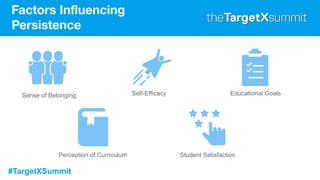
Factors Influencing
Persistence
Sense of Belonging Self-Efficacy Educational Goals
Perception of Curriculum Student Satisfaction
Factors Influencing
Persistence
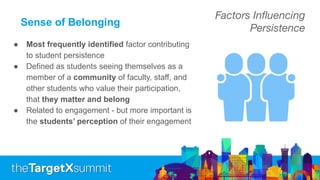
● Most frequently identified factor contributing
to student persistence
● Defined as students seeing themselves as a
member of a community of faculty, staff, and
other students who value their participation,
that they matter and belong
● Related to engagement - but more important is
the students’ perception of their engagement
Sense of Belonging
Self-Efficacy
● A person’s belief in their ability to succeed
in a specific situation or at a specific task
● Not related to actual ability
● Self-efficacy is learned, not inherited
● Students’ belief in their capacity to succeed
must be built, reinforced, and maintained
throughout their educational journey
Factors Influencing
Persistence
Educational Goals
● Students’ educational goals are both related to
institution and beyond
● Helping students gain clarity over their
educational goals can aid in their persistence
● May change over time - education is formative
● Student Journeys - session tomorrow at 9am
Factors Influencing
Persistence
Perception of Curriculum
● Students ask themselves, "Is the curriculum
valuable for me to spend my time on?
● Reflects day-to-day participation and beyond
credential
● Curriculum communicates not just a collection of
facts but a collection of values that determine
what is presented and how it is presented in the
classroom
Factors Influencing
Persistence
Student Satisfaction
● Are students pleased with the product they've
acquired?
● Goes beyond superficial things like amenities
● Motivators vs Hygiene Factors
○ Motivators - produce satisfaction
○ Hygiene Factors - diminish dissatisfaction
● The opposite of satisfaction is not dissatisfaction -
it's the absence of satisfaction
Factors Influencing
Persistence
#TargetXSummit
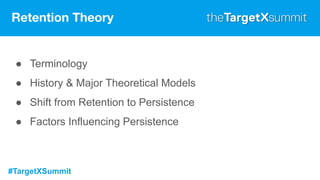
Retention Theory
● Terminology
● History & Major Theoretical Models
● Shift from Retention to Persistence
● Factors Influencing Persistence
#TargetXSummit
Best Practices
Ideal Stuff
#TargetXSummit
#TargetXSummit
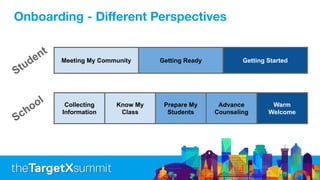
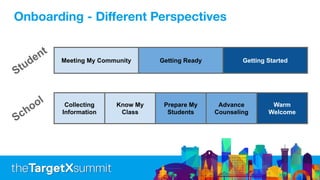
Meeting My Community Getting Ready Getting Started
Collecting
Information
Know My
Class
Prepare My
Students
Advance
Counseling
Warm
Welcome
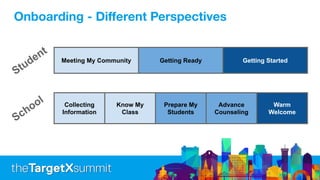
Onboarding - Different Perspectives
Student
School
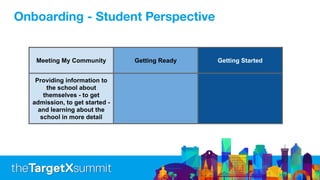
Meeting My Community Getting Ready Getting Started
Providing information to
the school about
themselves - to get
admission, to get started -
and learning about the
school in more detail
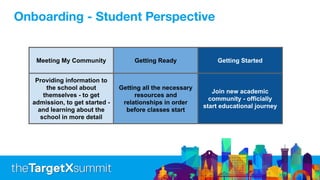
Onboarding - Student Perspective
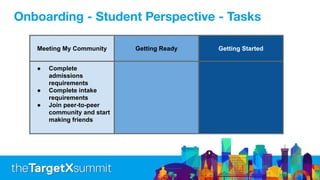
Meeting My Community Getting Ready Getting Started
● Complete
admissions
requirements
● Complete intake
requirements
● Join peer-to-peer
community and start
making friends
Onboarding - Student Perspective - Tasks
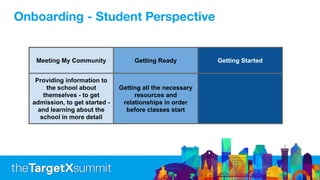
Meeting My Community Getting Ready Getting Started
Providing information to
the school about
themselves - to get
admission, to get started -
and learning about the
school in more detail
Getting all the necessary
resources and
relationships in order
before classes start
Onboarding - Student Perspective
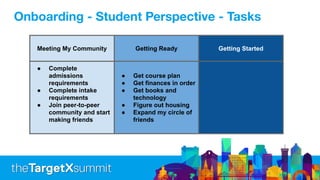
Meeting My Community Getting Ready Getting Started
● Complete
admissions
requirements
● Complete intake
requirements
● Join peer-to-peer
community and start
making friends
● Get course plan
● Get finances in order
● Get books and
technology
● Figure out housing
● Expand my circle of
friends
Onboarding - Student Perspective - Tasks
Meeting My Community Getting Ready Getting Started
Providing information to
the school about
themselves - to get
admission, to get started -
and learning about the
school in more detail
Getting all the necessary
resources and
relationships in order
before classes start
Join new academic
community - officially
start educational journey
Onboarding - Student Perspective
Meeting My Community Getting Ready Getting Started
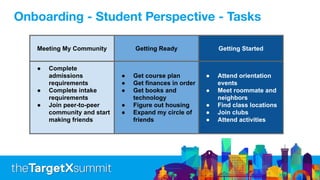
● Complete
admissions
requirements
● Complete intake
requirements
● Join peer-to-peer
community and start
making friends
● Get course plan
● Get finances in order
● Get books and
technology
● Figure out housing
● Expand my circle of
friends
● Attend orientation
events
● Meet roommate and
neighbors
● Find class locations
● Join clubs
● Attend activities
Onboarding - Student Perspective - Tasks
Meeting My Community Getting Ready Getting Started
Collecting
Information
Know My
Class
Prepare My
Students
Advance
Counseling
Warm
Welcome
Onboarding - Different Perspectives
Student
School
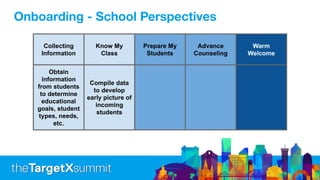
Collecting
Information
Know My
Class
Prepare My
Students
Advance
Counseling
Warm
Welcome
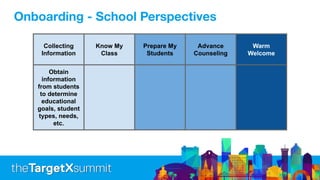
Obtain
information
from students
to determine
educational
goals, student
types, needs,
etc.
Onboarding - School Perspectives
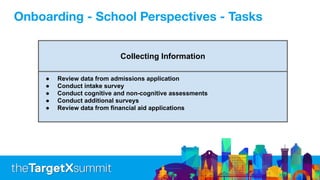
Collecting Information
● Review data from admissions application
● Conduct intake survey
● Conduct cognitive and non-cognitive assessments
● Conduct additional surveys
● Review data from financial aid applications
Onboarding - School Perspectives - Tasks
Collecting
Information
Know My
Class
Prepare My
Students
Advance
Counseling
Warm
Welcome
Obtain
information
from students
to determine
educational
goals, student
types, needs,
etc.
Compile data
to develop
early picture of
incoming
students
Onboarding - School Perspectives
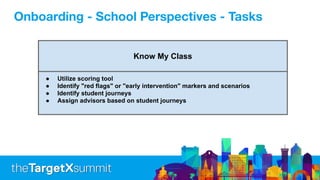
Know My Class
● Utilize scoring tool
● Identify "red flags" or "early intervention" markers and scenarios
● Identify student journeys
● Assign advisors based on student journeys
Onboarding - School Perspectives - Tasks
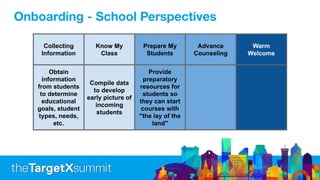
Collecting
Information
Know My
Class
Prepare My
Students
Advance
Counseling
Warm
Welcome
Obtain
information
from students
to determine
educational
goals, student
types, needs,
etc.
Compile data
to develop
early picture of
incoming
students
Provide
preparatory
resources for
students so
they can start
courses with
"the lay of the
land"
Onboarding - School Perspectives
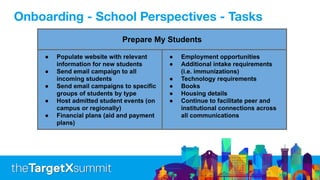
Prepare My Students
● Populate website with relevant
information for new students
● Send email campaign to all
incoming students
● Send email campaigns to specific
groups of students by type
● Host admitted student events (on
campus or regionally)
● Financial plans (aid and payment
plans)
● Employment opportunities
● Additional intake requirements
(i.e. immunizations)
● Technology requirements
● Books
● Housing details
● Continue to facilitate peer and
institutional connections across
all communications
Onboarding - School Perspectives - Tasks
Collecting
Information
Know My
Class
Prepare My
Students
Advance
Counseling
Warm
Welcome
Obtain
information
from students
to determine
educational
goals, student
types, needs,
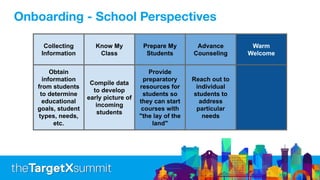
etc.
Compile data
to develop
early picture of
incoming
students
Provide
preparatory
resources for
students so
they can start
courses with
"the lay of the
land"
Reach out to
individual
students to
address
particular
needs
Onboarding - School Perspectives
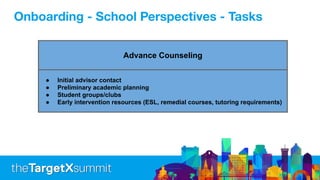
Advance Counseling
● Initial advisor contact
● Preliminary academic planning
● Student groups/clubs
● Early intervention resources (ESL, remedial courses, tutoring requirements)
Onboarding - School Perspectives - Tasks
Collecting
Information
Know My
Class
Prepare My
Students
Advance
Counseling
Warm
Welcome
Obtain
information
from students
to determine
educational
goals, student
types, needs,
etc.
Compile data
to develop
early picture of
incoming
students
Provide
preparatory
resources for
students so
they can start
courses with
"the lay of the
land"
Reach out to
individual
students to
address
particular
needs
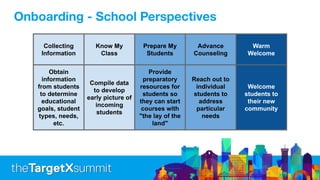
Welcome
students to
their new
community
Onboarding - School Perspectives
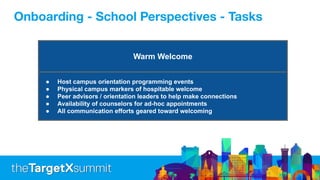
Warm Welcome
● Host campus orientation programming events
● Physical campus markers of hospitable welcome
● Peer advisors / orientation leaders to help make connections
● Availability of counselors for ad-hoc appointments
● All communication efforts geared toward welcoming
Onboarding - School Perspectives - Tasks
Meeting My Community Getting Ready Getting Started
Collecting
Information
Know My
Class
Prepare My
Students
Advance
Counseling
Warm
Welcome
Onboarding - Different Perspectives
Student
School
#TargetXSummit
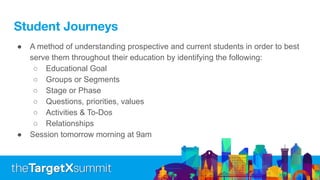
Student Journeys
● A method of understanding prospective and current students in order to best
serve them throughout their education by identifying the following:
○ Educational Goal
○ Groups or Segments
○ Stage or Phase
○ Questions, priorities, values
○ Activities & To-Dos
○ Relationships
● Session tomorrow morning at 9am
#TargetXSummit
#TargetXSummit
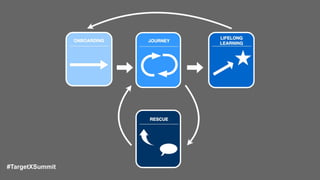
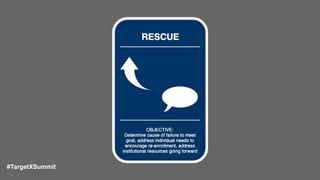
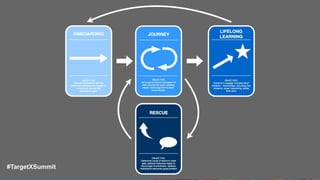
Best Practices for Rescue
● Engagement plan before rescue is needed
● Contact throughout registration period
● Find out what happened
● Plan for re-engagement
#TargetXSummit
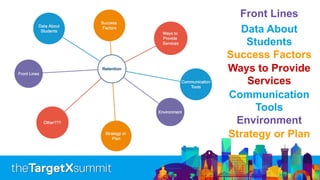
Front Lines
Data About
Students
Success Factors
Ways to Provide
Services
Communication
Tools
Environment
Strategy or Plan
#TargetXSummit
War Stories
Real Stuff
War Stories
● What big questions are you
working through at your school?
● What initiative have you tried that
has surprised you?
● What are your biggest
obstacles?
● What are your biggest priorities?
● What’s your biggest “blue sky”
dream?
Next Steps
Resources
Handouts, Worksheets,
Bibliography
Visit Product Lab
Student Journeys Story Project
Preview New Retention Solution
More Sessions Tomorrow
Student Journeys - 9am
Retention: Now & Future - 3:15pm
Best Practice Partnerships
meagan.wood@targetx.com
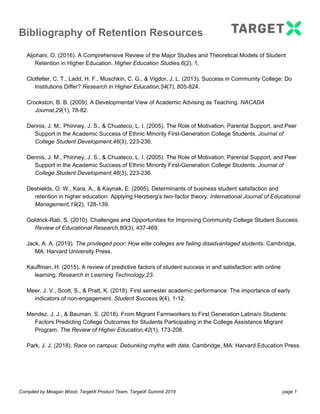
Bibliography of Retention Resources
Aljohani, O. (2016). A Comprehensive Review of the Major Studies and Theoretical Models of Student
Retention in Higher Education. ​Higher Education Studies,6​(2), 1.
Clotfelter, C. T., Ladd, H. F., Muschkin, C. G., & Vigdor, J. L. (2013). Success in Community College: Do
Institutions Differ? ​Research in Higher Education,54​(7), 805-824.
Crookston, B. B. (2009). A Developmental View of Academic Advising as Teaching. ​NACADA
Journal,29​(1), 78-82.
Dennis, J. M., Phinney, J. S., & Chuateco, L. I. (2005). The Role of Motivation, Parental Support, and Peer
Support in the Academic Success of Ethnic Minority First-Generation College Students. ​Journal of
College Student Development,46​(3), 223-236.
Dennis, J. M., Phinney, J. S., & Chuateco, L. I. (2005). The Role of Motivation, Parental Support, and Peer
Support in the Academic Success of Ethnic Minority First-Generation College Students. ​Journal of
College Student Development,46​(3), 223-236.
Deshields, O. W., Kara, A., & Kaynak, E. (2005). Determinants of business student satisfaction and
retention in higher education: Applying Herzberg’s two-factor theory. ​International Journal of Educational
Management,19​(2), 128-139.
Goldrick-Rab, S. (2010). Challenges and Opportunities for Improving Community College Student Success.
Review of Educational Research,80​(3), 437-469.
Jack, A. A. (2019). ​The privileged poor: How elite colleges are failing disadvantaged students​. Cambridge,
MA: Harvard University Press.
Kauffman, H. (2015). A review of predictive factors of student success in and satisfaction with online
learning. ​Research in Learning Technology,23​.
Meer, J. V., Scott, S., & Pratt, K. (2018). First semester academic performance: The importance of early
indicators of non-engagement. ​Student Success,9​(4), 1-12.
Mendez, J. J., & Bauman, S. (2018). From Migrant Farmworkers to First Generation Latina/o Students:
Factors Predicting College Outcomes for Students Participating in the College Assistance Migrant
Program. ​The Review of Higher Education,42​(1), 173-208.
Park, J. J. (2018). ​Race on campus: Debunking myths with data​. Cambridge, MA: Harvard Education Press.
Compiled by Meagan Wood, TargetX Product Team, TargetX Summit 2019 page 1
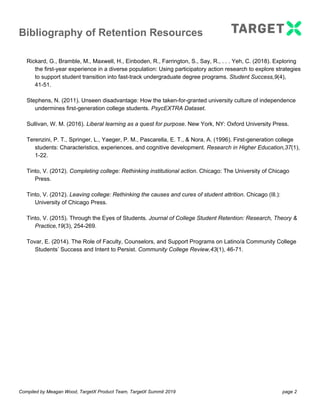
Bibliography of Retention Resources
Rickard, G., Bramble, M., Maxwell, H., Einboden, R., Farrington, S., Say, R., . . . Yeh, C. (2018). Exploring
the first-year experience in a diverse population: Using participatory action research to explore strategies
to support student transition into fast-track undergraduate degree programs. ​Student Success,9​(4),
41-51.
Stephens, N. (2011). Unseen disadvantage: How the taken-for-granted university culture of independence
undermines first-generation college students. ​PsycEXTRA Dataset​.
Sullivan, W. M. (2016). ​Liberal learning as a quest for purpose​. New York, NY: Oxford University Press.
Terenzini, P. T., Springer, L., Yaeger, P. M., Pascarella, E. T., & Nora, A. (1996). First-generation college
students: Characteristics, experiences, and cognitive development. ​Research in Higher Education,37​(1),
1-22.
Tinto, V. (2012). ​Completing college: Rethinking institutional action​. Chicago: The University of Chicago
Press.
Tinto, V. (2012). ​Leaving college: Rethinking the causes and cures of student attrition​. Chicago (Ill.):
University of Chicago Press.
Tinto, V. (2015). Through the Eyes of Students. ​Journal of College Student Retention: Research, Theory &
Practice,19​(3), 254-269.
Tovar, E. (2014). The Role of Faculty, Counselors, and Support Programs on Latino/a Community College
Students’ Success and Intent to Persist. ​Community College Review,43​(1), 46-71.
Compiled by Meagan Wood, TargetX Product Team, TargetX Summit 2019 page 2
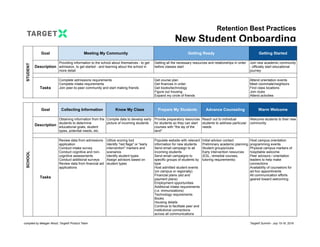
Retention Best Practices
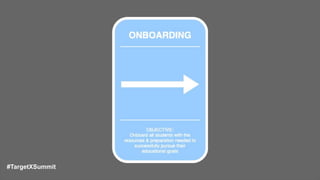
New Student Onboarding
STUDENT
Goal Meeting My Community Getting Ready Getting Started
Description
Providing information to the school about themselves - to get
admission, to get started - and learning about the school in
more detail
Getting all the necessary resources and relationships in order
before classes start
Join new academic community
- officially start educational
journey
Tasks
Complete admissions requirements
Complete intake requirements
Join peer-to-peer community and start making friends
Get course plan
Get finances in order
Get books/technology
Figure out housing
Expand my circle of friends
Attend orientation events
Meet roommate/neighbors
Find class locations
Join clubs
Attend activities
SCHOOL
Goal Collecting Information Know My Class Prepare My Students Advance Counseling Warm Welcome
Description
Obtaining information from the
students to determine
educational goals, student
types, potential needs, etc.
Compile data to develop early
picture of incoming students
Provide preparatory resources
for students so they can start
courses with "the lay of the
land"
Reach out to individual
students to address particular
needs
Welcome students to their new
community
Tasks
Review data from admissions
application
Conduct intake survey
Conduct cognitive and non-
cognitive assessments
Conduct additional surveys
Review data from financial aid
applications
Utilize scoring tool
Identify "red flags" or "early
intervention" markers and
scenarios
Identify student types
Assign advisors based on
student types
Populate website with relevant
information for new students
Send email campaign to all
incoming students
Send email campaigns to
specific groups of students by
type
Host admitted student events
(on campus or regionally)
Financial plans (aid and
payment plans)
Employment opportunities
Additional intake requirements
(i.e. immunizations)
Technology requirements
Books
Housing details
Continue to facilitate peer and
institutional connections
across all communications
Initial advisor contact
Preliminary academic planning
Student groups/clubs
Early intervention resources
(ESL, remedial courses,
tutoring requirements)
Host campus orientation
programming events
Physical campus markers of
hospitable welcome
Peer advisors / orientation
leaders to help make
connections
Availability of counselors for
ad-hoc appointments
All communication efforts
geared toward welcoming
compiled by Meagan Wood, TargetX Product Team TargetX Summit - July 15-16, 2019
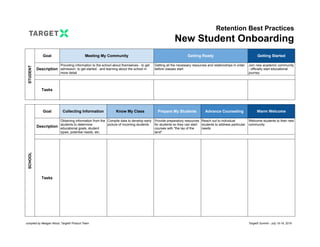
Retention Best Practices
New Student Onboarding
STUDENT
Goal Meeting My Community Getting Ready Getting Started
Description
Providing information to the school about themselves - to get
admission, to get started - and learning about the school in
more detail
Getting all the necessary resources and relationships in order
before classes start
Join new academic community
- officially start educational
journey
Tasks
Complete admissions requirements
Complete intake requirements
Join peer-to-peer community and start making friends
Get course plan
Get finances in order
Get books/technology
Figure out housing
Expand my circle of friends
Attend orientation events
Meet roommate/neighbors
Find class locations
Join clubs
Attend activities
SCHOOL
Goal Collecting Information Know My Class Prepare My Students Advance Counseling Warm Welcome
Description
Obtaining information from the
students to determine
educational goals, student
types, potential needs, etc.
Compile data to develop early
picture of incoming students
Provide preparatory resources
for students so they can start
courses with "the lay of the
land"
Reach out to individual
students to address particular
needs
Welcome students to their new
community
Tasks
Review data from admissions
application
Conduct intake survey
Conduct cognitive and non-
cognitive assessments
Conduct additional surveys
Review data from financial aid
applications
Utilize scoring tool
Identify "red flags" or "early
intervention" markers and
scenarios
Identify student types
Assign advisors based on
student types
Populate website with relevant
information for new students
Send email campaign to all
incoming students
Send email campaigns to
specific groups of students by
type
Host admitted student events
(on campus or regionally)
Financial plans (aid and
payment plans)
Employment opportunities
Additional intake requirements
(i.e. immunizations)
Technology requirements
Books
Housing details
Continue to facilitate peer and
institutional connections
across all communications
Initial advisor contact
Preliminary academic planning
Student groups/clubs
Early intervention resources
(ESL, remedial courses,
tutoring requirements)
Host campus orientation
programming events
Physical campus markers of
hospitable welcome
Peer advisors / orientation
leaders to help make
connections
Availability of counselors for
ad-hoc appointments
All communication efforts
geared toward welcoming
compiled by Meagan Wood, TargetX Product Team TargetX Summit - July 15-16, 2019
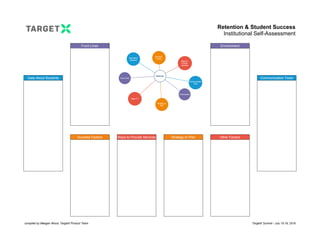
Retention & Student Success
Institutional Self-Assessment
Front Lines Environment
Data About Students Communication Tools
Success Factors Ways to Provide Services Strategy or Plan Other Factors
compiled by Meagan Wood, TargetX Product Team TargetX Summit - July 15-16, 2019

Retention War Stories and Best Practices

  • 1.
    #TargetXSummit Retention - War Stories& Best Practices Meagan Wood, TargetX
  • 2.
    Meagan Wood Business Analyst,Product Team Joined TargetX in August 2018 Nine years of higher education experience in enrollment management & student services meagan.wood@targetx.com
  • 3.
    Make every studenta graduate, and every graduate a success. TargetX Vision
  • 4.
    What are wedoing here? What we WILL be doing: ● Retention and Student Success Writ Large ● A little about tools, a lot about stories ● Starting something bigger What we WON’T be doing: ● Limiting our conversation to TargetX products ● Leaving without practical resources & next steps ● Solving the Retention Problem
  • 5.
    #TargetXSummit Agenda 1. Retention Theory NerdStuff 2. Best Practices Ideal Stuff 3. War Stories Real Stuff
  • 6.
  • 7.
  • 8.
  • 9.
  • 10.
  • 11.
    Terminology Retention An educational institution’s rateof keeping students enrolled for the duration of their originally intended degree program, and their efforts deployed to this end
  • 12.
    Terminology Student Success An educationalinstitution’s efforts to keep students on target toward completion of their educational goal More than just degree completion More common at community colleges
  • 13.
    Terminology Persistence The factors influencinga student’s continued progress toward their educational goal Emphasis is on the student instead of the institution Positively framed
  • 14.
    Terminology Attrition The rate ofdeparture of students from an educational institution Emphasis is on the student instead of the institution Negatively framed
  • 15.
  • 16.
    History of RetentionTheory ● Through mid-20th century: ○ Student attrition was explained based on individual student characteristics. ● Starting in the 1970s: ○ Theoretical models began to be used to understand and explain retention systemically.
  • 17.
    Three Theoretical Modelsof Retention Attrition as voluntary withdrawal ● William Spady ● Dropouts from Higher Education: Toward an Empirical Model, 1971 ● Drawn from sociological theory (Emile Durkheim) ● Failure to assimilate to a given community can lead an individual to voluntarily withdraw
  • 18.
    Three Theoretical Modelsof Retention - #2 Integration into educational community as rite of passage ● Vincent Tinto ● Leaving College: Rethinking Causes and Cures of Student Attrition, 1987. ● Rooted in social anthropology (Van Gennep) ● Three stages: Separation, Transition, Incorporation ● Most applicable to traditional student's first introduction to college
  • 19.
    Three Theoretical Modelsof Retention - #3 Student satisfaction as predictor of retention ● John P. Bean ● Rooted in human resources theories around employee turnover in the workplace ● Satisfaction based on many factors - not just superficial
  • 20.
    Late 20th Centuryinto Early 21st Century ● Retention research began addressing different issues and topics: ○ Diverse student populations ○ Different types of institutions ○ New learning modalities ○ Different role higher education was playing into the greater landscape ● No single model captures the complexity of retention
  • 21.
    “For years, ourprevailing view of student retention has been shaped by theories that view student retention through the lens of institutional action and ask what institutions can do to retain their students. Students, however, do not seek to be retained. They seek to persist. The two perspectives, although necessarily related, are not the same. Their interests are different.” Vincent Tinto, “Through the Eyes of Students,” Journal of College Student Retention, 2015.
  • 22.
    #TargetXSummit Factors Influencing Persistence Sense ofBelonging Self-Efficacy Educational Goals Perception of Curriculum Student Satisfaction
  • 23.
    Factors Influencing Persistence ● Mostfrequently identified factor contributing to student persistence ● Defined as students seeing themselves as a member of a community of faculty, staff, and other students who value their participation, that they matter and belong ● Related to engagement - but more important is the students’ perception of their engagement Sense of Belonging
  • 24.
    Self-Efficacy ● A person’sbelief in their ability to succeed in a specific situation or at a specific task ● Not related to actual ability ● Self-efficacy is learned, not inherited ● Students’ belief in their capacity to succeed must be built, reinforced, and maintained throughout their educational journey Factors Influencing Persistence
  • 25.
    Educational Goals ● Students’educational goals are both related to institution and beyond ● Helping students gain clarity over their educational goals can aid in their persistence ● May change over time - education is formative ● Student Journeys - session tomorrow at 9am Factors Influencing Persistence
  • 26.
    Perception of Curriculum ●Students ask themselves, "Is the curriculum valuable for me to spend my time on? ● Reflects day-to-day participation and beyond credential ● Curriculum communicates not just a collection of facts but a collection of values that determine what is presented and how it is presented in the classroom Factors Influencing Persistence
  • 27.
    Student Satisfaction ● Arestudents pleased with the product they've acquired? ● Goes beyond superficial things like amenities ● Motivators vs Hygiene Factors ○ Motivators - produce satisfaction ○ Hygiene Factors - diminish dissatisfaction ● The opposite of satisfaction is not dissatisfaction - it's the absence of satisfaction Factors Influencing Persistence
  • 28.
    #TargetXSummit Retention Theory ● Terminology ●History & Major Theoretical Models ● Shift from Retention to Persistence ● Factors Influencing Persistence
  • 29.
  • 30.
  • 31.
  • 32.
    Meeting My CommunityGetting Ready Getting Started Collecting Information Know My Class Prepare My Students Advance Counseling Warm Welcome Onboarding - Different Perspectives Student School
  • 33.
    Meeting My CommunityGetting Ready Getting Started Providing information to the school about themselves - to get admission, to get started - and learning about the school in more detail Onboarding - Student Perspective
  • 34.
    Meeting My CommunityGetting Ready Getting Started ● Complete admissions requirements ● Complete intake requirements ● Join peer-to-peer community and start making friends Onboarding - Student Perspective - Tasks
  • 35.
    Meeting My CommunityGetting Ready Getting Started Providing information to the school about themselves - to get admission, to get started - and learning about the school in more detail Getting all the necessary resources and relationships in order before classes start Onboarding - Student Perspective
  • 36.
    Meeting My CommunityGetting Ready Getting Started ● Complete admissions requirements ● Complete intake requirements ● Join peer-to-peer community and start making friends ● Get course plan ● Get finances in order ● Get books and technology ● Figure out housing ● Expand my circle of friends Onboarding - Student Perspective - Tasks
  • 37.
    Meeting My CommunityGetting Ready Getting Started Providing information to the school about themselves - to get admission, to get started - and learning about the school in more detail Getting all the necessary resources and relationships in order before classes start Join new academic community - officially start educational journey Onboarding - Student Perspective
  • 38.
    Meeting My CommunityGetting Ready Getting Started ● Complete admissions requirements ● Complete intake requirements ● Join peer-to-peer community and start making friends ● Get course plan ● Get finances in order ● Get books and technology ● Figure out housing ● Expand my circle of friends ● Attend orientation events ● Meet roommate and neighbors ● Find class locations ● Join clubs ● Attend activities Onboarding - Student Perspective - Tasks
  • 39.
    Meeting My CommunityGetting Ready Getting Started Collecting Information Know My Class Prepare My Students Advance Counseling Warm Welcome Onboarding - Different Perspectives Student School
  • 40.
    Collecting Information Know My Class Prepare My Students Advance Counseling Warm Welcome Obtain information fromstudents to determine educational goals, student types, needs, etc. Onboarding - School Perspectives
  • 41.
    Collecting Information ● Reviewdata from admissions application ● Conduct intake survey ● Conduct cognitive and non-cognitive assessments ● Conduct additional surveys ● Review data from financial aid applications Onboarding - School Perspectives - Tasks
  • 42.
    Collecting Information Know My Class Prepare My Students Advance Counseling Warm Welcome Obtain information fromstudents to determine educational goals, student types, needs, etc. Compile data to develop early picture of incoming students Onboarding - School Perspectives
  • 43.
    Know My Class ●Utilize scoring tool ● Identify "red flags" or "early intervention" markers and scenarios ● Identify student journeys ● Assign advisors based on student journeys Onboarding - School Perspectives - Tasks
  • 44.
    Collecting Information Know My Class Prepare My Students Advance Counseling Warm Welcome Obtain information fromstudents to determine educational goals, student types, needs, etc. Compile data to develop early picture of incoming students Provide preparatory resources for students so they can start courses with "the lay of the land" Onboarding - School Perspectives
  • 45.
    Prepare My Students ●Populate website with relevant information for new students ● Send email campaign to all incoming students ● Send email campaigns to specific groups of students by type ● Host admitted student events (on campus or regionally) ● Financial plans (aid and payment plans) ● Employment opportunities ● Additional intake requirements (i.e. immunizations) ● Technology requirements ● Books ● Housing details ● Continue to facilitate peer and institutional connections across all communications Onboarding - School Perspectives - Tasks
  • 46.
    Collecting Information Know My Class Prepare My Students Advance Counseling Warm Welcome Obtain information fromstudents to determine educational goals, student types, needs, etc. Compile data to develop early picture of incoming students Provide preparatory resources for students so they can start courses with "the lay of the land" Reach out to individual students to address particular needs Onboarding - School Perspectives
  • 47.
    Advance Counseling ● Initialadvisor contact ● Preliminary academic planning ● Student groups/clubs ● Early intervention resources (ESL, remedial courses, tutoring requirements) Onboarding - School Perspectives - Tasks
  • 48.
    Collecting Information Know My Class Prepare My Students Advance Counseling Warm Welcome Obtain information fromstudents to determine educational goals, student types, needs, etc. Compile data to develop early picture of incoming students Provide preparatory resources for students so they can start courses with "the lay of the land" Reach out to individual students to address particular needs Welcome students to their new community Onboarding - School Perspectives
  • 49.
    Warm Welcome ● Hostcampus orientation programming events ● Physical campus markers of hospitable welcome ● Peer advisors / orientation leaders to help make connections ● Availability of counselors for ad-hoc appointments ● All communication efforts geared toward welcoming Onboarding - School Perspectives - Tasks
  • 50.
    Meeting My CommunityGetting Ready Getting Started Collecting Information Know My Class Prepare My Students Advance Counseling Warm Welcome Onboarding - Different Perspectives Student School
  • 51.
  • 52.
    Student Journeys ● Amethod of understanding prospective and current students in order to best serve them throughout their education by identifying the following: ○ Educational Goal ○ Groups or Segments ○ Stage or Phase ○ Questions, priorities, values ○ Activities & To-Dos ○ Relationships ● Session tomorrow morning at 9am
  • 53.
  • 54.
  • 55.
    Best Practices forRescue ● Engagement plan before rescue is needed ● Contact throughout registration period ● Find out what happened ● Plan for re-engagement
  • 56.
  • 57.
    Front Lines Data About Students SuccessFactors Ways to Provide Services Communication Tools Environment Strategy or Plan
  • 58.
  • 59.
    War Stories ● Whatbig questions are you working through at your school? ● What initiative have you tried that has surprised you? ● What are your biggest obstacles? ● What are your biggest priorities? ● What’s your biggest “blue sky” dream?
  • 60.
    Next Steps Resources Handouts, Worksheets, Bibliography VisitProduct Lab Student Journeys Story Project Preview New Retention Solution More Sessions Tomorrow Student Journeys - 9am Retention: Now & Future - 3:15pm Best Practice Partnerships meagan.wood@targetx.com
  • 61.
    Bibliography of RetentionResources Aljohani, O. (2016). A Comprehensive Review of the Major Studies and Theoretical Models of Student Retention in Higher Education. ​Higher Education Studies,6​(2), 1. Clotfelter, C. T., Ladd, H. F., Muschkin, C. G., & Vigdor, J. L. (2013). Success in Community College: Do Institutions Differ? ​Research in Higher Education,54​(7), 805-824. Crookston, B. B. (2009). A Developmental View of Academic Advising as Teaching. ​NACADA Journal,29​(1), 78-82. Dennis, J. M., Phinney, J. S., & Chuateco, L. I. (2005). The Role of Motivation, Parental Support, and Peer Support in the Academic Success of Ethnic Minority First-Generation College Students. ​Journal of College Student Development,46​(3), 223-236. Dennis, J. M., Phinney, J. S., & Chuateco, L. I. (2005). The Role of Motivation, Parental Support, and Peer Support in the Academic Success of Ethnic Minority First-Generation College Students. ​Journal of College Student Development,46​(3), 223-236. Deshields, O. W., Kara, A., & Kaynak, E. (2005). Determinants of business student satisfaction and retention in higher education: Applying Herzberg’s two-factor theory. ​International Journal of Educational Management,19​(2), 128-139. Goldrick-Rab, S. (2010). Challenges and Opportunities for Improving Community College Student Success. Review of Educational Research,80​(3), 437-469. Jack, A. A. (2019). ​The privileged poor: How elite colleges are failing disadvantaged students​. Cambridge, MA: Harvard University Press. Kauffman, H. (2015). A review of predictive factors of student success in and satisfaction with online learning. ​Research in Learning Technology,23​. Meer, J. V., Scott, S., & Pratt, K. (2018). First semester academic performance: The importance of early indicators of non-engagement. ​Student Success,9​(4), 1-12. Mendez, J. J., & Bauman, S. (2018). From Migrant Farmworkers to First Generation Latina/o Students: Factors Predicting College Outcomes for Students Participating in the College Assistance Migrant Program. ​The Review of Higher Education,42​(1), 173-208. Park, J. J. (2018). ​Race on campus: Debunking myths with data​. Cambridge, MA: Harvard Education Press. Compiled by Meagan Wood, TargetX Product Team, TargetX Summit 2019 page 1
  • 62.
    Bibliography of RetentionResources Rickard, G., Bramble, M., Maxwell, H., Einboden, R., Farrington, S., Say, R., . . . Yeh, C. (2018). Exploring the first-year experience in a diverse population: Using participatory action research to explore strategies to support student transition into fast-track undergraduate degree programs. ​Student Success,9​(4), 41-51. Stephens, N. (2011). Unseen disadvantage: How the taken-for-granted university culture of independence undermines first-generation college students. ​PsycEXTRA Dataset​. Sullivan, W. M. (2016). ​Liberal learning as a quest for purpose​. New York, NY: Oxford University Press. Terenzini, P. T., Springer, L., Yaeger, P. M., Pascarella, E. T., & Nora, A. (1996). First-generation college students: Characteristics, experiences, and cognitive development. ​Research in Higher Education,37​(1), 1-22. Tinto, V. (2012). ​Completing college: Rethinking institutional action​. Chicago: The University of Chicago Press. Tinto, V. (2012). ​Leaving college: Rethinking the causes and cures of student attrition​. Chicago (Ill.): University of Chicago Press. Tinto, V. (2015). Through the Eyes of Students. ​Journal of College Student Retention: Research, Theory & Practice,19​(3), 254-269. Tovar, E. (2014). The Role of Faculty, Counselors, and Support Programs on Latino/a Community College Students’ Success and Intent to Persist. ​Community College Review,43​(1), 46-71. Compiled by Meagan Wood, TargetX Product Team, TargetX Summit 2019 page 2
  • 63.
    Retention Best Practices NewStudent Onboarding STUDENT Goal Meeting My Community Getting Ready Getting Started Description Providing information to the school about themselves - to get admission, to get started - and learning about the school in more detail Getting all the necessary resources and relationships in order before classes start Join new academic community - officially start educational journey Tasks Complete admissions requirements Complete intake requirements Join peer-to-peer community and start making friends Get course plan Get finances in order Get books/technology Figure out housing Expand my circle of friends Attend orientation events Meet roommate/neighbors Find class locations Join clubs Attend activities SCHOOL Goal Collecting Information Know My Class Prepare My Students Advance Counseling Warm Welcome Description Obtaining information from the students to determine educational goals, student types, potential needs, etc. Compile data to develop early picture of incoming students Provide preparatory resources for students so they can start courses with "the lay of the land" Reach out to individual students to address particular needs Welcome students to their new community Tasks Review data from admissions application Conduct intake survey Conduct cognitive and non- cognitive assessments Conduct additional surveys Review data from financial aid applications Utilize scoring tool Identify "red flags" or "early intervention" markers and scenarios Identify student types Assign advisors based on student types Populate website with relevant information for new students Send email campaign to all incoming students Send email campaigns to specific groups of students by type Host admitted student events (on campus or regionally) Financial plans (aid and payment plans) Employment opportunities Additional intake requirements (i.e. immunizations) Technology requirements Books Housing details Continue to facilitate peer and institutional connections across all communications Initial advisor contact Preliminary academic planning Student groups/clubs Early intervention resources (ESL, remedial courses, tutoring requirements) Host campus orientation programming events Physical campus markers of hospitable welcome Peer advisors / orientation leaders to help make connections Availability of counselors for ad-hoc appointments All communication efforts geared toward welcoming compiled by Meagan Wood, TargetX Product Team TargetX Summit - July 15-16, 2019
  • 64.
    Retention Best Practices NewStudent Onboarding STUDENT Goal Meeting My Community Getting Ready Getting Started Description Providing information to the school about themselves - to get admission, to get started - and learning about the school in more detail Getting all the necessary resources and relationships in order before classes start Join new academic community - officially start educational journey Tasks Complete admissions requirements Complete intake requirements Join peer-to-peer community and start making friends Get course plan Get finances in order Get books/technology Figure out housing Expand my circle of friends Attend orientation events Meet roommate/neighbors Find class locations Join clubs Attend activities SCHOOL Goal Collecting Information Know My Class Prepare My Students Advance Counseling Warm Welcome Description Obtaining information from the students to determine educational goals, student types, potential needs, etc. Compile data to develop early picture of incoming students Provide preparatory resources for students so they can start courses with "the lay of the land" Reach out to individual students to address particular needs Welcome students to their new community Tasks Review data from admissions application Conduct intake survey Conduct cognitive and non- cognitive assessments Conduct additional surveys Review data from financial aid applications Utilize scoring tool Identify "red flags" or "early intervention" markers and scenarios Identify student types Assign advisors based on student types Populate website with relevant information for new students Send email campaign to all incoming students Send email campaigns to specific groups of students by type Host admitted student events (on campus or regionally) Financial plans (aid and payment plans) Employment opportunities Additional intake requirements (i.e. immunizations) Technology requirements Books Housing details Continue to facilitate peer and institutional connections across all communications Initial advisor contact Preliminary academic planning Student groups/clubs Early intervention resources (ESL, remedial courses, tutoring requirements) Host campus orientation programming events Physical campus markers of hospitable welcome Peer advisors / orientation leaders to help make connections Availability of counselors for ad-hoc appointments All communication efforts geared toward welcoming compiled by Meagan Wood, TargetX Product Team TargetX Summit - July 15-16, 2019
  • 65.
    Retention & StudentSuccess Institutional Self-Assessment Front Lines Environment Data About Students Communication Tools Success Factors Ways to Provide Services Strategy or Plan Other Factors compiled by Meagan Wood, TargetX Product Team TargetX Summit - July 15-16, 2019