RETAILING
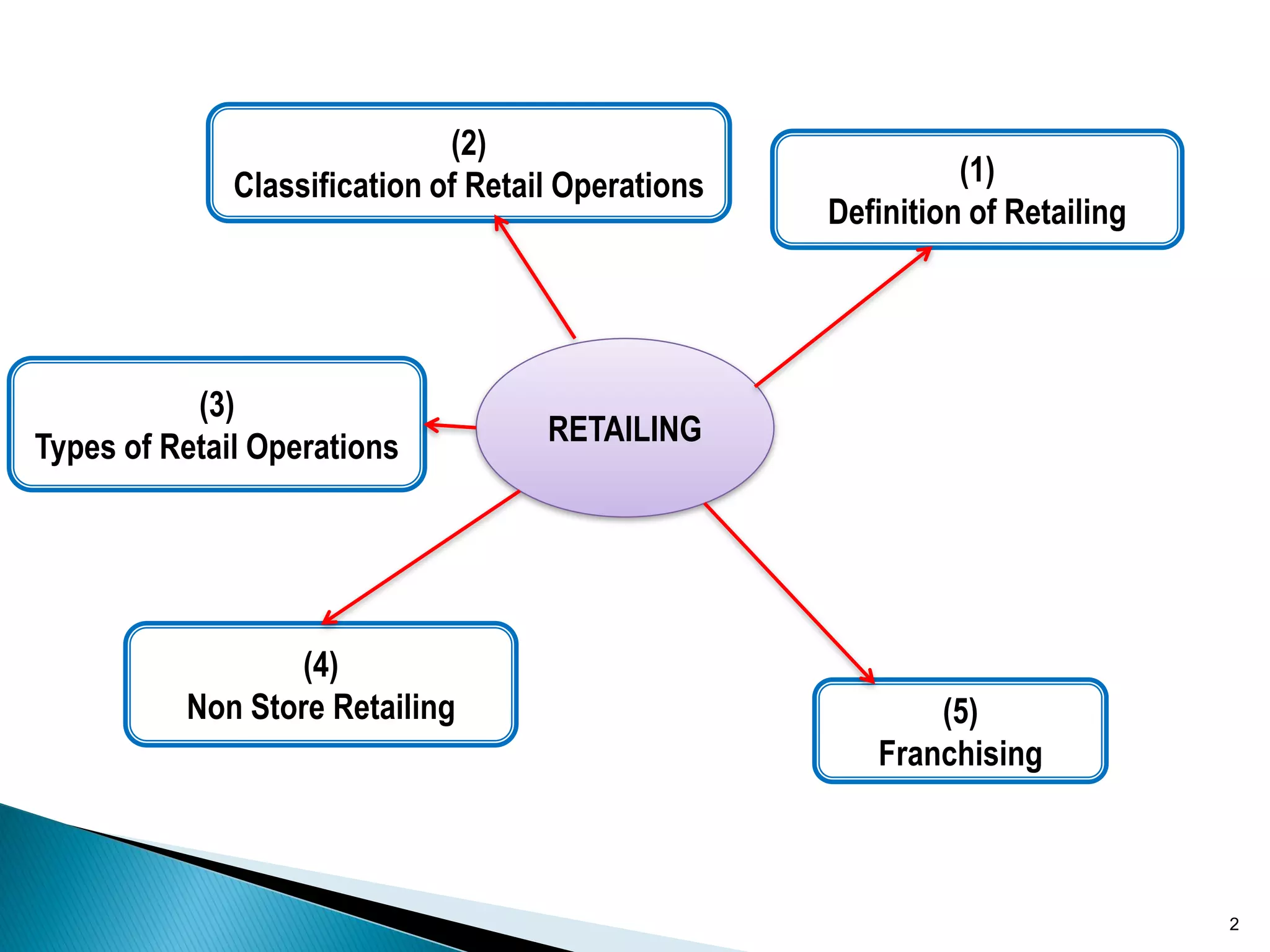
(1)
Definition of Retailing
(2)
Classification of Retail Operations
(4)
Non Store Retailing (5)
Franchising
(3)
Types of Retail Operations RETAILING
2
DEFINITION OF RETAILING
3
Lamb: All the activities directly
related to the sale of goods and
services to the ultimate
consumer for personal, non-
business use
4
 Retailers account for 11.7 percent of U.S.
employment
 Retailing accounts for 13 percent of U.S.
businesses
 Retailers ring nearly 40 percent of the U.S.
GDP
 Industry is dominated by a few giant
organizations, such as Wal-Mart
5
2004 rank Company Revenue # of stores
1 Wal-Mart $258.6 billion 4906
2 Home Depot $64.8 billion 1707
3 Kroger $53.7 billion 3774
4 Target $48.1 billion 1553
5 Costco $42.5 billion 420
6 Sears $41.4 billion 1970
7 Safeway $35.6 billion 1817
8 Albertson’s $35.4 billion 2305
9 Walgreen $32.5 billion 4227
10 Lowe’s $30.8 billion 952
6
CLASSIFICATION
OF RETAIL OPERATIONS
7
Ownership
Level of Service
Product Assortment
Price
Independent
Retailers
Chain Stores
Franchises
8
1. Ownership
a) Independent retailer
 Retailers owned by a single person / partnership & not
operated as part of a larger retail institution
 Eg; Bakery Shop, Local Florists, Shoe Shop, etc
b) Chain Stores
 Stores owned & operated as a group by single
organization
 Eg; Kamdar, Globe Silk Store, Nagoya
c) Franchises
 Owned & operated by individuals but are licensed by a
larger supporting organization
 Eg; KFC, McD, Pizza, etc
9
2. Level of service
 The level of service that retailers provide can be
classified along a continuum, from full-service to self-
service.
Discount stores Exclusive stores
Factory outlets
Warehouse clubs
Full Service
Self Service
10
3. Product Assortment
 By the breadth & depth of product line
 Eg; Toy R Us – concentrate on product assortment by
carrying single / narrow product lines
4. Price
 Traditional department stores & specialty stores
typically charge FULL SUGGESTED RETAIL PRICE
 While many more discount stores may offer LOWER
PRICE to attract volume purchases among customers
 Eg; Mydin – practice discount store, offer lower price
 Eg; Watson – practice full suggested retail price
11
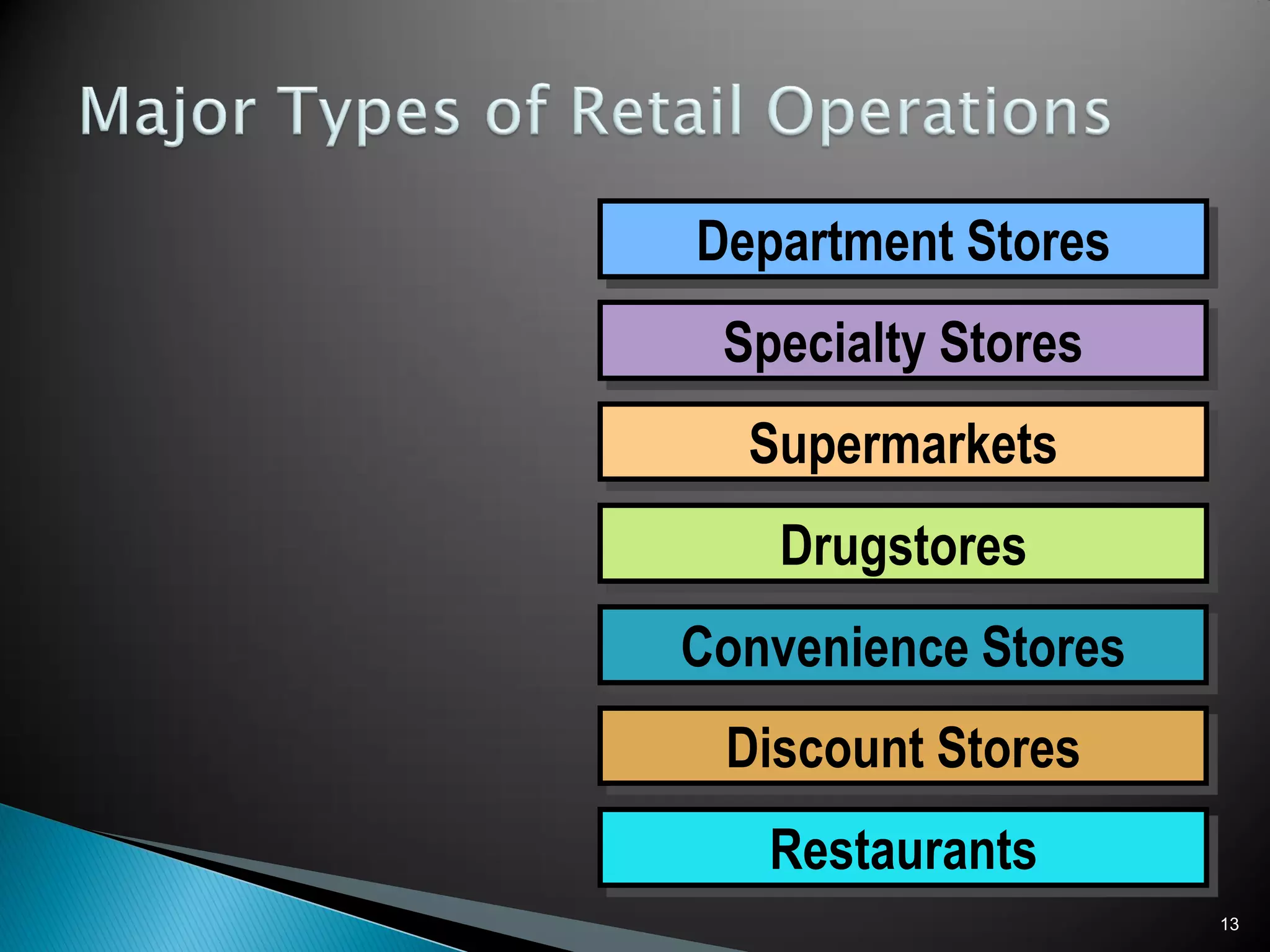
MAJOR TYPES
OF RETAIL OPERATIONS
12
Department Stores
Specialty Stores
Supermarkets
Drugstores
Convenience Stores
Discount Stores
Restaurants
13
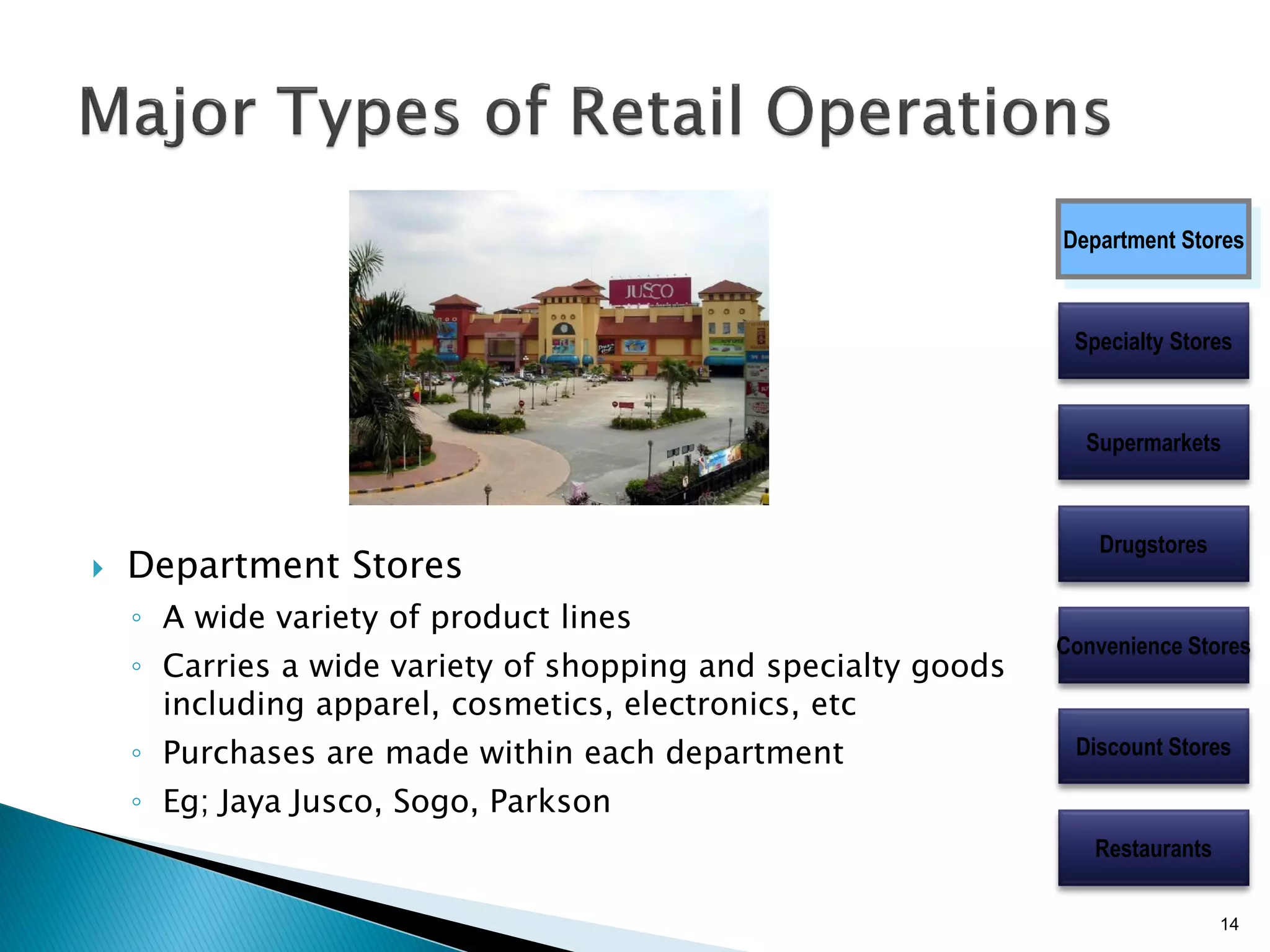
 Department Stores
◦ A wide variety of product lines
◦ Carries a wide variety of shopping and specialty goods
including apparel, cosmetics, electronics, etc
◦ Purchases are made within each department
◦ Eg; Jaya Jusco, Sogo, Parkson
Department Stores
Specialty Stores
Supermarkets
Drugstores
Convenience Stores
Discount Stores
Restaurants
14
 Specialty stores
◦ Narrow product line with a
deep assortment within that
line
◦ Merchandise is tailored to
specific target markets
◦ Price is a secondary
consideration to consumers
◦ These stores provide a low-
risk testing ground for many
new products
◦ Eg; Toys “R” Us, The Body
Shop, BATA
Department Stores
Specialty Stores
Supermarkets
Drugstores
Convenience Stores
Discount Stores
Restaurants
15
 Supermarkets
◦ Who operate large, low-cost, low-margin, high
volume & self-service stores serving
customer’s total needs for food, laundry &
household, etc
◦ U.S. Consumers spend about a tenth of income
in supermarkets
◦ Trends: The growth of prepared foods and
time-saving products, and the need for
convenience
◦ Eg; Batu Road, Jaya supermarket, Jaya Jusco
supermarket, Parkson Grand supermarket, etc
Department Stores
Specialty Stores
Supermarkets
Drugstores
Convenience Stores
Discount Stores
Restaurants
16
 Drugstores
◦ To sell pharmacy related products &
services to the customers
◦ Carry a wide selection of over the counter
(OTC) medications
◦ Products offer included medicines,
cosmetics, health products, beauty items,
etc
◦ Stock pharmacy-related products and
services
◦ Eg; Guardian, Watson, Georgetown
Pharmacy, etc
Department Stores
Specialty Stores
Supermarkets
Drugstores
Convenience Stores
Discount Stores
Restaurants
17
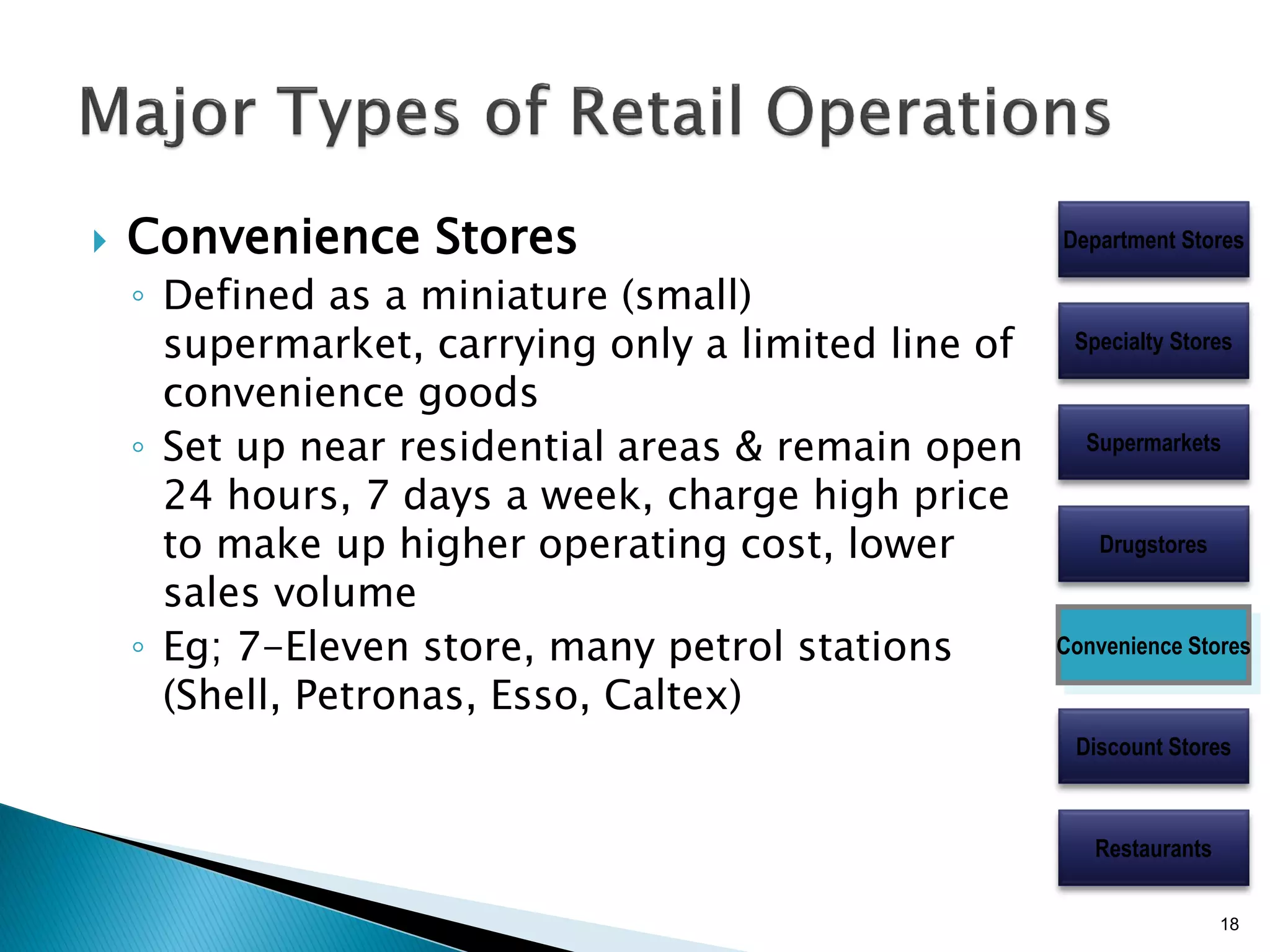
 Convenience Stores
◦ Defined as a miniature (small)
supermarket, carrying only a limited line of
convenience goods
◦ Set up near residential areas & remain open
24 hours, 7 days a week, charge high price
to make up higher operating cost, lower
sales volume
◦ Eg; 7-Eleven store, many petrol stations
(Shell, Petronas, Esso, Caltex)
Department Stores
Specialty Stores
Supermarkets
Drugstores
Convenience Stores
Discount Stores
Restaurants
18
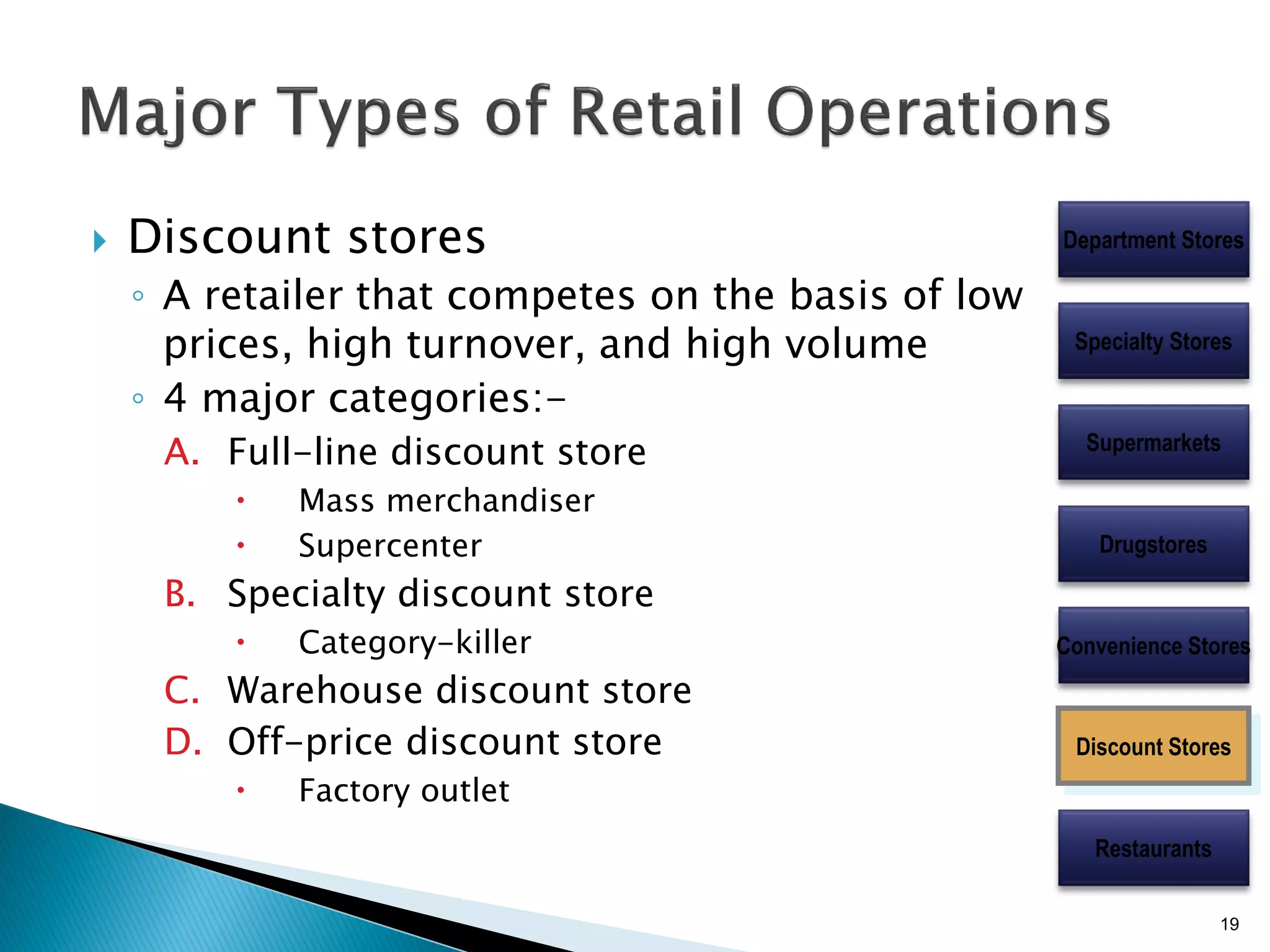
 Discount stores
◦ A retailer that competes on the basis of low
prices, high turnover, and high volume
◦ 4 major categories:-
A. Full-line discount store
 Mass merchandiser
 Supercenter
B. Specialty discount store
 Category-killer
C. Warehouse discount store
D. Off-price discount store
 Factory outlet
Department Stores
Specialty Stores
Supermarkets
Drugstores
Convenience Stores
Discount Stores
Restaurants
19
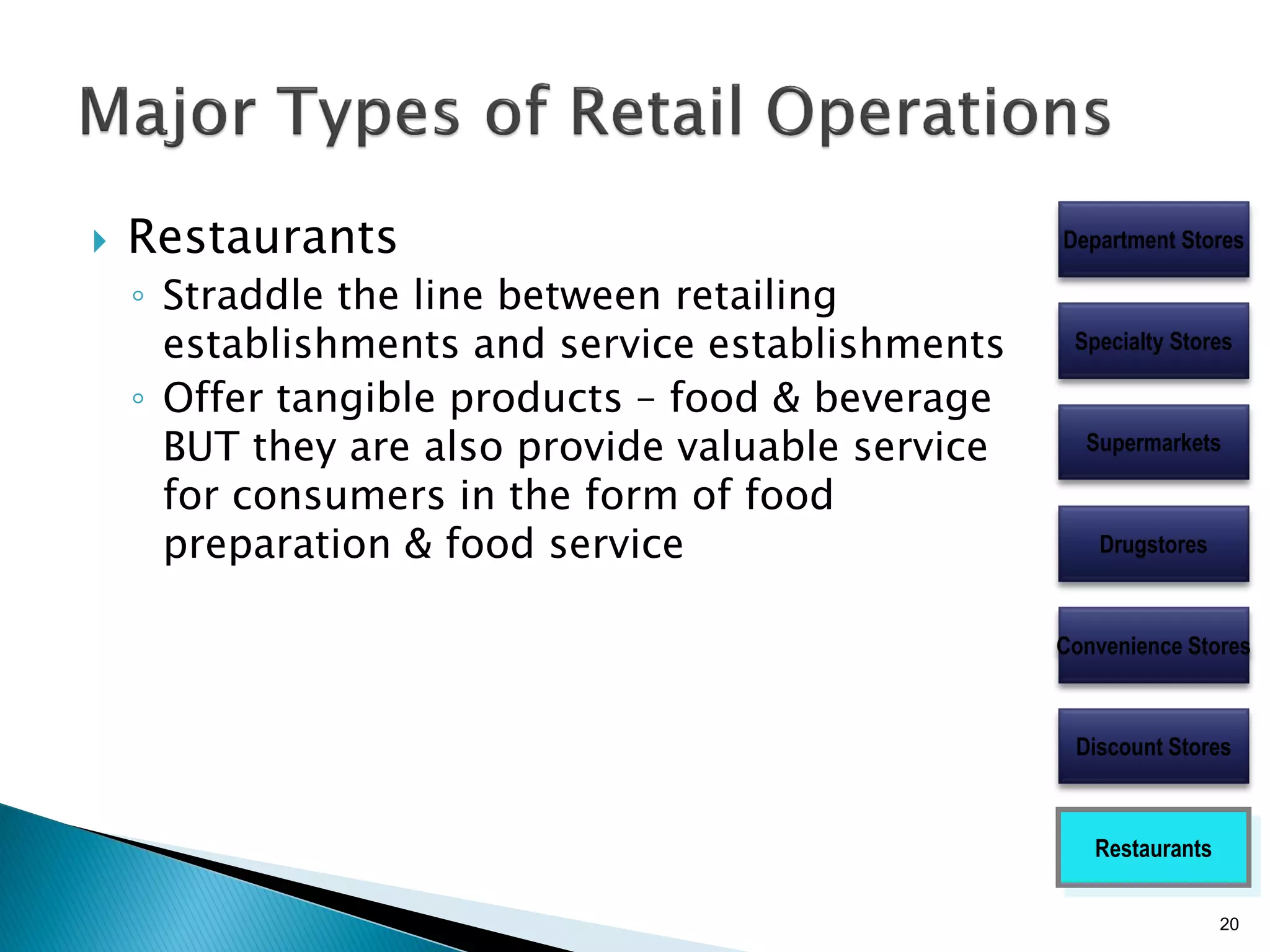
 Restaurants
◦ Straddle the line between retailing
establishments and service establishments
◦ Offer tangible products – food & beverage
BUT they are also provide valuable service
for consumers in the form of food
preparation & food service
Department Stores
Specialty Stores
Supermarkets
Drugstores
Convenience Stores
Discount Stores
Restaurants
20
Type of Retailer
Department Store
Specialty Store
Supermarket
Convenience Store
Drugstore
Full-line Discounter
Specialty Discounter
Warehouse Clubs
Off-price Retailer
Restaurant
Service Level
Mod Hi-High
High
Low
Low
Low-Mod
Mod-Low
Mod-Low
Low
Low
Low-High
Assortment Price Gross Margin
Broad
Narrow
Broad
Med-Narrow
Medium
Med-Broad
Med-Broad
Broad
Med-Narrow
Med-Narrow
Mod-High
Mod-High
Moderate
Mod High
Moderate
Mod Low
Mod Lo-low
Low-lower
Low
Low-High
Mod High
High
Low
Mod High
Low
Mod Low
Mod Low
Low
Low
Low-High
21
NON STORE RETAILING
22
Automatic Vending
Direct Retailing
Direct Marketing
Electronic Retailing
Door-to-Door
Office-to-Office
Home Sales
Parties
Telemarketing
Catalogs & Mail Order
Direct Mail
In-bound call
Out-bound call
On-Line Retailing
Shop-at-Home Networks
23
FRANCHISING
24
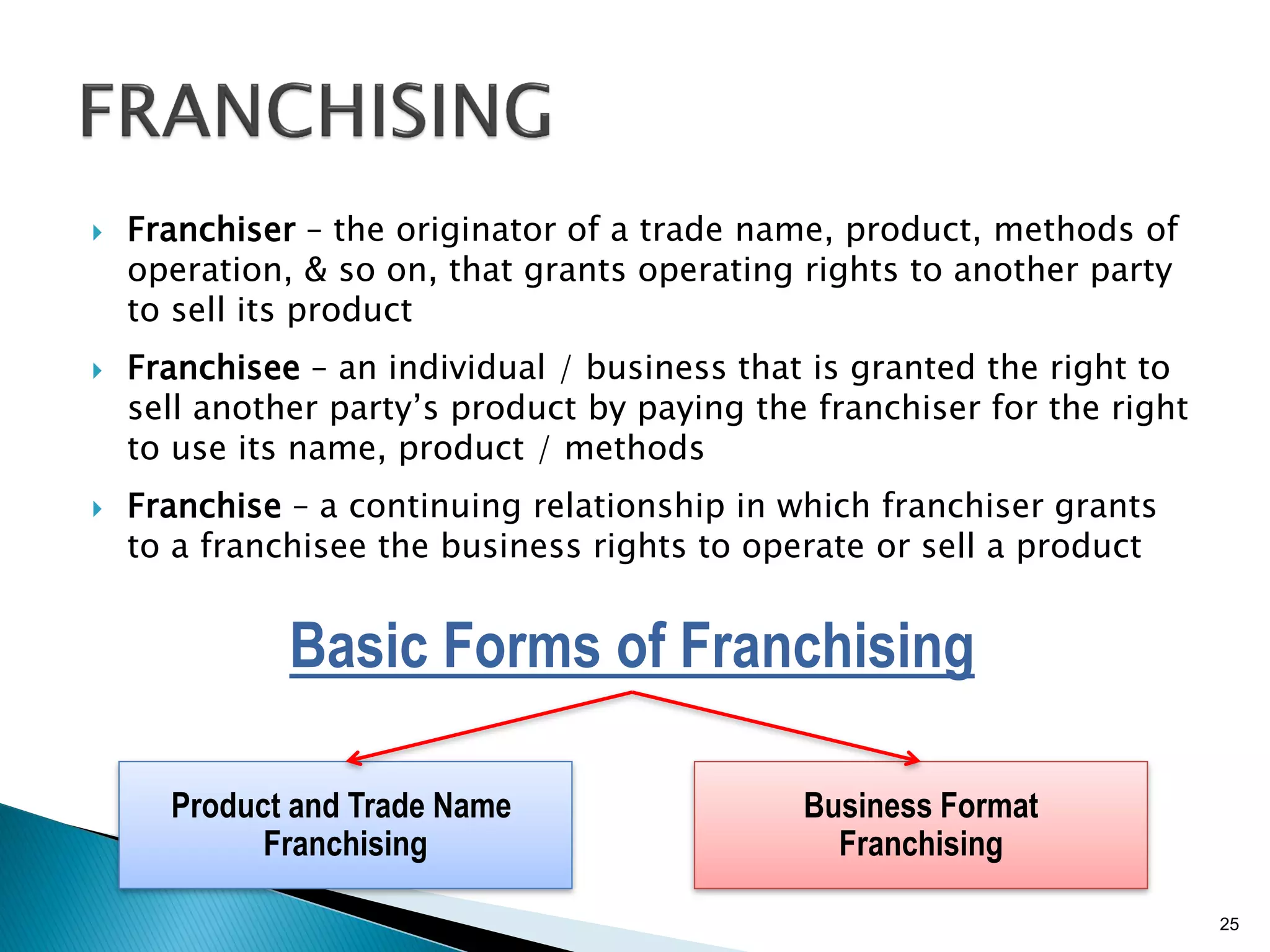
 Franchiser – the originator of a trade name, product, methods of
operation, & so on, that grants operating rights to another party
to sell its product
 Franchisee – an individual / business that is granted the right to
sell another party’s product by paying the franchiser for the right
to use its name, product / methods
 Franchise – a continuing relationship in which franchiser grants
to a franchisee the business rights to operate or sell a product
Basic Forms of Franchising
Business Format
Franchising
Product and Trade Name
Franchising
25
26
Product/Trade name Franchise
 This type of franchise system involves
the franchisee acquires sales right
which includes the trade name,
trademark, and/or products from the
franchisor upon the signing of the so-
called dealership contract, and agreed
to sell the product line identified by the
franchisor. This type of franchise
system is commonly used in the
automotive, petrol kiosk and service
station, soft beverages, and tyre
industries.
27
Business Format Franchise
 This franchise system is also named “full-fledge
franchise” The franchisee is granted the right to
manufacture and market the franchisor’s product
and/or services using a complete franchisor’s
business “set-up” which comprises of intellectual
properties (trade name. trade mark, etc.);
marketing strategies (pricing structure guideline,
promotional activities etc.), guided operational
activities (franchisee is equipped with operation
manual and has to undergo a training), premise
settings and layout ( exterior and interior layout;
ambience, colour scheme and decoration must
in-line with franchisor’s brand and image).
 Company expansion with limited capital requirements
 Motivate store owners
 Bulk purchasing of inventory
 An opportunity to become an independent businessperson
with reduced operating capital
 A product / service with has already been established in
the marketplace
 Technical training & managerial assistance form the from
franchiser
 Positive results achieved by quality control & product
uniformity
28

CHAPTER 8.pdf

  • 1.
  • 2.
    (1) Definition of Retailing (2) Classificationof Retail Operations (4) Non Store Retailing (5) Franchising (3) Types of Retail Operations RETAILING 2
  • 3.
  • 4.
    Lamb: All theactivities directly related to the sale of goods and services to the ultimate consumer for personal, non- business use 4
  • 5.
     Retailers accountfor 11.7 percent of U.S. employment  Retailing accounts for 13 percent of U.S. businesses  Retailers ring nearly 40 percent of the U.S. GDP  Industry is dominated by a few giant organizations, such as Wal-Mart 5
  • 6.
    2004 rank CompanyRevenue # of stores 1 Wal-Mart $258.6 billion 4906 2 Home Depot $64.8 billion 1707 3 Kroger $53.7 billion 3774 4 Target $48.1 billion 1553 5 Costco $42.5 billion 420 6 Sears $41.4 billion 1970 7 Safeway $35.6 billion 1817 8 Albertson’s $35.4 billion 2305 9 Walgreen $32.5 billion 4227 10 Lowe’s $30.8 billion 952 6
  • 7.
  • 8.
    Ownership Level of Service ProductAssortment Price Independent Retailers Chain Stores Franchises 8
  • 9.
    1. Ownership a) Independentretailer  Retailers owned by a single person / partnership & not operated as part of a larger retail institution  Eg; Bakery Shop, Local Florists, Shoe Shop, etc b) Chain Stores  Stores owned & operated as a group by single organization  Eg; Kamdar, Globe Silk Store, Nagoya c) Franchises  Owned & operated by individuals but are licensed by a larger supporting organization  Eg; KFC, McD, Pizza, etc 9
  • 10.
    2. Level ofservice  The level of service that retailers provide can be classified along a continuum, from full-service to self- service. Discount stores Exclusive stores Factory outlets Warehouse clubs Full Service Self Service 10
  • 11.
    3. Product Assortment By the breadth & depth of product line  Eg; Toy R Us – concentrate on product assortment by carrying single / narrow product lines 4. Price  Traditional department stores & specialty stores typically charge FULL SUGGESTED RETAIL PRICE  While many more discount stores may offer LOWER PRICE to attract volume purchases among customers  Eg; Mydin – practice discount store, offer lower price  Eg; Watson – practice full suggested retail price 11
  • 12.
    MAJOR TYPES OF RETAILOPERATIONS 12
  • 13.
  • 14.
     Department Stores ◦A wide variety of product lines ◦ Carries a wide variety of shopping and specialty goods including apparel, cosmetics, electronics, etc ◦ Purchases are made within each department ◦ Eg; Jaya Jusco, Sogo, Parkson Department Stores Specialty Stores Supermarkets Drugstores Convenience Stores Discount Stores Restaurants 14
  • 15.
     Specialty stores ◦Narrow product line with a deep assortment within that line ◦ Merchandise is tailored to specific target markets ◦ Price is a secondary consideration to consumers ◦ These stores provide a low- risk testing ground for many new products ◦ Eg; Toys “R” Us, The Body Shop, BATA Department Stores Specialty Stores Supermarkets Drugstores Convenience Stores Discount Stores Restaurants 15
  • 16.
     Supermarkets ◦ Whooperate large, low-cost, low-margin, high volume & self-service stores serving customer’s total needs for food, laundry & household, etc ◦ U.S. Consumers spend about a tenth of income in supermarkets ◦ Trends: The growth of prepared foods and time-saving products, and the need for convenience ◦ Eg; Batu Road, Jaya supermarket, Jaya Jusco supermarket, Parkson Grand supermarket, etc Department Stores Specialty Stores Supermarkets Drugstores Convenience Stores Discount Stores Restaurants 16
  • 17.
     Drugstores ◦ Tosell pharmacy related products & services to the customers ◦ Carry a wide selection of over the counter (OTC) medications ◦ Products offer included medicines, cosmetics, health products, beauty items, etc ◦ Stock pharmacy-related products and services ◦ Eg; Guardian, Watson, Georgetown Pharmacy, etc Department Stores Specialty Stores Supermarkets Drugstores Convenience Stores Discount Stores Restaurants 17
  • 18.
     Convenience Stores ◦Defined as a miniature (small) supermarket, carrying only a limited line of convenience goods ◦ Set up near residential areas & remain open 24 hours, 7 days a week, charge high price to make up higher operating cost, lower sales volume ◦ Eg; 7-Eleven store, many petrol stations (Shell, Petronas, Esso, Caltex) Department Stores Specialty Stores Supermarkets Drugstores Convenience Stores Discount Stores Restaurants 18
  • 19.
     Discount stores ◦A retailer that competes on the basis of low prices, high turnover, and high volume ◦ 4 major categories:- A. Full-line discount store  Mass merchandiser  Supercenter B. Specialty discount store  Category-killer C. Warehouse discount store D. Off-price discount store  Factory outlet Department Stores Specialty Stores Supermarkets Drugstores Convenience Stores Discount Stores Restaurants 19
  • 20.
     Restaurants ◦ Straddlethe line between retailing establishments and service establishments ◦ Offer tangible products – food & beverage BUT they are also provide valuable service for consumers in the form of food preparation & food service Department Stores Specialty Stores Supermarkets Drugstores Convenience Stores Discount Stores Restaurants 20
  • 21.
    Type of Retailer DepartmentStore Specialty Store Supermarket Convenience Store Drugstore Full-line Discounter Specialty Discounter Warehouse Clubs Off-price Retailer Restaurant Service Level Mod Hi-High High Low Low Low-Mod Mod-Low Mod-Low Low Low Low-High Assortment Price Gross Margin Broad Narrow Broad Med-Narrow Medium Med-Broad Med-Broad Broad Med-Narrow Med-Narrow Mod-High Mod-High Moderate Mod High Moderate Mod Low Mod Lo-low Low-lower Low Low-High Mod High High Low Mod High Low Mod Low Mod Low Low Low Low-High 21
  • 22.
  • 23.
    Automatic Vending Direct Retailing DirectMarketing Electronic Retailing Door-to-Door Office-to-Office Home Sales Parties Telemarketing Catalogs & Mail Order Direct Mail In-bound call Out-bound call On-Line Retailing Shop-at-Home Networks 23
  • 24.
  • 25.
     Franchiser –the originator of a trade name, product, methods of operation, & so on, that grants operating rights to another party to sell its product  Franchisee – an individual / business that is granted the right to sell another party’s product by paying the franchiser for the right to use its name, product / methods  Franchise – a continuing relationship in which franchiser grants to a franchisee the business rights to operate or sell a product Basic Forms of Franchising Business Format Franchising Product and Trade Name Franchising 25
  • 26.
    26 Product/Trade name Franchise This type of franchise system involves the franchisee acquires sales right which includes the trade name, trademark, and/or products from the franchisor upon the signing of the so- called dealership contract, and agreed to sell the product line identified by the franchisor. This type of franchise system is commonly used in the automotive, petrol kiosk and service station, soft beverages, and tyre industries.
  • 27.
    27 Business Format Franchise This franchise system is also named “full-fledge franchise” The franchisee is granted the right to manufacture and market the franchisor’s product and/or services using a complete franchisor’s business “set-up” which comprises of intellectual properties (trade name. trade mark, etc.); marketing strategies (pricing structure guideline, promotional activities etc.), guided operational activities (franchisee is equipped with operation manual and has to undergo a training), premise settings and layout ( exterior and interior layout; ambience, colour scheme and decoration must in-line with franchisor’s brand and image).
  • 28.
     Company expansionwith limited capital requirements  Motivate store owners  Bulk purchasing of inventory  An opportunity to become an independent businessperson with reduced operating capital  A product / service with has already been established in the marketplace  Technical training & managerial assistance form the from franchiser  Positive results achieved by quality control & product uniformity 28