An
Overview
on
Retailing in
India
Rohit Green Heart !
Let us define it
▪Retail is the sale of goods and services from individuals or businesses to the end user.
▪ Retailers are a part of an integrated system called the supply chain.
▪ A retailer purchases goods or products in large quantities from manufacturers directly or through a 
wholesale, and then sells smaller quantities to the consumer for a profit.
Retailing in India
 ▪ Retailing in India is one of the pillars of its economy and accounts for 14 to 15 percent of its 
GDP.
▪ India is one of the fastest growing retail markets in the world, with 1.2 billion people.
 ▪ As of 2010, larger format convenience stores and supermarkets accounted for about 4% of 
the industry.
FOREIGN DIRECT INVESTMENT
(FDI) IN INDIAN RETAIL SECTOR
▪ Until 2011, Indian central Govt denied foreign direct 
investment (FDI) in multi-brand retail stores i.e in supermarkets, 
convenience stores or any retail outlets.
▪ In November 2011, India's central government announced 
retail reforms for both multi-brand stores and single-brand 
stores. These market reforms paved the way for retail 
innovation and competition with multi-brand retailers such as 
Walmart, Carrefour and Tesco as well single brand majors such 
as Nike and Apple.
Indian Perspective
•Indian retail sector is largely closed to outsiders to safeguard the livelihood of nearly 15 million small 
store owners
•96% of the business run by unorganized retailers
•Only 51% foreign investment is allowed in single brand retail with prior government permission.
•FDI is also allowed in wholesale business.
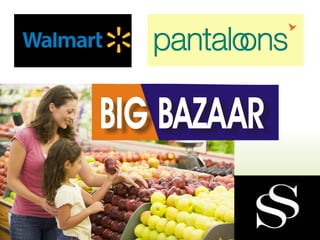
Nation’s
Multi-Retailers
Essentials characteristics of
Retailing
 ▪ Direct interaction with customers
▪Small Purchases
▪Instrument of marketing communication
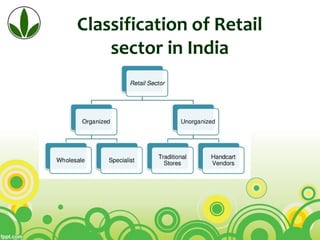
Classification of Retail
sector in India
List of sectors in India
•Food and Grocery
•Clothing
•Footwear
•Gems and Jewellery
•Pharmaceuticals
•Music
•Books
•Conumer durables
Types of Retailers
•Department Store
•Supermarkets
•Warehouse retailers
•Speciality Retailers
•E-tailer
•Convenience Retailer
•Discount Retailer
Retail Merchandising
•The activity of promoting the sale of goods, especially by their presentation in retail outlets.
•Termed as the planning, buying and selling of merchandise.
•At a retail in-store level, merchandising refers to the variety of products available for sale and the display of
those products in such a way that it stimulates interest and entices customers to make a purchase.
Retail Merchandising depends upon
the following factors
•Analysis
•Planning
•Acquisition
•Handling
•Control
Process of merchandise
management includes
• - the developing of strategies to ensure that the right product
o - is bought at the right price
o - is available at he right place
o - at the right time
o - in the right amount
o - in order to satisfy the needs of the target customer
Types of Retail Merchandising
•Virtual Merchandising
- A retail presence on the web.
- The virtual store is an online store that provides a list of merchandise and an order form.
•Visual Merchandising
- The physical display of goods in the most attractive and appealing ways.
- the interior arrangement of retail facilities.
Category Management
•Category management is a retailing and purchasing concept
•Here the range of products purchased by an organization or sold
by a retailer is broken down into similar or related products.
Examples: Tinned Fish, Network Provider Case etc.
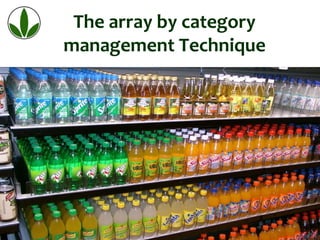
The array by category
management Technique
Category management helps in
•Easy to identify the availability for small scale businesses
•Easy in selection of products in terms of customers @ departmental stores or retail super markets.
•To reduce the cost of buying goods and services.
•To reduce the risk in supply chain.
•increase overall value from the supply base and gain
access to more innovation from suppliers.
Why online market is now
Trendy ??
•Online shopping is a form of E-commerce which allows consumers to buy goods from a seller over the
internet
•It reaches the customers ia an ease i.e mode of communication is easier if new goods are launched.
•Serves the goods with an advantage of no provisional taxes.
•Online stores are usually available 24 hours a day.
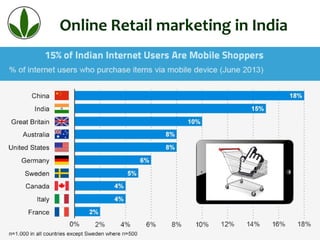
Online Retail marketing in India
Types of Online marketing
•Email marketing
•Blogging
•Pay per click marketing
•Social media marketing
•Digital marketing
•Viral marketing
•Promoting products through Email
•Can build a large list of people
Email marketing
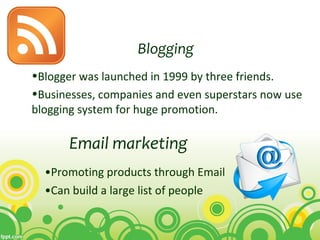
Blogging
•Blogger was launched in 1999 by three friends.
•Businesses, companies and even superstars now use
blogging system for huge promotion.
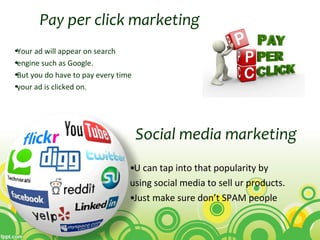
•Your ad will appear on search
•engine such as Google.
•But you do have to pay every time
•your ad is clicked on.
Pay per click marketing
Social media marketing
•U can tap into that popularity by
using social media to sell ur products.
•Just make sure don’t SPAM people
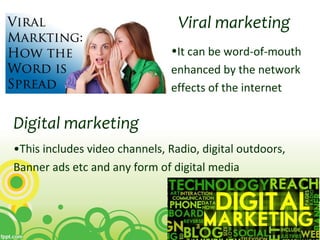
•This includes video channels, Radio, digital outdoors,
Banner ads etc and any form of digital media
Digital marketing
Viral marketing
•It can be word-of-mouth
enhanced by the network
effects of the internet
Why Indian market is
so attractive ?
•At Kearney’s study on global retail trends found India is least competitive as
well as least saturated of all major global markets
•Unlimited opportunities, huge markets, availability of raw materials at cheaper
costs, is expected to make India overtake the world’s best retail economy by
2042.
Our view on Retailing in India
•Indian Retail market has a huge room for development.
•Most of the Retailing business in India is done by Negotiation.
•Proper Government measures can assure healthy growth.
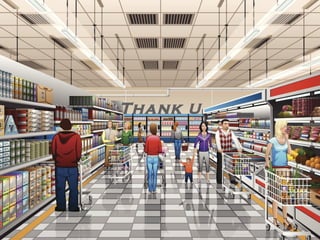
Thank U

Retail marketing

  • 1.
  • 2.
    Let us defineit ▪Retail is the sale of goods and services from individuals or businesses to the end user. ▪ Retailers are a part of an integrated system called the supply chain. ▪ A retailer purchases goods or products in large quantities from manufacturers directly or through a  wholesale, and then sells smaller quantities to the consumer for a profit.
  • 3.
    Retailing in India  ▪Retailing in India is one of the pillars of its economy and accounts for 14 to 15 percent of its  GDP. ▪ India is one of the fastest growing retail markets in the world, with 1.2 billion people.  ▪ As of 2010, larger format convenience stores and supermarkets accounted for about 4% of  the industry.
  • 4.
    FOREIGN DIRECT INVESTMENT (FDI)IN INDIAN RETAIL SECTOR ▪ Until 2011, Indian central Govt denied foreign direct  investment (FDI) in multi-brand retail stores i.e in supermarkets,  convenience stores or any retail outlets. ▪ In November 2011, India's central government announced  retail reforms for both multi-brand stores and single-brand  stores. These market reforms paved the way for retail  innovation and competition with multi-brand retailers such as  Walmart, Carrefour and Tesco as well single brand majors such  as Nike and Apple.
  • 5.
  • 6.
  • 7.
    Essentials characteristics of Retailing  ▪Direct interaction with customers ▪Small Purchases ▪Instrument of marketing communication
  • 8.
  • 9.
    List of sectorsin India •Food and Grocery •Clothing •Footwear •Gems and Jewellery •Pharmaceuticals •Music •Books •Conumer durables
  • 10.
    Types of Retailers •DepartmentStore •Supermarkets •Warehouse retailers •Speciality Retailers •E-tailer •Convenience Retailer •Discount Retailer
  • 11.
    Retail Merchandising •The activityof promoting the sale of goods, especially by their presentation in retail outlets. •Termed as the planning, buying and selling of merchandise. •At a retail in-store level, merchandising refers to the variety of products available for sale and the display of those products in such a way that it stimulates interest and entices customers to make a purchase.
  • 12.
    Retail Merchandising dependsupon the following factors •Analysis •Planning •Acquisition •Handling •Control
  • 13.
    Process of merchandise managementincludes • - the developing of strategies to ensure that the right product o - is bought at the right price o - is available at he right place o - at the right time o - in the right amount o - in order to satisfy the needs of the target customer
  • 14.
    Types of RetailMerchandising •Virtual Merchandising - A retail presence on the web. - The virtual store is an online store that provides a list of merchandise and an order form. •Visual Merchandising - The physical display of goods in the most attractive and appealing ways. - the interior arrangement of retail facilities.
  • 15.
    Category Management •Category managementis a retailing and purchasing concept •Here the range of products purchased by an organization or sold by a retailer is broken down into similar or related products. Examples: Tinned Fish, Network Provider Case etc.
  • 16.
    The array bycategory management Technique
  • 17.
    Category management helpsin •Easy to identify the availability for small scale businesses •Easy in selection of products in terms of customers @ departmental stores or retail super markets. •To reduce the cost of buying goods and services. •To reduce the risk in supply chain. •increase overall value from the supply base and gain access to more innovation from suppliers.
  • 19.
    Why online marketis now Trendy ?? •Online shopping is a form of E-commerce which allows consumers to buy goods from a seller over the internet •It reaches the customers ia an ease i.e mode of communication is easier if new goods are launched. •Serves the goods with an advantage of no provisional taxes. •Online stores are usually available 24 hours a day.
  • 20.
  • 21.
    Types of Onlinemarketing •Email marketing •Blogging •Pay per click marketing •Social media marketing •Digital marketing •Viral marketing
  • 22.
    •Promoting products throughEmail •Can build a large list of people Email marketing Blogging •Blogger was launched in 1999 by three friends. •Businesses, companies and even superstars now use blogging system for huge promotion.
  • 23.
    •Your ad willappear on search •engine such as Google. •But you do have to pay every time •your ad is clicked on. Pay per click marketing Social media marketing •U can tap into that popularity by using social media to sell ur products. •Just make sure don’t SPAM people
  • 24.
    •This includes videochannels, Radio, digital outdoors, Banner ads etc and any form of digital media Digital marketing Viral marketing •It can be word-of-mouth enhanced by the network effects of the internet
  • 25.
    Why Indian marketis so attractive ? •At Kearney’s study on global retail trends found India is least competitive as well as least saturated of all major global markets •Unlimited opportunities, huge markets, availability of raw materials at cheaper costs, is expected to make India overtake the world’s best retail economy by 2042.
  • 26.
    Our view onRetailing in India •Indian Retail market has a huge room for development. •Most of the Retailing business in India is done by Negotiation. •Proper Government measures can assure healthy growth.
  • 27.