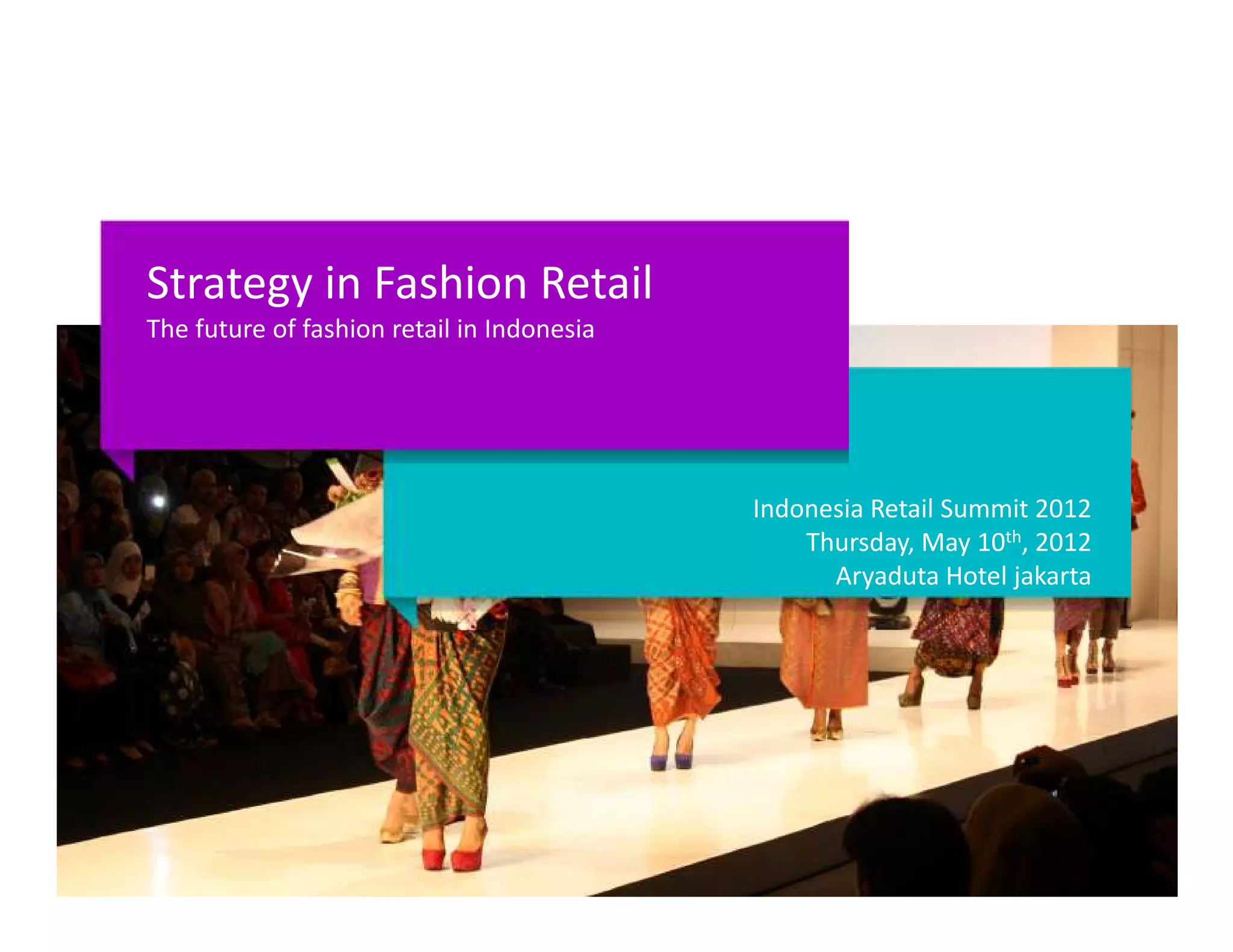
Strategy in Fashion Retail
The future of fashion retail in Indonesia


                                            Indonesia Retail Summit 2012
                                                Thursday, May 10th, 2012
                                                  Aryaduta Hotel jakarta
1.   Background
2.   Indonesia Retail Insight 2012
3.   Strategy & Approach
4.   How to Grow Market
5.   Summary

CHAPTER
Background
 • It is regrettable that the Indonesian government signed the ASEAN-China
   Free Trade Area (ACFTA) agreement which becomes effective since
   January 10, 2010
     – Currently Indonesia is not ready to compete with Chinese products
     – The fundamental reasons: High cost and in-efficiency (materials, energy cost,
       logistics, loan interest, low productivity of workers, regional minimum wage,
       lack of basic materials, spare part supply, etc)
     – Impacts toward the industry: declining turnover, industrial production,
       earning fell, lay-offs, significant decline of Indonesian products total export
       while import of Chinese product increase significantly
 • Indonesia’s economy and export rate is growing, but they are only
   contributed by coal, natural gas, palm oil, and other sectors which are
   exported in their raw forms without added value. On the other hand, the
   real sector is becoming more worrying, especially the textile industry


BACKGROUND
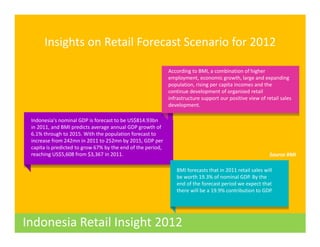
Insights on Retail Forecast Scenario for 2012

                                                             According to BMI, a combination of higher
                                                             employment, economic growth, large and expanding
                                                             population, rising per capita incomes and the
                                                             continue development of organized retail
                                                             infrastructure support our positive view of retail sales
                                                             development.

 Indonesia's nominal GDP is forecast to be US$814.93bn
 in 2011, and BMI predicts average annual GDP growth of
 6.1% through to 2015. With the population forecast to
 increase from 242mn in 2011 to 252mn by 2015, GDP per
 capita is predicted to grow 67% by the end of the period,
 reaching US$5,608 from $3,367 in 2011.                                                                    Source BMI

                                                                BMI forecasts that in 2011 retail sales will
                                                                be worth 19.3% of nominal GDP. By the
                                                                end of the forecast period we expect that
                                                                there will be a 19.9% contribution to GDP.


Indonesia Retail Insight 2012
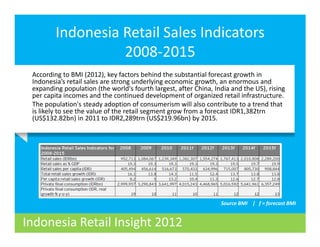
Indonesia Retail Sales Indicators
                   2008-2015
 According to BMI (2012), key factors behind the substantial forecast growth in
 Indonesia’s retail sales are strong underlying economic growth, an enormous and
 expanding population (the world's fourth largest, after China, India and the US), rising
 per capita incomes and the continued development of organized retail infrastructure.
 The population's steady adoption of consumerism will also contribute to a trend that
 is likely to see the value of the retail segment grow from a forecast IDR1,382trn
 (US$132.82bn) in 2011 to IDR2,289trn (US$219.96bn) by 2015.


                                                                  Source BMI | f = forecast BMI


Indonesia Retail Insight 2012
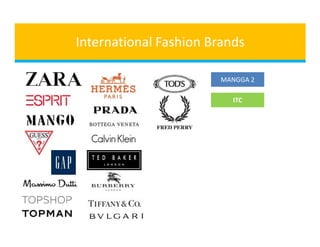
International Fashion Brands

                        MANGGA 2

                          ITC
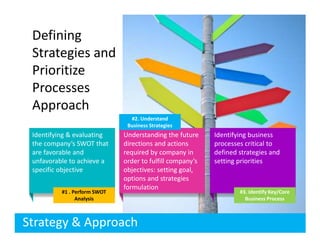
Defining
 Strategies and
 Prioritize
 Processes
 Approach
                                #2. Understand
                               Business Strategies
 Identifying & evaluating     Understanding the future     Identifying business
 the company’s SWOT that      directions and actions       processes critical to
 are favorable and            required by company in       defined strategies and
 unfavorable to achieve a     order to fulfill company’s   setting priorities
 specific objective           objectives: setting goal,
                              options and strategies
                              formulation
          #1 . Perform SWOT                                        #3. Identify Key/Core
                Analysis                                             Business Process


Strategy & Approach
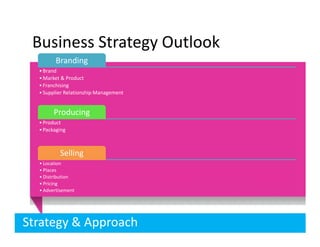
Business Strategy Outlook
         Branding
  • Brand
  • Market & Product
  • Franchising
  • Supplier Relationship Management


        Producing
  • Product
  • Packaging


          Selling
  • Location
  • Places
  • Distribution
  • Pricing
  • Advertisement


Strategy & Approach
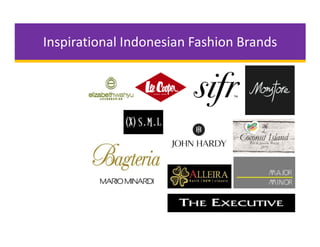
Inspirational Indonesian Fashion Brands
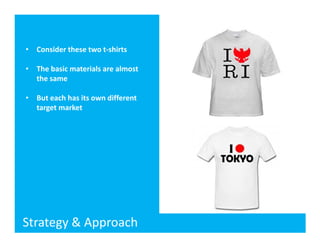
• Consider these two t-shirts

• The basic materials are almost
  the same

• But each has its own different
  target market


Strategy & Approach
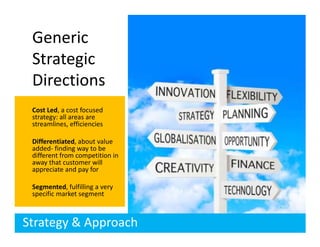
Generic
 Strategic
 Directions
 Cost Led, a cost focused
 strategy: all areas are
 streamlines, efficiencies

 Differentiated, about value
 added- finding way to be
 different from competition in
 away that customer will
 appreciate and pay for

 Segmented, fulfilling a very
 specific market segment


Strategy & Approach
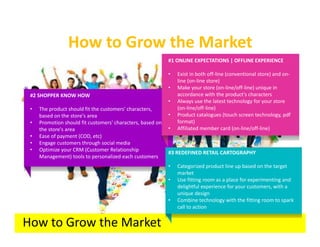
How to Grow the Market
                                                            #1 ONLINE EXPECTATIONS | OFFLINE EXPERIENCE

                                                            •   Exist in both off-line (conventional store) and on-
                                                                line (on-line store)
                                                            •   Make your store (on-line/off-line) unique in
 #2 SHOPPER KNOW HOW                                            accordance with the product's characters
                                                            •   Always use the latest technology for your store
 •   The product should fit the customers' characters,          (on-line/off-line)
     based on the store's area                              •   Product catalogues (touch screen technology, pdf
 •   Promotion should fit customers' characters, based on       format)
     the store's area                                       •   Affiliated member card (on-line/off-line)
 •   Ease of payment (COD, etc)
 •   Engage customers through social media
 •   Optimize your CRM (Customer Relationship
                                                            #3 REDEFINED RETAIL CARTOGRAPHY
     Management) tools to personalized each customers
                                                            •   Categorized product line up based on the target
                                                                market
                                                            •   Use fitting room as a place for experimenting and
                                                                delightful experience for your customers, with a
                                                                unique design
                                                            •   Combine technology with the fitting room to spark
                                                                call to action


How to Grow the Market
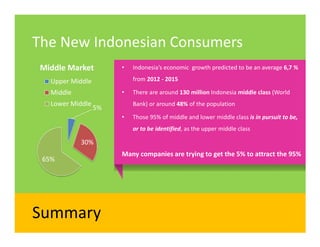
The New Indonesian Consumers
 Middle Market         •   Indonesia’s economic growth predicted to be an average 6,7 %

   Upper Middle            from 2012 - 2015

   Middle              •   There are around 130 million Indonesia middle class (World
   Lower Middle            Bank) or around 48% of the population
                  5%
                       •   Those 95% of middle and lower middle class is in pursuit to be,
                           or to be identified, as the upper middle class

            30%
                       Many companies are trying to get the 5% to attract the 95%
 65%


Summary
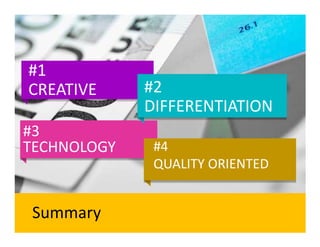
#1
CREATIVE     #2
             DIFFERENTIATION
#3
TECHNOLOGY    #4
              QUALITY ORIENTED


Summary
Medina L. Harjani (CEO – Pasaraya)

THANK YOU

Fashion Retail Strategy

  • 1.
    Strategy in FashionRetail The future of fashion retail in Indonesia Indonesia Retail Summit 2012 Thursday, May 10th, 2012 Aryaduta Hotel jakarta
  • 2.
    1. Background 2. Indonesia Retail Insight 2012 3. Strategy & Approach 4. How to Grow Market 5. Summary CHAPTER
  • 3.
    Background • Itis regrettable that the Indonesian government signed the ASEAN-China Free Trade Area (ACFTA) agreement which becomes effective since January 10, 2010 – Currently Indonesia is not ready to compete with Chinese products – The fundamental reasons: High cost and in-efficiency (materials, energy cost, logistics, loan interest, low productivity of workers, regional minimum wage, lack of basic materials, spare part supply, etc) – Impacts toward the industry: declining turnover, industrial production, earning fell, lay-offs, significant decline of Indonesian products total export while import of Chinese product increase significantly • Indonesia’s economy and export rate is growing, but they are only contributed by coal, natural gas, palm oil, and other sectors which are exported in their raw forms without added value. On the other hand, the real sector is becoming more worrying, especially the textile industry BACKGROUND
  • 4.
    Insights on RetailForecast Scenario for 2012 According to BMI, a combination of higher employment, economic growth, large and expanding population, rising per capita incomes and the continue development of organized retail infrastructure support our positive view of retail sales development. Indonesia's nominal GDP is forecast to be US$814.93bn in 2011, and BMI predicts average annual GDP growth of 6.1% through to 2015. With the population forecast to increase from 242mn in 2011 to 252mn by 2015, GDP per capita is predicted to grow 67% by the end of the period, reaching US$5,608 from $3,367 in 2011. Source BMI BMI forecasts that in 2011 retail sales will be worth 19.3% of nominal GDP. By the end of the forecast period we expect that there will be a 19.9% contribution to GDP. Indonesia Retail Insight 2012
  • 5.
    Indonesia Retail SalesIndicators 2008-2015 According to BMI (2012), key factors behind the substantial forecast growth in Indonesia’s retail sales are strong underlying economic growth, an enormous and expanding population (the world's fourth largest, after China, India and the US), rising per capita incomes and the continued development of organized retail infrastructure. The population's steady adoption of consumerism will also contribute to a trend that is likely to see the value of the retail segment grow from a forecast IDR1,382trn (US$132.82bn) in 2011 to IDR2,289trn (US$219.96bn) by 2015. Source BMI | f = forecast BMI Indonesia Retail Insight 2012
  • 6.
  • 7.
    Defining Strategies and Prioritize Processes Approach #2. Understand Business Strategies Identifying & evaluating Understanding the future Identifying business the company’s SWOT that directions and actions processes critical to are favorable and required by company in defined strategies and unfavorable to achieve a order to fulfill company’s setting priorities specific objective objectives: setting goal, options and strategies formulation #1 . Perform SWOT #3. Identify Key/Core Analysis Business Process Strategy & Approach
  • 8.
    Business Strategy Outlook Branding • Brand • Market & Product • Franchising • Supplier Relationship Management Producing • Product • Packaging Selling • Location • Places • Distribution • Pricing • Advertisement Strategy & Approach
  • 9.
  • 10.
    • Consider thesetwo t-shirts • The basic materials are almost the same • But each has its own different target market Strategy & Approach
  • 11.
    Generic Strategic Directions Cost Led, a cost focused strategy: all areas are streamlines, efficiencies Differentiated, about value added- finding way to be different from competition in away that customer will appreciate and pay for Segmented, fulfilling a very specific market segment Strategy & Approach
  • 12.
    How to Growthe Market #1 ONLINE EXPECTATIONS | OFFLINE EXPERIENCE • Exist in both off-line (conventional store) and on- line (on-line store) • Make your store (on-line/off-line) unique in #2 SHOPPER KNOW HOW accordance with the product's characters • Always use the latest technology for your store • The product should fit the customers' characters, (on-line/off-line) based on the store's area • Product catalogues (touch screen technology, pdf • Promotion should fit customers' characters, based on format) the store's area • Affiliated member card (on-line/off-line) • Ease of payment (COD, etc) • Engage customers through social media • Optimize your CRM (Customer Relationship #3 REDEFINED RETAIL CARTOGRAPHY Management) tools to personalized each customers • Categorized product line up based on the target market • Use fitting room as a place for experimenting and delightful experience for your customers, with a unique design • Combine technology with the fitting room to spark call to action How to Grow the Market
  • 13.
    The New IndonesianConsumers Middle Market • Indonesia’s economic growth predicted to be an average 6,7 % Upper Middle from 2012 - 2015 Middle • There are around 130 million Indonesia middle class (World Lower Middle Bank) or around 48% of the population 5% • Those 95% of middle and lower middle class is in pursuit to be, or to be identified, as the upper middle class 30% Many companies are trying to get the 5% to attract the 95% 65% Summary
  • 14.
    #1 CREATIVE #2 DIFFERENTIATION #3 TECHNOLOGY #4 QUALITY ORIENTED Summary
  • 15.
    Medina L. Harjani(CEO – Pasaraya) THANK YOU