Semester8
Seminar Theory Report
On
Marketing Mix Of Retail Industry
(shoppers Stop)
Himanshu Detroja
157300585015
Semester 8
IN PARTIAL FULFILLMENT OF THE AWARD FOR THE DEGREE OF
INTEGRATED MASTERS OF BUSINESS ADMINISTRATION-IMBA
Submitted to:
L J Institute of ManagementStudies
Gujarat Technological University,
Ahmedabad
2019
DECLARATION
This Seminar Theory Reportis based on my Survey on “Marketing Mix Of Retail
Industry(shoppers Stop) ” have beenprepared by me under the guidance of
ProfessorParita unadkat I further declare that this is my original work, as a part of
our academic course.
Place: Ahmedabad
Date: 15th
April, 2019 Himanshu Detroja
Guide Certificate
This is to certify that Himanshu Detroja has worked and completed his
Seminar Theory Report for the Semester – 8, IMBA Programme, on title
“Marketing Mix Of Retail Industry” under my supervision. It is his own work
and fact reported in the project is his personal findings and investigations.
Professor Parita Unadkat 10th
April, 2019
Name & Signature of Professorin charge/ Director ofthe Institute
Stamp of the Institute with Date
ACKNOWLEDGEMENT
I am glad to express my sentiments of gratitude to all who rendered
their valuable help for the successfulcompletionof this Seminar
theory Reporttitled, “Marketing Mix Of Retail Industry ”.
I record my deep sense of gratitude to, doctor.Viral Shah, Director –
LJ IMBA, Prof. Nikita Macquin, Dean LJ IMBA and Prof. Parita
unadkat, who gave me an opportunity to work under their guidance
which led me to the right directionfor the research.
I would also like to thank sincerely from the deep of my heart to all
those persons constantly guided me and gave me the practical
knowledge and materials of the subjectand especially to my
mentors Prof.Parita Unadkat .
My genuine sense of gratitude goes to my college and university
that gave me a chance to brighten my academic qualification that
provided me this opportunity to have practical and theory
knowledge on Seminar Theory Report .
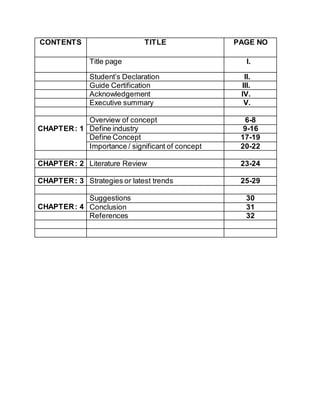
CONTENTS TITLE PAGE NO
Title page I.
Student’s Declaration II.
Guide Certification III.
Acknowledgement IV.
Executive summary V.
CHAPTER: 1
Overview of concept 6-8
Define industry 9-16
Define Concept 17-19
Importance / significant of concept 20-22
CHAPTER: 2 Literature Review 23-24
CHAPTER: 3 Strategies or latest trends 25-29
CHAPTER: 4
Suggestions 30
Conclusion 31
References 32
CHAPTER : 1
Overview of concept
Introduction
The Indian retail industry has emerged as one of the most dynamic and fast-paced
industries due to the entry of several new players. Total consumption expenditure is
expected to reach nearly US$ 3,600 billion by 2020 from US$ 1,824 billion in 2017. It
accounts for over 10 per cent of the country’s Gross Domestic Product (GDP) and
around 8 per cent of the employment. India is the world’s fifth-largest global destination
in the retail space.
Market Size
India’s retail market is expected to increase by 60 per cent to reach US$ 1.1 trillion by
2020, on the back of factors like rising incomes and lifestyle changes by middle class
and increased digital connectivity. Online retail sales are forecasted to grow at the rate
of 31 per cent year-on-year to reach US$ 32.70 billion in 2018.
India is expected to become the world’s fastest growing e-commerce market, driven by
robust investment in the sector and rapid increase in the number of internet users.
Various agencies have high expectations about growth of Indian e-commerce markets.
Luxury market of India is expected to grow to US$ 30 billion by the end of 2018 from
US$ 23.8 billion 2017 supported by growing exposure of international brands amongst
Indian youth and higher purchasing power of the upper class in tier 2 and 3 cities,
according to Assocham.
Investment Scenario
The Indian retail trading has received Foreign Direct Investment (FDI) equity inflows
totalling US$ 1.42 billion during April 2000–June 2018, according to the Department of
Industrial Policies and Promotion (DIPP).
With the rising need for consumer goods in different sectors including consumer
electronics and home appliances, many companies have invested in the Indian retail
space in the past few months.
 Beccos, a South Korean designer brand is set to enter the Indian market with an
investment of about Rs 1.00 billion (US$ 14.25 million) and open 50 stores by
June 2019.
 Walmart Investments Cooperative U.A has invested Rs 2.75 billion (US$ 37.68
million) in Wal-Mart India Pvt Ltd.
Government Initiatives
The Government of India has taken various initiatives to improve the retail industry in
India. Some of them are listed below:
The Government of India may change the Foreign Direct Investment (FDI) rules in food
processing, in a bid to permit e-commerce companies and foreign retailers to sell Made
in India consumer products.
Government of India has allowed 100 per cent Foreign Direct Investment (FDI) in online
retail of goods and services through the automatic route, thereby providing clarity on the
existing businesses of e-commerce companies operating in India.
Road Ahead
E-commerce is expanding steadily in the country. Customers have the ever increasing
choice of products at the lowest rates. E-commerce is probably creating the biggest
revolution in the retail industry, and this trend would continue in the years to come.
India's e-commerce industry is forecasted to reach US$ 53 billion by 2018. Retailers
should leverage the digital retail channels (e-commerce), which would enable them to
spend less money on real estate while reaching out to more customers in tier-2 and tier-
3 cities.
It is projected that by 2021 traditional retail will hold a major share of 75 per cent,
organised retail share will reach 18 per cent and e-commerce retail share will reach 7
per cent of the total retail market.
Nevertheless, the long-term outlook for the industry is positive, supported by rising
incomes, favourable demographics, entry of foreign players, and increasing
urbanisation.
Growth:
Because of the huge scope of business and high development potential, India is
attracting investors across the globe.
India is good to go to pick up from the most recent FDI strategy in retail.
There has been an increasing in buying power of the consumer because of simple
accessibility of credit which has given a push to higher esteem things and supported
repeated purchase. There has been a clear shift in consumer mindset in buying. . They
are progressively instructed and very much educated. They have turned out to be all the
more testing and are happy to attempt and purchase items which they haven't been
utilized up 'til now. The development of white collar class has prompted higher buys of
extravagance items and brand awareness. Noteworthy development in optional pay and
changing ways of life are among the significant development drivers of Indian retail
industry. With GST taking its shape, it has helped the retailers rearrange its assessment
structure. This will prompt better production network structure, better money streams.
Supply
The retail industry is currently utilizing the advanced retail channels (internet business),
which enables them to spend less on land while connecting with more clients in Tier II
and Tier III urban areas.
Supply is also influenced by some international players entering local markets.
Demand
Growing urbanization, increasing expendable earnings, changing statistic profile,
changing consumer tastes and preferences are a portion of the elements that are
driving interest in retail advertise in India.
Barriers to entry
Lack of quality, economic backdrop, regulatory issues are some of the factors acting as
an impediment to the spread of organised retail in India. Since it is capital-intensive
industry, access to capital also plays an important part for expansion.
Bargaining power of suplliers
The bargaining power of suppliers varies depending upon the target segment, the
format followed, and products on offer. The unorganised sector has a dominant position
in the total retail market in India. There are few players who enjoy an edge over others
on account of being established players and enjoying brand distinction. Overall, the
bargaining power of suppliers is low as retailers have low switching costs.
Bargaining power of customers
High because of wide accessibility of choice and less expensive choices accessible
crosswise over different channels. Additionally, low exchanging costs, price
sensitiveness, and effectively open data of an item and its value gives clients high
bartering force.
Competition
With India being an attractive retail market, there is a high level competition. competition
is described by many variables, including collection, items, value, quality,
administration, area, notoriety, credit, accommodation offered, and so forth. Forceful
web based business and advanced retailing combined with new participants, for
example, business houses and global players are heightening the challenge at a quick
pace.
Organized retailing
organized retailing refers to trading activities undertaken by authorized retailers,
those who have registered for sales tax, pay charge, and so on. These incorporate
corporate-upheld hypermarkets and retail chains, and furthermore exclusive
extensive retail organizations. Consequently, sorted out retail which currently
establishes a little four percent of absolute retail area is developing at an a lot quicker
pace of 45-half per annum and quadruples its offer in all out retail exchange to 16%
by 2011-12.
Unorganized retailing
Unorganized retailing refers to the traditional forms of low-cost retailing, for example,
local kirana shops, owner-operated general stores, paan/beedi shops, convenience
stores, hand cart and street vendors, etc. The unorganized retail sector is growing at
about 10% per annum with sales rising from US$ 309 billion in 2006-07 to US$ 496
billion in 2011-12 Drivers fuelling the growth of the retail sector are below:
Changes in demographics
India has the most lowest middle age of 24 when contrasted with created nations like
U.S.A., U.K. what's more, Japan. The competition of the Indian population is moving
towards the age gathering of 20-49 for example the working population with buying
power. Roughly 60% of the Indian population is below 30 years old. In this way, India
has the biggest 'youthful' population regarding sheer size and this young portion is the
real driver of consumption as they have the capacity (extra cash) and eagerness to
spend.
Rising salary levels
A bigger number of family units are getting added to the consuming class with growth in
salary levels. increasingly occurrences of double income in many families combined
with the ascent in spending power is further fuelling the development of retail segment.
Changes in buyer needs,dispositionsand conduct
The development of current retail is connected to buyer needs, attitudes and behavior.
Rising salary levels, education and worldwide introduction have added to the
advancement of the Indian working class. Subsequently, obtaining and shopping habits
have been instilled and are increasingly step by step. Generally, Indians have noten the
ones to binge spend on luxury items. Today, people are willing to try new things and
look different, which has expanded spending on health and beauty items separated
from clothes, sustenance and basic need things.
Increasedcreditfriendliness
There has been an extreme change in the Indian consumer's attitude with respect to
credit. With the simple accessibility of credit and declining loan fees, individual credit
has seen development. The blast in financing has brought about an increase in spends
on housing and consumer durables such as two-wheelers and cars. The utilization of
plastic cash (credit and platinum cards) has expanded altogether in the last 3-4 years.
With the acknowledgment of and the expansion in the quantity of electronic information
converter machines introduced in retailing outlets, credit and charge cards will give
further fillip to composed retail.
Increasing consciousness of Indian buyers
Over the years, because of the expanding literacy in the nation, introduction toward the
west, satellite TV, outside magazines and papers, there is a significant increase in
customer mindfulness among the Indians. Today an ever increasing number of buyers
are particular concerning the nature of the items/administrations.
The Rural Market:
Waking up The rural market is starting to develop as an important consumption zone.
The 700 million Indians residing in rustic India are an open door that retail organizations
can't 100 ignore. Retail and purchaser organizations who restrict their items for this
market, with respect to value focuses, bundling, stock-keeping units (SKU) estimate,
advancement, will succeed.
Entry of the corporate Sector
In differentiation to the circumstance just about 10 years prior, the level of
interest in retailing as a growth opportunity has increased visibly now.
Numerous associations in India that have been for such a long time
managing the essential dispersion channel to re ach clients have today set
out on achieving clients direct by methods for retailing independent from
anyone else. Corporate goliaths in India like Bharti, Reliance, and Birla
have set out on their retail activities.
Key players in retail industry: Indian and Global
I. Aditya Birla Retail Limited
II. Tata Group
III. K Raheja Group
IV. Reliance Retail Limited
V. Future Group
VI. Mom-and-pop stores
VII. Department stores
VIII. Malls
IX. Specialty Stores
X. Discount stores
XI. Hypermarkets / Supermarkets
XII. Convenience stores
XIII. E-tailers
CHAPTER : 1
Define industry
 Retail is the process of selling consumer goods or services to customers through
multiple channels of distribution to earn a profit. Retailers satisfy demand
identified through a supply chain. The term “retailer” is typically applied where a
service provider fills the small orders of a large number of individuals, who are
end-users, rather than large orders of a small number of wholesale, corporate or
government clientele. Shopping generally refers to the act of buying products
 Sometimes this is done to get last merchandise, including necessities, for
example, sustenance and garments; here and there it happens as a recreational
movement. Recreational shopping regularly includes window shopping and
perusing: it doesn't generally result in a buy.
 Retail markets and shops have an antiquated history, going back to relic.
Probably the most punctual retailers were nomad vendors. Throughout the
hundreds of years, retail shops were changed from minimal more than
"discourteous stalls" to the refined shopping centers of the cutting edge time.
 Most present day retailers normally make an assortment of vital dimension
choices including the sort of store, the market to be served, the ideal item
combination, client administration, supporting administrations and the store's
general market situating. When the key retail plan is set up, retailers devise the
retail blend which incorporates item, value, place, advancement, staff and
introduction. In the advanced age, an expanding number of retailers are trying to
achieve more extensive markets by selling through numerous channels, including
the two blocks and mortar and web based retailing.
 Digital advancements are additionally changing the manner in which that
purchasers pay for products and ventures. Retailing bolster administrations may
likewise incorporate the arrangement of credit, conveyance administrations,
warning administrations, beautician administrations and a scope of other
supporting administrations.
Retail shops happen in a various scope of sorts and in a wide range of settings – from
strip malls in private lanes through to expansive, indoor shopping centers. Shopping
lanes may limit traffic to walkers as it were. Now and then a shopping road has an
incomplete or full rooftop to make a progressively open to shopping condition –
shielding clients from different kinds of climate conditions, for example, outrageous
temperatures, winds or precipitation. Types of non-shop retailing incorporate web based
retailing (a sort of electronic-trade utilized for business-to-shopper (B2C) exchanges)
and mail request.
CHAPTER : 1
Define Concept
MARKETING MIX OF SHOPPERS STOP:
Shoppers Stop is a publicly traded company of Indian origins. It is associated with retail
and lifestyle industry as it deals in numerous related products. Shoppers Stop was
founded in the year 1991 and are a subsidiary of its parent company K Raheja Corp
Group. It faces competition from following companies
 Wills Lifestyle
 Westside
 Vishal Mega mart
 Ebony
 Pantaloons
 Globus
 Central
Marketing Mix of Shoppers Stop analyses the brand/company which covers 4Ps
(Product, Price, Place, Promotion) and explains the Shoppers Stop marketing strategy.
PRODUCT: Shoppers Stop is one of the leading fashion retail brands in India. The
product portfolio offered by Shoppers Stop is huge as it is a retailer for fashion. The
various segments of products Shoppers Stop offers are women, men, kids, gifts and
home furnishings and décor. All these help in understand the marketing mix product
strategy. The men segment is further divided into clothing, accessories, shoes, jewellery
and grooming products. Similarly in the women segment we have clothing, accessories,
shoes, jewellery and beauty care products. In the kids segment they have boys and girls
clothing, shoes, clothing for infants, toys section and kids accessories. In gifts, they offer
sweets and chocolates, premium gifting section, instant gifting as well as gifting for
special occasions. In the home furnishings and décor segment it has kitchen and dining
section, furniture, bath ware, home décor, living room section, electronic appliances and
a bedding section. Shoppers Stop provides various international brands, domestic
brands as well as some in-house brands. Shoppers Stop has sister brands such as
Crossword which sells books, Home Stop which sells home solutions, Brio and Desi
Café selling Amalgamated Bean Coffee, Hypercity which offers like a supermarket,
M.A.C. which sells cosmetics range, MotherCare which sells product from mothers and
babies and TImezone which looks after the entertainment division.
PRICE: Shoppers Stop sells different international brands and are very competitively
priced because there are many competitors such as Wills Lifestyle, Pantaloons, Future
group, Myntra, Jabong, Trendin, Snapdeal and many more. As the market has been
flooded with so many competitors, Shoppers Stop has to provide discounts and has to
come up with various sale events all throughout the year to sustain in the market. The
discounts are generally placed on old stocks and new arrivals are generally not
discounted. The apparels offered by Shoppers Stop can be found from very low prices
brands of 300 and goes up to around Rs. 10000 for designer collections. The prices
also vary according to categories also and the items to be purchased. Generally for the
women there is a much wider variety as they shop more frequently and cover a more
varied range of prices and brands. This gives an insight in the Shoppers Stop pricing
strategy in its marketing mix. Shoppers Stop has targeted upper-middle-class section of
society as its target customer that puts its onus on quality and style. It has set a high
benchmark in the retail industry as its policies have resulted in an increase in footfalls.
Shoppers Stop has adopted a premium pricing policy as it has been able to project itself
as a high-end brand that deals in only qualitative products. Its customers are willing to
spend premium prices for premium products. Shoppers Stop has also adopted a
promotional pricing policy and offers incentives like summer and winter sale to increase
its customer base as well as sales volumes in order to garner larger revenue figures.
PLACE: Shoppers Stop has a Pan-India presence as it has spread its network to most
parts of the country. It has its headquarters base at Mumbai in Maharashtra. Shoppers
Stop started its operations by opening its first outlet at Andheri in Mumbai and since
then has spread its presence to include seventy-four stores in thirty-five cities like
Kolkata, Chennai, Jaipur, Noida, New Delhi, Bangalore, Bhopal, Amritsar and
Aurangabad. Shoppers Stop has joined the e-commerce industry in the year 2008 with
delivery options at important Indian cities. As part of its omnichannel strategy it in the
year 2016, February launched its mobile application to garner a larger customer base.
Shoppers Stop has a strong distribution channel that includes services of an established
management team and skilled workforce for both direct and indirect dealings with its
customers. Shoppers Stop has presence in 35+ cities in India with 80+ stores in total
which are present strategically all over the country. Hypercity, Home Stop, Crossword,
MotherCare stores are also spread across India. Shoppers Stop also has presence in e-
tailing where we can access the product through online and mobile apps which has
access to over 1200 towns and cities. Shoppers Stop has 4 regional distribution centres
which work 24x7 to provide timely movement of the products to various stores all over
the country.
PROMOTION: Shoppers Stop uses print and online media as effective tools to
advertise. Promotions of Shoppers Stop are mostly focused on advertisements of
various kinds. It has print advertisements, outdoor advertisements such as billboards
and other major places across cities. Shoppers Stop also ties up with many other
companies to produce specialised apparels. Print advertisements has been used to
showcases latest fashion and trends available at its stores. Shoppers Stop has First
Citizen loyalty programs which has tied up Citibank credit cards to provide members
with extra benefits. It is also using the online platform to make a dominance over
various social networking sites such as Facebook and Twitter and opening YouTube
channel named ‘Style Hub’. Shoppers Stop also has various sales promotion which its
customers wait for such as the ‘End of Season Sale’ and other regular sales promotion.
Shoppers Stop also conduct various social responsibility activities such as partnering
with NGOs, providing vocational trainings for youth and training the handicapped for
livelihood. Shoppers Stop has adopted both ATL and BTL marketing strategies to
promote its brand in the consumer market. It has also implemented Interactive as well
as Guerrilla marketing to increase brand awareness. Shoppers Stop has launched
several ad campaigns and promotional policies with help of electronic, digital, print and
social media platforms. Advertisements are shown on popular television channels,
newspapers, magazines, and hoardings, Twitter, Facebook and YouTube to garner
maximum exposure. Shoppers Stop also offers periodic discounts and gift vouchers to
attract further sales at regular intervals. It has been awarded several accolades and
awards including The Emerging Market Retailer of the Year Award and The Hall of
Fame. It has launched a loyalty program titled First Citizen for its regular customers as
well as Shoppers Stop Gift Card after a tie-up with Quicksilver Solutions.
Since this is a service marketing brand, here are the other three Ps to make it the 7Ps
marketing mix of Shoppers Stop.
PEOPLE: Shoppers Stop also focuses on enhancing the skill sets of its employees by
continuously coaching them. Also various workshops are conducted for the employees
to maintain quality of the employees. Fair evaluations and timely assessments are done
for building leadership qualities among its employees. The frontline staff of Shoppers
Stop are timely updated with the help of various training modules. Also. To enhance
knowledge they are also updated with various technologies for enhancing efficiency in
various processes. Shoppers Stop also enhances skills of its customer care
representatives by career planning and trainings. It conducts satisfaction surveys of the
representatives which helps in redefining the various policies to employee loyalty.
Shoppers Stop has an employee base of around 7400+ and timely recruitment of
qualified staff is done to cater to the needs of the customers and handling various
functions. Shoppers Stop also has venues for training the executives such as the
F.L.E.X. program which trained 176 department managers in 2016 to enhance the
capabilities of various stores. Other learning systems are in place through the online
platform to provide timely updates and rectify flaws in the processes.
PROCESS: Shoppers Stop has got various processes and frameworks. The layout of
the Shoppers Stop stores are quite standardized and has ground floor having
cosmetics, watches, perfumes and other accessories. The 1st floor has clothing
accessories and the 2nd floor has shoes, formal apparels. The customers are provided
with facilities of keeping baggage at a counter and entry through all the floors. To
enhance customer experience they are provided with physical trial rooms by Shoppers
Stop as well as virtual trial rooms which are online systems which provide real feel of
wearing the garment. The checkout counters are placed on all the floors with multiple
counters for speedier checkouts. During checkouts loyalty program members are given
benefits of reimbursing points or gathering them as well as getting new customers.
To provide the best merchandise on the Shoppers Stop stores on the right places,
specialized teams are in place. These teams fix the clothing line ups starting from colour
to style and latest trends. Shoppers Stop also has a wide base of suppliers which are
chosen after stringent evaluations and other alternate venues are in place to mitigate
the adverse situations. Various IT systems are there to manage the backend processes
as well as enhance the online shopping experiences. Customers are also asked for
feedback through online channels for gauging there shopping experiences.
PHYSICAL EVIDENCE: Shoppers Stop stores have more than 300 brands of apparels
arranged in various places in the store and properly sorted according to the various
segments so as to enhance the customer experience. The frontline staff of Shoppers
Stop provides assistance to these customers in terms of consultation about latest trends
and sizes and help in trials. They also guide them to various segment of the stores.
Customers are also provided with trial rooms to try their outfits and choose according to
their tastes. Customers are also provided with trolley bags to carry multiple items. They
are also helped with the billing and packing process at the checkout counters. In the
online format customers are provided with speedier deliveries and customer buyer
guide to follow them through with purchase and make choices. This gives a summary of
the Shoppers Stop marketing mix.
CHAPTER : 1
Importance / significant of
concept
PESTEL ANALYSIS OF SHOPPERS STOP
PESTEL Analysis is a strategic management tool that Shoppers Stop management can
use to analyze internal and external factors that impact the situations in Shoppers' Stop
Group (SSG) . PESTEL stands for – Political, Social, Economic, Technological,
Environmental and Legal factors that impact the macro environment of the firm that it
operates in. Shoppers Stop operates in a dynamic environment where it is influenced
by – technological changes, regulatory framework, consumer spending behavior,
increasing environmental activism among consumers, collective social trends,
government decisions, increasing regulatory framework for environmental factors, and
ever evolving legal system.
 POLITICAL FACTORS:
Political factors are often related to the level of intervention and nature of intervention of
the local and national government in the business and economic environment.
Government policies and governance system plays a huge role in nature and objectives
of the policies. Based on data it seems that Shoppers Stop has come under increasing
global pressures to adhere to international regulations. Taxation policies - Over the last
two decades Shoppers Stop has benefitted from lower taxation policies throughout the
western hemisphere. It has resulted in high profits and increasing spending in the
research and development. In the second half Rajiv Lal, Virginia A. Fuller believe that it
can change. Changing policies with new government – We can make an inference after
reading the Shoppers' Stop Group (SSG) that there can be a transition of government in
near future in most prominent market. Shoppers Stop has to prepare for this eventuality
as it can lead to change of priorities for the sector. Regulatory Practices – Shoppers
Stop has to manage diverse regulations in the various markets it is present in. Over the
last few years Sales & Marketing has witnessed an increasing regulatory scrutiny.
Political stability in the existing markets – Shoppers Stop operates in numerous
countries so it has to make policies each country based on the Sales & Marketing
industry specific requirements. Given the recent rise in populism across the world I
believe that Shoppers Stop can see similar trends and may lead to greater instability in
its existing markets. Importance of local governments in Sales & Marketing – Local
government plays an integral role in policy setting and business environment
regulations in the sector. Shoppers Stop should closely monitor and lobby these
changes.
 ECONOMIC FACTORS:
Economic factors includes – consumer disposable income, taxation rate, economic
performance of country name, labor market conditions , the stage of economy of
country name, inflation rate, interest rate, exchange rate etc. Economic Factors that
Impact "Shoppers' Stop Group (SSG)" PESTEL Analysis are as mentioned:
Efficiency of financial markets – Shoppers Stop can access vibrant financial markets
and easy availability of liquidity in the equity market to expand further globally. Skill
level of workforce the present market – Shoppers Stop can leverage good skill level
of employees in the present market to not only improve services in Sales &
Marketing but also leverage those skills to create global opportunities. Increasing
liberalization of trade policy can help Shoppers Stop to invest further into the regions
which are so far off limits to the firm. Downward pressure on consumer spending –
Even though the consumer disposable income has remain stable, the growing
inequality in the society will negatively impact consumer sentiment and thus impact
consumer spending behavior. Inflation rate – The easy liquidity in the market post the
great recession of 2018 will lead to increasing inflation in the Shoppers Stop markets.
It can impact the Shoppers Stop consumers. Economic Cycles – The performance of
Shoppers Stop in Sales & Marketing is closely correlated to the economic
performance of the country it is present in.
 SOCIAL FACTORS:
Each society and culture has its own way of doing business. These social factors can
not only help companies like "Shoppers Stop" to better understand the way of doing
business but also in understanding the customer preferences in the market it operates
in. Social factors include – acceptance of entrepreneurial spirit, societal roles and
norms, traditions, demographics, culture, health & safety attitudes, attitude towards
certain products and services, gender roles, and leisure interests. Social Factors that
Impact Shoppers' Stop Group (SSG) Case Study Solution are as mentioned. Media
outlets play a critical role in influencing the public opinion. Both traditional media and
social media are rapidly growing, Shoppers Stop can leverage this trend to build
efficient marketing network. Gender roles – The gender roles are evolving in the
country. Shoppers Stop can test various concepts to cater to and support these evolving
gender roles in the local market. Demographics – For the Sales & Marketing sector,
Shoppers Stop has demographics on its side. Education level – The education level is
high in the Shoppers Stop existing markets. Based on evidences in Shoppers' Stop
Group (SSG) case study, you can suggest building a R&D center in the local market.
Migration – The broader attitude towards migration is negative in the market Shoppers
Stop is present. This can impact Shoppers Stop ability to bring international talent to
manage operations in the country. Leisure interests – the customers that Shoppers Stop
targets give a very high preferences to experiential products and services. The firm
needs to spend more energy to meet the preferences and expectations.
 TECHNOLOGICAL FACTORS:
Technology is fast disrupting various industries and Sales & Marketing is no different.
Some of the technological factors that are impacting the firm are– supply chain
disruption because of technology, innovation in customer services, access to mobile
phones driving empowerment, access to greater information, rate of technology driven
change, population access to technology, innovation in product offerings etc.
Technological Factors that Impact Shoppers' Stop Group (SSG) PESTEL Analysis are
as mentioned: Developments and dissemination of mobile technology has transformed
customer expectations in the Sales & Marketing sector. Shoppers Stop has to not only
meet and manage these expectations but also have to innovate to stay ahead of the
competition. Empowerment of supply chain partners – Technology has shortened the
product life cycle and it has enabled suppliers to quickly develop new products. This has
put pressure on Shoppers Stop marketing department to keep the suppliers happy by
promoting diverse range of products. It has added to the cost of operations of the
Shoppers Stop. Lowering cost of production – The latest technology is fast lowering
production and servicing cost in the Sales & Marketing sector. Shoppers Stop has to
restructure its supply chain to bring in more flexibility to meet both customer needs and
cost structures. Latest technology based innovations implemented by competitors of
Shoppers Stop – This can provide a good insight into what the competitors are thinking
and where Sales & Marketing industry business model future is. Intellectual property
rights and patents protection – If Shoppers Stop and the sector as whole will have
higher safeguards for IPR and other intellectual property rights then more players are
likely to invest into research and development. Maturity of technology – Based on data
in Shoppers' Stop Group (SSG) case study, the technology in the sector is still at
nascent stage and most players are vying for new innovations that can enable them to
garner higher market share.
 ENVIRONMENTAL FACTORS:
Over the last decade sustainability and environmental factors are becoming critical for
businesses. Government and pressure groups are fast asking organizations to adhere
to environmental standards. Some of the environmental factors are – increasing focus
on sustainability, safe waste disposal, laws regulating pollution, limiting carbon
footprints, climate change, safe disposal of hazardous material, safe water treatment,
insurance policies etc. Environmental Factors that Impact Shoppers' Stop Group (SSG)
PESTEL Analysis are: Paris Climate Agreement has put real targets for the national
governments. This can result in greater scrutiny of environmental standards for
Shoppers Stop in both developed and emerging markets. Regular scrutiny by
environmental agencies is also adding to the cost of operations of the Shoppers Stop.
Extreme weather is also adding to the cost of operations of the Shoppers Stop as it has
to invest in making its supply chain more flexible. Renewable technology is also another
interesting area for Shoppers Stop. It can leverage the trends in this sector. Many
governments are providing subsidies to invest in the renewable sector. Recycling is fast
emerging as a norm rather than a -good thing to do- in many economies. Shoppers
Stop has to make plans to adhere to regulations and meet consumer expectations in the
Sales & Marketing sector. Customer activism – Greater awareness among customers
have also put environmental factors at the center of Shoppers Stop strategy. Customers
expects Shoppers Stop to adhere to not only legal standards but also to exceed them to
become responsible stakeholder in the community. With the recent concern over global
warming, there has been a push to reduce the amount of waste and pollution
consuming the globe. Shoppers Stop is committed to protecting and conserving the
environment by seeking innovative solutions that encourage long-term sustainability.
 LEGAL FACTORS:
Legal plays a critical role in any country. Shoppers Stop management has to consider
following legal factors before entering international market – copyrights law, data
protection laws, discrimination laws, intellectual property rights protection, system of
justice, time taken to deliver justice, biasedness toward home players etc. Legal
Factors that Impact Shoppers' Stop Group (SSG) PESTEL Analysis are: Environment
Laws and guides – The level of environmental laws in the country and what Shoppers
Stop needs to do to meet those laws and regulations. Employment law in the country
and how they are impacting the business model of the Sales & Marketing sector. Can
these conditions be replicated or bettered in international market? Legal protection of
intellectual property, patents, copyrights, and other IPR rights in various countries. How
Shoppers Stop will be impacted if there is not enough protection. Data protection laws –
Over the last decade data protection has emerged as critical part of not only privacy
issues but also intellectual property rights. Shoppers Stop has to consider whether the
country have a robust legal and technological mechanism to protect against data
breaches or not. Health and safety norms in the the country and what Shoppers Stop
needs to do to meet those norms and what will be the cost of meeting those norms.
Time take for business cases in court – some countries even though follow international
norms but the time for resolution often run in years. Shoppers Stop has to carefully
consider average time of specific cases before entering an international market.
CHAPTER : 2
Literature Review
LiteratureReview
Literature Review of relevant earlier academic, scholarly and research work is an
essential component of any academic project, as a good literature review creates a
strong foundation, based on which knowledge in the domain can be further built and
expanded. It identifies areas where further research is needed and opens up
opportunities to extend, ratify, generalize or contest earlier research findings and
conclusions
An exhaustive literature review has been carried out covering the domain which is
provided in the following sections, leading to the section on Research Gaps identified.
Care has been taken to ensure that the review is not restricted by narrow geographic
boundary to any country or region. Stress has been given to more recent publications in
reputed international journals, as they in turn have reviewed previous work and have
built on past work. The review was however restricted to publications in English
language only.
The literature review carried out is concept centric or domain centric. Out of the vast
number of papers reviewed only those papers propounding concepts relevant to the
study has been included in the subsequent sections.
The literature review attempts to report and inform all the relevant advances in
accumulated knowledge in the domain However, papers of higher relevance or which
appeared to present breakthrough concepts have been discussed at somewhat greater
length.
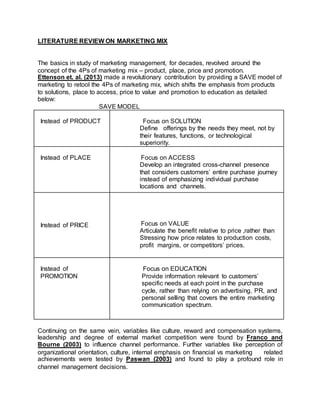
LITERATURE REVIEW ON MARKETING MIX
The basics in study of marketing management, for decades, revolved around the
concept of the 4Ps of marketing mix – product, place, price and promotion.
Ettenson et. al. (2013) made a revolutionary contribution by providing a SAVE model of
marketing to retool the 4Ps of marketing mix, which shifts the emphasis from products
to solutions, place to access, price to value and promotion to education as detailed
below:
SAVE MODEL
Instead of PRODUCT Focus on SOLUTION
Define offerings by the needs they meet, not by
their features, functions, or technological
superiority.
Instead of PLACE Focus on ACCESS
Develop an integrated cross-channel presence
that considers customers’ entire purchase journey
instead of emphasizing individual purchase
locations and channels.
Instead of PRICE Focus on VALUE
Articulate the benefit relative to price ,rather than
Stressing how price relates to production costs,
profit margins, or competitors’ prices.
Instead of
PROMOTION
Focus on EDUCATION
Provide information relevant to customers’
specific needs at each point in the purchase
cycle, rather than relying on advertising, PR, and
personal selling that covers the entire marketing
communication spectrum.
Continuing on the same vein, variables like culture, reward and compensation systems,
leadership and degree of external market competition were found by Franco and
Bourne (2003) to influence channel performance. Further variables like perception of
organizational orientation, culture, internal emphasis on financial vs marketing related
achievements were tested by Paswan (2003) and found to play a profound role in
channel management decisions.
CHAPTER : 3
Current Practices/ Product
or Service Of Selected
Organisation
PRODUCTS SOLD BY SHOPPERS STOP
 Apparel – Shirts, skirts, dresses, jumpsuits, jackets, bottom wear, baby suits,
winterwear, pants, sportswear, swimwear, lingerie, nightwear, sarees, churidar suits, t-
shirts, jeans, cargos, trousers, blazers, shorts and kurta pyjama
 Accessories – Umbrella, reading glasses, diaries, pen, travel essentials, sunglasses,
scarves, clutch, wallet, handbags, watches, belt and cufflinks
 Footwear – Flip-Flops, bellies, wedges, platforms, heels, flats, boots, slippers, sandals,
casuals and formal
 Jewellery – Fine jewellery, fashion jewellery, artificial jewellery and gold coins
 Toys – Dolls, infant toys, soft toys, musical instruments, board games, educational
games, cars, toy trains and blocks
 Beauty products – nail polish, shampoos, make-up, moisturiser, scrubs, masks, hair
colours, perfumes, deodorants, shaving products, make-up tools, soaps, serums and
toners
 Homeware – Bedsheets, bedcovers, pillow covers, dinner set, tableware, kitchen tools,
bath towels, bathrobes, laundry baskets, curtains, rugs, doormats, dustbins, furniture,
clocks, candles, lamp shades and wall décor
 Gifts – Chocolates, sweets, charms, e-gift vouchers, gift cards, corporate gifting and
premium gifting
Current practices of Shoppers Stop
1.Give customers areasonto visityourstore.
2.Showclients youcare byasking forfeedback.
3. Use social to sell.
4. Make it easy to be found online .
5. Accept more payment methods.
6. Exchange & Return policy of shoppers stop
CHAPTER : 4
Findings Of The Study
 They provide guaranteed best products and at the best Prices.
 Wide range of fashion garment and accessories under one roof.
 Affordable price and good product range for middle class.
 They should introduce more schemes ,discounts ,sales to increase the sales.
 They offers parking space only for the “First Citizen” holders which acts as a
constraints for many first visitor to visit the malls.
 Shoppers Stop Competitors Used aggressive medium of advertisement like
television commercial ads , thus to gain a competitive advantage over the
competitors shoppers stop should also use such medium of marketing.
CHAPTER : 4
Conclusion
Shoppers Stop is the oldest retail store in India. Despite the high prices of the products,
they attract customers because of their good marketing strategies. Shoppers Stop
provides Simpler Shopping Experience, whether one shops online or in store or any of
the leading third party marketplaces he/she gets the same experience in terms of
merchandise, price & service. It also provides Secure Shopping experience, Shopping
on their website is 100% safe and secure. They provide wide Range of products and
brands. They assort the collection from the best brands, trends, colors, fabrics, patterns
to bring you a deep fashion selection wide across Men, Women, Kids, Fashion
Accessories, and Home categories. They also provide Free Returns and has an easy
exchange and return policy. Also, they are 100% Original and are responsible for the
products and originality of their products. They also offer free alterations, Express Store
pickups, Personalized shopping at store and a personalized shopping guide. Shoppers
Stop intends to bring the world’s best retail technology, retail practices and sales to
India. The vision of Shoppers Stop is to be an inspirational and trusted brand,
transforming customer’s lives through fashion and delightful shopping experience every
time, to be a Global Retailer in India and maintain Number one position in the Indian
Market in the Departmental Store Category. . The stores aim to provide the consumers
a truly international shopping destination. Shoppers Stop has a team that is
experienced and professional, and follows systems and practices which are world-class.
The associates are passionate about providing the customers the best shopping
experience possible. Shoppers Stop provides fantastic shopping experience to
customers and thus, has set benchmarks to gain success.
Bibliography:
www.shoppersstop.com
www.marketing91.com
www.mbaskool.com
www.slideshare.net
www.economictimes.indiatimes.com
www.business-standard.com
www.blueoceanuniversity.com
www.socialsamsoa.com
www.scribd.com
www.livemint.com
www.rediff.com
http://shodhganga.inflibnet.ac.in/
www.ibef.org/
Theory shoppers stop

Theory shoppers stop

  • 1.
    Semester8 Seminar Theory Report On MarketingMix Of Retail Industry (shoppers Stop) Himanshu Detroja 157300585015 Semester 8 IN PARTIAL FULFILLMENT OF THE AWARD FOR THE DEGREE OF INTEGRATED MASTERS OF BUSINESS ADMINISTRATION-IMBA Submitted to: L J Institute of ManagementStudies Gujarat Technological University, Ahmedabad 2019
  • 2.
    DECLARATION This Seminar TheoryReportis based on my Survey on “Marketing Mix Of Retail Industry(shoppers Stop) ” have beenprepared by me under the guidance of ProfessorParita unadkat I further declare that this is my original work, as a part of our academic course. Place: Ahmedabad Date: 15th April, 2019 Himanshu Detroja
  • 3.
    Guide Certificate This isto certify that Himanshu Detroja has worked and completed his Seminar Theory Report for the Semester – 8, IMBA Programme, on title “Marketing Mix Of Retail Industry” under my supervision. It is his own work and fact reported in the project is his personal findings and investigations. Professor Parita Unadkat 10th April, 2019 Name & Signature of Professorin charge/ Director ofthe Institute Stamp of the Institute with Date
  • 4.
    ACKNOWLEDGEMENT I am gladto express my sentiments of gratitude to all who rendered their valuable help for the successfulcompletionof this Seminar theory Reporttitled, “Marketing Mix Of Retail Industry ”. I record my deep sense of gratitude to, doctor.Viral Shah, Director – LJ IMBA, Prof. Nikita Macquin, Dean LJ IMBA and Prof. Parita unadkat, who gave me an opportunity to work under their guidance which led me to the right directionfor the research. I would also like to thank sincerely from the deep of my heart to all those persons constantly guided me and gave me the practical knowledge and materials of the subjectand especially to my mentors Prof.Parita Unadkat . My genuine sense of gratitude goes to my college and university that gave me a chance to brighten my academic qualification that provided me this opportunity to have practical and theory knowledge on Seminar Theory Report .
  • 5.
    CONTENTS TITLE PAGENO Title page I. Student’s Declaration II. Guide Certification III. Acknowledgement IV. Executive summary V. CHAPTER: 1 Overview of concept 6-8 Define industry 9-16 Define Concept 17-19 Importance / significant of concept 20-22 CHAPTER: 2 Literature Review 23-24 CHAPTER: 3 Strategies or latest trends 25-29 CHAPTER: 4 Suggestions 30 Conclusion 31 References 32
  • 6.
  • 7.
    Introduction The Indian retailindustry has emerged as one of the most dynamic and fast-paced industries due to the entry of several new players. Total consumption expenditure is expected to reach nearly US$ 3,600 billion by 2020 from US$ 1,824 billion in 2017. It accounts for over 10 per cent of the country’s Gross Domestic Product (GDP) and around 8 per cent of the employment. India is the world’s fifth-largest global destination in the retail space. Market Size India’s retail market is expected to increase by 60 per cent to reach US$ 1.1 trillion by 2020, on the back of factors like rising incomes and lifestyle changes by middle class and increased digital connectivity. Online retail sales are forecasted to grow at the rate of 31 per cent year-on-year to reach US$ 32.70 billion in 2018. India is expected to become the world’s fastest growing e-commerce market, driven by robust investment in the sector and rapid increase in the number of internet users. Various agencies have high expectations about growth of Indian e-commerce markets. Luxury market of India is expected to grow to US$ 30 billion by the end of 2018 from US$ 23.8 billion 2017 supported by growing exposure of international brands amongst Indian youth and higher purchasing power of the upper class in tier 2 and 3 cities, according to Assocham. Investment Scenario The Indian retail trading has received Foreign Direct Investment (FDI) equity inflows totalling US$ 1.42 billion during April 2000–June 2018, according to the Department of Industrial Policies and Promotion (DIPP). With the rising need for consumer goods in different sectors including consumer electronics and home appliances, many companies have invested in the Indian retail space in the past few months.  Beccos, a South Korean designer brand is set to enter the Indian market with an investment of about Rs 1.00 billion (US$ 14.25 million) and open 50 stores by June 2019.  Walmart Investments Cooperative U.A has invested Rs 2.75 billion (US$ 37.68 million) in Wal-Mart India Pvt Ltd. Government Initiatives The Government of India has taken various initiatives to improve the retail industry in India. Some of them are listed below: The Government of India may change the Foreign Direct Investment (FDI) rules in food
  • 8.
    processing, in abid to permit e-commerce companies and foreign retailers to sell Made in India consumer products. Government of India has allowed 100 per cent Foreign Direct Investment (FDI) in online retail of goods and services through the automatic route, thereby providing clarity on the existing businesses of e-commerce companies operating in India. Road Ahead E-commerce is expanding steadily in the country. Customers have the ever increasing choice of products at the lowest rates. E-commerce is probably creating the biggest revolution in the retail industry, and this trend would continue in the years to come. India's e-commerce industry is forecasted to reach US$ 53 billion by 2018. Retailers should leverage the digital retail channels (e-commerce), which would enable them to spend less money on real estate while reaching out to more customers in tier-2 and tier- 3 cities. It is projected that by 2021 traditional retail will hold a major share of 75 per cent, organised retail share will reach 18 per cent and e-commerce retail share will reach 7 per cent of the total retail market. Nevertheless, the long-term outlook for the industry is positive, supported by rising incomes, favourable demographics, entry of foreign players, and increasing urbanisation. Growth: Because of the huge scope of business and high development potential, India is attracting investors across the globe. India is good to go to pick up from the most recent FDI strategy in retail. There has been an increasing in buying power of the consumer because of simple accessibility of credit which has given a push to higher esteem things and supported repeated purchase. There has been a clear shift in consumer mindset in buying. . They are progressively instructed and very much educated. They have turned out to be all the more testing and are happy to attempt and purchase items which they haven't been utilized up 'til now. The development of white collar class has prompted higher buys of extravagance items and brand awareness. Noteworthy development in optional pay and changing ways of life are among the significant development drivers of Indian retail industry. With GST taking its shape, it has helped the retailers rearrange its assessment structure. This will prompt better production network structure, better money streams.
  • 9.
    Supply The retail industryis currently utilizing the advanced retail channels (internet business), which enables them to spend less on land while connecting with more clients in Tier II and Tier III urban areas. Supply is also influenced by some international players entering local markets. Demand Growing urbanization, increasing expendable earnings, changing statistic profile, changing consumer tastes and preferences are a portion of the elements that are driving interest in retail advertise in India. Barriers to entry Lack of quality, economic backdrop, regulatory issues are some of the factors acting as an impediment to the spread of organised retail in India. Since it is capital-intensive industry, access to capital also plays an important part for expansion. Bargaining power of suplliers The bargaining power of suppliers varies depending upon the target segment, the format followed, and products on offer. The unorganised sector has a dominant position in the total retail market in India. There are few players who enjoy an edge over others on account of being established players and enjoying brand distinction. Overall, the bargaining power of suppliers is low as retailers have low switching costs. Bargaining power of customers High because of wide accessibility of choice and less expensive choices accessible crosswise over different channels. Additionally, low exchanging costs, price sensitiveness, and effectively open data of an item and its value gives clients high bartering force.
  • 10.
    Competition With India beingan attractive retail market, there is a high level competition. competition is described by many variables, including collection, items, value, quality, administration, area, notoriety, credit, accommodation offered, and so forth. Forceful web based business and advanced retailing combined with new participants, for example, business houses and global players are heightening the challenge at a quick pace. Organized retailing organized retailing refers to trading activities undertaken by authorized retailers, those who have registered for sales tax, pay charge, and so on. These incorporate corporate-upheld hypermarkets and retail chains, and furthermore exclusive extensive retail organizations. Consequently, sorted out retail which currently establishes a little four percent of absolute retail area is developing at an a lot quicker pace of 45-half per annum and quadruples its offer in all out retail exchange to 16% by 2011-12. Unorganized retailing Unorganized retailing refers to the traditional forms of low-cost retailing, for example, local kirana shops, owner-operated general stores, paan/beedi shops, convenience stores, hand cart and street vendors, etc. The unorganized retail sector is growing at about 10% per annum with sales rising from US$ 309 billion in 2006-07 to US$ 496 billion in 2011-12 Drivers fuelling the growth of the retail sector are below: Changes in demographics India has the most lowest middle age of 24 when contrasted with created nations like U.S.A., U.K. what's more, Japan. The competition of the Indian population is moving towards the age gathering of 20-49 for example the working population with buying power. Roughly 60% of the Indian population is below 30 years old. In this way, India
  • 11.
    has the biggest'youthful' population regarding sheer size and this young portion is the real driver of consumption as they have the capacity (extra cash) and eagerness to spend. Rising salary levels A bigger number of family units are getting added to the consuming class with growth in salary levels. increasingly occurrences of double income in many families combined with the ascent in spending power is further fuelling the development of retail segment. Changes in buyer needs,dispositionsand conduct The development of current retail is connected to buyer needs, attitudes and behavior. Rising salary levels, education and worldwide introduction have added to the advancement of the Indian working class. Subsequently, obtaining and shopping habits have been instilled and are increasingly step by step. Generally, Indians have noten the ones to binge spend on luxury items. Today, people are willing to try new things and look different, which has expanded spending on health and beauty items separated from clothes, sustenance and basic need things. Increasedcreditfriendliness There has been an extreme change in the Indian consumer's attitude with respect to credit. With the simple accessibility of credit and declining loan fees, individual credit has seen development. The blast in financing has brought about an increase in spends on housing and consumer durables such as two-wheelers and cars. The utilization of plastic cash (credit and platinum cards) has expanded altogether in the last 3-4 years. With the acknowledgment of and the expansion in the quantity of electronic information converter machines introduced in retailing outlets, credit and charge cards will give further fillip to composed retail.
  • 12.
    Increasing consciousness ofIndian buyers Over the years, because of the expanding literacy in the nation, introduction toward the west, satellite TV, outside magazines and papers, there is a significant increase in customer mindfulness among the Indians. Today an ever increasing number of buyers are particular concerning the nature of the items/administrations. The Rural Market: Waking up The rural market is starting to develop as an important consumption zone. The 700 million Indians residing in rustic India are an open door that retail organizations can't 100 ignore. Retail and purchaser organizations who restrict their items for this market, with respect to value focuses, bundling, stock-keeping units (SKU) estimate, advancement, will succeed. Entry of the corporate Sector In differentiation to the circumstance just about 10 years prior, the level of interest in retailing as a growth opportunity has increased visibly now. Numerous associations in India that have been for such a long time managing the essential dispersion channel to re ach clients have today set out on achieving clients direct by methods for retailing independent from anyone else. Corporate goliaths in India like Bharti, Reliance, and Birla have set out on their retail activities. Key players in retail industry: Indian and Global I. Aditya Birla Retail Limited II. Tata Group III. K Raheja Group
  • 13.
    IV. Reliance RetailLimited V. Future Group VI. Mom-and-pop stores VII. Department stores VIII. Malls IX. Specialty Stores X. Discount stores XI. Hypermarkets / Supermarkets XII. Convenience stores XIII. E-tailers
  • 14.
  • 15.
     Retail isthe process of selling consumer goods or services to customers through multiple channels of distribution to earn a profit. Retailers satisfy demand identified through a supply chain. The term “retailer” is typically applied where a service provider fills the small orders of a large number of individuals, who are end-users, rather than large orders of a small number of wholesale, corporate or government clientele. Shopping generally refers to the act of buying products  Sometimes this is done to get last merchandise, including necessities, for example, sustenance and garments; here and there it happens as a recreational movement. Recreational shopping regularly includes window shopping and perusing: it doesn't generally result in a buy.  Retail markets and shops have an antiquated history, going back to relic. Probably the most punctual retailers were nomad vendors. Throughout the hundreds of years, retail shops were changed from minimal more than "discourteous stalls" to the refined shopping centers of the cutting edge time.  Most present day retailers normally make an assortment of vital dimension choices including the sort of store, the market to be served, the ideal item combination, client administration, supporting administrations and the store's general market situating. When the key retail plan is set up, retailers devise the retail blend which incorporates item, value, place, advancement, staff and introduction. In the advanced age, an expanding number of retailers are trying to achieve more extensive markets by selling through numerous channels, including the two blocks and mortar and web based retailing.  Digital advancements are additionally changing the manner in which that purchasers pay for products and ventures. Retailing bolster administrations may likewise incorporate the arrangement of credit, conveyance administrations, warning administrations, beautician administrations and a scope of other supporting administrations. Retail shops happen in a various scope of sorts and in a wide range of settings – from strip malls in private lanes through to expansive, indoor shopping centers. Shopping lanes may limit traffic to walkers as it were. Now and then a shopping road has an incomplete or full rooftop to make a progressively open to shopping condition – shielding clients from different kinds of climate conditions, for example, outrageous temperatures, winds or precipitation. Types of non-shop retailing incorporate web based retailing (a sort of electronic-trade utilized for business-to-shopper (B2C) exchanges) and mail request.
  • 16.
  • 17.
    MARKETING MIX OFSHOPPERS STOP: Shoppers Stop is a publicly traded company of Indian origins. It is associated with retail and lifestyle industry as it deals in numerous related products. Shoppers Stop was founded in the year 1991 and are a subsidiary of its parent company K Raheja Corp Group. It faces competition from following companies  Wills Lifestyle  Westside  Vishal Mega mart  Ebony  Pantaloons  Globus  Central Marketing Mix of Shoppers Stop analyses the brand/company which covers 4Ps (Product, Price, Place, Promotion) and explains the Shoppers Stop marketing strategy. PRODUCT: Shoppers Stop is one of the leading fashion retail brands in India. The product portfolio offered by Shoppers Stop is huge as it is a retailer for fashion. The various segments of products Shoppers Stop offers are women, men, kids, gifts and home furnishings and décor. All these help in understand the marketing mix product strategy. The men segment is further divided into clothing, accessories, shoes, jewellery and grooming products. Similarly in the women segment we have clothing, accessories, shoes, jewellery and beauty care products. In the kids segment they have boys and girls clothing, shoes, clothing for infants, toys section and kids accessories. In gifts, they offer sweets and chocolates, premium gifting section, instant gifting as well as gifting for special occasions. In the home furnishings and décor segment it has kitchen and dining section, furniture, bath ware, home décor, living room section, electronic appliances and a bedding section. Shoppers Stop provides various international brands, domestic
  • 18.
    brands as wellas some in-house brands. Shoppers Stop has sister brands such as Crossword which sells books, Home Stop which sells home solutions, Brio and Desi Café selling Amalgamated Bean Coffee, Hypercity which offers like a supermarket, M.A.C. which sells cosmetics range, MotherCare which sells product from mothers and babies and TImezone which looks after the entertainment division. PRICE: Shoppers Stop sells different international brands and are very competitively priced because there are many competitors such as Wills Lifestyle, Pantaloons, Future group, Myntra, Jabong, Trendin, Snapdeal and many more. As the market has been flooded with so many competitors, Shoppers Stop has to provide discounts and has to come up with various sale events all throughout the year to sustain in the market. The discounts are generally placed on old stocks and new arrivals are generally not discounted. The apparels offered by Shoppers Stop can be found from very low prices brands of 300 and goes up to around Rs. 10000 for designer collections. The prices also vary according to categories also and the items to be purchased. Generally for the women there is a much wider variety as they shop more frequently and cover a more varied range of prices and brands. This gives an insight in the Shoppers Stop pricing strategy in its marketing mix. Shoppers Stop has targeted upper-middle-class section of society as its target customer that puts its onus on quality and style. It has set a high benchmark in the retail industry as its policies have resulted in an increase in footfalls. Shoppers Stop has adopted a premium pricing policy as it has been able to project itself as a high-end brand that deals in only qualitative products. Its customers are willing to spend premium prices for premium products. Shoppers Stop has also adopted a promotional pricing policy and offers incentives like summer and winter sale to increase its customer base as well as sales volumes in order to garner larger revenue figures. PLACE: Shoppers Stop has a Pan-India presence as it has spread its network to most parts of the country. It has its headquarters base at Mumbai in Maharashtra. Shoppers Stop started its operations by opening its first outlet at Andheri in Mumbai and since then has spread its presence to include seventy-four stores in thirty-five cities like
  • 19.
    Kolkata, Chennai, Jaipur,Noida, New Delhi, Bangalore, Bhopal, Amritsar and Aurangabad. Shoppers Stop has joined the e-commerce industry in the year 2008 with delivery options at important Indian cities. As part of its omnichannel strategy it in the year 2016, February launched its mobile application to garner a larger customer base. Shoppers Stop has a strong distribution channel that includes services of an established management team and skilled workforce for both direct and indirect dealings with its customers. Shoppers Stop has presence in 35+ cities in India with 80+ stores in total which are present strategically all over the country. Hypercity, Home Stop, Crossword, MotherCare stores are also spread across India. Shoppers Stop also has presence in e- tailing where we can access the product through online and mobile apps which has access to over 1200 towns and cities. Shoppers Stop has 4 regional distribution centres which work 24x7 to provide timely movement of the products to various stores all over the country. PROMOTION: Shoppers Stop uses print and online media as effective tools to advertise. Promotions of Shoppers Stop are mostly focused on advertisements of various kinds. It has print advertisements, outdoor advertisements such as billboards and other major places across cities. Shoppers Stop also ties up with many other companies to produce specialised apparels. Print advertisements has been used to showcases latest fashion and trends available at its stores. Shoppers Stop has First Citizen loyalty programs which has tied up Citibank credit cards to provide members with extra benefits. It is also using the online platform to make a dominance over various social networking sites such as Facebook and Twitter and opening YouTube channel named ‘Style Hub’. Shoppers Stop also has various sales promotion which its customers wait for such as the ‘End of Season Sale’ and other regular sales promotion. Shoppers Stop also conduct various social responsibility activities such as partnering with NGOs, providing vocational trainings for youth and training the handicapped for livelihood. Shoppers Stop has adopted both ATL and BTL marketing strategies to promote its brand in the consumer market. It has also implemented Interactive as well as Guerrilla marketing to increase brand awareness. Shoppers Stop has launched several ad campaigns and promotional policies with help of electronic, digital, print and
  • 20.
    social media platforms.Advertisements are shown on popular television channels, newspapers, magazines, and hoardings, Twitter, Facebook and YouTube to garner maximum exposure. Shoppers Stop also offers periodic discounts and gift vouchers to attract further sales at regular intervals. It has been awarded several accolades and awards including The Emerging Market Retailer of the Year Award and The Hall of Fame. It has launched a loyalty program titled First Citizen for its regular customers as well as Shoppers Stop Gift Card after a tie-up with Quicksilver Solutions. Since this is a service marketing brand, here are the other three Ps to make it the 7Ps marketing mix of Shoppers Stop. PEOPLE: Shoppers Stop also focuses on enhancing the skill sets of its employees by continuously coaching them. Also various workshops are conducted for the employees to maintain quality of the employees. Fair evaluations and timely assessments are done for building leadership qualities among its employees. The frontline staff of Shoppers Stop are timely updated with the help of various training modules. Also. To enhance knowledge they are also updated with various technologies for enhancing efficiency in various processes. Shoppers Stop also enhances skills of its customer care representatives by career planning and trainings. It conducts satisfaction surveys of the representatives which helps in redefining the various policies to employee loyalty. Shoppers Stop has an employee base of around 7400+ and timely recruitment of qualified staff is done to cater to the needs of the customers and handling various functions. Shoppers Stop also has venues for training the executives such as the F.L.E.X. program which trained 176 department managers in 2016 to enhance the capabilities of various stores. Other learning systems are in place through the online platform to provide timely updates and rectify flaws in the processes. PROCESS: Shoppers Stop has got various processes and frameworks. The layout of the Shoppers Stop stores are quite standardized and has ground floor having cosmetics, watches, perfumes and other accessories. The 1st floor has clothing
  • 21.
    accessories and the2nd floor has shoes, formal apparels. The customers are provided with facilities of keeping baggage at a counter and entry through all the floors. To enhance customer experience they are provided with physical trial rooms by Shoppers Stop as well as virtual trial rooms which are online systems which provide real feel of wearing the garment. The checkout counters are placed on all the floors with multiple counters for speedier checkouts. During checkouts loyalty program members are given benefits of reimbursing points or gathering them as well as getting new customers. To provide the best merchandise on the Shoppers Stop stores on the right places, specialized teams are in place. These teams fix the clothing line ups starting from colour to style and latest trends. Shoppers Stop also has a wide base of suppliers which are chosen after stringent evaluations and other alternate venues are in place to mitigate the adverse situations. Various IT systems are there to manage the backend processes as well as enhance the online shopping experiences. Customers are also asked for feedback through online channels for gauging there shopping experiences. PHYSICAL EVIDENCE: Shoppers Stop stores have more than 300 brands of apparels arranged in various places in the store and properly sorted according to the various segments so as to enhance the customer experience. The frontline staff of Shoppers Stop provides assistance to these customers in terms of consultation about latest trends and sizes and help in trials. They also guide them to various segment of the stores. Customers are also provided with trial rooms to try their outfits and choose according to their tastes. Customers are also provided with trolley bags to carry multiple items. They are also helped with the billing and packing process at the checkout counters. In the online format customers are provided with speedier deliveries and customer buyer guide to follow them through with purchase and make choices. This gives a summary of the Shoppers Stop marketing mix.
  • 22.
    CHAPTER : 1 Importance/ significant of concept
  • 23.
    PESTEL ANALYSIS OFSHOPPERS STOP PESTEL Analysis is a strategic management tool that Shoppers Stop management can use to analyze internal and external factors that impact the situations in Shoppers' Stop Group (SSG) . PESTEL stands for – Political, Social, Economic, Technological, Environmental and Legal factors that impact the macro environment of the firm that it operates in. Shoppers Stop operates in a dynamic environment where it is influenced by – technological changes, regulatory framework, consumer spending behavior, increasing environmental activism among consumers, collective social trends, government decisions, increasing regulatory framework for environmental factors, and ever evolving legal system.  POLITICAL FACTORS: Political factors are often related to the level of intervention and nature of intervention of the local and national government in the business and economic environment. Government policies and governance system plays a huge role in nature and objectives of the policies. Based on data it seems that Shoppers Stop has come under increasing global pressures to adhere to international regulations. Taxation policies - Over the last two decades Shoppers Stop has benefitted from lower taxation policies throughout the western hemisphere. It has resulted in high profits and increasing spending in the research and development. In the second half Rajiv Lal, Virginia A. Fuller believe that it can change. Changing policies with new government – We can make an inference after reading the Shoppers' Stop Group (SSG) that there can be a transition of government in near future in most prominent market. Shoppers Stop has to prepare for this eventuality as it can lead to change of priorities for the sector. Regulatory Practices – Shoppers Stop has to manage diverse regulations in the various markets it is present in. Over the last few years Sales & Marketing has witnessed an increasing regulatory scrutiny. Political stability in the existing markets – Shoppers Stop operates in numerous
  • 24.
    countries so ithas to make policies each country based on the Sales & Marketing industry specific requirements. Given the recent rise in populism across the world I believe that Shoppers Stop can see similar trends and may lead to greater instability in its existing markets. Importance of local governments in Sales & Marketing – Local government plays an integral role in policy setting and business environment regulations in the sector. Shoppers Stop should closely monitor and lobby these changes.  ECONOMIC FACTORS: Economic factors includes – consumer disposable income, taxation rate, economic performance of country name, labor market conditions , the stage of economy of country name, inflation rate, interest rate, exchange rate etc. Economic Factors that Impact "Shoppers' Stop Group (SSG)" PESTEL Analysis are as mentioned: Efficiency of financial markets – Shoppers Stop can access vibrant financial markets and easy availability of liquidity in the equity market to expand further globally. Skill level of workforce the present market – Shoppers Stop can leverage good skill level of employees in the present market to not only improve services in Sales & Marketing but also leverage those skills to create global opportunities. Increasing liberalization of trade policy can help Shoppers Stop to invest further into the regions which are so far off limits to the firm. Downward pressure on consumer spending – Even though the consumer disposable income has remain stable, the growing inequality in the society will negatively impact consumer sentiment and thus impact consumer spending behavior. Inflation rate – The easy liquidity in the market post the great recession of 2018 will lead to increasing inflation in the Shoppers Stop markets. It can impact the Shoppers Stop consumers. Economic Cycles – The performance of
  • 25.
    Shoppers Stop inSales & Marketing is closely correlated to the economic performance of the country it is present in.  SOCIAL FACTORS: Each society and culture has its own way of doing business. These social factors can not only help companies like "Shoppers Stop" to better understand the way of doing business but also in understanding the customer preferences in the market it operates in. Social factors include – acceptance of entrepreneurial spirit, societal roles and norms, traditions, demographics, culture, health & safety attitudes, attitude towards certain products and services, gender roles, and leisure interests. Social Factors that Impact Shoppers' Stop Group (SSG) Case Study Solution are as mentioned. Media outlets play a critical role in influencing the public opinion. Both traditional media and social media are rapidly growing, Shoppers Stop can leverage this trend to build efficient marketing network. Gender roles – The gender roles are evolving in the country. Shoppers Stop can test various concepts to cater to and support these evolving gender roles in the local market. Demographics – For the Sales & Marketing sector, Shoppers Stop has demographics on its side. Education level – The education level is high in the Shoppers Stop existing markets. Based on evidences in Shoppers' Stop Group (SSG) case study, you can suggest building a R&D center in the local market. Migration – The broader attitude towards migration is negative in the market Shoppers Stop is present. This can impact Shoppers Stop ability to bring international talent to manage operations in the country. Leisure interests – the customers that Shoppers Stop targets give a very high preferences to experiential products and services. The firm needs to spend more energy to meet the preferences and expectations.  TECHNOLOGICAL FACTORS: Technology is fast disrupting various industries and Sales & Marketing is no different. Some of the technological factors that are impacting the firm are– supply chain disruption because of technology, innovation in customer services, access to mobile
  • 26.
    phones driving empowerment,access to greater information, rate of technology driven change, population access to technology, innovation in product offerings etc. Technological Factors that Impact Shoppers' Stop Group (SSG) PESTEL Analysis are as mentioned: Developments and dissemination of mobile technology has transformed customer expectations in the Sales & Marketing sector. Shoppers Stop has to not only meet and manage these expectations but also have to innovate to stay ahead of the competition. Empowerment of supply chain partners – Technology has shortened the product life cycle and it has enabled suppliers to quickly develop new products. This has put pressure on Shoppers Stop marketing department to keep the suppliers happy by promoting diverse range of products. It has added to the cost of operations of the Shoppers Stop. Lowering cost of production – The latest technology is fast lowering production and servicing cost in the Sales & Marketing sector. Shoppers Stop has to restructure its supply chain to bring in more flexibility to meet both customer needs and cost structures. Latest technology based innovations implemented by competitors of Shoppers Stop – This can provide a good insight into what the competitors are thinking and where Sales & Marketing industry business model future is. Intellectual property rights and patents protection – If Shoppers Stop and the sector as whole will have higher safeguards for IPR and other intellectual property rights then more players are likely to invest into research and development. Maturity of technology – Based on data in Shoppers' Stop Group (SSG) case study, the technology in the sector is still at nascent stage and most players are vying for new innovations that can enable them to garner higher market share.  ENVIRONMENTAL FACTORS: Over the last decade sustainability and environmental factors are becoming critical for businesses. Government and pressure groups are fast asking organizations to adhere to environmental standards. Some of the environmental factors are – increasing focus on sustainability, safe waste disposal, laws regulating pollution, limiting carbon footprints, climate change, safe disposal of hazardous material, safe water treatment, insurance policies etc. Environmental Factors that Impact Shoppers' Stop Group (SSG) PESTEL Analysis are: Paris Climate Agreement has put real targets for the national
  • 27.
    governments. This canresult in greater scrutiny of environmental standards for Shoppers Stop in both developed and emerging markets. Regular scrutiny by environmental agencies is also adding to the cost of operations of the Shoppers Stop. Extreme weather is also adding to the cost of operations of the Shoppers Stop as it has to invest in making its supply chain more flexible. Renewable technology is also another interesting area for Shoppers Stop. It can leverage the trends in this sector. Many governments are providing subsidies to invest in the renewable sector. Recycling is fast emerging as a norm rather than a -good thing to do- in many economies. Shoppers Stop has to make plans to adhere to regulations and meet consumer expectations in the Sales & Marketing sector. Customer activism – Greater awareness among customers have also put environmental factors at the center of Shoppers Stop strategy. Customers expects Shoppers Stop to adhere to not only legal standards but also to exceed them to become responsible stakeholder in the community. With the recent concern over global warming, there has been a push to reduce the amount of waste and pollution consuming the globe. Shoppers Stop is committed to protecting and conserving the environment by seeking innovative solutions that encourage long-term sustainability.  LEGAL FACTORS: Legal plays a critical role in any country. Shoppers Stop management has to consider following legal factors before entering international market – copyrights law, data protection laws, discrimination laws, intellectual property rights protection, system of justice, time taken to deliver justice, biasedness toward home players etc. Legal Factors that Impact Shoppers' Stop Group (SSG) PESTEL Analysis are: Environment Laws and guides – The level of environmental laws in the country and what Shoppers Stop needs to do to meet those laws and regulations. Employment law in the country and how they are impacting the business model of the Sales & Marketing sector. Can these conditions be replicated or bettered in international market? Legal protection of intellectual property, patents, copyrights, and other IPR rights in various countries. How Shoppers Stop will be impacted if there is not enough protection. Data protection laws – Over the last decade data protection has emerged as critical part of not only privacy
  • 28.
    issues but alsointellectual property rights. Shoppers Stop has to consider whether the country have a robust legal and technological mechanism to protect against data breaches or not. Health and safety norms in the the country and what Shoppers Stop needs to do to meet those norms and what will be the cost of meeting those norms. Time take for business cases in court – some countries even though follow international norms but the time for resolution often run in years. Shoppers Stop has to carefully consider average time of specific cases before entering an international market.
  • 29.
  • 30.
    LiteratureReview Literature Review ofrelevant earlier academic, scholarly and research work is an essential component of any academic project, as a good literature review creates a strong foundation, based on which knowledge in the domain can be further built and expanded. It identifies areas where further research is needed and opens up opportunities to extend, ratify, generalize or contest earlier research findings and conclusions An exhaustive literature review has been carried out covering the domain which is provided in the following sections, leading to the section on Research Gaps identified. Care has been taken to ensure that the review is not restricted by narrow geographic boundary to any country or region. Stress has been given to more recent publications in reputed international journals, as they in turn have reviewed previous work and have built on past work. The review was however restricted to publications in English language only. The literature review carried out is concept centric or domain centric. Out of the vast number of papers reviewed only those papers propounding concepts relevant to the study has been included in the subsequent sections. The literature review attempts to report and inform all the relevant advances in accumulated knowledge in the domain However, papers of higher relevance or which appeared to present breakthrough concepts have been discussed at somewhat greater length.
  • 31.
    LITERATURE REVIEW ONMARKETING MIX The basics in study of marketing management, for decades, revolved around the concept of the 4Ps of marketing mix – product, place, price and promotion. Ettenson et. al. (2013) made a revolutionary contribution by providing a SAVE model of marketing to retool the 4Ps of marketing mix, which shifts the emphasis from products to solutions, place to access, price to value and promotion to education as detailed below: SAVE MODEL Instead of PRODUCT Focus on SOLUTION Define offerings by the needs they meet, not by their features, functions, or technological superiority. Instead of PLACE Focus on ACCESS Develop an integrated cross-channel presence that considers customers’ entire purchase journey instead of emphasizing individual purchase locations and channels. Instead of PRICE Focus on VALUE Articulate the benefit relative to price ,rather than Stressing how price relates to production costs, profit margins, or competitors’ prices. Instead of PROMOTION Focus on EDUCATION Provide information relevant to customers’ specific needs at each point in the purchase cycle, rather than relying on advertising, PR, and personal selling that covers the entire marketing communication spectrum. Continuing on the same vein, variables like culture, reward and compensation systems, leadership and degree of external market competition were found by Franco and Bourne (2003) to influence channel performance. Further variables like perception of organizational orientation, culture, internal emphasis on financial vs marketing related achievements were tested by Paswan (2003) and found to play a profound role in channel management decisions.
  • 32.
    CHAPTER : 3 CurrentPractices/ Product or Service Of Selected Organisation
  • 33.
    PRODUCTS SOLD BYSHOPPERS STOP  Apparel – Shirts, skirts, dresses, jumpsuits, jackets, bottom wear, baby suits, winterwear, pants, sportswear, swimwear, lingerie, nightwear, sarees, churidar suits, t- shirts, jeans, cargos, trousers, blazers, shorts and kurta pyjama  Accessories – Umbrella, reading glasses, diaries, pen, travel essentials, sunglasses, scarves, clutch, wallet, handbags, watches, belt and cufflinks  Footwear – Flip-Flops, bellies, wedges, platforms, heels, flats, boots, slippers, sandals, casuals and formal  Jewellery – Fine jewellery, fashion jewellery, artificial jewellery and gold coins  Toys – Dolls, infant toys, soft toys, musical instruments, board games, educational games, cars, toy trains and blocks  Beauty products – nail polish, shampoos, make-up, moisturiser, scrubs, masks, hair colours, perfumes, deodorants, shaving products, make-up tools, soaps, serums and toners  Homeware – Bedsheets, bedcovers, pillow covers, dinner set, tableware, kitchen tools, bath towels, bathrobes, laundry baskets, curtains, rugs, doormats, dustbins, furniture, clocks, candles, lamp shades and wall décor  Gifts – Chocolates, sweets, charms, e-gift vouchers, gift cards, corporate gifting and premium gifting
  • 34.
    Current practices ofShoppers Stop 1.Give customers areasonto visityourstore. 2.Showclients youcare byasking forfeedback. 3. Use social to sell. 4. Make it easy to be found online . 5. Accept more payment methods. 6. Exchange & Return policy of shoppers stop
  • 35.
  • 36.
     They provideguaranteed best products and at the best Prices.  Wide range of fashion garment and accessories under one roof.  Affordable price and good product range for middle class.  They should introduce more schemes ,discounts ,sales to increase the sales.  They offers parking space only for the “First Citizen” holders which acts as a constraints for many first visitor to visit the malls.  Shoppers Stop Competitors Used aggressive medium of advertisement like television commercial ads , thus to gain a competitive advantage over the competitors shoppers stop should also use such medium of marketing.
  • 37.
  • 38.
    Shoppers Stop isthe oldest retail store in India. Despite the high prices of the products, they attract customers because of their good marketing strategies. Shoppers Stop provides Simpler Shopping Experience, whether one shops online or in store or any of the leading third party marketplaces he/she gets the same experience in terms of merchandise, price & service. It also provides Secure Shopping experience, Shopping on their website is 100% safe and secure. They provide wide Range of products and brands. They assort the collection from the best brands, trends, colors, fabrics, patterns to bring you a deep fashion selection wide across Men, Women, Kids, Fashion Accessories, and Home categories. They also provide Free Returns and has an easy exchange and return policy. Also, they are 100% Original and are responsible for the products and originality of their products. They also offer free alterations, Express Store pickups, Personalized shopping at store and a personalized shopping guide. Shoppers Stop intends to bring the world’s best retail technology, retail practices and sales to India. The vision of Shoppers Stop is to be an inspirational and trusted brand, transforming customer’s lives through fashion and delightful shopping experience every time, to be a Global Retailer in India and maintain Number one position in the Indian Market in the Departmental Store Category. . The stores aim to provide the consumers a truly international shopping destination. Shoppers Stop has a team that is experienced and professional, and follows systems and practices which are world-class. The associates are passionate about providing the customers the best shopping experience possible. Shoppers Stop provides fantastic shopping experience to customers and thus, has set benchmarks to gain success.
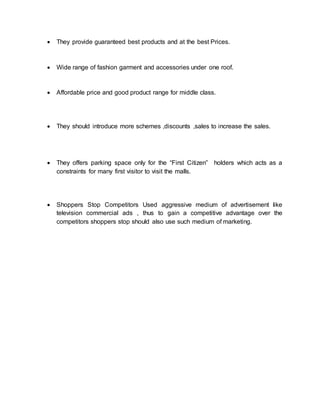
  • 39.