Presented by
Gaurav Singh -2013IPG047
Nivedita Bhadauria – 2016MBA17
Food oriented store based retail
Retail involves the sale of merchandise from a single point of purchase directly to a customer who
intends to use that product. The single point of purchase could be a brick-and-mortar retail store,
an Internet shopping website, a catalog, or even a mobile phone.
The retail transaction is at the end of the chain.
Retailing
Store based retailers
A store-based retailer operates and conducts business from a fixed location. A store-based retailer
opens its doors to walk-in customer traffic. Many stores have beautiful and useful things
beckoning so you will enter the store,
touch the merchandise, and buy a little of that magic to take home.
Store-based retail strategy mix:
A retail strategy mix involves a combination of factors: location, operations, goods/services
offered, pricing, atmosphere and customer services, and promotion. To flourish, a firm
should strive to be dominant in some way and thus reach destination retailer status.
Food
oriented
Box store
Warehouse
store
Combination
store
Hypermarket
Conventional
supermarket
Convenience
store
Convenience Store Strategy Mix
Well-located food-oriented retailer that is open long hours and
carries a moderate number of items. It is small, with average to
above-average prices and average atmosphere and services.
Advantages
1. Open for 24 hours to go at anytime.
2. Useful services such as battery charging or cashing.
3. Placed in the streets, we do not have to go far.
Disadvantages
1. Expensive.
Conventional Supermarket Strategy Mix
Departmentalized food store with a wide range of food and
related products; sales of general merchandise are rather
limited. Ex Reliance fresh.
Advantages
Disadvantages
1. Saving in labour cost due to self-service system.
2. Supermarket has large turnover.
3. Reasonable or low prices of goods.
4. Shopping is very easy and quick.
1. Supermarket requires huge financial resources.
2. it is normally situated at a long distance from the residential localities.
3. There is lack of personal attention.
4. Goods which require explanation by salesmen cannot be sold in such markets.
Hypermarket
Unites supermarket and general merchandise sales in one facility, with general merchandise
typically accounting for 25 to 40 percent of total sales.
Advantages:
1. Customers can get everything at one place. Hence saving time, energy and money in
searching.
2. Cost reduction from bulk buying in hypermarket are transferred to customers
Disadvantages :
1. It causes major traffic problem.
2. Forces smaller shops out of business.
Box (limited-line) store
Food-based discounter that focuses on a small selection of items, moderate
hours of operation (compared to supermarkets), few services, and limited
manufacturer brands.
It carries fewer than 2,000 items, few refrigerated perishables, and few sizes and brands per
item. Prices are on shelves or overhead signs. Items are displayed in cut cases. Customers
bag purchases. Box stores rely on low-priced private-label brands. Their prices are 20 to 30
percent below supermarkets.
Warehouse store
A warehouse store or warehouse supermarket is a food and
grocery retailer that operates stores geared toward offering deeper
discounted prices than a traditional supermarket. These stores offer
a no-frills experience and warehouse shelving stocked well with
merchandise intended to move at higher volumes.
Advantages:
Customers can get items in more discounted price as compare to supermarkets.
Disadvantages:
1. Atmosphere and services are very low.
2. Near to industrial area.
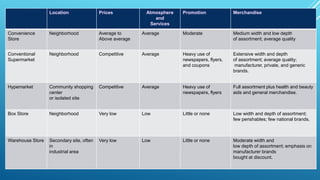
Location Prices Atmosphere
and
Services
Promotion Merchandise
Convenience
Store
Neighborhood Average to
Above average
Average Moderate Medium width and low depth
of assortment; average quality
Conventional
Supermarket
Neighborhood Competitive Average Heavy use of
newspapers, flyers,
and coupons
Extensive width and depth
of assortment; average quality;
manufacturer, private, and generic
brands.
Hypemarket Community shopping
center
or isolated site
Competitive Average Heavy use of
newspapers, flyers
Full assortment plus health and beauty
aids and general merchandise.
Box Store Neighborhood Very low Low Little or none Low width and depth of assortment;
few perishables; few national brands.
Warehouse Store Secondary site, often
in
industrial area
Very low Low Little or none Moderate width and
low depth of assortment; emphasis on
manufacturer brands
bought at discount.
Distribution Channel
References
1. https://www.thebalance.com/what-is-retail-2892238
2. https://www.slideshare.net
3. http://wps.prenhall.com/bp_berman_retail_12/234/60100/15385817.cw/-
/15385819/index.html
4. https://www.slideshare.net/PrabhakarPandey1/calssification-by-retail-strategy-
mix-12651759
THANK YOU

Food oriented store based retail

  • 1.
    Presented by Gaurav Singh-2013IPG047 Nivedita Bhadauria – 2016MBA17 Food oriented store based retail
  • 2.
    Retail involves thesale of merchandise from a single point of purchase directly to a customer who intends to use that product. The single point of purchase could be a brick-and-mortar retail store, an Internet shopping website, a catalog, or even a mobile phone. The retail transaction is at the end of the chain. Retailing Store based retailers A store-based retailer operates and conducts business from a fixed location. A store-based retailer opens its doors to walk-in customer traffic. Many stores have beautiful and useful things beckoning so you will enter the store, touch the merchandise, and buy a little of that magic to take home.
  • 3.
    Store-based retail strategymix: A retail strategy mix involves a combination of factors: location, operations, goods/services offered, pricing, atmosphere and customer services, and promotion. To flourish, a firm should strive to be dominant in some way and thus reach destination retailer status.
  • 4.
  • 5.
    Convenience Store StrategyMix Well-located food-oriented retailer that is open long hours and carries a moderate number of items. It is small, with average to above-average prices and average atmosphere and services. Advantages 1. Open for 24 hours to go at anytime. 2. Useful services such as battery charging or cashing. 3. Placed in the streets, we do not have to go far. Disadvantages 1. Expensive.
  • 6.
    Conventional Supermarket StrategyMix Departmentalized food store with a wide range of food and related products; sales of general merchandise are rather limited. Ex Reliance fresh. Advantages Disadvantages 1. Saving in labour cost due to self-service system. 2. Supermarket has large turnover. 3. Reasonable or low prices of goods. 4. Shopping is very easy and quick. 1. Supermarket requires huge financial resources. 2. it is normally situated at a long distance from the residential localities. 3. There is lack of personal attention. 4. Goods which require explanation by salesmen cannot be sold in such markets.
  • 7.
    Hypermarket Unites supermarket andgeneral merchandise sales in one facility, with general merchandise typically accounting for 25 to 40 percent of total sales. Advantages: 1. Customers can get everything at one place. Hence saving time, energy and money in searching. 2. Cost reduction from bulk buying in hypermarket are transferred to customers Disadvantages : 1. It causes major traffic problem. 2. Forces smaller shops out of business.
  • 8.
    Box (limited-line) store Food-baseddiscounter that focuses on a small selection of items, moderate hours of operation (compared to supermarkets), few services, and limited manufacturer brands. It carries fewer than 2,000 items, few refrigerated perishables, and few sizes and brands per item. Prices are on shelves or overhead signs. Items are displayed in cut cases. Customers bag purchases. Box stores rely on low-priced private-label brands. Their prices are 20 to 30 percent below supermarkets.
  • 9.
    Warehouse store A warehousestore or warehouse supermarket is a food and grocery retailer that operates stores geared toward offering deeper discounted prices than a traditional supermarket. These stores offer a no-frills experience and warehouse shelving stocked well with merchandise intended to move at higher volumes. Advantages: Customers can get items in more discounted price as compare to supermarkets. Disadvantages: 1. Atmosphere and services are very low. 2. Near to industrial area.
  • 10.
    Location Prices Atmosphere and Services PromotionMerchandise Convenience Store Neighborhood Average to Above average Average Moderate Medium width and low depth of assortment; average quality Conventional Supermarket Neighborhood Competitive Average Heavy use of newspapers, flyers, and coupons Extensive width and depth of assortment; average quality; manufacturer, private, and generic brands. Hypemarket Community shopping center or isolated site Competitive Average Heavy use of newspapers, flyers Full assortment plus health and beauty aids and general merchandise. Box Store Neighborhood Very low Low Little or none Low width and depth of assortment; few perishables; few national brands. Warehouse Store Secondary site, often in industrial area Very low Low Little or none Moderate width and low depth of assortment; emphasis on manufacturer brands bought at discount.
  • 11.
  • 12.
    References 1. https://www.thebalance.com/what-is-retail-2892238 2. https://www.slideshare.net 3.http://wps.prenhall.com/bp_berman_retail_12/234/60100/15385817.cw/- /15385819/index.html 4. https://www.slideshare.net/PrabhakarPandey1/calssification-by-retail-strategy- mix-12651759
  • 13.