Customer Value
Optimization
Alexandre Chaves
May/2022 UNLOCKING THE VALUE
OF YOUR BEST
CUSTOMERS
RADAR
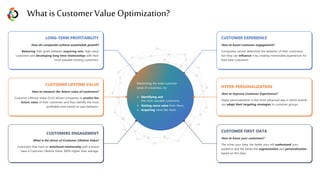
Maximizing the total customer
value of a business, by:
 Identifying and
the most valuable customers,
 Getting more value from them,
 Acquiring more like them.
CUSTOMER LIFETIME VALUE
How to measure the future value of customers?
Customer Lifetime Value (CLV) allows companies to predict the
future value of their customers and thus identify the most
profitable ones based on past behavior.
LONG-TERM PROFITABILITY
How do companies achieve sustainable growth?
Balancing their goals between acquiring new, high-value
customers and developing long-time relationships with their
most valuable existing customers.
CUSTOMERS ENGAGEMENT
What is the driver of Customer Lifetime Value?
Customers that have an emotional relationship with a brand
have a Customer Lifetime Value 306% higher than average.
HYPER-PERSONALIZATION
How to improve Customer Experiences?
Hyper-personalization is the most advanced way in which brands
can adapt their targeting strategies to customer groups.
CUSTOMER EXPERIENCE
How to boost customer engagement?
Companies cannot determine the behavior of their customers,
but they can influence it by creating memorable experiences for
their best customers.
CUSTOMER FIRST-DATA
How to know your customers?
The richer your data, the better your will understand your
audience and the better the segmentation and personalization
based on this data.
What is Customer Value Optimization?
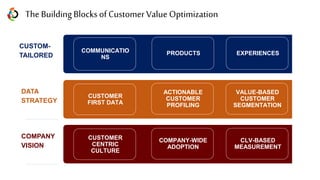
COMPANY
VISION
The BuildingBlocks ofCustomer Value Optimization
CUSTOMER
CENTRIC
CULTURE
COMPANY-WIDE
ADOPTION
CLV-BASED
MEASUREMENT
DATA
STRATEGY
CUSTOMER
FIRST DATA
ACTIONABLE
CUSTOMER
PROFILING
VALUE-BASED
CUSTOMER
SEGMENTATION
CUSTOM-
TAILORED EXPERIENCES
PRODUCTS
COMMUNICATIO
NS
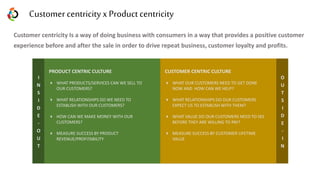
CUSTOMER CENTRIC CULTURE
 WHAT OUR CUSTOMERS NEED TO GET DONE
NOW AND HOW CAN WE HELP?
 WHAT RELATIONSHIPS DO OUR CUSTOMERS
EXPECT US TO ESTABLISH WITH THEM?
 WHAT VALUE DO OUR CUSTOMERS NEED TO SEE
BEFORE THEY ARE WILLING TO PAY?
 MEASURE SUCCESS BY CUSTOMER LIFETIME
VALUE
PRODUCT CENTRIC CULTURE
 WHAT PRODUCTS/SERVICES CAN WE SELL TO
OUR CUSTOMERS?
 WHAT RELATIONSHIPS DO WE NEED TO
ESTABLISH WITH OUR CUSTOMERS?
 HOW CAN WE MAKE MONEY WITH OUR
CUSTOMERS?
 MEASURE SUCCESS BY PRODUCT
REVENUE/PROFITABILITY
Customer centricity Is a way of doing business with consumers in a way that provides a positive customer
experience before and after the sale in order to drive repeat business, customer loyalty and profits.
I
N
S
I
D
E
-
O
U
T
O
U
T
S
I
D
E
-
I
N
Customer centricityx Product centricity
SWOT Analysisof Customer Centricity
Opportunities
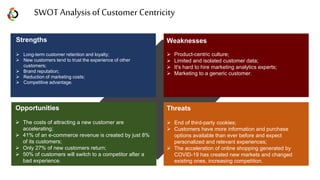
 The costs of attracting a new customer are
accelerating;
 41% of an e-commerce revenue is created by just 8%
of its customers;
 Only 27% of new customers return;
 50% of customers will switch to a competitor after a
bad experience.
Strengths
 Long-term customer retention and loyalty;
 New customers tend to trust the experience of other
customers;
 Brand reputation;
 Reduction of marketing costs;
 Competitive advantage.
Weaknesses
 Product-centric culture;
 Limited and isolated customer data;
 It's hard to hire marketing analytics experts;
 Marketing to a generic customer.
Threats
 End of third-party cookies;
 Customers have more information and purchase
options available than ever before and expect
personalized and relevant experiences;
 The acceleration of online shopping generated by
COVID-19 has created new markets and changed
existing ones, increasing competition.
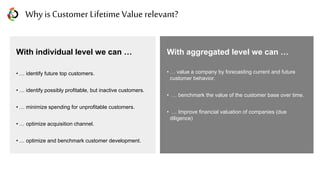
With individual level we can …
• … identify future top customers.
• … identify possibly profitable, but inactive customers.
• … minimize spending for unprofitable customers.
• … optimize acquisition channel.
• … optimize and benchmark customer development.
With aggregated level we can …
• … value a company by forecasting current and future
customer behavior.
• … benchmark the value of the customer base over time.
• … Improve financial valuation of companies (due
diligence)
Why is Customer LifetimeValue relevant?
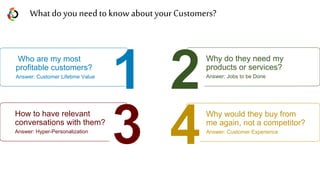
How to have relevant
conversations with them?
Answer: Hyper-Personalization
Who are my most
profitable customers?
Answer: Customer Lifetime Value
Why do they need my
products or services?
Answer: Jobs to be Done
Why would they buy from
me again, not a competitor?
Answer: Customer Experience
What do you need to know aboutyour Customers?
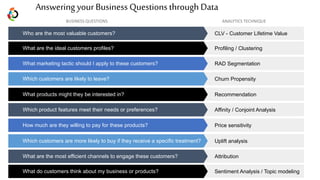
Answering your BusinessQuestionsthrough Data
CLV - Customer Lifetime Value
Who are the most valuable customers?
Profiling / Clustering
What are the ideal customers profiles?
RAD Segmentation
What marketing tactic should I apply to these customers?
Churn Propensity
Which customers are likely to leave?
Recommendation
What products might they be interested in?
Affinity / Conjoint Analysis
Which product features meet their needs or preferences?
Price sensitivity
How much are they willing to pay for these products?
Uplift analysis
Which customers are more likely to buy if they receive a specific treatment?
Attribution
What are the most efficient channels to engage these customers?
Sentiment Analysis / Topic modeling
What do customers think about my business or products?
BUSINESS QUESTIONS ANALYTICS TECHNIQUE
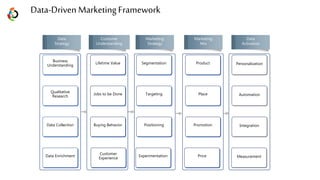
Segmentation Personalization
Targeting Automation
Positioning Integration
Lifetime Value
Jobs to be Done
Buying Behavior
Business
Understanding
Qualitative
Research
Data Collection
Customer
Understanding
Marketing
Strategy
Marketing
Mix
Data
Strategy
Data
Activation
Data Enrichment
Customer
Experience Measurement
Experimentation
Product
Place
Promotion
Price
Data-Driven Marketing Framework
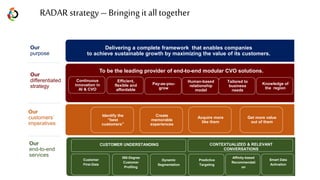
Our
customers’
imperatives
Our
end-to-end
services
Delivering a complete framework that enables companies
to achieve sustainable growth by maximizing the value of its customers.
Our
purpose
Our
differentiated
strategy
Human-based
relationship
model
Efficient,
flexible and
affordable
Continuous
innovation in
AI & CVO
To be the leading provider of end-to-end modular CVO solutions.
RADAR strategy – Bringing itall together
Customer
First-Data
Tailored to
business
needs
Knowledge of
the region
360-Degree
Customer
Profiling
Dynamic
Segmentation
Predictive
Targeting
Affinity-based
Recommendati
on
Smart Data
Activation
Identify the
“best
customers”
Create
memorable
experiences
Acquire more
like them
Get more value
out of them
Pay-as-you-
grow
CUSTOMER UNDERSTANDING CONTEXTUALIZED & RELEVANT
CONVERSATIONS
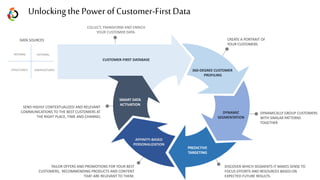
PREDICTIVE
TARGETING
CUSTOMER-FIRST DATABASE
DYNAMIC
SEGMENTATION
360-DEGREE CUSTOMER
PROFILING
SMART DATA
ACTIVATION
AFFINITY-BASED
PERSONALIZATION
Unlocking the Power of Customer-First Data
COLLECT, TRANSFORM AND ENRICH
YOUR CUSTOMER DATA.
CREATE A PORTRAIT OF
YOUR CUSTOMERS
DYNAMICALLY GROUP CUSTOMERS
WITH SIMILAR PATTERNS
TOGETHER
DISCOVER WHICH SEGMENTS IT MAKES SENSE TO
FOCUS EFFORTS AND RESOURCES BASED.ON
EXPECTED FUTURE RESULTS.
SEND HIGHLY CONTEXTUALIZED AND RELEVANT
COMMUNICATIONS TO THE BEST CUSTOMERS AT
THE RIGHT PLACE, TIME AND CHANNEL
TAILOR OFFERS AND PROMOTIONS FOR YOUR BEST
CUSTOMERS, RECOMMENDING PRODUCTS AND CONTENT
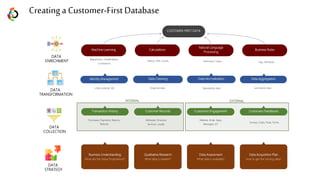
THAT ARE RELEVANT TO THEM.
INTERNAL EXTERNAL
STRUCTURED UNSTRUCTURED
DATA SOURCES
CUSTOMER-FIRST DATA
Calculations
Machine Learning Business Rules
Natural Language
Processing
Identity Management
Purchases, Payments, Returns,
Refunds
Surveys, Chats, Posts, Forms
Website, Email, Apps,
Messages, IoT
Attributes, Financial,
Services, Loyalty
Business Understanding
What are the Value Propositions?
Qualitative Research
What data is needed?
Data Acquisition Plan
How to get the missing data?
Data Assessment
What data is available?
DATA
ENRICHMENT
DATA
TRANSFORMATION
DATA
COLLECTION
DATA
STRATEGY
Transaction History Customers Feedbacks
Customers Engagement
Customer Records
INTERNAL EXTERNAL
Data Cleaning Data Normalization Data Aggregation
Unify customer IDs Standardize data Summarize data
Organize data
Regressions, Classifications,
Correlations
Metrics, KPIs, Scores Sentiment, Topics Tags, Attributes
Creating a Customer-First Database
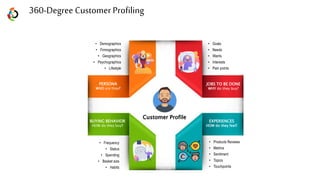
Customer Profile
BUYING BEHAVIOR
HOW do they buy?
• Frequency
• Status
• Spending
• Basket size
• Habits
• Products Reviews
• Metrics
• Sentiment
• Topics
• Touchpoints
• Demographics
• Firmographics
• Geographics
• Psychographics
• Lifestyle
PERSONA
WHO are they?
JOBS TO BE DONE
WHY do they buy?
EXPERIENCES
HOW do they feel?
• Goals
• Needs
• Wants
• Interests
• Pain points
360-Degree Customer Profiling
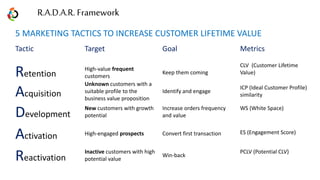
Tactic Target Goal Metrics
Retention
High-value frequent
customers
Keep them coming
CLV (Customer Lifetime
Value)
5 MARKETING TACTICS TO INCREASE CUSTOMER LIFETIME VALUE
R.A.D.A.R. Framework
Acquisition
Unknown customers with a
suitable profile to the
business value proposition
Identify and engage
ICP (Ideal Customer Profile)
similarity
Development
New customers with growth
potential
Increase orders frequency
and value
WS (White Space)
Activation High-engaged prospects Convert first transaction ES (Engagement Score)
Reactivation
Inactive customers with high
potential value
Win-back
PCLV (Potential CLV)
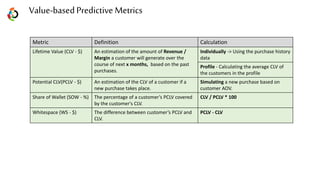
Metric Definition Calculation
Lifetime Value (CLV - $) An estimation of the amount of Revenue /
Margin a customer will generate over the
course of next x months, based on the past
purchases.
Individually -> Using the purchase history
data
Profile - Calculating the average CLV of
the customers in the profile
Potential CLV(PCLV - $) An estimation of the CLV of a customer if a
new purchase takes place.
Simulating a new purchase based on
customer AOV.
Share of Wallet (SOW - %) The percentage of a customer’s PCLV covered
by the customer's CLV.
CLV / PCLV * 100
Whitespace (WS - $) The difference between customer’s PCLV and
CLV.
PCLV - CLV
Value-basedPredictive Metrics
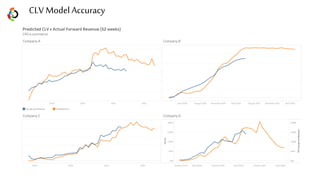
CLV Model Accuracy
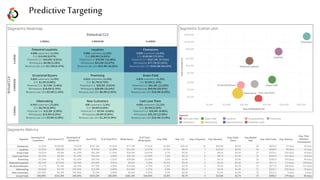
PredictiveTargeting
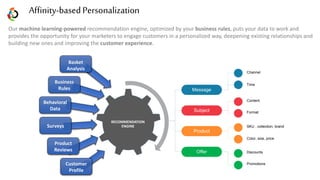
Our machine learning-powered recommendation engine, optimized by your business rules, puts your data to work and
provides the opportunity for your marketers to engage customers in a personalized way, deepening existing relationships and
building new ones and improving the customer experience.
Message
Subject
Product
Offer
Channel
Content
Format
SKU , collection, brand
Color, size, price
Promotions
Time
Discounts
RECOMMENDATION
ENGINE
Basket
Analysis
Customer
Profile
Product
Reviews
Surveys
Behavioral
Data
Business
Rules
Affinity-basedPersonalization
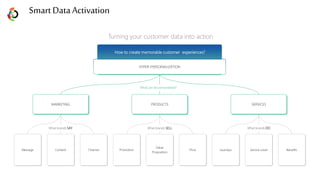
Smart Data Activation
What brands SAY What brands SELL What brands DO
HYPER-PERSONALIZATION
Message Content Channel Promotion
Value
Proposition
Price Journeys Service Level Benefits
What can be personalized?
How to create memorable customer experiences?
MARKETING PRODUCTS SERVICES
Turning your customer data into action

RADAR - CVO as a Service.pptx

  • 1.
    Customer Value Optimization Alexandre Chaves May/2022UNLOCKING THE VALUE OF YOUR BEST CUSTOMERS RADAR
  • 2.
    Maximizing the totalcustomer value of a business, by:  Identifying and the most valuable customers,  Getting more value from them,  Acquiring more like them. CUSTOMER LIFETIME VALUE How to measure the future value of customers? Customer Lifetime Value (CLV) allows companies to predict the future value of their customers and thus identify the most profitable ones based on past behavior. LONG-TERM PROFITABILITY How do companies achieve sustainable growth? Balancing their goals between acquiring new, high-value customers and developing long-time relationships with their most valuable existing customers. CUSTOMERS ENGAGEMENT What is the driver of Customer Lifetime Value? Customers that have an emotional relationship with a brand have a Customer Lifetime Value 306% higher than average. HYPER-PERSONALIZATION How to improve Customer Experiences? Hyper-personalization is the most advanced way in which brands can adapt their targeting strategies to customer groups. CUSTOMER EXPERIENCE How to boost customer engagement? Companies cannot determine the behavior of their customers, but they can influence it by creating memorable experiences for their best customers. CUSTOMER FIRST-DATA How to know your customers? The richer your data, the better your will understand your audience and the better the segmentation and personalization based on this data. What is Customer Value Optimization?
  • 3.
    COMPANY VISION The BuildingBlocks ofCustomerValue Optimization CUSTOMER CENTRIC CULTURE COMPANY-WIDE ADOPTION CLV-BASED MEASUREMENT DATA STRATEGY CUSTOMER FIRST DATA ACTIONABLE CUSTOMER PROFILING VALUE-BASED CUSTOMER SEGMENTATION CUSTOM- TAILORED EXPERIENCES PRODUCTS COMMUNICATIO NS
  • 4.
    CUSTOMER CENTRIC CULTURE WHAT OUR CUSTOMERS NEED TO GET DONE NOW AND HOW CAN WE HELP?  WHAT RELATIONSHIPS DO OUR CUSTOMERS EXPECT US TO ESTABLISH WITH THEM?  WHAT VALUE DO OUR CUSTOMERS NEED TO SEE BEFORE THEY ARE WILLING TO PAY?  MEASURE SUCCESS BY CUSTOMER LIFETIME VALUE PRODUCT CENTRIC CULTURE  WHAT PRODUCTS/SERVICES CAN WE SELL TO OUR CUSTOMERS?  WHAT RELATIONSHIPS DO WE NEED TO ESTABLISH WITH OUR CUSTOMERS?  HOW CAN WE MAKE MONEY WITH OUR CUSTOMERS?  MEASURE SUCCESS BY PRODUCT REVENUE/PROFITABILITY Customer centricity Is a way of doing business with consumers in a way that provides a positive customer experience before and after the sale in order to drive repeat business, customer loyalty and profits. I N S I D E - O U T O U T S I D E - I N Customer centricityx Product centricity
  • 5.
    SWOT Analysisof CustomerCentricity Opportunities  The costs of attracting a new customer are accelerating;  41% of an e-commerce revenue is created by just 8% of its customers;  Only 27% of new customers return;  50% of customers will switch to a competitor after a bad experience. Strengths  Long-term customer retention and loyalty;  New customers tend to trust the experience of other customers;  Brand reputation;  Reduction of marketing costs;  Competitive advantage. Weaknesses  Product-centric culture;  Limited and isolated customer data;  It's hard to hire marketing analytics experts;  Marketing to a generic customer. Threats  End of third-party cookies;  Customers have more information and purchase options available than ever before and expect personalized and relevant experiences;  The acceleration of online shopping generated by COVID-19 has created new markets and changed existing ones, increasing competition.
  • 6.
    With individual levelwe can … • … identify future top customers. • … identify possibly profitable, but inactive customers. • … minimize spending for unprofitable customers. • … optimize acquisition channel. • … optimize and benchmark customer development. With aggregated level we can … • … value a company by forecasting current and future customer behavior. • … benchmark the value of the customer base over time. • … Improve financial valuation of companies (due diligence) Why is Customer LifetimeValue relevant?
  • 7.
    How to haverelevant conversations with them? Answer: Hyper-Personalization Who are my most profitable customers? Answer: Customer Lifetime Value Why do they need my products or services? Answer: Jobs to be Done Why would they buy from me again, not a competitor? Answer: Customer Experience What do you need to know aboutyour Customers?
  • 8.
    Answering your BusinessQuestionsthroughData CLV - Customer Lifetime Value Who are the most valuable customers? Profiling / Clustering What are the ideal customers profiles? RAD Segmentation What marketing tactic should I apply to these customers? Churn Propensity Which customers are likely to leave? Recommendation What products might they be interested in? Affinity / Conjoint Analysis Which product features meet their needs or preferences? Price sensitivity How much are they willing to pay for these products? Uplift analysis Which customers are more likely to buy if they receive a specific treatment? Attribution What are the most efficient channels to engage these customers? Sentiment Analysis / Topic modeling What do customers think about my business or products? BUSINESS QUESTIONS ANALYTICS TECHNIQUE
  • 9.
    Segmentation Personalization Targeting Automation PositioningIntegration Lifetime Value Jobs to be Done Buying Behavior Business Understanding Qualitative Research Data Collection Customer Understanding Marketing Strategy Marketing Mix Data Strategy Data Activation Data Enrichment Customer Experience Measurement Experimentation Product Place Promotion Price Data-Driven Marketing Framework
  • 10.
    Our customers’ imperatives Our end-to-end services Delivering a completeframework that enables companies to achieve sustainable growth by maximizing the value of its customers. Our purpose Our differentiated strategy Human-based relationship model Efficient, flexible and affordable Continuous innovation in AI & CVO To be the leading provider of end-to-end modular CVO solutions. RADAR strategy – Bringing itall together Customer First-Data Tailored to business needs Knowledge of the region 360-Degree Customer Profiling Dynamic Segmentation Predictive Targeting Affinity-based Recommendati on Smart Data Activation Identify the “best customers” Create memorable experiences Acquire more like them Get more value out of them Pay-as-you- grow CUSTOMER UNDERSTANDING CONTEXTUALIZED & RELEVANT CONVERSATIONS
  • 11.
    PREDICTIVE TARGETING CUSTOMER-FIRST DATABASE DYNAMIC SEGMENTATION 360-DEGREE CUSTOMER PROFILING SMARTDATA ACTIVATION AFFINITY-BASED PERSONALIZATION Unlocking the Power of Customer-First Data COLLECT, TRANSFORM AND ENRICH YOUR CUSTOMER DATA. CREATE A PORTRAIT OF YOUR CUSTOMERS DYNAMICALLY GROUP CUSTOMERS WITH SIMILAR PATTERNS TOGETHER DISCOVER WHICH SEGMENTS IT MAKES SENSE TO FOCUS EFFORTS AND RESOURCES BASED.ON EXPECTED FUTURE RESULTS. SEND HIGHLY CONTEXTUALIZED AND RELEVANT COMMUNICATIONS TO THE BEST CUSTOMERS AT THE RIGHT PLACE, TIME AND CHANNEL TAILOR OFFERS AND PROMOTIONS FOR YOUR BEST CUSTOMERS, RECOMMENDING PRODUCTS AND CONTENT THAT ARE RELEVANT TO THEM. INTERNAL EXTERNAL STRUCTURED UNSTRUCTURED DATA SOURCES
  • 12.
    CUSTOMER-FIRST DATA Calculations Machine LearningBusiness Rules Natural Language Processing Identity Management Purchases, Payments, Returns, Refunds Surveys, Chats, Posts, Forms Website, Email, Apps, Messages, IoT Attributes, Financial, Services, Loyalty Business Understanding What are the Value Propositions? Qualitative Research What data is needed? Data Acquisition Plan How to get the missing data? Data Assessment What data is available? DATA ENRICHMENT DATA TRANSFORMATION DATA COLLECTION DATA STRATEGY Transaction History Customers Feedbacks Customers Engagement Customer Records INTERNAL EXTERNAL Data Cleaning Data Normalization Data Aggregation Unify customer IDs Standardize data Summarize data Organize data Regressions, Classifications, Correlations Metrics, KPIs, Scores Sentiment, Topics Tags, Attributes Creating a Customer-First Database
  • 13.
    Customer Profile BUYING BEHAVIOR HOWdo they buy? • Frequency • Status • Spending • Basket size • Habits • Products Reviews • Metrics • Sentiment • Topics • Touchpoints • Demographics • Firmographics • Geographics • Psychographics • Lifestyle PERSONA WHO are they? JOBS TO BE DONE WHY do they buy? EXPERIENCES HOW do they feel? • Goals • Needs • Wants • Interests • Pain points 360-Degree Customer Profiling
  • 14.
    Tactic Target GoalMetrics Retention High-value frequent customers Keep them coming CLV (Customer Lifetime Value) 5 MARKETING TACTICS TO INCREASE CUSTOMER LIFETIME VALUE R.A.D.A.R. Framework Acquisition Unknown customers with a suitable profile to the business value proposition Identify and engage ICP (Ideal Customer Profile) similarity Development New customers with growth potential Increase orders frequency and value WS (White Space) Activation High-engaged prospects Convert first transaction ES (Engagement Score) Reactivation Inactive customers with high potential value Win-back PCLV (Potential CLV)
  • 15.
    Metric Definition Calculation LifetimeValue (CLV - $) An estimation of the amount of Revenue / Margin a customer will generate over the course of next x months, based on the past purchases. Individually -> Using the purchase history data Profile - Calculating the average CLV of the customers in the profile Potential CLV(PCLV - $) An estimation of the CLV of a customer if a new purchase takes place. Simulating a new purchase based on customer AOV. Share of Wallet (SOW - %) The percentage of a customer’s PCLV covered by the customer's CLV. CLV / PCLV * 100 Whitespace (WS - $) The difference between customer’s PCLV and CLV. PCLV - CLV Value-basedPredictive Metrics
  • 16.
  • 17.
  • 18.
    Our machine learning-poweredrecommendation engine, optimized by your business rules, puts your data to work and provides the opportunity for your marketers to engage customers in a personalized way, deepening existing relationships and building new ones and improving the customer experience. Message Subject Product Offer Channel Content Format SKU , collection, brand Color, size, price Promotions Time Discounts RECOMMENDATION ENGINE Basket Analysis Customer Profile Product Reviews Surveys Behavioral Data Business Rules Affinity-basedPersonalization
  • 19.
    Smart Data Activation Whatbrands SAY What brands SELL What brands DO HYPER-PERSONALIZATION Message Content Channel Promotion Value Proposition Price Journeys Service Level Benefits What can be personalized? How to create memorable customer experiences? MARKETING PRODUCTS SERVICES Turning your customer data into action

Editor's Notes

  • #2 For questions contact jeff_s_johnson@dell.com or joe_pollock@dell.com. COMMON CUSTOMER CHALLENGES: Organizations face common macro-level, external challenges, including disruptive technology trends, changing business models, and shifting work paradigms. In addition, organizations face a wide range of common internal IT challenges when evolving to meet changing demands: Siloed IT environment: Highly fragmented, heterogeneous infrastructures are extremely difficult to manage and support. Costly legacy systems: Outdated mainframe and proprietary UNIX platforms are often too expensive to operate and maintain. Underperforming workloads: New computing trends—cloud, mobility, big data—expose the limitations of outdated applications. Scalability constraints: Rigid architectures are not equipped to handle new performance demands and the rapid growth of data. Low budgets: Budgets are not growing fast enough—or not growing all—to satisfy new requirements using old methods. Limited skillsets: Lack of expertise leads to slower technology adoption, as well as potential implementation risks. In the course of this presentation, I’d like to show you how Dell addresses these challenges not only through the capabilities we bring to market, but also in how we approach the design and development of our products, services, and solutions in ways that are truly unique and better.