

Documentation
Record and Report
Dr. Rahul B. Pandit
Faculty of Nursing
Sassoon General Hospital, Pune
Definition (Documentation)
Documentation is anything written or printed
on which you rely as record or proof of
patient actions and activities.
Documentation in a patient’s medical record
is a vital aspect of nursing practice.
Documentation
Nursing documentation must be ……….
1. Accurate
2. Comprehensive
3. Flexible enough to retrieve clinical data
4. Maintain continuity of care
5. Track patient outcomes
6. Reflect current standards of nursing
practice.
Challenges for accurately documenting and
reporting the care delivered to patients is….
1. The quality of care
2. Standards of regulatory agencies and
nursing practice,
3. Reimbursement structure in the health care
system
4. Legal guidelines
5. Verbal reports and written documents
(Confidentiality)
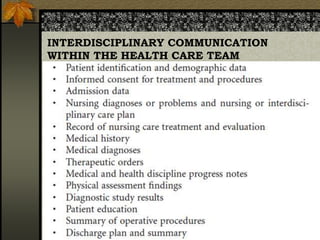
INTERDISCIPLINARY COMMUNICATION
WITHIN THE HEALTH CARE TEAM
Definition (Record)
Record is formally legal, administrative tool
that permanently document information
relevant to direct or indirect patient care.
Records are administrative devices used to
collect and classified information.
PURPOSES OF RECORDS
 Provides staff member, administrator, or
any other members and not only members of
the health team with documentation of the
services that have been rendered and supply
data that are essential for programme
planning and evaluation.
 Provide the practitioner with data required
for the application of professional services
for the improvement of family’s health.
PURPOSES OF RECORDS
 Records are tools of communication.
 Effective health records shows the health
problem in the family and other factors that
affect health. Thus, it is more than a
standardized sheet or a form.
 A record indicates plans for future.
 It provides baseline data to estimate the
long-term changes related to services
PRINCIPLES OF RECORD WRITING
 Nurses should develop their own method of
expression and form in record writing.
 Records should be written clearly,
appropriately and legibly.
 Records should contain facts based on
observation, conversation and action.
 Select relevant facts and the recording
should be neat, complete and uniform.
PRINCIPLES OF RECORD WRITING
 Records are valuable legal documents and
so it should be handled carefully, and
accounted for.
 Records systems are essential for efficiency
and uniformity of services.
 Records should provide for periodic
summary to determine progress and to
make future plans.
PRINCIPLES OF RECORD WRITING
 Records should be written immediately after
an interview.
 Records are confidential documents.
VALUES AND USES OF RECORDS
 Record provides basic facts for services.
 Provides a basis for analyzing needs in
terms of what has been done, what is being
done, what is to be done and the goals
towards which means are to be directed.
 Provides a basis for short and long term
planning.
 It prevents duplication of services and helps
follow up services effectively.
VALUES AND USES OF RECORDS
 Helps the nurse to evaluate the care and the
teaching which she has given.
 It helps the nurse organize her work in an
orderly way and to make an effective use of
time.
 It serves as a guide to professional growth.
 It enables the nurse to judge the quality and
quantity of work done.
VALUES AND USES OF RECORDS
 Record serves as a guide for diagnosis,
treatment and evaluation of services.
 It indicates progress
 It may be used in research
 The record helps identify families needing
service and those prepared to accept help.
 It enables him to draw the nurse’s attention
towards any pertinent observation he has
made.
FILLING OF RECORDS
Alphabetically
Numerically
Geographically
With index cards
Definition (Report)
Report is a system of communication aimed at
transferring essential information
necessary for safe and holistic patient care.
Report is oral or written exchange of
information shared between health team
members.
PURPOSES OF WRITING REPORTS
 To show the kind and quantity of service
rendered over to a specific period.
 To show the progress in reaching goals.
 As an aid in studying health conditions.
 As an aid in planning.
 To interpret the services to the public and
to other interested agencies.
GUIDELINES FOR QUALITY DOCUMENTATION
AND REPORTING
1. Factual
2. Accurate
3. Complete
4. Current
5. Organized
Format for Progress Notes
S =
O =
A =
P =
I =
E =
Format for Progress Notes
S = Subjective Data
O = Objective Data
A = Assessment
P = Plan of Care
I = Intervention
E = Evaluation
TYPE OF REPORT
1. Night report
2. Death report
3. MLC report
4. Prisoner report
5. Unknown patient
6. Any incident happens
TYPE OF RECORD
1. Admission and Discharge Book
2. MLC inform Book
3. Death Book
4. GOB Medicine Book
5. Cot List
6. Diet Book
7. Transfer Book
8. VIP Round Book
INSTITUTIONAL RECORD
1. Administrative Document
2. Faculty Document
3. Staff and Student Document
REFERENCES
 Barriet J. Ward management and Teaching. 2nd ed. Delhi: EBS Publishers; 1967.
 Jha SM. Hospital Management. Ist ed. Mumbai: Himalaya publishers; 2007.
 District hospitals- Guidelines for development. WHO. Geneva: HTBS publishers;
1994.
 Gopalakrishnan & Sunderasan: Material Management, Prentice Hall of India Pvt
Ltd. New Delhi, 1979.
 Kulkarni G R. Managerial accounting for hospitals. Mumbai: Ridhiraj enterprise;
2003.
 Kumar R& Goel SL. Hospital administration and management. Vol 1 (first
edn).New Delhi: Deep & deep publications;
 Gupta S& Kanth S. Hospital stores management, an integrated approach. (First
edn). New Delhi: Jaypee brothers; 2004..
 Wise P S. Leading and managing in nursing. Ist edn. Philadelphia: Mosby
publications; 1995.
 Koontz H & Weihrich H . Essentials of management an international perspective.
(Ist edn). New Delhi: Tata Mc Graw Hill publishers; 2007.
Record and Report

Record and Report

  • 1.
    Documentation Record and Report Dr.Rahul B. Pandit Faculty of Nursing Sassoon General Hospital, Pune
  • 2.
    Definition (Documentation) Documentation isanything written or printed on which you rely as record or proof of patient actions and activities. Documentation in a patient’s medical record is a vital aspect of nursing practice.
  • 3.
    Documentation Nursing documentation mustbe ………. 1. Accurate 2. Comprehensive 3. Flexible enough to retrieve clinical data 4. Maintain continuity of care 5. Track patient outcomes 6. Reflect current standards of nursing practice.
  • 4.
    Challenges for accuratelydocumenting and reporting the care delivered to patients is…. 1. The quality of care 2. Standards of regulatory agencies and nursing practice, 3. Reimbursement structure in the health care system 4. Legal guidelines 5. Verbal reports and written documents (Confidentiality)
  • 5.
  • 6.
    Definition (Record) Record isformally legal, administrative tool that permanently document information relevant to direct or indirect patient care. Records are administrative devices used to collect and classified information.
  • 7.
    PURPOSES OF RECORDS Provides staff member, administrator, or any other members and not only members of the health team with documentation of the services that have been rendered and supply data that are essential for programme planning and evaluation.  Provide the practitioner with data required for the application of professional services for the improvement of family’s health.
  • 8.
    PURPOSES OF RECORDS Records are tools of communication.  Effective health records shows the health problem in the family and other factors that affect health. Thus, it is more than a standardized sheet or a form.  A record indicates plans for future.  It provides baseline data to estimate the long-term changes related to services
  • 9.
    PRINCIPLES OF RECORDWRITING  Nurses should develop their own method of expression and form in record writing.  Records should be written clearly, appropriately and legibly.  Records should contain facts based on observation, conversation and action.  Select relevant facts and the recording should be neat, complete and uniform.
  • 10.
    PRINCIPLES OF RECORDWRITING  Records are valuable legal documents and so it should be handled carefully, and accounted for.  Records systems are essential for efficiency and uniformity of services.  Records should provide for periodic summary to determine progress and to make future plans.
  • 11.
    PRINCIPLES OF RECORDWRITING  Records should be written immediately after an interview.  Records are confidential documents.
  • 12.
    VALUES AND USESOF RECORDS  Record provides basic facts for services.  Provides a basis for analyzing needs in terms of what has been done, what is being done, what is to be done and the goals towards which means are to be directed.  Provides a basis for short and long term planning.  It prevents duplication of services and helps follow up services effectively.
  • 13.
    VALUES AND USESOF RECORDS  Helps the nurse to evaluate the care and the teaching which she has given.  It helps the nurse organize her work in an orderly way and to make an effective use of time.  It serves as a guide to professional growth.  It enables the nurse to judge the quality and quantity of work done.
  • 14.
    VALUES AND USESOF RECORDS  Record serves as a guide for diagnosis, treatment and evaluation of services.  It indicates progress  It may be used in research  The record helps identify families needing service and those prepared to accept help.  It enables him to draw the nurse’s attention towards any pertinent observation he has made.
  • 15.
  • 18.
    Definition (Report) Report isa system of communication aimed at transferring essential information necessary for safe and holistic patient care. Report is oral or written exchange of information shared between health team members.
  • 19.
    PURPOSES OF WRITINGREPORTS  To show the kind and quantity of service rendered over to a specific period.  To show the progress in reaching goals.  As an aid in studying health conditions.  As an aid in planning.  To interpret the services to the public and to other interested agencies.
  • 20.
    GUIDELINES FOR QUALITYDOCUMENTATION AND REPORTING 1. Factual 2. Accurate 3. Complete 4. Current 5. Organized
  • 21.
    Format for ProgressNotes S = O = A = P = I = E =
  • 22.
    Format for ProgressNotes S = Subjective Data O = Objective Data A = Assessment P = Plan of Care I = Intervention E = Evaluation
  • 23.
    TYPE OF REPORT 1.Night report 2. Death report 3. MLC report 4. Prisoner report 5. Unknown patient 6. Any incident happens
  • 24.
    TYPE OF RECORD 1.Admission and Discharge Book 2. MLC inform Book 3. Death Book 4. GOB Medicine Book 5. Cot List 6. Diet Book 7. Transfer Book 8. VIP Round Book
  • 25.
    INSTITUTIONAL RECORD 1. AdministrativeDocument 2. Faculty Document 3. Staff and Student Document
  • 26.
    REFERENCES  Barriet J.Ward management and Teaching. 2nd ed. Delhi: EBS Publishers; 1967.  Jha SM. Hospital Management. Ist ed. Mumbai: Himalaya publishers; 2007.  District hospitals- Guidelines for development. WHO. Geneva: HTBS publishers; 1994.  Gopalakrishnan & Sunderasan: Material Management, Prentice Hall of India Pvt Ltd. New Delhi, 1979.  Kulkarni G R. Managerial accounting for hospitals. Mumbai: Ridhiraj enterprise; 2003.  Kumar R& Goel SL. Hospital administration and management. Vol 1 (first edn).New Delhi: Deep & deep publications;  Gupta S& Kanth S. Hospital stores management, an integrated approach. (First edn). New Delhi: Jaypee brothers; 2004..  Wise P S. Leading and managing in nursing. Ist edn. Philadelphia: Mosby publications; 1995.  Koontz H & Weihrich H . Essentials of management an international perspective. (Ist edn). New Delhi: Tata Mc Graw Hill publishers; 2007.