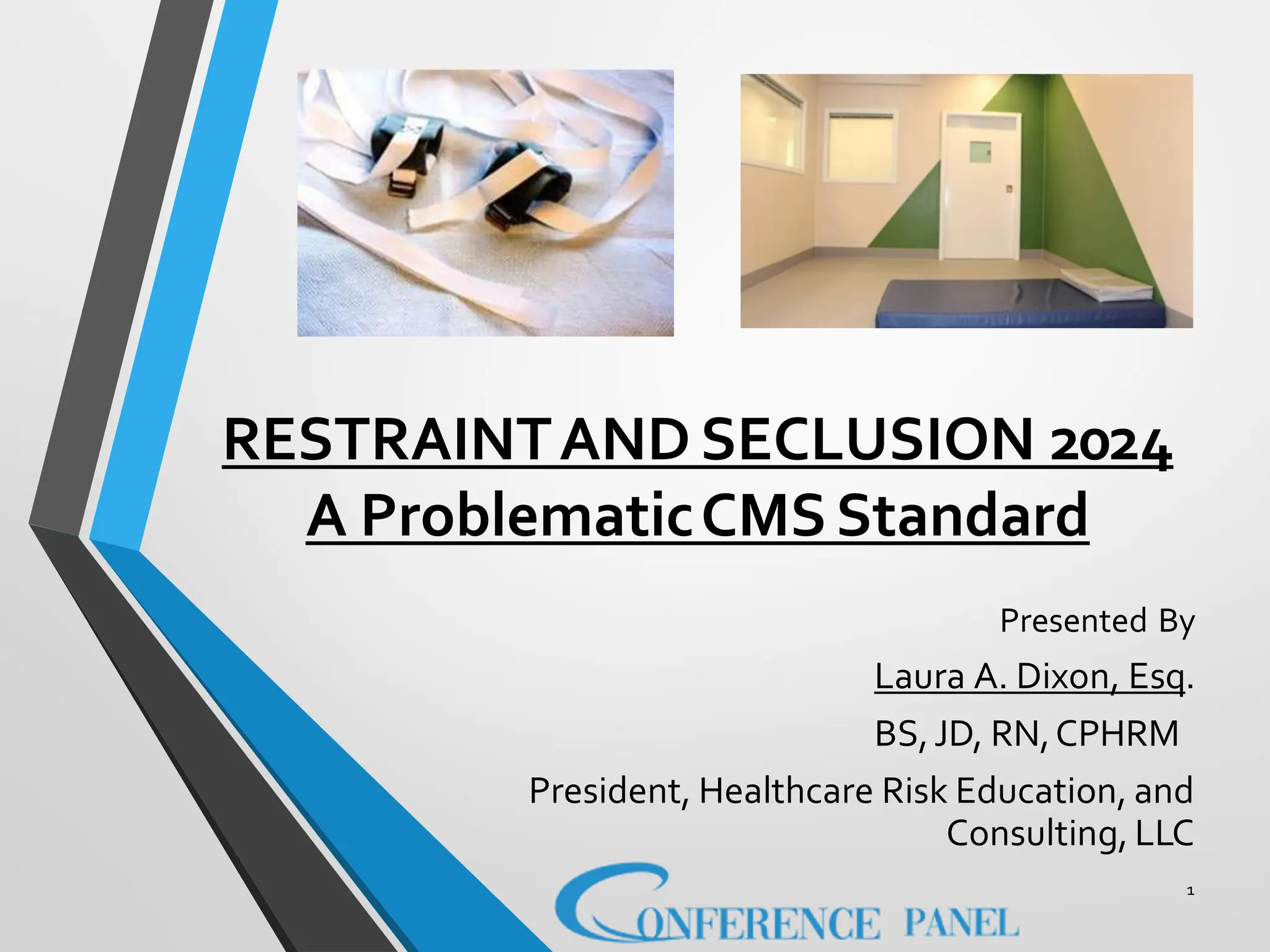
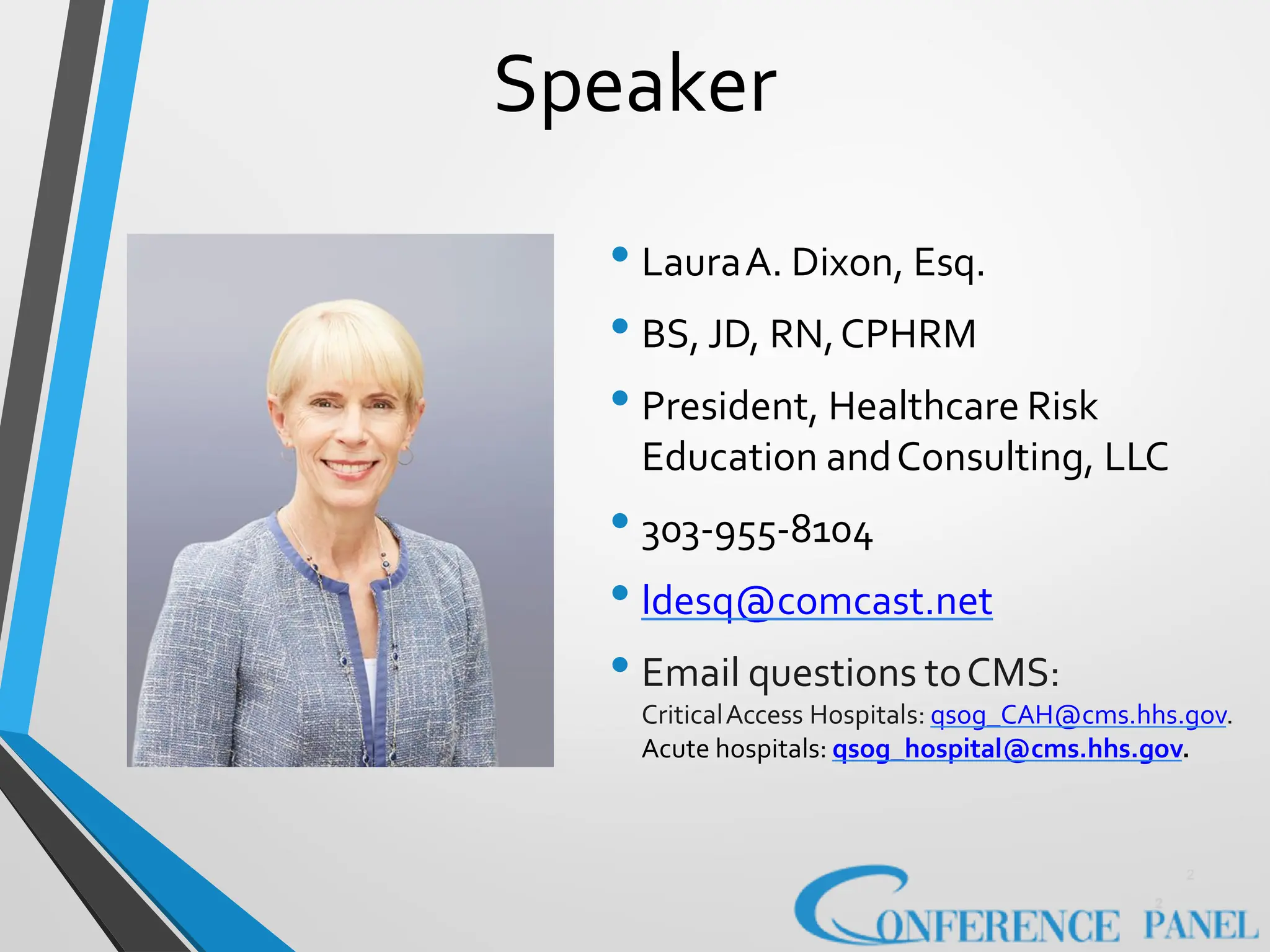
RESTRAINTAND SECLUSION 2024
A ProblematicCMSStandard
Presented By
Laura A. Dixon, Esq.
BS,JD, RN,CPHRM
President, Healthcare Risk Education, and
Consulting, LLC
1
2
2
Speaker
• LauraA. Dixon, Esq.
• BS, JD, RN,CPHRM
• President, Healthcare Risk
Education andConsulting, LLC
• 303-955-8104
• ldesq@comcast.net
• Email questions toCMS:
CriticalAccess Hospitals: qsog_CAH@cms.hhs.gov.
Acute hospitals: qsog_hospital@cms.hhs.gov.
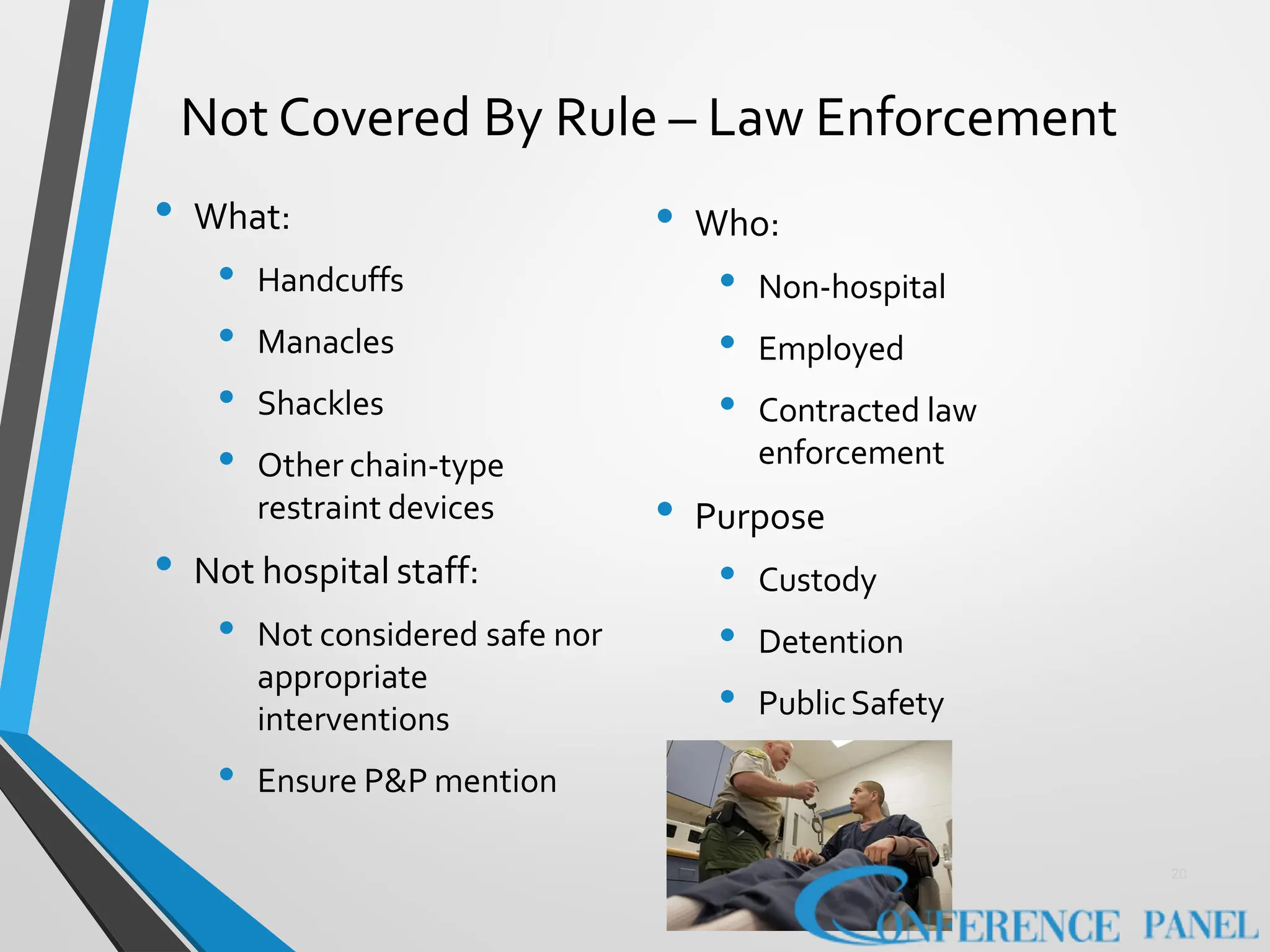
CMS Investigates Restraint Death
3
• March 2017 article: Greenville Hospital to lose its
Medicare contract unless it corrects a deficiency in a
CMSSurvey
• 48-year-old patient dies while strapped to a gurney
• Died of traumatic asphyxiation
• Coroner said his death was a homicide
• Admitted with gun shot wound to his arm
• He struggled with hospital security who secured him face
down on a gurney
More RNs Reduce Need for Restraints
4
• August 2016 study found restraints are used less when
more nurses are on duty
• Use of restraints has declined steadily
• Restraints can lead to agitation, confusion, and
adverse psychological and health effects
• Some hospitals compensate the shortage of RNs with
other staff
• Found this leads to increase in restraint use and that quality
of care suffers
• Staggs,V.S.,Olds, D.M.,Cramer, E. et al. JGEN INTERN MED (2016).
doi:10.1007/s11606-016-3830-z at
http://link.springer.com/article/10.1007%2Fs11606-016-3830-z
2022 Article: Restraints in Hospitals
• Study utilized three topic-based focus groups
• 19 participants from nursing, PT and medicine
• Participantsnoted lack of precise hospital guidelines
• Documentation often lacked the effect of restraint on
patient’s behavior
• Restraints were described as a safety measure
• Implementation most often led by nurses
• Attitudes and experiences were main detriments for restraint
use
• Experienced nurses tended to use restraints less
• Prior experience with violence → more use
• https://www.ncbi.nlm.nih.gov/pmc/articles/PMC8859077/pdf/NO
P2-9-1311.pdf 21
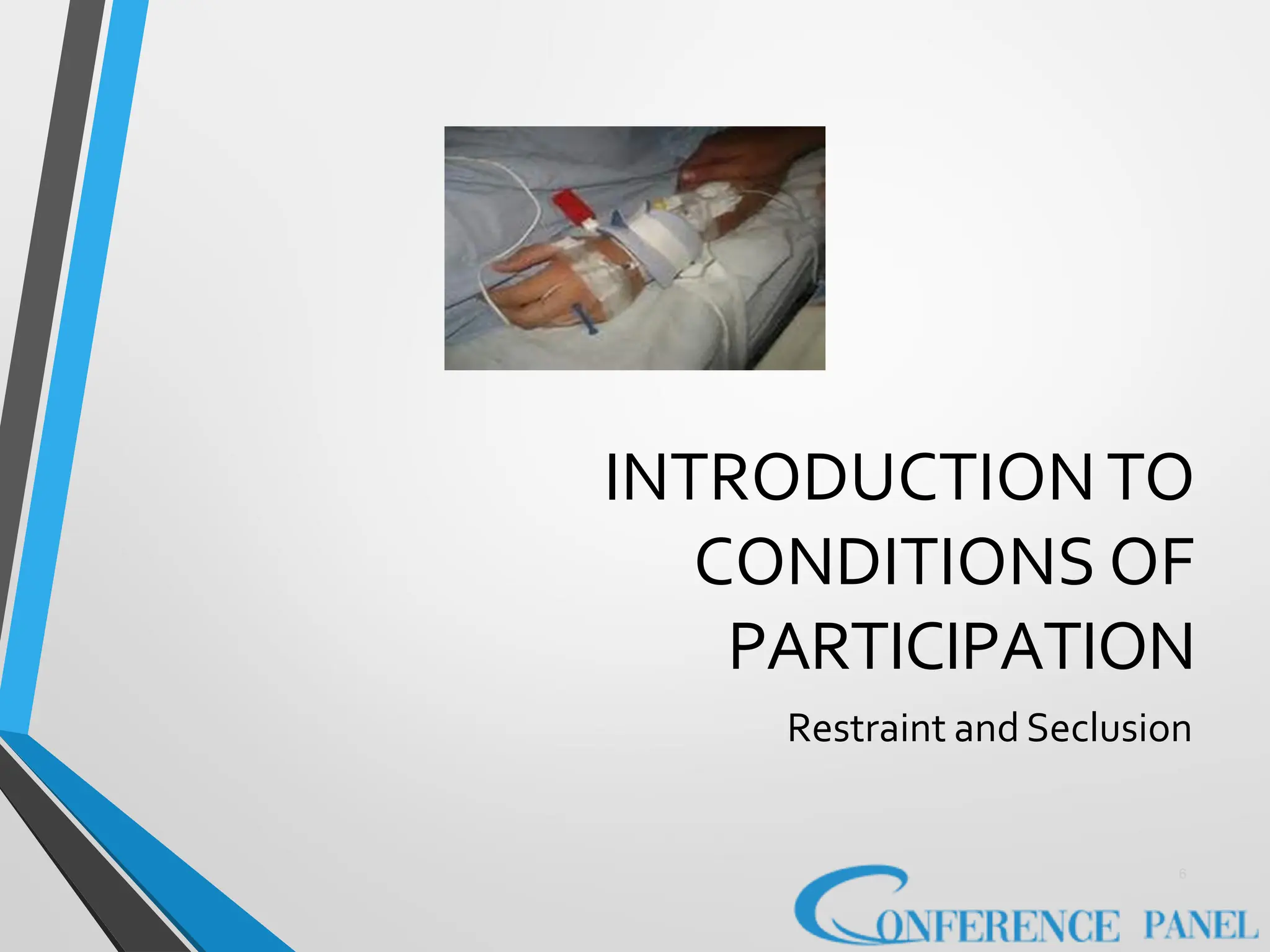
INTRODUCTIONTO
CONDITIONS OF
PARTICIPATION
Restraint and Seclusion
6
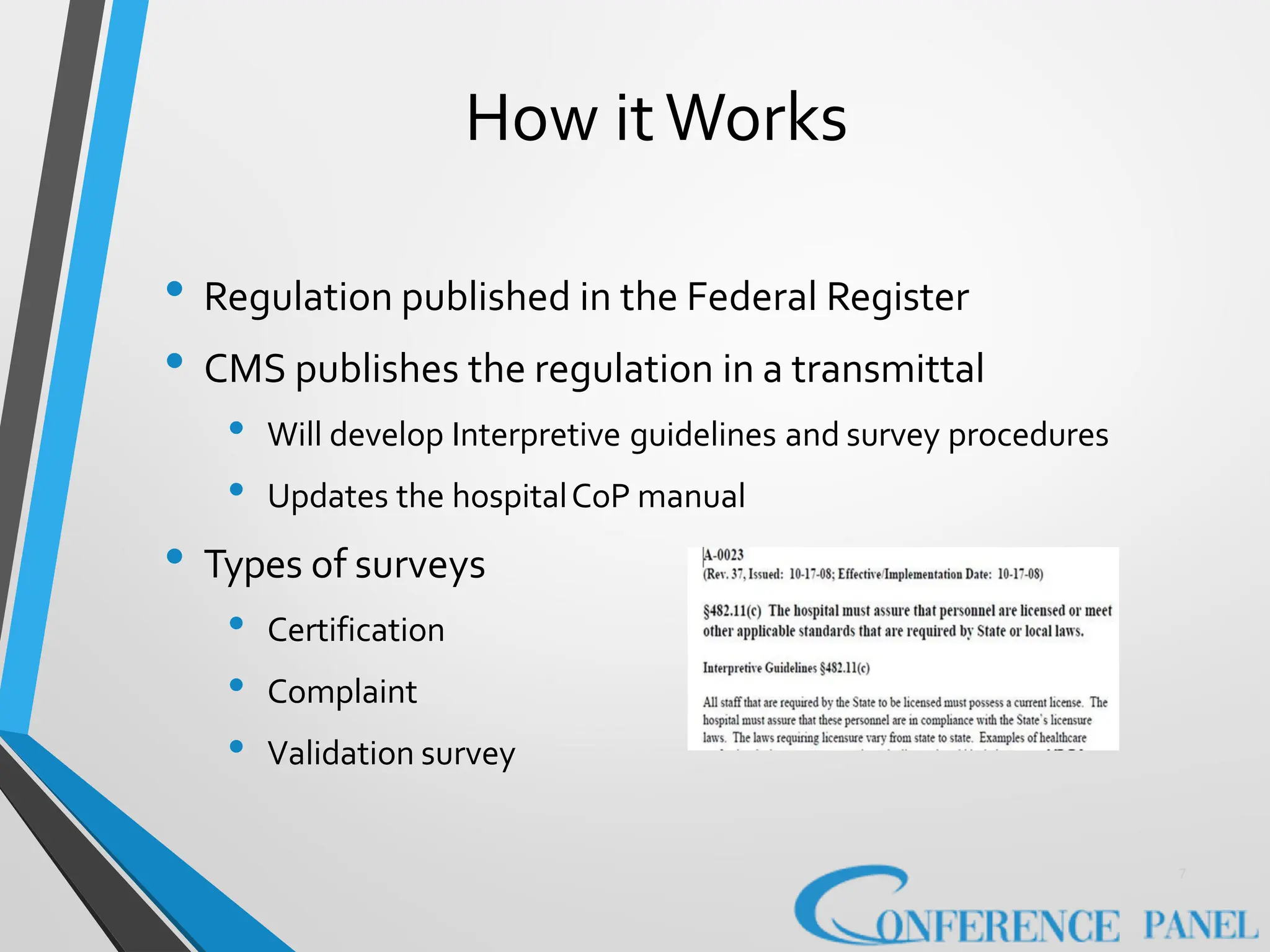
How itWorks
• Regulation published in the Federal Register
• CMS publishes the regulation in a transmittal
• Will develop Interpretive guidelines and survey procedures
• Updates the hospitalCoP manual
• Types of surveys
• Certification
• Complaint
• Validation survey
7
CMS COMPLAINT MANUAL
8
Death Reporting & Investigations 5170
9
• Applies to all deemed, non-deemed hospitals, CAH
distinct part psychiatric (DPU) and rehab units
• Required to report death associated with use of
restraint/seclusion to Regional Office – NOT State
agency
• Submit report electronically by fax/email – Form
10455
• ASPEN –Automated Survey Processing Environment
• ACTS –ComplaintTracking System
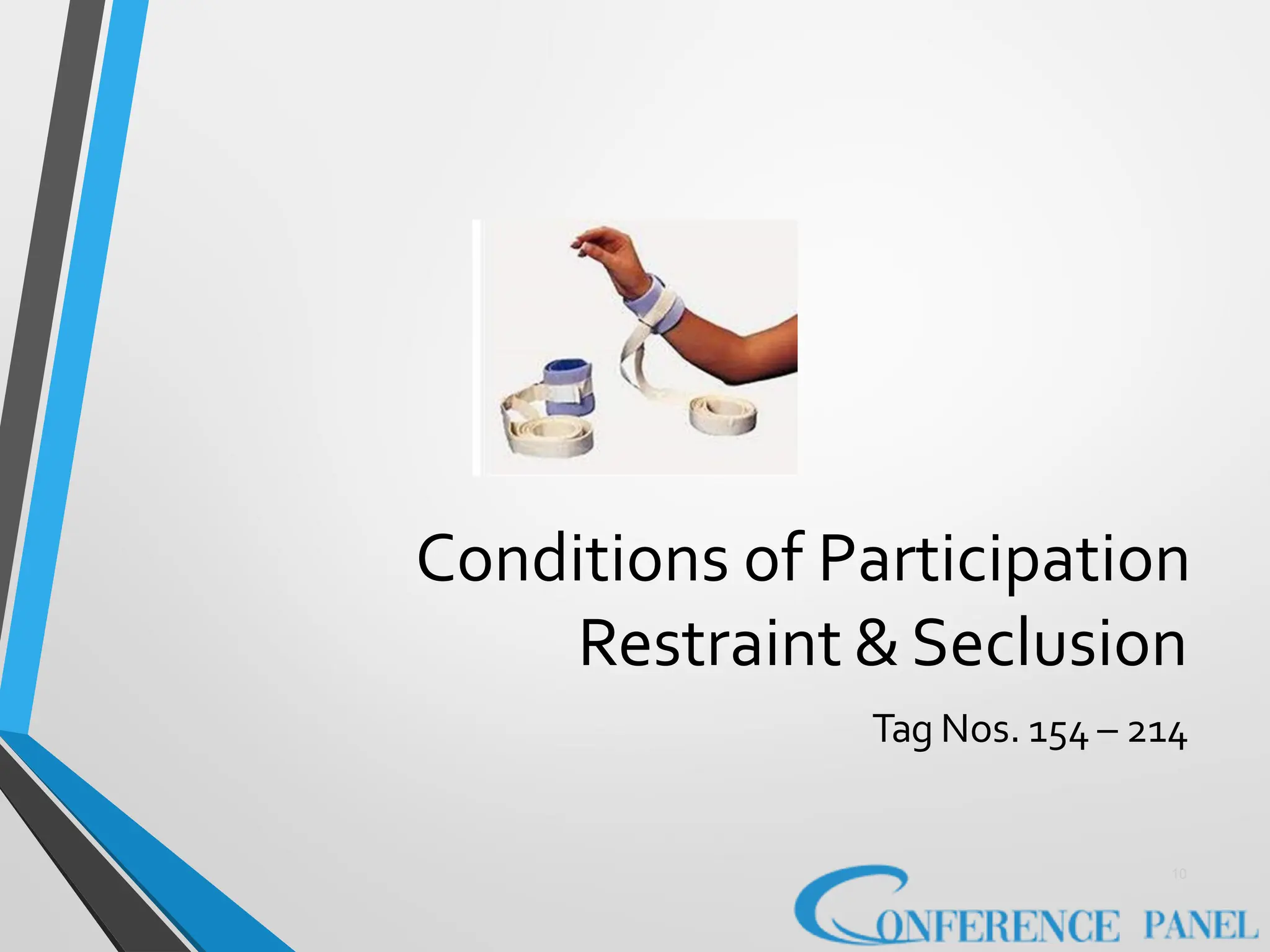
Conditions of Participation
Restraint &Seclusion
Tag Nos. 154 – 214
10
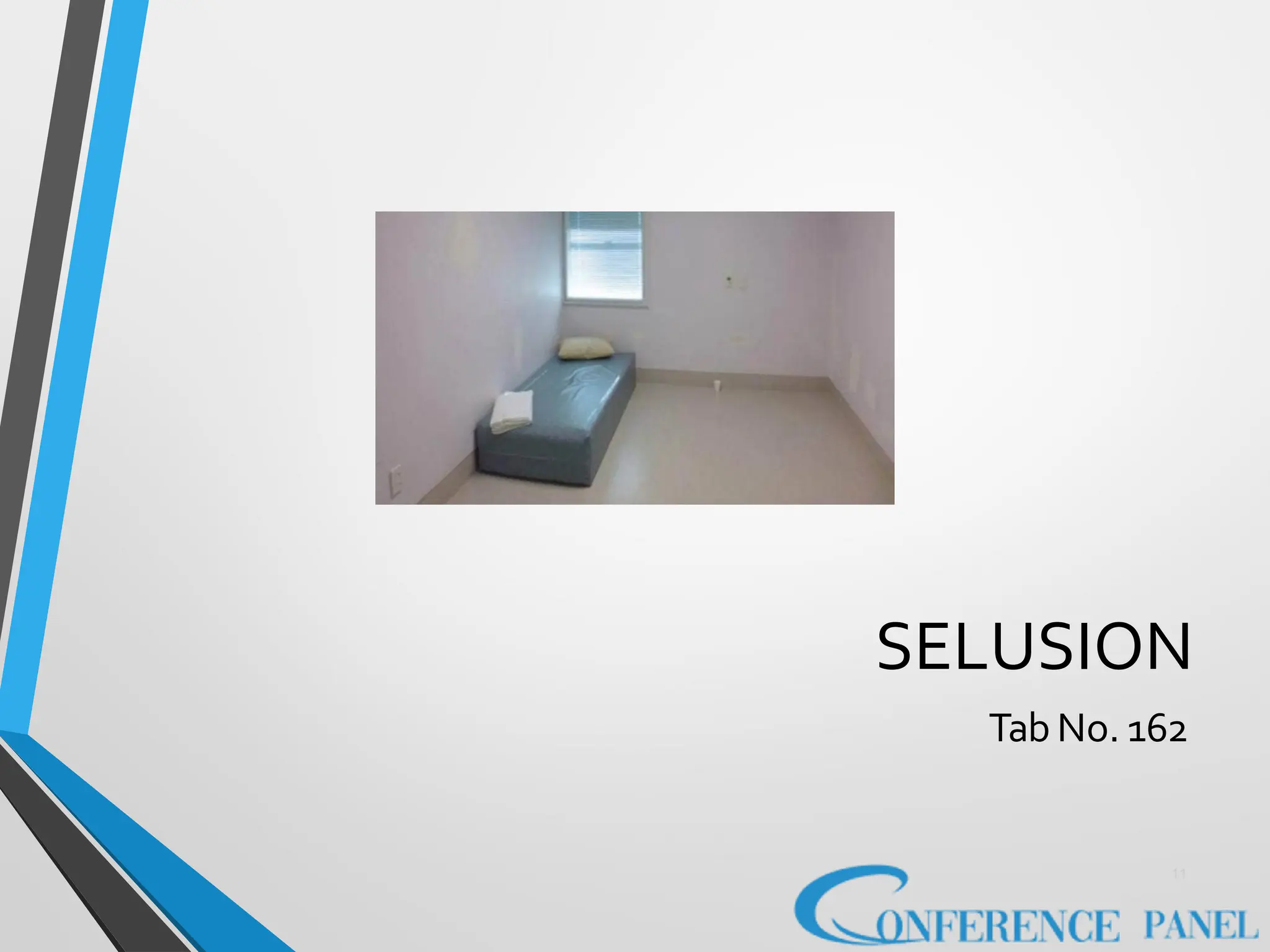
SELUSION
Tab No. 162
11
Definition 162*
12
• Seclusion:
• Involuntary confinement
• Alone in a room or area
• From which they are physically prevented from leaving
• May only be used for the management of violent or
self-destructive behavior (V/SD behavior)
• Jeopardizes the immediate physical safety of the patient, a
staff member, or others
(*Only tag number where seclusion identified separately)
Reducing Use of Seclusion
13
• “Learning from EachOthers – Success Stories and
Ideas for Reducing Restraint/Seclusion in Behavioral
Health”*
• Tools and forms in appendix
• Tool for behavioral health patients
• Published in 2003 by many organizations including:
• American Psychiatric NursesAssn. – NationalAssociation of
Psychiatric Health Systems (NAPHS) with support ofAHA
• See NAPHS andAHA guiding principles1
1 www.naphs.org;www.apna.org, www.psych.org, or www.apna.org,
http://www.naphs.org/catalog/ClinicResources/index.html
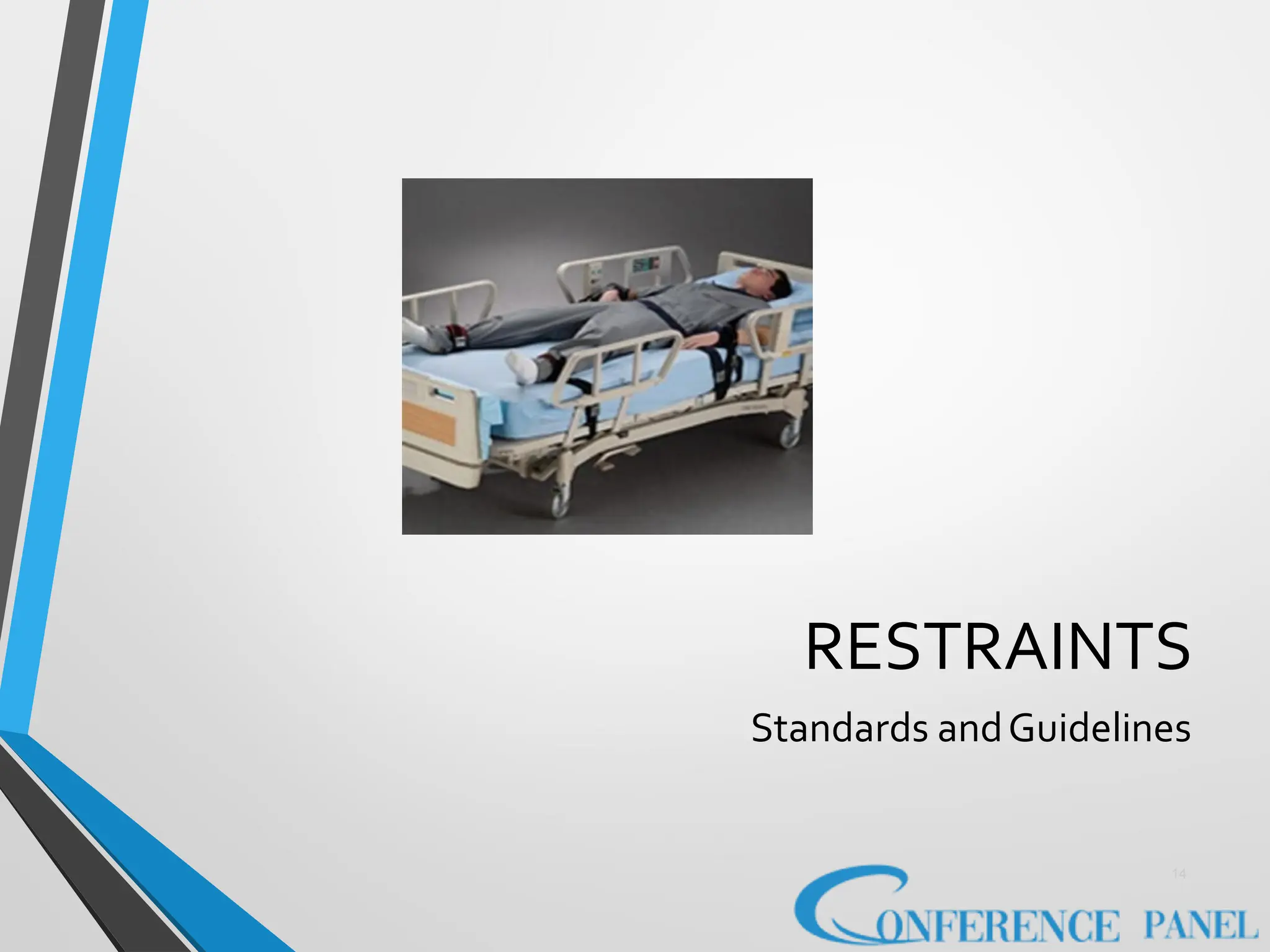
RESTRAINTS
Standards andGuidelines
14
Restraint and Seclusion 154
15
• All patients have a right to be free from unnecessary
physical or mental abuse, and corporal punishment
• Only used:
• When necessary
• Not as coercion, discipline, convenience or retaliation
• For patient safety
• Discontinued at earliest possible time
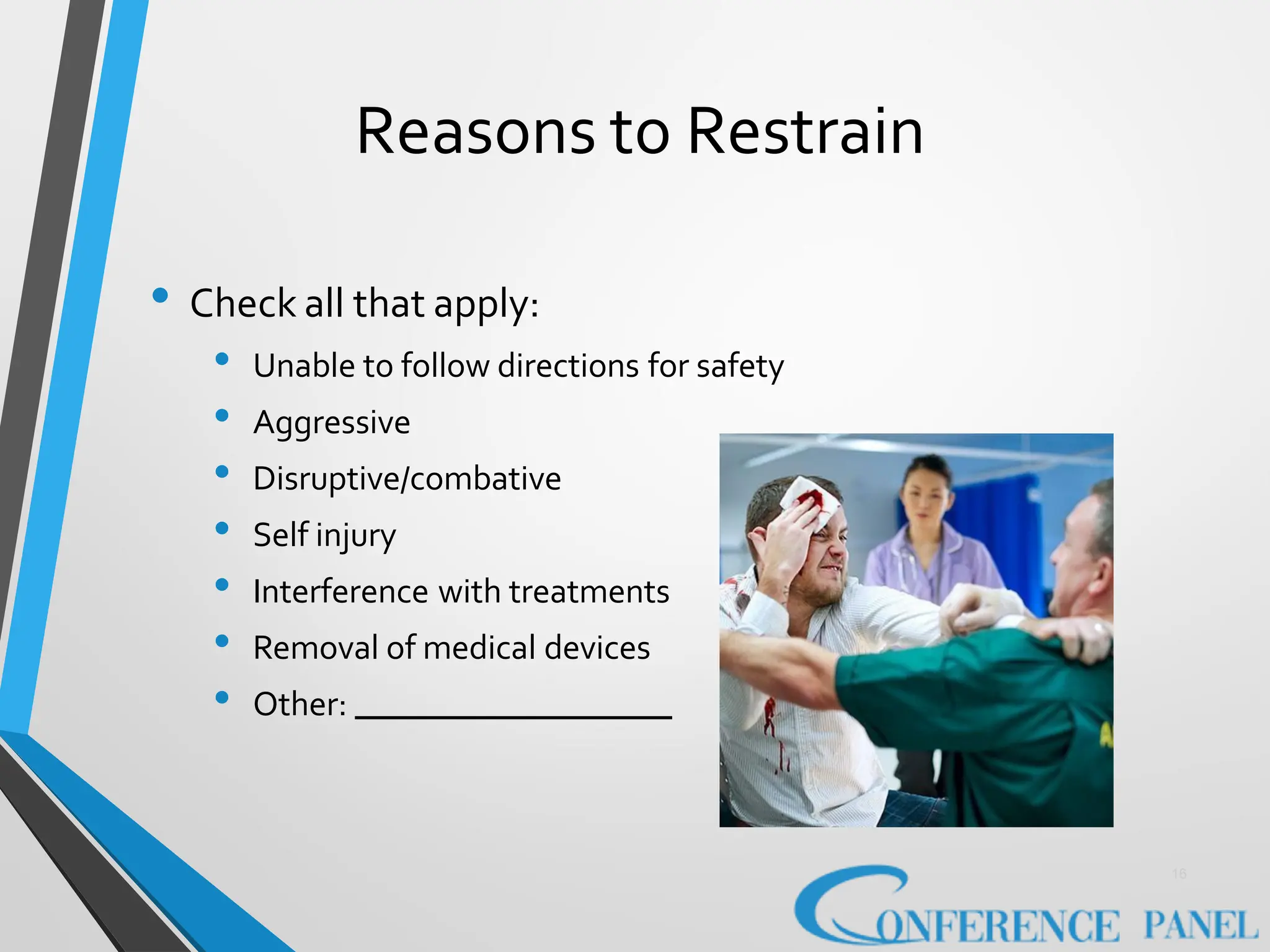
Reasons to Restrain
• Check all that apply:
• Unable to follow directions for safety
• Aggressive
• Disruptive/combative
• Self injury
• Interference with treatments
• Removal of medical devices
• Other:
16
MedicalCondition – Need for Restraint
17
• If the assessment indicates a need to protect the
patient from harm – must use least restrictive
intervention
• Can consider restraint
• Weigh risk of using restraint against risk presented by
behavior
• Request by patient/family not sufficient basis
• If need confirmed – practitioner must determine type
with least risk and most benefit
Documentation
18
• Staff must demonstrate restraint is least restrictive
• Through documentation
• Protects patient
• Based on assessments
• Assessments and documentation must be ongoing to
show continued need
• Once a day may not be sufficient – clinical condition changes
over time
Use ofWeapons
19
• Use of weapons in application of restraint or seclusion
not considered a safe, appropriate health care
intervention
• Pepper spray – Mace – Nightstick –Tasers –Cattle prods –
Stun guns – Pistols
• Security can carry per policy,State/Federal law
• Not considered health care intervention
• Is a law enforcement action
• CMS does not support use of weapons by any hospital
staff as a means of subduing a patient to place in
restraint/seclusion
Not Covered By Rule – Law Enforcement
• What:
• Handcuffs
• Manacles
• Shackles
• Other chain-type
restraint devices
• Not hospital staff:
• Not considered safe nor
appropriate
interventions
• Ensure P&P mention
• Who:
• Non-hospital
• Employed
• Contracted law
enforcement
• Purpose
• Custody
• Detention
• PublicSafety
20
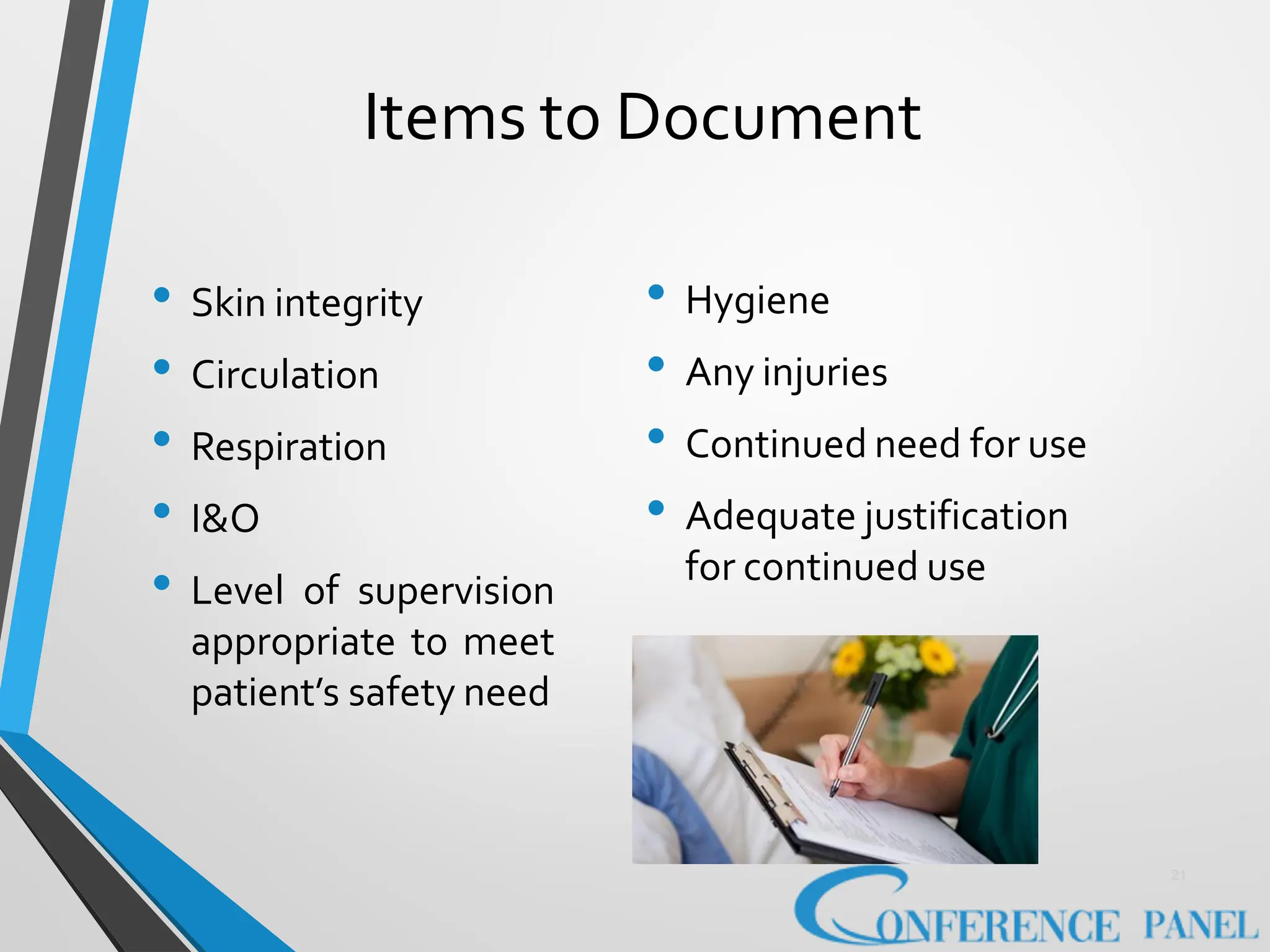
Items to Document
• Skin integrity
• Circulation
• Respiration
• I&O
• Level of supervision
appropriate to meet
patient’s safety need
• Hygiene
• Any injuries
• Continued need for use
• Adequate justification
for continued use
21
JOINTCOMMISSION
RESTRAINTANDSECLUSION
22
Impact of Restraint
23
• TJC: 40% of restraint-related deaths were caused by
unintended asphyxiation during restraint
• Creates a negative response to the situation and can be
humiliating to the patient
• Can be physically and emotionally traumatizing to the staff
involved
• It impacts the trust between the patient and the staff
• Restraint and seclusion should be a last resort
• And only done to protect the patient or the staff
Boarding Behavioral Health Patients
24
• Many hospitals board behavioral health patients
pending an inpatient psyche bed due to a shortages
• Important to ensure that the patient is in a safe room
to prevent inpatient suicide
• Many EDs have separate area to house these patients
• Free guide on how to create a safe room called the
Behavioral Health DesignGuide, at FacilityGuideline
Institute*
• Includes self assessment tool
189
189
The End Questions???
•LauraA. Dixon, Esq.
• BS, JD, RN,CPHRM
• President, Healthcare Risk Education,
and Consulting, LLC
• 303-955-8104
• ldesq@comcast.net
Register Now

Navigating Most Problematic CMS Standards - Hospital Restraint and Seclusion

  • 1.
    RESTRAINTAND SECLUSION 2024 AProblematicCMSStandard Presented By Laura A. Dixon, Esq. BS,JD, RN,CPHRM President, Healthcare Risk Education, and Consulting, LLC 1
  • 2.
    2 2 Speaker • LauraA. Dixon,Esq. • BS, JD, RN,CPHRM • President, Healthcare Risk Education andConsulting, LLC • 303-955-8104 • ldesq@comcast.net • Email questions toCMS: CriticalAccess Hospitals: qsog_CAH@cms.hhs.gov. Acute hospitals: qsog_hospital@cms.hhs.gov.
  • 3.
    CMS Investigates RestraintDeath 3 • March 2017 article: Greenville Hospital to lose its Medicare contract unless it corrects a deficiency in a CMSSurvey • 48-year-old patient dies while strapped to a gurney • Died of traumatic asphyxiation • Coroner said his death was a homicide • Admitted with gun shot wound to his arm • He struggled with hospital security who secured him face down on a gurney
  • 4.
    More RNs ReduceNeed for Restraints 4 • August 2016 study found restraints are used less when more nurses are on duty • Use of restraints has declined steadily • Restraints can lead to agitation, confusion, and adverse psychological and health effects • Some hospitals compensate the shortage of RNs with other staff • Found this leads to increase in restraint use and that quality of care suffers • Staggs,V.S.,Olds, D.M.,Cramer, E. et al. JGEN INTERN MED (2016). doi:10.1007/s11606-016-3830-z at http://link.springer.com/article/10.1007%2Fs11606-016-3830-z
  • 5.
    2022 Article: Restraintsin Hospitals • Study utilized three topic-based focus groups • 19 participants from nursing, PT and medicine • Participantsnoted lack of precise hospital guidelines • Documentation often lacked the effect of restraint on patient’s behavior • Restraints were described as a safety measure • Implementation most often led by nurses • Attitudes and experiences were main detriments for restraint use • Experienced nurses tended to use restraints less • Prior experience with violence → more use • https://www.ncbi.nlm.nih.gov/pmc/articles/PMC8859077/pdf/NO P2-9-1311.pdf 21
  • 6.
  • 7.
    How itWorks • Regulationpublished in the Federal Register • CMS publishes the regulation in a transmittal • Will develop Interpretive guidelines and survey procedures • Updates the hospitalCoP manual • Types of surveys • Certification • Complaint • Validation survey 7
  • 8.
  • 9.
    Death Reporting &Investigations 5170 9 • Applies to all deemed, non-deemed hospitals, CAH distinct part psychiatric (DPU) and rehab units • Required to report death associated with use of restraint/seclusion to Regional Office – NOT State agency • Submit report electronically by fax/email – Form 10455 • ASPEN –Automated Survey Processing Environment • ACTS –ComplaintTracking System
  • 10.
    Conditions of Participation Restraint&Seclusion Tag Nos. 154 – 214 10
  • 11.
  • 12.
    Definition 162* 12 • Seclusion: •Involuntary confinement • Alone in a room or area • From which they are physically prevented from leaving • May only be used for the management of violent or self-destructive behavior (V/SD behavior) • Jeopardizes the immediate physical safety of the patient, a staff member, or others (*Only tag number where seclusion identified separately)
  • 13.
    Reducing Use ofSeclusion 13 • “Learning from EachOthers – Success Stories and Ideas for Reducing Restraint/Seclusion in Behavioral Health”* • Tools and forms in appendix • Tool for behavioral health patients • Published in 2003 by many organizations including: • American Psychiatric NursesAssn. – NationalAssociation of Psychiatric Health Systems (NAPHS) with support ofAHA • See NAPHS andAHA guiding principles1 1 www.naphs.org;www.apna.org, www.psych.org, or www.apna.org, http://www.naphs.org/catalog/ClinicResources/index.html
  • 14.
  • 15.
    Restraint and Seclusion154 15 • All patients have a right to be free from unnecessary physical or mental abuse, and corporal punishment • Only used: • When necessary • Not as coercion, discipline, convenience or retaliation • For patient safety • Discontinued at earliest possible time
  • 16.
    Reasons to Restrain •Check all that apply: • Unable to follow directions for safety • Aggressive • Disruptive/combative • Self injury • Interference with treatments • Removal of medical devices • Other: 16
  • 17.
    MedicalCondition – Needfor Restraint 17 • If the assessment indicates a need to protect the patient from harm – must use least restrictive intervention • Can consider restraint • Weigh risk of using restraint against risk presented by behavior • Request by patient/family not sufficient basis • If need confirmed – practitioner must determine type with least risk and most benefit
  • 18.
    Documentation 18 • Staff mustdemonstrate restraint is least restrictive • Through documentation • Protects patient • Based on assessments • Assessments and documentation must be ongoing to show continued need • Once a day may not be sufficient – clinical condition changes over time
  • 19.
    Use ofWeapons 19 • Useof weapons in application of restraint or seclusion not considered a safe, appropriate health care intervention • Pepper spray – Mace – Nightstick –Tasers –Cattle prods – Stun guns – Pistols • Security can carry per policy,State/Federal law • Not considered health care intervention • Is a law enforcement action • CMS does not support use of weapons by any hospital staff as a means of subduing a patient to place in restraint/seclusion
  • 20.
    Not Covered ByRule – Law Enforcement • What: • Handcuffs • Manacles • Shackles • Other chain-type restraint devices • Not hospital staff: • Not considered safe nor appropriate interventions • Ensure P&P mention • Who: • Non-hospital • Employed • Contracted law enforcement • Purpose • Custody • Detention • PublicSafety 20
  • 21.
    Items to Document •Skin integrity • Circulation • Respiration • I&O • Level of supervision appropriate to meet patient’s safety need • Hygiene • Any injuries • Continued need for use • Adequate justification for continued use 21
  • 22.
  • 23.
    Impact of Restraint 23 •TJC: 40% of restraint-related deaths were caused by unintended asphyxiation during restraint • Creates a negative response to the situation and can be humiliating to the patient • Can be physically and emotionally traumatizing to the staff involved • It impacts the trust between the patient and the staff • Restraint and seclusion should be a last resort • And only done to protect the patient or the staff
  • 24.
    Boarding Behavioral HealthPatients 24 • Many hospitals board behavioral health patients pending an inpatient psyche bed due to a shortages • Important to ensure that the patient is in a safe room to prevent inpatient suicide • Many EDs have separate area to house these patients • Free guide on how to create a safe room called the Behavioral Health DesignGuide, at FacilityGuideline Institute* • Includes self assessment tool
  • 25.
    189 189 The End Questions??? •LauraA.Dixon, Esq. • BS, JD, RN,CPHRM • President, Healthcare Risk Education, and Consulting, LLC • 303-955-8104 • ldesq@comcast.net Register Now