MENTAL HEALTH ACT 2014
PRESENTED BY-
MRS.NAMITA .S.LAL
INTRODUCTION
• The Mental Health Act encourages psychiatrists and other
mental health practitioners to develop strong relationships with
people using mental health services, and to provide them with
information and support to make informed choices about their
care.
• The Mental Health Act promotes voluntary treatment in
preference to compulsory treatment, and establishes robust
safeguards and oversight mechanisms to protect the rights,
dignity and autonomy of people living with a mental illness.
FOCUS OF REFORM UNDER THE ACT
• The Mental Health Act 2014 came into effect on 1 July 2014. It
delivers major reforms to Victoria's mental health system,
placing people with a mental illness at the centre of their
treatment, care and recovery.
• he Act promotes supported decision-making and encourages
strong communication between health practitioners,
consumers, their families and carers. It supports people with a
mental illness to make and participate in treatment decisions
and to have their views and preferences considered and
respected.
CORE PRINCIPLES AND OBJECTIVES OF THE
ACT
• The Mental Health Act has a number of core principles and objectives,
including:
• assessment and treatment are provided in the least intrusive and
restrictive way
• people are supported to make and participate in decisions about their
assessment, treatment and recovery
• individuals’ rights, dignity and autonomy are protected and promoted
at all times
• priority is given to holistic care and support options that are responsive
to individual needs
• the wellbeing and safety of children and young people are protected
and prioritised
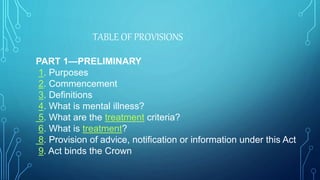
TABLE OF PROVISIONS
PART 1—PRELIMINARY
1. Purposes
2. Commencement
3. Definitions
4. What is mental illness?
5. What are the treatment criteria?
6. What is treatment?
8. Provision of advice, notification or information under this Act
9. Act binds the Crown
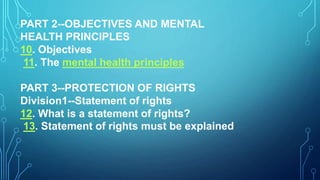
PART 2--OBJECTIVES AND MENTAL
HEALTH PRINCIPLES
10. Objectives
11. The mental health principles
PART 3--PROTECTION OF RIGHTS
Division1--Statement of rights
12. What is a statement of rights?
13. Statement of rights must be explained
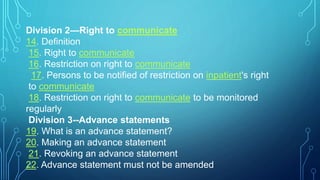
Division 2—Right to communicate
14. Definition
15. Right to communicate
16. Restriction on right to communicate
17. Persons to be notified of restriction on inpatient's right
to communicate
18. Restriction on right to communicate to be monitored
regularly
Division 3--Advance statements
19. What is an advance statement?
20. Making an advance statement
21. Revoking an advance statement
22. Advance statement must not be amended
Division 4--Nominated persons
23. Role of nominated person
24. Nomination of nominated person
25. Revocation of nomination
26. Revocation of nomination by person who
made the nomination
27. Nominated person may decline to act as
nominated person at any time
PART 4--COMPULSORY PATIENTS
Division 1--Assessment Orders
28. What is an Assessment Order?
29. Criteria for an Assessment Order
30. Making an Assessment Order
31. Contents of an Assessment Order
32. Information requirements in relation to an Assessment Order
33. Person subject to an Inpatient Assessment Order to be taken to a
designated mental health service
34. Duration of an Assessment Order
35. Variation of an Assessment Order
36. Assessment of person subject to Assessment Order by authorised
psychiatrist
37. Revocation or expiry of an Assessment Order
38. Treatment during an Assessment Order
Division 2--Court Assessment Orders
39. Examination by authorised psychiatrist
40. Notification requirements in relation to Court
Assessment Orders
41. Variation of a Court Assessment Order
42. Treatment during Court Assessment Order
43. Authorised psychiatrist to provide report to court
44. Authorised psychiatrist may make Temporary
Treatment Order
Division 3--Temporary Treatment Orders
45. What is a Temporary Treatment Order?
46. Authorised psychiatrist may make Temporary Treatment Order
47. Restriction on who can make Temporary Treatment Order
48. Community or Inpatient Temporary Treatment Order?
49. Contents of a Temporary Treatment Order
50. Information and other requirements in relation to Temporary Treatment Orders
51. Duration of a Temporary Treatment Order
Division 4--Treatment Orders
52. What is a Treatment Order?
53. Tribunal to determine whether to make person subject to Treatment Order
54. Authorised psychiatrist may make an application for a Treatment Order
55. Making a Treatment Order
56. Contents of a Treatment Order
57. Duration of a Treatment Order
Division 5--Variation of Temporary Treatment Orders and Treatment Orders
58. Variation of Temporary Treatment Orders and Treatment Orders
59. Requirements in relation to varied Temporary Treatment Orders and Treatment Orders
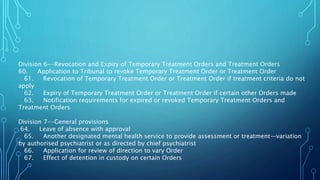
Division 6--Revocation and Expiry of Temporary Treatment Orders and Treatment Orders
60. Application to Tribunal to revoke Temporary Treatment Order or Treatment Order
61. Revocation of Temporary Treatment Order or Treatment Order if treatment criteria do not
apply
62. Expiry of Temporary Treatment Order or Treatment Order if certain other Orders made
63. Notification requirements for expired or revoked Temporary Treatment Orders and
Treatment Orders
Division 7--General provisions
64. Leave of absence with approval
65. Another designated mental health service to provide assessment or treatment—variation
by authorised psychiatrist or as directed by chief psychiatrist
66. Application for review of direction to vary Order
67. Effect of detention in custody on certain Orders
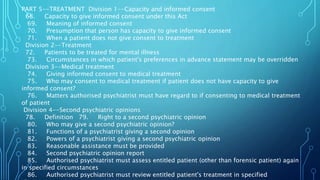
PART 5--TREATMENT Division 1--Capacity and informed consent
68. Capacity to give informed consent under this Act
69. Meaning of informed consent
70. Presumption that person has capacity to give informed consent
71. When a patient does not give consent to treatment
Division 2--Treatment
72. Patients to be treated for mental illness
73. Circumstances in which patient's preferences in advance statement may be overridden
Division 3--Medical treatment
74. Giving informed consent to medical treatment
75. Who may consent to medical treatment if patient does not have capacity to give
informed consent?
76. Matters authorised psychiatrist must have regard to if consenting to medical treatment
of patient
Division 4--Second psychiatric opinions
78. Definition 79. Right to a second psychiatric opinion
80. Who may give a second psychiatric opinion?
81. Functions of a psychiatrist giving a second opinion
82. Powers of a psychiatrist giving a second psychiatric opinion
83. Reasonable assistance must be provided
84. Second psychiatric opinion report
85. Authorised psychiatrist must assess entitled patient (other than forensic patient) again
in specified circumstances
86. Authorised psychiatrist must review entitled patient's treatment in specified
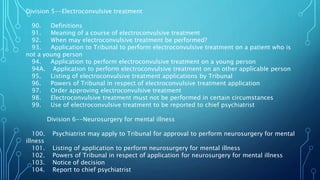
Division 5--Electroconvulsive treatment
90. Definitions
91. Meaning of a course of electroconvulsive treatment
92. When may electroconvulsive treatment be performed?
93. Application to Tribunal to perform electroconvulsive treatment on a patient who is
not a young person
94. Application to perform electroconvulsive treatment on a young person
94A. Application to perform electroconvulsive treatment on an other applicable person
95. Listing of electroconvulsive treatment applications by Tribunal
96. Powers of Tribunal in respect of electroconvulsive treatment application
97. Order approving electroconvulsive treatment
98. Electroconvulsive treatment must not be performed in certain circumstances
99. Use of electroconvulsive treatment to be reported to chief psychiatrist
Division 6--Neurosurgery for mental illness
100. Psychiatrist may apply to Tribunal for approval to perform neurosurgery for mental
illness
101. Listing of application to perform neurosurgery for mental illness
102. Powers of Tribunal in respect of application for neurosurgery for mental illness
103. Notice of decision
104. Report to chief psychiatrist
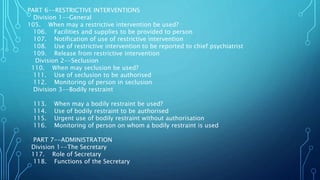
PART 6--RESTRICTIVE INTERVENTIONS
Division 1--General
105. When may a restrictive intervention be used?
106. Facilities and supplies to be provided to person
107. Notification of use of restrictive intervention
108. Use of restrictive intervention to be reported to chief psychiatrist
109. Release from restrictive intervention
Division 2--Seclusion
110. When may seclusion be used?
111. Use of seclusion to be authorised
112. Monitoring of person in seclusion
Division 3--Bodily restraint
113. When may a bodily restraint be used?
114. Use of bodily restraint to be authorised
115. Urgent use of bodily restraint without authorisation
116. Monitoring of person on whom a bodily restraint is used
PART 7--ADMINISTRATION
Division 1--The Secretary
117. Role of Secretary
118. Functions of the Secretary
Division 2--The chief psychiatrist
119. The chief psychiatrist
120. The role of the chief psychiatrist
121. Functions of the chief psychiatrist
122. Investigations by chief psychiatrist
123. Powers of entry
124. Power to give written direction to persons to produce documents or
answer questions
125. Member of staff of mental health service provider to give any
reasonable assistance
126. Report and recommendations following investigation by chief
psychiatrist
127. Report and response to be given to the Secretary
128. Publication and response
129. Chief psychiatrist may give written directions to mental health
service providers
130. Chief psychiatrist may conduct clinical reviews
131. Chief psychiatrist to give notice of intention to conduct clinical
review
132. Clinical review reports and recommendations
133. Standards, guidelines or practice directions to address systemic
issues identified in clinical review
135. Chief psychiatrist must make record
136. Reports
137. Reports to be given to the Secretary
138. Publication of report
139. Standards, guidelines or practice directions to address systemic issues identified in
clinical practice audit
140. Confidentiality obligations applying in respect of information from clinical practice
audit or clinical review
141. Confidentiality of documents
142. Provision of staff
143. Contractors
144. Power of chief psychiatrist to delegate
145. Reports submitted by the chief psychiatrist
Division 3--Authorised officers
146. Chief psychiatrist may appoint authorised officers
147. Identity cards
148. Production of identity card
Division 4--Designated mental health services
149. Emergency declaration of designated mental health services
150. Appointment of authorised psychiatrist
151. Authorised psychiatrist may delegate powers and functions
PART 8--MENTAL HEALTH TRIBUNAL
Division 1--Establishment of the Mental Health Tribunal
152. Establishment of the Mental Health Tribunal
153. Functions of the Tribunal
154. General powers of the Tribunal
155. Protection of members, persons and witnesses
Division 2--Membership of the Tribunal
156. Membership
157. President
158. Deputy President
159. Senior members and ordinary members
160. Legal members
161. Psychiatrist members
162. Registered medical practitioner members
163. Community members
164. Appointments to act as President or Deputy President
165. Remuneration and allowances
166. Public Administration Act 2004 does not apply to members
167. Resignation
168. Suspension
169. Investigation
170. Vacation and removal from office
Division 5--Procedure of the Tribunal
181. General procedure
182. Who are the parties to a proceeding?
183. Joinder of parties
184. Appearance and representation at hearing
185. Interpreters
186. Form and content of applications to the Tribunal
187. Principal registrar may reject certain applications
188. Withdrawal of proceedings
189. Notice of hearing
190. Multiple matters in respect of one person may be held concurrently
191. Access to documents
192. Adjournment of certain hearings only in exceptional circumstances
193. Hearings to be closed to the public
194. Details of person not to be published without consent of President
195. Determination of proceedings
196. Questions of law
197. Referral of question of law to Court
198. Requesting a statement of reasons
199. Correction of Order or statement of reasons 200. Validity of proceedings
201. Review by VCAT 202. Use of experts 203. Witness summons
204. Failure to comply with summons 205. False or misleading information
206. Contempt of the Tribunal
Division 6--Rules Committee
207. Establishment of Rules Committee
208. Functions of the Rules Committee
209. Power to make rules and issue practice notes
210. Membership of the Rules Committee
211. Meeting procedure
212. Validity of decisions
PART 9--COMMUNITY VISITORS
213. Definition
214. Appointment of community visitors
215. General provisions as to community visitors
216. Functions of a community visitor
217. Powers of community visitors
218. When may community visitors visit prescribed premises?
219. Request to see a community visitor
220. Reasonable assistance to be given to community visitors
221. Community Visitors Mental Health Board
222. Matter may be referred
223. Reports by community visitors
224. Annual report of Community Visitors Mental Health Board
225. Secrecy provision
PART 10—COMPLAINTS
Division 1--The Mental Health Complaints Commissioner
226. Mental Health Complaints Commissioner
227. Vacation of office
228. Functions of the Commissioner
229. Powers of the Commissioner
230. Provision of staff and contractors
231. Protection from liability
Division 2--Complaints management by the Commissioner
232. Making a complaint to the Commissioner
233. Referred complaints
234. Grounds for making a complaint
235. How to make a complaint
236. Time by when complaint to be made
237. Withdrawal of complaint
238. Preliminary assessment of complaint
239. Information relating to complaint to be provided
240. Circumstances in which Commissioner may close a complaint
241. Notice of complaint closure
242. Referring a complaint with or without consent
242A. Complaint to which National Law may also apply
243. Commissioner may accept complaints and undertakings
Division 3--Conciliation
244. Conciliation process
245. Parties may be represented at conciliation
246. Discontinuation of conciliation
248. Conciliation agreements
249. Non-disclosure of information given in conciliation
Division 4--Investigations
250. Identity cards for investigators
251. Identity cards to be produced by investigators
252. Investigation of a complaint
253. Notice of investigation
254. Power of entry
255. Powers to compel attendance and call for evidence and documents
256. Restrictions on powers
257. Report of findings following investigation
258. Mental health service provider response to report
259. Publication of report
Division 5--Compliance notices
260. Compliance notice
261. Application for review—compliance notice
262. Offence not to comply with compliance notice
Division 6--General
263. Requirement to provide reasonable assistance to Commissioner
264. Person not to be penalised because of complaining to Commissioner
265. Disclosure of information
266. Local complaint mechanisms to be established by mental health service providers
267. Mental health service providers to provide reports on complaints
268. Annual report of the Commissioner
PART 11--SECURITY PATIENTS
Division 1--Preliminary
269. Construction of references
Division 2--Court Secure Treatment Orders
270. Taking person subject to a Court Secure Treatment Order from prison to designated
mental health service
271. Notification of receipt of security patient subject to a Court Secure Treatment Order
272. Application to Tribunal in relation to security patient subject to Court Secure Treatment
Order
273. Tribunal hearing in relation to Court Secure Treatment Order
274. Discharge of person subject to a Court Secure Treatment Order
Division 3--Secure Treatment Order
275. What is a Secure Treatment Order?
276. Making a Secure Treatment Order
277. Notification of receipt of security patient subject to a Secure Treatment Order
278. Application for revocation of Secure Treatment Order
279. Tribunal hearing in relation to Secure Treatment Order
280. Discharge of person subject to a Secure Treatment Order
Division 4--Leave of absence
281. Grant of leave of absence
282. Revocation of leave of absence
283. Notification requirements for leave of absence
284. Application to Tribunal
Division 5--Monitored leave
285. Monitored leave application and grant
286. Monitored leave conditions, duration and variation
287. Matters to take into account
288. Applicant profiles and leave plans for monitored leave
289. Revocation of monitored leave
290. Notification requirements for monitored leave
Division 6--Taking security patients to another designated mental health service
291. Authorised psychiatrist may direct security patient to be taken to another designated
mental health service
292. Chief psychiatrist may direct security patient to be taken to another designated mental
health service
293. Role of authorised psychiatrist in taking security patient to another designated mental
health service
294. Application to Tribunal for review of direction to take security patient to another
designated mental health service
Division 7--General security patient matters
295. Cessation of security patient status
296. Security conditions
297. Notification and directions following discharge of security patient subject to Court Secure
Treatment Order or Secure Treatment Order
298. Custody of security patients
299. Warrant to arrest security patient absent without leave who leaves Victoria
Division 8--Interstate security patients
300. Definitions
301. Warrant to arrest interstate security patient who absconds to Victoria
302. Orders that Magistrates' Court may make in respect of interstate security patients
PART 12--FORENSIC PATIENTS
305. Definition
307. Authorised psychiatrist may direct taking forensic patient to another designated
mental health service
308. Chief psychiatrist may direct forensic patient to be taken to another designated
mental health service
309. Role of authorised psychiatrist in transferring forensic patient
310. Application to Forensic Leave Panel for review of decision to take forensic patient to
another designated mental health service
311. Security conditions
312. Leave of absence for forensic patient
PART 13--INTERSTATE APPLICATION OF MENTAL HEALTH PROVISIONS
Division 1--General
313. Definitions
314. Corresponding laws and Orders
315. Ministerial agreements
316. Victorian officers may exercise powers under corresponding laws
317. Interstate officers may perform functions or exercise powers in Victoria
Division 2--Operation of Victorian Orders interstate and corresponding orders in Victoria
318. Taking person from Victoria to interstate mental health facility for assessment
319. Taking person from interstate to Victoria for assessment
320. Transfer of responsibility for treatment of person to interstate mental health facility—with
person's consent
321. Transfer of responsibility for treatment of person to interstate mental health facility—without
person's consent
322. Taking person to interstate mental health facility—with person's consent
323. Taking person to interstate mental health facility—without person's consent
324. Person subject to interstate compulsory order taken to Victoria to determine suitability for
Temporary Treatment Order
325. Interstate application of Victorian Orders
Division 3--Persons absent without leave
326. Apprehension of persons absent without leave from interstate facilities
327. Persons absent without leave from designated mental health service
PART 14--VICTORIAN INSTITUTE OF FORENSIC MENTAL HEALTH
Division 1--Preliminary
328. Victorian Institute of Forensic Mental Health
Division 2--Board of directors
332. Board of directors
332A. Functions of the board
333. Constitution of board of directors
334. Appointment of directors
335. Terms and conditions of appointment of directors
336. Resignation and removal
337. Protection from liability
338. Validity of acts or decisions
339. Procedure of board of directors
339A. Guidelines of Minister
339B. Appointment of delegate to board
339C. Functions of delegate
339D. Obligations of board to delegate
Division 3--General
340. Chief executive officer
341. Institute may employ persons
342. Minister may issue directions
343. Strategic plan
344. Statement of priorities
345. Board of directors to give notice of significant events
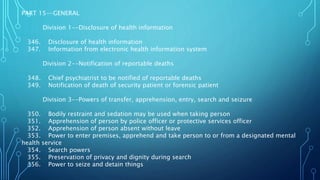
PART 15--GENERAL
Division 1--Disclosure of health information
346. Disclosure of health information
347. Information from electronic health information system
Division 2--Notification of reportable deaths
348. Chief psychiatrist to be notified of reportable deaths
349. Notification of death of security patient or forensic patient
Division 3--Powers of transfer, apprehension, entry, search and seizure
350. Bodily restraint and sedation may be used when taking person
351. Apprehension of person by police officer or protective services officer
352. Apprehension of person absent without leave
353. Power to enter premises, apprehend and take person to or from a designated mental
health service
354. Search powers
355. Preservation of privacy and dignity during search
356. Power to seize and detain things
Division 4--General provisions
357. Payment for examination
358. Offence to give false or misleading information
359. Destroying or damaging records
360. Protection against self-incrimination
361. Validity of order if there is an error
362. Power to bring proceedings
363. Defect in appointment or delegation
364. Conflict of interest
365. Service of documents
Division 5--Codes of Practice
366. Purpose of Codes of Practice
367. Making of Codes of Practice
368. Commencement and availability of Codes of Practice
369. Power to apply, adopt or incorporate
Division 6--Regulations
370. Regulations
371. Fees
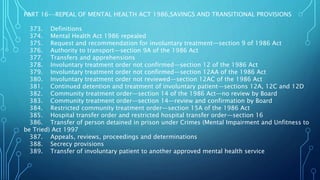
PART 16--REPEAL OF MENTAL HEALTH ACT 1986,SAVINGS AND TRANSITIONAL PROVISIONS
373. Definitions
374. Mental Health Act 1986 repealed
375. Request and recommendation for involuntary treatment—section 9 of 1986 Act
376. Authority to transport—section 9A of the 1986 Act
377. Transfers and apprehensions
378. Involuntary treatment order not confirmed—section 12 of the 1986 Act
379. Involuntary treatment order not confirmed—section 12AA of the 1986 Act
380. Involuntary treatment order not reviewed—section 12AC of the 1986 Act
381. Continued detention and treatment of involuntary patient—sections 12A, 12C and 12D
382. Community treatment order—section 14 of the 1986 Act—no review by Board
383. Community treatment order—section 14—review and confirmation by Board
384. Restricted community treatment order—section 15A of the 1986 Act
385. Hospital transfer order and restricted hospital transfer order—section 16
386. Transfer of person detained in prison under Crimes (Mental Impairment and Unfitness to
be Tried) Act 1997
387. Appeals, reviews, proceedings and determinations
388. Secrecy provisions
389. Transfer of involuntary patient to another approved mental health service
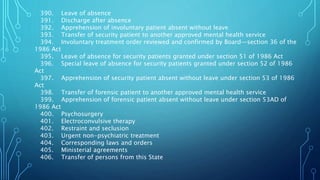
390. Leave of absence
391. Discharge after absence
392. Apprehension of involuntary patient absent without leave
393. Transfer of security patient to another approved mental health service
394. Involuntary treatment order reviewed and confirmed by Board—section 36 of the
1986 Act
395. Leave of absence for security patients granted under section 51 of 1986 Act
396. Special leave of absence for security patients granted under section 52 of 1986
Act
397. Apprehension of security patient absent without leave under section 53 of 1986
Act
398. Transfer of forensic patient to another approved mental health service
399. Apprehension of forensic patient absent without leave under section 53AD of
1986 Act
400. Psychosurgery
401. Electroconvulsive therapy
402. Restraint and seclusion
403. Urgent non-psychiatric treatment
404. Corresponding laws and orders
405. Ministerial agreements
406. Transfer of persons from this State
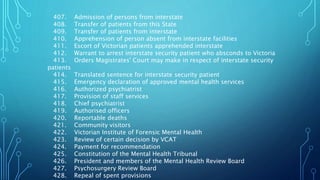
407. Admission of persons from interstate
408. Transfer of patients from this State
409. Transfer of patients from interstate
410. Apprehension of person absent from interstate facilities
411. Escort of Victorian patients apprehended interstate
412. Warrant to arrest interstate security patient who absconds to Victoria
413. Orders Magistrates' Court may make in respect of interstate security
patients
414. Translated sentence for interstate security patient
415. Emergency declaration of approved mental health services
416. Authorized psychiatrist
417. Provision of staff services
418. Chief psychiatrist
419. Authorised officers
420. Reportable deaths
421. Community visitors
422. Victorian Institute of Forensic Mental Health
423. Review of certain decision by VCAT
424. Payment for recommendation
425. Constitution of the Mental Health Tribunal
426. President and members of the Mental Health Review Board
427. Psychosurgery Review Board
428. Repeal of spent provisions
PART 16A--GENERAL SAVINGS AND TRANSITIONALS
Division 1--Mental Health Amendment Act 2015
428A. Transitional—Mental Health Amendment Act 2015
Division 2--Disability (National Disability Insurance Scheme Transition) Amendment
Act 2019
429. Definitions
430. Complaints to the Commissioner
431. The chief psychiatrist
432. Community visitors
Division 3--Health Legislation Amendment and Repeal Act 2019
433. Definitions
434. Transfer of conciliation process to Commissioner
ENDNOTES
Mental health act 2014

Mental health act 2014

  • 1.
    MENTAL HEALTH ACT2014 PRESENTED BY- MRS.NAMITA .S.LAL
  • 2.
    INTRODUCTION • The MentalHealth Act encourages psychiatrists and other mental health practitioners to develop strong relationships with people using mental health services, and to provide them with information and support to make informed choices about their care. • The Mental Health Act promotes voluntary treatment in preference to compulsory treatment, and establishes robust safeguards and oversight mechanisms to protect the rights, dignity and autonomy of people living with a mental illness.
  • 3.
    FOCUS OF REFORMUNDER THE ACT • The Mental Health Act 2014 came into effect on 1 July 2014. It delivers major reforms to Victoria's mental health system, placing people with a mental illness at the centre of their treatment, care and recovery.
  • 4.
    • he Actpromotes supported decision-making and encourages strong communication between health practitioners, consumers, their families and carers. It supports people with a mental illness to make and participate in treatment decisions and to have their views and preferences considered and respected.
  • 5.
    CORE PRINCIPLES ANDOBJECTIVES OF THE ACT • The Mental Health Act has a number of core principles and objectives, including: • assessment and treatment are provided in the least intrusive and restrictive way • people are supported to make and participate in decisions about their assessment, treatment and recovery • individuals’ rights, dignity and autonomy are protected and promoted at all times • priority is given to holistic care and support options that are responsive to individual needs • the wellbeing and safety of children and young people are protected and prioritised
  • 7.
    TABLE OF PROVISIONS PART1—PRELIMINARY 1. Purposes 2. Commencement 3. Definitions 4. What is mental illness? 5. What are the treatment criteria? 6. What is treatment? 8. Provision of advice, notification or information under this Act 9. Act binds the Crown
  • 8.
    PART 2--OBJECTIVES ANDMENTAL HEALTH PRINCIPLES 10. Objectives 11. The mental health principles PART 3--PROTECTION OF RIGHTS Division1--Statement of rights 12. What is a statement of rights? 13. Statement of rights must be explained
  • 9.
    Division 2—Right tocommunicate 14. Definition 15. Right to communicate 16. Restriction on right to communicate 17. Persons to be notified of restriction on inpatient's right to communicate 18. Restriction on right to communicate to be monitored regularly Division 3--Advance statements 19. What is an advance statement? 20. Making an advance statement 21. Revoking an advance statement 22. Advance statement must not be amended
  • 10.
    Division 4--Nominated persons 23.Role of nominated person 24. Nomination of nominated person 25. Revocation of nomination 26. Revocation of nomination by person who made the nomination 27. Nominated person may decline to act as nominated person at any time
  • 11.
    PART 4--COMPULSORY PATIENTS Division1--Assessment Orders 28. What is an Assessment Order? 29. Criteria for an Assessment Order 30. Making an Assessment Order 31. Contents of an Assessment Order 32. Information requirements in relation to an Assessment Order 33. Person subject to an Inpatient Assessment Order to be taken to a designated mental health service 34. Duration of an Assessment Order 35. Variation of an Assessment Order 36. Assessment of person subject to Assessment Order by authorised psychiatrist 37. Revocation or expiry of an Assessment Order 38. Treatment during an Assessment Order
  • 12.
    Division 2--Court AssessmentOrders 39. Examination by authorised psychiatrist 40. Notification requirements in relation to Court Assessment Orders 41. Variation of a Court Assessment Order 42. Treatment during Court Assessment Order 43. Authorised psychiatrist to provide report to court 44. Authorised psychiatrist may make Temporary Treatment Order
  • 13.
    Division 3--Temporary TreatmentOrders 45. What is a Temporary Treatment Order? 46. Authorised psychiatrist may make Temporary Treatment Order 47. Restriction on who can make Temporary Treatment Order 48. Community or Inpatient Temporary Treatment Order? 49. Contents of a Temporary Treatment Order 50. Information and other requirements in relation to Temporary Treatment Orders 51. Duration of a Temporary Treatment Order Division 4--Treatment Orders 52. What is a Treatment Order? 53. Tribunal to determine whether to make person subject to Treatment Order 54. Authorised psychiatrist may make an application for a Treatment Order 55. Making a Treatment Order 56. Contents of a Treatment Order 57. Duration of a Treatment Order Division 5--Variation of Temporary Treatment Orders and Treatment Orders 58. Variation of Temporary Treatment Orders and Treatment Orders 59. Requirements in relation to varied Temporary Treatment Orders and Treatment Orders
  • 14.
    Division 6--Revocation andExpiry of Temporary Treatment Orders and Treatment Orders 60. Application to Tribunal to revoke Temporary Treatment Order or Treatment Order 61. Revocation of Temporary Treatment Order or Treatment Order if treatment criteria do not apply 62. Expiry of Temporary Treatment Order or Treatment Order if certain other Orders made 63. Notification requirements for expired or revoked Temporary Treatment Orders and Treatment Orders Division 7--General provisions 64. Leave of absence with approval 65. Another designated mental health service to provide assessment or treatment—variation by authorised psychiatrist or as directed by chief psychiatrist 66. Application for review of direction to vary Order 67. Effect of detention in custody on certain Orders
  • 15.
    PART 5--TREATMENT Division1--Capacity and informed consent 68. Capacity to give informed consent under this Act 69. Meaning of informed consent 70. Presumption that person has capacity to give informed consent 71. When a patient does not give consent to treatment Division 2--Treatment 72. Patients to be treated for mental illness 73. Circumstances in which patient's preferences in advance statement may be overridden Division 3--Medical treatment 74. Giving informed consent to medical treatment 75. Who may consent to medical treatment if patient does not have capacity to give informed consent? 76. Matters authorised psychiatrist must have regard to if consenting to medical treatment of patient Division 4--Second psychiatric opinions 78. Definition 79. Right to a second psychiatric opinion 80. Who may give a second psychiatric opinion? 81. Functions of a psychiatrist giving a second opinion 82. Powers of a psychiatrist giving a second psychiatric opinion 83. Reasonable assistance must be provided 84. Second psychiatric opinion report 85. Authorised psychiatrist must assess entitled patient (other than forensic patient) again in specified circumstances 86. Authorised psychiatrist must review entitled patient's treatment in specified
  • 16.
    Division 5--Electroconvulsive treatment 90.Definitions 91. Meaning of a course of electroconvulsive treatment 92. When may electroconvulsive treatment be performed? 93. Application to Tribunal to perform electroconvulsive treatment on a patient who is not a young person 94. Application to perform electroconvulsive treatment on a young person 94A. Application to perform electroconvulsive treatment on an other applicable person 95. Listing of electroconvulsive treatment applications by Tribunal 96. Powers of Tribunal in respect of electroconvulsive treatment application 97. Order approving electroconvulsive treatment 98. Electroconvulsive treatment must not be performed in certain circumstances 99. Use of electroconvulsive treatment to be reported to chief psychiatrist Division 6--Neurosurgery for mental illness 100. Psychiatrist may apply to Tribunal for approval to perform neurosurgery for mental illness 101. Listing of application to perform neurosurgery for mental illness 102. Powers of Tribunal in respect of application for neurosurgery for mental illness 103. Notice of decision 104. Report to chief psychiatrist
  • 17.
    PART 6--RESTRICTIVE INTERVENTIONS Division1--General 105. When may a restrictive intervention be used? 106. Facilities and supplies to be provided to person 107. Notification of use of restrictive intervention 108. Use of restrictive intervention to be reported to chief psychiatrist 109. Release from restrictive intervention Division 2--Seclusion 110. When may seclusion be used? 111. Use of seclusion to be authorised 112. Monitoring of person in seclusion Division 3--Bodily restraint 113. When may a bodily restraint be used? 114. Use of bodily restraint to be authorised 115. Urgent use of bodily restraint without authorisation 116. Monitoring of person on whom a bodily restraint is used PART 7--ADMINISTRATION Division 1--The Secretary 117. Role of Secretary 118. Functions of the Secretary
  • 18.
    Division 2--The chiefpsychiatrist 119. The chief psychiatrist 120. The role of the chief psychiatrist 121. Functions of the chief psychiatrist 122. Investigations by chief psychiatrist 123. Powers of entry 124. Power to give written direction to persons to produce documents or answer questions 125. Member of staff of mental health service provider to give any reasonable assistance 126. Report and recommendations following investigation by chief psychiatrist 127. Report and response to be given to the Secretary 128. Publication and response 129. Chief psychiatrist may give written directions to mental health service providers 130. Chief psychiatrist may conduct clinical reviews 131. Chief psychiatrist to give notice of intention to conduct clinical review 132. Clinical review reports and recommendations 133. Standards, guidelines or practice directions to address systemic issues identified in clinical review
  • 19.
    135. Chief psychiatristmust make record 136. Reports 137. Reports to be given to the Secretary 138. Publication of report 139. Standards, guidelines or practice directions to address systemic issues identified in clinical practice audit 140. Confidentiality obligations applying in respect of information from clinical practice audit or clinical review 141. Confidentiality of documents 142. Provision of staff 143. Contractors 144. Power of chief psychiatrist to delegate 145. Reports submitted by the chief psychiatrist Division 3--Authorised officers 146. Chief psychiatrist may appoint authorised officers 147. Identity cards 148. Production of identity card Division 4--Designated mental health services 149. Emergency declaration of designated mental health services 150. Appointment of authorised psychiatrist 151. Authorised psychiatrist may delegate powers and functions
  • 20.
    PART 8--MENTAL HEALTHTRIBUNAL Division 1--Establishment of the Mental Health Tribunal 152. Establishment of the Mental Health Tribunal 153. Functions of the Tribunal 154. General powers of the Tribunal 155. Protection of members, persons and witnesses Division 2--Membership of the Tribunal 156. Membership 157. President 158. Deputy President 159. Senior members and ordinary members 160. Legal members 161. Psychiatrist members 162. Registered medical practitioner members 163. Community members 164. Appointments to act as President or Deputy President 165. Remuneration and allowances 166. Public Administration Act 2004 does not apply to members 167. Resignation 168. Suspension 169. Investigation 170. Vacation and removal from office
  • 21.
    Division 5--Procedure ofthe Tribunal 181. General procedure 182. Who are the parties to a proceeding? 183. Joinder of parties 184. Appearance and representation at hearing 185. Interpreters 186. Form and content of applications to the Tribunal 187. Principal registrar may reject certain applications 188. Withdrawal of proceedings 189. Notice of hearing 190. Multiple matters in respect of one person may be held concurrently 191. Access to documents 192. Adjournment of certain hearings only in exceptional circumstances 193. Hearings to be closed to the public 194. Details of person not to be published without consent of President 195. Determination of proceedings 196. Questions of law 197. Referral of question of law to Court 198. Requesting a statement of reasons 199. Correction of Order or statement of reasons 200. Validity of proceedings 201. Review by VCAT 202. Use of experts 203. Witness summons 204. Failure to comply with summons 205. False or misleading information 206. Contempt of the Tribunal
  • 22.
    Division 6--Rules Committee 207.Establishment of Rules Committee 208. Functions of the Rules Committee 209. Power to make rules and issue practice notes 210. Membership of the Rules Committee 211. Meeting procedure 212. Validity of decisions PART 9--COMMUNITY VISITORS 213. Definition 214. Appointment of community visitors 215. General provisions as to community visitors 216. Functions of a community visitor 217. Powers of community visitors 218. When may community visitors visit prescribed premises? 219. Request to see a community visitor 220. Reasonable assistance to be given to community visitors 221. Community Visitors Mental Health Board 222. Matter may be referred 223. Reports by community visitors 224. Annual report of Community Visitors Mental Health Board 225. Secrecy provision
  • 23.
    PART 10—COMPLAINTS Division 1--TheMental Health Complaints Commissioner 226. Mental Health Complaints Commissioner 227. Vacation of office 228. Functions of the Commissioner 229. Powers of the Commissioner 230. Provision of staff and contractors 231. Protection from liability Division 2--Complaints management by the Commissioner 232. Making a complaint to the Commissioner 233. Referred complaints 234. Grounds for making a complaint 235. How to make a complaint 236. Time by when complaint to be made 237. Withdrawal of complaint 238. Preliminary assessment of complaint 239. Information relating to complaint to be provided 240. Circumstances in which Commissioner may close a complaint 241. Notice of complaint closure 242. Referring a complaint with or without consent 242A. Complaint to which National Law may also apply 243. Commissioner may accept complaints and undertakings
  • 24.
    Division 3--Conciliation 244. Conciliationprocess 245. Parties may be represented at conciliation 246. Discontinuation of conciliation 248. Conciliation agreements 249. Non-disclosure of information given in conciliation Division 4--Investigations 250. Identity cards for investigators 251. Identity cards to be produced by investigators 252. Investigation of a complaint 253. Notice of investigation 254. Power of entry 255. Powers to compel attendance and call for evidence and documents 256. Restrictions on powers 257. Report of findings following investigation 258. Mental health service provider response to report 259. Publication of report Division 5--Compliance notices 260. Compliance notice 261. Application for review—compliance notice 262. Offence not to comply with compliance notice
  • 25.
    Division 6--General 263. Requirementto provide reasonable assistance to Commissioner 264. Person not to be penalised because of complaining to Commissioner 265. Disclosure of information 266. Local complaint mechanisms to be established by mental health service providers 267. Mental health service providers to provide reports on complaints 268. Annual report of the Commissioner PART 11--SECURITY PATIENTS Division 1--Preliminary 269. Construction of references Division 2--Court Secure Treatment Orders 270. Taking person subject to a Court Secure Treatment Order from prison to designated mental health service 271. Notification of receipt of security patient subject to a Court Secure Treatment Order 272. Application to Tribunal in relation to security patient subject to Court Secure Treatment Order 273. Tribunal hearing in relation to Court Secure Treatment Order 274. Discharge of person subject to a Court Secure Treatment Order
  • 26.
    Division 3--Secure TreatmentOrder 275. What is a Secure Treatment Order? 276. Making a Secure Treatment Order 277. Notification of receipt of security patient subject to a Secure Treatment Order 278. Application for revocation of Secure Treatment Order 279. Tribunal hearing in relation to Secure Treatment Order 280. Discharge of person subject to a Secure Treatment Order Division 4--Leave of absence 281. Grant of leave of absence 282. Revocation of leave of absence 283. Notification requirements for leave of absence 284. Application to Tribunal Division 5--Monitored leave 285. Monitored leave application and grant 286. Monitored leave conditions, duration and variation 287. Matters to take into account 288. Applicant profiles and leave plans for monitored leave 289. Revocation of monitored leave 290. Notification requirements for monitored leave
  • 27.
    Division 6--Taking securitypatients to another designated mental health service 291. Authorised psychiatrist may direct security patient to be taken to another designated mental health service 292. Chief psychiatrist may direct security patient to be taken to another designated mental health service 293. Role of authorised psychiatrist in taking security patient to another designated mental health service 294. Application to Tribunal for review of direction to take security patient to another designated mental health service Division 7--General security patient matters 295. Cessation of security patient status 296. Security conditions 297. Notification and directions following discharge of security patient subject to Court Secure Treatment Order or Secure Treatment Order 298. Custody of security patients 299. Warrant to arrest security patient absent without leave who leaves Victoria Division 8--Interstate security patients 300. Definitions 301. Warrant to arrest interstate security patient who absconds to Victoria 302. Orders that Magistrates' Court may make in respect of interstate security patients
  • 28.
    PART 12--FORENSIC PATIENTS 305.Definition 307. Authorised psychiatrist may direct taking forensic patient to another designated mental health service 308. Chief psychiatrist may direct forensic patient to be taken to another designated mental health service 309. Role of authorised psychiatrist in transferring forensic patient 310. Application to Forensic Leave Panel for review of decision to take forensic patient to another designated mental health service 311. Security conditions 312. Leave of absence for forensic patient PART 13--INTERSTATE APPLICATION OF MENTAL HEALTH PROVISIONS Division 1--General 313. Definitions 314. Corresponding laws and Orders 315. Ministerial agreements 316. Victorian officers may exercise powers under corresponding laws 317. Interstate officers may perform functions or exercise powers in Victoria
  • 29.
    Division 2--Operation ofVictorian Orders interstate and corresponding orders in Victoria 318. Taking person from Victoria to interstate mental health facility for assessment 319. Taking person from interstate to Victoria for assessment 320. Transfer of responsibility for treatment of person to interstate mental health facility—with person's consent 321. Transfer of responsibility for treatment of person to interstate mental health facility—without person's consent 322. Taking person to interstate mental health facility—with person's consent 323. Taking person to interstate mental health facility—without person's consent 324. Person subject to interstate compulsory order taken to Victoria to determine suitability for Temporary Treatment Order 325. Interstate application of Victorian Orders Division 3--Persons absent without leave 326. Apprehension of persons absent without leave from interstate facilities 327. Persons absent without leave from designated mental health service PART 14--VICTORIAN INSTITUTE OF FORENSIC MENTAL HEALTH Division 1--Preliminary 328. Victorian Institute of Forensic Mental Health
  • 30.
    Division 2--Board ofdirectors 332. Board of directors 332A. Functions of the board 333. Constitution of board of directors 334. Appointment of directors 335. Terms and conditions of appointment of directors 336. Resignation and removal 337. Protection from liability 338. Validity of acts or decisions 339. Procedure of board of directors 339A. Guidelines of Minister 339B. Appointment of delegate to board 339C. Functions of delegate 339D. Obligations of board to delegate Division 3--General 340. Chief executive officer 341. Institute may employ persons 342. Minister may issue directions 343. Strategic plan 344. Statement of priorities 345. Board of directors to give notice of significant events
  • 31.
    PART 15--GENERAL Division 1--Disclosureof health information 346. Disclosure of health information 347. Information from electronic health information system Division 2--Notification of reportable deaths 348. Chief psychiatrist to be notified of reportable deaths 349. Notification of death of security patient or forensic patient Division 3--Powers of transfer, apprehension, entry, search and seizure 350. Bodily restraint and sedation may be used when taking person 351. Apprehension of person by police officer or protective services officer 352. Apprehension of person absent without leave 353. Power to enter premises, apprehend and take person to or from a designated mental health service 354. Search powers 355. Preservation of privacy and dignity during search 356. Power to seize and detain things
  • 32.
    Division 4--General provisions 357.Payment for examination 358. Offence to give false or misleading information 359. Destroying or damaging records 360. Protection against self-incrimination 361. Validity of order if there is an error 362. Power to bring proceedings 363. Defect in appointment or delegation 364. Conflict of interest 365. Service of documents Division 5--Codes of Practice 366. Purpose of Codes of Practice 367. Making of Codes of Practice 368. Commencement and availability of Codes of Practice 369. Power to apply, adopt or incorporate Division 6--Regulations 370. Regulations 371. Fees
  • 33.
    PART 16--REPEAL OFMENTAL HEALTH ACT 1986,SAVINGS AND TRANSITIONAL PROVISIONS 373. Definitions 374. Mental Health Act 1986 repealed 375. Request and recommendation for involuntary treatment—section 9 of 1986 Act 376. Authority to transport—section 9A of the 1986 Act 377. Transfers and apprehensions 378. Involuntary treatment order not confirmed—section 12 of the 1986 Act 379. Involuntary treatment order not confirmed—section 12AA of the 1986 Act 380. Involuntary treatment order not reviewed—section 12AC of the 1986 Act 381. Continued detention and treatment of involuntary patient—sections 12A, 12C and 12D 382. Community treatment order—section 14 of the 1986 Act—no review by Board 383. Community treatment order—section 14—review and confirmation by Board 384. Restricted community treatment order—section 15A of the 1986 Act 385. Hospital transfer order and restricted hospital transfer order—section 16 386. Transfer of person detained in prison under Crimes (Mental Impairment and Unfitness to be Tried) Act 1997 387. Appeals, reviews, proceedings and determinations 388. Secrecy provisions 389. Transfer of involuntary patient to another approved mental health service
  • 34.
    390. Leave ofabsence 391. Discharge after absence 392. Apprehension of involuntary patient absent without leave 393. Transfer of security patient to another approved mental health service 394. Involuntary treatment order reviewed and confirmed by Board—section 36 of the 1986 Act 395. Leave of absence for security patients granted under section 51 of 1986 Act 396. Special leave of absence for security patients granted under section 52 of 1986 Act 397. Apprehension of security patient absent without leave under section 53 of 1986 Act 398. Transfer of forensic patient to another approved mental health service 399. Apprehension of forensic patient absent without leave under section 53AD of 1986 Act 400. Psychosurgery 401. Electroconvulsive therapy 402. Restraint and seclusion 403. Urgent non-psychiatric treatment 404. Corresponding laws and orders 405. Ministerial agreements 406. Transfer of persons from this State
  • 35.
    407. Admission ofpersons from interstate 408. Transfer of patients from this State 409. Transfer of patients from interstate 410. Apprehension of person absent from interstate facilities 411. Escort of Victorian patients apprehended interstate 412. Warrant to arrest interstate security patient who absconds to Victoria 413. Orders Magistrates' Court may make in respect of interstate security patients 414. Translated sentence for interstate security patient 415. Emergency declaration of approved mental health services 416. Authorized psychiatrist 417. Provision of staff services 418. Chief psychiatrist 419. Authorised officers 420. Reportable deaths 421. Community visitors 422. Victorian Institute of Forensic Mental Health 423. Review of certain decision by VCAT 424. Payment for recommendation 425. Constitution of the Mental Health Tribunal 426. President and members of the Mental Health Review Board 427. Psychosurgery Review Board 428. Repeal of spent provisions
  • 36.
    PART 16A--GENERAL SAVINGSAND TRANSITIONALS Division 1--Mental Health Amendment Act 2015 428A. Transitional—Mental Health Amendment Act 2015 Division 2--Disability (National Disability Insurance Scheme Transition) Amendment Act 2019 429. Definitions 430. Complaints to the Commissioner 431. The chief psychiatrist 432. Community visitors Division 3--Health Legislation Amendment and Repeal Act 2019 433. Definitions 434. Transfer of conciliation process to Commissioner ENDNOTES