Presented by :-
J . A . L . D . Kumari
( PC/2013/014 )
Conflict can arise anytime. How we utilize conflict
resolution strategies depend on both our
Conflict styles and our conflict resolution skills. There
are many ways to Respond to conflict situations;
some responses involve a considerate or cooperative
approach while others involve either a competitive or
passive approach.knowlage and learning of of
responses to conflict is important to understand how
to diffuse the situation and reach an agreement that
satisfies all parties. It may also help us to get proper
conflict resolution training.
Emotional, cognitive & physical
Responses
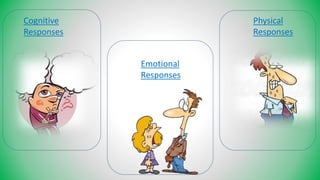
Emotional
Responses
Cognitive
Responses
Physical
Responses
 Conflict Avoidance or conflict Involvement Responses
 Hard & Soft Responses
 Rigid & Loose Responses
 Intellectual & Emotional Responses
 Escalating & Minimizing Responses
 Compulsive revealing & Compulsive Concealing
Responses
 Appealing to a third party
Common responses
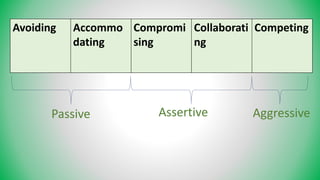
Avoiding Accommo
dating
Compromi
sing
Collaborati
ng
Competing
Passive Assertive Aggressive
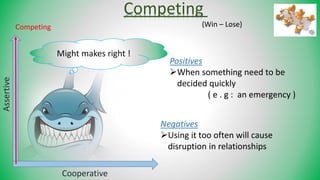
Competing
Might makes right !
Cooperative
Assertive
Positives
When something need to be
decided quickly
( e . g : an emergency )
Negatives
Using it too often will cause
disruption in relationships
Competing (Win – Lose)
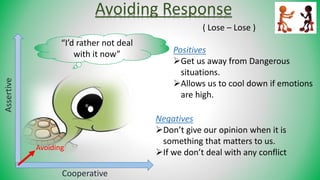
Avoiding Response
“I’d rather not deal
with it now”
Assertive
Cooperative
Positives
Get us away from Dangerous
situations.
Allows us to cool down if emotions
are high.
Negatives
Don’t give our opinion when it is
something that matters to us.
If we don’t deal with any conflict
Avoiding
( Lose – Lose )
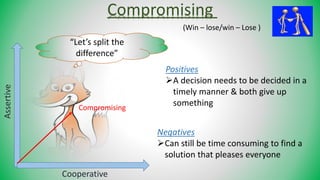
Compromising
“Let’s split the
difference”
Cooperative
Assertive
Positives
A decision needs to be decided in a
timely manner & both give up
something
Negatives
Can still be time consuming to find a
solution that pleases everyone
Compromising
(Win – lose/win – Lose )
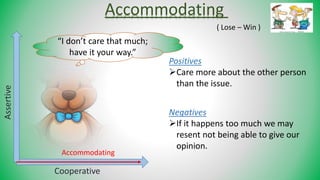
Accommodating
“I don’t care that much;
have it your way.”
Cooperative
Assertive
Positives
Care more about the other person
than the issue.
Negatives
If it happens too much we may
resent not being able to give our
opinion.
Accommodating
( Lose – Win )
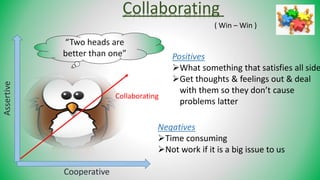
Collaborating
“Two heads are
better than one”
Assertive
Cooperative
Positives
What something that satisfies all side
Get thoughts & feelings out & deal
with them so they don’t cause
problems latter
Negatives
Time consuming
Not work if it is a big issue to us
Collaborating
( Win – Win )
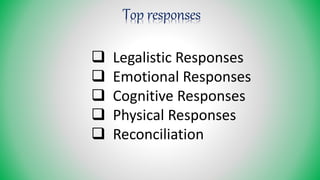
Top responses
 Legalistic Responses
 Emotional Responses
 Cognitive Responses
 Physical Responses
 Reconciliation
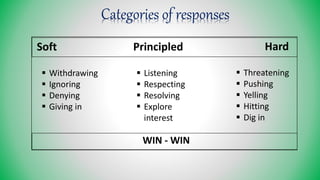
Categories of responses
Soft HardPrincipled
 Withdrawing
 Ignoring
 Denying
 Giving in
 Listening
 Respecting
 Resolving
 Explore
interest
 Threatening
 Pushing
 Yelling
 Hitting
 Dig in
WIN - WIN
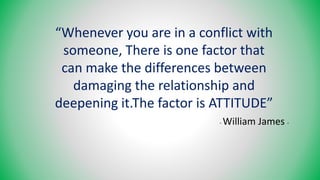
“Whenever you are in a conflict with
someone, There is one factor that
can make the differences between
damaging the relationship and
deepening it.The factor is ATTITUDE”
- William James -
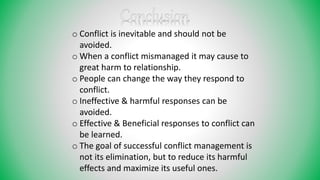
o Conflict is inevitable and should not be
avoided.
o When a conflict mismanaged it may cause to
great harm to relationship.
o People can change the way they respond to
conflict.
o Ineffective & harmful responses can be
avoided.
o Effective & Beneficial responses to conflict can
be learned.
o The goal of successful conflict management is
not its elimination, but to reduce its harmful
effects and maximize its useful ones.
References :-
https://www.Helpguide.org/articles-skills.htm
https://www.dougsguides.com/handling_conflict
https://ciian.org/module/responses.htm
https://web.mit.edu/collaboration/mainsite/module
conflict resolution education–books.google.lk
Responses to conflict

Responses to conflict

  • 1.
    Presented by :- J. A . L . D . Kumari ( PC/2013/014 )
  • 2.
    Conflict can ariseanytime. How we utilize conflict resolution strategies depend on both our Conflict styles and our conflict resolution skills. There are many ways to Respond to conflict situations; some responses involve a considerate or cooperative approach while others involve either a competitive or passive approach.knowlage and learning of of responses to conflict is important to understand how to diffuse the situation and reach an agreement that satisfies all parties. It may also help us to get proper conflict resolution training.
  • 3.
    Emotional, cognitive &physical Responses
  • 4.
  • 5.
     Conflict Avoidanceor conflict Involvement Responses  Hard & Soft Responses  Rigid & Loose Responses  Intellectual & Emotional Responses  Escalating & Minimizing Responses  Compulsive revealing & Compulsive Concealing Responses  Appealing to a third party
  • 6.
  • 7.
  • 8.
    Competing Might makes right! Cooperative Assertive Positives When something need to be decided quickly ( e . g : an emergency ) Negatives Using it too often will cause disruption in relationships Competing (Win – Lose)
  • 9.
    Avoiding Response “I’d rathernot deal with it now” Assertive Cooperative Positives Get us away from Dangerous situations. Allows us to cool down if emotions are high. Negatives Don’t give our opinion when it is something that matters to us. If we don’t deal with any conflict Avoiding ( Lose – Lose )
  • 10.
    Compromising “Let’s split the difference” Cooperative Assertive Positives Adecision needs to be decided in a timely manner & both give up something Negatives Can still be time consuming to find a solution that pleases everyone Compromising (Win – lose/win – Lose )
  • 11.
    Accommodating “I don’t carethat much; have it your way.” Cooperative Assertive Positives Care more about the other person than the issue. Negatives If it happens too much we may resent not being able to give our opinion. Accommodating ( Lose – Win )
  • 12.
    Collaborating “Two heads are betterthan one” Assertive Cooperative Positives What something that satisfies all side Get thoughts & feelings out & deal with them so they don’t cause problems latter Negatives Time consuming Not work if it is a big issue to us Collaborating ( Win – Win )
  • 13.
    Top responses  LegalisticResponses  Emotional Responses  Cognitive Responses  Physical Responses  Reconciliation
  • 14.
    Categories of responses SoftHardPrincipled  Withdrawing  Ignoring  Denying  Giving in  Listening  Respecting  Resolving  Explore interest  Threatening  Pushing  Yelling  Hitting  Dig in WIN - WIN
  • 15.
    “Whenever you arein a conflict with someone, There is one factor that can make the differences between damaging the relationship and deepening it.The factor is ATTITUDE” - William James -
  • 16.
    o Conflict isinevitable and should not be avoided. o When a conflict mismanaged it may cause to great harm to relationship. o People can change the way they respond to conflict. o Ineffective & harmful responses can be avoided. o Effective & Beneficial responses to conflict can be learned. o The goal of successful conflict management is not its elimination, but to reduce its harmful effects and maximize its useful ones.
  • 17.