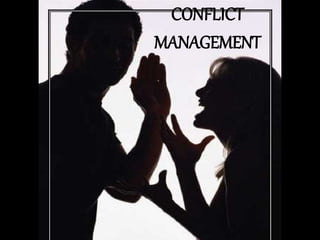
•Conflict Management
CONFLICT
MANAGEMENT
Working together isn’t
always e_______
What is conflict?
How would you
describe it?
What is conflict?
Dictionary definition:
–D_______________, struggle, fig
incompatible
Lack of conflict is a sign of over conformity.
It is __________ when there is no conflict
You need
diversity
of opinion
Good
Consequences
of Conflict
increased
creativity
It forces people to clarify their
v________
It can produce
constructive social
change
It gives people the opportunity to
t________ their capacities
•development of group and
organization cohesion
•Bad
Consequences
of Conflict
V________
breakdown of relationships
polarization of v__________ into static positions
A breakdown of
collaborative ventures
destruction of
_____________
The cost of conflict
• Relationship costs: intrapersonal &
interpersonal distance
The cost of conflict
• Costs to the individual
>aloneness, sadness, _______
The cost of conflict
• Costs to the company
• Low productivity
• Labor Turnover
• Strikes
• Lockout
Main
sources of
conflict
• The aggressive
or competitive
b_________ of
human beings
Main sources of conflict
• Competition for limited resources
Main sources of conflict
• F_______________
Main sources of conflict
• Clashes between values and _______
Main sources of conflict
• Cultural influences
Main sources of conflict
• M___________, assumptions and
expectations
Main sources of conflict
• Role and status issues
Where there are no properly deliniated job
descriptions, people’s responsibilities tend to
o_________ which causes a lot of conflict
Main sources of conflict
Mind games or power games: struggle for prestige
• Mind games
can bee seen in
everyday
situations in
the fields of
office politics,
_________
and
relationships
Main sources of conflict
Triggers:
A trigger is something
that sets off
a memory tape or
flashback
transporting the
person back to the
event of her/his
original trauma such
as combat trauma,
child physical and
sexual abuse
The Emotional v The
Rational Brain
Emotional brain
Inhibitors
• Social or legal consequences
• S______ c__________
• Personal values
• Fear that the other person will fight
back
Attitude & Behaviour Cycle
Your Attitude
affects
Your
Behaviour
affects My Attitude affects
My
Behaviour
affects
How can conflict be managed
successfully?
Empathy
• It works because it acknowledges
people’s feelings
– Try to put yourself in their
________
– Acknowledge their feelings
– Step alongside them, try to see
things from their point of view
Humility
is seeing others to be
better than ourselves
Three Levels of Conflict Management
• 1) Individual Level
• 2) Group Level
• 3) Organizational
Level
X. Types of Conflict in the
Individual Level
A) Double Approach
Conflict
1) Least _________ conflict
2) Resolution: not to vacillate
the decision for a long time
3) two or more ___________
choices
4) Ex.: choosing between
ordering fast food or healthy
food; choosing between two
universities in which you
were accepted
B. Double Avoidance Conflict
• 1) More stressful
conflict because both
goals are __________
• 2) Resolution: withdraw
or focus on other
matters; choose the
better option
• 3) Ex.: suffering a
toothache or going to
the dentist; letting
cancer go untreated or
go through
chemotherapy
c)Approach Avoidance Conflict
• 1) Very _______ conflict
• 2) A single goal in which
there is a tendency to
approach and a
tendency to repulse
• 3) Resolution: self
control and good
judgement
• 4) Ex., whether to go into
business or not;
gambling otr not;
womanizing or not
D) Double Approach Avoidance
Conflict
• 1) __________ stressful
• 2) Two or more goals that
have attracting and
repelling aspects
• 3) Resolution:
withdrawing or self-
control, carefully study all
options
• 4) Ex.: Whether to buy a
house in the country or in
the city
A) Competing mode
• High assertiveness and low
cooperation
1) Symbol: shark
2) Competing skills
__________ and debating
Using rank
Asserting your opinions
Standing your ground
Stating your position clearly
3)Strategic Philosophy
> when goals are
extremely important,
one must use power to
win
4) When To Use
a) When you need to
stand for your rights
b) When time is short and
a quick decision is
needed
5) Drawbacks
• a) Can
e__________
conflict
• b) Losers may
retaliate or
fight back
B) Collaborating mode
High assertiveness
high cooperation
1) Symbol: owl
2) Collaborative Skills:
• Active l_____________
• Non threatening
confrontation
• Identifying concerns
• Analyzing input
• Teamwork while
maintaining
relationships
3) Strategic Philosophy
• > The process of
working through
differences that
will lead to
creative
solutions that
will satisfy both
parties’ concerns
4) When to use
a) When there is a
high level of t____
b) When people are
open-minded
(willing to change
their thinking)
c) When people are
matured
Reaching win-win
5) Drawbacks
a) The process
takes a lot of time
and energy
b) Some may take
advantage of
other people’s
trust and
openness
C) Avoiding or Withdrawing
(No winners, no losers)
• >Low assertion and
low _____________
1) Symbol: Turtle
2) Avoidance Skills:
a) Ability to withdraw
b) Ability to side step
c) Ability to leave
something unsolved
d) Sense of timing
3) Strategic Philosophy
• >Avoid
conflict by
withdrawing,
sidestepping
or
p_________
4) When to use
a) When the conflict is
small and relationships
are at stake
b) When you see inevitable
_________, no chance
of getting needs met
c) When others can solve
the conflict more
successfully
d) When more information
is needed
5) Drawbacks
• a) Important issues
may not to solved
• b) Postponing seems
to make matters
________________
• C) Outwardly there
may be no conflict but
the conflict is bad
internally
D) Accommodating
(I lose, you win)
• Low assertiveness and
high cooperation
• 1) Symbol:Teddy bear
• 2) Accommodation Skills
a) forgetting your
desires
b) selflessness
c) Ability to yield
d) Obeying ________
• 3) Srategic Philosophy
• a) Avoids conflict by
• withrawing,
sidestepping or
posponing
• 4) When to Use
• a) When the issue is
more important to the
other person
• b) whe you realize you
are wrong
• C) When you want
others to learn from
their _____________
• d) When you know you
cannot win
5) Drawbacks
a) one’s ideas do not get
attention
b) Credibility and
Influence may be lost
c) Resentment may build
in people
E) Compromising mode
1) Moderate
assertiveness and
moderate cooperation
2) Compromising skills
a) Negotiations
b) Finding a middle
ground
c) Assessing value
d) Making concessions
3) Strategic Philosophy
a) meeting ________
b) Serving the common
good
4) When to use
a) When people are
commited to the goals
b) When time can be
saved by reaching
intermediate
settlements on
individual parts
c) When goals are
moderately ________
5. Drawbacks
a) Important values and
long-term objectives
may be derailed in the
process
b) May not work if initial
demands are too ____
c) Can spawn cynicism
especially when there
is no commitment to
honor the compromise
solutions
d) May be used as
“delaying t________”

Conflictmanagementpresentation

  • 1.
  • 2.
  • 3.
    What is conflict? Howwould you describe it?
  • 4.
    What is conflict? Dictionarydefinition: –D_______________, struggle, fig incompatible
  • 5.
    Lack of conflictis a sign of over conformity.
  • 6.
    It is __________when there is no conflict
  • 7.
  • 9.
  • 10.
  • 11.
    It forces peopleto clarify their v________
  • 12.
  • 13.
    It gives peoplethe opportunity to t________ their capacities
  • 14.
    •development of groupand organization cohesion
  • 16.
  • 17.
  • 18.
  • 19.
    polarization of v__________into static positions
  • 20.
  • 21.
  • 22.
    The cost ofconflict • Relationship costs: intrapersonal & interpersonal distance
  • 23.
    The cost ofconflict • Costs to the individual >aloneness, sadness, _______
  • 24.
    The cost ofconflict • Costs to the company • Low productivity • Labor Turnover • Strikes • Lockout
  • 25.
    Main sources of conflict • Theaggressive or competitive b_________ of human beings
  • 26.
    Main sources ofconflict • Competition for limited resources
  • 27.
    Main sources ofconflict • F_______________
  • 28.
  • 29.
    Main sources ofconflict • Clashes between values and _______
  • 30.
    Main sources ofconflict • Cultural influences
  • 31.
    Main sources ofconflict • M___________, assumptions and expectations
  • 32.
    Main sources ofconflict • Role and status issues
  • 33.
    Where there areno properly deliniated job descriptions, people’s responsibilities tend to o_________ which causes a lot of conflict
  • 34.
    Main sources ofconflict Mind games or power games: struggle for prestige
  • 35.
    • Mind games canbee seen in everyday situations in the fields of office politics, _________ and relationships
  • 36.
    Main sources ofconflict Triggers: A trigger is something that sets off a memory tape or flashback transporting the person back to the event of her/his original trauma such as combat trauma, child physical and sexual abuse
  • 37.
    The Emotional vThe Rational Brain
  • 38.
  • 39.
    Inhibitors • Social orlegal consequences • S______ c__________ • Personal values • Fear that the other person will fight back
  • 40.
    Attitude & BehaviourCycle Your Attitude affects Your Behaviour affects My Attitude affects My Behaviour affects
  • 41.
    How can conflictbe managed successfully?
  • 42.
    Empathy • It worksbecause it acknowledges people’s feelings – Try to put yourself in their ________ – Acknowledge their feelings – Step alongside them, try to see things from their point of view
  • 43.
    Humility is seeing othersto be better than ourselves
  • 44.
    Three Levels ofConflict Management • 1) Individual Level • 2) Group Level • 3) Organizational Level
  • 45.
    X. Types ofConflict in the Individual Level A) Double Approach Conflict 1) Least _________ conflict 2) Resolution: not to vacillate the decision for a long time 3) two or more ___________ choices 4) Ex.: choosing between ordering fast food or healthy food; choosing between two universities in which you were accepted
  • 46.
    B. Double AvoidanceConflict • 1) More stressful conflict because both goals are __________ • 2) Resolution: withdraw or focus on other matters; choose the better option • 3) Ex.: suffering a toothache or going to the dentist; letting cancer go untreated or go through chemotherapy
  • 47.
    c)Approach Avoidance Conflict •1) Very _______ conflict • 2) A single goal in which there is a tendency to approach and a tendency to repulse • 3) Resolution: self control and good judgement • 4) Ex., whether to go into business or not; gambling otr not; womanizing or not
  • 48.
    D) Double ApproachAvoidance Conflict • 1) __________ stressful • 2) Two or more goals that have attracting and repelling aspects • 3) Resolution: withdrawing or self- control, carefully study all options • 4) Ex.: Whether to buy a house in the country or in the city
  • 50.
    A) Competing mode •High assertiveness and low cooperation 1) Symbol: shark 2) Competing skills __________ and debating Using rank Asserting your opinions Standing your ground Stating your position clearly
  • 51.
    3)Strategic Philosophy > whengoals are extremely important, one must use power to win 4) When To Use a) When you need to stand for your rights b) When time is short and a quick decision is needed
  • 52.
    5) Drawbacks • a)Can e__________ conflict • b) Losers may retaliate or fight back
  • 53.
    B) Collaborating mode Highassertiveness high cooperation 1) Symbol: owl 2) Collaborative Skills: • Active l_____________ • Non threatening confrontation • Identifying concerns • Analyzing input • Teamwork while maintaining relationships
  • 54.
    3) Strategic Philosophy •> The process of working through differences that will lead to creative solutions that will satisfy both parties’ concerns
  • 55.
    4) When touse a) When there is a high level of t____ b) When people are open-minded (willing to change their thinking) c) When people are matured
  • 56.
  • 60.
    5) Drawbacks a) Theprocess takes a lot of time and energy b) Some may take advantage of other people’s trust and openness
  • 61.
    C) Avoiding orWithdrawing (No winners, no losers) • >Low assertion and low _____________ 1) Symbol: Turtle 2) Avoidance Skills: a) Ability to withdraw b) Ability to side step c) Ability to leave something unsolved d) Sense of timing
  • 62.
    3) Strategic Philosophy •>Avoid conflict by withdrawing, sidestepping or p_________
  • 63.
    4) When touse a) When the conflict is small and relationships are at stake b) When you see inevitable _________, no chance of getting needs met c) When others can solve the conflict more successfully d) When more information is needed
  • 64.
    5) Drawbacks • a)Important issues may not to solved • b) Postponing seems to make matters ________________ • C) Outwardly there may be no conflict but the conflict is bad internally
  • 65.
    D) Accommodating (I lose,you win) • Low assertiveness and high cooperation • 1) Symbol:Teddy bear • 2) Accommodation Skills a) forgetting your desires b) selflessness c) Ability to yield d) Obeying ________
  • 66.
    • 3) SrategicPhilosophy • a) Avoids conflict by • withrawing, sidestepping or posponing • 4) When to Use • a) When the issue is more important to the other person • b) whe you realize you are wrong
  • 67.
    • C) Whenyou want others to learn from their _____________ • d) When you know you cannot win 5) Drawbacks a) one’s ideas do not get attention b) Credibility and Influence may be lost c) Resentment may build in people
  • 68.
    E) Compromising mode 1)Moderate assertiveness and moderate cooperation 2) Compromising skills a) Negotiations b) Finding a middle ground c) Assessing value d) Making concessions
  • 69.
    3) Strategic Philosophy a)meeting ________ b) Serving the common good 4) When to use a) When people are commited to the goals b) When time can be saved by reaching intermediate settlements on individual parts c) When goals are moderately ________
  • 70.
    5. Drawbacks a) Importantvalues and long-term objectives may be derailed in the process b) May not work if initial demands are too ____ c) Can spawn cynicism especially when there is no commitment to honor the compromise solutions d) May be used as “delaying t________”