Obstructive Lung Diseases
Restrictive Pulmonary Diseases
Pulmonary infection
Lung Tumors
Diseases of the Pleura
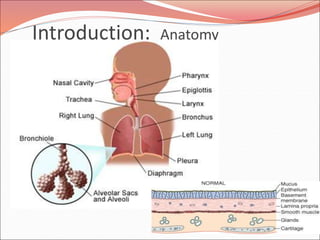
Introduction: Anatomy
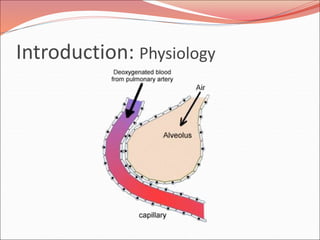
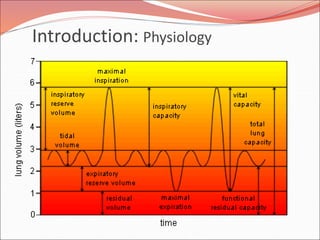
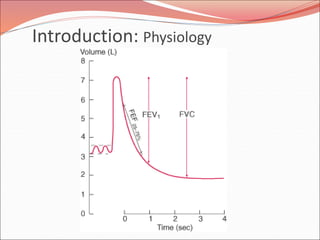
Introduction: Physiology
Pathology of lung diseases
 Very important in clinical medicine
 Complication of air pollution
 Common symptoms:
 Dyspnea: difficulty with breathing
 Decrease compliance, fibrosis
 Increased airway resistance , ch. bronchitis
 Chest wall disease, obesity
 Fluid accumulation, left sided heart failure
 Cough
 Postnasal discharge, GERD, Br. Asthma, ch. Bronchitis,
pneumonia, bronchiectasis, drug induced
 Hemoptysis
 Ch. Bronchitis, pneumonia, TB, bronchiectasis, aspergilloma
Atelectasis (collapse)
 Incomplete expansion of the lungs or
collapse of previously inflated lung
substance.
 Significant atelectasis reduce
oxygenation and predispose to infection.
Types of Atelectasis
1. Resorption atelectasis.
2. Compression atelectasis.
3. Contraction atelectasis.
Types of Atelectasis
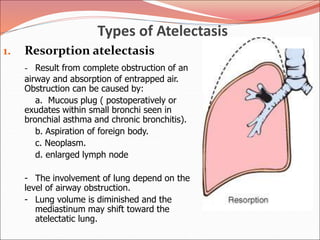
1. Resorption atelectasis
- Result from complete obstruction of an
airway and absorption of entrapped air.
Obstruction can be caused by:
a. Mucous plug ( postoperatively or
exudates within small bronchi seen in
bronchial asthma and chronic bronchitis).
b. Aspiration of foreign body.
c. Neoplasm.
d. enlarged lymph node
- The involvement of lung depend on the
level of airway obstruction.
- Lung volume is diminished and the
mediastinum may shift toward the
atelectatic lung.
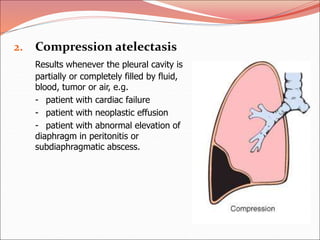
2. Compression atelectasis
Results whenever the pleural cavity is
partially or completely filled by fluid,
blood, tumor or air, e.g.
- patient with cardiac failure
- patient with neoplastic effusion
- patient with abnormal elevation of
diaphragm in peritonitis or
subdiaphragmatic abscess.
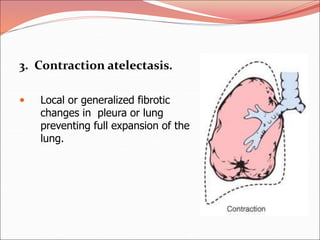
3. Contraction atelectasis.
 Local or generalized fibrotic
changes in pleura or lung
preventing full expansion of the
lung.
Atelectasis
 Atelectatic lung is prone to develop superimposed
infection.
 It is reversible disorder except for contraction atelectasis.
 It should be treated promptly to prevent hypoxemia.
Obstructive and Restrictive Pulmonary Diseases
 Diffuse pulmonary diseases are divided into:
1. Obstructive disease:
characterized by limitation of airflow
owing to partial or complete
obstruction at any
level from trachea to respiratory
bronchioles.
Pulmonary function test:
limitation of maximal
airflow rate during forced expiration
(FEVI).
2. Restrictive disease:
characterized by reduced expansion of
lung parenchyma with decreased total
lung capacity while the expiratory flow
rate is near normal.
Occur in:
1. Chest wall disorder.
2. Acute or chronic, interstitial and
infiltrative diseases,
e.g. ARDS and pneumoconiosis.
Introduction: Physiology
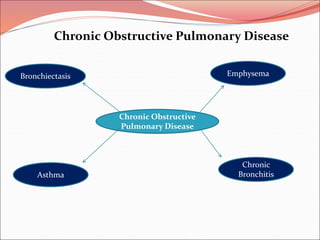
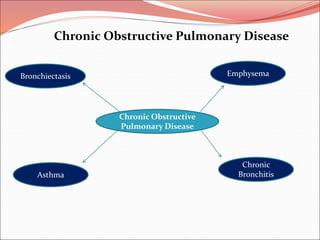
Chronic Obstructive Pulmonary Disease
(COPD)
 Share a major symptom: dyspnea with chronic or recurrent
obstruction to airflow within the lung.
 The incidence of COPD has increased dramatically in the
past few decades.
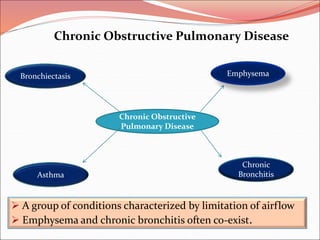
Chronic Obstructive
Pulmonary Disease
Emphysema
Bronchiectasis
Chronic
Bronchitis
Asthma
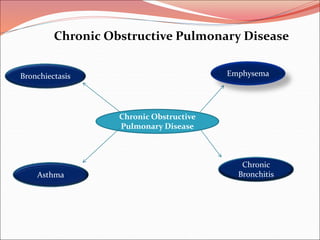
 A group of conditions characterized by limitation of airflow
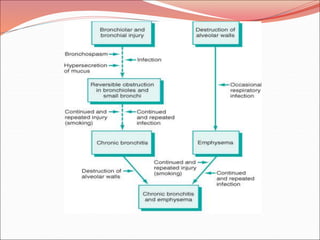
 Emphysema and chronic bronchitis often co-exist.
Chronic Obstructive Pulmonary Disease
Emphysema
Emphysema
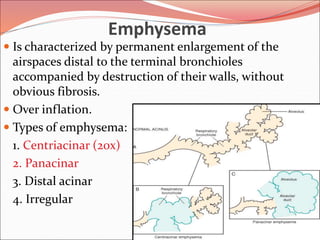
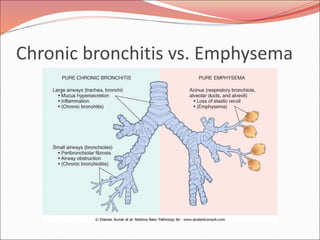
 Is characterized by permanent enlargement of the
airspaces distal to the terminal bronchioles
accompanied by destruction of their walls, without
obvious fibrosis.
 Over inflation.
 Types of emphysema:
1. Centriacinar (20x)
2. Panacinar
3. Distal acinar
4. Irregular
Emphysema
Incidence
 Emphysema is present in approximately 50% of
adults who come to autopsy.
 Pulmonary disease was considered to be
responsible for death in 6.5% of these patients.
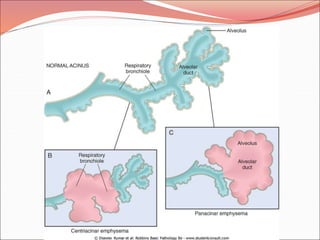
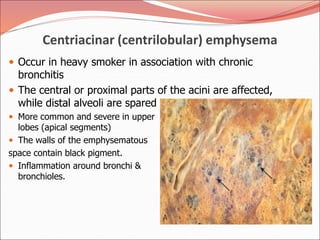
Centriacinar (centrilobular) emphysema
 Occur in heavy smoker in association with chronic
bronchitis
 The central or proximal parts of the acini are affected,
while distal alveoli are spared
 More common and severe in upper
lobes (apical segments)
 The walls of the emphysematous
space contain black pigment.
 Inflammation around bronchi &
bronchioles.
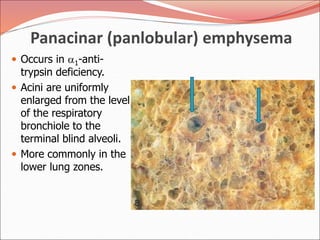
Panacinar (panlobular) emphysema
 Occurs in 1-anti-
trypsin deficiency.
 Acini are uniformly
enlarged from the level
of the respiratory
bronchiole to the
terminal blind alveoli.
 More commonly in the
lower lung zones.
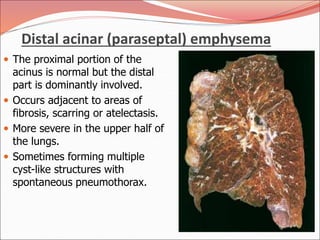
Distal acinar (paraseptal) emphysema
 The proximal portion of the
acinus is normal but the distal
part is dominantly involved.
 Occurs adjacent to areas of
fibrosis, scarring or atelectasis.
 More severe in the upper half of
the lungs.
 Sometimes forming multiple
cyst-like structures with
spontaneous pneumothorax.
Irregular Emphysema
 The acinus is irregularly involved, associated with
scarring.
 Most common form found in autopsy.
 Asymptomatic.
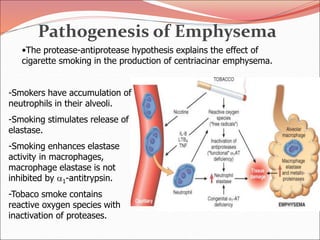
Pathogenesis of Emphysema
 Is not completely understood.
 Alveolar wall destruction and airspace enlargement invokes excess
protease or elastase activity unopposed by appropriate antiprotease
regulation (protease-antiprotease hypothesis)
 2 key mechanisms:
 1. excess cellular proteases with low antiprotease level
 2. excess ROS from inflammation
 Element of ch. Bronchitis coexists
Pathogenesis of Emphysema
 Protease-antiprotease imbalance occur in 1% of emphysema
 1-antitrypsin, normally present in serum, tissue fluids and
macrophages, is a major inhibitor of proteases secreted by
neutrophils during inflammation.
 Encoded by codominantly expressed genes on the proteinase
inhibitor (Pi) locus on chromosome 14.
 Pi locus is extremely pleomorphic (M , Z)
 Any stimulus that increase neutrophil or macrophages in the lung
with release of protease lead to elastic tissue damage.
-Smokers have accumulation of
neutrophils in their alveoli.
-Smoking stimulates release of
elastase.
-Smoking enhances elastase
activity in macrophages,
macrophage elastase is not
inhibited by 1-antitrypsin.
-Tobaco smoke contains
reactive oxygen species with
inactivation of proteases.
Pathogenesis of Emphysema
•The protease-antiprotease hypothesis explains the effect of
cigarette smoking in the production of centriacinar emphysema.
Emphysema
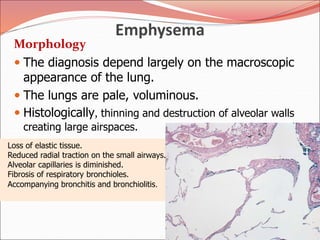
Morphology
 The diagnosis depend largely on the macroscopic
appearance of the lung.
 The lungs are pale, voluminous.
 Histologically, thinning and destruction of alveolar walls
creating large airspaces.
Loss of elastic tissue.
Reduced radial traction on the small airways.
Alveolar capillaries is diminished.
Fibrosis of respiratory bronchioles.
Accompanying bronchitis and bronchiolitis.
Emphysema: Clinical course
 Cough and wheezing.
 Weight loss.
 Pulmonary function tests reveal reduced FEV1.
Death from emphysema is related to:
1. Pulmonary failure with respiratory acidosis,
hypoxia and coma.
2. Right-sided heart failure.
Chronic Bronchitis
Chronic Obstructive
Pulmonary Disease
Emphysema
Bronchiectasis
Chronic
Bronchitis
Asthma
Chronic Obstructive Pulmonary Disease
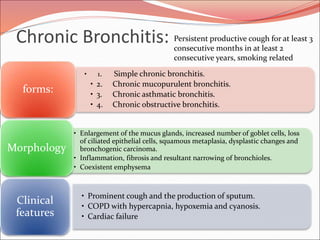
Chronic Bronchitis
 Common among cigarette smokers and urban
dwellers, age 40 to 65
 The diagnosis of chronic bronchitis is made on
clinical grounds.
 Persistent productive cough for at least 3
consecutive months in at least 2 consecutive years.
 Can occur in several forms:
1. Simple chronic bronchitis.
2. Chronic mucopurulent bronchitis.
3. Chronic asthmatic bronchitis.
4. Chronic obstructive bronchitis.
Chronic bronchitis
Pathogenesis
 Hypersecretion of mucus that starts in the large airways.
 Causative factor are cigarette smoking and pollutants.
Morphology
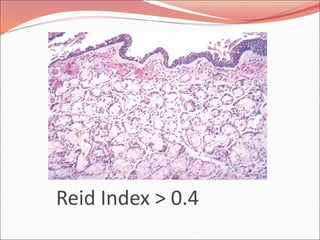
 Enlargement of the mucus-secreting glands, increased
number of goblet cells, loss of ciliated epithelial cells,
squamous metaplasia, dysplastic changes and bronchogenic
carcinoma.
 Inflammation, fibrosis and resultant narrowing of
bronchioles.
 Coexistent emphysema.
Reid Index > 0.4
Chronic bronchitis
Clinical Course
 Prominent cough and the production of sputum.
 COPD with hypercapnia, hypoxemia and cyanosis.
 Cardiac failure.
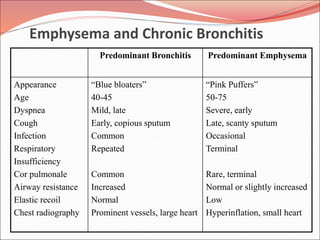
Chronic bronchitis vs. Emphysema
Emphysema and Chronic Bronchitis
Predominant Bronchitis Predominant Emphysema
Appearance
Age
Dyspnea
Cough
Infection
Respiratory
Insufficiency
Cor pulmonale
Airway resistance
Elastic recoil
Chest radiography
“Blue bloaters”
40-45
Mild, late
Early, copious sputum
Common
Repeated
Common
Increased
Normal
Prominent vessels, large heart
“Pink Puffers”
50-75
Severe, early
Late, scanty sputum
Occasional
Terminal
Rare, terminal
Normal or slightly increased
Low
Hyperinflation, small heart
Chronic Obstructive
Pulmonary Disease
Emphysema
Bronchiectasis
Chronic
Bronchitis
Asthma
Chronic Obstructive Pulmonary Disease
Chronic obstructive pulmonary diseases
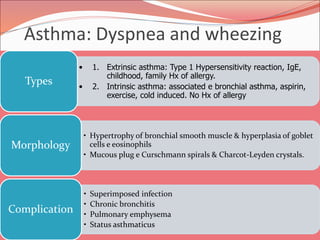
Bronchial asthma
 Chronic relapsing inflammatory disorder
characterized by hyperactive airways leading to
episodic, reversible bronchoconstriction owing to
increased responsiveness of the
tracheobronchial tree to various stimuli.
 It has been divided into two basic types:
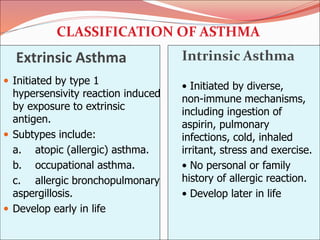
1. Extrinsic asthma.
2. Intrinsic asthma.
Extrinsic Asthma
 Initiated by type 1
hypersensivity reaction induced
by exposure to extrinsic
antigen.
 Subtypes include:
a. atopic (allergic) asthma.
b. occupational asthma.
c. allergic bronchopulmonary
aspergillosis.
 Develop early in life
Intrinsic Asthma
• Initiated by diverse,
non-immune mechanisms,
including ingestion of
aspirin, pulmonary
infections, cold, inhaled
irritant, stress and exercise.
• No personal or family
history of allergic reaction.
• Develop later in life
CLASSIFICATION OF ASTHMA
Extrinsic Asthma
 Atopic (allergic) asthma is the most common
form, begins in childhood
 Other allergic manifestation: allergic rhinitis,
urticaria, eczema.
 Skin test with antigen result in an immediate
wheel and flare reaction
 Other family member is also affected
 Serum IgE and eosinophil are increased
 immune related, TH2 subset of CD4+ T cells
Pathogenesis of Bronchial Asthma
EXAGGERATED BROCHOCONTRICTION
 Two components:
1. Chronic airway inflammation.
2. Bronchial hyperresponsiveness.
 The mechanisms have been best studied in atopic
asthma.
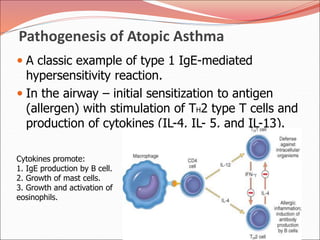
Pathogenesis of Atopic Asthma
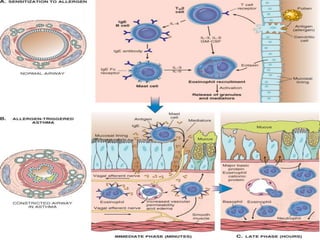
 A classic example of type 1 IgE-mediated
hypersensitivity reaction.
 In the airway – initial sensitization to antigen
(allergen) with stimulation of TH2 type T cells and
production of cytokines (IL-4, IL- 5, and IL-13).
Cytokines promote:
1. IgE production by B cell.
2. Growth of mast cells.
3. Growth and activation of
eosinophils.
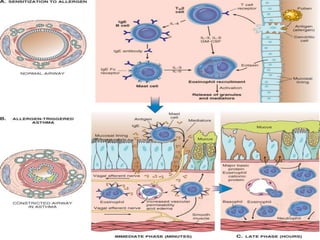
Pathogenesis of Atopic Asthma
• IgE-mediated reaction to inhaled allergens elicits:
1. acute response (within minutes)
2. a late phase reaction (after 4-8 hours)
Pathogenesis of Atopic Asthma
Acute-phase response
 Begin 30 to 60 minutes after inhalation of antigen.
 Mast cells on the mucosal surface are activated.
 Mediator produced are :
 Leukotrienes C4, D4 & E4 (induce bronchospasm, vascular permeability &
mucous production)
 Prostaglandins D2, E2, F2 (induce bronchospasm and vasodilatation)
 Histamine ( induce bronchospasm and increased vascular permeability)
 Platelet-activating factor (cause agggregation of platlets and release of
histamine)
 Mast cell tryptase (inactvate normal bronchodilator).
 Mediators induce bronchospasm, vascular permeability &
mucous production.
Pathogenesis of Atopic Asthma
 Late phase reaction:
 recruitment of leukocytes mediated by product of mast cells
including:
1. Eosinophil and neutophil chemotactic factors
2 . IL-4 & IL-5 and induceTH2 subset ofCD4+ T cells
3. Platelet-activating factor
4. Tumor necrosis factor.
 Other cell types are involved: activated epithelial cells,
macrophages and smooth muscle.
Pathogenesis of Atopic Asthma
Late phase reaction:
 The arrival of leukocytes at the site of mast cell degranulation
lead to:
1. Release of more mediators to activate more mast cells
2. Cause epithelial cell damage .
 Eosinophils produce major basic protein, eosinophilic cationic
protein and eosinophil peroxidase ( toxic to epithelial cells).
 These amplify and sustains injury without additional
antigen.
Non-Atopic Asthma
 Triggered by respiratory tract infection including
viruses and inhaled air pollutants e.g. sulfur dioxide,
ozone.
 Positive family history is uncommon.
 Serum IgE – normal.
 No other associated allergies.
 Skin test – negative.
 Hyperirritability of bronchial tree.
 Subtypes:
1. Drug-induced asthma.
2. Occupational asthma.
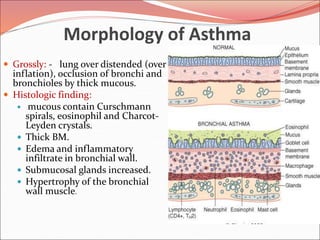
Morphology of Asthma
 Grossly: - lung over distended (over
inflation), occlusion of bronchi and
bronchioles by thick mucous.
 Histologic finding:
 mucous contain Curschmann
spirals, eosinophil and Charcot-
Leyden crystals.
 Thick BM.
 Edema and inflammatory
infiltrate in bronchial wall.
 Submucosal glands increased.
 Hypertrophy of the bronchial
wall muscle.
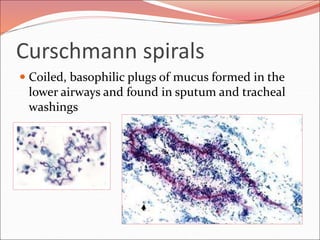
Curschmann spirals
 Coiled, basophilic plugs of mucus formed in the
lower airways and found in sputum and tracheal
washings
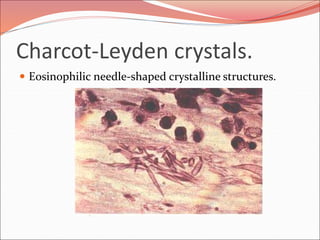
Charcot-Leyden crystals.
 Eosinophilic needle-shaped crystalline structures.
Clinical Coarse
 Classic asthmatic attack – dyspnea, cough, difficult
expiration, progressive hyperinflation of lung and mucous
plug in bronchi. This may resolve spontaneously or with
Rx.
 Status asthmaticus – severe cyanosis and persistent
dyspnea, may be fatal.
 May progress to emphysema.
 Superimposed bacterial infection may occur.
Bronchiectasis
Chronic Obstructive
Pulmonary Disease
Emphysema
Bronchiectasis
Chronic
Bronchitis
Asthma
Chronic Obstructive Pulmonary Disease
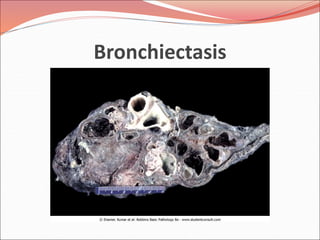
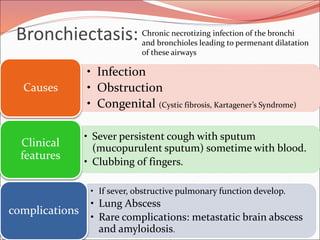
Bronchiectasis
 Chronic necrotizing infection of the bronchi and
bronchioles leading to or associated with abnormal
dilatation of these airways.
 Bronchial dilatation should be permanent.
Conditions associated with Bronchiectasis
1. Bronchial obstruction
Localized:
- tumor, foreign bodies or mucous impaction
Generalized:
- bronchial asthma
- chronic bronchitis
2. Congenital or hereditary conditions:
- Congenital bronchiactasis
- Cystic fibrosis.
- Intralobar sequestration of the lung.
- Immunodeficiency status.
- Immotile cilia and kartagner syndrome.
3. Necrotizing pneumonia.
Caused by TB, staphylococci or mixed infection.
Kartagener Syndrome
 Inherited as autosomal recessive trait.
 Patient develop bronchiactasis, sinusitis and situs
invertus.
 Defect in ciliary motility due to absent or irregular
dynein arms.
 Lack of ciliary activity interferers with bronchial
clearance.
 Males have infertility.
Bronchiectasis
Etiology and pathogenesis
 Obstruction and infection.
Bronchial obstruction (athelectasis of airway distal
to obstruction) – bronchial wall inflammation.
 These changes become irreversible:
1. If obstruction persist.
2. If there is added infection.
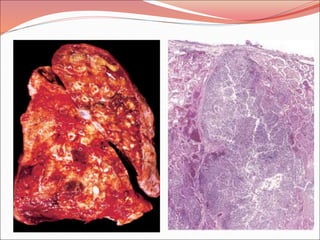
Morphology of Bronchiectasis
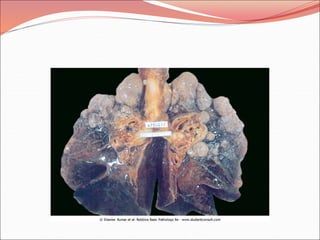
 Usually affects lower lobes bilaterally (vertical
airways).
 Dilated airways up to four times of normal, reaching
the pleura.
 Tube-like enlargement (cylindroid) or fusiform
(saccular).
 Acute and chronic inflammation, extensive ulceration
of lining epithelium with fibrosis.
Bronchiectasis
Bronchiectasis
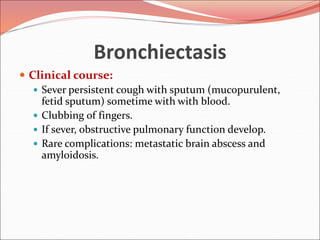
 Clinical course:
 Sever persistent cough with sputum (mucopurulent,
fetid sputum) sometime with with blood.
 Clubbing of fingers.
 If sever, obstructive pulmonary function develop.
 Rare complications: metastatic brain abscess and
amyloidosis.
Chronic Obstructive
Pulmonary Disease
Emphysema
Bronchiectasis
Chronic
Bronchitis
Asthma
Summary: Athelectasis
Chronic Obstructive Pulmonary Disease
Types
Pathogenesis
Pathology
Clinical features
Definition
Causes
Pathogenesis
Pathology
Clinical Features
Definition
Causes
Pathogenesis
classification
Clinical Features
Definition
Causes
Pathogenesis
Pathology
Clinical Features
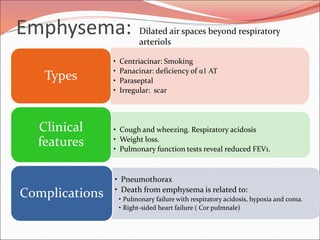
Emphysema:
• Centriacinar: Smoking
• Panacinar: deficiency of α1 AT
• Paraseptal
• Irregular: scar
Types
• Cough and wheezing. Respiratory acidosis
• Weight loss.
• Pulmonary function tests reveal reduced FEV1.
Clinical
features
• Pneumothorax
• Death from emphysema is related to:
• Pulmonary failure with respiratory acidosis, hypoxia and coma.
• Right-sided heart failure ( Cor pulmnale)
Complications
Dilated air spaces beyond respiratory
arteriols
Chronic Bronchitis:
• 1. Simple chronic bronchitis.
• 2. Chronic mucopurulent bronchitis.
• 3. Chronic asthmatic bronchitis.
• 4. Chronic obstructive bronchitis.
forms:
• Enlargement of the mucus glands, increased number of goblet cells, loss
of ciliated epithelial cells, squamous metaplasia, dysplastic changes and
bronchogenic carcinoma.
• Inflammation, fibrosis and resultant narrowing of bronchioles.
• Coexistent emphysema
Morphology
• Prominent cough and the production of sputum.
• COPD with hypercapnia, hypoxemia and cyanosis.
• Cardiac failure
Clinical
features
Persistent productive cough for at least 3
consecutive months in at least 2
consecutive years, smoking related
Asthma: Dyspnea and wheezing
• 1. Extrinsic asthma: Type 1 Hypersensitivity reaction, IgE,
childhood, family Hx of allergy.
• 2. Intrinsic asthma: associated e bronchial asthma, aspirin,
exercise, cold induced. No Hx of allergy
Types
• Hypertrophy of bronchial smooth muscle & hyperplasia of goblet
cells e eosinophils
• Mucous plug e Curschmann spirals & Charcot-Leyden crystals.
Morphology
• Superimposed infection
• Chronic bronchitis
• Pulmonary emphysema
• Status asthmaticus
Complication
Bronchiectasis:
• Infection
• Obstruction
• Congenital (Cystic fibrosis, Kartagener’s Syndrome)
Causes
• Sever persistent cough with sputum
(mucopurulent sputum) sometime with blood.
• Clubbing of fingers.
Clinical
features
• If sever, obstructive pulmonary function develop.
• Lung Abscess
• Rare complications: metastatic brain abscess
and amyloidosis.
complications
Chronic necrotizing infection of the bronchi
and bronchioles leading to permenant dilatation
of these airways
Respiratory Diseases -Obstructive lung diseases.ppt

Respiratory Diseases -Obstructive lung diseases.ppt

  • 1.
    Obstructive Lung Diseases RestrictivePulmonary Diseases Pulmonary infection Lung Tumors Diseases of the Pleura
  • 2.
  • 3.
  • 4.
    Pathology of lungdiseases  Very important in clinical medicine  Complication of air pollution  Common symptoms:  Dyspnea: difficulty with breathing  Decrease compliance, fibrosis  Increased airway resistance , ch. bronchitis  Chest wall disease, obesity  Fluid accumulation, left sided heart failure  Cough  Postnasal discharge, GERD, Br. Asthma, ch. Bronchitis, pneumonia, bronchiectasis, drug induced  Hemoptysis  Ch. Bronchitis, pneumonia, TB, bronchiectasis, aspergilloma
  • 5.
    Atelectasis (collapse)  Incompleteexpansion of the lungs or collapse of previously inflated lung substance.  Significant atelectasis reduce oxygenation and predispose to infection.
  • 6.
    Types of Atelectasis 1.Resorption atelectasis. 2. Compression atelectasis. 3. Contraction atelectasis.
  • 7.
    Types of Atelectasis 1.Resorption atelectasis - Result from complete obstruction of an airway and absorption of entrapped air. Obstruction can be caused by: a. Mucous plug ( postoperatively or exudates within small bronchi seen in bronchial asthma and chronic bronchitis). b. Aspiration of foreign body. c. Neoplasm. d. enlarged lymph node - The involvement of lung depend on the level of airway obstruction. - Lung volume is diminished and the mediastinum may shift toward the atelectatic lung.
  • 8.
    2. Compression atelectasis Resultswhenever the pleural cavity is partially or completely filled by fluid, blood, tumor or air, e.g. - patient with cardiac failure - patient with neoplastic effusion - patient with abnormal elevation of diaphragm in peritonitis or subdiaphragmatic abscess.
  • 9.
    3. Contraction atelectasis. Local or generalized fibrotic changes in pleura or lung preventing full expansion of the lung.
  • 10.
    Atelectasis  Atelectatic lungis prone to develop superimposed infection.  It is reversible disorder except for contraction atelectasis.  It should be treated promptly to prevent hypoxemia.
  • 11.
    Obstructive and RestrictivePulmonary Diseases  Diffuse pulmonary diseases are divided into: 1. Obstructive disease: characterized by limitation of airflow owing to partial or complete obstruction at any level from trachea to respiratory bronchioles. Pulmonary function test: limitation of maximal airflow rate during forced expiration (FEVI). 2. Restrictive disease: characterized by reduced expansion of lung parenchyma with decreased total lung capacity while the expiratory flow rate is near normal. Occur in: 1. Chest wall disorder. 2. Acute or chronic, interstitial and infiltrative diseases, e.g. ARDS and pneumoconiosis.
  • 12.
  • 13.
  • 14.
    Chronic Obstructive PulmonaryDisease (COPD)  Share a major symptom: dyspnea with chronic or recurrent obstruction to airflow within the lung.  The incidence of COPD has increased dramatically in the past few decades.
  • 15.
    Chronic Obstructive Pulmonary Disease Emphysema Bronchiectasis Chronic Bronchitis Asthma A group of conditions characterized by limitation of airflow  Emphysema and chronic bronchitis often co-exist. Chronic Obstructive Pulmonary Disease
  • 16.
  • 17.
    Emphysema  Is characterizedby permanent enlargement of the airspaces distal to the terminal bronchioles accompanied by destruction of their walls, without obvious fibrosis.  Over inflation.  Types of emphysema: 1. Centriacinar (20x) 2. Panacinar 3. Distal acinar 4. Irregular
  • 19.
    Emphysema Incidence  Emphysema ispresent in approximately 50% of adults who come to autopsy.  Pulmonary disease was considered to be responsible for death in 6.5% of these patients.
  • 20.
    Centriacinar (centrilobular) emphysema Occur in heavy smoker in association with chronic bronchitis  The central or proximal parts of the acini are affected, while distal alveoli are spared  More common and severe in upper lobes (apical segments)  The walls of the emphysematous space contain black pigment.  Inflammation around bronchi & bronchioles.
  • 21.
    Panacinar (panlobular) emphysema Occurs in 1-anti- trypsin deficiency.  Acini are uniformly enlarged from the level of the respiratory bronchiole to the terminal blind alveoli.  More commonly in the lower lung zones.
  • 22.
    Distal acinar (paraseptal)emphysema  The proximal portion of the acinus is normal but the distal part is dominantly involved.  Occurs adjacent to areas of fibrosis, scarring or atelectasis.  More severe in the upper half of the lungs.  Sometimes forming multiple cyst-like structures with spontaneous pneumothorax.
  • 23.
    Irregular Emphysema  Theacinus is irregularly involved, associated with scarring.  Most common form found in autopsy.  Asymptomatic.
  • 24.
    Pathogenesis of Emphysema Is not completely understood.  Alveolar wall destruction and airspace enlargement invokes excess protease or elastase activity unopposed by appropriate antiprotease regulation (protease-antiprotease hypothesis)  2 key mechanisms:  1. excess cellular proteases with low antiprotease level  2. excess ROS from inflammation  Element of ch. Bronchitis coexists
  • 25.
    Pathogenesis of Emphysema Protease-antiprotease imbalance occur in 1% of emphysema  1-antitrypsin, normally present in serum, tissue fluids and macrophages, is a major inhibitor of proteases secreted by neutrophils during inflammation.  Encoded by codominantly expressed genes on the proteinase inhibitor (Pi) locus on chromosome 14.  Pi locus is extremely pleomorphic (M , Z)  Any stimulus that increase neutrophil or macrophages in the lung with release of protease lead to elastic tissue damage.
  • 26.
    -Smokers have accumulationof neutrophils in their alveoli. -Smoking stimulates release of elastase. -Smoking enhances elastase activity in macrophages, macrophage elastase is not inhibited by 1-antitrypsin. -Tobaco smoke contains reactive oxygen species with inactivation of proteases. Pathogenesis of Emphysema •The protease-antiprotease hypothesis explains the effect of cigarette smoking in the production of centriacinar emphysema.
  • 27.
    Emphysema Morphology  The diagnosisdepend largely on the macroscopic appearance of the lung.  The lungs are pale, voluminous.  Histologically, thinning and destruction of alveolar walls creating large airspaces. Loss of elastic tissue. Reduced radial traction on the small airways. Alveolar capillaries is diminished. Fibrosis of respiratory bronchioles. Accompanying bronchitis and bronchiolitis.
  • 28.
    Emphysema: Clinical course Cough and wheezing.  Weight loss.  Pulmonary function tests reveal reduced FEV1. Death from emphysema is related to: 1. Pulmonary failure with respiratory acidosis, hypoxia and coma. 2. Right-sided heart failure.
  • 29.
  • 30.
  • 31.
    Chronic Bronchitis  Commonamong cigarette smokers and urban dwellers, age 40 to 65  The diagnosis of chronic bronchitis is made on clinical grounds.  Persistent productive cough for at least 3 consecutive months in at least 2 consecutive years.  Can occur in several forms: 1. Simple chronic bronchitis. 2. Chronic mucopurulent bronchitis. 3. Chronic asthmatic bronchitis. 4. Chronic obstructive bronchitis.
  • 32.
    Chronic bronchitis Pathogenesis  Hypersecretionof mucus that starts in the large airways.  Causative factor are cigarette smoking and pollutants. Morphology  Enlargement of the mucus-secreting glands, increased number of goblet cells, loss of ciliated epithelial cells, squamous metaplasia, dysplastic changes and bronchogenic carcinoma.  Inflammation, fibrosis and resultant narrowing of bronchioles.  Coexistent emphysema.
  • 33.
  • 34.
    Chronic bronchitis Clinical Course Prominent cough and the production of sputum.  COPD with hypercapnia, hypoxemia and cyanosis.  Cardiac failure.
  • 35.
  • 37.
    Emphysema and ChronicBronchitis Predominant Bronchitis Predominant Emphysema Appearance Age Dyspnea Cough Infection Respiratory Insufficiency Cor pulmonale Airway resistance Elastic recoil Chest radiography “Blue bloaters” 40-45 Mild, late Early, copious sputum Common Repeated Common Increased Normal Prominent vessels, large heart “Pink Puffers” 50-75 Severe, early Late, scanty sputum Occasional Terminal Rare, terminal Normal or slightly increased Low Hyperinflation, small heart
  • 38.
  • 39.
    Chronic obstructive pulmonarydiseases Bronchial asthma  Chronic relapsing inflammatory disorder characterized by hyperactive airways leading to episodic, reversible bronchoconstriction owing to increased responsiveness of the tracheobronchial tree to various stimuli.  It has been divided into two basic types: 1. Extrinsic asthma. 2. Intrinsic asthma.
  • 40.
    Extrinsic Asthma  Initiatedby type 1 hypersensivity reaction induced by exposure to extrinsic antigen.  Subtypes include: a. atopic (allergic) asthma. b. occupational asthma. c. allergic bronchopulmonary aspergillosis.  Develop early in life Intrinsic Asthma • Initiated by diverse, non-immune mechanisms, including ingestion of aspirin, pulmonary infections, cold, inhaled irritant, stress and exercise. • No personal or family history of allergic reaction. • Develop later in life CLASSIFICATION OF ASTHMA
  • 41.
    Extrinsic Asthma  Atopic(allergic) asthma is the most common form, begins in childhood  Other allergic manifestation: allergic rhinitis, urticaria, eczema.  Skin test with antigen result in an immediate wheel and flare reaction  Other family member is also affected  Serum IgE and eosinophil are increased  immune related, TH2 subset of CD4+ T cells
  • 42.
    Pathogenesis of BronchialAsthma EXAGGERATED BROCHOCONTRICTION  Two components: 1. Chronic airway inflammation. 2. Bronchial hyperresponsiveness.  The mechanisms have been best studied in atopic asthma.
  • 43.
    Pathogenesis of AtopicAsthma  A classic example of type 1 IgE-mediated hypersensitivity reaction.  In the airway – initial sensitization to antigen (allergen) with stimulation of TH2 type T cells and production of cytokines (IL-4, IL- 5, and IL-13). Cytokines promote: 1. IgE production by B cell. 2. Growth of mast cells. 3. Growth and activation of eosinophils.
  • 45.
    Pathogenesis of AtopicAsthma • IgE-mediated reaction to inhaled allergens elicits: 1. acute response (within minutes) 2. a late phase reaction (after 4-8 hours)
  • 46.
    Pathogenesis of AtopicAsthma Acute-phase response  Begin 30 to 60 minutes after inhalation of antigen.  Mast cells on the mucosal surface are activated.  Mediator produced are :  Leukotrienes C4, D4 & E4 (induce bronchospasm, vascular permeability & mucous production)  Prostaglandins D2, E2, F2 (induce bronchospasm and vasodilatation)  Histamine ( induce bronchospasm and increased vascular permeability)  Platelet-activating factor (cause agggregation of platlets and release of histamine)  Mast cell tryptase (inactvate normal bronchodilator).  Mediators induce bronchospasm, vascular permeability & mucous production.
  • 47.
    Pathogenesis of AtopicAsthma  Late phase reaction:  recruitment of leukocytes mediated by product of mast cells including: 1. Eosinophil and neutophil chemotactic factors 2 . IL-4 & IL-5 and induceTH2 subset ofCD4+ T cells 3. Platelet-activating factor 4. Tumor necrosis factor.  Other cell types are involved: activated epithelial cells, macrophages and smooth muscle.
  • 48.
    Pathogenesis of AtopicAsthma Late phase reaction:  The arrival of leukocytes at the site of mast cell degranulation lead to: 1. Release of more mediators to activate more mast cells 2. Cause epithelial cell damage .  Eosinophils produce major basic protein, eosinophilic cationic protein and eosinophil peroxidase ( toxic to epithelial cells).  These amplify and sustains injury without additional antigen.
  • 50.
    Non-Atopic Asthma  Triggeredby respiratory tract infection including viruses and inhaled air pollutants e.g. sulfur dioxide, ozone.  Positive family history is uncommon.  Serum IgE – normal.  No other associated allergies.  Skin test – negative.  Hyperirritability of bronchial tree.  Subtypes: 1. Drug-induced asthma. 2. Occupational asthma.
  • 51.
    Morphology of Asthma Grossly: - lung over distended (over inflation), occlusion of bronchi and bronchioles by thick mucous.  Histologic finding:  mucous contain Curschmann spirals, eosinophil and Charcot- Leyden crystals.  Thick BM.  Edema and inflammatory infiltrate in bronchial wall.  Submucosal glands increased.  Hypertrophy of the bronchial wall muscle.
  • 52.
    Curschmann spirals  Coiled,basophilic plugs of mucus formed in the lower airways and found in sputum and tracheal washings
  • 53.
    Charcot-Leyden crystals.  Eosinophilicneedle-shaped crystalline structures.
  • 54.
    Clinical Coarse  Classicasthmatic attack – dyspnea, cough, difficult expiration, progressive hyperinflation of lung and mucous plug in bronchi. This may resolve spontaneously or with Rx.  Status asthmaticus – severe cyanosis and persistent dyspnea, may be fatal.  May progress to emphysema.  Superimposed bacterial infection may occur.
  • 55.
  • 56.
  • 57.
    Bronchiectasis  Chronic necrotizinginfection of the bronchi and bronchioles leading to or associated with abnormal dilatation of these airways.  Bronchial dilatation should be permanent.
  • 58.
    Conditions associated withBronchiectasis 1. Bronchial obstruction Localized: - tumor, foreign bodies or mucous impaction Generalized: - bronchial asthma - chronic bronchitis 2. Congenital or hereditary conditions: - Congenital bronchiactasis - Cystic fibrosis. - Intralobar sequestration of the lung. - Immunodeficiency status. - Immotile cilia and kartagner syndrome. 3. Necrotizing pneumonia. Caused by TB, staphylococci or mixed infection.
  • 59.
    Kartagener Syndrome  Inheritedas autosomal recessive trait.  Patient develop bronchiactasis, sinusitis and situs invertus.  Defect in ciliary motility due to absent or irregular dynein arms.  Lack of ciliary activity interferers with bronchial clearance.  Males have infertility.
  • 60.
    Bronchiectasis Etiology and pathogenesis Obstruction and infection. Bronchial obstruction (athelectasis of airway distal to obstruction) – bronchial wall inflammation.  These changes become irreversible: 1. If obstruction persist. 2. If there is added infection.
  • 61.
    Morphology of Bronchiectasis Usually affects lower lobes bilaterally (vertical airways).  Dilated airways up to four times of normal, reaching the pleura.  Tube-like enlargement (cylindroid) or fusiform (saccular).  Acute and chronic inflammation, extensive ulceration of lining epithelium with fibrosis.
  • 62.
  • 64.
    Bronchiectasis  Clinical course: Sever persistent cough with sputum (mucopurulent, fetid sputum) sometime with with blood.  Clubbing of fingers.  If sever, obstructive pulmonary function develop.  Rare complications: metastatic brain abscess and amyloidosis.
  • 65.
    Chronic Obstructive Pulmonary Disease Emphysema Bronchiectasis Chronic Bronchitis Asthma Summary:Athelectasis Chronic Obstructive Pulmonary Disease Types Pathogenesis Pathology Clinical features Definition Causes Pathogenesis Pathology Clinical Features Definition Causes Pathogenesis classification Clinical Features Definition Causes Pathogenesis Pathology Clinical Features
  • 66.
    Emphysema: • Centriacinar: Smoking •Panacinar: deficiency of α1 AT • Paraseptal • Irregular: scar Types • Cough and wheezing. Respiratory acidosis • Weight loss. • Pulmonary function tests reveal reduced FEV1. Clinical features • Pneumothorax • Death from emphysema is related to: • Pulmonary failure with respiratory acidosis, hypoxia and coma. • Right-sided heart failure ( Cor pulmnale) Complications Dilated air spaces beyond respiratory arteriols
  • 67.
    Chronic Bronchitis: • 1.Simple chronic bronchitis. • 2. Chronic mucopurulent bronchitis. • 3. Chronic asthmatic bronchitis. • 4. Chronic obstructive bronchitis. forms: • Enlargement of the mucus glands, increased number of goblet cells, loss of ciliated epithelial cells, squamous metaplasia, dysplastic changes and bronchogenic carcinoma. • Inflammation, fibrosis and resultant narrowing of bronchioles. • Coexistent emphysema Morphology • Prominent cough and the production of sputum. • COPD with hypercapnia, hypoxemia and cyanosis. • Cardiac failure Clinical features Persistent productive cough for at least 3 consecutive months in at least 2 consecutive years, smoking related
  • 68.
    Asthma: Dyspnea andwheezing • 1. Extrinsic asthma: Type 1 Hypersensitivity reaction, IgE, childhood, family Hx of allergy. • 2. Intrinsic asthma: associated e bronchial asthma, aspirin, exercise, cold induced. No Hx of allergy Types • Hypertrophy of bronchial smooth muscle & hyperplasia of goblet cells e eosinophils • Mucous plug e Curschmann spirals & Charcot-Leyden crystals. Morphology • Superimposed infection • Chronic bronchitis • Pulmonary emphysema • Status asthmaticus Complication
  • 69.
    Bronchiectasis: • Infection • Obstruction •Congenital (Cystic fibrosis, Kartagener’s Syndrome) Causes • Sever persistent cough with sputum (mucopurulent sputum) sometime with blood. • Clubbing of fingers. Clinical features • If sever, obstructive pulmonary function develop. • Lung Abscess • Rare complications: metastatic brain abscess and amyloidosis. complications Chronic necrotizing infection of the bronchi and bronchioles leading to permenant dilatation of these airways