UNDERSTANDING
DEFIBRILLATION WAVEFORMS
Anupam Goswami MD
Definitions
• Energy: Energy in a defibrillator is expressed in joules. A joule
is the unit of work associated with one amp of current passed
through one ohm of resistance for one second.
• When we express it in a formula, it is generally stated as
follows:
Joules (Energy) = Voltage X Current X Time
Joules have become a surrogate for current in modern
defibrillator language.
• Current: Current is what actually defibrillates the heart. It is
also expressed as Voltage/Impedance (resistance).
• Impedance: Resistance to Flow; there is resistance in the
electrical circuit itself as well as in the patient. The amount of
impedance in a patient is difficult to determine as it relates to
body mass, temperature, diaphoresis quality of the contact
with paddles or pads. Impedance is expressed in ohms.
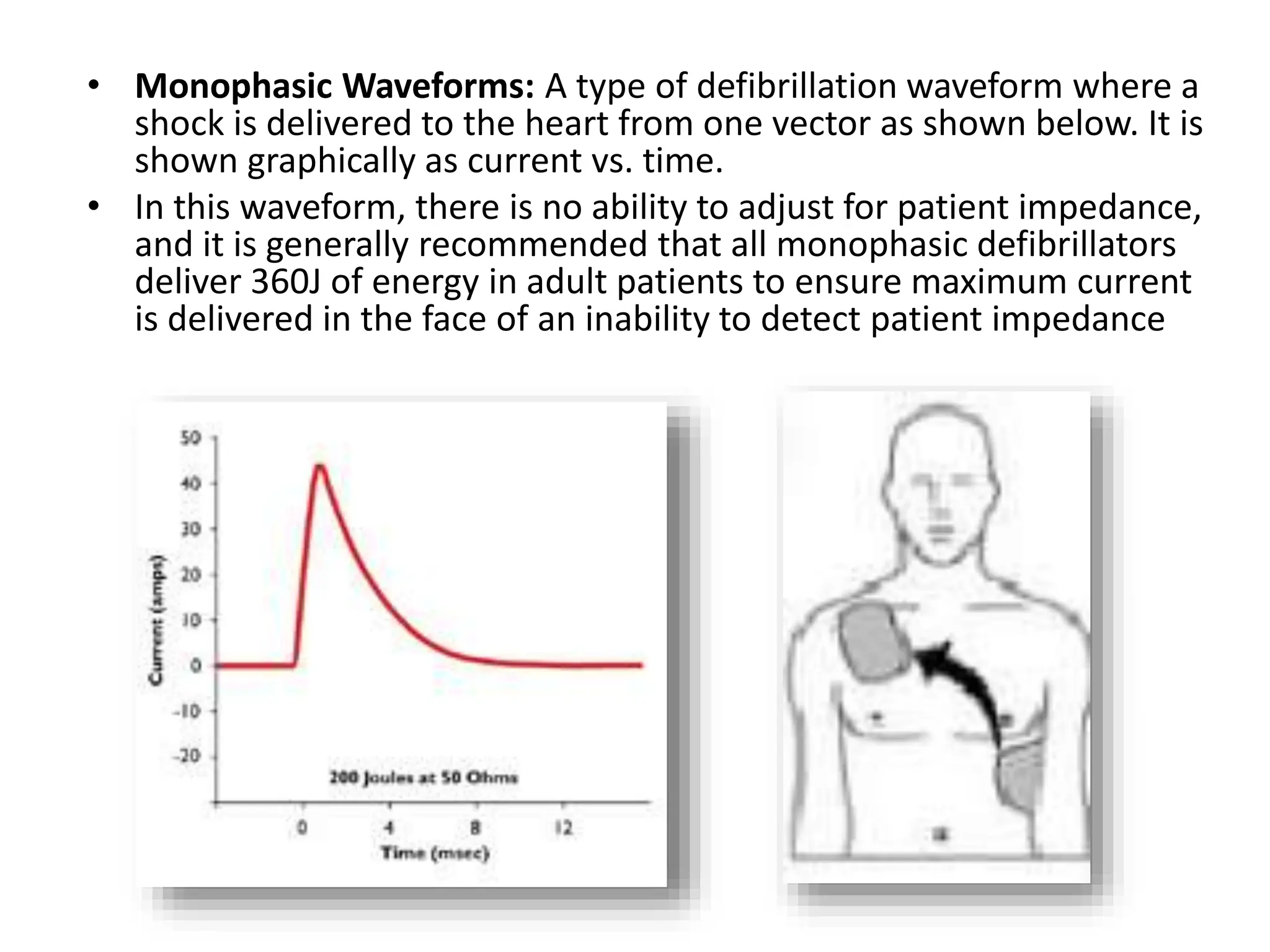
• Monophasic Waveforms: A type of defibrillation waveform where a
shock is delivered to the heart from one vector as shown below. It is
shown graphically as current vs. time.
• In this waveform, there is no ability to adjust for patient impedance,
and it is generally recommended that all monophasic defibrillators
deliver 360J of energy in adult patients to ensure maximum current
is delivered in the face of an inability to detect patient impedance
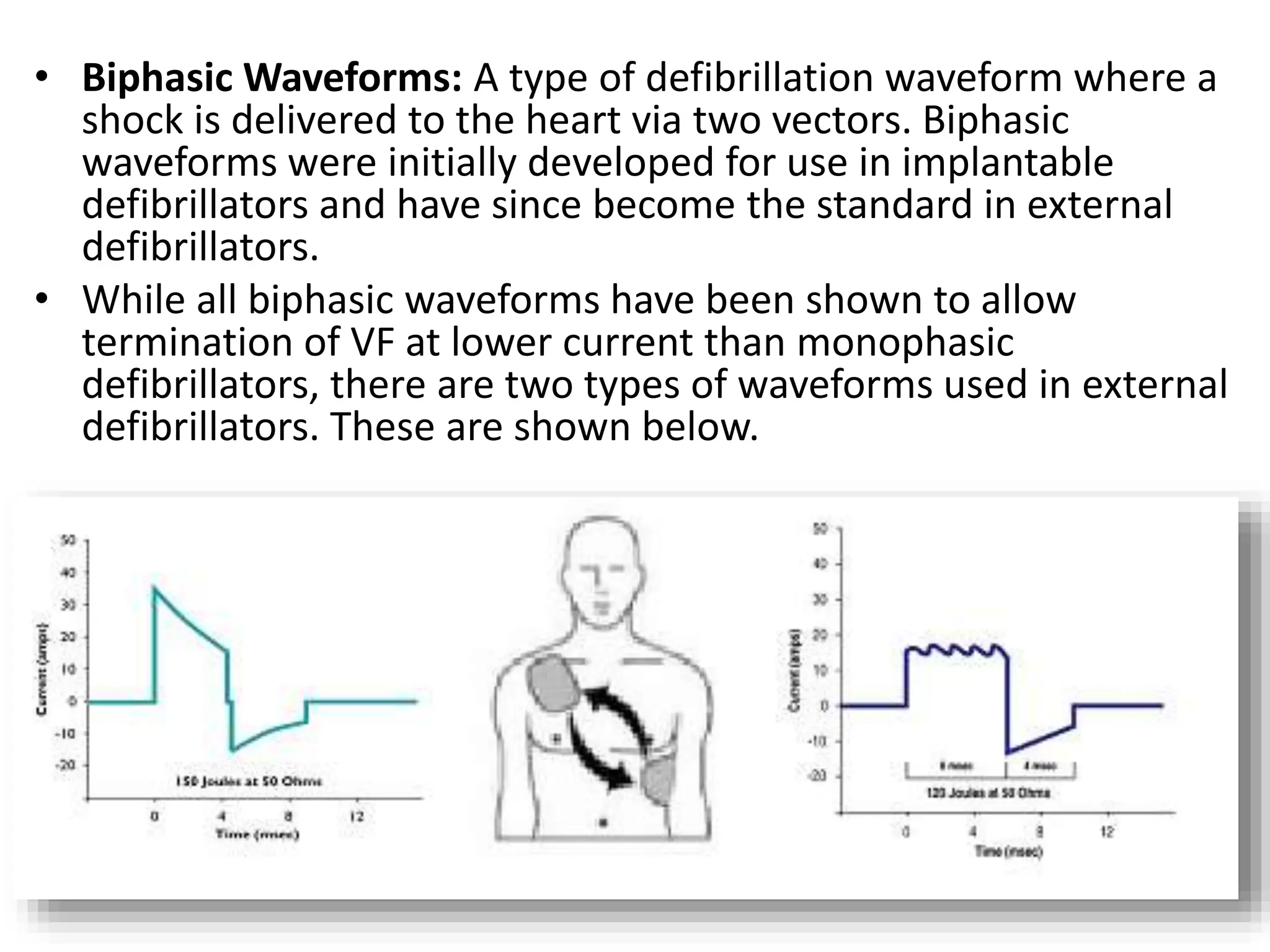
• Biphasic Waveforms: A type of defibrillation waveform where a
shock is delivered to the heart via two vectors. Biphasic
waveforms were initially developed for use in implantable
defibrillators and have since become the standard in external
defibrillators.
• While all biphasic waveforms have been shown to allow
termination of VF at lower current than monophasic
defibrillators, there are two types of waveforms used in external
defibrillators. These are shown below.
• Defibrillator manufacturers have approached biphasic defibrillation
differently.
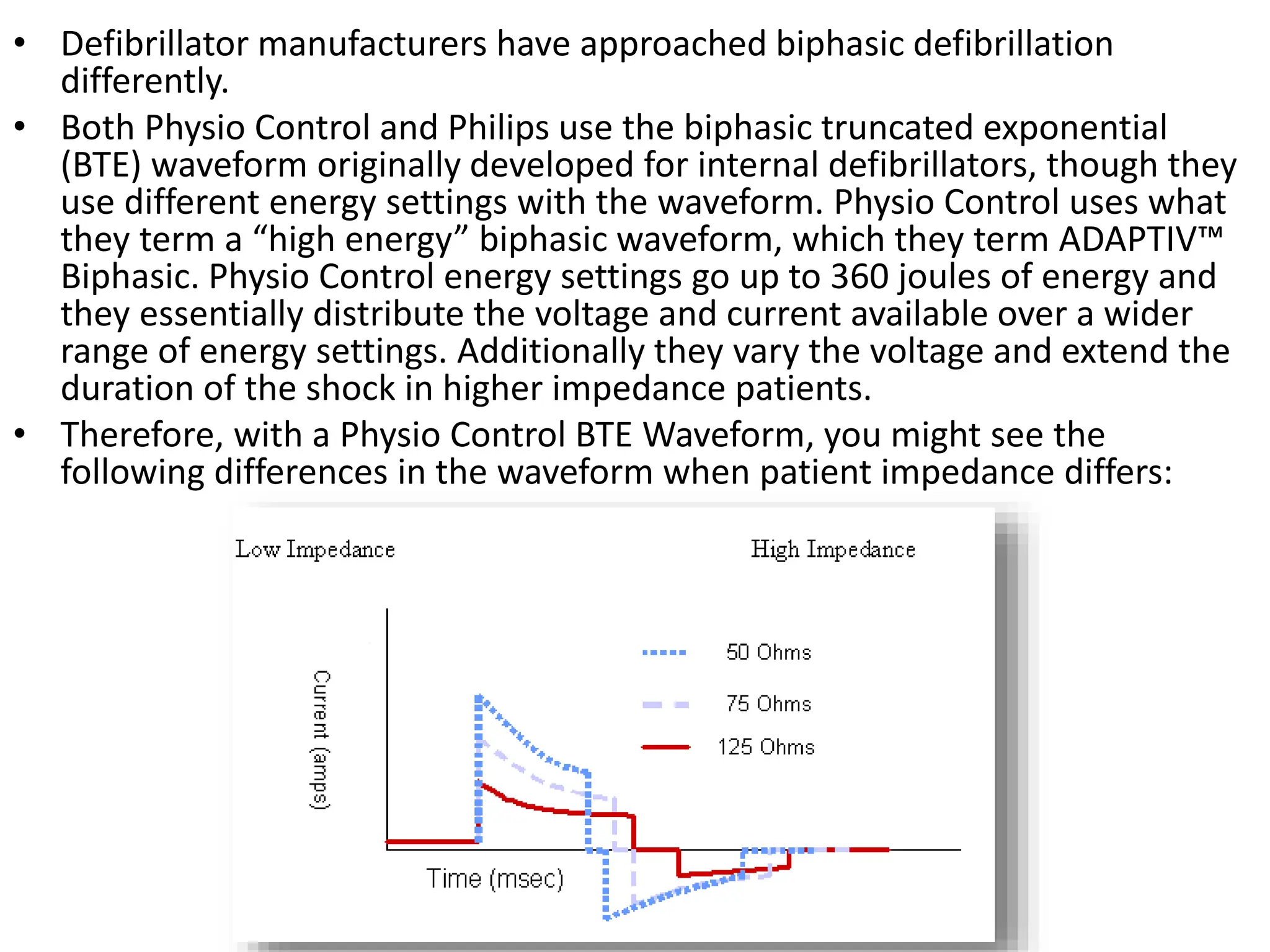
• Both Physio Control and Philips use the biphasic truncated exponential
(BTE) waveform originally developed for internal defibrillators, though they
use different energy settings with the waveform. Physio Control uses what
they term a “high energy” biphasic waveform, which they term ADAPTIV™
Biphasic. Physio Control energy settings go up to 360 joules of energy and
they essentially distribute the voltage and current available over a wider
range of energy settings. Additionally they vary the voltage and extend the
duration of the shock in higher impedance patients.
• Therefore, with a Physio Control BTE Waveform, you might see the
following differences in the waveform when patient impedance differs:
• Philips Medical also uses the biphasic truncated exponential
waveform in their SMART Biphasic device, but in this case, they
distribute the voltage and current available over a more
narrow range of energy with the maximum current delivered at
200J, roughly equivalent to that delivered by the Physio Control
device at 360J.
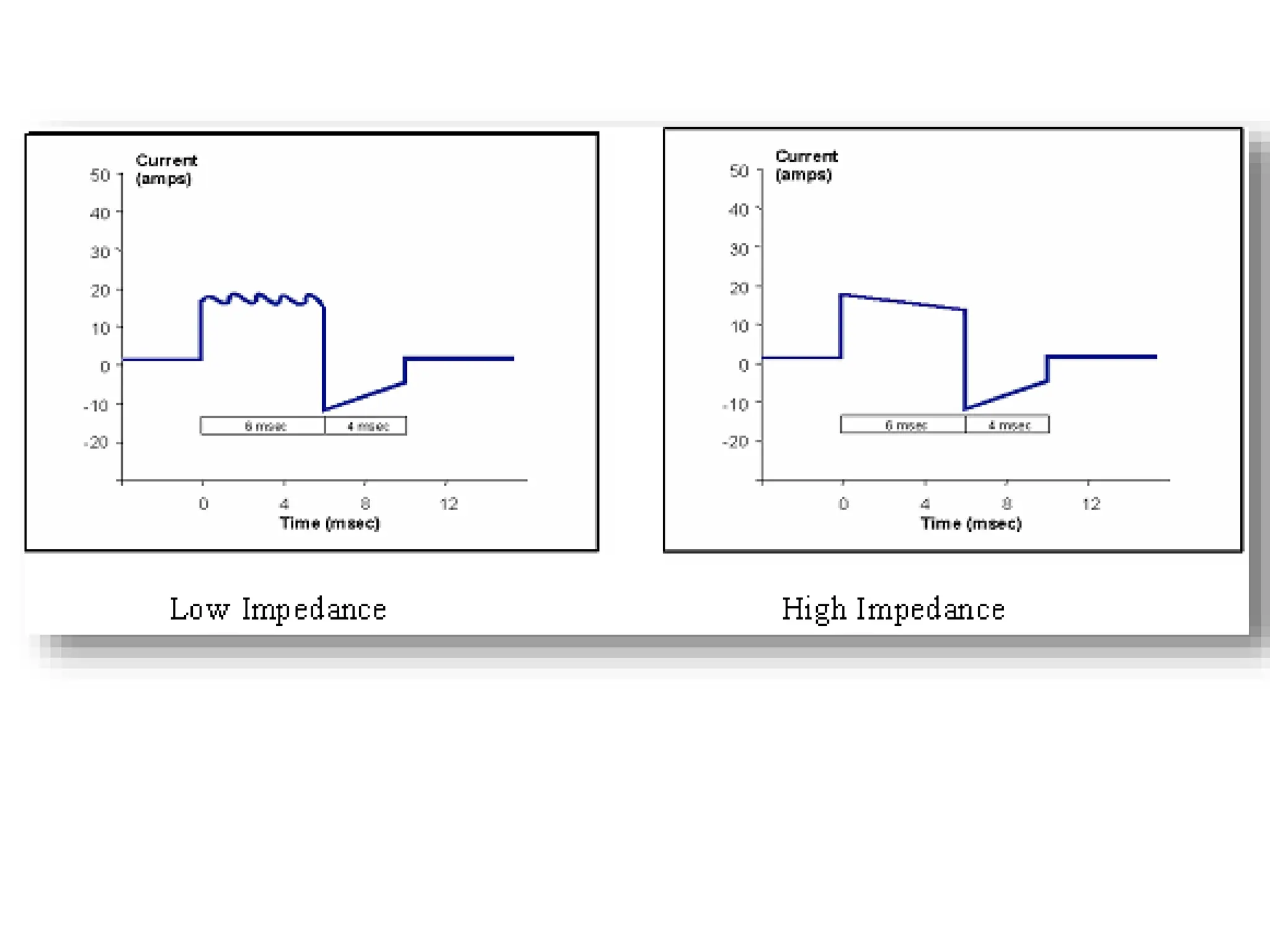
• The Rectilinear Biphasic Waveform (RBW) is used by ZOLL
Medical, and it differs from both of the BTE waveform devices.
ZOLL fixes voltage at the maximum and varies resistance in
order to deliver constant current across the broad range of
patients. Like Philips, 200 Joules is the maximum setting on the
defibrillator, however this maximum represents more voltage
on the capacitor than either Physio Control or Philips has
available. Additionally, the duration of the ZOLL RBE waveform
is fixed at 10 msec based upon work by Gliner et al.1 which
indicates that the defibrillation threshold decreases with
increasing time up to a point around 10-12 msec, after which is
begins to increase. As there is concern in the literature about
the effects of current on myocardial stunning, ZOLL chooses
not to go beyond that threshold
• The ZOLL RBW defibrillator actually divides impedance into two
components: equipment-based impedance and patient-based
impedance. Rather than adjusting the secondary variables, such
as voltage and time, the ZOLL RBW adjusts the equipment-based
impedance, and adds or subtracts resistors in the equipment as
required to control for an essentially “constant” current during
the course of the first phase.
• For example, for a 200J energy setting, the ZOLL RBW charges
the capacitor to the maximum voltage regardless of patient
impedance. In the case of a patient with 50 ohms of impedance,
the defibrillator controller adds ohms of resistance to effectively
“dampen” the amount of current being delivered to the patient.
For a patient with 150 ohms of impedance, no equipment-based
resistors are added, and the full amount of current is delivered
to the patient. In laboratory bench tests, at 200J, ZOLL delivered
27.8A peak current and 24.0A average current to a 50 ohm
resistor, and 14.8A peak current and 12.5A average current to a
150 ohm resistor. At energy settings less than 200J, the
difference between peak and average current is even less,
typically a maximum of 1A.
Note:
• It is really not a good idea to try to compare
manufacturers’ biphasic waveforms as each is
appropriate for the device in which it is found
and none has been shown to be superior to
others despite a number of clinical trials.
•
• 1. Gliner et al. Circulation 1995;92:1634-45
• 2. Tang et al. Journal of American College of
Cardiology 1999;34:815-822.

UNDERSTANDING DEFIBRILLATION WAVEFORMS.pptx

  • 1.
  • 2.
    Definitions • Energy: Energyin a defibrillator is expressed in joules. A joule is the unit of work associated with one amp of current passed through one ohm of resistance for one second. • When we express it in a formula, it is generally stated as follows: Joules (Energy) = Voltage X Current X Time Joules have become a surrogate for current in modern defibrillator language. • Current: Current is what actually defibrillates the heart. It is also expressed as Voltage/Impedance (resistance). • Impedance: Resistance to Flow; there is resistance in the electrical circuit itself as well as in the patient. The amount of impedance in a patient is difficult to determine as it relates to body mass, temperature, diaphoresis quality of the contact with paddles or pads. Impedance is expressed in ohms.
  • 3.
    • Monophasic Waveforms:A type of defibrillation waveform where a shock is delivered to the heart from one vector as shown below. It is shown graphically as current vs. time. • In this waveform, there is no ability to adjust for patient impedance, and it is generally recommended that all monophasic defibrillators deliver 360J of energy in adult patients to ensure maximum current is delivered in the face of an inability to detect patient impedance
  • 4.
    • Biphasic Waveforms:A type of defibrillation waveform where a shock is delivered to the heart via two vectors. Biphasic waveforms were initially developed for use in implantable defibrillators and have since become the standard in external defibrillators. • While all biphasic waveforms have been shown to allow termination of VF at lower current than monophasic defibrillators, there are two types of waveforms used in external defibrillators. These are shown below.
  • 5.
    • Defibrillator manufacturershave approached biphasic defibrillation differently. • Both Physio Control and Philips use the biphasic truncated exponential (BTE) waveform originally developed for internal defibrillators, though they use different energy settings with the waveform. Physio Control uses what they term a “high energy” biphasic waveform, which they term ADAPTIV™ Biphasic. Physio Control energy settings go up to 360 joules of energy and they essentially distribute the voltage and current available over a wider range of energy settings. Additionally they vary the voltage and extend the duration of the shock in higher impedance patients. • Therefore, with a Physio Control BTE Waveform, you might see the following differences in the waveform when patient impedance differs:
  • 6.
    • Philips Medicalalso uses the biphasic truncated exponential waveform in their SMART Biphasic device, but in this case, they distribute the voltage and current available over a more narrow range of energy with the maximum current delivered at 200J, roughly equivalent to that delivered by the Physio Control device at 360J. • The Rectilinear Biphasic Waveform (RBW) is used by ZOLL Medical, and it differs from both of the BTE waveform devices. ZOLL fixes voltage at the maximum and varies resistance in order to deliver constant current across the broad range of patients. Like Philips, 200 Joules is the maximum setting on the defibrillator, however this maximum represents more voltage on the capacitor than either Physio Control or Philips has available. Additionally, the duration of the ZOLL RBE waveform is fixed at 10 msec based upon work by Gliner et al.1 which indicates that the defibrillation threshold decreases with increasing time up to a point around 10-12 msec, after which is begins to increase. As there is concern in the literature about the effects of current on myocardial stunning, ZOLL chooses not to go beyond that threshold
  • 7.
    • The ZOLLRBW defibrillator actually divides impedance into two components: equipment-based impedance and patient-based impedance. Rather than adjusting the secondary variables, such as voltage and time, the ZOLL RBW adjusts the equipment-based impedance, and adds or subtracts resistors in the equipment as required to control for an essentially “constant” current during the course of the first phase. • For example, for a 200J energy setting, the ZOLL RBW charges the capacitor to the maximum voltage regardless of patient impedance. In the case of a patient with 50 ohms of impedance, the defibrillator controller adds ohms of resistance to effectively “dampen” the amount of current being delivered to the patient. For a patient with 150 ohms of impedance, no equipment-based resistors are added, and the full amount of current is delivered to the patient. In laboratory bench tests, at 200J, ZOLL delivered 27.8A peak current and 24.0A average current to a 50 ohm resistor, and 14.8A peak current and 12.5A average current to a 150 ohm resistor. At energy settings less than 200J, the difference between peak and average current is even less, typically a maximum of 1A.
  • 9.
    Note: • It isreally not a good idea to try to compare manufacturers’ biphasic waveforms as each is appropriate for the device in which it is found and none has been shown to be superior to others despite a number of clinical trials. • • 1. Gliner et al. Circulation 1995;92:1634-45 • 2. Tang et al. Journal of American College of Cardiology 1999;34:815-822.