MICTURITION
Def:- Micturition is a reflex process by which urine is voided from
urinary bladder through urethra. In grown up children and adults,it
can be controlled voluntarily to some extent.
RENAL SYSTEM
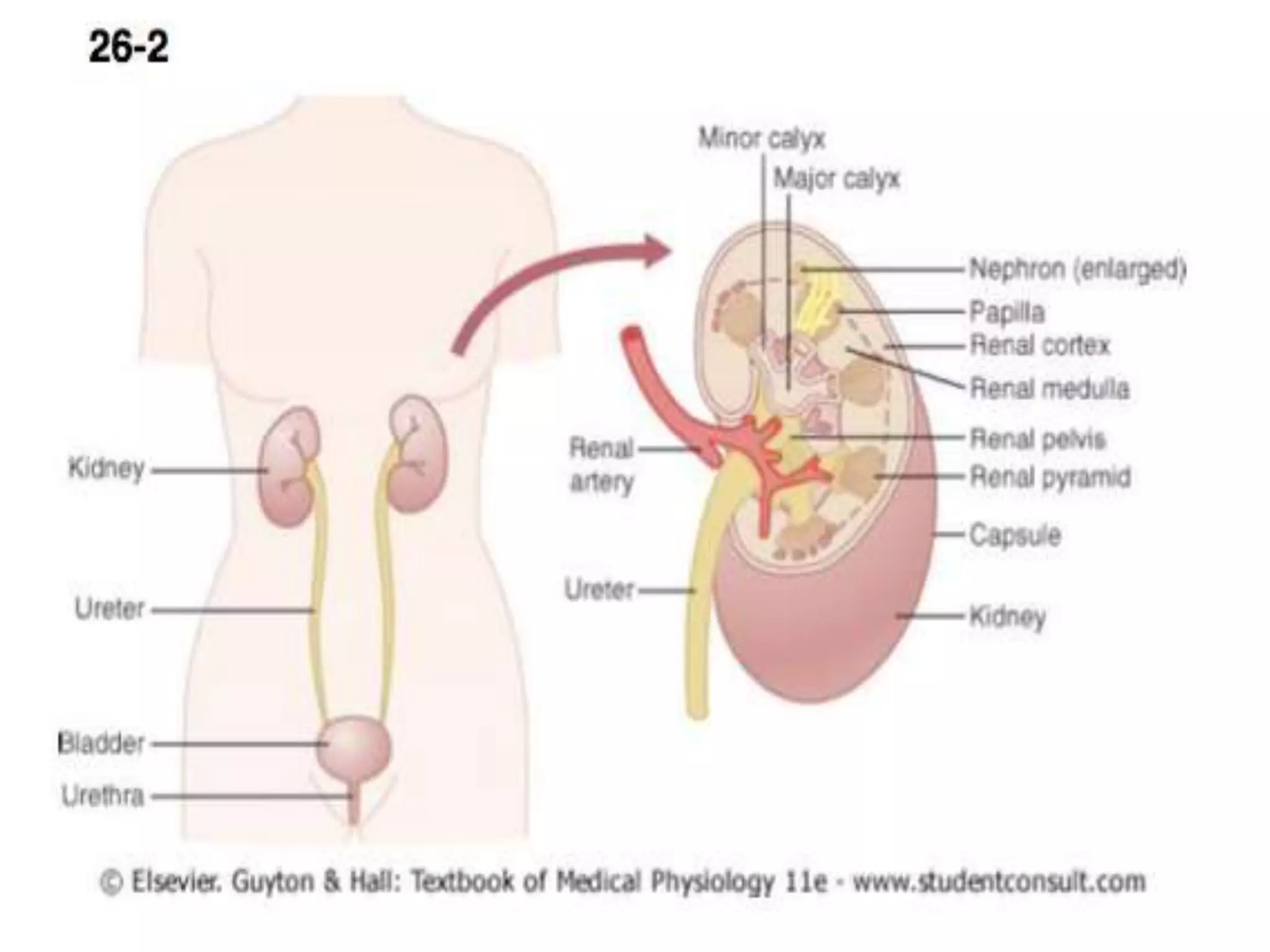
Renal system includes:-
1. A pair of kidneys
2. A pair of ureters
3. One urinary bladder
4. One urethra
In male urethra is long but in female it is short.
URINARY BLADDER
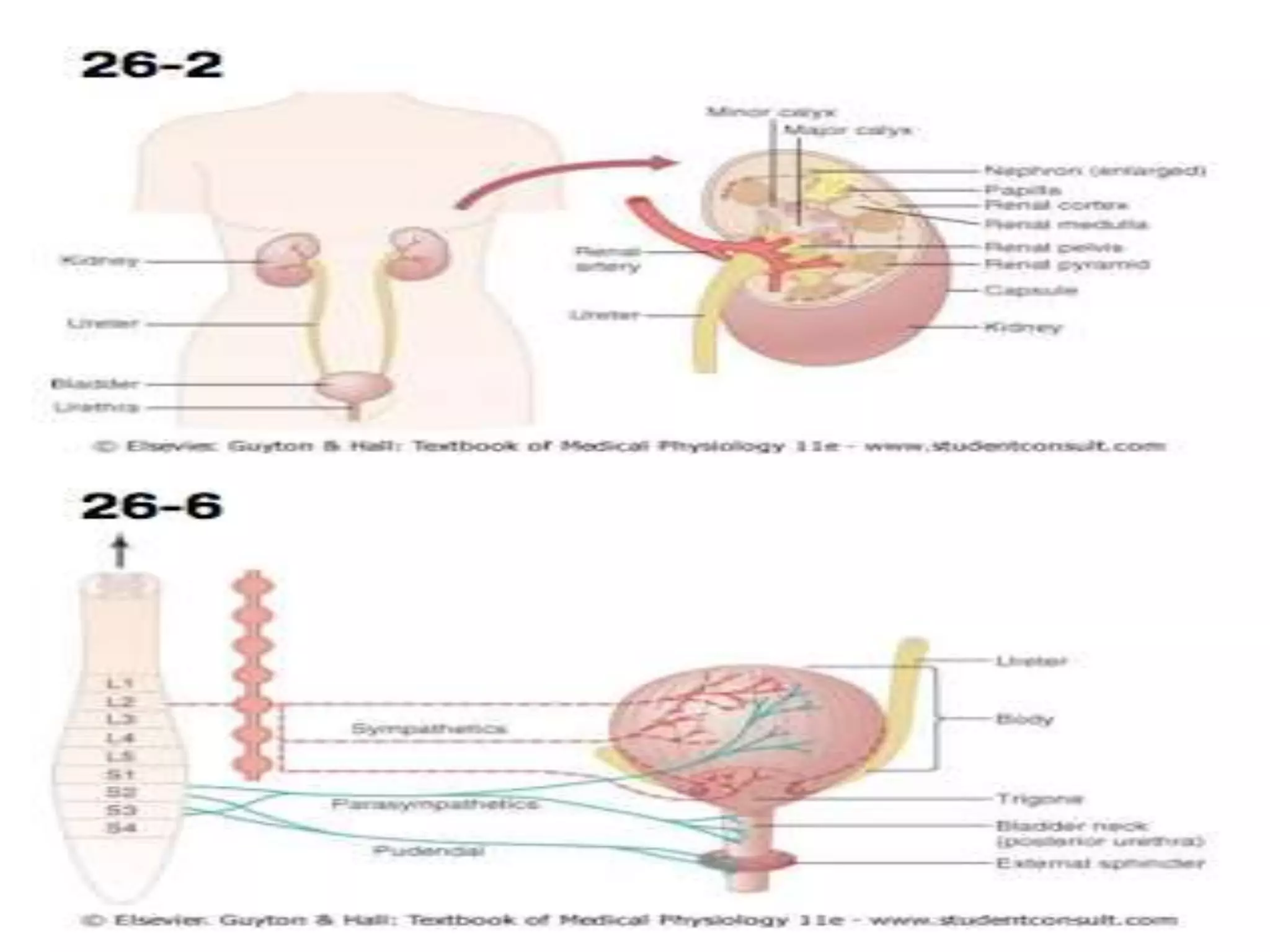
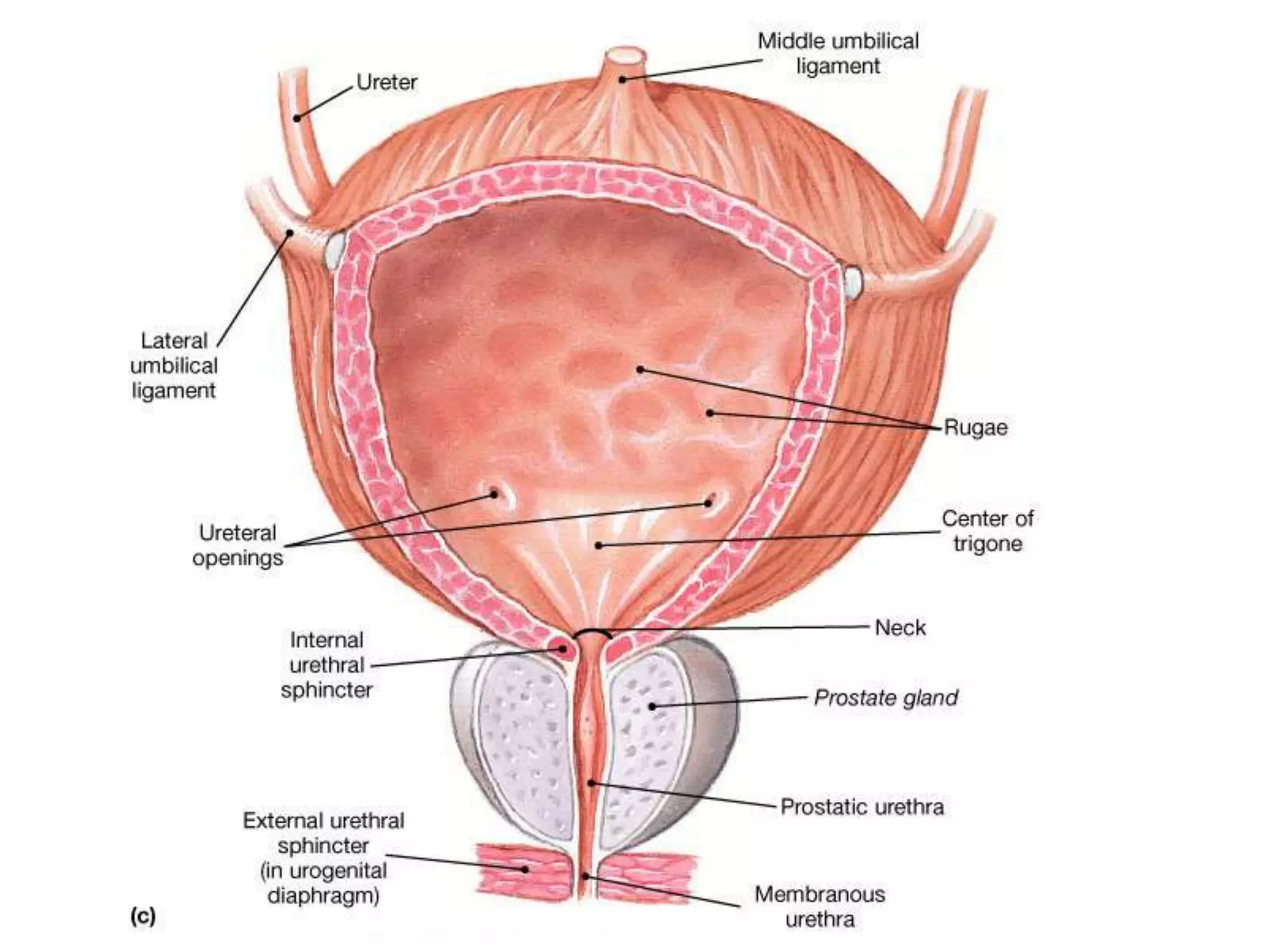
 Urinary bladder consist of the
Body
neck
And internal urethral sphincter.
 Smooth muscle forming the urinary bladder is called
detrusor muscle.
 Detrusor muscle is formed by ill defined three layers of muscles fiber
Inner longitudinal layer
Middle circular layer
Outer longitudinal layer
 Trigone:- At the posterior surface of bladder wall ,there is a triangular
area called Trigone.
 Two ureters enter at the upper angle of Trigone.
 Neck:- lower part of bladder is narrow and forms the neck of Bladder.
Internal urethral sphincter:- Distal end of
bladder is guarded by detrusor muscle called
internal sphincter.It opens towards urethra.
External urethral sphincter:- At the Distal end
of urethra , there is external urethral sphincter
made up of skeletal muscles fibers.
It is responsible for voluntary control of
micturition
NERVE SUPPLY OF URINARY BLADDER
Urinary bladder and internal sphincter is
supplied by sympathetic and parasympathetic
divisions of Autonomic Nervous system
(ANS)
The external sphincter is supplied by the
somatic motor nerve fibers.
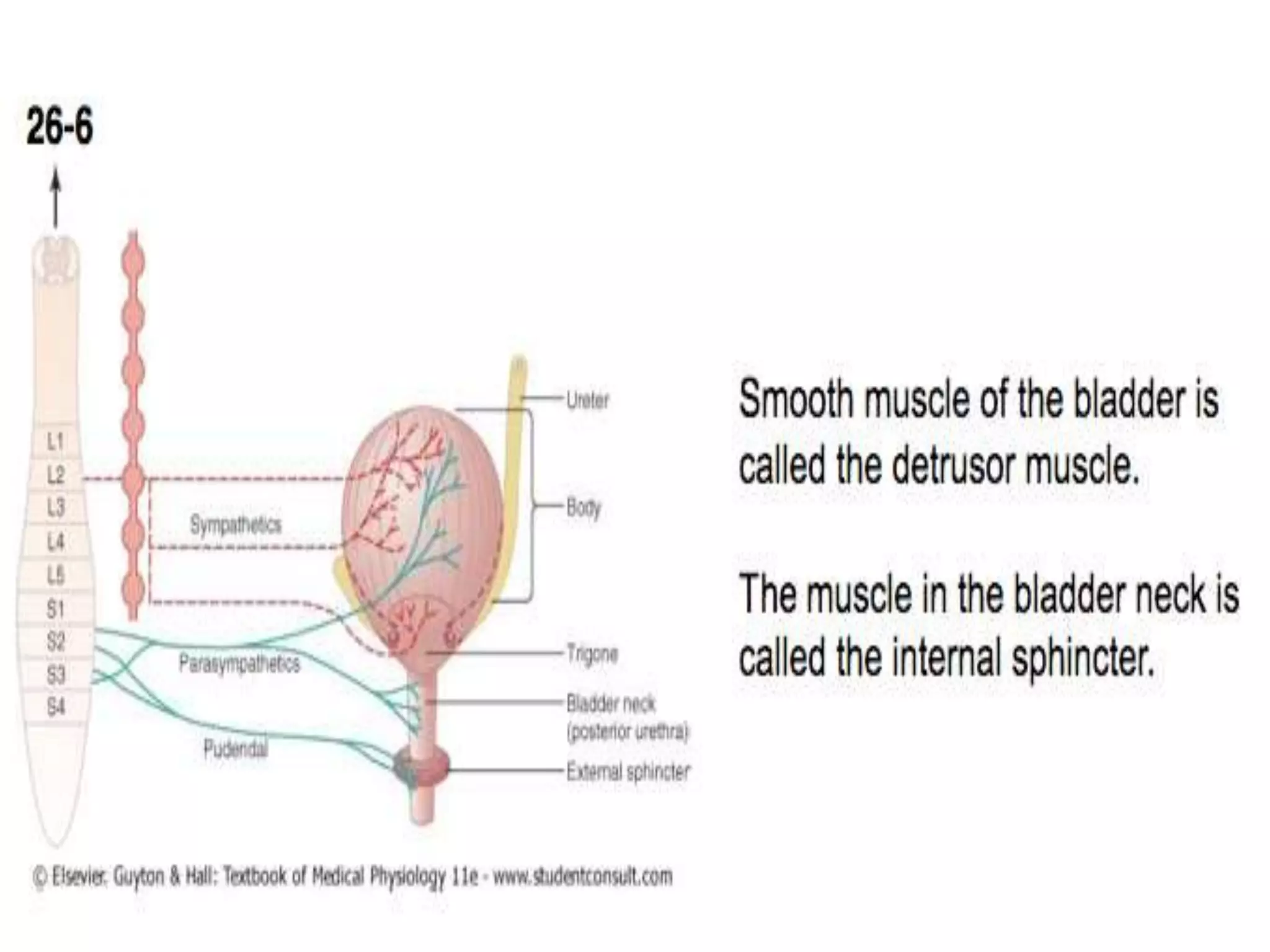
SYMPATHETIC NERVE SUPPLY
 Preganglionic fibers of sympathetic nerve arise from lumber segments
L1 , L2 of spinal cord.
 Fibers pass through lateral sympathetic chain without any synapse
terminate in Hypogastic nerve , which supplies the detrusor muscles
and internal sphincter of urinary bladder.
FUNCTIONS OF SYMPATHETIC NERVE
 Stimulation of sympathetic nerve causes relaxation of detrusor
muscles and constriction of internal sphincter
 It causes filling of urinary bladder by urine and so called nerve
of filling.
PARASYMPATHETIC NERVE SUPPLY
 Preganglionic fiber of parasympathetic nerve arise from second ,third and fourth
sacral segments(S2,S3,S4) of spinal cord form the pelvic nerve.
 These fibers run through hypogastric ganglion and synapse with
postganglionic neurons situated close to urinary bladder
FUNCTIION PARASYMPATHETIC NERVE
 Stimulation of pelvic (parasympathetic) nerve causes contraction of detruser
muscles and relaxation of the internal sphinctor leading to emptying of
urinary bladder. so, parasympatheric nerve is called the nerve of micturition
 Pevlic nerve has also the sensary fibers which carry impulse from stretch
receptors present on the wall of urinary bladder and urethera to the C N S.
SOMATIC NERVE SUPPLY TO
EXTERNAL SPHINCTER
 The external sphincter is skeletal muscle supplied by somatic nerve
called pudendal nerve. It arises from second ,third and fourth sacral
segments(S2,S3,S4) of spinal cord.
FUNCTION OF PUDENDAL NERVE
 It maintains the tonic contraction of skeletal muscles fibers of
the external sphincter and keeps the external sphincter
constricted always.
 During micturition this nerve is inhibited.
 It causes relaxation of external sphincter leading to voiding of
urine(micturition).
 So pudendal nerve is responsible for voluntary control of
micturition.
FILLING OF URINARY BLADDER
 Urine is formed in the nephrons of kidneys continuosly and transported
by ureter to urinary bladder by peristallic movement in the ureter.
 The direction of the ureter after leavling the kidney is downward and
outward and then horizontally before entering the bladder .
 Due to adaptation of detruser muscle urine is collected in the bladder
without much increase in the intravesical pressure.
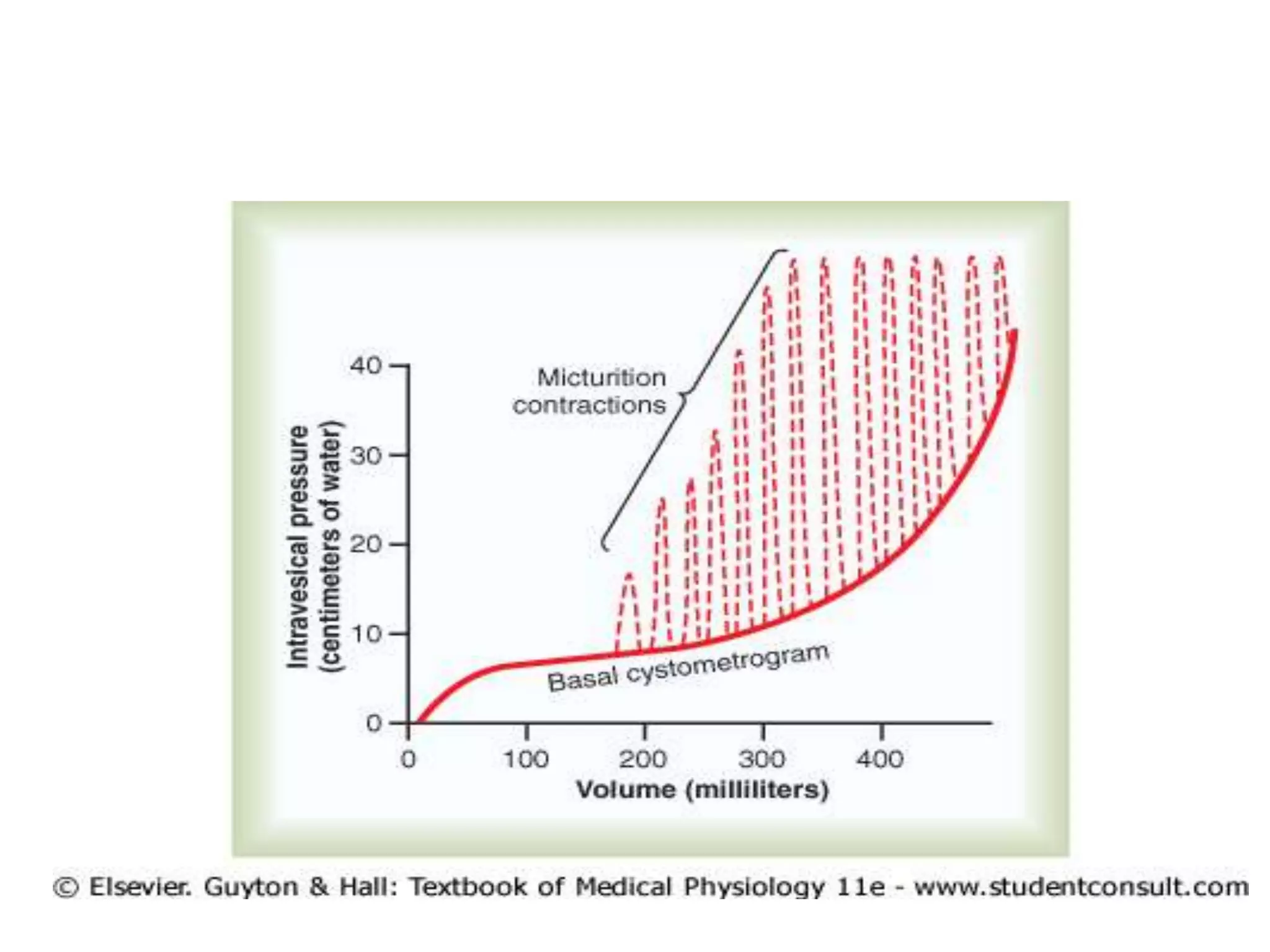
 Relationship between the volume of urine and pressure in the urinary
bladder is studied by Cystometrogram.
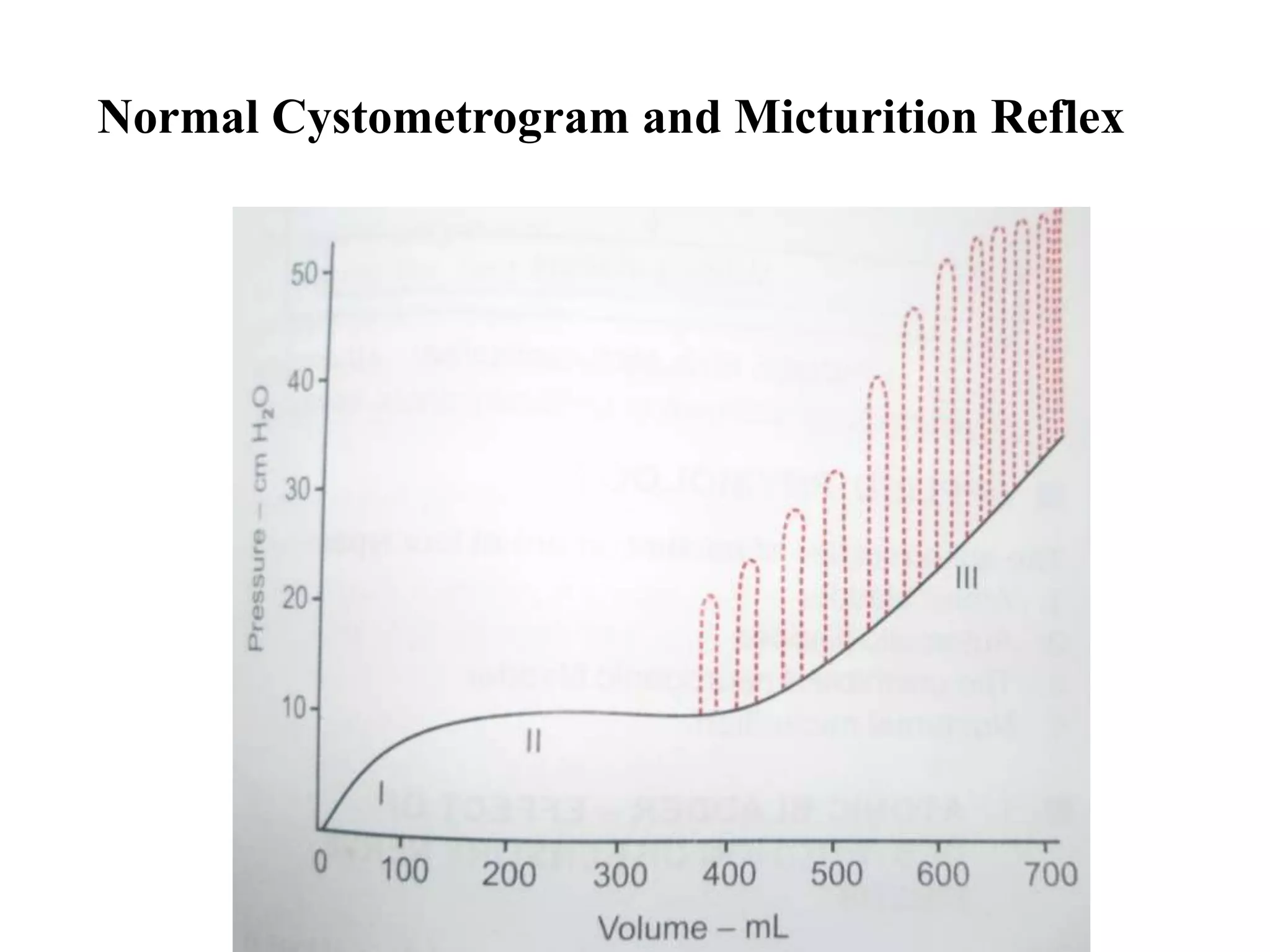
CYSTOMETROGRAM
Def:- Cystometrogram is the graphical recordingof pressure changes in the
urinary bladder in relation to rise in the volume of urine collected in it.
METHOD OF RECORDING OF CYSTOMETROGRAM
 A double lumen catheter is introduced in the urinary bladder.
 One of the lumen is used to infuse fluid into the bladder and the other
one to record the pressure changes .
 First the bladder is emptied completely then small known volume of
fluid is introduced into the bladder at regular intervals
 The intravesical pressure is recorded.
 A graph is obtained by plotting all the values of volume and the
pressure .
 This graph is called Cystometrogram
Normal Cystometrogram and Micturition
Reflex
CYSTOMETROGRAM SHOWS THREE SEGMENTS
 SEGMENT I
 When urinary bladder is empty the intravesical pressure is zero.
 When about 100ml fluid collected the pressure rises sharply to about 10cm H2O
 SEGMENT II
 It shows plateau the intravesical pressure remains more or less 10cm H2O without any change
even introducing 300-400ml of fluid.
 It is accordance with law of Laplace.
 SEGMENT III
 When collection of 300-400ml of fluid the contraction of detrusor muscle is intense and
increase in urge of micturation
 Still voluntary control is possible upto 600-700ml the pressure rises to 35-40cm H2O.
 When intravesicular pressure is above 40cm H2O.the constriction of detrusor muscles
become more intense and voluntary control is not possible.
LAW OF LAPLACE
 Pressure in spherical organ is inversly proportional to its radius, the
tone remaining constant.
P=T/R
P= presure ,
T= tension
R= Radius
 If radius is more pressure is less and if radius is less pressure is more
provided tone remains constant.
 Urinary bladder obeys Laplace law.
 When urine collected beyond 400ml ,the pressure rises sharply and urge
of micturition starts.
 Still voluntary control of micturition is possible.
 Beyond 600-700ml of urine collected then control starts failing.
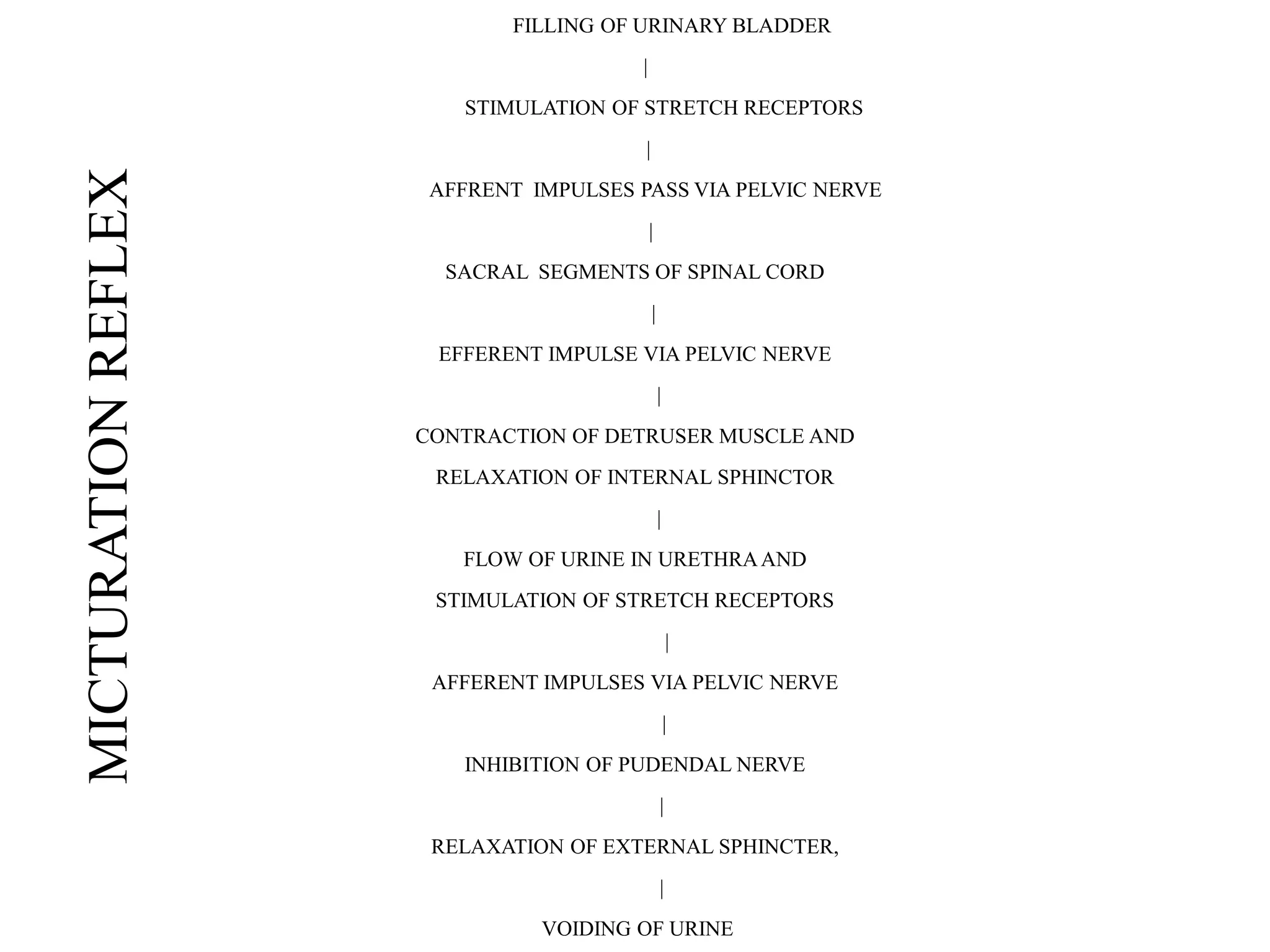
Normal Cystometrogram and Micturition Reflex
MICTURATIONREFLEX
FILLING OF URINARY BLADDER
|
STIMULATION OF STRETCH RECEPTORS
|
AFFRENT IMPULSES PASS VIA PELVIC NERVE
|
SACRAL SEGMENTS OF SPINAL CORD
|
EFFERENT IMPULSE VIA PELVIC NERVE
|
CONTRACTION OF DETRUSER MUSCLE AND
RELAXATION OF INTERNAL SPHINCTOR
|
FLOW OF URINE IN URETHRAAND
STIMULATION OF STRETCH RECEPTORS
|
AFFERENT IMPULSES VIA PELVIC NERVE
|
INHIBITION OF PUDENDAL NERVE
|
RELAXATION OF EXTERNAL SPHINCTER,
|
VOIDING OF URINE
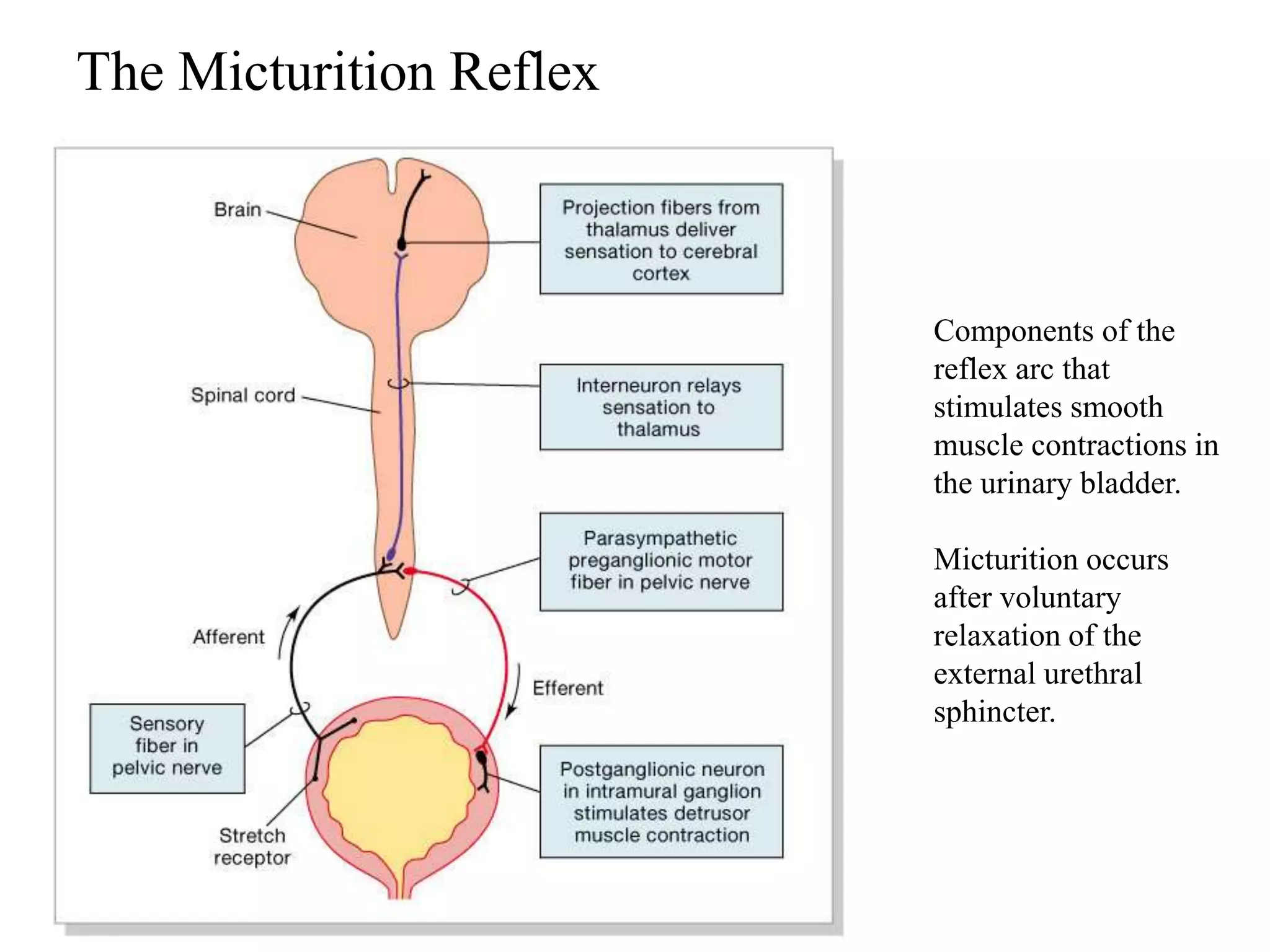
The Micturition Reflex
Components of the
reflex arc that
stimulates smooth
muscle contractions in
the urinary bladder.
Micturition occurs
after voluntary
relaxation of the
external urethral
sphincter.
MICTURITION
 It is the reflex by which micturition occurs.
 It is elicited by stimulation of stetch receptors on the wall of urinary
bladder and urethra.
 When urine is collected 300-400ml the intervesicular pressure increases
and the stretch receptors are stimulated and generation of sensory
impulse.
 The sensory impulse from the receptors reach the sacral segments of
spinal cord via sensory fibers of pelvic nerve(parasympathetic nerve)
 Motor impulses from spinal cord travel through motor fiber of pelvic
nerve to bladder and internal sphincter
 Causes contraction of detrusor muscles of bladder and relaxation of
internal sphincter urine enters urethra from bladder.
Stretch receptors in urethra stimlated send
afferent impulses to spinal cord via pelvic nerve
fibres.
These impulse inhibit pudendal nerve ,external
sphinder relaxes and micturition occurs.
Once micturition reflex begins it is self
regenerative further sensory impulse cycle
continues and urine is voided completely.
During micturation the flow of urine is facilitated
by the increase in the abdominal pressure due to
voluntary contraction of abdominal muscles.
HIGHER CENTERS OF
MICTURITION
 Spinal centers are present in lumber segments (L1, L2), sacral segments
(S2, S3, S4) of spinal chord but regulated by higher centers which
control micturition
(1) INHIBITARY CENTER OF MICTURITION
Inhibitary center in midbrain and cerebral cortex inhibit the micturition
by supressing mictonitim center.
(2) FACILITATORY CENTER OF MICTURICTION
Facilitatory center are in Pons facilitates micturition via spinal center
Abnormalities of
Micturition
1)Atonic bladder.
2)Automatic bladder.
3)Uninhibited neurogenic bladder.
4)Nocturnal micturition.
1. Atonic bladder
 Due to distruction of sensary pelvic nerve fibers of urinary bladder
A. spinal injury ( first stage of spinal shock.)
B. Syphilis – destruction of dorsal sensary nerve roots.
 In atonic bladder loss of tone in the urinary bladder due to
destruction of sensary nerve fibers. The bladder is filled up without
any stretch becomes flacid. No micturition contraction.
 Bladder filled completely and overflow in drops.
 It is called overflow incontenence or overflow dribling.
2. Automatic bladder
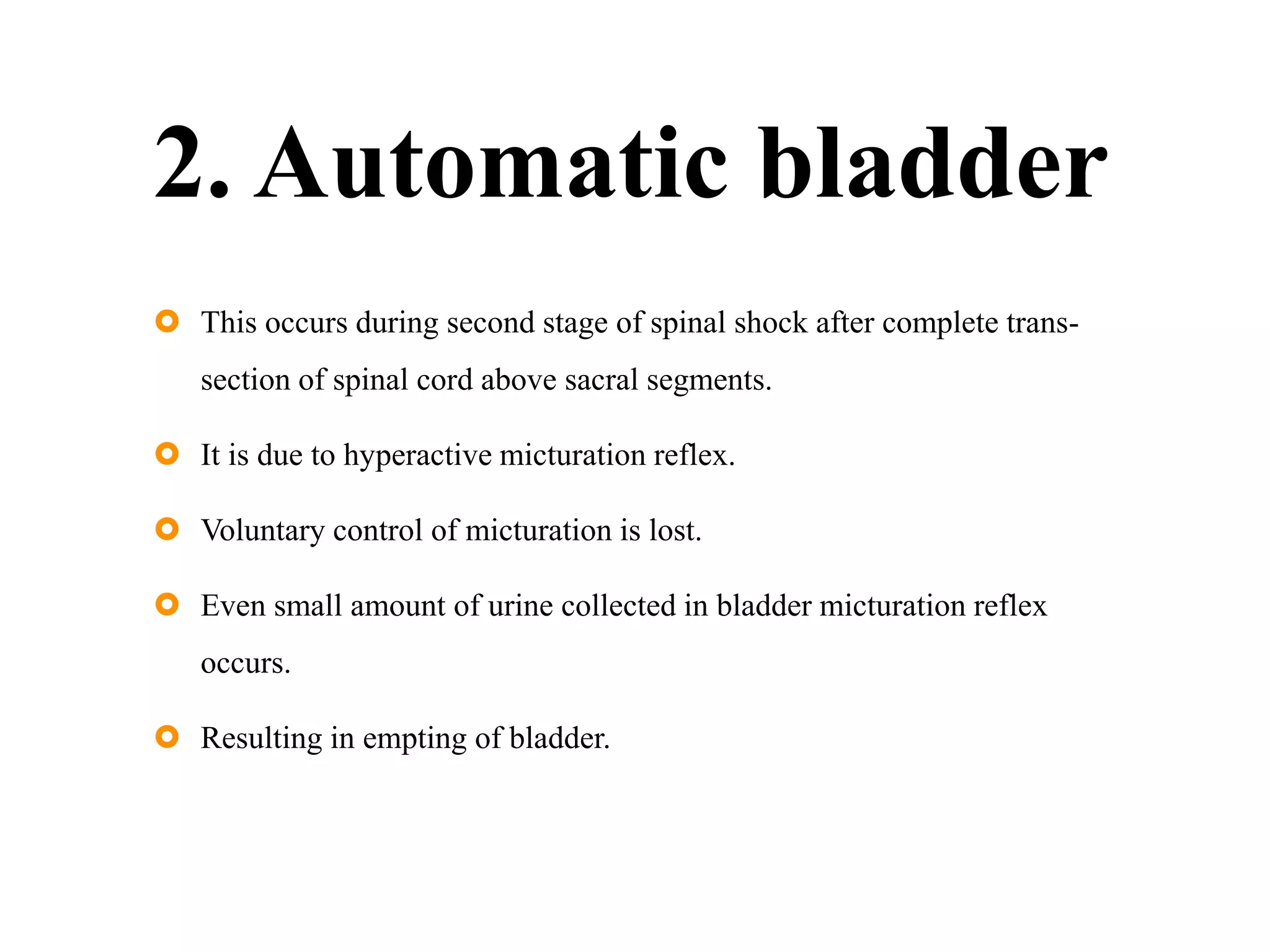
 This occurs during second stage of spinal shock after complete trans-
section of spinal cord above sacral segments.
 It is due to hyperactive micturation reflex.
 Voluntary control of micturation is lost.
 Even small amount of urine collected in bladder micturation reflex
occurs.
 Resulting in empting of bladder.
3. Uninhibited neurogenic
bladder
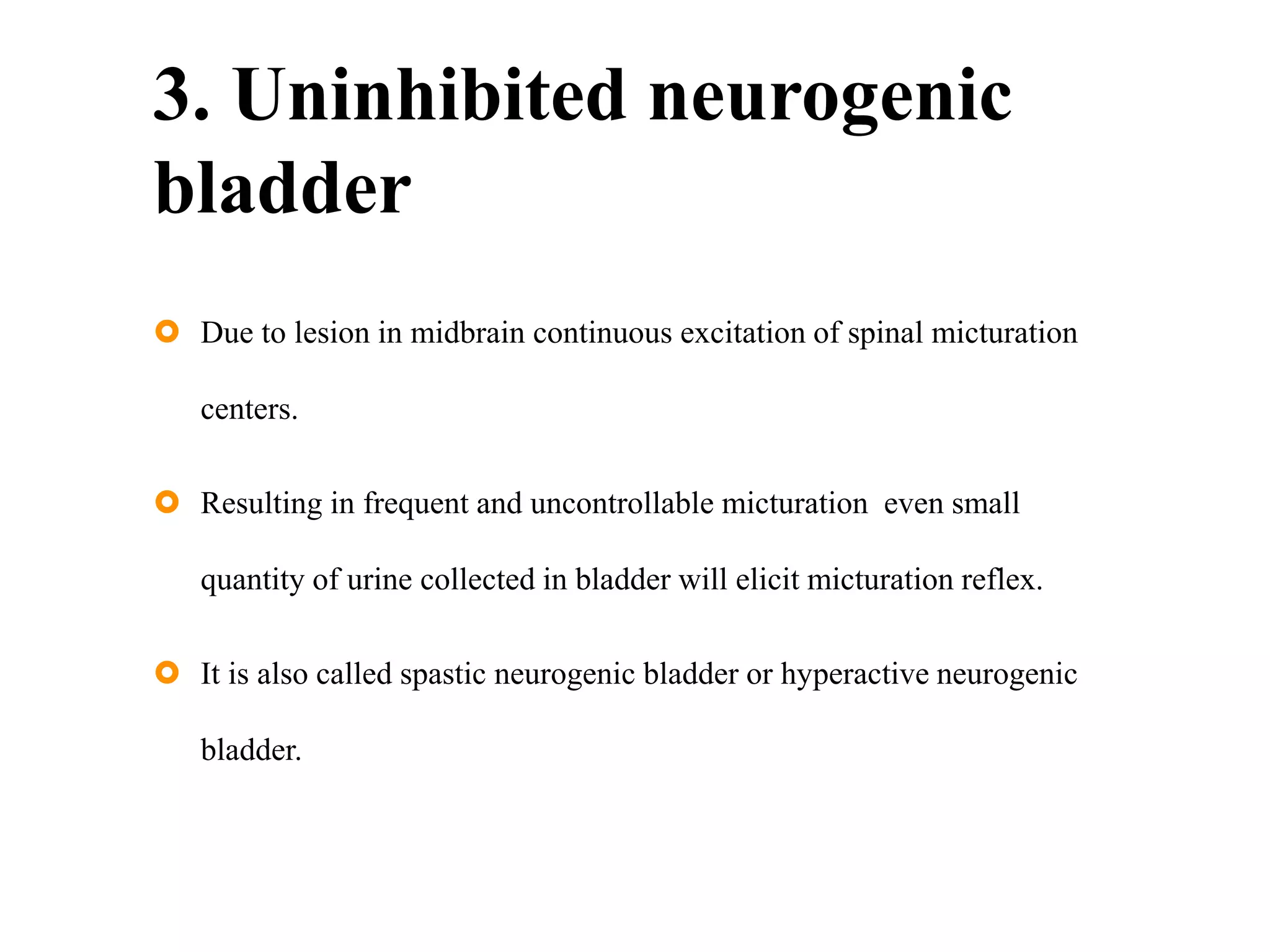
 Due to lesion in midbrain continuous excitation of spinal micturation
centers.
 Resulting in frequent and uncontrollable micturation even small
quantity of urine collected in bladder will elicit micturation reflex.
 It is also called spastic neurogenic bladder or hyperactive neurogenic
bladder.
4. Nocturnal micturition Or Enuresis Or
Bed wetting
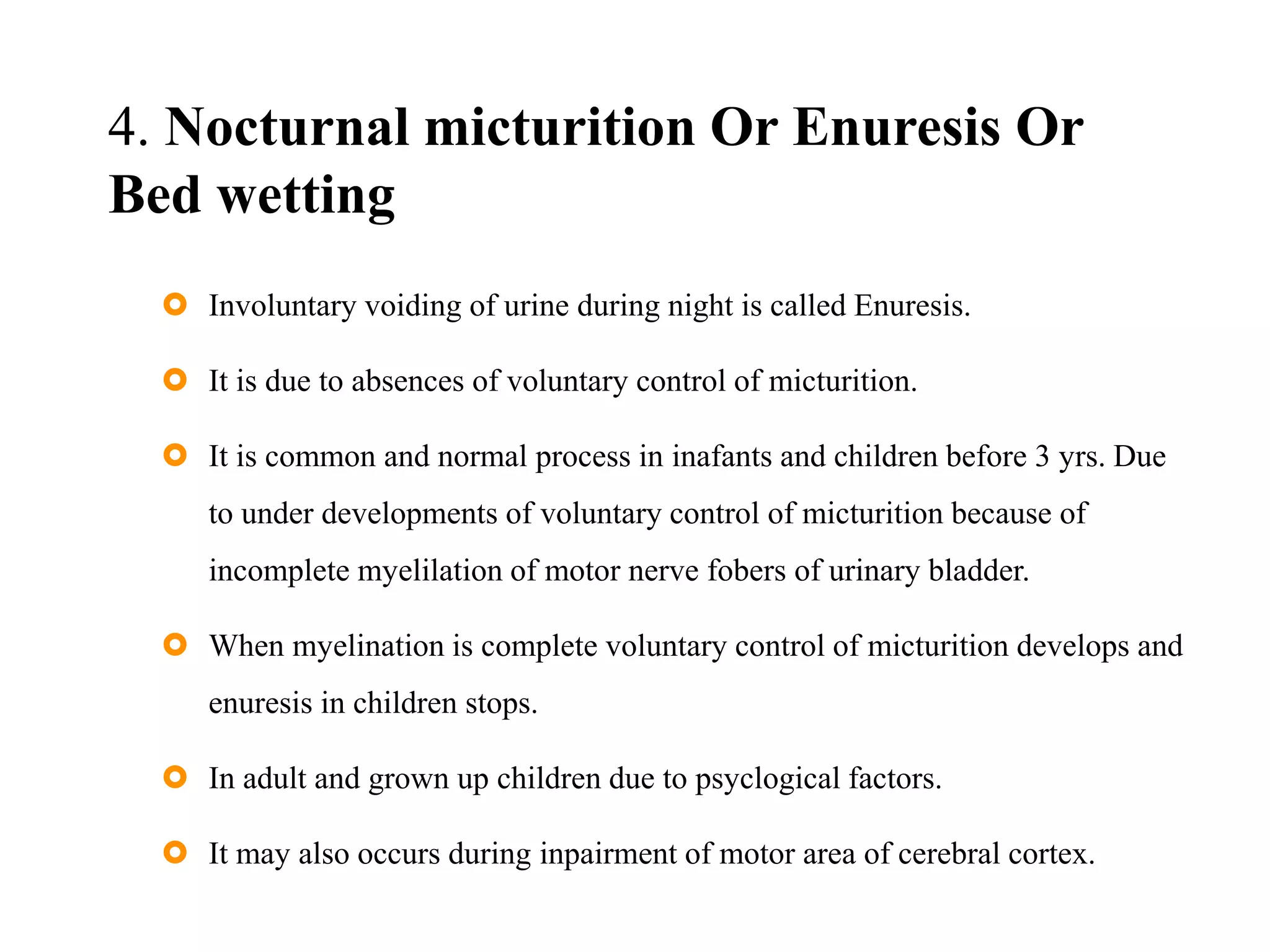
 Involuntary voiding of urine during night is called Enuresis.
 It is due to absences of voluntary control of micturition.
 It is common and normal process in inafants and children before 3 yrs. Due
to under developments of voluntary control of micturition because of
incomplete myelilation of motor nerve fobers of urinary bladder.
 When myelination is complete voluntary control of micturition develops and
enuresis in children stops.
 In adult and grown up children due to psyclogical factors.
 It may also occurs during inpairment of motor area of cerebral cortex.
Abnormalities of micturition
1. Atonic bladder
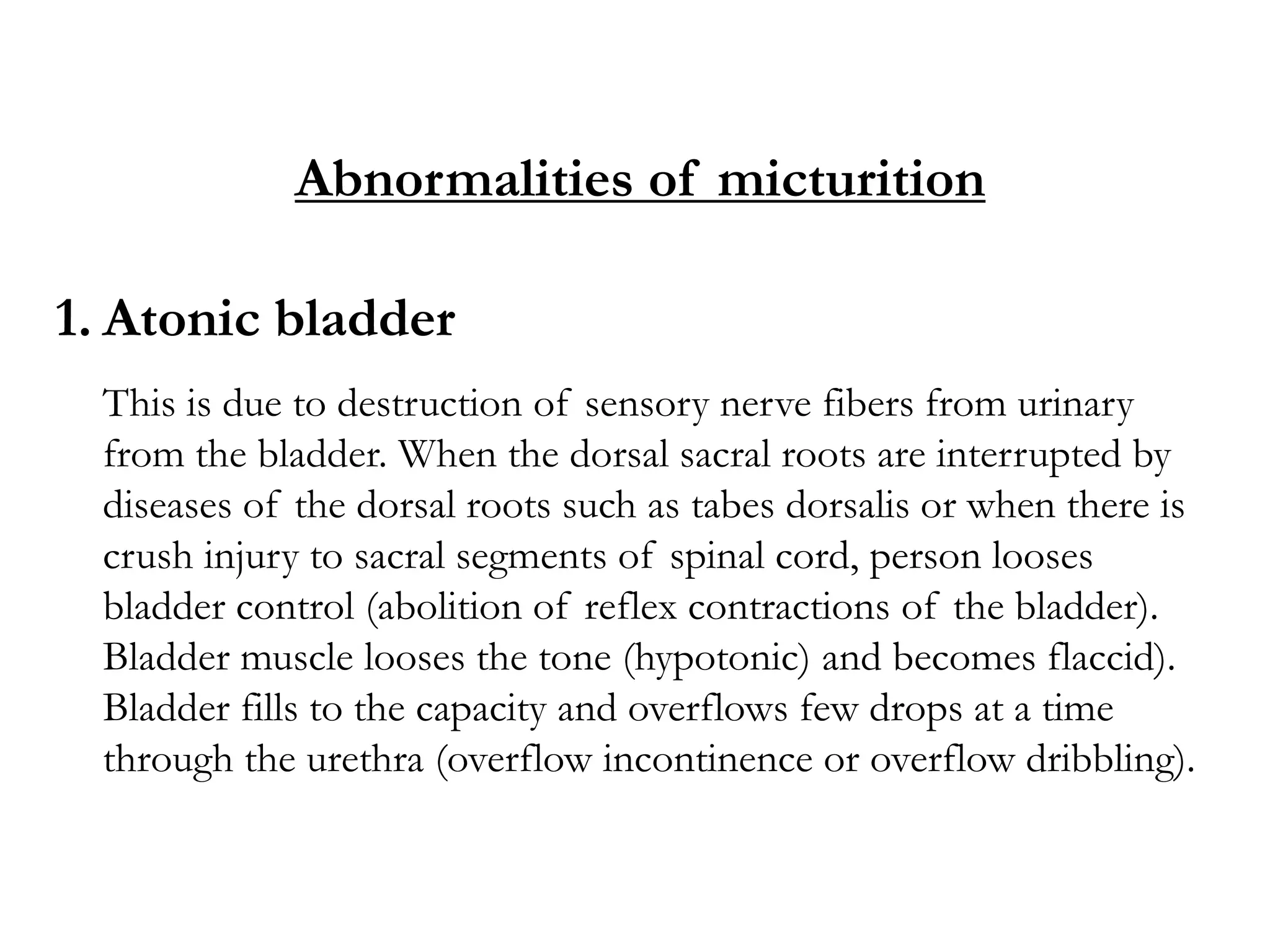
This is due to destruction of sensory nerve fibers from urinary
from the bladder. When the dorsal sacral roots are interrupted by
diseases of the dorsal roots such as tabes dorsalis or when there is
crush injury to sacral segments of spinal cord, person looses
bladder control (abolition of reflex contractions of the bladder).
Bladder muscle looses the tone (hypotonic) and becomes flaccid).
Bladder fills to the capacity and overflows few drops at a time
through the urethra (overflow incontinence or overflow dribbling).
2. Automatic bladder (Spastic
neurogenic bladder)
During spinal shock after complete transection of
spinal cord above sacral centres of micturition, the
urinary bladder looses its tone and becomes flaccid
and unresponsive. So, the bladder is completely
filled, and later urine overflows by dribbling. After
the spinal shock has passed, the voiding reflex
returns although there is no voluntary and higher
centre control.
Whenever, the bladder is filled with some amount
of urine, there is automatic evacuation of the
bladder.
3. Uninhibited neurogenic bladder
Due to a lesion in some parts of brain stem
(interrupting most
of the inhibitory signals), there is continuous
excitation of
spinal micturation centre by the higher centre.
There is
uncontrollable micturation. Even a small
quantity of urine
collected in bladder will elicit the micturation
reflex increasing
the frequency of micturation.
Nocturnal micturition (Bed wetting)
This is normal in infants and children below 3 years. It occurs due to
incomplete myelination of motor nerve fibers of the bladder
resulting loss of voluntary control of micturition .
URINALYSIS
URINALYSIS
 A analysis of the volume and physical chemical and microscopic
properties of urine is called urinalysis.
Characteristics of normal urine
1. Volume – 1 to 2 Liters/day normal.
2. Color – yellow or amber.
3. Turbidity – Transparent freshly.
But cloudy (Turbid) after standing.
4. Odor – Mildly aromatic but becomes ammonia like upon standing.
 In diabetic – fruity due to presence of ketone bodies .
5. PH – Ranges from 4.6 to 8.0, average 6.0 .
Depends on diet – Vegetarian alkality
Non Vegetarian acidity.
6. Specific gravity 1.001 to 1.035.33
Abnormal Constituent of Urine
1. Albumin – excessive in urine called
• Albuminuria.
2. Glucose present - * In diabetes Mellitus
* Excessive stress
* Excessive epinephrine
3. RBC – Hematuria pathological condition Irritation
from kidney stone.
4. Ketone Bodies – High level of ketone
 Called ketonuria
 Indication – diabetes mellitus,
– Anorexia
– starvation.
34
5. Bitirubin – when RGC destroyed by macrophages
 Bilirrubin liberated.
 Above normal level in urine called
Bilrubinia.
6. Casts – Casts are tiny mass
white blood cell casts
Red blood cell casts
Epithelial casts.
6. Microbes – E. Coli
Fungus
35
Dialysis
If a person’s kidneys are so impaired by disease - kidney
failure, injury
Then blood must be cleaned artificially by Dialysis.
Dialyo = to separate.
The separation of large solutes from smaller ones by
diffusion through selectively permeable membrane.
Method of Dialysis
1) Hemodialysis
2) Peritoneal Dialysis
36
1) Hemodialysis
(Hemo = blood)
It directly filters the patient blood by removing
wastes and excess electrolytes and fluid.
Then returning the cleansed blood to the patient.
Blood removed from the body is delivered to
Hemodialyzer (Artificial kidney)
A special solution dialysate is pumped into the
Hemodialyzer
37
 Remove wastes from the blood for example –
urea
creatinine
uric acid
Excess phosphate
potassium
sulphate ions
 Add needed substances glucose and Bicarbonate ions
 An Anticoagulant Heparin is added to prevent blood from
clotting in The Hemodialyzer.
 Most people require 6-12 hrs a week
38
2) Peritoneal dialysis
In this peritoneum of abdominal cavity is used as dialysis
membrane to filter the blood.
The peritoneum has large surface area, and numerous
blood vessels and so it is very effective filter.
A catheter is inserted into peritoneal cavity and connected
to a bag of dialysate.
The fluid flows into peritoneal cavity by gravity and left
their for sufficient time to permit washes and excess
electrolytes and fluid to diffuse into dialysate.
Then the dialysate is drained into a bag, discarded and
replaced by fresh dialysate.
39

Micturition (2)

  • 2.
    MICTURITION Def:- Micturition isa reflex process by which urine is voided from urinary bladder through urethra. In grown up children and adults,it can be controlled voluntarily to some extent. RENAL SYSTEM Renal system includes:- 1. A pair of kidneys 2. A pair of ureters 3. One urinary bladder 4. One urethra In male urethra is long but in female it is short.
  • 4.
    URINARY BLADDER  Urinarybladder consist of the Body neck And internal urethral sphincter.  Smooth muscle forming the urinary bladder is called detrusor muscle.  Detrusor muscle is formed by ill defined three layers of muscles fiber Inner longitudinal layer Middle circular layer Outer longitudinal layer  Trigone:- At the posterior surface of bladder wall ,there is a triangular area called Trigone.  Two ureters enter at the upper angle of Trigone.  Neck:- lower part of bladder is narrow and forms the neck of Bladder.
  • 5.
    Internal urethral sphincter:-Distal end of bladder is guarded by detrusor muscle called internal sphincter.It opens towards urethra. External urethral sphincter:- At the Distal end of urethra , there is external urethral sphincter made up of skeletal muscles fibers. It is responsible for voluntary control of micturition
  • 7.
    NERVE SUPPLY OFURINARY BLADDER Urinary bladder and internal sphincter is supplied by sympathetic and parasympathetic divisions of Autonomic Nervous system (ANS) The external sphincter is supplied by the somatic motor nerve fibers.
  • 9.
    SYMPATHETIC NERVE SUPPLY Preganglionic fibers of sympathetic nerve arise from lumber segments L1 , L2 of spinal cord.  Fibers pass through lateral sympathetic chain without any synapse terminate in Hypogastic nerve , which supplies the detrusor muscles and internal sphincter of urinary bladder. FUNCTIONS OF SYMPATHETIC NERVE  Stimulation of sympathetic nerve causes relaxation of detrusor muscles and constriction of internal sphincter  It causes filling of urinary bladder by urine and so called nerve of filling.
  • 10.
    PARASYMPATHETIC NERVE SUPPLY Preganglionic fiber of parasympathetic nerve arise from second ,third and fourth sacral segments(S2,S3,S4) of spinal cord form the pelvic nerve.  These fibers run through hypogastric ganglion and synapse with postganglionic neurons situated close to urinary bladder FUNCTIION PARASYMPATHETIC NERVE  Stimulation of pelvic (parasympathetic) nerve causes contraction of detruser muscles and relaxation of the internal sphinctor leading to emptying of urinary bladder. so, parasympatheric nerve is called the nerve of micturition  Pevlic nerve has also the sensary fibers which carry impulse from stretch receptors present on the wall of urinary bladder and urethera to the C N S.
  • 11.
    SOMATIC NERVE SUPPLYTO EXTERNAL SPHINCTER  The external sphincter is skeletal muscle supplied by somatic nerve called pudendal nerve. It arises from second ,third and fourth sacral segments(S2,S3,S4) of spinal cord. FUNCTION OF PUDENDAL NERVE  It maintains the tonic contraction of skeletal muscles fibers of the external sphincter and keeps the external sphincter constricted always.  During micturition this nerve is inhibited.  It causes relaxation of external sphincter leading to voiding of urine(micturition).  So pudendal nerve is responsible for voluntary control of micturition.
  • 12.
    FILLING OF URINARYBLADDER  Urine is formed in the nephrons of kidneys continuosly and transported by ureter to urinary bladder by peristallic movement in the ureter.  The direction of the ureter after leavling the kidney is downward and outward and then horizontally before entering the bladder .  Due to adaptation of detruser muscle urine is collected in the bladder without much increase in the intravesical pressure.  Relationship between the volume of urine and pressure in the urinary bladder is studied by Cystometrogram.
  • 13.
    CYSTOMETROGRAM Def:- Cystometrogram isthe graphical recordingof pressure changes in the urinary bladder in relation to rise in the volume of urine collected in it. METHOD OF RECORDING OF CYSTOMETROGRAM  A double lumen catheter is introduced in the urinary bladder.  One of the lumen is used to infuse fluid into the bladder and the other one to record the pressure changes .  First the bladder is emptied completely then small known volume of fluid is introduced into the bladder at regular intervals  The intravesical pressure is recorded.  A graph is obtained by plotting all the values of volume and the pressure .  This graph is called Cystometrogram
  • 14.
    Normal Cystometrogram andMicturition Reflex
  • 15.
    CYSTOMETROGRAM SHOWS THREESEGMENTS  SEGMENT I  When urinary bladder is empty the intravesical pressure is zero.  When about 100ml fluid collected the pressure rises sharply to about 10cm H2O  SEGMENT II  It shows plateau the intravesical pressure remains more or less 10cm H2O without any change even introducing 300-400ml of fluid.  It is accordance with law of Laplace.  SEGMENT III  When collection of 300-400ml of fluid the contraction of detrusor muscle is intense and increase in urge of micturation  Still voluntary control is possible upto 600-700ml the pressure rises to 35-40cm H2O.  When intravesicular pressure is above 40cm H2O.the constriction of detrusor muscles become more intense and voluntary control is not possible.
  • 16.
    LAW OF LAPLACE Pressure in spherical organ is inversly proportional to its radius, the tone remaining constant. P=T/R P= presure , T= tension R= Radius  If radius is more pressure is less and if radius is less pressure is more provided tone remains constant.  Urinary bladder obeys Laplace law.  When urine collected beyond 400ml ,the pressure rises sharply and urge of micturition starts.  Still voluntary control of micturition is possible.  Beyond 600-700ml of urine collected then control starts failing.
  • 17.
    Normal Cystometrogram andMicturition Reflex
  • 18.
    MICTURATIONREFLEX FILLING OF URINARYBLADDER | STIMULATION OF STRETCH RECEPTORS | AFFRENT IMPULSES PASS VIA PELVIC NERVE | SACRAL SEGMENTS OF SPINAL CORD | EFFERENT IMPULSE VIA PELVIC NERVE | CONTRACTION OF DETRUSER MUSCLE AND RELAXATION OF INTERNAL SPHINCTOR | FLOW OF URINE IN URETHRAAND STIMULATION OF STRETCH RECEPTORS | AFFERENT IMPULSES VIA PELVIC NERVE | INHIBITION OF PUDENDAL NERVE | RELAXATION OF EXTERNAL SPHINCTER, | VOIDING OF URINE
  • 19.
    The Micturition Reflex Componentsof the reflex arc that stimulates smooth muscle contractions in the urinary bladder. Micturition occurs after voluntary relaxation of the external urethral sphincter.
  • 20.
    MICTURITION  It isthe reflex by which micturition occurs.  It is elicited by stimulation of stetch receptors on the wall of urinary bladder and urethra.  When urine is collected 300-400ml the intervesicular pressure increases and the stretch receptors are stimulated and generation of sensory impulse.  The sensory impulse from the receptors reach the sacral segments of spinal cord via sensory fibers of pelvic nerve(parasympathetic nerve)  Motor impulses from spinal cord travel through motor fiber of pelvic nerve to bladder and internal sphincter  Causes contraction of detrusor muscles of bladder and relaxation of internal sphincter urine enters urethra from bladder.
  • 21.
    Stretch receptors inurethra stimlated send afferent impulses to spinal cord via pelvic nerve fibres. These impulse inhibit pudendal nerve ,external sphinder relaxes and micturition occurs. Once micturition reflex begins it is self regenerative further sensory impulse cycle continues and urine is voided completely. During micturation the flow of urine is facilitated by the increase in the abdominal pressure due to voluntary contraction of abdominal muscles.
  • 22.
    HIGHER CENTERS OF MICTURITION Spinal centers are present in lumber segments (L1, L2), sacral segments (S2, S3, S4) of spinal chord but regulated by higher centers which control micturition (1) INHIBITARY CENTER OF MICTURITION Inhibitary center in midbrain and cerebral cortex inhibit the micturition by supressing mictonitim center. (2) FACILITATORY CENTER OF MICTURICTION Facilitatory center are in Pons facilitates micturition via spinal center
  • 23.
    Abnormalities of Micturition 1)Atonic bladder. 2)Automaticbladder. 3)Uninhibited neurogenic bladder. 4)Nocturnal micturition.
  • 24.
    1. Atonic bladder Due to distruction of sensary pelvic nerve fibers of urinary bladder A. spinal injury ( first stage of spinal shock.) B. Syphilis – destruction of dorsal sensary nerve roots.  In atonic bladder loss of tone in the urinary bladder due to destruction of sensary nerve fibers. The bladder is filled up without any stretch becomes flacid. No micturition contraction.  Bladder filled completely and overflow in drops.  It is called overflow incontenence or overflow dribling.
  • 25.
    2. Automatic bladder This occurs during second stage of spinal shock after complete trans- section of spinal cord above sacral segments.  It is due to hyperactive micturation reflex.  Voluntary control of micturation is lost.  Even small amount of urine collected in bladder micturation reflex occurs.  Resulting in empting of bladder.
  • 26.
    3. Uninhibited neurogenic bladder Due to lesion in midbrain continuous excitation of spinal micturation centers.  Resulting in frequent and uncontrollable micturation even small quantity of urine collected in bladder will elicit micturation reflex.  It is also called spastic neurogenic bladder or hyperactive neurogenic bladder.
  • 27.
    4. Nocturnal micturitionOr Enuresis Or Bed wetting  Involuntary voiding of urine during night is called Enuresis.  It is due to absences of voluntary control of micturition.  It is common and normal process in inafants and children before 3 yrs. Due to under developments of voluntary control of micturition because of incomplete myelilation of motor nerve fobers of urinary bladder.  When myelination is complete voluntary control of micturition develops and enuresis in children stops.  In adult and grown up children due to psyclogical factors.  It may also occurs during inpairment of motor area of cerebral cortex.
  • 28.
    Abnormalities of micturition 1.Atonic bladder This is due to destruction of sensory nerve fibers from urinary from the bladder. When the dorsal sacral roots are interrupted by diseases of the dorsal roots such as tabes dorsalis or when there is crush injury to sacral segments of spinal cord, person looses bladder control (abolition of reflex contractions of the bladder). Bladder muscle looses the tone (hypotonic) and becomes flaccid). Bladder fills to the capacity and overflows few drops at a time through the urethra (overflow incontinence or overflow dribbling).
  • 29.
    2. Automatic bladder(Spastic neurogenic bladder) During spinal shock after complete transection of spinal cord above sacral centres of micturition, the urinary bladder looses its tone and becomes flaccid and unresponsive. So, the bladder is completely filled, and later urine overflows by dribbling. After the spinal shock has passed, the voiding reflex returns although there is no voluntary and higher centre control. Whenever, the bladder is filled with some amount of urine, there is automatic evacuation of the bladder.
  • 30.
    3. Uninhibited neurogenicbladder Due to a lesion in some parts of brain stem (interrupting most of the inhibitory signals), there is continuous excitation of spinal micturation centre by the higher centre. There is uncontrollable micturation. Even a small quantity of urine collected in bladder will elicit the micturation reflex increasing the frequency of micturation.
  • 31.
    Nocturnal micturition (Bedwetting) This is normal in infants and children below 3 years. It occurs due to incomplete myelination of motor nerve fibers of the bladder resulting loss of voluntary control of micturition .
  • 32.
  • 33.
    URINALYSIS  A analysisof the volume and physical chemical and microscopic properties of urine is called urinalysis. Characteristics of normal urine 1. Volume – 1 to 2 Liters/day normal. 2. Color – yellow or amber. 3. Turbidity – Transparent freshly. But cloudy (Turbid) after standing. 4. Odor – Mildly aromatic but becomes ammonia like upon standing.  In diabetic – fruity due to presence of ketone bodies . 5. PH – Ranges from 4.6 to 8.0, average 6.0 . Depends on diet – Vegetarian alkality Non Vegetarian acidity. 6. Specific gravity 1.001 to 1.035.33
  • 34.
    Abnormal Constituent ofUrine 1. Albumin – excessive in urine called • Albuminuria. 2. Glucose present - * In diabetes Mellitus * Excessive stress * Excessive epinephrine 3. RBC – Hematuria pathological condition Irritation from kidney stone. 4. Ketone Bodies – High level of ketone  Called ketonuria  Indication – diabetes mellitus, – Anorexia – starvation. 34
  • 35.
    5. Bitirubin –when RGC destroyed by macrophages  Bilirrubin liberated.  Above normal level in urine called Bilrubinia. 6. Casts – Casts are tiny mass white blood cell casts Red blood cell casts Epithelial casts. 6. Microbes – E. Coli Fungus 35
  • 36.
    Dialysis If a person’skidneys are so impaired by disease - kidney failure, injury Then blood must be cleaned artificially by Dialysis. Dialyo = to separate. The separation of large solutes from smaller ones by diffusion through selectively permeable membrane. Method of Dialysis 1) Hemodialysis 2) Peritoneal Dialysis 36
  • 37.
    1) Hemodialysis (Hemo =blood) It directly filters the patient blood by removing wastes and excess electrolytes and fluid. Then returning the cleansed blood to the patient. Blood removed from the body is delivered to Hemodialyzer (Artificial kidney) A special solution dialysate is pumped into the Hemodialyzer 37
  • 38.
     Remove wastesfrom the blood for example – urea creatinine uric acid Excess phosphate potassium sulphate ions  Add needed substances glucose and Bicarbonate ions  An Anticoagulant Heparin is added to prevent blood from clotting in The Hemodialyzer.  Most people require 6-12 hrs a week 38
  • 39.
    2) Peritoneal dialysis Inthis peritoneum of abdominal cavity is used as dialysis membrane to filter the blood. The peritoneum has large surface area, and numerous blood vessels and so it is very effective filter. A catheter is inserted into peritoneal cavity and connected to a bag of dialysate. The fluid flows into peritoneal cavity by gravity and left their for sufficient time to permit washes and excess electrolytes and fluid to diffuse into dialysate. Then the dialysate is drained into a bag, discarded and replaced by fresh dialysate. 39