© 2011-2023 Orangescrum 1
© 2011-2023 Orangescrum 2
The Ultimate Guide To Project Resources Management
Any Project Manager is worth their position and experience in project resource management
because managing people and projects together are the scope of any project management. To
help an organization’s workforce perform at its best, I will share the most used resource
management tools and best practices along with some of the most effective resource
management techniques.
What Is Project Resource Management?
Project resource management is the process of forecasting, collecting, and managing the entire
team, required tools, and resources that are crucial to finish a project successfully. It also
includes planning resources and their time for a smooth flow.
A “resource” is a generic term for a person or tool (such as software or hardware) that is
needed to finish a project. Human resources and equipment are the two main categories of
resources in project management. Time and money could also be viewed as project resources.
© 2011-2023 Orangescrum 3
The Process
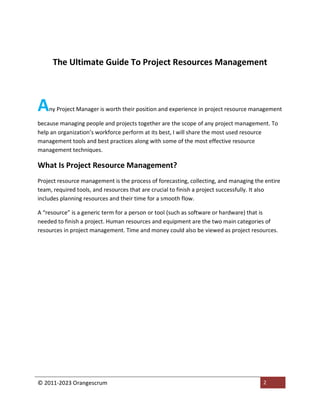
Below are several crucial steps in the project resource management process:
You specify the requirements necessary to complete the project in resource planning. Making a
work breakdown structure or another resource planning visualization may be required. Then
you perform resource allocation (based on the resource availability) and estimate resources for
project delivery to decide how much time each team member will spend working on the
project.
Following the completion of project planning, you must obtain resources (internally or
externally) to finish the work before building and overseeing the project team. Finally, you
evaluate resources frequently to keep an eye on and manage project progress.
Resources are not limitless for any project. This is because not every person assigned to a
project devotes their entire time to it. When resource utilization metrics or the percentage of
time people devote to a project, are calculated, planning, estimating, and resource allocation
become easier. Scope and budget are two additional resource restrictions in addition to time.
When managing new projects, you can use a variety of resource management techniques to
help you get around these restrictions. Here, we’ll go over a few of the most popular methods.
Resource Management
Calculating and allocating resources
Obtaining Resources
Organizing and leading the team
Continuously assessing further resource
needs
© 2011-2023 Orangescrum 4
Resource Loading
Resource loading, which assumes that the project’s start and end dates are fixed, determines
how much work is expected from team members to complete based on their capacity. Noting
that capacity shouldn’t be 100%, the resource load is reduced to 50% or 60% when paid time
off, sick days, and miscellaneous breaks are taken into account.
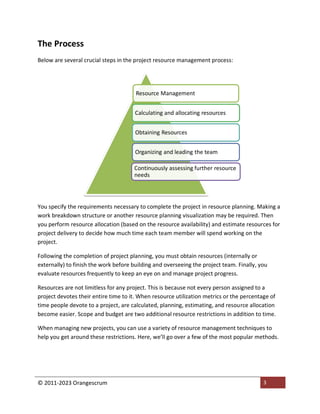
Estimating Resources
Resource Distribution
This must be done in order to perform resource allocation.
Identifying the skill set needed to complete the project’s tasks.
Calculating the number of hours each task will take. Plan your resource capacity, or choose who
will work on what tasks based on their availability and the project schedule.
Resource Management
Techniques for resource optimization strike a balance between supply and demand. To
complete projects on schedule and within budget, resource optimization aims to maximize
available resources. Resource evaluating and resource smoothing are two different types of
resource optimization.
There are two main ways to estimate project
resources:
Bottom-up: Estimate the time each team member will
need to spend on each deliverable from the bottom up.
Top-down: Based on the most important roles necessary
for project success and your project budget as a constraint,
assign human resources to those positions.
© 2011-2023 Orangescrum 5
Resources Evaluating
Calculating the amount of work, you anticipate team members will complete based on capacity
is the first step in resource evaluation, similar to resource loading. Project start and end dates
are flexible based on the available resources, which is the main difference in resource
evaluation.
Resources Smoothing
You can use the resource smoothing technique to reduce demand while remaining within the
given time constraints. Your project’s start and end dates are your main resource constraints
and cannot be changed. Engaging a more seasoned individual who can finish the job in less time
is an example of resource smoothing.
Resource Planning
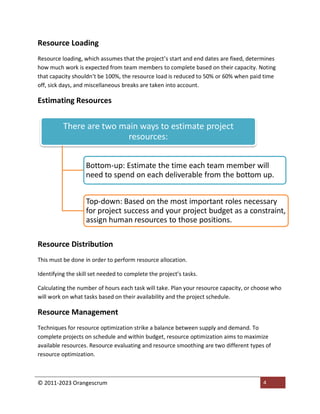
Resource planning makes predictions about future project resource needs. To improve your
forecast and prevent over-allocation, plan periodic project health checks to:
Resources Management Tools
After discussing resource management strategies, we’ll be discussing several tools you can use
to manage your project and team.
Comparing actual costs to the budget
Ensure that team members are engaged in
work that is consistent with their skills and
interests.
Improve project procedures in light of
lessons learned
© 2011-2023 Orangescrum 6
Plans for Resource Management
A project resource management plan specifies distributing, organizing, and utilizing resources
during a project. Resource plans keep accurate data readily available for project stakeholders to
support organizational decision-making.
Resource Calendars
Resource calendars are helpful for scheduling project tasks because they display staffing
availability. Resource calendars should be made at the start of a project and updated frequently
as it moves forward and new information becomes available.
Resource Organization Structure
A resource organization structure, which usually takes the form of a tree diagram or
hierarchical outline, lists the resources needed to complete a project. A resource breakdown
structure lists the people, tools, or other materials, time, and money required to complete the
work, whereas a work breakdown structure lists the tasks necessary to complete project
deliverables.
By aligning team members with necessary tasks, a resource organization structure can highlight
dependencies and enhance project workflows.
Software For Resource Management
Consider using comprehensive resource management software like Orangescrum and others to
manage your team and resources more effectively and complete initiatives more quickly.
Software tools for resource management, such as those for resource planning, resource
allocation, resource scheduling (plus web-based options), and capacity planning, each focus on
a different stage of the project lifecycle.
Project Resource Management Best Practices
Regarding project resource management, below are the project resource management best
practices followed by the most successful teams:
 Observe moderation. Things always take longer than we expect. A realistic buffer
should be included to account for potential delays.
 Keep track of your suppositions. It’s crucial to make your thoughts clear when creating
your resource plan. This aids in coordinating the scope and level of effort with
stakeholders.
© 2011-2023 Orangescrum 7
 Keep an eye on and revise your plan. For your resource management plan to be
effective, it must be a living document. After the project is finished, you can draw
lessons learned that will help you estimate the amount of effort required for future
projects.
Project Resource Management (PRM) is the process of effectively planning, allocating, and
managing the resources (people, equipment, and materials) needed to successfully complete a
project. A PRM guide typically identifies and acquires the resources needed for the project,
including personnel, equipment, and materials. Assigning resources to specific tasks and
ensuring that they are used efficiently and effectively. Monitoring and recording the use of
resources throughout the project, including time and cost data. Continuously reviewing and
adjusting resource allocation to ensure that the project stays on track and within budget.
Identifying and mitigating potential risks related to resource availability and allocation. Ensuring
that all project stakeholders are informed and involved in the resource management process.
Generating reports and using data analytics to track resource usage and identify trends and
patterns. Utilizing industry-standard tools and best practices to improve resource management
processes.
Effective resource management for the success of a project, including the need to plan,
allocate, and track resources effectively. The main goal of PRM is to ensure that the project
stays on schedule, within budget, and meets its objectives. Project resource management with
Orangescrum project management software helps to plan, allocate, and track resources. It also
helps project managers and teams to effectively manage resources, improve communication
and collaboration, and ensure that projects stay on schedule and within budget. Try
Orangescrum with 15 days free trial

The Ultimate Guide To Project Resources Management

  • 1.
  • 2.
    © 2011-2023 Orangescrum2 The Ultimate Guide To Project Resources Management Any Project Manager is worth their position and experience in project resource management because managing people and projects together are the scope of any project management. To help an organization’s workforce perform at its best, I will share the most used resource management tools and best practices along with some of the most effective resource management techniques. What Is Project Resource Management? Project resource management is the process of forecasting, collecting, and managing the entire team, required tools, and resources that are crucial to finish a project successfully. It also includes planning resources and their time for a smooth flow. A “resource” is a generic term for a person or tool (such as software or hardware) that is needed to finish a project. Human resources and equipment are the two main categories of resources in project management. Time and money could also be viewed as project resources.
  • 3.
    © 2011-2023 Orangescrum3 The Process Below are several crucial steps in the project resource management process: You specify the requirements necessary to complete the project in resource planning. Making a work breakdown structure or another resource planning visualization may be required. Then you perform resource allocation (based on the resource availability) and estimate resources for project delivery to decide how much time each team member will spend working on the project. Following the completion of project planning, you must obtain resources (internally or externally) to finish the work before building and overseeing the project team. Finally, you evaluate resources frequently to keep an eye on and manage project progress. Resources are not limitless for any project. This is because not every person assigned to a project devotes their entire time to it. When resource utilization metrics or the percentage of time people devote to a project, are calculated, planning, estimating, and resource allocation become easier. Scope and budget are two additional resource restrictions in addition to time. When managing new projects, you can use a variety of resource management techniques to help you get around these restrictions. Here, we’ll go over a few of the most popular methods. Resource Management Calculating and allocating resources Obtaining Resources Organizing and leading the team Continuously assessing further resource needs
  • 4.
    © 2011-2023 Orangescrum4 Resource Loading Resource loading, which assumes that the project’s start and end dates are fixed, determines how much work is expected from team members to complete based on their capacity. Noting that capacity shouldn’t be 100%, the resource load is reduced to 50% or 60% when paid time off, sick days, and miscellaneous breaks are taken into account. Estimating Resources Resource Distribution This must be done in order to perform resource allocation. Identifying the skill set needed to complete the project’s tasks. Calculating the number of hours each task will take. Plan your resource capacity, or choose who will work on what tasks based on their availability and the project schedule. Resource Management Techniques for resource optimization strike a balance between supply and demand. To complete projects on schedule and within budget, resource optimization aims to maximize available resources. Resource evaluating and resource smoothing are two different types of resource optimization. There are two main ways to estimate project resources: Bottom-up: Estimate the time each team member will need to spend on each deliverable from the bottom up. Top-down: Based on the most important roles necessary for project success and your project budget as a constraint, assign human resources to those positions.
  • 5.
    © 2011-2023 Orangescrum5 Resources Evaluating Calculating the amount of work, you anticipate team members will complete based on capacity is the first step in resource evaluation, similar to resource loading. Project start and end dates are flexible based on the available resources, which is the main difference in resource evaluation. Resources Smoothing You can use the resource smoothing technique to reduce demand while remaining within the given time constraints. Your project’s start and end dates are your main resource constraints and cannot be changed. Engaging a more seasoned individual who can finish the job in less time is an example of resource smoothing. Resource Planning Resource planning makes predictions about future project resource needs. To improve your forecast and prevent over-allocation, plan periodic project health checks to: Resources Management Tools After discussing resource management strategies, we’ll be discussing several tools you can use to manage your project and team. Comparing actual costs to the budget Ensure that team members are engaged in work that is consistent with their skills and interests. Improve project procedures in light of lessons learned
  • 6.
    © 2011-2023 Orangescrum6 Plans for Resource Management A project resource management plan specifies distributing, organizing, and utilizing resources during a project. Resource plans keep accurate data readily available for project stakeholders to support organizational decision-making. Resource Calendars Resource calendars are helpful for scheduling project tasks because they display staffing availability. Resource calendars should be made at the start of a project and updated frequently as it moves forward and new information becomes available. Resource Organization Structure A resource organization structure, which usually takes the form of a tree diagram or hierarchical outline, lists the resources needed to complete a project. A resource breakdown structure lists the people, tools, or other materials, time, and money required to complete the work, whereas a work breakdown structure lists the tasks necessary to complete project deliverables. By aligning team members with necessary tasks, a resource organization structure can highlight dependencies and enhance project workflows. Software For Resource Management Consider using comprehensive resource management software like Orangescrum and others to manage your team and resources more effectively and complete initiatives more quickly. Software tools for resource management, such as those for resource planning, resource allocation, resource scheduling (plus web-based options), and capacity planning, each focus on a different stage of the project lifecycle. Project Resource Management Best Practices Regarding project resource management, below are the project resource management best practices followed by the most successful teams:  Observe moderation. Things always take longer than we expect. A realistic buffer should be included to account for potential delays.  Keep track of your suppositions. It’s crucial to make your thoughts clear when creating your resource plan. This aids in coordinating the scope and level of effort with stakeholders.
  • 7.
    © 2011-2023 Orangescrum7  Keep an eye on and revise your plan. For your resource management plan to be effective, it must be a living document. After the project is finished, you can draw lessons learned that will help you estimate the amount of effort required for future projects. Project Resource Management (PRM) is the process of effectively planning, allocating, and managing the resources (people, equipment, and materials) needed to successfully complete a project. A PRM guide typically identifies and acquires the resources needed for the project, including personnel, equipment, and materials. Assigning resources to specific tasks and ensuring that they are used efficiently and effectively. Monitoring and recording the use of resources throughout the project, including time and cost data. Continuously reviewing and adjusting resource allocation to ensure that the project stays on track and within budget. Identifying and mitigating potential risks related to resource availability and allocation. Ensuring that all project stakeholders are informed and involved in the resource management process. Generating reports and using data analytics to track resource usage and identify trends and patterns. Utilizing industry-standard tools and best practices to improve resource management processes. Effective resource management for the success of a project, including the need to plan, allocate, and track resources effectively. The main goal of PRM is to ensure that the project stays on schedule, within budget, and meets its objectives. Project resource management with Orangescrum project management software helps to plan, allocate, and track resources. It also helps project managers and teams to effectively manage resources, improve communication and collaboration, and ensure that projects stay on schedule and within budget. Try Orangescrum with 15 days free trial