RESINS AND RESIN COMBINATION
1
Resins
 The term ‘resin’ is applied to more or less solid, amorphous
products of complex chemical nature.
 These are amorphous mixtures of essential oils, oxygenated
products of terpenes and carboxylic acids.
 Resins and related resinous products are produced in plants
during normal growth or secreted as a result of injury to the
plants.
 They are end product of metabolism.
2
General Properties
Physical nature
 Brittle, amorphous solids
 Hard, transparent or translucent.
 Insoluble in water.
 Dissolve in alcohol, chloroform and ether.
 When heated, they become soft yielding clear, adhesive
fluids (melt)
 On evaporation, these solutions deposit resin as a varnish-
like film.
3
Chemical Nature
 Chemically, resins are complex mixtures of
 resin acids,
 resin alcohols,
 resinotannols,
 resin esters, and
 resenes.
 Resins do not contain nitrogen elements
(Non nitrogenous compounds).
 Many resins ,when boiled with alkalis yield soaps.
4
Resine acid
 are mixtures of large proportion of diterpenoid oxyacids,
carboxylic acids and phenolic acids
 Occur both in free state and as esters.
 Soluble in aqueous solution of alkalis, forming soap like
solutions or colloidal suspensions.
 Used in manufacture of soaps and varnishes.
Examples:
 Abietic acids present in rose or colophony
 Copaivic acid present in copaiba
 Commiphoric acid present in myrrh
5
Resin Ester:
• This group contains esters as the chief constituents
of the resins
• Examples:
 Benzoin and Storax ,
 Benzoin contains benzyl benzoate,
 Storax contains cinnamyl cinnamate
6
Resin Alcohols:
• These are complex alcohols of high molecular weights
• Present in free state or as ester of simple aromatic acids
like benzoic acid, cinnamic acid, and salicylic acid
• Resin alcohols are further subdivided into:
I. Resinotannols (resin phenols)
– have tannin like properties and form blue color with
ferric chloride
Example: Aloeresinotannol from aloe
II. Resinols
– are high molecular weight non phenolic alcohols which
do not give tannin reaction with iron salts
Example: Benzoresinol from benzoin
7
Are complex neutral substances that do not respond to any
chemical reactions
Are insoluble in alkalis and acids,
Do not form salts or esters and resist hydrolysis by alkalis
Example: alban and fluvial from gutta percha
Resenes
8
Classification of resines
On the basis of their occurrence in combination with other
compounds, resins are classified as:
1. Glycoresins (glucoresin)
2. Oleoresin
3. Oleo-gum resin
4. Gum resin
5. Balsams
9
Glycoresins
Resins in combination with glycosides are known as
glucoresins or glycoresins.
These are complex mixtures.
On hydrolysis, they yield sugars and complex resin
acids.
examples:
– Jalap
– Podophyllum
10
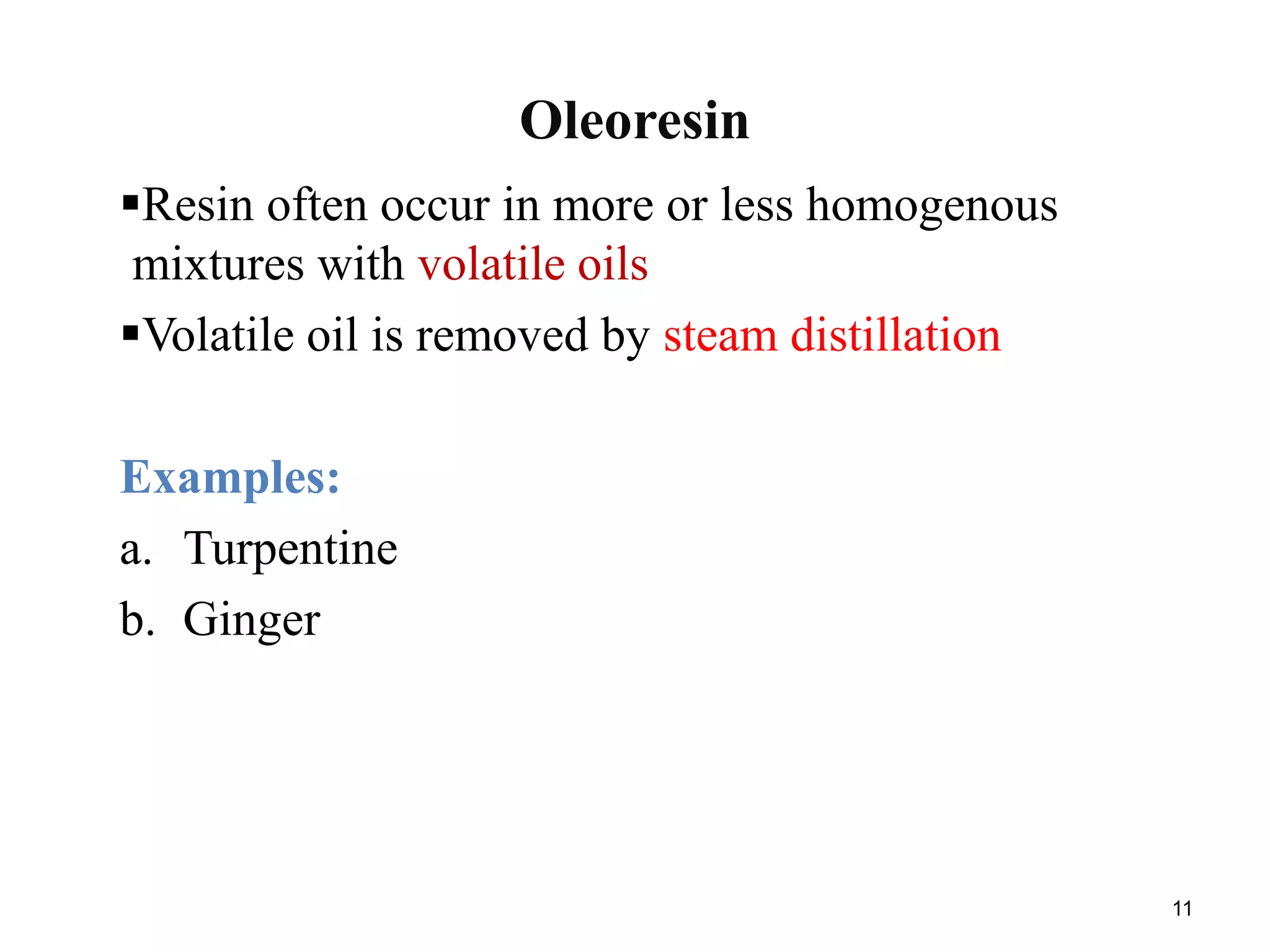
Oleoresin
Resin often occur in more or less homogenous
mixtures with volatile oils
Volatile oil is removed by steam distillation
Examples:
a. Turpentine
b. Ginger
11
Oleo-gum resin
• Resins associated with both gums and volatile
• The volatile oil is removed by steam distillation
• Dissolving in water separates the gum, because gums
are water-soluble carbohydrate derivatives
Examples:
• pomoea
• Myrrh
12
Gum resin
• Resins that occur in combination with gums
• Dissolving the associated gums in water can purify
these resins
– Asafoetida
– Gamboge
– Myrrh
13
Balsams
• Resinous substances containing high proportions
of balsamic acid (benzoic acid, cinnamic acid
etc) either in free or in combination or their esters
• Tolu balsam
• Benzoin
• Peru balsam
• Storax
14
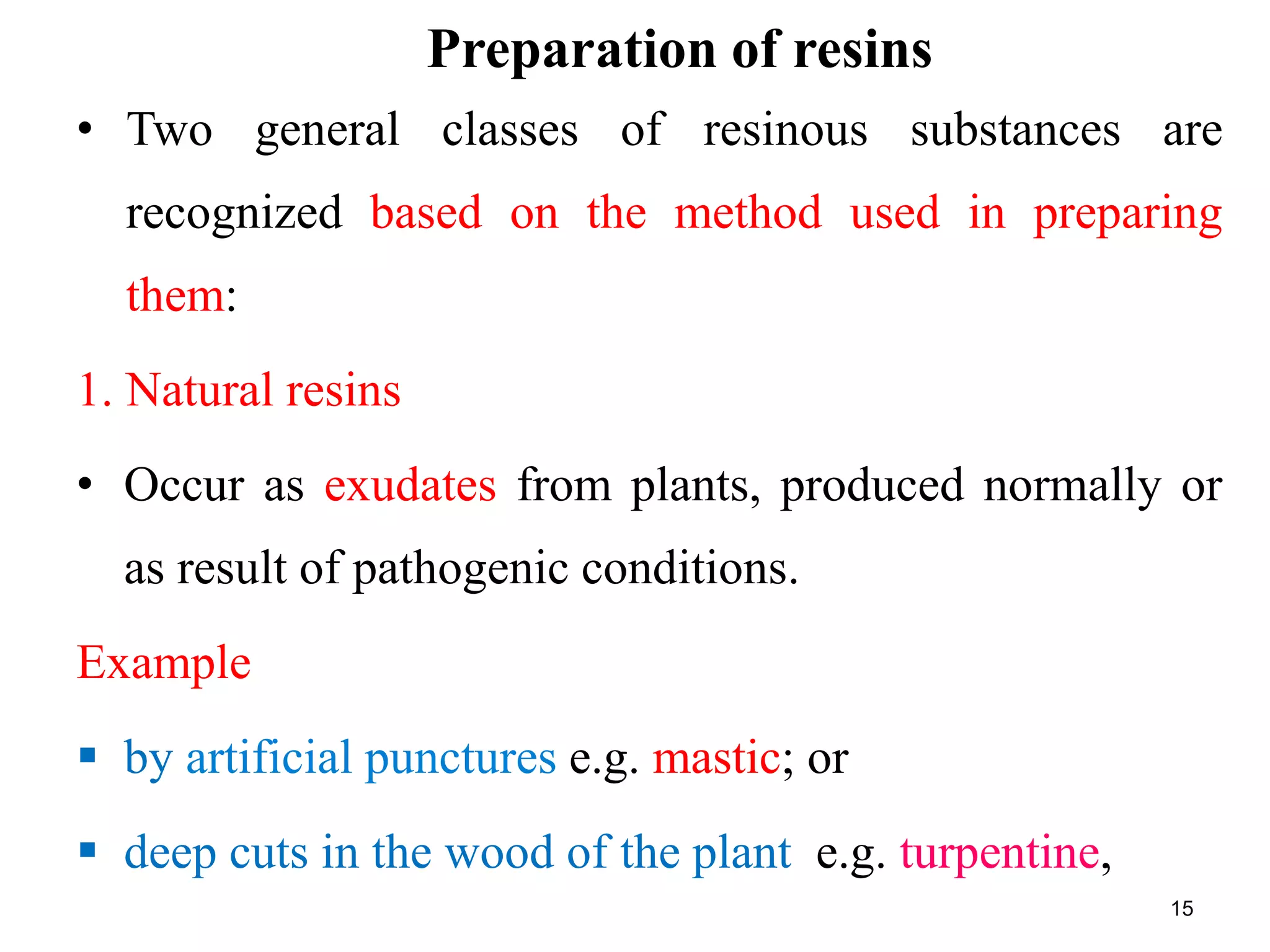
Preparation of resins
• Two general classes of resinous substances are
recognized based on the method used in preparing
them:
1. Natural resins
• Occur as exudates from plants, produced normally or
as result of pathogenic conditions.
Example
 by artificial punctures e.g. mastic; or
 deep cuts in the wood of the plant e.g. turpentine,
15
2. Prepared resins
• are obtained by different methods.
• The drug containing resins is powdered and extracted
with alcohol till exhaustion.
• The Concentrated alcoholic extract is either
evaporated, or poured into water and the precipitated
resin is collected, washed and carefully dried.
16
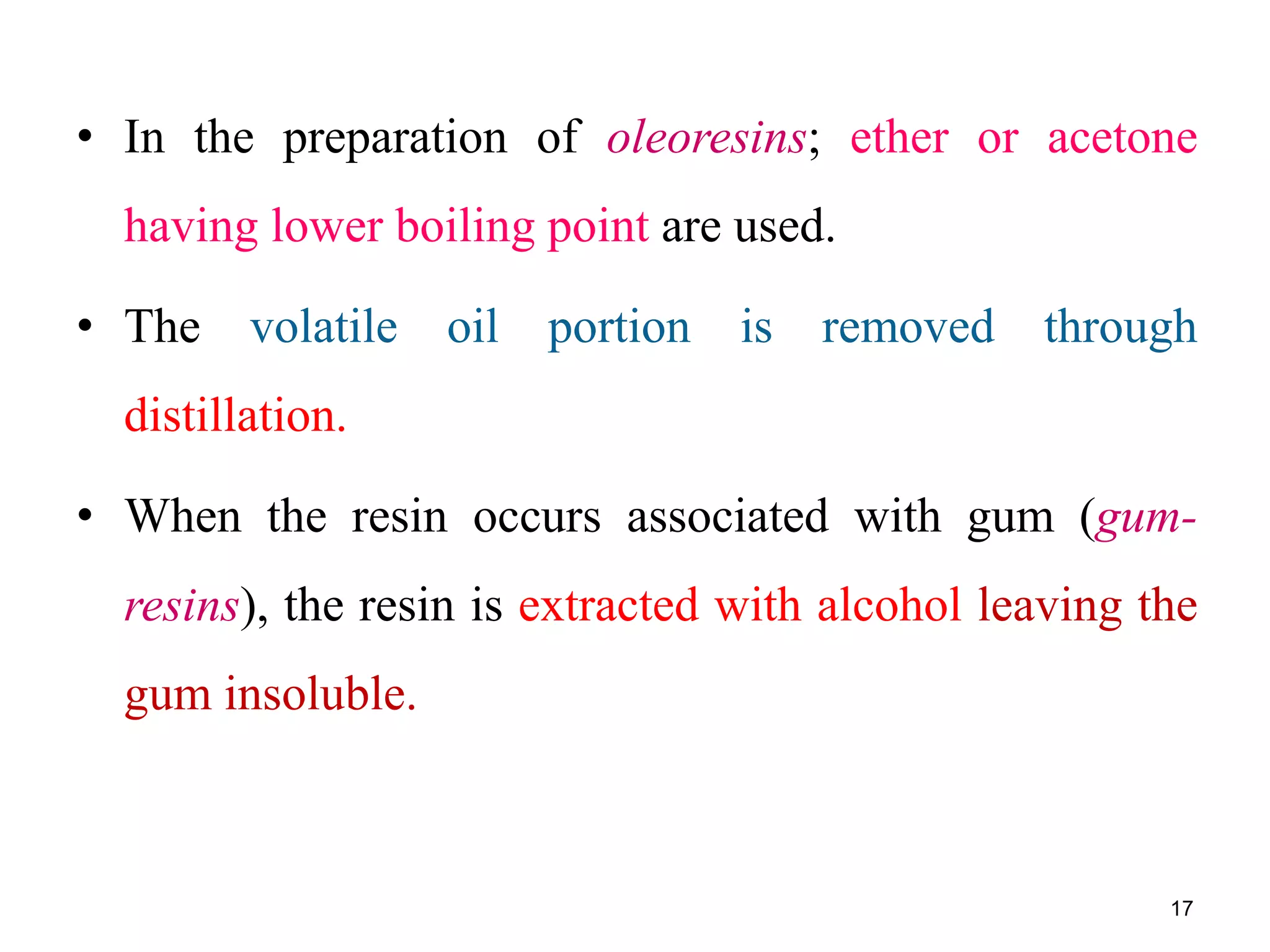
• In the preparation of oleoresins; ether or acetone
having lower boiling point are used.
• The volatile oil portion is removed through
distillation.
• When the resin occurs associated with gum (gum-
resins), the resin is extracted with alcohol leaving the
gum insoluble.
17
Crude drugs containing resins and resin
combinations
18
Resins
1. Rosin
Synonyms:
Rosin
Colophony
Chir
From Pinus
palustris (Pinaceae)
Part used:
Solid Resin
19
Constituents:
• Sylvic acid
• Sapinic acid
• Pimaric acid
• Resene etc
Uses:
• As stiffening agent in plasters, and ointments
• As a diuretic in veterinary medicine.
• Manufacture of varnishes and paint dyers, printing
inks, soaps, sealing wax, floor coverings etc.
• As an adulterant of other resinous products.
20
2. Cannabis
• Indian hemp
• Marijuana
• Pot
From Cannabis
sativa (Moraceae)
Part used:
• Dried flowering
parts of the pistillate
plants of Cannabis.
21
Constituents:
• 15-20% of resin, which contain
major active principle 1,3,4 Tetra
hydro cannabinol.
• Cannabidiol
• Cannabidiolic acid etc.
Uses (drug of abuse)
• Sedative, Hypnotic, Narcotic
analgesic, Antibacterial agent
• psychotropic properties due to
1,3,4 Tetra hydro cannabinol.
Glycoresins
1. Podophyllum
• May Apple
• Mandrake
• From Podophyllum
peltatum and
Podophyllum emodi
(Berberidaceae)
• Part used is dried rhizome
and root
22
Chemical constituents:
• 3.5 - 6% resin whose active
principles are lignans. These
include:
Podophyllotoxin
Alpha- peltatin
Beta- peltatin
Uses:
• Possess purgative properties.
• Resin is antimitotic and caustic.
• As a bitter tonic.
2. Jalap
• Jalap
• Jalap root
• From Exogonium purga
(Convolvulaceae)
• Part used is dried, tuberous root.
constituents
Resins including glycosides such
as:
• Ipurganol
• Jalapin
• Volatile oil , Starch, Gum
23
Uses:
• Cathartic
• Purgative
Oleoresins
1. Turpentine
– Gum turpentine
– Gum thus
• From Pinus palustris (Pinaceae)
• Turpentine is concrete oleoresin obtained
from Pinus species
• The oleoresin is secreted in ducts located
directly beneath the cambium in the sap-
wood.
Constituents:
• Volatile oil
• Resin
Uses: Employed externally as counter-irritant.
24
2. Capsicum
• Capsicum
• Chillies
• Cayenne pepper
• From Capsicum frutescens (African chillies)
• Capsicum annum (tabasco pepper) (Solanaceae)
• Part used is dried, ripe fruit
Constituents
• Capsaicin, extremely pungent principle
• Red coloring matter Capsanthin
• Volatile oils
• Fixed oils
• Carotenoids
• Ascorbic acid (vitamin C)
25
Uses:
• Irritant and carminative
• As a nerve stimulant and condiment.
• As a source of vitamin- C.
• As an appetizer.
• As a stomachic
3. Ginger
• From Zingiber officinale
(Zingiberaceae)
• Part used is dried rhizome
Constituents:
• Aroma is due to volatile oil whose
principle constituents are
sesquiterpenes:
– Zingiberene
– Zingiberol
• Pungency is due to ginger oleo
resins
– Zingerone
• In addition it contains 50% starch.
26
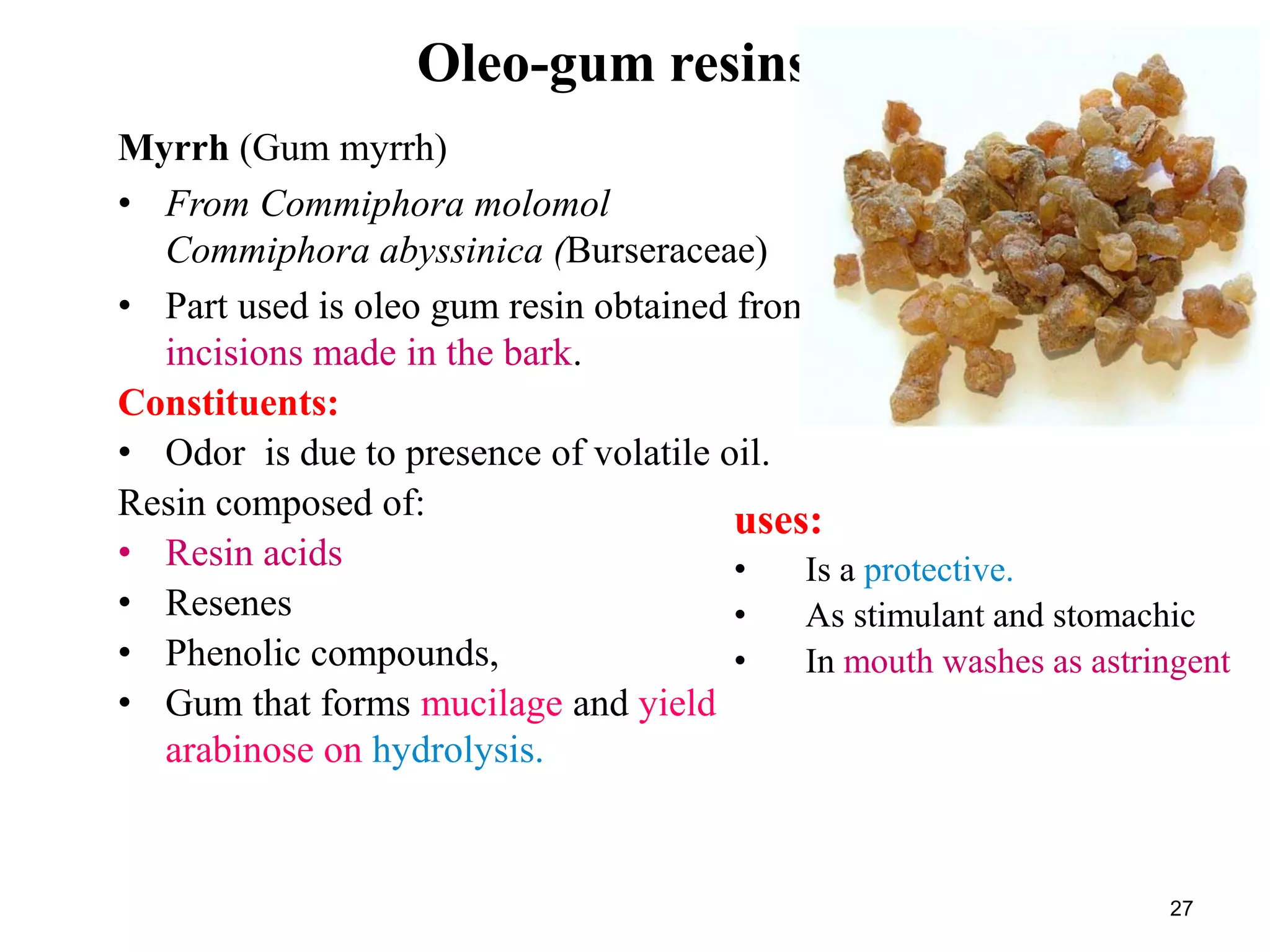
Oleo-gum resins
Myrrh (Gum myrrh)
• From Commiphora molomol
Commiphora abyssinica (Burseraceae)
• Part used is oleo gum resin obtained from
incisions made in the bark.
Constituents:
• Odor is due to presence of volatile oil.
Resin composed of:
• Resin acids
• Resenes
• Phenolic compounds,
• Gum that forms mucilage and yield
arabinose on hydrolysis.
27
uses:
• Is a protective.
• As stimulant and stomachic
• In mouth washes as astringent

RESINES.ppt

  • 1.
    RESINS AND RESINCOMBINATION 1
  • 2.
    Resins  The term‘resin’ is applied to more or less solid, amorphous products of complex chemical nature.  These are amorphous mixtures of essential oils, oxygenated products of terpenes and carboxylic acids.  Resins and related resinous products are produced in plants during normal growth or secreted as a result of injury to the plants.  They are end product of metabolism. 2
  • 3.
    General Properties Physical nature Brittle, amorphous solids  Hard, transparent or translucent.  Insoluble in water.  Dissolve in alcohol, chloroform and ether.  When heated, they become soft yielding clear, adhesive fluids (melt)  On evaporation, these solutions deposit resin as a varnish- like film. 3
  • 4.
    Chemical Nature  Chemically,resins are complex mixtures of  resin acids,  resin alcohols,  resinotannols,  resin esters, and  resenes.  Resins do not contain nitrogen elements (Non nitrogenous compounds).  Many resins ,when boiled with alkalis yield soaps. 4
  • 5.
    Resine acid  aremixtures of large proportion of diterpenoid oxyacids, carboxylic acids and phenolic acids  Occur both in free state and as esters.  Soluble in aqueous solution of alkalis, forming soap like solutions or colloidal suspensions.  Used in manufacture of soaps and varnishes. Examples:  Abietic acids present in rose or colophony  Copaivic acid present in copaiba  Commiphoric acid present in myrrh 5
  • 6.
    Resin Ester: • Thisgroup contains esters as the chief constituents of the resins • Examples:  Benzoin and Storax ,  Benzoin contains benzyl benzoate,  Storax contains cinnamyl cinnamate 6
  • 7.
    Resin Alcohols: • Theseare complex alcohols of high molecular weights • Present in free state or as ester of simple aromatic acids like benzoic acid, cinnamic acid, and salicylic acid • Resin alcohols are further subdivided into: I. Resinotannols (resin phenols) – have tannin like properties and form blue color with ferric chloride Example: Aloeresinotannol from aloe II. Resinols – are high molecular weight non phenolic alcohols which do not give tannin reaction with iron salts Example: Benzoresinol from benzoin 7
  • 8.
    Are complex neutralsubstances that do not respond to any chemical reactions Are insoluble in alkalis and acids, Do not form salts or esters and resist hydrolysis by alkalis Example: alban and fluvial from gutta percha Resenes 8
  • 9.
    Classification of resines Onthe basis of their occurrence in combination with other compounds, resins are classified as: 1. Glycoresins (glucoresin) 2. Oleoresin 3. Oleo-gum resin 4. Gum resin 5. Balsams 9
  • 10.
    Glycoresins Resins in combinationwith glycosides are known as glucoresins or glycoresins. These are complex mixtures. On hydrolysis, they yield sugars and complex resin acids. examples: – Jalap – Podophyllum 10
  • 11.
    Oleoresin Resin often occurin more or less homogenous mixtures with volatile oils Volatile oil is removed by steam distillation Examples: a. Turpentine b. Ginger 11
  • 12.
    Oleo-gum resin • Resinsassociated with both gums and volatile • The volatile oil is removed by steam distillation • Dissolving in water separates the gum, because gums are water-soluble carbohydrate derivatives Examples: • pomoea • Myrrh 12
  • 13.
    Gum resin • Resinsthat occur in combination with gums • Dissolving the associated gums in water can purify these resins – Asafoetida – Gamboge – Myrrh 13
  • 14.
    Balsams • Resinous substancescontaining high proportions of balsamic acid (benzoic acid, cinnamic acid etc) either in free or in combination or their esters • Tolu balsam • Benzoin • Peru balsam • Storax 14
  • 15.
    Preparation of resins •Two general classes of resinous substances are recognized based on the method used in preparing them: 1. Natural resins • Occur as exudates from plants, produced normally or as result of pathogenic conditions. Example  by artificial punctures e.g. mastic; or  deep cuts in the wood of the plant e.g. turpentine, 15
  • 16.
    2. Prepared resins •are obtained by different methods. • The drug containing resins is powdered and extracted with alcohol till exhaustion. • The Concentrated alcoholic extract is either evaporated, or poured into water and the precipitated resin is collected, washed and carefully dried. 16
  • 17.
    • In thepreparation of oleoresins; ether or acetone having lower boiling point are used. • The volatile oil portion is removed through distillation. • When the resin occurs associated with gum (gum- resins), the resin is extracted with alcohol leaving the gum insoluble. 17
  • 18.
    Crude drugs containingresins and resin combinations 18
  • 19.
    Resins 1. Rosin Synonyms: Rosin Colophony Chir From Pinus palustris(Pinaceae) Part used: Solid Resin 19 Constituents: • Sylvic acid • Sapinic acid • Pimaric acid • Resene etc
  • 20.
    Uses: • As stiffeningagent in plasters, and ointments • As a diuretic in veterinary medicine. • Manufacture of varnishes and paint dyers, printing inks, soaps, sealing wax, floor coverings etc. • As an adulterant of other resinous products. 20
  • 21.
    2. Cannabis • Indianhemp • Marijuana • Pot From Cannabis sativa (Moraceae) Part used: • Dried flowering parts of the pistillate plants of Cannabis. 21 Constituents: • 15-20% of resin, which contain major active principle 1,3,4 Tetra hydro cannabinol. • Cannabidiol • Cannabidiolic acid etc. Uses (drug of abuse) • Sedative, Hypnotic, Narcotic analgesic, Antibacterial agent • psychotropic properties due to 1,3,4 Tetra hydro cannabinol.
  • 22.
    Glycoresins 1. Podophyllum • MayApple • Mandrake • From Podophyllum peltatum and Podophyllum emodi (Berberidaceae) • Part used is dried rhizome and root 22 Chemical constituents: • 3.5 - 6% resin whose active principles are lignans. These include: Podophyllotoxin Alpha- peltatin Beta- peltatin Uses: • Possess purgative properties. • Resin is antimitotic and caustic. • As a bitter tonic.
  • 23.
    2. Jalap • Jalap •Jalap root • From Exogonium purga (Convolvulaceae) • Part used is dried, tuberous root. constituents Resins including glycosides such as: • Ipurganol • Jalapin • Volatile oil , Starch, Gum 23 Uses: • Cathartic • Purgative
  • 24.
    Oleoresins 1. Turpentine – Gumturpentine – Gum thus • From Pinus palustris (Pinaceae) • Turpentine is concrete oleoresin obtained from Pinus species • The oleoresin is secreted in ducts located directly beneath the cambium in the sap- wood. Constituents: • Volatile oil • Resin Uses: Employed externally as counter-irritant. 24
  • 25.
    2. Capsicum • Capsicum •Chillies • Cayenne pepper • From Capsicum frutescens (African chillies) • Capsicum annum (tabasco pepper) (Solanaceae) • Part used is dried, ripe fruit Constituents • Capsaicin, extremely pungent principle • Red coloring matter Capsanthin • Volatile oils • Fixed oils • Carotenoids • Ascorbic acid (vitamin C) 25 Uses: • Irritant and carminative • As a nerve stimulant and condiment. • As a source of vitamin- C. • As an appetizer. • As a stomachic
  • 26.
    3. Ginger • FromZingiber officinale (Zingiberaceae) • Part used is dried rhizome Constituents: • Aroma is due to volatile oil whose principle constituents are sesquiterpenes: – Zingiberene – Zingiberol • Pungency is due to ginger oleo resins – Zingerone • In addition it contains 50% starch. 26
  • 27.
    Oleo-gum resins Myrrh (Gummyrrh) • From Commiphora molomol Commiphora abyssinica (Burseraceae) • Part used is oleo gum resin obtained from incisions made in the bark. Constituents: • Odor is due to presence of volatile oil. Resin composed of: • Resin acids • Resenes • Phenolic compounds, • Gum that forms mucilage and yield arabinose on hydrolysis. 27 uses: • Is a protective. • As stimulant and stomachic • In mouth washes as astringent