CNS Infections
Dr. ADDISU (MD,MPH)
1
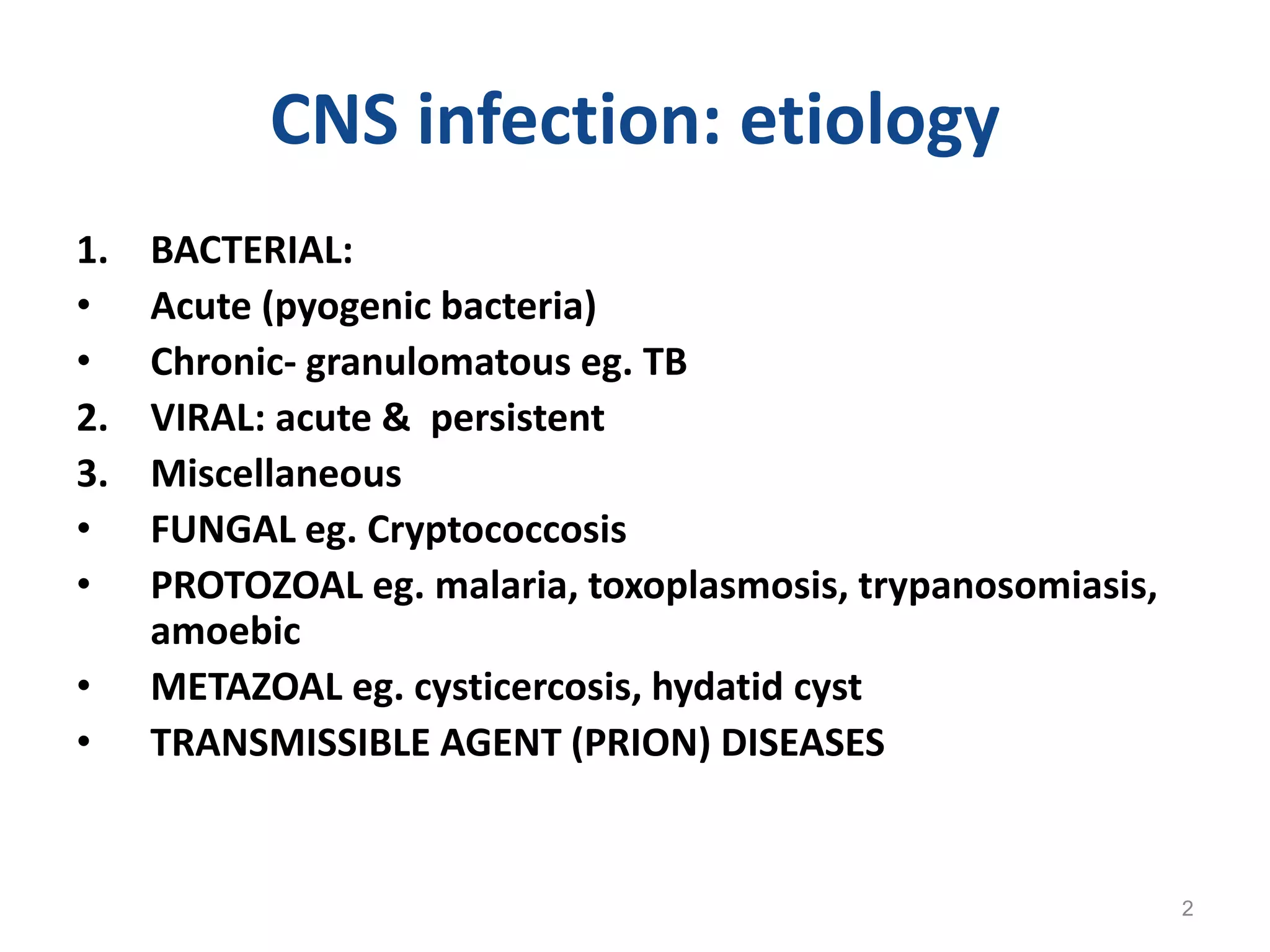
CNS infection: etiology
1. BACTERIAL:
• Acute (pyogenic bacteria)
• Chronic- granulomatous eg. TB
2. VIRAL: acute & persistent
3. Miscellaneous
• FUNGAL eg. Cryptococcosis
• PROTOZOAL eg. malaria, toxoplasmosis, trypanosomiasis,
amoebic
• METAZOAL eg. cysticercosis, hydatid cyst
• TRANSMISSIBLE AGENT (PRION) DISEASES
2
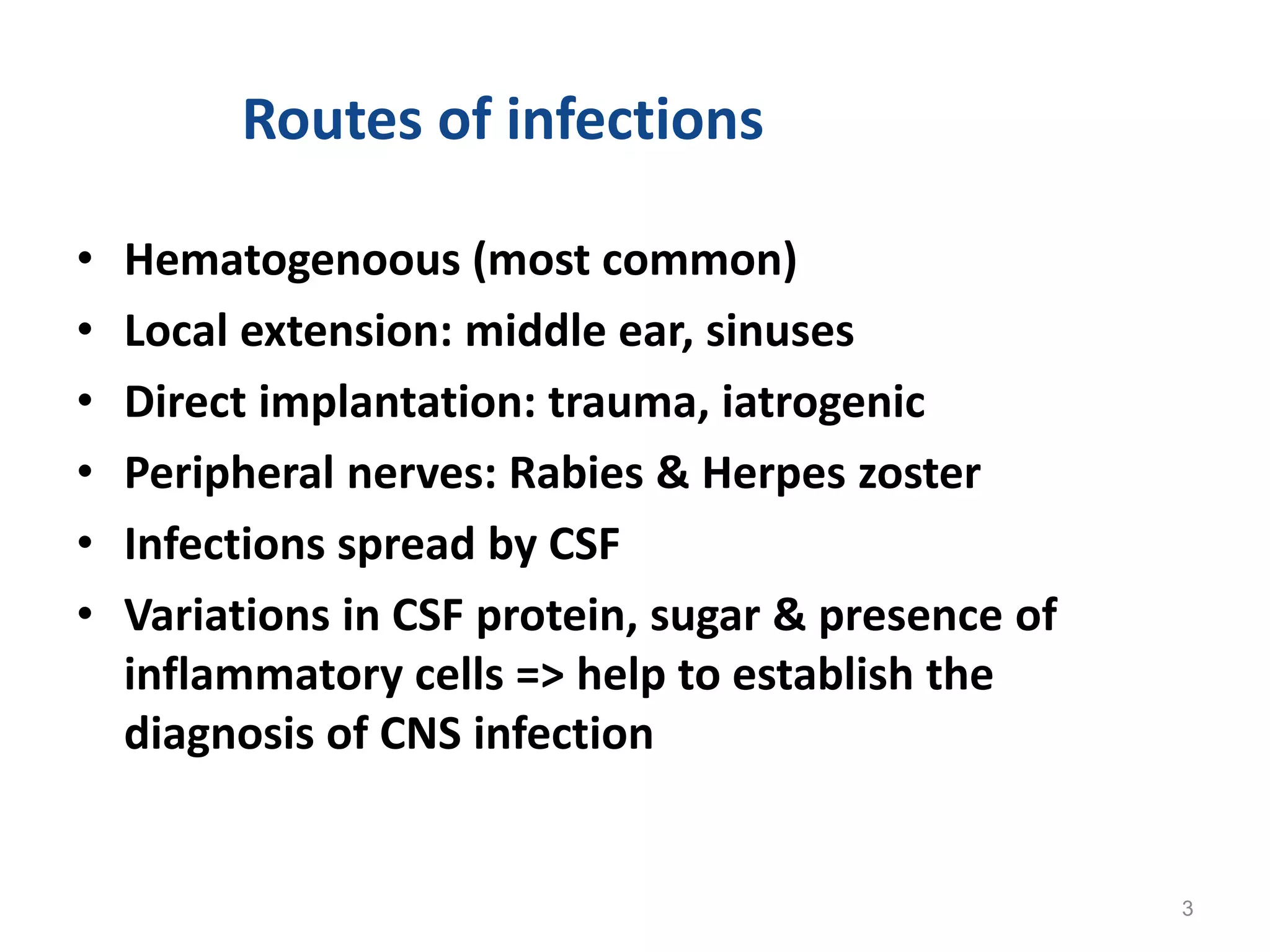
Routes of infections
• Hematogenoous (most common)
• Local extension: middle ear, sinuses
• Direct implantation: trauma, iatrogenic
• Peripheral nerves: Rabies & Herpes zoster
• Infections spread by CSF
• Variations in CSF protein, sugar & presence of
inflammatory cells => help to establish the
diagnosis of CNS infection
3
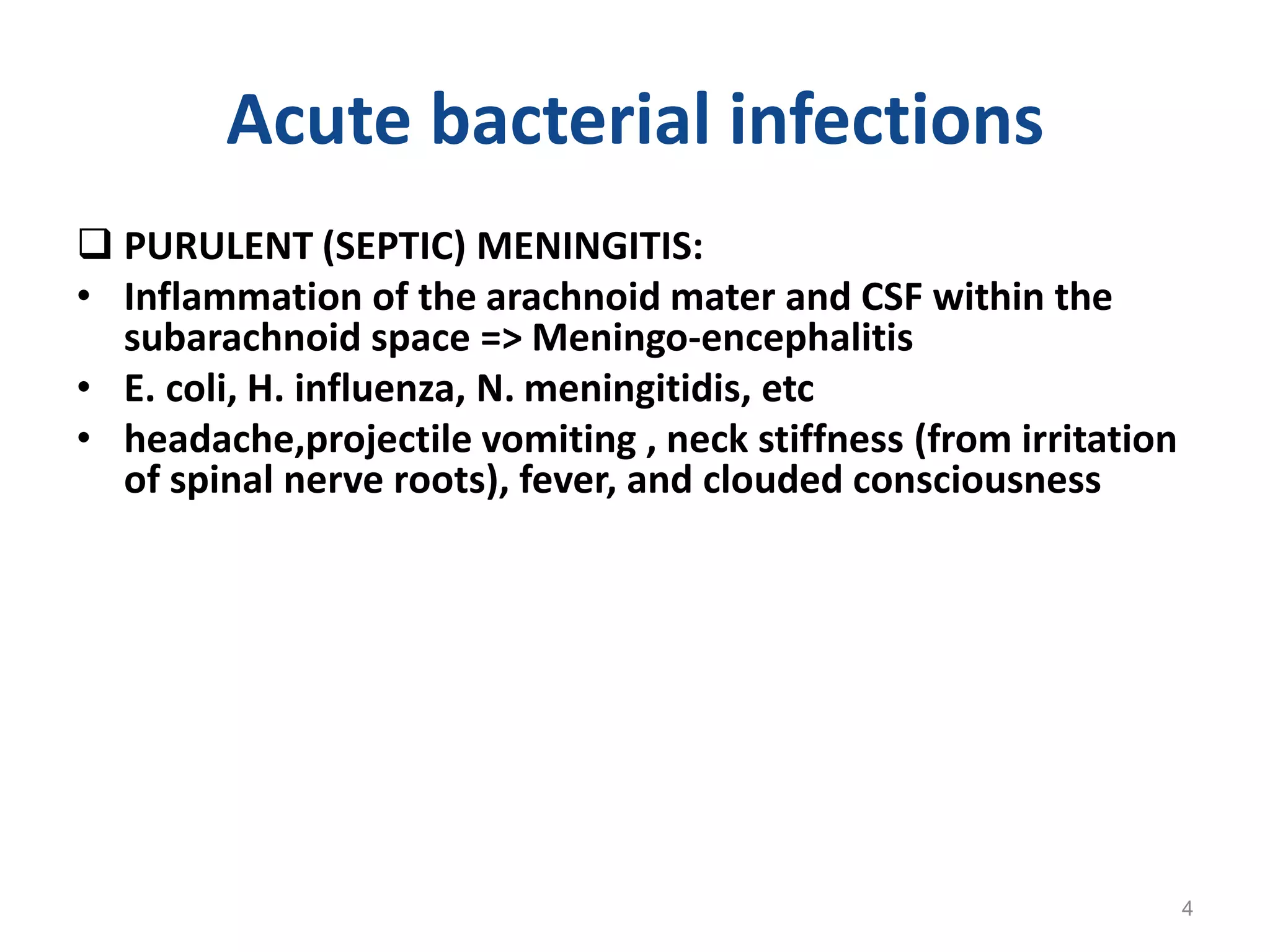
Acute bacterial infections
 PURULENT (SEPTIC) MENINGITIS:
• Inflammation of the arachnoid mater and CSF within the
subarachnoid space => Meningo-encephalitis
• E. coli, H. influenza, N. meningitidis, etc
• headache,projectile vomiting , neck stiffness (from irritation
of spinal nerve roots), fever, and clouded consciousness
4
Meningitis
• Newborn
– Streptococci (Group B)
– E. Coli
– Klebsiella-enterobacter
– Listeria monocytogenes
• Children, adults
– Str. pneumoniae
– Neisseria meningitidis
– Haemophilus influenzae
5
…
• Typical CSF findings low glucose, high protein, and many
PMN's. A gram stain should be done to identify organisms
• Release of cytokines => meningeal inflammation & brain
swelling may be rapid and fatal
• In Gram negative infections => endotoxic shock => severe
hypotension and hypoxic brain damage
• In meningococcal infection, organisms &/or toxins lead to
vascular damage and DIC => petechial haemorrhages =>
hemorrhagic necrosis of the adrenal glands (Waterhouse-
Friderichsen syndrome)
6
Acute Meningitis
• Fever
• Headache
• Altered mental status
• Neck stiffness
• Projectile vomiting
lumbar puncture
2 of 4 in 95%
7
Spinal tap CSF Normal
water clear
pressure 0 – 10 – 15 mmHg
cells: few < 5 l
lymphocytes/mm3
protein small amount
glucose small amount
Meningitis
Cloudy, purulent
Pressure: increased
Cells: up to 90‘000
neutrophils
Protein ;increased
Glucose;decreased
8
Results of Cerebrospinal Fluid Testing.
Samuels MA et al. N Engl J Med 2007;357:1957-1965.
Substance CSF Plasma Ratio
CSF/plasma
Na+ [meq/kg
H2O]
147.0 150.0 0.89
K+ [meq/kg H2O] 2.9 4.6 0.62
Mg++ [meq/kg H2O] 2.2 1.6 1.39
Ca++ [meq/kg H2O] 2.3 4.7 0.49
Osmolality [mosm/kg H2O] 289.0 289.0 1.0
Protein [mg/dl] 20.0 6000.0 0.003
Glucose [mg/dl] 64.0 100.0 0.64
Cholesterol [mg/dl] 0.2 175.0 0.001
9
Neisseria meningitidis
Gram –negative
„Meningococcus“
Streptococcus
pneumoniae
Gram-positive
„Pneumococcus“
10
Purulent meningitis
• Within 24 hours purulent exudate appears on the surface of
the brain => meningoencephalitis => ventriculitis and
choroid plexitis => ventricular empyema => periventricular
necrosis & vasculitis (leading to thrombosis and occlusion)=>
multiple small infarcts “characteristic & early in neonates”
• As early as 48 hours leptomeningeal fibroblastic proliferation
commences => occlusion of the exit foramina of the 4th
ventricle, obliteration of subarachnoid cisterns, or the
arachnoid villi over the convexities=> hydrocephalus
11
Brain abscess
• Raised intracranial pressure, and/or seizures
• Site dependent on routes of infection
• Post-traumatic: adjacent to site of trauma
• Direct spread: frontal sinusitis => frontal lobe
• Haematogenous => usually multiple, often occipital
lobe or along boundary zones
12
Epidural & subdural empyema
• Subdural empyema is usually 20 to sinus or
middle ear infection
• Epidural empyema common in the spine
13
Tuberculous meningitis
• Meningeal exudate (basal) & small
"tubercles" (granulomas)
• Granulation tissue with fibroblasts =>
obstructive hydrocephalus
• Obliterative arteritis of leptomeningeal
vessels => necrosis
• Tuberculomas: single /multiple and
simulating brain tumours
14
NEUROSYPHILIS
• Tertiary stage & 10% in untreated
• Meningovascular disease => obliterative
endarteritis => infarction
• Parenchymatous neurosyphilis (low grade
encephalitis) => neuronal loss and gliosis.
• Frontal lobes => general paralysis of the insane
(GPI)
• Demyelination of posterior columns of the spinal
cord => tabes dorsalis
15
VIRAL INFECTIONS
• Meningitis, encephalitis or myelitis
• Immunoallergic reactions perivenous
demyelination or encephalitis following
rabies vaccination
• Actual invasion of the CNS by the virus
• Persistent (slow viral) infections =>
degeneration of neurons/myelin
16
Pathology of viral infections
• Predominantly in grey matter
• Neuronal death & neuronophagia
• Microglial clusters, lymphoplasmacytic
perivascular infiltates
• Viral inclusion bodies (intranuclear or
intracytoplasmic) in neurones or glia
17
Acute viral encephalomyelitis
• POLIOVIRUS attacks neurones of the anterior horns,
brain stem motor nuclei, and motor cortex =>
Wallerian degeneration of axons and neurogenic
atrophy of muscles
• RABIES - the virus enters via peripheral nerves;
diagnostic intracytoplasmic inclusions in pyramidal
neurones (Negri bodies)
• HERPES SIMPLEX ENCEPHALITIS - pantropic reaction
=> acute necrotising encephalitis
18
Subacute & chronic (persistent) viral
infections
Subacute sclerosing panencephalitis (SSPE)
 Children, following measles, atrophic brain and
death within 1-2 yrs
Progressive multifocal leukoencephalopathy (PML)
20 to JC virus polyomavirus and in
immunosuppressed individuals (eg, AIDS)
 Virus destroys oligodendroglial cells => focal
demyelination
19
HIV/AIDS: HIV specific damage
• HIV encephalopathy: multinucleate giant cell
• HIV encephalitis (HIVE): multiple
microgranulomatous foci
• HIV leucoencephalopathy (HIVL) => diffuse or
focal loss of myelin, reactive astrogliosis,
macrophages and multinucleate giant cells
20
HIV-ASSOCIATED PATHOLOGY
• Diffuse myelin palor, Vacuolar myelopathy or
leucoencephalopathy
• Diffuse poliodystrophy, Lymphocytic
meningitis, Spongiform encephalopathy
• Cerebral vasculitis, AIDS associated myopathy
& peripheral neuropathy
21
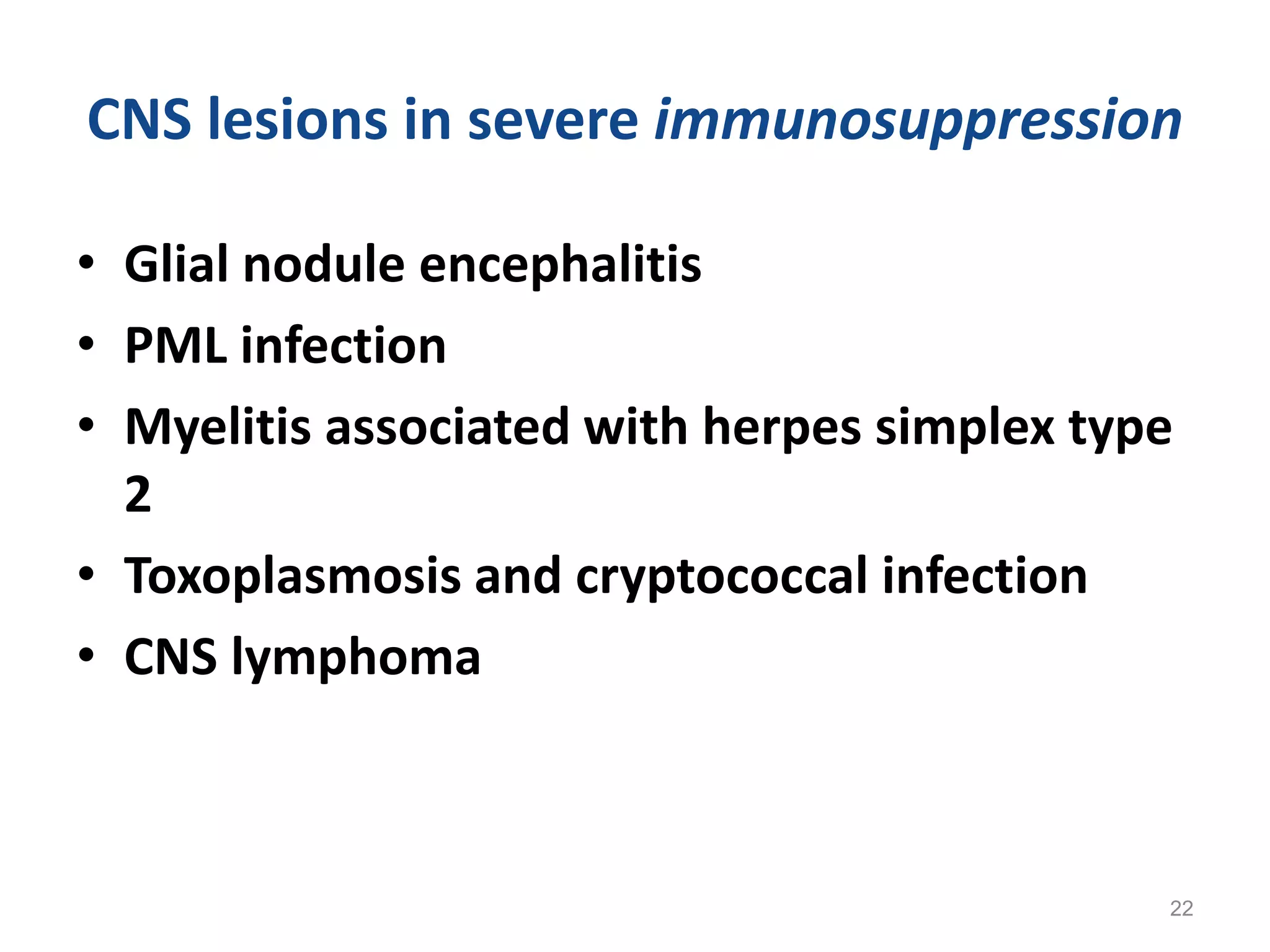
CNS lesions in severe immunosuppression
• Glial nodule encephalitis
• PML infection
• Myelitis associated with herpes simplex type
2
• Toxoplasmosis and cryptococcal infection
• CNS lymphoma
22
HIV HIV-associated
[opportunistic]
CNS Lymphoma
CNS and HIV
Papovavirus (J C Virus)
Progressive multifocal
leukencephalopathy
Toxoplasma Gondii
Cryptococcus
neoformans
HIV meningoencephalitis
(subacute, giant cells)
Intravascular B-cell
Lymphoma
23

2.CNS INFECTIONS 2015.pptx

  • 1.
  • 2.
    CNS infection: etiology 1.BACTERIAL: • Acute (pyogenic bacteria) • Chronic- granulomatous eg. TB 2. VIRAL: acute & persistent 3. Miscellaneous • FUNGAL eg. Cryptococcosis • PROTOZOAL eg. malaria, toxoplasmosis, trypanosomiasis, amoebic • METAZOAL eg. cysticercosis, hydatid cyst • TRANSMISSIBLE AGENT (PRION) DISEASES 2
  • 3.
    Routes of infections •Hematogenoous (most common) • Local extension: middle ear, sinuses • Direct implantation: trauma, iatrogenic • Peripheral nerves: Rabies & Herpes zoster • Infections spread by CSF • Variations in CSF protein, sugar & presence of inflammatory cells => help to establish the diagnosis of CNS infection 3
  • 4.
    Acute bacterial infections PURULENT (SEPTIC) MENINGITIS: • Inflammation of the arachnoid mater and CSF within the subarachnoid space => Meningo-encephalitis • E. coli, H. influenza, N. meningitidis, etc • headache,projectile vomiting , neck stiffness (from irritation of spinal nerve roots), fever, and clouded consciousness 4
  • 5.
    Meningitis • Newborn – Streptococci(Group B) – E. Coli – Klebsiella-enterobacter – Listeria monocytogenes • Children, adults – Str. pneumoniae – Neisseria meningitidis – Haemophilus influenzae 5
  • 6.
    … • Typical CSFfindings low glucose, high protein, and many PMN's. A gram stain should be done to identify organisms • Release of cytokines => meningeal inflammation & brain swelling may be rapid and fatal • In Gram negative infections => endotoxic shock => severe hypotension and hypoxic brain damage • In meningococcal infection, organisms &/or toxins lead to vascular damage and DIC => petechial haemorrhages => hemorrhagic necrosis of the adrenal glands (Waterhouse- Friderichsen syndrome) 6
  • 7.
    Acute Meningitis • Fever •Headache • Altered mental status • Neck stiffness • Projectile vomiting lumbar puncture 2 of 4 in 95% 7
  • 8.
    Spinal tap CSFNormal water clear pressure 0 – 10 – 15 mmHg cells: few < 5 l lymphocytes/mm3 protein small amount glucose small amount Meningitis Cloudy, purulent Pressure: increased Cells: up to 90‘000 neutrophils Protein ;increased Glucose;decreased 8
  • 9.
    Results of CerebrospinalFluid Testing. Samuels MA et al. N Engl J Med 2007;357:1957-1965. Substance CSF Plasma Ratio CSF/plasma Na+ [meq/kg H2O] 147.0 150.0 0.89 K+ [meq/kg H2O] 2.9 4.6 0.62 Mg++ [meq/kg H2O] 2.2 1.6 1.39 Ca++ [meq/kg H2O] 2.3 4.7 0.49 Osmolality [mosm/kg H2O] 289.0 289.0 1.0 Protein [mg/dl] 20.0 6000.0 0.003 Glucose [mg/dl] 64.0 100.0 0.64 Cholesterol [mg/dl] 0.2 175.0 0.001 9
  • 10.
  • 11.
    Purulent meningitis • Within24 hours purulent exudate appears on the surface of the brain => meningoencephalitis => ventriculitis and choroid plexitis => ventricular empyema => periventricular necrosis & vasculitis (leading to thrombosis and occlusion)=> multiple small infarcts “characteristic & early in neonates” • As early as 48 hours leptomeningeal fibroblastic proliferation commences => occlusion of the exit foramina of the 4th ventricle, obliteration of subarachnoid cisterns, or the arachnoid villi over the convexities=> hydrocephalus 11
  • 12.
    Brain abscess • Raisedintracranial pressure, and/or seizures • Site dependent on routes of infection • Post-traumatic: adjacent to site of trauma • Direct spread: frontal sinusitis => frontal lobe • Haematogenous => usually multiple, often occipital lobe or along boundary zones 12
  • 13.
    Epidural & subduralempyema • Subdural empyema is usually 20 to sinus or middle ear infection • Epidural empyema common in the spine 13
  • 14.
    Tuberculous meningitis • Meningealexudate (basal) & small "tubercles" (granulomas) • Granulation tissue with fibroblasts => obstructive hydrocephalus • Obliterative arteritis of leptomeningeal vessels => necrosis • Tuberculomas: single /multiple and simulating brain tumours 14
  • 15.
    NEUROSYPHILIS • Tertiary stage& 10% in untreated • Meningovascular disease => obliterative endarteritis => infarction • Parenchymatous neurosyphilis (low grade encephalitis) => neuronal loss and gliosis. • Frontal lobes => general paralysis of the insane (GPI) • Demyelination of posterior columns of the spinal cord => tabes dorsalis 15
  • 16.
    VIRAL INFECTIONS • Meningitis,encephalitis or myelitis • Immunoallergic reactions perivenous demyelination or encephalitis following rabies vaccination • Actual invasion of the CNS by the virus • Persistent (slow viral) infections => degeneration of neurons/myelin 16
  • 17.
    Pathology of viralinfections • Predominantly in grey matter • Neuronal death & neuronophagia • Microglial clusters, lymphoplasmacytic perivascular infiltates • Viral inclusion bodies (intranuclear or intracytoplasmic) in neurones or glia 17
  • 18.
    Acute viral encephalomyelitis •POLIOVIRUS attacks neurones of the anterior horns, brain stem motor nuclei, and motor cortex => Wallerian degeneration of axons and neurogenic atrophy of muscles • RABIES - the virus enters via peripheral nerves; diagnostic intracytoplasmic inclusions in pyramidal neurones (Negri bodies) • HERPES SIMPLEX ENCEPHALITIS - pantropic reaction => acute necrotising encephalitis 18
  • 19.
    Subacute & chronic(persistent) viral infections Subacute sclerosing panencephalitis (SSPE)  Children, following measles, atrophic brain and death within 1-2 yrs Progressive multifocal leukoencephalopathy (PML) 20 to JC virus polyomavirus and in immunosuppressed individuals (eg, AIDS)  Virus destroys oligodendroglial cells => focal demyelination 19
  • 20.
    HIV/AIDS: HIV specificdamage • HIV encephalopathy: multinucleate giant cell • HIV encephalitis (HIVE): multiple microgranulomatous foci • HIV leucoencephalopathy (HIVL) => diffuse or focal loss of myelin, reactive astrogliosis, macrophages and multinucleate giant cells 20
  • 21.
    HIV-ASSOCIATED PATHOLOGY • Diffusemyelin palor, Vacuolar myelopathy or leucoencephalopathy • Diffuse poliodystrophy, Lymphocytic meningitis, Spongiform encephalopathy • Cerebral vasculitis, AIDS associated myopathy & peripheral neuropathy 21
  • 22.
    CNS lesions insevere immunosuppression • Glial nodule encephalitis • PML infection • Myelitis associated with herpes simplex type 2 • Toxoplasmosis and cryptococcal infection • CNS lymphoma 22
  • 23.
    HIV HIV-associated [opportunistic] CNS Lymphoma CNSand HIV Papovavirus (J C Virus) Progressive multifocal leukencephalopathy Toxoplasma Gondii Cryptococcus neoformans HIV meningoencephalitis (subacute, giant cells) Intravascular B-cell Lymphoma 23