RSOC 9:
Ways of Understanding Religion
Library Research Workshop
Nicole Branch
Please sit with your
groups!
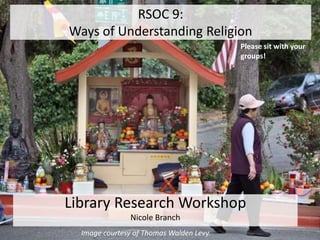
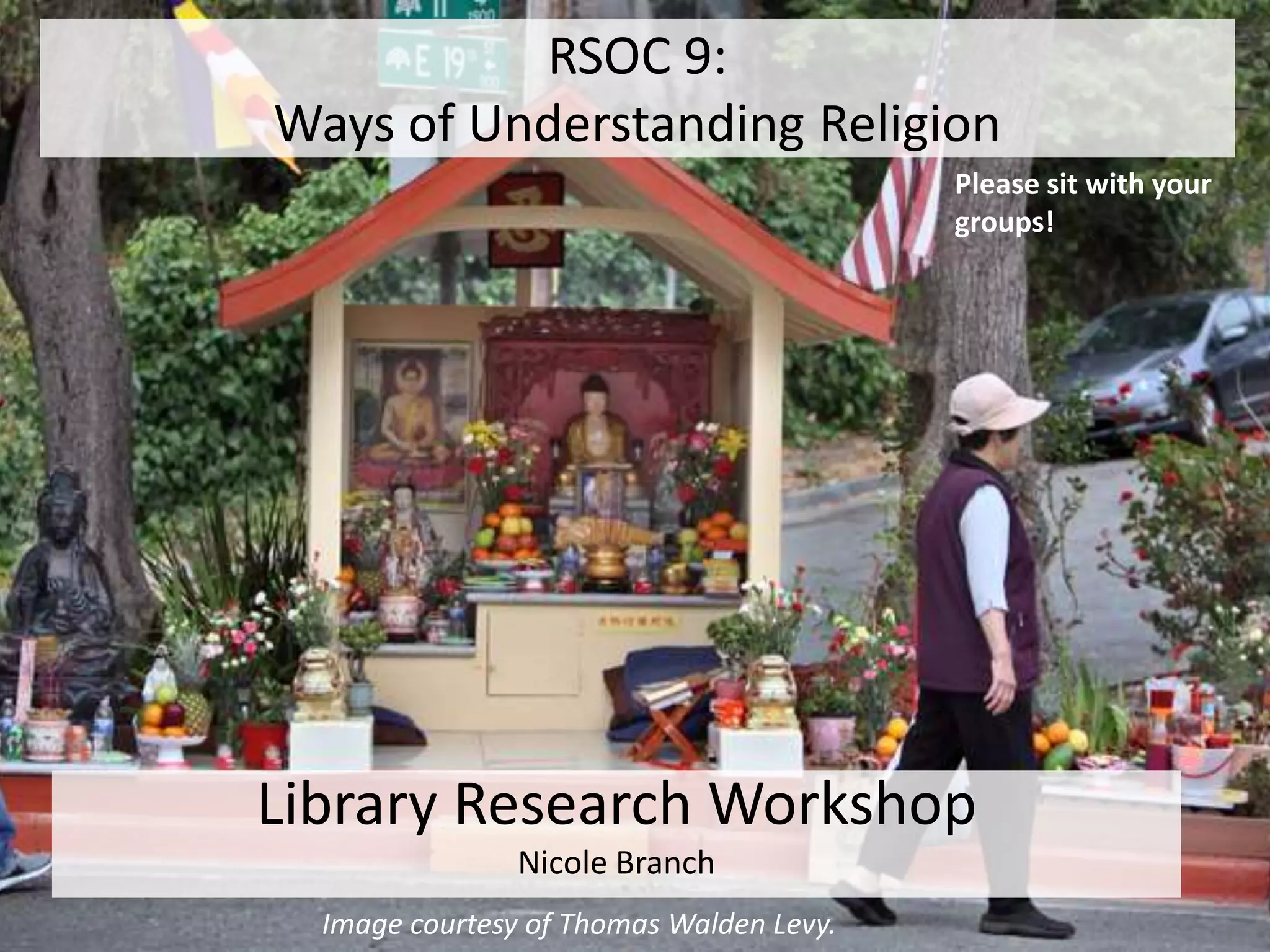
Image courtesy of Thomas Walden Levy.
Purpose
• Find scholarly research to better understand
the religious traditions you will be exploring
• Use knowledge to prepare for your
observations and analysis
Image courtesy of Flickr user wwwuppertal
Objectives
• Locate background information
• Distinguish scholarly sources from popular
• Access and evaluate scholarly sources
• Begin to describe your sources
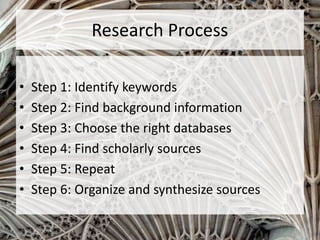
Research Process
• Step 1: Identify keywords
• Step 2: Find background information
• Step 3: Choose the right databases
• Step 4: Find scholarly sources
• Step 5: Repeat
• Step 6: Organize and synthesize sources
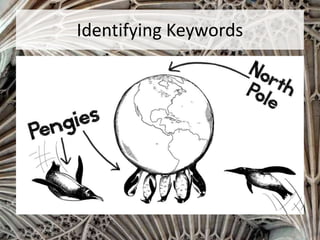
Identifying Keywords
Activity 1
• In your group, select one of the traditions
you are interested in exploring
• Brainstorm searchable keywords
• Record these on the worksheet for this class
Image courtesy of Flickr user Christian Ostrosky
Finding Background Information
• Can help prepare you for your experience
• Can help narrow your topic
• Can provide additional keywords to prepare
you for search
Activity 2
• Go to GVRL and run a search
• Record related terms and synonyms you find
on the worksheet
• Record narrower aspects of your topic
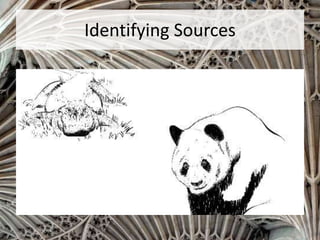
Identifying Sources
Characteristics of a
scholarly source
• words "Journal," "Transactions," "Proceedings," or
"Quarterly,” in title
• written for professors, students or researchers. Clear
indication of authorship and affiliation/bio/scholarly
credentials
• articles are reviewed by a board of experts or "peer
reviewed”
• follow a typical format: abstract, literature
review, methodology, results, conclusion, with
footnotes and bibliography
• may include tables, graphs or illustrations to
support research
• very little advertising
Characteristics of a
scholarly source
Activity 3
• Go to Academic Search Complete and search
using your keywords
• Limit your search by ‘scholarly (peer reviewed)
Journals’
• Find a good one and record the information
about the article in your form
Describing & Synthesizing Sources
• Put sources in context of topic
• Narrow in on important points
• Bring sources together
Activity 4
• On the form, briefly describe your article
• Convene with your larger group
• Take turns explaining your source and why it is
useful to the group
Questions?
Nicole Branch
nbranch@scu.edu

Researching Religious Traditions

  • 1.
    RSOC 9: Ways ofUnderstanding Religion Library Research Workshop Nicole Branch Please sit with your groups! Image courtesy of Thomas Walden Levy.
  • 2.
    Purpose • Find scholarlyresearch to better understand the religious traditions you will be exploring • Use knowledge to prepare for your observations and analysis Image courtesy of Flickr user wwwuppertal
  • 3.
    Objectives • Locate backgroundinformation • Distinguish scholarly sources from popular • Access and evaluate scholarly sources • Begin to describe your sources
  • 4.
    Research Process • Step1: Identify keywords • Step 2: Find background information • Step 3: Choose the right databases • Step 4: Find scholarly sources • Step 5: Repeat • Step 6: Organize and synthesize sources
  • 5.
  • 6.
    Activity 1 • Inyour group, select one of the traditions you are interested in exploring • Brainstorm searchable keywords • Record these on the worksheet for this class Image courtesy of Flickr user Christian Ostrosky
  • 7.
    Finding Background Information •Can help prepare you for your experience • Can help narrow your topic • Can provide additional keywords to prepare you for search
  • 8.
    Activity 2 • Goto GVRL and run a search • Record related terms and synonyms you find on the worksheet • Record narrower aspects of your topic
  • 9.
  • 10.
    Characteristics of a scholarlysource • words "Journal," "Transactions," "Proceedings," or "Quarterly,” in title • written for professors, students or researchers. Clear indication of authorship and affiliation/bio/scholarly credentials • articles are reviewed by a board of experts or "peer reviewed”
  • 11.
    • follow atypical format: abstract, literature review, methodology, results, conclusion, with footnotes and bibliography • may include tables, graphs or illustrations to support research • very little advertising Characteristics of a scholarly source
  • 12.
    Activity 3 • Goto Academic Search Complete and search using your keywords • Limit your search by ‘scholarly (peer reviewed) Journals’ • Find a good one and record the information about the article in your form
  • 13.
    Describing & SynthesizingSources • Put sources in context of topic • Narrow in on important points • Bring sources together
  • 14.
    Activity 4 • Onthe form, briefly describe your article • Convene with your larger group • Take turns explaining your source and why it is useful to the group
  • 15.

Editor's Notes

  • #7 https://vimeo.com/85564795
  • #10 https://vimeo.com/82685184