BEAMing Your Research Topic
Nicole Branch
Santa Clara University Library
Lesson adapted from Woodward & Ganski, University of Wisconsin
Milwaukee; Engaging Ideas by John C. Bean, and Joseph Bizup, Boston
University. Image courtesy of Flickr user Brian Wolf.
Objectives
• Plan & execute a search strategy
• Evaluate sources for relevance & purpose
• Discuss potential value of sources
• Select sources for purposes of your
assignment
Ways of Categorizing Sources
• Scholarly -------------------------- Popular
• Primary --------------------------- Secondary
• Good -------------------------------- Bad
Bizup’s “BEAM”
• Background
• Exhibit/Evidence
• Argument
• Method
Background
“Any source, assumed to be noncontroversial,
used to provide context… facts and information”
Examples:
• Encyclopedia articles
• Historical background/facts
• Statistics
• News anecdotes
Exhibit/Evidence
Sources you analyze or use as evidence.
Examples:
• Information and data about the issue
• Data you collect (interviews, surveys, field
observations)
• Cultural documents you use for analysis
Argument
“The conversation of critical views and relevant
scholarship” related to the topic.
Examples:
• Scholarly articles about your topic
• Articles from different disciplinary areas
• Literature reviews that trace the
“conversation” as well as the gaps in the
conversation
Method
“References to the theories or methods the
writer is employing”
Examples:
• Articles about particular research
methodologies
• Information about documentary film making
• Articles about particular theorists or theories
What can you do with these sources
for your writing?
•Provide context
•Used in the introduction to orient your reader to your topic
and your paper
Background
•Used for the basis of your original analysis
•The basis of your “voice” in the conversation
Exhibit
•Understand how your topic has been treated by others
•Identify gaps in current understanding of your topic
•Place your own analysis in the context of scholarly discourse
Argument
•Provides information to conduct your own analysis or
fieldwork
•Provides validity for your methods
Method
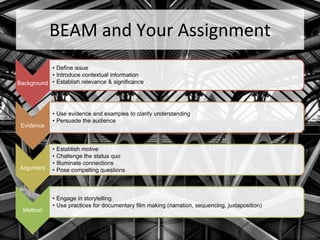
BEAM and Your Assignment
Background
• Define issue
• Introduce contextual information
• Establish relevance & significance
Evidence
• Use evidence and examples to clarify understanding
• Persuade the audience
Argument
• Establish motive
• Challenge the status quo
• Illuminate connections
• Pose compelling questions
Method
• Engage in storytelling
• Use practices for documentary film making (narration, sequencing, juxtaposition)
BEAM Your Research Topic
• In your groups, brainstorm the kinds of
information you would like to seek out
• We’ll have time to search later. This step is
just to generate ideas.
• Record ideas on the Jamboard for your group.
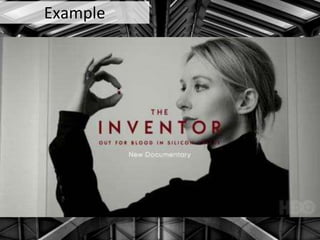
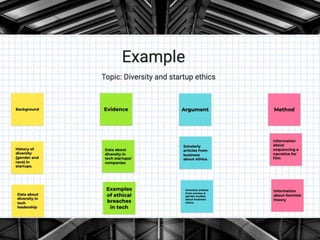
Example
BEAM Your Research Topic
• In your groups, brainstorm the kinds of
information you would like to seek out
• We’ll have time to search later. This step is
just to generate ideas.
• Record ideas on the Jamboard for your group.
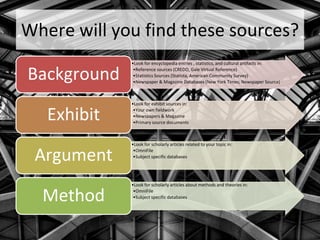
Where will you find these sources?
•Look for encyclopedia entries , statistics, and cultural artifacts in:
•Reference sources (CREDO, Gale Virtual Reference)
•Statistics Sources (Statista, American Community Survey)
•Newspaper & Magazine Databases (New York Times; Newspaper Source)
Background
•Look for exhibit sources in:
•Your own fieldwork
•Newspapers & Magazine
•Primary source documents
Exhibit
•Look for scholarly articles related to your topic in:
•OmniFile
•Subject specific databases
Argument
•Look for scholarly articles about methods and theories in:
•OmniFile
•Subject specific databases
Method
Find Sources
• Go to the research guide for this class
• Using the suggested databases, find sources
for your topic
• Try to find at least two sources that would be
useful
• Complete the form
• A copy will be sent to you and can be edited
Questions?
Nicole Branch
nbranch@scu.edu
x5436

BEAM- Science, Technology & Self

  • 1.
    BEAMing Your ResearchTopic Nicole Branch Santa Clara University Library Lesson adapted from Woodward & Ganski, University of Wisconsin Milwaukee; Engaging Ideas by John C. Bean, and Joseph Bizup, Boston University. Image courtesy of Flickr user Brian Wolf.
  • 2.
    Objectives • Plan &execute a search strategy • Evaluate sources for relevance & purpose • Discuss potential value of sources • Select sources for purposes of your assignment
  • 3.
    Ways of CategorizingSources • Scholarly -------------------------- Popular • Primary --------------------------- Secondary • Good -------------------------------- Bad
  • 4.
    Bizup’s “BEAM” • Background •Exhibit/Evidence • Argument • Method
  • 5.
    Background “Any source, assumedto be noncontroversial, used to provide context… facts and information” Examples: • Encyclopedia articles • Historical background/facts • Statistics • News anecdotes
  • 6.
    Exhibit/Evidence Sources you analyzeor use as evidence. Examples: • Information and data about the issue • Data you collect (interviews, surveys, field observations) • Cultural documents you use for analysis
  • 7.
    Argument “The conversation ofcritical views and relevant scholarship” related to the topic. Examples: • Scholarly articles about your topic • Articles from different disciplinary areas • Literature reviews that trace the “conversation” as well as the gaps in the conversation
  • 8.
    Method “References to thetheories or methods the writer is employing” Examples: • Articles about particular research methodologies • Information about documentary film making • Articles about particular theorists or theories
  • 9.
    What can youdo with these sources for your writing? •Provide context •Used in the introduction to orient your reader to your topic and your paper Background •Used for the basis of your original analysis •The basis of your “voice” in the conversation Exhibit •Understand how your topic has been treated by others •Identify gaps in current understanding of your topic •Place your own analysis in the context of scholarly discourse Argument •Provides information to conduct your own analysis or fieldwork •Provides validity for your methods Method
  • 10.
    BEAM and YourAssignment Background • Define issue • Introduce contextual information • Establish relevance & significance Evidence • Use evidence and examples to clarify understanding • Persuade the audience Argument • Establish motive • Challenge the status quo • Illuminate connections • Pose compelling questions Method • Engage in storytelling • Use practices for documentary film making (narration, sequencing, juxtaposition)
  • 11.
    BEAM Your ResearchTopic • In your groups, brainstorm the kinds of information you would like to seek out • We’ll have time to search later. This step is just to generate ideas. • Record ideas on the Jamboard for your group.
  • 12.
  • 14.
    BEAM Your ResearchTopic • In your groups, brainstorm the kinds of information you would like to seek out • We’ll have time to search later. This step is just to generate ideas. • Record ideas on the Jamboard for your group.
  • 15.
    Where will youfind these sources? •Look for encyclopedia entries , statistics, and cultural artifacts in: •Reference sources (CREDO, Gale Virtual Reference) •Statistics Sources (Statista, American Community Survey) •Newspaper & Magazine Databases (New York Times; Newspaper Source) Background •Look for exhibit sources in: •Your own fieldwork •Newspapers & Magazine •Primary source documents Exhibit •Look for scholarly articles related to your topic in: •OmniFile •Subject specific databases Argument •Look for scholarly articles about methods and theories in: •OmniFile •Subject specific databases Method
  • 16.
    Find Sources • Goto the research guide for this class • Using the suggested databases, find sources for your topic • Try to find at least two sources that would be useful • Complete the form • A copy will be sent to you and can be edited
  • 17.