
*Introduction to
Social Sciences
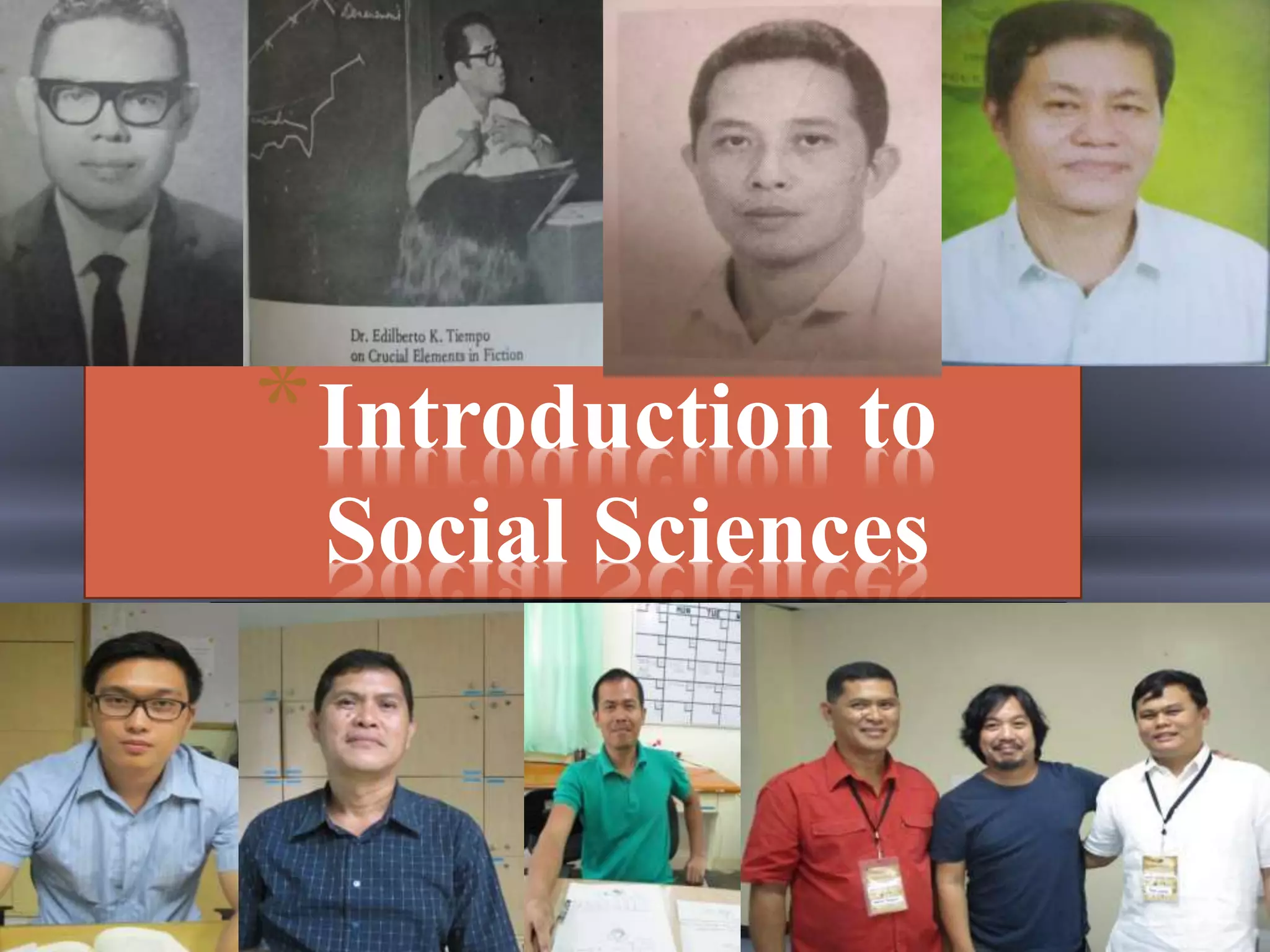
*Photo Credit
*1. Ian Omictin
*2. St. Paul University Alumni Affairs Office
*3. Mr. Penn Larena
*4. Mr. Ron Calumpang
*5. SPUD College of Arts and Education
*6. SPUD University Library
*Learning Objectives
.
*Meaning of the word Social Sciences
*Branches of Social Sciences
*Importance of Social Sciences
*Different views of the field of Social Sciences
*Explore the significant personalities that
contributed to the development of the local
Social Sciences
*KNOWLEDGE
*1. Pure
• Theoretical
• Descriptive
*2. Applied
• Practical / Experimental
*What are Social
Sciences???
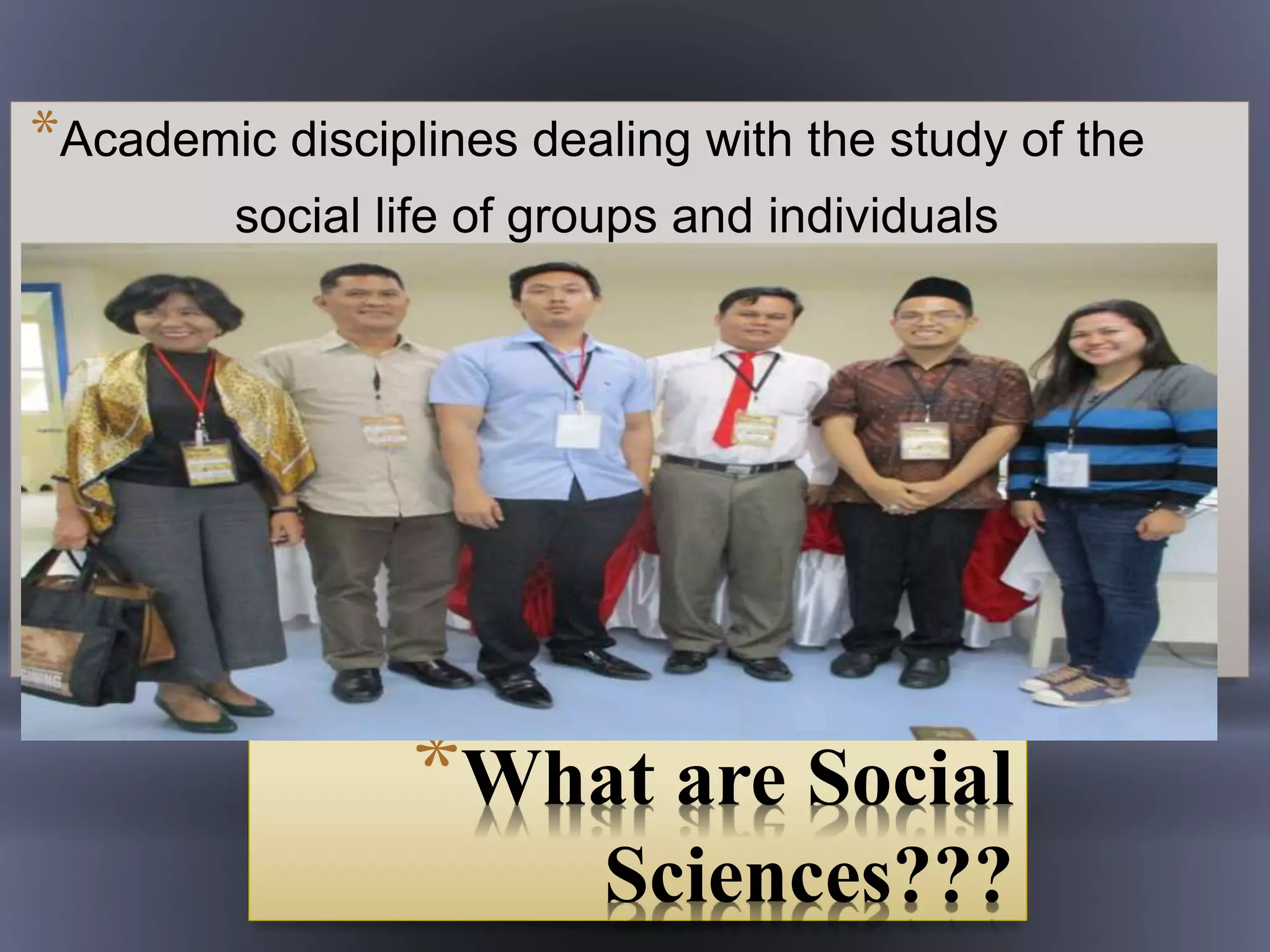
*Academic disciplines dealing with the study of the
social life of groups and individuals
*Social -relating to human society and
how it is organized.
*Science- the study of the physical and
natural world and phenomena, especially
by using systematic observation and
experiment.
*
Social Sciences
*
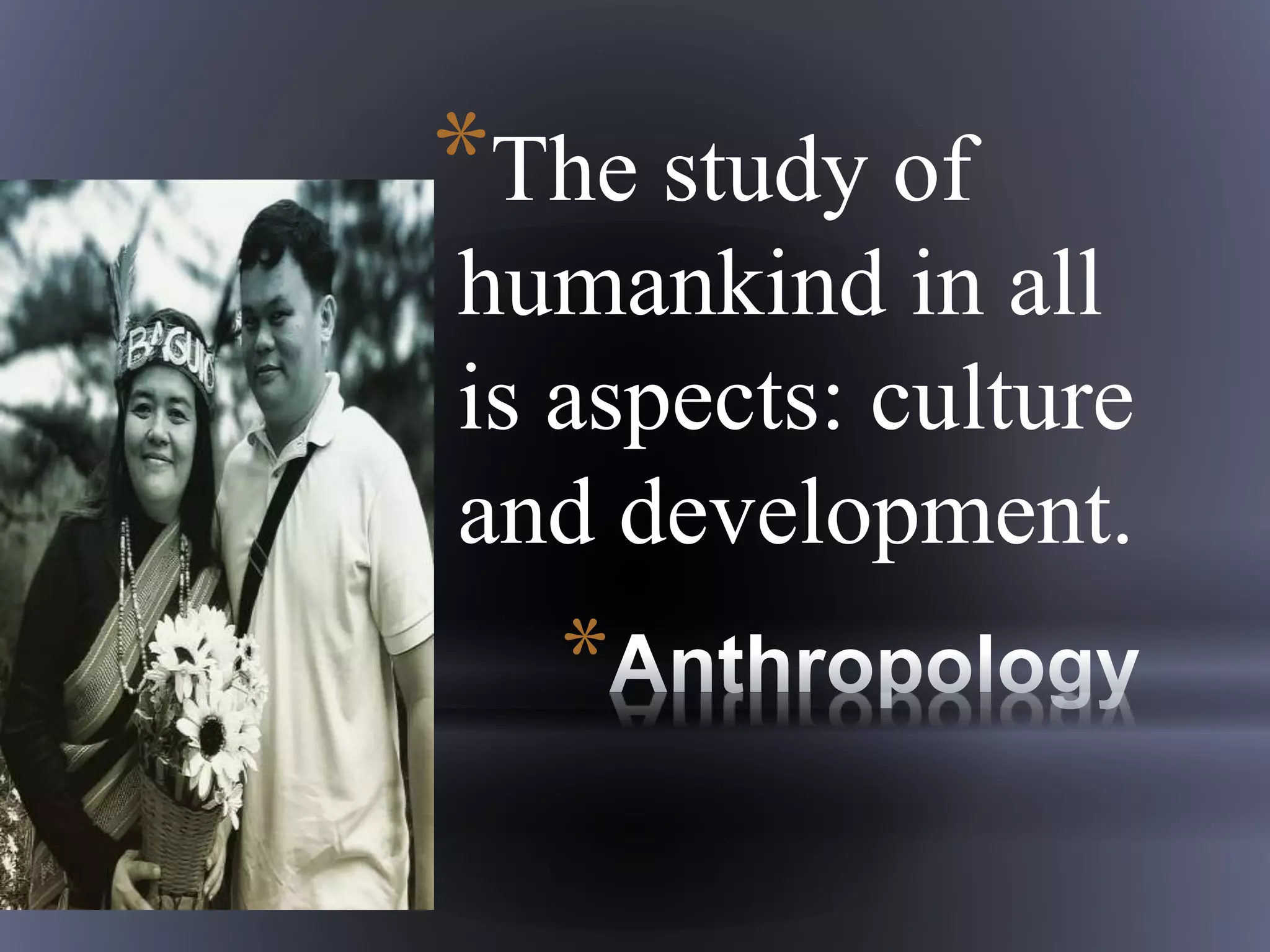
*The study of
humankind in all
is aspects: culture
and development.
*
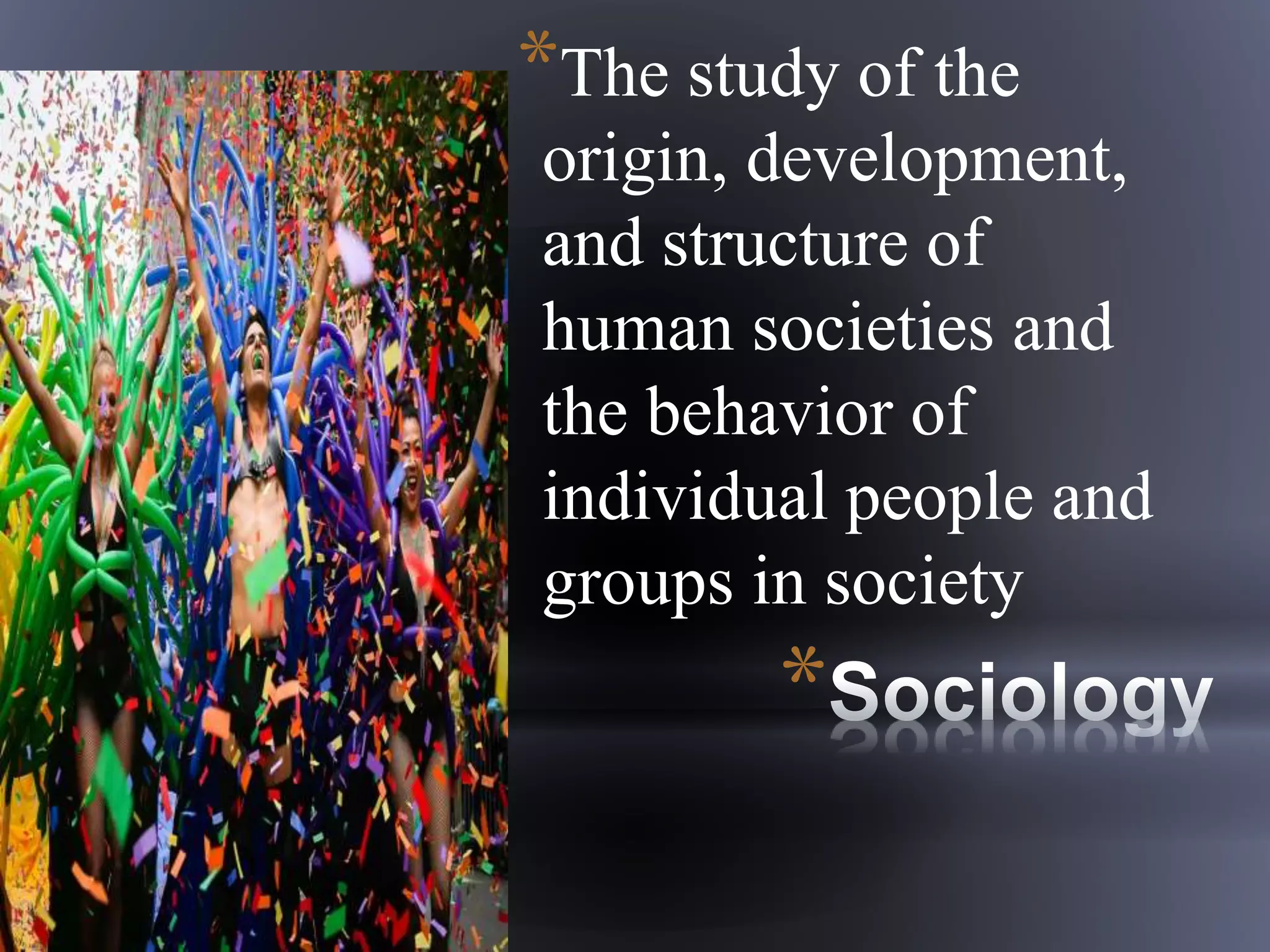
*The study of the
origin, development,
and structure of
human societies and
the behavior of
individual people and
groups in society
*
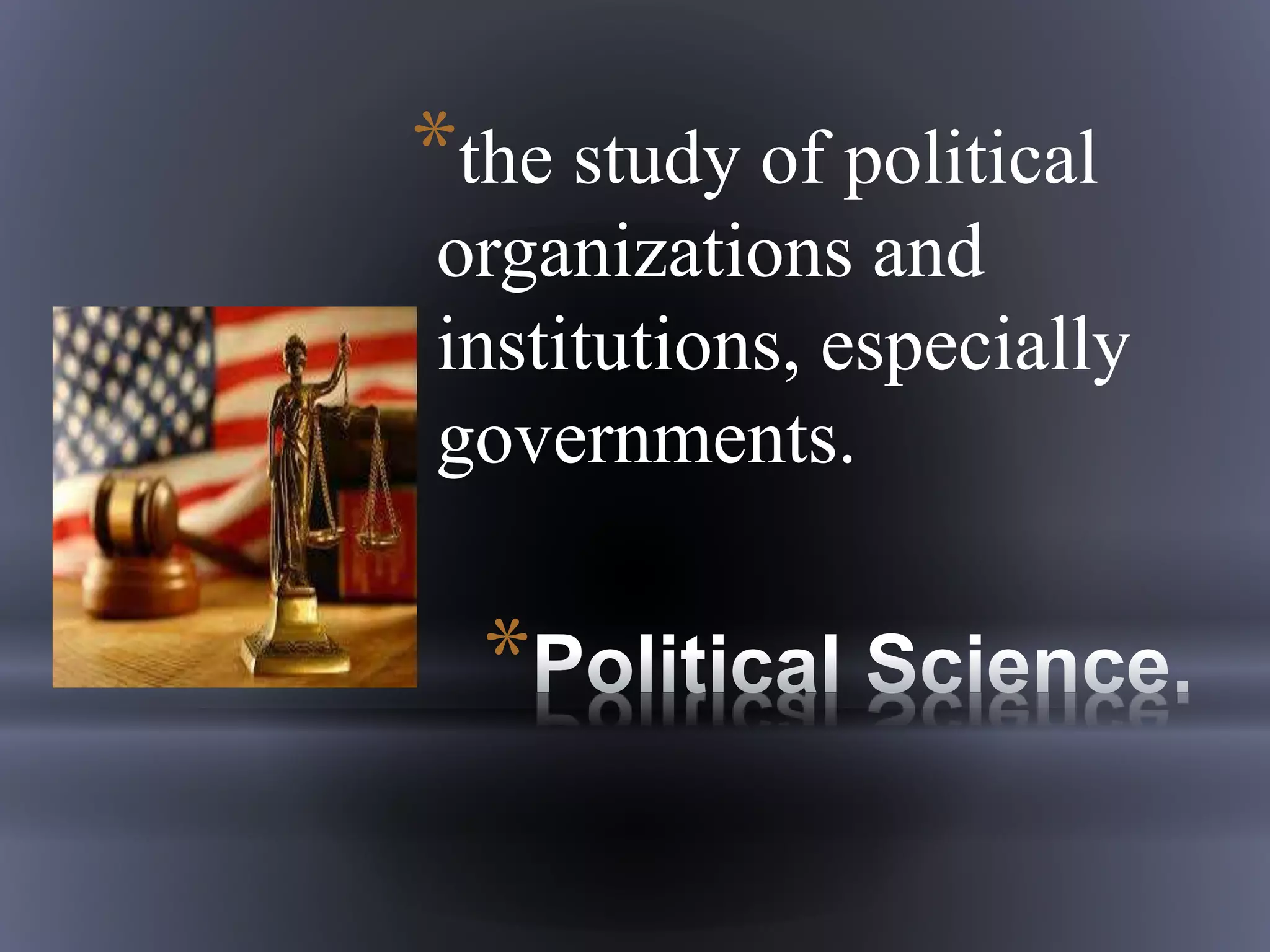
*the study of political
organizations and
institutions, especially
governments.
*
*the branch of
knowledge
dealing with past
events
*
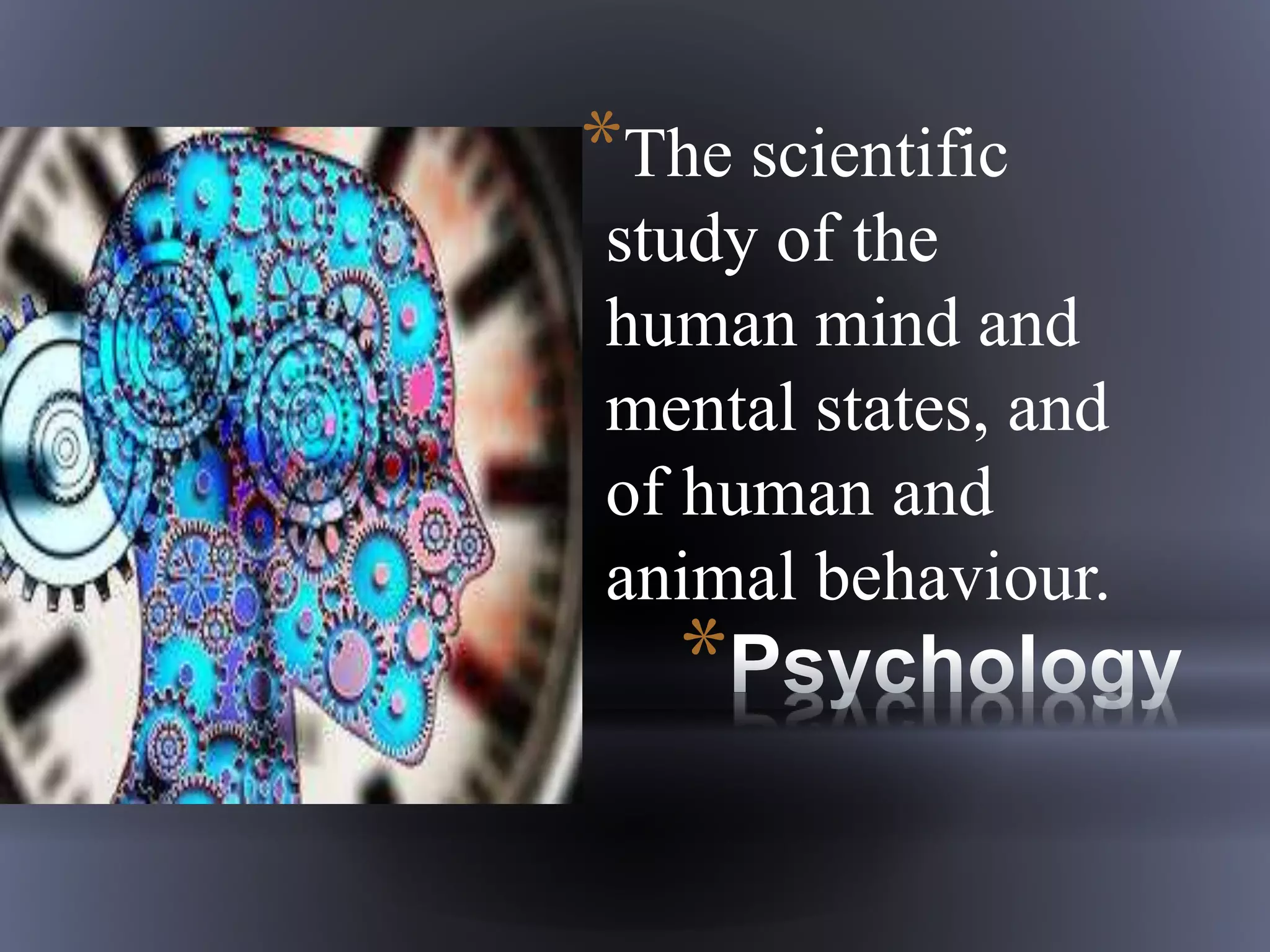
*The scientific
study of the
human mind and
mental states, and
of human and
animal behaviour.
*Importance
*knowledge of the social
sciences can help us
improve our societies
*Here we study
*• How people put their societies
together
*• The impacts of their decisions about
how their societies should be run.
*• How societies should be put
together.
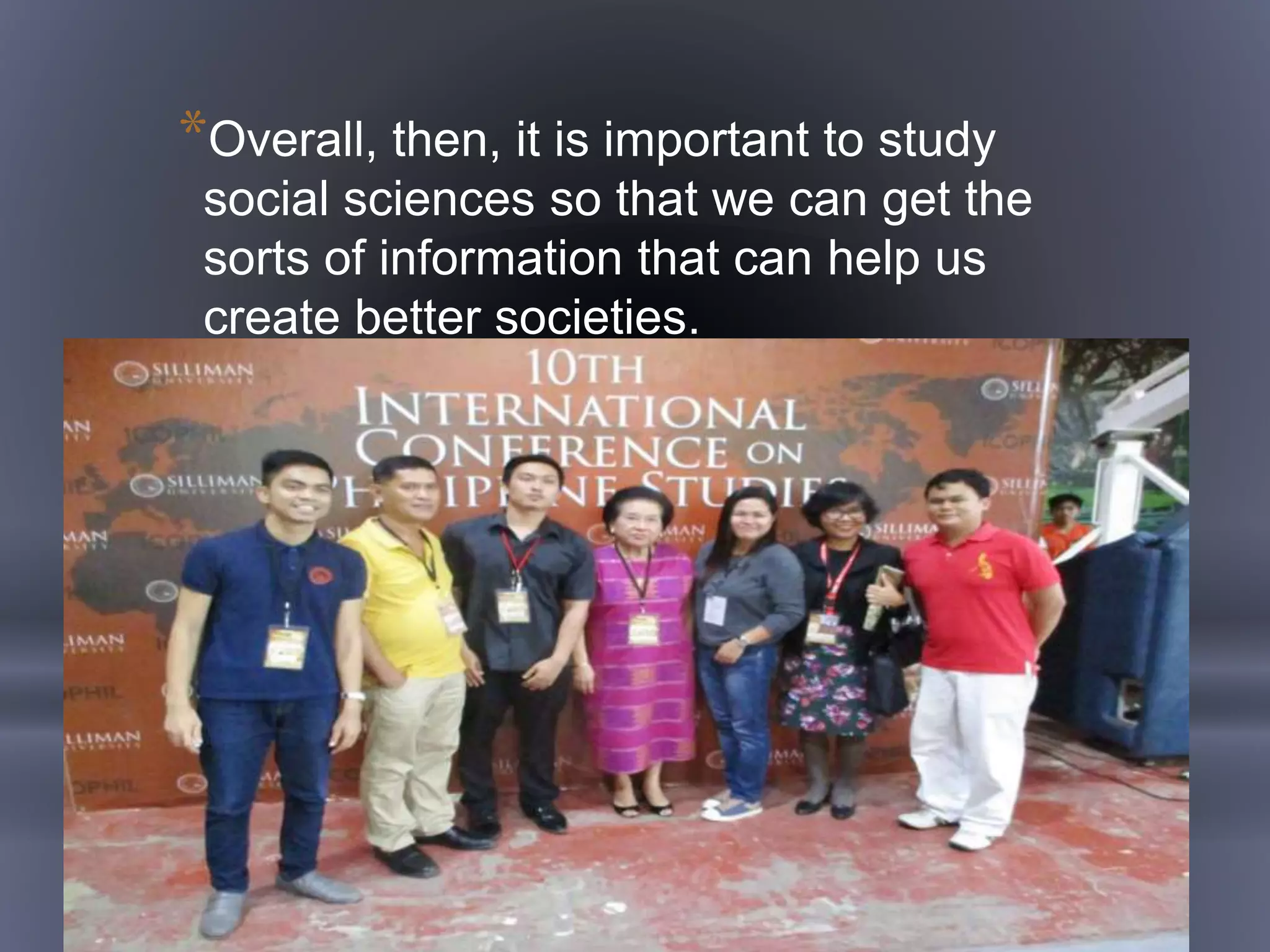
*Overall, then, it is important to study
social sciences so that we can get the
sorts of information that can help us
create better societies.
Social Sciences are all about an objective
study (science) of people and their
interactions.
*If we want to improve our lives, choices, groups,
*institutions and societies we need to understand
*how they work?
*interactions.
*why they exist? and
*how they have functioned in the past?
*The most effective study of social science is
*when they are studied together to answer the
*big questions we have about ourselves and
*human life on the planet.
*Some Views about Social
Sciences..
*Social sciences are among the most interesting subjects to
study. Human behaviour is fascinating. For anyone
involved in a life or profession that deals with human
behaviour (which is arguably everyone), knowledge and
understanding of communication, conflict-resolution,
motivation, etc. is immensely helpful.
*Some Views about Social
Sciences
*One of the best reasons is just because it is
*fascinating to try and figure out why humans
*do what they do. The newer science of
*behavioural economics looking closely at how
*people can be manipulated to make decisions,
*etc., is absolutely fascinating stuff.
*Though it is impossible to totally understand
*why humans do what they do, it is certainly
possible to better understand it.
*Some Views about Social
Sciences
*Studying the social sciences can provide us with so many
important answers and observations that may help improve the
understanding of our lives, and thus help us to improve our
interactions with each other.
*The social sciences can provide insight into all types of social
situations such as raising children, family relationships,
friendships, work place relationships, interactions with
strangers, cultural differences, and so on.
*Studying these situations and complex scenarios that arise in
each situation really aids those in various professions that
dedicate their lives to helping people improve and understand
their behaviour or psychological processes.
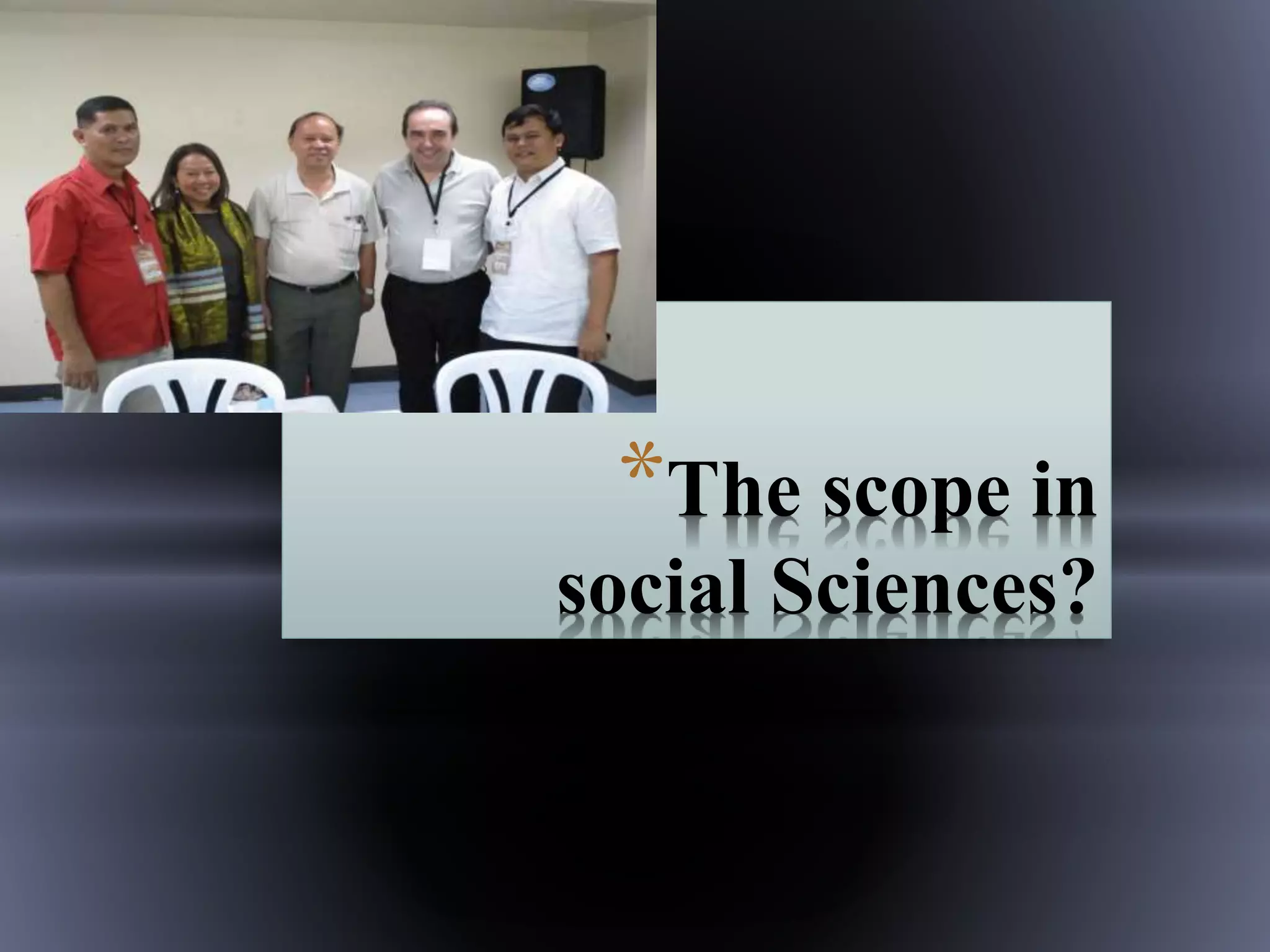
*The scope in
social Sciences?
*the scope in social
Sciences?
*The scope of social studies is determined
by the definition of the subject.
*It is the integration of various social
sciences and humanities for the purpose
of citizenship education. social studies
involves the study of history, economics,
and other subjects in social sciences.
*the scope in social
Sciences?
*Another school see it as a method or an
approach;
*• It is study of social sciences for pedagogical
purposes .
*• It equips students with the ability to teach
social science subjects in secondary level of
education.
*Social Sciences
Research Direction….…
*Social Sciences
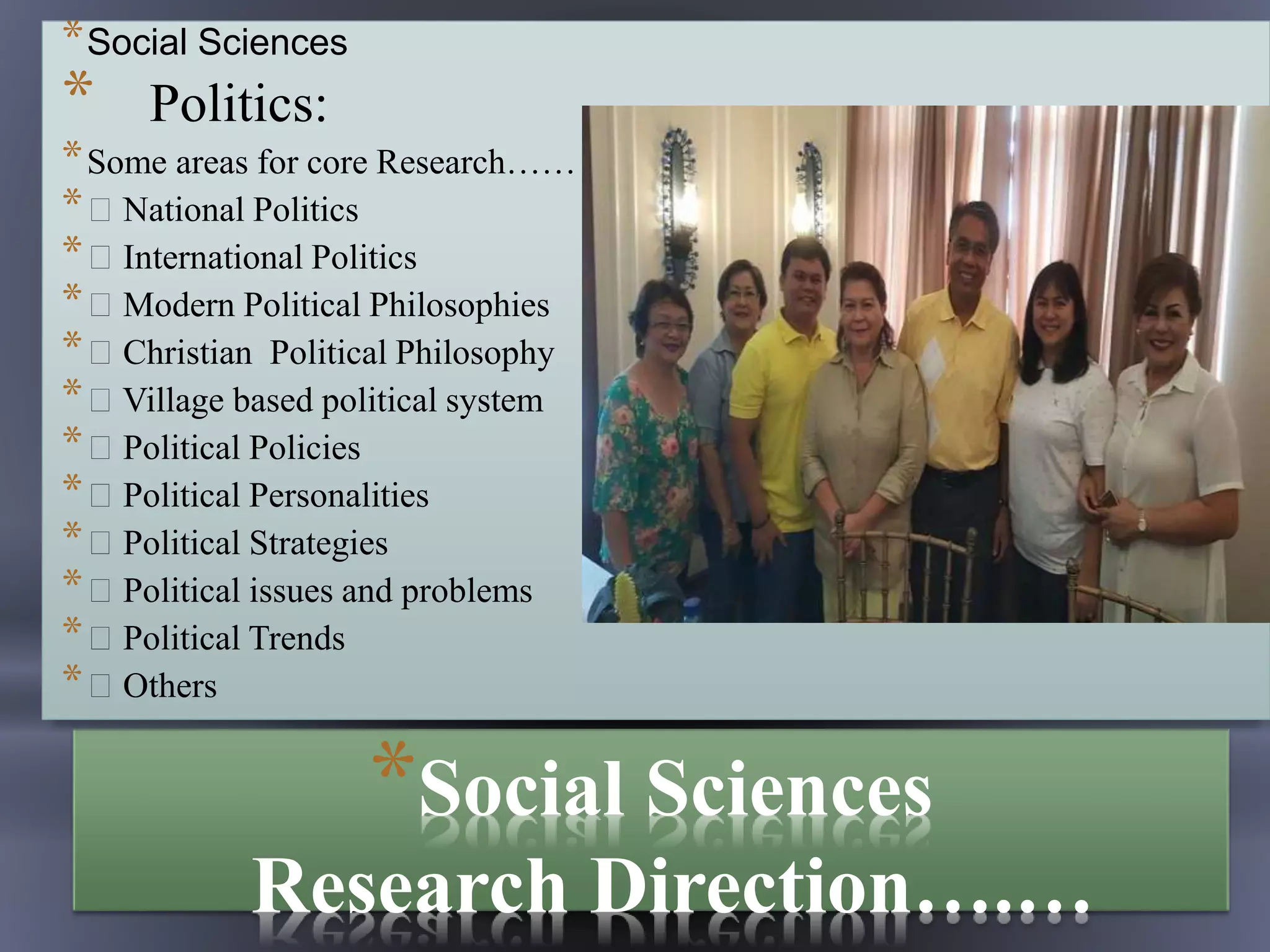
* Politics:
*Some areas for core Research……
* National Politics
* International Politics
* Modern Political Philosophies
* Christian Political Philosophy
* Village based political system
* Political Policies
* Political Personalities
* Political Strategies
* Political issues and problems
* Political Trends
* Others
*Social Sciences
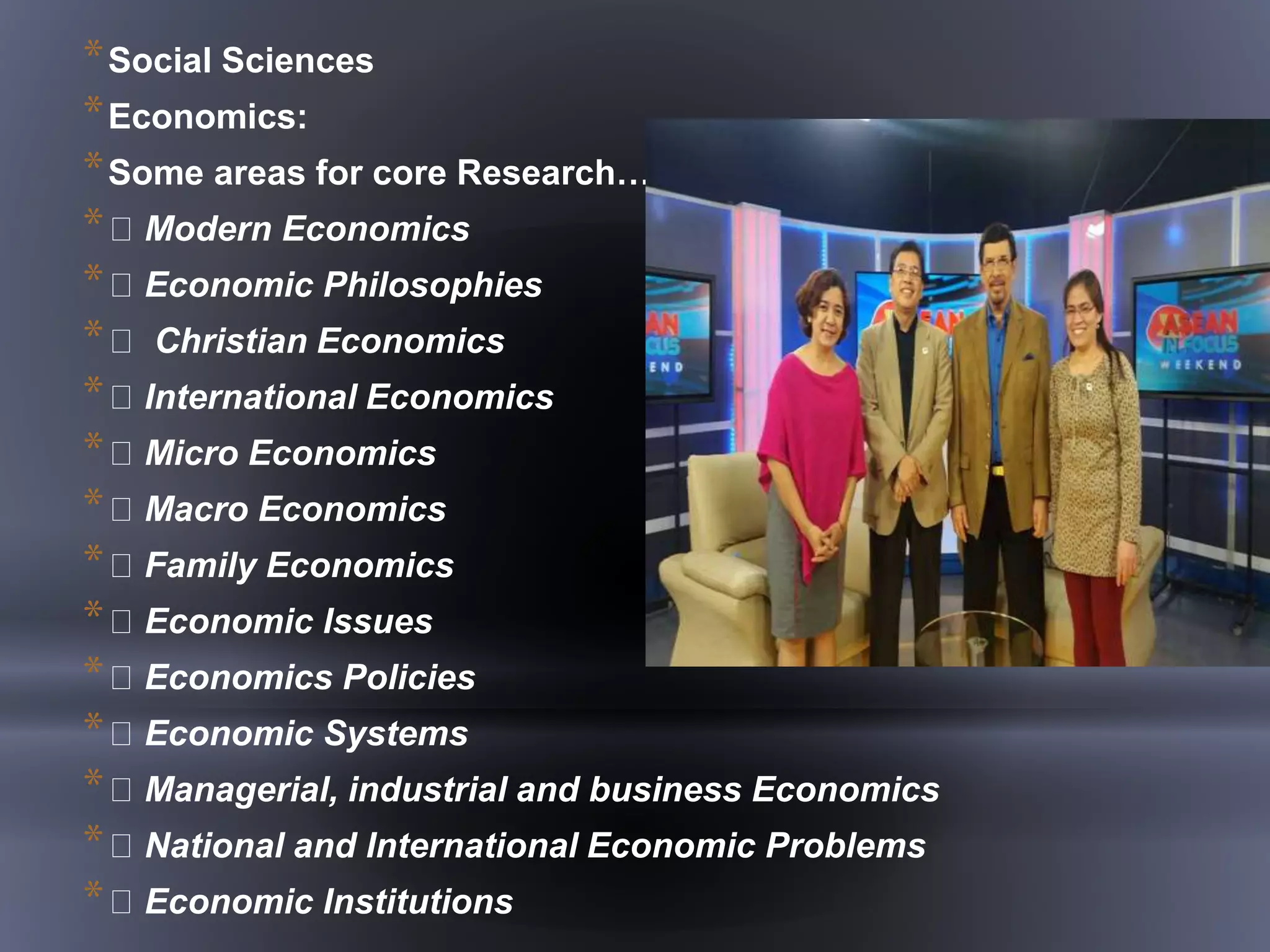
*Economics:
*Some areas for core Research……
* Modern Economics
* Economic Philosophies
* Christian Economics
* International Economics
* Micro Economics
* Macro Economics
* Family Economics
* Economic Issues
* Economics Policies
* Economic Systems
* Managerial, industrial and business Economics
* National and International Economic Problems
* Economic Institutions
* Social Sciences
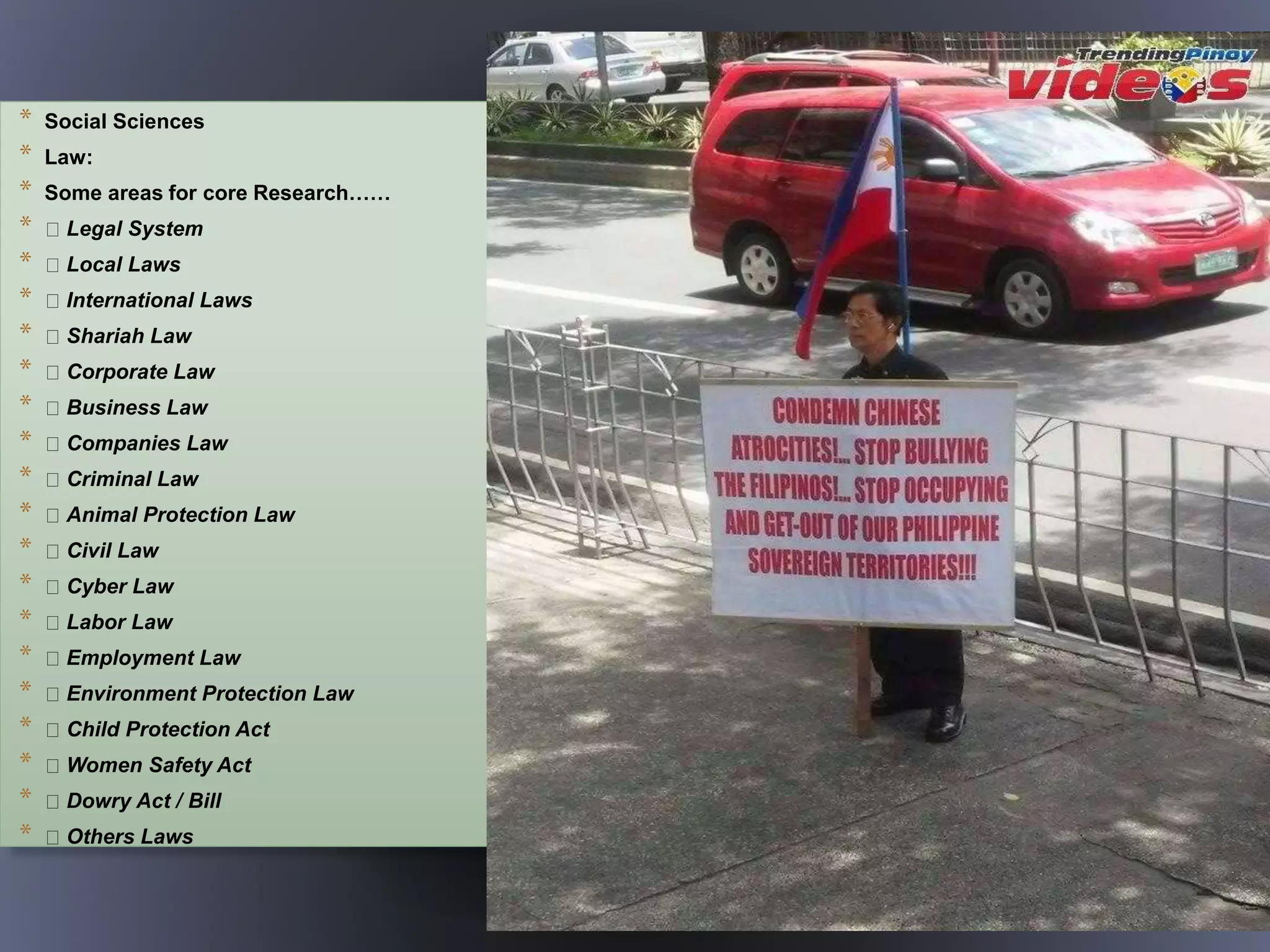
* Law:
* Some areas for core Research……
* Legal System
* Local Laws
* International Laws
* Shariah Law
* Corporate Law
* Business Law
* Companies Law
* Criminal Law
* Animal Protection Law
* Civil Law
* Cyber Law
* Labor Law
* Employment Law
* Environment Protection Law
* Child Protection Act
* Women Safety Act
* Dowry Act / Bill
* Others Laws
* Social Sciences
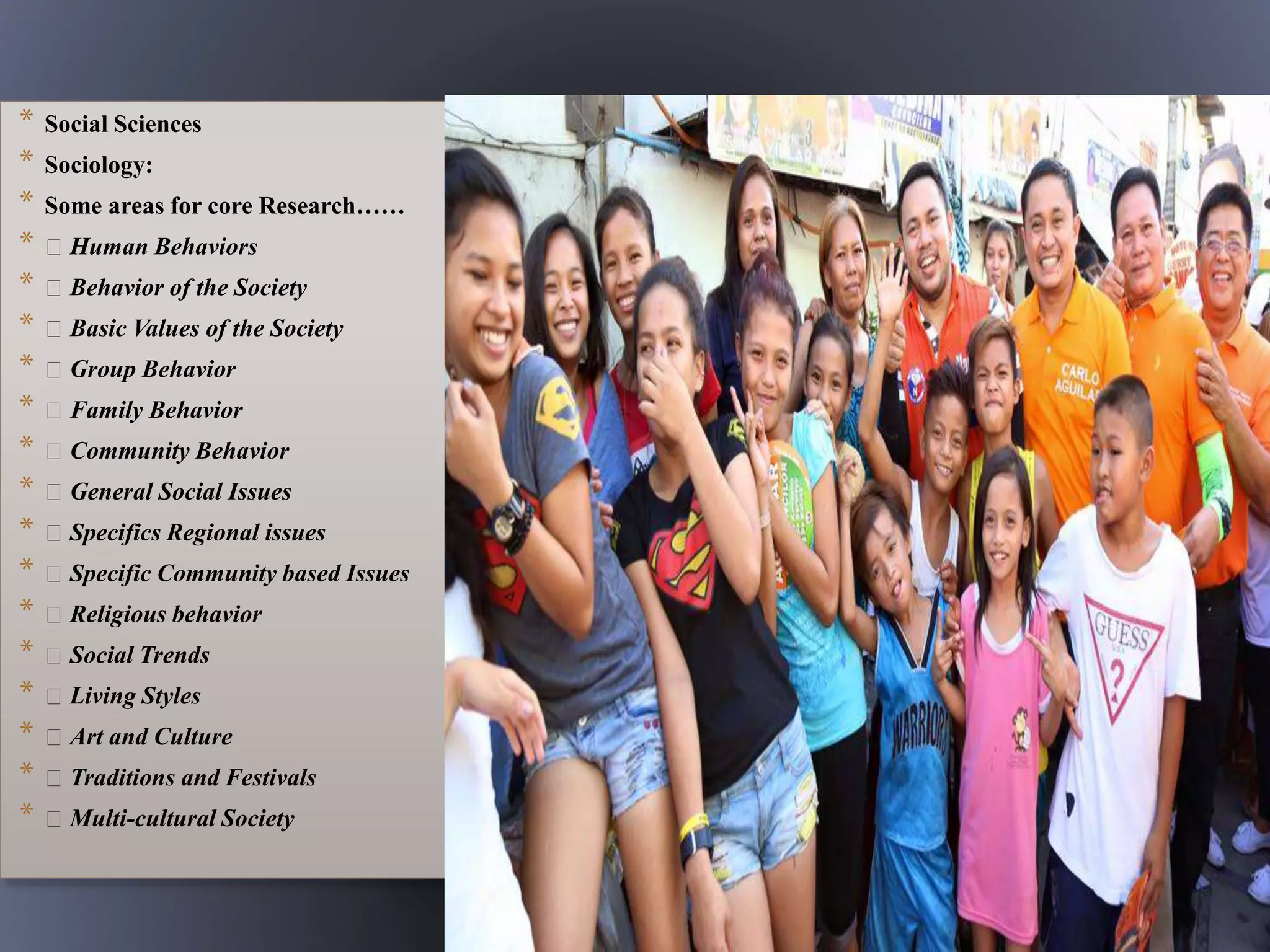
* Sociology:
* Some areas for core Research……
* Human Behaviors
* Behavior of the Society
* Basic Values of the Society
* Group Behavior
* Family Behavior
* Community Behavior
* General Social Issues
* Specifics Regional issues
* Specific Community based Issues
* Religious behavior
* Social Trends
* Living Styles
* Art and Culture
* Traditions and Festivals
* Multi-cultural Society
Social Sciences
Management:
Some areas for core Research….
Administration
Administrative System
Human Resource Management
Event Management
Personality Development
Diversity Management
Personal Life management
Family Life Management
Quality Management
Social Life Management
Professional Life Management
Religious Life Management
*Social Sciences
*Psychlogy:
*Some areas for core Research……
*Basic
*• Abnormal
*• Biological
*• Cognitive
*• Comparative
*• Cultural
*• Differential
*• Developmental
*• Evolutionary
*• Experimental
*• Mathematical
*• Personality
*• Positive
*• Social[
*Applied
*Applied
*• Applied behaviour analysis
*• Clinical
*• Community
*• Consumer
*• Educational
*• Health
*• Industrial and
*organizational
*• Legal
*• Military
*• Occupational health
*• Political
*• Religion
*• School
*• Sport
*Social Sciences
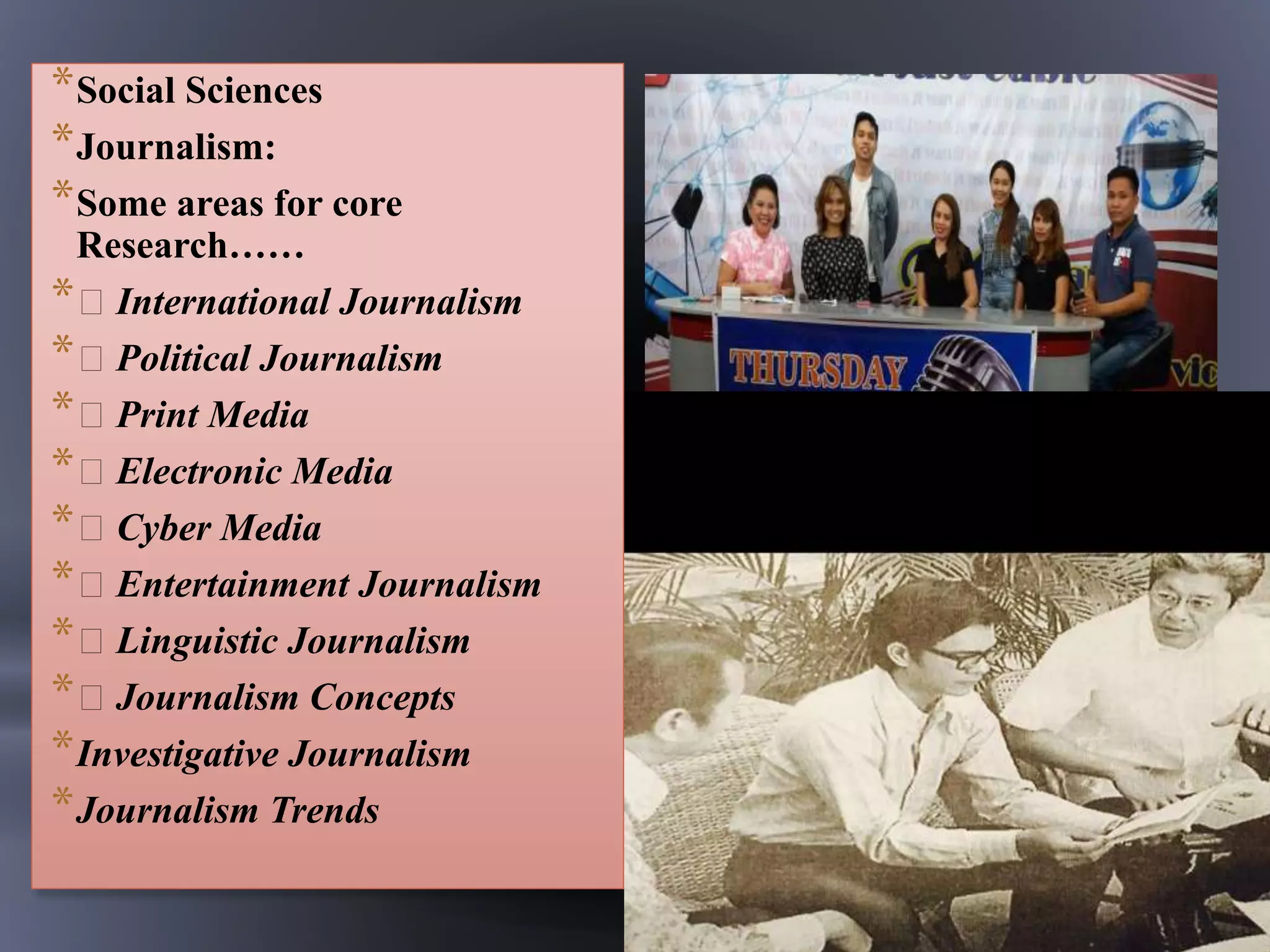
*Journalism:
*Some areas for core
Research……
* International Journalism
* Political Journalism
* Print Media
* Electronic Media
* Cyber Media
* Entertainment Journalism
* Linguistic Journalism
* Journalism Concepts
*Investigative Journalism
*Journalism Trends
*Social Sciences
*Linguistics:
*Some areas for core Research….
*Applied and experimental linguistics
*• Computational linguistics
*• Evolutionary linguistics
*• Forensic linguistics
*• Internet linguistics
*• Language acquisition
*• Language assessment
*• Language development
*• Language education
*• Linguistic anthropology
*• Neurolinguistics
*• Psycholinguistics
*• Second-language acquisition
*Society-Technology
*The Society-Technology Interactions team represents varied
disciplines, including anthropology, economics, and planning.
Team members regularly collaborate with social science, natural
and physical science, technology R&D, engineer, intermediary
group, and industrial partners. Though empirically oriented, we
take varied methodological approaches including behavioural,
experimental, and regional economics; ethnographic inquiry; and
surveying. Our analyses and products are designed to meet
diverse customer needs and range from models and decision-
support tools, to technical reports, to peer-reviewed publications,
to informational and training materials for varied audiences
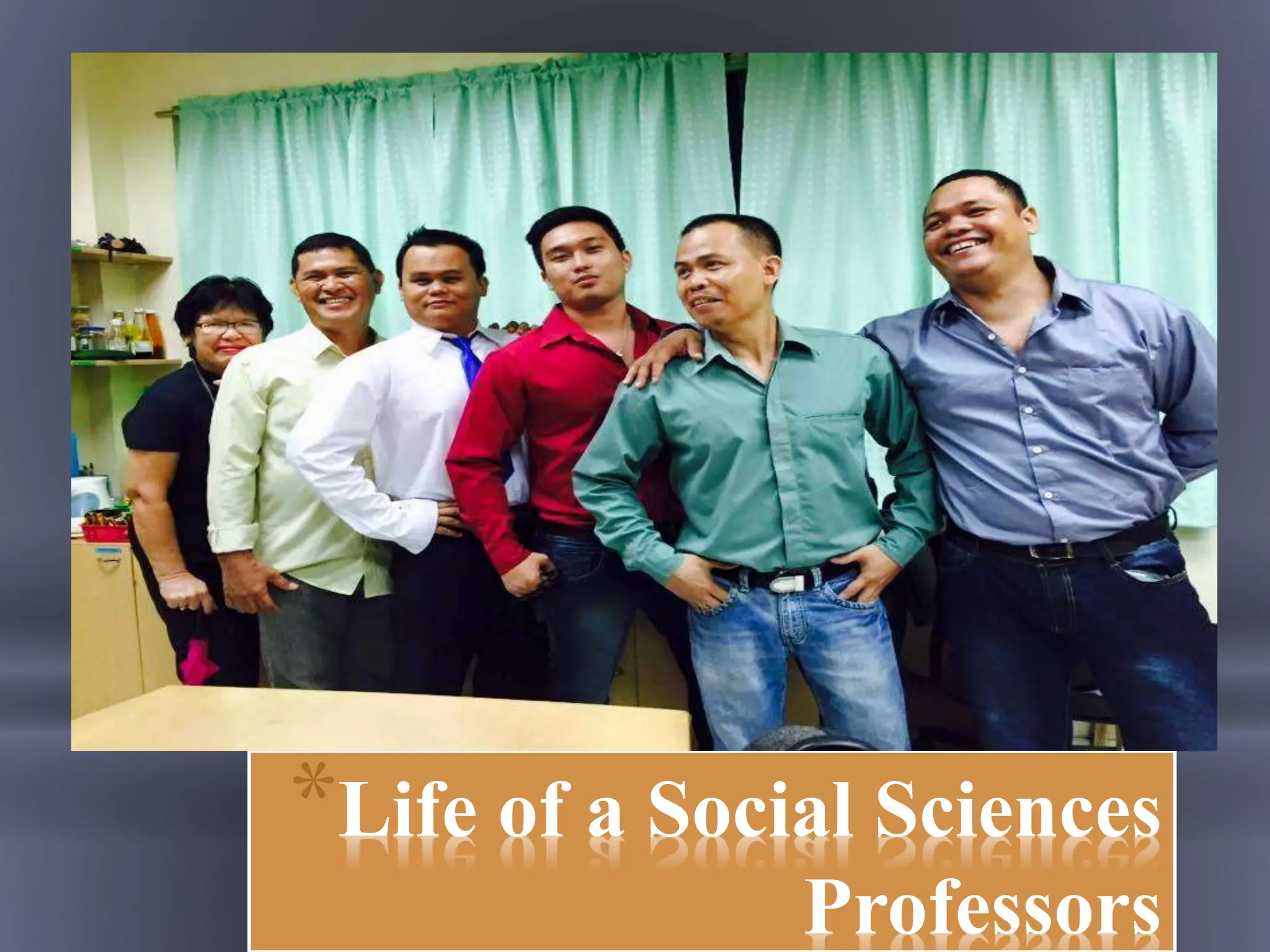
*Life of a Social Sciences
Professors
*Paulinians in Social
Sciences
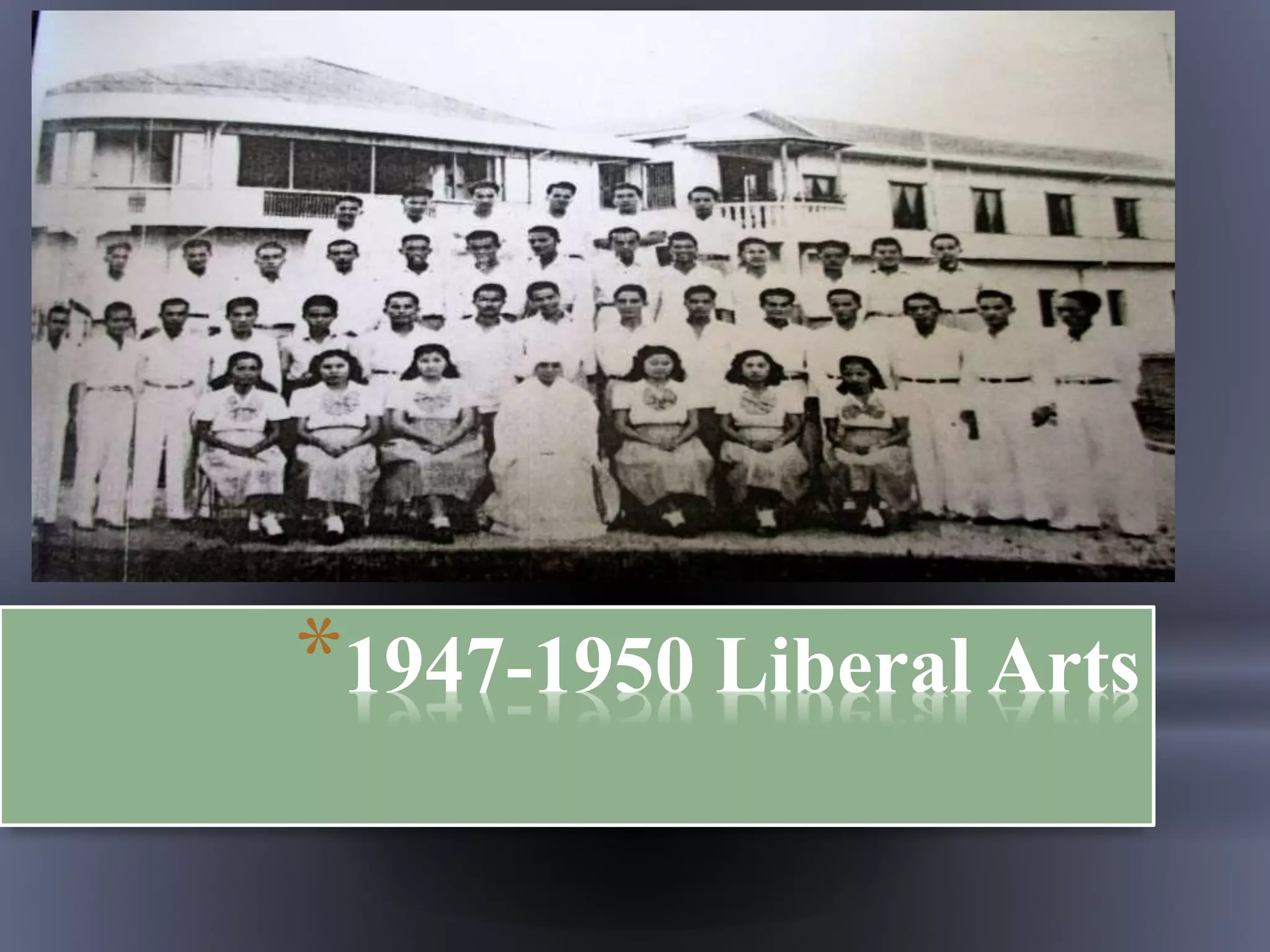
*1947-1950 Liberal Arts
*
*St. Paul University
Social Sciences Era
1960-1980s
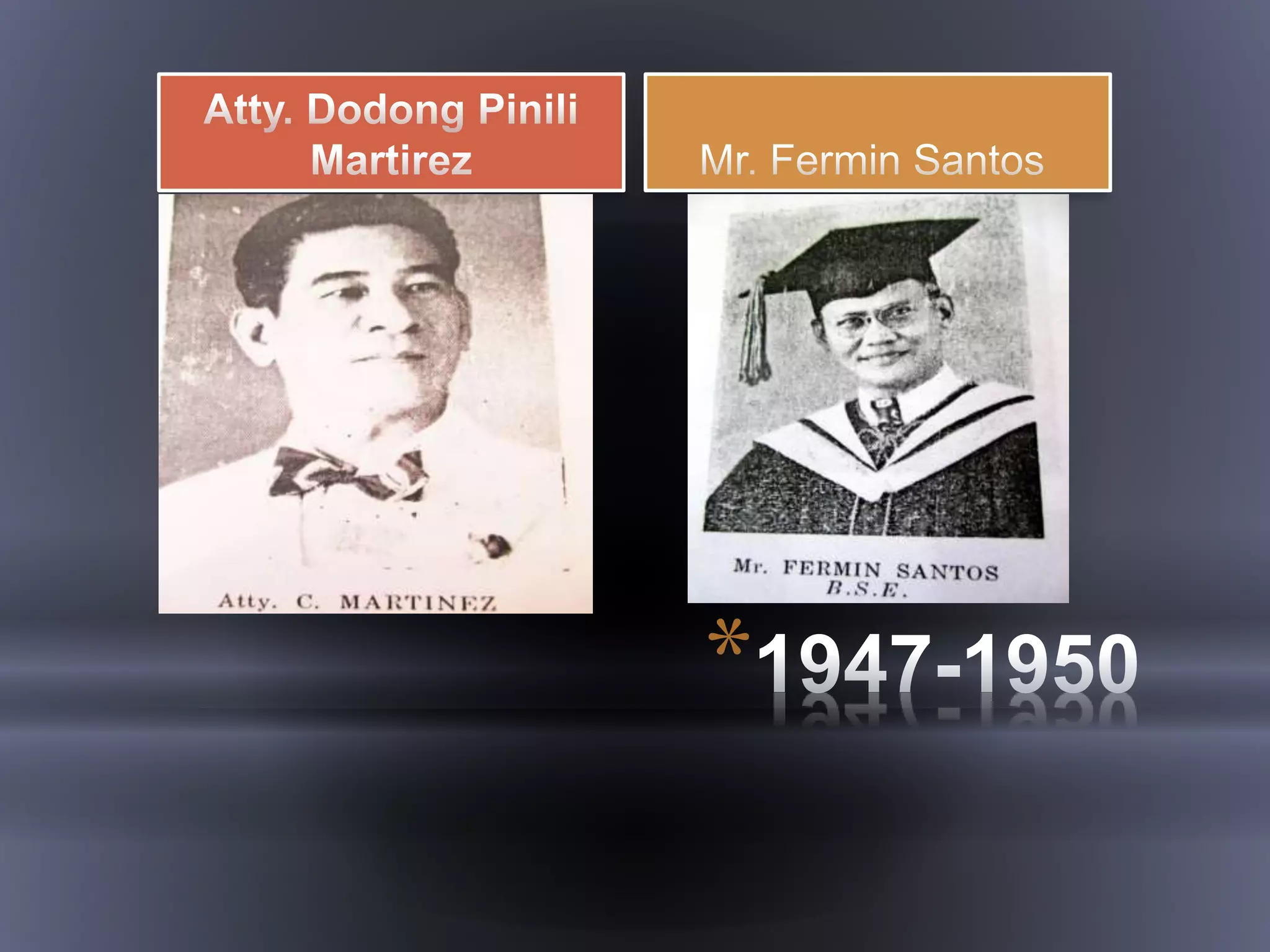
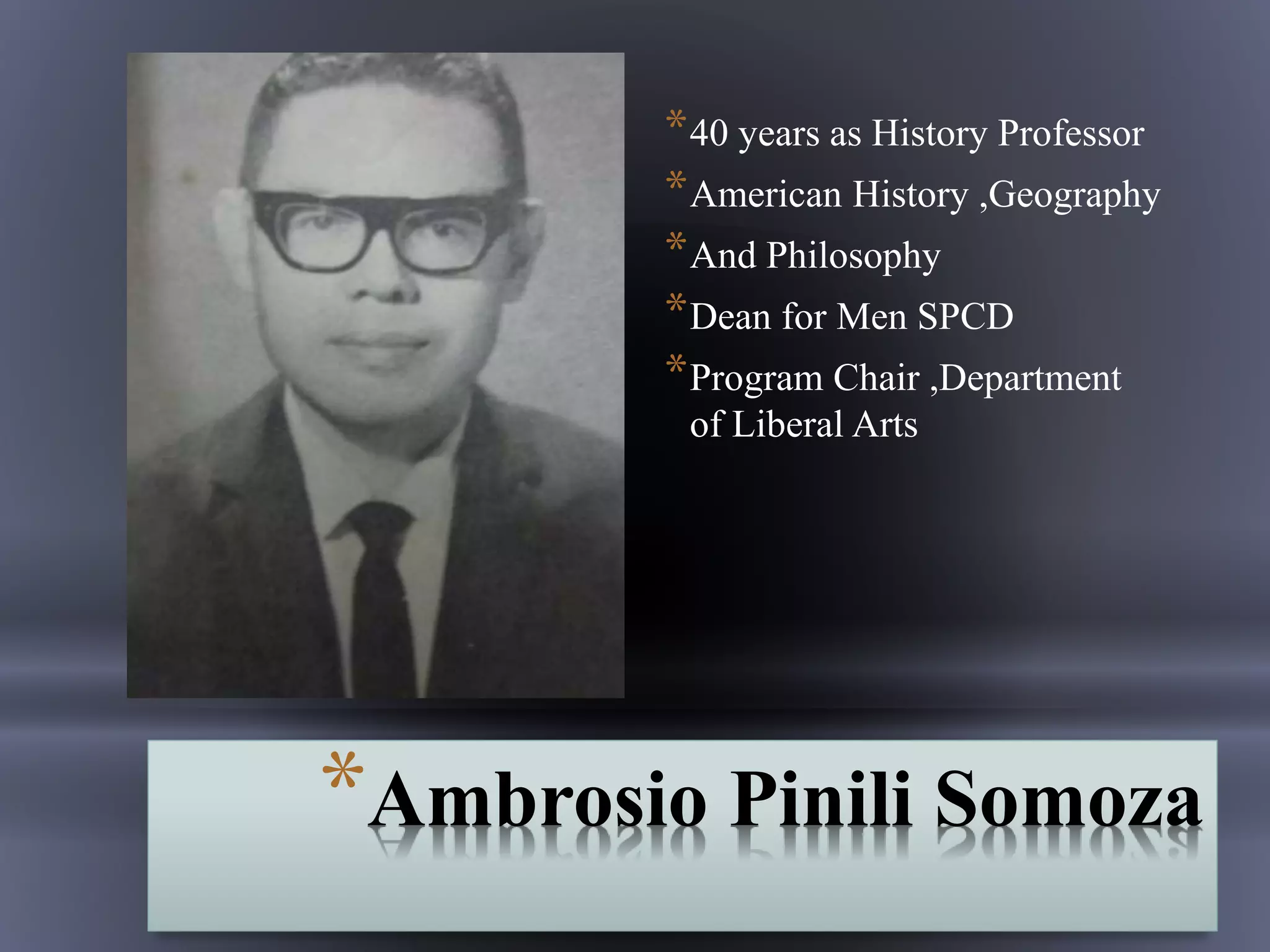
*Ambrosio Pinili Somoza
*40 years as History Professor
*American History ,Geography
*And Philosophy
*Dean for Men SPCD
*Program Chair ,Department
of Liberal Arts
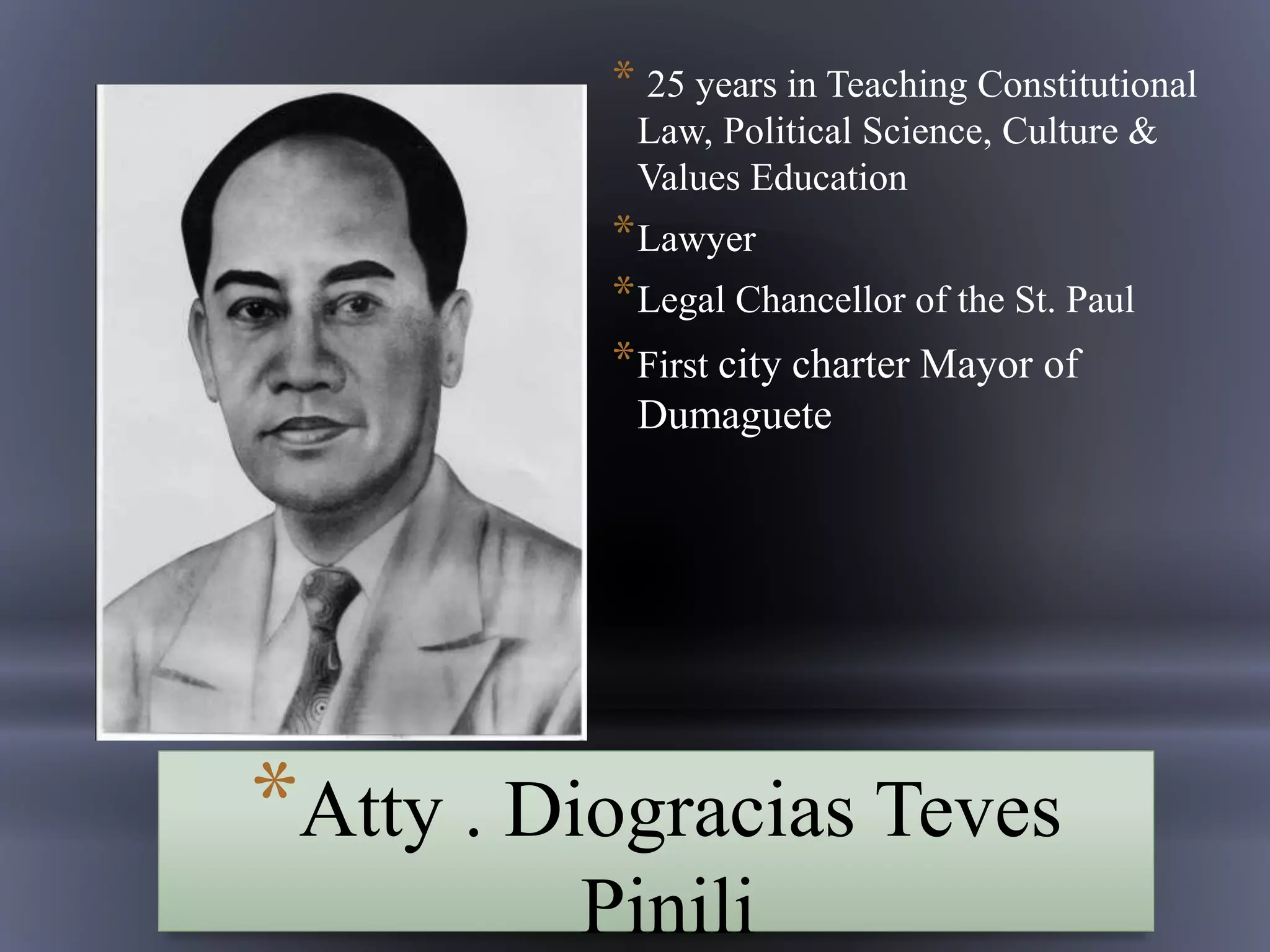
*Atty . Diogracias Teves
Pinili
* 25 years in Teaching Constitutional
Law, Political Science, Culture &
Values Education
*Lawyer
*Legal Chancellor of the St. Paul
*First city charter Mayor of
Dumaguete
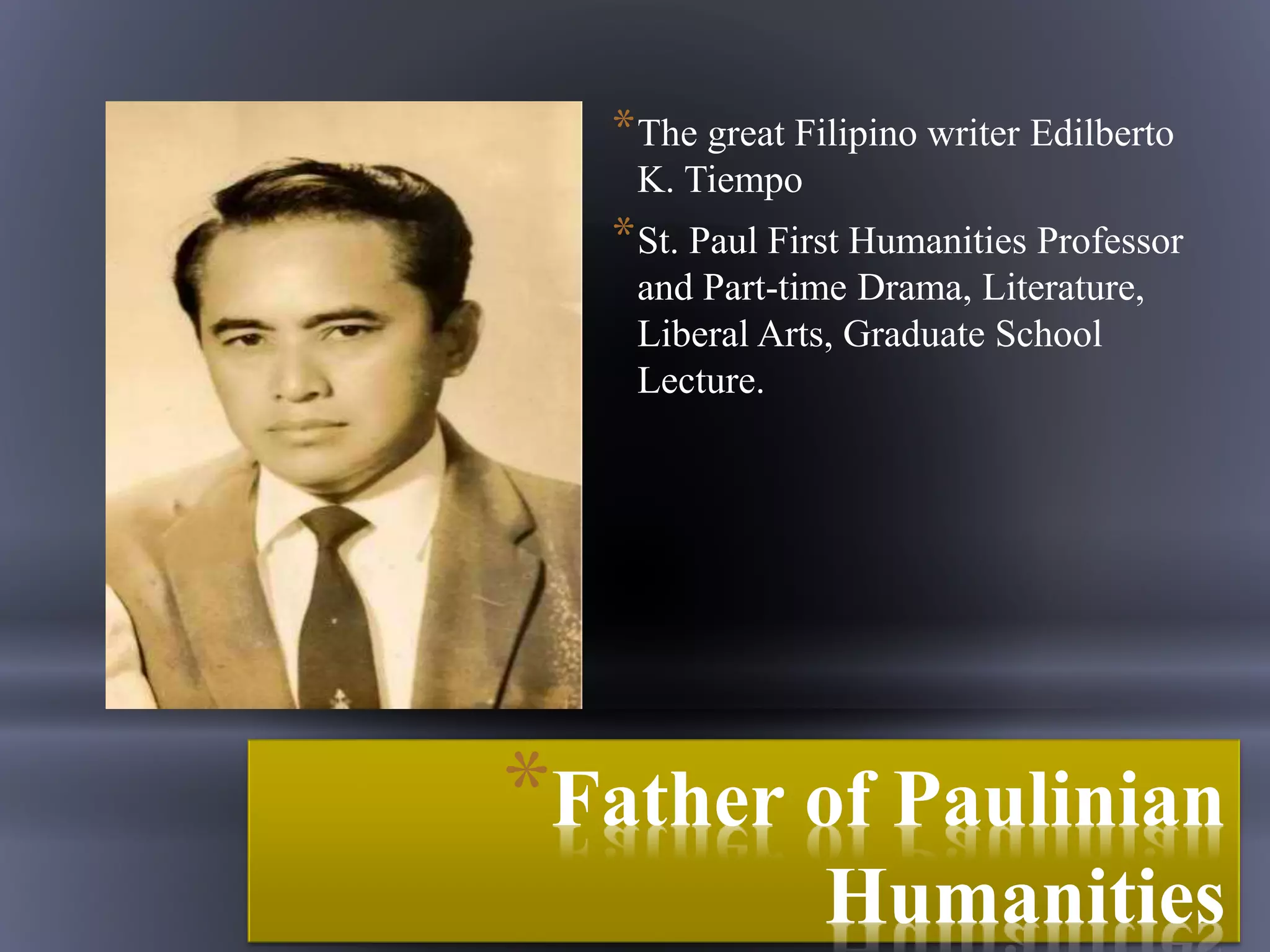
*Father of Paulinian
Humanities
*The great Filipino writer Edilberto
K. Tiempo
*St. Paul First Humanities Professor
and Part-time Drama, Literature,
Liberal Arts, Graduate School
Lecture.
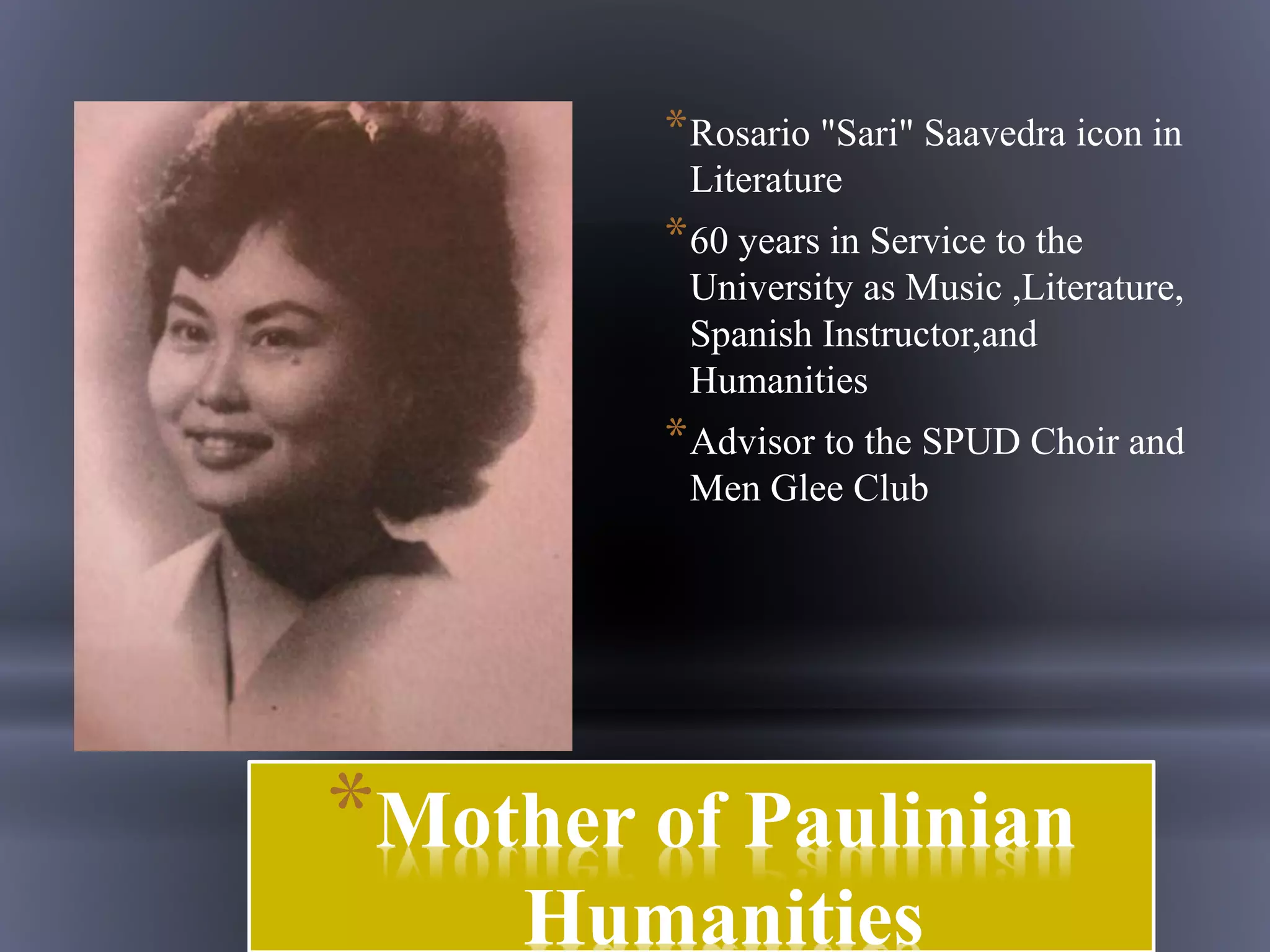
*Mother of Paulinian
Humanities
*Rosario "Sari" Saavedra icon in
Literature
*60 years in Service to the
University as Music ,Literature,
Spanish Instructor,and
Humanities
*Advisor to the SPUD Choir and
Men Glee Club
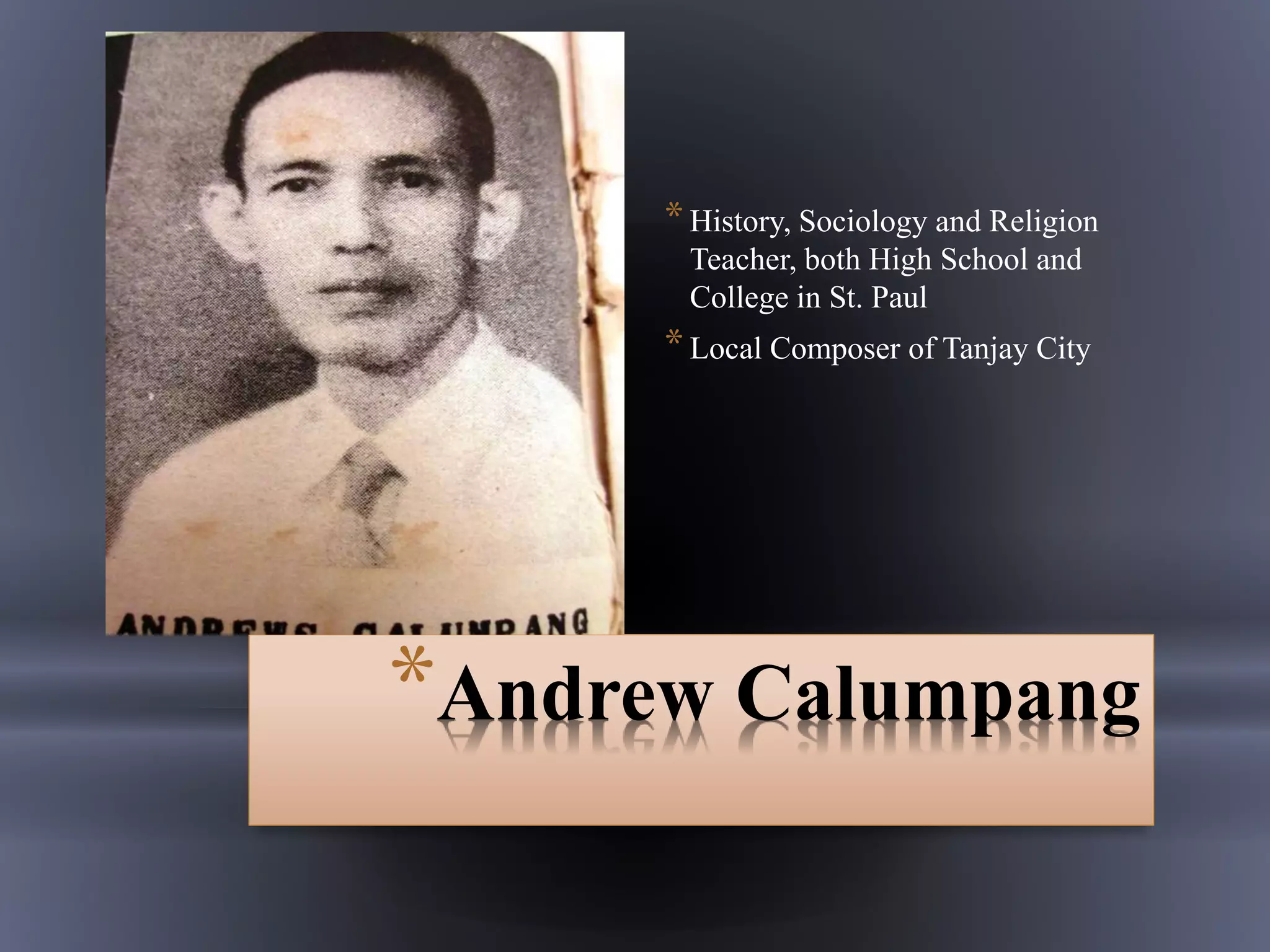
*History, Sociology and Religion
Teacher, both High School and
College in St. Paul
*Local Composer of Tanjay City
*Andrew Calumpang
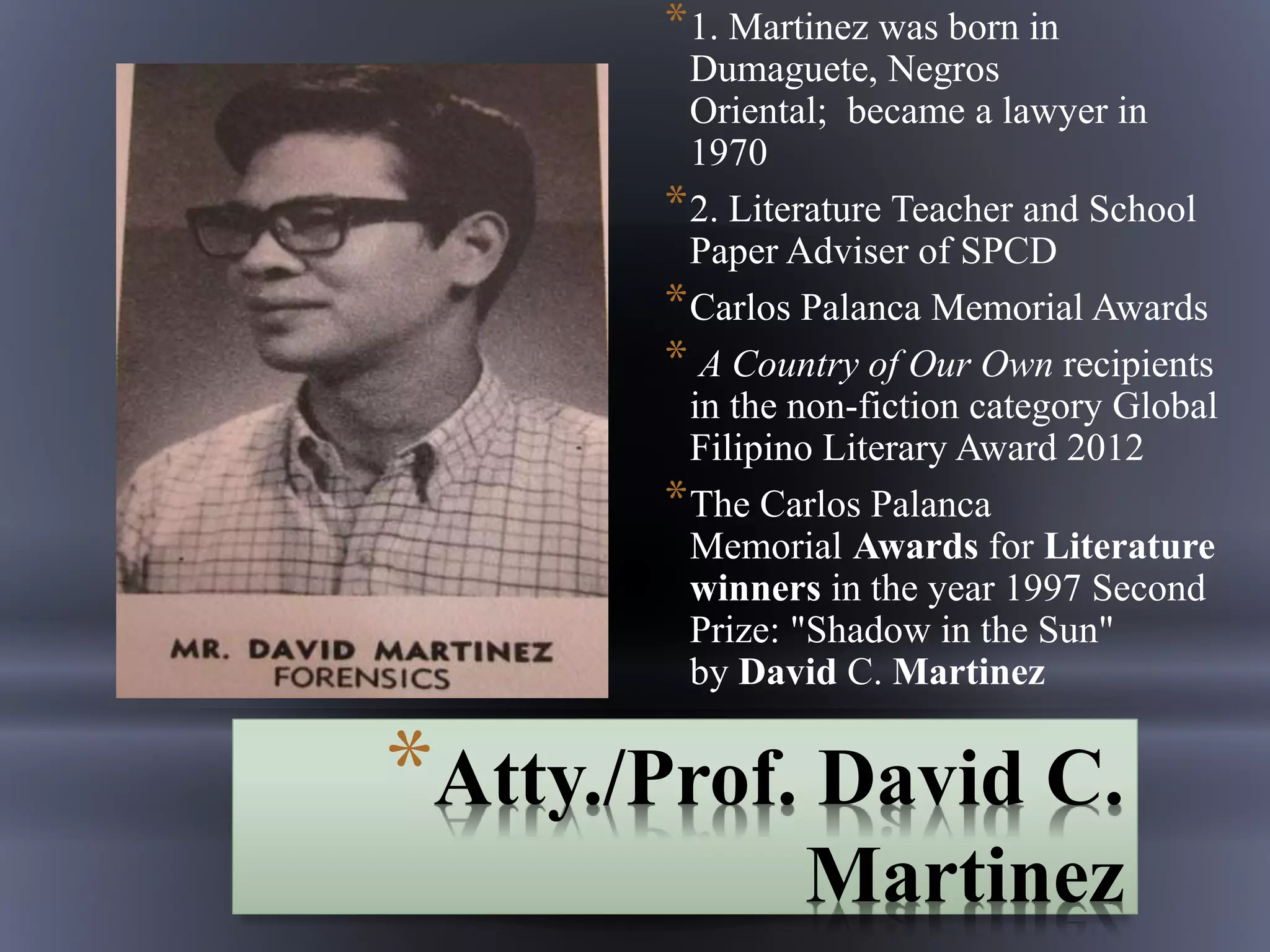
*Atty./Prof. David C.
Martinez
*1. Martinez was born in
Dumaguete, Negros
Oriental; became a lawyer in
1970
*2. Literature Teacher and School
Paper Adviser of SPCD
*Carlos Palanca Memorial Awards
* A Country of Our Own recipients
in the non-fiction category Global
Filipino Literary Award 2012
*The Carlos Palanca
Memorial Awards for Literature
winners in the year 1997 Second
Prize: "Shadow in the Sun"
by David C. Martinez
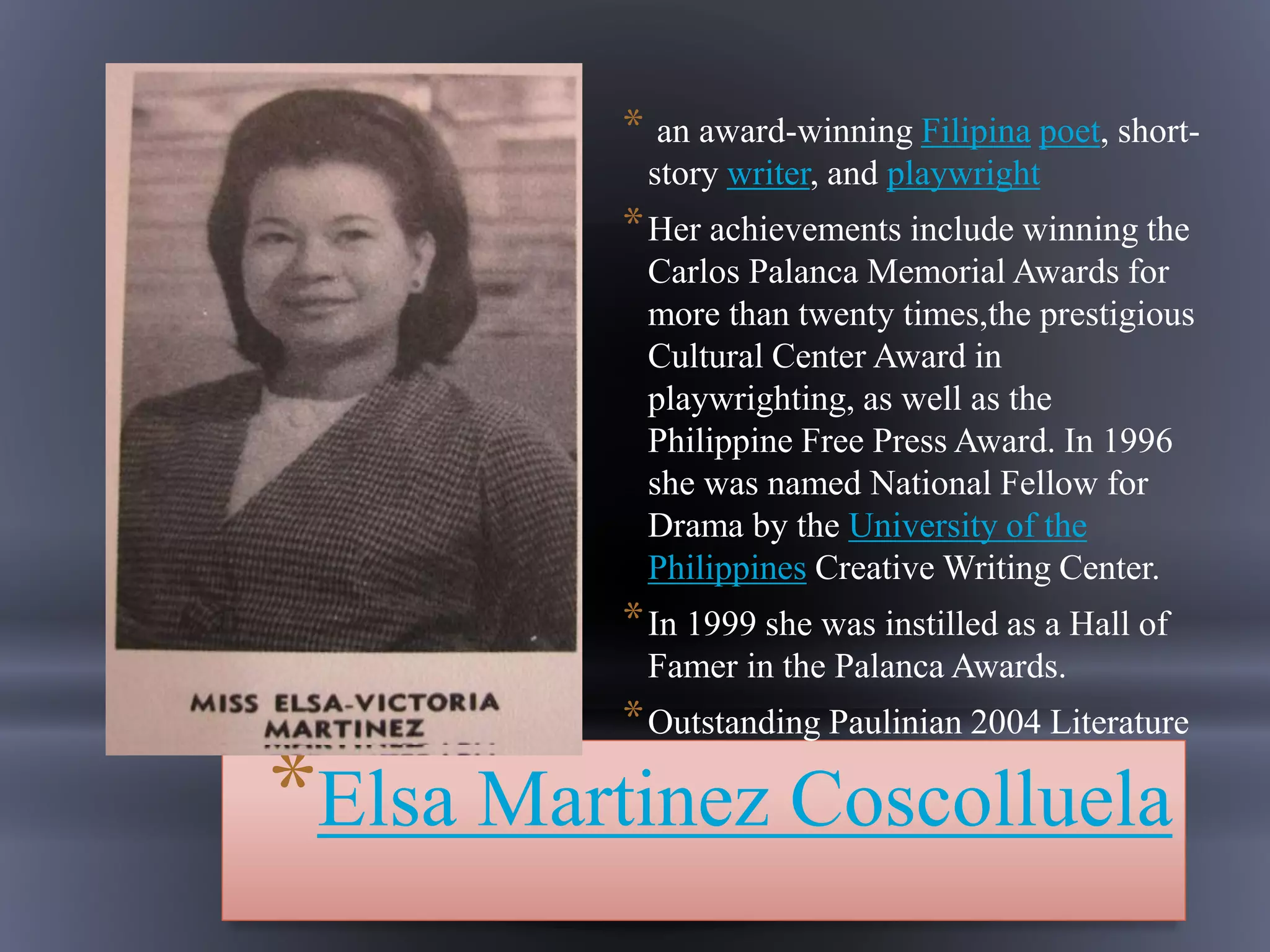
*Elsa Martinez Coscolluela
* an award-winning Filipina poet, short-
story writer, and playwright
*Her achievements include winning the
Carlos Palanca Memorial Awards for
more than twenty times,the prestigious
Cultural Center Award in
playwrighting, as well as the
Philippine Free Press Award. In 1996
she was named National Fellow for
Drama by the University of the
Philippines Creative Writing Center.
*In 1999 she was instilled as a Hall of
Famer in the Palanca Awards.
*Outstanding Paulinian 2004 Literature
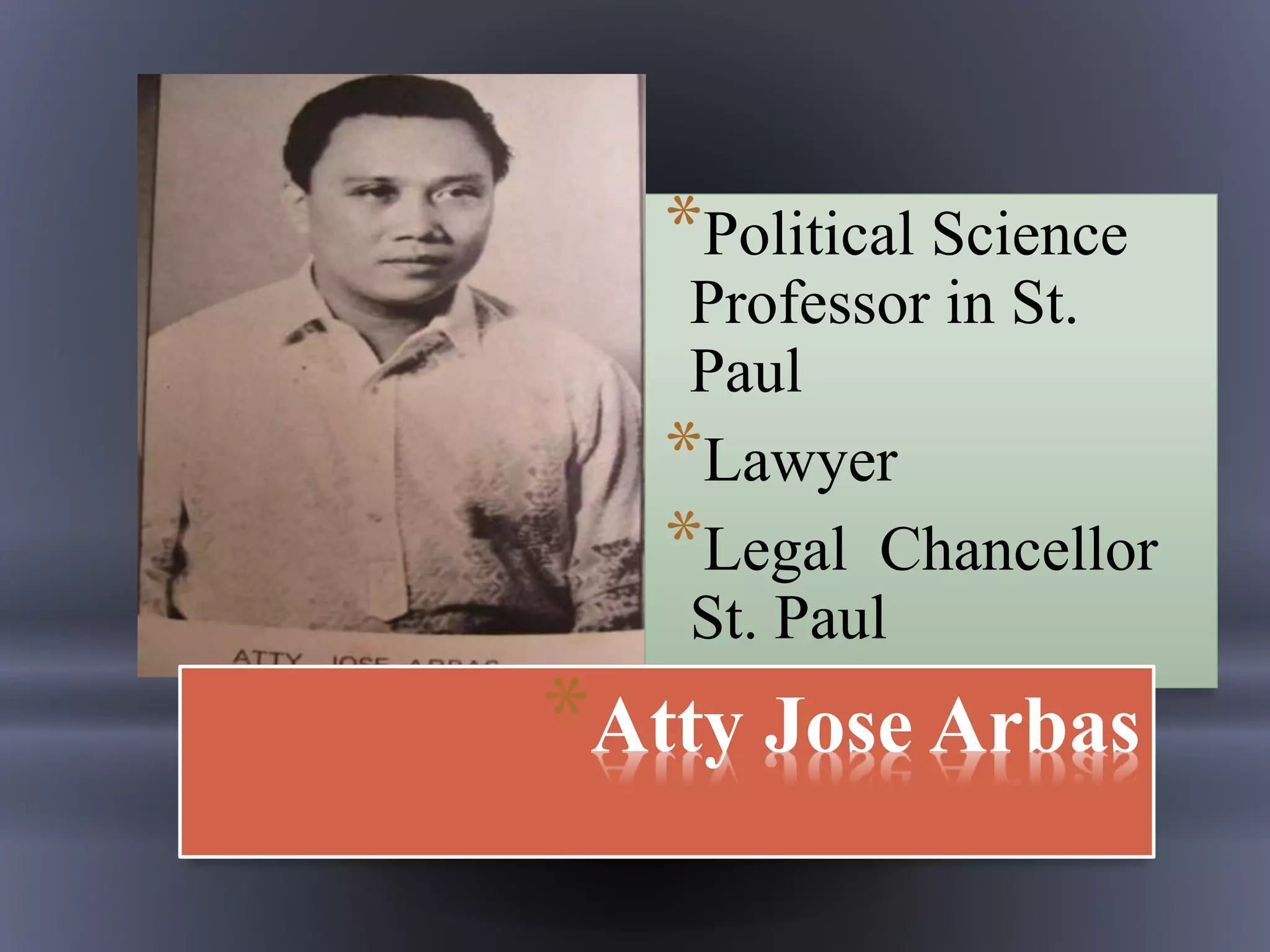
*Political Science
Professor in St.
Paul
*Lawyer
*Legal Chancellor
St. Paul
*Atty Jose Arbas
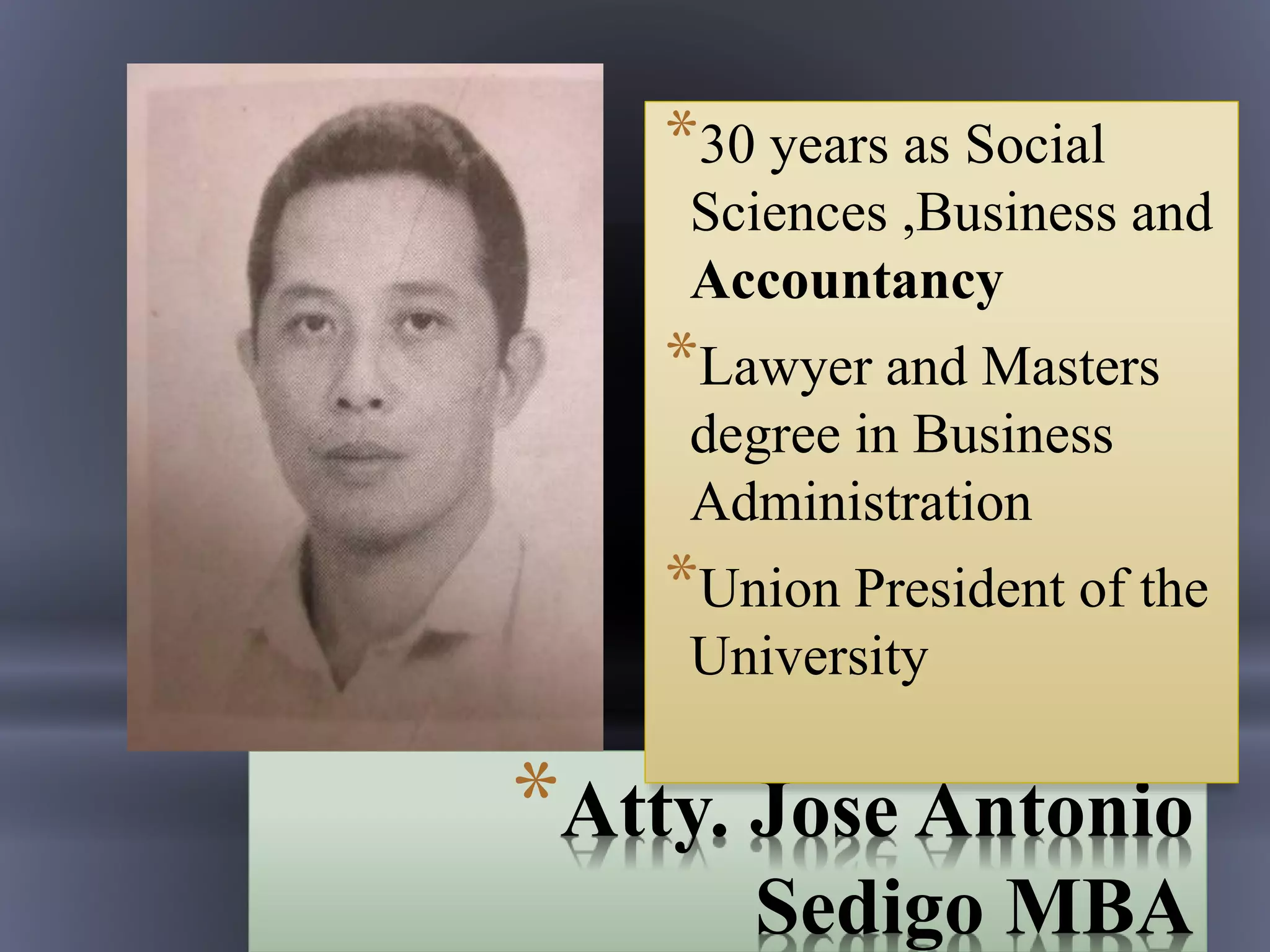
*Atty. Jose Antonio
Sedigo MBA
*30 years as Social
Sciences ,Business and
Accountancy
*Lawyer and Masters
degree in Business
Administration
*Union President of the
University
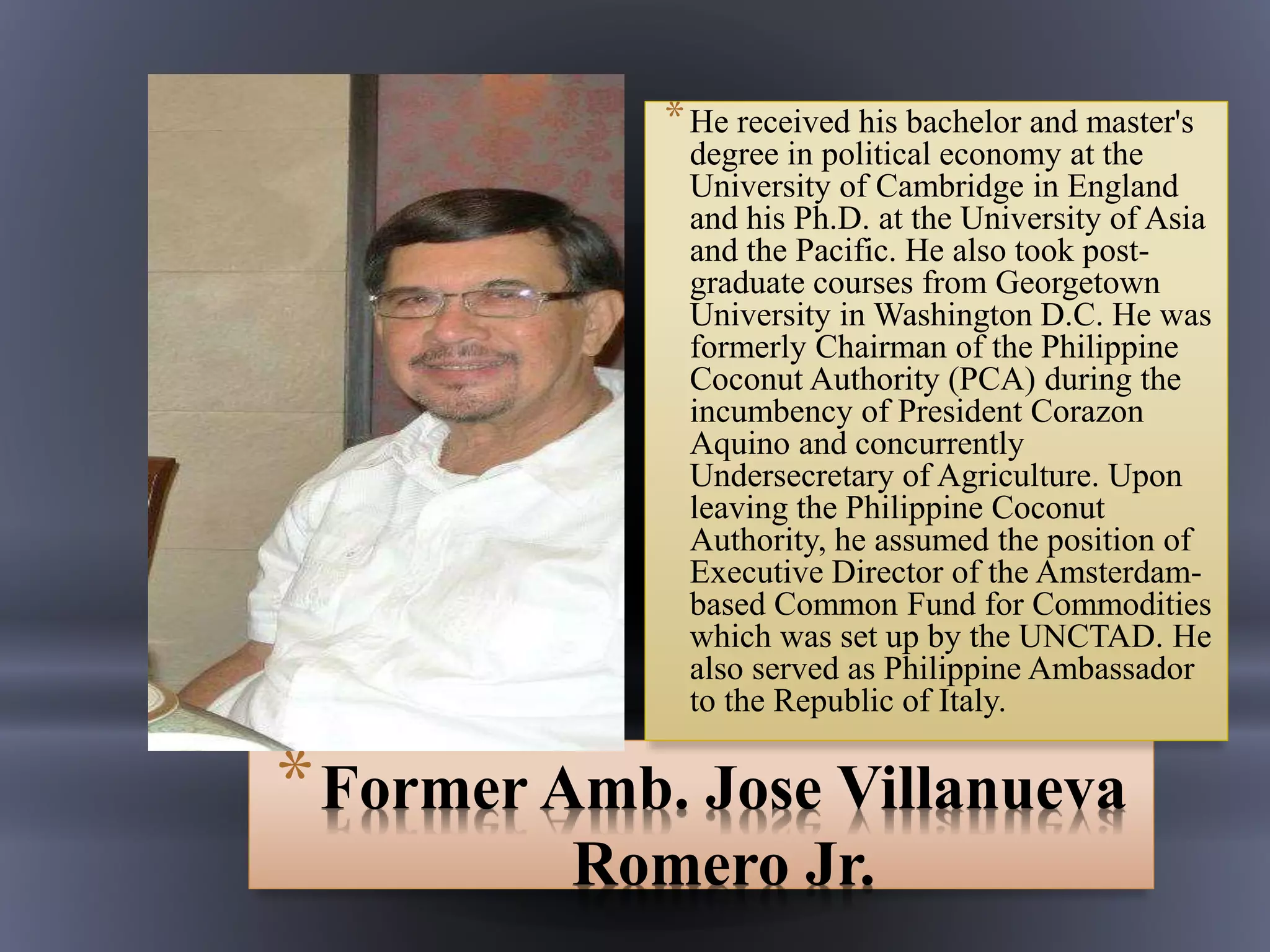
*Former Amb. Jose Villanueva
Romero Jr.
*He received his bachelor and master's
degree in political economy at the
University of Cambridge in England
and his Ph.D. at the University of Asia
and the Pacific. He also took post-
graduate courses from Georgetown
University in Washington D.C. He was
formerly Chairman of the Philippine
Coconut Authority (PCA) during the
incumbency of President Corazon
Aquino and concurrently
Undersecretary of Agriculture. Upon
leaving the Philippine Coconut
Authority, he assumed the position of
Executive Director of the Amsterdam-
based Common Fund for Commodities
which was set up by the UNCTAD. He
also served as Philippine Ambassador
to the Republic of Italy.
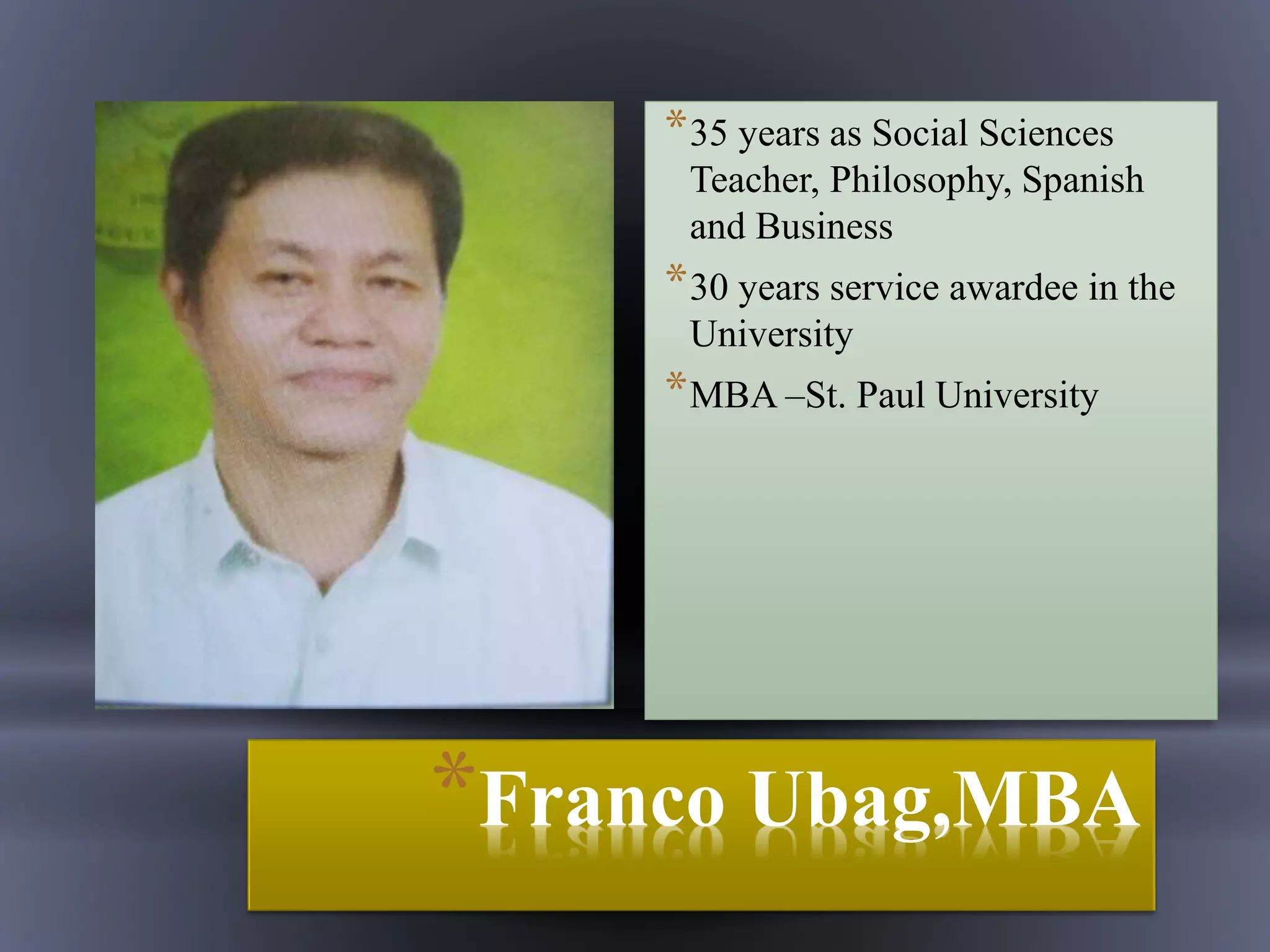
*Franco Ubag,MBA
*35 years as Social Sciences
Teacher, Philosophy, Spanish
and Business
*30 years service awardee in the
University
*MBA –St. Paul University
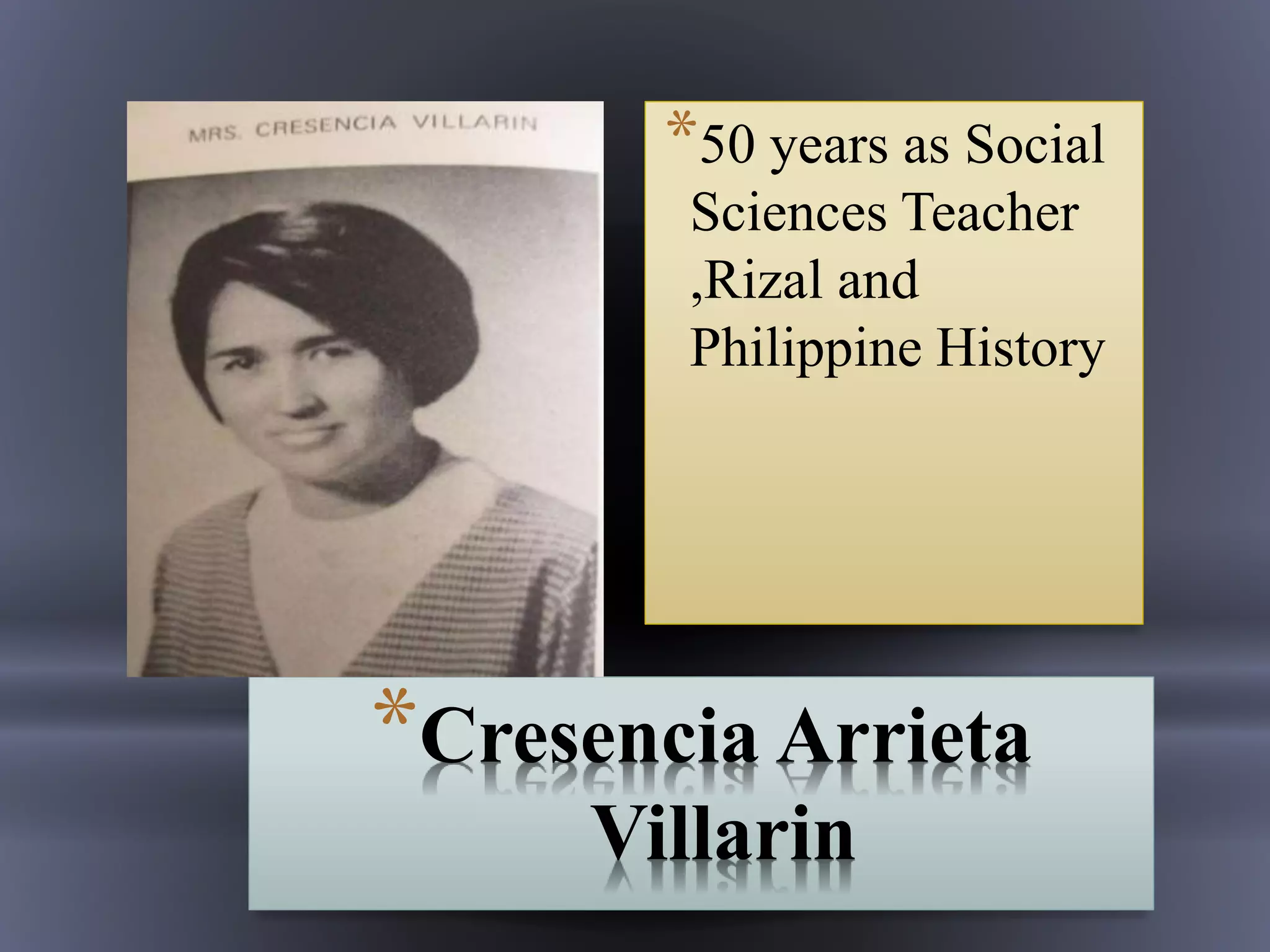
*Cresencia Arrieta
Villarin
*50 years as Social
Sciences Teacher
,Rizal and
Philippine History
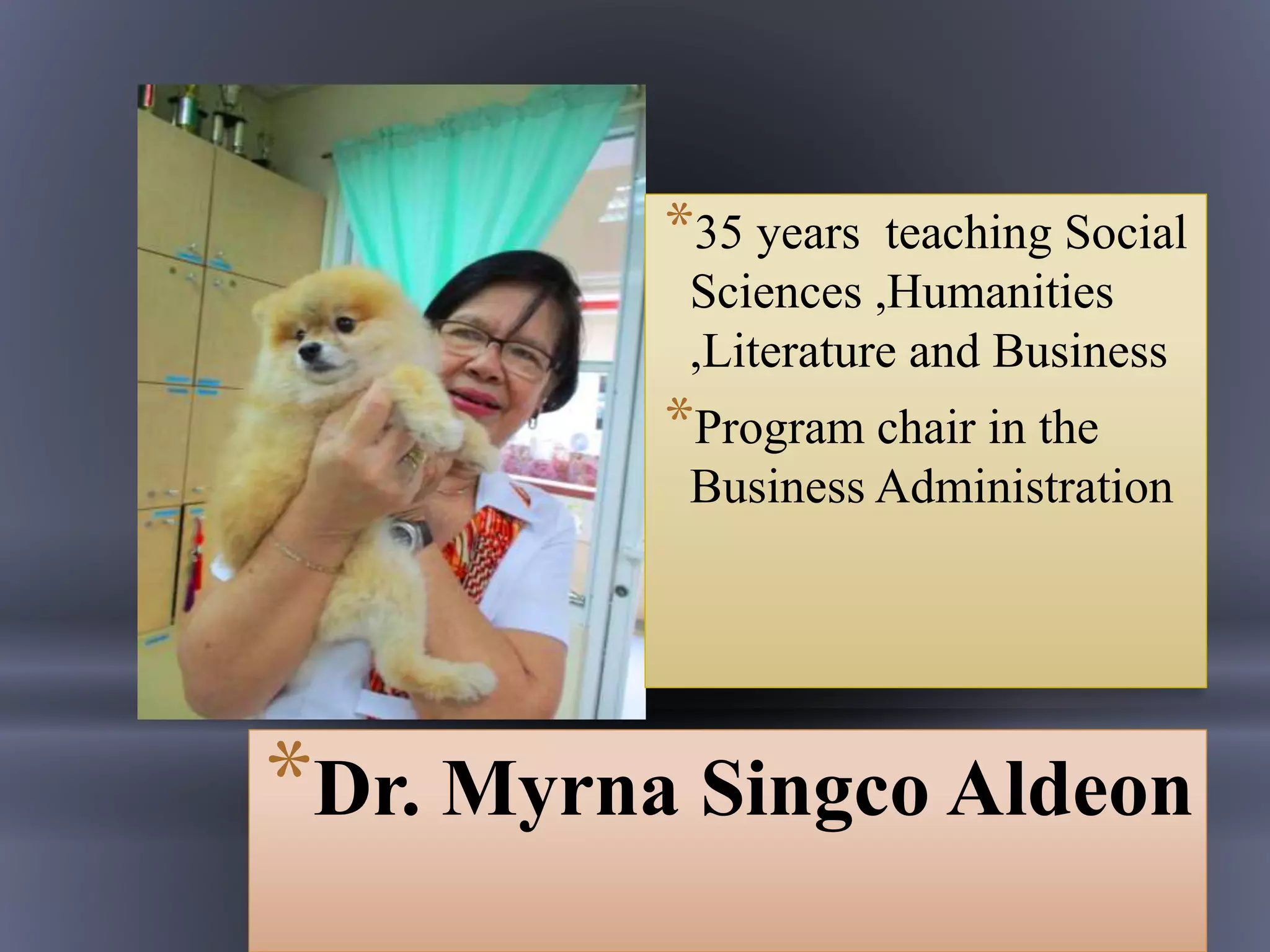
*35 years teaching Social
Sciences ,Humanities
,Literature and Business
*Program chair in the
Business Administration
*Dr. Myrna Singco Aldeon
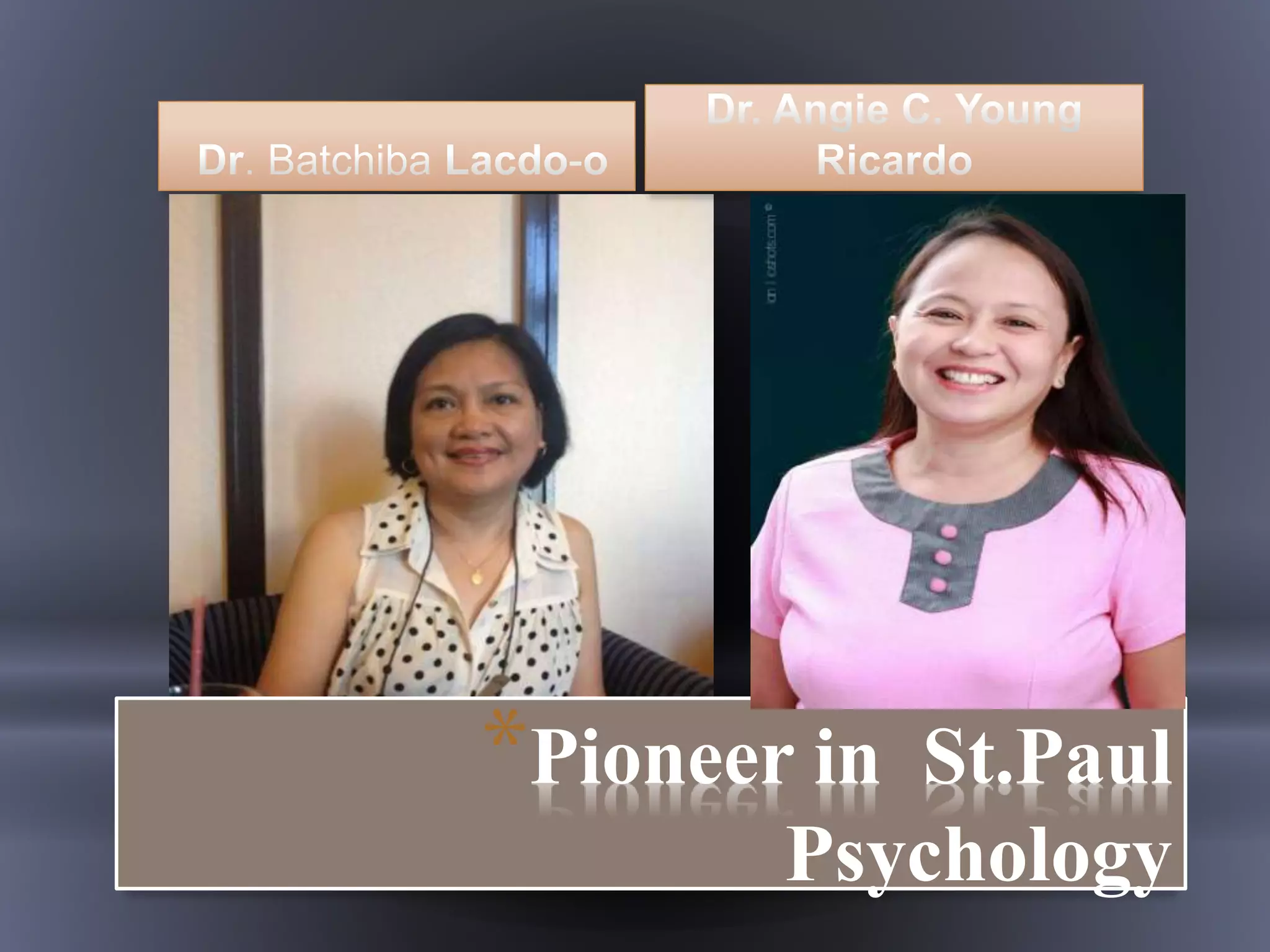
*Pioneer in St.Paul
Psychology
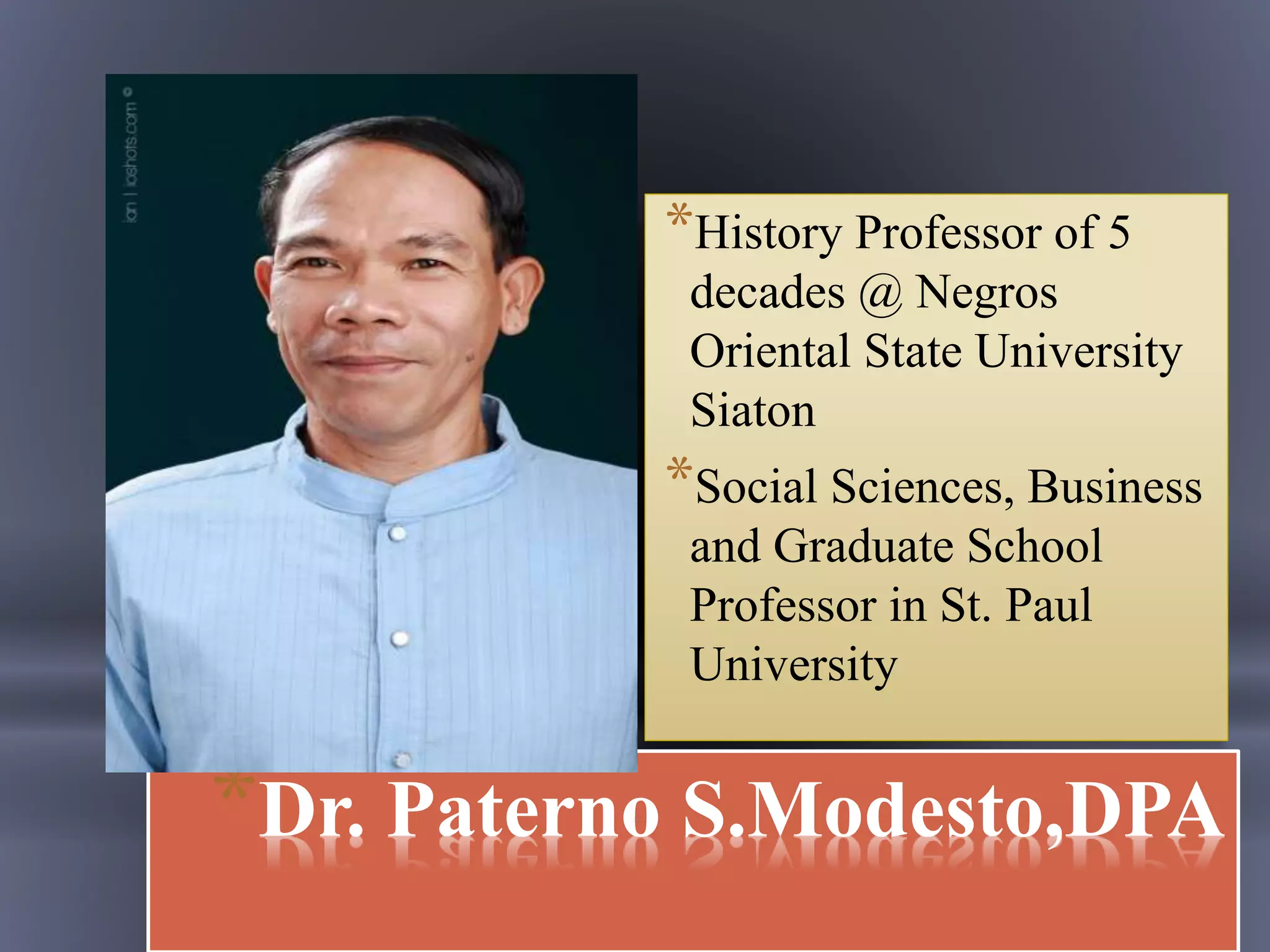
*History Professor of 5
decades @ Negros
Oriental State University
Siaton
*Social Sciences, Business
and Graduate School
Professor in St. Paul
University
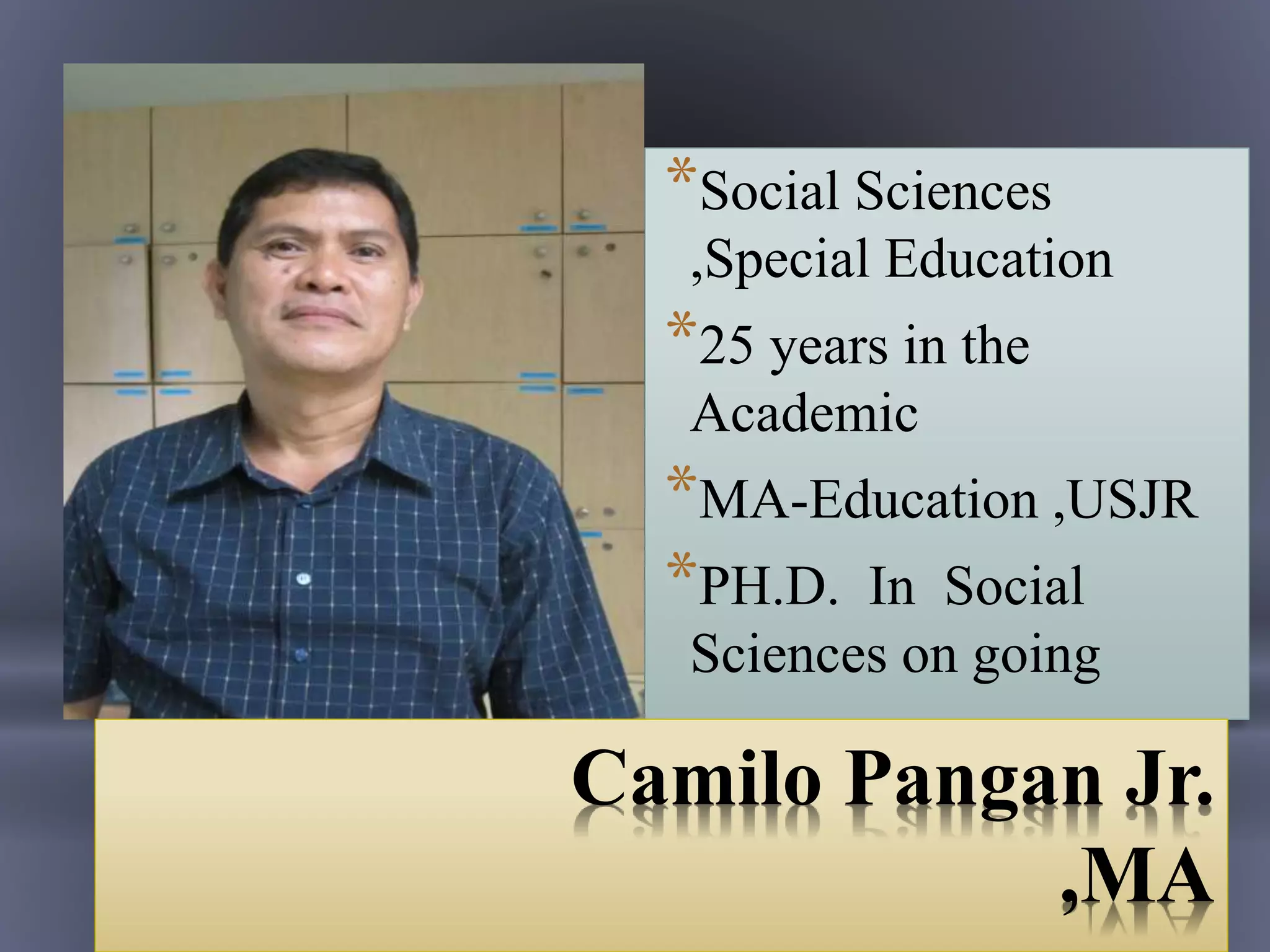
*Dr. Paterno S.Modesto,DPA
*Social Sciences
,Special Education
*25 years in the
Academic
*MA-Education ,USJR
*PH.D. In Social
Sciences on going
Camilo Pangan Jr.
,MA
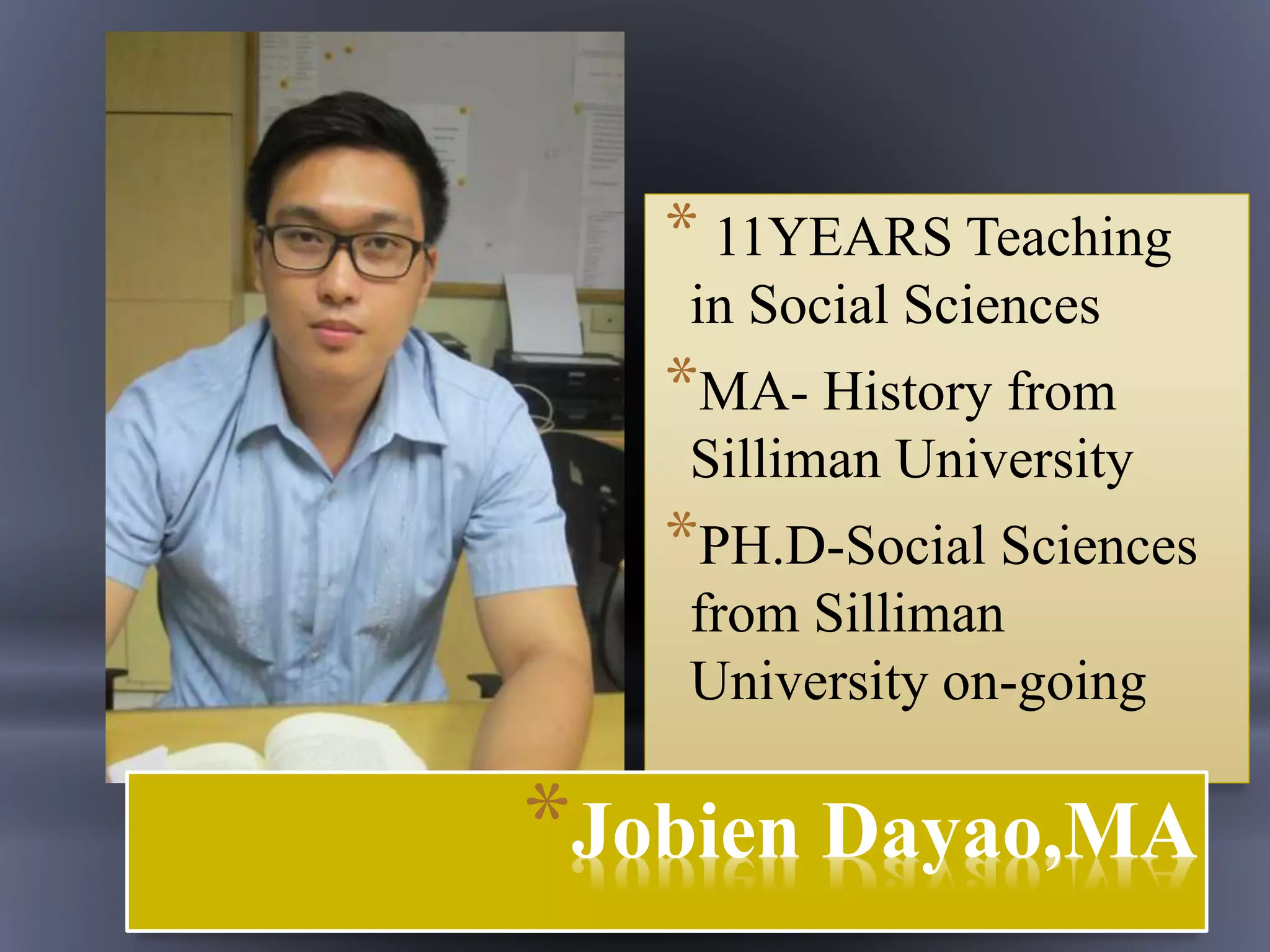
* 11YEARS Teaching
in Social Sciences
*MA- History from
Silliman University
*PH.D-Social Sciences
from Silliman
University on-going
*Jobien Dayao,MA
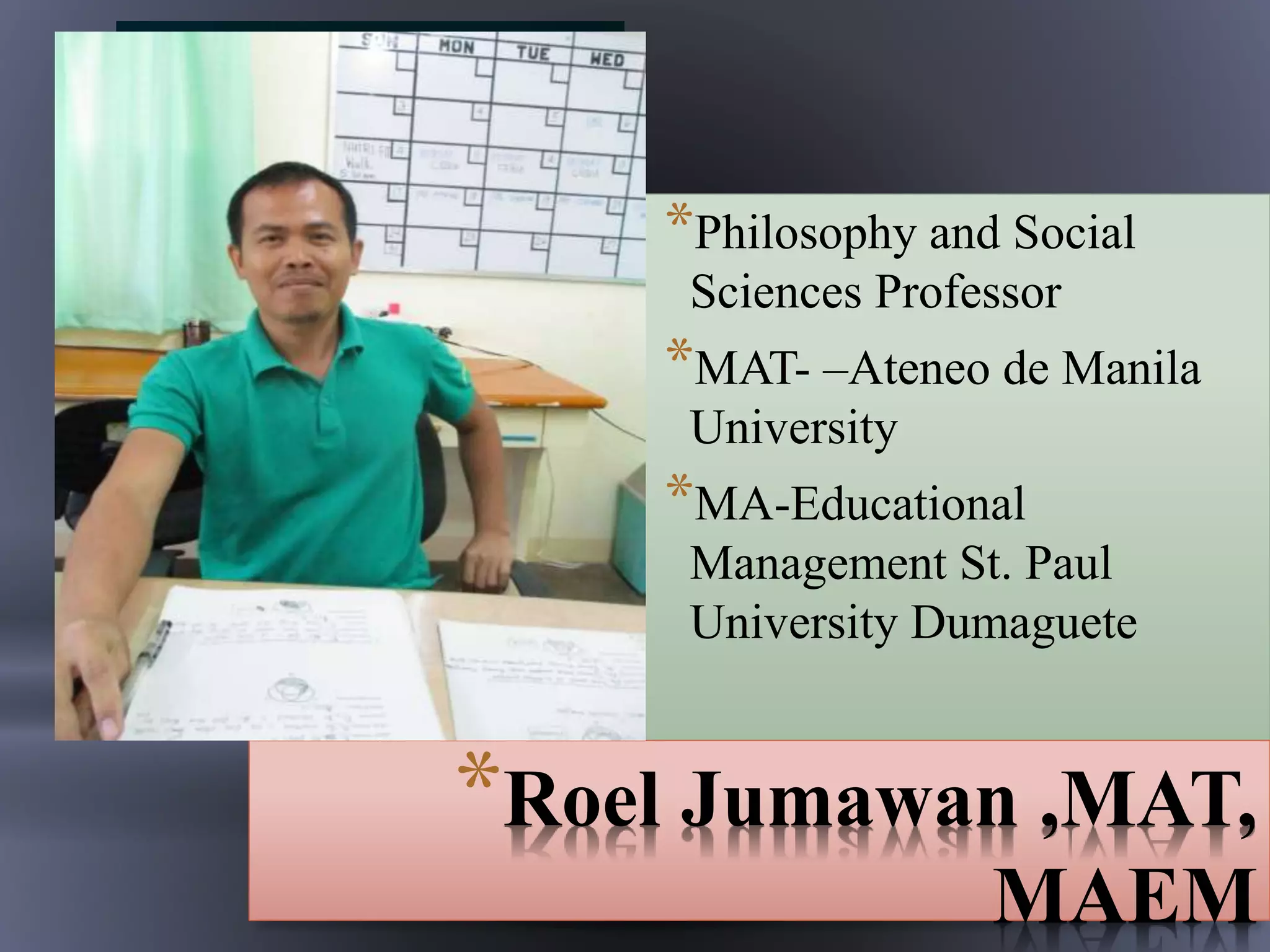
*Philosophy and Social
Sciences Professor
*MAT- –Ateneo de Manila
University
*MA-Educational
Management St. Paul
University Dumaguete
*Roel Jumawan ,MAT,
MAEM
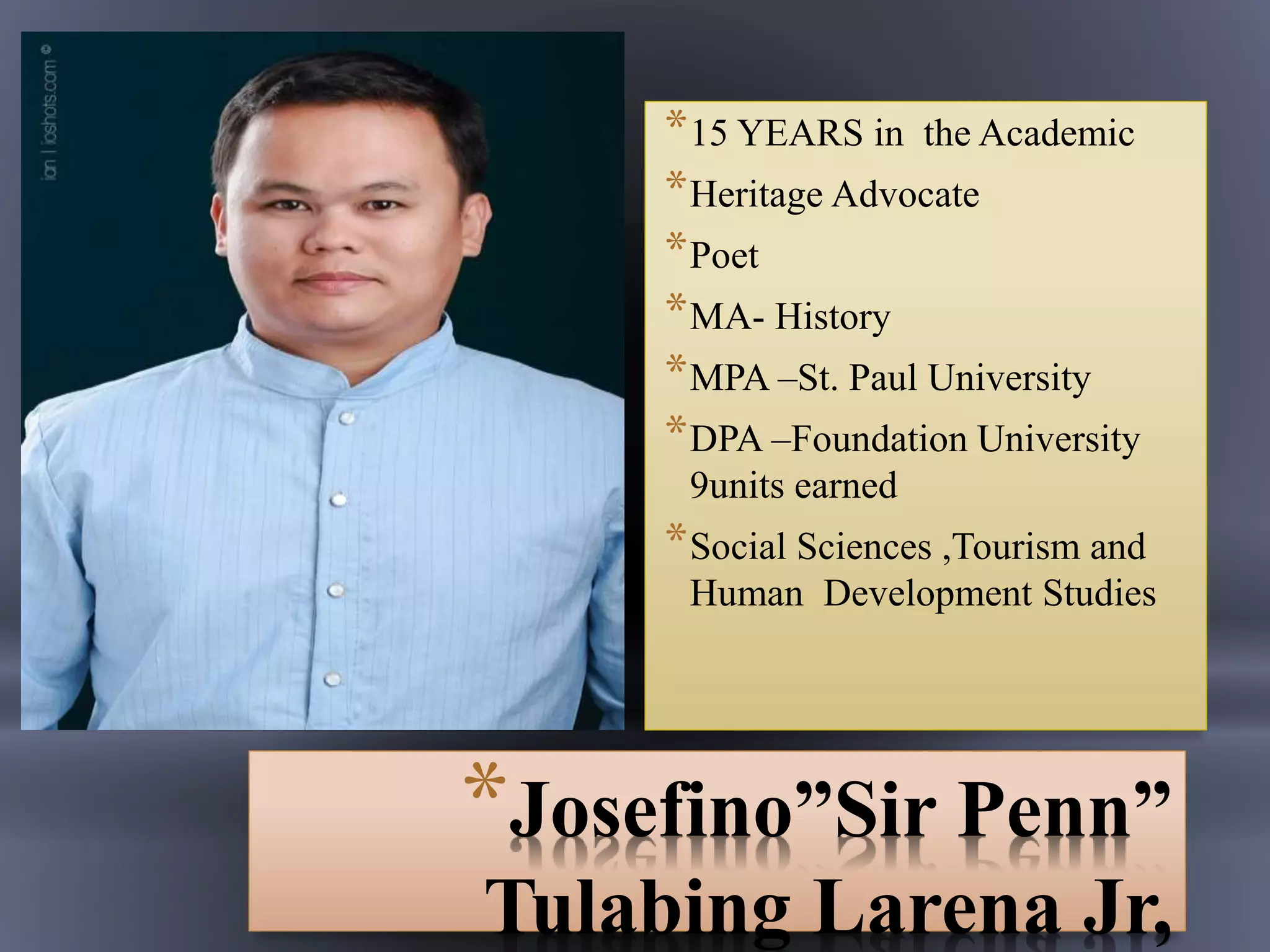
*Josefino”Sir Penn”
Tulabing Larena Jr,
*15 YEARS in the Academic
*Heritage Advocate
*Poet
*MA- History
*MPA –St. Paul University
*DPA –Foundation University
9units earned
*Social Sciences ,Tourism and
Human Development Studies
*
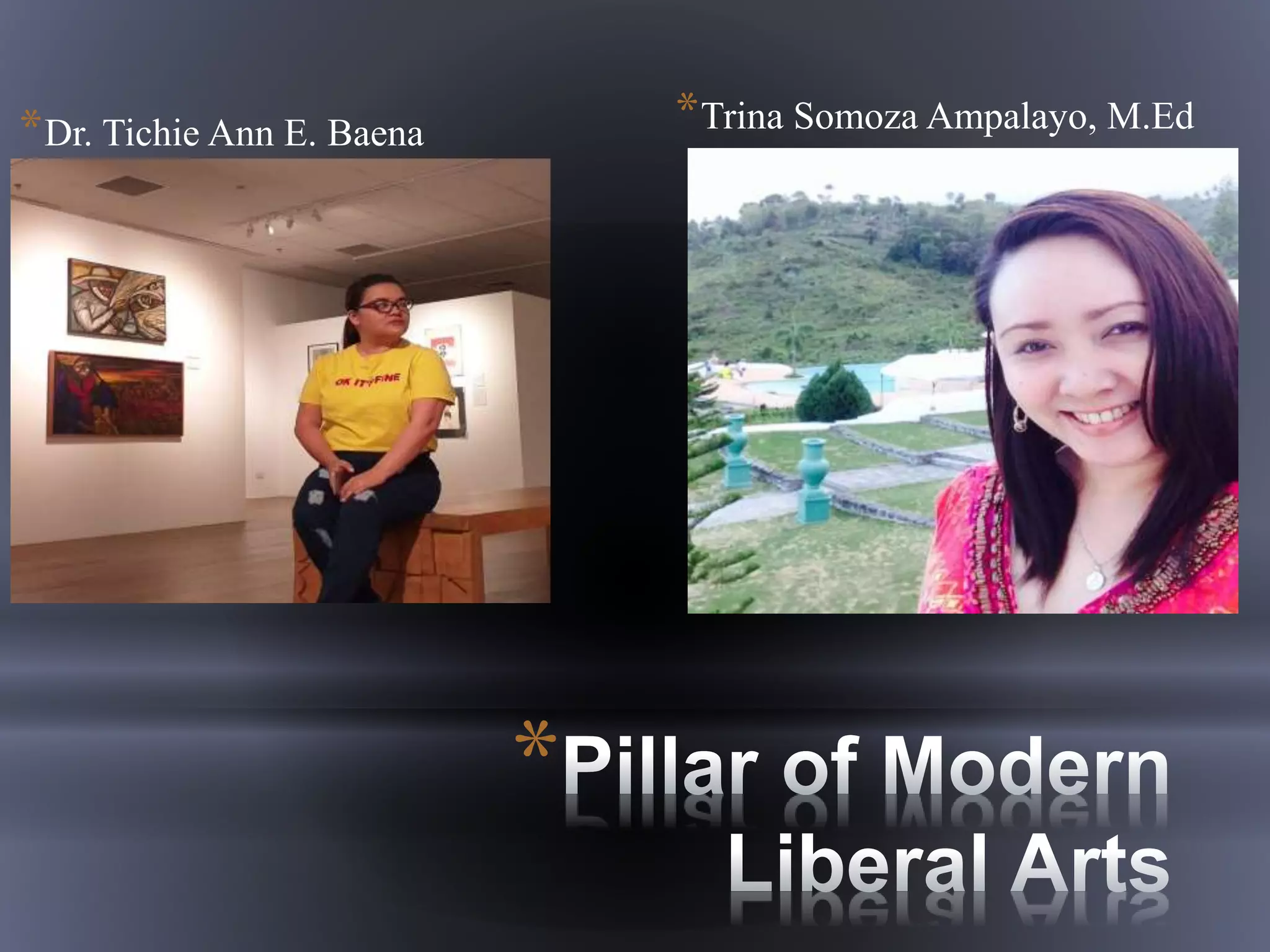
*Dr. Tichie Ann E. Baena *Trina Somoza Ampalayo, M.Ed
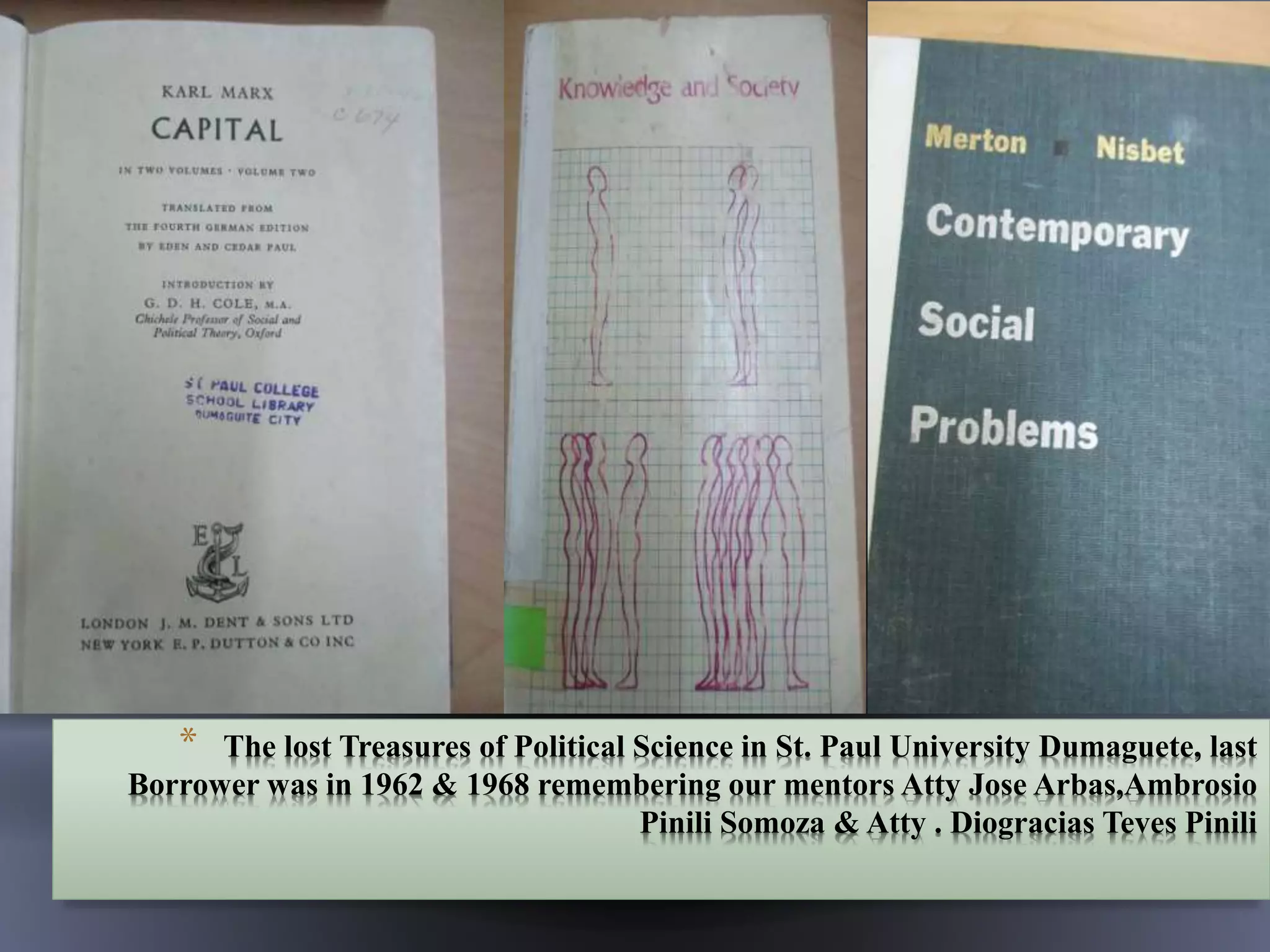
* The lost Treasures of Political Science in St. Paul University Dumaguete, last
Borrower was in 1962 & 1968 remembering our mentors Atty Jose Arbas,Ambrosio
Pinili Somoza & Atty . Diogracias Teves Pinili
*

Introduction to Social Sciences

  • 1.
  • 2.
    *Photo Credit *1. IanOmictin *2. St. Paul University Alumni Affairs Office *3. Mr. Penn Larena *4. Mr. Ron Calumpang *5. SPUD College of Arts and Education *6. SPUD University Library
  • 3.
    *Learning Objectives . *Meaning ofthe word Social Sciences *Branches of Social Sciences *Importance of Social Sciences *Different views of the field of Social Sciences *Explore the significant personalities that contributed to the development of the local Social Sciences
  • 4.
    *KNOWLEDGE *1. Pure • Theoretical •Descriptive *2. Applied • Practical / Experimental
  • 5.
    *What are Social Sciences??? *Academicdisciplines dealing with the study of the social life of groups and individuals
  • 6.
    *Social -relating tohuman society and how it is organized. *Science- the study of the physical and natural world and phenomena, especially by using systematic observation and experiment.
  • 7.
  • 8.
    * *The study of humankindin all is aspects: culture and development.
  • 9.
    * *The study ofthe origin, development, and structure of human societies and the behavior of individual people and groups in society
  • 10.
    * *the study ofpolitical organizations and institutions, especially governments.
  • 11.
  • 12.
    * *The scientific study ofthe human mind and mental states, and of human and animal behaviour.
  • 13.
  • 14.
    *knowledge of thesocial sciences can help us improve our societies *Here we study *• How people put their societies together *• The impacts of their decisions about how their societies should be run. *• How societies should be put together.
  • 15.
    *Overall, then, itis important to study social sciences so that we can get the sorts of information that can help us create better societies.
  • 16.
    Social Sciences areall about an objective study (science) of people and their interactions. *If we want to improve our lives, choices, groups, *institutions and societies we need to understand *how they work? *interactions. *why they exist? and *how they have functioned in the past? *The most effective study of social science is *when they are studied together to answer the *big questions we have about ourselves and *human life on the planet.
  • 17.
    *Some Views aboutSocial Sciences.. *Social sciences are among the most interesting subjects to study. Human behaviour is fascinating. For anyone involved in a life or profession that deals with human behaviour (which is arguably everyone), knowledge and understanding of communication, conflict-resolution, motivation, etc. is immensely helpful.
  • 18.
    *Some Views aboutSocial Sciences *One of the best reasons is just because it is *fascinating to try and figure out why humans *do what they do. The newer science of *behavioural economics looking closely at how *people can be manipulated to make decisions, *etc., is absolutely fascinating stuff. *Though it is impossible to totally understand *why humans do what they do, it is certainly possible to better understand it.
  • 19.
    *Some Views aboutSocial Sciences *Studying the social sciences can provide us with so many important answers and observations that may help improve the understanding of our lives, and thus help us to improve our interactions with each other. *The social sciences can provide insight into all types of social situations such as raising children, family relationships, friendships, work place relationships, interactions with strangers, cultural differences, and so on. *Studying these situations and complex scenarios that arise in each situation really aids those in various professions that dedicate their lives to helping people improve and understand their behaviour or psychological processes.
  • 20.
  • 21.
    *the scope insocial Sciences? *The scope of social studies is determined by the definition of the subject. *It is the integration of various social sciences and humanities for the purpose of citizenship education. social studies involves the study of history, economics, and other subjects in social sciences.
  • 22.
    *the scope insocial Sciences? *Another school see it as a method or an approach; *• It is study of social sciences for pedagogical purposes . *• It equips students with the ability to teach social science subjects in secondary level of education.
  • 23.
    *Social Sciences Research Direction….… *SocialSciences * Politics: *Some areas for core Research…… * National Politics * International Politics * Modern Political Philosophies * Christian Political Philosophy * Village based political system * Political Policies * Political Personalities * Political Strategies * Political issues and problems * Political Trends * Others
  • 24.
    *Social Sciences *Economics: *Some areasfor core Research…… * Modern Economics * Economic Philosophies * Christian Economics * International Economics * Micro Economics * Macro Economics * Family Economics * Economic Issues * Economics Policies * Economic Systems * Managerial, industrial and business Economics * National and International Economic Problems * Economic Institutions
  • 25.
    * Social Sciences *Law: * Some areas for core Research…… * Legal System * Local Laws * International Laws * Shariah Law * Corporate Law * Business Law * Companies Law * Criminal Law * Animal Protection Law * Civil Law * Cyber Law * Labor Law * Employment Law * Environment Protection Law * Child Protection Act * Women Safety Act * Dowry Act / Bill * Others Laws
  • 26.
    * Social Sciences *Sociology: * Some areas for core Research…… * Human Behaviors * Behavior of the Society * Basic Values of the Society * Group Behavior * Family Behavior * Community Behavior * General Social Issues * Specifics Regional issues * Specific Community based Issues * Religious behavior * Social Trends * Living Styles * Art and Culture * Traditions and Festivals * Multi-cultural Society
  • 27.
    Social Sciences Management: Some areasfor core Research…. Administration Administrative System Human Resource Management Event Management Personality Development Diversity Management Personal Life management Family Life Management Quality Management Social Life Management Professional Life Management Religious Life Management
  • 28.
    *Social Sciences *Psychlogy: *Some areasfor core Research…… *Basic *• Abnormal *• Biological *• Cognitive *• Comparative *• Cultural *• Differential *• Developmental *• Evolutionary *• Experimental *• Mathematical *• Personality *• Positive *• Social[ *Applied *Applied *• Applied behaviour analysis *• Clinical *• Community *• Consumer *• Educational *• Health *• Industrial and *organizational *• Legal *• Military *• Occupational health *• Political *• Religion *• School *• Sport
  • 29.
    *Social Sciences *Journalism: *Some areasfor core Research…… * International Journalism * Political Journalism * Print Media * Electronic Media * Cyber Media * Entertainment Journalism * Linguistic Journalism * Journalism Concepts *Investigative Journalism *Journalism Trends
  • 30.
    *Social Sciences *Linguistics: *Some areasfor core Research…. *Applied and experimental linguistics *• Computational linguistics *• Evolutionary linguistics *• Forensic linguistics *• Internet linguistics *• Language acquisition *• Language assessment *• Language development *• Language education *• Linguistic anthropology *• Neurolinguistics *• Psycholinguistics *• Second-language acquisition
  • 31.
    *Society-Technology *The Society-Technology Interactionsteam represents varied disciplines, including anthropology, economics, and planning. Team members regularly collaborate with social science, natural and physical science, technology R&D, engineer, intermediary group, and industrial partners. Though empirically oriented, we take varied methodological approaches including behavioural, experimental, and regional economics; ethnographic inquiry; and surveying. Our analyses and products are designed to meet diverse customer needs and range from models and decision- support tools, to technical reports, to peer-reviewed publications, to informational and training materials for varied audiences
  • 32.
    *Life of aSocial Sciences Professors
  • 33.
  • 34.
  • 35.
  • 36.
    *St. Paul University SocialSciences Era 1960-1980s
  • 37.
    *Ambrosio Pinili Somoza *40years as History Professor *American History ,Geography *And Philosophy *Dean for Men SPCD *Program Chair ,Department of Liberal Arts
  • 38.
    *Atty . DiograciasTeves Pinili * 25 years in Teaching Constitutional Law, Political Science, Culture & Values Education *Lawyer *Legal Chancellor of the St. Paul *First city charter Mayor of Dumaguete
  • 39.
    *Father of Paulinian Humanities *Thegreat Filipino writer Edilberto K. Tiempo *St. Paul First Humanities Professor and Part-time Drama, Literature, Liberal Arts, Graduate School Lecture.
  • 40.
    *Mother of Paulinian Humanities *Rosario"Sari" Saavedra icon in Literature *60 years in Service to the University as Music ,Literature, Spanish Instructor,and Humanities *Advisor to the SPUD Choir and Men Glee Club
  • 41.
    *History, Sociology andReligion Teacher, both High School and College in St. Paul *Local Composer of Tanjay City *Andrew Calumpang
  • 42.
    *Atty./Prof. David C. Martinez *1.Martinez was born in Dumaguete, Negros Oriental; became a lawyer in 1970 *2. Literature Teacher and School Paper Adviser of SPCD *Carlos Palanca Memorial Awards * A Country of Our Own recipients in the non-fiction category Global Filipino Literary Award 2012 *The Carlos Palanca Memorial Awards for Literature winners in the year 1997 Second Prize: "Shadow in the Sun" by David C. Martinez
  • 43.
    *Elsa Martinez Coscolluela *an award-winning Filipina poet, short- story writer, and playwright *Her achievements include winning the Carlos Palanca Memorial Awards for more than twenty times,the prestigious Cultural Center Award in playwrighting, as well as the Philippine Free Press Award. In 1996 she was named National Fellow for Drama by the University of the Philippines Creative Writing Center. *In 1999 she was instilled as a Hall of Famer in the Palanca Awards. *Outstanding Paulinian 2004 Literature
  • 44.
    *Political Science Professor inSt. Paul *Lawyer *Legal Chancellor St. Paul *Atty Jose Arbas
  • 45.
    *Atty. Jose Antonio SedigoMBA *30 years as Social Sciences ,Business and Accountancy *Lawyer and Masters degree in Business Administration *Union President of the University
  • 46.
    *Former Amb. JoseVillanueva Romero Jr. *He received his bachelor and master's degree in political economy at the University of Cambridge in England and his Ph.D. at the University of Asia and the Pacific. He also took post- graduate courses from Georgetown University in Washington D.C. He was formerly Chairman of the Philippine Coconut Authority (PCA) during the incumbency of President Corazon Aquino and concurrently Undersecretary of Agriculture. Upon leaving the Philippine Coconut Authority, he assumed the position of Executive Director of the Amsterdam- based Common Fund for Commodities which was set up by the UNCTAD. He also served as Philippine Ambassador to the Republic of Italy.
  • 47.
    *Franco Ubag,MBA *35 yearsas Social Sciences Teacher, Philosophy, Spanish and Business *30 years service awardee in the University *MBA –St. Paul University
  • 48.
    *Cresencia Arrieta Villarin *50 yearsas Social Sciences Teacher ,Rizal and Philippine History
  • 49.
    *35 years teachingSocial Sciences ,Humanities ,Literature and Business *Program chair in the Business Administration *Dr. Myrna Singco Aldeon
  • 50.
  • 51.
    *History Professor of5 decades @ Negros Oriental State University Siaton *Social Sciences, Business and Graduate School Professor in St. Paul University *Dr. Paterno S.Modesto,DPA
  • 52.
    *Social Sciences ,Special Education *25years in the Academic *MA-Education ,USJR *PH.D. In Social Sciences on going Camilo Pangan Jr. ,MA
  • 53.
    * 11YEARS Teaching inSocial Sciences *MA- History from Silliman University *PH.D-Social Sciences from Silliman University on-going *Jobien Dayao,MA
  • 54.
    *Philosophy and Social SciencesProfessor *MAT- –Ateneo de Manila University *MA-Educational Management St. Paul University Dumaguete *Roel Jumawan ,MAT, MAEM
  • 55.
    *Josefino”Sir Penn” Tulabing LarenaJr, *15 YEARS in the Academic *Heritage Advocate *Poet *MA- History *MPA –St. Paul University *DPA –Foundation University 9units earned *Social Sciences ,Tourism and Human Development Studies
  • 56.
    * *Dr. Tichie AnnE. Baena *Trina Somoza Ampalayo, M.Ed
  • 57.
    * The lostTreasures of Political Science in St. Paul University Dumaguete, last Borrower was in 1962 & 1968 remembering our mentors Atty Jose Arbas,Ambrosio Pinili Somoza & Atty . Diogracias Teves Pinili
  • 58.