CSR: ISSUES UNDER COMPANIES
ACT, 2013
By
Garima Tyagi
IV Year, B.P.Sc (LL.B)
National Law University, Jodhpur.
4 JULY, 2014
Privileged & Confidential
CSR: Introduction
 Introduction of a Corporate Social Responsibility clause in the
Companies Act, 2013 has made India the first country to
mandate CSR through a statutory provision.
 On 27 February 2014, the Government of India notified
section 135 and rules pertaining to Corporate Social
Responsibility under the Companies Act, 2013.
 According to the Indian Institute of Corporate Affairs, of the
1.3 million companies in India, about 6,000-7,000 companies
will be covered under the new CSR rule.
2Privileged & Confidential
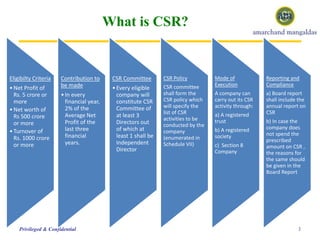
What is CSR?
3Privileged & Confidential
Eligibilty Criteria
•Net Profit of
Rs. 5 crore or
more
•Net worth of
Rs 500 crore
or more
•Turnover of
Rs. 1000 crore
or more
Contribution to
be made
•In every
financial year,
2% of the
Average Net
Profit of the
last three
financial
years.
CSR Committee
•Every eligible
company will
constitute CSR
Committee of
at least 3
Directors out
of which at
least 1 shall be
Independent
Director
CSR Policy
CSR committee
shall form the
CSR policy which
will specify the
list of CSR
activities to be
conducted by the
company
(enumerated in
Schedule VII)
Mode of
Execution
A company can
carry out its CSR
activity through:
a) A registered
trust
b) A registered
society
c) Section 8
Company
Reporting and
Compliance
a) Board report
shall include the
annual report on
CSR
b) In case the
company does
not spend the
prescribed
amount on CSR ,
the reasons for
the same should
be given in the
Board Report
Issues under the 2013 Act
4Privileged & Confidential
1. Foreign company having its branch office in India required to conduct CSR activities. [Rule 3(1)]
2. Activities in “normal course of business” excluded form CSR activities.[Rule 4(1)]
3. Mandatory disclosure but no penalty for non-compliance with CSR. [Rule 8]
4. No employee time-value contribution for expenses incurred on CSR training of employees. [Rule 4(6)]-
Resolved by the MCA Circular dated 18th June, 2014.
5. Ambiguity with respect to the ambit of activities covered under Schedule VII.: Resolved by the MCA
Circular dated 18th June, 2014.
6. Burden on small companies. [Rule 3(2)]
7. Deletion of social business project as a CSR activity.
8. Ambiguity with regards to the tax deductibility of CSR expenditure.
9. CSR implementing agency: An established trust or a trust promoted by the company for its CSR
activities?
10. Preference given to local areas for conducting CSR activities under the Act.
11. Ambiguity with regards to Group CSR activity.
1. Foreign company having its branch
office in India
5Privileged & Confidential
1. The CSR Rules broaden the term “company” beyond the scope of the Companies Act.
 Section 135(1) read with Section 2(20) means any company incorporated in India shall
conduct CSR activities.
 On the other hand, Rule 3 (1) states every company including its holding or subsidiary,
and a foreign company defined under clause (42) of section 2 of the Act having its
branch office or project office in India which fulfills the criteria specified in sub-
section (l) of section 135 of the Act shall comply with the provisions of section 135 of the
Act and these rules
2. Regulatory fault-line between foreign contribution and CSR regime.
 Under FEMA, branch offices and project offices can take up eight kinds of activities and
CSR is not among them. Further, FDI is not allowed in companies set up as not for profit.
 Any foreign contribution received from any foreign source (branches and project offices
not being Indian companies) requires approval under the Foreign Contribution Regulation
Act, 2010.
Continued….
3. Persons authorized by foreign company treated akin to directors of Indian company for fixing
liability.
 Rule 5(1) states that with respect to a foreign company covered under these rules, the CSR
Committee shall comprise of at least two persons of which one person shall be as specified
under Section 380(d) of the Act and another person shall be nominated by the foreign
company.
 Under Section 380 (d), authorized persons of the foreign company perform the limited role
of accepting on behalf of company service of process and any notices or other documents
required to be served to the company.
4. Computation of net profit of a foreign company.
As per the proviso to Rule 2 (f), balance sheet and profit and loss account of a foreign company will
be prepared in accordance with Section 381(1)(a) and net profit to be computed as per Section 198
of the Companies Act. But, it is not clear how the computation of net worth or turnover would be
arrived at in case of a branch or project office of a foreign company.
Since the net profits determine the eligibility of a company under the CSR Regime, this eligibility
criteria for foreign companies having their branch office in India under the CSR regime is currently
unclear.
6Privileged & Confidential
2. Activities in “normal course of business”
 Rule 4(1)
The CSR activities shall be undertaken by the company, excluding activities undertaken
in pursuance of its normal course of business.
 Expenses incurred in the normal course of business do not classify as CSR expenses
– even though the expenditure is for CSR related purpose. Example of HUL
 Mohd. Ahmad v. UOI (Delhi HC decision dated17th April, 2014).
"....a pharmaceutical company donating medicines/drugs within section 135 read with
Schedule VII to the Act is a CSR Activity, as the same is not an activity undertaken in
pursuance of its normal course of business which is relatable to health care or any
other entry in Schedule VII."
“an activity carried out by a Company covered under Schedule VII which is a part of
its core business, if not done with a profit motive, amounts to a CSR Activity.”
7Privileged & Confidential
3. Burden on Small Companies
 As per Rule 3(2), every company which ceases to be a company covered
under section 135 (1) for three consecutive financial years shall not be
required to fulfill its CSR obligations till such time it meets the criteria
specified in section 135 (1).
 This implies that a small company not satisfying any of the specified
criteria in a subsequent financial year and not incurring significant profit
would still need to undertake CSR activities
 As per section 135(1), every company having a net profit of just 5 crores
needs to comply with all the CSR provisions. This provision greatly
increases the burden on small companies.
8Privileged & Confidential
4. The “Comply or Explain regime”
 Section 135 stipulates that if a company fails to spend 2% of its average
net profit on CSR, the Board shall, in its report specify the reasons for
not spending the amount.
 No liability for failure to spend on CSR. No guidance as to what
constitutes a sufficient or statutorily valid explanation for failure to
spend in the board report.
 Under section 134(8) of the Act, failure to explain on the Board Report,
on the other hand, is punishable by a fine on the company of not less
than 50,000 rupees and up to 25 lakh rupees. Further, officers who
default on the reporting provision could be subject to up to three years
in prison and/or fines of not less than 50,000 rupees and as high as 5
lakh rupees.
9Privileged & Confidential
5. Deductibility of CSR Expenses
 Section 37 of the Income Tax Act, 1961- Business expenses
The expenditure on CSR is not one contemplated under Section 37 which provides for allowance of any
expenditure, not being in the nature of capital expenditure or personal expenses of the assessee, which is laid
out or expended wholly and exclusively for the purposes of the business or profession.
 However, the earlier decisions of the Court have allowed deductibility of expenses for socio-development
activities
 CIT vs. M/S Karnataka Financial Corpn 2010-TIOL-27
The High Court held the amount spent towards the development of infrastructural facilities of villages and
construction of a new market to organize self help group would certainly promote the business of the assessee
 Delhi Cloth & General Mills Co. Ltd. vs. CIT 198 ITR 500
The Delhi High Court held expenses incurred by company for running DCM Football Tournament was an
admissible deduction .
Though these decisions were rendered under section 37, they are in line with socio economic development
which is contemplated as CSR policy.
 Section 80G of the Income Tax Act, 1961 and CSR
 For carrying out CSR activities, a company can make contributions to a registered trust/society.
 Only certain contributions under section 80G are 100% deduction. Otherwise the deduction is
restricted to 50% of the total contribution.
 Clarification by CBDT needed with regards to the fate of CSR.
10Privileged & Confidential
6. Implementing Agency for CSR
11Privileged & Confidential
 Rule 4(2) stipulates that a company may undertake its CSR activities, through:
• a registered trust/registered society or a company established by the company or its
holding/subsidiary/associate company under section 8 of the Act or
• A registered trust/society or a company not established by the company but having
an established track record of three years in undertaking similar programs or
projects.
 However, local developmental organizations, not created by the company and who have
been working in an area for years, will be more adept at solving the peculiar issues of a
particular area.
Continued…..
 As per Rule 4(2), howsoever a company decides to execute its CSR obligations, it must
specify the project or programs to be undertaken through these entities, the modalities of
utilization of funds on such projects and programs and the monitoring and reporting mechanism.
 However, the precise obligation of the company in execution of its CSR is still unclear.
 Can a company pass on all the money to an umbrella NGO which ensures that the money
is then passed on to various other NGOs working on the ground in the required activities
and such umbrella NGO provides suitable reports to the Company?
 Is the Company required to personally supervise and ensure compliance with the CSR or
can this be done by NGOs that are themselves doing the actual ground work?
 The extent of supervision required to be undertaken by the company in case it makes a
contribution to an already established trust/society is unclear. A company may not make such
contributions to established NGOs if it cannot divest itself of its responsibilities under CSR. It
would rather prefer to set up its own company for carrying out its CSR activities.
12Privileged & Confidential
7. Employees’ Salary forming part of the
CSR Expenditure
 Rule 4 (6) stipulates that companies may build CSR capacities of their own
personnel as well as those of their Implementing agencies through Institutions with
established track records of at least three financial years but such expenditure shall
not exceed five percent. of total CSR expenditure of the company in one financial
year.
 This rule allows CSR expenditure to include CSR employees’ salary. Earlier, there
was a conspicuous absence of time-value contribution of employees on CSR
activities in the above rule.
 Issuance of Circular No. 21/2014 on 18th June, 2014 has clarified two aspects with
respect to this provision :
• CSR expenditure will be calculated in proportion to employees’ time/ hours
spent specifically on CSR activities.
• Salaries paid by the Company to the volunteers of the company contributing in
CSR activities will also be included in the CSR expenditure.
13Privileged & Confidential
8. Ambit of Schedule VII
 As per section 135, CSR means and includes but is not limited to:
 Programs related to activities specified in Schedule VII
 Programs undertaken as per the company’s CSR policy provided such policy
covers the subjects in Schedule VII.
This definition appears to be inclusive in nature.
 Despite the above provision, Rule 6 specified that the CSR Policy of a company
shall include only those activities which are specified in Schedule VII or are related
to activities which are specified in Schedule VII.
 Because of this inconsistency, it was unclear whether companies can undertake
activities outside the Schedule.
14Privileged & Confidential
Continued….
 This ambiguity was clarified by the General Circular No. 21/2014 issued on 18th June,
2014 which clearly stated that the statutory provision and provisions of CSR Rules, 2014, is
to ensure that while activities undertaken in pursuance of the CSR policy must be relatable
to Schedule VII of the Companies Act 2013, the entries in the said Schedule VII must be
interpreted liberally so as to capture the essence of the subjects enumerated in the said
Schedule. The items enlisted in the amended Schedule VII of the Act, are broad-based and
are intended to cover a wide range of activities as illustratively mentioned in the Annexure.
 Hence, companies can undertake activities not specifically mentioned in the Schedule
but they should fall within the broad base of different subjects covered under Schedule VII.
15Privileged & Confidential
9. Exclusion of “Social Business Projects”
from Schedule VII
 Pursuant to the powers of the Central Government u/s 467 of the Companies Act,
Schedule VII was amended by the MCA on 27th February, 2014 to exclude “social
business project” from the list of CSR activities.
 Social Business Projects, though not defined under the Act or Rules, means a
business set up to address a social problem but running with financial and economic
sustainability.
 This was a case of excessive delegated legislation on the part of the Central
Government as social business projects formed the core philosophy of CSR.
 Subsequently, by the General Circular No. 21/2014, under the head of “social
business project”, “giving medical and Legal aid, treatment to road accident
victims” was included in Schedule VII.
16Privileged & Confidential
Other Issues….
10. CSR activities to be concentrated to Local areas
• Proviso to section 135 stipulates that a company shall give preference to the
local area and areas around it where it operates, for spending the amount
earmarked for Corporate Social Responsibility activities.
• This may result in concentration of CSR projects in certain pockets such as
industrial belts and clusters, special economic zones and some towns and cities,
while many areas that require a lot of intervention may get ignored.
11. Group Companies
• Rule 4(3) provides that a company may also collaborate with other companies
for undertaking projects or programs or CSR activities in such a manner that
the CSR committees of respective companies are in a position to report
separately on such projects or programs.
• No Guidelines as to how the above provision will be actually implemented and
how the contribution of each company in the project will be segregated.
17Privileged & Confidential
Thank You
© Amarchand & Mangaldas & Suresh A. Shroff & Co.
Privileged & Confidential

Garima Tyagi_Presentation.PPTX

  • 1.
    CSR: ISSUES UNDERCOMPANIES ACT, 2013 By Garima Tyagi IV Year, B.P.Sc (LL.B) National Law University, Jodhpur. 4 JULY, 2014 Privileged & Confidential
  • 2.
    CSR: Introduction  Introductionof a Corporate Social Responsibility clause in the Companies Act, 2013 has made India the first country to mandate CSR through a statutory provision.  On 27 February 2014, the Government of India notified section 135 and rules pertaining to Corporate Social Responsibility under the Companies Act, 2013.  According to the Indian Institute of Corporate Affairs, of the 1.3 million companies in India, about 6,000-7,000 companies will be covered under the new CSR rule. 2Privileged & Confidential
  • 3.
    What is CSR? 3Privileged& Confidential Eligibilty Criteria •Net Profit of Rs. 5 crore or more •Net worth of Rs 500 crore or more •Turnover of Rs. 1000 crore or more Contribution to be made •In every financial year, 2% of the Average Net Profit of the last three financial years. CSR Committee •Every eligible company will constitute CSR Committee of at least 3 Directors out of which at least 1 shall be Independent Director CSR Policy CSR committee shall form the CSR policy which will specify the list of CSR activities to be conducted by the company (enumerated in Schedule VII) Mode of Execution A company can carry out its CSR activity through: a) A registered trust b) A registered society c) Section 8 Company Reporting and Compliance a) Board report shall include the annual report on CSR b) In case the company does not spend the prescribed amount on CSR , the reasons for the same should be given in the Board Report
  • 4.
    Issues under the2013 Act 4Privileged & Confidential 1. Foreign company having its branch office in India required to conduct CSR activities. [Rule 3(1)] 2. Activities in “normal course of business” excluded form CSR activities.[Rule 4(1)] 3. Mandatory disclosure but no penalty for non-compliance with CSR. [Rule 8] 4. No employee time-value contribution for expenses incurred on CSR training of employees. [Rule 4(6)]- Resolved by the MCA Circular dated 18th June, 2014. 5. Ambiguity with respect to the ambit of activities covered under Schedule VII.: Resolved by the MCA Circular dated 18th June, 2014. 6. Burden on small companies. [Rule 3(2)] 7. Deletion of social business project as a CSR activity. 8. Ambiguity with regards to the tax deductibility of CSR expenditure. 9. CSR implementing agency: An established trust or a trust promoted by the company for its CSR activities? 10. Preference given to local areas for conducting CSR activities under the Act. 11. Ambiguity with regards to Group CSR activity.
  • 5.
    1. Foreign companyhaving its branch office in India 5Privileged & Confidential 1. The CSR Rules broaden the term “company” beyond the scope of the Companies Act.  Section 135(1) read with Section 2(20) means any company incorporated in India shall conduct CSR activities.  On the other hand, Rule 3 (1) states every company including its holding or subsidiary, and a foreign company defined under clause (42) of section 2 of the Act having its branch office or project office in India which fulfills the criteria specified in sub- section (l) of section 135 of the Act shall comply with the provisions of section 135 of the Act and these rules 2. Regulatory fault-line between foreign contribution and CSR regime.  Under FEMA, branch offices and project offices can take up eight kinds of activities and CSR is not among them. Further, FDI is not allowed in companies set up as not for profit.  Any foreign contribution received from any foreign source (branches and project offices not being Indian companies) requires approval under the Foreign Contribution Regulation Act, 2010.
  • 6.
    Continued…. 3. Persons authorizedby foreign company treated akin to directors of Indian company for fixing liability.  Rule 5(1) states that with respect to a foreign company covered under these rules, the CSR Committee shall comprise of at least two persons of which one person shall be as specified under Section 380(d) of the Act and another person shall be nominated by the foreign company.  Under Section 380 (d), authorized persons of the foreign company perform the limited role of accepting on behalf of company service of process and any notices or other documents required to be served to the company. 4. Computation of net profit of a foreign company. As per the proviso to Rule 2 (f), balance sheet and profit and loss account of a foreign company will be prepared in accordance with Section 381(1)(a) and net profit to be computed as per Section 198 of the Companies Act. But, it is not clear how the computation of net worth or turnover would be arrived at in case of a branch or project office of a foreign company. Since the net profits determine the eligibility of a company under the CSR Regime, this eligibility criteria for foreign companies having their branch office in India under the CSR regime is currently unclear. 6Privileged & Confidential
  • 7.
    2. Activities in“normal course of business”  Rule 4(1) The CSR activities shall be undertaken by the company, excluding activities undertaken in pursuance of its normal course of business.  Expenses incurred in the normal course of business do not classify as CSR expenses – even though the expenditure is for CSR related purpose. Example of HUL  Mohd. Ahmad v. UOI (Delhi HC decision dated17th April, 2014). "....a pharmaceutical company donating medicines/drugs within section 135 read with Schedule VII to the Act is a CSR Activity, as the same is not an activity undertaken in pursuance of its normal course of business which is relatable to health care or any other entry in Schedule VII." “an activity carried out by a Company covered under Schedule VII which is a part of its core business, if not done with a profit motive, amounts to a CSR Activity.” 7Privileged & Confidential
  • 8.
    3. Burden onSmall Companies  As per Rule 3(2), every company which ceases to be a company covered under section 135 (1) for three consecutive financial years shall not be required to fulfill its CSR obligations till such time it meets the criteria specified in section 135 (1).  This implies that a small company not satisfying any of the specified criteria in a subsequent financial year and not incurring significant profit would still need to undertake CSR activities  As per section 135(1), every company having a net profit of just 5 crores needs to comply with all the CSR provisions. This provision greatly increases the burden on small companies. 8Privileged & Confidential
  • 9.
    4. The “Complyor Explain regime”  Section 135 stipulates that if a company fails to spend 2% of its average net profit on CSR, the Board shall, in its report specify the reasons for not spending the amount.  No liability for failure to spend on CSR. No guidance as to what constitutes a sufficient or statutorily valid explanation for failure to spend in the board report.  Under section 134(8) of the Act, failure to explain on the Board Report, on the other hand, is punishable by a fine on the company of not less than 50,000 rupees and up to 25 lakh rupees. Further, officers who default on the reporting provision could be subject to up to three years in prison and/or fines of not less than 50,000 rupees and as high as 5 lakh rupees. 9Privileged & Confidential
  • 10.
    5. Deductibility ofCSR Expenses  Section 37 of the Income Tax Act, 1961- Business expenses The expenditure on CSR is not one contemplated under Section 37 which provides for allowance of any expenditure, not being in the nature of capital expenditure or personal expenses of the assessee, which is laid out or expended wholly and exclusively for the purposes of the business or profession.  However, the earlier decisions of the Court have allowed deductibility of expenses for socio-development activities  CIT vs. M/S Karnataka Financial Corpn 2010-TIOL-27 The High Court held the amount spent towards the development of infrastructural facilities of villages and construction of a new market to organize self help group would certainly promote the business of the assessee  Delhi Cloth & General Mills Co. Ltd. vs. CIT 198 ITR 500 The Delhi High Court held expenses incurred by company for running DCM Football Tournament was an admissible deduction . Though these decisions were rendered under section 37, they are in line with socio economic development which is contemplated as CSR policy.  Section 80G of the Income Tax Act, 1961 and CSR  For carrying out CSR activities, a company can make contributions to a registered trust/society.  Only certain contributions under section 80G are 100% deduction. Otherwise the deduction is restricted to 50% of the total contribution.  Clarification by CBDT needed with regards to the fate of CSR. 10Privileged & Confidential
  • 11.
    6. Implementing Agencyfor CSR 11Privileged & Confidential  Rule 4(2) stipulates that a company may undertake its CSR activities, through: • a registered trust/registered society or a company established by the company or its holding/subsidiary/associate company under section 8 of the Act or • A registered trust/society or a company not established by the company but having an established track record of three years in undertaking similar programs or projects.  However, local developmental organizations, not created by the company and who have been working in an area for years, will be more adept at solving the peculiar issues of a particular area.
  • 12.
    Continued…..  As perRule 4(2), howsoever a company decides to execute its CSR obligations, it must specify the project or programs to be undertaken through these entities, the modalities of utilization of funds on such projects and programs and the monitoring and reporting mechanism.  However, the precise obligation of the company in execution of its CSR is still unclear.  Can a company pass on all the money to an umbrella NGO which ensures that the money is then passed on to various other NGOs working on the ground in the required activities and such umbrella NGO provides suitable reports to the Company?  Is the Company required to personally supervise and ensure compliance with the CSR or can this be done by NGOs that are themselves doing the actual ground work?  The extent of supervision required to be undertaken by the company in case it makes a contribution to an already established trust/society is unclear. A company may not make such contributions to established NGOs if it cannot divest itself of its responsibilities under CSR. It would rather prefer to set up its own company for carrying out its CSR activities. 12Privileged & Confidential
  • 13.
    7. Employees’ Salaryforming part of the CSR Expenditure  Rule 4 (6) stipulates that companies may build CSR capacities of their own personnel as well as those of their Implementing agencies through Institutions with established track records of at least three financial years but such expenditure shall not exceed five percent. of total CSR expenditure of the company in one financial year.  This rule allows CSR expenditure to include CSR employees’ salary. Earlier, there was a conspicuous absence of time-value contribution of employees on CSR activities in the above rule.  Issuance of Circular No. 21/2014 on 18th June, 2014 has clarified two aspects with respect to this provision : • CSR expenditure will be calculated in proportion to employees’ time/ hours spent specifically on CSR activities. • Salaries paid by the Company to the volunteers of the company contributing in CSR activities will also be included in the CSR expenditure. 13Privileged & Confidential
  • 14.
    8. Ambit ofSchedule VII  As per section 135, CSR means and includes but is not limited to:  Programs related to activities specified in Schedule VII  Programs undertaken as per the company’s CSR policy provided such policy covers the subjects in Schedule VII. This definition appears to be inclusive in nature.  Despite the above provision, Rule 6 specified that the CSR Policy of a company shall include only those activities which are specified in Schedule VII or are related to activities which are specified in Schedule VII.  Because of this inconsistency, it was unclear whether companies can undertake activities outside the Schedule. 14Privileged & Confidential
  • 15.
    Continued….  This ambiguitywas clarified by the General Circular No. 21/2014 issued on 18th June, 2014 which clearly stated that the statutory provision and provisions of CSR Rules, 2014, is to ensure that while activities undertaken in pursuance of the CSR policy must be relatable to Schedule VII of the Companies Act 2013, the entries in the said Schedule VII must be interpreted liberally so as to capture the essence of the subjects enumerated in the said Schedule. The items enlisted in the amended Schedule VII of the Act, are broad-based and are intended to cover a wide range of activities as illustratively mentioned in the Annexure.  Hence, companies can undertake activities not specifically mentioned in the Schedule but they should fall within the broad base of different subjects covered under Schedule VII. 15Privileged & Confidential
  • 16.
    9. Exclusion of“Social Business Projects” from Schedule VII  Pursuant to the powers of the Central Government u/s 467 of the Companies Act, Schedule VII was amended by the MCA on 27th February, 2014 to exclude “social business project” from the list of CSR activities.  Social Business Projects, though not defined under the Act or Rules, means a business set up to address a social problem but running with financial and economic sustainability.  This was a case of excessive delegated legislation on the part of the Central Government as social business projects formed the core philosophy of CSR.  Subsequently, by the General Circular No. 21/2014, under the head of “social business project”, “giving medical and Legal aid, treatment to road accident victims” was included in Schedule VII. 16Privileged & Confidential
  • 17.
    Other Issues…. 10. CSRactivities to be concentrated to Local areas • Proviso to section 135 stipulates that a company shall give preference to the local area and areas around it where it operates, for spending the amount earmarked for Corporate Social Responsibility activities. • This may result in concentration of CSR projects in certain pockets such as industrial belts and clusters, special economic zones and some towns and cities, while many areas that require a lot of intervention may get ignored. 11. Group Companies • Rule 4(3) provides that a company may also collaborate with other companies for undertaking projects or programs or CSR activities in such a manner that the CSR committees of respective companies are in a position to report separately on such projects or programs. • No Guidelines as to how the above provision will be actually implemented and how the contribution of each company in the project will be segregated. 17Privileged & Confidential
  • 18.
    Thank You © Amarchand& Mangaldas & Suresh A. Shroff & Co. Privileged & Confidential