Graduate Workshop, 10th May 2011James Nottingham    www.p4c.comwww.jamesnottingham.co.uk
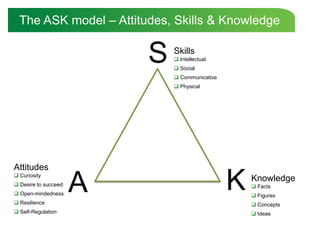
3 suggestions for making an impactFocus on learning rather than gradesDevelop attitudes and skills, as well as knowledgePreview as well as review
Focus on learning, not grades“Pupils show greater motivation, are better behaved and are more likely to be independent and strategic thinkers when teachers are not obsessed by grades.”“If there is one new thing we need in our school system right now, it is a well-developed focus on learning.”Chris Watkins, Institute of Education, Aug 2010From an analysis of 100 international studies on how children learn
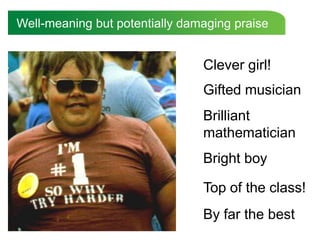
Well-meaning but potentially damaging praiseClever girl!Gifted musicianBrilliant mathematicianBright boyTop of the class!By far the best
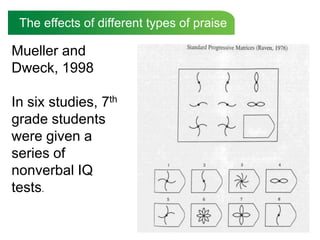
The effects of different types of praise Mueller and Dweck, 1998In six studies, 7th grade students were given a series of nonverbal IQ tests.
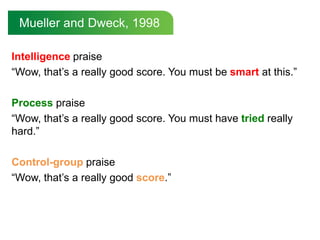
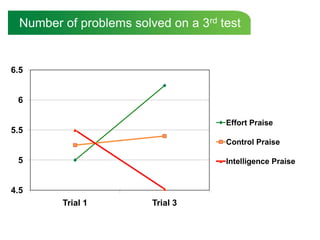
Mueller and Dweck, 1998Intelligence praise“Wow, that’s a really good score. You must be smart at this.” Process praise“Wow, that’s a really good score. You must have tried really hard.”Control-group praise“Wow, that’s a really good score.”
Number of problems solved on a 3rd test
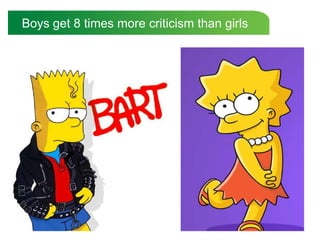
Boys get 8 times more criticism than girls
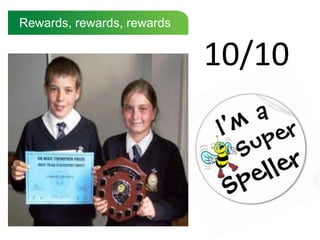
Rewards, rewards, rewards10/10
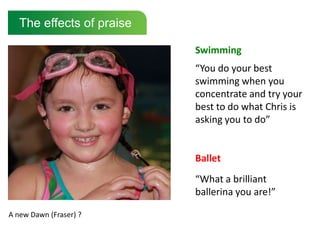
The effects of praiseSwimming“You do your best swimming when you concentrate and try your best to do what Chris is asking you to do”Ballet“What a brilliant ballerina you are!”A new Dawn (Fraser) ?
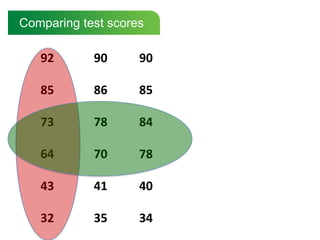
Comparing test scores928573644332908678704135908584784034
Tests, tests, tests …Tests
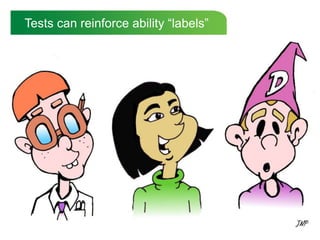
Tests can reinforce ability “labels”
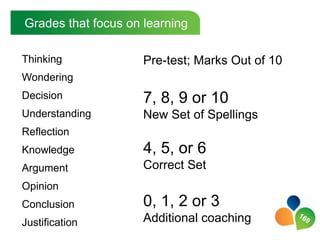
Grades that focus on learningThinkingWonderingDecisionUnderstandingReflectionKnowledgeArgumentOpinionConclusionJustificationPre-test; Marks Out of 107, 8, 9 or 10New Set of Spellings4, 5, or 6Correct Set0, 1, 2 or 3Additional coaching169
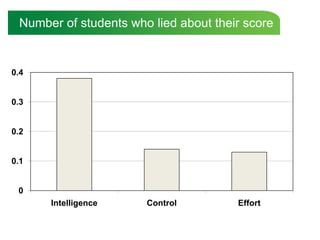
Number of students who lied about their score
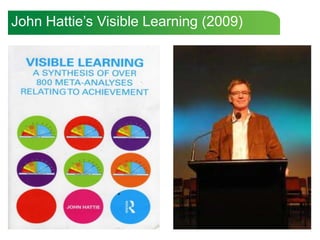
John Hattie’s Visible Learning (2009)
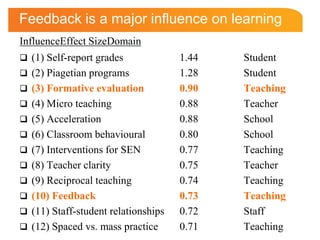
Feedback is a major influence on learningInfluenceEffect SizeDomain(1) Self-report grades		1.44		Student
(2) Piagetian programs		1.28		Student
(3) Formative evaluation		0.90		Teaching
(4) Micro teaching			0.88		Teacher
(5) Acceleration 			0.88		School
(6) Classroom behavioural		0.80		School
(7) Interventions for SEN		0.77		Teaching
(8) Teacher clarity			0.75		Teacher
(9) Reciprocal teaching		0.74		Teaching
(10) Feedback			0.73		Teaching

Graduate Forum 10th May 2011