Flipping Pedagogy 101
Anna Wood
Vice-Phec 2015, Nottingham
Ross Galloway, Judy Hardy
Flipping Pedagogy 101
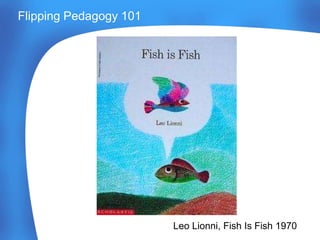
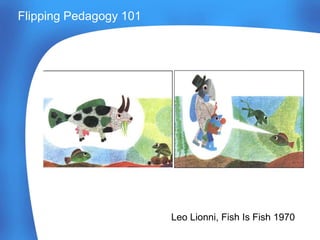
Leo Lionni, Fish Is Fish 1970
Flipping Pedagogy 101
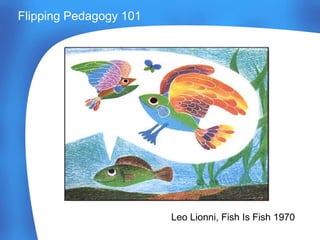
Leo Lionni, Fish Is Fish 1970
Flipping Pedagogy 101
● Context should determine pedagogy
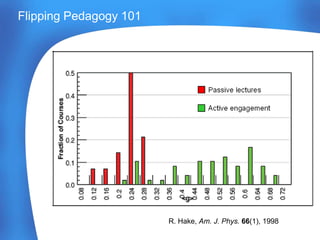
R. Hake, Am. J. Phys. 66(1), 1998
Flipping Pedagogy 101
● ¼ to ½ of instructors deviate
significantly from established design
of evidence-based teaching
approaches.
C. Henderson & M. Dancy, Phys Rev ST: PER 5, 020107, 2009
Flipping Pedagogy 101
Need to understand why not
just how.
'Tool kit' not a recipe
Flipping Pedagogy 101
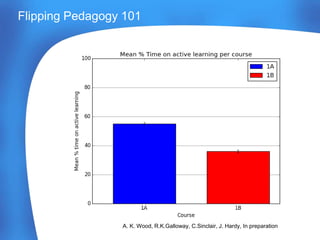
A. K. Wood, R.K.Galloway, C.Sinclair, J. Hardy, In preparation
Macro-scale factors:
Content, pedagogical aims, course structure,
assessments etc
● Micro-scale factors:
○ Responsivity to students’ needs in the moment
Flipping Pedagogy 101
Context is:
Flipping Pedagogy 101
● New understandings constructed
from existing understandings and
experiences.
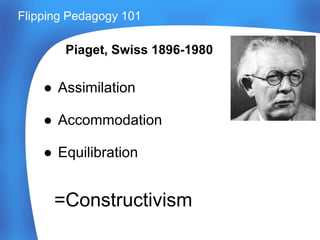
Piaget, Swiss 1896-1980
● Assimilation
● Accommodation
● Equilibration
Flipping Pedagogy 101
=Constructivism
● Assimilation
● Accommodation
+ Role of prior knowledge
Flipping Pedagogy 101
=Conceptual Change Theory
(Posner +Ausubel)
● Dissatisfaction with existing
concepts
● New conception is intelligible
● New conception is plausible
Flipping Pedagogy 101
Conceptual Change Theory:
G. Posner, et al. "Accommodation of a scientific conception: Toward a
theory of conceptual change." Science education 66.2 (1982): 211-
227.
Accommodation happens when:
Flipping Pedagogy 101
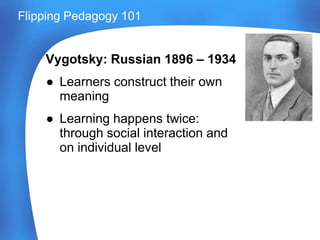
Vygotsky: Russian 1896 – 1934
● Learners construct their own
meaning
● Learning happens twice:
through social interaction and
on individual level
Flipping Pedagogy 101
Image from Wikipedia
Flipping Pedagogy 101
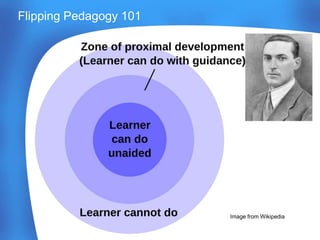
Zone of Proximal Development:
‘Distance between a child’s actual developmental
level as determined by independent problem solving
and the higher level of potential development as
determined through problem solving under adult
guidance or in collaboration with more capable
peers’
Flipping Pedagogy 101
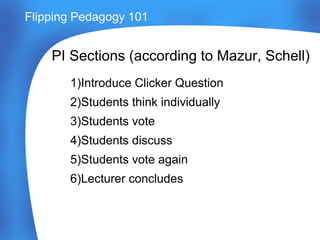
PI Sections (according to Mazur, Schell)
1)Introduce Clicker Question
2)Students think individually
3)Students vote
4)Students discuss
5)Students vote again
6)Lecturer concludes
Flipping Pedagogy 101
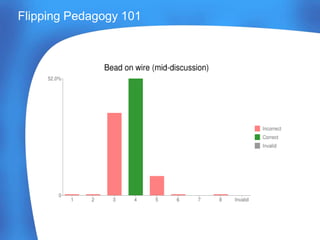
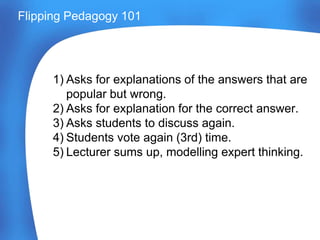
1) Asks for explanations of the answers that are
popular but wrong.
2) Asks for explanation for the correct answer.
3) Asks students to discuss again.
4) Students vote again (3rd) time.
5) Lecturer sums up, modelling expert thinking.
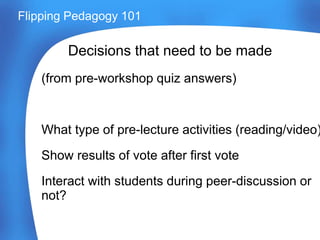
Decisions that need to be made
(from pre-workshop quiz answers)
What type of pre-lecture activities (reading/video)
Show results of vote after first vote
Interact with students during peer-discussion or
not?
Flipping Pedagogy 101
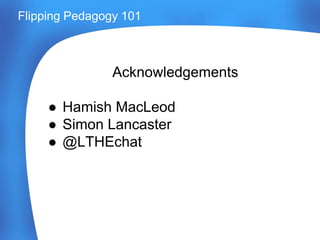
Acknowledgements
● Hamish MacLeod
● Simon Lancaster
● @LTHEchat

Flipping Pedagogy

  • 1.
    Flipping Pedagogy 101 AnnaWood Vice-Phec 2015, Nottingham Ross Galloway, Judy Hardy
  • 2.
    Flipping Pedagogy 101 LeoLionni, Fish Is Fish 1970
  • 3.
    Leo Lionni, FishIs Fish 1970 Flipping Pedagogy 101
  • 4.
    Leo Lionni, FishIs Fish 1970 Flipping Pedagogy 101
  • 5.
    Flipping Pedagogy 101 ●Context should determine pedagogy
  • 6.
    R. Hake, Am.J. Phys. 66(1), 1998 Flipping Pedagogy 101
  • 7.
    ● ¼ to½ of instructors deviate significantly from established design of evidence-based teaching approaches. C. Henderson & M. Dancy, Phys Rev ST: PER 5, 020107, 2009 Flipping Pedagogy 101
  • 8.
    Need to understandwhy not just how. 'Tool kit' not a recipe Flipping Pedagogy 101
  • 9.
    Flipping Pedagogy 101 A.K. Wood, R.K.Galloway, C.Sinclair, J. Hardy, In preparation
  • 10.
    Macro-scale factors: Content, pedagogicalaims, course structure, assessments etc ● Micro-scale factors: ○ Responsivity to students’ needs in the moment Flipping Pedagogy 101 Context is:
  • 11.
    Flipping Pedagogy 101 ●New understandings constructed from existing understandings and experiences.
  • 12.
    Piaget, Swiss 1896-1980 ●Assimilation ● Accommodation ● Equilibration Flipping Pedagogy 101 =Constructivism
  • 13.
    ● Assimilation ● Accommodation +Role of prior knowledge Flipping Pedagogy 101 =Conceptual Change Theory (Posner +Ausubel)
  • 14.
    ● Dissatisfaction withexisting concepts ● New conception is intelligible ● New conception is plausible Flipping Pedagogy 101 Conceptual Change Theory: G. Posner, et al. "Accommodation of a scientific conception: Toward a theory of conceptual change." Science education 66.2 (1982): 211- 227. Accommodation happens when:
  • 15.
  • 16.
    Vygotsky: Russian 1896– 1934 ● Learners construct their own meaning ● Learning happens twice: through social interaction and on individual level Flipping Pedagogy 101
  • 17.
  • 18.
    Flipping Pedagogy 101 Zoneof Proximal Development: ‘Distance between a child’s actual developmental level as determined by independent problem solving and the higher level of potential development as determined through problem solving under adult guidance or in collaboration with more capable peers’
  • 19.
  • 20.
    PI Sections (accordingto Mazur, Schell) 1)Introduce Clicker Question 2)Students think individually 3)Students vote 4)Students discuss 5)Students vote again 6)Lecturer concludes Flipping Pedagogy 101
  • 21.
    Flipping Pedagogy 101 1)Asks for explanations of the answers that are popular but wrong. 2) Asks for explanation for the correct answer. 3) Asks students to discuss again. 4) Students vote again (3rd) time. 5) Lecturer sums up, modelling expert thinking.
  • 22.
    Decisions that needto be made (from pre-workshop quiz answers) What type of pre-lecture activities (reading/video) Show results of vote after first vote Interact with students during peer-discussion or not? Flipping Pedagogy 101
  • 23.
    Flipping Pedagogy 101 Acknowledgements ●Hamish MacLeod ● Simon Lancaster ● @LTHEchat