Give It All You Got!
 Break Away from the 3R’s
        To the 3C’s


      Fred Feldon, Coastline CC
     CMC3 South Fall Conference
     Los Angeles Mission College
          October 6, 2012
This presentation is
     available for download at

http://www.slideshare.net/ffeldon/
 cmc3-fall-2012-give-it-all-you-got
August 31, 2012, 7:13pm

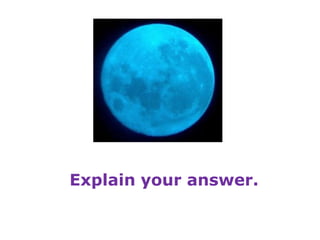
A “Blue Moon”?
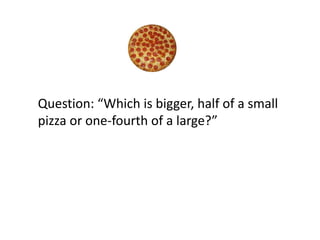
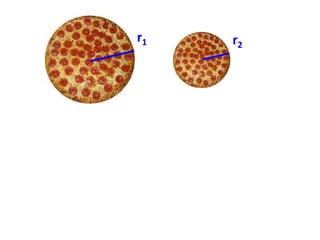
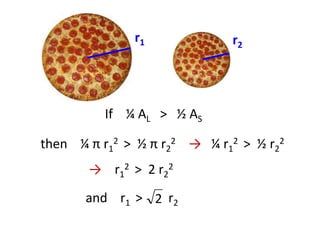
Question: “Which is bigger, half of a small
pizza or one-fourth of a large?”
r1   r2
r1             r2


          If ¼ AL > ½ AS

then ¼ π r12 > ½ π r22 → ¼ r12 > ½ r22
       → r12 > 2 r22
       and r1 > 2 r2
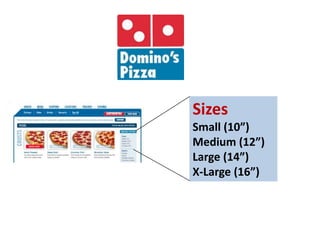
Sizes
Small (10”)
Medium (12”)
Large (14”)
X-Large (16”)
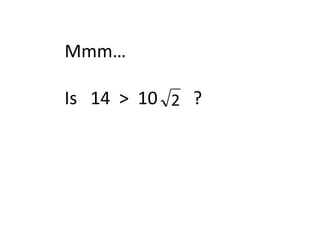
Mmm…

Is 14 > 10 2 ?
Explain your answer.
The Problem…
The Problem…

• Content is ubiquitous

• College teaching is no longer about
   the lecture
PatrickJMT on YouTube
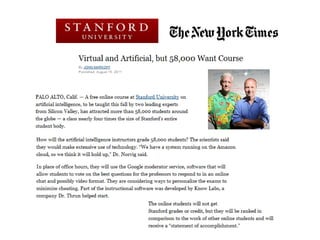
MOOC: Massive open
  online courses
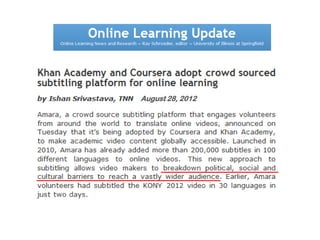
August 28, 2012
The Solution…


What can YOU do?
  Right NOW ?
The Solution…
• Summarize, highlight and motivate; ignite a
    shared intellectual endeavor; relate math
    in the classroom to the real world
The Solution…
• Summarize, highlight and motivate; ignite a
    shared intellectual endeavor; relate math
    in the classroom to the real world

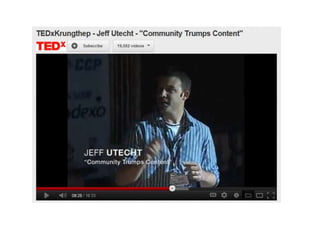
• Guide and direct students; community
    trumps content
The Solution…
• Summarize, highlight and motivate; ignite a
    shared intellectual endeavor; relate math
    in the classroom to the real world

• Guide and direct students; community
    trumps content
• Monitor progress; follow 80-20 Rule
The Solution…
• Summarize, highlight and motivate; ignite a
    shared intellectual endeavor; relate math
    in the classroom to the real world

• Guide and direct students; community
    trumps content
• Monitor progress; follow 80-20 Rule

• The 3 C’s !
The Solution…
• Summarize, highlight and motivate; ignite a
    shared intellectual endeavor; relate math
    in the classroom to the real world

• Guide and direct students; community
    trumps content
• Monitor progress; follow 80-20 Rule

• Emphasize Communication,
   Connectivity and Collaboration!
• Communication
    - Students talk more; you talk less. In class:
mini-lectures punctuated by individual, pair or
group work and explain their answers. Online:
Respond every day but make interaction 25%
teacher-to-student and 75% student-to-student
Fifty Ways to Leave Your Lectern


 “The ABC’s (Bloom’s Affective, Behavioral
and Cognitive goals) should be more equally
                balanced.”
         -- Dr. Constance Staley, Professor of
        Communication, University of Colorado
• Communication
 - Students talk more; you talk less. In class: mini-
lectures punctuated by individual, pair or group
work and explain their answers. Online: Respond
every day but make interaction 25% teacher-to-
student and 75% student-to-student

• Connectivity
     - Research shows a sense of community
increases success and retention. Foster
“productive struggle,” thinking through problems
and sharing viewpoints. More illuminating for
students than hearing you do it.
“Productive Failure”: Why Floundering
is Good--Attempting to figure
something out on your own produces
better results than having guidance
from the very beginning.”

    -- Annie Murphy Paul, Learning Theorist,
  Time.com “Health & Science,” August, 2012
• Collaboration
     - We’re all in this together. We’re all here
to help each other. The best way to learn
something is to explain it so someone else.
Blooms’ taxonomy. Incorporate peer review and

cloud computing. Advise students to ask
questions: “I or another student will reply right
away!”
“Mathematics is not a careful march
down a well-cleared highway, but a
journey into a strange wilderness,
where the explorers often get lost.”

-- W. S. Anglin, author of Mathematics: A
     Concise History and Philosophy, 1994
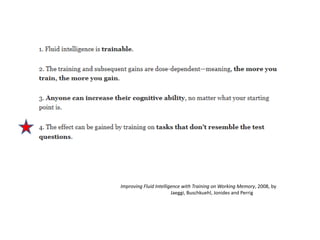
Improving Fluid Intelligence with Training on Working Memory, 2008, by
                        Jaeggi, Buschkuehl, Jonides and Perrig
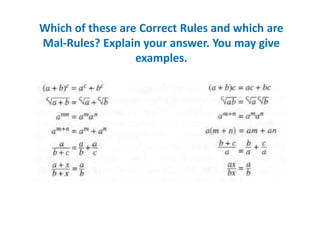
Which of these are Correct Rules and which are
Mal-Rules? Explain your answer. You may give
                  examples.
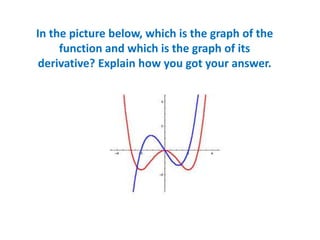
In the picture below, which is the graph of the
     function and which is the graph of its
 derivative? Explain how you got your answer.
A solid wood cube, 1 foot on an edge, was
 sawed into eight smaller congruent cubes.
The smaller cubes were then reassembled to
form the longest possible rectangular prism.
What is the percent change in surface area?
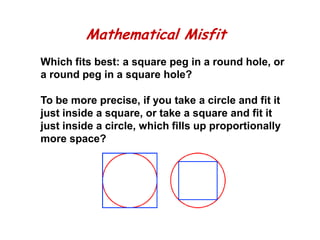
Mathematical Misfit
Which fits best: a square peg in a round hole, or
a round peg in a square hole?

To be more precise, if you take a circle and fit it
just inside a square, or take a square and fit it
just inside a circle, which fills up proportionally
more space?
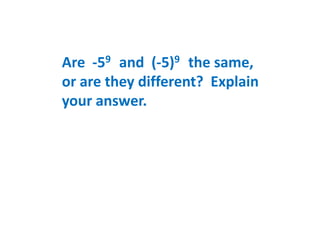
Are -59 and (-5)9 the same,
or are they different? Explain
your answer.
Which is better? To get 1/3 Off the
price of an item? Or 1/3 More for
          the same price?


                 -- Michael Tsiros, Marketing Professor, University of Miami
                                               School of Business, 9/1/2012
                 Full article at http://www.twincities.com/ci_21446847/bad-
                                math-skills-cause-customers-miss-bargains-study
New Book Trailer:


http://www.youtube.com/watch?v=3c6_Hzgqfmg
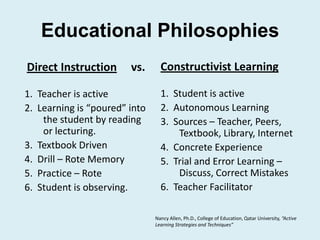
Educational Philosophies
Direct Instruction      vs.      Constructivist Learning

1. Teacher is active             1. Student is active
2. Learning is “poured” into     2. Autonomous Learning
    the student by reading       3. Sources – Teacher, Peers,
    or lecturing.                    Textbook, Library, Internet
3. Textbook Driven               4. Concrete Experience
4. Drill – Rote Memory           5. Trial and Error Learning –
5. Practice – Rote                   Discuss, Correct Mistakes
6. Student is observing.         6. Teacher Facilitator

                               Nancy Allen, Ph.D., College of Education, Qatar University, “Active
                               Learning Strategies and Techniques”
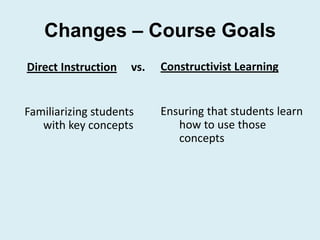
Changes – Course Goals
Direct Instruction   vs.   Constructivist Learning


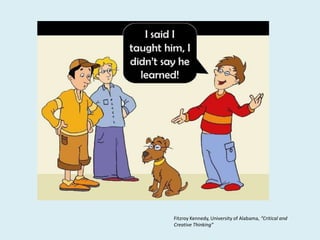
Familiarizing students     Ensuring that students learn
   with key concepts          how to use those
                              concepts
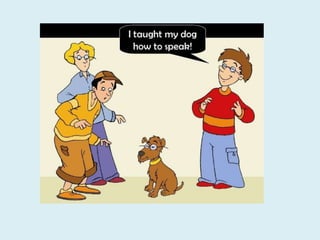
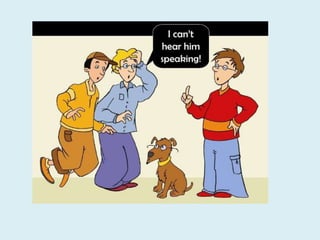
Fitzroy Kennedy, University of Alabama, “Critical and
Creative Thinking”
Changes – Teacher’s Role
Direct Instruction   vs.   Constructivist Learning


Dispenses information      Designs and manages the
    and concepts              overall instructional
                              process
Changes – Student’s Role
Direct Instruction      vs.         Constructivist Learning


Passive recipients of               Responsible for the
   information and                     acquisition of content
   content                             and for working
                                       collaboratively with
                                       other students to learn
                                       how to use it

                              Larry Michaelsen, University of Oklahoma, “Getting Started With
                              Team-Based Learning”
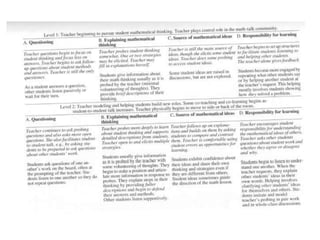
Describing Levels and
   Components of a Math-Talk
     Learning Community
• What does the transformation to reform
mathematics teaching look like?
• What would such a classroom look like?
• How do teachers, along with their
students, get there?


                   Kimberly Hufferd-Ackles, Karen C. Fuson, and Miriam Gamoran Sherin,
                   Northwestern University, NCTM Journal for Research in Mathematics
                   Education, March 2004
Describing Levels and
   Components of a Math-Talk
     Learning Community

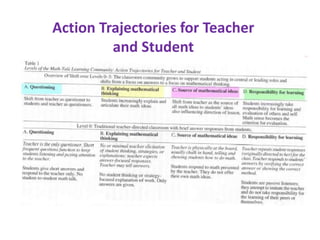
Shift over Levels 0-3: The classroom
community grows to support students acting
in central or leading roles and shifts from a
focus on answers to a focus on mathematical
thinking.
Describing Levels and
   Components of a Math-Talk
     Learning Community

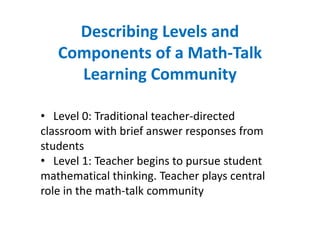
• Level 0: Traditional teacher-directed
classroom with brief answer responses from
students
• Level 1: Teacher begins to pursue student
mathematical thinking. Teacher plays central
role in the math-talk community
Describing Levels and
   Components of a Math-Talk
     Learning Community

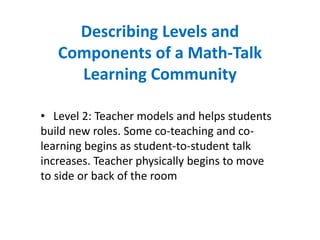
• Level 2: Teacher models and helps students
build new roles. Some co-teaching and co-
learning begins as student-to-student talk
increases. Teacher physically begins to move
to side or back of the room
Describing Levels and
   Components of a Math-Talk
     Learning Community

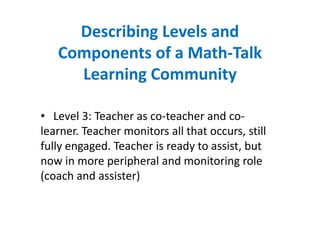
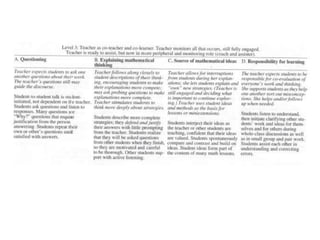
• Level 3: Teacher as co-teacher and co-
learner. Teacher monitors all that occurs, still
fully engaged. Teacher is ready to assist, but
now in more peripheral and monitoring role
(coach and assister)
Action Trajectories for Teacher
         and Student
The BIG Problem…
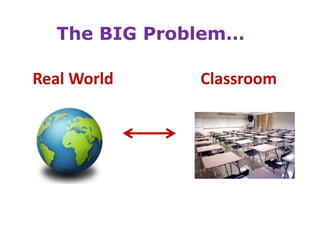
The BIG Problem…

Real World    Classroom
“Mathematical reasoning in *the
real world and] workplace differs
markedly from the algorithms
taught in school.”

   -- John P. Smith, Educational Psychologist,
                Michigan State University
Breaking News:

 You do NOT have to
be an expert to solve
    this problem!
Breaking News:

 You do NOT have to
   adopt a certain
    curriculum or
textbook to solve the
      problem!
Breaking News:

 You do NOT have to
   use a particular
method of instruction
 or mode of delivery
to solve the problem!
My Proposal:

 All you have to do is
“leave the lectern” as
often as possible, and
  promote the 3C’s!
   (Communication, Connectivity
       and Collaboration)
My Proposal:

   That alone will
closely duplicate the
 environment of the
     workplace!
My Proposal:

…will make problem-
solving more like the
     real world!
My Proposal:

 …will engage students
and restore the sense of
    enjoyment and
 adventure in teaching
        for you!
My Proposal:

   …will reform the
 teaching and learning
of mathematics in your
        classes!
My Proposal:

  …will increase
students’ success,
retention and your
    popularity!
Five Guiding Principles on How
       Mathematics Can
     and Should be Taught

   From the Co-Authors of IMACS
Institute for Mathematics & Computer
              Science, 2012

         http://www.eimacs.com/blog/2012/08/algebra-is-not-the-problem-part-2/
Five Guiding Principles on How
        Mathematics Can
      and Should be Taught
1. Mathematics is an important intellectual
   discipline—not merely a collection of
   algorithms for performing calculations.
Five Guiding Principles on How
        Mathematics Can
      and Should be Taught
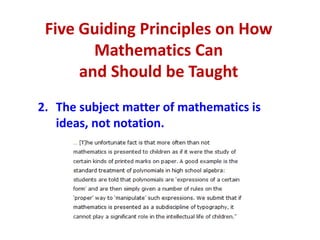
2. The subject matter of mathematics is
   ideas, not notation.
Five Guiding Principles on How
        Mathematics Can
      and Should be Taught
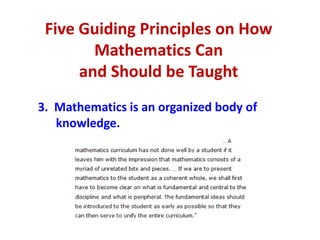
3. Mathematics is an organized body of
   knowledge.
Five Guiding Principles on How
        Mathematics Can
      and Should be Taught
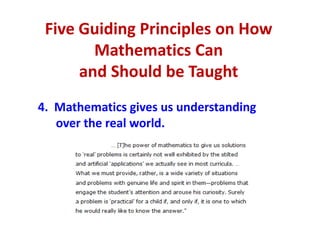
4. Mathematics gives us understanding
   over the real world.
Five Guiding Principles on How
        Mathematics Can
      and Should be Taught
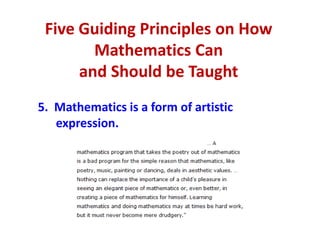
5. Mathematics is a form of artistic
   expression.
http://www.nytimes.com/2012/07/29/opinion/sunday/is-algebra-necessary.html
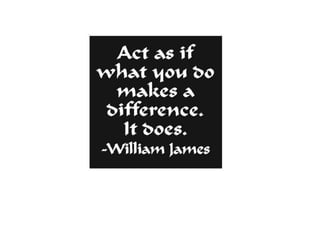
You–each one of us–
can make a difference!
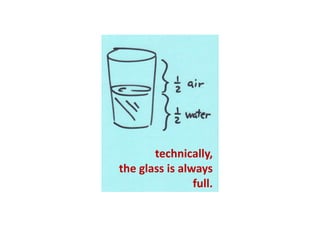
technically,
the glass is always
                full.
Thank You

     ffeldon@coastline.edu

       Available for download at

http://www.slideshare.net/ffeldon/
 cmc3-fall-2012-give-it-all-you-got

CMC3 Fall 2012 Give It All You Got V3

  • 1.
    Give It AllYou Got! Break Away from the 3R’s To the 3C’s Fred Feldon, Coastline CC CMC3 South Fall Conference Los Angeles Mission College October 6, 2012
  • 2.
    This presentation is available for download at http://www.slideshare.net/ffeldon/ cmc3-fall-2012-give-it-all-you-got
  • 3.
    August 31, 2012,7:13pm A “Blue Moon”?
  • 4.
    Question: “Which isbigger, half of a small pizza or one-fourth of a large?”
  • 5.
    r1 r2
  • 6.
    r1 r2 If ¼ AL > ½ AS then ¼ π r12 > ½ π r22 → ¼ r12 > ½ r22 → r12 > 2 r22 and r1 > 2 r2
  • 7.
  • 8.
  • 9.
  • 10.
  • 11.
    The Problem… • Contentis ubiquitous • College teaching is no longer about the lecture
  • 12.
  • 14.
    MOOC: Massive open online courses
  • 15.
  • 16.
    The Solution… What canYOU do? Right NOW ?
  • 17.
    The Solution… • Summarize,highlight and motivate; ignite a shared intellectual endeavor; relate math in the classroom to the real world
  • 18.
    The Solution… • Summarize,highlight and motivate; ignite a shared intellectual endeavor; relate math in the classroom to the real world • Guide and direct students; community trumps content
  • 20.
    The Solution… • Summarize,highlight and motivate; ignite a shared intellectual endeavor; relate math in the classroom to the real world • Guide and direct students; community trumps content • Monitor progress; follow 80-20 Rule
  • 21.
    The Solution… • Summarize,highlight and motivate; ignite a shared intellectual endeavor; relate math in the classroom to the real world • Guide and direct students; community trumps content • Monitor progress; follow 80-20 Rule • The 3 C’s !
  • 22.
    The Solution… • Summarize,highlight and motivate; ignite a shared intellectual endeavor; relate math in the classroom to the real world • Guide and direct students; community trumps content • Monitor progress; follow 80-20 Rule • Emphasize Communication, Connectivity and Collaboration!
  • 23.
    • Communication - Students talk more; you talk less. In class: mini-lectures punctuated by individual, pair or group work and explain their answers. Online: Respond every day but make interaction 25% teacher-to-student and 75% student-to-student
  • 24.
    Fifty Ways toLeave Your Lectern “The ABC’s (Bloom’s Affective, Behavioral and Cognitive goals) should be more equally balanced.” -- Dr. Constance Staley, Professor of Communication, University of Colorado
  • 25.
    • Communication -Students talk more; you talk less. In class: mini- lectures punctuated by individual, pair or group work and explain their answers. Online: Respond every day but make interaction 25% teacher-to- student and 75% student-to-student • Connectivity - Research shows a sense of community increases success and retention. Foster “productive struggle,” thinking through problems and sharing viewpoints. More illuminating for students than hearing you do it.
  • 26.
    “Productive Failure”: WhyFloundering is Good--Attempting to figure something out on your own produces better results than having guidance from the very beginning.” -- Annie Murphy Paul, Learning Theorist, Time.com “Health & Science,” August, 2012
  • 27.
    • Collaboration - We’re all in this together. We’re all here to help each other. The best way to learn something is to explain it so someone else. Blooms’ taxonomy. Incorporate peer review and cloud computing. Advise students to ask questions: “I or another student will reply right away!”
  • 30.
    “Mathematics is nota careful march down a well-cleared highway, but a journey into a strange wilderness, where the explorers often get lost.” -- W. S. Anglin, author of Mathematics: A Concise History and Philosophy, 1994
  • 32.
    Improving Fluid Intelligencewith Training on Working Memory, 2008, by Jaeggi, Buschkuehl, Jonides and Perrig
  • 33.
    Which of theseare Correct Rules and which are Mal-Rules? Explain your answer. You may give examples.
  • 34.
    In the picturebelow, which is the graph of the function and which is the graph of its derivative? Explain how you got your answer.
  • 35.
    A solid woodcube, 1 foot on an edge, was sawed into eight smaller congruent cubes. The smaller cubes were then reassembled to form the longest possible rectangular prism. What is the percent change in surface area?
  • 36.
    Mathematical Misfit Which fitsbest: a square peg in a round hole, or a round peg in a square hole? To be more precise, if you take a circle and fit it just inside a square, or take a square and fit it just inside a circle, which fills up proportionally more space?
  • 37.
    Are -59 and(-5)9 the same, or are they different? Explain your answer.
  • 38.
    Which is better?To get 1/3 Off the price of an item? Or 1/3 More for the same price? -- Michael Tsiros, Marketing Professor, University of Miami School of Business, 9/1/2012 Full article at http://www.twincities.com/ci_21446847/bad- math-skills-cause-customers-miss-bargains-study
  • 39.
  • 40.
    Educational Philosophies Direct Instruction vs. Constructivist Learning 1. Teacher is active 1. Student is active 2. Learning is “poured” into 2. Autonomous Learning the student by reading 3. Sources – Teacher, Peers, or lecturing. Textbook, Library, Internet 3. Textbook Driven 4. Concrete Experience 4. Drill – Rote Memory 5. Trial and Error Learning – 5. Practice – Rote Discuss, Correct Mistakes 6. Student is observing. 6. Teacher Facilitator Nancy Allen, Ph.D., College of Education, Qatar University, “Active Learning Strategies and Techniques”
  • 41.
    Changes – CourseGoals Direct Instruction vs. Constructivist Learning Familiarizing students Ensuring that students learn with key concepts how to use those concepts
  • 44.
    Fitzroy Kennedy, Universityof Alabama, “Critical and Creative Thinking”
  • 45.
    Changes – Teacher’sRole Direct Instruction vs. Constructivist Learning Dispenses information Designs and manages the and concepts overall instructional process
  • 46.
    Changes – Student’sRole Direct Instruction vs. Constructivist Learning Passive recipients of Responsible for the information and acquisition of content content and for working collaboratively with other students to learn how to use it Larry Michaelsen, University of Oklahoma, “Getting Started With Team-Based Learning”
  • 47.
    Describing Levels and Components of a Math-Talk Learning Community • What does the transformation to reform mathematics teaching look like? • What would such a classroom look like? • How do teachers, along with their students, get there? Kimberly Hufferd-Ackles, Karen C. Fuson, and Miriam Gamoran Sherin, Northwestern University, NCTM Journal for Research in Mathematics Education, March 2004
  • 48.
    Describing Levels and Components of a Math-Talk Learning Community Shift over Levels 0-3: The classroom community grows to support students acting in central or leading roles and shifts from a focus on answers to a focus on mathematical thinking.
  • 49.
    Describing Levels and Components of a Math-Talk Learning Community • Level 0: Traditional teacher-directed classroom with brief answer responses from students • Level 1: Teacher begins to pursue student mathematical thinking. Teacher plays central role in the math-talk community
  • 50.
    Describing Levels and Components of a Math-Talk Learning Community • Level 2: Teacher models and helps students build new roles. Some co-teaching and co- learning begins as student-to-student talk increases. Teacher physically begins to move to side or back of the room
  • 51.
    Describing Levels and Components of a Math-Talk Learning Community • Level 3: Teacher as co-teacher and co- learner. Teacher monitors all that occurs, still fully engaged. Teacher is ready to assist, but now in more peripheral and monitoring role (coach and assister)
  • 52.
    Action Trajectories forTeacher and Student
  • 55.
  • 56.
    The BIG Problem… RealWorld Classroom
  • 57.
    “Mathematical reasoning in*the real world and] workplace differs markedly from the algorithms taught in school.” -- John P. Smith, Educational Psychologist, Michigan State University
  • 58.
    Breaking News: Youdo NOT have to be an expert to solve this problem!
  • 59.
    Breaking News: Youdo NOT have to adopt a certain curriculum or textbook to solve the problem!
  • 60.
    Breaking News: Youdo NOT have to use a particular method of instruction or mode of delivery to solve the problem!
  • 61.
    My Proposal: Allyou have to do is “leave the lectern” as often as possible, and promote the 3C’s! (Communication, Connectivity and Collaboration)
  • 62.
    My Proposal: That alone will closely duplicate the environment of the workplace!
  • 63.
    My Proposal: …will makeproblem- solving more like the real world!
  • 64.
    My Proposal: …willengage students and restore the sense of enjoyment and adventure in teaching for you!
  • 65.
    My Proposal: …will reform the teaching and learning of mathematics in your classes!
  • 66.
    My Proposal: …will increase students’ success, retention and your popularity!
  • 67.
    Five Guiding Principleson How Mathematics Can and Should be Taught From the Co-Authors of IMACS Institute for Mathematics & Computer Science, 2012 http://www.eimacs.com/blog/2012/08/algebra-is-not-the-problem-part-2/
  • 68.
    Five Guiding Principleson How Mathematics Can and Should be Taught 1. Mathematics is an important intellectual discipline—not merely a collection of algorithms for performing calculations.
  • 69.
    Five Guiding Principleson How Mathematics Can and Should be Taught 2. The subject matter of mathematics is ideas, not notation.
  • 70.
    Five Guiding Principleson How Mathematics Can and Should be Taught 3. Mathematics is an organized body of knowledge.
  • 71.
    Five Guiding Principleson How Mathematics Can and Should be Taught 4. Mathematics gives us understanding over the real world.
  • 72.
    Five Guiding Principleson How Mathematics Can and Should be Taught 5. Mathematics is a form of artistic expression.
  • 73.
  • 74.
    You–each one ofus– can make a difference!
  • 76.
  • 77.
    Thank You ffeldon@coastline.edu Available for download at http://www.slideshare.net/ffeldon/ cmc3-fall-2012-give-it-all-you-got