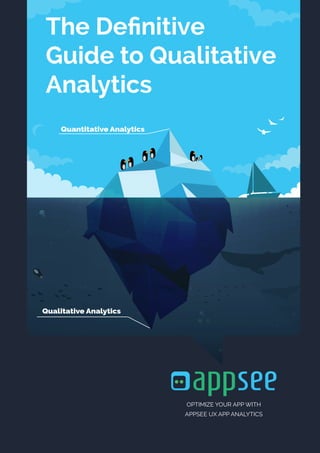
Quantitative Analytics
Qualitative Analytics
OPTIMIZE YOUR APP WITH
APPSEE UX APP ANALYTICS
The Definitive
Guide to Qualitative
Analytics
Introduction
Why Did We Write This Guide?
There’s a unique transformation occurring in the realm of mobile app
analytics. Analytics are not only becoming more specified but also more
robust in terms of what mobile teams are able to track and analyze.
Specifically, now app professionals have the ability to actually see and
qualify specific user behavior instead of just broadly defining it by numbers.
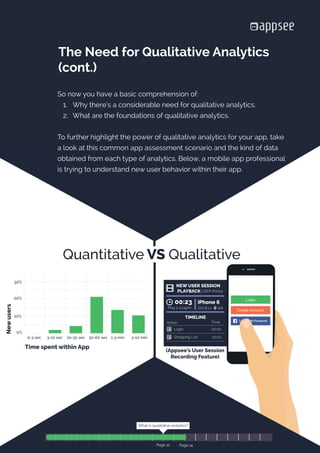
This is thanks to the advent of qualitative app analytics. We wanted to help
people understand exactly why this change is happening, what it means,
and how they can harness its full value.
Who is This Guide for?
This guide is for mobile product managers, CTO’s, mobile developers, UX
researchers, UI designers, mobile marketers, mobile startup leaders, or any
other type of “appreneur.” You do not need to have a Masters in Statistics
or Data Science in order to get the most from this guide. All you need is the
ambition to build the best app possible and the willingness to learn and
grow. Now, let’s get to the good stuff…






















The Rise of App Analytics				 | Page 4
The Rise of App Analytics (cont.)			 | Page 5
Quantitative Analytics: A Break Down		 | Page 7
The Shortcomings of Quantitative Analytics	 | Page 10
The Need for Qualitative Analytics			 | Page 12
Qualitative Analytics in Action (Use Cases) 	 | Page 15
Comparison Graph: Quantitative vs. Qualitative	 | Page 21
Table of Contents


It’s hard not to gape at the sheer mushrooming of the mobile app
ecosystem. As Eric Schmidt, Executive Chairman of Google, so perfectly
put it, “The trend has been mobile was winning; it’s now won.” Just think,
Schmidt said this back towards the end of 2013- almost three years ago.
Look how much growth has even occurred since then! The stats are
extensive and astonishing.
To start, US daily smartphone screen time has actually exceeded television
time. On top of that, now 80% of internet users own a smartphone and of
those users, 89% of their media time is spent within apps. By 2020, App
Annie projects that gross revenue across all app stores will exceed $101
billion globally. Plus, in terms of simple annual growth, from 2014 to 2015
global total time spent in android apps grew by a staggering 63%. The
amazing statistics go on and on. We can confidently look back over the last
3 years and reaffirm that mobile has definitely won but we can also say that
apps have been the most valuable player!
The Rise of App Analytics
What is qualitative analytics?
Page 12Page 4


Page 5
Just how have apps risen as the “most valuable player” in the mobile
industry? An upsurge of unique, innovative products and increased
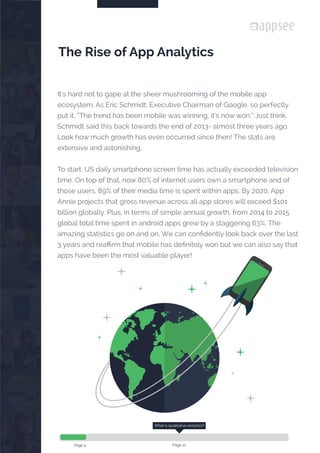
smartphone adoption certainly play a role, but are just the tip of the
iceberg. Under the surface practically every app uses some sort of app
analytics.
Why? Well to start off the concept of “If you build it, they will come” lasted,
if anything, for a hot minute. In this exploding app ecosystem, mobile
publishers quickly learned that if they want to stand out from the millions
of other apps out there, they can’t just rely on building a “great app”. They
must engage, monetize, and retain your users (who are some of the most
selective and impatient users the digital world has ever seen). The only
way to successfully do this is to know what’s going on inside your app- and
you can only obtain this knowledge via app analytics. Even interviewing
your potential users and holding focus groups won’t give you the insights
you are seeking. As Jakob Nielsen so perfectly worded it, you must “pay
attention to what users do, not what they say.” By gathering valuable data
on your app’s real users right from the get-go, you will optimize your app
more efficiently and with more certainty.
Thanks to the explosion of apps and speedy specification of apps’ needs,
there are a multitude (hundreds) of app analytics options out there. While
these systems might differ greatly in specific attributes, capabilities, plans
& pricing, and platform support, they typically can be categorized as
“Quantitative” (traditional) app analytics.
The Rise of App Analytics (cont.)
What is qualitative analytics?
Page 12
Page 6 /22The Definitive Guide to Qualitative Analytics
























But staying true to the spirit of the rapidly evolving mobile app world,
there’s already a “new” category of app analytics on the scene-
“Qualitative” app analytics. Now the big question is which one is going to
deliver the type of exceptional value that will allow you to fully understand
your users and what they’re doing, effectively optimize and troubleshoot
your app, and ultimately keep your app not just up to par but prevailing
in the ultra-competitive app ecosystem? In this guide we will illuminate
the characteristics and capabilities of both types of analytics, explore
the reasons behind the advent of Qualitative app analytics, and help you
successfully conclude which type of analytics best suits your needs. Let’s
get started.
What is qualitative analytics?
Page 12
What is qualitative analytics?
Page 6


So let’s start with what exactly is “Quantitative Analytics”? To obtain the best
understanding, let’s first look at the definition of the word “quantitative.”
Merriam Webster notes the definition as follows:
1.	 of, relating to, or expressible in terms of quantity
2.	 of, relating to, or involving the measurement of quantity or amount
3.	 based on quantity; specifically of classical verse: based on temporal
quantity or duration of sounds
Numbers, numbers, numbers- that is the crux of the definition. So when
it comes to quantitative app analytics, it means you are analyzing and
gathering data in terms of quantities. All of the data and information
obtained through this type of analytics can be measured and written down
with numbers. Typically, one would utilize quantitative analytics to get hard
aggregate insights on certain user actions and trends. Below are some
examples of when you would use quantitative analytics:
Quantitative Analytics: A Break Down
Page 7
What is qualitative analytics?
Page 12


1. Basic usage reporting
a. How many total users do you have?
b. How many times is your app launched on a daily basis?
c. How many new users do you have? What is the ratio of new to
returning users?
d. How long is the average user session?
e. How many users never return to your app after their first session?
f. How many of your users come from a particular country, a particular
campaign, a particular site?
2. Basic conversion reporting
a. How many users made it from Step A to Step B within a specific
conversion funnel?
b. How many users dropped off between Step A and Step B within a
specific conversion funnel?
c. How many users completed a certain conversion funnel? What is your
CR for a particular funnel?
3. Basic user trend reporting
a. How many times do users use a particular feature?
b. How many users quit your app on a particular screen?
c. How many users accept or deny a particular in-app permission?
Page 8
What is qualitative analytics?
Page 12
Page 9 /22The Definitive Guide to Qualitative Analytics
























Notice a trend? The term “how many” is often used when asking
quantitative oriented questions. Now although the fundamentals of
quantitative analytics are to gather large amounts of numerical data,
let’s not forget how far quantitative analytics has come in terms of how
those numbers are obtained and displayed. Today, the technique of data
visualization, the presentation of data in a pictorial or graphical format,
plays a big role in quantitative analytics. Basically it enables mobile
professionals to better grasp difficult concepts and identify new patterns
within all the data on their app. There is no doubt that data visualization can
certainly help you pinpoint trends and correlations within your data, but at
the end of the day it cannot tell you the “whys” behind all those numbers.
This leads us into our next section: The Shortcomings of Quantitative
Analytics
What is qualitative analytics?
Page 12
What is qualitative analytics?
Page 9
Numerical data is of course important, but there is so much more that
you can (and need) to learn about your app. Essentially, this is where
quantitative analytics falls short, as it only satisfies your number based
inquires. As noted earlier, quantitative data can help you pinpoint
numerical-based concerns such as quit rate of certain screens, but cannot
really go beyond that in terms of analysis.
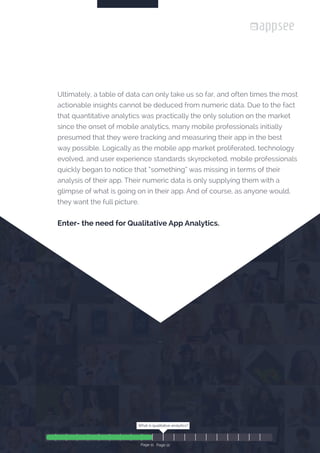
For example, let’s say you have a quit rate of over 50% for your login screen.
Clearly the majority of your users are not wanting to login to your app-
that’s certainly important to know. Unfortunately, with quantitative analytics
you have absolutely no idea as to why they are quitting. No matter whether
the data is displayed in a table or as a beautiful pie chart, at the end of
the day it is still a quantitative measurement and nothing more. In order to
hopefully understand the reason(s) behind this particular metric, you will
probably have to invest many hours, implement multiple tests and design
iterations, and potentially conduct additional primary user research. That’s
a lot- all just to get one answer for one bit of data.
The Shortcomings of Quantitative
Analytics
What is qualitative analytics?
Page 12
What is qualitative analytics?
Page 10
Page 11 /22The Definitive Guide to Qualitative Analytics
























Ultimately, a table of data can only take us so far, and often times the most
actionable insights cannot be deduced from numeric data. Due to the fact
that quantitative analytics was practically the only solution on the market
since the onset of mobile analytics, many mobile professionals initially
presumed that they were tracking and measuring their app in the best
way possible. Logically as the mobile app market proliferated, technology
evolved, and user experience standards skyrocketed, mobile professionals
quickly began to notice that “something” was missing in terms of their
analysis of their app. Their numeric data is only supplying them with a
glimpse of what is going on in their app. And of course, as anyone would,
they want the full picture.
Enter- the need for Qualitative App Analytics.
What is qualitative analytics?
Page 12
What is qualitative analytics?
Page 11


To properly grasp the essence of qualitative analytics, let’s again start out
with a simple definition:
1.	 Pertaining to or concerned with quality or qualities
2.	 Of or relating to how good something is: of or relating to the quality of something
Can qualities such as the color of one’s eyes, feelings on one’s birthday,
or softness of one’s cat be delineated by numbers? No- these are traits,
sentiments, and conditions.
So when it comes to the analysis of your app, what is the one essential
element that cannot be represented by numbers?
User experience.
User experience (UX) encompasses all aspects of the end-user’s
interaction with your product. Because the UX of your app is a qualitative
measurement, you need to essentially see what your users are
experiencing and how they behave in order to actually understand it.
Only qualitative app analytics, or as many now call it, “UX app analytics”
can measure this extremely critical and nuanced KPI.
The Need for Qualitative Analytics
What is qualitative analytics?
Page 12
Capturing Visual Data
Drilling down to the individual
user level
Displaying Data in a
Comprehensive Manner
USER RECORDING
00:23
1
3
2
SETTINGS
Send feedback
Sign out
About
CHECKOUT
Phone
Name
Address
Crashing Screens
Touch Heatmap
*From this point on you will see us utilize
“Qualitative Analytics” and “UX App Analytics”
interchangeably. Fundamentally, UX App Analytics
is a type of qualitative analytics. In the case
of mobile app software, qualitative analytics
specifically focus on assessing user experience.
Let’s take a look at the key pillars that
define the essence of UX app analytics*.
What is qualitative analytics?
Page 12
What is qualitative analytics?
Page 13
The Need for Qualitative Analytics
(cont.)
0%
10%
20%
30%
0-3 sec 3-10 sec 10-30 sec 30-60 sec 1-3 min 3-10 min
Newusers
Time spent within App
Create account
Login
NEW USER SESSION
PLAYBACKUSER #0014
00:23 iPhone 6
iOS 8.1.2 wifiMay 2 4:24pm
TIMELINE
Action Time
Login 00:00
00:10Shopping List
(Appsee’s User Session
Recording Feature)
Quantitative VS Qualitative
So now you have a basic comprehension of:
1.	 Why there’s a considerable need for qualitative analytics.
2.	 What are the foundations of qualitative analytics.
To further highlight the power of qualitative analytics for your app, take
a look at this common app assessment scenario and the kind of data
obtained from each type of analytics. Below, a mobile app professional
is trying to understand new user behavior within their app.
What is qualitative analytics?
Page 12
What is qualitative analytics?
Page 14


Qualitative Analytics in Action (Use
Cases)
Not only can qualitative analytics greatly help you with analyzing and
optimizing your user onboarding experience, it can also address a plethora
of app optimization concerns.
Let’s dive in to some specific case studies:
Crashes
You can save your dev team over “20% additional
hours” like eBay did by harnessing the power
of qualitative analytics for crash analysis and
repairs. With qualitative data on crashes, such as
crash video recordings paired with symbolicated
crash reports, mobile development teams no
longer have to pour over crash logs for endless
hours. Instead, they can see the exact sequence of actions that led to
the crash with their own eyes and then easily pinpoint the precise line
of code that needs to be fixed. No more guesswork when it comes to
understanding and resolving crashes- which means a better overall user
experience for your users.
What is qualitative analytics?
Page 12 Page 15


Checkout Process
Any m-commerce app understands the utter
importance of their checkout process and
screen. The slightest flaw or confusing element
can cost them a sale. In order to effectively and
thoroughly enhance this critical facet of your app,
you must go beyond quantitative data. Exactly
why did your user abandon purchase? Did they
experience a payment issue, did a form field freeze on them, did they have
trouble adding a promo code? All of these questions can only be answered
by UX app analytics. With UX app analytics you can filter users that did not
end up making a purchase and watch their session recordings. In seconds
you'll be able to detect the issue(s) that hindered them from converting.
BUY
User Support
Maybe you have a unique IoT app that allows
users to control their home heating system or
monitor their baby’s vitals? Your user support
team is even doubly crucial in this case seeing
as your app regulates a real-world, tangible
device in a realm that is relatively new in the
digital world. Basically, your mobile application is
your user’s home base and communicates the value of your IoT device. To
maintain a high level of performance, connectivity, and usability, your user
support team needs to know exactly how your users are behaving within
your app and what they are experiencing. Again, user experience is not
something that can be represented by numbers. By watching user session
recordings of real-world interactions with your app, your support team can
see the exact experiences of users, which users were affected by particular
issues, and reach out and resolve those matters accordingly. This can allow
your support team to be drastically more precise, personal, and prompt-
meeting your users’ high standards and even exceeding them.
What is qualitative analytics?
Page 12 Page 16


Search Accuracy
For any app with an extensive search function,
such as the standard travel app, you need to
remain on top of your game in terms of search
accuracy, auto-correction/predictions, and
search display results. Whether your search
function is fully optimal can make the difference
between a conversion and a drop-off. What are
the most often searched terms, how are the results appearing (are you
providing too many results per page?), are users confused by results or
straining to find the search they want? Surprise- another instance where
only qualitative analytics can provide you with the actionable insights you
need regarding your search function.
Secure Sign-Up
The majority of financial and banking companies
are going mobile nowadays and it makes total
sense. Users want to be able to access banking
and financial functionalities on the go, and not
have to wait to physically be at a desktop. Yet
that doesn’t mean that there isn’t a sense of
apprehensiveness from the user when it comes
to logging in to these types of apps, especially due to mobile security
issues. Basically, a secure sign-up/account login screen can make or break
the adoption of your app and retention of your users. Maybe your users are
struggling to complete a certain “CAPTCHA” or password confirmation? Or
maybe your users are quickly abandoning your app due to a “suspicious”
login glitch? Once more, you can utilize qualitative analytics to understand
how your users are experiencing your app and affim that your signup/login
screen remains a safe, gateway and not a barrier.
What is qualitative analytics?
Page 12 Page 17


In-app Ads
Let’s say you have a sports app, with your main
source of revenue being in-app ads. To put it
simply, no matter how much your monetization
tool and programmatic ad network “promise” that
they provide the best control and transparency in
the business, it is oftentimes not enough. When it
comes to monitoring your in-app ads, there are a
lot of moving pieces to keep track of, especially
if your app has a large amount of impressions to fill. Once an unsuitable ad
sneaks its way into your app, it can damage your brand name, ruin the UX,
trigger app abandonment, and spark negative reviews. A qualitative UX
tool, like user session recordings, can allow you to see through your users’
eyes how the ads (from banners to videos) are actually appearing on your
app’s screens.
These insights can reveal whether an ad potentially interrupted your users’
experience/journey, had a technical or quality issue, and/or led the person
to instantly quit your app among many other results. Many top apps are
beginning to harness the potential of qualitative analytics for monitoring
of in-app ads. For example, when the renowned sports app 365 Scores
utilized UX app analytics to monitor there in-app ads, they were able to
decrease user complaints by 44% and discontinue work with two unsuitable
ad networks.
What is qualitative analytics?
Page 12 Page 18


Gesturization
Let’s say you have a gaming app with a unique
gesture pattern. You want to analyze how your
users grasp this gesture, their natural movement
on your screens, and whether the gesture is
ultimately the best choice for your user base.
Maybe users from a specific country interpret
the gesture differently than another geo? Maybe some users are lacking
the fine motor skills to successfully execute this gesture? Or maybe some
users are just frustrated with the gesture? Numerical data is not going to
provide you with actionable answers on your gestures. UX app analytics
systems, like Appsee, will provide you with the qualitative answers you
need to optimize your gestures and app usability. Via Appsee’s user session
recordings and automatic tagging of specific gestures, you will be able to
see for yourself exactly how specific users complete or don’t complete your
gesture. On an aggregate level of analysis, Appsee’s visual touch heatmaps
can highlight all the gestures users are completing on each screen and
where they focus the most. It can also reveal every instance and location
of an unresponsive gesture on each screen. Innately, gestures are a very
physical, nuanced user action that in order to be properly optimized, must
be analyzed on the qualitative level.
What is qualitative analytics?
Page 12 Page 19


Fake Installs
Many mobile teams will run paid campaigns
to acquire downloads/new users. This is a
great tactic to boost visibility and increase
your user base, but it also has its inherent risks.
Unfortunately, there is always the potential that
some acquired users from paid campaigns can
actually be fake users/bots. The only way you
can truly separate the “wheat from the chaff” is by actually seeing how
users behave in your app. Surprise- you can only accurately execute this
by employing qualitative analytics. Qualitative analytics will allow you to
effectively pinpoint behaviors (or lack of behavior) that is characteristic
of fake users and then identify which source they originated from. This
will enable you to fine-tune your work with particular ad networks and
significantly boost your ROI.
What is qualitative analytics?
Page 12 Page 20
In order to fully grasp the value of qualitative analytics, you must
understand that it is a powerful complement to quantitative analytics. As
discussed, quantitative allows you to identify important trends, issues,
and actions within your app on a numerical basis. Then, qualitative
analytics augments this data by supplying the crucial “whys” behind the
numbers. Basically, in order to paint the clearest picture of what’s going on
inside your app, all successful qualitative analytics systems reference at
least some quantitative data.
Below we have another nifty visual that illuminates how qualitative
analytics effectively expands on quantitative.
The Marriage of Quantitative and
Qualitative
QUALITATIVE
QUALITATIVE
Funn
el Metrics Crash
M
etrics
Usabilit
y
M
etrics User Navigati
on
Metrics
W
hy
did
users
drop
off
your funnel at a
certain
stage
W
hy
did
a
crash
occurand
w
hatsequance
ofevents
led
up
to
the
crash
H
ow
are
your users
actually
using
your app
and
w
here
do
they
encounter usability
issues
H
ow
is
each
usernavigating
through
yourapp
and
w
hatdoes
theirjourney
look
like?
QUANTITATIVE
What is qualitative analytics?
Page 12
What is qualitative analytics?
Page 21























So are you ready to get the ball rolling and gain the best insights possible on your
app? Choose the definitive leader in qualitative app analytics- Appsee.
With Appsee's unique user recordings and touch heatmaps, you can make the
most informed decisions regarding your app's user experience and spend less
time sifting through mountains of data. Appsee also automatically detects all
screens, buttons and user actions within your app without requiring you to select
what to measure in advance. No more asking questions of your analytics system-
just pure, unambiguous answers regarding your app and its users.
Integrated with Fabric? You can easily install Appsee’s free trial with just one click.
You can also simply begin our Free Trial via our site. All it takes is one line of code
and less than 5 minutes. Now that’s user experience at its finest.
Get Started Now
Appsee is trusted by these amazing mobile teams:
The Industry Leader in Qualitative App Analytics
info@appsee.com
www.appsee.com

The Definitive Guide to Qualitative Analytics

  • 1.
    Quantitative Analytics Qualitative Analytics OPTIMIZEYOUR APP WITH APPSEE UX APP ANALYTICS The Definitive Guide to Qualitative Analytics
  • 2.
    Introduction Why Did WeWrite This Guide? There’s a unique transformation occurring in the realm of mobile app analytics. Analytics are not only becoming more specified but also more robust in terms of what mobile teams are able to track and analyze. Specifically, now app professionals have the ability to actually see and qualify specific user behavior instead of just broadly defining it by numbers. This is thanks to the advent of qualitative app analytics. We wanted to help people understand exactly why this change is happening, what it means, and how they can harness its full value. Who is This Guide for? This guide is for mobile product managers, CTO’s, mobile developers, UX researchers, UI designers, mobile marketers, mobile startup leaders, or any other type of “appreneur.” You do not need to have a Masters in Statistics or Data Science in order to get the most from this guide. All you need is the ambition to build the best app possible and the willingness to learn and grow. Now, let’s get to the good stuff…
  • 3.
                          The Rise ofApp Analytics | Page 4 The Rise of App Analytics (cont.) | Page 5 Quantitative Analytics: A Break Down | Page 7 The Shortcomings of Quantitative Analytics | Page 10 The Need for Qualitative Analytics | Page 12 Qualitative Analytics in Action (Use Cases) | Page 15 Comparison Graph: Quantitative vs. Qualitative | Page 21 Table of Contents
  • 4.
      It’s hard notto gape at the sheer mushrooming of the mobile app ecosystem. As Eric Schmidt, Executive Chairman of Google, so perfectly put it, “The trend has been mobile was winning; it’s now won.” Just think, Schmidt said this back towards the end of 2013- almost three years ago. Look how much growth has even occurred since then! The stats are extensive and astonishing. To start, US daily smartphone screen time has actually exceeded television time. On top of that, now 80% of internet users own a smartphone and of those users, 89% of their media time is spent within apps. By 2020, App Annie projects that gross revenue across all app stores will exceed $101 billion globally. Plus, in terms of simple annual growth, from 2014 to 2015 global total time spent in android apps grew by a staggering 63%. The amazing statistics go on and on. We can confidently look back over the last 3 years and reaffirm that mobile has definitely won but we can also say that apps have been the most valuable player! The Rise of App Analytics What is qualitative analytics? Page 12Page 4
  • 5.
      Page 5 Just howhave apps risen as the “most valuable player” in the mobile industry? An upsurge of unique, innovative products and increased smartphone adoption certainly play a role, but are just the tip of the iceberg. Under the surface practically every app uses some sort of app analytics. Why? Well to start off the concept of “If you build it, they will come” lasted, if anything, for a hot minute. In this exploding app ecosystem, mobile publishers quickly learned that if they want to stand out from the millions of other apps out there, they can’t just rely on building a “great app”. They must engage, monetize, and retain your users (who are some of the most selective and impatient users the digital world has ever seen). The only way to successfully do this is to know what’s going on inside your app- and you can only obtain this knowledge via app analytics. Even interviewing your potential users and holding focus groups won’t give you the insights you are seeking. As Jakob Nielsen so perfectly worded it, you must “pay attention to what users do, not what they say.” By gathering valuable data on your app’s real users right from the get-go, you will optimize your app more efficiently and with more certainty. Thanks to the explosion of apps and speedy specification of apps’ needs, there are a multitude (hundreds) of app analytics options out there. While these systems might differ greatly in specific attributes, capabilities, plans & pricing, and platform support, they typically can be categorized as “Quantitative” (traditional) app analytics. The Rise of App Analytics (cont.) What is qualitative analytics? Page 12
  • 6.
    Page 6 /22TheDefinitive Guide to Qualitative Analytics                         But staying true to the spirit of the rapidly evolving mobile app world, there’s already a “new” category of app analytics on the scene- “Qualitative” app analytics. Now the big question is which one is going to deliver the type of exceptional value that will allow you to fully understand your users and what they’re doing, effectively optimize and troubleshoot your app, and ultimately keep your app not just up to par but prevailing in the ultra-competitive app ecosystem? In this guide we will illuminate the characteristics and capabilities of both types of analytics, explore the reasons behind the advent of Qualitative app analytics, and help you successfully conclude which type of analytics best suits your needs. Let’s get started. What is qualitative analytics? Page 12 What is qualitative analytics? Page 6
  • 7.
      So let’s startwith what exactly is “Quantitative Analytics”? To obtain the best understanding, let’s first look at the definition of the word “quantitative.” Merriam Webster notes the definition as follows: 1. of, relating to, or expressible in terms of quantity 2. of, relating to, or involving the measurement of quantity or amount 3. based on quantity; specifically of classical verse: based on temporal quantity or duration of sounds Numbers, numbers, numbers- that is the crux of the definition. So when it comes to quantitative app analytics, it means you are analyzing and gathering data in terms of quantities. All of the data and information obtained through this type of analytics can be measured and written down with numbers. Typically, one would utilize quantitative analytics to get hard aggregate insights on certain user actions and trends. Below are some examples of when you would use quantitative analytics: Quantitative Analytics: A Break Down Page 7 What is qualitative analytics? Page 12
  • 8.
      1. Basic usagereporting a. How many total users do you have? b. How many times is your app launched on a daily basis? c. How many new users do you have? What is the ratio of new to returning users? d. How long is the average user session? e. How many users never return to your app after their first session? f. How many of your users come from a particular country, a particular campaign, a particular site? 2. Basic conversion reporting a. How many users made it from Step A to Step B within a specific conversion funnel? b. How many users dropped off between Step A and Step B within a specific conversion funnel? c. How many users completed a certain conversion funnel? What is your CR for a particular funnel? 3. Basic user trend reporting a. How many times do users use a particular feature? b. How many users quit your app on a particular screen? c. How many users accept or deny a particular in-app permission? Page 8 What is qualitative analytics? Page 12
  • 9.
    Page 9 /22TheDefinitive Guide to Qualitative Analytics                         Notice a trend? The term “how many” is often used when asking quantitative oriented questions. Now although the fundamentals of quantitative analytics are to gather large amounts of numerical data, let’s not forget how far quantitative analytics has come in terms of how those numbers are obtained and displayed. Today, the technique of data visualization, the presentation of data in a pictorial or graphical format, plays a big role in quantitative analytics. Basically it enables mobile professionals to better grasp difficult concepts and identify new patterns within all the data on their app. There is no doubt that data visualization can certainly help you pinpoint trends and correlations within your data, but at the end of the day it cannot tell you the “whys” behind all those numbers. This leads us into our next section: The Shortcomings of Quantitative Analytics What is qualitative analytics? Page 12 What is qualitative analytics? Page 9
  • 10.
    Numerical data isof course important, but there is so much more that you can (and need) to learn about your app. Essentially, this is where quantitative analytics falls short, as it only satisfies your number based inquires. As noted earlier, quantitative data can help you pinpoint numerical-based concerns such as quit rate of certain screens, but cannot really go beyond that in terms of analysis. For example, let’s say you have a quit rate of over 50% for your login screen. Clearly the majority of your users are not wanting to login to your app- that’s certainly important to know. Unfortunately, with quantitative analytics you have absolutely no idea as to why they are quitting. No matter whether the data is displayed in a table or as a beautiful pie chart, at the end of the day it is still a quantitative measurement and nothing more. In order to hopefully understand the reason(s) behind this particular metric, you will probably have to invest many hours, implement multiple tests and design iterations, and potentially conduct additional primary user research. That’s a lot- all just to get one answer for one bit of data. The Shortcomings of Quantitative Analytics What is qualitative analytics? Page 12 What is qualitative analytics? Page 10
  • 11.
    Page 11 /22TheDefinitive Guide to Qualitative Analytics                         Ultimately, a table of data can only take us so far, and often times the most actionable insights cannot be deduced from numeric data. Due to the fact that quantitative analytics was practically the only solution on the market since the onset of mobile analytics, many mobile professionals initially presumed that they were tracking and measuring their app in the best way possible. Logically as the mobile app market proliferated, technology evolved, and user experience standards skyrocketed, mobile professionals quickly began to notice that “something” was missing in terms of their analysis of their app. Their numeric data is only supplying them with a glimpse of what is going on in their app. And of course, as anyone would, they want the full picture. Enter- the need for Qualitative App Analytics. What is qualitative analytics? Page 12 What is qualitative analytics? Page 11
  • 12.
      To properly graspthe essence of qualitative analytics, let’s again start out with a simple definition: 1. Pertaining to or concerned with quality or qualities 2. Of or relating to how good something is: of or relating to the quality of something Can qualities such as the color of one’s eyes, feelings on one’s birthday, or softness of one’s cat be delineated by numbers? No- these are traits, sentiments, and conditions. So when it comes to the analysis of your app, what is the one essential element that cannot be represented by numbers? User experience. User experience (UX) encompasses all aspects of the end-user’s interaction with your product. Because the UX of your app is a qualitative measurement, you need to essentially see what your users are experiencing and how they behave in order to actually understand it. Only qualitative app analytics, or as many now call it, “UX app analytics” can measure this extremely critical and nuanced KPI. The Need for Qualitative Analytics What is qualitative analytics? Page 12
  • 13.
    Capturing Visual Data Drillingdown to the individual user level Displaying Data in a Comprehensive Manner USER RECORDING 00:23 1 3 2 SETTINGS Send feedback Sign out About CHECKOUT Phone Name Address Crashing Screens Touch Heatmap *From this point on you will see us utilize “Qualitative Analytics” and “UX App Analytics” interchangeably. Fundamentally, UX App Analytics is a type of qualitative analytics. In the case of mobile app software, qualitative analytics specifically focus on assessing user experience. Let’s take a look at the key pillars that define the essence of UX app analytics*. What is qualitative analytics? Page 12 What is qualitative analytics? Page 13
  • 14.
    The Need forQualitative Analytics (cont.) 0% 10% 20% 30% 0-3 sec 3-10 sec 10-30 sec 30-60 sec 1-3 min 3-10 min Newusers Time spent within App Create account Login NEW USER SESSION PLAYBACKUSER #0014 00:23 iPhone 6 iOS 8.1.2 wifiMay 2 4:24pm TIMELINE Action Time Login 00:00 00:10Shopping List (Appsee’s User Session Recording Feature) Quantitative VS Qualitative So now you have a basic comprehension of: 1. Why there’s a considerable need for qualitative analytics. 2. What are the foundations of qualitative analytics. To further highlight the power of qualitative analytics for your app, take a look at this common app assessment scenario and the kind of data obtained from each type of analytics. Below, a mobile app professional is trying to understand new user behavior within their app. What is qualitative analytics? Page 12 What is qualitative analytics? Page 14
  • 15.
      Qualitative Analytics inAction (Use Cases) Not only can qualitative analytics greatly help you with analyzing and optimizing your user onboarding experience, it can also address a plethora of app optimization concerns. Let’s dive in to some specific case studies: Crashes You can save your dev team over “20% additional hours” like eBay did by harnessing the power of qualitative analytics for crash analysis and repairs. With qualitative data on crashes, such as crash video recordings paired with symbolicated crash reports, mobile development teams no longer have to pour over crash logs for endless hours. Instead, they can see the exact sequence of actions that led to the crash with their own eyes and then easily pinpoint the precise line of code that needs to be fixed. No more guesswork when it comes to understanding and resolving crashes- which means a better overall user experience for your users. What is qualitative analytics? Page 12 Page 15
  • 16.
      Checkout Process Any m-commerceapp understands the utter importance of their checkout process and screen. The slightest flaw or confusing element can cost them a sale. In order to effectively and thoroughly enhance this critical facet of your app, you must go beyond quantitative data. Exactly why did your user abandon purchase? Did they experience a payment issue, did a form field freeze on them, did they have trouble adding a promo code? All of these questions can only be answered by UX app analytics. With UX app analytics you can filter users that did not end up making a purchase and watch their session recordings. In seconds you'll be able to detect the issue(s) that hindered them from converting. BUY User Support Maybe you have a unique IoT app that allows users to control their home heating system or monitor their baby’s vitals? Your user support team is even doubly crucial in this case seeing as your app regulates a real-world, tangible device in a realm that is relatively new in the digital world. Basically, your mobile application is your user’s home base and communicates the value of your IoT device. To maintain a high level of performance, connectivity, and usability, your user support team needs to know exactly how your users are behaving within your app and what they are experiencing. Again, user experience is not something that can be represented by numbers. By watching user session recordings of real-world interactions with your app, your support team can see the exact experiences of users, which users were affected by particular issues, and reach out and resolve those matters accordingly. This can allow your support team to be drastically more precise, personal, and prompt- meeting your users’ high standards and even exceeding them. What is qualitative analytics? Page 12 Page 16
  • 17.
      Search Accuracy For anyapp with an extensive search function, such as the standard travel app, you need to remain on top of your game in terms of search accuracy, auto-correction/predictions, and search display results. Whether your search function is fully optimal can make the difference between a conversion and a drop-off. What are the most often searched terms, how are the results appearing (are you providing too many results per page?), are users confused by results or straining to find the search they want? Surprise- another instance where only qualitative analytics can provide you with the actionable insights you need regarding your search function. Secure Sign-Up The majority of financial and banking companies are going mobile nowadays and it makes total sense. Users want to be able to access banking and financial functionalities on the go, and not have to wait to physically be at a desktop. Yet that doesn’t mean that there isn’t a sense of apprehensiveness from the user when it comes to logging in to these types of apps, especially due to mobile security issues. Basically, a secure sign-up/account login screen can make or break the adoption of your app and retention of your users. Maybe your users are struggling to complete a certain “CAPTCHA” or password confirmation? Or maybe your users are quickly abandoning your app due to a “suspicious” login glitch? Once more, you can utilize qualitative analytics to understand how your users are experiencing your app and affim that your signup/login screen remains a safe, gateway and not a barrier. What is qualitative analytics? Page 12 Page 17
  • 18.
      In-app Ads Let’s sayyou have a sports app, with your main source of revenue being in-app ads. To put it simply, no matter how much your monetization tool and programmatic ad network “promise” that they provide the best control and transparency in the business, it is oftentimes not enough. When it comes to monitoring your in-app ads, there are a lot of moving pieces to keep track of, especially if your app has a large amount of impressions to fill. Once an unsuitable ad sneaks its way into your app, it can damage your brand name, ruin the UX, trigger app abandonment, and spark negative reviews. A qualitative UX tool, like user session recordings, can allow you to see through your users’ eyes how the ads (from banners to videos) are actually appearing on your app’s screens. These insights can reveal whether an ad potentially interrupted your users’ experience/journey, had a technical or quality issue, and/or led the person to instantly quit your app among many other results. Many top apps are beginning to harness the potential of qualitative analytics for monitoring of in-app ads. For example, when the renowned sports app 365 Scores utilized UX app analytics to monitor there in-app ads, they were able to decrease user complaints by 44% and discontinue work with two unsuitable ad networks. What is qualitative analytics? Page 12 Page 18
  • 19.
      Gesturization Let’s say youhave a gaming app with a unique gesture pattern. You want to analyze how your users grasp this gesture, their natural movement on your screens, and whether the gesture is ultimately the best choice for your user base. Maybe users from a specific country interpret the gesture differently than another geo? Maybe some users are lacking the fine motor skills to successfully execute this gesture? Or maybe some users are just frustrated with the gesture? Numerical data is not going to provide you with actionable answers on your gestures. UX app analytics systems, like Appsee, will provide you with the qualitative answers you need to optimize your gestures and app usability. Via Appsee’s user session recordings and automatic tagging of specific gestures, you will be able to see for yourself exactly how specific users complete or don’t complete your gesture. On an aggregate level of analysis, Appsee’s visual touch heatmaps can highlight all the gestures users are completing on each screen and where they focus the most. It can also reveal every instance and location of an unresponsive gesture on each screen. Innately, gestures are a very physical, nuanced user action that in order to be properly optimized, must be analyzed on the qualitative level. What is qualitative analytics? Page 12 Page 19
  • 20.
      Fake Installs Many mobileteams will run paid campaigns to acquire downloads/new users. This is a great tactic to boost visibility and increase your user base, but it also has its inherent risks. Unfortunately, there is always the potential that some acquired users from paid campaigns can actually be fake users/bots. The only way you can truly separate the “wheat from the chaff” is by actually seeing how users behave in your app. Surprise- you can only accurately execute this by employing qualitative analytics. Qualitative analytics will allow you to effectively pinpoint behaviors (or lack of behavior) that is characteristic of fake users and then identify which source they originated from. This will enable you to fine-tune your work with particular ad networks and significantly boost your ROI. What is qualitative analytics? Page 12 Page 20
  • 21.
    In order tofully grasp the value of qualitative analytics, you must understand that it is a powerful complement to quantitative analytics. As discussed, quantitative allows you to identify important trends, issues, and actions within your app on a numerical basis. Then, qualitative analytics augments this data by supplying the crucial “whys” behind the numbers. Basically, in order to paint the clearest picture of what’s going on inside your app, all successful qualitative analytics systems reference at least some quantitative data. Below we have another nifty visual that illuminates how qualitative analytics effectively expands on quantitative. The Marriage of Quantitative and Qualitative QUALITATIVE QUALITATIVE Funn el Metrics Crash M etrics Usabilit y M etrics User Navigati on Metrics W hy did users drop off your funnel at a certain stage W hy did a crash occurand w hatsequance ofevents led up to the crash H ow are your users actually using your app and w here do they encounter usability issues H ow is each usernavigating through yourapp and w hatdoes theirjourney look like? QUANTITATIVE What is qualitative analytics? Page 12 What is qualitative analytics? Page 21
  • 22.
                           So are youready to get the ball rolling and gain the best insights possible on your app? Choose the definitive leader in qualitative app analytics- Appsee. With Appsee's unique user recordings and touch heatmaps, you can make the most informed decisions regarding your app's user experience and spend less time sifting through mountains of data. Appsee also automatically detects all screens, buttons and user actions within your app without requiring you to select what to measure in advance. No more asking questions of your analytics system- just pure, unambiguous answers regarding your app and its users. Integrated with Fabric? You can easily install Appsee’s free trial with just one click. You can also simply begin our Free Trial via our site. All it takes is one line of code and less than 5 minutes. Now that’s user experience at its finest. Get Started Now Appsee is trusted by these amazing mobile teams: The Industry Leader in Qualitative App Analytics info@appsee.com www.appsee.com