Innovation Education & Learning
Media
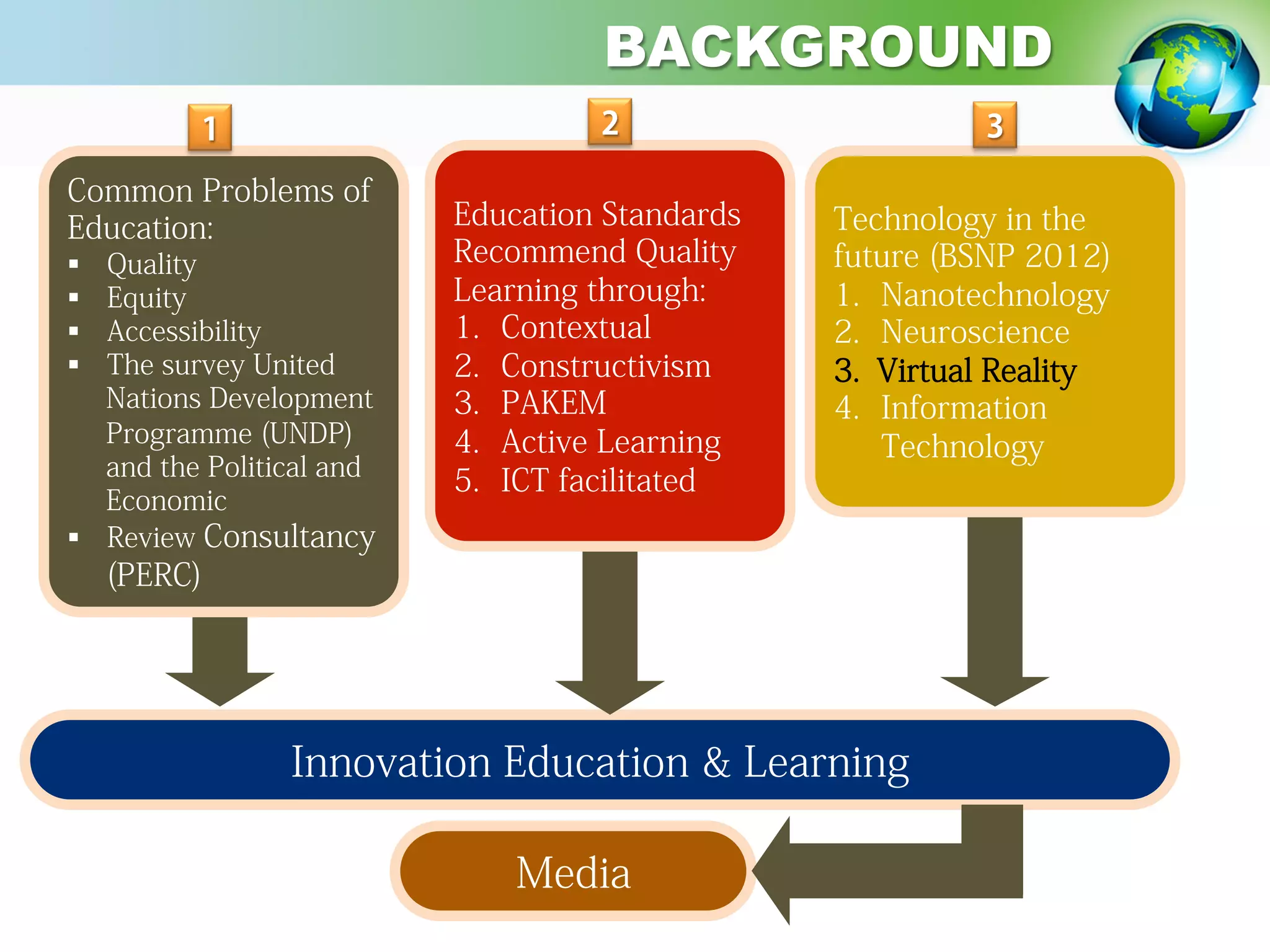
Education Standards
Recommend Quality
Learning through:
1.  Contextual
2.  Constructivism
3.  PAKEM
4.  Active Learning
5.  ICT facilitated
Common Problems of
Education:
§  Quality
§  Equity
§  Accessibility
§  The survey United
Nations Development
Programme (UNDP)
and the Political and
Economic
§  Review Consultancy
(PERC)
Technology in the
future (BSNP 2012)
1.  Nanotechnology
2.  Neuroscience
3.  Virtual Reality
4.  Information
Technology
1 2 3
BACKGROUND
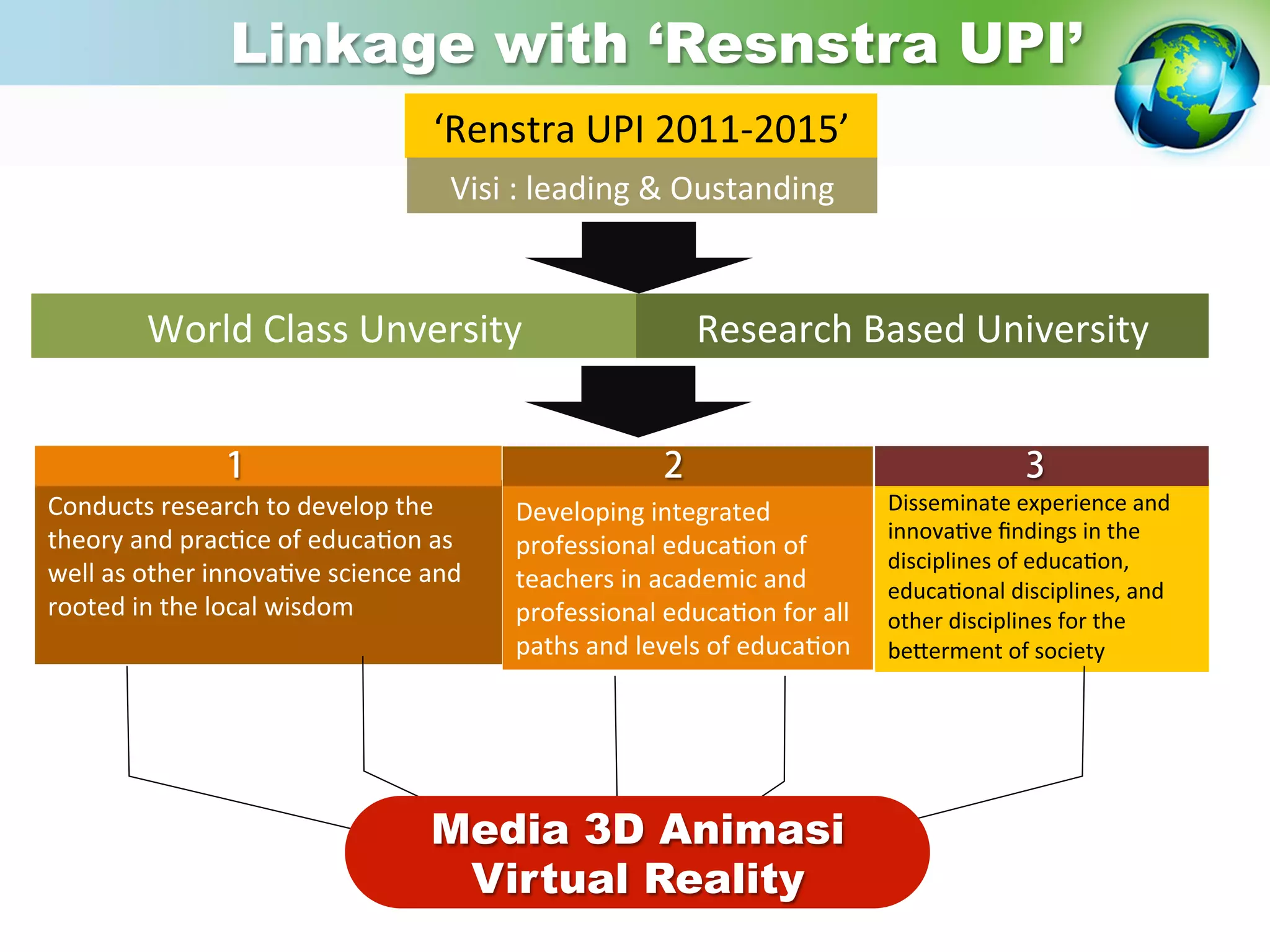
Linkage with ‘Resnstra UPI’
‘Renstra	
  UPI	
  2011-­‐2015’	
  	
  
Visi	
  :	
  leading	
  &	
  Oustanding	
  
World	
  Class	
  Unversity	
   Research	
  Based	
  University	
  
Conducts	
  research	
  to	
  develop	
  the	
  
theory	
  and	
  pracEce	
  of	
  educaEon	
  as	
  
well	
  as	
  other	
  innovaEve	
  science	
  and	
  
rooted	
  in	
  the	
  local	
  wisdom	


Developing	
  integrated	
  
professional	
  educaEon	
  of	
  
teachers	
  in	
  academic	
  and	
  
professional	
  educaEon	
  for	
  all	
  
paths	
  and	
  levels	
  of	
  educaEon	
  
Disseminate	
  experience	
  and	
  
innovaEve	
  findings	
  in	
  the	
  
disciplines	
  of	
  educaEon,	
  
educaEonal	
  disciplines,	
  and	
  
other	
  disciplines	
  for	
  the	
  
beNerment	
  of	
  society	
  
2 3 4 51 2 3
Media 3D Animasi
Virtual Reality
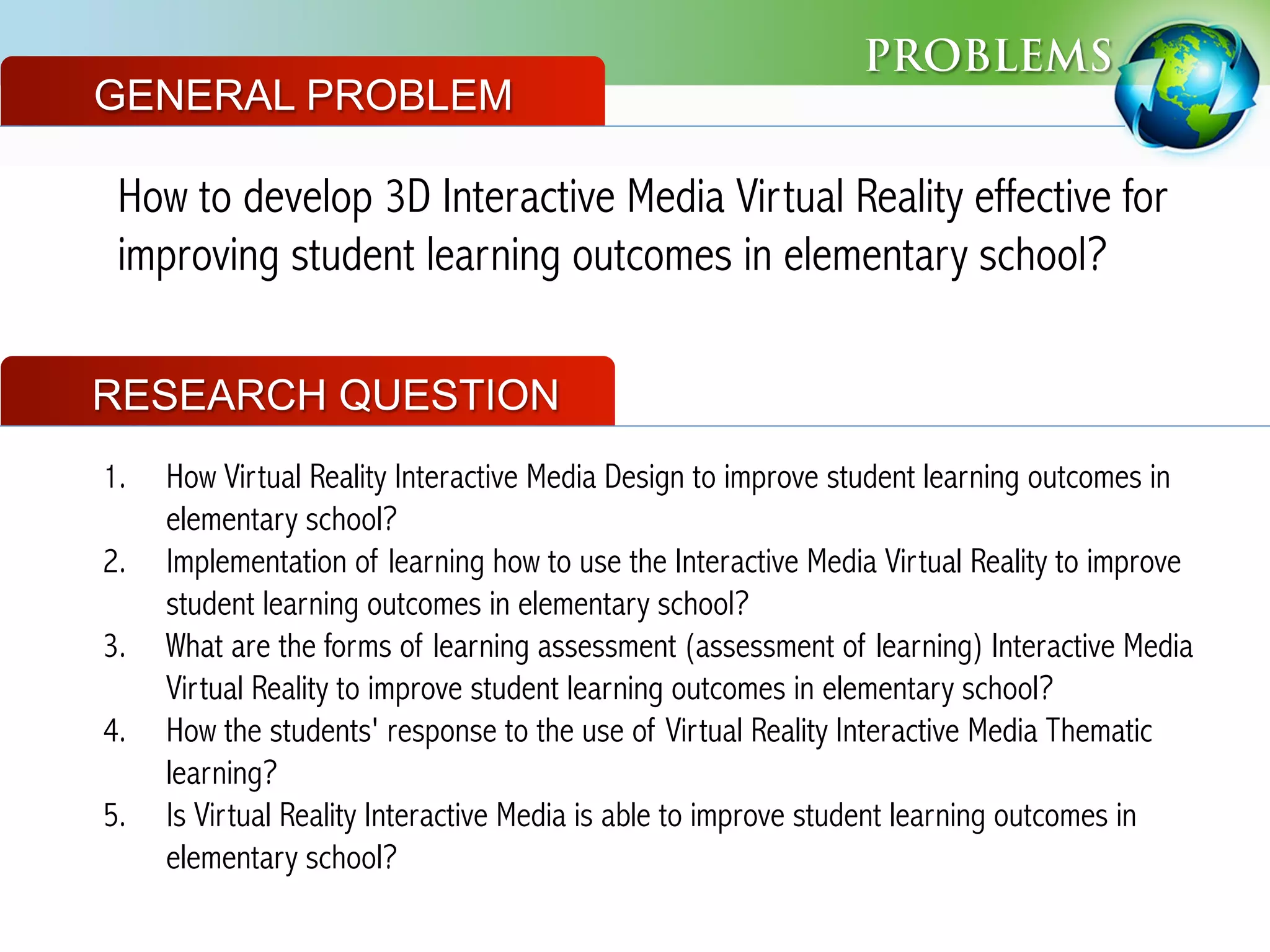
PROBLEMS
How to develop 3D Interactive Media Virtual Reality effective for
improving student learning outcomes in elementary school?
GENERAL PROBLEM
RESEARCH QUESTION
1.  How Virtual Reality Interactive Media Design to improve student learning outcomes in
elementary school?
2.  Implementation of learning how to use the Interactive Media Virtual Reality to improve
student learning outcomes in elementary school?
3.  What are the forms of learning assessment (assessment of learning) Interactive Media
Virtual Reality to improve student learning outcomes in elementary school?
4.  How the students' response to the use of Virtual Reality Interactive Media Thematic
learning?
5.  Is Virtual Reality Interactive Media is able to improve student learning outcomes in
elementary school?
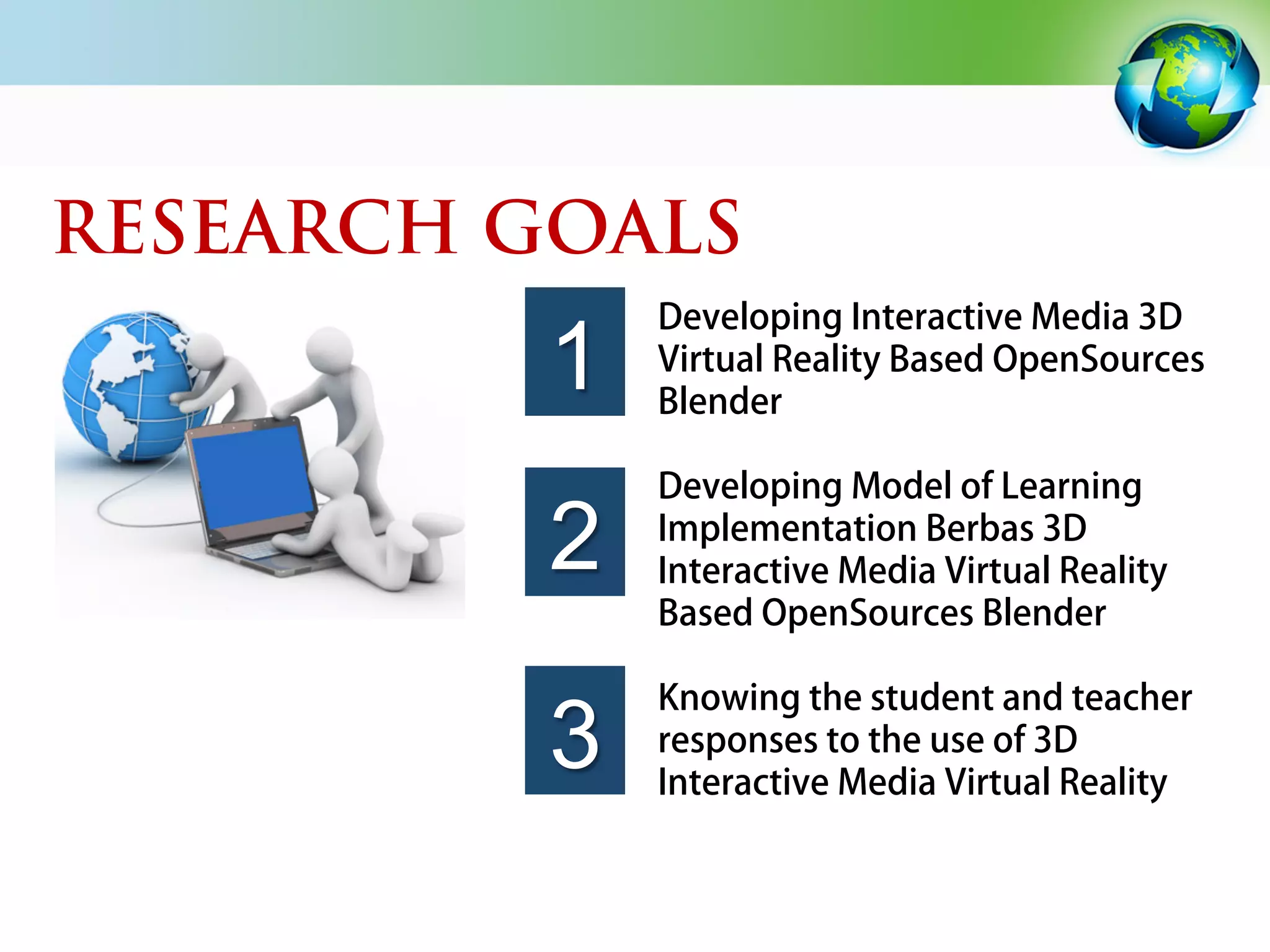
RESEARCH GOALS
Developing Interactive Media 3D
Virtual Reality Based OpenSources
Blender
Developing Model of Learning
Implementation Berbas 3D
Interactive Media Virtual Reality
Based OpenSources Blender
Knowing the student and teacher
responses to the use of 3D
Interactive Media Virtual Reality
1
2
3
benefits of
research
Theoretical
Developing science education
science with innovative product
produced based Visual Imaging
Technology
Practical
Models Media produced a reference
school in improving the
meaningfulness of learning
Institutional
Improving the image of the
institution (UPI) with products that
have intellectual property rights
1
2
3
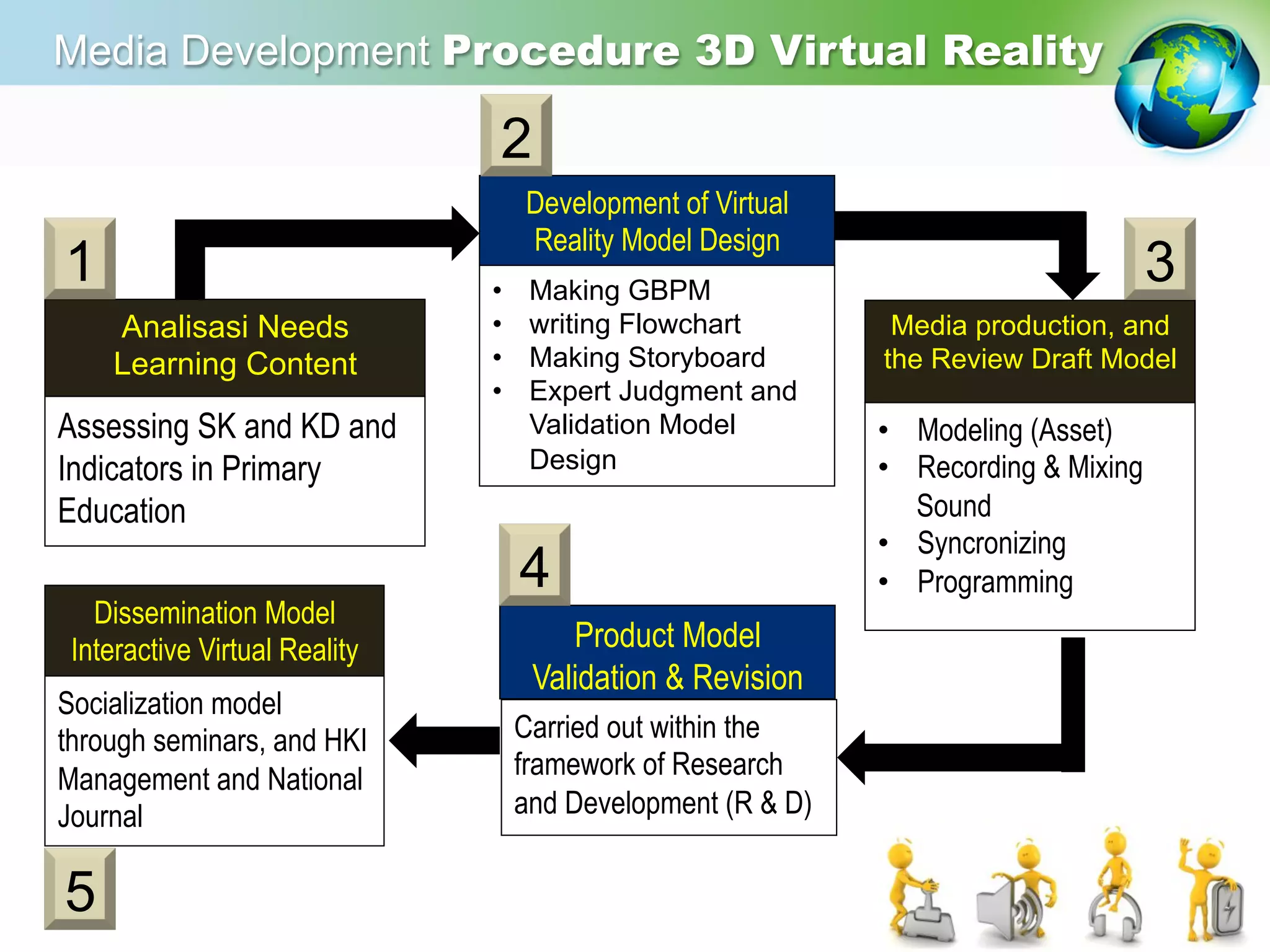
Analisasi Needs
Learning Content
Assessing SK and KD and
Indicators in Primary
Education
Development of Virtual
Reality Model Design
•  Making GBPM
•  writing Flowchart
•  Making Storyboard
•  Expert Judgment and
Validation Model
Design
Media production, and
the Review Draft Model
•  Modeling (Asset)
•  Recording & Mixing
Sound
•  Syncronizing
•  Programming
Product Model
Validation & Revision
Carried out within the
framework of Research
and Development (R & D)
Dissemination Model
Interactive Virtual Reality
Socialization model
through seminars, and HKI
Management and National
Journal
2
1 3
4
5
Media Development Procedure 3D Virtual Reality
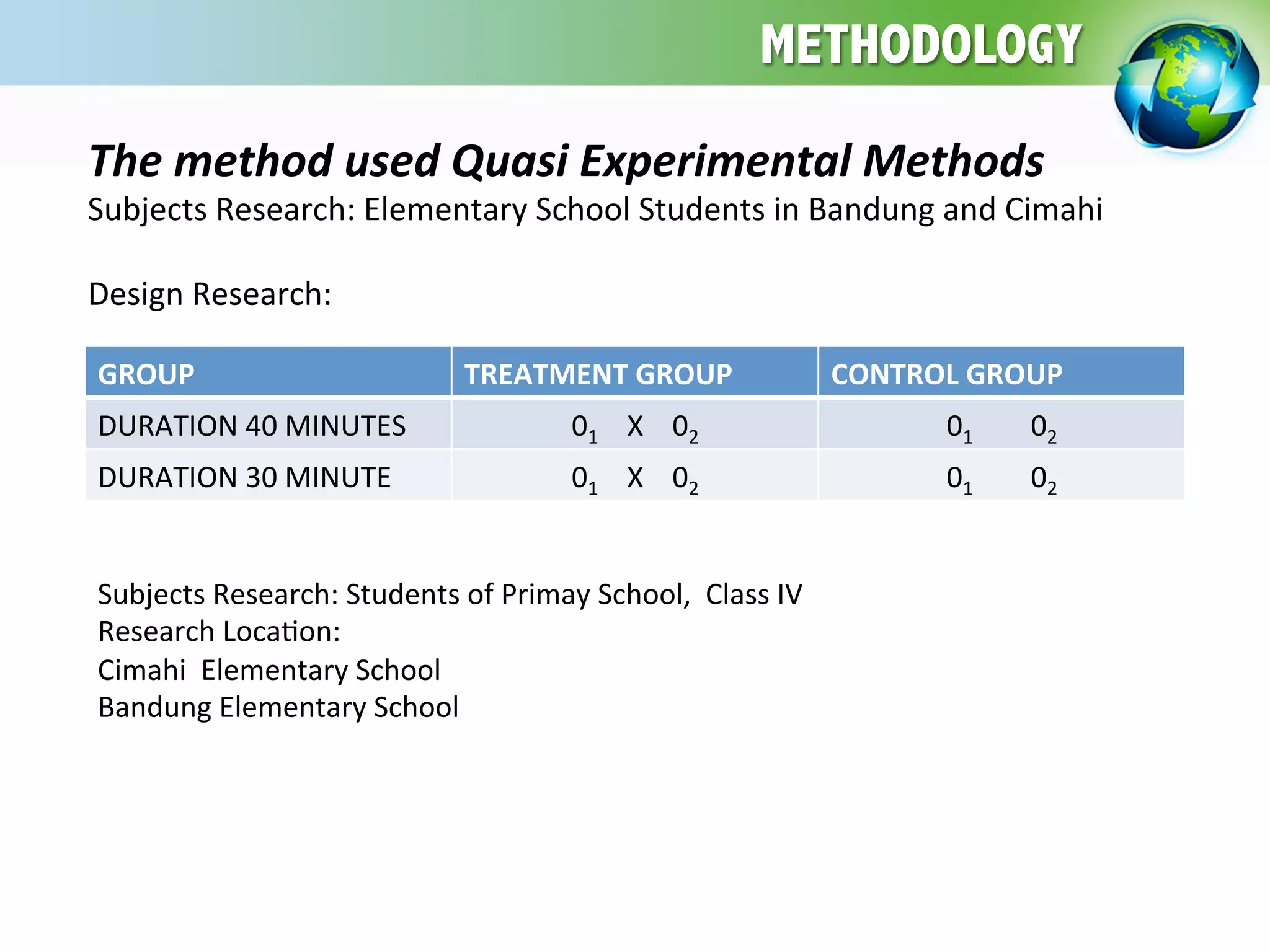
The	
  method	
  used	
  Quasi	
  Experimental	
  Methods	
  
Subjects	
  Research:	
  Elementary	
  School	
  Students	
  in	
  Bandung	
  and	
  Cimahi	


Design	
  Research:	
  
METHODOLOGY
Subjects	
  Research:	
  Students	
  of	
  Primay	
  School,	
  	
  Class	
  IV	
  
Research	
  LocaEon:	
  
Cimahi	
  	
  Elementary	
  School	
  
Bandung	
  Elementary	
  School	
  
GROUP	
   TREATMENT	
  GROUP	
   CONTROL	
  GROUP	
  
DURATION	
  40	
  MINUTES	
   01	


  X	


  02	
   01	


  02	
  
DURATION	
  30	
  MINUTE	
   01	


  X	


  02	
   01	


  02	
  
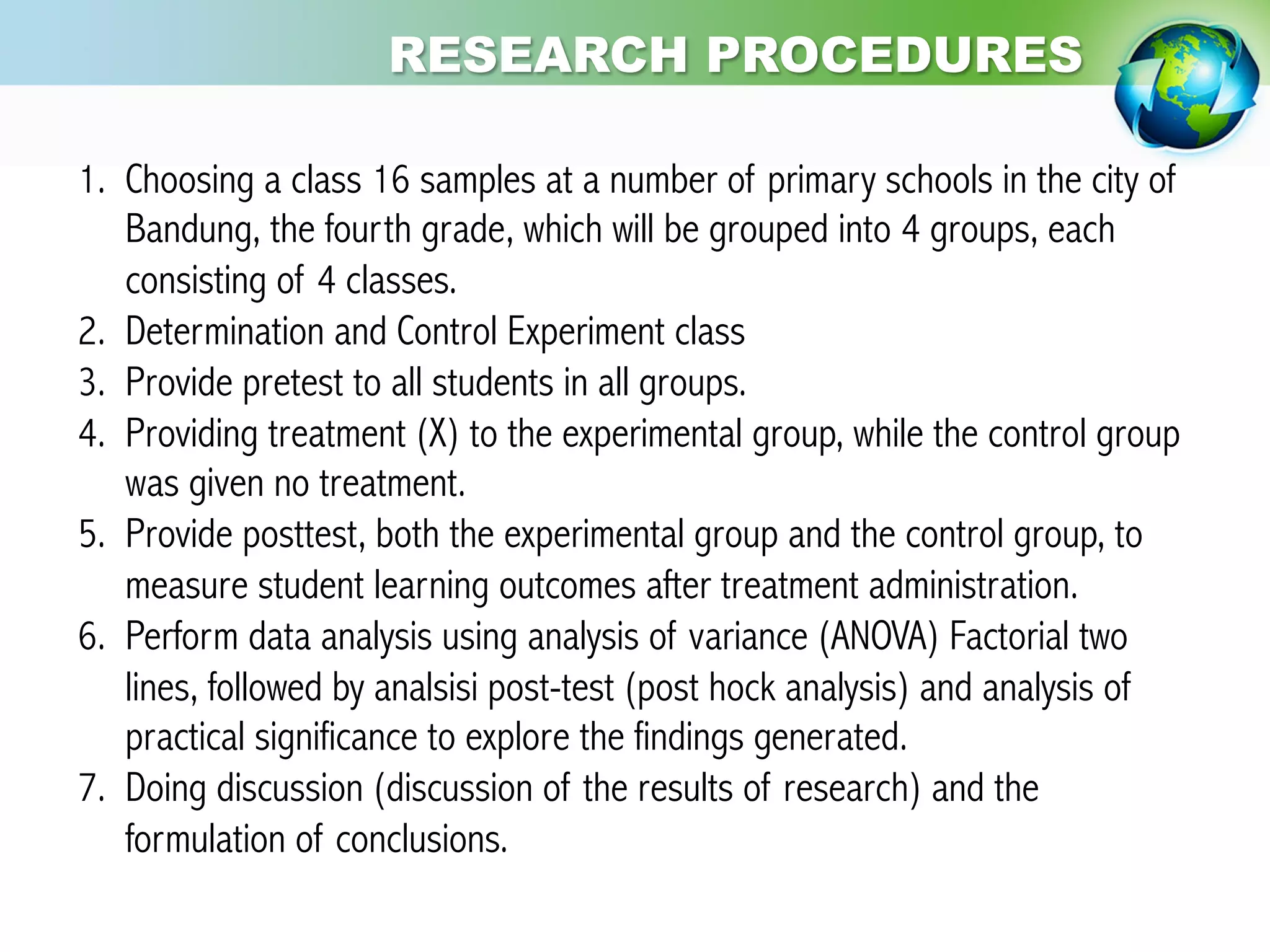
1.  Choosing a class 16 samples at a number of primary schools in the city of
Bandung, the fourth grade, which will be grouped into 4 groups, each
consisting of 4 classes.
2.  Determination and Control Experiment class
3.  Provide pretest to all students in all groups.
4.  Providing treatment (X) to the experimental group, while the control group
was given no treatment.
5.  Provide posttest, both the experimental group and the control group, to
measure student learning outcomes after treatment administration.
6.  Perform data analysis using analysis of variance (ANOVA) Factorial two
lines, followed by analsisi post-test (post hock analysis) and analysis of
practical significance to explore the findings generated.
7.  Doing discussion (discussion of the results of research) and the
formulation of conclusions.
RESEARCH PROCEDURES
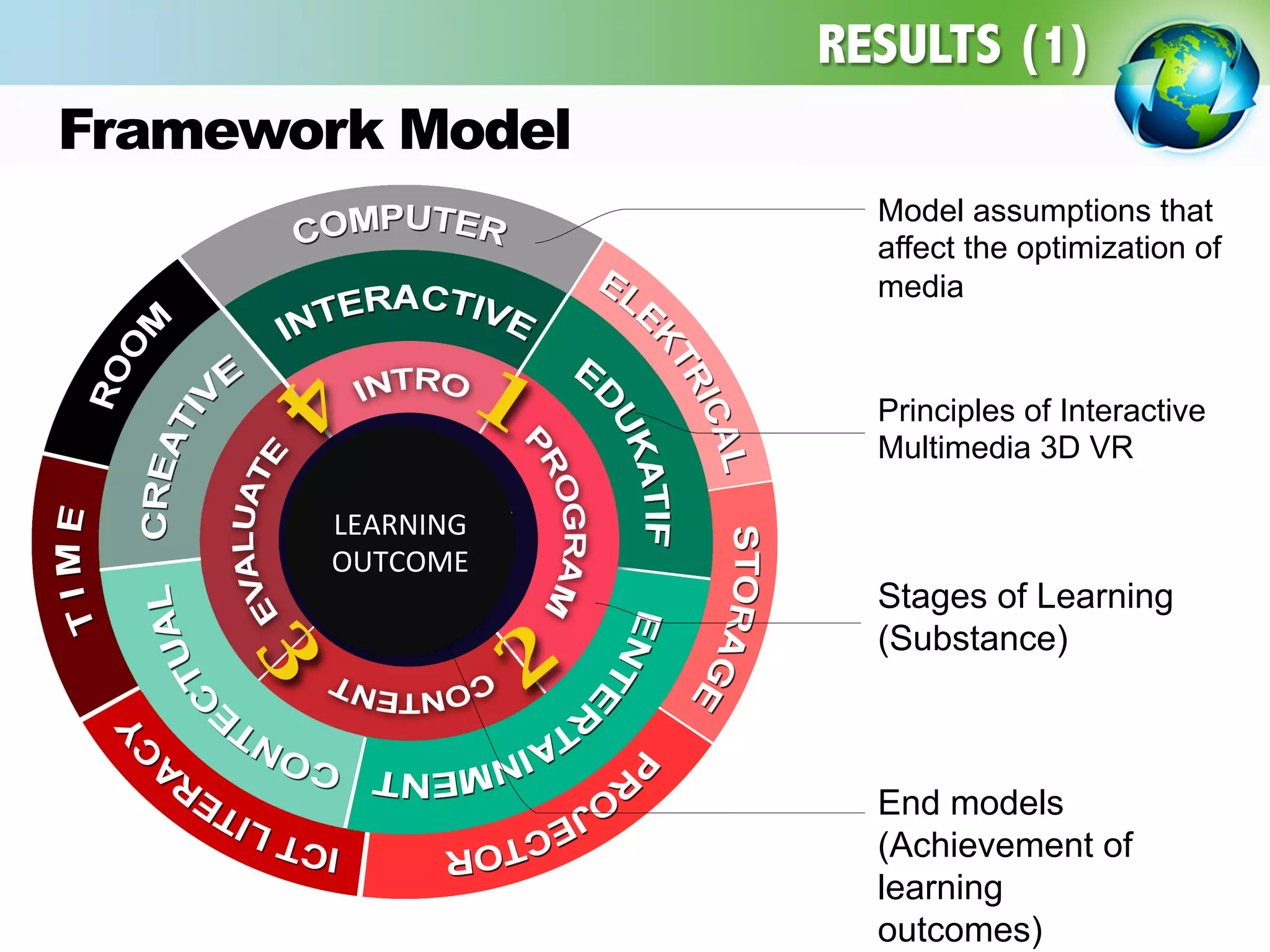
Model assumptions that
affect the optimization of
media
Principles of Interactive
Multimedia 3D VR
Stages of Learning
(Substance)
End models
(Achievement of
learning
outcomes)
Framework Model	
  
RESULTS (1)
LEARNING	
  
OUTCOME	
  
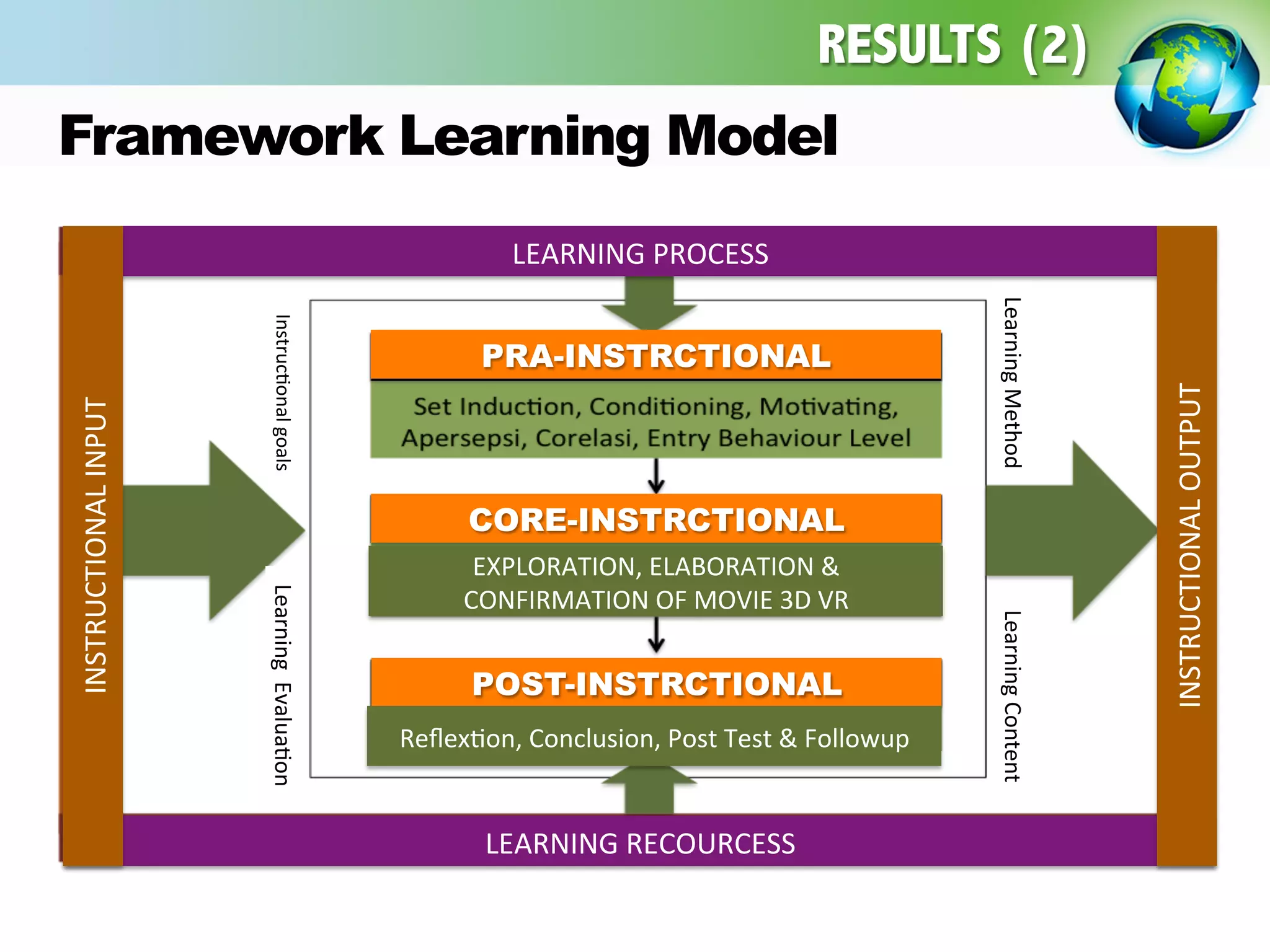
Framework Learning Model	
  
LEARNING	
  PROCESS	
  
LEARNING	
  RECOURCESS	
  
INSTRUCTIONAL	
  INPUT	
  
INSTRUCTIONAL	
  OUTPUT	
  
PRA-INSTRCTIONAL
CORE-INSTRCTIONAL
POST-INSTRCTIONAL
EXPLORATION,	
  ELABORATION	
  &	
  
CONFIRMATION	
  OF	
  MOVIE	
  3D	
  VR	
  
ReflexEon,	
  Conclusion,	
  Post	
  Test	
  &	
  Followup	
  
InstrucEonal	
  goals	
  
Content	
  Learning	
  Learning	
  Method	
  Learning	
  Content	
  
Learning	
  	
  EvaluaEon	
  
RESULTS (2)
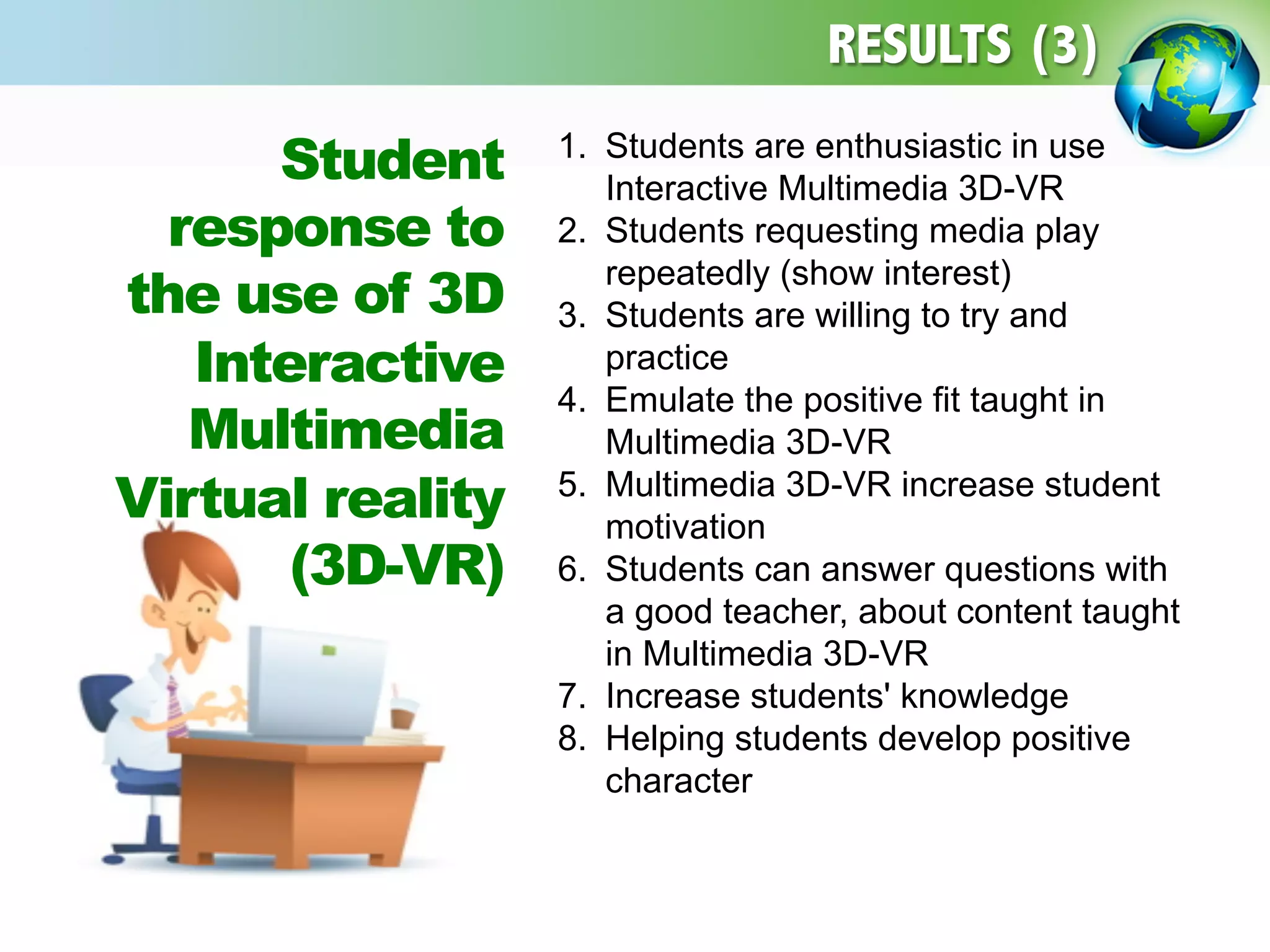
1.  Students are enthusiastic in use
Interactive Multimedia 3D-VR
2.  Students requesting media play
repeatedly (show interest)
3.  Students are willing to try and
practice
4.  Emulate the positive fit taught in
Multimedia 3D-VR
5.  Multimedia 3D-VR increase student
motivation
6.  Students can answer questions with
a good teacher, about content taught
in Multimedia 3D-VR
7.  Increase students' knowledge
8.  Helping students develop positive
character
RESULTS (3)
Student
response to
the use of 3D
Interactive
Multimedia
Virtual reality
(3D-VR)	
  
Nama Sekolah
Kelas
Rata-Rata
Gain
SD CIMAHI
MANDIRI
Pre-Tes Post Test
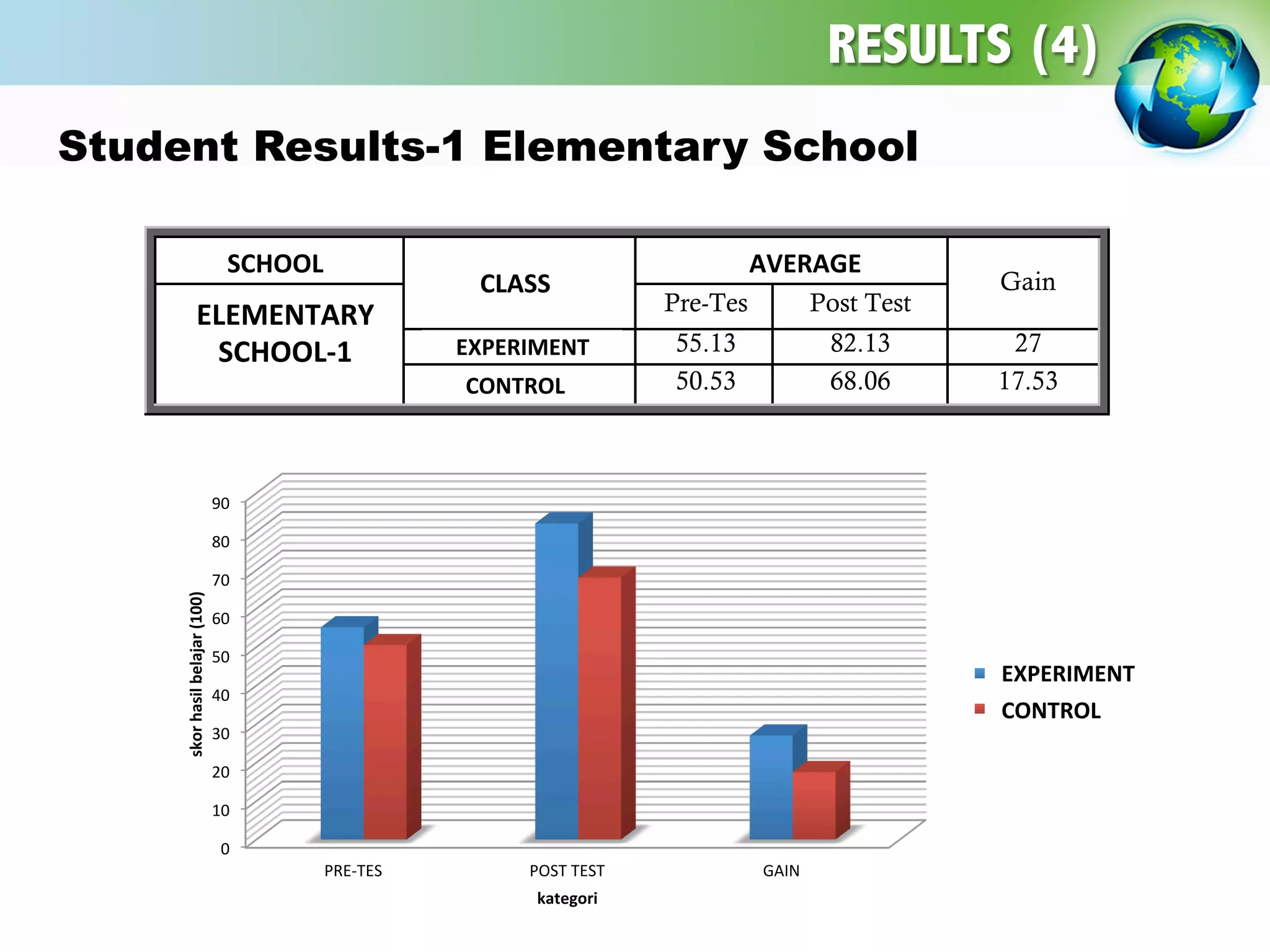
EKSPERIMEN 55.13 82.13 27
KONTROL 50.53 68.06 17.53
0	
  
10	
  
20	
  
30	
  
40	
  
50	
  
60	
  
70	
  
80	
  
90	
  
PRE-­‐TES	
   POST	
  TEST	
   GAIN	
  
skor	
  hasil	
  belajar	
  (100)	
  
kategori	
  
EKSPERIMEN	
  
KONTROL	
  
Student Results-1 Elementary School	
  
RESULTS (4)
SCHOOL	
  
CLASS	
  
AVERAGE	
  
EXPERIMENT	
  
CONTROL	
  
EXPERIMENT	
  
CONTROL	
  
ELEMENTARY	
  
SCHOOL-­‐1	
  
Nama Sekolah
Kelas
Rata-Rata
Gain
SD CIMAHI JATAYU
BANDUNG
Pre-Tes Post Test
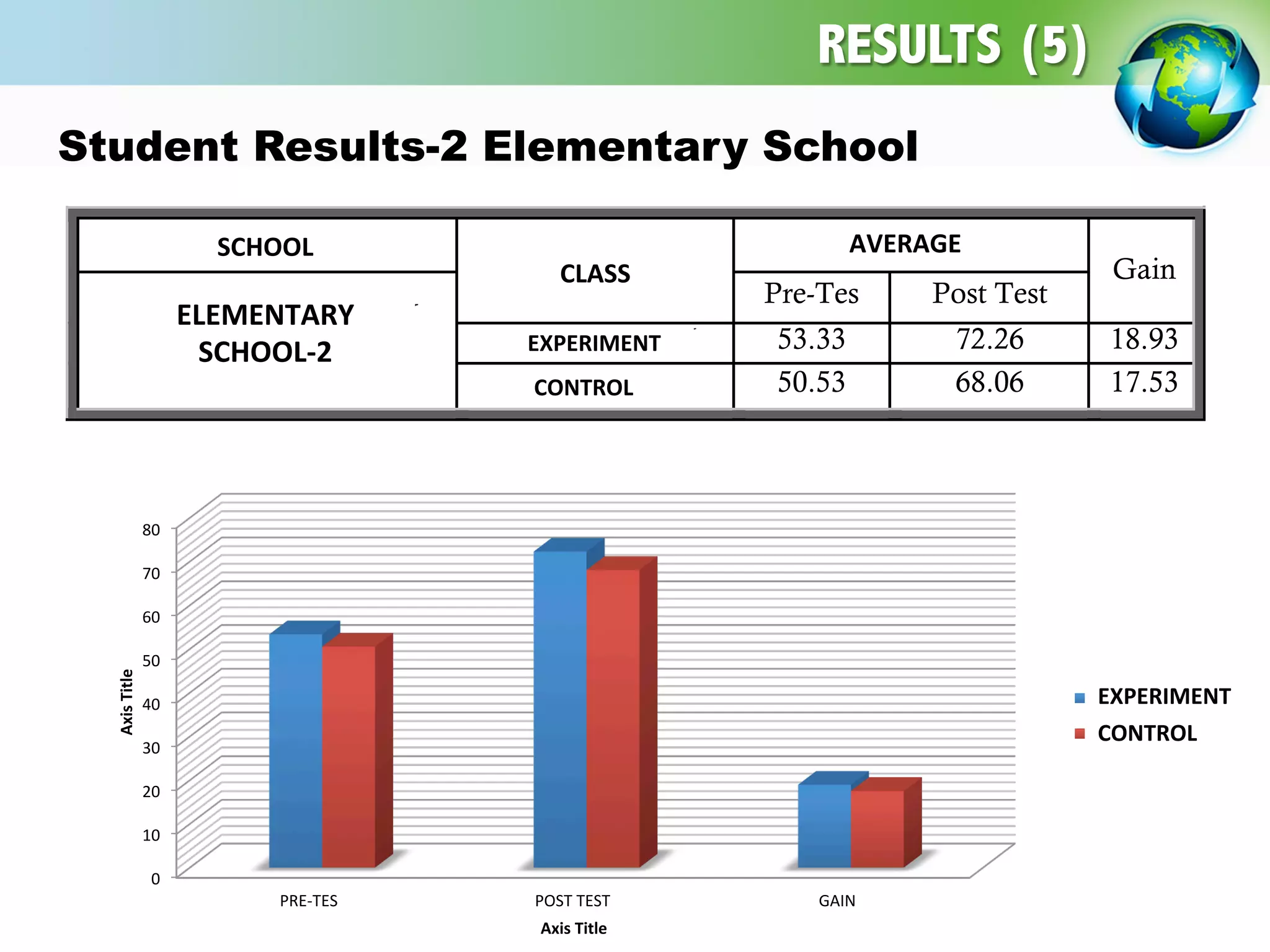
EKSPERIMEN 53.33 72.26 18.93
KONTROL 50.53 68.06 17.53
0	
  
10	
  
20	
  
30	
  
40	
  
50	
  
60	
  
70	
  
80	
  
PRE-­‐TES	
   POST	
  TEST	
   GAIN	
  
Axis	
  Title	
  
Axis	
  Title	
  
EKSPERIMEN	
  
KONTROL	
  
Student Results-2 Elementary School	
  
RESULTS (5)
SCHOOL	
  
CLASS	
  
AVERAGE	
  
EXPERIMENT	
  
CONTROL	
  
EXPERIMENT	
  
CONTROL	
  
ELEMENTARY	
  
SCHOOL-­‐2	
  
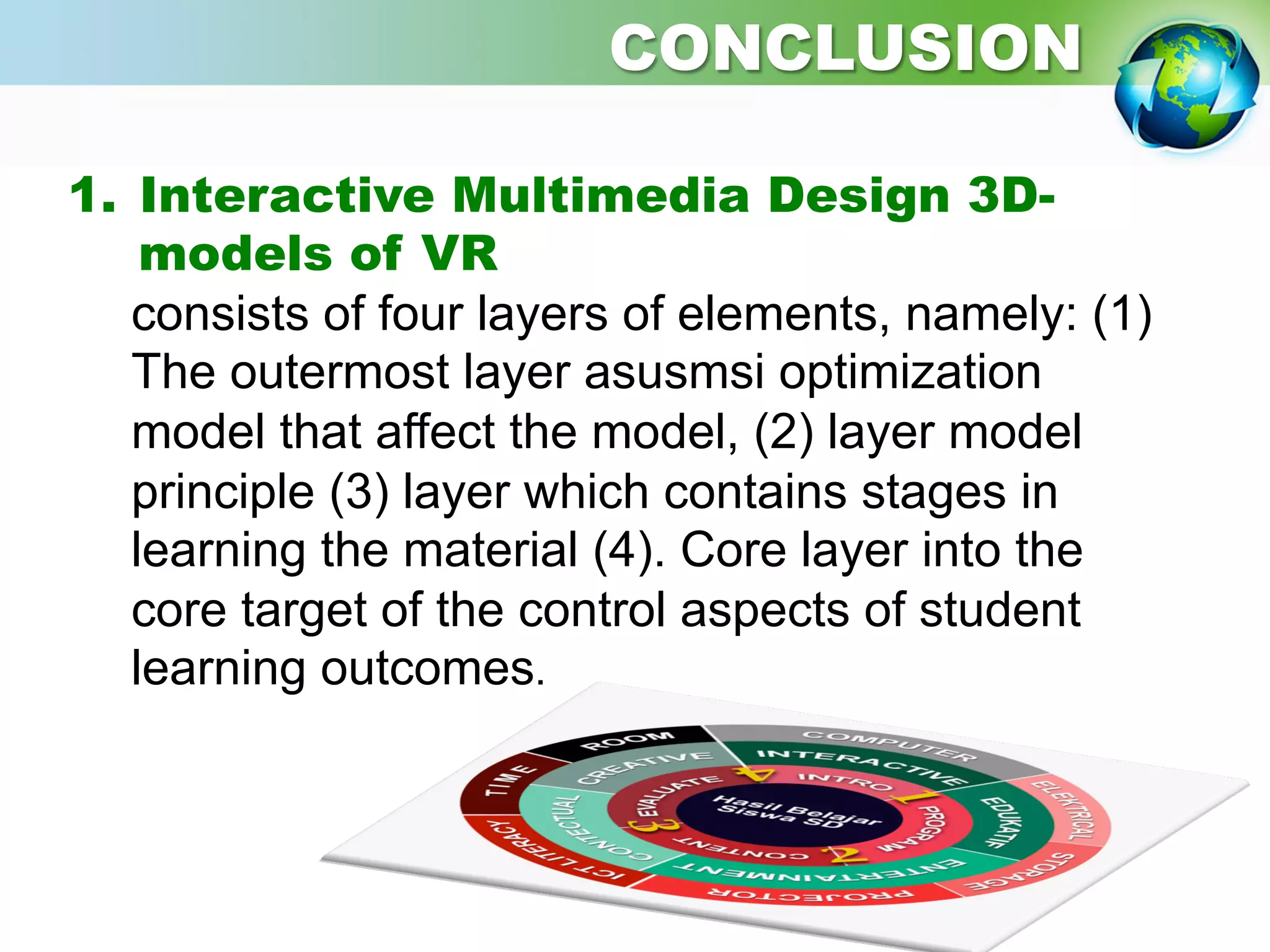
1.  Interactive Multimedia Design 3D-
models of VR
consists of four layers of elements, namely: (1)
The outermost layer asusmsi optimization
model that affect the model, (2) layer model
principle (3) layer which contains stages in
learning the material (4). Core layer into the
core target of the control aspects of student
learning outcomes.
	
  
CONCLUSION
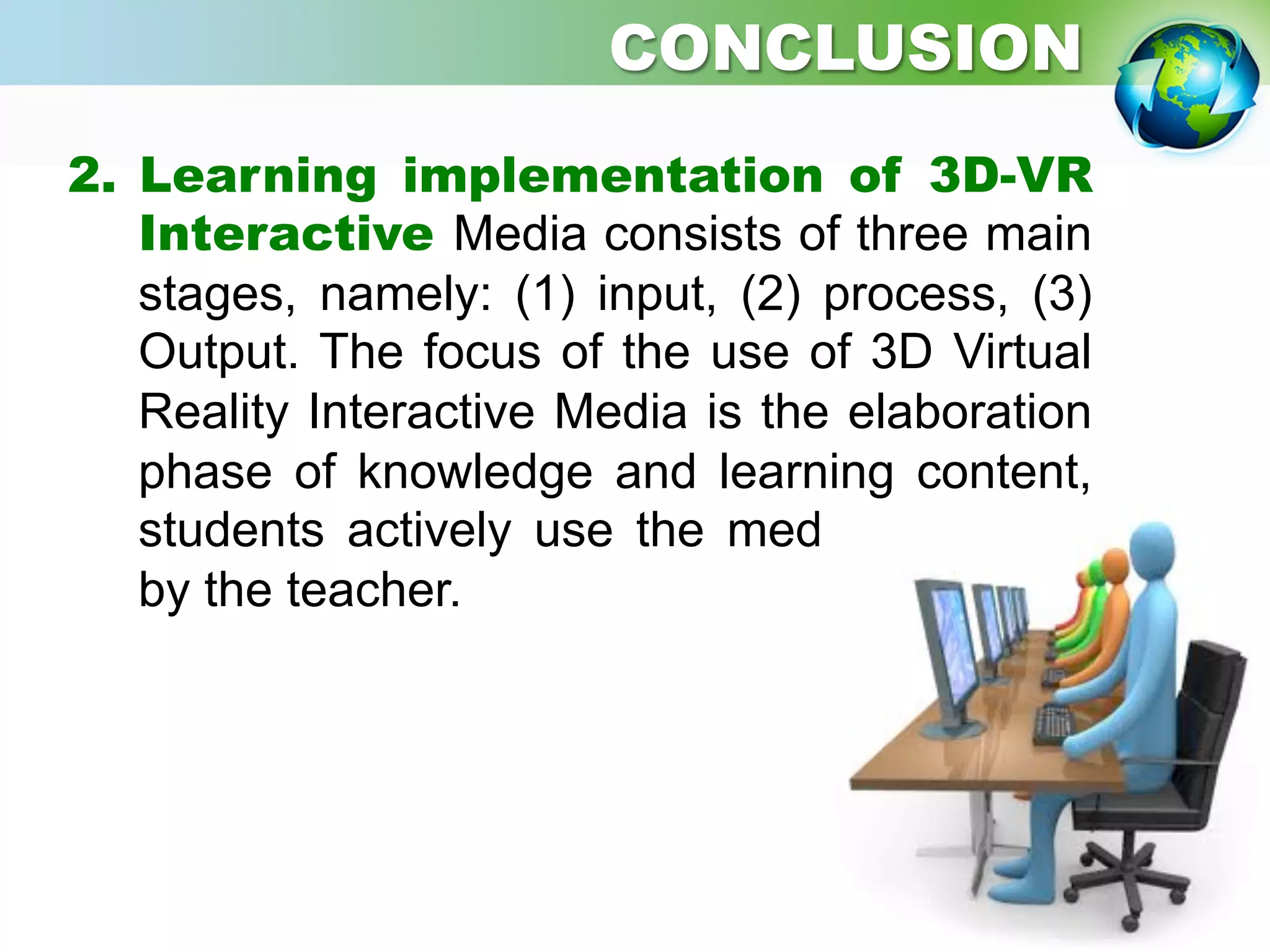
2.  Learning implementation of 3D-VR
Interactive Media consists of three main
stages, namely: (1) input, (2) process, (3)
Output. The focus of the use of 3D Virtual
Reality Interactive Media is the elaboration
phase of knowledge and learning content,
students actively use the media facilitated
by the teacher.
CONCLUSION
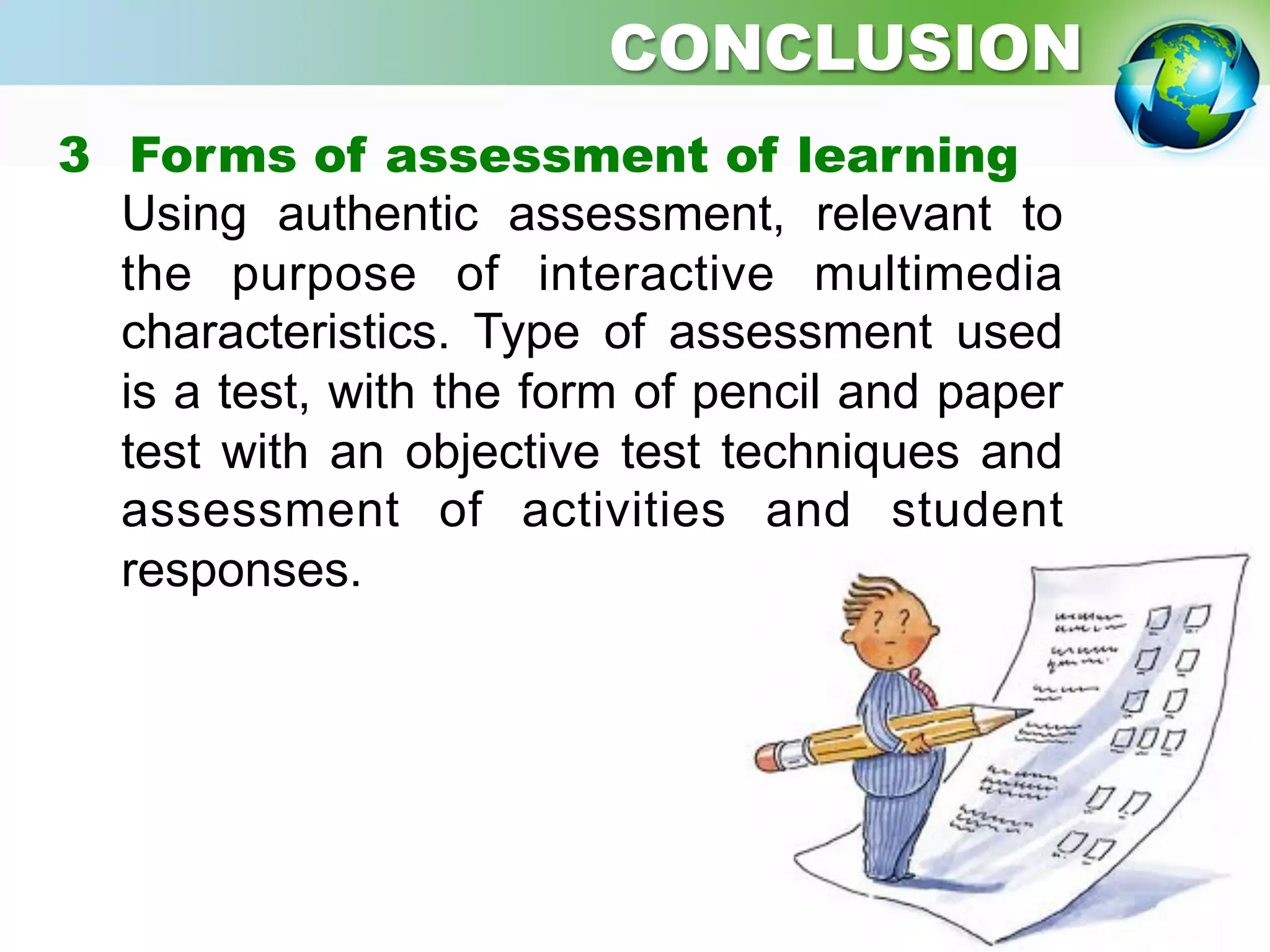
3  Forms of assessment of learning
Using authentic assessment, relevant to
the purpose of interactive multimedia
characteristics. Type of assessment used
is a test, with the form of pencil and paper
test with an objective test techniques and
assessment of activities and student
responses.
CONCLUSION
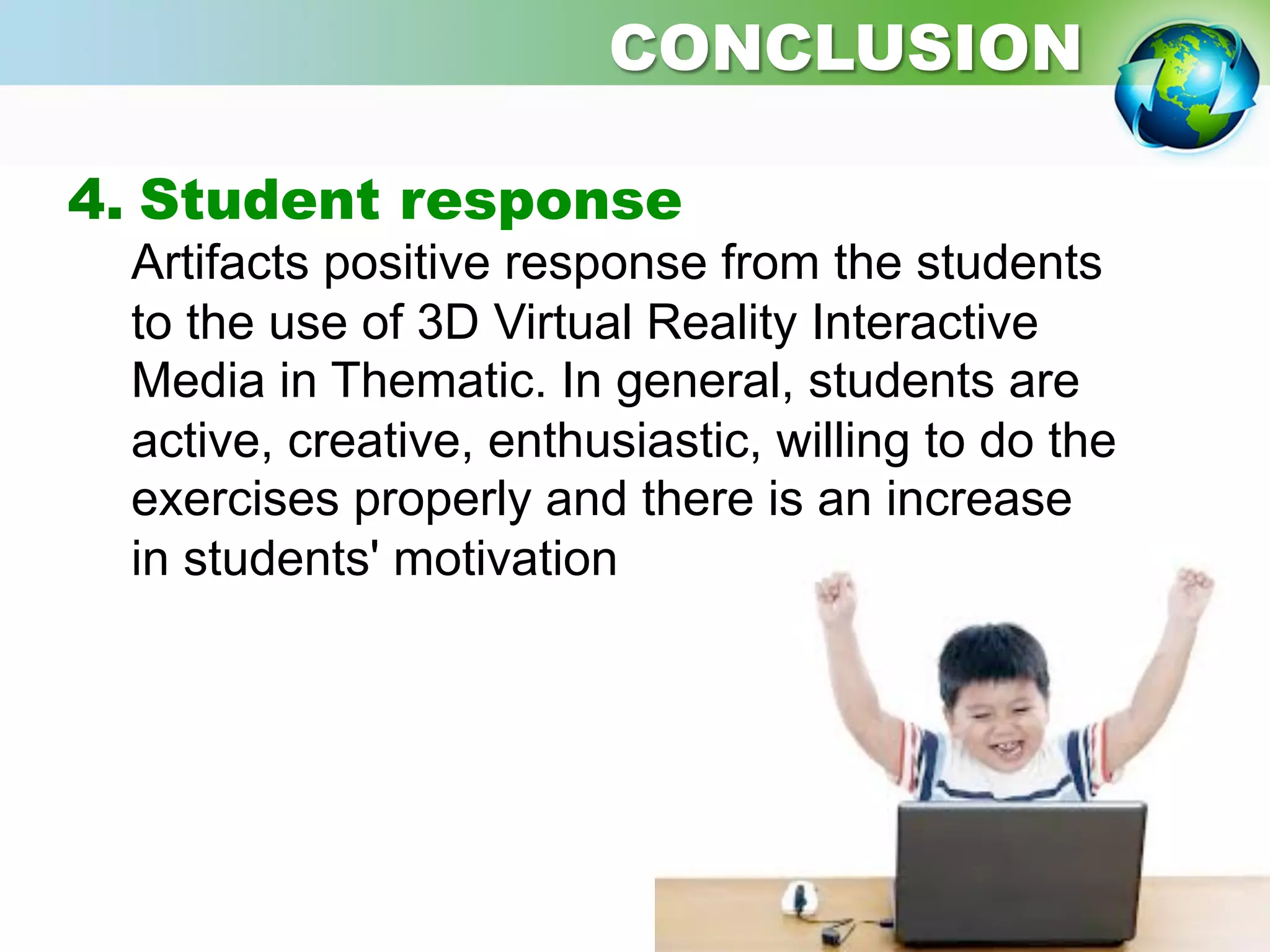
4. Student response
Artifacts positive response from the students
to the use of 3D Virtual Reality Interactive
Media in Thematic. In general, students are
active, creative, enthusiastic, willing to do the
exercises properly and there is an increase
in students' motivation
CONCLUSION
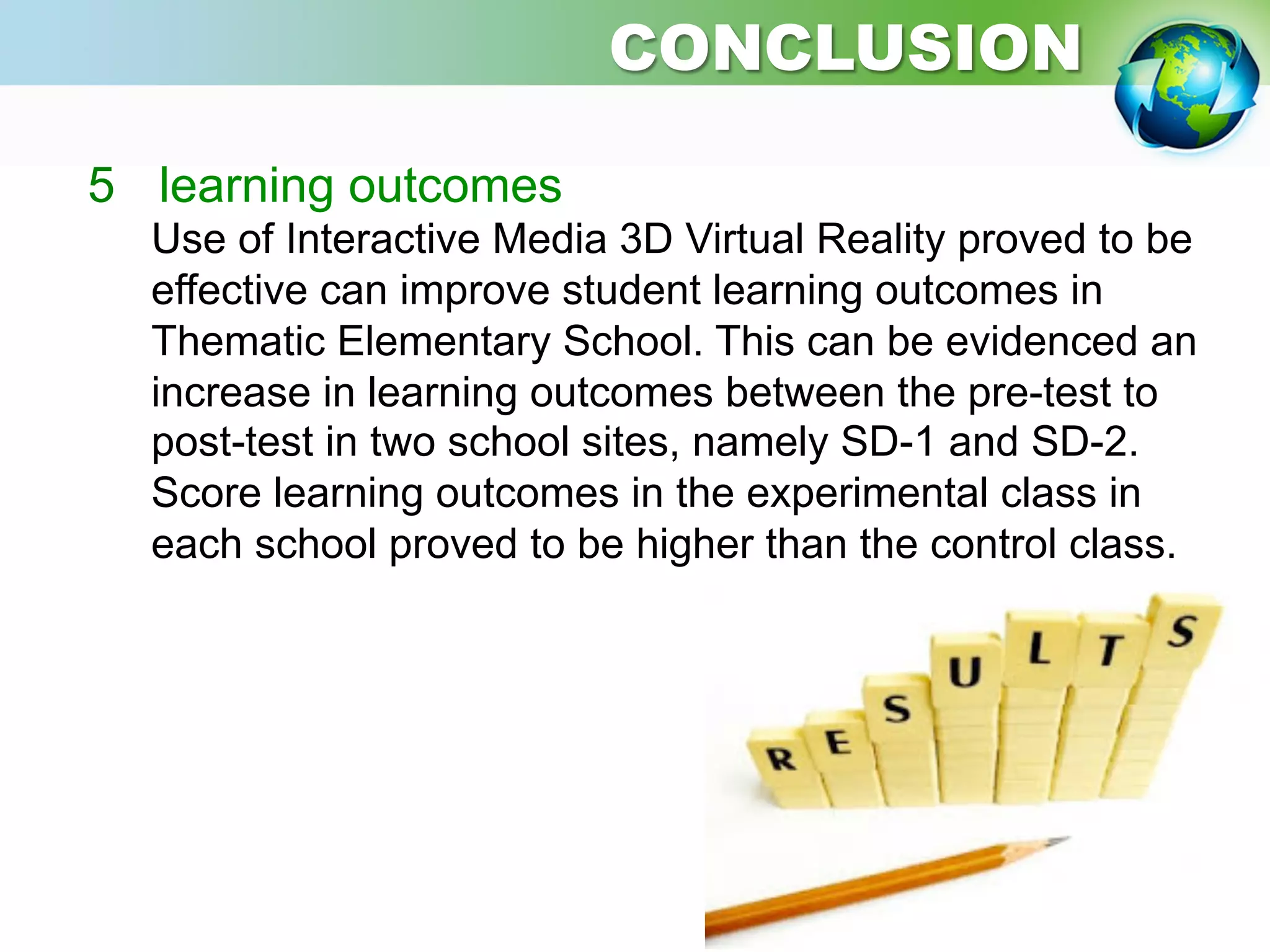
5  learning outcomes
Use of Interactive Media 3D Virtual Reality proved to be
effective can improve student learning outcomes in
Thematic Elementary School. This can be evidenced an
increase in learning outcomes between the pre-test to
post-test in two school sites, namely SD-1 and SD-2.
Score learning outcomes in the experimental class in
each school proved to be higher than the control class.
CONCLUSION
Thank You

RESEARCH ON VIRTUAL REALITY MEDIA

  • 2.
    Innovation Education &Learning Media Education Standards Recommend Quality Learning through: 1.  Contextual 2.  Constructivism 3.  PAKEM 4.  Active Learning 5.  ICT facilitated Common Problems of Education: §  Quality §  Equity §  Accessibility §  The survey United Nations Development Programme (UNDP) and the Political and Economic §  Review Consultancy (PERC) Technology in the future (BSNP 2012) 1.  Nanotechnology 2.  Neuroscience 3.  Virtual Reality 4.  Information Technology 1 2 3 BACKGROUND
  • 3.
    Linkage with ‘ResnstraUPI’ ‘Renstra  UPI  2011-­‐2015’     Visi  :  leading  &  Oustanding   World  Class  Unversity   Research  Based  University   Conducts  research  to  develop  the   theory  and  pracEce  of  educaEon  as   well  as  other  innovaEve  science  and   rooted  in  the  local  wisdom     Developing  integrated   professional  educaEon  of   teachers  in  academic  and   professional  educaEon  for  all   paths  and  levels  of  educaEon   Disseminate  experience  and   innovaEve  findings  in  the   disciplines  of  educaEon,   educaEonal  disciplines,  and   other  disciplines  for  the   beNerment  of  society   2 3 4 51 2 3 Media 3D Animasi Virtual Reality
  • 4.
    PROBLEMS How to develop3D Interactive Media Virtual Reality effective for improving student learning outcomes in elementary school? GENERAL PROBLEM RESEARCH QUESTION 1.  How Virtual Reality Interactive Media Design to improve student learning outcomes in elementary school? 2.  Implementation of learning how to use the Interactive Media Virtual Reality to improve student learning outcomes in elementary school? 3.  What are the forms of learning assessment (assessment of learning) Interactive Media Virtual Reality to improve student learning outcomes in elementary school? 4.  How the students' response to the use of Virtual Reality Interactive Media Thematic learning? 5.  Is Virtual Reality Interactive Media is able to improve student learning outcomes in elementary school?
  • 5.
    RESEARCH GOALS Developing InteractiveMedia 3D Virtual Reality Based OpenSources Blender Developing Model of Learning Implementation Berbas 3D Interactive Media Virtual Reality Based OpenSources Blender Knowing the student and teacher responses to the use of 3D Interactive Media Virtual Reality 1 2 3
  • 6.
    benefits of research Theoretical Developing scienceeducation science with innovative product produced based Visual Imaging Technology Practical Models Media produced a reference school in improving the meaningfulness of learning Institutional Improving the image of the institution (UPI) with products that have intellectual property rights 1 2 3
  • 7.
    Analisasi Needs Learning Content AssessingSK and KD and Indicators in Primary Education Development of Virtual Reality Model Design •  Making GBPM •  writing Flowchart •  Making Storyboard •  Expert Judgment and Validation Model Design Media production, and the Review Draft Model •  Modeling (Asset) •  Recording & Mixing Sound •  Syncronizing •  Programming Product Model Validation & Revision Carried out within the framework of Research and Development (R & D) Dissemination Model Interactive Virtual Reality Socialization model through seminars, and HKI Management and National Journal 2 1 3 4 5 Media Development Procedure 3D Virtual Reality
  • 8.
    The  method  used  Quasi  Experimental  Methods   Subjects  Research:  Elementary  School  Students  in  Bandung  and  Cimahi     Design  Research:   METHODOLOGY Subjects  Research:  Students  of  Primay  School,    Class  IV   Research  LocaEon:   Cimahi    Elementary  School   Bandung  Elementary  School   GROUP   TREATMENT  GROUP   CONTROL  GROUP   DURATION  40  MINUTES   01        X        02   01                02   DURATION  30  MINUTE   01        X        02   01                02  
  • 9.
    1.  Choosing aclass 16 samples at a number of primary schools in the city of Bandung, the fourth grade, which will be grouped into 4 groups, each consisting of 4 classes. 2.  Determination and Control Experiment class 3.  Provide pretest to all students in all groups. 4.  Providing treatment (X) to the experimental group, while the control group was given no treatment. 5.  Provide posttest, both the experimental group and the control group, to measure student learning outcomes after treatment administration. 6.  Perform data analysis using analysis of variance (ANOVA) Factorial two lines, followed by analsisi post-test (post hock analysis) and analysis of practical significance to explore the findings generated. 7.  Doing discussion (discussion of the results of research) and the formulation of conclusions. RESEARCH PROCEDURES
  • 10.
    Model assumptions that affectthe optimization of media Principles of Interactive Multimedia 3D VR Stages of Learning (Substance) End models (Achievement of learning outcomes) Framework Model   RESULTS (1) LEARNING   OUTCOME  
  • 11.
    Framework Learning Model   LEARNING  PROCESS   LEARNING  RECOURCESS   INSTRUCTIONAL  INPUT   INSTRUCTIONAL  OUTPUT   PRA-INSTRCTIONAL CORE-INSTRCTIONAL POST-INSTRCTIONAL EXPLORATION,  ELABORATION  &   CONFIRMATION  OF  MOVIE  3D  VR   ReflexEon,  Conclusion,  Post  Test  &  Followup   InstrucEonal  goals   Content  Learning  Learning  Method  Learning  Content   Learning    EvaluaEon   RESULTS (2)
  • 12.
    1.  Students areenthusiastic in use Interactive Multimedia 3D-VR 2.  Students requesting media play repeatedly (show interest) 3.  Students are willing to try and practice 4.  Emulate the positive fit taught in Multimedia 3D-VR 5.  Multimedia 3D-VR increase student motivation 6.  Students can answer questions with a good teacher, about content taught in Multimedia 3D-VR 7.  Increase students' knowledge 8.  Helping students develop positive character RESULTS (3) Student response to the use of 3D Interactive Multimedia Virtual reality (3D-VR)  
  • 13.
    Nama Sekolah Kelas Rata-Rata Gain SD CIMAHI MANDIRI Pre-TesPost Test EKSPERIMEN 55.13 82.13 27 KONTROL 50.53 68.06 17.53 0   10   20   30   40   50   60   70   80   90   PRE-­‐TES   POST  TEST   GAIN   skor  hasil  belajar  (100)   kategori   EKSPERIMEN   KONTROL   Student Results-1 Elementary School   RESULTS (4) SCHOOL   CLASS   AVERAGE   EXPERIMENT   CONTROL   EXPERIMENT   CONTROL   ELEMENTARY   SCHOOL-­‐1  
  • 14.
    Nama Sekolah Kelas Rata-Rata Gain SD CIMAHIJATAYU BANDUNG Pre-Tes Post Test EKSPERIMEN 53.33 72.26 18.93 KONTROL 50.53 68.06 17.53 0   10   20   30   40   50   60   70   80   PRE-­‐TES   POST  TEST   GAIN   Axis  Title   Axis  Title   EKSPERIMEN   KONTROL   Student Results-2 Elementary School   RESULTS (5) SCHOOL   CLASS   AVERAGE   EXPERIMENT   CONTROL   EXPERIMENT   CONTROL   ELEMENTARY   SCHOOL-­‐2  
  • 15.
    1.  Interactive MultimediaDesign 3D- models of VR consists of four layers of elements, namely: (1) The outermost layer asusmsi optimization model that affect the model, (2) layer model principle (3) layer which contains stages in learning the material (4). Core layer into the core target of the control aspects of student learning outcomes.   CONCLUSION
  • 16.
    2.  Learning implementationof 3D-VR Interactive Media consists of three main stages, namely: (1) input, (2) process, (3) Output. The focus of the use of 3D Virtual Reality Interactive Media is the elaboration phase of knowledge and learning content, students actively use the media facilitated by the teacher. CONCLUSION
  • 17.
    3  Forms ofassessment of learning Using authentic assessment, relevant to the purpose of interactive multimedia characteristics. Type of assessment used is a test, with the form of pencil and paper test with an objective test techniques and assessment of activities and student responses. CONCLUSION
  • 18.
    4. Student response Artifacts positiveresponse from the students to the use of 3D Virtual Reality Interactive Media in Thematic. In general, students are active, creative, enthusiastic, willing to do the exercises properly and there is an increase in students' motivation CONCLUSION
  • 19.
    5  learning outcomes Useof Interactive Media 3D Virtual Reality proved to be effective can improve student learning outcomes in Thematic Elementary School. This can be evidenced an increase in learning outcomes between the pre-test to post-test in two school sites, namely SD-1 and SD-2. Score learning outcomes in the experimental class in each school proved to be higher than the control class. CONCLUSION
  • 20.