DESIGNING DIGITAL BADGES FOR A COLLEGE
COURSE
AECT 2016 • LASVEGAS, NV
Dr.Vanessa Dennen
Professor of Instructional Systems & Learning Technologies, Florida State University
vdennen@fsu.edu @vdennen
Jiyae Bong
Doctoral Candidate in Instructional Systems & Learning Technologies, Florida State University
jb11ab@my.fsu.edu
1
OVERVIEW
Designing digital badges for a college course:
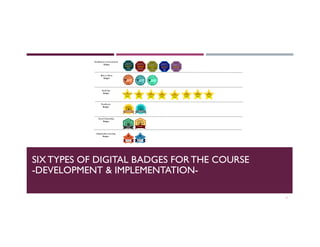
¡  Six different types of badges developed in an undergraduate course on Educational Technology and awarded
through a different process
Topics covered
¡  Course
¡  Design and development process for badges
¡  Implementation of badges
¡  Evaluation focusing on learner attitudes and motivation
2
DIGITAL BADGES
¡  Digital badges have been adopted in higher education contexts as an alternate form of acknowledgement and
assessment
¡  The use of digital badges in higher education settings has potential at multiple levels.
¡  Course level: monitoring individual progress and providing feedback
¡  Program level: supporting the development of competencies across classroom and extracurricular experiences
¡  University level: initiating intra-university collaboration among disciplines
3
ABOUT THE COURSE
¡  Undergraduate educational technology course
¡  3 credit hours, Spring 2016
¡  Offered to pre-service teachers
¡  Multiple sections of the course
¡  A team of instructors following a common syllabus and course design
¡  Teaching strategies: readings & lectures, discussions, demonstrations
¡  Assessments: problem-based projects, skill-based practical tests, and reflective blogs.
¡  Hosting system: Blackboard Learning Management System (built-in badging system)
4
PROJECT RATIONALE AND INITIAL DESIGN
Badges were introduced to this course to motivate students in three ways:
¡  Complete all assignments – even small ones – thoroughly and on time
¡  Be actively engaged in the class community, helping and providing feedback to each other
¡  Engage in independent, extracurricular learning related to the course topic
The first iteration of the badge system was designed and implemented in Spring 2015.
The system continued to be refined based on feedback from students and instructors.
5
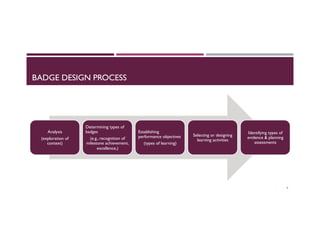
BADGE DESIGN PROCESS
Analysis
(exploration of
context)
Determining types of
badges
(e.g., recognition of
milestone achievement,
excellence,)
Establishing
performance objectives
(types of learning)
Selecting or designing
learning activities
Identifying types of
evidence & planning
assessments
6
SIX TYPES OF DIGITAL BADGES FOR THE COURSE
-DEVELOPMENT & IMPLEMENTATION-
7
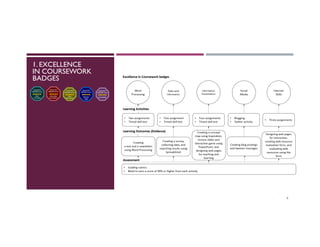
1. EXCELLENCE
IN COURSEWORK
BADGES
8
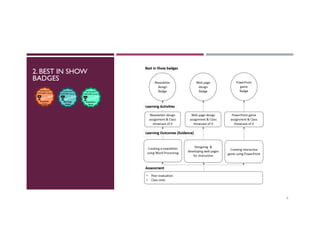
2. BEST IN SHOW
BADGES
9
3. GOLD STAR BADGES
10
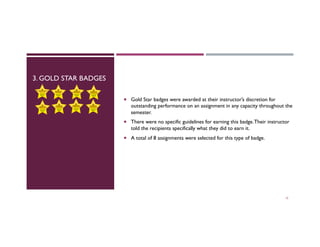
¡  Gold Star badges were awarded at their instructor’s discretion for
outstanding performance on an assignment in any capacity throughout the
semester.
¡  There were no specific guidelines for earning this badge.Their instructor
told the recipients specifically what they did to earn it.
¡  A total of 8 assignments were selected for this type of badge.
4. EXCELLENCE
BADGES
11
¡  Excellence badges were awarded to the students who show the best
performance on the selected assignments (Gold Star badges).
¡  Students who earned Gold Star badges could only choose if they want to
share their work and participate in the process to earn the Excellence
badge.
¡  Instructors provided feedback on their Gold Star work and students
could revise before submitting to the Excellence badge committee (all
course instructors).
¡  The committee chose the best one to award the Excellence Badge.
¡  The recipients' work was shared with the other students and used as an
example for future classes.
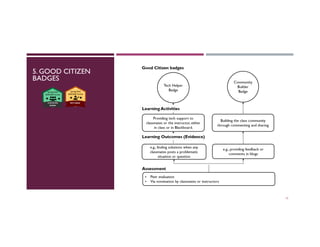
5. GOOD CITIZEN
BADGES
12
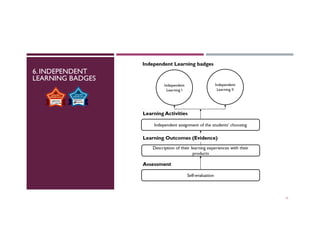
6. INDEPENDENT
LEARNING BADGES
13
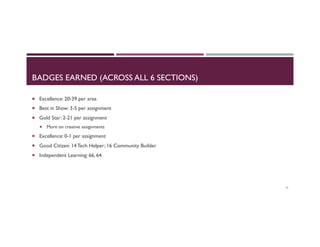
BADGES EARNED (ACROSS ALL 6 SECTIONS)
¡  Excellence: 20-39 per area
¡  Best in Show: 3-5 per assignment
¡  Gold Star: 2-21 per assignment
¡  More on creative assignments
¡  Excellence: 0-1 per assignment
¡  Good Citizen: 14 Tech Helper; 16 Community Builder
¡  Independent Learning: 66, 64
14
EVALUATION
FOCUSING ON LEARNER ATTITUDES AND MOTIVATION
15
Survey
Participants: n=59
•  N=49, 83.1%: Education major
•  N=52, 88.1%: First or second year in school
•  N=55, 93.2%: Female
•  N=55, 93.2%: not familiar with the concept of digital badges
•  N=56, 94.9%: no digital badges earned in any context
SURVEY RESULTS – PART I
FOCUSING ON LEARNER ATTITUDES AND MOTIVATION
16
Attitudes towards the use of digital badges
ATTITUDE TOWARDS THE USE OF DIGITAL BADGES
17
¡  Overall, the reactions towards the badges were mixed.
¡  “Badges are a great way to reward someone on a project they worked really hard on.” (Student
A)
¡  “It would probably be more useful for younger children who need rewards for their work other
than a grade.” (Student B)
ATTITUDE TOWARDS THE USE OF DIGITAL BADGES (N=59)
¡  A subset of students had positive attitudes toward badges
¡  Personally meaningful (47.5%)
¡  Motivational (33.7%)
¡  Generate pride (56.0%)
¡  Increase satisfaction in coursework (55.9%)
¡  Some students reported they would undertake actions for badges:
¡  Devote more time to work (44.1%)
¡  More likely to complete work (20.3%)
¡  Do extra work (16.9%)
¡  Others are a balance of neutral and disagreement with the positive attitudes / extra actions
18
SURVEY RESULTS – PART II
FOCUSING ON LEARNER ATTITUDES AND MOTIVATION
19
Attitudes towards the use of each type of badges
EXCELLENCE IN COURSEWORK BADGES
¡  Incentive for 30.5% of students to complete work at a high level and submit it on time
¡  25.6% students reported being unaware of these badges
¡  39% felt they were redundant with the grades they already earn
20
SUBJECTIVE BADGES:
BEST IN SHOW, GOLD STAR, EXCELLENCE
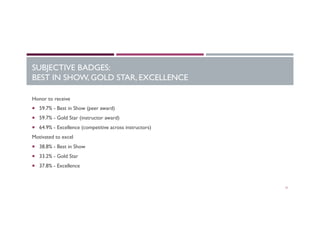
Honor to receive
¡  59.7% - Best in Show (peer award)
¡  59.7% - Gold Star (instructor award)
¡  64.9% - Excellence (competitive across instructors)
Motivated to excel
¡  38.8% - Best in Show
¡  33.2% - Gold Star
¡  37.8% - Excellence
21
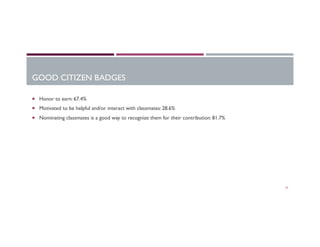
GOOD CITIZEN BADGES
¡  Honor to earn: 67.4%
¡  Motivated to be helpful and/or interact with classmates: 28.6%
¡  Nominating classmates is a good way to recognize them for their contribution: 81.7%
22
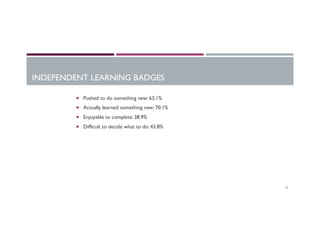
INDEPENDENT LEARNING BADGES
¡  Pushed to do something new: 63.1%
¡  Actually learned something new: 70.1%
¡  Enjoyable to complete: 38.9%
¡  Difficult to decide what to do: 43.8%
23
DISCUSSION
¡  Our badge system worked as an add-on to the current grading system.
¡  The badge systems could be differently designed and used with diverse approaches within the particular context.
¡  The badge system can also be used to solve instructional issues based on different instructors’ intentions, within
the particular context.
Practical issues we had:
¡  New workload associated with badges.
¡  Cultural change from a course-based system to an integrated course and competency-based system.
¡  Traditional assessment system can conflict with the badge system.
¡  A more thorough facilitation was needed.
24
CONCLUSION
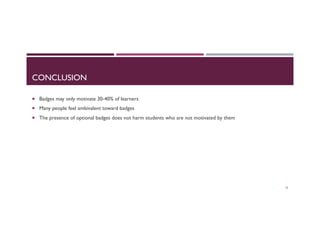
¡  Badges may only motivate 30-40% of learners
¡  Many people feel ambivalent toward badges
¡  The presence of optional badges does not harm students who are not motivated by them
25
THANKYOU! ANY QUESTIONS?
Contact:
Vanessa Dennen - vdennen@fsu.edu - @vdennen
Jiyae Bong – jb11ab@my.fsu.edu
26

Designing digital badges for a college course

  • 1.
    DESIGNING DIGITAL BADGESFOR A COLLEGE COURSE AECT 2016 • LASVEGAS, NV Dr.Vanessa Dennen Professor of Instructional Systems & Learning Technologies, Florida State University vdennen@fsu.edu @vdennen Jiyae Bong Doctoral Candidate in Instructional Systems & Learning Technologies, Florida State University jb11ab@my.fsu.edu 1
  • 2.
    OVERVIEW Designing digital badgesfor a college course: ¡  Six different types of badges developed in an undergraduate course on Educational Technology and awarded through a different process Topics covered ¡  Course ¡  Design and development process for badges ¡  Implementation of badges ¡  Evaluation focusing on learner attitudes and motivation 2
  • 3.
    DIGITAL BADGES ¡  Digitalbadges have been adopted in higher education contexts as an alternate form of acknowledgement and assessment ¡  The use of digital badges in higher education settings has potential at multiple levels. ¡  Course level: monitoring individual progress and providing feedback ¡  Program level: supporting the development of competencies across classroom and extracurricular experiences ¡  University level: initiating intra-university collaboration among disciplines 3
  • 4.
    ABOUT THE COURSE ¡ Undergraduate educational technology course ¡  3 credit hours, Spring 2016 ¡  Offered to pre-service teachers ¡  Multiple sections of the course ¡  A team of instructors following a common syllabus and course design ¡  Teaching strategies: readings & lectures, discussions, demonstrations ¡  Assessments: problem-based projects, skill-based practical tests, and reflective blogs. ¡  Hosting system: Blackboard Learning Management System (built-in badging system) 4
  • 5.
    PROJECT RATIONALE ANDINITIAL DESIGN Badges were introduced to this course to motivate students in three ways: ¡  Complete all assignments – even small ones – thoroughly and on time ¡  Be actively engaged in the class community, helping and providing feedback to each other ¡  Engage in independent, extracurricular learning related to the course topic The first iteration of the badge system was designed and implemented in Spring 2015. The system continued to be refined based on feedback from students and instructors. 5
  • 6.
    BADGE DESIGN PROCESS Analysis (explorationof context) Determining types of badges (e.g., recognition of milestone achievement, excellence,) Establishing performance objectives (types of learning) Selecting or designing learning activities Identifying types of evidence & planning assessments 6
  • 7.
    SIX TYPES OFDIGITAL BADGES FOR THE COURSE -DEVELOPMENT & IMPLEMENTATION- 7
  • 8.
  • 9.
    2. BEST INSHOW BADGES 9
  • 10.
    3. GOLD STARBADGES 10 ¡  Gold Star badges were awarded at their instructor’s discretion for outstanding performance on an assignment in any capacity throughout the semester. ¡  There were no specific guidelines for earning this badge.Their instructor told the recipients specifically what they did to earn it. ¡  A total of 8 assignments were selected for this type of badge.
  • 11.
    4. EXCELLENCE BADGES 11 ¡  Excellencebadges were awarded to the students who show the best performance on the selected assignments (Gold Star badges). ¡  Students who earned Gold Star badges could only choose if they want to share their work and participate in the process to earn the Excellence badge. ¡  Instructors provided feedback on their Gold Star work and students could revise before submitting to the Excellence badge committee (all course instructors). ¡  The committee chose the best one to award the Excellence Badge. ¡  The recipients' work was shared with the other students and used as an example for future classes.
  • 12.
  • 13.
  • 14.
    BADGES EARNED (ACROSSALL 6 SECTIONS) ¡  Excellence: 20-39 per area ¡  Best in Show: 3-5 per assignment ¡  Gold Star: 2-21 per assignment ¡  More on creative assignments ¡  Excellence: 0-1 per assignment ¡  Good Citizen: 14 Tech Helper; 16 Community Builder ¡  Independent Learning: 66, 64 14
  • 15.
    EVALUATION FOCUSING ON LEARNERATTITUDES AND MOTIVATION 15 Survey Participants: n=59 •  N=49, 83.1%: Education major •  N=52, 88.1%: First or second year in school •  N=55, 93.2%: Female •  N=55, 93.2%: not familiar with the concept of digital badges •  N=56, 94.9%: no digital badges earned in any context
  • 16.
    SURVEY RESULTS –PART I FOCUSING ON LEARNER ATTITUDES AND MOTIVATION 16 Attitudes towards the use of digital badges
  • 17.
    ATTITUDE TOWARDS THEUSE OF DIGITAL BADGES 17 ¡  Overall, the reactions towards the badges were mixed. ¡  “Badges are a great way to reward someone on a project they worked really hard on.” (Student A) ¡  “It would probably be more useful for younger children who need rewards for their work other than a grade.” (Student B)
  • 18.
    ATTITUDE TOWARDS THEUSE OF DIGITAL BADGES (N=59) ¡  A subset of students had positive attitudes toward badges ¡  Personally meaningful (47.5%) ¡  Motivational (33.7%) ¡  Generate pride (56.0%) ¡  Increase satisfaction in coursework (55.9%) ¡  Some students reported they would undertake actions for badges: ¡  Devote more time to work (44.1%) ¡  More likely to complete work (20.3%) ¡  Do extra work (16.9%) ¡  Others are a balance of neutral and disagreement with the positive attitudes / extra actions 18
  • 19.
    SURVEY RESULTS –PART II FOCUSING ON LEARNER ATTITUDES AND MOTIVATION 19 Attitudes towards the use of each type of badges
  • 20.
    EXCELLENCE IN COURSEWORKBADGES ¡  Incentive for 30.5% of students to complete work at a high level and submit it on time ¡  25.6% students reported being unaware of these badges ¡  39% felt they were redundant with the grades they already earn 20
  • 21.
    SUBJECTIVE BADGES: BEST INSHOW, GOLD STAR, EXCELLENCE Honor to receive ¡  59.7% - Best in Show (peer award) ¡  59.7% - Gold Star (instructor award) ¡  64.9% - Excellence (competitive across instructors) Motivated to excel ¡  38.8% - Best in Show ¡  33.2% - Gold Star ¡  37.8% - Excellence 21
  • 22.
    GOOD CITIZEN BADGES ¡ Honor to earn: 67.4% ¡  Motivated to be helpful and/or interact with classmates: 28.6% ¡  Nominating classmates is a good way to recognize them for their contribution: 81.7% 22
  • 23.
    INDEPENDENT LEARNING BADGES ¡ Pushed to do something new: 63.1% ¡  Actually learned something new: 70.1% ¡  Enjoyable to complete: 38.9% ¡  Difficult to decide what to do: 43.8% 23
  • 24.
    DISCUSSION ¡  Our badgesystem worked as an add-on to the current grading system. ¡  The badge systems could be differently designed and used with diverse approaches within the particular context. ¡  The badge system can also be used to solve instructional issues based on different instructors’ intentions, within the particular context. Practical issues we had: ¡  New workload associated with badges. ¡  Cultural change from a course-based system to an integrated course and competency-based system. ¡  Traditional assessment system can conflict with the badge system. ¡  A more thorough facilitation was needed. 24
  • 25.
    CONCLUSION ¡  Badges mayonly motivate 30-40% of learners ¡  Many people feel ambivalent toward badges ¡  The presence of optional badges does not harm students who are not motivated by them 25
  • 26.
    THANKYOU! ANY QUESTIONS? Contact: VanessaDennen - vdennen@fsu.edu - @vdennen Jiyae Bong – jb11ab@my.fsu.edu 26